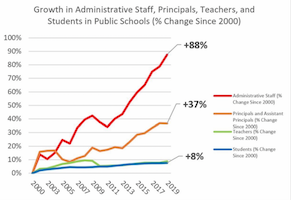
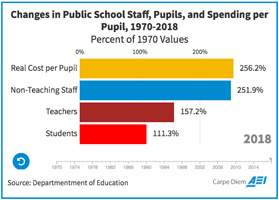
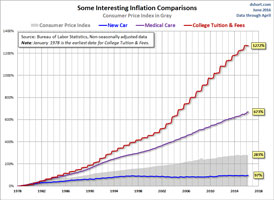
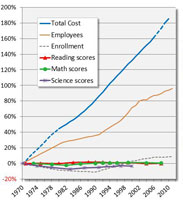
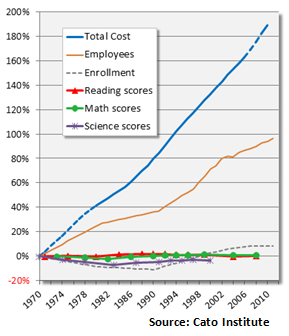
Federal, state and local governments spent a total of $786.8 billion on education in
2006.* If
private schools performed as poorly as most public schools -- at these prices -- they would go
out of business! Where else does the price go up and the quality of the end product go down,
year after year, except in a government-controlled monopoly like this?
Please note that in some of these articles, the word "student" is used to designate anyone who
is enrolled in an educational institution. But secondary school pupils are not necessarily
studious. Those who attend reluctantly are probably not learning. I speak from experience.
Stop
Pretending That Colleges Are Nonprofit Institutions. Here's a recent story from the
Chicago Tribune that jumped off the page when I read it. Northwestern University is finishing
up the construction of a new $800 million football stadium. This is supposedly a
nonprofit "educational" entity. [Advertisement] Uh-huh. Northwestern —
an "institution of higher learning" located outside of Chicago — is flush with
cash. It has an endowment of nearly $15 billion, and the tax-free donations keep flowing
in. Almost all the $800 million — which rivals the cost of professional
sports arenas with luxury skyboxes and opulent decor — for the lavish Taj Mahal football
stadium on the shores of Lake Michigan was donated to the school with tax-deductible dollars.
About half the money came from multibillionaire Pat Ryan. [...] Meanwhile, universities are now
paying star football players millions of dollars thanks to the new "portal" rules. Many
basketball and football athletes are now selling their passing, tackling and dunking skills each
year to the highest bidder. They can often make more money playing for the old U than if they
played in professional leagues like the NFL or NBA. This is pay-to-play athletics.
Healing
without Accountability at Brown. Why does Brown still employ a VP of DEI, why was he
put in charge of a healing initiative for the 12/13 campus killings, and why did he get plastic
surgery at age 13? Brown University President Christina Paxson wants to focus on healing, not
accountability for the December 13 killings on her campus. On January 5, she
announced a "Healing and Recovery Effort" called "Ever True". She appointed Vice President of
Diversity & Inclusion Matthew Guterl (he/him) to lead the initiative. Her full e-mail and his
biography are [...] predictable and tiresome word salads of demoralization. There can be no
healing without accountability. This is a deliberate DARVO strategy to control the
narrative. The goal is to absolve the administration's responsibility in the deaths of Ella
Cook and Mukhammad Aziz Umurzokov.
New
Jersey School District Cannot Account for $20 Million in Missing Funds. The
Montclair Public School District in New Jersey cannot account for $20 million in missing
funds. To make matters worse, local officials project a $25 million deficit "over the
next four years." The crisis came to light in September when Montclair Township said it couldn't
help the school district with the $20 million deficit. Township Manager Stephen D.
Marks said, "We are not the federal government, and we cannot print money." How did that
happen? The school district admitted the deficit "is due to years of unbudgeted for
spending." "The deficit is the result of money that was spent and was not budgeted, and it
appears to me that it's been occurring over a couple of years," said Interim School Business
Administrator Dana Sullivan, as reported by Montclair Local. "It's all coming crashing
down." In other words, Montclair spent money it did not have.
Minneapolis
Students Told They Can Stay Home Into Feb: Report. Minneapolis Public Schools
(MPS) will give students the option of learning from home through February 12 following the
fatal shooting of Renee Nicole Good by an ICE agent, according to local media citing the president
of a teachers union. The school district, which has an enrolment of about 29,000 students,
had previously said there would be no classes for the rest of the week "due to safety concerns"
after Wednesday's shooting. According to Fox 9, Marcia Howard, the president of the
Minneapolis Federation of Educators (MFE), wrote on Facebook that students will be given the option
to learn from home through February 12. According to KSTP Eyewitness News, on Wednesday, the
district said e-learning is only allowable for severe weather. MPS is yet to comment.
An
Open Letter to the Brown University Board of Trustees. One month ago on
December 13, Brown students Ella Cook and Mukhammad Aziz Umurzakov were killed at a final exam
review session on campus. Two days later on December 15, the same man who took their
lives murdered MIT Professor Nuno Loureiro at his home in Massachusetts. President Christina
Paxson failed them as a leader — will you hold her accountable as stewards? The President and
Corporation's most important duty is to keep Brown's campus secure for the community. Brown
has a $8 billion endowment, $2 billion annual budget, and 1,000+ surveillance cameras
funded by charging students $80,000/year in tuition. Paxson earns a $3 million salary
while employing ~4,000 administrators and ~100 public safety officers. Yet for five harrowing
days, the Brown administration could not give the public any helpful descriptions of the suspect's
appearance, whereabouts, or clear video and photo footage. Regardless of what you discover in
your after-action report, the world has witnessed institutional level failure at Brown. The
publicly known facts are embarrassing. In the weeks leading up to the attack, a janitor
alerted campus security multiple times about the suspect. He was ignored and no precautions
were taken. Two Brown police unions issued votes of no confidence against the police chief in
August and October, yet nothing changed.
Woke
Colleges and Universities Are Being Forced to Trim the Fat and Slash Thousands of Jobs.
Woke colleges and universities across the country are being forced to do with less and are slashing
thousands of jobs. This is a good thing. Higher education in America has become fat and
bloated. At some schools, there are almost as many administrators as there are
students. And people still wonder why tuition has gone up so much in recent decades.
There is no need for an 'assistant vice president of campus diversity' yet many schools have
them. Maybe they should start cutting those positions first.
Waste
of the Day: Superintendent Resigns, Nets Over $900K. A Long Island school
district must pay its superintendent over $907,500 after he resigned without a public explanation
this September, according to records obtained by Newsday through a Freedom of Information Law
request. The Plainedge Union Free School District paid Edward Salina a $662,352 lump sum for
184 unused sick and personal days and 286.5 unused vacation days. The district will also pay
the remaining $245,185 of Salina's salary for the 2025-26 school year. The salary is paid in
bi-weekly installments, which will end if Salina takes a job at another school, Newsday
reported. Salina's contract gave him 35 vacation days, 14 sick days and three personal days
per year. Unused days were carried over to the next year with no limit.
Lee
Zeldin hits the brakes on $2.3B for Biden's green school buses — threatening Hochul's EV
mandate in New York. Environmental Protection Agency Administrator Lee Zeldin is
hitting the brakes on $2.3 billion left in spending from the Biden administration's electric
school bus program — following backlash over New York Gov. Kathy Hochul's mandate
and as the vehicles have been breaking down in the cold and failing to be produced in a timely
manner to districts. Zeldin made the decision to review the taxpayer-funded program after
$2.7 billion was already "frivolously wasted" under former President Joe Biden on thousands of
electric buses, according to an agency spokesperson, working out to a price tag of roughly
$318,452.45 per vehicle to produce. In New York City, for example, more than $61 million
in EPA grant funding went toward just two entities making 180 of the "green" buses for five school
districts, with a cost range of $295,000 to nearly $395,000 for each one — but it's
unclear how many are even in use. Just 150 buses are on the road now in New York, according
to a spokesperson from the New York State Energy Research and Development Authority, after more
than $210 million in taxpayer funds were spent.
New
York Parents Furious as State-Mandated Electric Buses Leave Kids Without Heat in Frigid
Temperatures. Just a day after car manufacturing giant Ford Motors announced that it
was eating a sizable $19.5 billion bullet for putting too many of its eggs into the EV basket,
a WIVB-TV report is pouring even more cold water on the left's EV craze. As New York shifts
to meet a new statewide mandate requiring all purchased school buses to be electric, parents have
already identified a significant issue — especially in the rather chilly Empire
State. According to WIVB, parents "in the Lake Shore Central School District are speaking
out, claiming some bus drivers are turning the heat down, or off completely, in an attempt to
conserve battery life on their electric school buses." The report adds: "The kids are
coming home saying their bus is freezing cold and the parents are giving them hand warmers."
FAFSA
Mandates: Federal Overreach Masquerading as Help for Students. Across the
country, lawmakers are quietly advancing a new front in federal control over education by mandating
that high-school seniors complete the Free Application for Federal Student Aid (FAFSA) as a
condition of graduation. Under the guise of "helping students afford college," states such as
Oklahoma and Pennsylvania have pushed legislation compelling families to disclose sensitive
financial information to the federal government. Other states, such as Alabama, California,
Connecticut, Illinois, Indiana, Kansas, Maryland, Nebraska, New Jersey, New York, and Texas have
similar laws on the books, but Louisiana and New Hampshire have repealed such laws. These
measures — Oklahoma's Senate Bill 93 (SB93) and Pennsylvania's Senate Bills 750 and 310
(SB750 and SB310), which are included in The New American's state Legislative
Scorecards — may sound benign, but they warrant serious scrutiny. Each contains a
nominal "opt-out" provision; however, the underlying principle remains unchanged: government
coercion in personal financial decisions and deeper federal entanglement in local education.
Electric
School Bus Bursts Into Flames In LA. An electric school bus burst into flames in Los
Angeles on Wednesday morning, according to news coverage. The Los Angeles Fire Department
(LAFD) said that the vehicle fire was reported at about 9:20 a.m. at 11460 W. Foothill Blvd.,
which is located directly underneath the 210 Freeway overpass in the San Fernando Valley, KTLA
reported. There were no children on board the bus when the fire occurred, the outlet
reported, citing LAFD officials. The school bus' driver, whose age and sex have yet to be
released publicly, was later hospitalized due to minor smoke inhalation, according to KTLA. The
cause of the fire is presently unknown, and no firefighters were reported as being injured,
according to the outlet.
Is
the Imminent Closure of 50 Universities Really Such a Bad Thing? The Guardian
reports that, in the next two or three years, 50 "higher education providers" — 24 of
them within a year — could (just like the providers of other goods-and-services) close
down or, as Sally Weale, its education correspondent puts it, "risk exiting the market". [...]
Perhaps we should ask what connection there is between having a degree and being educated. I
mean, is it possible to have a degree and the kind of job that goes with it, perhaps a good
position in a famous old national newspaper, even maybe its correspondent for education, and still
be (let's call it) under-educated?
U.S.
colleges are rapidly losing relevance, and students need to examine their options. A
stunning new report from the University of California, San Diego, reveals that incoming college
students are less prepared for their classes than ever. The steep decline in academic
readiness among its first-year students is particularly noticeable in mathematics. The UCSD
paper shows that between 2020 and 2025, the number of students with math skills below high school
level increased nearly thirtyfold. Additionally, 70% of these students are below the middle
school level. The decline is attributed to the COVID shutdown, the elimination of
standardized testing, and grade inflation, all of which have resulted in an incoming class that is
less prepared for the rigor expected at UCSD.
Examination
of CPS Overnight Travel Spending. A series of reports by the CPS Office of Inspector
General found questionable, excessive and even exorbitant post-pandemic travel spending by CPS
employees and a broken travel expense process that opened the door to travel abuses. Given
its findings, the OIG recommended a series of travel reforms to save CPS resources and instill
accountability. Fueled in part by federal pandemic relief money, CPS travel expenditures that
included such items as airfare and lodging more than doubled between Fiscal Year 2019 (the last
full pre-Covid school year) and Fiscal Year 2024 (the most recent post-pandemic school year
analyzed by the CPS OIG), as indicated in Chart 1. FY 2023 and FY 2024 alone produced,
conservatively, more than $14.5 million in travel expenditures, mostly for out-of-town
employee professional development seminars or overnight student outings, an analysis by the OIG's
Performance Analysis Unit estimated. Severely deficient CPS travel expense procedures
contributed to this tab, two OIG investigations and an OIG performance review into districtwide
travel procedures showed. Over and over, CPS employees booked trips using CPS funds without
required pre-approvals, exceeded CPS spending limits on hotel rooms and airfare, and enjoyed
out-of-town activities of dubious necessity or value to students — all as CPS drew
closer and closer to a budget crisis.
Chicago
Public Schools Spent Millions on Travel as Students Fall Under Expectations.
[Scroll down] One principal went to Las Vegas numerous times "to attend a professional
development conference without CPS approval." The principal and his wife spent over $400 a
night on hotel rooms, not at the conference site. They arrived two days before the conference
started. Get this. The same conference took place in Chicago. Hardly any
employees attended THAT conference. Another teacher spent $4,700 on a luxury seven-day trip
to Hawaii for a four-day seminar.
The
Jobs Americans Won't Do? Try: The Skills Young Americans Weren't Taught.
[Scroll down] The truth is brutal: We didn't just lose workers. We lost a
generation of training. Kids stopped working. Old pros retired with no
apprentices. And the entire ladder of skill transfer, the thing that turns kids into
competent working adults, collapsed. Even if every illegal worker disappeared tomorrow, the
skills wouldn't magically reappear. You can't fill a gap with people who were never trained
to climb into it. This is where the conversation really begins.
Report
Reveals Chicago Public School Staff Expensing Pricey Trips. For most teachers, they
enter the profession not as a job, but as a calling. They love kids and want to be part of
educating the next generation. They certainly don't do it for the money. Those who are
not teachers but support staff also do what they do because they believe that education will take
students wherever they want to go in life. Millions of taxpayer dollars go toward public
education. Are those dollars being spent wisely? In one major city, that answer is most
likely "no." [Advertisement] [Tweet] On Wednesday, the Office of the Inspector
General (OIG) for Chicago Public Schools (CPS) released an eye-opening report on travel expenses
for the school district. The words used to describe the expenses detailed in the report were
"questionable, excessive and even exorbitant." But even more eye-opening might be the time
period in which many of these expenses took place. Between 2019 and 2024, charges for things
like airfare and hotels jumped from $3.6 million before the pandemic to a whopping
$7.7 million. The report concludes that the spending spree was partially funded with
pandemic relief money.
Why
Are Things Unaffordable? In the 1960s, tuition costs were a reasonable expense.
The best and brightest pursued advanced degrees and had good-paying high-skilled jobs available
upon graduation. Government-backed loans were buffeted by a competitive "private loan"
market. [...] Private lenders (prior to 2010) would lend money based on a risk model, where student
loans could be obtained with the lender determining their degree of risk associated with
repayment. It didn't serve their interest to make loans to a large swath of students that
might likely not repay the loan. Tuition was mostly held in check, as students and lenders
evaluated the cost-benefit analysis of higher education. Universities couldn't raise tuitions
beyond what "the perceived market" for return on investment would support. Eliminating
the private lending market placed government as the sole provider of student loans. The
government abandoned risk-benefit analysis and effectively provided loans to anyone and everyone
who wanted to attend university. This act ballooned the number of people (qualified and
unqualified) who obtained government-backed student loans and removed the "market" pressure on
tuitions, causing tuition rates to rise exponentially.
Mamdani's
Win Provides Still More Evidence That College Makes You Stupid. Anyone wondering
about the value of a college education these days should look at the exit polls out of New York
City. Because they show quite clearly that the more time you spend in college, the more
ignorant you become. Among other things, the exit polls show that Zohran Mamdani's victory
came entirely because of the support he got from those who were college educated — 57%
of whom voted for the inexperienced radical socialist immigrant born with a silver spoon in his
mouth. Just 42% of those without a college education were foolish enough to want this
wrecking ball running their city. What's even more interesting is that the more time spent in
school, the higher the support for Mamdani. Just 40% of high school graduates voted for him,
compared with 41% of those who dropped out of college, 46% of those with an associate's degree, and
57% of those with a bachelor's or better.
Bust
the Public School Monopoly. If teachers' unions and school superintendents believed
that their primary responsibility is to educate young minds, then they would hang their heads in
shame and desperately seek solutions. But it seems clear that modern-day school
administrators have no interest in helping the youngest members of society learn how to think
critically. They are interested in the number of tax dollars they receive for each name on an
enrollment sheet. Whether those names belong to bodies that will actually sit in chairs in
functioning classrooms is irrelevant to those who treat "education" as a business. If
"students" show up long enough to be counted, and if those counts are sufficiently large enough to
justify increased school budgets, then it doesn't matter whether anything is taught or
learned. If those numbers need a little padding, then Democrat officials can flood the local
schools with illegal aliens. There's a reason teachers' unions love open borders and mass
migration: Like other human-traffickers, they make big money by aiding and abetting criminal activity.
Rhode
Island school imposes $117,130.50 fee to see teacher curriculum. It seems Rhode
Island's Barrington Public Schools want $117,130.50 to show parents what a teacher was
teaching. That's right, a curriculum (or syllabus, if you prefer) is a few pieces of paper or
just an online link. A teacher's curriculum or syllabus enables parents to know what their
kids are being taught. It is transparency 101.
Ten
Million Dukes. There are plenty of Americans who hate homeschooling so much, they are
eager to forbid by law the kind of thing that made the young Thomas Edison a genius on the run, and
of course they would exercise that tyranny with high-toned slogans on their lips. How much
will you wager that most of those who would subject all children to the public schools (for there
are some who oppose private schooling to boot) are in sympathy with "No Kings"? If Donald
Trump did nothing else than to take a sledgehammer to the Department of Education, that pit of
uselessness and stupidity in the service of centralized power, he would deserve praise and
gratitude from all lovers of liberty.
A
4-Year-Old Was Allegedly Raped By A Teaching Assistant In A California Elementary School.
Superintendent Called It A 'Safety Incident'. A 4-year-old girl was allegedly raped
by a male teaching assistant who was left alone with her during nap time at the Sunset Elementary
School in San San Yisidro California. The school reportedly covered it up for MONTHS[.]
When superintendent Gina Potter finally addressed it, she simply called it a "safety
incident." A brave former student spoke out and shared her own story of abuse in this same
district. [Video clip]
The
Mississippi "Miracle". For the past decade, quiet educational reform has been
evolving in the State of Mississippi. While it's been termed a "miracle," there's really
nothing miraculous about it. Mississippi has simply adopted the same methods of reading
instruction that were used for centuries to successfully educate people like George Washington,
Thomas Jefferson, and Theodore Roosevelt. Over the past decade, Mississippi's fourth-graders
jumped from 49th in the nation to NINTH in reading on the National Assessment of Educational
Progress (NAEP.) Comparing only low-income students, Mississippi's fourth-graders ranked FIRST in
the nation on the NAEP's reading section. Likewise, comparing only Hispanic fourth-graders,
Mississippi also ranked FIRST in reading. Its black students did nearly as well in reading by
placing THIRD in the nation among black kids. If you control for family income and race,
Mississippi's fourth-graders actually placed FIRST in the nation in reading. At a time when
the entire fourth-grades of several large, urban school systems in BLUE states are functionally
illiterate — or test several grade levels below their age — Mississippi has
shown the way to legitimate, no nonsense education reform. Not surprisingly, the state has
received scant attention from the fake news media for its successful reform efforts.
When
Do We Truly Own Anything? The Property Tax Scheme That Keeps Us Paying Forever.
Every year, I write a check for twenty-four thousand dollars in property taxes. In Texas,
over half of that typically goes toward public education — sometimes up to
70 percent in certain counties. The irony is that none of it goes toward educating my
own children. I homeschool my kids. On our farm, we built a small barn with
electricity, air conditioning, and a nearby restroom. My husband and I teach our children
farming, entrepreneurship, and money management. We hire a teacher three days a week for
reading, writing, and math, and a tutor for additional help with reading. We pay entirely out
of pocket for all of it. Yet each year, I'm still forced to pay tens of thousands of dollars
to fund a system I fundamentally disagree with. I don't believe the public school system
nurtures creativity, curiosity, or courage. It creates workers, not thinkers. It
rewards compliance, not conviction. [...] It feeds them food I consider unhealthy and trains them
to fit in rather than think for themselves. Last year alone, my property tax bill increased
by eleven thousand dollars.
The Editor says...
Buzzwords and gender-confused talking points don't put food on the table.
Illiteracy
is a policy choice. In my home state of California, for instance, only 30% of public
school fourth graders can read proficiently. Fully 41% cannot even read at a basic
level — which is to say, they cannot really understand and interpret written text at
all. Eighth graders, as you might expect, look almost as bad. These numbers have been
tumbling downhill in California and more widely across the U.S. for years now, and not just because
of school closures during the pandemic. Nationwide, reading scores for fourth graders peaked
back in 2015, and while the especially ugly 2022 outcomes were dismissed at first as COVID-19
outliers, scores have fallen further since. The decline is the worst for the kids who were
already struggling; the test scores of the bottom 10% of students have dropped
catastrophically. But scores are not slipping everywhere. In Mississippi, they have
been rising year over year. The state recovered from a brief decline during COVIDand has now
surpassed its pre-COVID highs. Its fourth grade students outperform California's on average,
even though our state is richer, more educated, and spends about 50% more per pupil.
Please
do not do that research: Ten topics that do not need to be studied. Time and
money spent investigating one question are time and money not spent investigating another, perhaps
a more important question. Not every question can be addressed; someone must prioritize what
research is funded in this zero-sum game. Then there is the reality that clinicians who do
research are spending less time doing clinical care. Taxpayers have underwritten their
medical training; should the taxpayers then be asked to underwrite the research that takes them
away from medical practice? With this in mind, here are suggestions for research not to
do. Forsaking this research sacrifices nothing, saves money, and puts doctors back to work as
clinicians. We shouldn't do this research because the results are already known, or because
one more study won't change anyone's mind, or because a good study — a robust,
non-confounded study — cannot be done. [For example,] We do not need to learn
anything else about the harms of smoking. [...] We do not need to learn anything else about
exercise. [...] We never need another observational study about nutrition. [...] We never need
another observational study on dementia prevention.
In England: The
unstoppable rise of Send. As students go back to school this September, headteachers
across the country are being forced to confront a system in crisis. While children reconnect
with their friends and swap stories of the summer holidays, an ever-increasing number will have a
little 'S' next to their name on the register — for Send, or Special Educational Needs
and Disabilities. Startlingly, one in five students in England are now recorded as having
Send. Policy Exchange's new report, Out of Control, finds that the number of children given
Education, Health and Care Plans (EHCPs) — designed to support those with the most
severe needs that schools cannot normally provide for — has increased by 83 per cent
since 2015. As a former teacher, I saw this spiralling crisis first hand. This has come at
a tremendous cost. Half of all extra schools spending in the last decade has gone on Send.
£11 billion will be spent this year — with taxis for children with Send set
to cost more than £1 billion alone by the end of the decade. The system is at
breaking point, with three-quarters of England's councils facing bankruptcy over Send costs.
Deep
Pocket Democrats [are] Created by Complacent Citizens. American citizens must be
vigilant in overseeing local governments, lest they abuse their positions, particularly in the way
of financial matters. An example was shown in a recent article concerning the enormous
Forsyth County North Carolina property tax increases, which could be tied to a $46 million
deficit in the Winston-Salem/Forsyth County School system (WS/FCS). [...] The state auditor found
that the WS/FCS paid more than $75 million in bonuses in 2022 and 2023, and $332 million
in a suspense [sic] account. Currently there are 7,500 WS/FCS employees, but the 2023 records
show 10,056 people employed with an average salary of $37,233 and a median salary of $33,063.
Paying out $75 million in bonuses could mean that each employee received between $7,500 and
$10,000 in bonuses. Further research revealed deep pockets into which the money poured.
Let's start with WS/FCS Superintendent Tricia McManus (a registered Democrat) whose annual salary
of $256,005 was 588% higher than the average salary, and 674% higher than the median salary of
WS/FCS. What in the world did she do to have such an enormous salary?
The Editor says...
What is a suspense account?
When
Those Expensive School Buses Do the Electric Slide. Sure, there's an awkward break-in
period with any new technology, and being first normally has risks associated with being bold, but
the Biden administration promised to take all their cares away. They were going to pay for
most, if not all, of these wunder wagons, so no worries if there were a few close calls, from
nearly barbequed Canadian elementary schoolers, no heat on buses for Maine students in the winter,
to an entire brand-new, five-vehicle fleet of never-used electric buses a school system hadn't even
put in service yet. [Tweet] All that in only one post. Growing pains. In that
post, the spectacular school bus fire in Huntsville, Ontario, was part of the concerns that led the
government of Prince Edward Island (P.E.I.) to cancel its contract with electric bus manufacturer
Lion Electric this past January. [Advertisement] It's almost as if someone up there was paying
attention to world events, because even the school system's mechanics had questions about the
troubled EV company's track record.
Back
to Gas: School Districts Revert to Diesel Because Biden's Electric Buses Can't Be
Repaired. The Biden administration awarded Canadian electric bus maker Lion Electric
$159 million to manufacture 435 school buses between 2022 and 2024, making it the
third-largest recipient of such funding. The company has since fallen into bankruptcy, failed
to deliver hundreds of the buses it promised, and warned school districts that its dire financial
straits prevent it from servicing those in circulation. As a result, many of those districts
are turning back to diesel.
The
Backlash Presidency. For those who can't understand why Donald Trump was twice
elected president, including the Republicans and conservatives who continue to impugn him, we have
the answer: Trump is the response to three (yes, three) terms of Barack Obama. [...] The
Education Department has done nothing but spend money that it seized from others and strengthen the
anti-student, anti-parent teachers' unions. It's sacrosanct among Democrats and progressives,
more important than classical, meaning useful, schooling. So Trump, with the backing of his
party, is shutting it down.
Chicago
Expands Parental Replacement Centers Disguised As "Schools". Chicago's
government-school system is doubling down — literally — on its "Sustainable
Community Schools" (SCS) program to take over more and more functions once reserved for families,
voluntary associations, and churches. It is all part of a push for "equity," officials
said. Under the new plan, the city will be expanding from 20 "sustainable community schools"
to almost twice as many for the 2025-26 school year. The August 4 announcement by city
officials, union bosses, and government education chiefs came even as the district faces a
staggering $734 million budget hole. The idea behind "sustainable community schools" is
to provide what government educators refer to as more "services" and even "wraparound
services." Under the so-called "village model," everything from mental health and dental
health to nutrition and "family wellbeing" becomes the government school's responsibility.
Higher
Education Doesn't Have A Revenue Problem; It Has A Spending Problem. For years, the
narrative of "state disinvestment in public higher education" has shaped the national debate about
soaring college costs. According to this narrative (as argued by the defenders of the higher
education status quo), states have slashed funding, forcing public colleges to raise tuition to
survive. But a new Cato Institute study by Andrew Gillen, "Trends in Higher Education:
State Funding and Tuition Revenue at Public Colleges from 1980 to 2024," dismantles this
myth. Drawing on 45 years of inflation-adjusted figures from the State Higher Education
Executive Officers Association (SHEEO), Gillen's study reveals that state funding for public colleges
has steadily increased, not declined, and tuition hikes are driven by factors beyond state budgets.
College
is a 'Racket' — By the Numbers. At some point in the future, I'm going to risk
upsetting my friends who work in higher education and publish an essay where I'll argue that
college or "higher education" is probably one of the great rackets of American life. The main
theme of this essay will be that large percentages of students who are paying exorbitant tuition
and accruing massive debt don't actually need a diploma to excel in the vast majority of
jobs. Another point I'll try to quantify is that the Higher Education Complex is probably
larger than the equally spurious and massive Military Industrial Complex and Science/Medicine
Industrial Complex.
Trump
Admin Ends Biden's SAVE Scheme, Blocks 460K Borrowers From Costly Giveaway. The Trump
administration has officially shut the door on former President Joe Biden's hand-me-downs, putting
an end to his controversial SAVE student loan scheme. As a result, it denied 460,000
borrowers access to what critics called an unsustainable handout. The move marks a return to
fiscal responsibility, as the Department of Education aims to end student loan forgiveness and
restore accountability, rather than providing blanket handouts. According to an internal
document from the Department of Education, approximately 460,000 federal student loan borrowers
have been denied access to lower monthly payments through income-driven repayment (IDR)
plans. The denial follows a sweeping overhaul of the department under the Trump
administration, which confirmed that applications tied to the SAVE program can no longer be
accepted for processing. The Biden-era SAVE plan has been deemed illegal under current law
and has been officially withdrawn from consideration.
The
K-12 Teacher Exodus. Our educational system is on life support. Good teachers
being driven out of the profession for preventable reasons. Schools now lack 55,000 teachers
and 270,000 teachers are not properly credentialed. We must attract the most qualified people
into the profession and give them reasons to stay. There are too many activists in the
schools who are doing psychological damage to our kids, there are too many school districts that
are failing their students, and too many of our young people are unprepared to enter the
workforce. These issues need to be addressed, and soon.
Nearly
One-Quarter Of U.S. Public School Enrollment Could Be Anchor Babies. Afew simple
calculations indicate that as much as one-quarter of U.S. public school enrollment could be anchor
babies, meaning children with at least one parent illegally present in the United States.
This alone amounts to at least $145.6 billion in public resources diverted from U.S. citizens
every year. Here's the math. In April, the Kaiser Family Foundation estimated that
17 percent of school-age children, or nine million kids, in the United States are children of
at least one illegal alien. The New York Times has reported on the estimate. Some of
these children are also foreign citizens, while some were born in the United States. Under a
longstanding court misinterpretation, being born in the United States currently confers U.S.
citizenship. Almost no other developed countries confer citizenship solely by birth location.
The
Push to Abolish Education Department Goes Back Decades. In 1866, Ohio congressman and
future president James Garfield championed the creation of a federal Department of Education to
address high illiteracy levels among former slaves and an influx of European immigrants. As
part of the post-Civil War Reconstruction effort, the former Confederate states were required to
guarantee education for all in their rewritten constitutions. The new federal agency would
monitor and enforce compliance, according to a brief history of the Department of Education
published by The Conference Board think tank.
The Editor says...
Unless I'm missing something, that appears to be the entire article, but surely it isn't.
I have neither the time nor the inclination to investigate.
Chicago
Public Schools sees low enrollment numbers, tuition at one school costing $93k per
student. Only the government could create a school system that comes with private
tuition costs and one of the verifiably worst educations. Actually, allow me to rephrase
that: Only a "progressive" leftist government could accomplish such a feat. According
to a new report at Fox News, Chicago Public Schools are facing an enrollment crisis, one so
significant that around 150 of the schools are "half-empty." Furthermore, 47 of the
district's schools are functioning "at less than one-third capacity," driving up costs and
eliminating course diversity. (For reference, there are around 630 in the district, which means
that roughly, 30% of CPS schools are severely underattended.) [...] Chicago's average expense per
student is higher than the national average (which is roughly $17k), and on the high end?
Well, it's about $60,000 more than the next closest competitor, which happens to be a New York
public school district in an uppity area of Long Island that spends around $32k per student each year.
Public
Education is Collapsing: One Suburban Disaster. Add public education to the
list of American institutions that have collapsed. Like the legacy media, public schools
don't deserve the confidence or trust of Americans anymore. These days, reading and writing
are a sideshow to the feature presentation: crime, drugs, teacher-student sex, financial
mismanagement, and violence. Don't pretend you are safe from the collapse in suburbia.
One suburban South Carolina school district has it all. Richland Two School District just
outside Columbia shows suburbia can't avoid the collapse of public education.
Can
You Handle the Truth about the Comintern? [Scroll down] Keep in mind that
throughout the U.S. school system, there was already a socialist/progressive beachhead established
by John Dewey starting by 1900. Now we know why our annual education budget is close to
$1 trillion but we have 50 million functional illiterates and rank 20th to 35th in every
category. The Comintern discarded that name around 1943 but never backed off its aggressive
agenda targeting all aspects of American culture, particularly education. As a result, K-12
is a crime wave and a dead zone. Intentionally. American public schools pretend to
teach children to read, but somehow they can't manage. It's the same story everywhere you
look. There is never enough money. The kids don't try. Parents won't help.
Education professors — I think this is obvious — tend to be ideologues
dedicated to allowing as little education as possible.
Thousands
of Dead People Got Student Aid, Trump Admin Finds. The U.S. Department of Education
revealed that over $30 million in federal student aid had been distributed to thousands of
deceased individuals during the past three years. The disclosure followed an internal
cross-check of student aid records against federal grant logs and the Social Security Death
Index. The discovery of erroneous payments totaling over $30 million to deceased
individuals raises significant concerns about the integrity of federal financial aid programs,
which are funded by U.S. taxpayers.
Democrat
disintegration. Education is another issue regarding which the Democrats fail miserably.
Despite ever-increasing funding going towards America's public schools, the educational policies
promulgated by Democrats have consistently failed underserved communities, especially those among
minorities. Urban schools are often overcrowded and suffer from systemic neglect while
Democrats offer broad solutions like universal pre-K that do not address specific needs. A
2023 report found that not one student was proficient in reading or mathematics at 55 Chicago
public schools. Another report found the same results in 23 Baltimore schools. 23% of
respondents to 2022 Gallup poll were completely dissatisfied with public education, and 32% were
somewhat dissatisfied. This reflects the Democrat's failure to address educational access and
quality. Since COVID, achievement gaps and slow academic recovery have affected black
students the hardest, yet Democrat policies have not addressed this. The party's alignment
with teachers unions has blocked charter school expansion and school choice, which exacerbate inequities.
Court
Rules Harvard Gets to Keep Skimming 70% of Every NIH Grant Dollar. Imagine walking
into a university laboratory expecting to see scientists peering into microscopes, decoding the
mysteries of the universe. Instead, you find a labyrinth of administrators, diversity
officers, and luxury campus gyms funded in the name of "science." This, more or less, is the
current state of the National Institutes of Health (NIH) grant system, a financial edifice so
distorted that it warrants not just skepticism but outright indignation. The United States,
with a national debt that now rivals its GDP, continues to borrow money to subsidize a research
industrial complex that serves less to advance science than to enrich America's most gilded
academic institutions. The NIH, responsible for distributing almost $50 billion in
research grants annually, has morphed into a pipeline not for discovery, but for institutional
profiteering. It is a model that is both economically unsustainable and morally indefensible.
America's
Dead Ed. On May 15, the Manhattan Institute published a brief on the 2024
National Assessment of Educational Progress (NAEP). Also known as the Nation's Report Card,
it is the gold standard assessment for measuring American students' proficiency in various
subjects. As a former middle school testing coordinator, I helped administer the exam once
and saw the test delivered with the utmost professionalism. Students are randomly selected
without cherry-picking, and the test is handled with great attention to detail.
Unfortunately, the 2024 scores reveal that American schoolchildren are on a downward slope.
Only about a third of 4th- and 8th-grade students are proficient in reading or mathematics. [...]
When test scores show that the system is failing, the typical response is that we must spend more
money. However, as noted in the Manhattan Institute paper, this argument is flawed. New
York, for example, spends $36,293 per student — more than any other state. Yet its
4th-graders rank 32nd and 46th nationally on reading and math NAEP exams.
Clerisy
on the run. The Trump administration recently issued an executive order that commits
the federal government to restoring integrity to federally funded research. This is good news
and long overdue. The following is a list of research in areas where the science has been perverted:
• Research aimed at affirming climate catastrophism
• Research distorting net zero economics
• Research supporting public policy measures taken during the COVID-19 pandemic
• Research on race and gender that negates biology
This is by no means an exhaustive list of the scientific malfeasance propped up by federal
funding but it does include the most egregious offenses. In prior articles, I have parsed out
the flaws in this research and shown that these researchers are more than just sloppy. They are
dishonest. It is time to bring these corrupt players to heel.
Multiple
investigations launched against Houston ISD. Multiple investigations have been
launched against the state's largest school district over allegations of electioneering after it
already faced criminal fraud charges and federal, state and county investigations over the
years. The latest allegation against Houston Independent School District is that board
members again violated state law by using taxpayer money to urge voters to support a
$4.4 billion bond last November. The proposal totaled $11 billion in debt,
including the interest on the principal, The Center Square reported. That's on top of the
district already owing $2.5 billion.
Harvard
Researcher: Harvard Is Totally Corrupt. Is Harvard irredeemable? Yes,
unless they are forced by external forces to reform. [Tweet] That's not the assessment of a
conservative curmudgeon or some extreme partisans exacting revenge on institutions filled with
lefty lunatics. That is what several Harvard professors and researchers who have watched a
once-great institution become what it is today — practically totalitarian. Omar
Sultan Haque, M.D., Ph.D., a Harvard researcher, penned a cri de cœur on his Substack
arguing that Harvard has betrayed its very reason for being: the search for truth.
The
death of the university may soon be upon us. Good riddance. Our higher
education system has been in crisis for ages — excessive student debt, universities in
financial Queer Street, excessive dependence on foreign students, rampant wokeism, degrees in silly
subjects, trivial research projects — it's a familiar story. Somehow, it all
trundles along, aided by vested interests and politicians who kick as many problems as possible
into the long grass. But now technology is bringing a new threat to academic
business-as-usual — in the form of AI. Modern universities are not about imbuing
the values of disinterested learning and scholarship. They are educational sausage machines,
processing young people for the labour market. A degree is an essential ticket to most
regular well-paid jobs. Higher education institutions must be able to certify that the
sausages they process meet a certain minimum standard, but also to differentiate the best from the
also-rans. They need an assessment system.
McMahon
on Raising Taxes on Wealthy Universities: 'They Have Almost a $53B Endowment'. "When
you look at the elite universities let's go back to Harvard when they had a $53 billion down
there is a staunch and small endowment tax that is in place 1.4% that's on the universities 500
students that are on tuition that's about 500,000 per student as a barometer the it's about
$2 million per pupil way before the taxes are. It is a ton of money if you look.
It's going on even the universities will say we use most of our endowment for student research, don't
you think that's what they should be using those endowment dollars for." [Video clip]
Mississippi
Schools Are Better Than Yours. Mississippi has become the fastest-improving school
system in the country. [...] There's a much broader trend afoot. This spring, Paul Peterson
and Michael Hartney showed that red states (as defined by 2024 presidential election votes) are
overtaking their blue counterparts academically. In 2019, blue states had higher average NAEP
scores on all four major tests (fourth and eighth grade reading and math). By 2024, red states had
taken the lead in three of the four. With such striking patterns, one would expect some of
these red states to be the hottest ticket in education, perhaps with reporters embedding in steamy
Southern capitals to write long-form magazine profiles of crusading state chiefs, national
commissions chaired by governors, and awards distributed at fancy black-tie dinners. But none
of that is happening. Because these are SEC states. More often, there have been sloppy
attempts at debunking Mississippi's success. Some of them ran in national papers.
Others were withdrawn when the authors realized they were based on flawed information. This
isn't just wrong. It's a problem. There are lessons for our education community and for
both political parties.
What
is the point of Harvard's research? [Scroll down] The first topic is the
food frequency questionnaire or FFQ. You ask a cohort of people what they eat and how much of each
food. The initial FFQ was developed by Harvard researchers in 1985 and asked about 61
foods. Next, you wait for some time and then ask the people about their health
conditions. You collect other variables that might influence these conditions, such as age,
sex, body weight, etc. Analysis of the data collected is a mix-and-match of food and its
quantity, health conditions, and demographics. There are thousands of ways to analyze the
data, so literally any answer you want is possible. There are methods to adjust the analysis
to address the multiple testing problem, but the Harvard researchers (and others) do not adjust
their analysis. Other academics quickly realized that FFQ research and getting any answer you
want was a surefire path to publication. Now, 40 years later, there are over 50,000 FFQ
studies in published literature, and arguably none of them is reliable. They are all untrue!
Ghost
students are creating an 'agonizing' problem for California colleges. When the pandemic
upended the world of higher education, Robin Pugh, a professor at City College of San Francisco,
began to see one puzzling problem in her online courses: Not everyone was a real student.
[Advertisement] Of the 40 students enrolled in her popular introduction to real estate
course, Pugh said she'd normally drop three to five from her roster who don't start the course or
make contact with her at the start of the semester. But during the current spring semester,
Pugh said that number more than doubled when she had to cut 11 students. It's a strange new
reality that has left her baffled. "It's really unclear to me, and beyond the scope of my
knowledge, how this is really happening," she said. "Is it organized crime? Is it
something else? Everybody has lots of theories."
HHS
To Reevaluate $89 Billion Contract Awarded to Shadowy University of California Nonprofit.
The National Institutes of Health is having second thoughts about a behemoth $89 billion
contract it awarded to a seemingly dormant California nonprofit organization during the final days
of former president Joe Biden's term. The National Cancer Institute, a subsidiary of the NIH,
awarded a 25-year, $89 billion contract to the Alliance for Advancing Biomedical Research to
operate a cancer research lab at Maryland's Fort Detrick on January 17, just three days before
Biden left office. The reward marked a remarkable turn of fortune for the nascent nonprofit
organization, which shares close ties to the University of California's National Laboratories but
hadn't raised or spent a penny since its founding in 2022, according to its available Form 990 tax
filings. The nonprofit group exists with the "specific purpose to operate exclusively for the
benefit of, to perform the functions of, and/or to carry out the purposes of The Regents of the
University of California," according to its 2022 tax filing.
Isn't that what dormitories are for? California
floats plan to allow homeless students to sleep in their cars amid housing crisis. A
new bill in the Golden State would allow homeless community college and state university students
to sleep in their cars during the blue state's housing crisis. A Public Policy Institute of
California report found California has among the lowest homeownership rates and the most expensive
housing in the U.S., with rent about 50% higher than the national median. The California bill
seeks to provide a short-term solution to the state's decades-long housing strife.
Assemblymember Corey Jackson, a progressive California Democrat with a doctorate in social work,
proposed a bill in March that would require the chancellors of the California state universities
and the governing board of each community college district to develop an overnight parking program
with "basic needs coordinators and campus security" by late 2026.
One of us does not know what grant means. Harvard
sues Trump administration to stop the freeze of more than $2 billion in grants.
Harvard University announced Monday that it was suing the Trump administration to halt a freeze on
more than $2.2 billion in grants after the institution said it would defy the Trump
administration's demands to limit activism on campus. In a letter to Harvard earlier this
month, Trump's administration had called for broad government and leadership reforms at the
university, as well as changes to its admissions policies. It also demanded the university
audit views of diversity on campus, and stop recognizing some student clubs. Harvard
President Alan Garber said the university would not bend to the government's demands. Hours
later, the government froze billions of dollars in federal funding.
Trump
to yank another billion dollars in Harvard funding in latest blow over school's antisemitism,
admissions defiance: report. President Trump reportedly plans to pull an additional
billion dollars in funding from Harvard University, just a week after freezing $2.2 billion in
multi-year federal grants over the Ivy League school's refusal to make changes to curb alleged
antisemitism and overhaul admissions policies. The latest punishment comes after Harvard
released a lengthy list of demands from the Trump administration that White House officials had
thought would remain private, sources told the Wall Street Journal. Trump officials were
planning to treat Harvard more leniently than Columbia University, but changed course after the
nation's most prominent university's president publicized the letter's contents, including
requirements that Harvard allow federal government oversight of admissions, hiring and the ideology
of students and staff, according to the report. Harvard president Alan Garber addressed the
letter from Trump's new Task Force to Combat Anti-Semitism, noting the requests made clear that
"the intention is not to work with us to address antisemitism in a cooperative and constructive
manner," according to the Journal.
Private
universities have no "right" to public funds. The legacy of Harvard, Princeton, and
Yale, established to train generations of preachers and teachers, has been replaced by secular
studies that eschew these colleges' Christian roots. Individual bequests and endowments that
reflected the institutions' policies were, at one time, the funding standard for construction,
curriculum development, and research projects. Over the last century, especially the last
60 years, government grants have supplied the lion's share of curriculum expansion and
research funding. Institutions, whether medical, cultural, or educational, that have become
reliant on federal funding to cover multiple operations, have lost the basic understanding that all
grants come with strings attached. And federal grants are (or used to be) the most
stringent. The difference between then and now, is what kinds of fiduciary parameters are set
for recipients.
Do
Elite Universities Really Wish to Fight the Federal Government? Harvard has refused
to accept the orders of a Trump administration commission concerning its chronic problems with
anti-Semitism, campus violence, and racial tribalism, bias, and segregation. Yet, unlike some
conservative campuses that distrust an overbearing Washington, Harvard and most elite schools like
it want it both ways. They do as they please on their own turf and yet still demand that the
taxpayers send them multibillion-dollar checks in addition to their multibillion-dollar private
incomes. Aside from the issues of autonomy and free expression, there are lots of campus
practices that higher education would prefer were not widely known to the public. But soon
they will be, and thus will become sources of public anger. Perhaps envision elite private
colleges as mossy rocks, which seem outwardly picturesque — until you turn them over and
see what crawls beneath. So, if there are protracted standoffs, our elite campuses will be
hard-pressed to defend the indefensible. This effort will be difficult because public
confidence in higher education has already plummeted to historic lows in the most recent polls.
DOGE
savings suggestions. [#1] Student Financial Aid. Cut off federal financial aid
to students with a gender studies major. Federal aid should be directed towards STEM
students, those in vocational studies (nursing, etc.) and trades (electricians, plumbers, etc.).
No aid should be proffered for some of the soft, snowflake-type studies like sociology and
whatnot. Not that we want to completely cease civics curricula, but that's partly what
ChatGPT is for, or better yet, Musk's A.I. instantiation known as Grok. In addition to saving
money, that would probably be less biased. It would also lessen the impact of loony leftist
lecturers who intellectually abuse their immature wards. Why should federal financial aid
support injudicious and imprudent students with little experience, who, upon graduation, don't do
much for society other than foment social-activist strife?
Chicago
teachers vote on deal to bring average salary to over $114,000 per year. Chicago
Teachers Union members have begun voting on a labor contract that would raise their average salary
to more than $114,000 a year. Voting was scheduled Thursday and Friday on a four-year
collective bargaining agreement with Chicago Public Schools. Mayor Brandon Johnson expressed
support for the deal earlier this month. Mailee Smith, senior director of labor policy and
staff attorney at the Illinois Policy Institute, said the contract will burden taxpayers.
"It's estimated to cost around $1.5 billion, and Johnson has said he doesn't have a plan yet
to pay for it," Smith told The Center Square.
Trump
admin freezing $510 million in federal funding to Brown University. The Trump
administration plans to freeze more than half a billion dollars in federal grants and contracts to
Brown University, The [New York] Post has learned. The administration intends to withhold
$510 million in federal funding to Brown University while it reviews the Ivy League School's
response to alleged cases of antisemitism on its Providence, R.I., campus, as well as the
institution's Diversity, Equity and Inclusion policies, a White House official confirmed
Thursday. Brown University Provost Frank Doyle told faculty and staff in an email Thursday
that he was "aware" of the "troubling rumors emerging about federal action on Brown research
grants" but that he had "no information to substantiate" a potentially imminent funding pause.
Harvard
May Lose Up to $8 Billion in Federal Funding as Part of Trump's Civil Rights
Review. The Trump administration may pull as much as $8 billion in federal
funding from Harvard University as part of its review of higher education. In a press release
on Monday [3/31/2025], the Department of Education and the Department of Health and Human Services
announced a "comprehensive review of federal contracts and grants at Harvard University and its
affiliates" as part of its ongoing efforts of the Joint Task Force to Combat Anti-Semitism.
The Task Force will examine over $255.6 million in federal contracts awarded to Harvard
University and its affiliated institutions, as well as the over $8.7 billion in long-term
federal grant commitments to Harvard and its affiliates.
The Editor says...
Harvard has plenty of money. Why must Harvard be propped up by the taxpayers?
Less
Than Half of Student Borrowers Are Paying Their Loans. Student loan payments have
been due for six months now — yet no one seems to have told the students. The
federal government effectively suspended payments on student loans for four and a half years due to
the COVID-19 pandemic, leading many borrowers to lose touch with their loan servicers and disengage
from the repayment system. False promises of loan cancellation led to confusion and
bitterness. As of October 2024, student loan payments are due again — but it
should come as no surprise that less than half of borrowers are making them. The Education
Department hasn't updated its official student loan repayment statistics since September. But
Nelnet, the largest federal student loan servicer, provided me with data on the repayment statuses
of the roughly 13 million borrower accounts they handle. The picture is dire. In
February 2020, the last month before the payment suspension took effect, 60 percent of
Nelnet's borrowers were in current repayment on their loans.
Can
Trump Really Abolish the Department of Education? Forty-five years after Ronald
Reagan promised to abolish the Department of Education (DOE), President Trump, in a packed East
Room full of students, teachers, parents, education advocates, and governors from across the
country, signed an executive order to begin the process of shuttering the department. The DOE
was created by Congress, so it cannot be eliminated entirely by executive order.
Congressional action is required, and President Trump lacks the votes. In true Trump fashion,
he has directed secretary of Education Linda McMahon to dismantle it from within and transfer
authority back to the states. Those functions of the DOE that are based on federal statutes
will be transferred to other departments. The order also directs that no remaining DOE funds
can be used to advance DIE or gender ideology. Since the department was established in 1979,
it has thrown at least $1 trillion down the rat hole with little to show for it.
Public
School Teachers: The Stupidest Creatures on the Planet. I'm well into my 60s
and for my entire adult life I've heard that public school teachers are underpaid. It has
been repeated as a mantra for decades. [...] As most voters know, it seems that every stinking year
there is some ballot initiative or measure or legislative move to increase spending for our
woefully underfunded public-school systems. It never seems to end. There doesn't seem
to ever be a point of "we're good." Total nationwide spending on public K-12 education is
approaching a trillion dollars! In most states, public K-12 education consumes around 50% of
the entire state budget. Nationwide, we now spend an average of $17,000 per student
per year. In New York it is $33,000! Yet teachers remain underpaid. The Department of
Education's spending has gone from just under $11 billion in 1980 to a high of almost
$193 billion in 2010 to last year's spending of $158 billion. Yet teachers remain
underpaid. [...] Remember when technology was going to transform public education? We've
spent billions on classroom technology and what have test scores done? At best stayed flat,
in many cases they went down.
The
$3 Trillion Failure: Why Trump's Education Overhaul is Long Overdue. The federal
government has spent over $3 trillion on education since 1979, yet American students remain
shockingly unprepared for the modern world. The data paint an undeniable picture of failure:
more than 60% of fourth graders and 74% of eighth graders are not proficient in math, while 70% of
fourth and eighth graders fall below proficiency in reading. Worse still, nearly 40% of
fourth graders cannot even meet the most basic reading benchmarks. These grim statistics are
compounded by America's dismal performance on the world stage — U.S. students now rank
28th out of 37 OECD nations in mathematics, despite the fact that America spends more per pupil
than almost every other developed nation.
Why
libs should want to shut down the Department of Education. President Trump's
destruction of the federal Department of Education is overdue because the states, not the
president, should decide education policy. Once the federal DOE is gone, we should get rid of
the state DOE's and let local school boards set the policies. Once the state DOEs are gone,
we should have a beer and chill. Of course there is too much money involved for this to
happen. The money does not go to the classrooms but to six-figure school superintendents,
contractors, union featherbedding, bureaucratic featherbedding and the like. Education is the
perfect place for scoundrels because no one follows the money and any proposal not to increase
spending by at least the rate of inflation is reported by the media as anti-education. Hamas
terrorists hide behind children. So do the educrats. Oh wait. It's DOCTOR educrat
because they all have EdD's now.
The
Meltdown Over the Education Department's Demise Is Absolutely Hilarious. President
Donald Trump on Thursday signed an executive order that would dismantle the Department of Education
(DOE) and folks on the left aren't too happy about it. [Advertisement] The executive order
was met with much wailing and gnashing of teeth coming from Democrats who are upset at the prospect
of the federal government no longer having overwhelming control of how states educate their
children. Sen. Elizabeth "Lieawatha" Warren (D-MA) published in a video shortly before
Trump issued the order urging Americans to "stick together" and "fight back." [Tweet with
video clip] Democratic strategist and former adviser to Kamala Harris suggested that
Democrats "blame everything that happens in public schools on Republicans for closing the Education
Department, just like Republicans do with Obamacare and health care." [Tweet]
Biden's
Education Department spent over $100,000,000 on DEI, antiracist social workers for K-12
schools. The Department of Education under the Biden administration spent over
$100 million on grants to universities meant to train K-12 social workers in critical race
theory, social justice, and diversity, equity, and inclusion (DEI), a report released Wednesday
found. The grants were issued under the guise of providing mental health to students through
the Mental Health Service Professional Demonstration Grant Program and the School-Based Mental
Health Services Grant Program, according to a report released Wednesday by Parents Defending
Education (PDE). The funds were distributed to 26 universities that institute required courses
teaching about oppression and white supremacy, radicalizing social workers who go on to work in
K-12 schools.
The
Borg of Uncle Sam. [Scroll down] Biologists frequently say that the
fundamental nature of life is to propagate the species, and that seems to be the path the Borg of
American government has taken. In the 21st century, we've seen an amalgamation of the
Democrat party and the bureaucratic state, with a bastardization of both. Maybe no better
example exists than the Department of Education. Educating children is easily one of the most
important things a society can do to help perpetuate its culture and civilization, and the DOE
spends $280 billion a year on it. Sadly, of that number, less than $70 billion
actually goes to educating children. The rest goes to bureaucracy, consultants, NGOs, and,
ultimately, back into the pockets of Democrat politicians. This would be a crime even if
schools were properly educating children, but they're not. Across the country you have
failing schools where kids can't do simple math, easily the most basic skill one should take from
school. But you know what they are learning? How to be LGBT. This, like so much of
the rest of government, is far beyond incompetence. It's criminal.
America's
colleges are hoarding billions — and yet still cry poor as Trump targets federal
funding. Twenty years ago, maybe even ten, I'd have found stories about the
administration cutting grants to universities and detonating thousands of campus-related jobs
horrifying. But the education sob stories now flying off the presses have a gigantic lie of
omission. Take Johns Hopkins. NBC News was one of many to highlight the "grave
consequences" the new administration's policies have had on the famed institution, noting "the
changes will also have an economic impact in Baltimore because the university is the largest
private employer in Maryland." NBC pointed out that "about half of Johns Hopkins' funding
last year came from federal research dollars, according to a letter from Ron Daniels, the
university's president." It seemed odd that the "largest private employer in Maryland" is
half-funded by the federal "research dollars," but I shrugged and went to the Johns Hopkins website
to read the Daniels letter. [...] A short trip on the JHU site later I found myself at the Johns
Hopkins Public Interest Investment Committee annual report, published in January. There, I
learned that "as of June 2024, JHU's endowment comprised more than 4,700 funds, each supporting
specific purposes, schools, or faculty — totaling roughly $13.5 billion."
This was a 23% jump over the previous year, a roughly $2.5 billion increase.
Closing
the DoE. On March 3, 2025, Linda McMahon was sworn in as the 13th Secretary of
Education. The very next day, March 4, President Trump, in his address to Congress,
reaffirmed his commitment to dismantling the Department of Education (DoE) as part of his ongoing
efforts to return power to the states. Then, on March 5, 2025, President Trump took
decisive action by signing Executive Order 14201, directing Secretary McMahon to begin the process
of closing the DoE. This is a bold step that moves us closer to fulfilling a promise made to
the American people. The DoE wastes taxpayer money every single day. It's been a drain
on our country since its creation in 1979. It was never about reform — it was a
political payoff to the National Education Association (NEA), bought in exchange for their
endorsement and political support. What was sold to the public as a solution has turned into
an utter disaster — an inefficient, bloated bureaucracy that has held back our students.
Congress
needs to help Trump scrap [the] Education Department — AND its harmful
programs. President Donald Trump's order to begin dismantling the US Department of
Education, which he's expected to sign this week, is a welcome step toward shrinking government and
shedding woke policies. Yet it's just a step: He'll need Congress to fully scrap the
agency. And to rethink (or end!) programs that now automatically shovel out cash to benefit
blue states and teachers unions. Recall that the DOE was born of a crass political
bargain: Back in 1976, the nation's largest teachers union, the National Education
Association, offered its endorsement to obscure presidential hopeful Jimmy Carter if he agreed to
push one through. Carter agreed, got NEA's backing and won first the Democratic nomination
and then the general and got cracking on making good.
[Are]
Students who don't speak English collapsing reading test scores? Rapidly-increasing levels
of non-English speaking students in schools across the nation may be contributing to the abysmal
reading scores reported in recent years nationwide. Data from the 2024 Nation's Report Card
released by the National Assessment of Educational Progress (NAEP) in January revealed that not
only have test scores, particularly in reading, fallen nationwide, but the percentage of English
learners in K-12 schools has been rising dramatically in nearly every state. English learners
in both 4th and 8th grade underperformed students in every other demographic measured by the NAEP,
including low-income students and students with disabilities.
Now
it's Time for DOAR — Department of Actual Results. Years ago, we were told
technology was going to revolutionize K-12 education. Now almost every child across the land
has a Chromebook. Even in math class, paper and pencil became verboten. I challenge any
of you to attempt to do even simple math without them. And you already know how to do simple
math. What if you're just learning? My wife and her generation's math skills were
terribly damaged by another earlier dubious experiment called "new math." It would seem any
plan like this — basically experimenting on other people's children — would
include a DOGE meme or logoplan to review actual results. How did this technology impact
learning and knowledge? Short answer, in most cases it has been a disaster with test scores
showing no improvement and often regression. For this, states have spent billions? I
want my property taxes back. Recently, there was a tremendous push to change the start times
for high schools as those poor fragile creatures were being asked to get up far too early in the morning.
Can
Trump End the Department of Education Con Job? Consider that, since 1980,
$3.6 trillion were confiscated from American taxpayers and deployed by the agency, and the
outcome is that roughly 30% of American eighth graders can read at grade level. Only 26% of
American high school students are proficient at mathematics. But many of us have known for a
long time that the education Department is an expensive failure. The second, more important
point that Trump is making, is that it has always been a Democrat con job. Democrats sold the
Education Department to the public as an agency that is designed to help improve student outcomes
and ensure access to education for poorer students. What it really is, unfortunately, is a
machine for laundering money via patronage schemes to promote Democrat policies nationwide.
Waste
Land: The Education Department's Profligacy, Mediocrity, and Radicalism. It is
doubtful that any living person really comprehends the whole of the Department of Education (ED).
Since it was created in the waning days of the Carter administration and began to take form in the
opening months of the Reagan administration, ED has grown like mold on the walls of a flood-ravaged
house. Seemingly every session of Congress has added new tasks to ED's mandate without ever
removing the old ones and without ever asking whether these tasks are truly valuable or, if so,
whether they could be accomplished in some simpler way. Some of the luggage loaded
onto ED has fallen off over the years, not because of a sudden desire for efficiency, but usually
because some newer and even more cumbersome bureaucratic folly has shoved it aside. In
drafting this report, we set out as innocent outsiders with the question, "What does the Department
of Education actually do?"
Isn't
46 Years Of Failure Enough? Time To Kill The Education Department.
Americans who care deeply about education were treated to a rare sight on Thursday. In her
testimony before Congress to be the head of the Department of Education, Linda McMahon openly and
proudly outlined a plan to not just get rid of her job, but take the federal government out of the
education business. We wish her luck. [...] The Ed Department has failed in its mission and
needs to be dismantled, though that will require lawmakers' approval. "I will work with
Congress to reorient the department to helping educators, not controlling them," McMahon said,
adding: "Defunding is not the goal here." Defund, no; dismantle, yes. McMahon noted in
her questioning that, for instance, aid for disabled students would likely be better handled by the
Department of Health and Human Services, rather than the Education Department. And she vowed
more than once that Congress' federal aid to low-income school districts and students would be
maintained. So does the department really need to be dismantled? You bet. And
McMahon, former CEO of World Wrestling Entertainment but also former head of the Small Business
Administration in Trump's previous four years in office, is just the woman to do the job.
Trump
says he wants 'con job' Education Department closed 'immediately'. President Trump
said Wednesday [2/12/2025] he wants to shut down the Department of Education as soon as possible.
"I'd like it to be closed immediately," he told reporters in the Oval Office, describing the agency as
"a big con job." He blasted the US education system for being ranked 40th in the
world, but being ranked No. 1 for "cost per pupil." "Send it back to Iowa, to Idaho,
Colorado," Trump went on, keeping to his pledge to put education back to the states. The
78-year-old president is reportedly considering issuing an executive order that would move many DOE
functions to other agencies, only keeping those functions that are explicitly written in statute,
The Wall Street Journal reported.
Top
Biden EV Bus Maker Nears Bankruptcy, Leaving School Districts and Tens of Millions of Taxpayer
Dollars in Limbo. The Biden administration awarded Canadian electric bus company Lion
Electric nearly $160 million to manufacture hundreds of battery-powered buses for school
districts nationwide as part of its sweeping climate agenda. In recent weeks, Lion has
initiated bankruptcy proceedings, laid off all employees tasked with building its buses, and paused
manufacturing operations. Lion's financial demise leaves dozens of school
districts — including those in California, Montana, North Dakota, Iowa, Alabama, and
Maryland — questioning whether they will receive the buses the Biden administration
promised them. Lion has yet to deliver $95 million worth of electric buses to 55
districts across the country, according to federal data reviewed by the Washington Free
Beacon. "At this time we are working through the proper channels and keeping our attorneys
abreast of the situation," Dawn Wallace, the superintendent of Ohio Valley School District in Adams
County, Ohio, which ordered buses from Lion, told the Free Beacon. "No buses have been
delivered to our district. We are on hold."
'Beyond
Repair': DeVos Calls to Shutter Dept of Ed. For [a long time], conservatives have
argued to close down the Department of Education, although the Wall Street Journal developed
amnesia on that point this week. They have made two arguments: first, the federal government
has no jurisdiction on education policy, and second, their intervention makes things worse.
[Advertisement] Betsy DeVos, who served as the Secretary of Education in the first Trump
administration, writes today at the Free Press to confirm the second argument. Despite over a
trillion dollars in spending, mandates, and other interventions during that period, outcomes
are getting worse rather than better. DeVos provides the data and calls the situation
irretrievable: [Lengthy excerpt] How can this level of investment in education have come up
with no improvement at all? First off, DeVos reveals that it wasn't an investment in
education at all. It was an investment in bureaucracy featherbedding, and that investment
succeeded beyond almost all measure: [The same advertisement again] [Another lengthy
excerpt] DeVos has even more criticism for the DOE's handling of higher education.
Yes,
it's legal to strip school funding for illegal aliens. Because of the current
president and the current composition of Congress, we may never have a better opportunity to
eliminate federal funding for illegal aliens in K-12 government schools. Many assert that the
U.S. Constitution requires the government to provide elementary and secondary education in all
circumstances at taxpayer expense to children who are illegal aliens. In support of their
assertion, they cite the 1982 United States Supreme Court opinion in Plyler v. Doe,
457 U.S. 202 (1982). They are wrong. Plyler arose out of a Texas
law from 1975 that sought to deny illegal aliens a taxpayer-funded elementary and secondary education.
Plyler did not state that illegal aliens are entitled to such an education in all circumstances;
it described circumstances under which, presumably, it would be legal for a state to deny illegal aliens
a taxpayer-funded elementary and secondary education. Unbelievably, the Supreme Court stated in
Plyler that such a circumstance was not present in the record before the court in 1982.
However, such circumstances are present now in every state that is burdened with illegal aliens in
elementary and secondary public schools.
Fixing
the Student Loan Mess. As the new Trump Administration enters its third week, amidst
a vast sea of issues, a huge financial challenge awaits. Anyone paying attention knows that
the student loan situation in the U.S. over the last few decades is out of control. Some
46.2 million students have taken out loans, currently averaging $38,000, which most of these
borrowers will find difficult to pay back. Loans are necessary for many people because
college tuition continues to escalate. With a wave of a hand, the installed Biden-Harris
Administration attempted to administer a loan forgiveness program that boggles the imagination and
would create an unending debacle. Any such forgiveness ploy is unfair to those who recently,
or not-so-recently, re-paid their loans, including those who borrowed only the sum that they could
repay, while working part-time to pay for the rest.
No,
the U.S. Ed. Dept. Won't Be Abolished. But Here's What's Likely to Happen Instead.
I've been getting a surprising number of stressed-out emails from college students and teachers
asking about what'll happen to them if President-elect Donald Trump shuts down the U.S. Department
of Education. They want to know what'll happen to their Pell Grants, their schools, or their
retirement benefits. The level of concern is remarkable for a 44-year-old Republican promise
to close a big, distant federal bureaucracy. Given such reactions, it's worth explaining
what's going on with Trump's promise to abolish the department — and why a lot of the
breathless coverage may be missing the forest for the trees.
Faulty
Electric Buses Cause Massive Headaches for Multiple School Districts. The
administration of now-former President Joe Biden tried to bankroll the use of electric school buses
at government schools across the country. But as the electric buses continue to have massive
reliability issues, some schools regret taking the federal handouts and now want help from the
Environmental Protection Agency to get themselves out of the program. [...] There are at least six
districts reporting massive problems with Lion Electric school buses they bought through the
federal program. The two electric buses received by Yarmouth Schools have been with the
district for a year and a half, but they have only been used a few times because of functionality
issues, per WGME-TV. [...] WPFO-TV in Waterville, Maine, reported on the same issue at government
schools in the state, noting that the Biden administration earmarked $3 billion for the
project across the country. As of last fall, the EPA burned $1 billion of those funds to
put just 5,000 electric buses on the roads. For those keeping score at home, that's a healthy
$200,000 per electric bus, which is much more expensive than your typical diesel school bus.
New
'Report Card' on U.S. Schools. In 2022, states received $189 billion in funding
for primary and secondary schools. The funding was supposed to go to programs that would
allow kids to make up for the lost learning they were forced to experience during the
pandemic. Standardized test scores had fallen to levels not seen in forty years or
more. The infusion of cash would, as the Biden administration promised, help kids catch
up. The most closely watched standardized test for primary and secondary school children is
the National Assessment of Educational Progress (NAEP). It's called "The Nation's Report Card"
because more students take this test than any other standardized test. Nearly
$200 billion spent to help kids catch up to pre-pandemic levels of competency in reading and
math has been wasted. That's the conclusion we can reach by looking at this year's NAEP
results. "The percentage of eighth graders who have 'below basic' reading skills according to
NAEP was the largest it has been in the exam's three-decade history — 33 percent,"
reports the New York Times. "The percentage of fourth graders at "below basic" was the largest
in 20 years, at 40 percent." Math scores were a little better but still below the
levels achieved before the pandemic.
'Troubled'
Housing Authority of Cook County spent more than $60,000 at Six Flags. Riding roller
coasters. Chowing down on fried food. Catching waves in the pool at Hurricane
Harbor. Hundreds of Housing Authority of Cook County employees and their families could enjoy
these activities and more for three years at Six Flags on the agency's dime. The state's
second-largest housing authority, which was flagged by the U.S. Department of Housing and Urban
Development as "troubled" in part because of an absentee board, low-grade property inspections,
incorrect reporting on leases, high outstanding balances for tenants behind on rent and failure to
submit financial reports on time, spent more than $60,000 on such trips.
Newly
built net-zero 'ghost school' lies empty due to lack of pupils. A newly built
net-zero school has closed before it ever got the chance to open due to a lack of pupils.
Waterside Primary School in the expanding Trent Basin estate, in Nottingham, was set to open last
September and promised to serve 210 pupils with 30 nursery places on offer. But the project,
overseen by the Department for Education, has been embarrassingly shut down before a single child
has even stepped foot inside after only a few parents applied for places.
California
Schools Stay Open Despite Plummeting Enrollment. With a projected budget shortfall of
$95 million next year, Oakland Unified School District's (OUSD) latest plan to close schools
would trim costly overhead. The district has lost over 2,200 students since the start of the
COVID-19 pandemic — six schools have lost at least 20 percent of their
enrollment. But school closures are contentious, and a similar attempt failed in 2022 after
an uproar led to board members being recalled. "We need more [schools] not less," protested a
speaker at a recent board meeting. While it's unclear why the shrinking district would need
additional schools, the vocal opposition made trustees think twice before going on the record,
instead punting on a vote to merge ten schools into five. School closure battles like
Oakland's are playing out across California.
Illinois
Board of Education to Use Nearly $20 Million in Federal Grants on Electric School
Buses. Several Illinois school districts will be receiving millions in federal grant
dollars to purchase electric school buses to replace gas-powered ones, Board of Education officials
said. The Illinois State Board of Education (ISBE) announced on December 19 that it had
been awarded a $19.9 million grant from a U.S. Environmental Protection Agency (EPA)
initiative "made possible by President Joe Biden's Inflation Reduction Act." [Advertisement]
The initiative, called the Clean Heavy-Duty Vehicles Grant (CHDV) program, is doling out more
than $400 million to communities across the country in areas that have been designated as
being in "non-attainment" with the National Ambient Air Quality Standards (NAAQS).
[Advertisement] The nearly $20 million will be distributed to nine Illinois school districts
in order to replace 70 traditional school buses with "zero-emission" electric buses, as well as to
install electric vehicle charging stations for each new bus and to conduct workforce training to
"support these new technologies," the ISBE said.
The Editor says...
They're spending $20 million to buy 70 buses. That's over $285,000 per bus. The buses that are
being replaced probably aren't very old. Look around some weekday afternoon at the steady stream of school
buses in your city. From what I've seen, all school buses are new, or nearly new.
The
jobs that are most appealing to Gen Z. [Scroll down] What do we value?
Social justice, civil rights, climate change, personal happiness, and success, if they come
easily. Not all Americans, of course, but, in general, that's the vibe. Check out this
chart from Newsweek: [Illustration, not shown here, but well worth studying.] And these
are just the ones who haven't been indoctrinated in our colleges and universities. They want
"mental health" breaks. They want shorter hours, more vacation pay, and higher wages.
They want a stress-free work environment. Life, Liberty, and the Pursuit of Happiness are
fine if someone else is doing the work, right? If we deny the reality of what America has
become, we can never solve the problem of what America should be.
A
Half Century of Miseducation. The New York Times reported December 4 that
math and science test scores for U.S. fourth and eighth graders have been essentially stagnant
since 1995. Nor have they have been stagnant near the top — lots of countries outrank
us — but rather in the middling middle. American elementary/middle school students
perform behind Singapore, Taiwan, South Korea, Japan, England, Ireland, and Poland. [...] While
"experts" debate "causes" and DoE bureaucrats wring hands about "alarming" results, the truth is
that the almost half-century old DoE has almost nothing to show for its existence in terms of
improving American students' educational performance.
The
Cult of Credentialism. As with so much else in our culture today, we have been taught
to value the wrong things. Education, critical thinking, and intellectual growth are vitally
important. A degree is only as important as it assists an individual in these
pursuits. If a person advances toward an academic degree without becoming a better thinker,
then the degree is just window dressing. Everybody likes an attractive store window, but if
the merchandise inside is shoddy, no customer will return. Today, a college degree is
advertised as the essential accoutrement for every successful person. Unfortunately, a
college "education" has been responsible for producing a surplus of shoddy minds.
How
can schools save their buildings? Across the U.S., students are sitting in freezing,
molding, and all too often dangerous classrooms, as school buildings, one of America's most
underfunded infrastructure areas, go ignored. School districts, in dire need of a capital
infusion to address outdated buildings, may find that public-private partnerships offer a path for
addressing this critical issue. Hundreds of school buildings across the U.S. are woefully
underprepared for modern learning. Outdated facilities, poor digital connectivity, minimal
security, and a lack of access to essential tools limit educational outcomes, especially in
underserved communities. Education facilities represent the second-largest category of
underfunded infrastructure in the U.S., with a staggering $568-billion problem affecting K-12
schools and higher education institutions. This figure encompasses the funding needed for
upgrades, expansions, and deferred maintenance. The nation's school infrastructure earned a
dismal D+ in the 2021 Infrastructure Report Card from the American Society of Civil Engineers
(ASCE). Many buildings are outdated and unsafe, plagued by issues like faulty HVAC systems,
leaky roofs, and poor electrical systems.
Senator
Mike Rounds Introduces Legislation to "Abolish the Department of Education". Senator
Mike Rounds of South Dakota has introduced a bill that would "abolish the Department of Education"
and "for other purposes." The bill, also referred to as the "Returning Education to Our States
Act," has now been referred to committee for a vote. If passed, the bill would abolish the
Department of Education, except for certain programs. For example, the Individuals with
Disabilities Education Act will be transferred to Health and Human Services, along with the Impact
Aid program under Title VIII. The program and authority from the Office of Indian Education will
be transferred to the Department of the Interior. Federal Pell Grants will be transferred to
the Department of the Treasury, as well as the bulk of the Federal Family Education Loan
Programs. Under Sen. Rounds' bill, elementary and secondary education grants will also
be delegated to the Secretary of the Treasury.
The Editor says...
The time to introduce this bill is in the middle of January, not now.
How
TikTok exposed explosive 'pedophile' teachers scandal at Oregon school — and how
administrators knew about it for years. Parents and students at an Oregon high school
are in a furious uproar after two alleged pedophile teachers were arrested last week on charges
they sexually abused on at least nine underage girls — and administrators reportedly
knew about the sick allegations for years and did nothing. One parent at a chaotic school
board meeting accused administrators of helping to "groom" victims by failing to report the
abuse — and allowing one teacher to stay in his classroom until the day he was arrested.
"You've all known about it, and I want to know why," one outraged student demanded.
St. Helens High School choir teacher Eric Stearns, 46, and recently retired teacher Mark
Collins, 64, were arrested Tuesday and accused of a nearly ten-year sex crime spree against teen
students, according to authorities.
Sending
the teachers unions back to school. Some years ago, I attended a lecture by former
Secretary of Education under Reagan, William Bennett. He talked about a visit he made to
Chicago, where he was taken to a school that had no students. He said that the bells still
managed to ring, and announcements continued to be made over the P.A. system. What the staff
did all day was anybody's guess. But something has changed. Trump's re-election wasn't
just about Trump. America is waking up to finally understand what is wrong with our public
sector, including the government-run schools. For starters, what ability does the government
have to educate young people? Answer: The only ability the government has for it to
educate young people is its ability to collect taxes. Whatever the government does gets
perverted by politics. Schools in the urban cores are forbidden to fail students who meet
certain identity criteria. Also, teachers who have poor records of achievement are typically
transferred to the inner cities as an incentive for others to stay out of trouble. Hence, we
have sixteen-year-olds who read and calculate at fourth grade levels... if at all.
Besty
Devos Responds to Trump's Plan to Dismantle the Department of Education. "President
Trump will need to partner with Congress to actually get that done, but there are many steps that
can be taken to re-empower states and local communities and importantly, families," DeVos said in
the interview about for former president's plan and give power back to the states. "The
bureaucrats at the Department of Education aren't doing the job. They haven't done the job
for more than four decades to close achievement gaps, they've only widened," she added. DeVos
then said that education freedom and school choice needs to happen as soon as Trump enters office.
"The [teachers] unions have overplayed their hand in every area. Parents have seen it,"
DeVos added. "The Department doesn't really add any value anywhere," she stated, adding that
only 9 percent of spending for K-12 comes from the federal government but over 90 percent
of the regulation comes from Washington. "It's not what's best for students, it's what's best
for lobbyists," she said.
Ctrl +
Alt + Rage. The COVID lockdowns exacerbated a horrible situation in America's public
schools. Despite ever-increasing amounts of taxpayer dollars being pumped into our public
schools, student academic proficiency has been dropping for years. Districts in some states
(we're looking at you, Chicago and Baltimore!) show no students performing at grade level.
Add student misbehavior to the mix and you've got real problems, one being faculty retention.
Teachers are leaving the profession in numbers that are raising eyebrows. Washington State
had more teachers leave at the end of the last school year than at any time in the last thirty
years, and Maryland had more teachers leave than at any time in the last ten.
Trump
Vowed to Torpedo Dept. of Education, Ending an Era of Government Waste and Abuse.
In 1979, President Jimmy Carter established the Department of Education, one of the most egregious
moves by the U.S. government against the people. Since then, it's followed the long, proud
tradition of being a federal department that fails upward. Any inability to achieve a good
result is because it wasn't funded enough, or staffed enough. The budget for 2025 has the
Dept. of Ed taking in nearly $90 billion, and yet, since its inception, we went from being
number one in education in the world to one of the worst. As such, many of President-elect
Donald Trump's promises made during a video made a year ago are going viral today and one people
are excited about was his promise to end the Department of Education, stopping the wasteful
spending and putting control of children's education wholly back to the states.
The
Democrats Have Been Kamalished. Once Trump and Musk begin carving up the federal
workforce, entire public employee unions (and their dues) now owned by Democrats will be eliminated
or gutted. Two examples: teachers and postal workers. Trump plans to mostly eliminate
the Department of Education. Local jurisdictions will be hard-pressed to fund public
education in coming years as tax revenues decline. The average cost per public elementary and
secondary pupil is over $16,000. Urban costs run far greater. New York City spends around
$34,000. For classrooms of 25 students, that amounts to $850,000, for a short work year; about 60%
of the hours worked annually elsewhere in the economy. Most educational expenditures go to
salaries and benefits. School vouchers will be the inevitable solution to reduce costs.
The private sector obtains much better results, and is far cheaper. Teachers' unions will be
downsized, hobbling their ability to bundle donations to Democrats.
There's
No Political Solution. We're in a bad place when college kids borrow tens of thousands
of dollars for a so-called "education," but when they discover — only after they
graduate — that those degrees mean nothing in the real world, of course they're going to
be angry and feel hopeless. And now they want taxpayers to pay off their student loans for
them. In one sense, you can't really blame them. They were lied to all their lives
growing up in the government schools, by pop culture and the traitorous mainstream press. Now
they're told that being a white person automatically makes them an oppressor. Being a
heterosexual makes them a "hater" and as it turns out, their college degree is basically worthless.
School
charging $65,000 a year allows students to take day off if they're stressed over
election. Pupils at an elite progressive school in New York City will be given the
day off after the election to cope with "emotional stress". The decision was announced to
parents by Stacey Bobo, principal of the upper school at the Ethical Culture Fieldston
School. According to an email, seen by The New York Times, Ms Bobo said: "This may be a
high-stakes and emotional time for our community," adding that the school would "create space to
provide students with the support they may need." This will include counselling as well as
allowing students to stay at home if they felt unable to "fully engage in classes". They will
also be spared homework.
Analyst
calls for overhaul of Chicago Public Schools. Instructional and operational spending
per Chicago Public School student spiked to an average of nearly $20,000 in fiscal year 2022,
representing a jump of almost 50% over the past six years. Wirepoints President Ted Dabrowski
argues the time has come for a complete overhaul after data also shows academic performance slowed
to the point where less than one out of every four 11th graders were achieving or exceeding
proficiency in reading and math. "It tells me that the place is a fiscal mess, is an
educational mess and I think it's a moral mess," Dabrowski told The Center Square. "The
educational system of Chicago Public Schools doesn't work at all and it hasn't worked for a long
time and needs to be broken up."
In
Logansport, Indiana, kids are being pushed out of schools after migrants swelled county's
population by 30%. Thousands of migrants from Haiti and dozens of other countries
have arrived in this isolated Indiana city of 18,000 in just a few years. Furious residents
say they no longer feel safe in the once-sleepy downtown, and their kids are being muscled out of
the schools by new students who don't know English and need a lot of help. They blame Vice
President Kamala Harris and President Biden. "Do something. Our community cannot
withstand this many people being here," Candice Espinoza, 32, a local photographer, told The Post
when asked what her message would be to the Democratic presidential candidate. Nancy Baker,
44, a mother of two, was more blunt about what she would tell Harris: "Get off my property."
"I don't see how she can stand behind Biden the whole time and she keeps deflecting anytime they
ask questions."
Catering
to Non-English Speaking Kids Sends Education Costs Skyrocketing. The education
budgets for America's small towns and states are skyrocketing as the huge wave of of the
Biden-Harris administration's migrant children are diverted into American primary schools. As
these migrants flood into public schools, administrators are shifting more budget dollars towards
dealing with children who speak a dozen different languages, and some who have had little or no
education in their home countries before they came to the U.S., and this shift of budget dollars
necessarily takes resources away from native students. The surge began in 2021 when Biden's
ill-fated border policies kicked into high gear and caused a continually growing influx of English
Language Learners (ELL) who have to be taught English before being taught the rest of a school's
curriculum. Swing state Pennsylvania, for instance, saw a 40 percent rise in the number
of EEL students, according to the Daily Caller News Foundation.
Democrats
Want 'Climate Literacy' In Schools As Actual Literacy Slips. The Democratic Party is
pushing to increase "literacy" on climate change-related material in America's schools while
students are performing poorly with respect to actual literacy. The party's education
platform mentions the importance of "climate literacy" for American K-12 students several times,
emphasizing the purported need for students to be able to understand and interpret information
relating to climate change. Meanwhile, the average reading score for both fourth and eighth
grade students in 2022 had fallen by three points relative to 2019, according to the National
Assessment of Educational Progress (NAEP). "We will equip students with the knowledge and skills
to understand complex scientific issues, counter the rising tide of denialism by promoting
environmental and climate literacy, and reverse the Trump Administration's cuts to the National
Environmental Education Act," the platform states.
Congressional
Report: Biden-Harris Electric School Bus Program is 'Enriching' China. A new
congressional report claims that the Biden-Harris Administration's attempts to mandate electric
school buses in the United States is only benefiting the Chinese Communist Party (CCP), as the the
materials required for such vehicles come from China. According to Fox News, the 51-page
report by the House Energy and Commerce Subcommittee on Oversight and Investigations takes a closer
look at the White House's Clean School Bus Program (CSBP), first enacted in 2021. The program
appropriated $5 billion from the Environmental Protection Agency (EPA) to force schools across
the country to replace conventional, gas-powered buses with "clean" electric school buses (ESBs).
"Costly subsidies for ESBs are a poor use of federal taxpayer money at a time when school budgets are
increasingly strained," the report states. "Currently, it is only the existence of massive
taxpayer-funded subsidies that enables ESBs to compete with diesel buses and low emission
buses in the market."
Illegals
are drastically altering the landscape of public schools. Data doesn't lie, and
illegal alien minors are drastically altering the landscape of the public schools in Chicago.
According to an in-depth analysis published at Chalkbeat, a nonprofit news organization with a
stated mission to report on America's school system, particularly the way it impacts those who have
"historically lacked access to a quality education," the demographics of the Chicago public schools
is rapidly changing, and I'd argue, not for the better. While the number of (alien) Hispanic
students skyrockets, blacks rapidly diminish. Where once there were experienced educators,
now there are progressive activists, translators, and social workers who delegate dollars to
students based on other needs in extracurricular areas of their lives like housing and food.
And, around a quarter of the pupils don't even speak English.
Ohio
Grandfather Says His Grandson Is The Only Child Who Speaks English In His Class. Ohio
grandfather says his grandson needs an interpreter for preschool because he is the only child who
speaks English. It's crazy how much a country can change in 4 years. "My daughter
enrolls my 4-year-old grandson into preschool last week. And they have a little meet and
greet." "I live in a small town in Ohio. So she goes, takes him down to the meet and
greet. They tell her that she has to hire a translator with her own money in order to send
him to preschool because he's the only student who doesn't speak Spanish." "Can you believe
that? Can't go to preschool because he doesn't speak Spanish." [Video clip]
Bribing
Children to Attend School. High rates of chronic absenteeism — defined as
missing at least one out of every ten school days — have become a national issue.
California has been particularly hard hit. [...] But in Oakland, the school system has resorted to
bribery. In early March, Oakland's high school students enrolled in a pilot program that pays
students for perfect attendance. The Equitable Design Project gives students $50 every Friday
if they attend class five days a week. If high schoolers are tardy, cut class, or miss school
entirely, they forfeit the money for that week. This is outrageous. Not only is a
boatload of taxpayer money being taken by the government to pay for education, but now additional
dollars are also being used to bribe students who don't find their education meaningful.
There are many better ways to deal with this sad state of affairs. For one, more effective
educators would certainly be an impetus for students not to ditch school. However, teachers'
unions greatly impede teacher quality in many places, especially in California.
Congress
Should Make Universities Pay For Handing Out Useless Degrees. The Biden
Administration's continuing difficulties in federal court — which just this week saw
SCOTUS reaffirm the Eighth Circuit's rejection of the Department of Education's attempt to cancel
student debt via changes to the income-driven repayment regulation — underline the need
for a legislative solution. A better approach that addresses the root of mounting student
debt has emerged from the House of Representatives: The College Cost Reduction Act (CCRA), a
comprehensive higher education reform bill sponsored by House Education and Workforce Committee
Chairwoman Virginia Foxx, R-N.C. In her opening statement at the bill's markup session,
Rep. Foxx did not mince words: "We are scamming young Americans. College prices are
skyrocketing, and college value is stagnating." But unlike targeted debt cancellations, the CCRA
focuses on the colleges themselves by requiring them to have skin in the game. Instead of
students and taxpayers shouldering all the risk themselves, the bill would hold universities
partially accountable for defaults by their student borrowers.
Follow
The Science: A New Clarion Call. [Scroll down] One of the popular
medical textbooks is The Merck Manual of Diagnosis and Therapy, which Merck and Co., a
pharmaceutical company with $60 billion in annual revenue, writes and publishes. Of
course, Merck pinky promises that its editorial book division is firewalled from its
pharmaceutical-producing side. On that side, the company has paid hundreds of millions of
dollars in fines to settle allegations of fraud, bribing doctors, mis-marketing dangerous medicine,
and more. But when I dug into the Merck Manuals, both for professionals and consumers, I
found shocking omissions and false information. Do Merck Manuals mention that the company's
own HPV cervical cancer vaccine, Gardasil, has been the center of major controversies about its
safety and effectiveness? [...] No.
A
San Francisco program to produce black male teachers instead threw away taxpayer money.
Democrat programs always sound good but, once in operation, they're consistently disastrous, whether
because of inefficiency, graft, or being easy marks for grifters. San Francisco just added another
program to that list, with taxpayers having coughed up over $700,000 to get black men as teachers
in local elementary schools — and ending up with almost nothing to show for that
money. Democrats believe that they, not the taxpayers who do the work and create actual wealth,
know how to spend money virtuously and wisely. There is no indication that this is the case.
The more money that Democrats get, the more they waste.
Experts
Worry as College Prices Approach $100,000 per Year. Experts are sounding the alarm in
the wake of college prices closing in on $100,000 per year when counting tuition, fees, room and
board, books, and other living expenses. "Among the schools appearing on The Princeton Review's
'The Best 389 Colleges' list, eight institutions — including New York University, Tufts,
Brown, Yale and Washington University in St. Louis — have a sticker price of more
than $90,000 for the 2024-25 academic year," CNBC reported. Those tuition prices could well
cross into the $100,000 territory come 2026 so long as the adjustments average roughly
4 percent a year. Sameer Gadkaree, president of the Institute for College Access and
Success, told CNBC the trend will likely "discourage students from seeing that [college] as a place
they can attend, despite grant aid." "It's simply unaffordable," he said. "It's
absolutely a worrisome trend."
Student
Test Scores Still Falling Despite Hundreds of Billions in Federal Pandemic Aid for
Schools. Student test scores are continuing to fall four years after schools moved
online due to the COVID-19 pandemic, according to a study released Tuesday by testing company
Northwest Evaluation Association. The study found that gaps in academic performance between
today's students and their pre-pandemic counterparts are widening, despite the record
$190 billion in federal aid distributed to schools since the pandemic began. The
findings — which were divulged from an analysis of test results from the 2023-24 school
year for approximately 7.7 million students between the third and eighth grades —
also come two years after experts had claimed a recovery in education was underway.
Kamala:
electric school bus bust. The electric vehicle (EV) doom loop is accelerating.
Even in its fading days, surrounded by the stench of EV demise, the Harris/Biden Administration
continues to cheerlead for EVs. The head cheerleader: Kamala Harris:
["]One of Kamala Harris's highest profile responsibilities as vice president has been
spearheading the federal government's billion-dollar efforts to deploy thousands of electric buses
across hundreds of school districts nationwide. But years into the program, only a small
fraction of those projects have been completed while dozens of school districts have withdrawn from
the program altogether. As part of the first tranche of Clean School Bus program funding two
years ago, Harris and EPA administrator Michael Regan unleashed nearly $1 billion in federal
rebates for 389 school districts across all 50 states to help deliver a total 2,463 electric
school buses.["] And how many of those EV buses are actually in service? That's
hard to know since 27 districts report 60 buses, but that includes EV buses and propane-propelled
buses. Every other district has wisely backed out.
The
Looming Kamala Calamity. [Scroll down] And then there is education.
Harris asserted in 2019, "I am running to declare education is a fundamental right, and we will
guarantee that right with universal pre-k and debt-free college!" That same year, as a senator,
she tried and failed to enshrine the 21st Century STEM for Girls and Underrepresented Minorities
Act, which would have directed the Education Department to provide funding for school districts to
cover the costs of STEM education activities for girls and children from racial minorities.
Harris supports increasing Title I funding, changing the Title I formula to be "more equitable,"
and incentivizing states to increase spending on schools. The current national outlay of
$927 billion on government schools will easily top $1 trillion if Harris gets her
way. In November 2019, Harris proposed offering federal funds to encourage schools to
add after-school programming to accommodate working families' schedules.
The
Republic Is Asleep. The scale of America's civic ignorance is staggering. In
June, the American Council of Trustees and Alumni (ACTA) conducted a national survey of college
students that delved into their basic knowledge of American history and government and found that
significant numbers of college students graduate without even a rudimentary grasp of America's
history and political system. For example, 60% of college students could not correctly
identify the term lengths of members serving in U.S. Congress, and 63% were unable to identify the
Chief Justice of the Supreme Court. Importantly, these were multiple-choice questions.
Hence, students didn't have to recall John Roberts' name, only recognize it. The same is true
for the Speaker of the House, Mike Johnson, whose name was only known to 35% of students.
More than two-thirds didn't know that impeachment trials occur before the Senate. A majority
of students believe that the Constitution was written in 1776 rather than 1787.
The Editor says...
The public schools teach Science, Technology, Engineering, Arts, and Math (STEAM). In other words,
they teach everything except Government, History, Civics, Good Citizenship, Geography, and Common Sense.
Listen:
Morano on KTRH Houston radio: Texas schools blowing millions on EV buses thanks to Biden's
green push. Marc Morano of The Climate Depot says this is all part of the plan, with
a splash of election year scheming. "This is a political ploy using the Inflation Reduction
Act, which has pumped billions into these states for some push to these worthless net-zero goals,"
he says. "This is a massive boondoggle of waste, inefficiency, and expenses that will weigh
down Texas," he says. "There is little evidence this will be successful given the track
record around the country." "[Never mind] your child's education... they are trying to save
the planet here," Morano says.
Only
36% of Americans Believe College Is Worth the Expense. Only 36 percent of
Americans are confident about the value of a college education, a confidence level that has
declined from 57 percent in 2015. Most Americans, meanwhile, say they believe higher education
in the U.S. is headed in the "wrong direction." A mere 36 percent of adults say they have
a "great deal" or "quite a lot" of confidence in higher education, the results of a recent poll
conducted by Gallup and the Lumina Foundation found, according to a report by Associated Press.
California
paid $4 billion for 400,974 'ghost' TK-12 students last year. As state
enrollment continues to decline due to outmigration, falling birthrates, and parents choosing to
pull their children out of public school, the number of "ghost" students could continue to
rise. Funding guarantees and enrollment decline stabilization measures mean California is
paying for 400,974 "ghost" students who don't exist, costing the state $4.06 billion in the
2022-2023 school year, according to a report from the libertarian Reason Foundation. Study
authors Aaron Garth Smith and Christian Barnard examined the cost of so-called "hold harmless"
policies that provide funding protections for public schools in the face of declining enrollment.
Students
are entering college unable to write. K-12 public education has failed to prepare
incoming college students how to write at the public level. In a desperate attempt to catch
high school graduates up to speed, many universities are providing remedial writing classes to
college students. About 68% of those starting at two-year public institutions and 40% of
students enrolled in public four-year universities took at least one remedial writing class between
2003 to 2009, according to an original report from the Department of Education. Average math
and reading test scores dropped significantly from 2019 to 2021, according to a 2022 study by two
Northwest Evaluation Association (NWEA). It seems likely that the 2016 figures would be much
worse if they were resampled in 2023, after the COVID-19 pandemic.
The
Real Reason Johnny Can't Read: Bad Parenting. Like No Child Left Behind and
Common Core before it, the "Science of Reading" is just another excuse to line the coffers of
education bureaucrats and textbook publishers. A story at AMP Reports titled "'Science of
reading' movement spells financial trouble for publisher Heinemann" notes that "The educational
publisher raked in hundreds of millions of dollars in revenue during the 2010s selling reading
programs based on a disproven theory [the now disfavored Common Core]. The company now faces
financial fallout, as schools ditch its products."
Union
contracts are keeping kids from learning. Last year, only five percent of Detroit
Public Schools Community District students scored proficient, even as 99% of teachers were rated
"highly effective" or "effective." Baltimore Public Schools had a similar story: in 23
schools, not one student scored proficient in math. Yet, these schools and districts continue
unchanged today. These two examples might seem extreme. But they are not the
exception. Sadly, most large urban school districts nationwide fail to successfully educate
students. It is hard to imagine that any organization can fail to fulfill its basic purpose
and continue to operate. However, our government K-12 schools not only continue to operate,
but they receive more taxpayer money each year to sustain this poor performance. What's the
cause of this poor performance? One could point to a number of factors. But tellingly,
since government employees, including teachers, were allowed to unionize in the early 1970s, U.S.
public schools have experienced virtually zero growth in academic achievement.
Westbrook
Voters Reject School Budget with Nearly 16 Percent Property Tax Hike. Westbrook
residents voted Tuesday to reject the town's proposed $51.7 million school budget that
included a nearly 16 percent increase in the school property tax rate. According to the
Portland Press Herald, this was reportedly the first time that Westbrook voters have ever rejected
a school budget at the ballot box. The proposal was voted down by a margin of just 53 votes,
or by about 2.78 percent. In total, 48.38 percent of Westbrook voters supported the
school budget, while 51.16 percent opposed it.
Dallas
School District Cuts Budget, but Is $152 Million Short. Dallas Independent
School District's (DISD) next budget is lower than last year's and boasts no tax rate hike, but
will still fall short by $152 million when accounting for liabilities. Last month,
Dallas ISD trustees adopted a $1.88 billion general fund budget for the 2024-2025 fiscal
year. This amounts to just over $2.42 billion when food service and debt payments are
added, leaving an estimated deficit of around $152 million. As previously covered by
The Dallas Express, a budget proposal was ready in mid-April, giving board members more time
to deliberate than usual. Trustees unanimously approved it, with the exceptions of Trustee
Maxie Johnson, who was absent, and Trustee Joyce Foreman, who abstained.
Biden
admin to distribute almost $900 million to replacing gas school buses with
electric. The Biden administration is set to distribute nearly $900 million in
federal grants to schools nationwide as part of an initiative to replace gas-powered school buses
with electric models, promoting cleaner energy and decarbonization. This program is part of
the Biden administration's broader efforts to upgrade the infrastructure at public schools and
reduce pollution from outdated school buses. The Environmental Protection (EPA) Agency's 2023
Clean School Bus Program aims to help school districts purchase over 3,400 clean school buses, with
92% being electric, supporting the transition to zero-emission vehicles.
University
of Chicago settles student COVID lawsuit for $5,000,000. Students who sued the
University of Chicago for tuition refunds due to COVID-19 closures have reached a nearly
$5 million settlement agreement with the school. The private Illinois university
finalized the class-action lawsuit settlement with the students last week, agreeing to pay
$4.95 million, according to the Chicago Sun Times. Students affected by the
university's 2020 decision to switch to online classes due to COVID-19 could receive $25 or
more from the settlement, the report states.
The Editor says...
Oooo... twenty-five bucks. Jackpot! The university settled for five million, and
all you got was 25 bucks?
How
elite universities use your money. At one point in time, elite private universities
were probably mostly in the education business. They accepted tuition and fees and provided
an education in return. Today, that is not the main business at these schools. Rather,
they have become elite at a different endeavor: diverting money intended for one thing to buy
what they want. It may not be polite to call it this, but if it is different from
money-laundering, it's not very different. [...] Do elite private universities need to take your
money? Columbia University has an endowment of 13.8 billion dollars. Princeton has
an endowment of $34.1 billion. Harvard has an endowment of $50.7 billion. The
overhead policy is designed to let the liberal elite get richer without having to earn it. It
is a regressive policy of the most extreme kind. The middle class, with good intentions,
finances basic research. Then most of that money gets laundered and given free and clear to
the rich. The people who OK this system and oversee it are the same people who get rich by it.
When
Schools Hire an Unqualified Scammer. When Dazhon Darien was hired as the athletic
director at Pikesville High School in Baltimore County Maryland last summer, the school felt like
they had really landed someone special. After all, Darien had degrees from prestigious
universities and more than a decade of experience as an administrator in higher education. He
even had experience with Artificial Intelligence. There was only one problem with this ideal
employment match. None of that was true. Darien's resume was comprised of a collection
of fabrications and exaggerations. Only a few months later, he was terminated from the school
and now faces criminal charges for theft, stalking, and disruptive activities.
New
York School Budgets Outpace Inflation as Districts Plan to Spend Over $33K Per Student.
School districts presenting budgets to voters next Tuesday plan to spend an average of $33,404 per
student, up 4.4 percent from the current school year, according to new state data. Data
collected by the state Education Department show most districts (459) plan to increase total
spending by more than inflation, even as only 119 of the 667 districts expect enrollment to increase
by 1 percent or more and almost a third of districts (218) expect enrollment declines of at
least 1 percent.
The Editor says...
And after all that spending, some of the kids graduate and can barely read, can't make change for a $20
bill
without a calculator, can't read cursive (longhand) writing, and they know nothing about the Bill of Rights.
NY
school spending led all US by record margin in 2021-22. Public elementary and
secondary school spending in New York hit a new record high of $29,873 per pupil in 2021-22,
according to the Census Bureau's latest annual school finance data — inching closer to
fully twice the national average of $15,633 amid a significant post-pandemic decline in pupil
performance. Inflated by a massive increase in state "foundation aid," New York's preK-12
per-pupil spending was up $3,302, or 12.4 percent, which was the biggest increase of any state
in dollar terms. In percentage terms, New York's increase ranked fifth highest in a year when
total U.S. per-pupil spending rose 8.9 percent, which the Census Bureau described as the
largest nationwide percentage increase in 20 years.
Democrats
believe in miraculous money. Democrats believe that money in the form of government
expenditures can perform miracles and cure any ill. What used to be Humboldt State University
(HSU) in Arcata, California is now Cal Poly Humboldt (CPH). When I began teaching there in
1969 (and continued for ten more years), enrollment was about 6,000. That is about where it
remains today. Over the past fifty years, the university has made numerous failed attempts to
attract more students. The most recent and by far the costliest attempt occurred in 2021,
when Governor Gavin Newsom strong-armed the Legislature to commit almost half a billion dollars to
convert HSU to CPH, thinking enrollment would quickly double to 12,000. Thus far, enrollment
has increased two percent.
Seattle
may close 20 public elementary schools amid mass exodus of students. The Seattle
School Board is moving to close 20 out of 70 elementary schools to address a $100 million
annual budget shortfall. KOMO News reported that Seattle Public Schools (SPS) presented the
plan during a board meeting, suggesting that nearly one-third of the district's schools could close
starting from the 2025-26 school year. The district said elementary schools are operating at
only 65 percent capacity due to a significant decrease in student numbers triggered by the
prolonged pandemic closures.
UW-Milwaukee
employs about one administrator for every five students. The University of Wisconsin
at Milwaukee employs roughly 1.5 administrators for every 10 undergraduate students, according to
an analysis conducted by The College Fix. This is a 12 percent increase between
the 2013-14 and 2023-24 school year, according to data from the Integrated Postsecondary Education
Data System. 2023-24 is the most recent year data are available. UWM had a total of 92
administrators per 1,000 students in the 2013-2014 school year. By 2023, the university
employed 103 administrators per 1,000 students.
The
Lasting Effects of COVID on Schooling. Four years ago, on March 12, 2020,
Gov. Mike DeWine of Ohio took the extraordinary step of closing all schools in the state in
light of the then nascent coronavirus pandemic. In less than a week, the rest of the nation
made that extraordinary step ordinary, and America's public schools would remain closed until the
end of the school year. The school closures and remote schooling that followed are now years
behind us. Nonetheless, just as some individuals still suffer from long COVID months after
being infected, schools are still suffering from a long COVID of their own. Having cataloged
how the nation's schools responded to the pandemic for the past four years, I see two main
challenges facing schools today. The first is learning loss, which at its height in 2022 saw
students more than half a year behind in math and more than a third of a year behind in reading.
The second is less well-known but arguably more important: chronic absenteeism.
Pupils
in England 'facing worst exam results in decades' after Covid closures. Children in
England could face the worst exam results in decades and a lifetime of lower earnings, according to
research that blames failures to tackle the academic and social legacies of school closures during
Covid. The study funded by the Nuffield Foundation predicts that national GCSE results in key
subjects will steadily worsen until 2030, when it expects fewer than 40% of pupils to get good grades
in maths and English. Lee Elliot Major, a professor of social mobility at Exeter University and
one of the report's co-authors, said: "Without a raft of equalising policies, the damaging legacy
from Covid school closures will be felt by generations of pupils well into the next decade."
A
simple question that no one asks about the leftist college demonstrator.
[Scroll down] So, I'm left to wonder, who are these university student
demonstrators who have all this time that one might think would be better laser-focused on learning
their craft? Ask yourself who served humanity better — Mao Zedong, Greta Thunberg,
Barack Obama, or the folks that discovered and gave us aspirin and anesthetics? When you have
your next severe headache or are about to have a tooth extracted, ponder that question.
Moreover, it's not just their own time that an anarchist wastes. The societally frenzied seem
hell-bent on wasting your time as well. They keep that future researcher from getting
to class/lab. They wreak havoc with the intricate web of societal connections that enable him
or her to learn/perform.
Lawyer up,
Republicans. [Scroll down] Here, Republicans clearly have the law on their
side and they refuse to use it. Again. Last June, Scotusblog reported, "Supreme Court
strikes down Biden student-loan forgiveness program." Missouri sued to stop Biden from writing
off $400 billion — $400,000,000,000 — in loans without congressional
approval. Chief Justice John Roberts wrote the opinion. [...] So the court said no to gifting
former students $400 billion. And 10 months later, Biden has gone ahead and given
away $559 billion — $559,000,000,000. Where are the Republicans? Where are
their lawyers challenging this unconstitutional giveaway to the higher education industry?
That's right. This is a bailout for Yale, Harvard, MIT and all those other tax-exempt
colleges because the money does not go to students. The money already went to the colleges
(mainly). The message now is don't worry, kids, because no one will make you pay the loans
back. Do Republicans even have lawyers? What good are Trump-appointed judges if you
never bother using them.
Slush fund: Michigan
Public Schools Spent Nearly Half of Their $1.2 Billion in Pandemic Relief Funds on Employee
Compensation, Watchdog Says. Michigan public schools used nearly half of their
pandemic relief spending on employee compensation, according to a new report from a Michigan policy
watchdog. Many of the state's students, meanwhile, continue to perform below pre-pandemic
testing benchmarks. So far, Michigan public schools have spent 47 percent of their
$1.2 billion in COVID relief expenditures on staff salaries and bonuses, according to the
Mackinac Center for Public Policy. The watchdog group says state data show staffing levels
did not increase significantly enough for new hires to explain away the heavy spending on teacher
salaries and benefits. "Overall, staffing levels did not increase drastically enough to suggest
that the $1.2 billion of Covid aid slated for compensation was primarily devoted to mitigating
learning losses incurred by prolonged school closures," the report states.
The
Battle Against DIE Has Just Begun. [Scroll down] Consider, for example, a
job posting for the St. Louis Park, MN schools (4500 students) for an assistant
superintendent whose duties will be to "examine the presence and role of 'Whiteness' in systems and
structures" with an annual salary between $134,141 and $201,212. He or she will "...create and
communicate anti-racist structures and systems, works (sic) to interrupt systems of oppression, and
serves (sic) as a role model for culturally relevant pedagogy." Ideological fever is explicit:
"They are unwaveringly committed to anti-racist actions... and will have major responsibilities to
monitor and shape all teaching and learning, oversee budgets while helping the professional
development of staff while, finally, supervising compliance with all relevant laws." Keep in mind
that St. Louis Park is 77% white and only 8% Black and no evidence exists that the city
suffers from racial strife and every school in the district is recognized as a blue-ribbon
school of excellence by the Department of Education.
The Editor says...
Socialist bureaucracies are eager to spend money and solve problems that don't exist.
They do this to make themselves look like "essential workers" and to perpetuate their jobs, and
the money they spend directly or indirectly buys votes.
New
U of M president to receive annual base salary of $975,000. Dr. Rebecca
Cunningham, the newly selected president of the University of Minnesota, will receive an annual
base salary of $975,000. Additionally, the incoming university president will be given
six-figure retirement contributions, free housing, and annual pay increases over the term of her
five-year contract. In February, Dr. Cunningham was chosen by the University of
Minnesota's Board of Regents to serve as the new president. The board's vote was unanimous,
12-0, in favor of installing Dr. Cunningham. After her selection, the board authorized
the $975,000 figure.
2024
Is Shaping Up To Be The 'We Were Right About Everything' Election. Post-Covid,
however, Americans who were forced to see what their kids were learning via remote schooling have
largely woken up to the fact that education has been politicized beyond repair. [...] Meanwhile,
large urban school districts are failing in ways that should be a national emergency.
Washington, D.C., high schools have a 60 percent chronic absenteeism and a 47 percent
truancy rate. (You read that correctly.) In 53 Illinois schools, not one student
can do math at grade level, and there are reportedly 30 where no one can read at grade level.
If Democrats cared about kids, they would be moving heaven and earth right now to fix these schools.
They don't care about educating kids, but Democrats and their union funders will fight a national
political battle to make sure your kids can access pornography in schools.
Our
Fake, Fake, Fake World. Social revolutions begin. In search of meaningful
lives, people will reject the fake authorities that control them. One of the first things to
go will be today's fake academic institutions because they no longer serve any purpose.
Consider how far the state of Western education has fallen. During the time of our Founding
Fathers, education was seen as the silver bullet against social inequality. It was widely
understood that providing Americans with the foundations of civilizational knowledge equipped them
with the tools to build better lives. [...] Note that knowledge is the key here —
not the mere obtainment of some fancy degree. Neither Abraham Lincoln nor Thomas Edison had
much in the way of formal education, but both were highly educated men who profoundly shaped this
country. Mark Twain's humorous wit is not less remarkable because he never attended high
school, nor is the prose of John Steinbeck or William Faulkner less incisive because neither
finished college. Degrees mean nothing if the knowledge that they represent is fake.
Mandate
for Leadership. [Scroll down to page 319] Federal education policy should be
limited and, ultimately, the federal Department of Education should be eliminated. When power
is exercised, it should empower students and families, not government. In our pluralistic
society, families and students should be free to choose from a diverse set of school options and
learning environments that best fit their needs. Our postsecondary institutions should also
reflect such diversity, with room for not only "traditional" liberal arts colleges and research
universities but also faith-based institutions, career schools, military academies, and lifelong
learning programs. Elementary and secondary education policy should follow the path outlined
by Milton Friedman in 1955, wherein education is publicly funded but education decisions are made
by families. Ultimately, every parent should have the option to direct his or her child's
share of education funding through an education savings account (ESA), funded overwhelmingly by
state and local taxpayers, which would empower parents to choose a set of education options that
meet their child's unique needs.
Do
Public Schools Really Need 77,000 More Counselors? Public schools have a mental
health crisis and only thousands of new support staff can save them. That's the narrative
being pushed nationwide at a time when enrollment has crashed by nearly 1.3 million students
and $190 billion in federal K-12 COVID-19 relief aid is set to expire later this year.
"It would take 77,000 more school counselors, 63,000 more school psychologists and probably tens of
thousands of school social workers to reach levels recommended by professional groups before the
pandemic hit," reports The Washington Post. Now legislators in states such as Minnesota,
New York, and Virginia are introducing bills aimed at getting schools closer to meeting the
250-to-1 student-to-counselor ratio recommended by the American School Counselor Association
(ASCA). [...] But even before COVID-19, schools were staffed at record levels, and policymakers
have good reason to be skeptical of ASCA's guidance. Between 2002 and 2020, public school
staff grew by 13.2 percent nationwide while student enrollment increased by just 6.6%,
according to a new report published by Reason Foundation.
The
School Funding Fraud. Politico reports that billions of dollars in federal
pandemic relief aid to schools is running dry. The money must be spent by September, and
there is "urgent concern over how schools might get burned when the money's gone, as the process to
request extensions to looming spending deadlines heats up in the coming months." Schools
might be burned?! We are led to believe that the cheapskate American taxpayers are not forking
over enough cash to the government school monopoly. But the data tells a very different
story. According to the invaluable Just Facts, which is dedicated to researching and
publishing verifiable data about the critical public policy issues of our time, the U.S. spent
$1.2 trillion on education in 2022. The bulk of the spending, $834 billion, goes to
elementary and secondary education, while $226 billion is spent on higher education, and
$121 billion goes to libraries and other forms of education.
'Wolf
of Wall Street' Says for Most Students, College is 'a Complete Waste of Time'. Famed
former Wall Street broker Jordan Belfort commented on the diminishing value of a college education,
after a new report found some college students learned less than high school graduates a decade
after their enrollment. College is a "complete waste of time" for most students, he believes.
"If you want to be a professional, a doctor, a lawyer, an accountant or something that really
requires a degree then yes, you should go to college, and you should try to go to the best school
you can and make the most of it," Belfort said while on "Varney & Company" on Tuesday. "But all
of these other sort of softer subjects like gender studies and all this other stuff, what are you
going to do with that stuff, honestly? So I think it's a complete waste of time," he added.
$23 Million
Worth Of Computers Lost/Stolen From Chicago Schools. Tens of thousands of laptops and
iPads were lost or stolen from Chicago Public Schools in the 2021-22 school year, amounting to
$23 million in missing property. The Inspector General of Chicago Public Schools' annual
report found that 77,505 devices were missing from schools' inventory, including 27% of all devices
lent out to students. Three dozen schools reported that every single device lent out to
students was missing. In three schools, 50% of all devices in the building were reported as
lost or stolen. Half of the schools in Chicago lost at least 10% of their devices, a
percentage the Inspector General called a "serious problem." The $23 million price tag on
the missing devices is a conservative estimate, according to the report.
Cornell
Has 1 Administrator for Every 2 Undergrads. It seems like something has gotten into
the water supply at Cornell University in upstate New York. The Ivy League school has seen
more than its share of unrest and strange activities in recent years, particularly since the
beginning of the war in Gaza. Little of it seems to have anything to do with the biology and
horticulture programs that the college is famous for, instead focusing on political movements and
social justice. But what brought about this sea change? The College Fix has come across
some data that might help explain this phenomenon. The school has gone on a hiring spree over
the past decade or so, creating positions for a rapidly growing number of professionals, many of
them not involving teaching any classes. As of last year, their ranks have swelled to the
point where there are nearly half as many administrators as there are students. And a large
number of the new administrators are focused on diversity, equity, and inclusion (DEI).
Newsom's
Proposed Education Budget Grows As Students Test Scores Continue To Drop. Last week
California Governor Gavin Newsom unveiled his 2024-2025 state budget, feigning indignation
over the Legislative Analyst's Office's recent update on the state's actual budget deficit, which
the LAO put at $68 billion. Newsom's $330 billion budget has supposedly been
whittled down to a svelte $291.5 billion. "This is a story of correction and normalcy,"
Gov. Newsom said, downplaying the swing from the $100 billion surplus to a
$68 billion deficit, which Newsom claims is only $38 billion, in defiance of the LAO.
One of the largest budget expenditures is education, traditionally broken down by Kindergarten
through 12th grade, as well as the California Community College, California State University and
University of California systems.
This is a polite way of saying they were STOLEN: Chicago
Public Schools Have Lost $23 Million Worth of 'Free' Laptops and Other Electronic Devices
Provided to Students. Public schools in Chicago have lost $23 million worth of
laptops, iPads, and other electronic devices provided for 'free' to students. As many as
77,000 of these devices have just vanished into thin air. Where did they go and who stole
them? Taxpayers are constantly lectured about public schools needing more funding and better
equipment. Perhaps this is why so many people roll their eyes when they hear that
argument.
Chicago
Public Schools lost $23M worth of laptops, iPads and other devices in 1 year: report.
An annual report from the Inspector General of Chicago Public Schools (CPS) revealed that millions of
dollars worth of tech devices were reported lost or stolen "without appropriate search and recovery
efforts." The fiscal year 2023 annual report released Tuesday states CPS schools reported
77,505 tech devices as lost or stolen during the 2021-22 school year, totaling well over $23 million
in original purchase price. The discovery, as a result of the district's first post-COVID-19
inventory, calls the numbers "unacceptably high" and says the oversight process is in need of a "serious
overhaul." The report said the missing items included laptops, iPads, Wi-Fi hotspots, printers,
document cameras and interactive whiteboards.
The Editor says...
Obviously, kids who get free laptops, without putting down any deposit or making any
investment, will not value that property. Politician who spend other people's money do not
care when the money is squandered.
Border-Jumpers
Are Pushing American Kids Out Of School All Across The Country. Democrats' open
border is turning the entire United States into a refugee camp. The record-breaking numbers
of foreigners allowed to break U.S. border laws are most heavily affecting large and sanctuary
cities like New York City, but the numbers are so high they can't help but affect cities across
America as well. Yesterday, a Brooklyn high school informed parents their children will be
getting low-quality remote instruction because their school is being turned into a refugee
camp. The 4,000 students are being displaced on behalf of approximately 1,900 foreign
lawbreakers. In spring 2023, city officials also occupied school gyms with migrants,
prompting safety concerns from parents about unvetted, military-age male foreigners sharing
buildings with their kids. As the "Louder with Crowder" blog notes, "Brooklyn went 74%-25% to
Joe Biden, whose policies started the current border crisis. Also, pro-illegal immigration
Governor Kathy Hochul won Brooklyn 72% to 28%." [Tweet]
Mayor
Eric Adams Forces Students into Virtual Classes So Migrants Can Stay in School Gym.
Ahead of a thunderstorm Tuesday evening [1/9/2024], New York City Mayor Eric Adams (D) is moving
nearly 2,000 border crossers and illegal aliens from Floyd Bennett Field into a Brooklyn high
school's gymnasium — forcing students into virtual classes. On Tuesday, Adams
announced that the border crossers and illegal aliens would be moved from Floyd Bennett Field,
where they have been staying, to the gym at James Madison High School in the Midwood neighborhood
of Brooklyn. School faculty were told to take important items with them from their classrooms
and offices when they left campus on Tuesday. As a result, James Madison High School
Principal Jodie Cohen notified parents, students, and faculty that they would have to go virtual on
Wednesday to accommodate the border crossers and illegal aliens and their gym being turned into a
migrant shelter.
Useless
Degrees, An Analysis. In the past, a degree could give someone who was willing to
work hard a leg up on the competition. Somewhere along the road, we lost sight of the fact
that hard work was the not-so-secret essential ingredient, not that scrap of paper with the fancy
calligraphy on it. Through greed and cowardly moral blindness, the grifters who run our
colleges have transformed these venerable institutions into the educational equivalent of shady
time-shares.
The
Academy at the Crossroads. University of Pennsylvania president Liz Magill would not
have been forced to resign last weekend had Penn's donors and alumni not been organizing against
her for two months. The Penn rebels have now upped the ante. They have drafted a new
constitution for the school that makes merit the sole criterion for student admissions and faculty
hiring. The new charter requires the university to embrace institutional neutrality with
regard to politics and faculty research. The rebels want candidates for Penn's presidency to
embrace the new charter as a precondition for employment. With this latest twist in the
battle over university leadership, the academy stands at a crossroads. For decades, Wall
Street titans funneled billions of dollars into their alma maters, even as those universities
promoted ideas inimical to civilizational excellence and economic success. When students
started celebrating the October 7 Hamas attacks, however, the mega-donors took note.
Cheer
on Academia Burning Itself Down. Let's examine Harvard, the alleged pinnacle of
academic achievement and scholarship. It has a multi-billion dollar endowment, which a real
Republican Party would tax, but its true power is its reputation. [...] Harvard is not Harvard
anymore. The majority of grades given at Harvard are A's. At one time, "A" stood for
"outstanding." Now, it stands for "average." The admissions process is no longer
merit-based. It is diversity-based, as SCOTUS recently noted when it slapped the college for
its racism. Asian and white students need stratospheric grades and more to get in; those
whose grandparents hailed from the right continent do not. Diversity is an explicit rejection
of merit, though you are not supposed to say it. Well, everyone is seeing it and saying
it. Harvard's current president is a shining example of diversity in action. She was
not hired because she was talented. She is demonstrably untalented. She was hired because
she is diverse, meaning she checked boxes that should be meaningless but, in academia, mean everything.
SF
School District Agreed to Raises for Teachers, Now They Face a $400 Million Deficit.
In October, San Francisco's school district agreed to give teachers and staff raises to avoid a
threatened strike. [...] At the time, everyone was reportedly happy with the deal. Teachers
got raises and the district avoided a strike. But here we are two months later and now it's
clear the district is headed for a huge budge deficit and will need to cut hundreds of unfilled
positions in an attempt to bring things into the black. [...] So the plan is to start by cutting
927 jobs that are vacant, including 130 teachers and 101 special education aides. But those
cuts will only save about $103 million a year, which isn't enough to close the gap. To avoid
layoffs, the plan is to siphon off funding set aside for things like the arts, music and libraries
and to use that money to pay for all of those raises. One reason SF's budget is facing a
deficit is because of how many administrators it has.
If
a University President Is Dreadful, Fire Him/Her/They/Ze/It. Chicken Little was right
about the Ivy League. The sky really is falling. The cleanup can't begin until we hear
a resounding crash and see the debris. That cleanup job should begin with firing some
university presidents. The University of Pennsylvania went first. That great
university, founded by Benjamin Franklin, announced that "President Liz Magill has voluntarily
tendered her resignation." [...] If feckless college presidents don't turn over the keys
voluntarily to leave, take them away. Fire them. Don't reward them with cushy jobs in
their schools' hidden nooks and crannies. Why such harsh treatment? Because they have
inflicted enormous damage on the universities they were entrusted to lead. Now, the firings
have begun with one of the terrible triumvirate who testified before Congress last week. It
shouldn't be the last one. Magill, Harvard president Claudine Gay, and Massachusetts
Institute of Technology president Sally Kornbluth spent the days since their testimony trying to
walk it back. But their problem was not misstatements. Their problem was that they said
the quiet part out loud.
Report:
Harvard President Claudine Gay Plagiarized Portions of Her Ph.D. Dissertation. After
the past week's Congressional hearings, the presidents of Harvard University, the Massachusetts
Institute of Technology, and the University of Pennsylvania are being exposed to an amount of
publicity and scrutiny they're not used to and likely wish would go away. As we reported, the
trio claimed that calls for genocide against Jews needed to be placed into context before deciding
whether they violated student codes of conduct. [...][ While lifting full sentences or paragraphs
is obvious plagiarism, paraphrasing the work of another without acknowledging the source is also a no-no.
Affirmative action hires can't be fired, no matter what they do. Everybody knows this is true. Harvard
Board: Gay's Plagiarism Is a Concern. Also, We're Keeping Her.
Ahem. Later today, Beege will explore the question of what exactly it takes to get fired from
Harvard. For now, let's just marvel at the intellectual gymnastics of Harvard's corporate
board, which issued a statement just an hour ago or so expressing unanimous support for Claudine
Gay[,] while tacitly admitting her plagiarism issues. [...] The same board that declares that they
"unanimously stand in support" of Gay announced that she's editing her doctoral thesis from 1997.
Why? Because they've apparently been looking at Gay's scholastic integrity for two months
without doing anything about it until it got exposed by Christopher Rufo and Christopher Brunet.
"A
White Male Would Probably Already Be Gone". Carol Swain: What is bothering me
is not just that there's passages she didn't put in quotation marks. When I look at her work,
I feel like her whole research agenda, her whole career, was based on my work. It bothers me
because I know that my work was a big deal in the early 1990s. And I started falling out of
favor in 1995 when I started criticizing race-based affirmative action. I thought affirmative
action should be means-tested and race-neutral. When I started putting those ideas out,
that's when I started falling out of favor and getting labeled as a conservative, even while I was
a Democrat, and blacks started attacking me, calling me a "sellout."
Nearly
half of US companies plan to ax Bachelor's degree requirements. Nearly half of US
companies intend to eliminate Bachelor's degree requirements for some job positions next year, a
new survey has revealed. And 55 percent said they'd already eliminated degree requirements
this year, according to an Intelligent.com survey of 800 US employers, carried out in November. It
comes after Walmart, IBM, Accenture, Bank of America and Google announced similar plans.
Wrongthink
to Avoid. Speaking of brains, you should never mention the sad state of American
education at present. Kids no longer learn reading, writing or arithmetic. Instead,
they learn Critical Race Theory, LBQT+ propaganda, and climate change doom-mongering. Forget
writing in script, half the kids can't print legibly. [Indeed], most students don't even know how
to hold a pencil correctly! They put down their phones upon entering school, put their faces
in a computer for most of the day, and pull out their phones the moment the final bell
sounds. Should internet and phone technology ever go down, today's students will be helpless
little lambs, lost in the wilderness. Never before has so much money been spent for so little
education. But, like I mentioned earlier, the FBI is targeting parents concerned about the
abysmal state of public education. Don't be one. And whatever you do, don't question
"climate change".
How
America's Teachers Colleges Make Teachers And Their Students Dumber. Improving
teacher quality in America's schools will take much time and hard work. You would have to
start from the ground up, training new teachers from scratch based on partially lost
knowledge. You would have to raise college admission standards and require four years of
academic work in the teacher's core subject. Studies show that subject-matter knowledge is
the best predictor of a student's achievement. Educationally high-achieving countries like
Finland have already taken such steps in that direction. Education degrees and teacher
licensing, by the way, should be done away with. They are expensive and ineffective.
Undergraduate education licensing can be used to keep some people in the profession and other
people out. It may also discourage the right people from going into teaching in the first
place. In the end, teacher certification requirements may ultimately contribute to
intellectual mediocrity in America.
Why does the Department of Education exist? Department
of Education Targets Christian University After Being Sued by It. Officials of Grand
Canyon University (GCU) saw what was coming and declared in advance that the fine announced last
week by the Department of Education (DOE) was unjustified. It was targeting GCU for its
previous lawsuit against the DOE over its unwillingness to grant non-profit status to the
university. After months of attempting to deal with officials from the office of Federal
Student Aid (FSA), the part of the DOE that doles out and monitors federal monies to students, GCU
decided to go public with its complaint. GCU was first established as a non-profit in 1949 by
the Arizona Southern Baptist Convention (ASBC) but, after ending its affiliation with the ASBC, it
requested and obtained for-profit status in 2004. As the school exploded in growth from 1,000
students in 2008 to more than 118,000 currently, it began to chafe under the burden of real-estate
taxes ($9.2 million a year) levied on its sprawling 100-acre campus in the Phoenix suburbs.
It also learned just what it meant to be the recipient of federal tax monies — i.e.,
student aid — requiring the expenditure of millions of dollars and thousands of man hours
to keep up with the increase in federal regulations that always go along with "free" money.
Chicago's
Solution to Its Failing School System: Stop Grading Schools on Performance. In
1987, U.S. Education Secretary Bill Bennett famously traveled to Chicago, where he ruffled feathers
by telling a closed-room group that the Windy City's school system was "the worst in the nation."
Local parents and educators bristled at the charge, which resulted in an awkward New York Times
story. But decades of data would subsequently prove that Mr. Bennett was basically
correct: Chicago's schools were a total mess. The city's own accountability report card
would later demonstrate that huge majorities of students in the city's worst schools —
75 percent in elementary and 95 percent in high school — failed to meet the state
standards. Things hardly improved during the pandemic, even though the Chicago Public School
(CPS) system was spending roughly $28,000 per student (partly thanks to federal bailout cash).
"Just 30% of Black students meet or exceed reading standards in the third grade, and the number
falls to 14% for 11th graders, according to data from the Illinois State Board of Education," The
Chicago Tribune pointed out last year. Chicago schools clearly aren't getting the job done,
but political leaders in the city have discovered a solution to the problem: stop grading schools.
Anti-Semitic
Academia Finally Getting Punched in the Wallet. Yes, parents, this is what a small
fortune gets you when you send your kids off to have their minds polluted by the leftist filth that
controls Academia. These kids didn't come out of the womb being virulently anti-Semitic, they
had to be conditioned. To be sure, the American public education indoctrination mill helped
get them there, but it's the lunatics in Academia's ivory towers who are responsible for the
finished product. As I said in a recent podcast, the students are only working with the facts
that their professors presented to them. A handful of college presidents and boards of
regents have issued statements condemning anti-Semitism and Hamas, but that can all be filed under
"Too Little, Too Late." The damage to young minds has already been done.
Texas
School District Backs Off Effort To Seize a 79-Year-Old Man's Home for Stadium Parking.
A Texas school district has dropped its efforts to seize a 79-year-old man's home for an expanded parking
lot. After minimal discussion during a Thursday night meeting, the Aldine Independent School District
(ISD) board voted unanimously to end its efforts to acquire a one-acre parcel and home owned by Travis
Upchurch. "We are as a family completely relieved. We can go back to our normal lives.
We don't have to worry about what's going to happen to our dad or where dad's going to go," says Tara
Upchurch, Travis Upchurch's daughter. For the past several months, her family has been frantically
trying to fend off the Aldine ISD's efforts to acquire Upchurch's property for a high school football
stadium's parking lot — part of a $50 million rebuild of the stadium.
Our
Public Schools Are a National Disaster. Perhaps what's most distressing about the
latest collapse in high school test scores is that no one seems to be very distressed. You've
probably heard the news that ACT scores have fallen for the sixth straight year. Our high
school kids are less equipped for a job or college than at any time in three decades. Why
isn't anyone in Washington or anyone in our $800 billion education bureaucracy sounding the alarm
and declaring this a national emergency? It certainly puts our national security, our
technological superiority and our economic prosperity in grave danger.
Shut
It Down! [Scroll down] Let's get rid of the Department of Education,
too. Why does it even exist? Education is a local responsibility and none of the
federal government's business. Yet its spending is up 300% over the last 10 years. The
department didn't even exist before 1979. Has education improved since then? No.
Government's grand plans, like No Child Left Behind and Common Core, helped no one but
bureaucrats. Trying to justify itself, the department funded studies of everyone's favorite
government program, Head Start. The "experts" were surprised to learn that the much-praised
program has no effect. By third grade, there was no difference between kids that attend and
those who don't. Education is best left to local governments and parents.
For
Just $83,140, Princeton Will Train Your Son to Be a Drag Queen. It costs a staggering
$83,140 to send a student to Princeton University, and that's just for one year. Four years
of this august Ivy League school will set you back a cool $332,560, and just think: for that kind
of money, you could have bought a brand-new Corvette convertible every year and had some spare
change left over. But Princeton has its benefits: you may not be able to tool around in the
glorious sunshine with the wind blowing your hair back, but for all that dough, Princeton will take
your thoughtful, intelligent son and turn him into a prancing, preening,
children's-innocence-stealing drag queen. And they will do that in just one year, in case you
can't afford all four. Hey, it's worth $83,140 to get in step with the times, isn't it?
Former
teacher of 30 years quits job over 'out of control' students, low pay. Teachers
nationwide are quitting their jobs at an alarming rate. Florida's Lee County School District
is dealing with a major shortage, with several teachers quitting after feeling financially
undervalued and facing a lack of discipline among students. Stacey Sawyer is one of the many
teachers choosing to cut ties with her 30-year career as an educator, arguing that students'
behavior has gotten "out of control" since the pandemic. "The behavior issues have gotten out
of control from a lot of things. There are no subs for teachers, so they're having to work
during their planning and take over other classes," Sawyer said during an appearance on "The Big
Money Show." "Those classes are getting inundated with more and more students. The district
just puts more work on to the teachers and there is no extra pay. And I think that teachers
are just — they're tired. 'Teacher tired' is a whole different ballgame, and they've
had enough."
More
schools are adopting 4-day weeks. For parents, the challenge is day 5. It's a
Monday in September, but with schools closed, the three children in the Pruente household have
nowhere to be. Callahan, 13, contorts herself into a backbend as 7-year-old Hudson fiddles
with a balloon and 10-year-old Keegan plays the piano. Like a growing number of students
around the U.S, the Pruente children are on a four-day school schedule, a change instituted this
fall by their district in Independence, Missouri.
Covid
has broken the social contract between parents and schools. I spend a lot of time
talking to parents in focus groups about all sorts of educational issues, but it still took me ages
to get to the bottom of why school attendance has fallen off a cliff. I had absentmindedly
assumed that it was down to a grim combination of a few things: the many mental health troubles
affecting young people today that relate to the pandemic; remote working making it easier for
parents to keep their kids at home with a sniffle; the cost-of-living crisis biting in such a way
that there are many more families who are struggling to get the basics right. But I was
missing the mark. While all of those factors play some role in the fact that persistent
school absence has doubled since the end of the pandemic — the main reason is deeper,
more intractable, and much more worrying. In short, the social contract between parents and
schools was broken by Covid.
13
Baltimore City High Schools Have Zero Students Proficient On State Math Exam.
Investigative journalist Chris Papst of Fox45 News' Project Baltimore has revealed yet another
bombshell report on the massive grade scandal in Baltimore City Public Schools, which ranks as the
country's fourth most funded school system: "40% of Baltimore City high schools, where the state
exam was given, did not have any students score proficient in math. Not one student."
Papst's team obtained unredacted state test results for every school in Baltimore City through a
source at the school system. He said, "The results are hard to believe."
Kendi
Kar Krash. Ibram X. Kendi, ne Ibram Henry Rogers, is this generation's Jesse Jackson
and Al Sharpton on steroids: race hustling shakedowns perfected. His target has been
universities, which have been content to shower him with money, the most recent being Boston
University, which lured him and his Center for Antiracist Research away from American University
several years ago. Twitter founder Jack Dorsey gave Kendi a $10 million unrestricted
grant, among other foolish donors who shoveled money at Kendi, when they aren't paying him up to
$40,000 for a half-hour "antiracist training" seminar on Zoom. Someone noticed a few weeks
ago that Kendi hasn't had any academic publications for several years, and it appears his Center
for Antiracist Research hasn't produced any research, either: [...] And now the Center is laying
off 40 percent of its staff because its revenue has apparently dried up. And it is
not going down well with some of the laid-off staff, such as BU professor Phillipe Copeland, who
is among the terminated staff.
Ibram
Kendi's Center for Antiracist Research Hasn't Produced Any Research. Ibram X. Kendi's
Center for Antiracist Research made headlines this month when it announced it would axe a third of
its workforce. But those layoffs may not have much of an impact, considering the center has
hardly produced any original research at all. The Boston University-based center has produced
just two original research papers since its founding in June 2020, according to a Washington
Free Beacon review. Output from the center's scholars largely consists of op-eds or
commentary posted on the center's website. The group's plans to "maintain the nation's
largest online database of racial inequity data in the United States" quickly fizzled out, and the
database has been dormant since 2021. The Center for Antiracist Research is the latest
left-wing group to fall on hard times. George Soros's Open Society Foundations, which gave
$140,000 to Kendi's center, cut 40 percent of its staff in June. The Black Lives Matter
Global Network Foundation's revenues fell 88 percent from 2021 to 2022, as support for the movement
plummeted to an all-time low.
"I
don't know where the money is": Boston U launches inquiry into Kendi's 'anti-racist' research
center. How much money went into Ibram X. Kendi's Center for Antiracist Research,
anyway? According to the Boston Globe, Kendi raised "tens of millions of dollars" for his
Boston University-hosted center in just the three years since it launched in the wake of the George
Floyd homicide in Minneapolis. How much research has all that money produced? [...] Boston U
didn't stay quiet for long, however. Late yesterday, they announced a broader "inquiry" into
Kendi's on-campus center, apparently including an accounting of the money. The university
seems to have been taken by surprise by Kendi's layoffs, and the complaints "about the center's
culture and grant management practices" have reached a pitch that they can no longer ignore.
Chronic
absenteeism skyrockets in Minnesota public schools. More than 30% of Minnesota public
school students are chronically absent, double the pre-pandemic rate of 15%, according to the
state's Department of Education. The state published data for the first time since 2019 that
showed 69.8% of students last year were attending school at least 90% of the time, the threshold
for defining chronic absenteeism. [...] In some lower-income Minnesota schools, fewer than 25% of
students attend school regularly. In Minneapolis, where 57% of students are impoverished, the
overall attendance rate dropped from 79% in 2019 to 46% in 2022, with white students plummeting
from 90% attendance to 59% and black students moving from 71% to 32%.
Students are entering
college unable to write. K-12 public education has failed to prepare incoming college
students how to write at the public level. In a desperate attempt to catch high school
graduates up to speed, many universities are providing remedial writing classes to college
students. About 68% of those starting at two-year public institutions and 40% of students
enrolled in public four-year universities took at least one remedial writing class between 2003 to
2009, according to an original report from the Department of Education. Average math and
reading test scores dropped significantly from 2019 to 2021, according to a 2022 study by two
Northwest Evaluation Association (NWEA). It seems likely that the 2016 figures would be
much worse if they were resampled in 2023, after the COVID-19 pandemic.
New
York State delays release of public school test scores. The only possible
explanations are general mismanagement and incompetence at the department in getting the data ready
to release — which is not at all hard to imagine — or that the data is so
truly awful, building on a truly awful prior year, that they are looking for the exits rather than
just getting it over with.
Kids
Have Stopped Going to School. Pretty much everyone now agrees that shutting down our
schools during the covid epidemic, at the demand of teachers' unions, was one of the most
catastrophic policy decisions of modern times. As I have said before, it is unfortunate that
some old and very sick people had their demises hastened by covid, but what government did to our
children, for no good reason, was a crime. Having skipped school for a year or more courtesy
of the teachers' unions, a great many kids have never gone back, at least not on a consistent
basis. Why should they, once not showing up got the official OK? Alpha News has the
distressing statistics for Minnesota. True, Minnesota is a deeply troubled state.
Why
Young Americans Are Not Taught About Evil. Most of our schools teach almost nothing
of importance, and nothing is more important than the study of good and evil. In the United
States today, nearly all schools, from elementary through graduate, concentrate on teaching about
racism, sexism, preferred pronouns, homophobia, transphobia, LGBTQIA+, climate change, diversity,
equity, inclusiveness and white guilt. In other words, most of our educational institutions,
including the most prestigious, do not educate. Here are a few proofs. It
is almost certain that the great majority of American high school and college students (with the
obvious exceptions of Christian students) could not name the Four Gospels (presuming they even know
what they are); five of the Ten Commandments (presuming they know what those are); or the names of
two Shakespeare plays. Most American students know little about the American Revolution, let
alone about the French or Russian Revolutions. The same holds true for the Constitution and
every other American founding document. It is doubtful that, other than Washington and
Jefferson having owned slaves, American students know anything about these men or could name two
other Founders. When it comes to evil, the ignorance is enormous, often almost total.
America's
Public Schools Are Terrible. America's public schools are almost unbelievably bad, to
a degree that poses an existential threat to the republic. That's the bad news. The
good news is that most Americans are figuring it out. Rasmussen finds that a 36% plurality
say that our public schools are poor. That is a remarkable finding. A sadly misinformed
9% think our schools are excellent. But that disproportion is revealing. The teachers'
unions aren't fooling many people anymore.
Decades of Public
School Reading Failure. If you're thinking of fixing the schools, forget it.
Thousands of parents have fought this fight before you, each spending hundreds or thousands of
hours of personal time trying to fix the system. All have failed. The proof is in the
numbers. Despite enormous increases in public school funding and millions of man-hours spent
by parents fighting the system, the reading performance of U.S. school children never improves.
Stop
donating to your university. If you ever thought of being a donor to your favorite
college, or leaving an estate gift, I have one piece of advice: don't do it. This isn't out
of a cold heart, or being ungenerous, but from practical concerns over university and college
financial corruption. The same thing applies to making political contributions: the money
just goes into a swamp, and both must be starved (or drained). Donations, if any, must be highly
structured, with donor controls and institutional reporting. In both cases, you have to think
and act like a shareholder and owner. Giving money to a university is like government
taxation schemes: the money disappears in costs. Economist Robert Topel at the University of
Chicago wrote the "white paper" on why your money never goes to what you think it does: it gets
eaten up with bureaucratic overhead (his academic colleagues do not generally like his report).
Down
With Education! Well, possibly not all education. But down with colleges and
universities, anyway. It seems that their net effect is to make their students dumber.
A case in point: American college students think their country is going downhill. Not
in the ways it actually is going downhill, but in the ways it isn't. [...] I seriously think
the country would be better off if fewer of our young people went to college. And it would be
much better off if young people were getting a decent basic education through high school, as they
once did, in which case the remedial function that most colleges now play (badly) would be unnecessary.
On
the educational plantation. In retrospect, [Pennsylvania governor Josh] Shapiro's
broken promise should not surprise. Democrats have never been too kid friendly.
Abortion is not just a plank in the Democrat's platform but an entire stage. And their overt
allegiance to the teachers' unions that includes the indoctrination of Critical Race Theory,
transgender ideology, and the COVID-19 closures cannot be denied. Public schools in most
urban settings are focused on pushing kids through "the system" where many are D students.
The only Bs and Cs they get are in hepatitis. When done, more than their fair share find
themselves not at a state university but working toward tenure in a state penitentiary. In
other words, the continued plethora of failing public schools throughout our urban plain is just
business as usual.
Dershowitz:
Bad Behavior by Schools Helped Create Student Debt Issue, Harvard [is Run] Like a Huge Corporation.
On Friday's broadcast of Newsmax TV's "The Record," Harvard Law Professor Emeritus and Newsmax
Legal Analyst Alan Dershowitz said that the bad behavior of universities is a large driver of
student loan debt and even said his own institution has engaged in the same behavior and is "like a
mega-corporation and the tuition reflects it." After host Greta Van Susteren said that she
finds "universities, sometimes, reprehensible." Dershowitz responded, "Oh, they are." He added,
"When I started teaching at Harvard in 1964, we had essentially a couple of buildings, a few secretaries
and administrators. Now, it's like a mega-corporation and the tuition reflects it. [...]"
Wisconsin
governor slashes tax cuts and boosts school funding — for centuries.
Wisconsin's governor, Tony Evers, signed off on a two-year spending plan on Wednesday after gutting
a Republican tax cut and using his broad veto powers to increase school funding for
centuries. Evers angered Republicans with both moves, with some saying the Democratic
governor was going back on deals he had made with them. Wisconsin governors have broad
partial veto power and Evers got creative with his use of it in this budget, which is the third
passed by a Republican legislature that he's signed.
Largest
drop ever: Math scores see biggest plunge in 50 years of records. Math test scores
for 13-year-old students have plummeted by the largest drop ever recorded in 50 years, according to
a Wednesday report. Between 2020 and 2023, 13-year-old students' math scores dropped nine
points and the students' reading scores dropped four points, according to test data from the
National Center for Education Statistics, better known as the "Nation's Report Card." The
latest set of data demonstrates the learning loss students have suffered as a result of education
disruptions, such as remote schooling, during the COVID-19 pandemic.
Public
schools used COVID spending for staff bonuses. Back in 2021, Congress passed what
became known as the American Rescue Plan. The nearly two trillion dollar spending behemoth
had funds in for nearly everything under the sun and it was touted as a way to minimize the damage
from the pandemic and the shutdowns. But there was money in there designated for many other
things as well. In more recent news, a new report from the National Assessment of Educational
Progress showed that math and reading scores among American students are at the lowest levels seen
in decades. What do these two things have in common? After the bad news hit, Joe
Biden's Education Secretary, Miguel Cardona, was rushed out to apply some spin to the report.
Don't worry, he told us. Help is on the way, thanks to the President. Funds from his
American Rescue Plan are going to the schools and they will turn these low scores around.
That all sounds great except for one minor problem. As the Free Beacon reports this week, the
money already went to the schools. And a large chunk of it didn't go to the students.
It went to lucrative bonuses for teachers and administrators.
Lowering
the national IQ. In recent years, reading, math, science, and other scores have been
plummeting in America. Schools are not teaching students to read, to do math, to understand
the scientific method, or to think critically. Because some races poll lower than the average
in accomplishment, and some poll higher than the average, teachers and school boards around the
country are dumbing down teaching and testing so that no one fails. This allows the failures
to feel good about themselves and angers the overachievers because they are being dumbed down,
too. They recognize they are being done no favors with a slack-off curriculum. It is
beyond infuriating that our once-proud public school system cannot now graduate competent
people. Many can't even read. But they certainly graduate students who feel good about
themselves, which is all that matters to the leftist educationistas.
A
Look at Society Shows an Orchestrated Decline. Higher education is incredibly
expensive. "Financial aid" allows people to take out loans they could not otherwise carry,
breeding fiscal irresponsibility and disregard — per Pew Research, 60% of students
taking out loans they may never be able to repay. It lowers academic and intellectual
standards and saturates the market with college graduates; when schools can get just about any
price for tuition because the federal government is paying, "everyone" gets accepted, and rates go
through the roof. Did you know that only 41% of students graduate within four years?
Students want loan "forgiveness" or refunds, or they simply default, believing educational and
opportunity promises made were unfulfilled; this is how we train people to think they are owed
something for nothing.
Can
America Survive as a Self-Governing People? A series of tests by the National
Assessment of Educational Progress (NAEP), better known as the Nation's Report Card, show that
fifty years of student academic progress have been wiped out. Unless this is reversed,
America as a free nation faces a grim future. Test scores released this week for a sample of
8,700 13-year-olds showed that math scores had the largest drop ever since 1990, with reading
scores about the same as those in the initial test in 1971. In a survey on the exam, fewer
students said they read for pleasure, an activity that correlates with stronger academic
performance. Absenteeism has doubled since 2020, and mental health issues were noted.
NAEP test results in 2022 for 9-year-olds also showed steep declines with a first-time drop in math
since the initial 1973 test and the lowest reading scores since 1990. NAEP results for
eighth-graders released in May reported that only 13 percent were proficient in U.S. history, the
fruit of a decline that began in 2014. Civics scores saw the first ever drop, with only 22 percent
of students proficient.
13-year-olds
see largest ever drop in math scores; reading levels sink to 1975 average. Students
aged 13 years old have had a never-before-seen decline in math skills as well as a notable downfall
in reading, according to a brand new data assessment from the National Center for Education
Statistics (NCES). The Nation's Report Card's Long-Term Trend data found that students in 2023
tested in mathematics on par with the average score from 1990, the "largest declines ever recorded"
in math, according to the NCES press release. Reading levels for 2023 were just a point above
the average in 1971, and came out as the same average (256) scored in 1975.
Even
as our students fail, NYC teachers [are] rewarded with [a] generous contract. Good
morning, children, the teachers union is adding to the city's looming fiscal crisis. The city
reached an agreement this week with the union for a new expensive contract. Everyone knows
there are budget deficits, except, it seems, the union and the elected officials behind them.
The city's new contract — which gives teachers raises and bonuses of up to 20% and
retroactively to 2022 — is particularly rich when taxpaying companies, from local
McDonald's to major corporations such as Morgan Stanley and Meta are making major layoffs. At
a $37.5 billion total budget, the city Department of Education spending per student is higher than
any other system in the world, let alone country.
Teachers
to be Paid $150K in City Where Less Than Half of Students Are Good at Reading. Only
money can fix education. Lots and lots of money. Dump trucks of it dumped right in a
giant hole in Randi Weingarten's backyard where it travels through the sewers into the coffers of
top Democrats. When we pay our teachers like we pay NBA players, only then will children get
to the halfway mark at reading. Instead, we pay them like WNBA players. For now, New
York City schoolteachers must somehow survive on a miserly $150,000 a year.
COVID
Policies Destroyed the Literacy of American Children. Students spread out in their
rural Kansas classroom, answering questions with a partner about invaders atop elephants attempting
to sack Rome. The instructor, Bekah Noel, told her students to jot down answers for their
partners if they needed extra help writing or spelling. Halfway through the school year, with
some of her students reading nearly 200 words per minute and others struggling to sound out around
10, she has had to make a lot of tweaks like this. Exiting from the pandemic, the assumption
might be that Noel's students should be among the least scathed. The tiny, 900-student school
system in Columbus pivoted to remote learning briefly in March 2020 before going back in person
that fall. While some U.S. students spent a year or more learning online, pandemic school in
rural Kansas was as normal as it got. Though less damaged than others, the upheaval still
took a toll. Social distancing made it hard to teach kids in small groups, and with teachers
and students taking extended sick days, the pace of teaching ground to a crawl.
Student-Loan
Debt to Soar as Senators Vote to Retroactively Add Interest. The Senate passed
through a Republican bill blocking President Joe Biden's student loan forgiveness program on
Thursday, with a 52 to 46 vote. It gained the support of Democratic Sens. Joe Manchin
of West Virginia and Jon Tester of Montana, and independent Sen. Kyrsten Sinema of Arizona.
The resolution, which has already passed the House by a 218 to 203 vote with two Democrats breaking
party lines, would repeal the Biden administration's program to cancel up to $10,000 in federal
student loans for borrowers whose income falls below a certain level and up to $20,000 for students
who have received Pell Grants — a federal student aid subsidy. It would also end a
pandemic-era pause on interest accrual and retroactively add several months of student loan
interest that were waived by Biden's extension of the measure — it means that millions
of students will see their debt rocket.
Texas
high school postpones ceremony after only 5 seniors met graduation requirements. A
Texas high school had to postpone its graduation after only a few of their seniors met graduation
requirements. While preparing for the ceremony, students at Marlin High School received a
disappointing announcement on Wednesday that their graduation would be rescheduled for June.
The school district announced the sudden change in a statement posted to Facebook along with
calling for a mandatory meeting for senior parents that same night. Community members and
parents took to the comment section to blast the school district for the outcome. Some
parents said that the move is not fair to the students who did pass the graduation requirements.
After
Covid: Twelve Challenges for a Shattered World. [Scroll down] The public
schools closed in some places for up to two years. Government forced closures on many private
schools. Homeschooling became mandatory as daycare centers also closed. This massively
disrupted the work and education habits of families but now millions are seeking
alternatives. This applies to universities and colleges who betrayed students first with
lockdowns and then with mask and vaccine mandates. There has to be a better way. And
the market for educational services needs to open up to allow a better way. The old way
failed and is now being drained of trust, energy, and resources, even as student debt has ballooned
to incredible levels and public institutions are no longer attractive places to work. The
dream of universal education was killed by its most passionate champions.
The
Anglosphere education system is collapsing. It shouldn't be a secret that the public
education system in the United States is collapsing, although a vast number of people don't appear
to notice that fact. This is a testament to mental inertia. It takes a steady drumbeat
of evidence and perhaps the bravery of a few in the MSM to say the quiet part out loud. There
has been a modest decline in Americans' approval of the execrable system, but 42% of Americans
still approve of the system either completely or mostly. COVID did enormous damage to the
prestige of the system, as has the descent into ideological grooming, but far too many people approve.
Technical education
gets new focus as four-year degrees lose value. For decades, there has been societal
pressure on young people to pursue higher education under the assumption that obtaining a college
degree would result in better career prospects and higher earnings. This notion was
challenged during Axios' event, Skills over Status: The Shift Toward Skills-Based Hiring, held on
April 19 in Washington, DC, where Chairwoman of the House Committee on Education and The Workforce
Dr. Virginia Foxx discussed Congress' refocusing on technical education over four-year colleges.
"A
Prologue to a Tragedy": History and Civics Scores Drop to Record Lows. As discussed
in prior columns, we are graduating students from high school who cannot proficiently read or do
math. School districts have responded by solving the problem by simply lowering standards and
eliminating gifted programs. Now we are producing citizens who know little about our history
or our values. The decline has been blamed on the pandemic, though these declines have long
plagued our public schools. Nevertheless, the lockdowns had a profound impact on the
psychological and intellectual development of our students. While other countries refused to
shutdown their schools or go to virtual classrooms, the school districts and teacher unions pushed
for closures. In Europe, countries cited ample scientific evidence refuting the need to close
schools. However, experts in this country were banned from social media and attacked in the
press for raising these studies. The National Education Association and teacher union leaders
supported censorship during this period.
California's
Public School Exodus. No issue is more pressing in California than education.
In late October, the state released scores for the first post-Covid-shutdown state standardized
test, conducted earlier last year. The results were horrendous. Less than half of all
students who took the Smarter Balanced test — 47.1 percent — met the
state standard in English language arts, down 4 percentage points from 2018-19. One-third of
students met the standard in math, down 6.5 percentage points. Only 16 percent of black
students and 9.7 percent of English learners met standards in math. Not only did test
scores plummet; the state's chronic absenteeism rate has also skyrocketed. The no-show rate
leapt from 14.3 percent in 2020-21 to 30 percent in 2021-22.
'Too
Big to Fail' Is Too Big Period. A recent Gallup poll found that public confidence in
our institutions is collapsing. The only institutions that still garner majority confidence
are the military and small businesses. Nearly three quarters of Americans have lost
confidence in government, big business, academia, and the media (among others). The vast
majority of our institutions are failing. They aren't failing to survive. They're
failing to meet our expectations — which means they're failing to satisfy their reason
for being. [...] Academia hasn't lost our confidence because it has become too expensive —
though it has. It has lost it because it refuses to explore competing ideas. Critical
thinking has become a thing to be canceled, not developed.
Can
We Do Anything About America's Decline? Never have Americans spent more on K-12 and
higher education and never have they received less in return. The education industry is woke
and nonmeritocratic. Research is diverted, sidetracked, and polluted by ideological
commissars, endangering the U.S. lead in science, math, engineering, and the professions. [...] The
solutions are straightforward. Tax university endowment income — and lots of
superfluous and harmful programs will vanish. Stop federal student loan guarantees, and
soaring tuition and room-and-board costs will decline to the annual rate of inflation once
universities must guarantee their own student loans.
Brandon
Johnson and education in Chicago. In Chicago, only 25 percent of elementary students
tested at or above the proficient reading level, and only 21 percent did so in math. What's
worse, those numbers generally go down, not up, as students "progress" through middle school and
high school. Chicago families are yearning for answers concerning the city's failing
education system, as these shortcomings persist despite CPS spending $29,400 per student in 2023.
For context, in 2013, CPS spent $13,200 per pupil. Evidently, more spending does not
necessarily translate into better results. On the other hand, increased competition in the
education realm, in the form of school choice, wherein parents have the freedom to choose what
schools their children attend, seems to be a commonsense solution to what ails CPS. In fact,
school choice seems to be the only solution to the endless cycle of corruption, fraud, waste, and
abuse that has become so endemic throughout CPS.
College
Bound? Beware of Indoctrinate U. About the only possible good benefit of the
Covid pandemic was the gradual wakeup call to parents that most of the academic institutions,
teachers' unions and school boards did not have the best interests of their children at heart and
were more concerned with political influence at the cost of their responsibility to provide basic
educational tenets. The most desired degrees were once sought from Ivy League universities
but it's hard to recognize them given the ridiculous courses some of them now offer. Most of
them seem to be trendy rather than educational.
No
School In America Will Ever Be 100 Percent Safe Again. I attended public schools
throughout my entire education, and I always felt perfectly safe. Of course this was long
before the Columbine school shooting and the hundreds of other school shootings that have taken
place since that time. But if I was a child in this day and age, I would be absolutely
horrified to be put in any school, because they simply are not safe. In fact, no school in
America will ever be truly safe again because we have way too many dangerous predators running
around now. Yes, I know that school security has come a long way. But it hasn't come
far enough. The Covenant School in Nashville had their doors locked, but Audrey Elizabeth
Hale just shot through the glass doors and let herself in. From this point forward, no school
in America should ever have glass doors again. From a security standpoint, they are almost
completely useless.
Philosophy
Professor: 'Don't go to College! Become an Electrician.' It is astonishing
when a liberal philosophy professor tells people, including his own daughter, not to go to
university because they have become "indoctrination mills." Many other types of professors can
make a living outside universities. However, there is no real market for specialists in
Kant's transcendental deductions outside the university. With slight exceptions, philosophers
have little choice but to work in universities. So, when Prof. Boghossian tells his own
daughter not to go to university, he must believe that universities have become dangerously
unhealthy. Although Boghossian cites Harvard, Yale and Oberlin as "non-starters", he says
that all universities have been destroyed by "woke" nonsense and should be defunded.
University people, Boghossian says, "live in make-believe land."
Failing
Ohio School District Moves to 4-Day School Week to Avoid 'Burnout'... of Teachers.
North College Hill City School District in Cincinnati, Ohio, recently ranked #597 out of 607 Ohio
school districts, according to the state's evaluation index. By my grading scale, that's
straight F-minuses across the board. The district's preposterous excuse? The teachers
are "all worn out."
Incompetence
rewarded, throughout the U.S. government. Perhaps the most pressing problem this
nation faces is the incompetence of the Department of Education. Despite the illusionary
claim that the United States has the best educational system in the world it ranks 38th in math
scores and 24th in science scores in the world. In an age of technology this is a terrible
statistic which threatens to make the United States a third world nation in the long run. [...]
There is a more fundamental flaw in our educational system and it is promoting students based on
age and not achievement and teaching to class sizes greater than 25. Large class sizes means that
slow, medium, and fast learners are pooled together. Teaching to the average student means
that slow learners learn very little and fast learners get bored out of their skulls.
People
can be smart, talented, and complete dunces at the same time. America is filled with
overeducated twits. We have spent trillions of dollars creating them, with the excuse that
higher education has an enormous economic value for the individuals who get it and for the society
in which they live. This is true when relatively few people get specialized knowledge or
training, but emphatically not true when higher ed becomes a norm. [...] Want proof that too much
education is a bad thing? Biden keeps on trying to cancel student debt because nobody has
opened up a Women's Studies factory in town that pays high wages for recordings of blue-haired
trans-women whining about oppression. Millions of young people are weighed down by vast
amounts of debt that paid for totally worthless degrees.
Houston,
we have a problem. Down in Austin, Texas education has dominated the legislative
session. First, there is a move for school choice. Second, there is a move to have the
state take over the Houston school district. Third, to no one's surprise, the other side is
playing the race card. Let's look at school choice, a favorite of Governor Greg Abbott. [...]
Some version of school choice will come out of Austin this year. The other big topic down
here is Houston's school district, perhaps Exhibit A of why we need school choice. At the
moment, there is talk of the state taking over the district.
America's
Public Schools Are a Disaster. A report recently found that there are 53 public
schools in Illinois where not a single student can do math at grade level. That report made
international news, and my colleague Catrin Wigfall wondered whether there could possibly be any
such low-achieving schools in Minnesota. So she investigated. It turns out that there
are 19 public schools in Minnesota, 11 of them public charter schools, where not a single student
can do math at grade level. Per-pupil spending at these schools runs as high as $32,000
annually. Money has nothing to do with it. Statewide, only 45% of public school
students can do math at grade level, and only around 50% can read at grade level. By the time
they get to the 11th grade, only 36% of Minnesota youths can do math at grade level. Our
public schools are a disaster and a disgrace.
Why 65 Percent of
Fourth Graders Can't Really Read. Many parents saw America's public education system crumble under
the weight of the pandemic. Stringent policies — including school closures that went on far
too long, and ineffective Zoom school for kindergarteners — had devastating effects that
we are only just beginning to understand. But, as with so many problems during the pandemic,
COVID didn't necessarily cause these structural breakdowns as much as it exposed just
how broken the system was to begin with. How broken? Consider the shocking fact that
65 percent of American fourth-grade kids can barely read.
Run
and hide: Baltimore City Schools CEO dodges questions on recent state test scores.
The short version is that Baltimore City Public Schools are some of the best funded in the country
but the results of all that spending are dismal. Local Fox affiliate WBFF Fox 45 revealed
earlier this month that state test scores found 23 Baltimore City Schools had not one student
capable of doing math at grade level. Another 20 schools only had one or two students in the
entire school who were doing math at grade level. Efforts to speak to Baltimore City
officials and state representatives about the test scores have mostly been in vain. But
reporter Chris Papst hasn't given up. He went to an event where Baltimore City Schools CEO
Sonja Santelises was speaking. But as soon as her speech ended Santelises darted out the back.
Classrooms
Gone Woke & Wild. Student misbehavior, disrespect, and violence have become standard
features of traditional public schools. Instead of imposing firm consequences, woke
ideology — under the guise of "restorative justice" — produces dangerous
classrooms. According to a study by the American Psychological Association, "One-third of
surveyed teachers reported they experienced at least one incident of verbal and/or threatening
violence from students during COVID (e.g., verbal threats, cyberbullying, intimidation, sexual
harassment)." A staggering 14% of teachers and 22% of school staff cited physical violence
from students during COVID. Considering schools were closed during much of this period, the
percentage of adults affected is astounding[.]
Nearly
half of NYC DOE grads at CUNY need remedial classes. Nearly half of all New York City
public school graduates who head to local community colleges are forced into remedial classes to
survive their first semester, troubling new data obtained by The [New York] Post reveal. Amid
chronic absenteeism, widespread grade inflation, and a failure to prepare students for higher
education, city school kids are being shoved through an educational revolving door without truly
learning, experts told The Post. "Most of the kids we get from New York City schools are
underprepared for college," said Mohammad Alam, assistant dean of enrollment at Borough of
Manhattan Community College. In Fall 2022 across the City University of New York's seven
community colleges, 5,046 former Department of Education students were enrolled in a remedial math
course, while 4,250 had to take remedial English — 47% of all new DOE high school graduates, a
CUNY spokesperson said.
In
a Staggering Number of Chicago Schools, Zero Students Are Proficient in Reading or Math. How is American
education going? In at least one blue midwestern state, not well. Nonprofit research organization Wirepoint
has looked into Illinois public schools, and their performance deserves less than an "A+." Among more than 30
institutions of learning, zero students can read at their respective grade levels. As for math, across 53 schools,
no students are proficient. The bulk of those underperforming campuses — twenty-two in the case of
reading and thirty-three in the case of math — sit within the City of Chicago School District —
where taxpayers annually spend between $5,929 and $56,311 per student.
China's
spy balloon should be a wake-up call — about US schools. Two recent news stories converge into
one urgent plea. One is the alarming and well-covered story of the Chinese spy balloon.
The other: At 23 Baltimore public schools (out of 150), zero students tested proficient in math. That
includes 10 high schools. Not surprisingly, this story received far less coverage, including none in The New York
Times. Also ignored was the follow-up news: 77% of Baltimore high-school students read only at
elementary-school grade levels. Ignored too was the copy-cat story for Chicago: that of 649 Windy City
public schools, 22 have zero students grade-level proficient in reading, and 33 have zero grade-level proficient in
math. Yet the appallingly bad performance stats are not the full horror, because "grade-level proficiency" in
America is itself a scam. [...] Here's how our "grade level" stacks up internationally: In OECD's latest (2018)
Programme for International Student Assessments report, America ranked 27th in math, with the Beijing-Shanghai district,
Singapore, Macao, Hong Kong and Taiwan in the top five slots. In science, America ranked 18th, with
Beijing-Shanghai, Singapore, Macao, Estonia and Japan in the top five. [...] This, despite America having the highest
per-student spending of every country listed above.
High-paying
trade jobs sit empty even as college degrees drop in value. Thousands of high-paying blue-collar jobs that
don't require a college degree sit empty because too many people think college is necessary, according to the
Hechinger Report. "While a shortage of workers pushes wages higher in the skilled trades, the financial
return from a bachelor's degree is softening, even as the price, and the average debt into which it plunges students,
remain high," the higher education news outlet reported. So many high school graduates have been coached and
primed to get a bachelor's that highly paid jobs requiring less expensive and time-consuming training are not being
filled. This "poses a real threat to the economy," according to the news outlet. There's a mistaken idea
that college "is the sole path for everybody," Chris Cortines, co-author of a report on Washington state career and tech
education programs, told the Hechinger Report.
Is
it always financially worthwhile to obtain a four-year college degree? Answer: no. It depends
on the return on investment (ROI). The ROI is calculated by estimating the future earnings from the undergraduate
degree less the costs of obtaining that degree, including the income lost while attending college or university to get
the degree. The future earnings from the degree will depend on the economic value of the degree. Some
degrees have much more economic value than others. An Austin think-tank, the Foundation for Research on Equal
Opportunity (FREOPP), has performed the herculean task of creating a database of the ROI for 1,775 public and private
universities and 30,000 bachelor's programs. Want to know the highest-ROI major at Arizona State? It's
construction management, with a positive ROI of $1,035,357. Want to know the worst at ASU? It's a degree in
music, with a return of minus $391,887.
Not A Single
Student Is Proficient In Reading Or Math At 55 Chicago Schools. In 55 Chicago Public Schools, not one
student met grade level expectations in either math or reading during the 2021-2022 school year, according to a
Wirepoints report. Out of 649 Chicago Public Schools, 22 schools have zero students who met grade level
expectations for reading while no students were proficient in math in 33 schools during the 2021-2022 school year,
according to a Wirepoints report. The data analyzed is from the Illinois State Board of Education annual report
which details how schools within the state are performing. "Defenders of the current system are sure to invoke COVID
as the big reason for the low scores," Ted Dabrowski and John Klingner, authors of the report, stated. "But a look
at the 2019 numbers show that the reading and math numbers were only slightly better than they are now."
The
Perversion of Self Respect. [K]ids today just don't get it. They didn't learn how to earn their own
money. Kids never learned about money, credit, and responsibility because they were taught they were special and
could get anything they wanted without real effort. College recruiters state that many of their prospects don't
have any long-term plans but are just looking forward to the college 'experience.' Millennials and Gen-Zers
frequently believe they could enter executive positions right out of school. They have no understanding of how
business works. An incredible 43% of Millennials and 78% of the youngest, i.e., GenZers, plan to leave their jobs
within the next two years. Why? Because they did not receive the recognition, they felt they deserved and/or
craved. Our youth need constant validation. Such is learned behavior that parents, teachers, and society
teach that self-esteem is not earned; it's a given. When you devalue work, go to non-graded schools, or avoid
tests that will validate your success or burst your bubble if you fail, I believe that someone is not ready to become a
functioning adult.
Baltimore's
failing schools should be the biggest scandal in the country. A local Fox affiliate analyzed state test
scores and found 23 schools where not a single student was considered proficient in math. Those schools were the
worst but none of the schools performed well with just 7% of 3-8th graders doing math at a level appropriate for their
age. This is a scandal of massive proportions. Baltimore City is spending more than $300 million a year
on schools that are absolutely failing students and parents. And that's just the 20% of the total $1.6 billion
being spent on these failing schools. It's not like these results come as a complete shock to anyone. Last
year an Inspector General's report found that they city had more than 900 "ghost students" on the rolls at a cost of
about $10 million. These are students who were enrolled in classes (by someone) but who never attended a
single class.
Baltimore:
not one student at these 23 schools can do math at grade level. That's the situation in Baltimore, where
the city brags that they have some of the highest teacher salaries in the country. [...] Baltimore schools as a whole
did better than those 23 worst-performing schools: a whopping 7% of students in grades 3-8 were proficient at
math. So not everything is terrible. Just 93% of everything is terrible. We often hear about low
teacher salaries and insufficient education spending, but whenever people ask about how students are doing the topic
changes to something else. That's because school districts no longer exist to educate students; they are money
laundering operations to distribute jobs to mainly Democrat voters and political machines to funnel dollars into
Democrat campaign coffers. That may sound harsh, but all you have to do is look at the results. Students are
getting shafted, and the only thing we hear about is funneling more money into a system that is failing miserably.
Educating
For Today. When you look at the tax bills you quickly conclude that education is a major part of any state
budget. It also seems that every year we push more money into the education budget but results do not
improve. Achievement remains about the same. Many studies have shown that some children are not able to do
simple math problems well, and cannot read well by the time they graduate from high school. This is a real shame.
American
Students — Dumber and More Woke. The anecdotal evidence from textbook reading levels, shortened
college syllabi, scrapbook-like research assignments, proliferating college remedial classes, grade inflation, and the
popularity of "gut" college majors such as Gender Studies, is indisputable. We have also invested hundreds of
millions in our schools yet test results such as the SAT are flat over the past half century. Add the countless
stories of illiteracy among high school "graduates" despite falling class size and expensive reforms. Judged by
the standards of evolution, Americans may be going backwards. The best evidence of this decline are data from the
highly respected General Social Survey on mean IQ by decade among graduate students, undergraduates, and high school
students (a tip of the hat to Charles Murray on Twitter). This is a complicated subject given how America's
demography has altered, and measuring IQ via surveys might be iffy, but the numbers, even if a bit unsure, are alarming.
Kids'
Disinterest In Libraries Has Nothing To Do With A Manga Shortage. Forgive me if I'm a bit skeptical that
students today demanding anime and manga are tomorrow's readers of Faulkner, Austen, or Shakespeare. As much as
experts say comics can serve as a gateway to more complex reading, the data does not look good: The percentage of
adult Americans reading literature has been declining for decades, as has general book reading across all ages and
education levels. "Kids' reading rates have been plummeting for years. ... The data goes back many years," says Mark
Bauerlein, author of "The Dumbest Generation" and "The Dumbest Generation Grows Up" and emeritus professor of literature
at Emory. "They don't move from Pokemon to great literature," he says. "They go from Pokemon to cartoons and
video games, the visual. They want pictures; they're not going to like pages that are all print." Moreover,
pace Scardina's warning, no one has been visiting libraries for decades. Only 7 percent of Americans
visit a library weekly, while almost 60 percent seldom or never visit their local public library. Use of
libraries in America has declined by about a third in just the last decade.
Chicago
School Worker Is Charged After Stealing 1.5 Million Dollars Worth Of Chicken Wings. The food service
director for an impoverished south suburban school district is accused of stealing $1.5M worth of food —
mainly chicken wings — according to court documents reviewed by WGN Investigates. Vera Liddell, 66,
worked for Harvey School District 152 for more than a decade, according to a LinkedIn account associated with her
name. [Video clip]
The
More Taxpayers Pay For College, The Worse It Gets. The Supreme Court will hear two cases next month
challenging the Biden administration's recent move to require taxpayers to pay off $400 billion in other people's
federal student loan debt. Regardless of one's stance on the issue of college debt, President Biden's move is a
one-time treatment, not a cure. Policymakers and students alike need systemic fixes to push down the ballooning
price of higher education. They can do this by targeting the root of the issue: administrative bloat.
College tuition has shot up in recent decades, but it can't be blamed on inflation or the increased cost of
living. According to federal Consumer Price Index data, inflation of college tuition and fees dramatically
outpaces all other sectors of the economy — even health care.
Florida
nursing schools sold 7,600 fake diplomas worth more than $100 million, feds say. Three Florida nursing
schools sold thousands of fake nursing diplomas worth millions in a scheme that allowed aspiring nurses to bypass the
required training to become licensed in the profession, federal prosecutors alleged Thursday. Siena College, Palm
Beach School of Nursing and Sacred Heart International Institute — all based in south Florida —
combined to distribute more than 7,600 fraudulent diplomas worth over $100 million or roughly $15,000 per diploma,
federal prosecutors said. All schools are now defunct. Twenty-five defendants, including school directors
and diploma recipients, were charged in the scheme and each face up to 20 years in prison if convicted.
15
Of The Most Time-Wasting College Classes Ever Conceived. College is supposed to be a place of higher
education where people go to learn all of the skills necessary to excel in the occupation of their choice. And
then there are classes like this, which I'm 90% sure only exist as a way to give people a boost in their GPA.
A New K-12 System.
The American public education system is failing our children. That fact is revealed by the recent National
Assessment of Educational Progress exam scores. The reality is that 77% of high school seniors are not proficient
in the core subjects after 13 years of schooling. No entity — private or public —
should survive with this lack of performance. Yet, perhaps our most important public institution has not only been
allowed to fail miserably but has consistently received increased funding to do so without any accountability.
Every few years, a new program is introduced that will supposedly improve our schools. For example, "Goals 2000,"
"No Child Left Behind," "Common Core," etc. None of these initiatives has made any significant positive
difference. Instead, they only drive up costs to taxpayers. If we want to effectively educate all of our
children, a new education system is needed — not a tweak of the existing system and certainly not more money.
Public
Schools Face Dramatic Rise in Student Misbehavior. Reports of student misbehavior have risen sharply in
public schools, as districts also report widespread "stunted" social development among students. Yet special
education resources may not be able to cope with the subsequent rise in students with special needs. The annual
"School Pulse Panel," a survey conducted by the U.S. Department of Education's Institute for Education Sciences (IES),
revealed some troubling trends:
• More than 80% of public schools reported "stunted behavioral and socioemotional development" among students because of the COVID-19 pandemic.
• Schools also saw a 56% increase in "classroom disruptions from student misconduct" and a 49% increase in "rowdiness outside of the classroom."
• Seven in 10 public schools reported increases in students seeking mental health services since the start of the pandemic.
Many of the problems reported in the survey were preexisting, even if exacerbated by pandemic policies. For example, the demand for social and mental health services was already trending upward well before COVID-19.
Study: School
Causes Children to Commit Suicide. Children are killing themselves in large numbers due to government
schools, suggests a new study highlighting a very strong correlation between school attendance and youth suicide.
In fact, the researchers concluded, "youth suicides are closely tied with in-person school attendance." The study,
published by the National Bureau of Economic Research (NBER), found that youth suicides decline during the summer, when
children are home from school. Once school starts again, though, suicide levels among children in school start
rising again. The trends are so clear that, in parts of the country where the school year starts in August,
suicide rates start climbing in August. Meanwhile, in jurisdictions where school is not back in session until
September, suicide rates among children do not start going up until then.
Dear
Young People: College Is Lame. Get a Job. Young people, are you ready for success? Want a
career in a rewarding field that will lead to a fulfilling life? Don't go to college. Be an electrician, be
a plumber, be a welder, be a carpenter — [or] learn to code — but for heaven's sake and for that
matter, your own, don't go to college. I know some of you are months or even years away from high school
graduation, but: Don't. Go. To. College. Okay, so if you want to be a doctor, lawyer, or
physicist, maybe look for a college that does not double as an asylum. Other than that, treat college campuses
like the radioactive waste depots that they have become. Back when I was your age, everybody had to go to college.
"Get a liberal arts degree," my mother said. "You can do anything with a liberal arts degree." You can't do much
with a liberal arts degree in the 21st century. Actually, you couldn't do much with one in the 20th century, but
no one seemed to know that. We were all supposed to go to college. One person told me to skip it and be a
plumber. Not a day goes by that I do not rue failing to heed that advice.
How
did a 6-year-old get a handgun and shoot a teacher? This is a shocking story that took place on Friday in
Newport News, Virginia, but I held off on addressing it in the hope that more details would be forthcoming. (That
didn't happen.) A six-year-old boy entered his first-grade classroom, produced a loaded handgun, and shot his
elementary school teacher. The shooting was described by authorities as "not accidental" and it followed an
"altercation" between the teacher and the student. The female teacher survived the serious wound and she is
currently listed in stable condition at a local hospital. The boy, whose name is being withheld for obvious
reasons, is currently "in custody," but not technically under arrest. As alarming as this story may be, the path
forward from here is murky.
The Editor says...
More broadly, how safe is the school, if any six-year-old can walk right in with a gun?
California
Will Pay Students $22 an Hour for Climate Activism. Did you know that California students could get paid
for being woke climate crazies? The recently formed #CaliforniansForAll College Corps will pay $22 an hour, almost
$7 above California's minimum wage ($15.50), for 450 hours of community service work. This "community
service," which was previously considered volunteer, includes climate activism. [...] The corps is under the
jurisdiction of California Volunteers, a self-described State Commission affiliated with and appointed by the Governor's
Office, which would seem to indicate that the $10,000 each student will receive for activism is taxpayer money.
GOP
Governor Ditches Degree Requirements for Most Government Jobs. What does a college degree mean? The
answer, it seems, is "less and less." In Utah, they're devaluing it even more: The previously prestigious piece of
paper is no longer needed for most government jobs. [...] Thanks to evolving efforts, 98 percent of the 1,080 jobs in
Utah's executive branch — that is, 1,058 — don't anymore require a degree. [...] It would appear
there are multiple factors that could feed an end to degree mandates. For one thing, there was a time in America
when, it was generally thought, the smart kids went to college. These days, every Tom, Dick and dummy looks to
attend. Hence, a diploma hardly indicates a divergence from the less brainy bourgeoise. Beyond that,
universities have changed their product — openly. No longer does secondary education function as a means
by which for young adults to sharpen their minds and skills, be challenged in their beliefs, and explore new horizons.
Are Universities Doomed?
During the 1990s "culture wars" universities were warned that their chronic tuition hikes above the rate of inflation
were unsustainable. Their growing manipulation of blanket federal student loan guarantees, and part-time faculty
and graduate teaching assistants always was suicidal. Left-wing indoctrination, administrative bloat, obsessions
with racial preferences, arcane, jargon-filled research, and campus-wide intolerance of diverse thought short-changed
students, further alienated the public — and often enraged alumni. Over the last 30 years,
enrollments in the humanities and history crashed. So did tenure-track faculty positions. Some
$1.7 trillion in federally backed student loans have only greenlighted inflated tuition — and masked the
contagion of political indoctrination and watered-down courses.
What
did schools do with their emergency "pandemic" money? Literally nobody should be surprised by what public
schools did with all that pandemic aid they got during the COVID emergency. Very little of it actually was spent
on making schools more resilient to COVID or COVID-like diseases. If you thought the money would be going
primarily to health-related investments you would be disappointed. It isn't going so much to buying new air
filtration or similar expenses. Why would they spend the money on COVID-related things, since they worked to keep
kids out of school in the first place. So how are schools, which are rushing to spend the money as fast as they
can, using the extra dough. As you expect: expanding the money being spent on school personnel. Increases
staff, salaries, and bonuses. Some of that money is going to remedial education, as you would expect. The
teacher unions were bound and determined to keep schools closed or reduce in person time with students.
Fire
Them All; God Will Know His Own. At the beginning of the school year — what seems like eons
ago — I took a trip to the eighth floor of the Smith Campus Center searching for information about parking
permits and inadvertently walked into an administrative wasteland. Doors upon doors of largely empty offices
spanned the corridor, each emblazoned with a name cobbled together from academic-professional buzzwords like
"coordinator" and "vice provost." A few doors vaguely reminded me of emails I had received (and promptly ignored)
from various Harvard officials or names thrown around in the search for University President Lawrence S. Bacow's
successor, but most I had never heard of. As I made my way to the Parking Office, I had to ask myself: Where
did all these people come from? And do we really need them here? Concern over administrative bloat has
become more salient in recent years as universities, especially elite institutions such as those in the Ivy League, have
come under political scrutiny.
Mother
of NYC heiress paid 'deprogrammer' big bucks after daughter 'brainwashed' by college's woke agenda. New
York City pharmaceutical heiress Annabella Rockwell is claiming that her mother paid a $300-a-day "deprogrammer" after
believing her daughter had been "brainwashed" by attending an all-female elite liberal college that left the young woman
"totally indoctrinated" and estranged from the parents who raised her. "I left school very anxious, very nervous,
very depressed and sad," Rockwell, now 29, recently told the New York Post. "I saw everything through the lens of
oppression and bias and victimhood. I came to the school as someone who saw everyone equally. I left looking
for injustice wherever I could and automatically assuming that all White men were sexist. My thoughts were
no longer my own."
Report:
Journalism is the most regretted college major. Tens of millions of young Americans owe trillions of
dollars in debt they incurred for the sake of college degrees, not all of which were created equal. A new survey
published by the American employment marketplace ZipRecruiter has provided a valuable insight into the perceived
uselessness of certain college degrees, the most regretted of which is a journalism major.
Another
Reason Republicans Didn't Do So Well on Tuesday. For many years, New Mexico's public education system has
ranked at or near the bottom among the 50 states. Despite spending enormous sums of money, only a small
percentage of students are grade-level competent in reading and math. On March 16, 2020, Governor Grisham
ordered all public schools closed in N.M. The schools did not reopen for in-person learning until April 5,
2021. New Mexico's schools were shut the sixth longest of any state in the country. Here's the
problem: by May and June of 2020, published health statistics clearly indicated that the Wuhan virus was no more
dangerous to children than the common cold. Nonetheless, Governor Grisham commanded that the schools be shut and
remain shut. Why? Because the teachers' unions wanted the schools closed. In the battle between what
was best for the children and what was best for the teachers' unions, she chose the unions.
America's Death Wish. Let's get real:
The American people are electing the pols they deserve, demagogues who mirror the woke prejudices of an increasingly
propagandized people. According to the media, "threats to democracy" constituted one of the top concerns of the
people. How lame. Large segments of the American public clearly swallowed Joe Biden's self-serving malarkey
on that subject whole. Never mind that Biden was clearly referring not to authentic threats to democracy but
challenges to regnant liberalism. Biden is not afraid for democracy but afraid of it. He
desires a one-party state. The relative success of the Democrats on Tuesday is a measure not of the public's
rationality but of its submission to wokeness. Those in the 18 [to] 29 demographic voted for the Democrats
overwhelmingly — a tribute not to their wisdom but to their lack of it. These voters entered the booth
after receiving a warped education at colleges and universities swimming in wokeness. It is nearly impossible to
impress upon this generation the dangers of liberalism. They simply shrug at any description of them.
Why
suburban women are flocking to the GOP: As simple as A,B,C. [Scroll down] Schools didn't do any
better. Education policy (and even at the Centers for Disease Control and Prevention) during the COVID pandemic
was essentially run by the teachers unions. This year, Senate Republicans outlined the improper and extensive
influence teachers unions, particularly the American Federation of Teachers, wielded over the government's COVID
policies on schools. Union officials actually wrote key portions of Team Biden's school-opening guidance.
Teachers liked working remotely, and teachers unions fought hard to keep them home as long as possible. Teachers
had a nice time, but students suffered, to a degree that's still sinking in. Even in 2020, The Atlantic reported
that parents in New York, worried about crime and bad schools, were taking over the education of their kids. Since
then, as schools did a worse and worse job, more and more parents decided to educate their own kids.
Students
who finished high school during COVID now failing in college. We've already reviewed the increasingly
[convincing] evidence of the impact that lengthy school closures and "virtual learning" programs had on elementary and
middle school students during the pandemic lockdowns. Math and reading skills tested at the fourth and eighth
grade levels have plummeted and many children are having a very hard time bouncing back. But there is another
group of students who haven't drawn as much attention yet. Older high school students who were in their junior and
senior years of high school during the closures are now heading off to college. (Or at least the ones who still
managed to get accepted are.) A new report from the New York Times indicates that many of those students are
falling behind badly in college and some simply aren't going to make the cut.
Lenin
is Educating Your Children. Traditional education leaders are frantic to change the subject when
challenged and offer bogus excuses for their failure to deliver a good academic education. It [surely] is not for
lack of money. The United States spends [three quarters] of a Trillion dollars a year on public education while
the number of students they educate declines. Also, keep in mind that for those roughly 12 million children not in
public schools, money from the state is frequently absent or meager at best. Essentially, government bureaucrats
have a lock on school funds, and they aren't sharing.
Nation's
Education Report Card reveals U.S. has 'wiped out three decades of gains'. Education Department data
released Monday shows our nation's schools recorded the "largest drop in math scores ever this year, with fourth- and
eighth-grade students in nearly every state showing significant declines" reports the Wall Street Journal. Know as
the 'Nation's Report Card' the 2022 National Assessment of Educational Progress, revealed the nationwide plunge in
reading "wiped out three decades of gains." Low-performing fourth-grade students saw larger declines in both math
and reading scores compared with high-performing ones. Black and Hispanic students in the fourth grade saw larger
score drops in math than white students. "White students were the only racial group with declines at eighth-grade
reading. Gaps in math widened between fourth-grade students who are eligible for free and reduced-price lunches
and those who aren't."
Nation's
report card shows largest-ever drop in math scores. Student test scores saw precipitous declines in math
and reading over the past two years, according to new data from the National Assessment of Educational Progress,
commonly known as the nation's report card. The 2022 scores, which measure student proficiency in reading and
math, are the first edition of the nation's report to be released since COVID-19 pandemic policies forced schools
nationwide to close their doors, in some cases up to a full year. The biggest score declines were in math, which
the National Center for Education Statistics said in a press release was the biggest decline ever recorded. For
fourth graders, math scores declined by 5 points to 236 from their 2019 number of 241, while eighth grade scores
plummeted 8 points from 282 to 274.
High
School Test Scores Are Plummeting, and It's Not Just Because of the Pandemic. The numbers are as shocking
as they are undeniable: American high school students are more ignorant and ill-equipped than they have been in decades
or more; in fact, it's likely that their abilities are at their lowest level ever. The Washington Free Beacon
reported Thursday that "average scores on the ACT [American College Testing] college admissions test dropped to their
lowest in 30 years, revealing more evidence of the pandemic's alarming impact on American education." But it's not
just the pandemic. This is the result of the wokeification of the American public school system. Far too many
teachers are spending their time filling their students' heads with trans and Critical Race Theory nonsense instead of
giving them an education. It's dereliction of duty on a grand scale.
Biden's
education secretary [is] spending hundreds of millions on [an] 'equity' agenda as reading scores tank.
Education Secretary Miguel Cardona is fixated on equity-based education and seems to be ignoring academic priorities as
students nationwide are experiencing a "catastrophic" decline in literacy which will have severe consequences down the
line. Learning advocates and parents are slamming President Biden's education secretary for not even bothering to
mention academics in a statement of priorities in connection with the Department of Education's annual report card,
according to Fox News. It shockingly shows the largest score drop in reading among 9-year-old students since 1990.
The DOE has been dumping hundreds of millions of taxpayer dollars into woke, equity-focused programs and grants that have
next to nothing to do with actual learning. [...] Equity and race are being pushed as opposed to children
learning how to read and the blowback for doing so will reportedly spike crime and severely hamper an entire generation
of students when it comes to surviving out in the real world.
Are American college students
getting better, or worse? We often hear from the higher-ed establishment that they're getting
better. Grades are rising, so they must be learning more. So, let's get even more people into college and
thereby lift up the whole nation. Not so fast. In today's Martin Center article, economics professor Clark
Ross of Davidson rains on that parade with a host of observations about how his students have changed over the
decades. He writes, "This past spring, with 31 student grades administered, I had a GPA of 2.4, essentially a flat
'C.' My course is a 14-week, one-semester class that covers both introductory microeconomics and
macroeconomics. Of my 31 students this spring semester, I had about 12 who showed strong interest in economic
theory and performed well. Others appeared baffled by the theory, in both microeconomics and macroeconomics; nine
students received a grade of 'D' or 'F.' This performance was perhaps the worst by a group that I have
had in 50 years of teaching introductory economics, going back to my first such offering in 1972."
Hell's
Kitchen public school overwhelmed with 100 migrant kids. More than 100 migrant kids flooded into one
Hell's Kitchen elementary school — swelling class sizes up to 38 students, The [New York] Post has
learned. The children — between 100 and 120 — were among the wave of asylum seekers pouring
into the Big Apple, including on buses from Texas, some staying at a nearby shelter. PS 111 on West 53rd Street
normally has class sizes of 25 to 30. As the classes filled with newcomers, the school wound up sending 15 of the kids
to nearby PS 51, where they were enrolled in "transitional bilingual" classes, according to a PS 111 insider. The
transitional program offers instruction in Spanish half of the year, and then gradually adds English. PS 111
further eased the crunch by starting its own transitional bilingual class, with 15 students. Another roughly 75
students stayed in regular classes, with an hour a day of English-language instruction. Their parents were offered
a choice of which approach to take.
Plano
ISD Wants Another $1.5 Billion Added to Property Taxpayers' Debt. Despite declines in student enrollment
that are expected to continue into the foreseeable future, Plano Independent School District officials are asking voters
to approve $1.5 billion in new bond debt that must be repaid, with interest, by local property taxpayers. The bond
package totals nearly as much as the district's last five bonds combined. Plano ISD school board members also want
voters to approve a property tax rate that will increase the amount of tax revenue the district collects by $9 million
a year.
University
of Minnesota students complain after dining hall serves Lunchables. Students at the University of
Minnesota are up in arms about their school dining hall menu, which has reportedly been limited to pizza and
Lunchables. Despite paying $2,500 per semester, students at Minnesota's flagship university said the available
food options are not meeting their dietary needs. One student, a vegetarian, told the local CBS News outlet that
the available food options for her were especially limited and that she had resorted to buying her own lunch. "We've
been getting Lunchables and pizza — that's about it," another student told the outlet. "I need more than a
Lunchable to fill my diet."
The Editor says...
Boo hoo. This is exactly why colleges are surrounded by fast food restaurants.
The
Daily Chart: Public School Bloat. I am at a loss to think of a single measurable improvement in public
education that can be attributed to the existence of the federal Department of Education, and a look at staffing changes
since the year 2000 suggests that George W. Bush's signature education bill should perhaps be known as the No
Administrator Left Behind Act.
80%
of large public school districts receiving federal relief money have declining enrollments. A new analysis
finds that 80% of the urban public school districts receiving the largest share of federal pandemic relief money had
declining enrollments last year. School tracking website Burbio reported this week that 5,500 public school
districts are preparing to spend $91 billion from the Elementary and Secondary School Emergency Relief Fund. This
third round of pandemic relief funding, also known as ESSER III, became available when President Biden signed the
American Rescue Plan into law in March 2021. According to Burbio's analysis, 40 of the 50 districts with more than
10,000 students that received the most money per student had enrollment declines last year. They also had more
Title 1 students who qualified for special needs help in math and reading.
Student
Debt Is Not the Problem. The Higher Education Cartel Is. To the extent he thinks about it, Joe Biden
is probably expecting to be canonized by millennials whose student-loan debt he's paring down. [...] In truth, however,
the issue of student-loan forgiveness is a distraction from the real problem in higher education. Tuition rates
have risen faster than inflation for decades. What no one wants to confront, even as we proceed to forgive as much
as $1 trillion in student loan debt, is what has created the whole situation: the stranglehold that the
higher-education cartel has on colleges and universities. The last person to look at this seriously was William
Bennett, back when he was Ronald Reagan's Secretary of Education. A study he commissioned found that tuition rates
rose each year by about as much as Congress boosted federal educational assistance to college students. It was
never established whether this was an example of coincidence or correlation. Media coverage ever since has tended
to focus instead on suggesting that too many young people, especially the poor and minorities, can't afford to go to college.
How
Democrat School Closings can Wreck the Country. Democrats are in a panic after the September 1, 2022
report of student test scores which show school closures during the pandemic wiped out 50 years of academic progress
in America. In 2022, the National Center for Education Statistics (NCES) administered the National Assessment of
Educational Progress, usually referred to as the "nation's report card," in math and reading for nine-year-old students
to determine the academic impact of the COVID-19 pandemic. Across long-term trend reading and mathematics, there
were no increases in scores for any of the selected student groups compared to 2020, only declines or stagnant scores
for nine-year-olds. In math, there was a first time ever drop for nine-year-olds since the test began in 1973.
Their reading scores dropped the most since 1990.
Most
U.S. adults can't name the three branches of government, survey finds. Less than half of Americans can
name the three branches of the federal government — executive, legislative and judicial —
according to an annual survey of civics knowledge conducted for the Constitution Day holiday on Saturday.
Respondents to the Annenberg Public Policy Center's survey also had little understanding of the impact of a Supreme
Court ruling, and few could enumerate the freedoms guaranteed by the First Amendment. "My impression is that even in
prestigious universities, maybe 30% of all students could pass the civics test required of incoming immigrants," said
Joseph Ellis, a Pulitzer Prize-winning constitutional historian.
Sixth
Graders Protect Their Fellow Students From a Creepy Teacher. What do you do when your teacher is a pervert
and no one will listen? You take matters into your own hands. According to a report in The Boston Globe,
sixth-graders, no less, at Davisville Middle School in Rhode Island had had enough of their teacher not only being cruel
to the boys but also with the way he treated the girls. He leered at them, gave them pet names, and asked them to
dance. He even allegedly asked one girl to take off her shoes and show him her toes. The unnamed teacher,
who was also a coach, told the kids he had dealt with parents' complaints before and was not worried.
Flood
of migrant kids in NYC schools to fatten DOE coffers by $19 million plus. The city Department of Education
is rolling out the red carpet to asylum-seeking migrants, helping them cut through red tape to get at least 1,500
border-crossing kids enrolled in public schools[.] The influx of school-age children — among the roughly
8,000 newcomers bused to Manhattan since May by Texas Gov. Greg Abbott — stands to help the
enrollment-starved DOE reap millions of dollars in new revenue. More than half — or
$12,725 — of the DOE's $25,334 per-student funding is picked up by the state and federal government,
according to estimates provided by the watchdog Independent Budget Office. Enrollment in NYC schools fell to just
over 1 million students by the 2021-22 academic year — a decline of 87,000 students over the past two years,
the DOE confirmed. That loss in students translated to a yearly loss of roughly $1.1 billion in state and
federal funding for the DOE, based on the IBO estimates.
Test
scores show how teacher's union head Randi Weingarten damaged an entire generation of
kids. In a surprise to nearly no one, children's reading and math scores have
plummeted. National Assessment of Educational Progress, nicknamed "the nation's report card,"
results show the first-ever drop in math and the largest drop in reading in more than 30 years.
Black children had an even bigger collapse in scores. Decades of educational progress
undone. Poof. Horrific. Stupid. Unnecessary. We know the
school closures did this. It wasn't the COVID virus. It was the hyper-political
reaction, from the left, on reopening schools during the pandemic. The orders came from the
top. The Centers for Disease Control and Prevention issued the directives. Kids had to
be kept six feet apart in classrooms. Why? To this day, no one knows. It made no
sense when implemented, since we knew the COVID virus was airborne, and it made even less sense
when it arbitrarily switched it to three feet later in the 2021 school year. Anthony Fauci,
director of the National Institute of Allergy and Infectious Diseases, kept flipping back and forth
on school opening before finally settling on the nakedly partisan position of arguing that
President Biden's spending plan must pass before schools could open. This was in February
2021, when schools around the country in places that didn't live or die by his whims had been open
for months.
Math,
Reading Scores Plummeted to Lowest Level in Decades during School Shutdowns.
Elementary school students' math and reading scores plummeted to the lowest level in decades amid
the school shutdowns implemented in response to the Covid-19 pandemic, national test results
released Thursday show. In math, the National Assessment of Educational Progress, which has
dubbed itself the "nation's report card," reported a first ever score drop among nine-year-olds
since it was first administered in 1973. Their reading scores dropped by the largest margin
since 1990, the New York Times reported, indicating a serious setback for literacy acquisition.
Public
school teacher violates the code of conduct, gets a $190k payout. If it wasn't clear
before that school board elections are arguably the most important local races this November, this
story out of Sacramento might change your mind. Last year, an undercover journalist for
Project Veritas discovered that Gabriel Gipe had spent three years undermining the AP American
Government class he was hired to teach; and instead, was force feeding his students communist
propaganda, and incentivizing their participation in extracurricular Marxism. Gipe was
recorded as saying things like, "I'm probably as far left as you can go" and "I have 180 days to
turn them [students] into revolutionaries", and would publicly shame students who failed to espouse
an acceptable level of his Marxist beliefs and rhetoric[.] Now, the school district reached a
settlement with the former teacher, and instead of firing him for clear violations of district
guidelines, they're paying him nearly $200,000 of taxpayer funds to resign. Superintendent
Chris Evans had told news outlets and parents that Gipe had been terminated, but that turned out
to be a lie.
White
House Student Loan 'Forgiveness' Not in the Clear, Legal Challenges Could Emerge. As
Joe Biden tries to keep his campaign promise to "cancel" $10,000 in federal student loan debt,
legal challenges could emerge, and rightfully so. Nothing is free, and it seems like the
middle class that the Democrats claim to care about will foot the bill. If this proposal by
the White House faces legal challenges, it will force them to change course. [...] Hardworking
Americans — small business owners, farmers, truckers — and so many
more — will get the shaft because of Biden's reckless decision to "forgive" student debt
while the country still faces high inflation. Taking out a student loan was a choice, choices
come with responsibility, and the students who decided to take out loans should pay them
back. It should not "leave borrowers in limbo" if this debt "forgiveness" is struck
down. It is not the taxpayers' responsibility; the only person responsible should be the
person who took out the debt.
DC
Mayor Says No Virtual Learning, Giving Unvaccinated Black Teens Zero Alternative
Options. The District of Columbia does not appear to have a contingency plan for
unvaccinated students, who are banned from attending schools in person this fall after the first 20
days, according to comments made by Washington, D.C., Mayor Muriel Bowser Thursday. During a
press conference, Bowser, a Democrat, admitted there are no alternative options, including virtual
learning, for students who cannot attend school due to the District's vaccine mandate, meaning
unvaccinated children will effectively be left without an education. Over 40% of blacks ages
12-17 are not vaccinated, according to city data.
Biden's
Education Secretary dodges questions on how student loan relief will be paid for.
Education Sec. Miguel Cardona on Thursday refused to say how much the White House had
projected President Biden's student debt cancellation would cost — despite repeated asks. 'The
projections are still coming out depending on how many people take advantage of it,' Cardona said
when asked by CNN's John Berman for a number. 'Mr. Secretary what's the range?' Berman
pressed. 'Well, like I said, those projections are still coming out,' Cardona said again.
'What we're finding is when the loan payments restart $4 billion is going to go back into it
because people are going to start paying. Anyone making over $125,000 will resume payment
into their loans.' 'It won't offset the total cost of this over time, how will this be paid
for?' Berman asked. 'The president has been very clear about reducing the deficit, ' Cardona
said. 'Whatever funds go to this loan forgiveness will be offset by the increase in loan payment
restart for those making over $125,000.'
Biden's
Student Loan Bailout Adds Insult to Working-class Injury. President Joe Biden is set
to announce student loan forgiveness of $10,000 — and perhaps more — for
lower-income debtors on Wednesday, in a move that is unconstitutional, unfair, and dangerous for
the stability of our economy and our democracy. There is no doubt that some borrowers would
benefit from student loan relief — especially young people, low earners, borrowers in
the black community. It would help them avoid default, and perhaps allow some to enter the
housing market. Some of these debtors can truly be seen as victims of a system that urges
young people to attend college when other paths might be better suited to their talents and
interests; that jacks up federally-subsidized tuition costs; and that steers students toward
highly-ideological majors that provide few marketable skills, but train them as future left-wing
voters and activists.
NYC
to Enroll over 1K Young Border Crossers in Public Schools as City Deals with Classroom
Overcrowding. New York City officials are set to enroll at least 1,000 young border
crossers — most of whom arrived on migrant buses sent from Texas by Gov. Greg
Abbott (R) — in public schools across the five boroughs as the city grapples with how to
reduce classroom overcrowding. Buses filled with border crossers to New York
City — the nation's largest sanctuary city that shields and protects illegal aliens from
arrest and deportation by the Immigration and Customs Enforcement (ICE) agency. Now, New York
City officials say they will enroll at least 1,000 young border crossers in public schools from
Manhattan to Queens before the school year starts on September 8, according to the New York Post.
A
NYC school diploma isn't worth the paper it's written on. [Scroll down] Today, there's no better term
than "Potemkin schools" to describe how educrats run public education in New York City. Recently, teachers at William
Cullen Bryant High School in Queens complained that administrators forced them to pass failing students. Last year, a
long-stalled investigation revealed that Maspeth High School in Queens repeatedly faked passing grades. In 2020, at
Brooklyn's Cobble Hill High School where more than 70% of the students were failing, the principal was secretly recorded
instructing teachers to just pass kids. This happens not just at isolated failing schools; data on middle schools show
widespread grade fraud in New York City public schools, and the worst often occur in predominantly black communities.
One such school is the Eagle Academy for Young Men of Harlem, where in 8th grade, 95% of students failed Math proficiency
according to New York State standardized testing, but the school passed 93.9% of them in that subject. The founder and
former head of the Eagle Academy network, David Banks, is now Chancellor of the New York City Department of Education.
Harvard
lobbies Dems for tax break — while endowment swells to $53.2B. Harvard University and other Ivy
League schools are lobbying Democrats to roll back a Trump-era excise tax on private endowments even though these
institutions are sitting on tens of billions of dollars in cash, according to reports. Harvard's president, Lawrence
Bacow, personally met with senior Democratic lawmakers, including Senate Majority Leader Chuck Schumer (D-NY), to lobby
against the 1.4% excise tax, according to The Intercept. Bacow urged Democrats to repeal the tax despite the fact that
Harvard's endowment grew to $53.2 billion last year — the highest in the nation — after the school
reported a 33% return on investment. Harvard isn't alone among Ivy League schools whose student bodies are made up
primarily of youngsters from some of the country's wealthiest families.
Rethinking
Higher Education. The debate over student loan forgiveness as much as anything else highlights the problem of
college costs. About 70 percent of college freshmen take out federal student loans with an average debt of around
$32,000. The loans come due six months after a student leaves school, keeping in mind that only 40 percent of students will
graduate after four years. Eleven percent of borrowers will default in the first year, while 25 percent will default
within the first five years. To make matters worse, student loans are also tied to increasing college costs. The
Federal Reserve Bank of New York found that for every dollar increase in student loans, college tuition increased by 60 cents.
Loudoun
County Superintendent Who Covered Up Sexual Assaults Gets $28,000 Raise Amid Investigations. The superintendent
of Virginia-based Loudoun County Public Schools received a $28,000 pay raise despite his multiple failures to adequately
inform parents about two sexual assaults, according to a local news outlet. Loudoun County Superintendent Scott Ziegler
now makes a total salary of $323,000 alongside his $1,000 monthly vehicle allowance, according to WJLA. The Loudoun
County School Board approved the pay raise per Ziegler's 2021 contract. Ziegler's contract permits hefty pay raises if
the majority of school board members evaluate his performance as "proficient," the local news outlet reported.
$1.8
Billion Jackpot for NYC Teachers of Color Who Failed. Even as students pass through public schools without
learning to read and write, taxpayers are bled white by the looting spree that is public education: ["]Thousands of
former Black and Latino teachers in New York City stand to collect an astonishing $1.8 billion in damages after the city
stopped fighting a decades-long discrimination lawsuit which alleged that a licensing test that teachers were formerly
required to pass was biased.["] When leftists sue a government run by leftists, jackpot justice is a foregone
conclusion. ["]Between 1990 and 2014, New York State required all public school teachers to pass a Liberal Arts and
Sciences Test in order to maintain their teaching license. In 1996, a group of minority teachers and prospective
educators filed a lawsuit to abolish the testing requirement, citing a disparity in passage rates between white and minority
test-takers.["] According to liberal ideology, if whites do better on a test, then the test is racist. To
suggest that those who score poorly are less qualified would be — you guessed it — racist.
NYC
students, drivers suffering on buses with no AC: 'So many signs of dehydration and heat stroke'. Parents in New
York City are [angry] over the fact that un-airconditioned busses are transporting young and disabled children during a hot
and muggy heat wave expected to crush previous records this weekend. Since the academic summer camp program began on
July 5, hundreds of complaints have been received by the city's Department of Education, according to The New York
Post. Parents to Improve School Transportation, a group of concerned parents whose acronym appears to be synonymous
with their sentiments about the school bus situation, said that the majority of the vehicles in service do not have
air conditioning.
The Editor says...
[#1] You're in summer school. Summer school is always hot. [#2] You're too hot? That's what the
windows are for. [#3] The bus is better than walking. [#4] Aren't these same schools teaching children that air
conditioning is bad for the earth? This real-world experience will help them see the truth: Air conditioning is a
good thing.
NYC
students stuck on hot school buses during heat wave with no AC. Many public school buses transporting young
students and children with disabilities during an interminable heat wave in New York City don't have air conditioning,
families told The [New York] Post. The advocacy group Parents to Improve School Transportation, citing workforce
sources, says more than half of the buses don't have cool air. The city Department of Education has received hundreds
of complaints about sweltering conditions on the vehicles since the "Summer Rising" academic and camp program began July 5,
according to city data. The DOE did not provide its own counts of the buses without air conditioning or affected students.
Biden's
student loan forgiveness rhetoric has lured many into borrowing. As The College Fix dramatically headlines,
"Nearly 9 in 10 recent student loan borrowers bet on Biden bailing them out." Without actually promising or committing
anything, Joe Biden has led many young people to believe that the federal government will cancel the loans they take out to
finance a college education. A new survey indicates that the lure of borrowing without having to pay back has enticed
many youngsters take on debt that they otherwise would not have committed themselves to.
We
Should Immediately End Nationalized Funding of Student Tuition. In 2010, President Obama nationalized student
tuition loans by making the government the "sole provider" of government-backed college tuition loans. By doing so,
Obama effectively eliminated banks as the conduit of choice for government-backed tuition-loan financing. Similarly,
when Obama pushed for the government to be the Obamacare to be the "single-payer" of a nationalized health care system, the
obvious consequence would be to eliminate employer-sponsored and insurance company-provided health insurance from the
market. On March 30, 2010, Obama signed the Health Care and Education Act charging the U.S. Department of Education to
make 100 percent of all government-funded college loans, effective on July 1 of that year. In 2010, student loan debt
totaled $760 billion. In 2022, the total outstanding student loan debt will more than double to a record
$1.7 trillion. In 2017, a study by the Federal Reserve Bank of New York concluded that "more federal aid to students
enables colleges to raise tuition more."
Federal
Government Agrees To Cancel Student Debt For 200,000 People. The U.S. Department of Education settled a class
action lawsuit arguing that the agency was ignoring students' loan cancellation claims — a move that resulted in
the nixing of $6 billion in debt. The case — Sweet v. Cardona, formerly Sweet
v. DeVos — represented 264,000 people constituting the "current borrower defense backlog," according to a
press release from the Project on Predatory Student Lending. The group's 2019 lawsuit contended that for-profit schools
such as Corinthian Colleges and DeVry University "delivered worthless products that left students with thousands of dollars
in debt, damaged credit, and depleted access to further student aid" while lying about prospects for high-paying jobs.
Education Secretary Miguel Cardona lauded the settlement, which the U.S. District Court for the Northern District of
California will independently review before approval.
To
Fight Marxist Education, We Need a New Kind of School. Those with no understanding of history lack the acumen
to steer the future. Those deprived of great literature remain ill prepared for complex ideas or weighty
emotions. Those who don't first train their minds with the foundations of mathematics and logic lose their potential to
build anything new. To create automatons incapable of dissent or resistance, the Marxists simply destroyed
education. The unsavory result has been that America is now a nation of people with many titles and degrees but
diminished capacity for critical thought and reflection. Just as Congress and the White House work today to disarm
Americans of their constitutionally protected firearms, the successive governments behind the Department of Education's
demolition of public schooling have disarmed too many Americans of their potential for reason and rationality. Anyone
who doubts that unassailable truth need only look around to see a society unable to distinguish men from women, alleviate its
existential angst over ridiculously ludicrous tales of climate apocalypse, or comprehend that the very people who speak
endlessly of "saving democracy" or "fighting fascism" are the same ones destroying democratic institutions and promoting the
State's totalitarian authority.
Michigan
Democrats want parents to have less say in their children's education. Michigan Democrats fought to keep
students out of classrooms during the COVID-19 pandemic. Now, they are fighting to prevent families from being able to
choose which school their students attend. Michigan Gov. Gretchen Whitmer and the state's Board of Education are
opposing a ballot initiative that would allow more than 1 million students to attend a school of their choice. Whitmer
previously vetoed the proposal after it had been passed by the state legislature. Children should be stuck in failing
schools based on their ZIP code, according to Michigan's Democratic administration, because otherwise, the state would lose
government revenue.
When
leftists fight like mad to steal and brainwash your kids. If parents fail to provide for their children, they
can face legal consequences. The court systems have recognized parents' rights to raise their children, but that right
comes with responsibilities. Parents must feed, clothe, get medical attention, etc. for their children. Yet, more
and more, it seems that the government wants to take over parenting while still holding parents accountable for how their
children turn out. Over the years, school systems have extended how long they have children for more hours during the
day and more grade levels. The rationale is that the additional time is needed to better educate students, but American
student performance on the world stage continues to fall.
There
is a way to stop school shootings. Willie Sutton robbed banks because that's where the money was.
Shooters target schools because that's where the easy targets are. If we truly want to stop school shootings, it's past
time we hardened our schools so that our children are no longer easy targets. We could learn a lot from Israel, a
country that takes the protection of children so seriously that there have been only six attacks on schools since 1974.
While Israeli law focuses more on repelling terrorist attacks than school shooters, their security measures work well on both
threats. There are armed guards in Israeli schools. There are limited points of entry to schools. There are
shelters and fences at schools and reinforced school buses. Armed guards might even accompany students on field
trips. Nor do the Israelis rely on security at the school site. They also engage in behavior profiling, including
monitoring the social media of potential shooters. Such measures are controversial and would no doubt encounter
resistance in the United States. However, there have been 2,052 school shootings in America since 1970 (although only
the smallest percentage are mass shootings of the type pioneered at Columbine; most are extensions of or the same type of
violence seen in urban neighborhoods).
Kamala
Harris, EPA unveil $500 million to ditch diesel school buses for electric models. The Biden administration is
making $500 million available to school districts to transition the nation's gas-guzzling diesel school bus fleets to
zero-emission electric busses. The bucket of money is part of a broader tranche of $5 billion set aside in last year's
infrastructure spending for low- and zero-emission school buses over the next five years. This is the first time that
the administration has tapped into those funds to help schools go green.
Public
schools are feeling the fallout from the COVID lockdowns. Vladimir Lenin allegedly said, "Give me four years to
teach the children, and the seed I have sown shall never be uprooted." America's leftists have taken those words to heart
and, since the 1930s, have assiduously winnowed their way into America's education system. The COVID lockdown, for all
its destruction, may have ended up performing a huge service by exposing to parents just how bad the leftist toxin has grown
in the last ten to fifteen years. The sea change in parental attitudes toward education is shown in the fact that,
across America, public school enrollment is collapsing.
D.C.
Public Schools Spent $31,843 Per Pupil; But D.C. 8th Graders Had Lowest Math and Reading Scores in Nation. The
public schools in Washington. D.C., spent a total of $31,843 per pupil in fiscal year 2020, according to a newly
released report from the National Center for Education Statistics. Meanwhile, the National Assessment of Educational
Progress tests administered in 2019 showed that only 23 percent of the eight graders in D.C. public schools were proficient
or better in reading and only 23 percent were proficient or better in mathematics. The average reading test score for
D.C. eighth graders was lower than the average for eighth graders in any of the 50 states. The average math score for
D.C. eighth graders tied with the averages for eighth graders in Alaska and New Mexico for lowest in the nation.
Florida
to Teach Students About Evils of Communism. Some on the Left Aren't Happy About It. Florida students will
now learn about the evils of communist totalitarianism, thanks to the Florida Legislature and Gov. Ron DeSantis.
DeSantis signed HB 395 into law on Monday, creating a "Victims of Communism Day" in which middle school students will receive
at least 45 minutes of instruction every Nov. 7 on topics "such as Mao Zedong and the Cultural Revolution, [Josef] Stalin and
the Soviet system, Fidel Castro and the Cuban Revolution, Vladimir Lenin and the Russian Revolution, Pol Pot and the Khmer
Rouge, and Nicolas Maduro and the Chavismo movement." [Tweet with video clip]
The Editor says...
45 minutes per year? That's it? What if little Johnny and Suzie are absent that day?
Learning
loss is real, and teachers unions owe an explanation. No parent needs to be told that remote learning during
COVID was a disaster. But a new study confirms it. Its findings cry out to heaven for accountability among those
who brought this disaster upon their own school districts by ignoring science and keeping school buildings closed long after
there was any justification. Harvard researchers found that students in schools that stayed remote into 2020 lost the
equivalent of half a school year of learning over the two-year window beginning in the fall 2019 academic year. There
was a significant difference between the students who went back to in-person learning after the initial jitters over COVID
and the ones who did not. Students who returned to in-person schooling in fall 2020 lost only 20% of a school year.
Headcounts
are down at public schools. Now budgets are too. A school system in suburban Kansas City is eliminating
over 100 jobs, including kindergarten aides and library clerks. Oakland, California, is closing seven schools.
Other districts around the country are merging classrooms, selling buildings and leaving teaching positions unfilled in order
to close budget gaps. Public school systems are beginning to feel the pinch from enrollment losses tied to the
coronavirus pandemic. Money for schools is driven partly by student headcounts, and emergency provisions in many states
allowed schools to maintain funding at pre-pandemic levels. But like the billions of dollars of federal relief money
that have helped schools weather the crisis, those measures were not meant to last forever.
Where did
all the kids go? A Dallas friend well connected with Catholic schools told me that the phone does not stop
ringing at the office. Why? Parents are calling wondering how they can move their kid from public schools.
Most of them are not even Catholic. As my friend said, one mother said on the phone that she wants to send her kids to
a school where boys and girls go to different bathrooms and no one makes it a constitutional issue. Homeschooling is
booming, too, or another way that parents are voting against the system.
Enrollment
plummets at Washington's colleges, especially among men. In 2019, Washington created one of the most generous
college financial aid programs in the country. Compared with a program it replaced, the Washington College Grant
allowed many more students to qualify for free or subsidized tuition. No longer would eligible students be denied
aid because of caps tied to limited funds. By all rights, the state's colleges should have seen a rush of
applicants. Instead, enrollment plummeted. Community and technical colleges experienced a combined 24% drop
between fall 2019 and fall 2021. Public four-year institutions saw a collective drop in undergraduates of nearly 7% during
that time period, with some schools' losses double or even triple that. Roughly 60,000 fewer students, in all, enrolled.
IG
report: Baltimore city schools had more than 900 ghost students costing taxpayers $10 million. Last year
WBFF in Baltimore uncovered the existence of "ghost students" at a high school in the city where the average GPA for seniors
was 0.13. These were students who were enrolled in school on paper but who rarely or never attended classes. Last April
the Maryland Public Policy Institute sent a formal request to the Maryland Inspector General for Education asking that the
issue of ghost students be investigated. And finally, last September Baltimore City Schools released their own report
which identified about 100 ghost students who were attending ghost classes.
Queens
principal booted for fraud will get nice paycheck for 7 years. A Queens principal accused of using fraudulent
schemes to boost his school's graduation rate can never again work with city students — but will get a $1.8 million
desk job, The Post has learned. Khurshid Abdul-Mutakabbir, who was removed as principal of Maspeth High School last July,
won't return to any city school as a principal, according to a settlement of misconduct charges. But he can stay on the
Department of Education payroll for another seven years. Under Abdul-Mutakabbir, Maspeth HS created fake classes, awarded
credits to failing students, and fixed grades to push kids out the door, the Special Commissioner of Investigation for city
schools found, confirming exposés by The Post.
Parents
livid after kindergarteners at Michigan school drank premixed margarita brought by student. Michigan parents
were understandably upset Thursday when they learned a student in their children's kindergarten class had brought a premixed
margarita to school to share at snack time. The incident occurred at Grand River Academy in Livonia, MI in the western
part of the Detroit Metro area that offers K-12 education. According to Fox 2 Detroit, the kindergartener, whose
identity is being protected, had come to school with a ready-to-drink "Jose Cuervo Pink Lemonade Margarita." Mothers
Dominque Zanders and Alexis Smith spoke with Fox 2 to recount what they had learned about their daughters who were some of
the young children who had imbibed. Zanders explained how the unnamed girl poured the margarita in her daughter's cup,
"and she drank it and the girl ended up telling her what it is, and [Zanders' daughter] went and told the teacher there is
liquor in this cup, and the teacher gave her a funny face."
Here's
What the Woke Teachers Are up to in Your Public Schools. I decided to watch some of the TikToks coming out of
woke academia during an episode of RedState LIVE!. What you see will make you laugh while you pull your kid as far away from
these lunatics as humanly possible. You'll run into such characters as a shaved-headed witch, a devil horned transgender
student, and a guy whose crazy I just can't match. [Video clip]
Biden
budget proposes $100 million for 'racial' diversity in schools. President Joe Biden administration's newly
proposed $5.8 trillion federal budget includes massive spending increases for the Department of Education to promote "racial"
diversity. The new education allocations for fiscal year 2023 include "$100 million for a new Fostering Diverse Schools
program" which will use grants to help communities "develop and implement strategies that will build more racially and
socioeconomically diverse schools and classrooms," according to the Department of Education's (DOE) budget summary. The
program is part of an attempt to "address the well-documented, persistent negative effects of racial isolation and
concentrated poverty" through "efforts to increase school racial and socioeconomic diversity in preschool through grade 12."
Fed
Up, These Parents Sue Baltimore Public Schools. As in so many other places around the country, the public
education system in Baltimore is failing the city's children. Public schools have been failing American students for
decades, but the issue is pronounced in Maryland's biggest city. Stories abound of Baltimore's momentous failures to
teach its kids. One report details how a student graduated from high school without the ability to read; another
reveals that 41% of the city's high school students have a GPA under 1.0. To Jovani Patterson and his wife Shawnda,
both city residents, that's unacceptable. The couple announced Jan. 27 that they are suing the city and Baltimore City
Public Schools over what they view as an abject failure to educate children — as well as a massive waste of
taxpayer funds.
Anything that isn't nailed down. CPS
has lost 8% of schools' 'tech assets' during COVID, tens of thousands of computers, even air purifiers,
defibrillators. Computers and other devices that amount to at least 8% of the Chicago Public Schools'
"technology assets" have been listed as "lost" during the coronavirus pandemic. Among the missing items: Tens of
thousands of computers, iPads and other high-tech devices. They were lent to students during remote learning but
weren't returned. The police suspect that much of the other property that CPS listed as missing actually was stolen by
people with access to school buildings during the pandemic.
New
Poll on the Supreme Court Confirms Americans Are Absolute Dummies. With a Senate hearing underway to consider
confirming a new justice, that national treasure C-SPAN has commissioned another one of its timely polls on the Supreme
Court. [...] Here's a sampling of the results from 1,011 Likely Voters, many of whom shouldn't be allowed to:
• 44 percent of the voters don't know that the three branches of government are co-equal.
• Of the 44 percent who believe the branches are not equal, half (51 percent) think the Executive has the
most power, a quarter (26 percent) believe the Legislative has the most clout, and an ignorant 23 percent think it's the Judiciary.
• Nearly half (46 percent) say the Supreme Court is a partisan institution. • 61 percent
claim they are closely following Joe Biden's Court nominee.
• However, 72 percent of those same voters are lying. They have no idea who the nominee is up for the confirmation.
• Also, fully 85 percent are unaware that the nominee is a black female judge. Which means
Joe Biden might not reap quite as much political credit as he figured when he simply ruled out all other kinds, colors, and genders
of Americans in his secretive selection process.
• 58 percent of the voters think this Senate confirmation process is not an "effective and fair tool"
for approving Court nominees or they have no idea about it.
Parents
Opt Out of Failing California Schools. ith sky-high taxes, a sieve-like southern border, and an ongoing flow of
nutty regulations — one law targets cow flatulence, for example — California really doesn't need any more
bad news. But according to a recent report, the state now leads the country in illiteracy. In fact, 23.1 percent
of Californians over the age of 15 cannot read this sentence. While part of the problem is due to the aforementioned porous
border, much of the blame falls on the state's failing public schools. For example, according to the 2019 National Assessment
of Educational Progress (NAEP), just 30 percent of California eighth graders are proficient in reading. And that test,
of course, was given before the highly damaging COVID-related lockdowns kicked in. Voters' attitudes toward the state's
government-run schools have tumbled accordingly. A new poll from UC Berkeley's Institute of Governmental Studies reveals
that just 35 percent of the state's voters gave public schools in their local district a grade of A or B, down from
55 percent in 2011. At the other end of the spectrum, 25 percent now grade their local public schools
a D or F, up 15 percentage points from 2011.
The
Four Pillars of Vacuity. The recently appointed New York City schools chancellor David Banks portrays himself
as righteous, as an idealist, and as a reformer. According to him, he is a man with a vision to make right a broken
system. It is a given of new hires to this position that they portray themselves as men who can and will put
humpty-dumpty together again. [...] Chancellor Banks has publicly announced his vision supporting what he calls the Four
Pillars of his visionary policy. Under Pillar #1 ("reimagining the student experience") he asks us "Why don't we
provide the kind of experiences where kids can't wait to get up in the morning to get to school?" To have this question
as his opening shot at so-called reform should alarm the reader immediately. Very few students at any age can't wait to
get to school. To posit that as a goal is totally unrealistic. Has he forgotten that we have compulsory education
in the public schools.
Careers without College.
In Austria, Germany, and Switzerland, apprenticeships — not college — have been the primary route into
careers for four centuries. Many graduates go on to earn college degrees when these are of benefit, for instance MBAs
are popular among former apprentices-turned-entrepreneurs. Despite the popularity of apprenticeships in these
countries, knowledge of them remains poor in the US — but it shouldn't be for those who know their history.
Many of our Founding Fathers and leading industrialists entered careers without college degrees, for instance Benjamin
Franklin (printer), Benjamin Rush (physician), George Washington (surveyor), Alexander G. Bell (telephone), Andrew Carnegie
(steel making), Thomas Edison (electrical devices), Henry Ford (autos), Daniel Guggenheim (mining), Glenn Curtiss (bicycles,
motorcycles, aircraft), Cyrus McCormick (agricultural equipment, International Harvester), and the Wright Brothers (printing,
bicycles, aircraft). Numerous careers in art, farming, construction, manufacturing, theater, music, aviation,
marine-related, the military, and others traditionally require some form of apprenticeship or work-study to acquire the
knowledge and skills to succeed.
The
Progressives' Reverse Midas Touch in Education. Every 3 years, an international assessment of the academic
performance of 15-year-old students in the academic fields of reading, science, and mathematics, known as the Program for
International Student assessment (PISA) is administered. 79 countries around the world participate in the assessments,
most of them developed, economically prosperous first world or developing second world nations. As of the latest PISA
assessment in 2018, the United States churned out some alarming results. Of the 79 countries, the average score (of
reading, writing, and math) for the United States was 495, which put us at a ranking of 25th internationally. For
Mathematics, according to the Organization for Economic Cooperation and Development's (the organization that administers the
assessments) data, the United States ranked 37th internationally, for science, we ranked 18th internationally, and for
reading, we ranked 13th internationally. Thus, for all 3 assessments, we didn't even break the top 10
in terms of student achievement in 2018.
NYC
DOE to spend $323M to prop up school budgets as enrollment drops. The Department of Education has allocated
well over a quarter billion dollars to cover gaping school budget deficits tied to ongoing student enrollment declines, The
[New York] Post has learned. The DOE will give city public schools a total of $323 million dollars this year to help
them cover basic costs — including teacher salaries, according to a memo released last week. The mammoth
expenditure "allocates funding to schools in order to offset budget declines resulting from the SY 2021-2022 mid-year
adjustment," according to the agency. Since funding is calculated by student population, principals confronted with
steep drops are unable to meet costs without additional funding.
The Editor says...
When enrollment goes down, the expenditures go up. What happens when enrollment goes back up?
Norton
Elementary School in Snellville, Georgia Lost This Man's 5-Year-Old Daughter 3 Times! Video captured a
father's frustration with his 5-year-old daughter's elementary school after he said his daughter was left behind for the
third time this year when the school bus took other kids home. The video has been shared more than 24,000 times online,
and school officials apologized, saying "the whole thing wasn't handled well." [Video clip]
We're
neck-deep in an online learning crisis. We are facing a growing crisis within our schools —
especially K-12. With school closures and stopgap measures with online learning (which does not replace face-to-face
learning), the United States is falling behind most democratic societies and certainly the communist and autocratic countries
which control nearly all aspects of society. For K-12 in the United States, virtually all school districts normally
have a 9- to 10-month school year (including holidays). With the ravages of COVID and all of its variants, this
timeframe has been dramatically altered. It is fair to say K-12 students may be fortunate to have the equivalent of
half a year of instruction and learning and social interaction at best. This means, upon graduation, K-12 students
could have a 10th- or 11th-grade education, especially if lockdowns and online learning persist. With this current
crisis, our kids cannot get a fair education to allow them to compete in the ever-changing job market in the United States,
let alone the world.
The
College Bubble Won't Just Pop. Although taken for granted by millions of Americans, the choice to obtain a
college degree mystifies economists. Teenagers making the first significant financial decision of their lives are
paraded through prospective student tours — essentially timeshare presentations for minors — and
finally make an arbitrary pick where they will spend around a quarter-million dollars of borrowed or parental money. For
some, the degree results in open doors and respectable careers. For others, it's a scam that wastes their time and money.
The
Great College Education Con. As far back as the 1800's, when college was reserved for the elite, there were
those, including Mark Twain, who had their doubts as to its usefulness. [...] How much knowledge is actually attained in
college? If graduates were to stand on a soap box and be required to recall all they learned while in university, most
would come to silence within 5 minutes. If education per se was the goal, it is a poor return on investment. [...]
These days, most don't go to college to learn. What is learned is of little value, and even that is not retained.
One goes to college for advancement, for the credential. The cost of that credential, for the individual and society,
is massive. Student loan debt is $1.6 trillion dollars. Through lobbying by the financial industry, Congress made
student loans non-dischargeable in bankruptcy. The campaign was led by two executives at Sallie Mae, who personally
received nearly half a billion dollars in just a 4 year period. This is a remarkable transfer of wealth from the
working and middle classes to a politically connected elite.
Chicago
Public Schools closed despite receiving nearly $2.8B in federal COVID funding. The Chicago Public Schools
system were projected to receive nearly $2.8 billion in federal coronavirus aid intended to help schools reopen, but they
remain closed amid a showdown between city leaders and the teachers' union. According to data from the Illinois Board
of Education, Chicago Public Schools were projected to get $2.79 billion in federal coronavirus funding from the Elementary
and Secondary School Emergency Relief Fund. The ESSER was established in the Coronavirus Aid Relief, and Economic
Security (CARES) Act, which was signed into law in March 2020, and additional funding was added to the program by subsequent
legislation in January and March 2021.
CUNY
Removes 1,200 Unvaccinated Students From Classes. Administrators at City University of New York (CUNY) removed
over 1,200 students from their fall classes over vaccine noncompliance. The CUNY system has made it mandatory for
students to get the COVID-19 vaccine. "We are grateful the overwhelming majority of CUNY students enrolled in hybrid
and in-person classes complied with the mandate following the university's vaccination campaign that launched in March 2021
and continuous information about the vaccine mandate first shared starting in May 2021," said a CUNY spokesman this
week. Columbia University, NYU and St. John's have also all instituted vaccine mandates for students with the
ostensible aim of protecting against coronavirus.
Now the professors can live in Florida. Or Russia. Georgetown
University cancels in-person learning: $60,000-a-year school will start spring semester virtually. Lectures at Georgetown
University will move online until at least the end of January due to a rise in coronavirus cases, leaders have said in a
letter to students. The $60,000-a-year Washington DC school said it hoped in-person classes for spring semester would
resume across the university campus January 31 following the two-week delay. Undergraduate residential students however
will still be able to move into on-campus dorms from January 11. Georgetown President John J. DeGioia issued a
letter detailing the temporary switch to students as the university joined several others across the country in going online.
Error-riddled
letter from Virginia teachers union about lack of COVID testing in school district is mocked as parent spots roughly 20
blunders in just five paragraphs. An error-filled letter from a Virginia teachers union president calling for
increased protections against the coronavirus was mocked relentlessly on Twitter after an appalled parent took a correction
pen to the piece and posted the revised version online. 'Hey @VEA4Kids, are you going to send out more of these grammar
worksheets over break?' parent Ellen Gallery wrote Thursday morning, in a post that featured the heavily marked-up document
sent by Arlington Education Association President Ingrid Grant. 'My kids and I had a great time spotting errors!
Did we find them all?' the mom quipped.
Error-riddled
Virginia teachers union letter gets roasted on social media. An error-laden letter from a Virginia teachers
union calling for more protections against the coronavirus has gone viral on Twitter. Startled by a slew of linguistic
gaffes, an Arlington parent took a correction pen to the piece and posted the aftermath online. "Hey @VEA4Kids, are you
going to send out more of these grammar worksheets over break?" the poster quipped derisively. "My kids and I had a
great time spotting errors! Did we find them all?" Despite the letter only consisting of five paragraphs, the
Twitter teacher spotted roughly 20 blunders and highlighted them in green pen.
Wretched
Whitmer signs law allowing cafeteria workers and school bus drivers to teach school due to staffing shortages.
Michigan's Governor Gretchen Whitmer, who flip-flopped into supporting vaccine mandates just a few days ago, now recognizes a
severe staffing shortage for schoolteachers. Her solution? Signing into law permission for other school employees
to teach in their place. [...] Wait a minute! We are told that school bus drivers already in such short supply that in
some states National Guard troops have been called up as fill-ins. If Whitmer re-purposes bus drivers as teachers, will
she have to start calling out the Guard to replace them? Why not save trouble and just call out the Guard to teach?
Just
What is Education For? [Scroll down] Senator, I have a question. Just why are we sending all our
children to labor in government child-custodial facilities — er, schools — throughout their
childhood? Just why is it that we have banned children from working for money and anathematized it as "child labor?"
Just what is it that is so vitally important that kids can only get it from school? Apart from getting the noble and
progressive regime narrative? Back in the day, in 1913, in "Why Children Work" schools inspector Helen Todd found that
working children preferred to work rather than go to school. See, the kids reported that their employers treated them
much better than the teachers at school. That hasn't changed.
California
taxpayers will cough up almost $8 million for Marin County schools. In 2016, Marin County was the 13th richest
county in America. Considering how well its high-level white-collar workers weathered the COVID storm, working from
home on their computers, it's likely that it still has a place in that rarefied list. Nevertheless, California's
overtaxed residents are set to hand $7.86 million dollars to Marin public schools in a block grant to be spent over the next
five years. Unsurprisingly, given Marin's overwhelmingly elite leftist bent, that money is mostly going to fund woke
initiatives and, judging by the need for English as a Second Language, to deal with an influx of illegal aliens. One of
the draws for Marin County is that, outside of the almost all-Black public schools in Marin City and Sausalito, and the
almost all-Hispanic, with tons of illegal aliens, schools in San Rafael, it's got some of the most highly rated public
schools in California. That may not be saying much.
California
education 'equity' official resigns because she lives in Texas. The California Department of Education's equity
project manager has resigned due to the fact she lives in Texas. Pamela Kadakia worked for the California state
department while living in Texas, according to Politico. Additionally, the Lone Star State is on California's
state-funded travel ban list. California law mandates that state employees live there unless they need to live in
another location for their work, such as lobbying in D.C. Kadakia is the second California education equity official to
depart in recent weeks. The Golden State's first superintendent of equity, Daniel Lee, resigned earlier this month.
Politico reported how Lee lived in Philadelphia while collecting a salary of more than $161,000 from the state of California.
California
Education Official, Exposed for Living in Texas, Resigns. A second California education official has resigned
after it was revealed she had been working in the government job while living in the state of Texas. Pamela Kadakia has
stepped down as California Department of Education equity project manager, and her departure has been confirmed by the
department, Politico reported Thursday [12/23/2021]. "We sought to ensure that all our personnel were in line with the
new guidance," a CDE statement read. "In doing so, we accepted Ms. Kadakia's resignation." Not only does the
guidance require CDE officials to earn their government salary while working in the state, but the state also bans its
employees from traveling to Texas and 17 other red states because they have laws the state disagrees with and deems
"discriminatory," according to the report.
The Editor says...
Every state has laws that some of the other states don't. That's the reason this country is a conglomerate of 50 separate
states. California bans travel to certain other states because the other states' laws aren't the same as California's.
Other states' laws are the other states' citizens' concern, not California's.
California
'Deputy Superintendent of Equity' Resigns After Illegal Hiring [is] Revealed. A recent Politico investigation
found that California's first Department of Education deputy superintendent of equity, Dr. Daniel Lee, was hired even
though he "lives in Philadelphia and has a separate job there, more than 2,500 miles away" from the California schools he was
charged with "fixing." Afterward, California Assemblyman Kevin Kiley (R-06) sent a letter to the Government Operations
Agency in Sacramento questioning the lawfulness of Lee's hiring. [...] Remarkably, only a few days later Lee resigned from
the position. However, if you're like me and don't live in woke world, you probably didn't even know there was such a
position as a deputy superintendent of equity; nor is it likely you know what such a creature does. Don't worry, no one
really knows what he does.
Philadelphia
resident who was high-ranking California Dept. of Education official resigns. A high-ranking official in the
California Department of Education has resigned after a report showed he had been collecting more than $160,000 on the
taxpayers' dime while living and mostly working on the East Coast. California's first-ever deputy superintendent of
equity, Dr. Daniel Lee, has resigned, a spokesperson for the Department of Education confirmed Wednesday [12/15/2021].
The resignation comes after Politico first reported Lee is a Philadelphia resident who had been friends with California
Superintendent Tony Thurmond for more than two decades.
Nobody
noticed? California pays six figures to its 'superintendent of equity' who lives, works in Philly. The
California Department of Education is facing questions over why it is paying a six figure salary to an individual who has
been tasked with overseeing "equity" initiatives in the state's schools despite his residing in Philadelphia which is over
2,500 miles away. According to a report by Politico, Daniel Lee, who is described as a "psychologist, life coach and
self-help author," was hired to serve as California's first superintendent of equity, a capacity that he has served in since
last summer where he pulls down a salary of "up to $179,832" despite a resume that "shows no prior experience in California
or relationships with school districts in the state."
Staggering
student-loan debt burdens hundreds of congressional staffers. Lawmakers can't agree on how to save college
students from years of stifling loan debt. It's an ideological tug-of-war that can't end soon enough for millions of
Americans. It's also a fight that's personal for many congressional staffers who work under those members, and who are
still paying off the bills for their own educations — with some having paid over decades. An Insider
analysis of congressional financial disclosures for 2020 and 2021 found that Congress itself was profoundly affected:
About 360 high-ranking staffers owed money on student loans. Dozens of these staffers either work for House or Senate
leadership, on committees with jurisdiction over student-debt relief, or both.
The end product of the public schools: Gen
Z has Gone off the Rails! Now they have the The 'Birds Aren't Real' Movement! It's official, Gen Z has
lost their collective, college indocrinated minds. A new movement spreading around the USA that was started by a 23
year old insists that 'birds aren't real'. The movement, founded by Peter McIndoe, insists that all of the birds in the
USA have been killed off by the government and have been replaced with a fake bird that is being used to spy on us all.
[Video clip]
Teachers
Don't Want to Come In to Work Because of Class Privilege. After teachers' unions did everything possible to
keep schools shut down, the torrent of parental anger finally forced even the Democrat political machine that the unions had
bought and paid for a long time to actually reopen schools. The Democrats and their media suddenly reversed course and
insisted that they always wanted to reopen schools. Hilariously, even Randi Weingarten, and the nation's worst and most
parasitic union class, insisted that it always wanted in-person education. Except that now the system is back to
closing schools to give teachers "mental health days". Mental health days are a pretty unique innovation because no other
category of employees get to announce that they can't come in for a day or two a week because they all need time for "self-care".
Teachers In California Decide That Working Five
Days a Week Is Too Hard, and Give Themselves One Day A Week Off. Well, one day a week of "remote learning,"
sitting on their asses at home, which is what parents do not want, but which teachers do want. And when parents
complain, teachers tell parents to "step up" and do the hard work of teaching. This is amazing. I keep wondering
what the breaking point is. I'm wondering if there is a breaking point at all. Do they even have to show up,
ever? Can we just admit that the "teaching occupation" is just a welfare program for a fairly low-educated,
low-ambition bunch?
Schools
Misspent $190B in COVID Aid. According to watchdog group Open the Books, the Department of Education
distributed $190 billion of COVID relief funds to schools across America. The funding was meant to help schools reopen
and get kids back into classrooms safely, but how was the funding spent? "In Creston, Iowa, they expanded their sports
stadium and they added bleachers for $231,000. At a school district in Kentucky, they actually replaced their track for a
million dollars worth of this COVID spending aid," said Open The Books' Adam Andrzejewski to The National Desk's Jan
Jeffcoat. "It's a big problem when Congress is throwing so much money at school districts they can't even hardly spend
it." Andrzejewski said New York City public schools used COVID funding to aid in payroll spending. "They use some
of the money to pay their custodians and janitors," said Andrzejewski. According to auditors at Open the Books,
janitors at New York City public schools can make up to $256,000. Andrzejewski says that there is a history of misspending
within the Department of Education.
Heap Big Medicine
Man. From Canada comes this ridiculous story about an academic grant to study pre-scientific methods of
preventing cancer. One could say that the only important thing in this story is the dollar figure: $1.2 million.
Academic institutions exist in large part as slush funds to funnel cash into the hands of liberal constituencies. I am
pretty sure that any humor in what follows is unintentional: [...] What utter nonsense! Only in a university can one
actually get paid for writing such drivel.
The
Cost of School Closings. Surely, it is one of the most important stories in the Covid metaverse. It is
being covered by some media outlets, but it deserves more attention. The issue is simple — how much damage did local
governments do to children when they shut down in-person learning for more than a year? Many nations around the world
did not shut down their school system. They soldiered on. And yet, in America, the teachers unions and Democratic
politicians conspired to damage children, to abuse children, to hurt children — because they became completely hysterical
about a virus. Dare we mention that children were the least likely to be infected or to suffer serious consequences
from infection. I will repeat a point that has occasionally been made. The children who suffered the most from
this hysteria have been poor minority children. So, Democratic politicians and teachers' unions found a way to
compromise the futures of these children. This will increase the performance gap between them and their wealthier
counterparts. While politicians are running around screaming about racism, we have an appalling instance at work in
great blue cities. You cannot do much worse for minority children than to deprive them of in-person learning.
The
Kitchen-Table Drug Industry. It starts with kids who graduate from college with degrees in ordinary, plain
vanilla chemistry, the sort that use Bunsen burners and retorts. There are too many of them (and too few chemical
engineering graduates, the folks who make lots of money using tons of feedstock and miles of pipes). Only about one-third get
real jobs as chemists. Many of the rest sit around in mom's basement until they need money for student loans.
They go upstairs and use mom's kitchen utensils to produce a whole host of compounds — hormones like testosterone
and weight-loss drugs, mind-altering stuff like speed, cannabinoids, opiates, MDMA, and cocaine, explosives like black ball
powder and guncotton, abortifacients, date rape drugs, etc. "Cooking meth" kind of fits in only distantly with this industry.
What's
Really Driving America's Abysmal Inner-City Education Results? [Scroll down] So, this young woman comes
into my office and tells me she is pre-Med. That generally requires a first year of Biology, Chemistry, and perhaps
Calculus if one can carry that load. I told her what courses would be required, then made a later appointment for the
setting of her schedule. In the intervening time, the results from her placement tests came in. Having not yet
taken the ACT exam, she did take it as part of her admissions process and received a score of 4. Signing your name and
randomly guessing all the answers can get you a score of 4. On the Nelson-Denny Reading Test she scored out at an
elementary school level. Her math test showed she needed remedial work in basic arithmetic. She had a similar
result in her writing placement test. [...] According to the Cleveland Public Schools, she was earmarked for success.
It was all a lie. How could this happen? The scenario that built itself up as I pondered her situation is that
she was a willing and cooperative student in high school. She did her work as best she could and caused no trouble for
teachers or staff. And she was rewarded for that. But the rewards she was given, it is obvious, were rewards of
self-esteem and not of accomplishment. She was given every reason in the world to think that she would one day be a
doctor. And her high school teachers cheered her on. "You go, girl." But once she left the safe confines of
her inner-city Cleveland high school with its low expectations, reality squashed her like a frog.
College
enrollment is lower now than it's been at any time in the last half-century. You know college — the
hugely expensive four-to-six year investment of time and resources that many students spend their entire lifetimes paying
off? Yeah for some reason more people are opting out of it: [Tweet] [...] Could it be that more and more people are
looking around and figuring out that going $60,000 into debt for a devalued liberal arts degree isn't exactly the best deal?
Howard University
students continue protests, claiming dorms have roach, mice and mold issues. For a second week, students at
Howard University are protesting what they call "unlivable" housing conditions, claiming mold, roaches and mice are common
inside the dorms on campus. They are pitching sleeping bags and blankets inside the university's social hub, the Armour J.
Blackburn University Center, and claiming the university has ignored the issues and failed to take action. Howard senior
Jaelan Trapp said he spent a night outside of the student center and helped pass out food to protesters. Trapp claimed
university dorms are often filled with mold and mice, and said some upperclassmen students had trouble getting placed in dorms
at all. Trapp currently lives off-campus, but said he remembered having issues with housing as a freshman.
He said he paid for a single dorm but was placed in a double because of shortages.
The
Democratic Party Declares War on Parents. One thing that is quite clear is that the Democrats have decided you
as parents don't really need a say in how public education handles your child's needs in school. Throughout the
pandemic, we got multiple reports of the teachers' unions coordinating with the Biden administration on school closures,
keeping children out of schools. There was a sudden about-face when the numbers started turning against them, but there
was never any repentance for the damage it caused students across the country. We know that there was a significant
academic loss, along with social and emotional development that was ultimately delayed by the school closures, and still,
Democrats never acknowledged that the science never backed them up on it.
Parents
vs. Educational Wokeness. Years ago, a young friend began working for the U.S. Department of
Education. On his first day, as he tried to go in the main entrance, he discovered a handwritten sign, "The door be
broke." That long-ago note, sadly, describes education in America today — our public schools are decidedly
broken. No wonder school choice has become such a hot-button issue. No wonder more than one-third of the nation's
students have left the public schools for private education. No wonder the number of children being homeschooled has
increased so dramatically — up from around 3% before COVID to now around 11%. No wonder Charter Schools (publicly
funded schools that operate like private schools) are popular; Statista 2021 reports that there are nearly 7,500 Charter
Schools in the U.S. Despite federal programs like "No Child Left Behind" and spending more on education than any other
country in the world (an average of $16,268 per student in 2018), the United States lags behind many of the other advanced
industrial nations in terms of achievement.
NYC
students go without mandated services because of staffing shortage. The staffing shortage caused by the
thousands of unvaccinated teachers and staffers who were out of a job Monday wreaked havoc at some city schools, where
students skipped mandated services or were taught by inexperienced teachers. At PS 204 in Bensonhurst and PS 185
in Bay Ridge, there were no speech specialists. At IS 61 in Corona, students who needed occupational therapy
did not get it. The music teacher at PS 188 on Coney Island was teaching a general education class, and a gym
teacher, who was excused from teaching on a medical accommodation, sat in the gym while students got their physical education
in a classroom. The scenarios were among more than 50 provided to The [New York] Post by a teacher who compiled them this
week from colleagues who wanted to remain anonymous.
The Editor says...
As long as their union dues are paid up, the teachers' union will claim they're great workers and defend all of them to the bitter end.
Multiyear
fraud scheme by former employees uncovered at Tuskegee University. Several employees with Tuskegee University
are no longer with the school after a multi-year fraud scheme was uncovered during an internal investigation. According
to a letter from Tuskegee University President Charlotte P. Morris, the internal investigation began after the university's
trustees learned of financial irregularities in grant payments and certain fund accounts. An investigation by a special
review committee and law enforcement began in January 2020. Morris said the investigation found that several employees had
conducted a multiyear scheme to defraud Tuskegee of about $500,000 by diverting grants and university-owned funds.
Life in
Centrifugal USA. [Scroll down] The President claimed that this tsunami of dollars (parceled out to
favored supporters and interests) would not cost taxpayers one dollar. It wouldn't if you are dumb enough to consider
the stupidest wastes of money "investments." Things like these can serve as examples: [...] $100 Billion for New Public
Schools and Making School Lunches 'Greener' You might remember that the last "COVID" legislation had $128.5 billion in
taxpayer dole-outs for public schools; much of the money will be spent years after the pandemic and there was no requirement
that schools actually open. Yet this was, evidently, just the beginning. The Biden "infrastructure" plan includes
another "$100 billion to upgrade and build new public schools."
The
Biden administration undermines free market efforts to make college more affordable. The Consumer Financial
Protection Bureau (CFPB) recently issued a crackdown on an industry providing a new financial product, income share
agreements (ISAs), that can help students to better manage the cost of college. Many observers of the higher education
space anticipated this would happen eventually. Despite the potential for ISAs to improve the educational,
professional, and financial outcomes for students — especially those who are economically vulnerable —
the Biden administration seems keen on halting the growth of this industry. The emerging ISA industry is offering a
safer alternative to private student loans, many of which have high interest rates and no post-graduation protections like
federal student loans do. ISAs are contracts in which students receive funding to pay for their education in exchange
for a portion of their post-grad salary. Purdue University was the first major research university to offer ISAs to
their students as an alternative to pay for college without accruing debt. ISAs have since expanded to several other
universities, like the University of Utah, and private colleges.
Minneapolis
School Switches To Distance Learning After Shooting At Nearby Homeless Encampment. Crime at a homeless camp has
forced a Minneapolis school to switch to distance learning for the safety of students and staff. The encampment is near
Volunteers of America High School, which is located at the intersection of Franklin and Cedar avenues in the Seward
neighborhood. Trouble in the encampment has spilled over into the school's parking lot. Now, neighborhood leaders
are searching for a solution.
The Editor says...
I doubt if the "neighborhood leaders are searching for a solution," since they're the same people who advocate defunding
the police, needle exchanges, releasing criminals without bail, and letting crazy people leave the mental hospitals.
In other words, the vagrants' campground was created, or at least tolerated, by the same people who now pretend to want a
solution. Jails and mental hospitals exist for a reason. If "remote learning" is at all feasible, then
why do the taxpayers build schools?
The Black Mark
of a Bachelor's Degree. [Scroll down] I do not mean to implicate all colleges as participants in
the swindle. At some few colleges here and there, students actually learn things. [...] But if you look at colleges
generally, what do you get? Outside of those few departments like the applied sciences, where practical results condemn
failure to the garbage can, or mathematics, where proof is proof and wishing doesn't make it so, higher education is not
education at all. It is a racket. I mean the word in its strict sense. The colleges have positioned
themselves as the owners of the only bridge across an impassable river. If you want a good job, they say, you have to
go through us, and we, with government enablers and enforcers, will make you mortgage yourself over the gables for the privilege.
Never
Place Your Trust In That Which Has Deceived Us Even Once. Many schools were back in session last month.
Most of the remainder started the day after Labor Day. But the one with a really good teachers' union — New York
City — didn't start until today. A lot of schools around the country are still closed to on-site learning due to
cooties. Although there are those wags who claim that ALL schools are closed to on-site learning, and have been for
years. So if you wish your children to learn actual facts about history, be exposed to real literature, learn how to do
mathematical calculations and {{shudder}} think for themselves you will pretty much have to teach them yourself.
The
U.S. has a record-breaking $1.73 trillion in student debt. In the United States, student debt has grown
significantly over the past several decades. The Federal Reserve estimates that in quarter two of 2021, Americans owed
a startling $1.73 trillion in student loans. The record-breaking total marks an increase of 3% compared to quarter
two of 2020 — despite a lengthy pause on federal student loan interest rates and the elimination of billions of
federally held student loans by the Biden Administration. The decades-long increase in student debt is even more
noticeable when compared to decades prior. In quarter two of 2011, Americans owed roughly $905 billion in student
loans which means that U.S. student debt has increased by more than 91% in the past decade.
Dumbing
Down K-12 Education. Here's the sad truth. Twenty-five countries outperform U.S. K-12 students.
Those leading the way are China, Hong Kong, Finland, Singapore, South Korea, Japan, and Canada. China's students not
only place first overall, but they dominate each individual subject as well. U.S. students straggle in at 33rd in math,
23rd in science, and 17th in reading. Of course, you wouldn't learn this listening to the rhetoric coming out our
political and educational leaders. Instead, they tout data that ranks U.S. students against other American students,
states boast about their performance relative to other states, and school districts flaunt 2 percent gains in graduation
rates. The reality is even worse than the weak performance on average. The majority of U.S. public
school students do not achieve grade level proficiency.
Exclusive:
Ohio State University Paid 'White Fragility' Author $12,000 For Zoom Talk. Robin DiAngelo, one of the most
prominent critical race theory (CRT) peddlers and the author of the 2018 book "White Fragility," was paid $12,000 in taxpayer
dollars by Ohio State University to lecture on white privilege, while contractually concealing her work and avoiding
dialogue. DiAngelo, an "anti-racist" consultant with a limited liability corporation (LLC), addressed the third-largest
university in America by enrollment. Ohio State paid her for a virtual keynote speech on March 24, according to a
signed contract exclusively obtained by The Federalist.
Massive
School Bus Driver Shortage At CPS Had Family Spending $36 For Student's 9-Mile Lyft Ride Home. On Tuesday,
Chicago Public Schools bus drivers and riders will load up bright and early for day two of the 2021-2022 school
year — and both groups hope it goes much more smoothly than it did on Monday [8/30/2021]. A massive bus
driver shortage is creating confusion and stress for parents. CBS 2's Charlie De Mar talked Monday to one of the
thousands of families who had to scramble to find a ride. There are, of course, are always nerves and jitters on the
first day of school. But this year, classes for CPS students and parents got off to a very rough start — as
CPS is about 500 drivers short, and the driver shortage is being experienced across the country.
Administrative
Bloat at Universities Raises Costs Without Helping Students. The dramatic increase in noninstructional staff
and spending at universities has driven tuition higher for decades. A new American Council of Trustees and Alumni study
confirms the findings of earlier research that administrative bloat is raising costs without benefiting students. But
the real danger of universities hiring staff who do not engage in teaching or research is not the expense, but how it
corrupts the core mission of higher education. Universities are no longer focused on free academic inquiry in pursuit
of the truth or the development of capable adults. Instead, they have employed an army of staff who either distract
from that mission by providing therapeutic coddling to students or subvert truth-seeking by enforcing an ideological
orthodoxy. A fast-growing segment of noninstructional staff at universities consists of the people hired to promote a
particular approach to diversity, equity, and inclusion. A recent Heritage Foundation report by James D. Paul, a
distinguished doctoral fellow at the University of Arkansas, and I shows that the average university has more than
45 people devoted to diversity, equity, and inclusion.
Are
We in a Revolution and Don't Even Know It? Do we still recognize the principle that those who owe money must
pay it back? Biden is talking about vastly expanding any prior idea of student loan debt cancellations by massive new
amnesties. As capitalism transitions into socialism, what about the parents who saved to pay their children's tuition,
the students who worked part-time and took only the units they could pay for, or the working-class youths who decided loans
were too risky and preferred instead at 18 to go straight to work? Are they hapless Kulaks? And what do we name
the indebted students and the loan-sharking universities who finagled a collective $1.7 trillion in student debt?
Revolutionaries? Who pays for what others have incurred?
Chicago
spends billions on hiring teachers despite falling enrollment rates. The Chicago Board of Education recently
approved a $9.3 billion budget using emergency COVID-19 funds from the federal government to hire 2,000 new employees,
increase staff size, and distribute raises. The problem? The money is temporary, and a staggering 100,000 fewer
students are expected back when school starts at the end of August. Interim Chicago Public Schools CEO Jose Torres
warned using federal aid would create a "fiscal cliff" and massive problems down the line, but his concerns were drowned out.
The
Four Horsemen of the Biden Apocalypse. Citizens are unsafe on the streets of our cities, and our children are
unsafe in our public-school classrooms. Families are facing hostile environments in schools as teachers are using
Critical Race Theory to educate students about American history. Instead of celebrating the greatness of our founding
documents and the uniqueness of our system of government, teachers are demonizing our Founding Fathers and casting blame on
white Americans for racism and unfair treatment of minorities. In many schools, students are being separated by race,
and white students are being made to feel guilty for the color of their skin. While parents are expressing their anger,
too many school boards remain committed to the divisive curriculum. Schools are also one of the focal points of the
insane battle over how to deal with the COVID pandemic. Teacher unions and Biden officials are touting masks in
classrooms, while a growing number of parents are fighting this nonsense at school board meetings across the country.
Our
Nation's Theme Parks Are The Real Dystopian American Vision. From Disney World and Universal Studios to Cedar
Point and Six Flags, America's theme parks may offer charm and exciting thrill rides, but they also offer a stark dystopian
vision of how far America is from the great country it once was. [...] A college degree is essential for most career paths, yet
actual colleges teach less than ever, and entire fields like English and anthropology have become embarrassing jokes.
In cities like San Francisco, enormously expensive housing is paired with the need to pay for a private school to avoid a
calamitous public system. For millions of Americans, the struggle to maintain the middle class trappings they grew up
with has become a path to financial destruction.
Philly
schools are spending $4.5 million on air purifiers to curb COVID-19. They won't help much, experts say. Philadelphia
school officials are planning to consult with more air quality scientists after meeting Monday with an expert critical of the
district's $4.5 million purchase of NASA-originated air purifier technology. The expert, a Drexel professor, said the
purifiers were ineffective at reducing the spread of coronavirus and had the potential to create harmful chemicals. [...] The
devices have already been purchased and will be installed in every classroom by the end of July, a district spokesperson
said. But following the School District's announcement, several experts questioned the purifiers' effectiveness and safety.
The American Descent
into Madness. The universities over the past 40 years were intolerant, hard Left, and increasingly
anti-constitutional. But they also fostered a golden-goose confidence scheme that administrators dared not injure,
given the precious eggs of federally guaranteed student loans that ensured zero academic accountability and sent tuition
costs into the stratosphere. There was an unquestioned supposition that a degree of any sort, of any major, was the
ticket to American success. In cynical fashion, we shrugged that most prestigious institutions were little more than
cattle branders that stamped graduates with imprints that gave them unearned privilege for life. Yet universities now
have both hands around their golden goose's neck and are determined to strangle it. The public is becoming repulsed at
the woke McCarthyite culture on campus, and will be more turned off when campuses open in the fall in 2019-style. At
the Ivy League or major state university campuses, admissions are no longer based on proportional representation in the
context of affirmative action, but are defined increasingly by a reparatory character.
Public
Schools Still Can't Figure Out How To Reopen. The masks are off, the planes are full, the deaths are way down,
and the thriving is high, yet millions of parents still don't know whether their children's schools will be reliably open
this fall. That's because many government-run schools, which despite an ongoing enrollment decline are still the main
providers of instruction for around 90 percent of the country's 56 million or so K-12 students, have yet to promulgate
final rules on the kinds of COVID mitigations that can limit in-person capacity and/or trigger automatic shutdowns. "Up until
a couple of weeks ago, you thought we'd be out of the woods by September," Connecticut Gov. Ned Lamont said at a news
conference last week. "But now you see the Delta variant, you see what's going on in Australia, you see what's going on
in Israel, you see what's going on in Britain, not to mention Arkansas and L.A., so we're going to have to make up our minds
on that a little bit later."
Shed
a tear for the grown adults who took out gigantic federal loans for a master's degree worth nothing. Carve out
some time this weekend for this WSJ piece, one of the best hate-reads I've had in ages.[...] The Journal pulls back the
curtain on a preposterous higher-education scam run by corrupt elite universities like Columbia at the expense of imbeciles
who can't manage a budget and lavishly enabled by the federal government, which of course also can't manage a budget.
During the Bush era, the feds passed a new loan program called Grad Plus to help students who want to pursue a graduate
education pay their way. Grad Plus has three distinguishing features. The interest rates on the loans can be
quite high, upwards of eight percent. Unlike with undergrad loans, there's no lending limit so some students borrow
well into six figures. And if the loans aren't paid off in 20-25 years, taxpayers are on the hook for the balance.
'Financially
Hobbled for Life': The Elite Master's Degrees That Don't Pay Off. Recent film program graduates of Columbia
University who took out federal student loans had a median debt of $181,000. Yet two years after earning their master's
degrees, half of the borrowers were making less than $30,000 a year. The Columbia program offers the most extreme
example of how elite universities in recent years have awarded thousands of master's degrees that don't provide graduates
enough early career earnings to begin paying down their federal student loans, according to a Wall Street Journal analysis of
Education Department data. Recent Columbia film alumni had the highest debt compared with earnings among graduates of
any major university master's program in the U.S., the Journal found. The New York City university is among the world's
most prestigious schools, and its $11.3 billion endowment ranks it the nation's eighth wealthiest private school.
Preschool
and Kindergarten Enrollment Drops 13 Percent Nationally. Public school enrollment in 2020-2021 fell by 3
percent nationally compared to a year earlier, according to preliminary data from the U.S. Department of Education's National
Center for Education Statistics (NCES), with pre-K and kindergarten jointly seeing a sharp 13 percent drop. The stark
numbers represent the largest year-over-year decline in enrollment since the start of the century, with the drop concentrated
among the youngest learners, the NCES figures show. Pre-K saw a 22 percent decrease, kindergarten enrollment fell by
9 percent, grades 1 [through] 8 experienced a 3-percent drop, and grades 9 [through] 12 saw enrollment rise by
0.4 percent. The figures are preliminary, with the final results expected to come next spring.
The
Higher Education Bubble Has Popped. The higher education bubble has been rapidly inflating, threatening to pop
at any moment. Over the past several decades, our culture has tipped the scales from praising and valuing education to
downright socially mandating it. As a result, enrollment has skyrocketed to levels never before seen. While
broadening access to higher education is, of course, an ideal to strive for, we're doing a cultural disservice to young
generations by stigmatizing alternative options such as trade school. Increasingly, students feel as though they must
get a degree to get a halfway decent job — or even just for the sake of social acceptance. As a result, more
and more students are phoning it in with degrees in increasingly bizarre and niche fields. These curricula equip them
with a handle on abstract theory rather than tangible professional skills. After all, how many scholars of gender
studies are actually sustaining themselves outside of the higher-ed bubble?
Parents
rip into DOE, say NYC has failed black students. A growing legion of black parents in Queens say the Department
of Education has failed their kids through mismanagement and neglect — fueling an exodus out of the public school
system. Fed-up families in District 29 — a primarily black area which includes Hollis, Rosedale, and Cambria
Heights — said the DOE has long tolerated abysmal math and English proficiency rates, despite high per-student
spending. "There are a lot of black middle-class homeowners here," said local activist Michael Duncan of the newly
formed Students Improvement Association. "These are successful people, successful families. The results in our
schools are not reflective of the community. Something is wrong here."
Christian
magazine editor says he won't hire Ivy League graduates anymore. A Christian magazine editor has revealed he'll
no longer hire graduates from Ivy League colleges because they're too woke, self-important or scared to speak out against
cancel culture even if they don't believe in it. R. R. Reno is the editor of First Things, a monthly
religious magazine with a circulation of 30,000. In an op-ed for The Wall Street Journal on Monday, he said used to
jump at the chance to hire from Ivy Leagues, but now it turns him off applicants. He said from his experience, kids
from colleges like Rutgers in New Jersey are 'as talented but less self-important than Ivy Leaguers' and 'more likely to
accept the authority of those more experienced'.
Too
'woke' to work? Magazine editor says elite universities 'damaging' students. A magazine editor explained
on "Fox & Friends" Wednesday why he's reconsidering whether to hire Ivy league graduates. "I would just say that 10
years ago I would have seen that as a big positive on their resume and now I see it as a negative that they have to overcome
in the interview because obviously there is going to be great kids all over in higher [education] at different schools," said
the editor of "First Things" magazine Rusty Reno. Reno said back then, the negative tendencies of Ivy League graduates
was that they had a "sense of entitlement" and "arrogance."
Pandemic
burnout causing teachers to rethink returning in the fall. For many teachers across the country, the stress of
managing their own health concerns during the pandemic, juggling classroom and online education and trying to maintain a
connection with students has brought them to a breaking point. A January survey by RAND Corporation found that because
of pandemic-related anxieties, one-quarter of U.S. teachers plan to leave the profession by the end of the year. "One
of the most consistent narratives you've probably heard over the past year is [that] teachers who are stuck in these hybrid
situations feel like they're doing justice neither to the students who are in the school room, physically present, nor to the
students who are at home via some sort of remote, virtual instruction," Henry Seton, a former ninth-grade English teacher at
KIPP Columbus High School in Columbus, Ohio, told Yahoo News. "Juggling the two of those is no joke."
Texas
mom is arrested for posing as her 13-year-old daughter and attending classes all day to 'prove the weaknesses in the middle
school's security'. A Texas mother who filmed herself posing as her 13-year-old daughter to sneak into her
middle school and attend classes for a day, claims she was did the stunt to prove that security was poor. Casey Garcia,
30, was arrested Friday [6/4/2021] for criminal trespassing, tampering with government records and an unrelated traffic
violation, according to El Paso County Jail records, after a video of her sneaking into her daughter's middle school went
viral. In the video, Garcia can be seen walking into the building, which was later identified as the Garcia-Enriquez
Middle School.
The
public school system had stopped teaching children long before the pandemic. Instead of returning to in-person
instruction as soon as the science dictated, public school officials clung to superstitions and refused to ditch remote
learning. We knew as early as May 2020 that COVID-19 is not a threat to children and that classrooms are not the
super-spreader sites teachers feared they would be. [...] The results of this distance learning experiment have been
devastating. Students in all grades began failing their classes at alarming rates, and many just stopped virtually
showing up. [...] Low-income and minority children were hit hardest by malingering within public school systems. A
December analysis by consulting firm McKinsey & Company found that white students were one to three months behind where their
learning should have been in mathematics, but nonwhite students were three to five months behind.
A
Third of Americans say they are Not sure if sending troops to fight in World War II was the right decision, new poll
reveals. More than 75 years after the conclusion of World War Two, one third of Americans are questioning the
country's decision to send troops into battle. A new Economist/YouGov poll suggests that doubters believe it to be a
mistake or are unsure if it was the right decision. The poll, which was timed to coincide with Memorial Day, asked
people for their opinions were on the decision to send American troops to fight in particular wars.
More
L.A. Parents Protest Teachers Union Shifting Re-Open Standards. It seems the legacy media is deliberately
ignoring these grassroots protests by parents who are concerned, angered, and extremely tired of the American Federation of
Teachers (AFT), local school boards, and local teachers unions using their children as pawns. Parents have been rising
up in great numbers, but if you watched any legacy media, you would barely know it. [...] On April 27, 2021, Vail, AZ parents
stormed a School Board meeting to protest the board's intention to extend the mask mandate for their children. The
Board canceled the meeting and then called the police! [...] On May 20, 2021, parents in Palm Beach County, FL flooded a
school board meeting to protest mask infractions being used as a cudgel to penalize their children. [...] On May 21, 2021,
Orange County, California parents held a "No More Masks Rally" which was extremely well attended. However, in
California, the battle over masks is only one aspect of parents' frustrations; particularly in Los Angeles County.
Five
Things to Know About Biden's $1.8 Trillion American Families Plan. The American Families Plan includes an
unprecedented $109 billion proposal to finance two years of "free" community college, available to first-time students and
"workers wanting to reskill." This is a questionable investment. The completion rate stands at just 34% for
community college students. To improve these statistics, the proposal aims to send an additional $62 billion to
community colleges to increase retention and completion. After decades of lackluster outcomes, more federal spending is
unlikely to improve performance.
12
Lessons Learned from Covid-19. [#9] The public is woefully uneducated in history and the human immune system.
The media has only been able to create such fear because too few people understand the functioning of the immune system, which
fights off Covid-19 in at least 99.5% of cases (probably higher). And watching government so easily dupe the population and
take away freedoms show few have learned the lessons of totalitarian governments and virtually every dystopian novel ever written.
DeVos:
Teachers' Unions 'Play Politics with Kids' Lives'. Former Secretary of Education Betsy DeVos joined The
Story with Martha MacCallum Tuesday [5/11/2021] to sound off on extended school closures and respond to Monday's remarks
by president of the American Federation of Teachers Randi Weingarten. In a Monday interview with MacCallum, Weingarten
tried to blame the Trump administration for months of extended school closures and distance learning in the name of COVID
safety. DeVos responded on Tuesday, calling Weingarten's attempt to pass the buck "an outright lie," adding the Trump
administration "knew last spring that it was safe for kids to be back in school." DeVos didn't mince words when it came
to evaluating the state of play for America's students through the beginning of the Biden administration: "We have
failed kids across this country. I worry for the future of the country when this is how we're treating the most
valuable asset we have, our children, they're our future. It's just been heartbreaking to hear some of these stories,
to see some of these things first hand. There is no excuse."
San
Francisco schools are slammed for fake 're-open' plan [...] so the district can get $12 million in state money.
San Francisco's high school seniors will return to school for just one day so the city can qualify for $12 million in state
funds. The deal between the district and teachers union, which has been described as a blatant money grab, will see the
class of 2021 not even receive any in-person instruction from teachers but will instead have 'in-person supervision'.
Most students will not return to their own schools as only two high school sites are being made available to seniors who will
be welcomed back 'for at least one day before the end of the school year'.
New
Study Analyzes the High Cost of College. As college officials raked in more and more money, they simultaneously
turned away from the traditional mission of higher education — giving undergraduates a solid knowledge
base — and focused instead on a host of tangential activities. The deluge of money freed them from
old-fashioned academic concerns to do lots of other stuff. Any analysis of the cost of college must deal with the
several excuses that are often given for the huge increase in tuition and fees over the last half-century. Maybe there
are good reasons why, to cite two examples Arnold gives, tuition at the University of Kansas went from $716 in 1980 to over
$11,000 in 2020, and tuition at Vanderbilt went from $4,700 to over $52,000 over the same time span. Higher education's
defenders have advanced several arguments that purport to absolve schools of blame for the prodigious increases in tuition
and Arnold evaluates each of them.
Public
school enrollment, staff, and inflation-adjusted cost per pupil, 1970 to 2018. The animated "bar chart race"
visualization [left] is an updated version of several previous versions featured on CD over the last several years and shows
the growth over nearly the last 50 years in (a) the number of students enrolled in public schools (K-12),
(b) the number of public school teachers, (c) the number of non-teaching public school staff (administrators,
principals, assistant principals, support staff, librarians, guidance counselors, and instructional aides), and (d) the
inflation-adjusted cost of public school education per pupil, all from 1970 to 2018. All of the figures shown in the
animated chart are the percentages of 1970 values.
The Decline
of American Universities. Not long ago, Americans used to idolize their universities. Indeed, in science,
math, engineering, medicine, and business, many of these meritocratic departments and schools remain among the top-ranked in
the world. [...] But today's universities and colleges bear little if any resemblance to postwar higher education. Even
during the tumultuous 1960s, when campuses were plagued by radical protests and periodic violence, there was still
institutionalized free speech. An empirical college curriculum mostly survived the chaos of the '60s. But it is
gone now. Instead, imagine a place where the certification of educational excellence, the Bachelor of Arts degree, is
no guarantee that a graduate can speak, write, or communicate coherently or think inductively.
Transcripts
show apparent ghost students had not received grades in years. Ghost students are kept on the rolls of a school
even though they're no longer attending, increasing the amount of tax dollars that school receives. FOX45 News obtained
a list of 21 seniors at Augusta Fells who were enrolled on paper but apparently not physically attending the school, some
hadn't for years. Now, we've obtained the transcripts for two of these students. One of the students started at
Augusta Fells in 2013 and the last credit he earned was in 2017. But two years later, in fall of 2019, he was still on the
rolls. In his final year at the school, he had one class listed, yearbook. The other student's transcript tells
us he started at the school in 2015. The last credit he earned was during the 2016/17 school year. But he was still on
the rolls of Augusta Fells in the fall of 2019 with a 0.8 GPA and a class rank of 91 out of 101 students. Those are
just two of 21 seniors on the list, taxpayers would likely have paid North Avenue $331,653 to educate when they were no
longer in school.
Ghost
students: Failure and apparent fraud at one Baltimore high school. [Scroll down] What's clearly
going on at Augusta Fells is probably going on at other city schools. A former city council member who runs a charter
school told Fox45 he believes ghost students are haunting all of the city's schools and for the same reasons, i.e. schools
are funded based on headcount. "It's an open secret. To be frank with you. It's an open secret that the
system is very sloppy in its accounting. And so, it's an open secret that there are thousands of kids who are not
coming to school every day who are still on the rolls," Carl Stokes said. Like me, you've probably heard lots of people
complaining about systemic racism over the past couple years. Well, I think Fox45 has uncovered something that looks a
lot like genuine systemic racism, i.e. a system that is knowingly doing damage to mostly minority students with the winking
approval of the adults in charge, adults who appear to be failing at every level.
Words
That Confound the Lies of the Left. The U.S. spends 50 percent more per student than the average among the 35
most developed nations, yet in international comparisons is middle-of-the-pack, below, for example, my parents' home of
Poland. And regarding education's emotionally appealing claim that education is a staircase up from poverty, despite
$22 trillion in 50 years of spending on compensatory education and social programs, the achievement gap remains as wide as
ever. That reallocation, for example, dismantling ability grouping and programs for the gifted, has decimated efforts
to serve our best and brightest, thereby reducing our society to a lower common denominator.
Seattle
parents worried about safety after school allows homeless encampment to stay. One day before his 6-year-old
started at Broadview-Thomson Elementary School in Seattle, Ryle Goodrich was on the phone with the police department.
He was walking near a sprawling homeless encampment on the edge of school grounds when he spotted a sword in one of the
tents. "I have to go right now and call the police because I saw a sword back there," Goodrich told KOMO. "After that,
I have to go and calm my child and convince myself and him that it's OK to go back to school tomorrow." Another parent,
Ocean Greens, told KIRO-7 he is keeping his children out of school until the area is cleaned up.
Seattle
students returning to in-person learning are greeted by homeless encampments on campus, school officials demand they
remain. Students who returned to in person learning at Seattle Public Schools on Monday for the first time in
over a year found homeless encampments waiting for them on the grounds of two of the district's campuses. This, only
two short years after state officials debated legislation prohibiting homeless encampments from being allowed to be
established within 1,000 feet from a school. Neighbors have even photographed King County needle exchange vans
near the properties as well as dead rats in the encampments tied to sticks. [...] Neighbors attribute area crime, trash,
waste and needles to the encampments. Seattle Public School officials have refused to address the situation adequately
according to neighbors and parents. School board members have even demanded that the encampments remain.
The
Emotional Impact on Schools Being Closed is Incredible, Fight Back With The Women of Watts. There is absolutely
no doubt the emotional impact of schools being closed, and the social disconnect created upon children, is severely damaging
to their spiritual and mental health. Last week with the help of John Spiropoulos we posted a ground report on the
Women of Watts rally. John has produced three more spots, each profiling different parents or grandparents at the
rally. In addition John provided the footage to the Women of Watts to help them spread the word and raise money.
John's goal was to increase awareness, make these stories more than a 15 second soundbite, and to allow people to tell their
story. To understand just how devastating the outcomes are upon our nation's children, consider this emotional plea
from Leo Terrell. His tears are actually tears of strength, not weakness, because Terrell knows what horrific outcomes
will manifest if we do not immediately make returning to school a priority for our kids. [Video clip]
Electric
school buses are expensive but these 2 ideas could make getting them easier. As support grows for increasing
the number of electric vehicles to reduce air pollution, environmentalists and activists are turning their sights on school
buses. Now, the big yellow buses are almost exclusively powered by diesel engines, but that could slowly change.
Gov. Phil Murphy included electric school buses when he announced plans last month for the state to help fund $100 million
in grants to help towns buy heavy-duty electric vehicles and build charging infrastructure to meet goals to reduce emissions.
The Editor says...
[#1] The average lifespan of a school bus, if my one-minute internet search yielded the truth, is 10 to 12 years.
I find that hard to believe. All the school buses I've seen lately (in Dallas County) appear to be new or nearly new.
[#2] If the goal is to "reduce emissions," think before spending millions of dollars: Carbon dioxide is not a pollutant,
and even if no carbon dioxide is emitted by any school bus in the U.S., the combustion of coal in India and China will negate
any gains.
If we took the future of the
nation seriously, we would end public schools tomorrow. A friend who volunteers at a Sunday school in Harlem
for low-income children called me the other day, greatly upset: She had been working with a pair of students who failed
to learn the assigned reading, which was a short psalm or a prayer. She thought perhaps the fourth graders, a boy and a
girl, weren't applying themselves. The truth was much worse: The two children turned out to be illiterate.
Their public school teachers had passed them, grade by grade, into the fourth, and no one had ever taught them how to sound
out words. Their teachers graded spelling tests and assignments — they knew they were passing kids
who couldn't read. The two fourth graders didn't understand words like "will" or "firm." They couldn't read them,
and they didn't know what they meant. Yet these children were intelligent. They were eager — touchingly,
pathetically eager. And by the end of the hour with my friend they had made tangible progress. But what is one
hour, compared with 35 hours every week in public school?
The Miseducation of
America's Elites. The dissidents use pseudonyms and turn off their videos when they meet for clandestine Zoom
calls. They are usually coordinating soccer practices and carpools, but now they come together to strategize.
They say that they could face profound repercussions if anyone knew they were talking. But the situation of late has
become too egregious for emails or complaining on conference calls. So one recent weekend, on a leafy street in West
Los Angeles, they gathered in person and invited me to join. In a backyard behind a four-bedroom home, ten people sat
in a circle of plastic Adirondack chairs, eating bags of Skinny Pop. These are the rebels: well-off Los Angeles parents
who send their children to Harvard-Westlake, the most prestigious private school in the city. By normal American
standards, they are quite wealthy. By the standards of Harvard-Westlake, they are average. [...] So it strikes them as
something more than ironic that a school that costs more than $40,000 a year [...] is teaching students that capitalism is evil.
Public
Schools Refusing To Open Should Give Taxpayers Their Money Back. In many school districts across the nation,
public school teachers still don't want to go back to work. Private-sector workers have long been hard at work
in kitchens, at construction sites, and in hardware and grocery stores. Meanwhile, from Seattle, to Los Angeles, and to
Berkeley, California, Teachers' Union representatives insist they simply can't be expected to perform the on-site work in the
expensive facilities that the taxpayers have long been paying for. This week, for example, some school teachers in
Colorado's Jefferson County turned out to protest the district's plan to return to limited in-person learning later this
month. These protestors still insist it's unsafe, even though the very institutions these people have long parroted in
favor of endless lockdowns — the CDC and the World Health Organization, for instance — say re-opening
schools should be a "top priority."
Baltimore HS student
fails all but 3 classes over 4 years, ranks near top half of class. A Baltimore high school student failed all
but three classes over four years and almost graduated near the top half of his class with a 0.13 GPA, according to a local
report. Tiffany France, the mother of the failing student, thought her son would be receiving his diploma from Augusta
Fells Savage Institute of Visual Arts in June. However, she was surprised to discover that he is being sent back to the
ninth grade to start over. "He's stressed, and I am, too. I told him I'm probably going to start crying," France
told FOX 45 Baltimore.
A
Baltimore public school has abandoned educating its students. A Fox News station in Baltimore, Maryland,
investigated a small, new(ish) public high school, in a politically correct "green" building, called the August Fells Savage
institution of Visual Arts. With only 419 students, it ought to be turning out well-educated young citizens, ready to
take their place in the world. However, as WBFF Fox 5 News discovered, this is a school that, despite a $5.3 million
annual budget, passes students through like widgets in a factory, without bothering to educate them. Sadly, the parents
seem helpless to make a difference. The WBFF report takes as its starting point the tragedy of a 17-year-old boy who
was put back to the 9th grade because he had a 0.13 GPA. Year after year, the school kept promoting him despite endless
absences and failures, only to decide at the last minute that they couldn't even pretend to graduate him: ["]In
four years at Augusta Fells Savage Institute in west Baltimore, [Tiffany] France's 17-year-old son passed just three courses.
And despite failing courses like Algebra I, Spanish I and English II. He was promoted to Algebra II,
Spanish II, English III. His transcripts show he's ranked near the top half of his class of 120 students with a
0.13 GPA. And with just 2.5 credits, he's just been moved back to ninth grade.["] Did you catch that
bit about the young man's class ranking? Despite his dismal GPA, 58 students — almost half of the senior
class — had lower GPAs than he did.
The Editor says...
The news media seems to be trying to make the young sluggard appear to be the victim of a terrible school. His mother is,
too. Yes, the school promoted him (and half of his classmates) again and again without
justification. But the young loafer has only himself to blame for his poor academic performance. Unfortunately,
if he had applied himself and ended up as valedictorian, his buddies would have accused him of acting white.
Spiraling
out of control': DC-area parents clamor for full return to classrooms. Loudoun County sits about 40 minutes
outside of Washington, D.C., and is one of the wealthiest counties in the country, with a median household income of over
$142,000. It has just begun sending students back to school part-time by using a hybrid model, in which students spend
part of the week in class and the rest learning remotely. Almost 15,000 students, ranging from preschool to fifth
grade, whose families chose hybrid learning in a November 2020 survey, were welcomed back to attend school in person twice a
week. More than 2,000 teachers also returned to classrooms, according to data from Loudoun County Public Schools shared
with the Washington Examiner.
The Editor says...
You are paying for in-person instruction at a public school building, seven days a week. Not just two days a week.
New test results
show what many feared: NC students aren't doing well during pandemic. The first round of statewide school
test results from this school year are in, and they show that North Carolina students aren't doing as well as they did before
the coronavirus pandemic. Test results that will be shared at Wednesday's [3/3/2021] State Board of Education meeting
show that the majority of high school students did not pass state end-of-course exams given in the fall. The passing
rates are also sharply lower on most of those exams than the prior fall, but the state Department of Public Instruction is
cautioning against comparing the results. The test data also show that the majority of third-grade students who took
the beginning-of-grade reading exam scored at the lowest level and three quarters aren't proficient in reading.
Now's
Our Chance To Create Public School Alternatives. Throughout parts of the United States, children have not been
in school for a year. Instead, they are expected to daily attend zoom classes. What that means in practical terms
is that many kids sit somewhere at home, log in to class, turn off the camera, and go back to bed or play games on their
phone throughout the "school" day. One young man I know is one of only two students in his entire middle school class
whose face appears in the zoom classroom — and that is because he is a disabled student whose mother sits with
him. The school district cannot force children to turn the camera on. In my work counseling children, numerous
children have complained to me of isolation, severe loneliness, and anger. One formerly school-loving boy asserted that
teachers don't care about their students and it makes no difference if he does his work or not. He will carry that
sentiment back into the classroom, should they ever open up.
Unions Fight Return to Schooling.
The little-known Oakley Union Elementary School District, in the sprawling suburbs 50 miles east of San Francisco, isn't
accustomed to national attention. The school board's hot mic moment, however, during a video call earlier this month
created widespread and justifiable anger because it captured the arrogance, stupidity, and condescension that's typical on
some school boards — especially as officials drag their feet on reopenings. The board members didn't realize
that their discussion before the start of the public meeting was being broadcast live. Oops. In fact, the video
of the moment when they realized as much is one of the most awkward and funniest things that you'll see on YouTube. As
they joked and chatted before the start of the official session, trustees mocked parents whose children they presumably
represent. [...] After the fracas, the entire school board resigned and apologized — but the story had already
spread nationally because it spoke volumes about the attitudes of state and local officials, who show little concern as the
pandemic-induced shutdowns approach a full year.
Future Democrat voters: History
teacher stunned when students state Helen Keller conspiracy as truth, don't know Hitler, video purportedly shows. A
man purporting to be a U.S. history teacher noted in a now-deleted TikTok video several of his Gen Z didn't know who Adolph Hitler
was and believed that disabilities advocate Helen Keller was a "Nazi." In addition, one student believed that "D-Day," —
the June 6, 1944, Allied invasion of Europe during World War II — was a rap artist. [...] Recent testing showed that U.S.
students' knowledge of history, geography, and civics continue to decline, according to results from the biannual National Assessment of
Educational Progress last year. Just 15 percent of 8th-grade students were proficient or above in history while just
25 percent scored sufficiently in geography and civics.
8
Things You Must Know About Deeply Flawed COVID-19 Package. [#3] Its Massive Education Spending Won't Actually
Reopen Schools: The package spends $170 billion on education, which supporters say is meant to reopen schools
faster. However, the details show something else entirely. First, the nonpartisan Congressional Budget Office
reveals that only about a third of the education funds would be spent between now and September 2022, and that more would be
spent in 2026 than 2021. That's utterly absurd given the urgency of getting children back in classrooms. Second, about
$50 billion in funds for reopening schools have yet to go out the door, most of which was just passed in December.
Considering that youths are at the lowest risk from the disease, and that teachers are receiving preferential treatment on
vaccinations, $50 billion should be more than enough. In reality, the additional $170 billion is a de facto
pay-off to teachers unions, many of which are currently issuing unreasonable demands for reopening schools. Providing the
extra funding would reward this counterproductive behavior and should be vehemently opposed.
It's
time to starve colleges of students and money, conservative scholars argue. "When enough parents and students
decide that colleges are no longer worth it, campuses will start to fail." So said John Ellis, chairman of the
California Association of Scholars and distinguished professor emeritus of German literature at UC Santa Cruz. "The
most useful thing that critics of higher education can do is to get the public to understand what's really happening on the
campuses," Ellis said during a Feb. 11 online Heritage Foundation panel discussion titled "University Indoctrination:
How it Started and How to Stop it."
Why
aren't school districts giving taxpayers their money back? In Naperville, Illinois, the school board announced
it would distribute $10 million back to taxpayers this year. Yes, a tax refund. In a news release, Superintendent
Dan Bridges told residents that he "understands the great burden many of our families have faced during the COVID-19 pandemic
and hopes that this reimbursement lessens that burden." The typical family will receive a refund of $200 to $500.
Good for Naperville. The 10-month pandemic shutdown generated a savings of roughly $20 million, or about 6.5% out
of a $300 million school budget. The Naperville Sun reported that the district's expenses for everything from transportation,
utilities, staffing needs and so on have been much lower while the doors have been shut. Naperville school board member Paul
Leong, a local businessman, told me: "It's amazing that we are the only school district in the area or in the state that has
given taxpayers some of their money back."
The Coming Parent Revolt Over
School Reopening. The public health community has long since concluded that the perils of prolonged school
closures are far greater than the risks posed by COVID-19 to students and teachers. This fact has not been lost on
parents, who are growing increasingly impatient with teachers who won't return to the classroom. [...] In most red states,
public schools opened up last fall for full time in-person instruction or some hybrid of in-person and distance
learning. The blue states have, however, been considerably more dilatory about reopening. These states are, of
course, governed by Democrats who are bought and paid for by the teachers unions.
CDC
Admits It Based School Guidelines on Teacher Input and Stakeholders. The Centers for Disease Control and
Prevention (CDC) admitted during a press conference that it based its new school guidelines on science, but also input from
teachers and stakeholders. No wonder the guidelines pretty much give unions and schools an excuse to not return to
in-person learning. It's weird how one week officials say schools should reopen and the next they come up with every
excuse to keep it all closed.
Maybe
the children whose schools are still closed are the lucky ones. In many Republican-run regions across America,
schools are back in session and nothing bad has happened. There hasn't been a mass teacher or student die-off.
Instead, the kids are once again learning and socializing and their parents are back at work. Life is normal. In
many Democrat-run regions, though, the teachers are aggressively resisting returning to school. The Biden
administration, which is beholden to the teacher's unions for money and support, is complicit in allowing the teachers to
continue to receive paychecks while refusing to do their jobs.
Biden
Administration Flip-Flops On School Reopening Goal After Flak For Anti-Science 'One Day A Week' Plan. The Biden
administration flip-flopped on its school reopening policy on Thursday [2/11/2021], suddenly claiming it is devoted to
getting children back into classrooms full-time. During the Thursday White House press briefing, press secretary Jen
Psaki told reporters President Joe Biden's plan, which is a drastic shift from the administration's previous goal of only
requiring half of the country's children to return to in-person schooling for a minimum of one day a week by his 100th day in
office, meaning students being back in classrooms for only five or six days total would meet the goal. "The president
will not rest until every school is open five days a week. That is our goal. That is what we want to achieve,"
Psaki said Thursday, adding that parents shouldn't be satisfied with only partial school reopenings.
The Editor says...
You're paying for public schools to be open five days a week. (I'm paying school taxes, too, and I haven't had a kid in public schools
since way back in the 20th century.) Don't settle for schools being open only one day per week, just because the unionized teachers are
too lazy to report for work. On a semi-related topic, have you noticed that school zone speed traps are still in operation even though
there are no kids in school? That's because radar traps are all about money,
not safety.
You're paying for safe and orderly schools, and this is what you get: Boy
Breaks Up With Girl During Class, Girl Goes Totally [Nuts]. This young fella probably should have waited until
after school to break up with this clearly VERY stable girl, preferably via text, from 1000 miles away. [Video clip,
language warning (of course).]
The Editor says...
The young man dodged a bullet here, and learned an important lesson. If and when you make
life-altering decisions, choose carefully!
If
Schools Are Essential, They Should Be Open. Everyone knows that remote education is failing students,
especially immigrant children and others whose parents can't fill in the gaps that plague schooling by computer screen.
Yet, somehow, education groups that ostensibly are committed to closing the achievement gap are willing to let this
separate-but-equal education policy stand. President Joe Biden likes to say that he'll "listen to the scientists."
Apparently, there is an exemption to the science-first approach when teachers unions disagree.
Be a tribe of one.
Suppose you're a die-hard Democrat. What do you do about such issues as: [...] Schools for minorities. Do you
side with Chicago public school teachers — overwhelmingly Democrats — who want to continue receiving
their salary while schools are closed indefinitely on the pretense of COVID fears? Or do you side with black
parents — overwhelmingly Democrats — who want to see their kids back in school and point to safe school
re-openings across the country? There's the same issue on school choice. Do you side with teachers and their
unions — overwhelmingly Democrats — who want to restrict school choice by black parents? Or do
you side with those black parents — overwhelmingly Democrats — who want to send their kids to the best
schools available?
Parents
at ultra-elite prep school mobilizing against race-obsessed curriculum changes. One of the very fanciest, most
expensive prep schools in the country recently has been convulsed with demands to alter its curriculum and staff to force
feed a radical racial agenda on the children of the Ruling Class. But a group of parents has circulated a letter of
protest, seeking to ensure that Junior and Muffy will not be dumbed down and radicalized in the name of avenging the death of
George Floyd of a drug overdose while in custody of the Minneapolis Police. It is notable that the parents backing the
letter remain anonymous; such is power of casual accusations of "racism" today. Nonetheless, at least when their
privacy is protected, parents can recognize that the demands of the racialists can harm their offspring, curtailing the
breadth and depth of their education, degrading their ability to think and be aware of the intellectual heritage of our
civilization, and maybe even cheapening the value of the education they receive, currently at the price of $54,180 a year and
certain to rise further every year.
Leftist
Teachers Unions are Battling Against their Own Students in order to Keep Getting Paid without Working. Teachers
unions claim Covid makes schools too dangerous for teachers. That may be true for elderly teachers, but overall,
reopening schools is safe. [...] Studies on tens of thousands of people in the United States do find that closing schools
made no difference as far as Covid. Closed schools hurt students, especially poorer kids, because they can't afford the
alternatives available to the privileged. California closed government-run schools, while governor Gavin Newsom sent
his kids to a private school that's open. [Video clip]
The worst
run cities in America. [Scroll down] Even with billions of dollars meant to fund public education, many
cities have failing school systems. The deficiencies are reflected in graduation rates across New York, Los Angeles,
Philadelphia, Chicago, and Portland, each below 80 percent. New York spends more than double the national average per
pupil at $28,800 annually. Its school system often lets down gifted students, running without an accelerated program in
an eighth of its districts. A committee created by Mayor Bill de Blasio recommended ending such programs in efforts to
push for diversity. Many of the worst run cities have ceded more control of academic policy to teachers unions.
The results often place administrators above students. Los Angeles schools ground to a halt in 2019 with a strike led
by teachers unions, followed by coronavirus blackmail that schools would not reopen until a list of demands from teachers
unions were met.
Why
I Am Joining The Jan. 6 DC March For Trump. [Scroll down] Hoping for the best, I enrolled my children in
public elementary school that year. Over the course of five years, I watched a son be bullied so badly by other students
and his own teacher that I tried homeschooling just to see him smile again. I watched my other son be left behind in math
to the point that he couldn't add single-digit numbers properly. I watched a daughter bring home papers about global warming
and bad white people who hurt Native Americans. I joined the parent-teacher association only to find that fixing these
issues wouldn't happen there because there were no issues more important than selling wrapping paper to buy a new gymnasium and
computers to make sure we had the same equipment other schools did. I saw no future for myself or my children there,
so I quit the system.
Defenders of Civilization?
The American university, once the global model of higher education, is in veritable shambles in ways that translate the value
of its steep tuition reduced to laptop zooming. There is no First Amendment on campus. The culture of the Salem
Witch Trials applies: save yourself by going woke while going on the offensive to accuse others of witchcraft.
Administration has become a memo-writing contest, as both endangered and aspiring white males issue edicts condemning items
in the news to illustrate their superior woke bona fides. Most pay as much attention to them as did the vandals to
purple toga magistrates reading edicts to the wind in Rome circa fifth-century A.D. We hope only that the firebreaks
thrown up around the social sciences and humanities can prevent their infectious nihilism from crossing into the sciences and
professional schools. What is most striking is the self-righteousness of the university faculty, administration, and
students, despite their collective culpability for the current chaos.
Reporter
and Professor: Where Did I Go Wrong? [Scroll down] Someone has said that the coronavirus is speeding up
gradual changes that were already coming to society: increased remote working, reduced business travel, decline in higher
education. Panic over coronavirus seems to come from the left and it's been interesting to watch growing campus conflict as
frightened leftist faculty want classes shut down. But leftist administrators want their schools to be open —
they've got payrolls to meet and they know where the money comes from.
The
Real Reason Why Your Kids Can't Go Back To School (Hint: It's Not COVID-19). Schools have been closed for the
better part of a year now, for the putative reason that COVID-19 makes them unsafe. Only distance learning and Zoom and other
online classes are safe enough for both teachers and kids, we're told. Even though the science says otherwise, powerful teachers
unions keep schools closed anyway. But why? Let's start with a blunt fact: The teachers unions — including
the American Federation of Teachers (AFT) and the National Education Association (NEA), along with a host of radicalized local
unions — don't have your kids' best interests at heart, despite their well-funded, slick propaganda to the contrary.
They oppose reopening schools, despite overwhelming evidence they should be reopened immediately.
Joe
Biden Doesn't Think Schools Should Open For Another Full Year. In a new video interview, Joe Biden claimed that
schools should be able to reopen by this time next year or sooner. This time next year? The education of our
children is being damaged right now. And has been being damaged for almost a year now. [...] The Washington Post
writes that these school shut downs "will exacerbate inequality" and in terms of economic inequality they are not
wrong. A student cannot attend a zoom class, without internet, or a computer. This can be extremely damaging and
bare many long term effects to young school age children. Not to mention the fact that a remote learning class does not
hold even close to the educational value that an in class experience does.
21 facing federal charges in
'large-scale' drug ring involving UNC fraternities. Twenty-one people — including current and former
students from University of North Carolina, Duke University, and Appalachian State University — have been arrested
for dealing drugs at and on college campuses. United States Attorney Matthew Martin, a UNC alumnus, said the arrested
drug dealers were not small-time drug users, but instead "hardened drug dealers." "This is a large drug network and
supply chain fueling a drug culture at fraternities and within these universities and around these universities and towns,"
Martin said. He said the suspects were responsible for moving thousands of pounds of marijuana, hundreds of kilograms
of cocaine, LSD, molly, mushrooms, steroids, HGH, Xanax and other narcotics.
Nowhere To Go.
Although the American liberals seem poised to restart all projects abandoned in 2016, in reality, they may be leaving
themselves with nowhere to go. The main problem with returning to the way things used to be is that institutions have
been too badly damaged by the pandemic and its likely aftermath to afford former practices. For example, many colleges
are struggling to stay open. They are firing tenured professors and even that may not be enough to keep them afloat.
Why
is student loan debt treated differently from other debts? In recent days, political pressure to do something
about the $1.5 trillion in student debt owed to the federal government has heightened. An average of about $35,000 is
owed by some 43,000 students and their parents. Interestingly, no one seems too concerned about our collective $1.2 trillion
in auto debt, where the average loan stands at $32,480 for new vehicles and around $20,000 for used cars, perhaps owed by some of the
same struggling people. To most of us, debt is debt, and paying it off is never easy. But politicians seem to see things
differently, especially when it is owed mainly to the federal government and the debt holders can vote. After all, the political
reduction of federal debt can be done with a bookkeeping entry. Reducing private debt takes real money.
People
Are Pulling Their Kids Out of Public Schools. A number of folks are bidding farewell to public education. [...]
Massachusetts, for one, has seen shrinkage to the tune of 37,000 kids — a 4% decrease. North Carolina's
enrollment is down by the same percentage, having begun the school year at a deficit of 5%. In the case of The Baked
Bean State, sign-ups for pre-kindergarten students are a whopping 30% below normal, while kindergarten's been tapered by 12%.
As noted by The Daily Wire, "While younger students make up the highest proportion of those no longer enrolled in the public school
system in both North Carolina and Massachusetts, other grades have also been experiencing the public school enrollment decline."
Dallas
ISD plans to build cell towers, pay for internet to help students. Almost none of the students at W. W. Samuell
High School had access to district-issued laptops or internet hotspots in their homes just one year ago. In what would now be
viewed as a prescient decision, Principal Jennifer Tecklenburg started handing out Chromebooks to students in December so that every
student could have a device to take home. "It was an equity issue," she said. "The students needed the technology at home
as much as they needed it at school."
The Editor says...
Squandering money on Chromebook laptops is bad enough. There is no need for the school district to build its own cell towers, when
there are already cell phone towers all over Dallas.
Student
loan bailout would only pump more money into the higher education scam. In the early months of 2009, as the
U.S. economy was reeling from the bursting of the housing bubble and the resulting collapse of financial markets, student
loan balances had surpassed $700 billion. One of the lessons of the financial crisis was that individuals, financial
companies, and the government should be more careful about accumulating debt. Unfortunately, when it comes to student
loans, the government has decided to subsidize profligacy, and the conventional wisdom says we should all encourage it.
As we write, overall student loan debt has exploded to $1.7 trillion. And now, Democrats, led by Senate Minority Leader
Chuck Schumer and Sen. Elizabeth Warren, are pushing President-elect Joe Biden to forgive much of this debt by executive
order. But doing so will just mean that taxpayers will have to absorb the tab for reckless decision-making.
Biden's
Student Loan Forgiveness Plan Is Idiotic and Immoral. It is both terrifying and perverse that America's
intellectual gatekeepers — the "elite"-forming, credentialing institutions that separate the "deplorables" from
the ruling class — impress self-loathing pablum upon impressionable young minds. With some notable
exceptions, American higher education today comprises madrasas of wokeness fundamentally hostile to the American regime and
the American way of life. Many of the far left's most toxic ideas, whether moral relativism, socialism, "anti-racism"
or multiculturalism, either begin on campus or gain steam there. It shouldn't surprise anyone that one of the more
popular policies in conservative egghead circles today is to expand loan access to, and accreditation support for, trade
school alternatives to traditional four-year bachelor's degree-granting programs. Intellectual bankruptcy
notwithstanding, there are manifold more tangible problems associated with the failed higher education status quo. Four
years spent on campus between the ages of 18 and 22 means four prime years forgone from acquiring vocational skills,
advancing a career, and mating and forming families.
Discrimination
Doesn't Explain Problems Facing Black Community. In San Francisco, 70% of white students are proficient in
math; for black students, it is 12% — [a] gap of 58%. In Washington, D.C., 83% of white students scored
proficient in reading, as did only 23% of black students — a gap of 60%. In Philadelphia, 47% of black
students scored below basic in math and 42% scored below basic in reading. In Baltimore, 59% of black students scored
below basic in math and 49% in reading. In Detroit, 73% of black students scored below basic in math and 56% in
reading. "Below basic" is the score a student receives when he is unable to demonstrate even partial mastery of
knowledge and grade level skills. How much can racism explain this? To do well in school, someone must make a kid
do his homework, get a good night's rest, have breakfast, and mind the teacher. If these basic family functions are not
performed, it makes little difference how much money is put into education, the result will be disappointing.
November 2020 Election
Results: Dallas County. [Scroll down] Voters also approved most of Dallas Independent School
District's $3.7 billion bond package — the largest local debt proposal in Texas history. Proposition A
($3.3 billion for school facilities) and Proposition B ($270 million for technology equipment) passed; Propositions C,
D, and E to fund stadium upgrades, a performing arts theater, and a natatorium, failed. The bonds will cost local taxpayers an
estimated $6 billion with interest — a staggering sum on top of the $4.4 billion in bond debt and interest the
district already owes. The new bonds won't be paid off until 2061.
The Editor says...
The taxpayers are spending "$270 million for technology equipment." Twenty years from now, if not much sooner, most or all of that
equipment will be completely obsolete, yet it won't be paid for until 2061. By then, there will be several more layers of debt.
D.C.
sees double-digit drop in student literacy progress following months of remote learning. Students in
Washington, D.C. public schools have experienced a marked drop in literacy progress following months of mandated remote
learning, the city revealed this week. The drop in proficiency was most pronounced among black students in kindergarten
through second grade, who suffered a benchmark regression of over 30%. White and Latino students from those age brackets saw
drops of 6% and 12%, respectively, according to the Washington Post. The D.C. public school system "believes these results
this year are indicative of the extended time away from the classroom since March," school officials said in a statement.
Democrats'
deadly strings on new COVID-19 aid. Families and businesses are watching their bottom lines and stretching each
dollar. But House Democrats are pushing a plan to prevent America's schools from doing the same thing. The
proposed HEROES Act, laying out their demands for the next federal COVID-19 relief package, pledges $175 billion to K-12
public schools to help cover pandemic-related costs and backfill lost state revenues. But to qualify, states must keep
spending as much on education as they averaged during the past three years from now until mid-2022. That condition was
a priority for teachers unions, which claimed that otherwise states might shift funds to other priorities. But there's
a real chance that state tax receipts won't rebound to their pre-pandemic levels until 2023 or later, meaning states should
be looking for long-term fixes instead of short-term bailouts. And no state needs to look more carefully at how it
spends education money than New York.
Administering
'Truth' in our Schools. Last week, the Palm Beach County School Board, FL, voted four to three to reinstate
William Latson, a former principal of the Spanish River Community High School, Boca Raton, who had emailed a parent: "I
can't say the Holocaust is a factual, historical event because I am not in a position to do so as a school district
employee." His dismissal of the most well-documented genocide in history, and in a school with the largest Jewish student
population in the country at that, caused shockwaves and resulted in his suspension. [...] When Latson was recently
reinstated with $152,000 in lost wages, state administrative judge Robert Cohen ruled that the principal "made some
unfortunate choices in expressing his thoughts," but should have received a verbal or written reprimand — a mere
slap on the wrist. He called for reassigning Latson to a post "commensurate with his qualifications," no punishment at
all for doubting the worst genocide in modern history. Surely, if Latson had minimized slavery, he would have been fired.
Will
Changes to American Life Become Permanent? Will students revolt over borrowing money simply to watch lectures
on their basement computers? Will they be less likely to vote in November when they are isolated at home, rather than
congregating on campus near polling places and subject to constant peer pressures to vote — and to do so in
predictable ways? With college revenues dropping, will ambitious promises to hire more diversity administrators, build
more self-segregated racial theme houses, and increase campus social services be seen as just more costly overhead that
shorts classroom teaching?
Trump vs.
Biden — 5 reasons why a sane person should vote — again — for Trump. [#1]
Education: If you believe in equal opportunity, you want all youngsters to receive a decent education. In many
Democrat-led cities, Hispanic and African-American kids do not receive one. And yet the teachers' unions and their
Democratic Party backers refuse all accountability or reforms, condemning millions of Black and brown children to
second-class status. New York City spends $28,808 per public school pupil but in 2019 only 28% of black kids were
proficient in math and 35% made the cut in English. That is unacceptable, but Democratic presidential nominee Joe Biden
would respond by handing even more funds over to his union pals and supporting the status quo. Why? Because he
needs money from the National Education Association and the American Federation of Teachers, two of our nation's largest
political donors. In the past year alone, those two unions spent $25 million on political campaigns, 94% going to Democrats.
Why
Johnny Still Can't Read. Public schools from coast to coast are failing to teach young students the most basic
skill they need to succeed in school and life: reading. This failure is widespread, tragic, and mostly
unnecessary. We know how to teach reading, but many school administrators refuse to use the proven methods. The
extent of this self-inflicted catastrophe, which has ruined countless lives, was driven home to me again when the new school
year began several weeks ago. Some 20 years ago I founded the Roger Bacon Academy (RBA), which manages a family of
four charter schools in southeastern North Carolina. This year, for the first time in RBA's history, the schools
enrolled large numbers of students who transferred from the traditional county public schools. Of the 168 first- and
second-grade transfer students, 75 (approx. 45 percent) could not pass the basic readiness assessment to begin
kindergarten-level reading instruction.
Growth
in Administrative Staff, Assistant Principals Far Outpaces Teacher Hiring. Are schools really spending more on
administration than they used to? The short answer is yes. A recent Education Next blog post, "Could Covid
Finally Disrupt the Top-Down Education Bureaucracy?" by the founder of the Campaign for Common Good, Philip K. Howard,
included this passage: "While teacher pay has stagnated over the past two decades, the percentage of school budgets
going to administrators has skyrocketed. Half the states now have more noninstructional personnel than teachers.
The Charleston County, South Carolina, school system had 30 administrators earning over $100,000 in 2013. Last year it had
133 administrators earning more than $100,000. Union officials and central bureaucrats owe their careers to the bureaucratic
labyrinth they create and oversee."
The Progressive Medusa.
The Left sought to make the university woke and loud. It succeeded beyond its wildest dreams and so ensured that it is
now increasingly mocked and bypassed, its graduates both abjectly ignorant while zealously arrogant. Life on campus was
supposed to be an unforgettable, irreplaceable educational experience — a Socratic odyssey of free thought,
unconventional ideas, and constant reexamination. But it is not, and outside of the sciences and professions,
undergraduate liberal education has turned instead into a sort of summer camp bore for prolonged adolescence, a chorus of
nodding and chants. The virus and lockdown reminded America that going into hock for a collective $1.4 trillion in
student debt while offering the nation millions of unskilled and poorly educated activists could be bypassed with online
replacements at ten cents on the dollar. If universities do not have real core education, unleash ranting ideologues on
their classes, and the campus experience is dreary indoctrination, what, then, is exactly lost by distance learning?
Revolution 2020. In 1950,
Americans at all levels of government spent 2% of GDP on K-12 education and 0.37% on higher education. In our time we
spend 4.4% on K-12 and 1.9% on higher education, of a GDP that is about ten times as large. By any measure, the
increases have been huge. These were supposed to uplift Americans intellectually and (maybe) morally. But they
have dumbed down the nation to the point of mass illiteracy at the bottom and, at the top, created herds of ignorant,
haughty, debt-ridden college graduates, fit only to enforce government edicts against Americans they despise. But the
money also built up and entitled a class of monied, entitled, self-indulgent educrats — mostly administrators.
U.S. college towns nowadays are islands of luxury, ease, and hate. They act as the ruling class's gatekeepers.
Up
to Two-Thirds of Young U.S. Adults [are] Ignorant of the Holocaust. The Holocaust generation who lived through
the horror and those that fought in the war to end the atrocities are almost all gone. Will the memory of the greatest
crime in history go with them? It seems incredible but a generational ignorance about the Holocaust is taking hold and
threatens to make hollow the promise of our fathers and grandfathers never to allow such evil to exist ever again. The
evidence is startling, appalling. A survey commissioned by the Conference on Jewish Material Claims Against Germany
discovered a radical deficiency in knowledge of the recent past by young Americans ages 18-39.
D.C.
Public Schools Spend $30K Per Student; Only 23% of 8th Graders Proficient in Reading. The public elementary and
secondary schools in the District of Columbia spent $30,115 per pupil during the 2016-2017 school year, according to Table
236.75 in the Department of Education's "Digest of Education Statistics." But only 23% of the eighth graders in the
D.C. public schools were proficient or better in reading in 2019, according to the department's National Assessment of
Educational Progress, or NAEP, tests. Similarly, only 23% of eighth graders in the district's public schools were
proficient or better in mathematics. Clearly, the government-run schools in our nation's capital did not give taxpayers
their money's worth. Yet, the District of Columbia was not the only jurisdiction where public schools cost taxpayers
significant money and gave little in return.
School Daze. I'm both a
teacher and a parent of a student. I can say with authority that distance learning and the in-school New Normal are
beyond bad. They are society-killing, man-made disasters. My students are amazing, and we are making the best of
the situation. I know my class will be beneficial to the students, but they are being robbed. Quite
literally. They are paying for one academic and social experience and receiving a much diluted and polluted version of
college life. We are all starting the semester at a disadvantage. And please don't tell me that it's better than
dying, because attending school is not a death sentence, no matter what you have been told. My high school son has said
that online learning is "All of the bad parts of school and none of the good." He has had more than one meltdown over the
stress and confusion. His experience in the physical school was no better. He is masked and distanced all day
long. He said he did not talk to one other child all day long on his first day of hybrid learning!
You're paying for in-person instruction in a classroom. American
families stumble through first weeks of virtual school. The new school year had held promise of some return to
normalcy for American families since the pandemic upended daily life and made much of the spring semester unproductive.
But the spread of the coronavirus over the summer set off a national debate over whether to resume in-classroom
instruction. Public schools in Los Angeles and Chicago moved all classes online and New York City has pushed back the
start of its blended program, with in-person and remote classes, after teachers protested against a reopening plan they felt
was unsafe. Health experts have warned against opening where COVID-19 transmission is high. But in-person
schooling has a positive psychological impact that virtual learning lacks, and is important for kids who rely on school for
meals, U.S. top infectious disease official Anthony Fauci told reporters last month.
Public
School Funding Per Student Averages 80% More Than Private Schools. According to the New York Times, one
of the main reasons why public K-12 schools are reopening more slowly from Covid-19 lockdowns than private schools is because
public schools generally have less money. Times reporter Claire Cain Miller makes this claim three times in a
single article, but her assertion is the polar opposite of reality and has been so for decades. Twenty-five years ago,
the U.S. Department of Education (DOE) estimated that public K-12 schools spent an average of 43 [to] 52% more per student
than private schools in the 1991-92 school year. Since then, DOE data shows that inflation-adjusted average
spending per public school student has risen by 40%. Consistent with that DOE data, new research by Just Facts reveals
that average public K-12 school funding per student is about 80% higher than private schools. Spe
Northeastern
University Suspends Students For Not Social Distancing, Won't Refund $36,500 Tuition. Eleven students were
suspended from Northeastern University for the rest of the fall semester after staff members found them congregated in a
temporary dorm room at the Westin Hotel in Boston. According to the Boston Globe, the students' $36,500 tuition and
housing charges will not be refunded due to the policies of a "first-year international experience" program called N.U.in.
How
the Progressive Left Ruined Education. Schooling used to be about equipping pupils to succeed in life.
These days (with very few exceptions) it is about politicizing them so that as many as possible are indoctrinated into the
radical progressive left ideology, thus blighting their adult lives with discontent and grievances, mostly as result of being
conditioned to view all life's set-backs as a form of "oppression." The most pressing problems facing most
schoolchildren used to be how to avoid being bullied (becoming part of a mutually protective friendship group works best) and
how to find some way of making classes enjoyable (by learning to attend to lessons and/or being the class clown). These
days they have to worry about having the "right" opinions and not upsetting those who have minority privileges in case
denunciation or worse follows. In the old days, children (and parents) relied on the teachers to teach something
interesting and useful, and to inspire their pupils to become worthwhile members of society, whatever their
attainments. Today it's fashionable to blame our supposedly racist white patriarchal capitalist society for every
disaffection felt by those lacking sufficient self-respect to do something worthwhile with their lives.
The
college cartel's great coronavirus grift. Toddlers and children are not potent vectors for spreading the
coronavirus, the latest evidence suggests, but adolescents and young adults are. Yet even as kindergartens everywhere
remain closed, college campuses are reopening. But there's an asterisk. Colleges, in truth, clearly have no
intention of being genuinely open once they've cashed students' rent and tuition checks. Countless students have paid
full tuition, room, and board. Some did so after being threatened with the loss of their place at their school.
Others were promised that they could learn either while socially distanced or live on campus. Unfortunately, students
are instead being sent back to an inferior online education session. Or, worse, they are being sent home deeper in
debt, to infect homes full of older people.
The
Breathtaking Ignorance and Gullibility of America's Elites. There is little doubt that a major contributing
factor to the ever-growing ignorance of much of the native-born citizenry can be traced back to Marxist leaning education
establishment that has been increasingly focused, for the past 45 years, on indoctrination not education. In the 1960's
and 70's the United States had the best educated young people on the planet ranking at or near the top in math, reading and
science. However, by 2015 out of 70 developed countries throughout the world, American 15-year-olds ranked 38th in
math, 24th in reading and 24th in science. Concurrent with the precipitous drop in these core subjects, curricula
previously used for over a century in secondary and higher education, designed to foster appreciation of the Judeo-Christian
basis of the nation's founding as well as the development of reason and independent thinking by the students, was
deliberately abandoned. Most notably at the nation's colleges and universities. In its place was an emphasis on
revisionist American history and so-called self-esteem and its corollary, victimhood. All with an eye toward an
eventual fundamental transformation of the United States.
A
New Consciousness Is Replacing Education. The public does not know that for many schools K-12, when the schools
are open under normal circumstances, what is called "learning" is minimal. At least half of the students are in a
non-educational or anti-educational mode. This reality is never mentioned when talking about opening or not opening
schools. Adding in masks, plastic dividers, and rules for social distancing in NYC and other madhouse urban schools
will, independent of fears about COVID, result in a doubling down on the insanity. All day long, teachers are
struggling to have "order." The cursing, mouthing off, restlessness, inattention, screaming, constant talking, lack of
homework, assaults, robberies and attempted robberies, throwing of paper and objects, lack of basic supplies, etc. are more
typical of the time in class in many schools than the fantasy of "classroom learning." Yet I never see this reality mentioned.
Get Your Kids Out
of Public School. We are standing on the precipice of the biggest education revolution in generations. As
schools refuse at union behest to reopen full-time instruction in the fall, parents are flooding into alternative options
like homeschooling and pandemic "pods." For the first time in modern political memory, there is likely to be an exodus from
public schools. It will not just be the worst-served in poorer neighborhoods, to whom most school choice programs are
geared, that leave. It will also be middle-class and wealthier families. This presents the biggest opportunity
for domestic victory the Right has had in 70 years — if the Republican Party does not squander it.
Emory
projects an $84 million hit from COVID. It's hiring yet another diversity and inclusion official. Emory
University refuses to shortchange diversity and inclusion even as the private Georgia institution's projected losses
attributed to COVID-19 spiral. New President Greg Fenves, who was plagued by scandals at the University of
Texas-Austin, told the community in a wide-ranging Thursday update that Emory was creating yet another diversity and
inclusion position, a director of education and outreach. It already has a chief diversity officer, and its diversity
webpage names four offices besides the Office of Equity and Inclusion with diversity-and-inclusion missions.
Emory's estimate of the budget hit it will take from lost revenue and expenses related to the novel coronavirus has nearly
doubled since April, when it projected $45 million in net revenue losses through Aug. 31. The new estimate, Fenves
told The Emory Wheel: $84 million.
To
Save America, Defund the Schools. I've just been informed by a friend that school's closed this year, but you
can send your kid to daycare — in the closed school. For money. There are online classes, of
course — but why? They're terrible for children, and we know now that the disease itself isn't the
issue. Matt Walsh reports that kids are three times more likely to die of the flu than COVID-19. So we know that
schools aren't being closed for their safety. We heard that childcare costs hundreds a month, per kid, which we know
parents can't pay, since many of them are too poor. We heard that teachers are essential and then were told, by the
teachers, that they're inessential. L.A. County told us they'd take the children back — if we could stop all
"police brutality" and adopt universal health care and mail-in voting. The solution to this whole fraud is
simple. Truth is, our teachers are overpaid and incompetent. Why send your kid back to school when, according to
The Root, 75% of all black boys in California, where state spending on students is enormous, can't read or write
proficiently? Why put your kids in a classroom where there are 30 students to one teacher? Or where you're a
white God-fearing conservative, and the teacher hates America? Or where teachers can't discipline children because
doing so is "racist"? Or where you don't have the time to meet and assess all the teachers? Or where grades are curved
to pass dunces?
Wrecking the American Dream.
One of the basic tasks of the political Left, not only in contemporary America but on a worldwide basis ever since the French
Revolution, is to identify those social institutions that are healthy and functional, then ruin them completely, and
call this result "reform." [...] Scarcely half a century ago, America's system of higher education was the envy of the world,
but that was before the Left instituted the kind of "reform" that produces unemployed Gender Studies majors saddled with tens
of thousands of dollars in student-loan debt for degrees that don't qualify them for any gainful employment.
Reversing the trend of liberal indoctrination.
I have been teaching for nearly 15 years. I begin each semester with the same two assignments. On the first day,
students are given a citizenship quiz. This quiz tests basic knowledge about government, such as identifying the
Speaker of the House, naming the authors of the Federalist Papers, specifying the branch of government that has the power to
declare war, and knowing what the first 10 Amendments are also known as. Out of approximately 210 students, each
semester, only 12-18 students are able to pass the exam. A more troubling trend is that in recent semesters, out of
6 classes, there are usually 2-3 classes where a single student cannot pass the exam.
Our
Summer of Cultural Suicide. Lots of American universities became virtual global brands in the 21st
century. Sky-high tuition, rich foreign students, guaranteed student loans, and Club Med-like facilities convinced
administrators and faculty that higher education was sacrosanct. The universities preached that every successful
American had to have a bachelor's degree, as if the higher-education monopoly deserved guaranteed customers. But soon,
$1.6 trillion in aggregate student-loan debt, lightweight and trendy curricula, ideological hectoring, administrative bloat,
reduced teaching loads, poor placement of graduates, and the suspension of the Bill of Rights on campus began turning off
both students and the public. If students can Zoom or Skype their classes from home this fall, why pay $70,000 a year
for the campus "experience"?
In
my Consititutional Law class, we didn't read the Constitution. Law school is a notorious scam. In the
course of three years, young victims pay for courses in property law but don't learn how to buy a house. They take
courses in contract law but are never taught how to write one. They take courses in litigation procedures but in a
courtroom they literally don't know when to stand up and when to sit down. In fact, it's common for students to
graduate without having seen the inside of a courtroom. Never entrust a recent law school graduate with any legal
matters. If we trained doctors the way we train lawyers, surgeons would graduate medical school without knowing how to
wash their hands or which end of a scalpel is for holding and which end is for cutting.
President
Trump Can Use the Crisis to Dramatically Transform Education. The Los Angeles Unified School District spends
$18,788 per student. Its goal is to up that spending to $20,000. The mammoth LA school district is 7th in urban
spending and has around half a million students. And the costs only went up after a United Teachers strike extracted a
6 percent raise. Last year, LAUSD approved a $7.8 billion budget. Governor Newsom demanded federal aid during the
coronavirus and proposed moving over $4 billion in federal pandemic relief to the non-functioning schools. "Cuts to
funding at schools will forever impact the lives of children," Superintendent Austin Beutner warned. "The harm children
are facing is just as real a threat to them as is the coronavirus." Apparently cutting the budgets of closed schools is
just as lethal as a pandemic. "The notion that schools can continue to operate safely in the fall with a decreased
state budget is not realistic," deputy superintendent Megan Reilly complained after a proposed 7% budget cut.
Democrats,
COVID, and the War on Children. In-person education and opportunity to socialize are critical for students of
all ages, especially the youngest ones. And the isolation and quarantine has already taken its toll on children's
psychological well-being, which manifests itself in anxiety, emotional disorders, depression, and developmental delay.
Setting aside the remarkable inefficiency and even psychological harm of distance learning (not to mention the fact that
163,000,000 Americans still don't have a high-speed Internet at home — how are they to participate in online
education?) We are talking about 51,140,573 students nationwide. Can they return to their normal routines?
Luckily for some of them, the governors of the corresponding states and local school boards have decided that they can.
What about the rest?
Teacher,
parent sue Orange County School District to halt reopening of classrooms. The debate over reopening schools may
be headed to court. A joint lawsuit filed by an Orange County teacher and parent, whose children are enrolled in the
school district, was filed Sunday. It asks a judge to intervene and stop districts from conducting face-to-face
learning. The lawsuit states that the school district doesn't have enough resources to follow CDC guidelines for
reopening, including social distancing in classrooms and safe transportation for students. The suit says that the
Orange County school board is being forced to reopen in August to avoid the risk of losing state funding and claims if
schools reopen, the health of teachers and students will be at risk.
The Editor says...
Yes, the students and teachers are at risk, but contagious diseases are not
the greatest threat.
Private
Schools Are Adapting to Lockdown Better Than the Public School Monopoly. More than 120,000 American schools
have closed since March, a change affecting more than 55 million students. As we approach August, an intense
debate about reopening schools has been brewing. One side argues that schools should reopen so that families can return
to work and children can receive the education taxpayers have paid for. The other side says that schools cannot reopen
safely without $116 billion more in federal funding, on top of the $13 billion already allocated to states to reopen
schools. This debate wouldn't be so contentious if we funded students instead of school systems. The funding
could follow children to wherever their families feel they would receive an effective education, be it a district-run school,
a charter school, a private school, or a home setting. In that situation, if an individual school decided not to
reopen — or if it reopened unsafely or inadequately — families could take their children's education
dollars elsewhere.
Still
Believe That a College Degree Is a Great Investment? [Scroll down] There's more to life than money, and
more to college than boosting one's earning potential. I'm glad I attended college and am grateful to the taxpayers and
private donors that aided me, though my degree was not applicable to the career that ended up supporting my family.
Hilton
calls for education tax refund if schools don't reopen. "The Next Revolution" host Steve Hilton suggested on
his show Sunday that parents should receive education tax dollar refunds if schools stay shuttered in the fall. "We
believe in decentralization on this show and we believe above all in people power," Hilton said during his opening
monologue. "It is time to use it over this school fiasco. If your child's school won't open in the fall, demand
your money back so you can find an alternative. It is your child, your tax dollars. Why should you pay for
service you are not getting?"
A Nightmare
Campaign of Outright Idiocy. As we get into high summer, there must be a very large number of Americans now
actively considering whether the country is going mad. [...] [The Democratic] party is bound hand-and-foot to the palsied
hulk of organized labor and is a tinny echo of the teachers' unions' demands that schools be kept closed until there is a
vaccine: an indefinite fully paid holiday for the nation's underworked teachers who, in a great many cases, provide
no more education to America's youth than would a daycare center.
This
Is A Great Opportunity To Destroy Academia. [Scroll down] Video and computer technology was already
making the old giant lecture hall model obsolete even before the bat soup flu. You get the same level of loving
personal attention staring at a iPad in your house as you do staring at the TA 100 yards away from you in a behemoth lecture
hall, and you don't have to breath in either the viruses or the scent of old Pabst wafting off of the unwashed bodies of your
fellow students. And adding insult to insult is the idea that you have to pay upwards of $50,000 or more a year for the
"college experience." The Porsche experience is nice, but most people still choose the Chevy experience. You get there
either way — just the latter way you aren't impoverished for the rest of your life.
Destroy the
'Public' Education System. State-run schools have undercut two fundamental conditions of a healthy tolerant
society. First, they've created millions of civic illiterates who are disconnected from long-held communal values and
national identity. Second, they've exacerbated the very inequalities that trigger the tearing apart of fissures.
Clay
Travis: Harvard Charging Full Tuition For Online Courses is Lunacy. First of all, the idea of colleges
not being back in the fall is pure lunacy. Every college should be back in the fall based on all the data.
College kids are more likely to be struck by lightning or die from the flu or pneumonia than the coronavirus. If
professors are old, let them stay home and they can teach remotely. But college kids need to be back on campus.
Harvard has announced that almost all students will be learning remotely. Tuition is $49,000 a year and they are not
cutting the tuition. Tuition is $49,000 per year and students will sit in front of a computer screen and still be
charged the full price. This is madness.
Only
an academic could be this stupid. The recent riots have revealed that both the Black Lives Matter movement and
the corporations bowing down before it (including, but not limited to, the media) are incredibly ignorant about political
systems and American history. The common denominator is that the protestors and the corporate actors are mostly made up
of recent college grads (say, the last 20 to 25 years). They are not uneducated; they are miseducated — and
deliberately so. A recent tweet thread explains why these activists, both on the streets and inside corporate America,
are so abysmally ignorant. The answer is that their teachers are morons.
Watch: College
Kids Try to Explain What the 4th of July Is About, Fail Miserably. We don't expect college to educate kids on
America's history, in fact, we assume the opposite will happen. Turns out that high school isn't much better
either. A recent man on the street interview by Campus Reform saw many college-aged kids asked about what they think of
America, its history, and what the 4th of July means. Nearly all of them showed an astounding level of ignorance, and
not even just ignorance, but disinformation. Most didn't know the 4th of July celebrates the day we declared
independence, and all but one couldn't even come close to guessing the year. Guesses as to which war helped us gain our
independence ranged from the Civil War to World War 2. What they didn't know isn't even as shocking as what they
thought they knew. [Video clip]
The
Democrats' Bonfire of Inanities. In this modern Bonfire of Inanities, ignorance reigns supreme. Which is
one of the big problems with mob "justice," a painful lesson we history students here in America learned a long time
ago. Not that this current crop of uneducated, stupid, self-enthralled miscreants rioting in public streets and parks
has the slightest grasp on five minutes of history. Or, wisdom for that matter. This is what post-Obama America
looks like. Or, as President Trump calls it, "Joe Biden's America." History is dead. Intelligence is
weakness. Wisdom is scorned. Justice is the punchline to a sick joke.
The
Activist Never Sleeps. [Scroll down] In a time when the U.S. spends more on education than most of the
developed world but gets less in return, the classroom is going to become even more woke than it already is. More time
in which Johnny will not learn to read. Then again, if Johnny could read, he might also think. He might
question. He might notice that to grow up in the U.S. is to live in an environment where the bottom rungs on Maslow's
hierarchy of needs are largely taken for granted. The average American, certainly the average child, has no concept of
the grinding poverty experienced in parts of the world where meeting basic physiological needs can be a challenge; nor is
there an understanding of what genuine oppression looks like. The never-ending propaganda campaign serves to cultivate
the next generation of activists.
How
many Seattle students are doing distance learning? The school district can't say. After two months of
state-mandated distance learning due to the coronavirus, and distributing 13,500 laptops to students, Seattle Public Schools
cannot say how many of its students are showing up to virtual classes, handing in assignments, doing paper packets, or have
even made contact with school staff. Many teachers, meanwhile, say their online lessons are only reaching a fraction of
their students and that participation rates tend to be lowest among children of color, low-income students, and kids with
disabilities. Spokesperson Tim Robinson with Seattle Public Schools said data is sparse. "We don't have any hard
numbers or data to provide regarding non-connection between students and teachers," he said.
The Editor says...
Any networking professional could easily tell you how many clients are connected to a multicast at any given moment.
How
do we explain the many thousands of Americans who believe they are entitled to steal? Night after night, we
have watched thieving thugs break windows of small and large businesses, charge into them, and run out with as much
merchandise as they can carry. They stuff their booty into large SUVs, many of which have the license plates
removed. They are wearing masks so [they] do not fear facial recognition software. These riots seem to prove
that, despite our protestations to the contrary, we do live in something of a third-world nation. When that many people
in as many cities that are under siege right now feel no allegiance to the law, to their families, to their neighbors, to
civil society, we are indeed a nation in need of a reboot. Fifty-plus years of the left's smearing of American values,
their opposition to the nuclear family, the promotion of the idea that out-of-wedlock births are just another lifestyle
choice have, as we see now, made for a population sullied by the acceptance of abject criminality. That is what we are
all seeing on our TV screens. This is not about race; it is all about respect or the lack of it and values.
Why
We Need to Reemphasize America's Founding Principles in Civics Education. We have a serious problem in this
country with civics education and history. Not only are there widespread efforts to undermine the country's founding
principles, such as Howard Zinn's "A People's History of the United States" and The New York Times' "1619 Project," but the
prevalence of civics and history as subjects in schools has declined. In a recent conversation, Angela Sailor, vice
president of The Heritage Foundation's Feulner Institute, pointed out that multiple surveys show a negative trend in civic
literacy. Fewer Americans think that our nation is the best place of hope, opportunity, and community. That loss
of confidence threatens the sanctity of the American ideal, and its validity and relevance to our self-governing republic.
One-way
halls, lunch at desk, playing alone. L.A. schools could reopen with stark rules. Sixteen students to a
class. One-way hallways. Students lunch at their desks. Children could get one ball to play with —
alone. Masks are required. A staggered school day brings on new schedules to juggle. These campus scenarios
could play out based on new Los Angeles County school reopening guidelines released Wednesday [5/27/2020]. This
planning document will affect 2 million students and their families as educators undertake a challenge forced on them
by the coronavirus crisis: fundamentally redesigning the traditional school day.
Kentucky
Wildcats fire cheerleading coaches after hazing, nudity probe. The University of Kentucky, which has won 24
national cheerleading titles in the last 35 years, fired all of its coaches on Monday [5/18/2020] following an investigation
into allegations of hazing and nudity. Head coach Jomo Thompson and assistants Ben Head, Spencer Clan and Kelsey LaCroix
were let go after a three-month probe into the program revealed they failed to oversee off-campus events that included hazing,
alcohol use and public nudity.
American
Colleges Are Headed for a Meltdown. They've been through riots, protests, and natural disasters —
but America's colleges have never seen anything like the financial meltdown the coronavirus is about to bring to their
campuses. The rising wave of health fears, added costs, and vanishing tuition payments could crush small colleges, many
of which were already hanging by a financial thread. Those that can weather the crisis — including big-name
universities with billions in their bank accounts — in turn stand to gain big from the fallout. The emptying
out of schools and the mass transition to distance learning has already been "the largest all-sector hit that we've ever
seen," Jim Hundrieser, a vice president with the National Association of College and University Business Officers (NACUBO),
told the Washington Free Beacon.
Rowe:
COVID-19 Aftermath Will Expose 'Luxury Brand' Higher Education, A 'Breathtakingly Overpriced Product'. On
Saturday [5/16/2020], Dave Rubin of "The Rubin Report" uploaded part three of a recent interview with Mike Rowe, former host
of "Dirty Jobs" and founder of the mikeroweWORKS Foundation, to his YouTube channel. [...] After talking about how many of
his guests "come from academia," and that much discussion surrounds "cancel culture" and "outrage culture" at universities,
Rubin asked Rowe to discuss his foundation, skilled trades, and what's "happening with higher ed" in the pandemic era.
Bad
education: Why shocking public school corruption remains hidden. Even by Hollywood standards, school
district fraud can be dramatic. As the new HBO film Bad Education chronicles, Roslyn, New York, School Superintendent
Frank Tassone led an embezzlement scheme that siphoned off some $11 million meant for students. For more than six years,
he and his assistant superintendent, Pamela Gluckin, lived the high life. Meanwhile, the school board remained blissfully
ignorant of the criminal activity committed by its highest-paid employees.
Big
Google is watching your children. Schools remain shuttered across the country, 30 million Americans are out of
work, and food banks are running low, but the edutech sector is booming. Silicon Valley companies are feasting on an
exploding client base of quarantined students held hostage to "online learning." Big Google is leading the way —
and that is not OK. Unsuspecting parents cheering all the software and hardware donations during the pandemic shutdown
have no idea the privacy price their children are paying. This isn't charity. It's big tech recruitment of
vulnerable generations of future Google addicts. In California, Gov. Gavin Newsom and Google inked a deal to
provide 4,000 "free" Chromebooks to students, along with "free" Wi-Fi to 100,000 families. In Kentucky, the Jefferson
County public schools gave away 25,000 Chromebooks. In Philadelphia, public officials earmarked $11 million to purchase
40,000 Chromebooks for homebound kids.
The Editor says...
As I understand it, a Chromebook is a laptop computer that uses Google as its operating system.
I have one, and I presume that everything I do on my Chromebook is visible to somebody at Google.
A thousand Chromebooks is a terrible investment of public school funds, because they will be obsolete
in a few years, and most likely will have been paid for with borrowed money from school bonds.
Vermont's
giant sucking sound: Residents flee government bloat. In 1992, Ross Perot famously stated that NAFTA
would cause a "giant sucking sound" as jobs and industries fled the U.S. for Mexico. For years, progressive Vermont's
bloated bureaucracy has increased regulations, social programs, and income and real estate taxes in the fantasy that the rich
can just be taxed more to achieve every imagined social good. But the COVID-19 crisis has pulled aside the fiscal veil,
and now the Green Mountain State is careening into the red. A "giant sucking sound" is heard from Vermonters fleeing
the state. Vermont has stubbornly avoided funding its state pension system. It "boasts" the second highest
per-pupil school costs in America, the fourth highest health care costs, and the fourth highest welfare benefits.
Unsurprisingly, it also distinguishes itself as the 49th worst business climate and the only state to have its credit
rating downgraded in 2019 — when economic times were relatively good.
A
pandemic is the perfect opportunity to restore education. The COVID-19 pandemic is exposing what many have
known for decades: Our education system is broken. But the situation also presents us with a silver lining: the
opportunity to uncover the damaging influences and restore education. While millions of families are suddenly home
schooling, it's important to know that when our schools were elite and the envy of the world, we were a nation of
home-schoolers and small, private, and independent schools. What happened? Government and labor unions intruded,
claiming families and educators needed them. But do we? Theressah and Victor Ramirez say, "Absolutely not!"
Angry
Undergrads Are Suing Colleges for Billions in Refunds. College students, kicked off campus by the coronavirus, have a
new extracurricular activity: litigation. U.S. undergraduates have sued more than 50 schools, demanding partial
tuition, room-and-board and fee refunds after they shut down. The proliferating breach-of-contract suits, many of them
filed over the last week, target some of the biggest names in higher education: state systems including the University of
California and Arizona State, as well as private institutions such as Columbia, Cornell and New York University.
Many Colleges
Should Close Permanently. [Scroll down] It's true that colleges were in tough financial times even before
COVID, largely due to oversupply of their product, high prices and a demographics-induced shrinking of their customer
base. The internet — the most powerful invention since fire — undercuts their business model just
as it undercuts every other business model that relies on monopolizing information. Why pay $40,000/year to go to a
third rate school in a fourth rate town to hear a fifth rate lecture from a sixth rate ponytailed professor who gets summers
off and a month for Christmas while lambasting the suburban parents who are footing the bill, when on the internet you can
watch and re-watch for free at your convenience a brilliant talk from a fantastic speaker who's at the top of his game?
From the standpoint of the student, the only answer to that question is, because the second option doesn't get him a
certificate called "college degree" which he needs for the cubicle job downtown.
Study:
Historic Drop in U.S. Reading and Math Scores Since Common Core 'Debacle'. A study released Monday by the
Boston-based Pioneer Institute reveals a historic drop in national reading and math scores among U.S. students since the
adoption of the Common Core Curriculum Standards a decade ago. "Nearly a decade after states adopted Common Core, the
empirical evidence makes it clear that these national standards have yielded underwhelming results for students," said
Pioneer executive director Jim Stergios in a statement. "The proponents of this expensive, legally questionable policy
initiative have much to answer for."
The schools are closed, and not accomplishing much, but please send $200 billion. NYC,
Newark among cities asking Congress for $200 billion in aid for schools. New York City and Newark were among
dozens of city public schools asking for Congress to allocate $200 billion for schools in upcoming relief packages. The
letter was sent on behalf of The Council of the Great City Schools which calls itself "the nation's primary coalition of
large, urban public school districts." The coalition is asking for $175 billion allocated in educational stabilization
funds, $13 billion for IDEA, $12 billion in additional Title I program funding and $2 billion for E-Rate,
as well as emergency infrastructure funds.
No
Wonder the Kids are Historically Illiterate. Generally, when a buyer is defrauded of services, the demand for
the goods diminishes. As more emerges of what colleges and universities across this country are not doing, the demand
will dry up unless there are drastic changes. The American Council of Trustees and Alumni (ACTA) has published a report
titled "What Will They Learn?" It is a survey of core requirements at our nation's colleges and universities and one does
not need a Ph.D. to comprehend the paucity of education now apparent in far too many places.
The
Inevitable Conflict When Schools Reopen. Many students across the world have been receiving an education online
in recent weeks for the very first time. They are gaining new experiences with their families, along with new
experiences with their neighborhood peers, and hopefully reading books to further their own independent education. Many
students have always done this, and many more are now discovering it for the very first time. But when students return
to their brick-and-mortar schools which they previously attended, student-to-teacher conflict will inevitably rise.
Upon return, students may see many of their teachers as lazy or unprofessional, now that many students personally and
individually know that factual content is widely available on the internet and said information may not be widely shared, nor
allowed within brick-and-mortar school settings.
Imagining
Post-Coronavirus America. When kids return to school, parents might be far more attentive to their classrooms.
As parents become increasingly aware that their school tax dollars have gone to fraud, waste, abuse, and propaganda, homeschooling
becomes increasingly attractive. Many would prefer pure homeschooling, others the hybrid model (mixed classroom and homeschooling).
The upward thrust of school budgets will end. The future of K-12 education could well be the kids of Little House on the Prairie
learning on laptops.
Coronavirus
Pushes Higher Education to the Brink. The problems confronting the nation's colleges and universities long
predate today's crisis. But if current trends continue, the pandemic is likely to act as a catalyst for a historic
reckoning that may transform the delivery of higher education in this country. It's common knowledge that the cost of
attending both public and private institutions has grown far faster than the rate of inflation over the past 40 years. [...]
But colleges and universities have their own debt woes. Over the past 40 years, schools, particularly less selective
ones, have fought ever harder to attract students. The conventional wisdom held that the best way to do so was to
upgrade facilities, build new dormitories and student centers, and provide increasingly luxurious amenities. The result
has been a flood of debt, with a growing proportion of revenue dedicated to servicing it.
No school: Can you stop paying
your property tax? The property tax in Washington state is a key vehicle to fund government schools. The
boss of government schools, and promoter of school curricula that treats kids as sexual beings from birth, Chris Reykdal, has
suggested that districts dealing with coronoavirus not teach children, even online, because: "equity." So, can you
stop paying your property taxes since Reykdal has caused schools to stop teaching? Maybe Reykdal has a good reason for
his official opinion.
U-46
may spend $1.4 million on iPads and Chromebooks for preK-4 students and a digital learning management system. A
proposal to purchase 1,700 iPad tablets and 1,100 Chromebook laptops would mean nearly every U-46 student in preschool
through fourth grade would have access to a computer, district officials told the school board Monday [2/24/2020]. The
nearly $1.4vmillion expenditure would also include the purchase of a new Instructure digital learning management system,
which would allow content and resources used by teachers and students throughout the district to be consolidated, officials said.
The Editor says...
[#1] "Access to a computer" is highly overrated, especially for any student under ten, and especially since the kids have plenty
of "access to a computer" at home. [#2] Tablets and laptops become obsolete rapidly. Or, in the hands
of little kids, they break. They are terrible investments. [#3] Having "access to a computer" 24/7 is the
reason teenagers can't make change for a $20 bill without a calculator or do simple arithmetic in their heads.
How
Dumb Are America's College Students? For all my life I have been an advocate for higher education, but I have
reluctantly come to the conclusion that college is generally a mistake, as young people are mostly misinformed there, rather
than educated. There are a few technical fields — medicine, engineering, possibly law — where
such education is actually useful. Otherwise, we and our young people would be better off if they eschewed institutions
like Colgate in favor of trade and technical schools, or immediate entry into the labor market. They couldn't possibly
do worse than to pursue the typical four-year liberal arts degree.
California
will pay millions to settle suit claiming it violated children's rights by not teaching them to read. The state
of California today agreed to settle a years-long, high-profile lawsuit that accused the state of depriving low-income
students of color of their constitutional right to a basic education, by failing to teach them reading skills. Under an
agreement reached with plaintiffs in the complaint, Ella T. v. State of California, the state will provide
$50 million specifically to improve literacy in the 75 California elementary schools with the highest concentration of
third-graders scoring in the bottom tier of the state's standardized reading exam. The agreement, part of which needs
the Legislature's approval, also requires the state to advise public schools how to reduce disparities in discipline of
students of color, according to an outline of the agreement provided by Public Counsel, the pro-bono firm representing the
suit's plaintiffs.
PA
school receives $19,011 per student — but runs out of paper months before end of year. A paper
shortage at a Pennsylvania school district is revealing important questions about the priorities in public schools, and it's
exposing issues in a broken system that have gone unresolved for years. [...] Superintendent Frank Dalmas told the Pittsburg
Post-Tribune the "surprising" paper shortage is the result of a "conservative spending budget." The district received $19,011
per student in funding for the 2018-19 school year, according to the National Center for Education Statistics.
It's
All Trump's Fault. Unemployment is near historic lows, there are more jobs than job-seekers, but that's somehow
a disaster Democrats will fix. Have large student loan debt you can't pay off? It was Donald Trump who made you
choose an overpriced out-of-state university rather than attend an affordable in-state college, not to mention how he
pressured you into majoring in bi-sexual polar bear with a minor in interpretive social justice dance studies rather than
something marketable. If you have a problem, no matter how self-inflicted, there is a Democrat anxiously awaiting a
chance to absolve you of responsibility for it, just as they absolve themselves.
My
High School's Drift from Excellence Reflects the Progressives' Corruption of Public Education. The public high
school in Brooklyn, New York that I attended in the late 1940s had a student population of 10% black and 90% white from
families of Italian, Irish, German, Jewish, Polish, British and other ethnic origin. Attendance and graduation exceeded
90% [information from my yearbook and other records.] The principal of Bushwick High School opened assemblies with the
reading of a Psalm. [...] In 2004 Bushwick High School's student population was 1% white, 26% black, and 72% Hispanic.
Attendance was 56% and the graduation rate 23%. There were no new admissions and the school was about to shut down.
Reasons cited for terminating the school: problems with safety, overcrowding, and poor academic achievement. A former
student complained: "I went to Bushwick back in '98 and it was bad, some of the teachers didn't care just like the
students and there was no discipline."
San
Francisco middle school descends into 'Lord of the Flies' environment. Aptos Middle School is located in San
Francisco and, from the outside, appears like an ordinary school. But today the San Francisco Chronicle reports a small
group of disruptive students, somewhere between 5 and 20, have turned it into something reminiscent of the Lord of the
Flies. And, at least so far, school authorities seem unable to do much about it: [...] The schools previous principal
and assistant principal left recently and the new principal seems to have a different view of school discipline. It has
become normal for kids (ages 11 to 14) to wander through the halls, enter classes they are not in, and direct bad language at
other students and teachers.
Democrats
Hate What Trump Is Highlighting about Them. Poorer Americans, many of them minorities, are harmed
disproportionately when forced to send their children to failing schools. The Democrats, buried in the pockets of the
teachers' unions, have no room to maneuver on this issue. The fiscal argument also strongly favors school choice since
it is costing more by the year to send kids to public schools. In the Northern Virginia area, where I live, it costs
between $15,000 and close to $20,000, depending on the county, to educate each student every year. To spend that much
to send students into often unsafe environments where they are certain to fail is ludicrous. As the president noted,
"no parent should be forced to send their child to a failing government school." My only quibble is that schools are failing
only when examined from an American perspective, since they are doing exactly what Democrats want, which is cranking out
postmodern anti-American anti-religious future Democrat voters by the truckload.
Democrats'
student debt lies — here's what Sanders and Warren are not telling you. No one can deny that the
United States is facing a student debt crisis. With more than $1.6 trillion in outstanding student loan debt, tens of
millions of Americans are forced to pay huge sums of money every month — this writer included — to
private and government lenders, slowing down growth in other important areas of the economy, like the housing industry.
As usual, Democrats' plans to fix this important problem is to throw even more money at it and give greater power to the very
same government agents and politicians that messed the system up in the first place.
Colleges
Dupe Parents And Taxpayers. Colleges have been around for centuries. College students have also been
around for centuries. Yet, college administrators assume that today's students have needs that were unknown to their
predecessors. Those needs include diversity and equity personnel, with massive budgets to accommodate. According
to Minding the Campus, Penn State University's Office of Vice Provost for Educational Equity employs 66 staff members.
The University of Michigan currently employs a diversity staff of 93 full-time diversity administrators, officers, directors,
vice provosts, deans, consultants, specialists, investigators, managers, executive assistants, administrative assistants,
analysts and coordinators. Amherst College, with a student body of 1,800 students employs 19 diversity people.
Top college diversity bureaucrats earn salaries six figures, in some cases approaching $500,000 per year. In the case
of the University of Michigan, a quarter (26) of their diversity officers earn annual salaries of more than $100,000.
If you add generous fringe benefits and other expenses, you could easily be talking about $13 million a year in diversity
costs. The Economist reports that University of California, Berkeley, has 175 diversity bureaucrats.
The
Destructiveness of the Liberal Child Mind. The Left's takeover of our schools and media has brainwashed a whole
generation. We've got millions of befuddled biological adults walking about with the minds of kids, cheering on the
likes of foolish teen Greta, who should be at home practicing for her soccer meet or piano recital. Give any of these
kinderlings or their kind the reins of adult power, and what you get is an utter economic and societal wreckage. You
get the squalor, poverty, and degradation of the socialism of the Soviet Union, China, Cuba, North Korea, and now Venezuela.
You do get nice slogans and cool tee-shirts emblazoned with "Health Care Is a Human Right" and "Medicare for All," but such
things won't put food, let alone an MRI scanner or anti-cancer drug, on the table.
Green
Energy Firm That Says It's Saved Local Governments Billions Leaves Trail Of Questions. A major "green" firm
called Cenergistic says it's saved more than 1,000 schools and local governments $5.5 billion in energy costs, taking
portions of those savings as fees. But a new lawsuit, a decade of government investigations, and news reports show that
Cenergistic is an Enron-linked, for-profit company that has allegedly talked its way into no-bid contracts after secretly
putting school officials on its payroll, and then billed districts for questionable savings whose basis it refuses to explain.
Over
140 NYC schools have grades with 90 percent state exam failure rate. More than 140 New York City elementary and
middle schools had at least one grade where more than 90 percent of kids flunked their state exams last academic year,
according to a [New York] Post analysis. A total of 23 schools had at least one entire class where not a single student
passed a math or English proficiency test given annually to kids in grades 3 to 8. "Behind these figures are
individuals," said Yiatin Chu, a member of Manhattan's Community Education Council 1, a parental advisory panel. "These
are families who count on our schools to educate their children. This is depressing and it's shocking." With many of
the city's lowest-performing schools spending in excess of $30,000 annually per student, Chu called for urgent scrutiny of the
Department of Education.
College
Students Asked To Recite Pledge Of Allegiance. It Goes How You'd Expect. Last week, street reporter
Austen Fletcher, a.k.a Fleccas, took to the University of Southern California campus to ask students if they knew the Pledge
of Allegiance. While most students said they knew the pledge, only a handful could actually recite it, surprising even
themselves. "This week I went back to USC to see if students could recite the pledge of allegiance," Fleccas captioned
the video, adding, "Out of everyone we interviewed, 18 out of 31 people didn't know or botched the pledge. Sad!"
One female student, confident in her belief that she knew the pledge, started off with pledging allegiance to "the United
States of Republica."
Why isn't this included already? Florida
Will Require All High School Students to Take Civics Course. Florida high school students will likely be
required to take a civics course in order to graduate. Republican Florida Governor Ron DeSantis was behind the push to
mandate that Florida students have a basic civics education, and a bill mandating civics education is advancing through the
state government. According to a report by the Tampa Bay Times, Florida high school students will be required to
take a civics course in order to qualify for graduation. The course will teach students about the values that have
shaped American political history.
Are
Low Test Scores a Problem? [Scroll down] One bizarre aspect of all this reporting: no mention of
money. We outspend almost everybody and still get mediocre results. You might think the media would demand
better. If all the results were calculated in terms of money spent, the U.S. might be near the bottom of every
list. Strangest of all, none of this analysis shows interest in why our schools do such a bad job. Maybe
complicit media do know, but they want to keep the public in the dark for another few years.
Half
of young adults struggle to tell the time on a clockface with hands. It comes as a surprise even in the digital
age — but just half of 18 to 24-year-olds have no problem reading a traditional watch. Staggeringly, more
than a fifth of the age group — known as Generation Z — have a problem telling the time on an analogue
watch. And the slightly older generation fare little better, as one in five 25 to 34-year-olds admit they also find it
difficult to tell the time on a watch with hands.
U.S.
Students Show No Improvement on International Tests. Results of the 2018 Program for International Student
Assessment (PISA) found American teens showed no actual improvement in reading, math, and science compared to the 2015
results. Though the ranking of U.S. students improved among those of other countries, scores were statistically
unchanged compared to those from 2015, when the assessment was last conducted. The ranking of U.S. students improved
only because the scores of students in other countries dropped.
Why
Your Sons Refuse to Read. [Scroll down] I cite Kansas as an example here only because the Kansas State
Department of Education (KSDE) does a good job of testing its students and making test results available. Last year, in
the best performing public high school in Kansas, 45 percent of the school's tenth graders tested not
proficient in the English Language Arts. In the worst performing school, an incredible 97 percent of the tenth graders
tested not proficient. In the average suburban high school, inevitably considered "excellent" by town boosters, 60 to
80 percent of the students failed to reach the low bar of proficiency in language arts.
Five
Reasons to be Thankful for School Choice. The children being educated (or indoctrinated) in today's schools
will be the lawmakers, business owners, police officers, teachers, and lawyers of the future. You'll encounter them in
everything you do — from shopping at the grocery store to getting a cavity filled. Do you really want to
live in a society comprised of citizens who can't do basic math? Or be neighbors with people who have no idea what
caused the Civil War or what happened during the Holocaust? Or how about living in a town where the mayor believes, as
a Massachusetts public school district does, that condoms should be handed out to five-year-old children? Some of these
scary scenarios are inevitable, regardless of what school system our nation adopts. However, our country is assuredly
doomed if we continue down the current path of widespread government control of education. The good news is that the
education choice movement is growing.
Cornell's
new library exposes students to more than literature. The sleek new library at Cornell University has a design
flaw that allows people to see up the skirts of anyone browsing for books, students and reports say. The
state-of-the-art building — which took more than $21 million to build over five years — features
elevated platforms with see-through grated floors that put visitors on full view as people pass below, the students say.
The Editor says...
Yes, and this design would allow smoke and fire to spread throughout the whole building in a matter of seconds.
And if you drop an earring on the floor, there's no way to know how far it will go. Moreover, all this assumes that the
library patrons are all well-behaved citizens who act like adults. Never mind the view from below — what
about a homeless drunk on the uppermost floor vomiting (or worse) on everyone below? This is a classic example of
money down the drain.
19
Muslim students face charges consisting of rioting, terroristic threats in St. Cloud high school fight.
Nineteen Tech High School students in St. Cloud, Minnesota, who were involved in the Sept. 25 fight are facing criminal
charges. They were identified as Muslims. "Students of the same race." That is how police characterize the make-up
of the gangs of fighting students, according to St. Cloud Times. Charges include third-degree assault, second-degree
riot, terroristic threats, and possessing a dangerous weapon on school property, according to the Stearns County Attorney's Office.
Mike
Rowe Rips Student-Loan Crisis: 'We're Rewarding Behavior We Should Be Discouraging'. [Scroll down]
"Forty years ago, colleges needed a PR campaign," Rowe added. "We needed more people to get into higher education, but
when we gave the big push for college back the in '70s, we did it at the expense of alternative education. In other
words, we told people, 'If you don't get your degree, you're going to wind up turning a wrench.'" Rowe said the decision
by many school systems to do away with shop and metal-working classes has led to a "skills gap" in which millions of vacant
jobs have no qualified applicants.
Orwellian
Fear Reigns in Vermont. The Vermont pensions for teachers and state workers are among the most underfunded in
the nation. The estimated $4.5-billion deficiency is a lie, calculated using accounting gimmicks and absurd
forecasts. For every percentage point below the 7.3% "projection" of earnings on invested funds in these pensions, some
600 million additional dollars is suddenly added to that $4.5-billion total. If the national markets dip, Vermont faces
a fiscal whirlpool as assets shrink, obligations swell, credit ratings tank, and businesses flounder. No wonder working
Vermonters are fleeing the state. But it is really much worse than all that, if Vermonters were willing to look fear
in the eye.
Victor
Davis Hanson: Universities Breed 'Woke and Broke' Graduates. Conservative writer Victor Davis Hanson is
concerned about the quality of college graduates being produced by American universities and colleges in the modern era, who
he describes as "woke and broke." [...] Hanson points out that Americans that have graduated from college since the year 2000
have both lower rates of patriotism and home ownership. Recent college graduates are often ill-informed on American
history. Hanson believes that colleges and universities are to blame for this recent wave of low-skilled and
anti-American graduates.
Test
Scores Drop as Teachers Around the Country Strike for More Money. Johnny can't read, or write, do math, or
think. But teachers are demanding more and more money and resources that strapped school districts around the country
can't pay. The question is why. Recent standardized test scores not only don't show any improvement, they show
kids are regressing. And with recent strikes in Denver, West Virginia, and the ongoing strike in Chicago, that question
takes on a new urgency. Why should teachers get more money with scores like this?
[The]
First Common Core High School Grads [are the] Worst-Prepared For College In 15 Years. For the third time in a
row since Common Core was fully phased in nationwide, U.S. student test scores on the nation's broadest and most respected
test have dropped, a reversal of an upward trend between 1990 and 2015. Further, the class of 2019, the first to experience
all four high school years under Common Core, is the worst-prepared for college in 15 years, according to a new report.
The National Assessment of Educational Progress is a federally mandated test given every other year in reading and mathematics to
students in grades four and eight. (Periodically it also tests other subjects and grade levels.) In the latest
results, released Wednesday [10/30/2019], American students slid yet again on nearly every measure.
College
majors and jobs in America:The good, the bad, and the ugly. [Scroll down] The problem with academic
selection these days is this: Leftist radicals now running humanities and related "studies" departments have
systematically replaced the study of Western literature, philosophy and history with ideological indoctrination consigning
our rich literary, historical and cultural traditions to the trash barrel. Marxist academic committees systematically
replaced western tradition and culture with "alternative" tracts, texts and historically selective readings. All focus
on various flavors of anti-American, anti-Western and Marxist thought. Ruthless replacing history, literature and the
arts with Marxist-flavored ideology deprives today's students of historical, social and artistic context. As a result,
students who choose to major in these "disciplines" have wasted their money on an academic dead end. Their diplomas
mean nothing to most employers. In fact, most employers know a likely HR problem already lives within these graduates'
heads. Consequently, earning a BA in these areas today will likely get you a job at McDonalds and not much more.
Elite
Universities Have Failed to Produce Elites. Highly ranked and regarded institutions such as Harvard, Yale, and
Princeton or "public ivies" like the University of Virginia, University of Michigan, and UC Berkeley have failed to produce
men and women who are statesmen, creators, and leaders. Students, parents, and high school administrators spend
hundreds of hours and thousands of dollars to get themselves and their students into these institutions. Why? Not
because of the promise they will receive an education (one cannot call four years almost entirely devoid of facts and
disconnected from reality an education) but because it is expected that the time and money spent will launch them towards
financial and professional success. This is a tragedy for the nation and a disaster for these institutions. It is
something that cries out for reform and action from conservatives.
The
Myth of the 'Exploited' Athlete. For example, regular students typically do not receive free housing. In
contrast, college athletes (at least those in the "revenue" sports) are housed in dorms or apartment complexes. If a
student athlete had to pay rent and utilities for an apartment or dorm, he'd be shelling out at least $10,000/year.
Over three years, this is a $30,000 benefit. The student athlete who redshirts and finishes his eligibility in five
years receives a $50,000 benefit in housing alone. College football and basketball players also receive all the food
they can eat. In most dining halls, breakfast, lunch, and dinner are spread out in a buffet style that Morrison's
customers would envy. Not only are student athletes not going hungry, they probably eat better than 90 percent of
Americans anywhere. How many Americans have the opportunity to choose from dozens of menu items —
waffle stations, omelet stations, fresh juice stations, four meat choices, eight vegetable choices, salad bars, deserts, any
drink they want, with repeat trips allowed? The answer: Probably only athletes who play high-profile sports at
big-time colleges.
Fake
News, Fake Education. Sight-Words are said to be a legitimate way to teach reading. We know that this is
not true because the U.S. has 50 million functional illiterates. We are told endlessly that Reform Math and Common Core
Math will improve math scores, but math skills continue to drop. The Education Establishment has embraced Constructivism
as an all-purpose elixir suitable for every class, but its only real effect is to prevent teachers from teaching. They must
accept the reduced role of passive facilitator, with the demonstrable result that children learn less. We are assured that
these empty suits and numerous others represent sincere efforts to improve the skills of students. Arguably, those
assurances are straight-up lies. In any case, you won't believe the claims if you look closely at these pedagogical
impostors. Once a school system shifts toward social engineering and ideological manipulation, truth is no longer
deemed essential. Whatever will move the most people in the direction you want, that becomes truth.
New
Jersey teacher loses job, accused of snorting morphine in front of students. A New Jersey elementary school
teacher has lost his job for allegedly snorting morphine in front of his students, according to a Tuesday [10/1/2019]
report. Michael Palladino, 43, was charged in December with possession of a controlled dangerous substance and official
misconduct, according to a complaint from the Ocean County Prosecutor's Office.
Washington
state's public schools show their disgusting stuff. Just yesterday [9/20/2019], a Longview public school bus
driver who transported 90 kids in two trips was credibly reported to be driving like a drunk — weaving, running
red lights, and stinking of alcohol — according to the terrified school children who were stuck on that bus
without choice, with one of them calling 911. The cops eventually showed up, found the driver, smelled the alcohol, and made
an arrest. The school itself put the driver on paid leave. [...] Washington state is near-one-party blue state and that
means a woke culture has taken hold. One would look to affirmative action policies in hiring, perhaps convict hiring,
or possibly blue crony hiring, to explain why that bus driver got hired. More likely still, a powerful union may have
ensured that the driver stayed hired.
The Editor says...
Whenever the unions are involved, "paid leave" means extra vacation time.
Avoid college — it's a trap.
The "need" for college is a masterful example of social engineering and propaganda. Young people are told they MUST get
a degree, or else. A college degree will translate into higher lifetime earnings. [...] But if this is true, why are so
many young people experiencing the opposite? Rather than settling into well-paying careers, paying back their student
loans and hitting the normal milestones of life (marriage, home ownership, children), millions are living with their parents,
avoiding marriage because they are too deeply in debt, and working at Starbucks or Walmart. Don't get me wrong, those
are fine places to work; but it's not necessary to obtain $20K in debt and a history degree to apply for a job.
Democrat
on Illegal Immigration Contributing to Classroom Overcrowding: 'I Don't See That At All'. Rep. Norma
Torres (D-Calif.) said she does not think closing detention centers for illegal immigration would further contribute to
classroom overcrowding in public schools. According to a 2017 report from The Education Trust-West, more than 250,000
students in public schools had undocumented parents. The report also found that "1 in 13 Californians is undocumented."
School districts in cities such as Los Angeles have struggled with classroom overcrowding.
Are
Professors Better at Teaching Than Students? The answer appears to be: not much. That's based on research
by a trio of European scholars who examined the results at a university in the Netherlands. They wanted to know if
students do significantly better when taught by professors versus being taught by grad students or even top undergrads.
Their findings were that the latter are nearly as effective as the veteran educators.
America's
Children Need Universal School Choice Now More Than Ever. Many of the country's largest school districts give
families no alternative to the nearest public school. They offer no charter schools, no school vouchers — no
school choice programs of any kind. Instead, kids are consigned to a dysfunctional school. Fourth graders in
Baltimore and Philadelphia public schools are reading more than two grade levels behind their peers nationally, according to
the Nation's Report Card. Detroit's fourth-graders are reading nearly four grades behind their peers. Yet parents
in large public school districts often have even bigger concerns than whether Johnny can read. They're worried more
about their children's safety. And with good reason. From September through December last year, Chicago Public
Schools dealt with more than 600 allegations of sexual violence. In the year before that, 10% of high school students
in Washington, D.C., public schools were threatened or injured with a weapon on school property.
Civics
and Civility. Our government is one of limited and separated powers, a design deliberately chosen to secure the
promise of self-rule and our liberties and to prevent the accumulation of power in too few hands. Yet, according to
Annenberg, today it seems only about a quarter of Americans can name the three branches of government. Approximately a
third cannot name any branch. Many do not know why the founders established this separation of powers or how it
protects their liberties. Civic education is no longer a central part of the curriculum in many of our public schools.
From Icon to Just a Con.
[Scroll down] Universities emulated the ethos of loan sharks and shake-down businesses. The con was as simple as
it was insidiously brilliant. Academic lobbyists pressed government for billions in guaranteed student loans, on the
rationale that half of all Americans would now be offered a chance for the common, empowering BA degree. The federal
government backed student loans. That guarantee greenlighted cash-flush universities to pay inter alia for diversity
czars, assistant provosts of "inclusion," and armies of woke aides and facilitators, to reduce teaching loads, and to open
more race/class/gender "centers" on campus — by jacking up college costs higher than the rate of inflation.
Student debt soared. [...] In a just world, the exempt university would have been subject to the same rules of lending forced
upon car dealers, credit card companies, and mortgage lenders.
To
take back America, we need to take back the schools. "As recently as 20 years ago, the United States was ranked
No. 1 in high school and college education," Jon Guttman, a research director for the World History Group wrote at History
Net. "In 2009, the United States was ranked 18th out of 36 industrialized nations. Over that time, complacency
and inefficiency, reflective of lower priorities in education, and inconsistencies among the various school systems
contribute to a decline." That's partly to blame. So's this: administrative bloat. Between 1950 and
2009, the student population of America's public schools grew by 96%. The growth in teachers during that same time was 252%.
But the growth of administrators and other office staffers? That jumped 702%, American Enterprise Institute reported.
"America's public schools are bloated with bureaucracy and skinny on results," wrote Benjamin Scafidi at The Friedman Foundation
for Educational Choice.
My
Childhood Schooling In The Soviet Union Was Better Than My Kids' In U.S. Public Schools Today. Like other
Russian-speaking Jews, I am forever thankful to this country for taking me in and for giving me liberty. Yet when I
talk to people in our community about their wishes and anxieties, they always express discontentment with U.S. schools.
"How is it," some ask, "that we are all engineers, but our children can't do basic math?" "What do the students read,
exactly?" Others wonder. "The only reason my child is doing well academically," stated one mom of a second grader,
"is because he attends a Russian program on Sundays." Since when do the bright eight-year-olds require tutoring?
Broward's
Schools: Doubling Down on Deception. Broward Superintendent of Schools Robert Runcie appeared on this
week's edition of Local 10's Sunday morning commentary show in South Florida. There he doubled down on his ongoing
promotion of the official deception that he and Broward Schools do not compromise on the law or public safety. The fact
is that Robert Runcie and the entire Broward School Board have been compromising on law and public safety for years.
All
The People Who Think They Are Better Than You Are Much, Much Worse. Look at the freaks our universities are
pumping out — they can't read, they can't write, they think history started in 1996, and the only things they ever
created are evermore tiresome and weird gender identities.
Americans
Have Almost Entirely Forgotten Their History. Under tyrannical systems, it matters little if the people are
informed about political life. Autocrats make decisions for the people whether they like it or not. But in our
republic, we rely on the informed decision-making of citizens to judge policies and the leaders who will implement them.
Unfortunately, we are not very well-informed. According to a recently released survey, Americans are woefully uneducated
about the most basic facts of our history, to the point where most couldn't even pass a basic citizenship test.
What
Will They Learn at College? There's another college-related issue not given much voice and that's how important
is a college education in the first place. That's an issue raised by a Market Watch article, "Half of young Americans
say their degree is irrelevant to their work." Parents think a college education is necessary for success. Their
youngsters think differently.
The
demise of public education. One may believe that those in charge of public education are qualified to
administer the task of educating America's youth. One may believe they have the best interests of society at
heart. And one may believe they are doing the best they could do, given the conditions under which they have to
work. Abundant evidence, however, points to the conclusion that none of those beliefs is valid.
What Are Schools
For, Anyway? In the New York City public schools, only about two-thirds of K-12 students graduate with a high
school diploma. Of that two-thirds, a self-selected group then attends the City College of New York. Now, notice
that this isn't all of that two-thirds: it's only those graduates who want to go to college, we assume because they
imagine that doing so will teach them something useful leading to a job if not a career. Of that self-selected cadre,
four out of five of them will require remedial education in the "three R's" before they're prepared to do freshman-level
work. [...] New York City schools spend something like $25,000 per student per year to achieve these stellar results.
Where
is the technological revolution in education? During the past several decades, we have heard a lot of excited
speculation about the future of education. Surely, many experts have asserted, digital tools will be a game-changer.
Everything will be improved. But what have we actually experienced? For the most part, we see jazzed up versions
of things we had many years ago. PowerPoint and slide presentations. Lectures on television, in effect.
Training films. Distance learning.
What
American Socialists Say They Want. The promises are relentlessly upbeat and even humanistic. The reality
is always more decay, more mediocrity, more people prevented from reaching their potential. My thesis is that public
schools are the political reality served up billboard-size. Everyone can understand if they bother to look. For
example, public schools claim to teach reading, but we have 50 million functional illiterates. That's socialism in
action, also known as liberalism, progressivism, collectivism, communism. The claims are always gimmicks to gain more
power. The claims are always without sincere intent. This is the part that the ordinary citizen has trouble
with: The people at the top promise things they never intend to deliver.
The
High Cost of "Free" College Tuition. What would the American people be paying for with all this "investment"?
As a former university dean, someone who has been involved in education policy for decades, and as a parent and grandparent,
I've seen firsthand everything from the decline in educational quality to the toll of massive college debt on students and
their families. American colleges and universities are failing in one of their most basic missions: to equip students
with the tools they need for a career. Many students graduate ill-prepared to earn a living and pay off the enormous debt
they accumulated getting their degrees. Forty percent of those who start college don't even finish within six years.
Survey
of $1.5 Trillion Student Loan Debt by State: South Dakota Most Debt, Utah Least. The almost $1.5 trillion
in student loan debt in the United States is one of the issues candidates running in the 2020 presidential election are
touting, with Democrats backing plans ranging from forgiving all debt to making community colleges tuition-free. A new
survey shows how debt is distributed across states and the District of Columbia.
Our
So-Called 'Rights' Are Expensive! One of the fastest ways to make things more expensive is for the government
to provide easy access to money to pay for such things. Nothing illustrates this better than the cost of a college
education. [...] As we've also heard often the last few years, these rising costs have resulted in astronomical student loan
debt. With the total now north of $1.5 trillion, student loan debt for Americans is nearly equal to the total
amount of auto loan debt and credit card debt combined.
Guess
what, colleges? Two-thirds of your grads regret their diploma, costs, major. For decades now it's been a
sellers' market for American universities. Conventional wisdom held that the most important way to succeed in life was
to get a college diploma, no matter the cost. [...] A new poll of nearly a quarter-million Americans has found fully
two-thirds of them have buyer's remorse about their diploma, their major and the higher education experience in
general. How much longer do you think folks are going to keep paying such fees that produce such dissatisfaction and
unhappiness? Not surprisingly perhaps, the new survey found the top regret was incurring immense debts for that higher
education, a debt whose payments run on for many years, causing postponed marriages and families. An estimated
70 percent of college graduates this year finished school with loans to repay averaging $33,000.
S.F.
school board to spend at least $375k to cover over 'racist' George Washington mural. Historical images of
George Washington's life will soon vanish from San Francisco's Washington High School over accusations of racism. In
1936, Victor Arnautoff, a left-leaning artist who went on to join the Communist Party, created a 13-panel mural that was
meant to show an accurate depiction of U.S. history — warts and all. His art, however, was deemed so offensive
this week by school board officials that they will spend anywhere from $375,000 to $825,000 to hide it from public view.
Did
Your Child Return From College a Better Person? Let's begin with behavioral issues. There is a good
chance your son or daughter will have spent much of his or her free time at college partying, which often means getting
drunk, smoking marijuana and hooking up with someone for casual sex. While none of those activities necessarily means
your son or daughter became a worse human being, all of us can agree that none of them made your child a better one.
Report:
Nashville schools spent $1.8 million in no-bid contracts for software that went unused. Nashville taxpayers
shelled out millions just a few years ago for special new software designed to track the academic progress of every student
in the city based on the recommendation of schools director Shawn Joseph. Now they're learning Joseph misled the public
as he worked to secure the no-bid contracts and his personal connection to the education contractor, Performance
Matters. Metro Nashville Public Schools acknowledged it broke state law by awarding a $1 million no-bid contract to
Performance Matters for a student assessment platform at the behest of Joseph, who alleged the company was already working
"effectively" in the state at Shelby County Schools, WTVF reports.
The End of
Legitimacy and the Collapse of Democracy. College student debt now exceeds consumer debt and colleges,
originally designed to educate the top 7.5 to 15% of the college-age population, now reach down far below that. In the
meantime, colleges have become propaganda mills generating useless degrees that provide no skills for the work force and a
host of attitudes — such as the need to avoid controversy — that are counterproductive in a competitive
economic environment. For many, having acquired no useful economic skills, there is no way to get rid of the albatross
of student debt.
Oberlin
College ignored the First Law of Holes responding to the jury verdict against it. The entire higher education
industry is on the edge of an apocalypse. Prices have been jacked up to unsustainable levels, in large part to fund an
unproductive bureaucracy, much of it devoted to "diversity," just as a demographic decline in the age cohort eligible for
college is upon them. The broader public observes the excesses on campuses from Berkeley to Oberlin, and realizes the
contempt with which denizens of the ivory tower regards them.
Colorado
school officials ask voters to consider tearing down, rebuilding Columbine High School. It was the place that
spawned a new breed of attacks on innocent people. Now, 20 years later, Columbine High School faces scrutiny of another
kind: Whether it should be torn down and replaced. Calling the infamous Colorado shooting "a macabre source of
inspiration" for troubled people around the globe, the superintendent of the school system overseeing the high school said in
a letter posted Thursday [6/6/2019] that it might be time to consider a change. Jefferson Public Schools Superintendent
Jason E. Glass said in the letter, sent to the Columbine community, that the idea is in the very early stages and may not
happen. It would entail asking voters to approve $70 million "at some point" to construct a new school.
The Editor says...
Education bureaucrats love to brag about new school buildings. They constantly campaign to get new buildings built.
If schools have to be torn down and replaced every time there is a shooting, there will be no end to the construction.
Incidentally, when I was a kid, the schools that I attended were all about 40 years old at the time, and they are all still standing.
The College Bureaucracy
That Never Shrinks. The discourse around student debt — which now stands at $1.5
trillion — holds colleges harmless in causing that debt. The sole focus of discussion is instead how best to
underwrite rising tuitions with public or private money. But college tuition is not an act of God, beyond human control.
It is a result of decisions taken by colleges themselves — above all, decisions to bulk up their
bureaucracies. Bureaucratic outlays rose at nearly twice the rate as teaching outlays from 1993 to 2007, according to
the Goldwater Institute. From 1997 to 2012, colleges hired new administrators at twice the rate of any student-body
increase, the New England Center for Investigative Reporting found. Colleges inevitably claim that government mandates
force this administrative bloat upon them. But the vast majority of administrative hires are voluntary: for every
dollar in mandated bureaucratic spending from 1987 to 2011, public universities added an additional $2 in discretionary
bureaucracy, and private universities added $3, according to economists Robert Martin and Carter Hill. Fiefdoms focused
on diversity and student services grew at the fastest clip, in the name of fighting the campus oppression to which minority
and female students are allegedly subjected.
Keywords: Deadbeat, hippie, good riddance. These
Americans fled the country to escape their giant student debt. Chad Haag considered living in a cave to escape
his student debt. He had a friend doing it. But after some plotting, he settled on what he considered a less
risky plan. This year, he relocated to a jungle in India. "I've put America behind me," Haag, 29, said.
Today he lives in a concrete house in the village of Uchakkada for $50 a month. His backyard is filled with coconut
trees and chickens. "I saw four elephants just yesterday," he said, adding that he hopes never to set foot in a Walmart
again. More than 9,000 miles away from Colorado, Haag said, his student loans don't feel real anymore. "It's kind
of like, if a tree falls in the woods and no one hears it, does it really exist?" he said.
The Editor says...
Why was he in college at all?
Educrats
Are Parasites. Parents in American K-12 often see that their children are unhappy and not learning much.
But parents for the most part tolerate this abuse. Why? Teachers accept danger, disrespect, and the constant
prospect of burnout. The autonomous activity that teachers traditionally engaged in is effectively prohibited.
Why do they accept this? Meanwhile, unnecessary administrators swarm through the system, and superintendents are
notoriously overpaid, many above $200,000 a year. Principals and administrators hardly deign to negotiate with the
community except to say, "No, you can't." The Education Establishment has changed public education into a lucrative
private business. Why do taxpayers tolerate this underperforming but overcharging colossus?
Higher
Education in America. Distinguished Professor Emeritus of Economics at Ohio University Richard Vedder's new
book, "Restoring the Promise," published by the Independent Institute based in Oakland, California, is about the crisis in
higher education. He summarizes the three major problems faced by America's colleges and universities. First, our
universities "are vastly too expensive, often costing twice as much per student compared with institutions in other
industrialized democracies." Second, though there are some important exceptions, students "on average are learning relatively
little, spend little time in academic preparation and in some disciplines are indoctrinated by highly subjective ideology."
Third, "there is a mismatch between student occupational expectations after graduation and labor market realities." College
graduates often find themselves employed as baristas, retail clerks and taxi drivers.
Should
we shutter the Department of Education? Since its inception 40 years ago as a political payoff from President Jimmy
Carter to the National Education Association, the Department of Education has engaged in scores of dubious actions that have made millions
of Americans yearn for its expulsion. The most recent example of comes from a long string of audits showing the federal department is
doing a lousy job keeping tabs on the $38 billion it receives to administer federally funded K-12 programs. "Complex and
persistent" is how Congress' spending watchdog, the Government Accountability Office, described the agency's mismanagement of data,
oversight, and evaluation.
Academia
and False Advertising. When famous and affluent Hollywood celebrities were exposed recently for bribing their
children's way into some of America's most prestigious academic institutions, far too many observers seemed to have missed
the fact that this episode is but a symptom of a cancer that has metastasized throughout the entire academic world. To
put it in its simplest terms, "the College Admissions Scandal" revealed that colleges and universities are guilty of false
advertising insofar as they would have Americans believe that applicants are admitted as students on the basis of their
qualifications — not the size of their parents' bank accounts. But these same colleges and universities have
been engaged in false advertising for decades insofar as they have been deceiving the American public into thinking that they
are educational institutions that, as such, provide an open market place of ideas. They are no such thing, sadly.
Another
college bribery scam: Delaware State University registrar faces 10 years in prison. A former employee at
Delaware State University allegedly took more than $70,000 in bribes to give students discounts on their tuition. Crystal
Martin, 35, who once worked as a registrar at the public university, told a court on Tuesday [4/16/2019] that she accepted money
from out-of-state students to reclassify them as in-state residents. The scheme took place between 2013 and 2017 and cost
the college more than $3 million, according to prosecutors.
The Editor says...
Why spend money on bribes to get a discount on tuition? Why not just pay the tuition?
Jordan
Peterson: Young People's Ignorance of Socialism Risks "Absolute Catastrophe". Canadian academic Jordan
Peterson warns that socialism is so appealing to young people because they are "unbelievably ignorant" about the history of
the 20th century. During an event hosted by The Heritage Foundation this week, the clinical psychologist and
best-selling author said that millennials are embracing far-left ideology because they weren't taught about its disastrous
outcomes at school. "People are unbelievably ignorant of history," said Peterson. "What young people know about
20th-century history is nonexistent, especially about the history of the radical left. How would you know? They
are never taught about it so why would they be concerned about it?"
The
Biggest College Scandal of All. College tuition, room-and-board costs can now exceed $50,000 to $70,000 a
year. This is a massive financial hardship for the families that actually pay out of pocket the $200,000 to $300,000
tab for a four-year degree and for those who get loans. The debt for a 22-year-old graduate can easily exceed $100,000.
Meanwhile, the size of the student loan debt nationwide has reached some $1.5 trillion. As one solution, leading voices
in the Democratic Party — ranging from Sens. Bernie Sanders to Kamala Harris to Rep. Alexandria
Ocasio-Cortez — are touting "free college" or even more guaranteed student loans for families. The worst
idea of all is student loan forgiveness of up to $1 trillion. This would only shift the costs of expensive colleges
onto the back of taxpayers — many of whom never even went to college.
Duke
University to pay $112.5 million settlement for faked research. Duke University agreed to a deal Monday [3/25/2019]
that will require it to repay the federal government $112.5 million to settle claims it falsified scientific research at
taxpayers' expense. The prestigious private school in Durham, North Carolina, said it will take additional steps on "research
integrity" and says it already has implemented more monitoring of research in the wake of the scandal, which involved a health
researcher and her supervisors.
Duke
Whistleblower Gets More Than $33 Million In Research Fraud Settlement. Duke University is paying the U.S.
government $112.5 million to settle accusations that it submitted bogus data to win federal research grants. The
settlement will also bring a $33.75 million payment to Joseph Thomas, the whistleblower who drew attention to the fraud when
he worked for Duke. Thomas, a former Duke lab analyst, sued the university on behalf of the federal government, saying
that a Duke researcher fudged data to help the university win and keep lucrative grants from two agencies, the National
Institutes of Health and the Environmental Protection Agency.
More
Misconceptions about College. While the numbers of high-school graduates heading off to college have increased
in recent years, the percentages graduating with a four-year degree have not increased much. Many students, especially
those who are the first in their families to attend college, drop out before receiving a degree. (They cannot drop out of
student-loan payments, though.)
Trump's
Most Daunting Task: Educating on Socialism. Because of a sclerotic leftwing education system, our youth
have been indoctrinated in a simple-minded version of socialism for decades without knowing it. Meanwhile, the right
has been extraordinarily lazy in confronting this, acting in a basically uneducated manner themselves. It's almost
criminal. Ask your average college student who is history's greatest mass murderer and almost none of them would name
Mao. They have no idea what the Great Leap Forward was when some thirty million Chinese were starved to death by the
Chairman in the name of socialism or why that might have happened. One could go on with the history of megadeath from
Stalin to Hitler to Pol Pot (who?) — all socialists — and get plenty of blank stares.
College Scam: That's Not
the Half of It. College tuition and textbook costs have climbed faster than any other component of the economy.
At the same time, the value of a college degree in fields of questionable economic utility have correspondingly diminished.
This has left many dropouts as well as graduates with large debt obligations and no real means to repay them. Some seventy
percent of college graduates carry student debt, which now amounts to over a trillion and a half dollars. Part of this is
the unintended consequence of easily available government-backed loan programs, and the propagation of the myth that a college
degree translates into much higher income over a lifetime. [...] About 44% of college graduates end up in jobs that
do not require a college education.
Only
1 state passes US citizenship test, DC fails big. A majority in every state except Vermont has failed the U.S.
Citizenship test, the latest sign that Americans aren't very good history students. In the multiple choice version of
the test given to immigrants seeking citizenship, 53 percent of Vermonters passed.
Alexandria
Ocasio-Cortez, the voice of an ignorant generation. The seed of Millennial miseducation, which grew into the
Tree of the Lack of Knowledge as activist educators substituted ideology for scholarship, is finally bearing its rotten
fruit. According to one survey, one third of Millennials believe President George W. Bush killed more people than
Soviet dictator Joseph Stalin. Over 40 percent of Millennials have never heard of Mao Zedong; another 40 percent
and 30 percent, respectively, are unfamiliar with Vladimir Lenin and Che Guevara. Two-thirds of Millennials cannot identify
Auschwitz, and 22 percent have never heard of the Holocaust, twice the percentage of American adults on average.
The Dems Who Cried 'Wolf!'
Sure, 40 percent of Americans are locked-in hating Trump, and are quite willing to believe the worst about him. But
large constituencies of Americans also believe all kinds of other falsehoods. Sixteen million Americans believe
chocolate milk comes from brown cows. Twelve million Americans believe Lizard People run our country. Eleven
percent believe that HTML is a sexually transmitted disease. Nearly 30 percent believe in Bigfoot. Fifty-six
percent of American women believe in ghosts, as do 38 percent of the men. More than half believe in outer-space
aliens, and just under 38 percent believe they have visited Earth. So it is to be expected that a solid
40 percent will believe any lie or calumny against Trump.
The shutdown proves how redundant
a lot of the government is. [President Trump should] Propose the permanent shuttering of non-essential cabinet
level departments. Closing the Department of Energy would save $32.5 billion, Department of Commerce,
$61.8 billion, and the Department of Education, $59.9 billion. These are not new or radical ideas for
Republicans. Reagan tried to close the Department of Education in 1981. And the current Secretary of Energy, Rick
Perry, proposed closing his own Department when running for president. Are they really non-essential? In a word,
yes. But let me put it in perspective with a few questions: The Department of Education was created in 1979.
Does anyone believe that American education has improved since then? Does anyone think American commerce would cease if
the department were closed?
Government
shutdown exposes redundancy in Washington. Back in 1979, when Jimmy Carter proposed spending about
$6 billion to fund a brand new Department of Education (F.Y. 2019 budget is $60 billion), one of the strongest
selling points was that education programs were scattered in every department and agency across the government. Just
think how much money we can save if we bring all those programs under the control of one, federal department! It didn't
work. Today, there are still education programs in many federal agencies, and the Education Department has become a
gigantic presence.
Wealth,
Poverty, and Flight: The Same Old State of California. The top California income-tax rate is
13.3 percent (the nation's highest). The state's average sales tax is (conservatively) about 8.5 percent
(ninth in the nation). California's bewildering combined array of gasoline taxes are about 55 cents per gallon and
rising (second-highest in the nation). In exchange, California public-school test scores rank between 44th and 46th in
the nation. Its roads and infrastructure are rated in various surveys between 42nd and 45th.
Birthright Citizenship
is the Biggest Cost of Illegal Immigration. The great libertarian economist Milton Friedman famously argued
decades ago that illegal immigration was preferable to low-skilled legal immigration because illegals at least can't apply
for welfare benefits. It's basically true in that illegals cannot apply for federal assistance (though Friedman
overlooked the existence of welfare fraud), but the real major cost of illegal immigration is indirect; through their
American-born, and thus legal-citizen children. Education is the biggest cost. According to the Pew Research
Center, from 1995 to 2012, the percentage of K-12 students with at least one undocumented immigrant parent rose from 3.2 to
6.9%. And according to a handful of studies, the cost to taxpayers to educate the children of illegals comes out to:
$44.5 billion annually [according to] The Atlanta Journal-Constitution, reported in 2010. [Or] $59 billion annually
[according to the Federation] for American Immigration Reform, reported in 2016. Both estimates were calculated by simply
multiplying the number of students with illegal immigrant parents by the average cost of educating a child K-12.
44
Percent of Young Americans Believe Barack Obama Had "Bigger Impact" Than George Washington. According to a
recent survey, 44 percent of Milennials believe that Barack Obama had a "bigger impact" on America than George
Washington. The Foundation for Liberty and American Greatness (FLAG) released a survey conducted by YouGov and
commissioned by FLAG, the results of which are disturbing and demonstrate a dearth of belief in American exceptionalism
and in comprehension of basic American political tenets.
Snack-loving
rat spotted in Florida school's vending machine: 'I was horrified'. Students at Atlantic Community High School
in Delray Beach. Fla., were treated to an unlikely sight on Wednesday after spotting a rat scurrying through the
school's vending machine, Fox 13 reports. Footage taken by one of the 11th-graders shows the rodent crawling
amid the snacks and candy as excited students are heard warning each other of the intruder.
Bill
Gates Tacitly Admits His Common Core Experiment Was A Failure. Bill and Melinda Gates run the world's richest
nonprofit, with assets at $40 billion and annual giving around $4 billion. [...] Since 2009, the Gates Foundation's primary
U.S. activity has focused on establishing and implementing Common Core, a set of centrally mandated curriculum rules and tests
for what children are to learn in each K-12 grade, with the results linked to school and teacher ratings and punitive measures
for low performers. The Gates Foundation has spent more than $400 million itself and influenced $4 trillion in
U.S. taxpayer funds towards this goal. Eight years later, however, Bill Gates is admitting failure on that project, and
a "pivot" to another that is not likely to go any better.
Financial
Hype, Flawed Policies, and Corruption Abound in NYC Schools. We must wonder why New Yorkers now need a
$17-billion school building program. Could this be connected to the failed policies of the previous NYC mayor, Michael
Bloomberg, and his schools chancellor, Joel Klein? They systematically closed so-called failing high schools and turned
those properties into three or four academy schools. Those closures were based on the New Vision ideal of small academy
schools as being more agreeable learning environments for less academically inclined students. This lowered the student
population in each of those large buildings, which added significantly to the space crunch. For example, this writer
taught in a high school that became three small academy high schools and, in so doing, went from 2,700 students to an
official enrollment of 1,950. Space for the other 750 students had to be found elsewhere. Often overcrowding in other
high schools resulted, and New Yorkers are still in that dismal dilemma of studying in unduly restrictive environments.
Worst College Majors.
The worst college majors are fields of study that leave the student with relatively few job opportunities and often a
distorted or ultra-liberal view of the world. Students incur an average debt in excess of $25,000 for attending
college, and these college majors can leave such students without the ability to pay off their loans, which are typically not
dischargeable in bankruptcy. Adding insult to injury, many public colleges have begun charging students more if they
decline one of the Worst College Majors, and study something of value instead. Incidentally, a study by USA Today and
the non-profit Education Sector showed that 514 colleges are more likely to produce defaults in student loans than graduates.
9
Years Into Common Core, Test Scores Are Down, Indoctrination Up. It's been about nine years since the Obama
administration lured states into adopting Common Core sight unseen, with promises it would improve student achievement.
Like President Obama's other big promises — "If you like your doctor, you can keep your doctor" — this
one's been proven a scam. [...] So here we are, nine years later. Common Core has been officially rolled out into U.S.
public and even many private schools for at least three to five years now. Are American children increasingly prepared
for the "the challenges of the 21st century"? We're actually seeing the opposite. They're increasingly less
prepared. And there's mounting evidence that Common Core deserves some of the blame.
Race
gaps in SAT math scores are as big as ever. Analyzing data published by the College Board for college-bound
seniors in 2015, we find very large racial achievement gaps. Blacks and Latinos remain clustered at the very bottom of
the distribution. Blacks in particular lag far behind, with an average score of 428 out of 800, significantly below the
average score of 534 for whites and 598 for Asians. These inequalities are especially concentrated at the tails of the
score distribution; we estimate that at most only 1,000 blacks and 2,400 Latinos scored above a 750, compared to some 16,000
whites and 29,600 Asians. Perhaps most disappointingly, we find that the black-white score gap has remained virtually
unchanged over the past 15 years, despite significant efforts to close the achievement gap.
Walk Away.
You've heard the rumors, or you have seen the results yourself. Kids can't read, not fluently. Incoherent Common
Core homework makes them cry. Students don't know the simplest things about geography, history, science, or anything
else. Jay Leno, Jesse Watters, Mark Dice, and now Jimmy Kimmel have shown this over and over. The incompetent,
ideological extremists perpetuating this educational malpractice should be rejected or at least rebuked. What's a simple
way to do that? You don't need to send them a card. Just walk away...if not physically, at least emotionally.
It
Doesn't Matter If You Love The Constitution If Your Neighbors Don't Know What It Says. A study conducted last
year by the Annenberg Center of Public Policy at the University of Pennsylvania showed that only 26 percent of Americans
could name all three branches of government, while more than a third (37 percent) surveyed couldn't name even one of the five
freedoms or rights guaranteed by the First Amendment — religion, speech, press, assembly, and petition. Former
Supreme Court Justice Antonin Scalia once lamented Americans' ignorance of the Federalist Papers: "It is such a profound
exposition of political science that it is studied in political science courses in Europe. And yet we have raised a
generation of Americans who are not familiar with it." Indeed, most states' history and civics classes today are "mediocre
to awful," according to a 2011 study published by the American Bar Association. When states' standards for history classes
were graded for "content and rigor" and "clarity and specificity" on scales from A to F, a whopping 28 states
earned grades of D or F, while only 9 earned an A- or B. This self-destruction of our popular
constitutional culture has gone hand-in-hand with another dangerous trend. With civic awareness at dismal lows, the
people's unique relationship to the Constitution has also been systematically usurped by lawyers and legal elites.
High
school teacher shortage forcing schools to go digital. Teacher shortages across the country are getting so dire
that they're forcing some school districts to live stream lessons, replacing educators in many classrooms. According to
The Wall Street Journal, tens of thousands of high school students nationwide are now getting lessons taught by a remote
teacher to occupy many hard-to-fill positions in areas like science, math and special education. All 50 states and
Washington D.C. have reported teacher shortages over the last few years. The U.S. Department of Education said the
number of people completing teacher programs has dropped from 217,506 in 2011 to 159,598 in 2016.
An
academic hoax to expose a massive academic scam. Much of academia has risen up in arms over an audacious
year-long hoax perpetrated by three scholars who wrote 20 phony papers in various fields of gender and identity studies that
used "politically fashionable" language to support blatantly outlandish conclusions. And it worked: Seven of the
papers got accepted for publication before the hoax's exposure last week, and seven more are still in the peer-review
process. Only six were rejected outright. Which means the howls condemning the hoax are outrageously misdirected.
Many
NYC students are bombing the writing portion of state exam. An alarming number of NYC students have scored
three or more "zeroes" for their writing answers on the statewide English exams, a new study reveals. On the English
Language Arts exams between 2013 and 2016, in addition to multiple-choice questions, students had to read nine or 10 short
stories or texts, then write responses aimed at showing their ability to think critically and cite evidence to support their
answers. A score of zero (out of 2 to 4 possible points per question) means a student wrote something "totally
inaccurate," "unintelligible," or "indecipherable."
Poll:
69% of Millennials Can't Define Socialism. There's one quote I'll never forget overhearing from a co-worker in
my teenage years: "We're all socialists if you think about it. When you go to the store you have to talk to the
cashier, so that's social." He was dead serious. So it comes as no surprise that a poll shows 69% of millennials can't
define socialism. My co-worker may have been clueless about socialism, and apparently that's the rule rather than the
exception among self-professed socialists. VICE magazine, which caters to an audience of hipster millennials, recently
wrote about the burgeoning socialist movement among young people, and cited a poll that showed two-thirds of socialists can't
even define their ideology. (For the record, socialism is government ownership of the means of production, like land,
labor, and capital).
Our
Education System Flunks The Citizenship Test. A new survey finds that only a third of Americans could pass the
U.S. Citizenship test. It's a dismal testament to the abject failure of the country's education system. And a
looming threat to the nation's future.
New
York's state English exams are a horrific waste. Another year, another ridiculous effort to see how schools are
faring by using state tests, then negating the usefulness of those tests by waiting months to release scores and ultimately
disregarding the scores and passing kids on to the next grade anyway. It's a system only a government bureaucrat could
love. The two statewide tests in English Language Arts and math begin in third grade. The math test is fairly
straightforward and so gets much less criticism, although the usefulness of the actual test is debatable. But the ELA
has come to represent everything that is wrong with New York's entire education system. The ELA state test for third-
graders consists of six short essays and one long essay. That's essentially a full day of writing for an 8-year-old,
something that adults would find difficult. It's a test of endurance more than reading proficiency.
Startling
number of city public school students don't understand basic math, English. More than half of city public
school students still don't have a basic grasp of math and English, according to the latest round of state test results
released Wednesday [9/26/2018]. Overall, 46.7 percent of kids in grades 3 to 8 were proficient in English and
just 42.7 percent in math, according to the data. State Education Commissioner MaryEllen Elia stressed Wednesday that
year-to-year comparisons were pointless because of constant changes to testing formats and evaluation methods.
The
50 N.J. school districts spending the most per student. Statewide, per-pupil spending ranged from about $10,000
at one charter school to about $60,000 at a tiny district along the Jersey Shore. Some of the highest spending districts
are some of the smallest, those that need a building and full staff for just a small number of students. But there are also
plenty of large districts that spend a lot per student, including both K-12 districts and regional high schools.
College
Students Have NO CLUE Why 9/11 Happened! This is just sad and pathetic. Young Americans Foundation interviewed American
kids at college about why terrorists struck the USA on 9/11. Their answers will [surprise and discourage you]. [Video clip]
I realize that perhaps schools aren't teaching history properly, but this horrific event happened within their lifespan and took the lives of nearly
4,000 of their own countrymen!! How [...] could you be so intellectually un-curious that you have no idea why terrorists are targeting you?!
The
Higher Education Bubble Is Bursting — And That's A Good Thing. A good indication of a tightening
labor market is the fact that several major corporations have dropped their college degree requirements. College just
became an even bigger waste of time and money for many.
A
Perfect Storm Threatens America's Survival. Increasingly parents, particularly conservatives, need to be concerned about
sending their offspring to expensive universities and having them return as poorly educated dedicated leftists, struggling to find a job,
loaded with debt, and unable to think clearly about the world or their place in it. Free speech is often not just discouraged, but
essentially banned. High school students are taught little or no history or patriotism. Street interviews reveal young people
so uneducated that they can't identify the vice president, state who won the Civil War, explain what the Fourth of July celebrates, find
any country on a map, or qualify for military service. There can be no greater danger to our civilization than a poorly educated
public, but increasingly, it seems that's what we've got.
10 Ways Big Government
Harms You. [#4] Big government makes education cost more and worth less when you get it. [...] Saddled with
debt and faced with a job market producing fewer attractive employment opportunities due to big government constricting
policies, graduates can quickly find themselves in a desperate position. More and more 22 year olds are being forced
to continue to live with their parents, take part-time work instead of full-time work, or even seek some sort of additional
government relief because they can't make ends meet. The promises they were made at their high school graduations about
the success to come from continuing education, now ring hollow.
Report:
Public Schools Failed On Every Level To Stop Abuse In Chicago Schools. According to a new report, Chicago
public schools aren't doing enough to protect students from sexual abuse. An independent review of sexual misconduct
shows there were failures at every level. A prominent law firm conducted the study over the summer and found
deficiencies in training, reporting, data collection and tracking trends in misconduct cases. The report details a
failure to report potential sexual harassment, a lack of communication with the Department of Children and Family Services as
well as employee misconduct allegations between students and staff.
Even
the Pentagon Says Morons Are Inheriting the Earth. This has become a legitimate crisis for the U.S. military,
which is having a devil of a time finding sufficient numbers of recruits who are not stupid, obese, and/or convicted
criminals. Less than 50 years ago, America's military was the employer of last resort for some citizens; indeed judges
might send you to the local recruiting station as an alternative to prison. The 21st century military is a very
different place, professional and high-tech, and even raw recruits need to be literate and somewhat trustworthy, not to
mention physically fit enough to get through basic training.
Identity
Politics Are Rapidly Destroying The Value Of College Degrees. [Scroll down] A fifth of undergrads now say
it's acceptable to use physical force to silence a speaker who makes 'offensive and hurtful statements.'" The same survey
indicates that about four in every ten students believes the First Amendment does not allow "hate speech." Meanwhile,
even at elite colleges like the liberal arts school Pomona, nearly 90 percent of students say their campus climate chills
speech because they fear saying things others might find offensive. Those illiberal trends are bad enough on their own,
but the format of college also makes little sense. Its incentives are poorly aligned with what is valued in the workplace.
Students are incentivized to be obedient and compliant, not to set themselves apart from the pack. Many college students
end up slinging impressive sounding extracurriculars together that any hiring manager can easily see through.
The
Deflation of the Academic Brand. [Scroll down] Indeed, [Alexandria] Ocasio-Cortez has repeatedly noted
that she graduated fourth in her class at Boston University, with a joint degree in economics and international
relations. Yet most of her major statements that she has made since coming onto the national scene have proven either
wrong or unhinged. In an interview on the rebirthed Firing Line, the international-relations major was forced to
admit that she knew relatively little about the facts on the ground in the Israeli-Palestinian dispute, other than
boilerplate left-wing anti-Israeli talking points. She claimed that the unemployment rate is low because "everyone has
two jobs" In truth, only one in 20 do, about 5 percent of the American workforce. Crazier was her statement that the
"upper middle class does not exist anymore." In fact, its numbers are at a near all-time high, nearly encompassing one-third
of adults. A series of Ocasio-Cortez's assertions about Medicare and Obamacare turn out to be equally fallacious.
University gives radical leftist Noam Chomsky
$750k contract. The University of Arizona will pay Noam Chomsky, a radical leftist professor who has previously
expressed support for the terrorist group Hezbollah, a total of $750,000 over three years to teach a course on
politics. Chomsky's $250,000 annual salary dwarfs the compensation offered to other UA faculty members, according to
Judicial Watch, which notes that the average engineering professor at UA earns only about $80,000.
Obama
Education Chief Arne Duncan: American School System 'Runs on Lies'. Former Secretary of Education Arne
Duncan writes in his new book that the American education system "runs on lies." The man who served as Barack Obama's
education secretary for most of the former president's two terms makes this assertion in How Schools Work, reports CBS
News. During an interview that aired Sunday [8/5/2018] on Face the Nation, Duncan said, "We say we value
education but we never vote on education, we never hold politicians accountable local, state, or national level for getting
better results, higher graduation rates, more people graduate from college."
Watch:
Ivy League Students Try To Explain First Amendment. Campus Reform released a new video on Monday that showed
how clueless many millennials on college campuses are about the protections guaranteed to them by the First Amendment to the
United States Constitution. Campus Reform's Cabot Phillips traveled to Columbia University, an Ivy League school, and
offered $20 to any person who could name all five freedoms guaranteed by the First Amendment. Not one student was able
to list the five freedoms, which are freedom of speech, religion, assembly, press, and petition.
Shock
Survey: 40% Of Americans Cannot Name A Single Right Guaranteed By The First Amendment. The survey of 1,009
American adults was conducted in May and June of 2018 by the Fors Marsh Group in partnership with Lata Nott and Gene
Policinski of FFI. The survey has a margin of error of 3.7%. When asked to name the freedoms guaranteed by the First
Amendment, only one person was able to name all five. 2% of respondents were able to name the right to petition the
government for redress of grievances; 12% were able to name the right of peaceful assembly; 13% were able to name freedom of the
press; 15% were able to name freedom of religion; and 56% were able to name freedom of speech.
Columnist Questions
If College Students Can Differentiate Between Republicans And Nazis. Columnist Dennis Prager wondered whether
college students could differentiate between Republicans and Nazis on "Tucker Carlson Tonight" on Friday evening [8/3/2018].
[Video clip] "Well everything they are doing can hurt the country. Calling the man a Nazi and all his supporters
are Nazis and comparing the Helsinki conferences, they did on MSNBC for example, to Pearl Harbor and Kristallnacht[.]
Kristallnacht was the opening of the Holocaust. As I wrote in my column, I think a lot of college-educated kids
have no idea what the Holocaust or the Nazis were," Prager stated.
The Left Are the Locusts
of Culture. [Scroll down] The majority have no idea of the complex interweb of relationships, or the weave of
technology, finance and just plain work that allows them their comfortable first world lives. They have no idea what it
would mean if it collapsed. To an extent, they assume that every time and every place had this quality of life and that their
"diversity" will only make it better.
The
Origins of Our Second Civil War. Universities grew not just increasingly left-wing but far more intolerant than
they were during the radicalism of the Sixties — but again in an infantile way. Speakers were shouted down
to prove social-justice fides. "Studies" courses squeezed out philosophy and Latin. History became a melodramatic
game of finding sinners and saints, rather than shared tragedy. Standards fell to accommodate poorly prepared incoming
students, on the logic that old norms were arbitrary and discriminatory constructs anyway. The curriculum now was
recalibrated as therapeutic; it no longer aimed to challenge students by demanding wide reading, composition skills, and
mastery of the inductive method. The net result was the worst of all possible worlds: An entire generation of
students left college with record debt, mostly ignorant of the skills necessary to read, write, and argue effectively,
lacking a general body of shared knowledge — and angry.
Is
There a Cure for the Modern University? So much has gone wrong with the modern university that one scarcely
knows where to begin. Innumerable books have been written on the subject, from Hilda Neatby's 1953 So Little for the
Mind to Michael Rectenwald's 2018 Springtime for Snowflakes. Articles abound in the thousands. As a
former laborer in the educational vineyards, I have attempted a modest contribution to the literature, consisting of three
books and dozens of essays and articles, to no particular avail. The academic outlook continues to degenerate,
following an agenda that seems to be unstoppable, as if programmed by some ideological Doomsday Machine. The reasons
for the precipitous decline in academic rigor, standards, and outcomes are many and have been thoroughly canvassed.
Boston
University's Fake-O-Nomics Darling. The annual list price to attend Boston University — including
tuition, fees, room and board — currently rounds out to $70,000. To acquire a degree in economics from this tony
institution of higher learning, an undergrad must complete courses in calculus, microeconomic and macroeconomic analysis,
empirical economics, statistics and assorted electives. Four years, 52 credits and nearly $300,000 later, the school
promises that BU economics majors will depart "with a firm understanding of core microeconomic and macroeconomic theory" and
the "empirical skills that are essential to applying economic reasoning in our increasingly data-driven world." How,
then, to explain the abject economic illiteracy of meteoric media darling and democratic socialist "political rock star"
Alexandria Ocasio-Cortez?
The
case for abolishing public schools. Here are the reasons why a public school system should be abandoned. [...]
[#3] Results or Return on Investment. A common retort I hear is that an educated population benefits all Americans.
By any accounting of how well we are educating American kids in public schools, we are failing miserably, and not receiving any
benefit for your money is a common attribute of "bait and switch" scams. Public schools are not functioning at any
reasonably acceptable level.
Oberlin
College Faces 'Negative' Rating by Credit Agencies Due to 'Declining Enrollment'. New reports suggest that
social justice haven Oberlin College is facing a myriad of financial issues. Oberlin College in Ohio is notorious for
its over-emphasis on social justice politics. It's the alma mater of social justice icon Lena Dunham, who once
published an art video that celebrated the "extinction of white men." In 2015, Oberlin students accused their school of
"cultural appropriation" over accuracy issues with certain cultural dishes that were offered in the dining hall. In
December 2017, a local business claimed that Oberlin administrators slandered them by calling them racist for prosecuting
alleged shoplifters.
'Access
to Literacy' Is Not a Constitutional Right, Judge in Detroit Rules. Do students at poorly performing schools
have a constitutional right to a better education? On Friday [6/29/2018], a Federal District Court judge in Michigan
decided that they did not when he dismissed a class-action lawsuit filed by students at troubled schools in Detroit.
The suit, filed in September 2016, argued that students at some of the city's most underperforming schools —
serving mostly racial minorities — had been denied "access to literacy" because of underfunding, mismanagement
and discrimination.
If
Johnny Can't Read, Who's to Blame? [Scroll down] And the school board, invariably re-elected by loyal
Detroit residents to govern the district, were manifestly incompetent and entirely ungovernable themselves: [...] Democrat
board members weren't even organized enough to blow $1.5 billion in taxpayer funds. And it's not as if they didn't have
time while being chauffeured around in limousines. When the school board was ousted and replaced with an unelected
reform board in 1999, Detroit residents were outraged, calling it undemocratic to replace an elected school board, and racist
that white politicians (Mayor Archer was black) should be making decisions over what happens in majority-black Detroit.
Under the reform board things improved, but not much, as the damage was too deep. Enrollment continued to drop, taking
per-pupil funding with it. In 2004, Detroiters voted to return to an elected school board. But soon, "budget
missteps, corruption, financial mismanagement and enrollment losses ushered in" another round of state intervention, this
time under a Democrat, Governor Jennifer Granholm.
1
in 4 Chicago schools fail in new inspections spurred by dirty schools reports. Chicago Public Schools officials
say their efforts to improve school cleanliness are working, but data they released late Tuesday showed that one in four
schools still failed "blitz" inspections despite heightened awareness prompted by Chicago Sun-Times reports. Just ahead
of the July 4 holiday, CPS released school-by-school summary results of inspections by central office staffers and employees
of Aramark and SodexoMAGIC, which have major contracts to clean and oversee facilities services in the school system.
CPS officials still would not release copies of the new inspection reports, though.
New study suggests young people's
IQs are in decline. A new study, conducted by Norwegian scientists, shows that IQ scores of today's young
people are in decline, putting an end to the post-war trend of rising intelligence. After the Second World War young
people's IQs were steadily rising. It was dubbed the Flynn effect after New Zealand intelligence researcher James
Flynn. This phenomenon saw average IQ scores rise about three points per decade. But researches from the Ragnar
Frisch Centre for Economic Research in Oslo say the Flynn effect is now past its peak. In a paper, published in the
PNAS journal, Norwegian scientists Ole Rogeberg and Bernt Bratsberg analyzed the data from standardized IQ tests of about
730,000 men, born between 1962 and 1991, who underwent mandatory IQ tests to join the national service.
High
school yanks yearbook sales after discovering that unattributed senior quote is linked to Adolf Hitler. A
Massachusetts high school has halted yearbook sales after realizing that a senior quote inside was linked to Adolf Hitler.
'Make the lie big, make it simple, keep saying it, and eventually they will believe it,' read the quote under one senior's
photo in the Andover High School yearbook, the school realized this week. The quote, though not word-for-word, seems to
reference the concept of the 'big lie' famous from the writings of both Hitler and Nazi propaganda minister Joseph Goebbles.
The Editor says...
Quoting Hitler? Is that reason enough to recall the yearbooks? Doesn't the yearbook have an editor?
Prof exposes $11 million payroll for 'diversicrats'
at UMich. The University of Michigan spends more than $11 million per year on salaries for 93 full-time
diversity employees, according to one of its own professors. Mark Perry, an economics and finance professor who is also
an American Enterprise Institute (AEI) scholar, recently convinced UM to conduct an internal investigation of 11 programs
that benefit female students while excluding men. While the university recently closed that investigation without
offering an explanation, Perry argues in a recent post on AEI's blog that UM has more than enough diversity-related resources
to conduct regular audits of its programs without prompting from a formal complaint.
What
everyone's afraid to say about college and jobs. At most schools you can crash college lectures for free.
But almost no one does that. "In people's bones, they realize that what really counts is that diploma," concludes
Caplan. Because that diploma is now usually subsidized by taxpayers, college costs more. Tuition has risen at
triple the rate of inflation. It's not clear students learn more for their extra tuition, but colleges' facilities sure
have gotten fancier. They compete by offering things like luxurious swimming pools and gourmet dining. That
probably won't help you get a job.
James
Mattis warns: Number of Americans qualified for military service continues to drop. The number of
Americans qualified for military service is dropping, Defense Secretary James N. Mattis warned late Wednesday [5/23/2018],
citing drug abuse, obesity and a lack of "morals" as key reasons why nearly three-quarters of young people can't meet the minimum
requirements. "We are no longer receiving people from the society who are as much in step with the qualities that our
institution must have for success on the battlefield," Mr. Mattis told reporters Wednesday, following his address to Air
Force Academy graduates in Colorado Springs, Colorado. The military for years has struggled with a declining pool from
which to pull its recruits, but Mr. Mattis made clear the problem is getting worse.
K-12:
Let the Peasants Eat Popcorn. This country's K-12 system has created 50 million functional illiterates, give
or take. Where are all the people with consciences, social consciousness, or even just the smallest sense of fair play?
Reading is easy to teach. Why do we allow people to remain illiterate?
The
Consequences of Historical Ignorance. America is suffering through a crisis in education, especially when it
comes to history. Many were horrified when a poll, released in April, showed that two-thirds of millennials don't know
what Auschwitz is, despite the fact that it was the most notorious Nazi death camp in World War II. That was hardly the
only worrisome poll of late. Americans should be outraged that our schools have failed to teach even the most basic
historical facts to the younger generations. Worse, the education they receive has often only turned into a justification
for superficial social activism, lacking in depth and veracity.
Can
We Make American Education Great Again? Not With Teacher Walkouts. The results released a couple of weeks
ago were disappointing, showing that scores on reading and math tests for fourth and eight graders remained flat in 2017.
Meanwhile, as those results were coming out, across the nation, in West Virginia, Kentucky, Oklahoma, Arizona and Colorado,
schools were hit with teacher walkouts and strikes. The bad test scores and the walkouts are not unrelated. The
weak test scores say a lot. After a brief burst of improvements in the early 2000s, test scores have shown little
change or improvement for nearly a decade — essentially the Obama years until today. For all their talk, the
Obama administration was a huge failure at continuing early-2000 improvements in 8-12 education.
65%
of Public School 8th Graders Not Proficient in Reading; 67% Not Proficient in Math. Among the 27 large urban
districts for which the Department of Education published 2017 NAEP test scores, the Detroit public schools had the lowest
percentage of students who scored proficient or better in math and the lowest percentage who scored proficient or better in
reading. Only 5 percent of Detroit public-school eighth graders were proficient or better in math. Only 7 percent
were proficient or better in reading. In the Cleveland public schools, only 11 percent of eight graders were proficient
or better in math and only 10 percent were proficient or better in reading. In the Baltimore public schools, only 11 percent
were proficient or better in math and only 13 percent were proficient or better in reading. In the Fresno public schools,
only 11 percent were proficient or better in math and only 14 percent were proficient or better in reading.
The Editor says...
Hmmm... what do all these cities have in common? They're all run by Democrats!
Educational
Fraud Continues. Nationally, our high school graduation rate is over 80 percent. That means high school
diplomas, which attest that these students can read and compute at a 12th-grade level, are conferred when 63 percent are
not proficient in reading and 75 percent are not proficient in math. For blacks, the news is worse. Roughly
75 percent of black students received high school diplomas attesting that they could read and compute at the 12th-grade
level. However, 83 percent could not read at that level, and 93 percent could not do math at that
level. It's grossly dishonest for the education establishment and politicians to boast about unprecedented graduation
rates when the high school diplomas, for the most part, do not represent academic achievement. At best, they certify
attendance.
Tucker
Asks 'Is College Worth It?': 'More Students Are Failing, Yet Almost Nobody Fails'. College has become "crushingly expensive,"
but is it worth it? Tucker Carlson posed the question Wednesday night [4/25/2018], asking whether American families are getting what
they pay for out of the nation's institutions of higher learning. He pointed to research based on tracking 2,000 college students over
several years. It found that 45 percent of students "did not demonstrate any significant improvement in learning" over the first
two years of college and 40 percent "didn't learn anything at all over all four years." [Video clip]
Schools
are removing analogue clocks from exam halls as teenagers 'cannot tell the time'. Schools are removing analogue
clocks from examination halls because teenagers are unable to tell the time, a head teachers' union has said. Teachers
are now installing digital devices after pupils sitting their GCSE and A-level exams complained that they were struggling to
read the correct time on an analogue clock. Malcolm Trobe, deputy general secretary at the Association of School and
College Leaders (ASCL), said youngsters have become accustomed to using digital devices. "The current generation aren't
as good at reading the traditional clock face as older generations," he told The Telegraph.
7 Forces Driving
America Toward Civil War. [#4] Moral Decline: A large number of Americans have lost their principles,
manners and virtue and it shows through from the sort of politicians they elect, to their rudeness online, to the sort of
shallow hedonism and fame whoring they find appealing. Americans are increasingly becoming a soft and decadent people
which is problematic because the challenges may change, but we can be certain that Americans will face future challenges
every bit as difficult as the ones past generations had to tackle. This is frightening because if you look at the
"principles, manners and virtue" of Americans today, they don't seem capable of dealing with monumental events like the War
of 1812, the Civil War, the Depression or World War II. Most people in their twenties probably couldn't tell you why all
those events were such challenges in the first place. When America faces a challenge bigger than we can handle because
of ineffective politicians and our "amusing ourselves to death" population, there are no guarantees our republic will survive.
The
$100 Million Parkland Boondoggle Broward Schools Doesn't Want You to Hear. Kenneth Preston is another side of
the Parkland shooting story. The hushed-up school-safety side. [...] All he's done since the Valentine's Day serial
shooting of 17 people at Marjory Stoneman Douglas High School is spend more than 100 hours searching through thousands
of pages of local government documents that most taxpayers would never dream of reading. He's spoken with dozens of school
and law enforcement officials, parents of victims and members of the media. The kind of investigation you would expect
only from a well-trained special prosecutor. The story first was reported by DML News but avoided by most mainstream
media who chose instead to expend their resources on the Washington anti-guns march. Immediately after the story became
public, Broward Schools Superintendent Robert Runcie tweeted out a message calling it "fake news." What Preston alleges
is that the Broward school system, superintendent and School Board members in particular, are directly responsible for
shooter Nikolas Cruz and the student and teacher deaths not only by their liberal policies, but by holding back money
directly intended to address school safety.
Ecosexual'
University of Michigan Professor Writes About 'Talking Erotically to Plants'. University of Michigan Professor
Sarah Ensor published an academic journal article this month that argues that humans should establish erotic relationships
with plants. Originally highlighted by the Twitter account New Real Peer Review, Ensor's journal article explores the
field of "ecosexuality," a term which means the sexual relationship between humans and plants. Advocates in the field
argue that the Earth needs to be treated with love. In addition to reducing harmful environmental practices, ecosexuals
believe that humans should physically make love to the Earth.
The Editor says...
In the good old days, insane people were locked up.
Council
of Great City Schools Pushes Anti-Second Amendment Resolution. The Council of Great City Schools (CGCS) is an
organization of 70 urban public school systems, first formed in 1956. It started with 10 large, urban schools and has
grown with federal funding. As such, it is not surprising it pushes causes dear to those pushing for more and bigger
government, more taxes, more spending, more federal funding. It's member are nearly funded by tax dollars. Most
of its teachers would be members of the far left National Education Association. When the CGCS says they wish to
improve education, they are essentially saying: Give us more money.
Millennials
know a lot of stuff, just not history. They know a lot about "The Bachelor" and "Star Wars." They can text
more than 60 words per minute. They know that George W. Bush was responsible for more deaths than Joseph Stalin.
They know that capitalism is a dangerous concept and communism isn't really a problem. They are unfamiliar with that Lenin
fellow and Mao Tse-tung, who are dead, by the way. So, why bother knowing or caring? Yes, sure, three-quarters of
millennial parents are still paying some of their adult children's bills, as our Jazz Shaw has noted. And thanks to the
Federal Trade Commission, Jazz was able to show that Americans in their twenties who are so good adept at taking selfies, are
easily the most susceptible to scams, not grandparents in their seventies. So, it was quite encouraging to learn the other
day that fully one-in-three millennials knows what Auschwitz was. Yes, yes, that means that two-thirds of this hip new
generation never heard of the infamous Nazi death camp.
Survey:
66 Percent of Millennials in the U.S. Do Not Know Auschwitz Was Part of the Holocaust. Sixty-six percent of American
Millennials between the ages of 18 and 34 years old did not know that Auschwitz was part of the Holocaust, according to a
survey released Thursday [4/12/2018]. The Holocaust Knowledge and Awareness Study, released on Holocaust Remembrance Day,
found that many U.S. adults lack basic knowledge of the events that occurred during the Holocaust — and that the lack
of Holocaust knowledge was more pronounced among American Millennials ages 18 to 34. One of the more striking findings found
that 41 percent of U.S. adults — and 66 percent of U.S. millennials — could not explain that
Auschwitz was a concentration camp in Poland where the Nazis detained 1.3 million people and exterminated 1.1 million
during World War II.
Robbins:
No way to spin lack of education progress. Conservative educators and education analysts were once again
disappointed in the recently-released National Assessment of Education Progress results. The NAEP scores show fourth-
and eighth-graders have made little to no gains in math and reading since 2015. Jane Robbins of the American Principles
Project says even progressives who support Common Core are hard pressed to put a positive spin on this biennial report.
"We're sort of stuck in the mud," she observes, "and unfortunately it's at a lower level than we had known 10 years ago."
The Limits of American
Patience. Universities and colleges have taken for granted that they can count on massive federal student loan
subsidies to increase vastly the number of administrators, pay for an expanding apparat of politicized and nonteaching staff,
increase tuition beyond the rate of inflation and not dare to be held accountable for dismal graduation rates, poorly
educated graduates, or ossified systems of tenure. They recoil at the mention of exit exams for graduates. But
when at some institutions nearly half the units are taught by poorly paid temporarily lecturers, and national aggregate
student debt reaches $1 trillion, and the First and Fourth Amendments are under assault, what cannot go on,
will not go on.
Chicago
Public Schools cheated to pass cleanliness audits, janitors say. When parents, teachers or students have
complained in recent years about dirty classrooms and lunchrooms, Chicago Public Schools officials have pointed to high
"pass" rates found in audits by an independent firm that monitors the work of private companies overseeing the cleaning.
But following Chicago Sun-Times reports revealing that CPS staffers found filthy conditions at 91 of 125 schools they
examined, janitors now tell the newspaper that supervisors cheated to pass those cleanliness audits. Janitors at two
Chicago schools say their bosses alerted them whenever the auditing company would be coming — sometimes several
days ahead — and also tipped them about where to clean.
One-Third
of Millennials Don't Know the Earth Is Round. Just how unforgivably has government-run education been letting
down youth? One indication is the percentage of 18- to 24-year olds who don't know the Earth is round: [...] On the
positive side, they know how to recycle, that economic freedom makes it be too hot out for the sacred man-eating polar bears,
and that America is racist.
A Third Of
Millennials Aren't Sure The Earth Is Round, Survey Finds. A new survey has found that a third of young
millennials in the U.S. aren't convinced the Earth is actually round. The national poll reveals that 18 to 24-year-olds
are the largest group in the country who refuse to accept the scientific facts of the world's shape. YouGov, a British
market research firm, polled 8,215 adults in the United States to find out if they ever believed in the "flat Earth"
movement. Only 66 percent of young millennials answered that they "always believe the world is round." Science
teachers across the U.S. will be shaking their heads after learning that nine percent of young adults answered that they
have "always believed" the planet was flat.
The Battle of Woke Island. [Scroll down]
Here, then, is yet another example of how the politics and rhetoric of the university have slowly colonized America's economic, cultural, and
political institutions, how recent graduates are carrying with them into the workforce all the bad ideas they learned from their humanities
courses, independent research, and campus programming. I am talking about the modes and categories of identity politics, of viewing all
human phenomena through the prism of race and gender (and sometimes, though rarely, of class), of robbing individual human beings of their
moral agency and reducing them to membership in a group, and of organizing these groups into a hierarchy of victimization and grievance.
40% of teachers doubt their
school security against a shooter. Here's something to cause profound concern for many parents: Four-out-of-ten
teachers in this country do not think their school has sufficiently strong security to keep out a would-be mass shooter.
Don't
Go To College. "Higher education" is terrible. Please note the quotation marks, you doofy liberals who
will no doubt fill the comments with high-pitched typing about how "Conservatives hate knowing stuff." What passes for
"education" today is nothing of the sort, and what calls itself "academia" is really just a venal trade guild packed with
mediocrities desperately trying to keep fooling people into forking over $60,000 a year — usually obtained via
ruinous borrowing that ties a financial anchor around the defrauded grads' necks for the rest of their lives. Today,
academia's product is largely garbage — gender studies, twisted history, and pointless sociology spin-offs like
communications and political science.
Homeschooling:
The Best Hope for America's Future. Homeschooling is far superior to government indoctrination camps, obsessed with teaching social
justice, white guilt, gun control, homosexuality, abortion, and conspiring against and disobedience toward parents. Eighty-two percent of
public schools are failing. Despite spending $1.4 billion annually, around $16,000 per student, reading proficiency rates for Baltimore
high school grads is around 11%, with 12% in math proficiency. And yet, the Baltimore school system graduates around 70% of its students every
year. In other words, a large number of Baltimore's graduates can barely read their diplomas.
Politico,
House Democrats Unintentionally Launch the Dismantling of the 'Deep State'. Just about every American not
employed as union "muscle" was enraged by New York City's "rubber room" scandal. The city's most incompetent public
school teachers were being paid to not work — they would clock in and literally sit in a room each day for
years(!) on full salary and benefits. The "deal" the city had struck with the United Federation of Teachers made them
virtually impossible to fire.
The
Left and Distraction: Pulling It All Apart. Our university system is a shadow of itself. That was the plan:
take over the university system, and make it in the image of their leftist heroes. Make the youth of America believe insane things that
aren't true or helpful. Deconstruct, and make them hate their own culture. Wow, were they successful. That education remake
has gone farther, down into our K-12 public schools, and into many private schools as well.
The Fight
over Flunked-Out Teachers. At the direction of Bill de Blasio's administration, New York City public school
principals have begun filling vacancies with teachers languishing on the city's Absent Teacher Reserve. Everyone knows
that this decision is lousy for city kids, especially those most in need of top instructors. In hindsight, though, it
was also inevitable: the rules that govern public schools are designed to look out for the interests of adults, not
children. The ATR is an example of what happens when commonsense reforms run up against an inflexible system.
The Demons of
Higher Ed. A recent study of abuses in for-profit postsecondary education highlights a reputational disparity
within American higher education. For-profit programs and colleges are distrusted and maligned. Their proven
value to populations for whom traditional college is out of reach and the various good-faith reforms win little or no
notice. Neither do the abuses of nonprofit colleges, themselves rife with institutional decadence and dishonesty.
The study, a 780-page doorstopper from the University of San Diego's Child Advocacy Center entitled "Failing U.," asks
whether state laws adequately protect students from "for-profit predators." It lines up one critique after the
next of recruitment and regulatory oversight.
6-year
graduation rates at many HBCUs lower than 20 percent. In analyzing federal data for an in-depth examination of
the nation's historically black colleges and universities, the AJC found that the six-year graduation rates at 20 schools
were 20 percent or lower in 2015. This means that four of five beginning freshmen at those schools didn't earn a degree
within six years.
Muslim professor
goes on 'frightening Islamic rant', students call 911. Students attending a lecture at Tarrant County College
were so frightened by their professor's behavior during a recent class that they had to leave the room. When TCC
Adjunct Professor Daniel Mashburn walked into his Astronomy class Tuesday night, several students were alarmed by his
behavior. Some thought it was a joke while others called police. Student April McLeod says her teacher got to
class about 20 minutes late and turned off the lights and was wearing a ball cap, a toboggan, a scarf over his face and
gloves. She says Mashburn never took any of it off even when police questioned him after responding to calls from students.
Is
The Higher Ed Bubble Starting to Pop? Talk of the "higher education bubble" has been around for a while, but
two news items today make me think it is starting to pop — and remember, bubbles usually don't pop
instantaneously. The housing crash of 2008 was signaled by visibly deteriorating conditions in the summer of 2007.
Likewise, the higher ed bubble is going to resemble the old line about how some rich person went bankrupt — first
slowly, then all at once.
California
Sued by Students & Parents for Failing to Teach Literacy. A group of parents and students has filed what it
hopes will be a landmark lawsuit against the State of California for its public schools failing to teach literacy.
Public Counsel and the prestigious Law Firm of Morrison & Foerster sued the State of California, the State Board of
Education, the State Department of Education, and State Superintendent of Public Instruction Tom Torlakson for their
collective failure to provide every child in the state access to literacy as required under the California Constitution.
California
Is Being Sued Because So Few Of Their Public School Children Can Read. At one elementary school in California,
96 percent of the students are not proficient in either English or math. How is that even possible?
Unfortunately, the more the federal government gets involved in education, the worse it seems to get. At one time the
United States had the greatest system of public education on the entire planet, but these days we only seem to make headlines
when news comes out about how poorly we are doing.
Federal
College Aid Programs Are A $150 Billion Disaster — But There Is Hope. Thanks to years of extremely
bad public policies, the federal higher education programs dump tens of billions of dollars a year in grants and aid, only to
produce an ocean of debt and millions of graduates ill-suited for the workforce. House Republicans are set to introduce
a sweeping reform plan that would start to repair this wreckage.
Unaccountable Public
Schools. Educational bureaucrats complain that charter and private schools are "unaccountable." But
in reality, no institution in America is less accountable than unionized, government-run school systems. Virtually
no one gets fired when they do a poor job, and when Johnny can't read, it's not because he wasn't taught well, but rather
because funding was insufficient, class sizes were too big, poverty was overwhelming — or Betsy DeVos was making everything
worse. And when the public schools are shown not to be living up to their promises, the educrats move the goalposts
to disguise their shortcomings. The latest example of this pattern is unfolding right now.
Black
Self-Sabotage. In 2016, in 13 of Baltimore's 39 high schools, not a single student scored proficient on the
state's mathematics exam. In six other high schools, only one percent tested proficient in math. In raw numbers,
3,804 Baltimore students took the state's math test, and 14 tested proficient. Citywide, only 15 percent of Baltimore
students passed the state's English test. Last spring, graduation exercises were held at one Baltimore high school,
90 percent of whose students received the lowest possible math score. Just one student came even close to being
proficient. Parents and family members applauded the conferring of diplomas. Some of the students won achievement
awards and college scholarships. [...] Baltimore's black students receive diplomas that attest that they can function at a
12th-grade level when in fact they may not be able to do so at a seventh- or eighth-grade level. These students and
their families have little reason to suspect that their diplomas are fraudulent. Thus, if they cannot land a good job,
cannot pass a civil service exam, get poor grades in college and flunk out of college, they will attribute their plight to racism.
At
last! Major California newspaper calls for crooked Janet Napolitano to be fired. By deciding to tolerate
a corrupt president, Janet Napolitano, the Regents of the University of California have failed in their duty to the citizens
of California, who own the university and subsidize that institution with $3 billion a year of their hard-earned taxes.
There is no doubt that Napolitano is corrupt: the behavior that she engaged in, once it was uncovered, has been made a
crime. But because ex post facto laws cannot be applied to behavior that predated them, she is escaping prosecution.
Texas
High School's Re-Brand from Lee to L.E.E. Will Cost $300K. The Texas school district that recently voted to
re-imagine a campus named for Confederate General Robert E. Lee with a more welcoming 21st Century nomenclature, unveiled
that the projected costs to re-brand hovers around $300,000. North East Independent School District Superintendent Brian
Gottardy presented a report to the trustees Monday estimating a $299,098 price tag to rename Lee High. However, this is
not a complete makeover. He said that would have totaled more than $1.3 million and included changing the school's
mascot and spirit colors.
Where
Did All The Public School Money Go? Paper-Pushers. The National Education Association blasted the GOP tax
reform plan saying that eliminating the state and local tax deduction for those who itemize taxes would be a severe blow to
schools, putting 250,000 education jobs at risk. [...] There are other provisions in the tax bill that might worry teachers'
unions, such as letting parents use 529 college savings plans to pay for elementary and secondary school costs. That
would help make private schools more affordable — a small step toward encouraging school choice. But it's
the so-called SALT deduction that has the unions up in arms. Why? Because getting rid of it might force high-tax
states — which benefit the most from the deduction — to cut taxes and rein in their own spending.
The
government spends billions to help send low-income students to college. Only half are graduating. It's no
secret finishing college is more difficult for low-income students. But new government data show just how hard that
struggle can be. At four-year colleges, just under half of students who received Pell Grants — federal aid
awarded to millions of low income families each year — went on to earn a bachelor's degree within six years,
according to a Money analysis of Education Department data released Thursday [10/19/2017]. That's compared with 67%
of students who did not receive the grant.
Most College
Students Clueless About the First Amendment. Last week at Columbia University, conservative pundit Tommy
Robinson attempted to give a speech on mass immigration in Europe. Instead, the event devolved into chaos.
Students consistently shouted down Robinson, effectively preventing him from speaking as he Skyped into the campus auditorium
from the United Kingdom. He gave up on trying to speak and instead fielded questions from protesters. "This is
our free speech, this is our First Amendment right," repeated some of the protesters as they shouted over Robinson. It
was clear that many students had a warped understanding of the First Amendment.
NYC
school staff salaries up $555M, 'Occupy' teacher gets over $300G, report says. School workers in the nation's
largest city took home a half-billion dollars more last year than they did the previous year, with the biggest paycheck going
to a teacher who hasn't been in a classroom regularly since November 2011. The payroll data from the Empire Center for
Public Policy obtained by the New York Daily News showed New York City's total pay to workers in 2016 rose to $10.73 billion
for the 2016-17 school year, up from $10.18 billion.
The End of the University?
Colleges and universities have become flashpoints for the most heated culture war conflicts of the day. Our former
institutions of higher learning are now the sites of anarchic violence against the few conservative speakers who manage to
get invited on campus. With a Republican in the White House, academics with a far leftwing bias indoctrinate students
more aggressively than ever before. Some of those same professors, and timid school administrators, are under literal
siege from radicalized minority students demanding racial payback for perceived oppression. Instead of allowing their
worldviews to be expanded by the campus diversity they claim to value so highly, students wail about racist and sexual
"microaggressions" and retreat into segregated safe spaces. Universities have degenerated into circuses of
irrationality and radicalism.
Principal
accused of grade-fixing has new six-figure job. A Brooklyn principal accused of bringing grade-fixing to new
heights has resigned, but was given another six-figure job, city officials said. Marc Williams, after less than two
years as principal of the Secondary School for Journalism in Park Slope, quit amid an investigation of course-credit schemes
exposed by The [New York] Post in July. A teacher said Williams turned a blind eye when a student got a passing grade
in a course by taking online tests — with help from a classmate. Williams has been made a "case manager" in
the Department of Education's human resources department, officials said. His new $127,443 salary is less than the
$156,131 he made last school year, but "it was not a demotion," said DOE spokesman Michael Aciman.
Including the classes you paid big money to attend... UC
Berkeley Faculty Calls for Campus-Wide Boycott of Class. Over 200 University of California, Berkeley professors
and faculty are calling for the shutdown of classes and activities during "free speech week," an event scheduled Sept. 24
to 27 that features some "alt-right" speakers. In an open letter to Berkeley community and campus members, the group
called for the boycott of classes and for the closing of all buildings, the Los Angeles Times reported.
The
scariest stat you'll see all day. When you consider the fact that a third of American adults cannot name a
single branch of their federal government, you cease to wonder why things are so bad and begin to wonder why they are not
already worse. In a poll conducted for the Annenberg Public Policy Center ahead of this weekend's celebration of the
229th anniversary of the ratification of the Constitution, only 26 percent of respondents could identify the executive,
legislative and judicial branches, while 40 percent could name only one or two.
Stossel:
Government-Run Schools Crush Innovation. The late Andrew Coulson, a leading advocate of free-market education
and a former senior fellow at the Cato Institute, partnered with the Free to Choose Network to create the recent PBS film
School, Inc., which examines the problems with America's government-run schools and how to fix them. But
School, Inc. is three hours! So John Stossel made a two-part short-attention-span version.
Don't
buy the spin on CPS. It's still a dumpster fire. As all the world knows by now, Springfield is getting close to
another fiscal crisis, this time over school funding. At the center of the crisis is how much more to give to CPS. The
district and Mayor Rahm Emanuel make a good case for added money, particularly to help fund teacher pensions, which everywhere
else in Illinois outside of Chicago are fully financed by the state. But CPS admits that, even if it gets every penny of
the roughly $300 million in net new aid it wants from the state, City Hall will have to come up with another
$269 million — and that's just for this school year. The truth is, CPS has been fiscally mismanaged for decades.
Guess
who pays for those $150,000 Columbia journalism degrees? There's been some brouhaha about Columbia University's
Graduate School of Journalism's new data journalism degree, which comes with a whopping $150,000 price tag for the
three-semester Master's degree. [...] What is questionable is the issue of who pays for the degree. President Obama put
limits on repaying back student loans at the 20-year mark, meaning anyone who takes out debt at the $150,000 level is only
going to be repaying a fraction of that debt. The taxpayers will pick up the remainder of the tab. Should the
taxpayers be paying for that? Particularly if the journalists being turned out end up being advocacy journalists on
just one side of the political spectrum? That is worth asking.
Journalists
to pay $147,514 to earn $37,820. The reason journalists as a trade missed the biggest election in their lifetimes last
November is they relied on polls instead of shoe leather to read the mood of the nation. Numbers failed them, so their answer
is to double down on numbers. [...] For $147,514, you too can be a member of the next generation of newsroom leaders.
Columbia
University Uses Trump To Sell $100,000 Journalism Degrees. Columbia Journalism School is rolling out a new
master's degree in data journalism. The Ivy League university, apparently unsatisfied with its $9.6 billion endowment,
will charge $106,282 for the twelve-month program. Estimated living expenses bring the total price tag up to $147,514.
Many observers, including journalists, were quick to point out that paying over $100,000 for a journalism degree probably isn't
worth it. That would be true if students were actually paying for it. But in all likelihood, taxpayers will foot a
substantial portion of the bill for Columbia's data journalism program.
Most
states don't have plans to fix their worst public schools. The Every Student Succeeds Act was passed in 2015 to
give power back to the states and local leaders to make necessary changes in their school's systems to increase students'
test scores and create standards to hold teachers accountable. This reformed and replaced former President George W.
Bush's 2002 No Child Left Behind program. Each state is required to turn in an ESSA proposal by September 18th.
So far, only 16 states and the District of Columbia have met the deadline.
Iran
sentences Princeton graduate student to 10 years for espionage, report says. A Chinese American student whom
Iran has accused of espionage was sentenced by an Iranian court to 10 years in prison, the judiciary's official news agency
reported Sunday, a move likely to raise tensions with the Trump administration ahead of a deadline to waive some Iran
sanctions. The Mizan news agency identified the American as Xiyue Wang, 37, a graduate student and researcher at
Princeton University. The report said he was born in Beijing and is a dual citizen of the United States and China, but
that information could not be confirmed. Earlier in the day, judicial spokesman Gholam Hossein Mohseni-Ejei announced
that a U.S. citizen had been sentenced for "infiltration" but did not give further details.
The Editor says...
If he graduated from Princeton, he's probably not a missionary, and if he's not a spy, then he has no sensible reason to be in Iran.
This case represents the failure of American education: This fellow graduated from a university without knowing there are some places in
the world to which you should not go. He was probably told that Islam is a "religion of peace." He was probably misinformed
about a number of other things, but those subjects are irrelevant now.
The
Next Right-Wing Populist Will Rise to Prominence by Attacking American Higher Education. Republican voters may disagree on policy
and principle, but they can agree on whom they don't like: Radical professors, race-obsessed provocateurs, gender-studies grifters,
anti-Israel fanatics, weak-kneed administrators, disgusting libertines, angry feminists, and illiberal student protesters. Conservatives
can get on board with this critique. They have long railed against the liberal bias of colleges and its effect on America's young.
14
Facts That Prove That America's Absolutely Pathetic System Of Public Education Deserves An 'F' Grade. One thing that almost
everyone can agree upon is that our system of public education is broken. We spend far more money on public education than anyone else
in the world, and yet the results are depressing to say the least. Considering how much we are putting into education, we should be
producing the best students on the entire planet, but it just isn't happening. Personally, I attended public schools from kindergarten
all the way up through law school, and the quality of education that I received was extremely poor. Even on the collegiate level, most
of the courses were so "dumbed down" that even the family dog could have passed them.
Colleges
Are Preparing Kids For An Economy That No Longer Exists. As I sat down to enjoy some smoked salmon at a recent
BBQ I attended, I ended up at a table with two recent high school graduates. To my disappointment, when I asked them
what their plans were for the summer and beyond, both said they were heading to college. With student loans and a
wasteful four years in front of them, I couldn't help but ask why.
Why Government Schools
Fail. Why haven't American schools improved? The education establishment says, "We don't have enough
money!" But American schools spend more per student than other countries. Spending tripled during Coulson's lifetime
and class sizes dropped. But test scores stay flat. "Schools adopted all sorts of new technologies, from
projectors to personal computers to 'smart' whiteboards," says Coulson. "None of these inventions improved outcomes ...
Educational quality has been stuck in the era of disco and leisure suits for 40 years, while the rest of the world has passed
it by." The main reason for that is that most schools are controlled by government. Government is a monopoly, and
monopolies resist change.
Don't
Fall For The College Scam. [Scroll down] Meanwhile, over at Aspen High School, nearly everyone goes to
college because, well, college is where nearly everyone from Aspen High School goes. Administrators say with unintended
irony that they teach independent thinking, and so everyone must march lockstep to college to be force-fed more of it.
This narrow-mindedness in the educational-industrial complex is worse than self-serving. Teachers are privileged to
exert an influence over young minds. When teachers tell kids that only losers don't go to college, kids believe
them. That blind belief costs taxpayers and students a lot of money.
The
surprising number of American adults who think chocolate milk comes from brown cows. Seven percent of all
American adults believe that chocolate milk comes from brown cows, according to a nationally representative online survey
commissioned by the Innovation Center of U.S. Dairy. If you do the math, that works out to 16.4 million misinformed,
milk-drinking people.
Is college
worth it? Increasing numbers say no. Enrollment has been no better than flat at large four-year universities,
and law school enrollment plunged 31 percent from 2010 to 2015. And freshman enrollment at the University of Missouri
fell 35 percent since the riots in which a faculty member called for "muscle" against a student journalist and administrators
caved in to rioters' demands.
Trump
budget would undo Obama's massive student loan forgiveness program for the wealthy. The truth is that the
so-called "public service loan forgiveness" (PSLF) program has been abused and mostly benefits the most successful
Americans. The program was started in 2007, and by 2012, just 25,600 people qualified for the program. Then, the
Obama administration exponentially expanded the program to benefit 553,000 people by 2016. Why the dramatic increase?
California
regents party at university's expense, report says. The University of California Board of Regents spent tens of
thousands of dollars on parties, including a $17,600 banquet the night before they voted in January to raise student tuition,
according to a newspaper report Sunday [5/28/2017].
Chicago
math: CPS has 378K students and $9 billion in debt. Picking through details from an article on the WBEZ web
site — oh, that's the Chicago NPR affiliate, so this information does not come from a conservative outlet such as the
Wall Street Journal — I came across a couple of interesting nuggets. Chicago Public Schools wants to borrow
$900 million to survive the school year and make a massive pension payment — instead of the $400 million it was
asking for just last week. Digging deeper into that article you learn that CPS is burdened by $9 billion in
debt. Which comes out to $24,000 per student. If CPS manages to borrow the new cash that will bring the troubled
and ineffective school system's debt to nearly $10 billion. But it may not be able to — Chicago Public School's
bonds have been rated as junk for two years.
6
Baltimore schools, no students proficient in state tests. A Project Baltimore investigation has found five
Baltimore City high schools and one middle school do not have a single student proficient in the state tested subjects of
math and English.
Nearly
half of Illinois education spending goes to pensions. Some form of bankruptcy is coming to Illinois. What
we have now in the Land of Lincoln — what would Abe think? — is absolutely unsustainable. [...] Chicago
Public Schools has their own pension system — it's a financial sinkhole too.
Good
Jobs Are Out There — It's the Schools that Are Failing. It's the public schools that are failing,
more than the job market. Last summer set an all-time record of 5.9 million unfilled jobs. Manufacturing job
openings were at the highest level in years, with 300,000 new jobs becoming available each month. A Wall Street
Journal interview with the CEO of United Technologies, Greg Hayes — who famously caved to Trump and kept the
Indiana Carrier plant in the U.S. — has some surprising information about jobs and American workers. His
company has jobs for machinists, with only a high-school degree required, that pay $100K a year. The jobs are going
begging. Applicants cannot read or do math.
Therapeutic
Universities and Soft Despotism. [Scroll down] This need to service students' psychological health has contributed to the expensive
administrative bloat in higher education, which has led to fewer full-time professors, more exploited adjuncts, and higher tuition costs.
K-12: Quacks Rule. The Education
Establishment is always whining about more funding. They would like you to forget that many people make good money in this field, probably more
than they can make outside. While teachers average $40,000 (and college English professors average $90,000), principals, administrators, and
superintendents are often over $150,000 and pushing past $200,000. People at the top get grants, awards, publishing deals, promotions, and
sabbaticals. These compensations buy loyalty.
Hogwash 101. [Scroll down]
Ironically, during this era of hate and violence on America's campuses, they have never been more opulently landscaped nor
more luxuriously outfitted with amenities. A distant relative of mine is in the business of equipping college campuses
with elaborate swimming-pool complexes. She visits the most expensive hotels in the world, and then replicates their
facilities at state flagship universities. Despite her best efforts to make old State U. look like a Dubai resort,
student activists on her campus denounce the microaggressions they claim to endure and complain that the paradisiacal campus
isn't a safe space. Yet few seem to be in any hurry to leave.
Report:
School-Issued Computers 'Spy' on Children Without Parental Consent. A new report finds that, under the guise of
"personalized learning," school-issued computer devices — now distributed to one-third of K-12 students in schools
across the United States — are serving to collect and store an unprecedented amount of personal data on children
without their parents' notice or consent. A newly released investigation by Electronic Frontier Foundation (EFF)
reveals student use of technology in school has grown at a profound rate, especially with free or low-fee devices issued by
schools. The education technology industry, according to the report, is now valued at over $8 billion.
The Editor says...
Please note that laptop computers, which are obsolete after only a few years, are often paid for with 30-year municipal
bonds. So you're paying for outdated computers long after they're in the landfill.
How
the ruling class reproduces itself, with the involuntary help of taxpayers. The University of Virginia is owned
and funded by the taxpayers of the Commonwealth of Virginia. They are subsidizing an institution that discriminates
against the children of non-wealthy and non-influential taxpayers in order to hand out a highly-prized ticket into an elite
college. This is part of the deep rot within American higher education, which has assumed a critical role in keeping
the ruling class comfortably in power, and keeping the "wrong" people away from access to opportunities to join the higher
echelons of society. The reason why so many families are willing to go deeply in debt to finance college for their
children (4 years at a private university easily costs more than a quarter million dollars) is that college plays
the major role in sorting out people and justifying privilege through the concept of "meritocracy."
Student
Loan Forgiveness Program Approval Letters May Be Invalid, Education Dept. Says. More than 550,000 people
have signed up for a federal program that promises to repay their remaining student loans after they work 10 years in a
public service job. But now, some of those workers are left to wonder if the government will hold up its end of the
bargain — or leave them stuck with thousands of dollars in debt that they thought would be eliminated. In a
legal filing submitted last week, the Education Department suggested that borrowers could not rely on the program's
administrator to say accurately whether they qualify for debt forgiveness.
80
out-of-state trips taken after Metro Schools imposed travel freeze. Employees and top administrators for Metro
Nashville Public Schools continued to travel out-of-state in the weeks and months following a travel freeze imposed by
Superintendent Dr. Shawn Joseph. A Channel 4 I-Team investigation revealed that employees embarked on 80
out-of-state work trips from late October to early March, according to an open records request. Joseph imposed the
temporary travel freeze on September 26 in hopes of scrutinizing work-related travel and ensuring the trips aligned
with the district's priorities.
A
Plan to Reform Our Failing Universities. According to HSDC's (Homeland Security Defense Coalition) annual
report for 2016, the average cost of tuition fees in the U.S. is in the vicinity of $33,000 per academic year, rising in the
elite universities to $60,000 and more. This is unacceptable. As I've written previously, "Tuition fees will need
to come down, perhaps by decoupling Pell grants from tuition hikes," and subsequently capped at a rate tied to inflation.
Universities will then have to devise ways of living within their means, by drastically shrinking administrative bloat, reducing
professorial salaries by a percentage to be determined, and downsizing or eliminating Humanities departments that are either
irrelevant or marginal, that is, courses of study that cannot deliver basic competence in reading and writing, knowledge of
civics and history, familiarity with the classics of the Western tradition, and economic productivity.
Your
Tax Dollars At Work: Subsidizing Elite Colleges That Produce Intolerant Bigots. In early March,
distinguished author and social scientist Charles Murray was scheduled to talk at Middlebury College, a Vermont school that
charges $64,000 a year in tuition. Several students erupted in noisy demonstrations that ended up with the 74-year-old
Murray being shoved and Middlebury political science professor Allison Singer in a neck brace. The attack was so
vicious and unwarranted that even some liberals who normally ignore such outbursts when they target conservatives were
shocked. They should hardly have been surprised. Elite schools that cater mainly to the children of wealthy
parents have become havens for militant, narrow-minded and often-violent bigots.
The
Education Every Student Really Needs. Sixty percent of college graduates don't know any of the steps necessary
to ratify a constitutional amendment. Fifty percent don't know how long the terms of representatives and senators
are. Forty percent didn't know that Congress has the power to declare war. Such dismal trends continue after
graduation: Forty-three percent of Americans don't know that the First Amendment gives them the right to freedom of
speech, and a full third can't identify a single right it gives them. Our nation is experiencing a crisis in civic
education. A 2016 American Council of Trustees and Alumni report showed that, even though nearly all twelfth-grade
students took a course in civics, less than a quarter of them passed a basic examination at "proficient" or above.
Judicial
Watch Sues Education Department over Cover up Of Increasing Student Loan Failures. Judicial Watch announced
that it today filed a Freedom of Information (FOIA) lawsuit in the U.S. District Court for the District of Columbia against
the U.S. Department of Education seeking records relating to then Obama administration's "coding error" that resulted in
masking that most borrowers are failing to pay down their federally-subsidized student loans (Judicial Watch v. U.S.
Department of Education). The Obama administration's Obamacare legislation also included provisions that resulted in
the federal takeover of the student loan industry, which radically increased taxpayer subsidies of higher education loans.
The
Federal Government's Student-Loan Fraud. All told, the federal government's portfolio of student loans now
stands at a whopping $1.3 trillion. As the Washington Post notes, "What's striking about the findings is that Americans
have a variety of repayment options to avoid default. The Obama administration expanded programs that cap monthly payments
to a percentage of earnings, but even though millions of people are enrolled in those income-driven plans, there is still a
disconnect." Actually, there is no disconnect at all. As we noted earlier, just under one-half of millennials
today believe their student debts will be forgiven, and an increasing number even use their loans for exotic spring break
vacations, booze, and partying. So, by that logic, you'd be a fool to pay.
Manhattan
public-school complex has been without hot water for nearly 3 years. There's been an extended ice age at this Manhattan public-school
complex. The hot-water system at the Park West Educational Campus — which houses five public high schools in Hell's Kitchen —
was knocked out during construction back in 2014, and it still hasn't been restored, The [New York] Post has learned. Tired of hand-washings that
leave their fingers numb with cold and concerned over cleaning and cafeteria practices, some students have resorted to calling 311 themselves after
complaints to administrators went nowhere.
Today's Riot-Prone Mobs
Are A Product Of America's Cult-Like Education System. The last 50 years have produced a huge wave of kids who are functionally uneducated,
even if they're at the top in their class at elite schools. So many are unable to think independently, lack context, and try mightily to adapt to various
PC lines. All of the above must be like living in a fog, or floating in the cold depths of outer space with nothing to hold on to. It's bound to
weaken relationships, and create the loneliness epidemic we are seeing in today's society. They have learned through their environmental studies, non-stop
identity politics, and a steady diet of hostility towards Christianity that if they want to be accepted, they must bow to the politically correct formula.
After so much indoctrination and propaganda, a human being becomes highly malleable and vulnerable to a cult mindset. Indeed, cults operate by disrupting
recruits' capacity to think independently and clearly.
New
York Public Schools Prefer Illiterate Teachers. Today, one of parents' greatest fears is making certain their
kids receive a good education. It's gotten so ridiculous in some sectors of society that expecting parents are
interviewing and reserving space in the finest kindergarten long before the child is born. Liberal elitists are
especially susceptible to this inter-parent peer pressure — to get their children into the finest schools.
And of course the elites, in places like Washington D.C, San Francisco, L.A. or New York, would never stoop so low as to
allow little Penelope or Reginald to attend a public school, where they might have to interact with the serfdom class.
The country club class insists on the finest education for their offspring, and despite their rhetoric, don't believe this
can be achieved in a public school.
Thanks
To Obama, Taxpayers Are On The Hook For Spring Break Bacchanalia. In a nationwide survey, LendEDU asked
students whether they were planning to use any loan money to help pay for travel or lodging for Spring Break. What they
found was that nearly 31% said yes. That translates into nearly 2.4 million students, who will be using at least some
of their student loan money to help pay for drunken revelries in Miami, Daytona, Cancun, the Bahamas, or wherever else college
kids go for Spring Break. The survey also found that substantial numbers of students admit to using student loan money
for things other than education: 24% say they've used some of the money to pay for alcohol, a third for clothing or to
eat out, 7% to pay for drugs, and 6% to gamble.
Obama's
Legacy: Half Of College Students Now Expect Taxpayers To Bail Them Out. A recent survey by LendEDU of 500
current college students found that 49.8% of them think that the federal government will forgive their loans after they
graduate. "In reality," LendEDU's Mike Brown notes, "a very small percentage of graduates will even qualify for Public
Service Loan Forgiveness. It is worrisome that current students may be over-borrowing on the hope that their student
debt will be forgiven in the future." Worrisome, indeed, particularly given that the amount federal student loan debt is
currently $1.3 trillion, and rising fast.
College
Socialism Has Nearly Triumphed: Our Nation Is Doomed. I really hope this isn't true. If the latest
survey by student loan refinancing company LendEDU is correct, our nation is doomed. Question 15 in the survey asked
500 students "Do you believe that you will be helped by federal student loan forgiveness programs after graduation?"
["]When asked, 49.80% of college students believed they would in fact be helped by federal student loan forgiveness
programs after graduation.["] Even worse: the entire survey was about a program called FAFSA, which stands
for "Free Application for Federal Student Aid." The application is free — the money isn't. But the kids
don't know this.
Rutgers
University spent nearly $1.5M for Barack Obama's 2016 commencement address. Rutgers University spent nearly
$1.5 million on its 2016 commencement ceremony because of that year's keynote speaker, then-President Barack Obama. The
hefty price tag is $523,000 more than it cost the university the year before, when its commencement speaker was Bill Nye 'The
Science Guy,' according to NJ Advance Media. A final accounting by the university found that most of the money was
spent on the extensive security measures needed to accommodate the president as well as the record crowd that witnessed the
event at the school's football stadium in Piscataway, New Jersey.
Today's
Riot-Prone Mobs Are A Product Of America's Cult-Like Education System. Today's street theater is the
culmination of decades of radical education revision. The radical Left's systematic attack on the study of Western
Civilization has essentially been an attack against the study of any and all civil societies. It is an attack on the
features that make a society civil and free. Those features include freedom of expression, civil discourse, the
Socratic method of figuring out truth, value of the individual, and a common knowledge of the classics of history and
literature that help us understand what's universal in the human experience. All of that had to go. Now, as
we see students marching to demonize as "fascists" proponents of free speech, their ignorance is in full view.
How About
"America First" for College Admissions? The percentage of foreign students enrolling in both public and private
colleges and universities has skyrocketed. Their sponsors, Middle East governments and regimes like China, buy their
way into American colleges and universities for their own students, forcing up costs for the dwindling number of Americans
fortunate enough to gain admission. It is estimated that over one million international students are enrolled in U.S.
colleges and universities. That figure has doubled in 15 years. The growing international enrollment is
crowding out qualified U.S. students.
Cosmetology
Schools Sue Betsy DeVos Over Obama-Era Rules. The American Association of Cosmetology Schools sued Education
Secretary Betsy DeVos claiming that a gainful-employment rule implemented by the Obama administration shouldn't be applied to
beauty schools. The lawsuit, filed Friday [2/10/2017] in federal court in Washington, seeks an order barring the rule
that threatens career schools' access to federal student aid if they saddle their graduates with too much debt relative to
their earnings. The trade group said the rule is harmful when applied to beauty schools, whose graduates typically
underreport income from cash tips.
Education at a Crossroads.
In just a matter of days — perhaps next Monday — a decision will be made in Washington affecting the
futures of millions of children in low-income communities, and in the very troubled area of race relations in America.
An opportunity has arisen — belatedly — that may not come again in this generation. That is an
opportunity to greatly expand the kinds of schools that have successfully educated, to a high level, inner-city youngsters
whom the great bulk of public schools fail to educate to even minimally adequate levels.
Principal
hid disruptive students in trailer during review visits. During the last two visits by the district superintendent for a "quality
review," Rachelle Legions, the leader of PS 106 in Far Rockaway, Queens, rounded up six to eight of the most disruptive students and
hid them in a trailer in the schoolyard, insiders told The [New York] Post. Children in several grades who frequently scream, fight and
throw things were allegedly stashed out of sight and earshot while District 27 Superintendent Mary Barton toured classrooms to evaluate the
troubled school — now on a state watch list because of rock-bottom test scores.
The
$7 billion school improvement grant program: Greatest failure in the history of the US Department of Education?
The final IES report on the School Improvement Grant program is devastating to Arne Duncan's and the Obama administration's education
legacy. A major evaluation commissioned by the U.S. Department of Education and conducted by two highly respected research
institutions delivered a crushing verdict: The program failed and failed badly. (The Washington Post's article by
Emma Brown does an exceptional job recounting the administration's $7 billion folly.)
Education
Department report finds billions spent under Obama had 'no impact' on achievement. The Obama administration
pumped more than $7 billion into an education program, first authorized under President George W. Bush, that had no impact on
student achievement — according to a report released by the Department of Education in the final days of the 44th president's
term. The Department of Education's findings were contained in its "School Improvement Grants: Implementation and
Effectiveness" report. The study could energize the debate over national education policy just as the Senate considers President
Trump's controversial pick to lead the department, Betsy DeVos, an outspoken school choice advocate who has questioned the way federal
education dollars are spent.
Obama
administration spent billions to fix failing schools, and it didn't work. One of the Obama administration's
signature efforts in education, which pumped billions of federal dollars into overhauling the nation's worst schools, failed
to produce meaningful results, according to a federal analysis. Test scores, graduation rates and college enrollment
were no different in schools that received money through the School Improvement Grants program — the largest
federal investment ever targeted to failing schools — than in schools that did not. The Education Department
published the findings on the website of its research division on Wednesday, hours before President Obama's political
appointees walked out the door.
Presidential
protestors don't understand America. It's time that Americans demand that their schools once again teach
American history (so students know that the popular vote winner does not always win the presidential election), American
government (so they know we are a republic and not a democracy), the Constitution (so they understand our bicameral federal
and election system), and absolute truth (that personal opinion must submit to truth and reality). If we don't make these
changes, we will not want to imagine, much less experience, the horrifying results from Abraham Lincoln's warning that "the
philosophy of the schoolroom in one generation will be the philosophy of government in the next."
The Brainwashing of a Nation.
Why are the hallowed halls of the Ivy League institutions offering worthless degrees designed to keep graduates from
obtaining economic independence and thus remain perpetually immature students? Because that was the whole plan, wasn't
it? Take the young brains and promise them the world without them having to work hard for anything. Make them
feel that everything is a right that others have to pay for. Fight against the status quo of a good work ethic to
achieve success. Occupy Wall Street, Black Lives Matter and other protest organizations were perfect examples of blind
subservience to Marxist dogma and ignorance of reality.
Before
and After Obama: 10 Signs of a Diminished America. While politicians feud over how much money should be spent and how to measure educational
performance, data from the School of Hard Knocks keeps flowing in, and it's not pretty. We're constantly told the "skills gap" drives chronic high
unemployment, both in general and for specific groups, and better education is the answer. We're constantly told we must import more skilled, and
more determined, workers to do the jobs Americans can't or won't do. This is a [scathing] indictment of our education system, which no
stack of carefully-worded government reports from the Department of Education can paper over.
Junior
college president grotesquely livin' large at taxpayer expense. The sad truth is that higher education has gone
from being a calling to a racket, in all too many cases. And the rot extends from the top to the bottom of the status
hierarchy. Arguably, higher education is the biggest industry on the country, and certainly for many families with
children in college, it is the second most expensive purchase in a lifetime, after a house. That pile of money draws
all sorts of scavengers.
We're Number 25!
It will not come as a surprise, but American children are still lagging the world in academic performance. When it comes to
competing with their peers in foreign countries, they are not even close to the top. In most areas of academic achievement
American children were average. In science we're number 25 in the world! A recent test, called the 2015 Program for
International Student Assessment was administered by Organization for Economic Cooperation and Development. Evidently,
something is not quite right.
New
tests show US education lags foreign competitors. Last week and this morning the results of two major
international exams came out: the Trends in International Mathematics and Science Study and the Program in International
Student Assessment. Together, they offer a mixed bag of overall mediocre news for the United States. On
TIMSS — an exam that tends to use "traditional" questions such as directly multiplying two numbers —
American students saw fourth grade math scores dip a bit between 2011 and 2015, eighth grade math scores rise a statistically
significant amount, and fourth and eighth grade science scores rise slightly. We also placed pretty high compared to
other countries, though we finished behind Kazakhstan on all tests.
K-12: Occupied
Territory. The U.S. government published the dark truth about K-12 schools in the famous "A Nation at Risk"
report of 1983. Here is that truth: if a foreign country created the schools we have now, we would conclude that they were
"an act of war" against our children. A Nation at Risk told us that the simplest way to understand the mediocrity and malaise
so common in K-12. We shouldn't assume there is anything natural about this decline or anything mysterious. It's a
man-made attack by a vicious enemy who infiltrated our schools and made them dysfunctional. But what country would that be?
[...] We all know there's only one country with a tradition of aggressive meddling in the internal affairs of other countries.
Solar
Activity Weakest In More Than A Century. Professors usually spend about 3-6 months (sometimes longer)
researching and writing a 25-page article to submit an article to an academic journal. And most experience a twinge of
excitement when, months later, they open a letter informing them that their article has been accepted for publication, and
will therefore be read by ... an average of ten people. Yes, you read that correctly. The numbers reported by
recent studies are pretty bleak: — 82 percent of articles published in the humanities are not even cited
once. Of those articles that are cited, only 20 percent have actually been read. Half of academic papers
are never read by anyone other than their authors, peer reviewers, and journal editors. All of this is very
unfortunate. Ideally, the great academic minds of a society should be put to work for the sake of building up
that society and addressing its problems. Instead, most Western academics today are using their intellectual capital
to answer questions that nobody's asking on pages that nobody's reading.
The
Decline and Fall of Higher Education. [Scroll down] After a few years as a philosophy professor, I began
to wonder how anyone could find a life fulfilling, devoted to topics so abstract, specialized, and lacking in practical
value. I also became alarmed as I saw students accumulating huge debts while graduating with a diminished capacity for
real world work; and dismayed when, upon relating my concerns to colleagues, they neither disagreed nor cared. It took
me a while to see that my wonder, alarm, and dismay were related. The overwhelming majority of university professors
are people who were very good at school but not much else. Almost none of my colleagues had ever had a job outside of
school; almost to a person, an academic career was a way of staying in school and avoiding the difficulties of having to work
with others to achieve real world results. In school, we excelled at writing papers that served no purpose besides
being testaments to our cleverness. Eventually, I began to see that academic research is largely just a continuation of
these meaningless scholastic exercises for those who lack the wherewithal to do anything else.
After
Trump University, Why Not Sue All Colleges? Why attend college? Several reasons. Job opportunities,
security in a changing economy, higher income, and family stability. Similar to the promises of Trump University?
This current academic year, nearly 4 million will graduate with degrees ranging from associate to doctor. What are
their prospects in an anemic economy with a record low labor participation rate of under 63 percent? Never mind the
media-touted unemployment rate which only counts those actively looking for a job. The market that college graduates
find themselves in is one where a third of those who could be working are not. The new grads join 94 million Americans
currently outside the labor force. How are the millennial grads faring in the workplace? They make up 40 percent
of the unemployed, about 14 percent of them without a job.
Study:
80 percent of students can't differentiate between real and fake news. Fake news stories aren't limited to elections, but it
appears that most students don't have the skills to detect fake stories. A Stanford University study found most students in junior
high through college can't tell the difference between fake news stories and the real thing, according to Fortune. Stanford's History
Education Group tested for "civic online reasoning" — the ability to assess the credibility of information served up by smartphones,
tablets, and computers. From January 2015 through June 2016 the group collected and studied responses from 7,804 students
from 12 states. The schools ranged from "under-resourced" inner-city schools in Los Angeles to "well-resourced" suburban schools
in Minneapolis.
Trump's
Chance to Fix American Higher Education. College was once a responsible choice and a solid investment in a young person's economic
future. It was considered a sure[-]fire ticket to the middle class and a worthwhile monetary sacrifice for families to make in giving their
children a chance to succeed in life. Today, costs have soared to the point that college has become a costly albatross for many students,
who face decades of debt despite diminished employment prospects. The situation has gotten so bad that many thoughtful students now question
whether their financial future might be brighter if they avoided college altogether.
Spending
a $100 Million a Year to Pay Teachers to Do Nothing. The New York Post ran a story Sunday [11/6/2016]
about a man who was suing New York City. He wasn't after money (he's making $94,000 a year). He was suing to be
allowed to earn his money. David Suker, 48, is one of hundreds of teachers in the Absent Teacher Reserve. He gets
paid to show up. "I come to work every day, sit down and do nothing," Suker told the Post. I'd heard of such
instances before, but I was unaware just how large the program is. The Post says there are currently 1,304
people in the ATR.
Dumb American
Youth. Do you wonder why Sen. Bernie Sanders and his ideas are so popular among American college
students? The answer is that they, like so many other young people who think they know it all, are really uninformed
and ignorant. You say, "Williams, how dare you say that?! We've mortgaged our home to send our children to college."
Let's start with the 2006 geographic literacy survey of youngsters between 18 and 24 years of age by National Geographic and
Roper Public Affairs. Less than half could identify New York and Ohio on a U.S. map. Sixty percent could not find
Iraq or Saudi Arabia on a map of the Middle East, and three-quarters could not find Iran or Israel.
New union backed tax would hammer Oregonians..
Targeted at big businesses, Measure 97 would impose a new 2.5 percent tax on companies that gross over $25 million a
year. The trick is, the tax would not be on net profits but on gross revenues after the $25 million mark. In
other words, companies are not taxed on how much money they actually make after expenses but on how much money comes through
the door. [...] Measure 97 is being sold as a way to fund education, but there is nothing in its text that would keep the
Legislature from using the money for any old thing that it prefers. Our Oregon, the group behind the measure, is
union-funded.
Medieval
America. In medieval Europe, widespread literacy disappeared. Superstition reigned in place of reason.
Despite spending some $11,000 per student each year, are we all that much different? In many polls, more than a quarter of
Americans believe in astrology. A quarter think aliens have visited Earth. More than 40 percent can't name their
own vice president. Nearly three-quarters of Americans have no idea what the Cold War was about.
What's
Scary, Scarier, and Scariest about Hillary. [Scroll down] One of the clearest examples of how certain
types of jobs drive out other more valuable jobs is in public schooling. Teaching the young how to read, write and sum
isn't rocket science. It isn't even model airplane science. Nor does it take a lot of manpower. But the
layering on with new government jobs year after year; school psychologists, nurses, "professional" unionized custodians,
assistant teachers, grievance counselors, teacher aides, curriculum specialists and junior teachers, playground monitors,
security guards, nutritionists and in some cases more administrators than classroom teachers has meant that spiraling school
taxes have helped drive something like two million manufacturing jobs out of my state and into oblivion.
Reforming
Higher Education. As the price of higher education has gone up, both the quality of the education and the
opportunities it creates have vastly diminished. What has survived is the myth of higher education: the idea that
higher education is a means to a professional career and social mobility. For tens of thousands of college graduates
each year, that has proven to be a cruel hoax. For too many, graduation has meant carrying the burden of staggering
debt without the marketable skills to pay it off. How did we get here? The basic intellectual skills required to
get through a real education are possessed by probably no more than 7.5% to 15% of the college-age population.
K-12:
Parent X Takes On Principal Zero. [Scroll down] Truth is, the dumbing down starts in kindergarten.
Kids don't learn to read promptly. They don't learn basic information. By the time they reach ninth grade,
they're dumb enough to think this principal's high school is a reasonable place, not the illegitimate fraud it actually
is. What does this principal do all day? Put another way, what is his real job? I think the best word is
enforcer. His job is to lay down the law to irritating parents who are slow to get the message. If they
or their kids still have any dreams, they should give them up. Accept average.
What Can Discrimination
Explain? According to the National Assessment of Educational Progress, sometimes referred to as The Nation's
Report Card, nationally, the average black 12th-grader's test scores are either basic or below basic in reading, writing,
math and science. "Below basic" is the score received when a student is unable to demonstrate even partial mastery of
knowledge and skills fundamental for proficient work at his grade level. "Basic" indicates only partial mastery.
Put another way, the average black 12th-grader has the academic achievement level of the average white seventh- or
eighth-grader. In some cities, there's even a larger achievement gap. Is this a result of racial discrimination?
Hardly. The cities where black academic achievement is the lowest are the very cities where Democrats have been in charge
for decades and where blacks have been mayors, city councilors, superintendents, school principals and teachers. Plus,
these cities have large educational budgets.
Report
calls most of Michigan's universities dropout factories. The bulk of Michigan's public universities are
"dropout factories" a new report charges, much to the consternation of those universities, who say the report is flawed from
its first sentence. The report, issued by Third Way, a nonpartisan think tank based in Washington, D.C., says that if
Michigan's 15 public universities were judged by the same criteria as K-12 schools, 12 of them would be labeled as dropout
factories that fail to graduate fewer than two-thirds of their students. The report also says a student entering a
Michigan public university has only a one in two shot of graduating. That's because the average six-year graduation
rate is 52.28%. The report also says one-third of students make less than $25,000 six years after graduation.
If
There's One Thing Millennials Regret, It's Going To College. They may be the most educated generation in
history, but if there's one thing millennials regret, it's going to college. More than a third of 18- to 35-year-olds
say they wish they had not gone to university, according to a new survey, while almost half say they would have got to where
they are now without a degree. The findings come as levels of graduate debt soar to record high and parents are
increasingly having to shoulder the burden of their child's university career.
These
Fancypants Colleges Cost Over $50,000 Per Year And Offer Robberies Galore. If you are looking for an insanely
expensive college located in a place where you and your fellow students will be subjected to a relatively high frequency of
robberies, The Daily Caller is here to help. Using the most recent data from the U.S. Department of Education's Office
of Postsecondary Education, Chicago media giant WGN has created a searchable database of America's college campuses by the
number of robberies per 10,000 students.
Fed
Set to Unload Explosive Student Loan Rule That Will Dump Billions on Taxpayers. Regulations are flying out the
door in in Washington, where an already hyper-aggressive Obama administration is looking at its last chance to move its
agenda forward while sidestepping Congress. Many of the expensive rules in areas like energy, health care, and finance
have drawn widespread public and media scrutiny — which makes it all the more curious that what is likely to be
the single most expensive proposed regulation of the year, a Department of Education rule that would discharge billions in
student loans, has gone almost completely unnoticed.
Student-Loan
Defaulters in Standoff With Government. The U.S. government desperately wants [Jason] Osborne and his wife to
start repaying their combined $46,500 in federal student debt. But they are among the more than seven million Americans
in default on their loans, many of them effectively in a standoff with the government. These borrowers have gone at
least a year without making a payment — ignoring hundreds of phone calls, emails, text messages and letters from
federally hired debt collectors. Borrowers in long-term default represent about 16% of the roughly 43 million Americans
with student debt, now totaling $1.3 trillion across the U.S., and their numbers have continued to climb despite the
expanding labor market.
'Green Lives Matter' college
course title has some critics seeing red. [Scroll down] 'Green Lives Matter' isn't the only eccentrically named course offered at the
school[:] university administrators encourage faculty to develop creative titles for mandatory freshmen seminars, according to [social sciences dean
Scott] Furlong. Freshmen can also choose to enroll in "Food Politics," "The Science and History of Monsters" and "From Disney's Pocahontas to the
NFL: Stereotypes and the Realities of the First Nations People."
Obama's
Balloon: Federal Student Loan Debt Up 517% in 5 Years. Since President Barack Obama took office in
January 2009, the cumulative outstanding balance on federal direct student loans has jumped 517.4 percent. The balance
owed as of the end of May was $739,641,000,000.00. That is an increase of $619,838,000,000.00 from the balance that was owed
as of the end of January 2009, when it was $119,803,000,000.00, according to the Monthly Treasury Statement. Earlier this month,
Obama announced new executive actions to allow five million student-loan borrowers to cap their monthly payments at 10% of their
income, according to the White House.
Spoiled
College Grad Demands New Dress Code at Job, Gets the Boot. College kids have a pretty easy time getting their way on campus.
Just make enough of a stink and the universities cave. Unfortunately, these students eventually reach a little place called the real world,
where things aren't so forgiving. One recently wrote in to an advice columnist because the antics he'd gotten away with elsewhere suddenly
didn't work. You see, Junior was at his internship, and he wanted the company to have a more lax dress code. Plus, they noticed one
of the regular staff wearing shoes that weren't in line with the standard dress code, and that just wasn't right. So, this individual got
together with his fellow interns and wrote up a proposal for an alternate dress code (hmm ... ) accompanied with a petition (whoops!) and
sent it on.
Pennsylvania
pension agency docks 'ghost teachers' credit. The Public School Employees' Retirement System, the agency that
administers the pensions of Pennsylvania teachers, is revoking pension credits accrued by so-called ghost teachers working
for an Allentown teachers union. In a brief filed in Commonwealth Court as part of a lawsuit seeking to stop the
practice of teachers leaving the classroom to work full-time for the Allentown Education Association, PSERS said those
employees are not eligible to receive pension credits for the time they worked exclusively for the union. PSERS revoked
a total of $76,891.93 connected to AEA President Debra Tretter and former president Melvin Riddick that may be returned to
the Allentown School District. The agency ruled more than $1 million in public wages for the past two union heads
does not legally qualify for retirement credit.
Trump
Univ is a Convent Compared to the Dept of Education. Regardless of what you think of Trump University, one
thing is for sure; colleges and universities in America are far worse. America's education system is a Ponzi schemes
for the most part. Truth be told, the sports programs and STEM classes pay for all the nonsense degrees, like Ethnic
Studies, Art History, Philosophy, and so o[n]. These majors should have long been abandoned. How colleges charge
hundreds of thousands of dollars for degrees that nobody wants or uses is what should be investigated.
Michigan
governor signs $617 million Detroit schools bailout. Michigan's governor signed a $617 million bailout and restructuring
plan for Detroit's public schools on Tuesday [6/21/2016], two years after the state committed money to help end the city's bankruptcy.
An
Expensive Law Degree, and No Place to Use It. [Scroll down] Yet in financial terms, there is almost no
way for Mr. Acosta to climb out of the crater he dug for himself in law school, when he borrowed over $200,000.
The government will eventually forgive the loan — in 25 years — if he's unable to repay it, as is
likely on his small-town lawyer's salary. But the Internal Revenue Service will probably treat the forgiven amount as
income, leaving him what could easily be a $70,000 tax bill on the eve of retirement, and possibly much higher.
Mr. Acosta is just one of tens of thousands of recent law school graduates caught up in a broad transformation of the
legal profession. While demand for other white-collar jobs has grown substantially since the start of the recession,
law firms and corporations are finding they can make do with far fewer in-house lawyers than before, squeezing those just
starting their careers.
Philadelphia
set to pass 1.5 cent-per-ounce soda tax. Philadelphia could soon become the first major U.S. city with a sugary
drinks tax after a city council committee voted Wednesday [6/8/2016] to approve an amended version of a soda tax proposal
that would set a 1.5 cent-per-ounce tax on sugary and diet drinks.
Detroit
Free Press Editor Calls For Murder Of GOP Lawmakers. [Scroll down] Yesterday [6/6/2016] Michigan's
Republican legislators voted to bail out Detroit's abysmally run schools with $617 million in taxpayer funding.
The same bill also fought efforts to constrain charter school choices in Detroit.
How
the Democratic Party Ruined Atlanta. As in so many Democrat-run U.S. cities, Atlanta's public-school system has
grown, over time, into a bureaucratic monstrosity of waste and ineptitude — exhibiting efficiency only in its
ability to separate taxpayers from their hard-earned money. Every year the Atlanta Public Schools (APS) system gobbles
up some $15,000 in taxpayer funds — about 50% more than the national average — for the
education-related expenses of each K-12 pupil in its jurisdiction. Notwithstanding these massive investments, APS
students perform abysmally on achievement tests designed to measure their academic competence. In 2013, for example,
proficiency rates for APS eighth-graders were a meager 22% in reading and 17% in math. Moreover, the high-school
graduation rates of APS students in recent years have ranged between 51% and 59%, far below the national average of 78%.
Time to Shut Down
the Department of Education. The Department of Education was created under President Carter in 1979 under the
same misguided pretense that has driven much of the growth of our massively bloated federal government — that if
there is something we really care about, we should give more money and power to Washington bureaucrats. It would be
good news if the Department of Education just wasted the money it gets from our hard-earned taxes. But it uses the money
to do real damage. Nothing could provide a better example than the newly issued guidance letter that the Department of
Education, jointly with the Justice Department, just sent to public school districts across the country, threatening to
cut of [sic] federal funds if public schools do not comply with guidelines for treatment of so-called transgender students.
Transgender
Teacher Gets $60k After Co-Workers Won't Call Her 'They'. A "transmasculine" teacher at an Oregon elementary
school has been awarded $60,000 by her school district as compensation for harassment she claims to have suffered on the job,
including being referred to by the wrong pronoun. According to The Oregonian, Leo Soell was born a woman, but now
prefers to identify as "transmasculine" and "genderqueer," meaning she does not consider herself to be male or female.
After getting breast cancer in late 2014, she had her breasts amputated to create a more masculine appearance and changed her
name to Leo. Once she returned from medical school in May, 2015, Soell was fully public with her gender-neutral identity.
Detroit
Public School Official Charged In $1.2 Million Tutoring Scheme. Children in the Detroit Public School system
were shortchanged out of $1.2 million in tutoring services that never took place, according to the U.S. Attorney's
office. Carolyn Starkey-Darden, the former director of grant development at DPS, is charged with billing the Detroit
Public Schools $1.275 million over seven years for tutoring services never rendered through companies she created, the
Detroit Free Press reports. Court records show she submitted phony documents to the school district, included doctored
test scores, forged attendance records and parent signatures.
USDA
Awards $746,827 to Improve 'Shopping Practices of Adolescents'. Secretary of Agriculture Tom Vilsack announced Thursday [5/19/2016]
six universities have been awarded nearly $3.8 million in funding by the U.S. Department of Agriculture (USDA) for programs designed to
help fight obesity. The USDA's program descriptions for the six grants include:
• $746,827 to the University of Kentucky for the testing of the program "Smart Shopping." According to the program
description, Smart Shopping is "aimed at improving the shopping practices of adolescents with the ultimate goal of increasing fruit and vegetable intake."
• $797,995 was awarded to the University of New England, Biddeford, Maine for the "Supermarket Science: Multipronged Approaches
to Increasing Fresh, Frozen and Canned Fruit and Vegetable Purchases" program.
• The University of Maryland received $943,287 for a program designed to enhance implementation of school wellness policies.
The efforts['] goal "is to create health promoting school environments that support healthy growth/development of children to prevent obesity."
Burlington College.
You might neither know nor care much about this tiny institution of higher learning tucked away in Vermont's largest city, but we find it
significant because Burlington College just made the decision to shut its doors due to the impact of "crushing" debt it has run up
over the years. And why should we care about that? Well, from 2004 to 2011, the president of Burlington College was one Jane Sanders,
the wife of Democrat presidential hopeful and lifelong socialist huckster Bernie Sanders. It seems the Sanders better half was not a
particularly miserly chief executive; she in fact thought it would be a good idea to buy up an entire new campus than the one the school
had been situated on, with the concept that the brand new campus financed by debt would produce a sensational increase in enrollment and
revenue. The pool of new college entrants being of stagnant size, that didn't happen and the college is folding at the end of the
month. Just imagine what Jane's husband, who has never held a private sector job, could do atop a larger institution.
Milwaukee
school officials say budget item listing $471G for Black Lives Matter [is] a misunderstanding. An item in the
Milwaukee Public Schools' proposed budget listing $471,073 for Black Lives Matter has critics fuming, but district officials
said Monday it is all a misunderstanding. Although the budget draft lists the controversial activist group, whose
members have called for attacks on police officers, as the recipient of the funds, school officials said much of the money
would go to hiring and training three social studies teachers. "No funding is going to any Black Lives Matter
organization," Tony Tagliavia, a spokesman for Milwaukee Public Schools told FoxNews.com in a statement.
Detroit
Public Schools principal: Kickbacks spent on jewelry, perfume. A former principal who spent 28 years working
for the Detroit Public Schools pleaded guilty to bribery today, admitting she accepted roughly $22,000 in kickbacks from a vendor and
spent the money two ways: buying jewelry, perfume and clothing for herself and helping her school. "Other than the gift
cards, it was used for the schools," ex-DPS principal Gerlma Johnson said today [5/11/2016] in U.S. District Court, where she sought to
explain how she spent the rewards she received for helping a vendor submit phony invoices for paper and other school supplies.
The
only word this French teacher knows is 'bonjour'. A Texas high school teacher who teaches French could have to
bid adieu to his job — because he doesn't know how to speak the language. Albert Moyer has been teaching
French classes at the Houston Independent School District's Energy Institute High School for about five months, but the only
word he knows how to speak is "bonjour," students told local TV station KHOU. "I thought it was a joke, I couldn't
believe this was happening," said Sharonda White, whose son Nathanial is in one of Moyer's classes. Nathanial said his
teacher, who only took one year of French in high school, can't even answer any of the students' questions.
Is College Too Pricey?
Wait Till It's Free. As he panders for the youth vote, Democratic presidential hopeful Bernie Sanders promises
free tuition at public colleges and universities because, he says, "a college degree is the new high school diploma." Rival
Hillary Clinton supports President Barack Obama's plan to make community college tuition-free — that is, publicly
funded. Beware, America: Imagine how expensive college tuition will be if Democrats somehow manage to make more
of it "free." As for value, if Sanders has his way, you can expect the college degree to be the new high school diploma.
FAIL:
Busted Wind Turbines Give College Whopping Negative 99.14% Return On Investment. Lake Land College recently
announced plans to tear down broken wind turbines on campus, after the school got $987,697.20 in taxpayer support for wind
power. The turbines were funded by a $2.5 million grant from the U.S. Department of Labor, but the turbines lasted for
less than four years and were incredibly costly to maintain. "Since the installation in 2012, the college has spent
$240,000 in parts and labor to maintain the turbines," Kelly Allee, Director of Public Relations at Lake Land College, told
The Daily Caller News Foundation. The college estimates it would take another $100,000 in repairs to make the turbines
function again after one of them was struck by lightning and likely suffered electrical damage last summer.
A
Picture Is Worth a Thousand Words. This chart, put together by my Cato colleague Andrew Coulson, is a
devastating indictment of the government monopoly education establishment. They've received huge amounts of money in
recent decades, and dramatically expanded the bureaucracy, but student achievement is stagnant.
Philly
'ghost teachers' making $1.5 million this year. Sixteen Philadelphia public school teachers are earning $1.5 million during the
current school year not to teach. As part of the contract with the School District of Philadelphia, the local teachers union is permitted to
take up to 63 teachers out of the classroom to work full-time for the Philadelphia Federation of Teachers. The practice, known as
"release time" or "official time," allows public school teachers to leave the classroom and continue to earn a public salary, benefits, pension and
seniority. These so-called ghost teachers perform a variety of jobs for the PFT, serving as either information officers for other teachers or
carrying out the union's political agenda.
Vendor
in Detroit schools corruption case lived like a king. In 2002, Norman Shy was settling into his new,
custom-built mansion in Farmington Hills, Mich. — complete with an indoor lap pool, massive marble foyer, paneled
library, movie theater and nine bathrooms. Life was good for the school supply vendor. But behind the glamour was
a scammer, prosecutors allege in a federal criminal case, and he would go undetected for years.
The down side of socialism isn't taught in public schools, so the kids see nothing wrong with it. The
Character of a Socialist. Upon initial inspection, Bernie Sanders' near monolithic appeal to America's youngest
voters is perplexing. Why would the first generation of the 21st Century gravitate toward a living relic of the 20th
Century who has made it his objective to rehabilitate the very worst idea of the 19th Century? Some say that it is a
lamentable aspect of the modern age that history is poorly taught, and its lessons must be eternally relearned. The
appeal of Bernie Sanders-style socialism may, however, have as many roots in the simple absence of a degree of prudence and
wisdom, qualities that cannot be conferred in a classroom.
Four
Big Myths about CPS Funding. Chicago Public Schools, or CPS, CEO Forrest Claypool is trying to guilt the state
of Illinois into a massive bailout of the broke school district. To do this, he's using divisive rhetoric, even
implying that the state's education funding system is racist. The problem with Claypool's argument is that his numbers
don't add up. [...] [E]ven a cursory look at the data over the last decade shows that rather than suffering discrimination,
Chicago has received more than its fair share of education funding from the state — and then some.
Nearly 10 Million Americans
Are Behind on Their Student Debt. A huge amount of Americans with student debt are finding it hard to keep up with their
loans. More than 40% of Americans with federal student loans are behind in their payments or aren't making them at all. The data
comes from a quarterly snapshot of the government's $1.2 trillion student-loan portfolio put out by the Department of Education.
That means only 12.5 million Americans are current on their federal loan repayments of the 22 million who are out of school and
took out loans.
College
forces students to fund scholarship for illegal immigrants. A private college in Arizona is charging students a
fee to fund a scholarship for illegal immigrants, a controversial move which supporters say gives a hand to those who need it
but which anti-illegal immigration advocates call irresponsible. Prescott College is tacking a $30 annual fee onto its
$28,000 annual tuition to establish an annual scholarship for "undocumented" students, as part of a policy first proposed by
students and faculty from the undergraduate and Social Justice and Human Rights Master of Arts divisions. While
students can opt out of paying the fee, if they do nothing, it will be automatically imposed. Backers say it helps
reverse what they call Arizona's reputation as a "national example of discriminatory politics."
Free College Is Too
Expensive. The current government loan/grant/financial aid scenario distorts and masks the true cost and competitive potential
of the higher education industry. Since all colleges — including "public" colleges — realize that a very significant swath of their
students get artificially low-rate loans and generous grants/financial aid, the colleges themselves simply jack up their tuition,
salaries and fees — at a rate far in excess of inflation — secure in the knowledge that the Government will be doling out free money
for the students to pay for a major portion of it. Lavish resort-quality dorms, overpaid, questionably-qualified tenured 'professors'
who are free to spout any non-academic drivel they please, college sports programs unhinged, etc., are all indications of the over-priced,
inefficient conditions at many (but not all) colleges, where rigorous, verifiable, accountable academic study seems almost incidental to a
college's existence.
Feds:
12 Detroit principals stole $1M in kickback scheme. In its latest crackdown on school corruption in Detroit,
the federal government today [3/30/2016] dropped a legal bomb on 12 current and former principals, one administrator and a
vendor — all of them charged with running a nearly $1-million bribery and kickback scheme involving school
supplies that were rarely ever delivered. At the heart of the alleged scheme is businessman Norman Shy, 74, of Franklin,
who is accused of paying $908,500 in kickbacks and bribes to at least 12 Detroit Public Schools principals who used him as a
school supply vendor in exchange for money — some for as little as $4,000, another for $324,000. He secretly did
this for 13 years, scamming school after school to the tune of $2.7 million with the help of principals who benefited
along the way, prosecutors allege.
It's Little Mystery
Why So Many College Students Are Illiterate. The American Council of Trustees and Alumni publishes occasional
reports on what college students know. Nearly 10 percent of the college graduates surveyed thought Judith Sheindlin,
TV's "Judge Judy," is a member of the U.S. Supreme Court. Less than 20 percent of the college graduates knew the effect of
the Emancipation Proclamation. More than a quarter of the college graduates did not know Franklin D. Roosevelt was president
during World War II; one-third did not know he was the president who spearheaded the New Deal. But it is little mystery why so
many college students are illiterate, innumerate and resistant to understanding.
How
can I possibly grade these students? [Scroll down] When I ask students how often they have read a newspaper,
one student proudly stated that he does not read the New York Times because it is owned by "rich people." Clearly, the left
has a devoted follower. In addition, many of these college students have never learned capitalization rules, so "White
House" is not capitalized, nor is "American," "Christian," or "English." [...] Specious logic and convoluted sentences describe
the vast number of submissions that I must wade through each week. But no one will truly acknowledge the elephant in
the room: that these students are totally unprepared for college.
Akron
Public Schools is a good case study of how education spending often defies common sense. In 2012-13, the
district spent $110,847 on upscale hotels around the nation for various professional conferences, $540,807 on legal fees,
$138,368 on various forms of student entertainment, $44,327 on restaurants and catering, $31,066 on a program for adolescent
boys based on African drum beats, and $25,445 to rent space at various convention centers and country clubs. Then there's
the $1.6 million in salary paid to the 14 highest compensated employees in the district. That's a full 10 percent
of the entire budget deficit.
Jefferson
County district spent nearly $300K on hotels and millions on inflated salaries, union perks. Last May, citing
budget concerns, the district laid off 41 teachers. In August the school board increased property taxes by 1.4 percent. [...]
But in the 2012-13 academic year, the Jefferson County district spent a whopping $298,039 on hotel accommodations, $165,861
on travel agencies, more than $100,000 on restaurant and catering tabs, $355,981 on legal fees and $243,287 on various forms
of entertainment for students. On top of that, the 10 highest paid administrators made a combined $1.7 million in
salary, and the district spent nearly $17 million on a handful of pointless contractual perks for union teachers.
Federal
Student Aid Is Responsible for Ever-Increasing College Tuition Costs. A consensus is growing that federal
student aid, however well-intentioned, is directly responsible for increases in college tuition over the past few decades.
One study estimates that expansions of federal student aid roughly doubled tuition costs relative to a baseline, while
another finds that each dollar of subsidized Stafford student loans boost tuition by 65 cents. The logic is simple:
when students have access to a generous line of credit, colleges will raise their prices because their students can easily borrow
the money to pay them. In theory, since there is a cap on how much students may borrow through the Stafford student loan
program (the most common form of student loan), there should be an upper limit to how much federal student aid can fuel tuition
increases. Currently, the aggregate cap stands at $31,000 for undergraduate dependent students. But as the cost of
college approaches this cap, more and more borrowers may take advantage of a back door — the Parent Loans for
Undergraduate Students (PLUS) program.
Rochester
district spent $37 million on six-figure salaries in 2012-13, while laying off teachers, cutting programs. The
district clearly has academic problems. In 2013 only four percent of eighth-graders were proficient in math and only six
percent in English. In 2012 the graduation rate was a miserable 43.4 percent. The district also has serious financial
issues. It was facing a $44 million budget deficit headed into the 2012-13 school year. That shortfall prompted the
layoff of 56 teachers, one year after the layoff of approximately 700 teachers. Given all of this, one might expect
Rochester school officials to spend every available dime to help kids get up to par academically. But instead they chose to pay
themselves way too much money.
Big
salaries, legal expenses, travel, cell phones strain Syracuse school district budget. Syracuse school officials
have cut roughly 1,000 jobs from the district's payroll over the last five years, despite a general increase in overall
spending. [...] They dropped more than a half million dollars on legal expenses, $1.1 million on police services, about
$150,000 on hotels and travel expenses, $114,000 on employee cell phones, $32,000 on entertainment venues and about $18,000
on restaurant tabs. Even more disturbing is the fact that 137 administrators and other employees made more than $100,000
in straight salary in 2012, which came to a combined total of $15.2 million. How can a district on such a tight
budget justify those types of salaries?
Law
Graduate Gets Her Day in Court, Suing Law School. Nearly a decade has passed since an aspiring young lawyer in California, Anna Alaburda,
graduated in the top tier of her class, passed the state bar exam and set out to use the law degree she had spent about $150,000 to acquire. But on
Monday [3/7/2016], in a San Diego courtroom, she will tell a story that has become all too familiar among law students in the United States: Since
graduating from the Thomas Jefferson School of Law in 2008, she has yet to find a full-time salaried job as a lawyer. From there, though, her story
has taken an unusual twist: Ms. Alaburda, 37, is the first former law student whose case against a law school, charging that it inflated the
employment data for its graduates as a way to lure students to enroll, will go to trial.
Data
reveals the obscene, lavish compensation for NY's Long Island administrators. Superintendent Carole
Hankin — who retired October 31st — raked in $511,333 in compensation annually, according to
SeeThroughNY.net, a transparency website maintained by the Empire Center. But a review of her contract reveals the fringe
benefits are equally eyebrow-raising. The contract stipulated Hankin's base pay for the 2012-13 school year to be
$405,244.23 and it could never decrease. President Barack Obama, by the way, makes a base salary of $400,000 per year.
Failing
Camden schools wasting lots of taxpayer money, students not learning. Camden City schools spent $306,457,458
taxpayer dollars during the 2011-12 school year, the most recent year for which state figures are available. That works out
to roughly $24,000 per student, well-above the New Jersey average of $18,000, reports Trentonian.com. That allowed the
district to drop a lot of money — $987,564 on legal fees, $394,818 on professional conferences and workshops,
$708,817 on various consultants, $86,939 on restaurants and catering and $160,666 on drug and alcohol treatment —
with little to show for it in the way of student achievement. That's obvious, judging from the district's embarrassing
graduation rate (49 percent) and test scores. NJ.com reports that only one in five Camden students rate as
"proficient" (or competent) on the state's math and English tests.
A
furious mother grills Bernie and Hillary on how they would fix the problems facing Detroit public schools if elected. Nearly
every public school in Detroit had to close back in January after teachers called out sick in protest of deplorable conditions at the
schools. [...] The teachers' union in Detroit has repeatedly complained about mold, rodent infestations, too-large class sizes and other
issues. Photos that surfaced on social media starting in early January show black mold growing on the ceiling of schools, old food,
unfixed bullet holes, and rodent droppings on the floor, according to Business Insider.
Media
That Curse CEO Pay, Find College Presidents Make Double. For all that the liberal media and politicians rake
CEOs over the coals for being paid too much, it turns out there is a group of people getting paid even more. Turns out,
the average college president is making $377,261 per year, more than twice the annual haul for the average CEO, according to
the Federal Reserve Bank of Cleveland and CBSNews.com. Academia is known to be a bastion of liberal thought, and can be
confirmed by Open Secrets information on political donations from the education industry. The industry wildly favors
donating to democrats over republicans.
America
is on the Road to Declinistan. [Scroll down] In the age of reality television and social media, college
students cannot identify Joe Biden but resoundingly know Kim Kardashian. They have no idea who fought in and won the Civil
War but know that Snookie appeared on The Jersey Shore. Hollywood elites are distressed over alleged discrimination against
black actors who live in $10 million homes, ignoring the real tragedies occurring in inner cities where blacks are killing
each other in record numbers. Progressives co-opted K-12 education with Common Core and an anti-American AP U.S. History
curriculum. College campuses are rapt with progressive professors more obsessed with their hatred of democracy and capitalism
than teaching facts and promoting critical thinking. Radical 1960's crazies are now respected professors and their hate speech
against America and Israel is common in lectures.
Cost effectiveness
of NC's green schools debated. A new report for the John Locke Foundation says green schools in North Carolina
and nationally fall short of their promised energy savings and can be less energy-efficient than traditional schools.
The report looked at green schools in four North Carolina school districts, including Wake and Durham counties, and found most
were less energy-efficient than similar schools in their districts. The report, which was released this week, says that
the failure of those schools to produce energy savings as promised is an "environmental failure." Proponents of green
building say that most schools built according to environmentally sensitive principles do save money and can have other
benefits for students.
Weimar America.
No one can figure out how and why America's youth have borrowed a collective $1 trillion for college tuition,
and yet received so little education and skills in the bargain. Today's campuses have become as foreign to American
traditions of tolerance and free expression as what followed the Weimar Republic. To appreciate cry-bully censorship,
visit a campus "free-speech" area. To witness segregation, walk into a college "safe space." To hear unapologetic
anti-Semitism, attend a university lecture. To learn of the absence of due process, read of a campus hearing on alleged sexual
assault. To see a brown shirt in action, watch faculty call for muscle at a campus demonstration. To relearn the mentality
of a Chamberlain or Daladier, listen to the contextualizations of a college president. And to talk to an uneducated person,
approach a recent college graduate.
How a Generation Lost Its Common
Culture. My students are know-nothings. They are exceedingly nice, pleasant, trustworthy, mostly honest, well-intentioned, and
utterly decent. But their brains are largely empty, devoid of any substantial knowledge that might be the fruits of an education in an inheritance
and a gift of a previous generation. They are the culmination of western civilization, a civilization that has forgotten nearly everything about
itself, and as a result, has achieved near-perfect indifference to its own culture. [...] Our students' ignorance is not a failing of the educational
system — it is its crowning achievement. Efforts by several generations of philosophers and reformers and public policy
experts — whom our students (and most of us) know nothing about — have combined to produce a generation of know-nothings.
Bernie
Sanders's Free College Tuition Problem. Bernie Sanders is running for president of the United States proclaiming that under his
presidency, all Americans will have the opportunity to attend public college for free. There's only one fly in the ointment of this free
college proposal: today in Illinois, half of the public college and university tuition goes not toward education, but toward pensions
for college professors who no longer work. So in order for Sanders to make college free, someone, other than students, has to pick up
the huge cost of the retired professors' pensions. He has said nothing about eliminating this cost by forcing public university professors
to save for their own retirements. Sanders is in an awkward situation. He has to gain the support of young voters by criticizing
the high cost of college but can't acknowledge that his party not only depends on this money, but established this quid pro quo setup.
Indenturing Students. Young voters should be
very cautious in accepting Bernie Sanders' idea that college should be free. Anybody who thinks this socialist-spun fantasy is a responsible plan should look at
the rising student loan debt. It is now at $1.3 trillion and is stifling the finances of young people who want to get married, buy a house, buy a car, or
pursue any other financial goals. Socialism is a millstone around the necks of America's middle class and poor. Anyone who disagrees with this should
look at how the cost of a college education has risen much faster than wages. This was only possible because student loans became a substitute for incomes.
They seemed to make college more affordable but that was not only an illusion: it was a hurtful, intentional fraud.
African Americans often pick low-paying
college majors, study says. The high school graduation rate for African American students in New Jersey eclipsed 80 percent for the first time in
2015, according to state data. But a new study released Tuesday [2/9/2016] found that African American students headed to college are likely to end up in some of
the lowest-paying college majors. Georgetown University's Center on Education and the Workforce found that while more African Americans are attending college,
they are also highly concentrated in lower-paying majors, such as social work or human services and community organization.
Teachers
who can't teach. It's called the "law of the vital few" — better known as the 80/20 rule. It states that a
disproportionate impact comes from a small input. Eighty-four percent of total income tax payments, for instance, are paid by 20 percent
of earners. And more than two-thirds of all drunken-driving fatalities are caused by the tiny fraction of drivers with at least a 0.15
blood-alcohol level (the hard-core drunk drivers). Perhaps nowhere is this rule more apparent than in the U.S. education system.
Education economist Erik Hanushek has found that a small percentage of teachers are responsible for virtually all of the United States' poor
global education ranking. (U.S. students score worse on international tests than students from countries like Vietnam, Poland and Latvia.)
The regrettable decline of higher
learning. What do campus microaggressions, safe spaces, trigger warnings, speech codes and censorship have to do with higher learning?
[...] In fact, today's campuses mimic ideological boot camps. Tenured professors seek to indoctrinate young people in certain preconceived
progressive political agendas. Environmental studies classes are not very open to debating the "settled science" of man-caused, carbon-induced
global warming — or the need for immediate and massive government intervention to address it. Grade-conscious and indebted students
make the necessary ideological adjustments.
15,029
Chicago school employees make over $100k, despite poor results. Any way you slice it, the [Chicago] school district is a
financial mess, with its most recent budget deficit estimated at a mind-numbing $480 million. It's well documented that
retirement costs are a big part of the problem in the district. In fiscal 2015, CPS contributed an incredible $676 million
to the Chicago Teachers Pension Fund. But retirees are not the only ones draining the district of its financial resources.
Thousands of current employees make top dollar, at least by public education standards, and it seems obvious that the district can
no longer sustain such high salaries.
The
Good News in American Higher Education. [Scroll down] The public and even college administrators are increasingly
fed-up with extreme, over-the-top campus politics that seem to have reached their own absurd conclusion. Recent expletive-filled,
mob-rule protests, fueled by outrageous demands and coupled with histrionic cowering in so-called "safe spaces" have led many observers
to conclude that the inmates are running the asylum and that this nonsense has to stop. All this for just $65,000 a year?
Does anyone even go to class?
Confronting
the hard truths of America's civic illiteracy. With the primary and caucus season beginning today, voters will
no doubt have heard candidates' calls for tuition-free college or easier access to higher education. They have yet to hear
those candidates call for education that prepares graduates for informed citizenship. Before considering college without
cost, the nation should ensure college is worthwhile as our institutions prepare a new generation of leaders. We have
strayed far from the vision of Thomas Jefferson, who said, "No nation is permitted to live in ignorance with impunity."
If universities, legislators, and the citizenry ignore this crisis, these words will continue to haunt us as we confront the
hard truths of American civic illiteracy that can turn democracy to chaos.
Taking aim at New York's academic fat cats.
Gov. Cuomo has picked a truly obese target by telling New York's public university systems to get serious about cutting the fat — starting
with bloated executive salaries. Fact is, getting to the high rungs of both SUNY and CUNY looks to be the most lucrative career path in state
government. As the Empire Center for Public Policy notes in its yearly review of taxpayer-funded salaries, 47 of New York's top 50 publicly paid
employees work for SUNY — and the other three for CUNY. That includes SUNY Stony Brook's basketball coach and SUNY Buffalo's football
coach, each paid nearly $450,000 — more than 2½ times what Cuomo makes.
Education Insanity.
Many see smaller class sizes and more money as part of the general solution to our nation's educational problems. It turns
out that since 1955 the average number of students per teacher has fallen from 27 to 16. During the same period real
per-pupil expenditures have increased more than fourfold. Today, expenditures per pupil in the United States exceed those of
nearly every other country in the world. The Program for International Student Assessment, or PISA, ranks 15-year-old student
academic performance in 34 OECD countries. In 2012, the U.S. students performed below average in mathematics and ranked 27th.
In reading, U.S. students ranked 17th; and in science, they ranked 20th.
New
York State Student Algebra Performance Drops Despite Lowered Standards. The percentage of students passing the New York State Regents
algebra test fell from 72 percent in 2014 to 63 percent in 2015, even after the New York Education Department (NYDE) used a process called
"equating" in hopes of ensuring a similar pass rate. After the first Common Core State Standards (CCSS) exams given to New York 3rd through
8th graders in 2013 resulted in plummeting scores for both English and math, NYDE changed the test to make it easier for students to pass in 2014.
In addition, the department manipulated the scores on the 2014 Regents exam given to 9th through 12th graders so the same percentage would pass the
test as before, ostensibly because of its nature as a high-stakes test for seniors, who must pass six Regent exams to graduate.
Detroit
teachers illegally strike with sick-outs and no one cares. Last week five public schools in Detroit were
closed due to sick-outs, that is, these for-the-kids educators called in sick when they weren't, likely by the direction of
the Detroit Federation of Teachers. This is a strike in everything but name, and teacher strikes are illegal in Michigan.
And no one it seems, except for Detroit News reporter Ingrid Jacques, to be angry about these phone-in walk outs. Why
aren't the parents up in arms? [...] Will the "sick" teachers be punished? Will their union be cited for organizing an
illegal strike? Will Detroit parents finally get angry? The parents should already be angry because for the fourth
straight year Detroit's elementary schools ranked last in reading and math scores among big cities.
Harvard's
Tuition in 1840 Was $75. The annual tuition at Harvard in 1840 was $75 a year. What if the price of Harvard
over time had risen at the same rate as prices generally — that is equaled the rate of inflation? The tuition at
Harvard today would be $1,703 — instead of the actual $45,278. In inflation-adjusted terms, the "sticker price"
of going to Harvard has risen by over 26 times (at Princeton, it has risen even more — 48 fold). Even
at the public University of Virginia, today's inflation-adjusted tuition for in-state students is over eight times what it was in
1840. The compounded growth in Harvard's tuition, adjusting for changing prices, is 1.87 percent a year.
Squandered
Resources on College Education. Most college students do not belong in college. I am not by myself in this
assessment. Washington Post columnist Robert Samuelson said, "It's time to drop the college-for-all crusade," adding that
"the college-for-all crusade has outlived its usefulness." Richard Vedder, professor emeritus of economics at Ohio
University, reports that "the U.S. Labor Department says the majority of new American jobs over the next decade do not need a
college degree. We have a six-digit number of college-educated janitors in the U.S." Vedder adds that there are
"one-third of a million waiters and waitresses with college degrees." More than one-third of currently working college
graduates are in jobs that do not require a degree, such as flight attendants, taxi drivers and salesmen. College was
not a wise use of these students', their parents' and taxpayer resources.
The Editor says...
I've heard [1]
[2]
that 19 percent of the prostitutes in New York City have college degrees. But this might not mean
that their degrees are worthless, or that these people are unemployable. It might have more to do with
the lack of stigma
associated with prostitution,
especially in New York City.
Brown University unveils
$100 million plan to address campus diversity. Brown University has unveiled a $100 million plan aimed at boosting
diversity on its Rhode Island campus over the next 10 years, including doubling the number of faculty members from minority and
other underrepresented populations. The plan is spelled out in a 19-page document that Brown President Christina Paxson posted
on the Ivy League university's website earlier this week.
US student-loan
forgiveness program proves costly. At issue is a 2007 program that forgives any federal student debt after a
borrower has made a decade of payments, which are pegged to a low percentage of salary, while working for government or
nonprofit entities. It was designed to encourage young Americans to pursue traditionally hard-to-fill jobs: public defenders,
social workers, teachers and modestly paid doctors in underserved areas. But the program is encompassing far more workers
than envisioned, many of them well-paid. Thousands of workers with pricey graduate degrees are on track to discharge five-
and six-figure debts on their way to typically lucrative careers, according to enrollment figures and financial advisers.
The Most Expensive Day Care in the World.
Over the past few days we have seen evidence of just how far gone American academia is, complete with screaming hysterics and forced
resignations over Halloween costumes at Yale and screaming hysterics and forced resignations over artistic displays of indeterminate
ideology at the University of Missouri. The latter appears to be the most full exposition of pathology on campus available for
examination, and perhaps the best example yet of how the Left is eating its own in the institutions it dominates.
The
7 Keys To Trapping As Many Americans As Possible In Poverty. You want to make as many Americans poor as possible? Then start
by... [#5] Screwing Up The Education System: [...] First, it's important to keep pouring money into the public school system. That
gives middle class Americans the false impression that something is being done to improve education; yet it never actually seems to improve education
in our public schools. Additionally, kids who are homeschooled or go to private schools consistently outperform kids who go to public schools,
which makes it very important to fight to keep as many children as possible stuck in failing public schools. A kid who can't read is likely to
stay poor.
America's
Real Education Woes. Despite ever-growing educational spending and endless experimentation to discover magic
bullets, the recent news from the education front is depressing. For example, scores on the National Assessment for
Educational Progress (the NAEP) showed a lack of progress in reading and math proficiency — only a third of the
nation's eighth-graders were "proficient" (or above) in math while the figure was only slightly higher for fourth-graders.
Even worst news comes from Washington DC and New York City. Both have made expensive efforts to uplift students and close
the race-related academic achievement gap. In DC eighty-two percent of white students met the proficiency standard in English;
the corresponding figure for Hispanics was 8%, for blacks it was 4%. Meanwhile, in New York City the school Chancellor tried
to spin truly dreadful outcomes into a "success." She hailed the substantial uptick in blacks and Hispanics taking the
Advanced Placement (AP) tests but her celebration failed to mention that 95% of the Hispanic students and 97% of the African
Americans students could not pass a single AP test (and this despite Hispanic students being able to take an AP test
in the Spanish language and culture).
Take the Cities Back from
Democrats. The National Assessment of Educational Progress, a survey administered by the U.S. Department of
Education, has just released its 2015 report on school performance. The school districts of most big cities are awful,
but two stand out as utter, pathetic failures: Cleveland and Detroit. In Cleveland, 90 percent of students
are unable to read "proficiently"; 91 percent are non-proficient at math. Detroit, remarkably, is even worse:
93 percent of kids fail at reading and 96 percent fail at math.
Detroit
Public Schools: 93% Not Proficient in Reading; 96% Not Proficient in Math. Only 4 percent of Detroit public
school eighth graders are proficient or better in math and only 7 percent in reading. This is despite the fact that
in the 2011-2012 school year — the latest for which the Department of Education has reported the financial data —
the Detroit public schools had "total expenditures" of $18,361 per student and "current expenditures" of $13,330 per student.
According to data published by the Detroit Public Schools, the school district's operating expenses in the fiscal year that ended
on June 30, 2014 amounted to approximately $14,743 per student.
U.S.
student performance slips on national test. Fourth-graders and eighth-graders across the United States lost
ground on national mathematics tests this year, the first declines in scores since the federal government began administering
the exams in 1990. Reading performance also was sobering: Eighth-grade scores dropped, according to results released
Wednesday [10/28/2015], while fourth-grade performance was stagnant compared with 2013, the last time students took the test.
Math
test scores down for the first time in 25 years. For 25 years, through four presidential administrations, U.S.
schools could rely on one small truth: Math scores on the National Assessment of Educational Progress, or NAEP test,
always went up. Not this year.
GAO:
73% of 8th Graders Don't Know Much About Geography. Seventy-three percent of American eighth graders tested
below the proficiency level in geography last year, according to a report to Congress by the Government Accountability Office
(GAO). Analyzing nationally representative test data from the U.S. Department of Education, GAO found that only 27 percent
of eighth graders nationwide scored at either the proficient (24%) or advanced (3%) level on standardized geography tests in 2014.
Islamic
State Raked in Over $1 Billion in 2014. The Islamic State remains one of the most well-armed and well-funded
terrorist groups in the world, raking in over $1 billion in revenues last year and capturing up to $50 billion in Iraqi
weapons, according to a State Department security report. "ISIL's sophisticated military skill and brutality has been key
to its success in Iraq and Syria," states an Oct. 19 report by the Overseas Security Advisory Council.
How To Help Your Child Survive Public
Schools. The problem with most government-run schools is that, (1) they are mediocre because they are unaccountable to
parents and students, and, (2) they teach stupid ideas such as 'Barack is Great' or the urban religion of environmentalism. The good news
(if there is any good news) is that the very fact that these schools are mediocre makes it doubtful that they can effectively advance the ridiculous
ideas they're teaching. Children are not stupid. If schools are not giving them anything of value, they'll sense it.
UT
Arlington gets $2.62 million federal grant for student services. The aroma of coffee may fill the second floor of UT
Arlington's Central Library, but a new $2.62 million federal grant assures that a lot more than lattes will soon be served there.
The University of Texas at Arlington will use some of the funds to renovate the library space to consolidate many tutoring, mentoring and
counseling services — now scattered around campus — for lower-income and nontraditional students.
Americans
Are Devoid of Critical Thinking Skills. Never has there been a time in history requiring that an individual be
equipped with critical thinking skills more than now. The biggest problem that America is facing today is the inability of
the vast majority of the citizenry to think critically. Matt Drudge went so far as to say that Americans are sick.
Lack of the ability to think critically is a mental symptom that affects all people regardless of their level of education,
economic status, age, race, ethnicity, sex, or political party (although it appears that liberals are more likely to lack such
skills). If we are to ever bring America back to the point where she is great again, the majority of the citizens are
going to have to acquire and hone critical thinking skills.
Public school students think every movie is a documentary. Scores
of people believe blockbuster movie The Martian is based on a true story. It's said to be the closest any
Hollywood space movie has come to being scientifically accurate. But it appears that The Martian, starring Matt Damon, is
being taken a little too seriously by some, with scores of people believing the sci-fi flick was based on a true story.
Tweets from people who watched the Ridley Scott film, which came out on Friday, reveal that a surprisingly large number of
people are unaware that humankind has never set foot on Mars.
A Nation's Demise by its Own
Design. We are a loving nation, open armed and understanding. But, as the inflow of foreigners entering our
country threatens to accelerate and as our schools become less American, the teaching of American History is hitting new lows.
With the loss of our history is the loss of national identity. With this unchecked inflow, and the lack of teaching of our
history, we decline. Yet we allow it.
The Liberal Solution to Ferguson, MO?
More Liberalism. [Scroll down] In the Normandy school district — Michael Brown's alma mater —
93 percent of students who took the standard college entrance examination scored below the national average. Normandy students
taking the ACT test had an average score of 16 — not high enough to gain admittance to most four-year state institutions.
It isn't funding that is keeping these students from going to college. It is their abysmal K-12 preparation. Predictably, the
Ferguson Commission urges the state to invest in a universal pre-K program and move the compulsory education age down to 5 from 7.
This would become a new (and hugely expensive) entitlement, while adding another layer onto K-12 schools that are not meeting the needs of
low-income, African-American students (who make up 80 percent of Ferguson-Florissant students and more than 96 percent of students in
nearby Normandy). How is expanding a broken system going to help anyone?
Average NYC school janitor makes
$109K a year. School custodians are cleaning up — in the hallways and in their paychecks —
because the city doesn't want to hire enough of them. Custodians took home an average pay of $109,467 in the 2013-14
school year — and 634 of the city's 799 custodians earned more than $100,000 in salary and overtime during that
time, city payroll records show. That's because of the city's 1,500 school buildings, 238 have no full-time custodian
on site, up 74 percent from the 137 empty slots in 2012, according to data from the custodians union.
College
Students Totally Clueless About Why US Attacked on 9/11. Those who were old enough to remember Sept. 11 vow to
never forget what happened that day. But the next generation, it seems, already has — or never knew to begin with.
When asked by the Young America's Foundation what caused 9/11, many students at George Mason University in northern Virginia had
no clue, gave vague responses, or were just flat out wrong.
Public
University To Cough Up $3,500 For 'Hoodies Up' Speech From Trayvon Martin Personal Injury Lawyer. Close to four
years after George Zimmerman killed Trayvon Martin in 2012, and over two years after Zimmerman was acquitted in a criminal
trial, an attorney for Martin's family is still cashing in on the case with speaking engagements. Later this week, on
Sept. 10, attorney Jasmine Rand will deliver a lecture entitled "I Am Trayvon Martin: Hoodies Up" at the taxpayer-funded
University of Georgia, reports The College Fix. Rand will receive $3,500 for her speech, a school spokeswoman indicated.
SAT Scores Hit Four-Decade
Low. Graduating high school students' SAT college admission scores fell again this year — to the lowest
level in four decades. Rapidly growing expenditure on education seems to be producing poor test results. A record
1.7 million graduating seniors took the SAT test last year. With a highest possible score this year of 800 on each
SAT section, according to the College Board, students scored a worst since 1999 math score of 511, worst since 1972 reading
score of 495, and worst writing score since the section was added in 2005.
How
well do the students in your state perform on the SAT? Typically, when fewer members of a graduating class take
the SAT, the average score tends to be higher. In all four of the lowest-scoring states, 91 to 100 percent of
the graduating classes took the SAT. In the 12 highest-scoring states, 10 percent of the graduating class or less
took the SAT.
Why Home Schooling? Many public schools
not only are dangerous but produce poor educational results. According to the National Assessment of Educational Progress
for 2013, sometimes called the Nation's Report Card, only 33 percent of white 12th-graders tested proficient in math, and
47 percent tested proficient in reading. For black 12th-graders, it was a true tragedy, with only 7 percent
testing proficient in math and 16 percent in reading. These grossly disappointing educational results exist despite
massive increases in public education spending.
Nine Signs of the Impending American
Collapse. There can be no doubt that the university has been in free fall since the radical takeover of its mission
in the festering 1960s, though its decline can be traced back to the "progressive," child-centered pedagogy of John Dewey in the
early 20th century. Standards have been lowered to admit those who are unfit for the rigors of post-secondary education;
the curriculum has been both diluted and politicized; the campus has become a hotbed of revolutionary sentiment and activism;
debate, argument and the free exchange of ideas are no longer part of its intellectual currency as a left consensus has shut
down the expression of contrary views; feminist orthodoxy has exerted a castrating effect on university teaching and policy;
trigger warnings prioritize feelings over knowledge, infantilizing a student body that must be spared the slightest twitch of
emotional discomfort; and draconian language laws meant to combat expressions of "micro-aggression," no matter how vanilla,
have prohibited statements like "America is the land of opportunity" or "I believe the most qualified person should get the
job." In short, the utopian ideal of "social justice" has snookered the pursuit of truth and the formation of inquiring minds.
Obama's
$1.2 Trillion Student Loan Program Is Falling Apart. In less than five years, President Obama turned a relatively
small, privately run, guaranteed student-loan program into a massive government-run disaster. What's his answer? More
government, naturally.
The
White Guilt-White Privilege Shakedown. The inconvenient truth is that most of the people who promote
coursework and seminars in white privilege, gay studies, women's studies, womyn's studies, Africana studies, and
so on have few genuine work skills that qualify them to (1) manufacture a product or (2) deliver a
genuine service such as medicine, accounting, law, or education in a value-adding trade or profession. This
is why they must posture, and foment feelings of white guilt and white privilege to sell their meaningless and
worthless "services."
Construction
companies pushed building of two unneeded schools. Lincoln-Way High School District 210 is on the state's
financial watch list. The problem goes back to 2005 when voters in the Will County Illinois district voted to double the
number of high schools from two to four. Much of the impetus was based on population projections that enrollment in far
southwestern Chicago district would double from 5,000 to 10,000. But ten years later only 7,000 students attend
Lincoln-Way schools. Now the district will likely close one of its high schools.
How
Taxpayer Subsidies for Students Drives Up College Tuition. Many observers have been
puzzled by the relentless increase in tuitions charged by private and public schools alike —
at a growth rate greater than that of any component of the consumer price index, including health care.
Some blame the price increases on the greed of campus administrators. But that assessment is an unfair
oversimplification that fails to ask: what has enabled schools to hike tuitions so much?
The
$400 College Textbook is Here: Thanks, Government Intervention into Student Loans and Higher
Education! A new milestone must have been established recently — we're now
officially in a new era of the $400 new college textbook and the $300 used college textbook, see
accompanying graphic showing the top 15 most expensive textbooks at the University of Michigan-Flint
based on a new unpublished report by Matthew Wolverton, an electronic resource management librarian
at the Thompson Library (UM-Flint's library). The graphic [to the left] shows the most
expensive college textbooks by discipline at UM-Flint, based on the average price of new textbooks
for each discipline in winter 2015 semester.
Education
and America's Third World. Just 20 percent of tenth-graders in Alabama's Mobile County
are proficient in math. In Holmes County, Mississippi — home to the lowest life
expectancy in the United States earlier this decade and a center of extreme poverty — a
meager 28 percent of 8th graders are proficient in language arts. In McDowell County, the poorest
in West Virginia, only a quarter of high school students can claim reading proficiency according to the
latest available test results. Urban areas with the means to invest heavily in the status quo
haven't seen results, either. Despite spending among the largest sums in the nation on a per-pupil
basis, roughly $18,000 per student, Baltimore's schools achieve an 8th grade reading proficiency rate of
16 percent. On the most recent Maryland school standardized tests, only 29 percent of
Baltimore city 8th grade students passed the math portion. These are pitiful results.
Study
blames college tuition arms race on schools addicted to federal aid. A new explosive study has found a direct link between
expanded federal aid and rising tuition rates among the nation's colleges and universities, re-energizing a debate over the escalating cost
of post-secondary education for millions of Americans. Critics say the findings prove a long-held theory that current aid policy is
not helping, and may be actually hurting families who are struggling more than ever to afford college, and paying off a mountain of debt
for the privilege.
Fed
research: Student aid mostly raises the price of college tuition. Increasing federal
student aid leads colleges to raise tuitions, offsetting the benefit to students, according to new
research published by economists with the Federal Reserve Bank of New York. The new analysis finds
that the majority of an increase in subsidized student loans or grants translates to higher tuitions,
and that at least in the short run, added loans do not boost enrollment.
Chicago
Public Schools lays off 1,400 so it can make pension payment. In order to make a massive pension
payment today [6/30/2015], Chicago Public Schools announced it will have to lay off 1,400 employees. Even
before these firings there were already more retirees collecting pensions than current workers paying into the
pension system. If that sounds unsustainable — it is. The devil's bargain Democratic
politicians made with the teachers unions is a disaster for Chicago taxpayers. And for Chicago school children.
CPS
Makes Full Pension Payment; 1,400 Layoffs Expected. The Chicago Board of Education
made its pension payment on schedule Tuesday [6/30/2015], but at a cost — massive
layoffs. The meet the $634 million obligation, the board used a combination of borrowed money,
$200 million dollars in cuts and layoffs it promised before talks with the Chicago Teachers Union
broke down last week.
'NYC is lost. Totally.'.
The following letter (sent via iPhone) is from Marilyn T., a teacher. She has worked in the greater
New York City area for many years and wants everyone to know how debased and crazy our classrooms have
become. She sums it up this way: "NYC is lost. Totally." Every American should be keenly
concerned about understanding and saving New York City, because your own city is probably using the same bad
methods and heading toward the same level of failure.
Fire
administrators to fix higher ed. Is the air finally gushing out of the higher education bubble?
Well, enrollment dropped last year, and even some pretty tony colleges have closed. Perhaps the most dramatic
sign of all was spotted by New York Times' Frank Bruni: The new president of University of Texas-Austin
has turned down the offered million dollar salary. Instead, he'll settle for a still-posh $750,000. But
a new university president making 25% less is still news. The question is whether this trend will trickle down,
as it must if higher education is to reform.
LSU's
$85M 'lazy river' leisure project rolls on, despite school's budget woes. Students at
Louisiana State University will soon be able to soak up the sun in a manmade "lazy river," part of
an $85 million leisure project under way despite the school's desperate financial situation.
The "river," which is more like a pool and spells out "LSU," is part of a campus recreation project that
includes an outdoor adventure center, a rope-climbing course and a 21,000-square-foot sun deck.
The Baton Rouge school hopes to have the project done in time for fall of 2016.
School
Districts Spending Millions on 'White Privilege' Training for Employees. The Pacific
Educational Group (PEG) espouses a lot of controversial and stereotypical concepts regarding
minority students in K-12 schools. For instance, the organization teaches that black kids are
less likely to respond to fundamental ideas like working hard to achieve success, or being on time
for school or work, because those ideas are supposedly foreign to African-American culture.
PEG is literally selling notions like that to American public schools, and the schools are buying
them, at a cost of millions of tax dollars every year.
The Crisis
of the Blue Model. The Corinthian network of schools, based in California has shut
down Heald College, Everest College and WyoTech College leaving 16,000 students across six states
"with questions about how they would finish their educations and how they would pay off the loans
that they had taken out to 'get ahead.'" But perhaps "education" isn't exactly the right word for
what they were offering. The system is being closed in response to accusations of being a diploma
mill that encouraged students to take out government student loans amounting to over a billion
dollars. This enormous debt enabled the hopeful to pay Corinthian fees in exchange for
instruction of questionable quality that left many unemployable but loaded with student loans.
Flunking
civics means apathy reigns. Each week, Jesse Watters of Fox News interviews mostly
young people about politics, government, current events and history. He claims their displays of
ignorance are not edited. The worst part is that the interviewees don't seem to care that they know
little about their government and country.
Is College even necessary anymore?
If truth be known, the institutions of higher learning have become instruments for our decline.
[...] Thanks to the Internet, the only benefit now from a degree from an Ivy League university is
networking with alumnae to secure high paying positions. But now with a good high school education
and an ability to access the World Wide Web, one can supplement one's learning with the multiple of
courses offered free of charge from numerous sources.
Why
Should Taxpayers Bail Out Students Buried in Debt? To set the story up, the NPR
reporter focused on the plight of Clementine Lindley, who recalls how after graduating she had to
"decide whether to pay rent, buy food or make her student loan payments" because her debt was so
massive. How did Lindley rack up so much debt? NPR doesn't say, but a little sleuthing shows
that Lindley got her Bachelor's degree in "Liberal Studies" from the private Seattle University and then
went on to get a Master's in "Peace and Conflict Resolution" from University of Ulster in Northern
Ireland. And now she's executive director of a non-profit in Montana. There's nothing wrong
with pursuing such degrees or careers. But Lindley clearly dug a financial hole for herself by
choosing to combine expensive colleges with degrees that aren't exactly in high demand.
Is
the Modern American University a Failed State? A bachelor's degree is no longer proof
that any graduate can read critically or write effectively. National college entrance test scores
have generally declined the last few years, and grading standards have as well. Too often,
universities emulate greenhouses where fragile adults are coddled as if they were hothouse orchids.
Hypersensitive students are warned about "micro-aggressions" that in the real world would be
imperceptible. Apprehensive professors are sometimes supposed to offer "trigger warnings" that
assume students are delicate Victorians who cannot handle landmark authors such as Joseph Conrad or
Mark Twain. "Safe spaces" are designated areas where traumatized students can be shielded from
supposedly hurtful or unwelcome language that should not exist in a just and fair world.
The
Real Reason College Tuition Costs So Much. [Scroll down] In fact, public
investment in higher education in America is vastly larger today, in inflation-adjusted dollars,
than it was during the supposed golden age of public funding in the 1960s. Such spending has
increased at a much faster rate than government spending in general. For example, the military's
budget is about 1.8 times higher today than it was in 1960, while legislative appropriations to
higher education are more than 10 times higher. In other words, far from being caused by
funding cuts, the astonishing rise in college tuition correlates closely with a huge increase in public
subsidies for higher education. If over the past three decades car prices had gone up as fast as
tuition, the average new car would cost more than $80,000.
The things
professors say. Colleges have been able to raise tuition at three times the rate of
inflation for about half a century, thanks to massive subsidies and credit financed by the federal
government, and their gatekeeper role as certifiers of intelligence for prospective employers.
Intelligence tests have been forbidden as a means of screening applicants, so as a means of screening,
employers have had to rely on the certification provided by a college degree. This has enabled
prestigious colleges to act as the gatekeepers to high paying careers, and thereby extract crippling
levels of tuition from parents desperate to launch their children on high-paying and prestigious
careers. Occidental College, for example, currently charges $47,522 a year for tuition.
Add in room and board, textbooks, travel and incidentals, and a parent must cough up a quarter
million bucks or so to certify a child with an Oxy diploma.
New
York City is rife with underperforming schools. Just 29% of students in the nation's
largest public school system scored at the appropriate grade level on state reading tests. Or do
the quick calculation: Only one in three city students meets state standards in math. A [New York]
Daily News analysis indicates New York City is rife with underperforming schools, at least according
to the standardized tests used by the state.
Cleaning up the Boondoggles.
Since the late 1960s state universities have established departments and "learning" centers that
have nothing to do with education and everything to do with advocacy for a certain narrow points of
view — say minority studies, feminist studies, advocacy for the poor, the people with
eating disorders, the chronic bedwetters — that sort of thing. State governments too have
allowed taxpayers' dollars to be skimmed off into similar projects. Now state governments, recently
taken over by conservative Republicans — possibly even by Tea Partiers — are
closing down such boondoggles and provoking howls of indignation from the so-called aggrieved.
36
Million Americans Lack Basic Work Skills. A report conducted by the OECD and commissioned by the
U.S. Department of Education entitled Time for the U.S. to Reskill? has found that a staggering 36 million
adults in the U.S. are "low-skilled." That is, they lack the most basic skills in literacy, numeracy and
problem-solving deemed minimally necessary for meaningful employment in a high-tech global economy.
According to the OECD, black and Hispanics are "three to four times more likely to have low skills than whites."
L.A.
schools can't afford computers for all, Cortines says. Los Angeles Unified School
Supt. Ramon C. Cortines said Friday the district cannot afford to provide a computer to every
student, signaling a major reversal for his predecessor's ill-fated $1.3-billion effort to distribute
iPads to all students, teachers and school administrators. Instead, Cortines said, the L.A. Unified
School District will try to provide computers to students when needed for instruction and testing.
"I don't believe we can afford a device for every student," said Cortines, who added that the district never
had a fleshed-out framework for how the devices would be used in the classroom and paid for over time.
4
out of 10 Jersey City schools still don't make the grade, superintendent tells state.
In a city where 40 percent of schools fail to meet state standards, Jersey City Superintendent
Marcia Lyles says the primary focus has to be on college and career prep. [...] Jersey City, with
about 28,000 students, faces issues that encompass poverty, chronic absenteeism, low test scores,
and above-average dropout rates at the high school level. Of its 40 schools, 16 are
classified by the state as "low-performing."
Kansas high school's $47,000 piano
strikes a sour note. A $47,000 concert grand piano for a Kansas City, Kan., high
school is hitting some sour notes in the state's school finance debate. Some critics of school
spending are questioning whether a public high school really needs such a high-end instrument and
have adopted the piano as kind of a symbolic example of wasteful school spending.
Gov.
Jerry Brown Hit With Massive $1 Billion Common Core Bill. A rather expensive
development has surfaced on the way to installing Common Core in California's hundreds of school
districts statewide. Officials have figured out that the big government initiative could
collectively cost districts $1 billion every year to set up a new statewide testing system
supporting the new curriculum. The question is, who's going to pay for it? According
to the Santa Ana School District, the state, not the district, should foot the bill.
No
to 'Free' Community College; America's Cultural College Obsession Needs [to be] Changed. President Obama has
proposed making community college free for students, claiming that this move would expand opportunities for Americans and
better train our workforce. Others have criticized the plan, pointing out that it will cost taxpayers and won't encourage
colleges to be effective and efficient. Fiscal conservatives are quick to oppose any expansion of government, and
rightly so: There's no such thing as a free lunch, "free" education or free health care. That said, this
proposal is aimed at solving real and significant problems in the U.S., namely the affordability barrier in higher ed.
and the mismatch of available jobs and well-trained job seekers. These problems deserve our attention.
The
moldy food, brown water and roaches of Florida's revolting 'high school of horror'.
High school is a tough time for any teenager, but the students at Miami Sunset Senior High School
seem to have it a little harder. Photos from inside the school have surfaced on social media
showing horrifying conditions, from a moldy carton of fruit punch, to brown tap water and cockroaches
on the walls and the food.
1,800
computers missing from NYC schools, audit finds. New York City's Department of Education, the
nation's largest school system, doesn't seem to know where thousands of computers have gone. CBS New York
reports on a new audit that found 1,800 desktop and laptop computers are missing from eight schools in Manhattan, the Bronx,
Brooklyn and Queens and from the department's headquarters. The audit also tracked the whereabouts of another
400 devices that were found in closets and in unopened boxes that had not been touched for three years.
$20 Mil to Boost Reading Skills in
the Dominican Republic. While America's failing public schools remain on a perpetual
downward spiral, the U.S. government is spending tens of millions of dollars to help struggling
students and improve academics in the Dominican Republic. It may seem crazy, but unfortunately
it's simply one of a myriad of real-life stories illustrating how government wastes our tax dollars.
To be fair, state governments and the feds — mostly via the U.S. Department of Education —
spend boatloads of cash on public schools in this country, though it's done little over the years to
improve performance in the nation's inner cities.
Public School
Spending vs Achievement. [This chart] shows the performance over time of U.S.
17-year-olds on the "Long Term Trends" testing program of the National Assessment of Educational
Progress. The spending line corresponds to the trend in the total cost of a complete K-through-12
public school education (i.e., what it cost to send a high-school graduate all the way through
public school). For good measure, it shows how the number of public school employees has roughly
doubled since 1970 — from about 3.3 to about 6.4 million people.
The
price of pre-K in 2016 might be higher than you think. Over the past couple of years,
a number of red and blue states across the country have joined the pre-K bandwagon, including
Republican strongholds like Oklahoma and Georgia. And the trend might continue: last month, the
Obama administration announced its new Preschool Grant Program in which states are eligible for a
chunk of $250 million to build or expand preschool programs. The administration's tempting offer
has begun to place a growing group of Republican governors, members of Congress, and mayors in the
pro-pre-K posse.
Five
California Cities Make Forbes 'Least Educated' List. A survey ranking the most and least educated American cities offers
a bleak picture of California; only one of the top ten educated cities is in the state, while a whopping five of the least-educated
cities hail from the Golden State, according to Forbes.
Paterson school district
pays $1.1M for retirees' leave days. The city school district paid out more than $1.1 million for unused sick and vacation
days to 47 former employees who retired on July 1. Most of the employees had been teachers, but the list also included a few
maintenance workers and aides.
The
survey that proves the republic is unsalvageable. One in three Americans can't name a single branch of the U.S.
government, according to a poll from the Annenberg Public Policy Center of the University of Pennsylvania. The survey,
which was conducted from July 8 to 14, and published Sept. 17, found that only 36 percent of respondents could name
all three branches of government, while an alarming 35 percent of survey respondents couldn't name a single branch.
The poll, which contains a margin of error of plus or minus 3.06 percent, surveyed 1,416 U.S. adults aged 18 and older.
The report also found that only 27 percent of respondents say they are aware Congress needs a two-thirds majority in order to
override a presidential veto.
School district blasted for
adding $85,000 administrative position. Redundant, wasteful and ridiculous are a few of the ways current and former
school board members are describing the creation of a new administrative position within Liberal USD 480. At an annual
salary of $85,000, Liberal School Board members voted last week to hire Vanessa Jones to fill the role of bond project manager after
the district's successful passage of a $127 million bond election earlier this year.
Report: Illinois schools spent
$11.1 million on taxi cabs last year. Tuesday, OpenTheBooks.com released a spending report for 928 Illinois school
districts. Each report covers pensions, salaries, and vendor spending. Each individual school district is benchmarked on
spending vs. consumer price index (CPI) inflation. "In my hometown of Hinsdale, the salary spending since 2000 is up over 76%
vs. inflation," OpenTheBooks founder Adam Andrzejewski said. "The average salary is over $105,000 (2012) and 223 employees
making over $100,000 per year. Incredibly, the teachers are threatening to strike."
30 Blocks
of Squalor & Cigarette Taxes for the Children. It's that time of year again — when
the little juvenile delinquents, future prison inmates, and functionally illiterate junior members of the
free [stuff] army pick up their "free" backpacks and "free" school supplies they will never use and shuffle
off to the decaying prison like schools in the City of Philadelphia to eat "free" breakfasts and "free"
lunches, while being taught government sanctioned pablum by overpaid mediocre union teachers. It's a
repeat of every year for the [Philadelphia] school district. As the school year approaches they are
shocked to report a massive deficit and beg the State of PA for more funding. The $12,000 per child
simply isn't enough, even though Parochial schools provide ten times the education for $9,000 per child.
4 Charts
Every Mom With Kids Going Back to School Should See. Even though the Obama Administration proposes
spending $25 billion specifically to "provide support for hundreds of thousands of education jobs" in order
to "keep teachers in the classroom," research by both Heritage and The Fordham Institute reveal alarming numbers:
only half of education jobs belong to teachers. Heritage's education policy expert Lindsey Burke says "school
districts should trim bureaucracy and work on long-term reform options for better targeting taxpayer resources," instead
of putting taxpayers on the hook for more federal spending.
Study:
Half of All School Employees Not Teachers, 130% Increase Since 1970. The ranks of
non-teachers — such as administrators, counselors, teacher aides and cafeteria
workers — has swelled 130 percent since 1970 and they now make up 50 percent of all
public school employees according to a new study, The Hidden Half: School Employees Who Don't Teach.
Looking at data from the National Center for Education Statistics (NCES), the Thomas B. Fordham
Institute found that the growth of non-teaching staff has greatly outpaced student growth over the
past four decades.
The Hidden Half: School Employees
Who Don't Teach. The number of non-teaching staff in the United States (those employed
by school systems but not serving as classroom teachers) has grown by 130 percent since 1970.
Non-teachers — more than three million strong — now comprise half of the
public school workforce. Their salaries and benefits absorb one-quarter of current education
expenditures.
America's
worker shortage: One million and counting. America has a deficit of workers. Willing workers. Capable
workers. Skilled, or at least semi-skilled workers, who can do a job and do it well. There are at least one million
jobs that go begging day after day if only employers could find workers to fill them. [...] Why is it so hard to fill these jobs?
One reason is the curse of the so-called "skills mismatch." American workers with high school or even college degrees just
aren't technically qualified to do the jobs that are open. This is a stunning indictment of our school system at all levels
considering that all in parents and taxpayers often invest as much as $200,000 or more in a child's education. We're not
turning our kids into competent workers.
Why Hoboken
is Throwing Away All of its Student Laptops. Inside Hoboken's combined junior-senior
high school is a storage closet. Behind the locked door, some mothballed laptop computers are strewn
among brown cardboard boxes. Others are stacked one atop another. Dozens more are stored on mobile
computer carts, many of them on their last legs. That's all that remains from a failed experiment
to assign every student a laptop at Hoboken Junior Senior High School. It began five years ago with
an unexpected windfall of stimulus money from Washington, D.C., and good intentions to help the
district's students, the majority of whom are under or near the poverty line, keep up with their
wealthier peers. But Hoboken faced problem after problem and is abandoning the laptops entirely
this summer.
New
database details pay of California public school employees. Last year, James Hammond,
the superintendent of the Montclair-Ontario Unified School District in the Inland Empire, was paid
$492,077. Jonathan Eagan, the principal of a junior high school in the Bay Area city of Martinez
made $279,669. And 31 custodians at California public schools were paid more than $100,000 in
2013. That is a sample of statistics found in a newly released online database that allows users
to search and download detailed employee compensation figures for superintendents, teachers, principals
and other staff members at school districts across the state.
Pro-Amnesty
Elites Treat People as 'Commodities'. Rupert Murdoch also recently argued for a
dramatic expansion of the controversial H1B guest worker program. Murdoch writes that "there is a
shortage of qualified American candidates," to fill jobs in STEM fields like computer services and
engineering. But the evidence shows the opposite: the US graduates approximately
twice as many STEM-trained students each year as there are STEM jobs to fill.
Obama's
Move to Help Students Is Not as Forgiving as It Seems. Mr. Obama formally widened the
pool of eligible participants in the Pay as You Earn program (PAYE) and said it could save recent
graduates hundreds of dollars every month, helping an additional five million people manage their
student debt. [...] But if you look at the numbers closely, PAYE saves you money only if you
borrowed big and earn little. The revised program caps monthly loan payments at 10 percent of
discretionary income, defined as income exceeding 150 percent of the federal poverty level for a
single person.
From
barista to bachelor's degree ... and back to barista. Starbucks wants to give an
espresso shot to its workers' career dreams — and retain talent — by providing financial
aid to employees who enroll in an online bachelor's degree program. But will those baristas without
college degrees put in the hard work only to end up as baristas with a college degree?
Chicago
Teachers Union-Run School Bombs at the Prom. In the "you can't make this up" file,
Paul Robeson High School in Chicago just had its prom and its theme was "This Is Are Story." Sadly,
this isn't a joke or a bit of intentional irony on the part of the students. Turns out that Paul
Robeson High School is a symptom of a school district that is failing its students. [...] The
taxpayers pay these teachers $76,000 a year and the school's administration can't even distinguish
between "are" and "our" on printed cards they hand out on prom night?
UT
Regent Uncovered Waste, Fraud And Abuse... And Might Be Fired For It. Days after taking office as a regent of the
University of Texas, Wallace Hall began making discoveries that pointed toward considerable administrative wrongdoing, questionable
admissions decisions and misuse of public funds. Three years later, UT-Austin President Bill Powers and his friends in the Texas
legislature are doing everything they can to silence Hall — and may take the unprecedented step of forcibly removing him
from office. As a pretext, administrators have claimed that Hall's insatiable demand for UT records (he has requested that
over 800,000 pages of documents be made public) hampered university operations.
Fire
watch officers at Paterson high school cost $445,000. The cost of assigning special
fire watch officers to International High School continues to climb even though state officials say
they completed work on a requisite smoke control system seven months ago.
U.S.
Pours Millions Into Failing Black Colleges, Breaks New Student Loan Rules. The
institutions are known as Historically Black Colleges and Universities (HBCU) and JW's probe has
uncovered documents that show American taxpayers are being forced to fund them even when their
accreditation has been stripped, they have dismal graduation rates and rank among the nation's
worst medical schools. For instance, Meharry Medical College (where the late Jackson's physician,
Conrad Murray, got his degree) is renowned for producing an alarming number of inept doctors along
with third-world institutions like Manila Central University in the Philippines and the Autonomous
University of Guadalajara in Mexico, according to records obtained by JW.
DC
Schools: $29,349 Per Pupil, 83% Not Proficient in Reading. The public schools in Washington, D.C.,
spent $29,349 per pupil in the 2010-2011 school year, according to the latest data from National Center for
Education Statistics, but in 2013 fully 83 percent of the eighth graders in these schools were not
"proficient" in reading and 81 percent were not "proficient" in math. These are the government schools
in our nation's capital city — where for decades politicians of both parties have obstreperously pushed
for more federal involvement in education and more federal spending on education.
Average NJ
per-student spending is close to $19K, new report finds. New Jersey schools spent an average of $18,891 to educate
each student last year, an increase of $866, or almost 5 percent, from 2012, according to figures released yesterday by the
New Jersey Department of Education, with costs varying widely among districts. The annual "Taxpayer's Guide to Education
Spending" showed wealthy Avalon Borough in Cape May County at the top of the list of districts and charter schools,
spending $43,775 a student. The lowest district, Rockaway Borough, spent $12,587.
Math, reading performance is stagnant among U.S. 12th-graders, assessment
finds. The nation's high school seniors have shown no improvement in math and reading performance since
2009, and large racial achievement gaps persist, according to the results of a test administered by the federal
government last year. The results, released at an event Wednesday at Dunbar High School in Northwest Washington,
detail students' performance on the National Assessment of Educational Progress, or NAEP. Also called the Nation's
Report Card, NAEP is widely regarded as the most consistent measure of U.S. students' achievement over time.
NM college spends $5 million on solar
array to save $200,000 in utility bills. Santa Fe Community College has just unveiled
a solar array that, it says, will save the college at least $200,000 a year on its utility bills.
But the array, funded by taxpayers in a 2010 bond election, will cost $5 million. You don't have
to be a math major at the college to figure out it would take 25 years of $200,000 cost savings per
year to reach the $5 million mark for the project to just break even.
Education
Department releases names of 55 schools facing sex assault probes. The Education Department on Thursday [5/1/2014]
released a list of 55 colleges and universities under investigation for their handling of sexual abuse claims, in an
unprecedented step aimed at increasing transparency regarding sex assault in higher education. The schools listed
are all facing a Title IX investigation.
Is a bachelor's degree
still worthwhile? For a long time, the argument against earning a bachelor's degree was largely a question
of dollars and cents. Everyone understood the value of a degree, but not everyone could afford one. Now the
argument is starting to shift to "dollars and sense," meaning that potential students are starting to ask not only if a
degree is economically prudent, but also whether it makes sense as a credential[.]
The Math
Behind a Pricey College Degree. By relating the amount of debt you are willing to take on
to the amount you expect to earn in a career based on that degree you can keep the payments to a level
that are mathematically possible. What doesn't work is taking out $100,000 in loans to pursue a
career that sees annual incomes cap out at $50,000. There just isn't enough income "pie" to go around
in that situation. So parents and students, please think long and hard about how you want to allocate
your post-graduation income pie before selecting a school.
No
connection between school spending, student outcomes. For decades, it's probably the most troublesome
question facing education: Why are results for U.S. public school students so mediocre, despite the billions of
taxpayer dollars spent? Andrew Coulson thinks he's got the answer: Because there is no discernible correlation
between spending and outcomes. "The takeaway from this study is that what we've done over the past 40 years
hasn't worked," said Coulson, director of the Center For Educational Freedom at the CATO Institute. "The average
performance change nationwide has declined 3 percent in mathematical and verbal skills. Moreover, there's
been no relationship, effectively, between spending and academic outcomes."
No connection between
education spending and student outcomes. For decades, it's probably the most troublesome question
facing education: Why are results for U.S. public school students so mediocre, despite the billions of taxpayer
dollars spent? Andrew Coulson thinks he's got the answer: Because there is no discernible correlation
between spending and outcomes.
Why
More Federal Education Spending Is Not the Answer. Rather than shift the tax burden from
households with children to relatively high-earning households without children, Felix Salmon of Reuters
proposes increasing federal education funding. This strikes me as ill-conceived for a number of reasons.
If anything, I would suggest that we move in the opposite direction. Though federal spending represents a
relatively small share of K-12 spending at present (13 percent of the total as of 2010), this understates
the extent of federal influence, as federal mandates shape how much of the remaining spending is disbursed.
And so the U.S. has a far more centralized, far more tightly-regulated K-12 system than is commonly understood.
Superintendent's pay in
South Bay district called 'excessive'. New York City Chancellor Carmen Farina oversees more than a
million students, 1,700 schools and a budget the size of many states. Her pay: $412,193. Los Angeles
Unified Supt. John Deasy has half a million students, 1,000-plus schools, a $7-billion budget — and
made $393,106 last year. Supt. Jose Fernandez's South Bay school district has just 6,600 students, five
high schools and a $70-million budget. His earnings: $674,559 last year. "I don't know of
anybody, in any major city, who makes anything close to that, even with extra bonuses or compensation," said
Michael Casserly, executive director of the Council of the Great City Schools, based in Washington.
What's the least
valuable college degree in the U.S.? The survey may add to parents' doubts about the value of a
college degree, especially given that rising tuition costs have far outpaced the pace of inflation and the
tough job market for some majors (think liberal arts). Those trends have saddled graduates with a combined
$1 trillion in debt. The worst off? Arts, humanities and education majors at more than a dozen
institutions — including respected schools such as Ohio State University and Indiana
University — where the 20-year net return falls lower than -$100,000.
The Editor says...
That's right. Negative 100,000 dollars.
College
Students Fail to Name a Single U.S. Senator. Last week, MRCTV's Dan Joseph went to American
University to give the student body a little general knowledge quiz. When asked if they could name
a single U.S. senator, the students blanked. Also, very few knew that each state has two
senators. The guesses were all over the map, with some crediting each state with twelve, thirteen,
and five senators.
Early
Results Indicate $4.6 Billion in School Turnarounds was a Waste. A $4.6 billion federal school
improvement program aimed at the bottom 5 percent of U.S. schools has at best done nothing for them, and at
worst spent money as some schools worsened, federal data show, and analysts and educators are questioning the
program. The U.S. Department of Education released a report Nov. 21 comparing average proficiency rates
of School Improvement Grant (S(G) schools in 2011-2012 to the year prior. Although some schools' academic
performance improved, many worsened. "SIG is almost certainly going to go down as one of the U.S. Department
of Education's biggest and most expensive mistakes — possibly the biggest," said Andy Smarick, a partner
at Bellwether Education Partners. "Schools are getting millions, and we're just not seeing anything close to the
gains that were promised and are needed."
Ex-Jersey City schools monitor tops watchdog's list of highly paid 'part-time' state workers. Cathy Coyle, the former Jersey City school official brought on as a state monitor in 2012, was the
most expensive "part-time temp" in state government last year, according to a New Jersey Watchdog report. Coyle was
paid $151,862 last year as a "special services" employee, while collecting a $73,765 pension, the report says. Coyle
was one of four of these kinds of workers who collected more than $200,000 last year, including pensions, according to the
report. The 40 part-time workers on the watchdog's list collected $6 million in income last year.
Proficient
Reading Remains Elusive for U.S. Kids. Although U.S. kids have made progress in decoding words, leading to a
slight uptick in elementary-grade reading scores over the past two decades, they're still shaky at the second part of
reading -- understanding what they sound out. That's crucial to upper-level reading, where scores have remained
stagnant since national tests began. Improving that element of reading may be an even bigger challenge than
revitalizing phonics, because understanding requires background knowledge gained in a variety of life experiences
that families, rather than educators, probably have to provide.
Despite
outrageous school spending, students actually dumber than in 1972. The amount of money that the American taxpayers
have been forced to spend on public schools has more than doubled in the last few years — even though such spending
has had no demonstrable impact on students' intelligence levels, a bombshell new study found. On average, student academic
performance actually declined slightly over the last 40 years — an astonishing fact, given the huge amount of money
spent on public education and the general boost that technological improvements have provided to virtually every other sector
of U.S. life.
Academic Performance and Spending over the
Past 40 Years. Long-term trends in academic performance and spending are valuable tools for evaluating past
education policies and informing current ones. [...] State-level academic performance data are either nonexistent prior to
1990 or, as in the case of the SAT, are unrepresentative of statewide student populations. Using a time-series regression
approach described in a separate publication, this paper adjusts state SAT score averages for factors such as participation
rate and student demographics, which are known to affect outcomes, then validates the results against recent state-level
National Assessment of Educational Progress (NAEP) test scores. This produces continuous, state-representative
estimated SAT score trends reaching back to 1972.
Gov't Spending
$4.8M to Tell Students to 'Get Fruved'. If a college student dressed up as a giant bunch of grapes jumped
out of the shadows and told you to "get fruved," what could you possibly say? The University of Tennessee-Knoxville
is getting more than $4.8 million taxpayer dollars to develop a healthy-eating campaign that has students —
dressed up as fruits and vegetables — cavorting in the hallways of higher education.
Feds spend
millions dressing creepy students up as fruits, vegetables. The federal government gave nearly $5 million to
the University of Tennessee in support of its creepy healthy-eating campaign, which dresses students up as fruits and vegetables
and films them terrorizing the residence halls. [...] Most of the campaign is designed and run by students. The grant for
the project was made through the U.S. Department of Agriculture.
Dartmouth Caves to Student
Threats. [Scroll down] The initial student letter called for greater diversity in the faculty and post-doctoral
program as well as an increase in enrollment for Black, Latino, and Native American students to 10 percent of the student population
each. The anonymous students also demanded that all students be required to take classes on "social justice" and "marginalization,"
that gender-neutral housing be available for all students, and that restrictions on the use of the term "illegal immigrants" be
imposed. In response to the demands for racial quotas, Dartmouth plans to allocate $1 million to hire faculty "who
bring diverse perspectives to campus." Another $30 million will also be spent to bring in more minorities for the
post-doctorate program.
One
in four Americans 'do not know the Earth circles the Sun'. One in four Americans are completely unfamiliar with Nicolaus Copernicus's 1543
theory that the Earth circles the Sun, according to a study by the National Science Foundation. The survey, released on Friday [2/14/2014] at an annual
meeting of the American Association for the Advancement of Science, asked 2,200 people nine factual questions about physical and biological science, with the
average score being just 5.8 correct answers. The question — "Does the Earth go around the Sun, or does the Sun go around the
Earth" — was answered incorrectly by 26 percent of respondents.
Obama:
Coffee shops shouldn't have better Internet than schools. "In a country where we expect free Wi-Fi with our coffee,
we should definitely demand it in our schools," Obama said in Adelphi, Md., highlighting $750 million in new commitments from
private companies to put digital learning labs in schools. Under his plan, the Federal Communications Commission will also spend
$2 billion to connect 20 million students to wireless technologies. Obama did not get into the details of the new
spending, but White House officials have said funds will be shifted into the FCC's E-Rate program.
Here's How
You'll Pay to Bring High-Speed Internet to Schools. President Obama has a plan to connect 99 percent of U.S. schools to
high-speed Internet within five years without adding "a dime to the deficit" and "without waiting for Congress." It sounds too good
to be true, but the administration has a trick up its sleeve: a federal program that collects fees on American phone bills and uses
the revenue to fund Internet access at schools and libraries in rural and low-income areas. The program, known as E-Rate, was created
in 1996 and is administered by the Federal Communications Commission as part of the Universal Service Fund. The program is currently
capped at about $2.3 billion per year, but the FCC has the power to lift the program's cap — even without congressional
approval — and raise funds for it by bumping up phone fees.
No Space, No Books, No Clue At NYC's
Worst Elementary School. Students at PS 106 in Far Rockaway, Queens, have gotten no math or reading and writing books for the
rigorous Common Core curriculum, whistleblowers say. The 234 kids get no gym or art classes. Instead, they watch movies every
day. "The kids have seen more movies than Siskel and Ebert," a source said.
The failure factory at PS 106. Bill de Blasio
and Carmen Farina: Meet the test of your education policy. It's called PS 106 in Far Rockaway. And as The [New York]
Post's Susan Edelman laid out in horrific detail Sunday, it's one of this city's failure factories. So the question is: What
do the mayor and his new schools chancellor intend to do about it?
No, Public Schools Are Not
'Jammed' with Students. It's remarkable how often the conventional wisdom conflicts with data and evidence. A recent article
in the New York Times illustrates the case of public-school class sizes. It describes schools as "jammed" because of an up-tick in
student-teacher ratios coming out of the recession. It's the type of story that fits comfortably within the (erroneous) conventional wisdom
about underfunded schools. How about some long-run perspective? Student-teacher ratios — not the same thing as class size, but a
similar concept that's easier to measure — have dropped substantially in the last 50 years, according to the National Center for
Education Statistics. There were 26 students for every teacher in 1960. The ratio was reduced to 22 by 1970, and then
it went down to 19 in 1980, to 17 in 1990, and to 16 in 2000.
Only 3 Students Scored College-Ready in Camden,
NJ. The new school superintendent in Camden, N.J., says it was a "kick-in-the-stomach moment" when he learned that only three district
high school students who took the SAT in the 2011-12 school year scored as college-ready.
Bizarro Lake Woebegon. Welcome to Camden, New Jersey,
where the new superintendent of schools recently announced that only three students in the public school system who took the SAT tests in the 2011-12
academic year scored high enough to qualify as college-ready, according to AP.
Obama's Cash for
Universal Preschool Clunkers. It's elementary: When Democrats find themselves in political trouble, they reach for your
wallets. After squandering billions on an ineffectual stimulus, failed green energy boondoggles and the disastrous Unaffordable Care
Act, the Obama White House wants to dump $75 billion more into "free" preschool for all. That'll solve everything.
American education's race to the
bottom. We are paying filet mignon prices and getting Sonic Burger results, in other words. I guess the upside is that
our unionized teachers have such great job security that they can hardly be fired once they get "tenure." Oh, and the benefits and
retirement pay are outstanding. Naturally, Arne Duncan, Secretary of Education, is calling for even more money. [...] America's
government schools have been run for the benefit of teacher unions, not for the students. There is an obvious solution staring
us in the face: awarding education funds to parents, and allowing them to choose schools suited to their children.
Colleges
Substitute Western Greats With Gender Studies. Parents pay a fortune to send their kids to big-name colleges, and they expect
strong scholarship in return. More and more, what they're getting ranges from drivel to leftist indoctrination.
Second largest California school district pays
teachers for not teaching. California has a 1971 state law — the Stull Act — that mandates student performance
be included in teacher evaluations. This is just the sort of approach that President Obama and Education Secretary Arne Duncan like as part
of their push to eliminate the 10 percent or so of teachers they say are too incompetent to be allowed in the classroom. But guess what:
The law has been ignored for decades in California. Why? Because for at least 20 years, the most powerful special interest in the
state has been the teacher unions — the California Teachers Association and the California Federation of Teachers. Keeping the CTA
and CFT happy has been a higher priority in local school districts and in the Legislature than actually honoring a clearly written state law.
Voters
Defeat Amendment 66, But What If Judges Get the Final Say on Education Spending? On Tuesday, Colorado voters wisely rejected
Amendment 66, which would have pumped almost $1 billion in new taxes into the state's wasteful and inefficient public-school system.
The amendment had powerful supporters from all corners of the education establishment — the teacher's unions, the governor, almost
every elected Democrat, Michael Bloomberg, Arne Duncan, the Gates Foundation, and many others. Remarkably, nearly two-thirds of Colorado
voters still rejected Amendment 66. It's a gratifying demonstration that the political class, for all its wealth and influence, can
still be defeated by ordinary citizens exercising the vote.
New N.C. exams paint bleak picture of skills in
state, CMS. The 2013 scores indicate that most African-American, Hispanic and low-income students performed below grade level in reading,
math and science. Those groups had begun catching up with white and Asian classmates on the old exams, but they saw the sharpest drop on the new
ones. In CMS, for instance, more than 70 percent of white students passed elementary, middle and high school math tests, but fewer than
30 percent of black students did. Both groups of CMS students outperformed state averages, the white students by more than 15 percentage points.
Up With Teachers, Down With Doctors?
Pay teachers more. Shrink class sizes. Upgrade classroom materials. These are the standard positions taken by teachers' unions and
their political allies on the left. The belief is that more school spending, especially on across-the-board pay raises for teachers, is essential
to improving education. These views are mistaken. Teachers are not underpaid, and total education spending — which has more than
doubled in real terms since the 1970s, with little change in test scores — is wasteful and excessive.
What Government Schools Can Teach Us
About Government Healthcare. So what can single-payer education teach us about single-payer healthcare? For one thing, it shows that the government
will not necessarily cut costs just because it has the power to do so. Teachers unions have allied with politicians to ratchet up public education spending
over time, with no significant increase in quality.
J-school failure:
Just 26 percent of new reporters have skills to do the job. A journalism degree can cost nearly $100,000 for graduate students, but for many
it's a waste of money because they are leaving school without the skills needed in the new age of digital reporting and publishing, according to a sweeping
new survey of the industry. The highly-regarded Poynter Institute, an international strategy center and leader in journalism education, found in their
2013 "Future of Journalism" study that only one quarter of journalism school students showed up on the job ready for work.
U.S. adults below par on math, reading test.
In math, reading and problem-solving using technology — skills considered critical for global competitiveness and economic strength —
American adults scored below the international average on a global test, according to results released Tuesday [10/8/2013].
SAT
scores show less than five percent of Paterson high school students ready for college and careers. Just 26 of the 598 high school students in
Paterson Public Schools who took the SAT tests this year had scores that reached the college and career readiness benchmark, according to statistics released
by city education officials. That rate of 4.3 percent of pretty much matches last year's performance when 4.4 percent, or 26 of
591 students, reached the college-career ready mark, the data shows. In 2011, 21 of 513 were college-career ready, or 4 percent.
Bankrupt ideas lead to bankrupt governments.
Outside of government, almost every good or service becomes better and less expensive in real terms each year. Government, though, is most heavily involved
in education and health care. In both cases, costs have risen far faster than inflation for decades. With education, there has been almost no
measurable improvement in quality as measured by what students know.
SAT scores stagnant; many unprepared for college, officials say.
The combined average SAT score of 1498 was the same as last year; a perfect score on the three-section test is 2400. In California, the combined average
score of 1505 dropped two points from last year and 12 points from 2010. Perhaps more telling, only 48% of test takers reached the "SAT
Benchmark" — a score of 1550 that indicates a 65% likelihood that students will obtain a first-year college grade-point average of B- or
higher, according to the College Board.
Rich, Arrogant, and Stupid. [Consider] the continuing failure
of our schools to give our children the skills necessary to be productive members of our economy and good citizens worthy of political freedom. For nearly a
century our so-called "educators" have pursued every fad of pseudo-sciences like psychology to throw out traditional learning and replace it with voodoo like
"self-esteem," "collaborative learning," "values clarification," and other nostrums reflecting progressive ideology and pop-psych snake oil. The result
has been abysmal ignorance of basic skills evident in comparisons with other countries. For example, in a 2010 report, only 6% of U.S. students were
performing at an advanced level in math, a percentage lower than 30 other countries, and only 32% of 8th graders were proficient in math.
The Decline of College. Almost all the old
campus protocols are now tragically outdated or antithetical to their original mission. Tenure — virtual lifelong job security for full-time
faculty after six years — was supposed to protect free speech on campus. How, then, did campus ideology become more monotonous than diverse,
more intolerant of politically unpopular views than open-minded? Universities have so little job flexibility that campuses cannot fire the incompetent
tenured or hire full-time competent newcomers.
Three-quarters of
Americans think teachers paid less than they really are. Seventy-four percent of Americans think teachers make less than they really do,
according to a new poll from Rasmussen. The average teacher salary in America is $55,000 (upward of $75,000 in Chicago), but three quarters of
Americans think teachers earn less than that.
Justice Sandra Day O'Connor on Political Ignorance.
Retired Supreme Court Justice Sandra Day O'Connor recently gave a speech lamenting widespread political ignorance in the United States. [...] About one-third can
name the three branches of government. Fewer than one-fifth of high school seniors can explain how citizen participation benefits democracy. "Less than
one-third of eighth-graders can identify the historical purpose of the Declaration of Independence, and it's right there in the name," she said.
America the ignorant. One of the frequently depressing things you encounter when
writing about politics and government, or talking to the sorts of people who read about it on a daily basis, is the false impression you form that everyone knows this
stuff. [...] But I'm sorry to report that you are in a shockingly tiny minority.
American Education: a Lesson in Incoherence.
The USA has a below-average employment rate for tertiary educated 25-64 year olds, ranked 10th worst among 35 countries, with the
corresponding unemployment rate in this same group well above the OECD average. America also has a below average proportion of
full-time earners among 25-64 year-old tertiary-educated individuals with earnings from employment. World Bank data also shows
that the percentage of total unemployment comprised of those with tertiary education is extremely high in the USA.
The Educators' War on the Working Class.
They say that capitalism is the deadliest threat to poor Americans. But that's not true — it's actually Big Education. We are
constantly told that educators are "dedicated" to improving the lives of students and that a good education opens the door to a good career
and financial success. But while this rhetoric may have been true at one time, in the last ten years the economic reality of property
taxes and student loan debt are starting to overcome the positives. Educators may now be the greatest source of financial hardship faced
by middle-class and poor working Americans.
Obama's Crackpot Scheme to Make College
'More Affordable'. Begin with the obvious. A cardinal political rule is that thou shall not harm one vital constituency, and it is hard
to think of a more loyal, energetic, and financially generous Democratic constituency than today's campus. These loyal voters will never be
given pink slips, at least not by a Democratic president. Less obvious, but ultimately of greater importance, today's universities, with scant
exception, are vital to the long-term ideological health of the Democratic Party's progressive wing. If colleges are slimmed down, who will
teach the next generation about "social justice" or the evils of the white male patriarchy?
Not for the Children. [Recently there was] an announcement by Dunbar High
School in Washington, D.C., that it plans on August 19 to begin "an entire week of activities to celebrate the grand opening of our new $160 million state-of-the-art
school building." The painful irony in all this is that the original Dunbar High School building, which opened in 1916, housed a school with a record of high academic
achievements for generations of black students, despite the inadequacies of the building and the inadequacies of the financial support that the school received. By
contrast, today's Dunbar High School is just another ghetto school with abysmal standards, despite Washington's record of having some of the country's highest levels of
money spent per pupil — and some of the lowest test-score results.
America's Educational Madness. Imagine you were the CEO of
something called "American K-12 Public Schools" and it was the annual Board meeting. With everyone assembled, the firm's Chief of Research distributed this
one-page "progress" report. [...] In a nutshell, and in constant 2013 dollars, the cost of a K-12 education in 1970 was $57,602; the same education in 2010
was $164,426 all the while employment in education rose sharply and school enrollments remained flat. Clearly, if our hypothetical firm was a real business,
it would have long vanished.
A $147 Million
Signal of Faith in Atlanta's Public Schools. The most expensive public high school ever built in Georgia opens Wednesday
in an old I.B.M. office building. With 11 stories, a 900-car parking deck and views fit for a corporate executive, the school,
North Atlanta High, looks very much like the fancy office buildings and glittery shopping strips that populate its Buckhead community.
The school cost about $147 million. That is small change compared with the Robert F. Kennedy high school complex in Los Angeles,
built in 2010 for $578 million — a figure critics liked to point out was more expensive than Beijing's Olympic stadium.
Test Scores Sink as New York
Adopts Tougher Benchmarks. The number of New York students passing state reading and math exams dropped drastically this year, education
officials reported on Wednesday, unsettling parents, principals and teachers and posing new challenges to a national effort to toughen academic standards.
In New York City, 26 percent of students in third through eighth grade passed the tests in English, and 30 percent passed in math, according to
the New York State Education Department.
Cory
Booker Spent $100 Million in Education Money on Political Consultants. Newark Mayor and U.S. Senate Candidate Cory Booker claims he cares about
education, but a new ad produced by the American Commitment Fund shows Booker squandered $100 million in education funds donated by Facebook CEO Mark
Zuckerberg on political consultants, focus groups, mailing and polling.
The College Degree Scam. For years we've heard the
propaganda line that everyone needs to go to college — that a degree will improve your status and standard of living. It has become
politically incorrect to even suggest that a higher education degree might not be right for every young American. So it's not surprising that
those without a college degree often feel inferior and marginalized. Has a college degree become the litmus test for whether a person is well
educated and successful? These highly successfully individuals would likely disagree with that premise.
Lying as a Way of Life. The Washington
Post says that "fewer than half of D.C. children are proficient in reading, according to standardized tests, and more than a third of all
city residents are functionally illiterate, according to a 2007 report." This despite the availability of "public education" which
by rights should have made illiteracy a thing of the past. But public education's achievements — or lack thereof —
can be gauged by the Post's further reporting that in certain DC schools districts lagging children are no longer invited to remedial
summer classes because they "are too far behind." They can't even be included in remediation for fear they will prove an anchor
round the necks of any students who might actually have a chance to escape the government-funded shipwreck.
The Editor says...
That's an important bit of information: There are some kids who are too far behind to qualify for "no child left behind."
Being Schooled About Transgenders.
Education these days involves indoctrination, far more than teaching children to think clearly and to recognize demagoguery and propaganda.
Too often, our schools — from pre-school to graduate programs — are saturated with so-called "progressive" ideology.
Even when they cannot read or do basic math, children can spout the latest cultural truism [...] They know where to buy condoms or obtain birth
control; they "know" that global warming is the greatest threat facing mankind. And, today, it is becoming perfectly normal for "transgender"
students to pop in and out of whichever bathroom they want to use.
Black Education Tragedy. Some of that
evidence unfolded when [George] Zimmerman's defense attorney asked 19-year-old [Rachel] Jeantel to read a letter that she allegedly had
written to Trayvon Martin's mother. She responded that she doesn't read cursive, and that's in addition to her poor grammar, syntax
and communication skills. Jeantel is a senior at Miami Norland Senior High School. How in the world did she manage to become
a 12th-grader without being able to read cursive writing? That's a skill one would expect from a fourth-grader. Jeantel is
by no means an exception at her school.
Drunk College
Kids Know Almost Nothing About Independence Day. These kids don't know why we celebrate the 4th of July, who America gained independence
from or what year it happened. They even had trouble coming up with how many stars and stripes are on the American flag. If these kids
represent the future of America, we have a lot more to worry about than the IRS or the NSA.
Democrats put Blacks in the Back of the Bus.
Currently the unemployment rate for black Americans is 13.5%, vs. 6.7% for whites, but the rate for black teens is 42.6%, vs. 21.6% for whites. It's clear
that the Obama economy has had a very disparate impact on blacks. This is in large part due to the much lower skill levels of blacks than whites.
While 94.4% of whites finish High School only 88.1% of blacks do. Similarly while 39.2% of whites have at least a Bachelors degree only 20.1% of blacks do.
There are many theories as to why this gap exists but a likely cause is the horrible state of public education in the inner cities where Democrat politicians and
teachers unions work together with little concern for the children they're supposed to serve.
Study: U.S. Teacher Training 'Dismal'.
A report released on Tuesday [6/18/2013] by the National Council on Teacher Quality finds that U.S. teacher training is "an industry of mediocrity" that
produces teachers without a clue. "The results were dismal," said Kate Walsh, president of the bipartisan research group. Walsh
told Reuters that new teachers "don't know how to teach reading, don't know how to master a classroom, don't know how to use data."
Dewey: Stalin's Propagandist, the World's
Teacher. [In 1928], The New Republic published Dewey's Impressions of Soviet Russia and the revolutionary world.
This polemic stands as a remarkable testament to progressivism's disdain for mankind, reason, and truth. It is also Dewey's most honest and
concise primer on the principles of his progressive education method. Anyone prepared to defend the idea of government-controlled schooling
after reading this work is perhaps beyond reach of rational argument.
The Soul Abstracted from Life.
Modern civilization willingly consigns almost all of its children to the living hell of forced retardation. Everyone
knows the educational establishment is beset with problems, corruptions, and the downward ratchet of lowest common
denominator standards. And yet parents continue to send their children to government schools, hoping, perhaps
even half-believing, that this will not significantly harm the children's adult lives. They are dead wrong.
Powerful Evidence
for School Choice. Simply stated, it's increasingly difficult for defenders of the status quo to rationalize pouring more money
into the failed government education monopoly. To paraphrase Winston Churchill, never has so much been spent so recklessly with such meager
results.
Boola, Boola, Save Your Moolah. Snapping your wallets shut now is
the last option left to us to retake these now failing institutions and remake them into what the nation needs — places where capable students are taught, at
reasonable cost, how to provide the goods, services, and civic skills to carry on our great democratic republic.
New Jersey spent $18,047 per
pupil in public schools last year. Among regular Bergen districts, total per-pupil spending ranged from a high of $25,938 in the
small, wealthy and high-achieving district of Alpine to $13,317 in the immigrant, blue-collar community of Fairview. The Bergen County
Special Services district, which serves severely disabled children, spends $87,588.
'If We Can Save Just One Child...'
By the time Adam Lanza was ten years old, Connecticut schools were required by law to have an anti-bullying policy in place. This
requirement was strengthened in 2008 and again in 2011. None of these laws helped protect Adam Lanza, nor did they keep him from
growing up into an angry young man known to us only for a final horrific act at the scene of his own torment. Teacher trainers,
consultants, anti-bullying policy coordinators, and such benefited from the legislation, but Lanza did not.
Facing the Hardest Truth on
Public Education. Were public schools better twenty, forty, or sixty years ago? Of course they were. But
it no more follows from this that public education is not such a bad idea than it follows from the fact that the welfare state of sixty
years ago had not yet incorporated socialized medicine that socialism is not such a bad idea. Today's extensions of progressive
control over an ever-increasing range of our lives did not arise from nowhere; they were made possible by earlier, gradual insinuations
of the concepts and moral perspectives of tyranny into the modern West's soul.
Teachers Pensions: Revealing What States Are Hiding.
How much are we spending on education? Actually, far more than we know — because as it turns out, states are hiding some of the
teachers' benefits. In a new paper, Heritage expert Jason Richwine reveals that "Proper accounting would reveal tens of billions of dollars
in extra teacher pension costs, equivalent to somewhere around $1,000 in unreported spending per student." That's right —
the real cost of education is far higher than we've been told, but it's not because of extra classroom resources or newer facilities.
It's because of teachers' pensions.
Official
Education Spending Figures Do Not Incorporate Full Cost of Teacher Pensions. Despite the centrality of pensions in debates
over government budgeting and education policy, the federal government dramatically underestimates teacher pension costs in its official
education spending figures. States report to the federal government only the yearly contributions to teacher pension funds rather
than the present value of accrued benefits.
No Guns, No School:
Liberal Racism In Obama's Chicago. Facing a billion-dollar budget shortfall, the Chicago Public Schools' plan to close
54 schools, mostly in black and low-income neighborhoods, forces many students to cross gang boundaries to get a mediocre education.
Teachers'
Unions Panic as Scott Walker Moves to Expand School Vouchers. There is a reason why teachers' unions oppose standardized
ratings. Hard numbers highlight performance and mandate reforms. Scott Walker is proposing to give parents an exit strategy from
broken schools, but those broken schools are the bread and butter of the Educrats who can use their failures as bottomless money pits.
Christie
to announce state takeover of Camden schools. As part of the takeover of what the state considers the worst-performing
district in New Jersey, Christie will appoint a new superintendent and leadership team, shifting the school board to an advisory role,
according to Christie administration officials briefed on the plan.
Panic in Faculty Lounges. It's always a
knee-slapper when American university professors and administrators, representatives of one of the most extravagantly funded and
unaccountable industries in the history of the world, complain they are being underfunded and that the world will suffer as a
result. [...] If university officials are in a dither about how to replace lost research funds, they have plenty of options, as the
sheer waste in the university industry is staggering. A great first step would be for universities to sluff off
all the useless administrators that have been added to payrolls over the fat years of the recent decades. The railroads have
nothing on universities for featherbedding.
Swelling
Educational Bureaucracy Declares War On Children. What is happening these days in education? Children are being
demonized and expelled from public schools for "crimes" associated with plastic army men or gun-shaped cookies. A monster is growing.
Ever since the Department of Education took in more than $100 billion in 2009 stimulus cash to "improve education" the incidents of
petty tyranny traumatizing children from its bureaucrats and teachers unions has grown exponentially in schools.
Curricula and Social Engineering.
In this day of solicitous, competitive parenting, can you conceive of parents willingly turning their child over to a school with a
curriculum geared to the least common denominator? One that's designed to systematically indoctrinate him with socialist,
anti-capitalist concepts? Yet nearly 90% of American families send their children off to the local public schools for just
such and education. Between the embedded social engineering/indoctrination and the dumbing down of the academic curriculum,
public education today hosts serious and systemic problems.
A Looming Political Firestorm In Wyoming.
Concerned citizens can expect to see their children's academic well being relegated to inconsequential status, while untold sums of tax
money disappear once more down unspecified rat holes. This has been "business as usual" for many years, and its devotees and
beneficiaries see no reason for things to change.
Ensuring
Black Kids Get Inferior Education: a Civil Rights Issue? The single greatest civil rights issue in modern America is the
inferior quality of education that so many black Americans are receiving. If the KKK were in charge of the school system in cities
like Detroit and Atlanta, the kids couldn't be getting a much poorer education. But, as long as there are black, liberal Democrats
running the show and wetting their beaks, nobody seems to care whether the children get educated.
Non-Teaching School Staff Costing
Taxpayers Money. The U.S. public education system has seen an enormous increase in staff over the past few decades.
But unlike private companies, which base staffing decisions on product demand, the number of school staff positions has increased
rapidly without a commensurate increase in the number of students served by the system.
Officials:
80 Percent Of Recent NYC High School Graduates Cannot Read. Nearly 80 percent of New York City high school graduates
need to relearn basic skills before they can enter the City University's community college system. The number of kids behind the
8-ball is the highest in years, CBS 2's Marcia Kramer reported Thursday [3/7/2013].
Rebuttal: No, 80 Percent of NYC High School
Graduates Are Not Illiterate. An unfortunate story on CBS New York Thursday [3/7/2013] carried this headline: "Officials:
80 Percent Of Recent NYC High School Graduates Cannot Read." It's a shocker, but it's also untrue. And to make things worse, the
story that followed was riddled with typos.
California's expensive
education failure. According to RAND Corp., as late as the 1970s California's public schools still had an "excellent"
reputation. Then, in 1975, Brown (in his first stint as California's governor) signed the Rodda Act, giving government unions
the power to take money directly out of government employees' paychecks. The California Teachers Association quickly poured
this new revenue stream into an organizing drive, more than doubling the union's ranks. The Golden State's politics have never
been the same since — nor has the quality of its public schools.
The Logic of Liberalism.
Education in the USA is in rather deep trouble. We have masses of students graduating with hardly the ability to do
basic math and basic language skills. We have high school dropouts at record levels. We have U.S. students doing
poorly on international exams. A dearth of solutions abound. No one really knows what to do. But
liberals have their patented resolution. Spend more money.
The Real State of the Union.
The growing crisis in the government's student loan programs may be the least publicized trillion-dollar mess in world history.
Outstanding balances have grown by $400 billion during just the past four years. During that time, the percentage of loans
which is 90 or more days delinquent has skyrocketed from an already awful 8 percent to 11 percent, with most of
that increase occurring during just the past few reported quarters. Why is this happening — and why will the situation
probably get much worse? High school grads are going on to college at a record high percentage, but an unprecedented percentage
of those who do are ill equipped to succeed in their studies. When they fail, their student loans don't go away, not even in
bankruptcy.
Cut role of feds in
local police, fire and education. [Scroll down] Take K-12 education, which the federal government had almost zero role in funding
until President Carter created the Department of Education in 1979. Since then, federal education spending has grown more than 350 percent.
Yet math, reading and science scores are virtually identical to those of the 1970s. Every dime of federal education spending appears to have been
completely wasted.
Yeah, so is grammar. Improperly assigned teachers
[are] a problem. Untrained teachers have been assigned to a variety of difficult classes, including those filled with
English-language learners and others with special intellectual and physical needs. In many cases, these teachers lack training
in a particular subject that they've been assigned to teach, such as English or math.
Poor Kids
Are No Excuse For America's Poor Education. It's a depressingly common annual headline: U.S. students fare poorly compared
with those in other countries even though America spends far more on its schools. But a new report wants you to believe that U.S.
schools really aren't so bad compared with other developed countries. It's just the greater number of poor kids they have to educate
that makes them appear bad. This is nothing more than a rehash of the tired ideology that schools cannot be held responsible for how
well students learn.
Subsidies
create glut of college grads. A new study finds almost half of Americans with college degrees are working at jobs that don't
require one. It's the latest example of how federal subsidies are creating a massive higher-education bubble.
Majoring
in Useless: College grads taking jobs that don't even require degree. With record numbers of college graduates
underemployed in jobs that don't actually require degrees, economists are joking that even aspiring janitors may soon have to
get master's degrees to compete for jobs. A study released Monday by the Center for College Affordability and Productivity
found that 37 percent of employed graduates didn't need to attend college at all to successfully perform their current jobs.
Administrative Bloat at America's
Colleges and Universities. Forty years ago, one presumes the university had no Office of Equity and Diversity. Now, it's a
burgeoning enterprise. And, bureaucracies being what they are, one suspects the Office will continue to grow long after its original
purpose has been fulfilled.
An Anatomy of a Most Peculiar Institution.
A student's life on campus is a zero-sum game. For each elective like "The modern comic book," or "Chicana feminisms" or "Queering the
text," students have no time (or desire to) take more difficult and instructive classes on the British Enlightenment or A History of World
War I or Classical English Grammar. [...] The result is perhaps a fourth of the liberal arts courses — many would judge more
like 50% — would never have been allowed in the curriculum just 40 years ago. They tend to foster the two most regrettable
traits in a young mind — ignorance of the uninformed combined with the arrogance of the zealot. All too often students in
these courses become revved up over a particular writ — solar power, gay marriage, the war on women, multiculturalism —
without the skills to present their views logically and persuasively in response to criticism.
Heads of 36 private
colleges earn more than $1 million. For the second straight year, the chief executives of 36 private U.S. colleges or universities
earned more than $1 million in 2010, according to an annual study by the Chronicle of Higher Education. Topping the list in
Pennsylvania was Amy Gutmann, president of the University of Pennsylvania, who earned a base salary of $915,000 and total compensation
of $1,463,000.
Tax-the-Rich
Obama Fairy Tale Won't Magically Restore Public Services. [Scroll down] Since Ronald Reagan became president and began wielding
those menacing scissors to cut tax rates, total education spending per student has nearly doubled. On the federal level, the U.S. Department
of Education spent $14.2 billion in constant dollars when Reagan came to Washington, but the budget rose to $56 billion in 2006 under
President George W. Bush. From that point forward, with the reduced Bush tax rates firmly in place, spending soared again to
$71 billion in 2011.
Advance Illinois
releases dismal report on education in Illinois. Years of overhaul efforts have done little to improve schools in
Illinois, and a comprehensive and sustained program to change how children are educated in the state's public schools is needed,
leaders of an education reform group said Tuesday [11/13/2012]. "We're going to have to hit this with a 2-by-4," said Robin
Steans, executive director of Advance Illinois. According to a report released by the organization Tuesday, only one-third of
Illinois students complete fourth grade proficient in reading; the same percentage of students is academically prepared at the start
of high school; and fewer than one-third of students leave high school ready for college.
Changing Demographics? More Like Enduring Ignorance.
On election night, for the umpteenth time, I went to the local food mart, and gave the high school kid working the register a five dollar bill for
something that cost $2.32. She punched it into the computer, after which I gave her the thirty-two cents. By now, most of you know
where this is going: the dazed look, alternating between the change and me, as if I'd handed her the Dead Sea Scrolls and demanded a
translation on the spot. Of course if I'd used that analogy to make light of the moment, it wouldn't have mattered: these kids
aren't just mathematically illiterate, they wouldn't know what the Dead Sea Scrolls are either — unless it was the name of a new
app for their I-phones.
Students
sickened after eating lunches contaminated with droppings. Students at a Chicago high school fell ill Wednesday [10/10/2012] after
eating contaminated school lunches, a CPS spokesperson confirmed. Two students reportedly became sick at Hirsch High School on the city's south
side after eating hot school lunches that were contaminated with rat or mouse droppings. The food appeared to have been chewed by either a rat or
a mouse. The students were hospitalized after becoming sick and are expected to be ok. The kitchen has been shut down for inspection.
The Imaginary Teacher Shortage. For decades
we have tried to boost academic outcomes by hiring more teachers, and we have essentially nothing to show for it. In 1970, public schools
employed 2.06 million teachers, or one for every 22.3 students, according to the U.S. Department of Education's Digest of Education
Statistics. In 2012, we have 3.27 million teachers, one for every 15.2 students. Yet math and reading scores for 17-year-olds have
remained virtually unchanged since 1970, according to the U.S. Department of Education's National Assessment of Educational Progress.
Obama's America: Student Reading
SAT Scores Hit Record Lows. No doubt the Obama administration will combat this problem by complaining about racial discrepancies
in education and suggesting pouring billions more down the rathole that is the public education system — all the while avoiding
scrutiny for teachers unions. That's the all-purpose liberal solution: cash, cash, and more cash.
OSU
president expenses in the millions. E. Gordon Gee makes millions as president of Ohio State University, but a Dayton Daily News investigation
found the university spends almost as much for Gee to travel the globe, throw parties, wine and dine donors, woo prospective faculty, hang out with students
and staff and maintain a 9,600-square-foot mansion on 1.3 acres.
10 Public Colleges with Insanely
Luxurious Dorms. Competition for students who have more sophisticated tastes than in past years is creating the perfect environment for
schools to try to outdo each other with ever-more posh on-campus housing.
Academic Dishonesty. In
today's college climate, we shouldn't be surprised by the outcomes. A survey conducted by the Center for Survey Research and
Analysis at the University of Connecticut gave 81 percent of the seniors a D or an F in their knowledge of American
history. Many students could not identify Valley Forge, words from the Gettysburg Address or even the basic principles of
the U.S. Constitution. The National Center for Education Statistics reported that only 31 percent of college graduates
can read and understand a complex book.
Useless, Costly Teacher's Unions.
[Scroll down] Heartland's S.T. Karnick, Director of Research, noted that "The average teacher salary in Chicago is $74,839, plus
benefits far better than those available in the private sector. Yet Chicago Public Schools are among the nation's worst, which is saying
a lot." According their own data, Chicago's public schools "failed to make adequate yearly progress in student achievement last
year. Children in the city's private and charter schools do much better at a fraction of the cost."
Gallup: Americans Rate
Public Schools the Worst Place to Educate Children. A new Gallup poll released today indicates that Americans rate public
schools the worst place to educate children. In the national survey conducted Aug. 9-12, private independent schools, parochial
and church-related schools, charter schools and home-schooling all rated higher than public schools.
Federal Subsidies to
Chicago Schools: $4 Billion in 4 Years; $10,540 Per Student. Taxpayers in places as divergent as Florida and Montana,
Nevada and New Hampshire, Arizona and Maine — as well as their children who will eventually need to pay the interest on
the federal government's growing debt — may not think they have a stake in the Chicago teachers strike, but in fact the
budgets of the Chicago Public Schools show that American taxpayers everywhere have literally billions at stake in what goes on in
this one city's public school system. Over the past four years, the Chicago public schools have churned through total revenues
of approximately $20.27 billion and about $4.26 billion of that revenue — or almost 21 percent
of it — has come from the federal government.
President Obama wants to improve the education of black students. Why not all students? Obama's Educational Excellence Initiative.
President Barack Obama recently wrote an executive order that established a White House initiative on educational excellence for black Americans that will be housed in
the Department of Education. It proposes "to identify evidence-based best practices" to improve black achievement in school and college. Though black
education is in desperate straits, the president's executive order will accomplish absolutely nothing to improve black education. The reason is that it
does not address the root causes of educational rot among black Americans.
How
American Public Education Has Become a Criminal Enterprise (Part 2). Back in 1983, the National Commission on Excellence in
Education produced its long-awaited and by now totally ignored report entitled "A Nation at Risk." [...] This harsh indictment was handed
down 29 years ago, and the schools have only gotten worse. Dumbing down an entire nation is certainly a crime of such magnitude
that it is barely understandable. What kind of Americans would have dreamed up such a plan and callously implemented it, knowing full
well that it would undermine the nation's economic and cultural health as well as inflict untold mental suffering on millions of Americans
who are now adults trying to cope with the handicaps their schools gave them?
The Education Blob. Since progressives want
government to run health care, let's look at what government management did to K-12 education. While most every other service in life has gotten
better and cheaper, American education remains stagnant. Spending has tripled! Why no improvement? Because K-12 education is a virtual
government monopoly — and monopolies don't improve. In every other sector of the economy, market competition forces providers to
improve constantly. It's why most things get better — often cheaper, too (except when government interferes, as in health care).
The Underclass. In one essay, "We Don't Want No
Education," reprinted by City Journal, [Theodore] Dalrymple says that he cannot recall meeting a 16-year-old from the public housing project near his
hospital who could perform simple multiplication operations, such as nine times seven. One 17-year-old told him, "We didn't get that far."
This was after 12 years of attending school.
We Don't Want No Education. Just as it was impossible to go broke
underestimating the taste of the American public, so it is impossible to overstate the abysmal educational depths to which a large proportion of the
English have now sunk, boding ill for the country's future in the global market. Very few of the 16 year olds whom I meet as patients
can read and write with facility; they do not even regard my question as to whether they can read and write as in the least surprising or insulting.
I now test the basic literacy of nearly every such youth I meet, in case illiteracy should prove to be one of the causes of his misery. One can
tell merely by the way these youths handle a pen or a book that they are unfamiliar with these instruments.
Toronto schools pay high prices for
small jobs. Here's what taxpayers were charged for work done at Toronto public schools:
Installing a $17 pencil sharpener: $143 to put in four screws.
The installation of a sign on a school's front lawn: $19,000
An electrical outlet on the wall in a school library: $3,000
A "breakfast club" kitchen: $250,000
Obama the Reactionary. [Scroll down] You have to
remember that Obama was given nearly 100 million dollars of play money by the Chicago Annenberg Challenge, courtesy of Bill Ayers, supposedly
to fix the inner city school system. When the money was all spent Obama's campaign was launched, but nothing had changed in Chicago's schools.
Not worth the
debt. Pretty much everyone agrees that the increases in tuition (which have vastly outpaced consumer prices
and family incomes) and the growth in student-loan debt (which now exceeds credit-card or auto-loan debt) are unsustainable.
As economist Herb Stein famously said, something that can't go on forever, won't.
New Normal: Majority Of Unemployed
Attended College. For the first time in history, the number of jobless workers age 25 and up who have attended some college now
exceeds the ranks of those who settled for a high school diploma or less. Out of 9 million unemployed in April, 4.7 million had gone to
college or graduated and 4.3 million had not, seasonally adjusted Labor Department data show.
In Obama's economy,
it's better to forget college. For how many generations have parents told their offspring that a college education would virtually guarantee
economic success in life? Well, not in Obama's economy. All part of his hopeless change.
Why College Football Should Be Banned: In more than
20 years I've spent studying the issue, I have yet to hear a convincing argument that college football has anything do with what is presumably the primary
purpose of higher education: academics. That's because college football has no academic purpose. Which is why it needs to be banned. A
radical solution, yes. But necessary in today's times.
Higher Education Theatre of the Absurd.
Higher education today is a nightmare. There are a trillion dollars in potentially toxic student debt. We see people with PhDs on food stamps, a
400% rise in tuition over 20 years, and only 49% of college grads finding jobs within a year. According to the left, these woes result from
a "conservative war on professors." But wait. If conservatives dislike the professoriate, it is because the professoriate has done an
excellent job excluding right-wingers.
The fruits of the public school system: One in three Americans would 'fail
citizenship test'. A survey has found that around one third of U.S. citizens would fail the country's citizenship test for
immigrants. The study, conducted by the Center for the Study of the American Dream at Xavier University, in Cincinnati, Ohio, found
that one in three respondents would fail the civics portion of the test given to those applying for U.S. citizenship. More than 1,000
Americans over the age of 18 were asked 10 random questions from the civics test, which asks about US history and government topics.
Obama to Speak at 'Luxury' Public
School. [Scroll down] What the official announcement left out was that this isn't just any public school ... it's
a luxury school. "Arlington's new Washington-Lee High School is nearing completion," the Washington Post reported in August 2007.
"In January, students at the school will begin a transition into a $95 million building with a vegetated 'green' roof, a 10-lane swimming
pool and a cyber cafe. Some parts of the old school will remain in use after January while construction is completed on the
new building."
Illinois
considers charging kids for riding school buses. The big yellow school bus, that enduring symbol of free public
education, may not be so free in the future in Illinois. State education officials, struggling to find savings as the
Legislature reduces funding, are considering a plan that would allow school districts to charge students for transportation.
Taxpayers Finance
a $537,767-Per-Year Bureaucrat. [Long Island school Superintendent Carole] Hankin and the other bureaucrats mentioned [in this
article] are extreme examples, but they help underscore the problem that exists when politicians and bureaucrat unions make insider deals,
swapping political support for lavish compensation levels.
American Education Fails Because It Isn't Education.
Twenty years ago the U.S. ranked first in the world in the number of young adults who had high school diplomas and college degrees. Today we rank
ninth and seventh, respectively, among industrialized nations. Compared to Europe and Asia, 15-year-olds in the United States are below average in
applying math skills to real-life tasks. The United States ranks 18 out of 24 industrialized nations in terms of relative effectiveness of its
education system. Knowledge in history, geography, grammar, civics and literature are all in decline in terms of academic understanding and achievement.
Want to
Be Unemployed? Get This College Degree. A study released Wednesday [1/4/2012] by Georgetown University's
Center on Education and the Workforce found that among recent college graduates with undergraduate degrees, architecture
had the highest rate of unemployment at 13.9 percent, followed by the arts (11.1 percent) and the humanities
(9.4 percent).
Cup stacking is a
silly excuse for a sport. Stacking is about as ridiculous as the Olympic sport of curling, but offers far less cardiovascular
benefit. It's also surprisingly expensive. ... The thing that drives me wild is that, according to Speed Stacks' official website,
10,511 schools have incorporated cup stacking into their gym curriculum. You read that correctly -- gym curriculum! Childhood
obesity rates are rising, but we have millions of children standing around in gym classes across America building pyramids with plastic
cups. Meanwhile, playgrounds lie abandoned, balls wait unbounced in dark storage rooms and outdoor tracks silently bake under
the sun.
Why is Public Education Failing? It's a fact.
Most of today's school children can barely read or write. They can't perform math problems without a calculator. They barely know who the
Founding Fathers were and know even less of their achievements. Most can't tell you the name of the President of the United States. It's pure
and simple; today's children aren't coming out of school with an academics education. Colleges know it. They have to set up remedial courses
for incoming freshmen just to prepare them for classes. Parents know it. Their children grow dumber everyday. The politicians say they
know it. They hold hearings to grill education "experts," and they hold high-powered education "summits" to debate and discuss the "problem."
And they keep coming up with more federal programs and dictate more standards and spend more taxpayer dollars to fix the problem. But the problem
continues to explode. Why?
$600,000 spent; two students pass. Advanced Placement
programs not paying off. Few of the students who attend Charleston's lowest-performing schools
can pass the rigorous Advanced Placement tests, but school leaders say they're committed to changing that.
The school district has poured more than $600,000 into downtown Burke High during the past three years for its
AP Academy, a program started in the fall of 2008 to give the school a needed academic boost. Only two
students have earned "passing" scores to receive college credit during the past two years.
So When Are We
Allowed to Be Intolerant? [Scroll down] Education, a core function of state and local
governments, is an industry where performance is measured by inputs rather than by outputs. If the quality
of performance decreases, governments at all levels say we're not paying teachers enough, or we need smaller
class sizes, or newer schools, or we need more money to throw at the problem. Between 1970 and 2005,
school spending per pupil, adjusted for inflation, doubled, while standardized achievement test scores did not
improve. Over almost that same time period, public-school employment doubled per student.
Ohio's 'Excellent' School
Ratings a Farce. More than 50 percent of the state's eighth graders scored at an accelerated or advanced
level in reading, and 33.7 percent in math, according to Ohio's assessment, but the NAEP score showed just 3 percent
of eighth-grade students scoring at advanced levels in reading and 8 percent in math. "States and districts have
strong incentives to claim their students are performing at the highest level even when they are not," said Paul Peterson, a
senior fellow at the Hoover Institution.
The fruits of the public school system: 80%
of minorities ineligible to join military. The Pentagon is struggling to meet President Obama's
demands for more diversity in officer-ranks because a stunning 80 percent of minority teens who might
consider military service are ineligible because of bad grades, criminal records, obesity and drug use, the
head of the Military Leadership Diversity Commission revealed Tuesday [3/6/2012].
These Are The
Worst Teachers In New York City. After a prolonged legal battle, the New York City Department of
Education on Friday [2/24/2012] released individual performance rankings for 18,000 public school teachers.
The data rates teachers based on their students' gains on the state's math and English exams over five years in
fourth- through eighth-grade classrooms, according to the Wall Street Journal's Lisa Fleisher. The teachers'
union had filed a lawsuit to stop the data from being released, but last week a judge sided with the city and
ruled that it could be made public.
Department of Education: Catholic Schools
Beat Public Schools. When two schools meet in a basketball game, the winner is indisputable. One team
outscores the other. The same is true in certain types of academic competition. When students take standardized
national tests, students from some schools outscore students from others. In the most recent round of National
Assessment of Educational Progress tests, which are administered by the U.S. Department of Education, the winners were
indeed indisputable. Catholic schools thrashed public schools.
Why Math Matters: [Scroll
down] It turns out that only 7 percent of U.S. students perform at the advanced level in math.
Forty-five percent of the students in Shanghai are advanced in math, compared with 20 percent in South Korea
and Switzerland and 15 percent of students in Japan, Belgium, Finland, the Netherlands, New Zealand and
Canada.
The Editor says...
The video clip in the article above is truly remarkable. It is surprising to see how many "students",
evidently in a public high school, do not know how many states are in the U.S., or how many countries border
the U.S. These are things they should have learned in the 4th or 5th grade. There is no doubt
in my mind that the same interviews could be conducted in South Dallas with even more shocking results.
Sick, sick, sick.
More than 300 CPS principals and administrators each grabbed more than $100,000, cashing out unused sick days and vacation
days, from 2006 to 2011, the BGA [Better Government Association] reported.
Why
"No Child Left Behind" Hasn't Worked: Of course, none of these federal programs does anything to
raise the test scores of minority children because they are stuck with all of these progressive programs that
refuse to teach children to read with intensive, systematic phonics. And that's why dropout rates keep
climbing, and the SAT reading scores have dropped to their lowest point in decades.
Disgraced teacher
is worth $10M, makes $100,000 a year, does nothing, & refuses to leave. In a defiant raspberry to
the city Department of Education — and taxpayers — disgraced teacher Alan Rosenfeld, 66,
won't retire. Deemed a danger to kids, the typing teacher with a $10 million real estate portfolio
hasn't been allowed in a classroom for more than a decade, but still collects $100,049 a year in city
salary — plus health benefits, a growing pension nest egg, vacation and sick pay.
Public Union Hero of the
Day. This is working the rules exactly as the unions have negotiated it. The rubber rooms,
by the way, were for teachers accused of questionable behavior — not the totally incompetent.
And there are plenty of totally incompetent teachers in the NYC system. All those credentials mean bupkis,
when one considers that education majors tend to be the weakest academically in most colleges. I would say
that's ironic, but it's pretty much guaranteed.
SI teacher puts himself on camera languishing in the
rubber room. This Staten Island teacher wants the world to know he is paid $75,000 a year to do nothing all day long. More than two
years after the city shut down the so-called rubber rooms that served as detention centers for teachers, Francesco Portelos sat in front of a live cam
Thursday [10/4/2012], killing time. "I want people to see where their tax dollars are going," said Portelos, 34, who taught technology at
Intermediate School 49 until last spring, when he got yanked from the classroom, he said. "I'm getting paid $75,000 to sit around."
One year on the job, 13 years in
rubber room earns perv teacher $1M. He worked just one year as a full-time teacher in New York. But he has collected
nearly $1 million for 13 years for doing almost nothing. Aryeh Eller, 46, a former music teacher at Hillcrest HS in
Queens, is the longest-sitting "rubber room" teacher in the city. He was yanked from the classroom in 1999 and confessed to
repeated sexual harassment of female students, according to a 2000 investigative report.
The return of
'rubber rooms' — another step backward for de Blasio's schools. Under Mayor de Blasio, New York public schools seem to be moving
in only one direction — and it's not forward. For evidence, note Susan Edelman's story in Sunday's [1/17/2016] [New York] Post.
The ridiculous "rubber rooms" — where the city Department of Education keeps teachers it's trying to fire for incompetence or misconduct —
are back. The power of the United Federation of Teachers is such that out-and-out firing these teachers is a nonstarter. Thus the rubber
rooms — officially, "reassignment centers" — where these teachers get paid to twiddle their thumbs.
Rubber
Rooms' Kissing Cousin: New York City's Absent Teacher Reserve Program. New York City government
schools have had some pretty outrageous policies. Rubber rooms were a great example. They were
special places created for teachers accused of crimes, incompetence and the like. Due to state tenure
laws, it actually cost less to house the failed teachers in a location where they couldn't inflict more
damage on students, than to go through the lengthy and expensive legal process necessary to fire them.
Thanks Big Labor! Now New York administrators are trying to deep-six a program created a few years ago
in the collective bargaining agreement with the United Federation of Teachers: the Absent Teacher Reserve.
Disgraced
millionaire typing teacher collects $100k a year from NYC. Alan Rosenfeld — a 66-year-old
disgraced typing teacher — hasn't taught since he was accused of making inappropriate comments and
leering at 8th grade girls in 2001, but still collects $100,049 a year from the city, the New York Post reports.
Rosenfeld, a millionaire businessman and attorney, could have retired at 62 but, a friend told the Post, "It's
an F-U" to the school system. And every year he stays onboard, his $85,400 yearly pension grows by
another $1,700.
Charter
Schools Beat the Daylights Out of Public Schools. Is it any surprise that the mainstream media
is ignoring the many recent reports that confirm the vast qualitative divide between public and charter
schools? First was the news that the most recent Scholastic Aptitude Test (SAT) scores in reading and
writing (for the 2011 high school graduating class) have hit a new low. About 1.6 million
students — mainly high school seniors planning on attending college — take the
SAT every year. The average national SAT scores for 2011 fell in every area of the exam —
reading, math, and writing. In fact, the reading and writing scores were the lowest ever. Moreover,
the SAT scores show that only 43% of the test-takers had full college-level skill, which is defined as a
composite score of 1550 out of 2400.
Report:
Half of American Schools Failed Federal Standards. Nearly half of America's public schools didn't
meet federal achievement standards this year, marking the largest failure rate since the much-criticized No Child
Left Behind Law took effect a decade ago, according to a national report released Thursday [12/15/2011]. The
Center on Education Policy report shows more than 43,000 schools — or 48 percent —
did not make "adequate yearly progress" this year. The failure rates range from a low of 11 percent
in Wisconsin to a high of 89 percent in Florida.
Why
Pay Teachers More For Poor Student Performance? Does anyone poor-mouth their pay more than public
school teachers? A new study finds that to the contrary, teachers make 50% more than comparable private
workers. So what do taxpayers get for this premium? The short answer is poor schools, falling test
scores, high dropout-rates, foolish policies, a free ride for the academic bottom dwellers and a growing home-school
movement fleeing the system. In sum, a Big-Labor dominated system that serves itself — not the
public.
This
Texas Town Is Building A $40M Bus Barn, To Go With Its $60M Football Stadium. The same board that
approved a $60 million high school football stadium in Allen, Texas a few years back now intends to throw
tax dollars at a $40 million industrial bus depot one block from a local elementary school, according to a
group of local residents embittered over the school district's new plans.
The opposition has its own web site: Stop the Barn.
Allen ISD wants to build a massive 130,000 sq. ft. industrial bus depot, warehouse, and distribution
center on a 42 acre lot, right next to residential neighborhoods. ... There's no question this will be an
industrial facility. As we discuss in our Residents' Report, the zoning for Watters land prohibits nearly
all the above. But unfortunately, AISD is not subject to the city's zoning.
After $60M stadium, Texas school now wants $32M 'bus barn'.
The latest controversy in Texas' education saga is unfolding in Allen, a Dallas suburb, where school officials
are following construction of a new $60M school stadium with the quest to build a new service center, at a cost
projection of $32M, which would combine the transportation, facility and maintenance, distribution center, and
food service departments all at one site. Called a "bus barn" by the opposition, the new center is
projected to save the school district a total annual estimated cost savings of $139,695, making the payback
period 230 years.
Allen Throws
Taxpayers Under Bus. There is no doubt Allen has experienced rampant population growth over the
past few decades, so the school district is building a new bus barn. Rather than renovate the existing
facility, bureaucrats naturally want to instead build a brand new $40 million structure.
The
higher ed bubble is bursting, so what comes next? A couple of years back, I suggested in these
pages that higher education was facing a bubble much like the housing bubble: An overpriced good,
propped up by cheap government-subsidized credit, luring borrowers and lenders alike into a potentially
disastrous mess. Subsequent events have proved me right as students have begun to think twice about
indebtedness and schools have begun to face pressure over tuition. For higher education, costs have
skyrocketed even as the value of their product has been declining, and people are starting to notice.
President
Obama Promotes Plan to Raise College Tuitions. By limiting student obligations to repay, and by
passing more of the repayment burden onto taxpayers, colleges and universities will be able to continue to raise
tuitions at a rate that outpaces nearly every other cost center in the American economy.
Save the World
on Your Own Dime. One public university in North Carolina has just found money to start (in the
midst of a budget crisis) a new scholarship to reward feminists for engaging in feminist political activism
on the job. Here in the Tar Heel state, this year's budget cut in higher education is nearly 16%. But
there was still enough money in the pot to create a new Janet Mason Ellerby Women and Gender Studies Scholarly
Award. The award was created to recognize Ellerby's "significant contributions to feminist scholarship and
activism." What are those contributions?
Obama
Gets a Failing Grade on Education. This from a Huffington Post article — 2011 National Math,
Reading Test Scores Show Sluggish Growth: ["]On the 2011 National Assessment of Educational Progress,
administered every two years, average scores in fourth and eighth-grade math increased slightly, gaining one
point each on a 500-point scale since 2009 and continuing a trend of minimal increases since 2003.["] ... While
the writer is a master of the understatement the article is missing one little fact — The Obama
administration has increased Department of Education spending by 40% annually since taking office. If you
consider the result of the extra $30 billion in annual spending is a .000667 times average increase in
yearly testing scores from 2009-2011, I would say it's more likely a huge failure than a minimal increase.
Occupy
Wall Street gets the ink, Tea Party gets the voters. [Scroll down] If education is so great,
after all, why are so many educated people unemployed and camping out in public parks? ... It's not that the
education system is our only public-spending failure, it's just that the Occupy movement has done such a
persuasive job of illustrating the particular failures of the education system.
College
Has Been Oversold. Education is the key to the future: You've heard it a million times, and
it's not wrong. Educated people have higher wages and lower unemployment rates, and better educated
countries grow faster and innovate more than other countries. But going to college is not
enough. You also have to study the right subjects.
Education
Spending Up 64% Under No Child Left Behind But Test Scores Improve Little. Although federal
education spending has increased by nearly 64 percent since the inception of the No Child Left Behind
education law, there has been little improvement in America's test scores and an overall further diminishment
of U.S. education on the world stage.
Exciting Schools.
School spending has doubled over the past 30 years. Yet what do we get? More buildings and more
assistant principals — but student learning? No improvement. If you graph the numbers, the
spending line slopes steeply, while the lines for reading, math and science scores are as flat as a dead man's
EKG. Why no improvement? Because K-12 education is a government monopoly, and monopolies don't
improve.
Illiteracy,
the scourge of Philadelphia. Among the nation's largest cities, Philadelphia has the highest
percentage of poor people and the lowest percentage of college graduates. Compounding the problem,
perhaps the city's greatest challenge, is a staggering and profound lack of literacy.
SAT
reading scores at all-time low. SAT reading scores for the high school class
of 2011 were the lowest on record, and combined reading and math scores fell to their lowest
point since 1995.
SAT
reading scores drop to lowest point in decades. SAT reading scores for graduating high school
seniors this year reached the lowest point in nearly four decades, reflecting a steady decline in performance
in that subject on the college admissions test, the College Board reported Wednesday [9/14/2011]. In the
Washington area, one of the nation's leading producers of college-bound students, educators were scrambling to
understand double-digit drops in test scores in Montgomery and Prince William counties and elsewhere.
The Statist
Dictionary: _______ Studies. Indicates a university course where little
actual scholarship is required (Women's Studies, Black Studies, Queer Studies, Religious Studies,
Islamic Studies, Environmental Studies), which prepares students for careers as Walmart greeters,
burger-flippers, and government employees. If your child is majoring in a field that ends in
Studies, you may expect to have your basement occupied until the first property tax bill arrives
after your death.
Pay More To Get Less?
Paying teachers $150,000 salaries will transform public schools, promises Education Secretary Arne Duncan.
Would a better-paid crew have saved the Titanic as it was sinking?
Florida schools have a spending problem, not a funding problem.
Florida's taxpayers should be asking why their schools have scads of non-instructional employees on the payroll
when that work could be outsourced to private companies, for a fraction of the cost. That would free up a
bunch of money that schools could then spend in the classroom educating students. As it currently stands,
Florida's school employee unions have turned public education into their private financial playground, ensuring
that the adult workers are getting automatic pay raises, retirement bonuses, lavish benefits, and anything else
they can sneak into their contracts.
The
Superiority of School Vouchers Demonstrated. The failure of the American K-12 public school
system has been obvious for decades. Some of us fossils can recall the public uproar that accompanied
the release of the report "A Nation at Risk" back in 1987, documenting the mediocre at best, disastrously bad
at worst performance of the nation's public schools. The public school special interest groups (the
PSSIGs) — that is, public school administrators, education department professors, "labor studies"
professors, textbook publishers, and most notoriously teachers unions and their members — managed
to turn the outrage into support for jacking up spending.
Tennessee
schools get $3 million for fresh fruit, veggies. Tennessee schools will share $3 million
in federal funding for more students to eat healthy fresh fruit and vegetables this school year. The
state was awarded a $3.15 million grant by the U.S. Department of Agriculture to prepare the healthy
snacks at no charge to students in 156 low-income elementary and middle schools.
The Editor says...
Bring your own lunch, freeloaders! It is not the proper role of government to hand out "free"
food to individuals of any age. To put it another way, it is not the proper role of government
to take money out of my paycheck in order to buy snacks for someone else's illegitimate children.
It Strikes Me As Odd.
One of the hardy perennials of American politics is an insatiable demand for more educational spending.
Outlays for education have been steadily and massively growing year by year, while the academic achievements
of American kids have been dropping. If it were only about money, schools in Washington, D.C. would be
the best, not the last, in the nation.
The coming college crash.
We flatter ourselves that America is the land of individuality, and that college is the place we go to "find"
our unique "selves." In fact, at prohibitive cost, college is churning out a single kind of person —
self-entitled, immature and compliant. The nation's prestigious cookie-cutters, and the human cookies
they mass produce, are luxuries we can no longer afford.
Michigan
to Take Over Detroit's Worst Schools. Detroit's poorest-performing schools will be placed in the
hands of a new statewide authority next year, the latest attempt to turn around one of the worst education
systems in the nation. Michigan Governor Rick Snyder announced on Monday [6/20/2011] that a new
authority, dubbed the Education Achievement System, will operate the lowest 5 percent of schools in
Michigan.
Superintendent
Brings Home $500,000. Fox 5 News reports that Syosset schools superintendent Carole Hankin
rakes in more than half million dollars a year. She heads what is billed as one of the top school
districts in the country, and people pay steep property taxes to fund the schools.
L.A.
public school system wastes $500 million on pointless training, report says. The Los Angeles
Unified School District squanders more than $500 million a year on an academic-improvement strategy that has
consistently proven to be ineffective, researchers concluded in a report released Tuesday [6/7/2011].
The nation's second-largest school system spends 25% of its teacher payroll ($519 million a year) to
compensate teachers for completing graduate coursework. These courses are a primary means by which
teachers earn credits that translate to raises.
So You Have a College
Diploma. Now that your time and money are tapped out, this diploma will serve as lasting reminder
of everything you accomplished during your magical four to seven years on campus. Please take it with our
compliments, and treasure its distinctive elegance during the many, many free hours you will soon have after
moving back home with your parents.
Perpetuating Federal Spending on Education.
We've spent $2 trillion on education since federal aid began in 1965. The specified goals were to
improve student achievement, eliminate or narrow the gap between upper-income and low-income students, and
increase graduation rates from high school and college. We have little or nothing to show for the
taxpayers' generosity. Even Education Secretary Arne Duncan admitted that 82 percent of public
schools should be ranked as failing.
$500 Million
Program Will Help Kids 'Sit Still' in Kindergarten. Health and Human Services Secretary
Kathleen Sebelius told CNSNews.com on Wednesday that the administration's new $500 million early
learning initiative is designed to deal with children from birth onward to prevent such problems as
5-year olds who "can't sit still" in a kindergarten classroom.
The Editor says...
The Mennonites accomplish this at no cost. How? Strict discipline
and no television!
Taj Mahal Schools.
The latest installment of this expensive misguided endeavor is a $100 million dollar school located in
New York City's largely black Harlem targeting under-performing students. ... The facilities include 52 classrooms
equipped with state-of-the art electronics, three science labs, a two-story library, a fitness room and dance
studio. Also included are in-school access to medical doctors, psychologists and a dentist while a
school chef will prepare low-fat meals for breakfast and lunch. Add a longer school day and extended
school year plus after-school programs to help with homework and for those who stay around until 9:00 pm,
sports, music and other activities. ... There is nothing in this catalogue of costly measures that
will fix academic insufficiency.
Government Schools:
Antiques Preserved in Political Amber. No one will fix the schools; everyone who can depends
on their staying as they are. A genuine fix would destroy the public education empire exactly as the
industrial revolution destroyed agrarian society. That looming threat cements the status quo in place
at any cost. That cost, paid by students, parents, voters and the country, is high: dropouts,
incompetence and political indoctrination instead of education at about twice the cost per pupil needed in
other places that do better. Politicians defer to the teachers' unions; it's national news when one
doesn't.
Stimulus
Pays Off With Obama Teachers Union Endorsement. [Scroll down] So we have to ask ourselves:
What did we get for the money? Tens of thousands of teachers remain employed, the unions reaped tens of
millions in dues, but what was the return on the investment for taxpayers and students. The answer is
very little. As we've seen over and over again, government education dollars are for the teachers and
their unions, not the kids who are supposed to be learning.
55% of Americans
Prove Failure of Education. Last Friday, a new CNN survey showed that 80% of Americans believe
the economy is in poor shape. Who could argue with them? With unemployment ticking back up to 9%,
home values still sliding, surging gas prices, lackluster confidence on the part of consumers as well as
business leaders, and an apparently out-of-control national debt with no visible signs of solutions that
are agreeable to both sides, we seem to be stuck in doldrums for the long run. Here is the shocker in
the same survey: 55% of Americans blame former President Bush and the Republicans for the mess
we are in!
High-schoolers' civics
knowledge waning. Three out of 4 U.S. students lack a basic understanding of democracy, of how the
U.S. political system works and what it means to be a citizen of this country, according to national test scores
released Wednesday [5/4/2011]. That equals a failing grade in civics.
'The war people
are trying to take money from our school'. The word "education" appears in the Constitution
exactly zero times. Constitutionally, education is not (nor should it be) a function of the federal
government. Further, the overwhelming majority of funding for public schools comes from local and
state taxes. The federal defense budget, no matter how bloated, has no impact on education whatsoever.
Every college graduate should be able to easily explain this. Overall, the U.S. has quadrupled (adjusted
for inflation) spending on education in the last 50 years, and has nothing to show for it whatsoever.
The Schools Scandal.
American spending on public education, adjusted for inflation, has more than doubled over the last three
decades. What did taxpayers get for their money? The average math and reading scores of American
17-year-olds have not improved since the early 1970s, according to the National Assessment of Educational
Progress long-term trend assessment. Twice the money. Zero progress.
Report:
Journalism Degrees Are Probably Just As Useless As You Expected. Getting into a good university,
as anyone will tell you, is hard work. Harder still is mustering up the confidence that your (often all
too pricey) education will be put to good use, so that one does not find oneself spending an entire semester
reading The Canterbury Tales in its original middle English for nothing. It's good to know ahead of time,
then, that your degree has some sort of worth, that it will eventually lead to a well-paying job rife with
opportunities for advancement. Which is exactly why I will dissuade my hypothetical children from
majoring in journalism...
The
Myth of Racial Disparities in Public School Funding. Achievement disparities among racial and
ethnic groups persist in the American education system. Asian and white students consistently perform
better on standardized tests than Hispanic and black students. While many commentators blame the
achievement gap on alleged disparities in school funding, this Heritage Foundation paper demonstrates that
public education spending per pupil is broadly similar across racial and ethnic groups. To the extent
that funding differences exist at all, they tend to slightly favor lower-performing groups, especially
blacks. Since unequal funding for minority students is largely a myth, it cannot be a valid
explanation for racial and ethnic differences in school achievement, and there is little evidence
that increasing public spending will close the gaps.
A liberal
arts education is a degree in B.S.. Instead of teaching students how to approach problems
from a multidisciplinary perspective, today's U.S. higher education system is teaching students how to
deceive people. Employers looking to hire hard-working, competent employees may want to think twice
about the quality of a liberal arts education. According to a 2010 study from the Association of
American College and Universities, employers desire workers with broad educations, but is this really
what modern liberal arts programs are supplying? As someone who is about to graduate from a
well-regarded liberal arts school, I can firmly say no.
Education
Spending Won't Create Jobs. A report by the Federal Reserve Bank of Cleveland confirmed that when
it comes to long-term unemployment, the length of unemployment is unrelated to education level. Although
employment is higher for people with more years of education, the duration of unemployment is the same for all
education levels. ... The Obama administration continues to propagate the falsehood that solving the unemployment
problem requires "more investments in education." Investment is a favorite liberal code word for more
spending and higher taxes.
The
Education Department's 82% Failure Rate. Education Secretary Arne Duncan blames — you
guessed it — George W. Bush for the steep decline of public schools. How much failure
does it take for politicians to recognize government as the problem?
Education Spending Has a Simple
Solution. We have precious little to show for the $2 trillion in federal education
spending over the past half century, and Andrew J. Coulson of CATO has the charts to
prove it. It now costs three times as much to provide essentially the same education
as we provided in 1970. Even this bad news fails to give the big picture because, as
productivity was falling in public schools, it was rising everywhere else. Nearly all
the products and services most of us buy have gotten better, more affordable, or both, over
the past two generations.
Teacher
Training Provides an Education on Government Waste. In fiscal year 2009, the federal government
spent $4 billion on professional development for teachers. But a report from the nonpartisan Government
Accountability Office says the money was divided among 82 different programs spread through 10 different government
agencies. Within the Department of Education itself, eight different offices administer 60 programs for
teacher retraining.
Eliminating the
U.S. Department of Education: The Department of Education was established to promote "student
achievement and prepare them for global competitiveness by fostering educational excellence and insuring
equal access." Since 1979 when the Department of Education was created and with the passage of laws
regulating education, such as the No Child Left Behind, the result has been an education system where
compliance with laws becomes the rule of the day rather than the primary focus being quality education.
Wisconsin's
Teachers: Betraying Students, Robbing Taxpayers. The average salary of a Milwaukee public school
teacher is $56,500. But factor in the enormous benefits packages, including health care and pensions, and
the annual average compensation is $100,005! In spite of such well-compensated instructors, and per-pupil
spending higher any other Midwestern state, two thirds of Wisconsin 8th graders cannot read at a proficient level,
according to 2009 data from the U.S. Department of Education. Twenty-two percent, or nearly one in four
students, cannot even read at a "basic" level. True, that is slightly higher than the national average —
but what a pathetically weak average it is! An atrocious 30 percent of 8th graders nationwide are
"proficient" readers.
Doin' the Madison Mis-Step.
Our educational system has become a money pit where funding levels bear no relationship to results. No,
the simple truth is that [teachers have] earned this exalted status not as a reward for excellence but through
extortion, by coercive collective bargaining, a monopoly status that fosters inefficiency, waste and mediocrity,
and making generous contributions of time and money to a political party that has become little more than
an operating arm of the teacher and other public employee unions.
"Reverse
seniority" rules are harmful to American education. Since the 1960s, the National
Education Association (NEA) and the American Federation of Teachers (AFT) have used their massive
campaign war chests — they spent some $59.3 million in the 2009-10 election cycle alone — and
collective-bargaining power to insulate teachers from the kinds of performance management found in the
private sector. For Baby Boomers, who account for 26 percent of the nation's teachers, the
deals are especially sweet.
A college degree does not guarantee a job. Hollowing Out Science
and Engineering Careers. To aggravate the unemployment problem, the US government has brought
in hundreds of thousands of foreign professionals by issuing H-1B visas and by utilizing a host of other
programs known by their bureaucratic designations: TN, L-1, etc. These programs were created by
Congress under pressure from US employers, who cited the shortage of qualified American candidates. ... [However]
Michael S. Teitelbaum, Vice President of the Alfred P. Sloan Foundation, said that no one "has been
able to find any objective data suggesting general 'shortages' of scientists and engineers." Milton
Friedman, a Nobel Prize winning economist, called the program a corporate subsidy.
Bubbles,
Bubbles Everywhere. [Scroll down] Lots of poor college students and their strapped parents
are floating huge government-subsidized student loans to pay for ever more costly bachelor's degrees that no
longer ensure that the recipients are either well educated, will find a job upon graduation or, if employed,
will be better-paid than the vocationally trained. Going to college has somehow become seen as a
national right rather than a privilege predicated on superior academic achievement, financial sacrifice and
continued academic discipline.
Cash
for Education Clunkers. Our government already spends more per capita on education than
any other of the 34 wealthiest countries in the world except for Switzerland, according to recent
analysis of data from the Organization for Economic Cooperation and Development. Overall
inflation-adjusted K-12 spending has tripled over the past 40 years, the Michigan-based Mackinac
Center for Public Policy points out. Yet American test scores and graduation rates are stagnant.
One in 10 high schools is a dropout factory. And our students' performance in one of the most
prestigious global math competitions has been so abysmal that the U.S. simply withdrew altogether.
Many
Students Learn Little to Nothing in College. The recent study of 2,300 college students
showing that half of them learn nearly nothing in the first two years is generating a lot of conversation.
As someone who spent more than three decades in the professoriate, what surprises me is why this is news.
Excuses, Excuses.
Spending on education has increased more rapidly in the past two years than any sector other than
alternative energy. Yet the president reports that America continues to fall behind its
competitors. There is no measurable evidence that Obama's injection of funds has had any effect
other than to enrich teachers' unions, which are then able to contribute to the political campaigns
of Democratic candidates. Obama's call for more spending on education is nothing more than another
payoff for his political constituency.
U.S
Receives Report Card — Failing Grade in Science. Scores released Tuesday [1/25/2011]
from the 2009 National Assessment of Educational Progress indicate there are still vast numbers of students
with rudimentary levels of science knowledge.
Socialism Is
Back. [Scroll down] The well-off and well-connected tend to enjoy reasonably good public
schools, which help sustain high residential real-estate values in the largely suburban communities that
host them. But other Americans are much less pleased with their government schools, particularly the
poor, non-whites, and those living in inner cities. Black families, in particular, consistently rate
their government schools as performing poorly, and their subjective impressions are borne out by empirical
data. The public schools are not a random or inexplicable failure. They are a classical socialist
failure, with massively misallocated resources, an ensconced bureaucratic class, and a needlessly impoverished
client class.
America
Without Government Schools. The public schools use the most boring textbooks to teach bored kids
what they really don't care to know. In fact, most public schools don't even teach kids to read properly.
They use teaching methods that create reading disability. Now, if you were in charge of teaching your own
children to read, would you use a teaching method that produced reading disability? Of course not.
You'd seek out a program that produced learning success. Such programs do exist, despite the fact that
many public schools refuse to use them.
Death by Ignorance. [Scroll
down] The Department of Education (DOE) spends over $160 Billion of our tax dollars:
$63.7 Billion in discretionary appropriations plus $96.8 Billion in "bailout" money. There
are additional billions spent by states, and billions more in property taxes for local school districts.
(For example, the Texas Education Agency spent about $26 Billion in 2009.) The AP article reported
that 25% of high school graduates are obese, making them ineligible for military service. This affords
an opportunity to highlight one of the most successful functions of government: the opportunity to
exploit crises in order to expand.
Quarter of students fail
exam for Army. Nearly one-fourth of the students who try to join the U.S. Army fail its entrance exam, painting a
grim picture of an education system that produces graduates who can't answer basic math, science and reading questions, according
to a new study released Tuesday [12/21/2010].
Black Education Disaster.
SAT scores confirm the poor education received by blacks. In 2009, average SAT reading test scores were:
whites (528), Asians (516) and blacks (429). In math it was whites (536), Asians (587) and blacks (426). Twelve
years of fraudulent primary and secondary education received by most blacks are not erased by four or five years of college.
This is evidenced by examination scores taken for admission to graduate schools.
The good life on
36 weeks a year of work. Champion News has just published data on the top teacher salaries in
Illinois, making it clear that unionization has enabled a massive raid on the taxpayers' funds. Teaching
can be a noble profession, but many of these teachers are cleaning up like bandits for a 9-month work year.
In all, over 14,000 teachers in this one state make more than 100,000 a year in salary. When you add in
pension, health care, and other benefits (15 days a year of sick leave, payable upon retirement if not
used), which can add another 40% or more to salary, these teachers are doing much better than most college
professors and many doctors.
Phys Ed teacher pulls down $191,124, Superintendent
$350,154. As Illinois citizens struggle with the severe economic downturn plaguing the state,
Illinois public school employees enjoy another record year of salaries, fringe benefits and pensions.
Coburn
Report Shows Billions in Education Budget Spent on 'School House Pork'. What do mariachi classes,
wine studies and the Rock and Roll Hall of Fame have in common? They were all funded by federal Department
of Education earmarks, according to an extensive new report released Thursday [9/30/2010] by Sen. Tom Coburn.
The Oklahoma Republican, in a study called "School House Pork," is urging the federal government to suspend these
education "slush funds" after finding that lawmakers have secured 5,563 such earmarks, worth $2.3 billion
over the past decade.
Spending Less for Better
Education: Successful cost-cutting requires satisfying three conditions. First, reductions must
improve education, not just make mediocrity less expensive. Second, measures must defeat interests who sustain
an expensive, personally lucrative status quo. Finally, cutbacks must create powerful counter-constituencies
to resist the inevitable rear-guard action from teachers' unions and all profiting from government's largess.
Detroit
Public Schools to lose $19 million. The Detroit Public Schools could face more budget cuts or fall deeper
into a financial hole this year, preliminary enrollment counts show. Results reported by the state's Center for
Educational Performance and Information from the statewide Sept. 29 enrollment count day show the district has
73,460 students, or 2,593 fewer students than anticipated. The enrollment loss means the district won't get
about $19 million in state funds it was counting on.
California, where the graft is greener.
The Antelope Valley Union High School District has entered into public-private partnership (taxpayer beware!) with
private firm PsomasFMG to build a 9.6 megawatt photovoltaic system, according to a report in Climatewire.
And what a deal it is. The school system, which expects to save $40 million over the life of
the panels (no word of how long "life" is), will not have to put any money down, instead signing a 20-year
power purchase agreement with PsomasFMG for about 80 percent of its power needs. Southern California
Edison will generously provide the other 20 percent at a reduced rate.
The Erosion of American
Higher Education. In America, the cost of higher education has been rising faster than inflation
and health care costs for more than two decades. Money Magazine calculated that college tuition rose by
439 percent from 1982-2007. According to Mark C. Taylor ... four years at a top-tier school
will increase from $330,000 in 2020 to $785,000 in 2035 if recent trends continue. What are colleges and
universities spending all that money on? If you think it's on initiatives that improve the quality of
education for students, you're wrong.
Sorry, But We Deserve
Our Schools. The U.S. now spends more per pupil on education than any other major industrialized
country. So much is spent that the schools are now hiding the information; a Cato Institute report ... found
that public schools across the country are reporting only a portion of their spending. It took a lot of
research and some Freedom of Information effort for Cato to assemble the data. For examples, the Los
Angeles Unified School District reported a cost per pupil of $10,053, whereas Cato found it was actually
$25,208. Washington, D.C. reported $17,542 to Cato's $28,170. Chicago reported $11,536, while Cato
came up with $15,875. Cato estimated private school costs for comparison, finding that in Los Angeles,
the public school cost per pupil was 201 percent greater than the cost at the average private school
there. It was 155 percent greater in Washington, D.C. and 79 percent greater in Chicago.
Brainwashing instead of educating isn't cheap.
The Federal Takeover of
Education. Federal control over education has been growing since the 1960s despite the fact that
the word education does not appear in the Constitution of the United States. ... Look how federal funding
for No Child Left Behind led to mandatory testing and proficiency requirements for the states. Did that
federal intervention actually lead to higher academic standards or improved student outcomes? No, it led
to the dumbing down of many state standards and zero improvement in student outcomes. In fact, ever since
President Lyndon Johnson implemented the Elementary and Secondary Education Act in 1965, federal involvement in
education has led to zero improvement in student outcomes.
New
K-12 school in Los Angeles costs taxpayers $578 million. There's been an ongoing budget crisis in
Los Angeles this year. Mayor Antonio Villaraigosa was at one point threatening to shut city services
down two days a week to make ends meet. Despite this, it does not appear that the city has been cutting
back.
L.A.'s
'Taj Mahal' School's Real Cost. For anyone who ever doubted bureaucrats' ability to spend, one
need look only at Los Angeles' newest public school, the most expensive ever built. If only the education
inside was as rich. With a price tag of $578 million, the new Robert F. Kennedy Community Schools
is an impressive building — perhaps indicative of what some call the Los Angeles Unified School
District's edifice complex.
Broke —
and Building the Most Expensive School in U.S. History. At $578 million — or
about $140,000 per student — the 24-acre Robert F. Kennedy Community Schools complex in
mid-Wilshire is the most expensive school ever constructed in U.S. history. To put the price in context,
this city's Staples sports and entertainment center cost $375 million. To put it in a more important
context, the school district is currently running a $640 million deficit and has had to lay off 3,000
teachers in the last two years. It also has one of the lowest graduation rates in the country and some
of the worst test scores.
Obama Continues Pushing
Absurd College Agenda. If we already are graduating many young people from college who learn
little and will wind up in jobs that most high school kids could do, why should we want more of them? ... But
shouldn't we worry about "falling behind" other countries? No. We can't magically transform our
anemic economy into a powerhouse by scraping the bottom of the barrel to find more disengaged kids to process
through our credential factories. The truth is that there is no direct connection between national
prosperity and "educational attainment."
Back to the Classroom.
How bad are public schools? Much worse than most people realize. So bad that they blight the
futures of the young people in them. So bad that if we don't turn back the clock to real education,
we will most certainly lose our republic.
America's Educational System: Enough is
Enough. One year after the federal government pumped $100 billion into school districts,
Education Secretary Arne Duncan has requested an extra $26 billion to fund teachers' jobs. Some
of you may be asking, "To what end?" And you're certainly right. However, we should consider
another important question: What exactly is your hard-earned cash paying for?
Magical Education
and the Slide into Third-Worldism. Instigating Detroit's third-world slide is its schoolchildren's
woeful academic performance. A mere 2% of its high school graduates are prepared for college-level
math; just 11% are ready for college-level reading. In 2008-2009, its graduation rate was 58% compared to
the national average of 89%. In 2009, Detroit public-school students posted the worst math scores in
the forty-year history of the National Assessment of Educational Progress test. Students are fleeing
at jailbreak speed — between 1997 enrollment dropped from 175,168 students to 84,000 and continues
to fall, and those remaining are probably the worst of the worst.
1 in 4 Americans Don't Know Who We Fought for
Independence. As grills across America fire up this weekend some Americans may want to crack
open a history book instead of a cold beer. A Marist poll finds that 26 percent of Americans
dont know whom the United States declared its independence from.
The Editor says...
Evidently many others don't know that a sentence should not end with a preposition, or that
contractions contain apostrophes.
Grade-A
dunces dumping desks. Here's one way to flunk economics. Officials at a downtown public
school wastefully threw out hoards of pricey desks, chairs, cabinets and other classroom furniture yesterday [8/11/2010]
despite steep budget cuts to city schools. Residents who live near the Greenwich Village Middle School
on Hudson Street said they watched in horror as sanitation workers crushed more than 50 pieces of perfectly
good furniture — and perhaps twice that — in the back of a garbage truck.
Putting
on the Ritz ... with Title I dollars. [East St. Louis School District 189] consistently
underperforms — and can clearly use every penny it's been allocated — yet it has
spent $3.1 million on consultants, $200,000 on airline tickets to conferences and stays in ritzy
hotels, and $10,000 on original artwork.
End Them, Don't Mend
Them. [Scroll down] Policy analyst Adam Schaeffer made a detailed examination of the
budgets of 18 school districts in the five largest U.S. metro areas and the District of Columbia. ... Schaeffer
calculated that Los Angeles, which claims $19,000 per-pupil spending, actually spends $25,000. The New
York metropolitan area admits to a per-pupil average of $18,700, but the true cost is about $26,900. The
District of Columbia's per-pupil outlay is claimed to be $17,542. The real number is an astonishing
$28,170 — 155 percent more than the average tuition at the famously pricey private academies of the
capital region.
Many in college lack basic skills.
It has been the dirty little secret of higher education for decades: Tens of thousands of college students
can't do the work. Developmental education — reteaching basic skills in reading, writing and
math — is a $200 million-a-year problem in Texas, funded by taxpayers, colleges and the students
themselves. Private groups also spend millions of dollars on the issue. But relatively few students
who need the classes go on to earn a degree, raising questions about whether money spent on developmental
education is a wise investment.
Fund students, not schools.
[Scroll down to page 12] Free and universal K-12 education is generally agreed to be one of the core functions
of state government. But by international and historical standards, public schools in the U.S. are costly and
yield poor achievement results. According to education economist Caroline Hoxby, the productivity of public
schools in the U.S. (measured by dividing a measure of student achievement by per-pupil spending in inflation-adjusted
dollars) has fallen more than 50 percent in the past 30 years. Many of the school districts with the
highest per-capita spending — in Chicago, New York, Washington, D.C., and other major cities — report the worst academic
performance.
Public schools are underperforming.
The failure of public schools to graduate students who are academically prepared to become productive members
of society is well documented: Fewer than 1 in 3 (30 percent) eighth-graders scored at
proficient or above in the 2003 Urban National Assessment of Educational Progress (NAEP) reading test. In
Chicago, the figure was only 15 percent, and in Cleveland and the District of Columbia, the figure was
only 10 percent. The U.S. high school graduation rate for 1998 was only 74 percent, indicating
that 1 in 4 students drops out before graduating. Latino and black graduation rates are only
56 percent and 54 percent respectively.
Detroit Public Schools reading scores at
the bottom. Detroit Public Schools students registered historically low scores again on a national
test — this time in reading — prompting cries for change from parents, educators and
government leaders. ... Among Detroit fourth-graders, 73 percent scored below the "basic" level on the
NAEP reading test, meaning they lack the basic skills that are the building blocks of reading. The test
showed 22 percent of students are at the basic level, with just 5 percent scoring "proficient."
Less than 1 percent of students scored at the advanced level.
No teacher left behind.
The black-hole of public education which continues to suck in obscene amounts of tax dollars in spite of the
economic plight of their benefactors show what can happen when the liberals have near total control of any
institution for a lengthy period of time. The left has removed the foundation of objective knowledge
in favor of agenda based indoctrination and now we are dealing with the consequences. ... Hey, here's an
idea. Why not teach the students how to read, write and do arithmetic instead of devoting endless
hours teaching them to sing and dance in praise of Obama!
National
study lists Dallas school district as 'dropout epicenter'. Texas high school students are more
likely to graduate than a decade ago, but more than a third of them still won't earn a diploma in four years,
a new national study found. Plus, the Dallas and Houston school districts are among the 25 "dropout
epicenters" that produce one-fifth of all dropouts in the U.S.
'Black
flight' changing the makeup of Dallas schools. [Scroll down] Black students formed a majority in
Dallas schools through the 1980s and '90s. Over the last 10 years, though, the number of black children has
fallen by nearly 20,000, or about a third. Meanwhile, Hispanic children have filled their seats as the district's
overall enrollment remains fairly flat at about 157,000. Today, about 41,000 black students attend DISD schools.
They make up 26 percent of the district compared with 106,000 Hispanic children, or 68 percent. White
students are 5 percent of the district.
LAUSD
wants to spend another $360 million. Spending other peoples money is the number one pastime of
the Los Angeles Unified School District. Spending $13 Billion a year of the taxpayers money
apprarently isn't good enough for the school board members, today [4/13/2010] they will decide if they
are going to borrow $360 million and send the IOU to the taxpayers. What do they want to
spend the money on? Well, $100 Million of it will go towards trendy solar panels. They claim
that by spending $100 Million now, they will spend $5 Million less each year on electricity.
LAUSD Announces
Solar Energy Program. The school district announces a $350-million goal of putting enough solar
panels on schools and other district buildings to generate 50 megawatts of electricity by 2012 and lower
its electricity bill.
LAUSD furloughs teachers, shortens school
year — and buys solar panels! If roofs were threatening to fall down on
students' heads or school buses were in danger of exploding, the district could justify using what
amounts to a credit card purchase. But solar panels? Fancy green school buses? What is
Superintendent Ramon Cortines thinking?
L.A.'s
green schools: Propane buses, solar panels and environmental education. In March, hundreds
of decades-old buses will be upgraded to less-polluting, more-energy-efficient propane models. Eight
schools, out of a planned 250, will have solar power installed. Still others will be outfitted with
"smart" irrigation systems to reduce the millions of gallons of imported water the district guzzles each day,
more than half of which is used for outdoor watering. "One of our goals is to be the No. 1 greenest
school district in the country," said Yoli Flores Aguilar, an L.A. Board of Education member who co-sponsored
the Green LAUSD resolution in 2007.
The Editor asks...
Why not try to achieve the highest graduation rate, or try to be the most economically efficient
school district, or the safest school district in the country? Not a chance? Okay,
perhaps becoming the "greenest" school district is their only achievable goal.
Your Money for 'Green'
Schools? A large chunk of your state income taxes goes to education, and schools benefit from a
portion of your local property taxes, too. Now the federal government is considering a big increase in
its spending on school construction — with your money. Already, as federal taxpayers, we pay
$70 billion a year for K-12 education, much of it going to teacher salaries and school lunches. Then
last year, Congress approved another $56 billion for school construction, renovation and repairs in the
economic stimulus bill.
Islamic
links to Utah's Beehive Academy probed. The school is $300,000 in the red, yet, teachers say, the
geography class is without maps, the computer labs are stocked full of second-hand equipment and the school
can't afford a janitor. The administration's unusual approach to education has driven many to question:
what is the school spending its money on?
Obama's Education Spending Frenzy.
[Scroll down] The stimulus package allocated $100 billion to public education. This unprecedented federal
funding, nearly twice the Department of Education's annual budget, was touted as a vehicle for transforming public
education rather than doubling down on a failed system. But most of the $69 billion released as of this
writing has gone to backfill state education budgets and maintain teaching jobs.
'The
Cartel' is a Damning Expose of Public Education. Despite the fact that the United States spends
more per student on education than any other nation in the world, students of the American educational system
have scored well below average on worldwide rankings of mathematical and literacy proficiency. Why is this?
A Nation of Dependents.
The more we expect government to provide our basic needs, the more we become a nation dependent on government
largesse, rather than independent individuals personally empowered to earn the values we seek. It has
already happened in education. Government programs have crowded out private alternatives, currently
providing 90% of primary and secondary schooling. Without affordable private alternatives, parents are
reduced to lobbying politicians for funding and supporting campaigns to squeeze more tax money from their
neighbors.
Kansas City
Schools, A Case Study in Liberal Stupidity. [Scroll down slowly] And now the KC school
system is broke and has to close down half its schools. This, after a court-ordered $2 billion
injection. I would call that $2 billion quite a stimulus for the KC system. See how
well it turned out?
Popping
the Higher-Education Bubble. The administration has called for dramatic increases in federal
subsidies for student aid. His 2011 budget request includes $156 billion for such programs.
But experience shows that increasing student aid has failed to solve the college-affordability problem.
Some economists have even found that increased spending on student aid contributes to rising costs. ... Since
1982, college tuition has increased by 439 percent — more than four times the rate of inflation and
twice the rate of increase for medical care.
L.A. school district spent millions firing just
seven teachers. In the past decade, LAUSD officials spent $3.5 million trying to fire just
seven of the district's 33,000 teachers for poor classroom performance — and only four were fired,
during legal struggles that wore on, on average, for five years each. Two of the three others were paid
large settlements, and one was reinstated. The average cost of each battle is $500,000.
On national test, 69 percent of Detroit children
score below basic on fourth grade math. According to results being released today, Detroit
schoolchildren ranked the lowest in the nation of participants on the National Assessment of Educational
Progress (NAEP) math test. In terms of performance levels in the fourth grade in Detroit on the math
test, 69 percent of students scored at a below basic level. In terms of performance levels in the
eighth grade in Detroit, 77 percent were below basic.
What Suckers We Are.
Still paying full price for your kids' meals at school? The government currently provides free or reduced-price
lunch, breakfast or both for nearly 60% of all school-age children nationwide. Households with incomes of
up to 185% of poverty level are eligible. In Philadelphia public schools, 72% of students have access to
a universal feeding program — regardless of income. Pennsylvania Sen. Bob Casey wants to
nationalize that program.
Choice & Education Across the States.
There is widespread agreement in the education reform community that more accountability and better results are needed
from the nation's public school system. ... During the 2000 presidential election, George W. Bush pledged to end
the "soft bigotry of low expectations." But seven years and billions of dollars later, there has been only limited
improvement.
In
education, it's family, not funding. Since 1965, when the Elementary and Secondary Education Act
allowed the federal government to poke its nose into education, taxpayers have been hosed for billions of
dollars that have gone to our public schools. Have we gotten a bang for our buck?
Exiled Queens teacher on
payroll despite knocking up student. Three strikes and he wasn't out. At the beginning of his 32-year
career as a math teacher in Queens, Francisco Olivares allegedly im pregnated and married a 16-year-old girl he had met
when she was a 13-year-old student at his Corona junior high, IS 61, The [New York] Post learned.
Los Angeles teacher
should be fired immediately, judge again rules. A city schoolteacher removed from the
classroom more than seven years ago for alleged misconduct — and who continued to receive a
full paycheck the entire time — should be fired immediately, a Los Angeles County Superior
Court judge ordered Tuesday [1/12/2010].
Pay has stopped for jailed
Alabama teacher, AP reports. The Alabama Department of Education has stopped the pay of a
Washington County teacher who was still getting her salary while locked up in federal prison serving
a 10-year sentence for child enticement.
California math
scores among nation's worst. About 30 percent of fourth-graders and 23 percent of
eight-graders in California tested proficient math tests from the National Assessment of Education Progress,
ranking the state near the bottom nationally. ... Nationwide, 38 percent of fourth-graders and
33 percent of eighth-graders performed at proficient levels.
75 Percent of Oklahoma High School Students Can't
Name the First President of the U.S.. Only one in four Oklahoma public high school students can
name the first President of the United States, according to a survey released today [9/16/2009]. The survey
was commissioned by the Oklahoma Council of Public Affairs in observance of Constitution Day on Thursday.
What the Public
Thinks of Public Schools. [Scroll down] But when it comes to actual dollars spent per
pupil, Americans get the numbers wrong. Those polled by Education Next estimated that schools in their
own districts spend a little more than $4,000 per pupil, on average. In fact, schools in those
districts spend an average of $10,000. ... When those surveyed are told how much is actually being spent
in their own school district, only 38% say they support higher spending.
The Great Escape:
After many students go through a dozen years in the public schools, at a total cost of $100,000 or more per
student — and emerge semi-literate and with little understanding of the society in which they live,
much less the larger world and its history — most discussions of what is wrong leave out the fact that
many such students may have chosen to use school as a place to fool around, act up, organize gangs or even
peddle drugs.
SAT Scores Fall as Gap Widens; Asians
Gain. High-school students' performance last year on the SAT college-entrance exam fell slightly,
and the score gap generally widened between lower-performing minority groups and white and Asian-American
students, raising questions about the effectiveness of national education reform efforts.
Duncan Wields $100 Billion to Make
U.S. Schools Like Chicago's. Sue Duncan has taught poor kids at her after-school center on Chicago's
South Side for 48 years. She says her son Arne spent seven days a week there as he was growing up. ... What
he absorbed matters because Duncan is now U.S. education secretary, in charge of improving a public school system that
ranks below those of other developed nations in some studies. He's armed with $100 billion in stimulus
money from his friend, President Barack Obama, more than twice the budget of any of his predecessors.
Don't
Get That College Degree! A student who secures a degree is increasingly unlikely to make up its cost, despite
higher pay, and the employer who requires a degree puts faith in a system whose standards are slipping. Too many
professors who are bound to degree teaching can't truly profess; they don't proclaim loudly the things they know but
instead whisper them to a chosen few, whom they must then accommodate with inflated grades.
5
Character Flaws That Are Destroying America's Future. [#3] Excessive Self-Esteem: Perhaps
because we've spent decades trying to pump up the self-esteem of children in our public schools, irregardless (sic)
of whether they've done anything to merit it, we have legions of people in our society who have an excessive
level of confidence in their beliefs and abilities. They're just so darn sure that what they believe is
right just by virtue of the fact they believe it. Traditions? Codes of conduct? Religious
beliefs? Customs? There's no need to even understand why previous generations believed what they
did or to question what purpose it served. Just remember that they were racist back then and so they
couldn't have had any good ideas.
Time To End The Monopoly In Education.
To boost the economy out of the recession, President Obama has chosen to spend an additional $100 billion on public
schooling over the next two years. His education secretary, Arne Duncan, is touring the nation to promote this
education "stimulus." However well-intentioned, their effort isn't just futile; it's also counterproductive.
Far from being an engine of wealth creation, the education system is bleeding the economy to death.
Obama Revisionism.
During his 4th of July message to the United States, Barack Obama engaged in another round of historical revisionism.
Many have probably not heard the speech ... but the message Obama attempted to sell was a clear distortion of the founding
principles of the United States. Uneducated or undereducated Americans, the products of liberal, politically correct
"instruction" in most public schools, probably would not be able to challenge his slick, deceitful incorporation of the
founding generation into a speech about big government.
Dumbest Generation
Getting Dumber. The Program for International Student Assessment (PISA) is an international comparison of
15-year-olds conducted by The Organisation for Economic Co-operation and Development (OECD) that measures applied learning
and problem-solving ability. In 2006, U.S. students ranked 25th of 30 advanced nations in math and 24th in science.
Disability, Inc..
This is not a joke. Monday, the U.S. Supreme Court issued a 6-3 decision that required an Oregon public school
district to pay a $5,200 monthly tuition (plus fees) for a private boarding school for a high-school senior
whose psychologist had diagnosed him with ADHD, depression, math disorder and cannabis abuse. Also not a
joke: The Obama administration had urged the big bench to so rule. Thus the Individuals with
Disabilities Education Act (IDEA), which mandates that all "children with disabilities" have the right to a
"free appropriate public education," is turning into a cash cow for disability lawyers and private schools.
Chicago schools report contradicts
Obama and Duncan. New research from a Chicago civic group takes direct aim at the city's "abysmal" public
high school performance — and puts a new spin on the academic gains made during the seven years that Arne
Duncan led the Chicago schools before he was named U.S. Education secretary.
Citizen's
Guide to California Public School Finance. In any given state, legislatures spend more on
elementary and secondary education than any other major program, including healthcare, higher education,
social services, and the criminal justice system. California is no exception. At $40 billion,
K-12 education represents the largest share of the state general-fund budget. Yet few people comprehend
how — or how much — funding public schools receive because of the complexity and
murkiness of the California public-school finance system.
D.C.
Graduation Rates Down. The on-time graduation rate for D.C. public schools has fallen
below 50 percent, according to a new study, while the rates for Maryland and Virginia have not
improved since the mid-1990s. The study, released today by researchers affiliated with the trade
publication Education Week, examined data from 1996 to 2006, the latest available federal figures, to
calculate the percentage of students who graduate from high school within four years of starting ninth
grade. In 2006, the study found, the D.C. graduation rate fell to 48.8 percent, down
8.8 percentage points from the previous year. The figure did not include public
charter schools.
Obama's Government Health Plan Will
Look Like Public Schools. Horace Mann's education reform exhortations in the late 1830's and 40's were eerily
parallel to the pitch for Obama today: full inclusion, mandatory attendance, standardized pedagogy, along with coerced
community participation by virtue of local taxes providing funding. It promised to eradicate illiteracy, violence and
vice. For decades, the payoff was impressive. But one hundred years later, Mann's idealism would be corrupted
by John Dewey's progressive advocacy of self esteem replacing subject matter mastery.
Giving Failure a Pass.
The Los Angeles Unified School District, the largest in California, spends $10 million a year to "house,"
with full pay and benefits, about 160 teachers deemed unsuitable for the classroom, according to "Failure
Gets a Pass," a recent series in the Los Angeles Times. "If I had my way, I would fire [all of
them], and they would not get another d----- penny," LAUSD superintendent Ramon C. Cortines told the
Times. "They're milking the system."
Twenty-Five Years Later,
A Nation Still at Risk. [Scroll down] Our school results haven't appreciably improved, whether one looks
at test scores or graduation rates. Sure, there are up and down blips in the data, but no big and lasting changes in
performance, even though we're also spending tons more money. (In constant dollars, per-pupil spending in 1983 was 56%
of today's.) And just as "A Nation at Risk" warned, other countries are beginning to eat our education lunch.
More freedom, less government, for education. For
Obama, the solution to everything seems to be government and spending. But in improving education, more of
neither seems to work. According to Department of Education data, reported by the Cato Institute, K-12 spending
per student, adjusted for inflation, went from $5,393 in 1970 to $11,470 in 2004. Over the same period, there were
tiny increases in math scores among 17-year-olds and no improvement in reading scores.
Senator:
Parents worrisome about D.C. schools system. "Parents tell us, they know in many cases, in D.C., if
they're sending their kids off to the public schools the chances are very good they're going to end up in a
gang rather than graduating high school," Sen. Jim DeMint, South Carolina Republican, said during a news
conference Thursday [3/5/2009].
The Great College Hoax. Higher
education can be a financial disaster. Especially with the return on degrees down and student loan
sharks on the prowl.
I Feel Your Pain. Not Theirs. Yours. In the
now-famous firefighters' case, Ricci v. DeStefano, the New Haven Fire Department administered a civil service exam
to choose a new batch of lieutenants and captains. The city went so far as to hire an outside consultant to design
the test in order to ensure that it was job-related and not racially biased. But when the results came in, only
whites and Hispanics scored high enough to earn promotions. Such results never entice Democrats to reconsider their
undying devotion to the teachers' unions that routinely produce students who can't read, write or do basic math.
California School Spends $10G a Year to Teach
AP Spanish to Kids Who Speak Spanish. A middle school in Southern California is spending $10,000
a year to teach Advanced Placement Spanish to 35 of its 650 students — and all but one of them are
already fluent in Spanish. Thirty-four of the kids in the AP class are from Mexico or are the children
of Mexican immigrants. They all grew up speaking Spanish at home.
Another Cohort of Kids
Failed by Government Schools. [Scroll down] Here in the United States you can't listen to the
radio for an hour without hearing an ad for franchised educational tutoring from Sylvan Learning Center or
Mathnasium. It's pretty odd, all things considered, that parents elect to pay for such extra tutoring
when the governments at all levels in 2008 are expected to spend $837.7 billion, according to
usgovernmentspending.com. Using the US Census 2000 number of 80 million Americans between
5 and 24, that's about $10,500 per young American.
Obama speaks the
truth. Our President has a habit of saying what he means when he doesn't mean to say what he
means. ... This week, while telling us about his plan to limit earmarks in Congressional bills, he once again
did it by telling us his true feeling about public-versus-private entities. ... Mr. Obama's Stimulus Bill hands
the Detroit school system $355 million with no strings attached even though recent audits have shown millions
of dollars missing. No, Mr. Obama was defining his basic philosophy from his inner core — business
is bad; government is good.
Higher (Priced)
Education. How is it that Americans who lived hard scrabble lives 150 years ago could read,
write, do math problems and quote at length from Shakespeare and the Bible, while today, in spite of "Sesame
Street," pre-school, Operation Head Start, computers and mind-numbing hours of homework, millions of youngsters
entering college can do none of those things? It seems obvious to me that our education system, which
costs us billions and billions of dollars, is a wreck.
Special Speech.
[Scroll down] Witness the District of Columbia, which spends more per public-school student than any other school
system in the country. In terms of academic outcome, school discipline, and almost every other conceivable
measure, the D.C. schools are a notorious disaster, and for children with special needs they are an absolute
scandal. The idea that throwing more federal dollars into this sinkhole is a solution of some sort is
laughable.
You Can't Be
Half-Socialist. Our shoddy educational curriculum that has left most younger Americans so
deficient in the study of history that vast numbers of them think George Washington was a Civil War general,
or a lumberman who chopped down cherry trees. They have no real understanding of the economic system
that allowed us to become the wealthiest and most powerful nation since the Roman Empire ruled most of the
known world 2000 years ago.
The Real
Obama: Part III. The education situation in Obama's home base of Chicago is one of the
worst in the nation for the children — and one of the best for the unionized teachers. Fewer
than one-third of Chicago's high-school juniors meet the statewide standards on tests. Only 6 percent
of the youngsters who enter Chicago high schools become college graduates by the time they are 25 years
old. The problem is not money: Chicago spends more than $10,000 per student.
Why Obama's
Communist Connections Are Not Headlines: I have seen for quite some time that although we
won the Cold War — and defeated the Soviet communist empire — America is vulnerable
to varying degrees of collectivism, wealth redistribution, "creeping socialism" (Ronald Reagan's phrase),
class-warfare rhetoric, and generally milder, more palatable (but still dangerous) forms of disguised
Marxism. Why? How? The answer is simple: The history and truth about communism
is not taught by our educators.
How
to spend limited taxpayer education dollars. The Department of Education was established in 1979
by President Jimmy Carter to improve education in our country. The department's budget then was
$14.5 billion. Today, its budget has grown sixfold. Yet over the same period of time
there has been virtually zero change, on average, in test scores.
Boston Suburb's
'Taj Mahal' Brings Ban on Luxury High Schools. A $200 million high school scheduled to open in
2010 in the Boston suburb of Newton, Massachusetts, will be the state's most expensive. It may also be
the last of its kind. The 413,000-square-foot (33,368 square-meter) Newton North High, featuring an
arts complex and an athletic wing with swimming pool and climbing wall, has become a symbol of excess in
Massachusetts, where households bear the country's eighth-highest property-tax burden, according to the
Washington-based Tax Foundation.
Chicago
schools' espresso machines a waste of money, inspector reports. One Chicago Public Schools
manager must have really been jonesing for a cup of coffee when officials say she spent nearly $70,000 of the
district's money to buy 30 cappuccino/espresso machines for a high school program.
$500 billion spent on
education. The Bush administration has issued a booklet declaring that U.S. taxpayers spent more
than $500 billion for public schools in the 2003-04 school year, after months of attacks by Democrats and
teachers unions who say that federal requirements for school improvement are underfunded.
Teachers Union Exposed. According to the
New York Times, an international comparison finds that the United States has the worst educational
quality per dollar spent on schooling, ranking 18th in reading and 28th in math. Why are we getting
so little for our money?
Public school spending: The
District of Columbia spent more money per student ($13,187) than any state in the country
in 2001-2002, according to a June 2004 report by the U.S. Census Bureau. Near the top of the
list were New York ($11,546), New Jersey ($11,436), Connecticut ($10,001) and Massachusetts ($9,856).
Public Education Finances Report. Includes
an interesting chart: "Elementary-Secondary Per Pupil Current Spending Amounts by State: 2005-06."
NY: 14,884
NJ: 14,630
DC: 13,446
VT: 12,614
Expensive and easy fixes
haven't solved education woes. It would be a godsend if pumping more capital into the district
could raise achievement levels. Instead, the quest for easy fixes to our underperforming educational
system marches on. We've tried just about everything we can think of. We've reduced class sizes,
we've pumped up teacher training requirements, and we've poured tons of money into free food programs.
If we're really interested in what works, why not look at the top performing public schools in the state?
Time to Draw a Line in the Sand on
Dysfunctional Schools. The Arizona Daily Star … conducted a ten-month investigation
and found that one-third of Tucson middle and high school students failed a core academic class, but
nonetheless, 90 percent were promoted to the next grade. … Seventy-nine percent of Tucson students
attending community college must take remedial math; 48 percent take remedial writing, and 32 percent
are placed in remedial reading.
Nevada
Should Embrace Charter Schools. Nevada's school age population increased by 21 percent between 2000 and
2005 and is expected to increase by some 60 percent between 2000 and 2016. Nevada is struggling to keep up with
these demands. In 2003, Nevada's per-pupil public school spending for buildings was more than 40 percent above the
national average. Nevada's school quality issue represents an even more serious problem. According to the Nation's
Report Card from 2007, 43 percent of Nevada fourth graders cannot read at a basic level. Nevada's quality and
quantity problems are interrelated.
Congress Is Destroying America's Schools.
Why any town or city bothers to hold an election for members of the local board of education is a mystery to
me. Between the U.S. Department of Education and a union, the National Education Association,
masquerading as just a group of concerned teachers, local boards have no real power to reverse
the subjugation and destruction of the nation's education system. Since the Constitution
does not even mention education, it is a continuing mystery why the U.S. has a department
devoted to it.
School Choice Is Change You Can Believe In.
Just how rotten are the D.C. public schools? In a recent survey by Education Week, the D.C. public schools
ranked fourth from the bottom in terms of graduation rates. Test scores for basics like math and reading
are also near the bottom. It's not for lack of money: A recent U.S. Census Bureau report says the
district school spending clocks in at more than $13,400 per child — third highest in the nation.
It takes a lot of money to run a school system as lousy as D.C.'s.
The Union War on the No Child Left Behind Act:
Spending per pupil has skyrocketed over the last three decades -- going from just over $3,000 a year to more than $8,194 a year.
In our nation's biggest districts, such as Washington, D.C., that number has reached more than $16,000 a year. Yet,
despite this increased spending, fewer than one-third of our fourth graders (and an equivalent proportion of our eighth
graders) read proficiently. Reading performance has improved only slightly over the past fifteen years among fourth
graders and has not improved at all among eighth graders.
Public School System, Not Vouchers, Is What's
Unfair. The District of Columbia is widely cited as having one of the worst public school
systems in the country, with reported graduation rates at a mere 57 percent and politicians crying foul
over an alleged lack of funding. But as Andrew Coulson of the Cato Institute noted in the Washington
Post, public funding of DC schools is commonly claimed to be $8,322 per pupil, which is higher than the
tuition for many private schools in the area. And when Coulson accounted for all education expenditures
in the district, he found actual public school spending was about $24,600 per child! You could send your
kids to the toniest of private schools for that kind of money, yet the DC schools are a disaster.
Congress putting
D.C. kids in danger. The D.C. Opportunity Scholarship Program saves lives. The fate of the nonprofit
outfit, which takes poor children out of failing schools and gives them scholarships to private institutions, is currently
up in the air — in the hands of Congress and, ultimately, the president. Supporters of the program cite
its strong record of academic improvement, but its value goes beyond grades. It quite literally saves lives.
Children enrolled in the DCOSP, now in its fifth year, are physically safer than they were in District public schools,
some of the most violent in the nation.
Black Education.
The education establishment and politicians tell us that we need to spend more for higher teacher pay and smaller
class size. The fact of business is higher teacher salaries and smaller class sizes mean little or nothing
in terms of academic achievement. Washington, D.C., for example spends over $15,000 per student, has
class sizes smaller than the nation's average, and with an average annual salary of $61,195, its teachers are
the most highly paid in the nation.
Why
such high pay for school-district lawyers? While Philadelphia School District officials continue combing their
books for nearly $40 million in spending cuts needed to balance next year's budget, one group of school employees
appears to be safe from the ax: lawyers. The district's Office of General Counsel will receive a slight
increase of $325,074 in 2008-09, bringing its total outlay to $13.5 million, according to the budget proposal
presented during City Council hearings April 28 and 29.
Average
SAT scores are lowest since 1999. This year's declines follow a seven-point drop
last year for the first class to take a lengthened and redesigned SAT, which included
higher-level math questions and eliminated analogies.
US Can't Pass English 101.
The students' chosen path to increased emoluments is not easy, for many of them are not well prepared for college work.
Never mind the agonies of the "compare-and-contrast paper, the argument paper, the process-analysis paper... and the
dreaded research paper." Many of the students "cannot write a coherent sentence."
Algebra I stumping high
school freshmen. Thousands of high school freshmen across Michigan are failing Algebra I,
the first of four math courses this class of students must take and pass to fulfill what are among the toughest
graduation requirements in the nation. The failure rate — estimated at 20% to 30% of
about 113,000 freshmen — has some predicting a crisis by the time these students are
juniors and must take Algebra II.
American Education Fails Because It
Isn't Education. We have been focusing on a massive national campaign to "fix" the
schools for the past decade or more. Now we have ultra high-tech, carpeted, air-conditioned
school buildings with computers and television sets. We have education programs full of new
ideas, new methods, and new directions. In the 1990's we set "national standards,"
accountability through "national testing" through Goals 2000. Through that program we
declared that every child would come to school "ready to learn," "no child would be left behind,"
and pledged that our kids would be "second to none" in the world. Above all, we've spent
money, money and more money. The result, American students have fallen further behind,
placing 19th out of 21 nations in math, 16th in science, and dead last in physics.
Why is Public Education Failing?
It's a fact. Most of today's school children can barely read or write. They can't perform
math problems without a calculator. They barely know who the Founding Fathers were and
know even less of their achievements. Most can't tell you the name of the President of
the United States. It's pure and simple; today's children aren't coming out of school
with an academics education.
U.S. Students' Achievement Is
Mediocre in International Study. According to a new report comparing academic
achievement for the 50 U.S. states with international scores, students in even the
highest-achieving states are mediocre when compared with the rest of the developed
world. … Nationally, the United States had a significantly smaller percentage of
students score "proficient" in mathematics on the combined scale than did six, primarily
Asian, countries, including Japan and Singapore. … In science, five Asian countries,
plus England, Estonia, and Hungary, had significantly larger percentages of students
score at proficient levels than the United States.
Will
Detroit save its kids or bureaucracy? Recently, on "Fox News Sunday," as an example of why
entrenched bureaucratic systems don't work, I pointed to the Detroit Public Schools as the worst big city
school system ... Yet, I was not giving my personal opinion. I was reporting the results of an
independent study funded by the Gates Foundation. It asserted the Detroit school system graduates only
one-fourth of its entering freshmen on time, placing Detroit dead last on its list.
States'
Data Obscure How Few Finish High School. When it comes to high school graduation rates,
Mississippi keeps two sets of books. One team of statisticians working at the state education
headquarters here recently calculated the official graduation rate at a respectable 87 percent, which
Mississippi reported to Washington. But in another office piled with computer printouts, a second team
of number crunchers came up with a different rate: a more sobering 63 percent.
N.J.
struggling under tax burden. Between 2002 and 2007, property-tax collections went from $16 billion
to $22.1 billion -- a 38 percent jump caused largely by the ballooning costs of running schools
and towns. That increase was more than double the inflation rate in the same period.
Study:
Detroit schools rank last in graduation rate. Detroit has the worst graduation rate among
principal school districts serving the country's 50 largest cities, according to a national study released
this morning by a coalition of education policy makers. The region as a whole placed 11th among the
country's large metropolitan areas, according to the report by Washington, D.C.-based America's Promise
Alliance.
High school graduation
called 'coin toss'. A teenager living in one of the nation's 50 largest cities has about
a 50 percent chance of graduating high school, a new report finds.
School grant program wastes
billions. Just how much improvement of low-accomplishing public schools have Californians purchased
with the $1.25 billion in their taxes spent on No Child Left Behind special programs? The disturbing
answer, apparently: "little if any academic improvement."
The End
of America As We Know It: About a third of the students in our country aren't even getting high
school degrees and at the bottom end of the scale, in places like Detroit, fewer than 25% of the students go
on to graduate. Even the students who do graduate are getting a watered down, politically correct
education that's inferior in most ways to the one that people received in this country 50 years ago.
Eight Facts about Teacher Pay and
Teacher Retention in Texas Public Schools: There is no overall teacher shortage in Texas at
this time, and Texas teachers are not underpaid; however, after five years in a classroom, nearly
60 percent of teachers quit the profession. [There must be a reason!]
One Salary Doesn't Fit All.
School officials can give their star teachers considerably more money, without raising taxes, by modernizing
their teacher pay system. … The research is clear. Teacher performance does not improve with each
additional year in the classroom after the first couple of years. Eric Hanushek, a well-respected
education researcher with the Hoover Institution at Stanford University, finds that a teacher with 15 years
of experience is no more effective than a teacher with five years of experience.
A
Teaching Moment From the District of Columbia. The District of Columbia … is proving that spending
more on public schools is a waste of money. That was the unintended lesson of the press conference District
Mayor Adrian Fenty called this week to announce that half the District's public schools would not have proper
textbooks for opening day and half the school buildings would not have air conditioning. This is not
because the District has been frugal. Its public schools wallow in cash.
Higher Grades Contradict
Test Scores. Forty-three percent of white students scored at or above proficient levels on the
reading test, compared with 20 percent of Hispanic students and 16 percent of black students.
On the math test, 29 percent of white students reached the proficient level, compared with 8 percent of
Hispanics and 6 percent of blacks. The gap in reading scores between whites and minorities was
relatively unchanged since 2002. One of the stated goals of the federal No Child Left Behind law is to
reduce the gaps in achievement between whites and minorities.
Can D.C.
Schools Be Fixed? The schools spent $25 million on a computer system to manage personnel that
had to be discarded because there was no accurate list of employees to use as a starting point. The school
system relies on paper records stacked in 200 cardboard boxes to keep track of its employees, and in some cases
is five years behind in processing staff paperwork. It also lacks an accurate list of its 55,000-plus
students, although it pays $900,000 to a consultant each year to keep count.
To
Live and Take in D.C.: The Santa Clausiness of the D.C. government is almost beyond
comprehension. It seems that all you have to do is work there and money just falls into your
lap. For instance, The [Washington] Post reported just last week on how a former principal requested
a grant to train teachers and the school system authorized $3 million in a single day. And when she went
to pick up the first $1 million, the school system just handed over the money — no silly,
fussy contract or anything like that.
A few words from the Editor:
Use your favorite search engine and look for aerial photos of Duncanville High School, southwest of
Dallas. You'll see the school has 12 tennis courts, two baseball fields, two soccer fields, a
football stadium, a band hall, a natatorium, and untold numbers of classrooms in several very nice
buildings. The band hall alone is bigger than the high school I attended 40 years ago.
And yet the academic situation is dismal at best. My wife taught math there for a couple of months
(that was all she could stand), and she reports that many of the kids in Algebra II don't know how
to multiply fractions, they don't know what a decimal point does, and they can't multiply two numbers
without a calculator. Cheating is rampant: the kids send text messages to one another during
tests (instead of whispering or passing notes). Money is not going to fix these kids' academic
problems. Millions of dollars have been spent already on this school — mainly to assure
the success of the football and basketball teams — and the kids are dumber than ever.
And why should the kids put forth any effort anyway? Uncle Sam will make sure they have jobs.
After all, there's always the Army. If no jobs are available, some government agency will buy groceries
and pay the rent. Illegitimate children are a big plus — the girls see pregnancy
as a goal rather than a pitfall. The boys take pride in laziness and stupidity, and any display
of intellect is stigmatized as "acting white." In my opinion, if these kids are any indication
of America's future, it's time to start building more prisons.
Duncanville High School is proof that "more money for education" -- a common campaign promise -- is
not going to improve the end product of America's schools.
Stemming the dropout tide.
Our nation has been asleep at the dropout switch for three decades. Consider that 24 years ago, the
National Commission on Excellence in Education sounded a call to action: "Our Nation is at risk... the
educational foundations of our society are presently being eroded by a rising tide of mediocrity that threatens
our very future as a Nation and a people." … Since that time, however, our country has made virtually no
progress in improving graduation rates even though education reform has been high on the public agenda.
No state meets the teacher quality goal set by
Bush. Not a single state will have a highly qualified teacher in every core class this school
year as promised by President Bush's education law. Nine states along with the District of Columbia and
Puerto Rico face penalties.
Shakespeare is not to be at
most colleges. They're calling it "the unkindest cut of all." As Shakespeare fans prepare
to celebrate the Bard's 443rd birthday Monday, researchers for a non-profit group say fewer colleges
appear to require students to study the influential author.
Robbing
Parents To Pay Teachers. "According to the U.S. Department of Education, the average private
school charged $4,689 per student in tuition for the 1999-2000 school years. That same year, the average
public school spent $8,032 per pupil." Somehow, private schools are able to out-perform public schools
when it comes to imparting knowledge and skills despite the fact their students have less than half as much
funding as public school students and the success of home-schooled students over their contemporaries is
already legendary.
More Money Doesn't Mean Better Education in
Kansas. A January report issued by the Topeka-based Flint Hills Center for Public Policy
challenges prevailing wisdom about the adequacy of public school spending in Kansas. … The report finds
no connection between total per-pupil spending and eighth-grade reading assessment scores from each of the
state's 300 school districts between 1993-94 and 2004-05, even among districts with the same rates of
student poverty.
Lansing
schools spend $100K on staff trip. Lansing schools sent 56 staff members to a weeklong magnet
schools conference in Las Vegas earlier this month, spending an estimated $100,000 in federal grant money
on fees, airfare, lodging, meals and substitute teachers.
California schools
experience a drop in performance. Just over half of California's public schools have met the state's
expectations for academic improvement, a sharp drop from a year ago, when more than two-thirds hit their target.
60% of Tennesseans give
state 'C' or worse in teaching students. Education is not the top public priority to Tennesseans,
even though they are dissatisfied with the job the state is doing educating students, a recent Vanderbilt
University survey found. A poll by Vanderbilt's Peabody Center for Education Policy found 44 percent
of Tennesseans identified it as the most important issue among a list of seven issues, second to the
54 percent who chose health care.
Where's
the courage in education reform? The dropout rate among Latino students in the Los Angeles Unified
School District is 60 percent. Among black students it's 57 percent. Average proficiency
in English and math is under 30 percent. By the California Department of Education's own Academic
Performance Index, 46 percent of elementary schools score 3 or below out of a possible 10, 72 percent
of middle schools score 3 or below, and 66 percent of high schools score 3 or below.
It is a
myth that schools don't have enough money. Government schools, like most monopolies,
squander money. America spends more on schooling than the vast majority of countries that
outscore us on the international tests. But the bureaucrats still blame school failure on
lack of funds, and demand more money.
Bad
apples and public schools. If there is one thing the Department of Education does well, it is
collect statistics about schools. According to its National Center for Education Statistics, Americans
in recent decades paid for a massive increase in spending on government schools. Between the 1970 and
2002 school years, average per-pupil spending in public elementary and secondary schools rose 111 percent,
from $4,170 (in constant 2001-2002 dollars) to $8,802. From just 1990 to 2003, average per-pupil
spending increased 25 percent, from $7,692 (in constant 2003-2004 dollars) to 9,644. This big
run-up in spending did not cause a big run-up in student performance.
This article includes a state-by-state chart of spending per student. D.C.'s Distinction: $16,344 Per Student,
But Only 12% Read Proficiently: The District of Columbia spends far more money per student in
its public elementary and secondary schools each year than the tuition costs at many private elementary
schools, or even college-preparatory secondary schools. Yet, District 8th-graders ranked dead last
in 2005 in national reading and math tests.
Study finds one-third
in D.C. are illiterate. About one-third of the people living in the national's
capital are functionally illiterate, compared with about one-fifth nationally, according to a
report on the District of Columbia. Adults are considered functionally illiterate if they
have trouble doing such things as comprehending bus schedules, reading maps and filling out
job applications.
$500 billion spent on
education. The Bush administration has issued a booklet declaring that U.S. taxpayers spent more
than $500 billion for public schools in the 2003-04 school year, after months of attacks by Democrats and
teachers unions who say that federal requirements for school improvement are underfunded.
Technology Has Made Our Public Schools Less
Efficient. Spending on technology in public schools increased from essentially zero in 1970 to
more than $100 per student in 2004, according to Education Week, a leading publication for teachers and school
administrators. … Between 1997 and 2004, the federal government appropriated more than $4 billion
to help states purchase educational technology. Meanwhile, these huge new investments in technology were
coupled with a massive increase in the teacher workforce that drove the student-teacher ratio from 22 students
per teacher in 1970 to 16 per teacher in 2001. There is no reputable analysis suggesting that the
billions invested in technology have enhanced the productivity or performance of America's schools.
More teachers'
union myths: The United States spends $83,910 per student from ages 6 to 15. The
Slovak Republic, which outperforms the United States in this study, spends $17,612 per student.
What other institution can fail one-third of the time
and survive? Time reported last week that only two out of every three young people who enter
America's high schools complete enough of their work to graduate. The other third just disappear
into society's wasteland.
Academic Gravy Train
Derailment. In their quest for support for the lifestyle to which they have become
accustomed, professors and administrators at state universities have traditionally looked at
Republicans with disdain and pinned their hopes on elected Democrats. But now, even some of
their traditional partisan angels are becoming skeptical of their claims of imminent need.
Cypress Ridge High School rated 'dangerous'
by the state. The suburban, middle-class Cypress Ridge High School is the first Houston-area
campus to be deemed "persistently dangerous," an emotionally charged label that it earned, in part, for reporting a
high number of drug violations. … The high school is one of just five Texas schools to make this year's
list. Fewer than 40 U.S. schools were deemed dangerous last year. … In Texas, schools are
considered persistently dangerous if they report three or more mandatory expulsion incidents per 1,000
students in each of the previous three years.
Seven Myths Regarding School Finance and
Tax Reform in Texas. Like many states, Texas must now respond to a judicial mandate regarding
funding for public schools. The Texas Supreme Court has ruled that school districts lack meaningful
discretion in setting property tax rates. In the Court's view this constitutes a statewide property
tax, which is prohibited by the Texas Constitution. This is one more example of the education lobby's
efforts to mandate increased spending for public education, a strategy that they have successfully pursued
nationwide.
No Magic Bullet — Top
Ten Myths about Government-Run Universal Preschool. The case for government-run universal
preschool is based on selective, limited, and nonexistent evidence. What evidence there is argues
for targeted pilot or demonstration programs that have research components attached to determine whether
the programs are actually producing better student outcomes both in the short and long terms. Given
the empirical holes that exist in the evidence for universal preschool, it would seem premature in the
extreme to entrench an untested expensive program, run by poorly performing government bureaucracies,
into the state constitution.
Special children, special needs,
big bucks. A state report also showed that 25 percent of city high school seniors in
special education received diplomas last spring without meeting graduation requirements. Baltimore
City's school system is an excellent example of a situation where both mainstream and special-education
students would benefit greatly from the opportunity to take their per-pupil money elsewhere to a better
school.
College
illiteracy stuns educators. Shocked, stunned, and appalled are American educators
as they study the recent report from the National Center of Education Statistics, which reveals
that only 31 percent of college graduates can read a complex book and extrapolate from
it. "It's really astounding," said Michael Gorman, president of the American Library
Association. "That's not saying much for the remainder," he added, meaning that 69 percent
of our college graduates cannot read at or above a "proficient" level.
History as
she is wrote. If you want to know why kids these days don't seem to know much of
anything useful — or have a command of proper facts — you should take a look at their
textbooks. Terry Graves says they are filled with "facts" that will make your head spin.
Impoverishing
everyone, educating no one. The word "education" does not appear anywhere in the US
Constitution. The founders of this nation understood that education was best served at the
local level and somehow, prior to around the midpoint of the last century, America's schools
managed to turn out students so well educated they created the world's greatest economy, most
powerful agricultural system, a constant stream of technological advances, and what is arguably
the most effective military fighting force on the face of the earth.
Diplomythology:
Any conservative understands that students in colleges are largely taught false, bitter rhetoric in
place of knowledge and inquiry. Not only do modern universities destroy minds, but they consume huge
amounts of wealth in the process. Is this, however, part of the price for providing a good education
for our children?
Specious science
in our schools. In September, millions of America's school children will return to their
classrooms where their textbooks are teaching an utterly polluted stream of environmental and other
science misinformation. Like so many issues involving our debased educational system, this is
not evoking much public outcry. It should.
The illusion of formal
education: Few myths resist experience more than the value of formal education. The
briefest overview of human thought shows how little schooling has to do genius. Science?
Pythagoras, Archimedes, Galileo, Newton, and Einstein each leaped far beyond the horizon, and each
did so largely alone. Academia snuggled up to Einstein after his breakthroughs, and published
his finding, but Einstein was a Swiss Patent Office clerk without a diploma when he made those
breakthroughs.
Young Americans
Geographically Illiterate, Survey Suggests. Young adults in the United States fail to understand
the world and their place in it, according to a survey-based report on geographic literacy released
today [5/2/2006]. Take Iraq, for example. Despite nearly constant news coverage since the
war there began in 2003, 63 percent of Americans aged 18 to 24 failed to correctly locate the country
on a map of the Middle East. Seventy percent could not find Iran or Israel.
[Yes, but one of the questions was, "Which of these cities is the setting for the original
television series CSI: Crime Scene Investigation?" That's a question about television,
not geography. Is a knowledge of prime-time television essential to a good education?]
"Change-Agents" change
American education. Academic subjects such as math, science, and history have been
deliberately hollowed out of their content. These, and most other disciplines, have been
replaced with meaningless, mind-numbing psychobabble. Dumbed down methods such as whole
language, new math, guessing, and others, are meant to cripple the minds of our young people. These
methods create the mental dissonance required to stanch the development of cognitive thinking.
Traditional values have been undermined with sex education, values clarification, "remediation," new
age, and more psychobabble.
The Separation of
State and Schools: We need to abolish the cabinet level office of Department of
Education. The only function a department of education would have in Washington would be a clearinghouse
of ideas with no control over local schools. That would be dealt with on the state level.
The Dirty Dozen: America's Most Bizarre
and Politically Correct College Courses. As tuition rates climb to an average of
over $21,000 per year, today's college students study prostitution, teeth whitening, and Beavis
and Butthead. The Dirty Dozen highlights the most bizarre and troubling instances of
leftist activism supplanting traditional scholarship in our nation's colleges and universities.
Judge
tosses out No Child Left Behind lawsuit. A judge threw out a lawsuit Wednesday
[11/23/2005] that sought to block the No Child Left Behind law, President Bush's signature
education policy. … The National Education Association and school districts in three
states had argued that schools should not have to comply with requirements that were not
paid for by the federal government.
Editor's Note: That's called
a "costly unfunded mandate" — a cliché used all over the internet. The lesson
here is that neither states, cities nor individuals can get money from the federal government without
a lot of strings attached.
Colleges
find many lacking. In the lowest-level writing class at Columbia College, freshmen
learn about the pitfalls of run-on sentences and the correct places for commas. In basic math,
they learn about fractions, decimals and simple geometry. Sarah Rehder didn't expect to start
college in either of these courses. A graduate of Curie High School in Chicago, she assumed
she was prepared for college.
Education: then
and now. Some years ago, when I looked at the math textbooks that my nieces in Harlem were
using, I discovered that they were being taught in the 11th grade what I had been taught in the
9th grade. Even if they were the best students around, they would still be two years
behind — with their chances in life correspondingly reduced.
Are
We Learning Our Lessons About Education Spending?. From 2001 to 2004, federal spending on
elementary and secondary education has jumped 68 percent, to $38 billion. Aid to higher
education has more than tripled, to $28 billion. And what's this generosity buying? Less
educated students.
Taxpayer Billions Wasted on
Education. "Despite the huge infusion of federal cash," writes [Neal] McCluskey, "and the
near tripling of overall per pupil funding since 1965, national academic performance has not
improved. Math and reading scores have stagnated, graduation rates have flat lined, and
researchers have shown numerous billion-dollar federal programs to be failures."
Florida —
where "bad" is "good". Get this: There's a new principle in American
education — namely, that public schools are to be "uniformly" bad. Such is the
rock-bottom meaning of that 5-2 Florida Supreme Court decision last week scuttling a public school
voucher program. You needn't sift for long the legal gobbledygook to figure out that the Florida
decision cuts aspiring students off at the knees and rewards substandard performance by their
teachers and administrators.
A for Error. In the
fabled past, students in colleges and universities were penalized for giving an incorrect answer on an
exam, now they risk a lower grade if they don't. "Memorize the wrong answer and give it back to them,"
advised Trey Winslett, a junior at the University of North Carolina at Chapel Hill, when asked how he
handled inaccuracies in textbooks and lectures that he and his classmates had to remember for tests.
The Glass Ceiling of Women's
Studies: Colleges and universities spend billions on women's studies programs, mostly
at the taxpayers' expense, but coeds are avoiding these programs to a greater extent than television
viewers avoid the WB.
Why
Professor Johnny can't spell. Rebecca Beach is a freshman at Warren County
Community College (WCCC) in Washington, New Jersey. Recently, she sent an email to
the faculty at her school announcing the appearance of a decorated Iraq war hero named
Lt. Colonel Scott Rutter.
Cheating
the children. Last week, Florida's supreme court ruled that public money can't be
spent on private schools because the state constitution commands the funding of only
"uniform … high-quality" schools. How absurd. As if government schools
are uniformly high quality. Or even mostly decent. Apparently competition, which made
even the Postal Service improve, is unconstitutional when it comes to public education in Florida.
Students
show almost no gains in reading. In the latest snapshot of how well American schoolchildren
are learning, national test results showed a small gain in math proficiency in the past two years but
nearly zero improvement in reading scores since 1992 despite more than a decade of focus on boosting
student achievement.
College Spending
Spree: Every year, when millionaire college presidents and lobbyists go to Capitol Hill in
Washington, D. C. to plead for more federal money from American taxpayers in order to educate the public,
there is not a dry eye in the House of Representatives among either lawmakers or their legislative
assistants. And that's just on the Republican side. You get a different story when you
actually go to a few college towns.
Schools
Beset by Computer Errors. D.C schools continue to experience problems with a new computer
system, with some principals saying yesterday that their schools have been unable to record attendance,
print student schedules or even access the Internet since Wednesday [9/7/2005].
Illinois Schools Use Hidden Tax to Evade
Property Tax Caps. Hundreds of school districts across Illinois have sharply increased a
special tax that is meant to pay for legal claims and insurance expenses, some of them apparently doing
so to divert the money to other purposes.
A Time to
Remember and Preserve. Recently, I asked a student about to enter the
10th grade in one of Alabama's top public high schools what she knew about the
Declaration of Independence. She said, "The Declaration of Independence is the
declaration that gave us our freedom." I asked what the Constitution meant to her
and she said, "I really don't know much about it because our history teacher is from
Pakistan and all he taught us about in 9th grade history is about Pakistan."
Victims
of the blackboard jungle. Only after the girl's father called police himself
did law enforcement come to the scene. By the time the cops arrived, all of the
administrators had gone home for the day. The principal is now in the process
of being fired.
Duh! 81% of
kids fail test. A stunning 81% of [New York City]'s eighth-graders flunked the state's
basic social studies exam last year – and the scores have gone down annually since the test
debuted in 2001.
Time
to get an accurate read on the performance of public schools. While
national media are filled with pictures of horrors all over the world, the biggest
tragedy in the United States rates only local stories. I'm referring to the
sad, sad tale of how public school systems promote millions of children all the way
into high school without ever teaching them how to read.
Michigan Rethinks Laptop Giveaway
Program. In 2000, on the heels of the tech boom, then-Gov. John Engler set
aside $110 million to give laptop computers to Michigan's 91,000 public school
teachers. While that may have been a nice perk for teachers, a survey conducted by
Michigan Virtual University found that fewer than one in nine teachers felt they could use
the laptops to enhance their lessons. Perhaps unsurprisingly, the program has resulted
in no significant jump in student achievement.
Duke
study: Internet makes children dumber. Before your school district gets the bright idea
of giving away laptops and getting all of the children online, have a look at this study from researchers
at Duke...
An iPod for
every kid? We have come to the conclusion that the crisis Michigan faces is not a shortage of
revenue, but an excess of idiocy. Facing a budget deficit that has passed the $1 billion mark,
House Democrats Thursday [4/5/2007] offered a spending plan that would buy a MP3 player or iPod for every
school child in Michigan. No cost estimate was attached to their hare-brained idea to "invest" in
education. Details, we are promised, will follow.
Update: Democrats
try to bury iPod idea. House Democrats tried to bury a distracting controversy Thursday, saying a
statement made last week about providing iPods for Michigan students had been misconstrued and was unfairly
overshadowing the state's budget crisis.
Prince George's County to monitor its
school buses with GPS. The District recently outfitted its fleet of 650 school buses, which
transport the city's special-education students, with GPS tracking devices. WJLA-TV reported that the
system cost D.C. Public Schools $1.6 million and will cost about $800,000 a year to maintain.
Note: That's $2460 per bus, plus $1230 per year (per bus) to maintain the
system. What needs to be maintained once the system is up and running? For
that amount of money, they could reinstall a whole new system every three years. And even when
such a system works perfectly, all it shows is the location and speed of every bus. This appears
to be an expensive solution for which there is no problem.
The 65 percent solution:
Nationally, 61.5 percent of education operational budgets reach the classrooms. Why make a fuss about
3.5 percent? Because it amounts to $13 billion. Only four states (Utah, Tennessee, New
York, Maine) spend at least 65 percent of their budgets in classrooms. Fifteen states spend less
than 60 percent. The worst jurisdiction — Washington, D.C., of course — spends
less than 50 percent.
No basketball player left
behind. Leftists love to talk about the structural problems that purportedly keep down the
poor, and by that they mean a free market system. But one structural problem truly does exist: the
tragedy of inner city public school systems that make a future of poverty likely for large numbers of students.
Survey Finds
Fewer Drug-Free Schools. More teens are saying there are drugs in their schools,
and those who have access to them are more likely to try them, said a Columbia University
survey released Thursday [8/18/2005].
Minorities, "racism," and
the UMASS flap: On average, Asian students spend twice as much time doing homework as their
non-Asian classmates. They believe they'll get in trouble at home if their grades fall
below A-, while for whites the "trouble threshold" is B-, and for blacks and Hispanics, C-. They
don't believe that success or failure in school depends on factors beyond their control.
Protecting
Our Public Schools: There is no acceptable level of school crime, but violent
crime against students and educators cannot be tolerated at any level in a civilized
society. The duty to keep school property free of the foreseeable risks of crime
falls on our school districts; and our teachers and administrators are charged with
ensuring that violence inside school buildings is quickly terminated.
Public Education Productivity
Declines 71% in 35 Years. In today's more technology-oriented and competitive
world, the U.S. should be producing much higher SAT results than 35 years ago, with real
diplomas reflecting real mastery of all subjects, especially with three times more real
spending per student.
The Impact Of Violence On
Public Education: Our states and their school districts have set about establishing a variety of
school security programs designed to both limit school violence and to react to it after it occurs. But
uniformed security personnel, gates, locks and alarms do little to assist the classroom teacher to maintain
order in the very places where learning is supposed to be going on.
Building Unwanted Schools in Illinois.
While taxpayers in Florida's Miami-Dade School District aren't getting the new schools they want and need,
taxpayers in Jersey County, Illinois, are getting new schools they don't want and don't need, despite
rejecting — by a 71–to–29 percent vote — a 1999 school district referendum to
build two new schools. School enrollment in Jersey County has been falling for the past eight years.
Phony
"ethics". We have known for a long time that teenagers in Japan scored
much higher on international math tests than American teenagers do. But did you
know that teenagers in Poland, the Slovak Republic, Iceland, Canada, and
Korea — among other places — also score higher than
our teenagers? Out of 29 countries whose teenagers took a recent international
math test, American teenagers ranked 24th. Americans also scored near the bottom
on tests of general problem-solving.
Higher
education in decline. College costs have risen dramatically over the last
several decades. In many cases, it's difficult to find a college where per-student
costs are under $20,000 each year. Most often, tuition doesn't measure the true cost
because taxpayer and donor subsidies pay part of the expenses. While costs are rising,
education quality is in precipitous decline, particularly at the undergraduate level. Part
of the reason is the political climate on college campuses, where professors use their
classrooms for proselytizing and indoctrination and teach classes that have little or
no academic content.
Raw Data on the Sources
and Uses of Public Education Dollars. If per-pupil expenditures continue
to increase at 6% a year, average U.S. spending for K-12 education for the
school year starting this fall [2004] would be about $11,000 per student,
with total expenditures exceeding a half a trillion dollars.
Editor's Note: The
chart on this page shows that the District of Columbia spends more than 2.66 times
as much per pupil as the State of Utah. Which of these two places has better,
safer schools?
Calvert
Commie Public Schools: In this era of entitlement, it's laughable that public
school budgets financed by taxpayers are in any way lacking. Maryland's per pupil
expenditure has been rising steadily over the years, and the state currently spends on
average about $9,000 per year on every student in its public schools. And
this doesn't even take into account state and federal grants. It seems the only
thing lacking these days is the intelligence of public school bureaucrats.
Corruption in Public Schools
Costs Taxpayers, Impedes Reform. Ongoing news reports from across the country
indicate incidents of corruption and mismanagement in the public schools occur frequently,
often on a massive scale. Ignoring the scale of the problem not only costs taxpayers
millions of dollars but also hinders school reform efforts, according to New York University
law professor Lydia G. Segal. In her recent book, Battling Corruption in America's
Public Schools (Northwestern University Press, 2003), Segal argues, "one impediment to
reform that no one is seriously studying in the debate over how to improve public schools is
systematic fraud, waste, and abuse." Her careful documentation of the pervasive corruption and
waste in the nation's three largest school districts — New York City, Chicago, and Los
Angeles — leaves little doubt the problem merits serious study.
Signature
Disappointment: Last week, Republican delegates objected to a draft platform
that bragged about education spending increases worthy of LBJ. A reference to the Great
Society's architect was dropped in favor of boasting about the Bush administration's being
responsible for the biggest boost in federal education spending in 40 years. Although
the 50 percent increase in federal spending over the past three years is far more than
Democrats ever dreamed of committing to Jimmy Carter's Education Department, they complain
that the expensive reform is under-funded.
Education
plus money does not equal achievement. Observation and common sense have
told me for years that there is no relationship between the amount of money spent on
education and student achievement. Now a new study to be released July 7 [2004]
by the Cato Institute provides irrefutable facts that lead to the same conclusion.
Here is that report: A Lesson in Waste: Where Does
All the Federal Education Money Go? Despite the huge infusion of federal
cash and the near tripling of overall per pupil funding since 1965, national academic
performance has not improved. Math and reading scores have stagnated, graduation rates
have flatlined, and researchers have shown numerous billion-dollar federal programs
to be failures.
    2002 Federal Education Spending in the Top Seven Departments
    Department of Education:                     $46,324,352,000
    Department of Health and Human Services:     $22,858,490,000
    Department of Agriculture:                   $11,896,064,000
    Department of Labor:                          $6,364,200,000
    Department of Defense:                        $4,749,222,000
    Department of Energy:                         $3,625,124,000
    National Science Foundation:                  $3,230,812,000
Scandals Prevalent In Public Schools:
Recent cases in Milwaukee and Florida involving the misuse of funds have raised questions about how accountable
school choice programs are for their use of public tax dollars and charitable donations. Media accounts of
these isolated incidents imply that fraud and fiscal mismanagement are somehow a byproduct of the private
sector's involvement in school programs. Yet the public school sector has persistently been burdened with
ongoing incidents of financial mismanagement and cases of large-scale fraud.
Texas Teacher says the State's Education
System is Wasteful and Poorly Run . As an example of typical mismanagement, the Texas teacher
points to the huge salaries of the state's education superintendents, some of whom are involved in private
consultancies and whose side-line dealings should probably be flagged as conflicts of interest.
The Rise of a Judicial Dictatorship:
[In Washington DC,] integration seems to have proven a false promise and a colossal failure. While per-pupil
expenditures are among the highest in the nation, the test scores of children in these D.C. schools are among
the lowest. In too many, the kids are learning at levels three and four grades below the national norm.
District fails to check
students. D.C. school officials did not verify residency requirements for more than 200 students
at schools and facilities receiving city funding during the past two years, violations that potentially cost
the District nearly $3 million, according to a report by the D.C. inspector general.
Do Away
With Public Schools. Consider Washington, home of the nation's most devoted government-lovers
and, ironically, the city with arguably the worst public schools in the country. Out of the 100 largest
school districts, according to the Washington Post, D.C. ranks third in spending for each pupil ($12,979) but
last in spending on instruction. Fifty-six cents out of every dollar go to administrators who, it's no
secret, do a miserable job administrating, even though D.C. schools have been in a state of "reform" for nearly
40 years.
Educational
ineptitude: While teacher ineptitude is neither flattering nor comfortable to
confront, confront it we must if we're to do anything about our sorry state of education.
Educational
ineptitude II: The unflattering fact that we must own up to is that many,
perhaps most, of those who choose teaching as a profession represent the very bottom
of the academic barrel.
Brown v
Board of Education, 50 years later: When a school is found to be in need of
improvement, parents, school officials and community organizations must work together to
turn things around. For the past fifty years we've failed to do that.
Brown after
50 Years: Looking for Equality and Raising Expectations. Fifty
years ago, in May 1954, the Supreme Court decision in Brown v. Board of Education got
the law right but fell short of the mark. The May 1896 decision in Plessy v.
Ferguson had determined that "separate but equal" was constitutional. The Brown
decision overruled the "separate" part, but made no mention of "equal." Fifty years later,
public education remains unequal, with a persistently wide gap in educational achievement
between students of color and white students.
Study Shows Texas Must
Focus on Productivity. A new study by the Texas Public Policy Foundation
(TPPF) challenges assertions that poor student achievement in Texas is the result of
inadequate funding and that higher taxes are the best way to improve achievement. The
Texas legislature is considering proposals for changing the state's education funding
system. Any new system of taxation, the TPPF authors contend, should preserve local
control and promote parental choice.
Just the
Facts: U.S. Science Achievement. For more than three decades, the
long-term trend studies of the National Assessment of Educational Progress have tracked
how well U.S. students perform in science at three age/grade levels. The trends in
test scores for 9-year-olds and 13-year-olds have been relatively flat. For
17-year-olds, scores dropped sharply during the 1970s and have since risen steadily,
though not to the level achieved when the tests were first administered.
Poor
education prognosis: Drs. Abigail and Stephan Thernstrom's new book shows that
the government education whites receive is nothing to write home about, but for blacks, it's
no less than a disgraceful disaster.
Reforming
education against all odds: Teachers unions recoil from accountability and
resent evidence that all is not well, or that whatever is wrong cannot be cured by
increased funding of current practices. But per-pupil spending, adjusted for
inflation, is three times what it was 40 years ago, and the pupil-teacher ratio is
40 percent lower, yet reading scores are essentially unchanged.
No Tax Dollar Left
Behind: Dept. of Education statistics indicate increased federal spending doesn't improve education.
More Children Left Behind:
Despite a 20-year record of failure, Title I funding was reauthorized in the No Child Left Behind Act.
Federal spending on education has grown by $11 billion since President Bush took office.
Public Schools: Spending
Money in all the Wrong Places. Reducing teacher workloads does not improve
student achievement. Between 1950 and 1994, the pupil-teacher ratio in American
schools fell by 35%. Student achievement deteriorated. The achievement
decline is not explained by changes in family structure, poverty, special education,
or increasing numbers of immigrants.
Mission
Creep: Larger school districts tend to veer "off task".
Government and Education:
They Don't Mix. Members of the nonprofit Separation of School & State Alliance advocate the
elimination of any government role in K-12 education. "Government-run schools are built on forced
attendance and tax-financing," said Marshall Fritz, former private school principal who founded the group in
1994. "These coercion-steeped schools are now producing the most violent, illiterate and ignorant
generation this nation has ever known. Only when we end state coercion can educators and families
be free enough to improve education."
Why Buying Government Bonds is a Bad
Investment for Yourself, and Our Future: The U.S. Department of Health and Human Services (HHS)
spends 80% of its budget on administrative overhead, while private charities are prosecuted for
fraud if more than 20-30% of donations goes for staff. In California, there are an average of 132 administrators
for every 100 teachers in the public schools, while there are only 18 per 100 teachers in the parochial schools.
Average cost per high-school student: $5200 public vs. $2200 private.
International Scorecard for U.S. Education:
Big Spending, So-So Results. The latest international scorecard for education looks to be little
changed in one respect: The United States continues to be at or very near the top in level of spending
on education. At the same time, the U.S. is falling in the international standings of student performance.
Who Says Government Programs Have to Work?
The list of programs that fail, whose unintended consequences exacerbate problems, simply boggles the
mind. Take the recently expanded Title I. Secretary of Education Rod Paige once said, "After
spending $125 billion … over 25 years, we have virtually nothing to show for it. Fewer
than a third of fourth-graders can read at grade level."
Fiddling whilst Rome
burns: If one didn't know better, one would think that Washington's predominantly black public
school system was being run by the grand dragon of the Ku Klux Klan, hell-bent on a mission to
sabotage black academic excellence. Instead, it's a system being run by blacks for blacks.
"School Days, School Days,
Dear Old Golden Rule Days…": Every time you turn around these days, you read or hear about
how deplorable the state of public education is in the United States. Yet, we continue to seem to have a
singular answer… "throw more money at it". We've been doing that for years now and the results just
aren't there. Our young people are exiting the educational system without being able to perform basic
tasks. And, we just keep throwing more money at the problem.
What Should We Expect from Smaller
Classes? In a thoughtful review of studies of class size and academic performance in last
November's Scientific American, Ronald G. Ehrenberg and colleagues point out class-size reduction has one
obvious drawback: "It costs plenty." They note the state of California alone has spent more
than $1.5 billion annually over the past several years to reduce class sizes to 20 or fewer in
kindergarten through third grade …with only a "tiny effect."
The Education Bill:
The compromise education bill just passed by Congress and signed into law by President Bush provided some good
political theater and even a little humor, with the president embracing Ted Kennedy. But what did it do
for American education?
Education
Fraud in Philadelphia: Today's education expenditures
are higher than in earlier periods, when there was higher academic
achievement. In fact, if anything, there's a negative correlation
between education expenditures and academic achievement.
More
Money for Education, Lots More Money: The
education bill President Bush signed into law Tuesday [1/8/2002] authorizes
$26.5 billion to be spent in the current fiscal year on kindergarten
through 12th grade programs. That's $8 billion more
than what was budgeted a year ago for education and $4 billion more
than what the president originally wanted to spend on the new package.
Investing
in Public Education: Does It Add Up? In reality, tuition
at many parochial and other low-budget private schools will in fact be covered by
half of what the public schools spend per pupil in many communities.
Schoolhouse
Crock: Why George W. Bush's education reforms won't change anything. President
Bush has proposed to increase the Department of Education's budget by 11 percent,
to $44.5 billion. Assuming his budget is passed as is, Title I, which continues
to be the largest single item in the federal education budget, would spend
approximately $10 billion for a program that has consistently failed to
produce any measurable results for close to four decades.
Free Lunch: Title I's formula for determining
aid -- and its recipe for fraud: Individual schools receive Title I funding based on the
percentage of students that are eligible for the federally subsidized free-lunch program. Though the
lunch program is designed to provide food to low-income students who might otherwise go hungry, its guidelines
do not require schools to verify the parental income of students who enroll. The process to qualify for a
free lunch comes down to parents self-reporting their income on a form that is turned in to their local
school. Federal free-lunch program administrators argue that the program has little potential for
abuse because "the worst that happens is a kid gets a free lunch."
How Bad Is the Education
Bill? As the Senate completes its blunting of President Bush's once-bold plan to overhaul the
federal role in elementary-secondary education, most of the final decisions await a House-Senate conference
committee. But the measure's outlines are clear and, for the most part, dismaying. There will be no
real school choice or empowering of parents. There will be no true flexibility for change-minded states
to channel their federal education dollars into reforms of their own devising. Few of today's hundreds of
narrow "categorical" programs will be merged. There will, in fact, be no fundamental overhaul of this
LBJ-era legislation, despite decades of evidence of its failure. But there will definitely be a whopping
price tag, as billions of additional dollars are attached to these meager reforms.
Up from Mediocrity: Giving
parents the financial reins is the key to accountability in education. For
too long, the establishment has passed the buck when students fail, and generations
of children have paid the price. Since 1970, student achievement has stagnated or
declined, despite a two-fold increase in spending, smaller class sizes and improved
teacher salaries.
Put a stake through its heart; don't fund the
federal education system. There are now seven different versions of H.R. 1, a bill that
would spend $5 billion more on the same failed system! This is a noxious piece of legislation that
should be scrapped along with the entire US Department of Education. The reason for this is that the
Department is the reason for the failure of our schools.
In England: Thank Marx for our
children's low marks. Isn't it time the lies stopped, and the Government owned up to the severe
failings of the education system? This is where the Marxist drivel taught in teacher training colleges for
the past 40 years or so has got us. The odd stand has been made against this poison — notably
by Chris Woodhead when he was chief inspector of schools — but little impact has been made. In
fact, just as the Government is having to create all these training places because its school system has failed,
it continues to seek to do ever more damage.
In Scotland: Education chief fails
spelling test. A senior education leader in charge of efforts to improve children's
literacy has been left embarrassed after he sent out a letter containing glaring spelling mistakes.
Cooking the Books at
Education: The sad truth, which has escaped the attention of most of the major media, is that
there is no real guarantee that any of this money will actually get to the students that may need it. This
is because the Department of Education has been so mismanaged that it can't account for the money it is spending.
Anti-choice Education Bill Clears
Last Hurdle: The legislation authorizes unprecedented spending on education - more than
$15 billion for "disadvantaged" schools alone next year as compared to around $8 billion this year.
Increased
school spending reduces literacy: If we built fewer government
schools, that would increase pressure on parents to either home-school or
get their kids into private schools, which would rescue more millions of
souls from the enervating government youth indoctrination camps.