A federal minimum wage was first set in 1938 at 25 cents per hour. It is currently $7.25
per hour.* This country
thrived for many years without a minimum wage. Now the minimum wage is here to stay, and as a matter of
political reality, it can never be decreased or frozen — and certainly not eliminated.
The minimum wage was originally intended to be a fair wage for entry-level, menial, unskilled labor that anybody could do. It was
never intended to be enough to feed an entire family or put the kids through college. For that you need a good job — one
that only comes from experience, education, and stable employment.
The minimum wage (like most other government intervention) does more harm than good. And if you'll look around at the grocery store, or
a fast food restaurant, you'll see there are plenty of people who demonstrate that the minimum wage is too high already.
Notice if you will that whenever the minimum wage is discussed on television "news" programs, they'll always show footage of welders,
construction workers, auto mechanics and other blue collar workers, none of whom earn the minimum wage.
History of the minimum wage: The
Dems' Proposed Minimum Wage Hike Is Racist and Will Promote Greater Income Inequality. Minimum wage laws began
rearing their ugly little heads at the beginning of the 20th century when racist white people began to worry about people of
color taking their jobs. For example, in 1925 a minimum wage was instituted in British Columbia with the racist goal of
pricing Japanese immigrants out of the lumber industry's job market. Likewise, in 1931 the U.S. Congress passed the
Davis-Bacon Act as a racist means to keep African-Americans out of union-controlled job markets. During the peak of The
Great Migration in the 1920s, northern cities were flooded with hardworking black men looking to make a better life for their
families. Racist union bosses and their racist union members understood that the hardworking newcomers posed a problem.
Carts and Horses.
[Scroll down] So, we want to solve the problem of poverty. The obvious solution
would be to give the poor more money. Problem: poverty, solution: more money.
So, let's raise the minimum wage. More money = less poverty. Unless:
[#1] Companies can't afford to pay out more in wages, so they eliminate positions.
The ultimate effect is that more people are poor than were in the beginning.
[#2] Because these companies can no longer keep enough workers on staff, they pile
the extra work onto those few workers left, and eventually, they quit and hope against hope there's
an opportunity elsewhere. So we lose workers.
[#3] Last week 10,000 California workers were let go due to the increase in
the minimum wage. That's 10,000 sources of government revenue gone, at least temporarily.
Now even the government is poorer. And that's just three ripples moving out from this "solution."
The point is that superficial "solutions" are no solutions at all.
Does
Raising the Minimum Wage Cause Job Loss? Does raising the minimum wage cause job loss? It's a complicated
issue, with such factors as economic growth, economic justice, income, the deficit, fairness, inflation, poverty, inequality,
the work ethic, and eligibility for benefits thrown in to cloud the picture. [...] What does the research say? Results
are all over the place. As Dee Gill wrote, "...the research evidence of what actual minimum wage requirements do to job
numbers goes both ways; many studies find that minimum wage laws reduce employment, and many other studies on the exact same
laws find they have little or no effect on jobs. Some 60 years and hundreds of research papers from prestigious
universities, government agencies, and private organizations have created little consensus on the subject, academic or otherwise."
Minimum
Wage Laws Are a Terrible Idea. Every employer pays as much as he or she can to get the best possible
workforce. If the government sets a floor on what can be paid for a certain kind of job, either the job won't be
filled; someone overqualified will do it; or automation will substitute. There's tons of research on the minimum
wage. But the bottom line is common sense. All employers will hire the best workforce they can afford.
If government limits what they can afford, the workforce will be constrained.
The
Unintended Consequences of The Minimum Wage. Unfortunately, we live in a world in which too frequently
government won't leave us alone, and instead, very actively tries to mind our business for us. Let us briefly look at
one such instance in which Uncle Sam puts his nose in other people's business, that being the legal hourly minimum wage.
[...] The assertion is made that anything less than an hourly wage in that general amount (or more!) is denying a person the
chance to earn a "living wage." It is offered as paternalistic intervention in the labor market meant to improve the working
and living conditions of those who may be unskilled or poorly experienced to have a chance to earn enough to get ahead in
life. Who, after all, can be against someone having some minimal amount to live decently? Only the cold, callus,
and uncaring, surely; or those who are apologists and accomplices of the greedy, selfish, and profit-hungry businessmen who
have no sense of humanity for those who are in their employ. That's why there needs to be a law.
The 4 Biggest
Future Dangers for America That You've Never Heard Of. [#2] Automation replacing jobs: As computers become
ever more sophisticated, there will be more and more jobs they can do. Wal-Mart has started experimenting with using a
robot to scan shelves. Burger joints are using automation to order food. Companies are already experimenting with
driverless cars and artificial intelligence. The consequences for the human workforce could be staggering.
Don't
Cheer Minimum-Wage Hikes — They're Killing Millions Of Jobs. Twenty-one states and Washington, D.C.,
will raise their minimum wage this year, under the misbegotten notion that it will help the poor, in particular struggling
minority youth. It won't. As a new study from the American Action Forum shows, not only will most workers not be
better off, they will take a huge hit. Why? Common sense tells you that when you raise the cost of something,
anything, less of it will be used or consumed. It's a fundamental precept of economics. And labor is no
different. Coercive minimum-wage hikes this year, the AAF estimates, will kill 261,000 jobs held mostly by poor,
undertrained, undereducated, young suburban millennials and minority teens.
Chart:
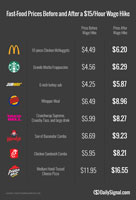
What Your Favorite Fast-Food Items Would Cost With $15 Minimum Wage. For Americans hitting the drive-thru at
their local McDonald's, a $15-an-hour minimum wage could hit them in their wallets. According to a January report
released by James Sherk, a former research fellow in labor economics at The Heritage Foundation, fast-food prices would rise
by 38 percent under a $15-an-hour minimum wage and cause a 36 percent drop in employment. Sherk's research comes after
several cities and states across the country voted to raise their minimum wages, with increases typically phased in over the
next five years.
An
Alternative to Increasing the Minimum Wage. Underemployment and low wages in working-class communities have led
not just to the loss of the dignity of work, but to a host of ensuing societal diseases that should have conservatives
horrified: family breakdown and illegitimacy, drug addiction, crime. Over the past few years, progressives have
congealed around a simple response to this problem: raising the minimum wage. Mandate a higher wage, and bosses will
have to pay employees more, and that way they'll have more money. Hey presto, problem solved! Of course,
conservatives know this is crazy. Unintended consequences always exist. A minimum wage is absurd, amounting to a
ban on low-skilled people from entering the workforce and climbing the first rungs on the ladder of opportunity.
The
Coming Minimum-Wage Tsunami Will Wash Away Millions Of Minority Jobs. [A new] study by the American Action Forum, a nonpartisan think tank led
by former Congressional Budget Ofce Director Douglas Holtz-Eakin, looked at minimum-wage hikes scheduled to take effect in the coming years in 14 states
and the nation's capital and found they will "cost millions of jobs across the country and each lost job only leads to total wage earnings rising by a few
thousand dollars." The reason is simple: When you raise the minimum wage of low-skilled, low-productivity labor — a group that disproportionately
includes young minority males — you inevitably destroy jobs. No business will hire someone and pay him more than he's worth. So all those states
might think they're helping the downtrodden and the poor, and striking a blow for equality by mandating higher wages, but they're doing just the opposite:
Pricing many young people out of entry-level jobs.
The Racist
Roots of Minimum Wage Laws. There is little question in most academic research that increases in the minimum
wage lead to increases in unemployment. The debatable issue is the magnitude of the increase. An issue not often
included in minimum wage debates is the substitution effects of minimum wage increases. The substitution effect might explain
why Business for a Fair Minimum Wage, a national network of business owners and executives, argues for higher minimum wages.
Report:
Minimum Wage Hikes Will Lead to 1.8 Million Job Losses. Minimum wage increases over the next several years will
result in 1.8 million job losses, according to a report from the American Action Forum. By July of this year, 22 states
and the District of Columbia will have implemented minimum wage increases. In just 2017 alone, wage increases will lead to
383,000 job losses. While the goal of increasing the minimum wage is to increase earnings for low-income individuals, the
report finds that the additional earnings transferred from the job losers to the job keepers is minimal.
Is
Anybody Shocked that Higher Minimum Wage Mandates Are Resulting in Fewer Jobs? While economists are famous for
their disagreements (and their incompetent forecasts), there is universal consensus in the profession that demand curves
slope downward. That may be meaningless jargon to non-economists, but it simply means that people buy less of something
when it becomes more expensive. And this is why it makes no sense to impose minimum wage requirements, or to increase
mandated wages where such laws already exist.
Racial Issues.
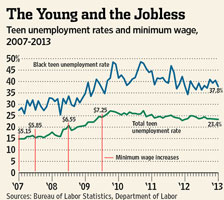
Many things that are supposed to help blacks actually have a track record of making things worse. Minimum
wage laws have had a devastating effect in making black teenage unemployment several times higher than it once was.
Minimum
wage laws don't work. Here's why. A minimum wage seems to be a compassionate law requiring employers to
pay low-income workers a wage necessary to meet a reasonable standard of living. So should we have a minimum
wage? And if so, what should it be? The current minimum wage is $7.25, which merely acts as a floor price since
most states have their own, higher minimum wages. The 2016 Democrat and Republican presidential nominees both support
some sort of minimum wage. Hillary Clinton has advocated for a federal minimum wage of $12 per hour, while Donald Trump
has been vague. In some instances, he has called on raising the minimum wage to $10, but in other cases, emphasizes
that such policy should be left to the states.
Elitist
Arrogance, Part II. Recent years have seen proposals for an increase in the federal minimum wage to $15 an hour. Some
states and localities, such as Seattle, have already legislated a minimum wage of $15 an hour. Nobody should be surprised that
fast-food companies such as Wendy's, Panera Bread, McDonald's and others are seeking substitutes for employees who are becoming costlier.
One substitute that has emerged for cashiers is automated kiosks where, instead of having a person take your order, you select your meal and
pay for it using a machine. Robots are also seen as an alternative to a $15-an-hour minimum wage. In fact, employee costs are much
higher than an hourly wage suggests. For every employee paid $15 an hour, a company spends an additional $10 an hour on non-wage benefits,
such as medical insurance, Social Security, workers' compensation and other taxes. That means the minimum hourly cost of hiring such an
employee is close to $25.
Ex-McDonald's
CEO: A $15 minimum wage destroys critical career opportunities. Most restaurant businesses —
including McDonald's and Famous Dave's of America — are run by individual franchisees who by and large operate
independently of corporate headquarters. These franchises are faced with slim profit margins, with business expenses
like staff and rent offsetting a large chunk of revenues from sales. As such, franchisees are ill-prepared to pay their
employees more for the same work if they hope to keep hiring new people and expand their business. A $15 hourly wage
would effectively make employees more expensive without increasing revenue, eating away at the profits job creators need to
stay afloat. To offset higher labor costs, these job creators would be faced with a few undesirable options:
Raise prices, cut back on staff, or switch to automation (and perhaps all of the above).
Three
myths behind higher minimum-wage laws. Our lecturer-in-chief recently informed the class that "it's not cool to
not know what you're talking about." Great. Now if only Mr. Obama would take that message to his comrades on
the left advocating a minimum wage of $15. For these legions, it seems to be an article of faith that public policy is
best guided by magical thinking, facts and logic [notwithstanding]. But, of course the president is marching to the
same drummer — just leading from behind. The propaganda supporting the Fight for $15 — or $12
or, before that, $10.10 — is as duplicitous as it is abundant.
#FightFor15
ignores 100 years of economic evidence on the minimum wage. The shockwaves that hit after minimum wage increases across the
country could be brutal. Recent studies on the minimum wage make the artificial wage increase look costlier than the rosy future
portrayed by supporters. [...] Laws and regulations aren't solutions so much as trade-offs. The goal is to make benefits outweigh
costs. With the new demands for a higher minimum wage, a blind desire for "justice" and anti-poverty action has blinded supporters
to economic fact. In many instances, the large increases in the minimum wage will have important, relevant costs. Dismissing
those costs as non-existent does not usher in wise economic policy.
How
to Stop Losing the Minimum Wage Issue to the Democrats. Of course, I know the rationale for a lower (or no)
minimum wage. As a University of Chicago MBA, I know all about price elasticity and supply & demand[,] and how the data
(and common sense) dictate that jobs are lost when wages are increased. In my career, I ran companies with factories in
Asia and know that it is logical to manufacture high-volume products in countries where wages & benefits are $3.00 per hour
rather than in the US where comparably skilled workers pull in $30+ an hour. It's no secret why jobs have moved
overseas in recent decades. But, explaining the intricacies of economics to most US voters is futile. Consider
the facts: 12% of Americans lack a high school diploma. 70% have not completed college. And only 30% of US citizens
have passports. The typical group of Americans at a dinner party does not want to hear how an increase in the minimum wage
will inevitably create job losses due to global wage economics.
The
Coming Minimum Wage Catastrophe. The Left's destructive push for a $15 an hour minimum wage threatens to make
the American fast-food worker extinct while driving up the price of burgers and other dietary staples relied on by low-income
consumers. It's actually a highly effective job-creation program — for those who manufacture robots and the
touch-screen point-of-sale terminals that replace the comparatively expensive human help. White Castle, Carl's Jr.,
Hardee's, McDonald's and plenty of other fast-food chains are already considering or making the move to get rid of their
frontline employees. The current feel-good push for a $15 an hour minimum wage has nothing to do with helping workers
and everything to do with advancing the goals of the left wing, especially the labor movement.
Minimum
wage or maximum deception? City after city and state after state seem to be moving toward forcing employers to
offer a $15 minimum wage because, well, because it sounds good to people who are making $10 an hour. But just whose
fault is it that employers are only paying $10 an hour? This is not hard to figure out if you took even a high school
class in economics. There is a little something called "supply and demand. If there are not enough laborers in a
particular field to do the job offered by employers, then those laborers find themselves in demand, allowing them to hold out
for bigger paychecks. This is common in skilled positions such as oil-rig workers, nurses, engineers.
$15
dollar minimum wage: Epic Fail. If the feds demand that everyone receive 15 bucks per hour regardless of
skills, education or contribution, companies will simply asses the situation, determine which positions are worth 15 bucks
and eliminate the ones that are not. No company is going to pay anyone more money than that position brings to the
company. Ain't gonna happen. We have already seen companies making moves. We have all purchased items from
a store without help of a cashier. They have now invented a robot that can prepare 360 burgers per hour. What's
next? If I'm not mistaken, only 4 percent of workers earm minimum wage. And most of them are teenagers.
A
$15 Minimum Wage Is A Booby Prize For American Workers. In principle, there is solid moral ground for the
recent drive to boost the minimum wage to $15, with California and New York State taking dramatic steps Monday toward that
goal. Low-wage workers have been losing ground for decades, as stagnant incomes have been eroded by higher living
costs. This has been particularly tragic for workers in high-priced cities like San Francisco, Seattle, Los Angeles and
New York, where the movement has achieved irresistible momentum. If the Democrats manage to win a sweeping victory in
the fall, the $15 minimum could also be imposed nationwide, with huge impacts on "laggard" regions like the South.
Liberalism's
Simple-Mindedness on Defiant Display. Minimum wage laws are so wrong for so many reasons it's hard to know
where to start. Most polls indicate that a majority of Americans support such laws. That fact reflects an
extremely low "EQ" level of the citizenry. By EQ I mean economics quotient. Presumably, most people who support
minimum wage laws do so because they believe they will reduce poverty and decrease income inequality. The opposite is
the case, however. Simple economic logic proves the point, as well as mountains of evidence. A question that has
been asked numerous times of minimum wage advocates is this — if a $15 minimum wage will help low-income earners,
why not $20 or $50 an hour? I have yet to hear a coherent response to that question. The answer is obvious, of
course. Many workers are not worth $20 or $50 an hour. Many fewer workers would be hired at those wages.
Unemployment would skyrocket.
Demagoguery
and the Minimum Wage. Particularly among politicians of the left, raising the minimum wage has long been a staple as a
campaign talking point. [...] As economists have taught for generations, price controls (wages are prices) never achieve their intended
ends. Simply put, there are irrefutable laws of economics that cannot be repealed by political action. Demagoguery and
emotional appeal may produce short-term political advantage, but ultimately claims based on unsound economics must disappoint those
who put faith in those claims. Minimum wage laws are an exemplar of political action that cannot live up to its claims.
The Editor says...
This page is full of evidence that the minimum wage is a job killer.
All Aboard Starship Bernie! Every
time we raise the minimum wage, youth unemployment increases. The 16 to 19 demographic had an unemployment rate of 45% in 2011, compared to 26% in
the year 2000. That staggering number represents lost tax revenue, increased social spending and, most importantly, lost opportunity. One of two things
happen when the minimum wage goes up: a business passes the cost on to consumers, or it sheds the least productive employees — like the
baggers in supermarkets or kitchen help, and busboys in restaurants. Can the Vermont senator cite an example of successful socialism? The USSR
collapsed under the dead weight of decades of five-year plans. North Korea doesn't have an economy. Cuba is a basket case. China started
on the road to prosperity by abandoning Maoism.
A Retrospective
on the Obama Years. [Scroll down] Some people have more money and make more money than others. This
inequality is a byproduct of many factors, including talent, intellect, work ethic, birth circumstances, and market capitalism.
But economic fundamentals are ignored in the era of income inequality hysterics. Witness the recent labor-organized protests over
a higher federal minimum wage. Progressives from coast to coast adopted the mantra. In response, dozens of states and
municipalities raised their local minimum wage. Yet, progressive theory cannot transform marginal labor into skilled labor.
And so the non-partisan Congressional Budget Office reported on what fast food chain CEOs have long promised: higher mandated wages
mean fewer jobs and more automation. Alas, there is no union representing the newly unemployed.
Buddy, Can You Spare $15 an Hour? One piece of news
this past weekend suggests a big minimum-wage hike could cost low-skilled workers their jobs. Wal-Mart closed its Oakland store amid
speculation that the city's $12.55 minimum wage played a role. Oakland City Councilman Larry Reid told The Chronicle the city's wage
law was a factor in the closure. It's hard to think otherwise when Oakland was one of 269 stores slated to be shuttered across the
country, while in nearby San Leandro, where the $10 state wage floor prevails, two stores will remain open for business. The Washington
Post reported last week that Wal-Mart was withdrawing plans to build two superstores in the nation's capital. A city councilman told
the Post that behind closed doors Wal-Mart blamed D.C.'s minimum wage rules (currently $11.50 per hour, but the wage could rise to $15 if
voters pass a ballot measure).
W-a-l-m-a-r-t does not spell welfare. Although mandated wage hikes sound good
in theory, in the real world of economics that politicians wholly disregard, they are job-killers. These district-running Democrats grouse about
low-wage jobs and a "living wage" in order to perpetually keep their voter bases stirred up ensuring their own re-elections. This is their
draconian justification to use the heavy hands of government to throw destructive monkey wrenches (these arbitrary, Orwellian regulations) that, in
practice, promote more unemployment under the guise of promising its opposite. In this, they completely ignore the history that such positions
were designed as "starter" jobs: to give the young their first employment experiences. They were never intended to be the stuff of
careers — or the economic basis upon which to raise a family.
Minimum
Wage Hikes Are Costing jobs. Employment data now coming in from six U.S. cities that have mandated increases in the
minimum wage are proving a basic economic law: When the price or cost of something increases, less of it will be demanded.
In his analysis of the preliminary data now available from Chicago, Oakland, San Francisco, Seattle, Los Angeles and Washington, D.C.,
Jed Graham wrote: "Job gains have fallen to multi-year lows at restaurants, hotels and other leisure and hospitality venues."
The Minimum Wage and the Great Recession: Evidence from the Current
Population Survey. My baseline estimate is that this period's full set of minimum wage increases reduced employment among
individuals ages 16 to 30 with less than a high school education by 5.6 percentage points. This estimate accounts for 43 percent
of the sustained, 13 percentage point decline in this skill group's employment rate and a 0.49 percentage point decline in
employment across the full population ages 16 to 64.
Minimum
Wage Increases Spell Disaster for America's Retail Companies. [A recent] report finds that its not just Walmart who would be negatively
affected, but many of the other big retail companies too — including McDonald's, Starbucks, Target, and Walgreens. A wage increase
from $7.25 to $9 an hour would increase the profit per-employee by over 40%. Sounds great for employees, right? Not exactly. The
increase makes those jobs far less valuable to the company and often leads executives to eliminate those positions.
Minimum
wage increase push just a political ploy. On the same day that he announced a $15 minimum wage for fast-food
workers, Governor Andrew Cuomo (D-NY) told a union rally in Manhattan that he is asking the state legislature to make $15 the
minimum for all workers. "Every working man and woman in the state of New York deserves $15 an hour as a minimum wage, and
we're not going to stop until we get it done," he declared. [...] Jared Meyer with the Manhattan Institute for Policy Research
and Economics thinks "a $15 an hour minimum wage is a dangerous idea that's really an uncharted territory.
3 unintended consequences of
Seattle's minimum wage hike. [#2] The Demise of the Tipping Culture: Some restaurants are excited about
doing away with tipping while raising base pay, but others are skeptical. Many are worried that their best servers will
leave, as the tipping system allows them to make more in an hour than a base hourly wage ever could. "The tipped culture
is what draws people into the industry," Christin Fernandez, spokeswoman at the National Restaurant Industry, pointed out.
The minimum wage increase in Seattle will raise base pay for everyone in the restaurant industry, but that could backfire on
servers who no longer have the opportunity to earn tips.
Minimum
Wage for Thee, But Not for Me. The AFL-CIO, official labor union of the Democrat Party, wants a higher minimum
wage to provide "protection for the country's lowest-paid workers." The SEIU, another large labor union, wants a bump in
the minimum wage to create jobs and generate economic activity. [...] Let's follow the money. A company can unionize and
instead of paying $15 per hour, pay only $8 an hour, saving a bunch of money. A win for the company. Workers in the
newly unionized company are now paying union dues. A win for the union. Finally, over 90 percent of union
political donations, made up largely of dues, go to Democrats. A win for the Democrats, the party that would grant
the minimum wage exemptions by virtue of their control of the executive branch of government.
California:
$15 Minimum Wage, $30 Per Pizza, Massive Fail. Small businesses are already struggling to survive the spate of
minimum wage increases to $15 per hour in parts of California. [...] Even though businesses with less than 56 workers are
exempt from the $14.44 rate and do not have to raise their wages to $15 until 2018, Vic Gumper, who owns Lanesplitter Pizza,
with outlets in Berkeley, Oakland, Albany and Emeryville, decided not only to bite the bullet but swallow it, paying his
workers $15 to $25 an hour while eschewing tips or raising prices.
Minimum-wage
offensive could speed arrival of robot-powered restaurants. [Scroll down] The industry could be ready for
another jolt as a ballot initiative to raise the minimum wage to $15 an hour nears in the District and as other campaigns to
boost wages gain traction around the country. About 30 percent of the restaurant industry's costs come from salaries, so
burger-flipping robots — or at least super-fast ovens that expedite the process — become that much more
cost-competitive if the current federal minimum wage of $7.25 an hour is doubled. "The problem with the minimum-wage
offensive is that it throws the accounting of the restaurant industry totally upside down," said Harold Miller, vice
president of franchise development for Persona Pizzeria, who also consults for other chains.
Where's
The Beef? $15 Wage Means 36% Smaller Burger. Would you pay the same price for a Mini Mac instead of a Big Mac?
Raising the average fast-food wage to $15 an hour could force restaurants to hike prices by 11% — or shrink the size
of burgers by 36%, according to an IBD analysis of data from a recent Purdue University study. Higher prices and smaller
burgers are just two of the unappetizing menu of options facing fast-food chains and their customers as cities such as Los Angeles,
Seattle and New York raise the minimum wage to $15 an hour.
National
$15 Minimum Wage Is Trouble. [I]t's important to realize that the argument against
minimum wages isn't that they hurt the rich; it's that they can end up hurting the poor. Raise
minimum wages too high, and you'll eventually choke off employment, harming the very people that the
policy is intended to help. We're not going to get an answer to the employment question until
some cities try a $15 minimum wage. It might work, and it might not. Smaller minimum wage
hikes in the past weren't too damaging, but $15 is uncharted territory. Experiments such as those
in Seattle, San Francisco and Los Angeles will help us determine whether $15 is too high.
Sorry,
Paul Krugman: The Minimum Wage Won't Miraculously Cure Poverty. Paul Krugman stated in
The New York Times today that "there's just no evidence that raising the minimum wage costs jobs, at
least when the starting point is as low as it is in modern America." To support his position, he
cites studies by University of California professor David Card and Princeton University professor
Alan Krueger. Some commentators want a $12 minimum wage, as proposed by President Obama, a 66
percent increase. Others, such as the Restaurant Opportunities Centers United and New York
Communities for Change, want a $15 minimum wage, a more than 100 percent increase.
Starbucks
And The Minimum Wage Hikes: What A Brew. Starbucks raised its prices Tuesday from five to 20 cents a drink.
Despite falling coffee bean prices, the java seller has been hit with minimum wage and other pay hikes to please the left. Guess
who's paying?
How
stupidly obvious WAS this end result of the SF minimum wage hike? Suffice it to say
that these people don't know anything about how businesses operate, but still think that they do.
As you can see, plug in that combination of reckless confidence and slack-jawed idiocy into a convenient
Blue State government matrix, and voila! — You get bad, self-defeating policy.
Study:
Minimum wage hike boosted price of Chipotle burritos. Raising the minimum wage doesn't
happen in a vacuum, according to new research on Chipotle. When Chipotle Mexican Grill Inc. raised
its minimum wage in San Francisco, it raised its prices proportionately, according to William Blair, a
global investment banking and management firm, which issued a report on Tuesday [7/7/2015] to its investors.
States
with the Highest Minimum Wage. Hourly earnings in the U.S. rose 0.3% in May to $24.96 a jump of
2.3% from the year-ago period. However, those earning the minimum wage are still getting paid a lot less
even in the 29 states paying above the federal minimum wage.
$15 Minimum
Wage: Women, Blacks Hurt Most. This push for higher minimum wage will mostly hurt
women — a constituency that the left claims to care so much about. According to the
National Women's Law Center, women are at least half of the minimum-wage workers in all 50 states.
In New Hampshire, Arkansas, Maine and Pennsylvania, 70 percent of the minimum wage workers are female.
Minimum
Wage, Maximum Stupidity. Take the left's penchant for form over substance, combine
with a fundamental ignorance of what money is and what it does, stir with hammer and sickle, and
what do you get? You get a crusade to raise the minimum wage to $15.00 an hour.
When
Will They Ever Learn? One doesn't even need an economics class to understand that a $50-million
house will not have a bunch of buyers in a bidding war, compared to a much less expensive house. Or that a
sale, lowering the price of something, is a good way to sell more and clear the inventory. So why is there
such confusion about the minimum wage? A wage is simply the price of labor. Raise the price, and demand
goes down. And vice versa. Watch it play out in San Francisco, Seattle, and Los Angeles as small
businesses, unable to afford their new cities' minimum wages, close their doors or lay off employees.
The Working Wage. Every time I've gotten
into a written or verbal discussion about minimum wage laws (or the relatively new crusade for a "living wage," which is
another exercise of compulsive power beyond what the law requires, premised on the idea that business owners who obey the
minimum wage laws are nonetheless greedy villains) someone objects that people "deserve" so much better than the paltry
whatever-dollars-per-hour, and nobody could possibly "live" on it. I insert a placeholder for the dollar amount
because it's an argument I've been hearing throughout my entire life. The wage changes over time, but the argument
doesn't. It's not easy to explain that raising the price of labor does not automatically increase its value.
A law that requires payment of $10 per hour to ever brand-new, inexperienced, unproven worker does not suddenly make them
worth $10 per hour.
Obama's
Peculiar View of Economics and Law. Obama wants to raise the federal minimum wage to
$10.10 an hour but the CBO — whose words Democrats admonished were sacrosanct during the
health care debate — has concluded that would kill about 500,000 jobs. White House and
liberal think tanks have countered raising the wages of hamburger flippers would miraculously increase
demand for their services and GDP, because those who remain employed would have more money to spend —
forget the fact that Americans would pay more for fast food and have less to spend on everything else.
Child-care worker
sees hours cut after Oakland's minimum wage hike. Child-care assistant Eunice Medina,
23, was thrilled when Oakland's minimum wage took effect in March. But almost as quickly, Medina's
workdays were cut and her hours shaved from eight to six. Her employer, Asiya Jabbaar, says she
had no choice.
Business
group that backed L.A. mayor's minimum wage plan 'not so happy' now. As the Los
Angeles City Council prepares for a final vote Wednesday [6/3/2015] to raise the minimum wage, leaders of the
most prominent business group to back a citywide pay boost have privately expressed concerns about
changes made to the proposal since Mayor Eric Garcetti first sought their support. The Los
Angeles Business Council, a Century City-based coalition of firms that has supported liberal causes
such as affordable housing and clean-energy projects, endorsed Garcetti's plan to increase the
minimum wage to $13.25 by 2017.
Unions
Now Want An Exemption From The Minimum Wage Hike They Pushed. Those who think the
minimum wage doesn't cost jobs might want to have a chat with unions in Los Angeles. After
pushing for a big hike in that city's minimum wage — which will climb to $15 an hour by
2020 — labor leaders now want an exemption for companies that have unionized workers.
Why? Because, according to Rusty Hicks, head of the Los Angeles County Federation of Labor, "with a
collective bargaining agreement, a business owner and the employees negotiate an agreement that
works for them both. The agreement allows each party to prioritize what is important to them."
LA's labor unions
want an exemption from the city's new $15-an-hour minimum wage. The Los Angeles City
Council recently passed a bill to hike its minimum wage to $15 an hour, a change strongly supported
by Southern California labor unions. Except now the unions want a last-minute change in the
bill — an exemption for unionized firms, which would be allowed to pay less than $15 an
hour if a collective bargaining agreement calls for it.
In
Los Angeles, unions make an offer companies can't refuse. From the truth is stranger
than fiction except if you're in Los Angeles and/or dealing with union personnel file we learn what
happens when reality slaps high-sounding abstract liberal theory in the face. In this instance,
reality wins. Sort of.
Unions
seek exemption from LA minimum wage law they helped pass. For months, organized labor
went after companies like McDonalds and Walmart, shaming any business that paid the old minimum
wage. Carrying signs saying, "We see greed" and "We are worth more," union members marched
outside businesses and appeared at City Council meetings demanding Los Angeles raise the minimum
wage from $9 to $15 by 2020. [...] Yet after pushing through the new wage law, union officials are
asking for a waiver that would allow any company that unionizes to avoid paying the minimum wage.
Democrats
Should Live Up to Their Own Lectures. "We owe it to workers across the country to make
sure our minimum wage is set to a level that works for them and their families," Senator Patty
Murray (D., Wash.) insisted last month, as she introduced the Raise the Wage Act. It would
boost the federal minimum wage from $7.25 to $12.00 per hour by 2020 — a 66 percent
hike. Added House co-sponsor Representative Bobby Scott (D., Va.): "We can't build a
strong economy on the backs of impoverished workers." Thirty-two senators have co-sponsored
this bill, as have 165 House members. Amazingly, the Employment Policies Institute reports,
94 percent of these 197 Democrats pay their interns zero.
Hillary
Clinton, Bill de Blasio and the false god of American politics. The minimum wage has been converted into something it was
never intended to be — a permanent salary regarded as the chief support for a worker's family long term. Instead, it should
be taken for what it is, an entry-level position that gives workers an opportunity to move up to a better job at higher pay, taking full
advantage of advanced training programs offered to them. Raising the minimum wage to $15 an hour, however, may result in robots
replacing workers. Food will be ordered from a computer at your table. It's already happening in some restaurants.
Economic
malpractice on the minimum wage and a remedial assignment. [T]he $15 per hour wage is not
determined by some rigorous cost-benefit analysis that concludes that $15 per hour generates the most
benefits with the least costs. Rather, it's a number that is just "plucked from the air." And
if you're using the PFA approach to determine the minimum wage in some fantasy world that is not grounded
in economic theory, empirical evidence, science or logic, then why not make the minimum wage $25, $75 or
$150 or $1,000 per hour?
Minimum
wage workers tend to be young, single, part-time workers with less than a high school diploma. For
workers ages 16 to 19 years old, only 15.3% made the minimum wage or less in 2014 (about 1 in every 6.5 workers
in that age group) and almost 85% of those workers earned more than the federal minimum wage last year. For workers
ages 25 and older, only 2.5% (1 in 40) earned the federal minimum wage or less last year. So even the
vast majority of teenagers (more than 8 of every 10) earn more than then federal minimum wage.
Timely news and commentary:
Minimum
Wage is Maximum Folly. Advocates of minimum wage present the policy as a means to
uplift low-income workers. But for more than a century, it has steadily produced outcomes
starkly at odds with this goal. It is far more than an economic policy. It is a
statement on our society's underlying assumptions about human freedom, responsibility, and the
proper limits of government power. When examined honestly, minimum wage reveals an unsettling
truth: symbolic compassion often produces actual misery, and the people paying the highest price
are those least able to bear it. Let's look at how this policy originated. The popular
narrative claims the minimum wage was created to protect low-skill workers from exploitation.
But the historical record tells a very different story — one so politically inconvenient
that it has been almost entirely erased from public discussion.
Squad
Pushes $25 Minimum Wage in the Name of 'Racial Justice'. The Daily Signal has
obtained plans from a coalition of House Democrats showing it will push legislation to raise the
federal minimum wage to $25 an hour and "tax the rich" in an effort to strip "power and privilege"
from "the wealthy and well-connected" to advance "racial justice." Reps. Delia Ramirez,
D-Ill.; Analilia Mejia, D-N.J.; Rashida Tlaib, D-Mich.; Bonnie Watson Coleman, D-N.J.; and Chuy
García, D-Ill., along with representatives from national unions and advocacy groups, plan to
announce the Living Wage for All Act at a press conference Tuesday. "This bill is about
holding corporate America accountable," Stuart Appelbaum, president of the Retail, Wholesale and
Department Store Union, said in a statement obtained by The Daily Signal. "While prices rise
and profits grow, workers are still being paid poverty wages instead of a true living wage.
That has to change if we are serious about dignity and fairness in this economy," Appelbaum added.
A
$33 Burger? As New York City Eyes $30 Minimum Wage, Restaurants Brace for
Impact. Zohran Mamdani rode to victory as New York City's mayor in part due to his
audacious campaign promises around freezing the rent and offering free bus service to Big Apple
residents. But perhaps no campaign promise of Mamdani's was as bold as his "$30 by '30" plan,
which called for increasing the city's minimum wage to $30 by 2030. Now that Mamdani is in
office, New York City Council members have introduced a bill to turn $30 by '30 from a catchy
campaign slogan into an economic reality. But while the top-line number of $30 has received
most of the attention, the fine print in the legislation may be even more alarming: It would
eliminate what's known as the tipped-wage credit for restaurants in NYC, meaning that mom-and-pop
restaurants — some of the city's smallest businesses — would find themselves
on the hook for paying workers $30 an hour. Restauranteurs around the city are sounding the
alarm, warning that the bill could pose a dire threat to NYC's famed dining scene.
The case against raising
the minimum wage. Last month, the state House of Representatives passed a bill to
raise the minimum wage in Pennsylvania to $15 per hour by 2029. The governor and House Democrats
continue to push for this increase, arguing it is unjust that the Commonwealth's minimum wage has
remained frozen at $7.25 since 2009, while neighboring states have increased their wages since
then. While likely dead on arrival once the Republican-led state Senate votes on it, this
short-sighted attempt to ease very legitimate cost-of-living challenges deserves opposition.
The idea of mandatory payroll increases may sound productive on paper, however, the real damage
from this would hurt everyone, especially the entry-level, unskilled labor class that proponents
paint as the beneficiaries of these laws.
NYC
minimum wage could climb to $30. A new bill could push New York City's minimum wage
as high as $30 an hour, setting the stage for one of the highest local pay floors in the
nation. [Advertisement] The proposal would require employers to pay workers at least
$25 an hour if they provide qualifying benefits and $30 an hour if they do not.
[Advertisement] Lawmakers would apply the same standards to independent contractors,
including those who perform work through digital labor platforms. [Irrelevant photo]
The bill directs the Department of Consumer and Worker Protection to adjust the minimum pay rates
each year based on inflation. The agency would also calculate and update annually the value
of qualifying benefits used to determine which pay tier applies. The measure is similar to a
central campaign promise from New York City Mayor Zohran Mamdani, who pledged to pursue a $30
minimum wage during his run for office.
The
Minimum Wage Is Always Zero: New $30 Minimum Wage Could Axe Hundreds of Hotel Jobs in
LA. Amazing, isn't it, how little leftist politicians know about economics,
especially where minimum wage laws are concerned. The minimum wage, of course, has been and
always will be zero, no matter the good intentions of anyone who thinks they can simply mandate
otherwise. [Advertisement] Case in point: Los Angeles, where the city council and
Mayor Karen Bass, currently in contention with New York's Zohran Mamdani for "America's Most
Clueless Mayor," have passed an ordinance that will jack up the minimum wage for workers in the
hospitality industry to $30 an hour. As you might predict, that means a lot of working-class
people in that industry are now looking at unemployment. [...] Note that the top-out wage of
$30/hour hasn't yet taken effect. That may well be the last straw.
'Jim
Snow 2.0': Critics blast Mamdani's $19 snow jobs after $30 wage pledge. New York City
Mayor Zohran Mamdani built part of his campaign around a bold promise: a $30 minimum wage by 2030.
His plan called for phased increases: $20 per hour in 2027, $23.50 in 2028, $27 in 2029, and
$30 in 2030. After that, wages would automatically adjust each year based on cost of living or
productivity growth. As of January 1, 2026, New York City's minimum wage is $17 per hour
under state law. But as a major winter storm approached the city this month, the Department
of Sanitation activated an emergency snow-shoveling program paying $19.14 per hour. Overtime
is set at $28.71 after 40 hours.
California's
Stupid, Ridiculous, Abusive, Nanny State, and Absurd New Laws for 2026. Because the
cost of living in California is so high, Democrat lawmakers think increasing the minimum wage to
$16.90 per hour will help hourly workers afford a $900,000 home — the median home price
in the Golden State. Even if that hourly worker put in a full-time year, they will only make
$35,152, which is less than $3,000 monthly, which barely covers the median cost for a studio
apartment. Currently, the average rent in California is $2,155 for Studio, $2,284 for 1
Bedroom, $3,240 for 2 Bedroom, $4,147 for 3 Bedroom, and $5,103 for 4+ Bedroom, according to
Rentometer. California's absurdly high cost of living will not be offset by a $16.90 minimum
wage. It just makes Democrats feel better about themselves.
In England: Graduate
jobs halve in just a year after minimum wage rise. The number of graduate jobs
advertised has almost halved in just a year after Rachel Reeves pushed up the cost of hiring
younger workers. Vacancies for graduate roles plunged by 45pc in November compared with the
same month a year earlier, according to jobs site Adzuna. At the same time, advertised
entry-level vacancies for those at the very start of their careers dropped by one quarter.
Hiring for these roles is now at its lowest level since the pandemic lockdowns. The figures
showed that vacancies for all jobs in November fell for the fifth month in a row. November is
historically a strong month for hiring, with many businesses taking on new staff during the busy
festive period.
Why
Governments Love Raising the Minimum Wage — Because it's Really a Tax. In
a previous article, we examined how the minimum wage works in practice. Higher, more
comfortable pay for easier and lower-skilled jobs attracts capable, energetic workers into those
roles, displacing the genuinely low-skilled from the labour market and trapping them on
benefits. These effects are neither subtle nor controversial. They are visible
everywhere. And yet, year after year, chancellors of all parties have pushed the minimum wage
higher — not merely in line with inflation, but far beyond it. By April 2025,
the annualised minimum wage had risen to £25,500, around 60% higher in real terms than when
the policy was introduced in 1999. One can see why Labour governments, committed to equality
whatever the consequences, favour such increases. But Conservative governments have overseen
them too — raising the minimum wage by around 20% in their final two years in
office. To understand why, we need to look not at rhetoric, but at how the minimum wage works
in practice, both for workers and for government finances.
Maryland's
Push for a $25 Minimum Wage Would Be Disastrous if it Happens. Activists with One
Fair Wage are gathering signatures for a 2026 ballot measure that would set Maryland's minimum wage
at $25 an hour, eliminating exceptions for tipped workers and making the state the highest in the
nation. [Advertisement] The group insists "$25 isn't radical! It's
survival." Maryland already pays $15 an hour statewide, higher than the federal $7.25 and
neighboring Virginia's upcoming $12.77. Places like Washington, D.C., reach $17.95, but no
state comes close to $25, which would mean over $52,000 annually for full-time work. Rachel
Greszler, a senior research fellow at The Heritage Foundation, calls the idea extreme. "I
think it's insane. Maryland's already trying to compete, especially with Virginia nearby, and
you were losing businesses, especially the small businesses, which are disproportionately affected
by high minimum wages, and to do this is just gonna exacerbate the problems that we're having with
the budget, of course, and of having good jobs for people."
California's
Fast Food Minimum Wage Hike Cost the State 18,000 Jobs. In 2023, California passed a
law requiring a $20 per hour minimum wage for all fast-food restaurants with more than 60 locations
nationwide. Democratic Gov. Gavin Newsom portrayed the union-supported law as
pro-worker, saying it moved the state "one step closer to fairer wages." Other California
politicians supporting the law claimed it would provide a path to economic security for
lower-income workers, enabling them to more assuredly put food on the table. "Sacrifice,
dedication, and the power of a government who serves its people is what got us to this moment,"
said then-Assemblymember Chris Holden (D-Pasadena). But the carve-out for smaller chains was an
implicit acknowledgment that the law would come with costs — costs that smaller
businesses with slimmer margins presumably could not afford. New research suggests that the
mandate has also resulted in fewer jobs for struggling entry-level workers.
New
York Doubles Down on Delivery Wage Disaster. In 2023, New York City became the first
city in America to pass a minimum wage rate for app-based restaurant delivery drivers.
Several other progressive cities have followed suit, resulting in a range of issues from rising
delivery costs to many drivers dropping out of the workforce entirely. Now, the city that
started it all is doubling down — this time on grocery delivery drivers. In July,
the New York City Council passed numerous bills that it claimed were designed to protect grocery
delivery drivers. This legislative package introduced new rules, requiring delivery apps to
include a 10-percent tipping option either before or at the time of the order (vs. afterwards,
where the option exists now), and mandated that app-based platforms pay delivery drivers within
seven days of the end of a pay period. One of the most notable bills would extend New York
City's minimum wage mandate from restaurant delivery drivers to drivers delivering groceries.
Report:
California's $20 Fast Food Minimum Wage Led to 18,000 Fewer Jobs. California's new
$20-per-hour minimum wage for fast food workers has resulted in a significant decline in employment
in that sector, leading to 18,000 fewer jobs than would have been the case otherwise. That's
according to a new paper released by the National Bureau of Economic Research (NBER) this month, [...]
California's
Minimum Wage Hike Cost 18,000 Fast-Food Jobs as Employment Ticked Up in Other States.
California Gov. Gavin Newsom signed Assembly Bill 1228 into law in September 2023, which
established a Fast Food Council within California's Department of Industrial Relations and
increased the minimum wage for 500,000 fast food workers from $16.00 per hour to $20 per hour on
April 1, 2024. Newsom celebrated his signing of the bill as "one step closer to fairer
wages... by giving hardworking fast-food workers a stronger voice and seat at the table."
Former Assemblymember Chris Holden (D-Pasadena), the bill's primary sponsor, described it as "one
of the most impactful fast food wage laws that this country has ever seen." The law was
certainly impactful: A working paper recently published by the National Bureau of Economic
Research (NBER) found that the law increased wages in California's fast food sector by
8 percent relative to the rest of the country. But not all of the consequences of the
law were intended or positive for workers.
LA
city council hikes minimum wage for struggling hotels to $30/hour. California never
learns. Actually, let me be more specific: leftists never learn. The people are already
reeling from the statewide minimum wage hike signed into law by Gavin Newsom, which went into
effect a little over a year ago — since then, businesses and the job market have been in
total turmoil. We saw the closure of a beloved restaurant that had been open for thirty
years, and a report from March of this year revealed that "the state is shedding jobs at an
alarming rate," estimating that number was around 16,000. Yet, the obvious link between
a government mandated increase in the minimum wage and economic fallout did nothing to deter the
Los Angeles city council from upping the ante, which recently voted to mandate a phased-in citywide
minimum wage hike for hotels and airport workers: The first increase up to $22.50/hour will
happen this month, and by 2028, that number needs to be $30/hour.
LA
Hotels Revolt as City Approves $38 Minimum Wage. Los Angeles is hosting the 2028
Summer Olympics. The games were awarded to the city back in 2017 and since then it is
preparing for the arrival of tens of thousands of visitors. They city was already struggling
a bit because of the deadly wildfires which destroyed significant portions of two neighborhoods in
January. [...] Now the city is facing a new challenge. The city council today approved a new
minimum wage law that would apply to airports and hotels past a certain size. [...] The new
ordinance will now go to Mayor Bass for her signature. If she approves it, the sudden spike
in labor costs presents a real problem for the hotels that were already struggling with a slow
recovery from the pandemic. [...] And that brings us back to the 2028 Olympics. In a last
ditch effort to warn the city against this, a group of hotels have threatened to pull out of an
agreement to provide discounted rooms for the Olympics.
L.A.
council backs $30 minimum wage for hotels, despite warnings from tourism industry.
The Los Angeles City Council voted Wednesday to approve a sweeping package of minimum wage
increases for workers in the tourism industry, despite objections from business leaders who warned
that the region is already facing a slowdown in international travel. The proposal, billed by
labor leaders as the highest minimum wage in the country, would require hotels with more than 60
rooms, as well as companies doing business at Los Angeles International Airport, to pay their
workers $30 per hour by 2028. That translates to a 48% hike in the minimum wage for hotel
employees over three years. Airport workers would see a 56% increase.
Economic
Genius! Let's Have a $50 Minimum Wage! [Scroll down] Ultimately, the
value of money is tied to the goods and services that can be purchased with it, so if you expand
the money supply without expanding the goods and services, the only thing that changes is the
dollar's value. Nobody gets any richer unless more actual wealth is created. That's why
increases in the minimum wage are a fool's solution to a perennial problem: some people make more
money than others, and people whose labor or contribution is low on the value scale — say, fry cooks
whose sole skill is being surly while making fries — will not make sufficient money to satisfy their
desires. [...] Poor people have to live somewhere, and Oakland is where poor people live in the Bay
Area. But their poverty will not be relieved by magic bullets like an increase in the minimum
wage. If the wage goes to $50/hour, those people will become unemployed tomorrow, and
businesses will bail immediately.
Denver's
mayor is out to lunch — but he might be the only one. In a one-year
period, the number of restaurants in Denver declined by 183. Of all the restaurant closures in
Colorado last year, 82% were in Denver — a place that has only about 12% of the
population of Colorado. Average profits at the few surviving Denver restaurants are only
3-5%. Anyone who dines out knows that this isn't because prices are down. It's because
costs are up. Restaurant wages in Denver are up 89% since 2019. The main reason is
Denver's minimum wage of $18.81/hour for ordinary workers and $15.79 for tipped workers. For
comparison, in New York City the minimum wage for both is $16.50. That's right, the minimum
wage for ordinary workers in Denver such as kitchen staff is much higher than in New York City, and
for tipped workers such as servers it's almost as high. For both, it's higher in Denver than
in Aspen.
California
could bump fast-food minimum wage to $20.70. One year after California introduced a
first-of-its-kind $20 minimum wage for fast-food workers, an increase of up to 70 cents is
slated for a vote. California's Fast Food Council, comprised of fast-food workers, restaurant
owners and state officials, approved a motion Wednesday to consider a cost-of-living-adjustment at
an upcoming meeting. The Council's next meeting, expected to take place in April or May, will
be for further discussion and not see a vote taken on a decision about it.
Even
SEIU Admits It: Minimum Wage Hikes Raised Prices, Cost Over 10K Fast-Food Jobs in
California. The real minimum wage is and always will be the same: Zero.
Even the Service Employees International Union (SEIU), the union that represents, among other
things, food service workers, is being forced to admit the truth of this economic principle.
A study commissioned by the SEIU organization shows that California's new $20/hour minimum wage for
fast-food workers raised food prices, and may have cost over 10,000 jobs. [...] Any economics
student could tell you that hiking the minimum wage would result in pricing low-skilled workers out
of the job market, and that low-skilled workers are generally the ones who seek fast-food
jobs. Until politicians started diddling in the workplace with minimum-wage laws, fast food
was one of the businesses where young people seeking employment experience could set their feet on
the first one or two rungs of the economic ladder.
Seattle
Restaurant Owner Cries After Minimum Wage Hike Forces Her to Close. A Seattle, Washington,
small business owner says she has "cried every day" about the closure of her restaurant due to the
state's new minimum wage hike to over $20 per hour. The Democrat-controlled city's law increasing
the minimum wage from $19.97 to $20.76 went into effect on the first day of 2025, Breitbart News
reported. [Advertisement] Because of this, Bebop Waffle Shop had to close its doors for good
on Monday after 10 years, owner Corina Luckenbach told FOX13: [Video clip]
The
Real Minimum Wage Is Zero: Seattle Restaurateur Closing Down Due to Mandated Wage
Hike. The minimum wage has been and always will be zero. As many states and
locales that have passed ever-higher minimum wage hikes are learning to their sorrow, the cost of
an employee must be less than the value added to the business by that employee, and minimum wage
hikes can negate that added value. Food service establishments are particularly
vulnerable. My father-in-law ran cafeterias in several places for almost 60 years before
finally retiring at age 80, and he has repeatedly maintained that not only are food service
establishments the most failure-prone of small business models, but they also operate on small
margins. Now, with the advent of the new year, the city of Seattle's minimum wage law has
gone into effect, and one small restauranteur has already closed her doors.
They'll
do anything to sell the narrative. California decided to raise the minimum wage for
fast-food employees, to $20 per hour. [...] The truth is that everyone knows what happens when you
drive up costs on employers. It's obvious that the money has to come from somewhere and,
unlike Congress, they can't just pretend money appears in their account by miracle. They have
to make hard choices. [...] What people need to understand is that the natural state of man isn't
for us to make six-figure salaries. The natural, default state is poverty. We're born
into the world with nothing and we have to build all of our wealth ourselves. You can't just
mandate prosperity and while wealth isn't a zero-sum game, you can't just wish it into existence,
either. Firms that have to pay $20 per hour have to have workers, but they had fewer workers
than they might otherwise have had. People lost out, and many of those people are those who
would most have benefitted from any job at all. But they couldn't have a study tell us
that. They couldn't admit that they screwed up.
California
Fast Food Restaurants Shed Thousands of Jobs after $20 Minimum Wage Hike.
California's fast food industry shed more than 6,000 jobs after Democratic lawmakers passed a bill
mandating a $20 minimum wage for most fast food and counter service restaurants in the state,
according to a new analysis of labor data. U.S. Bureau of Labor Statistics data show that
between September 2023, when California governor Gavin Newsom signed Assembly Bill 1228, and
June 2024, Golden State fast food employment dropped from 570,909 jobs to 564,743. That's
a loss of 6,166 jobs, or 1.1 percent, according to an analysis by the nonprofit Employment
Policies Institute. During that same period a year earlier, California fast food restaurants
added 17,528 jobs, a 3.1 percent increase over those ten months in 2022 and 2023, the data show.
Voters
Reject $18 Minimum Wage Proposal, First Pay Hike to Fail on a Ballot Since 1996.
California voters have turned down a proposal to raise the state's minimum wage to $18 per hour in
a narrow vote. This marks the first failure of a minimum wage hike initiative in the United
States in nearly three decades. The final results, delayed by two weeks of counting due to
close margins, showed 49.2 percent in favor of the increase, not meeting the required
threshold for passage. The voting results displayed significant regional differences.
While the majority of Bay Area and coastal counties backed the measure, exceptions included San
Luis Obispo, Orange, Ventura, and Del Norte counties. In contrast, most inland counties
opposed the raise, except for Alpine and Imperial.
Harvard
Kennedy School determines there's no negative impacts to California workers after minimum wage
hike — study does not measure small businesses. In a report from the
Harvard Kennedy School on California's minimum wage increase, authors Daniel Schneider, Kristen
Harknett and Kevin Bruey argue that there have been no adverse effects on hours, scheduling, or
benefits from legislation requiring $20 an hour wage for fast-food worker, but those workers are
all from large fast-food chains. The study only looked at large fast-food companies and did
not consider small businesses who would have much more difficulty in meeting the demands of the
minimum wage law. The report does not exhaustively list the fast-food outlets used as the
basis of the report, only noting that "front line workers at some of the nation's largest
firms — from McDonald's to Chipotle — contend with unstable schedules,
limited benefits, and chronically low wages." The authors laud California as being "at the
vanguard of progressive and innovative protections for fast food workers" and insists the state
raising the minimum wage by $4 on Apr. 1, 2024 to $20 was one of these progressive and
innovative protections" and constituted the largest such wage increase in US history.
Maine's
Minimum Wage Increased to $14.65 Per Hour. The Maine Department of Labor (MDOL)
announced Wednesday that, in compliance with state law, Maine's minimum wage will be increased
fifty cents an hour from $14.15 to $14.65 as of January 1, 2025 in order to keep pace with the
cost of living. Under current State Law, the hourly minimum wage must be increased in
accordance with the cost of living as of August the previous year, rounded to the nearest five
cents. In addition to this, the new tip wage has been set at $7.33 per hour, up from $7.08,
such that it remains at fifty percent of the minimum wage. The amount of tips earned per
month in order to qualify as an eligible service worker was also increased from $179 per month to
$185 per month.
Do
minimum wage hikes lead to more criminal activity? For decades, economists and
sociologists have debated the pros and cons of minimum wage increases. Generally, these
debates have centered upon the economic effects of minimum wage hikes. However, according to
new research, there may also be a correlation with minimum wage increases and a rise in
crime. A study titled "The Unintended Effects of Minimum Wage Increases on Crime" from the
Journal of Public Economics shows that minimum wage hike-induced job losses may account for
increases in larceny arrests and overall criminal activity. Using data from the FBI's Uniform
Crime Reports, the authors found that a 1 percent increase in the minimum wage is associated
with a 0.2 percent increase in property crime arrests among 16- to 24-year-olds.
Americans
won't work. Americans don't seem to want to work the small jobs any more, most likely
because they are getting some kind of government money or their expenses are being taken care of by
Mommy and Daddy Dearest. Some don't believe they need to work their way up a success ladder
but should instead start at the top. How does this help the American labor market?
Well, these non-Americans work for less money so employers are more likely to hire them. Try
to hire an American teenager or older and they will want to know your health care benefits, days
off, vacation time, and lunch breaks. They will want flex-time. Coming in late, to
them, is no biggie. Being on time is too white. We are in a world of trouble when young
Americans have no drive, no job pride, and little ambition. Someone needs to staff businesses
or the businesses will die.
$20
an hour [is] not enough; now California fast food workers want another pay raise.
California's fast food workers may have just gotten a state-mandated bump to $20 dollars an
hour but they are already demanding another raise despite the controversial pay hike for unskilled
labor. This week, the California Fast Food Workers Union which is a branch of the powerful
Service Employees International Union (SEIU) issued their "demands" at the initial meeting of the
state's new Fast Food Council. According to a memo obtained by KTLA, the union is calling for
a minimum wage bump up to $20.70 an hour "to keep up with the rising cost of living."
The Editor says...
The cost of living goes up for everybody when do-nothing flunkies are overpaid.
California
fast food workers demand another minimum wage increase — four months after $4
raise. Fast food workers in California are asking for another minimum wage hike just
months after the Golden State bumped their pay from $16 to $20 an hour. The California Fast
Food Workers Union — a branch of the Service Employees International Union
(SEIU) — released a new list of demands at the first-ever meeting of the state's Fast
Food Council, according to KTLA 5 News. The union is asking that wages for workers be raised
to $20.70 per hour by Jan. 1, 2025, "to keep up with the rising cost of living," the SEIU
released in a statement to the outlet. They also called for increased job stability, fair
payment for owed back pay, stable schedules for workers, and a thorough investigation into what
they claim are widespread "pervasive abuses" in the fast food industry, KTLA 5 News reported.
Two
more California chains file for bankruptcy, citing $20 per hour minimum wage. The
owner of fast-casual food chains Tender Greens and Tocaya filed for bankruptcy, citing California's
$20 per hour fast food minimum wage, inflation, and the state's empty office districts as
contributing factors. The bankruptcy effort is aimed at restructuring and keeping stores open
and employees at work. One Table Restaurant Brands owns Tender Greens and Tocaya, companies
both founded in Los Angeles and with 37 of their 39 restaurants in California, and a total of 1,147
employees. Both brands had annual average restaurant sales of $3.4 million in 2019, but
were decimated by the "catastrophic" COVID-19 pandemic, with average restaurant sales dropping to
$2.3 million in 2020 and are still struggling to recover.
California
Fast Food Franchisees Forced to Cut Employees' Hours due to $20 Minimum Wage.
California fast food franchise owners are being forced to cut their employees' hours following
Gov. Gavin Newsom's (D) $20 minimum wage law, which went into effect in April. Lawrence
Cheng, whose family owns several Wendy's restaurants in southern California, has had to fill in
behind the register to make up for the dramatic cuts, he told the Associated Press. While he
used to have "nearly a dozen employees" working the afternoon shift at his Fountain Valley location,
he is reportedly down to just seven per shift.
California's
Minimum Wage Continues to Destroy Restaurants. Would you rather have some jobs
available at $12 an hour or no jobs available at $20 an hour? The answer may vary depending
on whether you're a business owner or job seeker — or politician or bureaucrat.
Regardless, the opening question, which is of the kind late economist Walter E. Williams often
asked, should be pondered with news that California's new $20 minimum wage is continually claiming
victims. The latest is a San Francisco McDonald's franchisee who'd been in business for
30 years. This pales in comparison, though, to one of the new minimum wage's first
victims: Rubio's Coastal Grill. That chain is closing 48 Golden State locations —
more than a third of its 134 remaining restaurants across California, Arizona, and Nevada.
California
somehow manages to keep getting worse. California continues to reap the consequences
of disastrous left-wing policy decisions, but it's hard to feel bad for voters who keep affirming
Democratic control. In April, the minimum wage for employees of fast food chains with more
than 60 locations increased to $20 per hour. Of course, this has resulted in job losses,
reduced hours, and food becoming more expensive. Blaze Pizza announced it is moving its
headquarters from California to Georgia, Pizza Hut has laid off 1,200 delivery drivers, and
In-N-Out was forced to raise its prices. One chain, Rubio's Coastal Grill, said that it was
closing 48 California locations because of the "rising cost of doing business" in the state.
In-N-Out
hikes prices thanks to California's new $20 minimum wage. In-N-Out is beefing up its
notoriously cheap prices to keep up with California's new $20 state minimum wage at fast food
restaurants. In Los Angeles County, a double-double burger combo at the low-cost burger
chains now goes for $11.44 — a $0.76 increase from last year, KTLA reported. In
San Francisco's tourist-heavy Fisherman's Wharf location, a double-double burger coupled with
french fries and drink costs $13.63 after taxes.
How's
that $20 minimum wage working out? Gavin Newsom instituted a $20 minimum wage for
fast food workers in California. 3 months later and nearly 10,000 fast food workers have been
laid off, chains are closing down locations, and others are declaring bankruptcy. [Tweet]
Fast
Food Workers Make $20 Min. Wage in California, Now Everyone Wants It.
California implemented a $20 minimum wage only a month ago, which many workers celebrated.
However, the initial optimism has given way to concerns as massive layoffs sweep various
industries. Who could have predicted that? Also, not every fast food worker is getting
$20 an hour. Now, all want wage increases, and the unions are pushing for more with no end in
sight. Before you know it, more layoffs will follow, and businesses will fold.
Barely
A Month Old, California's $20-Hr. Fast-Food Minimum Wage Is Already An Economic
Disaster. California Democrats who pushed through the state's punitive new minimum
wage must be feeling mighty proud about now. Not only are fast-food joints closing or
replacing low-end employees with overseas workers and robots, now the law is costing the very
people it was supposed to help while decimating consumers' wallets. Well done! The
$20-an-hour wage floor foisted on California's fast-food restaurants, dubbed with the
innocent-sounding moniker Assembly Bill 257, was signed into law last fall. It didn't take
long to become a disaster. Hoover Institution senior fellow and economist Lee Ohanian showed
just how quickly bad policies can wreck an economy. And the damage was done even before the
law officially went into effect a month ago today.
Subway
Could Shrink to Smallest Size in Years as California's $20 Minimum Wage Does Major
Damage. The Subway chain is shrinking in a trend that could grow now that
California's sky-high minimum wage for fast food workers is in effect. Subway closed 733
American stores in 2023, according to the New York Post. Although it added 396 stores and
acquired some others, overall the chain's store count dropped by 443.
Labor
group says California $20 min wage 'just the beginning'. A fair wage advocacy group
is demanding that California's new $20 minimum wage law for fast food workers be extended to all
sectors to help working-class people who are struggling with the state's high cost of living.
FOX Business spoke with Saru Jayaraman, president of One Fair Wage to discuss what she described as
the skyrocketing levels of home insecurity and food insecurity post-pandemic. Fast food
workers winning a $20 minimum wage, she said, "was just the beginning." Jayaraman pointed to
the exorbitantly high cost of living in the Golden State where, in some counties, an individual
would need a $40 an hour salary to live comfortably.
The
many disadvantages of an increase in hourly minimum wages. Minimum wage increases can
have unintended consequences, such as reduced working hours, cut benefits, or increasing
unemployment. Poor neighborhoods, instead of benefiting from a minimum wage increase in the
long run, pay for it in increased commuting prices, rent increases, higher food and drink costs,
and an overall cost of living increase. Businesses with apprentice and job training programs
are hurt financially if they are forced to pay unskilled workers an increased minimum wage.
Minimum wage entry-level jobs are harder to get because most businesses are unlikely to hire young
adults with no previous job experience. It is a myth that an increase in minimum hourly wage
benefits the poor the most. Poor neighborhoods struggling to survive, unless they are on
total welfare, bear the brunt of higher prices in businesses located within or on their borders.
Restaurant
Worker Laid Off In Store Closing Warns About State's Rising Minimum Wage. Former
Fosters Freeze Assistant General Manager Monica Navarro warned Wednesday about the effects of
California's rising minimum wage on workers. The state's minimum wage hike for fast-food
workers is resulting in layoffs. Navarro appeared on Fox Business to discuss how the Fosters
Freeze, a chain fast-food restaurant in Lemoore, California where she was employed, announced their
permanent closure on April 1. While some employees thought the announcement was an April
Fools Day joke, Navarro said she learned about the shutdown through coworkers who showed up for
work that day. Navarro told the Fox Business show hosts that while California does not
require employers to notify employees, it would have been helpful if they had.
The minimum wage is too high already: 'Hiring
Gen Z is a nightmare — they don't turn up to their first day of work'. "A
nightmare" is how James McNeil describes his experience working with members of Generation Z.
Many young workers are barely able to get through an interview, are unwilling to pick up the phone
and have even ghosted their new companies completely on the first day of their jobs, according to
exasperated employers. McNeil, 38, had been in charge of a sales team of an organisation
collecting music royalties from businesses and often he received job applications from
20-somethings to join the company. "We'd book interviews [but] people wouldn't turn up, or
they'd turn up late, or they'd turn up and were wildly unprepared," says McNeil, who now runs
Ready2Lease, a car leasing firm. "They didn't know anything about what they were doing, what
they were there for."
Mass
Layoffs Begin At California Fast Food Chains As $20 Minimum Wage Law Takes Effect.
Inflation has driven up operational costs for businesses across the US and shrunk profit margins
for major food chains in the past few years. This has led to higher menu prices (like the
"$18 Big Mac") and slowing sales for every major fast food company. Another anchor dragging
on the restaurant business in many regions was at least two years of covid stimulus coupled with
rent moratoriums, creating aggressive labor shortages and raising wages in upwards of $16 per hour
for brand new no-skill employees. Small chains and mom-and-pop businesses simply can't
compete. Larger chains raised prices but have also been forced to reduce employees and labor
costs through automation, but the layoffs are just getting started.
It's
Economic Logic: Increasing the Minimum Wage Creates More Unemployment. Some
economists believe that the increase in the minimum wage will boost unemployment, while other
economists think otherwise. Hence, they believe that raising the minimum wage would raise the
living standards of workers. For example, in a study conducted in the 1990s, economists David
Card and Alan Krueger examined a minimum-wage rise in New Jersey by comparing fast-food restaurants
there and in an adjacent part of Pennsylvania, finding no impact on employment. Other
economists, however, found that the increase in minimum wages increased employment. Given the
contradictory results, is there an alternative approach to decide whether an increase in the
minimum wage will result in an increase or reduction in employment?
Newsom
exempts more 'friends' from $20/hour fast-food wage law. Not too long ago, Gavin
Newsom got caught with his hand in the cookie jar of political cronyism. In response to a
draconian law passed raising fast-food worker wages to $20 an hour, known as A.B. 1228, Newsom
carved out a little exemption for his friends at Panera Bread on the laughable grounds that these
establishments bake bread on the premises. In reality, the owner of several Panera establishments
was a high school buddy who was a really good donor to his campaigns. Once caught, Newsom
backed off, but right when he thought no one was looking, he went right back to the cookie
jar again to carve out more little exemptions for his friends who donated well, as if word had gotten
around, signing off on a "cleaned-up" bill known as A.B. 610.
California
Pizza Chains Plan Layoffs in Advance of New $20 Minimum Wage. Who could possibly have
seen this coming? California's minimum wage for fast food workers is going up next week and
some chains are already planning layoffs in response. Newsom signed the bill raising the
minimum wage last September. [...] California Democrats and unions are always generous with other
people's money but the result will be pink slips for hundreds of workers.
Newsom
Donor Greg Flynn Agrees to Pay $20 Minimum Wage Amid 'PaneraGate' Scandal. Panera
Bread franchisee and Newsom donor Greg Flynn announced on Wednesday that he would be complying with
the AB 1228 $20 per hour wage law for fast food companies when it begins next month following over
a week of backlash against him and Governor Gavin Newsom over allegations that he had originally
been exempt to the law because of his donor ties with Newsom. When AB 1228 was passed last
year, all fast food companies were covered under the bill, directing them to make the new minimum
wage for their industry only from $16 an hour to $20 an hour. Initially there were only a few
exemptions: certain restaurants in grocery stores, and restaurants with on-site bakeries, with
Panera Bread being the largest one exempted. For months, this went without question, as the
reasoning behind it seemed reasonable. [...] News outlets began looking into who owned these Panera
Bread locations. That's when it was discovered that Flynn, who owns well over a third of the
exempted Panera Bread locations in the state, is a major donor of Governor Newsom, as well as a
high school friend.
One week earlier... Panera
Bread Exempt From $20 Per Hour CA Minimum Wage Law, Because Newsom Protects His Wealthy
Buddies. In September 2023, California passed a $20 an-hour minimum wage
increase, which had an immediate chilling effect over fast food and fast casual chain dining.
Many of these restaurants upped their already increased prices; some fired staff — like
Pizza Hut did with its delivery drivers — and moved to more self-serve and robot
checkout. Some are even closing locations. Unless you're Panera Bread. In
California, Greg Flynn owns multiple Panera Bread chains in the state. Flynn also happens to
be a "friend" of California Governor Gavin Newsom. You do the math. [Tweet]
Coincidentally... Panera
Bread to launch cheaper sandwiches, abandon dinner in 'largest menu transformation
ever. Panera Bread plans to expand its salad and sandwich options with the "largest
menu transformation ever" — including many items for less than $10 — as it
shifts away from dinner meals, the company announced Thursday. The popular chain —
which recently earned an exemption from California's new $20-an-hour minimum wage law —
will add nine new menu items and enhance the recipes for 12 existing classics in a "new era" at the
company, according to a press release. The rollout at Panera's more than 2,100 locations is
slated to begin April 4.
Longtime
Newsom Donor Owns Panera Bread, Which is Exempt From California Minimum Wage
Increase. California Gov. Gavin Newsom fought to exempt fast-food chains from
the new minimum wage increase if the company baked its own bread and sold it as a standalone
item. The minimum wage will increase to $20. But why? The first and only
restaurant you think of is Panera Bread. [...] [Panera Bread owner Greg] Flynn is a regular donator
to Newsom. He gave $100,000 to fight against the recall. Newsom got another $64,800
during his 2022 reelection campaign. People close to Flynn told Bloomberg News he "has been
known to tout his relationship with Newsom" and bragged "he can reach the governor via text."
Target
offers robot nail manicures: 'It takes 10 minutes and you don't have to tip'. As
prices rise across the nation, beauty lovers are looking for more affordable alternatives to their
standard self-care routines. Those looking for a manicure that doesn't require tipping their
nail tech are in luck: Robot manicurists are here to help. While the robots themselves
aren't new, they're benefitting from renewed momentum as women seek cheaper ways to maintain their
beauty regimens. Videos show how fast and easy it is to get your nails painted by a
robot. [Video clip]
New
$20 minimum wage law in California set to take effect, but people notice an 'obscure'
exemption. Talk about fortuitous! In a strange turn of events, one of Gavin
Newsom's biggest donors hits the jackpot, and when the state-mandated $20 minimum wage for certain
fast-food workers takes effect in April, this lucky duck employer won't be subject to complying
with the increase, thanks to an "obscure" exemption in the statute. [...] Greg Flynn is a
billionaire, one of Newsom's (and other Democrats') most loyal and longtime benefactors, and
according to Bloomberg, "the largest restaurant franchisee in the US, if not the world." Flynn's
fast-food portfolio includes establishments like Taco Bell, Wendy's, and Pizza Hut[,] but his
California fast-food portfolio is limited to one brand: Panera Bread. And,
surprise surprise, the new law's "obscure exemption" seems only applicable to... Panera Bread.
Fast
Food Franchise Owners Speak Out Against $20 Minimum Wage. As AB 1228's start date to
give $20 an hour to fast food employees nears, multiple franchise owners reached out to the Globe
and said what the fast food landscape in California will look like in the near future.
Following the signing of AB 1228 in October by Governor Gavin Newsom, the new $20 minimum wage
for fast food employees, a massive jump from the $16 minimum wage, has had multiple companies take
extreme measures. Some, like Chipotle and McDonalds, have announced already raised prices
before the wage raise date of April 1st. Others are investing in automated kiosks and
other automated devices to help reduce the number of employees. Some stores outright
closed. Most notable, however, has been the massive amount of layoffs. Already, over
1,200 Pizza Hut drivers have had announced lay-offs, with drivers to be replaced by services such
as DoorDash and Uber Eats in the coming months.
Barbara
Lee Wants Outrageous $50 Minimum Wage. Democratic House Rep Barbara Lee recently
appeared on a debate stage and stated her case for a $50 federal minimum wage. Lee has been a
House Rep in a district mainly covering Oakland since 1998. She was debating other candidates
who were running for US Senate in California. [Tweet]
Minimum
wage could rise to $50 an hour, or $100,000 a year, under radical new plan. A
California lawmaker has proposed an ambitious plan to raise the minimum wage to $50 per hour.
Democratic Representative Barbara Lee argued that, due to the affordability crisis in the San
Francisco Bay Area, a family of four needs at least $127,000 to survive. Lee's proposal means
that minimum wage workers would earn more than $100,000 per year. She made these comments
while debating with Reps Adam Schiff (D-CA), Katie Porter (D-CA) and Republican Steve Garvey.
Schiff and Porter have both called for the minimum wage to be increased to at least $20 an
hour. However, Garvey has resisted raising it. He warned that increasing it to $20
could lead to higher costs for hard-working Californians because the cost will ultimately be passed
on to consumers.
The Editor says...
[#1] As many others have pointed out for decades, the minimum wage was never intended to support an
entire family. [#2] If prices are too high in San Francisco, it's partly because the
minimum wage is already too high.
McDonald's
location in Connecticut slammed over 'outrageous' Egg McMuffin price. A McDonald's
outpost in Connecticut is being slammed for its "outrageous pricing" after a customer was charged
more than $7 for an Egg McMuffin — and nearly $6 for a side of hashbrowns. "$7.29
for one McDonald's Egg McMuffin. What has the world come to??" New York-based Bespoke
Investment Group wrote on X of the breakfast sandwich, also posting a photo of the stiff
bill. The receipt showed that on Saturday, the user spent $14.58 on two Egg McMuffins at a
McDonald's in Fairfield, Conn., located at a rest stop off Interstate 95.
The Editor says...
There are at least three obvious reasons for the high price: The I-95 rest stop location is probably
sitting on very expensive real estate, the minimum wage in Connecticut is very high, and Joe Biden printing
money like there's no tomorrow, inevitably resulting in inflation.
The minimum wage in Connecticut is $15.69 per hour.
Only California and Washington
have a higher minimum wage. In Texas and many other states, it's $7.25 per hour.
1,200
Pizza Hut Drivers [are] Among [the] First Victims of California's $20 Minimum Wage Folly. My
foray into the workforce was a minimum-wage job making pizzas and washing dishes at Pizza
Hut. The money I earned supported my spending as a new driver and taught me how to budget and
save for the future. And the experience I gained — everything from teamwork to
customer service to safety standards — has stuck with me throughout my career.
If I were growing up in California today, though, that same job opportunity probably wouldn't
exist. As a 16-year-old without experience, I couldn't produce $20 per hour of value for
Pizza Hut — or probably any company. But $20 per hour is where Assembly Bill 1228
in California sets the bar for fast-food workers. After factoring in mandatory employment
taxes, that comes out to more than $48,000 per year for a full-time employee. Not
surprisingly, multiple Pizza Hut franchises announced they are laying off 1,200 delivery
drivers. These drivers are likely just the first of potentially thousands more fast-food
workers who will lose their jobs.
The
Empire State rings in the new year with a pay bump for minimum-wage workers. New
York's minimum-wage workers had more than just the new year to celebrate Monday, with a pay bump
kicking in as the clock ticked over to 2024. In the first of a series of annual increases
slated for the Empire State, the minimum wage increased to $16 in New York City and some of its
suburbs, up from $15. In the rest of the state, the new minimum wage is $15, up from $14.20.
The state's minimum wage is expected to increase every year until it reaches $17 in New York City
and its suburbs, and $16 in the rest of the state by 2026.
Democrats
Get Ready to Screw a Bunch of People. If you know anyone in California who works in
the fast food industry — usually teenagers and other people supplementing their income
with part-time, flex work — they're screwed. What was once the launching pad into
the work world will not be too expensive to hire as many people to do, as the state raises their
minimum wage to $20. Sorry, but if you can be replaced with a touch screen and a credit card swiper
you aren't worth $5 an hour, let alone $20. "Pizza Hut is set to lay off more than 1,200
delivery drivers in Los Angeles, Orange and Riverside counties in the coming year, ahead of a new
state law that boosts the fast-food minimum wage," reports CBS News. That's one chain in one
geographic area, what do you think it's going to be like in the rest of the state?
California's
Minimum-Wage Hike Hasn't Even Happened But It's Already Killing Jobs. The Golden
State's leftist Democrat-dominated legislature loves to grandstand as a champion of the downtrodden
and the working poor, even if the policies they enact end up hurting those people the most.
That's certainly the case with the state's minimum wage hike, which is set to hit in 2024. [...]
Let's start by saying we're not against anyone getting a raise. But raises should come from
the companies themselves, not from government decrees. As study after study in recent years
show, government-mandated minimum wage hikes usually hurt those they're meant to help. It's
an irony that seems lost on California's leftist political class, now in total control of the
state, continues to "help" those at the bottom rungs of the economic ladder by making it more
expensive for businesses to hire them and keep them working. Already, with California's
looming minimum-wage tax on fast-food chains in the state, employers are tweaking costs by reducing
hours, laying off workers and charging you more for that cheeseburger, fries and a drink that you crave.
California
Pizza Hut Operators Laying off All Delivery Drivers Due to Mandated Wage Increase. In
their seemingly never-ending quest to make lives for Californians miserable, the state legislature
passed a bill that Governor Newsom signed into law mandating a $20 minimum wage for fast food
workers by April of 2024. Now you'd think that would be great for the workers, who are often
low-income and could use the extra money. But that can only happen if they have a job... and
for at least 1,200 employees, they soon won't as multiple Golden State Pizza Hut franchises,
collectively operating hundreds of stores, are laying off all their in-house drivers.
Newsom
signs $25 minimum wage law for all hospital workers, finds out afterward it will cost California $4
billion. Governor Hairspray doesn't pay attention much to California's budget numbers
when he signs off on a bill. [...] So now the state gets to pay the janitors, gardeners, Mexican
cleaning ladies (yes, real ones, and they live in Mexico and commute), gift shop clerks, and anyone
else in the employ of a hospital, $25 an hour, no exceptions, and no matter what the value of their
jobs are in the free market. What a great way to spend the state's revenue at a time of a
$14 billion deficit. Now Newsom gets an $18 billion deficit, but when you have a
billion here, a billion there, who's counting?
Fast
Food Workers Demanding $20 an Hour Just Got Bad News, New Robot Can Cook 8 Burgers a
Minute. In a move that could drastically reshape the fast-food job market, especially
in states like California where the minimum wage has recently been raised to $20 an hour, a startup
called Aniai has unveiled a robotic chef that cooks burgers at an astonishing speed. Named
the Alpha Grill, this robot can cook eight burgers in less than a minute, setting the stage for a
future where machines could replace human cooks in fast-food kitchens. Winning the 2023
Kitchen Innovation Award, the Alpha Grill is no ordinary burger-making machine. It uses smart
technology and sensors to perfectly cook each burger. According to the article, "It grills
the burgers perfectly every time, so there are no worries about overcooking or undercooking."
These high-tech features allow the Alpha Grill to adjust its cooking style based on the size and
thickness of the meat. Unlike traditional grilling, the robot knows when the burgers are done
and cooks both sides at once, so there's no need to flip them.
The
CBC Favorite for Senate, CA Rep. Barbara Lee Is in Trouble, Jumps the Shark on $50 per Hour
Min. Wage. After blowing her chance to be Governor Gavin Newsom's appointment
to fill the late Dianne Feinstein Senate's seat, California Rep. Barbara Lee (D-Oakland)
decided she needed to distinguish herself from her two fellow congressional candidates, Adam Schiff
(D-Burbank) and Katie Porter (D-Irvine). [...] This is a ridiculously unsustainable idea. An
18-year-old clerk or burger flipper will start out at the same salary as the majority of
internists. Not gonna happen, my friend, but chalk it up to each candidate trying to outdo
each other with the Big Labor activists they were courting on Sunday night. All three
candidates are effectively cut from the same progressive cloth and support the same talking points,
so nothing to see there either. What this push for an increase in the federal minimum wage is
about is getting ahead of a potential LaPhonza (Ayyee!) Butler Senate run.
California's
$20 Minimum Wage Will Hurt the Fast Food Workers It's Meant to Help. Last month,
Gavin Newsom signed into law a California bill that will raise the minimum wage for fast food
workers to $20 an hour starting in 2024. While the law has been hailed as a victory for low-wage
Californians, the reality is much more complicated. When states force industries to massively
increase wages, the result isn't that the same number of employees start making more money.
Instead, enacting a climbing minimum wage often results in higher unemployment and higher prices.
California
fast food workers will earn at least $20 per hour. Unions representing health care
workers, fast food workers and other industries are increasingly flexing their power, as employees
take to the picket lines this summer. Across industries, workers are seeking improved
benefits, better working conditions and most commonly, increased wages. In California, nearly
1 million fast food and healthcare workers are set to get a major raise after a deal was announced
earlier this week between labor unions and industries. Under the new bill, most of California's
500,000 fast food workers will be paid at least $20 per hour next year. And a separate bill
will increase health care workers' salaries to at least $25 per hour over the next 10 years.
What
Will Happen When Only Self-Checkouts Remain? I rarely go to McDonald's, but the last
time I was there, my only option was to place my order via a kiosk. The only time I saw an
employee was when someone emerged from the back to give me my food. It didn't feel convenient
at all but rather post-apocalyptic. To a certain degree, this was to be expected. The
demand for higher minimum wages prompted many companies to take a closer look at automation.
A robot or a kiosk may need to be serviced or rebooted now and then, but they never call in sick,
unionize, or rage-quit in the middle of the lunch rush.
Washington
State farm workers learn that the real minimum wage is zero. While individuals may be
irrational, humans taken en masse respond rationally to incentives and disincentives.
As Washington State's farm workers are discovering, this applies with special force to economic
principles. Leftist economic legislation always hurts most those who are the ostensible
beneficiaries of its policies. In Washington, the leftist Legislature decided that it was
unfair that seasonal farm workers don't get time-and-half-pay when their work exceeds 40 hours a
week. So they mandated it. [...] It sounds like such a decent thing to do. After all,
as NPR reports, Jim Crow is why agricultural workers aren't treated like other hourly workers in
America. Or maybe the problem is that agricultural work isn't like other work in
America. Crops don't follow a business calendar. Instead, they follow nature's
inexorable cycles, one of which is that, when crops are ready, if you don't get them out of the
fields immediately, they over-bloom, rot, or die, making them valueless.
There
are never enough regulations for progressives. Bernie Sanders now wants a minimum
wage of $17 per hour and a 32-hour work week. [...] Bernie, like most progressives, probably has no
idea what that does to inflation and the hit that causes to productivity. Here is a simple
calculation: If you get the same pay for 32 hours that you got for 40 hours you divide
32 into 40, which is 80%, so that is an automatic 20% increase in costs to the businesses, and that will
have to be passed to the customers. Bernie seems to have no idea what a policy like this would
do to incentivize companies to hire fewer people and replace them with automation, but he probably
doesn't care. The goal of Democrats for decades seems to be making more people dependent on
the government instead of having a goal to make more people independent and giving them the
opportunity to move up the economic ladder.
A
Minimum-Wage Hike Would Still Hurt Poor Workers Most. Vermont's self-described
socialist Sen. Bernie Sanders is a nonstop cheerleader for a minimum-wage hike.
Recently, in Britain's Guardian newspaper, he once again called for a huge increase in the minimum
wage. Sounds generous, until you realize it would in fact hurt most the working poor, those
who supposedly would reap the greatest benefits of a boosted minimum wage. [...] The idea that
there are "too many" people "trying to survive and raise families on $9, $10 or $12 an hour" isn't
exactly true, at least not for the vast majority of workers. Among the 76.1 million hourly
wage workers, the average earner took home $33.18 an hour in March, or roughly $1,141.39 a
week. That's $59,352 a year. The Bureau of Labor Statistics' own data (for 2021, the
latest full year for data) show that just 1.4% of all hourly workers made at or below the current
minimum wage.
Workers
in the US now want at least $76,000 to start a new job as minimum wage expectations continue to
rise. American employers may need to fork out even bigger bucks to lure in
workers. Employees' wage expectations have risen to a new high of $75,811 a year, according
to the New York Fed's SCE Labor Market Survey in March. The reservation wage, or the lowest
wage that someone would accept for a new role, is almost $2,100 higher than it was in November when
the survey was last conducted, at which point the wage was $73,667. The survey asked
respondents about the lowest wage or salary they would accept before taxes and other deductions if
they were offered a job today in their line of work that they would consider.
The Editor says...
I'm no economist, but the way I see it, inflation operates in a cycle: When prices go up,
wage demands will also go up, if the workers have any leverage at all.
Useless Minds.
One potential solution to the displacement of workers by automation is to adopt a Universal Basic
Income (UBI), where everyone in society is guaranteed an income regardless of employment.
People might use their unlimited free time to pursue other interests since it would be pointless to
retrain for the old careers. Those might be volunteering, artistic pursuits, or caring for
family members. These activities may not be valued in terms of monetary compensation but can
still provide a sense of purpose and fulfillment. In a completely automated society, the
ownership of the economy would depend on the economic system in place. If the society was
capitalist, the robotic economy would likely be owned by individuals or corporations, presumably
taxed by the government to provide a UBI for the economically "useless mouths." In a socialist or
communist system, the means of production would be owned by the state. Since state-owned
factories have historically been less productive than private enterprise the UBI provided by
socialist/communist robots might prove lower. But essentially the arrangement would be the
same. Greater and greater percentages of the population — regardless of whether
they are capitalist or socialist — would be dependent on the dole.
Nina
Turner, driving force behind restaurant automation. [Scroll down] What is a living wage?
Well, it's a somewhat nebulous concept which says workers should earn enough to cover the costs of food, housing, taxes,
all the basics for themselves and their dependents without spending more than about 30% of their income on rent.
MIT created a living wage calculator which is update regularly and varies within each county in a given state based on
the cost of living. Here's the MIT chart for Orange County, CA. [Chart] There's more to it, but as you
can see a living wage for a single adult with 3 kids could be as high as $81 an hour (partly to account for the
cost of child care). That's an annual salary of $168,480 which is a lot of money to pay someone who flips
burgers at McDonalds. So a McDonalds in, say, Anaheim, CA staffed by 3 cooks, 3 cashiers and two
cleaners could be spending well over a million dollars a year on just 8 employees. And most McDonalds are open
at least 16 hours so with two shifts you'd need to double that amount.
An
Actual Threat to Our Democracy. The ever-crazier California legislature has passed a law that, as the Wall
Street Journal's editors describe it: ["]...creates a state council to dictate wages, working conditions
and benefits, among other things, for fast-food workers who aren't unionized. The law is intended to coerce
fast-food franchises to surrender to the Service Employees International Union (SEIU).["] Can that possibly
be constitutional? I don't know, but it any event it is a terrible idea: ["]...the state council
could issue edicts such as raising the minimum wage for fast-food workers to $22 a[n] hour.["]
McDonald's
new fully-automated restaurant. McDonald's has opened up a fully-automated restaurant in Texas, which is
completely run by machines so you don't have to speak to anyone, and it has left people on the internet divided.
The brand-new eatery, located just outside Fort Worth, uses advanced technology so that customers can order their food
and receive their meal without having to interact with any humans, and while some people are excited about the idea,
others find it a little creepy. A TikToker who goes by the username @foodiemunster online recently visited the
restaurant and documented the entire thing on the video-sharing app, and it launched a major debate among viewers.
The Editor says...
The location of this restaurant is never given, as far as I can see, except to say it's just outside of Fort Worth.
5
Things to Know About McDonald's New Test Restaurant in Texas. There's never been a McDonald's restaurant
quite like this before. Here's what you need to know about a new McDonald's test restaurant located just outside
Fort Worth, Texas (and why we're so excited about it): [...]
The Editor says...
This is a corporate press release from McDonald's, and there no mention of the restaurant's location.
California
voters may block the new fast food minimum wage law. In August, the California legislature narrowly passed
a new law designed to micromanage the fast food industry in that state known as the FAST Act. (Fast Food
Accountability and Standards Recovery Act.) Governor Gavin Newsom signed it into law on Labor Day. The food
and beverage industry started raising the alarm immediately, describing all of the negative effects this legislation
could produce. The law would allow the legislature to create an unelected board (the "Fast Food Council") that
would oversee everything from benefits and wages to working hours. But one industry group began collecting
signatures to demand a referendum on the new law. The deadline for submitting signatures was this Monday and it
looks like they met the goal.
Seattle's
Dick's Drive-In Mocks Left and Right Pandering About the Minimum Wage. [Scroll down] Every time a
business automates, and in particular a fast-food restaurant automates, a Right that learned all the wrong lessons from
the Left about pandering starts generating faux tears about how wages floors are bringing on the replacement of man by
machine. Which is gag-inducing, and economically illiterate. To see why, ask yourself what businesses and
fast-food restaurants would be doing if the minimum wage were zero. Logic says they would be doing the same.
See Dick's Drive-In yet again. Figure that Dick's still needs workers, which means that compensation of $25/hour
would be the norm even without government intervention. What's important is that the above would likely be true
even if Dick's could secure the services of workers for less than $25. Why? The answer is that cheap labor is
very expensive. Incredibly so. Low-paid workers frequently live down to their pay, they quit without care, and
worker turnover is incredibly expensive. Henry Ford taught us this truth over 100 years ago. He didn't
overpay his workers so that they would buy Fords; rather he overpaid them so that they would stop quitting.
The
minimum wage: A simple and wrong answer. On July 1, the minimum wage was increased in over 20 states,
cities, and counties throughout the U.S. At the federal level, there is a proposal to more than double the minimum wage to
$15/hour. It does seem like such a simple solution to low wages: Just pass a law raising them. Indeed,
polls have consistently shown that over two-thirds of people favor a mandated higher minimum wage. But if raising
hourly wages merely entails legislation, why be so stingy? Why not $30/hour, or $300/hour? Why not legislatively
make all those low-end workers into millionaires? If it can be done by just a congressional vote, why not?
A Living Wage?
Let's begin with a definition of what a Living Wage is: "A Living Wage is a socially acceptable level of income that is
meant to provide adequate coverage for basic necessities such as food, shelter, child services, and healthcare."
Investopedia states that a Living Wage for a family of four was $68,808 as of 2019. That is more than this country's
Average Median Income of $67,521 in 2020. 'Socially Acceptable?' Now, that describes my problem. Socially
Acceptable to whom? Consider this: The idea for a Living Wage began in the Soviet Union. Or, as Marx liked
to say: "From each according to his ability, to each according to his needs." The Living Wage movement is
Marxist to its core, granting a higher wage than justified by a worker's productivity, to someone who has a need and then
capping wages for those with superior abilities.
$30
An Hour Minimum Wage? This Democratic Candidate Says Yes. A Democratic congressional candidate in
Washington State is arguing for a $30 per hour minimum wage, claiming that the $15 minimum wage movement is an outdated
number. Rebecca Parson, a candidate for Washington's 6th District that includes Tacoma, shared the comment recently in
a post on Twitter. "$15 minimum wage is an antiquated demand. It should be $30 per hour," she tweeted.
Biden's
War with Prices. America experimented with wage and price controls back in the 1970s, and the results weren't
good. We speak of wages and prices as though they were two different things. But a wage is a price, the price of
labor and services rendered; it's just one of the costs of doing business. In his SOTU, Biden said: "Let's...
raise the minimum wage to $15 an hour." But often, the value added to a business by the work of some individuals just
isn't worth $15. Minimum wage laws are the government dictating a price, which jacks up other prices, like for a
cheeseburger. In the sphere of wages, government intrudes into price in a variety of ways. The bailouts of GM and
Chrysler were partly about the government propping up the price of UAW labor. Mandated employee benefits jack up the
price of labor, which gets passed along to the consumer.
Over Half Of US
States Will Increase Minimum Wage In 2022. Over half of the states in the U.S. will institute a minimum wage
increase in 2022, according to a report. A total of 26 states will raise the minimum wage in 2022, with 22 of the
states starting the pay hikes on Jan. 1, according to payroll experts at Wolters Kluwer Legal & Regulatory U.S. "These
minimum wage increases indicate moves toward ensuring a living wage for people across the country," Deirdre Kennedy, senior
payroll analyst at Wolters Kluwer, said in the report. "In addition to previously approved incremental increases, the
change in presidential administration earlier this year and the ongoing coronavirus pandemic have also contributed to these
changes." West Hollywood, California, will see the largest minimum wage increase, with hotel workers set to earn at least
$17.64 per hour starting on Jan. 1, according to the report. California and New York have the highest minimum wages in
the nation, $15 per hour.
Avoid
the Reductio When Arguing Over the Minimum Wage. When I analyze minimum-wage legislation with my freshman
economics students, I always emphasize the fact that the analysis itself cannot determine if such legislation is good or
bad. Such a determination is not in the province of science. Economic analysis can reveal only the likely
consequences of a minimum wage. Assessing the merits or demerits of these consequences necessarily involves value
judgments. And because minimum-wage statutes, like nearly all government interventions, have both upsides and
downsides — in popular parlance, they generate some 'winners' and some 'losers' — value judgments
cannot be avoided when considering how to weigh the benefits reaped by the 'winners' against the losses imposed on the
'losers.' Science cannot tell us the maximum amount, if any, of a loss the 'losers' can suffer in order for the policy
nevertheless to be justified.
Walmart
Brings Automation To Regional Distribution Centers. The progressive press had a field day with "woke" Walmart
highly publicized February decision to hikes wages for 425,000 workers to an average above $15 an hour. We doubt the
obvious follow up — the ongoing stealthy replacement of many of its minimum wage workers with
machines — will get the same amount of airtime. As Chain Store Age reports, Walmart is applying artificial
intelligence to the palletizing of products in its regional distribution centers; i.e., it is replacing thousands of
workers with robots. Since 2017, the discount giant has worked with Symbotic to optimize an automated technology
solution to sort, store, retrieve and pack freight onto pallets in its Brooksville, Fla., distribution center.
How
Our Leftist Government Gets Its Minimum Wage Hike without Legislation. The Biden administration has discovered
a back door into raising the effective minimum wage. Paying lucrative supplemental unemployment benefits, which is
effectively subsidizing leisure, increases the opportunity cost of working and thereby places upward pressure on wages as
employers seek to incentivize would-be employees to move off the couch and into the workforce. No minimum-wage
legislation and political combat with the Republicans is required to implement this policy. The federal government need
only keep the spigot open on supplemental unemployment benefits, and employers seeking to attract workers will have no choice
but to increase the wages offered to compete. The long-run effects of this policy are deeply concerning precisely
because they are so harmful to workers.
In
Another Blow To Minimum Wage, Amazon To Bring Cashierless Checkout Tech To 'Full-Size Grocery' Store. In the
latest setback for those seeking an increase in the federal minimum wage, Amazon announced that it will be opening its first
full-size and fully operational grocery store, complete with "cashierless checkout technology" in Washington state.
This "Amazon Fresh" store will utilize what the Big Tech giant has dubbed, "Just Walk Out" technology, which means that you
do not have to stop at a checkout register to pay for your items. Upon entry to the store, customers scan a QR code
with their Amazon account details, while the store infrastructure tracks what is selected from the shelves. The customer
can then leave, and Amazon will bill their account automatically.
Clockwork
manicure robot is proof the future is here. Need a manicure? There's now a robot for that. In under
10 minutes and for less than $10, you can get a "Clockwork Minicure" — the perfect manicure, done by a
robot. [Video clip]
Former
McDonald's CEO warns $15 minimum wage directly contributing to fast-food industry's automation push. Last
month, McDonald's announced plans to raise the starting hourly wage range to $11-$17 per hour for crew and $15-$20 per hour
for shift managers. The fast-food chain noted in its wage hike announcement that it planned to hire 10,000 new
employees over the next three months. However, McDonald's current CEO Chris Kempczinski confirmed during Alliance
Bernstein's Strategic Decisions Conference last week that the company is testing an automated, voice-recognition based
drive-thru ordering system at 10 of its Chicago locations. Kempczinski noted that the artificial intelligence
technology has 85% accuracy with filling orders, with workers having to step in for approximately one in five orders.
How
Biden is raising the minimum wage by the back door. How do you raise the minimum wage without raising the
minimum wage? This is a riddle that the Biden administration has solved with a set of economic policies that specialize
in perverse incentives to crush small business. Chief among these policies is continuing unemployment aid to millions
of Americans while job openings go unfilled. Once again this week the jobs numbers underperformed, missing projections
by 100,000. This is starting to be a habit for Biden. Increasingly Build Back Better looks more like sit on the couch
and watch the checks roll in. Republicans in congress and in state houses across the country understand that we must
stop paying people not to work. Democrats have another idea. And you will be shocked to learn it involves even
more government spending.
The
new, new way to raise the minimum wage. The line we're being sold by the left is that the stimulus payments are
to help people in need during this COVID economic "crisis." [...] This is in spite of data recently released by the Bureau of
Labor Statistics showing that while roughly 10 million folks are unemployed, there are 8 million job openings going unfilled.
[...] Well, here's the new, new plan. Pay people with stimulus money an amount below minimum wage not to work, but
enough to survive. Like a teenager given the choice to do household chores for $7 per hour or $5 per hour to do
nothing, we all know their decision. That's because the pay for mowing the lawn or washing the car is below what
economists call a "reservation wage." It's not worth the extra two bucks an hour to quit playing videogames. But what
if the pay for chores were raised to $10 per hour, or even more? Boom! The lawn is perfectly trimmed, and the car
is shiny like new.
7
Ways Biden Wants to Make America More Like California. [#3] In 2016, California became the first state to
adopt a $15 minimum wage statewide. The full wage doesn't take effect until next year. "While you're thinking
about sending things to my desk, let's raise the minimum wage to $15," Biden told Congress. "No one ... working
40 hours a week should live below the poverty line." The current federal minimum wage is $7.25 an hour, meaning an
employer cannot pay an employee less than that. More than half the states, 29, impose a higher minimum wage than the
federal one, according to the National Conference of State Legislatures. A 2019 study by the University of California,
Riverside predicted problems for full-service restaurants and the industry's employees. "The model suggests that there
would be 30,000 fewer jobs in the industry from 2017 to 2022 as a result of the higher minimum wage," the study says.
Biden
signs $15 minimum wage for federal contract workers. President Joe Biden signed an executive order Tuesday to
increase the minimum wage to $15 an hour for federal contractors, providing a pay bump to hundreds of thousands of
workers. Biden administration officials said that the higher wages would lead to greater worker productivity,
offsetting any additional costs to taxpayers.
The Editor says...
If higher wages lead to greater productivity, why isn't the minimum wage at least $50 an hour? Obviously Mr. Biden's assertion is
not true (to put it politely). Some people's job performance is not worth $15 per hour. Random laborers don't turn into brain
surgeons if you pay them $100 an hour.
There's Nothing
'Manageable' About Minimum Wage Hikes. The minimum wage isn't a living wage. On that, I agree with those
who want to raise the minimum wage. However, unlike them, I also recognize that it was never meant to be, either.
However, what's troubling is just how many larger businesses are advocating for a hike in the minimum wage. One of the
latest is Chipotle. [...] Now, that $13 average minimum wage at Chipotle isn't a standard starting wage. It's an
average that takes into account places with relatively low wages and places that require much higher wages. That
said, if it's so manageable to pay workers $15 per hour for Chipotle, then why aren't they already doing it? Of course,
that's a rhetorical question. They're clearly not doing it because there's no reason to do so. There are no
requirements to pay that much and the labor isn't actually worth that much. So why are they making a statement like
this in support of an increased minimum wage? That's easy. Competition.
The Rising Minimum
Wage Debate. There's something about the threat of a storm that always has me stocking up. And I'm not
the only one: It seemed my entire town had made its pilgrimage to our big-box grocery chain that day, with everyone's
carts loaded to the brim. As I searched for an open checkout lane, I was struck by something: There was no one
even working at the checkout counters. No cashiers, no baggers — almost every single line was a self-checkout.
This labor-less reality is relatively new. Granted, I don't always shop at this particular store, but I'd been there a month
or two earlier and at that time, there were only a handful of self-checkout lines. That day, there were only a handful of
fully staffed checkout lanes. What happened? The threat of a higher minimum wage happened. And, if the Democrats
get their way, automation at everything from grocery stores to McDonald's will be the future sooner than you think.
Vanita
Gupta Says She Backs $15 'Livable Wage.' Her Family Business Pays Mexicans $1.30 an Hour. President Joe Biden's
nominee for a top Justice Department post is a longtime advocate for raising the minimum wage to $15, but she owns up to $1
million in stock in a company chaired by her father that pays its Mexican workforce as little as $1.30 an hour. Vanita
Gupta — whose net worth of between $42 and $187 million makes her the Biden administration's wealthiest
nominee — owns at least $500,000 in Aptiv PLC, an international auto parts manufacturer chaired by her
father. In contrast with Gupta's advocacy for a $15 an hour minimum wage, the company pays some of its Mexican
employees hourly rates as low as $1.30, according to active job listings reviewed by the Washington Free Beacon.
One job posted on Indeed.com, for example, offers a line operator role at a Zacatecas plant that pays the U.S. dollar
equivalent of $260 a month for a 50-hour per week job. In her nonprofit work and her personal social media, Gupta has
repeatedly expressed support for both the $15 per hour minimum wage and a so-called livable wage.
Far-left
enraged with 'corporate Democrats' vote against $15 minimum wage. Far-left activists are furious with the
"corporate Democrats" that sided with Republicans against Sen. Bernard Sanders' latest push to raise the federal minimum
wage to $15 per hour. Justice Democrats, the group that helped give rise to New York Rep. Alexandria
Ocasio-Cortez, said the vote in the Senate on Friday [3/5/2021] showed why "we need to not just elect more Democrats —
we need to elect better Democrats." Mr. Sanders offered an amendment seeking to add the minimum wage hike to the
$1.9 trillion coronavirus relief package that lawmakers are hammering out in the Senate.
Sanders'
$15 Minimum Wage Fails in Senate. Senator Bernie Sanders' (I., Vt.) proposed amendment to hike the federal
minimum wage to $15 failed in the Senate on Friday, with seven Democrats and one independent joining Republicans in voting
down the measure. Senators Joe Manchin (D., W.Va.), Kyrsten Sinema (D., Ariz.), Jon Tester (D., Mont.), Jeanne Shaheen
(D., N.H.), Maggie Hassan (D., N.H.), Chris Coons (D., Del.) Tom Carper (D., Del.) and Angus King (I., Maine.) voted against
an attempt to waive a procedural objection against adding the wage hike to the $1.9 trillion COVID-19 relief bill.
The
eight Democrats who voted 'no' on $15 minimum wage. One of President Biden's top policy goals, an increase in
the federal minimum wage to $15 an hour by 2025, suffered a big setback Friday when eight members of the Senate Democratic
caucus voted against it. An effort by Senate Budget Committee Chairman Bernie Sanders (I-Vt.) to waive a procedural
objection to adding the $15 minimum wage to a COVID-19 relief package was resoundingly defeated by a vote of 58-42 in which
seven Democrats and one independent joined all 50 Republicans.
Legal Documents
Show Manchin Has Stakes in Companies That Pay Less Than $15 an Hour. Sen. Joe Manchin (D-WV), the most
prominent Democratic opponent of a $15 federal minimum wage, has a financial stake in at least one company that apparently
would have to increase pay if such a measure passed, TYT has learned. The Senate parliamentarian said last week she
does not think the $1.9 trillion coronavirus relief package is eligible for passage by a simple majority if it includes the
hourly wage increase. Her guidance shifted the focus of progressive efforts from Manchin to Vice President Kamala
Harris, who could reject the parliamentarian's finding. But Manchin, along with Sen. Kyrsten Sinema (D-AZ), could
find himself back in the spotlight if Sen. Bernie Sanders (I-VT) succeeds in forcing a vote this week on the $15 minimum
wage, as he has vowed to do. Manchin has said he would accept an $11 hourly minimum wage as part of coronavirus relief,
but progressives have said that's not enough.
Why not $50? AOC:
$15 Minimum Wage a 'Deep, Deep Compromise,' Should Be $24. Rep. Alexandria Ocasio-Cortez (D-NY) on Monday
[3/1/2021] criticized certain Democrats for failing to support progressive demands for a $15 minimum wage, contending they
are living in a "dystopian capitalist nightmare" and adding that the minimum wage should actually be $24 an hour. The
New York lawmaker defended the progressive push for a $15 minimum wage during an appearance on The Mehdi Hasan
Show. [Video clip]
Despite
2 Strikes at Job-Killing Minimum Wage Hike, Senators Keep Swinging. First, the Democrats' $15 federal hourly
minimum wage mandate was ruled out by the Senate's parliamentarian because it didn't conform to the rules of the Senate for
passing reconciliation bills with a 50-vote threshold. So, Democrats pivoted to a new, even worse plan. They
wanted to tax businesses that hire entry-level and lower-skilled workers. They wanted to tax the American dream.
The "Plan B" worker tax would have imposed new tax increases on American employers equal to 5% of their payroll costs if they
employed workers earning less than "a certain amount." That amount wasn't specified, but could be the same annual levels
as the proposal to raise the minimum wage to $15 an hour by 2025 and index it for inflation thereafter.
The Editor says...
When I entered the work force, the minimum wage was $1.60 per hour, and even at that, I might have been overpaid.
Democrats'
'American Rescue' Bailout Would Enslave Us to Debt and Lockdowns. [Scroll down] Third, we passed a
coronavirus relief bill in December — that is, just two months ago. That bill ran to $900 billion and then
some, and that money hasn't even been spent yet. Come to think of it, neither has all the money from the earlier
coronavirus relief bills. By some estimates, there's about a trillion dollars sloshing around the system, waiting to be
spent. And, by the way, the CBO projects that of the $1.9 trillion in spending authorized by this bill, about
$700 billion won't be spent until at least 2022. So much for "emergency" relief. Fourth, this bill contains a
bunch of stuff that has nothing to do with the coronavirus, or relief from it — a massive increase in the minimum wage,
for instance. That's been on the progressive Democrats' wish list for years, since long before anyone had ever heard of the
coronavirus. It's a terrible idea under any circumstance — the Congressional Budget Office says it will cost
1.4 million jobs — but it's a particularly bad idea to roll it into a bill that its supporters claim is designed
to help those struggling to find work.
Parliamentarian:
COVID-19 bill must lose minimum wage hike. The Senate parliamentarian dealt a potentially lethal blow Thursday
to Democrats' drive to hike the minimum wage, deciding that the cherished progressive goal must fall from a $1.9 trillion
COVID-19 relief bill the party is trying to speed through Congress, Senate Democratic aides said.
Minimum
wage hike can't be part of COVID relief bill, Senate official rules. Democrats can't include a $15 minimum wage
hike as part of the $1.9 trillion coronavirus relief package, a key Senate official ruled on Thursday [2/25/2021].
Senate Parliamentarian Elizabeth MacDonough's decision dealt a blow to progressives, who had been pushing to include such a
provision in the bill. MacDonough, the nonpartisan arbiter of Senate rules, issued a guidance saying she didn't believe
the change complied with guidelines of reconciliation, the fast-track process that Dems are using to pass the bill.
Senate Budget Committee Chair Bernie Sanders, who previously said he was optimistic that MacDonough would back the provision,
slammed the finding on Thursday night.
Don't
Overlook Minimum Wage's Negative Effects. [Walter] Williams devoted much of his professional career to studying
minimum wages and documenting their negative effects, particularly on young Black people. While Williams had the good
sense to learn that good intentions alone are insufficient to produce good public policy, many others have failed to learn
this lesson. The latest illustration is an attempt to jack up the minimum wage to $15 per hour as part of another
COVID-19 relief bill. Rep. Ro Khanna, D-Calif., recently declared on CNN's "Inside Politics" that small businesses
wouldn't struggle under a federal mandate to pay employees $15 an hour, even during a recession. To support his claim,
he pointed out that Target and Amazon, two of the greatest beneficiaries of the lockdown, raised their lowest hourly wage to
$15 voluntarily. He later asserted that he doesn't want small businesses that are underpaying workers and that $15 is
very reasonable. How he knows this is a mystery, but this arrogance demonstrates an ignorance of basic economics.
Minimum-Wage Hikes and Crime.
With Democrats in full control of the federal government for the first time in more than a decade, an increase in the minimum
wage looks more likely than ever. Both President Joe Biden's coronavirus stimulus proposal and a bill recently
reintroduced by congressional Democrats propose raising the federal minimum to $15. Such a steep increase would have
profound social and economic effects, boosting wages for some while driving others out of the work force. It could also
contribute to another, less-expected consequence: a rise in crime. A surprising body of research links increases in
the minimum wage to increases in criminal offending by those most likely to lose jobs as a result of the wage hike. One
analysis concluded that raising the federal minimum to $15 could create crime costs of up to $2.5 billion — a bill
that would be borne disproportionately by the very people whom the wage hike is meant to help. The minimum wage's economic
trade-offs are well known. It raises the take-home pay of some, while causing others — particularly teens, young
adults, and less-skilled workers — to lose their jobs.
8
Things You Must Know About Deeply Flawed COVID-19 Package. [#5] Its Unprecedented Minimum Wage Increase Would
Kill Jobs and Businesses: While lawmakers should pass pro-investment and pro-jobs legislation during a recession,
Congress is doing the opposite: attempting to staple a minimum wage increase to $15 an hour onto a package that is supposedly
about the pandemic. Even though the increase would be phased in over four years, it would have an immediate impact on
investment decisions. Some businesses would spend more on automation to reduce their number of employees. Others
would choose not to invest in opening or expanding, and many struggling to stay afloat would give up and close their doors
for good.
Dem
Rep. Khanna: 'We Don't Want' Small Businesses That Can't Afford $15 Minimum Wage. Representative Ro Khanna
(D-CA) declared Sunday on CNN's "Inside Politics" that we should not want "low-wage businesses" when pressed on small
businesses who would struggle under a federal mandate to pay employees $15 an hour. The nonpartisan Congressional
Budget Office predicted raising the federal minimum wage to $15 an hour by 2025 would cost 1.4 million Americans their jobs
over the next four years.
The
Looming Democratic Civil War on the Minimum Wage. The fight to increase the minimum wage is front-and-center
now that the second Trump impeachment trial is over. Democrats plan to use reconciliation to pass a massive $1.9 trillion
COVID relief bill, which might include a minimum wage hike. Democrats cannot afford to lose a single vote. Well, so far,
they've lost two, Sens. Joe Manchin (D-WV) and Krysten Sinema (D-AZ). At this point, it's dead in the water. Will this
measure get 60 votes going through the regular legislative process? Maybe. Senate Republicans have offered a bill of
their own that increases the minimum wage to $15, but it's only for American citizens. It contains measures to ensure businesses
don't hire illegal aliens, so that's not going anywhere. I do think there might be enough votes to increase the minimum wage,
but the politicking will begin here, and once again there will be theatrics.
Do
Dems' Care Minimum-Wage Hike Will Devastate Poor, Minorities? Democrats like to talk about helping the "little
guy" struggling to make it in an economically hostile world. But instead of providing help, their policies often punish
the most vulnerable among us. So it is with the fight to raise the minimum wage to $15 an hour, as recent research
shows. Democrats have included a federal $15-an-hour minimum wage in the $1.9 trillion pork-a-palooza reconciliation
bill they call "stimulus." The left-media, predictably, have supported the idea. But a minimum wage hike is not
stimulus. It is, in fact, a devastating blow to small, struggling businesses and, worst of all, for the poorest
Americans; it's a recipe for fewer jobs, lower incomes and lasting economic inequality.
Restaurateurs
fear Biden's relief package that would double wages for tipped workers this year. President Biden's $1.9 trillion
coronavirus relief package wouldn't just boost the minimum wage. It would completely overhaul how tipped workers are paid with
a restaurant industry struggling to claw its way back from COVID-19 restrictions and shutdowns. Restaurateurs fear the move
would squeeze the industry's tight profit margins and put an unnecessary strain on the still-sputtering economy. House
Democrats' plan would more than double the minimum wage for tipped employees this year, to $4.95 per hour, before ultimately
equalizing it with their proposed hourly $15 minimum wage by 2027.
6
Bleak Consequences From CBO's Report on the $15 Minimum Wage. The CBO estimated median job losses of 1.4 million
and noted that losses are "unlikely to be much lower," but "could be much higher" — potentially 2.7 million or more
lost jobs. It's important to note that these job losses don't include losses already estimated to occur because of separate
state and local wage increases, such as Florida's recent passage of a $15 minimum wage. Jobs lost to the minimum wage —
by way of companies going out of business, automating low-wage jobs, or off-shoring them — won't come back.
The Editor says...
Off-shore is not a verb, except in the news media.
CBO
offers minimum wage reality check. As President Biden and Democrats kept pushing the absurd idea of increasing
the minimum wage during a pandemic that has already adversely affected the service industry, the Congressional Budget Office
on Monday delivered a needed reality check. Democrats led by Biden would more than double the federal minimum wage from
its current $7.25 per hour to $15 per hour between now and 2025. Conceptually, allowing politicians to determine the
floor at which individuals must be paid, rather than the fair value determined by market forces, is a bad idea. But at
a time when so many people are already out of work, it is a catastrophe. Such a dramatic increase would lead to massive
job losses and higher costs to consumers.
CBO:
$15 minimum wage would [cost] 1.4 million jobs. Raising the federal minimum wage to $15 an hour would kill 1.4 million
jobs, the Congressional Budget Office said in a new analysis Monday that severely complicates President Biden's demand for a wage hike
in any new coronavirus relief bill. CBO said job losses would grow each year from implementation, and by 2025 there would be
1.4 million fewer people holding employment than there would be without the federal action. Half of those will have dropped
out of the labor force altogether, the analysts said. "Young, less educated people would account for a disproportionate share of
those reductions in employment," CBO said.
6
Things to Know About Democrats' COVID-19 Package. [#5] Raising the Minimum Wage: A hike in the federal
minimum wage, which is now $7.25 per hour, could be the biggest sticking point in the conference committee. The Senate
adopted an amendment from Sen. Joni Ernst, R-Iowa, prohibiting a $15 minimum wage during the global pandemic. It
passed by a voice vote. In another GOP victory, the Senate approved an amendment from Sens. Rick Scott and Marco
Rubio, both of Florida, to block tax hikes on small businesses during the pandemic. Manchin opposed the $15 minimum
wage that many Democrats were demanding. With the Senate split 50-50 between Democrats and Republicans, and Vice
President Kamala Harris casting any tie-breaking vote in favor of the Democrats, every vote matters. However, Manchin
indicated that he isn't opposed to any increase in the federal minimum wage of $7.25 an hour for low-skilled workers, often
younger and working at fast food chains or retail outlets.
Minimum
wage? Self-service pays $0 per hour...with absolutely no benefits. As Parker Beauregard proved once again
yesterday [2/5/2021], when preening politicians force businesses, in this case grocery store workers in Long Beach, Calif.,
to pay their workers higher wages — for the workers' own good, of course — the workers lose.
Indeed, just about everyone loses. Except the politicians. In this case, the grocery store workers lost their
jobs. The residents in the neighborhoods where these grocery stores were located lost the convenience of having
reliable, well stocked grocery stores serving a wide variety of fresh food close by. The city lost the tax revenue the
stores generated. The residents of the city will lose money or services because the city will have to charge higher
taxes or reduce services to compensate for lost tax revenue. The remaining stores will increase prices to cover their
increased labor costs.
California
politicians demand grocery stores pay workers more; groceries close instead. Every business operates at a risk,
and the risk-reward ratio was obviously closed to the point that it didn't make sense to put effort into a store with
declining profits. Is this so hard to understand? Apparently, it is, because an emotionally driven, fact-bereft
city councilperson going by the name of Mary Zendejas, who sponsored the bill, said that "it really saddens me that they'd
rather take away 200 jobs instead of doing the right thing, which is paying hazard pay for these local grocery store workers
who risk their lives everyday they come in and who are putting their lives on the line every second they're working."
There is so much wrong with this sentiment. In Zendejas's world, there is now a moral obligation of private companies
to pay whatever rate is deemed appropriate by leftists on a given day. Today it's a $4-an-hour boost because everyone
is a hero. Tomorrow it's a national $15-an-hour increase. These are entirely arbitrary numbers, and by Biden's
logic, if there is no evidence that they upset the balance of supply and demand, then why stop there?
So much
for Joe Biden, moderate. [For example,] Canceling jobs: the minimum wage increase. In his pandemic relief
proposal, Biden is pushing a $15/hour federal minimum wage, more than twice the current rate of $7.25. According to the
Bureau of Labor Statistics, of the 80.4 million U.S. workers who were paid on an hourly basis in 2017, 542,000 —
generally younger and low-skilled workers — were paid the prevailing federal minimum wage of $7.25/hour. But
the added cost to employers isn't limited to those making the minimum wage. Increases will ripple up as workers with
more experience, responsibilities or skills who are currently making $15.00/hour understandably demand a commensurate
increase. The cumulative effect will force thousands of employers, already struggling to stay solvent, to close their
doors. As Fox News recently reported, 48 percent of small businesses already say revenues are below what they need
to stay open. The minimum wage increase would make that situation worse.
How
Many Millions of Jobs Will Be Lost if Democrats Raise Minimum Wage to $15 an Hour? On Tuesday, Democrats
introduced a bill that would raise the minimum wage nationally to $15 an hour over five years. That would more than
double the current minimum wage of $7.25 an hour. The Raise the Wage Act would increase pay to $9.50 an hour in 2021,
$11 in 2022 before rising n in 2023 to $12.50 per hour. The minimum wage under the legislation would tick upward to $14
in 2024 and then $15 in 2025.
Why
Everyone Is Laughing at the Democrats Minimum Wage Bill Right Now. The Democrats have put forward their bill to
raise the minimum wage to $15/hour... by 2025. Yeah, you read that right. [The writer believes] there should be no
minimum wage, [an idea] which The New York Times editorial board supported in 1987. Let the market decide the wages for
these low-skill workers: [...] Flashforward to 2021 and we know which side has won and what it has done for these workers.
[...] They tried this in Seattle, and it's ruined the restaurant business.
The
$15-an-hour national minimum wage canard. If politicians truly wanted to reduce poverty, they would have
supported Trump's policies of lower taxes and fewer regulations that cut across the board. Those policies were
producing natural wage raises for those at the bottom and reducing poverty to a record low by the end of 2019. They came
from market factors, not top-down diktats, the laws of supply and demand. A $15 minimum wage would cost between $20 and
$25 per hour by the time all payroll taxes and other mandated benefits are included. The higher you raise the minimum,
the more job opportunities disappear for the poor, the young, and the less educated who are trying to move up the economic
ladder. Older people wanting to supplement Social Security will also see their opportunities destroyed. Hours
will also be cut substantially.
California
Democrat floats $23 minimum wage. California Rep. Ro Khanna, D-Calif., asked his Twitter followers this
week to consider the benefits of raising the minimum wage above $20 per hour. In a since-deleted post captured by
ProPublica, Khanna noted that raising the minimum wage to $15 per hour is expected to lift 1 million people out of
poverty — while envisioning what an even steeper increase would do. "Raising the minimum wage to $15 would
lift 1 million people out of poverty. Imagine how many more lives would be impacted if we matched the rate of
productivity and made it $23/hr," the post read. A spokesperson for Khanna's office did not return FOX Business'
request for comment as to why the post was deleted.
Biden
Vows to Destroy Small Businesses with $15 Per Hour Federal Minimum Wage. Joe Biden on Thursday [1/14/2021]
vowed to destroy what's left of small businesses with a $15 per hour federal minimum wage. Biden unveiled a
$1.9 trillion Covid relief plan which included a $15 per hour minimum wage, $30 billion in rental assistance and a ban on
evictions and foreclosures until the end of September 2021. Democrats and RINOs destroyed small businesses with
unconstitutional Covid lockdown orders. Biden promised to help only all non-white owned businesses to reopen and
rebuild — whites need not apply.
Tipping
point: Colorado restaurants reeling from COVID-19 pandemic face new wage hike. Colorado's minimum wage went up
32 cents an hour on Friday [1/1/2021], with restaurants holding on by their fingernails during the COVID-19 pandemic saying it
may be the last straw. The increase could prove catastrophic to restaurants already on the verge of closure, said Sonia
Riggs, CEO of the Colorado Restaurant Association. "What may seem like a small amount will actually take a significant
toll on restaurants who are already struggling to make rent, keep their employees on their payroll and keep their doors open
even in the short term," she said. As part of a constitutional mandate, the state's hourly minimum wage increases every
year and is adjusted for inflation.
A
$15 Minimum Wage Would Cost 2 Million Jobs, Professors Conclude. Instituting a minimum wage hike to $15, as
Democratic presidential candidate Joe Biden supports, would cost 2 million American jobs, a new report claimed. The
report, from economics professor David Macpherson at Trinity University in Texas and business professor William Even at Miami
University in Ohio, found that enacting a federal minimum wage of $15 would hurt the economy, especially industries already
hit hard by the coronavirus pandemic. The report looked at the Raise the Wage Act, which passed the Democrat-controlled
House of Representatives in 2019, before the pandemic hit. The bill has no hope of passing a Republican-controlled
senate, but if the two runoff elections in Georgia swing Democrat, control could flip and the party could pass the minimum
wage increase under a potential President Biden. Biden, however, has not been officially declared the winner of the
2020 election, as President Donald Trump still has numerous lawsuits in multiple states that must work through the system.
Here
Are 11 of Joe Biden's Biggest Debate Lies. BIDEN: "There is no evidence that when you raise the minimum wage,
business has gone out of business. That is simply not true." FACT: Biden wants to more than double the federal
minimum wage to $15 an hour, another disastrous one-size-fits-all idea. And now he's claiming that forcing companies to
double payroll expenses (this also increases taxes paid by employers) won't hurt businesses. He further claims it never
has. The idea that mandating a raise in the minimum wage hurts businesses and workers is not even controversial.
Everyone knows it does.
Report:
Biden Economic Policy Will Kill Two Million Jobs. One of Joe Biden's top economic policy priorities could kill
as many as two million new jobs, a new report finds. Biden has championed a $15 minimum wage throughout his
presidential bid. The Democrat's website touts helping "get state and local laws increasing the minimum wage across the
finish line" and calls it "well past time we increase the federal minimum wage to $15 across the country." An analysis from
the pro-free market Employment Policies Institute (EPI) found that a nationwide mandate for a $15 minimum wage —
more than double the current federal rate of $7.25 per hour — could eliminate millions of jobs within its first
six years.
Seattle
Tries To Bury Uber And Lyft With New Minimum Wage Law. A little thing like a pandemic isn't going to keep the
liberal municipal governments of many cities from continuing to prosecute their war on the gig economy, and that's clearly
true in Seattle. Despite having plenty of more pressing issues to address, with all of the rioting and looting going
on, the City Council voted unanimously this week to enforce a new "pay formula" for drivers of ride-sharing companies to
ensure that they receive the $16.39 per hour pay rate as regular full-time workers in the city. And the "formula"
they've cooked up to do this is nothing but a hot mess. As usual, the measure had the financial and vocal support of
labor unions who have long been fighting to keep these gig economy jobs out of reach in support of traditional taxi companies
and their unions.
Minimum Wage Cost Me My Job.
What happens when politicians decide they are in a better position than business owners to know how much workers should be
paid? We don't have to guess. Cities like Seattle and New York have already done so with their $15/hour minimum
wage mandates. Simone Barron, a lifelong restaurant worker, recounts how "helping" her impacted her wallet, her career,
and her life.
Black
Lives Matter, Just Not to Democrat Politicians, Part II. [Scroll down] The [Davis-Bacon] act requires
wages on federal or federally-assisted projects to pay local "prevailing wages." The way that ends up being read is, "union
wages." This, as Sowell notes above, immediately had the effect of precluding Black workers from the competition.
Although Davis-Bacon was a product of a "Republican" President and two Republican legislators, what followed was pure
Democrat... pure leftist. Under President Franklin Roosevelt's goading, the National Industrial Act was passed in June
1933, the National Labor Relations Act in 1935, and the Fair Labor Standards Act of 1938. All of the above just
exacerbated the effects of Davis-Bacon by making Black labor even more uncompetitive. I would remind you, all of these
laws had solid union support — go figure. So like many "good ideas" from the left, the folks least able were
forced to bear the brunt of Democrat vote-buying chicanery. The effects of these policies are still around today.
Minimum
Wage Laws Create Unemployment. This insight is always important, in that the unemployment created by this
pernicious legislation always attacks the poor and the unskilled, precisely the people who can least afford it. But it
is even more crucial to understand this economic law in the age of pandemic, for two reasons. One, the unemployment
rate has now skyrocketed to gargantuan proportions thanks to government shutdowns. Two, the Democrats are attempting to
impose a $15-per-hour minimum wage on all businesses that receive government relief packages, now and for the future, even
after COVID-19 is no longer a threat.
Dems
Snuck A $15 Minimum Wage Into The CARES Act — And We'll All Pay The Price. Buried in a story about
the overly generous unemployment "bonus" that Democrats added to the CARES Act is the reason why they insisted on it in the
first place — and why it will drag down the recovery once the lockdown ends. While lawmakers were hammering
out the massive $2 trillion bill, a key focus of which was to keep workers connected to their jobs through a loan guarantee
program — Democrats insisted on a huge increase in unemployment benefits. The result was a $600 a week
bonus. New York Sen. Chuck Schumer was right to call this "unemployment on steroids." Well, guess what?
"The $600 payment aligns with working full time at $15 an hour — the minimum-wage level many Democrats in Congress
support," notes the Wall Street Journal.
Meet
Flippy the Burger Chef, Who Never Sleeps or Goes Home — and Makes $3 an Hour. A new Karl Marx can
come along shouting "Workers of the world, unite!" but Flippy the burger chef will hear none of it. An employee even
illegal aliens can't compete with, he does his job dutifully, never goes home, doesn't get sick or take bathroom breaks and
won't unionize — and can be had for $3 an hour. [...] Flippy, you see, is a robot. [...] [Miso chief executive
Buck] Jordan believes that Flippy could appear widely in fast-food kitchens as early as next year, a potentiality made
possible by rapidly declining hardware costs. Robot arms, for example, have plummeted from $100,000 to just $10,000
during the last four years, and the cost is poised to drop even further. Consequently, Miso can now lease Flippy to
restaurants for $2,000 a month; this equates to approximately $3 an hour, though this will vary depending on an eatery's
particular needs. In contrast, the Times informs that a human fast-food employee can cost $4,000 to $10,000 a month
or more.
Okay, that's $22. Do I hear $25? Tom
Steyer Vows $22 Minimum Wage if Elected. Democrat presidential hopeful and billionaire Tom Steyer has vowed to
raise the federal minimum wage to $22 per hour should he defeat other Democrat hopefuls and President Donald Trump in
November. According to a report from Fox News, Steyer made the announcement during a campaign block party on Sunday
while campaigning in South Carolina. Both Sen. Bernie Sanders (I-VT) and Sen. Elizabeth Warren (D-MA) have
also released plans to raise the minimum wage to $15 per hour.
Supreme
Court upholds Minneapolis's $15 minimum wage ordinance. The Minnesota Supreme Court on Wednesday ruled in favor
of a Minneapolis ordinance establishing a $15 minimum wage for the city. The high court's opinion, written by Chief
Justice Lorie Skjerven Gildea, states that by complying with the Minneapolis ordinance, employers are not in violation of the
Minnesota Fair Labor Standards Act, and therefore the ordinance is compatible with state statutes. Graco, Inc. filed a
lawsuit against the city on Nov. 10, 2017, seeking a judgment declaring that Minnesota statutes preempt municipal
ordinances. A district court ruled that the state sets a floor, not a ceiling for wages. An appeals court
affirmed that ruling last March.
Target
raised wages. But some workers say their hours were cut, leaving them struggling. Two years ago, Target
said it would raise its minimum wage to $15 an hour by the end of 2020. The move won praise from labor advocates and put
pressure on other companies to also move to $15. But some store workers say the wage increases are not helping because
their hours are falling, making it difficult to keep their health insurance and in some cases to pay their bills. CNN
Business interviewed 23 current and former Target employees in recent months, including department managers, who say hours
have been scaled back even as Target has increased starting wages.
NYC
Restaurant Industry Jobs Evaporate After $15/Hr Wage Sets In. Last December, the final phase of increasing the
minimum wage in New York City to $15 per hour went into effect. (Well, at least the last stage for now.) It was
considered a huge victory for the Fight for 15 crowd and, presumably, a big win for workers, particularly in the foodservice
industry. So how has that been working out since then? As the New York Post reported this weekend, the law of
unintended consequences has come roaring into play. They feature the story of one taco and tequila joint on the upper
west side that's been doing a thriving business for a quarter of a century. But now it's all coming to an end, and
they're far from the only restaurant feeling these effects.
Is Your Minimum Wage $15 An Hour? Behold Your
Future! If you live in San Francisco, Los Angeles, Seattle, or anyplace else the minimum wage is $15 an hour,
and work in kitchen prep, behold your future: ["]After three years of quietly toiling away on a robotic food system,
Seattle startup Picnic has emerged from stealth mode with a system that assembles custom pizzas with little human
intervention.["]
Dallas
County raises minimum wage for its employees to $15 an hour. Dallas County will be among the few local
governments in Texas to raise the minimum wage to $15 an hour for its employees after the Commissioners Court approved its
budget Tuesday [9/17/2019]. The 4-1 budget vote, which included the raises, capped a multi-year undertaking by County
Judge Clay Jenkins, who has pushed for the county to raise its minimum wage. "Elected officials cannot go out and talk
about the importance of living wage jobs in the community if we don't pay a living wage here at home," Jenkins said.
NYC
Businesses Cut Staff, Raise Prices Due to $15 Minimum Wage. The $15 minimum wage has forced some business
owners in New York City to cut staff and raise their prices. Susannah Koteen, the owner of Lido Restaurant in Harlem,
said the minimum wage has directly impacted her business, and she worries that it could get worse as time goes by.
"What it really forces you to do is make sure that nobody works more than 40 hours," Koteen told reporters. "You can
only cut back so many people before the service starts to suffer."
CBO
Counts Cost of Raising Minimum Wage to $15. Just a week before the Democrat-controlled House of Representatives
is due to vote on its Raise the Wage Act, the non-partisan Congressional Budget Office (CBO) calculated its possible impact
on the economy. The bill, if enacted into law (highly unlikely), would gradually raise the minimum wage in the country
from its present level of $7.25 an hour to $15 an hour by 2024. The CBO concluded that, "For most low-wage workers,
earnings and family income would increase, which would lift some families out of poverty [for a single person, that level is
$1,040 a month; for a family of four, it's $2,145 a month]. But other low-wage workers would become jobless, and their
family income would fall — in some cases, below the poverty level."
A
$15 Minimum Wage Would Drown Middle America. [House] Democrats passed legislation that would raise the national
minimum wage to $15 an hour over the next six years. [...] Democrats claim the bill tackles inequality, but it will actually
do the exact opposite of that. And the small town worker and the poor urbanite will be the ones who suffer. It's
only over the past few years that Democrats have really dug in their heels on a high national minimum wage.
Rep.
Rashida Tlaib said the federal minimum wage should be raised to $20 an hour. "Big fights like this one, $15.
When we started it, it should have been $15," the Michigan Democrat said in a video posted by America Rising on Monday.
"Now I think it should be $20 ... It should be $20 an hour. $18-20 an hour." Tlaib said the higher minimum was because
the cost of "a lot of things" has gone up.
The minimum wage is
known for killing jobs, but what else does it do? Congress voted to raise the federal minimum wage to $15 per
hour by 2025 as HR 582 passed 231-199. The "Raise the Wage Act" garnered the support of three Republicans, but it did not
receive votes from six Democrats. It will now move to the GOP-controlled Senate, making it potentially dead on arrival as
Majority Leader Mitch McConnell (R-KY) said that he does not plan on taking up the legislation. It was reported that
staffers on the Sanders 2020 presidential campaign are upset that they are not earning $15 an hour, something that the
long-time socialist has demanded for years. Rather than lead by example, his campaign compensates employees $13.
When Sanders was asked about this, he seemed to be more upset by personnel going to the media, [...]
Bernie
Sanders Just Destroyed the Case For A $15 Minimum Wage. Last week he tweeted: "There's nothing 'extreme'
about raising the minimum wage to $15 an hour." Then over the weekend, Sanders had to go to an extreme. After
taking fire for paying some members of his salaried unionized campaign staff the equivalent of the market rate of $13 an
hour, he had to announce "he will cut staffers' hours so that they can effectively be paid a $15-an-hour minimum."
Sanders, who has never started a business, and therefore doesn't understand how companies meet payroll responsibilities (or
refuses to acknowledge the financial realities of having to do so), found out that there are consequences when wages are
increased by artificial means rather than market forces. Companies have to either cut jobs or cut hours —
and sometimes both.
Pay
Attention Millennials — Bernie Sanders Will Cut Campaign Worker Hours to Achieve $15 Hour Wages.
After coming under fire for not delivering on his promise to pay campaign workers $15/hr, communist Bernie has a solution:
Cut their hours. Then workers will be forced to get another job. Perhaps, just perhaps, democrat voters will notice
this was/is the outcome of the Obama economic wage/labor scheme that led to people having to get two and three jobs. An
outcome those same democrat candidates openly rail against in talking points.
Bernie
Sanders campaign responds to staffers' demand for $15 minimum wage by cutting back hours. Congrats on finally
becoming a capitalist, Bernie. If you missed Ed's post on Friday about Team Bernie's crash course in real-world
economics, read it now for background. The campaign's field organizers realized they've been working an average of 60
hours a week at a rate of $36,000 per year, which shakes out to a bit less than $15 per hour — the magic number
Bernie himself has demanded be set as the new federal minimum wage. He can't pay us less than what he wants every
American to be paid, his staffers rightly reasoned. So they've complained to management and the complaints leaked into
the press and now there's a hubbub over the country's most prominent socialist nickel-and-diming his own labor force and,
quite simply, it's the feelgood story of the summer.
Citing
higher minimum wages in Seattle, Portland, and SF, West Coast restaurant chain files for bankruptcy. Progressives never
learn. Even as Democrats running for president line up behind a national $15/hour minimum wage, on the West Coast, where cities
like Seattle, Portland, and San Francisco all have implemented this demand, a restaurant chain with over 2,000 employees has filed for
bankruptcy, citing the high minimum wages that have increased its costs.
AOC
Returns to the Scene of the Minimum Wage Crime. The issue is simple: Does a government-mandated minimum
wage help or hurt the very workers and job seekers that Ocasio-Cortez wants to help? Ask her former boss, who owned The
Coffee Shop diner in Union Square where AOC used to work. Late last year, The Coffee Shop closed its doors after 28 years,
sidelining 150 employees. How successful was the place, where diners often came to celebrate special occasions?
Could A $15 Minimum Wage Make
Neighborhoods Less Safe? The minimum wage debate has reignited in recent months as Congress considers the Raise
the Wage Act of 2019, a bill that would more than double the federal minimum wage to $15 per hour. Skeptics worry that
a 107% increase in the minimum wage will substantially reduce low-skilled employment, hurting many of the vulnerable workers
it was designed to help. But a $15 minimum wage could mean more than lost jobs. My new research, co-authored with
Zachary Fone of the University of New Hampshire and Resul Cesur of the University of Connecticut, finds evidence that some
affected younger workers turn to property crime as a consequence of a higher minimum wage.
Why
Do Democrats Keep Pushing Ideas That Are Known Failures? Over the weekend, half a dozen presidential hopefuls
in the Democratic party attend a union sponsored event called "National Forum on Wages and Working People," at which they all
pledged to raise the federal minimum wage to $15 if elected. [...] Have none of these Democrats heard about what happened
when Seattle jacked its minimum wage up? Or what's happening right now in New York, which now requires restaurants to
pay a $15 minimum? A study by university economists of Seattle's wage hike found that it depressed average incomes
among entry-level workers. Why? Because employers cut back hours and hired fewer workers, more than offsetting
the cost of the wage hike.
After
Hiking the Minimum Wage, Massachusetts and New York Find Mass Job Loss. After hiking their minimum wages, the states of
New York and Massachusetts have found that, far from being a net positive, the wage hikes have resulted in job loss and
economic chaos. The states have discovered job loss, store closures, and reduced hours of work for low wage workers,
according to Forbes. The magazine recently noted that the "ugly side" of the Minimum Wage outweigh the good parts.
Three
Questions to Ask Liberals. [#3] You felt good, but did you do good? This question concerns the results of a
policy that sounds good or feels good to implement. Take the social justice warriors who fought to raise the minimum wage
at fast food restaurants. I am sure it felt great to punish the greedy fast food restaurant owners and get the employees
at these restaurants a higher hourly wage, but what were the results? What typically happens in these instances is that
government-mandated rise in wages forces the owners of these restaurants to fire people and reduce the hours of the employees
they keep. The reduction in hours lowers employee wages. Further, many restaurants begin automating these positions,
replacing human beings with robots and machines. This not only hurts people in the present, but also hurts potential
employees in the future. Raising the minimum wage felt good, but it did not actually do good.
3
Bernie Sanders policies now embraced by the Democratic field. For years, Sanders has made passionate pushes to
increase the minimum wage. He recently reintroduced legislation to increase the federal minimum wage from $7.25 per
hour to $15 per hour by 2024. "While the official unemployment rate is relatively low, too many workers in America today
are making wages that don't pay enough to make ends meet. Workers and their families cannot make it on $9 an hour or
$10 an hour — or even less," Sanders said in a statement in November, claiming it would give 40 million workers a
raise. "We have got to raise the minimum wage in this country to a living wage — at least $15 an hour."
Minimum
wage hikes trigger 'payroll tsunami,' as small businesses cut back. Small business owners across the country
are beginning to feel the pinch as more states move toward a $15 minimum wage. While proposals to raise pay are
intended to help workers, several mom-and-pop coffee shops as well as restaurants are responding by cutting hours, eliminating
jobs or closing down entirely because they can't keep up with rising wages under the law.
The
new minimum wage is killing NYC's once-thriving restaurant scene. New York City restaurants are eliminating
jobs, reducing employee hours and raising prices due to the higher costs of the $15/hour minimum wage. A once-growing
industry is contracting, according to an online survey conducted by the New York City Hospitality Alliance, an association
representing restaurants in the city. Last year, "full-service restaurants recorded a 1.6 percent job loss, which
is the first recorded annual loss in two decades," said Andrew Rigie, executive director of the trade group.
Study:
$15 Minimum Wage Would Cause 400,000 New Crimes Per Year. A $15 per hour minimum wage would lead to $2.4 billion
in property crimes, a new paper released Monday [3/18/2019] argues. The paper directly contradicts past arguments, most
prominently from the Obama-era Council of Economic Advisers, that raising the minimum wage would reduce crime rates. Rather,
the authors find, an increase to the minimum wage drives up property crime rates among 16-to-24-year-olds, the group most likely
to be working for minimum wage already. Myriad factors determine whether or not people choose to commit crimes, including
economic ones. Access to jobs, steady income, and education, can all influence whether or not a person begins a career as
a criminal. This has a practical implication for policymakers looking to reduce crime: In addition to expensive interventions
like increasing incarceration or the number of cops, enhancing labor market access and outcomes might be an effective approach.
If
$15 Minimum Wage Is Such a Good Idea, Why Did AOC's Bar Close Down? The brilliant Thomas Sowell, when in
college, considered himself a Marxist. Asked what changed him, Sowell said, "Evidence." After completing undergrad
at Harvard and obtaining a master's in economics, Sowell landed a summer internship with the Department of Labor. While
there, he researched the impact of minimum wage law on employment. Sowell learned two things, both of which he found
startling. First, minimum wage laws create job loss by pricing the unskilled out of the labor force.
Second, Sowell discovered that "the people in the labor department really were not interested in that, because the
administration of the minimum wage was supplying one-third of the money that was keeping the labor department going. ... I
realized that institutions have their own agendas and their own incentives." In short, Sowell found that the Department of
Labor did not care about the real-world effects of the minimum wage law. He credits this experience, this search for
evidence, with having the "biggest" impact on his thinking.
$15
Minimum Wage Sparks A Jobs Recession In New York. When Amazon pulled out of New York, the loss of 25,000 future
jobs made headlines. What isn't making headlines are the thousands of jobs being destroyed right now thanks to the
city's new $15 minimum wage.
Illinois
House votes to raise minimum wage to $15 by 2025; Gov. J.B. Pritzker expected to sign it. Illinois
Democrats on Thursday [2/14/2019] voted to raise the state's minimum wage to $15 per hour by 2025, a move that will give
Gov. J.B. Pritzker an early political victory, grant pay raises to workers and upset businesses across the state.
Under the plan, the Illinois minimum wage would first rise from $8.25 per hour to $9.25 on Jan. 1, then gradually increase
every year until it hits $15 per hour six years from now. Calls to have a higher minimum wage near Chicago than Downstate
were ignored, so the plan approved Thursday would take effect statewide.
Democrats
Make Raising State's Minimum Wage a Top Priority. The Illinois Legislature starts in earnest Tuesday and with
Democratic supermajorities in both chambers and a Democrat in the executive office, they'll have to shore up a budget while
moving forward with progressive agenda including raising the state's minimum wage.
Be Careful
What You Wish for on the Minimum Wage. We have a saying in France that goes something like this: With
enough "ifs," we could put Paris in a bottle. In other words, if you assume away all the difficulties of the real
world, you can achieve miracles. This proverb was all I could think about when reading Ginia Bellafante's recent column
in The New York Times about making the case for a $33 minimum wage in the Big Apple. While in her estimation,
the $15 minimum wage that went into effect in NYC on Jan. 1 is a step in the right direction, she argues that it's not
enough if the goal is to enable a single parent with two school-age children there to meet his or her expenses. With
that objective in mind, $33 an hour is necessary.
Michigan
Legislature Enacts Minimum-Wage Hikes. The Michigan Legislature approved Legislative Initiated Petition 3, an indirect
initiated state statute that will gradually increase the state's minimum wage over the next four years. Starting in 2019, the
government-mandated wage floor will begin increasing from its current rate of $9.50 an hour to $12.00 in 2022. After 2023,
minimum-wage hikes will be tied to changes in the U.S. Bureau of Labor Statistics' Consumer Price Index.
Unexpectedly : NYC
Restaurants Cut Staff and Worker Hours Due to New $15 Minimum Wage. A new law in New York City which took
effect at the start of the year, requires businesses with eleven or more employees to pay them a minimum of $15 an hour.
It's not working out too well for restaurants. Chalk this up to good intentions and unintended consequences.
Moving the goalposts: $15 an hour minimum wage now insufficient.
For years, liberals have claimed that the minimum wage needs to increase to $15 an hour to provide a living wage for full-time
workers. The stated goal, as socialist Sen. Bernie Sanders writes on his website, is straightforward, "We must ensure
that no full-time worker lives in poverty." In one way, the campaign has been remarkably successful. California and
New York are phasing in a statewide $15 an hour minimum wage. Numerous cities, including Seattle, Minneapolis and
Washington D.C., have passed $15 an hour minimum wage laws as well. But as sure as the sun comes up in the morning,
progressives are now demanding more.
Minimum
Wage Hikes In 2019 Will Hurt Minority Youth By Killing Jobs. New York City is one of a number of locales that
increased its minimum wage to $15 an hour in the New Year. Already, early reports say, small businesses are
struggling. Expect this to become a common refrain across the country.
Fast-food
industry turns to seniors as more reliable workers. Senior citizens have a lifetime of job discipline
experience in work and social settings in the real world, not online, an attention span beyond four seconds and the
accompanying self-confidence that makes them ideal for customer interactions in such retail work. [...] Bureau of Labor
Statistics show that the number of younger people age 16 to 24 entering the labor force is actually declining.
But the number of workers re-entering the work force at age 65 and above is growing four to six percent.
Robot
janitors are moving into Walmart. Don't mind that self-driving, Zamboni-style robot gliding through the aisles
at Walmart. It's just one of the retailer's new janitors. Walmart will add 360 autonomous, floor-scrubbing robots
to its stores nationwide by January, the company said in a joint statement with Brain Corp, which makes Brain OS, the
artificially intelligent platform that runs the machines.
'Fight
for $15' Dealt Massive Blow as Walmart Introduces Robot Fleet. Our readers have no doubt heard plenty over the
past few years about the leftist-driven "Fight for $15" campaign to pressure federal, state and local governments to
artificially increase the minimum wage to $15 per hour. Doing so would disrupt our nation's market economy and
dramatically increase labor costs for businesses both small and large. In localities where the the pressure campaign
has already achieved victories to start increasing the minimum wage in steps toward $15, we have already seen businesses
respond by laying off or hiring fewer workers, cutting hours of retained employees or passing along the cost increase via
higher prices for goods and services. One other means to cope with the artificially increased labor costs is to eschew
them altogether via automation — the use of computers or robots to do simple tasks previously relegated to
entry-level, minimum wage-earning employees. It's a development that had been steadily growing over decades but has
been kicked into overdrive in recent years.
2019
Brings Yet Another Minimum Wage Hike. Just like earlier this year, because of the enactment of SB 3 (Leno) in
2016, California's minimum wage is going up again. On January 1, 2019, the state's minimum wage will be increased for
all sizes of businesses as "small employers" will see their second wage hike in recent years.
Midterms
and minimum wage: Arkansas, Missouri to vote on higher pay. Residents of just two states will vote on
ballot measures to hike minimum wages when the polls open on Election Day on Tuesday [11/6/2018]. Voters in Missouri
are set to consider Proposition B, which would raise the state's minimum wage to $12 per hour in increments by the year
2023. The state's current minimum wage is $7.85 per hour, compared to the $7.25 minimum mandated at the federal
level. A similar measure is up for consideration in Arkansas. Voters will cast ballots on whether to hike minimum
wage to $11 per hour by the year 2021, up from a current level of $8.50.
Why Some
Amazon Workers Are Fuming About Their Raise. Last week, Dave Clark, Amazon's senior vice president in charge of
operations, stood on a ladder in a warehouse near Los Angeles and announced to employees that Amazon was raising pay for its
vast blue-collar work force. [...] But in Amazon warehouses across the country, many longtime workers are fuming that —
based on the information they have received so far — they may end up making thousands of dollars less a year.
Amazon's
hourly workers lose monthly bonuses and stock awards as minimum wage increases. Amazon's minimum-wage increase
for its hourly workers comes with a trade-off: no more monthly bonuses and stock awards. Amazon confirmed in an email
to CNBC that the company is getting rid of incentive pay and stock option awards as it increases the minimum wage to $15 per
hour. The company, however, stressed that the wage increase "more than compensates" for the loss in other benefits.
Amazon's Minimum
Wage Hike: Heartfelt Activism, Or Crass Political Opportunism? Amazon, the massive online retailer,
announced with great fanfare that it will raise its minimum wage to $15 an hour, and will encourage others across the nation
to do the same. Is it unselfish public-mindedness, or political and competitive pressures that's behind the move?
Some
Amazon employees say they will make less after the raise. Amazon's decision to raise workers' minimum wage to
$15 per hour was welcome news, even Sen. Bernie Sanders praised the move. But for some Amazon employees, the
excitement didn't last very long as they learned that existing financial incentives and bonus programs, including stock and
monthly bonuses, that usually boost paychecks will be eliminated starting November 1. Several Amazon warehouse workers
in the U.S., who spoke to Yahoo Finance on the condition of anonymity fearing reprisals, talked about how the change will
negatively affect them. After the removal of these perks, some workers said they will be making less. Most of the
workers who voiced concerns have been working for the company for more than two years, and have been earning close to $15 an
hour before the raise.
Minimum-Wage
Hikes [Were] Economic Poison For Venezuela. If you believe minimum-wage hikes actually make workers better off,
maybe you should consider the case of Venezuela. There, a frantic series of minimum-wage hikes have led not to higher
wages, but business closures, mass layoffs and widespread misery.
Ocasio-Cortez
Mourns Restaurant Driven Out Of Business By Minimum Wage Law She Backs. This week, Alexandria Ocasio-Cortez
"swung by" to say goodbye to a restaurant where she used to work. What she didn't say is that it is closing because the
owners can't afford New York City's soon-to-be $15 minimum wage — the very job-killing policy Ocasio-Cortez and
her fellow Democrats want to impose nationwide.
Minnesota's
Wage Hikes Have Slowed Job Growth. Minnesota's recent minimum wage increases have led to unemployment among
low-wage workers, hurting the very workers the policy was meant to benefit, Watchdog.org reports. All else being equal,
"businesses will demand less labor, which could mean fewer workers and/or shorter hours per worker," said University of
Wisconsin economics professor Noah Williams, talking about the effects of the wage hike. Wisconsin first raised its
minimum wage in 2010 to maintain the federal standard of $7.25 an hour. Four years later, Minnesota started raising its
minimum wages again in a series of hikes, ending up at $9.65 an hour as of January 2018.
San
Francisco Learns That There's No Such Thing As A Free Lunch. This July, the city's minimum wage climbed to $15,
up from $14, the result of a four-year series of hikes imposed by San Francisco voters in 2014. The minimum wage will now be
indexed to the Consumer Price Index. Not surprisingly, the rapid increase in wages has hurt the city's businesses, particularly
its restaurants. As the San Francisco Chronicle pointed out recently, "Despite the anticipation for what has finally arrived,
many (restaurateurs) continue to struggle with finding a balance, because tactics such as adjusting service models, cutting staff
and raising prices can only go so far." The paper quotes one restaurant owner saying "you can only charge so much for
a burger ... before people are leaving to go find a better value. It's the same challenge we've been facing for a while."
Which is why many restaurants have shut their doors.
Adios,
Entry Level Jobs At The Golden Arches. Who could have possibly seen this coming? Well, pretty much
everyone, really. John wrote last month about the supposed finalization of plans to roll out automated kiosks at
McDonald's stores around the country, though some were still claiming it was just a "partial addition" to their ordering
functions. But for anyone who's been paying attention, the home of Ronald McDonald has been installing kiosks and
testing customer responses for well over a year now on a wide scale. They have also released a mobile ordering app for
your phone similar to the one Dunkin Donuts uses. But now that it's becoming official, the gloves are coming off.
There's no longer any talk about the kiosks being "just another option" when you go to pick up your Royale' with Cheese.
Kiosks will be installed in all stores within two years and they will be the default, primary way of placing your order in
person. (Assuming you don't phone it in from the app.) And that means there will be very little use for any
workers at the counters taking orders.
MoveOn
declares low wages 'violence'. In their campaign for a $15 job-killing minimum wage, the leftwingers at
MoveOn.org have declared low wages "violence." [...] Because it shows how unserious they are, and it also shows that by
negating the meaning of words, they can justify real violence as their result. If the minimum wage as it is is
'violence,' well then what is to stop a bloody uprising in response? They characterize everything except real violence
as "violence" these days, as Instapundit's Glenn Reynolds has noted. It goes to show that the left really has a
hostility to the idea of words having meaning. This fuels their extremism, as ever crazier things ever more divorced
from reality are said, as words are completely drained of meaning.
The Fight for 15 is knocking
NYC out. In New York City, the clock is ticking on one of the many progressive legislative packages pushed
through over the past few years by Governor Andrew Cuomo to appease his liberal base. Oddly named the "Victory for New
York Families" bill, the law mandated that minimum wage levels in the city would have to rise to $15 per hour by the end of
this year, along with various benefits including paid family leave. I suppose that certainly seems like a victory for
those in low skill, low wage jobs, but that's only if they still have a job. As the Federalist reports this week, the
arrival of the deadline has already seen a number of employers, particularly in the food and beverage industry, either closing
their doors or laying off workers. And people on the unemployment line still don't get anywhere near $15 per hour.
Fight
Against $15: Democrats Push To Repeal Minimum Wage Hike In Nation's Capital. "Fight for $15" is the rallying
cry for most Democrats these days. But soon after Washington, D.C., voters approved a hike in tipped wages to $15,
Democrats on the city council moved to repeal it. That's what happens when ideology crashes into reality.
Libs
demand more than $20 an hour delivering packages. How much is unskilled labor worth? For liberals, you
might think the answer is an astronomical $15 an hour, the minimum wage many states have set, destroying jobs that cannot
provide that much value. But for libs, $15 an hour is just the starting point. The Atlantic wrote a sob story
about someone who took a part-time job delivering packages for Amazon for $18 an hour (which would eventually go up to
$25). Her anger and indignation explain what is wrong about the liberal entitlement mentality.
The NYC "Minimum Wage
Bomb". There's been yet another development in the Fight for Fifteen, this time coming to us from the Big
Apple. With great fanfare, the Democrats in New York City (and in the state government as well) have been trying to
outdo each other this election cycle by jacking up the minimum wage. Recent legislative moves brought the city to the
point where they've had six minimum wage increases in two years. As you might imagine, this has been particularly
tough on the restaurant and bar business. The city is quickly making some eateries essentially unprofitable unless they
increase their menu prices to the point where they will likely just drive away customers anyway.
New
York City minimum wage taking toll on restaurants. New York City restaurants are proposing a surcharge for all
diners to cover the rising cost of wages. A group of more than 100 owners are pushing for lawmakers to let them add an
extra 5% to weather next year's hike in the minimum wage to $15 as well as the rising cost of food and rent. "We're
seeing restaurants go out of business," Apple-Metro CEO Zane Tankel said Tuesday during an interview on FOX Business'
"Evening Edit." Tankel argues that the minimum-wage hike will destroy jobs and force restaurants to raise menu prices.
NYC
restaurants propose surcharges for all diners. Big Apple restaurants are at a tipping point. With record
hikes in wages over the past couple of years — on top of rising rent, food and other costs — restaurant
owners pressed City Hall lawmakers to allow them to levy a surcharge on all diners to cover their bloated expenses. Without
the surcharge, which could range from 3 percent to 5 percent, or more, many owners said they will go out of business.
Walmart's:
shelf-scanning robots to patrol the aisles. Machines already play a part in the shopping experience for many,
with self-checkout facilities popping up in supermarkets and department stores all over the world. They now continue
their push into retail, with Walmart expanding its trials of robots that roam the aisles for sections in need of attention.
Self-checkouts have been around for years now, but the truth is there a other repetitive tasks that could conceivably be carried
out by machines. Way back in 2015, Simbe Robotics took aim at at this with a fully autonomous robot called Tally that rolls
around stores using a sensor array to make sure shelves are fully stocked and that items are correctly priced, placed and labelled.
Flippy
the Burger Flipping Robot Mocks the Wage Naivete of Left and Right. Flippy is a robot "employee" of the
Caliburger chain, and he is apparently able to cook as many as 2,000 hamburgers per day. Interesting about all this is
that while Reagan's backers once defended him against the assertion that his policies were only creating fast food jobs,
modern members of the right are now criticizing lefty policies that are allegedly — drumroll
please — destroying those same jobs. It would be funny if it weren't so sad.
Minimum
Wage Hikes Inflict Maximum Pain. There's probably no more popular way of patting yourself on the back for doing
good while actually harming people than advocating for hiked minimum wage laws that forbid people to accept work that pays
below a legally mandated floor. When you raise the price of something above what people are willing to pay, people buy
less of it, or else they pass the costs down the line, when possible. This isn't exactly a revelation; it's one of the
older known economic realities. Unfortunately, there's always been a certain portion of the population that insists
that labor is different and that you really can make people more prosperous by decree. But yet more recent evidence
suggests that hiking the price of hiring people works just like raising the cost of everything else. This means that
the recent craze for minimum wage laws has not turned out, after all, to be a genius plan for filling bank accounts.
The
NYC minimum wage hike is going to screw over workers. One in two New York City workers may soon be underemployed
and in economic pain. The city is now teeming with a vast hidden underclass of underemployed workers who don't show up
in official government statistics: More than 1.6 million people, or a staggering 45 percent of the local labor
force, are struggling because they don't have enough hours in their work week, according to a new report by the Robin Hood
Poverty Tracker in association with Columbia University. And the massive ranks of these underemployed seems set to
surge further in the months to come, as many New York employers slash hourly payrolls while the minimum wage rises to $15 an
hour, The [New York] Post has learned.
Jack
in the Box CEO: Swapping cashiers for robots 'makes sense' due to minimum wage increase. The CEO of fast-food
restaurant Jack in the Box said "it just makes sense" to replace cashiers with robots due to the minimum wage increase in
California. "As we see the rising costs of labor, it just makes sense" to swap cashiers with kiosks where customers can
order their food themselves, CEO Leonard Comma said Tuesday at the ICR Conference in Orlando, Fla., Business Insider
reported. However, Comma said that while his fast-food restaurant has tested products with technological advances at
their establishments, he has decided to not go forward with the kiosks.
Red
Robin will offset minimum wage hikes by canning busboys. Restaurant busboys, in line to earn a little more
dough this year as minimum wage hikes hit across the country, are instead losing their jobs as chains look to cut costs.
One chain axing jobs is Red Robin, which hopes to save about $8 million this year by eliminating busboys at each of its
570 restaurants, the company said Monday. Red Robin restaurants are located mostly in Western states, where the minimum
wage has risen more quickly.
18
States Raise Minimum Wage in 2018. Through new legislation, successful ballot measures or inflation adjustments
built in to previous statutes, some 4.5 million people should see increases in their paychecks in the New Year. Ten of
those states — Maine, Vermont, Washington, Michigan, New York, Rhode Island, California, Colorado, Arizona, and
Hawaii — are seeing increases as the result of legislative or ballot measures. The other eight —
Alaska, Florida, Minnesota, Missouri, Montana, New Jersey, Ohio, and South Dakota — will see so-called "automatic"
increases in their minimum wage laws in 2018. Most new minimum wage legislation is phased-in through gradual increases,
declaring loudly the hypocritical claim that such increases won't affect employment. It's like feeding nightshade to a
victim in such small doses that he doesn't even notice — until he's dead. Take Washington State for example.
Its minimum wage will rise to $11.50 this year, up 50 cents from last year and making it the highest statewide minimum wage
state in the country. Over the next three years the minimum wage in Washington will rise to $13.50 an hour, all approved by
enthusiastic but largely economically ignorant voters.
Six
Insane California Laws That Will Be Implemented On Monday. [#4] Low-skilled workers will have a harder time finding
work: That's just a fancy way of saying, "The minimum wage will increase from $10.50 an hour to $11 an hour." Under SB 3,
the minimum wage will increase each year until it hits $15 an hour in 2022. For people who already have jobs, this is no big deal.
For people making below the minimum wage who keep their jobs and get a pay increase, it's great. But for low-skilled workers who need a
job, this is bad news. A company is not going to pay a 20-year-old $11 an hour if he's only bringing $9 an hour worth of value to the
company. It will either make do without that position, automate, or move to a state whose legislature has some grasp of basic economics.
But, really, [...] it's not the government's business how an employer and employee work out a mutually beneficial wage. If an applicant
wants to make $9 an hour, and an employer wants to pay $9 an hour, how is it not a bad thing for the government to say that's illegal?
Report: California's
$15 Minimum Wage Will Destroy 400,000 Jobs. California's massive state-wide jump to a $15 minimum wage could
conservatively cost around 400,000 potential jobs, according to a new Employment Policy Institute study. "California
Dreamin' of Higher Wages," strives to evaluate what the state's jump to a $15 minimum wage will mean when it fully kicks in
in 2022 by attempting to contextualize it with the empirical effects of previous minimum wage increases in the state going
back to 1990. The results are pretty dire. They believe that by the time the minimum wage fully kicks in the
state will have lost 400,000 jobs as a consequence. These job losses will not be evenly distributed throughout the state's
workforce. They will hit food service, retail, and agriculture jobs the hardest. Overall, this a four percent loss
of jobs out of workforce estimated at around 10 million.
New
York City's Empty Storefronts And The $15 Minimum Wage. "Why Is New York Full Of Empty Stores?" That's the
question posed by the New York Times editorial board in today's paper, as it worries about a "scourge of store closings that
afflicts one section of the city after another, notably in Manhattan and parts of Brooklyn." The editorial offers few
answers to its question and at least one bad solution in the form of a new "vacancy tax" for building owners with unoccupied
storefronts. But perhaps the most notable omission from the Times' editorial is the board's own role in exacerbating
the city's troubles through its advocacy for a $15 minimum wage. The concerns about retail employment aren't
anecdotal: According to Labor Department data, 2016 was the first year since 2009 where New York City's retail trade
experienced a decline in year-over-year employment growth.
Top
Union Executive in Fight for $15 Resigns After Complaints of Misconduct With Staff. One of the top labor
figures in the Fight for $15 minimum wage campaign on Monday resigned from his senior position at the Service Employees
International Union amid complaints about his sexual conduct toward staffers. Scott Courtney's resignation as executive
vice president of the SEIU and a member of the union comes a week after SEIU President Mary Kay Henry suspended him based on
preliminary information from an internal investigation.
Proof that the minimum wage is too high: Burger-Flipping Robot
Taking Over In 50 Fast Food Restaurants. As fast food employees across the U.S. continue to protest for higher
wages, a California chain restaurant has decided to hire a new staff member that works for free. The competition for
the company's low-wage workers: a burger-flipping robot named "Flippy." CaliBurger has announced they will be installing
the high-tech replacement in 50 of their locations around the world. "Flippy," the robotic kitchen assistant, was created
by a California startup company called Miso Robotics and is expected to roll out in 2018.
The Editor says...
Flippy won't disappear without notice when he finds something better to do with his time.
Flippy won't show up late for work, smelling like marijuana. And Flippy won't spit in your
food if you complain that it's undercooked.
The Fight For
$15 Fizzles. Last year, the "Fight for $15" movement was said to have unstoppable momentum, driven by labor
unions, left-wing politicians and a sympathetic press. Then reality struck. Too bad it didn't strike sooner.
Minimum
wage hike would kill thousands of jobs in liberal DC suburb, study finds. A new study commissioned by a
Washington, D.C., suburb could send a warning shot to local governments taking up the 'Fight for $15' — predicting
a proposed minimum wage hike would cost thousands of jobs and millions of dollars in lost income. The study was conducted to
assess the impact of a proposal in Montgomery County, Md., to raise the minimum wage to $15, up from $11.50. Such a proposal
cleared the county council in January but was vetoed by County Executive Isiah Leggett, who commissioned the study.
Montgomery
County, Maryland Minimum Wage Increase Impact Study, July 31, 2017. There is a significant body of research around the
impacts of an increase in the minimum wage. In general, the primary benefit from an increase in the minimum wage is heightened
earnings that improve the standard of living for low-wage workers. This greater purchasing power leads to improved mental health,
morale, and decreased stress. The broader impacts from increased earnings include a potential reduction of poverty and overall
wage inequality. Additional research has shown a connection between a higher minimum wage and a reduction in hunger and food
insecurity. Conversely, as the impact analysis conducted for the study shows, an increase in the County minimum wage would
increase personnel and contract costs to the County, as well as prompt job loss and a loss of income due to these job losses.
The projected loss of jobs and income would result from the actions County business owners would be expected to take in response to
an increase in the minimum wage. These would include laying off employees, cutting hours and benefits, reducing training programs,
and, in the extreme, possible business closures or relocation.
Pizza
shop worker loves Seattle's new $15 minimum wage, until he finds out that it cost him his job. Pizza shop
worker Devin Jeran was excited about the raise that was coming his way thanks to Seattle's new $15 an hour minimum wage
law. Or at least he was until he found out that it would cost him his job. Jeran will only see a bigger paycheck
until August when his boss has to shut down her Z Pizza location, putting him and his 11 co-workers out of work, Q13 Fox
reported. He said that while the law was being discussed all he heard about was how the mandatory minimum wage increase
would make life better for him, but that doesn't seem to be the case.
BET
television network reports on disparate impact on black teens of minimum wage rise. Ethnicity, in this case,
trumps progressive solidarity. But unless I am mistaken, I don't think BET devotes a lot of attention to the impact of
illegal immigration on blacks,which uses the same supply and demand logic. I am not a regular viewer, so I could be
wrong, but in general, the black racial grievance industry embraces solidarity over the interests of its own constituents.
What
the Minimum Wage Debate Gets Wrong. In January 2016, Seattle raised its minimum wage from $11 to $13 per hour,
the highest in the country. Progressives hailed the increase, seeing it as evidence that a proposed national $15 per
hour minimum wage, once pure fantasy, had finally become a realistic possibility. Such a hike, it is generally assumed,
would help combat economic inequality and impact a wide swath of the workforce — as a result of the long decline
in median real hourly wages, more than 40 percent of American workers currently earn less than $15 per hour. But a
recent study of Seattle's workers has challenged the presumed benefits of a higher minimum wage. By analyzing
individual workers' wages and hours over time, the study estimated that the city's decision to increase the minimum wage cost
the average low-wage employee $125 per month. The Washington Post called the study "bad news for liberals," and
the results quickly rekindled long-running debates about the wisdom of minimum wage increases.
Democrats'
'Better Deal' Proposals Would Make Americans Worse Off. First, the initiative calls for "rais[ing] the wages and incomes of
American workers and creat[ing] millions of good-paying jobs." To this end, it calls for government "investment" in job creation
projects, "fighting back" against corporations that outsource American jobs, and "ensur[ing] a living wage" for all Americans — a
proposal that suggests a higher government-set minimum wage. But all of these suggestions would harm, not help, the American
workforce. As Heritage Foundation research shows, government spending does not encourage private businesses to expand or
entrepreneurs to start new firms — for instance, the 2009 fiscal stimulus did not boost employment. Moreover, higher minimum
wages merely price less-skilled entry-level workers out of the workforce, reducing the portion of Americans who work. "Fighting
back" against corporations that outsource does not create an incentive for them to expand employment.
Seattle's
$15 minimum wage debate catches small businesses in the middle. A native Vermonter who moved west about 30 years ago,
Ms. Milazzo is all for the idea that employees — especially those at the bottom of the pay scale — receive a
fair wage for their work. But she is straining to reconcile her principles with what's best for her business. Seattle's 2015
minimum wage ordinance raises hourly pay by 50 cents to a dollar per year until all companies in the city hit $15 by 2021.
Milazzo says she'd be happy to comply — if she didn't also have to contend with soaring property taxes and rental and utility
rates. Instead, she's condensed her store hours and cut entry-level jobs. "You can't just say to the little people, 'Now pay
everybody more,'" she says. "Where does it come from?"
Burger Joint
Robotics Are Coming Soon. Fast-food restaurants are a major target for automation developers because of the
high labor costs connected with preparing food and dealing directly with customers. Kiosks for ordering food have begun
appearing as a result of their simple design. In February for example, Wendy's announced it would install kiosks in
1,000 restaurants (around 16 percent) by the end of the year.
St. Louis Drops Minimum
Wage More Than $2. St. Louis, Missouri lowered its minimum wage from $10 to $7.70, the minimum for the rest of the state.
St. Louis raise the minimum wage to $10 in 2015. On Aug. 28, however, a Missouri law will go into effect preventing cities from
inventing their own minimum wage separate from the state. Republican Governor Eric Greitens had said the raised minimum wage will "kill jobs,
and despite what you hear from liberals, it will take money out of people's pockets."
The Maine-imum Wage. The Washington
Post reports that Maine's House of Representatives voted to lower its minimum wage for restaurant workers who receive tips. Why? The state
voted to phase-in an increase in the minimum wage over a number of years. Unfortunately, that voter-driven law also got rid of a part of the
previous law that let restaurant employers count tips for up to half the minimum wage. Here's what happened, according to the Post:
"Servers actively campaigned to overturn the results of a November referendum raising servers' hourly wages from $3.75 in 2016 to $12 by 2024, saying
it would cause customers to tip less and actually reduce their take-home income." Even worse, workers feared that restaurant owners suddenly
having to pay a lot more in wages might have to lay off workers or even shut down.
The $15 disaster: Seattle's grim warning
for NYC. The Fight for $15 has a history in New York — in 2012, hundreds of minimum-wage workers launched the movement by walking off
their jobs to protest and demand a higher minimum wage. But if you want a glimpse of the future for the city, look at Seattle. A new study published
by University of Washington economists found that, as conservatives long argued and as basic economics would seem to have predetermined, Seattle's unprecedented
minimum-wage hike actually hurt the very workers it sought to help. Specifically, the economists found, as businesses were forced to devote more of their
revenue to payroll, they scaled back workers' hours by nearly 10 percent. So even though the minimum wage had ticked up from $11 to $13 —
on its way to $15 in 2021 — Seattle's low-income workers ended up bringing home $125 less each month in 2016.
How
Seattle's Minimum-Wage Disaster Hurts Those It's Meant To Help. It's both sad and tragic, but even policies
passed with the best of intentions can hurt those they're intended to help. So it is with Seattle's minimum wage.
Last August, we asked: "What will happen when Seattle raises its minimum to $15 an hour in 2017? It could get
ugly." Unfortunately, we were right.
The
Minimum-Wage Job-Killer Strikes Again! Working from the absurd idea that if higher wages are good for
individual workers, it must be socially beneficial to have government order all employers to pay their workers more,
progressives and other leftists have had extraordinary success in forcing small businesses to pay higher minimum wages.
Big Mac's stock is up 27% this year. Why? Pushed by concerns over a rising minimum wage, the fast-food chain is
replacing human cashiers as fast as it can. But it really has no choice. By the end of 2017, it plans to have
digital cashiers in 2,500 restaurants; by 2018, another 3,000 restaurants will go digital. They're also going to let
you order via mobile device at 14,000 restaurants by year end.
Minimum
wage fight may heat up after new study finds jobs, hours fell in Seattle. It's one of the core questions in the
debate over minimum wage: Does pushing the pay floor to $15 lead businesses to cut hours and jobs? A
much-anticipated study released Monday [6/26/2017] by a team of researchers at the University of Washington is likely to
intensify that controversy — just as Los Angeles heads toward its own minimum-wage increase for large
businesses,from $10.50 an hour to $12 an hour on July 1. The new study has found that jobs and work hours fell for
Seattle's lowest paid employees after the city raised the minimum wage to $13 last year on its march to $15 for all workers
by 2021.
Minimum Wage Madness Begins to Kill Off California's
Restaurant Industry. The restaurant industry is a canary in California's coalmine of moonbattery. Minimum
wage insanity is killing it: [...] It's bad enough in big cities on the coast. Wages, like prices, are lower inland and
in smaller towns. That means that one-size-fits-all central planning is even more unsupportable regarding the minimum
wage. Unemployment is already significantly higher away from the coast in California.
Wynne's minimum
wage hike slams small business. After crippling businesses with unaffordable energy rates, this is just the
latest move by [Kathleen] Wynne to cripple Ontario's entrepreneurs.
The Editor says...
Yeah, I had never heard of her, either. Apparently she's the Premier of Ontario.
Minimum-Wage
Hikes: A Feel-Good Lie That Destroys Jobs And Minority Kids' Futures. Once again, another city self-righteously imposes
a minimum-wage hike on private employers. And once again, it finds out it's a business- and job-killer — and only boosts
pay for a handful of people. This time it's the Big Apple, New York, that's discovering the ugly truth. But don't feel
left out: Your town may be next.
NYC
Minimum Wage Law Forcing Higher Prices and Restaurant Closures. An increase in the New York City minimum wage
is forcing some restauranteurs to either close up shop or raise their prices. According to a report from The Wall
Street Journal, New York City restaurants are suffering as a result of a two dollar increase in the minimum wage that
took place at the end of 2016. "It's going up too fast," said Jeremy Merrin, the owner of a chain of Cuban restaurants.
Merrin said minimum wage increases forced him to close two of his New York City locations and raise prices at his others.
"We can't catch our breath," he added.
Restaurants
Add "Labor Surcharge" to Tabs to Cover Minimum-wage Increases. Instead of increasing their menu prices in
response to increased minimum-wage levels, restaurant owners are burying their increased labor costs at the bottom of each
tab. The increase, between three and four percent, only comes after the customer has completed his meal. The
increase also increases the tip customers leave behind as most customers leave a gratuity based on the check's total.
This is going to raise the average customer's check, which has already increased by nearly 11 percent since 2012, close to
five or six percent. Some restaurant and fast-food owners aren't burying the increase but are instead calling attention
to it so that customers know that they're the ones actually bearing the brunt of the forced increase in the minimum wage.
Denver
Area Restaurants Charging Surcharge to Make Up for Minimum Wage Hike. After Amendment 70 forced Colorado
businesses to pay a higher minimum wage, many Denver-area restaurants are struggling to survive. In a bid to stay in
business, some restaurants are now adding a ten percent surcharge to make up for the recent hike. Corona's Mexican
Grill in the Denver suburb of Broomfield, for instance, recently posted a notice to customers that a surcharge has been added
to all bills to try and offset the wage hike. The charge is meant to make sure no employees are laid off because of the
expense, Denver's Fox 31 reported.
Wendy's
Response to $15 Minimum Wage? Rollout 1,000 Robots! Liberals who believe that a person flipping burgers
deserves $15 an hour have a very rude awakening coming their way. Fast food giant Wendy's has a response to their $15
minimum wage idea. Robots.
Wendy's
reportedly to install self-order kiosks at 1,000 stores. Fast-food chain Wendy's is planning to install
self-order kiosks at about 1,000 locations across the country by the end of 2017 to cut labor costs, The Columbus Dispatch
reported. Wendy's has locations in at least 110 New Jersey towns. The report did not indicate the locations
getting the kiosks. Wendy's said it already offered kiosks to its restaurants last year and that both customers and
franchisees have demanded more of the service.
How might New York's wage hikes affect jobs?
New Yorkers throughout the state who make minimum wage have noticed a nice bump in their pay checks. "New York is
embarked on this amazing experiment where we are going to increase the minimum wage in the city from $9 to $15 in three
years," says Greg David of Crain's New York Business
Mob
Protesting Trump's Labor Secretary Reveals What Massive Idiots They Are. Andy Puzder is CEO of CKE restaurants,
which owns Hardee's and Carl's Jr. He's also President-elect Trump's nominee for Secretary of Labor. A number of
"Fight for $15" moonbats decided to protest him. [...] The reason these idiots were protesting Puzder was because they were
given talking points, he owns Carl's Jr., he's white and because he's Trump's man... oh, and because he's against the minimum
wage. This isn't standing on principle, it's protesting for the sake of protesting. This whole minimum wage thing
is beyond stupid. These people can't see that they are literally protesting themselves out of a job. Fortunately,
Puzder is the adult in the room and will hopefully bring sanity back to the Labor Department.
Leaving
for Las Vegas: California's minimum wage law leaves businesses no choice. Los Angeles County used to have
more than 5,000 apparel factories; today, my company is one of roughly 2,000 — and many (e.g. American
Apparel) are looking for a way out. One Los Angeles Times headline, quoting a California State University economist,
warned that "the exodus has begun."
You're Not Worth $15. [Scroll down] That
young lady doesn't deserve $15 a DAY, let alone $15 an hour. We as a society are cheating her by telling her she
does. She needs honesty. "You are a nice human being but you're basically worthless in the workplace. I'll
pay you two dollars an hour to replace the paper towels in the bathroom and text your boyfriend in between smoke breaks.
Deal?" Stop this minimum wage madness. It's cheating young people out of valuable workplace experience, driving up
unemployment in the black community, and raising prices on the goods and services that poor people depend on.
Thanks
To 'Fight For $15' Minimum Wage, McDonald's Unveils Job-Replacing Self-Service Kiosks Nationwide. As the labor
union-backed Fight for $15 begins yet another nationwide strike on November 29, I have a simple message for the protest
organizers and the reporters covering them: I told you so. It brings me no joy to write these words. The
push for a $15 starter wage has negatively impacted the career prospects of employees who were just getting started in the
workforce while extinguishing the businesses that employed them. I wish it were not so. But it's important to
document these consequences, lest policymakers elsewhere decide that the $15 movement is worth embracing.
25
Arrested at Zuccotti Park $15 Minimum Wage Protest. About 25 people participating in a nationwide minimum-wage protest were
arrested Tuesday [11/29/2016] after they linked arms and sat on a lower Manhattan street. They were among about 350 people at a
peaceful rally, part of the National Day of Action to Fight for $15. The campaign seeks higher hourly wages, including for workers at
fast-food restaurants and airports. It was also the first time Uber drivers had joined the protest.
"Fight
for $15" protests sweeping the country. A national day of protests for a higher minimum wage is seeing demonstrations
from O'Hare Airport in Chicago to Kansas City to Los Angeles. The national "Fight For $15" protest is the latest in the fight
for a $15-per-hour minimum wage. Protesters called the day of action "Disruption Tuesday." Fast food employees, child
care teachers, graduate assistants, and others in low-wage jobs who plan to walk off their jobs in 340 cities.
McDonald's
Response to $15 Minimum Wage: Automation in Every Store. It's official: McDonald's says that every one of its 14,000 stores nationwide
will be replacing cashiers with automated touch-screen kiosks. They're starting with stores where minimum-wage laws mandate the highest rates, such as
Florida, New York, San Francisco, Boston, Chicago, Washington, D.C., and Seattle. [...] Now, McDonald's loyalists will be able to place their customized order
on a touch screen, take a seat and have their meal brought right over. Next year, they'll even have the option of mobile ordering. That means that,
eventually, more than 20 million customers every day will place their own orders at a kiosk or on a mobile device and then have them delivered by a human
to their table. And it's just a matter of time before those humans will be replaced by machines as well.
Ballot
Measures will Prove an Insightful Experiment on the Minimum Wage. While last week's shocking presidential
election certainly took up most of the oxygen in the media, it wasn't the only consequential vote taking place. Dozens
of states posed questions of policy directly to the people, with citizens voting on ballot measures ranging from the
legalization of marijuana to the death penalty. One of the most prominent types of ballot measures this cycle were
proposals to raise the minimum wage in several states. Arizona, Colorado and Maine all voted to increase their minimum
wage levels incrementally to $12 an hour by 2020, while voters in the state of Washington decided to increase their minimum
wage to $13.50 over the same period. This comes on the heels of California's decision to join the cities of Seattle and
Washington, D.C. in raising the minimum wage to $15. In total, 14 states will have a higher minimum wage going
into 2017 than they had in 2016.
Childcare
costs skyrocket after minimum wage hike passes. Starting in January, Advent Child Center is increasing tuition
about $140 a month per child, taking tuition from $705 to $845 a month, an increase some are not ready to pay. "It just
adds to the tightness of general month to month expenditures," said mother Dawn Ellis, who has two children enrolled at
Advent Lutheran. The increase is a direct result of the passing of Initiative 1433, increasing statewide minimum
wage to $13.50 by 2020.
Hillary
Clinton's big ideas for tanking the US economy. Hillary says she has a cabinet full of ideas.
Unfortunately, most of them are dimwitted. Here are five that could hurt employment, growth and stocks. [#1] Raise
the minimum wage to $12 or even $15 an hour. Clinton might as well call this the Teenage Job Elimination Act.
Even the liberal Congressional Budget Office recently estimated a $12 minimum would reduce the number of starter jobs by as
many as 1 million. Seattle recently raised its minimum to $11 and is headed to $15. An assessment by the University
of Washington finds that so far that move had the "negative unintended consequence" of fewer hours worked and fewer jobs.
Robots
Could Push 'Fight For 15' Backers Out Of Work. The political push to raise the minimum wage nationwide to $15
an hour has motivated many restaurants and other businesses with low-skilled workers to think about replacing some human
staff with automation and robots. At the same time, such technology is improving by leaps and bounds and costs are
coming down.
Left's
California Dream Built on Ignorance. Just when you cannot envision the ignorance of the Left dipping any lower,
they confound you with their dismal destruction via good intentions. The latest comes from a poll stating despite the
fact registered voters believe that people will lose their jobs and businesses will relocate out of state, they still
overwhelmingly support the increase in minimum wage to $15 per hour in California. The Democrat-owned
legislature — the ones that are not in jail or under indictment — passed a bill that would gradually
raise the minimum wage from $10 to $15 in 2022. The poll says 64 percent of Californians support that. That
is while 66% of them believe that people will be laid off and 65 percent say that businesses will leave the state.
NJ Gov. Christie
vetoes $15 minimum wage bill. A bill to raise New Jersey's minimum wage to $15 an hour has been vetoed by
Governor Chris Christie. This is the second time the state's Democrats pushed for a bigger paycheck for low wage
workers only to be turned down by Christie.
Find
Out How Many Jobs Your State Could Lose With a $15 Minimum Wage. Following legislation in New York and
California raising their statewide minimum wages to $15 an hour, a new study has found that such statewide mandates would
lead to hundreds of thousands of job losses. According to a new study from The Heritage Foundation, proposals at the
state and federal levels to raise the minimum wage to $15 an hour would lead to job losses in nearly all states and the
District of Columbia. Conducted by James Sherk, a research fellow in labor economics, the study found that state
minimum wage hikes would lead to the loss of 9 million jobs across the country.
American
Apparel said to be considering moving manufacturing out of California. The Los Angeles clothing maker, which
emerged from bankruptcy in February, is contemplating a move to a state such as Tennessee, North Carolina or South Carolina,
where the minimum wage is $7.25, said one source, who requested anonymity due to pending litigation. That would be a
significant savings once California's minimum wage climbs to $15 an hour in 2020.
American
Apparel struggles to afford to keep calling LA home. American Apparel's days as a Los Angeles-based manufacturer are
numbered, sources close to the company told The [New York] Post on Monday [8/15/2016]. The 27-year-old teen retailer, which
boasts on its Web site that its togs are "Designed, Cut and Sewn in Los Angeles," is making plans to pull up stakes and move
east — possibly to North Carolina or Tennessee, where the minimum wage is $7.25. In California, the minimum wage
is set to rise to $15 by 2020.
The
Bitter Lesson From Seattle's Minimum Wage Hike. Raising the minimum wage is one of those wonderful-sounding
ideas that, whenever tried, unfortunately never quite works the way it was promised. To its credit, the Washington Post
has noticed. The Post recently highlighted a new study from a group of economists who were commissioned by the city of
Seattle to look at that city's minimum wage hike from $9.96 an hour to $11.14 an hour. What they found was enlightening.
The 'Fight-for-$15'
Fantasy. The most absurd plank to appear in either party's platform this year is the Democrats' call to "raise
the federal minimum wage to $15 an hour over time and index it." It is policy written for the nation's very wealthiest
enclaves, but incoherent for economically distressed regions. Looked at from El Paso, Texas, where the median hourly
wage is only $12.70, a national $15-per-hour minimum sounds no saner than a $29-per-hour minimum would in Washington, D.C.
The pain caused by
minimum wage hikes. This past week, Donald Trump stunned Republicans who nominated him just the week before, when he told Bill
O'Reilly that he supported raising the minimum wage to $10. Trump reiterated the stance in a press conference the next day. This
goes not just conservative orthodoxy, but even against views held by moderate Republicans. Besides the economic arguments to be made
against raising the minimum wage, there are real world personal consequences for countless workers trying to gain a foothold into the
economy. Raising the wage also hurts small business owners who are struggling to grow their businesses.
Boston
Globe Accidentally Reports That Raising the Minimum Wage Kills Jobs. Many Americans are campaigning for a raise
in the minimum wage. Even more Americans are struggling just to find jobs at any wage. Yup — those two
news items are related. While trying to present a case for the Massachusetts state legislature to approve a program
that provides summer jobs to teens at non-profits and government agencies, an editorial at the Boston Globe
accidentally explained why artificially imposed minimum wages kill job opportunities.
Cleveland
business owners: $15 minimum wage would destroy us. The owners of Dave's Markets, who operate eight stores in
the city of Cleveland, told members of City Council Thursday that a $15-an-hour minimum wage imposed only on Cleveland
businesses would cripple their company and might require them to close some stores. Steve Saltzman, vice president of
Dave's, said during a Committee of the Whole hearing on the issue that some of the company's Cleveland stores meet the
grocery needs of the community but are barely profitable. A voter-driven initiative to set the city's minimum wage
85 percent higher than the state's $8.10-an-hour rate would devastate the company and leave some neighborhoods without
a grocery store at all, he said.
Why
a Universal Basic Income Is a Terrible Idea. If you have not heard any proposals for a "universal basic income"
(UBI), you will soon. Under a UBI, the federal government would send each American (including children, in some plans)
a monthly check of, say, $800 or $1,000 to cover basic needs. A couple would receive $20,000 per year, regardless of
other income earned; a family with children would get more. The bloated welfare state? Streamlined! Poverty?
Solved! And all of it supposedly paid for by eliminating safety-net programs that would no longer be necessary.
Minimum
wage, maximum mess in Oregon. When Oregon Governor Kate Brown signed a minimum wage bill into law in March, it
was the highest statewide wage floor in the U.S. It was also the most convoluted, setting three different wages and
raise schedules depending on the area's population.
DC
Councilmember: Should Minimum Wage be $50 an Hour? Inside the measure the D.C. Council passed to raise
the district's minimum wage to $15 an hour was an amendment to have a study on the possibility of having government provide a
basic income to D.C. residents. "Raising the minimum wage is a good thing, but is $15 enough? Or should the
number be $35 or $50 an hour?" Councilman David Grosso (I-At-Large) said during Tuesday night's [6/7/2016] meeting.
Cleveland
Mayor, Council lead call against $15 min wage proposal. Cleveland Mayor Frank Jackson and Council President
Kevin Kelley are calling out state and national leaders — demanding that they publicly denounce a proposal to set
the city's minimum wage at $15 an hour, while the rest of the state remains at $8.10. Nineteen letters dated
June 3 were sent to members of Congress, state legislators and others, including Democratic presidential candidate
Hillary Clinton and former Ohio Gov. Ted Strickland, who is now running for the U.S. Senate.
DC
lawmakers approve citywide $15 minimum wage. Lawmakers in the nation's capital approved a $15-an-hour minimum
wage on Tuesday, joining numerous other cities and the states of California and New York in mandating pay raises for retail,
restaurant and service-industry workers.
Ex-CEO
of McDonald's: Cheaper to Buy $35K Robot Than Pay $15 Per Hour. Former CEO of McDonald's Ed Rensi said a
proposed $15 minimum wage would drive restaurants to use automation more, and hire fewer workers. During an interview
on Fox Business Network's "Mornings with Maria" program, Rensi slammed the idea of raising the minimum wage, saying, "If a
$15 minimum wage goes into effect across the country, you're going to see job loss like you can't believe." Adding that
"it's cheaper to buy a $35,000 robotic arm than it is to hire an employee who's inefficient making $15 an hour bagging french fries."
Other shoe drops as $15 minimum
wage spurs Wendy's to pursue automated ordering. Supporters of a $15 minimum wage are about to get a heaping
helping of reality. Self-service kiosks will be made available to the more than 6,000 Wendy's franchises in the United
States, the company announced on Thursday [5/12/2016]. Individual restaurant managers will decide whether to install them
as an alternative to having human beings take customers' orders. [...] After all, a computer kiosk doesn't need to be paid
$15 an hour to take orders.
Wendy's
moves to self-service ordering as minimum wage rises. Investor's Business Daily reported Wednesday that fast
food chain Wendy's will be expanding the use of self-service kiosks in response to the rising minimum wage: [...] California
has already raised the minimum wage to $10 an hour and, in April, Gov. Jerry Brown signed a law which will raise the
minimum wage to $15 per hour by 2022. On the same day, New York's Gov. Cuomo also signed a law which will raise the
state's minimum wage to $15 per hour. The push to raise the minimum wage is backed by labor unions under the banner
Fight for 15.
Clinton
camp blasts Trump for saying states should control minimum wages. Donald Trump appeared to be moving to the
left on the minimum wage when he said yesterday [5/8/2016] that 'I think people have to get more.' 'I have seen what's
going on,' he said. 'And I don't know how people make it on $7.25 an hour.' But what appeared to be a step to the
left will really be a 'race to the bottom,' warned a top Hillary Clinton aide, tasked with rebuffing some of the recent
comments Trump has made on the economy.
The Editor says...
Read the Constitution again. Especially the Tenth Amendment.
Minimum
Wage, Maximum Stupidity. California is the latest state to dive headfirst into the shallow waters of raising
the minimum wage. Predictably they are about to suffer, not a broken neck, but instead further injury to their already
lackluster economy. Governor Jerry Brown recently announced a deal to raise the state minimum wage to $15 an hour by
2022. This follows the efforts of other cities to raise their minimum wage last year, specifically Seattle and San
Francisco. How did that work out? For large businesses that could pass on the wage increase to customers, no big
deal. For smaller businesses such as bookstores or restaurants, not so well. Small businesses in competitive
markets are unable to raise prices enough to cover their higher labor expense and instead reduce workers' hours or simply
reduce workers.
Hillary's
State Department Stopped Haiti From Increasing Its Minimum Wage to 61 Cents. The #FightFor15 movement is
continuing to make gains. After steamrolling through large urban centers such as Seattle, San Francisco, and New York,
now it may be coming to entire states near you. New York and California recently adopted a $15 statewide minimum wage,
and both Democratic presidential candidates have advocated extending the policy nationwide. While Bernie Sanders has
made political hay out of Hillary Clinton's seeming reluctance to fully embrace his rush to $15, she has been coming around
to the same talking points of late. Of course, when the rubber meets the road, Hillary seems to have a different take
on drastic wage hikes. When she was running the show, the State Department helped block Haiti's efforts to increase its
minimum wage from 27 cents to 61 cents per hour.
UC
Berkeley Forced to Cut 500 Jobs After $15 Minimum Wage Hike. The $15 minimum wage hike in California has sent
financially troubled UC Berkeley into decision making mode, and "the people who clean buildings, who work in food services or
health clinics," says Todd Stenhouse, will be the ones without a job. Stenhouse, a spokesman for the American
Federation of StateChancellor, also said "There's a very clear need for those front-line services. But the
question is whether there really is a need to hemorrhage resources on executives."
McDonald's
workers rally in Times Square for $15 minimum wage. Hundreds of raucous protesters, including striking Verizon
employees, converged on a McDonald's restaurant in Times Square Thursday [4/14/2016] demanding a $15-an-hour minimum wage for
fast food workers.
Why
Minimum Wage Is Bad For Workers, Great For Unions. The Los Angeles Times recently described how Bill Martinez,
a 53-year-old bellhop at the Sheraton Universal in Studio City, was thrilled when he heard the city council voted to raise
the minimum wage at big hotels like the one he worked at. That would have boosted his hourly pay 71%. Oops.
The law in fact lets unionized hotels avoid the minimum. So even though Martinez pays $56.50 a month in dues to the
union, he won't get the raise. "That's what really makes me mad," he said. But non-unionized hotels will have to
pay the higher wage. So unionized hotels will now have a cost advantage. In short, the unions used minimum wage
workers to generate more business for themselves. Please remember that the next time you hear some union spokesperson
blabbing about "the working man."
Those
$15/hr minimum wage raises aren't really $15/hr. Front page articles and headline posts tell the story of a $15
per hour minimum wage that is being accepted by states all across the nation — but ... that's not entirely the
story. Sure, New York and California are following other Pacific-coast lefty states in enacting a $15/hr minimum wage,
but not today, or tomorrow, or next year or even the year after that! So what is the real minimum wage in those liberal states?
New
York's $15 Minimum Wage Called 'Too Much, Too Fast' for Small Business Owners. Under New York's new law, the
minimum wage gradually will increase, implemented at different increments depending on the region of the state. [...] New
York City employers with more than 10 employees will see the jump to $15 by 2018, while businesses with fewer than
10 employees have until 2019. By 2021, employers in Long Island's Nassau and Suffolk counties as well as Westchester
County will have to implement the $15 minimum wage.
Casualties
of a Living Wage: A California Bookstore Owner's Minimum Wage Story. After more than a decade at the helm of
her bookstore, Ann Kinner faces an uncertain future because of new measures at the city and state level to raise the minimum
wage. On June 7, San Diego residents will vote on a ballot measure to raise the city's minimum wage to $11.50 an hour
in 2017. This proposal, coupled with a bill signed by Gov. Jerry Brown on Monday raising the state minimum wage to
$15 an hour by 2022, has left Kinner in knots.
Oregon
Governor Abandons $15+ Minimum Wage. Facing a barrage of criticism from business, and labor skepticism over
threats of higher unemployment, Oregon Governor Kate Brown is scaling back her $15.52 minimum wage proposal. Brown has
been trying to be the most "Left Coast" governor by pushing a minimum wage that would surpass that of California's Jerry
Brown and Washington's Jay Inslee.
Surprise!
"Grassroots" Effort to Push $15 Minimum Wage Actually a Massive Astroturf Campaign Funded by SEIU. Critics are
pointing to a financial disclosure report as evidence that the self-proclaimed grassroots movement Fight for $15 was actually
orchestrated by a major labor union. The Fight for $15 movement has fought since 2012 to raise the national minimum
wage to $15 an hour. The movement has seen several successes on the local level from across the country. It has
been marketed as a grassroots rise of low-wage workers, but the movement is highly paid by the Service Employees International
Union (SEIU), according to a recent federal expenditure report. "SEIU's latest financial disclosure once again exposes the
remarkable degree to which the 'Fight for $15' campaign is bought and paid for by big labor bosses trying to stay relevant in the 21st
century," America Rising Squared Executive Director Brian Rogers said in a statement provided to The Daily Caller News Foundation.
The
risks of California's minimum-wage increase. A hot concept in wonkdom these days is "evidence-based policymaking." If, for
example, educators try "career academies" for low-income high school students, and data show that students get higher earnings later, then
career academies should get more funding. So widespread is support for this notion that even the House and Senate agreed to set up
a federal commission "to make recommendations on how best to incorporate outcomes measurement, institutionalize randomized controlled trials,
and [add] rigorous impact analysis into program design." President Obama signed the bill on Wednesday [3/30/2016].
California is first state
to approve $15 minimum wage. California has become the first state in the nation to approve a statewide $15
minimum wage. Both the State Assembly and State Senate passed the measure on Thursday afternoon [3/31/2016].
Governor Jerry Brown said he would sign it on Monday. "No one who is working full time in California should
live in poverty due to a low wage," said Democratic State Senator Mark Leno, who cosponsored the bill.
Heaven Help
California's Non-Urban Cities Under a $15 Minimum Wage. If anybody is wondering why so many California
residents outside of the big cities want to break away and make their own states, just take note of the news today that
California legislators have made a deal with the all-powerful unions to jack up the minimum wage for all industries and all
employers across the state to $15 by 2022 and then tie future increases to inflation. Small business in California will
have until 2023 to comply. There are 13 counties in California that still have double-digit unemployment figures,
according to the state's own data. The data isn't seasonally adjusted, so keep in mind that unemployment naturally rises
at the start of a new year. But even taking into account an adjustment there are significant populations in the state
struggling to find work. None of these high unemployment counties are connected to the big cities.
After
Huge Minimum Wage Hike, What California's Economic Future Could Look Like. California lawmakers and labor leaders are cheering a
new deal that, if passed, raises the state's minimum wage to $15 an hour, making the Golden State the first in the country to do so.
But labor experts are already warning that such a wage hike could lead to higher prices for consumers, more automation, and a drop in
employment. According to media reports, lawmakers and labor unions reached a deal this weekend raising the statewide minimum wage
to $15 an hour by 2022. Gov. Jerry Brown, a Democrat, formally announced the proposal Monday [3/28/2016].
Some
restaurants face pressure to trim menus and staffs under California's wage hike. A deal that would raise California's minimum
wage to $15 an hour was met with a mixture of joy and anxiety across the state Sunday [3/27/2016]. Some workers and labor officials
hailed it as a breakthrough in providing higher-wage jobs in fields where it's a struggle to make ends meet. But some business owners
feared the shift would hurt their bottom lines — and perhaps even put them out of business.
Minimum
Wage Hike in DC Will Stifle Job Creation. Last summer, the District of Columbia's increased its minimum wage to
$10.50 an hour, which is currently the highest for any U.S. state or territory. This July, the District's minimum wage will
rise again to $11.50 an hour. Then, on Nov. 8, 2016 D.C. voters may consider an initiative to increase the minimum wage
to $15 an hour by 2020, resulting in even more job losses, while business owners and consumers face higher prices.
Fight
for 15 update: Seattle employment craters. [T]he continent sized Petri dish which is the American jobs market
has been the subject of much speculation since the Fight for Fifteen muscled its way into the presidential campaign debate.
It's a very populist position which the Democrats have been riding like rocket. At the same time, people who actually study
such matters have been warning that it would backfire spectacularly, particularly if it was implemented in a rush. Job
availability is subject to the same laws of supply and demand as anything else, and jacking up wages almost always has to
result in fewer jobs.
Oregon's
Poor Will Soon Feel the Effects of a New Minimum Wage. Last week Oregon Governor Kate Brown gleefully signed
into law a progressive statewide minimum wage increase. [...] The current Oregon minimum wage is $9.25/hour. I say
progressive because the area of the state will determine the base "living wage." If one works in rural Oregon the wage will
increase to $12.50/hr. — small cities and towns, $13.50 and large cities like Portland, the hourly minimum wage will
top out at $14.75. But as is being reported, some are still not satisfied. And why would they be? We should know
by now that the far left can and will never be placated. No matter how much wealth government redistributes, it will
never be enough.
Even [the] state that just
raised [its] minimum wage is facing pressure to raise it again. It took less than a day after Oregon's governor
signed one of the nation's largest minimum wage hikes into law for activists to complain that it's not enough —
and to begin pushing for further wage mandates to be included on the state's ballot in November. The newly signed law will
raise Oregon's minimum wage from the current level of $9.25 per hour to $14.75 per hour in cities like Portland. Smaller
cities will have a minimum wage of $13.50 and "rural areas" will have the minimum wage set at $12.50. The increases will be
phased-in over the next six years, with the first increases taking effect in July.
Seattle
pushes sweeping new rules for worker schedules, employers cry foul. You've heard the battle cries over paying workers a "living
wage." Now, get ready for the next phase: "Livable schedules." On the heels of Seattle passing a controversial $15 minimum
wage law, the City Council there is now drafting an ordinance that aims to shift power away from employers when it comes to how workers are
scheduled and paid.
Oregon
lawmakers pass tiered minimum wage increase. Oregon lawmakers have approved landmark legislation that propels the state's minimum
wage for all workers to the highest rank in the U.S., and does so through an unparalleled tiered system based on geography.
Rep. Gutierrez on $30 Minimum Wage: 'I
Am For That Goal'. Rep. Luis Gutierrez (D-Ill.) recently praised a Las Vegas restaurant for raising its minimum wage to $15 an hour but said he is "for
that goal" of $30 an hour. Gutierrez can be seen making the comments in a series of You Tube videos that show the Democrat speaking to a small group at a
Hillary Clinton event during his visit to Nevada earlier this February.
Minimum
wage hikes in 14 states in 2016: How high will they go? As the United States marks more than six years without
an increase in the federal minimum wage of $7.25 an hour, 14 states and several cities are moving forward with their own
increases, with most taking effect on Friday, Jan. 1.
Dunkin
Brands CEO: Serving Up a Minimum Wage Hike Under Review. Dunkin Brands CEO Nigel Travis explained the divided views on the fight for a $15
minimum wage with FOX Business Network's Stuart Varney. "We are very focused on franchise economics and our franchisees and us have always been very
clear that we fully support and encourage discussions about the minimum wage, particularly in periods of high employment as we have now," Travis said,
"we've gone from high unemployment to high employment."
Fast
food workers strike nationwide for $15/hr. Hundreds of fast food workers are striking nationwide Tuesday [11/10/2015],
joining other workers in pressing for a more livable wage. Billed as the largest rally to date, there are 270 demonstrations
scheduled nationwide. Workers have gone on strike nationwide repeatedly in the last few years demanding higher pay.
According to organizers, more than 60 million Americans are paid less than $15 per hour.
Maine
Liberals Reject $15 An Hour Minimum Wage. Portland, Maine is the liberal, crunchy granola center of Maine
politics. The state's largest city, it cast 75% of its votes for Barack Obama in 2012. Mitt Romney won 20% and the Green
Party took much of the rest. But liberalism has its limits. City voters rejected a proposed increase in the minimum wage to
$15 an hour tonight [11/3/2015] by 58% to 42%. Businesses rallied in opposition and held news conferences featuring small business
owners who warned what the measure would mean for them. The campaign paid off.
Why
Wal-Mart's Shrinking Profit Should Scare Liberals. Wal-Mart's second profit warning in two months should be a
wake-up call for the political left. If America's largest private employer is struggling with its own pay increases,
how will other businesses cope with even larger minimum-wage hikes?
The Liberal Solution to Ferguson, MO?
More Liberalism. [Scroll down] The adverse impact of a dramatic increase in the minimum wage on teenagers looking
for their first jobs should be clear to anyone who stops to think about it. If a business is forced to pay $15 an hour to a worker
whose true value to the enterprise is, say, $8 an hour, that amounts to a hidden tax of $7 an hour, or 87.5 percent, on the employment
of that person — a tax that does not apply to people making, say, $20 or $30 an hour. Naturally, such a tax would
encourage employers to invest in automation and concentrate their hiring on more skilled and experienced workers. As Milton Friedman
put it, "The minimum wage law is most properly described as a law saying that employers must discriminate against people who have low skills."
St.
Louis leaders agree to raise minimum wage to $11 per hour. Minimum wage workers in St. Louis could soon be
joining other workers in cities across the country in getting a raise. On Friday [8/28/2015], the St. Louis Board
of Aldermen approved a bill to institute a citywide $11 per hour minimum wage by 2016. Mayor Francis Slay, who supported
the bill, signed it an hour after it was approved.
Chipotle
Predictably Responds To 14% Minimum Wage Hike With 14% Higher Prices. This is what you
get when you pay for what someone feels they deserve versus what they actually earn in an open
market. Of course prices have gone up at Chipotle to match the raise in the minimum wage. You didn't
think they were going to willingly lose money on the deal did you? In fact, I'm surprised, and still expect,
prices to go up even more since their sales will now go down due to increased pricing. It's a vicious
circle and these liberal moonbats have bought into it and pushed it to the point of extinction.
Higher minimum wage puts the squeeze on
business. They've dropped the bill for the $15 minimum wage on the table, and guess who's paying?
Recently, we learned the consequences of Seattle's $15 minimum wage: A net loss of 1,300 jobs for area
restaurants, which employ about half of its minimum wage workers, over the first half of the year. That's the
biggest dip since the Great Recession, despite broader regional employment gains and a booming U.S. restaurant industry.
It's clearly employees picking up the tab in the "Fight for $15."
Shocker:
After Raising Minimum Wage, Walmart Cuts Hours. In a move that shocked the nation, the worldwide superstore
known as Walmart is beginning to cut back employee working hours in order to offset costs after raising its minimum wage to
$9 an hour.
California's
SB3, the Minimum Wage Hike. California has embarked upon a dangerous experiment. The Democrats who secured
total control of the statehouse have been the most productive group of legislators at passing bills in the last 50 years.
Most of these bills were passed stealthily to avoid media scrutiny. The last minimum wage hike was rammed through without
much media attention. The same with the Sick Leave Law that went into effect in July of 2015. These two new costs, when
combined with the federal ACA have increased the cost of labor roughly 35% overnight. None of these assaults on California
businesses were sensibly staggered, nor was the business community even consulted. It's as if the feeling that exists
under the Capital building is a childlike free-for-all to greedily get as much vote-buying, pro-labor legislation in before the
window closes. And now comes SB3, which is to amend the last minimum wage and take it higher, much much higher, for the
entire state.
Raising the
minimum wage is about leftist power, not helping Americans. The current feel-good push
for a $15 an hour minimum wage has nothing to do with helping workers and everything to do with
advancing the goals of the left wing, especially the labor movement. This is true despite the
occasionally soaring rhetoric of President Obama amid the Left's incessant whining about "income
inequality," itself a particularly un-American concept, an imaginary evil that dwells only in the
nightmares of left-wingers. The fact gets lost that the minimum wage itself and continuing
increases in the minimum wage hurt working people.
Seattle
CEO who set firm's minimum wage to $70G says he has hit hard times. The Seattle CEO
who reaped a publicity bonanza when he boosted the salaries of his employees to a minimum of $70,000
a year says he has fallen on hard times. Dan Price, 31, tells the New York Times that things have
gotten so bad he's been forced to rent out his house. Only three months ago Price was generating
headlines — and accusations of being a socialist — when he announced the new salary minimum
for all 120 employees at his Gravity Payments credit card processing firm. Price said he was doing
it, and slashing his $1 million pay package to pay for it, to address the wealth gap.
Seattle
sees fallout from $15 minimum wage, as other cities follow suit. Seattle's $15 minimum
wage law is supposed to lift workers out of poverty and move them off public assistance. But there
may be a hitch in the plan. Evidence is surfacing that some workers are asking their bosses for
fewer hours as their wages rise — in a bid to keep overall income down so they don't lose
public subsidies for things like food, child care and rent. Full Life Care, a home nursing
nonprofit, told KIRO-TV in Seattle that several workers want to work less.
The
Minimum Wage Is One of the Key Policies That Will Cause Puerto Rico to Go Bankrupt.
Puerto Rico just signaled that it will file for Chapter 9 protection. They just hired former Detroit
judge Steven Rhodes to assist them with this. This is the same tactic that was used by the City of
Detroit. A lot of Puerto Rico's woes can be traced to entitlements and the minimum wage in that
country. Sound familiar? Puerto Rico is a precursor of what is to come here in the US.
With Marxist cities such as Washington DC, Seattle, Portland, San Francisco, New York and Los Angeles all
raising their minimum wages in the midst of a debt death spiral, default is in our not-so-distant future.
Right now, there are a number of cities on the verge of bankruptcy due to pensions, student loans and welfare.
The Socialist Left Wants to Make
Things Right. Under socialism there is no private property, advocates and supporters
say. It could have fooled me. The twenty years I lived under the transition from socialism to
communism, all the elites had their private property, including the union bosses appointed by the
Communist Party, while the proletariat had nothing. [...] These same socialists advocated quite
loudly a living wage of $15-25 per hour for minimum wage unskilled workers. It is only "fair" and
"social justice" to pay someone enough money where they can live comfortably while expending no
effort to educate themselves for a career that would enable them to earn a deserved living wage.
Unions
Seek Exemptions from Minimum Wage Laws. Since the first federal minimum wage went into
effect in 1938, there have been people calling for an increase. Recently, there has been a push for
a $15 hourly minimum wage at the federal level, as well as within various state and municipalities.
Many of these calls for minimum wage hike have been led by, and funded by, unions. One in particular,
Raise the Wage, called for a $15.25 minimum wage in Los Angeles and was funded by unions, including AFL-CIO.
While unions have been fighting for increasing minimum wages, they have also been fighting for unions to be
exempted from the increased minimum wages.
Los
Angeles raises minimum wage to $15 per hour. Mayor Eric Garcetti signed into law on
Saturday [6/13/2015] an ordinance that makes Los Angeles the biggest city in the nation to gradually
raise the minimum wage to $15 an hour.
Los
Angeles becomes the biggest city yet to approve a $15 minimum wage. The Los Angeles
City Council voted overwhelmingly Tuesday [5/19/2015] to raise the city's minimum wage to $15 an hour by 2020,
up from the current $9 an hour, making the city the largest in the country to set a target that has gone from
almost absurdly ambitious to mainstream in the span of a few years. The bill, which will need to clear
a final vote, passed by a margin of 14-1.
L.A.
restaurants push for tips to count toward minimum wage. As L.A. leaders weigh raising
wages for businesses across the city, scores of local restaurateurs argue that the city should count
tips toward the added amount they would have to pay workers to reach the proposed $13.25 or $15.25
minimum wage. Doing so, they say, would ensure the wage increase helps those who need it most
and reduce the financial burden on businesses.
Feeling the pain
of a $12.25 minimum wage. With cities such as Seattle phasing in higher minimum wages,
one city has already had a taste of a $12.25 hour baseline rate, and the experience hasn't been all
that painless. After voter approval, Oakland, California, a neighbor to San Francisco, boosted
its minimum wage by more than one-third to $12.25 an hour on March 1. With one month of
higher wages under their belts, 223 businesses provided feedback on their experiences to the Employment
Policies Institute, a fiscally conservative think tank.
Perez,
Jarrett to take paid-leave show on the road starting April 1. Labor Secretary Thomas E. Perez and
White House senior adviser Valerie Jarrett will travel to several states this spring to promote paid-leave policies,
showing the extent to which the Obama administration is working outside the Beltway to achieve its policy goals.
The "Lead on Leave" road show — which starts April 1 in Seattle and will also feature assistant to the
president Tina Tchen and other senior officials — reprises a strategy the administration has used to galvanize
support for raising the minimum wage and expanding retirement benefits.
Ruinous
'Compassion': New Minimum Wage Laws Kick In. It is fascinating to see brilliant people
belatedly discover the obvious — and to see an even larger number of brilliant people
never discover the obvious. A recent story in a San Francisco newspaper says that some
restaurants and grocery stores in Oakland's Chinatown have closed after the city's minimum wage was
raised. Other small businesses there are not sure they are going to survive, since many depend on a
thin profit margin and a high volume of sales.
Seattle's
New $15 Minimum Wage Law Causing Restaurants to Close All Over the City. Since Seattle
forced a raise in its minimum wage to $15 small businesses, especially restaurants, have been
closing all across the city because they just can't afford the new wage and stay open. Higher
minimum wages always seem like a great idea to people as a general idea. Unfortunately, in
real life forced higher minimum wages are disastrous for all small businesses and Seattle is a
perfect example of why it is a bad, bad idea.
Seattle
restaurants going dark as $15 an hour minimum wage goes into effect. Seattle is about
to embark on a civic experiment that most experts predict will be an economic disaster; a $15 an
hour minimum wage is set to go into effect on April 1st. And some restuarants in the city have
already shuttered their doors and are either going out of business or moving to friendlier climes.
This was entirely predictable — and was predicted when the measure passed the Seattle city council.
Mayor
to NYC business leaders: Start pay at $13 an hour. Mayor Bill de Blasio, promoting his
message of income equality and empowering the less fortunate, pressed influential New York City
business leaders on Thursday to raise their workers' starting pay to $13 an hour.
Minimum
Wage Hike Closes San Francisco Bookstore. An independent San Francisco bookstore says
it will be closing its doors by March 31, despite having its best year ever in 2014. And
it's pointing at San Francisco's newly enacted minimum wage law as the reason.
Minimum
Wage Hike Hits Home in SF. This is a bookstore that has survived the doubling of rent
in San Francisco, the impact of Amazon and other online retailers on book sales, and the recession.
But despite all of that, it is the city's new $15 an hour minimum wage that will finally put them
over the edge.
The Real Minimum Wage
is Still $0. The New York Times headline hardly disguised the Old Gray Lady's
glee: "States' Minimum Wages Rise, Helping Millions of Workers." The mandates escalating the price
of labor certainly will help some of the very few workers currently earning minimum wage. The news
that isn't fit to print is that by further burdening employers with costs, the policies ensure layoffs of
some workers currently employed and the continued unemployment of others who might have found work if the
states allowed the market, rather than bureaucrats, politicians, or a mathematical formula, to determine wages.
21 states to
boost minimum wage in January. After the new wages go into effect, 29 states and the
District of Columbia will have minimum wages higher than the federal minimum of $7.25. Washington
state's new minimum wage $9.47 per hour will be the highest in the nation.
Hey GQ,
can't find any crazy Democrats? Here are 16. [For example,] Rep. Barbara Lee (CA):
Called for a $26 minimum wage so that "people ... could afford to live in areas now where they
cannot afford to live" and "you would increase diversify in certain communities where you don't have
diversity anymore. You would have economic parity." Nah, $26 an hour isn't going to
diversity Park Avenue. Try $260 an hour, that'll work!
Minimum
wage hike won't help striking fast-food workers. On Thursday [12/4/2014], the Service
Employees International Union is planning protests advocating a $15 hourly minimum wage. The union
claims that fast food, home care, and airport workers will go on strike in 160 cities, though it did
not provide a list. Regardless of whether a $15 minimum wage occurred at the local, state, or
federal level, it is unlikely the minimum wage hike would actually help the group intended:
low-skilled workers.
California
bill would require retailers, restaurants to pay their employees double on holidays. A
California lawmaker said she will introduce a bill that would double the pay of employees who work
over Thanksgiving and Christmas. "I've watched how the retailers and restaurateurs continue to
expand their hours and open up on these holidays that are traditionally family holidays," Assemblywoman
Lorena Gonzalez told the Sacramento Bee. "What people are being called in to do now is a real slap
in the face of family values, frankly."
Opposing viewpoint: Why I Don't
Mind Working Retail Thanksgiving Day. For the last two or three years, people have
been complaining about Black Friday starting earlier and earlier and claim to feel badly for poor
oppressed retail workers who have to work on Thanksgiving Day rather than spend it with their
families. So here's my take, as an actual retail employee who does work on Thanksgiving.
Why
Democrats need rich people, too. The populist Democratic senator from Massachusetts
was in the Dirksen Senate Office Building [11/18/2014], hosting an event to push Wal-Mart to raise
wages and improve working conditions. "No one in this country should work full time and still live
in poverty," she said, wearing a green wristband to show solidarity with Wal-Mart workers. "Today a
person can work full time, and a momma and a baby on a full-time minimum job cannot keep themselves
out of poverty — and that's wrong."
The Editor says...
The minimum wage was never intended to support an entire family, or to support any individual in perpetuity — especially
a single mother. If you're still living on one minimum-wage job when you're 30 years old, there's something
wrong with your ambition glands, or with your education.
Forced Unionization of Fast Food Workers is the Real Plan. Minimum
Wage Hike [is] Only The Beginning. The effort to raise the minimum wage in Chicago and
throughout the state of Illinois in general is not just about a higher salaries but about the
ability to unionize, a labor leader said this week. Speaking at a panel at the Congressional
Black Caucus Legislative Conference in Washington this week, Kendell Fells a national coordinator
for Service Employees International Union, said an increased minimum wage is not the ultimate goal
of his group.
University of Memphis weighing
minimum wage. The University of Memphis is considering paying a minimum wage of $10.10
an hour and stepping into a national debate over how much workers should make for their efforts.
Unions
And Liberals Are Working Hard To Kill Jobs. How many employees could McDonalds do away
with per store by going automated? Two to five? More? And will the other fast food restaurants
quickly follow suit? You can bet they will. These are low paying jobs because that is the business
model, and always has. They are not jobs meant for adults supporting kids.
The
'Fight for $15' Suffers A Setback As McDonald's Flirts With Automation. The "Fight for
$15" movement to increase the hourly pay of fast food workers to $15 per hour has gained a lot of
momentum in the past year. Led by unions, who seek to expand into the fast food industry, and
progressive activist groups, there have been protests nationwide demanding fast food chains raise
the starting pay of employees to more than double the minimum wage. That fight may be on the verge
of backfiring.
Mob
Rule Economics. The latest examples are the mobs in the streets in cities across the
country, demanding that employers pay a minimum wage of $15 an hour, or else that the government
makes them do so by law. Some of the more gullible observers think the issue is whether what some
people are making now is "a living wage." This misconstrues the whole point of hiring someone to do
work. Those who are being hired are paid for the value of the work they do. If their work is
really worth more than what their employer is paying them, all they have to do is quit and go work
for some other employer, who will pay them what their work is really worth. If they can't find
any other employer who will pay them more, then what makes them think their work is worth more?
How
Democrats Use the Minimum Wage Issue To Exploit The Poor. The Democrat Party of the U.S. has gained and kept
political power by portraying themselves to the masses of people as the only political party that cares about the working
middle class and the vulnerable poor. You need us, Democrats love to say at every election cycle, to help you achieve
a better life. And as the November election nears, they are once again bringing up the minimum wage issue. Their
position is that the Republicans are too insensitive to the needs of the poor to raise the minimum wage. Voters must
elect Democrats in order to see a minimum pay raise. But at some point American voters, particularly the working middle
class and poor, may begin to wonder whether or not Democrats are incompetent or something else is at play.
Living
wage: New York mayor gives thousands of workers raise. Mayor Bill de Blasio's
executive order requires business tenants in certain city-subsidized building projects to raise
their minimum wages to $13.13 for employees who don't receive benefits.
Los
Angeles approves $15.37 minimum wage for hotel workers. The Los Angeles City Council voted Wednesday [9/24/2014]
to raise the minimum wage for hotel workers to $15.37, one of the highest wage requirements in the country. Hotel workers
in yellow shirts packed City Hall as the council voted 12 to 3 to approve the measure, which will go into effect for
hotels with at least 300 rooms beginning in July. Hotels with 150 rooms or more will have to meet the wage
requirement a year later.
What a $15 Minimum Wage Would Do
to Fast Food Prices. Thousands of fast-food workers across 150 cities nationwide gathered today to call for a $15-an-hour
minimum wage. However, a report released today by James Sherk, senior policy analyst in labor economics at The Heritage Foundation,
found that fast-food restaurants would have to boost their prices 38 percent to make up for the increased labor costs.
Protests
for $15 fast food minimum wage fizzle. On Thursday, fast food and home healthcare workers across
the country walked away from their jobs and joined the "Fight for $15," an SEIU-backed movement demanding a
$15 minimum wage and unabridged union rights for fast food workers. In the past, organizers and
participants have largely avoided trouble with law enforcement. This time, however, protesters
came armed with a mandate from on high to engage in civil disobedience to the point of arrest.
'Today'
Hosts Object to Restaurant Charging Extra Fee After Minimum Wage Hike. On Thursday's [8/7/2014] NBC
Today, co-host Savannah Guthrie noted a restaurant in Minnesota that found "a unique way to offset the added
expense" of the state hiking its minimum wage: "The Oasis Café is now including a 'minimum wage fee'
on bills. You see it right there on the bill. Totals 35 cents.... the cafe's owners say this
wage hike is going to cost them $10,000 a year, this is their way of protesting it..."
Union-Backed
City Council Members Clear the Way for Referendum on $12.25 Minimum Wage. Oakland City
Council members who favor a minimum-wage increase have received campaign donations and research from
wage-hike activists and labor unions. Last week, the council voted, 5-3, against a moderate
proposal to raise the minimum wage over time and to exempt small businesses in the early stages so
they could adjust. The council did so to clear the way for a ballot measure to put before the
voters in November that would raise the wage for all businesses to $12.25 beginning in March.
The $12.25 increase is supported by Lift Up Oakland, an organization heavily backed by labor unions.
Is
Thinking Obsolete? One of the few countries without a minimum wage law is Switzerland,
where the unemployment rate has been consistently less than 4 percent for years. Back in 2003, The
Economist magazine reported that "Switzerland's unemployment neared a five-year high of 3.9% in February."
The most recent issue shows the Swiss unemployment rate back to a more normal 3.2 percent.
Automation [is] the Joker in the
Deck. The recent increase in the federal minimum wage (and presumably the wage that federal contractors will be
required to pay) to $10.10 per hour will, if adopted nationally, immediately result in the loss of some 500,000 jobs and possibly
affect employment of up to a million workers, according to the report from the Congressional Budget Office (CBO). In
reality, the long-term effect will be much more significant. Because the minimum wage affects the lowest end of the
employment spectrum, its impact will be felt largely on low-skilled, transient, and part-time workers, including young people,
students, and others. The effect would be especially distressing among those who find themselves underemployed as a
result of the ObamaCare mandate and forced to seek second jobs.
Hypocrites:
Democrats Demanding 'Livable Wages' Pay Their Interns Nothing. Raising the minimum wage for fast-food
workers is the cause du jour among liberals, so naturally, Democrats have to jump on board and pretend to care about
someone else's paycheck other than their own. They're just hoping and praying that none of us will look too
closely at them, because if we do, we'll see that they are all flaming hypocrites who advocate for a "living wage"
while employing unpaid interns who work a full time schedule.
Democrats'
Minimum Wage Stunt Laughably Backfires. You might better remember the group as Organizing for
America. An offshoot of President Obama's campaign apparatus, the grassroots organization is tasked with
promoting his legislative agenda. Not sure why they dropped "America" from their name. Perhaps too
many members found it offensive. [...] [President Obama] sent out a series of tweets with graphics meticulously
color coordinated with the Live the Wage website. These are all variations on the theme that while the
price of goods has increased over the past five years, the minimum wage has not.
Lefty
flips out over billboard explaining consequences of $15 minimum wage. The billboard
just educates people about reality. If you raise the cost of labor, then it becomes economical to
replace labor with automation, in this case touch screens, which are declining in cost as labor
prices itself out of the market through high minimum wages.
Employers
Try to Get Seattle to Reconsider Its $15 Minimum Wage. Seattle's plan to dramatically
increase the minimum wage is going to be unsustainable in the long term and is already costing jobs
and raising prices, business owners say. Seattle businessmen lead by Forward Seattle, a
non-partisan organization representing independent businesses, collected about 19,500 signatures to
put a referendum on the city's minimum wage ordinance on this November's ballot. Several of the
petitioners have said their businesses cannot withstand the ordinance's schedule for increasing the
minimum hourly wage, which will boost it from $9.25 to $15 in as few as three years for the largest
employers.
Obama's
minimum wage hike will cost 500,000 jobs by the end of 2016, claims bombshell official report. The White House may have to scrap
its plans to aggressively promote a 40 percent national minimum wage hike now that the nonpartisan Congressional Budget Office found that
the move would likely cost the U.S. 500,000 jobs by the second half of 2016. The CBO's report, released Tuesday afternoon [7/8/2014], also
estimated that it would pull 900,000 low-income Americans above the federal government's poverty line.
Why
I can't be both an economist and a liberal. The Congressional Budget Office estimates
raising the federal minimum wage to $10.10 an hour, as President Obama proposes, would eliminate
500,000 to 1,000,000 jobs. Businesses will be forced to raise prices, lose customers and lay off
employees. Fast food restaurants will begin to use more machines and we'll see something similar
to automated checkout devices at drug stores and supermarkets.
California:
Pro-Business Latino Democrats Stopped Minimum Wage Hike. The burgeoning power of the Latino community in
California was illustrated this week by the death of a minimum wage hike proposal in the state Assembly. Despite the
fact that the pro-business Latino Caucus is comprised totally of Democrats, one of its members abstained from supporting the
bill. Business groups were astonished to see the bill die in an Assembly labor committee, which was seen as
dominated by the state's unions. The tipping point in the death of the $13-per-hour minimum wage bill was the
abstention of Salinas Democrat Assemblyman Luis Alejo, who had written the 2013 bill raising the state's minimum wage
to $9 next week and $10 by 2016. He was joined by one other Democrat.
Big
Labor Gave Millions to Worker Centers in 2013. The most famous of these groups is the
Fast Food Workers Committee, which has overseen protests for pay hikes at McDonalds and other
well-known chain restaurants across the country. The Fast Food Workers Committee received more than
$1.8 million from the SEIU in 2013, according to the analysis. "This is not some organic,
localized uprising of restaurant workers or some altruistic campaign for higher wages. This is a
systematic campaign to organize fast food workers," said WFI's Glenn Spencer. "You don't invest
millions every year in this type of operation without getting something in return."
Businesses
launch legal challenge to Seattle's $15 minimum wage. Many Seattle workers are about
to see their income go way up, after the City Council unanimously passed a $15 minimum wage earlier
this month. But faster than you can get a happy meal at McDonald's, the ordinance is facing a
legal challenge. "I guarantee not everyone will survive," warned David Jones, who owns a Subway
franchise in Seattle. "This discriminatory law will affect some franchisees and they will go out of
business."
An Increased Minimum Wage Equals
Greater Unemployment. [I]n California where countless businesses are fleeing thanks
to the insanity of its liberal legislature and Governor, as May ended its senate approved a measure
that would lift the state pay floor to $13.00 an hour by 2017. If it becomes law, Californians will
be interacting with machines for everything from banking to filling their gas tank to having a
fast-food meal. Even more insane, Seattle has become home to the highest minimum wage in the
nation, $15.00 an hour!
Sanders Compares Efforts To Raise Minimum Wage to Pre-MLK Civil Rights
Movement. At a rally of fast food workers in North Carolina, Sen. Bernie Sanders (I-Vt.) compared the
efforts of those who want to raise the minimum wage to $15 an hour to the civil rights activists who paved the way
for Martin Luther King Jr. "There are brave people who are out in front. Martin Luther King Jr. didn't
start by himself, and there were people out there 50 years before him breaking down the barriers. Great
labor leaders were doing this a hundred years ago," Sanders said at the April 26 rally for Raise Up For 15
in Charlotte.
One photo reveals big issue with
Seattle's $15 minimum wage. It's easy enough to discuss what could happen under a controversial policy,
but it's a little more difficult to provide evidence after enactment to prove a claim. In the case of SeaTac and
its newly minted $15-per-hour minimum wage, the proof comes from a single photo of a parking receipt.
Democrats'
Immoral Approach to Minimum Wage. Raising the minimum wage destroys jobs. Democrats pushing for
a higher minimum wage has nothing to do with improving peoples' lives and everything to do with playing two
cards — class envy and fairness — from their hate-inspiring deck to win votes. How
much can Mr. Joe American grocery store owner afford to pay an unskilled worker just entering the work force?
When government pulls an amount out of the air that it believes is a fair hourly wage and forces it on business
owners, business owners are forced to make real-world economic decisions.
0.8%
of Workers Are Over 29 and Earn Minimum Wage or Less. A majority of the Americans who worked for the
minimum wage or less in 2013 were 24 years old or younger, according to data released by the Bureau of Labor
Statistics, and only 0.8 percent of American workers were 29 or older and worked for the minimum wage or
less. A supermajority of 67.5 percent who earned the minimum wage or less in 2013, according to BLS,
worked in what the government calls the "Leisure and Hospitality" industry. This includes restaurants,
bars, hotels, theatres, amusement parks and other facilities catering to people pursuing recreational activities.
On
The Historically Racist Motivations Behind Minimum Wage. The business-friendly National Center
for Policy Analysis points out "the 1931 Davis-Bacon Act, requiring 'prevailing' wages on federally assisted
construction projects, was supported by the idea that it would keep contractors from using 'cheap colored labor'
to underbid contractors using white labor." African-American economist Thomas Sowell with Stanford University's
Hoover Institution gives an uncomfortable historical primer behind minimum wage laws: [...]
The minimum wage is zero in the Obama White House. Hypocrites! White
House Ignores Calls To Pay Interns. Even as it pushes Congress to raise the minimum wage to
$10.10 per hour, the Obama administration is resisting calls to pay interns who serve in the White House.
Harry
Reid plans minimum wage vote this week. After months of delay, Senate Majority Leader Harry Reid
will hold a critical test vote on legislation that would raise the minimum wage by nearly 40 percent, to
$10.10 an hour. The bill anchors a Senate Democratic agenda that focuses on income inequality.
Democrats say the current minimum hourly wage of $7.25 deprives workers of a decent standard of living.
Like other legislation on the Democratic agenda, however, the minimum wage bill has no chance of passing the
Republican-led House.
The
Minimum Wage Will Slash the Economy's Throat. It is amazing how violently the Democrats shout about how
the increase in the minimum wage law is the key to economic salvation. I'm not sure, even if we forget about
increased unemployment and higher prices, how a $10.10 minimum wage is supposed to give us a vibrant economy.
Nevertheless, Democrat Representative George Miller of California insisted the Republicans are suffocating the economy
by not passing this pay increase.
A
National Minimum Wage Is a Bad Fit for Low-Cost Communities. A one-size-fits-all minimum wage, without
any adjustments for the significant differences in the cost of living across the country, will disproportionately
affect low-skilled workers in low-cost areas.
If We
Raise [the] Minimum Wage, Why Stop At $10 An Hour? A measly 10 bucks an hour? In a country
as wealthy as the U.S.? The minimum-wage number is decided on by politicians, not the free market.
And since our politicians can raise the minimum wage as high as they wish, why stop at 10 bucks? Why
not $100 an hour? That would make a lot of people happy.
Obama's
Weekly Address: Minimum Wage Hike About 'Rewarding' Women. "Congress needs to join the rest of the
country and pass a bill that would lift the federal minimum wage to ten dollars and ten cents an hour," President
Obama insisted. Studies on raising the minimum wage have shown that such a plan would not necessarily help
Americans in poverty. In fact, one such study from Express Employment Professionals found that 38% of
employers paying minimum wage would have to fire workers to comply with a higher minimum wage, while 54%
would reduce the number of workers hired. According to Forbes, the last time Congress raised the
minimum wage, more than 600,000 jobs disappeared.
Fast-food protests to spotlight 'wage theft'. It's part of an ongoing
campaign by labor groups to build support for pay of $15 an hour and bring attention to the rights of low-wage workers.
Will Royal Warrants Be the Next
Big Thing From Obama's Campaign? President Obama's recent shopping trip to Manhattan "was a reward for Gap, which is
raising its minimum pay for employees to $10.10 an hour in keeping with Mr. Obama's stalled proposal to increase it across the board,"
the New York Times reported. It's hardly the first time in his presidency that Mr. Obama has made a personal endorsement of a
private business. In fact, it's a habit of his.
The Minimum Wage Is No Friend of the Poor.
The debate over raising the federal minimum wage to $10.10 an hour from the current $7.25 heated up last week with the publication of a Congressional Budget
Office study, which estimated that total employment would likely be reduced by "500,000 workers" if the hike were implemented. While the CBO's
scenario made sense, a truly substantive debate about the minimum wage would start with the merits of abolishing it altogether, while seeking to help
poor people through more direct means.
Sperling:
Higher Minimum Wage Will Allow Some Americans to 'Work Less'. Raising the minimum wage to $10.10 by 2016 will help "people
who just want to work hard," but it also will help those who want to "work less," White House economic adviser Gene Sperling told MSNBC's
"Morning Joe" on Wednesday [2/19/2014]. He argued that Americans support raising the minimum wage because it will lift "struggling"
families out of poverty: [...] Sperling called an increase to $10.10 a "moderate increase," and he said it means people "will rely less
on the government."
The Editor says...
Obviously, if you can't make ends meet at the current minimum wage, you're already dependent upon the government, so a minimum wage increase
won't make you less dependent.
Minimum wage hike would kill a half-million
jobs: CBO. Raising the minimum wage to $10.10 an hour will cost the U.S. economy a half-million jobs by 2016 but will substantially boost wages for
most low-income workers, according to a Congressional Budget Office report released Tuesday that adds a significant hurdle to Democrats' push for an increase.
Stung by the findings, the White House, which is still facing a sluggish job picture five years after the recession, scrambled for a response. It praised the
nonpartisan agency's finding that low-wage workers' income would rise but said the CBO job numbers "do not reflect the overall consensus view of economists."
Minimum-wage hike would help alleviate poverty, but could kill jobs, CBO reports. President Obama's
proposal to raise the minimum wage to $10.10 an hour would increase earnings for 16.5 million low-wage Americans but cost the nation about 500,000 jobs,
congressional budget analysts said Tuesday [2/18/2014]. [...] The higher wages would lift about 900,000 people out of poverty, the report said. But the
CBO warned that raising the minimum wage could also cause employers to lay off low-wage workers or hire fewer of them, reducing overall employment by about
500,000 jobs, or about 0.3 percent of the labor force.
Obama's
'Give America a Raise' battle cry is misleading and disturbing. To start, increasing the minimum wage would only affect a
subset of Americans. In 2012, according to the Bureau of Labor Statistics, just 1.6 million Americans were paid the federal
minimum wage of $7.25 an hour. That's far less than the millions of people who had their health insurance plans cancelled as a
result of Obama's health care law, which Obama dismissed as representing only a small portion of the public. It's true that Obama
supports raising the minimum wage to $10.10, so if passed, the hike would affect more than the 1.6 million. But the number
who would see their earnings go up is certainly not all of America.
The minimum wage is
rarely a household's sole sustenance. Earlier this month, I wrote about how North Carolina cut off its extended unemployment
benefits in July, only to see its job market take off in the months afterward. As the new Labor Department state employment data from
last week reaffirm, the cuts don't seem to have hurt the state's economy at all, and might have even helped encourage job-seekers to take
what was available. This reality did not prevent President Obama from calling on Congress in Tuesday's State of the Union to extend
benefits, prolonging the six-year "emergency" measure.
How many
workers will be affected by Obama's minimum wage executive order? Ahead of tonight's State of the Union Address, the White House
has announced that President Obama will sign an executive order raising the minimum wage for workers employed through federal contracts. The
policy is a part of a "year of action" being touted by the Obama administration, in which the president will attempt to impose changes through
executive order that he cannot pass through Congress. But the White House document explaining the planned action does not indicate how many
Americans will actually be affected by the executive order.
The Minimum Wage Hike: Who Pays? The jobs
held by minimum wage earners are predominantly in service jobs, such as fast food franchises, and small business establishments. These
businesses are supported by consumers. And if consumers are expected to pay more to support a hike in the minimum wage, it follows that
consumers would need more money in their pockets in order to afford to pay minimum wage earners higher wages. If consumers don't have
more money, then a hike in the minimum wage without a hike in consumer incomes would force them to purchase less. Either way the minimum
wage is not controlled by government fiat but by simple economic reality: the disposable income of those who purchase the goods and services
produced by minimum-wage workers.
96 Percent of Dems Who
Support Minimum Wage Hike Don't Pay Their Interns. Liberals are really pushing raising the minimum wage for 2014. Thirty states
have put forward bills to increase it, and Democrats have made this issue part of their political strategy for this year. Yet, a new study from
the Employment Policies Institute (EPI) has exposed the proponents of raising the minimum wage of their "hypocrisy." It seems that 96% of
Democrats who support such measures don't pay their interns.
Study: Obama's
proposed minimum wage hike could destroy 1 million jobs. The Obama administration's proposal to raise the minimum wage to
$10.10 an hour could result in as many 1,084,000 jobs eliminated from the work force, according to a new study conducted by the Employment
Policies Institute (EPI)[.] "No amount of denial by the president and his political allies — and no number of 'studies'
published by biased researchers — can change the fact that minimum wage hikes eliminate jobs for low-skill and entry-level
employees. Non-partisan economists have agreed on this consensus for decades, and the laws of economics haven't changed," Michael
Saltsman, research director at EPI, said in a statement.
New study
shows that Obama's proposed minimum wage hike will kill jobs. The Employment Policies Institute recently released a
study on the impact that raising the federal minimum wage to $10.10 will have on the economy. The news is grim, as an estimated
360,000 to 1,084,000 jobs would be eliminated across the country according to the report.
Debate Over
Minimum Wage Hike Is Obscured By Myths. Most people who earn the minimum wage or slightly more are the only earners in their
households and therefore are poor, right? And so, if the federal government or state governments raise the minimum wage, that will be
a nicely targeted way of helping poor people, right? Well, no. Wrong on both counts. Most workers earning at or close to
the minimum wage are not the sole earners in a household, and most of them are not in poor households.
Seven Minimum Wage Facts That Have Democrats
Worried. [#3] Labor workers already make well above the minimum wage. Democrats and unions hoping labor workers will be energized by a
minimum wage bump will be sad to know that laborers in every single sector of what the government calls "production and nonsupervisory employees" — like
manufacturing, construction, mining, retail, transportation, etc. — already earn well above the minimum wage. In fact, in November 2013, the
government reported that the average hourly labor wage across all industries was $20.31 — a figure nearly three times the federal minimum wage.
And as the unions themselves boast, a union member's annual salary is already $10,400 higher than a non-union worker.
Democrats Continue Class
Warfare Rhetoric. Income inequity will be 2014's attack line for Obama and Democrats, this election cycle's class-warfare rhetoric.
The first example is their pledge to rebuild the middle class with a minimum-wage increase. According to Keystone College political science
professor Jeff Brauer, the major difficulty of relying on such a strategy is one word: demographics.
Candy
Crowley: 'Why Would I Become a Republican' If I'm Unemployed or on Minimum Wage? On CNN's State of the Union Sunday
[1/5/2014], host Candy Crowley asked a question of Gov. Scott Walker (R-Wisc.) that should offend people on both sides of the aisle.
"If I am an unemployed American ... or if I am a minimum wage worker ... why would I become a Republican?"
The Editor says...
Of course you remember Candy Crowley, the "jourrnalist" who served as "moderator" of the 2012 presidential debate and turned it into a two-against-one tag team match.
This amounts to an admission (or a boast) on Ms. Crowley's part that the elevated minimum wage and nearly-perpetual unemployment checks are two methods used to
buy votes for the Democrats.
Obama on the minimum wage — then
and now. In coming weeks President Obama and Hill Democrats will launch a new campaign to raise the minimum wage. Working
with labor unions and activist groups, Democrats hope to increase the federal minimum wage from its current $7.25 to $10.10. "It's well
past the time to raise a minimum wage that in real terms right now is below where it was when Harry Truman was in office," the president declared
in his Dec. 4 speech on inequality. Republicans will argue that raising the minimum wage will hurt the economy, as employers, especially
small businesses, hire fewer low-wage workers. It's an argument Obama expects to hear a lot.
Focusing
on inflation-adjusted minimum wage is misguided. To put things in perspective, when Obama wanted to downplay the
number of individuals who had received cancellation letters due to his health care law, he portrayed the 5 percent who
obtained their health insurance through the individual market as representing a small segment of the population. In
comparison, 1.6 million Americans earned exactly the federal minimum wage in 2012, according to the Bureau of Labor Statistics,
and another 2 million had wages below that due to certain exemptions. Combined, the 3.6 million earning at or below
the minimum wage represented less than 3 percent of working Americans.
The Minimum Wage Issue — Again.
Minimum wage-earners actually pay a "negative" tax. A person making the federally mandated minimum wage of $7.25/hour will make $15,080/year
(assuming he/she works 2,080 hours — 40 hours/week times 52 weeks). He/She is in the first income quintile according to
a recent Congressional Budget Office (CBO) report. According to the same report, he/she pays an income tax rate of -9.2% (Table 2), or $1,387.
He/she pays no income tax on the $15,080, and receives $1,387. So the effective minimum wage is $7.91/hour ([$15,080 + $1,387]/2,080).
But wait! There's more!
Big Labor's Big Mac Attack? Doubling the minimum
wage for fast-food workers is delusional and counterproductive.
Why racists love the minimum wage laws. A survey of American economists
found that 90 percent of them regarded minimum-wage laws as increasing the rate of unemployment among low-skilled workers. Inexperience is often the problem:
Only about 2 percent of Americans over the age of 24 earned the minimum wage. [...] In an earlier era, when racial discrimination was both legally and socially
accepted, minimum-wage laws were often used openly to price minorities out of the job market. In 1925, a minimum-wage law was passed in the Canadian province of British
Columbia, with the intent and effect of pricing Japanese immigrants out of jobs in the lumbering industry.
Destroying Household Jobs. Despite evidence from around the
world that minimum wage laws can price low-skilled workers out of jobs, the U.S. Department of Labor is planning to extend minimum wage coverage to domestic
workers, such as maids or those who drop in from time to time to do a few household chores for the sick and the elderly.
Minimum Wage Laws are a Masterful Delusion.
Market wage levels are not determined by emotions, greed or pity; the wage offered by an employer to a prospective employee is the result of certain
constraints:
a. The skill-set of the employee and how it fits with the job requirements
b. The experience and record of reliability of the prospective employee
c. The actual value that the employee can potentially produce in the job
d. The quality and quantity of prospects competing for the same job
e. The wage level the prospective employee is willing to accept
f. The wage level competitors are likely to offer prospective hires
g. The relative scarcity of skills and knowledge required to perform the job
Minimum Wage History. Many states have departed from the
federal minimum wage. Washington's minimum wage is highest, advancing to $9.04, January 1, 2012.
The History of Minimum Wage.
The Clinton administration gave the rights to each state to implement their own minimum wage law based on the cost of living in their state.
The History of Minimum Wages in the USA. In 1938,
President Franklin D. Roosevelt signed the first minimum wage law, setting the federal minimum wage for industrial workers at 25 cents
an hour. Agricultural workers and others who did not work in industry were exempt from this law, however.
Minimum Wage: The federal minimum wage for
covered nonexempt employees is $7.25 per hour effective July 24, 2009. The federal minimum wage provisions are
contained in the Fair Labor Standards Act (FLSA).
How to Help Fast-Food Workers.
What's wrong with simply doubling the minimum wage? The answer is that wages are not arbitrarily set. Even in a corporatist
economy, they result from supply and demand. This can be seen in an extreme hypothetical example, in which the minimum wage in
the fast-food industry is raised to $100 an hour. What would happen to employment? It's easy to see that it would plummet
as the industry itself faded away. Why? Because, given the price of fast food, workers can't possibly produce $100 worth
of value for their employers in an hour.
Rung Out to Dry. [Scroll down] The only
way to enjoy the higher rungs of the ladder is to have climbed those lower ones first, as a teen, a college kid, or new "resident" to this country.
Not only do you feel the pride of achievement through the upward climb, but at the top you can look down at everyone else and say, in an annoyed voice
"You know, when I was your age..." I wonder if we've created a generation of kids who are now incapable of saying that — not because
they never got paid minimum wage, but because they never applied for the job.
Minimum Wage Madness: Part II.
A survey of American economists found that 90 percent of them regarded minimum wage laws as increasing the rate of unemployment
among low-skilled workers. Inexperience is often the problem. Only about 2 percent of Americans over the age of 24
earned the minimum wage. Advocates of minimum wage laws usually base their support of such laws on their estimate of how much a worker
"needs" in order to have "a living wage" — or on some other criterion that pays little or no attention to the worker's skill
level, experience or general productivity. So it is hardly surprising that minimum wage laws set wages that price many a young
worker out of a job.
Minimum Wage
Laws: Immoral, Crippling, and... Popular. The phrase in vogue today with advocates of minimum wage laws — laws forcing employers to pay
employees more than they otherwise would — is "living wage." But, apart from laws mandating a minimum wage, this phrase has no referent in
reality. And laws dictating minimum wages are immoral.
Fast food CEO:
Minimum wage hikes closing locations. CKE Restaurants' roots began in California
roughly seven decades ago, but you won't see the parent company of Carl's Jr. and Hardee's
expanding there much anymore. What's causing what company CEO Andy Puzder describes as "very
little growth" in the state? In part it's because "the minimum wage is so high so it's harder to
come up with profitable business models," Puzder said in an interview. The state's minimum wage is
set to rise to $9 in July, making it among the nation's highest, and $10 by January 2016.
Seattle
City Council Passes Landmark $15-An-Hour Minimum-Wage Bill. As expected, the Seattle
City Council this afternoon passed the historic $15-an-hour minimum-wage bill that Mayor Murray and
the City has spent months hammering out. With all nine Council members in attendance (Councilmember
Tom Rasmussen was late), the minimum wage bill was approved unanimously, even earning the
endorsement of socialist Kshama Sawant by the time the dust settled.
Seattle approves
$15 minimum wage. Seattle's city council on Monday unanimously approved an increase
in the city's minimum wage to $15 an hour, making it the nation's highest by far. The increase
was formally proposed by Seattle Mayor Ed Murray, and his spokesman said he intends to sign the
ordinance on Tuesday [6/3/2014].
Chicago
aldermen propose hiking minimum wage to $15 an hour. A group of Chicago aldermen on Wednesday
introduced a proposal to boost the minimum wage in the nation's third-largest city to $15 an hour, joining
officials in other major U.S. cities who also are considering a hike.
Panera
CEO Supports Raising Minimum Wage, Replacing Cashiers with Computers. Panera Bread CEO Rob Shaich, a
Democratic donor and minimum wage supporter, recently announced that he will be replacing cashiers with computers.
Shaich, who donated $35,800 to the Obama Victory Fund, said he wanted the minimum wage raised as long as it applied
equally to all, according to Tim Carney of the Washington Examiner.
RINO Alert: Mitt
Romney Endorses Minimum Wage Hike. In typical RINO fashion, Mitt Romney has made a new statement that basically defies
everything he stood for as the Republican presidential candidate in 2012. In an appearance on MSNBC's Morning Joe this
morning [5/9/2014], Mitt Romney said that Republicans should drop their opposition to a minimum wage hike. "I think we oughta
raise it," Romney said. "Because frankly, our party is all about more jobs and better pay and I think communicating that is
important to us."
Fed Chair Yellen: Minimum wage hike to have negative impact on jobs.
In testimony before a Senate committee on Thursday [5/8/2014], Fed Chair Yellen said a minimum wage increase would likely have some negative
effects on jobs, though it's not clear how large. Still, boosting the federal minimum wage, which has remained at $7.25 per hour
since mid-2009, would benefit some people, she added. In recent months, the federal minimum wage has been a hot-button issue.
In February, President Barack Obama boosted the minimum pay for federal contractors hired in the future to $10.10 per hour.
Obama's
Minimum Wage Hike Is Caracas-Style Economics. The only reason raising the minimum wage
has any traction at all in the political sphere is that the cost of living has risen sharply in the
Obama years. Obama likes to blame employers for not paying workers enough. But it's Obama's
pattern of big-spending policies that have hurt the lowest-wage earners the most. Purchasing power
has fallen 8% in the past decade, a result of inflation for everyday goods. And such erosion hits
the working poor the hardest. The consumer price index suggests a 2% to 3% average annual rise in
prices over the past decade. But the real picture is far worse.
Why not a hundred? CA
Congresswoman: Raise State Minimum Wage to $26 an Hour. One of the most liberal Representatives in
Congress wants California to raise its minimum wage to $26 an hour. Appearing on Crossfire on
Friday [5/2/2014], co-host Newt Gingrich asked Rep. Barbara Lee (D-CA) whether it was a good idea for the mayor
of Seattle to propose a minimum wage of $15 an hour. Lee said, "good for him."
GOP blocks
minimum-wage hike. Senate Republicans on Wednesday blocked legislation from Democrats that would
increase the federal minimum wage from $7.25 to $10.10 an hour. The Senate voted 54-42 to end debate on a
motion to proceed to the Minimum Wage Fairness Act, short of the 60 votes that were needed. Sen. Bob
Corker (R-Tenn.) was the only Republican to vote "yes." Senate Majority Leader Harry Reid (D-Nev.) voted
against the measure in order to have the chance to bring it up again.
Republicans,
citing stagnant economy, block minimum wage hike. Senate Republicans on Wednesday [4/30/2014]
blocked a bill to increase the federal minimum wage from $7.25 to $10.10 per hour, arguing that the central
legislation in the Democrats' "fair shot" agenda would kill jobs and hurt the economy. The vote was 54-42,
falling short of the 60 votes needed to prevent a filibuster. The debate started just hours after the
Commerce Department reported the U.S. economy barely grew at all in the first quarter, expanding only
0.1 percent.
Budget
office says minimum wage boost would cost firms $15B. The Congressional Budget Office estimates that
a Senate Democratic bill gradually increasing the federal minimum wage to $10.10 hourly would require private
businesses to spend $15 billion more in salaries when it takes full effect in 2017. The proposal by
Sen. Tom Harkin, D-Iowa, would increase the federal minimum from $7.25 an hour to $10.10 an hour, over two years.
The federal minimum increase is one of the main issues currently being pushed by President Obama. The
nonpartisan budget office's estimate could be used as ammunition by Republicans, who largely oppose the measure
because they say it would drive up business costs.
Oklahoma
bans local wage hikes. Cities and counties won't be allowed to raise the minimum wage
under a law signed Monday by Oklahoma Gov. Mary Fallin (R). Under the new law, which passed the
state legislature on party-line votes earlier this year, cities would be prohibited from raising the
minimum wage above the $7.25 federal mark, and they would be prevented from requiring employers to
provide sick days to their employees.
Obama's
Minimum Wage Beliefs Are As False As Can Be. President Obama would like everyone to believe that
raising the minimum wage will help those in poverty, will cause no drop in employment, and will probably even
boost the economy. Unfortunately, these beliefs are as false as can be and come from a fundamental
misunderstanding of the very Keynesian economics he professes to follow. In reality, it is likely
to slow growth and will do less than he claims to help the poor.
Biden economics:
Minimum wage hike worth billions, 'really good for the economy'. President Obama is waging an election-year push with
congressional Democrats to boost the federal minimum wage from $7.25 to $10.10 per hour. Many Republican lawmakers oppose the
action, pointing to a study that the move would eliminate about 500,000 jobs nationwide. Mr. Biden, who filled in this week
while the president was traveling overseas, said there's proof that raising the minimum wage is good for the economy.
Job Destroyer. Does the president have a clue
about what creates jobs and what kills jobs? Based on the evidence from his five years as president, the answer is no, he
doesn't. [...] From all appearances, Obama is unfazed by the plethora of studies that have concluded a boost in the minimum wage
kills jobs. In fact, he has declared there's "no solid evidence that a higher minimum wage costs jobs." The CBO
respectfully disagrees. It reported in February that hiking the wage to $10.10 an hour would cause a net loss of 500,000 jobs
and possibly as many as one million.
Blow
to Obama as Harry Reid suddenly withdraws Senate Democratic support for minimum wage hike. Raising the minimum wage was
expected to be the centerpiece of the Obama administration's 2014 agenda, and White House surrogates planned just a week ago to spend
the last days of February arguing in favor of the initiative. But [Senate Majority Leader Harry] Reid and [President] Obama hit
a roadblock on Feb. 18 when the nonpartisan Congressional Budget Office released a report predicting a loss of 500,000 jobs by
2016 as a consequence of a $10.10 minimum wage.
Obama's Minimum Wage Ruse. President
Obama's newfound enthusiasm for the minimum wage is the political equivalent of a ruse of war. [...] As his approval rating slides, Obama
has heartily embraced the red herring as the cornerstone of his public relations strategy. Bearing his by now familiar
deer-in-the-headlights look, he officially knows next to nothing about what his administration is doing and is constantly on the
lookout for scapegoats and other distractions.
Minimum
Wage Hike Support Falls On CBO Job Loss News. Less than half the public support a sharp boost in the minimum wage when told that
it could cost the economy half a million jobs, according to the latest IBD/TIPP Poll out Thursday [2/27/2014]. That comes amid reports
that some Senate Democrats are backing away from President Obama's push to boost the minimum wage by 39% over the next two years, to $10.10 an
hour, after the Congressional Budget Office found that it would kill 500,000 jobs.
Jindal: 'Obama Economy Is Now the Minimum Wage
Economy'. Louisiana Gov. Bobby Jindal (R) says President Obama could use his pen and his phone to create jobs if he really wanted to.
"What worries me is it appears to me that after more than five years of being in office, the president is waving the white flag of surrender. It
seems to me the Obama economy is now the minimum wage economy. And the reality is, America can do better.
The Obama Legacy: Majoring on Minor
Issues. Here's the truth. Raising the minimum wage isn't about boosting the economy at all. Its mathematical
impact is negligible to the positive... at best. You see, there are only about 3.6 million American workers who earn the minimum
wage. That is a mere 2.5% of all workers. Then reduce that amount, as three in ten of those workers are teenagers flipping burgers
or stocking shelves, and you're down to 1.7% of American adult workers. Add the fact that nearly two thirds of these workers are not
the primary breadwinners in their respective families — a fact in sharp contrast to Obama's words at the signing.
Obama Signs an Executive
Order to Raise the Federal Minimum Wage. Obama originally wanted to raise federal employees to $9 per hour. However, having failed so
embarrassingly on the Affordable Health Act he had to do something dramatic, hence $10.10 per hour. Still, it's a joke. For income equality
with the upper tier, Obama would have to raise federal employees to ten thousand dollars an hour. And that still wouldn't equal the income of the
financial titans or the hedge fund managers.
White House, Big Labor: The CBO has no
idea what it's talking about on minimum wage. What else can they say, really? The Democrats have built their entire midterm strategy on an
economic populism focused around the minimum wage as a way to both cudgel Republicans and distract from ObamaCare's woes — it's much too late to turn back
now, not even for a super official, nonpartisan report confirming many of the plan's negative effects on the job market and those in poverty to which
Republicans have been pointing.
Wal-Mart Says [it is]
'Looking' at Support of Minimum Wage Raise. Wal-Mart Stores Inc. (WMT), the largest private employer in the U.S., said it's looking
at supporting an increase in the federal minimum wage, breaking with business and industry groups that oppose such a measure.
Obama's
minimum wage hike will cost 500,000 jobs by the end of 2016 - report. The White House may have to scrap its plans to aggressively promote a
40 percent national minimum wage hike now that the nonpartisan Congressional Budget Office found that the move would likely cost the U.S. 500,000
jobs by the second half of 2016. The CBO's report, released Tuesday afternoon, also estimated that it would pull 900,000 low-income Americans
above the federal government's poverty line.
Union Activists Sign on to Pro-Minimum-Wage-Hike
Bill. A letter supporting a minimum wage hike being circulated by the George Soros-funded Economic Policy Institute that
purports to represent the views of leading academics has been signed by a number of economists who work for labor unions and leftwing special
interest groups. In-house economists for the AFL-CIO, Service Employees International Union, and liberal, labor-aligned groups such
as Center for American Progress, Institute for Women's Policy Research, Center on Budget and Policy Priorities, and the Center for Economic
and Policy Research all signed onto the letter, which was touted as proof that the proposed $10.10 minimum wage would serve as a panacea
for slumping wages.
Barack
Obama's Presidency Is A Complete Failure By His Own, Self-Imposed Standards. In November, black unemployment was still 12.5%, after
5 years under President Obama. The Hispanic, or Latino, unemployment rate was still 8.7%. The teenage unemployment rate, reflecting
Obama Democrat experiments with the minimum wage, was 20.8%. The black teenage unemployment rate was 35.8%.
Democrats Turn to Minimum
Wage as 2014 Strategy. Democratic Party leaders, bruised by months of attacks on the new health care program, have found an issue
they believe can lift their fortunes both locally and nationally in 2014: an increase in the minimum wage. The effort to take advantage
of growing populism among voters in both parties is being coordinated by officials from the White House, labor unions and liberal advocacy groups.
Chicago sandwich shop
fires all its staff. Director of operations Doug Besant said in the email the restaurant will likely close for a month as they remodel and
reconcept the business into a burger joint. But the move comes less than a month after Snarf's workers rallied for higher wages.
Teamsters allege right-to-work laws are
'slavery'. Michigan labor unions are understandably upset over the Wolverine State's adoption of a right-to-work law and are fighting it in
every way they can. Detroit-based Teamsters Local 214 has gone so far as to argue that it violates anti-slavery laws.
Rep. Ellison:
'We Demand' Obama Raise Minimum Wage by Executive Order. At the "Fast Food Forward" protest on Thursday [12/5/2013], Rep. Keith
Ellison (D-Minn.) demanded that Pres. Obama sign an executive order bypassing Congress and unilaterally raising the federal minimum wage.
N.J. minimum wage rises
by $1. Effective Wednesday [1/1/2014], New Jersey's minimum wage will rise by $1 to $8.25 an hour, boosting the
paychecks of more than 250,000 New Jerseyans and bumping up costs for businesses with low-wage workers. While the wage
increase is immediate, the reaction by businesses may take longer to assess — especially in light of the automatic annual
increases voters approved in November, guaranteeing minimum-wage workers future raises.
The End of Poverty in America. President Obama,
on Wednesday [12/4/2013], made a big speech about "economic inequality" and vowed to spend his last three years in office working to increase the
federal minimum wage, as well as a lot of other things. [...] The one thing I've never had anyone do is explain to me why if a $15 an hour
minimum wage is a good idea, a $100 an hour minimum wage is a bad idea. I suspect it's because they realize that if they do, the jig is up:
if they raise the minimum wage that high, companies won't be able to pay the wage, and either there will be massive unemployment or massive inflation,
as companies try to make up the difference.
Can a Minimum-Wage
Hike Really Motivate Voters? President Obama's message for the coming year is going to be a renewed focus on "income inequality."
[...] One of the president's agenda items on this is raising the minimum wage. President Obama backs a proposal from Democratic members of
Congress to raise it to $10.10 per hour. On that front, fast-food workers around the country are walking out on the job and holding
protests today [12/5/2013], with one Detroit fast-food employee arguing his $7.40 per hour constituted "slave wages."
The War of the Wages. Mr. Obama returned
to his favorite theme of rising income inequality on Wednesday, which he called "the defining challenge of our time." [...] Earlier this year he
proposed an increase to $9 an hour from the current $7.25. That has gone nowhere on Capitol Hill and Mr. Obama is less popular than he was,
so the White House response is to raise the bidding to $10.10. If his popularity keeps falling, Mr. Obama will be demanding $15 by next
November. One liberal highlight from last month's elections was when 60% of New Jersey voters approved a state minimum wage hike to $9.25 an
hour. Unions now plan to put wage increases of $9 to $10 an hour on the 2014 ballot in at least five states — Alaska, Idaho,
Massachusetts, Missouri and South Dakota.
Study: Union-Backed Fast Food Proposal
Could Cost Half a Million Jobs. Hourly wage increases advocated by labor groups could kill more than 450,000 jobs, according to a new
report. Union-backed labor groups, including Fast Food Forward and Fight for 15, are staging nationwide walk-outs and demonstrations at fast
food chains across the country calling for starting wages of $15 per hour. Their success could spell economic disaster for nearly 20 percent
of the nation's 2.5 million fast food workers, according to an analysis from the Employment Policies Institute.
Heritage
Foundation's Index of Dependence exposes the 'living wage' lie. As with so many arguments made by the Left, the living wage appeal sounds
reasonable. After all, why shouldn't an employer pay employees at least enough for them to have decent housing, clothes, food, transportation and
educational opportunities? But there is a big lie behind this seemingly reasonable argument, namely that the employer is responsible for providing
a person's basic needs, not the individual himself. The falsehood is further illuminated by this question: Who is responsible for providing
for the employer's basic needs? If the answer is the employer, then society has two classes and equality is just a politically convenient myth.
Push
for minimum wage hike led by localities, Democrats. States and municipalities across the country are leading a
localized push to raise the minimum wage, driven largely by Democrats, who see an opening to appeal to working-class Americans
at a time of growing inequity. Efforts in Congress to raise the national minimum wage above $7.25 an hour have stalled.
But numerous local governments — including those of Montgomery and Prince George's counties, and the District —
are forging ahead, in some cases voting to dramatically increase the pay of low-wage workers.
$15 An Hour
Minimum Wage at Seattle-Tacoma Squeaks to Victory. Washington State has the nation's highest minimum wage of $9.19 an
hour. With Proposition 1's victory, SeaTac's travel and hospitality industry employees will have a minimum wage more than
twice the national average of $7.25 an hour.
Democrats considering bill to
lift minimum wage by 40 percent. Senate Democrats, hoping to move beyond the disastrous rollout of the new health care law, plan to pivot to
legislation that would increase the federal minimum wage by nearly $3, to over $10 an hour. Democratic lawmakers met privately Thursday [11/7/2013]
to discuss proposals, including one by Sen. Tom Harkin, D-Iowa, which would raise the federal minimum wage to $10.10 per hour, a nearly 40 percent
increase. It would also would tie wage levels to inflation.
We Bet You Haven't Heard This About Obamacare.
Another push is underway to raise the minimum wage. But what you probably haven't heard is that Obamacare has already done that. The
plan on the table in Congress would raise the federal minimum wage above $10 an hour (which is higher than all existing state rates). Obamacare's
mandate on employers, however, is already scheduled to raise the hourly cost of hiring a full-time worker past $10 an hour.
California passes 'job killer' increase
in minimum wage to $10. While the Economic Policy Institute estimates that the wage increase will affect more than 2.3 million California
workers, groups like the California Chamber of Commerce opposed the bill, calling it a "job killer" that will drive up business costs "worse than any predicted
rate of inflation increase."
California Raises Minimum Wage to $10 an
Hour. The California legislature has passed a bill that will raise the state's minimum wage to $10 an hour within three years, giving
California one of the highest state minimum wage rates in America.
California Legislature OKs minimum wage
boost. A bill that would boost California's minimum wage to $10 an hour by 2016 won approval by the state Legislature on Thursday [9/12/2013]
and was sent to Gov. Jerry Brown, who said he would sign it. The measure would raise the current $8 minimum wage to $9 an hour next July 1
and to $10 on Jan. 1, 2016.
Doubling
Fast-Food Workers' Wages Will Kill Jobs. It isn't hard to see what a doubling of the minimum wage would do in an industry that
pays out an estimated 70% of revenue to workers: Hundreds of thousands would lose their jobs overnight. The average fast-food
employee makes $8.94 an hour, according to the National Employment Law Project. Unions and workers want to boost that to $15 an hour.
Fine, except most who now earn $9 an hour are young with little education and few skills. To be blunt, they're not worth the extra money.
They'll be fired.
Fast-Food Strike: Dumb Strike, or the Dumbest Strike
Ever? Fast-food customer service is hard work, but it's entry level. [...] It's a skill-developing stepping stone from which an ambitious person
should seek a better gig. It's not an end, it's a means. If you're in a job like that, you're very replaceable and you always will be. Knowing
that should motivate a good worker to seek a better job where they will earn more and be harder to replace, not try to squeeze too much out of an-entry level job.
Union Front Groups Agitate for Higher Restaurant
Wages. Union front groups turned out hundreds of fast food workers from dozens of cities demanding union representation and
$15 minimum wages. Service Employees International Union, one of the largest Democratic special interest groups, and activists with
Restaurant Opportunity Center, a nonprofit union front group, inspired the mass demonstrations that closed down fast food joints from New York
City to San Francisco.
Sen. Boxer: Yeah, I'd say a
$10/hour minimum wage sounds about right. This was all during a segment, by the way, about how California's economy is doing relatively
fine because, hey, that's exactly what happens when "the wealthy are paying their fair share" and the state legislature has a Democratic supermajority
to run the place. You'd think the segment was a self-parody of Democratic talking points, except that, astonishingly, it isn't.
Boxer pushes for $10 minimum wage.
Senator Barbara Boxer (D-Calif.) said Monday night she wants the minimum wage increased to $10, a nearly $3 boost from its current level of $7.25.
"I think about $10. I think that would be right," Boxer said in an appearance on MSNBC's "The Ed Show."
SEIU: The 21st Century's Jack Cade.
Suppose the restaurant workers get what they want: wages of $15 an hour. The same thing will happen that would have happened had
Jack Cade become King, and decreed that bakers must sell seven half-penny loaves for a penny. The restaurants would have to raise their
prices substantially, which would reduce sales. This would, in turn, result in restaurant closures, layoffs, or both. The jobs might
pay $15 an hour on paper, but there would be no job openings.
D.C. 'living wage' bill still in
limbo. Legislation that would raise the minimum hourly wage at certain large retailers in the District — and could jeopardize Wal-Mart's
development plans in the city — is in limbo more than a month after it passed. Mayor Vincent C. Gray, who has yet to decide
whether he will veto the bill or sign it into law, said Wednesday [8/21/2013] that he has not yet received the legislation from D.C. Council Chairman
Phil Mendelson.
Washington City Moves
Toward Nation's Highest Minimum Wage, Other Perks. The city of SeaTac, Wash., might boast the nation's highest minimum wage if voters pass an initiative
this November. The SeaTac Committee for Good Jobs contends it has collected the necessary number of petition signatures — more than 2,000 signatures,
or more than 15 percent of the city's voting population — to put on the ballot a measure asking establishment of a $15 an hour minimum wage.
It would apply only to hospitality and transportation employees of Seattle-Tacoma International Airport and nearby hotels and car-rental firms.
Fries with that free lunch?
The problem with a $15 fast food wage. Fast food wages have never been expected to support households on their own — nor is it
reasonable to think that every job in the economy should. According to the Census Bureau, the average family income of a minimum wage-earner is over
$53,000, so this appears to be something minimum wage workers already understand.
Ronald McDonald, Slave Driver. The striking workers want
$15 an hour. The median hourly wage for fast-food workers is $9.05. Some make less than half of the wage the strikers seek. But when
worker commitment to a strike lasts a lunch break, corporate commitment to meeting their demands will likely prove as half-hearted. Workers who don't
have the time to strike must suffer with bosses who won't find the money to end the passable impasse.
Liberals will believe
anything if you call it a 'study'. [L]iberals in the left wing media, led by the HuffPo, are citing a "study" claiming that
doubling the wages of McDonald's workers would only result in a 17% price rise: "Doubling McDonald's Salaries Would Cause Your Big
Mac To Cost Just 68 ¢ More: Study" headlined the story by Christine Fairchild, citing a study by someone described as a "researcher
at the University of Kansas." Ms. Fairchild later had to acknowledge that author Arnobio Morelix "is registered as a undergraduate
student at the university, according to University of Kansas School of Business Communications Director Austin Falley." A not
particularly bright undergraduate, it turns out. As in laughably ignorant about the nature of the business McDonald's is in.
Obama
refuses to pay his interns (while campaigning to raise the minimum wage). As President Obama campaigns to increase the minimum
wage, his own interns aren't getting paid a cent to work a minimum of 45 hours a week. White House interns are expected to show up
to work 'at least' Monday through Friday from 9 a.m. to 6 p.m., according to the administration's website. Housing and
commuting assistance aren't provided either, so the White House encourages applicants to petition nonprofits for help funding their living expenses.
Workers in Washington apparently must be paid a living wage, unless they are paid nothing. Justice Department looking to
employ experienced attorneys — for free. The Civil Rights Division of the Department of Justice is looking to hire experienced,
full-time, bar-certified lawyers. The catch: These attorneys will not be paid.
DC
Politicos Block Walmart, Help Special Interests, Hurt The Poor. Why, when there is no question that nothing has created more wealth
and eradicated more poverty than capitalism, do left wing politicians hate it so much? After all, it's supposed to be the left that cares
about the poor. The latest chapter in this ongoing saga of economic perversity is action being taken in Washington, DC, to prevent Walmart
from opening stores there.
The Left, Wal-Mart, and the D.C. City
Council Fiasco. Yesterday, the liberal majority of the D.C. City Council voted that if Wal-Mart opens three stores in the underserviced
poor areas of the nation's capital — inhabited largely by African-Americans — it cannot do so unless the chain raises the minimum
wage of its employees to $12.50 per hour. That action reflects how far removed from reality the council members are.
Wal-Mart says it will pull out of D.C. plans should city mandate 'living wage'.
The world's largest retailer delivered an ultimatum to District lawmakers Tuesday, telling them less than 24 hours before a decisive
vote that at least three planned Wal-Marts will not open in the city if a super-minimum-wage proposal becomes law. [...] The D.C. Council
bill would require retailers with corporate sales of $1 billion or more and operating in spaces 75,000 square feet or larger to pay
their employees no less than $12.50 an hour. The city's minimum wage is $8.25.
D.C.
Council poised to chase off 900 jobs because they don't like Wal-Mart. Businesses are not obligated to open in your city or your
neighborhood, particularly when you incentivize them to locate elsewhere. Washington, D.C. is particularly susceptible to losing potential jobs
(particularly in entry-level and working class retail positions, as opposed to lobbyist slots) to nearby jurisdictions because it doesn't take
much to simply cross the bridge to friendlier climes in, say, Virginia.
Thies: D.C. Government Doesn't
Pay a "Living Wage". Last week, the Council approved a measure that would require Walmart and other large retailers doing business in
the District to pay a "living wage" of $12.50 per hour. [...] District government pays less than $12.50 per hour. According to the D.C.
Department of Human Resources, some full-time school maintenance workers and custodians make $11.75 per hour. The rate for a clerk at the
University of the District of Columbia is $10.40.
The Minimum Wage
Hurts Unskilled Black Workers. Historically, [...] minimum wage laws and unions have actually hurt the black community.
Did you know that there was a time in our country, after the Civil War, when white unemployment was higher than black unemployment? It
seems almost unfathomable now, but that was the case in the early decades of the 20th Century. This was intentionally changed after
Congress enacted the first federal minimum wage law: the Davis-Bacon Act of 1931.
New York approves
$9 minimum wage. The New York Legislature approved a $135 billion budget that included a $9 minimum wage and a
middle-class tax rebate paid for by the "millionaires tax."
Taxpayers to subsidize NY's higher minimum wage. A hike in New York's minimum wage
is a big win for Democrats, but a provision buried inside the tentative state budget shows taxpayers will be paying much of the bill.
Elizabeth Warren's Fuzzy Math. Sen. Elizabeth
Warren's (D., Mass.) argument that the minimum wage would be triple what it is today if it were linked with productivity relies on
oversimplified and faulty data, a new study says. Warren's rhetoric "makes zero economic sense, and demonstrates how out of
touch Sen. Warren is with business realities faced by employers who hire people and pay them the minimum wage," said the report by
the Employment Policies Institute (EPI), a free market think tank specializing in wage issues.
Minimum Wage Hike
Means Fewer Jobs Can Be Available. Democratic Sen. Elizabeth Warren of Massachusetts says the minimum wage should
be $22 an hour. As is always the case, the urge to help will create more problems than it alleviates.
A&M study says raising minimum
wage would not stimulate economy. In President Barack Obama's State of the Union address, he proposed raising the minimum
wage from $7.25 an hour to $9, along with an annual boost for inflation, sparking a national debate. The recent Texas A&M study,
"Effects of the Minimum Wage on Employment Dynamics," analyzed the factors related to the minimum wage and changes in employment and
found that job creation was reduced substantially, but jobs lost did not increase.
Take it to the bank: Sen.
Elizabeth Warren wants to raise minimum wage to $22 per hour. Sen. Elizabeth Warren, Massachusetts Democrat, suggested raising
the minimum wage to $22 per hour is only logical if you look at the numbers. "If we started in 1960, and we said [that] as productivity
goes up ... then the minimum wage was going to go up the same ... if that were the case, the minimum wage today would be about $22 an hour,"
the senator said, at a recent Education, Labor and Pensions Committee hearing on "Keeping up with a Changing Economy: Indexing the Minimum
Wage."
The Editor says...
Productivity went up in spite of the steadily increasing minimum wage, not because of it.
Minimum wage
responsible for black unemployment, Sowell says. In an appearance on Fox News Channel's "Hannity" with fill-in host
and Daily Caller editor in chief Tucker Carlson, author Thomas Sowell argued that the federal minimum wage law has been used to
undermine companies that employ blacks. In the fourth quarter of 2012, the black unemployment rate was more than double the
rate for whites. But prior to the 1930s, Sowell said, black unemployment was actually lower than white unemployment.
House defeats minimum wage increase.
The House on Friday [3/15/2013] rejected a Democratic push to raise the federal minimum wage to $10.10, shooting down one of President
Obama's priorities from his State of the Union speech. The 233-184 defeat also exposed divisions within the Democratic Party.
Where Mr. Obama called for a hike from the current $7.25 to $9 an hour, congressional Democrats pushed for a $10.10 rate. But they
couldn't muster unity even within their own ranks. Six Democrats from conservative-leaning districts voted against the wage increase,
as did every single Republican who was present.
The Editor says...
I predict there will be an executive order to increase the minimum wage anyway.
Minimum
Wage Laws [are] Economically Harmful Because [they are] Immoral. Employers are not willing to pay people more than what
they are worth to the company. If someone is worth only $5 per hour to a business, the employer will not pay him $7.25 or $10 per
hour. The real minimum wage is zero, and that is precisely what many unskilled workers end up getting due to the intrusive
wage-control laws.
Nancy Pelosi demands $10.10 per hour
minimum wage. Democratic House Minority Leader Nancy Pelosi said that recent Wall Street gains mean one sure thing:
The minimum wage should be hike to $10.10 per hour. "This week, we saw something quite remarkable — the stock marking
soaring to record heights," she said, Raw Story reported. [...] So, she suggests, why not raise the current minimum wage from $7.25 per
hour to $10.10 per hour — even more than the $9 per hour proposed by the president?
The
Crushing Impact Of A 24% Minimum Wage Hike. Barack Obama, during his State of the Union speech, declared that he
wanted to raise the minimum wage to raise the minimum wage from $7.25 to $9 per hour. It was obviously written into his
speech to garner applause from the Democrats in attendance and, no doubt, resonated with many low-income workers who might have
been watching. It is also a good bet that those Democrats and many others who think raising the minimum wage is a good
idea have never run a business, as they do not understand (or care?) about the compensation problems of wage compression.
Former Obama Economic Adviser
Destroys His Push for Minimum Wage Hike. President Obama's call for a minimum-wage hike is hardly surprising —
it's a staple of liberal politics. What is surprising is that Obama's former top economic adviser would trash it in the New
York Times.
Why not $20 an hour? Why not $50 an hour? Think about it. Liberals call for
$10.10 minimum wage — more than Obama requested. The White House is coming under pressure from liberal Democrats
in the House and Senate to press for a minimum wage hike as high as $10.10. Sen. Tom Harkin (D-Iowa) argues President Obama "missed
the mark" in calling to raise the minimum wage to $9 in his State of the Union address, and his staff met with White House staff last week
to argue for a higher number.
Top Fed member says
minimum wage hike kills jobs. Plans to raise the minimum wage, like President Obama's goal of adding $1.75 to the
current $7.25 an hour rate, are a job killer, according to a new analysis from a top member of the Federal Reserve Board and two
scholars. What's more, wrote the Fed's William Wascher and University of California economists David Neumark and
J.M. Ian Salas, new-styled studies that suggests the minimum wage doesn't cut jobs have "serious problems" and are
just plain wrong.
Iowa
Senator Thinks $9 Minimum Wage is not Enough. In an op-ed for USA Today, Senator Tom Harkin (D-IA) says that a $9 per
hour minimum wage is not enough. He says, "While I was heartened to hear President Obama make the minimum wage a centerpiece
of his State of the Union Address, I believe that his proposal of $9 per hour does not go far enough to ensure that working families
can make ends meet."
The Editor says...
Show me a "working family" in which no one makes more than the minimum wage (if such a family exists), and
I'll show you a group of people with a long history of bad decisions.
The $9/hr unemployment act. The President proposes a 25% increase in
minimum salary to $9/hr. The result? The least educated, experienced and skilled will be priced out of the market.
Minimum Question for Mr. Obama. [Scroll down] If a
government policy that artificially raises the price of Chinese-made tires reduces the quantities of such tires that are bought, why does a government
policy that artificially raises the price of low-skilled labor not reduce the quantities of such labor that are hired?
Obama's
minimum wage proposal a stealth pay raise for unions. "An analysis of union collective bargaining agreements available
from the Department of Labor's Office of Labor-Management Standards indicates that many service, retail and hospitality industry
labor unions — such as UNITE-HERE or the Service Employees International Union (SEIU) — peg baseline wages to the federal
minimum wage," the Center for Union Facts (CUF) observes. "Thus, in many cases, raising the federal minimum wage will
either trigger wage renegotiations or automatic wage hikes for certain unionized employees."
The data doesn't support Obama's proposal, but his party won't
waver in its commitment to the mythology of left-wing class struggle. Obama's Minimum Wage Welfare State.
Real median household income in the United States has fallen more than 8 percent since Barack Obama was first sworn in as president,
and has even fallen during the course of the Obama "recovery." That, of course, is the fault of George W. Bush, John Boehner,
rich people, and ATM machines. Fortunately, President Obama and his economic advisors have come up with a solution to this problem:
force businesses to pay their employees more.
The Minority Youth Unemployment Act.
One paradox of the Obama Presidency is how it has retained the support of young people and minorities despite the damage its policies have done to
their economic prospects. In his latest attempt to increase the minority youth jobless rate, President Obama is proposing to raise the
minimum wage. In his State of the Union address, Mr. Obama proposed an increase to $9 an hour by 2015 from $7.25, and then indexing the
minimum to inflation.
Report: Minimum wage increases trigger raises in union contracts. Unions Back Wage Hike. President Barack Obama's proposal
to increase the minimum wage will give a boost to union members who already earn more than the current federal minimum of $7.25 an
hour. Many unions in the retail and service industries have negotiated provisions into contracts that would boost union salaries
in the event of minimum wage increases, according to a study from labor watchdog Center for Union Facts (CUF).
The Minority Youth Unemployment
Act. In his latest attempt to increase the minority youth jobless rate, President Obama is proposing to raise the
minimum wage. In his State of the Union address, Mr. Obama proposed an increase to $9 an hour by 2015 from $7.25, and
then indexing the minimum to inflation. "Employers may get a more stable workforce due to reduced turnover and increased
productivity," the White House says. No doubt employers are slamming their foreheads wondering why they didn't think of that.
Note To Everybody: Obama Isn't Stupid.
The truth is that Obama has figured out something FDR stumbled upon 80 years ago but never really understood — namely, that a
poor economy is the friend of socialism. And because it is, a socialist in office can consolidate support by creating a
stagnant economy with an ever-growing public sector and an ever-growing dependent class. When you understand this, you understand
all the inexplicable economic policies emanating from this White House. Take this crazy nine dollar minimum wage, for example.
Real wages are down in this country. They've fallen by some $4,000 per year since Obama took office. But that's less of a
problem than the fact eight million less people are working than were working when he was first inaugurated.
Nothing New in the
State of the Union. Perhaps the oldest liberal canard was his proposal to increase the minimum wage from $7.25 to $9 an
hour by 2015, and index future increases to inflation. Nothing will destroy jobs faster, especially among teenagers, young adults,
minorities and the middle class.
Raising the
Minimum Wage: A Tired, Bad Proposal. We heard many bad and tired ideas during last night's State of the Union address,
and one of them was the promise to raise the minimum wage, to $9 dollar an hour. While on the surface it may seem like a way
to increase the standard of living for lower-income Americans, in reality the policy is likely to backfire.
Why Not a $100 Per Hour Minimum
Wage? President Obama announced that he's supporting a federal, inflation-adjusted minimum wage increase from $7.25 to
$9.00 per hour. Even if he settles for $8 per hour, this seems irresponsible in light of our stubbornly slow economic recovery.
But if the government is going to raise the minimum wage, why stop at such a low wage rate? If higher minimum wages are so
wonderful, why don't we just raise the minimum wage to $50 or $100 per hour?
Obama's Minimum Wage Increase
Fallacy. [In his State of the Union speech,] Obama called for raising the minimum wage to $9.00 per hour, and to
index the minimum wage to inflation. Sounds great! In ObamaWorld, in a static economy where the economy will not
react to a minimum wage increase, what Obama proposes would be fine. Unfortunately (or fortunately, depending on your
perspective), we don't live in a static economy; rather, we live in a dynamic economy that will react to a minimum wage
increase.
Obama's
'bipartisan' State of the Union paints Republicans as anti-science, job-hating Neanderthals. The State of the Union
repeated a lot of the same themes of the past few years. That's because a lot of Obama's promises remain unfulfilled and are
still reliant on slipping them through a hostile Congress. Take his signature pledge to raise the minimum wage to $9, which
he insisted will stimulate the economy and create jobs. Back in 2008, Obama said he's raise the minimum wage to $9.50 by 2011.
D.C.'s minimum wage folly.
The nation's post-election leftward lurch is gaining momentum. Six states, including New York and California, are agitating
for a boost in the minimum wage. Sen. Tom Harkin, Iowa Democrat, wants the federal government to set a nationwide wage floor
that will automatically rise each year. Not to be left out, D.C. Council Chairman Phil Mendelson on Tuesday circulated his
proposal for a 55 percent increase in the minimum wage over the federal level, which he would only apply to employees of the
"big box" retailers that liberals love to hate.
Long Beach hotel to lay off all workers.
A week before a new minimum wage for Long Beach hotels goes into effect, a large, marina-area hotel has told all of its employees —
75 people — that they will be laid off, according to union representatives.
Bill
O'Reilly Asks PBS Star Tavis Smiley About His Hope to More Than Double the Minimum Wage. Never let liberals tell you that
left-wingers never get any air time on Fox News. On Thursday night [9/13/2012], Bill O'Reilly was honoring PBS host Tavis Smiley and
his Marxist friend Cornel West by having them on to discuss their "poverty tour." He began by saying "I applaud you both." But when
he asked Smiley and West for specifics, it included more than doubling the federal minimum wage level (currently at $7.25 an hour).
A Guaranteed Minimum Income In The US? We know from the records
that the welfare rolls have increased exponentially under Obama. Recently, changes were made by Presidential Executive Order to redefine
"work" allowing even more applicants for welfare to be added to the welfare rolls. Why? Could it be the Obama Administration is
deliberately attempting to "crash" the US welfare system? If so, why? I contend that is exactly what is happening. If
I an [sic] correct, then we are actually seeing the "Cloward-Piven Strategy" at work. We are observing the foundation, the groundwork, if you
will, for establishing a guaranteed annual (minimum) income for American citizens.
About 200 union protesters attack Mitt Romney, call for
increasing federal minimum wage. About 200 union protesters descended on the parking lot of the Dunkin' Donuts on High
Street in Carlisle [Pennsylvania] just before 12:30 p.m. today [7/20/2012] to call for increasing the federal minimum wage and to attack GOP
presidential candidate Mitt Romney. The members of Service Employees International Union picked Dunkin' Donuts because the chain
is partially owned by Bain Capital, the private equity firm that Romney used to head. Some of the protesters wearing Romney masks
engaged in a pseudo counter-protest, based on what the union said is Romney's opposition to increasing the federal minimum wage.
Tyrants and Human Nature.
Though a few liberals and progressives acknowledge the minimum wage law's negative effects on low-skilled workers, none acknowledges
the law's racially discriminatory effects. If an employer must pay a minimum of $7.35 an hour to everyone he hires, the costs to
discriminate in the employment of people whom he doesn't like are less. The minimum wage is so effective at promoting racial
discrimination in employment that it was a major tool in the arsenal of South Africa's racists during its apartheid era. Racist
unions were the country's major supporters of minimum wages for blacks.
The Negative Effects of Minimum Wage Laws.
There is no "free lunch" when the government mandates a minimum wage. If the government requires that certain workers be paid higher wages,
then businesses make adjustments to pay for the added costs, such as reducing hiring, cutting employee work hours, reducing benefits, and charging
higher prices. Some policymakers may believe that companies simply absorb the costs of minimum wage increases through reduced profits, but
that's rarely the case.
Impacting Poverty. Rep. Jesse Jackson,
Jr. (D-Ill) wants to again raise the minimum wage — from $7.25 to $10.00 — despite an abundance of experience that doing so
accomplishes exactly the opposite of what minimum wage advocates claim is their objective: Make low income earners better off. Why
doesn't McDonalds increase the price of Big Macs if they want to sell more? It's pretty obvious that consumers will buy less of a product when
its price goes up. So why is it not equally obvious that consumers of labor — employers — will buy less of a class of
labor if the price of that labor increases?
Left pushes for $10 minimum wage,
but House Democratic leadership balks. The House Democrats pushing for a steep hike in the minimum wage could face an
unlikely foe: their own leadership. Behind Rep. Jesse Jackson Jr. (Ill.), almost two dozen liberal Democrats endorsed legislation
this week to raise the federal minimum wage immediately from $7.25 to $10 per hour, the first such increase in three years.
Rep.
Jackson Jr: Raising Minimum Wage to $20 Would 'By Far Surpass' What It Was Designed For. Rep. Jesse Jackson Jr.
(D-Ill.) proposed raising the minimum wage to $10 an hour today but when asked why it should not be raised to $20 an hour
Jackson did not answer directly, saying only that "even making the argument for $20 an hour would by far surpass" the goal
the minimum wage was designed to reach.
Business
Groups Balk at Higher Minimum Wage Talk in New York. New York Assembly Speaker Sheldon Silver (D-Manhattan) is leading
a move to raise the state's minimum wage from $7.25 to $8.50 and then index it to annual inflation. [...] Business groups in New York
oppose the move, which would amount to a 17 percent increase in the minimum.
The demonstrators want the state to raise the minimum pay from $7.25 to $8.50 an hour. 6 arrested
during minimum wage protest in Albany. Six Occupy Albany demonstrators were charged with misdemeanor trespassing
in the Capitol on Thursday [5/31/2012] in a demonstration aimed at raising the minimum wage.
No $5 Footlongs Due to $10 Minimum Wage.
Subway's signature $5 foot-long sandwich is no more in San Francisco due to the high cost of doing business and the city's
rising minimum wage.
Good Intentions, Bad Results. A group of
economists estimate that Sen. Tom Harkin's proposal to raise the minimum wage could add nearly 500,000 to the unemployment
rolls. Tucked into the Iowa Democrat's Rebuild America Act is a provision to raise the minimum wage to $9.80 for all
wage earners, a 35 percent increase from the current $7.25 level.
Why not a $100-an-hour minimum wage? From coast to coast,
politicians want to hike the minimum wage. New York State legislators aim to lift it from $7.25 to $8.50 per hour.
California lawmakers are weighing a boost from $8.00 to $8.50. Ralph Nader recently urged the Occupy movement to demand
that the federal floor increase from $7.25 to $10.00. ... Why not a $100-an-hour minimum wage?
San Francisco's
High Minimum Wage More Harm than Good. In the long run, even those who seemingly benefit from the
new higher minimum wage won't see the improved lifestyle that might be expected. As described [elsewhere
in this article], increasing the minimum wage will drive up the cost of living and working in San Francisco.
The purchasing power of low-wage workers will be reduced — $10.24 per hour won't buy what it used to.
Eventually, people at the low end of the wage scale, now defined as $10.24 per hour, will have no more purchasing
power than they did to start with. Cries will again go out to increase the minimum wage for those at the
bottom end of the scale and the job-destroying cycle will begin anew.
RINO alert! Romney
supports automatic hikes in minimum wage. Republican presidential contender Mitt Romney renewed
his support Wednesday [2/1/2012] for automatic increases in the federal minimum wage to keep pace with inflation,
a position sharply at odds with traditional GOP business allies, conservatives and the party's senior lawmakers.
Minimum wage in S.F. up
to $10.24, highest in U.S.. San Francisco is known for its love-it-or-hate-it, cutting-edge firsts,
and this one's no exception. Today [1/1/2012] it will be the first city in the nation where the minimum
hourly wage will top $10. The lowest-wage workers will earn $10.24 an hour, up from the current rate of $9.92.
The Democratic
Party's War on the Poor. For a century or more, one of the greatest goals of the left has been
to ensure that every wage is a living wage. The left advocates a minimum wage that would first allow a
worker to support himself, then himself and a spouse, then himself and a family. If the employer balks
at the idea that every employee at every level should be paid well enough to support a family, the employer is
branded as heartless, and the unions rise up and picket him or shut him down.
SF Becomes First
US City to Top $10 Minimum Wage. The city's hourly wage for its lowest-paid workers will hit
$10.24 [on 1/1/2012], more than $2 above the California minimum wage and nearly $3 more than the working
wage set by the federal government.
Winners, Losers, and
the Minimum Wage. Many support the idea of a minimum wage, and usually that support is driven by a
desire to help those with less. That inner desire is noble, but minimum wage laws have been around a long time,
and people have had plenty of time to study their impact. Even with the best of intentions, if these laws
harm those at the bottom, we should discard them.
Families Don't
Depend on the Minimum Wage. A growing economy generates good jobs; higher wages don't grow the
economy. And the overwhelming evidence is that higher minimum wages reduce the availability of jobs at
the lowest end of the job market. ... Very few families depend on the earnings from a single minimum-wage job
for their economic support.
The
extremist nut jobs of Occupy Wall Street. The selfish, greedy and jealous, mostly white, mostly
comfortably middle class, mostly hollowly educated adult children involved with Illegally and Possibly Criminally
Trespassing Wall Street, otherwise known as Occupy Wall Street (OWS) have begun to realize how selfish, greedy and
jealous — not to mention what "extremist nut jobs" — they are.
The Editor says...
Their list of demands includes a $20 per hour minimum wage for everyone, whether employed or not.
I guess that means everyone should be paid $20 per hour, around the clock, for doing nothing. (The
audacity of such a demand is almost incomprehensible.) They also demand free college education.
But with a guaranteed income, why bother with college?
More from the culture of narcissism.
I wouldn't think it would be worthwhile to draw attention to the Occupy Wall Street "movement," or its list of
demands that wouldn't pass muster in an average kindergarten class. But if America's president and vice
president choose to talk about it, and give it credibility, then it's news. According to VP Joe Biden,
demands such as free college, pay independent of work, a $20 minimum wage (why not $100 or $1,000?), and a
nation with open borders have legitimacy and "a lot in common with the tea-party movement."
Obama's kind of
economist. It's hard to find an economist who questions the relationship between the
minimum wage and employment, specifically, that a higher minimum wage reduces employment opportunities
for young, low-skilled and inexperienced workers. After all, this is Economics 101.
The impact of price changes and volumes of economic studies over nearly seven decades affirm this negative
relationship. President Obama, however, has found just such an economist, and has chosen him to
head up the Council of Economic Advisers.
The Tea Party,
Right About Everything. One of the first things Democrats did after taking back Congress in 2007
was raise the federal minimum wage 41% from 2007 to 2009. Result? The unemployment rate went from
4.4% in May 2007 to 10.1% in 2009. It is 9.2% even today — four years later. As for
teens, the unemployment rate went from 14.9% to 27.1%, the highest ever recorded, meaning since 1948.
Today it is still a high 24.5%. And for blacks: from a low of 7.9% in 2007 to 16.5% in 2010.
It is still a high 16.2%.
Ottawa Taxpayers Should Rejoice Over ACORN's
"Living Wage" Defeat. The infamous American radical group ACORN suffered a rare defeat in the
Canadian capital city last week. Ottawa City Council committee gave a thumbs-down to the ACORN-backed
plan that would have forced contractors with the city to fork over at least $13.25 per hour, a full three
dollars more than the general minimum wage in the province of Ontario.
Minimum wage madness
exposed. A real life experiment has revealed the madness of raising the minimum wage. ... The GAO
has just released a report on the effect of raising the minimum wage in American Samoa and the Northern Mariana
Islands to mainland US levels. What cause could appeal more to liberals? Eliminating discrimination!
Treating all American citizens the same! Rescuing exploited workers from evil companies exploiting them!
Well, in the real world, if employees cannot produce value in excess of what they are paid, they don't have
jobs anymore.
MU
prof: Wage increases hurt minority teens. Increases in the minimum wage — which
rose 10 cents to $7.40 an hour in Ohio this year — have priced young black men out of the
entry-level job market more than twice as fast as their white counterparts, according to the study, based on
figures reported by the Bureau of Labor Statistics from 1994 to 2010. The study found that for each
10 percent increase in the minimum wage, employment for young black males without a diploma fell by
6.5 percent. By comparison, the drop in employment was 2.5 percent for white males ages
16-24 with no diploma, and 1.2 percent for Hispanics.
Punished
By Minimum Wage. During the peak of what has been dubbed the Great Recession, the unemployment rate
for young adults (16 to 24 years of age) as a whole rose to above 27%. The unemployment rate
for black young adults was almost 50%, but for young black males, it was 55%. Even and Macpherson say
that it would be easy to say this tragedy is an unfortunate byproduct of the recession, but if you said so,
you'd be wrong. Their study demonstrates that increases in the minimum wage at both the state and
federal level are partially to blame for the crisis in employment for minority young adults.
Bill would repeal
Nevada's minimum wage law. Critics of Nevada's minimum wage law claim the voter-approved
mandate has had unintended consequences in the down economy and should be repealed.
The
Real Cost Of Minimum Wage Hikes. On July 24, 2009, the federal minimum wage increased to
$7.25, the final step in a series of three hikes passed in 2007. Today, a year later, the unemployment
rate for our nation's teens remains stalled near 25%, with one out of every five unemployed teens searching
for work for six months or more. This isn't a coincidence.
Minimum Wage Cruelty.
Which allows an American Samoan worker to have a higher standard of living: being employed at $3.26 per hour
or unemployed at a wage scheduled to annually increase by 50 cents until it reaches federally mandated wages
at $7.25? ... Who would support people being unemployed at $7.25 an hour over being employed at $3.26 an hour?"
That's precisely the outcome of Congress' 2007 increases in the minimum wage.
A Minimum Wage Equals
Minimum Jobs. Several years ago, the city council of Santa Monica, Calif., decided to make the town a workers'
paradise by passing a unionbacked law requiring everyone to be paid at least $12.25 an hour. At the time, restaurant
owner Jeff King complained to me that that law would "dry up the entry-level jobs for just the people they're trying to
help." He was right. ... The good news is that the people of Santa Monica woke up and overturned the "living wage."
Brilliant! How about $20 next year? Michigan Democrats
may seek $10 minimum wage in 2010. The Michigan Democratic Party is considering asking voters to
raise the state's minimum wage to $10 an hour. The minimum wage currently is $7.40 an hour. The
potential 2010 ballot initiative was among a few discussed Wednesday [7/22/2009] by party chairman Mark Brewer.
Ballot
proposals would drive final nails into Michigan's coffin. Mark Brewer seems determined to prove
that Michigan Democrats are incapable of providing responsible leadership during the state's moment of crisis.
The state Democratic Party chairman is proposing a package of ballot initiatives that would raise the minimum wage
to $10 an hour, increase and extend unemployment insurance benefits, slash utility rates and place a moratorium on
home foreclosures. ... It's hard to say whether his ideas are more ridiculous or more despicable.
State
Dems propose $10 minimum wage. A $10 minimum wage in Michigan is the centerpiece of a number of populist
proposals unveiled Wednesday by the Democratic Party, which hopes to get some of the initiatives on next year's ballot.
Besides the 35 percent hike in the minimum wage, party officials want to mandate employer health coverage for all workers,
boost unemployment benefits, slash utility rates and freeze home foreclosures."
The Dangerous
Minimum Wage Mirage. The federal government is trying to strengthen the U.S. auto industry. So
here's a great idea for what it can do: Tell the Big Three to raise their prices across the board. That
would help in some obvious ways. Higher prices would mean bigger profit margins on every sale. Bigger
profits would mean more jobs. More jobs would mean more workers buying new American cars.
Minimum-wage
folly: Beginning July 24, the federal government will be making it more difficult for employers to
hire low-skilled and unskilled American workers. Thanks to an ill-advised law enacted with bipartisan support in
2007, the cost of providing an entry-level job to individuals with few skills or minimal experience will be going up by
more than 10 percent. Those who cannot find a job paying at least $7.25 an hour will not be permitted to
work. Welcome to the latest chapter of America's minimum-wage folly.
Mandating Unemployment.
Here's some economic logic to ponder. The unemployment rate in June for American teenagers was 24%, for
black teens it was 38%, and even White House economists are predicting more job losses. So how about
raising the cost of that teenage labor? Sorry to say, but that's precisely what will happen on
July 24, when the minimum wage will increase to $7.25 an hour from $6.55. The national wage
floor will have increased 41% since the three-step hike was approved by the Democratic Congress in May 2007.
Minimum wage hike spreads Blue State unemployment misery.
On July 24, the federal minimum wage will rise to $7.25, the third in a series of increases that included
a hike to $6.55 in July 2008 and $5.85 in July 2007. These represent a significant increase from
the $5.15 rate that prevailed for a decade. With the increase in unemployment to 9.5 percent in
June from 9.4 percent in May, Congress should rethink the hike. Increasing the federal minimum
wage is the latest in the Blue State vs. Red State battles, with congressional leadership spreading the
pain to reduce the advantages of states with low minimum wage laws.
Higher minimum
wage coming soon. The federal minimum wage is set to increase later this month as the job market shows
signs of further decay. The federal minimum wage will go to $7.25 an hour on July 24 from its current level
of $6.55, according to the U.S. Department of Labor.
Thousands
lose jobs due to higher federal minimum wage. Chicken of the Sea, the tuna company, announced
this month that it will close its canning plant in American Samoa in September. The culprit is 2007
legislation in Washington that gradually increased the islands' minimum wage until it reaches $7.25 an hour in
July 2009, almost double the 2007 levels. ... Chicken of the Sea will lay off 2,041
employees — 12 percent of total employment, almost half of all cannery workers.
Ask
American Samoa how minimum wage killed jobs. In 2007, Congress bypassed the usual method of having
the Labor Department adjust American Samoan wage minimums and dictated that the current $3.76 for canning fish would
increase to $7.25 in stages by 2014. It wasn't all that long before Chicken of the Sea said goodbye,
we're gone, have fun. That meant a loss of 2,041 jobs right there, and the next thing you knew, Star Kist
was also reducing jobs...
CNMI to ask for suspension of minimum wage
hikes. The CNMI will be asking the chairman of the U.S. House Education and Labor Committee, George Miller,
to suspend the automatic minimum wage hike in the Northern Marianas and American Samoa in view of "significant economic
difficulties" in the two U.S. territories.
New Year's Day
increase arrives for Oregon minimum wage. The minimum wage in Oregon increased by 45 cents an hour as of
today [1/1/09], from $7.95 an hour to $8.40 an hour. The increase means an extra $936 a year for a minimum-wage worker
who puts in 40 hours per week. State officials say minimum-wage earners make up 7.5 percent of Oregon's
work force.
The Editor says...
How many minimum wage earners work 40 hours a week? I suspect there are very few.
Bad Law,
Worse Timing. The federal minimum wage rose by 70 cents yesterday [7/24/2008] to $6.55 per
hour, and left-wing advocates are celebrating the increase as a boon for the so-called working poor. Not
to be party poopers, but the reality is that most poor people in the U.S. already earn more than the minimum
wage, and most workers who do earn the minimum wage aren't poor.
How's That Minimum Wage Hike Working,
Speaker Pelosi? Since the second leg of the minimum wage hike is about to go into effect, and since
we are in the middle of presidential and congressional election season that has to a great extent focused on the
state of the economy, one cannot help wondering what Speaker Pelosi and the rest of her Democratic cronies have
to say about the success of their "progressive economic agenda."
Two Cheers for
Obama. Despite his enormous appeal, Obama is an over-the-cliff-and-tumbling-into-the-canyon-Left,
big-government, tax-hiking spendthrift. ... Obama endorses a 45 percent minimum-wage increase, from
$6.55 to $9.50. Why not simply triple it, to $19.65? Employers would love that.
Jobless rate at 5-year high.
An unexpectedly steep 84,000 U.S. jobs were lost in August and the unemployment rate hit a five-year high
of 6.1 percent, fanning worry ahead of November's presidential vote that the economy was near
recession.
The Editor says...
This "5-year high" statistic comes right after the latest increase in the minimum wage. Indeed,
the minimum wage is at a record high.
What
the Media Didn't Tell You About Friday's Unemployment Spike: Hundreds of thousands of students
are looking for work right now, and they're not finding it. Congress is to blame. Last year
Congressional Democrats (along with some Stockholm-Syndromed Republicans) passed the Fair Minimum Wage Act of
2007, which started a phased hike of the minimum wage from $5.15 an hour to $7.25. Free market economists
warned them that this would increase unemployment — that rapid increases in unemployment
compensation hit teens and minorities the hardest.
Mean To Teens: When
Democrats in Congress finagled a jump in the minimum wage last year, they crowed about their victory. Now
Americans are finding out what it cost as the unemployment rate shoots up. … [In May] hundreds of thousands
of youths poured onto the job market at the same time, thanks to the end of the school year. But many, if
not most, won't find jobs. They've been priced out of the market.
Look
for the Union Label. What do the farm bill, the cap-and-trade global warming bill, the clean
water bill, the housing bailout bill, and the school construction bill all have in common? Not much,
except that in each one and countless others the Democratic majority in Congress has inserted "prevailing-wage"
requirements that amount to a super-minimum wage. We're speaking of Davis-Bacon, the 1931 law that
originally applied to road building and other federal construction projects and set a floor on wages in part to
price black and Mexican workers out of the work. Today, its main impact is to require de facto union wages.
July 24, 2007... Minimum
wage goes up today. The first of three year-over-year increases, a 70-cent bump, will bring the
minimum wage to $5.85 an hour. It's the first increase in 10 years, when the minimum wage was set
at $5.15 an hour. The minimum wage will increase 70 cents each summer, reaching $7.25 per hour
in 2009.
L.A.
living wage law is upheld. The 3-0 ruling by a panel of the 2nd District Court of
Appeal in Los Angeles means that the city can now implement a law that would provide salary and
benefits equal to $10.64 an hour to workers at a dozen LAX-area hotels.
Deal reached on minimum wage
increase. Democratic efforts to raise the minimum wage to $7.25 an hour got a big boost Friday
evening [4/20/2007] as House-Senate negotiators reached a deal on a package of business tax incentives
accompanying the wage increase. … The wage would increase from $5.15 to $7.25 per hour over the next two
years under companion House and Senate bills, but the two chambers struggled over how much tax help to award
businesses employing minimum wage workers.
Minimum Wage Increase to Become Reality.
This would be the first change since the minimum wage went from $4.75 to $5.15 on Sept. 1, 1997, under
former President Clinton and the Republican-controlled Congress. The minimum wage provisions were one
part of the Iraq war spending bill that did not change: the minimum wage goes up to $5.85 two months
after Bush signs the bill, then to $6.55 one year later and to $7.25 the next year.
[Why is this part of the Iraq war spending bill?]
Bush Supports
Democrats' Minimum Wage Hike Plan. President Bush for the first time endorsed a specific plan
for raising the federal minimum wage yesterday [12/20/2006], as he embraced Democratic calls to boost it
by $2.10, to $7.25 an hour, over two years. … The president's endorsement of a minimum wage increase
breaks with the position long held by conservative Republicans that the increase would hurt business
and ultimately the economy.
House passes minimum wage
increase, will rise to $7.25 an hour in next 26 months. The Democratic-controlled House voted
Wednesday [1/10/2007] to increase the federal minimum wage to $7.25 an hour, bringing America's lowest-paid
workers a crucial step closer to their first raise in a decade. The vote was 315-116. "You should
not be relegated to poverty if you work hard and play by the rules," said House Majority Leader Steny Hoyer,
D-Md.
[No, the people who are relegated to poverty are those who are lazy, illiterate, and belligerent.]
House passes minimum wage bill with
tax breaks. The House overwhelmingly approved business tax breaks worth $1.8 billion over
10 years yesterday [2/16/2007], a key step toward forging a congressional compromise on increasing the
minimum wage. The vote on the tax cuts was 360-45.
Minimum wage fight teaches Dems about
limited power. While final passage is highly probable, Democrats and their allies in organized
labor long ago capitulated to GOP demands, agreeing to accept business-friendly tax cuts as the price for the
first minimum wage increase in a decade.
Sticking it
to Low-Skilled Workers. The law of supply and demand, which operates whether we like it or not,
says that when the price of something goes up, people buy less of it. … The law of supply and demand
works in the labor market, too. If government mandates a higher minimum wage, some workers will get a
raise. Some. But something else will happen. Employers will hire fewer low-skilled workers.
Others will let some current workers go. Some will choose not to expand their businesses. A few will
close altogether. If an employer believes a worker creates only about $5.15 worth of value on the job, he
won't pay $7, even if the government demands it.
Minimum Wage Bill Flawed. Contrary to
what its supporters claim, the minimum wage bill Congress recently passed is unfair to workers and, in most cases,
will harm the very workers it supposedly is designed to help. In fact, most workers will experience a
minimum-wage penalty rather than a minimum-wage benefit because of this bill. This bill has far more to do
with increasing the political capital of politicians in Washington, D.C., rather than increasing real wages of
low-income families.
The
Temperamental Minimum Wage: The first fundamental law of demand postulates that the lower the
price of something, the more will be demanded, and the higher the price, the less will be demanded.
To my knowledge, there are no known exceptions to the law of demand. That was until last fall when 650
economists, including several Nobel Laureates, signed a letter calling for an increase in the minimum wage.
Familiar
Problem Stalls Minimum Wage Bill. When Democrats campaigned last fall to recapture control of
Congress, few domestic issues seemed to have as much winning potential as raising the minimum wage.
Democrats ostentatiously signed pledges to block any pay increase for Congress until it raised the minimum
wage. They organized ballot initiatives to raise the state minimum wage. And when they did
recapture the House and the Senate, Democrats made it a top priority. Yet after six weeks in power, the
Democratic-led House and Senate have yet to agree on a final bill.
Welcome Back
to Democratland. Rep. Bill Pascrell proclaimed that "The little guy is not going to be forgotten
any longer." Sounds great. The Democrats are back in power, and now the deserving working poor are
finally going to be paid a living wage. Except that it isn't true. Fewer than one in five minimum
wage workers lives in a family with income below the poverty line. Despite the picture painted by the
Democrats in Washington, more than 82 percent of minimum wage workers have no dependents, according to the
Bureau of Labor Statistics.
2007 EPI Minimum Wage Survey of Labor Economists:
Almost three-fourths of labor economists (73%) believe that a mandated minimum wage increase set at 150% of the
current wage would result in employment losses. Similarly, more than two-thirds of labor economists
(68%) believe a mandated minimum wage would result in employers hiring more applicants with greater skills,
and nearly one-third (31%) believe there would be no change in hiring practices.
Democratic Agenda Running on Empty.
The nonpartisan Congressional Budget Office (CBO) examined the effects of increasing the minimum wage from
$5.15 to $7.25 per hour. It confirmed that the overwhelming majority of minimum-wage workers live in
households with incomes too high to qualify for welfare programs such as the Earned Income Tax Credit, Food
Stamps or Medicaid. In fact, CBO estimated that only 18% of these workers had total cash incomes below
the federal poverty threshold.
Minimum Wage Socialism: The idea
that legislators can help low-income workers simply by mandating a pay raise is the height of hubris.
While the minimum-wage rhetoric may sound good, the reality is quite different. Forcing employers to pay
low-skilled workers a higher than market wage — in the absence of any changes in
productivity — will decrease the number of workers hired (the law of demand).
Increases in Minimum Wage Hurt Small Business and
Employees. Government manipulation of the starting wage has failed as tool of social and/or
economic justice. It has not been proven to reduce poverty or narrow the income gap and puts a
stranglehold on America's top job creators: small businesses. The overwhelming majority of
economists continue to affirm the job-killing nature of mandatory wage increases.
Restaurant owners stew over new
rules. The first big hit to the San Francisco restaurant industry came three years ago this
month — a $1.75-an-hour increase in the minimum wage. The second came last Monday when the city became
the first in the country to require all businesses to provide paid sick leave to their employees. The third
is due in July when the city's plan to require health coverage for uninsured residents kicks in — assuming
the employer mandate portion of the ordinance survives a legal challenge by restaurant owners. A word
to diners: Budget accordingly.
Pelosi: God Bless
the Child that's not at Home. The current rush to increase the Federal Minimum Wage with no regard
for its ultimate impact upon jobs, small businesses and the broader economy only serves to further sharpen the
focus of that beam. It seems that most minimum wage earners are teen and college aged kids of working
families. Subsequently, this red herring regressive wealth transfer accomplishes little but the
subsidizing of middle class children on the backs of small businesses. This is, of course, typical
welfare state thinking and the perfect opening salvo for a new House majority which apparently mistook
America's distaste for war and scandal as a mandate for loony lefty legislation.
Democrats
Prepare to Raise Minimum Wage. It looks like full steam ahead for a significant boost to the
federal minimum wage when Democrats assume control of Congress in January. Sen. Edward Kennedy of
Massachusetts said Thursday [11/16/2006] that increasing the federal minimum wage from $5.15 to $7.25 would
be his top priority as chairman of the Senate Committee on Health, Education, Labor and Pensions.
Democrats
to raise wages for poor workers. The incoming Democratic-led U.S. Congress intends to give a
hand to dishwashers, fast-food cooks and America's other poorest-paid workers by raising the federal minimum
wage for the first time in a decade. … With the new 110th Congress set to convene on January 4,
Democrats vow a vote soon on a bill to raise the minimum wage over two years to $7.25 per hour.
[The writer of the headline above makes the unwise assumption that all minimum wage earners are on
their own, when in reality, many of them live in (and are supported by) middle class households.]
The Right
Minimum Wage. A federal minimum wage is an idea whose time came in 1938, when public confidence
in markets was at a nadir and the federal government's confidence in itself was at an apogee. This, in
spite of the fact that with 19 percent unemployment and the economy contracting by 6.2 percent in
1938, the New Deal's frenetic attempts had failed to end, and perhaps had prolonged, the Depression.
Today, raising the federal minimum wage is a bad idea whose time has come, for two reasons, the first of
which is that some Democrats have an evidently incurable disease — New Deal Nostalgia.
Who Earns the Minimum Wage? Suburban
Teenagers, Not Single Parents. The House of Representatives recently voted to increase the
minimum wage in an attempt to improve the lives of the working poor. Most minimum-wage workers, however,
are not poor. Congress should examine which workers — assuming that their jobs are not casualties
of the higher minimum wage — the change would benefit.
New wage boost puts squeeze on
teenage workers across Arizona. Oh, for the days when Arizona's high school students could roll
pizza dough, sweep up sticky floors in theaters or scoop ice cream without worrying about ballot initiatives
affecting their earning power. That's certainly not the case under the state's new minimum-wage law that
went into effect last month. Some Valley employers, especially those in the food industry, say payroll
budgets have risen so much that they're cutting hours, instituting hiring freezes and laying off employees.
Raising the Minimum Wage Will Not Reduce Poverty
for Three Main Reasons: First, the only workers who benefit from a higher minimum wage are those
who actually earn that higher wage. Raising the minimum wage reduces many workers' job opportunities and
working hours. Second, few minimum-wage earners actually come from poor households. Third, the
majority of poor Americans do not work at all, for any wage, so raising the minimum wage does not help them.
Good Intentions Are Not Enough. Few
of those who would benefit from a higher minimum wage are disadvantaged workers. Nor do minimum-wage
workers need the government to step in for them to earn a raise. A higher minimum wage does not reduce
poverty rates, and because of the perverse way that many government aid programs are structured, it will
also do little to help the neediest minimum-wage families.
Minimum Wage Hikes Hurt Unskilled and
Disadvantaged Workers' Job Prospects. Though the majority of minimum wage workers are teenagers
or young adults under the age of 25, the case for raising the minimum wage focuses on how it will help
low-income adults who are struggling to get by. But businesses change their mix of workers when the
minimum wage rises. If they must pay higher wages, companies hire more highly-skilled and productive
workers. Poor, low-skill workers thus lose out.
Do Minimum Wage Increases Benefit Workers
and the Economy? The job-killing effect of higher mandatory minimum wages is well documented.
As Alex Adrianson of The Heritage Foundation points out: "Raising the minimum wage increases the prices
of goods produced by minimum wage workers. Consumers respond by buying less, and employers respond by
making less, which means fewer jobs. Employers also respond to relatively more expensive labor by
investing in labor-saving technology, which again means fewer jobs."
Minimizing the Harm of the Minimum
Wage: The minimum wage is an extremely ineffective anti-poverty measure. It does not help
the poor, low-income workers its supporters often invoke. Contrary to the stereotype, most minimum wage
workers do not need government assistance. Less than one in five live below the poverty line, and the
average family income of a minimum wage earner is almost $50,000 a year. Very few minimum wage workers
support a family with their earnings — fewer, in fact, than in the population as a whole.
Minimum wage workers are far more likely to be teenagers or college students than single parents working full
time. The majority of minimum wage workers are between the ages of 16 and 24, and over three fifths
work part time.
The Negative Effects of the Minimum Wage: Various
state legislators and interest groups around the United States are pushing for increases in the minimum
wage. In California, for example, even Republican Gov. Arnold Schwarzenegger now advocates raising
the state minimum wage from its current $6.75 an hour to $7.75 by July 2007. But when the minimum
wage law confronts the law of demand, the law of demand wins every time. And the real losers are
the most marginal workers — the ones who will be out of a job.
How To Cook The Numbers
101. David Hogberg examines a study the left often cites as proof that increasing the federal
minimum wage won't harm employment. House Majority Leader Steny Hoyer, in a speech supporting an increase
in the minimum wage, claimed, "According to one recent study small business employment grew more between 1997
and 2003 in states with a higher minimum wage than in those adhering to the federal minimum wage." ... That
"study" was conducted by the liberal Fiscal Policy Institute. It is a textbook case in cooking the data.
Why
a Higher Minimum Wage Is Bad Economic Policy: If you want to know why the Democrats keep
treading water in spite of an unpopular president and the feckless pork-barrel leadership of congressional
Republicans, look no further than the minimum wage. In a recent move that was about as surprising as
a low-scoring soccer game, Democrats made it clear they will make the minimum wage a central part of their
election strategy next fall.
Minimum wage = minimum
employment. According to the Labor Department, as of 2004, less than 3 percent of hourly
wage workers were paid at or below the federal minimum wage. About half are under age 25, and about a
quarter are teenagers. Less than 2 percent of workers 25 or older get the minimum wage or less.
About 60 percent of these low-wage workers were in the leisure and hospitality industry, primarily food
services and drinking places, where wages are supplemented by tips.
Minimum wage increase
challenged. While most minimum wage earners quickly advance into better-paid positions, a small
group in [any state's] workforce may remain at the minimum wage for extended periods. These employees
are very often high school dropouts or have poor reading skills. They earn the minimum wage because
they offer meager skills, not because their employers are unreasonable. A wage hike might not be so
problematic if lawmakers could also confer new skills along with the increased wages. Voting for higher
wage floors, however, doesn't teach anyone to read, make change or show up to work on time.
Senator Kennedy Ignores the Economic Reality
of Minimum Wage Increases. Senator Kennedy claims that his minimum wage increase is meant
to help hurricane Katrina victims, many of whom are poor minorities. He does not mention that only
8 percent of the beneficiaries from his wage increase will be single mothers, and only 4 percent
will be single mothers in poverty.
Senate defeats Democrats' minimum wage
increase. Sen. Edward Kennedy, a Massachusetts Democrat, unsuccessfully tried to attach the
proposal to a defense authorization bill that is expected to be passed by the Senate in coming days.
Senate
rejects bid to raise minimum wage. "Americans believe that no one who works hard for a living
should have to live in poverty. A job should lift you out of poverty, not keep you in it," said Sen.
Edward M. Kennedy, D-Mass. He said a worker paid $5.15 an hour would earn $10,700 a year, "almost
$6,000 below the poverty line for a family of three."
[Senator Kennedy gives us the example of a family of three, where there is only one wage
earner, and that person makes the minimum wage. How many such families exist,
Senator? Do any of them live in your neighborhood?]
Minimum Rage: When
The New York Times calls your argument "straightforward" and a CNN host calls your opponents' arguments "a lot
of bull," you can probably count the media on your side. That's exactly what Democrats are seeing in the
media's approach to minimum wage increases — an issue designed to turn out liberal voters in at least six
states this fall.
With Minimum Wage on State
Ballots, PBS Pushes Increases. Minimum wage increases will be on the ballot in six states on
November 7. PBS's "Now" took the opportunity to push for broad increases on its October 27
edition, showcasing worker Melone Peyton, who doesn't even earn minimum wage. Conveniently, David
Brancaccio's show left out conservative voices that might have contextualized Peyton's
situation — and added facts about the effects of a minimum wage increase.
House Approves Minimum Wage
Increase. Republicans muscled the first minimum wage increase in a decade through
the House early Saturday [7/29/2006] after pairing it with a cut in inheritance taxes
on multimillion-dollar estates.
Update: Senate Rejects
Estate Tax / Minimum Wage Bill. The Senate late Thursday [8/3/2006] rejected, 56-42, a bill fusing
the cut in estate taxes with a $2.10 increase over three years in the $5.15 minimum wage. The bill also
would have revived a host of expired tax cuts, including a business research and development credit and
deductions for state sales taxes, college tuition and teachers' classroom supplies.
LAX-area
hotels urged to end fight against 'living wage'. The city's leading politicians called on hotel
owners Tuesday [12/12/2006] to abandon their effort to block a new ordinance that requires hotels near Los
Angeles International Airport to pay a "living wage" valued at $10.64 an hour to their nonunion workers.
Paying the Price: Why the living
wage is an inefficient welfare system. When the first living wage was implemented in Baltimore
in 1994, many people believed it to be a necessary and drastic increase of the minimum wage. … Supporters
of the policy undoubtedly think the living wage helps out their fellow citizens, but unfortunately fail to
realize the unintended economic destruction that would ensue if the living wage were to take effect.
Chicago
Council Passes 'Living Wage' Act. [An] ordinance, which passed 35-14 Wednesday [7/26/2006] after
three hours of impassioned debate, requires mega-retailers to pay wages of at least $10 an hour plus $3 in
fringe benefits by mid-2010. … The minimum wage in Illinois is $6.50 an hour and the federal minimum
is $5.15. Mayor Richard M. Daley and others warned the living wage proposal would drive jobs
and desperately needed development from some of the city's poorest neighborhoods and lead giants
like Wal-Mart to abandon the city.
Who's Really Behind the Anti-Wal-Mart
Campaign? ACORN, a national organization of low- and moderate-income persons, has been around
since the early 1970s. The organization claims about 175,000 member families in 80 cities and advocates
left-wing populist approaches to a variety of issues including public housing, jobs, wages, taxes, and voter
registration. … While advocating living wages, ACORN has opposed paying even minimum wages to its
own workers. This was made apparent back in 1995, when ACORN sued the state of California to be
exempted from paying its own workers the minimum wage.
Minimum Wage Hits $9.50
in Santa Fe. This month, in the liberal bastion of Santa Fe, New Mexico, they are raising the
minimum wage in the city to $9.50 per hour. The measure applies to all businesses with 25 or more
employees. The driving force behind this decision was Acorn, the 'national community organization,' as
Jon Gertner describes it in The New York Times Magazine for January 15, 2006. Acorn has discovered
that the way to win on the minimum wage issue is to cast it not as an economic issue but as a moral issue.
An Increase in the Minimum Wage? On
June 13, the House Appropriations Committee approved a bill that would increase the minimum wage from
$5.15 to $7.25 per hour over the next three years. This bill, with the support of seven Republicans
on the committee, would implement one of the highest priorities of the congressional Democratic leadership.
Edwards
Urges Ohio to Hike Minimum Wage. Former U.S. Sen. John Edwards, a potential 2008 Democratic
presidential candidate, told supporters of a ballot issue to increase the state's minimum wage that a hike
in Ohio would be the first step toward increasing wages across the nation.
Texas inmates not entitled to minimum
wage. Texas inmates working in the laundry of a state prison aren't entitled to earn at least
the federal minimum wage of $5.15 an hour, an appeals court has ruled. Convicted sex offender
Douglas R. Loving contended his job as a drying machine operator qualified him for protection
under the Fair Labor Standards Act — meaning he should get minimum wage — because the act didn't
specifically exempt prisoners.
Three measures to
raise California's minimum wage. Three bills to raise the minimum wage — one
backed by Gov. Arnold Schwarzenegger and two by Democrats — face tests this week in the
Legislature. The bills would boost the hourly minimum wage by $1 to $7.75, making it one of
the highest — if not the highest — in the nation.
California boosts minimum wage
to the highest in US. The California Assembly on Thursday [8/31/2006] approved a bill to boost
the minimum wage to $8 an hour, the highest level in the nation, and sent it to Gov. Arnold Schwarzenegger's
desk for signing.
Minimum wage,
war top Democrats' plans. Democrats say they will burst out of a 12-year exile with a bang
if they win control of Congress in two weeks. They promise to quickly pass a minimum wage increase
at home and to reduce the U.S. war role in Iraq.
The imps of the
impoverished. The living wage is the new-and-improved "poverty line," the theoretical
wage that would allow a worker to live in middle-class comfort, paying the bills and accepting no
special subsidies. The minimum wage, on the other hand, is a legal barrier to trade in
labor. It's not theoretical at all. It's the law.
Minimum Wage,
Maximum Folly. About a fortnight ago, Mrs. Williams alerted me to an episode of Oprah Winfrey's
show titled "Inside the Lives of People Living on Minimum Wage." After a few minutes of watching, I
turned it off, not because of the heartrending tales but because most of what was being said was dead wrong.
Below
the minimum wage: The Internet leaves no excuse for guessing about what is "probably"
true. Just type "Statistical Abstract" into Google, and then click on Section 12, Table
636: "Workers Paid Hourly Rates." Table 636 reveals that only 520,000 were
paid the $5.15 federal minimum wage in 2004. … Nearly three times as many U.S.
workers (1,483,000) were paid less than the minimum wage.
A Worst-Case Scenario for Federalism: Massachusetts
and the Minimum Wage. Supreme Court Justice Louis Brandeis' conception of
individual states as "laboratories of democracy" would aptly describe Massachusetts should
its legislature pass a bill raising the state minimum wage from $6.75 to $8.25. Sadly,
this is one experiment destined to go up in smoke. … Unfortunately, there are no winners
with the minimum wage. The resulting increase in unemployment, taxes, consumer costs
and crime touch all rungs of the social ladder.
The Effects of the Proposed Ohio
Minimum Wage Increase. In recent years, the movement to enact "living wages" or
increases in the minimum wage has been active in states and cities across the
country. Advocates of these wage hikes argue that the increases will help
low-income families escape poverty. Although emotionally compelling, this argument
ignores the unintended consequences the proposed increase would create. Worse, the
mandated increase confers its benefits overwhelmingly on employees who aren't poor whereas
those who are bear a disproportionate share of the costs.
Schwarzenegger
Seeks $1 Minimum-Wage Boost, Aide Says. California Governor Arnold Schwarzenegger will
propose a $1 increase in the minimum wage for the most populous U.S. state, reversing a position he
took in two vetoes, a member of the governor's administration said.
Senator Kennedy Ignores Economic Reality of
Minimum Wage Increases. Senator Kennedy claims that his [proposed] minimum wage increase is a
family issue because many of the beneficiaries are women with children. He does not mention that only
8 percent of the benefits from his wage increase will be single mothers, and only 4 percent will
be single mothers in poverty.
Minimum wage, maximum
folly. Senators Edward Kennedy, D-Mass., and Rick Santorum, R-Pa., both introduced proposals to
increase the minimum wage from its current $5.15 an hour. Sen. Kennedy's proposal would have raised
the minimum wage to $7.25 in three steps over 26 months, while Sen. Santorum's would have raised it to
$6.25 in two steps over 18 months. Two weeks ago, both measures failed passage in the Senate.
Something
for nothing: Part III. Minimum wages in South Africa have been set higher than
the productivity of many workers, so employers have no incentive to hire those workers, even though
such workers are perfectly capable of producing much-needed goods and services.
The Minimum Wage Trap: The
latest research has shown that increases in the minimum wage encourage high school students to
drop out – enticed by the lure of higher pay for unskilled work. This reduces
their lifetime earnings and displaces lower-skilled workers at the same time. Given these
kinds of effects, it is not surprising that the minimum wage has almost no impact on poverty or
on increasing the incomes of the poor.
Minimum
Wage Increase: Help or Hype? Massachusetts Senator John Kerry, like other
liberal politicians, is once again calling for an increase in the minimum wage. The
Kerry plan calls for a 36 percent increase to seven dollars an hour. He says it
will help those living in poverty. Like all liberal ideas, it sounds good at
first. [But] increasing employee costs means staffing cutbacks and reduced hours.
Editor's Note:
Just for future reference, Ralph Nader supports a $10-an-hour minimum
wage.* Why
stop there? Why not make it $20 an hour?
Abolish the Minimum Wage. A minimum wage helps no
one. Except for the politicians who propose it in an effort to look "sensitive to the need of the poor."
After all, we need to help these poor people, and get them all the money we can. What does the minimum wage
actually do? It causes unemployment. Economists don't agree on much, but this is one thing they do
agree on. When you require employers to pay a minimum wage, any worker whose labor is not worth that
wage is fired, or never hired to begin with.
Raising the Minimum Wage: Another Empty
Promise to the Working Poor. Since its inception in 1938, increases in the federal minimum wage
have become an increasingly weak mechanism for addressing the problem of poverty in America. This continuing
deterioration stems from the fact that fewer low-wage employees are supporting a family on a minimum wage income.
As poverty becomes more a problem of hours worked and not an individual's wage level, anti-poverty policies that
focus on wages will be less efficient than polices that focus on income, such as the Earned Income Tax Credit.
The Minimum Wage Is Bad Policy. The
concept of a minimum wage seems straightforward: If we believe the wages of
some workers are too low, we should pass a law requiring those wages to be higher. What
could be simpler? The problem is that increasing the minimum wage may make some people
better off, but others will be harmed. Experience proves that the minimum wage
hurts more people than it helps. A bill to raise minimum hourly pay is introduced
in every Congress. The current proposal would immediately raise the federal minimum
wage from $5.15 to $5.85, then to $6.45 one year later and to $7.00 after two years.
When more is
less. Contrary to a universal confusion between words and reality, those paid
the official "minimum" wage are not the nation's lowest-paid workers. The federal
minimum wage does not apply to those working on small farms or at seasonal amusement or
recreational establishments. It does not apply to newspaper delivery people, companions
for the elderly, outside salesmen, U.S. seamen on foreign-flag ships, switchboard
operators or part-time babysitters.
The
illusions of the minimum wage: Although you can force employers to pay their workers
more, you can't force them to employ people. If you raise the tax on cigarettes by $2.10 a pack,
people will smoke fewer cigarettes. The minimum wage functions as a tax on hiring low-wage workers,
which means companies will look for ways to do without them. Economists have always taken this
effect as an unfortunate reality.
Why the Minimum Wage Law Causes
Unemployment: Supporters of a higher minimum wage also frequently imply that a
large portion of minimum wage workers are single mothers for whom welfare is an alternative
to work. However, this belief is also disproven by the facts. Single parents,
male and female, make up only 6.5 percent of the minimum wage workforce. Only about
half of them work full time. The number of poor people earning the minimum wage is small in
part because most poor people of working age are not working. Only 9.2 percent of poor people
of working age have full-time jobs. About 60 percent do not work at all.
Minimum wage realities:
I've always thought that the minimum wage was perfect liberal economics, in the sense that it perfectly encapsulates
the liberal philosophy. Liberals see a problem: workers with low wages. Their solution:
pass a law requiring those wages to be increased. What could be simpler? The problem, of course,
is that someone has to pay those higher wages, and the money doesn't come from the tooth fairy.
Wage growth among minimum wage workers:
Contrary to popular belief, minimum wage employees are not dependent on government policies to increase their wages.
Higher education and job training along with a strong labor market are significant contributing factors.
Does the Minimum Wage Reduce Poverty?
This study by economists Richard Vedder and Lowell Gallaway shows convincingly that minimum wages, because of inefficient
targeting of the poor and unintended adverse consequences on employment and earnings, are ineffective as an antipoverty
device. The report relies on an impressive array of empirical evidence showing that, however one views the data,
in the United States, state and federal minimum wages have not reduced poverty.
The Minimum Wage Employee
Profile: There are more than 550,000 teens working at the minimum wage who live in households
where family income exceeds $30,000. Only 44% of minimum wage employees work full time.
The majority of minimum wage employees could increase their income simply by working more hours. Single
parents with three or more children account for only 1% of the minimum wage work force, and only 57%
of these single parents work full time.
Minimum Wage Laws and
the Distribution of Employment: Kevin Lang's paper focuses on employment
in eating and drinking establishments, a Bureau of Labor Statistics classification including
fast food and table service restaurants, as well as cafeterias. The report shows that the
effect of higher minimum wages in the late 1980s was to displace adults employed in food
service in favor of younger workers.
The New York
Times and the minimum wage: For decades, the New York Times had carefully and
consistently editorialized against the minimum wage. But five years ago, for no
apparent reason, it reversed a policy dating back to 1937 and suddenly endorsed a
higher minimum wage.
High
Minimum Wage = High Unemployment. Washington state is not alone
in experiencing perpetual high state unemployment. Oregon, Washington
and Alaska are among the five states with the highest unemployment
rates. It is perhaps no coincidence that these three states have the highest
state minimum wages in the nation.
Repeal the Minimum
Wage. To put it bluntly, given all the evidence we have about the destructive
effects of the minimum wage law, anyone who still calls for an increase in it is either sadly
lacking in economic education or is a demagogue.
Bifurcated bias lens:
In the U.S., the Davis-Bacon Act of 1931 (still on the books), a super minimum wage law, was enacted to protect
unionized white construction workers from competition with black workers. … Minimum wage laws lower the
cost of, and hence subsidize, racial preference indulgence. After all, if an employer must pay the same
wage no matter whom he hires, the cost of discriminating in favor of the people he prefers is cheaper.
Discrimination: The
Law vs. Morality. A discussion racial discrimination associated with the
minimum wage and the Davis-Bacon Act, which was enacted in 1931 and is still
in effect today.
The fallacy
of the prevailing wage. In its contempt for the market, the federal government
is setting high wages that keep people poor. … Construction had long been the kind of
work where young people could break in by helping, watching and working cheap until they
acquired skills. The Davis Bacon Act eliminates that.
"Living wage"
kills jobs. Give credit where credit is due. The political
left is great with words. Conservatives have never been able to come up
with such seductive phrases as the left mass produces.
Senator
Ted Kennedy's Minimum Wage Foolishness: During a
period of job losses and poor business investment, Senator Ted Kennedy
wants to make it more expensive to create jobs. The Massachusetts
Democrat has proposed hiking the minimum wage by a whopping 29%,
from $5.15 per hour to $6.65.
The Complex Dynamics Of Raising The Minimum
Wage. The problem of elevating the welfare of the country's lowest-paid workers
is far more complex than minimum-wage proponents would have us believe. A minimum-wage
hike does not, and cannot, translate into a long-term improvement in welfare. The small number
of job losses resulting from past minimum-wage increases is not an argument for another
round of wage mandates. Rather, it is testimony to the fact that politicians do not have
the market clout they think they have.
Effects
of Minimum Wages on Teenage Employment, Enrollment and Idleness: Changes
in the minimum wage, often thought to affect only aggregate employment
levels, are now known to have impacts both in and outside the labor market. Inside
the labor market, higher minimum wages affect the composition of the minimum wage
work force, reducing the employability of less skilled workers. At the same time,
higher minimum wages may accelerate the rate at which youths terminate their formal schooling.
Minimum
Wage Woes: It doesn't take a Nobel economist to figure out that an
employer isn't going to hire someone he can't afford. Labor Department statistics
show that a high percentage of those receiving the lowest pay are part-time workers
who aren't supporting a family. Three-fifths are between ages 16 and 24.
Minimum
wage FAQ: Who earns the
minimum wage? Young people living with their parents
account for 37.6% of those who benefited from the 1996 minimum wage hike.
Winners
and Losers of Federal and State Minimum Wages: During
recent minimum wage and living wage debates, it is often
heard that there is no job loss attached to a mandated wage
increase. A majority of economists question the "no displacement"
theory, but many policymakers and their constituents believe this
theory to be true. Contrary to popular opinion, mandating a higher
minimum wage comes at a cost. But what if, despite a credible body
of economic research to the contrary, there is no job loss following
a mandated wage hike? In this study, economists Thomas MaCurdy and
Frank McIntyre of Stanford University answer that question. They find
that the cost does not disappear. In fact, by some measures, it hurts
the poor the most. Moreover, a vast majority of poor families pay this
cost despite receiving no benefits from the wage hikes.
Making
the Underclass Permanent: I will never forget the words of the
man who ultimately became my stepfather, "Walter, any job, at any wage is better
than begging and stealing." Government handouts and a flourishing drug trade
weren't around to corrupt that lesson.
The Living
Wage Folly: Living-wage ordinance campaigns undertaken at private
firms are modeled after the old union "corporate campaigns" of the 1970s and
1980s. They involve concerted efforts to ruin the reputations of those who do not
surrender, as well as picketing, demonstrating, boycotting, and other forms of
harassment. All, of course, in the name of "social justice." In all settings other
than labor such actions are called extortion.
Unreal
wages: Many of the most persistently gloomy reports about the U.S. economy
have long been based on the single most misleading statistic the government produces.
Senator
Kennedy Gears for Minimum Wage Battle. As soon
as they can secure passage of a "Patients Bill of Rights" and bring about a
version of education reform, congressional Democrats are gearing to start a
battle on a minimum wage increase.
"Living Wage" Law Is Public Policy at its
Worst: On November 3, 1998, Detroit voters overwhelmingly approved a so-called "living
wage" ordinance. Effective January 1, 1999, it requires employers with at least $50,000 in city
contracts or financial assistance to offer workers a minimum hourly wage of $8.23 if health benefits are
included, or $10.28 if they are not. Furthermore, the law requires that employers hire only city
residents. Violators are subject to a $50-per-day penalty and may have their city contract or grant
revoked as well. The city's already-bloated bureaucracy will get larger now because contracts will have
to be monitored for compliance, which also means that businesses will be forced to reveal confidential payroll
information. This is public policy at its worst.