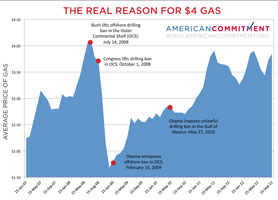
Democrats and environmentalists are
keeping the price of gasoline high for a number of reasons. Democrats seem to enjoy
having a crisis to solve, but unfortunately their solutions are usually worse than
the problems. In addition, the environmentalists hate to see capitalism and industry
succeed. Many of them are, quite literally, earth-worshiping hippies. Rational
arguments are lost on people who believe that they can "save Mother Earth" from the evil
oil companies. If these people would stand aside, offshore oil production could expand,
domestic oil supplies would go up, and prices at the gas pump would steadily decrease.
Note: As you might imagine, there is a great deal of discussion about the
recent oil spill in the Gulf of Mexico. In particular, the event is being used for
political leverage, by the people who oppose oil production anywhere, as "proof"
that offshore oil drilling will inevitably result in massive spills. All the discussion
about the Deepwater Horizon oil spill has been moved
to this page.
Rubio
looks to defense bill to block offshore drilling, but some fear it creates a loophole. Sen. Marco Rubio
(R-Fla.) is turning to a must-pass defense bill as a way to block offshore drilling off the coast of Florida, but fellow
drilling opponents worry his amendment opens the door for the Department of Defense to speed extraction in the sensitive
area. Rubio is making multiple efforts to block any drilling off the state's Gulf Coast, home to multiple military
installments that use the waters for training. One amendment to the National Defense Authorization Act (NDAA) would
extend the current moratorium on offshore drilling in the area through 2032. The other would require the secretary of
Defense to sign off on all future lease sales in Florida's Gulf to assure the drilling wouldn't interfere with military operations.
Biden
offshore drilling ban would kill 200,000 jobs, oil lobby says. Joe Biden's proposal to ban new offshore oil and
gas drilling in federal waters would cost nearly 200,000 jobs, strip the U.S. government of billions in dollars of revenue,
and potentially push production to other countries, according to a new study commissioned by the industry's trade
group. The study, released Tuesday [5/26/2020] by the National Ocean Industries Association, does not name Biden.
But its release is intended to underscore the potential consequences of Biden's proposal to prevent the U.S. government from
issuing new oil and gas drilling permits in federal waters, which had experienced record oil production before the
coronavirus halted demand.
U.S.
halts Alaskan oil drilling for two years. The Obama administration canceled offshore drilling in Alaska's
Arctic Ocean for the coming two years after scrapping current and future drilling plans in the Chukchi and Beaufort seas.
Interior
Department quietly suspends Arctic drilling leases. As part of the Friday night [10/16/2015] news dump, the Obama administration
did a complete about face on the subject of Arctic oil exploration. After years of supporting research and efforts to keep our options
open for future energy development, Interior Department boss Sally Jewell sent out word that extensions or expansion of permits for drilling
off of Alaska's coast would essentially be extinguished.
Federal
regulators pull back Arctic offshore lease sales. Three weeks after Royal Dutch Shell announced it was walking
away from exploratory drilling in U.S. Arctic waters, the Obama administration has taken steps to keep drill rigs out of
Alaska's northern ocean for a decade or more.
Offshore Fracking In Gulf Of Mexico Is
On The Rise As Companies Seek Out Deep-Sea Riches. Global oil and gas firms are increasingly turning to offshore fracking to extract more fossil-fuel
riches from the bottom of the ocean. The Gulf of Mexico in particular could see fracking activity grow by more than 10 percent over this year and
next, according to Baker Hughes Inc., which operates about a third of the world's offshore fracking fleet, Bloomberg News reported Thursday [8/7/2014].
Deep Water Fracking Next Frontier for
Offshore Drilling. Energy companies are taking their controversial fracking operations from the land to the sea — to deep waters
off the U.S., South American and African coasts. Cracking rocks underground to allow oil and gas to flow more freely into wells has grown into one
of the most lucrative industry practices of the past century. The technique is also widely condemned as a source of groundwater contamination.
The question now is how will that debate play out as the equipment moves out into the deep blue. For now, caution from all sides is the operative word.
Offshore Hydraulic
Fracturing. Offshore, a form of hydraulic fracturing has been in commercial use since the early 1990's. Similar to hydraulic
fracturing that is being used to develop unconventional resources onshore (shale and tight sand), hydraulic fracturing offshore has combined two
mature oil and gas technologies — hydraulic fracturing and gravel pack completions. The result has been a significant improvement
in well life and reliability, productivity, and oil and gas recovery.
Obama
to create the world's largest protected marine territory. President Obama will expand a protected marine
habitat to six times its current size, making it the largest aquatic area off limits to development in the world, the White
House said Wednesday [9/24/2014]. Obama will officially sign a proclamation increasing the Pacific Remote Islands
Marine National Monument in the south-central Pacific Ocean on Thursday to 490,000 square miles. The White House
said it would help revive overfished populations, such as tuna, and preserve coral reefs that support marine life.
"Expanding the Monument will more fully protect the deep coral reefs, seamounts, and marine ecosystems unique to this part
of the world, which are also among the most vulnerable areas to the impacts of climate change and ocean acidification,"
the White House said.
The Editor says...
This action has nothing to do with fishing or marine habitat or coral reefs. It is all about the
prevention of offshore oil exploration and production.
Of course, development will have to wait until the Democrats are out of the White House. Shell
announces new Gulf of Mexico discovery. Shell Oil Co. on Tuesday [7/15/2014] announced
an offshore discovery in the Gulf of Mexico it believes contains 100 million barrels of oil
equivalent. The discovery was made about 75 miles offshore in the eastern portion of the
Gulf in water that's nearly 7,500 feet deep.
Obamanomics:
Tax The Rich, Punish The Working Poor. The great entrepreneur Harold Hamm [...] has turned North Dakota into Saudi Arabia.
Energy independence is in sight. Now, the energy sector is responsible for roughly 10% of our growth. And tens of thousands of energy
jobs are now being created at very high wages, all while our trade deficit is evaporating and our entire Middle East foreign policy may be changing.
Of course, the Obama administration is taking credit for the oil-and-gas revolution. But they initially opposed it and in fact had nothing
to do with it. And if they opened up federal lands and offshore drilling, the energy success would be even greater.
Obama repeatedly defied federal
court with Gulf oil policies. Jacking up oil prices by ending energy production on federal lands has long been a top priority for liberal
Democrats and their Big Green environmental movement backers. So when the Deepwater Horizon offshore oil drilling rig exploded on April 20,
2010, President Obama wasted little time before shutting down all drilling in the Gulf of Mexico. On April 30, 2010, Obama ordered a temporary
ban on all new oil and gas leases in the region and asked Interior Secretary Ken Salazar to produce a report with further recommendations.
Tim
Scott, Mark Sanford wade into offshore drilling debate in South Carolina. Five years after "Drill, baby, drill!" entered the
United States' political lexicon, there's a new push for offshore exploring and drilling, led in part by U.S. Sen. Tim Scott. The
South Carolina Republican is working on legislation to give companies a green light to survey the South Atlantic coast for oil and gas
deposits — and to tap into them.
What happened to the "all of the above" energy strategy? Biden:
Offshore oil drilling threatens national security. The nation's need for oil and the changing environment are enduring
dangers, Vice President Joe Biden told graduates of the United States Coast Guard Academy Wednesday [5/22/2013]. Speaking at the
New London, Conn., commencement, Biden said offshore drilling and the need to protect high-seas oil tankers threaten both the nation's
shorelines and environmental security. [...] The vice president also said global warming will force the cadets to focus more on the
heretofore frozen Arctic north than did their predecessors.
The Editor says...
I hope the regular visitors to this web site don't pay much attention to the opinions embedded in the news reports on
Politico. If you do, here is the opposing viewpoint: The Arctic north is still frozen. It was "heretofore" frozen,
indeed, and it still is. Also, while Mr. Biden says oil drilling threatens our national security, exactly the opposite is
true. Buying oil from unfriendly Muslim countries instead of drilling for it at home is a direct threat to our national
security. As for our "environmental security," there is no such problem. There is no environmental problem in the
United States today that compares to the multiple pollution problems we faced in the 1960's — all of which have been remedied.
Barack Obama's America.
Barack Obama's America is a place where Americans can't drill for oil in American waters but where American taxes can be used to
subsidize Brazilian oil exploration and development.
President
Obama steals credit for energy success he opposed. President Obama may be the first chief executive to take credit for the
results of things he has opposed throughout his time in the Oval Office. The latest example came last week, when the Department of
the Interior announced it had approved 21 million acres in the Gulf of Mexico for energy resource exploration and development.
Obama Administration Mandates Oil Firms Hire Sea
Turtle Observers. The Department of Interior (DOI) is requiring private oil companies to hire marine mammal and sea turtle monitors if the companies
are granted a lease to drill offshore. A marine mammal observer's job is to watch for whales, dolphins, and similar sea creatures and to advise on minimizing
the underwater noise created by offshore drilling, which can affect the sea mammals.
Gas Prices Are Up Because of Obama's Offshore Ban.
In the Hofstra presidential debate, President Obama said: "when I took office, the price of gasoline was $1.80. Why is that? Because
the economy was on the verge of collapse." Wrong. Prices collapsed because we signaled to the world that we were finally moving forward
with developing America's massive offshore oil and gas resources — and they shot back up when Obama reimposed the offshore ban.
Why gas is nearly $4 a gallon. So it was Bush's bad
policies that drove the economy down, and with it the gas prices. Let's ignore the obvious, and not even point out that if what Obama said
were true, gas would be [almost] free by now, if not for the taxes.
Feds give Shell green
light to launch Arctic drilling. The Obama administration on Thursday [8/30/2012] agreed to immediately allow
Shell to launch initial drilling in Arctic waters, even though a critical oil spill containment barge is still a two-week trek
away. Administration officials stressed that the company would only be allowed to begin initial site work and drill
1,400 feet below the surface of the Chukchi Sea without penetrating underground oil reservoirs until that emergency
equipment has won Coast Guard certification and is on site.
Survey says voters back offshore drilling.
Roughly seven out of 10 voters support changing U.S. policy to allow more oil and natural gas development along the nation's coastline, according
to a new Harris Interactive poll released today [8/14/2012]. That matches the level of support for offshore drilling that was documented by other
polls conducted before the Deepwater Horizon disaster two years ago briefly turned some Americans off to the idea.
Coastal governors decry
limited role in offshore drilling plan. The Obama administration ignored the wishes of coastal leaders when assembling a
plan for offshore drilling near their shores, says a group of Republican governors from Texas, Louisiana and other states. In a
letter to President Barack Obama late Wednesday [8/8/2012] and obtained exclusively by Hearst Newspapers, the pro-drilling governors
say they are "concerned about the lack of communication from the federal government on critical matters that affect our coastal
development." In particular, the group complains that the Interior Department did not consult properly with coastal states
on its a plan for selling offshore oil and gas drilling leases from 2012-2017 before finalizing the plan in June.
Committee
to Issue Subpoenas for Five Interior Dept. Officials in Drilling Moratorium. The House Natural Resources Committee
voted 26-17 today [8/1/2012] to let Chairman Doc Hastings (R-Wash.) proceed with issuing subpoenas for five Obama administration officials
involved in the disputed report that led to the Gulf drilling moratorium. The officials — who never confirmed
an invitation to appear at a hearing last week, thus leading to its postponement until September — are believed to have
direct knowledge or involvement in the drafting, editing or review of the Department of the Interior report that was edited to
appear as though the moratorium was supported by a panel of engineering experts when it was not.
Interior Department
sneaks offshore moratorium past public. While the Obama administration was taking a victory lap last week after the
5-4 Supreme Court decision to uphold the president's signature legislative accomplishment, Obamacare, the Interior Department was
using the media black hole to release a much-awaited five-year plan for offshore drilling. That plan reinstitutes a 30-year
moratorium on offshore energy exploration that will keep our most promising resources locked away until long after President Obama
begins plans for his presidential library. Given the timing, it is clear that the self-described "all of the above" energy
president didn't want the American people to discover that he was denying access to nearly 98 percent of America's vast
energy potential on the Outer Continental Shelf (OCS).
Is Salazar the New Holder? Ken Salazar, a former Democratic senator and
attorney general of Colorado, was brought into the fold early by Obama's transition team. Since then, his department has been held in civil
contempt for refusing to comply with an injunction against the offshore drilling moratorium and has spun the administration line about domestic energy
production being up while simultaneously cutting back on oil and gas exploration on federal lands — with leasing falling to the lowest
amount of acreage in 20 years.
Obama Sets Drilling Limits,
Continues War On Oil. President Obama has said that his administration has an all-of-the-above energy plan. Apparently "all"
doesn't include offshore drilling. No president has ever offered fewer offshore leases.
Sierra Club
Sues to Stop Offshore Drilling, and Guess Who Is Funding the Defense. [Scroll down] A little known US law called the Equal
Access to Justice Act, signed by President Jimmy Carter in 1980, allows the groups to use lawsuits against government as revenue sources.
When they sue, the government has to incur the costs of defending itself against the lawsuits, and also picks up the expenses for the groups suing
the government. No one even keeps track of how much money the government has ended up spending on such lawsuits.
Obama's
Interior Department Still Going Rogue. The Obama administration's loathsome cowboy, Interior Secretary Ken
Salazar, won't take no for an answer. He's been smacked down repeatedly by federal courts for imposing a draconian,
junk science-based moratorium on the oil and gas industry. Yet, the job-killing zealot and his boss just introduced
another ruinous offshore drilling ban two weeks ago. The White House rationale for the renewed crackdown?
Because we said so.
Senators
Aim to Repeal and Replace Obama's 5-Year Offshore Drilling Plan. Two of the senators who pushed an investigation
into a suspected Interior Department cover-up of the White House fudging scientific conclusions to justify the gulf drilling
moratorium are now fighting the administration's plan to stymie exploration and production on the outer continental shelf.
On the same day that the nation's attention was turned toward the ObamaCare ruling at the Supreme Court, the Obama administration
was quietly issuing a five-year energy proposal that would place a virtual moratorium over 85 percent of the nation's
offshore areas.
Offshore drilling under fire
from latest energy plan. A new plan by the Interior Department that critics say would lock up more than 85 percent
of America's offshore areas to energy production is drawing negative reviews from congressional Republicans. The restrictive
five-year proposal only allows for 15 new offshore leases in the Gulf region and Alaska, but blocks new drilling on the Atlantic
and Pacific coasts, including the much sought after Virginia and South Carolina region.
Don't Drill, Baby, Don't. The Obama administration's recently
released five-year plan for offshore drilling leases has been met with sharp criticism from the oil and gas industry and Republicans,
who say it continues a crippling moratorium on potential energy reserves on the West and East Coasts. The administration's
2012-2017 offshore lease plan, released June 28, expands available leasing areas for drilling slightly in the Gulf of Mexico
and opens new areas in the Arctic Ocean, but also keeps both the West and East Coasts completely off-limits for offshore oil
exploration.
Senior GOP
lawmaker: Interior is stonewalling on deepwater drilling probe. A senior Republican says the Interior Department is
stymieing a House committee probe into the deepwater drilling freeze imposed after the 2010 BP oil spill by refusing to make several
officials available for interviews. House Natural Resources Committee Chairman Doc Hastings (R-Wash.), in a letter to Interior
Secretary Ken Salazar on Friday [7/6/2012], says he's providing a "final opportunity" to establish a schedule for interviews with Interior
officials to occur the week of July 16.
Interior
Dept. IG to be Investigated in Alleged White House Drilling Moratorium Cover-Up. A trio of senators have won their request
for an investigation into Interior Secretary Ken Salazar's inspector general regarding a potential cover-up of documents that led to the
drilling moratorium in the Gulf of Mexico following the BP oil spill. Sens. David Vitter (R-La.), Jeff Sessions (R-Ala.) and John
Cornyn (R-Texas) asked the Integrity Committee of the Council of the Inspectors General on Integrity and Efficiency in a May 24
letter to investigate the Interior Department's Acting Inspector General Mary Kendall, whom they say "failed to ensure an independent,
impartial and complete investigation into the Administration's offshore drilling moratorium and related activities."
Record-setting Gulf drilling auction
nets $1.7 billion. The Interior Department on Wednesday [6/20/2012] held a record-setting sale of oil and gas drilling
rights in the central Gulf of Mexico, with companies submitting $1.7 billion in winning bids for 454 offshore tracts and
Statoil establishing a new high-water mark with its $157 million offering for a single lease.
Obama Stonewalling Gulf Oil Spill
Disclosure. The Obama administration is desperately trying to avoid coming clean about its role in delaying capping the
Gulf Oil Spill. [...] We can reasonably infer that the authors of those 21 documents may include President Barack Obama, his
then-chief of Staff Rahm "Never Let a Crisis Go to Waste" Emanuel, and Energy and Climate Change Czarina Carol "Midnight Moratorium"
Browner from the White House, not to mention Energy Secretary Steven "Solyndra" Chu, Interior Secretary Ken "Boot on Their Neck"
Salazar, and Admiral Thad "An Overabundance of Caution" Allen of Homeland Security's United States Coast Guard. All of them
had a lot to say and or do publicly during the oil spill containment operations.
Time for LOST to Get Lost.
Secretary of State Hillary Clinton says that by failing to ratify LOST, the U.S. could fail to develop offshore oil and gas
deposits under the ocean bed. Funny, that's what we're failing to do now. Signing the treaty would not change the
Obama Administration's fierce determination to prevent offshore drilling.
Inspector General under
investigation in drilling ban. Lawmakers are investigating whether a top government investigator was involved in
producing a report that erroneously suggested certain scientists approved a drilling moratorium in the Gulf of Mexico after the
Deepwater Horizon disaster. The moratorium cost thousands of jobs throughout the region and created a decline in energy
production. Seven members of the National Academy of Engineers later rebuffed the action.
Senators
Demand Probe of Potential Cover-Up in Gulf Drilling Moratorium. Three senators have called for an investigation into
a potential cover-up of documents that led to the drilling moratorium in the Gulf of Mexico following the BP oil spill. Sens.
David Vitter (R-La.), Jeff Sessions (R-Ala.) and John Cornyn (R-Texas) today wrote Kevin L. Perkins, chairman of the Integrity
Committee of the Council of the Inspectors General on Integrity and Efficiency, stressing that they believe the Interior Department's
Acting Inspector General Mary Kendall "failed to ensure an independent, impartial and complete investigation into the Administration's
offshore drilling moratorium and related activities."
Cabinets gone
wild. [Scroll down] Secretary of the Interior Ken Salazar has pulled off the near impossible: At a time when
the known gas and oil reserves of the United States on public lands have soared, he has cut back on federal leasing of them to just
about 2 percent of available offshore lands and 6 percent of onshore. Meanwhile, huge new amounts of oil are now found
on private lands despite, not because of, the Interior Department. When he was a U.S. senator, Salazar claimed that
even $10-a-gallon gas would not change his mind about voting to increase offshore drilling.
Obama administration rebuffs subpoena. The Obama
administration has snubbed a congressional subpoena in the investigation of a White House "drafting error" that suggested
certain experts supported their decision to temporarily ban oil drilling in the Gulf of Mexico. The Interior Department
says it will not turnover all of the requested documents and accused the House Resources Committee conducting oversight of
the incident of violating the administration's good faith effort to work with the panel.
House committee says Obama administration may have edited 2010
report to favor Gulf oil drilling moratorium. The Obama administration was subpoenaed Tuesday [4/3/2012] for
documents that congressional investigators hope would shed light on how a government report was edited to indicate experts
endorsed a moratorium on oil drilling in the Gulf following the Deepwater Horizon tragedy. Interior Department
officials have refused to comply with repeated requests from the House Resources Committee to provide documents that
lawmakers say would show if political appointees at the agency or White House were involved in the editing decision
and whether it was intentional.
Obama Kills Atlantic Offshore Drilling For Five
Years. Yesterday [3/29/2012] the Obama administration announced a delaying tactic which will put off the possibility of
new offshore oil drilling on the Atlantic coast for at least five years.
House
Panel Says Obama 'Hides Ball' On Energy Truth. House panel votes to issue subpoenas to administration
officials involved in doctoring a report on the Gulf oil spill to justify a moratorium and in squelching another that
concludes EPA regulations will kill jobs.
Republicans
vote to subpoena oil moratorium documents. House Republicans voted Wednesday [3/28/2012] to authorize congressional
subpoenas demanding that the Obama administration turn over documents it has refused to provide in two investigations, including one
looking at the post-Gulf of Mexico drilling moratorium. The 23-17 vote in the Natural Resources Committee escalated yet
another showdown between the administration and House Republicans, who have flexed their investigative powers on everything
ranging from immigration to gunrunning to land use.
President's
Budget Projects 72% Drop in Off-shore Drilling Lease Revenue. With gasoline prices at historic highs, and
threatening to go even higher, Department of Energy Secretary Steven Chu, who recently revealed he does not even own an
automobile, was reported as saying back in September of 2008 (prior to the Obama Administration and his appointment as
Secretary of the Department of Energy), that American gasoline prices should be gradually raised over a fifteen year
period to encourage energy efficiency. He was quoted in a Wall Street Journal interview back then as stating "Somehow
we have to figure out how to boost the price of gasoline to the levels in Europe."
Top 10 Obama energy blunders. After
the 2010 oil spill in the Gulf of Mexico, President Obama imposed a moratorium on deep-water drilling. The
action prompted oil rigs to relocate to Brazil, costing jobs in America. Obama then offered technology and
support for Brazil to develop its offshore oil production, creating jobs in Brazil. Does this make sense
to anyone?
Tell
America the whole truth about gas prices, Mr. President. According to government data, a mere
3.7 deep-water permits in the Gulf of Mexico have been approved per month since last August, compared with
seven per month during the previous three years. More than 80 percent of the oil produced in the Gulf
comes from deep-water rigs. Similarly, the average approval time for mandatory environmental impact studies
that must be made for drilling in the gulf has doubled under Obama, going from an average of 61 days
to 118.
Shell
losing $1 billion a year on U.S. Gulf drilling delays. Royal Dutch Shell Plc, Europe's largest oil
company, is losing about $1 billion a year from drilling delays in the Gulf of Mexico since the 2010 Macondo
disaster. Shell's production in the region will be curbed by about 50,000 barrels of oil equivalent this
year, similar to 2011, Chief Financial Officer Simon Henry said. The company expects to return to planned
operations off the Gulf coast by 2014.
Obama's dishonest
energy promise. President Obama's ambiguous call to "open" 75 percent of the country's potential
offshore oil and natural gas resources to exploration may sound generous, but the truth is, the areas containing
those resources are technically already included in the upcoming 2012 to 2017 offshore leasing plan, and they are
virtually the same areas where exploration and production have been allowed for decades.
Gulf
Deepwater Drilling Ban's Hidden Victims. Small- and medium-size businesses serving Louisiana's
energy industry are shedding employees, dipping into personal savings or moving elsewhere to stay afloat.
The administration's war on fossil fuels is taking its toll.
Obama loves oil! Not!
Without his nose growing visibly, the President claimed the government was behind the technological advances that
led to the current shale gas boom, and even suggested that he might take credit for the rise in domestic oil
production. In fact, Mr. Obama's administration has hampered and castigated oil companies at every turn.
In the light of the hysterical grandstanding over the BP Gulf spill (whose impact proved to be greatly exaggerated),
it was ironic indeed to hear the President now declare a great opening up of offshore exploration.
Deep Gulf
drilling thrives 18 mos. after BP spill. Two hundred miles off the coast of Texas, ribbons of
pipe are reaching for oil and natural gas deeper below the ocean's surface than ever before.
The
Year in Obama Scandals — and Scandal Deniers. [Scroll down] In February, federal judge
Martin Feldman in Louisiana excoriated the Obama Interior Department for defying his May 2010 order to lift its
fraudulent ban on offshore oil and gas drilling in the Gulf. He called out the administration's culture
of contempt and "determined disregard" for the law.
President Obama's
top 10 constitutional violations. [#6] The deep-water drilling ban: Following the Deepwater
Horizon oil spill, the Interior Department issued a blanket six-month moratorium on new oil and gas drilling in
the Gulf of Mexico. A federal judge struck down that moratorium as arbitrary and capricious, but the
government issued a new order to replace the one that was struck down. That order was subsequently
withdrawn, but the judge was so shocked by the administration's conduct that he found the government in civil
contempt of court.
Obama's Energy
Plan: Chevy Volt. We hear much these days about all the jobs "saved or created" but hear little about
jobs slashed or destroyed. In many ways, the Obama administration has become a job-wrecking machine.
According to Forbes in the same Politico op-ed piece, the six-month gulf drilling moratorium alone cost 8,169 jobs
and $487 million in wages, not to mention the sweeping effects on the trucking and agriculture industries.
Shell
Ready to Move on Alaska Wells — If Alphabet Soup of Challenges Would End. An estimated
27 billion barrels of oil are sitting just off the northern coast of Alaska in waters controlled by the
United States, but despite spending more than five years and $4 billion, Shell Oil Company still can't
get to it. The company was planning to announce this week plans to move ahead with drilling three
test wells in the Beaufort and Chukchi Seas next summer, but it's still lacking several permits and a roadmap
of how to get them. Shell doesn't blame strict environmental protections. The company's beef is
with a seemingly endless web of legal appeals and challenges available to drilling opponents.
Obama Stalls Deepwater Drilling Despite Lifting of
Moratorium. This week marks one year since the Obama administration lifted its formal moratorium
on deepwater drilling, but thanks to the Interior Department's frustrating approach to energy development, much
of the Gulf of Mexico is still suffering the effects of a permitting logjam. ... We were hoping for a productive
discussion about how we can work together to remove the Interior Department's bureaucratic roadblocks and allow
our Gulf Coast energy industry to get back to work. Unfortunately, we just got the same old company line:
They're working on extending leases and granting permits on a 'case-by-case' basis.
Once in a while, it doesn't hurt to state the obvious: Deep-water
drilling lags behind pre-spill levels. A year after the Obama administration lifted a deep-water
drilling ban imposed in response the Gulf oil spill, the offshore energy industry is still struggling to rebound,
coastal and business leaders said Wednesday [10/12/2011]. A parade of executives from companies whose
fortunes are tied to offshore drilling told the House Natural Resources Committee it is taking too much time
and effort to win the Interior Department's approval to drill new wells and plug old ones.
'Drill,
Castro, Drill!' says Obama and the Environmental Defense Fund. In half a heartbeat the Obama team
could put the kibosh to the most dangerous offshore oil drilling ever proposed near U.S. shores, scheduled to
begin in December by a Spanish/Cuban corporation. By fighting this drilling his "Environmentalist"
allies could get the biggest bang for their lobbying buck in their history. But all bets are off.
This drilling, you see, won't be by tacky/villainous U.S. oil companies. Instead a Spanish-Cuban oil
company will be the outfit drilling in Cuban waters 60 miles from Key West. U.S. companies are
banned from exploring anywhere within 125 of the Florida Coast, by the way.
Obama's Interior
Chokehold on America. How could a bureaucratic bottleneck in the Gulf of Mexico cost the U.S.
economy nearly $20 billion and wipe out hundreds of thousands of jobs as far away as Ohio, Pennsylvania
and California? Unfortunately, with this White House administration, anything is possible.
President Obama recently announced yet another jobs initiative — knowing all the while that one
very simple action on his part would indeed create new jobs, infuse federal and state budgets with billions
of dollars, and make us less reliant on imports. But that didn't happen.
Drill, Cuba, Drill.
Deep-water drilling will resume in the Florida Strait when a giant, semi-submersible oil rig en route
from Singapore arrives later this fall. The bad news is it will not be American.
Shell
Gets Alaska Drilling Go-Ahead from EPA. Shell Oil is set to tap Alaska's vast oil reserves now
that the U.S. Environmental Protection Agency (EPA) has issued a final air quality permit to allow exploration
development north of the Arctic Circle. The permit allows Shell to set up its Noble Discoverer
drillship in the Chukchi Sea along with a fleet of support vessels including icebreakers and oil-spill
response crafts.
The Editor says...
The population density in Alaska (north of the Arctic Circle) is practically zero, and
there is no shortage of wind. How bad could the air quality possibly be?
The
Obama energy crisis as you've never before seen it. It's been eclipsed somewhat
in recent months by the continued stagnation of the economy and the increasingly loud Republican
presidential nomination battle, but the energy crisis caused by President Obama's Permatorium on
drilling in the Gulf of Mexico is just as serious as it ever was. And it's going to get worse
if something isn't done soon to lift the bureaucratic strangulation being applied to the oil and
natural gas industries by Obama's Secretary of the Interior Ken Salazar.
Rigged
For Failure. A year ago, three oil rigs fled the Gulf of Mexico for better opportunities abroad.
Now, it's 10. Make no mistake, the toll is rising on a business environment marked by the Obama
administration's uncertainty.
Collateral Damage: Lost Gulf Rigs
from Obama Obstructionism. Ten oil rigs have left the Gulf of Mexico since the Obama
Administration imposed a moratorium on deepwater oil and gas drilling in May 2010 and others could follow
soon, a detailed July 2011 report from Sen. David Vitter's (R-La.) office shows. ... It gets worse.
Several of the remaining rigs could be relocating soon, according to the report.
Obama's
"Industrial Sabotage" Devastates the Gulf. Kevin Mooney tabulates the damage that the Obama
administration is doing to the Gulf economy, and to the energy industry generally. ... If a hostile nation
drove our drilling rigs out of the Gulf of Mexico, it would be an act of war.
Obama's Real Energy Policy.
[Scroll down] The oil companies drilling in the Gulf of Mexico are still reporting incredible delays in
re-opening even the inshore oil rigs. Offshore fields have become almost impossible to develop despite
the incredible size of some of these discoveries. The government shut down even the inshore oil fields
in the Gulf after the Deepwater Horizon disaster last year. The Department of the Interior just
announced the first auction of oil leases since the Deepwater Horizon tragedy in April of last year, to be
held in December. The Gulf provides 29% of America's oil and 13% of our natural gas.
Ten
Oil Rigs Have Exited the Gulf of Mexico. Ten oil rigs have left the Gulf of Mexico since the
Obama Administration imposed a moratorium on deepwater oil and gas drilling in May 2010, according to
documentation the Pelican Institute obtained from Sen. David Vitter's (R-La.) office.
Who Controls the Price of Oil?
OPEC should not be able to burden consumers to the same extent now [as they did in the 1970's] because large
oil reserves were discovered in Alaska, North Sea, Canada, and the Gulf of Mexico. However our business-killing
EPA regulations and Obama's seven-year moratorium on drilling in the Gulf do.
Top 10 Scariest Economic Developments.
[#5] Price of oil skyrocketing: When Obama took office, the price of oil was $1.61 a gallon. With
the Middle East turmoil, the decline of the dollar and the administration's lack of an energy policy, oil has
soared to $4 a gallon. How about letting oil companies drill in America instead of subsidizing
Brazilian offshore drilling?
No Energy in the Executive.
"At some point this must end. With a permit, or without." With those words, an exasperated federal
judge punctuated his latest decision ordering the Obama administration to process applications to drill for oil
and gas offshore. More than a year after the BP Deepwater Horizon oil spill caused the administration
temporarily to halt the federal permitting process, Judge Martin Feldman of the Eastern District of Louisiana
was prepared to accept no further bureaucratic delay by the federal regulators who continue to bottle up
almost all drilling applications.
Top 10 Examples Proving Obama Wants High Energy Prices.
The BP oil spill prompted the President to impose a drilling moratorium in the Gulf making deepwater drilling
permits impossible to obtain. So when oil companies moved their rigs to areas off the coast of Brazil
where they were welcomed, Obama offered billions in U.S. taxpayer money to aid the venture, creating new jobs
in South America. By refusing to allow U.S. energy sources to be developed, the President is ensuring
increased reliance on expensive and volatile foreign oil.
Too Little, Way Too Late.
Why has the Democratic Party done everything in its power for more than 30 years to suppress domestic
production of oil? Let's consider some sources of petroleum that the Democrats have blocked. ANWR
is estimated to have the capacity to produce 1,000,000 barrels per day. Currently, around 1.5 million
barrels per day are produced in the Gulf of Mexico; if the Obama administration would stop blocking permits
and allow that production to increase by only 20 percent, that would be 300,000 barrels per day.
Then there is the Keystone pipeline. The administration would like to block its construction, which
would prevent 900,000 barrels per day from entering the U.S.
Obama's
Environmentalists Destroy Marine Environment. The most prolific marine ecosystem on earth is being
systematically destroyed on orders of the U.S. Department of the Interior. ... The most prolific and "diverse
marine ecosystem" ever recorded by marine scientists was created by the "facilities" the U.S. Dept. of the
Interior is hell-bent on dismantling (offshore oil platforms). Acting as artificial reefs over the
past half century, the natural beauty, teeming fish life, coral colonies, and "bio-diversity," created by
these structures is amply documented in several studies commissioned by none other than the U.S. Dept. of
the Interior.
Environmentalists
push to keep U.S., others from oil drilling in Arctic. Environmentalists are toiling to stop a
modern-day gold rush at the top of the world, as the U.S. and four other countries scramble to stake claims
to potentially vast oil riches under the frozen waters of the Arctic Sea. Environmental activists such as
Greenpeace are opposed to any resource extraction in the region.
House passes bill
to speed Arctic drilling. The House on Wednesday [6/22/2011] passed legislation that would
accelerate offshore drilling in the Arctic by curtailing environmental reviews of coastal oil exploration
projects. The measure, sponsored by Rep. Cory Gardner, R-Colo., and Rep. Gene Green, D-Texas, aims
to remove legal and regulatory barriers that have stalled Shell Oil Co.'s bid to drill in Arctic waters
near Alaska.
Witnesses say Gulf drilling ban was a
harsh blow. The Obama administration's reactions to last year's BP oil spill did more damage
than the crude itself, Mississippi Gov. Haley Barbour and Gulf Coast employers told a House committee
Thursday [6/2/2011]. Barbour said little oil reached Mississippi's shores, but the administration's
May 2010 decision to impose a five-month ban on most deep-water drilling has left a lasting impact.
Running
on empty: The drilling ban one year later. It was one year ago when the Obama administration
imposed a deep-water drilling moratorium on new oil and gas wells in response to the Deepwater Horizon
tragedy in the Gulf of Mexico. For all practical purposes, the ban continues today — despite
the administration's pre-election announcement in October that it had lifted the moratorium.
"The
Worst Environmental Disaster in U.S. History!" (One Year Later). "There's just no data to suggest
this is an environmental disaster, "said Marine Scientist and former LSU professor Ivor Van Heerden who also works
as a BP spill-response contractor. "I have no interest in making BP look good — I think they lied about
the size of the spill — but we're not seeing catastrophic impacts. There's a lot of hype, but no evidence
to justify it." In fact these observations came — not a year after the Deepwater Horizon blew-up — but
a mere three months afterwards, making them all the more blasphemous at the time. By now they've been amply
vindicated, making the Obama team's "moratorium" and more recent stonewalling on Gulf of Mexico drilling permits
all the more preposterous.
House Measure Lifts Gulf Drilling Moratorium.
House Republicans on Thursday [5/12/2011] passed legislation to reverse President Obama's moratorium on drilling
in the Gulf of Mexico over the objections of many Democrats who insisted that gas prices would go down if oil
company taxes were increased.
Gas Prices
Are High Because the Liberals Want It that Way. [Scroll down] President Obama overreacted
to the British Petroleum Deep Horizon oil spill in the Gulf of Mexico last year by issuing a crippling moratorium
on offshore deepwater drilling. The spill was a result of a lack of sufficient oversight during the
transition of the rig from exploration to commercial production, a particularly low-probability event.
The moratorium did nothing to address the root cause of the accident. The 5th Circuit Court of Appeals
agreed with this line of reasoning, yet White House officials falsely represented to the public last year and
more recently to a court that scientists had approved the blanket drilling moratorium. The administration
then defied a federal court by replacing its original moratorium, which had been struck down, with a substantively
identical second moratorium — for no good reason.
House
to Vote on Lifting Offshore Oil Moratorium. With almost 98 percent of America's offshore
oil off-limits to drilling, and sustained gas prices nearing $4 a gallon, congressional Republicans say only
one thing is keeping America from tapping into its offshore resources — President Obama. On
Wednesday [5/11/2011], Congress considered a bill to void that. The House debated H.R. 1231, a
bill titled, "Reversing President Obama's Offshore Moratorium Act," and it is expected to pass Thursday
[5/12/2011].
House Bucks Obama: Bill Jump-Starts Gulf Oil Production.
Republicans are banking on a measure approved by the House on Thursday [5/5/2011] to lower gasoline prices by
accelerating offshore lease sales in the Gulf of Mexico. "The situation we find ourselves in today is detrimental
to everyone who goes to the pump to fill their cars," said Rep. Rob Bishop (R.-Utah). "The cost of gas increases,
and continues to increase because of the inaction of this administration."
Interior
Department auctions off shore oil leases, EPA says you can't drill. If the Justice Department
weren't in on this scam, they'd be investigating the bait and switch tactics the Obama administration uses
on the oil industry. First you take billions of dollars from an oil company for an offshore lease,
then you come up with an absurd excuse to stop them from drilling.
The
Gulf Is Still Waiting for More Drilling Permits. On the first anniversary of the Deepwater Horizon
oil spill, the administration's de facto moratorium, or "permitorium," on offshore drilling has resulted in
higher prices for gas and heating fuel in addition to costing thousands of Americans jobs and making the country more
dependent on foreign oil. Indeed, it appears that the administration has found in the Gulf disaster the
justification for its political bias against domestic oil and gas production.
How we
will end up paying $6 a gallon for gas: Someday, you will be pumping gas, staring at the digital
numbers racing by, and you'll wonder: "How could I possibly be paying $6 a gallon for gasoline?"
You also will be wondering why so many of your friends and relatives are still looking for work. Or why
America is more dependent on foreign oil than ever before. If you look back to today, you'll remember
why: President Obama's de facto moratorium on deepwater drilling in the Gulf of Mexico.
Wrecking a Nation.
In 1985, the U.S. imported 25 percent of its oil usage. Today, it's 61 percent. And
still we are placing restrictions on increases in domestic production, both for oil and other sources of
energy. A few days back, President Obama, rather than sticking around a couple hours to explain to
the American people or to the U.S. Congress why we were going to war in Libya, flew off to Brazil to hand
out a permit to allow deep sea oil drilling in the Gulf of Mexico to Brazil's state-run oil company,
Petrobras. Capitalist companies in America need not apply.
Drill, Drill, Drill (but only in Brazil).
President Obama making the case for offshore oil development in Brazil while the Gulf of Mexico remains in
limbo. ... In the Gulf of Mexico and off the coast of Alaska, oil production remains at a virtual standstill
while an Administration "permitorium" on drilling continues unabated, save for three Gulf permits granted to
operations which previously had permits and one allowing for new exploration (we'll see how far that one gets
before the green lawsuits commence). Meanwhile, American rig operators continue to go without jobs while
the network of small businesses that support oil production have been dealt blows from which they may never
recover.
Drill,
Brazil, drill, says the U.S. When was the last time an American president stood before an audience
in a foreign country and announced that he looked forward to importing more of its oil? Answer: Just
over a week ago, when President Obama joined political and business leaders in Brasilia in hailing the fact that
their newly discovered offshore petroleum reserves might be twice as large as those in the United States.
Obama's Domestic Energy Doublespeak.
The gap continues to widen between what President Obama claims to be true about domestic energy
production and what Louisianians know is true. With prices at the pump climbing toward $4 a
gallon, the President is asking us to believe that his administration supports expanded drilling
off the Gulf Coast. Those of us who live there know that nothing could be further from the
truth.
19,000 Jobs Lost Nationally
Since Offshore Drilling Moratorium Imposed. At least 13,000 jobs have been lost since last summer's
moratorium on offshore oil production, surpassing projected job losses in a 2010 study by thousands, according
to the Louisiana State University professor who authored the study. Joseph Mason, author of "The Economic
Cost of a Moratorium on Offshore Oil and Gas Exploration to the Gulf Region," estimated that the new regional
job losses due to the moratorium on offshore oil production in the Gulf region is now 13,000 — up
from his original estimate of 8,000.
Senator Questions
$2-Billion Loan to Brazil for Offshore Drilling. Sen. David Vitter (R-La.) is questioning how
the United States has benefited from a $2-billion loan the Export Import Bank of the United States made to a
Brazilian oil company for its offshore drilling operations. ... The Obama administration has approved only
three permits for drilling new deepwater wells in the Gulf of Mexico since it lifted its moratorium on
issuing permits last October — seven months after the BP rig explosion and oil spill.
Obama: Drill, Brazil, Drill!
While leaving U.S. oil and jobs in the ground, our itinerant president tells a South American neighbor that
we'll help it develop its offshore resources so we can one day import its oil.
Drill, Bebê,
Drill. Let's see if I have this straight: America shouldn't drill for oil and gas
in the Gulf of Mexico because our evil oil corporations surely will cause another accident like the BP
spill and pollute all the oceans of the world; but it's no problema apparently for the obviously technologically
superior Brazil to drill in the open Atlantic and sell their production to us? At least that is
what I gleaned from the encouraging words delivered by our president to Brazilian leaders in a speech to
local businessmen in Brasilia last week.
Is
Obama's Interior Secretary lying about drilling permits, or his Justice Department? President
Obama's Interior Secretary Ken Salazar told Congress recently that his department has received only seven
deepwater drilling permit applications and 47 for shallow water drilling in the past nine months. That
caught Sen. David Vitter's attention because he recalled that the Department of Justice told a federal judge
last week that there are actually 270 shallow water drilling permit applications pending and 57 deepwater
applications. Which is it? The 54 applications Salazar claims or the 327 claimed by
the Justice Department? Does the Obama administration's left hand know what it's far-left hand is doing?
Thanks for Small Favors,
President Obama. On Feb. 28, just after Interior Secretary Salazar declared that he was not
satisfied with Gulf drilling safety standards, President Obama's drilling czar, Michael Bromwich, announced
that a permit had been approved to resume deep-water drilling 70 miles off the Louisiana coast.
Not a new permit, mind you, but one for a project that had already begun drilling before the Deepwater Horizon
accident in April 2010. In the months ahead, Bromwich hinted, there might be more approvals, even
approval for a new deep-water well. Maybe so, maybe not.
Americans
Back Offshore, ANWR Drilling. With the price of gas up 39 cents at the pump in a month
and heading higher amid turmoil in much of the Middle East, Americans wonder why the U.S. isn't doing more
to exploit its own oil resources. They favor drilling in territorial waters, 67%-29%, according to a
new IBD/TIPP poll. That is up from 61%-30% from last May and 64%-25% when Republicans touted drilling
in the 2008 election as oil topped $147 a barrel.
Obama's Fuzzy Oil
Production Math. He doesn't want to admit it, but President Obama is taking credit for
something George W. Bush did. The White House is touting federal data that shows domestic
oil production is at its highest level since 2003. In a blog post last week, Obama's top climate
and energy aide, Heather Zichal, points to Energy Information Administration data that shows oil production
from the Outer Continental Shelf (which basically means the Gulf of Mexico) has increased by more than a
third between 2008 and 2010.
Time Is Money, Oil Is Time.
Writing at the Politico, Steve Forbes adds up the damage: "The Interior Department's six-month moratorium
on offshore oil production has cost 8,169 jobs, according to a study by one Louisiana State University professor, along
with more than $487 million in wages and nearly $98 million in forfeited state tax revenues in the Gulf
states alone..."
Feds
give first green light for deep-water project since drill ban. The federal government just gave
the green light for Noble Energy to resume a deep-water drilling project that was halted by the Obama administration's
moratorium last year — the first of its kind to be approved since the ban was lifted in October.
Until today [2/28/2011], federal regulators had yet to allow offshore drilling that was off limits under a
five-month ban on some deep-water exploration.
Vitter:
One drilling permit is not enough. One down, 14 to go. That's the message Sen. David
Vitter (R-La.) sent to the Obama administration on Monday [2/28/2011] when the Interior Department announced
it had approved the first Gulf of Mexico deepwater drilling permit since last year's massive oil spill.
Vitter has placed a hold on a key Interior nominee until the department's offshore drilling arm —
the Bureau of Ocean Energy Management, Regulation and Enforcement — issues at least
15 deepwater permits.
Obama Nixes Safe Drilling.
Interior Secretary Ken Salazar was in Houston this weekend talking with oil executives who are eager to start
drilling again in the Gulf of Mexico. That may sound like progress, but after the meeting Salazar
said that nothing had changed. He was not ready to approve any new drilling.
No date yet for deepwater Gulf
permits - US officials. U.S. officials on Friday [2/25/2011] could not offer a firm date when
deepwater permits to drill for oil in the Gulf of Mexico will be issued, as crude posted its highest weekly
close in more than two years. "We are carefully and rigorously reviewing drilling plans," Michael
Bromwich, director of the Bureau of Ocean Energy Management, the offshore drilling regulator, said at a
news conference.
The Oil Spill Crisis
That Didn't Go To Waste. The extent of the Obama Administration's political opportunism in the
Gulf oil spill is being revealed as the investigation into the Deepwater Horizon accident continues to plod
along. A spate of new developments on the political front highlights the bending of facts to fit a
political agenda.
A
Shale Of A Difference. We've been here before. After the Deepwater Horizon disaster in the Gulf
of Mexico, which was caused by a single drilling rig explosion, all deepwater rigs were shut down while the
administration took a fresh look at safety rules and procedures. A de facto moratorium remains in
the form of a snails-pace permitting process.
Oil ban means more
debt. The Obama administration's policy against oil drilling kills American jobs, undermines
the economy and violates a judge's direct order. The full-court press against the oil industry amounts
to what Rep. Stephen J. Scalise, Louisiana Republican, calls a "permitorium" on offshore drilling.
The permitorium is what remains after the formal moratorium against deep-water drilling was lifted in October.
Vitter:
Drilling regulator sticks to 'talking points'. Sen. David Vitter said today [2/16/2011] he
was unsatisfied after a meeting with the nation's top offshore drilling regulator, Michael Bromwich, to
discuss delays in the government's approval of deep-water exploration projects. Vitter, R-La., said
Bromwich "said some things that would make most Louisianians' heads spin." "I wish my meeting with
Director Bromwich was more fruitful," Vitter said. "Unfortunately, pretty much all he did was repeat
the administration's talking point that there is no de facto drilling moratorium in the Gulf."
White
House seeks new fees on offshore drillers. The fiscal year 2012 White House budget proposal
calls for new fees on oil-and-gas companies to help fund drilling oversight, which the Interior Department
has expanded in the wake of the BP oil spill. But calls for digging deeper into the industry's
pockets — along with the White House plan to end billions of dollars in industry tax incentives — will
face a cool reception among oil-and-gas companies and many Republicans.
New
Containment System Shreds Last Excuse for Permitorium. No more excuses, Mr. President.
Let the drilling resume. A consortium of oil companies, led by Exxon, today unveiled a dedicated
underwater containment system, including the vessels needed to deploy it, for runaway oil wells in the Gulf.
The system borrows heavily from the innovative method BP used to cap the Deepwater well before pessimists
said it would be possible via the standard "bottom kill." Since it is all ready to go, this new device
could stop a blowout in weeks, rather than the 85 days it took BP to design, build, and emplace a
similar structure.
National
Commission Spill Report: Too Anti-Drilling Instead of Anti-Spilling. The BP Deepwater Horizon
Spill Commission report is out and its recommendations would spell bad news both for energy industry jobs and
the future price at the pump. The administration-selected panel, dominated by anti-drilling activists
but devoid of anyone with actual experience producing energy, proposes to pile new layers of red tape onto a
process that already leaves much domestic energy off-limits and creates years of delays for rest. It
even includes measures that would virtually shut down new oil drilling in Alaska, though the spill occurred
thousands of miles away and under very different conditions in the Gulf of Mexico.
The
Interior Department's Culture of Contempt. Federal judge Martin Feldman in Louisiana excoriated
the Obama Interior Department Wednesday [2/2/2011] for defying his May 2010 order to lift its groundless ban
on offshore oil and gas drilling in the Gulf. Nine months later, not a single permit has been issued.
Several deepwater platforms have moved out of the area to take their businesses — and an estimated
5,000 jobs — overseas. Billions of dollars in potential oil revenue and Gulf lease
sales-related rent have also dried up.
Judge
holds Interior in contempt over drilling ban. A Louisiana federal judge on Wednesday held the
Interior Department in contempt for re-imposing a deepwater oil-drilling ban last year after the judge had
struck down an earlier version of the moratorium. The contempt finding provides political ammunition
for Republicans and pro-drilling Democrats who say Interior is blocking offshore development.
A contemptuous
administration. The case, Hornbeck Offshore Services v. Salazar, centers on a company
challenging the moratorium on deep-water drilling imposed after the BP oil spill. On June 22,
U.S. District Judge Martin L.C. Feldman ordered Interior Secretary Kenneth L. Salazar not to
enforce the moratorium because it appeared "arbitrary and capricious and, therefore, unlawful."
White
House's Contemptible Drilling Ban. The Obama administration's trouble with the courts has
continued with a judge's ruling last week that the Interior Department's reinstating of a drilling
moratorium followed by a de facto moratorium via an overly restrictive permitting process constituted
contempt. The administration had issued a drilling moratorium in May in waters deeper than 500 feet
after the explosion and sinking of the Deepwater Horizon drilling rig off Louisiana that resulted in the spill
of more than 4.1 million barrels of oil into the Gulf of Mexico.
Spill report could delay Arctic
drilling. The presidential commission that probed the oil spill in the Gulf of Mexico also
delivered a setback to Shell Oil Co. and others that hope to drill in Arctic waters near Alaska. The
seven-member panel, which issued a report Tuesday [1/11/2011] on government and industry deficiencies it said
led to the Gulf spill, also identified too many "serious concerns" about cleaning up and containing oil
spills in the remote Arctic to green-light those projects now.
Oil
Heads For $100 A Barrel, As Industry Pushes For More Drilling Offshore. The price of oil has hit its
highest level in over two years — $95 a barrel for Brent crude. Rising prices are part of the ongoing recovery
in the world economy, but energy economists are saying there's a danger they could hold back growth. And just in
time for the new Congress, and promises of easy regulation on business for the next few years, a big U.S. industry group
has started a push to increase drilling off the U.S. coasts.
More Hurdles for Drilling.
Even as other nations press ahead with plans for deep-water drilling, Obama continues to block offshore oil and gas
projects in the U.S. Despite the symbolic lifting of the deep-water drilling ban back in October, no new
projects have been approved. Even those already approved have been halted by the president's interior secretary,
Ken Salazar. ... It's good politics to appear conciliatory at a moment when gas prices are rising. But
Obama never seems to follow through.
Drilling Is
Stalled Even After Ban Is Lifted. More than two months after the Obama administration lifted
its ban on drilling in the deep-water Gulf of Mexico, oil companies are still waiting for approval to drill
the first new oil well there. Experts now expect the wait to continue until the second half of 2011,
and perhaps into 2012.
Finding Reverse Gear in the New Year.
[Scroll down] Obama's panicked and senseless drilling moratorium is costing us "75,000 jobs, $91 billion
in government revenue, and 900,000 barrels of oil per day," according to the Republican House Natural Resources
Committee. It's locked us into a death spiral toward five-dollar-per-gallon gasoline, which will be a
hammer blow to an already weak economy. Polls show a substantial majority opposed to the ban, with a
December Rasmussen poll revealing 54% of voters feel it will be bad for the economy.
The 10 Biggest 'Non-Story'
Stories of 2010. [#9] Feds shutdown Gulf drilling industry — Though the 6-month moratorium in response
to the BP oil spill was lifted in November, a de-facto ban remains in place. Also unreported is the work stoppage
in shallow-water due to ever evolving regulations and bureaucracy. Tens of thousands of jobs are on the line but
even in this economy the press cares not.
Repeal
'Don't Ask, Don't Drill'. Tax cuts? Omnibus spending? Jobless benefits? Don't
ask, don't tell? How about repealing the drilling ban that has slashed oil and gas production and cost
us trillions in revenue and tens of thousands of jobs?
Making plans for post-Obama America: Chevron again will go deep in
the Gulf. Chevron Corp. on Thursday [12/16/2010] gave another multibillion-dollar vote of
confidence to the future of oil and gas activity in the deep-water Gulf of Mexico. Despite lingering
regulatory uncertainty in the U.S. offshore region created by the BP oil spill, the nation's second-largest
oil company after Exxon Mobil said it will spend $4 billion over the next several years to develop its
Big Foot field, 225 miles south of New Orleans.
New environmental rule expected to delay
offshore drilling. The Obama administration will require environmental studies before approving
any deep-water wells — a new regulatory hurdle that virtually assures the government will not green-light
any of those projects soon. In outlining the plan Wednesday [12/8/2010], the nation's top offshore drilling
regulator said he hopes the environmental reviews will add "weeks, not months" to the deep-water permitting
process critics say is already too slow.
Obama's 200lbs of Gulf Coast Seafood Stinks of
Hypocrisy. President Obama announced Wednesday [12/1/2010] that he will serve 200 pounds of
Gulf Coast seafood to guests at White House parties this holiday season, symbolic of his support for gulf coast
fishermen. It is unlikely, however, that 200 pounds of seafood will make Gulf Coast citizens forget that
just two days earlier, the Obama administration reimposed an embargo on US oil against America by reinstating
the offshore moratorium.
Obama's Offshore
Flip-Flop. The Department of the Interior this week announced that its 2012-17 five-year plan
for leasing tracts for offshore oil and gas exploration would place the Pacific, Atlantic, and eastern Gulf
coasts off limits. In addition, Interior announced that the go-slow policy for Alaska offshore leasing
would continue. Secretary of the Interior Ken Salazar used BP's Gulf oil leak as justification for
reversing the policy that President Obama announced in March.
Rising
Oil Prices Fuels Debate Over Offshore Drilling. With oil prices climbing near highs for the year
above $88 a barrel Friday [12/3/2010], energy analysts predicted that oil could rise to $120 a barrel before the
end of 2012, adding more fuel to the debate over offshore drilling. It's hard to say exactly what that would
mean for motorists buying gasoline since the price of gas depends upon a number of different variables, including
the region, retail prices and local and state taxes, AAA told FoxNews.com.
Today's
Prohibition. The White House has reversed its March decision and will now impose a drilling
moratorium in the Gulf and off the Atlantic coast. It blames the BP spill, but that's just a convenient
cover for the real reason.
Offshore Drilling Curbed
Again. The Obama administration reversed course Wednesday [12/1/2010] and said it wouldn't allow
drilling off the Atlantic coast and in the eastern Gulf of Mexico near Florida, citing safety concerns after the
worst offshore oil spill in U.S. history.
Oil Drilling Moratorium is an Act of Treason.
If you had any doubt that Barack Obama's agenda is to destroy the United States of America, but still want more
proof, I offer you the announcement that his administration will not provide any offshore oil leases in the eastern
Gulf of Mexico, Pacific, or Atlantic coasts — for at least seven years!
Once Again, Feldman Explodes
Administration Offshore Drilling Policy. Last week, when the Department of the Interior announced to
great fanfare that they had lifted their ruinous deepwater drilling moratorium — despite concerns that
behind the facade of doing away with a formal drilling ban there would be a de-facto moratorium on drilling thanks
to onerous new rules and a slow permitting process.
Feds'
lease sale may be pushed back. The future of a planned March sale of offshore drilling leases in the Gulf
of Mexico is in doubt because of the federal government's plans to first conduct a lengthy environmental study of the
region. The environmental analysis — formally announced this week — is expected to take
about six months to complete, a timeline that means it is unlikely to be concluded before March.
Gangster
government and the Gulf oil spill. In his new book, Louisiana Gov. Bobby Jindal claims President Obama
was more concerned about his standing in the polls than Gulf Coast residents' welfare. ... When Jindal later expressed
worries that a White House-imposed moratorium on oil and gas drilling in the Gulf of Mexico would drive up joblessness
in his state, Jindal claims Obama was more concerned about standing in the polls.
Report: White House edited to favor
drilling ban. The White House rewrote crucial sections of an Interior Department report to suggest an
independent group of scientists and engineers supported a six-month ban on offshore oil drilling, the Interior
inspector general says in a new report. In the wee hours of the morning of May 27, a staff member to
White House energy adviser Carol Browner sent two edited versions of the department report's executive summary
back to Interior.
BP Horizon Spill Still a Nightmare for Gulf
Residents. To small companies like mine that rely heavily on oil and gas industry demand to
fill work orders, which allows job growth here in Louisiana, there are only two relevant periods of business:
pre-moratorium and post-moratorium. Pre-moratorium represents a period of growth, potential, and optimism.
Post-moratorium is a much darker period of lay-offs, stress, and sleepless nights for my wife and me.
Offshore Oil Drilling in Shallow Water:
Good Safety Record, Less Risky. Offshore oil drilling in shallow waters (depths of less than
500 feet) has been in existence since World War II. While oil spills in shallow water have
occurred in the past, only 15 barrels of oil have been spilled in over 11,000 shallow water wells
drilled in the past 15 years — a remarkable record.
The Gulf... Between Obama and the
American People. As Charles Krauthammer noted on FNC last night, it's about the Obama White House's
mantra of never letting a good crisis go unexploited. This is their agenda — shut down
domestic production of energy sources that work, force you onto those that do not work so well yet are spectacularly
more expensive when they do — and place energy production and therefore, ever more of the economy's
fate in the state's hands. It's not complicated. All one need to do is listen to their admissions
and vows. Then the American people will with no doubt also understand what's going on. And that
can't come too soon.
President Obama ends deep-water-drilling ban.
The Obama administration Tuesday [10/12/2010] lifted its ban on deepwater oil and gas drilling a month ahead of
schedule, but it isn't enough to get its top budget nominee past Sen. Mary Landrieu, a Louisiana Democrat who
said the move doesn't go far enough.
Salazar's
sleight of hand on Gulf drilling. Sen. Mary Landrieu was either being diplomatic or disingenuous
when she used "good start" to describe Interior Secretary Ken Salazar's lifting of the federal government's
drilling moratorium in the Gulf of Mexico. More to the point was her insistence that lifting the ban
means nothing in the absence of "an action plan to get the entire industry in the Gulf of Mexico back to
work.
Inspectors Rarely
Surprised Oil Rigs. Surprise inspections of deepwater drilling rigs in the Gulf of Mexico dwindled
to about three a year over the past decade, even as exploratory drilling far from shore increased, according to
federal data analyzed by The Wall Street Journal. And since 2004 federal authorities haven't made a single
surprise inspection on any of the 50 or so deepwater natural gas and oil production platforms in
the Gulf, despite a law requiring periodic unannounced inspections.
Slowdown in Shallow-Water
Drilling Could Cost Gulf Economy $4.3 Billion. The reduced number of shallow-water oil drilling
permits issued by the government after the BP oil spill could place as many as 40,000 jobs at risk and cost
the region $4.3 billion in lost wages and revenues, according to a study by the Maguire Energy
Institute at Southern Methodist University.
U.S. Imposes Offshore Drilling Moratorium, but
Other Countries Fail to Follow. The Gulf Coast oil spill of April 20, 2010 caused the Obama
administration to take some drastic measures, ... [including] a 6-month moratorium on offshore drilling (set to
end November 30, 2010), a panel of "experts" to determine the cause of the spill, and new rules from the
Department of Interior to minimize the harm of a future oil spill. But how are other countries responding
to the U.S. disaster?
Ocean Energy Chief: No Idea When Gulf Drilling to
Resume. Michael Bromwich, the director of the Bureau of Ocean Energy, Management, Regulation, and
Enforcement (BOEMRE), told the commission investigating the BP oil spill that the federal government had no
idea when deep-water oil drilling would resume in the Gulf of Mexico, even though the federal moratorium on
such drilling expires on Nov. 30.
Landrieu
Blocks Obama OMB Pick over Drilling Ban. Sen. Mary Landrieu, D-La., is officially playing hardball
with the Obama administration over the six-month ban on drilling in the Gulf of Mexico. Landrieu announced
Thursday afternoon [9/23/2010] she will block Obama's nominee for the Office of Management and Budget, Jack Lew,
until the president lifts the moratorium on deepwater oil and gas drilling is lifted "or significantly modified."
Fossil Fuel is Nuclear Waste.
California is blessed with interesting place names from its multicultural heritage. Pismo Beach is named
after the Chumah Indian word for 'globs of tar' due to natural Hydrocarbon outflow found on this beach.
The Spanish Portola Expedition in 1769 discovered "molten geysers of tar" at the present day La Brea tar
pits in downtown Los Angeles. La Brea is Spanish for tar. Tar still oozes from the ground at
La Brea, down now to about 10 gallons per day. Globs of tar still wash up at Pismo Beach, but
are now blamed on man's failed drilling or shipping efforts.
Senate
Interior Dept. spending bill to block West Coast drilling. The Interior Department spending bill
slated for markup Thursday in the Senate Appropriations Committee will re-impose oil-and-gas drilling bans off
the Pacific Coast that lapsed after decades in 2008, Sen. Dianne Feinstein (D-Calif.) said. Obama
administration offshore leasing plans do not contemplate oil-and-gas development off the coasts of California,
Oregon or Washington. But Feinstein — who chairs the subcommittee that crafts Interior
spending bills — said in the Capitol Tuesday [9/14/2010] that the measure would re-instate
the bans to provide extra protection.
Alaska sues over oil
drilling. Alaska's governor says the state is suing to overturn the federal suspension of
offshore drilling in Arctic Ocean waters.
Second
Gulf Oil Facility Fire Reignites Offshore Drilling Debate. Fires in the Gulf of Mexico at two
offshore oil facilities in less than five months has spurred environmental groups and some lawmakers to
pressure the Obama administration to extend its six-month ban on deepwater drilling.
Jobs
Knowingly Killed And Destroyed. There's a law known as the law of unintended consequences.
It's invoked when you try to do the right thing but overlook other events and occurrences set in motion by
your actions. In the case of the drilling moratorium, the consequences were intended.
Obama
knew Gulf drilling ban would cost at least 23,000 jobs. Interior Department officials knew
beforehand that President Obama's six-month moratorium on drilling in the Gulf of Mexico would cost more
than 23,000 jobs and inflict devastating economic damage throughout the region. Even so, the
administration was not deferred from defying a federal judge and doing it anyway.
Support
for Drilling Ban Drops in Florida. Now that the runaway well in the Gulf of Mexico is no longer
gushing oil, public opinion in Florida — including the North Florida/Panhandle region that was most at
risk — has turned against the idea of banning offshore drilling in the state's waters, according
to a poll conducted Aug. 6-10...
Texas sues feds
over offshore drilling ban. The Texas attorney general sued the Obama administration Wendesday
[8/11/2010] over its new deep-water offshore drilling moratorium, claiming it is unjustified and federal
officials did not contact the state before issuing the ban.
Moratorium Mischief. While the
President's legal team mounts their appeal and drafts a new explanation for why we need a "pause" in drilling
across the gulf, they should include a chapter about Brazil. Specifically, why the "pause" excludes a multi-billion
dollar, U.S. taxpayer-funded loan program designed to assist Brazil's state-owned oil company, Petrobras, in
drilling off the coast of Brazil in waters deeper than the Gulf of Mexico. As you might expect, Brazil
and Petrobras will benefit substantially from the U.S.-government loans, but the real boondoggle lies within
President Obama's gulf drilling moratorium.
Covering up for George
Soros. [Scroll down] For example, Soros has made a boatload of money off his huge investment
in the Brazilian oil company, Petrobras, a company that has benefited mightily from its deep offshore oil
reserves. Barack Obama had the U.S. Export-Import bank extend billions of dollars of loans to underwrite
Petrobras's offshore oil development. Soros positioned himself to reap big gains just days before his
pal in the White House pushed for billions in loans to Petrobras — a company from a country that
can certainly tap the financial markets on its own to raise funds to tap oil off its shores.
70% in Texas Favor Offshore Oil Drilling; 66% Support Deepwater
Drilling. Voters in Texas continue to show strong support for offshore oil drilling, and in
contrast to findings in other states around the country, show nearly the same level of support for deepwater
drilling. A new Rasmussen Reports telephone survey of Likely Voters in the state finds that 70% favor
offshore oil drilling, 10 points higher than the national level. Nineteen percent (19%) oppose
offshore oil drilling, while 11% more are not sure.
The
Spill Is Gone, So End Drilling Ban. Now that the nation's newspaper of record has told us there is
"little additional risk" from the Gulf oil spill, maybe the government can give us our offshore oil industry
back. We could sure use it.
War
Vs. Big Oil Goes Beyond Drilling Ban. The White House, along with certain members of Congress,
has declared war on Big Oil. This animosity is evidenced not only by the current ban on offshore
drilling, which may well force the industry to relocate to other parts of the world, it is also reflected in
the myriad of proposals to hike the industry's taxes and use the additional revenues to pursue the
administration's green agenda.
Beyond
Politics? Oil firms have been lumped into one big, bad group by the U.S. drilling moratorium.
But they're not all alike. BP's green politics played a big role in the Gulf spill. That's what
should be repudiated, not drilling.
First rig sails away over drilling ban.
Diamond Offshore announced Friday that its Ocean Endeavor drilling rig will leave the Gulf of Mexico and move
to Egyptian waters immediately — making it the first to abandon the United States in the wake of
the BP oil spill and a ban on deep-water drilling.
Guess who's
coming to drill. As the Administration's stunts cause drilling rigs to leave the Gulf
for Africa and elsewhere, Russia moves in.
Obama To Louisiana: Drop Dead.
Numerous speakers appeared before the President's oil spill commission to plead for the resumption of drilling
in the Gulf of Mexico. Even the commission, which did not contain one representative from the oil and gas
industry, was inclined to support the lifting of the moratorium. ... To prevent future mishaps, more vigorous
oversight is needed, but drilling in the Gulf does not need to be stopped.
IG investigating Interior Dept. report falsely claiming experts endorsed
offshore drilling ban. In response to a request from Republicans on the House Natural
Resources Committee, the Department of Interior's acting Inspector General, Mary Kendall, announced
she is opening an investigation into whether a Department of Interior report recommending an offshore
drilling ban was manipulated to appear as if the ban was endorsed by seven experts from the National
Academy of Engineers.
Keep Offshore Drilling in the
U.S. Afloat. As the unemployment rate sits at 9.5%, American jobs are literally floating away.
Two oil drilling rigs from the Gulf of Mexico recently embarked on a two month journey overseas. Diamond
Offshore announced one rig is going to the Nile River delta of Egypt and the other is heading to the Republic
of Congo; and their job opportunities went with them. These rigs were sitting idle due to President
Obama's deep water drilling ban and his administration's subsequent new moratorium, even though a federal
judge struck down the first ban.
Ken
Salazar Needs Another Behind-Kicking. When President Obama picked former Democratic Sen. Ken Salazar
as his Interior Secretary last year, the Coloradan donned a 10-gallon hat and dubbed himself "the new sheriff in
town." But Cowboy Ken is the one who needs to be run out on a rail. In his continued quest to shut down
offshore drilling, Salazar has run roughshod over scientific integrity, transparency and the Gulf Coast economy.
Obama Ban Kneecaps Gulf Coast Economy.
The crisis in the Gulf of Mexico intensified Friday [7/9/2010] as one of the largest drilling companies in
the world announced movement of its deepwater drilling rig Ocean Endeavor from the Gulf of Mexico to Egypt.
"With new contracting severely restricted in the Gulf of Mexico as a result of the uncertainties surrounding the
offshore drilling moratorium, we are actively seeking international opportunities to keep our rigs fully employed,"
said Diamond Offshore President and CEO, Larry Dickerson. "We greatly regret the loss of U.S. jobs
that will result from this rig relocation."
The Editor says...
Yes, and the rest of us will regret paying $6.00 a gallon for gasoline if this trend continues.
Obama outlaws drilling in water at any depth. Revised deep drilling moratorium
is unveiled. After two court rulings against its six-month moratorium on new deepwater oil and
gas drilling, the Obama administration on Monday [7/12/2010] announced a revised ban, saying it would end by
Nov. 30 or sooner and it would no longer be based on water depths.
New Ban Hits Oil
Drillers. The Obama administration on Monday issued a new order banning most new deepwater-drilling
activities until Nov. 30, setting up a fresh round of conflict with the oil industry over when it will
be safe to drill again offshore.
Idled
Gulf Rigs Head For Africa What does it say about America's investment climate when the Republic
of Congo now attract oil rigs that once drilled the Gulf of Mexico? That's the effect of the
Obamaadministration's nonstop bid to halt production here.
Obama throws out baby + bathwater: Drilling
ban is Louisiana's third calamity. It will be years before Louisiana totes up all of the terrible
effects of Hurricane Katrina and the Deepwater Horizon oil spill. But the damage Louisianans suffer if
a federal court approves President Obama's six-month offshore drilling moratorium could well be much worse.
Sen. Mary Landrieu, D-La., estimates that as many as 38,000 jobs will be lost in the first four months alone, with
more than 12,000 of those disappearing in just two parishes, Lafayette and St. Martin.
Drilling
delay to boost oil imports. President Obama's moratorium on deep-water drilling could have
the unintended effect of increasing U.S. dependence on oil imports — thus raising the risk of
a more common type of oil spill from tankers, energy analysts say. The six-month moratorium already
has thrown thousands of oil workers in the Gulf region out of work and jeopardized the outlook for tapping
the most promising prospects for oil discoveries in the U.S. since the 1970s.
Ecological
Disaster Is No Excuse for Creating an Economic Disaster. Americans are horrified by the damage
being done to the Gulf Coast region's environment and local economies by the oil spill. Clearly, every
measure needs to be taken to mitigate that damage and figure out what went wrong so that such accidents can be
prevented in the future. Yet the disaster in the Gulf shouldn't be an excuse to create a new economic
disaster, by raising energy prices for millions of Americans and by ceasing responsible exploration for oil
and natural gas.
Unanimous: Fifth Circuit Court Rejects
Obama Drilling Moratorium. A three-judge panel of the U.S. 5th Circuit Court of Appeals in a
unanimous decision has rejected the Obama moratorium on drilling in the Gulf of Mexico, upholding U.S.
District Judge Martin Feldman's June 22 injunction. At a hearing on Thursday [7/8/2010], the
Department of the Interior argued that the court should reinstate the drilling ban while they wait for
the full court to hear the appeal.
Obama Underwrites
Offshore Drilling. You read that headline correctly. Unfortunately, the Obama Administration
is financing oil exploration off Brazil. The U.S. is going to lend billions of dollars to Brazil's
state-owned oil company, Petrobras, to finance exploration of the huge offshore discovery in Brazil's Tupi
oil field in the Santos Basin near Rio de Janeiro.
Here's the explanation... The War
On Coal. [Scroll down] Apparently, drilling off Brazil in 14,000 feet of water has no such
impact. This is the same Export-Import Bank that has made similar loan guarantees for the Brazilian
state-owned oil company, Petrobras, to drill in deep water off Rio de Janeiro's pristine beaches. Billionaire
and major Democratic party supporter George Soros is heavily invested in Petrobras.
Judge halts
Obama's oil-drilling ban. A federal judge in New Orleans halted President Obama's deepwater
drilling moratorium on Tuesday [6/22/2010], saying the government never justified the ban and appeared to
mislead the public in the wake of the Gulf of Mexico oil spill.
Judge
Smacks Down Obama Oil Ban as "Misleading," "Confused," "Capricious." Federal Judge Martin Feldman
issued an injunction on June 22 ordering Interior Secretary Ken Salazar and the Obama administration not to
enforce a federal moratorium on all drilling on the Outer Continental Shelf in water at depths greater than
500 feet.
'What Would
Saul Alinsky Do?' Politico reports that the drilling companies who secured the court order
blocking the moratorium say the administration indeed is going to defy the court order. I'm quite sure
that Alinsky would applaud this move: If at first you don't succeed through proper legal channels,
proceed anyway, because nothing is more important than the radical ends you seek, including the means
that must be trampled in the process.
Presidents and
public panics. Isn't this a perfect example of liberal political manipulation? Obama has
stopped all oil drilling also on erroneous pretenses. A federal judge has just ruled that the drilling
moratorium was based on false pretenses. Since when does it make sense to punish an entire industry
for the problems of one company?
Gulf
Drilling Season Reopens. Citing serious flaws, a federal judge overturned President Obama's
six-month moratorium on new deep-water drilling projects. It's a good decision, one that puts reason
and the law before populist politics. In rejecting the moratorium, New Orleans federal judge Martin
Feldman said "the Interior Department failed to provide adequate reasoning for the moratorium" and suggested
it intentionally misled the public.
Ruling mocks offshore ban.
After enjoying a brief reprieve from the barrage of criticism over his response to the oil spill in the Gulf
of Mexico, President Barack Obama was dealt a significant blow Tuesday [6/22/2010] that may refresh perceptions
that his administration's handling of the crisis has been improvised and haphazard.
Ken
Salazar Gets a Kick in the You-Know-What. In a scathing ruling issued Tuesday afternoon [6/22/2010],
New Orleans-based Feldman overturned the administration's radical six-month moratorium on deepwater drilling —
and he singled out Salazar's central role in jury-rigging a federal panel's scientific report to bolster
flagrantly politicized conclusions. In a sane world, Salazar's head would roll. In Obama's world,
he gets immunity.
The Audacity of Nope.
Today [6/22/2010] in New Orleans, U.S. District Judge Martin Feldman lifted President Obama's six-month ban on
deepwater drilling. ... The U.S. will appeal. In response to the ruling, drilling companies' shares
jumped; Obama's slumped.
Louisianans Support Off-Shore
Drilling. Louisianan liberals and conservatives alike strongly support drilling off the
shore of the state: 77 to 12 percent. The oil spill has done little to sway
Louisianans' opinions, 42% of voters say the spill hasn't changed their mind.
Jindal
steps up battle against Obama's 6-month deepwater drilling moratorium. Louisiana Gov. Bobby
Jindal (R) has spent weeks throwing political punches at the Obama administration's six-month freeze on
deepwater oil-and-gas drilling, alleging it will wreak havoc on the region's already battered economy.
Now, Jindal is battling the moratorium in the courtroom, too.
Oil: The Real
Green Fuel. [Scroll down] If we stop drilling offshore, we could lose up to $1 trillion
in economic benefits, according to economist Peter Passell. And, absent the utopian dream of oil-free
living, every barrel we don't produce at home, we buy overseas. That sends dollars to bad regimes
(though more to Canada and Mexico). It may also increase the chances of disaster, because tanker
accidents are more common than rig accidents.
Will oil
drilling become a pipe dream? If President Obama's Oval Office speech made one thing clear, it
is that his administration and the activists who back it view the Gulf oil spill as simply an opportunity to
advance their pre-existing agenda — which has nothing to do with cleaning up the Gulf, protecting
the fragile coastal environment or fostering the region's economy.
Obama's
oil crackdown may hike energy prices. President Obama is expected to highlight his get-tough
strategy for offshore oil drilling in an Oval Office address Tuesday night [6/15/2010]. But while the
policy may be politically popular, it could contribute to higher gas prices in the future, analysts are
warning. The current six-month ban on drilling, part of the White House response to the BP oil spill,
is just one factor affecting oil prices. Others include global demand, the strength of the dollar and
hurricane season.
Deep-water drilling
ban will face House test. U.S. Rep. Pete Olson, R-Sugar Land, announced Saturday [6/12/2010]
that he would file legislation early this week that would rescind the Obama administration's six-month ban
on deep-water offshore oil drilling. The moratorium "is turning a tragedy into a nightmare," Olson
said, flanked by Republican House colleagues Kevin Brady of The Woodlands, Mike McCaul of Austin and
Joe Barton of Ennis, at a news conference at the state Republican convention in Dallas.
Obama to Call for
Broad Energy Action. President Barack Obama will use an Oval Office address Tuesday night to
outline his plans for cleaning up the Gulf oil spill, compensating victims, getting tough on the offshore
oil industry and enacting new policies to reduce U.S. oil dependence. He'll also tout his new leader,
named Tuesday, to overhaul the agency that regulates oil drilling.
Obama
under pressure on oil drilling ban. Warning of job losses and economic peril, critics of
President Obama's six month moratorium on offshore oil drilling are intensifying pressure on him to rescind
it. The administration is at work on new regulations for offshore drilling, following Obama's decision
to halt oil exploration off Alaska and cancel 33 deepwater projects in the Gulf of Mexico.
Another Stumble in the Gulf.
The administration has decreed a six-month moratorium on exploratory drilling in the Gulf, based on a report
that Interior Secretary Ken Salazar wrote for President Obama. Salazar claimed that a panel of seven experts
selected by the National Academy of Engineering had peer reviewed his report. It turns out, though, that
the seven experts never saw the recommendation for a moratorium, and in fact oppose it.
Arrogance in the Executive.
[Scroll down slowly] The blowout in the Gulf occurred in "ultra deep water." Drilling for oil at a
depth of a mile or so below the surface became economically feasible about a decade ago, when the price of oil
shot up above $20 a barrel. Still, it was a considerable technical challenge to go from deepwater drilling
(depths of about 1,000 feet) to ultra deep (5,000 feet). Until the explosion on April 20 that
destroyed the Deepwater Horizon rig, oil companies had experienced only one significant spill in drilling hundreds
of wells in the Gulf over a period of more than 60 years, including many in ultra deep water. It has
taken just one disaster to call an exceptionally good safety record into question. After the eventual
postmortem, we may decide that wisdom dictates a long moratorium on ultra deep water drilling.
Or not. It may be possible to learn quickly from whatever mistakes were made in this
instance and move on.
America
can't afford not to drill in Gulf. Those who disparage offshore drilling — and
seem eager to ban it — ignore that the Gulf of Mexico accounts for one-third of U.S. oil
production. Without domestic production, we would be spending even more on imported oil — which
already is running $1.5 billion a day. Any sensible response to the explosion on the Deepwater
Horizon oil rig — and the huge oil spill that's fouling Gulf waters — needs to recognize
two facts: First, the demand for oil is expected to increase. Second, America cannot suddenly
stop offshore drilling.
Drilling Bits of
Fiction. The Obama Administration is under political pressure to reverse its ill-considered deep
water drilling moratorium, and the latest blowback comes from seven angry experts from the National Academy of
Engineering who say their views were distorted to justify the ban.
Obama's
drilling plans hurt more than help. President Obama's recent announcement ordering the suspension
of work on 33 exploratory wells currently being drilled in the Gulf of Mexico was no surprise. The moratorium
on new permits for deepwater wells was expected, as was the cancellation of a lease sale in the western Gulf of
Mexico. Even the revocation of a proposed lease sale off the coast of Virginia and the halt to planned
exploration off the coast of Alaska weren't unexpected in the wake of the disaster.
Killing
The Drilling. As if the latest measly numbers on our jobless recovery weren't bad enough, along comes
the administration to pile disaster upon disaster by slapping a six-month ban on deep-water drilling.
America can't afford not to drill in the Gulf.
Those who disparage offshore drilling — and seem eager to ban it — ignore that the Gulf of Mexico
accounts for one-third of U.S. oil production. Without domestic production, we would be spending even
more on imported oil — which is already running $1.5 billion a day.
Obama
Spares Us From Energy Independence; Ignorant MSM Cheers. [Scroll down] The drilling would
not be permitted any closer than 125 miles from any shoreline, which is well into international waters.
In fact, nobody would ever see the drilling platforms. A person of average height can only see
about three miles into the horizon and even folks in the tallest luxury hotels have a vista that extends maybe
25 or 30 miles tops. No, wrecking the view isn't something that folks are being spared from.
Obama's
Aggravated Buggery. [Scroll down] With this power grab, the EPA now has the power
and the intent to kill the entire coal industry, which supplies half of our electricity, a supply which
will not, contrary to the remarkably dangerous assertions of at least two administration officials, be
replaced just by plopping some windmills offshore. So, as you think about the Obama administration's
head-fakes on energy in the run-up to trying to cram through another anti-energy bill, know this:
Media slavishness/ignorance notwithstanding, Obama "opened for drilling" not one offshore area; it was
all already opened, and he simply imposed an embargo on U.S. resources from the North Atlantic, West Coast,
and parts of Alaska.
72% Support Offshore Drilling, 59% Favor It Off California and
New England. Voters support offshore oil drilling more than ever, and most don't
agree with President Obama's decision to limit where that drilling can be done. A new Rasmussen
Reports national telephone survey finds that 72% of U.S. voters believe offshore oil drilling should be
allowed. Just 12% disagree and oppose such drilling, with another 16% who aren't sure. This
is the highest level of support for drilling found in nearly three years of surveying.
Poll:
Majority want more expansion of offshore drilling. A new poll released Friday [4/2/2010]
shows that a majority of people surveyed believe oil and gas drilling should be allowed off the coasts
of California and New England. Those areas weren't included in President Obama's announcement on
Wednesday [3/31/2010] that offshore exploration would be expanded to include the mid and south Atlantic
coast, the Gulf of Mexico and the north coast of Alaska.
Drill, Maybe, Drill. The
Obama administration opened up some of the nation's shores to offshore drilling on Wednesday [3/31/2010],
a move that seemed more political than practical. Ironically, environmentalists and conservatives
inadvertently found common ground when criticizing the plan: it won't do all that much to create
true energy independence.
Environmentalists with
Oil on Their Hands. BP now drills in 5,000 feet of ocean because these better alternatives
have been foreclosed to the oil industry. Environmental groups have effectively stymied this safe and
relatively easy production of oil in the name of some higher but more nebulous good. Where they once
rationalized their campaign against oil companies based upon the threat of environmental degradation, environmental
groups now use the increasingly dubious claims of global warming to justify their obstruction.
Obama's
Drilling Deception: If this were a sincere change of heart and an honest, stand-alone effort to
wean America off foreign oil, it would be worth heralding. But as always with this administration, there's
a catch...
Pence
calls president's drilling announcement a 'smokescreen'. Congressman Mike Pence, an Indiana
Republican, said in a statement today [3/31/2010]: ..."As usual the devil is in the details. Only
in Washington, D.C., can you ban more areas to oil and gas exploration than you open up, delay the date of
your new leases and claim you're going to increase production." "The President's announcement today
is a smokescreen. It will almost certainly delay any new offshore exploration until at least 2012 and
include only a fraction of the offshore resources that the previous Administration included in its plan.
Stall, Baby,
Stall. The administration's sudden interest in offshore drilling is little more than political
posturing designed to gain support for job-killing energy legislation soon to come down the pike. I'm
confident that GOP senators will not take the bait.
Obama To Open Up Offshore Drilling,
But Not That Much. It wasn't exactly "Drill, baby, drill" but President Obama still surprised
friends and critics alike by announcing Wednesday [3/31/2010] the administration would allow some off-shore
drilling. The operative word here is "some." Industry experts and key congressional staffers told
IBD that the policy change really creates only the possibility of drilling off Virginia's coast. In most
other cases, huge procedural, legal and legislative hurdles remain.
New
Obama plan will NOT increase U.S. energy supplies. On the last day of March, President Obama
traveled to Andrews Air Force Base to announce his new program for exploring for energy on America's Outer
Continental Shelf (OCS). Then he returned to the White House to announce his support for a holiday for
the late Cesar Chavez, the famous head of the United Farm Workers Union. His "energy plan" will not
increase U.S. energy supplies... it will reduce them. His actions on energy will not help the hard
working supporters of Cesar Chavez, but they will do wonders for Hugo Chavez...
The Same Old Drill.
Obama justified his decision to allow drilling in the eastern Gulf of Mexico, the southern Atlantic and some
coastal regions of northern Alaska on the grounds that it would create jobs and serve as a "bridge" to the
carbon-free Brigadoon we've long been promised. The reality is that his decision was entirely political.
Aiming to win vital Republican support in the Senate for some kind of bipartisan cap-and-trade legislation, he
lifted the ban where the polling was in favor of doing so. Sound science, energy policy and economics
were the last things on his mind.
How Offshore Oil and Gas
Production Benefits the Economy and the Environment. Conventional wisdom holds that offshore
oil and gas production harms the surrounding environment. This blanket "wisdom" ignores the fact
that the largest source of marine hydrocarbon pollution is offshore natural oil seepage. It also
ignores the fact that offshore oil production has lowered the amount of oil released into the ocean by
reducing natural oil seepage, especially in areas with active offshore oil seeps, such as California's
Santa Barbara coast.
10
Dems warn Kerry: Don't expand offshore drilling in climate change bill. Ten coastal state
Senate Democrats say they'll oppose a climate bill if it greatly expands offshore oil and gas drilling.
The warning was issued to Sen. John Kerry (D-Mass.) and the two other architects of upcoming energy and
climate legislation.
The Editor says...
Why is there a "climate change bill" at all? Hasn't everyone heard? Global warming was just a big
hoax!
Obama surrenders
gulf oil to Moscow. The Obama administration is poised to ban offshore oil drilling on the outer
continental shelf until 2012 or beyond. Meanwhile, Russia is making a bold strategic leap to begin drilling
for oil in the Gulf of Mexico. While the United States attempts to shift gears to alternative fuels to battle
the purported evils of carbon emissions, Russia will erect oil derricks off the Cuban coast.
Why
Is Obama Ignoring the Will of the People On Offshore Drilling? Apparently there is no need for
"tough decisions" on offshore drilling, as President Obama has claimed. The administration can simply
delay the decision, ignoring a clear majority of Americans who support offshore drilling in the process.
The
Obama Moratorium: No offshore drilling while he's in office. The Obama administration's
six-month delay in approving new offshore drilling leases in federal waters will become a new three-year ban,
Interior Secretary Ken Salazar quietly told reporters last Friday [3/5/2010]. Which means that no new
oil and gas leases will be approved during President Obama's term even though two-thirds of the American
public supports such activity, according to a December 2009 Rasmussen poll.
Chortling At Chu.
Our secretary of energy pushes bio-refineries and windmills to oil executives at an energy conference as the
administration announces a three-year offshore drilling ban. This is a policy for economic suicide.
Now is the time for Alaskan offshore oil
drilling to begin. Over more than three decades, 84 oil and gas wells have been drilled in Alaska's
Outer Continental Shelf without incident. Moreover, without increased domestic production, we will continue
to import oil and gas from countries that have far weaker environmental laws than we do.
Shhh: Public
Comments Favor Drilling. An email last fall from a top Interior Department official indicates
public comments ran two-to-one in favor of a Bush administration plan to expand offshore drilling.
Drilling Down
Into Obama's Energy Promises. During his State of the Union address, President Obama tossed a couple
of sops to popular opinion, promising to support: A) nuclear power, and B) offshore drilling.
James Hudnall did a brilliant job of dismantling Obama's atomic promises, pointing out that even if the President
happened to be uncharacteristically sincere in this case, no new nuclear plant will be built in a dog's lifetime,
even if the pooch happens to one of those little yip-dogs that seem to live forever. Based on what we have
seen of his administration so far, the same is true of Obama's newfound commitment to offshore drilling.
Drillgate:
Cover Up at Interior, Internal Emails Show. American Solutions has been working the last several months
with the help of the Freedom of Information Act to get to the bottom of "Drillgate," the continuing saga of trying to
find out from the Department of the Interior (DOI) what were the results of the six month long public comment period
on the five year plan for new offshore oil and gas development.
Interior Department bureaucrats bury 2-1 public support for more
off-shore drilling. [Scroll down] Interior Department emails obtained by Americans
for Solutions via a Freedom of Information Act (FOIA) request turned up an Oct. 27, 2009, email
from Liz Birnbaum, who directs Interior's Minerals Management Service, in which she explains to Salazar's
chief of staff and other senior Interior officials that she had told the Interior head that the public
comments favor increased OCS energy production by a 2-1 margin.
Drillgate: Secretary Salazar's
Cover-Up. The administration asked for public comments on a plan to expand offshore drilling.
When they came in 2-to-1 in favor, the Interior Department sat on the news.
How About
Some Transparency on Offshore Drilling? If Energy Freedom Day seems like a long time ago, it
was. It's been since September of 2008 since the Congressional restrictions on energy leasing in
85 percent of America's territorial waters, which have been renewed annually since 1982, were allowed to
lapse. Along with the White House restrictions rescinded by President Bush, it opened nearly all of our
federally controlled waters for energy leasing. A lot has happened since, but there's been no real
movement forward on drilling.
Federal
scientists: Limit offshore drilling plans. Citing danger to marine life, the National
Oceanic and Atmospheric Administration opposes opening large tracts of coast to drilling and recommends
buffer zones off Santa Barbara.
Gaia's Oil Spills.
According to the U.S. Minerals Management Service, between 1985 and 2001, spills from offshore platforms and
pipelines accounted for only 2% of the oil released in U.S. waters. ... Nature, not man, is by far the largest
contributor of oil into the marine environment. In the Gulf of Mexico, natural oil seeps account for 95%
of offshore oil, the National Academy of Sciences reports. In Southern California, they contribute 98%
of the crude in the offshore zone. Those same natural seeps are responsible for 60% of the oil found in
the North American marine environment.
California Assembly Expunges Santa
Barbara Drilling Vote. The California State Assembly is refusing to provide the names of
assemblymen who voted to ban oil recovery off the coast of Santa Barbara. Twenty-eight members
supported the ban, but their votes cannot be found in the official state database. Assembly leaders
expunged the votes in order to spare lawmakers running for re-election an official record of their
controversial decision.
The Editor says...
How can we have a representative government if the legislators conduct secret ballots?
Cubans and Russians May Drill Near
Florida Shore. The Russian and Cuban governments have contracted for Russian energy companies
to search for oil and natural gas deposits in the North Cuba Basin within 45 miles of the Florida Keys.
Should Russian energy companies find and recover oil and natural gas in the basin, they would be drilling
closer to Florida shores than U.S. companies are allowed to drill.
Obama Underwrites
Offshore Drilling. You read that headline correctly. Unfortunately, the Obama Administration
is financing oil exploration off Brazil. The U.S. is going to lend billions of dollars to Brazil's
state-owned oil company, Petrobras, to finance exploration of the huge offshore discovery in Brazil's Tupi oil
field in the Santos Basin near Rio de Janeiro.
This would explain it... Passing the Smell Test.
Earlier this week, AT's Rick Moran highlighted the Obama Administration's decision to invest $2 billion to finance offshore
drilling in Brazil. Many good questions there, including the pertinent question of why offshore drilling is okay for Brazil,
but not for the U.S. Since the initial story broke late last week, Bloomberg has reported that billionaire Democratic
donor George Soros acquired over $800 million in Petrobas stock during the second quarter of 2008...
Deep oil: a
giant discovery. BP has announced a "giant" oil discovery in the Gulf of Mexico, drilled to
a total depth of 35,055 feet. Drilling began at a depth of 4,132 feet below the surface of the
water. No further details of the magnitude of the discovery are being released. But this is
further evidence that deep oil and gas deposits may dwarf the resources discovered at shallower depths.
BP's oil find is big, but miles
out and down. A major new oil discovery by BP in the Gulf of Mexico underscores the potential
of a highly touted deep-water area where other oil companies also scored big in recent years, but the task of
producing the crude has just begun.
BP Finds
'Giant' Oil Source Deep Under Gulf of Mexico. BP said Wednesday [9/2/2009] that it made a
"giant" oil discovery in the Gulf of Mexico, and analysts said that the find deep below the sea floor
raised hopes that further exploration in the region could help sustain U.S. offshore oil production.
The discovery, known as Tiber, was made 250 miles southeast of Houston and was "in the same league" as
other big fields BP has discovered in the Gulf of Mexico, BP spokesman Daren Beaudo said.
Forget 'Peak Oil' —
Drill, BP, Drill. Ignoring peak-oil Cassandras, BP has made another giant oil find in the Gulf
of Mexico. We're not running out of oil. Our government just doesn't want us to look for it.
Gov.
Schwarzenegger Calls for Drilling off Santa Barbara Coast. Facing a widening budget deficit in the midst
of a deepening recession, California Gov. Arnold Schwarzenegger (R) has proposed tapping into a rich source of oil and
natural gas near Santa Barbara to help alleviate the Golden State?s growing economic woes. Long an opponent of
offshore drilling, Schwarzenegger now supports a plan that would allow Texas-based Plains Exploration & Production Co. to
bore as many as 30 wells from existing oil platforms near Vandenberg Air Force Base.
Offshore Oil Suffers From Obama Restrictions on New
Drilling. Congress lifted its 27-year moratorium on drilling off Florida and the East and West Coast
last year, but billions of barrels of that oil remains untouched and off-limits because the Obama administration has
postponed development there. The Obama administration favors green energy and provides generous tax subsidies
to wind and solar.
Activists Push for Offshore
Energy Drilling Ban. A day after Interior Secretary Ken Salazar ordered a review of offshore
oil and gas development, Congress is set to hear from environmental activists and officials from coastal
communities who want to continue the ban on offshore drilling.
Obama's Will to Drill. Gas and oil
producers are getting a case of indigestion that no anti-acid can cure. They fear that President Obama will break
his campaign promise to allow drilling in the Gulf of Mexico and the outer continental shelf, arguably jeopardizing U.S.
energy security. ... On his way out the door, George Bush accelerated the process for getting drilling started by two
years, meaning that the paperwork part of the process would have ended sometime in 2010, rather than 2012. Energy
companies applauded this because "green tape" prevents offshore explorers from actually putting a drill-bit to ocean
floor for at least five years, and often longer. But on Feb. 10, Obama's Interior Secretary, Ken Salazar,
announced that he is de-accelerating the process by 180 days, to Sept. 23, to allow more public input and to
give his department more time to review the latest data on U.S. offshore reserves.
Administration delays move toward more offshore
drilling. Calling it a "headlong rush of the worst kind," Interior Secretary Ken Salazar today put the
brakes on a Bush administration proposal to expand offshore oil and gas drilling. Salazar said President Barack
Obama's administration will wait until September to decide whether to expand offshore drilling and invited public
comments on the Bush administration's plan to open up as much as 300 million acres of coastal waters for oil
and gas leases.
Obama: I won't move quickly
on offshore drilling. A day after his Interior secretary signaled plans for a cautious approach to oil and
natural gas exploration on the Outer Continental Shelf, President Barack Obama said Wednesday that he's "holding out for a
more comprehensive strategy" for U.S. energy development before approving offshore drilling along the East Coast. ... The
president's stand on drilling is a sharp departure from that of former President George W. Bush, whose aides unveiled
plans last fall to sell leases for oil and gas development off the Virginia coast.
Barney Frank Opposes Offshore
Drilling For Fishing Industry. "Well, my main focus on that is on the fishing industry," Frank
said. "I represent the port of New Bedford and Fairhaven — the single most prosperous fishing port
in America and the fishing industry has always been very worried about this." But one fisheries group
expressed a completely different view. Bob Jones, executive director of the Southeast Fisheries
Association, explained to the Northwest Florida Daily News on June 22 that oil rigs actually help
fish populations.
A Change in Climate for Climate
Change Policy. At least a dozen recent polls show that three-fourths of likely voters put far
more importance on the U.S. oil supply than global warming. This prevalent public opinion dissolved
the U.S. Congress' long and intransigent opposition to increased domestic oil production. In late
September, the 30-year bans on offshore oil production expired. The rapid decline in the price of oil,
as a result of economic slowdown, has not yet squelched broad support for more domestic oil production.
Offshore Drilling Ban: An
important event occurred this week, though it went largely unnoticed because of the economic turmoil on Wall
Street. On September 30 Congress allowed the 27-year-old ban on offshore oil drilling to expire.
This is very good news for Americans and for our energy independence. Conversely, it should be bad news
for the world's tyrants who profit enormously from our dependence upon their vast oil resources. One can
hope that the expiration of this ban permanently ends the unnecessary and impractical Congressional regulation
of our natural resources under the disingenuous guise of environmental protection.
Leftists
have blocked U.S. drilling for too long. In 1993, our Congress passed a bill to drill offshore
and the Southern U.S. for oil. This bill was vetoed by President Bill Clinton and was not overridden.
He set a moratorium of 20 years for drilling, which was a very bad decision against America. If we
were drilling in the U.S. and in the Arctic National Wildlife Refuge and building refineries and pipelines
along with atomic plants, we could have been employing over one million workers in the process and in
operation of the refineries and plants.
Energy in the
Balance. Obama and Pelosi have no answer to a few simple questions: If they are now convinced that
it is a good idea to develop our own resources of oil, why do they oppose a bill that would do that, and only that?
Instead of making this now-agreed measure one ornament on a Christmas tree to subsidies, why not pass it on its own,
and asap? And if it is now good policy to give some states the power to approve drilling off their coasts, why
not off Pelosi's California?
Another reason to
drill: Interior Department studies estimate at least 19 billion barrels of oil and
84 trillion cubic feet of natural gas lie untapped beneath the 85 percent of our territorial
waters currently off-limits. That many barrels would nearly double the nation's proven oil
reserves. And 84 trillion cubic feet is enough natural gas to supply America's homes for
16 years. And, it should be noted, these initial government estimates of energy in restricted
areas tend to be on the low side. These amounts, if brought online, would be more than enough to
make a difference in heating oil and natural gas prices for many years to come.
Bush Urges Congress
to Expand Oil Drilling After August Recess. President George W. Bush criticized Democrats in
Congress for not acting on his proposal to open more domestic land to oil drilling, saying lawmakers should
revisit the issue when they return from their August recess. "Democratic leaders are leaving town
without taking any action to ease the burden of high gas prices," Bush said in his weekly radio broadcast.
"If Congress does not act, they will owe families across America an explanation for why they're ignoring
their concerns."
Democrats Reluctantly
Embrace Offshore Drilling. For decades, opposition to new offshore oil drilling has been a core
principle of Congressional Democrats, ranking in the party pantheon somewhere just below protecting Social
Security and increasing the minimum wage. But a concerted Republican assault over domestic oil
production and the threat of political backlash from financially pressed motorists have Democrats poised
to embrace a fundamental shift in energy policy.
Offshore oil drilling:
cleaner than Mother Nature. Democrats and other environmental naysayers cite the 80,000 barrels
that spilled six miles off of Santa Barbara, Calif., inundating beaches and aquatic life. This hydrocarbon
Hindenburg haunts the memories of those who witnessed it. But this genuine catastrophe occurred in January
1969 — nearly 40 years ago. That era's drilling technology has gone the way of Flower Power
and black-and-white TV. Innovation has boosted the safety and environmental reliability of offshore
drilling.
Let go
of the past and allow offshore oil drilling. California produces only 39% of the crude oil it
uses. An additional 16% comes from Alaska and the remaining 45% is bought from foreign sources,
according to the California Energy Commission. So there's a gusher of hypocrisy here: The state
that is the biggest consumer of gasoline in the nation — but produces less than 40% of what it
uses — is opposed to drilling for more oil off its shores. We're slackers not pulling our weight.
Energy
Policy End Game. In 41 days, the long-imposed moratorium on offshore oil drilling and domestic
oil shale production is set to expire — gone. This happens automatically and can be stopped only if
Congress votes to re-establish the ban. Lifting the moratorium might free up as much as 100 years'
worth of oil and gas for domestic consumption. But keeping domestic energy supplies off limits is
something Democratic leaders Nancy Pelosi and Harry Reid and their environmentalist allies desperately
want to do.
Democrats
and Drilling. It took a few months, and more than a few polls, but Democrats have concluded that
they've lost the debate against more oil-and-gas drilling. The surrender became official on Saturday
[8/16/2008], when House Speaker Nancy Pelosi announced that even she was ready to "consider opening portions"
of the Outer Continental Shelf to oil exploration. That's great news, assuming she and her fellow
Democrats really mean it.
Debunking Democrats on Drilling: The
mere prospect that the U.S. might get serious about increasing the supply of oil has sent speculators scurrying for
cover. Imagine what would happen if we actually explored, drilled and produced some of that offshore
oil — which, by the way, could be way more than 18 billion barrels. The U.S. Minerals Management
Service estimated in 2006 that the quantity of undiscovered technically recoverable oil in the outer continental
shelf is between 66.6 to 115.3 billion barrels of oil.
Poll: Majority of Floridians back
offshore drilling. With gas prices hovering at $4 a gallon, a majority of Floridians now support
drilling for oil in protected areas offshore, according to a new poll. The survey finds support for
drilling at 60 percent….
Reid
plan splits Democrats on oil drilling. "I am unalterably opposed to drilling," said Sen. Frank
Lautenberg, D-N.J., a member of the Environment and Public Works Committee, citing the recent Mississippi
River oil spill. House Speaker Nancy Pelosi, D-Calif., is also reportedly against the plan and may
not allow it to be brought to the floor of that body.
The Editor says...
The Mississippi River oil spill on July 24 happened when a barge and a tanker
collided.*
It wouldn't have mattered if the oil came from offshore or elsewhere. The oil spills to which Democrats
frequently point are accidents in transportation, not production.
Drill, Drill,
Drill Is Working. As Sen. John McCain and the GOP leadership nationalize the drill, drill, drill
message, the Republican party might conceivably be riding a summer political rally. The question of
offshore drilling, along with expanded domestic energy production, has suddenly become the biggest political
and economic wedge issue of this election. Is there a Republican tsunami in the making?
This oil is worth its salt.
More stands between the world's oil producers and the bounty of oil and gas beneath the Gulf of Mexico's seafloor
than sediment and sea life. It's salt. But it's nothing like the granules in the shaker on the dinner
table. It's a massive, undulating series of thick canopies, sheets and tongue-shaped chunks that stretch
across the deepwater Gulf far off the coastlines of Texas and Louisiana.
Offshore drilling draws support.
Dave Mica is one who believes it's time to start drilling in the Gulf for oil and natural gas. … "Oil seeps
naturally," Mica said. "You know, think of the 'Beverly Hillbillies' and Jed Clampett and the bubbling
crude. More oil seeps naturally than is spilled by man. It does not minimize situations that
occur and the necessity for cleaning them up, but I think it's irresponsible not to look at the track record
of the energy industry as a whole."
Bush lifts executive
ban on offshore drilling. Putting pressure on congressional Democrats to back more exploration for oil,
President Bush on Monday [7/14/2008] lifted an executive ban on offshore drilling that has stood since his father was
president. But the move, by itself, will do nothing unless Congress acts as well.
GOP
eyes temporary funding bill to lift drilling ban. President Bush removed an executive order
Monday imposed by his father that prevented drilling along the coast. But in order to give oil
companies access to new offshore areas, Congress must remove its three-decade-old ban that prevents drilling
along the Outer Continental Shelf.
Offshore
Drilling a Potent Issue for McCain, GOP. When Democratic leaders shut down Congress last week
for the rest of the summer to avoid dealing with record oil and gas prices, they may have committed the
biggest political blunder of the 2008 elections. What they didn't expect was that many Republican House
members would not leave town without addressing the hottest national issue in this year's presidential and
congressional campaigns.
U.S. and Canada split over Lake Erie drilling.
Offshore drilling has become one of the hot political issues in a new era of $4-a-gallon gasoline. But no
one is pushing for drilling off the north shore of the United States — except the Canadians. As
it has for many years, a Canadian oil and gas company is pumping natural gas out of 480 wells in Lake Erie,
most of them toward the eastern end of the lake.
More
Offshore Oil Drilling. For fear of oil spills, as of 2008, the U.S. Federal government and
various states ban drilling in thousands upon thousands of square miles off the U.S. Coast. These areas,
primarily on the Outer Continental Shelf, hold an estimated 115 billion barrels of oil and 633 trillion
cubic feet of natural gas. This leaves America's energy needs increasingly at the mercy of foreign
autocrats, despots and maniacs. All the while worldwide demand for oil ratchets ever and ever upward.
The
Environmental Benefits of Offshore Drilling: Louisiana produces almost 30 percent of
America's commercial fisheries. Only Alaska (ten times the size of the Bayou state) produces slightly
more. So obviously, Louisiana's coastal waters are immensely rich and prolific in seafood. These
same coastal waters contain 3,200 of the roughly 3,700 offshore production platforms in the Gulf of Mexico.
From these, Louisiana also produces 25 percent of America's domestic oil, and no major oil spill has ever
soiled its coast. So for those interested in evidence over hysterics, by simply looking bayou-ward, a
lesson in the "environmental perils" of offshore oil drilling presents itself very clearly.
Offshore Drilling in the Gulf of
Mexico: The Mineral Management Services (MMS), an agency of the Department of Interior, estimates that the
OCS (Outer Continental Shelf) contains enough natural gas to heat 100 million homes for 60 years or enough oil to
replace current Persian Gulf imports for 59 years. … But despite these findings, there are those from radical
environmental groups that oppose critical access to domestic oil and natural gas, claiming they are protecting the
environment.
Environmentalists Say Yes
to Offshore Drilling. When an environmental group formed for the sole purpose of opposing offshore oil
drilling warmly embraces a plan to drill off its own coast, you know something important has changed in our culture:
Americans have recognized that offshore oil drilling is largely safe. Since 1975, drilling in the Exclusive Economic
Zone (within 200 miles of the U.S. coast) has had a 99.999% safety record, according to the Energy Information
Administration, which reports that "only .001 percent of the oil produced has been spilled."
House Majority Leader Refuses to
Take Position on Drilling. At his weekly pen and pad briefing for reporters, House Majority
Leader Steny Hoyer refused to answer a Capitol Hill reporter's repeated question about whether he would
vote to support expanded offshore drilling.
Hollywood
Once Hailed Offshore Drilling. In energy production, Louisiana has been well ahead of the learning
curve for decades, and offers ready proof regarding its much-hyped "perils." The first offshore oil production
platforms went up off the Louisiana coast in 1947. By 1953 Hollywood (no less!) was already hailing the
pioneering wildcatters who moved major mountains — technological, logistical, psychological,
cultural — to tap and reap this source that today provides a quarter of America's domestic
petroleum, without causing a single major oil spill in the process.
Well
Oiled Fear Tactics: The Outer Continental Shelf has been off-limits to oil exploration and development
for a quarter of a century thanks to Executive Orders and Congressional votes. We are told that there well
could be 18 billion barrels within reach of our shores. No wonder the Saudis are considering stepping
up their oil production — they had better sell to us while they still have a customer. Once we
tap our offshore reserves, in 10 years we will not need their oil. By tapping ANWR and other domestic
sources, we could actually wean ourselves off of OPEC altogether.
Our
Own Oil Cartel: Contemplate this the next time you spend $60 or more filling up your tinny
little car with gasoline made from imported oil: The U.S. government knows where it can get its hands on
more untapped petroleum than exists in the proven reserves of Iran or Iraq, which have 136 billion
barrels and 115 billion barrels, respectively.
The
Truth About Gas Prices: [Scroll down] The Destin Dome lies 25 miles south of
Pensacola, Florida. It contains more than three trillion cubic feet of much needed dry natural gas.
Chevron acquired leases at Destin Dome in 1984 during the Reagan administration. But Reagan was out of
office before the field could be developed and Bush the Elder came to power. Bush the Elder imposed an
ill-conceived moratorium on leasing oil and gas fields off most of the Florida coast. … The truth is, the
United States is awash in domestic oil and natural gas.
House Subcommittee Rejects Plan to Open U.S.
Waters to More Oil Exploration. A House subcommittee on Wednesday [6/11/2008] rejected a
Republican-led effort to open up more U.S. coastal waters to oil exploration. Rep. John Peterson, R-Pa.,
spearheaded the effort. His proposal would open up U.S. waters between 50 and 200 miles off
shore for drilling. The first 50 miles off shore would be left alone.
China's
Drilling for Oil in America's Backyard, Republicans Say. House Republicans want the American
people to know that right now — around 60 miles off the coast of Key West, Fla. — China
is drilling for oil, thanks to a lease issued by Cuba. But 1,200 miles north of Key West, Democrats in
Washington are blocking the United States from conducting its own environmentally-safe oil and gas exploration
in similar U.S. coastal areas….
Opening America's Waters
to Energy Production: Washington, D.C., must do something about the increasing price of gasoline,
now topping $4.00 per gallon. One important step would be to tap our own supplies of oil. Yet for
decades, overlapping congressional and presidential restrictions on drilling for energy in the Outer Continental
Shelf (OCS) have stood in the way of lower prices for oil and natural gas. The President took a positive
step yesterday [6/18/2008] by urging Congress to rescind the ban on drilling in American-controlled waters.
Green
groups bolster lobby against offshore drilling. Environmental groups are scrambling to shore up
opposition in the Democrat-led Congress to more offshore oil drilling, countering the push for added domestic
production by President Bush and voters pinched by rising gasoline prices. "There are plenty of us on
the other side creating pressure, too," said Nick Berning, spokesman for Friends of the Earth, which is
unleashing a campaign targeting select congressional districts to fend off calls for Congress to let the
offshore drilling ban expire Sept. 30.
67%
Support Offshore Drilling, 64% Expect it Will Lower Prices. Most voters favor the resumption of
offshore drilling in the United States and expect it to lower prices at the pump, even as John McCain has
announced his support for states that want to explore for oil and gas off their coasts.
McCain urges end to ban on offshore
drilling. Sen. John McCain said Monday the federal moratorium on offshore oil and gas drilling should be
lifted, and individual states given the right to pursue energy exploration in waters near their own coasts.
The Editor says...
Wow — Let the 50 states decide for themselves. That's a great idea, but that law is
already on the books, Senator. It's called "The 10th Amendment."
Border battle brews over
Mexico's undersea oil. Eight miles north of the maritime border with Mexico, in waters a mile
and a half deep, Shell Oil Co. is constructing the most ambitious offshore oil platform ever attempted in the
Gulf of Mexico. As tall as the Eiffel Tower, the floating production facility will be anchored to the
ocean floor by moorings spanning an area the size of downtown Houston. Slated to begin operating late
next year, this leviathan known as Perdido (or Lost) will cost billions and be capable of pumping 100,000
barrels of crude a day.
Drill
now, drill here, pay less. According to the federal Minerals Management Service, about 86 billion
barrels of oil and 420 trillion cubic feet of natural gas are locked up and untouchable just off our shores.
"Locked up"? By whom? Who could be so stupid? So diabolical? So un-American? Big
Oil? The U.N? … Close. It's our cracked-up Congress — mainly liberal Democrats who
are beholden beyond reason to the religious left's most dangerous fundamentalist sect, wacko environmentalism.
Drilling Off Florida Coast Offers Benefits, Risks.
Exactly how much untapped oil could be found along the country's coastline is unclear. The National Petroleum Council
estimates that 5 billion barrels lie off Florida's coast alone, while the Energy Information Administration suggests
the number is closer to 16 billion barrels. Other estimates go as high as 21 billion barrels.
McCain's
View on Expanded Oil Drilling Uncertain. Republican presidential candidate Sen. John McCain is
"open to the possibility" of tapping America's domestic oil and gas reserves, but it is not clear from his
voting record whether he would actively push to expand offshore oil recovery efforts.
Tax Deal Opens Way For Gulf Oil
Drilling. An agreement on a tax package Thursday [12/7/2006] moved Congress closer to opening a
vast area in the Gulf of Mexico, 125 miles south of Florida's Panhandle, to oil and gas drilling. …
The drilling legislation also revamps revenue sharing from Gulf oil and gas production, sending hundreds of
millions of dollars to four Gulf states for restoring coastal wetlands and repairing hurricane damage.
A first: Shell plans to produce at
8,000 feet in Gulf. The European oil giant, whose U.S. arm is based in Houston, said it will take
the lead on the so-called Perdido project, which it will co-develop with Chevron and BP, and expects to begin
tapping three fields near the site "around the turn of the decade."
It's Time to End Restrictions on Offshore
Oil Drilling. The United States is the only nation in the world that has placed a substantial
amount of its oil and natural gas potential off-limits. This includes restrictions on drilling in most
of the nation's offshore areas. Despite current high oil and natural gas prices, these longstanding
offshore drilling bans remain in place. Congress should revise this policy, for the benefit of the
American consumer and American economy.
Is the Gulf of Mexico saturated
with oil? Chevron's announcement this week that the Jack Field located in the Gulf of Mexico
270 miles southwest of New Orleans may have as much as 15 billion barrels of oil was not the only
recent find of oil in the Gulf.
Promising New Oil Find in Gulf of Mexico. Tests of
a deep-water well in the Gulf of Mexico could indicate a significant oil discovery, three companies announced
Tuesday [9/5/2006], in the first project to tap into a region that reportedly could boost U.S. oil and gas
reserves by as much as 50 percent.
Exaggeration alert! 50 percent
sounds a bit optimistic at this stage.
Or maybe not... Deepwater Drilling May Open
New Oil Frontiers. Oil companies are buzzing after Chevron, Devon Energy, and Norway-based Statoil
ASA last week announced the successful discovery of oil at a staggering depth beneath the surface of the Gulf
of Mexico (map of region). Jack 2, as the new test well is called, extends downward for more than
five miles.
Businesses urge offshore gas,
oil drilling. Strangers from the heartland, two businessmen share the hope that the energy resting
beneath the deep blue waters of the central Gulf of Mexico might bring relief from high natural gas prices.
So, they wonder, why isn't it being pumped?
Senate moves forward on oil drilling in
Gulf. The Senate today [7/31/2006] narrowly agreed to shut off debate on a bill to allow oil
and gas producers to drill in the eastern Gulf of Mexico, all but ensuring senators will approve the
legislation as early as Tuesday.
House
Votes to Continue Offshore Drill Ban. Despite talk of an energy crisis and the need for
independence from foreign oil, Congress seems to be in no mood to open more of the country's coastal
waters to energy development.
Will
We 'Die of Thirst'? The House of Representatives slammed its boot down last week, for the
second time this year, right in the face of the American economy that will certainly "die of thirst" for
the want of oil. This time it was renewal of the 25-year ban on drilling in offshore areas from New
England to Alaska. It seemed strange to many Americans, since a caribou hadn't been sighted off Jeb
Bush's Florida in a million years.
Drive less, pay more.
Paraphrasing, here's how the exchange went between congressional Democrats and the president over lifting
their respective bans on offshore drilling: President Bush: "We need to lift the bans. Americans
are being hammered by high gasoline prices." Democrats in Congress: "You go first." President
Bush: "OK, I hereby lift the presidential ban on offshore drilling. Your turn." Democrats in
Congress: "Forget that. Gasoline prices are too low. Let's raise the gasoline tax 56 percent
instead."
States Seek to Tap Offshore Oil,
Natural Gas. The federal moratorium on new offshore oil and natural gas development,
imposed by former President Bill Clinton in a 1998 executive order and currently scheduled to expire
in 2012, is coming under fire from state officials who see a silver lining in rising natural gas
and oil prices.
[Hmmm… I wonder why President Clinton did that. If I
didn't know better — and I don't — I'd say the Democrats thrive on crises and
want energy problems to get worse so the government can ride to the rescue.]
Local Off-Shore Drilling Supporters Rally.
Tourism is Florida's biggest business, and the state's 850 miles of beaches are some of its prime attractions,
but they are also highly sought after for off-shore drilling. On Thursday, supporters of
the cause took to the streets in Palm Beach Gardens to spread their message. Many people said they feel
that, with gas prices and supply as volatile as they have been recently, off-shore oil drilling should
be considered.
Drill Like Brazil.
Brazil, a leader in the use of biofuels such as ethanol and in the face of falling oil prices, still plans to
spend huge sums to expand its offshore oil resources. Drilling rigs are infrastructure too.
Above The Law. Progressives
don't appear able to comprehend that conservatives and a growing number of independents aren't just upset
about what is being done, it's the how it's being done part that has the nation in such an uproar.
Interior Secretary Ken Salazar's decision to go back to the well, or rather to turn his back on the wells,
by trying to impose a new version of an offshore drilling ban is just the latest example of an administration
that has decided it can ignore the will of the people and rule of law.