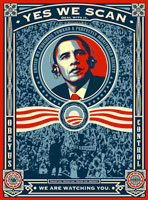
The USA Patriot Act and the illusion of "homeland security"
Introduction:
In my opinion, the "War on Terrorism" will be a perpetual emergency that will be
used to justify a number of small but dangerous power grabs by people in Washington who
already have too much power. Please read
my earlier comments about
this power grab, some of which I would like to reiterate: Not every enemy of
this country is a foreigner. The enemies of this country are those who want
to do away with the Electoral College and chip away at the Bill of Rights. The
enemies of this country include legislators who simply don't care if the laws they make are
unconstitutional. The few of us who do care are called "extremists".
According to Amnesty International, the Patriot Act
• Creates a broad definition of "domestic terrorism" that may have a chilling
effect on the US and international rights to free expression and association.
• Allows non-citizens to be detained without charge and held indefinitely once charged.
• Infringes on the right to privacy and removes many types of judicial review over
intelligence activities.*
The Patriot Act expands the ability of the government to conduct secret
searches — even in criminal investigations unrelated to terrorism. And it
grants the FBI broad access to sensitive medical, financial, mental-health
and educational records about individuals without having to show evidence
of a crime and without a
court order.*
Many people believe the USA Patriot Act is much more likely to be a threat to the
rights of ordinary Americans than an impediment to terrorists. If the USA
deteriorates into just another totalitarian police state, as a result of an
overreaction to the September 11 attacks, then a handful of terrorists
have succeeded in disrupting our society forever. I hope the information
below will benefit those who are concerned about this issue.
"Law enforcement tools created decades ago were crafted for
rotary telephone — not email, the Internet, mobile communications
and voice mail. Every day that passes without dated
statutes* and
the old rules of engagement — each day that so passes is a day
that terrorists have a competitive advantage. Until Congress makes
these changes, we are fighting an unnecessarily uphill battle. Members
of the committee, I regret to inform you that we are today sending our
troops into the modern field of battle with antique weapons. It is not
a prescription for victory."
*Does this mean, "with outdated statutes"?
As much as I like John Ashcroft, I was stunned
by the half-truths in this statement when I heard it. I was watching his testimony on a live satellite feed as he gave it. His
arguments sounded good at first, but upon closer examination they seem
to be based upon specious reasoning. He wants us to believe that the FBI is
stuck in the rotary-dial era while terrorists are using cell phones and
email. Nonsense! The FBI sifts through email every day using their
Carnivore system,
and listens in on cell phones all over the world using a system called
Echelon. (And you can
be sure that the FBI communicates on really nice radios and cell phones.) These
are not "antique weapons," and nobody knows this more than Attorney General Ashcroft. His
"antique weapons" statement is false, misleading and deceptive. He expresses concern about each day
that passes while the terrorists have an "unfair advantage". The obvious implication
is that he wants his demands (for outlandish federal funding, legal shortcuts, and a huge
power grab) met today, before they can be deliberated. In my opinion, this
is a recipe for an Orwellian police state.
Related story:
Surveillance Switcheroo: How the anti-terrorism bill got
passed. In the days following September 11, it was easy to feel kinda bad for Attorney
General John Ashcroft. He really wanted to catch the terrorists, but he just didn't seem up to the
job. Whiz-bang encryption and communication technologies had left the cops in the dust, he said, and
unless the country acted fast, things would only get worse. That's compelling stuff, but it turns out
to be an almost complete inversion of the truth.
"Where an excess of power prevails, property of no sort is duly
respected. No man is safe in his opinions, his person, his
faculties, or his possessions."
- James Madison
Note: USA PATRIOT Act of 2001 = Uniting and Strengthening America by
Providing Appropriate Tools Required to Intercept and
Obstruct Terrorism.
Overview and recap: The
USA PATRIOT Act: The Story of an Impulsive Bill that Eviscerated America's Civil Liberties. The USA
PATRIOT Act provides a textbook example of how the United States federal government expands its power. An emergency
happens, legitimate or otherwise. The media, playing its dutiful role as goad for greater government oversight, demands
"something must be done." Government power is massively expanded, with little regard for whether or not what is being done is
efficacious, to say nothing of the overall impact on our nation's civil liberties. No goals are posted, because if targets
are hit, this would necessitate the ending or scaling back of the program. Instead, the program becomes normalized.
There are no questions asked about whether the program is accomplishing what it set out to do. It is now simply a part
of American life and there is no going back. The American public largely accepts the USA PATRIOT Act as a part of civic life
as immutable, perhaps even more so than the Bill of Rights. However, this act — passed in the dead of night, with
little to no oversight, in a panic after the biggest attack on American soil since Pearl Harbor — is not only novel,
it is also fundamentally opposed to virtually every principle on which the United States of America was founded.
The
Whistleblower Who Uncovered the NSA's 'Big Brother Machine'. The backstory to Mark
[Klein] knocking on EFF's door starts in 2001 with the government's response to the horrific 9/11
attacks. The first of these was the Patriot Act. In the seven weeks between its
introduction and passage in 2001, Lee and I stayed up countless nights trying to parse the
three-inch-thick printout of the proposed legislation to identify the sections that affected the
internet. We needed to understand what laws the government wanted to change, spot overreach
and unconstitutionality, and marshal appropriate support or resistance where necessary. The
draft legislation had been rolled out so quickly that we had the impression it was just sitting in
an envelope on someone's desk, with a note that read, "Open at the next crisis." Our theory
was confirmed when we saw that a good chunk of the proposed law was nearly the same package of
legal changes that the FBI had tried — and failed — to push after the
Oklahoma City bombing in 1995. One big change impacting surveillance was clear: Prior to
September 11, the U.S. had what could reasonably be called a "wall" separating foreign
surveillance for national security purposes done by the NSA from domestic surveillance for law
enforcement purposes done by the FBI. The theory was that those powers would never be turned on
in the U.S. and used against its own people. The Patriot Act, however, helped erode that wall.
Mike Johnson's
Crusade to Renew Warrantless NSA Spying on Americans Culminates This Week. House Speaker
Mike Johnson is on a crusade. He is determined to pass a three-year, reform-free renewal of
the notorious FISA law that authorizes the NSA to spy on the communications of American citizens,
on U.S. soil, without warrants of any kind. Immediately prior to the last (unsuccessful)
attempt by Johnson to pass a new reform-free renewal of this spying law — just two weeks
ago — I wrote about the bizarre and deeply bipartisan history of FISA domestic spying
and how the U.S. somehow became a country that authorizes its surveillance state to target American
citizens, all without warrants. I will not recount all of that here, except to note
that — like the 2001 Patriot Act — the original law empowering the NSA to spy
on Americans without warrants was such a self-evident departure from American tradition that
passage was only possible by portraying it as a mere temporary emergency measure. Yet
those spying powers have now become one of the many such "temporary" and "emergency" measures that
have seamlessly become a quasi-permanent fixture of the U.S. government.
The
Patriot Act: America's Trojan horse for tyranny. When the smoke was still
rising from the rubble of the Twin Towers, the American people were reeling, grieving —
and vulnerable. That vulnerability was weaponized. In one of the most cunning bait-and-switch
maneuvers in modern history, our government handed us the Patriot Act — an Orwellian
surveillance framework disguised as national defense. We didn't just get conned —
we got conquered. Not by terrorists from abroad, but by tyrants in suits.
Waging
War Against Their Own. [Scroll down] This is beyond any 18th-Century
definition of tyranny, exceeded by the level of surveillance currently used by the government to
monitor the citizens. This is a government holding its citizens to be enemies, codified by
the Patriot Act, and even having passed such a hostile act, it is not the fault of the people, but
an egregious act of war against the people, their rights and their freedoms. The last time
that happened, the American people rose up to displace the offending system and the same should be
happening right now. I understand it will take some enormous break in tradition, much like
the Pandemic, though more likely a combination of threats to the people intended to drive them into
the arms of the criminal government.
Overthrowing
the Constitution: All Sides Are Waging War on Our Freedoms. [Scroll down]
In the 23 years since the USA Patriot Act — a massive 342-page wish list of
expanded powers for the FBI and CIA — was rammed through Congress in the wake of the
so-called 9/11 terror attacks, it has snowballed into the eradication of every vital safeguard
against government overreach, corruption and abuse. The Patriot Act drove a stake through the
heart of the Bill of Rights, violating at least six of the ten original amendments — the
First, Fourth, Fifth, Sixth, Seventh and Eighth Amendments — and possibly the Thirteenth
and Fourteenth Amendments, as well. The Patriot Act also redefined terrorism so broadly that
many non-terrorist political activities such as protest marches, demonstrations and civil
disobedience are now considered potential terrorist acts, thereby rendering anyone desiring to
engage in protected First Amendment expressive activities as suspects of the surveillance
state. The Patriot Act justified broader domestic surveillance, the logic being that if
government agents knew more about each American, they could distinguish the terrorists from
law-abiding citizens — no doubt a reflexive impulse shared by small-town police and
federal agents alike.
The
Disaster Lottery. The system now, especially since the enactment of the Patriot Act,
that can be used to label anyone a terrorist and subject them to any amount of horrors dreamed up
by the blue-suited tyrants, is designed to suppress the one legitimate means of expressing
discontent left, the protest. It is, as always before in human history, the interest of the
government to stifle and deter criticism at all costs. It didn't work very well in early
America, but it has been refined and with the ubiquitous surveillance state, much more
efficient. So, what is left? Revolution, or in this case, counter-revolution. The
actual revolution was a slow-moving, incremental imposition and deprivation of rights over an
extended period of time during which the courts fiddled with definitions of clear and plain words
to mean the exact opposite. Bravo, it's a feat of self-deception that will stand for
centuries as an example of governmental lunacy.
The Culmination
of Marxist Infiltration, Part 1. Excuses for the tragedy of 9/11 included the failure
of intelligence communities to communicate with each other. [...] Congresses and presidents had
deliberately dispersed the intelligence duties across the government to avoid consolidation of
power. But in the name of fighting terrorism, Bush and Congress merged twenty-two of them
into one concentration of power under the 2003 Department of Homeland Security. Within six
weeks of the 9/11 attack, the predatory American Security State was born with the passage of the
USA Patriot Act; it was to expire in four years. It authorized unprecedented surveillance of
American citizens and individuals worldwide without traditional civil liberties safeguards.
It beefed up surveillance procedures and warrantless wiretapping under the Foreign Intelligence
Surveillance Act (FISA) to enable the government to spy on American citizens. FISA was just
reauthorized by Speaker Mike Johnson, without protections against warrantless search and
seizure. The Patriot Act finally expired in March, 2020 without being reauthorized, but
federal law enforcement agencies retain most of the authorities granted by the act.
Rejecting
the Status Quo Is the Only Way to Survive. [Scroll down] Republican
voters have spent decades demanding smaller government, less illegal immigration, balanced budgets,
and renewed deference to constitutional constraints and the Bill of Rights. Republican
leaders have promised to get right on that — just as soon as they build the Department
of Homeland Security, provide sixty million illegal aliens with amnesty, add trillions to the debt
in war spending, and expand the PATRIOT Act so that the federal government can spy on every citizen
of the United States!
New
America: Guilty Until Further Notice. Americans might wrongly think the law
enforcement phrase "potential threat" or "risk to the public" only refers to the jihadist or
gangster. Many are probably familiar with the House of Representatives discussing how the FBI
uses FBI employees and cooperators as a weapon against Americans; this was described as the FBI's
weaponization of law enforcement. What many might not know is who the FBI described as
"potential" threats, or "potential domestic terrorists." The House of Representatives reported
that: ["][T]he FBI singled out Americans who are pro-life, pro-family, and support the
biological basis for sex and gender distinction as potential domestic terrorists.["]
HR7521 —
TikTok Ban Assurances and Those Who Remember Patriot Act Assurances. Serendipitously,
or not — depending on who you talk to, I was previously scheduled to be in DC at the
moment of inflection for the passage of HR7521, the proverbial "TikToK Ban Law." Allow me to
encapsulate the issues and present the point of those who say there is nothing to worry about.
First, the context that should matter (it doesn't because the USIC are in charge here) is that every
element that preceded the passage of the Patriot Act is being duplicated in the passage of the
TikTok ban. Which is to say, everyone is deferring to this ridiculous need to support USA
National Security. We The People have been burned by this approach before, yet so many
refuse to see the similarity.
The
Benefits of Hardship. While the Patriot Act broadened the toolkit for tracking down
foreign threats, its nefarious use as a domestic surveillance weapon took a sledgehammer to
Americans' privacy. [...] In the wake of 9/11, President Bush and Vice President Dick Cheney
erected an unconstitutional infrastructure that could be used to spy on Americans' communications
and financial transactions. They enlarged the welfare state, created whole new departments
and agencies, increased debts and deficits, expanded federal intrusion into local education and
family life, and squandered a great deal of goodwill both at home and abroad. Instead of
championing conservative principles and constitutional governance, the Bush-Cheney White House
championed American empire abroad, while sacrificing rights and freedoms at home.
Keep
Your Head on a Swivel. [Scroll down] Neither the FBI nor the larger
Intelligence Community is motivated by the prospect of saving American lives. Why would the
U.S. government see Americans as expendable? The most straightforward answer is that it does
not serve the American people but is instead interested exclusively in expanding its own
powers. What 9/11 confirmed for the Intelligence Community is that even its worst failures
can be used to institute unconstitutional laws, such as the Patriot Act, that serve to broaden
government authority. In the subsequent two decades, the federal government has created a
complex surveillance system that enables it to spy on every citizen of the United States. Not
only has freedom been foolishly traded for the promise of security, but also that promise proved
to be a lie.
22
Years of Blowback from the USA Patriot Act. [Scroll down] Allowing the
government to spy on the citizenry will not reduce acts of terrorism, but it will result in a
watched, submissive, surveillance society. Not only did the USA Patriot Act normalize the
government's mass surveillance powers, but it also dramatically expanded the government's authority
to spy on its own citizens without much of any oversight. Thus, a byproduct of this post
9/11-age in which we live, whether you're walking through a store, driving your car, checking
email, or talking to friends and family on the phone, you can be sure that some government agency
is listening in and tracking your behavior. This doesn't even begin to touch on the corporate
trackers that monitor your purchases, web browsing, Facebook posts and other activities taking
place in the cyber sphere. We have all become data collected in government files.
The
Evolution of the American Police State. In the immediate aftermath of September 11,
2001, when the reality of international terrorism was fresh in the minds of the American people,
The Patriot Act was passed. An irrational fear had taken over the citizenry that the
government used to justify the most sweeping forms of domestic surveillance in the history of the
Republic. The law granted virtually unchecked power to domestic intelligence and law
enforcement agencies. Powers which were quickly turned against the American people who did
not genuflect to the political establishment.
DHS:
No Return to Pre-9/11 Freedom. Ever. Looking back over the last 10 years and
thinking about where many of us were and how we felt when the towers fell is surreal. These
are sad thoughts. But what I find even more saddening is the fact that we have allowed our
country to become more and more of a police state over the last 10 years. And apparently, the
end is not in site, and will likely only become worse. When the Department of Homeland Security
was launched after 9/11 and the Patriot Act was launched as a bill that would last only 4 years,
many freedom loving Americans squabbled. Most turned to those rebels and told them to "shut up,"
that it was necessary to protect America. Then we allowed the TSA to militarize our airports and
treat us like cattle. Then came the unsecured and blatant violation of personal privacy when travelers
data was being collected. And of course the full body pat downs of children and full-body scans.
Domestic
Enemies of the Constitution and the American People. The political process is, by
design, contentious. Through this tension, the extremes of governance were supposed to be
restrained, leading to gradual change, reliable policies, a degree of bipartisanship, and a
predictable market economy. There were always exceptions to the rule, but 9/11 was different,
and it opened the door to profound changes in how we engaged the world and the way we viewed our
own. Unprecedented permanent powers were created to surveil Americans citizens, secret
intelligence courts were established and normalized, and America's role as guarantor of inalienable
rights was no more. The beginning of the rift between the government and its people results
directly from massively increased spending and subsequent actions taken to "protect us," which
could also be construed as "control us" — it's a fine line between "for your safety" and
"for your enslavement." Politicians and agencies like the FBI exploited their new mandate to
"protect and defend" to increase their power and prestige; today, we live with weaponized
bureaucracies and two-tiered justice.
Devin
Nunes: David Weiss is Another John Durham Protective Silo - The Deep State Operation Tracks
Back to Obama Weaponizing Intel and DOJ. This interview segment is almost as if Devin
Nunes reads here. The former House Intel Committee chairman outlines the appointment of David
Weiss as another DC silo creation similar in construct to John Durham. Obviously, Nunes is
correct. Additionally, as Nunes accurately outlines the entire weaponization process traces
back to when Barack Obama took office and unleashed the apparatus of the intelligence agencies to
target domestic political opposition. At the same time, Obama's AG Eric Holder created the
DOJ National Security Division and then weaponized surveillance under the auspices of FARA and FISA
Courts to target one side of the political dynamic. [Video clip] Elevator Speech:
[#1] The Patriot Act turned the intel surveillance radar from foreign searches
for terrorists to domestic searches for terrorists.
[#2] Obama/Biden then redefined what is a "terrorist" to include their political opposition.
A
Specific Type of Continuity. As we have exhaustively outlined on these pages, the
outcome of the Patriot Act was to create a system where every American was now viewed by our
federal government through the prism of the citizen being a potential terrorist threat. The
federal government aligned all of our institutions and systems accordingly. DHS was created
to monitor American behavior, the TSA was created to scan American travelers, and the FBI was
enhanced with resources to conduct surveillance despite our Fourth Amendment protections within our
Constitution. Instead of the U.S. Govt protecting U.S. citizens from foreign threats, the
Patriot Act changed the mission of government to protect itself from potential citizen
threats. In essence, We the People became the suspects, and all of the constitutional
viewpoints within the FBI and Dept of Justice were modified to create monitoring systems.
A
Guide to Understanding the Hoax of the Century. After 9/11, the threat of terrorism
was used to justify measures like the Patriot Act that suspended constitutional rights and placed
millions of Americans under a shadow of mass surveillance. Those policies were once
controversial but have come to be accepted as the natural prerogatives of state power. As
journalist Glenn Greenwald observed, George W. Bush's "'with-us-or-with-the-terrorists' directive
provoked a fair amount of outrage at the time but is now the prevailing mentality within U.S.
liberalism and the broader Democratic Party." The war on terror was a dismal failure that ended
with the Taliban returning to power in Afghanistan. It also became deeply unpopular with the
public. Why, then, would Americans choose to empower the leaders and sages of that war to be
the stewards of an even more expansive war against disinformation? It is possible to venture
a guess: Americans did not choose them. Americans are no longer presumed to have the right
to choose their own leaders or to question decisions made in the name of national security.
Anyone who says otherwise can be labeled a domestic extremist.
Related: House
Judiciary FISA Hearing to Examine How Spy Powers Have Been 'Weaponized Against' Americans.
The House Judiciary Committee on Thursday will investigate how Section 702, a law that was designed
to help combat terrorism, has been "weaponized against" Americans. Breitbart News first reported
that the House Judiciary Committee will hold a hearing next week on the Foreign Intelligence Surveillance
Act (FISA) ahead of Section 702's December reauthorization deadline. [...] A routine audit recently
found that the Department of Justice (DOJ) and the Office of National Director of Intelligence (ODNI) of
Section 702 use found that FBI agents often had political overtones for their search queries of the
FISA database. This includes "the names of a local political party" to see if it had links to foreign
intelligence. The Justice Department reportedly claimed that FBI personnel "misunderstood" the search
procedures and that they were "subsequently reminded of how to correctly apply the query rules."
Time
to Deal with Root Causes, Not Symptoms. [Scroll down] There have been many
stories of domestic surveillance conducted by federal agencies, as well as the weaponizing of those
agencies against political enemies of the Democrat Party. Republicans in the House of Representatives
are beginning to expose some of the abuses, but nobody is talking about dealing with the root cause that
enabled the spying on Americans: The Patriot Act of 2001. Few people know that "Patriot" is
an acronym that stands for "Providing Appropriate Tools Required to Intercept and Obstruct Terrorism."
And that euphemism means domestic surveillance! The events of 9/11 stampeded Congress to unanimously
pass the Act, which refocused the vast intelligence collection apparatus built to track the actions of potential
adversaries onto US citizens for the first time — all in the interests of "anti-terrorism."
The result was weakened bank secrecy laws, new types of warrants on the flimsiest of excuses, and information
collection by signals intelligence and electronic surveillance systems focused on Americans on our home
soil. Other increases in the government's surveillance powers are discussed [elsew]here. Since
2001, the domestic surveillance apparatus has been politically weaponized to go after Democrat-defined
terrorists, including "white supremacists," nationalists, and Trump supporters (refer to the continuing
FBI investigations of J6 protestors). A big part of the solution is to repeal the key root cause
that opened the door for politicization of federal surveillance capabilities against Americans.
Time to repeal the Patriot Act.
People
Behind Biden Announce Creation of Formal National Surveillance State, Yet No One Seems
Bothered. [Scroll down] Barack Obama and Eric Holder did not create a
weaponized DOJ and FBI; the institutions were already weaponized by the Patriot Act. What
Obama and Holder did was take the preexisting system and retool it, so the weapons of government
only targeted one side of the political continuum. [...] In the era shortly after 9/11, the DC
national security apparatus, instructed by Vice President Dick Cheney, was constructed to preserve
continuity of government and simultaneously view all Americans as potential threats. The
Department of Homeland Security (DHS) and the Office of the Director of National Intelligence
(ODNI) were created specifically for this purpose. After 9/11/01, the electronic surveillance
system that was originally created to monitor threats from abroad was retooled to monitor threats
inside our country. That is when all of our electronic 'metadata' came under federal
surveillance. That inflection point, and the process that followed, was exactly what Edward
Snowden tried to point out. What Barack Obama and Eric Holder did with that new construct
was refine the internal targeting mechanisms so that only their political opposition became the
target of this new national security system.
The
Politicization of the Department of Justice. The tragic events of 9/11 marked a turning point in our
nation's recent civil rights history. First the terrorists attacked us — and then, in the name of
national security, we began to attack ourselves. It has become almost cliché to say that we live in a
surveillance state, but we do. Ever since Congress, on a fully bipartisan basis, enacted the Patriot Act six weeks
after the attacks on 9/11, the ever-present eye of the government has been searching for new and creative ways to spy on
American citizens. The government has the technology to monitor all of our electronic devices, listen to our phone
calls, and read our emails and text messages — all under the auspices of national security. This
special law designed for an emergency has become a permanent addition to the government's investigatory toolbox.
The unfortunate reality is that the bulk of the actions taken by law enforcement under the Patriot Act have almost
nothing to do with combating terrorism.
Connections,
Facebook Spies on Private Messages and DHS Uses Private Chats Against J6 Detainees. This 'surveillance
system' has been of great interest to CTH for several years, in part because it is a key aspect of the domestic
intelligence system now operating as a functioning part of the Fourth Branch of Government. The overwhelming
majority of the investigative resources within the Dept of Homeland Security (DHS) are used in this whole of
network monitoring system. I cannot emphasize the importance of the connections enough. Surveillance of
domestic communication, to include surveillance of all social media platforms, is now the primary mission of DHS. The
information is gathered by social media, funneled by direct portals into the DHS network then distributed to DOJ-NSD and
FBI officials as well as the Office of the Director of National Intelligence. This communication surveillance
network is what DHS, created as an outcome of the Patriot Act, is all about.
The
FBI's Apex Bureaucracy Is Dangerous. Twenty years after the post-9/11 PATRIOT Act architecture redefined
Americans' constitutional rights without amendment ratification or public permission, perhaps it is time for Americans
to insist that federal officers once again deign to establish probable cause and execute valid warrants before they go
snooping where they have not been invited. Maybe it is time for citizens to recognize that with their silence and
compliance, they have handed away a mountain's worth of personal liberty for an anthill's hollow promise that they would
remain secure. Any way you slice it, nothing about the expansive, entrenched, and cumbersome national security
Deep State that exists today is remotely conducive to Americans' constitutional rights or personal liberties. The
surveillance state buttressed by the DOJ and FBI justifies its enduring need to violate Americans' privacy by
disseminating waves of fear to the public and pretending that its existence, however unsavory, is critical for
Americans' personal survival. It is far past time for Americans to recognize this ruse as the con it is and
reclaim their inherent freedoms.
The
Citizenry's Willingness to Surrender their Freedoms Risks a Potential Dissolution or Civil War. Over the past
two decades, far too many citizens of the United States have willingly surrendered their rights and freedoms and now they are
on the cusp of being unrestorable. This erosion and voluntary forfeiture have empowered the ruling elites/radical
left. Ominous societal conditions have been created that risk national dissolution or a civil war. Three events
in the past twenty-one years have been the primary catalysts that have accelerated and exacerbated this seemingly
irreversible outcome. The first: the reaction to the terrorist attack on September 11, 2001; the second: the election
of Barack Obama; and the third: the lockdown and medical tyranny of the Chinese Coronavirus Pandemic. After the events
of September 11, 2001, Congress, with no outcry from the populace and near unanimous agreement from both political parties,
passed the Patriot Act and other legislation. These laws expanded the definition of terrorism and the government's
ability to define, at their whim, what "terrorism" is. Further, the government was granted near unlimited power to
combat whatever was defined as "terrorism." Within less than ten years that power was turned against the American people and
new catch phrases began to be used by the ruling class: "white supremacy" and "domestic terrorism". A new era was
spawned which allowed the government to use its newly acquired powers to spy on and intimidate innocent Americans at home and abroad.
Democrats
Are Attempting To Jam Through A New Patriot Act That Will Target American Conservatives. Democrats never let a
good crisis go to waste. After the tragic shooting in Buffalo that left ten dead and three injured, they are renewing
calls to pass a bill that will expand the FBI and Department of Homeland Security's powers to investigate domestic
terrorism. Some Republicans were initially supportive of the bill, but after Democrats made a last-minute change to the
definition of domestic terrorism that makes it extremely vague, most came out in opposition to it. RINO warmonger Adam
Kinzinger (R-Il.) was the sole Republican to vote in favor of the bill in the House.
FBI
opened multiple investigations into protesting parents, GOP lawmakers say. The FBI has opened multiple
investigations into parents protesting education policies, including a father who was upset over mask mandates, according to
new whistleblower revelations. The FBI's activities were publicly revealed in a letter Wednesday from Republicans on
the House Judiciary Committee to Attorney General Merrick Garland. The specifics of the FBI's investigations were disclosed
to lawmakers by whistleblowers. Garland directed the FBI and the Department of Justice to form a joint task force in
October 2021 to investigate threats against school board members after the National School Boards Association asked the Biden
administration in a September 2021 letter to investigate parents protesting at school board meetings as domestic terrorists
under the Patriot Act.
Jack's
Magic Coffee Shop Reports 2nd Quarter Financials, Net Operating Loss of $128 Million. [Scroll down] After
the Patriot Act was triggered, not coincidentally only six weeks after 9/11, a slow and dangerous fuse was lit that ends with
the intelligence apparatus being granted a massive amount of power. The problem with assembled power is always what
happens when a Machiavellian network takes control over that power and begins the process to weaponize the tools for their
own malicious benefit. That is exactly what Barack Obama was all about. The Obama network took pre-assembled
intelligence weapons we should never have allowed to be created, and turned those weapons into tools for his radical and
fundamental change. The target was the essential fabric of our nation. Ultimately, this corrupt political process
gave power to create the Fourth Branch of Government, the Intelligence Branch. From that perspective the fundamental
change was successful.
My
Hippie Vietnam War Professor Was Right About the Dangers of the Patriot Act. [Scroll down] Currently, the
federal government is isolating and targeting very different enemies of the state than it was in 2001, to say the
least. Among these are soccer moms who don't like their sons being taught that their sex and skin color makes them
guilty of some ancestral sin that justifies their having become the victims of perpetual discrimination in applying to
college or a job. They are fathers who don't like the idea that a 16-year-old boy who is pretending that he's a girl
can share a shower with his 16-year-old daughter after volleyball practice. They are parents who don't like that their
elementary schoolchildren are being told that they may truly be something other than a boy or a girl, or that they should
sexually experiment upon themselves. They are racial minorities who don't like that their sons and daughters are being
taught that they're perpetual victims in America, or that phantom impediments to success are oppressing them. And many
among all of those parents take issue with their children being taught that their race is anything more than an immutable
trait that is profoundly unimportant relative to kindness, intelligence, work ethic, and what Dr. Martin Luther King,
Jr. referred to as "character" when relating his famous dream to the American people. Today, the federal enforcement
mechanisms meant to combat terrorism, including those of the Patriot Act, are being used against all of those Americans with
whom a clear majority ideologically and politically agree.
How
Did Ordinary American People Become Domestic Terrorists in The Eyes of The Deep State. Barack Obama and Eric
Holder did not create a weaponized DOJ and FBI; the institutions were already weaponized by the Patriot Act. Instead,
what Obama and Holder did was to take the preexisting system and retool it so the weapons of government only targeted one
side of the political continuum. [...] What Barack Obama and Eric Holder did with that new construct was refine the internal
targeting mechanisms so that only their ideological opposition became the target of the new national security system.
This is very important to understand as you dig deeper into this research outline. Washington DC created the modern
national security apparatus immediately and hurriedly after 9/11/01. DHS came along in 2002, and within the
Intelligence Reform and Terrorism Prevention Act of 2004 the ODNI was formed. When Barack Obama and Eric Holder arrived
a few years later, those newly formed institutions were viewed as opportunities to create a very specific national security
apparatus that would focus almost exclusively against their political opposition.
Every
Tragedy Caused by Government Is Done with the Best of Intentions. President Bush's "war on terror" in response
to the worst attack on U.S. soil since Pearl Harbor not only led to two of the longest wars in U.S. history without producing
clear-cut long-term victories but also initiated a mass surveillance state that is now used against Americans by the FBI,
NSA, and U.S. military to target constitutionally protected political beliefs.
How
Do We Regain Trust in the FBI? A Pew Research study released last month demonstrated a sharp decline in trust
in the government from a high of seventy-seven percent in 1964 to a low that has remained under twenty-five percent since
2007. If three-quarters of Americans have spent the last fourteen years distrusting the government at large, what does
that say about the agencies entrusted with justice and public safety? [...] The parallel between the FBI and the NKVD is not
a straight line — at least, not yet. At the same time, looking at the chronology of when Americans
suddenly lost faith in their government (2007), an eerie set of circumstances predate the decline in trust. The first
development that hastened the consolidation of power and authority in federal agencies like the FBI was the Patriot Act of
2001. It paved the way for expanded police powers in the name of public safety.
The New Domestic
War on Terror Has Already Begun — Even Without the New Laws Biden Wants. The Department of Homeland
Security on Friday [5/28/2021] issued a new warning bulletin, alerting Americans that domestic extremists may well use
violence on the 100th Anniversary of the Tulsa race massacre. This was at least the fourth such bulletin issued this
year by Homeland Security (DHS) warning of the same danger and, thus far, none of the fears it is trying to instill into the
American population has materialized. [...] Just like the first War on Terror, these threats are issued with virtually no
specificity. They are just generalized warnings designed to put people in fear about their fellow citizens and to
justify aggressive deployment of military and law enforcement officers in Washington, D.C. and throughout the country.
Not a single person of honor
or integrity can survive inside the DC institutions. [Thread reader] I still held the belief there were
three branches of government, and there were "checks and balances", and there had to be some way for a good person to expose
corruption. He quickly dispatched those beliefs (with examples). He explained the "checks and balances" I spoke of
did exist at a time when there were three branches of government. However, that time has long passed. There is
only one overarching DC eco-system now. The three branch concept is gone. Doesn't exist. As he explained,
the levers of power are all controlled by the same system, and behind that system are positions — not people.
"Positions." People are evaluated based on their ability to support and protect the system. Their skill level is
what moves them into position. Position. Evaluation. Next Position. Evaluation. Etc. The
system more like an institution. Within the institution there are divisions. The divisions are what we used to
call "branches". The divisions (branches) are not independent from the institution of DC. The divisions are operated
by people in power who hold positions. He identified the timeline of this institutional creation as a slow build (over
decades), but most visibly increasing in publicity after 9/11/01 and the patriot act. Once the patriot act made the
government responsible for total safety; the previously embedded bad actors took full control. One office of particular
note was the creation of the ODNI. As he noted the amassing of surveillance power. [O]nce that Rubicon was crossed,
everything after was downstream and unstoppable. The institution of the total intelligence apparatus now had full control...
Security Theater Redux.
After the September 11 attacks, the U.S. government employed various counterterrorism measures in an atmosphere of panic.
Some made sense and stood the test of time, such as vetting airline passengers or banning knives on planes. Others were
abandoned and memory-holed as ineffective and wasteful, like the Iraq Campaign. The Right focused on the failure of security
efforts to distinguish loyal and law-abiding Americans from high-risk groups. The spectacle of children and grandmas being
subjected to humiliating pat-downs at airports stands out as particularly galling. The Left and the libertarians were wary
of the expansive authority of intelligence agencies and the domestic use of the military. In one instance, a tank was parked
outside of Miami International Airport, as if al Qaeda would unleash an armored attack. Critics labeled such dramatic and
mostly symbolic efforts for what they were: security theater.
Democrat
Domestic Terrorism Can No Longer Be Ignored. Section 802 of the USA PATRIOT Act defines "domestic terrorism" as
activities involving acts in violation of state or federal criminal laws that are "dangerous to human life" and "appear to be
intended" either to (i) "intimidate or coerce a civilian population," (ii) "influence the policy of a government by
intimidation or coercion," or (iii) "affect the conduct of a government by mass destruction, assassination, or kidnapping."
Intimidating a civilian population? Coercing government officials? Engaging in mass destruction and assassination of
police? Ding-ding-ding! [...] Democrat domestic terrorists light fires everywhere they go, egg on violence against police
and civilians, and threaten businesses who refuse to pay into their protection rackets by "donating" to their favorite money-laundering
501(c)(3)s; and our criminal justice system looks the other way or even actively abets the terrorists by releasing them from jail cells
just as soon as they arrive, while leaving Americans to fend for themselves.
Brainwashing
& the New Vocabulary: 12 Words & Phrases I Never Want to Hear Again. Remember how after September 11th
happened, there was that nasty bill that formed the TSA and authorized all sorts of surveillance against the American people
and they called it, ironically, The Patriot Act? Of course, we knew then that the bill was anything but patriotic,
however, that didn't stop it from being passed and trampling all over the Constitution. The word "patriot" was
perverted by those in power who wanted everyone to fall into lockstep with the unconstitutional searches at airports and many
other invasions into our privacy. Which brings us to another word that doesn't mean what people think it
means — it was all done in the name of "security."
The
Bushes Have Poisoned the Well Forever. [Scroll down] After Clinton's eight years were up, it was George W.'s
turn to be President. Although portrayed as a "conservative" like his dad and the rest of the GOP, he presided over massive
spending binges, mostly on the wars in Iraq & Afghanistan. He also pushed the Patriot Act, the Republican version of Obamacare
insofar as it was a massive bill that members of Congress admitted they didn't read, was rammed through and signed into law with
little scrutiny and contained lots of horrible surprises for the American people. It also had the effect of dramatically
increasing the power of the federal government over the American people, effectively treating us all as terrorists and
international criminals and stripping away our Constitutional rights.
How big is the terrorist
watch list? Who is on it? What is often described as a single, unified list is actually a collection of
lists, or databases, created or expanded under the George W. Bush administration to avoid the breakdowns in intelligence
sharing that precipitated the September 11 terrorist attacks. Here's how it breaks down: The FBI's Terrorist
Screening Database is the U.S. government's primary watch list, and what people usually mean when they refer to the terrorist
watch list. It contains about 1 million records. About 5,000 of those records — 0.5 percent —
are about Americans. The screening database is subdivided into other lists. The most well-known of these is the no-fly
list, whose members are barred from commercial air travel that passes through the United States. The no-fly list contains
about 81,000 names, up from 16 on the eve of September 11, 2001. About 1,000 are Americans.
How to Land on the Government
Watch List. [T]he U.S. Government's Consolidated Terrorist Watch List keeps track of people who are known or
suspected terrorists. These are the people the U.S. government doesn't want to board planes, enter the country or
obtain a visa without a lot of hassle. While the government makes no secret of the list's existence, its official
contents are off-limits to the public. That's because the federal government believes if terrorists are aware of being
on a watch list, they will become more vigilant and tricky in committing heinous crimes.
72
Types Of Americans That Are Considered "Potential Terrorists" In Official Government Documents. At one time,
the term "terrorist" was used very narrowly. The government applied that label to people like Osama bin Laden and other
Islamic jihadists. But now the Obama administration is removing all references to Islam from terror training materials,
and instead the term "terrorist" is being applied to large groups of American citizens. And if you are a "terrorist",
that means that you have no rights and the government can treat you just like it treats the terrorists that are being held at
Guantanamo Bay. So if you belong to a group of people that is now being referred to as "potential terrorists", please
don't take it as a joke. The first step to persecuting any group of people is to demonize them. And right now
large groups of peaceful, law-abiding citizens are being ruthlessly demonized.
Patriot
Act enabled Russia collusion hoax and further Deep State treachery. In October of 2001, and following 9/11,
President George W. Bush told the nation that the Patriot Act would "give intelligence and law enforcement officials
important new tools to fight a present danger." It was assumed — foolishly — that the threat was
from terrorism. But when and as reauthorized, the Patriot Act during the administration of President Barack Obama,
Obama claimed that tweaks to the act would allow US law enforcement to better target homegrown "lone wolves." Again, the
assumption — a foolish one — assumed that the targets would largely be self-motivated terrorists.
Terrorists like Boston Marathon bombers Dzhokhar and Tamerlan Tsarnaev. But leave it to official Washington to stretch
any legal definitions beyond their original, intended scope.
FBI
attempted to retroactively use the PATRIOT Act to sidestep FOIA. The passage of the PATRIOT Act has been
decried as one of the most widespread attempts by the government to overreach in order to bypass the judicial and legislative
restrictions that had otherwise been placed on it. The FBI file for former CIA Station Chief William F. Buckley details
one such attempt, over a decade after his murder. In late July of 2001, the FBI was responding to a FOIA request for
the file on Buckley (no relation to the conservative commentator), the CIA station chief who had been kidnapped in Lebanon
and later died as a result of the kidnapping.
The Imperial
President's Toolbox of Terror: A Dictatorship Waiting to Happen. [Scroll down] The Bush Administration claimed it could strip
American citizens of their constitutional rights, imprison them indefinitely, and deny them legal representation simply by labeling them as enemy
combatants. While the Obama Administration jettisoned the use of the term "enemy combatant," it has persisted in defending the president's
unilateral and global right to detain anyone suspected of supporting terrorist activities.
Engineered
Chaos And Fear The New Norm In America As Many Assume The "Reality" Of Staged Events. There was a time when
there was actually a sense of normality all around us and there was a sense of justice and accountability at the government
level even if it was mostly the perception of it. [...] There was even a time when you could comfortably plan on traveling pretty
much anywhere in the world, especially here in the United States for business or pleasure without having to deal with the prospect
of "terrorism" or another psyop mass shooting, terror truck drivers, snipers or lockdowns. You also didn't have to worry
about a violent police state, checkpoints, surveillance cameras, killer robots, government spying and 24/7 fear, death and
destruction being put out by the mainstream media news. There was a sense of order, in other words, that many of us still
remember and we remember exactly what it felt like. Obviously you can't miss something or yearn for the days you've never
experienced. This disconnect that the younger generation has to what some may refer to the good old days is important in
the grand scheme of things because this chaos is all they know and it is a grand example of learned helplessness. For the
first time in modern American history we have a generation that doesn't know what order, calmness and peace looks like.
House
reverses course, upholds NSA phone snooping as terrorist attacks shift debate. The fight is over snooping
programs targeting foreigners' communications under Section 702 of the Foreign Intelligence Surveillance Act, but which also
end up snaring Americans' emails and phone calls. Intelligence agencies claim the right to go through that data when
they are investigating terrorism and say it's critical to preventing plots or learning about the contours of attacks, such as
the one in Orlando, as they happen. Civil libertarians argue that the data shouldn't be collected in the first place and
say if agents are going to peer into it, they should get a warrant before looking at Americans' data under Section 702.
6
Things To Know About Tying Gun Sales To A Watch List. [#5] Hillary Clinton's 'Spirit of 9/12' is the specter of
pervasive government surveillance. It is true that in the shocked days after 9/11, the two major sides of American
politics came together for a brief moment. But their response went too far. During this period of unity, Congress
authorized an indefinite military action in Southwest Asia that almost 15 years later stretches across the Middle East and
into Africa with no end in sight. During this period of unity, Clinton and 97 other senators came together to pass the
USA PATRIOT Act, which established a surveillance regime that took civil libertarians more than a decade to dismantle.
In light of these previous terrorism overreactions, the burden is on the individuals demanding that we do something (anything!)
to demonstrate that their proposals are reasonable and include responsible safeguards for constitutionally protected rights.
Congress
Must Shut the Backdoor on Section 702 Surveillance. The fight over NSA surveillance is about to heat up
again. This week, the House will consider a measure that would require the NSA and other government agencies to follow
due process and obtain a warrant to collect the communications of American citizens. Through an amendment to H.R. 5293,
the Department of Defense Appropriations Act of 2017, the House could defund warrantless government searches of the database
of information collected under Section 702 of the Foreign Intelligence Surveillance Act (FISA). The amendment, proposed
by Reps. Massie (R-Ky.), Lofgren (D-Calif.), and Poe (R-Texas), would prevent the NSA's backdoor spying on American
citizens through the use of U.S. person identifiers. The Massie-Lofgren-Poe amendment also prohibits government
agencies from requesting that U.S. companies build security vulnerabilities into their hardware or software in order to make
it easier for the government to access them. This would protect encryption, which has been undermined by the NSA's
breathtaking extension of surveillance.
Four librarians gagged
and threatened with prison time under the Patriot Act. Using the broad powers granted under the USA PATRIOT
Act, the FBI demanded that 4 librarians produce private information about library patrons' reading habits, then used an
endless gag order to force them to remain silent about the request for the rest of their lives under penalty of prison time.
CISA
Is Now The Law: How Congress Quietly Passed The Second Patriot Act. Why was the CISA included in the omnibus package,
which just passed both the House and the Senate? Because any "nay" votes [...] would also threaten the entire budget of the
federal government. In other words, it was a question of either Americans keeping their privacy or halting the funding of the
US government, in effect bankrupting the nation. And best of all, the rushed bill means there will be no debate. The bottom
line as OTI's Robyn Green said, "They've got this bill that's kicked around for years and had been too controversial to pass, so they've
seen an opportunity to push it through without debate. And they're taking that opportunity." The punchline: "They're
kind of pulling a Patriot Act." And when Obama signs the $1.1 trillion Spending Bill in a few hours, as he will, it will be
official: the second Patriot Act will be the law, and with it what little online privacy US citizens may enjoy, will be gone.
Agents
performing warrantless searches are the hallmark of totalitarianism. In an effort to draw attention away from the intelligence
failures that permitted the attacks of 9/11 and create the impression that it was doing something — anything — to avoid a repeat,
the federal government tampered seriously with freedoms expressly guaranteed in the Constitution. Its principal target was the right to
privacy, which is protected in the Fourth Amendment. At President George W. Bush's urging, Congress passed the Patriot Act in
October 2001. This 315-page statute passed the House of Representatives with no debate, and there was very limited debate in the
Senate. I have asked many members of Congress over the years whether they read this bill before they voted upon it, and I have yet
to find a member who did. In the House, that would have been impossible; the bill was made available to representatives only
15 minutes prior to their vote.
The Phony
Surveillance Debate. If any terrorists are reading this column, now would be a good
time to turn on C-Span 2. For the next few days, you guys got it made. Section 215
of the Patriot Act has expired and the Senate has only just started debating the bill that would renew and
tailor these authorities. So if you suspect you might be under investigation, go ahead and switch burner
phones. No more roving wiretaps. Feel free to contact any compatriots inside the United States on
a landline. No more bulk collection of telephone metadata. Gather ye rosebuds. Carpe diem.
This at least is what the White House and others would have you believe.
The
Patriot Act must go: It assaults our freedoms, doesn't keep us safe. [Scroll
down] After the House Judiciary Committee took all this into account in its redrafting of the
proposed Patriot Act, the House Republican leadership and the George W. Bush White House pulled
a fast one. They switched the painstakingly negotiated version of the Patriot Act for the
original version and posted the original version on the House intranet, and leadership scheduled a
vote within the hour of posting. It is safe to say that no member of the House read the
Patriot Act in that hour. It takes about 20 hours to read, as it is hundreds of pages in
length, and it amends dozens of prior statutes that also must be read. Most House members
clearly never knew what they were authorizing. The only negotiated-for provision that survived
the switch was the sunset provision of section 215. Section 215 only authorizes the
feds to write their own search warrants for business records and for surveillance of so-called
lone-wolf terrorists no matter what telephone they may use. The Bush and Obama
administrations secretly persuaded the secret Foreign Intelligence Surveillance Act (FISA) court
that somehow section 215 also permitted the NSA to acquire bulk data from telephone and
computer use based on the government's needs, not based on probable cause.
White
House: 'There is no plan B' if Patriot Act powers expire. The White House said Friday
[5/29/2015] there is "no plan B" if key Patriot Act powers expire at midnight Sunday [5/31/2015].
Administration officials pressed Senate leaders — currently on a weeklong Memorial Day recess —
to return to Washington and immediately pass legislation that would extend most government surveillance tools but
also would take steps to protect Americans' privacy. "There is no plan B. There is no executive
action the president can take to give our law enforcement and national security professionals all the tools they
need," White House press secretary Josh Earnest told reporters.
FBI
admits no major cases [have been] cracked with Patriot Act snooping powers. FBI agents can't point to any
major terrorism cases they've cracked thanks to the key snooping powers in the Patriot Act, the Justice Department's
inspector general said in a report Thursday [5/21/2015] that could complicate efforts to keep key parts of the law
operating. Inspector General Michael E. Horowitz said that between 2004 and 2009, the FBI tripled its use of
bulk collection under Section 215 of the Patriot Act, which allows government agents to compel businesses to
turn over records and documents, and increasingly scooped up records of Americans who had no ties to official
terrorism investigations.
House
Votes to End N.S.A.'s Bulk Phone Data Collection. The House on Wednesday [5/13/2015]
overwhelmingly approved legislation to end the federal government's bulk collection of phone
records, exerting enormous pressure on Senator Mitch McConnell of Kentucky, the majority leader, who
insists that existing dragnet sweeps continue in defiance of many of those in his Republican Party.
Under the bipartisan bill, which passed 338 to 88, the Patriot Act would be changed to prohibit
bulk collection by the National Security Agency of metadata charting telephone calls made by Americans.
In addition, the legislation would bar permitting bulk collection of records using other tools like
so-called national security letters, which are a kind of administrative subpoena.
Why
the EFF is pulling its support for the USA Freedom Act. The United States Court of Appeals for the Second Circuit
has determined in American Civil Liberties Union (ACLU) v. Clapper that the National Security Agency's telephone records
program went far beyond what Congress authorized when it passed Section 215 of the Patriot Act in 2001. The court
unequivocally rejected the government's secret reinterpretation of Section 215. Among many important findings, the
court found that Section 215's authorization of the collection of business records that are "relevant to an authorized
investigation" could not be read to include the dragnet collection of telephone records. The court also took issue with
the fact that this strained application of the law was accomplished in secret and approved by the secret and one-sided Foreign
Intelligence Surveillance Court (FISA Court).
Security
officials, surveillance hawks get busy with fearmongering ahead of Patriot Act deadline. The
June 1 deadline for Congress to renew portions of the Patriot Act that authorize the National Security
Agency's controversial surveillance programs is drawing near. For top government officials and many
establishment Republicans, that means it's time to double down on homeland security fearmongering.
White
House report offers more on NSA spying on Americans' calls, with Patriot Act set to expire. With
debate gearing up over the coming expiration of the Patriot Act surveillance law, the Obama administration on
Saturday [4/25/2015] unveiled a 6-year-old report examining the once-secret program to collect information on
Americans' calls and emails. The Office of the Director of National Intelligence publicly released the
redacted report following a Freedom of Information Act lawsuit by the New York Times. The basics of the
National Security Agency program had already been declassified, but the lengthy report includes some new details
about the secrecy surrounding it.
Renew the
Patriot Act. Many observers postulate that Muslims in America are inherently different
than those in Europe, hence they don't need surveillance. Here they are assimilated, there they are
separate. I'm not so sure — America has had plenty of trouble with radical Muslims:
from the Boston Marathon bombers; from Muslims weaned in radical mosques in Minnesota joining Jihad; from
the Fort Hood shooter in Texas, and on. Perhaps the biggest difference is that in Europe Muslim
immigrants represent a far greater proportion of the population; for example, about 10% in France.
16 Reasons Why the United
States is Going to Hell in a Handbasket. [#5] We have been seeing a decline in
freedom for a longtime but after 9-11 the loss personal freedom, privacy and constitutional rights
have been on a rapid decline. Now we are constantly, watched, monitored and recorded, we can
now legally be detained and held indefinitely without a trial or due process. And U.S. citizens
can even be assassinated on U.S. soil by order of the president. Just like the imaginary, war
on drugs, the war on terror has been used as an excuse to trample on individual constitutional rights
and to increase the power of the government and the ultra wealthy that control the country from behind
the curtains.
How a Court Secretly Evolved,
Extending U.S. Spies' Reach. Ten months after the Sept. 11 attacks, the nation's surveillance court delivered a ruling
that intelligence officials consider a milestone in the secret history of American spying and privacy law. Called the "Raw Take"
order — classified docket No. 02-431 — it weakened restrictions on sharing private information about Americans,
according to documents and interviews. The administration of President George W. Bush, intent on not overlooking clues about Al Qaeda,
had sought the July 22, 2002, order. It is one of several still-classified rulings by the Foreign Intelligence Surveillance Court
described in documents provided by Edward J. Snowden, the former National Security Agency contractor.
Spy Chief: We Should've Told You We
Track Your Calls. Even the head of the U.S. intelligence community now believes that its collection and storage of millions of call records was
kept too secret for too long. The American public and most members of Congress were kept in the dark for years about a secret U.S. program to collect and
store such records of American citizens on a massive scale. The government's legal interpretation of section 215 of the Patriot Act that granted the
authority for this dragnet collection was itself a state secret.
Ruling Protects Bank,
Phone, Other Records from FBI 'Security Letters'. A federal judge in San Francisco has declared "national security letters" from the Federal
Bureau of Investigation to banks, phone companies, and other businesses to be unconstitutional. The March 15 ruling by U.S. District Judge
Susan Illston declared the letters do not "serve the compelling need of national security." The FBI has been issuing thousands of letters
annually on its own authority and with no judicial review to obtain confidential customer information. The letters also order the companies not to
disclose the demands for information to targeted customers or others. The FBI began issuing the letters after the USA Patriot Act became law in 2011.
The Drift toward Despotism.
[Scroll down] But one notes that the Supreme Court has dramatically circumscribed Fourth Amendment protections against unreasonable
search and seizure when it occurs at America's border, and post-9/11 the "border" has been redefined to mean anywhere within 100 miles
of the actual frontier. Many European countries are not 100 miles wide in their entirety. A hundred-mile buffer zone
from Belgium's northern border, for example, would be well south of the southern border and deep into France.
NSA director admits to misleading public on terror
plots. In so many words, NSA director Keith Alexander admitted Wednesday [10/2/2013] that the Obama administration had issued misleading
information about terror plots and their foiling to bolster support for the government's vast surveillance apparatus. During Wednesday's [10/2/2013]
hearing, Senate Judiciary Committee Chairman Patrick Leahy pushed Alexander to admit that plot numbers had been fudged in a revealing interchange: [...]
Court
Reveals 'Secret Interpretation' Of The Patriot Act, Allowing NSA To Collect All Phone Call Data. The FISA Court (FISC) today [9/17/2013] released
a heavily redacted version of its July ruling approving the renewal of the bulk metadata collection on all phone calls from US phone providers under Section 215
of the Patriot Act. This is part of the "secret interpretation" as to how the FISC interprets the Patriot Act's "business records" or "tangible things"
section to mean that the government can order a telco to turn over pretty much all records — even as the very author of the law says it was
written specifically to not allow this interpretation.
Govt to declassify some secret court
opinions. The Justice Department is declassifying portions of some secret court orders concerning the government's authority to
seize records under the Patriot Act.
The IRS, the NSA, and Obama's Dirty Tricks.
[President Obama] can't blame the Patriot Act on President Bush: the act expired in March 2011; Congressional Democrats had to vote to keep the Patriot
Act and Obama had to approve its reauthorization. Additionally, Section 215 of the Patriot Act clearly states that only phone calls or other
communication with a foreign connection can be tapped. There is no authorization to tap into electronic communications between domestic
residents of the U.S.
Why you should worry about the NSA. My concerns
are twofold. First, the law under which President George W. Bush and now President Obama have acted was not intended to give the
government records of all telephone calls. If that had been the intent, the law would have said that. It didn't. Rather,
the law envisioned the administration coming to a special court on a case-by-case basis to explain why it needed to have specific records.
I am troubled by the precedent of stretching a law on domestic surveillance almost to the breaking point. On issues so fundamental to
our civil liberties, elected leaders should not be so needlessly secretive.
The Founders warned us. As Congress
and the White House pasted together and passed the so-called Patriot Act in the aftermath of the 2001 attack on the New York World Trade
Center, a few conservatives raised questions about the degree to which the nation seemed ready "to trade liberty for security."
Those questions fell on deaf ears as leaders of both parties concluded that a level of government intrusion and "more flexible"
interpretations of the Constitution's civil liberties protections were in order.
This abuse of the Patriot Act must end.
"Big Brother" is watching. And he is monitoring the phone calls and digital communications of every American, as well as
of any foreigners who make or receive calls to or from the United States. [...] The administration claims authority to sift
through details of our private lives because the Patriot Act says that it can. I disagree.
FBI
sharply increases use of Patriot Act provision to collect US citizens' records. The FBI has dramatically increased its use
of a controversial provision of the Patriot Act to secretly obtain a vast store of business records of U.S. citizens under President
Barack Obama, according to recent Justice Department reports to Congress. The bureau filed 212 requests for such data to a
national security court last year — a 1,000-percent increase from the number of such requests four years earlier, the reports
show.
Sensenbrenner:
Obama Administration's NSA Assurances 'a Bunch of Bunk'. Representative Jim Sensenbrenner, who introduced the PATRIOT Act
on the House floor in 2001, has declared that lawmakers' and the executive branch's excuses about recent revelations of NSA activity are
"a bunch of bunk." In an interview on Laura Ingraham's radio show Wednesday morning, [6/12/2013] the Republican congressman from
Wisconsin reiterated his concerns that the administration and the secret Foreign Intelligence Surveillance Act court have gone far beyond
what the PATRIOT Act intended. Specifically, he said that Section 215 of the act "was originally drafted to prevent data mining" on
the scale that's occurred.
A Little Wisdom from Benjamin Franklin.
[Scroll down] Just like those unpleasant chaps in Orwell's 1984, the fact that we are now and apparently ever shall be on a war
footing means that we are living in a state of perpetual emergency, which in turn means that he, the man in charge, can do pretty much
whatever he wants to whomever he wants, and so can his minions. [...] Few people, I think, would deny that extraordinary situations call
for extraordinary measures. [...] But what we have here is the fabrication of perpetual emergency in order to justify the unlimited and
permanent expansion of of government power. The other word for that process is tyranny. It doesn't happen all at once.
But it's happening pretty fast.
The Patriot Act is merely a fig leaf to cover what tyrants would do anyway. Document:
Sen. Obama Opposed 'Government Fishing Expeditions' Under Patriot Act. A "Dear Colleague" letter signed by then-Senator Barack
Obama (D-IL) in 2005 urged an end to "government fishing expeditions" under Section 215 of the Patriot Act to gather records on American
citizens indiscriminately. The letter was also signed by eight other Senators, including John Kerry (D-MA) and Chuck Hagel (R-ND), who
currently serve in President Obama's Cabinet as Secretary of State and Secretary of Defense, respectively.
Washington's
dark secrets. [Scroll down] Moreover, because of rules governing classified information, members of Congress were strictly
limited in what they could say publicly. Wyden and Udall, both members of the Senate Select Committee on Intelligence, grew
increasingly worried about the government's interpretation and application of Section 215 of the Patriot Act, which greatly
expanded the government's ability to collect information, but they could do no more than publicly hint at their concerns.
As a result, their warnings went largely ignored by the public, which couldn't decipher them. This gets to the broader
issue of what the public deserves to know.
'Fascism!':
The Five's Beckel Explodes At Obama Administration Over 'Deplorable' NSA Phone Records Grab. "I think it is one of the most outrageous
examples of the stepping on the Constitution I've heard," Beckel began. "They have no right to the phone records... It is illegal, it is
unconstitutional and it is deplorable. I didn't like it when they did it during the Bush administration and I don't like when they're doing it now."
"They have taken this PATRIOT Act, which I think was the most dangerous act passed, and they have taken it and abused it," Beck added.
Author of
Patriot Act says NSA phone records collection 'never the intent' of law. The author of the Patriot Act said Thursday
[6/6/2013] that a secret program under which the Obama administration was collecting phone records from millions of Americans is
"excessive" and beyond the scope of the law. Rep. Jim Sensenbrenner, R-Wis., who wrote the 2001 law, was among a host of
lawmakers on both sides of the aisle who raised alarm over the practice.
The Editor says...
If you can't foresee unintended consequences, you shouldn't write laws.
Thank You for Data-Mining. Well, another day,
another Washington furor. This one is over a National Security Agency phone data monitoring program, but unlike the other White House scandals there
seems to be little here that is scandalous. The existence of the program was exposed years ago and such surveillance is a core part of the war on terror,
if we can still use that term.
President Obama's Dragnet.
[Scroll down] The administration has now lost all credibility. Mr. Obama is proving the truism that the executive
will use any power it is given and very likely abuse it. That is one reason we have long argued that the Patriot Act,
enacted in the heat of fear after the 9/11 attacks by members of Congress who mostly had not even read it, was reckless in its
assignment of unnecessary and overbroad surveillance powers. Based on an article in The Guardian published Wednesday
night [6/5/2013], we now know the Federal Bureau of Investigation and the National Security Agency used the Patriot Act to
obtain a secret warrant to compel Verizon's business services division to turn over data on every single call that went
through its system.
Ruling
Protects Bank, Phone, Other Records from FBI 'Security Letters'. A federal judge in San Francisco has declared "national
security letters" from the Federal Bureau of Investigation to banks, phone companies, and other businesses to be unconstitutional.
The March 15 ruling by U.S. District Judge Susan Illston declared the letters do not "serve the compelling need of national
security." The FBI has been issuing thousands of letters annually on its own authority and with no judicial review to obtain
confidential customer information. The letters also order the companies not to disclose the demands for information to targeted
customers or others. The FBI began issuing the letters after the USA Patriot Act became law in 2011.
Obama Continues His War on the Fourth Amendment.
The Patriot Act — written in defiance of the Constitution and in ignorance of our history — permits federal agents
to write their own search warrants, just as the king and Parliament had permitted British soldiers to do. Those agent-written
search warrants are intended to be limited to the search for evidence of terror plots and are theoretically limited to the seizure of
physical records in the custody of third parties, like lawyers, doctors, hospitals, billing clerks, telephone and Internet carriers, and
even the Post Office. (Did you know that federal agents can see your mail and your legal and medical records without permission from
a judge?) This abominable piece of legislation sacrificed freedom for safety and enhanced neither.
When the government demands
silence. [Scroll down] In our own post-Sept. 11 era, the chief instrument of repression of personal
freedom has been the government's signature anti-terrorism legislation, the Patriot Act. It was born in secrecy, as members of the
House of Representatives were given 15 minutes to read its 300 pages before voting on it in October 2001, and it operates in
silence, as those who suffer under it cannot speak about it. The Patriot Act permits FBI agents to write their own search warrants
and gives those warrants the patriotic and harmless-sounding name of national security letters (NSLs). This authorization is in
direct violation of the Fourth Amendment to the U.S. Constitution [...]
The grand illusion of partisan politics. [Scroll
down] As an American caught up in the fervor and need for justice in response to the 9/11 attacks, I'll admit that I accepted
and supported the passage of the various laws and formation of the different agencies, from the Patriot Act to the Department of
Homeland Security. I'll take full responsibility for my errors in judgment. Once I was able to shake off the initial
shock of the event and conduct my own research into the larger agenda, I was able to see that we were, and still are, being lied to by
elected officials on both sides of the political spectrum.
Congressional Abdication.
Perhaps the greatest changes in our defense posture and in the ever-decreasing role of Congress occurred in the years
following the terrorist attacks on U.S. soil of September 11, 2001. Powers quickly shifted to the presidency
as the call went up for centralized decision making in a traumatized nation where quick, decisive action was considered
necessary. It was considered politically dangerous and even unpatriotic to question this shift, lest one be accused
of impeding national safety during a time of war. [...] Hundreds of billions of dollars were voted for again and again in
barely examined "emergency" supplemental appropriations for programs to support our ever-expanding military operations.
Who (or What) Are They
Looking For? In response to the events of September 11, 2000 and after designating an axis of evil yet carefully
navigating around the question of Islam and its fanatics, the federal government in Washington rushed to increase surveillance
and security measures to guard against Al-Qaeda and the threat of terrorism. We, the citizens who are not responsible for
terrorism, are saddled 12 years later with the Department of Homeland Security, the Transportation Safety Administration
and a surveillance technology that is everywhere, all the time. Nine trillion dollars later are we more secure?
Once You're On the 'List,' You Can't Get Off. TransUnion had
notified the dealership that [Sandra] Cortez's name was on the Treasury Department's Office of Foreign Assets Control list owing to its resemblance
to a "specially designated individual" from Colombia named Sandra Cortez Quintera. This was obviously a coincidence involving a very common
Latino name. However, under the so-called USA PATRIOT Act, businesses such as the John Elway Subaru dealership in Denver face draconian
fines and prison sentences for extending credit to anyone suspected of terrorist connections.
Too Much Bipartisanship.
The 112th Congress has not been a bright one for our civil liberties. While new champions have emerged like Rand Paul and
Mike Lee in the Senate and House freshmen like Justin Amash, in national security state matters, the majority of both parties are
in agreement. First, there was the so-called "Patriot" Act reauthorization. After a drawn out fight over 2011, the
statists extended three controversial provisions until 2015. Then came the FY 2012 NDAA and Section 1021 authorizing
indefinite detention of American citizens, effectively turning America into a "battlefield" where anyone captured may be considered
an enemy combatant.
Government Spying Out of Control. The Patriot
Act, which was enacted in 2001 and permits federal agents to write their own search warrants in violation of the Fourth Amendment, actually amended
FISA so as to do away with the FISA-issued search warrant requirement when the foreign person is outside the U.S. This means that if you email
or call your cousin in Europe or a business colleague in Asia, the feds are reading or listening, without a warrant, without suspicion, without records
and without evidence of anything unlawful. The Patriot Act amendments to FISA also permit the feds to use anything they see or hear while spying
in a federal court.
Adams 2016. Sometimes emergencies necessitate
government action. The problem is that once the emergencies pass, the government apparatus stays in place. Income taxes and other
permanent solutions to temporary problems have plagued us for far too long (and they have been used to fuel further government expansion).
The PATRIOT act is also interfering with my efforts to reduce the entanglement between our government and our banking system. Therefore,
it must go.
Feds Sue Telecom for Fighting
Warrantless Search. The Justice Department is suing a telecommunications company for challenging a request from the Federal Bureau of
Investigation for customer information — despite the fact that the law authorizing the request explicitly permits such challenges. [...] Clearly
the Justice Department is unaccustomed to having to defend its attempts to obtain customer data on its own say-so; and it isn't taking this fight
lying down.
Covert FBI Power to Obtain Phone Data Faces Rare
Test. Early last year, the Federal Bureau of Investigation sent a secret letter to a phone company demanding that it turn over
customer records for an investigation. The phone company then did something almost unheard of: It fought the letter in court.
The U.S. Department of Justice fired back with a serious accusation. It filed a civil complaint claiming that the company, by not handing
over its files, was interfering "with the United States' sovereign interests" in national security. The legal clash represents a rare and
significant test of an investigative tool strengthened by the USA Patriot Act, the counterterrorism law enacted after the attacks of Sept. 11,
2001.
The NDAA Repeals More Rights.
Little by little, in the name of fighting terrorism, our Bill of Rights is being repealed. The 4th Amendment
has been rendered toothless by the PATRIOT Act. ... Innocent people are wrongly accused all the time. The
Bill of Rights is there precisely because the founders wanted to set a very high bar for the government to overcome
in order to deprive an individual of life or liberty. To lower that bar is to endanger everyone. When
the bar is low enough to include political enemies, our descent into totalitarianism is virtually assured.
The Hitman
Cometh. When the first citizen was felled by President Obama's new citizen assassination program,
the act was lauded by members of both parties as a tough and needed measure to successfully prosecute the war
on terror. I counseled that this new and self-declared power would quickly morph into something dangerous
to both democratic dialogue and the expression of ideas, potentially putting anyone with the temerity to criticize
the President at risk. Since no one has seen the names of the persons supposedly on the classified "hit
list," there is no accountability in the way the new program is leveraged or organized.
Obama, the
Hitman: Killing Due Process. [Scroll down] The present move of the Obama administration
towards KGB-style assassination of U.S. citizens should be regarded with close scrutiny. Many warned that
one day very soon, the PATRIOT Act and its sister legislation would be used against American citizens.
The broad and ambiguous language found in the PATRIOT Act gives the president, whoever that may be, the power
to determine what is and is not "terror." ... Everything that follows is contingent on this loose definition —
i.e. warrantless wiretapping, warrantless entry, human tracking, access to bank statements and phone records,
access to internet records, "enhanced" interrogation, and now assassination. ... Even the philosophical basis
of the PATRIOT Act is flawed. If citizens are found conspiring against the United States, a provision
already exists in the Constitution to address it.
New Patriot Act Controversy: Is Washington Collecting Your
Cell-Phone Data? The FBI can order a private company to turn over data as long as the bureau
can convince a special national-security court, the Foreign Intelligence Surveillance Court, that the
information is "relevant" to antiterrorism work. Obama Administration officials emphasize that this
review by the intelligence court is an important step in protecting privacy. Privacy advocates, however,
consider it little more than a rubber stamp. "'Relevant' means some noncrazy reason for asking for it,"
said the Cato Institute's Julian Sanchez, who believes the government is using that authority to sweep up
huge amounts of communications data.
Tweeting
the word 'drill' could mean your Twitter account is read by U.S. government spies. The Department
of Homeland Security makes fake Twitter and Facebook profiles for the specific purpose of scanning the networks
for 'sensitive' words — and tracking people who use them. Simply using a word or phrase from
the DHS's 'watch' list could mean that spies from the government read your posts, investigate your account, and
attempt to identify you from it, acccording to an online privacy group.
Could the U.S.
Government Start Reading Your Emails? Cherie Anderson runs a travel company in southern
California, and she's convinced the federal government is reading her emails. But she's all right
with that. "I assume it's part of the Patriot Act and I really don't mind," she says. "I figure
I'm probably boring them to death."
The Editor says...
Spice up your email with drug slang,
and you can be sure they're reading your email.
Patriot Act
Miracle. While the liberal blogosphere is still peddling the Big Brother meme, the Obama
Administration is now in full-throated support. Attorney General Eric Holder told the House Judiciary
Committee earlier this month that it is "absolutely essential" that the provisions be reauthorized...
Obama, in Europe, signs
Patriot Act extension. Minutes before a midnight deadline, President Barack Obama signed
into law a four-year extension of post-Sept. 11 powers to search records and conduct roving wiretaps
in pursuit of terrorists.
Obama resides on the outskirts of the law. ROBAMA:
Is It OK for a President to Autopen a Bill Into Law? With the Patriot Act set to expire last
night, President Obama signed legislation extending it — from France — as first reported by ABC News.
How did he do that? Using an autopen, of course. Is that allowed?
Congressman questions Patriot Act
"autopen" signature. Republican Rep. Tom Graves of Georgia sent President Obama a letter today
questioning the constitutionality of the president's use of a device called an autopen to sign into law an
extension of the Patriot Act. Congress passed the bill Thursday night, shortly before certain provisions
of the Patriot Act were set to expire. However, Mr. Obama could not sign the bill right away in person,
since he was in Europe for the G8 Summit. In order to sign the bill before the measures expired, he
authorized the use of the autopen machine, which holds a pen and signs his actual signature.
Obama
"Signs" Patriot Act Extension From Afar — Via Autopen. On Thursday, May 6
Congress passed a four-year extension of the unconstitutional powers included in the Patriot Act. These
unprecedented powers include allowing the federal government to search records and use wiretaps of terrorism
suspects without satisfying the conditions of the Fourth Amendment. The House of Representatives and
the Senate rushed the votes through their respective bodies, following the futile, though noble, efforts of
several of their colleagues to prevent the passage of this post-9/11 package of unconstitutional measures.
In the name of fighting the Global War on Terror and keeping the "homeland" safe, the protections placed by the
Constitution around the civil liberties of Americans were removed, the parchment barrier shredded by the
purveyors of fear.
If a machine can sign for the
President, could Sasha, too? Forget what you learned in civics class back in high school.
It turns out a bill doesn't have to be signed by the president to become law. A machine can sign it for
him. Pres. Obama was 3,700 miles from the White House at the G8 Summit in Deauville, France, when
Congress voted final passage of a bill to extend the life of three expiring provisions of the Patriot Act,
provisions deemed important by the president.
President's
fidelity to oath on autopilot? In recent weeks, Mr. Obama has tested the limits of constitutionality
by becoming the first president to approve legislation by autopen, rather than signing it himself. ... The
autopen was used last month on a bill to extend the most controversial provisions of the USA Patriot Act.
On Friday [6/17/2011], a group of 21 House Republicans wrote the president and asked him to re-sign
the legislation in person, just to remove all doubt.
"'Emergencies'
have always been the pretext on which the safeguards of individual liberty have been eroded."
Reid,
Boehner Reach Deal On Four Year Patriot Act Extension. Senate Majority Leader Harry Reid (D-NV) and
House Speaker John Boehner (R-OH) have agreed to a deal on a four-year extension of the Patriot Act, the Associated
Press reports. Officials in both parties told the AP that the deal between Reid and Boehner calls for a quick
vote. Closure on the motion to proceed on the Patriot Act will take place at 5 p.m. on Monday, Reid
said on the floor of the Senate late Thursday [5/19/2011].
GOP
seeks six-year extension of Patriot Act surveillance. House Republicans last week introduced
a bill that would extend expiring Patriot Act surveillance authorities for six years, until the end of 2017.
The bill would allow intelligence agencies to continue conducting three types of activities: roving
surveillance, the collection of business documents and other tangible materials, and surveillance of "lone
wolf" operators, who are not acting against the U.S. as part of an established terrorist group.
Is Barack Obama
George W. Bush? Now that Barack Obama has adopted many of Bush's foreign policies and
exceeded him in economic irresponsibility, is Obama the same as Bush? Excepting the issues of
abortion and gays in the military, there has been very little practical difference in the politics of
George W. Bush and Barack Obama, from immigration (both have espoused amnesty) to the Bush Tax
Cuts to the Patriot Act. There was a time when liberals like Rosie O'Donnell equated the Patriot
Act with Apartheid, when blacks in South Africa were forbidden the right to an attorney by white government
officials. Yet Obama, our first black president, has extended and expanded Bush's Orwellian
Patriot Act.
Ron
Paul slams Patriot Act, backers drown out jeers at conference. Rep. Ron Paul (R-Texas) elicited
the loudest reaction of any speaker so far at the Conservative Political Action Conference on Friday [2/11/2011],
with a throng of raucous supporters drowning out audible boos emanating from the CPAC crowd. Paul
didn't disappoint, offering a fiery speech that took on the Patriot Act and military spending and lamented
bipartisanship in Washington.
In
a Surprise, House Fails to Pass PATRIOT Act Extensions. Deserting and embarrassing their GOP
House leadership, 26 Republicans — including several members of the Tea Party Caucus —
bolted Tuesday night to join Democrats in a surprise rejection of a centerpiece of Bush-era powers to fight
terrorism that curbed American civil liberties.
Patriot
Act needs diligence. A miscalculation in a whip count falsely indicated the measure could
pass under suspension of the rules, which requires a two-thirds vote rather than a simple majority.
There's virtually no debate or deliberation, and the measure is tossed in with a handful of other supposedly
minor bills that require little more than perfunctory floor action. But even if a whip count had
shown at least two-thirds of the U.S. House supporting reauthorization, should something as critical and
controversial as extending the Patriot Act be approached in such a cavalier manner?
Coddling
terrorists with the Patriot Act. Instead of protecting civil liberties, the Justice Department is
wasting money coddling prison inmates, including convicted terrorists. A report released by the department's
inspector general last week examined implementation of a section of the USA Patriot Act that requires the
evaluation and, if necessary, investigation of claims of civil rights or civil liberties violations allegedly
committed by Justice employees. ... Instead of serving as a reasonable limitation on a sweeping law, the
provision in practice has become a magnet for trivial and often unfounded complaints.
DOJ
Pushing to Expand Warrantless Access to Internet Records. This morning's Washington Post
reveals that the Department Of Justice has been pressuring Congress to expand its power to obtain records
of Americans' private Internet activity through the use of National Security Letters (NSLs). NSLs,
you may remember, are one of the most powerful and frightening tools of government surveillance to be
expanded by the Patriot Act.
Let's start with a Patriot Act success story: Terror Averted. What is notable about
the Riverdale plotters — James Cromitie, David Williams, Onta Williams and Laguerre Payen — is
that they were not trained in overseas camps, nor were they radicalized by a large terror cell. Instead,
they are U.S. and Caribbean natives who converted to Islam in prison. Equally significant is that their
surveillance by the FBI, and later their successful apprehension, owes a great deal to the preventative measures
of the much-maligned Patriot Act. One such measure enables investigators to obtain suspect records from
third parties, such as travel and telephone records, without notifying the subject. The second is a provision
that enables law enforcement officials to obtain one warrant for multiple electronic devices. Both these
measures likely contributed to the FBI's success in foiling the Riverdale terror plot.
And another one: The Zazi plea and the
Patriot Act: Obama supporters will use the [Zazi] case to support civilian trials for Gitmo
detainees. Before they make that leap, they need to acknowledge how the case against Zazi was
built. Remember: If you can't collect the dots, you can't connect the dots.
Endless loop alert: This article refers back to this page. "1984"
and Increasing Government Control. Strong supporters of the USA Patriot Act suggest few freedoms
might need to be sacrificed to ensure the public safety, however, the government could one day use the USA
Patriot Act to gain power over the people; this would be the worst case scenario for Americans because of the
high value placed on individualism that is protected by the Constitution and Bill of Rights.
Liar. The electorate is waking up and unlike
Carter's days, they have a ready source of rapid information. Perhaps this is why Obama has begun expanding the
Patriot Act so he can act against US Citizens by claiming that they are "domestic terrorists". I find it interesting
that a party that is so quick to cry "privacy is a right" found it important to eliminate that right in Obama's
extension. It should also be noted that the extension was largely bipartisan.
Shhhhh,
Don't Tell Anyone — The Patriot Act Was Reauthorized. After a lot of huffing and puffing,
about the need to add more civil-liberties protections to a law already teeming with them, the Democrat-controlled
Senate quietly voted to extend the three Patriot Act provisions that would have expired without reauthorization.
Although beating back Patriot and its sensible national-security provisions has been a rallying cry for the Left,
Senate Democrats agreed to a clean reauthorization on a voice-vote.
The coming of an American Reichstag?
While published reports confirm that Capitol Police have been contacted and are addressing security concerns
of lawmakers and the incidents of vandalism, the involvement of federal agencies has not been publicly disclosed,
nor will it likely be on any official level. The reason, according to this source, is that high-level
discussions between top lawmakers and agency heads are "exploring the application of the Patriot Act against
any right-wing individual or group that poses a danger to government operations."
EFF
Demands Records on PATRIOT Act Effectiveness, Lawfulness, and Misuse. The Electronic Frontier
Foundation (EFF) filed suit today against the Department of Justice (DOJ), demanding records on three
controversial PATRIOT Act surveillance provisions that expire early next year unless Congress renews
them. EFF is seeking the immediate release of Federal Bureau of Investigation (FBI) reports on the
provisions' effectiveness, lawfulness, and potential misuse in a lawsuit filed under the Freedom of
Information Act (FOIA).
The ACLU Goes AWOL.
When George W. Bush was president, the ACLU and its liberal allies were driven nearly berserk by the possibility
that the FBI might know what library books Americans had borrowed. Under the terms of the health care
legislation that President Obama signed into law earlier today, the IRS will have access to all of our most
intimate medical records — and not one peep from the ACLU or anyone else on the Democratic side of
the aisle in either the House or the Senate.
Senate votes to extend USA Patriot
Act for 1 year. The Senate voted Wednesday [2/24/2010] to extend for a year key provisions of the
nation's counterterrorism surveillance law that are scheduled to expire at the end of the month.
Obama supports extending Patriot Act
provisions. The Obama administration supports extending three key provisions of the Patriot
Act that are due to expire at the end of the year, the Justice Department told Congress in a letter made
public Tuesday.
Director
of FBI Urges Renewal of Patriot Act. FBI Director Robert S. Mueller III urged lawmakers
yesterday [3/25/2009] to renew intelligence-gathering measures in the USA Patriot Act that are set to expire
in December, calling them "exceptional" tools to help protect national security. The law, passed shortly
after the Sept. 11, 2001, terrorist attacks, created divisions between proponents, who said it was
necessary to deter terrorism, and privacy advocates warning that it tramples on Americans' civil liberties.
Portions of the law are up for reauthorization this year.
When Skies Become
Unfriendly: Should rowdy airline passengers be prosecuted under the USA PATRIOT Act? On the
surface, the question seems to answer itself: PATRIOT, enacted by Congress in the wake of 9/11, was intended
to protect against a terrorist attack, not the drunk in seat 16A. Dig a bit deeper, however, and there are
good reasons to hold people accountable when they prevent pilots or flight attendants from doing their jobs.
Terrorist watch list
hits 1 million. The government's terrorist watch list has hit 1 million entries,
up 32% since 2007. Federal data show the rise comes despite the removal of 33,000 entries last
year by the FBI's Terrorist Screening Center in an effort to purge the list of outdated information
and remove people cleared in investigations.
USA PATRIOT Act and Domestic Detention Policy.
From its initial draft to its final adoption, the PATRIOT Act zipped through in six weeks — less
time than Congress typically spends on routine bills that raise no constitutional concerns. Congress's
so-called deliberative process was reduced to this: closed-door negotiations, no conference committee,
no committee reports, no final hearing at which opponents could testify, not even an opportunity for most of
the legislators to read the 131 single-spaced pages about to become law. Indeed, for part of the time,
both the House and Senate were closed because of the anthrax scare; congressional staffers weren't able to
retrieve their working papers.
PATRIOT Act Apologist Site Didn't Get
the Memo. Last week, the Department of Justice Inspector General's office released a damning
report documenting the FBI abusing its powers under the PATRIOT Act and violating the law to collect
Americans' telephone, Internet, financial, credit, and other personal records about Americans without
judicial approval. It appears that not everyone at the DOJ got the memo. The DOJ's Life and
Liberty website, a site dedicated to defending the honor of the PATRIOT Act during the re-authorization
process last spring, still reads as if nothing has changed. Particularly in the light of the newly
revealed truth, many of the quotes now seem (at best) naive.
Who are the Patriots? I
accept the definition of patriotism as that effort to resist oppressive state power. The true patriot is
motivated by a sense of responsibility, and out of self interest — for himself, his family, and the
future of his country — to resist government abuse of power. He rejects the notion that
patriotism means obedience to the state.
The President Is
Wrong: The USA Patriot Act Should Be Terminated. A mere 45 days after
the September 11th terrorist attacks, President Bush signed into law the USA Patriot
Act. A politician's dream — and a civil libertarian's nightmare — the Patriot Act
broadened the already immense powers of the federal government, not only in regard to
investigations relating to terrorism but also to criminal investigations. At some
342 pages, this massive, complex, highly technical 30,000-word statute is divided into
ten titles, with more than 270 sections and endless subsections that cross-reference and
amend a dozen or more different laws. Most of our congressional representatives admitted
that they did not even read this monstrosity before they voted to pass it. Hidden within
this tome are provisions that turn the FBI, CIA and INS into secret police.
Police
in Thought Pursuit. Denuded of euphemisms and code words, the Act aims to identify and stigmatize
persons and groups who hold thoughts the government decrees correlate with homegrown terrorism, for example,
opposition to the Patriot Act or the suspension of the Great Writ of habeas corpus. The Act will
inexorably culminate in a government listing of homegrown terrorists or terrorist organizations without due
process; a complementary listing of books, videos, or ideas that ostensibly further "violent radicalization;"
and a blacklisting of persons who have intersected with either list. Political discourse will be chilled
and needed challenges to conventional wisdom will flag. There are no better examples of sinister
congressional folly.
DOJ: FBI Forced Business To Disclose
Consumer Info. The FBI underreported its use of the USA Patriot Act to force businesses to turn
over customer information in suspected terrorism cases, according to a Justice Department audit. One
government official familiar with the report said shoddy bookkeeping and records management led to the problems.
Terror
Database Has Quadrupled In Four Years. Each day, thousands of pieces of intelligence information
from around the world — field reports, captured documents, news from foreign allies and sometimes
idle gossip — arrive in a computer-filled office in McLean, where analysts feed them into the
nation's central list of terrorists and terrorism suspects. Called TIDE, for Terrorist
Identities Datamart Environment, the list is a storehouse for data about individuals that
the intelligence community believes might harm the United States.
The "Enemy Combatant" Attack on Freedom:
It is impossible to overstate the importance of the principles involved in the [Jose] Padilla case for the
American people. Ordinary Americans might ask, "Why get all upset about some guy named Jose Padilla?
He's just a terrorist." What such Americans fail to realize, however, is that Padilla was just the test
case whose legal principles would then apply to all Americans. That's why groups dedicated to civil
liberties and especially the Bill of Rights have focused such an inordinate amount of attention on the Padilla
case. They understood that if the enemy-combatant doctrine would be upheld with respect to Padilla, the
government would then be able to apply it against all Americans, including dissidents, protesters, and critics
of the government.
It's Not Exactly a National Emergency.
The United States operated under a continuous state of emergency from 1933 until 1976, according to By
Order Of The President by Phillip J. Cooper. To correct this ridiculous situation Congress
passed The National Emergencies Act (50 U.S.C. 1601-1651) in 1976 to stop open-ended states of national
emergency and formalize Congressional checks and balances on Presidential emergency powers. … [Even
so,] There are currently fourteen (14) national emergencies in effect in the United States.
Two Patriot Act Provisions Ruled
Unlawful. A federal judge issued a stern rebuke of a key White House antiterror law, striking
down as unconstitutional two pillars of the USA Patriot Act. U.S. District Judge Ann Aiken ruled
Wednesday [9/26/2007] that using the act to authorize secret searches and wiretapping to gather criminal
evidence — instead of intelligence gathering — violates the constitutional protection
against unreasonable searches and seizures.
Strike Two! Successive Blows To Patriot Act
Slam 'Big Brother' Government. "The Patriot Act should never have been enacted in the first
place. It passed with both 'Big Box' parties rushing headlong to allow frightening expansions of
government power. What happened to [Oregon attorney Brandon] Mayfield could have happened to
any other innocent American; and he is an attorney!" said Constitution Party national Committee Chairman
Jim Clymer.
Patriot Act Loses Appeal.
A federal appeals court ruled that some portions of the U.S. Patriot Act that govern dealings with foreign terrorist
organizations are unconstitutional because the language is too vague to be understood by an ordinary person. The
ruling released Monday [12/10/2007] by the 9th U.S. Circuit Court of Appeals in San Francisco affirms a 2005 decision
by a lower court judge.
Angry
U.S. Democrats threaten to limit FBI anti-terror powers. Furious U.S. Democrats threatened
Friday to limit the FBI's anti-terror powers after an audit uncovered major problems with how agents used
the Patriot Act to secretly obtain personal information like credit reports. The audit found the FBI
misused, sometimes illegally, so-called security letters that require companies to provide highly personal
records about their customers without a judge's approval.
Lawmakers Vow
Hearings on FBI Errors. Members of Congress vowed today to conduct investigative
hearings — and consider reining in parts of the Patriot Act — following revelations
of pervasive problems in the FBI's use of national security letters to secretly obtain
telephone, e-mail and financial records in terrorism cases.
Judge rules against parts of Patriot Act. A
federal judge struck down parts of America's top anti-terror law as unconstitutional Thursday [9/6/2007],
saying courts must be allowed to supervise cases where the government orders Internet providers to turn over
records without telling customers.
What the Government Knows: Over
the last four years, U.S. law enforcement agencies have gained access to over 28,000 financial records inside
the United States under a little known provision of the USA Patriot Act that parallels the secret international
bank data program disclosed by news organizations last week, Treasury Department records show.
The article above alludes to the currently hot topic
of domestic spying.
This item is from England, but it is on topic. Let's treat the plotters as common
criminals, not soldiers in a global war. We should reserve special scepticism for those who
claim that the rules of the game need to change, on the supposed grounds that fanaticism and zealotry have
created a new kind of danger. Such people seem to insinuate that our criminal law is designed only to
deal with criminality of the self-interested sort.
Bush Signs
Renewal of Patriot Act. A day before parts of the USA Patriot Act were to expire, President
Bush signed into law a renewal that will allow the government to keep using terror-fighting tools passed
after the Sept. 11, 2001, attacks.
The Editor says...
On one hand, the President claims that the Patriot Act is vital to combatting terrorism
in this country, because terrorists are constantly plotting to kill us all. And he makes this
argument without mentioning that all the terrorists so far have
been Muslims. But then he
approves and promotes a deal to let a company from
an exclusively Muslim country operate some of this country's largest ports. What is he thinking?
Civil Disobedience and Dissent: Good citizen
or domestic terrorist? One of the fall-outs from a law that is passed in the U.S. Congress is the possibility
of copycat or similar laws being proposed in state and municipal legislatures. In the case of the USA Patriot Act, it
became apparent that zealous legislators in various states could hardly wait to set about writing their own local versions
of this federal law that seriously compromises protections guaranteed in the Bill of Rights. In Nevada, for example,
concerned citizens had to face down lawmakers who saw a chance to create their own anti-terrorist legislation, or
mini-Patriot Act, that could have impeded public dissent and political protest.
Making a Meth of the PATRIOT Act. If you
thought al Qaeda or Iraqi insurgents were the major threats facing America, Rep. Charlie Dent (R-Pa.) says
you're wrong. According to Dent, "The growing availability of methamphetamine is a form of terrorism
unto itself." Many of Dent's colleagues apparently agree, so they've attached surveillance,
"smuggling", and "money laundering" provisions to the reauthorization of the USA PATRIOT Act. These
vast new police powers, contained in a new "Combat Methamphetamine Act" (CMA) and other provisions, serve
no purpose in the ongoing and serious struggle against terrorism.
How the Patriot Act came in from the
cold. It may be one of the most controversial congressional bills in years, but the USA
Patriot Act is on the verge of becoming more entrenched than ever in US law.
ACLU Urges Judge to Lift Patriot
Act Library Gag Order. The American Civil Liberties Union urged a federal judge Wednesday
[8/31/2005] to lift a gag order on a client who is being asked by the FBI to provide records about library
patrons under the Patriot Act. Federal prosecutors say allowing that could tip off suspects and
jeopardize a federal investigation into terrorism or spying.
Patriot
Act Appeal Fails at Supreme Court. Connecticut libraries lost an emergency Supreme Court
appeal on Friday [10/07/2005] in their effort to be freed from a gag order and participate in a
congressional debate over the Patriot Act.
Update: Prosecutors drop appeal in Patriot Act librarian
case. Federal prosecutors said Wednesday [4/12/2006] they will no longer seek to enforce a gag
order on Connecticut librarians who received an FBI demand for records about library patrons
under the Patriot Act.
and... FBI Abandons Connecticut
Library Security Case. The FBI has abandoned its effort to obtain user records from a group of
Connecticut libraries employing a controversial investigative tool known as a national security
letter — a broad and secret demand for communications and financial information.
Librarians
are Constitutional Experts Too? The American Library Association campaigns against the
USA's PATRIOT Act, even as it provides justification for Castro's persecution of Cuban librarians.
If You Thought Patriot Act I Was Bad, Wait
Until You See Patriot Act II. A recent report published by Gun Owners of America gave an in-depth
summary of a new expanded version of the USA Patriot Act. The Domestic Security Enhancement Act of
2003 (DSEA) gives even more broad new powers to the federal government.
Excerpt:
The report lists several problematic portions of the new bill including:
• The government could bug, wiretap, or search anyone in America for up to 15 days without
going to any court.
• The government could seize personal information about Americans (including credit
information, educational transcripts, etc.) in a wide range of circumstances without the approval of any court.
• Individuals and groups which advocate Second Amendment rights could be classified
as "foreign powers" and subjected to electronic surveillance for up to one year without the
approval of any court.
Can Patriots Survive The Patriot Act?
Walter M. Brasch, Ph.D., is as liberal as I am conservative. He teaches journalism at Bloomsburg University
in Pennsylvania. His latest book, "America's Unpatriotic Acts: The Federal Government's Violation
of Constitutional and Civil Rights" was recently published and it documents how the Patriot Act and its
enforcement should scare the daylights out of everyone.
Alleged
terrorist held years in US without charges. To the government, he is an al Qaeda "sleeper"
agent sent to the United States by Osama bin Laden to help sow more terror after the September 11
attacks. As his lawyers and human rights groups see it, however, Ali Saleh Mohamed Kahlah al-Marri is
just one more victim of the many indefinite and seemingly arbitrary detentions carried out in the name of
the U.S. war on terrorism.
Does
government stupidity know any bounds? The Patriot Act was supposed to provide federal funding to states
to equip the fire, police, and EMS officers who serve at the front lines of a terrorist attack. But the congressmen
who wrote the law apparently believed that patriotism starts at home. Money was allocated under a complicated
formula where each state, regardless of its size or location, got an equal slice of the pie before risk was
even considered.
Patriot
Act Supporters See Success; Detractors Disagree. Critics of the USA Patriot Act warn that
Americans' civil liberties are under assault, but national security experts see a strong correlation
between new counter-terrorism laws and the absence of additional attacks since 9/11.
Congress gives a boost to the
Patriot Act. The House voted Thursday evening [7/21/2005] to make permanent all
but two of the law's expanded search and surveillance powers. The only exceptions involved the
government's authority to conduct roving wiretaps and to obtain personal records from
businesses, libraries and medical offices in terrorism investigations. Those hotly
debated provisions were given a 10-year extension.
USA
PATRIOT Act: Update on Provisions Affecting the Tech Industry. Congress is in the process
of tweaking sixteen separate sections of the USA PATRIOT Act that were scheduled to sunset at the end of this
year. There is a House bill and the Senate bill, and the two versions are being reconciled in conference
committee. The USA PATRIOT Act was a wide-ranging expansion of state power — and in the information
age, that means wide-ranging effects on the technology and telecommunications industries and their
customers. Four years later, regulatory agencies have issued the rules to flesh out the
provisions of the law.
Liberty
Coalition urges blockage of PATRIOT Act Legislation. The Liberty Coalition … [has] called
on the Senate to block a vote on reauthorization of the Patriot Act as it now stands. The group's
leadership strongly feels that a handful of modest but critical reforms to the legislation are still needed.
U.S. House
votes to renew Patriot Act. Considered a key part of U.S. President George W.
Bush's war on terror, the Patriot Act was introduced after the Sept. 11, 2001 attacks. It
gives the government unprecedented powers to investigate terror suspects, including greater access to
educational, financial and medical records, without a judge's prior approval. Sixteen provisions
were due to expire at the end of this year unless renewed by Congress. By 257-171 vote,
lawmakers on Thursday [7/21/2005] agreed to drop the expiration dates on 14 of of those
provisions.
Senators
Threaten to Hold Up Patriot Act. Legislation reauthorizing the Patriot Act stalled
Thursday [11/17/2005] as lawmakers worked to satisfy senators upset by the elimination of some
civil liberties protections.
Gonzales Continues to Defend the
Patriot Act. Attorney General Antonio [sic] Gonzales has stated that he is "open to
suggestions" when discussing the renewal of the USA Patriot Act. Gonzales also stated that
he would oppose "any proposal that would undermine our ability to combat terrorism effectively."
Included in this article is a list of key provisions that are due to expire by the end of 2005 if
not renewed by Congress.
Editor's note:
The man's name is Alberto Gonzales.
Excellent! Oversee the PATRIOT Act.
H.R. 3179 is the latest attempt to expand the scope of the PATRIOT Act even before it is clear that
all the current PATRIOT Act powers are necessary and being used appropriately. Despite the
unanswered concern, key Congressional leaders resorted to stealth tactics late last year to attach a measure
to the 2004 Intelligence Authorization bill that drastically increased the power of the FBI by allowing the
agency to demand records from car dealers, pawnbrokers, travel agents, and other businesses without the
approval of a judge or grand jury. Neither the House nor the Senate debated this measure; the real
action happened behind closed doors.
USA Patriot Act — The Good, the Bad,
and the Sunset. The events of September 11 convinced … overwhelming majorities in
Congress that law enforcement and national security officials need new legal tools to fight terrorism. But
we should not forget what gave rise to the original opposition — many aspects of the bill increase
the opportunity for law enforcement and the intelligence community to return to an era where they monitored and
sometimes harassed individuals who were merely exercising their First Amendment rights. Nothing that
occurred on September 11 mandates that we return to such an era.
Read this: EPIC's web page about the USA PATRIOT
Act. Section 215 grants the FBI the authority to request an order "requiring the production of any
tangible things (including books, records, papers, documents, and other items)" relevant to an investigation of
international terrorism or clandestine intelligence activities. Although the amendment is entitled "Access
to Certain Business Records for Foreign Intelligence and International Terrorism Investigations," the scope of
the authority is far broader and applies to any records relevant to the individual. This amendment, which
overrides state library confidentiality laws, permits the FBI to compel production of business records, medical
records, educational records and library records without a showing of "probable cause" (the existence of
specific facts to support the belief that a crime has been committed or that the items sought are evidence
of a crime). Instead, the government only needs to claim that the records may be related to an ongoing
investigation related to terrorism or intelligence activities.
The USA PATRIOT Act Was Planned Before
9/11. Many people do not know that the USA PATRIOT Act was already written and ready to go long
before September 11th. Recent criticism of Bush's admission that he had received warnings only weeks
before September 11th has made it more important to understand the origins of the USAPA.
The Patriot Act: Bad
Medicine. It's one thing to add a spoonful of sugar to make the medicine go down. But
it's quite another to go to enormous lengths to convince a patient that the medicine itself is the
sugar. Yet this is substantially what the Bush administration and its allies in the building
of an imperial presidency did when they labeled their grasp for power "The Patriot Act."
Patriots Act Games: It is the
worst kind of foolishness to think that the federal government is going to nobly enforce the USA
Patriot Act without yielding to the temptations of its authoritarian powers. This piece of
legislation needs to be significantly reformed to insure judicial oversight remains an essential
element of investigative actions and law enforcement.
House,
Senate Chiefs Spar on Patriot Act. The Republican chairmen of the House and
Senate judiciary committees may end up in a showdown on how best to reauthorize the USA
Patriot Act. … [Congressman] Sensenbrenner plans to go along with Bush's
call on the House side, with his committee … working on legislation that would strike all
the "sunset" provisions — the predetermined dates when a law or provision
expires — from the Patriot Act.
Patriot
Act for Pranksters? The federal government stands ready to exploit random
acts of personal stupidity as precedents for turning its bloated "anti-terrorism" powers
against the American public.
How the PATRIOT Act Enables Law Enforcement to
Circumvent Privacy Protection. Section 218 of the USA PATRIOT Act would amend the Foreign
Intelligence Surveillance Act (FISA) so that the FBI could secretly conduct a physical search or wiretap
primarily to obtain evidence of crime without proving probable cause of crime. … Though notice to the
target is the general rule for physical searches in criminal cases, FISA physical searches are "black bag
jobs." Law enforcement agents secretly break into a home or business and conduct a search without
notice. Indeed, the party whose privacy was compromised is never informed unless there is a later
criminal prosecution.
Crisis Policy-Making: Immediate Action, Prolonged
Regret. President Bush and his subordinates proclaim that the United States has entered into "a
new kind of war." Unfortunately, this undertaking has the potential for the same kind of domestic abuses
and excesses associated with previous U.S. wars. Already some officials have proposed such steps as
requiring everyone to carry a national identification card, allowing the indefinite detention of legal
immigrants without charges or hearings and vastly increasing government surveillance powers.
Libraries Say Yes, Officials Do Quiz Them About
Users. Law enforcement officials have made at least 200 formal and informal inquiries to
libraries for information on reading material and other internal matters since October 2001, according to a new
study that adds grist to the growing debate in Congress over the government's counterterrorism powers.
The
Un-American Patriot Act: The new USA Patriot Act, enacted in response to the
September 11th terrorist attacks, could pose more of a threat to personal liberty
than to terrorists.
The Patriot Act
reduces privacy and undercuts judicial review. The assumption has been
that there was simply too much liberty and privacy in America — and that federal
law-enforcement agencies did not have enough power. To remedy that perceived problem,
policymakers rushed the USA Patriot Act into law. The Patriot Act was designed to reduce privacy
and increase security. It has succeeded in at least reducing privacy. Financial privacy
is essentially gone. The feds have turned banks, brokerage houses, insurers and other
financial institutions into state informers.
Colleges
Protest Call to Upgrade Online Systems. The federal government, vastly extending the
reach of an 11-year-old law, is requiring hundreds of universities, online communications companies
and cities to overhaul their Internet computer networks to make it easier for law enforcement
authorities to monitor e-mail and other online communications.
Patriot
Act Push Angers Some on the Right. A Senate panel vote riles
conservatives concerned about the reach of federal power. … The conservatives
complained that the Senate panel had moved in secret to expand the act. They
are particularly upset about proposed "administrative subpoenas" that would
let the FBI obtain a person's medical, financial and other records in terrorism cases
without seeking a judge's approval.
Patriot Fixes — Commentary by Bob
Barr. The most common charge levied against critics of the Patriot Act — one that
Alberto Gonzales, the new face of Justice, is likely to repeat in his days ahead — is that they're
"misinformed." Well, as a former U.S. attorney appointed by President Reagan, a former CIA lawyer and
analyst, and a former Congressman who sat on the Judiciary Committee, I can go mano a mano with any
law-enforcement or intelligence official on the facts. And the facts say that the Patriot Act needs to be
reviewed and refined by Congress.
Son of the Patriot Act. As it
has shown the world in its pre-emptive military action in Iraq, the Bush administration at home is following
the philosophy "the best defense is a good offense" to obtain more power. Despite serious concerns in
Congress and in state and local governments across the country — well more than 200 of which are on
record as opposing some or all of the USA Patriot Act — and by private organizations from across the
political spectrum, the administration is actively seeking to expand this law.
Patriot Act II Creates a National ID
card. After a one-year study period, the Department of Homeland Security will mandate standards
for all state driver's licenses, including "biometric ID provisions," which can include your fingerprints,
retinal scans, and other biometric identifiers, such as your DNA. The new high-tech national ID cards
will be required for boarding planes, cruise ships, and for driving a car. That means they can be used as
Soviet-style internal passports, making anyone deemed "suspect" unable to travel in their own country.
House Votes to
Limit Patriot Act Rules. The House voted Wednesday [6/15/2005] to block
the FBI and the Justice Department from using the anti-terror Patriot Act to search
library and book store records, responding to complaints about potential invasion of
privacy of innocent readers.
House
Votes To Curb Patriot Act. The House handed President Bush the first defeat in his
effort to preserve the broad powers of the USA Patriot Act, voting yesterday to curtail the FBI's
ability to seize library and bookstore records for terrorism investigations. Bush has
threatened to veto any measure that weakens those powers.
Rhetorical questions: What
is in the public library that is so valuable to terrorists? What kind of books might I
purchase at a book store that could be used as evidence against me? Why does President Bush think
these provisions of the Patriot Act are so vital to our national security? What kind of damage could
someone like Janet Reno or Howard Dean or Hillary Clinton do with a law like this?
Patriot
Act Critics Laud Vote to Limit Use. Advocates of rewriting the USA Patriot
Act are claiming momentum after the House, despite a White House veto threat, voted to
restrict investigators from using the anti-terrorism law to peek at library records
and bookstore sales slips.
Patriot Act Games. The USA
Patriot Act of 2001 and the proposed Son of Patriot Act, now being debated in the Congress at the request of the
Bush administration ... are frightening laws. Left unchecked, they threaten the constitutional basis on
which our society is premised: that citizens possess rights over their persons and property and that they
retain those rights unless there is a sound, articulated, and specific reason for the government to take them
away (i.e., probable cause of criminal activity). The Fourth Amendment's guarantee against unreasonable
search and seizure will have been gutted.
Hearing Announced for H.R. 3179:
This legislation contains provisions that will be detrimental to important concepts of our American system of
justice such as due process and checks and balances. For instance, under H.R. 3179, the business
owners who are recipients of National Security Letters requiring records to be handed over to law enforcement
would be forever silenced from speaking about what had happened… until the Attorney General ruled
otherwise. Not even a complaint to the Inspector General of the Department of Justice is allowed.
It's the kind of measure that just is un-American.
PATRIOT Act Sneak Attack II: As a
result of many protests from US citizens, the Judiciary Committee postponed a vote on the bill, HR 3179,
the Anti-Terrorism Intelligence Tools Improvement Act of 2003, and instead a subcommittee held a public hearing
on May 18. But you would never know that the hearing occurred if you read the American press
or watch or listen to US electronic news media. A major expansion of one of the most controversial
laws ever adopted in the US was ignored by most of the media.
Was "1984" a how-to book? Polls show
Americans regaining their skepticism of government and demanding that respect for civil liberties figure in
anti-terrorist policies. But government officials don't appear to be paying attention. Instead,
they seem to be pawing through a copy of "1984" with the idea of using George Orwell's cautionary tale as a
blueprint for an America of the future.
Is the Government Exaggerating the Terrorist Threat?
In an article entitled "U.S. has overstated terrorist arrests for years" the Miami Herald [in 2001] accused the
FBI (and particularly FBI Director Mueller) of deliberately exaggerating the amount of terrorist activity in the
US in order to try to justify budget increases. The FBI claimed that there were 236 convictions for
terrorist acts in the year 2000, but refused to provide a list or any details. Yet when the Miami Herald
managed to get its hand on documents under the Freedom of Information Act, it concluded that "The Department of
Justice has overstated its record of arresting and convicting terrorists for years, inflating the numbers it
gives Congress with garden-variety crimes that have no connection to terrorism."
Clearing the
air on the Patriot Act. As a former Member of Congress who voted in favor
of the legislation in 2001, I believe many provisions in the Act are appropriate for the
government to uncover and prosecute acts of terrorism. I believe just as strongly,
however, that other provisions go far beyond this vital mission and undermine our
constitutional freedoms and Fourth Amendment rights.
The Patriot Act: Probable Cause and
Due Process. Both liberal and conservative groups alike have criticized the U.S. Patriot Act,
passed in the wake of the terrorist attacks of September 11, 2001, because they say it violates probable
cause and due process rights protected by the Constitution of the United States.
Report Card on the Patriot
Act: Privacy advocates remain wary of the antiterrorism measure, saying that the
government's claims are hard to verify because the operations conducted under the new law
have so far been kept secret.
Revisiting the Patriot Act. The
Patriot Act requires a wide array of businesses and agencies to collect detailed information about groups and
individuals and to relay the information to federal agencies, including data about users of the Internet.
USA Act Stampedes Through.
"The report has just come to us," said Rep. Robert Scott (D-Virginia) during the debate…. "It would
be helpful if we would wait for some period of time so that we can at least review what we are voting on, but
I guess that is not going to stop us, so here we are."
Strange... Patriot Act
Suppresses News Of Challenge to Patriot Act: The American Civil Liberties Union disclosed
yesterday [4/28/2004] that it filed a lawsuit three weeks ago challenging the FBI's methods of obtaining many
business records, but the group was barred [by a provision in the Patriot Act] from revealing even the
existence of the case until now.
The Editor says...
This is a particularly dangerous law if we can't even debate its faults.
Deconstructing the Bill of
Rights: The Patriot Act, more than 300 pages in length, was either
written at lightning speed or, perhaps, some version of the bill was, by some prescient
anticipation of 9-11, sitting on the shelf in the Department of Justice, waiting
for implementation.
Cell Phone Jamming and Terrorist
Attacks. Here's an idea that's so amazingly stupid that I can't even believe it's being
seriously discussed: the LA police are considering jamming all cell phones in the event of a
terrorist attack.
Total
Informational Awareness. A project of the United States Department of
Defense, Total Informational Awareness (TIA) is designed to gather personal data on
a grand scale, including emails, phone calls, financial records, transportation habits,
and medical information. Its proponents believe that by scanning and analyzing this
massive pile of data, government agents will be able to predict and prevent crime.
Update: Signals And Noise. The name
"Total Information Awareness" was changed, in an effort to erase any connection to its past. Today it's called the
Research Development and Experimental Collaboration (RDEC). The NSA is the biggest player, with at least
15 nodes as of December 2004, according to official documents. "I think it's considerably more
today," said a former government official knowledgeable about RDEC. A spokesman for the NSA said he had
no information to provide about the network.
Monitor Thy Neighbor. Americans
are beginning to understand that many precious liberties have been put in jeopardy by the government's rush to
enact new laws in the wake of September 11th. Federal law enforcement agencies now have broad
authority to conduct secret, warrantless searches of homes; monitor phone and internet activity; access
financial records; and undertake large-scale tracking of American citizens through huge databases. We're
told this is necessary to fight the unending war on terror, but in truth the federal government has been
seeking these powers for years.
From the Constitution Party National
Platform: The USA PATRIOT Act permits arrests without warrants and secret detention without
counsel, wiretaps without court supervision, searches and seizures without notification to the individual whose
property is invaded, and a host of other violations of the legal safeguards our nation has historically
developed according to principles descending from the Fourth and Fifth Amendments.
Hundreds of Cities Outlaw the Patriot Act. Not
only was the Constitution tossed out the window when the USA Patriot Act was passed, mistakes can now
be — and have been — made without our knowledge. You may have inherited a cell
phone number that was previously being tapped. This has actually happened. Guess what? Chances
are, it's still being tapped, but you'll never know. Incorrect addresses on secret warrants can result in
a nasty — and dangerous — surprise at 3:00 am. This has happened too.
Guess what? There isn't a thing you can do about it. No one is ever going to show you the
warrant so you can discover the mistake.
Be sure to check out The
USA Patriot Page at the Electronic Frontier Foundation.
Patriot
Act Privacy Invasion Invoked. In recently disclosed memos, the FBI asked the
Justice Department in the fall of 2003 for permission to invoke portions of the Patriot Act
that allow investigators access to citizen's business and library transactions.
Let the Patriot Act die. The quick,
emotional passage of the Patriot Act only weeks after the September 11th attacks allowed little time for
scrutiny of its measures. In fact, most members of Congress did not read it before voting.
Congressman Ron Paul said he couldn't even get a copy before the vote. As a result, provisions of the Act
offer major opportunities for government abuses of law-abiding private citizens.
D.C. Government Should Ignore Greenpeace on Homeland
Security. The "Terrorism Prevention and Safety in Hazardous Materials Act of 2004" will actually
make more difficult the already arduous task of protecting Washington from the depredations of terrorists.
Excellent: Losing the War for Civil Liberties: Rep.
Ron Paul says, "I think we're on the verge of a very, very tough police state in this country — and
it will only end when Americans are fed up. So far people are terrified to say anything.
Hopefully, we'll wake up before it's too late."
Starting a Brush Fire for
Freedom: An interview with US Rep. Ron Paul. Since the 9/11 tragedy, Dr. Paul has been
an outspoken critic of the USA Patriot Act and the creation of the Department of Homeland Security, which he
believes are a threat to liberty and a sign that our country is becoming more like a police state. "The
idea that search warrants could be granted so easily under the Patriot Act," says Dr. Paul. "…with
sneak and peak searches and going into libraries and other places to find out what people are doing is
wrong. It's total surveillance."
Editor's Note: The article above
is very timely, and the person conducting the interview, Mr. John W. Whitehead, also had
some interesting things to say, for example...
On Saturday, December 13, 2003, President Bush signed the Intelligence
Authorization Act into law. This was the same day Saddam Hussein was
captured and Americans, thus, were obviously distracted. It included a
redefinition of financial institutions. The phrase, which previously
referred to banks, now includes stockbrokers, car dealerships, credit card
companies, insurance agencies, jewelers, airlines, the U.S. Post Office
and the catch-all phrase of any other business "whose cash transactions
have a high degree of usefulness in criminal, tax, or regulatory matters."
Trading
Freedom for Security: When it comes to many of the "anti-terror" policies
and laws being fastened upon us, the "cure" may be more deadly than the disease.
The Patriot Act and Mission
Creep: One of the problems with laws is that the crimes that justify their
passage are not always the crimes they are used against. In the United States,
the RICO (Racketeering Influenced Corrupt Organizations) law was passed to help
fight organized crime, but was used against anti-abortion protesters and relatively minor
drug offenders. And the Patriot Act, passed to help fight terrorism, is being
used against a variety of other crimes.
The National Homeland Security Knowledgebase:
NHSK is a leading Non-Government Website for search phrase "Homeland Security" featuring a comprehensive collection of
links and resources and news in Homeland Security, Defense and global security issues.
Fear factor and Fortress
America: This raises the questions of whether we can hope to make ourselves
"safe" — if by that we mean no more terror attacks — and if it is
worth the price of transforming ourselves into an armed fortress. Changing America
is a primary objective of the terrorists. If we change ourselves,
have they won?
Civil Liberties and the War on Terrorism:
Less than six weeks after the September 11th terrorist attacks on New York and Washington, DC, Congress passed
anti-terrorism legislation that received minimal media coverage and triggered almost no public protest.
Yet the new legislation granted the federal government sweeping new powers to investigate and detain anyone
deemed a threat to national security.
Georgia student indicted
on terrorism charge. A 21-year-old college student has been indicted on suspicion of giving
material support of terrorism, a federal prosecutor said Thursday [4/20/2006]. … It is unclear what
Syed Haris Ahmed is accused of doing because the indictment is sealed and authorities provided few
details.
Taking Liberties in the War
on Terror: The Justice Department's "Patriot Act II". In the days following September 11th,
the Bush Administration made a calculated decision to view the attacks on the World Trade Center and the Pentagon
as acts of war by foreign aggressors, rather than criminal acts that required redress by the justice system.
Stealth
Legislation Undermines the Constitution. It appears that we are witnessing
a stealth enactment of the enormously unpopular "Patriot II" legislation that was
first leaked several months ago. Perhaps the national outcry when a draft of the
Patriot II act was leaked has led its supporters to enact it one piece at a time
in secret. Whatever the case, this is outrageous and unacceptable.
The
President Is Wrong: The USA Patriot Act Should Be Terminated. At
some 342 pages, this massive, complex, highly technical 30,000-word statute
is divided into ten titles, with more than 270 sections and endless subsections
that cross-reference and amend a dozen or more different laws. Most of our congressional
representatives admitted that they did not even read this monstrosity before they voted
to pass it. Hidden within this tome are provisions that turn the FBI, CIA and INS into
secret police.
Report says Homeland Security Got Census Data
on Arab Americans. EPIC has obtained heavily redacted documents through the Freedom of Information
Act revealing that the Census Bureau provided the Department of Homeland Security statistical data on people who
identified themselves on the 2000 census as being of Arab ancestry. There is no indication that the agency
requested similar information about any other ethnic group.
Editor's note:
Well… yeah! That's exactly what the Homeland Security people should be
doing. The writer of the above article makes it sound like a bad thing.
Truth About
the "War on Terrorism": Never content to follow the mass media and focus solely
on the minutiae of an important question, James Bovard explores and analyzes the bigger
picture in order to get to the truth of the matter — namely how Americans let themselves
get dragged into what appears to be a never-ending war on terror, how politicians have used
fear of terrorism to dangerously expand the power of the federal government, and the extremely
serious threat to life, liberty, and property that the exercise of this power poses to citizens
of the United States and to those of other countries.
"If Tyranny and Oppression come to this land, it will be in the guise of fighting a foreign enemy."
Editor's note:
The articles in this subsection appear on the ACLU web site, or they pertain to the ACLU's battle
against the Patriot Act. In general, I am very reluctant to
agree with the ACLU on anything; but in this case I'll make an exception.
Patriot
Act II: H.R. 3179 would enhance the government's secret power to obtain
personal records without judicial review. It would also limit judicial discretion over
the use of secret evidence in criminal cases and allow the use of secret intelligence wiretaps
in immigration and possibly other civil cases without notice or an opportunity to suppress
illegally acquired evidence. If passed, this bill would be a major and unwarranted
expansion of the government's secret surveillance powers under the USA PATRIOT Act.
USA PATRIOT Act: Just
45 days after the September 11 attacks, with virtually no debate, Congress passed the USA PATRIOT Act.
There are significant flaws in the Patriot Act, flaws that threaten your fundamental freedoms by giving the
government the power to access to your medical records, tax records, information about the books you buy or
borrow without probable cause, and the power to break into your home and conduct secret searches without
telling you for weeks, months, or indefinitely.
Detroit Judge says
Patriot Act suit can proceed. A federal judge in Detroit has rejected the government's request
to dismiss an ACLU lawsuit challenging the constitutionally of the controversial USA Patriot Act, an
anti-terrorism measure Congress enacted after the 9/11 attacks. … [U.S. District Judge Denise] Hood
said in a 15-page decision that the ACLU's clients — Muslim charities, social services
organizations and advocacy groups — established that they have been harmed
Section 215 of the law.
We Can Be Secure and Free. The
situation hasn't improved much yet, but Secretary Tom Ridge, Undersecretary Asa Hutchinson and those who
work for them seem intent upon securing our borders, enforcing our immigration laws and even changing the way
we try to encourage or require prospective citizens to buy into our values before they can claim U.S.
citizenship… and doing so in a manner consistent with maintaining our traditional freedoms.
A Tale of Two Attorneys General: The
public wants security, and will put up with mistakes in its cause. But when it senses that important
values have been ignored, there is retribution. By the time the Supreme Court adjourns in June, it
almost certainly will have embarrassed the administration by rejecting some of the extravagant claims for
power made by it in the several terrorism cases the Court has significantly agreed to hear.
The Un-American Patriot
Act: The new USA Patriot Act, enacted in response to the September 11th terrorist attacks,
could pose more of a threat to personal liberty than to terrorists.
Foundations of the
Garrison State: Far from being a reaction to 9-11, the proposed Department of Homeland Security
is based on an elitist blueprint finished and on the President's desk before Black Tuesday.
Comments on the Department
of Homeland Security: The promise of the newly formed Department of Homeland
Security is to improve our nation's security from terrorism. Unfortunately, the results
are far more likely to be the opposite. Centralizing security responsibilities has the
downside of making our security more brittle, by instituting a commonality of approach and a
uniformity of thinking. Unless the new department distributes security responsibility
even as it centralizes coordination, it won't improve our nation's security.
Homeland Security department
ill-equipped, critics say. As the Department of Homeland Security marks its first anniversary,
the mammoth agency responsible for protecting the United States is saddled with funding woes, bureaucratic
power struggles and unfulfilled expectations, according to lawmakers and security analysts.
Homeland Security Funding
Part I: Money is Not Flowing to the Places in Danger. Most of the homeland security money
Congress has appropriated since Sept. 11, 2001, has failed to reach the local governments that need it
most, while much of the funding has gone to places that face only a minimal threat from terrorism.
The Action is in the
Reaction. The terrorist leaders and their sponsors are providing the pretext for the U.S.
government to institute police-state measures.
What Can Be
Done: The answer to terrorism lies not in granting Gestapo-like police powers to the federal
government but in restoring legitimate internal security measures.
Suspending Habeas
Corpus: The Bush administration claims the power to detain "enemy combatants" indefinitely
without trial, a suspension of the Habeas Corpus guarantee on which our justice system is founded.
Civil Liberties and the War on Terrorism:
Less than six weeks after the September 11th terrorist attacks on New York and Washington, DC, Congress
passed anti-terrorism legislation that received minimal media coverage and triggered almost no public protest.
Yet the new legislation granted the federal government sweeping new powers to investigate and detain anyone deemed
a threat to national security. [Huge collection of additional articles.]
The Demand
for Data by the Feds is on the Rise. Private businesses such as phone companies, banks and retail
stores are facing more requests from law enforcement agencies for information about their customers, forcing many
to deploy staff and upgrade equipment to meet the demand. The subpoenas and court orders, many stemming from
new government powers to search for terrorists, have alarmed civil rights groups and privacy advocates, who say
that the government is secretly snooping on innocent citizens.
The Bill of Rights and the Homeland
Security prison in Tacoma: The Department of Homeland Security will soon open a "Northwest Detention
Center" on the Tacoma Tideflats at 1623 E. "J" St. Please visit this site in person in the next
few days and see it for yourself. Don't bother looking for any signs identifying what it is, however, because
there aren't any.
Is There a Detention Center Near You? The Bureau
of Immigration and Customs Enforcement (ICE) spends more than $600 million per year to operate eight
Service Processing Centers and seven contract detention facilities. According to ICE, the average
detention is about one month, although some detainees are kept for several years.
What Are We Protecting? Americans
were taken by surprise by the terrorist attacks on September 11, 2001 and in some way, everyone saw that day
as a wake up call. We wanted to feel secure again. We felt more vulnerable than perhaps we have ever
felt. In response to these feelings, our leaders declared a "War on Terrorism" and they enacted legislation with
names like the USA PATRIOT Act so that we would feel like something was being done.
EFF Analysis Of
The Provisions Of The USA PATRIOT Act That Relate To Online Activities: As far as the investigation has
revealed so far, computer crime played no role in the September 11, 2001 attacks or in any previous terrorist attacks
suffered by the United States. Computer crime, especially when it results in danger to lives, is a serious offense,
but PATRIOT adds it to the list of "terrorist offenses." …Without explanation, early versions of PATRIOT
included even low-level computer intrusion and web defacement as "terrorist offenses."
Editor's note:
Defacing a web site is an act of criminal mischief, certainly something
to be prosecuted and punished, but it is not an act of terrorism. Stiffening
the punishment for this type of crime was mentioned in
the Republican
Party platform in the 2000 election cycle, at least a year before the
September 11 attacks.
"A Republican administration will work to improve international cooperation against
all forms of cross-border criminality, especially the burgeoning threat of cyber-crime
that threatens the vitality of American industries as diverse as aerospace and
entertainment. Nowhere has the [Clinton] administration been more timid in
protecting America's national interests than in cyberspace. Americans have
recently glimpsed the full vulnerability of their information systems to penetration and
massive disruption by amateurs. A sophisticated terrorist or adversary government
could potentially cripple a critical U.S. infrastructure, such as the electrical grid
or a military logistics system, in time of crisis. A new Republican government will
work closely with our international partners and the private sector to conceive and
implement a viable strategy for reducing America's vulnerability to the spectrum of
cyber threats, from the adolescent hacker launching a contagious computer virus to
the most advanced threat of strategic information warfare."
The Illusion of National Security:
No one, after 911, can doubt that our national and our personal safety has been attacked by Islamic fanatics
bent on imposing their religion via "jihad" or holy war. Our government has been energized. Not
since Lyndon Johnson's "Great Society" have the forces of Big Brother been so excited. They have a mission.
They have a plan. They have programs. They have regulations. All desperately needed, says the
government, to fight terrorism.
Total Police State Takeover:
The Second Patriot Act is a mirror image of powers that Julius Caesar and Adolf Hitler gave themselves.
Whereas the First Patriot Act only gutted the First, Third, Fourth and Fifth Amendments, and seriously damaged
the Seventh and the Tenth, the Second Patriot Act reorganizes the entire Federal government as well as many
areas of state government under the dictatorial control of the Justice Department, the Office of Homeland
Security and the FEMA NORTHCOM military command.
Does Bush's "Project Safe Neighborhoods"
Violate the Constitution? A Bush administration program that calls for federal agents to prosecute
gun crimes runs afoul of the U.S. Constitution, some legal scholars believe. "In actuality and despite what the
federal courts have felt constrained to do, the federal government has no more legitimate constitutional authority over
gun crime that happens in one state than it does over jaywalking or drunk driving," said Gene Healy, Cato
Institute legal scholar.
Why the Fourth Amendment is Right and
Bush and Ashcroft are Wrong: Various news stories in recent years document the fact that police have on
numerous occasions battered down doors, entered the wrong houses and even killed innocent people. These no-knock
raids illustrate very clearly just how little protection Americans have against being subjected to unreasonable
searches and seizures of their persons and property.
Fight Terrorism. There is no
substitute for citizen control of government. Without more meaningful checks on raw and often secret
political power, that power may not only fail to protect us from terrorists, that power can become terrorism.
Four Myths About Muslims:
Day after day the "war on terror" brings more misinformation, disinformation and propaganda. Most security
measures are either window dressings for public consumption or usurpations of civil liberties by power-hungry elements
within the bowels of bureaucracy.
Secret Patriot Act II Destroys Remaining U.S. Liberty:
Congressman Ron Paul (R-Tex) told the Washington Times that no member of Congress was allowed to read the first
Patriot Act that was passed by the House on October 27, 2001. The first Patriot Act was universally decried
by civil libertarians and Constitutional scholars from across the political spectrum.
USA Patriot Act remains shrouded in secrecy.
The USA Patriot Act remains largely a mystery, its impact still shrouded in complexity and secrecy. The legislation,
overwhelmingly approved by Congress after the White House demanded new tools to prevent another terrorist assault, resulted
in the largest expansion of police powers in decades.
Momentum growing against the Patriot
Act: "When the Patriot Act was passed, smoke was still coming out of the rubble of the Pentagon
and the twin towers" of New York's World Trade Center, [Congressman Butch Otter of Idaho] said. "We
rushed in order to provide some comfort to the people of the United States. It was a big mistake."
The Risks of Panic: We all
want to prevent future attacks, and see terrorists brought to justice for their heinous actions. But
this does not suggest that we should act precipitously without carefully contemplating the potential
implications, especially when there has been little (if any) meaningful analysis of such decisions' real
utility or effects. Calls for quick action abound, suggesting technical and non-technical approaches
intended to impede future terrorism or to calm an otherwise panicky public.
"You do not examine legislation in the light of the benefits it
will convey if properly administered, but in the light of the wrongs
it would do and the harms it would cause if improperly administered."
- Lyndon B. Johnson
Preserving freedom, beating
terror: As we settle in for the long haul in the war against terrorism, we are establishing the
patterns that will determine whether that war secures or loses our liberty. Much depends on the kind of
contribution average American citizens make to this effort. How can we help protect American liberty,
and strengthen it in the process?
DOJ's Already Monitoring Modems. The
Department of Justice already is using its new anti-terrorism powers to monitor cable modem users without obtaining a judge's
permission first.
Emergency warning systems "unreliable".
Discovering that many components of the nation's disaster warning systems still rely on decades-old equipment, an assessment
of the systems by a private firm has found them to be "incomplete, highly fragmented, unreliable and
slow." The government provides only the
illusion of security. Anti-gun Measure Billed as
Anti-terror: Two Republican senators want to close the so-called gun show loophole in federal
firearms laws. John McCain, R-Ariz., and Mike DeWine, R-Ohio, sent a note to fellow GOP
senators that they would attach a rider addressing gun shows in the next appropriate bill. Their
reasoning for backing the measure: that it will help stop terrorists.
Save the Constitution.
Before we burn the Constitution in this war on terrorism, why don't we try living under it? In an
emergency executive order, President Bush has pushed the panic button, thrown the baby out with the
bathwater and discarded 200 years of the rule of law in this country. It's just a short step to
dictatorship when one man has the power to jail or even execute aliens in secret kangaroo courts. And
those are just some of the powers assumed by the president in an order released last week.
Sept. 11 — Mandate for
big government? Several polls taken after last fall's terrorist attacks in New York and Washington
seemed to indicate that the public was willing, in the interests of safety and security, to put more trust in government
than at any time in recent memory. Political science professionals, liberals and Democrats were briefly
ecstatic, as it appeared that a new day was dawning. Leading Democratic strategists argued, in fact, that the
road to electoral success lay in embracing government solutions to just about everything rather than downplaying
the party's historic love affair with the state. Bill Clinton, they argued, was flat wrong when he suggested
that the "era of big government is over." It was just beginning.
New Federal Patriot Act Turns Retailers into Spies against
Customers: Ordinary businesses, from bicycle shops to bookstores to bowling alleys, are being pressed
into service on the home front in the war on terrorism. Under the USA Patriot Act, signed into law by President
Bush late last month, they soon will be required to monitor their customers and report "suspicious transactions" to
the Treasury Department — though most businesses may not be aware of this.
Police State: Critics
both left and right are saying the USA PATRIOT Act not only strips Americans of fundamental rights but does little or
nothing to secure the nation from terrorist attacks.
The Real Terror: The most common phrase one
hears on the television and the radio, from nearly everyone who can be reached with a microphone, is "life will
never be the same again." This is doubtless true, for the psychological effects of the attack on the
World Trade Center and the Pentagon will leave scars on just about every thinking person in this
country. But the phrase means more than that to certain of our government officials, for whom that
seemingly obvious phrase means "we're going to make sure that we concentrate as much power in the hands of the
government as possible, under the pretext of trying to keep the public safe."
House
Judiciary Committee Questions Use of PATRIOT Act: John Whitehead — president
of the Rutherford Institute, a human rights and civil liberties public interest law firm
in Charlottesville, Va. — called the inquiry "definitely a move in the right
direction. "The PATRIOT Act is, in my opinion, the most invasive violation of
constitutional liberties I've seen in my 28 years practicing law," he said.
Analysis
of "Patriot II": Like its predecessor, [it] is a grab bag of provisions
spread throughout the legal landscape. One clear difference exists however. Unlike
USAPA, USAPA II has no provisions that "sunset" after a certain time. All of its
changes are permanent.
Vanishing
Liberties: Where's the Press? On March 18 [2003], the Associated
Press reported that at John Carroll University, in a Cleveland suburb, Justice Antonin Scalia
said that "most of the rights you enjoy go way beyond what the Constitution requires"
because "the Constitution just sets minimums." Accordingly, in wartime, Scalia
emphasized, "the protections will be ratcheted down to the constitutional minimum."
Measuring
Freedom: The war on terrorism has hardly begun, but it has already demolished
the Fourth Amendment, an important basis of our civil liberties. To feel more secure against
Muslim terrorists, we have made ourselves less secure from government.
House Judiciary Chairman Hesitant on Patriot Act
II. The Bush administration's plans to expand a post-Sept. 11 anti-terrorism law face
resistance from a powerful House Republican who says he's not even sure he wants the government to keep
its new powers.
Number of secret inquiries has
gone way up since Sept. 11: Since the Sept. 11 attacks, the Justice Department and FBI have dramatically
increased the use of two little-known powers that allow authorities to tap telephones, seize bank and telephone records
and obtain other information in counterterrorism investigations with no immediate court oversight, according to officials
and newly disclosed documents.
Why the Pentagon Wants to Spy on
Your Shopping: Did you realize the Pentagon will soon know about every gun, book, magazine,
Twinkie, condom and everything else you buy? The reason for the massive database: to seek "patterns
indicative of terrorist activity," defense officials said [recently].
The American Booksellers Foundation for Free Expression and
free speech groups representing librarians, publishers, writers and others filed a brief that strongly supports
a legal challenge to the constitutionality of the provision of the USA Patriot Act that gives the FBI virtually
unlimited access to personal, organization and business records, including bookstore and library records.
CALEA: These
Are Not Your Father's Wiretaps. Privacy advocates fear that the FBI's need to monitor Internet
Age technologies, such as voice over IP, will give it far too sweeping powers.
Editor's note:
The Pen Register statute governs real time interception of "numbers
dialed or otherwise transmitted on the telephone line to which such device is
attached." [That means Caller-ID among other things.] Although the use
of such devices requires a court order, it does not require probable cause: there is
no judicial discretion, and the court must authorize the surveillance upon government
certification. A government attorney need only certify to the court that the
"information likely to be obtained by such installation and use is relevant to an ongoing
criminal investigation." Therefore, the Pen Register and Trap and Trace statute
lacks many of the privacy protections found in the wiretap
statute.*
Operation Eroding Freedom: Civil Liberties and
the War on Terrorism. Less than six weeks after the September 11th terrorist attacks on New York
and Washington, DC, Congress passed anti-terrorism legislation that received minimal media coverage and triggered
almost no public protest. Yet the new legislation pushes aside the Bill of Rights in favor of granting the
federal government sweeping new powers to investigate and detain anyone deemed a threat to national security.
Homeland Security Bill a "Threat to Our
Civil Liberties": While the announcement that Congress will likely reach a compromise on the proposed new
homeland security agency is seen by many as a victory for Republicans in general and President Bush specifically,
some conservatives complain that the deal gives up too much.
The Homeland Security Monstrosity:
Congress spent just a few short hours voting to create the biggest new federal bureaucracy since World War II,
not that the media or even most members of Congress paid much attention to the process. Yet our most basic freedoms
as Americans — privacy in our homes, persons, and possessions; confidentiality in our financial and medical
affairs; openness in our conversations, telephone, and internet use; unfettered travel; indeed the basic freedom
not to be monitored as we go through our daily lives — have been dramatically changed.
Don't Sacrifice Liberty to Terrorism:
How Americans respond to the terrorist attack of September 11th is vital to the survival of our nation's unique
liberties. Which will we choose for our future? Liberty, free of massive government intrusion in our
lives? Or the false promise of a neatly tucked safety blanket?
Ashcroft: Good
intentions on a bad road: [Bush and Ashcroft] argue convincingly, I think,
that roving wiretaps, reading people's e-mail, putting video cameras on every corner, and
perusing their library habits will make it easier to catch terrorists before they act. They
can even make a case that by establishing a Castro-like system of informants or requiring
us all to carry ID cards they will be able to make it more difficult for terrorists to
move around. The problem is that, once all of this is in place, we will no longer be
living in the same country we lived in prior to Sept. 11.
Libraries and the Patriot Legislation: The
USA PATRIOT Act broadly expands law enforcement's surveillance and investigative powers. In particular,
the law raises complicated questions with respect to what constitutes a business record and the law's broad
definition of computer trespassers. The law also creates a new relationship between domestic criminal
investigations related to foreign intelligence.
The FBI has not been here. Librarians, who
can be required by the FBI to submit library records of private citizens under the PATRIOT Act — and
who are prohibited from making these requests public — have invented some clever, legal strategies
to fight back.
Feds Deny Asking ISPs to Watch E-mails: Last
month, the European Union passed a resolution that would require all ISPs to store for up to seven years e-mail message
headers, Web-surfing histories, chat logs, pager records, phone and fax connections, passwords, and more. Already,
Germany, France, Belgium, and Spain have drafted laws that comply with the directive. Technology experts say the
U.S. federal government may try to do the same thing using the vast law enforcement allowances provided under
the USA Patriot Act.
Don't Ask For More! I
believe the time has come to insist that public officials put every law they propose through a common-sense filter
before they do any more damage to our present and future liberties. Federal and state governments are
rushing through legislation they say is designed to combat terrorism. Others say they are misusing their
powers to hide the fact that they have failed us miserably. New laws will not provide the safety we need
and so richly deserve. But common sense will.
PC shield for
terrorists: President Bush should not be surprised if millions of Americans come to the
conclusion that the "war on terror" is nothing but a propaganda cover for increasing the police powers
of the government over native-born loyal citizens.
Protecting Liberty in a Permanent War: With
the detention of Jose Padilla (aka Abdullah al-Mujahir), the Bush administration has made an extraordinary
assertion of power. It is sweeping and unnerving. The administration contends that, by merely designating a
person as an "enemy combatant," the government can hold him in prison without according him a trial.
Indeed, the government does not have to charge him with any criminal offense, much less present evidence of
an offense. That is true even if the person in question is an American citizen and is apprehended on
American soil.
Security
Bill Raises Constitutional Concerns: Provisions of the legislation proposed
to create a Department of Homeland Security have raised concerns about constitutional
rights and open government among some members of Congress. H.R. 5005 also
exempts DHLS from the Freedom of Information Act under certain circumstances.
Law may impede rights: A little
known provision of the new anti-terrorism law may make it easier for FBI agents to walk into public libraries
and search records and computers for signs of subversive activity. But don't bother asking your local
librarian if anyone has been peeking in the files or checking the computers. The law says they can't talk
about searches — not to you, not to the press, not to their congressmen and not to each other. Local
librarians fear the new law could be abused and no one would know about it.
FISA: It's
Not Everywhere You Want It To Be. Despite the mistakes of our
past, the USA PATRIOT Act, passed in October 2001, has taken us back to the 1950s by
removing the safeguards on information sharing between the CIA and its counterpart
domestic agencies. The CIA, FBI, NSA and INS, among other agencies, maintain extensive
databases full of sensitive information on American citizens. Until the USA PATRIOT Act,
laws such as the FISA regulated the sharing of this information between agencies.
Bipartisan
SAFE Act Aimed at Reining In PATRIOT Act: Sen. Larry Craig (R-ID)
and Sen. Dick Durbin (D-IL) have introduced a bipartisan bill in the U.S. Senate
that would amend the PATRIOT Act to limit the alleged Fourth Amendment encroachments
of the use of surveillance equipment and search warrants by the federal government.
Ron Paul says the Home Security
Act Was a Race to Judgement: Rep. Ron Paul, R-Tex., continues to assail the recently passed
Homeland Security Act, saying that a full text of the 480 plus page bill was not available to his fellows
on the floor of the House until just 2 hours before the history-making vote that literally reconfigures
government.
The Forever War: How long can an emergency
last? Since 9/11, anyone who has questioned a proposed extension of government power or
contraction of individual liberty has had to deal with an intimidating three-word rejoinder: "We're
at war."
Police State USA: Now
that Republicans are about to assume control of the U.S. Senate, it's time to focus attention on the real
problems with the Homeland Security Act. It is nothing short of a prescription for a full-scale
police state in the USA. It is, as crafted, deeply flawed, dangerous and a cure worse than
the disease.
Congress Targets the Patriot
Act. The use of the Patriot Act to pursue a case unrelated to terrorism has provided
ammunition to those who want to limit the scope of the law.
"It is a universal truth that the loss of liberty at home is to be charged to the
provisions against danger, real or pretended, from abroad."
- James Madison
The Ashcroftonian assault on liberty presses
on. Last week the Justice Department scored a major victory with the arrest of Al Qaeda
operative Iyman Faris, a naturalized U.S. citizen whom the Justice Department says plotted to destroy the
Brooklyn Bridge. What many do not know though, is that the Government did this the old fashioned
way — without expanded police power.
The Patriot Act goes too far. The
bill directly threatens the first, fourth, fifth, sixth, eighth, and fourteenth amendments to the
Constitution. In essence, while aimed at protection against terrorism, the Patriot Act goes too far and
encroaches on and seriously erodes rights that this country was set up to protect.
How the Protection of Law Was Lost: The
Patriot Act and follow-up proposals are destroying habeas corpus and permitting warrantless searches and
spying. Supposedly, these police state measures are directed toward terrorists, but they are certain to
expand, just as asset freezes and forfeitures expanded.
PATRIOT
Act Opponents Draw Justice Department's Ire. The spokesman for the
U.S. Justice Department Wednesday [10/15/2003] criticized local government officials
and activists across the nation who continue to do battle with the USA PATRIOT Act and
urge local law enforcement agents not to assist in its enforcement.
You Are a Suspect:
If the Homeland Security Act is not amended before passage, here is what will happen to you:
Every purchase you make with a credit card, every magazine subscription you buy and medical
prescription you fill, every Web site you visit and e-mail you send or receive, every academic
grade you receive, every bank deposit you make, every trip you book and every event you
attend — all these transactions and communications will go into what the Defense
Department describes as "a virtual, centralized grand database."
More Surveillance on the
Way: The USA Patriot Act opened loopholes that let electronic communications service providers
give customer records to law enforcement officials without a warrant. In lay terms, the folks that
provide your email account are an electronic service provider, and your actual emails could fall into the
category of customer records.
Terror laws "eat away at privacy":
"The internet is being turned into a surveillance device and eventually surveillance will be a core design
component of computers," warned Simon Davies, head of Privacy International.
Banks and Suspicion:
Government-required surveillance provisions in the newly passed antiterrorism bills could force banks to rob
their customers of both financial privacy and convenience. But how will the provisions aid in
curtailing terrorism?
President
Signs Anti-Terrorism Bill Amid Privacy Concerns: "This bill does too much damage to the Constitution,"
said Steve Dasbach, the Libertarian Party's national director. "[It] massively increases the government's
surveillance powers, diminishes Americans' privacy and restricts our fundamental civil liberties."
Not So Fast: "Freedom itself was attacked this
morning," President Bush declared on September 11. Many have echoed him in the weeks since then,
arguing that the terrorists behind the attacks despise our way of life, which they seek to disrupt by inciting
fear. Their success hinges not only on how we respond as individuals — whether we go about our
business undeterred — but on how our government responds. If it rushes to adopt authoritarian
measures in the name of fighting terrorism, "freedom itself" could be added to the list of casualties.
Is anti-terrorism
anti-Constitution?: New federal powers concern analysts from both sides of the political
spectrum. Last week, President Bush signed into law new powers sought by Attorney General John Ashcroft
and the Justice Department that will allow federal law-enforcement agencies to "wiretap" the entire
Internet. Under the USA Patriot Act of 2001, law-enforcement agencies can also, in "rare instances,"
search a person's home without informing that homeowner for up to 90 days -- the so-called "sneak-and-peak"
provision -- as well as implant a hidden "key logger" device on that suspect's computer, allowing
law-enforcement officials to capture passwords and monitor every keystroke of a suspect's computer.
The Hilla-Reno Test:
Oops, they did it again. Congress passed another bill that significantly increases the power of the federal
government. It is for our protection, so they tell us. Just as in the past, the bill was rushed on
through. There was very little time for anyone who was actually voting on the legislation to review its
details and, as usual, this is where the devil is. The bill has already been signed into law by President
Bush and will be implemented immediately.
The Chill from the Pentagon:
The Pentagon assures us we have nothing to fear from its new Total Information Awareness (TIA) counterterrorism
project, a colossal effort to assemble and "mine" massive databases of our credit-card purchases, car rentals,
airline tickets, official records, and the like. The aim is to monitor the public's whereabouts, movements, and
transactions to glean suspicious patterns that indicate terrorist planning and other shenanigans. Well,
we shouldn't always trust the assurance of the Pentagon.
Total Information Awareness: The Total
Information Awareness project is part of the Defense Advanced Research Projects Agency's Information Awareness
Office. The office is headed by Admiral (retired) John Poindexter who is responsible for conceiving the
project. TIA purports to capture the "information signature" of people so that the government can track
potential terrorists and criminals involved in "low-intensity/low-density" forms of warfare and crime. The
goal is to track individuals through collecting as much information about them as possible and using computer
algorithms and human analysis to detect potential activity. A key component of the TIA project is to
develop data-mining or knowledge discovery tools that will sort through the massive amounts of information to
find patterns and associations.
Risks of Total Surveillance:
The U.S. Public Policy committee of ACM (USACM) is concerned that the proposed Total Information Awareness (TIA)
Program, sponsored by the Defense Advanced Research Projects Agency, will fail to achieve its stated goal of
"countering terrorism through prevention". Further, we believe that the vast amount of information and
misinformation collected by any system resulting from this program is likely to be misused to the detriment of
many innocent American citizens.
Total
Information Awareness Program Delayed by Senate: Civil libertarians from
both sides of the political aisle were successful Thursday [1/23/2003] in temporarily
halting the Pentagon's "Total Information Awareness" program, which included plans for
a new government "data mining" operation unparalleled by any past U.S.
intelligence-gathering effort.
Bill Clinton Backs Poindexter-like
Snoop Program: Poindexter's Total Information Awareness proposal envisions collection of personal
data on individuals' driver's licenses, passports, credit card purchases, car rentals, medical prescriptions,
banking transactions and other records previously off limits to government investigators without a
court-approved subpoena.
Information Awareness Office Makes Us a Nation of
Suspects. Embedded in the nearly 500 pages of the current House version of the Homeland Security
Act is language that could give the federal government sweeping powers to secretly monitor e-mails, bank
accounts, credit card transactions, telephone calling cards, medical records, and travel documents - all
without a search warrant - and keep that data in a centralized database.
Secret U.S. court OKs electronic spying:
Robert Levy, a senior fellow at the Cato Institute, said, "Because the FISA now applies to ordinary criminal
matters if they are dressed up as national security inquiries, the new rules could open the door to
circumvention of the Fourth Amendment's warrant requirements. The result: rubber-stamp judicial
consent to phone and Internet surveillance, even in regular criminal cases…."
The Next Casualty: Your
Freedom. Beware of bureaucrats disguised as patriots. In the aftermath of the terrorist
attacks on New York and Washington, D.C., the government has instituted sweeping new security procedures.
However, one of the "unintended consequences" could be the further loss of our civil liberties and our right to
privacy. If that happens, then the terrorists will have won, regardless of how safe we think we are.
Do We Need More Government Surveillance?
Safety and freedom are not mutually exclusive. I have been surprised at my fellow citizens willingness to
trade their personal freedoms for security.
Conservatives
Urge Caution on Expanding Surveillance Power: While the U.S. Justice Department seeks new
surveillance power to track down terrorists, some conservatives are casting a skeptical eye on what they see as
an erosion of civil liberties. "Before we begin dismantling constitutionally protected safeguards and
diminishing fundamental rights to privacy, we should first examine why last week's attacks occurred," said
Rep. Bob Barr (R-Ga.), a senior Member of the Judiciary Committee.
Yield no more freedom. Just
as the drug war has not reduced the amount of illegal drugs used in this country, the sacrifice of our civil liberties
on the altar of national security has not brought us security.
Libertarians
Frown on New FBI Surveillance Powers: "There's no evidence that these new police powers will actually
stop terrorists, but there is a clear and present danger that they will curtail the fundamental civil liberties of Americans.
That's why this bill should worry Americans more than it should worry terrorists. And that's why Congress should reject it,"
said Steve Dasbach, the Libertarian Party's national director.
Terrorist Attacks Trigger "Grave
Crisis" in Civil Rights: The latest casualty in last month's terrorist attacks is the Bill of
Rights according to a number of liberal civil rights groups that gathered in Washington Monday [10/01/2001] to
criticize the Bush administration's proposals to improve safety and security at the nation's airports.
America Under Siege: It
is vitally important that we keep in mind several key principles. One of the most important is contained in Alexander
Hamilton's warning that war or the threat of war "will compel nations the most attached to liberty to resort for repose and
security to institutions which have a tendency to destroy their civil and political rights. To be more safe, they at
length are willing to run the risk of being less free."
Documentary film: 911: The Road to Tyranny:
The government needed a crisis to convince the people to willingly give up their liberty in exchange for
safety. 911 the Road to Tyranny documents the ruthless history of governments
orchestrating terrorist attacks against their own people to scare them into total submission.
A Bad Year for Privacy: Long
before planes slammed into the World Trade Center and anthraxed mail snarled Capitol Hill, privacy mavens had
worried that a terrorist attack would spur Congress to approve invasive new laws. Then came
Sept. 11's deadly attacks, followed by President Bush signing the USA PATRIOT Act the
following month.