I still think the most interesting thing about the nominations and confirmations in 2005 and early 2006 has been the fact that Justice Sandra Day O'Connor submitted her resignation effective only upon her successor's confirmation. But unless she resigns, there is no vacancy, so there could be no nominations. If I had been the President of the United States, I would have sent back a letter telling her to resign or don't, but not to try to have it both ways.
All the discussion about President Obama's nominees, Judge Sonia Sotomayor and Ms. Elena Kagan is located on another nearby page.
Outdated material about Samuel Alito and Harriet Miers has been moved to this page in order to save bandwidth and reduce clutter.
Look on this page for information about the Supreme Court's handling of the gun ban in the District of Columbia.
The recent case of Boumediene v. Bush is discussed here.
The resistance and obstruction surrounding Judge Brett Kavanaugh is discussed here.
The Supreme Court declines. No surprise here. From The Hill newspaper, ["]Supreme Court declines to restore Virginia Democrats' congressional map.["] Restore? At no point was the Democrats' map the actual map. The farcical vote was never certified. But in no event was the U.S. Supreme Court going to intervene in the state supreme court's interpretation of their own state's constitution. If you dig into the reasoning in the VA court's decision, it's clear that Democrats failed to follow a set of unambiguous deadlines baked into the state constitution. But in the Democrats' view, the "will of the people" must always prevail over any "technicalities" in the laws or constitutions.
Supreme Court rules trucking broker can be held responsible for using dangerous haulers. The Supreme Court ruled unanimously Thursday that a man maimed in a tractor-trailer crash could sue the broker who arranged the load, a major win for highway safety advocates who have sounded alarms about unsafe trucking companies and the high number of deaths and injuries in truck crashes. A CBS News investigation last month revealed the widespread scope — and deadly consequences — of the explosion in demand for overland shipping, in part because more people shop online, and the strain that demand has placed on America's trucking fleet. The high court rejected arguments from the trucking industry that it would be unfair and burdensome to hold big logistics companies responsible for screening the safety backgrounds of the haulers they work with.
The Supreme Court Just Opened a Door the Trucking Industry Wanted Kept Shut. The safety of America's roadways has raised concerns in recent years, including reports of fatal accidents involving foreign truck drivers, in the wake of years of lax regulation of illegal immigrants receiving commercial driver's licenses (CDLs) under the Biden administration. While not every incident has led to deaths, some victims and their families have taken to court the brokers who pay trucking companies to haul their freight. [Advertisement] A ruling issued by the Supreme Court on Thursday might lead to stricter standards within the industry: [Tweet]
SCOTUS drops landmark 9-0 ruling impacting semi-truck crash victims. he Supreme Court issued a ruling Thursday in a high-stakes trucking case that impacts the legal recourse available to crash victims and their families. Shawn Montgomery v. Caribe Transport II involved a December 2017 collision between two semi-trucks: one operated by the plaintiff, Shawn Montgomery, and the other by an individual employed by Caribe Transport II, a small motor carrier hired by freight broker C.H. Robinson Worldwide. While parked on the shoulder of an interstate highway in Illinois, Montgomery claimed his truck was rear-ended at high speed, causing severe and permanent injuries, including the amputation of his leg. Montgomery filed his lawsuit against the driver, the carrier, and the freight broker. He accused C.H. Robinson of "negligent hiring," citing Illinois common law. C.H. Robinson argued that the Federal Aviation Administration Authorization Act preempted Montgomery's claim. A spokesperson for the company previously told Blaze News that "a single, uniform federal framework" is vital for road safety, while "a patchwork of state tort laws" would ultimately "undermine that system."
SCOTUS Liberals Caught Slow-Walking Another Ruling To Help Dems. Supreme Court liberals' penchant for slow-walking major rulings isn't simply political, it has put in peril the lives of the conservative majority. As The Federalist's Mollie Hemingway uncovered in her New York Times best-selling new book on Justice Samuel Alito, the high court's three liberals long delayed the release of the Dobbs v. Jackson ruling reversing Roe v. Wade. They refused to deliver their long overdue dissent for months, stone-walling even after their ideological allies at Politico leaked a draft of the majority opinion in early May 2022. [Advertisement] The unprecedented leak set off a wave of leftist protests and a literal firestorm of pro-abortion-led violence. Six days later — on Mother's Day — a radical who was eventually arrested thanks to a half-eaten burrito firebombed the Madison headquarters of Wisconsin Family Action, a Christian pro-life, pro-family organization. The attacks on the right would keep coming. Protesters lined the streets and sidewalks outside the conservative justices' homes. [...] Justice Elena Kagan, an Obama nominee, seemed so hell-bent on stalling the ruling that ended nearly 50 years of bad law and nationalized abortion that she screamed at fellow liberal Justice Stephen Breyer in his chambers, demanding he not give in to the majority's exhortations.
The Spine of Justice Roberts. I do not like Chief Justice John Roberts. I think his loyalties lie more with defending the entrenched powers of the political Establishment than with defending the Constitution of the United States. I find his jurisprudence squishy. Although his decisions could be described as advancing, more often than not, conservative viewpoints, Roberts does not seem to have a consistent philosophy guiding his opinions. Roberts is a pragmatist. He surveys the mood of the country and considers how the rest of the members of the Court will vote on any case, and he chooses a position that he feels will best preserve the institutional longevity of the Judicial Branch. Roberts is, in other words, more interested in maintaining the power of the branch that he embodies than in making tough, but correct, decisions.
At the Supreme Court, Justice Alito has finally had it with Ketanji Jackson. Jackson should never have been nominated to or confirmed for the Supreme Court. She was manifestly unqualified from the outset. Of course, as Biden freely admitted, he did not search for a new Supreme Court justice amongst the best judicial minds in America (and there are some smart leftist judges). Instead, looked only at black women. And I must say, if Jackson is the best that narrow pool of potential jurists has to offer, it's a scathing indictment of black, female judges — or at least, of leftist black, female judges and lawyers.
The Supreme Court Outlaws Anti-White, Pro-Dem Discrimination. A shadow has lifted over American democracy. For generations, government-mandated racial prejudice quietly diluted the voting power of American whites, the very group that forms the overwhelming core of the Republican electorate. On April 29, the Supreme Court finally ended this systemic discrimination in its ruling in Louisiana v. Callais. The decision strikes down race-based congressional maps that artificially boost minority districts at the expense of equal representation. The judgment applies to state and local districts, too. It restores a simple truth: districts must reflect population realities, not engineered outcomes designed to weaken one race's electoral voice. This is no minor adjustment. It is a foundational correction to 40 years of constitutional betrayal.
Supreme Court allows Voting Rights ruling to take effect immediately. The Supreme Court decided Monday to let its recent ruling limiting a key part of the Voting Rights Act take effect early instead of holding it for a month, per tradition. The Supreme Court last week narrowed the scope of Section 2 of the Voting Rights Act to bar race-based districts, ruling that Louisiana's map was unconstitutional and prompting the state to reschedule its upcoming House primaries while its lines are redrawn. Supporters of the Supreme Court ruling urged the court to allow it to take effect immediately so Louisiana has time to redraw the maps, but opponents urged the court to push it until after the election because voting in the primary had begun. The court's ruling was unsigned but Justice Samuel Alito wrote in a concurring opinion that Louisiana should not have to use a map found to be unconstitutional and there is still time for a new map to be redrawn, according to USA Today.
SCOTUS Tolls the Bell on Racial Gerrymandering. This week, the Supreme Court, in an opinion written by Justice Samuel Alito, ended decades of race-engineering in how congressional districts are drawn. The opinion is likely not only to benefit Republicans by increasing their representation in Congress, but it also should end racial engineering in a multitude of local institutions, to the benefit of all. It signals the beginning of the end for progressive governance, begun by President Woodrow Wilson (ironically, a segregationist), whose vision conflicts with the Constitution. Thirty-one years ago, Justice Clarence Thomas argued that racial gerrymandering — defended as a means for ensuring proportional electoral results according to race — should not continue.
More Devastating News for Democrats. The Supreme Court's bombshell ruling striking down racial gerrymandering under the Voting Rights Act sent shockwaves through the political landscape this week — and Southern Republican governors wasted no time acting on it. For Democrats, who have spent years leaning on race-based district engineering to protect their congressional seats, the timing couldn't be worse. [Advertisement] Alabama and Tennessee both called special legislative sessions on Friday to redraw their congressional maps, and the dominoes are already starting to fall across the South. Alabama Gov. Kay Ivey moved quickly, calling lawmakers into special session and signaling she wants the state ready to hold new primary elections if the courts move fast enough to allow it. Right now, Alabama's May 19 primaries are set to proceed using a court-ordered map that artificially packs black voters into two districts — a map the Supreme Court's ruling makes unconstitutional.
Justice Thomas Concurs. If ever anyone deserved to be miserable, certainly the Democratic Party does. Among those vindicated by Wednesday's ruling was my friend Professor Carol Swain, who had famously warned in the early 1990s that racial Gerrymandering — seeking to maximize the number of majority-black districts, in order to send more black representatives to Congress — would undermine the Democratic majority in the House of Representatives because, in the process, it would create majority white districts that favored Republicans. Swain's warning was not heeded by Democrats, and when she was proven correct by the 1994 midterm landslide for Republicans, liberals never forgave her for being right. The unhinged rage of Democrats after the Callais decision could be (or at least should be) silenced simply by posting the map of Louisiana's 2nd and 6th districts, which was what brought the case to the Supreme Court.
Dems Revive Court-Packing Threats After Being Told They Can't Do Racist Gerrymandering. In the name of "norms" and "democracy," radical Democrats are renewing calls to pack the U.S. Supreme Court should they regain control of the federal government. The wave of alarming threats came about after the high court handed down a ruling in Louisiana v. Callais on Wednesday that nuked states' ability to use race in the redistricting process. As The Federalist reported, the decision effectively gives states leeway "to eliminate majority-minority districts that were carved out under past interpretations of Section 2 of the Voting Rights Act — interpretations that benefited Democrats." [Advertisement] Clearly fearful it could jeopardize their political power, Democrats wasted no time in using the 6-3 decision — which fell along ideological lines — as an excuse to revive their threats to pack the Supreme Court with left-wing ideologues once given the reigns of Congress and the White House. Such threats were widespread during Joe Biden's presidency but conveniently became less common once Donald Trump returned to office.
Democrats Pounce on Supreme Court Voting Rights Ruling, Demand 'Term Limits for Justices,' Impeachment. The Supreme Court's decision striking down a majority-black Louisiana congressional district as an unconstitutional racial gerrymander is sending Democrats into paroxysms of hyperbole, with politicians competing to use the most extreme language to denounce the decision and the court that issued it, and to offer the most catastrophically dire description about its consequences. President Trump warned that the rhetoric was "dangerous," perhaps having in mind the attempt on his life Saturday night and a 2022 assassination attempt against Supreme Court Justice Brett Kavanaugh. The fact that the Supreme Court has ruled against Trump on tariffs and on deploying the National Guard to Chicago has not prevented senior Democrats from describing it as "illegitimate" and calling for retaliatory steps against the justices.
Unanimous SCOTUS rebukes New Jersey for intimidating pro-life groups, ignoring precedents. The issue was simple for New Jersey: We can't protect consumers from deception about abortion services without requiring pro-life pregnancy centers to identify donors. The response from the Supreme Court on Wednesday was just as simple: Have you read our precedents? Chief Justice John Roberts further cemented his reputation as "Mr. First Amendment" by wrangling the high court's perceived conservative ideologues and institutionalists as well as the liberals into a unanimous ruling for both donor privacy and access to federal courts, with Justice Neil Gorsuch writing the opinion and no one muddling the message with a concurrence. New Jersey Attorney General Jennifer Davenport, who was only confirmed two months ago, lost on every argument predecessor Matthew Platkin made to deny First Choice Women's Resource Centers legal standing in federal court so it could challenge Platkin's demands for information on donors on First Amendment grounds.
Supreme Court Smacks Down Rampant Race-Based Gerrymandering. The U.S. Supreme Court released a bombshell ruling on Wednesday significantly curtailing states' use of race in the redistricting process. "Section 2 of the Voting Rights Act of 1965 ... was designed to enforce the Constitution — not collide with it. Unfortunately, lower courts have sometimes applied this Court's §2 precedents in a way that forces States to engage in the very race-based discrimination that the Constitution forbids," Associate Justice Samuel Alito wrote for the majority (6-3). [Advertisement] Known as Louisiana v. Callais, the case centers around Louisiana's creation of a second majority-black district in its most recent congressional map. The Pelican State added the second majority-minority district following a lower court order that said its original map — which only included one majority-black district — likely violated Section 2 of the Voting Rights Act (VRA). The new map prompted a new lawsuit from a different set of plaintiffs, who alleged the creation of a second majority-minority district constituted an unconstitutional racial gerrymander. A different lower court agreed with these plaintiffs.
Did Supreme Court Just Kill Dems' Efforts To Racially Gerrymander Midterms? It Sure Did. In a decision that shouldn't have surprised anyone, the U.S. Supreme Court ruled that Democrats can no longer create safe electoral fiefdoms based on race to win elections, calling it "racial gerrymandering." It's about time. The ruling essentially "neuters," as some put it, Section 2 of the Civil Rights Act of 1964. PJ Media scribe Matt Margolis called the decision "one of the most consequential redistricting decisions in a generation." That's not hyperbole. And it was long overdue. While still upholding the landmark Voting Rights Act, a 6-3 conservative majority found that a redrawing of Louisiana's congressional map to include a second majority-black district violated the 15th Amendment. However, "In striking down a Louisiana voting map as a racial gerrymander," the New York Times noted, "the Court opened the door for other states to redraw maps."
Supreme Court rules on key Voting Rights Act rule as Republicans and Democrats wage redistricting war. The Supreme Court on Wednesday limited the scope of a key Voting Rights Act provision that restricts how states draw districts affecting minority voters, constraining states' use of race as a factor when drawing congressional maps ahead of the 2026 midterms. Justices ruled 6-3 that Louisiana's 2024 congressional map, which was redrawn to create a second majority-Black district, constituted an "illegal" racial gerrymander. The court's decision sharply narrows states' use of race as a factor when drawing their congressional districts, effectively watering down Section 2 of the Voting Rights Act in question designed to protect minority voters. Compliance with Section 2 of the Voting Rights Act, "as properly construed, can provide such a reason," Justice Samuel Alito said, writing for the majority. "Correctly understood, Section 2 does not impose liability at odds with the Constitution, and it should not have imposed liability on Louisiana for its 2022 map."
Supreme Court Sides with Pregnancy Resource Center in Win for Pro-Life Donors. The Supreme Court on Wednesday sided with a pro-life pregnancy resource center that had raised First Amendment concerns about a New Jersey investigation into its practices. [Advertisement] The Court handed First Choice Women's Resource Centers a unanimous procedural victory in the case, which centers on a state investigation into whether it misled patients to discourage abortions. The ruling allows First Choice to challenge, in federal court, a subpoena it received from then-New Jersey Attorney General Matthew Platkin (D) demanding donor lists and other information from the center. First Choice had argued the investigation was baseless and that the demands threatened their First Amendment rights to free speech and association. But when the group tried to challenge the subpoena in federal court, a judge — and later an appeals court — found the case was not yet far enough along. The lower court found that First Choice had not suffered any injury from the subpoena, and therefore did not have the legal standing to sue. However, the Supreme Court ruled Wednesday that First Choice has established an injury to its First Amendment rights of association, and is therefore able to challenge the subpoena in federal court.
Supreme Court tosses Louisiana's race-based congressional map. Big news from the frontlines of the redistricting war. The Supreme Court just took a hammer to race-based gerrymandering. [Tweet] Hey, would you look at that? [Advertisement] Finally, a decision where all of the "conservative" justices ended up on the same side of an issue.
Supreme Court hears arguments on ending legal protections for Haitian/Syrian migrants. The Supreme Court on Wednesday weighed the Trump administration's push to end legal protections for Haitians and Syrians as migrants fleeing war and natural disaster. Several conservative justices appeared to be leaning in favor of the Republican administration's argument that the law limits what courts can do to the program known as temporary protected status, or TPS. Haitians and Syrians were among those from 17 countries with TPS, which allows migrants already in the U.S. to stay with work permits in 18-month increments, so long as the Department of Homeland Security Secretary deems their country of origin unsafe for return. In President Donald Trump 's second term, Homeland Security has ended the protections for 13 countries, exposing their migrants to potential deportation.
The Editor says...
Every immigrant from Haiti, Syria, Somalia, Nigeria, Nepal, Honduras, Nicaragua, or any of a dozen other countries,
is almost certain to become a public charge if
admitted to the U.S. There should be no dispute at the Supreme Court about this.
Liberal Supreme Court justices say majority has 'completed demolition' of Voting Rights Act. The Supreme Court's liberal justices called their colleagues' decision clawing back race-based redistricting on Wednesday a "now-completed demolition" of the Voting Rights Act. In a 48-page dissent, Justice Elena Kagan held up the landmark 1965 law as helpful to the nation's progress on racial discrimination. [Advertisement] "At this last stage, the Court's gutting of Section 2 puts that achievement in peril," Kagan wrote. "I dissent because Congress elected otherwise," she continued. "I dissent because the Court betrays its duty to faithfully implement the great statute Congress wrote. I dissent because the Court's decision will set back the foundational right Congress granted of racial equality in electoral opportunity. I dissent." She read her dissent aloud from the bench, a rare move the justices reserve for when they want to express their strong disagreements in a case.
The Editor says...
If I were a Supreme Court justice, I would take the rest of the day off, rather than listen to Justice Kagan
read 48 pages of bellyaching over the termination of race-based anti-white gerrymandering.
The United States of America v. John Roberts. The Supreme Court is under attack. It has been under attack for years, almost exclusively from the left. And by "under attack," I don't mean the peaceful criticism. I mean everything from challenges to its legitimacy to outright ignoring its rulings to death threats against conservative justices. [Advertisement] This began years ago. Chief Justice John Roberts initially responded by trying to stay apolitical and by trying to ignore the criticism. When President Barack Obama called him out during his 2010 State of the Union address, Roberts called the stunt "very troubling." In the last two decades, that has been the entire extent of his pushback against the left.
How Liberal Justices Used A Footnote To Drag Out Dobbs Release Amid Assassination Threats. After the Dobbs decision overturning Roe v. Wade was leaked in May of 2022, Justice Samuel Alito warned his colleagues that delaying its official release "was a security threat," The Federalist's Editor-In-Chief Mollie Hemingway reports in her new book, Alito: The Justice Who Reshaped the Supreme Court and Restored the Constitution. Despite the danger, Justices Elena Kagan, Stephen Breyer, and Sonia Sotomayor included a footnote in their joint dissent tying Dobbs to an unreleased opinion — ensuring Dobbs could not be released until the other case was decided, Hemingway reveals. Notably, the majority opinion was ready in February, and only the dissent needed to be finalized. But the liberal justices' dissent lagged, holding up the decision's release. When the justices convened on May 12 to assess the progress of the pending opinions, Dobbs was graded a "C," meaning it was "not near completion" despite the majority opinion having been completed for months.
Trump fires at Justice Roberts and Norm Eisen with one brutal right hook. President Trump called out two members of the establishment, one a so-called Republican and the other a Democrat. His first target was Chief Justice Roberts, who is either unwilling or unable to stop leakers inside the Supreme Court from wreaking havoc. They are leaking sensitive information to the press and creating chaos. Everyone remembers what happened before the Roe v. Wade ruling, when a major leak triggered outrage just ahead of the midterms and helped energize an otherwise bored and disinterested Democratic base. Ironically, they never found that leaker, and now it appears others inside the Court are working to stir up even more division. So now Trump is calling out Roberts, who clearly cannot control his own Court. He is telling him to bring in the FBI and find the leakers already.
Supreme Court to weigh rights of legal immigrants who commit crimes. The Supreme Court will review on Wednesday the Trump administration's bid to remove a criminal noncitizen who was paroled into the country, one of two immigration cases the justices will hear over the next week. The case, Blanche v. Lau, centers on a Chinese national, Muk Choi Lau, who became a legal permanent resident in 2005 but was eventually charged with trademark counterfeiting in 2012 and left the country. When Lau returned later in 2012, he was paroled into the country by immigration officers to face trial, then convicted in 2013. Immigration officials began removal proceedings against him in 2014, citing the conviction, but years later, a federal appeals court tossed out an immigration court's removal order, finding he could not be removed despite the criminal conviction because he was legally admitted into the country when he was paroled.
Explosive Report: As Dobbs Majority Faced Death Threats, Liberal Justices Slow-Walked Release. When the draft of the Supreme Court ruling that would overturn Roe v. Wade leaked to the press, the conservative justices who signed on to the majority opinion suddenly wore bigger targets on their backs. The very real threat of assassination hung over them like a coming thunderstorm. And still their pro-abortion colleagues stalled the release of the official ruling for weeks, putting the justices' lives at increased risk, as detailed in Mollie Hemingway's new book on Justice Samuel Alito and reported Saturday by Fox News. [Advertisement] Alito is the justice who wrote Dobbs v. Jackson Women's Health Organization, the ruling ending nationalized abortion. "Alito asked the dissenters to make the completion of their dissents their priority because delay of the decision was a security threat," Hemingway, The Federalist's editor-in-chief writes in Alito: The Justice Who Reshaped the Supreme Court and Restored the Constitution."Abortion supporters had an incentive to kill one or more of the justices in the majority to change the outcome."
Justice Jackson Takes Aim at Fellow Justices, and the Results Aren't Pretty. Justice Ketanji Brown Jackson is distinguishing herself on the U.S. Supreme Court — and not in a positive way. It's as though she's positioned on an island defined by woke ideology, racial justice, and equity, while the other eight justices remain on the mainland of restraint. [Advertisement] For proper context, it's important to know about a case that was in front of her and the other members of the court. [...] Here's the full quote from Jackson's written dissent: "If, finally, the Court's decision to intervene reflects disapproval of the DCCA's assessment of which particular facts to weigh and to what extent, I cannot fathom why that kind of factbound determination warranted correction by this Court." While Sotomayor voted with Jackson in this case, she declined to join in the dissent Jackson wrote. I wonder why. What Jackson was trying to say was that the Supreme Court never should have taken the case, and that the DCCA nailed it.
Supreme Court Sides With Chevron in $745M Louisiana Case. The Supreme Court handed environmental plaintiffs a unanimous defeat on Friday, ruling that Chevron USA can fight its Louisiana coastal damage lawsuit in federal court rather than the sympathetic state-court venue that produced a nearly three-quarter-billion-dollar verdict against the company. [Advertisement] The 8-0 decision in Chevron USA Inc. v. Plaquemines Parish vacated a Fifth Circuit ruling and remanded the case back to the lower courts. Justice Clarence Thomas wrote the opinion, joined by six colleagues; Justice Ketanji Brown Jackson concurred in the judgment separately. Justice Samuel Alito took no part in the case, having recused himself due to his financial interest in ConocoPhillips, the parent of Burlington Resources Oil and Gas Co., which remained a party in the underlying lower court proceedings.
The Latest 'Shadow Docket' Scandal Proves Between the Justices and Legacy Media, SCOTUS Is Toast. This week seems to be rife with journalistic malpractice from outlets either running with leaked and unsubstantiated material that tries and fails to put Trump administration officials in a bad light or works to erode and undermine our nation's institutional bodies of governance. [Advertisement] The latest installment from The New York Times involves leaked memos from the United States Supreme Court, verified by more anonymous sources. ["]The Times spoke to 10 people, liberals and conservatives, who were familiar with the deliberations over the pivotal emergency order and who spoke on the condition of anonymity because confidentiality was a condition of their employment.["] Amazing how one can fail so spectacularly on this basic tenet of integrity. [...] As RedState reported in February, Chief Justice Roberts took action to secure the integrity of the court's processes after the 2022 leak of the draft opinion in Dobbs v. Jackson Women's Health. Two months later, if this latest tranche of leaked memos is any indication, it hasn't worked. Between justices Sonia Sotomayor and Ketanji Brown Jackson publicly criticizing their constitutionalist colleagues, and the legacy media's breathlessly publishing unsourced and leaked material, soon there will not be a Supreme Court left to preserve.
Supreme Court sides unanimously with Big Oil in environmental lawsuit from Louisiana parishes. Aseries of lawsuits seeking potentially billions of dollars from oil companies for environmental damage to Louisiana's coastal areas got a substantial setback from the U.S. Supreme Court. The court said 8-0 that one lawsuit would be moved out of the state's courthouses and instead considered in federal court, considered a more favorable judicial venue for the oil companies. The ruling included only eight of the nine justices because Justice Samuel Alito recused himself over his stock holdings in ConocoPhillips. The companies argued that the case belongs in federal court based on their predecessors' production of aviation fuel supply at the behest of the federal government during World War II. All of the justices agreed with that argument.
Supreme Court Sides With Chevron in $745M Louisiana Case. The Supreme Court handed environmental plaintiffs a unanimous defeat on Friday, ruling that Chevron USA can fight its Louisiana coastal damage lawsuit in federal court rather than the sympathetic state-court venue that produced a nearly three-quarter-billion-dollar verdict against the company. [Advertisement] The 8-0 decision in Chevron USA Inc. v. Plaquemines Parish vacated a Fifth Circuit ruling and remanded the case back to the lower courts. Justice Clarence Thomas wrote the opinion, joined by six colleagues; Justice Ketanji Brown Jackson concurred in the judgment separately. Justice Samuel Alito took no part in the case, having recused himself due to his financial interest in ConocoPhillips, the parent of Burlington Resources Oil and Gas Co., which remained a party in the underlying lower court proceedings.
Climate Lawfare Suffers Major Defeat at the Supreme Court. The Supreme Court on Friday unanimously struck down a bizarre effort at climate lawfare, which aimed to penalize Chevron for its role in boosting the U.S. war effort against the Nazis and Imperial Japan in World War II. The ruling is good news for sanity, but it also sets an important precedent for the Left's ongoing climate lawfare efforts. You see, climate alarmist lawyers have sought to weaponize state laws against oil and gas companies, and the ruling in Chevron v. Plaquemines Parish delivers a knockout punch to at least part of their nefarious strategy. While the case turns on a technicality, that technicality means a great deal to the environmentalist trial lawyers seeking to make a buck and undermine the oil industry.
What's Wrong With Wong Kim Ark? Political writers often refer to the Supreme Court's 1898 decision in United States v. Wong Kim Ark as the ultimate authority on birthright citizenship, natural born citizenship, and the citizenship status of controversial "anchor babies." Because it forms the underlying precedent for current interpretations of citizenship law, it's instructive to examine the case in detail. [...] Effectively, Wong grew up as a Chinese national on American soil, no doubt a circumstance that never occurred to the birthright citizenship authors who wrote the clause with newly freed slaves in mind.
The Supreme Court's Chiles Decision Is The Obergefell Death Knell. In a landmark 8-1 ruling handed down on March 31, 2026, the U.S. Supreme Court in Chiles v. Salazar struck a powerful blow for free speech and against the radical LGBT agenda that has dominated American law and culture for far too long. Justice Neil Gorsuch, writing for the majority, declared that Colorado's ban on so-called "conversion therapy" for minors unconstitutionally regulated speech based on viewpoint. The state had tried to silence licensed counselors like Kaley Chiles who dared to help clients — often confused young people — explore their sexuality in ways that aligned with Biblical truth and biological reality rather than rainbow ideology. Only Justice Ketanji Brown Jackson dissented, revealing once again the left's intolerance for anything opposed to its orthodoxy.
Here's How Sotomayor And Jackson's Temper Tantrums Are Causing Headaches For Kagan. Supreme Court Justice Sonia Sotomayor has been receiving a great deal of attention lately — and the reason has likely got fellow Justice Elena Kagan banging her head against the wall. Sotomayor is raising eyebrows with remarks she gave at a University of Kansas School of Law event earlier this week. [...] According to Bloomberg Law, the Obama appointee took a veiled shot at Justice Brett Kavanaugh over a concurrence he authored in a case before the court's emergency or "interim" docket last year. In a 6-3 decision along ideological lines, the high court paused a Biden-appointed judge's injunction hamstringing ICE's deportation operations in Los Angeles. Kavanaugh defended the court's decision in his concurrence, writing that the policy's challengers "likely lack Article III standing to seek a broad injunction restricting immigration officers from making these investigative stops."
Trump Admin. Scores a Big Win at 4th Circuit Regarding DOGE. The Trump administration scored a significant appellate win on Friday with a 4th Circuit Court of Appeals ruling regarding DOGE (Department of Government Efficiency) access to Social Security Administration (SSA) records. [Advertisement] The appellate court, sitting en banc, vacated the preliminary injunction issued by Maryland District Court Judge Ellen Hollander in April of 2025 — a decision that blocked DOGE personnel from accessing sensitive SSA data. The Trump administration appealed that (district court) decision, even filing an application for stay with the Supreme Court when the 4th Circuit denied its motion for a stay pending appeal. That application was granted by the Supreme Court in June, and the 4th Circuit heard oral argument on the matter in September.
Fourth Circuit bows to Supreme Court in DOGE Social Security data fight. A majority of the Fourth Circuit deferred to the Supreme Court Friday in a fight over the Department of Government Efficiency's access to Social Security data. The majority ruled that the Supreme Court's unexplained decision to stay a preliminary injunction barring DOGE's access binds them to vacate the injunction until further proceedings. A federal judge blocked DOGE from accessing the systems in March 2025, questioning why officials needed large quantities of sensitive information on Social Security recipients. Ruling on the side of labor unions and retirees, the Fourth Circuit initially denied the government's attempt to stay the injunction. It now finds itself bound by the June Supreme Court decision.
Unraveling The Far-Left Group Seeking To Derail Future Republican SCOTUS Nominees. The U.S. Supreme Court's consideration of so-called "birthright citizenship" last week has rightly drawn many eyeballs to a high-profile subject involving the rule of law and judiciary. And while the issue is certainly important, there's another newsworthy story related to the high court that isn't receiving the attention it deserves. The New York Times published a seemingly under-the-radar piece on Friday titled, "Liberal Group Warns That Trump Could Have Two More Supreme Court Picks." Authored by Times reporter Reid Epstein, the article disclosed plans by a far-left organization to disrupt potential Supreme Court nominations should they arise during President Trump's second term.
Supreme Court opens door for Bannon contempt case to be dismissed. The Supreme Court on Monday gave the Trump administration a path to dismiss the criminal case against President Trump acolyte Steve Bannon over his failure to respond to congressional subpoenas. Having the case thrown out would be mostly symbolic, considering Bannon was already convicted and served jail time, according to NBC News. Bannon, who briefly was a White House political adviser during Trump's first term before being fired, was convicted in 2022 on two counts of contempt of Congress over his refusal to comply with the subpoenas, which sought documents and testimony related to the Jan. 6, 2021, Capitol riot. The Supreme Court, acting on Bannon's appeal of his conviction, sent the case back to a district court judge, which erased an appeals court ruling that upheld the jury verdict. In February, the Trump administration, which took over the case from the Biden administration, said it planned to dismiss the case after concluding it was "in the interests of justice," NBC also reports.
Steve Bannon's Contempt of Congress Conviction Vacated by the Supreme Court. Steve Bannon, Chief Strategist and Senior Counselor to the President during Donald Trump's first term and now host of the conservative podcast War Room, just got his July 2022 contempt of Congress conviction vacated by the Supreme Court. [Advertisement] The order clears the way for Bannon to have the case dismissed by a lower court. Bannon had declined to appear before the "House Select Committee to Investigate the January 6th Attack on the U.S. Capitol" — the notorious J6 committee — and was sentenced to four months in prison, which he served in 2024, and fined $6,500. [Tweet]
When the GOP Establishment Helped to Give Us a Walking Disaster in a Black Robe. It seems clear that Ketanji Brown Jackson is a walking disaster in a black robe and the ultimate DEI hire. [...] Unlike Joe Biden, who clearly made the sex and the color of the candidate his top priority to appease black voters, I couldn't possibly care less about her sex or her skin color. But this walking disaster in a black robe is what happens when choices are made strictly on those terms, and exclusive of the candidate's mental ability. Also, given Biden's longstanding inability to form coherent sentences reliably, you'll forgive me if I disregard his assessment of her level of smarts, which he expressed in the above video, particularly given the evidence provided every time she opens her mouth. She is the biggest example of a DEI hire I can think of. And the thing is, Biden as much as labeled her as such. Her appointment, given her demonstrated lack of ability, is nothing short of a threat to our republic. It's in that context that I view the people who voted to confirm this mental midget to the highest court in the land.
Harris Calls to Oppose New Court Nominees "Before They Happen". In a post on X, [Kamala] Harris highlighted a New York Times article on the "liberal organization" "preparing a multimillion-dollar effort to oppose potential Trump Supreme Court appointees before they happen." Orton announced that "the project would cost $3 million to start and $15 million more if vacancies occurred." The group expressly cited the possibility of Justices Clarence Thomas (77) and Samuel Alito (76) retiring.
The Editor says...
The American people made it abundantly clear in 2024 that they wanted Donald Trump to select Supreme Court nominees, rather than Kamala Harris.
Nearly 10% of US Births Are Anchor Babies. The U.S. Supreme Court is considering the legality of an executive order from President Donald Trump that would restrict birthright citizenship. ["]Most certainly the liberals on the Supreme Court will want to shoot down this legislation. The members of the Democrat Party have always touted birthright citizenship and they are more vehement about it now because President Trump is finally addressing this issue and they are against anything that Trump wants for our country. And they are the party who would continue to have open borders if and when they again gain power. That is who they are and what the want for America.["] The order would deny U.S. citizenship to children born in the United States to mothers who are unauthorized immigrants or have legal temporary status at the time of the child's birth if the father is not a citizen or lawful permanent resident.
9% of All Births Are Anchor Babies & Chief Justice Roberts Likes It. Birth tourism is booming in 2023. Over 300,000 babies were born to unauthorized or legal, temporary immigrant mothers. In total, it's 9% of the US births in that given year. "And we look at how that shakes out over time," says Will Cain, "a clear spike in the number of births to unauthorized immigrant mothers in the United States from 2019 to 2023. That's unprecedented; it's unforeseen; it's undeniable, but Chief Justice Roberts was unconvinced." Roberts made the ridiculous statement that "It certainly wasn't a problem in the 19th century."
The Editor says...
I find it frustrating that the Supreme Court justices act like they've never heard of this issue before,
and the whole controversy has to be explained to them, starting at square one.
The Pardon Power Has No State Lines: SCOTUS Must Decide Tina Peters' Fate Once and For All. The question is simple, although its implications reach deep into the structure of the American constitutional order. Is the President's pardon power confined to violations of federal statutes, or does it extend to state criminal offenses when the underlying conduct implicates the national interest? Many scholars assume the narrow view without argument. Yet the text of the Constitution, the early Supreme Court cases that interpreted it, and the long sweep of historical practice all point toward a broader understanding. This broader view, once grasped, reveals a simple truth. The President's pardon power was designed to cut across jurisdictional lines when the welfare of the nation requires it. The case of Tina Peters, who remains in a Colorado prison despite a full and unconditional presidential pardon, shows precisely why that design matters today, and why the Supreme Court must now settle the question once and for all.
If SCOTUS Upholds 'Birthright Citizenship,' It Will Do So At Its Own Peril. The U.S. Supreme Court heard oral arguments Wednesday on the Trump administration's challenge to the decades-long practice of interpreting the 14th Amendment to allow foreigners to obtain American citizenship simply by being born within the boundaries of the country. If the Supreme Court rules in favor of this view, allowing any foreigner circumstantially (or intentionally) born on U.S. soil to be automatically adopted into the Union as a citizen, it will mean the end of actual American citizens taking the high court seriously. As Justice Clarence Thomas pointed out, the purpose of the 14th Amendment was to grant citizenship to black people and freed slaves after the Civil War. Making the point further, Thomas asked, "How much of the debates around the 14th Amendment had anything to do with immigration?" U.S. Solicitor General John Sauer noted that there was very little, if any, which suggests that the intent of the 14th Amendment was never to be the international migration boondoggle it has become.
Justice Alito Nukes Dems birth right argument with one powerful scenario. The birthright citizenship fight is one of the most important battles in front of the Supreme Court. It's there right now, and yesterday, in a historic move, President Trump became the first president in US history to sit and listen to oral arguments. [Tweet with video clip] If this country can't get control of this massive immigration scam, then the bigger messes will never get fixed. It'll just keep rolling on, decade after decade, with foreigners gaming our system by flying here to give birth on American soil and waltzing away with an American citizen child as a perfect little legal anchor baby for the future. That was never the point of the 14th Amendment, and deep down, everybody knows it, especially Democrats. When Trump retook the White House, he moved quickly to shut this down, and of course the left ran to the courts because they need this racket to stay in power. Now, the Supreme Court is staring down one of the most abused and twisted parts of our immigration law.
Migration Advocates Threaten 'Millions' May Lose Status if Supreme Court Allows Trump's Birthright Citizenship Order to Stand. Migration advocates claim that "millions" of U.S.-born children, youths, and adults could have their citizenship cancelled if the Supreme Court allows President Donald Trump's Executive Order barring citizenship for the new children of illegal migrants to stand. [Advertisement] "Thousands of American babies [born after January 20, 2025] will immediately lose their citizenship," ACLU Legal Director Cecillia Wang told the nine justices on Wednesday morning. "And if you credit the government's theory, the citizenship of millions of Americans past, present ... could be called into question." [Advertisement] The claim was promptly shot down by Trump's lawyer in the courtroom, Solicitor General John Sauer. "This [January 2025] Executive Order [from Trump, denying citizenship to the children of illegals] applies only prospectively [in the future], and we ask the court to rule only prospectively," he said.
The Supreme Court Established 140 Years Ago That Foreign Nationals Born in the U.S. Are Not Citizens. Elk v. Wilkins quite clearly explained what 'Subject to the Jurisdiction Thereof', the five words at the center of President Trump's birthright citizenship order mean. The question was whether an American Indian born on a reservation was a citizen. The Supreme Court decided he wasn't because he wasn't subject to the jurisdiction of the United States. That phrase in the 14th Amendment made it abundantly clear that its purpose was to naturalize freed black slaves, not random foreigners.
Ketanji Brown Jackson Remains "Puzzled" by Medical Freedom. President Biden celebrated the confirmation of Justice Ketanji Brown Jackson by telling reporters on the White House South Lawn, "America is a nation that can be defined in a single word: Asufutimaehaefutbuhwuhsh." That proved to be a fitting foreshadowing for a tenure that has been defined by directionless verbosity, unintelligible standards, and the determined advancement of partisan dogma. On Tuesday, Justice Jackson issued the lone dissent in an opinion overturning Colorado's ban on "conversion therapy." The state law was broad enough to apply to any discussions acknowledging biological realities with gender-confused patients or contradicting the precept that the LGBTQIA+ socialization process is a cure without trade-offs. The near-unanimous court ruled that the First Amendment barred this "egregious form of content discrimination," which banned therapists from voicing "perspectives the State disfavors when speaking with consenting clients." Justice Jackson, however, described the defense of free speech as "puzzling," which is unsurprising given her comprehension issues on the bench.
Jonathan Turley Says It's 'Insane' US Is One Of Few Countries With Birthright Citizenship. George Washington University law professor Jonathan Turley said Thursday that it is "insane" for the U.S. to continue allowing birthright citizenship. [Advertisement] The Supreme Court heard oral arguments Wednesday regarding President Donald Trump's executive order that ended birthright citizenship for children born to illegal aliens. Turley said on "Fox & Friends" that the current issues with birthright citizenship pose a major threat to the country. "The fact that we are one of the few countries that continues to embrace birthright citizenship is perfectly insane, and it is a great danger to this government and to this republic," Turley said. "So the question for these justices is not necessarily if they agree with birthright citizenship. I expect the majority does not." [Video clip]
Ketanji Brown Jackson Is Not the Idiot You Think She Is. A lot of people have been noticing that even her liberal colleagues are exasperated with Jackson, who speaks by far the most in oral arguments, and often seems to make absurd and self-contradictory arguments. [Advertisement] The latest example of this is Kagan firing a broadside at Jackson on her dissent in Chiles vs. Salazar, in which the court ruled that Colorado could not ban what it called "conversion therapy," which was the bizarre term used to describe giving counseling to children who are confused about their gender. Merely telling a child they are beautiful and fine the way they are, rather than being born in the wrong body, was made illegal. The court ruled 8-1 that Colorado had no business making counseling illegal. [Tweet] Jackson's dissent was a wonder to behold, not least because it contradicted her dissent from last year on a case having to do with transgender surgery for minors. [...] Kagen basically laughed in her face, with good reason.
Colorado Can't Ban Counselors from Helping Minors Escape LGBTQ Ideology, Supreme Court Rules. In an 8-1 opinion Tuesday, the U.S. Supreme Court ruled that a Colorado law violates the First Amendment by discriminating against the free speech rights of a Christian therapist who helps minors embrace their biological reality and heterosexual inclinations. In Chiles v. Salazar, Kaley Chiles, a licensed Christian therapist, challenges a 2019 Colorado law banning conversion therapy helping clients under 18 who want to rid themselves of unwanted gender ideologies that reject biology. Chiles does not provide any type of physically-altering service. Instead, she counsels her clients in order help them achieve their psychological goals. As such, she is engaging in constitutionally-protected free speech, the court ruled: "Held: Colorado's law banning conversion therapy, as applied to Ms. Chiles's talk therapy, regulates speech based on viewpoint, and the lower courts erred by failing to apply sufficiently rigorous First Amendment scrutiny."
Trust The Gender Science, Says SCOTUS Justice Who Doesn't Know What A Woman Is. There are many things that D-list Broadway actress and Supreme Court Justice Ketanji Brown Jackson does not understand, as she will be the first to tell you. The latest item on that list, she revealed on Tuesday, is the First Amendment. After her eight colleagues struck down Colorado's ban on the use of talk therapy to help children overcome gender confusion, Jackson wrote a 35-page dissent — longer than the majority and concurring opinions combined — and reportedly forced everyone in the courtroom to listen as she read all 35 pages of it from the bench. [Advertisement] "To properly evaluate the First Amendment claim at issue in this case, one must first understand the impetus for Colorado's regulation, what that law requires, and the nature of the speech it implicates," she writes. Jackson clearly does not. Led by Justice Neil Gorsuch, the majority found that Colorado violated the speech rights of counselors like Kaley Chiles by banning them from providing talk therapy to patients who ask for help overcoming gender dysphoria and other sex-based confusion. But Jackson insists speech codes targeting counselors' ability to speak freely to clients about gender ideology are no different from standard medical regulations like prohibitions on doctors recommending suicide. (That's an interesting example, given the support for state-sponsored suicide within the scientific establishment she reveres.)
Justices Hear Potential Landmark Case on Birthright Citizenship. Some conservative-leaning justices had hard questions for Solicitor General John Sauer on Wednesday when he argued to reverse nearly 130 years of precedent on birthright citizenship, as President Donald Trump was in attendance. The case involves Trump's executive order instructing agencies not to recognize citizenship for U.S.-born children without at least one parent who is an American citizen. Birthright citizenship is the view that anyone born in the United States — even a child of illegal immigrants — is automatically a U.S. citizen.
Trump admin faces tough questions from skeptical Supreme Court over 'quirky' birthright citizenship arguments. Supreme Court Justices from across the ideological spectrum pummeled a lawyer for the Trump administration with biting questions during oral arguments Wednesday over the president's executive order on birthright citizenship. While it wasn't fully clear which way the high court will go in the landmark case, Republican-appointed justices made clear they were far from a lock for the administration — all while President Trump was in the room as the first sitting president in US history to observe oral arguments in person. "You obviously put a lot of weight on 'subject to the jurisdiction thereof.' But the examples you give to support that strike me as very quirky," Chief Justice John Roberts asked US Solicitor General John Sauer early on.
Justice Jackson Suggests Foreign Tourists Qualify for Birthright Citizenship Because They Have 'Local Allegiance' to U.S. While on Vacation. During oral arguments at the Supreme Court on Wednesday, Justice Ketanji Brown Jackson made her case for why the children of foreign tourists ought to qualify for birthright American citizenship if they are born in the United States while their parents are on vacation. [Advertisement] The case, known as Trump v. Barbara, will decide whether or not President Donald Trump's executive order to end birthright citizenship for the U.S.-born children of illegal aliens and foreign tourists, often referred to as "anchor babies," is constitutional. During an exchange with the ACLU's Cecillia Wang, who is arguing that the order is unconstitutional, Jackson seemingly made a case for why birthright citizenship should extend to foreigners who just so happen to be on vacation in the United States at the time their child is born. "I was thinking about this and I think there are various sources that say this, that you can have — you obviously have permanent allegiance based on being born in whatever country you're from, that's what everyone recognizes," Jackson said. "But you also have local allegiance when you are on the soil of this other sovereign."
The Editor says...
Where is "Local Allegiance" mentioned in the Constitution? Or anywhere else? Is
it really Justice Jackson's job to make up laws on the spot?
Eight justices shut down Colorado's 'egregious' censorship of talk therapy in 'conversion' ban. Colorado was cruising for a judicial bruising when it struggled to defend its ban on so-called conversion therapy for minors at the Supreme Court last fall, with several justices skeptical of its last-ditch argument that plaintiff and licensed counselor Kaley Chiles didn't actually violate the law with her talk therapy for kids struggling with gender identity and sexual orientation. That bruising came down Tuesday in the form of an 8-1 ruling against the law, with only Justice Ketanji Brown Jackson dissenting, in a worrying sign for similar bans in half the states but also for red states that might try to ban so-called gender affirming counseling. The issuance of the majority opinion, a slim 23 pages without the summary, three months before the court typically issues its final decisions of the term, showed how closely aligned the six right-coded and two left-coded justices were on the core issues of the case.
Supreme Court Strikes Down Colorado's Ban on 'Conversion Therapy' for LGBT Minors. The Supreme Court on Tuesday struck down a Colorado law banning "conversion therapy" for minors, ruling in a 8-1 decision that the law violates the First Amendment free speech rights of licensed counselors. The Court's majority found that the law favors one viewpoint by allowing counselors to affirm a client's gender identity or sexual orientation but preventing counselors from helping clients who don't wish to take that step. "Colorado may regard its policy as essential to public health and safety," Justice Neil Gorsuch wrote on behalf of the majority. "But the First Amendment stands as a shield against any effort to enforce orthodoxy in thought or speech in this country." Justice Ketanji Brown Jackson was the lone dissenter.
Parents, not bureaucrats, raise America's children and the Supreme Court agrees. The United States Supreme Court issued a landmark ruling that should strike fear into woke school boards across America. In Mirabelli v. Bonta, the Court held that a California law preventing schools from disclosing to parents their child's claimed "gender identity" at school violated parents' free exercise rights under the Constitution's First Amendment and their substantive due process rights under the Fourteenth Amendment. The Supreme Court determined that California's policy of socially transitioning children to a different gender at school without parental consent likely violates the free exercise rights of those who have "sincere religious beliefs about sex and gender, and feel a religious obligation to raise their children in accordance with those beliefs." The court went on to note that this "unconsented facilitation of a child's gender transition is greater than the indoctrination of LGBTQ story books" that the court addressed last summer in Mahmoud v. Taylor. The court similarly found in Mahmoud that Montgomery County Public Schools violated the rights of objecting parents. That school district paid out $1.5 million to settle the case.
Clarence Thomas Becomes 4th Longest Serving Supreme Court Justice In U.S. History. Justice Clarence Thomas has become the fourth-longest-serving justice in U.S. Supreme Court history as of Thursday. Thomas reached 12,572 days on the bench — 34 years and 153 days — moving past Chief Justice John Marshall, according to tenure calculations based on his October 23, 1991, commission date. The milestone comes just months after Thomas moved into fifth place, surpassing Justice Hugo Black in November 2025, as previously reported by The Dallas Express. At that time, Thomas had logged 12,448 days and trailed only four justices in total tenure.
Supreme Court Limits Excessive Force Claims, Backs Officer in Protest Case. The Supreme Court on Monday issued a ruling in an excessive-force lawsuit against a Vermont police officer, holding that the officer was entitled to qualified immunity because no clearly established law put him on notice that using a wristlock to lift a noncompliant protester — after warnings — violated the Fourth Amendment. [Advertisement] In an unsigned decision, the justices reversed a lower court and granted Vermont police Sgt. Jacob Zorn qualified immunity after he used force to remove a protester during a 2015 sit-in at the state capitol. The court's ruling was 6-3, with the liberal Justices Sonia Sotomayor, Elena Kagan, and Ketanji Brown Jackson dissenting. The question was whether prior case law clearly established that Zorn's conduct violated the Fourth Amendment. The Court said it did not, holding that officers are protected unless existing precedent clearly establishes the conduct is unconstitutional.
Justice Alito just made it clear: He wants ONE Election DAY. Dems have been playing fast and loose with our elections for quite a while now. They keep testing every gimmick they can think of. Whatever they can do to make voting drag on longer, feel less secure, and leave more room for "funny business." Of course the one thing they don't want to do is the most obvious: voter ID. Their schemes are always sold as some kind of better "access" or more "convenience," but what they're really doing is turning a civic act into a chaotic, messy process that Americans don't trust. That's why this latest Supreme Court case matters so much. Election Day is supposed to mean something. It is supposed to be the day people vote, the day the rules are clear, and the day the country starts getting answers. Instead, we have been stuck with this absurd system where ballots keep showing up after the election, strangers can handle stacks of votes, and the public is just expected to smile and pretend this all looks perfectly normal. It doesn't. It looks sloppy, and after the circus of 2020, people are right to be fed up.
Supreme Court justices skeptical of counting late-arriving ballots. The Supreme Court's conservative justices on Monday seemed particularly skeptical of arguments by the state of Mississippi that mail-in ballots arriving after Election Day should still be counted. Mississippi counts ballots that arrive up to five days after Election Day. At least 17 states and the District of Columbia count ballots that arrive late, with at least two allowing them to arrive up to two weeks after Election Day. The case before the high court is Watson v. Republican National Committee. Mississippi's Secretary of State Michael Watson is a Republican who oversees state elections. [Advertisement] Justice Amy Coney Barrett pressed Mississippi Solicitor General Scott Stewart about the security of mail-in ballots and what prevents someone from designating their neighbor to deliver a ballot. "That submission to mail to a common carrier is different in kind than, say, submitting it to a relative or a neighbor," Stewart answered. "What's the difference?" Barrett asked, "They're not government officials."
Supreme Court Voices Skepticism About States Accepting Mail-In Ballots After Election Day. The U.S. Supreme Court appeared skeptical on Monday about the legality of state laws permitting election officials to accept mail-in ballots after Election Day. The moment came during oral arguments for Watson v. RNC, which deals with a challenge to a Mississippi law authorizing absentee ballots to be accepted up to five days after Election Day so long as they are postmarked before or on the day of the contest. Mississippi appealed to the high court after the 5th Circuit Court determined that the state statute is preempted by federal laws designating an official Election Day. [Advertisement] Mississippi Solicitor General Scott Stewart opened Monday's discussion by arguing that the federal Election Day statutes "adopt a simple rule: States must make a final choice of officers by Election Day." He contended that they do not prohibit states from accepting ballots after Election Day so long as they are postmarked before or on that day. Several of the court's Republican appointees immediately pushed back on those claims.
Supreme Court sounds skeptical of late-arriving ballots, a Trump target. The Supreme Court 's conservative majority on Monday sounded skeptical of state laws that allow the counting of late-arriving mail ballots, a persistent target of President Donald Trump. A ruling, likely to come by late June, that bars counting ballots arriving after Election Day would send officials scrambling in 14 states and the District of Columbia, just a few months before the 2026 midterm congressional elections to change their ballot rules. An additional 15 states that have more forgiving deadlines for ballots from military and overseas voters also could be affected.
John Roberts Calls for Restraint After Years of Judicial Overreach. Chief Justice John Roberts, the person in charge of the Supreme Court of the United States, recently stepped forward with a familiar appeal, urging Americans to dial back personal attacks on judges and to show respect for the judiciary. The message landed with a tone of concern, almost paternal, as if the country had suddenly lost its bearings and needed a reminder about decorum. [Advertisement] Roberts framed the issue as one of civic responsibility, arguing that the rule of law depends on public confidence in the courts, which sounds right on its face. Courts don't have armies; they rely on legitimacy, and when that legitimacy weakens, the system strains. But we didn't just fall off the bus deciding to turn on the judiciary. That frustration has been building for years, and it didn't come from nowhere. For nearly a decade, a steady stream of rulings from lower federal courts has blocked, delayed, or reshaped executive actions tied to President Donald Trump.
Supreme Court Gears Up To Decide If Elections End On Election Day. Does Election Day actually mean Election Day? That's the key issue the U.S. Supreme Court is going to consider when it holds oral arguments in a pivotal elections case next week. Known as Watson v. RNC, the legal dispute centers around a challenge to a Mississippi law allowing election officials to accept mail-in ballots up to five business days after Election Day so long as they are postmarked on or before the day of the contest. The issue of accepting late-arriving ballots has become a prominent issue in elections in recent years, with more than a dozen states permitting such a practice. In the case before SCOTUS, the justices will decide whether these state statutes violate existing federal laws that establish an election day for federal races. Speaking with The Federalist, Honest Elections Project Executive Director Jason Snead predicated that a favorable decision from the high court rendering them unconstitutional would go a long way in upholding the law and boosting Americans' confidence and trust in elections.
Dirty Words Trump Dirty Deeds for the Next SCOTUS Pick. If Samuel Alito decides to call it quits this summer — and there are good reasons for him to do so that have nothing to do with his stellar performance as a justice on the US Supreme Court — last week's dissent in one of the most appalling court decisions in recent memory — which is saying something — should shoot Judge Lawrence Van Dyke to the top of President Trump's SCOTUS shortlist. [...] The Ninth Circuit Court of Appeals, which I had the dubious pleasure of arguing in front of back when I was still doing law, recently chose to refuse to review a decision that allowed Washington state to essentially force young girls — and I mean, like thirteen years old — to come face-to-face with naked perverts who get off on exposing themselves to women and children. The court didn't put it that way, of course. The courts rarely put things forthrightly when they do something that seems like madness to normal people, but which leftist ideology demands. Instead, they deflect and distract, employ euphemisms and clichés, and ignore precedent and common sense to avoid actually describing the reality of what their decisions mean. Well, not Judge Van Dyke. Not by a long shot.
Jackson and Kavanaugh Clash in Rare Public Fight Over Supreme Court Handling of Trump Cases. It is rare to see Supreme Court justices argue with each other in public. Disagreements usually appear months later in written opinions after a case is decided. The justices rarely sit on the same stage and debate how the Court is handling active legal fights. [Advertisement] That is what happened Monday when Justice Ketanji Brown Jackson and Justice Brett Kavanaugh shared a stage and openly clashed over how the Supreme Court has handled emergency appeals tied to President Donald Trump's policies. The discussion centered on the Court's emergency docket. These cases often arrive after lower courts block federal policies, and the administration asks the Supreme Court to allow those policies to take effect while the lawsuits continue. That process has become one of the most important legal fronts for Trump's agenda. The Court has repeatedly stepped in after lower-court rulings halted various policies, allowing the administration to move forward while the lawsuits continue.
It's time for Chief Justice Roberts to resign. A long-time U.S. Supreme Court reporter for the New York Times, Linda Greenhouse, recently wrote a surprisingly candid description of how U.S. Chief Justice John Roberts added "gratuitous" language into his opinion on the recent tariff case, personally criticizing the president on record. Greenhouse conveniently frames the justice's indulgence, however, as a legitimate "warning" to both the president and "the waiting world." She states that Roberts "is losing patience with Trump." Apparently, the chief justice is thought to be entitled to act as a shadow president. Greenhouse admits that Roberts's personal opinion of the president, made by a judge who is tasked with technical assessments of legal arguments — or calling balls and strikes — is outside the bounds of his normal case opinion writing. But she nonetheless celebrates his second-guessing of executive office decision-making, as a new judicial responsibility, and appropriate as a watchdog for public policy he disagrees with, or that his political influencers disagree with. That is obviously outside his constitutional and judicial oath, but it may be inside an impeachable offense.
Appeals Court Rules D.C.'s Gun Magazine Restriction Is Unconstitutional. In a big win for the Constitution, a federal appeals court ruled on Thursday that Washington, D.C.'s gun magazine restriction is unconstitutional. In a 2-1 ruling, the three-judge panel found that the federal district's ban on firearm magazines capable of holding more than 10 rounds violates the Second Amendment. Judges Joshua Deahl (Trump appointee) and Catharine Easterly (Obama appointee) comprised the majority, while Chief Judge Anna Blackburne-Rigsby (Bush 43 appointee) dissented. "Magazines capable of holding more than 10 rounds of ammunition are ubiquitous in our country, numbering in the hundreds of millions, accounting for about half of the magazines in the hands of our citizenry, and they come standard with the most popular firearms sold in America today," Deahl wrote for the majority. "Because these magazines are arms in common and ubiquitous use by law abiding citizens across this country, we agree with Benson and the United States that the District's outright ban on them violates the Second Amendment."
Supreme Court Rules Courts Must Defer to Immigration Agencies on Asylum Cases. The Supreme Court upheld the standard for reviewing asylum cases, keeping it in the hands of immigration agencies. Yes, even the leftist justices agreed. 9-0. "We granted certiorari to determine whether the Court of Appeals applied the appropriate standard of review under the INA [Immigration and Nationality Act]," wrote Justice Ketanji Brown-Jackson. "We conclude that the statute requires application of the substantial evidence standard to the agency's conclusion that a given set of undisputed facts does not constitute persecution." In Urias-Orellana v. Bondi, Humberto Urias-Orellana claimed he and his family faced persecution in El Salvador. [...] Immigration judges and the BIA fall under the executive branch. "Section 1252(b)(4) does not use the phrase 'substantial evidence,'" explained Jackson. "But it does specifically address the '[s]cope and standard for review' that the courts of appeals must apply when evaluating IJ and BIA removal orders." The section's subparagraph B applies to this case: "the administrative findings of fact are conclusive unless any reasonable adjudicator would be compelled to conclude to the contrary."
The Supreme Court Hands the Trump Administration a Victory on Immigration. The Supreme Court unanimously ruled that federal appeals courts must defer to immigration judges' determinations on whether asylum-seekers face harm in their home countries severe enough to qualify for U.S. protection, marking a victory for the Trump administration's immigration agenda. [Advertisement] The decision is expected to streamline the asylum process and block common tactics used by applicants and their attorneys to delay removal from the country. [Tweet]
'Monumental' Supreme Court Ruling on California Schools' Secret Sex Changes for Kids. Saying that this decision sends "a powerful message that the Constitution still protects families, and California schools are not above the law," parents and teachers in California have won a "monumental" ruling at the U.S. Supreme Court, halting California schools from secretly transitioning children and hiding the information from parents until the 9th Circuit Court of Appeals issues its final decision. [Advertisement] The U.S. Supreme Court threw out a 9th Circuit Court ruling that allowed government-run schools to keep secretly transitioning children while California parents pursued a lawsuit against the state. The 6-3 ruling means that the parents will be able to continue exercising their fundamental civil rights "under the Free Exercise Clause of the First Amendment and the Due Process Clause of the Fourteenth Amendment" while the 9th Circuit goes back to the drawing board to rule on the merits of this case. Greg Burt of the California Family Council said the decision by the Supreme Court vacating the 9th Circuit's injunction was nothing short of "monumental."
Is America a Country for Americans? The Supreme Court Will Decide. Citizenship is not a technicality. It is not a loophole. It is not a prize slipped across a hospital bassinet because geography happened to cooperate. Citizenship is the highest legal bond between an individual and a sovereign nation. If that bond means anything, it must mean allegiance. That is the principle at the center of President Donald J. Trump's Executive Order 14160, signed on Jan. 20, 2025, titled Protecting the Meaning and Value of American Citizenship. The order directs federal agencies not to recognize automatic citizenship for certain children born in the United States after Feb. 19, 2025. When the mother was unlawfully present, or present only temporarily, and the father was neither a citizen nor a lawful permanent resident, the child becomes ineligible for citizenship. Its rationale is straightforward. The Fourteenth Amendment grants citizenship to those born in the U.S. and "subject to the jurisdiction thereof." That final clause is not ornamental language. It is a constitutional requirement. Opponents moved quickly. Lawsuits were filed almost immediately.
Supreme Court Rules Post Office Can't Be Sued. The United States Supreme Court ruled 5-4 on Tuesday that a federal law shielding the U.S. Postal Service from liability for lost or misdelivered mail also bars lawsuits alleging intentional misdelivery. In U.S. Postal Service v. Konan, Justice Clarence Thomas, writing for the majority, said the Federal Tort Claims Act (FTCA) preserves the Postal Service's immunity from claims arising out of the "loss, miscarriage, or negligent transmission" of mail. The Court concluded that the statute's protections extend to mail that was intentionally misdelivered, not just negligently handled. Justice Sonia Sotomayor dissented, joined by Justices Elena Kagan, Neil Gorsuch, and Ketanji Brown Jackson. In her dissent, Sotomayor argued that the majority's interpretation grants the Postal Service broader immunity than Congress intended.
It's time for Chief Justice Roberts to resign. long-time U.S. Supreme Court reporter for the New York Times, Linda Greenhouse, recently wrote a surprisingly candid description of how U.S. Chief Justice John Roberts added "gratuitous" language into his opinion on the recent tariff case, personally criticizing the president on record. Greenhouse conveniently frames the justice's indulgence, however, as a legitimate "warning" to both the president and "the waiting world." She states that Roberts "is losing patience with Trump." Apparently, the chief justice is thought to be entitled to act as a shadow president. [...] But she nonetheless celebrates his second-guessing of executive office decision-making, as a new judicial responsibility, and appropriate as a watchdog for public policy he disagrees with, or that his political influencers disagree with. That is obviously outside his constitutional and judicial oath, but it may be inside an impeachable offense.
Striking Down Tariffs, SCOTUS Gives Congress Permission To Be Useless. Many have disagreed with the rationale for the Trump tariffs, lamented their content and consequences, and been alarmed about the president's expansive use of emergency powers to impose them. But the Supreme Court's ruling challenging them ought to be alarming because it allows Congress's dereliction of duty to continue while tipping the balance of power even further toward the judiciary. The Supreme Court's decision, written by Chief Justice John Roberts, is also alarming for a number of other reasons. To begin, it was dubious, seeing as how a splintered majority dismissed all "[s]tatutory text, history, and precedent" to the contrary in holding that tariffs are not a means to "regulate ... importation" under the International Emergency Economic Powers Act (IEEPA), as Justice Brett Kavanaugh, joined by Justices Clarence Thomas and Samuel Alito, persuasively argued in his dissent. The court's decision was also nonsensical, given that under its ruling, per the dissent, a president could "shut off all or most imports from China, but not ... impose even a $1 tariff on imports from China."
Russiagate quietly reaches Supreme Court as justices asked to allow feds to be sued for FISA abuses. Litigation brought by a key figure in the Russiagate scandal has quietly reached the Supreme Court, giving the nation's nine justices a chance to weigh in on an investigation that has become a symbol of law-enforcement and intelligence abuses during the Obama-Biden era. Carter Page, an energy consultant who briefly served as a foreign policy adviser to President Donald Trump's 2016 campaign, became the subject of an FBI counterintelligence investigation into possible Russian election interference known as Crossfire Hurricane. In 2020, Page filed a federal lawsuit seeking damages from then-FBI Director James Comey and other former officials, including former Deputy Director Andrew McCabe and former Deputy Attorney General Rod Rosenstein. He alleged that they violated his constitutional rights by submitting false or misleading information to secure the Foreign Intelligence Surveillance Act of 1978 (FISA) warrant, and that he was wrongfully surveilled as part of a politically motivated investigation.
The Supreme Court's Political Attack Masquerading as a Judicial Decision. In Learning Resources, Inc. v. Trump, the Supreme Court used a legal test meant to rein in the regulatory state and, instead, misapplied it to the President's powers to manage foreign policy. This leads to an absurd outcome that leaves the President with draconian powers over foreign trade, but a limited ability to take effective, lesser measures. It is hard to see this as anything but another unjustified judicial attack on President Trump. [...] First, to understand what is going on, here is the big picture: It begins with Art. 1, Section 1, of the Constitution, which gives Congress the sole authority to write laws. However, a century ago, progressives created the regulatory state, after which Congress, without amending the Constitution, ceded much of its authority to write laws to regulatory agencies. This has completely distorted our constitutional republic.
Chief Justice Roberts Partied With Obama's Ethics Czar in a 150-Room Palace: Mike Benz. Mike Benz is calling for greater scrutiny of remarks made by Norm Eisen regarding Chief Justice John Roberts' stay in the Czech Republic during Eisen's tenure as U.S. ambassador. Benz pointed to a clip in which Eisen defended Roberts and described time the two spent together overseas. According to Benz, "This incredible 16 seconds pulled up by the researcher Norm Eisen said his good friend Supreme Court Justice John Roberts was not corrupt, and that John went to the Czech Republic for a week so that they could spend more time working on American rule of law issues together."
Supremes' tariff ruling will not, MUST not stop Trump's push for trade justice. Don't worry: Friday's Supreme Court decision limiting some of President Donald Trump's tariff powers won't derail his larger, vital project of rebalancing US trade relations, boosting US industry and safeguarding US supply chains — nor should it. Yes, he'll need to find other ways (more permanent and legally airtight) to pursue those goals, but the high court's ruling against his across-the-board tariffs illegal also made it clear he has many such tools at his disposal — including other tariff powers. Even many of his allies warned that imposing import duties under the International Emergency Economic Powers Act was legally dubious; other more "durable" laws give him lots of leeway, even if some of them require explicit support from Congress.
Tariff Decision: Setback or Boon? The main and dissenting opinions are very lengthy, but the case, at a minimum, holds that the IEEPA (International Emergency Economic Powers Act), which was the basis for the challenge in the V.O.S. case, cannot be used to raise revenue. [...] The IEEPA was obviously chosen by the Administration as it was a fast way to impose tariffs. By contrast, Section 232 requires a prior Commerce Department investigation. It should come as no surprise to those who marvel at the competence of the Administration that during the long delay between the filing in the Supreme Court and the decision this week, Commerce did conduct such an investigation. Section 232 of the Trade Expansion Act of 1962 empowers the U.S. President to impose tariffs, quotas, or other trade restrictions on imports deemed to threaten national security. Following a Department of Commerce investigation (maximum 270 days), the President has broad discretion to determine what constitutes a "national security" threat and to act, with no legal cap on the tariff rate.
The Supreme Court has ruled on tariffs, but who will ultimately pay? Friday's blockbuster ruling on tariffs was hardly welcomed by the Trump administration, but it was also widely expected. The Supreme Court clearly established in its 6-3 decision that the International Emergency Economic Powers Act does not afford presidents authority to issue sweeping, unilateral tariffs like those imposed by President Trump over the last year. The justices fractured on other issues. And they left one issue conspicuously unaddressed: What happens to the hundreds of billions of dollars collected from these tariffs so far? [Advertisement] Many of us predicted that the administration would lose this fight. That view was reinforced after oral arguments, when a majority of justices raised possible reasons why the president might not possess this power. Then again, he does possess similar powers under other laws, which the administration has already announced he will use.
The Left's Elastic Principles On Judicial Authority. Today, since the Supreme Court just ruled against Trump's use of the 1977 International Emergency Economic Powers Act to impose tariffs, the Dems are in a festive mood and are happy to praise the Court. No worries, Trump has recourse to many other statutes to pursue his economic policies. That was something the Left began to realize by Friday afternoon, when Trump and Treasury Secretary Scott Bessent set forth their plans for a workaround. Gloom and then anger gripped the liberal talking heads as they realized that their promised victory over Trump was evaporating before their very eyes. But what I want to call attention to here is the fickleness of the Left's attitude toward the Court. It was not so long ago, when the Supreme Court repeatedly ruled in favor of Trump, that the Dems talked darkly about packing the Court and setting term limits for justices and otherwise made their displeasure known. Remember Chuck Schumer pontificating from the steps of the Court? "I want to tell you, Gorsuch, I want to tell you, Kavanaugh, you have released the whirlwind, and you will pay the price," he said.
Trump has lost the tariff battle but not the tariff war. The Supreme Court's tariff decision landed about where conventional wisdom said it would: The justices ruled 6-3 that the International Emergency Economic Powers Act simply doesn't give the president the sweeping authority the Trump administration claimed. That's not a political rebuke. It's a legal one, and a narrow one at that. Chief Justice John Roberts put the bottom line plainly: "We hold that IEEPA does not authorize the President to impose tariffs." That's it. Not that tariffs are unconstitutional. Not that Trump's trade agenda is illegitimate. Just that this particular statute doesn't do the work the administration wanted it to do. The core of the majority's reasoning is straightforward and, frankly, hard to argue with. Article I gives Congress the power to tax, and tariffs are taxes.
The Supreme Court Just Issued Their Ruling on President Trump's Tariffs. After weeks of waiting, the Supreme Court ruled against the Trump administration in a decision addressing whether President Trump had authority to impose sweeping tariffs without congressional approval. [Advertisement] [Tweet] At the heart of the issue was whether President Trump had such authority under the International Emergency Economic Powers Act (IEEPA), a law that allows presidents to take economic actions during a national emergency and to impose broad tariffs without Congress passing tariff laws. In a 6-3 decision, the Supreme Court ruled that President Trump exceeded his authority under the International Emergency Economic Powers Act (IEEPA) by imposing broad tariffs without congressional approval, placing new limits on the executive branch's ability to use tariffs as a unilateral economic tool. You can read the ruling [elsew]here. The decision affirms critics' arguments that tariffs function as taxes and that the Constitution vests the power to levy taxes in Congress, not the president.
Trump Imposes 10 Percent Global Tariff After Supreme Court Struck Down Emergency Powers Tariffs. President Donald Trump announced he is imposing a ten percent global tariff on top of tariffs already in place after the Supreme Court struck down his duties imposed under the International Emergency Economic Powers Act (IEEPA). [Advertisement] Trump's announcement came during a press briefing the White House scheduled on short notice after the 6-3 ruling against the IEEPA tariffs, in which Chief Justice John Roberts, Justice Neil Gorsuch, and Justice Amy Coney Barrett sided with liberal judges to rule against the president. [Tweet with video clip]
Kavanaugh Goes Off on Fellow Justices in Blazing Dissent, Calls Tariff Decision 'Illogical'. The Supreme Court decreed in a bombshell 6-3 ruling Friday that Trump's global tariffs were invalid and that he overstepped his powers by using the International Emergency Economic Powers Act (IEEPA) to impose them. The decision leaves open the question of whether the government will have to issue refunds to many of those it charged, which would be a logistical nightmare. [Advertisement] Although liberals are celebrating, Trump himself and his Treasury Secretary Scott Bessent both said they were undeterred and would use other methods to achieve their goals. Three conservative justices, Samuel Alito, Clarence Thomas, and Brett Kavanaugh, dissented, and Kavanaugh came out swinging in his opinion: [Excerpt]
Trump goes on blistering attack against Supreme Court justices after tariff ruling: 'Unpatriotic and disloyal to our Constitution'. President Trump launched a scathing attack on Supreme Court justices Friday after suffering a 6-3 defeat on the legality of his "reciprocal" and fentanyl tariffs. "I'm ashamed of certain members of the court, absolutely ashamed, for not having the courage to do what's right for our country," Trump said in the White House briefing room, after two justices he nominated — Amy Coney Barrett and Neil Gorsuch — voted against his signature trade policies. "They're very unpatriotic and disloyal to our Constitution. It's my opinion that the court has been swayed by foreign interests and a political movement that is far smaller than people would ever think." [Photo] Trump said that the three Democrat-nominated justices — Ketanji Brown Jackson, Elena Kagan, and Sonia Sotomayor — were automatically against his policies and are a "disgrace to our nation."
Supremes' tariff ruling will not, MUST not stop Trump's push for trade justice. Don't worry: Friday's Supreme Court decision limiting some of President Donald Trump's tariff powers won't derail his larger, vital project of rebalancing US trade relations, boosting US industry and safeguarding US supply chains — nor should it. Yes, he'll need to find other ways (more permanent and legally airtight) to pursue those goals, but the high court's ruling against his across-the-board tariffs illegal also made it clear he has many such tools at his disposal — including other tariff powers. Even many of his allies warned that imposing import duties under the International Emergency Economic Powers Act was legally dubious; other more "durable" laws give him lots of leeway, even if some of them require explicit support from Congress. Crucially, he should have bipartisan backing for his top priority: disentangling the US economy from China — and the silver lining here may be the need to explicitly repair the so-called "rules based" post-1990 global order that was an open invitation to the world to come and feast on a supine America, cozened into thinking it could only fight with both hands tied behind its back.
America Slides Into A Congress-Shaped Hole, And Gorsuch Helps. To discuss the decision on tariffs, start with chronic illness. The human barnacle named Sen. Patty Murray berated Secretary of Health and Human Services Robert F. Kennedy Jr. in 2025 for cutting some research grants that Congress had funded, and he asked her in response what she had done about the crisis in American chronic illness. Ever. In her decades in Congress. [Tweet with video clip] [Insert thing here] is a problem. You've been here for 30-plus years. Tell us what you've done about it. This is the evergreen question in 21st-century America. [Advertisement] In a much-discussed passage from his concurring opinion in the tariff case, which is one of the opinions published here, Supreme Court Justice Neil Gorsuch wrote that tariff authority didn't belong to the executive branch.
Trump Responds to Supreme Court's Decision on Tariffs. President Donald Trump came out to speak to the press from the White House on Friday to express his feelings on the Supreme Court's Decision to rule against his broad tariffs, which he imposed through a series of executive orders last year, under the International Emergency Economic Powers Act (IEEPA). [Advertisement] He began by saying the ruling was "deeply disappointing," and that he was "ashamed of certain members of the court — absolutely ashamed for not having the courage to do what's right for our country." The president also thanked Justices Brett Kavanaugh, Clarence Thomas, and Samuel Alito for "their strength and wisdom and love of our country." Trump claims that when you read their dissenting opinions, there's no way anyone can argue against them. "Foreign countries that have been ripping us off for years are ecstatic. They're so happy," he said. "And they're dancing in the streets, but they won't be dancing for long — that I can assure you.["]
Treasury Secretary Bessent Reacts to Supreme Court Tariff Decision. On Friday, Treasury Secretary Scott Bessent tossed in his commentary in response to the Supreme Court's tariff decision. It makes for interesting listening; Secretary Bessent may be the administration official who is the best at what he does, tied perhaps with Secretary of State Marco Rubio. [Advertisement] First: At a briefing covered by C-SPAN, Bessent spoke on the alternatives available to the president with regard to tariffs. [Tweet with video clip] [Transcript] [Advertisement] These are the same statutes the president mentioned this morning, and there will likely be legal challenges to the use of these authorities as well, but that will have to be litigated another day. Later, speaking with Fox News' Will Cain: [Tweet with video clip]
Supreme Court to hear arguments and take up birthright citizenship in April. The U.S. Supreme Court will hear arguments on April 1 over whether to uphold birthright citizenship in the United States. Trump v. Barbara challenges President Donald Trump's Jan. 20, 2025, executive order that denies birthright citizenship to children in the U.S. born after Feb. 19, 2025, whose parents are either illegally present or temporary residents of the United States. The case has far-reaching consequences and could fundamentally redefine the 14th amendment, an addendum to the U.S. Constitution that provided citizenship to formerly enslaved African Americans. Legal analysts said much interpretation of the 14th Amendment has shaped current immigration law in the United States. The concept of birthright citizenship primarily rests on a Supreme Court interpretation of the 14th Amendment to include children born in the United States to foreign parents. The 14th Amendment reads: "All persons born or naturalized in the United States, and subject to the jurisdiction thereof, are citizens of the United States and of the State wherein they reside."
Legal Analyst Says Ketanji Brown Jackson Must Recuse Herself from Immigration Cases Following Grammy Awards Participation. Mark Pulliam, retired attorney and Misrule of Law blogger, criticized Supreme Court Justice Ketanji Brown Jackson's attendance at the 68th Annual Grammy Awards, arguing her presence at the event undermined the impartiality and public credibility expected of a Supreme Court justice, and that she should recuse herself from all immigration cases moving forward. Jackson attended the Grammy Awards last week, where she was nominated for Best Audio Book, Narration, and Storytelling Recording for her memoir, "Lovely One." During the awards show, multiple award recipients — including artists Billie Eilish and Bad Bunny — delivered politicized acceptance speeches, taking aim specifically at U.S. Immigration and Customs Enforcement (ICE) operations.
If Trump Fills A Supreme Court Vacancy, Here Are Three Suggestions. If most conservatives had their way, Chief Justice John Roberts would have been replaced by now. His horrid failures on Obamacare and his insistence on maintaining precedent have slowed restorative efforts to rectify the country's checks and balances. The court needs a Chief Justice who will demonstrate not just leadership and advocacy for judicial independence, but also restore constitutional preeminence against branch supremacy. Justice Roberts still fights to maintain stare decisis, even though the Framers of the Constitution never intended for judicial rulings to supplant the legislative branch. Chief Justice Roberts is a spry 71-year-old but might grow tired of getting outvoted by his conservative colleagues. Now is a good time for Trump to consider future nominees.
SCOTUS Allows California's Gerrymandered Map. The U.S. Supreme Court might have just helped Democrats defeat a Republican majority for the 2026 midterm election. California Republicans filed to block the blatant gerrymandering in their state last month, but the Supreme Court — despite supposedly having a conservative majority that took an oath to uphold the Constitution — sided with California Gov. Gavin Newsom (D-Inferno) Wednesday, according to The Epoch Times. Back in October, Rep. Kevin Kiley (R-Calif.) slammed the redrawn congressional map, saying: "California is already #1 in the nation for poverty, unemployment, and homelessness. So now Newsom has set his sights on a new distinction: #1 in gerrymandering. Princeton's Gerrymander Project called the Prop. 50 map one of the two worst gerrymanders in the last 50 years."
Justice Ketanji Brown Jackson removed any shred of impartiality by applauding anti-ICE speeches at the Grammys. Supreme Court Justice Ketanji Brown Jackson continues to dismay. Her attendance at the rancidly partisan anti-ICE Grammy Awards on Sunday was a joke. The 55-year-old Biden DEI candidate was nominated for a Grammy for narrating the audiobook of her memoir "Lovely One," which she unashamedly believes herself to be. But she should have stayed home rather than laughing and clapping in the audience with a bunch of virtue-signaling luvvies ranting "F--- ICE" every time they got on stage.
Chief Justice Roberts Finally Moves to Secure Supreme Court Processes; Leaky Media Hardest Hit. Supreme Court Chief Justice John Roberts has made a move to secure the deliberations, private discussions, and working drafts of the court. According to the New York Times, Roberts is requiring all clerks and permanent staff to sign a non-disclosure agreement. [Advertisement] The writer writes about this in a hushed tone, as though she is laying out the plot of a murder mystery. But there is nothing mysterious about the erosion of the court's integrity, which points directly to publications like the NYT and POLITICO happily disseminating what is leaked to them.
Will New Election Evidence Damage the Supreme Court? [Scroll down] After Joe Biden was declared the winner, we were told to believe that the man who couldn't greet a foreign leader without a teleprompter, and who had a creepy habit of sexualizing young girls, got more votes than Barack Obama. Our suspicions rose. We needed the courts to adjudicate our election grievances. Donald Trump, along with several states, gave them the opportunity to do so. Lawsuits were filed challenging the election results. But rather than ensuring that the election represented the will of the people by hearing the evidence and taking appropriate action, the courts refused to hear the cases, claiming that the plaintiffs lacked "standing." Let that sink in: The Supreme Court held that candidates, states, and citizens had no stake in the outcome of an election! Contrary to the assertions of the Democrats, the courts didn't find the challenges unfounded, because they never heard the arguments or reviewed the evidence. When the Article III branch of government had the chance to defend the Constitution and our rights, the judges instead became risk-averse monkeys. They chose to see nothing, hear nothing, and say nothing.
Supreme Court Orders CA Dems To Justify Prop 50 Maps. The Supreme Court on Thursday gave California Democrats a week to respond to the California Republican Party's request to block the new Democrat-drawn congressional district maps from being used in November. The request for a response, issued by Justice Elena Kagan, who is handling the emergency-injunction request for the court, surprised many court watchers. Given that the justices allowed Texas Republicans' gerrymandered map to stand, most thought the Supreme Court would allow the Los Angeles district court's ruling earlier this month, validating California's new map to stand as well. California Republicans, however, argue that the new maps violate the Voting Rights Act because at least one of the districts was written to favor Latino voters.
Team Trump Drops Unexpected Bombshell in Birthright Citizenship Brief at Supreme Court. For years now, Americans have been told that birthright citizenship is settled law. They've been convinced it's untouchable and obvious. If you're born on American soil, you're automatically a U.S. citizen, end of discussion. And if you questioned that idea, it wasn't just discouraged; you were branded some kind of unconstitutional traitor. [Two advertisements] This has been the ruse designed to keep this sham going. And as you likely know, President Trump is trying to put an end to this farce. The moment he signed the executive order ending birthright citizenship, the left rushed to court with lawsuits already locked and loaded. So now, the fight over what actually makes someone an American is officially underway. Legal briefs are flying back and forth, and Team Trump just challenged the entire narrative head-on with a bombshell nobody saw coming, not even the legal nerds.
Supreme Court stunned over mention of outdated, racist laws in defense of Hawaii's 'vampire' gun restrictions. Supreme Court justices were stunned Tuesday when lawyers defending Hawaii's so-called "vampire rule" — which restricts carrying guns on privately owned spaces without consent — pointed to racist laws in their defense of gun control. During their arguments, the lawyers had cited the Black Codes, post-Civil War segregationist laws that limited the rights of African Americans, as evidence of a tradition of similarly restrictive gun control in US history. "I want to understand how you think Black Codes should inform this court's decision-making. It's quite astonishing," conservative Justice Neil Gorsuch pressed attorney Neal Katyal. Lawyers were before the Supreme Court Tuesday for arguments over whether Hawaii can ban people from carrying a handgun onto private property open to the public, like laws and hotels, without the owner's permission.
Title IX Is Clear. The Problem Is Enforcement. The Supreme Court of the United States heard oral arguments in key Title IX cases. That matters. The case law matters. The legal clarity matters. But here is the uncomfortable truth: even a strong ruling from the Supreme Court will not, by itself, save girls' sports. Why? Because the biggest failures right now are not happening at the federal level. They are happening in state legislatures and local school districts that have refused to act clearly and rationally, even as the law has become clearer. At the federal level, momentum is moving in the right direction. Courts blocked the Biden administration's 2024 attempt to rewrite Title IX by regulation, issuing a nationwide injunction that stopped enforcement. President Donald Trump's executive order restoring Title IX's original meaning, protecting female sports based on biological sex, remains in effect. Federal agencies are now acknowledging what the law requires. Under the leadership of Linda McMahon, the Department of Education is actively investigating states accused of allowing males into girls' sports in violation of Title IX.
Justice Alito Obliterates Trans Ideology Effortlessly in Oral Arguments. Justice Samuel Alito was on fire Tuesday during oral arguments in Little v. Hecox and utterly destroyed Kathleen R. Hartnett, the attorney representing a biological male student who wants to play sports on the girls' team. His questioning cut right through activist jargon and forced the case onto solid legal ground, revealing just how contorted the arguments become when ideology collides with biological reality. [Advertisement] For instance, when transgender activists are asked a simple question — "What is a woman?" — the response is usually a circular word salad claiming that "a woman is anyone who identifies as a woman." Using a word to define itself explains nothing, and that logical void is exactly what Alito went after, exposing how much of this ideology collapses under basic scrutiny. "How can a court determine whether there's discrimination on the basis of sex without knowing what sex means for equal protection purposes?" Alito asked Hartnett. And Hartnett's response was as telling as it was moronic. She essentially punted, saying they would just accept the statute's definition that the athlete in question "qualifies as a birth sex male" and was "being excluded categorically from the women's teams."
The Absolute Absurdity of Ketanji Brown Jackson. A lot has been said over the years about Justice Ketanji Brown Jackson being the most intellectually void member of the Supreme Court in history. Tuesday was a reminder that it hasn't been nearly enough. On Tuesday, the Supreme Court heard oral arguments in Little v. Hecox and another case involving whether states can limit "transgender" participation in women's sports. As expected, Jackson led the way in producing viral moments, once again stating she's "not a biologist" while uttering the word, and I use that term lightly, "cis-ginger." [...] Jackson wasn't done beclowning herself, though. In another instance, she pushed back on the idea of sex being a valid distinction in sports by complaining that only those "girl-assigned at birth" qualify. [...] For the record, no one is "assigned" a sex or gender (but I repeat myself) at birth any more than someone is assigned ears or a nose at birth. Sex and gender, like those things, are self-identified by their physical realities. They simply exist. They are not a figment of a doctor's imagination, nor are they an arbitrary assignment done at the moment of birth.
ACLU Lawyer Can't Answer When Justice Alito Asks Her to "Define man or woman, boy or girl" During Questioning on Transgenders In Sports Case. Today, the U.S. Supreme Court Justices listened to arguments from attorneys on whether states can ban biological boys who identify as "transgender" from playing on girls' and women's sports teams in public schools and colleges. The two controversial cases the Supreme Court heard were: Little v. Hecox, from Idaho, where a law says sports teams must be based on biological sex at birth [amd] West Virginia v. B.P.J. (or Becky Pepper-Jackson) — from West Virginia, where a similar law ("Save Women's Sports Act") bars transgender girls from female teams. The West Virginia case involves a 15-year-old high school student named Becky who has been on hormone therapy and wants to compete in track and field. The cases were heard by a conservative majority court, with leftist Justices Sotomayor, Kagan, and the far-left Biden-appointed Ketanji Jackson (the most low-IQ justice on the court) arguing in favor of stripping young girls and women of the opportunity to privacy in the locker rooms and from being able to achieve the top spots in their sport when competing against biological men.
Could This Undo 2020 Changes?: SCOTUS Greenlights Lawsuits Against Mail-In Ballot Rules. The Supreme Court held Wednesday that candidates for office can challenge rules governing elections in court. In a 7-2 decision, the majority held that Republican Illinois Rep. Michael Bost has standing to challenge state rules that allow mail-in ballots to be counted up to 14 days after Election Day. "Candidates have a concrete and particularized interest in the rules that govern the counting of votes in their elections, regardless whether those rules harm their electoral prospects or increase the cost of their campaigns," Chief Justice John Roberts wrote in the majority opinion. "Their interest extends to the integrity of the election — and the democratic process by which they earn or lose the support of the people they seek to represent." Justices Sonia Sotomayor and Ketanji Brown Jackson dissented.
Social Media Erupts After Hearing Justice Brown Jackson Invent This Wacky New Word to Describe Actual Girls. Supreme Court Justice Ketanji Brown Jackson managed to completely butcher the English language, leading to widespread mockery online. As CBS reported, the Supreme Court heard arguments on Tuesday on whether laws from Idaho and West Virginia that ban biological males from playing in girls' and women's sports violate the Constitution's guarantee of equal protection and the landmark law known as Title IX. Two bio males, Lindsay Hecox of Idaho and Becky Pepper-Jackson of West Virginia, sued their respective states, claiming they discriminate based on sex and transgender status. They claim the states' laws ban every 'transgender' female from school sports, and treat them worse than others. This is, of course, not true. West Virginia and Idaho are simply relying on science to ensure actual fair play and the rights of female athletes.
Palace Intrigue Over Alito Recusal as Supremes Hear Louisiana Oil Case. The long-running saga of various parish governments in Louisiana suing big oil companies over claims their operations are a main cause of South Louisiana's land subsidence problems enters a new chapter on Monday in Washington, DC. There, the Supreme Court heard arguments in the case of Chevron v. Plaquemines Parish. It is a case filled with unusual intrigue given the fact that associate justice Sam Alito, part of the Court's 6-member conservative majority, recused himself last week due to his stock holdings in one company named in the case. In this case, Alito cites his holdings in ConocoPhillips, whose subsidiary Burlington Resources has been part of the case, as the reason for recusal. But some of the circumstances around the move seem oddly timed and puzzling. Louisiana Republican Gov. Jeff Landry used his previous office as Attorney General to intervene in some of the cases on the side of the parishes even though he claims to be a supporter of the state's energy industry. Critics question that claim given that the industry became heavily involved in the southern part of the Roosevelt administration's efforts to win World War II.
Supreme Court to hear case on 'transgender' male athletes in female sports. Next week, the U.S. Supreme Court will hear oral arguments in a pair of cases that will decide if so-called "gender identity" trumps women's and girl's rights. In Little v. Hecox and West Virginia v. B.P.J., gender-confused male athletes who want to compete in female sports competitions are challenging laws that have been enacted in recent years to maintain the integrity of girls' and women's sports. In both cases, lower courts have undermined women's sports laws and forced schools to let boys compete in female sports. "West Virginia is ready for this argument, and we expect it to be a 9-0 decision," predicted state Attorney General JB McCuskey. "Our argument here is that, very simply, biological males are bigger, faster, and stronger than girls, and therefore, it creates an unfair and an unsafe playing space for girls." Also at stake are important privacy and religious liberty issues.
Federal Appeals Court Strikes Down California Ban on Open Carry of Firearms. A divided federal appeals court on Jan. 2 struck down California's ban on open carry of firearms in most parts of the state, finding it violates the U.S. Constitution's Second Amendment. A panel of the U.S. Court of Appeals for the Ninth Circuit ruled 2-1 in favor of a gun owner, finding the state prohibition on open carry of guns in counties that have more than 200,000 residents violates the constitutional right to keep and bear arms. Around 95 percent of the Golden State's inhabitants reside in counties of that size.
Pennsylvania Supreme Court Gives Green Light for Warrantless Searches of Public's Google History. The Pennsylvania Supreme Court has handed a major victory to the surveillance state, ruling that Americans can no longer claim a "reasonable expectation of privacy" over what they type into Google. According to the court, authorities can perform warrantless searches of the public's Google history because everyone already knows they're being tracked. In a decision released Tuesday, the court upheld the use of a sweeping "reverse keyword search" that allowed police to obtain a convicted rapist's Google search history without a warrant, not by targeting a suspect, but by pulling data on everyone who searched a particular address. Rather than warning about the dangers of mass digital monitoring, the justices embraced it.
SCOTUS Likely To Revive Obama-Era Practice Of Turning Away Asylum-Seekers. The U.S. Supreme Court recently agreed to reassess an old immigration policy that turned away asylum seekers at ports of entry along the southern border of the U.S. President Donald Trump asked the justices to look over a Ninth Circuit decision that said the barrier was illegal. [Advertisement] The Biden administration ended the practice, which the government calls "metering." However, the Trump administration wants to keep its options open as it cracks down on immigration. "The Constitution entrusts the power to manage the border to the political branches, not the judiciary," U.S. Solicitor General John Sauer wrote in November. Citing connections to active policies, Sauer said that "the decision below improperly 'undercuts Congress' authority' to set asylum policy. It also 'severely intrude[s] on the executive branch's prerogative to manage our country's borders.'" A nonprofit immigrant rights organization, Al Otro Lado, along with 13 asylum-seekers who initiated the lawsuit at the heart of the dispute in 2017, expressed their support for the Ninth Circuit's ruling and are prepared to defend it before the Supreme Court.
The Roberts Court is wrong to block the National Guard. President Trump is right to order the National Guard to Chicago, or anywhere else, to enforce national security when state law enforcement fails to do so, or is politically directed, as in Chicago, to effectively stand down, leaving citizens unnecessarily exposed. [...] Liberal lawyers, progressive law professors, and others will represent the recent SCOTUS opinion, which further blocks deployment of the National Guard, as a legal victory. They will go to pains to assert interpretations of judicial review that they think represent "the law." Theories of judicial review, like that of Harvard Law professor John Hart Ely and his "Democracy and Distrust," are still revered by the progressive left as a testament to the Warren court, with selective emphasis on procedure that furthers the protection of special and minority interests. Unfortunately, the "minority" can turn out to be the political party that is out of power, rather than any of the people themselves. Indeed, the liberal press is representing that the Supreme Court is siding with the interests of Illinois and Chicago politicians.
Supreme Court Won't Stay Ruling Blocking Trump From Sending National Guard to Illinois. The Supreme Court refused to issue a stay requested by President Donald Trump after lower courts blocked him from sending the National Guard to Illinois. The United States District Court for the Northern District of Illinois and the United States Court of Appeals for the Seventh Circuit issued the restraining orders. Justices Samuel Alito, Clarence Thomas, and Neil Gorsuch dissented. Justice Brett Kavanaugh did not join the majority's explanation.
Supreme Court says Trump can't deploy National Guard to Chicago as legal challenge moves forward. The Supreme Court on Tuesday rejected a bid by the Trump administration to deploy National Guard members to the Chicago area while a legal challenge moves forward, delivering a setback to President Trump in his effort to use federalized troops in Illinois to ensure enforcement of federal immigration laws. The high court left untouched a judge's decision blocking the government from putting National Guard members on the streets of Chicago and surrounding areas. The Trump administration had urged the Supreme Court to allow the extraordinary move to deploy the troops over the objection of Illinois' Democratic governor, arguing that federal courts cannot second-guess the president's decision to call the National Guard into federal service. But the Supreme Court declined the administration's request to freeze that order in a decision that appears to be 6-3. Justices Clarence Thomas, Samuel Alito and Neil Gorsuch dissented.
Supreme Court Indicates Its Time For Biggest Shakeup To Federal Bureaucracy In Nearly A Century. The era of "independent agencies" might soon be over. The Supreme Court seemed inclined on Monday to allow the president to fire members of "independent" multi-member coalitions, which the Trump administration argues are really a "headless fourth branch" of government that operates without political accountability or democratic control. The case, Trump v. Slaughter, centers on a simple question: can President Donald Trump fire Federal Trade Commissioner Rebecca Slaughter? Standing in the way of his decision is a 90-year-old precedent, Humphrey's Executor v. United States, which limits the president's ability to remove members of multi-member commissions like the FTC without cause. The conservative justices have greenlit several of Trump's attempts to remove other agency officials since he took office in January, including members of the National Labor Relations Board (NLRB), the Merit Systems Protection Board (MSPB) and Consumer Product Safety Commission (CPSC).
There's No Constitutional Question About Who Controls Executive Branch. Today, the Supreme Court will hear oral arguments in Trump v. Slaughter, in which it will decide whether Congress may insulate the heads of certain executive agencies, in this case the Federal Trade Commission (FTC), from Presidential removal. As Advancing American Freedom has argued in both the Biden and Trump administrations, the constitutional answer must be no. However, while a decision in the President's favor in this case is correct, that decision will also make it imperative that the Court restore Congress's power to legislate. The Constitution divides the federal government into three branches and tasks: the Legislative Branch (Congress) with making the laws, the Executive Branch (the President) with enforcing the laws, and the Judicial Branch (the federal courts) with interpreting and applying the law and acting as a backstop against abuses of power by the other two branches. Over about the last century, however, significant power from each of the three branches was consolidated in the unelected administrative state.
Why SCOTUS must affirm Trump's birthright citizenship order. In America, We The People are the sovereign citizens. Our sovereign power flows from God to us. We lend power to our federal and state governments through the loan agreement called the U.S. Constitution. This is radically different from Great Britain, from which we escaped, where the king or queen has sovereign power[,] and hands out sovereign crumbs to placate their subjects through documents like the Magna Carta. Our most crucial sovereign power, as We The People, is controlling our border and populace. We never gave away this power to unelected judges. Not at our founding and the passage of the Fifth Amendment. Not after the Civil War and the passage of the Fourteenth Amendment. Not in any subsequent Congress. Certainly not after the last election. Judges simply do not have the power to steal the People's sovereign power to control our border and populace. This includes the crucial issue of birthright citizenship.
The Supreme Court will back Trump on firing agency heads, but not on tariffs. [Scroll down] Independent agencies are curious creatures. Scour the Constitution, and you'll never find a mention of them. They are largely the creation of New Deal legislation from the 1930s. Over the ensuing century, they took on a life of their own in the fertile and fecund federal bureaucracy, like slimy salamanders spontaneously generated from warm mudpuddles. There's no doubt the President can fire ordinary agency leaders, but these independent agency leaders seem to have a special status in the minds of Washington politicians. They clearly are part of the executive branch, since they're not part of the judicial or legislative branch, but purportedly cannot be fired by the chief executive — the President — because they're "independent." They effectively make policy and enact legislation without oversight from Congress or the President. This raises two questions. First, how can Congress delegate away its legislative power under the Constitution to entities never mentioned in the Constitution? [...] The second question is, if the President cannot fire the leader of an independent agency, then who can?
Media Pout That SCOTUS Could Put The Kibosh On Bureaucratic Sabotage Of GOP Presidents. If you read and watched nothing but legacy media coverage of the Supreme Court this week, you'd come away thinking that a majority of justices are prepared to anoint Donald Trump as king of America. Naturally, it's all complete garbage. This hyperbolic hullabaloo centers around a case heard by the high court earlier this week known as Trump v. Slaughter. The matter involves Trump's firing of Rebecca Slaughter, a Democrat member of the Federal Trade Commission (FTC). [Advertisement] The media-led freakout comes into play because of the likely prospect that a majority of justices are prepared to side with the administration in overturning Humphrey's Executor v. U.S., a 1935 decision that gave Congress the thumbs-up to limit presidents' ability to remove members of so-called "independent agencies" like the FTC.
Ketanji Brown Jackson Makes Up Her Own Doctrine About 'Experts' in Bizarre Tangent During Supreme Court Oral Arguments. Supreme Court Justice Ketanji Brown Jackson has a college sophomore's understanding of the Constitution. That is no exaggeration. In fact, it might understate the case. I have taught college sophomores whose knowledge of the Constitution's basic principles far exceeds that of Jackson. During oral arguments Monday in a case involving fired Federal Trade Commissioner Rebecca Slaughter, Jackson peddled two grotesque lies, one of which showcased her own unconstitutional doctrine regarding so-called "experts" in the federal bureaucracy. President Donald Trump fired Slaughter in March. Slaughter responded by suing the president, claiming that SCOTUS' decision in the 1935 Humphrey's Executor case prevents the elected chief executive from firing the unelected heads of agencies without cause. On the whole, SCOTUS appeared hostile Monday to the idea that federal bureaucrats exist independent of the elected president's will. That bodes well for Trump, the Constitution, liberty, and self-government.
Is Justice Jackson's judicial buffoonery giving black women a bad name? Justice Ketanji Brown Jackson has made a pretty strange name for herself on the Supreme Court, and it's not because she's carefully sticking to the Constitution. Over and over, she sounds less like a judge calling balls and strikes and more like an activist trying to steer outcomes she personally approves of or has been told to push. She feels a lot like a DEI activist judge, used more for her willingness to play the game and control than actually because she's a fair judge. [Advertisements] And really, that reputation didn't come out of nowhere. Legal analysts across the spectrum have noticed it. Instead of basing her arguments on the Constitution, Jackson tends to frame the law around feelings, intentions, and what she believes would be safest or most helpful. That might play well in some left-wing faculty lounge, but it's a dangerous mindset on the highest court in the land. That's exactly why her latest comments have raised eyebrows. In a recent Supreme Court exchange, Justice Jackson argued that presidents should not be able to fire so-called "experts" who run large parts of the federal government.
Yes, Supreme Court, Please 'Destroy The Structure Of Government'. The case involves Trump's decision in March to fire Rebecca Kelly Slaughter, a member of the Federal Trade Commission whom Trump appointed to the FTC in his first term, but decided that letting her remain would be "inconsistent with the administration's priorities." Slaughter says her firing was illegal, pointing to a 1935 Supreme Court ruling — Humphrey's Executor v. the United States — which involved FDR's firing of an FTC commissioner whom FDR believed was thwarting his activist agenda. In that ruling, the court said that when Congress created the FTC, it dictated that the president could fire a commissioner only for "inefficiency, neglect of duty, or malfeasance in office," and because the FTC was merely a "quasi-executive branch agency." Although that 1935 ruling temporarily thwarted FDR's big-government ambitions, it had the effect of putting big government on steroids. After the ruling, "independent agencies" flourished — there are at least 19 of them now — moving the country inexorably toward the leftist vision of a powerful central government run by unaccountable "experts" liberated from the whims of voters.
Justice Gorsuch Exposes Attorney's Illogical Defense Of Unchecked Bureaucracy. Associate Justice Neil Gorsuch dismantled a lawyer's illogical arguments about a president's executive power during a high-stakes Supreme Court hearing on Monday. The moment came during oral arguments for Trump v. Slaughter, a case centered around President Trump's firing of Rebecca Slaughter, a Democrat member of the Federal Trade Commission. As The Federalist previously reported, the high court will weigh the constitutionality of statutory limitations on a president's ability to remove members of so-called "independent agencies" and whether to overturn longstanding precedent established in its 1935 Humphrey's Executor v. U.S. decision.
Supreme Court Vacates Ruling That Upheld New York School Vaccine Mandate. The Supreme Court on Dec. 8 vacated a ruling upholding New York's ban on religious exemptions to its school vaccine mandate and ordered a lower court to review its stance on the ban. The case is known as Miller v. McDonald. Justices vacated the March decision from the U.S. Court of Appeals for the Second Circuit, which had found the legislation banning religious exemptions to vaccination requirements was "neutral on its face" and did not "target or affirmatively prohibit religious practices."
Justice Kentanji Brown Jackson Argues for Supreme Power of DC Bureaucracy. Highlighting exactly why Barack Obama, Joe Biden and James Clyburn needed to deploy a 2021 Machiavellian strategy to get her moved onto the Supreme Court, Justice Kentanji Brown Jackson (KBJ) argues for the supreme power of the DC bureaucracy that must not be challenged by the President of the United States (Executive Branch). In the case of Trump v Slaughter, the removal of the FTC Chair, Justice KBJ argues that presidential authority must be kept in check by the unelected "professionals and experts" who make up the bureaucracy underneath him. The "No Kings" argument is entirely ridiculous given the plenary power of the executive and the constitutional authority of the office. [Video clip] Ketanji Brown-Jackson was always going to be installed in the supreme court as part of the overall Obama team's use of Joe Biden. Merrick Garland was removed from his position specifically to create the path for KBJ to travel. Everything about this was planned well in advance of Biden's installation. KBJ is to the judicial branch what BHO was/is to the executive branch.
"You're Asking Us to Destroy the Structure of Government": Justice Sotomayor. The Constitution created three branches of government, not four. There is no room in the Constitution for self-answerable bureaucracies or bureaucracies created by Congress, but functionally answering to no one except members of their own network. Even the Administrative Procedure Act, created by FDR to rein in the bureaucracy as a fourth branch of government has been almost entirely used by courts to rein in Trump's presidential powers rather than that of the 'independent' bureaucrats. Now maybe there would be some practical or moral grounds (even if not legal or constitutional ones) for independent agencies if they actually were the independent good government agencies that liberals pretend they are. They're not. They're invariably left of center and sliding fast. Trump v. Slaughter, about the removal of an FCC commissioner with the unfortunate 'slaughter' name, looks set to roll back more of the bureaucratic state. "You're asking us to destroy the structure of government and to take away from Congress its ability to protect its idea that the government is better structured with some agencies that are independent," Justice Sonia Sotomayor complained.
SCOTUS agrees to hear birthright citizenship case. The Supreme Court on Friday agreed to hear the case over President Donald Trump's executive order directing federal agencies to interpret the 14th Amendment as excluding birthright citizenship to the children of illegal aliens and tourists, CBS News reported. Trump imposed the order as a means of combating the practice of birth tourism and the creation of "anchor babies", intended to present an obstacle to deportations. Thus far, the Department of Justice has struggled to defend the order in the lower courts and it remains unclear whether the conservative friendly justices will be more receptive to their arguments. A decision will likely come in early 2026. Reacting to the announcement, South Carolina GOP Attorney General Alan Wilson urged the court to end birthright citizenship. "The Fourteenth Amendment never intended to grant automatic citizenship to tourists or illegal aliens who enter our country for the sole purpose of having an 'anchor baby,'" he said.
Vital SCOTUS Case Tests The President's Absolute Authority To Remove Executive Branch Officials. On Monday, the Supreme Court will hear oral argument in Trump v. Slaughter — a case that at its simplest level concerns whether the president had the power to fire Rebecca Slaughter, a member of the Federal Trade Commission. The case, however, actually presents a much more profound issue concerning separation of powers and executive authority under Article II, and whether the Supreme Court should reverse the near century-old precedent of Humphrey's Executor. Starting, though, at the simplest level: In March of 2025, President Trump notified Slaughter that he had removed her "from the Federal Trade Commission, effective immediately," because her "continued service on the FTC is inconsistent with [the President's] Administration's priorities." Slaughter, whose term as an FTC Commissioner was not set to expire until 2029, filed suit against Trump, alleging the president could not fire her without cause.
Will Trump's autopen executive order de-bench 237 leftist federal judges (including Ketanji Brown Jackson)? On Thursday, I wrote that leftist judges on the bench are creating a form of tyranny, for they have arrogated to themselves the constitutional power of the Executive branch of government. There is no more balance. According to the Democrat appointees on the bench, none of Trump's actions are solely within the discretion of the democratically elected chief executive. Instead, all are subject to judicial review and approval. The day after I wrote that essay, Trump issued a statement via Truth Social voiding every document that was signed with an Autopen during Joe Biden's presidency and threatening Biden along the way: [Text of Trump's statement] Some have pointed out that this order is merely performative, since one president can always undo another's executive orders. As an aside, that line of argument is untrue. As we've seen, district courts have repeatedly held that Donald Trump cannot reverse the executive orders of previous presidents. That's the special unwritten Donald Trump rule. Their rulings are always dressed up in fancy language and erroneous legal arguments, but the net result has been that what other presidents do, Trump cannot undo. [...] More important than that argument's inaccuracy is a practical reality: Voiding all of Biden's Autopen signatures doesn't just end policy Executive Orders. In theory, it also ends every judicial nomination Biden made, from Ketanji Brown Jackson on down.
The Editor says...
If you think George Floyd was treated like a martyr, just wait until Ketanji Brown Jackson is kicked off the Supreme Court!
Supreme Court Fails to Keep a Tight Leash on Police K-9 Drug-Sniff Searches That Intrude Into Vehicles, Raising Fourth Amendment Concerns. In yet another ruling that contributes to the steady normalization of police overreach, the U.S. Supreme Court has refused to rein in police K-9 drug-sniff searches during traffic stops. By declining to hear an appeal in Mumford v. Iowa, the Court let stand an Iowa Supreme Court ruling that allows police to rely on a drug dog's intrusion into a car's interior during a traffic stop — even when officers lack probable cause to believe the car contains contraband. In a 5-2 decision in Mumford v. Iowa, the Iowa Supreme Court upheld as constitutional a search in which a police K-9 placed its paws on a car door and inserted its snout through an open window before alerting to drugs. The Rutherford Institute, joined by Restore the Fourth, had urged the U.S. Supreme Court to overturn the ruling, arguing that warrantless, nonconsensual intrusions into protected spaces violate the Fourth Amendment, which extends its protection to a person's vehicle.
SCOTUS Must Stop Mail-In Voting Madness. One of the suppurating sores that still bedevil our body politic in the aftermath of COVID-19 is the ongoing abuse of mail-in voting. Absentee ballots have long been available to a small number of voters, of course. But, during the pandemic, many states used public safety as a pretext to dramatically expand eligibility for mail-in voting and to extend the deadlines for receiving these ballots. Now, at least 30 states continue to count such votes long after Election Day has come and gone. This inevitably creates concerns about election integrity. Consequently, it was only a matter of time before the U.S. Supreme Court would be required to decide if post-election vote counting violates federal law.
Supreme Court Greenlights Trump Admin Deportations To Third Countries. The U.S. Supreme Court approved the Trump administration's request to pause a lower court injunction that had blocked deportations of individuals to third countries without prior notice. The decision marks a near-term victory for the administration as it aims to implement its immigration crackdown swiftly. The Court ruled 6-3 in favor of staying the injunction, with Justices Sonia Sotomayor, Elena Kagan, and Ketanji Brown Jackson dissenting. The case involved a group of migrants contesting their deportations to third countries — nations other than their countries of origin.
Here's What The Media Aren't Telling You About That 'Gay Marriage' Case SCOTUS Just Rejected. By now, you've probably seen the giddy headlines from America's propaganda media about the U.S. Supreme Court declining to take up a case that sought to overturn so-called "gay marriage." [...] This "breaking news" is in response to an order list published by the Supreme Court on Monday detailing which cases it will and will not be taking up during its ongoing 2025-2026 term. Among those the court declined to consider is a case (Davis v. Ermold) involving former Rowan County, Kentucky, clerk Kim Davis. Davis' legal troubles began following the Supreme Court's 2015 Obergefell v. Hodges decision that opened the door for so-called "gay marriage" in America. As described by Liberty Counsel — the Christian group representing Davis — the former clerk "ceased issuing any marriage licenses while she sought an accommodation for her religious beliefs." "The courts," the organization said, "then used Obergefell ... to deny her a religious accommodation that unconstitutionally forced her to choose between her religious beliefs and her livelihood."
Ongoing Judicial Coup Proves Alito, Thomas Were Right About Weak SCOTUS Injunction Ruling. Less than five months ago, Associate Justices Samuel Alito and Clarence Thomas warned that the U.S. Supreme Court's decision in Trump v. CASA, limiting lower courts' use of nationwide injunctions, failed to address loopholes open to abuse by left-wing activists and judges. And since the handing down of that ruling, the two senior justices have been proven right. The issue of nationwide injunctions was front and center during a panel discussion at The Federalist Society's annual National Lawyers Convention this past weekend. Titled, "Judicial Oversight of District Courts After CASA," the conversation focused on the CASA decision and the ongoing judicial coup aimed at grinding President Trump's administration to a halt. While speaking on the panel, Yale Law School Professor E. Garrett West praised the Supreme Court's CASA decision as "a brilliant vindication of the formalist argument that says universal injunctions are totally impermissible" under America's constitutional framework. However, he noted, "the bad news is that it practically will make almost no difference with respect to the functional problems created by the universal injunction."
Eric Holder Confirms Democrats Will Pack Supreme Court. As mentioned earlier, once Democrats are in a position to do it, they will break the filibuster in order to pack the Supreme Court with left-wing apparatchiks like Ketanji Brown Jackson so that it can no longer serve as a break on the tyranny they wish to impose. Barack Obama's self-described "wingman," the leftist radical Eric Holder, essentially confirms it: [Video clip] Democrats have employed judicial tyranny to hamstring the Trump Administration. If you think it is bad now, wait until James Boasberg types constitute a majority on the Supreme Court.
Dems promising to destroy Supreme Court if they regain power, constitutional expert warns. Democrats, even before President Donald Trump started gaining constitutional and favorable rulings from the U.S. Supreme Court, joined other leftists in insisting that the institution must be changed, stacked with leftist ideologues, so the party can get its way whenever it wants. While Joe Biden was in the White House and Democrats were at their peak power to weaponize the government against their political opponents, through Letitia James, Jack Smith, Fani Willis, the FBI and more, the talk fell by the wayside. But with President Donald Trump back in the Oval Office and a few Democrat election victories in governors' races, it's back, and "with a vengeance," according to constitutional expert Jonathan Turley, the Shapiro Professor of Public Interest Law and George Washington University. Elections can cause people to speak the unspoken, he noted.
Supreme Court takes staggering action against U.S. religious freedom. The U.S. Supreme Court has refused to take the case involving former Kentucky county clerk Kim Davis, who faces a catastrophe because of a leftist ruling creating same-sex "marriage" across the country by extremists who no longer are on the bench. It is Kim Davis who now faces $360,000 in penalties for the "hurt feelings" of homosexuals who bypassed other marriage license channels and sought her out to try to force her to publicly violate her Christian faith and issue them a marriage license. "Davis was jailed, hauled before a jury, and now faces crippling monetary damages based on nothing more than purported hurt feelings," explained Liberty Counsel chief Mat Staver.
Supreme Court Will Not Reconsider Sodomy-Based "Marriage" Ruling. The Supreme Court declined Monday to reconsider its landmark ruling legalizing gay marriage. In a brief order, the justices rejected, without comment, Kentucky county clerk Kim Davis' petition to consider overturning the 2015 Obergefell v. Hodges decision. [Advertisement] Davis, who was briefly jailed after she declined to issue marriage licenses based on a religious objection to the 2015 ruling, urged the justices to reverse Obergefell's "legal fiction of substantive due process." "The damage done by Obergefell's distortion of the Constitution is reason enough to overturn this opinion and reaffirm the rule of law and the proper role of this Court," her petition filed by Liberty Counsel stated.
Supreme Court Set to Decide if Mail-In Ballots Can Be Counted After Election Day. The Supreme Court agreed Monday to hear a case challenging state laws that allow mail-in ballots received after Election Day to be counted. The case originated in Mississippi, where the Republican National Committee challenged a law allowing mail-in ballots that are received up to five business days after Election Day to be counted. The ballots must also be postmarked by the election's date. The 5th U.S. Circuit of Appeals ruled in favor of the RNC last fall, deciding, "Federal law requires voters to take timely steps to vote by Election Day. And federal law does not permit the State of Mississippi to extend the period for voting by one day, five days, or 100 days. The State's contrary law is preempted." [Advertisement] The appeals court cited the Constitution's Article II, Section 1, clause 4, and wrote, "'The Congress may determine the Time of chusing the Electors' for president." In addition, Congress passed a law in 1845, establishing "uniform time" for appointing presidential electors as the Tuesday after the first Monday in November.
Supreme Court Blocks Court Order Requiring Trump Admin Pay Full Snap Benefits. The Supreme Court issued a ruling blocking an order from a federal judge that required the Trump administration to pay full Supplemental Nutrition Assistance Program (SNAP) benefits for November. [Advertisement] The decision from the Supreme Court came after the Trump administration requested that U.S. District Judge John McConnell's order that the administration dish out full SNAP benefits by Friday be blocked, according to the Associated Press.
Supreme Court Reinstates Trump Admin Requirement That Passports Reflect Biological Sex. The Supreme Court on Thursday reinstated the Trump administration's mandate that passports must identify individuals by their biological sex. [Advertisement] The High Court paused a lower court's ruling that blocked the passport policy from being implemented while it is adjudicated in the courts. "Displaying passport holders' sex at birth no more offends equal protection principles than displaying their country of birth — in both cases, the government is merely attesting to a historical fact without subjecting anyone to differential treatment," the court said in an unsigned order. The three liberal justices dissented. [Advertisement] The policy is born out of President Trump's day one executive order that requires the federal government to only recognize two sexes. The order also declares that sex is not changeable.
Supreme Court Allows State Department Policy Requiring Sex at Birth on Passports. The U.S. Supreme Court on Nov. 6 allowed the Trump administration to enforce its policy requiring the sex designation on a U.S. passport to be consistent with the passport holder's sex at birth. The court's decision in Trump v. Orr took the form of an unsigned order without comment.
Chief Justice Roberts Urged to Investigate Lower Court Judges' Political Outbursts. Senate Judiciary Committee Chairman Chuck Grassley (R-IA) and House Judiciary Chairman Jim Jordan (R-OH) have sent a letter to Chief Justice John Roberts, calling for investigation of partisan statements by activist judges. Dozens of lower court judges are accused of making anonymous statements to the New York Times for an article it published titled "Federal Judges, Warning of 'Judicial Crisis,' Fault Supreme Court's Emergency Orders." The lawmakers point to remarks by lower court federal judges who called Supreme Court emergency orders "mystical" and "overly blunt" while describing tensions in the judiciary as a "war zone" and telling the press that they were in a "judicial crisis."
Supreme Court justices appear skeptical that Trump tariffs are legal. Supreme Court justices on Wednesday expressed skepticism about the legality of aggressive tariffs imposed by President Donald Trump against most of the world's nations. Conservative and liberal justices sharply questioned Solicitor General D. John Sauer on the Trump administration's method for enacting the tariffs, which critics say infringes on the power of Congress to tax. Lower federal courts ruled that Trump lacked the legal authority he cited under the International Emergency Economic Powers Act to impose the so-called reciprocal tariffs on imports from many U.S. trading partners, and fentanyl tariffs on products from Canada, China and Mexico. Sauer, who is defending the tariff policy as grounded in the power to regulate foreign commerce, said "these are regulatory tariffs. They are not revenue-raising tariffs." "The fact that they raise revenue was only incidental," Sauer said, shortly after oral arguments in the case began.
Nearly Half Of State AGs Ask SCOTUS To End 'Birthright Citizenship'. The attorneys general of 24 states filed a brief with the U.S. Supreme Court supporting the Trump administration's attempt to stop the invasion-through-legal-loophole of "birthright citizenship." Attorneys general Jonathan Skrmetti, R-Tenn., and Brenna Bird, R-Iowa, led the charge alongside nearly every Republican state attorney general in the country with the 37-page brief asking the nation's high court to side with the Trump administration's argument that the 14th Amendment clearly does not allow for any person born on American soil to automatically become an American citizen. After President Donald Trump signed an executive order on his first day in office properly interpreting the 14th Amendment, and discarding ridiculous left-wing arguments about "birthright citizenship" — which have allowed illegals to stay in the United States with anchor babies for decades — Washington, Arizona, Illinois, and Oregon sued in order to protect illegals over Americans. "The idea that citizenship is guaranteed to everyone born in the United States doesn't square with the plain language of the Fourteenth Amendment or the way many government officials and legal analysts understood the law when it was adopted after the Civil War," Skrmetti said in a press release.
Ten Million Dukes. I see there were protests today, with the American people rising against the supposed King of the United States, Donald Trump. [...] Where have these opponents of arbitrary rule been? The Supreme Court Royal Over The Undifferentiated Masses — now there's a passel of archons for you. Is there a single feature of human culture, let alone local government, that it considers outside of its immense, all-comprehending wisdom? Redefine marriage, detaching it from common sense and human biology? No problem. Specify what a football coach may not say to his players in the locker room? No problem. Manage a city school district for twenty years, busing a certain number of these students to that place and those students to this place? No problem. Rifling people in their towns and states of almost all their rightful power and responsibility to police obscenity? No problem. It has become so bad that we all now assume that the main feature we want in our president is that he will agree with us on what kinds of juridical archons to appoint, the super-legislators in the most delicate and yet far-reaching cultural problems, who are no more to be trusted with such power than nine plumbers or nine housewives or nine truck drivers or just the first nine names in the Washington telephone book.
The Editor says...
The telephone book? What's that?
KBJ Suggests Black People Can't Vote, Compares Them To The Disabled. During oral arguments for a major case that could put an end to race-based gerrymandering on Wednesday, Democrat-appointed Justice Ketanji Brown Jackson suggested that race should be a consideration when drawing congressional districts because black people are systemically "disabled" and don't have proper access to voting systems. Jackson drew a comparison between the redistricting cases in question, Louisiana v. Callais and Robinson v. Callais, and accessibility under the Americans with Disabilities Act. She implied that minorities like black people are systemically blocked from accessing voting polls (a demonstrably false claim) and compared this to disabled people not being able to access a building. She used this faulty comparison to bolster her underlying argument that past race-based discrimination should allow for a present race-based remedy. [Advertisement] "Congress passed the Americans with Disabilities Act against the backdrop of a world that was generally not accessible to people with disabilities, and so it was discriminatory in effect because these folks were not able to access these buildings," Jackson said. She argued that whether such discrimination is intentional is irrelevant.
Supreme Court Could Outlaw Race-Based Redistricting. The Supreme Court seems poised to strike down race-based redistricting as unconstitutional, or at least rein in the practice, court experts told The Epoch Times. The outcome of the high-profile racial gerrymandering case of Louisiana v. Callais could have an impact on the balance of power in the federal legislative branch. Gerrymandering is the manipulation of electoral district boundaries to favor a particular party or constituency.
Supreme Court seems inclined to limit race-based electoral districts under the Voting Rights Act. The Supreme Court on Wednesday appeared ready to gut a key tool of the Voting Rights Act that has helped root out racial discrimination in voting for more than a half century, a change that would boost Republican electoral prospects, particularly across the South. During 2 1/2 hours of arguments, the court's six conservative justices seemed inclined to effectively strike down a Black majority congressional district in Louisiana because it relied too heavily on race.
Radical Fed Judges are 'Cloward-Pivening' the Supreme Court. Here's how the game works. In Trump's first administration, radical federal judges just issued rulings blocking government actions. As the second term admin has been more aggressive about pursuing Supreme Court interventions, federal district judges are issuing frivolous rulings intended to barrage SCOTUS with a constant need to intervene. And that's followed by complaints to the media that the Supreme Court is seizing too much power and undermining the judiciary. Call it the 'Cloward-Pivening' of the federal court system. Back in September, a dozen judges complained to NBC News. Anonymously. Now the New York Times has topped that with 'three dozen federal judges' attacking the Supreme Court. [...] What's happening here is a cynical political game in which federal judges coordinate with leftist activist groups like the ACLU and issue massive amounts of highly dubious rulings that the fairly small Supreme Court has to cope with and then they complain that the rulings are "opaque" and "confusing". Of course those rulings wouldn't be necessary if those same judges allowed them to properly proceed instead of issuing their own emergency blocks based on their moods and politics.
The Supreme Court Seems Skeptical of 'Must Stay Gay' Law. In this 7-minute video, The Ruth Institute explains why it submitted an amicus curiae brief opposing Colorado's "Must Stay Gay" law that criminalizes therapists who help people with same-sex or transgender issues who wish to resolve them in accord with their religious consciences. Dr. Jennifer Roback Morse reports on the oral arguments at the Supreme Court over a case challenging that law as an attack on medical and religious freedom. Several justices asked questions that made it clear they're skeptical of the law's impact on free speech as well. [Video clip]
Supreme Court Yet Again Tells A District Judge In D.C. That He Is Not King. I have written three prior articles [...] about Judge Amir Ali in the D.C. District Court and his efforts to force the Trump Administration to send billions of dollars in foreign aid funds to dozens/hundreds of NGOs and other grant/contract recipients that the Biden Administration was pumping money to through USAID during the close months of its time in office. Judge Ali was among the last of the district judges to be nominated/confirmed by the Biden Administration, and has a legal history that simply screams "progressive activist" judge. The incoming Trump Administration froze foreign aid funding while it undertook an examination of USAID's operations as well as whether the grants/contracts entered into by USAID were consistent with the changes in foreign policy that the Administration was putting in place. Reducing the size of USAID's work force and foreign contractors involved in USAID spending was also part of the review by DOGE. The basis for Judge Ali's orders has always been that these organizations might not be able to survive and remain in operation without the funds they expected to come to them through USAID.
Supreme Court Allows Trump To Fire Democrat Appointees On Federal Panel. The Supreme Court on Wednesday cleared the way for President Trump to remove three members of the Consumer Product Safety Commission (CPSC), marking the second time the justices have allowed his terminations at independent agencies to stand. [Advertisement] The emergency order overrides a lower court ruling that had blocked the firings and ordered the reinstatement of Commissioners Mary Boyle, Alexander Hoehn-Saric, and Richard Trumka Jr. while litigation continues. The Supreme Court majority cited its May emergency ruling that upheld Trump's removal of officials from two other independent agencies, stating the Consumer Product Safety Commission did not differ in "any pertinent respect." "Although our interim orders are not conclusive as to the merits, they inform how a court should exercise its equitable discretion in like cases," the unsigned order reads.
Christian counseling at the SCOTUS. The case involves the parents of a teenager who claims to be a different gender than the one identified at birth. The Christian parents sought help from a counselor who shares their faith. A Colorado law bans "conversion therapy" for minors. The therapist, Kaley Chiles, says the law silences her and deprives young people of help. She further says she does not try to convert anyone to her faith. In familiar secular progressive fashion, The Washington Post found a person it identifies as a transgender man, who it says tried to commit suicide in 2010. That person, says the newspaper, called conversion therapy bad medicine. Parents, who have discovered that in many public schools their rights once thought to be "unalienable" have been eroded, could find they have lost the right to influence what they believe is the moral direction of their children, should the court deliver what they would regard as an adverse opinion, upholding the Colorado law, and denying the therapist's right to tell patients what she believes will be best for them. As with abortion, the Post and other media regularly look for people who will affirm their editorial and moral point of view.
Supreme Court Seems Skeptical of Colorado's Ban on 'Conversion Therapy'. The U.S. Supreme Court seems poised to rule against Colorado's law banning so-called conversion therapy for LGBT youth. During a hearing on Oct. 7, several justices appeared sympathetic to a therapist's challenge to the ban on the grounds that it violates her First Amendment rights to free speech. Lower courts had ruled that the law regulates a therapist's conduct, finding that any infringement on her speech was incidental.
US Supreme Court hears challenge to 'conversion therapy' ban for minors. The US Supreme Court was hearing a challenge on Tuesday by a Christian therapist to a Colorado law that bans "conversion therapy" for minors who are questioning their gender identity or sexual orientation. [Advertisement] The case was brought by Kaley Chiles, a licensed mental health counselor who argues that the prohibition from holding such conversations with minors is a violation of her First Amendment free speech rights. [Advertisement] "Colorado forbids counselors like Kaley Chiles from helping minors pursue state-disfavored goals on issues of gender and sexuality," her attorney, James Campbell, told the court at the start of oral arguments. "The First Amendment doesn't permit Colorado censorship." Colorado's Minor Conversion Therapy Law, passed in 2019, prohibits licensed mental health professionals from trying to change the sexual orientation or gender identity of their patients under 18 years old.
Supreme Court rules Trump admin can end legal protections for Venezuelan migrants. The Supreme Court on Friday ruled that President Donald Trump's administration can strip more than 300,000 Venezuelan migrants of their Temporary Protected Status. [Advertisement] The Justice Department last month asked the Supreme Court to weigh in on the case, which sought to overturn U.S. District Judge Edward Chen's ruling that Homeland Security Secretary Kristi Noem's decision to vacate extensions on the status for the Venezuelans exceeded her authority. The Supreme Court ruled in a 6-3 split to overturn Chen's decision, stating not much changed from when it made a similar ruling in May that allowed Noem to end protections for Venezuelan migrants whose protections expired in April, according to the Associated Press. The high court's three liberal justices dissented and Supreme Court Justice Ketanji Brown Jackson blasted her conservative counterparts for "wordlessly" allowing the Trump administration to "disrupt as many lives as possible."
Supreme Court takes case on post-Election Day ballots to determine who can sue over elections. The U.S. Supreme Court on Wednesday will hear oral arguments for a Judicial Watch case regarding Illinois' law that allows mail-in ballots to be accepted for two weeks after Election Day, in which the justices will determine whether the congressman bringing the lawsuit has standing. Judicial Watch, on behalf of Rep. Mike Bost, R-Ill., filed a lawsuit in May 2022 over Illinois' law that lets ballots postmarked by Election Day be received up to 14 days after the election. Currently, 15 states and Washington, D.C., accept mail-in ballots postmarked by Election Day if they are received after the election, according to Ballotpedia. The states are Alaska, California, Illinois, Maryland, Massachusetts, Mississippi, Nevada, New Jersey, New York, Ohio, Oregon, Texas, Virginia, Washington, and West Virginia. The state that has the latest deadline for accepting mail-in ballots is Washington, which allows ballots to be accepted until the day before certification, which is 21 days after the general election, according to the National Conference of State Legislatures.
The Supreme Court Must Clarify Birthright Citizenship, Trump Is Right to Force the Question. The Citizenship Clause of the Fourteenth Amendment has fourteen words before the comma, and three of them do most of the work. All persons born or naturalized in the United States, and subject to the jurisdiction thereof, are citizens of the United States. The lawyers' dispute focuses on the condition, subject to the jurisdiction. The words are spare, yet they point to a demanding idea, citizenship follows allegiance. The question presented by President Trump's Executive Order 14160 is whether a birth that occurs while both parents lack any lawful and durable tie to the US satisfies that condition. The answer, rooted in text, history, and structure, is no.
Once Again, the Trump Administration Snags a Win From SCOTUS on USAID Funding Case. Once again, the court handed the Trump administration a win, this time by formally granting the administration's application for a stay of D.C. District Judge Amir Ali's September 3rd preliminary injunction, which blocked the Trump administration from withholding previously appropriated USAID funding. The Supreme Court previously granted an administrative (temporary) stay of that injunction, as to "funds that are subject to the President's August 28, 2025 recission proposal currently pending before Congress." With Friday's ruling, the court has now stayed the lower court injunction pending disposition of the matter on appeal.
What Would It Really Take To Overturn Obergefell? "Gay marriage did that," Katie Faust, founder of Them Before Us, repeated for the eighth time to an audience at the recent National Conservative Conference. She wasn't raising tired talking points about the landmark Obergefell v. Hodges ruling undermining federalism or religious liberty. She was lamenting how gay marriage upended children's rights. Voices like Faust's calling for a reckoning with the effects of Obergefell are increasingly gaining traction among some conservatives. NatCon's "Overturn Obergefell" panel, which came weeks after the filing of a longshot Supreme Court petition, reflected rising hope that the culture is trending towards reversal. "The last 10 years have made one thing unmistakably clear," Faust said. "We can either recognize gay marriage, or we can recognize a child's right to their mother and father. We can't do both."
Trump Admin Asks Supreme Court To Block Order Forcing It To Issue Passports Based On 'Gender Identity'. The Trump administration asked the Supreme Court on Friday to block a lower court order forcing the government to issue passports based on "gender identity." Judge Julia E. Kobick, a Biden appointee, issued an order in June directing the federal government to allow transgender-identifying citizens to choose their own sex designation. "The Constitution does not prohibit the government from defining sex in terms of an individual's biological classification," the application states. "U.S. passports are official government documents, addressed to foreign nations," the application states. "The Executive Order in this case is an exercise of power conferred on the President both by the Constitution and by statute to determine the contents of U.S. passports." The First Circuit Court of Appeals declined Sept. 4 to block Kobick's order, arguing that the government failed to engage with the lower court's analysis that the policy was rooted in "unconstitutional animus toward transgender Americans."
The Supreme Court Steps Up. We have been following the cases that address the president's control over the executive branch under Article II of the Constitution. By statute, Congress has tried to limit the president's powers, most notably by establishing "independent" agencies that are not fully under the president's control. The constitutionality of such agencies has always been doubtful, but in Humphrey's Executor v. United States, 295 U. S. 602 (1935), the Court upheld the law that said the president can remove a commissioner of the Federal Trade Commission only for cause. More recent cases have narrowed the scope of that ruling, and many observers have doubted the ongoing vitality of Humphrey's Executor. Now the Supreme Court has taken up that issue directly. Rebecca Slaughter is, or was, an FTC Commissioner whom President Trump discharged. She sued, and the district court in Washington issued an order purporting to bar Trump from carrying out her firing, and keeping Slaughter in place. Yesterday the Supreme Court issued an order in the case. The order grants the president's application for a stay of the district court's order, which means that Slaughter's termination can proceed.
DOJ Asks SCOTUS To Shut Down 'Judicial Interference' With Trump's Removal Of Fed Governor. The Justice Department asked the U.S. Supreme Court on Thursday to shut down lower courts' "interference" with President Trump's efforts to fire Federal Reserve Governor Lisa Cook. In its emergency application for stay, the Trump administration requested that the high court place a temporary pause on a preliminary injunction issued last week by Biden-appointed District Judge Jia Cobb. That order sought to block the president from removing Cook from her position with the agency. [Advertisement] Trump announced he was firing Cook "on Aug. 25 over allegations broached by one of his appointees that she committed mortgage fraud related to two properties she purchased in Ann Arbor, Michigan, and Atlanta in 2021, before she joined the Federal Reserve," according to a local Fox affiliate. Cobbs' ruling prompted the Trump administration to appeal to the D.C. Circuit Court of Appeals, asking the higher court to pause the Biden appointee's injunction. A three-judge panel for the appellate court declined (2-1) to do so on Monday.
SCOTUS Refuses To Block Court Order Granting 'Trans' Student Access To Preferred Bathroom. On Wednesday, the U.S. Supreme Court declined to block a lower court order authorizing a trans-identifying South Carolina student to use the school bathroom of her choice. In an unsigned order, the high court rejected an emergency request from South Carolina to stay a temporary order by the 4th Circuit Court of Appeals. That ruling, as described by left-wing SCOTUSblog, "requires a South Carolina school district to allow a transgender student to use the boys' bathroom while the teen's challenge to a state law that requires students to use the bathrooms that correspond to their biological sex" continues to make its way through the courts. The requirement was reportedly first included in a 2024-2025 spending package passed by South Carolina's Republican-controlled General Assembly. The limitation was further renewed in the state's most recent funding measure, which took effect on July 1, according to CBS News.
SCOTUS Chief Justice Hands Trump Admin a Temporary Victory on Foreign Aid. Supreme Court Chief Justice John Roberts has handed a temporary victory to President Donald Trump by keeping in place the Trump administration's freeze on foreign aid for the time being. The decision puts nearly $5 billion in funding on hold. [Advertisement] The Associated Press reports: [Excerpt] Trump told House Speaker Mike Johnson (R-La.) in a letter at the end of last month that he wouldn't spend $4.9 billion in foreign aid that Congress approved. It's what we call a "pocket rescission," in which the president requests that Congress not spend certain approved funds. "This case raises questions of immense legal and practical importance, including whether there is any avenue to test the executive branch's decision not to spend congressionally appropriated funds," Ali wrote in his decision that required Congress to approve the rescission. The U.S. Court of Appeals for the District of Columbia Circuit tossed an earlier ruling from Ali that required the administration to spend them money.
DEI judges [are bad]. Justice Sonia Sotomayor said before she was nominated for the job, "I would hope that a wise Latina woman with the richness of her experiences would more often than not reach a better conclusion than a white male who hasn't lived that life." In 16 years on the job, she has failed to live up to her billing. Her most recent failure was in a dissent on ICE stopping suspected illegal aliens in California. Another DEI judge — Maame Ewusi-Mensah Frimpong — had ruled on August 1 that Immigration and Customs Enforcement cannot enforce immigration laws. 6 of justices — four white males, a white woman and a black male — said ICE can enforce the law. The 3 DEI justices opposed this. In their dissent, Sotomayor the wise Latina said, "Based on the evidence before it, the court [Judge Frimpong] held that the Government was stopping individuals based solely on four factors: (1) their apparent race or ethnicity; (2) whether they spoke Spanish or English with an accent; (3) the type of location at which they were found (such as a car wash or bus stop); and (4) the type of job they appeared to work." Duh. That makes sense. Three-quarters of the undocumented workers (illegal aliens) are Hispanic. Going after Hispanics is not discrimination. That's police work. You go where the criminals are: the parking lot at Home Depot an hour before it opens.
Supreme Court Says It's Fine For ICE To Arrest Those Who Fit Profile Of Illegals In LA. Let's be honest, the vast majority ICE stops in Sanctuary City Los Angeles and other towns are already known to be illegally present in the U.S. Most is not raids on a whim, or yanking Hispanic looking people out of the cars. It's targeted. They know who they are, because they registered with the government when Biden let them across the border. Or Obama let them across. Or, they've overstayed visas or ordered deported decades ago. It's not like the 70s and 80s where La Migra rolled up and just raided places looking to find them. They know who they are. ICE and other federal agencies know where they are. Many are receiving government funded apartments, housing, food, schooling, etc.
Supreme Court lifts limits on Los Angeles-area immigration stops. The Supreme Court on Monday lifted a judge's limits on Los Angeles-area immigration stops based on a person speaking Spanish or working in a certain profession. The Trump administration urged the high court for the emergency intervention, calling the order a "straitjacket" on enforcement efforts in an epicenter of the president's immigration crackdown. The ruling appeared to fall along the court's 6-3 ideological lines, though the justices are not required to publicly disclose their votes in emergency orders. The one-paragraph order contained no explanation, as is typical.
John Roberts Invites Leftist Bullying Campaigns Against SCOTUS By Playing Politics On The Bench. It's been widely reported for years that Chief Justice John Roberts has altered his jurisprudence in pivotal matters before the Supreme Court to preserve what he views as the "legitimacy" of the judiciary. So, it comes as no surprise that America's leftist media have sought to exploit that weakness by trying to bully the Bush appointee into giving them the judicial outcomes they want. That appeared to be a major goal of an NBC News article published Thursday, which contained critical remarks from anonymous lower court judges upset that the Supreme Court won't entertain their judicial coup against the Trump administration. While many of these unnamed judges whined about the high court's use of the emergency docket to temporarily block injunctions on the administration's policies, several of them noticeably directed their verbal fire at Roberts, who they argued should do more to push back against President Trump's criticisms of the lower judiciary's overreaching antics.
The Supreme Court already decided birthright citizenship — in 1898. In all the debates and court decisions about President Trump's executive order limiting birthright citizenship to children born to U.S. citizens or lawful permanent residents, one central fact has been overlooked. This fact, once grasped, should guide everything Congress does, everything the president does, and everything the Supreme Court does about birthright citizenship. That fact is that the Supreme Court already decided the meaning of the Citizenship Clause of the Fourteenth Amendment, and it did so by announcing a rule that the president's executive order substantially — but not entirely — complies with. The Citizenship Clause provides that "[a]ll persons born or naturalized in the United States, and subject to the jurisdiction thereof, are citizens of the United States." The Supreme Court definitively interpreted the Citizenship Clause in United States v. Wong Kim Ark, decided in 1898. At issue was the citizenship status of a man born in the United States to noncitizen Chinese parents. Though this decision has always been challenging to read, the Court was clear enough when it held: ["]Chinese persons, born out of the United States, remaining subjects of the Emperor of China, and not having become citizens of the United States, are entitled to the protection of and owe allegiance to the United States, so long as they are permitted by the United States to reside here [emphasis added]; and are 'subject to the jurisdiction thereof,' in the same sense as all other aliens residing in the United States.["] Here, the Court held that persons such as Wong Kim Ark's parents — and thus children born to them in the United States — were within the allegiance and protection of the United States, and subject to its jurisdiction under the Citizenship Clause, "so long as they are permitted by the United States to reside here" — meaning, provided that they were lawfully present and permitted to continue residing here.
Will The Supreme Court's Conservatives Begin To Disregard The Views Of Justice Jackson Next Term? I mentioned the page numbers prominently in order to make note of the fact that eight of the nine Justices managed to make what they thought were the necessary legal points on resolving the motion to stay in an aggregate total of 13 pages stretching across four opinions. Justice Jackson wrote a dissent — not joined by any other Justice — that is 21 pages long. It is becoming more and more obvious that the reason these decisions are coming out of SCOTUS only after significant delays is due to the Court waiting on Justice Jackson to finish her lengthy — and mostly pointless — dissents. The dissent includes another collection of insults by Justice Jackson in attacking the integrity of the Justices she disagrees with. The most notable example is the following: ["Calvinball" screenshot] This is now recorded in the written history of the Supreme Court. It is hard to imagine language from a Justice that more directly impugns the integrity and commitment to the rule of law of her colleagues than this.
Justice Jackson Writes Opinions For Her Media Fanbase, Not Everyday Americans. In roughly three years, Associate Justice Ketanji Brown Jackson has established herself as one of the most recognized members of the Supreme Court — and not in a good way. Despite being the most junior justice on the high court, Jackson has regularly gone out of her way to thumb her nose at her colleagues for upholding America's constitutional framework. Whether it be through public comments or poorly written opinions, the Biden appointee has shown little respect for the longstanding traditions and collegiality that have defined SCOTUS for generations.
Justice Gorsuch Gives Rogue Lower Courts The Smackdown They Deserve. America's lower judiciary is out of control — and Supreme Court Justice Neil Gorsuch is putting it on notice. In a Thursday order, the nation's highest court granted (in part) a request by the Trump administration to temporarily pause a lower court blockade on the National Institutes of Health's bid to terminate DEI-related grants totaling nearly $800 million. The ruling was 5-4, with Chief Justice John Roberts and the court's Democrat appointees saying they would have denied the administration's application in full. [Advertisement] The granting of stay was one of several instances in which the Supreme Court has been asked to weigh in on injunctions issued by (primarily) left-wing district judges. Such orders have often come at the behest of Democrat activists seeking to sabotage the Trump administration via a judicial coup. In addition to signing onto the majority's Thursday decision, Gorsuch penned a concurring opinion in the case in which he ripped into the lower judiciary's out-of-control behavior. While noting that "[l]ower court judges may sometimes disagree with this Court's decisions ... they are never free to defy them."
SCOTUS and Same-Sex Marriage. SCOTUS has a chance to overrule Obergefell v. Hodges, in a case that it might or might not take this term (although chances are it won't). Whether this term or some future term, the justices, along with the public, need to accurately apprehend the logical lay of the land. It looks like this: If same-sex couples are similarly situated to opposite-sex couples, then (as in Obergefell) state laws banning same-sex civil marriage should be struck down; conversely, if same-sex and opposite-sex couples are not similarly situated, then state laws, or legislation by Congress, that requires recognition of same-sex civil marriage should be struck down (note that there's no equal-protection right to destroy marriage). The logic of this is actually the best practical reason for overruling Obergefell. The question of whether same-sex and opposite-sex couples are similarly situated with respect to marriage is an apparently irresolvable disagreement.
SCOTUS Asked to Overturn the Obergefell Same-Sex Marriage Ruling. In his concurrence to the 2022 Supreme Court Ruling in Dobbs v. Jackson Women's Health that overturned the Roe v. Wade decision, Justice Clarence Thomas stunned the left when he wrote that the court "should reconsider all of this Court's substantive due process precedents," including Hodges v. Obergefell, which effectively legalized same-sex marriage nationwide. Owing to a legal appeal from Former Kentucky county clerk Kim Davis, who was infamously jailed, sued, and then terminated from her role after she refused to issue marriage licenses to same-sex couples because it violated her faith, Thomas may get his chance.
Who Is This Century's MVP? [#4] Clarence Thomas: Clarence Thomas survived a tumultuous confirmation process in 1991 and unending racial taunts in the years to follow to emerge as the most dependable protector of the Constitution on the Supreme Court, likely in the history of the Court. As such, Thomas has been a inspiration to his younger peers. Without his strength and wisdom, one or two them might have gone 'Souter' on us.
Justice Kavanaugh Highlights Separation Of Powers Issue Congress Keeps Making Worse. Supreme Court Justice Brett Kavanaugh identified a foundational issue impacting America's separation of powers during a rare sit-down interview on Thursday. The moment came during a discussion with District Judge Sarah E. Pitlyk at this year's Eighth Circuit Judicial Conference. Pitlyk previously clerked for Kavanaugh when he was a judge on the D.C. Circuit Court of Appeals. Kavanaugh was reportedly asked about the Supreme Court's emergency docket, where petitioners may file applications seeking temporary relief from the high court in their respective cases while litigation continues in the lower courts. Since returning to office, the Trump administration has regularly used the emergency docket to ask SCOTUS for emergency relief from lower courts' judicial coup. A majority of the justices — including Kavanaugh — have at times granted the administration's requests, garnering criticisms from the court's Democrat appointees. Addressing the critique that the high court's orders granting such relief often come without explanations, Kavanaugh warned about the "lock-in effect" that could occur should the justices offer extensive legal opinions on an issue before the merits of the cases can be fully litigated and decided by the Supreme Court. "There could be a risk in writing the opinion, of lock-in effect, of making a snap judgment and putting it in writing, in a written opinion that's not going to reflect the final view," Kavanaugh said.
Kim Davis asks Supreme Court to overturn Obergefell decision. A petition before the U.S. Supreme Court is asking the justices to consider overturning the 2015 decision that legalized same-sex marriage nationwide in light of religious liberty concerns and a recent ruling reversing decades-old U.S. policy on abortion. The Christian conservative legal group Liberty Counsel announced Thursday it filed a petition for a writ of certiorari with the U.S. Supreme Court on behalf of Kim Davis, the former county clerk of Rowan County, Kentucky. Davis, 59, has faced nearly a decade of litigation over her refusal to issue same-sex marriage licenses following the Supreme Court's Obergefell v. Hodges decision that overturned state bans on same-sex marriage.
Another Win: SCOTUS Grants Trump Admin's Application for Stay in Case on CPSC Appointees. The courts have been busy Wednesday — we've seen all sorts of rulings, from the (non)release of Jeffrey Epstein grand jury transcripts to Kilmar Abrego Garcia, and then some. [Advertisement] Not to be outdone, the Supreme Court has also entered the chat and issued another ruling on its emergency docket. In a 6-3 decision, the court has granted the Trump administration's application for stay in a case involving Consumer Product Safety Commission appointees. [Tweet] In a case quite similar to Trump v. Wilcox, which the court ruled on in April, the court issued a stay of Maryland District Court Judge Matthew Maddox's June order granting plaintiffs Mary Boyle, Alexander Hoehn-Saric, and Richard Trumka Jr.'s motion for summary judgment and ordering their reinstatement to their roles as members of the CPSC.
Liberals take to the sea, target Chief Justice Roberts' island home. Chief Justice John Roberts noted in his 2024 year-end report that the independence and legitimacy of federal courts were under attack. While recognizing passionate reactions to judicial rulings as inevitable and strong criticism as occasionally warranted, Roberts underscored that "not all actors engage in 'informed criticism' or anything remotely resembling it." The chief justice of the U.S. Supreme Court noted that types of "illegitimate activity" exist which "threaten the independence of judges on which the rule of law depends: (1) violence, (2) intimidation, (3) disinformation, and (4) threats to defy lawfully entered judgments." Roberts stressed that "attempts to intimidate need not physically harm judges to threaten judicial independence" and can take the form of visits to judges' homes. Over the weekend, a flotilla comprising leftist demonstrators paddled to Roberts' summer home on Hupper Island, just off Port Clyde, Maine, to protest the high court's recent rulings.
The Judicial Tyranny of Justice Ketanji Brown Jackson. How can you tell if the newest Supreme Court Associate Justice Ketanji Brown Jackson is an "activist" judge? She admits it. Worse, she appears to think it is her job, if not her duty, to engage in (left-wing) judicial activism. In an interview with CBS News, Jackson explained what she hopes to accomplish in her many dissents. "I just feel that I have a wonderful opportunity to tell people in my opinions how I feel about the issues," she said, "and that's what I try to do." She added, "And I'm not afraid to use my voice." This sounds like a podcaster rather than a judge. You might be forgiven for thinking judges are supposed to interpret the law as intended by the legislature and apply the law to resolve disputes before the court. Chief Justice John Roberts, for example, compares the role of a justice to that of an umpire whose job is to call balls and strikes. "Judges," Roberts said, "are like umpires. They don't make the rules, they apply them." As to judges deciding cases based on policy or on "how (they) feel about the issues," on their weighing in on policy, Roberts said, "I don't think you want judges deciding cases based on what is good policy ... there are legal questions here."
Supreme Court allows Trump to lay off nearly 1,400 Education Department employees. The Supreme Court is allowing President Donald Trump to put his plan to dismantle the Education Department back on track — and to go through with laying off nearly 1,400 employees. With the three liberal justices in dissent, the court on Monday paused an order from U.S. District Judge Myong Joun in Boston, who issued a preliminary injunction reversing the layoffs and calling into question the broader plan. The layoffs "will likely cripple the department," Joun wrote. A federal appeals court refused to put the order on hold while the administration appealed. The high court action enables the administration to resume work on winding down the department, one of Trump's biggest campaign promises.
Supreme Court Blocks Lower Court Ruling, Permitting Trump Administration to Fire Dept of Ed Workforce. In a 6-3 Supreme Court decision today, the majority have blocked a lower court ruling that stopped the Trump administration Dept of Education from downsizing the federal agency. The justices apparently voted 6-3 to stay the lower court ruling with the DEI justices (gay, latino, black) filing a 19-page dissent. The high court lifted an injunction a federal judge in Boston granted in May against the firing of Dept of Education bureaucrats. [Screenshot] The lower court judge ruled the staff cuts were so drastic they would prevent the department from carrying out duties mandated by Congress. He also said the mass firings appeared to be part of Trump's plan to eliminate the Education Department entirely, despite a lack of congressional authorization to do so. Today, the Supreme Court again affirmed the President is within his power to control the size and scope of the executive branch.
Supreme Court allows Trump administration to implement widespread Education Department layoffs. The Supreme Court on Monday allowed the Trump administration to move ahead with plans to carry out mass layoffs at the Department of Education that were blocked by a federal judge. The conservative-majority court, without any explanation, granted an emergency application from the administration that blocks the federal judge's ruling. The court's three liberal members objected, with Justice Sonia Sotomayor writing a blistering dissenting opinion. "When the Executive publicly announces its intent to break the law, and then executes on that promise, it is the Judiciary's duty to check that lawlessness, not expedite it," she wrote.
The New York Times celebrates the worst of judicial activism. In what has to be the most ridiculous op-ed the New York Times has run in a decade, the outlet's editorial board perfectly channels Supreme Court Justice Ketanji Jackson Brown to celebrate judicial activism untethered from the law or facts. The Constitution sets the framework for government, with Congress having the sole power to legislate (Art. I § 1), the President having the sole power to enforce the law (Art. II § 1), and Courts having the sole power to decide legal disputes among parties with standing (Art. III § 1). Courts are bound to respect these limits. As the prescient Judge Robert Yates, a New York delegate to the Constitutional Convention, observed, the greatest danger to our nation would arise from courts engaged in judicial activism, substituting their desired policies for those of our elected officials, and assuming the power to legislate from the bench.
Keywords: Incompetent, activist, DEI hire, stay in your lane.
Justice
Jackson's Cathartic Jurisprudence. I wrote recently about the chilling jurisprudence
of Justice Ketanji Brown Jackson, who has drawn the ire of colleagues in opinions for her rhetoric
and extreme positions. Many have expressed alarm over her adherence to what has been
described by a colleague as an "imperial judiciary" model of jurisprudence. Now, it appears
that Jackson's increasingly controversial opinions are serving a certain cathartic purpose for the
far-left Biden appointee. On ABC News, Jackson stated, "I just feel that I have a wonderful
opportunity to tell people in my opinions how I feel about the issues, and that's what I try to
do." Her colleagues have not entirely welcomed that sense of license. The histrionic
and hyperbolic rhetoric has increased in Jackson's opinions, which at times portray her colleagues
as abandoning not just the Constitution but democracy itself. Her dissent in the recent
ruling on universal injunctions drew the rebuke of Justice Amy Coney Barrett over what was
described as "a vision of the judicial role that would make even the most ardent defender of
judicial supremacy blush."
The Culture War Goes to Court. June 1 marked the 100th anniversary of Pierce v. Society of Sisters. This landmark U.S. Supreme Court decision struck down an Oregon law that prohibited parents from educating their children in private and religious schools and required public school attendance. Justice James McReynolds wrote, "The child is not the mere creature of the state," which summed up the majority opinion in the decision. A century later, however, the battle continues. On June 27, SCOTUS ruled 6 [to] 3 that Maryland parents who have religious objections can pull their children from public school lessons using "LGBTQ+ inclusive" storybooks. The Mahmoud v. Taylor decision maintains that parents have a fundamental right to direct their children's moral and religious upbringing and that parental rights don't end at the classroom door.
KBJ Keeps Showing America Why She Doesn't Belong On SCOTUS. When the time came to pick a replacement for retiring Supreme Court Justice Stephen Breyer, then-President Joe Biden made it very clear that his selection would not be based on merit, but identity politics. And since stepping into the role, Associate Justice Ketanji Brown Jackson has done her best to drive that point home. On Thursday, the junior justice participated in a sit-down interview at an event hosted by the Indianapolis Bar Association. While a significant portion of the discussion reportedly focused on her life story, the most compelling part of the back-and-forth came when Jackson was asked by Obama-appointed District Judge Jane Magnus-Stinson about "what keeps [her] up at night." Pausing momentarily, the justice proceeded to give the answer of a stereotypical left-wing activist. "I would say the state of our democracy," Jackson said, eliciting applause from Magnus-Stinson and the audience. Of course, the Biden appointee didn't offer specifics, only adding that she is "really very interested in getting people to focus and to invest and to pay attention to what is happening in our country and in our government." It doesn't take a law degree to decipher that Jackson's "democracy" remark was in all likelihood a dig at sitting President Donald Trump. The junior justice took an indirect jab at the Republican president for his criticisms of leftists' judicial coup at a separate event earlier this year.
Ketanji Brown Jackson Accidentally Reveals She 'Fundamentally Misunderstands the Role of a Supreme Court Justice'. Even when Supreme Court Justice Ketanji Brown Jackson isn't writing opinions, she's still letting everyone know how little she understands about the job. In a recent interview, Jackson spoke openly about her role as a justice. If you're someone who doesn't follow the court, its history, or understand the ramifications of its decisions, you still probably know justices interpret the Constitution. [Advertisement] That's the priority for them. Jackson — on the other hand — doesn't put it in her list of job responsibilities as she told ABC's Linsey Davis. [Promo] "I just feel that I have a wonderful opportunity to tell people in my opinions how I feel about the issues, and that's what I try to do," Jackson said. [Tweet with video clip]
Impeach her.
Ketanji
Brown Jackson Says She Uses Supreme Court Opinions To Express Her Feelings. Justice
Ketanji Brown Jackson said during her book tour last weekend that she views Supreme Court opinions
as a way to voice her personal convictions. "I just feel that I have a wonderful opportunity
to tell people in my opinions how I feel about the issues, and that's what I try to do," Jackson
said. She made the comments during a discussion of her new memoir, "Lovely One," in front of
4,000 attendees at the Essence Festival of Culture in New Orleans. Jackson's conception of
her role appears to differ from that of most Supreme Court justices. The justice "apparently
has a fundamental disagreement with the rest of the court about what the role of a Supreme Court
justice is," Scott Jennings, former director of political affairs for George W. Bush, said
in a CNN interview on Wednesday.
Supreme Court Justice Ketanji Brown Jackson Continues to Make a Fool of Herself. Supreme Court Justice Ketanji Brown Jackson got brutally exposed twice by her colleagues for being out of her depth. [...] Yet, this has a different flavor. Amy Coney Barrett came within inches of calling her mentally challenged, later Sonia Sotomayor also pretty much said Jackson was ahead of her skis in the dissent on Trump's cuts to the federal workforce. [Advertisement] So, when Ms. Jackson said she's worried about our democracy, and that it keeps her up at night, I must laugh. The most constitutionally illiterate justice on the Supreme Court is concerned about something that she can't grasp. That's not me saying it — that's her colleagues who torched her for not opining on what's in front of them or refusing to dabble in the legalese, which would expose that Justice Jackson is a proponent of an imperial judiciary, which is anti-democratic. [Tweet]
Ketanji Jackson says the quiet part out loud: What matters are her feelings, not the law. The Supreme Court website helpfully explains at its "Opinions" page that the "most well-known opinions are those released or announced in cases in which the Court has heard oral argument." In other words, those are the ones that analyze the Constitution, congressional statutes, pre-existing cases (precedent), and bureaucratic regulations. Other lesser-known "opinions" are a few types of quick orders. Judges may also issue concurrences or dissents in which they state their understanding of American law. Stunningly, though, Justice Ketanji Brown Jackson has added a new type of opinion to this list: her own. That is, her personal, emotional reactions to the matters before the Court: "I just feel that I have a wonderful opportunity to tell people in my opinions how I feel about the issues, and that's what I try to do," Jackson said. Thus saith the wannabe theater kid, who brings her personal values and emotionalism to her performance as a judge.
Communist SCOTUS Justice Sotomayor says "public education is doomed without mandatory gay and trans story hour". Sotomayor was the first DEI SCOTUS hire, by Obama many years ago. She was appointed by Obama simply because she was fat and a Latina. And let us not forget RINOs voted to confirm her. [Two tweets and a string of advertisements.]
SCOTUS Ruling Against Universal Injunctions Didn't Go Far Enough. The Supreme Court's ruling in Trump v. CASA that universal injunctions "likely exceed the equitable authority" Congress has granted federal courts has been framed as a victory for a Trump administration stymied by an unprecedented barrage of them. But the majority's 6-3 opinion in favor of the administration's challenge to universal injunctions — via its appeal of several such rulings in cases consolidated under CASA, whereby courts halted its executive order curtailing birthright citizenship — is far greater than a win for one president. It is a triumph for the rule of law and our republic over judicial tyranny, though it comes with loopholes that Resistance 2.0 is already plotting to drive a truck through in its ongoing lawfare campaign.
Supreme Court Tells Judge to Fall in Line. In polite but firm judicial language, the Supreme Court made it clear on July 3 that Massachusetts federal district court Judge Brian Murphy wouldn't get away with dodging the stay the court had issued against him in an important immigration case. According to the court, Murphy is bound by the prior order and cannot "enforce an injunction that our stay rendered unenforceable." Murphy's misbehavior comes as no surprise given that he's one of President Joe Biden's "Midnight" judges. Sen. Chuck Schumer, D-N.Y., rushed him through the Senate during its lame-duck session after the 2024 election, with Murphy's nomination barely confirmed on Dec. 2 by a 47-45 vote. Even Sen. Susan Collins of Maine, arguably the most liberal Republican in the Senate, voted against Murphy because he is so radical. The case in question involved a preliminary injunction issued by Murphy preventing the removal of criminal illegal aliens to third-world countries — in this case, South Sudan.
SCOTUS Ruling Against Universal Injunctions Didn't Go Far Enough. The Supreme Court's ruling in Trump v. CASA that universal injunctions "likely exceed the equitable authority" Congress has granted federal courts has been framed as a victory for a Trump administration stymied by an unprecedented barrage of them. But the majority's 6-3 opinion in favor of the administration's challenge to universal injunctions — via its appeal of several such rulings in cases consolidated under CASA, whereby courts halted its executive order curtailing birthright citizenship — is far greater than a win for one president. It is a triumph for the rule of law and our republic over judicial tyranny, though it comes with loopholes that Resistance 2.0 is already plotting to drive a truck through in its ongoing lawfare campaign.
Ketanji Brown Jackson Did Something So Stupid That Even Sonia Sotomayor Couldn't Let It Slide. For years, the general consensus on the right has been that Sonia Sotomayor is the most vapid Justice on the Supreme Court, and certainly, there's been plenty of evidence to that effect. Who could forget that time she compared mutilating children under the guise of "gender-affirming care" to taking an aspirin? [Advertisement] But Ketanji Brown Jackson exists, and that means Sotomayor was never long for her throne. Appointed by former President Joe Biden, Jackson infamously claimed she couldn't define what a woman is because she's "not a biologist" during her confirmation hearing, and it's been all downhill from there. More recently, she completely misrepresented the basic facts in a case involving whether parents can opt out of LGBT lessons in school. Her masterpiece came at the end of June, though. In a dissent involving whether district court judges could issue sweeping nationwide injunctions, Jackson used the phrase "wait for it" like a summer intern before arguing that assessing the law was a "mind-numbing technical query," as if that's not the Supreme Court's purpose. In an unprecedented move, Justice Amy Coney Barrett unleashed on her in response. [Tweet]
Supreme Court Hands Trump White House a Major Win, and Slaps Down Justice Jackson Again. The Trump administration clinched another win today, with the Supreme Court shredding a restraining order on a rogue lower court's ruling that prevented the government from reorganizing its workforce. For now, the mass layoffs that were put on hold are back on (via The Hill): [Advertisement] [Excerpt] [Tweet] The ruling was 8-1, with Justice Ketanji Brown Jackson dissenting. Yet, as Justice Amy Coney Barrett did in the Casa decision, which curtailed lower court's national injunction power, Jackson got cooked in the opinion, only it was by Sonia Sotomayor — she had to remind Jackson that the Court can only opine on what's been presented before them, not what they think is being presented before the body.
Ketanji Jackson's wacko dissent to a Supreme Court order allowing agency heads to plan to trim their departments. It's no secret that Joe Biden nominated Ketanji Brown Jackson to serve on the United States Supreme Court because she is a black woman. In other words, she was not chosen for her judicial acumen, but for her political identity. That goes a long way to explaining the absolutely lunatic dissent she issued to a Supreme Court order. That order stayed a California district court judge's ruling blocking President Trump from ordering agency heads to produce plans for possible "Reductions in Force." What makes Jackson's dissent even crazier than its lack of any intellectual foundation is her open hostility to her fellow justices and the president.
Supreme Court green-lights Trump's order for mass firings across federal government. The Trump administration can move forward with plans to fire tens of thousands of workers across the federal government, the Supreme Court ruled Tuesday. A judge in California had blocked the layoffs, finding that they would likely violate federal law. But the justices granted an emergency appeal from the administration seeking permission to enforce a Feb. 11 executive order that instructed agencies to carry out dramatic "reductions in force." In an apparent 8-1 ruling, the high court said it was not assessing the legality of any particular agency's layoff plans, nor any moves taken so far to implement those plans. Litigation over the downsizing efforts is sure to continue. But for now, the justices said, the administration can enforce the executive order and a memo from the Office of Management and Budget implementing that EO. The high court's unsigned decision — which the majority explained in two terse paragraphs — lifts an injunction issued by U.S. District Judge Susan Illston, who had blocked 21 agencies from complying with the mass layoff orders.
Dr. John Eastman on Birthright Citizenship. The Supreme Court's blockbuster cases — in other words, those that are politically controversial — always seem to be decided in late June at the very end of the term. October Term 2024, which ended last Friday, is no exception. Planned Parenthood does not have standing to challenge South Carolina's decision to exclude it from Medicaid funding, the Court held in Medina v. Planned Parenthood South Atlantic. Texas's law requiring that websites publishing sexually explicit content verify that visitors to the site are over 18 is constitutional, stated the Court in Free Speech Coalition v. Paxton. And Mahmoud v. Taylor indicates that parents of children in grades K-5 entitled to a preliminary injunction allowing them to opt their children out of "LGBTQ+inclusive" storybooks. But the case causing the most apoplexy on the left is Trump v. CASA, Inc., which held that lower courts exceed their authority when they issue nationwide or "universal" injunctions that block the implementation of executive orders beyond the actual parties to the case.
Did You Catch Sotomayor's Latest Supreme Court Meltdown? Sonia Sotomayor has built her reputation on the Supreme Court not through legal brilliance or persuasive reasoning, but through a relentless display of grievance and victimhood that borders on performance. Last year, she admitted that recent rulings brought her to tears. "There are days that I've come to my office after an announcement of a case and closed my door and cried," she said. "There have been those days. And there are likely to be more." She continued, "There are moments when I'm deeply, deeply sad. There are moments when, yes, even I feel desperation. But you have to own it, you have to accept it, you have to shed the tears and then you have to wipe them and get up." Well, she's still complaining. [...] Let's be clear: Sotomayor's recent complaints about the Trump administration supposedly having the Supreme Court "on speed dial" are nothing more than sour grapes from a justice who can't stand being in the minority. She's not offering a principled critique of legal procedure — she's whining because the Court didn't rubber-stamp her preferred political outcome.
Dirty Deeds, Judicial Ping Pong, and the BBB. The underlying facts are these: A district court judge in Massachusetts decided that removal proceedings weren't enough and issued a preliminary injunction demanding yet another immigration court hearing for eight men, "all have violent criminal histories and served prison time in the U.S. — murder, rape, child sex abuse etc." Each had received final orders of removal and were being shipped to South Sudan. The men were by then in transit and the plane was halted in Djibouti to comply with the court order that they be kept in custody until they received that hearing or were returned to the U.S. The Supreme Court stayed that order "over the violent objection of Sotomayor." After the government filed its appeal but before the Supreme Court acted, the district court judge ruled that as to six of the men, the government had violated his injunction. (His order, by the way "applied to any illegal alien being removed to any third country — it was universal.") How outrageous was the sloppy obstructive effort by the D.C. District Court? This outrageous: "The only authority it cited was the [Sotomayor] dissent from the stay order [of the Supreme Court]." The Supreme Court stay should have ended the matter, but the judge remained undaunted and issued a new order, claiming that it differed from the one the Supreme Court had stayed. DHS sought clarification from the Supreme Court, and the court made clear the lower court was in serious error.
In [its] Latest Term, [the] Supreme Court's 'Conservative Majority' Plays By The Left's Rules. Many conservatives are celebrating a series of strong decisions from the Supreme Court, including the 6-3 U.S. v. Skrmetti decision upholding Tennessee's ban on transgender procedures for minors. This is an incredible win, and full credit should be given to the culture warriors who fought tirelessly for this cause. Nevertheless, this temporary victory provides another opportunity to reflect on the nature and function of our current Supreme Court and our political regime more broadly. I have written recently about why the Supreme Court still poses a significant obstacle to national restoration even when it allegedly grants "wins" to conservatives. The latest court term demonstrates that yet again. The current Supreme Court term demonstrates that even the way the Supreme Court evaluates cases about religion, free speech, and LGBT demands impedes the restoration of American virtue and self-government. The Supreme Court hurts the conservative cause by retreating into leftist paradigms of constitutional construction and lending these positions false legitimacy.
Judge Blocks Another Trump Order, Proving Alito Was Right About Loopholes In SCOTUS Injunction Ruling. Days after Justice Samuel Alito warned that a recent Supreme Court ruling had two glaring holes that could be exploited, an Obama-appointed judge appears to have done just that. U.S. District Judge Randolph Daniel Moss sided with the left-wing ACLU and several other activists organizations when he ruled that President Donald Trump exceeded his authority when he issued an executive order on Jan. 20 prohibiting illegal aliens who "engaged in the invasion across the southern border" from seeking asylum or a withholding of removal. Moss claimed Trump lacked "the inherent constitutional authority." [Advertisement] As described by Fox News, Moss "granted plaintiffs' request to certify a class of migrants who were either subject to Trump's proclamation heard by the court or would be subject to it in the future." This certification, as explained by Fox News, means the lawsuit can proceed forward despite a recent ruling from the Supreme Court that limited the authority of unelected, rogue judges. The high court, to Alito's chagrin, did not close the loophole to prevent rogue judges from granting a certified class status.
SCOTUS 'Clarifies' Its Stay in Sudan Deportation Case. On Thursday afternoon, the Supreme Court issued a follow-up order in a closely-watched case involving the removal of illegal aliens to third countries. In a 7-2 ruling, the court granted the Trump administration's motion to clarify and affirmed that its stay of the lower court's April 18 injunction meant that the lower court could not then use its later, derivative orders to essentially continue enforcing the now-stayed injunction. [Advertisement] Yes, 7-2 — Justice Elena Kagan concurred with Thursday's ruling, despite the fact that she'd dissented from the court's prior ruling granting the stay. [Tweet]
Supreme Court to Hear Cases on Men in Women's Sports. The Supreme Court announced Thursday it will hear two cases involving state laws preventing boys from competing in girls' sports, a key issue in the nationwide battle over transgenderism. [Two advertisements] The justices are set to determine the constitutionality of laws in Idaho and West Virginia barring males who identify as transgender from playing in women's and girls' sports leagues. A date for oral arguments has not been set, but the Court's next term will begin in October. "Idaho's women and girls deserve an equal playing field," said Idaho Attorney General Raul Labrador. "I am thrilled the U.S. Supreme Court has agreed to hear our case. For too long, activists have worked to sideline women and girls in their own sports. Men and women are biologically different, and we hope the Court will allow states to end this injustice and ensure that men no longer create a dangerous, unfair environment for women to showcase their incredible talent and pursue the equal opportunities they deserve." The justices ruled 6-3 in June to uphold a Tennessee law banning irreversible transgender operations on minors. The court's ruling was a major victory for conservatives seeking to restrict the harmful medical procedures and fight gender ideology more broadly.
We Still Have An Imperial Judiciary, Yet Trump Continues To Exercise Extreme Restraint. "'[E]veryone, from the President on down, is bound by law.' That goes for judges too," the Supreme Court declared last week in holding several lower court judges erred in entering nationwide injunctions in the lawsuits challenging Donald Trump's birthright citizenship executive order. The Supreme Court's Friday decision in Trump v. CASA, Inc. represents the high court's most recent check on what it branded an "imperial judiciary." Yet, there appears no end in sight to the lower courts' entry of lawless injunctions against the Trump Administration. The Supreme Court — or more specifically, Chief Justice John Roberts — holds much blame for enabling this coup by court. Early on during the second Trump Administration, when single district court judges began crowning themselves Kings (or Queens) of the Constitution, rather than forcefully halt the lawlessness of the lower courts, Justice Roberts led the high court in providing gentle corrections.
Martians, Melodrama, and Make-Believe Law. The pundit class has been hyperventilating ever since the Supreme Court clipped the wings of so-called "universal" injunctions, yet the same talking heads studiously avoid showing viewers what Justice Ketanji Brown Jackson actually wrote in her 22-page dissent. Why? Because the minute ordinary Americans read her words, the DEI fairy dust settles and the emptiness of the argument is obvious. Consider the first page of her opinion: "The Court's decision to permit the Executive to violate the Constitution with respect to anyone who has not yet sued is an existential threat to the rule of law." That line sounds fierce until you remember what the majority just reminded us: "Complete relief is not synonymous with universal relief." The plaintiffs get their day in court; they win their own injunction; everyone else is free to file the next morning. That is how Article III's "case or controversy" requirement has worked since — brace yourself — Marbury v. Madison. Yet Jackson waves that "boring legalese" away as a "smokescreen."
Justice Amy Coney Barrett's Thunderclap Heard Around the Republic. Justice Amy Coney Barrett's rebuke of Justice Ketanji Brown Jackson in Trump v. CASA, Inc. was sweeping and ferocious — and for good reason. Jackson's dissent did not merely differ in tone or jurisprudence. It was a judicial manifesto, a radical blueprint to recast the federal judiciary as the final, universal enforcer of national policy. Justice Barrett met fire with fire — and then buried the dissent beneath the ash. [...] Jackson's dissent is built on an expansive — and dangerous — claim: that once any federal court finds executive conduct unlawful, the entire Executive Branch must halt that conduct universally. In other words, the reasoning of a single unelected judge — often in a jurisdiction strategically selected by the progressive legal cartel — should carry the force of law everywhere. Even more troubling, Jackson advocates for these universal injunctions not after full proceedings but at the preliminary stage — before final judgment on the merits, even if the federal government has had no full opportunity to defend its position, introduce evidence, or pursue appellate relief.
Ketanji, the Woman Who Doesn't Belong on the Supreme Court. Did Ketanji Brown use AI to write her sloppy, poorly written and endless dissent in the Nationwide rulings case? It's an interesting premise. It's a word salad of extraordinary blather. One thing is certain: it's terrible, wordy and too informal.
Justice Jackson Is Even Worse Than We Thought. We've previously covered Justice Ketanji Brown Jackson's dissent in Trump v. CASA Inc., yet it somehow manages to be worse than we initially thought. I think we can easily say that her dissent proves that she's not a serious member of the Supreme Court. In the recent case concerning birthright citizenship and nationwide injunctions, while Justice Amy Coney Barrett delivered a majority opinion grounded in the Constitution and centuries of precedent, Jackson's dissent veered into the realm of the absurd. Instead of offering a rigorous legal argument, Jackson resorted to rhetorical theatrics and bizarre hypotheticals, leaving observers wondering if she grasps the gravity of her role on the nation's highest court. Barrett was brutal when she called out Jackson's dissent as "untethered" to both precedent and the Constitution. She pointedly remarked, "We will not dwell on JUSTICE JACKSON'S argument, which is at odds with more than two centuries' worth of precedent, not to mention the Constitution itself. We observe only this: JUSTICE JACKSON decries an imperial Executive while embracing an imperial Judiciary." That's a polite way of saying Jackson's reasoning is so far afield that it belongs in a law school debate club, not the Supreme Court.
Cat fight at the Supreme Court! Birthright citizenship is the kind you get if you're born in America even if your parents are here illegally. The 14th Amendment seems to provide for it, although there is a non-frivolous argument that it does not. A universal injunction is one that binds the enjoined party even against persons not involved in the lawsuit. The district court judge in this case found Trump's executive order against birthright citizenship to be in violation of the 14th Amendment, and issued an injunction forbidding its enforcement against the plaintiff in the case. Here's where it gets dicey. The judge's injunction applied not just for the benefit of the named plaintiff, but for the benefit of all other people in the country even though they weren't parties to the case. It was a universal injunction. Trump appealed the universal injunction on two grounds: (1) you should not get citizenship merely by being born in America if your mother was here illegally — in other words, the 14th Amendment does not provide for birthright citizenship — and (2) the universal injunction barring enforcement of the executive order even against people who were not parties to the case was an unconstitutional overreach by the judge. The Supreme Court heard the latter argument on universal injunctions, and reserved the substantive birthright citizenship issue for another day.
The Supreme Court has reined in dangerous extensions of judicial power. In Trump v. CASA, Inc., the U.S. Supreme Court reaffirmed a foundational principle of constitutional law: that federal courts are empowered to resolve disputes between parties, not to dictate national policy from the bench. Specifically, the Court ruled that nationwide judicial injunctions — where a single district judge blocks a federal policy for the entire country — are not constitutionally authorized under Article III. While this may sound like a radical shift, it's actually a return to the traditional boundaries of judicial power as envisioned by the Founders and practiced for most of American history. [...] A nationwide, or "universal," injunction is a court order that stops the federal government from enforcing a law or policy not just for the plaintiff, but for everyone — nationwide. These types of injunctions gained popularity in the late 20th and early 21st centuries, especially in high-profile cases involving immigration, environmental policy, healthcare, and executive orders.
The Chilling Jurisprudence of Justice Ketanji Brown Jackson. For most citizens, the release of Supreme Court opinions is about as exciting as watching paint dry, particularly in a case dealing with the limits of district courts in issuing universal injunctions. Yet Friday's Trump v. CASA case included a virtual slugfest between Justice Amy Coney Barrett and Justice Ketanji Brown Jackson. The decision was one of the biggest of the term. The Court moved to free the Administration from an onslaught of orders from district judges seeking to block the President in areas ranging from the downsizing of government to immigration. However, it was the departure of the normally staid court analysis that attracted the most attention.
America Wins, Cry Harder. It's not every day the Supreme Court hands down a legal earthquake, but this week, it did. [...] First, the Court ruled that states can cut off taxpayer dollars to abortion mills like Planned Parenthood. Let me repeat that: You no longer have to fund the slaughter of innocent children if your state says "No." For decades, the abortion cartel operated like a taxpayer-funded mafia. No more. That gravy train just hit a legal brick wall. The pro-life movement has fought for this since the fall of Roe. Now, states can say, "Not with our money." It's a victory for life, for liberty, and for every single person who believes their conscience shouldn't be trampled to fund the barbarism of abortion-on-demand.
Supreme Court Ends Unelected District Court Judges' Abuses Of Power. The Supreme Court decisively ended lower courts' ability to block policies issued by the Trump administration using nationwide injunctions on Friday. In a 6-3 ruling, the majority found that lower courts exceeded their authority by issuing a nationwide block on President Donald Trump's birthright citizenship restrictions. [Advertisement] "The injunctions before us today reflect a more recent development: district courts asserting the power to prohibit enforcement of a law or policy against anyone," Justice Amy Coney Barrett wrote in the majority opinion. "These injunctions — known as 'universal injunctions' — likely exceed the equitable authority that Congress has granted to federal courts. We therefore grant the Government's applications to partially stay the injunctions entered below." [Tweet]
Supreme Court Rules D.C. Judges Don't Run the Entire Country. The Supreme Court, the only federal court actually authorized by the Constitution, ruled 6-3 that federal district judges don't actually wield unlimited power over the entire country. [...] Nationwide injunctions by federal district judges had in recent months allowed them to function as the actual government, blocking any and all policies by the administration on farcial grounds such as the Administrative Procedures Act, claiming that the decisions were unjusified, and effectively allowing these judges to rule in the place of elected oficials. This is not a broad rebuke. The majority opinion by Justice Amy Coney Barrett has plenty of hedges, but notes that there is no constitutional authority for injunctions that go beyond granting relief to the named plantiffs. That means you can expect the next wave of ACLU lawsuits to have a much broader class of plantiffs. But it at least begins the roillback of a judiical coup in which judges like Boasberg had insisted that they had unlimited powers over the country, its armed forces and diplomats abroad, and even foreign nations making them more powerful than presidents. They're not.
Trump: Nationwide Injunction Ruling 'Monumental'. President Donald Trump on Friday thanked the Supreme Court for ruling against nationwide injunctions of "radical left judges." Trump spoke shortly after the Supreme Court ruled that individual judges lack the authority to grant nationwide injunctions. "This morning the Supreme Court has delivered a monumental victory for the Constitution, the separation or powers and the rule of law," Trump told reporters in the White House briefing room while being flanked by U.S. Attorney General Pam Bondi. "In striking down the excessive use of nationwide injunctions to interfere with the normal functioning of the executive branch, the Supreme Court has stopped the presidency itself. [...] "Some of the cases we're talking about would be ending birthright citizenship, which now comes to the fore," he said. "That was meant for the babies of slaves. It wasn't meant for people trying to scam the system and come into the country on a vacation." Adding that he expected the Supreme Court to rule on birthright citizenship in the next term beginning in October, Trump said the justices' decision will allow him to pursue his agenda.
Supreme Court Limits Nationwide Injunctions in Trump Birthright Case. A divided Supreme Court on Friday ruled that individual judges lack the authority to grant nationwide injunctions, but the decision left unclear the fate of President Donald Trump's restrictions on birthright citizenship. The outcome was a victory for the Republican president, who has complained about individual judges throwing up obstacles to his agenda. But a conservative majority left open the possibility that the birthright citizenship changes could remain blocked nationwide. Trump's order would deny citizenship to U.S.-born children of people who are in the country illegally.
SCOTUS Lays Down the Law: Schools Can't Force Alphabet Ideology Down Kids' Throats. No doubt that leftists will scream that the Court has backed the "Christian Nationalists" or make some similar complaint, so it's hilarious that the case that opens the door for parents to keep their kids from being subjected to alphabet ideology in the schools will forever be known as Mahmoud v Taylor. [Tweet] At the root of the case is Maryland's assertion that allowing parents to opt their children out of being indoctrinated with all sorts of alphabet ideology propaganda was too large a burden for the school to bear if they wanted to educate kids. Allowing kids not to be subjected to books that promote gay marriage, gender bending, and all sorts of Queer culture ideology would be disruptive, and kids have to learn how to be accepting, in any case. Pish posh, said a 6-3 majority on the Supreme Court. That's bunk. Chastising kids for being bigots if they believe in traditional marriage obviously undermines parents teaching kids their religious values.
Supreme Courts Upholds Right of Parents to Opt Their Kids Out of LGBTQ-Themed Classroom Activities. The U.S. Supreme Court on Friday handed down its ruling in the parental rights case of Mahmoud v. Taylor. In a 6-3 decision, SCOTUS decided that parents do have the right to opt their elementary school-aged (pre-K through 8th grade) children out of classroom instruction that may include materials on gender and sexuality. The three dissenters were Justices Elena Kagan, Sonia Sotomayor, and Ketanji Brown Jackson. [Advertisement] Writing for the majority, Justice Samuel Alito states that the parents involved were likely to succeed in their claim that the school system, by not allowing the opt-out on LGBTQ-themed classroom activities, was an unconstitutional burden on their religious liberties.
Vicious SCOTUS Fight Proves One Judge Is In Way Over Her Head. The majority of the Supreme Court is just as fed up with Justice Ketanji Brown Jackson as we are. A slate of Supreme Court opinions were released today, including Medina v. Planned Parenthood South Atlantic. The court sided with Medina in a 6-3 decision, ruling that states like South Carolina are not legally bound to funnel taxpayer dollars towards abortion facilities like Planned Parenthood[.] [Advertisement] Dissenting, as per usual, was liberal justice Ketanji Brown Jackson, joined by Sonia Sotomayor and Elena Kagan. [Tweet] Jackson accused her colleagues of "stymying ... the country's great civil rights laws" — an accusation which the majority opinion refers to as an "extravagant charge." The fight only heats up from there. [Advertisement] Jackson's dissent begins by invoking the Civil Rights Act of 1871 — legislation which expanded the federal government's power to defend citizens' constitutional rights against "white supremacist violence," in Jackson's words.
Jonathan Turley: Supreme Court Could Soon Crack Down on Activist Judges, Hand Trump 'Enormous' Victory. The U.S. Supreme Court is preparing to hand down a pivotal decision that could finally put an end to one of the Left's favorite judicial tricks: nationwide injunctions designed to paralyze conservative executive action. According to George Washington University law professor Jonathan Turley, a looming Supreme Court decision on nationwide injunctions could have "enormous" impacts on the Trump administration. Turley said Tuesday that the high court will likely crack down on rogue activist judges. The SCOTUS is poised to decide on the practice by federal judges that can currently halt executive branch policies affecting the entire country. Conservatives have argued that injunctions have been strategically sought in left-wing jurisdictions.
SCOTUS Agrees Trump Admin Can Carry Out Third-Country Deportations. On Monday, the U.S. Supreme Court temporarily agreed that the Trump administration can deport illegal aliens to so-called "third countries." In a 6-3 decision, the justices granted a request from the administration to stay a lower court order attempting to block the president and his team from carrying out the policy in question. As noted by Fox News, the order, which was issued by Biden-appointed District Court Judge Brian Murphy, directed the Trump administration "to keep in U.S. custody all migrants slated for deportation to a country not 'explicitly' named in their removal orders — known as a third-country deportation." [Advertisement] According to Friday's order, the temporary stay on the lower court injunction will remain in place "pending the disposition of the appeal in the United States Court of Appeals for the First Circuit and disposition of a petition for a writ of certiorari, if such a writ is timely sought."
Supreme Court Rules Fuel Producers Can Contest California's Emissions Regulations. It's been a rough go for the Democrats in California recently. Over the course of the last few days, the 9th Circuit Court of Appeals issued a stay of the District Court injunction undoing President Donald Trump's federalization of the California National Guard after riots and attacks on federal ICE agents enforcing federal immigraton laws. Governor Gavin Newsom was reported to be "NAPAing" as Los Angeles burned again... these fires being man-caused conflagrations set by anti-ICE demonstrators. Now the U.S. Supreme Court has ruled (in a 7-2 decision, no less) that fuel producers have legal standing to challenge California's vehicle emissions standards and electric vehicle (EV) requirements. California has spent the last several years promoting the state's "net zero" insanity and endeavoring to inflict it on other states.
A Radical Company is Paying Supreme Court Justices Millions. Last year, Justice Ketanji Brown Jackson, despite being in her early 50s and having an undistinguished career before her affirmative action appointment, published a memoir. You might be forgiven for having missed it when "Lovely One" came out. As the media politely notes, it was "briefly" on the New York Times bestseller list and is now going for half price on Amazon. That is mostly to be expected of the ghostwritten memoir of an obscure judge. Except that Jackson received a $893,750 advance for her memoir and is now reporting $2 million in profits last year. These would be record numbers for a Supreme Court Justice's biography from a book that hardly anyone had noticed when it came out. And while books can become unexpected successes once released, there was little sign of that happening. The actual sales figures have not been made public and perhaps 'Lovely One' sold millions of copies even while hardly anyone noticed before ending up in the remainder bin a year later.
SCOTUS Hands Big Immigration Win to Trump Administration. In a 6-3 decision, the Supreme Court has issued a big win to the Donald Trump administration. The ruling pauses an order from a lower court judge that required the administration to give illegal immigrants a warning before sending them to other countries with which they have no prior ties. The program, called "third-country removal," was shot down by a federal judge in May. U.S. District Judge Brian Murphy blocked the administration's attempt to deport a group of immigrants to South Sudan. Shocker: Murphy is a Joe Biden appointee. [Tweet] Another shocker: the three justices who dissented were Sonia Sotomayor, Elena Kagen, and Ketanji Brown Jackson.
In Landmark Skrmetti Case, Justice Thomas Demolishes The 'Expert Class'. Associate Justice Clarence Thomas has never been shy about telling it like it is in his Supreme Court opinions. So, it came as little surprise when he demolished the so-called "expert class" in the high court's Wednesday opinion in U.S. v. Skrmetti. In a 6-3 ruling, SCOTUS deemed a Tennessee law prohibiting the surgical and chemical castration of minors does not violate the 14th Amendment's equal protection clause. The decision came along ideological lines, with all six Republican appointees voting in the affirmative and all three Democrat appointees dissenting. While signing onto Chief Justice John Roberts' majority opinion in the case, Thomas also authored a separate concurring opinion "to address some additional arguments made in defense of Tennessee's law." It was here that the Court's most senior justice shattered attempts by plaintiffs — which included the Biden administration — to "accord outsized credit to claims about medical consensus and expertise."
Supreme Court Deals Blow To Deep State Control In Ruling Against EPA. The U.S. Supreme Court took a major step in helping dismantle the federal government's stranglehold on public policy on Wednesday. In an 8-0 decision, the court ruled that the Environmental Protection Agency (EPA) could not defend itself against a lawsuit from Oklahoma and Utah in its rubber-stamp home court, the D.C. Circuit. The case arose from the EPA's 2023 decision to deny the state implementation plans (SIP) submitted by 21 states in order to comply with the 2015 "good neighbor" revision to the Clean Air Act, which "mandates states to prevent their emissions from substantially affecting the air quality of neighboring states." However, the facts of this case are essentially a secondary point, because the thrust of the Supreme Court appeal has to do with the venue at which the case can be heard. The EPA wanted it to be heard in the D.C. Circuit, while Oklahoma and Utah, two states suing the EPA over the denial of their SIPs, want it to be heard in the 10th Circuit — their regional court.
John Roberts Is The Face Of Leftists' Judicial Coup. Not a week seems to go by without a rogue lower court judge issuing yet another overreaching edict designed to subvert the will of the American people. On Monday, an Obama-appointed district court judge attempted to block parts of President Trump's executive orders ending subsidization of programs promoting DEI and radical gender ideology. On June 5, a different Obama-appointed judge handed down an injunction aiming to halt the Trump administration's prohibition on international students attending Harvard. A week before that, yet another Obama-appointed judge sought to prevent the president from ending a Biden-era "parole" program for foreign nationals living in the United States. While these "judges" certainly deserve criticism for rubber-stamping leftists' lawfare, there's one individual who deserves primary blame for this concentrated effort to cripple Trump's presidency via a judicial coup: Chief Justice John Roberts.
Supreme Court Allows 2 Executions in Alabama, Florida. The U.S. Supreme Court on June 10 denied stays of execution in two capital cases, rulings that allowed the condemned men to be executed within minutes of each other later the same day. The court's unsigned orders covered the cases of Gregory Hunt of Alabama and Anthony Wainwright of Florida. The court did not explain its rulings. No justices dissented.
Supreme Court hands DOGE big wins in Social Security, records cases. The Supreme Court on Friday handed the Department of Government Efficiency (DOGE) two major victories in its expanding legal battle over drastic efforts to reshape the federal bureaucracy. In two separate emergency rulings issued simultaneously, the court lifted a block on DOGE personnel accessing sensitive Social Security Administration (SSA) systems and wiped a ruling forcing DOGE to turn over discovery in a records lawsuit. [Advertisement] Both rulings appeared to be along the Supreme Court's ideological lines, with the court's three Democratic-appointed justices publicly dissenting. The decisions come as President Trump's relationship with billionaire tech mogul Elon Musk, the face of DOGE for months, publicly imploded Thursday. His administration continues to defend DOGE's work in the courts. In the Social Security case, the justices lifted a Maryland-based federal judge's order blocking DOGE from snooping around the SSA's systems that contain personally identifiable information, including Social Security numbers, medical and mental health records, bank data, and earnings history.
Supreme Court Rules in Favor of Straight Woman in Discrimination Case. The Supreme Court unanimously ruled Thursday in favor of a straight woman who sued her employer for discrimination when she was denied promotion and demoted because of her sexual orientation. [Two advertisements] The decision will make it easier for members of majority groups to sue for discrimination in parts of the country and comes amid President Donald Trump's crackdown on diversity, equity, and inclusion programs. Justice Ketanji Brown Jackson wrote the opinion for the court. "By establishing the same protections for every 'individual' — without regard to that individual's membership in a minority or majority group — Congress left no room for courts to impose special requirements on majority-group plaintiffs alone," Jackson wrote. The petitioner, Marlean Ames, started working for the Ohio Department of Youth Services in 2004. After being interviewed for a management position in 2017, her boss selected a lesbian woman to fill the role instead. The agency later demoted Ames from her role as program administrator and hired a gay man in her place.
Supreme Court Rules on Mexico's Attack on US Gun Manufacturers. The Supreme Court unanimously struck down Mexico's challenge to U.S. gun manufacturers, holding that they cannot be blamed for crime and cartel violence south of the border. Justice Elena Kagan delivered the unanimous opinion of the court. Justices Clarence Thomas and Kentanji Brown Jackson filed concurring opinions. Kagan ruled that because Mexico did not plausibly allege that gun manufacturers aided and abetted gun dealers' unlawful sales of firearms to Mexican traffickers, the Protecting Lawful Commerce in Arms Act bars Mexico's lawsuit from proceeding.
Supremes Deliver a Big Win for Gunmakers in Smith & Wesson vs. Mexico. It's been a mixed year for Second Amendment advocates, but on Thursday, came a significant win from the Supreme Court on that front. The Court announced a decision in "Smith & Wesson Brands, Inc., Et Al. Petitioners v. Estados Unidos Mexicanos." In this case, Mexico in effect sued American gun manufacturers for the plague of violence that is sweeping Mexico. The Supreme Court, in its decision, noted that Mexico's case runs afoul of the Protection of Lawful Commerce in Arms Act, or PLCA.
SCOTUS Rejects Second Amendment Challenges To Maryland AR-15 Ban, Rhode Island Magazine Cap. The Supreme Court kicked off its last month issuing decisions by refusing to hear two Second Amendment challenges to Maryland's sweeping ban on AR-15s and Rhode Island's restriction on magazines that hold more than 10 rounds. The high bench's rejection of both petitions effectively affirms the blue states' decision to encroach on Americans' right to bear arms. AR-15s are the most popular semiautomatic rifle in the U.S. Under a 2013 Maryland gun grab labeled an "assault weapons ban," however, residents of the so-called "Free State" were prohibited from owning an AR-15 or AK-47.
SCOTUS Slaps Down Green Overreach: 8-0 Ruling Frees Infrastructure from NEPA Shackles. In a rare but resounding act of judicial sanity, the Supreme Court of the United States has delivered an 8-0 ruling that reins in one of the most abused weapons in the bureaucratic arsenal: environmental obstructionism. The case, Seven County Infrastructure Coalition v. Eagle County, stemmed from a challenge to a planned railway in Utah, a project that environmentalists attempted to kneecap through endless litigation under the National Environmental Policy Act (NEPA). In a time when green tape has been weaponized to stall or cancel everything from pipelines to housing, this decision marks a turning point — and it's worth celebrating.
Supreme Court Rules 7-2 to Permit Removal of 500,000 Migrants from Cuba, Haiti, Nicaragua and Venezuela. A federal judge in Boston previously blocked the Trump administration's plan to end a Biden-era program that granted humanitarian parole protection for more than 500,000 migrants from: Cuba, Haiti, Nicaragua and Venezuela. Today the U.S. Supreme Court ruled 7-2 that President Trump can eliminate the program and potentially deport the migrants. This is a good opportunity to remind everyone that installing Justice Ketanji Brown-Jackson was an Obama operation using Joe Biden. I wrote about the plan a full year before KBJ was nominated to the Supreme Court[.] Everything was by design. Ketanji Brown-Jackson was always going to be installed in the supreme court as part of the overall Obama team's use of Joe Biden. Merrick Garland was removed from his position specifically to create the path for KBJ to travel. Everything about this was planned well in advance of Biden's installation. KBJ is to the judicial branch what BHO was/is to the executive branch. Merrick Garland was pulled from the DC judicial circuit to replace him with KBJ. Garland was never going to be the U.S. Attorney General in anything more than a title. Deputy AG Lisa Monaco was the person in control of Main Justice during Joe Biden's tenure.
Supreme Court Lets Trump Strip 500,000 Migrants Of Legal Status. The Supreme Court on Friday sided with the Trump administration[,] allowing them to revoke temporary legal status granted to over 500,000 immigrants by the Biden administration. In a 7-2 vote, the court granted an emergency application filed by DHS Secretary Kristi Noem that ends the Biden program which granted 532,000 people from Cuba, Venezuela, Haiti and Nicaragua permission to temporarily live and work in the United States. [Tweet] And of course, liberal justices Ketanji Brown Jackson and Sonia Sotomayor dissented — with Jackson writing that the court had failed to take into account "the devastating consequences of allowing the government to precipitously upend the lives and livelihoods of nearly half a million noncitizens while their legal claims are pending." DHS was contesting a ruling by Massachusetts-based US District Judge Indira Talwani — who ruled that the administration could not cancel each person's status without an individualized determination.
Parental Rights at 100. 100 years ago today, the United States Supreme Court unanimously decided the case of Pierce v. Society of Sisters, a landmark blow in favor of parental rights. [...] The Supreme Court will decide this month the case of Mahmoud v. Taylor. The case comes from Montgomery County, a large school district that borders Washington, D.C. Montgomery County adopted a sex education curriculum including components for preschoolers through fifth grade. That curriculum treats the gender ideology agenda as completely normal and to be taught to children who still probably have not been exposed to addition. To top it off, despite Maryland law to the contrary, Montgomery County refused to allow parents to opt out of the curriculum. Outraged parents sued and the case was argued before the U.S. Supreme Court in April.
Top 9 Supreme Court Decisions to Watch For in June. The Supreme Court is heading into its summer recess, which means that the justices will be issuing a series of hotly-anticipated decisions throughout June. These decisions could yield significant precedents that ripple through the national political environment, affecting congressional and executive agendas alike. So far, the court has already released rulings on electronic cigarettes, a deportation case, ghost guns, and TikTok. [Paywall]
Supreme Court rules Trump can revoke protected status for 500,000 immigrants pending appeal. The Supreme Court ruled Friday that President Donald Trump can terminate the protected status of around 500,000 immigrants from Cuba, Haiti, Nicaragua, and Venezuela while an appeal of the president's order is still pending. The Department of Homeland Security later Friday said that with the Supreme Court's decision, "DHS can once again start removing illegal aliens under the disastrous CHNV parole programs as the case progresses." Justice Ketanji Brown Jackson, in a scathing dissent joined by Justice Sonia Sotomayor, said the majority of the Supreme Court "has plainly botched" its assessment in granting a stay of a lower court ruling that had blocked the terminations ordered by Trump on his first day back in the White House.
Supreme Court Allows Trump Admin to Remove Parole Status of Immigrants From 4 Countries. The Supreme Court has temporarily stayed a lower court decision that halted the Trump administration's attempt to remove a protection known as parole for immigrants from Cuba, Haiti, Nicaragua, and Venezuela. The court's decision, which came on May 30, blocks the lower court order as the issue plays out in the court system. Justices Ketanji Brown Jackson and Sonia Sotomayor dissented from the court's decision. The Trump administration had argued that the decision to remove parole was discretionary for the secretary of homeland security and not reviewable by courts.
Supreme Court limits judges' authority to block infrastructure projects over environmental concerns. The Supreme Court on Thursday limited the authority of judges to block infrastructure projects due to environmental concerns. The justices handed down the lone decision Thursday morning, slightly curbing judicial authority at a time when President Donald Trump's administration is loudly complaining about alleged judicial overreach. The case, Seven County Infrastructure Coalition v. Eagle County, relates to the National Environmental Policy Act (NEPA) and the requirement for environmental impact statements (EIS) in infrastructure projects supported by the federal government. "NEPA does not allow courts, 'under the guise of judicial review' of agency compliance with NEPA, to delay or block agency projects based on the environmental effects of other projects separate from the project at hand," Justice Brett Kavanaugh wrote in the opinion of the court. "Courts should afford substantial deference and should not micromanage those agency choices so long as they fall within a broad zone of reasonableness," the opinion continued.
The Supreme Court Tames NEPA. This is big news: in recent decades, it has been just about impossible to get anything done in the United States. The permitting process for infrastructure projects of all kinds has become, essentially, a never-ending gauntlet that few projects can survive. There are several reasons for this, one of which is the expansive reading that activists and courts have given the National Environmental Policy Act. NEPA requires permitting agencies to analyze environmental impacts before proceeding with projects. That is a feel-good principle that, in practice, has often brought progress to a screeching halt. Today's case is Seven County Infrastructure Coalition v. Eagle County, Colorado. [...] The Board prepared an Environmental Impact Statement, but the D.C. Circuit Court of Appeals sent the project back to the drawing board on the ground that the Board did not sufficiently consider the environmental impacts, not just of building the railroad, but of more oil drilling in Utah and more refining of crude oil along the Gulf Coast. The Supreme Court, in an opinion by Justice Kavanaugh, held that NEPA requires no such analysis.
The justices must at long last deal with 'chronic injunctivitis'. This week, the Supreme Court continued to deliberate over what to do with the growing number of national or universal injunctions issued by federal district courts against the Trump Administration. The court has long failed to address the problem, and what I call "chronic injunctivitis" is now raging across the court system. Justices have only worsened the condition with conflicting and at times incomprehensible opinions. Both Democratic and Republican presidents have long argued that federal judges are out of control in issuing national injunctions that freeze the entire executive branch for years on a given policy. For presidents, you have to effectively sweep the district courts 677-to-0 if you want to be able to carry out controversial measures. Any one judge can halt the entire government. Under President Barack Obama, Justice Elena Kagan expressed outrage over the injunctions in public comments at Northwestern University School of Law. Kagan lashed out at the obvious "forum shopping" by then conservative advocates to get before favorable courts, insisting "It just cannot be right that one district judge can stop a nationwide policy in its tracks and leave it stopped for the years it takes to go through the normal [appellate] process."
Supreme Court Gives Trump a Quiet, Yet Potentially Large Victory Against Administrative State. As Americans began to prepare for Memorial Day weekend, the Supreme Court quietly handed President Donald Trump a significant victory in the fight to rein in the rogue D.C. bureaucracy. In a short, two-page order, the court stayed a district court order that directed Trump to reinstate two federal officials whom he had fired. Chief Justice John Roberts and Justices Clarence Thomas, Samuel Alito, Neil Gorsuch, Brett Kavanaugh, and Amy Coney Barrett voted for the stay. Justices Elena Kagan, Sonia Sotomayor, and Ketanji Brown Jackson dissented. The obvious effect is that the two officials — Gwynne Wilcox and Cathy Harris, whom Trump removed from the National Labor Relations Board and the Merit Systems Protection Board, respectively — cannot retake their positions in either agency unless they win their lawsuits. The implications, however, are far more sweeping.
For Playing Political Games With Trump's Deportations, Judge Ho Gives SCOTUS The Smackdown It Deserves. The refusal by a majority on the U.S. Supreme Court (SCOTUS) to shut down leftists' lower court judicial coup against President Trump has drawn sharp rebukes from conservatives across America. These critics (correctly) argue that the high court's unwillingness to shut down (and at times, its willingness to participate in) this effort both subverts the power of the executive branch and undermines the will of the more than 77 million Americans who voted for the president in the 2024 election. But it's not just judicial commentators and everyday citizens who are getting fed up with the justices' political gamesmanship. Last week, a three-judge panel on the Fifth Circuit Court of Appeals issued an order "expedit[ing] to the next available randomly designated regular oral argument panel" the case known as A.A.R.P. v. Trump. The matter centers around Trump's use of the Alien Enemies Act to deport Venezuelan Tren de Aragua gang members.
SCOTUS Fostering Short-Order Cook Atmosphere in Trump Cases. It is unlikely any of the hundred or so judges handling the coast-to-coast deluge of lawsuits against the Trump administration has ever deigned to enter a Denny's restaurant — at least since undergraduate school. After all, Ivy League-educated jurists such as Beryl Howell and Jeb Boasberg and Allison Burroughs — to say nothing of Chief Justice John Roberts — would never share dining space with everyday Americans chowing down on cheap eats at a chain restaurant famous for its "Moons Over My Hammy" sandwich. (My favorite go-to at 2 am in Mattoon, Illinois in the late 1980s.) No doubt on any given day one of the more than 1,4000 Denny's restaurants is filled with supporters of Donald Trump — lots of truckers and farmers wearing red MAGA hats without a foie gras terrine in sight. Which is why it must have offended the oversized egos of the aforementioned judges and their ilk when an appellate judge compared their vaunted courtrooms to the iconic always-open diner.
Supreme Court Temporarily Shields DOGE From Freedom of Information Requests. The Supreme Court on May 23 temporarily blocked lower court orders requiring the Department of Government Efficiency (DOGE) to respond to freedom of information requests in a pending lawsuit. President Donald Trump issued Executive Order 14158 on Jan. 20, implementing DOGE, an advisory body that recommends cost-cutting measures for federal agencies. The executive order directed the entity to "implement the President's DOGE Agenda, by modernizing Federal technology and software to maximize governmental efficiency and productivity." Chief Justice John Roberts issued what's called an administrative stay that puts lower court orders on hold while the justices consider how to handle the case. Roberts did not provide reasons for his decision.
What's going on at the Supreme Court is that not enough is going on. [Transcript] They need to crack down on some district courts that have gone off track, that have exceeded their powers under separation of powers and have really involved themselves too heavily in running the executive branch. [...] There are at least 300 cases that have been filed against the Trump administration. That's the last count I saw. And it's probably higher. I think it's probably closer to 400. And this is part of a coordinated effort to disrupt the Executive branch, to disrupt Trump 2.0. And unfortunately the Supreme Court has not gotten a handle on it. [Video clip]
Supreme Court: Children of Illegal Aliens or Tourists are not U.S. Citizens. The Court's interpretation of the Citizenship Clause of the Fourteenth Amendment thus limits its application to children of aliens residing in the country with permission. This requirement implies that children born to foreign nationals living in the country without permission are not subject to its jurisdiction, and that mere tourists, since they are only visiting and do not reside here, also are not so subject. This crucial qualification of common law birthright citizenship by the requirements of both residence and permission therefore excludes from citizenship at birth children both of tourists and of those residing in this country without permission — that is, illegal aliens. To disregard these requirements would involve interpreting the Court to mean that illegal aliens are within the "allegiance and protection" of the United States. But the Court specifically stated otherwise, holding that Chinese nationals who were not permitted to reside in the United States were not within its allegiance and protection. The Court could hardly have held otherwise. The phrase "allegiance and protection" describes the reciprocal obligations of citizens and the state that are foundational to a nation. Since illegal aliens are at all times subject to apprehension and deportation, they can hardly be regarded as within the "protection" of the United States.
Supreme Court grants Trump request to fire independent agency members but says Federal Reserve is different. The Supreme Court on Thursday [5/22/2025] granted a Trump administration request that allows the president to fire members of independent federal agencies while suggesting that its legal reasoning would not apply to the Federal Reserve. The move to pause a lower court ruling formalizes a temporary decision along similar lines on April 9 that allowed President Donald Trump to fire Gwynne Wilcox, a member of the National Labor Relations Board, and Cathy Harris, a member of the Merit Systems Protection Board.
Supreme Court Rules Allowing Executive Branch to Fire Executive Appointees (NLRB and MSPB). At issue was President Trump's plenary authority to remove Gwynne Wilcox, a former member of the National Labor Relations Board (NLRB), and Cathy A. Harris, the removed chair of the federal Merit Systems Protection Board (MSPB). The NLRB oversees laws protecting workers' rights and union elections nationwide, while the MSPB defends federal government workers against political discrimination. The court's order is unsigned; however, it provides dissent from the three DEI appointed justices (lesbian, latina, black), and did not decide the underlying merits of the case, which will continue to play out in the lower courts. Presumably the court alignment was 6-3.
For KBJ And Sotomayor, Leftist Suppression Of Democracy Is Not An 'Exigent' Issue. Several weeks ago, Supreme Court Justice Ketanji Brown Jackson seemingly suggested that conservative criticisms of Democrats' ongoing judicial coup against President Trump amounted to "attacks on our democracy." Not even a month later, the junior justice is effectively endorsing real leftist suppression of democracy. On Tuesday, the U.S. Supreme Court granted temporary relief to Maine Republican Rep. Laurel Libby. As The Federalist's Breccan Thies previously reported, the state rep had her "voting and speaking rights" stripped by Maine's Democrat-controlled House after she published "a social media post where she called out a male athlete, who claimed to be a female, for stealing a title from females at a sporting event." "Libby would be forced to issue a public apology in order to regain speaking and voting rights," Thies noted. While seven of the justices agreed it was necessary that Libby be able to freely speak and vote on behalf of her constituents in the state legislature, two apparently did not: Jackson and Associate Justice Sonia Sotomayor. The order released by SCOTUS noted that both Democrat appointees would have denied Libby's application.
SCOTUS Quietly Weighs Major Case On Candidates' Standing To Challenge Election Rules. The origins of this case date back to May 2022, when U.S. Rep. Mike Bost, R-Ill., and two other Republicans identified as presidential elector nominees filed a lawsuit against the Illinois State Board of Elections and the Board's executive director, Bernadette Matthews. The plaintiffs specifically challenged a state law permitting the acceptance and counting of mail ballots up to 14 days after Election Day, arguing the statute "violates the federal law establishing Election Day by allowing votes to arrive and be counted for two weeks after the polls close," according to Capitol News Illinois. In July 2023, U.S. District Court for the Northern District of Illinois Judge John Kness granted a request by defendants to dismiss the case. In his decision, Kness, a Trump appointee, claimed that plaintiffs "lack[ed] standing to sue, the Eleventh Amendment is a bar to suit, and the Complaint fails to state a claim upon which relief can be granted." This prompted Bost and the GOP elector nominees to appeal the ruling to the 7th Circuit Court of Appeals.
Fact-Checking Justice Sotomayor's Imaginary Birthright Citizenship Cases. Last week, the Supreme Court held oral arguments in Trump v. CASA, Inc., a case that stems from President Donald Trump's January executive order on birthright citizenship. At this point in the litigation, the court isn't addressing the constitutionality of the order itself, but instead will resolve an important procedural question over the power of lower federal court judges to issue "nationwide" injunctions. Nonetheless, during the arguments, Justice Sonia Sotomayor made an assertion about the executive order that grabbed national attention. In an exchange with U.S. Solicitor General John Sauer, Sotomayor insisted the president's order violates "not just one, but by my count, four established Supreme Court precedents." She specifically named the 1898 case of United States v. Wong Kim Ark, which she claimed held that "your parents' fealty to a foreign sovereign doesn't defeat your entitlement to citizenship as a child." She then referred to three other unnamed cases in which the Supreme Court allegedly held that "even if your parents are here illegally, if you're born here, you're a citizen."
Supreme Court allows Trump to revoke protected status for thousands of Venezuelans. The Supreme Court gave the Trump administration the green light Monday to revoke special legal protections for thousands of Venezuelan immigrants, which could pave the way for at least some of them to be deported. The high court granted an emergency application filed by the administration, meaning officials can move forward with reversing a decision made at the tail end of the Biden administration to extend protections for almost 350,000 Venezuelans under the federal Temporary Protected Status program. [Advertisement] The brief order noted that liberal Justice Ketanji Brown Jackson would have denied the application. Litigation will now continue in lower courts.
SCOTUS Oral Argument In Nationwide Injunction Case Illustrates Courts' Coup Against Trump. The Supreme Court heard oral arguments on Thursday in three cases concerning challenges to President Trump's birthright citizenship executive order. The question before the high court was not, however, the constitutionality of the EO, but rather whether the lower courts had authority to issue injunctions on a nationwide basis to bar implementation of an EO. You would be hard pressed to know that, though, from the justices' questions — the overwhelming number of which focused instead on how to stop Trump. "So, as far as I see it, this order violates four Supreme Court precedents," Justice Sotomayor declared early in the argument, referring to the Trump Administration's EO on birthright citizenship. "And you are claiming that not just the Supreme Court — that both the Supreme Court and no lower court can stop an executive from — universally from violating that holding — those holdings by this Court," Justice Sotomayor further charged. "[W]hy should we permit those countless others to be subject to what we think is an unlawful executive action," the justice pushed, when a nationwide injunction could immediately remedy the executive branch's unlawful action.
End the 'Nationwide' Injunction Racket Once and for All. On Thursday, the U.S. Supreme Court heard oral argument in the case of Trump v. CASA, Inc. Though the case arises out of President Donald Trump's January executive order on birthright citizenship and the 14th Amendment, Thursday's oral argument had very little to do with the hotly contested substantive issue of whether the children of illegal aliens born on U.S. soil must automatically be conferred American citizenship. Instead, the argument mostly focused on a procedural legal issue that is just as important as the underlying substantive issue itself: whether lower-court federal judges possess the legitimate power to issue 'nationwide' injunctions to bring laws or executive orders to a halt throughout the entire republic.
Supreme Court Justice Proves She's Totally Clueless Yet Again. Supreme Court Justice Ketanji Brown Jackson talks a lot. That's not just a qualitative observation. She consistently tallies up the most words spoken per justice. Take care not to confuse quantity with quality. When Jackson does open her mouth, it's usually to expose her incompetency. During a Supreme Court hearing, Jackson made the case for rule by nationwide injunction. "I would think we'd want the system to move as quickly as possible to reach the merits of the issue, and maybe have this court decide whether or not the government is entitled to do this under the law," the justice said. "Wouldn't having universal injunctions actually facilitate that?" Jackson apparently isn't much for Article II of the Constitution, which vests executive power in the president. It seems she'd prefer the president permanently subordinated to a clique of appointed judges. Herself included.
Joe Biden's Dept of Justice — Merrick Garland was AG In Name Only for a Specific Reason. There has been a lot of discussion about who was running the Biden administration against the backdrop of numerous revelations about his cognitive incapacity while in office. However, one key point keeps being overlooked about the DOJ during his tenure. Merrick Garland was not selected to be Joe Biden's Attorney General because the crew in control of the events wanted Merrick Garland as Attorney General. Garland was removed from his position as DC Circuit Court Justice in order to make room for Ketanji Brown-Jackson to take Garland's place, get Senate confirmed and then await the resignation of Supreme Court Justice Stephen Bryer. As a standalone Supreme Court nominee, Judge Ketanji Brown-Jackson would have been a radical pick. Judge Brown-Jackson was a known activist in the DC District Court; however, by removing Garland as chief circuit justice and replacing him with KBJ, who needed Senate confirmation as chief circuit justice, she could get through a later Senate confirmation easier and then sit on the Supreme Court for thirty years. Garland was removed to make room for KBJ. It was a strategy.
Supreme Court Keeps, Mostly Punts, Temporary Block on Deportation of Terrorist Aliens Using 'Alien Enemies Act'. The Supreme Court attempted to split the baby between executive "national security" power and the dynamic use of the "Alien Enemies Act" today [5/16/2025] with a ruling that temporarily blocks the Trump administration from deporting criminal alien gang members under the UEA until the criminals are afforded some undefined amount of time to appeal their repatriation status. Essentially, this is a stall and punt routine. [Excerpt] The 7-2 ruling was unsigned. Justices Alito and Thomas dissented. The main opinion issued by the court was labeled "per curiam" — a term meaning that it was issued by the court as a body, rather than any individual justice. However, Justice Brett Kavanaugh wrote a separate opinion concurring in the decision. But Kavanaugh wrote that he'd prefer to have the Supreme Court dig into the legality of Trump's Alien Enemies Act invocation right away, without waiting for the issue to be hashed out by lower courts.
Supreme Court Extends Block on Deportation of Some Alleged Venezuelan Gang Members. The Supreme Court on May 16 agreed to block the government from deporting some alleged Venezuelan gang members under the Alien Enemies Act. "The application for an injunction pending further proceedings is granted," the court said in an unsigned order. Justices Samuel Alito and Clarence Thomas dissented. The court also acknowledged it may have to schedule an oral argument in the case known as A.A.R.P. and W.M.M. v. Trump at some point in the future after the U.S. Court of Appeals for the Fifth Circuit revisits the case. A.A.R.P. and W.M.M. are the initials of two of the detainees. "Additionally, [the detainees] suggested this Court treat the application as a petition for a writ of certiorari; doing so, the petition is granted," the order said. A writ of certiorari is a court order that allows the justices to move forward with hearing an appeal. When certiorari is granted, the Supreme Court typically holds an oral argument in the case.
Supremes consider whether one district judge can derail a president. Will the Supreme Court stop radicals in robes from subverting the president and imperiling the separation of powers via rule by universal injunction? Or will it continue allowing any one of 680 district court judges to nullify the votes of tens of millions of Americans by hamstringing the commander in chief with rulings infringing upon his powers to pursue policy and pick personnel? These questions loomed over the Supreme Court on Thursday, as justices heard oral arguments in cases challenging the president's executive order curtailing birthright citizenship. Those arguments suggest we could be looking at a 5-4 decision hinging on Chief Justice John Roberts — one that could make or break Trump's presidency, and our republican order. The Resistance has made universal injunctions its lawfare weapon of choice to combat Trump II.
Justice Ketanji Wants Minor Judges to Rule Over the President to Speed Things Up. Justice Ketanji Jackson, who doesn't know what a woman is and protects pedophiles, wants nationwide injunctions because, without them, the Executive would no longer have to "move quickly" to reclaim its Article II powers. In other words, she argues that we want district court judges to block Trump's agenda to get the actual case to the nine Supreme Court lawyers faster. [...] Ketanji wants minor lawyers in robes to control the Executive. Aside from her illogic, how does that affect the separation of powers? After listening to this, would you say she has the higher intellectual ability worthy of the Court? [Video clip]
Supreme Court Wrestles With Nationwide Injunctions in Birthright Citizenship Cases. The Supreme Court on May 15 grappled with how far federal judges could go in issuing sweeping blocks on policies such as President Donald Trump's order restricting birthright citizenship. Their comments came during oral argument over the administration's request that the high court remove three nationwide injunctions on Trump's order. Those nationwide blocks are among the many issued by federal judges that have halted a range of Trump administration policies. U.S. Solicitor General D. John Sauer, who argued for the Trump administration, told the justices that nationwide injunctions had been used in ways that exceeded judges' authority under Article III of the Constitution. More specifically, he and others have criticized nationwide injunctions for granting relief on a broad basis rather than just for the parties before the court.
Supreme Court Set to End Era of Nationwide Judicial Injunctions. The days of rogue district court judges hijacking executive authority may finally be numbered. On Thursday, the Supreme Court is set to hear arguments in a consolidated case, Trump v. CASA, which challenges lower court rulings that blocked President Trump's executive order ending birthright citizenship for children born in the U.S. to illegal immigrants. Despite the constitutional authority granted to the executive branch on immigration matters, three district judges issued sweeping nationwide injunctions halting the order. Now, the highest court may have the chance to rein in judicial overreach and restore balance between the branches of government. Since President Trump began his second term, liberal judges have weaponized nationwide injunctions against his administration an astonishing 17 times in just the first few months — and that's only counting through late March 2025.
John Roberts Is The Judicial Supremacist The Founders Warned Us About. It's a sad day in America when the chief justice of the U.S. Supreme Court ignores the basic framework of the Constitution he's supposed to interpret. That's what happened on Wednesday, when Chief Justice John Roberts took it upon himself to subtly thumb his nose at President Trump and conservatives during a rare sit-down interview in his hometown of Buffalo, New York. In addition to rebuking calls to impeach activist lower court judges for overstepping the confines of the Constitution, the chief justice had this to say about the subject of "judicial independence": [...] The chief justice begins by claiming that the judiciary is a "co-equal" branch of government. Then, in the very next breath, he asserts that the courts can "strike down ... acts of Congress or acts of the president." If the courts can unilaterally "strike down" actions by the legislative and executive it believes to be unlawful or finds unfavorable, as Roberts maintains, then that isn't "co-equal." It's judicial supremacism. What Roberts is conveying is his apparent belief that the Supreme Court and judicial branch writ large are wholly supreme to the other branches of government. That is, regardless of the will of the people as expressed through their elected representatives, it is judges who have the final say on matters of law and public policy.
Souter's shame. [Justice] Souter's legacy was severely compromised by his embrace of the outrageous Kelo decision of 2005. Up until that time, it had been understood that the protections of the Fifth Amendment's "takings clause" meant that a U.S. citizen's property could only be seized by the government for a public purpose, such as a road or canal. In Kelo, Souter joined the four other most liberal justices to hold that the homes of over seventy residents of New London, Connecticut, could be taken from them in order to give the land to a more-favored private party, in this case, the Pharma-Giant Pfizer. Souter did so over the vigorous dissent of the four most conservative justices on the Court. In addition to its violation of what had always been the essence of the "takings clause," the Kelo majority decision was one of the most poorly reasoned decisions ever rendered by the Court.
Suspend Habeas Corpus? White House counselor Stephen Miller touched off a firestorm by suggesting that the administration is looking into suspending the writ of habeas corpus as to illegal aliens in custody. [...] The Trump administration characterizes the influx of 10 million or more illegals across our Southern border as an invasion, and has predicated one or more executive orders on that position. Again, this is debatable, but I think the administration's position is not unreasonable. So a case can be made that suspension of habeas corpus by the President, under present circumstances, is constitutional. The Lincoln precedent, too, weighs in Trump's favor. How the Supreme Court would decide the issue, if it comes to that, no one can say. (Or rather, we can say as always: three votes, those of the Democrats, are not in doubt. They will vote in lockstep as they always do in political cases. What is in doubt is how the other justices might vote.) But I think the administration probably would lose. The second question is whether the administration should suspend the writ. Politically, I think it would be a bad mistake.
Stephen Miller's America First Legal Drops Bombshell Lawsuit Against Chief Justice John Roberts. Stephen Miller's America First Legal (AFL) has filed a bombshell lawsuit against Chief Justice John G. Roberts, Jr., in his capacity as Presiding Officer of the Judicial Conference of the United States, and Robert J. Conrad, Director of the Administrative Office of the U.S. Courts. The lawsuit accuses the powerful duo of running what AFL describes as an "unconstitutional shadow agency" and violating federal transparency laws. The lawsuit, filed on April 22, slams the Judicial Conference of the United States and its administrative arm — both overseen by Chief Justice Roberts — as rogue "executive agencies" that have collaborated with far-left lawmakers to wage lawfare against conservative Supreme Court justices.
SCOTUS Rules on Trump's Ban on Transgenders in the Military. The Supreme Court issued a brief order on Tuesday allowing the Trump administration's ban on transgender people in the military to proceed. Though the order was unsigned, the usual suspects, Justices Elena Kagan, Sonia Sotomayor, and Ketanji Brown Jackson, locked arms and said they would have denied the Trump administration's request to pause the lower court's order. [Advertisement] [Tweet] Several years after the Biden administration chased warriors away from the military by mandating the COVID vaccine and also encouraging transgender people to join through DEI initiatives, the Supreme Court paused a decision by U.S. District Judge Benjamin Settle, located in Seattle, who suggested that Trump's decision to ban transgender soldiers was unconstituional, claiming that it was "unsupported, dramatic and facially unfair."
Supreme Court Affirms President Trump Can Block Mentally Unstable People from the Military. The Supreme Court lifted a lower-court judge's ruling that paused the administration's ban on mentally unstable people who were uncertain of their gender. The DEI judges (Latino, Lesbian and Black) dissented. Previously, President Trump stopped allowing transvestites to participate in military service for obvious 'mission critical' reasons. A lower court said that was unconstitutional and blocked the ban. The Supreme Court has ruled 6-3 that stopping psychologically unstable trans-identifying people, was within the scope of authority of the commander in chief.
Stephen Miller's America First Legal Drops Bombshell Lawsuit Against Chief Justice John Roberts. Stephen Miller's America First Legal (AFL) has filed a bombshell lawsuit against Chief Justice John G. Roberts, Jr., in his capacity as Presiding Officer of the Judicial Conference of the United States, and Robert J. Conrad, Director of the Administrative Office of the U.S. Courts. The lawsuit accuses the powerful duo of running what AFL describes as an "unconstitutional shadow agency" and violating federal transparency laws. The lawsuit, filed on April 22, slams the Judicial Conference of the United States and its administrative arm — both overseen by Chief Justice Roberts — as rogue "executive agencies" that have collaborated with far-left lawmakers to wage lawfare against conservative Supreme Court justices.
She is a political activist, not a judge.
After
Years Of Leftist Threats Against Justices, KBJ Decides Trump Is The Real 'Threat To
Democracy'. After years of harassment, violent threats, and an assassination attempt
being leveled at her conservative colleagues by radical leftists, Supreme Court Associate Justice
Ketanji Brown Jackson has finally cracked the code on who she believes poses the biggest danger to
the judicial branch: President Donald Trump. While speaking at a judicial conference in
Puerto Rico on Thursday, Jackson reportedly discussed Americans' growing criticisms of activist
lower court judges unilaterally usurping the constitutional powers of the president to execute
existing laws — an issue she characterized as "the elephant in the room." Without
mentioning Trump by name, the Biden appointee claimed that these "attacks are not random," and
"seem designed to intimidate those of us who serve in this critical capacity."
A complete inversion of the truth:
Justice
Ketanji Brown Jackson slams 'relentless attacks' on judges, 'designed to intimidate'.
Supreme Court Justice Ketanji Brown Jackson slammed "relentless attacks" on judges, adding that
they are "designed to intimidate." Jackson didn't mention President Trump by name in her
comments Thursday, but said she was addressing "the elephant in the room," likely referring to
calls for impeachment of judges by him and others amid blocks on Trump's policies, Politico
reported. "The attacks are not random. They seem designed to intimidate those of us who
serve in this critical capacity," Jackson said at a judges' conference in Puerto Rico. "The
threats and harassment are attacks on our democracy, on our system of government. And they
ultimately risk undermining our Constitution and the rule of law."
Trump administration asks SCOTUS to strip legal protections from 350K Venezuelan migrants after Obama-appointed judge put hold on plan. The Trump administration on Thursday asked the Supreme Court to strip temporary legal protections from 350,000 Venezuelans, potentially exposing them to being deported. The Justice Department asked the high court to put on hold a ruling from a federal judge in San Francisco that kept in place Temporary Protected Status for the Venezuelans that would have otherwise expired last month. The status allows people already in the United States to live and work legally because their native countries are deemed unsafe for return due to natural disaster or civil strife. A federal appeals court had earlier rejected the administration's request.
SCOTUS Betrays Again - This Time Sides with California Against Gun Owners. The first 100 days of President Donald Trump's second administration have revealed at least one unmistakable truth. In short, the federal judiciary poses a serious threat to the freedom of the American people. On Monday, according to The Washington Times, the U.S. Supreme Court announced that it would not take up a case involving a challenge to a sweeping and patently unconstitutional California gun-control law.
SCOTUS's Refusal To End Leftists' Judicial Coup Is Damaging Its Credibility More Than The Media Ever Could. Not a day seems to go by without some activist lower court judge issuing an overreaching injunction blocking part of President Trump's agenda. Throughout Wednesday and Thursday alone, judges across multiple venues handed down decrees barring numerous executive actions taken by the president since returning to office. From DEI to election policy, these cases are but a few of the more than 170 lawsuits Democrats and left-wing political actors have filed to sabotage Trump and the 77 million Americans who voted for him. Despite this clear effort to destroy American democracy via a judicial coup, the U.S. Supreme Court (SCOTUS) seems to have no interest in stopping it. The nation's highest court has had ample opportunities to halt these lower court judges' destructive antics but has repeatedly declined to do so.
Here's The Federalist's Guide To This Year's Biggest Supreme Court Cases. Summer is right around the corner, which means the U.S. Supreme Court (SCOTUS) is gearing up to release opinions on some of the biggest policy debates impacting the country. With dozens of cases covering a large swath of issues heard by the high court every year, it can be difficult to keep track of which consequential opinions Americans should keep their eyes on. That's why The Federalist's 2024-2025 Supreme Court guide is here to help. From covering religious liberty disputes to the legality of state laws prohibiting dangerous "trans" procedures on children, this comprehensive breakdown will help you identify and understand the major cases to be decided on by the nation's highest court this term. In 2004, Marlean Ames, a heterosexual woman, began working as an executive secretary for the Ohio Department of Youth Services, and was later promoted to be a program administrator in 2014. According to the Maryland State Bar Association, Ames' "troubles began in 2017 when her new supervisor, Ginine Trim, a gay woman, took over and in 2019, Ames was demoted from her role, replaced by a younger gay man, and faced additional personnel changes that [allegedly] favored LGBTQ+ candidates."
Why are Courts Reviewing a Non-Reviewable Presidential Act? SCOTUS' latest missive represents the second time the highest court has flexed its muscle to headlock, if even temporarily, the president's top policy priority, one that is supported by a wide swath of the American people — which prompts two crucial questions: What happens next and why are the courts involved in a matter everyone appears to agree is exclusive presidential turf? Since SCOTUS posted its decision in the wee hours of a Saturday morning — mimicking what Judge James Boasberg did a month ago in the first lawsuit of this nature — both the Trump Department of Justice and the American Civil Liberties Union, which is defending potential AEA subjects in numerous jurisdictions, have responded. The highest court has yet to set any deadlines; the case, which this time originated in northern Texas, is essentially at a standstill in the lower courts due to SCOTUS' middle-of-the-night premature adjudication.
Alito's right to warn: Court's knee-jerk habit of slapping Trump will cost it dearly. "A number of judges have seemingly adopted a constitutional meta-principle: what a past President did, President Trump may not undo." So wrote Harvard Law professor and constitutional scholar Adrian Vermeule on Friday after a district court judge issued yet another lawless nationwide injunction meant to handcuff Trump and halt his agenda. It's a criticism that the Supreme Court, and particularly Chief Justice John Roberts, must take to heart. One of the hallmarks of Roberts' term has been an overweening desire to guard the judicial branch's "legitimacy." But Roberts seems oblivious to the fact that the biggest threat to the courts' legitimacy comes from the courts themselves — and his desire to preserve the judiciary's standing with a small circle of Washington and academic insiders. We saw that as far back as 2012, when Roberts switched sides in the case against Obamacare at the last minute, for fear that striking down that unprecedented bill would upset the DC apple cart and harm the court's legitimacy.
SCOTUS Sides With Illegal Aliens Again. The U.S. Supreme Court, following its shocking decision to block the Trump administration from deporting terrorist illegal alien gang members more quickly, has just issued another decision favoring illegals. Today, the court, according to Newsweek, "ruled that immigrants who agree to leave the U.S. voluntarily are entitled to deadline flexibility when the deadline falls on a weekend or holiday." Because obviously illegal aliens who should never have been here to begin with deserve all the consideration in the world when authorities are kicking them out in line with the law, federal orders, and the will of We the People. SCOTUS Justices Neil Gorsuch and John Roberts reportedly joined the radical leftists on the court for a 5-4 decision. How depressing that even with a supposed conservative majority on the court, Donald Trump and the American people are almost constantly being handed defeats.
Supreme Court Ruling Makes Curious Exception For Illegal Migrants Ordered To Leave Country On A Saturday. The Supreme Court ruled that weekends and holidays cannot be counted when foreign nationals are given deadlines to leave the United States. In a split 5-4 decision, a majority of justices on the nation's highest court ruled in favor of Hugo Abisai Monsalvo Velazquez, a Mexican national who had been living unlawfully in the U.S. for years and ordered deported. Velazquez successfully argued that his 60-day notice to leave the country — which ended on a Saturday — should have provided more flexibility for weekends and holidays. "Does every calendar day count?" Justice Neil Gorsuch, writing for the majority, wrote. "Or does the statute operate to extend a deadline that falls on a weekend or legal holiday to the next business day?" "Here, as elsewhere, the term 'days' operates to extend a deadline that falls on a weekend or legal holiday to the next business day," Gorsuch wrote.
Trump admin asks Supreme Court to allow ban on transgender troops. The Trump administration petitioned the Supreme Court Thursday to let a ban on transgender military service members take effect while litigation challenging it continues. Back in January, President Trump signed an executive order to crack down on "gender radicalism in the military" and discharge service members who identify as transgender. But last month, a federal judge blocked the order, deeming it unconstitutional and "soaked in animus." "The district court's universal injunction will remain in place for the duration of further review in the Ninth Circuit and in this Court — a period far too long for the military to be forced to maintain a policy that it has determined, in its professional judgment, to be contrary to military readiness and the Nation's interests," Solicitor General D. John Sauer wrote in the administration's application to the high court.
What Is Democratic Legality? Since 2021, the left has waged a veritable war against the American legal system in a variety of ways. One serial target of Democrats and the Left has been the Supreme Court. In 2020, Senate Minority Leader Chuck Schumer (D-NY) spoke to an angry throng of pro-abortion protestors assembled at the very doors of the court chambers. He threatened two of the justices, Kavanaugh and Gorsuch, by name. Schumer yelled to the volatile crowd that the justices' views would make them "reap the whirlwind," and the two would not know what "hit" them. In the ensuing months, protestors mobbed some of the conservative justices' homes — likely committing felonies. The sympathetic Biden Justice Department chose not to follow the law, and so did nothing — although eventually a would-be assassin turned up. Joe Biden himself bragged that he would try to ignore the Supreme Court ruling banning his arbitrary cancellation of billions of dollars in student loans. Indeed, he boasted, "The Supreme Court blocked it, but that didn't stop me." In response, no one on the left ever complained about endangering the "rule of law" or Biden as "a dictator."
Justice Ketanji Brown Jackson Shows She's Either the Dumbest or Most Evil Justice on the Supreme Court. When now-Justice Ketanji Brown Jackson stated in her confirmation hearing that she couldn't define what a "woman" is, that probably should have been treated as a bit of a red flag. That would have required the Senate to have any sense of shame, though, and we all know that's long been in short supply. [Advertisement] Since joining the Supreme Court, Jackson has become perhaps the most reliable left-wing vote on the court. There is no level of partisanship she won't stoop to in order to defend a Democrat viewpoint, and that was on display again in recent oral arguments surrounding parental rights. The case in question focuses on whether parents have a right to opt their children out of being taught LGBTQ ideology, including transgenderism. While a majority of the court seemed to be leaning toward affirming that obvious right, Jackson showed she's either the dumbest or most evil member of the court. [Tweet with video clip]
The Editor says...
I will gladly concede and stipulate that if I had been nominated to the Supreme Court instead of
Ketanji Brown Jackson, I would be "the dumbest Justice on the Court." That bar is set pretty high.
SCOTUS On Deporting Alien Enemies. [Scroll down] There is a misconception that every federal court filing leads to a draw-out process with discovery and a trial, and the outcome — removal of alien enemies — takes years to accomplish. That's simply not true. The only issues involving TdA members will be 1) are they a Venezuelan citizen? 2) are they over 14 years of age? 3) Are they members of TdA? If the answer[s] to all 3 are "Yes" based on information submitted to a hearing officer, the only issue for a court to consider is whether the "process" was sufficient. The court doesn't even need to hold a hearing — it can make a decision based on written submissions. Federal courts make THOUSANDS of similar such determinations every year. State and federal inmates file thousands of "habeas" petitions concerning the circumstances of their incarceration. Nearly all of them are denied without a hearing. Thousands of "appeals" from final decisions by the Social Security Administration go through federal district courts. Usually a Magistrate Judge is assigned to do all the analysis and write a recommendation on disposition to the District Judges who must enter the final order.
SCOTUS Orders Trump to Stop Deporting Illegal Alien Gang Members, Judge Alito Eviscerates High Court for Judicial Despotism. At 1:00 am on Saturday, the Supreme Court of the USA issued an injunction blocking President Trump from deporting illegal aliens identified under the Alien Enemies Act. It was/is a bizarre order considering the lower court had not even ruled on the matter; worse yet, the Supreme Court created an imaginary "class" of aliens. Any illegal alien who happens to also be a gang member, or illegal alien who would 'smartly' now claim to be a gang member, is ultimately the beneficiary of a Supreme Court order blocking their removal or deportation. That's how judicially insane this injunction is. [...] The bottom line appears to be the ACLU ran to the Supreme Court less than an hour after filing a responsive motion with the court of jurisdiction, solely on the false premise that some illegal alien member within the removal order process of deportation, might be removed. The Supreme Court bought the argument, created an entire class of deportees under the auspices of gang membership, and blocked President Trump from deporting anyone who might be a gang member, while the illegal aliens argue about their non-gang status.
SCOTUS: Breaking All Norms By Vetoing the Alien Enemies Act. The stroke of a pen just after midnight can reveal more about a court than a hundred pages of published prose. In the small hours of April 19, the Supreme Court directed the Trump administration to halt every deportation undertaken pursuant to the Alien Enemies Act. That unsigned stay did not confine itself to the two Venezuelan petitioners who had managed to file habeas papers in the Northern District of Texas. Instead, it protected an undefined putative class that no court had certified. One week earlier, the same Justices had dissolved a nationwide injunction on the ground that the Alien Enemies Act is, except for narrow habeas review, largely immune from judicial second-guessing. The rapid pivot invites a hard question: can a tribunal that touts restraint on Monday credibly seize sweeping control over foreign-affairs decisions on Saturday? I argue that it cannot, and that the Court's intervention violates the very separation-of-powers principles it claims to revere.
The Great Consternation. On Saturday night, the SCOTUS [erred] staying the deportation of Venezuelan gang-bangers rounded-up by ICE in Texas. Do you suppose that means the executive branch is powerless now to remove anyone who entered the USA illegally? It's alleged that the illegal aliens have a right to some due process beyond their deportation orders — which themselves entail sufficient due process to execute their removal, since entering the country illegally is an actionable violation. Of course, millions of illegal immigrants ditched their own identity documents before crossing into the USA, so there is no way of even establishing who they actually are, were they to appear in an American court for any proposed due process sorting-out. The identity erasure was carried out deliberately to confound the law, and was part of the concerted efforts of NGOs working with the "Joe Biden" regime to stuff illegals into the country as fast as possible with no vetting whatsoever. It was, you understand, an elaborately engineered operation, down to the CPB One cell phone app created by the US Department of Homeland Security itself under Secretary Alejandro Mayorkas to mass produce phony asylum cases that streamlined illegal entry for millions.
SCOTUS Violates Marbury v. Madison By Granting Ex Parte Injunction Against Executive Branch In Its Original Jurisdiction. It is black letter law that the Supreme Court's original jurisdiction is fixed by the Constitution. By contrast, Congress can regulate the Supreme Court's appellate jurisdiction. As a result, a litigant cannot simply file an action in the Supreme Court to demand relief. Poor William Marbury learned this lesson the hard way more than two centuries ago. I thought this much was clear, but apparently not. The Supreme Court's statement in A.A.R.P. v. Trump violated Marbury v. Madison. (I cannot call the statement an order or decision, because the Court was without jurisdiction.) When the Justices voted, the District Court had not issued a ruling and the Fifth Circuit ruled it had nothing to review. There was no credible allegation that the lower courts were dragging their feet. Indeed, both lower courts were moving with remarkable dispatch. Judge Ramirez's concurrence explains why there was no "effective denial of injunctive relief based on the district court's failure to issue the requested ruling within 42 minutes." As a result, there was no actual lower court decision for the Fifth Circuit to review, and no lower court decision for the Supreme Court to review. The proper order, if any, was to deny the application on the expectation that the lower courts would move promptly. The Court has done that from time to time. But I cannot recall the Supreme Court issuing a global injunction against the executive branch while the lower court was in the midst of deciding the issue.
SCOTUS Could Sell Our Nation Out This Summer. The Supreme Court has temporarily halted deportations of alien criminals (Tren de Aragua) from Texas. Only Justices Alito and Thomas dissented. Hopefully, we have nothing to worry about. However, if the court demands trials for each of these illegal aliens, it's over for the US. Perhaps, they may only object to sending them to the El Salvador prison. Tren de Aragua had no foothold in the US before 2021, and now they do. They are in most major cities and beyond. We must get them out of here. We cannot afford the time or expense to provide each person with a taxpayer-funded trial. The country probably has 50 to 60 million illegal aliens in the US, and many are undesirables. Only 15 years ago, illegal aliens had few privileges beyond a hearing in an immigration court. You're here illegally? Fine, now you're gone. They are getting privileges of citizens thanks to far-left groups like the ACLU, which has its origins in Soviet Russia. Over the past four years, the US welcomed human traffickers, monsters who trafficked children into sex and labor horrors. The US removed all vetting and DNA verification requirements to facilitate it.
Supreme Court Blocks Deportation of Alleged Venezuelan Gang Members for Now. The Supreme Court on April 19 temporarily blocked the Trump administration from deporting an unspecified number of Venezuelan men currently in immigration custody who are alleged to be members of a criminal gang. The new, unsigned order granting the Venezuelans' emergency application was issued on Saturday at about 12:55 a.m. Justices Clarence Thomas and Samuel Alito dissented. Alito's reasoning will be added to the court's file later, according to the order. "The Government is directed not to remove any member of the putative class of detainees from the United States until further order of this Court," the order states.
Supreme Court Halts Deportations Under the Alien Enemies Act. The Supreme Court temporarily halted the Trump administration's use of the Alien Enemies Act to deport members of the Tren de Aragua Venezuelan street gang early Saturday. A terse order issued on a 7-2 vote with Justices Thomas and Alito dissenting, the Court ordered the administration "not to remove any member of the putative class of detainees from the United States until further order of the Court." This caps off a furious day of legal maneuvering and borderline legal malpractice as the ACLU was laughed out of court in the Northern District of Texas, appealed to the Fifth Circuit and lost there, and then schlepped to the court of Resistance hero Judge James Boasberg in DC who heard their case despite a Supreme Court order telling him he had no jurisdiction in the matter.
Supreme Court Halts All Deportations Under Alien Enemies Act. In a highly unusual early Saturday morning Order, the Supreme Court has halted all deportations under the Alien Enemies Act. [...] The Order was issued before the government even had a chance to file a response to the Emergency Application brought on behalf of "Venezuelan men in immigration custody at risk of imminent removal under the President's Proclamation invoking the Alien Enemies Act." What may have moved a majority of the court to act was the allegation that the current administration actions violated the prior Supreme Court order that removal under the AEA required some as yet unspecified due process to contest whether such persons were in fact gang members subject to the AEA Declaration.
Supreme Court blocks new deportations of Venezuelans in Texas under 18th-century wartime law. The Supreme Court on Saturday blocked, for now, the deportations of any Venezuelans held in northern Texas under an 18th-century wartime law. In a brief order, the court directed the Trump administration not to remove Venezuelans held in the Bluebonnet Detention Center "until further order of this court." Justices Clarence Thomas and Samuel Alito dissented. The high court acted in an emergency appeal from the American Civil Liberties Union contending that immigration authorities appeared to be moving to restart removals under the Alien Enemies Act of 1798. The Supreme Court had said earlier in April that deportations could proceed only if those about to be removed had a chance to argue their case in court and were given "a reasonable time" to contest their pending removals.
Supreme Court Issues Order on the Removal of Salvadoran National Kilmar Abrego Garcia. The Supreme Court has issued further guidance in the case of Salvadoran national Kilmar Armando Abrego Garcia, and while it doesn't fully affirm the district court ruling, it's rather a mixed bag as far as the Trump administration's position on the matter. [...] Following Judge Xinis' ruling, the administration filed an emergency application for stay with the Fourth Circuit Court of Appeals, which denied that application. The administration then filed an application with the Supreme Court requesting that the district court's injunction be vacated and seeking an immediate administrative stay. On Monday, Chief Justice John Roberts ordered that stay. Now, the full court has issued a brief opinion and order on the matter and sent the case back to the district court for clarification. Noting that the deadline imposed by the district court for the government to return Abrego Garcia to the United States by 11:59 p.m. on April 7, 2025, has passed, the Supreme Court noted that "the Government's emergency application is effectively granted in part and the deadline in the challenged order is no longer effective."
This Supreme Court Is Woefully Weak On The Second Amendment. The Supreme Court just issued a decision allowing the Bureau of Alcohol, Tobacco, Firearms and Explosives (ATF) to rewrite the nation's gun laws. It appears that the seven justices have contracted a bad case of "Gun Derangement Syndrome," or GDS — a serious infection that afflicts many on the federal bench. The symptoms are this: when firearms are involved, the judicial rulebook goes out the window. Originalism is ignored, basic principles of statutory interpretation overlooked, and new rules of law invented. What's left is nothing that passes for reasoned decision-making; it's the implementation of judges' personal policy predilections. Until recently, the Supreme Court seemed immune to this illness. After nearly all federal circuits mused that the Second Amendment did not so much as protect an individual right to bear arms, District of Columbia v. Heller set the record straight. And after lower courts devised "judge-empowering interest-balancing tests" to circumvent Heller, The New York State Bar Association v. Bruen course-corrected. But recently, cracks have begun to show.
After Trump Suffers Defeat in Bureaucrat Firing Case, the Supreme Court Comes in Off the Top Rope. The case surrounding the firing of members of the National Labor Relations Board and Merit Systems Protection Board has turned into one wild ride, and it just got wilder. The Trump administration scored an initial victory, with the United States Court of Appeals for the District of Columbia ruling 2-1 that he could give the two Joe Biden appointees the boot. But just as the excitement over that began to settle, the appeals court decided to hear the case en banc, leading to a 7-4 decision essentially unfiring the two board members. [...] At the time, I said it set up a big legal showdown, but I wasn't expecting things to move this quickly. Just two days later, the Supreme Court stepped in to grant a stay, meaning the bureaucrats will stay fired (for now, at least) while this process plays out. [Tweet]
Supreme Court Blocks Order Requiring Trump Administration to Reinstate Thousands of Federal Workers. The Supreme Court on Tuesday blocked an order for the Trump administration to return to work thousands of federal employees who were let go in mass firings aimed at dramatically downsizing the federal government. The justices acted in the administration's emergency appeal of a ruling by a federal judge in California ordering that 16,000 probationary employees be reinstated while a lawsuit plays out because their firings didn't follow federal law.
Supreme Court Blocks Reinstatement of Fired Federal Workers for Now. The Supreme Court on April 8 blocked a lower court order that mandated the Trump administration to reinstate thousands of federal employees who were let go in mass firings meant to downsize the federal government. Trump asked the high court to intervene after a lower court judge ordered the administration to reinstate thousands of probationary workers to their jobs after they were terminated earlier this year. In response, the Supreme Court made a narrow determination focused on the right, or standing, of several nonprofit associations to sue over the firings. The high court's order will keep probationary employees in six federal agencies on paid administrative leave for now.
SCOTUS Ruling In Deportation Case Is Too Little Too Late. The Supreme Court ruled 5-4 on Monday that Washington D.C. District Court Judge James Boasberg did not have the jurisdiction to hear the case involving President Donald Trump's use of the Alien Enemies Act to deport a group of Venezuelan nationals and alleged gang members. While it's a step in the right direction, SCOTUS should have reined Boasberg in a lot sooner to end the judicial tyranny seeking to control the nation. Boasberg blocked the administration's use of the Alien Enemies Act last month for 14 days. A federal appeals court later upheld his pause in a 2-1 decision. [Advertisement] "Boasberg effectively usurped the president's power and mandate to combat illegal immigration by thwarting his policy and micromanaging his operations to deport the terrorist illegal aliens of Tren de Aragua," Ben Weingarten explained in these pages. The Supreme Court ruled that for "core habeas petitions" (requests for a court to review whether a detained party is being held lawfully), the "jurisdiction lies in only one district: the district of confinement." The majority held that because "[t]he detainees are confined in Texas," the "venue is improper in the District of Columbia."
Supreme Court slapdown of Judge Boasberg sends message to federal judges on overreach. The Supreme Court decision reversing U.S. District Judge James Boasberg's block on President Donald Trump's deportation of gang members under the Alien Enemies Act sent a stern message to federal judges nationwide that overreach and venue shopping won't be tolerated. The Trump administration has witnessed a record number of temporary restraining orders (TROs) against its policies, with lower-level federal judges imposing sweeping blocks on executive actions, notably those involving immigration. The Department of Justice has repeatedly urged the Supreme Court to narrow the scope of federal injunctions or to clarify the extent of lower court judges' authority to interfere in executive branch operations. In a 5-4 decision, the justices opted Monday both to overturn the Boasberg order halting Trump's enforcement of the AEA, but also declared the D.C. District of Columbia an inappropriate venue for the case in light of the gang member's detention in Texas.
Goodbye to Venezuelan Gang Members, For Now. Earlier this evening [4/7/2025], the Supreme Court ruled in favor of the Trump administration on its deportation of Venezuelan gang members. This is a bigger case than the one I wrote about yesterday, and it continues the trend of the Court not being reflexively hostile to the Trump administration. [...] Today's decision is a blow against judge shopping, which the Democrats have indulged in freely: [...] So the Democrats will have to bring their case in Texas, where their chances of getting a Democratic Party judge are far lower than in D.C. — assuming, as always, no corruption in the district court's clerk's office. And meanwhile, deportations will continue. The justices said that the Venezuelan gang members are entitled to judicial process, the only question being where that process should take place: [...]
Supreme Court lifts order blocking Trump from using Alien Enemies Act to deport suspected Venezuelan gang members. The Trump administration will be allowed to resume deporting suspected Venezuelan gangbangers under the 1798 Alien Enemies Act after the Supreme Court on Monday lifted a lower court order that blocked the deportations. In a 5-4 decision, the high court ruled that the Trump administration was "likely to succeed on the merits" in a lawsuit filed in a Washington, DC, district court challenging the removal of five Venezuelan men under the centuries-old law. "The detainees are confined in Texas, so venue is improper in the District of Columbia," read the conservative majority opinion. The court also determined that anyone the Trump administration is seeking to deport under the Alien Enemies Act must be afforded notice "within a reasonable time and in such a manner as will allow them to actually seek [a court hearing] in the proper venue before such removal occurs."
Chief Justice Roberts, Norm Eisen, and the appearance of impropriety. News broke over the last couple of days that one of Chief Justice John Roberts's good buddies is Norm Eisen, one of the chief instigators of the plot to destroy Donald Trump through Deep State manipulation and lawfare. Under a long-standing federal rule of judicial conduct banning even the "appearance of impropriety," Justice Roberts's close relationship with Eisen means he should step down. [...] Most egregiously, when Roberts presided over the first impeachment against Trump — which conservatives believe was to keep people from learning about Joe Biden's corrupt dealings in Ukraine through his son Hunter — he ensured that Trump was denied basic due process. To that end, he denied Trump access to any of the proceedings in the House and to Democrat witnesses, and Trump was not allowed to bring his own witnesses. This was the first time in history that impeachment, a proceeding with roots in medieval England, was carried out without due process for the accused.
Supreme Court Sides With Trump Admin Against Teacher Grants Over DEI Concerns. The U.S. Supreme Court delivered some good news for the Trump administration on Friday afternoon. In a 5-4 move, the Court ruled that the administration can block teacher development grants over concerns about prioritizing Diversity, Equity, and Inclusion (DEI). As he's done before, Chief Justice John Roberts sided with the liberals. With such a ruling, the Court has granted an emergency request to stay a Massachusetts court order that would have required the administration to reinstate the grants. [Tweet] Last month, U.S. District Judge Myong Joun, who was appointed by former President Barack Obama and serves in the district of Massachusetts, issued a temporary restraining order requiring the administration to resume the grant programs in eight liberal states: California, New Jersey, Colorado, Illinois, Maryland, Massachusetts, New York, and Wisconsin. However, this is a temporary victory, and the matter could still come back before the Supreme Court.
Supreme Court Allows Trump Admin to Terminate Teaching Grants That Violate DEI Policy in 5-4 Vote. The US Supreme Court in a 5-4 vote on Friday sided with the Trump Administration and blocked a Massachusetts judge's order requiring it to reinstate $250 million in Department of Education DEI training to eight states. In an unsigned order, Chief Justice Roberts sided with the liberal justices and would have denied Trump's emergency application. Liberal justices Kagan, Jackson and Sotomayor dissented.
Supreme Court Shuts Down Activist Judge, Lets Trump Cut $250 Million In DEI Training For Teachers. The Supreme Court on Friday overruled an activist judge in Boston, allowing the Trump administration to slash $250 million for more than 100 teacher training grants for DEI and other woke programs. In a 5-4 decision nine days after the request, the Supremes sided with the Trump administration's emergency request to stay the court order by judge Myong J. Joun of the federal District of Massachusetts — who had ordered the Trump administration to "immediately restore" the "pre-existing status quo prior to the termination." According to the ruling — which is likely to narrow the ability of district courts to halt agency actions involving grant function, Joun lacked authority to order the Trump admin to restore the funding.
Trump Gets a Win at the Supreme Court. The Trump administration picked up a win from the Supreme Court today [4/4/2025] when the Court overturned a federal judge's order blocking the administration from canceling teacher training grants. [...] A federal judge in Massachusetts had blocked the administration from ending the grants last month.
Chief Justice Roberts' Secret Friendship with Trump Prosecutor Ally Norm Eisen Exposed. In a bombshell revelation that's sending shockwaves through conservative circles, it turns out Chief Justice John Roberts has been rubbing elbows with none other than Norm Eisen — the radical leftist operative who's spent years orchestrating lawfare campaigns against President Donald Trump and his allies. According to a report from Revolver News, Roberts didn't just bump into Eisen at a D.C. cocktail party. No, these two are apparently such "good pals" that Roberts jetted off to the Czech Republic for a week-long sleepover at Eisen's lavish 150-room palace. It's straight from the mouth of Norm Eisen himself — the very same man who practically wrote the Deep State's instruction manual on how to destabilize political opponents via color revolutions, lawfare, and weaponized legal warfare against President Trump.
America's federal court judges: a self-anointed priesthood. You know how it goes. An appellate court affirms or reverses the lower court's order. The losing party takes it to the Supreme Court. The Supreme Court places it on the calendar to be heard eventually. At long last, there's a big hearing, only to have Justice Amy Coney Barrett ignore the glaring substantive constitutional issues and focus on an inconsequential procedural matter that requires returning the whole thing to the trial court. Then, the cycle starts again.
Judge Boasberg is not my president. ["]Members of this Court are vested with the authority to interpret the law; we possess neither the expertise nor the prerogative to make policy judgments. Those decisions are entrusted to our Nation's elected leaders, who can be thrown out of office if the people disagree with them. It is not our job to protect the people from the consequences of their political choices.["] — Chief Justice John Roberts, NFIB v. Sebelius, 2012. The question before the court now is if the Elections Have Consequences Rule applies now or only when we have a DEI hire as president because if a president needs the permission of a judge to do his job then he is not the president; the judge and 676 other district judges are because now they are somehow empowered to stop any and all acts of the president. But the twigs are not the tree. We shall see if the justices agree.
I've recognized manipulation in the past, and I see it now on the Supreme Court. And then there was my perplexity in 2005 when I found myself wondering why G.W. Bush had appointed Roberts, the "new guy," directly into being Chief Justice of our Supreme Court rather than elevating a more experienced judge to that position. At the time, he seemed like a lightweight compared to Scalia, Thomas, and Alito. I thought he should be learning from them rather than being the chief. Now, we are facing the reality of that appointment, and I find myself wondering even more why we cannot fix the broken Supreme Court. We have a Chief Justice who belongs to the same secretive "club" as patently evil Judge Boasberg, chief judge of the DC district court. We have a supposedly "conservative" justice under whose robes, reliably, the dregs of our leftist society can sweep their evil manipulation of government. I now better understand how he could say that those questioning the 2020 election had no "standing."
The Administration Goes To the Supreme Court Over Removal Of Venezuelan Gang Members As Alien Enemies. The Trump Administration has filed a 40 page Application to Vacate the Temporary Restraining Orders (TROs) issued by District Judge Boasberg halting the removal of members of the Venezuelan criminal gang Tren de Aragua (TdA). These orders are likely to remain in place — absent Supreme Court intervention — until there is a trial of a class action lawsuit over the legality of the Administration's invocation of the Alien Enemies Act, declaring all members of TdA to be alien enemies subject to summary deportation. This brief has been filed less than 48 hours after the Circuit Court of Appeals for the D.C. Circuit Court denied a similar motion for an Emergency Stay.
Trump Appeals Deportation Case to Supreme Court. The Trump administration made an emergency appeal to the Supreme Court to hear its case for using the Alien Enemies Act to deport members of a Venezuelan gang. The alleged members were sent to an El Salvador prison. The administration is asking the high court to reverse an order from U.S. District Judge James Boasberg, of the District of Columbia, blocking further deportations under the act. "This case presents fundamental questions about who decides how to conduct sensitive national-security-related operations in this country — the President, through Article II, or the Judiciary, through TROs. The Constitution supplies a clear answer: the President," acting Solicitor General Sarah Harris wrote, according to NBC News. "The republic cannot afford a different choice."
The Administration Goes To the Supreme Court Over Removal Of Venezuelan Gang Members As Alien Enemies. [Scroll down] At first glance these three cases may not seem to have much in common beyond the fact that single district judges in three different locations — Washington D.C., Boston, and San Francisco — have used their positions to obstruct the efforts of the Administration. But, looking back at this article I wrote two weeks ago, you can see that I noted the Administration seemed to have a plan in the way it was going about changing policies and reshaping the Executive branch. The California case, where it was ordered by a federal judge to reinstate 16,000 terminated employees, goes to its power over the Executive branch in making efforts to shrink the size of the federal workforce and make it operate in a more efficient manner. Taking up the case involving the grants for hiring teachers goes to its authority to reverse policies — not laws — of the Biden Administration requiring the consideration of DEI issues in hiring. The Trump Administration policy is the opposite — if a state wants federal money it must accept the strings that come attached.
Where We Need Musk's Chainsaw the Most. [Scroll down] The more traditional perspective covers some interesting territory. During President Trump's first term, as the original "Russia hoax" was being uncovered, Chief Justice Roberts appointed Judge Boasberg to preside over the Foreign Intelligence Surveillance Court (FISC). The DOJ inspector general reviewed the FISA warrants to assess the government's role in the hoax, and Judge Boasberg asked Mary McCord to advise the FISC during the I.G. investigation. Now, not only did Mary McCord participate in some of the DOJ decisions that led to the abuse, but her husband, Sheldon Snook, worked in the office of Chief Justice Roberts. This social network is why any appeal of Judge Boasberg's rulings will probably not lead to a clear decision from SCOTUS. To succeed on appeal, Justice Barrett would have to forsake her mojo for conjuring a 5-4 decision with Justice Roberts et al. Although that is unlikely in itself, the real understanding of equity in the Supreme Court is in even worse shape. Justice Thomas wrote a dissenting opinion in Liu v. SEC, in which a recently invented equitable superpower called "disgorgement" was reviewed by SCOTUS. Disgorgement refers to forcing someone who "unjustly" enriched himself to give up those "ill-gotten" gains; it was used by Judge Engoron to "justify" his $355,000,000 judgment against President Trump in New York State.
US Supreme Court will not hear novel youth-led climate change case. The U.S. Supreme Court on Monday rejected a bid by 21 young people to revive a novel lawsuit claiming the U.S. government's energy policies violate their rights to be protected from climate change. The justices denied a request by the youth activists to hear their appeal of a decision by the San Francisco-based 9th U.S. Circuit Court of Appeals directing a federal judge in Oregon to dismiss the case after holding they lacked legal standing to sue.
The case against Justice Roberts: Is he owned by the CIA? One moment in particular, during Trump's first sham impeachment, has become a glaring red flag — and for many folks, it's all the proof they need that something's seriously off with Justice Roberts. Now, if your head spins every time someone brings up Trump's first impeachment, whistleblowers, or John Roberts' name in the same breath — welcome to the club. Just keep in mind that it's confusing on purpose, because when the Deep State is plotting a coup, they'd rather you stay very confused and in the dark. But let's break down what Robert's did that has many up in arms in very simple terms. [...] During Trump's impeachment trial in the Senate, Senator Rand Paul tried to ask a question that would expose the name of the whistleblower, something the American people had every right to know. But Roberts stopped him cold — refusing to read the question aloud. That was a massive break from Senate precedent. Roberts essentially censored a sitting senator to protect a CIA operative running point on a political hit job against a sitting president. And that's precisely what Sean Davis pointed out in his X post: [Tweet with video clip]
John Roberts Is Responsible for the High Court's Self-Delegitimization. At his 2005 Senate confirmation hearing to be chief justice of the United States Supreme Court, John Roberts famously invoked America's national pastime in describing his view of the judicial role in our constitutional order: "Judges are like umpires. Umpires don't make the rules, they apply them. The role of an umpire and a judge is critical. They make sure everybody plays by the rules, but it is a limited role. Nobody ever went to a ball game to see the umpire." If only! Unfortunately, Roberts' actual career on the high court has been one extensive repudiation of his lofty "umpire" proclamation. In exalting above all other concerns his personal conception of the institutional integrity of the Supreme Court, and by extension the entire judiciary, Roberts has ironically done more than anyone else to delegitimize the courts. His recent wildly out-of-line criticism of President Donald Trump's call for impeachment of a rogue lower-court judge is just the latest example. For the court's own sake, in these politically tense times, Roberts must change course immediately.
The Necessary Fight. During civil wars people often find out who they have been at war with for some time. Such is the case with the judiciary attempting to block everything the Trump administration does. Such is the case with Chief Justice John Roberts. While he has been long a thorn in the sides of conservatives, often siding with the opposite ideology on decisions, he's largely protected by simply being appointed by George W. Bush. That is the caveat that doesn't hold much water with those on the right. George W. Bush is someone who has been working against the right for a long time. The latest example was Roberts coming out with an X post lecturing Trump on the appellate process. Roberts, himself, should be removed from the bench. He is a tired, frightened little man without the courage to face important constitutional questions. He was largely responsible for refusing to look at election-rigging cases and is completely willing to allow the left to do whatever it chooses when it comes to blocking Trump's legitimate actions that the people overwhelmingly favor. An investigation by the new FBI should expose Roberts for his actions that, I believe, are in violation of the law, morality and decency.
Chief Justice John Roberts Caught in Secretive, Invite-Only Club for Elite Judges and Lawyers. Investigative journalist Bad Kitty Unleashed reported on Thursday that Supreme Court Chief Justice John Roberts is involved in a secretive, invite-only club for elite judges in Washington, DC. The secretive club America Inns of Court also includes the radical America-hating judges James Boasberg, Beryl Howell, Ketanji Brown Jackson, and Amit Mehta — all hard-left judges and Trump-haters. John Roberts has been Chief Justice of the Supreme Court since September 2005. What in the world is he doing fraternizing in a secret group with far-left colleagues?
This Mess Is of Your Own Making, Chief Justice Roberts. Several days back, when one of the near-countless cases of judicial overreach in which partisan Democrat operatives in black robes issued absurd orders delaying presidential orders involving immigration issues or spending reforms or other changes well within the sole purview of the executive branch made its way to the Supreme Court for review, this column discussed a piece by the Federalist's John Daniel Davidson that shredded the Supreme Court's Chief Justice John Roberts and Justice Amy Coney Barrett for siding with the Democrats. After noting that for procedural reasons the specific case in question would likely still come out all right, I joined Davidson's rejection of Roberts and Barrett. [...] Well, that was almost two weeks ago, and things have only gotten worse. The number of absurdly partisan judicial orders purporting to thwart the Trump administration's executive actions — whether deporting illegal aliens, scrubbing the federal budget, laying off superfluous or unproductive federal employees, or other items that involve things purely within the purview of Article II powers under the Constitution — has only grown.
President Trump Goes Scorched Earth on Judge Boasberg, Chief Justice John Roberts Defends Boasberg. The notoriously corrupt DC Judge James Boasberg is now in the big ugly spotlight. President Trump calls for Judge Boasberg to be impeached. [Social media post] Supreme Court Justice John Roberts immediately jumps into action to defend his friend and colleague. Have you ever seen Justice Roberts respond so quickly? The reason is the relationship between him and Boasberg. [Excerpt from Politico] John Roberts appointed Boasberg to be presiding judge of the FISA court after Judge Rosemary Collyer's term was over. In the aftermath of the DOJ manipulating the FISA court to attack President Trump, Chief Justice Roberts needed Boasberg to protect the FISC. As a result, Boasberg sat at the epicenter of some of the worst DC judicial decisions ever. Including the precedent of forcing VP Mike Pence to testify in a grand jury against the accused, President Donald Trump. Simultaneously, Boasberg did everything he could to fulfill his commitment to Roberts, even appointing Mary McCord, wife of Roberts' senior staff Sheldon Snook, to be amicus to the court. Yes, Roberts will protect Boasberg, because Boasberg — who Roberts appointed to be presiding judge of the FISC — has major leverage over Roberts.
The Politics of John Roberts. A brewing constitutional crisis came to a head Tuesday. Federal trial judges nominated by Democrats continue to issue order after order frustrating President Trump's agenda. Now, President Trump is echoing a call of some on the legal right to start impeaching judges. [...] It would be one thing if the federal courts let the litigation play out in its normal course. File briefs, motions, and make arguments galore until two years later, the parties get some kind of decision — when the point is near moot. (Much like how the courts handled the 2020 election challenges from Trump.) Instead, because liberal judges cannot help themselves or see the forest for the trees, Trump is having his relatively popular actions frozen at the earliest stage possible — one after the other — despite these disputes being uncharted territory. (Does Trump give us anything but?) These judges may not realize this has already gotten to the point where it is playing into Trump's hands. But John Roberts does. Roberts is not interested in saving Trump. But he is interested in saving his power — the power of the Supreme Court.
Dear Chief Justice Roberts, Do Your Job. The Democrats organized a blitzkrieg of lawsuits against the administration intended to disrupt and to freeze the executive branch, and unfortunately, to a certain degree, it has been working because district court judges have been stepping out of their separation of powers lane. We had a case involving the restoration of an officer to the administration who Donald Trump fired. He's now finally gone, but only after he was put back in place by a district court judge. We had a district court judge at 1:00 a.m. on a Saturday morning rule that Treasury officials could not have access to Treasury systems for payments, literally decapitating the Treasury Department. It was walked back by another judge, but it happened. We had district courts rule that the people auditing the systems from DOGE could not have access to them. And just a couple of days ago, we had a district court judge who ordered that planes in flight carrying designated members of terrorist organizations being flown out of the country pursuant to the presidential powers had to turn around midflight, not even knowing whether they had the fuel to do so. This has given rise to an uprising and calls for impeachment of various district court judges. I haven't advocated that, but today Chief Justice Roberts issued a statement speaking out against the impeachment proceedings and talking about letting the normal appellate process run. The problem is the normal appellate process has not been running. It has not been working. The district court judges have been deliberately framing their relief, their relief which will not ultimately hold up on appellate review, as temporary restraining orders so that there's difficulty of review. Twice the government went to the Supreme Court asking them to step in and stop this, and unfortunately the Supreme Court refused to do so.
Chief Justice Roberts Steps In It With His Impeachment Comment. Chief Justice Roberts decided he needed to opine on Trump's anger at Judge James Boasberg and the judge's asinine attempt to stop deportation flights of known illegal gang members and criminals. As I wrote here, activists organizations found an activist judge to issue an oral order followed hastily by a written order. The result of that order was supposed to mean that two major deportation flights, already over international waters and well on their way to El Salvador were supposed to turn around. Remember, those who come here illegally and then commit additional crimes should, after arrest, face the consequences of deportation. That's THE LAW. Furthermore, many of those criminals who are now in an El Salvadoran prison are affiliated with organizations (Tren de Aragua for example) that the Trump Administration has designated as terrorist/narco terrorist groups. But no sooner had Republicans and President Trump called for Boasberg's impeachment, then the Democrats flipped their collective wigs. How DARE THEY??!! How dare the President designate these poor misunderstood migrants as alien enemies!
The Supreme Court Has Long Held That The Alien Enemies Act Gives The President Plenary Power. Several days ago, invoking the Alien Enemies Act ("AEA"), President Trump ordered that "250 Tren de Aragua members and 23 MS-13 members wanted for alleged crimes in El Salvador" be deported. The woke left, led by the Soros minions, immediately asked Judge James Boasberg of the US District Court in DC to stop it — and amazingly, he agreed via minimalist "minute orders." Boasberg ignored Trump's findings and ordered that the planes carrying the deportees (already en route to El Salvador) return to the US. This grotesquely wrong decision justifies impeachment. The AEA is one of our nation's oldest statutes, enacted in 1798, 11 years after America's founding. Many of the same men who drafted the Constitution later drafted and approved the Act.
The USAID Case: Judge Amir Ali's $2 Billion Defiance Escalates. As someone who has served as a judicial officer on appellate review, I know how these battles unfold behind closed doors. I've seen colleagues wobbly in their convictions. I've written blistering dissents. I've withheld dissents when persuading a majority to reconsider. That is precisely why Justice Alito's fiery dissent — joined by Justices Thomas, Gorsuch, and Kavanaugh — must not be rationalized away. Some legal analysts still insist this case is minor. Why did Alito and the conservative wing sound the alarm with such force if that were true? They weren't quibbling over technicalities. This wasn't just a procedural disagreement. It was a judicial broadside — a full-throated rebuke of Judge Ali's overreach and the Supreme Court majority's failure to stop it. Yet the dissent's harshest terms weren't aimed at Judge Ali. They were squarely directed at the Supreme Court majority — particularly Chief Justice Roberts and Justice Barrett — who had the power to stop this and failed.
Roberts, Coney Barrett Defect Again, Force Trump Admin to Spend Money US Doesn't Have. Justice Amy Coney Barrett has joined Chief Justice John Roberts as the "conservative" members of the Supreme Court most likely to side with its liberal wing. The most recent example was this week when Roberts and Barrett joined with Justices Sonia Sotomayor, Elena Kagan and Ketanji Brown Jackson to order the Trump administration to restore United States Agency for International Development funding "for work already completed." On Wednesday, the majority instructed the district court overseeing the case to "clarify what obligations the Government must fulfill to ensure compliance" with its temporary restraining order.
The Supreme Court Just Enabled a $2 Billion USAID Power Grab. In a breathtaking act of judicial self-aggrandizement, a single district court judge seized control of $2 billion in taxpayer funds — money that the Trump administration had lawfully put on hold. Worse, a narrow 5-4 majority of the Supreme Court has inexplicably blessed this overreach, elevating the dictates of an unelected judge over the executive branch's constitutional authority — at least for now. Justice Alito, joined by Justices Thomas, Gorsuch, and Kavanaugh, did not mince words in his dissent: ["]Does a single district-court judge who likely lacks jurisdiction have the unchecked power to compel the Government of the United States to pay out (and probably lose forever) 2 billion taxpayer dollars? The answer to that question should be an emphatic 'No,' but a majority of this Court apparently thinks otherwise. I am stunned.["] Stunned is the right word. This ruling is more than legally indefensible — it is constitutionally dangerous.
The Supreme Court Should Not Encourage a One-Judge Constitutional Crisis. The Supreme Court's main job is to settle questions of law that arise in "cases or controversies." But it also supervises the federal judiciary. Sometimes, that means getting outside of the Court's comfort zone of an orderly appeals process when individual judges single-handedly provoke a separation-of-powers crisis. On Wednesday, in Department of State v. AIDS Vaccine Advocacy Coalition, the Court fell down on that job. It issued a vague order doing little to rein in D.C. federal district Judge Amir Ali from inserting himself above the president in running the U.S. Agency for International Development. The Court's 5-4 decision, with Chief Justice Roberts and Justice Amy Coney Barrett joining the three liberals, probably only delays the Court's rendezvous with the USAID dispute.
If The Supreme Court Is Going To Ignore The Constitution, Trump Should Ignore The Supreme Court. The Supreme Court's shocking decision on Wednesday to allow a D.C. district court judge to order the Trump administration to disburse $2 billion in federal grant money is a major blow to the separation of powers undergirding our constitutional system of government. But the thing about separation of powers is that they stand or fall together. All three branches of our government — legislative, executive, and judicial — have to respect the Constitution's clear separation of powers. If one of them doesn't, there's no reason that the others should. Put another way, if the Supreme Court can simply disregard the Executive branch's constitutional authority and allow it to be usurped by an inferior federal court, which is what happened, then there's no reason the Executive branch under Trump should pay any attention to what the Supreme Court says in this case, because it's trying to assert an authority it simply doesn't have.
Supreme Court Rules Against Trump's Bid to Stop $2 Billion in USAID Funding. On Wednesday morning, in a 5-4 emergency decision, the Supreme Court upheld a decision from U.S. District Judge Amir Ali that essentially says that Donald Trump can't withhold $2 billion in USAID money from existing contractors. Chief Justice John Roberts and Justice Amy Coney Barrett sided with the three liberal members of the court.[...] Justices Samuel Alito, Clarence Thomas, Neil Gorsuch, and Brett Kavanaugh voted in favor of Trump, with Justice Alito writing the lengthy dissent that begins with: ["]Does a single district-court judge who likely lacks jurisdiction have the unchecked power to compel the Government of the United States to pay out (and probably lose forever) 2 billion taxpayer dollars? The answer to that question should be an emphatic 'No,' but a majority of this Court apparently thinks otherwise. I am stunned.["]
Supreme Court Likely to End Separate Standard for White, Straight People. The Supreme Court held oral argument today in a case known as Ames v. Ohio Department of Youth Services. The case involved an allegation of so-called reverse discrimination against Marlean Ames who claimed she was discriminated against and lost jobs because she is straight. [...] Not only was the person hired to replace her gay, he was only 25 and, according to her claim, lacked the basic qualifications to hold her job. Ames also noted that her supervisor and other gay supervisors held a party to celebrate a gay employee's 30th year working for the organization whereas she was called into a meeting and told she could either retire or take a job making $40,000 less than her current job. But the importance of this case goes well beyond what happened to Ames. That's because about half of federal courts require a higher standard of proof when a discrimination case is brought by a member of a majority group, i.e. by straight, white people.
Supreme Court Stops Biden Judge's Midnight Deadline, Halts Order Forcing Admin to Pay $2 Billion in Foreign Contracts. Chief Justice Roberts temporarily stopped Judge Amir Ali's midnight deadline and halted his order forcing the Trump Admin to pay $2 billion in foreign contracts. Biden-appointed Judge Amir Ali on Tuesday blasted DOJ lawyers over USAID disbursement and ordered the Trump Administration to pay the foreign contracts by 11:59 pm on Wednesday evening. The Supreme Court immediately responded to Trump's emergency request to vacate Judge Amir Ali's order. "IT IS ORDERED that the February 25, 2025 orders of the United States District Court for the District of Columbia, case Nos. 1:25-cv-00400 and 1:25-cv-00402, are hereby stayed pending further order of the undersigned or of the Court. It is further ordered that any response to the application be filed on or before Friday, February 28, 2025, by 12 p.m. (EST)" Chief Justice Roberts wrote in a brief order.
Clarence Thomas Slams Supreme Court for Rejecting Pro-Life Free Speech Case. Conservative Supreme Court Justice Clarence Thomas expressed strong criticism after the highest court declined to hear a case involving pro-life activists and their free speech rights. In a rare public statement, Thomas condemned the decision, arguing that the Court's refusal to consider the case undermines fundamental First Amendment protections. The case in question involved activists challenging restrictions on their ability to express anti-abortion views, a matter Thomas believes the Court should have addressed to safeguard free speech amid increasing government regulations. On Monday, the U.S. Supreme Court declined to hear two cases involving pro-life groups who challenged laws banning protests near abortion clinics. The Court rejected appeals from Coalition Life, or the "America's Largest Professional Sidewalk Counseling Organization," in New Jersey and Illinois. Both had appealed lower court rulings that dismissed their lawsuits. They argued that "buffer zones," which were set in place after a previous Supreme Court decision in Colorado, keep patients from facing harassment. Thomas criticized the law, which was grounded in the 2000 Hill v. Colorado decision that upheld a similar law based on a "right to avoid unwelcome speech" under specific circumstances.
The Editor says...
Yes, but unwelcome speech is nothing compared to preventable homicide.
Supreme Court Punts on Trump Firing Legally Protected Official. The US Supreme Court put off ruling on the case of fired Special Counsel, the improbably named Hampton Dellinger. In a ruling with dissents by four justices, the Supreme Court agreed to put off ruling on the government's appeal of the order reinstating Dellinger until the DC Circuit issues its ruling on Wednesday. "In light of the foregoing," wrote Chief Justice John Roberts for the majority, "the application to vacate the order of the United States District Court for the District of Columbia presented to THE CHIEF JUSTICE and by him referred to the Court is held in abeyance until February 26, when the TRO is set to expire."
Supreme Court Declines to Allow Trump Admin to Immediately Fire Watchdog Official. The U.S. Supreme Court on Feb. 21 declined to allow the Trump administration to immediately fire Office of Special Counsel chief Hampton Dellinger. This is the first time that the Supreme Court has weighed in on an action taken by the second Trump administration. The court ruled that, at least for the time being, it will allow a temporary block of Dellinger's firing to stand until it expires on Feb. 26. The Trump administration filed an emergency application with the Supreme Court on Feb. 16, asking the justices to undo a federal district court's temporary restraining order blocking the termination of Dellinger's employment. Washington-based U.S. District Judge Amy Berman Jackson determined that the court will hold a hearing on Feb. 26 regarding Dellinger's request to upgrade the temporary restraining order to a preliminary injunction. The Supreme Court ruled that the government's request to rescind the block will be "held in abeyance," or delayed, until Feb. 26.
Why SCOTUS Needs To Reevaluate The Problem It Created In Obergefell. In late January, the Idaho House of Representatives passed a memorandum calling on the U.S. Supreme Court to "reverse" its 2015 gay marriage decision, Obergefell v. Hodges, "and restore the natural definition of marriage, a union of one man and one woman." The memo passed 46 to 24 in the House and is heading to the Idaho Senate. If it passes the senate, it will be sent on to the Supreme Court as one more formal encouragement that it take up a case that might overturn Obergefell. The memo excoriates the "illegitimate overreach" in Obergefell, arguing that the decision redefined marriage in direct opposition to its natural, age-old definition, one also enshrined in Idaho's state constitution. The argument might seem 10 years late, but it comes at a time when — after the 2022 repeal of Roe v. Wade and the reinstallation of Trump — the Supreme Court might be receptive to such a call.
'Lawfare & Disorder TRO' Comes to SCOTUS. Democrats desperate to slow down Donald Trump's demolition of the bureaucratic state have launched a new version of lawfare, forcing Trump into court at every step. Trump appears to have learned from years of experience in Democrat lawfare, however, and is choosing the timing of his battles well. The first case that Trump has taken to the Supreme Court offers him a good chance of success — and perhaps a precedent-setting decision that will moot many of the other challenges in the pipeline. Trump removed the existing head of the Office of Special Counsel immediately on taking office, prompting a lawsuit to reverse Trump's actions. Oddly, the district court agreed and issued a TRO putting Hampton Dellinger back on the job, and the DC CIrcuit Court of Appeals declined to intervene. That allowed the White House to petition the Supreme Court: [...] As a test case for the DOGE-driven deconstruction of the bureaucratic state, Trump couldn't have asked for a better set-up.
Will POTUS be happy with SCOTUS? It is reprehensible that Supreme Court justices can be ideology-driven, progressive activists in the manner Sotomayor, Kagan, and Brown have shown themselves to be. SCOTUS was created to interpret the law, not make law by fiat. To their credit, and often to the chagrin of the men who appointed them, the justices placed on the court by Republicans have taken their responsibility and the constitutional intent for their positions, more seriously than the Democrat appointees. They have not always voted along so-called party lines. They were placed in their positions to use their judgement, knowledge and understanding of the law to do their Constitutional duty to our Republic. Lockstep partisanship should never be part of that process.
Schumer Under Investigation While Trump Reshapes Washington. Senator Chuck Schumer is a lawyer, so presumably he is familiar with the provisions of 18 U.S. Code § 115. In case he has forgotten — after all, there are a lot of statutes to keep track of — Edward R. Martin, Jr., the Interim D.C. U.S. Attorney, is in the process of reminding him. Among other things, that statute holds that anyone who threatens a federal government official or their family with the "intent to impede, intimidate, or interfere with such official, judge, or law enforcement officer while engaged in the performance of official duties, or with intent to retaliate against such official, judge, or law enforcement officer on account of the performance of official duties," shall be punished with a term in the slammer, the length of the sentence being dependent on the actual harm caused. When the Supreme Court was hearing an abortion case in March 2020, Schumer showed up at a protest rally in front of the Court and shouted, "I want to tell you, Gorsuch, I want to tell you, Kavanaugh: You have released the whirlwind, and you will pay the price."
This Top Senate Democrat Is Now Under Federal Investigation. Interim D.C. U.S. Attorney Edward R. Martin, Jr. has made a bold move, dismissing about 30 federal prosecutors involved in the Capitol riot cases. This decision, announced on Friday, signals a significant housecleaning of the top prosecutor's office in Washington, D.C., as Martin gears up to purge partisans who weaponized the Justice Department against Joe Biden's political enemies, including Trump, pro-life activists, and others. But he's also taken another bold step, effectively launching an investigation into Senate Minority Leader Chuck Schumer over comments he made back in March 2020 during a #MyRightMyDecision rally outside the Supreme Court. During the rally, Schumer blatantly threatened Trump-appointed Supreme Court Justices Brett Kavanaugh and Neil Gorsuch over their potential votes in the first abortion case before the Supreme Court with the new conservative majority. "I want to tell you, Gorsuch, I want to tell you, Kavanaugh: You have released the whirlwind, and you will pay the price," Schumer said to a chorus of cheers. "You won't know what hit you if you go forward with these awful decisions."
DOJ Opens Investigation into Chuck Schumer For Threatening Supreme Court Justices. The Department of Justice has opened an investigation into Chuck Schumer for threatening Supreme Court justices. According to The Washington Post, interim D.C. U.S. attorney Edward R. Martin, Jr. is looking to scrutinize Democratic leaders and former Justice Department officials. Among them is the Senate Minority Leader Chuck Schumer in connection with comments regarding Trump's Supreme Court justices, Neil Gorsuch and Brett Kavanaugh. During a pro-abortion rally back in 2020, Schumer said that the two justices would "pay the price" for overturning Roe vs Wade, a decision that they eventually handed down two years later.
Justice Ketanji Brown Jackson Wore a Symbol of Resistance to the Inauguration. If you have to be somewhere you don't want to be — like, say, the inauguration of Donald Trump — you may as well make it known you're not down with the program. At least, that's what it seems Supreme Court Justice Ketanji Brown Jackson did. Yesterday, during the inauguration, while Mark Zuckerberg was yucking it up with Jeff Bezos and Lauren Sánchez and Elon Musk simply could not hold himself back from throwing a thumbs-up to the camera, Justice Jackson sat quietly. With her judicial robes, she wore a collar and a pair of earrings made up of cowrie shells. While Jackson hasn't elaborated on why she wore the statement piece, according to Vogue, the move appears to be a symbol of quiet resistance. The shells served as prized possessions in ancient African cultures, but more notably, for African Americans, cowries were talismans of protection. The National Museum of African American History and Culture notes that historians "speculate the cowries may have been brought to America as talismans to resist enslavement."
The Editor says...
Primitive superstition, in other words.
The Lousiest President of All Time. Whether or not anyone could measure up to the law, it's clear that during Biden's presidency, nobody could measure up to the government. That's because he was the DIE hirer-in-chief and made sure almost nobody, from top to bottom, was fit for command. He sent a fat and mentally ill man, "Rachel" Levine, to run the United States Public Health Service. He put Ketanji Brown on the Supreme Court — a woman so stupid that she couldn't define "woman," thinks being a street junkie is a constitutional right, and doesn't have (quote) "a judicial philosophy per se." Despite her not having anything good to say, she speaks more, ex cathedra, according to the Washington Times, than all the other Supreme Court justices.
Supreme Court unanimously upholds forced sale of TikTok from Chinese parent company. The US Supreme Court unanimously upheld a law Friday that would force TikTok's sale from a Chinese state-owned firm, even as President Biden and President-elect Donald Trump have sought to block the divestment. The nine justices ordered the qualified divestment by Jan. 19 of the California-based social media platform from Beijing-based ByteDance. "There is no doubt that, for more than 170 million Americans, TikTok offers a distinctive and expansive outlet for expression, means of engagement, and source of community," read the key portion of the unsigned opinion.
Disappointment from the Supreme Court. The last hope for a small glimmer of sanity in the years-long saga of the lawfare warriors against President Trump has been extinguished by a 5-4 vote of the United States Supreme Court in the following order, handed down late on the evening before the day the Democrats will have their most fervent wish granted: that President Trump will start his second term as president of the United States as a "convicted felon": [Exhibit] This very disappointing order will present us with the spectacle of one of the most corrupt, if not the most corrupt, and unethical "judges" — a word I put in quotation marks to express the deep disdain I hold for this person, who has been referred to as the Captain Ahab of the Judiciary — passing judgment on the former and future president of the United States solely for the purpose of giving the Democrat party its "pound of flesh." It must be noted that in addition to Chief Justice Roberts, risibly referred to by the mainstream press as a "conservative," the one person whose vote could have stayed this act of sheer ruthlessness on the part of the far left — but, inexplicably, didn't — was Justice Amy Coney Barrett.
Supreme Court in Peril. In this episode, we discuss the Supreme Court's 5-4 ruling against President Trump in his New York documents case. We focus particularly on the concerning long-term implications of Amy Coney Barrett's decision to side against Trump, which is not the first time she has done so. [Video clip]
Supreme Court Chief Roberts Just Defended The Censorship-Industrial Complex. Over the last decade, America's ruling class has used the threat of "mis-, dis-, and mal-information" to justify turning the awesome powers of the administrative state against domestic Wrongthinkers from elite orthodoxy. The most insidious and far-reaching manifestation of this phenomenon has been seen in the Censorship-Industrial Complex, which has eroded our First Amendment, thereby imperiling the republic itself. Alarmingly, a new report indicates that the Supreme Court — which refused to bring the censorship regime to justice — not only shares this regime's concerns about "disinformation," but likewise supports robust and widespread action to "combat" it. The report comes from Chief Justice John Roberts himself. Roberts took to his recently released annual review to elucidate what he sees as the key threats to the independence of his fellow justices, and thereby the rule of law itself. He distinguishes between "strong and passionate reactions" to and "informed criticism" of the court on the one hand, and independence-threatening "illegitimate activity" on the other.
Democrats' 'Ethics' Smears Against Thomas And Alito Are So Embarrassing They Buried Their Own Report. The Democrat-run Senate Judiciary Committee's two-year partisan assault on conservative Supreme Court justices, especially Justices Clarence Thomas and Samuel Alito, on baseless "ethics" allegations ended with a pathetic 93-page Democrat staff report replete with dishonest and false information. It was so bad it was issued the day after Congress left town for the year and right before the Christmas recess. This entire investigation was never about "ethics" but about trying to undermine the Supreme Court because it is no longer acting like a left-wing super legislature handing down opinions implementing the Democrats' political agenda. The Democrats falsely accused Justices Thomas and Alito of violating ethics laws by not disclosing vacations with friends and not recusing from cases because of their spouses' activities. They are wrong on both counts.
The Top 10 Hoaxes The Propaganda Press Peddled In 2024. [#2] War on SCOTUS: While Democrat mouthpiece ProPublica kickstarted a media war on the Supreme Court last year with smear attacks on Justices Clarence Thomas and Samuel Alito, The New York Times took its hysteria to a whole new level. In May, the outlet fabricated a controversy about an upside-down American flag flown at the Virginia residence of Alito and his wife, which the outlet claimed was a symbol adopted by "some" "Stop the Steal" protestors on Jan. 6, 2021. Justice Alito told the paper that he "had no involvement whatsoever" in flying the flag, but that it was placed there by his wife to protest a neighbor's profane yard signs. Despite claims of ethics violations from so-called "experts," The Federalist's Legal Correspondent Margot Cleveland — who researched judicial ethics rules as a law clerk for years — noted that the Gray Lady's "effort to smear Justice Alito as unethical based on the flag incident cannot withstand scrutiny" and "[t]he calls for Alito to recuse from [Jan. 6-related] cases have no basis in sanity." America's "newspaper of record" wasn't done attempting to tarnish Alito, however. [...]
A pathetic end to a Democratic attack on the judiciary. Senate Democrats were so proud of the results from their 20-monthlong "investigation" into what they wanted everyone to believe was an "ethical crisis" at the Supreme Court that they buried their report on its findings by making it public on the Friday afternoon before Christmas. Thus, it made as little news as they could have hoped, for it's an utterly thin document that is so flimsy it's embarrassing for all connected to it. The reality is that Senate Democrats have not investigated an ethical crisis at the Supreme Court so much as they have been trying to manufacture a scandal that does not bear scrutiny. As the results of the election this past November showed, Senate Democrats failed miserably. For over 90 pages, the Judiciary Committee report details plane trips taken, books sold, and flags flown by justices from the Left and Right, but not once does the report come close to identifying an instance of a party with business before the Supreme Court influencing a justice's decision.
KBJ Should Follow Her Dream and Leave SCOTUS for Broadway. On December 14, at the Stephen Sondheim Theatre in New York, Justice Ketanji Brown Jackson demonstrated that not only is she intellectually weak (something we all know as she can't even define what a "woman" is), but that her lack of self-awareness really makes her unfit to serve on the Supreme Court. And in reality, being a Supreme Court justice isn't even what she really wants out of life! In her own words, she really achieved her lifelong dream this past week by being in a Broadway show. Her dream has always been to be in the spotlight on stage; and in realizing that, it puts all of her actions and opinions in perspective. At her core she is not a legalist, but a panderer who seeks adulation from an audience. [...] We can see repeatedly through her life's actions that at her core she's still the little girl seeking the adulation of an audience.
Trump Targets Birthright Citizenship, Tripping Immigration's Third Rail. The 14th Amendment was ratified primarily to grant citizenship to formerly enslaved people after the Civil War. It overturned the Dred Scott v. Sandford (1857) decision, which denied citizenship to African Americans and has been considered one of the most faulty judgments to ever come out of the Supreme Court. Dred Scott was an enslaved African American man who sued for his freedom. He argued that he had been taken by his enslaver, John Emerson, into free territories (Illinois and Wisconsin) where slavery was prohibited, and therefore he should be free. In a 7 [to] 2 ruling authored by Chief Justice Roger B. Taney, the Supreme Court held that Dred Scott was not a citizen. Whether enslaved or free, Blacks could not be U.S. citizens and, therefore, could not sue in federal Court. The decision effectively denied African Americans any legal standing as citizens.
Joe Biden Considers A Scorched Earth Policy On His Way Out The Door. If there is a legacy to Joe Biden pre-Barack Obama, it is his destruction of the confirmation process for the Supreme Court. For most of our history up until that point in 1987, Supreme Court nominations were largely collegial processes that focused mainly on the candidate's knowledge of the law and their qualifications for sitting on the bench. Joe Biden and fellow liberal urchin Teddy Kennedy savaged Bork for his conservative views and, as the New York Times suggested, the Bork nomination "in some ways, was the beginning of the end of civil discourse in politics." From that point forward, politics was no longer an arena where ideas were debated as a sidebar to American life. From that point forward, Democrats shifted hard left, and in less than two decades, the cancer of the left would infect virtually every element of American life. Joe Biden did that.
Justice Ketanji Brown Jackson to appear in pro-transgender Broadway musical. Kentanji Brown Jackson may not know what a woman is, but she knows what it is to go to bed one night as just an ordinary Supreme Court justice and to wake up the next day as a Broadway star. Yup, she's hitting the Great White Way (or, maybe, in her case, the Great Black Way) to fulfill a childhood dream: taking a turn in a Broadway musical. Interestingly, the particular musical she's chosen, "& Juliet," is a tawdry pro-transgender show. I think we can now guess how Jackson will vote on Tennessee's "no 'gender-affirming' care on minors" law.
Ketanji Brown Jackson Vs. Sonia Sotomayor: Who's Dumber? On Wednesday, the Supreme Court heard arguments in U.S. v. Skrmetti, a pivotal case addressing state restrictions on controversial medical interventions, including puberty blockers and hormone treatments for minors with gender confusion. At the heart of the case is a Tennessee law banning these procedures for children, with the court's decision likely to have far-reaching consequences. Will our country protect children from these barbaric and irreversible procedures or not? As I previously reported, Justice Ketanji Brown Jackson humiliated herself when she bizarrely tried to equate banning transgender procedures for minors with prohibiting interracial marriage. She began with a convoluted statement: "Being drawn by the statute that was sort of like the starting point, the question was whether it was discriminatory because it applied to both races and it wasn't necessarily invidious or whatever." It got worse from there. "But you know, as I read ... the case here, the court starts off by saying that Virginia is now one of 16 states which prohibit and punish marriages on the basis of racial classifications." While it was clear that she intended to invoke historical racial discrimination, the connection to the case at hand was tenuous at best.
Justice Ketanji Jackson Makes a Fool of Herself During Oral Arguments. The Supreme Court is hearing arguments in U.S. v. Skrmetti, an extremely important case over state restrictions on medically unnecessary interventions, such as puberty blockers and hormone treatments, for minors experiencing gender confusion. At issue is the constitutionality of a Tennessee law that prohibits these procedures for gender-confused kids, though the outcome of this case will have implications for 24 other states enacting similar measures, as it could pave the way for more states to outlaw these practices on kids and potentially adults as well. [...] Oral arguments are ongoing, and we've already got a cringeworthy claim from Justice Ketanji Brown Jackson, who was nominated to the court by Joe Biden. She attempted to draw a parallel between banning transgender procedures for minors and banning interracial marriage during the oral arguments. Her premise was nothing short of baffling. She started by saying, "Being drawn by the statute that was sort of like the starting point, the question was whether it was discriminatory because it applied to both races and it wasn't necessarily invidious or whatever," before trailing off in a haze of confusion.
Justice Ketanji Brown Jackson Makes Insane Argument Comparing Bans on Sex Changes for Children to Barring Interracial Marriage. Joe Biden's Supreme Court Justice pick, Ketanji Brown Jackson, has quickly distinguished herself as arguably America's dumbest justice after just three years on the bench. On Wednesday, she again lived up to that reputation in a case dealing with 'gender-affirming' care for children. As CBS reports, The Supreme Court is addressing a case concerning the constitutionality of a Tennessee law that bars puberty blockers and hormone therapy for so-called 'transgender' youths. Back in March 2023, Tennessee's Republican-led legislature instituted its ban on these dangerous medical procedures, which have been used to treat 'gender dysphoria' for decades. Advocates for child mutilation, including the Biden regime, are nonsensically whining that if the Supreme Court does the right thing and upholds the Volunteer State's commonsense law, it would open the door to state lawmakers outlawing the same treatments for adults.
Should Trump try to amend the Constitution? Now that the election is settled, it's time to focus on the governing agenda. Though I'm usually reluctant to mess with the Constitution, I think an amendment is in order regarding Article III. During the campaign, the Democrats revealed their willingness to "pack" the Supreme Court. This is intended to nullify the particularly wise justices who don't like the Dems' hare-brained schemes. Kind of hearkens back to 1935, when FDR made such an attempt to pack the Court following the Schechter Poultry case that gutted the National Industrial Recovery Act, which was a key component of the New Deal. Congress failed to go along with FDR, and relations between the two branches remained strained henceforth. All I am suggesting is that the amendment simply say, "The Supreme Court is to be composed of nine justices, no more and no fewer." In practice, the Court has been composed of nine justices ever since 1869. But Congress can change that — and perhaps that is what should be changed.
Delusion Democrat Says Biden Should Appoint Harris to Supreme Court. Democrats should be doing some serious soul searching and reflecting on why a majority of American voters rejected Kamala Harris and other Democratic candidates on Tuesday, and I'm sure some of them are doing just that. [Advertisement] There are also some on the left, however, who can't seem to face up to reality quite yet. [Tweet with video clip] [...] There've been calls from progressives demanding the 70-year-old Sotomayor step down for months now, starting with an April column by progressive commentator Medhi Hasan, who argued that Sotomayor should retire and let Joe Biden appoint a much younger candidate who could remain on the Court for decades instead of risking another Ruth Bader Ginsberg situation.
Justice Sonia Sotomayor Faces Renewed Calls to Retire After Trump Win. Following President-elect Donald Trump's victory, calls have resurfaced for Supreme Court Justice Sonia Sotomayor to retire to prevent Trump from potentially filling another court vacancy. Sotomayor, who was appointed by President Barack Obama in 2009, is the first Latina and the third woman to serve on the Supreme Court. At 70, she is the oldest Democrat-appointed justice on the Court which has a 6-3 conservative supermajority. In light of Trump winning the 2024 presidential election over Vice President Kamala Harris, calls for Sotomayor to retire so that President Joe Biden, with support from a Democrat-majority Senate, would have enough time to appoint a new justice have recirculated on social media.
The Editor says...
Lame duck judicial appointments should be illegal — especially lifetime appointments. The
losing presidential candidate should not be allowed one last chance to throw a wrench into the machinery as
he is ushered out the door.
Media Misinformation Undermines Our Democracy. The decision in NY Times v. Sullivan cannot be justified on constitutional grounds. Nothing in the original text, structure, or public understanding of the First Amendment points to the notion that the media deserves special immunity from accountability. This interpretation wasn't drawn from some obscure corner of the Constitution; it was invented, pure and simple. Even if we were to concede that the original intent of the First Amendment was to promote open and robust public debate, it does not logically follow that this would mean granting carte blanche to spread provable lies with near-zero liability. Journalists, unlike private citizens, benefit from various protections, including shield laws, which are designed to allow them to operate freely in pursuit of the truth. Shield laws are legal provisions that protect journalists from being compelled to reveal confidential sources or unpublished information gathered during news gathering, allowing them to work without fear of retribution or exposure of their sources.
Kamala Harris and Democrats will pack the Supreme Court if they win. In 2016, countless conservatives skeptical of Donald Trump voted for him anyway because the future of the Supreme Court was on the ballot. Now that concern is even more pressing. [...] At her CNN town hall, Kamala Harris was asked if she supported packing the Supreme Court with multiple additional justices in order to change its ideological composition. She declined to dismiss the idea. Instead, she ominously said, "I do believe there should be some kind of reform of the court, and we can study what that actually looks like." Her vague answer is the constitutional equivalent of then-Speaker Nancy Pelosi's (D-Calif.) quip about ObamaCare that "[w]e have to pass the bill so that you can find out what is in it." When it comes to our Constitution, Americans deserve more than talking points. We cannot afford to wait and find out what Kamala Harris's plan is for the Supreme Court. The only way to be sure the court will continue in its current form is to reelect Trump and a Republican majority in the Senate. For the past four years, Democrats have been laying the groundwork to pack the court. If they win the Senate, House and White House, they will do it.
Virginia Takes Noncitizen-Voting Case to Supreme Court ahead of Election. Virginia attorney general Jason Miyares on Monday took the commonwealth's noncitizen-voter case to the Supreme Court after a lower court blocked officials from purging their voter rolls of noncitizen aliens. [Two advertisements] A federal appeals court on Sunday backed a lower court's Friday ruling that ordered Virginia to restore some 1,600 suspected noncitizens who are ineligible to vote to the state's voter rolls. Miyares and Governor Glenn Youngkin, both Republicans, responded with a pledge to take the case to the Supreme Court with just nine days left before the election. They followed through on Monday. The request asks the Supreme Court to pause the appeals court's Sunday decision. "Not only will the Commonwealth of Virginia be irreparably harmed absent a stay, so will its voters and the public at large," Virginia wrote in its emergency application for staying the injunction.
Two Lawsuits Challenge Swampbuster and the Regulatory Labyrinth of the Administrative State. An example of the arbitrary power the administrative state wields are some of the rules agencies have framed for the Swampbuster provisions, passed by Congress in 1985, under which the U.S. Department of Agriculture (USDA) can deny benefits to farmers who do not voluntarily give up farming on wetlands. And who designates wetlands? It is the Natural Resources Conservation Service (NRCS), a federal agency of the USDA. Using Swampbuster, the USDA has come to regulate property it would otherwise not have been able to. However, four recent Supreme Court decisions have reined in the administrative state. The court swept aside decades-old precedents to shift the balance of power from the agencies to the courts. The Swampbuster provisions and NRCS-framed rules, too — seen by many legal experts as violative of property rights and overly broad in implementation — have been challenged in two recent lawsuits. Though the courts have yet to decide on the Swampbuster lawsuits, the four Supreme Court decisions will likely have a strong bearing on the cases.
Justice Alito Wrecks ATF's 'Ghost Gun' Argument: Are Eggs and Peppers an Omelet? Justice Samuel Alito wrecked the government's defense of the ATF "ghost gun" rule during oral arguments Tuesday [10/8/2024] by asking if eggs and peppers are an omelet. Breitbart News reported that the case is Garland v. VanDerStok, and it is focused on ATF Final Rule 2021-05F. A central part of this rule was redefining what the word "firearm" means so as to designate "partially completed pistol frames" and other gun parts as "firearms." [Advertisement] Justice Alito asked about "components" and the way they are defined in relation to a "weapon." [Advertisement] He asked, "Here is a blank pad and a pen. Is this a grocery list?" The government answered no, citing numerous uses for the pad and pen. [Advertisement] He followed up by asking, "If I put on a counter some eggs, some chopped up ham, some chopped up pepper and onions, is that a western omelet?" The government again answered no, again citing "well-known other uses" for the eggs, ham, etc. [Advertisement] Justice Amy Coney Barrett followed Alito by asking if the omelet analogy would change if the ingredients were purchased from Hello Fresh. The government answered in the affirmative. [Advertisement] Justice Neil Gorsuch followed up, asking about the scope of "ordinary meaning," as applied to "every noun" used by Congress or the U.S. Code — if it can be used to see Alito's pad and pencil as a grocery list.
A Supremely Bad Idea. Wielding "ethics" violations against one's political foes is a Washington tradition. When it comes to ethics and the Supreme Court, observers should not be deceived. Current attacks on the justices' ethics are bad-faith political barbs intended to undermine the Court — not expressions of genuine concern over actual transgressions. And the policy reforms being suggested to solve this nonexistent problem would do enormous damage to our most important legal institution while producing few, if any, countervailing benefits. The latest proposal, which Justice Elena Kagan herself has championed, is to create an "enforceable" code for the justices. Details are sparse, but the basic idea is to empower lower court judges — whose work the Supreme Court reviews — to police the justices' alleged ethical violations. Apparently, the chief justice would decide which lower court judges to endow with this extraordinary authority. Precisely what investigatory and enforcement tools those judges would wield remains unstated.
Corruption within the Secret Service and the Supreme Court. The big news from Sunday is that Trump — thank God — survived a second assassination attempt and, just as thankfully, no one else was killed or injured. Currently, we have no explanation for the shooter's pinpoint accuracy regarding where he'd find Trump. What some may have missed, though, was another story yesterday in the New York Times claiming that a massive Supreme Court leak implied that Chief Justice John Roberts, a notable squish, manipulated normal procedures to save Donald Trump via the Court's immunity decision. Both these events — the would-be assassin's weirdly precise knowledge about Trump's whereabouts and the Supreme Court's leaks — tell us that something is rotten in the state of the Deep State.
Kamala Harris' Platform Declares War On The Supreme Court. Kamala Harris has finally released an "issues" page on her campaign website seven weeks after she became the presumptive Democrat nominee — and part of her platform includes waging a war on the Supreme Court. On July 1 the Supreme Court ruled in a 6-3 decision that a president has "absolute immunity" for "actions within his conclusive and preclusive constitutional authority," "at least presumptive immunity" for all "official acts," and "no immunity for unofficial acts." The decision severely impeded the Biden-Harris administration's lawfare efforts against former President Donald Trump. Harris has now vowed to fight "to ensure that no former president has immunity for crimes committed while in the White House." "[Harris] will also support common-sense Supreme Court reforms — like requiring Justices to comply with ethics rules that other federal judges are bound by and imposing term limits — to address the crisis of confidence facing the Supreme Court," the issues page states.
Kamala Harris Is The Real Threat To Our Constitutional Republic. A Harris presidency also threatens the separation of powers established by our Constitution. In Article III of the Constitution, the Founders sought to guarantee an independent judiciary by providing for lifetime appointments. Harris had previously spoken favorably of her then-running mate Joe Biden's proposed "reforms" to the Supreme Court, which included establishing term limits for the justices. Before taking over at the top of the ticket for Democrats, Harris also reportedly told the New York Times she was "absolutely open to" packing the high court. Such "court packing" would consist of Congress first increasing the number of justices on the Supreme Court and then a President Harris appointing several new justices. As the constitution does not set the number of justices at nine, Democrat control of both Congress and the Executive Branch would allow for the Supreme Court to be reconstituted with members whose politics Harris favors.
Supreme Court Declines to Reinstate $475 Billion Student Loan Relief Program. The Supreme Court on Aug. 28 turned down President Joe Biden's request to reinstate a $475 billion student loan relief plan weeks after an appeals court blocked the program. Justice Brett Kavanaugh referred the application to the full court, which denied it. No dissents were recorded. The Supreme Court said it "expects that the Court of Appeals will render its decision with appropriate dispatch." The case remains pending in the lower courts. The SAVE (Saving on a Valuable Education) plan that Education Secretary Miguel Cardona first proposed in August 2022 would reduce monthly payments for millions of eligible borrowers and accelerate loan forgiveness for others. A reported 8 million borrowers have signed up for the program.
Supreme Court refuses to revive Biden's latest student loan debt relief plan. The Supreme Court on Wednesday rebuffed a Biden administration plea seeking to revive the latest plan to tackle federal student loan debt. The court in a brief order denied an emergency request filed by the administration seeking to lift a nationwide injunction imposed by an appeals court. There were no noted dissents.
The Editor says...
The only reason it's an "emergency request" is that the election is two months away, and the "Biden"
administration wants to buy some votes. The Supreme Court should be insulted by a petitioner calling
something an emergency when it's not.
Democrats Promise To Save 'Democracy' By Destroying The Supreme Court. It's difficult to sit here and make substantive arguments against the Democrats' Supreme Court "reform" proposal, since everyone knows it's just a cynical ploy to delegitimize both the court and the Constitution. Ask yourself this: would any Democrat support the president's court-packing scheme if they believed Republicans would win both Houses and the presidency? Of course not. It's Calvinball all the way down. And it is a court packing scheme. An unconstitutional one. One imagines the term "court packing" hasn't polled very well with the public, so Joe Biden — or whoever's running the White House these days — signed off on a backdoor plan. An 18-year term limit for justices would, very conveniently, turn a 6-3 originalist majority into a 6-3 "living and breathing document" majority that would overturn many recent decisions, and rubber stamp a slew of federal abuses.
Biden's Supreme Court Reforms Are Unconstitutional. On Monday, President Biden proposed two reforms to the Supreme Court — term limits for justices and a binding ethics code — along with a constitutional amendment to its recent presidential-immunity decision. Making his case in a Washington Post op-ed, the president claimed broad support and specifically thanked "the bipartisan Presidential Commission on the [SCOTUS] for its insightful analysis, which informed some of these proposals." But there's a problem with Biden trying to use the commission to give his proposals legitimacy. Adam White, who served as a member of that commission, tells The Free Press that "nothing in our report actually recommended anything" that the president is now proposing. Imposing term limits by statute would be unconstitutional, says White, a legal scholar for the American Enterprise Institute who was one of 34 experts who delivered a report on Supreme Court reforms to Biden in 2021. "The Constitution explicitly guarantees that justices hold their office in good behavior, which means until impeachment or death or retirement, that's always been understood as life tenure," he explains.
The Biden-Harris plan to wreck the Supreme Court is the REAL threat to America's democratic system. Democrats just revealed their true, sick political nature with their cynical push to remake the Supreme Court. Indeed, they showed just how far they're willing to go to take down Donald Trump and win an election. And that they are the real threat to democracy and America's political system. The plan, rolled out by President Biden and Veep Kamala Harris, would impose 18-year term limits on justices, essentially, a plan to pack the court with liberals. They'd subject justices to a code of conduct you can bet will be used similarly against justices they dislike. Plus, they want more limits on presidential immunity after the Supreme Court reminded them that, under the Constitution, presidents cannot be charged with crimes for official actions they take while in office.
Biden's Supreme Court 'Reform' Is a Lame Duck Fantasy by a Failed Little Man. Joe Biden used the op-ed page of the Washington Post rather than an address to the nation to announce his anticipated "reform" plan for the US Supreme Court on Monday. [...] It is in direct response to two related factors. The 6-3 conservative majority does not seem to be going anywhere. If Trump wins, that majority will probably be cemented for at least another generation. The Supreme Court has proven to be the bulwark defending our civil liberties from the fascistic tendencies of Biden and his supporters. The second factor is that the Supreme Court has made rulings curtailing the ability of federal agencies to rule by fiat (Loper Bright) and has attacked one of the sacraments of the Democrats' secular religion by ruling that abortion is not a constitutional right (Dobbs). Along the way, it limited the ability of Democrats to use the legal system to harass and imprison opposing politicians by recognizing that a president has some degree of immunity for official acts.
Biden and Harris debut plan to overhaul Supreme Court — with focus on limiting Trump's powers. President Biden formally unveiled his planned overhaul of the Supreme Court on Monday — with a clear eye on limiting the powers of former President Donald Trump should he succeed him. The commander-in-chief took the unusual step of unveiling his major planned policy steps in a newspaper op-ed, with the Washington Post helpfully telling readers: "The writer is president of the United States." Biden laid out three main changes to the court — which he said is "mired in a crisis of ethics" — including term limits and a binding code of conduct.
The Editor says...
I find it difficult to believe the Washington Post's claim that "The writer is president of the United
States." The man pretending to be the President is only awake for a few hours a day, and was unable to
assemble a meaningful sentence during the televised debate a few weeks ago. When somebody else writes a
sentence for him, he can just barely read it off the teleprompter. Nice try, WaPo.
Cruz Warns Biden's Plan To 'Reform' The Supreme Court Is About Destroying It. Sen. Ted Cruz (R-TX) warned this week that President Joe Biden's plan to "reform" the U.S. Supreme Court was code for his intent to "destroy" the court because it is the one major government institution that the political Left does not currently control. Cruz made the remarks during his most recent episode of "Verdict" with co-host Ben Ferguson while talking about Biden's Oval Office address on Wednesday evening. In his speech, Biden, 81, said that for the remainder of his time in office, he would "call for Supreme Court reform because this is critical to our democracy — Supreme Court reform." Cruz responded to Biden's remarks by saying: "Well, and understand by the word reform, he means destroy the Supreme Court. What he wants to do is utterly politicize it."
Biden Needs a Supreme Court Bogeyman. A few things in life are certain: death, taxes, and the Left trying to control the Supreme Court. From demanding the unnecessary addition of more seats or limiting the justices' terms, relentless propaganda that certain justices and their decisions are "corrupt," creating fake ethical "scandals," openly threatening individual justices, and more, the Left wants the court under their thumb. That's old news. The only new thing, if you can really call it that, is that President Joe Biden, according to news reports, will soon endorse a few ideas that have been around for years. Biden says he now supports limiting Supreme Court justices' terms and imposing an "enforceable" ethics code.
Report: Biden Caves to Left, Will Back Changes to Supreme Court. President Joe Biden is preparing to back changes to the Supreme Court that he hopes will energize the left-wing base of the Democratic Party as his reelection campaign continues to sink. The Washington Post reported Tuesday that Biden will soon back term limits for Supreme Court justices and a new "ethics code" to be enforced against the judiciary. He will stop short, however, of calling to expand the Court. That could be a matter of politics more than one of principle. Democrats once hoped to use their temporary majority in both houses of Congress in 2021 and 2022 to expand and "pack" the Court with enough liberal justices to outweigh the Court's six Republican-nominated members. The likely prospect of losing the Senate — given the sheer number of Democrat-held seats at stake in November — makes the idea of expanding the Court less enticing, since Republicans could block left-wing nominees.
Reining in the administrative state. [Scroll down] In Jarkesy, SCOTUS affirmed a defendant's Seventh Amendment right to a trial by jury before a federal agency can take their property. Jarkesy's critics claim that this decision will impede federal agencies' ability to enforce federal law. This is incorrect due to the narrow scope of the ruling. The majority limited Jarkesy's scope to penalties levied based on violations that stem from common law; meaning if a fine arises from a violation that wasn't historically handled by the judiciary then a jury trial isn't required. If an agency requests a penalty and cannot convince a jury that the penalty requested is reasonable, then the penalty was unreasonable for the violation.
AOC wants to impeach two Supreme Court justices. Alexandria Ocasio-Cortez (AOC) has led the charge to impeach U.S. Supreme Court justices Clarence Thomas and Samuel J. Alito, Jr. on grounds of alleged failure to report gifts and for political views that AOC asserts compromise their ethical obligation toward impartiality. In particular, AOC is enraged that Justice Thomas has questioned the legitimacy of the 2020 elections and the Democrat narrative regarding the events of January 6, 2021, and that Justice Alito's wife passionately supported Donald Trump through the so-called insurrection and displayed flags AOC connects to extremism. The impeachment resolutions attempt to dismantle the SCOTUS — not by depoliticizing it, but by hyper-politicizing it (like everything else in social justice America) into a one-party ideological apparatus. Co-sponsors of AOC's Court impeachment coup include the usual extremist suspects Ilhan Omar, Rashida Tlaib, and Jamaal Bowman, but equally revealing is the resolutions' "endorsers," a hodgepodge of dodgy socialist NGOs and radically progressive cultural Marxists.
After Fischer, What Next? Contrary to the DOJ's recent spin, the Fischer decision was a massive defeat for the government, as it had (mis) used Section 1512(c)(2) — a felony that entailed draconian sentencing guidelines and a presumption that charged defendants be held pre-trial without bail — against nearly 340 J6ers. While left-leaning lawyers have been endlessly tweeting about Fischer being proof of a judicial putsch in favor of Donald Trump, the Supreme Court's decision is hardly surprising. For years the Supreme Court, led by the late Justice Ruth Bader Ginsburg, has reigned in the DOJ's broad interpretations of obstruction statutes.
Stark Raving Mad. You might think the Democrats would be able to keep it together, given that they control the presidency, the Senate, the federal bureaucracy, and the press, and are only a few seats away from controlling the House. But, for whatever reason, they have gone mad. Democrats have reached a fever pitch of hysteria that I doubt we have seen before in our history. One example among many is their mental breakdown over the Supreme Court's presidential immunity decision, Trump v. United States. As I wrote here, that decision was moderate, middle of the road, and entirely predictable. While it addressed a novel issue, it is consistent with past Supreme Court decisions. But to hear the Democrats tell it, the Court has unleashed anarchy and turned the president into a dictator.
Joe Biden hates separation of powers. The chattering class spends much time arguing over the Supreme Court ruling in Trump v. USA. The decision is clearly moderate, in which the Court chose to require the lower courts to do their job and define private and official actions performed by the president in any proceedings. The absurd argument by Justice Sotomayer that assassination would be protected misses any reasonable reading of the prerogatives of the president under Article II. But then the three dissenters were looking to convict Donald Trump and remove him from the presidential race. The majority was analyzing the issues for the future and recognizing the separation of powers.
Amy Coney Barrett's 'Trojan Horse'. The Supreme Court Trump v. United States ruling that former presidents are entitled to some degree of immunity from criminal prosecution has significant implications for the ongoing legal battles surrounding Donald Trump. This ruling, widely perceived as a victory for Trump, has nuanced elements that warrant closer scrutiny, particularly in the comments made by Justice Amy Coney Barrett. The Court's decision confirmed that presidents are protected from prosecution for official actions extending to the "outer perimeter" of their office, while unofficial conduct remains vulnerable to legal scrutiny. This distinction is crucial, as it provides a pathway for prosecutors to refocus their efforts on Trump's private actions. Justice Barrett's comments have created a critical, largely overlooked opening for Democrats and their Special Counsel.
Trump immunity decision in balance as Supreme Court caps term. The Supreme Court is set to rule on Monday whether former President Trump has immunity from criminal prosecution, a monumental decision that comes just days after the court dropped a decision throwing into doubt charges against hundreds of Jan. 6 rioters and Trump himself. The stakes are as high as Trump's ask of the court is broad. The former president is pleading with the court to toss his federal Jan. 6 case with his claims of immunity. While the court could well reject the sweeping immunity sought by Trump, several justices signaled an openness during April arguments to carving out some form of protection from criminal prosecutions for former executives. "The question becomes — as we've been exploring here today, a little bit — about how to segregate private from official conduct that may or may not enjoy some immunity," Justice Neil Gorsuch, one of the court's six conservatives, said in April.
The Editor says...
Ask is not a noun.
Clarence Thomas Questions Jack Smith's Authority in Blistering Opinion on Immunity Ruling. Conservative Supreme Court Justice Clarence Thomas questioned Jack Smith's authority as special counsel in his concurring opinion on the high court's presidential immunity ruling. The Supreme Court on Monday ruled 6-3 that Trump has absolute immunity for his core Constitutional powers. Former presidents are entitled to at least a presumption of immunity for their official acts. The Supreme Court ruled there is no immunity for unofficial acts.
Trump immunity case: Supreme Court rules ex-presidents have substantial protection from prosecution. The Supreme Court ruled Monday in Trump v. United States that a former president has substantial immunity from prosecution for official acts committed while in office, but not for unofficial acts. In a 6-3 decision, the Court sent the matter back down to a lower court, as the justices did not apply the ruling to whether or not former President Trump is immune from prosecution regarding actions related to efforts to overturn the results of the 2020 election. "The President enjoys no immunity for his unofficial acts, and not everything the President does is official," Chief Justice John Roberts wrote for the majority.
Supreme Court grants Trump immunity for official acts. The Supreme Court ruled that former President Donald Trump has absolute immunity from criminal prosecution for official acts but not unofficial ones. In a 6-3 decision, the Court determined that presidents enjoy immunity from official acts while in office but that privilege does not extend to private conduct. The case has been sent back to the trial court with instructions for Judge Tanya Chutkan to determine which actions in the indictment constitute official conduct and should be dropped from the case. Chief Justice John Roberts authored the decision, which strikes a balance between arguments that presidents have absolute immunity and arguments that not prosecuting criminal actions would lead to misconduct from presidents.
Supreme Court dismisses state challenges to red state restrictions on social media platforms. The Supreme Court on Monday dismissed challenges to Florida and Texas laws that restrict how large social media companies moderate user content. Each law would require Big Tech companies like X (formerly Twitter) and Facebook to host third-party communications but prevent those businesses from blocking or removing users' posts based on political viewpoints. In a unanimous ruling, the court said lower courts did not properly analyze the First Amendment issues at play in the case. As a result, each case will go back to its respective Circuit Court of Appeals.
Reaction to Supreme Court Ruling on Presidential Immunity. The Supreme Court on Monday ruled 6-3 that Trump has absolute immunity for his core Constitutional powers. Former presidents are entitled to at least a presumption of immunity for their official acts. The Supreme Court ruled there is no immunity for unofficial acts. Jack Smith's DC case against Trump will be delayed again as it bounces back down to the lower court to Judge Tanya Chutkan.
Schumer Bashes 'MAGA SCOTUS' After Historic Trump Immunity Decision. Senate Majority Leader Chuck Schumer (D-NY) blasted what he called the "MAGA SCOTUS" on Monday after the U.S. Supreme Court found in favor of former President Donald Trump in his challenge to January 6th prosecutors. Trump faces charges in Washington, D.C., brought by Special Counsel Jack Smith relating to his conduct on January 6, 2021, when rioters stormed the Capitol. He argued that he is immune from prosecution for his official acts.
AOC threatens to file impeachment articles following Supreme Court immunity ruling. Rep. Alexandria Ocasio-Cortez (D-NY) plans to draft articles of impeachment after the Supreme Court ruled former President Donald Trump may have some immunity from prosecution related to actions he took in the aftermath of the 2020 election. "The Supreme Court has become consumed by a corruption crisis beyond its control," Ocasio-Cortez said in a post to X on Monday. "Today's ruling represents an assault on American democracy. It is up to Congress to defend our nation from this authoritarian capture."
The Editor says...
That would be well worth watching: Legal scholar AOC takes on a couple of Supreme Court justices,
second-guessing their reasoning. I'd like to see that, especially if she would raise the
stakes: I mean, she's threatening their continued employment, so let her wager her own
job on the outcome, just to make it fair.
AOC Wants to Impeach Justices. Rep. Alexandria Ocasio-Cortez, D-N.Y., threatened to bring articles of impeachment against the Supreme Court after Monday's immunity ruling regarding former President Trump. "The Supreme Court has become consumed by a corruption crisis beyond its control," Ocasio-Cortez wrote on X. "Today's ruling represents an assault on American democracy. It is up to Congress to defend our nation from this authoritarian capture. I intend on filing articles of impeachment upon our return." She's very upset about Donald Trump's presidential immunity and the decision by SCOTUS to uphold it. What high crime and misdemeanor did the Justices commit? Disagreeing with her? This dingbat got 82% of the vote in her district.
Amy Coney Barrett Acts Clueless About Hunter Biden's Laptop. Justice Amy Coney Barrett painted Big Tech's suppression of the Hunter Biden laptop stories four years ago as a safeguard against foreign interference in an official Supreme Court ruling on Wednesday. In what could have been a landmark censorship case, Barrett, who wrote the majority opinion in Murthy v. Missouri, characterized tech giants' reactionary censorship of the laptop story as a good-faith effort to minimize Russian meddling in the 2020 election. After summarizing social media companies' content moderation programs throughout the coronavirus epidemic, Barrett wrote "platforms also applied their misinformation policies during the 2020 Presidential election season." "Facebook, in late 2019, unveiled measures to counter foreign interference campaigns and voter suppression efforts," she wrote. "One month before the election, multiple platforms suppressed a report about Hunter Biden's laptop, believing that the story originated from a Russian hack-and-leak operation." Except the only people who believed this were gullible Democrats who fell for an intelligence hoax peddled by the deep state to protect then-candidate Joe Biden.
Two Trump justices just failed the First Amendment test. The U.S. Supreme Court may have mortally wounded the Constitution this week by seemingly forgetting or not caring that the First Amendment is kind of the whole ballgame. [...] Stick with me now, John Roberts, Brett Kavanaugh, and Amy Coney Barrett. Because if "we the people" don't have permanent and unambiguous standing on behalf of the First Amendment to the Constitution, then explain to me what we can possibly have standing on without threat of it being taken away. And what is the ACLU's standing to sue Oklahoma over speech? Or what's the Wisconsin-based Freedom from Religion Foundation's standing to sue Louisiana over speech? Notice how this street only goes one way?
SCOTUS J6 Ruling — Does It Matter? Conservatives are enraged over Supreme Court Justice Amy Coney Barrett's dissent in a SCOTUS decision handed down today. It potentially effects hundreds of J6ers as well as the U.S. Department of Justice's (DOJ) prosecution of Donald Trump. [Tweet] The reputedly conservative justice sided with leftists Elena Kagan and Sonia Sotomayor in the 6-3 decision that overruled DOJ's use of 18 U.S.C. §1512(c)(2) against J6 defendants. Liberal Justice Ketanji Brown Jackson was among those who upheld the decision. SCOTUS ruled that 1512(c)(2) only applies to destruction of physical evidence in judicial proceedings or investigations. It said that these parameters do not apply to those who participated in the rally that occurred at the U.S. Capitol on January 6, 2021. [...] SCOTUS' ruling could drastically change how sentencing is calculated, but most J6ers are faced with additional charges and enhancements. Unless a defendant already received maximum sentences for every charge (which is not the case for any sentences of which I am aware), a judge could simply resentence for an identical time period or even add time at his or her discretion.
Americans 6, Deep State 3. The Supreme Court decided to make the Securities Exchange Commission obey the Constitution and give the accused a right to a jury trial. This was a Seventh Amendment case. The amendment says, "In Suits at common law, where the value in controversy shall exceed $20, the right of trial by jury shall be preserved, and no fact tried by a jury, shall be otherwise re-examined in any Court of the United States, than according to the rules of the common law." The SEC used its in-house administrative law judge to fine George Jarkesy $300,000 and to confiscate another $685,000 from him. There was no jury. Well, you don't need a calculator to determine that $985,000 is more than $20. Mister Jarkesy sued for his 7th Amendment right to a jury trial. He fought all the way to the Supreme Court. The Washington Post reported, "A big victory at the Supreme Court isn't priceless, after all. It costs somewhere north of $1,144,602.64." That was 13 years ago. Surely Bidenomics made even higher the cost of challenging this wretched government.
Supreme Court overturns Chevron decision, curtailing federal agencies' power. The Supreme Court on Friday overturned a landmark decision that gave federal agencies broad regulatory power. The 6-3 decision on the so-called, 40-year-old Chevron decision upends the agencies' authority to issue regulations unless Congress has spoken clearly, according to CBS News. The court split along conservative-liberal ideological lines in the dispute, with Chief Justice John Roberts writing for the conservative majority, the news outlet also reports. The crux of the Chevron decision states federal agencies should be allowed to fill in the details when laws aren't crystal clear. Opponents of the decision have argued the decision gave power to those who work in government instead of judges who should be making such decisions.
US Supreme Court blocks EPA's 'Good Neighbor' air pollution plan. The U.S. Supreme Court blocked an Environmental Protection Agency regulation aimed at reducing ozone emissions that may worsen air pollution in neighboring states, handing a victory on Thursday to three Republican-led states and the steel and fossil-fuel industries that had challenged the rule. The 5-4 decision granted requests by Ohio, Indiana and West Virginia, as well as U.S. Steel Corp, opens new tab, pipeline operator Kinder Morgan, opens new tab and industry groups, to halt enforcement of the EPA's "Good Neighbor" plan restricting ozone pollution from upwind states, while they contest the rule's legality in a lower court.
Did SCOTUS Start Dismantling the Bureaucratic State? We didn't get the Loper Bright ruling or a final decision on the Chevron doctrine today. However, the Supreme Court may have kicked a strut out from underneath the bureaucratic state today unexpectedly, in a case involving the Securities and Exchange Commission — and the Seventh Amendment. The case of SEC v Jarkesy originates in the 2010 Dodd-Frank Act, which granted federal regulators expanded authority to pursue and adjudicate civil-fraud complaints within the executive branch alone. One of its early targets was George Jarkesy, Jr., and his firm, Patriot28, LLC for allegedly violating anti-fraud provisions in SEC law and regulation. The SEC both charged and adjudicated the case of civil fraud against Jarkesy and fined him $300,000. Jarkesy, meanwhile, labored under the impression that the Seventh Amendment guarantee of a jury trial applied to Americans in the finance industry. In a 6-3 decision written by Chief Justice John Roberts, the court agreed. And Roberts' reasoning could have deep implications for other federal agencies as well, if taken to a natural conclusion: [...]
Liberal Justice Sotomayor bemoans 'dismantling' of federal agency power as Supreme Court curbs SEC. Liberal Justice Sonia Sotomayor accused the Supreme Court's conservative majority of seizing power for itself as it curbs the authority of federal agencies in a series of rulings, including one Thursday that went against the Securities and Exchange Commission. She said in a dissenting opinion that the ruling, which limits the SEC's ability to enforce securities laws, was part of a "disconcerting trend" in which the court has pared back the power of regulators. She cited other recent decisions in which the court made it easier for presidents to fire the heads of independent agencies and limited the authority of in-house judges. "Make no mistake, today's decision is a power grab," Sotomayor wrote. She took the additional step of reading a summary of her dissent from the bench, something justices do when they are particularly upset with a decision.
Supreme Court Sides With Biden Admin In Landmark Censorship Case. The Supreme Court issued a ruling Wednesday [6/26/2024] siding with the Biden administration in a landmark case that challenged the federal government's ability to pressure social media companies to censor speech. The justices ruled 6-3 to reverse a lower court injunction barring the federal government from "coercing or significantly encouraging" social media companies to suppress speech, finding that plaintiffs did not have standing. The case, Murthy v. Missouri, was brought by the Republican attorneys general of Missouri and Louisiana, along with five individual plaintiffs whose own speech was censored. "The plaintiffs rely on allegations of past Government censorship as evidence that future censorship is likely," Justice Amy Coney Barrett wrote in the majority opinion. "But they fail, by and large, to link their past social-media restrictions to the defendants' communications with the platforms. Thus, the events of the past do little to help any of the plaintiffs establish standing to seek an injunction to prevent future harms."
Supreme Court Dealt Free Speech A Blow In "The Worst Possible Way". [Tweet with video clip]
The Supreme Court has ruled for the Biden Administration in a major social media censorship case. The Supreme Court has swept aside a legal effort to stop the Biden Administration's social media censorship schemes. By a 6-3 vote, the court found Wednesday that two states and five private plaintiffs had not shown they were personally damaged by federal efforts to make companies like Facebook suppress Covid skeptics. Because they could not show government contacts caused specific censorship acts, the plaintiffs lacked the "standing" for a suit. "We begin — and end — with standing," Justice Amy Coney Barrett wrote for the majority, which included the court's three liberal justices and three centrist conservatives. The decision technically only applies to an injunction a lower federal court has issued for the plaintiffs. But it effectively ends the lawsuit, once known as Missouri v Biden and now called Murthy v Missouri. The ruling leaves Berenson v Biden, my own lawsuit against White House and Pfizer officials over their 2021 conspiracy to force me off Twitter, as the only serious remaining challenge to the Biden administration's censorship.
Supreme Court Allows Government Control Over Speech on Social Media Platforms, Rejects Standing in Murthy vs Missouri. The Supreme Court rejected the standing of the State of Missouri and five individuals in the censorship and free speech case surrounding social media. The court came down with a 6-3 decision, Justice Amy Coney-Barrett writing the majority opinion. Justices Alito, Gorsuch and Thomas dissented in the minority. The background of the case was very familiar to this audience, as the Biden administration was previously blocked by lower courts from telling social media platforms to remove content against their interests. Today, the Supreme Court rejected the standing of the plaintiffs, essentially giving a green light to the USA government to begin controlling social media platforms again. If you read the opinion, I would strongly urge readers to focus beginning on page #11 of the Justice Barrett opinion. It is obvious in the three or four pages that follow, the court was looking for an exit from the free speech issue. Denying the case on "standing" grounds became their justification for the cop-out.
Supreme Court Strikes Down Injunction Preventing Government From Pressuring Big Tech to Suppress Free Speech. The Supreme Court struck down a lower court's injunction preventing the federal government from pressuring Big Tech companies to suppress free speech in a pivotal ruling Wednesday. The court did not rule on the question of whether the government may pressure social media companies to suppress speech in a way that would be illegal for the government to do itself. Instead, the court ruled that the plaintiffs failed to establish Article III standing to bring the case. "We begin — and end — with standing," Justice Amy Coney Barrett wrote in the majority opinion for Murthy v. Missouri. "At this stage, neither the individual nor the state plaintiffs have established standing to seek an injunction against any defendant. We therefore lack jurisdiction to reach the merits of the dispute."
The Supreme Court Is Not Going To Save You. The Supreme Court's 6-3 ruling in Murthy v. Missouri dropped Wednesday, shattering the hopes of conservatives that maybe, just maybe, the Judicial Branch would stand up for the First Amendment rights of ordinary Americans against the egregious abuses of the executive bureaucracy. But no. The Court instead ruled that the plaintiffs lacked standing because the Biden White House allegedly backed off of its censorship campaign after the 2022 midterms (it didn't). The ruling essentially allows the federal government to continue trampling on the First Amendment rights of ordinary Americans by deputizing social media companies to do what federal agencies cannot do directly: police what Americans are allowed to say online.
Searching for America's Identity. After 171 years without a doctrine of separation of church and state, the Supreme Court of the USA in 1947 by a mere 5-4 vote declared that this separation is necessary and sacrosanct. And by 1962 and 1963, both Bible reading and prayer were declared by the Court forbidden in our public schools. By 1973, a woman's right to an abortion on demand was declared a constitutional right, and legitimate thereby in every state in the Union. Only recently did the Supreme Court reverse itself, after 60 million-plus abortions, to allow each individual state to make its own abortion laws as its voters see fit. Abortions are not inherently a national, constitutional right. In 2005, in the significant Kelo v. New London case, the Court again voted 5-4 to expand the legitimate bases for government to confiscate private property under eminent domain laws. This was a serious attack on private ownership of property. And, lastly, in Obergefell v. Hodges, the Supreme Court asserted that marriage between two men or between two women is a constitutional right. That vote also was a 5-4 vote, but this is now the law of the land.
Will the Supreme Court Affect the Debate? The Supreme Court announced that it was adding another opinion day to its schedule — Wednesday, June 26th. Among the pending cases is United States v. Trump, in which the court must decide to what extent presidential immunity shields the president from criminal prosecution for actions taken while in office. [...] The timing of the release of the opinion — should it occur on Wednesday — is particularly significant because the following day is set for the debate between President Biden and Donald Trump, and there's every indication that Biden's strategy is to hammer on the criminal cases (and singular criminal conviction in New York) against his opponent. But all those cases have substantial infirmities as well and Trump can certainly argue that those cases are not evidence of wrongdoing by him, but rather evince the Democrats' use of lawfare to punish him and remove him from the election contest. (All these cases arise from the deep blue cities of New York and Washington, D.C. which, at least when it comes to Trump, seem to be using a Soviet legal handbook.)
Is the Supreme Court leaker back in action? [Scroll down] Biden himself has been big on interfering with other branches of government to get his way since the get-go. His fingerprints were all over the sudden spate of lawfare lawsuits against President Trump just days after he announced he would run for president in 2024, with White House operatives turning up in district attorney offices in New York and curious visits to the White House from local Georgia prosecutors among other things. Now we learn he's out trying to throw nails into the path of the Supreme Court to ensure that the border stays open and open the pathway in to foreign criminals. This underlines that if there is a leaker, and there probably is, it's imperative to catch him or her. The Court can't make decent decisions if none of the justices can trust one another. That this happened, twice, on Joe Biden's watch suggests a pretty nefarious racket inside the Supreme Court, whose leaks are unprecedented.
The Editor says...
Joe Biden's mental capacity has deteriorated to such an extent that he doesn't appear to know where
he is most of the time. Joe Biden is no longer capable of concocting any kind of plot to bypass
or undermine the Supreme Court. All this is being done by others with enough access and leverage to
get their deeds done without revealing the names of the people behind it. A shadow government, in
other words. People we didn't vote for are running the country.
Supreme Court's Immigration Rebuke Suggests Biden's Border Order Is Unconstitutional. The U.S. Supreme Court ruled 6-3 on Thursday that U.S. citizens do not have a constitutional right to guarantee their noncitizen spouse admittance into the country, something President Joe Biden tried to cement in his most recent executive order concerning the ongoing border invasion. American Sandra Muñoz sued the federal government after her husband, Luis Asencio-Cordero, an MS-13 gang member, was denied a visa by U.S. Citizenship and Immigration Services in 2015 due to "unlawful activity" the immigration officer suspected based on a gang affiliation tattoo he spotted on the El Salvador native during the interview. Asencio-Cordero, a noncitizen, eventually "disavowed any gang membership" and, with Muñoz's help, tried to appeal the visa case with the Department of State. The federal agency, however, agreed with USCIS's decision, effectively asserting (along with the Supreme Court's judgment Thursday) that a noncitizen like Asencio-Cordero has "no constitutional right to enter the United States."
America is Riding on this Supreme Court Decision. Rights that we have had, cherished, and depended on for over 200 years are potentially vanishing because of who? If I were a detective on a TV Show pinning the photos of suspects on a board, it wouldn't be difficult to pinpoint the perpetrators. Soros, Google, The Disinformation Index, Newsguard, Microsoft, Facebook, the State Department, the FBI, and others have all collaborated to spread the censorship disease. Why? It's big business. Power, money, and the takeover of the once greatest nation on earth is all they want. This decision by these justices could have profound and lasting effects on conservative causes, particularly in the Freedom Economy. Americans should seek out companies and products that champion and safeguard free speech, not suppress it. As someone who currently works in the tech field, and formerly in the Trump Administration, I understand this decision's significance and the judiciary's power in shaping history. The Constitution is designed to protect you and your voice, even if it differs from the big tech companies.
Supreme Court Erases Loophole That Kept Foreigners Inside The U.S. Illegally. In a 5-4 ruling Friday, the Supreme Court erased a loophole that allowed foreigners to avoid deportation proceedings by citing a paperwork technicality. The case centered on three illegal immigrants: Moris Esmelis Campos-Chaves, an El Salvador native who entered the country illegally in 2005 through Texas; Varinder Singh, a man from India who illegally entered the U.S. in 2016 by "climbing over a fence" in California; and Mexico-native Raul Daniel Mendez-Colín, who illegally entered the U.S. in 2001 in Arizona. [Advertisement] The trio argued that their deportation notices did not meet the criteria for a proper notice as prescribed by the law. Title 8 USC § 1229 (a) describes two types of notices. The first is a general initial notice to appear that shall include, among other specificities, a "time and place" for the proceeding. The second notice regards a "change or postponement in the time and place of such proceedings." The Supreme Court previously ruled in 2021 that "this information must be provided in a single document in order to satisfy [the law]."
Supreme Court strikes down ban on bump stocks. The Supreme Court on Friday [6/14/2024] overturned a Trump-era ban on bump stocks, ruling that the Bureau of Alcohol, Tobacco, Firearms and Explosives exceeded its authority by determining that the gun attachments turn firearms into machine guns. The case was decided 6-3, with Justice Clarence Thomas writing the majority opinion and Justice Samuel Alito concurring. Justices Sonia Sotomayor, Elena Kagan and Ketanji Brown Jackson, the court[']s three liberals, dissented.
Supreme Court strikes down federal ban on bump stocks. The Supreme Court on Friday struck down a ban on bump stocks on semiautomatic weapons implemented after the 2017 mass shooting at a Las Vegas concert in which the shooter used the attachment to kill 58 people. In a 6-3 decision, along the court's conservative-liberal split, the court said the Bureau of Alcohol, Tobacco, Firearms and Explosives did not have the authority to institute the ban as the federal law that bans machine guns from the public should not extend to bump stocks, which are attachments that allow semiautomatic weapons to fire off hundreds of rounds in a single pull of a trigger.
String Of Unanimous SCOTUS Decisions Confirms Proliferation Of Activist Lower Courts. Coordinated attacks on SCOTUS's integrity, led by Democrats and their allies in the corporate media, try to deceive Americans into believing partisans hijacked the highest court in the land and ideologically fractured it into near-dysfunction. The prominence of unanimous opinions and even more unanimous judgments not only discredits this notion but suggests a far more concerning narrative about the politicization of lower courts. Since its inception, the Supreme Court has wielded its authority to deliver decisions rooted in bench agreement. In recent years, especially, justices "defied critics" with "historic unanimity" on cases that circuit, appeals, and state supreme courts decided in defiance of the Constitution. Of the 32 cases already decided in the 2023 term, 21 of the judgments were agreed upon by all of the presiding justices. Many of them signaled justices' concern that lower courts abused their ruling power to violate the Constitution.
The Corruption of Supreme Court Coverage. [T]he Supreme Court has become America's most reliable defense against national government expansion. The mismatch between the aims of justices and journalists, some of the latter of whom are also connected to government-funded law schools staffed by liberal legal scholars, could not be more stark. It has been reflected in Court coverage, where journalists have begun regularly using the gossip of bad literature to suggest "crime or corruption." Since 2018, Justice Kavanaugh has been accused of a high school assault that the alleged key witness refused to corroborate. He has also been accused of indecent exposure at a dorm party after another accuser spent "six days carefully assessing her memories." Justice Thomas has been labeled a servant of wealthy Americans based on his social relationships, in spite of at least two recent major cases in which he ruled against corporate interests. Justice Gorsuch has been tarred over a property in which he owned a stake.
Punked. This week, a lot of people and institutions got "punked," that is, humiliated, by their own actions. [...] Let's start with the attack on Justice Samuel Alito. The Left simply cannot abide the fact that it doesn't control all branches of the government, and threatens to pack the court and, barring that, disparages and tries to force the recusal of justices Clarence Thomas and Alito from the presidential immunity case, if not their removal from the court altogether. They promote one pretext after another. Someone — maybe a dummy or a prankster determined to expose them as idiots — reported that once the American flag at Alito's home in Virginia briefly was flown upside down. In the fevered world of the Left, this represented Justice Alito's support of the January 6 "Insurrection." [...] Not satisfied with this first, not terribly successful, smear of the justice, a second flag, a pine tree with the words "An appeal to God" flown at the family's vacation home, became the get-Alito rallying point. The usual media mob, and even the once sane Bill Kristol (who years before had endorsed Alito for the court) argued this was further evidence of disqualifying bias by Alito because one person on January 6 waved such a flag. In fact, the flag is an historic one. It was created during the Revolutionary War and was used by George Washington's troops.
Justice Alito Becomes Latest Target Of Fabricated Controversies To Delegitimize SCOTUS. Far-left activists are so desperate to knock another conservative Supreme Court justice off cases central to their campaign playbook this year that they've manufactured another pair of twin scandals to hit a new target: Justice Samuel Alito. On Sunday, the Daily Beast reported Alito apparently engaged in a scandal when the justice participated in the open stock market. [Advertisement] "U.S. Supreme Court Justice Samuel Alito sold off a chunk of stock in Anheuser-Busch Inbev in August 2023, just as a vicious right-wing boycott campaign of the company was reaching full swing, according to financial disclosure reports first spotted by the Substack page Law Dork," the paper wrote. "The boycott was ostensibly in reaction to a limited social media partnership between trans influencer Dylan Mulvaney and Bud Light, one of AB-Inbev's best-selling brands."
Will the Supreme Court Let This Crisis Go to Waste? Has the Supreme Court noticed that we've crossed a legal Rubicon? The Constitution — that thing the Court is supposed to defend — is becoming less relevant by the day because the left has decided that our mutual pact of self-governance doesn't apply to leftists. They have weaponized our government against us — using it to surveil, silence, harass, and steal from us. Our own government is even arguing that the Constitution should not be a constraint on its operations — which is precisely what its purpose is. Are the Supreme Court Justices beginning to realize that we are in crisis? Two recent cases indicate that they are awakening to that reality.
America: Goodbye my Country. According to all available scientific evidence to date, the "Covid vaccine" has killed and destroyed the health of more people than the Covid virus. The corrupt "authorities" have done their best to cover this up, but as I have reported the coverup has failed. Still nothing is being done about it. Nothing can be done as long as Congress is dependent on campaign contributions from corporations. "Our" representatives are really representatives of those interest groups that fund election campaigns. Congress reports to them, not to us. The idiot US Supreme Court actually ruled that corporations had a legitimate Constitutional right to purchase the US government. This ruling converted a government that represented the people into one that represented the political campaign contributors.
Supreme Court Lays the Groundwork for Cops to Chill First Amendment Activity, Retaliate Against Nonviolent Protesters. In a case with far-reaching implications across the political spectrum for free speech and the right to protest, the U.S. Supreme Court is allowing a case to move forward that could hold a protest organizer liable for the independent actions of another protester, ultimately undermining the right to organize non-violent protests. Warning that the outcome of the case could affect a wide range of protests related to abortion, gun rights, and pandemic mandates, as well as former President Trump's liability for the events that occurred on January 6, 2021, The Rutherford Institute had filed an amicus brief in Mckesson v. Doe calling on the Supreme Court to ensure that people who lead protests, political or otherwise, without intending to incite violence are not held civilly liable for the actions of others who engage in violent criminal activities at those protests.
The First Amendment: An Inconvenience to the Government. Modern liberals are supposed to be about liberty — protecting the rights of the people. Our newest justice on the SCOTUS bench must not have gotten the memo on that. She appears wanting as an arch defender of the First Amendment. Last month, the U.S. Supreme Court heard a Missouri case regarding (there's no other way to say this) social media censorship. At issue is whether the federal government coerced social media companies into suppressing certain content and whether that would constitute an affront to free speech protections. Supreme Court Associate Justice Ketanji Brown Jackson created a stir while hearing oral arguments to the case. It was her comments about the First Amendment "hamstringing" the power of the federal government that created the furor. In the landmark case, Murthy v. Missouri, what is at issue is the federal government's influence over social media content. Justice Jackson, nominated by President Biden in 2022, is one of three ideologically more liberal justices on the court. [...] Unfortunately, several of the other eight justices seemed to share her skepticism that the Biden administration's strong-arm tactics amounted to a violation of the Constitution.
Trump-haters hit a brick wall at SCOTUS. Trump-hating prosecutors' joy ride hit a brick wall in the Supreme Court last Thursday, where six Justices doubted and ridiculed liberals' attempts to prosecute Trump in federal court. This was so thoroughly a rout of Biden's minions that it also diminishes the impact of the ongoing New York County prosecution of Trump. Delusional Biden supporters have expected federal prosecutors to rescue Biden by putting Trump on trial before the election. But a barrage of comments by a Supreme Court majority exposed fatal defects in this legal strategy of anti-Trumpers to win the presidential election by prosecuting Trump. Chief Justice Roberts did more than reject the decision by the Democrat-dominated D.C. Circuit that went against Trump. Roberts mocked that decision for relying on a senseless tautology, which is also known as begging the question — assuming the truth of a statement without proving it.
Justice Kavanaugh Warns Of Vicious Cycle Of Malicious Prosecutions That Could End Presidency. During Thursday's deliberations at the U.S. Supreme Court on former President Donald Trump's immunity claim, Supreme Court Justice Brett Kavanaugh warned that a decision in the case has future implications for whether future presidents are shielded from vicious cycles of malicious prosecution that could effectively end the presidency as we know it. In the course of two-and-a-half hours of oral arguments on April 25, justices on the Supreme Court appeared skeptical of a ruling by a federal appeals court that rejected President Trump's claim that he has absolute immunity from criminal charges based on his official acts as president. President Trump was indicted by special counsel Jack Smith in August 2023 on charges of conspiring to overturn the results of the 2020 election.
SCOTUS Justices Signal They May Grant Certiorari in Case of Peaceful J6 Protestor Russell Alford. The United States Supreme Court reportedly signaled that they are considering granting Russell Alford, one of the few J6 defendants to refuse a plea deal, his petition for writ of certiorari, a move that only happens for roughly 1% of cases brought to SCOTUS. Alford is one of the 75 January 6 defendants who joined The Gateway Pundit in our official request to RINO Speaker McCarthy last year for the government's January 6 footage.
Justice Alito Questions Whether Prosecuting Presidents Would Undermine the Government. U.S. Supreme Court Justice Samuel Alito on Thursday questioned whether prosecuting former presidents may undermine the county's governance during a hearing on former President Donald Trump's presidential immunity case. President Trump's lawyers have argued that former presidents are entitled to absolute immunity for their official acts. Otherwise, they say, politically motivated prosecutions of former occupants of the Oval Office would become routine and presidents couldn't function as the commander-in-chief if they had to worry about criminal charges. "I'm sure you would agree with me that a stable, democratic society requires that a candidate who loses an election, even a close one, even a hotly contested one, leave office peacefully, if that candidate is the incumbent," Justice Alito asked Michael Dreeben, an attorney for special counsel Jack Smith's team, which is prosecuting the former president in two separate cases. "Of course," Mr. Dreeben replied.
Immunity Case — Ketanji Brown Jackson Not A Genius Either. Today was the day the Supreme Court heard arguments in the Immunity Case regarding Jack Smith's persecution of Donald Trump for election interference. This case hinges on the government's belief that Trump interfered with the election by believing that he had not lost and claiming so publicly and loudly. Newest Supreme Court Justice Ketanji Brown Jackson used the arguments as an opportunity to prove that she is not only "not a biologist" but she is not a legal scholar or a genius either. Good news for Sonia Sotomayor. She no longer asks the dumbest questions from the bench. Brown Jackson prefers to put herself up and front. She does not believe in watching and learning. Just over a week ago, I wrote that Brown Jackson "lectured" her Conservative Colleagues to show more "reason and restraint". KJB (Brown Jackson) could begin by restraining her mouth. KBJ got kicked to be curb by Trump's lawyer John Sauer, who clerked for the late Justice Antonin Scalia, when she called the Trump Administration a regime: [Tweet]
Supreme Court Seems Open to Allowing Some Presidential Immunity, May Delay Trump Trial. The Supreme Court seemed skeptical on April 25 of former President Donald Trump's claim that he should receive absolute criminal immunity, but it appeared to be open to allowing some level of immunity for presidents. Conservative justices seemed poised to remand the case back to the district court in Washington with instructions on what constitutes official and private acts for further fact-finding proceedings. This would further delay President Trump's trial in Washington and possibly other proceedings in Georgia, Florida, and New York, handing him a strategic win as he seeks to hold up cases until after the November presidential election. Attorney D. John Sauer argued for President Trump, and former Deputy Solicitor General Michael Dreeben argued for Special Counsel Jack Smith. The case stems from President Trump's attempt to dismiss Mr. Smith's indictment related to his activities on and leading up to Jan. 6, 2021. Justice Clarence Thomas kicked off questions by asking Mr. Sauer to pinpoint where in the Constitution he derives his concept of immunity.
Supreme Court Majority Is Sympathetic to Trump's Immunity Claim With No Trial Likely Before the Election. The U.S. Supreme Court heard arguments stemming from Special Counsel Jack Smith's prosecution of former President Donald Trump on felony charges that he conspired to overturn the results of the 2020 election. Jack Smith sent his advocate, Michael Drebeen, a veteran of over 100 Supreme Court appearances and Robert Mueller's unethical investigation of President Trump, into a proverbial Cuisinart of hostile questions. If the questions and statements of the justices are to be taken at face value, Trump's trial will not take place before November's election and possibly not at all.
U.S. Supreme Court Turns Away Two Closely-Watched Cases. The U.S. Supreme Court declined to decide if delivery drivers for Amazon.com, Domino's Pizza, and a Flowers Foods subsidiary can get out of having to go through mandatory arbitration for employment claims, which the court recently said applies to a wide range of industries. The court turned down both companies' separate requests to review lower court decisions that said the drivers were working in interstate commerce even when they were making local deliveries and were exempt from the Federal Arbitration Act (FAA), which meant they could go to court with a class action wage claim instead of an individual arbitration claim.
U.S. Supreme Court Rejects Kari Lake Voting Machine Lawsuit. The U.S. Supreme Court on Monday rejected a voting machine lawsuit filed by her and former Arizona secretary of state candidate Mark Finchem. The pair claimed in their suit "that they had sufficiently argued that all Arizona-certified optical scanners and ballot marking devices 'have been wrongly certified for use,'" the Washington Examiner reported. A federal judge rejected the lawsuit in 2022, and the 9th U.S. Circuit Court of Appeals upheld that decision in October 2023, before the Supreme Court declining to take the case.
Why SCOTUS Will Toss 350 J6 Convictions. It's unlikely that many Americans sat down with a second cup of coffee and listened to last Tuesday's oral arguments before the Supreme Court in Fischer v. United States. Nonetheless, it was an edifying tutorial on how the Department of Justice abused a federal law in order to charge J6 rioters with a serious felony. The statute is part of the Sarbanes-Oxley Act, passed in 2002 to prevent corporations from tampering with evidence to obstruct congressional inquiries or other official proceedings. For 19 years, the law was used only for that purpose. Then, in 2021, the DOJ redefined "official proceedings" to mean anything the government does, including certification of Electoral College votes. This arbitrary revision became necessary because the actual "crimes" committed by most of the J6 defendants amounted to little more than trespassing and disorderly conduct. This obviously conflicted with the narrative being pushed by President Biden, congressional Democrats and the corporate media, all of whom insisted from the beginning that the riot was a "deadly insurrection." Consequently, the DOJ had to come up with something that would sound more serious to the public than charging a few hundred knuckleheads with misdemeanors.
High Court's 9-0 Ruling Lowers Bar for Filing Anti-DEI Discrimination Lawsuits. A low-profile case decided Wednesday by the Supreme Court could have big implications for employers' diversity, equity, and inclusion programs. Muldrow v. City of St. Louis was a case about a female police officer who alleged that she was transferred from one department to another because of her sex. She argued that the transfer violated Title VII of the Civil Rights Act, which forbids "race, color, religion, sex, or national origin" discrimination with respect to employment "compensation, terms, conditions, or privileges." [...] It's fashionable for corporate employers to create race- and sex-based employment conditions and privileges as part of their DEI initiatives. Some cases are obvious and egregious. For example, Novant Health fired a white male executive in order to replace him with two women — one black, the other white. And Starbucks fired a former manager because she was white. Other cases are subtle yet ubiquitous.
Justice Neil Gorsuch Blows Up Department of Injustice's Case Against J6 Protesters. The United States Supreme Court is holding arguments in Fischer v. US, a case that could reduce criminal charges filed against more than 350 Trump supporters who participated in the US Capitol protest on January 6, 2021. The Department of Injustice (DOJ) is using a statute called "obstructed a Congressional proceeding" to prosecute hundreds of these protesters simply for exercising their First Amendment rights. This statute is a serious felony with the potential of 20 years behind bars. CNN notes that this case also has implications for President Donald Trump, who was charged by corrupt special counsel Jack Smith for exercising his First Amendment rights on that fateful day.
Justice
Clarence Thomas Grills DOJ Lawyer on January 6 'Obstruction' Statute. The US
Supreme Court on Tuesday heard oral arguments in Fischer v. United States and at issue is
statute 18 USC §1512(c)(2):
Whoever corruptly —
(1) alters, destroys, mutilates, or conceals a record, document, or other object, or
attempts to do so, with the intent to impair the object's integrity or availability for use in an
official proceeding; or
(2) otherwise obstructs, influences, or impedes any official proceeding, or attempts
to do so, shall be fined under this title or imprisoned not more than 20 years, or both.
The Supreme Court is expected to issue a decision on Fischer v United States this summer
which means hundreds of J6 cases could be upended. Biden's corrupt DOJ has charged more than
300 J6ers with 18 USC §1512(c)(2). Additionally, two of the four charges against Trump in Jack
Smith's DC case are conspiracy to obstruct so the Supreme Court's ruling could torpedo the special
counsel's case against Trump as well.
Justice Gorsuch Lays Waste to the Biden Administration's Argument for Jail Sentences. The Supreme Court heard arguments in the Fischer v. United States case, which related to whether the DC Court of Appeals "erred in construing 18 U.S.C. § 1512 obstruction of congressional inquiries and investigations, to include acts unrelated to investigations and evidence," according to SCOTUSblog. This criminal statute was slapped against hundreds of January 6 defendants, many serving years behind bars. During oral arguments, Justice Neil Gorsuch poked holes in the Biden Justice Department's case, listing four instances of "obstructing a Congressional proceeding," mentioning Rep. Jamaal Bowman's (D-NY) fire alarm stunt last year: [Tweet with video clip] The best part is when the Solicitor General Elizabeth Prelogar said they would need evidence of intent in these circumstances. "Oh, they intend to do it alright," replied Gorsuch. In March, a federal appeals court ruled that up to 100 January 6 defendants might have had their jail sentences improperly enhanced.
A Sesame Street analysis reveals why the Supreme Court must rule against the DOJ. As I write this, the Supreme Court is hearing arguments in Fischer v. United States, a singularly important case that will affect the fates of hundreds of J6 defendants and, if decided correctly, will severely curtail federal prosecutorial overreach. However, the Supreme Court's rules and a Sesame Street analysis say that the DOJ cannot get away with lumping Free Speech into the same felony class as destroying evidence or threatening witnesses. The issue is how to interpret 18 U.S.C. § 1512(c)(2). Anyone who graduated from law school before the year 2000 (after that date, all law school graduates are presumptively ideologically corrupt) knows that the DOJ has perverted the statute's meaning, which is manifestly intended only to address the willful destruction of evidence. It remains to be seen how ideologically corrupt the Supreme Court is (or isn't).
SCOTUS Allows Baton Rouge Police Officer's Civil Suit Against BLM Leader to Go Forward. In a decision that may have large ripple effects across the country, the Supreme Court rejected a First Amendment appeal, thereby allowing a civil suit that was brought against a Black Lives Matter activist leader in Baton Rouge, LA, by an unnamed police officer to go forward on Monday. The brief order states that DeRay Mckesson's First Amendment appeal to the high court was rejected, and he must face a lawsuit brought by the officer who was injured during a 2016 protest after the officer-involved shooting death of Alton Sterling in July of 2016. Sterling, who was black, was shot by officers after failing to comply with their orders and after they saw Alton with a firearm in his pants pocket. Days after the fatal shooting, McKesson organized a protest where protestors blocked a highway outside of a local police station. As police officers were clearing the roadway of protestors and vehicles, Officer John Doe (as he was identified in the filing) was struck in the head by a "rock-like object," which caused "brain trauma" and other injuries, according to court filings. McKesson did not throw the object, and it is undisputed that he never authorized or incited the violence. However, the officer claims that regardless of whether McKesson knew of or ordered/incited the violence, his leadership at the event makes him liable for damages.
Supreme Court Will Hear Arguments on Thursday That Could Overturn Convictions of Hundreds of J6 Rioters. On Tuesday, the Supreme Court will hear a case that could impact the 2024 presidential election and lead to the release of or reduction in sentences for hundreds of January 6 rioters. Before the trials began, the J6 prosecutors decided that the most serious charge they could get a conviction for was an obstruction charge. The prosecutors were alleging that the rioters obstructed an official proceeding of Congress, making the crime eligible to be prosecuted for anyone who "corruptly alters, destroys, mutilates, or conceals a record, document, or otherr object, or attempts to do so, with the intent to impair the object's integrity or availability for use in an official proceeding; or (2) otherwise obstructs, influences, or impedes any official proceeding, or attempts to do so." There are two points of contention for defense attorneys. The first is the definition "corruptly" and the second is the "otherwise" wording that leads, they say, to an overly broad interpretation of the statute. The case involves Joseph W. Fischer, an off-duty Pennsylvania police officer, who is facing several charges as a result of his admitted participation in the riot.
SCOTUS Errs In Murthy v. Missouri By Assuming Big Tech Is Just Like Print Media. Along with my co-plaintiffs, I was at the Supreme Court last week for oral arguments in our Murthy v. Missouri case, in which we are challenging the federal government's alleged censorship on social media. The Supreme Court will likely rule in June whether to uphold, modify, or strike down the Fifth Circuit Court of Appeals' injunction against five federal agencies, in what, the district court judge wrote, "arguably involves the most massive attack against free speech in United States' history." At the hearing, Justice Samuel Alito pointed out that emails between the White House and Facebook "showed constant pestering of Facebook." He went on to comment, "I cannot imagine federal officials taking this approach to the print media. ... It's treating these platforms like subordinates." He then asked the government's attorney, "Would you treat The New York Times or The Wall Street Journal this way? Do you think the print media considers themselves 'partners' with government? I can't imagine the federal government doing that to them."
Have the Justices Been Captured by Media? Today's Supreme Court is seen as an outsider institution in Washington: either a bastion of limiting government in a government town or a rogue assaulter of what Washington insiders like to call "the common good." But this perception may be increasingly obsolete, thanks to a trend which the justices seem unable to combat and sometimes even encourage: their growing perception of dependency on an aggressive "fourth estate" of establishment journalists. [...] The media's heightened scrutiny of the Court started in earnest in 2018 with the nomination to the bench of Justice Brett Kavanaugh, rightly seen as a new vote to overturn Roe v. Wade. Since then, no aspect of the justices' lives has been off-limits — whether RV purchases or publishing strategies, spousal employment or house sales.
Jan. 6 Defendant Released Early After Supreme Court Takes Case That Could Shorten Sentence. A federal judge has released a man sentenced to three years behind bars concerning actions during the Jan. 6, 2021, riot at the U.S. Capitol Building after the Supreme Court took up a case that could have affected his sentence and that of hundreds of others. Kevin Seefried, a resident of Laurel, Del., was handed a felony conviction of obstructing an official proceeding. Furthermore, Seefried received a 12-month and 6-month sentence for misdemeanor charges. According to the Department of Justice, Seefried and his son Hunter were among the first people to enter the Capitol during the January 6th insurrection. They were also photographed carrying a Confederate flag while inside. According to Newsweek, the obstruction charge is at the center of the case that the nation's highest court has taken up.
NYC Begs Supreme Court to Allow Over 800,000 Illegal Immigrants to Vote. The New York City council is asking the state's Supreme Court to allow illegal immigrants to vote in the city's municipal elections. In 2021, then-Mayor Bill de Blasio signed a law that would have allowed 800,000 non-citizens with green cards, visas, and work permits to vote as long as they have resided in the city for at least 30 consecutive days. However, the controversial law was struck down last month by an appellate court.
The Editor says...
Citizens have no need for "green cards, visas, and work permits," because those things are for
temporary authorization of visitors, tourists, and migrant workers. The New York City
council is providing many illegal immigrants with housing and other freebies, which establishes a
relationship that could easily be construed as buying votes, if the illegal immigrants
were to be allowed to participate in elections.
Scotus Sides With Texas on Immigration Law — Round 'Em Up. The Supreme Court last Tuesday upheld a Texas law allowing local law enforcement to arrest illegal immigrants entering the US. This is a massive victory for Governor Greg Abbott (R), whose attempts to handle the border crisis have been repeatedly stymied by the Biden Administration. The Texas law (SB4), passed late last year, allows state and local officials to arrest and impose criminal penalties on individuals entering the country illegally and allows state judges to order deportation. According to Abbott, the law was a necessity due to the Biden Administration's abject failure to enforce federal laws at the border. Texas Attorney Genearl Ken Paxton described the ruling as a "huge win" and confirmed the law "is now in effect." The Supreme Court's ruling also rejects a request from the Justice Department, which insists SB4 is a violation of the Constitution's Supremacy Clause. The Supremacy Clause states that federal law takes precedence over state law in most cases.
Free speech hangs in the balance in 3 Supreme Court cases. This month, the Supreme Court reviewed a trifecta of free speech cases that has government and civil libertarians alike on edge. While each of the cases raises an insular issue, they collectively run across the waterfront of free speech controversies facing this country. For some of us, what was most chilling from oral arguments were the sentiments voiced by justices on the left of the court, particularly Justice Ketanji Brown Jackson. The court may now be reflecting the shift among liberal scholars and politicians away from freedom of speech and in favor of greater government speech regulation. [...] We are now living through one of the most anti-free speech periods in our history. On our campuses, law professors are leading a movement to limit free speech under the pretext of combating hate speech or disinformation. A dangerous triumvirate has formed as government, corporate and academic interests have aligned to push limitations of free expression.
Ketanji Brown Jackson Defenestrates the First Amendment. At her confirmation hearings, Justice Ketanji Brown Jackson claimed she lacked the expertise to define "woman." Just two years later, she did not hesitate to redefine the First Amendment and free speech as she advocated for the regime to bulldoze our Constitutional liberties provided they offer sufficiently sanctimonious justifications. At Monday's oral arguments in Murthy v. Missouri, Jackson said her "biggest concern" was that the injunction, which prohibits the Biden Administration from colluding with Big Tech to censor Americans, may result in "the First Amendment hamstringing the Government." This, apparently, was of greater concern to Jackson than the revelations that the Intelligence Community held ongoing meetings with social media companies to coordinate censorship demands, that the White House explicitly demanded the censorship of journalists, and that the Department of Homeland Security was instrumental in manipulating citizens ahead of the 2020 presidential election. But according to Jackson's outlook, those facts may have actually been encouraging. She scolded counsel, "Some might say the Government actually has a duty to take steps to protect the citizens of this country."
Ketanji Brown Jackson is a fascist who should be removed from the Court. Ketanji Brown Jackson, is concerned the First Amendment is "hamstringing the government." That's a 5-alarm fire of a pull-quote from a sitting Supreme Court justice, and she should absolutely be impeached and removed from the Court over it. I'm as serious as a heart attack here. Nearly every sentence of this single thought of hers adds up to textbook fascism, (a hybrid economic system in which the private economy exists but under strict state regulations, and must give way to the national interest, which is whatever the government says it is.) [...] Really? Your biggest concern is how the First Amendment hamstrings... the federal government? No, honey. No. Your biggest concern should be the federal government hamstringing the First Amendment. You have it exactly backwards. The "charter of negative liberties" is exactly that for a reason, intentionally crafted to restrict the government's ability to deprive the people of their essential liberties. The entire point of the Bill of Rights is to "hamstring" the federal government; how does she not understand this down to her bones?
The right to shout "BS" during a pandemic. I found the oral argument of the case now styled Murthy v. Missouri this past Monday to be utterly demoralizing. As soon as the oral argument concluded I rashly hazarded my assessment that it portends a victory for the massive censorship-industrial complex represented by the Biden administration. My assessment was a hot take based on the tenor of the argument. The argument seemed to me to reflect a fantasy world. It was unreal. In the case argued by Biden administration, the big sticks from the feds were simply here to lend a helping hand to their friends in social media. They all got along beautifully. No problem! The misinformation promoted by the government went unmentioned. The government appeared only as our benefactor. "My biggest concern," said Justice Jackson, "is that [plaintiffs'] view has the First Amendment hamstringing the government in significant ways." She only wants to leave government censors free to persuade their social media partners to do their bidding. You got a problem with that?
What happened at the Supreme Court Monday, and what it means for Berenson v Biden — and free speech. On Monday, the Supreme Court heard two cases vital to the future of the First Amendment — and Berenson v Biden, my lawsuit against the White House and Pfizer officials for their conspiracy to force Twitter to ban me in 2021. The first, Murthy v Missouri, came out of broad federal efforts to monitor and suppress "misinformation" on social media. The second, NRA v Vullo, looks specifically at whether the state of New York overreached when it leaned on insurers to stop doing business with the National Rifle Association. Both cases may impact my suit. In fact, the two cases are so vital to it that on Tuesday federal Judge Jessica G.L. Clarke, who is hearing it, officially delayed it until after the Supreme Court decides them. Based on how the justices handled oral arguments, the court seems on track to rule for the government in the Missouri case but also in favor of the NRA, overturning appellate courts in both cases.
This Country Cannot Afford A Weak Supreme Court Decision On Internet Censorship. The Biden administration attempted to distract the Supreme Court from the voluminous evidence of federal abuse of Americans' speech rights during oral arguments in Murthy v. Missouri Monday. It sounded like several justices followed the feds' waving red flag. "The government may not use coercive threats to suppress speech, but it is entitled to speak for itself by informing, persuading, or criticizing private speakers," said Biden administration lawyer Brian Fletcher in his opening remarks. He and several justices asserted government speech prerogatives that would flip the Constitution upside down. The government doesn't have constitutional rights. Constitutional rights belong to the people and restrain the government. The people's right to speak may not be abridged. Government officials' speaking, in their official capacities, may certainly be abridged. Indeed, it often must be, precisely to restrict officials from abusing the state's monopoly on violence to bully citizens into serfdom.
Getting Hot Out There in Election Fraud Land. Is Arizona going to the Supreme Court? The Court is rumoured to want an election fraud case. It can't ignore this very much longer. No one is letting go. Everyone observing thinks the judge will quail, because he will be ruined and under threat by the cartel that owns Arizona. If Lake loses her signature battle — which she shouldn't — this was straight up fraud — it doesn't matter. We're in an incremental battle. These people, the forces on the now-bonkers left, devised their successful program in 2002 with four billionaires, and for twenty years they have been accruing power, building their system straight out to fraud and selling out to the cartels and WEFers. At some point along the way, the power they built went haywire and began to eat the culture. What that has triggered is a tsunami of citizen activism. Not the astroturf of the corporate left or international socialist left, but the real thing. We're tracking everything. Spy on us, we will gut your data.
Supreme Court Refuses to Block Texas From Arresting Illegal Immigrants. The Supreme Court has acted. Texas is free to deal with illegal migrants in violation of immigration law by arresting them. The Biden administration failed in its attempt to block a Texas law that allows the state to arrest those suspected of violating U.S. Immigration law. The Biden administration argued that the federal government may enforce or ignore immigration law as it sees fit. It said states like Texas have no say in the matter and no recourse to defend themselves. The court majority said no to this overreaching, and some justices were not happy. Liberal Justice Sonia Sotomayor, joined by Justice Ketanji Brown Jackson, wrote, "Today, the Court invites further chaos and crisis in immigration enforcement." The court may still reopen the issue as a constitutional matter later, but for now, the Biden administration may not interfere with Texas. Biden had wanted an administrative stay to halt any action by Texas as a way of shortcutting the process of appeals. The Texas migration law makes unauthorized entry into the state, except at a port of entry, a state felony. While such entry is already a federal crime, the Biden administration has turned a blind eye to the law. Texas now has a free hand to defend its state borders. A federal judge attempted to stay the law's implementation, but the 5th Circuit overturned that ruling. The Biden administration hoped the Supreme Court would overrule the 5th Circuit. It did not.
Supreme Court Allows Texas to Enforce Deportation Law. Earlier today the U.S. Supreme Court voted 6-3 to allow Texas to enforce Texas Senate Bill 4 and resume arresting and deporting migrants crossing the border illegally, as the Fifth Circuit Court of Appeals continues litigation in United States, Applicant v. Texas, et al. Texas Governor Greg Abbott believes the Supreme Court's decision is a positive development as the case returns to the Fifth Circuit Court of Appeals, stating on X, "BREAKING: In a 6-3 decision SCOTUS allows Texas to begin enforcing SB4 that allows the arrest of illegal immigrants. We still have to have hearings in the 5th circuit federal court of appeals. But this is clearly a positive development."
A turbulent day for free speech at the Supreme Court. When can the federal government use its coercive regulatory powers to silence ideas it doesn't like on social media? That was the question presented to the Supreme Court on Monday, and while a majority seems ready to protect the First Amendment, too many justices seemed ready to give the government the benefit of the doubt. [...] That is not how the First Amendment is supposed to work. The federal government does not have a First Amendment right to anything. The same is true with state and local governments. The First Amendment is a protection for people, not governments. If the Biden administration wants to cajole people to get vaccinated, it is free to do so from the bully pulpit. What it is not allowed to do is use government power or threats to censor people who disagree with its COVID policies. That is what the Biden administration did, not just on vaccines but on other subjects, such as posts about the virus originating in China or questioning Biden policies on racial justice, Afghanistan, or Ukraine.
Supreme Court green lights Texas law that allows state police to arrest migrants. The Supreme Court on Tuesday allowed a Texas law to take effect that enables state law enforcement to arrest people they suspect are illegally entering the United States from Mexico. The three liberal justices publicly dissented from the court's order that clears the way for the controversial statute, S.B. 4. The order is not a final decision, and the case could return to the high court. The Biden administration had urged the justices to block the law, passed by Texas's Republican-controlled Legislature last year, asserting it is an "unprecedented intrusion into federal immigration enforcement." "There is no ambiguity in SB4," U.S. Solicitor General Elizabeth Prelogar wrote to the justices. "It is flatly inconsistent with federal law in all its applications, and it is therefore preempted on its face."
Justice Ketanji Brown Jackson says some foolish things. The Justices of the Supreme Court make their living with words. They read them, they write them, they speak them, they listen to them, and they rule with them. We currently have a Justice who uses words very poorly. At her confirmation hearing before the Senate, Justice Jackson was asked to give a definition of "woman." That's a legitimate question, since many legal matters depend on whether a given person is a woman or a man. Her answer was: "I can't. Not in this context. I'm not a biologist." Jackson was of course dodging the question. Fine, that's what you do when you're being cross examined by a hostile questioner. But the unartfulness of her dodge was striking.
Free Speech... For Sale or Rent. Oral arguments were given today on the First Amendment cases concerning the government influencing social media sites to ban and censor speech. [...] Justice Jackson probably made the worst case and exposed herself as someone who has little or no understanding of the principles of the First Amendment, but obviously subscribed to Obama's definition of the Bill of Rights as a Bill of Negative Rights in that they told the government what it cannot do. She asked "if these people are giving false information, are suggesting that the government can do nothing about that?" (paraphrased) If you understand the ideology of these communists, there's nothing the government can't do and therefore the Bill of Rights negate the ability of government to do whatever it wants. Yes! Absolutely right. First of all, I argue that the Bill of Rights contain rights the people have over the government, in spite of it, regardless of it and in that sense Obama is right, but that's the whole point. It does tell the government what it cannot do, but that doesn't make it a "negative right" it makes it a right of the people rather than a right of the government. It would be a right of the people, even if there were no government at all.
Supreme Court Appears to Lean Favorably Toward Government in First Amendment Case. Oral arguments were heard today in the appeal of the government against the states of Louisiana, Missouri and seven plaintiffs who claim that Biden officials, including Surgeon General Vivek Murthy, violated the First Amendment by pressuring social media platforms to suppress or delete content about COVID-19 that federal officials found objectionable. The Biden administration had an extensive communication pipeline into Twitter, Facebook, Instagram, Google, YouTube and various subsidiary tech companies where instructions, the government says "encouragement", were/was given about the removal of content critical of the government position, and the removal of content providers — American citizens.
War is peace. Freedom is slavery. Ignorance is strength.
Justice
Ketanji Jackson justifies government censorship of Americans' online speech by invoking 'duty' to
'protect' citizens. The Supreme Court heard arguments in the Murthy v. Missouri
case, in which the attorney general from Missouri brought a case claiming that the Biden
administration violated the First Amendment in colluding with social media platforms to suppress
and censor Americans' speech on social media platforms. The focus of the questioning by the
justices was on the definition of coercion and the standing of Missouri having brought the
case. For Justice Ketanji Brown Jackson, however, the key element was that in certain,
heightened conditions, the government should have the right to suppress speech.
US Supreme Court Justice Kentanji Brown Jackson Just Defended The US Government [is] Violating the 1st Amendment. This afternoon, Senator Rand Paul (R-KY) tweeted about today's US Supreme Court case (Murthy v. Missouri) that involves several plaintiffs, including The Gateway Pundit, who have been harmed by censorship by the government and big tech. [Tweet] [...] Joe Biden's latest addition to the US Supreme Court, Justice Ketanji Brown Jackson, however, had a different take on the significance of the free speech case. Some might say that Justice Ketanji Brown, during oral arguments, dismissed the First Amendment as a roadblock for the government and big tech in their efforts to collude against Americans to censor their free speech.
Justice Jackson Complains First Amendment Is 'Hamstringing' Feds' Censorship Efforts. Free speech is on trial at the Supreme Court, but Justice Kentanji Brown Jackson is no fan of the First Amendment. The Constitution, you see, limits the government. But leftists want unlimited government — which is why they hate the Constitution. During Monday's oral arguments for Murthy v. Missouri, formerly known as Biden v. Missouri, Jackson claimed to oppose any ruling in favor of Americans' constitutional right to free speech if it limited the government's ability to censor that speech via Big Tech. "My biggest concern is that your view has the First Amendment hamstringing the government in significant ways in the most important time periods," Jackson told Louisiana Solicitor General Benjamin Aguiñaga. [Tweet] Jackson expressed skepticism at reigning in the federal government's unconstitutional censorship pressure campaign because "some might say that the government actually has a duty to take steps to protect the citizens of this country" that goes far beyond simply posting its own speech or engaging in constitutional means of securing citizens from violence.
The Editor says...
Justice Jackson apparently doesn't understand the purpose of the Bill of Rights. Or maybe she does,
which would be even worse.
SCOTUS Set to Hear Free Speech Case on Biden Admin Colluding With Big Tech to Stifle 'Misinformation'. As we wrote in Oct. 2023, the attorneys general of Missouri and Lousiana, along with five plaintiffs, asked the United States Supreme Court to uphold an injunction prohibiting the Biden administration from colluding with Big Tech companies to stifle free speech on social media sites by calling it "misinformation." They also argued that the case should be heard in front of the High Court. [...] SCOTUS will hear arguments in what's now called Murthy v. Missouri, which may become a landmark case in the fight to uphold Americans' First Amendment rights[.] Journalist Glenn Greenwald and Twitter-X owner Elon Musk were just a few of the people talking about the case in anticipation of the SCOTUS hearing the case: [Tweet]
Consequences Minus Truth. This Monday, the Supreme Court will entertain oral arguments on the case Missouri, et al. v. Joseph R. Biden, Jr., et al. The integrity of the First Amendment hinges on the decision. Do we have freedom of speech as set forth in the Constitution? Or is it conditional on how government officials feel about some set of circumstances? At issue specifically is the government's conduct in coercing social media companies to censor opinion in order to suppress so-called "vaccine hesitancy" and to manipulate public debate in the 2020 election. Government lawyers have argued that they were merely "communicating" with Twitter, Facebook, Google, and others about "public health disinformation and election conspiracies." You can reasonably suppose that this was our government's effort to disable the truth, especially as it conflicted with its own policy and activities — from supporting BLM riots to enabling election fraud to mandating dubious vaccines. Former employees of the FBI and the CIA were directly implanted in social media companies to oversee the carrying-out of censorship orders from their old headquarters.
Alito extends Supreme Court pause of SB4, Texas immigration law that would allow state to arrest migrants. Supreme Court Justice Samuel Alito on Tuesday extended an order blocking Texas troopers and police from arresting and jailing migrants suspected of crossing the U.S. southern border without authorization under a strict state immigration law known as SB4. Alito continued an administrative stay of a lower court order that had paved the way for Texas officials to enforce SB4, one of the toughest state immigration laws in U.S. history. The pause was previously going to expire on Wednesday evening. Alito on Tuesday extended it through Monday, March 18. Passed into law by the Texas legislature last year, SB4 authorizes Texas law enforcement at the state and local levels to arrest, jail and prosecute migrants on state charges of entering or reentering the U.S. outside of an official port of entry. It also empowers state judges to require migrants to return to Mexico as an alternative to prosecuting suspected violators of the law.
The Anti-Democratic Democratic Left. Joe Biden has claimed that his opponents are assaulting democracy on the basis of the January 6, 2020, buffoonish riot. Joe Biden has claimed that his opponents are assaulting democracy on the basis of the January 6, 2020, buffoonish riot. Aside from the fact that storming the Capitol Rotunda sometimes is apparently deemed permissible — as in the recent pro-Hamas takeover of it — or aside from the fact that disrupting a federal government proceeding is deemed exempt — as in the recent pro-Hamas throng that blocked the route of the presidential motorcade and thus delayed the State of the Union address to the nation by 26 minutes — who really is attacking democracy? Take the Supreme Court. After the Court went to a 6-3 conservative majority, liberal law professors, progressive activist groups, and many ends-justify-the-means Democrats in Congress began advocating "packing the court" to gain additional new billets for left-wing judges. [...] Formerly, any such notion would have been written off as lunatic and dangerous, given that the nine-justice Supreme Court has been canonized for 155 years since 1869.
Momentum builds in major homelessness case before U.S. Supreme Court. Momentum is building in a case regarding homeless encampments that will be argued before the U.S. Supreme Court next month and could have major implications for cities as homelessness nationwide has reached record highs. Dozens of briefs have been filed in recent days, including from the Department of Justice, members of Congress and state attorneys general. They joined the growing number of western state and local officials who have submitted briefs urging the justices to overturn a controversial lower court decision they say has prevented them from addressing homeless encampments. In 2018, the 9th U.S. Circuit Court of Appeals — whose jurisdiction includes nine Western states — ruled it was unconstitutional to punish people who are "involuntarily homeless" for sleeping outside if there are not enough shelter beds. Its Martin v. Boise decision found that doing so would violate the cruel and unusual punishment clause of the Eighth Amendment to the U.S. Constitution.
Colorado Ballot Case: SCOTUS Rules For Constitution. Per the unanimous decision from SCOTUS this morning, Donald Trump's name can stay on the ballot in Colorado and votes for him will be counted. [...] There are several notable things in this decision, which you can read in its entirety [elsew]here. First, this was Constitutional law at its best and finest. As HotAir's Ed Morrissey points out, SCOTUS reminds us that the 14th Amendment doesn't expand, it LIMITS states powers. Secondly, the court, in its decision, focused on the law. What is the role of the 14th Amendment on the state and federal level? Does a state have the legal power to keep a federal candidate off a ballot? Their answer is no, no they do not.
Supreme Court temporarily halts rollout of Texas migrant arrest law. The Supreme Court on Monday moved to temporarily halt the introduction of a new Texas law under which local authorities would be allowed to arrest migrants believed to be illegally entering the country. In an order issued by Justice Samuel Alito, the high court delayed the implementation of the measure until 5 p.m. on March 13.
Supreme Court Overturns Trump Colorado Disqualification in Unanimous Ruling. The Supreme Court ruled that former President Donald Trump cannot be removed from the ballot by individual states, overturning the Colorado Supreme Court decision that found him ineligible as a candidate and disqualified from the state ballot under Section 3 of the 14th Amendment. "[R]esponsibility for enforcing Section 3 against federal officeholders and candidates rests with Congress and not the States. The judgment of the Colorado Supreme Court therefore cannot stand," the per curiam order reads. "All nine Members of the Court agree with that result." The order was issued on March 4, just a day before more than a dozen states hold their primary elections.
Supreme Court puts Trump back on Colorado Republican primary ballot. The Supreme Court on Monday [3/4/2024] unanimously reversed the Colorado court ruling that barred Donald Trump from appearing on the state's Republican presidential primary ballot because of a provision in the U.S. Constitution related to people who engage in insurrection. The decision Monday said that "States have no power under the Constitution to" enforce the provision disqualifying people from federal office if they engaged in insurrection, "especially the Presidency." The ruling said states could disqualify people from holding state offices on those grounds. The Supreme Court's ruling mean that no other state can bar Trump, or any other candidate, from a presidential ballot by invoking the insurrection clause in the Constitution. "For the reasons given, responsibility for enforcing Section 3 against federal officeholders and candidates rests with Congress and not the States," the ruling said. "The judgment of the Colorado Supreme Court therefore cannot stand."
Did Biden Just Create A Constitutional Crisis? The Supreme Court told President Joe Biden that he didn't have the authority to forgive student loan debt. But he did anyway, bragging that the Court "didn't stop me." So why do we even have a legislative branch and a high court if the president is going to make law as if he were a king? It's Biden's party, and its activist media, that has been carping for years about losing "our democracy." Yet when a Democratic president bypasses the checks and balances that are the backbone of our republic, the three co-equal branches framework of government that is intended to guard against descending into a dictatorship, they celebrate rather than condemn. Maybe it's because they care about the integrity of our system of government only when it's making policies they want.
Colorado Lawyer Flails As Clarence Thomas Calmly Destroys His Trump Disqualification Argument. By merely asking for examples, U.S. Supreme Court Justice Clarence Thomas calmly destroyed respondents' argument for disqualifying former President Donald Trump from Colorado's 2024 presidential primary ballot. The moment came on Thursday morning [2/8/2024], during oral arguments on Trump's appeal to overturn the Colorado Supreme Court's Dec. 19 decision to keep him off the Centennial State's 2024 primary ballot. Colorado's highest court claimed in its ruling that the former president can be "disqualified" from holding office under Section 3 of the 14th Amendment, which stipulates that "[n]o person" who has previously sworn an oath as an officer of the United States and has "engaged in insurrection or rebellion shall" serve in any of an enumerated list of offices of the United States. The president and vice president are not included in this list of positions. [...] Contrary to respondents' assertion, Trump has not been convicted of any crimes, let alone insurrection, as Justice Brett Kavanaugh pointed out.
Democrat Lawyer Admits At Supreme Court That Only One Party Can Be Allowed To Rig Elections. There was never a purer demonstration of how traitorous Democrats are about "defending democracy," or whatever corny phrase they like to use, than what just happened at the Supreme Court. At the very end of oral arguments in the Colorado case determining whether the state had the right to remove former President Donald Trump's name from the 2024 ballot, Justice Samuel Alito asked the state's solicitor general, Shannon Stevenson, what's going to happen if other states "retaliate" by, say, removing Joe Biden from theirs. Elected officials in at least six states have suggested it as a course of action. It's an obvious question that Stevenson either wasn't prepared for or knew it would expose her state's case as a tragic joke. "Your honor, I think we have to have faith in our system that people will follow their election processes appropriately, that they will take realistic views of what insurrection is under the 14th Amendment," she said. "Courts will review those decisions, this court may review some of them." What she said next should have resulted in her being laughed out of the room.
Supreme Court Grants Colorado Secretary of State Jena Griswold 10 Minutes to Justify Her Position on Disqualifying President Trump From Ballot. Apparently the Lawfare crew have been working and coaching overtime to give Colorado Secretary of State Jena Griswold a framework to explain to the Supreme Court how Colorado's very specific election laws allow for presidential candidates to be disqualified despite meeting all constitutional requirements. State Solicitor General Sharon Stevenson would be the legal mind representing Jena Griswold. This should be an interesting attempt. Griswold asked the Supreme Court for 15 minutes to explain how Colorado law supersedes the U.S. Constitution. In an order announced earlier today [pdf here], the court has granted Ms. Griswold 10 minutes to make her case. The oral arguments will take place on Thursday, February 8th.
Time to Get Rid of the Chevron Ruling. The burden of overregulation weighs heavily upon American industry. It saddles the business world with burdens that stifle initiative and diminish profits. One Supreme Court decision that reinforces and codifies this government regulation is Chevron U.S.A. v. National Resources Defense Council. The 1984 ruling over a Clean Air Act regulation held that when confronted with ambiguous provisions of federal statutory law, judges must defer to the reasonable interpretations of agency officials over any others. This blank-check approach to the law made it difficult to challenge oppressive regulation and further empowered an already top-heavy bureaucracy. Soon, Chevron became the rule to make all rules. Now, Chevron is being challenged, and it is about time.
Jan. 6 convicts released after Supreme Court takes up challenge to feds' use of obstruction charge. At least two Jan. 6 defendants got out from behind bars because the Supreme Court is reviewing the legitimacy of charging them with obstructing an official proceeding, which is one of the feds' favorite charges for people who breached the Capitol. The legal challenge brought by Jan. 6 defendant Joseph Fischer accuses prosecutors of using an overly broad interpretation of "obstructing an official proceeding" to launch hundreds of cases stemming from the Capitol riot, including against former President Donald Trump. The case will be argued before the high court in the spring with a decision expected by the end of June. But until then, at least two defendants successfully petitioned for early release pending the decision.
Texas Isn't 'Ignoring' The Supreme Court, It's Upholding The Law. A talking point cropping up on social media and press contends that Texas Governor Greg Abbott is "ignoring" or "defying" the Supreme Court by continuing to erect fencing along the U.S.-Mexican border. This is wrong. Abbott can't ignore the Supreme Court because Texas wasn't ordered to do anything. SCOTUS vacated an order against the Department of Homeland Security [sic] that stopped the Feds from cutting down razor fencing along the border. Nothing says that Texas can't erect the fencing. Though, you must marvel at the breathtaking audacity of Democrats suddenly treating the court's (non-existent) words as if they were sacred text. This very week, President Joe Biden again ignored the court, rolling out yet another iteration of his unconstitutional student "loan forgiveness" program. Biden habitually circumvents, ignores, defies, attacks, and demeans SCOTUS — and Democrats cheer him on along the way. Senate leaders and "dark money" fake media organizations like ProPublica have poured millions into delegitimizing and smearing the court to undermine its authority.
The Constitution Literally Allows Texas to Engage in War at the Southern Border. Here's How. The Supreme Court's decision this week to order Texas not to protect its border with Mexico will go down in history as one of the court's most cowardly decisions that could doom our nation — if it is allowed to stand. That decision was not just about razor wire. It was about the role of states in our federal system and the betrayal of the nation — first by a president, and now by two Republican-appointed justices. [...] The establishment media had attacked Trump for spending $11 billion to put barriers up along 50 miles of our southern border. But the corrupt media thought nothing of spending more than 10 times that to defend Ukraine and its border. And the House GOP now estimates the annual cost of the Biden open border will be $451 billion in caring for illegal aliens. Biden opened the door, and over 3.8 million people walked through. That number of illegals is greater than the population of 22 states and is on the verge of destroying the nation in every way by causing crime, drug deaths, child trafficking, terrorism, deficit spending and more. He could not have done any more damage to the nation if he had tried.
Can America survive its traitors? This week's decision by the U.S. Supreme Court to allow the federal government to remove razor-wire barriers set up by the State of Texas to discourage illegal border crossings was a slap in the face to every law-abiding American citizen. An estimated 5 million foreign nationals, the vast majority of them males between the ages of 18 and 40, have illegally crossed into the U.S. since Biden took office. And this doesn't include the "gotaways," which are those who cross over under the radar of Border Patrol rather than giving themselves up and claiming "asylum." This is an invasion of military-aged men, who by all accounts appear well-fed and well-clothed. We should assume most of them are here for no good reason. If you think about the ramifications of this decision — all of the death and destruction that will take place in Texas and beyond as a result — it's not difficult to conclude that it's more than just your typical bad legal decision. No, this was a criminal decision. And it was made possible by a Trump-appointed justice, Amy Coney Barrett, who along with Chief Justice John Roberts voted with the Marxist wing of the court.
Supreme Court Sides with Biden Regime, Allows Border Patrol Agents to Remove Razor Wire at [the] Border. The US Supreme Court on Monday sided with the Biden Regime and allowed Border Patrol agents to remove razor wire installed on the Texas-Mexico border. In a 5-4 vote, the Supreme Court granted Biden's emergency request. This is the 9th time that the Supreme Court has sided with the Biden Regime out of 14 emergency applications.
Supreme Court Allows Feds to Cut Razor Wire on Texas Border While Lawsuit Continues Through the Courts. In a 5-4 vote, the Supreme Court permitted the feds to cut the razor wire on the Texas-Mexico border as the lawsuit over the wire continues through the courts: [...] The justices did not explain why they vacated the injunction. Texas installed the razor wire because Biden's administration is not doing anything to secure the border. The feds started cutting the wire to allow the migrants to cross. Texas sued the Department of Homeland Security, U.S. Customs and Border Protection, and U.S. Border Patrol, claiming "the Border Patrol illegally destroyed state property." [...] The Supreme Court granted Biden's emergency appeal and allow the agents to cut the wire as litigation continues. The case itself has not reached the Supreme Court.
Supreme Court Rules 5-4 That State Authorities Cannot Protect American Citizens from Illegal Border Entry. In a 5-4 ruling today [pdf Available Here], Chief Justice John Roberts and Justice Amy Coney Barrett joined with the radical leftists on the court, Ketanji Brown Jackson, Elena Kagan and Sonia Sotomayor, to say that Texas is not permitted to protect itself from illegal border crossers. None of the justices provided any explanation for their vote. The court majority sided with the Biden administration policy of removing razor wire to permit illegal alien entry without impediment. Justices Samuel Alito, Neil Gorsuch, Brett Kavanaugh and Clarence Thomas voted with Texas, in favor of national border integrity.
Supreme Court Must Answer Whether Judges or Bureaucrats Have Final Word on Federal Law. Will the Supreme Court uphold the Chevron doctrine, under which courts defer to contested interpretations of law by agencies in the executive branch? Or will the high court instruct lower courts to determine the best reading of the law, as they do in virtually every non-agency case? Those are the questions the Supreme Court must answer after hours of arguments Wednesday in Relentless v. Department of Commerce and Loper Bright v. Raimondo, two cases that challenge the Chevron doctrine. Most of the justices sounded skeptical of the doctrine. But whether Chevron or any deference to agencies' legal interpretations endures will depend on how the justices answer a host of subsidiary questions. Both the Relentless and Loper Bright cases were brought by commercial fishermen challenging the National Marine Fisheries Service's interpretation of a federal law called the Magnuson-Stevens Act.
Ted Cruz Has an Idea on How SCOTUS Could Rule Unanimously to Keep Trump on the Ballot. As the senator explained to co-host Ben Ferguson, matters for the Court to address include both whether or not there was an insurrection on January 6, 2021, which Trump was in charge of, and which would thus mean he would be disqualified under Section 3 of the 14th Amendment, as well as whether or not Colorado was overstepping. Cruz also had strong words for the Colorado Supreme Court, calling their decision "lawless." Sharing at one point how he believed taking up this case was "a no-brainer," Cruz also said that "I think all nine [justices] agreed 'we needed to take it' and I don't think they hesitated on it," given how major a Constitutional question it was. "Under the Constitution, it is difficult to imagine a more consequential question and a question that demands the Supreme Court to get it," he added. When it comes to the topic Cruz would speak to throughout the episode, in the Court not wanting to be seen as political, the senator also offered that "I don't think the Court was eager to get into this issue at all," explaining that "the justices are not looking to opine on this, but once Colorado ruled, they had no choice and they had no choice but to do it quickly."
Is the Supreme Court Derailing U.S. v. Trump Without Leaving Any Fingerprints Behind? Recent procedural moves by three different courts considering cases and charges filed against both former President Trump and hundreds of January 6 defendants are moving in sync — in my opinion — to likely derail any trial in the matter of United States v. Trump in the District of Columbia federal court. [...] Below the timeline is an analysis of how I think the events fit together. Keep in mind, while there are multiple courts and Judges/Justices taking actions, there is only one calendar and the moves of each Court impact the calendaring options of the other Courts. [Timeline omitted for brevity.] The overall effect of these moves is to leave all the cases somewhat in limbo while the Supreme Court awaited Trump's December 20 filing on whether or not he agrees with the Special Counsel that the immunity issue should bypass the Appellate Court and go straight to the Supreme Court.
Supreme Court Sends Jack Smith Packing — Denies His Request For Ruling on Trump Immunity Argument. The US Supreme Court on Friday denied Jack Smith's request for a ruling on Trump's immunity argument. Jack Smith last Monday asked the US Supreme Court to weigh in on Trump's immunity claims. President Trump on Wednesday urged the US Supreme Court to reject Jack Smith's request to expedite the ruling on his immunity argument. Trump's lawyers argued that Trump is immune from federal prosecution for alleged 'crimes' committed while he served as US President.
Is SCOTUS Poised to Overturn Key J6 Felony Count? An order published by the Supreme Court on December 13 represented a moment hundreds of January 6 defendants and their loved ones had been waiting for: the highest court granted a writ of certiorari petition in the case of Fischer v. USA. In a nutshell, after more than two years of litigation before federal judges in Washington, SCOTUS will review the Department of Justice's use of 1512(c)(2), obstruction of an official proceeding, in January 6 cases. A "splintered" 2-1 appellate court ruling issued in April just barely endorsed the DOJ's unprecedented interpretation of the statute, passed in 2002 as part of the Sarbanes-Oxley Act in the aftermath of the Enron/Arthur Anderson accounting scandal. Justices will review the appellate court's muddy decision during oral arguments expected to take place in March or April. A final opinion should be announced before the court's term ends in June.
SCOTUS Takes Up Obstruction Charge Appeal for J6 Defendant - Could Be Huge for Trump and Others. On Wednesday, the Supreme Court agreed to hear the appeal brought by a man charged with obstructing an official proceeding relating to the events at the Capitol on January 6th, 2021. The plaintiff in this case, Joseph Fischer, petitioned the Supreme Court to hear his case and asked for a dismissal of the "obstructing an official proceeding" charge as it related to the certification of the election, which declared Joe Biden the winner. At the heart of the Fischer v. U.S. case is 18 U.S.C. 1512(c)(2), which makes it a crime to "corruptly... otherwise obstructs, influences, or impedes any official proceeding[...]." If convicted, the penalty is up to 20 years in federal prison. The Department of Justice has charged over 300 people under that section, including former President Donald Trump.
Senate Democrats Throw Out the Rules to Launch [an] Unprecedented Attack on the Supreme Court. Senate Democrats threw out the rules of the Senate Judiciary Committee on Thursday in order to launch an unprecedented attack on the United States Supreme Court. More specifically, on conservative justices and their friends. For months Chairman Dick Durbin and Democratic Senator Sheldon Whitehouse have been trying to issue subpoenas to longtime conservative activists Leonard Leo and billionaire Harlon Crow. Leo and Crow, both private individuals, are also friends to Justices Clarence Thomas and Samuel Alito. Earlier this month, Durbin briefly backed off his conquest to subpoena Leo and Crow. Today, he blatantly disregarded Senate process and voted to do just that. "Senate Judiciary Committee Democrats have been destroying the Supreme Court; now they are destroying the Senate. I will not cooperate with this unlawful campaign of political retribution," Leo released in response to the move.
Supreme Court May Take Up Jan 6 Defendant's Case Challenging Charges. The United States Supreme Court is considering taking up a case of a Jan. 6 defendant who is challenging their charges as a violation of the U.S. Constitution. A man facing multiple criminal charges for his actions during the Jan. 6 Capitol riot of 2021 petitioned the U.S. Supreme Court in July. He called on the SCOTUS to intervene with respect to one particular count that he asserts is unwarranted. He argues that the charge is a potential violation of the constitutional rights of himself and others who are similarly situated. It is not guaranteed that the Supreme Court will actually take up the case or rule in the petitioner's favor.
Senate Judiciary Republicans pressure Democrats to tamp down Supreme Court investigation. If Senate Democrats plan to subpoena conservative judicial activists as part of a Supreme Court ethics investigation, Republicans say they must go after liberal advocates the same way. Senate Judiciary Committee Chairman Dick Durbin (D-IL) has sought to authorize subpoenas for influential conservative judicial activist Leonard Leo and GOP megadonor Harlan Crow, defending the subpoenas as necessary after the pair's "defensive, dismissive refusals" to cooperate with a congressional investigation. Now, Republicans have proposed more than 150 additional subpoenas to broaden an investigation they say is one-sided against conservative justices on the high court.
The Supreme Court won't allow Florida to enforce its new law targeting drag shows during appeal. The Supreme Court said Thursday it will not allow Florida to enforce its new law targeting drag shows, while a court case proceeds. The justices refused to narrow a lower-court order that has prohibited the law from being enforced statewide. Florida had asked the court to allow its anti-drag show law to be enforced everywhere except at the Hamburger Mary's restaurant in Orlando, which challenged the law's constitutionality. Three justices, Samuel Alito, Neil Gorsuch and Clarence Thomas, said they would have granted the state's request. Last month, a panel of the 11th U.S. Circuit Court of Appeals upheld a lower court's order stopping the law from being enforced. The district court found that the law likely restricted free speech and couldn't be enforced anywhere in the state.
Supreme Court Takes First Amendment Case Involving Former NY Official Who Pressured Banks Not To Work With The NRA. The Supreme Court agreed Friday to hear a First Amendment case stemming from a New York official's pressuring banks not to do business with the National Rifle Association (NRA). In NRA v. Vullo, the justices will consider whether the First Amendment allows "a government regulator to threaten regulated entities with adverse regulatory actions" for doing business with a controversial speaker. The Second Circuit Court of Appeals dismissed the NRA's lawsuit in 2020, finding that it failed to prove former superintendent of New York's Department of Financial Services Maria Vullo "crossed the line between attempts to convince and attempts to coerce." "The Second Circuit's opinion below gives state officials free rein to financially blacklist their political opponents — from gun-rights groups, to abortion-rights groups, to environmentalist groups, and beyond," the NRA wrote in its petition, adding that the "public importance of this case cannot be overstated."
Chief Justice Roberts and the Erosion of the Judiciary. When historians review the decline of American judiciary in the 21st century, they may have difficulty evaluating the role of one of its most important figures, Chief Justice John Roberts. His responses to a multitude of challenges have been inconsistent, and at times baffling. In his 2010 State of the Union Address, President Barack Obama broke the event's longstanding rules of decorum by hectoring the Supreme Court, six members of which were sitting right in front of him. Obama was peeved by the Court's recent Citizens United decision, which he alleged would "open the floodgates for special interests — including foreign corporations — to spend without limit in our elections." Obama had a captive audience for one of his straw-man arguments, and made the most of it. It was too much for Justice Samuel Alito, who muttered sotto voce "That's simply not true." Sitting right in front of him was Chief Justice John Roberts, who said and did nothing. Obama's verbal assault was a preview of serious problems to come.
Climate Data Refutes Crisis Narrative. By sidestepping the question of whether CO2 is indeed a dangerous pollutant, and instead leaving that decision up to a politicized EPA, the U.S. Supreme Court in the Massachusetts v. EPA case issued a deeply flawed ruling. Without CO2, life on earth as we know it would not exist. CO2 is plant food, and without it, plants die. There is evidence that more atmospheric CO2 would have a primarily beneficial impact on planetary ecosystem health. If oil and gas companies defended themselves on this basis, they might take a case all the way to the Supreme Court and force a reversal of Massachusetts v. EPA.
Legal experts ask Supremes to fix court mistakes in Jan. 6 case. A prominent team of experts in the law is urging the Supreme Court to take up the arguments of one Jan. 6 protester, because the Department of Justice, in its apparent politicization of the prosecutions, has used an unconstitutional law against the protesters. The law, known as the Sarbanes-Oxley statute, actually criminalizes First Amendment-protected speech, explains a friend-of-the-court brief filed by the lawyers at William J.Olson, P.C. The brief urges the high court to take up the appeal of Joseph W. Fischer, one of many thousands who rallied for President Donald Trump that day. A few hundred of those later went to the Capital, and there the protests turned into a riot for a number of people. The legal team explained its brief argues "since the government claimed the election protest on January 6 was an insurrection, it should have charged many defendants with that crime, but instead it charged no one with insurrection, preferring use of a Sarbanes-Oxley provision (which does not apply) to get a more severe sentence."
SCOTUS Takes Up Free Speech Case. Late Friday, the Supreme Court agreed to hear Missouri v. Biden, a case that may end the Biden administration's circumvention of the First Amendment by outsourcing censorship to Big Tech. The case was initially filed by the states of Missouri and Louisiana, along with various private plaintiffs who allege that social media platforms censored them at the behest of federal agencies. U.S. District Judge Terry Doughty ruled for the plaintiffs on July 4, enjoining the agencies from communicating with platforms about "content moderation." The Biden administration sought relief from the 5th Circuit Court of Appeals and lost again, making a Supreme Court clash inevitable.
The Supreme Court Could Decide The Future Of Child Sex Change Bans. As multiple federal courts have issued various rulings on the legality of child sex bans, legal experts told the Daily Caller News Foundation that the Supreme Court is likely to take up the issue. In Tennessee, Alabama, and Kentucky, federal courts have upheld child sex change bans, while bans in other states, such as Arkansas, have been struck down. The arguments against the bans are often derived from the Due Process and Equal Protection clauses of the 14th Amendment, but those arguments aren't likely to survive on the Supreme Court level, where challenges to the bans are likely headed, legal experts told the DCNF.
Supreme Court lifts restrictions on Joe Biden's administration pushing for the removal of controversial Facebook and X posts about COVID and election security. The Supreme Court on Friday said it would indefinitely block a lower court order curbing Biden administration efforts to combat controversial social media posts on topics including COVID-19 and election security. The justices said they would hear arguments in a lawsuit filed by Louisiana, Missouri and other parties accusing administration officials of unconstitutionally squelching conservative points of view. The new case adds to a term already heavy with social media issues.
Conservatives, Savor our Supreme Court. Well over a year later, the Dobbs v. Jackson Women's Health Organization decision from this court feels utterly surreal to conservatives who have become accustomed to defeats in the culture war. The overturning of Roe v. Wade represents a stunning victory for the pro-life movement, a key victory in a war that has endured for nearly 50 years since the original 1973 Roe decision. The overturning of Roe was compounded with a string of wins for conservative causes including the end of affirmative action, a cutback on the regulatory power of the EPA, and a staunch defense of religious liberty. These triumphs provide reason for hope as a new term begins.
Supreme Court Rejects GOP States' Challenge to Biden's Rule Estimating Social Cost of Carbon. The U.S. Supreme Court has declined to hear a lawsuit from Republican-led states challenging the Biden administration's attempt to assign a social cost to carbon — a foundational element to all life. No explanation was given and the Court merely listed Missouri v. Biden on Tuesday as one of the petitions for writ of certiorari that were denied. The Supreme Court similarly refused earlier this year to hear another challenge to the estimates. Last year, the Court of Appeals for the 8th Circuit affirmed a federal district court's decision to dismiss the lawsuit. The eighth circuit ruled that the states lacked standing to challenge the estimates and indicated they could sue if it identified a concrete injury.
Supreme Court declines to consider longshot bid to disqualify Trump from running for president. The Supreme Court said Monday that it will not take up a longshot challenge to Donald Trump's eligibility to run for president because of his alleged role in the January 6, 2021, attack on the US Capitol. The case was brought by John Anthony Castro, a little-known candidate for the Republican presidential nomination, who sued Trump earlier this year in an effort to disqualify him from running for president and holding the office "given his alleged provision of aid or comfort to the convicted criminals and insurrectionist that violently attacked our United States Capitol on January 6, 2021." The case was denied without any comment or recorded vote.
Update:
Man
Who Aggressively Tried to Get Trump Removed from 2024 Ballots Arrested on Federal Charges.
A Texas man who launched an aggressive campaign to prevent former President Donald Trump from appearing
on the ballot in 2024 has been arrested on tax fraud charges. John Anthony Castro, who himself is
running for president as a Republican, asked the Supreme Court last year to disqualify Trump, citing the
14th Amendment. The court declined to hear the case, so Castro took his effort to states across the
country, filing over two dozen challenges to Trump's eligibility, The Hill reported.
Supreme Court Caves to Left on Racial Quotas. The Supreme Court sided on Tuesday with federal interference in the Alabama legislature for the second time in four months, by ordering or allowing the liberal judicial override of a redistricting plan. This misuse of the Voting Rights Act obstructs a state legislature from exercising its constitutional authority to reformulate its congressional districts based on population changes. Some 15 years after Americans elected a black president, and long after black congressmen and senators have been elected by majority-white constituents, the Supreme Court is still falling for the liberal lie that whites won't elect a black representative. Liberals perpetuate this fiction to increase the number of Democrat-controlled congressional districts, rather than to protect voting rights.
Clarence Thomas Gets It. Ever since the end of June, Americans in the media have been chattering about the implications of the Supreme Court ruling in Students for Fair Admissions v. Harvard. [...] First off, consider the fact that the proponents of race-based admissions feel the need to use euphemisms like "affirmative action." Generally speaking, political factions that rally around a euphemism are doing so because they don't actually feel good about the thing they're defending. Just think of how Southerners before the Civil War often talked about the sanctity of their "domestic institutions" without naming the "institution" they were defending, or the way that pro-abortion people today talk about "a woman's right to choose" without saying what it is that the woman should be able to choose to do. But of all these content-free labels, "affirmative action" takes the cake. What is being "affirmed"? What "action" is being taken? If you didn't already know the answer, a hundred guesses would not suffice.
Roberts and Barrett join liberals as Supreme Court revives federal ghost gun restrictions. The Supreme Court on Tuesday agreed to freeze a lower court order that bars the government from regulating so-called ghost guns — untraceable homemade weapons — as firearms under federal law. The brief order grants the Biden administration's request to allow the regulations to remain in effect while legal challenges play out.
The Remaking of America. [#3] The Attack on the Supreme Court. Once the Court achieved a more or less predictable conservative majority, the Left sought to diminish it in a variety of ways. It has called for packing the Court with leftist jurists to create a new 15-justice bench. Leftist law professors in the Ivy League, in neo-Confederate nullification and insurrectionary style, call for the nation to ignore Court rulings on abortion and affirmative action. The Senate minority leader led a throng to the doors of the court, threatening justices by name: "You have released the whirlwind, and you will pay the price. You won't know what hit you if you go forward with these awful decisions." Protestors now mob the homes of individual justices hoping to intimidate them and alter their upcoming opinions — confident that the Department of Justice will exempt them from any legal consequences of such felonious behavior.
Justice Alito Says [there is] 'No Provision' In The Constitution Allows Congress To Regulate SCOTUS. Justice Samuel Alito said "no provision" of the Constitution allows Congress to regulate the Supreme Court in a Wall Street Journal interview published Friday [7/28/2023]. Alito's comments come in the face of Democrats' escalating efforts to impose a code of ethics on the Supreme Court following reports alleging justices violated ethics rules, which Republicans have sharply criticized as an effort to delegitimize and intimidate the Supreme Court. Just last week, the Senate Judiciary Committee voted along party lines to advance Democratic Rhode Island Sen. Sheldon Whitehouse's Supreme Court ethics legislation to the full senate. Whitehouse's Supreme Court Ethics, Recusal, and Transparency (SCERT) Act would require the justices to adopt a code of ethics, increase disclosure and recusal requirements and establish a process for reviewing and investigating complaints made against justices.
Senator John Kennedy Goes Off on Senate Democrats for Excusing the Evil, Racist Attacks Against Clarence Thomas. The Senate Judiciary Committee (SJC) did a markup on "ethics" legislation Thursday targeting conservative Supreme Court Justices. While the Democrats managed to pass out of this sick bill out of committee on a party-line vote, they got humiliated by Senator John Kennedy (R-LA) in the process over a simple amendment condemning racism. Kennedy is a straight-shooting national treasure complete with an incisive wit and dry sense of humor. He has displayed these talents throughout his time in the Senate whether by stumping unqualified Biden nominees or in interviews with reporters. As Townhall reported, he put his remarkable skills once again to the test and went scorched earth on the Democrats for refusing to pass his amendment calling out the evil, racist attacks against the great Clarence Thomas.
Subverting the Court. It's important to keep in mind that the Biden administration still wants to pack the Supreme Court, but they also want to compress it, and now more than ever, after it found itself on the losing side of several rulings. By so doing, they seek to change the nature of American government. Packing the Court, or adding more justices beyond the current nine, is a progressive policy going back at least to Roosevelt and the New Deal. If the DNC can run up the number of justices on the Court, then it can cement a near-permanent majority, using the Court to legislate.
Media Attacks on the Supreme Court Cross a Different Line. Unsteady politics breeds ugly innovations, and this year, those innovations are striking at the heart of America's constitutional order. In the last half-week alone, three negative stories about Supreme Court justices have appeared in major outlets, on top of multiple stories since January. None of these stories covers the law; all of them suggest ethical improprieties but stop just short of alleging them; and cumulatively, they push against the freedom of association of the justices and their staff. At no point in our history have Americans seen an entire media, academic, and political apparatus line up to indiscriminately attack one of our branches of government. But, in the face of a conservative Supreme Court determined to rein in national power, we're seeing that now.
'60s Denialism: Affirmative Action's Last Ditch Defense. [Scroll down] Ketanji Brown Jackson had no more use for Obama's truth-telling than Jesse did. "Gulf-sized race-based gaps exist with respect to the health, wealth, and well-being of American citizens," writes Jackson. "They were created in the distant past, but have indisputably been passed down to the present day through the generations." The 53-year-old Jackson and the 69-year old Sotomayor seem to have both sleep-walked through their charmed, affirmative action-greased lives. The income and educational gaps were not "created in the distant past." They were created on their watch and largely by their own political party. Neither Jackson nor Sotomayor acknowledges that those gaps were narrowing up and through the 1950s. Neither says a word about fatherlessness or family breakdown and the accompanying reversal in economic momentum. Sotomayor, for instance, mentions President Andrew Johnson three times but never once mentions President Lyndon Johnson. No one mentions Moynihan.
Liberal Supreme Court justice comes out in favor of segregation. Supreme Court Justice Ketanji Brown Jackson is trying to put one over on America. In her dissent from the high court's long-overdue ruling against racial preferences in college admissions, she cited an utterly bogus statistic. "For high-risk Black newborns, having a Black physician more than doubles the likelihood that the baby will live," she wrote in rationalizing Harvard's bigotry against Asian American applicants. Yet that black infant mortality number is obvious bunk. If it were true, it would mean thousands of black infants dying every year thanks to white doctors' secret racism.
Extremist Democrats are openly calling for the destruction of the Supreme Court. When spoiled toddlers lose a game, they often try to change the rules or otherwise throw a tantrum. That's how former President Donald Trump handled losing the 2020 election. And it's evidently how top progressive members of Congress — who endlessly criticize Trump — are handling a slew of recent defeats at the Supreme Court. The conservative-majority Supreme Court recently ruled against racial discrimination in college admissions, against President Joe Biden's attempt to twist the law to spend $430 billion on a student loan bailout against Congress's wishes, and against LGBT activists in a free speech case. Progressive Democrats are not taking these decisions well. Indeed, they're responding by effectively calling to destroy the Supreme Court as we know it.
The Press Slobber Over Justice Ketanji Brown Jackson, but Inadvertently Expose She's Terrible at Her Job. Another Supreme Court term has wrapped up, and it wasn't short on controversial landmark decisions. As RedState reported, affirmative action in college admissions was struck down while Joe Biden's illegal student loan forgiveness scheme also went up in smoke. Further, in a less sexy but equally important case, the court ruled against the EPA's ability to arbitrarily define and regulate bodies of water. If you are a fan of preserving personal freedom and equality under the law, the results were worthy of celebration. Unfortunately, many people, including some of the justices on the Supreme Court, have no care for such things.
To Gain Power, the Left Seeks to Destroy the Supreme Court. Always remember: Any institution the Left doesn't control, it will seek to destroy. The Supreme Court dealt a series of serious blows to the Left's agenda this summer, and leftists aren't taking it well. First, the high court ended racial discrimination in college admissions, which the Left views as essential to upholding the diversity, equity, and inclusion regime. Then the court struck down President Joe Biden's blatantly unconstitutional student loan bailout scheme, which was unpopular with the general electorate but extremely popular with the base of his party. Several other Supreme Court decisions have the Left pretty steamed at the moment, too.
Democrats' Insidious Assault on 'Our Democracy'. In March 2020, then-Senate Minority Leader Chuck Schumer (D-N.Y.) stood on the steps of the Supreme Court to openly threaten Trump's first two court picks if they did not rule correctly in a forthcoming abortion decision. Schumer intoned: "I want to tell you [Justice Neil] Gorsuch. I want to tell you [Justice Brett] Kavanaugh. You have released the whirlwind and you will pay the price. You won't know what hit you if you go forward with these awful decisions." That outburst triggered a rare public rebuke from the typically mild-mannered Chief Justice John Roberts: "Threatening statements of this sort from the highest levels of government are not only inappropriate, they are dangerous." Later that same year, Trump's nomination of Judge Amy Coney Barrett to replace Justice Ruth Bader Ginsburg on the high court elicited nonstop hysterical comparisons of — and risible public demonstrations about — the Handmaid's Tale dystopia that would come if Barrett's nomination succeeded.
Arizona AG tells U.S. Supreme Court to shove it. You have probably noticed the full-court press against the Supreme Court the Left has been playing. Constant threats to ignore its rulings, attacks on its integrity (which, in an unusual move, the Supreme Court Justices unanimously denounced), and threats to pack the Court to regain a Leftist majority. Now we have yet another direct attack on the Constitution and the legal system from the Arizona Attorney General. [Tweet] Kris Mayes, Arizona's Attorney General, has announced that she intends to defy the Supreme Court's decision in 303 Creative vs. Elenis, and did so in no uncertain terms.
The Muddled Mindset of Progressivism. It's time we had a courageous conversation about the left's incoherent stance on big government and race. This muddled mindset was on full display last week as two progressive Supreme Court justices, Sonia Sotomayor and Ketanji Brown Jackson, attacked the majority's decision rejecting affirmative action in higher education by crediting such race-based policies for progress while also claiming that nothing much has changed in our supposedly racist country. "Today," Sotomayor declares in the second paragraph of her dissent, "this court stands in the way and rolls back decades of precedent and momentous progress." Despite that grand advancement, she asserts just one sentence later that the majority was cementing "a superficial rule of colorblindness as a constitutional principle in an endemically segregated society where race has always mattered and continues to matter." Momentous progress in an endemically segregated nation? Both Sotomayor and Jackson try to show how race continues to matter by drawing on the pessimistic historical determinism of critical race theory to argue that African Americans are still shackled by the original sin of slavery.
Democrats Revive Calls To Pack Supreme Court. Democrats revived calls to pack the Supreme Court with liberals last week after the court's conservative majority decided several cases the wrong way, as liberals view it. On Thursday and Friday, the Supreme Court handed down three decisions on multiple closely watched cases. The court ruled against Harvard and the University of North Carolina's race-based admissions processes, it ruled in favor of a Christian graphic designer who did not want to make wedding websites for same-sex couples, and the court struck down President Biden's student loan forgiveness program. Democrats and liberals raged at the high court, some calling to expand the court's bench to dilute the conservative majority, which was cemented by former President Donald Trump's three conservative nominees.
We Need a Constitution That Means What It Says. Take, for instance, the Supreme Court's ruling last week that state legislatures do not have the sole discretion to determine how federal elections will be run in those states. Instead, state courts are given veto power over the decisions of the legislature. The mainstream media (and of course their Democratic Party allies) celebrated the court's decision in Moore v. Harper that rejected the so-called "independent state legislature" theory. The New York Times called the theory "dangerous." Vox said the ruling was a "big victory for democracy." Those who supported the independent state legislature "theory" were called extreme, fringe, radical, and worse. In other words, they were Trump supporters. The only problem is that if the theory is extreme, then so is the U.S. Constitution, because no matter how much the 6-3 majority insists otherwise, it isn't a theory at all. It is the plain language of the Constitution.
AOC proposes subpoenas and impeachment to limit SCOTUS justices' power following landmark decisions. Democratic "Squad" member Rep. Alexandria Ocasio-Cortez, D-N.Y., slammed the U.S. Supreme Court for what she called an "abuse of power" Sunday, following landmark decisions this past week rejecting affirmative action and Biden's student loan debt plan. She proposed impeachment and subpoenas be put into play in order to limit the justices' power. "The Supreme Court is far overreaching their authority," Ocasio-Cortez said on CNN's "State of the Union." "And I believe, frankly, that we really need to be having conversations about judicial review as a check on the courts as well," she added.
Supreme Court rulings favor American freedom, despite what the left thinks. The final cases rang out with a consistent clarity that the Constitution favors individual liberty over group rights and government power. The distinction is what helped make America different from the start, yet to witness the hysterical outcry against the rulings, fewer and fewer Americans understand the founding principles. Either that or they want to trash American exceptionalism so they can force everybody to think alike. You don't have to read the opinions to see the pattern. You only have to see who is furiously denouncing the court as a right-wing instrument of hate and exclusion. The list includes the usual suspects — President Biden, The New York Times, Sen. Elizabeth Warren and all the petty potentates of the progressive-media-government complex. They are united in demanding more sweeping government power and fewer rights for individuals who dissent from their orthodoxy.
Supreme Court tosses Biden's student loan forgiveness plan where it belongs: The trash. On Friday, the U.S. Supreme Court handed President Joe Biden and his administration a strong rebuke. In a 6-3 decision, the conservative majority of the court struck down Biden's controversial decision to cancel billions of dollars in student loan debt based only on his say so and without Congress' clear approval. "...this leads the Court to conclude that '[t]he basic and consequential tradeoffs' inherent in a mass debt cancellation program 'are ones that Congress would likely have intended for itself,'" wrote Chief Justice John Roberts for the majority. The president overstepped his authority in unilaterally declaring millions of Americans could benefit from up to $20,000 in student loan forgiveness, without going through Congress. This "generous" plan would have saddled taxpayers — the majority of whom have not gone to college themselves — with at least $400 billion in debt.
Affirmative Action Is Another Nonsense Leftist Position We've Been Conditioned To Take Seriously. It's often incredibly surreal to remember that concepts and arguments from the left are at all taken seriously in this country. Reading Justice Ketanji "Black Girl Magic" Brown Jackson's dissenting opinion in the college race-based admissions case is truly one of those times. [...] "Our country has never been colorblind," she said in her dissent. She said that in reality, because race-based admissions "help to address" past discrimination against blacks, they are actually "to the benefit of us all." Hear that, Asian applicants? Losing a spot at Harvard to someone of lower academic achievement is actually to your benefit! You should be saying thank you. Jackson then chronicled every way in which blacks are at a disadvantage — including in fictional ways — asserting that the only way to remedy the matter was to then compensate black Americans with preferential treatment. [...] It's unclear whether Jackson knows that she's a sitting justice charged with determining whether policies are constitutionally sound and not an academic theorizing on what a perfect world might look like.
Justices Thomas And Jackson Help Us Understand Judicial Activism. I must first admit that, as a conservative, I thought that decisions to avoid decisions in favor of the freedom to practice religion (Masterpiece Cake Shop) smelled funny. The pendulum swung when the Dobbs decision gored the Left's ox. But were either of those cases actually legislating from the bench, to use the worn-out pejorative? As I've become an active consumer of SCOTUS legalese, I believe that there is a useful distinction between someone who legislates from the bench and one who does not. The opinions of Justices Thomas and Jackson provide us with the decoder ring.
Supreme Court Kills Joe Biden's Student Loan Forgiveness Scam. In a decision released on Friday, the Supreme Court struck down Joe Biden's student loan "forgiveness" plan. Biden's plan, which was unveiled last August, mere months before the midterm elections, sought to cancel $10,000 of debt for individual student loan borrowers earning less than $125,000 per year (or $250,000 for households) and $20,000 of debt for borrowers who received a Pell Grant. [...] Biden's Education Department utilized the HEROES Act of 2003, which grants the U.S. secretary of Education the authority to let military service members postpone their student loan payments during national crises, previously used to postpone student loan payments during the COVID pandemic. But the Biden administration attempted to use the HEROES Act to forgive debt.
Libs are mad at the Supreme Court for recent decisions so they're back on their "pack the court" thing again. Who's ready for another month of discourse where Democrats gripe and complain about our republic working the way it was intended. and spout off their fantasies about destroying the legitimacy of the court? Well, that's where we are. On Twitter, #ExpandSCOTUS is trending because the libs don't know how to handle their Ls. [Tweets] Tough beans! Trump picked three good justices and y'all have to live with it.
Liberal Supreme Court Justices Rely on False Claims about Racism, Anti-Gay Bigotry to Bolster Dissents. Justice Ketanji Brown Jackson joined the dissent in Students for Fair Admissions, Inc. v. President and Fellows of Harvard College, in which the Court ruled that race-conscious admissions policies violate the Equal Protection Clause of the 14th Amendment. She cited an Association of American Medical Colleges study that argues for the "critical importance of diversity in the medical profession." Affirmative action, Jackson claimed, doubles the chance of black infant survival: "For high-risk Black newborns, having a Black physician more than doubles the likelihood that the baby will live, and not die." The study, however, finds that black infants have a 99.6 percent survival rate with black doctors and a 99.8 percent survival rate with white doctors. What Jackson misinterpreted when she claimed that the black infant survival rate "doubles" with a black doctor is the discrepancy that more white doctors are in Neonatal intensive care units (NICU), where babies are less likely to survive. If a black baby has a black doctor, it's likely because that baby is not in a NICU, which of course yields higher survival rates.
Supreme Court rejects Biden's student loan forgiveness plan. A sharply divided Supreme Court ruled Friday that the Biden administration overstepped its authority in trying to cancel or reduce student loans for millions of Americans. The 6-3 decision, with conservative justices in the majority, effectively killed the $400 billion plan, announced by President Joe Biden last year, and left borrowers on the hook for repayments that are expected to resume by late summer. Biden was to announce a new set of actions to protect student loan borrowers and would address the court decision later Friday, said a White House official. The official was not authorized to speak publicly ahead of Biden's expected statement on the case and spoke on condition of anonymity.
Supreme Court rules for web designer who refused to work on same-sex weddings. The Supreme Court on Friday ruled in favor of an evangelical Christian web designer from Colorado who refuses to work on same-sex weddings in a decision that deals a setback to LGBTQ rights. The justices, divided 6-3 on ideological lines, said that Lorie Smith, as a creative professional, has a free speech right under the Constitution's First Amendment to refuse to endorse messages she disagrees with. As a result, she cannot be punished under Colorado's antidiscrimination law for refusing to design websites for gay couples, the court said.
Biden: 'I'm Hoping' Attacks on Court Legitimacy Influence Their Rulings. On Thursday's broadcast of MSNBC's "Deadline: White House," President Joe Biden stated that he hopes members of the Supreme Court will react to repeated attacks on and questioning of the Supreme Court's legitimacy by ruling differently and that he hopes Chief Justice John Roberts' ruling earlier in the week in a case involving the powers of state legislatures was influenced by these attacks on the court's legitimacy.
Supreme Court Quoted Pelosi In Decision That Killed Biden's Student Debt Cancellation. Chief Justice John Roberts quoted former House Speaker Nancy Pelosi (D-CA) in the majority opinion — released on Friday — that struck down President Joe Biden's student debt cancellation program. The program, which was designed to forgive up to $10,000 in federal student loans for borrowers whose incomes were below a certain threshold — up to $20,000 if they had been Pell Grant recipients — was ruled unconstitutional by a 6-3 margin, with Roberts saying that the COVID-era HEROES Act did not give Joe Biden the authority to act unilaterally on the issue. "The Secretary asserts that the HEROES Act grants him the authority to cancel $430 billion of student loan principal. It does not. We hold today that the Act allows the Secretary to 'waive or modify' existing statutory or regulatory provisions applicable to financial assistance programs under the Education Act, not to rewrite that statute from the ground up," Roberts wrote in the majority opinion.
Here's How Much The Supreme Court Just Shaved Off The Deficit In A Single Ruling. The Supreme Court ruled Friday that the Biden administration's plan to forgive student loan debt was unconstitutional, and by doing so, the Supreme Court may have lowered the deficit by nearly $400 billion, according to the Committee for a Responsible Federal Budget (CRFB). The Biden administration's decision to offer student debt forgiveness to millions of Americans circumvented Congress' constitutional right to make laws on spending, the Supreme Court ruled, according to Reuters. By ruling against Biden's plan, the Supreme Court has shaved off $400 billion from the deficit, saving taxpayers about $30 billion annually for the next decade, according to the CRFB.
Gorsuch blasts Sotomayor's dissent in Christian web designer ruling: 'Reimagines' facts from 'top to bottom'. Supreme Court Justice Neil Gorsuch issued a harsh rebuke of Justice Sonia Sotomayor's dissent in the case of a Christian web designer who the court ruled was not obligated to design websites for gay couples. "It is difficult to read the dissent and conclude we are looking at the same case," Gorsuch wrote in the 6-3 Supreme Court decision on Friday. That decision said web designer Lorie Smith was not legally required to design websites for gay marriages because doing so would violate her free speech rights and Christian beliefs, despite a Colorado law that bans discrimination based on sexual orientation. Gorsuch said Sotomayor's dissent in the case "reimagines the facts" from "top to bottom" and fails to answer the fundamental question of, "Can a State force someone who provides her own expressive services to abandon her conscience and speak its preferred message instead?"
Gorsuch Savages Sotomayor's Brain-Melting Dissent in the 303 Creative Case. Friday, the Supreme Court on Friday delivered another wild ride as several highly-anticipated decisions came down, leaving Democrats reeling. As RedState reported, Joe Biden's clearly illegal student loan scheme was stopped in its tracks by a 6-3 split on the court. That finally put to bed a cynical ploy by the president meant to buy votes before the 2022 mid-terms. On the other side was the 303 Creative case, which once again put the future of religious liberty in the United States on the chopping block. In the end, another 6-3 decision won the day, ruling that Lorie Smith (the owner of the company) could not be compelled to violate her religious beliefs by creating websites for gay weddings. Not surprisingly, the case originated in Colorado, the same state that has spent somewhere around a decade hassling Jack Phillips, owner of Masterpiece Cakeshop.
The Supreme Court ends Affirmative Action [in college admissions]. Sixteen years ago, Chief Justice John Roberts wrote these wise words: "The way to stop discrimination on the basis of race is to stop discriminating on the basis of race." Today, the Chief Justice put action behind that statement and held unlawful the race-based admissions of Harvard College and the University of North Carolina (UNC), declaring they violated the Equal Protection Clause of the Fourteenth Amendment. In doing so, he ended Affirmative Action in the colleges. At issue in this particular case were the programs of Harvard and UNC, both of which consider race in determining which students get admitted. In Harvard's admission process, race is determinative "for a significant percentage 'of all admitted African American and Hispanic applicants.'" It's also determinative for a large number of Asians and whites who are not admitted based on their race.
Winsome Sears Nukes Ketanji Brown Jackson's Dissent: 'Chosen Because She's Black'. Justice Clarence Thomas isn't the only person who made an epic response to Ketanji Brown Jackson's absurd dissent in the Students for Fair Admissions v. Harvard and Students for Fair Admissions v. the University of North Carolina cases. During an appearance on Fox News, Virginia Lt. Gov. Winsome Sears blasted Jackson's dissent while calling out Jackson as an affirmative action pick to the court. Host Martha MacCallum asked, "This is the dissent from Justice Jackson. She said, 'With let them eat cake obliviousness today, the majority pulls the ripcord and announces color blindness for all by legal fiat. But deeming race irrelevant in law does not make it so in life,' she said. She and Justice Sotomayor were outraged by this decision. Sotomayor said, 'The opinion today will highlight the court's own impetus in the face of America who cries for equality resound.' What would you say to these justices?"
Chief Justice Roberts Accuses Liberal Justices Of Power Grab In Affirmative Action Opinion. Chief Justice John Roberts delivered a scathing response to the liberal justices in Thursday's Affirmative Action decision, accusing them of burying a power grab in the dissents penned by Justices Sonia Sotomayor and Ketanji Brown Jackson, with Justice Elena Kagan concurring. Roberts addressed the dissent on page 46 of his opinion, saying that the Justices had divorced the case from the context in a concerted effort to make the Court the arbiter of which race[s] were entitled to preferential treatment. "The principal dissent wrenches our case law from its context, going to lengths to ignore the parts of that law it does not like. The serious reservations that Bakke, Grutter, and Fisher had about racial preferences go unrecognized," Roberts began. "The unambiguous requirements of the Equal Protection Clause — 'the most rigid,' 'searching' scrutiny it entails — go without note." "And the repeated demands that race-based admissions programs must end go overlooked — contorted, worse still, into a demand that such programs never stop," Roberts continued.
Justice Jackson's emotional dissent relied on an objectively flawed study. For decades, leftist Supreme Court justices have abandoned legal analysis and relied on questionable "science" and "sociology" to prop up their unconstitutional amendments to the Constitution. Justice Ketanji Brown Jackson continued that dishonorable tradition in her dissent to Students for Fair Admissions, Inc. v. President and Fellows of Harvard College. It's a perfect reminder of how far leftists will deviate from the law to control the culture. [...] Thankfully, in Students for Fair Admissions, the Supreme Court's leftists did not get the chance to abandon the constitutional question and, instead[,] use irrelevant arguments to create a constitutional right to discrimination. Because of the Sotomayor and Jackson dissents, we know that's exactly what they would have done. Jackson, especially, doesn't understand that her job is whether the Constitution authorizes a specific behavior, preferring, instead, to scream (in legal terms), "This is so unfair." It seems appropriate, then, that Jackson's existential screed relied in part on a faulty study about black infant mortality. Ted Frank, an attorney at the Hamilton Lincoln Law Institute, noticed that Jackson claimed that, irrespective of the actual Constitution, the court should essentially legislate affirmative action or black babies will die.
Biden and AOC Reveal Just How Little They Understand About the Constitution or SCOTUS. My colleague Sister Toldjah wrote about some of the bizarre things that Joe Biden said about the Supreme Court decision on affirmative action on Thursday. I wanted to talk a little bit more about what he said and what Rep. Alexandria Ocasio-Cortez (D-NY) said to show that the Democrats just are clueless when it comes to the Constitution and the Supreme Court. What Biden said revealed how he doesn't understand the Constitution or the Supreme Court. He said, "We cannot let this decision be the last word." [Tweet with video clip] Yet, that's exactly what the Supreme Court is: the last word on the subject, legally. The right response is: "I may not agree with the decision but the Court has spoken." But instead, he attacked the Court, calling it not a "normal court" — because it doesn't do what he wants it to do. But he doesn't seem to care that sounds a bit "insurrection-y" — he's attacking the legitimacy of the Court.
Supreme Court: 'Eliminating Racial Discrimination Means Eliminating All of It'. The Supreme Court handed down a definitive ruling against the use of racial preferences in college admissions, declaring in a 6-3 decision on Thursday: "Eliminating racial discrimination means eliminating all of it." The syllabus opinion in Students for Fair Admissions v. President and Fellows of Harvard College notes that any exceptions to that principle — based on the Equal Protection Clause of the Fourteenth Amendment to the U.S. Constitution — "must survive a daunting two-step examination known as "strict scrutiny." Unless the discrimination is for a "compelling" government interest, and is "necessary" to achieve it, it is unconstitutional.
The Great Clarence Thomas Demolishes Biden's Race-Baiting Supreme Court Justice in "Ferocious" Affirmative Action Case Concurrence. The only piece of sour news on today's historic ruling abolishing race-based college admissions is that Chief Justice John Roberts wrote the majority opinion instead of the great Justice Clarence Thomas. His concurrence is the stuff legends are made of. [...] But Ketanji Brown Jackson, Joe Biden's affirmative action Supreme Court pick, does not share these patriotic beliefs. After today's ruling, she threw a race-baiting, hissy fit that predictably had liberals swooning. She accused the Court's conservatives for having a "let-them-eat-cake obliviousness." She went on to whine that the Justices detached" themselves from "this country's actual past and present experiences," while lecturing the "ostrich-like" members about "lived experiences."
Of Course Ketanji Brown Jackson Supports Affirmative Action. It's The Only Reason She's A Supreme Court Justice. Supreme Court Justice Ketanji Brown Jackson is not pleased with her judicial colleagues' ruling that Harvard and the University of North Carolina's affirmative action admissions programs are unconstitutional. [...] Jackson's assertion that the Students for Fair Admissions decision is "truly a tragedy for us all" is not the least bit surprising considering that her ascent to the bench reeked of race-based choosing. No matter how hard the left tries to paint Jackson's rise as "monumental," there's no denying that the Biden administration handed Jackson a position in the highest court in the land based on her sex and race. Even before he became president, Biden made it clear that nominating a black woman to Supreme Court was a top priority.
The Supreme Court Corrects a Grievous Error. In every area of life, the Constitution and federal civil-rights laws forbid the government from using race in making decisions. Government cannot use race to distribute government funds, provide benefits, deploy police, run prisons or hospitals, or even protect the nation's security through "racial profiling." But the Court carved out one area from this fundamental colorblind principle. In Grutter v. Bollinger (2003), the Supreme Court created a special exception for admissions to colleges and universities. A majority in Grutter accepted the claim that colleges could use racial diversity as a proxy for intellectual diversity — which relies upon the stereotyping assumption that a student's mindset depends on his or her race. Yesterday, in Students for Fair Admissions v. Harvard, the Supreme Court finally cut this cancer out of constitutional law.
Ketanji Brown Jackson's Dissent Is An Argument For Institutional Racism. Supreme Court Justice Ketanji Brown Jackson hardly feigned interest in adjudicating the constitutionality of affirmative action in her dissent today. Remember all that talk about Jackson's "progressive originalism?" It's not a thing. Instead, Jackson offered more than 9,000 overwrought words of leftist social commentary, "expound[ing] upon the universal benefits of considering race in this context." Her embrace of identitarianism and defense of Asian-American discrimination is jarring. Jackson believes state-funded institutions should judge Americans by their immutable characteristics and historical sins rather than their individual accomplishments and actions. It's really that simple. "With let-them-eat-cake obliviousness, today, the majority pulls the ripcord and announces 'colorblindness for all' by legal fiat," Jackson's sarcastically noted. I dunno; colorblindness seems like a worthy ambition. But the Supreme Court didn't institute "colorblindness for all." It could no more do that than stop justices from mixing their metaphors.
Black Conservatives Praise SCOTUS Decision Striking Down Government-Sanctioned Racism. Black conservatives praised the Supreme Court's Thursday decision to strike down government mandated race-based admissions policies at colleges and universities. The court ruled so-called "affirmative action policies" violate the Equal Protection Clause of the Fourteenth Amendment. While liberals lamented the ruling and claimed it will bring segregation, many black conservatives have celebrated. Ambassadors with the Project 21 Black Leadership Network called the case "a 21st century Brown v. Board moment." "Today we have a 21st century Brown v. Board moment," Project 21 Chairman Horace Cooper said, according to its press release. "Finally, the Court has ruled that colleges and universities will have to use only methods that are 'race-neutral' for admissions and will no longer be able to discriminate against or in favor of applicants based on their race."
The Unsurprising Affirmative Action Decision in Students for Fair Admissions v. Harvard. Today [6/29/2023] in Students for Fair Admissions v. Harvard, the Supreme Court effectively ended the current regime of diversity-justified-race-based affirmative action in higher education. As the opinion for the Court by Chief Justice Roberts puts it: University programs must comply with strict scrutiny, they may never use race as a stereotype or negative, and — at some point — they must end. Respondents' admissions systems — however well intentioned and implemented in good faith — fail each of these criteria. They must therefore be invalidated under the Equal Protection Clause of the Fourteenth Amendment. While the majority opinion is somewhat cagey about the extent to which it is overturning its prior precedents such as Grutter and Fisher as a formal matter, it does seem clear that going forward current practices at many elite universities will now be held unlawful.
Supreme Court Bans Affirmative Action in College Admissions. The Supreme Court has ruled that it is unlawful for colleges and universities to use race as a factor in admissions, overturning rulings from as far back as 1978 that claimed institutions of higher education had a valid interest in promoting racial diversity on campus and could thus give favorable consideration to black and Latino applicants in their admissions process. Two separate decisions were reached in which the nation's highest court ruled that Harvard University and the University of North Carolina at Chapel Hill engaged in unlawful discriminatory practices based on race that violated the Constitution.
Supreme Court rejects affirmative action in ruling on universities using race in admissions decisions. The U.S. Supreme Court handed down a major ruling on affirmative action Thursday, rejecting the use of race as a factor in college admissions as a violation of the 14th Amendment's Equal Protection Clause. In a 6-3 decision, Chief Justice John Roberts wrote in the majority opinion that, "A benefit to a student who overcame racial discrimination, for example, must be tied to that student's courage and determination." "Or a benefit to a student whose heritage or culture motivated him or her to assume a leadership role or attain a particular goal must be tied to that student's unique ability to contribute to the university. In other words, the student must be treated based on his or her experiences as an individual — not on the basis of race," the opinion reads.
Supreme Court Rules in Favor of Christian Postal Worker Who Refused Sunday Work. The Supreme Court on Thursday unanimously ruled in favor of a Christian letter carrier who refused to work on Sundays because of his faith, arguing that the federally funded United States Postal Service violated Title VII of the Civil Rights Act of 1964 requiring employers to accommodate the religious practice of their staff with limited exceptions. All nine justices on the bench, including progressives Justice Kagan, Sotomayor, and Brown-Jackson, ruled against the USPS. The case involved Gerald Groff, an evangelical Christian who believes for religious reasons that Sunday should be devoted to worship and rest. While working for the USPS, Groff did not work on Sundays, according to the court opinion authored by Justice Alito. His schedule remained this way until the postal service facilitated Sunday deliveries for Amazon. To avoid the requirement to work on Sundays, Groff transferred to a rural USPS station, until it also started Sunday deliveries, forcing him to redistribute work load to other staff.
Supreme Court rules state legislatures do not have complete control over federal elections. The Supreme Court of the United States (SCOTUS) ruled Tuesday that state legislatures do not have complete power over elections in a challenge brought by North Carolina legislators. "The Elections Clause does not vest exclusive and independent authority in state legislatures to set the rules regarding federal elections," SCOTUS ruled in a 6-3 majority decision written by Chief Justice John Roberts. The legal theory is called the "independent state legislatures theory."
Did the Supreme Court Just Give Jack Smith the Green Light To Charge Trump for January 6? The Supreme Court's decision in Moore v. Harper to reject the independent state legislature theory could give Special Counsel Jack Smith a free hand to bring charges — including, possibly, against President Trump — in respect of efforts to overturn the 2020 presidential election. By a 6-to-3 vote, the high court held that notwithstanding the Constitution's Elections Clause, the national parchment "does not exempt state legislatures from the ordinary constraints imposed by state law," meaning that state lawmakers are bound by state constitutions and the judges who interpret them. The link between Chief Justice Roberts's opinion and Mr. Smith's prosecutorial potential was ventured on CNN by a retired judge, Michael Luttig, who clerked for Judge — later Justice — Antonin Scalia, spent 15 years as a rider on the Fourth United States Appeals Circuit, and is now one of President Trump's legal antagonists.
Supreme Court Rejects 'Independent State Legislature' Theory, Finds State Courts Can Rule on Federal Elections. The Supreme Court ruled Tuesday that state legislatures do not have sole discretion in setting the rules for congressional elections, dismissing the plaintiffs' argument that questions surrounding partisan gerrymandering are outside the reach of North Carolina courts. "The Elections Clause does not insulate state legislatures from the ordinary exercise of state judicial review," wrote Chief Justice John Roberts for the 6-3 majority. He was joined in the opinion by Justices Elena Kagan, Sonia Sotomayor, Ketanji Brown Jackson, Brett Kavanaugh, and Amy Coney Barrett. However, Roberts clarified that "state courts may not transgress the ordinary bounds of judicial review such that they arrogate to themselves the power vested in state legislatures to regulate federal elections."
Supreme Court Allows Louisiana Congressional Map To Be Redrawn To Add Majority-Black District. On Monday, the Supreme Court ruled that the Louisiana congressional map may be redrawn to include another majority-Black district. When lawmakers failed to achieve an agreement on a new map last year, the courts were ready to take over. The justices abandoned their preparations to hear the case themselves and lifted a hold on a lower court's decision for a revamped redistricting plan. The decision by the Supreme Court follows a ruling earlier this month by the justices on Alabama's congressional maps, which upheld how courts have historically approached the redistricting provisions in the Voting Rights Act, the landmark civil rights law that Black voters are using to challenge the Louisiana congressional plan.
What the Left Has Left for America. The Left has adopted Franklin Roosevelt's once infamous (but now sanctified) 1937 approach to destroying the autonomy of the Supreme Court by threatening to pack it. Note how any means necessary are justified in their attacks. Swarm the conservative justices' private homes to leverage future opinions, with the assurance that an ethically bankrupt Justice Department will never enforce existing laws prohibiting such intimidation of the justices. Have the Democrat Senate minority leader scream threats to justices by name at the very doors of the court and at the head of a mob — promising to individual justices a whirlwind to reap and unrecognizable forces that will soon hit them. Wage ad hominem attacks on traditional justices in the media. Allege they are corrupt, on the theory that they are limited in their means of defense and any rebuttal will lack the wherewithal of the original unfounded smears.
Have You Noticed That Only Conservative Justices Are Prone to 'Ethical Lapses'? Do you think it's a coincidence that these attacks on Alito, Clarence Thomas, and Amy Coney Barrett are occurring when a Democratic president is in office? Meanwhile, the "charges" against these justices are laughable — so much so, that CNN buried the lead in its piece detailing the charges against Alito and Barrett: "Neither Barrett's real estate deal nor Alito's appearance in Italy appear to violate any of the court's ethics rules, according to several experts interviewed by CNN." But here's the smear anyway. Go ahead and feel free to spread it around. It's a "war against the legitimacy of the Supreme Court as a whole," writes National Review's Noah Rothman. And it may be the most despicable, unscrupulous assault on the court as an institution in history.
Supreme Court allows Biden administration to limit immigration arrests, ruling against states. The Supreme Court on Friday cleared the way for the Biden administration to reinstate rules that instruct Immigration and Customs Enforcement to focus its deportation efforts in the U.S. interior on immigrants with serious criminal convictions and those deemed to threaten national security. The court found that Texas and Louisiana, the two states that challenged the administration's guidelines, lacked standing to bring the suit, formally known as United States v. Texas. The ruling was 8-1, with only Justice Samuel Alito dissenting. Justice Brett Kavanaugh wrote the opinion for the majority, joined by Chief Justice John Roberts and Justices Sonia Sotomayor, Elena Kagan and Ketanji Brown Jackson. Justices Neil Gorsuch, Clarence Thomas and Amy Coney Barrett concurred in the judgment, with Gorsuch and Barrett contributing opinions of their own.
Supreme Court Strikes Down Texas' Challenge to Biden Border Policy. The Supreme Court Friday struck down Texas and Louisiana's legal challenge to new Biden administration border policies that violate federal statutes and harm citizens in Texas and Louisiana, the states argued. All justices besides Samuel Alito concurred in the opinion that Texas and Louisiana lack standing to challenge the new rules, which the Department of Homeland Security promulgated in 2021. Texas and Louisiana argued that federal law requires law enforcement to arrest certain noncitizens upon their release from prison or entry of a final order of removal, but the new DHS rule only prioritizes the arrest and removal of noncitizens who are suspected terrorists or dangerous criminals who unlawfully entered the country recently. The states claimed that these rules harmed them by imposing extra costs by requiring them to continue to incarcerate or supply social services — such as health care and education — to noncitizens.
Supreme Court rejects appeal from religious college disputing transgender dorm rooms. The Supreme Court rejected an appeal on Tuesday from a Christian college in Missouri that sued the Biden administration over a requirement to open dorm rooms and shared shower spaces to members of the opposite sex. The College of the Ozarks asked the justices to block the Department of Housing and Urban Development directive that added "gender identity" to the definition of "sex" in the 1968 Fair Housing Act.
Landmark Supreme Court gun ruling sparks lawsuits on 'sensitive places'. The Supreme Court's landmark Second Amendment decision last summer kicked off new legal battle lines to overturn laws designating broad localities as gun-free zones known as "sensitive places." Sensitive place laws aren't new but have become a burgeoning strategy for Democratic-led states implementing gun control after last year's June 23 New York Rifle & Pistol Association v. Bruen decision. The ruling struck down the Empire State's old discretionary concealed carry regime and, most notably, held that gun regulations should be "consistent with the Nation's historical tradition of firearm regulation."
The Campaign To Destroy SCOTUS Is Getting Increasingly Stupid. The dishonest, ginned-up campaign to smear originalists on the Supreme Court has always been predicated on half-truths and innuendo. But Slate's Mark Joseph Stern is now accusing Samuel Alito of "violating" completely imaginary SCOTUS ethic "rules" in a case involving Phillips 66. According to Stern, even when originalist justices properly disclose all their investments and then recuse themselves, they're still corrupt. Why? [...] The "Statement on Ethics Principles and Practices" plainly states that in "many instances, the grounds for recusal will be obvious," but that justices "may provide a summary explanation of a recusal decision" or "may provide an extended explanation for any decision to recuse or not recuse." There is no "rule." The above italics are mine. Because the word may, meaning "to express the possibility," has a different definition than words like "will" or "must," which denote an obligation or duty. So, for example, one may refer to a person who cynically delegitimizes constitutional governance for the sake of power as an "irredeemable authoritarian hack masquerading as a journalist," but one is not required to do so. The word "may" does not appear in a document drafted by Supreme Court justices by accident. As Roberts explains in the letter cited by Slate, compelling an explanation for every recusal "might encourage strategic behavior by lawyers who may seek to prompt recusals in future cases."
SCOTUS to unions, 8-1: You break it, you bought it. Alternate headline: Pottery Barn rules apply to walkouts. In an 8-1 decision in which only Justice Ketanji Brown Jackson fully dissented, the Supreme Court ruled today that unions have to reimburse employers for damages caused by striking workers. The National Labor Relations Act does not confer immunity to unions or workers — the latest ruling from a court that has stiffened the boundaries for labor activities in the last few years: ["]The Supreme Court ruled on Thursday that federal labor law did not protect a union from potential liability for damage that arose during a strike, and that a state court should resolve questions of liability. The majority found that if accusations by an employer are true, actions during a strike by a local Teamsters union were not even arguably protected by federal law because the union took 'affirmative steps to endanger' the employer's property 'rather than reasonable precautions to mitigate that risk.'["]
What the 'Pig Case' Says about the Supreme Court. On 11 May, the U.S. Supreme Court decided National Pork Producers' Council v. Ross, in which the justices ruled by a 5-4 margin that California's Proposition 12, approved by voters in 2018, is constitutional. Proposition 12 banned the sale, in California, of pork derived from pigs, or the offspring of pigs, that were confined on less than 24 square feet of floor space per breeding pig, or "in a manner that prevents the animal from lying down, standing up, fully extending [its] limbs, or turning around freely." The case was an important decision for states' rights, and it split the Court in an unusual way: Justices Thomas, Gorsuch, Sotomayor, Kagan, and Barrett sided with California, while Justices Roberts, Alito, Kavanaugh, and Jackson voted against allowing the new law to go into force. It is worth noting that of the five justices who made America's liberals so angry by deciding Dobbs v. Jackson last summer, three of them — Thomas, Gorsuch, and Barrett — sided with deep-blue California in this particular dispute, while the four left-leaning justices were split half and half.
Police Get a Green Light to Use Force Against Unarmed Individuals Who Have Already Surrendered or Complied. The U.S. Supreme Court has once again refused to hold police accountable for using force on unarmed individuals who have already surrendered or complied with police orders. Despite a series of high-profile incidents involving the use of unnecessary and excessive force by police against unarmed individuals, the Court declined to narrow the scope of qualified immunity granted to officers who assault non-violent suspects who have ceased to resist arrest. Attorneys for The Rutherford Institute and Cato Institute had filed a joint amicus brief before the Supreme Court in Salazar v. Molina, challenging a lower court ruling that essentially gives police a green light to punish and harm suspects solely based upon their initial nonviolent resistance or flight. The legal coalition warned that the ruling by the Fifth Circuit Court of Appeals, which granted qualified immunity to a police officer who tased a non-violent suspect in the back after he lay down to surrender, undermines public safety by discouraging suspects from surrendering or complying with police commands.
SCOTUS unanimously yanks chain on EPA in Sackett. Anyone want to take bets on the life expectancy of the Chevron doctrine after today's unanimous decision on Sackett v EPA? The Supreme Court unanimously ruled that the EPA had grossly overstepped its congressional mandate in defining "Waters of the United States," vastly limiting its authority to declare jurisdiction over what it claims to be "wetlands" on private property. It's the second such loss in as many years for the EPA's attempt to aggrandize its jurisdiction, CBS News notes: [...] In both instances, the EPA had tried to extend its authority without involving Congress. In this case, which has been percolating for years, the Obama-era EPA had defined the term "wetland" in the Clean Water Act and Waters of the US rule (WOTUS) as basically any land where water naturally pooled on occasion. That led the EPA in 2004 to block Mike and Chantell Sackett from completing a home on their residential-zoned Idaho lot of less than an acre and socking them with massive per-day fines until they dismantled what had already been built — even though their land was nowhere near a navigable body of water, as the WOTUS rule required.
Schumer rips 'MAGA' Supreme Court after 9-0 vote on EPA waters rule. Senate Majority Leader Chuck Schumer, D-N.Y., slammed the Supreme Court's ruling Thursday that limited the Environmental Protection Agency's ability to regulate bodies of water, calling it a "MAGA" court even though the decision was 9-0. On Thursday, the high court issued an opinion that narrowed the EPA's broad definition of Waters of the United States (WOTUS). The court said the federal government must define WOTUS as a water source with a "continuous surface connection" to major bodies of water. The decision upended an attempt by the Biden administration to regulate wetlands, lakes, ponds, streams and other "relatively permanent" waterways, which had relied on a broad reading of the EPA's authority under the Clean Water Act (CWA).
Minnesota County Had No Right to Confiscate Elderly Woman's Home Equity, Supreme Court Rules. The Supreme Court has ruled in favor of the plaintiff in Tyler v. Hennepin County, finding that county officials violated the Takings Clause of the Fifth Amendment by seizing not only back taxes owed by an elderly home owner but also the equity she had accumulated in her condo. The case centers around Geraldine Tyler, a 94-year-old woman, whose $40,000 home was seized by Hennepin County, Minn., due to $15,000 in unpaid taxes and fees. However, after the sale of the property, local officials kept the surplus $25,000 profit instead of returning the funds to Tyler. "A taxpayer who loses her $40,000 house to the State to fulfill a $15,000 tax debt has made a far greater contribution to the public fisc than she owed," Chief Justice John Roberts wrote in a majority opinion published on Thursday. "The taxpayer must render unto Caesar what is Caesar's, but no more."
Supreme Court delivers blow to wetlands protections in win for Idaho landowners. The Supreme Court on Thursday significantly weakened a landmark water pollution law by ruling that an Idaho couple's property does not include wetlands subject to federal oversight under the law. The ruling, in which all the justices agreed in the outcome but differed on the legal reasoning, concluded that Mike and Chantell Sackett's land does not fall under jurisdiction of the 1972 Clean Water Act, so they do not require a federal permit to build on the property. The decision ends a years-long battle between the Sacketts and the federal government and is a victory for conservative groups and business interests opposed to the broad application of the water pollution law.
Woman Who Exposed Planned Parenthood Baby Part Sales Asks Supreme Court to Overturn Judgment Against Her. Liberty Counsel has filed a petition for writ of certiorari asking the U.S. Supreme Court to review the previous ruling by the Ninth Circuit Court of Appeals against Sandra Merritt in Planned Parenthood's multimillion-dollar civil lawsuit for her undercover investigation of the abortion giant. The implications of this case have far-reaching First Amendment consequences involving free speech and undercover journalism. In the petition for writ of certiorari, Liberty Counsel asks the High Court to consider "whether the First Amendment's Free Speech Clause protects newsgathering journalists, who operate under an alias to document and expose what they reasonably believe to be unlawful conduct, from being subjected to punitive liability for 'fraud.' This case concerns whether, and to what extent, the press may raise the First Amendment as a defense against generally applicable tort laws when undercover journalists gather and publish truthful news of significant public importance.
Supreme Court Rules IRS Can Secretly Grab Bank Records of Outside Parties. The Supreme Court has ruled unanimously in a delinquent taxpayer case that it is lawful for the IRS to secretly summons the bank records of third parties. In other words, the nation's highest court recognized that the Internal Revenue Service is not required to notify third parties who are not under investigation when seeking a summons for banking records thought to be relevant to the tax delinquency of another person. One lawyer who briefed the Supreme Court said the new ruling gives the IRS "startlingly broad authority to pry into the financial records of people who may be only remotely connected to a delinquent taxpayer." The ruling, a victory for the Biden administration, came after the administration's attempts to strengthen IRS enforcement efforts became an issue in the midterm congressional elections.
Gorsuch Condemns the 'Breathtaking' Use of Emergency Powers During Covid. Justice Neil Gorsuch has penned a passionate polemic against the emergency powers that were widely used during the Covid-19 pandemic, saying that while they may have solved some problems, they created many others. Gorsuch's statement came in the Supreme Court's final word on the effort of a group of states to challenge the end of Title 42, which allowed migrants to be expelled on public-health grounds. Last December, the conservative justices blocked the administration from lifting Title 42 and scheduled oral arguments. However, the justices removed the case from the argument calendar in February after the Biden administration announced it planned to end the Covid-19 national emergency. The justices closed the book on the case Thursday, days after Title 42 expired.
Unanimous SCOTUS shields Google, Twitter — and bypasses Section 230. Do Internet platforms need Section 230 to shield them from liability? Should it be taken down as social-media platforms increasingly apply editorial control over content, arguably transforming them from platforms to publishers? Don't expect explicit answers from two decisions handed down by the Supreme Court today, both unanimously rejecting liability claims without the use of Section 230 protections.
Supreme Court allows Illinois 'assault weapons' ban to take effect. The U.S. Supreme Court allowed Illinois' ban on "assault weapons" to take effect temporarily on Wednesday. The ruling allows the Illinois law to remain in effect while lower courts deliberate on its constitutional status. Wednesday's ruling comes after a gun shop owner in Illinois requested an injunction against the ban. The Illinois law bans the sale and new possession of semi-automatic "assault weapons." Those who already legally own such weapons would not have to turn them in. The law also bans the sale of large capacity magazines.
Sen. Markey introduces bill to pack Supreme Court, claims two Justices 'have no right to be there'. Democratic Massachusetts Sen. Ed Markey introduced a bill to pack the Supreme Court on Tuesday, claiming during a press conference on the legislation that Justices Neil Gorsuch and Amy Coney Barrett have "no right" to be on the Court. Markey's Judiciary Act of 2023, which pro-abortion groups Planned Parenthood and NARAL Pro-Choice America endorsed, would add four seats to the Supreme Court. During his press conference on the Supreme Court steps, Markey called for Justice Clarence Thomas to resign and claimed that two justices have "no right to be there." "In 2016, Senate Republicans broke the rules and packed the court," Markey said. "In 2020, Donald Trump helped them to break the rules again." Republicans refused to confirm Merrick Garland to the Supreme Court in 2016. After former President Donald Trump took office, Republicans confirmed Gorsuch in 2017. After Justice Ruth Bader Ginsburg died, Republicans confirmed Barrett in October 2020.
The Great Left-Wing Disinformation Operation Against the Supreme Court. The past five weeks has seen a flurry of media activity, clearly coordinated, against the right-of-center U.S. Supreme Court. First, the outlet ProPublica began publishing a series of pieces "exposing" the well-known fact of Justice Clarence Thomas' long-running friendship with billionaire real estate tycoon Harlan Crow, and alleging ethical improprieties pertaining to the justice's purported failure to disclose certain information. Second, Politico alleged a conflict of interest for Justice Neil Gorsuch in an old real estate transaction in his native Colorado that involved the CEO of a major law firm. Third, Business Insider relied on a "whistleblower" to allege corruption on the part of Jane Roberts, the wife of Chief Justice John G. Roberts, due to her being a well-compensated legal recruiter. Fourth, The New York Times ran a lengthy and meandering front-page story about the at-times coziness between George Mason University's Antonin Scalia Law School and some of the Court's right-of-center justices.
The Left's Three-Part Strategy Targeting the Supreme Court. [Scroll down] ["] Well, there is a federal statute which prohibits protesting at a judge's home, not limited to Supreme Court justices, at a judge's home for the purpose of influencing the judge or obstructing justice. So the question would be legally, are they trying to influence? Well, certainly the protests that took place between the leak of the Dobbs decision and the actual Supreme Court issuing its decision clearly were intended to influence the justices. And I think you could probably say these so-called ethics protests also are, they're trying to influence them to go along with Dick Durbin and the other Democrats who want to impose some sort of external ethics code on the Supreme Court justices. So I think clearly it violates the statute. Now, some people say the statute's unconstitutional and has never been challenged, but it's on the books. And as we know, the FBI and the DOJ love to enforce even petty laws that are on the books when it's politically convenient for them.["]
Liberal Justices Had Political Entanglements That Were Largely Ignored By Democrats. Between 2004 and 2018, justices collectively disclosed taking 1,306 trips paid for by others, including 219 taken by Breyer, some of which were paid for by a wealthy Democratic donor family, according to Open Secrets. Three of Breyers trips in 2018 were funded by the Chicago-based Pritzker family, which has donated millions of dollars to Democratic causes. Breyer, who serves on the Pritzker Prize for Architecture jury, took two of those trips as part of that role. Republican Texas Senator Ted Cruz highlighted Breyer's travel during Tuesday's Senate Judiciary Committee hearing on Supreme Court ethics. "In 2019, [Justice Breyer] traveled to New York City, to Vancouver and Paris," Cruz said. "In 2018, Justice Breyer traveled to Ireland and Spain. In 2016, he traveled to New York, Spain and France. In 2013, he traveled to Norway, Sweden and Denmark. In 2012, he traveled to Beijing and to London — all of this paid for by the Pritzker Foundation." "I'm not suggesting that he is corrupt," Cruz continued. "What I am suggesting is this committee is corrupt."
Biden DOJ 'Actively' Tried to 'Dissuade' Marshals From Enforcing the Law to Protect Supreme Court Justices, Senators Say. Republicans are accusing the Department of Justice of "actively" seeking to "dissuade" the U.S. Marshals Service from enforcing 18 USC 1507 to protect the Supreme Court justices. In a May 3 letter to Attorney General Merrick Garland, Sens. Katie Britt of Alabama, Tom Cotton of Iowa, Ted Cruz of Texas, and Mike Lee of Utah reveal that they have obtained "post orders" dated May 19, 2022, that claim "USMS is not in a position to enforce" federal and state law. "This is the exact kind of thing from the Biden DOJ that continues to cause people across Alabama and America to fear that there is a two-tiered system of justice in our country," Britt said in an emailed statement to The Daily Signal. "The simple fact of the matter is that the Administration agreed with the protestors' politics and willfully chose not to enforce the law." The U.S. Marshals Service should not engage protesters "unless they attempt to enter private property," the post orders said, according to the senators.
Cruz, Hawley Cut Dems Down to Size on SCOTUS Security Funding Threats. Ever since the Capitol riot, Republicans have been subjected to non-stop pious lectures from Democrats, their allies in the mainstream press, and on the NeverTrump "right" about how it is undemocratic to allegedly undermine and delegitimize "sacred institutions" in America like the Supreme Court and Congress. But as Republican members of the Senate Judiciary Committee reminded them this week during a predictable hearing on so-called "Supreme Court ethics reform," it's Democrats themselves who are guilty of the worst offenses on this front, which include repeated smear attempts — likely coordinated at high levels — against sitting conservative members of the court like Justices Clarence Thomas and Neil Gorsuch.
Supreme Court is the left's new Trump. Having convinced themselves that Democrats will cream President Trump next year thanks to ballot harvesting, the left has moved to remove the last obstacle to their total control of our country, which was a constitutional republic until January 20, 2021's installation of Biden in the White House. The left now attacks the Supreme Court. Democrats want to give Congress control of the court by creating an ethics commission of some sort. That's like Jack the Ripper calling for knife control. If such a commission does not work, assassination is not outside the left's ken. Justice Samuel Alito flat out raised that possibility when asked about the leak of his draft of the decision that overturned Roe. Readers must understand that we now have a government of the government by the government and for the government.
Rather Than Smearing Justices, Democrats Should Be Asking Them For Ethics Lessons. The concerted effort by the media and Democrats to delegitimize the Supreme Court is the most consequential attack on our institutions in memory. Make no mistake. Today's "Supreme Court Ethics Reform" hearing is meant to discredit the high court and slander justices with innuendo. Nothing else. Democrats are angry because the court happens to occasionally uphold basic constitutional principles of American governance. Democrats are nervous that originalist justices are going to weaken the administrative state or hand power back to localities or protect religious liberty or gun rights. The recent hit pieces on Justices Clarence Thomas and Neil Gorsuch were shoddy and transparently partisan. They did not uncover any conflict of interest nor corruption. They exist to give politicians fodder and hackish outlets like The Washington Post the freedom to contend that the Senate is "consider[ing] strengthening ethics rules for the Supreme Court in response to a cascade of revelations about unreported lavish travel and real estate deals." Most Post readers will, no doubt, be unaware that there has been no "unreported" lavish travel or real estate deals.
Senate Republicans Accuse Democrats, Media Allies of Smear Campaign against Conservative Justices. Republicans on the Senate Judiciary Committee tore into their Democratic colleagues during a Tuesday hearing on Supreme Court ethics, accusing the lawmakers of joining with their ideological allies in the media to undermine the conservative Supreme Court majority because it stands in the way of their desired policy outcomes. The hearing was scheduled by Judiciary Committee Democrats after ProPublica published a series of articles detailing Justice Clarence Thomas's relationship with Texas billionaire Harlan Crow. Despite the fact that Crow has not had business before the Court during Thomas's tenure — with the exception of one case that was never taken up involving a company which Crow had a minority interest in — many Democrats have seized on the report to argue that the Court should adopt stricter ethics rules to prevent undue interference.
Democrats are threatening to remove security funding for Supreme Court. Even I underestimate the willingness of the Democrats to use the threat of violence to force compliance with their demands. According to both Senators Ted Cruz and Josh Hawley, 15 Democrats from the Judiciary Committee have sent a letter to the Appropriations Committee asking that funding for the security that defends the lives of the Supreme Court Justices and their families be denied until the Court buckles to the demands of the Democrats. [Tweet]
SCOTUS Grants Review of Case That Will Gut the Federal Bureaucracy. In the biggest news to come out of the Supreme Court of the United States since Roe v. Wade was overturned, the Court has granted a review of Loper Bright Enterprises vs. Raimondo. In its deliberations, the court will deal with the question of whether to overrule the infamous Chevron Doctrine, a '70s-era precedent that granted broad powers to the bureaucratic state to interpret vague, often narrow statutes with near zero accountability. [...] [L]ower courts have been bound by former Justice Stevens' assertion that "reasonable interpretations" of statutes by administrative agencies are to not be overruled. In this case, the word "reasonable" has been stretched to absolute extremes, and that has allowed the bureaucratic state to reign supreme with near impunity. That's how you get the ATF banning bump stocks despite there being no actual statutory allowance for such a violation of personal freedom. It's also how you get the lion's share of environmental regulations, including literal puddles in backyards being hit with ridiculous, costly EPA enforcement. The federal government has been completely out of control for decades, and the Chevron Doctrine has been at the heart of many of the abuses.
Supreme Court to Hear Case That Could Rein in Federal Agencies. The Supreme Court agreed to hear Loper Bright Enterprises v. Raimondo, a case which could see an end to Chevron deference, in which courts defer to a federal agency's interpretation of an ambiguous statute. The Court limited its grant of certiorari to the second question presented — namely, "whether the Court should overrule Chevron or at least clarify that statutory silence concerning controversial powers expressly but narrowly granted elsewhere in the statute does not constitute an ambiguity requiring deference to the agency." Justice Ketanji Brown Jackson recused herself because she heard arguments in this case when she was on the D.C. Circuit.
The Left's Plan for [a] Hostile Takeover of [the] Supreme Court. The Left's campaign to control the Supreme Court has three parts. First, they push the idea that the current justices are deciding cases politically, rather than impartially. In other words, the justices are twisting and shaping the Constitution's meaning to reach results that advance certain political interests. This tactic appears to be working. In a March poll, 62% of respondents said that justices often decide cases based on "their own personal or political views," rather than "legal analysis." Second, the Left attacks Supreme Court decisions, and individual justices, that do not reliably advance liberal political interests, as partisan, corrupt, or unethical. Sen. Sheldon Whitehouse, D-R.I., for example, claims that the Republican-appointed justices have "delivered rulings that advantage the big corporate and special interests that are, in turn, the political lifeblood of the Republican Party." Whitehouse doesn't even try to argue that the decisions he doesn't like were legally incorrect, or applied the law improperly, only that they advanced the wrong political interests. The Left's personal attacks on certain justices follow the same pattern.
Dobbs was probably leaked by Sotomayor. The Supreme Court decision last year in Dobbs v. Jackson overruled Roe v. Wade, their 1973 decision that purported to find an abortion right in a U.S. Constitution that never mentions or alludes to it. Abortion is now rightly governed by the people's elected legislators, and, sadly, to some extent by unelected bureaucrats, but, in any event, not by judges. The Dobbs decision was leaked a couple of months in advance of its issuance. The effect of the leak was an outcry from abortion proponents, illegal protests at the homes of the conservative Justices, and an attempted assassination of one. The leak was unprecedented in over two centuries of Supreme Court jurisprudence. Chief Justice Roberts turned the matter over to the Court's marshal, a person not skilled in criminal law investigation. Apparently unaided or little-aided by the unlimited resources of federal law enforcement, she concluded that there was no "preponderance of evidence" to name the leaker.
An Amazing Coincidence! Three Conservative Supreme Court Justices Under Investigation for Ethics. I am not a conspiracy monger. Readers of my work know that I take a dim view of trying to explain what happens in the world as some sort of organized or even generalized plot to discredit/destroy the right or its personalities. The world is far too messy to be so organized about anything. But the human brain is a wonderful mechanism for ordering the world. We are born to see patterns around us; cloud formations as animals or other illusions that are beautiful but irrelevant. But just because it seems organized doesn't mean it is. Essentially, you can't take outcomes as evidence of conspiracy. But isn't it interesting that within a matter of a few days, three conservative Supreme Court judges have been reported to have ethics problems?
Justice Alito Has 'Good Idea' Of Who Leaked Dobbs Opinion; Suggests Motive Was Assassination. Supreme Court Justice Samuel Alito said that he has a "pretty good" idea who was behind the leak of the court's decision on overturning Roe v. Wade — and that the leak made the justices targets for possible assassination. Alito, who authored the landmark Dobbs v. Jackson Women's Health Organization decision that ruled there is no constitutional right to abortion, made the comments in an interview with The Wall Street Journal. "I personally have a pretty good idea who is responsible, but that's different from the level of proof that is needed to name somebody," Alito said: "It was a part of an effort to prevent the Dobbs draft ... from becoming the decision of the court. And that's how it was used for those six weeks by people on the outside — as part of the campaign to try to intimidate the court."
Supreme Court says you need to pay off other people's student loan debt. The Supreme Court just handed thousands of student loan borrowers a victory. The nation's highest court ruled on Thursday in favor of $6 billion in student debt relief for 200,000 borrowers — a result of a settlement from a years-long lawsuit now known as Sweet v. Cardona. The lawsuit was first filed in 2019 under former President Donald Trump on behalf of borrowers with stalled borrower-defense claims, or claims that borrowers can file if they believe they were defrauded by the school they attended. If approved, their debt would be wiped out.
Why Progressives Attack the Supreme Court. The modern tradition of political philosophy begins with the assertion of the rule of will. This comes to us by men like Machiavelli, Hobbes, Rousseau, and others. Modern political ideology is also antagonistic toward nature; it believes nature to be malleable, or changeable, and that man has the power through science, industry, and will power to fundamentally transform nature to something new. Modern political philosophy is about the will to power, the will to transform. Because the Supreme Court exists as the guardian of the rule of law, and therefore the natural law and natural rights, which stands against the rule of will, progressives hate the Supreme Court and want the Supreme Court destroyed. Progressivism is the embodiment of modern political philosophy. It is all about the rule of will. Thus, progressivism naturally clashes with the Supreme Court's judicial philosophy of rule of law, natural law, and natural rights.
Democrats Seek to Remove the only Black Male from the Supreme Court. The Democrat News-Media Complex (the DNC) has "discovered" another intolerable crisis that they hope may enable them to impeach the only black male, Clarence Thomas, on the Supreme Court of the United States (SCOTUS) in order to remove him from that position. That's so that Joe Biden can put perhaps another black woman on the court who doesn't know what a woman is, because that, not expertise in the Constitution, is the primary qualification for a SCOTUS seat by the Biden administration. AOC, given her zeal for "social justice" [that is, injustice], says she is willing to file the articles of impeachment herself. One might normally think that removing the only black male on the Court is a clear case of racism, but it is not because AOC is a Democrat and socialist and Justice Thomas is a Republican. Anyone who disagrees is a racist.
This Supreme Court ruling could upend everything about climate change lawsuits. Federal courts of appeals cannot agree whether climate change lawsuits are governed by state or federal law. Some federal courts have also concluded these cases should proceed in state court, an outcome Judge David Stras — a respected jurist on the U.S. Court of Appeals for the 8th Circuit — just last week called "confounding," even if correct. It's time for the Supreme Court to intervene. For over a century, the Supreme Court has held that lawsuits over air (and water) pollution that crosses state lines must be decided under federal law. This means overreaching states and cities cannot impose their environmental agendas on their neighbors or otherwise hijack the domain of federal environmental law, federal regulations and international treaties. The Supreme Court unanimously extended this principle in American Electric Power Co. v. Connecticut (AEP). That case, decided in 2011, involved federal-law claims by eight states, New York City, and others to compel certain power companies to abate their greenhouse-gas emissions.
Report: U.S. Marshals Were Told Not to Arrest Protesters Outside Supreme Court Justices' Homes. U.S. Marshals assigned to guard Supreme Court justices during the controversy over Roe v. Wade last year were reportedly told not to arrest protesters that gathered outside their private homes. Last year, individual Supreme Court Justices were targeted by protesters after an illegal leak of a draft decision aiming to overturn Roe v. Wade before it had been officially decided. At the time, even the left-wing Washington Post admitted such protests were likely illegal according to Title 18, Section 1507, of the U.S. Code.
County's Lawsuit Suing Energy Companies For 'Climate Change' Teed Up For Supreme Court. The Supreme Court may be getting ready to take up a county's lawsuit alleging oil companies are responsible for environmental damages caused by climate change, the latest development in a campaign by local left-wing officials to influence national climate policy. The case, brought by Boulder County, Colorado against Suncor Energy and Exxon Mobil, seeks monetary relief for the companies' decision to burn fossil fuels and allegedly "conceal" the associated dangers, which the county argues "caused, accelerated, an[d] exacerbated the impacts of climate change." While the companies have appealed the case to the Supreme Court, it still has to decide on the question of jurisdiction, and whether or not the case should be heard in state or federal court. Boulder isn't the only local government suing oil companies: local-level climate lawsuits have been occurring for years, and there are similar pending cases in cities across the country, from California to Rhode Island.
Jackson pens solo dissent as Supreme Court vacates abortion ruling. The Supreme Court on Monday struck down a federal court ruling upholding the right for a minor to go to court to get permission to undergo an abortion, with Justice Ketanji Brown Jackson penning a solo dissent in the case. The ruling from the court on Monday vacated a lower court ruling that a state court clerk could be sued for telling a pregnant teenager that the court must notify her parents of her attempt to get a court order to allow her to obtain an abortion without the consent of her parents. Jackson's dissent focused on the use of Munsingwear vacatur, in which a case is vacated because it has become moot while pending review by a higher court — unless the party adversely impacted by the initial decision is not to blame for the "mootness."
Supreme Court requests more funding to protect justices. Why won't the DOJ do its job? It is a violation of a federal statute to protest outside of the Supreme Court justices' homes, yet protests regularly happen. Ever since the decision on Dobbs was leaked, indicating that Roe v Wade would be overturned, there have been protests in the neighborhoods of conservative Supreme Court justices. Attorney General Merrick Garland is a Democrat. Is it a partisan politics thing? If so, Garland is a petty and spiteful man. If not, he is inept and incompetent. There is no middle ground here. It's one or the other.
Supreme Court Slashes IRS Penalty Against Taxpayer for Not Reporting Foreign Bank Accounts. The Supreme Court ruled 5-4 in a fractured opinion on Feb. 28 that the IRS imposed an excessive fine on a businessman for failing to report foreign bank accounts, reducing the financial penalty to $50,000 from $2.72 million. The decision came after the House of Representatives, now controlled by Republicans, voted in January to repeal a congressional provision allotting almost $80 billion to the IRS over the coming 10 years for increased enforcement. Democrats say the IRS has long been underfunded, but Republicans say the extra money would have been used to harass taxpayers. Only 4 percent of the additional funding would have been devoted to improving taxpayer service, while 58 percent would have gone to escalating enforcement efforts, the New York Post reported in August 2022.
There Is No 'Expert' Clause in the U.S. Constitution. [Scroll down] There is no provision within the United States Constitution that accords unlimited power to bureaucrats simply because some people consider them to be well-credentialed. As for Sotomayor's suggestion that, by superintending this statutory matter, the Court is taking it upon itself to set policy, "instead of leaving that decision in the hands of the person who has experience with these questions," that too is absolute rot.
A Legal Reckoning on Student-Loan Forgiveness. The Supreme Court on Tuesday heard arguments in two cases challenging Joe Biden's power to spend a half-trillion to a trillion taxpayer dollars forgiving student-loan debt without the consent of Congress. The president's abuse of "emergency" wartime powers passed in the 2002 HEROES Act is nothing less than lawless royalism. It continues his effort to use the Covid emergency to assert unprecedented powers, such as the capacity to order the compulsory vaccination of the nation's workers and to prohibit the eviction of apartment tenants for nonpayment of rent. At least vaccination is a Covid-specific policy, and the eviction moratorium was never designed to last forever. By contrast, student-loan-debt forgiveness was a preexisting policy demand of progressives before the pandemic, its effect would be to eliminate existing debts permanently, and it was issued at a time when Biden himself was assuring the nation that the pandemic was over and the economy was in full recovery.
AG Garland Defends His Defense of Supreme Court Justices. Protesters have been showing up at the homes of conservative Supreme Court justices ever since the leak of the draft Dobbs (abortion) ruling last year, but Attorney General Merrick Garland told Congress on Wednesday he doesn't know if anyone has been arrested for breaking a law that bars picketing outside justices' homes. "It's very clear that they're trying to influence in one way or another those serving on the United States Supreme Court," Sen. Mike Lee told a hearing of the Senate Judiciary Committee. "And yet, not one person to my knowledge has been prosecuted for such things under 18 USC section 1507." Lee asked Attorney General Garland why no charges have been brought against protesters under that section of the law. Garland said he didn't know if anyone has been charged under Section 1507. But he defended what he has done in light of the ongoing protests: [Video clip]
Injustice of the Court. In this corrupt nation, I don't expect the Supreme Court to rule on important issues of the day, that's not what they do anymore. Today, they serve only to cover up for the unconstitutional acts of presidents and their administrations, weasels like Mayorkas and Garland, both running amok, violating every law they encounter, blind to criminal activity, unless there's some aspect of Trumpism involved, then they find their prosecutorial legs and the court can be relied upon to rule with vengeance, because they are no longer Americans, just people who live in America, who leech off of the hard work and good sense of its citizens while they defile and abuse them, traffic their children and dilute their culture. It's a shame and I'm sickened by it, but it's true. We are so corrupt that one's political affiliation leads to sentences of probation or life in prison for the same act, it's all in the definition and how they apply them. This has gone on a long time.
The Unhinged Meltdowns Outside SCOTUS Over Student Debt Are Something to See. There have been some pretty nutty meltdowns over the past day regarding the student debt forgiveness matter that is presently before the Supreme Court. The reaction of Democrats and some in the media has been wild, showing that they don't care about the Consitution, all they care about is paying off their base for the bribe that was offered before the midterms. They know they will likely lose since there is no support in the Constitution for Joe Biden's ability to unilaterally forgive student debt. But they want to put on a show now so that the leftists base will blame SCOTUS and not who they should be blaming — Joe Biden and the Democrats who lied to them on this issue.
SCOTUS [is] Gearing up to Sink Biden's Midterm Bribe of Forgiving Student Loan Debt. It was never up to President Joe Biden to forgive the student loan debt held by millions of Americans, yet during the midterms, the Democrats made it a party-wide campaign promise. While the lie didn't fly well enough to stop the Republicans from taking back the House with an unforgivably slim margin, it sure gave young leftists something to rally around. But despite Biden telling Americans he'd forgive the debt, even members of his own party were feeling uneasy about the promise. New Hampshire Democrat lawmaker Chris Pappas didn't like the way Biden was sidestepping Congress and said publicly that this wasn't so much forgiveness as it was debt reallocation.
Biden will be playing defense on student loans this week at the Supreme Court. President Joe Biden's $400 billion student loan forgiveness plan will finally get its day at the Supreme Court on Tuesday. But some experts predict that by the time arguments end, the administration may wish it had been somewhere else. Biden's proposal, which would forgive up to $20,000 for some borrowers, is almost certain to be in for a rough ride before a court with a 6-3 conservative majority and an increasingly skeptical view of agencies acting without clear approval from Congress. "The case against him on the merits is very strong," said Ilya Somin, a law professor at George Mason University.
SCOTUS again denies hearing 2020 election case alleging Biden, Harris, lawmakers ignored fraud. The Supreme Court announced Tuesday [2/21/2023] it will not hear a 2020 election lawsuit against former Vice President Mike Pence, President Joe Biden, Vice President Kamala Harris, 291 House members and 94 senators, after a petition to reconsider was filed last month. The lawsuit alleges the respondents violated their oaths of office by refusing to investigate evidence of fraud in the 2020 election before accepting the electoral votes on Jan. 6, 2021, allowing for Biden and Harris to be "fraudulently" inaugurated. The court held a private conference Friday to vote to reconsider whether to hear the case, releasing its decision Tuesday. Four of the nine justices must vote to hear a case for it to move forward. After the Supreme Court initially declined on Jan. 9 to hear the lawsuit filed by Raland J. Brunson. He filed a petition on Jan. 23 for reconsideration.
Supreme Court weighs whether to hold Google liable for terrorism-related death. In its first case about the federal law that is credited with helping create the modern internet, the Supreme Court seemed unlikely Tuesday to side with a family wanting to hold Google liable for the death of their daughter in a terrorist attack. In two and a half hours of arguments, the justices seemed concerned about upending the internet in their interpretation of a 1996 law, Section 230 of the Communications Decency Act, that shields Google, Twitter, Facebook and other companies from lawsuits over content posted on their sites by others.
U.S. Supreme Court cancels arguments in Republican bid to keep border expulsions. The U.S. Supreme Court on Thursday canceled scheduled arguments in a case in which Republicans sought to keep in place a policy introduced under former President Donald Trump that has let American officials quickly expel hundreds of thousands of migrants at the U.S.-Mexico border. The policy, known as Title 42, was implemented by Trump's administration in March 2020 - early in the COVID-19 pandemic - as a measure tied to a public health emergency.
Real and Fake Worlds: Why the Trains are Failing. In the olden days, you didn't need a college degree to get a real job. You took an IQ test to get a job. In Griggs v. Duke Power Co, the far left wing Supreme Court all but outlawed these tests. Employers thus started to required university degrees for jobs that a smart and ambitious 19 year old could have begun learning via on-the-job training and mentorship. All the smart kids were forced to attend college. Most of them realized, "If I am going to go through all this hassle, I may as well sell insurance for State Farm upon graduation." Banning IQ tests for jobs, more than any other policy, hollowed out the middle. Millions of smart kids got left behind. We should care not for their sake, but our own.
Democrats want to impose a code of conduct on SCOTUS. Stop me if you've heard this one before. Congressional Democrats are unhappy with the way some things have been going at the Supreme Court lately, so they've decided to draft a bill telling the justices how they should conduct their affairs. Citing "unprecedented" behavior from some of the justices (read: the conservative ones), the bill would seek to force the court to enact a "code of conduct" similar to the ones that guide lower courts. Not only is this a baldly partisan shot across the bow based on the specious reasons being offered, but the ability of Congress to blatantly stick its nose into the operation of the court is constitutionally dubious at best.
A Supreme Disappointment. Doesn't "one of the worst breaches" in the Court's history deserve a conclusion and naming of a culprit? Apparently not. In recent years, the left has waged an unrelenting war on the Supreme Court, demanding Justices work toward their political goals rather than upholding their oath to the U.S. Constitution. When they haven't gotten their way, they've sent raucous and threatening protestors to the homes of Justices who voted to return abortion law to the states. The White House encouraged this behavior, which eventually led to an assassination attempt outside the home of Justice Brett Kavanaugh. Remaining and staunch defenders of the institution deserve better than an inconclusive investigation about the grave breach of trust. The lack of a conclusion and accountability severely damages the integrity of the Court and undercuts promises from Justice Roberts to take the leak, "the betrayal," seriously. With no punishment or accountability for the leaker, that betrayal stands. Not just to the Court but to the American people who still had faith in the institution — now, a damaged faith.
Supreme Court marshal says justices were part of investigation, but didn't sign sworn affidavits. Supreme Court Marshal Gail Curley said that justices were part of the investigation into who leaked a draft opinion to Politico last year. "During the course of the investigation, I spoke with each of the Justices, several on multiple occasions. The Justices actively cooperated in this iterative process, asking questions and answering mine. I followed up on all credible leads, none of which implicated the Justices or their spouses. On this basis, I did not believe that it was necessary to ask the Justices to sign sworn affidavits," Curley said in a statement on Friday [1/20/2023]. Curley's statement comes one day after the Supreme Court Marshal released a report stating that an investigative team hasn't been able to "identify a person responsible by a preponderance of the evidence" who leaked the Dobbs v. Jackson Women's Health Organization draft opinion.
Supreme Court Swears They Cannot Find Leaker of Dobbs Decision. Yeah sure. The Supreme Court of the United States asserts today that after a nine-month investigation they just cannot find the person who leaked the draft of Justice Samuel Alito's opinion in Dobbs v. Jackson Women's Health Organization. The draft opinion on the abortion issue was leaked to Politico from inside the court in May 2022 in what the court calls "one of the worst breaches of trust in its history." However, despite their efforts to get to the bottom of the leak and find the leaker, they cannot find out who it was. The court then delivers a two-page memo explaining the situation, and a 23-page report from former Secretary of Homeland Security, Michael Chertoff.
Democrats Once Again Resist A Supreme Court Demand That They Respect Our Civil Rights. Back in the day, Democrats reacted to the Supreme Court's Brown v. Board of Education decision requiring that they respect all Americans' civil liberties with fury and a petulant campaign of massive resistance. What is old is new again — the Democrat Party is back in form, furious that SCOTUS will not let them steal our rights. This time it is gun rights. The Bruen decision made it clear that blue states cannot deny your right to keep and bear arms on a whim. And the libs have gone into overdrive to undermine it.
House Judiciary Committee To Investigate Dobbs Leak: report. The House Judiciary Committee intends to continue investigating the Supreme Court draft opinion leak that surrounded Dobbs v. Jackson Women's Health Organization, an anonymous source close to the committee told Fox News. The Supreme Court announced Thursday that its investigation into the Dobbs leak had failed to find the person responsible. The House Judiciary Committee is looking to pick up where the investigation left off, an anonymous source told Fox. Republican Rep. Jim Jordan of Ohio, chairman of the House Judiciary Committee, has previously indicated that the committee would investigate the leak, according to Fox.
Supreme Court Releases Final Report From Investigation Into Who Leaked Dobbs Draft. [Scroll down] The Supreme Court released the report along with an unsigned statement that called the leak "one of the worst breaches of trust" in the court's history. "The leak was no mere misguided attempt at protest," the statement said. "It was a grave assault on the judicial process." "The Chief Justice assigned the task to the Marshal of the Supreme Court and her staff," the statement continued. "After months of diligent analysis of forensic evidence and interviews of almost 100 employees, the Marshal's team determined that no further investigation was warranted with respect to many of the '82 employees [who] had access to electronic or hard copies of the draft opinion.'" "In following up on all available leads, however, the Marshal's team performed additional forensic analysis and conducted multiple follow-up interviews of certain employees," the statement continued. "But the team has to date been unable to identify a person responsible by a preponderance of the evidence."
SCOTUS leak probe ends with a fizzle. Who leaked the Supreme Court's draft decision on Dobbs, the case that overturned Roe? It's been the biggest political whodunit in years, with scores of potential perps. We have waited since early May to discover the identity of the thief and the true motive for leaking it out. Chief Justice John Roberts promised a thorough investigation to get to the bottom of the crime. What did he find out? Well ... it was an inside job — which everyone pretty much assumed from the start. And that's pretty much it.
The Editor says...
Good thing it wasn't a murder investigation! It sounds like they know who the culprit is, but they can't really prove it.
Supreme Court rejects New York gun retailers' bid to block new concealed carry laws. The Supreme Court rejected a bid by New York gun retailers on Wednesday [1/18/2023] to block a slew of new gun control laws in the state, which they argued violate their Second Amendment rights and hurt their businesses. There were no noted dissents in the order or explanations from the justices for their decision. "We are disappointed that not one of the nine justices saw fit to grant the plaintiffs some stay of enforcement of the new laws against them," Paloma Capanna, the lead attorney for the New York gun retailers, told Fox News Digital on Wednesday.
Supreme Court investigators have narrowed leak probe down to a small group of suspects. I was thinking yesterday that we haven't heard much about this recently. Today the Wall Street Journal reports there has been some progress in narrowing down the list of suspects but still no definitive conclusion. [...] The reference to investigators seeking cellphones from the clerks was revealed back in June by CNN. CNN also reported the clerks had been asked to sign affidavits, presumably attesting to their innocence. [...] The Journal's description of the brief interviews seems to jibe with the idea that investigators aren't looking for a confession so much as daring the leaker to lie to a direct question. As the article points out, the leak itself probably wasn't illegal so there's no punishment in terms of arrest or imprisonment coming for whoever did this whether they confess or not. However, there could be a case made for disbarment if the clerk can be shown to have lied to the Chief Justice or the marshal. That would certainly be a blow to one of the top young lawyers in the country.
Over this weekend, a lot of very important legal happenings have occurred. [Thread reader] Last term, a case came before the US Supreme Court, where West Virginia sued the EPA for egregious changes to the clean air act that essentially rewrote the law with much tougher restrictions. This was done at the Biden admin's direction to directly target the WV Coal industry. In West Virginia v EPA, the crux of the matter was Exec Branch Agencies abusing Chevron Deference legal standard to exceed their regulatory authority to essentially rewrite laws for political reasons, by changing their regulatory definitions & rules. In deciding WV v EPA, SCOTUS ruled that EPA exceeded its authority & that chevron deference DOES NOT permit an agency to make rule changes that effectly modifies existing laws or would create new law. The Supreme Court ruled that in drastically changing the clean air act standards to punish coal & oil industries, the EPA was rewriting the law, which only congress can do.
Supreme Court Rejects Texas-Led Attempt to Protect Trump-Era Immigration Rule. The U.S. Supreme Court on Jan. 9 rejected a Texas-led challenge to reinstate a Trump-era policy that blocked certain immigrants from gaining permanent residency status if they're deemed likely to qualify for government benefits. The high court didn't say why it rejected the challenge, listing the case under its list of "certiorari denied" cases. An appeal from 14 Republican-led state attorneys general, led by Texas Attorney General Ken Paxton, sought to rescind a lower court ruling against their request to mount a legal defense of Trump's "public charge" rule after President Joe Biden stopped defending the measure and later rescinded it. The policy was put into effect by the Trump administration in February 2020 and was ended by the Biden administration in March 2021.
US Supreme Court Also Decides NOT to Look at Bonner Case on Legality of Mail-in Ballots. The US Supreme Court not only decided not to look at the Brunson brothers' case, but also decided not to take up the Bonner case challenging the legality of mail-in ballots. Such a shame. The US Supreme Court is absolutely frightened to take up strong cases that challenge corrupt elections or corrupt practices. Yet this is the biggest issue facing our country right now and the biggest threat to our Constitution.
A Mulligan for the Supreme Court. Many would argue that the Supreme Court had a terrible "first shot" in regards to the election of 2020, when they refused to become involved in the many issues raised by the Presidential election. Perhaps the most notable of these was Texas vs. Pennsylvania, in which the State of Texas asked that Pennsylvania, Georgia, Michigan and Wisconsin not be allowed to certify their 2020 election results because changes in their election procedures made by courts, governors, and election officials violated the Constitution, which rests the power to define the "times, places, and manner" of federal elections solely in the hands of state legislatures, an argument commonly referred to as the "Independent State Legislature" (ISL) theory. The Court refused to consider the case, not on the merits of its argument, but on a technicality, claiming that Texas had not demonstrated a "judicially cognizable interest" in the manner in which another state conducts its elections. As a result, we have seen nearly two years of the rapid destruction of our nation, including fiscal irresponsibility that is led to staggering inflation, a steady decline in the stock market, enactment of policies that have reduced us from energy independence to a nation that must look to countries such as Venezuela and Iran to meet our basic needs and, perhaps most frightening, the politicization of the Department of Justice (including the FBI) into organizations resembling a third-world police state. Fortunately, there are cases currently before the Supreme Court that offer them the opportunity for a "do-over."
Supreme Court Agrees to Keep Title 42 Border Policy in Place Temporarily. The Supreme Court voted 5-4 on Tuesday in favor of keeping Title 42 in place while legal challenges around the Trump-era border restriction play out. The decision comes about a week after Chief Justice John Roberts stayed a lower-court order that would have ended the pandemic-era policy on December 21. Title 42 allows for asylum-seekers at the border to be expelled to prevent the spread of communicable diseases. On Tuesday, the court agreed to keep that pause in place, granting an emergency request by 19 Republican attorneys general who warned that allowing Title 42 to expire would lead to an explosion of illegal immigrants crossing the southern border. Justice Neil Gorsuch joined the court's three liberals in voting against the request for a stay.
Jim Jordan Single Handedly Wrecked the Democrats' Attempt to Discredit the Supreme Court. I'm sure that if many people were being honest with themselves, they'd rather find themselves at the business end of a loaded gun than be subjected to a line of questions by Republican Ohio Rep. Jim Jordan. Sure enough, that's exactly where former anti-abortion activist and current Supreme Court whistleblower Rev. Robert L. Schenck found himself during Thursday's House Justiciary Committee Hearing. Schenck was supposed to be the Democrats' star witness, but by the time Jordan was done with him, he was a smoking pile of ash. Schenck was supposed to testify over his allegations that Justice Alito leaked court opinions in regard to the 2014 Burwell v. Hobby Lobby Stores, Inc. case. The reverend claimed he'd gotten information about the majority opinion on the case after Alito had dinner with mutual friends of Schenck's. Alito denied this leak, yet the New York Times reported on a letter Schenck had sent to Chief Justice Roberts earlier this year making the claim that he had.
Dems' Star Witness In SCOTUS Hearing Deemed 'Not Credible' By SCOTUS. The House Judiciary Committee majority is bringing conservative-turned-progressive activist the Rev. Robert Schenck as a witness to a hearing on Thursday over allegations that Supreme Court Justice Samuel Alito leaked court opinions in 2014, despite the Supreme Court in 1996 deeming Schenck "not entirely credible." Thursday's hearing, entitled "Undue Influence: 'Operation Higher Court' and Politicking at SCOTUS" comes as a report of the allegations that Alito leaked information to a couple who had contact with Schenck. The reverend is slated to be the Democrats' star witness during the hearing despite the Supreme Court's conclusion that Schenck was an unreliable witness.
The Supreme Court is preparing to strike down forced speech. In a case argued at the Supreme Court this week, a Colorado website designer appealed a decision from lower courts requiring her to create wedding websites for gay couples in violation of her religious belief that marriage is between a man and a woman. The Court is likely to reverse the lower court decision, and allow her to decline to create such websites. The liberal minority on the Court and the liberal media argue that such a decision will lead to a new Jim Crow era where the providers of public accommodation are allowed to refuse services to people on the basis of their sexual preferences or skin color. That argument is incorrect and probably not even sincere. Here's why. [...]
Supreme Court smacks Trump. Consider, please: the high court ruled, in Dobbs, that a right to abortion, created in Roe v. Wade, is nowhere found in the Constitution of the United States. On November 22, half a year later, the high court stated, effectively, that a house of Congress has a right, found nowhere in the Constitution, to the tax returns of a president of the country. To boot, the justices bestow such a right on a viciously partisan panel that was established to probe the four-hour disturbance at the Capitol on January 6, 2021 — and not the tax returns of the former president. Not only should the justices have dismissed the action against Mr. Trump as the fruit of a poisonous House panel, but the Court should have denounced the subpoena demanding tax records as a bill of attainder — and noted that if tax records for a former president are subject to (unlawful) congressional subpoena, who among the people is protected against a tyrannical Legislature serving a dictatorial administration, with SWAT teams sent forth by a thuggish FBI to enforce totalitarian subpoenas?
Supreme Court declines to shield Trump tax returns from Congress. The Supreme Court on Tuesday [11/22/2022] rejected an emergency appeal from former President Trump seeking to shield his tax returns from House Democrats, capping a multiyear legal battle and paving the way for the release of his tax returns. The order — which had no noted dissents — was in response to an appeal Trump filed with the Supreme Court late last month after a lower court declined to reverse its ruling mandating that he turn over his tax records to the House Ways and Means Committee.
Amy Coney Barrett [is being] called on to recuse herself from upcoming gay rights case over faith group affiliation. Former members of the charismatic Christian group, People of Praise, claim Supreme Court Justice Amy Coney Barrett, a member of the community, can not be impartial in the upcoming 303 Creative LLC v Elenis case, which will determine if a graphic design firm must include same-sex weddings on the wedding websites it designs. The ex-members, who consider themselves to be "survivors" of the People of Praise, are calling on Barrett to recuse herself based on her continued affiliation with the group, according to The Guardian. Her involvement with the group, they argue, indicates that she has participated in anti-LGBTQ+ policies. In 2015, Barrett joined the board of Trinity Schools Inc., a private group of Christian schools with ties to People of Praise. A faculty guide published that same year stated that "blatant sexual immorality" — including "homosexual acts" — had "no place in the culture of Trinity Schools."
That 2014 SCOTUS leak may never have happened. We're still hearing tales this month about a leak from the Supreme Court, but not the one from over the summer involving Roe. In case you missed the latest one, it involved a letter sent to Chief Justice John Roberts from Reverend Rob Schenck, an evangelical activist who claimed that he knew about the outcome of the 2014 case of Burwell v. Hobby Lobby. He claimed to have been told about the pending decision by a family friend of Justice Samuel Alito and his wife. The letter appears to be authentic, but the contents of it may not hold up under closer scrutiny.
Ketanji Brown Jackson sides with death row inmate in first Supreme Court opinion. Justice Ketanji Brown Jackson sided with a death row inmate in Ohio in her first written opinion since joining the Supreme Court this summer. Jackson, who was joined by Justice Sonia Sotomayor, wrote a dissenting opinion objecting to the Supreme Court's decision to reject an appeal from Davel Chinn, the death row inmate, who was convicted of a 1989 murder in Dayton. Chinn's lawyers had petitioned the court to take his case, arguing that the prosecution withheld evidence that a key witness who identified him as the shooter was mentally disabled.
The Supreme Court Confronts the Left's Victimhood Consensus. As George Washington University professor Jonathan Turley has shown, Harvard arguably manipulates the applicants' personality, likability, courage, and kindness scores to achieve its desired objective: race-based admissions levels. This approach represents little more than the return of Plessy v. Ferguson's separate but equal doctrine, which is now hidden within contemporary diversity rhetoric. Plessy v. Ferguson was outlawed more than seventy years ago in the Brown v. Board of Education decision. The return of race-based admissions allows Harvard to rate Asian American applicants fifty percent lower on average than African Americans. Harvard's percentage ranking allowed black students with lower scores on standardized tests to be admitted at roughly twice the rate of Asian American students. This raises the question of why Harvard and other universities have decided to engage in subterfuge that is hidden in plain sight.
The Supreme Court Has A Chance To Save The Economy From The FTC's Wrecking Ball. Next week, the Supreme Court will have a chance to save the free market economy from the Federal Trade Commission (FTC). Even as the court reins in the administrative state, the FTC is advancing new rules and novel theories that stretch the limits of its mandate. Under its progressive chair, Lina Khan, the FTC wants to cancel the gig economy, cripple the ad-supported internet, and address racial justice, rather than simply protect consumers. In Axon Enterprise v. FTC, the court could take a big step toward cabining the FTC within its statutory and constitutional authority. Axon itself involves a narrow procedural question of whether someone can raise certain constitutional challenges to the FTC directly in federal court, without having to wade through years of administrative processes.
A second attempt to block Biden's student-debt cancellation lands at the Supreme Court. Opponents to President Joe Biden's student-debt relief took their legal battle to the Supreme Court on Tuesday in the latest attempt to get the nation's highest court to block the plan. Indiana student-loan borrowers Frank Garrison and Noel Johnson are seeking to halt the program, claiming it's unlawful and requires them to pay more in taxes because the debt cancelation is considered taxable income under state law. "The administration is attempting to erase half a trillion dollars in debt without any legal basis," Caleb Kruckenberg, an attorney at the Pacific Legal Foundation, a conservative law firm representing the two applicants, said in a statement. "The Court ought to put the brakes on this lawless action while it's considered by the courts."
Alito Channels Elizabeth Warren During Oral Arguments: 'I Identify As American Indian'. During oral arguments in two cases involving Harvard University and the University of North Carolina, Justice Samuel Alito joined other conservatives on the bench to cast doubt on allowing the consideration of race in college and university admissions decisions. In one exchange, Alito wondered what metrics were used for determining heritage. "We rely on self-reporting," said North Carolina Solicitor General Ryan Park, who is defending affirmative action policies at UNC. "One great-grandparent," Alito said. "Are you going to make me continue to go on?" "Right, I think that as we go on, I agree that it would seem less plausible that that person would feel that this is actually capturing my true racial identity," Park responded. Alito then appeared to refer to Sen. Elizabeth Warren's claim of a Native American heritage.
Justice Roberts Puts a Hold on Democrat Attempts to Obtain Trump's Tax Returns. Chief Justice John Roberts put a hold on the House Ways and Means Committee quest to obtain President Donald Trump's tax returns Tuesday morning. Previously, the D.C. District Court ruled in favor of Democrats on the Committee prompting the IRS to release them. [Tweet] The move comes after an emergency appeal was made by Trump's legal team yesterday. "The Committee's purpose in requesting President Trump's tax returns has nothing to do with funding or staffing issues at the IRS and everything to do with releasing the President's tax information to the public," the request states. [Tweet]
Supreme Court Blocks Congress From Getting Trump's Tax Returns. The U.S. Supreme Court on Nov. 1 blocked Congress from obtaining former President Donald Trump's tax returns. Chief Justice John Roberts, a George W. Bush appointee, stayed an appeals court order that had ruled a congressional panel could gain access to the documents. Trump filed an emergency application on Monday to the Supreme Court, asking it to halt the order. Roberts' stay is temporary, pending further developments in the case. Rep. Richard Neal (D-Mass.), chairman of the House Committee on Ways and Means, has for years been trying to obtain Trump's returns, asserting that they are necessary as the panel considers possibly updating how audits of presidents are done. Trump said that the true purpose is to release the returns to the public.
Supreme Court poised to outlaw racial discrimination, again. The Supreme Court on Monday considered the arguments of Harvard and the University of North Carolina justifying their racial discrimination in admissions. The schools will probably lose. They schools argue their racial discrimination (they refuse to call it that, of course) is just one of many factors they consider in admissions. But the data show it's by far the most important one. For example, at UNC a white person with a given set of test scores, grade point average and other factors, with 10% chance of getting admitted, would have a 98% chance with the same qualifications if he were black. At Harvard, the case was brought by an Asian student group. The data show that at Harvard an Asian needs an SAT score about 400 points higher than a black person with comparable other qualifications. That 400-point difference is huge.
Supreme Court leans toward ending affirmative action in college admissions. Conservative Supreme Court justices indicated Monday that they are willing to end the explicit consideration of race in college admissions as they weighed cases challenging affirmative action policies at the University of North Carolina and Harvard University. Members of the court's conservative majority questioned the legal rationale for allowing the practice and probed to what extent colleges and universities could enact new "race neutral" admissions policies aimed at improving racial diversity. Some justices, however, indicated they would be willing to allow applicants to discuss their racial identities in some form as part of essays touching upon their experiences, such as examples of overcoming discrimination.
Yes, please explain why. (This ought to be good.)
Justice
Kagan suggests gender-neutral college admissions could give unfair advantage to 'white men'. Supreme Court
Justice Elena Kagan suggested that gender-neutral admission processes could give "white men" an advantage over people
who have been "kicked in the teeth" during an oral argument Monday on a pair of lawsuits deciding whether affirmative
action within Harvard University and the University of North Carolina (UNC) is constitutional. During the oral
argument for Students for Fair Admissions v. President and Fellows of Harvard, Kagan suggested to Patrick
Strawbridge, who is representing Students for Fair Admissions, that higher education institutions that use
gender-neutral policies lead to unequal outcomes for men at universities. Kagan noted that "white men" could get a
"thumb on the scale" in university admissions if educational institutions sought to address the disparity.
The Editor says...
I thought all they wanted was a level playing field.
Justice Thomas Unloads on Lawyer Defending Affirmative Action: 'Diversity Seems to Mean Everything for Everyone'. Justice Clarence Thomas pressed North Carolina's solicitor general to explain how the University of North Carolina defines diversity during oral arguments on Monday in a Supreme Court case centered around the use of race as a factor in college admissions. "I've heard the word diversity quite a few times and I don't have a clue what it means," said Thomas. "It seems to mean everything for everyone." Students for Fair Admissions (SFFA) has challenged the race-based admissions policies of both Harvard and the University of North Carolina at Chapel Hill (UNC), accusing both schools of discriminating against Asian-American applicants. The cases were initially merged, but are now being heard separately after Justice Ketanji Brown Jackson recused herself from the Harvard case because she had previously served on the university's board of overseers.
Ketanji Brown Jackson won't shut up. Ketanji Brown Jackson is without a doubt the biggest detriment to the female sex since Eve in the garden of Eden. She's remarkably unintelligent, and she won't stop talking. [...] She's the epitome of the "women never shut up" stereotype, just yammering away like an idiot with nothing of substance to say — another mindless leftist that talks just to talk, loving the sound of their own voice to the pain of those listening. Astutely pointed out by a colleague's spouse: ["]She is the politician on the court, because she is simply arguing to the public principles and ruling that the court as currently constituted will not accept.["] The same court that saw the appointments of men like Oliver Ellsworth and Antonin Scalia, now sees a token affirmative action recipient who is so wrapped up in leftist ideology, she can't (or won't) say what a "woman" is — and she's becoming even less impressive (how is that even possible?) as time marches on.
Astonishing call for censorship of Justice Amy Coney Barrett by publishing industry figures. Even as they claim to oppose censorship, a group of almost 500 people (as of the moment) from the literary world — best-selling authors, publishing industry employees, and others — have signed on to a call for Penguin Random House to drop a forthcoming book by Justice Amy Coney Barrett. Her crime? Signing on to the majority opinion in the Dobbs case, overturning Roe v. Wade, and returning abortion to the states.
Supreme Court to decide if CA can use pigs to impose its left-wing agenda on America. The state of California simply refuses to leave the rest of us alone. Last week, the U.S. Supreme Court heard more than two hours of oral arguments (more than in the case overturning Roe v. Wade) concerning pigs and how much space should be allotted for a sow to give birth and wean her piglets. In 2018, California voters approved a proposition that banned the sale of any pork not produced at a farm that provided at least 24 square feet of space per sow. While there is always an argument to be made against animal cruelty, the problem here is a matter of practicality. Only four percent of pig farms currently meet California's new standard. Boutique pork — as it were — is available at stores like Whole Foods for around $8 a pound. If applied nationwide, California's law would raise the price of pork by an estimated 9.2 percent; current record inflation and already-high food prices [notwithstanding]. Believe it or not, the Biden regime is reportedly siding with the pork farmers, not California.
Justice Barrett Rejects Emergency Request to Block Biden's Student-Debt Forgiveness Plan. Justice Amy Coney Barrett on Thursday rejected an emergency request by a group of Wisconsin taxpayers to block the enforcement of President Biden's student-loan forgiveness plan. Barrett, who typically fields emergency bids from Wisconsin, acted alone without referring the case to the rest of the Supreme Court bench or seeking a response from the government. On Wednesday, the plaintiffs challenging Biden's student-debt wipeout, which would effectively erase up to $10,000 in loans for graduates who earn less than $125,000 a year, filed an emergency petition to stop the government from implementing the plan pending litigation in the lower courts. Pell Grant recipients, under Biden's order, would be eligible to receive $20,000.
A conservative group just asked the Supreme Court to block Biden's student-loan forgiveness. A conservative taxpayers group wants President Joe Biden's student-loan forgiveness plan blocked as soon as possible — and it's taking matters to the Supreme Court. The Brown County Taxpayers Association in Wisconsin filed an emergency request to the Supreme Court on Wednesday, asking to temporarily pause Biden's student-debt relief plan before Sunday, when the group expects the administration to start officially canceling borrowers' debt. The conservative group, represented by the Wisconsin Institute for Law and Liberty (WILL), initially filed a lawsuit against the debt relief on October 4, arguing that it has an "improper racial motive" by seeking to help Black borrowers and advance racial equity. It said Biden exceeded his constitutional power by enacting the loan relief without congressional approval. Two days later, a federal judge tossed out the lawsuit. While that decision is being appealed, the group is now escalating the issue to the Supreme Court in an effort to block Biden's plan from taking effect.
U.S. Supreme Court refuses case on rights for the unborn. After dismantling federal abortion rights in its previous term, the U.S. Supreme Court on Tuesday [10/11/2022] turned away a case that would consider extending constitutional protections to the unborn. The Supreme Court declined to hear the case on Tuesday without comment, CNN and CBS News reported.
Levin: SCOTUS Justice Ketanji Brown Jackson is an 'Idiot'. Conservative talk-radio host and best-selling author Mark Levin said the new Supreme Court associate justice, Ketanji Brown Jackson, is an "an idiot," and added that she has "no respect for the other justices." On his popular Mark Levin Show, Levin, a constitutional scholar, commented on Oct. 5, "Now we have a Supreme Court justice who I oppose. I told you she's going be the most radical justice in American history. On the first day, during oral argument, she demonstrated that she is. She also demonstrated that she's an ideologue and I'll say an idiot. That's right — I said it — an idiot. KBJ — which is why she's celebrated on the left. She is an idiot." Levin continued, "She's lecturing the solicitor general from Alabama about the 14th Amendment. And what she's basically saying is what the 14th amendment compels is discrimination — because it was born from discrimination, it was born to end discrimination, therefore it can be used to advance discrimination."
KBJ's case for 'progressive originalism' in Supreme Court debut draws rebuke. Supreme Court Justice Ketanji Brown Jackson argues the framers of the 14th Amendment adopted it "in a race-conscious way," a position some legal experts say is subject to debate. Jackson, the first black woman on the Supreme Court, began her first two days on the nine-member bench by speaking more than any other justices, in addition to a full four-minute statement in which she said the 14th Amendment used "race-conscious" remedies to make freedmen equal to white citizens. The issue at hand involved a challenge to Alabama 's 2021 congressional district map, which a lower court held was a racial gerrymander because it only contained one majority-black district out of the state's seven.
Supreme Court Declines to Hear Challenge to Health-Care-Worker Vaccine Mandate. The Supreme Court on Monday declined to hear a legal challenge to the Biden administration's vaccine mandate for health-care workers at facilities that receive federal funds. The justices rejected an appeal submitted by the plaintiffs, including ten mostly Republican-controlled states, after a lower court declined to hear their petition. The vast majority of health-care workers nationwide, 10.4 million, are subject to the mandate, although there are medical and religious exemptions. The case is Missouri v. Biden.
Next up on the Supreme Court's agenda: Affirmative action. Progressives who are still reeling from the end of Roe v Wade are already expecting the worst from the Supreme Court's next term which starts next week. One of the big issues the court will be considering in the next term is affirmative action in college admissions. [...] In 2003, Justice Sandra Day O'Connor predicted that the need for affirmative action for university admissions "will no longer be necessary." It has been 19 years since she said it.
Finally, libs fear the Supreme Court. The Supreme Court reconvenes on Monday, and for the first time in my 69 years, liberals actually are afraid of the court. That is a good thing because for decades, liberals have used the justices to enact legislation no Congress and few state legislatures would dare to make law. Liberal justices have imposed their will upon the land by legalizing abortion and legalizing homosexual marriages. Along came Mitch McConnell and Donald Trump. They appointed and confirmed three conservatives to the court to give the Constitution a 6-3 majority on the court. Suddenly, liberals hate the court.
Retired liberal Supreme Court Justice Stephen Breyer says Roe v. Wade draft leaker STILL hasn't been found, despite huge probe. Nobody knows anything. Newly retired liberal Supreme Court Justice Stephen Breyer told CNN's Chris Wallace in an interview that, as far as he knows, the identity of the mysterious leaker of Justice Samuel Alito's opinion draft on the overturning of Roe v. Wade, is still unknown. According to a transcript provided by the network, Wallace asked about the leak, which happened in May: 'Within 24 hours the chief justice ordered an investigation of the leaker. Have they found him or her?' 'Not to my knowledge, but ... I'm not privy to it,' Breyer responded. Wallace pressed: 'So in those months since, the chief justice never said, "Hey, we got our man or woman?" ' 'To my knowledge, no,' said Breyer, who, despite being retired, maintains an office at the Supreme Court.
Equal Justice, They Said. Is it a crime to threaten a Supreme Court justice? Sen. Chuck Schumer (D-N.Y.) did just that in front of the Supreme Court doors, when he riled up protestors by threats to individual justices: "I want to tell you Gorsuch. I want to tell you Kavanaugh. You have released the whirlwind and you will pay the price. You won't know what hit you if you go forward with these awful decisions." Had Sen. Mitch McConnell (R-Ky.) done the same and warned both Justices Sotomayor and Kagan that the two "won't know what hit you," what would the Biden Administration have done? [Is it] a felony to mass at a justice's home, and threaten his person, in attempts to warp a judicial ruling? Attorney General Merrick Garland saw no problems when a left-wing mob descended on the homes of Justices Gorsuch and Kavanaugh. No one was arrested or indicted. No wonder an admitted would-be assassin later felt he could approach, with impunity, the Kavanaugh residence or that a mob could, with impunity, drive him out of a restaurant. Again, would Garland have stood by had a MAGA crowd swarmed the home or the dinner table of Justice Ketanji Brown Jackson? For that felony, most would likely still be sitting in jail awaiting charges.
John Roberts says 'public opinion' can't be Supreme Court's 'guide' in post-Roe reversal speech. Chief Justice John Roberts has defended the Supreme Court, but refused to comment further on the mysterious leak that has remained unsolved. Roberts took aim at the court's critics in a speech Friday night, which marked his first public appearance since Roe v. Wade was overturned earlier this year. "If the court doesn't retain its legitimate function of interpreting the Constitution, I'm not sure who would take up that mantle. You don't want the political branches telling you what the law is, and you don't want public opinion to be the guide about what the appropriate decision is," Roberts said.
Justice Gorsuch Shares Update on SCOTUS Leak Investigation. While speaking on a panel during a judicial conference in Colorado, Supreme Court Justice Neil Gorsuch reiterated again that the Court's investigation into the leak of a draft opinion earlier this year was continuing. "The chief justice appointed an internal committee to oversee the investigation," Gorsuch noted on Thursday, adding the committee has "been busy" in the months following the unprecedented leak that stunned Court watchers and breached the longstanding trust within the Supreme Court. "We're looking forward to their report, I hope soon," Gorsuch added, though he didn't say whether the investigation's findings about who leaked the draft or how it ended up published by POLITICO would be released to the public. The Trump-nominated Gorsuch reiterated his colleagues' earlier condemnations of the leak, saying "improper efforts to influence judicial decision making, from whatever side, are a threat" to the Court's important work.
Supreme Court report on Dobbs leak coming soon, 'I hope,' Gorsuch says. Supreme Court Justice Neil Gorsuch said Thursday that he hopes the investigation into the Dobbs v. Jackson Women's Health Organization draft opinion leak will be completed soon. It was Gorsuch's first public comments since the late June ruling striking down a nationwide constitutional right to abortion in Roe v. Wade. Gorsuch spoke before a group of lawyers and judges Thursday in Colorado Springs, Colorado, at the 10th Circuit Judicial Conference. "The chief justice appointed an internal committee to oversee the investigation," Gorsuch said. "That committee has been busy, and we're looking forward to their report, I hope, soon."
The Supreme Court is too silent on abortion case leak. Supreme Court Justice Neil Gorsuch did well to lift the veil, ever so slightly, on the investigation into who leaked the court's controversial draft decision in the Dobbs v. Jackson Women's Health Organization abortion case. Still, the court hasn't hit the mark in terms of what the proper balance is between confidentiality and transparency about its inner workings. The breach of trust occasioned by the leak was serious because the court's internal deliberations on cases before it really do merit confidentiality. The status of the investigation, however, merits far more transparency than it has received, even after crediting Gorsuch's somewhat cryptic mention of it.
Shame of the Nation. The Democrats' response to the Supreme Court's decision to overturn Roe v Wade is emblematic of the Democrats' corrosive view of the Constitution as an outdated and disposable instrument when it doesn't serve their immediate purposes. The Court's decision to reject Roe v Wade was met not with legal counter arguments but with widespread calls to reverse the result whether by legislative measures or thuggish and illegal campaigns of intimidation against the justices who argued that Roe had been unconstitutionally decided. The unconstitutional measures supported by the Democrats were accompanied by a long-planned and long-discredited campaign to have the party in power in the executive branch pack the Court with pro-Roe justices and turn it into an appendage of the ruling party. This "nuclear" remedy would destroy the independence of the judiciary forever, and with it the system of checks and balances that is the heart of the constitutional order that has shaped this country's legal system and defended its freedoms for over 200 years.
Ketanji Brown Jackson will rule on one affirmative action case despite recusal pledge. Supreme Court Justice Ketanji Brown Jackson will be able to weigh in on a lawsuit surrounding alleged discriminatory college admissions practices after the high court decoupled a pair of cases surrounding affirmative action policies at Harvard University and the University of North Carolina, Chapel Hill. Jackson, who was sworn in as the first black woman on the high court last month, said in March that she planned to recuse herself from the previously consolidated lawsuits during her Senate Judiciary Committee hearings due to her role on Harvard's Board of Overseers, which concluded on May 26. But last Friday, the Supreme Court made a procedural step to separate the cases, thereby allowing her to vote on the UNC case.
Backfire! Infamous Leak Of Supreme Court Draft Doomed Roe V. Wade, Sources Say. [Scroll down] The motivation of the leaker, it has been assumed, was that alerting the American public to the upcoming ruling would result in such outrage from the left in America that activists, and their compliant media, would apply so much pressure to those justices in the majority that they would change their minds and vote to uphold the deeply flawed Roe v. Wade. Abortion-loving and science-denying novice protesters would yell, scream, and hold their breath until their faces turned blue unless the conservative justices reversed course. The more radical and skilled objectors would patrol the fronts of justice's homes, make subtle but unmistakable violent threats, and even attempt to assassinate Justice Brett Kavanaugh. The pro-abortion leftists were going to get out in front of this unacceptable decision. They were going to prevent it. The Biden Administration applauded the radicalism, calling it an exercise of free speech and they refused to condemn the leaker.
Information or Disinformation? CNN Report On SCOTUS Abortion Leak Seems Designed To Point Finger At Conservative Justices. [R]emember the leak of the draft Alito majority opinion overturning Roe v. Wade in the Mississippi abortion case (Dobbs), that looked a lot like the eventual official majority opinion? That leak in early May 2022 led to several weeks of protests and attacks on the conservative Justices, including an assassination attempt on Brett Kavanaugh that has been memory-holed by the media and Democrats. The standard speculation was that it was a law clerk for a liberal Justice. But there were alternatives spread, such as that it was an attempt by one of the conservative Justices to keep the others in line by alerting the public that there already was a 5-vote majority. That never made sense to me, because none of the Alito-5 was a surprise, and in so leaking, the Justices would be exposed to weeks of threats. Despite Chief Justice John Robert's vow to investigate the leak, there has been no public information as to the status of the investigation or who was the leaker.
Dred Scott was popular, Justice Kagan. Some things are so obvious that it surprises me that no one else says it. I am surprised no one pointed out to Justice Kagan that we have a Supreme Court to do that which is unpopular. The Court protects the Constitution from The Mob. Miss Kagan said, "I'm not talking about any particular decision or even any particular series of decisions, but if over time the court loses all connection with the public and with public sentiment, that's a dangerous thing for democracy." She should know better. The worst decisions made by the Supreme Court are the ones that were popular at the time.
SCOTUS and media silence: Whatever happened to the leak probe? The leak rocked the federal judiciary, the American political scene, and led to an ugly campaign to intimidate Supreme Court justices, inspiring one assassination plot that thankfully went nowhere. Chief Justice John Roberts promised an investigation to identify the leaker, and the pool of suspects seemed relatively small — the justices themselves and their clerks. Almost three months later, though, the leaker has seemingly escaped detection and punishment.
Democrats Discover Another 'Threat to Democracy'. Before departing for its summer recess, the U.S. Supreme Court agreed to take up Moore v. Harper, a redistricting dispute between North Carolina's legislature and Supreme Court. The latter struck down two congressional maps enacted by the former and then imposed its own redistricting scheme. The North Carolina General Assembly petitioned SCOTUS to rule that this violated the U.S. Constitution. Predictably, the mere fact that the justices agreed to hear the case at all has produced panic among Democrats and a deluge of dire predictions about the death of democracy. Harvard law professor Laurence Tribe warns, "Adopting the independent state legislature theory would amount to right-wing justices making up law to create an outcome of one-party rule." Sen. Sheldon Whitehouse (D-R.I.) predicts, "If accepted, this extreme theory would lay the groundwork to allow rogue state legislatures to overturn the will of the people in future elections." The Democratic Association of Secretaries of State issued the following hysterical statement: "The Supreme Court's decision to hear the 'independent state legislature' theory behind the Moore v. Harper case brings us one step closer to a judicial coup."
Elena Kagan Claims 'Legitimacy' of Supreme Court Is at Risk When It Strays From Public Opinion. [H]ere we go again — with more ignorance of the role of the United States Supreme Court in the aftermath of the Roe overturn. Only this time, the idiocy comes from within SCOTUS, courtesy of Elena Kagan, who on Thursday claimed the legitimacy of the Court is tied to its conformity with public opinion. [...] Silly me. All this time, I thought the Supreme Court's role was that of final arbiter of the law, thus ensuring the American people with the promise of equal justice under the law and, thereby, as guardian of the Constitution of the United States of America.
Exactly the opposite is true.
Kagan
claims Supreme Court has to follow 'public sentiment'. The Supreme Court may lose its legitimacy if it strays
too far from public sentiment, according to Justice Elena Kagan. Kagan, a liberal judge appointed to the court in 2010
by former President Barack Obama, tied the standing of the court to its "connection to the public," noting it could be
dangerous if people continue to view Supreme Court justices as increasingly partisan, likely an allusion to the recent
contentious court term that saw the overturning of Roe v Wade and an expansion of gun rights. "I'm not
talking about any particular decision or even any particular series of decisions, but if over time the court loses all
connection with the public and with public sentiment, that's a dangerous thing for a democracy," Kagan said at a judicial
conference in Montana.
Supreme Court blocks Biden from implementing immigration policy but will hear case. The federal government doesn't have the resources to detain and deport every immigrant in the country illegally. Like previous administrations, the Biden administration sought to focus immigration enforcement on people it believes pose a threat to national security or public safety or who are recent border crossers. The Trump administration, by contrast, sought to remove a wider category of immigrants without such distinctions. A federal district court in Texas sided with the states and halted the policy's enforcement. A three-judge panel of the New Orleans-based U.S. Court of Appeals for the 5th Circuit — all three of whom were nominated by GOP presidents — declined to put the district court's ruling on hold while the administration contemplated appeal. The Biden administration filed its emergency request in July asking the Supreme Court to review the 5th Circuit's decision.
Alexandria Ocasio-Cortez Seeks to Strip the Supreme Court of Its Constitutional Role. It is utterly unsurprising that Ocasio-Cortez and cohorts have concocted this naked power trap to suit their satanic plans. While this doesn't stand a chance of getting through even the House, let alone the Senate, it stands as a stark warning that modern liberalism is as drunk on the notion of seizing all power to itself as it is intent on murdering children.
Will America Ever Find Out Who the Supreme Court Leaker Is? Last Thursday, the Supreme Court officially ended its term after releasing final opinions on a number of cases. But the Supreme Court still hasn't revealed who leaked the draft opinion of Dobbs v. Jackson Women's Health Organization at the beginning of May. [Tweet] Shortly after the leak, Chief Justice John Roberts tasked the Marshal of the Court to get to the bottom of the breach and called it egregious.
Who Are the Real Insurrectionists? There is a revolutionary war now being waged against the Supreme Court, because it no longer characteristically legislates from the bench. If the Court was once beloved as an iconic institution that was a sort of liberal judiciary, legislature, and executive all in one, it is now utterly despised as counterrevolutionary. Indeed, it is declared illegitimate, and its rulings to be ignored. Former law professor Senator Elizabeth Warren (D-Mass.) screams about a need to pack the Court — an insurrectionary attempt to end 160 years of judicial law and custom, that would be impossible without first ending the 180-year filibuster. Sen. Chuck Schumer (D-N.Y.) called out Justices Neil Gorsuch and Brett Kavanagh by name at the doors of the Court, issuing biblical warnings of violence to both: "You won't know what hit you if you go forward with these awful decisions."
John Roberts: An Enemy of the Rule of Law. The conservative movement worked unceasingly for almost a half-century to undo Roe v. Wade, the 7-2 Supreme Court ruling that shocked the world by abruptly legalizing abortion from coast to coast in 1973. Yet Roberts, who was nominated by a conservative president, chose not to take part in overturning the precedent that provided the angry Left with a power base and endless fundraising opportunities as it poisoned American politics for generations. Roe seeped into everything and the abortion establishment vilified anyone seeking even the slightest rollback. Out of a sense of left-wing solidarity, labor unions, community organizers, civil rights campaigners, open-borders advocates, Antifa, and environmentalists all mobilized whenever abortion rights created by Roe were deemed under threat. It gave these sad, ornery people a reason for living. Mind you, the court's June 24 decision in Dobbs v. Jackson Women's Health Organization, has been — surprise, surprise — grotesquely mischaracterized by the Left. Read the opinion and you'll see it is not actually a conservative, right-wing, or Republican ruling, although people who identify as these things are praising it. It takes no position on the morality of abortion. It does not ban it. It merely recognizes at long last that the purported right to abortion is nowhere to be found in the U.S. Constitution. It corrects the error of the Roe court and embraces federalism by returning the authority to regulate abortion to the states where it belongs.
Following Landmark Second Amendment Decision, SCOTUS Overturns Appeals Court Decisions in 4 States. The Supreme Court followed up its June 23 landmark ruling that for the first time recognized a constitutional right to carry firearms in public for self-defense, by issuing a series of rulings June 30 reversing federal appeals court decisions that upheld gun restrictions in California, New Jersey, Maryland, and Hawaii. Courts will find it difficult to uphold the firearms laws in question after the high court's June 30 and June 23 rulings. In unsigned orders, all four cases were remanded June 30 to lower courts "for further consideration in light of" the Supreme Court's June 23 decision in New York State Rifle and Pistol Association v. Bruen. In that 6 [to] 3 ruling, the high court invalidated New York state's tough concealed-carry gun permitting system.
'Burning America to the ground': Liberals can't get over SCOTUS EPA decision. Liberals lambasted the Supreme Court after the justices ruled the Environmental Protection Agency (EPA) exceeded its authority Thursday. The high court issued a 6-3 decision in West Virginia v. Environmental Protection Agency Thursday that limits the power of government agencies. Chief Justice John Roberts wrote that the EPA exceeded its authority when it sought to impose caps on power plant emissions.
Supreme Court marshal asks police to enforce laws banning picketing outside justices' homes. The Marshal of the U.S. Supreme Court has asked Maryland officials to step up the enforcement of laws she says prohibit picketing outside the homes of the justices who live in the state. "For weeks on end, large groups of protesters chanting slogans, using bullhorns, and banging drums have picketed Justices' homes," Marshal Gail Curley wrote in the letters to GOP Gov. Larry Hogan and Montgomery County Executive Marc Elrich, which were dated Friday.
Did you see where the leftist Supreme Court justices voided the Constitution? [Scroll down] What's important to remember when thinking about the Constitution is that its principles exist irrespective of specific rules. Think of it as the difference between navigating by instructions that tell you to "turn left" or "turn right" at specific intersections, versus instructions that tell you to "head north" or head south" at the same intersections. Under the first system, if you're facing the wrong way, you're lost. Under the second system, you will always know in which direction to travel. The same is true of constitutional principles. They don't spell out that this rule applies to men and this one does not apply to women or Asians. Instead, like the compass points, they are overarching ideas that always apply. But that's not how leftists see the Constitution. Rather than seeing those optimal, overarching principles of liberty, they see rules that must be folded, spindled, and mutilated to dole out the benefits of liberty to some while denying them to others.
Ketanji Brown Jackson sworn in as Supreme Court justice. Ketanji Brown Jackson on Thursday was sworn in as a Supreme Court justice, officially making her the nation's first Black woman to serve in the role. She will fill the seat being vacated by the retiring Justice Stephen Breyer, 83, whose previously announced departure after nearly 28 years on the bench took effect Thursday at noon. Jackson thanked her new colleagues for "their warm and gracious welcome" and said she was "especially grateful for the time and attention given to me by the Chief Justice and by Justice Breyer."
Supreme Court Justice Stephen Breyer Announces Official Retirement Date. U.S. Supreme Court Justice Stephen Breyer has announced when he'll officially retire from the nation's highest court. In a letter to President Joe Biden, Breyer confirmed that his retirement will come into effect on June 30 at 12 p.m. ET. "The Court has announced that tomorrow, beginning at 10 a.m., it will hand down all remaining opinions ready during this Term," he wrote in the letter. "Accordingly, my retirement from active service under the provisions of 28 U.S.C. [Section] 371(b) will be effective on Thursday, June 30, 2022, at noon. It has been my great honor to participate as a judge in the effort to maintain our Constitution and the Rule of Law." Breyer, who was nominated by President Bill Clinton in 1994, wrote that Judge Ketanji Brown Jackson is prepared to "take the prescribed oaths" to start her service on the Supreme Court.
The Editor says...
The nitwit who doesn't know what a woman is, may be prepared to take the oath, but she's not qualified to do the work.
Supreme Court sides with Oklahoma in battle over crimes on Native American territory. The Supreme Court on Wednesday [6/29/2022] backed Oklahoma's years long struggle for jurisdiction over certain crimes that take place on Native American land, a decision with implications for prosecutions of other crimes on Native territory. The 5-4 decision comes two years after the nation's highest court handed down a ruling that vastly expanded what is considered Native territory in Oklahoma. Though Oklahoma officials had asked the Supreme Court to overturn that recent ruling, the high court declined to consider that request when it agreed to hear the case in January. Associate Justice Brett Kavanaugh wrote the majority opinion. Associate Justice Neil Gorsuch wrote a dissent that was joined by the court's three liberal justices.
One more blockbuster Supreme Court decision could still be coming. West Virginia vs. the EPA asks whether important policies that impact the lives of all Americans should be made by unelected D.C. bureaucrats or by Congress. This SCOTUS could well decide that ruling by executive agency fiat is no longer acceptable. The case involves the Clean Power Plan, which was adopted under President Barack Obama to fight climate change; the program was estimated to cost as much as $33 billion per year and would have completely reordered our nation's power grid. The state of West Virginia, joined by two coal companies and others, sued the EPA, arguing the plan was an abuse of power.
A Big Win for Religious Liberty at the Supreme Court. On October 23, 2015, high school football coach Joseph Kennedy knelt at the 50-yard line and bowed his head for a "brief, quiet prayer." The game was over and Coach Kennedy prayed alone. It was a quiet, reflective moment for the coach to exercise his religious beliefs. The school district objected, informing him it was "unconstitutional." Three days later, after a football game on October 26, Coach Kennedy "again knelt alone to offer a brief prayer as the players engaged in postgame traditions." Some adults joined him on the field as he prayed. That would be his final game. Shortly thereafter, the school district put Coach Kennedy on leave and prohibited him from participating in any capacity in "football program activities."
The Left Aborts Its Right to be Called Tolerant, or Intelligent. Let's review the news since Friday's Supreme Court decision — a decision that gave power back to the people to decide what laws should apply when it comes to abortion. Riots. Arson. Calls to assassinate a sitting justice. Threats of violence against anyone who is pro-life. [...] The disconnect between the Supreme Court's decision and the reaction from the left is even more startling when you read Justice Samuel Alito's opinion, in which he argues clearly, forcefully, compellingly, and without apology that the Court made a grievous mistake in 1973 when it invented a constitutional right to abortion out of whole cloth, and then compounded that mistake with 1992's Planned Parenthood v. Casey. Alito destroys the dissenting opinion and is brutal in his takedown of Chief Justice John Roberts' hair-brained attempt to split the difference. Read it and see for yourself. We guarantee that, if you are at all open-minded, you'll realize that the only question Alito leaves unanswered is how [...] the court let this disgrace stand for nearly 50 years.
Supreme Court sides with Bremerton's praying coach. The U.S. Supreme Court has ruled that a former high school football coach in Bremerton, who prayed with his players and other students on the field, could legally do so under his First Amendment rights to free speech and free exercise of religion. The high court ruled 6-3 Monday in Kennedy vs. Bremerton School District along ideological lines for Joseph Kennedy, a former part-time assistant coach. Every Republican-appointed justice sided with Kennedy; every Democratic-appointed justice dissented.
The Return To Constitutionalism Is Hidden In Plain Sight. Working through Heller, McDonald, Bruen, and Dobbs, the Court has made it painfully clear that the Constitution must be understood as it was understood by its framers. This is called "Originalism." Further, because the Court denied lower courts access to a second stage of legal "balancing of interests" in evaluating the impact of a restriction on Constitutional rights, this is "Textualism." What the text says about a right in plain language is what it says. No more, and no less. No court gets to change this. Under Originalism, a court must research the pertinent historical documents, preferably referenced in briefs. It is not allowed to use secondary sources that support a preferred conclusion as the Left wing of SCOTUS does. In both Bruen and Dobbs, their dissents demonstrate a view long on policy verbiage but devoid of substantive legal analysis. Courts won't be allowed to do this anymore. They must be courts of law, not another legislature. We cannot allow the words to change in meaning over time. The "Living Constitution" approach is over.
Making the Constitution Great Again. For non-lawyers, such as myself, this is a no-brainer. Any right or power not in the Constitution should be decided by the individual states and the people in those states. This includes not only the right to abortion, but also same-sex marriage, prostitution, recreational marijuana, gambling, driving age, all of these now, turned over to the states to decide. Same-sex marriage was a state issue until the 2015 Obergefell vs Hodges SCOTUS decision. States can sort these issues through a ballot referendum or through their legislatures, elected by and representing the people in those states. Each state can decide whether to and how to allow or restrict these and many other activities not expressly mentioned in the Constitution. Again, this reflects the genius of the framers, leaving a mechanism for future issues to be adjudicated.
Justice Clarence Thomas Had Predicted and Aspired to Achieve This Exact Reaction From Leftists. Justice Thomas is a staunch conservative and had been long before he was nominated to SCOTUS by President George H.W. Bush in 1991. Thomas isn't casting votes with the goal of retaliation against political opponents, he's conducting himself as he would have even if he hadn't been brutally attacked during those Senate Confirmation Hearings over three decades ago. But the vengeance in Thomas' heart isn't driving him to stick it the left with hate-tinted legal opinions, it's merely motivating his longevity.
Only the MAGA Movement Could Have Ended the Atrocity of Roe v. Wade. If you consider yourself a pro-life Republican and weren't on the Trump Train in 2016, sit [...] down. Had you and your precious "principles" won the day, Hillary Clinton would have appointed those three Supreme Court justices instead of Donald Trump, and the moral atrocity known as Roe v. Wade would still be a "constitutional right." For decades, the Republican establishment ran around promising to overturn Roe, and for decades, they failed. And instead of Trump all-stars like Brett Kavanaugh and Amy Coney Barrett and Neil Gorsuch, we got Sandra Day O'Connor, Anthony Kennedy, John Roberts, and David Souter. Roe is dead for only one reason: the MAGA Movement.
Roe v. Wade is dead. Today, the Supreme Court overturned nearly 50 years of bad abortion law: "We hold that Roe and Casey must be overruled." The issue of abortion will be left to the States. In 1973, the Supreme Court legalized abortion under the auspices of the "right of privacy," which it held to "encompass a woman's decision whether or not to terminate her pregnancy." While we do have rights that are guaranteed to us despite not being in the Constitution (those natural rights), abortion was never one of them. Not until Roe, at least. It is estimated that more than 63 million babies have been aborted since Roe. That's more than the combined population of Florida and California. Recent CDC numbers show nearly 630,000 abortions in 2019 — meaning 195 abortions per 1,000 live births. Abortion has never been a rare procedure since legalization, and the activists who led the fight to legalize abortion for 50+ years prior to (and after) Roe would be proud of that fact.
Justice Thomas: Supreme Court Should Reconsider Rulings on Same-Sex Marriage, Contraception. Supreme Court Justice Clarence Thomas wrote Friday that the high court should reconsider rulings on contraception, same-sex relationships, and same-sex marriage in a solo concurring opinion released Friday that struck down Roe v. Wade. The Republican-appointed justice argued that the Supreme Court should reconsider other cases that fall under prior due process precedents. "I write separately to emphasize a second, more fundamental reason why there is no abortion guarantee lurking in the Due Process Clause," Thomas wrote. "Considerable historical evidence indicates that 'due process of law' merely required executive and judicial actors to comply with legislative enactments and the common law when depriving a person of life, liberty, or property." With Friday's ruling, the "court declines to disturb substantive due process jurisprudence generally or the doctrine's application in other, specific contexts," he also wrote, adding that cases like Griswold v. Connecticut — giving the right of married persons to obtain contraceptives — as well as Lawrence v. Texas — a ruling on the right to engage in a private, consensual sexual act — and Obergefell v. Hodges — the right to same-sex marriage — should be revisited.
Justice Restored — Roe Overturned. In a stunning 6-3 opinion delivered by Justice Samuel Alito, joined by Justices Clarence Thomas, Neil Gorsuch, Brett Kavanaugh, and Amy Coney Barrett, with Chief Justice Roberts concurring, the Court simply holds: "The Constitution does not confer a right to abortion; Roe and Casey are overruled; and the authority to regulate abortion is returned to the people and their elected representatives." Justices Stephen Breyer, Sonia Sotomayor, and Elena Kagan dissented. [...] "Like the infamous decision in Plessy v. Ferguson, Roe was also egregiously wrong and on a collision course with the Constitution from the day it was decided," the Court says.
United States Supreme Court Overturns Roe V. Wade; Leaves Abortion Restrictions To States. The U.S. Supreme Court has overturned the monumental Roe v Wade case that legalized abortion across the [sic] America. The 6-3 decision in Dobbs v.s. Jackson Women's Health Organization on Friday followed the early May leak of a draft opinion indicating which way the justices would rule. That leak prompted protesting across the nation, particularly in Washington, D.C. as well as dozens of attacks and vandalism of pro-life organizations, centers, and churches. Justice Samuel Alito wrote that Roe and a subsequent case, Planned Parenthood v. Casey, which upheld Roe, both must be overturned, and the right to allow, deny, or restrict the right to an abortion must reside with states.
Supreme Court Strikes Down Roe v. Wade in Historic Victory for Pro-Life Movement. The Supreme Court on Friday [6/24/2022] overturned Roe v Wade, the 1973 ruling that legalized abortion, allowing a Mississippi law that bans abortions after 15 weeks to take effect. "The Constitution does not confer a right to abortion; Roe and Casey are overruled; and the authority to regulate abortion is returned to the people and their elected representatives," Justice Samuel Alito wrote for the 6-3 majority. Justice Alito was joined in upholding the Mississippi law by Justices Amy Coney Barrett, Neil Gorsuch, Brett Kavanaugh, Clarence Thomas, and Chief Justice John Roberts. Roberts split from the 5-4 majority on overturning Roe, writing in a concurring opinion that he would have taken a "more measured course" stopping short of overturning Roe altogether, but agreed that the Mississippi abortion ban should stand.
Protesters plan to target Justice Clarence Thomas' home after he said SCOTUS should now revisit gay marriage and contraception. Thousands of protesters took to the streets on Friday night to express their anger at the Supreme Court's decision to overturn Roe v. Wade — the 50-year law that guaranteed access to abortion in every state. In New York City, a crowd thousands strong massed in Union Square and Washington Square Park, and then marched up Park Avenue. The crowd massed on Grand Central station, before walking past it and continuing through the Upper East Side. In Washington DC, Union Square was the site of demonstrations, while protesters from Boston to Philadelphia, Atlanta, Detroit and Los Angeles marched in fury.
Roberts charts [his] own path in Supreme Court abortion ruling. Chief Justice John Roberts issued a concurring judgment in the Supreme Court ruling Friday morning that revokes a woman's constitutional right to an abortion. Roberts explicitly sided with his conservative colleagues in their majority opinion to uphold Mississippi's ban on abortions following 15 weeks of pregnancy. However, in his concurring opinion, he expressed a difference in opinion with his colleagues on the matter of overturning the court's decades-old decision in Roe v. Wade, which gives women the constitutional right to abortion.
The Editor says...
In case you went to a public school, let me explain: The Supreme Court is not the source of our rights.
The Supreme Court does not have the authority to manufacture rights. The Supreme Court does not write laws.
Sometimes, Supreme Court decisions can be found to be in error, and can be overturned. That's what happened on Friday.
The Greatest Living American Issues His Career-Defining Court Opinion. On Thursday [6/23/2022], the single greatest living American used the occasion of his 74th birthday to remind of his greatness. He did so by issuing the single piece of writing that, at least thus far, best encapsulates and defines his career as one of the most towering constitutionalists in the history of the republic. It is unfortunate that Justice Clarence Thomas, an intellectual trailblazer of an originalist constitutional interpretive methodology who celebrated his 30-year anniversary on the Supreme Court last fall, had to date failed to pen a Court majority opinion that law students and legal practitioners could readily point to as his signature achievement — his juridical magnum opus. Much of Thomas' most impactful, and certainly culturally salient, writings have come in dissent. He has of course had ample opportunity to write majority opinions over the span of his illustrious Court tenure, but those majority opinions have typically come in more arcane legal realms, such as habeas corpus. All of that changed with Thomas' 63-page majority opinion in the New York State Rifle & Pistol Association v. Bruen case, this Supreme Court term's marquee Second Amendment case.
Supreme Court Hands Down Biggest Second Amendment Victory Since Heller. The Supreme Court on Thursday handed down its opinion in a landmark Second Amendment rights case, the biggest win for gun rights since the court's Heller ruling holding that "New York's proper-cause requirement violates the Fourteenth Amendment by preventing law-abiding citizens with ordinary self-defense needs from exercising their Second Amendment right to keep and bear arms in public for self-defense."
SCOTUS tosses "may issue" firearm carry permit laws in Bruen, 6-3. A blockbuster extension of Heller and McDonald has tossed out state requirements to demonstrate a need to carry a firearm, and on the expected 6-3 split. Justice Clarence Thomas wrote the opinion in New York State Rifle & Pistol Association v Bruen, holding that states demanding a special reason to grant access to the right to bear arms violates both the Second and Fourteenth Amendments.
Clarence Thomas Delivers the Second Amendment's Greatest Victory Yet. The Supreme Court on Thursday recognized a constitutional right to carry firearms for self-defense for the first time, a sweeping victory for Second Amendment rights. The justices struck down New York State's restrictions on concealed carry in a far-reaching ruling poised to undo remaining limits on the right to carry. Justice Clarence Thomas delivered the majority opinion for a 6-3 Court over dissents from the liberal trio.
Supreme Court strikes down New York gun law. The Supreme Court on Thursday struck down a New York law that placed strict restrictions on carrying concealed firearms in public for self defense, finding its requirement that applicants seeking a concealed carry license demonstrate a special need for self-defense is unconstitutional. In a 6-3 ruling, the Supreme Court reversed a lower court decision upholding New York's 108-year-old law limiting who can obtain a license to carry a concealed handgun in public.
Libs Have Full Blown Meltdown After SCOTUS School Choice Ruling. As Katie reported, the Supreme Court sided with school choice advocates on Tuesday in a 6-3 decision regarding voucher programs in Maine. [Tweet] Predictably, as with any victory for individual freedom — and especially in dealing with parents' choice of where their children get an education — the mainstream media and liberal activist organizations have not been taking the Supreme Court ruling well. Most of the unhinged wailing centers on the supposed "separation of church and state," which is invoked dubiously to claim that allowing parents to choose where their children attend school means that religion is being forced by the government. But, that's just not true, as the Court's ruling made clear. When in full meltdown mode, though, libs never let the facts get in their way.
Thomas, Alito Author Blistering Dissents In SCOTUS Decision On Gun Crime Sentencing. Supreme Court Justices Clarence Thomas and Samuel Alito released blistering dissents Tuesday after the high court limited the reach of a federal statute requiring harsh penalties for certain crimes involving guns. The case centered around Justin Taylor, who authorities said was a marijuana dealer in Virginia in the early 2000s. Taylor and an accomplice planned in 2003 to rob money from a buyer, and the accomplice shot and killed the buyer during the robbery, according to CNN. Taylor was subsequently charged with "attempted Hobbs Act robbery," which is a federal crime and has a maximum sentence of 20 years. Taylor was sentenced to a total of 30 years, however, because of a federal statute that requires a mandatory minimum sentencing for using a firearm during a violent crime.
Would A Fanatic Have Tried To Murder Brett Kavanaugh If Merrick Garland Had Enforced Federal Law? Federal law is quite clear about pickets or parades that seek to interfere with the administration of justice or influence a judge in the administration of his duty. Such action is criminal, punishable by up to one year in prison. If the pickets were a peaceful assembly of people who support abortion in a public place, such as the Supreme Court building, this would be political activity protected by the First Amendment. But the protesters are bringing their demonstrations to the front yards of Supreme Court justices' private residences. They come in large numbers; they shout through bullhorns; they utter profanities. Since this is in response to a leaked draft of an opinion that the Supreme Court justices have not yet voted on, there is no conceivable intent of such behavior other than to influence the decision. This is a federal crime. Federal crimes should be prosecuted by federal authorities. Attorney General Merrick Garland was silent about these protests at the justices' homes when they began.
Justices seem poised to hear elections case pressed by GOP. The Supreme Court seems poised to take on a new elections case being pressed by Republicans that could increase the power of state lawmakers over races for Congress and the presidency, as well as redistricting, and cut state courts out of the equation. The issue has arisen repeatedly in cases from North Carolina and Pennsylvania, where Democratic majorities on the states' highest courts have invoked voting protections in their state constitutions to frustrate the plans of Republican-dominated legislatures. Already, four conservative Supreme Court justices have noted their interest in deciding whether state courts, finding violations of their state constitutions, can order changes to federal elections and the once-a-decade redrawing of congressional districts. The Supreme Court has never invoked what is known as the independent state legislature doctrine, although three justices advanced it in the Bush v. Gore case that settled the 2000 presidential election.
Leftist Groups Join Together to Blockade Supreme Court on Monday. Monday, June 13th, is listed as one of the Supreme Court decision days. The much anticipated Roe v Wade decision is expected sometime this month. It could be tomorrow. In anticipation of this historic decision far left groups are joining together in a planned insurrection and blockade of the US Supreme Court. The far left group Shut Down DC announced last week that they will shut down and blockade the streets around the Supreme Court on Monday.
Democrat Senators Unveil a Dangerously Asinine Plan to Subvert the Coming Abortion Ruling. Though we can't know for sure, Monday [6/13/2022] could finally mark the day that the Dobbs decision, which is reportedly going to overturn Roe v. Wade, is released by the Supreme Court. As RedState reported on Saturday, far-left groups are already planning to commit what I've been assured is an insurrection, surrounding the Supreme Court in an effort to stop it from functioning. Were they tipped off? I don't know, and even if the Dobbs decision takes another week or two, it's just a matter of time before the Democrat Party descends into absolute insanity. A preview of that happened last night after Democrat senators, including Maggie Hassan and Elizabeth Warren, unveiled a dangerously asinine plan to undermine the coming abortion ruling.
Supreme Court rules noncitizens not entitled to bond hearings. On Monday, the United States Supreme Court ruled that unlawful migrants to the United States are not entitled to a bond hearing. The opinion stems from the migration of Antonio Arteaga-Martinez. Arteaga-Martinez, a Mexican Citizen, came to the United States unlawfully on four occasions without inspection until May 2018, when Immigration and Customs Enforcement (ICE) issued a warrant for Arteaga-Martinez's arrest after he had been living and working in the United States for almost six years. ICE's detention of Arteaga-Martinez did not come with the opportunity for a bond hearing and he was set to be removed from the United States.
Sports Illustrated says SCOTUS ruling for praying coach 'erodes democracy'. Sports Illustrated is taking heavy fire over a tweet suggesting that a Supreme Court ruling in favor of a former high school football coach who was fired for kneeling in silent prayer after games would be a blow against democracy, the latest example of the sad decay of a magazine that was once an American institution before it became a propaganda vehicle for radical leftist ideology. The nation's highest court will decide the case of Joe Kennedy, a retired USMC gunnery sergeant and combat veteran who in 2015 was fired by the Bremerton School District in Washington State for honoring God at the 50-yard-line at the completion of games. He was unceremoniously dumped from his job after refusing to obey orders to cease and desist resulting in a long legal battle that has made its way to the SCOTUS. SI, which has celebrated cop-hating, anti-American heel Colin Kaepernick as its sportsperson of the year and specializes in evangelizing for the "woke" left, has a serious problem with the bedrock principle of religious freedom guaranteed by the Constitution and decried a ruling in Kennedy's favor as a danger to "democracy" — a term that has been hijacked by power-drunk Democrats and the cultural revolutionary left.
John Roberts' Refusal To Release Dobbs Opinion Is Jeopardizing The Lives Of His Colleagues. Since the infamous leak of the U.S. Supreme Court (SCOTUS) draft majority opinion in Dobbs v. Jackson Women's Health Organization last month, Americans have waited with bated breath for the high court to issue its verdict on the constitutionality of the 1973 Roe v. Wade decision, which federally legalized abortion in the United States. Despite high expectations that the court would release its final Dobbs opinion — which is expected to deem Roe unconstitutional — on Monday SCOTUS instead issued a series of less contentious opinions, once again leaving millions of Americans in limbo. The high court is set to release more legal opinions on Wednesday, with notable cases pertaining to gun rights, school choice, and the regulatory power of the Environmental Protection Agency also awaiting publication.
Unity And Healing? Pro-Abortion Group Targets Amy Coney-Barrett's Kids And Church. This past week we became aware of an attempted assassination by a leftwing activist of Supreme Court Justice Brett Kavanaugh. [...] Did Biden do anything to unite, heal, or even lower the temperature after the news? Has anyone heard a peep from Biden about the planned killing of Kavanaugh? Or have we heard crickets? This brings us to this bit of news. The pro-abortion group known as Ruth Sent Us has been militant in its rhetoric, and downright threatening. With the exception of a temporary suspension of the group's TikTok account last month, there's been virtually no accountability for the group. Their Twitter account is still active and as extreme as ever, and no prominent Democrats have come out and denounced the group. Then on Tuesday, we became aware of the radical group's targeting of Justice Amy Cone-Barrett's family and church.
The Kavanaugh Assassination Plot is a Leftist Inside Job. After police arrested a California leftist on a mission to assassinate Justice Kavanaugh, the Biden administration finally condemned the campaign to intimidate the Supreme Court. "As the president has consistently made clear, public officials, including judges, must be able to do their jobs without concern for their personal safety or that of their families," White House press secretary Karine Jean-Pierre falsely claimed. After leftist activists had posted a map of the homes of Supreme Court justices to harass them, Jen Psaki had retorted. "I don't have an official U.S. government position on where people protest." There is in fact such a position and it's illegal under 18 U.S.C. § 1507 which states that anyone with "the intent of interfering with, obstructing, or impeding the administration of justice, or with the intent of influencing any judge, juror, witness" "pickets or parades in or near a building.... or residence, shall be fined under this title or imprisoned not more than one year, or both." Biden just decided not to enforce these laws in order to allow his leftist allies to intimidate the justices.
The Democrats: 'A Criminal Organization'. More than a decade ago, Michael Walsh dubbed the Democrats, "A criminal organization masquerading as a political party." I once thought this was overstating the matter, but I no longer do. If you can't fully accept this characterization, recent events surrounding the leak of the Supreme Court draft opinion overturning Roe v Wade, should unshutter your eyes and let in the light. Democratic leaders are encouraging lawless, threatening behavior against Supreme Court justices, and their attorney general refuses to enforce the law against such behavior. This criminal organization has a huge public relations outfit working around the clock for it, the Major Media, which is why you may have missed this. It's hard to ignore the fact that the leaders of the party are openly inciting violence in an effort to force the Court to decide cases based on fear of the mob, instead of the law. [...] Not one single Democratic leader has spoken out in opposition to the terroristic actions against the Court.
Supreme Court intimidation has taken justices to a dark place. [Scroll down] Notice how little we have seen of the pro-Roe side relying on efforts to get their way through legitimate and obvious channels — to argue their position on its legal merits. Perhaps on some level they know what has long been clear to pro-choice and pro-life legal thinkers alike — that the Constitution simply does not include a right to abortion. For those on the Left, legal analysis has given way to political platitudes. Principled debate has given way to raw intimidation tactics. All of this only bolsters the conclusion that those who seek to subvert the court are on the wrong side of history. Today we see the toll taken by these intimidation tactics — and by ostensible leaders who keep appeasing the radicals in their party. This is why leaks of Supreme Court opinions are dangerous. This is why doxxing justices is a bad idea. This is why justices' homes should be off limits. This is why the court must release the Dobbs opinion as soon as possible.
Someone Just Tried to Kill Brett Kavanaugh. Welcome to the New Normal. Early Wednesday morning, police arrested an armed man near the home of Supreme Court Justice Brett Kavanaugh in Chevy Chase, Maryland. The man told investigators he'd traveled all the way from California to break into Kavanaugh's house and kill the justice, then kill himself. The man apparently told police that he was driven to kill Kavanaugh because he was angry that the justice likely had voted to overturn Roe. The would-be assassin also was reported to be upset over the recent mass shootings in Buffalo, New York, and Uvalde, Texas. He believed Kavanaugh planned to vote to loosen gun laws, and his eliminating the justice would avoid that. [...] As my colleagues have noted on multiple occasions, these ongoing assaults on the justices' neighborhoods are clearly illegal and go past mere protesting. Cully Stimson, a senior legal fellow at The Heritage Foundation who happens to be a neighbor of Justice Amy Coney Barrett, explained a federal law that clearly has been broken by these protesters.
The Eerie Silence Around Kavanaugh Assassination Attempt. Just consider how when then-Rep. Gabby Giffords, D-Ariz., was shot in 2011, former Alaska Gov. Sarah Palin was blamed for inciting violence with a map with a series of political targets — despite there being zero evidence tying Giffords' shooter to Palin. Yet in 2017, when a gunman shot five people at a Republican lawmakers' practice baseball game in Alexandria, Virginia, there was little in the way of a national conversation. It looks like 2017, not 2011, is the road map for what will happen in the aftermath of the attempted assassination of Kavanaugh, despite there being clear evidence Kavanaugh's would-be shooter was motivated by politics. As noted in the criminal complaint, Roske told police "he was upset about the leak of a recent Supreme Court draft decision regarding the right to abortion as well as the recent school shooting in Uvalde, Texas." In light of Roske's motivation, it seems relevant to remember the remarks of then-Senate Minority Leader Chuck Schumer in 2020 when, amid a discussion of abortion, he said in part, "I want to tell you, Kavanaugh, you have released the whirlwind and you will pay the price."
Democrats Put Out a Contract on Justice Barrett. Would-be assassin Nicholas Roske failed to carry out his mission of assassinating Supreme Court Justice Brett Kavanaugh. This isn't surprising: the sort of person who acts on incitement from the likes of Chuck Schumer is more or less deranged, and more or less incompetent. Yet there are more where Roske came from, and one of them may succeed. What do the Democrats think about attempted assassinations of Supreme Court justices? To my knowledge, neither Schumer nor Joe Biden's handlers have commented. I surmise that the Democrats are hoping for one or more assassinations to take place before Biden is hustled out of the White House, so that his handlers can appoint a successor.
How Democrats and dark money are plotting to blow up the Supreme Court. After Hillary Clinton lost the 2016 election to Donald Trump, Brian Fallon needed a job. Fallon had served as Clinton's national press secretary during the campaign, and before that he had done the same job for my colleague Chuck Schumer in the Senate. For a while, his reputation around Washington, DC, was stellar. He was, according to a lengthy profile in the Daily Beast, "one of the most sought-after operatives in Democratic politics: a brass-knuckle brawler with experience at the highest levels of government, a cellphone filled with the top journalists in town, and a reputation for being preternaturally on message." But something changed in Fallon after Clinton's loss to Donald Trump. He became less interested in traditional politics, giving up a role as a commentator on CNN, and more interested in ways of putting pressure on Democrats to take radical action. By 2018, two years into President Trump's first term, Fallon and his friends in Democratic politics had seen some of their party's core ideas repudiated time and time again at the ballot box. They had lost the game of electoral politics. So, they figured, they would change the rules of the game to give themselves a better chance of winning.
Should SCOTUS issue a ruling in Dobbs immediately as a matter of self-protection? When you have reason to believe that five justices have signed onto overturning Roe but the decision hasn't been handed down yet, that's an incentive to take one of those votes away by any means necessary. Especially since a Democratic president would get to fill the vacancy. [...] The way to handle the leak isn't to have the Court change how it operates, it's to give the justices extra security. [...] As a matter of political self-interest, Democrats should want that security in place ASAP. If someone harms one of the justices, God forbid, they'll never be able to explain why they dragged their feet even after the reality of the threat was made clear last night. And the country would be rendered ungovernable by the thought of Democrats benefiting politically from a murder which they might have prevented if they had acted sooner to protect the Court.
Democrats Block Bill Providing Additional Security for Supreme Court Justices. House Democrats on Wednesday stalled a bill that would have provided additional security for Supreme Court Justices on the same day a man was arrested for attempting to murder Justice Brett Kavanaugh. House Republican Leader Kevin McCarthy (R-CA) made a unanimous consent request on the House floor to bring up S. 4160 for a vote. S. 4160, which passed the Senate by a unanimous vote, would have allocated additional security for the justices' family members.
A decision bigger than guns and abortion looms. The Supreme Court case that matters the most this year is West Virginia v. Environmental Protection Agency. Republican state Attorney General Patrick Morrisey challenged the EPA's authority to regulate carbon dioxide, which is a nutrient not a pollutant. The decision will make Poca, West Virginia, the center of the universe for one news cycle because the John Amos Power Plant (named for a local politician, not the actor) serves as a backdrop to the Home of the Poca Dots. The plant runs on coal. Morrisey is protecting the right of West Virginians to mine coal and burn it to make electricity. The New Republic summed up the case through the lens of the hysterical left. TNR said, "The justices heard oral arguments in March in West Virginia v. Environmental Protection Agency. At issue in that case is a phantasmal back-and-forth battle between the EPA, power plants, and red-state attorneys general over a defunct carbon emission rule drafted two presidencies ago.
Man With Gun Arrested Near Supreme Court Justice Brett Kavanaugh's Home; Told Police He Was There to Kill Kavanaugh. A California man was arrested overnight near the Maryland home of Supreme Court Justice Brett Kavanaugh. The man reportedly told police he was there to kill Kavanaugh. After the story broke, the Supreme Court issued a statement confirming the incident. Kavanaugh has been targeted by protesters at his home since the leak of a draft opinion overturning Roe v. Wade. [...] Two years ago Senate Majority Leader Chuck Schumer (D-NY) threatened Kavanaugh by name. [Tweet]
California Man Charged with Attempted Murder after Traveling to Kavanaugh's Home with Gun. Nicholas John Roske was charged with the attempting or threatening to murder or kidnap a Supreme Court Justice Wednesday after traveling to Justice Brett Kavanaugh's home armed with a Glock handgun intent on killing the justice over his expected rulings in ongoing cases related to abortion and the Second Amendment. Roske, 26, of Simi Valley, Calif. was identified as the suspect in an affidavit unsealed Wednesday afternoon. Roske told law enforcement that he called 911 to turn himself in because he was having suicidal thoughts, also telling the operator that he intended to kill a "specific" Supreme Court justice, according to the affidavit. Roske was subsequently arrested, and officers found a Glock 17 pistol with two magazines, as well as a tactical knife, pepper spray, and other items such as a hammer and screwdriver.
The Editor says...
This story already has holes in it: The article above says the suspect called 911 to turn himself in. The
article below says a couple of US Marshals spotted him getting out of a cab. How could both stories be true?
Did he go to Justice Kavanaugh's house to turn himself in? Why would he take a gun and a knife and a screwdriver
when he turned himself in?
Armed man arrested near Supreme Court Justice Brett Kavanaugh's home. An armed California man incensed about the leaked Supreme Court draft opinion expected to overturn Roe v. Wade was arrested near Justice Brett Kavanaugh's Maryland home Wednesday after he hatched a plan to kill the jurist to "give his life purpose," prosecutors said. Nicholas John Roske, 26, was arrested by the Montgomery County Police Department at about 1:50 a.m. near Kavanaugh's home in Chevy Chase and was charged later Wednesday in Maryland federal court with attempting to kill or kidnap a US judge, court records show. Roske, who was dressed in black clothing and carrying a backpack and a suitcase, was spotted getting out of a cab in front of Kavanaugh's home around 1:05 a.m. by two deputy US Marshals, who were stationed outside the residence, court papers state.
CNN Denied Attempted Kavanaugh Assassin Was Armed, Cries 'Both Sides'. After taking over an hour to get to the major breaking story of the day Wednesday [6/8/2022] — the attempted assassination of Supreme Court Justice Brett Kavanaugh at his home earlier that morning — CNN's At This Hour tried to downplay the incident by suggesting the man wasn't armed "at all" and tried to claim there were threats from "both sides" of the political spectrum. Despite reports that the would-be assassin was armed with a gun, a knife, and pepper spray, and was angered by the leaked draft decision that could overturn Roe v. Wade, CNN law enforcement correspondent Whitney Wild tried to downplay the entire situation, even denying he had any weapons on him.
Will the Supreme Court put a stake through the heart of gun control? Old Joe Biden, floundering in the polls and needing a distraction, seized on the recent mass shootings to launch a gun control push. [...] Meanwhile, the constitutional conservatives on the Supreme Court are going to hand down another important decision on self-defense and the Second Amendment. The looming SCOTUS decision everyone knows about is the expected overturning of Roe v Wade in the Dobbs case. But also coming this June is the Bruen case, which should strike down the granddaddy of all American gun control laws: New York's 1911 Sullivan Act. Sullivan was a corrupt Tammany Hall politician, and there are many scholars who think Sullivan's motives in essentially disarming law-abiding citizens of their pistols was to make life easier for his many criminal compatriots. The Sullivan Act is a discretionary permit law, allowing the police arbitrary power to decide to whom they issue a pistol permit. In New York City, for example, it's often been easy to get one if you are wealthy or famous, like Robert De Niro. Yet ordinary people who live and work in dangerous neighborhoods are routinely denied gun permits, like the plaintiffs in Bruen.
Is This Proof Ketanji Brown Jackson Lied About Second Amendment Rights at Her Hearings? After the majority draft opinion of Dobbs v. Jackson Women's Health Organization was leaked, the left quickly mobilized with the talking points that Justices Gorsuch, Kavanaugh, and Barrett lied about Roe v. Wade being "settled precedent." It was a garbage argument, of course, as there is no such thing as "settled precedent." If there were, slavery would still be legal. Nevertheless, it's an argument that was endlessly repeated after the Dobbs opinion was leaked. So, my question is: Will the same people who accused Gorsuch, Kavanaugh, and Barrett of lying also accuse Joe Biden's recently-confirmed U.S. Supreme Court Justice Ketanji Brown Jackson of lying about the individual right to keep and bear arms being under the Second Amendment?
The Editor says...
If it can be proven that she lied during her confirmation hearings, and the Justice she's supposed to replace hasn't retired yet,
can her confirmation be rescinded? Or would that require too much backbone?
The Structural Legal Rot Runs Deep. [Scroll down] The leaking of the Alito draft memo in which a majority (in draft form) overturned Roe v Wade was shocking, a breach of the confidentiality rules on court deliberations, a sound policy that has existed as long as memory. Chief Justice John Roberts has initiated an investigation, and initially there was considerable discussion of the consequences to the leaker. The NY Post is one example of the debate on the legality of the leak. No clear criminal law seemed to cover it, and the most likely crimes it was suggested would be false statements to a federal investigator or hacking if that's how it is determined the leak occurred: [...] Of course, if a crime did occur it would have to be prosecuted by the Department of Justice and heard in a D.C. court. Probably before a judge who wouldn't find it reason to strike from the jury panel officers of Planned Parenthood or NARAL and the partner of the leaker.
Supreme Court hands Biden admin major win for climate agenda. The Supreme Court denied a petition from 10 Republican-led states Thursday requesting it to block a key Biden administration climate policy. The decision ensures that President Joe Biden's so-called "social cost" of carbon policy — which assigns an estimated dollar value or cost to every ton of carbon emissions, according to the Government Accountability Office — can remain in place and be used for future federal permitting processes. The high court rejected states' April 27 petition without giving a reason or listing which justices opposed it, according to a one-page filing published on the Supreme Court docket.
Will the Supreme Court Leaker ever face any consequences? It has been over two weeks since Politico published a draft opinion by Justice Samuel Alito that provides the rationale on why Roe v. Wade (1973), which legalized abortion nationwide, has to be overturned. The document that was leaked to Politico by an unnamed 'source' launched a thousand protests all over the country. Law enforcement was compelled to place barricades before the Supreme Court building in Washington and U.S. Marshals had to provide around-the-clock security at the homes of Supreme Court Justices because of relentless intimidation from the 'protestors'. However, that wasn't all. 'Protestors' vandalized Catholic churches and pregnancy centers. Hoodlums tossed a Molotov cocktail into the offices of a Wisconsin pro-life group. The rapidly moving news cycle and the pace at which the Democrats mobilized their hooligans could cause people to forget how it all started. The starting point was the leak.
The Collapse of Trust. Looking at the issues facing our country, there seems to be something pernicious for which we don't seem to know what to do to correct the downward trajectory that is shaking us to our core. [... For example,] The Supreme Court Leaker: let's not deal with the leak itself; just the fact that the sanctity of the court was broken. No one seems to want to do anything about it and the likely effect it will have on future deliberations and decisions. Why has this traitor not been outed? I say "traitor" because the individual wants to effectively substitute his/her opinion over that of the Supreme Court. Think about that for a moment. My understanding is that the list of suspects contains about 40 individuals. Three weeks in and the suspect has not been identified. That person must be found and outed. The Supreme Court cannot stand if we, as a country lose faith in the deliberative process, which is foundational to the functioning of our country. That's really what's on the line.
Is The New Deal Unconstitutional? Well, duh — the obvious answer is YES. But that hasn't been a winning argument in the Supreme Court since 1935 unfortunately. In the aftermath of the leaked Dobbs opinion, the left has been in a panic about what other "rights" the Supreme Court might take away, like the right to same sex marriage, inter-racial marriage, contraception, and watching European soccer in the middle of the night.
Rand Paul calls for the Supreme Court to use a lie detector test to find out who leaked the Roe v. Wade draft. Kentucky Republican Senator Rand Paul on Thursday urged the Supreme Court to use a lie detector to uncover who leaked an explosive draft opinion that suggests the judicial body could overturn federal abortion protections. GOP lawmakers have for weeks demanded consequences for whoever was responsible for leaking the draft to Politico earlier this month. Chief Justice John Roberts confirmed the draft's authenticity on May 3 and vowed to open an investigation into who committed the 'betrayal of the confidences of the court.'
GOP Lawmaker Says Liberal SCOTUS Justices 'Know' Who Leaked 'Roe' Draft. A Republican member of the House said during an interview on Thursday the U.S. Supreme Court's liberal-leaning justices are very likely aware of who engaged in an unprecedented leak of a draft decision written in February overturning the landmark 1973 abortion legalization ruling known as Roe v. Wade. In an interview with Newsmax TV, Rep. Matt Rosendale of Montana said he was certain at least some of the justices know the leaker's identity. "We all could probably agree that the justices that were appointed by Democrat presidents know who the leaker was," he said. "What bothers me, it's not only the undermining that it did of the institution and the trust factor that these folks have with each other," it's that now that the trust is broken, "it's very difficult to restore it."
Conservative justice sides with liberal judges in 5-4 SCOTUS ruling on illegal immigrant deportation. In the case of an illegal immigrant seeking to avoid deportation, a ruling of 5-4 against found the United State Supreme Court in disagreement as to their specific role within the constitutional framework and Justice Neil Gorsuch sided with his liberal peers. Pankajkumar Patel had entered the country illegally in the 90s with his wife Jyotsnaben and had endeavored to adjust his status in 2007 with the United States Citizenship and Immigration Services (USCIS). However, when seeking to obtain his Georgia driver's license, Patel had erroneously indicated that he was already a citizen and so his discretionary adjustment had been denied. The case of Patel v. Garland was heard by SCOTUS after Patel had appealed to the 11th Circuit Court following the Department of Homeland Security (DHS) attempting to deport him and his wife. Writing for the majority, Justice Amy Coney Barrett was joined by Chief Justice John Roberts and Justices Clarence Thomas, Samuel Alito and Brett Kavanaugh in ruling the matter was outside their purview because Congress had set forth the rules Attorney General Merrick Garland's Justice Department was required to follow.
The end of the Supreme Court's authority? As the days go by since the leak of the draft Supreme Court ruling that might overturn Roe v Wade, we're seeing a variety of responses in both the private and public sectors. Most revolve around one of several declarations that the world is about to end in some sort of cataclysm. This doomsaying is coming from private activist groups promising a "summer of rage" and elected officials who are closing in on branding some of the Supreme Court justices as "dangerous" rogue agents of destruction. But a truly interesting interpretation popped up today in an editorial board piece from the St. Louis Post-Dispatch. Rather than attacking the Supreme Court as an institution, they fret over the possibility that the court may be close to losing its relevance and authority, perhaps disappearing as a legitimate third branch of the federal government. And how might this happen? Through decisions by various states to simply ignore their rulings, rendering them irrelevant. And, of course, they're talking about state laws restricting abortions.
Justice Thomas warns that leak of abortion draft judgment could herald the END of the Supreme Court. Justice Clarence Thomas on Friday compared the leak of fellow Justice's Samuel Alito's draft opinion, which would overturn abortion protections under Roe v Wade, to 'infidelity.' Thomas, 73, said at a conference that the leak would weaken the public's trust in the Supreme Court as an institution, calling the unauthorized disclosure of deliberations 'tremendously bad.' In his remarks, the conservative justice, who has long called for overturning Roe, hinted that a liberal clerk may have leaked Alito's draft opinion, and lamented that partisan rancor has grown more entrenched on the high court.
AG Garland Orders U.S. Marshals to Protect Supreme Court Justices. The man who was all too eager to protect school board officials from "terrorist" parents by ordering the FBI to investigate them had to be dragged kicking and screaming to do his job and send U.S. Marshals to protect the private homes of Supreme Court justices. Attorney General Merrick Garland "directed the U.S. Marshals Service to help ensure the Justices' safety by providing additional support to the Marshal of the Supreme Court and Supreme Court Police," the DOJ said. The AG's reluctant assistance came after a huge outcry from Republicans in Congress who were concerned that protesters violated the law by demonstrating in front of the homes of Justices Roberts, Kavanaugh, and Alito following the leak of the draft opinion rescinding abortion protections in Roe v. Wade.
Youngkin Steps In to Offer Security for Supreme Court Justices as Biden DOJ Is AWOL. Republican Virginia Gov. Glenn Youngkin appears to be stepping into a gap created by the Biden administration's Justice Department to help ensure the safety of Supreme Court justices and their families. Protesters have gone to the homes of conservative Supreme Court Justices Samuel Alito, John Roberts and Brett Kavanaugh in Virginia and Maryland following the leak of a draft majority opinion in Dobbs v. Jackson Women's Health Organization. Alito, who wrote the draft, Kavanaugh, Neil Gorsuch, Amy Coney Barrett and Clarence Thomas have reportedly signed on to the opinion, which would overturn the 1973 decision in Roe v. Wade. Roe struck down all state laws banning abortion, making it a national right.
The Editor says...
[#1] The Supreme Court does not make laws or create rights. [#2] Homicide is not a right.
Media's Spin On Who Leaked SCOTUS Opinion Doesn't Hold Water, Legal Experts Say. Efforts in the media to blame a conservative at the Supreme Court for leaking Justice Samuel Alito's draft opinion revealing the likely overturning of Roe v. Wade are "misguided," according to legal experts. Several media personalities have claimed the leading theory for the leak of Justice Samuel Alito's draft opinion was that a conservative clerk shared it with the media to cement the non-binding majority vote. Legal experts pointed to ways in which the leak has already benefited Democrats and argued that comments on who may have leaked the draft opinion were purely speculative. "The most likely leaker was someone on the left — whether a clerk, staffer, or family member of someone at the Court — who wanted to create public protests and otherwise scare Justice Kavanaugh or Barrett away from joining Justice Alito's majority," Georgetown Law professor Ilya Shapiro told the Daily Caller News Foundation.
Let the leaker pay for all the overtime incurred!
Garland
directs U.S. Marshals to ensure safety of Supreme Court justices. Attorney General Merrick Garland has ordered
the U.S. Marshals Service to ensure the safety of Supreme Court justices amid protests sparked by a leaked draft opinion that
would overturn Roe vs. Wade. "The Attorney General directed the U.S. Marshals Service to help ensure the
Justices' safety by providing additional support to the Marshal of the Supreme Court and Supreme Court Police," the Justice
Department said in a press release Wednesday. The statement did not add further details about the security measures,
noting that Garland "continues to be briefed on security matters related to the Supreme Court and Supreme Court Justices."
Democrat politicians support protesting outside of justices' homes. The official Democrat party line, from Biden on down, is in place: It's irrelevant that federal law explicitly bans conducting protests in front of judge's homes (or during church services, for that matter). Democrats approve of those protests and, when asked to explain, they'll tell you that it's because conservatives have protested around Democrat politicians. By saying that, they show their total ignorance about the difference between politicians, who must be responsive to the people, and judges, who shouldn't be. Abortion bullies have been on the move, protesting at the homes of Supreme Court justices and attacking churches. Both those activities are illegal. Regarding the protests in front of the justices' houses, 18 U.S.C. § 1507 is clear. It makes it a federal offense to conduct a protest "in or near a building or residence occupied or used by [a] judge," for the purpose of "interfering with, obstructing, or impeding the administration of justice, or with the intent of influencing any judge...in the discharge of his duty."
The perils of mobocracy. A week ago, Politico leaked a draft opinion by Supreme Court Justice Samuel Alito that provides the rationale on why Roe v. Wade (1973) which legalized abortion nationwide, had to be overturned. It was merely a draft, not an official ruling or a press release. Drafts often evolve and so do judges' votes. So what actually happens if Roe v. Wade is indeed overturned? Will abortions be illegal across the nation? Will abortionist doctors and women suffering miscarriages or seeking abortions be arrested? Will women be compelled to apply primitive methods to abort their children? [...] The overturn merely leaves that decision on abortion to individual states. This is how federalism works. This is exactly what the Founding Fathers intended.
Senate unanimously passes bill to protect families of Supreme Court justices. The Senate unanimously passed a bill to provide top-level security services to Supreme Court justices and their families amid threats against conservative court members who look likely to strike down Roe v. Wade. Sens. John Cornyn (R-TX) and Chris Coons (D-DE) introduced the bill as protesters threaten and picket the homes of Brett Kavanaugh, Samuel Alito, and other justices after the leak of a draft opinion that, were it to become final, would return the issue of abortion to the states. "Threats to the physical safety of Supreme Court Justices and their families are disgraceful, and attempts to intimidate and influence the independence of our judiciary cannot be tolerated," Cornyn said in a statement. "I'm glad the Senate quickly approved this measure to extend Supreme Court police protection to family members, and the House must take up and pass it immediately." The Supreme Court Police Parity Act, which now heads to the House, would offer justices similar security to other top-ranking government officials.
Left's Intimidation of Justices Is Illegal, but Will Biden Enforce the Law? Irony doesn't begin to explain why pro-choice activists chose Mother's Day weekend to picket the homes of Justice Brett Kavanaugh and Chief Justice John Roberts, who appear ready to overturn Roe v. Wade. In an age when there appear to be fewer consequences for violating moral or statutory laws, demonstrators and protesters outside the Supreme Court building seem to have violated at least two federal laws. In the abortion-at-anytime Biden administration, which refuses to enforce immigration laws, it seems unlikely these laws will be enforced. Here are excerpts from two federal laws, should the Justice Department need to be reminded of them. The first, 18 U.S. Code 1507 "Picketing or Parading," states, ["]Whoever, with the intent of interfering with, obstructing, or impeding the administration of justice, or with the intent of influencing any judge, juror, witness, or court officer, in the discharge of his duty, pickets or parades in or near a building housing a court of the United States, or in or near a building or residence occupied or used by such judge ... shall be fined under this title or imprisoned not more than one year, or both.["] That seems clear, doesn't it?
After Roe, Here Are Seven More Precedents the Post-Trump Supreme Court Should Smash. Justice Samuel Alito's draft opinion overturning Roe v. Wade is, to quote a certain sitting U.S. president, a "big [...] deal." It's not just that the decision is a huge victory for conservatives that cleanses us of one of America's gravest moral taints. Justice Alito's decision matters because of the potential it unlocks. If Alito's opinion is issued unchanged, it will represent the full reversal of one of the foundational decisions of the Warren and Burger Courts of the 60s and 70s. It is no exaggeration to say that the Supreme Court of those two decades created the modern left-wing hegemony we are currently groaning under. Repeatedly, the justices of the Court invented new constitutional rights where none were even suspected to exist before. They imposed new and ridiculous mandates on cities and states.
NPR's Nina Totenberg: 'Leading theory' is conservative clerk leaked abortion opinion. One of the Supreme Court's longtime reporters said the "leading theory" is that a conservative clerk leaked the majority draft opinion indicating the high court is poised to overturn Roe v. Wade. Nina Totenberg, a legal affairs correspondent for NPR, said the only theory that makes sense is that the leak came from someone who "was afraid that this majority might not hold."
To Defeat Mobocracy, Justices Must Plow Ahead and Overturn Roe. The scandalous leak of a full draft of Justice Samuel Alito's five-justice-strong majority opinion in this term's marquee Supreme Court case, Dobbs v. Jackson Women's Health Organization, is an event without precedent in the court's history. If Alito's coalition holds, the leaked majority opinion, a February-dated first draft whose authenticity has been confirmed by Chief Justice John Roberts, would represent the culmination of a half-century of pro-life efforts to overturn 1973's Roe v. Wade atrocity. Roe, which was the court's worst decision since 1857's Dred Scott v. Sandford due to the cases' similar fundamental lies about human anthropology and human dignity, should have been overturned in 1992's Planned Parenthood v. Casey.
Justice Alito and family [have been] moved to an undisclosed location. US Supreme Court Justice Samuel Alito, who wrote the leaked draft opinion in Dobbs v. Jackson, which is expected to overturn Roe v. Wade, has reportedly been moved to an undisclosed location with his family due to concerns for their safety. [Tweet] Earlier in the week, Alito canceled an appearance at the 5th US Circuit Court of Appeals' judicial conference. According to multiple outlets, far-left activists, including a group called Ruth Sent Us, are attempting to intimidate the five justices who are expected to sign the final version of Alito's leaked opinion in Dobbs v. Jackson Women's Health Organization, which could overrule Roe and Planned Parenthood v. Casey. The other four justices include Clarence Thomas, Neil Gorsuch, Brett Kavanaugh, and Amy Coney Barrett.
Reports Indicate Justice Alito and His Family Have Been Moved to a Secure Location. Supreme Court Justice Samuel Alito is paying a price for authoring a draft opinion that was leaked last week in which he and four other justices appear to be on the verge of overturning the Roe v. Wade decision that legalized abortion. For the sake of safety, Alito has reportedly been moved to a location that will not be revealed, according to Breitbart. Last week, Alito canceled an appearance at the 5th U.S. Circuit Court of Appeals' judicial conference. Although no official reason was given for the cancellation, the move came only days after fierce protests greeted the leak of the opinion.
Abortion is Dred Scott Redux. [Scroll down] There is no happy solution to any of this. Why? Because society cannot agree on the basics. Roe v. Wade was a disaster in 1973. It forced all states to be Abortion States, just as the Dred Scott decision forced all states to be Slave States. A proposed national Abortion Rights law by the Democrats would be just as devastating. That would be Dred Scott III, as Roe v. Wade was already Dred Scott II. The country would unravel.
What I Saw When Protesters Marched to Supreme Court Justices' Homes. Dozens of furious marchers made their way through a Washington, D.C. suburb Saturday evening [5/7/2022], hellbent on demonstrating their rage towards conservative Supreme Court justices. "No uterus, no opinion!" they cried as they disrupted the quiet streets, days after a leaked draft of a Supreme Court opinion written by Justice Samuel Alito indicated that five Supreme Court justices planned to strike down Roe v. Wade. The protestors gathered outside a local market in Chevy Chase, Maryland. Initially, it seemed like the poor weather was going to dent the number of marchers.
Losing the People? Then Change the Rules. The tradition of a nine-person Supreme Court is now 153 years old. The last attempt to expand it for political gain was President Franklin Roosevelt's failed effort in 1937. FDR's gambit was so blatantly political that even his overwhelming Democratic majority in Congress rebuffed him. Yet now "court packing" is a law school cause celebre. It is hailed as a supposedly quick fix to reverse the current 5-4 conservative majority. Recently, a rough draft of an opinion purportedly overturning the Roe v. Wade decision that had legalized abortion in all 50 states was leaked to the media by someone inside the court. That insider leak of a draft opinion was a first in the modern history of the Supreme Court. It violated all court protocols. Yet it was met with stunning approval from the American left.
The
Roe Demonstrators: Where Did They Get That Idea? Much has been written this week about the
pro-abortionists' plans to picket the homes of the six Republican-appointed justices over the egregiously leaked Alito draft
overturning Roe v. Wade. Those criticisms, which I summarize below, are certainly valid. If we
had an attorney general who cared about enforcing the law, he'd seek injunctive relief and criminal penalties for such
conduct. [...] The relevant statute is 18 U.S.C. Sec. 1507 which reads:
[1] Whoever, with the intent of interfering with, obstructing, or impeding the administration of justice, or
[2] with the intent of influencing any judge, juror, witness, or court officer, in the discharge of his duty,
[3] pickets or parades in or near a building housing a court of the United States, or
[4] in or near a building or residence occupied or used by such judge, juror, witness, or court officer, or
[5] with such intent uses any sound-truck or similar device or resorts to any other demonstration in or near any such building or residence,
[6] shall be fined under this title or imprisoned not more than one year, or both.
Dangerous Scene as Pro-Abortion 'Protesters' Gather at Justices' Homes, Attempt to Pressure Them. Things are growing more and more dangerous after a draft opinion to overturn Roe v. Wade was leaked. Several of the Justices' have been doxxed, and now protesters are gathering in front of their homes, attempting to pressure them to uphold the supposed "right" to the barbaric practice of abortion. Videos show pro-abortion fanatics gathering at the homes of Chief Justice John Roberts and Justice Brett Kavanaugh.
Biden is encouraging illegal intimidation of justices. Passionate protests always have the potential to turn violent, which is why it definitely matters where they happen. It is one thing to protest outside city hall, a police station, or the Supreme Court. It is an entirely different act to protest outside a mayor's personal residence or a police officer's house. In 2020, unfortunately, many Black Lives Matter protesters crossed this line, demonstrating in residential neighborhoods, especially outside of mayors' homes, many of which were vandalized. This is why federal law prohibits picketing or parading in front of the home of a judge, juror, witness, or officer of the court under pain of up to one year in prison. Efforts to intimidate people within the legal system are an offense against judicial independence, a key prerequisite to democracy. If protesters want to demonstrate outside the Supreme Court, that is fine. But going into a judge's neighborhood and marching in front of his or her home is too far. It is a dangerous act of intimidation that should be roundly criticized.
Supreme Court Justice Clarence Thomas tells protestors that they won't influence final ruling on abortion. Following protests sparked by the leak of a draft Supreme Court decision indicating the justices are poised to overturn the constitutional right to abortion, Justice Clarence Thomas said on Friday that the court cannot be 'bullied.' The leak set off a political firestorm, with abortion-rights supporters staging rallies outside the courthouse and at locations around the United States, as well as an internal crisis at the nation's top judicial body where an investigation into the source of the unprecedented disclosure is underway. Thomas, one of the most conservative justices on the nine-member court, made only a few passing references to the protests over the leaked draft opinion as he spoke at a judicial conference in Atlanta.
There may have been a Supreme Court leak long before Alito's draft. There's been quite the kerfuffle about the horrendous leak at the US Supreme Court (SCOTUS) on an upcoming ruling that may end Roe v. Wade. That caused me to recall another case, just a decade ago, in which such a leak may have occurred, only that one happened under the radar. [...] Pay close attention to the timelines: Sebelius was argued at the Supreme Court from March 26-28 in 2012. The justices then held a conference on Friday, March 30, and voted on the outcome. The vote then was 5 to 4 against upholding the individual mandate, with John Roberts siding in the majority with conservatives. The very next Monday, April 2, 2012, President Obama made remarks about the case, although the actual vote would not be known for nearly three months. Among other things, he stated that he was "confident that the Supreme Court will uphold the law" because "it's constitutional." Because the Democrats are masters at legislating from the bench and have always hinted at the veiled threat to pack the court, Obama's comments sounded to me more like, "Nice Court you have there, John. Hope you can keep it."
A Human Event. I must confess that when the news broke last night and I read Justice Alito's careful, exhaustive, impressive opinion, I fell into a mild despair. For the Justice preserved, as one of the defining strands of his opinion, that the human standing of the child in the womb would be left as a matter merely of belief. [...] But it became clearer to me last night that any disappointment was overborne by the vast good that Samuel Alito accomplishes here. [...] Samuel Alito showed us here how a demanding moral reasoning on this matter would have to be tempered in what could only be called a consummate act of statecraft. Alito does what I've complained for years that White and Rehnquist, the dissenters in Roe, never did: he draws upon the precise facts about the development of that small human being in the womb. Indeed, he supplied almost all of the substantive arguments that I'd want the Court to make.
Elizabeth Warren explodes on 'The View', claims police could investigate 'miscarriages' if Roe overturned. Sen. Elizabeth Warren, D-Mass., has been "madder than hell" since the leak of the Supreme Court draft opinion that overturns Roe v Wade. The outspoken liberal politician continued her strong defense of Roe during a Friday segment on ABC's The View. During her guest appearance, Warren offered several extreme hypotheticals on how the U.S. government could abuse women if Roe v Wade is gutted in the near future. She fretted that miscarriages could be "investigated" by the police or that women might be punished for accidentally injuring their unborn babies while picking up packages in the mail. She also worried that morning-after pills could disappear, in vitro fertilization could be limited, and women's "most personal choices" would be criminalized.
Do the Unhinged Protesters Know It's a Crime to Protest at a Supreme Court Justice's Home? The Virginia Correctional Facility for Woman in Goochland awaits anyone who acts out their rage and shows up out of control at a Supreme Court Justice's residence in response to the unethical and unprecedented leak of a draft opinion in the Dobbs abortion case. The people of Virginia have decided that it is a crime to protest at a Virginian's home. [...] In other words, civil society benefits by keeping homes about family, friends, and peace and not clowns in Handmaid costumes. If you show up and protest a Supreme Court Justice near their home, you are committing a crime in Virginia. And most of the Justices with any sense live in Virginia.
What If There Is No Majority To Overturn Roe? An Alternative Theory Of The Supreme Court Leak. At some point we will know who the leaker was of Justice Alito's draft Opinion overruling Roe v. Wade. That Opinion, according to Politico, represents a court majority of five Justices which continues until recently. The immediate and most obvious speculation (including by me) was that the leak was by a liberal/leftist, likely a law clerk, trying to create a firestorm of protest that would pressure one of those five Justices to wobble, much like Chief Justice John Roberts reportedly switched his vote on Obamacare in 2012. That explanation makes sense on several levels, including how protests were ready to go from the moment the Politico story published. Democrat politicians were ready to go also, making overheated threats and centering the 2022 election on the issue. So at every level, it's logical and obvious that the leak was by a lefty law clerk or other staffer at the Court in an attempt to prevent the Alito draft from becoming the issued majority Opinion of the court. (I'm discounting that a Justice him/herself was involved.)
White House Resists Condemning Protesters Descending on Supreme Court Justices' Homes. The White House on Thursday resisted asking angry pro-abortion protesters not to descend on the homes of Supreme Court Justices after a draft judicial decision on Roe v. Wade was leaked to the press. "I don't have an official U.S. government position on where people protest," White House press secretary Jen Psaki replied when asked if the president condoned the actions of protesters sharing information on the home addresses of originalist Supreme Court justices. The protest group Ruth Sent Us announced plans to direct protests at the homes of six Supreme court justices — three in Virginia and three in Maryland. Psaki also resisted calling the actions of some protesters "extreme," despite reported violence and vandalism by some of the angry pro-abortion protesters.
Chief Justice Roberts Speaks Out About Leak of Abortion Decision. Chief Justice John Roberts commented for the first time publicly about the leak of the draft opinion on the abortion case out of Mississippi in which the majority of the justices voted to send all abortion decisions back to the states for voters to sort out. If the draft decision holds, it would wipe from the books the Roe v. Wade and Casey v. Planned Parenthood decisions. At a federal judicial conference in Atlanta on Thursday, Roberts described the leak by a Supreme Court employee as "absolutely appalling."
Pro-Abortion Group Doxxes 6 GOP-Nominated Supreme Court Justices After Roe Leak. A radical pro-abortion renta-mob has now doxxed — published the addresses and personal information of six justices of the U.S. Supreme Court — and offered to pay protesters to "peacefully" do a "walk by," camp out in front of their homes, and do "art." One could safely conclude that mob rule has come to the U.S. Supreme Court, that is if the mob at the Kavanaugh hearings hadn't disabused you of that notion already. A newly formed astroturf group called Ruth Sent Us, ironically referring to Ruth Bader Ginsburg, who thought the Roe v. Wade decision was improperly based, has now threatened the very security of the six GOP-nominated justices of the Supreme Court: Chief Justice John Roberts as well as Amy Coney Barrett, Brett Kavanaugh, Clarence Thomas, Neil Gorsuch, and Samuel Alito.
WH Has Shameful Response to Leftists Targeting Churches and Homes of Justices. The White House has not condemned the leak of the SCOTUS draft opinion, an attack on the integrity of the Court, and an attempt to intimidate the justices. They wouldn't even say if they would accept the decision of the Court when it ultimately came down. White House Press Secretary Jen Psaki was given another chance on Thursday to do just that, and once again, she pointedly refused to do so on behalf of Joe Biden. A reporter asked why they refused and Psaki got huffy, saying that the leak was a "distraction" that wasn't at the same level as the SCOTUS non-decision. They want to whip the left into a frenzy over it, to help their chances in November.
Quick Look at U.S. Code Makes Jen Psaki's 'Answer' on Targeting Justices at Home so Much Worse. On Wednesday, [White House press secretary Jen] Psaki gave a very troubling answer when questioned on whether the Biden White House would view a majority opinion overturning Roe v. Wade as a "legitimate" ruling. She refused to give a straight "yes" or "no" answer, and instead pivoted to how things would supposedly take a dire turn for women in at least "half" the states in America if the draft majority opinion held. Things got even more shameful on Thursday when Psaki was asked about the admitted plans by the radical leftist group "Ruth Sent Us" to target and march outside of the private homes of some of the conservative Justices, whose addresses were partially shared complete with maps by the militant left-wing agitators in a clear attempt at intimidating them over the Mississippi pro-life case currently before the court. Not only did Psaki decline to condemn the leak, but she repeatedly refused to condemn the planned "protests" outside of the Justices homes.
Roe v. Wade 'Insurrection' Reveals The Left's Deep Contempt For Our Constitution. We don't know who leaked the draft of the high court's Roe v. Wade decision, but whoever it was, he or she was almost certainly a leftist Democrat. How do we know this? They, more than any other group, have a bred-in-the-bone hatred for America's constitutional order that borders on the pathological. Most Americans don't know this. Indeed, they believe that, whatever policy differences we have, we're all one in loving America's Constitution and the rights and freedoms it protects. Yet, whenever the left is upset at a Supreme Court decision, it instantly calls for radical changes so it can win in the future. It's the equivalent of saying, hey, if you can't win the game within the rules, just change the rules, as Victor Davis Hanson recently observed.
The Supreme Court Leaker Blew up an Intricate Chain of Custody — and Committed 'Obstruction of Justice'. We don't know at this point who leaked the Supreme Court draft opinion overturning two major abortion decisions, but we do know that this "suicide bomber," as a former law clerk called them, is guilty of obstruction of justice and, in the words of another former law clerk, "violat[ed] like, ten different procedures." Mike Davis, a former law clerk for Supreme Court Justice Neil Gorsuch, and who worked with the Senate Judiciary Committee on judicial nominations, spoke with me on KTTH radio and said, "You're supposed to be dealing with the youngest, smartest, young lawyers and law grads in the country, and they have ethical obligations as young lawyers, future lawyers." Davis, who now leads the Article III Project, said each law clerk signs agreements with the Court not to snitch. Plus, he told me, "There are federal statutes that prevent the misuse of federal property; there are federal statutes that prevent obstruction of justice."
Dobbs Opinion, If It Stands, Rights Supreme Court's Wrong. The now infamous draft majority opinion in Dobbs v. Jackson Women's Health Organization, leaked Monday, will overturn Roe v. Wade and Planned Parenthood v. Casey in a rich, bold, and comprehensive manner. The law at the center of the Dobbs case is a Mississippi statute prohibiting abortion after 15 weeks of pregnancy. Jackson Women's Health Organization — the respondent of the case — is an abortion center in Mississippi. Respondents argued that no compromise measures were possible regarding the statute and prior abortion precedent. Roe and Casey either stand or fall. This is the occasion for the Supreme Court's ruling. Justice Samuel Alito's opinion is a thorough cleaning of the stables of the court's 20th-century abortion jurisprudence. Virtually every conceivable argument, fact, and shibboleth launched by pro-abortion legal forces has been considered, evaluated, and rejected.
What we know about the Supreme Court draft leak investigation. Chief Justice John Roberts called on the recently appointed Supreme Court marshal, Col. Gail A. Curley, to investigate the leak of a draft opinion in an abortion case before the high court. Best known as the person who announces the entrance of justices each session with the words, "Oyez, Oyez, Oyez," Curley is now given the high-priority task of investigating the leak of a draft opinion in Dobbs v. Women's Health Organization. The draft decision, authored by Justice Samuel Alito, signals justices are prepared to return the question of abortion's legality over to the states.
Low-level domestic terrorism:
Liberal
group calls for protests at conservative Supreme Court justices' homes. Left-wing activist groups are planning
to send protesters to the homes of conservative Supreme Court justices following a leak indicating the court may soon
overturn Roe v. Wade. The activists are organizing under the moniker "Ruth Sent Us" and have published the
supposed home addresses of Justices Amy Coney Barrett, John Roberts, Samuel Alito, Brett Kavanaugh, Clarence Thomas and Neil
Gorsuch. "Our 6-3 extremist Supreme Court routinely issues rulings that hurt women, racial minorities, LGBTQ+ and
immigrant rights," the group's website reads. "We must rise up to force accountability using a diversity of tactics."
Alito makes masterful argument to 'overturn' Roe v. Wade. Justice Samuel Alito's draft opinion in Dobbs v. Jackson Women's Health Center is a masterful account of why Roe v. Wade was wrong from the start and why it should be jettisoned. For liberals shocked by the prospective ruling, and for conservatives who thought it might never happen, it's worth taking a look at Alito's clear reasoning. In 1973, the Court in Roe v. Wade imposed unrestricted abortion for any reason all the way up to viability (which was then roughly the end of the second trimester) and, under a malleable "health exception" in a companion case, even right up to birth. Never mind that the text of the Constitution makes no mention of any right to abortion. Never mind that abortion was a crime in every state at the time that the Fourteenth Amendment, the imagined source of the abortion right, was adopted in 1868. In 1992, Planned Parenthood v. Casey botched the opportunity to overturn Roe. It instead reiterated that states could not prohibit abortion before viability, and it invented an "undue burden" standard to assess abortion regulations before viability.
The Constitutional Crisis That Roe v. Wade Set In Motion Is Now Upon Us. The leak of a draft majority opinion of the U.S. Supreme Court overturning Roe v. Wade and Casey v. Planned Parenthood — and with it our 50-year regime of legalized murder of the unborn — has rightly captured the nation's attention. It is without question the most important news story in the country, and, if the draft decision stands, the most important political development in a generation. But it is also more than these things. Whether the draft opinion stands or falls, this is a great moment of moral clarity for the nation — and a time of great peril. Now we see, as we rarely have over the past five decades, the severity of what Roe inaugurated in 1973 and Casey sustained in 1992.
Betcha Ketanji Brown Jackson And Her Friends Know What A Woman Is Now. Judge Ketanji Brown Jackson, who was nominated to the United States Supreme Court in large part because of her sex, said she couldn't define what a woman is during her confirmation hearings. "I'm not a biologist," Jackson said in her exchange with Republican Sen. Marsha Blackburn. While conservatives criticized Jackson for failing to answer a simple question about human biology, one that was necessary to evaluate whether she would faithfully interpret the Constitution and adjudicate Americans' rights, Democrats rushed to defend the activist nominee who has ties to and endorsements from the abortion industry. Jackson may not be on the SCOTUS bench yet but now that a leaked Dobbs v. Jackson opinion indicates that the Supreme Court is preparing to strike down Roe v. Wade, Democrats are scrambling to preserve what they have strictly labeled as "a woman's right to choose." "How interesting that two weeks ago they refused to define a 'woman' and now today the only thing they want to talk about is protecting a 'woman's right to choose,'" Blackburn pointed out on Tuesday.
Aborti-mania — the perfectly planned meltdown. Just as a wave of crucial midterm primary elections kick off around the country this spring, the conveniently scheduled leak of a Supreme Court draft opinion overturning Roe v. Wade became America's new weapon of manufactured mass distraction. Left-wing abortifa agitators descended on the Supreme Court steps in Washington, howling, "Fascist scum has got to go." Unhinged TikTokers called for "riots," "gas" and "torches"; "burning it all to the ground" by targeting "all those old white men and the women who support them"; and "mayhem in the streets" that will dwarf the "global protests around George Floyd." [...] The aborticrats are not just nuts. They're evil. An "anarchist collective" is now instructing women (yes, all of sudden, the left has discovered that biological women are really a thing) how to concoct "do it yourself" abortion pills with horse ulcer powder, corn syrup and confectioners' sugar. (Yes, these are the same types who made it a punishable offense to talk about alternative COVID-19 treatment ivermectin, the anti-malarial drug used safely for three decades around the globe by humans and animals.)
The Hunt for the Suspect in the Supreme Court's Opinion Leak is Fully On. The Federal Bureau of Investigation can no longer be trusted to investigate crimes — even devastating leaks that sabotage the nation's highest court. The Department of Justice can no longer be trusted to deliver "justice," except as a mockery to Americans' constitutional rights. The corporate news media can no longer be trusted to provide credible information in the interest of preserving the country's most venerated institutions. Thus, Americans are taking it upon themselves to hunt down the leaker who undertook the extreme, unprecedented act of leaking Supreme Court documents pertaining to some of the most divisive cases and subject the culprits to further scrutiny. [...] The document leak was accompanied by the mobilization of protesters around the Supreme Court, whose police officers erected barricades to keep out the fomenting mob. The Democratic National Committee dispatched fundraising emails — as if right on cue. The entire imbroglio smacked of a sophisticated operation to penetrate one of the most secretive bodies in the world and expose its inner workings for crude political fodder.
The best argument that the draft decision was leaked by a progressive. [Scroll down] There are really a couple of ways to look at this question. The first is cui bono? Who benefits from the leak. And as already mentioned, you really can make an argument for either side seeing some benefit in the leak. But there's another way to look at this. What type of person would be most likely to leak this? And that's where I think [Bari] Weiss makes a compelling case that the most likely person is a young person on the left.
Leaker of Alito's draft opinion could face criminal prosecution: legal experts. Whoever leaked Justice Samuel Alito's draft opinion in a crucial abortion-rights case violated a key tenet of the Supreme Court — and might even have committed a crime, legal experts said Tuesday [5/3/2022]. "It is a core, central principle of working there to keep everything confidential," said Washington, DC, lawyer Bill Burck, a former federal prosecutor who clerked for former Justice Anthony Kennedy. If the leaker is a clerk — or even one of the court's nine justices — "it's hard to see how a crime was committed" because the document isn't classified and they'd have a right to possess it, Burck said. But amid the investigation ordered by Chief Justice John Roberts, others said the unprecedented disclosure of Alito's 98-page work in progress may have run afoul of a federal law that prohibits the theft of public money, property or records.
Roe will not be missed. The leaked draft opinion that would overturn the Supreme Court's 1973 Roe v. Wade decision remains a mystery in some respects. But two things are certain. First, the leak has damaged the court's credibility. Chief Justice John Roberts is right to initiate a full investigation by the marshal of the court. The Supreme Court's credibility stands to gain substantially if the culprit is identified and disciplined for his or her deeply unprofessional conduct. Second, Roe, which established a constitutional right to abortion, justifiably appears to be on life support. To be sure, as Roberts noted, the draft "does not represent a decision by" the court "or the final position of any member on the issues in the case."
Mark Levin on gravity of SCOTUS leak: 'All these institutions are going to collapse'. As the fallout over the dramatic alleged Supreme Court leak to Politico continues, takes are coming in from every angle, and commentator Mark Levin hasn't missed out on an opportunity to weigh in either. Speaking on "Fox & Friends" on Tuesday [5/3/2022], Levin attacked the leak itself as a "grave assault" on the integrity of the institution of the Supreme Court of the United States. There's been speculation that the leak was intended to intimidate justices planning on overturning Roe v. Wade (1973), though as of writing there's no proof as to who the culprit is (but plenty of speculation), or even if the leak is legitimate.
Fact-Checking 6 Outrageous Claims About Leaked Supreme Court Draft Overturning Roe v. Wade. Amid news reports about the leaked draft of a Supreme Court opinion that would end abortion on demand, critics wailed in the media, in speeches, and on Twitter about the proposed ruling. The high court confirmed the authenticity of the draft majority opinion by Justice Samuel Alito in Dobbs v. Jackson Women's Health Organization that was leaked to Politico, but asserted that it is not the final version. If the Alito draft from February essentially stands and at least four other justices sign on, it would overturn the 1973 Roe v. Wade decision that made abortion legal across the nation. If the Supreme Court overturns Roe, however, the ruling would not ban abortion nationwide but rather leave to elected state legislatures to determine whether or under what restrictions abortion is allowed in their states.
Who Leaked The Roe V. Wade Draft? Some Big Clues Point To Obvious Culprits. Violating hundreds of years of norms and ethics, a leaked memo from within the Supreme Court purports to show a majority of the nine justices having indicated a willingness to overturn the half-century-old Roe v. Wade decision. If true, the leak itself is nothing short of blatant judicial intimidation and amounts to an insurrection in its own right, according to D.C. politicians and pundits. The leaked draft dates back to February, written by Justice Samuel Alito, strongly hints at an overturning of the flawed 1973 decision of Roe. He was joined by Justices Thomas, Kavanaugh, Gorsuch, and Coney Barrett. Unknown was where the spineless John Roberts stood.
Another leak: Roberts trying to save Roe while sacrificing Casey? First someone leaks a draft opinion to Politico, and now insiders are leaking about SCOTUS deliberations and negotiations to CNN. The issue of abortion has apparently transformed the Supreme Court into the Sieve Court. With an apparent 5-3 lineup set to overturn Roe based on Justice Samuel Alito's draft majority opinion in Dobbs, Chief Justice John Roberts has reportedly argued to retain Roe while dumping Casey as a compromise position. Or so CNN and its sources say, anyway.
Who leaked? For starters, why now? If the point is to inflame Democrats so that they'll turn out in force in November, it's idiotic to leak the decision early. That'll give the country extra time to adjust psychologically to a post-Roe reality, risking that liberal passions will cool somewhat before the midterms. If you want lefties energized to vote, you should keep quiet until the decision is released in late June, as expected. That might be close enough to Election Day to matter. Another question as to timing. The draft of Alito's opinion says it was circulated on February 10. Presumably the leaker has had a copy in their possession since then. Why not leak it sooner instead of waiting three months? If the point was to ruin the justices' trust in each other and try to create a public stir to shift the outcome before it's finalized, an earlier leak would have worked just as well. Maybe better, since it would have derailed the deliberation process at an earlier juncture.
People Are Pointing Fingers At A Certain SCOTUS Justice And His Clerk In Relation To SCOTUS Leak. Following the unprecedented leak of a Supreme Court initial majority draft opinion to undo Roe v. Wade huge controversies begin to surface! The document, first obtained by Politico, outlined the potential demise of the landmark 1973 ruling. The revelation sent shockwaves across the nation. Protesters gathered at the fenced-off Supreme Court in Washington, D.C. on Monday night. The leak is likely the product of an ideologically leftist law clerk seeking either to halt a nixing of the abortion ban or to engender support for court-packing, Alan Dershowitz told Fox News.
Decoding the leak from the U.S. Supreme Court. These are desperate times for the Democrats in Washington. The polls and the mood of the nation suggest that they will receive a shellacking during the midterms in November. The Democrats have just around six months to act. Desperate times demand desperate measures, so the Democrats are resorting to sneaky tactics such as "leaks," hoping it will benefit them. They leaked messages between President Trump's chief of staff, Mark Meadows, and key GOP figures and Trump aides to portray Republicans as insurrectionists and fascists looking to subvert the course of democracy. The New York Times leaked a conversation allegedly between House minority leader Kevin McCarthy and Rep. Liz Cheney to cause a rift within the GOP and cause the impression that GOP is imploding due to conflicts within the leadership. However, their most audacious leak occurred on Monday night, when Politico obtained a nearly 100-page opinion, authored by Justice Samuel Alito, which Politico claims is a "full-throated" and "unflinching repudiation of constitutional protections of abortion rights."
Democrats Horrified by Draft Opinion Overturning Roe: 'Ripped Up the Constitution'. Prominent Democrats reacted with horror to the Monday night leak of a draft Supreme Court opinion that, if adopted, would overturn Roe v. Wade, the landmark 1973 decision that legalized abortion on a national level. The draft Dobbs v. Jackson Women's Health opinion, which upholds Mississippi's 15-week abortion ban, was written on February 10 by Justice Samuel Alito, with Justices Thomas, Gorsuch, Barrett and Kavanaugh concurring. Chief Justice John Roberts does not plan to join the majority in overturning Roe, CNN reported.
Supreme Court Observers Demand Investigation of Leaked Decision to Reverse Roe. Supreme Court experts decried the unprecedented leak of the Court's draft decision in Dobbs v. Jackson Women's Health, in which justices reportedly voted to overturn Roe v. Wade. The Supreme Court voted to overturn the landmark decision after oral arguments in December, according to a draft opinion leaked to Politico, but the vote is not final. Legal experts said the leak would damage the trust and functioning of the Court and was likely politically motivated. Legal scholar Jonathan Turley said the leak was likely part of a push to encourage liberal efforts to protect abortion rights through the Supreme Court or through the legislature.
Before Finally Overturning Roe, Supreme Court Must Block Yet Another Insurrection Attempt. The Supreme Court is poised to relinquish its nearly 50-year stranglehold on abortion law and return the debate over whether states may protect unborn human life to the American people and their elected representatives, according to a draft opinion that was leaked to Politico reporters. If the draft opinion authored by Associate Justice Samuel Alito stands, it would be a momentous course correction for the court. Roe v. Wade, the radical decision that took the abortion debate away from the American people, has myriad legal, scientific, and constitutional critics. Even abortion supporters complained about its weaknesses, as Alito mentions in his draft opinion. Roe was issued in 1973, shortly after the end of the Warren Court, known for pushing through radical changes through the power of a majority of justices rather than on the basis of the Constitution.
John Roberts' Cowardice On Obamacare Is Why The Left Thinks It Can Bully and Extort SCOTUS. In a matter of hours, Washington D.C. and the political world have erupted in chaos. On Monday evening, Politico published a report of an alleged leaked draft of a majority U.S. Supreme Court decision that would strike down Roe v. Wade, the 1973 court case that federally legalized abortion in the United States. Writing for the majority in Dobbs v. Jackson Women's Health Organization, Justice Samuel Alito's alleged draft opinion describes the irrationality of the 1973 ruling, reportedly stating that "Roe was egregiously wrong from the start."
The Hunt for the SCOTUS Leaker Is On. Chief Justice John Roberts released a statement Tuesday morning confirming that the Supreme Court was launching a full, formal investigation into the source of Monday's leak of the draft opinion showing an overturn of Roe v. Wade[.]
Supreme Court Chief Justice Releases Statement on Unprecedented SCOTUS Leak — Confirms Its Authenticity — Launches Investigation. The US Supreme Court reportedly voted to end Roe v Wade in a draft opinion by Justice Samuel Alito according to a report leaked to Politico on Monday night. The draft opinion was leaked to the press — something that is unprecedented. Of course, most assume the leaker is a liberal clerk who hopes to change the outcome of the case. On Tuesday morning Chief Justice of the Supreme Court John Roberts released a statement on the unprecedented leak. Roberts reportedly confirmed its authenticity and called for an investigation.
Omar leads calls for court-packing after draft opinion in abortion case leaks. Rep. Ilhan Omar (D-MN) is leading calls to expand the Supreme Court after a draft opinion leaked on Monday signaled the high court will undo the landmark 1973 Roe v. Wade abortion case. Omar is a frequent advocate of congressional legislation allowing for court-packing. Her latest call to expand the court of nine justices comes amid the revelation of a document authored by Justice Samuel Alito for the case Dobbs v. Jackson Women's Health Organization, ruling that "the authority to regulate abortion must be returned to the people and their elected representatives."
Ilhan Omar demands more Supreme Court justices. Rep. Ilhan Omar is demanding the Supreme Court add more justices to override its conservative majority while other Democrats are renewing their calls to nix the filibuster and codify the right to an abortion after a leaked preliminary opinion revealed the court is looking to overturn Roe v. Wade. 'Overturning Roe would put the lives of women across the country at risk. It would fly in the face of decades of precedent and the overwhelming majority of public opinion. And they will not stop here. Expand the court,' the Minnesota Democrat said on Twitter. 'Congress must pass legislation that codifies Roe v. Wade as the law of the land in this country NOW. And if there aren't 60 votes in the Senate to do it, and there are not, we must end the filibuster to pass it with 50 votes,' Sen Bernie Sanders, I-Vt., wrote on Twitter.
The Dobbs Supreme Court Leak. It's shocking. Not that the Supreme Court would overturn Roe, but that someone would presumably leak a draft opinion (we don't know if it is the current one) to change the ruling. Chief Justice John Roberts reverences the integrity of the Court. That a decision was leaked is abhorrent — and one so critical to who we are as a nation! Someone was trying to undermine constitutional law by leaking it. The Court has been wrong for nearly 50 years about abortion. Some cheap stunt should not change matters.
SCOTUSBlog: Roe Leak Is the 'Gravest, Most Unforgivable Sin'. The prominent independent U.S. Supreme Court analysis page, SCOTUSBlog, said Monday evening's [5/2/2022] leak of the Court's expected decision in Roe v. Wade is "the gravest, most unforgivable sin." "It's impossible to overstate the earthquake this will cause inside the Court, in terms of the destruction of trust among the Justices and staff," SCOTUSBlog tweeted. "This leak is the gravest, most unforgivable sin."
Democrats Pounce, Call On Congress To Immediately Abolish Filibuster In Wake of SCOTUS Leak. If you thought you were going to have a nice peaceful start to the week, think again. In a shocking development that is unfolding even as we write, someone has leaked information that SCOTUS may be preparing to overturn Roe v. Wade. A leak like this is unprecedented, and some have surmised that it may well be a last-ditch effort for Democrats to motivate their base. Not such a crazy notion, as Monday night brought word that Democrats from across the country have already been calling for the elimination of the filibuster to help them protect the most sacred tenant of their faith — abortion.
The Destruction of the Supreme Court. I find it an amusing coincidence that, on the day students in AP U.S. Government and Politics across the country took their end-of-year exam, arguably the biggest scandal in Supreme Court history broke. That scandal, the leaking of what appears to be an authentic initial draft opinion on the controversial Dobbs case, has left many in the legal community aghast. Left and right, many agree that this is highly irregular and highly improper. There's a reason it hasn't happened before. Whether or not a person supports Roe v. Wade or wishes it to end, we should all be terrified at the prospect of even the Supreme Court succumbing to the most primal of partisan bickering. The leaking of the draft opinion, which is in no way the final decision of the Court but a good indicator of where it's headed, marks the end of cordiality between judicial philosophies as exemplified by the friendship between Ruth Bader Ginsburg and Antonin Scalia.
Unprecedented: Sources Say Justice Roberts Will Call On FBI to Investigate SCOTUS Leak. As we reported earlier, the SCOTUS leak regarding the Roe decision is unprecedented in its scope. As political as court appointments have become, there is a professional and moral standard at SCOTUS that has long been held in esteem. Leaks are unheard of because justices and their staff take their judicial mandate extremely seriously. This is the highest court in the land. Their decisions have deep ripple effects throughout American life. They take controversial cases and often make controversial rulings.
Astounding Leak from the Supreme Court. Liberals love to bleat on these days about how Republicans have been breaching "democratic norms," but late today [5/2/2022] one of the most sacrosanct norms of our political order was breached: Someone leaked a draft Supreme Court opinion striking down Roe v. Wade and Planned Parenthood v. Casey in the pending case of Dobbs v. Jackson Women's Health Association. The opinion, drafted by Justice Samuel Alito, is 98 pages long, and I'm going to want to read through it carefully before offering conclusions or analysis. But some of the language in the opinion on a first skim seems promising, such as "Roe was egregiously wrong from the start." Heh: The left has been saying for years now that a liberal Court could overturn precedents they hate such as Citizens United under the heading that it was "wrong the day it was decided."
Barricades Quietly Erected Around Supreme Court After Roe Draft Decision Leaks. "Just minutes" after Politico reported that the majority of the Supreme Court's justices were leaning towards striking down legal abortion nationwide, barricades around the court building were being erected, according to a journalist with the Washington Examiner. Cami Mondeaux said on Monday night [5/2/2022] that she received Politico's alert as she was passing the Supreme Court building, and that "barricades were going up right then." The high court's leaked memo, an early draft decision penned by Justice Samuel Alito, labeled the landmark case Roe v. Wade "egregiously wrong from the start."
Roe v. Wade leak called an effort to intimidate Supreme Court justices. The leaking of a Supreme Court draft opinion that would overturn the Roe v. Wade ruling on abortion prompted outrage Monday night including accusations by Republican senators of a liberal-left effort to intimidate the justices into changing their ruling. Legal scholars also were calling within hours of the Monday night report in Politico for Chief Justice John G. Roberts Jr. to find and punish the person who ended in the unprecedented leak. Josh Blackman, a constitutional law professor at the South Texas College of Law Houston, said Chief Justice Roberts "has an absolute obligation to conduct a thorough and transparent investigation."
The left's leak of a draft Supreme Court opinion overturning Roe v. Wade is unprecedented. Politically motivated leaks are no big deal in today's partisan politics. But something happened today that is utterly unprecedented. A draft Supreme Court opinion overturning Roe v. Wade was leaked. To my knowledge, this has never happened before. The leak was obviously by either one of the three Justices in the liberal wing of the Court, or one of their 10-12 clerks who have access to the internal deliberations of the Court. It was presumably for the purpose of ginning up a public outcry to pressure one or more of the majority justices to change his or her mind. Something somewhat similar happened in the Supreme Court's decision upholding Obamacare. Chief Justice Roberts initially was on the side of four conservatives to invalidate the law, but he was persuaded to change his mind. The outcome was a 5-4 decision upholding it.
Supreme Court has voted to overturn abortion rights, draft opinion shows. The Supreme Court has voted to strike down the landmark Roe v. Wade decision, according to an initial draft majority opinion written by Justice Samuel Alito circulated inside the court and obtained by POLITICO. The draft opinion is a full-throated, unflinching repudiation of the 1973 decision which guaranteed federal constitutional protections of abortion rights and a subsequent 1992 decision — Planned Parenthood v. Casey — that largely maintained the right. "Roe was egregiously wrong from the start," Alito writes.
Politico Tries to Pre-Game SCOTUS by Publishing Leaked Draft Opinion Overturning Roe. Since when do you leak draft opinions? When you're trying to gin up the bloodthirsty pro-abortion crowd into a frenzy, that's when. Between May and June is when the SCOTUS rulings on the cases of consequence — like Dobbs v. Jackson Women's Health — begin to come down, and Americans watch with bated breath. However, with the way things have been going for the Left and the Democrats (but I repeat myself), they are not confident that a Supreme Court with three Trump appointees will do their bidding; especially in light of their rulings on vaccine mandates and the Texas Heartbeat law.
Supreme Court Barricaded After Bombshell Abortion Leak, Leftists Start to Call for Rash Action. The news is coming hard and fast after a bombshell leak out of the Supreme Court revealed a draft decision to overturn Roe v. Wade. RedState reported on the initial details, noting that it is misleading to treat the draft as the final result. Still, this is completely unprecedented, and it does appear that five justices were prepared at the time of the draft to overturn the landmark abortion precedents of Roe and Casey. What happens next is where things get interesting, though. Clearly, this leak was designed to gin up outrage and possibly violent threats against the justices in a last-ditch attempt to get them to change their votes. Shortly after the leak was announced, barricades went up around the Supreme Court.
Hillary Alum Lauds Leaker: 'Brave Clerk' May Be Warning America of Roe Overturn in 'Last-Ditch Hail Mary Attempt' to Stop It. As news of the possibility of infamous Supreme Court decision Roe v. Wade being overturned is breaking, pro-abortion Democrats appear to be defending the possibility of a leak from the nation's High Court. Lauding the potential "brave clerk" who may have leaked what appears to be a preliminary decision by Justice Samuel Alito to overturn Roe and Planned Parenthood v. Casey, former national press secretary for Hillary Clinton's failed 2016 presidential campaign Brian Fallon said the apparent leaker took the "unpredecented [sic] step of leaking a draft opinion to warn the country what's coming in a last-ditch Hail Mary attempt to see if the public response might cause the Court to reconsider."
Jonathan Turley: Supreme Court Abortion Decision Leak 'Original Sin for Judicial Ethics'. Whoever leaked the alleged draft of the Supreme Court's decision to overturn Roe v. Wade has committed the "original sin for judicial ethics," said Jonathan Turley, criminal defense attorney and Shapiro professor of public interest law at George Washington University. Politico published an alleged draft on Monday [5/2/2022] of the Court's decision to overrule Roe v. Wade in the Dobbs v. Jackson Women's Health Organization case. The case revolves around Mississippi's 15-week abortion ban and is the most significant challenge in decades to the Court's 1973 Roe v. Wade decision, which declared abortion to be protected by the U.S. Constitution. The draft was seemingly written by Justice Samuel Alito and has circulated inside the Court, the news outlet reported.
Supreme Court Rules Boston Violated First Amendment by Refusing to Fly Christian Flag outside City Hall. The Supreme Court ruled on Monday [5/2/2022] that the city of Boston violated the First Amendment by refusing to fly a local organization's Christian flag in front of city hall, though it had flown other groups' flags. The decision in Shurtleff v. the City of Boston was unanimous, with the Court ruling that Boston should have allowed the Christian group's flag because the flags did not represent government speech. "We conclude that Boston's flag-raising program does not express government speech," Justice Stephen Breyer wrote for the court. "As a result, the city's refusal to let (the group) fly their flag based on its religious viewpoint violated the Free Speech Clause of the First Amendment." The Court said the city had created a public forum by allowing private organizations to use a flagpole in front of City Hall for commemorative events. Therefore, the flagpole must be open to all because the government can't restrict speech based on a speaker's viewpoint in a public forum.
Is Chief Justice Roberts trying to turn votes to save Roe v Wade? Writing at the Volokh Conspiracy site today, law professor Josh Blackman expresses some concern that Chief Justice John Roberts might be up to his old tricks again. Specifically, Blackman parses the tea leaves from a Wall Street Journal editorial calling for an end to Roe v Wade (and Casey) and detects possible hints that Roberts is trying to save the decision by winning one of the two newest members over to the liberal side.
Justice Sotomayor poses bizarre question as SCOTUS hears arguments for school coach fired for praying. On Monday, the Supreme Court of the United States heard oral arguments in the case of Joseph Kennedy, a junior varsity head coach from Washington state's Bremerton School District who was fired in 2015 after praying at the 50-yard line after games. The justices will reportedly be looking at two separate issues in the case before issuing their ruling. First, whether the coach praying by himself within view of others including students amounted to unprotected "government speech," and second, if it is not, in fact, unprotected "government speech," would it still present issues under the First Amendment, specifically the Establishment Clause?
Supreme Court Signals Victory for Praying Football Coach. The Supreme Court on Monday [4/25/2022] looked poised to side with a high school football coach who claims he was unfairly suspended for praying on the field. The Bremerton School District in 2015 suspended coach Joe Kennedy, claiming his postgame prayers were designed to cause a spectacle. Kennedy pushed back, claiming he was exercising his First Amendment rights. During Monday's arguments, the justices seemed to take Kennedy's side. Justice Brett Kavanaugh pushed back on the district's characterization of Kennedy as an attention-seeker and said it's hard for a head coach to do anything discreetly during an athletic event. Justice Samuel Alito took issue with the district's rationale for suspending Kennedy.
SCOTUS to Hear Case Over Joe Biden Ending 'Remain in Mexico' Border Policy. The United States Supreme Court (SCOTUS) is scheduled to hear a case on Tuesday that will decide whether President Joe Biden illegally terminated the Migration Protection Protocols, known as former President Trump's "Remain in Mexico" program. In 2019, Trump instated the Remain in Mexico program that helped effectively eliminate the policy of Catch and Release at the U.S.-Mexico border. Rather than apprehending and releasing border crossers into the U.S. interior, the program required officials to return border crossers to Mexico while awaiting their asylum and immigration hearings in U.S. courts. On June 1, 2021, Biden's Department of Homeland Security (DHS) Secretary Alejandro Mayorkas issued a memorandum terminating Remain in Mexico.
Supreme Court [will] hear [the] First Amendment case of [a] high school football coach fired for praying at [the] 50-yard line after [the] woke mob complained. A Washington high school assistant football coach who lost his job after praying at the 50-yard line while surrounded by students will take his case to the U.S. Supreme Court on Monday, claiming the school district violated his First Amendment rights. Joseph Kennedy, a Marine, said the Bremerton School District infringed on his religious freedom by refusing to let him continue praying at the midfield after games following an incident where students joined him in the prayer in September 2015. Lawyers for the district said Kennedy was allowed to pray by himself, but following three more instances of the coach praying with students on the field and in locker rooms, he was placed on administrative leave and his contract was dropped in 2016, the New York Times reported.
It's Not Just Joe Biden. The United States Has A Potemkin Government. Joe Biden's shameful performance at the White House Easter egg roll Sunday was another strong visual indicator that he is not really governing this country. And he's not the only sham authority in this country — our nation is replete with them. [...] About the only thing Congress can do right now is further inflate prices for working people by endlessly greasing politicians' corrupt cronies. Oh, they can also elevate to final oversight of the people's Constitution a woman who believes our natural human rights must be destroyed. That's a Potemkin Supreme Court justice, and if we get one more like her, or one of the current ones goes softer, it will be an entirely Potemkin Supreme Court.
Supreme Court Refuses to Hear COVID-19 Vaccine Mandate Challenge From Teachers. The U.S. Supreme Court on Monday refused to hear a New York City vaccine mandate challenge from teachers, meaning the mandate will be allowed to stand. The nation's high court rejected the case without comment and provided no indication that any of the justices would take it. The four teachers, who said the COVID-19-related rule violated their right to keep their profession, took their appeal to the Supreme Court after a lower court left the New York City mandate in place. Those teachers previously asked Justice Sonia Sotomayor, who oversees the state, to provide relief that would block the mandate from going into effect, which Sotomayor also rejected.
What Makes for A Qualified Supreme Court Nominee? As Ketanji Brown Jackson ascends to the Supreme Court, it is valuable to assess how her nomination shaped our understanding of what it means that a judge is "qualified" to serve on the nation's highest Court. Is Jackson qualified, as defined by her résumé and the path she has followed through the judiciary? Of course. But gone are the days of assessing potential justices on the basis of book smarts, pedigree and days spent on the job. The obvious defining factor today is judicial philosophy, which is why Republicans not named Romney, Collins or Murkowski voted not to confirm Jackson. Overwhelming Democratic opposition to Republican nominees is fueled by the same instinct. No one can argue that the three Trump nominees — Gorsuch, Kavanaugh and Barrett — or the George W. Bush ones — Roberts and Alito — lacked the background to be considered worthy. But each came up against a wall of Democratic opposition because their views on the law were unacceptable to liberals.
Test for Justice Ketanji Brown Jackson: Actions Speak Louder Than Words. The Senate voted 53-47 on Thursday to confirm President Joe Biden's nomination of D.C. Circuit Judge Ketanji Brown Jackson to the U.S. Supreme Court. Three Republican senators — Lisa Murkowski of Alaska, Susan Collins of Maine, and Mitt Romney of Utah — joined all 48 Democratic senators and two independents in voting for Jackson. At 51 years old, Jackson likely will serve for the next two or three decades. Here are some things to watch for in the years ahead: [...]
Senate Confirms Ketanji Brown Jackson to Supreme Court. The Senate voted 53-47 to confirm Judge Ketanji Brown Jackson to the Supreme Court on Thursday [4/7/2022]. Jackson was nominated by President Biden after Justice Stephen Breyer announced in February that he will retire by summer. Jackson will join Justices Elena Kagan and Sonia Sotomayor in the Court's liberal minority. Biden fulfilled a campaign pledge by nominating the first black woman to the Court. Jackson will be the third African American justice confirmed to the Court, after Thurgood Marshall and Clarence Thomas.
Senate votes 53-47 to CONFIRM Ketanji Brown Jackson as the first black female Supreme Court justice: Biden hugs his. The Senate voted 53-47 on Thursday [4/7/2022] to confirm Judge Ketanji Brown Jackson to the Supreme Court, with three Republicans voting with all Democrats. Jackson, a 51 year-old federal appeals court judge, will be the first black woman on the high court and the third black justice. Her confirmation vote was not nearly as bipartisan as that of the justice she'd been chosen to replace, Stephen Breyer, and others. But still, President Biden can tout a bipartisan win thanks to yes votes from GOP Sens. Mitt Romney, Utah, Susan Collins, Maine, and Lisa Murkowski, Alaska. Vice President Kamala Harris presided over the Senate and banged the gavel to declare the final vote count and seal Jackson's confirmation, as Democrats throughout the Senate chamber broke out in raucous applause.
Ketanji Brown Jackson, Dave Aronberg And Jeffrey Epstein. Federal election records show newly anointed Supreme Court Justice Ketanji Brown Jackson has given money to just two politicians, both Democrats: Barack Obama and Dave Aronberg. Obama was an obvious recipient of her largesse. She worked on his 2008 presidential campaign, and he repaid the favor by appointing her to the U.S. Sentencing Commission followed by the D.C. District Court, while also commuting the three-strikes prison sentence of her cocaine-trafficking uncle. But who is Aronberg? He is a high school friend of Jackson from Florida, who, like her, has been accused of being soft on child sex offenders. The two were also classmates at Harvard Law School. Her financial gift to him is yet another data point indicating she is strangely not happy with laws protecting kids from sexual predators. With the Senate Thursday [4/7/2022] voting to confirm her 53-47, she is now in a lifetime position to review the constitutionality of those laws.
Understanding the Progressive Mind. How far have progressive criminals succeeded in subverting our system? Ketanji Brown Jackson who is about to become a Supreme Court Justice is a believer in and promoter of Critical Race Theory, which means she considers the Constitution a "white supremacist" document that social justice warriors like her are bound not to respect. And the entire Democrat Party thinks that's okay and is ready to support her.
The Left Is Melting Down Over Senator Tim Scott's Vote on Judge Jackson. On Monday [4/4/2022] Republican Senator Tim Scott announced he will not vote to confirm Judge Ketanji Brown Jackson to the Supreme Court. "The historic nature of Judge Jackson's nomination reinforces the progress our country has made. However, ideology must be the determining factor — not identity — when considering such an important lifetime appointment," Scott released in a statement. "It is clear that Judge Jackson's judicial philosophy and positions on the defining issues of our time make her the wrong choice for the Supreme Court. From leaving the door open on court packing to her multiple overturned opinions, I cannot support a nominee with her record of judicial activism. I remain disappointed that President Biden missed the opportunity to unite the country with a mainstream nominee that could have received resounding bipartisan support. For all these reasons, I will be voting no on Judge Jackson's nomination to the Supreme Court."
Judge Ketanji Jackson Brown rejects America's very foundation. America has two seminal documents: The Declaration of Independence and the Constitution. The former states the fundamental predicates justifying America's creation as an independent nation. The latter is a contract that sees the federal government and the People define the government's function and limit its powers. Both articulate principles that Biden's nominee to the Supreme Court, Judge Ketanji Jackson Brown, rejects. Her rejection should instantly disqualify her.
Pro-Crime Party Nominates a Justice. Presidents are entitled to nominate Supreme Court justices who represent their party and its values. Using that as our guide, President Joe Biden picked the Democrats' perfect Supreme Court justice: Ketanji Brown Jackson. If you'd given me a thousand bucks to come up with a question that would stump a Supreme Court nominee, I never would have thought of: What's a woman? Democratic values. As Sens. Josh Hawley, Tom Cotton, Ted Cruz and Lindsey Graham amply demonstrated at the nomination hearings last week, Judge Jackson really likes defendants in child pornography cases. She's partial to all criminals, but the child porn cases make the point bracingly. In seven out of seven child pornography cases that came before Judge Jackson, where the sentencing was up to the judge, she imposed sentences that were a fraction of those recommended under the sentencing guidelines. In all seven cases, her sentences were also far below those requested by the prosecutor.
Convicted child rapist nabbed for assault after lax sentence from Ketanji Brown Jackson. Supreme Court nominee Ketanji Brown Jackson doled out a lenient sentence to a child rapist for violating probation — and he allegedly struck again during the time when prosecutors wanted him locked up, The [New York] Post has learned. The Biden nominee's handling of sex offender Leo Weekes' case emerged in a tranche of court filings and transcripts sent to the Senate Judiciary Committee Friday — just days before the panel is set to vote on whether to report her nomination to the full Senate. While Republicans have previously highlighted Jackson's practice of giving the lightest possible punishments in child pornography cases, the Weekes case throws into question her treatment of rapists, as well.
LGBTQ+: Leftism's corruption of God's sacred gift to humankind. [Scroll down] Such subtleties are evidently lost on Joe Biden's pick for the Supreme Court, Ketanji Brown Jackson, currently a federal court judge, now nominated, in part, because she is (ahem!) a woman. However, in sworn testimony before the Senate Judiciary Committee, Judge Brown Jackson declared her inability to define "woman," citing her lack of training in biology. Fox News host Tucker Carlson had a field day with this stupefying remark, then handily segued to Lia, the aquatic pretend woman. "She" is the one whose "womanhood" is beyond question to the left's addled True Believers, but in a way that leaves a federal judge struggling for discernment. The whole point of the "trans" movement, Carlson explains, is to force people to accept falsity as truth.
Biden's SCOTUS Nominee Excused Child Predators Possessing Graphic Pornographic Imagery. A bombshell New York Post report and string of tweets from Jack Posobiec reveal even more reprehensibly lurid leniency from Joe Biden's SCOTUS nominee, Ketanji Brown Jackson. Her record on sentencing child molesters and predators had been made known earlier by Senator Josh Hawley (R-MO) prior to and during her confirmation hearing, but these new details make Cotton's work look primitive. [...] It is nearly impossible to comprehend the level of depravity required to grant leniency to absuers of children. Then again, these people advocate for the murder of nbabies and infants, so leneicny for preying on children seems par for the course.
A World Gone Mad. Governments everywhere, including here in the USA, have abandoned God, good government, law and order, common sense, and traditional Judeo-Christian values. They have jumped in with both feet into the dark and shadow without bothering to look back at seeing what they have already wrought. [...] We can include the hypocrisy Democrats have exhibited during these Supreme Court nomination hearings that they routinely turn into dog and pony shows. They viciously attack any conservative nominee, regardless of race, while demanding respect be given their anti-constitutional nominees. Poor Judge Jackson, she will always be remembered as the nominee who couldn't define the word woman, and just stared into the distance.
Ketanji Brown Jackson chose leniency even in baby sex torture cases. In the eight child-porn cases that came before her court, former D.C. District Court Judge Ketanji Brown Jackson heard horrifying details of "sadomasochistic" torture of young kids — including "infants and toddlers" — yet challenged the disturbing evidence presented by prosecutors and disregarded their prison recommendations to give the lightest possible punishments in each case, according to transcripts of sentencing hearings obtained by the [New York] Post. In some cases, she even apologized to some of the kiddie-porn perverts for having to follow the statutes, which she called "substantially flawed." Over and over, the records reveal, Jackson made excuses for the sex fiends' criminal behavior and cut them slack in defiance of investigators and prosecutors — and sometimes even probation officers serving her court — who argued for tougher sentences because the cases were particularly egregious or the defendants weren't remorseful.
Democrats And Media Enablers Are Overlooking Child Sex Crimes To Protect Ketanji Brown Jackson. [Scroll down] The other child pornography cases overseen by Jackson do not involve teenagers. They involve grown men actively seeking to groom children to have sexual intercourse, the distribution of sadomasochist pornography with depictions of young male children, and a case where a criminal distributed 102 child pornography videos and shared lewd photos of his 10-year-old daughter, among others. In every single child pornography case handled by Judge Jackson, she went below the maximum recommendation, below the minimum recommendation, and below the prosecutor's request. Now there is another case to consider — the details of which the Biden White House apparently "overlooked" when sharing records with the Senate Judiciary Committee.
Navy ship to be named after Supreme Court Justice Ruth Bader Ginsburg. A Navy fuel ship will be named for the late Supreme Court Justice Ruth Bader Ginsburg in recognition of her efforts to advance women's rights and gender equality, Navy Secretary Carlos Del Toro said Thursday [3/31/2022]. The future John Lewis-class replenishment oiler — a ship that transfers fuel to the Navy's operating carrier strike groups — will be the eighth such vessel to be named for an historic figure who fought for civil and human rights. Others include former Supreme Court Justice Thurgood Marshall, abolitionist and women's rights activist Sojurner Truth, gay rights icon Harvey Milk and civil rights leader John Lewis.
Who will vote to confirm Ketanji Brown Jackson and why? Based on the torrent of information that has been made public about Ketanji Brown Jackson, it is shocking that any member of Congress would vote to confirm her to the SCOTUS. Add to this that thousands of documents from her four years on the Sentencing Commission have been withheld, presumably by Dick Durbin. Those four years of her record must be [really bad], for never before has a nominee's record not been made available to the Judiciary Committee. Despite this breach of protocol, and thanks to Mike Davis of the Article3 Project, the members of the committee and the public have been able to familiarize themselves with her judicial history. Just in the last few days, an eighth case has come to light, withheld by the White House, that again shows Jackson's penchant for handing out the briefest sentences possible. In this one, the offender had 6,500 images of children being reprehensibly abused. If confirmed, she would be the most radical justice ever to sit on the Supreme Court.
The Smearing of Clarence Thomas. Democrats should not get away with their shameless political gambit to force Justice Clarence Thomas's recusal from Supreme Court cases based on the political activism of his wife, Ginni Thomas. Supreme Court justices are not even subject to disqualification over their own activities that bear directly on cases. This never upsets Democrats when the justices have been appointed by Democratic presidents.
Don't judge Clarence Thomas for wife Virginia's alleged 'insurrection' acts. ["]We are long past the day when a wife's opinions are assumed to be the same as her husband's." So argued Stephen Gillers, a law professor at New York University, in 2013. If the professor's name sounds familiar, it's because he's been cited by seemingly every major media outlet since news broke last week that Virginia Thomas, wife of Justice Clarence Thomas, sent text messages to Donald Trump's White House chief of staff Mark Meadows urging him to fight the 2020 election results. The Los Angeles Times described Mr. Gillers as a "judicial ethics scholar," and The New York Times dubbed him "one of the nation's foremost legal-ethics experts." But it turns out that the professor's ethics, like those of a lot of liberal Democrats these days, are situational. In 2013 he was defending a decision by late Judge Stephen Reinhardt of the Ninth Circuit Court of Appeals not to recuse himself from a case involving the American Civil Liberties Union, even though Reinhart's wife, Ramona Ripston, had served as executive director of the ACLU for Southern California.
Former Clarence Thomas Clerk: Judges Are Never Asked To Recuse Themselves Over Political Views. It's so predictable. Rep. Alexandria Ocasio-Cortez has now threatened Supreme Court Justice Clarence Thomas to resign or else face impeachment. Leftists in Congress and the media hyperventilate over every tidbit showing that Justice Thomas's wife, Ginni, is involved in national conservative politics — most recently, that she pushed for integrity in the 2020 election. This isn't news, and it has nothing to do with Justice Thomas's ability to be a fair and impartial jurist. Yet the Left breathlessly deploys false and double standards because they are desperate to attack the justice who has been faithful to the United States Constitution they are constantly trying to hijack for their own political agenda. In a country based on self-government, citizens must be informed about what their government is doing. Because the media won't report this nonstory accurately, here are the facts. [...]
Two Out Of Donald Trump's Three Supreme Court Selections Just Caved To The Left On A Major Ruling. While many expected that Brett Kavanaugh, after his brutal treatment at the hands of the left during his mess of a confirmation hearing, would remain firmly entrenched on the right, that doesn't appear to be the case. Instead, he just sided with the left on a major issue, setting the stage for Team Biden to start discharging unvaxxed Navy SEALs. While conservative justices Clarence Thomas, Samuel Alito, and Neil Gorsuch dissented and argued that the SEALs should not be discharged for refusing the jab, Kavanaugh concurred with the leftist majority, [...]
Democrats Need to Be Destroyed. Just 25 years ago, there was no question that Democrats knew what a "woman" was. Do you really think Bill Clinton or Ted Kennedy were confused by the concept? No man has come forward claiming to have been sexually assaulted by them, so they either knew or managed to bat 1.000 with their guesses. Nowadays, what a woman is has reverted to a mystery. All the knowledge accumulated throughout all of human history on the subject has been tucked back, far out of sight, so as to obscure even a chromosome test. Even God is confused, having made so many "mistakes" that even the angels in Heaven lost all understanding of what the other gender is. There are now men and other people who may or may not be men, or they're something else, there's simply no way to know. The nation's hotel doormat, USA Today, ran the dumbest piece ever written in any language in a desperate attempt to defend Ketanji Brown Jackson from criticism over not being able to define "woman." (The answer, by the way, is: adult human female. Pretty simple.)
Ketanji Brown Jackson should not be confirmed to the Supreme Court. Supreme Court decisions not only change the legal landscape. They can alter the culture in destructive ways. Roe v. Wade was a cultural earthquake that led to the elimination of over 60 million nascent human beings. Almost fifty years later, a majority of Americans believe that it was not only bad law, but evil. Social upheaval ensues when Supreme Court Justices think they have the authority to make sweeping cultural changes by diktat. Jackson as a devotee and admirer of Derrick Bell undoubtedly sees herself as a social reformer. Bell is the "Godfather" of Critical Race Theory. CRT says the law is based upon white supremacy. Society is unjust and racist at its core, so goes the theory, and therefore, the law is as well. It is not deserving of respect and deference, and ultimately, it must be overthrown. Putting someone of this perspective on the Court is injecting poison into the heart of the American legal system. She could be on the Supreme Court for thirty years, doing immense damage to our country.
Flashback: Ketanji Brown Jackson Had a Major Hand in 'Pizzagate' Trial. In a rather interesting twist to the closely watched nomination of Judge Ketanji Jackson Brown to the U.S. Supreme Court, it turns out that President Joe Biden's pick for the high court happened to be the judge on a case involving a man who shot up the Washington D.C. pizzeria implicated by "Pizzagate" conspiracy theories. Pizzagate arose in 2016, in the days leading up to the historic political standoff between Donald Trump and Hillary Clinton. It posited, based on allegedly covert language found among thousands of leaked emails, that Clinton and her Deep State cronies were involved in high-level child sex trafficking which involved the use of the restaurant Comet Ping Pong in Washington. Jackson presided over the trial for Edgar Maddison Welch, who stormed the eatery with an AR-15 and a handgun. Considering Jackson's lengthy professional history of advocating for lenient sentencing for child pornography offenders, this is certainly the sort of stuff that fuels Pizzagate-type conspiracy theories.
The Freeport Question of Our Time. The "Freeport Question" refers to Abraham Lincoln's devastating question posed to Stephen Douglas in his second debate against Douglas on August 27, 1858, held in Freeport, Illinois. The question was seemingly simple: "Can the people of a Territory in any lawful way, against the wishes of any citizen of the United States, exclude slavery from their limits prior to the formation of a State constitution?" Douglas's answer split the Democratic Party in half, and helped to assure Lincoln's victory in the 1860 presidential election. Douglas's answer was Yes, a territory could exclude slavery prior to applying for statehood if the residents of the territory so chose. But the Democratic Party's southern slave interest was demanding a federal "slave code" that would permit them to take slaves to any territory as a matter of federal legal right (a prospect made more possible by the lamentable Dred Scott decision), no matter what a majority of the residents thought. As such, Douglas's answer was unacceptable, and so was his candidacy in 1860, which is why the Democratic Party split in half in the summer of 1860 and ran two tickets in the November election.
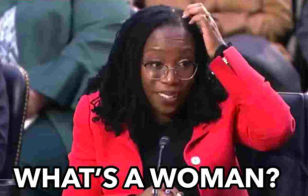
KBJ Hearings
Typify Our Debased Political Discourse. Since Judge Ketanji Brown Jackson was chosen by President Biden to
replace Justice Stephen Breyer on the Supreme Court, we've been encouraged by the White House, congressional Democrats, and
the corporate media to celebrate her as the "first Black woman" nominated to serve on the Court. Yet, when asked during
her confirmation hearing to define the term "woman," she responded, "I can't ... I'm not a biologist." The problem with
this answer isn't just that it was unworthy of a serious SCOTUS nominee. It is symptomatic of a debilitating disease that has
infected our political discourse, rendering substantive policy debate all but impossible and endangering the republic.
Reject Ketanji Brown Jackson. The issue with Ketanji Brown Jackson, the 51-year-old federal appellate judge who is our senile president's Supreme Court nominee, is not necessarily her on-paper qualifications. By most traditional metrics, she is "qualified": She has served as both a district court and appellate court judge, served as vice chair of the U.S. Sentencing Commission, formerly clerked for Justice Stephen Breyer (the man she has been nominated to replace) and is a double-Harvard alum. In terms of "objective" criteria, this is an impressive resume. Instead, the issue with Jackson is that she is a left-wing ideologue who, if successfully confirmed by the Senate, will devote the next few decades endeavoring to move the Supreme Court far to the left. All relevant indications are that she will approach her job not like her (slightly) more pragmatic former boss, but like a leftist activist — in the mode of her possible future colleague, the midwit partisan flack Justice Sonia Sotomayor. Worse, Jackson, due to the outrageous race- and sex-conscious nominating process in which President Joe Biden selected her, is uniquely unfit to render equal justice under the law for legal issues affecting race and sex.
Is Judge Ketanji Brown Jackson humble, or just an idiot? If Harvard Law School grads were paying attention to Judge Ketanji Brown Jackson's testimony in responding to Sen. Marsha Blackburn's simple but revealing question on defining "woman," they would petition the provost to rescind her diploma. Judge Jackson purports not to know what a woman is: "I'm not a biologist." Thus, Judge Jackson would have to recuse herself from any court case involving human biology, sex and gender, equal protection, even women's right to vote. The corollary fits Judge Jackson's competence in applying jurisprudence where she is not credentialed in any subject matter. For example, she's not an agronomist or a hydrologist or a botanist or a bio-chemist, so she couldn't sit on a case involving the EPA and soil erosion, nitrous oxide leaching into water supplies, SuperFund sites, navigable waterways, or ethanol Renewable Fuel Standards.
Ketanji Brown Jackson's Big Lie to Sen. Blackburn Exposes Progressivism. When Sen. Marsha Blackburn (R-Tenn.) asked Judge Ketanji Brown Jackson to define the word "woman," during Jackson's U.S. Supreme Court confirmation hearing before the Senate Judiciary Committee, she got the response "I can't." When Blackburn responded with an incredulous "You can't?" Jackson replied: "Not in this context. I'm not a biologist." It takes a biologist to define "woman"? Does Jackson think we're morons? In a way, yes. Or she doesn't care. She's a progressive, and progressives have been redefining language — English and many others — to fit their purposes dating back to the Spanish Civil War and undoubtedly earlier. Jackson very well knows what a woman is. The nominee has known this all her life, as we all have. But these days, in her part of the political world, she's not supposed to. So she lied.
Even Republican Presidents Would Seem to Have a Right to Free Speech. It seems to me that the point of the super partisan congressional January 6 Commission is to tar former president Donald Trump with inciting a riot ("insurrection" for the hyperbolic), an issue they raised and lost in the second impeachment battle. Perhaps they hope to persuade the Department of Justice to institute some cooked-up criminal charges against him for his comments on January 6. If I'm right about their objective, this week the Supreme Court in a unanimous opinion seems to have dealt them a setback. [...] The short form precis of this decision is that elected officials are free to criticize each other under the Constitution. Blackman argues, and the Wilson case supports his contention, that while the First Amendment does not preclude some restraints on the free speech rights of civil servants, the same kind of restraints are simply inapplicable to elected officials. This strikes me as self-evident.
'Wrong Direction' to Choose a Supreme Court Justice Based on Skin Color: Ben Carson. It's a wrong direction to choose a Supreme Court Justice candidate based on race and gender instead of merit and qualifications, said Ben Carson, the Housing and Urban Developing Secretary under the Trump administration. "So many people fought for such a long time to make sure that we had equality of opportunity. And a lot of blood was shed. A lot of people went to prison. Then we just turn around and sort of throw all that out, and start saying, 'We're going to make the qualification something over which a person has no control — their external characteristics,' and that's moving in the wrong direction," Carson told NTD's "Capitol Report" program in a recent interview, referring to President Joe Biden's pledge to send a black woman to the high court. "We really have to stop that and start asking ourselves: what makes a person who they are? Is it their skin? Is it their hair? Or is it their brain?"
KBJ's promise to recuse herself from the Harvard discrimination case is meaningless. KBJ is the person whom biologist Joe Biden assures us is "a black woman" in accordance with his earlier promise to nominate a person of that sex and color as a great act of noblesse oblige for which he, as a non-black non-woman, we think, should be honored in history, especially in view of his dementia. Surely he'll now join Barack Obama, Al Gore and Yassar Arafat in receiving a Nobel Peace Prize. I wonder if he'll deposit the check into that joint checking account he shares with Hunter. We have to take Joe's word for KBJ's sex and color. Since she's not a biologist, KBJ herself is unable to confirm that she's a woman and it's not clear whether she's able to confirm that she's black.
Media Bias Works: Ketanji Brown Jackson Is Widely Popular. Gallup on Wednesday published a new poll showing that Americans just love Ketanji Brown Jackson and want her on the Supreme Court right away: she is supposedly broadly popular, more so than anyone who has been nominated to the court since the 1980s. The far-Left news aggregator BoingBoing is thrilled, gushing about "the first black woman nominated to the Supreme Court and the most popular Supreme Court nominee in modern history," but Gallup's poll is really less about Ketanji Brown Jackson, whom nobody had ever heard of before Old Joe Biden nominated her to the Supreme Court, than it is about the lingering power of the establishment media. The Democrat party propaganda organs that masquerade as news organizations still wield considerable persuasive power, and that's not good news.
After Sen. Kennedy's Questioning, Constitutional Law Expert Reminds Us Who Really Chose KBJ. In his live-tweeting of the confirmation hearings this week to decide if Judge Ketanji Brown Jackson will serve on the U.S. Supreme Court, Committee for Justice (CFJ) President Curt Levey made a telling point about how Judge Jackson was selected as the nominee in the first place, which included considerable involvement from White House Chief of Staff Ron Klain. [Tweet]
'Disqualifying' words from Judge Ketanji Brown Jackson. After four long days of hearings by the Senate Judiciary Committee, we are left with more questions than answers about what kind of justice Ketanji Brown Jackson would be if confirmed to the Supreme Court — and the answers the Senate received were troubling to the point of being disqualifying. Judge Jackson repeatedly claimed to not have a judicial philosophy. Instead, she suggested that she uses a "methodology" that she has developed throughout her time on the bench: utilizing "the arguments of the parties, the facts in the case, and the law that applies in every case" as "inputs" that aid her decision-making. The problem is that this "methodology" wholly lacks substance, and Jackson described more of a functional strategy used by every judge, rather than a philosophical lens through which she views the law. A judicial philosophy is needed to inform how the law is read and how it applies to the facts of any case.
Court Strikes Down Democrat Gerrymander in Maryland. It's been a wild, past few weeks, when it comes to surprise rulings on redistricting. As RedState reported on Wednesday [3/23/2022], the US Supreme Court stepped in to overturn Gov. Tony Ever's district-level map in Wisconsin. That left the left reeling, not because of the consequences of possibly losing a district or two, but because the precedent of the ruling took another big bite out of the Voting Rights Act, which Democrats have used for decades as a kind of "cheat code" to gerrymander in their favor while stopping Republicans from doing the same.
First Liberty Lawyer: Ketanji Brown Jackson Can't Uphold Constitution if She Thinks It's Racist. Keisha Toni Russell, a constitutional lawyer at First Liberty Institute, testified Thursday in opposition of Judge Ketanji Brown Jackson's nomination for the Supreme Court, arguing that her support of critical race theory means she would not be able to uphold the Constitution if she believes it is racist. "Every lawyer and judge promises to defend and protect the U.S. Constitution, but she cannot uphold this oath if she believes that the Constitution and the principles of America's foundation are racist and inherently flawed. Neither can a judge remain impartial and administer justice independently if she holds a philosophy that correcting racism requires affording privileged classes less justice than oppressed classes," Russell said in her opening statement.
Ketanji Brown Jackson is a Trojan Horse. Judge Ketanji Brown Jackson does have several attributes in common with the President. For one, she's got a lousy memory. Indeed, it was Senator Cruz's careful and repetitious questioning, that helped her to recall quite a few things about herself that she had previously forgotten. Such a lack of self-awareness from one who anticipates setting precedent is disturbing. She did independently recall "staring at the image on the cover [of Derrick Bell's book Faces At The Bottom Of The Well] when I was growing up." She must have been a very late bloomer. That book was first published when she was a senior at Harvard. Judge Brown is no scholar. She's a graduate of Harvard and Harvard Law, yet couldn't recall the core arguments in the pivotal Dred Scott case. How does she expect to converse intelligently with thoroughly prepared lawyers regarding precedent and relevance in cases that will appear before her in the Supreme Court?
The Editor says...
She may be incompetent, evasive, smug, and soft on child pornographers, but she sure is black. Sadly, that's all that matters.
Tom Cotton Destroys Brown Jackson Over Support Of Suspected Terrorists. Tom Cotton would already have earned an A+ for his digging into Joe Biden's affirmative action nominee Ketanjio Brown Jackson and her disgusting leniency toward and support for consumers of child pornography. She is vile. As if Cotton hadn't done enough already, now he's going after the judge and Supreme Court hopeful for her almost-as-bad representation of suspected terrorists and detainees at Guantanamo Bay. Kudos to Cotton for having the stones to do what few GOP seem willing to anymore. Josh Hawley, Ted Cruz, John Kennedy, and Marsha Blackburn have been impressive throughout the hearings as well.
Ketanji Brown Jackson, Biden's Supreme Court pick, reveals a lot with questions she won't answer. Senate Judiciary Committee Democrats incessantly remind us that the historic milestone marked by Judge Ketanji Brown Jackson's nomination is that she would become the Supreme Court's first Black woman. Yet, how historically significant can it be if she can't say what a woman is? For all her appeal — and in 12 grueling hours of testimony on Tuesday, Judge Jackson's intellect and charm were on full display — the nominee is dodgy. Though a highly accomplished — indeed, a historic — woman, she testified that she can't "provide a definition" of what a woman is.
They're Really Going to Die on This Hill? [Scroll down] It's a certainty the judge will be confirmed to the court, but what is not at all certain is how much more damage Democrats will do to themselves before the hearings are over. Republicans have appropriately stayed focused exclusively on Brown Jackson's public comments and previous court rulings as well as direct questions concerning her past opinions and philosophy. How well has it gone? Polling among the general population shows a mixed impression at best, despite most agreeing she'll be confirmed. Not hard to understand when you discover the judge couldn't define what a woman is. Brown Jackson said "I don't know" when asked when life begins. Most disturbingly, the judge and her defenders tied themselves in knots this week explaining why she went so light on past sentencing of child pornographers and pedophiles. Too much uncomfortable time was spent explaining and listening to her statements parsing what ages constitute actual child rape and what ages seem too close in age to be considered pedophilia.
Bongino: Ketanji Brown Jackson disqualified herself with this single claim. During Tuesday's [3/22/2022] confirmation hearing, Sen. Marsha Blackburn, R-Tenn., cited a decision from another liberal justice, the late Ruth Bader Ginsburg, who wrote in U.S. v. Virginia that "supposed inherent differences are no longer accepted as a ground for race or national origin classifications, physical differences between men and women, however, are enduring." Turning to Jackson, the Tennessean asked if she agreed with Ginsburg that sexes are not "fungible" and asked her for a definition. Jackson said she couldn't provide a definition for the word "woman" and argued it was because she was not a biologist. Bongino said that claim was the cherry on top of an "absymal performance" by Jackson[.] "I think it's clear at this point that Judge Brown Jackson is not qualified to be a Supreme Court justice — why, she said so. I didn't say it, she said it. I'm telling you, I don't think she's qualified, but she said [as much] too," he said. "You can't hear this enough: There is nobody on Planet Earth who should sit on the bench if they can't describe in simple terms what a woman is — How do you not know what a woman is? How can you not define what a woman is? Ketanji Brown Jackson is a woman. I know that. She doesn't know? She's unaware she's a woman?" he continued.
The things they don't teach at Harvard — Black Woman Brown Jackson canot define "woman". Joe Biden promised that in picking a nominee to fill the upcoming opening on the Supreme Court, he would not consider any white or Hispanic or Asian people and not consider any men at all. He promised to consider only black women. Only about 2% of American lawyers fall into that demographic. In overtly discriminating against the other 98%, Biden committed an obvious violation of the Civil Rights Act, but I rather doubt Biden's Department of Labor will file suit. True to his promise, Biden found a black woman lawyer to nominate. Her name is Ketanji Brown Jackson. It was Biden who touted his nominee as "a black woman" even before he chose her, and so I suppose we should honor that designation. Henceforth, she is "Black Woman Brown Jackson." [...] In any event, I suspect that Black Woman Brown Jackson will decide on a definition of "woman" within seconds after she is confirmed by the Senate and will stick to that definition for her 30 or more years on the Supreme Court. We won't like her definition, nor will any real biologist. But the lying leftist wokerati will. This is the same group that says Justice Clarence Thomas is not really black, because he's a conservative.To the left, what matters is ideology and power, not logic, honesty or truth.
Four times Jackson was rattled by GOP pressure during Supreme Court hearing. Supreme Court nominee Judge Ketanji Brown Jackson has come out strongly against a strict line of questioning by GOP members of the Senate Judiciary Committee despite a select number of moments in which she became rattled during the confirmation process. [#1] Defining what a woman is: Sen. Marsha Blackburn, a Tennessee Republican, asked Jackson on Tuesday night about a number of culture war issues, including efforts to permit or ban transgender student-athletes to compete on teams corresponding to their gender identity rather than their biological sex.
Judge Ketanji Brown Jackson Denies Connection to CRT. Her Past Says Otherwise. Under questioning from Sen. Ted Cruz, R-Texas, at her Supreme Court hearing, Judge Ketanji Brown Jackson ran away from critical race theory as fast as possible. Her record says otherwise, however. The candidate's past embrace of some of critical race theory's leading proponents is concerning, and shows that she has so far gotten off easy during her hearing. [...] In her exchange with Cruz, Jackson insisted that she had never studied critical race theory. "It wouldn't be something that I would rely on if I was on the Supreme Court," Jackson said to Cruz. In 2015, however, Jackson said that she tries to convince her students that sentencing "melds together myriad types of law," including "administrative law, constitutional law, critical race theory," etc. Jackson also has closer ties to critical race theory. When Cruz asked Jackson whether critical race theory was taught in schools, she responded, "I don't think so. I believe it is an academic theory that is taught at the law school level." That is in itself a red herring. As we never tire of pointing out, even if critical race theory is not assigned to K-12 students, it is likely applied, such as, for example, when teachers and trainers force students to perform "anti-racism" trainings that separate them by race or ethnicity.
Democrats Condone Child Porn? The New York Times has published a lot of stupid stuff over the years, but this is one of the worst bits of analysis I've seen in a long time. It comes from an article on Judge Jackson's confirmation hearing that is headlined "Judging a Judge on Race and Crime, G.O.P. Plays to Base and Fringe." It includes this absurd smear: ["]By making the leniency allegations [re child porn sentencing], Mr. Cruz, Ms. Blackburn and Mr. Hawley appeared to be exploiting echoes of QAnon, which has a broad, almost cultlike reach among some members of the Republican base. [...] ["]
How Can Ketanji Brown Jackson Rule In Sex Discrimination Cases If She Can't Define 'Woman'? Judicial confirmation hearings are rarely illuminating. Since the introduction of television cameras, they mostly serve as a way for senators to say what they want their constituents to hear and for judicial nominees to say as little as possible. Nothing is learned, at least not on purpose. But occasionally, we learn something by accident. At Judge Ketanji Brown Jackson's confirmation hearing on Tuesday, Sen. Marsha Blackburn of Tennessee asked a seemingly innocuous question: "Can you provide a definition of the word 'woman'?" The nominee was unable to do so. It might seem like a question that goes more to politics than to the job of a judge, but when sex discrimination is frequently before the court — including as recently as last year in Bostock v. Clayton County — it behooves a judge to have some inkling about what "sex" means.
Cruz: I'm Not Voting for Jackson, Who's Probably the First SCOTUS Nominee Who Can't Say What a Woman Is. On Wednesday's broadcast of the Fox News Channel's "Jesse Watters Primetime," Sen. Ted Cruz (R-TX) said he will not vote for the confirmation of Supreme Court nominee Judge Ketanji Brown Jackson and that Jackson is probably the first SCOTUS nominee in history who can't define what a woman is. Cruz said, "Well, listen, she is probably the first Supreme Court nominee in the history of our country who is unable to answer the question, what is a woman? And her record, unfortunately, I think, is far outside the mainstream."
GOP senators complain Durbin 'editorializing' during Supreme Court hearings. At the start of the third day of Supreme Court nominee Ketanji Brown Jackson's Senate Judiciary Committee hearings Wednesday, a pair of GOP members complained that Democratic Chairman Dick Durbin is "editorializing" between Republican talking points. The complaints began with Texas Sen. John Cornyn after Durbin claimed Jackson's hearings have become a "testing ground for conspiracy theories" against President Joe Biden's high court nominee, who is tapped to succeed Justice Stephen Breyer and would become the first black woman on the Supreme Court if confirmed by the Senate.
Supreme Court Decision on Redistricting Leaves Democrats Reeling. Republicans were down a touchdown with one play left and half the field to go in Wisconsin regarding redistricting for the state legislature, but thanks to a shocker of a decision from the Supreme Court, overtime has just been forced. Previously, Wisconsin's highest court had decided to use maps drawn by the Democrat governor after a months-long battle with Republican lawmakers. In doing so, the process hurdled past several legal issues that the Supreme Court decided were improperly ignored.
Supreme Court tosses Wisconsin legislative voting maps. The Supreme Court on Wednesday [3/23/2022] threw out Wisconsin state legislative maps that were preferred by the state's Democratic governor and selected by Wisconsin's top court, making it unclear what the boundaries will be for the fall election. But while the justices in an unsigned opinion threw out voting maps the Wisconsin Supreme Court had selected for the State Assembly and Senate, they left in place state congressional maps. The state's highest court selected the maps from a range of options after lawmakers and the governor couldn't agree.
The glib and unresponsive job interview. Imagine interviewing for a job — in this case, the United States Supreme Court — and treating the interviewers with contempt. Glib and unresponsive. Two words that accurately describe the posture of Supreme Court nominee Ketanji Brown Jackson while taking questions from Republican Senators at yesterday's hearing. In what can only be described as a foregone conclusion with a bit of window dressing, Jackson's hearing was filled with shelter and protection from tough questions provided by Democrat committee chairman Dick Durbin. Consistently giving lighter sentencing for convicted child pornography offenders than recommended by prosecutors was just a sample of the radical nature of Jackson's past decisions. But what was more reveling during Senate questioning was Jackson's contemptuous smirk — knowing that a non-response held no consequences and would not interfere with her assured appointment.
If Ketanji Brown Jackson Doesn't Know What a 'Woman' Is, Why Does She Use the Word So Much? Joe Biden's recent Supreme Court nominee Judge Ketanji Brown Jackson, whom the president has admitted was nominated in part because she is a woman, stunned listeners on Tuesday when she refused to give a definition of what a woman is. "I can't. ... I'm not a biologist," Jackson said after Republican Sen. Marsha Blackburn asked her to provide a definition of the word "woman." But for not knowing what a "woman" is, Jackson loves to use the word. Here are 14 times she invokes the fairer sex in just the first two days of her confirmation hearings, plus 34 times she's used the word in her legal opinions as a judge.
The Takeaway from KBJ: She Can't Define a Woman. I haven't been paying much attention to the confirmation hearings of Judge Ketanji Brown Jackson, and I suspect the American public isn't either. In these kinds of low-salience cases, I'd guess that only one moment is really going to matter in the popular perception, and Republicans have created it. The Democrat-allied media are underplaying or ignoring this exchange, but it was absolutely devastating. In essence, the Republicans were poking around, somewhat ineptly, trying to make the judge say something that would sound extreme, shocking, bizarre, nonsensical, alarming, and ultra-woke to the average American, and Senator Blackburn finally succeeded.
A Big 'No' On Ketanji Brown Jackson. As both President Joe Biden and the Democrats have made clear, Jackson was selected because she was, 1) African-American, 2) a woman, and (most important of all) 3) a leftist. Unfortunately, none of those things are actual qualifications for the Supreme Court. Despite her superficially sparkling resume, under tough questioning this week, she showed why she shouldn't be privileged with a seat on our nation's highest court. On issue after issue, she whiffed, at times pretending not to have an opinion, or acting as if she didn't really know much about certain landmark legal cases and current controversies. Indeed, it became very clear under questioning that Jackson has been disingenuous about her legal philosophy and extreme political beliefs that encompass race, gender, crime and culture, among other things. Her answers were at times not believable.
Democrats Call Republican Senators Racist for Treating Ketanji Jackson Like Everyone Else. Here we go again. Democrats have found yet another opportunity to falsely label their political opposition as racist. The Supreme Court confirmation hearings for Judge Ketanji Brown Jackson began on Monday [3/21/2022] and the left is already characterizing Republican senators as vicious racists for daring to question her qualifications. Even Mr. Magoo could have seen this coming from a mile away. Several members of the left-wing chattering class have already started lobbing erroneous accusations of racism at GOP lawmakers for questioning the nominee. Professional race-baiter Elie Mystal wrote a piece for The Nation in which he predicted Republicans are going to do all kinds of racisms to keep Jackson from being appointed to the Supreme Court.
Ketanji Brown Jackson, Biden's Supreme Court pick, reveals a lot with questions she won't answer. Senate Judiciary Committee Democrats incessantly remind us that the historic milestone marked by Judge Ketanji Brown Jackson's nomination is that she would become the Supreme Court's first Black woman. Yet, how historically significant can it be if she can't say what a woman is? For all her appeal — and in 12 grueling hours of testimony on Tuesday, Judge Jackson's intellect and charm were on full display — the nominee is dodgy. Though a highly accomplished — indeed, a historic — woman, she testified that she can't "provide a definition" of what a woman is. Sen. Marsha Blackburn, R-Tenn., even tried to help, spoon-feeding her the wisdom of an iconic progressive, the late Justice Ruth Bader Ginsburg, that "physical differences between men and women ... are enduring. The two sexes are not fungible." But Jackson was unmoved — if there is a difference between men and women, she's claims she is unable to discern it.
Ketanji Brown Jackson [is] getting the respect that Amy Coney Barrett was denied. The famous "gonzo journalist" Hunter S. Thompson once said, "Politics is the art of controlling your environment." The confirmation hearing of Judge Ketanji Brown Jackson is about to vividly show what Thompson meant. Less than two years after the abusive treatment of Justice Amy Coney Barrett, the Senate is holding a hearing that is dramatically different in the treatment of the Supreme Court nominee and the issues considered relevant to her confirmation. For those with memories going back to 2020, there have been striking differences in how the news media haved covered Jackson's nomination in recent weeks. When Barrett was nominated, the media ran unrelenting attacks on her and her background. Nothing was viewed as out of bounds, from her religion to her personal life to fabricated theories of prior assurances on pending cases.
The First Black Woman Nominated to the Supreme Court Can't Define 'Woman'. In a situation almost beyond belief, the individual who's been heralded by the liberal media and Democrats for her historic status as the first black woman to be nominated to the Supreme Court is unable to define "woman," according to her testimony late on Tuesday night [3/22/2022]. The somewhat ironic if not tragic revelation came courtesy of a line of questioning from Senator Marsha Blackburn (R-TN) who — even some 13 hours after the hearings started — was fired up and ready to roll. "Can you provide a definition for the word woman?" Blackburn asked. "Can I provide a definition?" Judge Jackson responded somewhat surprised. "Mhmm, yeah," Blackburn responded. "I can't," Jackson said. "You can't?" Blackburn responded. "Mmm, not in this context — I'm not a biologist," Judge Jackson said.
Supreme Court Nominee And Pedo Sympathizer, Ketanji Brown Jackson, Can't Tell You What A Woman Is. As the confirmation hearing for Judge Ketanji Brown Jackson went into hour 13, Sen. Marsha Blackburn asked the Supreme Court nominee on Tuesday to define the word "woman." "I can't — " Jackson replied. "You can't?" Blackburn said. "Not in this context. I'm not a biologist," Jackson said. [Video clip]
Pre K-12 School Where Judge Jackson Sits on Board Pushes Cultural Marxism on Kids. Georgetown Day School, the private Pre K-12 school where Judge Ketanji Brown Jackson sits on the board of trustees, teaches radical critical theory pedagogy, and boasts on its website "everyone will engage in the work of social justice within all aspects of school life" — which Judge Jackson would be required to "support" and "promote" as a member of the board. During her second day of questioning by senators on Tuesday, Judge Jackson took questions from a number of Republicans pertaining to her opinion on "Critical Race Theory" — and Sen Ted Cruz (R-TX) specifically probed her on race-essentialist materials being taught at Georgetown Day School, such as "Antiracist Baby" by Ibram X. Kendi. However, teaching "Antiracist Baby" is not the only radical material being pushed on children at the school where Judge Jackson sits on the board.
Biden's Supreme Court nominee Ketanji Brown Jackson refuses to define the word 'woman' because she's 'not a biologist'. Supreme Court nominee Ketanji Brown Jackson refused to define the word 'woman' during the fiery second day of her confirmation hearing conducted by the Senate's Judiciary Committee. The moment came during a tense exchange with Senator Marsha Blackburn (R-Tenn.) who pressed Jackson on sex and gender issues amid the fallout of biological male swimmer Lia Thomas storming to victory in the NCAA championships against female competitors. Quoting late Supreme Court judge Ruth Bader Ginsburg, Blackburn said: 'Physical differences between men and women are enduring. The two sexes are not fungible. A community made up exclusively of one sex is different from a community composed of both.' 'Do you agree with Justice Ginsburg that there are physical differences between men and women that are enduring?' the senator asked.
Five Key Points from Ketanji Brown Jackson's Tough Day in the Senate. Supreme Court nominee Judge Ketanji Brown Jackson had a tough day Tuesday, as she faced the first serious questions about her record and her judicial philosophy. Judge Jackson came across during the introduction hearing on Monday as a personable, likable and accomplished attorney and jurist, with a beautiful family. On Tuesday, however, she was unable to satisfy concerns that she harbors deeply radical political views, and that she has a record of being too soft on sex offenders.
Ketanji Brown Jackson's anti-constitutional, pro-child predator views. Today was the second day of hearings on the nomination of Ketanji Brown Jackson, a person Joe Biden nominated to the Supreme Court because she's a leftist Black woman. It revealed that she is anti-constitutional, anti-White, and has a weird fondness for child sex predators. Democrats' statements today boiled down to three things: (1) We are so excited that you're a Black female. (2) Republicans are racist for daring to inquire into your credentials and views. (3) Regarding those racist questions, we would never treat a Supreme Court nominee as disrespectfully as the Republicans are treating you. (Their disgraceful treatment of Brett Kavanaugh, Amy Comey Barrett, Clarence Thomas, and Robert Bork has been memory-holed.) The real focus was on Jackson's disturbing views about child sexual predators, the Constitution, and race. Her answers revealed that she's either very dumb or very dishonest.
Why do Democrats Hate Children? Every time there's a headline involving Democrats and children it is evident that as a group, Democrats hate children. Not only do they appear to hate them, they appear to enjoy, support and promote sexually and mentally abusing and killing them. They want to abort them, even when a fetus is shown to probably be viable after 24 weeks. Even if that means crushing the baby's skull and tearing that fetus apart limb by limb in order to "deliver" it. That's what a late term abortion is. [...] If an adult sexually assaults, abuses, penetrates or traffics a child, that's okay by them, too. Just ask Biden's SCOTUS nominee, Kentanji Brown Jackson who thinks that even basic sentences for child rapists and abusers are "too harsh."
Democrat Sen. Dick Durbin Leaps to Defend Ketanji Brown Jackson from Accusations of Leniency in Child Porn Possession Cases. Democrat Sen. Dick Durbin (D-IL) leaped to the defense of President Joe Biden's Supreme Court nominee on the second day of her confirmation hearing, favorably questioning her record of "lenient" sentences for defendants who were caught in possession of child pornography. Durbin, who is the Chair of the Senate Judiciary Committee, started off the hearing by raising questions about Ketanji Brown Jackson's record of sentencing "non-production" cases below federal guidelines — a line of questioning which was in direct response to Sen. Josh Hawley's (R-MO) Twitter thread last week. In these tweets, Hawley detailed Jackson's rulings, interviews, articles, and speeches and accused her of "having a pattern of letting child porn offenders off the hook for their appalling crimes."
The Greenhouse Effect at the Supreme Court. It goes without saying that leftists have perfected the art of situational ethics. The basic operating rule for the left is: "'Democracy' means getting what we want; if any institution doesn't give us what we want, that institution must be destroyed," though they will always call it "reform." [...] We now see this in the case of the Supreme Court, which is infuriating liberals because it no longer serves as a policy-making body for the left to use as an end-run around the branches of government accountable to voters. Look no further than the primal scream in the latest issue of the New York Review of Books from long-time Supreme Court "reporter" Linda Greenhouse. Sober Court watchers have long noted the "Greenhouse Effect," which in this case has nothing to do with climate change. It refers to the supposedly soothing, no-ideology-to-see-here persona Greenhouse has affected for decades. Her article is predictably entitled, "Should We Reform the Supreme Court?" In other words, should we add more Justices or change it around in some way so as to "restore" it as a Progressive battering ram.
Judge Jackson in brief. Judge Jackson is easy to read. Her tone of voice in response to unfriendly questions is insufferable. She talks down to the unenlightened. She looks down on conservatives. She buys every chapter and verse of the rapidly evolving progressive dogma. The rapidly evolving progressive dogma is to be incorporated into the Constitution as the opportunity presents itself. Her merits are entirely superficial. She makes a good appearance if you don't look too closely.
Senator Kennedy Stumped Biden's Supreme Court Nominee with One Question. As Tuesday's Supreme Court confirmation hearing dragged into the evening hours, Senator John Kennedy (R-LA) raised a simple question about when constitutional protections for life — or even just life itself — begins. "When does life begin, in your opinion," Senator Kennedy asked Judge Ketanji Brown Jackson for starters. "Senator... um... I don't... know," Judge Jackson replied, followed by an uneasy, awkward laugh. [...] Senator Kennedy pushed further on the point, asking Judge Jackson an important follow-up, "When does equal protection of the laws attach to a human being?" "Well Senator, um... I believe that the Supreme Court... um... actually I, I actually don't know the answer to that question — I'm sorry — I don't," Judge Jackson responded, again with an ill-timed grin on her face as her initially confident answer turned to another know-nothing response.
Ignorant:
Ketanji
Brown Jackson 'Did Not Know' Joe Biden Twice Filibustered Black Nominee Janice Rogers Brown. Supreme Court
nominee Ketanji Brown Jackson "did not know" former ranking member of the Judiciary Committee Joe Biden twice filibustered
black nominee Janice Rogers Brown for the U.S. Court of Appeals for the District of Columbia. "Do realize she was
filibustered for two years when she was appointed to the D.C. circuit judge?" Sen. Lindsey Graham (R-SC) asked. "I
didn't know that," Jackson responded. "Did you know that Joe Biden filibustered Janice Rogers Brown?" Graham
asked. "I did not know that[,"] Jackson again said. "Now that you know that, how do you feel about it?" Graham
asked to which Jackson had no response.
Evasive:
SCOTUS
pick Jackson won't say whether she backs court-packing push. Supreme Court nominee Judge Ketanji Brown Jackson
refused to say Tuesday whether she would support increasing the number of justices on the high court, invoking a statement by
current Justice Amy Coney Barrett. Senate Judiciary Committee Chairman Dick Durbin (D-Ill.) posed the court-packing
question to Jackson during the second day of her Senate confirmation hearing by suggesting that Barrett had said that she
"could not opine" on the issue when she appeared before the committee in October 2020. "I agree with Justice Barrett and
her response to that question when she was asked before this committee," Jackson said. "My North Star is the consideration
of the proper role of a judge in our constitutional scheme," she added. "In my view, judges should not be speaking to
political issues, and certainly not a nominee to the Supreme Court."
Supreme Court Nominee Ketanji Brown Jackson Refuses to Join with Ginsburg, Breyer in Opposing Court-Packing. Supreme Court nominee Ketanji Brown Jackson during her confirmation hearing on Tuesday refused to join with the late Justice Ruth Bader Ginsburg and outgoing Justice Stephen Breyer in opposing court-packing. Senate Judiciary Committee Ranking Member Chuck Grassley (R-IA) asked Jackson where she stood on court-packing, noting that although it is a congressional decision, justices have weighed in on the subject before. Grassley specifically asked her if she would side with liberal justices Ginsburg and Breyer, who opposed court-packing.
Incompetent:
Supreme
Court nominee Jackson doesn't 'quite remember the basis' for Dred Scott decision. Judge Ketanji Brown Jackson,
who President Biden nominated to the Supreme Court to become the first ever Black female justice, admitted Tuesday that she
could not recall the basis for the infamous Dred Scott decision, which in 1857 said that a Black person whose ancestors had
been slaves could not be an American citizen. The case came up during Jackson's confirmation hearing on Tuesday, when
she faced questioning from Sen. John Cornyn, R-Texas. Cornyn brought up the concept of substantive due process, a legal
doctrine utilized to expand the Constitution's due process clause to protect various rights not enumerated in the Constitution.
Sen. Josh Hawley Presses Judge Jackson For 'Apologizing' To Child Porn Offender. Republican Missouri Sen. Josh Hawley pressed Supreme Court nominee Ketanji Brown Jackson on allegedly "apologizing" to a child pornography offender at Tuesday's [3/22/2022] confirmation hearing. Hawley raised the case United States v. Hawkins, where Jackson sentenced an 18-year-old child porn offender 3 months imprisonment, despite sentencing guidelines recommending up to 10 years. He read a transcript in which Jackson allegedly told the convict there is "no reason to think" that he is a pedophile. "Didn't you apologize to him? And I just got to tell you, I can't quite figure this out," Hawley said. "You said to him, 'This is a truly difficult situation. I appreciate that your family's in the audience. I feel so sorry for them, and for you and the anguish this has caused all of you. I feel terrible about the collateral consequences of this conviction.' And then you go on to say 'sex offenders are truly shunned in our society.' I'm just trying to figure out, judge, is he the victim here?"
Senators [are being] kept from seeing Sentencing Commission records on Supreme Court nominee. The Biden administration is keeping more than 48,000 pages of records about Supreme Court nominee Ketanji Brown Jackson from senators reviewing her nomination, including documents about her time at the U.S. Sentencing Commission that she has made a central part of her professional story. Senate Judiciary Committee Chairman Dick Durbin (D-Ill.) is "hiding" records from Jackson's time as vice chair of the Sentencing Commission, where she championed leniency for child predators, says Michael Davis, former chief counsel for the Senate Judiciary Committee. Sen. Chuck Grassley (R-Iowa) said Monday that 16,000 pages of substantive content has been released on Jackson, compared to the 48,000 pages withheld by the White House under the Presidential Records Act and FOIA exemptions.
Secrecy Shrouds Key Jackson Documents Despite Durbin's Sunshine Week Praise. Senate Judiciary Committee Chairman Dick Durbin (D-Ill.) was among the bipartisan group of signers of a March 16 Sunshine Week letter to Comptroller General Gene Dodaro declaring that the Freedom of Information Act (FOIA) "is crucial for ensuring transparency and accountability in government, but persistent challenges continue to limit citizens' ability to access information under the statute." Sunshine Week is the annual celebration of the FOIA by journalists, transparency advocates, and some elected officials. Durbin and the other signers asked Dodaro, who heads the Government Accountability Office (GAO), to investigate why there is a huge, and growing, backlog of unanswered FOIA requests at federal agencies. But, as Sen. Charles Grassley (R-Iowa), the top Republican on the judiciary panel, made clear during the first day of Judge Ketanji Brown Jackson's Supreme Court confirmation hearing, private citizens aren't alone in having trouble getting government agencies to produce copies of official documents the FOIA requires to be made public.
Dick Durbin blocks documents showing Ketanji Brown Jackson's judicial record. The Senate hearings for Judge Ketanji Brown Jackson's Supreme Court nomination are not going well. Senate Judiciary Committee chair Dick Durbin is blocking the release of documents showing Brown Jackson's actual record as a judge, taking a page from the tactics of impeachment-obsessed Rep. Adam Schiff. That's how Democrats do hearings these days. [...] Which signals that there is something they are trying to hide. According to the Article3Project, Brown Jackson sentenced perverts, predators, and child molesters to less-than-recommended jail and prison time on a consistent basis. [...] She's also been strikingly soft on kiddie porn purveyors and viewers, despite the hard fact that 80% of viewers of child porn are likely to have molested a child in real life, according to a study from the Mayo Clinic. She views hard punishments of these dirtbags as "stigmatization" and "revenge." Any concerns for the permanently harmed children in these monstrous crimes? Apparently not from her — and of course, a show of the records could correct us if we are wrong. But Durbin wants no such records out there, which can only by default lead to the conclusion that they are worse than what people suspect.
Democrats Learn What Consequences Are During Ketanji Brown Jackson's Confirmation Hearing. The confirmation hearing for Supreme Court nominee Ketanji Brown Jackson began on Capitol Hill on Monday. The prior reactions in the mainstream media were what you'd expect. Namely, endless, slobbering profiles and claims that any questioning of the judge's record would be racist and out of bounds. When the time came, Sen. Dick Durbin opened the hearing by pleading with Republicans for "civility." [Tweet] Of course, Republicans owe Durbin and his party nothing of the sort. After all, it's been less than four years since one of the most disturbing, disgusting congressional and media spectacles in US history: The Brett Kavanaugh hearings. We all remember the eleventh-hour letter brought forth by Sen. Dianne Feinstein that blew up Kavanaugh's nomination process. We remember the fact that Christine Blasey Ford, Kavanaugh's chief accuser, couldn't provide any corroborating details, including not being able to even say where the supposed rape occurred all those decades ago. We remember the Julie Swetnick travesty where mainstream news outlets ran with wild tails of gang rape brought by a client of now-felon Michael Avenatti. We remember the tortured performance of Sheldon Whitehouse talking about "boofing" and quizzing Kavanaugh on his high-school yearbook. We even remember when Democrat protesters broke into and occupied the Senate office building, something that would have been labeled an insurrection had it been accomplished by Republicans.
A Trump-Hating Backer of Biden's Supreme Court Nominee Is Married to the Top J6 Prosecutor. Confirmation hearings for D.C. Circuit Court Judge Ketanji Brown Jackson, Joe Biden's first U.S. Supreme Court nominee, began Monday [3/21/2022] before the Senate Judiciary Committee. During an event in Washington, D.C. on Monday morning, activists gathered to rally on behalf of the nominee who could be the first black woman seated on the nation's highest court. "It's also, for so many of us, a moment that is personal," Fatima Goss Graves, president and CEO of the National Women's Law Center, told the crowd. "It is personal if you have ever been the only person sitting in a room. It is personal if you have ever wondered, 'Is that for me?'" Over the past several weeks, Graves, a graduate of Yale Law school, has given dozens of interviews in support of Jackson's nomination. In a January column for CNN, Graves denounced "the current homogeneity of the legal profession and judicial system" and claimed "the perspective of White men has been treated as the default" in court proceedings.
Senator Josh Hawley Outlines Record of SCOTUS Nominee Ketanji Brown Jackson Being Lenient Against Pedophiles and Child Sex Abusers. As the evidence in the Jeffrey Epstein case showed us, extremely powerful people participate in the horrific evil of exploiting children for sex. The networks of politicians and rich billionaires are filled with people who participate in these evil endeavors. Recently, the far-left sphere of U.S politics have embraced a culture of accepting child sex trafficking, and their deviant grooming objectives have now entered the classroom. To present one reference, you might remember the dozens of female gymnasts who were sexually assaulted for years while the U.S. Olympic Committee and FBI did nothing to stop it {Go Deep}. Let us be very clear in that example. The FBI didn't make a mistake in the cases, nor did the USOC fail in their responsibility; both the FBI and USOC intentionally, willfully and with expressed admissions facilitated the ongoing rape and sexual abuse of hundreds of pre-teen and teenage girls.
Cory Booker Embarrasses Himself by Gushing Over Ketanji Brown Jackson's Race and Gender. Many criticized Joe Biden for promising during his presidential campaign that, if given the chance, he'd nominate a black woman to the Supreme Court, effectively making his eventual nominee an affirmative action pick. This pick would forever have to live with the perception that she was chosen primarily for reasons of identity, not her qualifications. And Biden came through on his promise, but Democrats don't seem to care about fixing that perception. Senator Cory Booker, for example, can't even discuss the nominee's qualifications without mentioning her race and gender.
Vital Questions Ketanji Brown Jackson Must Answer. Yes, there are and have been black justices and women justices, but never, ever a black woman justice! Who would dare stand in the way of history? [...] Nevertheless, if Democrats want to at least give the appearance of fairness, they should ask Jackson the same questions they asked the last two Republican nominees to the court. We're not talking about those silly questions that might reveal her judicial philosophy. Although there is plenty there worthy of careful scrutiny. Joel Pollak over at Breitbart News put together a handy list of such questions, ranging from: Do you believe current penalties for sex offenders are too harsh? What do you think of Biden's decision only to select a black woman as a nominee? Do you support critical race theory? Do you agree with the "1619 Project" that America was founded on slavery? Do you support court-packing? Can we have rule of law with an open border? Democrats have already labeled such questions as racist.
Senators have every right to question Ketanji Brown Jackson's child pornography record. What was once shaping up to be a sleepy Supreme Court confirmation process turned contentious this week when Republican Sen. Josh Hawley of Missouri took to Twitter to question Supreme Court nominee Ketanji Brown Jackson's record on child pornography cases. Hawley raised a number of separate incidents that he claimed establish a pattern of Jackson being soft on defendants charged with child pornography, including her role in producing a 2012 United States Sentencing Commission report to Congress recommending that lawmakers reduce mandatory minimum sentencing for child pornography offenses.
Will Senate apply the Ginsburg or the Barrett Rule to Judge Jackson? During [Ruth Bader] Ginsburg's confirmation, then-Judiciary Committee chairman Joe Biden told her that a confirmation is where a nominee is expected to "answer questions or to discuss your judicial philosophy." He later expressed concern over how Ginsburg, "at least from my perspective, appeared to be reticent to answer some of our questions even more so than recent nominees." Nevertheless, in her confirmation, Ginsburg declared that she refused to answer questions on her position on particular issues. "I'm not going to give an advisory opinion on any specific scenario," she explained, "because as clear as it may seem to you, I think I have to avoid responding to hypotheticals because they may prove not to be so hypothetical." What became known as the Ginsburg Rule meant that nominees could refuse to answer questions on how they interpret the Constitution on issues like abortion. The rule has been given broader and broader meaning with each confirmation. I have been a critic of the rule as reducing confirmations to largely contentless staged events where nominees avoid legitimate questions on their interpretative approaches in any given area.
'This Seat is Reserved': Quotas and the Supreme Court. Just over a week ago, President Joe Biden nominated Ketanji Brown Jackson to fill the Supreme Court seat being vacated by retiring Justice Stephen Breyer. Jackson is a black woman, as were the other two leading contenders — J. Michelle Childs and Leondra Kruger. Nobody except black women were seriously considered, which was intentional. Two years ago, during the South Carolina presidential primary in 2020, Biden had pledged to nominate a "black woman" to the Court. Though such a justice had never served before — making it, on paper, an unprecedented nomination — Biden's pledge was a clear attempt to shore up black votes in South Carolina at a time when his campaign was flailing. However, Biden was hardly the first candidate to consider Supreme Court nominees based on their gender or race. Later that year, then-president Donald Trump nominated Amy Coney Barrett to the Supreme Court, to fill the seat vacated by Ruth Bader Ginsburg upon her death. Though Ginsburg was a woman, she was neither the first woman nor the only woman serving on the Court at the time. Two others, Sonia Sotomayor and Elena Kagan, were already on the bench, and Trump had made no prior pledge to keep the seat female. Yet, when Ginsburg died at the height of the 2020 election, Trump vowed that only a woman would take her place. Similarly, all the leading contenders — Barbara Lagoa, Joan Larsen, and Barrett herself — were women, and no judges except women were seriously considered at all. Both nominations demonstrate that America's long-running politicization of its Supreme Court has finally met identity politics — the result being quotas on the Court. In 'filling the shoes' of the previous occupant, nominees are now expected to match not only their qualifications but also their race and gender.
A Look at Ketanji Brown Jackson's Most Noteworthy Judicial Decisions. On March 21, Judge Ketanji Brown Jackson's Supreme Court confirmation hearing will begin. Senators will be scrutinizing her past judicial opinions on critical issues from labor law to illegal immigration to presidential claims of executive privilege. This brief overview of several of those key opinions provides some insight into her general approach to resolving legal issues. Jackson has been through this confirmation process three times before — when she was nominated to the U.S. Sentencing Commission, to the district court, and to the D.C. Circuit — but it is safe to say that a lot more people are going to be paying attention this time. The first day will be taken up with speeches by all the senators of the Senate Judiciary Committee and will conclude with an opening statement by the nominee herself. The real fireworks, though, will take place over the next two days when senators ask a battery of questions of the nominee herself, many of which she will avoid answering, citing the longstanding rule that a nominee should not answer questions about legal issues that might come before the Supreme Court if she is confirmed.
The Editor says...
Can-of-Worms Alert! Aren't these hearings highly premature? There is no vacancy on the Supreme Court at this moment.
What if Justice Stephen G. Breyer changes his mind and decides to stay a while longer? What is K. B. Jackson's status if she's
confirmed by the Senate but Breyer refuses to leave? Can an incoming President nominate a new Justice in the absence of
any openings on the Supreme Court — just to send a message?
Biden Supreme Court pick backed by radicals who believe the Constitution is 'trash'. Demand Justice, the secretive leftist group in the Arabella Advisors dark-money network dedicated to judicial nominations, has revealed a bit more about itself in recent tax exemption applications, which were obtained by Americans for Public Trust. The filings include the first complete list of the board of directors of Demand Justice. One name stands out in particular: Elie Mystal, The Nation's justice correspondent. He has long written far-left screeds about the law and recently declared on "The View," "The Constitution is kind of trash." That was no slip of the tongue for Mystal. In another recent interview, when asked if "the Constitution needs to be scrapped altogether," he replied, "Sure, but I don't think that's going to happen."
The hidden agenda behind Joe Biden's 'black female' Supreme Court pledge. Ketanji Brown Jackson was raised in the orbit of government: her father was chief attorney for a school district; her mother was a school principal. [...] Throughout her career, there is one common thread: a personal crusade to reduce the ability of the criminal justice system to impose real sentences on people convicted of crimes. Our system requires both defense attorneys and prosecuting attorneys; it is fundamental to our system that the defendant is assumed innocent until proven guilty. But once that guilt is proven, the American people need to be able to count on our system to remove the criminal from society, to keep him off the streets until he is no longer a threat. In a nation in which the vast majority of crimes are committed by recidivists, there is no other issue more central to criminal justice than the ability to impose long sentences on those who are finally proven to be a threat to their communities. Ketanji Brown Jackson is intended to be the pro-criminal, anti-LEO lobby's camel under the tent, to infect the Supreme Court itself with this malevolent attitude.
High Court Nominee Ketanji Brown Jackson Argued Against Free Speech — Near Abortion Clinics. A woman walks up to you on a sidewalk in front of a department store — as you are headed into that store — and says she hopes you will not shop there because it sells products made in Communist China. [...] You may or may not agree with her request that you not patronize that store. But does she not have a right, on a public sidewalk, to say what she said and hand you that brochure (which you are also free to decline)? Suppose your state legislature were to pass a law declaring that people who share her point of view may not approach and speak to people on public sidewalks outside stores that sell products made in China. Would that comply with the First Amendment, which denies government the power to make any law "abridging the freedom of speech"? President Joe Biden's nominee to replace Justice Stephen Breyer on the Supreme Court argued in a federal court case that the government can in fact restrict the freedom of speech on a public sidewalk — in the vicinity of an abortion clinic.
Legal brief of Supreme Court nominee shows Left's double standards on protests. A legal brief filed by Supreme Court nominee Ketanji Brown Jackson helps illustrate how leftists have an objectively disordered view of "protests." It's a view in which rioters looting local stores, torching cars, and assaulting security guards are seen as "mostly peaceful protests," while nuns and old ladies praying outside abortion clinics are seen as frightening and dangerous. The brief Jackson co-wrote against the latter has proved an early rallying point for conservatives against her nomination. To be clear, Jackson has an admirable history of personally eschewing the more dramatic forms of protest. Yet she has described that reluctance as a judgment of practicality and efficacy, not as a determination that vociferous protest somehow violates the rights of others. Except, that is, when the protesters are opposing abortion. In the case of McGuire v. Reilly, Jackson was a lead attorney for a NARAL state chapter and a consortium of other self-styled women's and reproductive health groups filing a friend-of-the-court brief in favor of a Massachusetts state law.
[The] Judicial system [is] 'unfair' to sex offenders, says Biden's Supreme [Court] pick. President Biden's Supreme Court nominee, Judge Ketanji Brown Jackson, acknowledged in a Senate confirmation questionnaire that she was the author of a paper published anonymously that charged the American judicial system was "unfair" to sex offenders. The paper, which said sex offenders' punishments had been "excessive," "unfair and unnecessarily burdensome," was titled "Prevention Versus Punishment: Toward a Principled Distinction in the Restraint of Released Sex Offenders."
Biden's Supreme Court Pick Shielded Top Clinton Aide Amid Email Scandal. President Joe Biden's Supreme Court nominee shielded one of Hillary Clinton's top State Department aides from scrutiny about his use of a personal email account to conduct official business. Then-U.S. district judge Ketanji Brown Jackson in 2015 denied Gawker's request for details about press aide Philippe Reines's stewardship of the account in the context of a Freedom of Information Act lawsuit, which sought emails Reines traded with 34 different media outlets. Jackson blocked Gawker's request, calling it "extraordinary" and claiming there was no proof that Reines had acted in "bad faith" by using a personal email address.
Joe Biden SCOTUS Nominee Refuses to Use 'Illegal Alien,' Opts for 'Noncitizen'. President Joe Biden's nominee to replace Justice Stephen Breyer on the Supreme Court, Judge Ketanji Brown Jackson, apparently refuses to use the term "illegal alien" in her court opinions, opting instead for "noncitizen." In a handful of immigration-related cases that Jackson has ruled on U.S. District Court for the District of Columbia, she has made a note to employ the term "noncitizen" or "undocumented non-citizens" rather than the terms "alien" or "illegal aliens" that are regularly used in court and in federal statutes.
What Senators Must Ask Supreme Court Nominee Ketanji Brown Jackson About Her Record, Judicial Philosophy. Jackson's rulings and previous comments offer clues as to why Biden nominated her to replace Breyer. She is a favorite of left-wing special-interest groups and was among the top front-runners for the seat. [...] Jackson was born in Washington, D.C., but grew up in Miami. She has clerked for three judges, including Breyer, and also worked with major corporate law firms and as a federal public defender in Washington. While in private practice, Jackson signed onto an amicus curiae (friend of the court) brief on behalf of several pro-abortion groups defending a Massachusetts law that created a 6-foot "floating buffer zone" around abortion clinics, and another on behalf of former federal judges arguing that the Detainee Treatment Act was not an adequate substitute for federal habeas corpus (a position that the Supreme Court ultimately adopted). As a public defender, she represented a Guantanamo Bay detainee seeking habeas corpus review to challenge his classification as an "enemy combatant."
Joe Biden Mispronounces His Own Supreme Court Nominee's Name. Remember when WaPo's Jennifer Rubin claimed Republicans would mispronounce Ketanji Brown Jackson's name? It turns out Joe Biden and his Press Secretary Jen Psaki are the ones who are struggling with Ketanji Jackson's name. Joe Biden on Monday delivered remarks during a Black History Month celebration at the White House. He struggled to pronounce his own Supreme Court nominee's name.
How RINO Paul Ryan is Connected to Biden's Radical Leftist SCOTUS Pick. Think Paul Ryan, the RINO that used to be Speaker of the House and ran as Mitt Romney's VP is on your side? Think again. Not only is he trying to take down Trump, but he's deeply connected to Biden's far-left Supreme Court Justice nominee, Ketanji Brown Jackson. In fact, she's married to a man named Patrick Jackson. Patrick is the twin brother of Paul Ryan's brother-in-law, William Jackson. And while Ryan the RINO claims that their politics are different, he's done what he can to advance her legal career, a legal career that means advancing leftism in the courts. As ABC reported back in 2016: Ryan even testified on Brown's behalf when she was nominated to the district court in 2012, offering his "unequivocal" endorsement of her qualifications in recommending her for the bench.
Amy Klobuchar Says Its 'Offensive' for Republicans to Criticize Biden's SCOTUS Pick as 'Far-Left'. Democratic Sen. Amy Klobuchar of Minnesota said Sunday that she finds it "offensive" for Republicans to call President Joe Biden's Supreme Court nominee Ketanji Brown Jackson "far-left." After "Fox News Sunday" guest host Harris Faulkner pointed out that some Republicans have taken issue with the Supreme Court pick for being "far-left," noting attorney Jonathan Turley saying recently that "this is a political deliverable, a good one for President Biden" because the other potential nominees were not as far-left, Klobuchar said the ideological term is "offensive" to her.
Wink-and-a-nod nomination: Who really is Ketanji Brown Jackson? For many liberal groups, Ketanji Brown Jackson is a supreme "deliverable" by President Biden. Activist groups have pushed her nomination to the Supreme Court while opposing the consideration of fellow short-lister District Judge J. Michelle Childs. These groups clearly did not like Childs and her more moderate take on legal issues. Yet the interesting question is, what did they see in Judge Jackson that made her the preferred choice? It seems to be widely understood but barely discussed. Jackson received a rather unenviable start to her nomination. Without any real pressure on timing, the White House announced its selection of the D.C. circuit judge even as Ukrainians were fighting street by street for their freedom. The "now for something completely different" moment was quickly overshadowed by images of the agony abroad. That decision follows Biden's unnecessary, unprecedented pledge to consider only Black females for a vacancy on the court — the very type of threshold criteria that the court has declared unconstitutional or unlawful for schools or businesses.
Biden Selects Jackson for Supreme Court From Left-Wing Donor 'Shortlist'. D.C. Circuit Judge Ketanji Brown Jackson, President Joe Biden's nominee for the Supreme Court, was among the names on a shortlist from Demand Justice, a liberal legal organization seeded with funding by mega-donor group Arabella Advisors. Demand Justice pushed Biden to choose someone from its Supreme Court list during the 2020 campaign. It heralded Jackson as a jurist who has "stood up for the rule of law, holding the Trump administration accountable for its rule-breaking." And it credited Jackson for writing that "presidents are not kings" and that "no one is above the law." "With the intended nomination of Ketanji Brown Jackson, Joe Biden has made it clear that his top priority is paying back the left-wing dark money network that spent over one billion dollars to help elect him and Senate Democrats," Carrie Severino, president of the Judicial Crisis Network, a conservative legal group, tweeted.
Another Win for the Radical Left: Graham Blasts Biden's Choice for SCOTUS. Republican Senator Lindsey Graham, who sits on the Judiciary Committee, is blasting President Joe Biden for choosing D.C. Circuit Court of Appeals Judge Ketanji Brown to replace Supreme Court Justice Stephen Breyer. [Tweets] Meanwhile Senate Minority Leader Mitch McConnell, who voted against her confirmation to her current position on the D.C. Circuit, is also weighing in. "I congratulate Judge Jackson on her nomination. I look forward to meeting with her in person and studying her record, legal views, and judicial philosophy," McConnell released in a statement Friday [2/25/2022].
Biden's Nominee Ketanji Brown Jackson Is So Radical Her Major Decisions are Frequently Overturned. The Biden Administration is expected to nominate radical activist judge Ketanji Brown Jackson to be the next Supreme Court Justice. The Biden Administration stuck to its promise to nominate a black woman to be the next Supreme Court Justice. [...] We reported previously how liberals were pressuring Justice Breyer to leave the Supreme Court so they could insert a black woman in his place. Biden then came out a month ago and announced he would be replacing Justice Breyer with a black woman. Most Americans were not happy with Biden's resolution to place a black woman in the Supreme Court. The reason is Americans wanted the best person on the court regardless of color or race.
Biden's SCOTUS Nominee Helped Strike Down Trump's Border Controls. President Joe Biden's nominee to replace Justice Stephen Breyer on the Supreme Court, Judge Ketanji Brown Jackson, previously struck down border controls sought by former President Trump. Jackson, appointed by Biden to the United States Court of Appeals for the District of Columbia Circuit last year, previously served on the U.S. District Court for the District of Columbia, where she ruled on a handful of immigration cases.
Gun Control Groups Applaud Biden's Nomination of Ketanji Brown Jackson. Gun control groups applauded President Biden's Friday nomination of Ketanji Brown Jackson to the Supreme Court of the United States (SCOTUS). Jackson is currently a justice on the United States Court of Appeals for the District of Columbia. Gabby Giffords' gun control outlet, the Giffords Law Center, was quick to "laud" the nomination of Jackson, and Mike Bloomberg-affiliated Everytown for Gun Safety praised Jackson's nomination as well.
Biden to nominate Ketanji Brown Jackson to Supreme Court. President Joe Biden will nominate federal Judge Ketanji Brown Jackson on Friday to replace Supreme Court Justice Stephen Breyer, which would make her the first black woman on the high court's bench should she be confirmed by the Senate. Breyer announced his retirement last month after 28 years on the Supreme Court, effective when the current term ends this summer. That paved the way for Biden to fulfill his 2020 campaign promise of nominating a black woman as a Supreme Court justice.
Biden's choice to help with his SCOTUS pick is a BLM board member, CRT promoter and defund-the-police supporter. President Joe Biden touted his appointment of Clinton confidant and Kamal Harris-bestie Minyon Moore to help him choose the first black female Supreme Court justice, but he never mentioned that she's a Black Lives Matter board member, CRT promoter and supports the Defund the Police movement. Moore's deep blue political credentials go all the way back to Jesse Jackson's 1984 and 1988 presidential campaigns. But when the president announced that he would be setting up a board of advisors to help him with his SCOTUS pick and confirmation strategy he soft-peddled Moore's history.
Supreme Court Takes Up Review of 'Remain in Mexico' Policy. The Supreme Court on Friday [2/18/2022] agreed to hear President Joe Biden's request to terminate the Trump-era "Remain in Mexico" policy. Formally called the Migrant Protection Protocols (MPP), the program requires the federal government to send migrants back to Mexico while their asylum hearings are pending. "The case will be set for argument in the second week of the April 2022 argument session," the Supreme Court wrote. Biden's Department of Homeland Security (DHS) suspended new enrollments into the MPP during his first month in office last January. A legal battle ensued when Biden's DHS Secretary Alejandro Mayorkas issued a memo terminating the program in June. Then, Texas-based federal Judge Matthew Kacsmaryk ordered Biden to "enforce and implement MPP in good faith" following a lawsuit from Texas and Missouri.
Biden's Popularity is Sinking Like the Titanic. Joe Biden was never a force of intellect, statesmanship, or wisdom, during his decades in the U.S. Senate, eight years as vice president, or his first year in the Oval Office. A recent example is how Biden, who now wants a black female on the U.S. Supreme Court, blocked the first black woman nominee to the court, Janice Rogers Brown in 2003, an inconvenient fact the corporate media and Biden's dwindling supporters choose to gloss over.
Supreme Court Rejects Effort to Block Vaccine Mandate for NYC Schoolteachers Without Religious Exemptions. The U.S. Supreme Court on Friday denied a request to block the city's COVID-19 vaccine mandate for employees of the New York City Department of Education who were not given a religious exemption. Justice Sonia Sotomayor, who handles cases from the region, denied the emergency injunction filed by a group of public school teachers, supervisors, and staff employed by the New York City Department of Education (DOE), the largest public school district in the country. Her latest ruling comes the same day as the deadline for the teachers as well as other New York City public workers, firefighters, and police officers to get their COVID-19 vaccinations. Those who do not have proof of vaccination will likely be fired or put on unpaid leave.
Alabama's first Black federal judge asks Biden not to tap Ketanji Brown Jackson for Supreme Court. The first Black federal judge in Alabama sent a letter to President Joe Biden asking him to pass over a leading contender for the US Supreme Court, NBC News reported on Friday [2/11/2022]. U.W. Clemon — a former state lawmaker who served as a federal judge in Alabama from 1980 to 2009 — petitioned the president not to consider Judge Ketanji Brown Jackson for the vacancy that will be filled upon the departure of Justice Stephen Breyer later this year. Jackson, who has been a frontrunner for the seat, currently sits on the federal appeals court in Washington, D.C. In his letter, Clemon said that there were "several exceptionally well-qualified black female aspirants for the Supreme Court," but expressed a desire to see Jackson out of contention for the nomination.
Supreme Court Vacancy: No White nor Male Folk Need Apply. Our current president has promised (or was strongarmed by James Clyburn into promising, you might correctly say) that he would nominate a black woman as Supreme Court Justice before the formal selection process ever began. As the Babylon Bee points out, Biden's desire for black representation in the Court should come as quite a shock to the esteemed Justice Clarence Thomas, against whom Biden attempted to carry out a "high-tech lynching" in order to prevent his selection just thirty years ago. But, in general and in principle, there is so much wrong with this promise having been made that it's hard to imagine it ever occurred in the same country I was raised in. Race doesn't matter in the slightest when it comes to the value one is able to provide in a free market of labor and ideas, after all. If there was one central premise around the idea of race during most of my lifetime, that was it.
Biden narrows Supreme Court nominees shortlist to four Black female candidates. President Biden on Thursday said his search for a nominee to replace retiring Supreme Court Justice Stephen G. Breyer is focused on four Black women. He started the search with at least a dozen Black women on his list. [...] "I'm not looking to make an ideological choice here," Mr. Biden said. "I'm looking for someone to replace Justice Breyer with the same kind of capacity Judge Breyer had, with an open mind who understands the Constitution and interprets it in a way that is consistent with the mainstream interpretation of the Constitution."
The Supreme Court Drops the Hammer on Democrat Redistricting Games. After several days of bad news on the redistricting front, including a bad decision in North Carolina for the GOP-drawn map there, a big win has been delivered to Republicans. The US Supreme Court has ruled 5-4 to halt a lower court order in Alabama that it must redraw its previously passed Congressional map. That means a 6-1 Republican to Democrat map will now go into effect in 2022, and given the makeup of the Supreme Court, there's no reason to believe it gets struck down at any point past that.
You Can Call White People Evil, But Don't Criticize Affirmative Action. [Scroll down] Georgetown's law school took a very different position after law professor Ilya Shapiro tweeted criticism of Biden's decision, one opposed by 76% of Americans, including a majority of Democrats and non-whites, to only consider black women for the Supreme Court. Shapiro correctly pointed out that choosing a Supreme Court Justice based on race would lead to a lesser choice. As the vast majority of Americans, Democrats and minorities, agree. But Georgetown, which did not suspend a professor calling for the murder and castration of white men, decided that the constitutional professor's speech had to be condemned and prohibited. Shapiro, who was to lead the law school's Constitutional Law Center, got a lesson in how Georgetown views free speech and academic freedom, when it placed him on administrative leave. Dean William Treanor described Shapiro's tweets as "appalling" and insisted that they, "are at odds with everything we stand for at Georgetown Law and are damaging to the culture of equity and inclusion that Georgetown Law is building every day."
Biden's Destructive Supreme Court Bungle: Panderer In Chief. When Supreme Court Justice Stephen Breyer retirement was leaked by leftist activists in order to force the issue, President Biden was immediately confronted by demands to honor his pledge during the 2020 presidential campaign to appoint a black female to his first vacancy on the Supreme Court. When Republicans objected that this race and gender litmus test is unconstitutional, many of the Left replied that Biden is simply doing what Ronald Reagan did when he promised to appoint a woman to the court and later appointed Sandra Day O'Connor to the court in 1981. If one follows leftist "logic," if Reagan violated the constitution, we can too. In fact, as Jonathan Turley has argued, what Biden has pledged to do is the opposite of what Reagan did.
Why Biden Will Pick a Radical Replacement for Breyer. The Democrats are facing a grim November if they can't find some way to energize their increasingly disillusioned base. Consequently, they regard the retirement of Justice Stephen Breyer from the Supreme Court as a golden opportunity to rekindle enthusiasm among their voters. President Biden, having already committed to replacing Breyer with an affirmative action hire, is all but certain to nominate a far left radical in order to provoke a confirmation brawl with the GOP as the midterms approach. The Republicans, however, have little to gain by trading punches in such an altercation. They would be wiser to employ a "rope-a-dope" strategy. Biden will come out swinging with a nomination from the "Demand Justice" shortlist of leftist nominees — probably D.C. Circuit Judge Ketanji Brown Jackson — and Senate Democrats will respond to the most innocuous questions with cries of "racism."
Member of #TeamJackson Allegedly Edited Wikipedia Bios of Potential Supreme Court Nominees. Politico reports that a former clerk to Judge Ketanji Brown Jackson was editing the Wikipedia bios of Judge Jackson and other potential nominees to replace Justice Stephen Breyer. According to the story, the former clerk sought to make Judge Jackson's bio more appealing to progressives, and the other potential nominees' bios less so.
Biden's Supreme Court Tradeoff. President Biden ignited a political firestorm last month when he announced that he would fill the Supreme Court vacancy created by Justice Stephen Breyer's resignation with a Black woman. This was reportedly the result of a deal (political quid pro quo) that candidate Biden struck with Representative James Clyburn (D-South Carolina) in return for delivering the Black vote in the South Carolina primary. President Biden did a huge disservice to both the integrity of the selection process in nominating justices to the high court and to the candidate that is ultimately chosen. The fact that Biden would enter into such a pact with Clyburn strongly suggests that these vacancies are for sale. It is worth noting that a former governor of Illinois (Rod Blagojevich) was impeached, convicted, and removed from office by a unanimous vote of the Illinois Senate (59 - 0) and spent considerable time in federal prison for "selling" the Senate seat that was vacated when Barack Obama was elected president. It matters not whether the bribe is denominated in dollars or votes.
Schumer falsely claims Supreme Court 'was all White men' until 1981, ignoring Thurgood Marshall. Senate Majority Leader Chuck Schumer falsely claimed Thursday [2/3/2022] that the Supreme Court was made up of "all White men" until 1981, skipping over the late Justice Thurgood Marshall, who was appointed by Lyndon B. Johnson in 1967. "The president's pledge to name a Black woman to the Supreme Court is historic," Schumer said during floor remarks about President Biden's forthcoming Supreme Court nomination.
A shady liberal funding network is pushing Biden's hand for SCOTUS pick. A secretive liberal dark-money juggernaut spent more than a billion dollars in 2020 to help President Biden win the White House, take the US Senate and hold the US House of Representatives. This group, Arabella Advisors, isn't a household name, but if there is a liberal cause that you've heard of, Arabella is likely funding it. And now the group is turning its attention to the Supreme Court. Arabella, which former Clinton administration official Eric Kessler founded in 2005, manages a network of five nonprofit groups: the New Venture Fund, the Sixteen Thirty Fund, the Hopewell Fund, the Windward Fund and the North Fund. Each of these groups focuses on different policy issues, but they all operate under the Arabella umbrella.
Why GOP senators must reject Biden's 'diversity hire' Supreme Court justice nominee. Last week, Joe Biden declared that he intends to nominate "the first Black woman ever nominated to the United States Supreme Court." Joe Biden had reportedly promised House majority whip Jim Clyburn during the 2020 campaign that he would nominate a Black woman to the Supreme Court. So what does one make of this declaration? It is a grave affront to any candidate for any position to be openly declared as a "diversity" hire because it means that the primary criteria for her selection are genetics and not merit. Besides being anachronistic, Biden's public declaration is an insult to the nominee.
White House Press Secretary dodges question: Must Supreme Court nominee be 'pro-abortion'? The White House refused to say whether President Joe Biden's pick for the next Supreme Court justice must be pro-abortion, during a press briefing on Tuesday [2/1/2022]. "I'm not going to outline a litmus test from here today," White House Press Secretary Jen Psaki said Feb. 1. Her comments came in response to EWTN correspondent Owen Jensen, who asked, "Will that person have to be pro-abortion?" While Psaki declined to say more about the future Supreme Court nominee in regards abortion, she repeated to Jensen that the president "believes in a woman's right to choose."
Biden's Vow to Name a Black Woman to the Supreme Court Backfired. Americans seem to be turned off by Joe Biden's Supreme Court nomination strategy. In a new ABC News/Ipsos poll of U.S. adults, more than three-quarters of respondents said Biden should "consider all possible nominees" to replace retiring Justice Stephen Breyer, rather than "consider only nominees who are Black women, as he has pledged to do." Even 54 percent of Democrats said they'd prefer Biden take the wide-net approach. This may come as an unwelcome surprise to the White House, but it makes perfect sense to those of us who've been following Biden's blundering attempts to discuss race and gender in politics over the past two years. Though public support for affirmative action programs is on the rise, with 62 percent of U.S. adults in favor, the way Biden has talked about the value of diversity in political institutions is remarkably crass. It's no wonder that the vast majority of Americans, including a majority of his own party, are chafing at it.
Biden's Possible SCOTUS Nomination Has a Curious Past, and Curious Advocates. Fulfilling Joe Biden's pledge to nominate a Black female to the Supreme Court, the White House confirmed that Judge J. Michelle Childs is on Biden's list for consideration.
Biden's chief of staff leaked Breyer retirement to 'limited' group, Durbin says. President Joe Biden's chief of staff leaked Supreme Court Justice Stephen Breyer's plan to retire to "a limited group" on Wednesday [1/26/2022], a top Democrat told reporters. Senate Judiciary Committee Chairman Richard Durbin told reporters he received a "surprise" call on Wednesday morning from White House chief of staff Ron Klain, who "said that President Biden wanted [Durbin] to know that Stephen Breyer was about to announce his retirement from the court." Durbin, an Illinois Democrat, said Klain told him to keep the news a secret and that Breyer planned to make an official announcement on Thursday. Breyer, 83, was apparently blindsided Wednesday when the news leaked about his retirement and was widely reported by the media.
First Black Woman Supreme Court Justice Could Be... a Man? President Joe Biden has made clear he will keep his promise to elect the first black woman to the Supreme Court, following Justice Stephen Breyer's retirement. But in a curious tweet announcing he will pick someone with excellent qualifications, he said, "And they will be the first black woman nominated to the United States Supreme Court." They? Yes. Don't be surprised. "Diversity and equity" are of paramount importance to the Biden administration. He is making sure you remember it as he is making this announcement. So why would you assume it is a "she"? At least theoretically, the first black woman Supreme Court justice could be a biological male who self-identifies as a woman. The move would go right along with current White House practice. Recall that the Biden administration celebrated with great pride the appointment of Dr. Rachel Levine, a biological male who transitioned in order to appear as a woman, as the "first female four-star admiral of the U.S. Public Health Service Commissioned Corps."
You may have a solid racial discrimination claim against Joe Biden. The White House last week leaked word of Justice Stephen Breyer's imminent retirement. [...] Attention has been diverted from Joe Biden's ongoing bungling of Ukraine, the economy, COVID, the border, Afghanistan and his plummeting poll numbers, by a renewed focus on his campaign promise to nominate a black woman for the next Supreme Court opening. Indeed, the very next day Biden repeated that promise. He explicitly stated that he would replace Breyer with a black woman. Anyone not a black woman need not apply for the job. Limiting the job applicants to black women, it should be noted, reduces the applicant pool considerably. Black women are about 2% of American lawyers. This is illegal racial discrimination under an array of federal and state civil rights laws. Imagine if an employer announced in a job posting that they would refuse to even consider certain races for a job opening.
Majority of Americans want Biden to consider 'all possible nominees' for Supreme Court vacancy: Poll. A new ABC News/Ipsos poll finds that a plurality of Americans view the Supreme Court as motivated by partisanship, while President Joe Biden's campaign trail vow to select a Black woman to fill a high-court vacancy without reviewing all potential candidates evokes a sharply negative reaction from voters. The ABC News/Ipsos poll, which was conducted by Ipsos in partnership with ABC News using Ipsos' KnowledgePanel, comes days after the most senior member of the Supreme Court, Justice Stephen G. Breyer, announced his retirement at the end of the current term. Breyer's announcement provides Biden the opportunity to change the demographic makeup of the conservative-leaning bench.
A Black Female SCOTUS Judge Won't Do Anything to Help Blacks. When Joe Biden's earpiece expresses, through his mouth, its firm intention to nominate a black female Supreme Court candidate, critics will say that race and sex shouldn't matter in such things. Well, don't worry — they won't. Whoever Justice X ends up being, she'll almost assuredly vote in lockstep with white Elena Kagan and Hispanic Sonya Sotomayor. She'll almost definitely vote just the way white ACLU baby Ruth Bader Ginsburg did. This just underlines, too, how superficially made any "diversity" choice would be. [...] This is why it's so funny when commentators, black female ones included, of course, proclaim that with a black female SCOTUS justice black women's interests "will finally be represented." Funnier still is that some thus opining actually believe it.
Biden's pledge to nominate a black woman to the Supreme Court is an insult to minority groups. This isn't the first time that Biden has used race and sex as his primary selection criteria for top government posts. During his 'campaign', Biden proudly declared his vice president would be a woman of color. The result was Kamala Harris, the most unpopular and perhaps the worst Vice President in recent history. She has been a fiasco in handling tasks assigned to her. She even struggles to construct basic sentences during friendly TV interviews and in public forums. Biden has nominated 16 people to federal appeals courts, eight of his appointees have been Black women. So what does one make of this? Firstly, it is gravely insulting to any individual to be openly acknowledged as a 'diversity' hire. How would the new Supreme Court Justice candidate feel knowing the primary criteria for her selection is not her experience or her aptitude or her knowledge of the Constitution but the pigment under her skin and her gender, both of which she was born with and had nothing to do with.
Republican pols preemptively surrender on Supreme Court, but Americans don't. Biden isn't even pretending that anything other than race and sex are the most important metrics for his Supreme Court choice. And of course, the usual RINOs couldn't agree more with quotas for the Supreme Court. Perhaps these out-of-touch politicians would do well to pay attention to the American people, though, because Americans think it's a terrible idea to make intellectual qualifications the least important thing. Lindsey Graham, a man of tremendous charm and no backbone, has already surrendered on the issue. When he heard that J. Michelle Childs, a U.S. District Court Judge from South Carolina, was on the short list, Graham couldn't have been more excited. "Michelle Childs is incredibly qualified," he said. "There's no affirmative action component if you pick her." No, Childs is not incredibly qualified. She is simply another garden-variety leftist. If you search for articles about her in the media before her name suddenly got picked up for the Supremes you learn that she has no record of extraordinary intellectual distinction.
Biden's Supreme Court Nomination Reveals Democrat Contempt for Black Americans. If anyone doubted the contempt White Democrats, Black Democrats, and the mainstream media hold for Black Americans, I would refer you to President Bidens' announcement regarding his Supreme Court nominee and their giddy reaction. Every president before Biden had proudly professed that each of their nominees for the Court was the most qualified jurist available in America. With his declaration that his next nominee to the Supreme Court will be a Black woman chosen because of her race and gender, not her qualifications, President Joe Biden reinforced a 220-year Democrat Party message to everyone in the world: Do not be confused — Black people remain inferior. They cannot achieve because of merit. [...] Since the 1800s, it has been understood if the Democrats have any hope of maintaining power in the United States, this condescending line of thinking must be reinforced in the Black community. The Black community must be made to believe that they can have nothing, achieve nothing, and do nothing without the grace and mercy of the White Democrat demi-gods.
The Democrats Make Their Own Racism Explicit. This week the Democratic National Committee gave Justice Steven Breyer the hook, announcing that he was retiring before he'd firmly decided to do so. When he finally responded, he made clear his intention to remain on the bench until Biden's nominee was confirmed, which at best likely will be sometime this summer if ever. As part of a deal he made with congressman and House majority whip Jim Clyburn when he was on the ropes in the primaries, President Biden promised to nominate to this significant position a black woman, and three candidates' names — a weak bench if the suppositions are correct — have been bandied about in the press. How odd to admit you are selecting a nominee on the basis of race and sex just as the Supreme Court is about to hear serious challenges to affirmative action in college admissions. Moreover, he asserts this will be an "historic" nomination, but it won't be. (Picking an Asian-American would be.)
This Senate Rule Could Stop Democrats From Confirming Biden's SCOTUS Nominee. With Justice Stephen Breyer officially announcing his retirement on Thursday (a full 24 hours after the White House announced it for him), Senate Democrats will have a chance to fill a Supreme Court seat, likely before the 2022 midterm elections in November. But ever since 2017, when Senate Republicans invoked the nuclear option to confirm Supreme Court justices at a simple majority, instead of at the usual 60 votes necessary to break a filibuster, there has been procedurally little minorities can do to prevent a nomination from moving forward (the outright lies, smears, and chaos tactics Senate Democrats employed against Justice Brett Kavanaugh notwithstanding). This conventional wisdom, however, is true only of Senates that present a clear minority-majority differential. The Senate of 2022 is tied, with 50 Democrats and 50 Republicans, which presents Republicans with an interesting procedural option: denying a quorum in the Senate Judiciary Committee, thus preventing the nomination from being reported out of committee and placed on the calendar, and ultimately moved to the Senate floor.
Biden's Supreme Court pledge is not Reagan's nor Trump's — it's unfair. With the retirement of Supreme Court Justice Stephen Breyer, President Joe Biden was immediately challenged by Democrats to make good on his pledge during the 2020 presidential campaign to only consider black females for his first vacancy on the Court. When he made that pledge, some of us raised concerns that he was adopting a threshold racial and gender qualification for the Court. That claims were immediately challenged by liberal commentators and their authority was somewhat surprising: Ronald Reagan. They insisted that Ronald Reagan made the same pledge to only consider a woman for his first vacancy. The claim is false and indeed the Reagan example shows why Biden's pledge was both unprecedented and unnecessary. In his campaign, Biden made two pledges to voters and asked his opponent to do the same to nominate only a black woman for the next open Supreme Court seat and to choose a woman as his vice president.
Joe Manchin Says No Rubber-Stamp for Biden's Supreme Court Nominee. Sen. Joe Manchin (D-WV) on Wednesday said he will not rubber-stamp President Joe Biden's Supreme Court nominee to replace Justice Stephen Breyer. "I take my Constitutional responsibility to advise and consent on a nominee to the Supreme Court very seriously," Manchin said. "I look forward to meeting with and evaluating the qualifications of President Biden's nominee to fill this Supreme Court vacancy."
In 2003, Joe Biden Filibustered and Voted Against Nomination of a Black Woman to the Federal Bench. In 2003, then-President George W. Bush nominated Janice Rogers Brown, an associate justice on the California Supreme Court to serve as a Judge on the United States Court of Appeals for the District of Columbia Circuit. She was the first black woman nominated for the federal bench. But Rogers Brown had a problem; she was a libertarian-conservative and refused to play ball with civil rights organizations. One of her major decisions was a dissent in the case of forcing cigarette manufacturers to put warning labels on packs and cartons. A truly libertarian decision. She also attacked the New Deal, which gave us Social Security and other programs as "the triumph of our socialist revolution." You can imagine the anger of her liberal colleagues over that one.
Dems Itching to See GOP Senators 'Block a Black Woman' Seem to Be Forgetting Some Things. With the retirement of Supreme Court Justice Stephen Breyer being made official Thursday by the man himself just one day after some court snitch rushed to the media before Breyer was read to make it also came the expected news that President Biden would be nominating a black woman in hopes that she would be confirmed and make history in the process. "While I've been studying candidates' backgrounds and writings, I've made no decisions except one," Biden stated during a press conference earlier with Breyer. "The person I will nominate will be someone with extraordinary qualifications, character, experience, and integrity, and that person will be the first Black woman ever nominated to the United States Supreme Court." [...] [A]nother aspect of the confirmation process Democrats are eager to see play out is how many Republican Senators will go on record opposing a black woman for the nation's highest court. For instance, Bill Clinton apologist and CNN analyst Joe Lockhart tweeted that he was looking "forward to watching every Republican Senator oppose the first black woman to the Supreme Court" before the midterms.
Leftists used to say vice presidents have no voice in Supreme Court picks. Biden says he will nominate a Black woman for the Supreme Court seat that an old White leftist is vacating. This is, of course, illegal because it discriminates against people of other races, as well as against men, but that's not going to stop Biden. So far, all the names bandied about run the gamut from deeply racist women to, well, more deeply racist women. But what if Mitch McConnell is able to fend off a vote by rallying all 49 of the other Republican senators to vote against this person, creating a tie? Some might say that Kamala would break that tie but that leading leftist legal light, Lawrence Tribe, says not so fast. Or at least, he said that waaaaay back in 2020. In 2020, Laurence Tribe was very upset that Trump had nominated, and the tiny Senate majority was set to confirm, Amy Coney Barrett. If even one Senator had switched sides, there would have been a tie. William Jacobson reminds us that, when this was an issue, Alan Dershowitz noted that it wasn't entirely clear that the Vice President could step in to break that tie.
I'm rooting for Maxine Waters. Or maybe Sheila Jackson Lee.
Psaki:
Biden stands by pledge to nominate first Black woman to Supreme Court. White House press secretary Jen Psaki
said Wednesday that President Biden stands by his commitment to nominate a Black woman to serve on the Supreme Court.
Mr. Biden is expected to formally announce Supreme Court Justice Stephen G. Breyer's retirement and will have his first
opportunity to install a new justice since taking office. He pledged during the 2020 campaign that he would nominate
the first Black woman to serve in the high court if a seat opened during his tenure.
The Editor says...
Mr. Biden is excluding whole classes of candidates because they're the wrong color. Seems like there's a name for that behavior.
Kamala Harris Rumored to Be Biden's Top SCOTUS Pick, Hillary Clinton Waiting in the Wings. The White House was handed a much-needed 'bombshell' on Wednesday to blow up the narrative that Biden's presidency is already a failed one. Amid brewing conflict between Russia and Ukraine, soaring inflation, a border crisis, and endless Covid crisis-mongering, Biden desperately needed a distraction. Then Supreme Court Justice Breyer signaled he would soon retire. The New York Times reported the news, which does not make it a lock; but when it comes to progressive affairs, one can bet the grey lady has it right that the announcement is all-but-a-done-deal. While Biden is certain to pick a fire-breathing leftist for the forthcoming vacancy, there is another option that would solve a lot of headaches for Team Biden. Be rid of Kamala Harris.
The Editor says...
Here's how this will play out, if it happens soon: Kamala is deposited into the Supreme Court, in much
the same way that a barrel of radioactive waste is dropped off at Yucca Mountain, never to be seen again. What a
relief! (No, not really. Over the next 50 years, she will be a constant source of embarrassment, due to her
Affirmative Action presence: No matter how incompetent and intellectually useless she is at the Supreme Court, she will
have been hired because of her race and gender, and impossible to fire because of her race and gender. Not to mention the
fact that Supreme Court Justices are untouchable anyway.) Then the new VP nominee is either Oprah Winfrey, Michelle Obama, Lori
Lightfoot, Maxine Waters, or Valerie Jarrett, but I'm still rooting for Maxine Waters. Naturally, the spineless Republicans,
with few exceptions, will just sit there without objecting, as usual. Then Joe Biden resigns, and heads for the ice cream
shop, on the way to the "memory care" wing of the nicest nursing home in Delaware. Voila! Now there's a radical-left
president! And suddenly everyone realizes that stolen elections have consequences.
JCN's Severino: Stephen Breyer [was] 'Bullied' Into Retiring by 'Left-Wing Dark Money Groups'. U.S. Supreme Court Justice Stephen Breyer was ushered into retirement by "left-wing dark money groups," according to a statement Wednesday by Carrie Severino, president of the conservative Judicial Crisis Network. Breyer's retirement was reported by the press before he himself made it, leading to speculation that it had been leaked by a White House eager to appease left-wing critics after its recent legislative failures — and worried about Republicans winning the Senate in 2022.
Remember When Liberal Law Profs Said VP Can't Cast Tiebreaker On Supreme Court Nominations? The working assumption in the media coverage in the hours since Justice Stephen Breyer's planned retirement was leaked is that getting Biden's pick confirmed is a done deal because Kamala Harris can cast the tie breaking vote and Democrats certainly will stick together. Even Lindsey Graham reached that conclusion. [...] How it would be resolved is not clear, the courts generally can't rule on Senate Rules. If Democrats ram through a 50-vote plus tie-breaker nominee, what's next? Is it legitimate, can that Justice take the seat? Would the other Justices in effect vote whether to seat the person?
Hirono: I Hope SCOTUS Pick Will Not Make Rulings 'Just Based on' Law and 'Will Consider the Impact' of Rulings. On Wednesday's [1/26/2022] broadcast of MSNBC's "The Beat," Senate Judiciary Committee member Sen. Mazie Hirono (D-HI) said she wants Supreme Court Justice Stephen Breyer's replacement to be someone "who will consider the impact, the effects of whatever decision-making is on people in our country so that they are not making decisions just based on" the law.
Oh My: Breyer Wasn't Ready to Announce His Retirement... So Who Leaked It? Supreme Court Justice Stephen Breyer has not made an official announcement about retiring at the end of the current term but that hasn't stopped news of his departure from spreading like wildfire in Washington D.C. and around the country. Reportedly, Breyer is "upset" about the way the announcement was made and did not plan on breaking the news today. [Tweets] The news was leaked, by who is still unknown. [Tweet] For months far-left activists have tried to push Breyer out in order for President Joe Biden to replace him. [Tweet] The White House continues to claim they were unaware of Breyer's plans to announce his retirement. [Tweets] Others aren't convinced. [More tweets]
Biden's Supreme Court Short List: Ketanji Brown Jackson, Leondra Kruger, Kamala Harris. President Joe Biden committed during the 2020 presidential election to nominating a black woman to the U.S. Supreme Court[,] though he would not, unlike President Donald Trump, reveal a list of candidates for the public to scrutinize. While there are many outstanding black female attorneys and jurists, there are still few on the federal bench or in senior judicial positions, making Biden's list of potential candidates an unusually short one.
Turley: Biden's Black, Female Supreme Court Requirement [is] 'Unconstitutional' in Other Contexts. George Washington University Law School professor Jonathan Turley noted Wednesday that President Joe Biden's criteria for a new Supreme Court justice — that she be black and female — are "unconstitutional" in other contexts, according to the Court itself. Turley was commenting in the wake of news earlier in the day that Justice Stephen Breyer, 83, would be retiring at the end of the current Court term — an announcement that apparently took Breyer himself somewhat by surprise. Biden promised during the 2020 Democratic Party presidential primary to nominate a black and female justice to the Court at the first opportunity.
Justice Stephen Breyer just did Joe Biden and Senate Democrats a favor by announcing his retirement in January. Joe Biden had been president for just three months, but Demand Justice was anxious. The influential, courts-focused progressive organization wanted Supreme Court Justice Stephen Breyer to step away so Biden could fill the seat with someone younger who could serve for decades to come. So Demand Justice on April 9, 2021, marked the 11-year anniversary of the late Justice John Paul Stevens' retirement announcement by launching a "Breyer Retire" campaign and dispatching a black-and-neon-green billboard truck emblazoned with the message "BREYER, RETIRE" to circle the Supreme Court. But Breyer stayed put. His apparent intransigence frustrated progressives — and even some of his own past clerks — who wanted him to step down ahead of what is expected to be a difficult midterm election for Democrats.
Biden's Supreme Court Pick Sexually Assaulted Me 25 Years Ago. The news that Supreme Court Justice Stephen Breyer is retiring is still fresh. He won't even officially retire until October, and the Biden administration will likely spend months vetting potential nominees. But I can tell you right now, whoever Biden picks, they sexually assaulted me 25 years ago at a high school party. I can't remember how I got there or how I got home. So far, the people I know who were present are telling me it didn't happen. I may have changed my story a few times too. But, hey, look, you can trust me. I have no agenda. I should also let you know that Biden's nominee, whoever it is, might have a detailed calendar proving they weren't at the party. Don't believe it? Believe me! I think I should be praised for my bravery in coming forward. I think the media must tell my story without questioning the details, and Time Magazine should profile me.
Supreme Court Justice Stephen Breyer to retire. Supreme Court Justice Stephen Breyer will retire. As one of three liberal justices on the court, his vacancy, reported by several outlets Wednesday, will pave the way for President Joe Biden to make his first pick for the nation's highest bench. "It has always been the decision of any Supreme Court Justice if and when they decide to retire, and how they want to announce it, and that remains the case today," White House press secretary Jen Psaki wrote in a statement. "We have no additional details or information to share."
SCOTUS to rule on Harvard affirmative action scheme. The conservative-dominated Supreme Court could put an end to the practice of factoring race into college admissions, after agreeing to take up a pair of court challenges claiming affirmative action is unfair to white and Asian American students on Monday [1/24/2022]. The high court said it will take up lawsuits claiming that Harvard University, a private institution, and the University of North Carolina, a state school, discriminate against Asian American applicants. The suits claim that affirmative action gives an edge to African Americans, Hispanics, and Native Americans over Asian students.
Supreme Court to Hear Cases Challenging Affirmative-Action at Universities. The Supreme Court announced on Monday [1/24/2022] that it will take up suits challenging the consideration of race as a factor in college admissions. The Court will hear challenges by non-profit Students for Fair Admissions against Harvard University and the University of North Carolina. The group alleges that Harvard discriminates against Asian applicants, and that UNC uses race in admissions even though "race-neutral alternatives can achieve diversity." Arguments will likely be heard in spring of this year, with a decision by June. "We are grateful the Supreme Court accepted these important cases for review," SFA president Edward Blum said in a statement. "It is our hope that the justices will end the use of race as an admissions factor at Harvard, UNC and all colleges and universities."
Supreme Court Refuses to Block Texas Abortion Law. Texas abortion providers and advocates were dealt another setback on Thursday when the Supreme Court rejected their request for a federal judge to accelerate the legal challenge to the Lone Star State's six-week abortion ban. Though no majority opinion was issued, the six conservative and moderate justices voted in lockstep with each other while the three liberal justices (Stephen Breyer, Sonia Sotomayor, and Elena Kagan) dissented.
Supreme Court again declines to intervene in challenge to Texas abortion law. The U.S. Supreme Court denied on Thursday abortion providers' latest request to intervene in the ongoing legal challenge against Texas' restrictive abortion law, cutting off one of their few remaining paths to a speedy victory. The case is currently before the 5th U.S. Circuit Court of Appeals, which sent the case to the Texas Supreme Court. That is expected to add months to the legal proceedings. Abortion providers were hoping the U.S. Supreme Court would direct the 5th Circuit to send the case to federal district court, where a judge previously blocked the law.
The Supreme Court's Ruling On Vaccine Mandates Is Frighteningly Weak. It's long been axiomatic in the legal profession that tough facts make bad law. Yesterday's forked decisions from the Supreme Court in two vaccine mandate cases now add a corollary to that principle: Quick cases make milquetoast opinions. The Supreme Court heard the Occupational Safety and Health Administration and Medicare/Medicaid mandate cases in tandem on an expedited basis last Friday. Although court observers expected lightning-fast decisions, the opinions in National Federation of Independent Business v. Department of Labor and Biden v. Missouri didn't drop until Jan. 13. The high court issued both decisions as per curium, or "by the court," unsigned opinions, with a 6-3 majority staying the OSHA de facto vaccine mandate in National Federation and a 5-4 majority in Biden v. Missouri allowing the Center for Medicare and Medicaid Services' rule requiring vaccines for medical facility workers to take effect. Justices John Roberts and Brett Kavanaugh switched sides to join the court's leftist members in the Medicare/Medicaid case, with Justice Clarence Thomas and Justice Samuel Alito issuing separate dissents joined by Justices Amy Coney Barrett and Neil Gorsuch in Biden v. Missouri.
The liberal justices' lies reveal the left's addiction to virus fears. Democrats, Big Tech social media companies and the mainstream liberal media have spent two years raging about the spread of coronavirus misinformation, pointing their fingers at conservatives resisting government efforts to curb the disease's spread via lockdowns, mask requirements and vaccine mandates. But it turns out the source of some of the worst pandemic myths wasn't right-wing podcasters booted from Twitter for the sin of disagreeing with Dr. Anthony Fauci. They came from liberal Supreme Court justices. On Friday, the high court heard oral arguments about the Biden administration's push to impose vaccine mandates on private employers. The case involves a dubious effort to twist Occupational Safety and Health Administration regulations meant to prevent health hazards specific to the workplace to include diseases that can be caught anywhere. But this problematic expansion of government power over the private sector and the rights of individuals to govern what is put into their bodies — the mantra of "My body, my choice" apparently only applies to abortions — was not the main takeaway.
Supreme Court Amends Oral Argument Transcript After Liberal Commentators Claim Gorsuch Misstated Flu Death Toll. The Supreme Court released an amended version of its Saturday oral argument transcripts in order to correct an error involving a question asked by Associate Justice Neil Gorsuch. During oral arguments against President Joe Biden's COVID-19 vaccine mandate for companies employing more than 100 individuals, Gorsuch asked why the Occupational Safety and Health Administration (OSHA) does not mandate vaccines for other illnesses, such as the flu. "We have flu vaccines. The flu kills, I believe, hundreds, thousands of people every year. OSHA has never purported to regulate on that basis," the justice noted. However, an initial transcript of the oral arguments claimed that Gorsuch asserted that "hundreds of thousands of people" die of the flu every year, causing left-wing publications and commentators to accuse the justice of promoting COVID-19 misinformation. The edited transcript was first reported on by The Hill.
SCOTUS Justices' COVID Ignorance Illustrates Why They Should Stay in Their Lane. Aside from labeling herself an "affirmative action baby," Supreme Court Justice Sonya Sotomayor once suggested she was a "wise Latina." Given this, apropos here is a line from ancient Chinese sage Confucius: "Wisdom is, when you know something, knowing that you know it; and when you do not know something, knowing that you do not know it." Sotomayor certainly failed this test during oral arguments on Friday over the Biden administration's COVID-19 "vaccine" mandates, making outlandishly incorrect claims that have brought her mockery. "We have hospitals that are almost at full capacity with people severely ill on ventilators," she stated matter-of-factly. "We have over 100,000 children, which we've never had before, in serious condition, many on ventilators." Both assertions are so distant from reality that one could wonder where the judge gets her information; even limiting oneself to just New York Times perusal shouldn't yield such profound ignorance.
The Supreme Court and Congress Humiliate Themselves. Article III, Section II of the Constitution establishes the jurisdiction (legal ability to hear a case) of the Supreme Court. The Court has original jurisdiction (a case is tried before the Court) over certain cases, e.g., suits between two or more states and/or cases involving ambassadors and other public ministers. What this means in simple terms is that with rare exceptions when the court has original jurisdiction as detailed in Section II above, the court sits as an appellate court. That means that it is not a trier of fact. It must decide the legal issues based solely on the factual record. Anyone with even the most basic knowledge of civics knows this, but apparently three justices do not, and in going beyond the scope of the trial court record, they not only exceed their constitutional role, but showed why this limitation is important. They cited purported facts which are in substantial error in a forum where there is no opportunity to really contest them as would be the case in a trial court.
Leftist Supreme Court Justices Abandoned The Law And Made Up Facts. In Supreme Court arguments on the OSHA COVID Vaccination Mandate case, the "Wise Latina" revealed at least Sixth Degree Stupidity for all to see. One should not casually suggest that a graduate of law school who has ascended through the ranks to the highest Court in the land is stupid. But that is the inescapable conclusion her performance requires. [...] The Wise Latina was not alone. Justices Kagan and Breyer were equally adrift in the storm of panic porn unleashed on America by the Dark Lord of Disease, Anthony Fauci. [...] These three alleged jurists could not contain themselves in presenting egregious lies about the prevalence and severity of COVID-19. In doing so they perverted the judicial process in ways that could not be remedied short of immediate factual rejoinders. Unfortunately, counsel for the plaintiffs in the case were unprepared for questions of fact and left great edifices of insanity standing without being challenged. [...] Mental incapacity was not restricted to the Wise Latina. Justice Breyer claimed that "hospitals are full almost to the point of maximum," and "750 million" new cases were reported in the US yesterday. I thought he was seated on the Supreme Court of a country with only 330 million people.
Even SCOTUS leftists have to lie to further the left's Wuhan virus narrative. Make no mistake about it, leftists lie. This is especially true of leftists in politics and the media. In fact, on most any matter dear to the left's perverse agenda, one is safer assuming that the leftist you're hearing or reading is lying. Thus, almost no one should've been surprised at the wild (and numerous) lies hurled by Supreme Court Justices Elena Kagan, Stephen Breyer, and Sonia Sotomayor during oral arguments over the Biden Administration's private sector Wuhan Virus vaccine mandate. Early in the hearing, Justice Kagan called the Wuhan Virus "the greatest public health danger that this country has faced in the last century." She added, "More and more people are dying every day. More and more people are getting sick every day. I don't mean to be dramatic here. I'm just sort of stating facts." I suppose "sort of stating facts" is like "sort of telling the truth," [...] Of course, Kagan's statements here are premised on the notion that we can even trust the U.S. Wuhan Virus numbers — we can't.
Supreme Court Just Heard Oral Arguments in Vaccine Mandate Cases. Here Are the Takeaways. [Scroll down] Among other things, the justices emphasized that SARS-CoV-2 poses serious health risks to whomever it infects; that hundreds of thousands of people have been infected just since Jan. 1; that the disease it causes, COVID-19, is potentially fatal to some individuals; and that the issue itself is a simple one, to wit: whether the government's program should be allowed to go forward during the pendency of the litigation. To the last point, those justices repeatedly questioned counsel about the harm that the public would suffer if the mandates were delayed "even for a second," as Breyer said. In fact, most of the oral argument in the OSHA and Centers for Medicare and Medicaid Services cases was devoted to a discussion of the facts rather than to the law. This is significant because no provision in the Occupational Safety and Health Act or the Medicare and Medicaid programs' statutes authorizes OSHA or the Centers for Medicare and Medicaid Services to make medical decisions for employees by coercing them to be vaccinated, despite how dire such facts may potentially be. In fact, no act of Congress expressly authorizes any federal agency to demand that anyone be vaccinated against any disease.
The Supreme Court will probably toss out the tyranical OSHA vaccine mandates. Let's be clear what the issue is here. The issue before the court is not whether vaccination is good or bad. All nine of the Justices have been fully vaccinated and have also received boosters (as I have). It's fair to conclude that the Justices all think vaccinations are good, at least for people of their demographic. Nor is the issue whether state or federal government can impose vaccine mandates on the population. They probably can, and occasionally have. In oral argument yesterday, Justice Gorsuch noted in passing that he recently rejected a challenge to a vaccine mandate imposed by the state government of New Mexico. Similarly, Congress could pass a law imposing a vaccine mandate or authorizing the Executive Branch to impose one. What's at issue in this case is much narrower. It's whether the Executive Branch via the Occupational Safety and Health Administration ("OSHA") can impose vaccine mandates without specific authorization from Congress. The six conservative justices signaled that they think the answer is no.
Justice Sotomayor Told a Huge Whopper About Kids and COVID. The liberal wing of the Supreme Court embarrassed itself Friday [1/7/2022] with a slew of false claims about COVID-19 during oral arguments over Joe Biden's vaccine mandates. For example, Justice Stephen Breyer claimed hospitals are at capacity because of unvaccinated Americans with COVID. This is false. But perhaps the most ridiculous false claim from a Supreme Court justice came from Justice Sonia Sotomayor, who falsely claimed that 100,000 children are in "serious condition" from COVID. "We have hospitals that are almost at full capacity with people severely ill on ventilators. We have over 100,000 children, which we've never had before, in serious condition, and many on ventilators," Sotomayor claimed. This false claim can be easily fact-checked thanks to data from the Department of Health and Human Services, which says that the current number of confirmed pediatric hospitalizations with COVID in the United States is 3,342. Those are hospitalizations with COVID, not from COVID.
Despite Sotamayor's Absurd Lack Of Covid-19 Knowledge, USSC Seems Skeptical Of Biden Vaccine Mandates. Aside from the utter lack of basic knowledge of Covid-19 exhibited by some of the USSC Justices, the court seemed skeptical of the Biden administration's claim that it has the authority to force vaccine mandates on over 84 million private sector employees.
Republican-Appointed Ohio Solicitor General to SCOTUS: The State Can Mandate Vaccines for 'All Individuals'. There were a lot of head-smacking moments during oral arguments before the Supreme Court regarding Joe Biden's OSHA vaccine mandate for companies with more than 100 employees. Even though I know the left wing of the court is packed with totalitarians, it always takes my breath away to hear them opine about how the government should be allowed to exercise almost unlimited power over Americans, and their cavalier attitude about the rights of individuals. What I did not expect to hear was Ohio Solicitor General Ben Flowers — a Republican appointee — arguing before the court that the state essentially has unlimited power to force individuals to take a vaccination.
The Oral Arguments on Biden's Vaccine Mandate Were a Total Disaster. On Friday [1/7/2022], the Supreme Court heard arguments about the constitutionality of President Joe Biden's Wuhan coronavirus vaccine mandates for private companies with more than 100 employees. In September 2021, Biden tasked OSHA with implementing and enforcing the mandates. In the time since, the administration has been sued by multiple parties. During questioning, liberal Justice Sonia Sotomayor made a number of false statements about the vaccine's ability to prevent transmission of the virus. While it may protect against death or hospitalization, the vaccine does not prevent transmission.
New study of Pfizer's COVID vaccine has some disturbing findings. I just read a disturbing study of the Pfizer COVID-19 vaccine's efficacy by the Canadian COVID Care Alliance. This organization comprises over 500 independent Canadian doctors, scientists, and health care practitioners. The title of the article, "The Pfizer Inoculations for COVID-19: More Harm Than Good," is disturbing. The article itself, which discusses the many nuances of this study, is even more distressing. You may recall the much-reported "95% efficacy" of the vaccine against COVID-19. We all assumed that if we were vaccinated, we would then only have a 5% chance of becoming infected. Sounds great, but the statement is misleading. In the Pfizer study, only 8 out of 18,198, or 0.043% of participants who received the vaccine, contracted COVID, while 162 out of 18,325, 0.884% in the control group who received injections of saline became infected. Therefore, while there was a Relative Risk Reduction of 95%, the Actual Risk Reduction was a mere 0.84%. This disparity certainly changes one's perspective on just how effective the vaccine is.
The Pfizer Inoculations For COVID-19 — More Harm Than Good. Our alliance of over 500 independent Canadian doctors, scientists, and health care practitioners is committed to providing quality, balanced, evidence-based information to the Canadian public about COVID-19 so that hospitalizations can be reduced, lives saved, and our country safely restored to normal as quickly as possible. [...] The federal, provincial and municipal governments in Canada have a responsibility to protect the health of Canadians as well as our Charter Rights and Freedoms. Any medical interventions approved by Health Canada must first be proven safe. Due diligence in research, as well as adherence to established protocols of the doctor/patient relationship, informed consent and scientific inquiry are essential to carrying out that responsibility. Deviating from those practices, causing harm and failing to disclose risks of harm is negligent at best.
Leftist Supreme Court justices are trying to legislate their ignorance. After reading about Friday's Supreme Court hearing the power of federal agencies to impose far-reaching vaccine mandates, a friend asked me how Supreme Court Justice Sonia Sotomayor could be so completely ignorant about COVID. The snarky answer was that the "Wise Latina" was drawing on her inner wisdom, obviating the need for facts. However, given that Justices Breyer and Kagan were just as ill-informed, and all three were pushing to define public policy rather than analyze the Constitution, the accurate answer is that leftist Supreme Court justices care nothing about the law. They view themselves as an unelected legislature and are guided by their personal fears.
Supreme Court Seems Skeptical of Biden Vaccination Mandates. The Supreme Court seemed skeptical of the Biden administration's bold claim that it has the authority to impose vaccination mandates applying to more than 84 million private sector employees and to workers in federally funded health care facilities. In a rare Friday sitting the high court seemed broadly receptive to the idea that states have authority to impose vaccination mandates but questioned the ability of federal agencies to do the same. The court decided Dec. 22, 2021, to fast-track emergency applications pertaining to challenges to the two mandates' lawfulness as those challenges work their way through the lower courts. Various business groups, along with Ohio, Missouri, Louisiana and two dozen other states, want the federal mandates blocked.
Left-Wing SCOTUS Justices Spew COVID Misinformation To Defend Biden's Unconstitutional Vaxx Mandate. The U.S. Supreme Court heard arguments on Friday over the Biden administration's vaccine mandate for private employers during which several justices made repeated false claims about COVID-19 and the effectiveness of the jab. The Occupational Safety and Health Administration (OSHA) rolled out its emergency temporary standard demanding that private employers with 100 or more employees require vaccinations at the request of the Biden administration late last year. The Fifth Circuit Court of Appeals issued a temporary stay, however, preventing enforcement. Challengers of the OSHA standard argued on Friday that the agency has no right to force a medical decision on workers, but several justices pushed back on this idea using false narratives about COVID-19 to justify the federal government's vaccine mandate. Justice Elena Kagan suggested that getting the vaccine reduces the spread of COVID-19, a dubious claim that's contested by the rapidly rising number of breakthrough cases worldwide.
Liberal Supreme Court justices spread COVID-19 misinformation. Justices Elena Kagan, Stephen Breyer, and Sonia Sotomayor confirmed during Friday's oral arguments that they are firmly in favor of President Joe Biden's private sector vaccine mandate. However, the facts they relied upon to make their case were flat-out wrong. Kagan began by claiming "the best way" to prevent the spread of COVID-19 is "for people to get vaccinated," and the "second best way" is to "wear masks." Neither claim is true. While the vaccines appear to slow the spread of COVID-19 and reduce the chance of death, there is absolutely no evidence that they prevent transmission, especially not against the much more contagious omicron variant.
Disappointed. That's me — disappointed in how the mandate cases went before the SCOTUS. I had cautioned for weeks that the legal issues regarding Administrative State were separate from the scientific and medical issues, but I held out hope that the scientific data that has emerged over the course of the two year Covid Regime would still inform the oral arguments. Instead we got, as expected, outright lies from the liberal justices and surprisingly little informed challenges from the conservative justices.
The Supreme Court Can and Should Resolve 'Waters of the United States' Issue. For decades, there has been major confusion regarding what waters are regulated under the Clean Water Act. The United States Supreme Court can change this by agreeing to hear a case brought by the Pacific Legal Foundation. In its petition asking the court to hear the case, Sackett v. Environmental Protection Agency, the Pacific Legal Foundation presents a simple question: Should Rapanos v. United States be revisited to adopt the plurality opinion's standard for regulated wetlands? In 2006, the late Justice Antonin Scalia in Rapanos provided much-needed clarity on what waters are covered under the Clean Water Act, and specifically what waters, including wetlands, should be considered "waters of the United States" (informally known as WOTUS) under the Clean Water Act. This definition is extremely important because it clarifies what waters the EPA and the U.S. Army Corps of Engineers have jurisdiction over under the law. Unfortunately, Scalia's opinion in Rapanos was a plurality opinion, not getting the necessary five votes for a majority. As a result, the Supreme Court wasn't able to provide the clarity it could have 15 years ago.
High Noon at High Court for Vax Mandate. The Supreme Court takes up the issue of vaccine mandates on Friday, holding a special hearing that is nearly unprecedented in its rushed timing. At issue are two of Biden's mandates. One compels the vaccination or testing of everyone who works at a 100+ employee company; the other requires vaccination of every staffer at every hospital, nursing home, or health care facility that receives funding from Medicare or Medicaid. Will we become a country of haves and have nots concerning the Covid vaccine, whereby those who sensibly decline the vaccine are segregated in cities, schools, hospitals, and concerts? The new year has rung in a slew of new "no vaccination, no service" rules in restaurants, bars, gyms, and even maintenance work in high-rise apartments. This is not a fight in which the Supreme Court wanted to be, [...]
There Is No Radical Right, and There Is No Mainstream Left, Either. [Scroll down] Yet oddly, leftists claim the people's mandate in all their ends. They claim it in their quest to overthrow the independent Supreme Court. To do that, they seek to abolish the over 215 year-old requirement in the Senate that most matters pass with supermajority support in order to carry out their plan to pack the Court with leftist judges. After using the supermajority threshold to their own advantage 327 times just last Congress, including at least nine times to block major bills, now leftists want a change. Why? Because too many Supreme Court Justices espouse what they say is an extremist judicial philosophy. What is this philosophy? That the Supreme Court should abide by the Constitution instead of making it up to enact laws too unpopular for the democratically elected Congress to pass. It's the Constitution itself leftists seek to overthrow. And our democracy along with it. That's insurrection.
Will The Supreme Court Side With Individual Liberty? The fact that there are more Republican-appointed justices than not bodes well for inherent rights and freedom in 2022's big cases, in particular the anon vaccine cases, but with Roberts the Squish and three neophyte Trump appointees coming into their own, anything is possible. As an interesting aside, the three surviving retired justices (O'Connor, Kennedy, and Souter) all joined the ranks courtesy of Republican presidents and subsequently tilted leftward. Has any justice ever moved right? When it's all said and done, the idea of an absolutely safe constitutional court is on par with the idea of an absolutely safe vaccine. It is, of course, ridiculous to even think that the Supreme Court would even come close to upholding the mandates. What legal argument could be made to support it? There simply isn't one; likewise for arguing for the medical need. The attorneys arguing against the mandate could highlight, among other things, that the vaccines are not even vaccines, they are closer to therapies.
Supreme Court Set to Convene Special Session on Vaccine Mandates. On Wednesday, the Supreme Court announced that it will hold a special session in roughly two weeks to hear oral arguments regarding the Biden Administration's ongoing efforts to force vaccinations on private employees, federal contractors, and healthcare workers, according to Politico. The special session will begin on January 7th, 2022, just several days ahead of the regularly-scheduled session set to begin on January 10th. The decision comes after several high-profile rulings that have produced mixed results with regards to the constitutionality of the vaccine mandates. Biden has ordered three different nationwide vaccine mandates: One demanding that all private businesses with 100 employees or more mandate vaccines for their employees, or else face federal penalties; one ordering all healthcare workers, especially those affiliated with Medicare and Medicaid, to get vaccinated; and one forcing all federal contractors to take the vaccine.
Supreme Court will hear challenge to Biden Covid vaccine mandates. The Supreme Court late Wednesday agreed to hear legal challenges to the Biden administration's Covid-19 vaccine mandates for large employers and health-care facilities. The court, in an order, said that its consideration for requests to stay those mandates would be deferred until oral argument on Jan. 7. The Supreme Court consolidated the applications of both challenges, which were considered by Justices Brett Kavanaugh and Samuel Alito, and both will be heard on Jan. 7. Lower court orders, which allowed the employer mandate and partially allowed the health-care worker mandate, will remain in effect until then.
Democrats Use the Threat of Court-Packing to Intimidate the Supreme Court from Overturning Roe. According to our Constitution, the judicial branch — of which the Supreme Court is the head — is intended to be an independent and equal branch of the federal government. As James Madison wrote in Federalist 51 — part of a series of pamphlets from 1787-1788 that have shaped our understanding of the Constitution ever since — the essence of our republican system "consists in giving to those who administer each [branch], the necessary constitutional means, and personal motives, to resist encroachments of the others." Yet these days, two branches of the federal government, the executive and the legislative — both currently controlled by Democrats — are encroaching hard on the Court, which currently consists of six Republican appointees and three Democratic appointees.
Pennsylvania Supreme Court Ends School Mask Mandate. The Pennsylvania Supreme Court Friday affirmed a Commonwealth Court decision that said Acting Health Secretary Alison Beam did not have the authority to issue a mask mandate for everyone indoors at schools and childcare centers. It means, effective immediately, school mask mandates are no longer mandatory, although many schools have a local rule that students who wish to wear a mask may still do so. The suit was brought by Pennsylvania Senate President Pro Tempore Jake Corman, a Republican who is running for governor. It was filed personally, as a parent, along with other parents, and not as part of a Senate action.
Supreme Court Refuses To Block Biden's Airline Mask Mandate. Americans are relying on the Supreme Court to ultimately overturn the Biden administration's unconstitutional COVID-19 mandates. But the same high court that refused to review the fraud-ridden 2020 election is standing by the illegitimate president's federal transportation mask mandate. On Thursday, Chief Justice John Roberts rejected an emergency request to block the federal mask mandate for air travel. Florida resident Michael Seklecki, the father of a 4-year old autistic boy claims in court filings that he and his son are medically incapable of wearing a mask for a sustained period of time, but must regularly travel out of state for his son's specialized medical care.
The Dobbs Arguments Revealed Why the Supreme Court Should Stay Out of Abortion. Dobbs v. Jackson Women's Health Organization, involving Mississippi's ban on abortion after 15 weeks, is, of course, the most consequential abortion case to reach the Supreme Court in decades. The arguments on Wednesday, as you would expect, featured plenty of intricate legal discussion about precedent and the like. They also delved at length into questions of policymaking that aren't rightly in the ambit of the Supreme Court — and that the court never should have taken on in Roe and Casey, the abortion cases that are on the verge of collapse owing to their manifest constitutional shabbiness. Indeed, the otherwise fascinating, substantive and wide-ranging discussion was relatively light on what is the supposed source of a constitutional right to abortion. The advocates opposed to the Mississippi law located it somewhere in the 14th Amendment, even though, as Justice Samuel Alito pointed out, no one at the time of the Amendment's passage believed it guaranteed a sweeping right to abortion. Justice Sonia Sotomayor even said at one point that the Supreme Court comes up with decisions all the time that aren't directly grounded in the Constitution. This is a line of argument that, if taken seriously, would justify the Supreme Court swinging free of all restraint and rewriting the nation's laws on the fly. Which is precisely what the court did in Roe and Casey.
Democrat Politicians Renew Calls to Pack the Supreme Court, Add More Liberal Judges. Democrat politicians are renewing their calls to pack the Supreme Court following the oral arguments in the Mississippi 15-week abortion ban case that has potential to unravel Roe v. Wade. The court is currently made up of six conservative justices and three liberals, after the death of Justice Ruth Bader Ginsberg — and the liberals are not very happy about it. The court heard arguments in the Dobbs v. Jackson Women's Health Organization case on Wednesday and legal analysts believe the conservative-majority court is gearing up to strike down the precedent set in Roe v. Wade.
What's that you smell in the Supreme Court? In Wednesday's [12/1/2021] Supreme Court oral arguments in Dobbs v. Jackson Women's Health Organization, Justice Sonia Sotomayor got a whiff of something she did not like. She said many abortion opponents, including the sponsors of the Mississippi abortion law at issue, hoped her three new colleagues would allow for the reversal or reduction of Roe v. Wade. With Justices Brett Kavanaugh, Neil Gorsuch and Amy Coney Barrett listening, she asked, "Will this institution survive the stench" created from such political machinations — and then answered: "I don't see how it is possible." Of course, when justices begin to declare their disgust at the very thought of overturning precedent, there is another detectable scent in the courtroom. [...] Justices Sotomayor and Stephen Breyer insisted that overturning Roe in whole or in part would bring ruin upon the court by abandoning the principle of stare decisis, or the respect for precedent. Yet neither showed the same unflagging adherence to precedent when they sought to overturn conservative doctrines.
Doctor Slams Sotomayor: "To Compare an Unborn Child to a Brain-Dead Person is Wholly Ignorant". Doctors and scientists corrected U.S. Supreme Court Justice Sonya Sotomayor this week after she compared unborn babies to brain dead people and claimed they cannot feel pain until at least 24 weeks of pregnancy. Dr. Grazie Pozo Christie, a radiology specialist and senior fellow with The Catholic Association, said the justice's statements were "wholly ignorant" of basic scientific knowledge. "To compare an unborn child to a brain-dead person or a corpse flouts science, which tells us that at 15 weeks gestation, a baby's organs are fully formed, her heart pumps 26 quarts of blood a day, and her lungs are already practicing drawing breath," Christie responded in a statement.
SCOTUS Oral Arguments: Signs Point to Roe v. Wade Being Nuked. I'm not sure I ever expected to write this article, and just a few years ago it would have seemed impossible to ponder, but signs are pointing toward Roe v. Wade, the vile politicized decision that legalized and protected abortion in all 50 states, being nuked. The Supreme Court is currently engrossed in oral arguments, and the live stream of the event has offered some big clues to how things are going and where things are headed. To start, I want to expose you to the arguments being made by the liberal Justices. Sonia Sotomayor's commentary was especially disgusting and blatantly political, not even bothering to examine the actual legal issues at play. At one point, Sotomayor actually argued that a baby in the womb feeling pain doesn't mean it's alive, which is completely counter to science. She also insisted that the desire to protect the lives of babies in the womb is purely religious.
Fear for Roe: Nets Ignore U.S. Abortion Laws Matching China, North Korea. One of the major moments from Wednesday's [12/1/2021] blockbuster Supreme Court oral arguments on Mississippi's law banning abortion after 15 weeks was when Chief Justice John Roberts noted that because of Roe v. Wade, America found itself in the company of China and North Korea in allowing abortion after viability was reached. This important point went completely unmentioned by the broadcast networks that took up the liberal position in support of the barbaric act. "Roe v. Wade established a woman's constitutional right to have an abortion and if the court upholding the Mississippi law, it would undermine or overrule Roe altogether. Today, it seemed clear the conservative justices are ready to do exactly that," sneered ABC senior national correspondent Terry Moran on World News Tonight. "12 [states] have trigger laws that would automatically halt or nearly all abortions if Roe is overturned," noted correspondent Janet Shamlian on the CBS Evening News. And on NBC Nightly News, they suggested women would become "second class citizens" if Roe was overturned.
Justice Thomas Tears Into Pro-Abortion Lawyers With Hard Opening Questions. Supreme Court Justice Clarence Thomas was sworn in on October 23, 1991. Beginning in 1996, he would take a 10-year break from asking questions from the bench, until the first case before the Court following the death of Chief Justice Antonin Scalia, his ideological soul mate. While still measured, Thomas has been known to take lawyers to the mat when he sees fit to do so. Wednesday morning's oral arguments in the Mississippi abortion case — that threatens to weaken Roe v. Wade if not overturn it — provided Justice Thomas the perfect opportunity to do just that, with a round of tough questions for the "pro-choice" lawyers.
Supreme Court Justice Thomas Rocks Pro-Abortion Lawyers With Tough Opening Questions. The U.S. Supreme Court, which started out as a respected, non-partisan, and crucial protector of the Constitutionality of laws passed by legislatures, has become highly partisan, as former U.S. presidents, from both parties, have only nominated potential justices who reflected their world views. Following decades of Democratic President's nominees getting confirmed, the U.S. Supreme Court ruled in Roe v Wade, on January 22, 1973, that abortion was a Constitutional "right". This ruling was front and center in today's opening arguments concerning the legality of Mississippi's controversial 2018 law banning abortion, including in cases of rape and incest, before 15 weeks of pregnancy. Justice Clarence Thomas has been a reliable Constitutional conservative on the Supreme Court for 30 years, but he has been known for his silence on the bench. This week, Thomas broke his usual silence to ask a question that has pro-abortion activists unhinged.
10 Things You Need to Know About Today's Oral Arguments in Dobbs v. Jackson Women's Health Organization. It seems like both an understatement and overkill to call Wednesday a historic day, as the Supreme Court heard the oral arguments in Dobbs v. Jackson Women's Health Organization, a case that could become a pivotal moment in the abortion debate. The Court could overturn Roe v. Wade and return abortion policy to the individual states, and as I wrote yesterday, it could change the nature of the abortion debate altogether.
High Court Hears Arguments in Biggest Abortion Case Since Roe. The Supreme Court heard arguments Wednesday in Dobbs v. Jackson Women's Health Organization, a case challenging the constitutionality of Mississippi's Gestational Age Act. The law bans most abortions after 15 weeks' gestation. The time allotted for each side was extended so that newly appointed U.S. Solicitor General Elizabeth Prelogar could participate and include the Biden administration's opposition to laws protecting unborn children. Most of the time for arguments was spent on whether the court's decisions in Roe v. Wade and Planned Parenthood v. Casey should be overruled.
Justice Kavanaugh Just Boiled the Abortion Debate Down to Its Most Fundamental Core. Today's [12/1/2021] oral arguments before the United States Supreme Court have been incredibly instructive, educational, and inspiring. [...] The live-streamed audio allowed interested Americans to hear exactly how well-suited each of the nine justices are for the weightiest of all topics they will probably ever hear. It's a fine departure from the made-for-television Senate confirmation hearings that end up shedding hardly any light on anything. [...] Hearing the nine justices actually quizzing the attorneys charged with arguing the Dobbs v. Jackson Women's Health Organization enlightened us profoundly on their intellect, empathy, and abilities to carry out the critical job they've been given for the rest of their lives.
The Supreme Court will probably uphold the Mississippi law limiting abortion after 15 weeks. Keep in mind that oral argument at the Supreme Court is typically more theater than jurisprudence. The Justices usually already have their minds made up from reading the briefs. But it's worthwhile theater because it connects the public to the judicial process. Also, it gives some insight into the likely decision which won't come till next Spring. My first observation is that much of the public is confused about what the Court is deciding and what it is not. Blame the media for that. Clicks are generated and fires are stoked not by the media presenting cases, but by presenting parades of horrible. Here, the Court is not considering whether to ban abortion. That's not on the table. What's on the table is whether the Court will uphold the law enacted by the legislature of Mississippi which limits abortion in that state after 15 weeks.
Court's Legitimacy Depends on Overturning Roe v. Wade. When the U.S. Supreme Court takes up Dobbs v. Jackson Women's Health Organization today, it will be asked to overrule Roe v. Wade, the court's 50-year-old precedent that created a constitutional right to abortion. Legions of commentators are turning out to defend Roe, claiming that the Supreme Court's legitimacy depends on reaffirming it. They are wrong. The majority's opinion in Roe has undermined the court's legitimacy for nearly a half-century. Roe relied on dubious reasoning to remove a contentious policy issue from the reach of the American people, placing all abortion policy in the hands of the unelected and unaccountable judiciary. As a result, Roe has politicized the court and poisoned the judiciary. The most legitimate thing the Supreme Court can do is overrule Roe.
Supreme Court stepping into fight over 'welfare' immigrants. On Oct. 29, the Supreme Court agreed to rule on whether 14 states have standing to challenge President Biden's decision to rescind President Trump's regulation barring immigration to anyone who might end up on the public assistance rolls, known as the "public charge" rule. The California-based U.S. Court of Appeals for the 9th Circuit ruled the states did not have standing, but that decision was appealed, and the high court decided to weigh in. They probably will hear oral arguments late this month.
If Kavanaugh And Barrett Betray Pro-Lifers, We Must Blow Up The Conservative Legal Movement. Less than a handful of years after their hard-won elevation to the Supreme Court, Justices Brett Kavanaugh and Amy Coney Barrett are sending a chill down the spines of conservatives with a string of bad signals from their seats on the court. In July, Kavanaugh and Barrett joined the court's leftist majority in declining to hear Arlene's Flowers v. Washington, a critical religious liberty case. They again sided with the court's left in a similar decision to turn away a religious exemption challenge to Maine's vaccine mandate — which Justices Neil Gorsuch, Samuel Alito, and Clarence Thomas took pains to note was staggering in its hypocrisy. "A State may not assume 'the best of individuals engaged in their secular lives while assuming 'the worst' about the habits of religious persons," the trio wrote.
Supreme Court appears poised to overturn NY gun control law from 1913. The US Supreme Court appeared poised Wednesday [11/3/2021 to overturn a New York law that limits someone's ability to legally carry a concealed gun in public. The conservative-leaning high court listened to about two hours of arguments in a case brought by a New York chapter of the NRA and state weapons owners, who have sought to overturn a 1913 gun control law. The suit, which was struck down by lower courts, seeks to expand the ability of New Yorkers to legally carry concealed weapons. The panel's conservative justices — who outnumber its liberals 6-3 — questioned the current law during Wednesday's hearing.
SCOTUS Appears Ready to Strike Down Restrictive NY Concealed Carry Law. The Supreme Court heard oral arguments on a case involving an overly restrictive New York law concerning gun permits this week. It's being called the most important Second Amendment case in a decade and would expand the definition of the "right to keep and bear arms." The law requires a citizen wanting a concealed carry permit to show "proper cause" before obtaining such a license in locations typically open to the general public, even in rural areas. Why would any citizen be required to "show cause" to exercise any right in the Constitution? "The idea that you would need a license to exercise a right is unusual with regard to the Bill of Rights," remarked Chief Justice John Roberts.
What You Need To Know About Today's Gun Rights Case In The Supreme Court. Today [11/3/2021], for the first time in more than a decade, the U.S. Supreme Court will hear oral argument in a case involving the Second Amendment. While the appeal in New York State Rifle and Pistol Association, Inc. v. Bruen concerns the constitutionality of New York's restrictive concealed-carry permitting system, the high court's analysis will prove as important as the ultimate outcome.
Gun
rights showdown — Supreme Court case a potential big win for Second Amendment. On Wednesday
[11/3/2021], the Supreme Court will take up arguably the oldest and most controversial right in our history. New
York State Rifle Association v. Bruen is the first major gun rights case in over 10 years to come before the
Supreme Court and it has the makings of a major gun rights victory. The case concerns concealed-carry restrictions that
require a showing of "proper cause." Lower courts have upheld the New York law, but there are ample constitutional
concerns over its vague standard, such as showing that you are "of good moral character." New York wants to exercise
discretion in deciding who needs to carry guns in public while gun owners believe that the law flips the constitutional
presumption in favor of such a right. There are few constitutional rights that have been debated so long in this
country as gun rights. Indeed, before other Englishmen were given a written guarantee of the right to bear arms,
colonists in Virginia in 1607 were given such a written guarantee by the Crown. Since that time, the right to bear arms
has been an ingrained part of our culture and ultimately our Constitution.
Italics added by The Editor.
Supreme Court Defies Biden Administration, Accepts Immigration, EPA Cases. The Supreme Court decided Oct. 29 to hear two cases that the Biden administration did not want the court to hear — one, aimed at reviving a rule that screens out potentially government-dependent immigrants, and another that could roll back the reach of the U.S. Environmental Protection Agency (EPA). The court decisions came as migrants continue to stream illegally across the increasingly porous southern border and the Biden administration develops a strategy for dealing with the scientifically contentious phenomenon of manmade global warming. The decisions also came as the court prepares to hear high-profile cases in coming days dealing with a Texas law strictly regulating abortions and a New York law that strictly regulates gun use. The Supreme Court agreed to hear Arizona v. San Francisco, court file 20-1775, which concerns the so-called public charge rule.
Mark Levin: 'The Democratic Party Is All In — Trash the Independence of the Supreme Court'. During the Sunday [10/24/2021] broadcast of FNC's "Life, Liberty & Levin," conservative talker Mark Levin warned the modern Democratic Party was threatening the independence of the Supreme Court. According to Levin, author of "American Marxism," Attorney General Merrick Garland'snd other gestures from the Biden administration, including a "commission" on the Supreme Court, were efforts to "trash" the high court's independence.
Gregg Jarrett eviscerates Joe Biden's idiotic SCOTUS commission. "Packing the Supreme Court" is a noxious idea and even Biden knows it. He famously (and correctly) denounced it as "boneheaded" and a "terrible, terrible idea." But during the campaign, he didn't have the courage to stand by his convictions[,] because he feared it would alienate the liberals in his party that he's been sucking up to. So, he pandered to the idea (and then dodged) and then appointed a commission to study it[,] hoping to buy time and shift responsibility elsewhere. It's the antithesis of leadership, but classic Joe Biden. He's the Charlie Brown of presidents — notoriously wishy-washy and a model of self-contradiction. Franklin Roosevelt tried to pack the high court but failed. And Biden is no FDR — not by a long shot. But as a practical matter, it won't happen. Not a chance. You'd need a constitutional amendment to impose a term limit[,] and that won't happen. And Democrats would have to blow up the filibuster in order to add justices to the court[,] and that won't happen. But more importantly, it's politically toxic. Polls consistently show that Americans are vehemently opposed to tampering with the Supreme Court.
Democrat Dog and Pony Shows Come up Short. It isn't hard to point out the failures of Democrats. They're so numerous it would be difficult to compile a comprehensive list of them. But two recent political gambits by congressional Democrats are falling flat on their face. Biden's SCOTUS Commission and the congressional J6 commission have completely failed in their purpose of hiding their incompetence in managing anything larger than a fundraising dinner. Democrats successfully managed to whip their base into a frenzy over the appointment of Brett Kavanaugh to the Supreme Court. It seems like ages ago now, but the #MeToo crowd that trashed Kavanaugh was nowhere to be found when Trump was able to nominate a second Supreme Court justice, Amy Coney Barrett, who was attacked for merely being a mother Democrats didn't like.
Cotton: SCOTUS Commission Was an 'Effort to Provide Joe Biden Cover'. During a Friday [10/15/2021] interview on Fox News Channel's "America's Newsroom," Sen. Tom Cotton (R-AR) sounded off on the White House's presidential commission on the Supreme Court's seeming reluctance to support court-packing. According to Cotton, the commission was never supposed to make any changes to the Supreme Court. Instead, the Arkansas Republican said the commission's purpose from the beginning was to provide then-presidential candidate Joe Biden "cover" from the far left.
Biden's Supreme Court packing commission says they are split on adding more justices. Joe Biden's Supreme Court commission warned that expanding the number of Justices on the bench could be seen as a 'partisan move' with global and domestic repercussions in documents released on Thursday evening [10/14/2021]. Members of the panel agreed that Congress had the Constitutional authority to pull it off but were 'divided on whether Court expansion would be wise.' Biden established the presidential commission in April. The panel is now releasing more than 200 documents as the high court navigates one of its most politically divisive sessions with questions on abortion and gun rights on the docket in coming weeks.
A Radical Dissent by Justice Clarence Thomas Offers a Reproach to Merrick Garland. Brown v. Entertainment Merchants arose after California passed a law banning the sale of violent video games to persons under the age of 18. California was promptly sued by, in Entertainment Mercahnts, a trade association. They were opposed by the governor, Edmund Brown, and the state attorney general, one — remember this — Kamala Harris. At the Supreme Court, the state of California lost. The majority opinion was written by The Great Scalia, as the justice is known in these columns. The opinion noted that the high bench had already rejected attempts by states to "shoehorn" violence into unprotected category of obscenity. More broadly, the majority of justices reckoned that the California law "does not comport with the First Amendment," which prohibits laws abriding the freedom of speech. Joining Justice Scalia in the majority were Chief Justice Roberts, and Justices Kennedy, Ginsburg, Sotomayor, and Kagan. Justice Alito wrote a separate concurrence. So it turned out that the only justices to side with Governor Edmund Brown and Attorney General Kamala Harris — both Democrats — were Justice Breyer and, in Clarence Thomas, the most right-wing member of the high court.
John Roberts is no longer the leader of his own court. Who, then, controls it? When Chief Justice John Roberts delivered the decisive vote in 2012 that upheld Barack Obama's signature achievement in office, the Affordable Care Act, he reportedly did so following a month-long campaign by fellow conservatives to try to get him to join their side. His decision to side with liberal colleagues inspired ire on the right but it also cemented the chief justice's role as the leader of his own court. That was then. Last week, as the supreme court began a new session that will include rulings on abortion, gun rights, and torture, Roberts no longer holds the coveted role of sitting in the court's ideological center.
People Notice When the Elites Lie. [Scroll down] Ordinary Americans, who aren't emotionally invested in keeping up the illusion that all is well on the banks of the Potomac, saw something different. They saw John Roberts telling a lie and Donald Trump telling the truth. Everybody knows that most of what the upper level of the judicial system does is politics by another name. They know that most of the time, Obama judges, Trump judges, Bush judges, and Clinton judges rule differently on politically charged questions. And a large portion of the American people decide whom to vote for in presidential elections based mainly on what kinds of judges they want the next president to appoint. John Roberts has the audacity to tell these people that none of this is true and that all judges are really just doing their best to enforce the same laws in an impartial way.
Supreme Court rejects appeal by D.C. residents for more representation in Congress. The Supreme Court on Monday [10/4/2021] advised a lower court to reconsider earlier decisions on the border wall and rejected an appeal from Washington, D.C. residents for voting rights in Congress, delivering a blow to the districts statehood push. The high court on Monday directed lower courts to reconsider their previous rulings that froze funding for construction of a wall at the southern border. Former President Trump, after watching Congress deny his funding requests for the wall, declared an emergency and diverted $3.6 billion from the military budget for the wall, drawing a slew of lawsuits.
Sonia Sotomayor Exposes the Lie of an 'Apolitical' Supreme Court. [Scroll down] And just as all eyes have returned to the court, observers of all stripes have been presented with a timely reminder as to how the court's progressives view their jobs: to wit, as unabashed liberal partisans. That reminder has now come courtesy of the current court's most far-left justice, Sonia Sotomayor. It follows an entire career's worth of similar comments from Justice Sotomayor's former colleague, the late Justice Ruth Bader Ginsburg. According to reporting from both CNN and the Washington Post, Sotomayor recently offered what can only be interpreted as a substantive public policy position on S.B. 8, Texas' recent anti-abortion fetal heartbeat law that has garnered much national attention. That Sotomayor would now offer a forthright political opinion on the topic is hardly unexpected: She dissented from the court's correct recent decision to deny Texas pro-abortion plaintiffs' emergency request to enjoin any enforcement of S.B. 8, lambasting the law at the time as "flagrantly unconstitutional."
Vaccinated Supreme Court justice Brett Kavanaugh tests positive for COVID. The Supreme Court revealed Friday that Justice Brett Kavanaugh tested positive for Covid-19 on Thursday night [9/30/2021]. The justice, 56, has been fully vaccinated against the virus, as have all other members of the high court. He is currently experiencing no symptoms and his wife and family have tested negative. The court said Kavanaugh had tested negative as recently as Monday morning.
The Supreme Court Could Not 'Block' Texas' Fetal Heartbeat Law. On Wednesday [9/1/2021], the U.S. Supreme Court declined to intervene in a challenge to S.B. 8, Texas' new abortion law. This unique statute empowers private citizens to sue those who perform or facilitate abortions. President Biden ripped the 5-4 decision, charging that the conservative justices followed "procedural complexities" "rather than use its supreme authority to ensure justice." Biden is wrong. The Court has no sweeping, majestic power to "ensure justice." Indeed, it is a myth that courts can "strike down" laws at all. Rather, judges have a very limited power: to enjoin specific government officials from enforcing laws against specific litigants. The judiciary cannot simply erase statutes from the book. And when the government plays no role at all in enforcing a statute — as with S.B. 8 — courts cannot "block" that law from going into effect.
Supreme Court Refuses To Block Texas Heartbeat Law Which Virtually Bans Killing Babies. The Supreme Court ruled in favor of a Texas law that protects babies who have a detectable heartbeat from being aborted in the Lone Star State. In a 5-4 decision, the highest court in the nation declined to block Texas' newest abortion law despite protests from Planned Parenthood, other abortion activists, and even journalists. Radical pro-abortion facilities and activists first brought an emergency petition to the Supreme Court with the hopes that the justices would at least temporarily block the law from going into effect on Sept. 1. The court passed on acting on the petition on Aug. 31, meaning the law, which gives private citizens the power to file civil suits against anyone who performs abortions after six weeks or assists a woman in obtaining an abortion, went into effect on Wednesday. Violators of the law could be forced to pay $10,000 to the plaintiff.
Follow the Science... Toward Tyranny. Now comes the U.S. Supreme Court espying tyranny in a bureaucratic Centers for Disease Control (CDC) regulation preposterously claiming to prevent the spread of COVID-19. Perhaps the court caught some anti-tyranny virus, for just 48 hours before, it denied the bureaucracy the ability to preserve and enhance the Deferred Action for Childhood Arrival (DACA) program — which allows "Dreamers" to remain in the United States illegally and indefinitely. Whatever the epidemiology of its jurisprudence, the court's unsigned per curiam opinion in Alabama Association of Realtors v. HHS has exposed the tyranny of the administrative state. Both the CDC and the DACA examples illustrate the extent to which the federal government is governed not by an elected congress or president, or even the unelected courts but by the administrative state, the nexus of bureaucracy, academia, and media that effectively rules America on behalf of increasingly leftist policies.
Supreme Court denies request to stop Texas 6-week abortion ban, with John Roberts and liberals dissenting. The Supreme Court formally denied a request from Texas abortion providers to freeze a state law that bars abortions after six weeks. Chief Justice John Roberts joined the three liberal justices in dissent. The court's move means that the law — which is one of the strictest in the nation and bans abortion before many people know they are pregnant — will remain on the books. The law allows private citizens to bring civil suits against anyone who assists a pregnant person seeking an abortion in violation of the ban. In an unsigned opinion, the majority wrote that while the clinics had raised "serious questions regarding the constitutionality of the Texas law," they had not met a burden that would allow the court to block it at this time due to "complex" and "novel" procedural questions.
Virginia Supreme Court upholds reinstatement of teacher who opposes transgender pronoun mandates. Loudoun County Public Schools failed to convince the Virginia Supreme Court that it had the right to suspend a teacher — and ban him from school board meetings — for publicly speaking against a proposed transgender pronoun mandate. The high court upheld a circuit court ruling that reinstated Tanner Cross as his free speech lawsuit proceeds against the district. It cited recent First Amendment precedents from both the U.S. Supreme Court and the 6th U.S. Circuit Court of Appeals, which does not have jurisdiction over Virginia federal courts. "[I]t is settled law that the government may not take adverse employment actions against its employees in reprisal for their exercising their right to speak on matters of public concern," and the district doesn't dispute that Cross was speaking on an "issue of social, political, or other interest to a community," the high court said.
A spot of good news in sea of bad news. On Thursday [8/26/2021], a grim day, in a depressing month, in a terrible year, there is some good news: the Supreme Court killed the CDC's efforts to destroy private property. In a per curium decision, the six non-leftist Supreme Court justices held that the CDC lacks the authority to impose eviction moratoriums. This is a huge victory, not just for property-owners, but for the American way of life.
Supreme Court Ends Biden's Eviction Moratorium. The Supreme Court on Thursday [8/26/2021] rejected the Biden administration's latest moratorium on evictions, ending a political and legal dispute during a public health crisis in which the administration's shifting positions had subjected it to criticism from adversaries and allies alike. The court issued an eight-page majority opinion, an unusual move in a ruling on an application for emergency relief, where terse orders are more common. The court's three liberal justices dissented. The decision puts hundreds of thousands of tenants at risk of losing shelter, while the administration struggles to speed the flow of billions of dollars in federal funding to people who are behind in rent because of the coronavirus pandemic and its associated economic hardship. Only about $5.1 billion of the $46.5 billion in aid had been disbursed by the end of July, according to figures released on Wednesday, as bureaucratic delays at the state and local levels snarled payouts.
Supreme Court Strikes Down Biden Eviction Moratorium. The Supreme Court struck down the Biden administration's eviction moratorium in a 6-3 decision on Thursday [8/26/2021]. The Centers for Disease Control and Prevention issued the moratorium earlier this month to cover counties with "high" or "substantial" coronavirus spread, which as of Wednesday included the vast majority of counties in the U.S. The order was issued after a previous nationwide moratorium instituted during the Trump administration expired on July 31.
Supreme Court Allows Revival of Trump-Era 'Remain in Mexico' Asylum Policy. The Supreme Court on Tuesday [8/24/2021] refused to block a ruling from a federal judge in Texas requiring the Biden administration to reinstate a Trump-era immigration program that forces asylum seekers arriving at the southwestern border to await approval in Mexico. The court's brief unsigned order said that the administration had appeared to act arbitrarily and capriciously in rescinding the program, citing a decision last year refusing to let the Trump administration rescind the Obama-era program protecting the young immigrants known as dreamers.
Supreme Court Rules Against Biden, Reinstates Trump's 'Remain In Mexico' Policy. The Supreme Court ruled Tuesday [8/24/2021] against the Biden administration's attempt to end former President Donald Trump's "Remain in Mexico" policy. In a 6-3 vote, the court rejected the administration's bid to block U.S. District Judge Matthew Kacsmaryk's ruling that revived the enforcement of the policy. The high court said the administration failed to show the decision to end the policy was not arbitrary and capricious. Justices Stephen Breyer, Sonia Sotomayor and Elena Kagan dissented.
Supreme Court Orders Reinstatement of 'Remain in Mexico' Policy in [a] Blow to Biden Admin. The Supreme Court on Tuesday [8/24/2021] declined to block a lower-court ruling that will require the Biden administration to reinstate the Trump-era "Remain in Mexico" policy for asylum seekers at the U.S. border. The court's three liberal justices dissented, saying they would have granted the administration's request to halt the lower court's order. The administration had sought to end the policy, formally known as Migrant Protection Protocols, which forces migrants to await their U.S. immigration court dates in Mexico. The program was first suspended when Biden took office and was later formally terminated. However, Texas and Missouri sued to challenge the Biden administration's decision to end the program.
US Supreme Court Intervenes in 'Remain in Mexico' Case, Blocking Program's Revival. The U.S. Supreme Court on Aug. 20 temporarily blocked the reinstatement of the "Remain in Mexico" program, intervening just hours before President Joe Biden's administration would have had to restart the policy. Justice Samuel Alito, a George W. Bush nominee, in a one-page order, stayed a ruling by a federal judge that was poised to go into effect on Aug. 21. That ruling would have forced the Biden administration to restart the Trump-era program, formally known as the Migrant Policy Protocols (MPP). The Biden administration ended the program on June 1, triggering a lawsuit from the states of Texas and Missouri. Alito issued the order after the U.S. government filed an emergency motion with the nation's top court. He said he was blocking the lower court ruling so that the full Supreme Court could consider the application. He has asked the states that are challenging the Biden administration's reversal of the policy to respond to the administration's request by Aug. 24.
Justice Amy Barrett denies appeal from Indiana University students fighting COVID-19 vaccine mandate. Supreme Court Justice Amy Coney Barrett denied an appeal from students at Indiana University to block the school's vaccine mandate. Barrett, who has jurisdiction over the appeals court involved in the case, denied the students request for an injunction against Indiana University's vaccine mandate on her own without consulting other colleagues on the court and without hearing from the school. Indiana University told students and employees that they are required to be vaccinated by the start of the fall term on August 23. Students who don't comply will have their registration canceled, and employees who don't comply will lose their jobs.
Supreme Court Denies Petition to Block Indiana University's Vaccinate Mandate. The Supreme Court denied Thursday [8/12/2021] the petition of eight Indiana University students asking to block the school's requirement that students receive the COVID vaccine as a condition of fall enrollment. Newly confirmed conservative Justice Amy Coney Barrett was charged with reviewing the legal challenge to the college's rule and refused to block it. No other justices on the bench offered a dissenting opinion. The case originated when a group of Indiana students asked the court for an emergency order striking down the mandate, claiming that the potential harm of inoculation exceeded the merits of protection against the disease for their age demographic.
The Supreme Court has Become a Council of Kings. In this month's edition of "let's kill the Constitution," we have the CDC's eviction moratorium as the next demonstration that no one in our government feels compelled to comply with the Constitution anymore. In Alabama Association of Realtors v. Department of Health and Human Services, the Supreme Court upheld the CDC eviction moratorium and did so in a manner that vastly expanded the Court's power and authority. The moratorium required that property owners allow others to squat on their property, without compensation, for over a year. It was clearly a violation of constitutionally protected property rights. It restricted what property-owners could and could not do with their own property, without compensation or due process. A minority comprising Justices Thomas, Alito, Gorsuch, and Barrett held that the CDC does not have the authority to impose an eviction moratorium — even during a time of pandemic. Justice Kavanaugh agreed with this minority but then voted with Justices Roberts, Breyer, Sotomayor, and Kagan to allow the moratorium to stand.
The Bill Comes Due After the DOJ Capitalizes on Brett Kavanaugh's Cowardice. As I feared, Brett Kavanaugh's cowardice in not vacating the stay on the original eviction moratorium is coming back to haunt property owners across the country. In my previous pieces on this topic, I noted that Kavanaugh had the chance to join the conservatives, vacate the stay on the original moratorium, and do so in a way that clearly prevents any future issuance given how blatantly unconstitutional this theft of property is. Instead, perhaps in some misguided attempt to get the left to love him, the Trump-appointed justice joined the liberals, allowing the moratorium to continue and expire. By doing so, Kavanaugh created a path for Joe Biden and the CDC to essentially game the system, bankrupting more landlords before any new challenge can make it through the courts. Biden admitted yesterday that is their plan.
Mississippi Attorney General Asks Supreme Court to Overturn Roe V. Wade. The Mississippi Attorney General on Thursday asked the Supreme Court to overturn Roe V. Wade. "The conclusion that abortion is a constitutional right has no basis in text, structure, history, or tradition" Mississippi Attorney General Lynn Fitch told the Supreme Court justices. "There are those who would like to believe that Roe v. Wade settled the issue of abortion once and for all," Fitch said in a statement posted on her official website. "But all it did was establish a special-rules regime for abortion jurisprudence that has left these cases out of step with other Court decisions and neutral principles of law applied by the Court. As a result, state legislatures, and the people they represent, have lacked clarity in passing laws to protect legitimate public interests, and artificial guideposts have stunted important public debate on how we, as a society, care for the dignity of women and their children. It is time for the Court to set this right and return this political debate to the political branches of government."
Backlash in states starts over Biden court-packing scheme. At the very moment today [7/20/2021] that President Joe Biden's Presidential Commission on the Supreme Court of the United States was meeting to consider adding likely Democratic justices, an effort started in Wisconsin to lock in the current makeup of the court — and 150 years of history. Newly elected Wisconsin state Sens. Julian Bradley and Eric Wimberger and Rep. Tony Kurtz said they started to circulate a resolution to block expanding the court beyond nine judges. While some other states have passed simple resolutions on the issue, their plan, dubbed "Wisconsin Keep 9 Resolution," calls for a constitutional convention to debate an amendment that would require nine states. In a memo seeking co-sponsors shared with Secrets, the trio wrote, "Legislators in other states have urged their members of Congress to amend the constitution. However, as a legislature we do have the power to call for a constitutional convention directly, and that is what this joint resolution does."
Justice Breyer Addresses Rumors of Retirement. Supreme Court Justice Stephen Breyer addressed rumors of his potential retirement on Thursday. The 82-year-old justice has sat on the bench for nearly 27 years and is under pressure from the far-left to step down so that President Joe Biden can appoint another liberal justice while Democrats hold the majority in the Senate. Breyer said that his own health, and the court, are the factors behind his decision. "Primarily, of course, health," Breyer told CNN of his decision making process. "Second, the court." He added a firm "no," when asked if he was retiring in the immediate future.
A Coup Against The Constitution? [Scroll down] In addition to spinning up new states, the left is also wondering how to get a Supreme Court that will rule in its favor. There is no legal requirement for nine justices, so they saw the opportunity to use their wafer-thin tie plus Kamala Harris in the Senate to add some seats and pack the court. While the act of doing so might be technically Constitutional, the reason for doing it is clearly anti-Constitutional. Many Democrats and leftists no longer see the Bill of Rights as the most powerful protection citizens possess. They see an impediment to doing the important work they were put here to do. That includes exempting hate speech (as they define it) from the First Amendment and getting that ridiculous Second Amendment back to its proper place securing the right to a flintlock musket of your choice. They want a Supreme Court that will rubber stamp any initiative that helps rein in all that dangerous individual liberty.
Right, wrong and a flower shop. Is there anyone who can say what is always right and always wrong and present an unchanging standard by which all behavior can be judged? I raise the question in light of last week's non-ruling by the U.S. Supreme Court, which declined for a second time to hear an appeal from a flower shop owner in Washington State. Barronelle Stutzman, the owner, refused to provide flowers for a same-sex couple because her religious beliefs instruct her that marriage was created by God for opposite sexes. The U.S. Supreme Court had sent her case back to the state supreme court for further consideration. That court upheld its original ruling, forcing Ms. Stutzman to provide the flowers, or face penalties under the state's anti-discrimination laws. Three conservative members of the U.S. Supreme Court wanted to hear the case. It takes four. What confuses many people is that the U.S. Supreme Court ruled in favor of a Colorado baker who refused on the same religious grounds as Ms. Stutzman to bake a wedding cake for a same-sex couple. Why is religious belief a sufficient reason to uphold the Colorado baker's right not to bake a cake for a same-sex wedding and a violation of another state's law in the flower shop case? News reports say Ms. Stutzman has provided flowers in the past to gay individuals, but not for their weddings. How far are the courts willing to go with this?
I Could Lose Everything After 'Devastating' End to 8-Year Court Battle Over Same-Sex Wedding, Florist Says. When the Supreme Court announced July 2 that it had declined to take up florist Barronelle Stutzman's case, it left her on the losing side of an eight-year court battle. In 2013, one of Stutzman's longtime customers asked her to design floral arrangements for his same-sex wedding. She told him that because of her religious beliefs, she could not design an arrangement for the wedding, but she referred him to several other florists. A few weeks later, she learned she was being sued. The Washington state "attorney general, without any complaint from Rob [Ingersoll] and Curt [Freed], sued me personally and corporately, and the ACLU got ahold of Rob and Curt and also sued me personally and corporately," Stutzman told The Daily Signal. Now, the Washington state Supreme Court ruling against the Christian florist stands because the U.S. Supreme Court declined to take up Stutzman's appeal. The Supreme Court's move could cost Stutzman everything.
Supreme Confusion Over Free Speech. The Supreme Court just undermined the authority of K-12 public schools to set reasonable rules for children about their speech outside the classroom or on campus but involving school matters with established rules. The Court also took what should have been a matter between the child and the child's parents and transferred it to our courts, which further weakens parental and school authority. In its recent decision, Mahanoy Area School District v. B.L., the Supreme Court recently ruled on a school's ability to discipline a student for express and symbolic speech made off-campus (in this case, via a social media app called Snapchat).
The Liberal Supreme Court. This is a review of the Supreme Court's constitutional decisions during its October 2020 term, which ended on June 30, 2021. (It's called the October 2020 term because that's when it began.) This review shows that, contrary to the mainstream media narrative, the court doesn't have a "conservative majority." In constitutional cases at least, it leans toward the liberal side. SCOTUS Blog tells us that during this term the court's most liberal justice, Sonya Sotomayor, was in the majority 70 percent of the time. But that includes cases interpreting federal statutes, where conservatives won some victories. These included Brnovich v. Democratic National Committee, upholding Arizona's election integrity law, and Pakdel v. San Francisco, helping landowners sue for compensation when government seizes their land. Where the liberal tilt is noticeable is in constitutional cases.
Supreme Court Leaves Unlawful, Unconstitutional Eviction Moratorium Intact. The Supreme Court's decision to leave in place the Centers for Disease Control and Prevention's unlawful, unconstitutional eviction moratorium poses a threat to the rule of law, federalism, and fundamental constitutional rights. Justice Brett Kavanaugh perplexingly agreed with the court majority to leave this moratorium in place, despite acknowledging that the CDC's edict is indeed unlawful. On Sept. 4, 2020, the CDC banned property owners from commencing the eviction process in courts until the end of 2020. The CDC subsequently renewed and extended this ban three times. Not only did the CDC grossly exceed its congressional mandate, but a congressionally authorized eviction moratorium would itself violate the Constitution. The CDC predicated its edict on the Public Health Service Act, which authorizes regulations "necessary to prevent the introduction, transmission or spread of communicable diseases from foreign countries into the states or possessions, or from one state or possession into any other" international and interstate spread of communicable diseases.
Conservatives 6, Tyranny 0. The New Civil Liberties Alliance is fighting the systemic threats of the administrative state. With the Supreme Court shutting down for the summer, NCLA pointed out six wins over liberal bureaucrats and politicians. The alliance announced, "As the U.S. Supreme Court's October 2020 Term comes to a close, the New Civil Liberties Alliance is celebrating an unblemished 6-0 record for the amicus curiae briefs we filed in defense of civil liberties. The high court's administrative power cases produced several unlikely majorities, including two NCLA amicus wins in the form of unanimous opinions written by Justice Sotomayor and Justice Breyer. Justice Gorsuch even quoted from NCLA's amicus brief in his separate opinion in U.S. v. Arthrex. These six rulings in favor of NCLA's positions show that our strategy of defending civil liberties against administrative power in the federal courts is working." The group did not argue these cases. Instead it lent public support to those suing the government.
SCOTUS Defends Election Integrity, Dems Panic. On Thursday [7/1/2021], the Supreme Court upheld two longstanding provisions of Arizona election law, provoking widespread trepidation among the Democrats. In a 6-3 ruling authored by Justice Samuel Alito, the Court held that it was permissible for the state to limit ballot harvesting and out-of-precinct voting. Such limitations are commonplace throughout the country, but the Democratic National Committee (DNC) took Arizona to court arguing that these two violated Section 2 of the Voting Rights Act (VRA). The DNC lost but appealed to the Ninth Circuit Court of Appeals, which ruled against Arizona. SCOTUS overturned that ruling and the panicked Democrats inevitably denounced the Supreme Court's decision as a brazen assault on democracy.
Supreme Court Upholds Freedom of Association. In Americans for Prosperity Foundation v. Bonta, the Supreme Court on Thursday held by a 6-3 majority that California violated that right by demanding that charitable organizations disclose their major donors as a condition of fundraising in the state. Charitable organizations in California that solicit contributions are required by state law to register with the state and provide reports that include their federal IRS Form 990. While most Form 990 information is public, federal law requires that "Schedule B," which lists an organization's "substantial donors," be kept confidential. Americans for Prosperity and the Thomas More Law Center refused to provide their Schedule B's to the state, and instead sued California. The risk of public disclosure of this sensitive information, they argued, violates the right of association, especially when California does not actually use it to investigate charitable misconduct.
Supreme Court wades into national debate over pipelines. s both parties debate the construction of new oil and gas pipelines, the U.S. Supreme Court has weighed in, saying states cannot overturn federal eminent domain permits for those projects. The Supreme Court ruled 5-4 Tuesday [6/29/2021] in PennEast Pipeline Co. v. New Jersey that the state of New Jersey was not exempt from federal eminent domain provisions. In the case, the PennEast Pipeline company received a permit to build a 116-mile pipeline from the Federal Energy Regulatory Commission. That pipeline went through New Jersey, and the company obtained most of the necessary rights-of-way for construction. However, when it came time to obtain them from the state of New Jersey, the state's government resisted.
Democrats Demand Biden pack the Supreme Court with liberal justices. Democrats are demanding that President Joe Biden pack the US Supreme Court with liberal justices after it upheld Republican-backed Arizona voting rules in its final decision of the 2020-2021 term. Biden expressed his disappointment in the ruling on Thursday and called on Congress to restore fundamental voting rights, saying: 'In a span of just eight years, the Court has now done severe damage to two of the most important provisions of the Voting Rights Act of 1965 — a law that took years of struggle and strife to secure. 'After all we have been through to deliver the promise of this nation to all Americans, we should be fully enforcing voting rights laws, not weakening them.'
Strike 3: Why Biden Commission Should Reject Court-Packing. President Joe Biden's Supreme Court commission is up and running, keeping alive the calls for court-packing. This plan for a hostile takeover of the Supreme Court has been rejected not once but twice in American history. The commission can put it to rest for good. Court-packing means expanding the number of positions on a given court for the purpose of changing its decisions. Every president appoints judges as existing positions become vacant. Congress periodically creates new judgeships because certain courts need more judges to handle caseloads. Neither of these constitutes court-packing. Congress has always known the difference.
Supreme Court upholds Arizona voter fraud protections. The Supreme Court upheld Arizona voting rules that restrict ballot harvesting and the submission of provisional ballots outside of one's home precinct, following a challenge from the Democratic National Committee. In a 6-3 decision on Tuesday [6/29/2021], the court ruled that neither the policy requiring provisional ballots to be completely disregarded if submitted at the wrong precinct nor the law making it a felony to submit another person's ballot (with limited exceptions) violate Section 2 of the Voting Rights Act. The decision overturned a ruling by the Ninth Circuit Court of Appeals. "[N]either Arizona's out-of-precinct rule nor its ballot-collection law violates §2 of the VRA," Justice Samuel Alito wrote in the court's opinion, in which he was joined by Chief Justice John Roberts and Justices Clarence Thomas, Neil Gorsuch, Brett Kavanaugh, and Amy Coney Barrett.
Justice Alito devastates Dems' arguments in AZ voting rights case Brnovich v. Democratic National Committee. On July 1, the Supreme Court of the United States, in a 6 [to] 3 decision, ruled that Arizona did not violate Section 2 of the Voting Rights Act when it required in-person voting to take place in the precinct to which the voter is assigned, and limited collection of early-voting ballots to the U.S. Postal Service, election officials, or family member, household members or caregivers. In overturning a Ninth Circuit en banc decision rejecting Arizona's voting requirements, Justice Sam Alito, for — let it be said — the six justices appointed by Republican presidents, recognized the legitimate interests of a State in preventing fraud, and intimidation or pressure on voters. Justice Alito noted that fraud does not have to be shown before a State can act to take legitimate measures to prevent fraud. He also indicated that "disparate impact" must be shown to be significant before overturning a State's voting laws.
Are SCOTUS's three remaining reliable liberals clueless on immigration? "[W]hy would Congress want to deny a bond hearing to individuals who reasonably fear persecution or torture, and who, as a result, face proceedings that may last for many months or years (while their withholding-only proceedings wend their way toward completion)? I can find no satisfactory answer to this question." A seemingly perplexed Justice Stephen Breyer wrote this (and was predictably joined in bewilderment by the Court's two other liberal justices, Sotomayor and Kagan) in his June 29 dissenting opinion in Johnson v. Guzman Chavez, the recent case in which the majority found that, in layman's terms, deported aliens who re-enter the U.S. illegally are not entitled to a bond hearing while they await their current adjudication.
Supreme Court Upholds Arizona Voting Rules in Heated Voting Rights Decision. In its first statement about voting rights since 2013, the Supreme Court on Thursday [7/1/2021] upheld a pair of Arizona voting regulations and gave a boost to Republican lawmakers enacting new election rules following the 2020 election. The two rules at issue disqualify votes cast at the wrong precinct and limit third-party ballot collection, which critics call "ballot harvesting." The real flash point in Thursday's case is the framework judges should use to identify voting procedures that violate Section Two of the Voting Rights Act, the focal point of election litigation. Justice Samuel Alito delivered the opinion for a six justice majority over the dissent of Justice Elena Kagan for the liberal trio. The decision announced limits on the reach of the Voting Rights Act.
Supreme Court strikes down California donor disclosure requirement. The Supreme Court on Thursday [7/1/2021] invalidated a requirement by the state of California that charities fundraising in the state must disclose the identities of their most generous donors. The high court ruled 6-3 along ideological lines in favor of a pair of nonprofits that challenged the state's policy. The Supreme Court found the measure, which requires charities that fundraise in the state to turn over information about their top contributors, is unconstitutional. "We are left to conclude that the attorney general's disclosure requirement imposes a widespread burden on donors' associational rights. And this burden cannot be justified on the ground that the regime is narrowly tailored to investigating charitable wrongdoing, or that the state's interest in administrative convenience is sufficiently important," Chief Justice John Roberts wrote in an opinion, joined in full by Justices Brett Kavanaugh and Amy Coney Barrett.
Supreme Court upholds Arizona restrictions in major voting rights, racial discrimination case. A divided US Supreme Court on Thursday [7/1/2021] upheld two Republican-backed Arizona voting restrictions, rejecting claims that they discriminate against minority voters and imposing new limits on the landmark Voting Rights Act. The 6-to-3 decision, breaking along ideological lines, overturned a lower court ruling to uphold Arizona's policy of invalidating ballots cast in the wrong precinct and a law criminalizing the collection of mail ballots by third-party community groups or campaigns.
Arizona Ballot-Harvesting Ban Is Legal, Supreme Court Rules in High-Stakes Electoral Integrity Case. Arizona's ban on ballot-harvesting and out-of-precinct voting does not violate the federal Voting Rights Act, the Supreme Court ruled 6-3 in a closely watched case with implications for future elections. In an exclusive interview with The Epoch Times, Mark Brnovich, the attorney general of Arizona who argued the case, said the court "recognized when it comes to time, place and manner, the states have a lot of authority." "We as public servants have no more sacred duty than protecting the people's right to vote, but we have to maintain confidence in the integrity of the results," the Republican officeholder said.
Is the Supreme Court gaslighting us? George Washington University Law School Professor Jonathon Turley has posited that recent unanimous Supreme Court rulings may be the court sending a message to politicians. Facing threats to pack the Supreme Court and calls for Justice Stephen Breyer to resign, Turley believes the court is making a rare show of unity. Apparently, the logic is that if they show that they're not ideological (I know, don't laugh), the Democrats will understand that packing the court won't make any difference. They're trying to validate Chief Justice John Robert's claim that there are no "Obama judges" or "Trump judges." There's just one problem — the Supreme Court is both political and ideological, and everyone knows it. Trying to gaslight everyone now is asking us to ignore 50 years of bad behavior. Good luck with that.
Supreme Court says [there is] no right to [a] hearing for some immigrants. The Supreme Court ruled Tuesday [6/29/2021] that the government can indefinitely detain certain immigrants who say they will face persecution or torture if they are deported to their native countries. Over the dissent of three liberal justices, the court held 6-3 that the immigrants are not entitled to a hearing about whether they should be released while the government evaluates their claims. Justice Samuel Alito wrote for the court that "those aliens are not entitled to a bond hearing."
Already Deported Illegal Aliens Have No Right to Seek Release on Bond, Supreme Court Rules. The Supreme Court ruled 6-3 that previously deported illegal aliens again facing deportation who claim a fear of persecution if they are removed to their country of origin may be indefinitely detained by the government. Over the dissent of its three Democrat-appointed justices, the high court found that those noncitizens aren't entitled to a hearing about whether they should be released while the government processes their claims. Justice Samuel Alito wrote the court's opinion in Johnson v. Guzman Sanchez, which was made public on June 29. Oral arguments took place telephonically on Jan. 11. Before that, both the trial court and the U.S. Court of Appeals for the 4th Circuit ruled against the government. Not allowing people who have already been deported to seek release on bond makes sense, Alito wrote in the court's opinion.
Wisconsin Supreme Court Rejects Lawsuit to Ban Absentee Ballot Drop Boxes. The Wisconsin Supreme Court recently rejected a lawsuit that sought to ban the state's usage of absentee ballot drop-boxes, although another legal challenge on their use is still being considered in a lower court. Conservative businessman and GOP donor Jere Fabick in March petitioned (pdf) the state Supreme Court in March to consider a ban of the drop-boxes, arguing that they violate state election laws. He also sought to ban election officials from filling in missing addresses of witnesses on ballot envelopes, and his suit attempted to limit who can return absentee ballots to election clerks. In a 4-3 ruling on June 25, the court threw out the case but noted that the lawsuit raised important questions. The majority claimed that arguments contained within the lawsuit were not "clearly presented."
Justices deny Wyoming, Montana coal suit against Washington. The U.S. Supreme Court decided Monday [6/28/2021] that it won't allow Wyoming and Montana to sue Washington state for denying a key permit to build a coal export dock that would have sent coal to Asia. Justices Clarence Thomas and Samuel Alito voted in the minority in the ruling against letting the two states sue the third in a case that would have gone directly before the high court.
Clarence Thomas says federal laws against marijuana may no longer be necessary. Clarence Thomas, one of the Supreme Court's most conservative justices, said Monday that because of the hodgepodge of federal policies on marijuana, federal laws against its use or cultivation may no longer make sense. "A prohibition on interstate use or cultivation of marijuana may no longer be necessary or proper to support the federal government's piecemeal approach," he wrote. His views came as the court declined to hear the appeal of a Colorado medical marijuana dispensary that was denied federal tax breaks that other businesses are allowed.
Supreme Court Lets Trans Students Using Opposite Sex Bathrooms Ruling Stand. On Monday, the Supreme Court turned down an opportunity to reverse a ruling that permitted students identifying as the opposite sex to use the opposite sex's bathrooms. The Court declined to hear the case of Gavin Grimm, a Virginia female student who identifies as a boy who had sued the Gloucester County school board for stating that restrooms were "limited to the corresponding biological genders." "The case initially reached the Supreme Court in 2017, but the argument was canceled after President Trump reversed an Obama administration rule that had directed schools to allow students to use restrooms that correspond with their gender identity," The Washington Post noted.
No, San Francisco Can't Force You To Lease Your Retirement Home To a Renter for Life Says SCOTUS. Back in April, I wrote about the case of Pakdel v. City and County of SF, involving the Ninth Circuit decision appealed to the Supreme Court which upheld a San Francisco ordinance that required persons converting rental property into condominiums to offer a lifetime lease to any renter occupying a unit of the property as a condition of the conversion permit. [...] The Pakdels brought suit in federal court in San Francisco on the grounds that the San Francisco ordinance was an unconstitutional "taking" of their property by the City and County of San Francisco without just compensation. The district court ruled against the Pakdels on procedural grounds — they hadn't brought their action at an appropriate juncture in the conversion process, and that they hadn't followed certain procedures prescribed by the San Francisco ordinance which might have allowed them to avoid the mandatory rental requirement.
The Supreme Court won't save conservatism. For decades, conservatives have sought to regain lost culture-war ground through judicial nominations, with GOP voters consistently rating the Supreme Court a higher priority than do Democrats. As the latest high-court term winds down — one featuring a putative 6-3 "conservative" majority — it's worth taking stock of where that project stands. The answer: not in a great place. Consider two of this term's highest-profile cases: California v. Texas (on ObamaCare) and the Fulton v. City of Philadelphia (on religious liberty). In California, a 7-2 majority of Supremes again left former President Barack Obama's signature domestic policy untouched. The court declined to reach the substantive issue — the constitutionality of the individual mandate. Instead, they dismissed the lawsuit brought by Texas and 17 other states on the threshold question of standing — lawyer-speak for a plaintiff's obligation to show a concrete, remediable injury traceable to the defendant's conduct.
SCOTUS concedes school administrators can regulate off-campus speech. SCOTUS, on June 23, ruled 8-1 in favor of the plaintiff, Brandi Levy, in a case involving her suspension after badmouthing her school on social media. Her profanity-laced diatribe was posted on Snapchat. She wrote the message after she failed to make the Varsity Squad and was being kept on the Junior Varsity Squad. [...] A student took a screenshot of the message and showed it to the cheerleading squad's coach, and Brandi was subsequently kicked off the team. The parents made numerous appeals, which ascended through the appellate courts, eventually reaching the Supreme Court. At stake was the issue of whether a school has authority to take disciplinary action when a student speaks outside school grounds. Schools have argued that extracurricular activities off-campus, but affiliated with the school, are within that purview. The school also argued that speech that leads to a "substantial disruption" to school activities is an actionable offense no matter where it is made, off school property or outside school time.
Supreme Court Rules against NCAA in Athlete Compensation Dispute. The Supreme Court unanimously ruled on Monday [6/21/2021] that the NCAA can no longer bar colleges from offering student-athletes education-related benefits, including free laptops or paid post-graduate internships, in the name of amateurism. The ruling does not specifically address the question of paying athletes directly, however. Justice Neil Gorsuch wrote on behalf of the court that the NCAA "seeks immunity from the normal operation of the antitrust laws," adding that the court declines the request because "this suit involves admitted horizontal price fixing in a market where the defendants exercise monopoly control." Justice Brett Kavanaugh accused the NCAA of "price fixing" in a concurrent opinion. "The NCAA's business model would be flatly illegal in almost any other industry in America," he wrote.
SCOTUS Wimps Out On Obamacare — Again. Obamacare has once again been rescued by a Supreme Court that seems determined to keep it alive regardless of the Constitution or precedent. Thursday morning [6/17/2021], the justices dismissed California v. Texas based on the dubious proposition that a coalition of 18 GOP states had no legal standing to challenge the "reform" law or its infamous insurance mandate. The majority didn't deign to consider the merits of the lawsuit, which argued that the mandate was not merely unconstitutional but inseverable from the rest of the statute. The Court's cowardice drew a blistering dissent from Justice Samuel Alito, who accused the majority of ignoring decades of precedent in order to deny the states standing: ["]No one can fail to be impressed by the lengths to which this Court has been willing to go to defend the ACA against all threats. A penalty is a tax. The United States is a State. And 18 States who bear costly burdens under the ACA cannot even get a foot in the door to raise a constitutional challenge. Fans of judicial inventiveness will applaud once again. But I must respectfully dissent.["]
'Hopelessly divided' Supreme Court defies narrative with another unanimous opinion. The Supreme Court has finally handed down two of the five "blockbuster" opinions of this term with rulings on the Affordable Care Act and religious rights. The most striking aspect of the decisions was the absence of ideological divisions. Indeed, the case on religious rights is yet another unanimous decision from a Court that President Joe Biden has declared "out of whack" and Democratic leaders have declared hopelessly divided along ideological lines. This week represented the final collapse of the false narrative that has been endlessly repeated like a mantra in Congress and the media. When it comes to health care, the ACA has long been in the position of Mark Twain who insisted that his death has been "greatly exaggerated." During the circus-like confirmation hearing of Amy Coney Barrett, Democratic senators surrounded the room with giant pictures of people who would lose their health care due to her nomination. Various senators and legal analysts insisted that Barrett was obviously selected to kill the ACA. Democratic senators pummeled Barrett with stories of people who may die as a result of her nomination and portrayed her as a craven, heartless ideologue selected to take away health care for millions.
The Supreme Court's Day of
Reckoning is Coming. The election of 2020 is going to lay bare the dereliction of the Supreme Court for all to see. [...] The court seems to have three distinct voting blocs:
[#1] The oath keepers — These are the justices that are willing to stand up and defend the Constitution even if it means they'll have to endure attacks. Justices Thomas, Alito, and Gorsuch make up this bloc.
[#2] The jellyfish — These are the justices that lack the spine to face controversy. They're more concerned about defending the court than the Constitution. Justices Roberts, Barrett, and Kavanaugh make up this bloc.
[#3] The subversives — These are the justices that have been using penumbras and emanations to rewrite the constitution in pursuit of social engineering. Justices Kagan, Sotomayor, and Breyer make up this bloc.
It's rumored that only three justices wanted to hear the 2020 election lawsuits. Does anyone doubt that it was those who comprise the "oath keepers" bloc? Now, Chief Justice Roberts has placed his court in a trick-box.
By choosing to stay out of the election controversy, John Roberts has bet the court's reputation that the mysteries of the election would remain mysteries. As wagers go, it was not a particularly smart one. The election involved
millions of ballots, tens of thousands of election workers, and thousands of counties. If there was fraud, there is too much evidence, in too many hands, to stay hidden.
The Roberts Court Punts on Religious Liberty Again. In yesterday's Fulton v. City of Philadelphia decision from the Supreme Court, conservatives saw a victory in the battle over religious liberty as the nation's highest court decided 9-0 that the City of Philadelphia could not exclude a Catholic services organization from the providing adoption services through its system. That the decision was unanimous came as something of a shock to many observers, and raised questions about the Court under Chief Justice John Roberts. The decision, while a victory for religious liberty, is still seen as fairly narrow, [...]
Supreme Court unanimously rules in favor of Catholic foster agency in case that pitted religious freedom against LGBTQ rights. The US Supreme Court unanimously ruled on Thursday in favor of a Catholic child welfare organization, saying the charity has a right to decline to place foster children with same-sex couples. Catholic Social Services sued the City of Philadelphia after it informed private agencies that provided foster care services that it would not refer children to the agencies unless they agreed to nondiscrimination requirements. Catholic Social Services argued that it had the right to opt-out of the nondiscrimination requirement, citing the First Amendment.
Supreme Court sides with Catholic foster agency that excludes same-sex couples in 9-0 ruling. The Supreme Court sided unanimously with a Catholic foster agency in a dispute against the city of Philadelphia over whether it should be banned from participating in the city's foster program because it excludes same-sex couples. The group, Catholic Social Services (CSS), claimed that "Philadelphia's attempts to exclude the Catholic Church from foster care" violated the First Amendment. Lawyers for the city, meanwhile, said that CSS "lacks a constitutional right to demand that DHS offer it a contract that omits the same nondiscrimination requirement every other FFCA must follow when performing services for the City." In a 9-0 ruling, the justices sided with Catholic Social Services.
U.S. Supreme Court urged by 22 states to maintain eviction ban. The attorneys general of 22 states on Friday urged the U.S. Supreme Court not to end the Centers for Disease Control and Prevention's pandemic-related residential eviction moratorium that has been challenged by landlord groups. The landlords asked the Supreme Court last week to issue an order stopping the national ban on evictions, which was first implemented last September and is due to expire on June 30. CDC Director Rochelle Walensky declined to say this week if the agency will again extend the moratorium, saying discussions are ongoing.
Unpacked and Undivided: Is The Court Sending A Message With A Litany Of 9-0 Decisions? Today [6/1/2021] the Supreme Court issued two more unanimous decisions in Garland v. Dai and United States v. Cooley. This follow two unanimous decisions last week. The weekly display of unanimity is notable given the calls by Democratic leaders to pack the Court. Yesterday, I wrote about how the heavy-handed campaigns might backfire with the justices. As we await important and likely divided decisions on issues like abortion, Chief Justice John Roberts and his colleagues seem to be sending a message that the Court is not so rigidly ideological as Democratic members and activists suggest. In the Garland case, the court ruled (again) unanimously to reverse the Ninth Circuit in an opinion written by Justice Neil Gorsuch on the rule in immigration disputes regarding the credibility of non-citizens' testimony. In Cooley, the Court unanimously ruled in an opinion by Justice Stephen Breyer that a tribal police officer has authority to detain temporarily and to search a non-Native American traveling on a public right-of-way running through a reservation.
Kagan Writes 9-0 Supreme Court Opinion Rejecting Liz Warren's Subversion of Immigration Law. On Monday, the Supreme Court unanimously rejected an illegal immigrant's attempt to twist immigration law and create a loophole that would allow thousands of illegal immigrants to become lawful permanent residents. Democratic senators and attorneys general advocated for this loophole, but a liberal justice wrote the opinion for a unanimous Court. "Petitioner Jose Santos Sanchez entered this country unlawfully from El Salvador. Years later, because of unsafe living conditions in that country, the Government granted him Temporary Protected Status (TPS), entitling him to stay and work in the United States for as long as those conditions persist. Sanchez now wishes to become a lawful permanent resident (LPR) of the United States. The question here is whether the conferral of TPS enables him to obtain LPR status despite his unlawful entry. We hold that it does not," Associate Justice Elena Kagan, an Obama appointee, wrote in the opinion.
Supreme Court must review forcing only men to register for the draft at 18 because policy sends 'tremendously harmful message', activist group warns. The Supreme Court is being asked to decide whether it is discrimination for the government to require only men to register for the draft when they turn 18. The question of whether it is unconstitutional to require men but not women to register could be viewed as one with little practical impact. The last time there was a draft was during the Vietnam War, and the military has been all-volunteer since.
Supreme Court refuses case to include women in military draft. On Monday [6/7/2021], the U.S. Supreme Court said it won't take a case, brought by the National Coalition For Men, which challenged the constitutionality of the male-only draft. In a decision with no noted dissenting opinions, the court declined to take the case. In the opinion, Justice Sonia Sotomayor wrote that the court had decided to defer the matter to Congress, as it "actively weighs the issue."
Landlord group asks Supreme Court to strike down eviction freeze. A group of landlords on Thursday [6/3/2021] asked the Supreme Court to end a nationwide freeze on evictions so that property owners can proceed with removing financially distressed renters from their homes. The emergency request comes a day after a federal appeals court in Washington, D.C., rebuffed the group's bid to nullify the Centers for Disease Control and Prevention's (CDC) eviction moratorium. Led by the Alabama Association of Realtors, the group asked Chief Justice John Roberts to reinstate a lower court ruling that found public health officials had overstepped their authority in halting evictions across the U.S.
The New Secession Crisis: The Democrats have already left the Union. The Democrats have already seceded from America's historic conception of nationhood in many respects: [...] THEY have attempted, most importantly, to change our fundamental structures of governance. In trying to add Puerto Rico and Washington, D.C. (which is specifically excluded from statehood in the Constitution) as states, they have attempted to fundamentally and unilaterally alter the congressional balance of power. They have attempted to end the Senate filibuster (a 183-year-old tradition of our governance) and pack the Supreme Court, by amending the 152-year-old Judiciary Act in a blatant attempt to remove the influence of the last branch of government they don't control.
WaPo wonders: Has John Roberts lost control of SCOTUS? Let's answer this question with another: Did John Roberts ever have power to "steer the direction of the court" in the first place? The Washington Post offers what appears to be a belated cri de coeur over the consequences of moving from having five conservative jurists on the Supreme Court and having six instead. But this is the wrong number to use, at least in one sense: [...] Peter Stevenson wants to make the argument that the new 6-3 majority is choosing cases over Roberts' objections, cases that will take the court in a more political direction. That, however, ignores a technical point about granting cert. Strictly speaking, Roberts doesn't have any control over which cases the court will hear other than his one vote on requests for cert — and it only takes four justices to hear a case, not five or six.
Are the Supreme Court and Biden ready to rumble over Roe? Over the years, pro-choice groups at times exaggerated the risk of a serious threat to Roe and its progeny. Now, however, reality has caught up to the hyperbole. The court just accepted review in a Mississippi case that could deliver a crippling, or even lethal, blow to Roe. But President Biden has a familiar back-up plan. Dobbs vs. Jackson Women's Health Organization would seem, on its face, to be an incremental — not existential — threat to Roe. The Mississippi legislature moved to ban abortions after 15 weeks, seven weeks earlier than past laws passing constitutional muster. However, Dobbs is the long-awaited "clean case" — one that has a straight, unimpeded shot at the key controlling abortion case of Planned Parenthood v. Casey, the case which effectively reframed Roe around the key criteria that the Constitution forbids bans on abortion before a fetus has achieved viability.
Roe v. Wade is on trial. Don't let the Left threaten the Supreme Court over it. Roe v. Wade is on the docket again, and everybody knows exactly what will happen. No, we cannot predict the ruling on Mississippi's 15-week abortion ban. Republican-appointed judges are inevitably mercurial on this issue in hearings. We would not be surprised to see Justices John Roberts, Brett Kavanaugh, or even Neil Gorsuch uphold part or even all of the current deformed jurisprudence on abortion. But we do know with certainty that the Left will use media pressure, corporate pressure, and even violent threats against the republic in a tireless lobby effort to preserve Roe and Planned Parenthood v. Casey. The abortion lobby has long been the beating heart of the Democratic Party. Defense of abortion and subsidies for Planned Parenthood are the central items of Democratic dogma. On war, taxes, spending, labor, and even guns and climate change, Democrats allow some dissent. But not on abortion. The party's fundraising apparatus is inextricably tied with the abortion industry.
Supreme Court Strikes Down Warrantless Gun Seizure 9-0. In some ways this was a very narrowly tailored opinion, in that the Second Amendment was not invoked at all, only the Fourth. And indeed, Justice Samuel Alito' concurring opinion specifically states that "Our decision today does not address those issues" in relation to the constitutionality of red flag laws. However, the decision was a blow for individual rights against warrentless police seizures in the home. Also, by explicitly including guns as property that is equally protected from such warrentless seizures, the Supreme Court has properly supported Second Amendment rights against the state's overreach.
This 9-0 SCOTUS Ruling on Guns Shows Just How Extreme (and Dangerous) the Biden Administration Really Is. Did you hear that Joe Biden's Department of Justice wanted the Supreme Court to rule that police could search Americans' homes for firearms — and confiscate them — without a warrant? In the case of Caniglia vs. Strom, this issue was in play. Had SCOTUS ruled that police could do that, your Second Amendment rights would have been in grave jeopardy.
Supreme Court shuts down police attempts to search homes without a warrant. The case arose out of a 2015 incident in which a Rhode Island married couple argued over attempted suicide. At one point, the husband, Edward Caniglia, gave his wife, Kim, an unloaded gun and told her to kill him. She left the house instead and later called local police to check on him. When the police arrived, they entered the house and confiscated Caniglia's guns. He later sued. A district court sided against him. When he brought the case to an appeals court, it also decided against him — and extended the "community caretaking exception" for police to search cars without a warrant to homes as well. It was in this last decision, Thomas wrote, that the lower courts had erred, arguing that the home is a much more private sphere than a car.
Supreme Court Accepts a Mississippi Abortion Case That Seems Likely to Overturn Planned Parenthood vs. Casey. Today [5/17/2021] the US Supreme Court announced it would take up the issue of abortion in the upcoming fall term in a case that promises to be significant. The case is called Jackson Women's Health Organization vs. Dobbs. [...] This is not an argument over procedure; it is a question that will frame the abortion debate in the future. If the Court agrees with Mississippi, then the door is open for those states that wish to regulate all abortions. If the abortion industry wins, then all "pre-viable" babies can be killed without mercy.
Pro-Abortionists Lose Their Minds as a Sledgehammer Is Taken to Roe v. Wade. The Supreme Court of the United States has chosen to hear the case of Dobbs v. Jackson Women's Health Organization, which challenges a Mississippi state law that restricts abortions of fetuses after 15 weeks of gestation.
Supreme Court to hear challenge to Roe v. Wade. The Supreme Court on Monday accepted a Mississippi challenge to the abortion precedent set by Roe v. Wade. In an unsigned order, the court said that it would hear the case but limited its scope to the first question presented in the petition, which is whether "all pre-viability prohibitions on elective abortion are unconstitutional." The court will not consider the other two questions, which related to scrutiny of abortion restrictions. The court's acceptance of the case electrified the anti-abortion movement, with many leaders hoping that it would signal the end of a decades-long battle to send the abortion question back to individual states.
Activists Panic as SCOTUS Takes Case That Could Overturn Roe v. Wade. SCOTUS announced on May 17 that it would provide a ruling on a controversial abortion ban from the state of Mississippi and hear the case next fall. The Mississippi law — passed in 2018 but blocked by lower courts — banned all abortions after 15 weeks of pregnancy. LifeSiteNews summed up the threat to Roe, writing that SCOTUS is now set to hear the case "which challenges the 'viability' threshold of current legal precedent and therefore sets the stage for a decision that will either uphold, overturn, or modify Roe v. Wade." The Fifth Circuit Court of Appeals ruled against the Mississippi ban (prompting the SCOTUS ruling), citing that the 15-week-ban violates legal precedent that abortions cannot be banned before the unborn baby is viable, which is around 22 to 24 weeks. That precedent, according to the circuit court, traces "an unbroken line dating to Roe v. Wade." If SCOTUS sides with Mississippi's ban, then Roe v. Wade would be in the crosshairs. Again, the idea that a chunk could be taken out of the federal right to kill their preborn offspring put leftists on Twitter into a state of panic.
Supreme Court Tees Up To Review Abortion Bans In Mississippi Case. The U.S. Supreme Court agreed to take up a case examining whether Mississippi's pro-life ban on elective abortions 15 weeks into pregnancy is unconstitutional. This particular restriction in Missippi was first enacted in 2018 and allowed abortions after the 15-week date for "medical emergencies" and "severe" fetal abnormalities. Lower courts, however, including the U.S. Court of Appeals for the 5th Circuit, blocked the law and ruled that it places an undue burden on women who want to abort their child after the state's deadline. By choosing to take up Dobbs v. Jackson Women's Health, justices on the Supreme Court are teeing up to reevaluate "whether all pre-viability prohibitions on elective abortions are unconstitutional" and potentially change how landmark abortion cases such as Roe v. Wade and Planned Parenthood v. Casey affect Americans. Pro-life activists celebrated the decision as a step in the right direction to ban abortion altogether.
How [a] Court-Packing Power Grab Endangers Rights, Threatens Nation's Foundations. The independence of the Supreme Court is crucial to preserving the original meaning of the Constitution and preventing a radical transformation of our laws and our country. But with Democrats in control of the White House and slim majorities in the House and Senate, not only are basic rights like the right to life under daily assault, the very foundations of America are threatened like never before. President Joe Biden last month announced a 36-member commission to study potential "reforms" for the Supreme Court, including possibly increasing the number of justices on it. House Judiciary Committee Chairman Jerry Nadler, D-N.Y., and Sen. Ed Markey, D-Mass., have proposed legislation to increase the number of justices from nine to 13. Conveniently — though not coincidentally — for Democrats, four new justices would mean there would then be seven justices appointed by Democratic presidents, compared with six appointed by Republican presidents.
The
Supreme Court has taken up residence in the Swamp. The Supreme Court was originally envisioned as a nonpartisan third branch of
the government. With lifetime appointments and a mission to defend the Constitution, it was believed that the court would remain above
the political fray. But about 50 years ago, the court decided that with penumbras and emanations it could discover things in the
Constitution that are not actually written there. [...] As political players, the justices have used their newfound power to "discover" a
whole host of "rights" that are not actually written in the constitution. They've discovered:
• A right to privacy
• A right to abortion
• A right to same-sex marriage
• A right for the government to seize private property for the benefit of private enterprises
• A right for the government to regulate commerce within states
The issue isn't whether any of these things are good or bad. The issue is that the voters, via their elected representation,
should have been allowed to make these decisions.
3 Things to Know About Second Amendment's Return to Supreme Court. It's been well over a decade since the Supreme Court last decided a meaningful Second Amendment case. That wait is about to end. Although District of Columbia v. Heller (2008) and McDonald v. City of Chicago (2010) answered some foundational questions about the right to keep and bear arms, the Supreme Court's decade of silence enabled lower courts to undermine these core cases routinely. This in turn allowed states to run roughshod over the Second Amendment. We've gotten our hopes up before that the Supreme Court finally would stop treating the Second Amendment as a second-class right, unworthy of consistent legal review. Just last term, the high court excited millions by taking up New York State Rifle & Pistol v. City of New York, which was about New York City's incredibly restrictive laws on transporting firearms. That excitement came to a crushing end when New York City enacted minor changes to its laws and the Supreme Court declared the case moot, declining in the interim to take up any of the remaining Second Amendment challenges for the term. Many suspected we might go another decade without seeing the court hear another challenge to gun control laws.
Supreme Court has key rulings in the coming weeks; includes voting rights, health care. Every spring the Supreme Court seems to find itself in the headlines with consequential rulings on the horizon. This spring is no different. Over the coming weeks, major cases impacting various aspects of American life are poised for rulings. One of the biggest outstanding cases involves the Affordable Care Act. The Supreme Court ruled in 2012 that it was constitutional, but this is a new challenge.
19 States Ask Supreme Court to Rein In EPA Powers Over Coal Plants. West Virginia and 18 other states are asking the Supreme Court to review the scope of the Environmental Protection Agency's regulatory authority over greenhouse gases after an appeals court struck down a Trump-era rule months ago on carbon dioxide emissions from coal-fired power plants. "The case, if granted, would be the biggest climate question to reach the Supreme Court in more than a decade," according to Bloomberg Law. In Massachusetts v. EPA (2007), the Supreme Court gave the agency the power to regulate greenhouse gases. The Jan. 19 decision by the U.S. Court of Appeals for the D.C. Circuit was a victory for left-wing environmentalists that helped clear the way for the then-incoming Biden administration to impose new restrictions on the energy sector.
Supreme Court Tosses Democrats Lawsuits Seeking Access To Trump Finances. The U.S. Supreme Court has halted lawsuits from Democrats that accused Donald Trump of violating the U.S. Constitution's anti-corruption provisions by maintaining ownership of his business empire including a hotel near the White House while in office. The justices threw out lower court rulings that had allowed the lawsuits — one filed by the District of Columbia and the state of Maryland and the other by plaintiffs including a watchdog group — to proceed, while also declining to hear Trump's appeals of those decisions. The justices ordered the lower courts to dismiss the cases because they are now moot.
SCOTUS Will Decide Whether the Right to Bear Arms Extends Beyond Your Doorstep. While it may seem obvious that the constitutional right to "keep and bear arms" extends beyond the home, federal courts have been debating that question for years. This week, the Supreme Court agreed to hear a case that could finally settle the issue, which the petitioners call "perhaps the single most important unresolved Second Amendment question." The case involves a New York law that requires applicants for handgun carry licenses to show "proper cause," which according to state courts means more than a "generalized desire" to "protect one's person and property." Applicants must "demonstrate a special need for self-protection distinguishable from that of the general community," which in practice means that ordinary New Yorkers have no right to armed self-defense once they leave their homes. The vast majority of states are less demanding, typically requiring that people who want to carry concealed handguns meet a shortlist of objective criteria. But several states have laws like New York's, enforcing subjective standards such as "good cause" (California), "proper purpose" (Massachusetts), "justifiable need" (New Jersey), "good and substantial reason" (Maryland), or a special "reason to fear injury" (Hawaii).
Supreme Court to take up major Second Amendment concealed handgun case. The Supreme Court said Monday [4/26/2021] it will consider how much protection the Second Amendment provides for carrying a gun outside the home. The case is the first time in more than a decade that the court has agreed to take up a central issue of the gun rights debate, something it has consistently ducked since issuing a landmark ruling in District of Columbia v. Heller in 2008 that the Second Amendment provides an individual right to keep a handgun at home for self-defense. The court agreed to hear a challenge to a New York state law that allows residents to carry a concealed handgun only if they can demonstrate a special need beyond a general desire for self-protection.
Did Amazon Pull Clarence Thomas Documentary Off Their Site in Order to Pull Him Off Their Case? Does Amazon intend to test Thomas's word should a Section 230 case come before the Supreme Court; insisting he recuse himself because Amazon's decision to pull, "Created Equal: Clarence Thomas in His Own Words," from its site creates a conflict of interest? The possible motives behind Amazon's decision to take down from its platform the popular documentary about the prominent African-American Supreme Court Justice, especially during Black History Month, has bewildered and astounded many commentators, on the left and on the right, including Mark Paoletta.
Supreme Court Seems Primed to Reverse Kamala Harris's Attack on Free Speech. On Monday [4/26/2021], the Supreme Court heard arguments in the key First Amendment case Americans for Prosperity v. Rodriguez, which centers on the State of California's requirement that nonprofit organizations disclose their donor information to the state. Back in 2015, then-Attorney General Kamala Harris (D-Calif.) demanded that two conservative nonprofits, Americans for Prosperity (AFP) and the Thomas More Law Center (TMLC), hand over their donor lists. This demand threatened to reveal the identities of donors, potentially subjecting them to threats and harassment. Legal representatives for AFP and TMLC said the Supreme Court justices' questions and remarks suggested they are likely to strike down California's requirement as an unconstitutional violation of the First Amendment.
Clarence Thomas calls out liberal court colleagues for inconsistent opinions 'depending on the issues'. Supreme Court Justice Clarence Thomas used a footnote in a murder case to call out his liberal colleagues' apparent double standard for minors, questioning why teenagers should have an absolute right to abortion but can't be held fully responsible for homicide. "When addressing juvenile murderers, this Court has stated that 'children are different' and that courts must consider 'a child's lesser culpability," Thomas said in the footnotes of his opinion in Jones v. Mississippi. "And yet, when assessing the Court-created right of an individual of the same age to seek an abortion, Members of this Court take pains to emphasize a 'young woman's right to choose.'" "It is curious how this Court's view of the maturity of minors ebbs and flows depending on the issue," Thomas continued.
Clarence Thomas Smacks Leftist Justices For Hypocrisy On Maturity Of Minors Regarding Abortion. On Thursday [4/22/2021], in a concurring opinion he wrote agreeing with the Supreme Court's 6-3 decision in Jones v. Mississippi, Justice Clarence Thomas smacked leftist justices on the Court for their hypocrisy when it came to the maturity of minors. Thomas pointed out that some language in Court decisions assumed that when referring to juvenile murderers, members of the Court had cited that "children are different" and that courts must consider "a child's lesser culpability," yet when discussing abortion by girls of minor age, leftist justices had assumed they were mature enough to make that decision. [...] (Thomas was referring to Montgomery v. Louisiana.) "And yet, when assessing the Court-created right of an individual of the same age to seek an abortion, Members of this Court take pains to emphasize a 'young woman's' right to choose." (Thomas referred to Lambert v. Wicklund, Planned Parenthood of Southeastern Pa. v. Casey, and Ohio v. Akron Center for Reproductive Health.) "It is curious how the Court's view of the maturity of minors ebbs and flows depending on the issue," he concluded.
Why Supreme Court justices should not be signing $2 million book deals. The news this week that Justice Amy Coney Barrett has signed a $2 million book deal should strike even capitalists such as myself as unseemly. Barrett has been on the Supreme Court for less than a year and she is already cashing in for seven figures. I publicly supported her confirmation to replace the late Justice Ruth Bader Ginsburg but her decision to accept a $2 million advance for a book she could not have sold for $200 before her confirmation casts serious doubt on her judgment, and judges, especially Supreme Court justices, need good judgment. Technically, Barrett has done nothing wrong. The United States Code limits a judge's outside earned income at 15 percent of the judge's salary. Barrett's current salary as an associate justice of the Supreme Court is $265,600, which means her outside earned income cannot exceed $39,750. Although I do not teach math for a living, I do know that $2 million is a lot more than $39,750. But in a federal statutory schema littered with loopholes, book royalties inexplicably do not count as outside earned income for purposes of government ethics.
Keep an Eye on This SCOTUS Labor Case. Americans are proud of their right to property, not enjoyed by people in many democracies. As the Cato Institute puts it, our founding fathers understood that private property is the foundation of prosperity and freedom. But California's 46-year-old Agricultural Labor Relations Act (ALRA) violates that constitutional principle, and it even fails to protect farm workers. It allows union officials and pickets to invade farms — for three hours every day, for 120 days a year — and harangue, coerce, and arm-twist farm workers into joining the union and engaging in collective bargaining with growers even when they're happy with their working conditions and pay. The property-owner is powerless to stop the intrusion, as the regulation does not require the owner's permission. Surprising? That is why a forthcoming decision by the Supreme Court in a case involving a strawberry plant nursery and a packager from California and the state's Agricultural Labor Relations Board (ALRB) will be a watershed.
Supreme Court's failures are putting America on a path to tyranny. Rarely do the generation experiencing the actual events and decisions that lead to their nation's demise fully appreciate the enormity of their oversight until sometime after their culture's destruction has been rendered incurable. Largely, it is not due so much to their negligence as it is to most of them being too preoccupied with simply living and making a living. Perhaps that would explain why, in just the first four months of 2021, the Supreme Court issued four decisions — or, perhaps better viewed as non-decisions — that should have caused all legitimately patriotic Americans to be alarmed and called to action... but did not seem to. Only a few weeks ago, without offering any substantive explanation, the Court summarily refused to even look at — much less seriously consider — any of the evidence of the 2020 election irregularities offered by attorney Sidney Powell and others. Evidently, the Supreme Court of the United States of America was not interested in doing what it could — and should — to let America know decisively whether or not its presidential election had been shamelessly stolen by those now in power. Why would they not do this?
Supreme Court Rejects GOP Challenge to Pennsylvania Election Rules. The Supreme Court declined on April 19 to hear a lawsuit regarding a Pennsylvania voting dispute nearly six months after the Nov. 3, 2020, election. The court rejected an appeal from a Republican congressional candidate's unsuccessful challenge of the state's mail-in ballot initiatives, which is the final Nov. 3-related action to be dismissed related to Pennsylvania's voting laws. In a two-line order, the Supreme Court wrote: "The petition for a writ of certiorari is granted. The judgment is vacated, and the case is remanded to the United States Court of Appeals for the Third Circuit with instructions to dismiss the case as moot." The decision is the Supreme Court's latest rejection of a slew of election lawsuits that came before and after the Nov. 3 election, as President Donald Trump and his Republican allies attempted to challenge the results.
AOC: Why are we letting nine justices tell Congress what it can and can't do? In all seriousness, there's less to her comment about letting nine judges boss Congress around than there might appear. She's not suggesting that Congress should disregard rulings by the Court — I think. And she's not arguing that Marbury v. Madison should be overturned and the practice of judicial review abandoned — I think. What she's saying, dopily enough, is that she'd be fine with 13 judges telling America's elected representatives what they can and can't do. Just not nine.
Three times John Roberts has moved left in Supreme Court rulings or held a minority position. Since Justice Amy Coney Barrett joined the court, Roberts, more often than not, has voted with the minority when it comes to religious freedom during the pandemic. The minority is a new position for Roberts, who, since being nominated by President George W. Bush in 2005 and confirmed by the Senate, historically has voted with the majority more than any of the other justices currently serving on the court. But former President Donald Trump's three appointees, Barrett, Brett Kavanaugh, and Neil Gorsuch, have left the centrist Roberts at odds more often with his fellow Republican-appointed colleagues. The chief justice still commands the court, but in the past year sometimes has found himself alienated from other court conservatives.
The Left's Legislation to Pack the Supreme Court: What Is It & What Does It Mean? In the latest example of progressive hysteria and hypocrisy, a group of democrats formally launched legislative efforts Thursday [4/15/2021] to pack the Supreme Court by adding four new justices. House Judiciary Committee Chairman Jerrold Nadler (D-NY), Chairman of the Judiciary Subcommittee on Courts, Intellectual Property, and Internet Hank Johnson (D-GA), Representative Mondaire Jones (D-NY) and Senator Edward J. Markey (D-Mass) introduced the bill, called the Judiciary Act of 2021, in efforts to create a 13-justice Supreme Court. The bill is short, sweet and to the point. It simply revises the section in federal law that says the Supreme Court has a "Chief Justice of the United States and eight associate justices" to say "a Chief Justice of the United States and twelve associate justices."
14 Times Democrats Admitted Court-Packing Is A Terrible Idea. This month, Democrats in both chambers of Congress have made clear their intention of expanding the Supreme Court, with the clear intention of swinging the Court's sphere of influence away from conservatives and back towards the Left. But while Democrats increasingly support such a proposal, it wasn't long ago that leaders in the party strongly opposed the idea. Here are 14 times Democrats said court-packing was an idea they could not get behind. [...]
Biden's Supreme Court Will Mean End of Independent Judiciary. President Joe Biden's executive order last week creating a bipartisan commission to study "structural changes" to the Supreme Court sends a clarion message of his administration's plan to fundamentally dismantle third branch judiciary checks on unconstitutional executive and legislative branch overreaches. According to a White House press release: "The Commission's purpose is to provide an analysis of the principal arguments in the contemporary public debate for and against Supreme Court reform, including an appraisal of the merits and legality of particular reform proposals." The executive order says, "The topics it will examine include the genesis of the reform debate; the Court's role in the Constitutional system; the length of service and turnover of justices on the Court; the membership and size of the Court; and the Court's case selection, rules, and practices." Read all of this to mean that it will provide the rationale and legal framework for court-packing.
House and Senate Planning to Introduce Legislation Thursday to Pack The Supreme Court. Jerry 'the penguin' Nadler and Senator Ed Markey are planning to introduce legislation tomorrow [4/15/2021] to add four Supreme Court justices to the current bench. The objective is to bring a liberal bias to the high court by adding four leftist judges.
Supreme Court Justice Stephen Breyer is in the hot seat. Supreme Court Justice Stephen Breyer is in the crosshairs of the progressive left. And no, it's not that the left-wing Breyer has undergone an epiphany and might finally fulfil his oath of office and start ruling per the written Constitution. Rather Breyer's "crime" is that he's 82 years old. It appears the left is still smarting over the Ruth Bader Ginsburg fiasco. That came about because RGB tenaciously hung on past her shelf-life and deprived Barack Obama the chance to appoint her successor. As a result. that opportunity fell to President Trump, and he nominated Amy Coney Barrett to the Supreme Court. The left thought this would herald the end of its domination of the courts, and it might well have if the 2020 election wasn't stolen from President Trump. As things stand now, the Senate is evenly split between Republicans and Democrats with Vice-President Harris holding the deciding vote. This is a tenuous situation for Democrats. Should one of their members from a red state die unexpectedly, the Senate could easily flip.
Propagandists: Latino TV Networks Cheer Dems' Court-Packing Bill. Gone are the days when the nation's leading Spanish-language networks would cover the U.S. presidency with adversarial scrutiny. Their coverage of the Democrats' efforts to pack the Supreme Court proves their pivot to advocacy propaganda. Watch as anchors from Telemundo and Univision, respectively, hail Democrat efforts to pack the Court: [Video clip]
The Abiding Shame of 'Packing' the Supreme Court. In 2005, then-Senator Joe Biden (D-DE) delivered a Senate floor speech about President Franklin Delano Roosevelt's doomed 1937 plan to "pack" the U.S. Supreme Court. FDR's plan would have permitted him to add six justices, immediately securing a pro-New Deal judicial majority. But "in an act of great courage, Roosevelt's own party stood up against this institutional power grab," Biden recounted 16 years ago. "They did not agree with the judicial activism of the Supreme Court, but they believed that Roosevelt was wrong to seek to defy established traditions as a way of stopping that activism." In fact, Biden actually understated the extent to which Senate Democrats rebuked the iconic Democratic president's court-packing scheme. The Senate Judiciary Committee report issued at the time used eye-opening, clarion language: "Let us of the Seventy-fifth Congress, in words that will never be disregarded by any succeeding Congress, declare that we would rather have an independent Court, a fearless Court, a Court that will dare to announce its honest opinions in what it believes to be the defense of the liberties of the people, than a Court that, out of fear or sense of obligation to the appointing power, or factional passion, approves any measure we may enact. We are not the judges of the judges. We are not above the Constitution."
Democrats Introduce Bill to Expand Supreme Court, but Reception Is Tepid. A group of Democrats on Thursday [4/15/2021] unveiled their bill to expand the Supreme Court, but party leaders showed little support and Republicans assailed the proposal as radical. The "Judiciary Act of 2021" would add four seats to the nation's top court, effectively flipping the balance from 6 [to] 3 in favor of conservative-appointed justices to 7 [to] 6 in the opposite direction. The rationale fueling the proposal is that Republicans confirmed Justice Amy Coney Barrett after Justice Ruth Bader Ginsburg died last year. The GOP broke no rules or laws, but some Democrats were bitter that they did not hold the seat open for whoever won the 2020 election. "Republicans stole the Court's majority, with Justice Amy Coney Barrett's confirmation completing their crime spree," Sen. Ed Markey (D-Mass.) said in a statement. "This legislation will restore the Court's balance and public standing and begin to repair the damage done to our judiciary and democracy."
Dems Unveil Plan to Pack the Supreme Court but Republicans Can't Wait for Them to Try. Democrats have long teased the idea that they would pack the Supreme Court once former President Donald Trump had put three judges in place, but now that the prospect is becoming a reality, Republicans are actually daring Democrats to try it under the idea that once they do try, it'll seal their fate in the midterms. According to Fox News, not only are Republicans very confident that they'll stop the Democrats from accomplishing expanding the Supreme Court from nine seats to 13, but that the move will be unpopular enough to hand both the House and the Senate to them during the midterm elections. This has prompted some politicians to openly encourage Democrats to give court packing a shot.
Democrats kick off push to pack Supreme Court with four new justices. A group of Democrats Thursday formally launched a legislative effort to pack the Supreme Court by adding four new justices, in a move that was hailed by progressive activists but quickly met with fierce GOP opposition and skepticism by Democratic leadership. Sen. Ed Markey, D-Mass., along with House Judiciary Committee Chairman Jerrold Nadler, D-N.Y., and Judiciary Committee members Mondaire Jones, D-N.Y., and Hank Johnson, D-Ga., stood outside the Supreme Court Thursday [4/15/2021] to announce their new legislation to expand the high court from nine to 13 justices.
Nancy Pelosi and senior Dems kill their own party's bid to pack the Supreme Court with four more liberal judges. Nancy Pelosi effectively killed an upcoming Democrat proposal to expand the Supreme Court by four seats by saying Thursday [4/15/2021] she would not bring the bill to the House floor. The bid from a group of Democratic lawmakers would change the number of justices for the first time in 160 years and wipe out the conservative majority built under Donald Trump. 'Do you support [Rep.] Jerry Nadler's bill to expand the Supreme Court by 4 seats and would you commit to bringing that bill to the floor,' a reporter asked the House Speaker at a press conference on Thursday. 'No,' she said.
Pelosi Says She Has "No Plans" to Bring Nadler's Bill to Expand Supreme Court by Four Seats to House Floor. House Speaker Nancy Pelosi (D-CA) on Thursday morning [4/15/2021] said she does not support Jerrold Nadler's bill to expand the Supreme Court by four seats. According to a report by The Intercept, Congressional Democrats, with House Judiciary Chairman Nadler leading the charge, will unveil the new court packing legislation on Thursday. When asked about Nadler's bill, Pelosi said she didn't completely reject the idea of packing the Supreme Court. She said she supported Joe Biden's commission to study the proposal.
'The moderate left is gone': Republicans line up to condemn Dems' plan to introduce a bill to pack Supreme Court with four new justices — erasing the GOP majority. Republicans have condemned proposals to increase the number of Supreme Court justices from nine to 13 — a plan which Democratic members of Congress have said they will introduce on Thursday [4/15/2021]. 'Packing the Supreme Court would destroy the Supreme Court,' tweeted Tom Cotton, senator for Arkansas. 'The Democrats will do anything for power.' Donald Trump's former chief of staff, Mark Meadows, said increasing the size of the court was a terrible idea.
Is Biden's Supreme Court Commission Packed To Fail? With the establishment of his commission to study the possible packing of the Supreme Court, President Biden has adjoined his name to one of the most inglorious efforts of Franklin Roosevelt. Court packing has long been anathema in the United States, and polls have consistently shown the vast majority of Americans oppose the idea. Biden himself once denounced it as a "boneheaded" idea, but that was back in 1983, when there remained a real space in politics for at least the pretense of principle. Now Biden and others seem to think the Supreme Court must be canceled for its failure to yield to the demands of our age of rage. Many of us were surprised when he pandered to court packing calls in the 2020 primaries. Some of us have called for expanding the court over a lengthy transitional period, but commentators and some Democrats called for an immediate infusion of new justices to give liberals the controlling majority. Unhappy with conservative rulings, Democrats demanded that the Supreme Court be replaced by a much larger and more reliably liberal body.
Nadler Unveils Democrats' Plan to Pack Supreme Court, Claims: "We're Not Packing it, We're Unpacking It". House Judiciary Chairman Jerrold Nadler unveiled the Democrats' plan to pack the Supreme Court on Thursday [4/15/2021]. The majority of Americans do not support court packing, but stolen elections have consequences. Nadler said the number of justices is up to Congress and Congress has changed that number 7 times in the history of the country. Chairman Nadler said the Democrats are seeking to expand the Supreme Court by four seats to match the number of circuit courts.
The Editor says...
Pick any number less than a hundred, and some hair-splitting legalist can find that it "matches" some other number, and therefore
it's just the right amount. This is the chicanery for which the Democrats are famous.
Democrats ready legislation to add four seats to Supreme Court. A group of Democratic lawmakers plans to introduce legislation that would add four seats to the Supreme Court. Rep. Mondaire Jones of New York, Rep. Jerry Nadler of New York, Rep. Hank Johnson of Georgia, and Sen. Ed Markey of Massachusetts are prepared to bring forth legislation on Thursday that would increase the number of justices on the high court from nine to 13. "Our democracy is under assault, and the Supreme Court has dealt the sharpest blows," Jones wrote in a Wednesday [4/14/2021] tweet. "To restore power to the people, we must #ExpandTheCourt."
The Editor says...
It's hard to imagine what the Democrats' grievances are, since the liberals on the court are hard-core left-wing activists, and there are
only three or four reliable conservatives to be seen there, and at the moment when the country needed their courage the most —
November 2020 — they sat on the sidelines. Giving the political left a 10-to-3 majority on the Supreme Court will give
the SCOTUS far more power, but it won't "restore power to the people." The Democrats demand that the next person nominated to the
court must be a black female, which is exactly the kind of race-based favoritism they pretend to oppose.
GOP reps announce constitutional amendment to keep Supreme Court at 9 'before it's too late'. A group of six House Republicans Tuesday will introduce a constitutional amendment aimed at setting the number of Supreme Court justices at nine in a reaction to calls from Democrats to pack the court and a commission ordered by President Biden to study the topic. The proposed amendment, first obtained by Fox News, is sponsored by Rep. Mike Gallagher, R-Wis., along with Reps. Chris Jacobs, R-N.Y., Ken Buck, R-Colo., Mo Brooks, R-Ala., Ted Budd, R-N.C., and Markwayne Mullin, R-Okla. Biden's 36-member commission would study not just adding justices to the court but also other potential reforms as well, including "the length of service and turnover of justices on the Court; the membership and size of the Court; and the Court's case selection, rules, and practices."
Dems Ready Legislation to Pack the Supreme Court. On Thursday, Democrats in the U.S. House and Senate plan to unveil legislation to expand the size of the Supreme Court, potentially reversing the originalist gains under former President Donald Trump. The bill would add four seats to the Court, bringing the total from nine to 13, sources told The Intercept. Congress has the authority to set the number of justices on the Court, which has remained at 9 since 1869. House Judiciary Committee Chair Jerry Nadler (D-N.Y.), Subcommittee Chair Hank Johnson (D-Ga.), and Rep. Mondaire Jones (D-N.Y.) are leading the bill in the House while Sen. Ed Markey (D-Mass.) will lead the effort in the Senate.
Democrats to propose legislation expanding the Supreme Court. Several House Democrats are set to unveil legislation Thursday to expand the number of justices on the Supreme Court. Supporters of the proposal plan to hold a news conference on the steps of the Supreme Court building. They include U.S. Sen. Ed Markey of Massachusetts and U.S. Reps. Jerry Nadler and Mondaire Jones, both of New York, and Hank Johnson of Georgia. Given Democrats' control of the White House and Senate, the legislation could allow the party to supersede the court's current conservative majority by "packing" the Court with liberal justices. Some Republicans quickly derided the proposal.
This Pastor Went to the Supreme Court to Stop Government From Locking Down Churches. He Won. Jeremy Wong has never been all that interested in politics. The young associate pastor at Orchard Community Church always tried to keep his focus on the congregation — until COVID struck. Then, to his frustration, things changed. Suddenly, it was impossible to minister the way he and so many other pastors had under California's suffocating lockdown rules. By October, after months of trying to lead Bible studies and prayer meetings over Zoom, Jeremy had had enough. He decided to join a lawsuit to fight the state's over-the-top limits on in-home religious gatherings. Finally, late Friday night, something happened that he "never in [his] wildest thoughts" expected: they won. "I didn't have super high expectations," the 40-year-old told the Mercury News. But the feeling of relief is unmistakable.
Trump Issues Urgent Statement on Grave Danger to the Supreme Court. Donald Trump has weighed in on a dangerous development that poses a threat to the Supreme Court. The statement, issued by email, addresses the Biden-appointed commission to "reform" the highest court in the land, which obviously means advocating that it should be packed with radical new justices. "Wouldn't it be ironic if the Supreme Court of the United States, after showing that they didn't have the courage to do what they should have done on the Great Presidential Election Fraud of 2020, was PACKED by the same people, the Radical Left Democrats (who they are so afraid of!), that they so pathetically defended in not hearing the Election Fraud case," Trump said.
Supreme Court Deals Heavy Blow To Environmentalist Group. The U.S. Supreme Court has delivered a heavy blow to a major left-wing environmental group. In the 7-2 ruling, the justices sided with the U.S. Fish and Wildlife Service, thwarting the Sierra Club's bid to obtain documents concerning a regulation finalized in 2014 relating to power plants. "The Freedom of Information Act (FOIA) requires that federal agencies make records available to the public upon request unless those records fall within one of nine exemptions. Exemption 5 incorporates the privileges available to Government agencies in civil litigation, such as the deliberative process privilege, attorney-client privilege, and attorney work-product privilege," Supreme Court Justice Amy Coney Barrett wrote. "This case concerns the deliberative process privilege, which protects from disclosure documents generated during an agency's deliberations about a policy, as opposed to documents that embody or explain a policy that the agency adopts," she continued.
Why Biden Is Breaking America. As I previously wrote, even Justice Ruth Bader Ginsburg was against court packing because she didn't want to see the court politicized further. [Indeed], as I noted in the same piece, Joe Biden has spoken out against it for years, saying that doing so would be an egregious power grab. Yet, here we are on the edge of that power grab. If he does that, then he may indeed be able to decree any executive order which might then be upheld by a compliant and packed Supreme Court.
JoeBama Turns His Eye of Chaos Toward The Supreme Court. Leftist ideologues from the Chicago school have a typical playbook they pull from. One of their strategies is to flood the zone of politics to create chaos that allows them to act under cover of the distracted nature of their plan. JoeBama turning his eye toward the Supreme Court while pushing COVID crisis, the Border crisis, promoting infrastructure and simultaneously advancing on the filibuster rule is classic Chicago, aka Alinsky. The deployment of a commission to study reform in the Supreme Court, while simultaneously having a plan to install Judge Ketanji Brown Jackson (50) to replace Justice Stephen Bryer [sic], now 82-years-old, is all part of that chaos approach. The existence of the commission — and the potential recommendation to pack the court with additional voices — has another benefit; it can be viewed by the existing court as a threat to retain the status quo... or else. The leftists will use the commission to mold the courts decisions. Chicago is often subtle as a brick through a window.
Supreme Court Rules Against California's Limits On In-Home Religious Gatherings. The U.S. Supreme Court in a divided decision late Friday ruled in favor of lifting restrictions on in-home religious gatherings, overturning a lower court ruling that upheld Gov. Gavin Newsom's limits on people from different homes. The 5-4 unsigned ruling follows other similar decisions recently regarding churches and the coronavirus pandemic. The decision noted it was the fifth time the court has rejected the Ninth Circuit's analysis of California coronavirus restrictions. Chief Justice John Roberts dissented but did not sign the dissenting statement submitted by justices Elena Kagan, Sonia Sotomayor and Stephen Breyer. The ruling stated that before it can limit religious gatherings, the government must prove they pose a greater danger than secular activities that remain open, such as shopping or attending movies.
Biden to Form Commission to Study Packing the Supreme Court. President Joe Biden is set to issue an executive order on Friday forming a bipartisan commission that will perform a 180-day study of potential changes to the Supreme Court, including court packing and setting term limits for justices. "The Commission's purpose is to provide an analysis of the principal arguments in the contemporary public debate for and against Supreme Court reform, including an appraisal of the merits and legality of particular reform proposals," the White House said in a statement. "The topics it will examine include the genesis of the reform debate; the Court's role in the Constitutional system; the length of service and turnover of justices on the Court; the membership and size of the Court; and the Court's case selection, rules, and practices." Biden promised to form the bipartisan commission during the campaign in October as he repeatedly dodged questions regarding his stance on expanding the Supreme Court.
MSNBC host calls on liberal Supreme Court Justice Breyer to retire after his warning against 'court-packing'. MSNBC host Mehdi Hasan has called on liberal Supreme Court Justice Stephen Breyer to retire from the bench after he spoke out forcefully against court-packing earlier this week. In the piece, published Thursday [4/8/2021] and starkly headlined "Justice Stephen Breyer Should Retire from the Supreme Court," Hasan accused Breyer of intentionally overlooking the "partisanship" of his conservative colleagues, and dismissed his position as "naive, misguided and self-serving." "It feels odd for me to have to remind a sitting justice that nowhere in the Constitution does it say there should be nine justices on the court," Hasan wrote at one point. In a lecture at Harvard Law School on Tuesday, Breyer argued that politically-driven changes to the Supreme Court risked damaging the rule of law in the United States.
Inside Biden White House's ties to dark money group seeking to pack Supreme Court. President Biden's White House has close ties to a left-wing dark money group that seeks to expand the Supreme Court. Both White House press secretary Jen Psaki and Paige Herwig, Biden's point person on judicial nominations, previously worked for Demand Justice, which is part of a massive dark money network, the Sixteen Thirty Fund. Demand Justice is open about seeking to overhaul the federal court system to advance progressive goals.
Did Trump Violate the First Amendment by Blocking People on Twitter? Clarence Thomas Weighs In. When President Donald Trump blocked users on Twitter, some of them sued, claiming the president had violated their First Amendment rights to speak in a public forum. On Monday [4/5/2021], the Supreme Court dismissed that lawsuit as moot. While the Court did not issue an opinion on the case, it stands to reason that Biden v. Knight First Amendment Institute (2021) would be moot because Trump is no longer in office and because Twitter has suspended Trump's account. Justice Clarence Thomas wrote an important concurring opinion warning that the true threat to free speech did not involve Trump but Twitter. In 2019, the Second Circuit Court of Appeals held that the comment threads on Trump's tweets constituted a "public forum," so Trump violated the First Amendment by blocking plaintiffs from accessing the threads. "But Mr. Trump, it turned out, had only limited control of the account; Twitter has permanently removed the account from the platform," Thomas noted.
SCOTUS and the Snapchat cheerleader. A free speech case involving children and public schools is going to be going before the Supreme Court. This case, out of Mahonoy, Pennsylvania, has been rattling around in the courts for nearly four years now and it could set a new precedent in terms of how restrictive public schools are allowed to be when it comes to the speech of minors. At the heart of the case is a former high school cheerleader who elected to use some, shall we say, inappropriate [language] when posting to her friends on the social media app Snapchat. When word of her ranting reached school officials, she was suspended from the cheerleading squad for a year. While this may sound like a trivial matter, it does speak to precisely how broad the power of public schools can be when it comes to the off-campus activities of students.
Supreme Court to hear case of cheerleader suspended for Snapchat post. A cheerleader who was suspended from the squad because she posted [some stuff] on Snapchat will now have her case heard by the Supreme Court — which will weigh whether her free speech rights were violated. Brandi Levy was just 14 and a freshman cheerleader in Mahonoy, Pennsylvania, when she sent the offending Snapchat to her friends after not getting accepted into the varsity squad, she told ABC News.
A lifetime position on the Supreme Court is far too important to trivialize with race and gender quotas.
Psaki
Reveals That Biden 'Absolutely Committed' To Installing A Black Woman On Supreme Court. During a press
briefing, White House Press Secretary Jen Psaki revealed that Joe Biden is "absolutely" committed to nominating a Black woman
to the Supreme Court. During his campaign, Biden promised to put a Black woman on the nation's highest court in order
to appeal to the critical race theorists of the Democrat Party. The campaign promise was put in the spotlight as a
reporter asked Psaki if the Biden team was considering giving favorable chances to political nominees of certain skin
color. Biden's campaign pandering came back to the spotlight after he released his first federal judicial picks, a
group of 11 attorneys that included multiple Black women.
The Editor says...
If the nominee must be black and must be female (how is that legal?) I'm rooting for either Sheila Jackson Lee or Maxine
Waters. Imagine all the lively discussions that would ensue behind closed doors at the Scotus with either of those two
clowns in the room.
The Supreme Court: Cowards, Crooks, or Compromised? The Court's unwillingness to make any decisions regarding the presidential election of 2020 is a historic failure. [...] One could argue, successfully, that January 6 on the Washington Mall happened because of the lack of integrity and guts in the Supreme Court. Because of their blatant disassociation with being a coequal branch with the presidency and Congress, the Court has lost enormous respect from half of America. [...] From the five to six purple battleground states, there were obviously enough questions, doubts, and sworn witnesses to at least hear the evidence in the cases. There was so much smoke out there in terms of possible election irregularities that the Supreme Court had ample reason and cause to see if there was in fact a roaring blaze. But yet a majority of the Court refused to hear it.
Supreme Court Takes Up Dismemberment Abortion Case. On Monday [3/29/2021], the Supreme Court announced it would consider the case Cameron v. EMW Women's Surgical Center, which centers on Kentucky's ban on dismemberment abortions, also known as dilation and evacuation (D&E) abortions. The Court is not likely to weigh the merits of the purported constitutional "right" to abortion enshrined in Roe v. Wade (1973) and later cases, however. In April 2018, Kentucky Gov. Matt Bevin (R) signed H.B. 454 into law, banning any practice that involves "the bodily dismemberment, crushing, or human vivisection of the unborn child." Yet after Bevin lost his reelection campaign in 2018, his successor, Gov. Andy Beshear, a Democrat, did not direct his administration to keep defending H.B. 454. Beshear's health secretary did defend the law until the Sixth Circuit Court of Appeals upheld an injunction against it.
Supreme Court Denies Bid by Judicial Watch to Require Hillary Clinton Testify Under Oath About Her Emails. The Supreme Court on Monday [3/29/2021] denied a bid by conservative watchdog group Judicial Watch to uphold a court ruling requiring Hillary Clinton to testify under oath about her private email system. The Supreme Court's denial was unsigned and issued without comment. In January Judicial Watch filed a petition for writ of certiorari ("cert petition") with the U.S. Supreme Court asking it to uphold a court ruling requiring Hillary Clinton to testify under oath about her private email system. Hillary Clinton used a private email system to conduct official government business when she was the head of the Department of State.
Supreme Court sits on potentially blockbuster abortion case. The Supreme Court is sitting on a petition in a Mississippi abortion case that could blow the lid off Roe v. Wade. The case, Dobbs v. Jackson Women's Health Organization, has been before the court since September without a word from the justices. It has been considered at the court's conferences eight times and each time left on the table. That likely means that fewer than four justices so far have voted to take up the case. Another possibility is that the court has already rejected the case and one of the conservative justices is working on a dissent that will be released in one of the court's orders list. The lack of action at this point in either direction is surprising to some anti-abortion advocates, who, especially after former President Donald Trump's administration appointed Justice Amy Coney Barrett to the court, expected the court to weigh in on the controversial issue.
A federal appellate judge challenged Supreme Court infallibility. In the case of Tah v. Global Witness Publishing, Inc., which emerged from the United States Court of Appeals for the District of Columbia Circuit, nobody but the parties involved cared about the issues in the case. It became noteworthy, though, because Judge Laurence Silberman used the dissent, not just to disagree with the majority's ruling, but also to warn against the danger of a national media that is completely allied with the party controlling all of Washington D.C. However, I find the case even more exciting because it attacks the notion of Supreme Court infallibility.
Poll: Clarence Thomas Is GOP's Most Popular Supreme Court Justice. According to an Economist and YouGov poll, Justice Clarence Thomas is the Republican Party's most popular justice on the Supreme Court of the United States. The survey asked whether there was a favorable or unfavorable opinion of the justices and found Thomas had a favorability of 59 percent within the Party, along with Justice Amy Coney Barrett with 55 percent and Justice Brett Kavanaugh with 53 percent favorability.
Supreme Court Chief Justice Roberts Has Been... Highly Disconcerting. We the Constitutional have spent large swaths of the last fifteen years wondering just what the heck Supreme Court Chief Justice John Roberts is doing. Republican President George W. Bush was reelected in 2004 in part because We the People like having judges enforce the Constitution — not rewrite it. The next year, he appointed Roberts Chief Justice. At the time, we were more than a little pleased. Ever since, not so much. Because he has issued an incessant cavalcade of really awful rulings. Most recently, he was so far out there every one on the Court ruled the correct way — except him.
Supreme Court sides with Christian students silenced on Georgia campus. The U.S. Supreme Court on Monday sided with a former Georgia college student who sued his school after it prevented him from expressing religious views in a free-speech zone on campus. The 8-1 decision, authored by Justice Clarence Thomas, said that Chike Uzuegbunam — who was silenced by Georgia Gwinnett College officials even after he had obtained a permit to proselytize and handout religious literature — can seek nominal damages despite the fact that the school ultimately changed course and Uzuegbunam subsequently graduated. In a very rare alignment of votes, Chief Justice John Roberts was the lone dissenting justice in the case.
Supreme Court dismisses Trump's last election fraud case. In a ruling on Monday [3/8/2021], the Supreme Court dismissed the last of three court cases brought by the Trump campaign challenging the 2020 US presidential election. The Court did not give a comment as to their reasons for the dismissal. This final challenge brought by the Trump campaign alleged that thousands of votes cast using absentee ballots in Wisconsin needed to be examined for fraud, according to Reuters.
SCOTUS, 8-1: You better believe students can sue colleges over "speech zone" First Amendment violations. That gasp heard after this ruling dropped comes from every college and university with a "free speech zone" and policies that impose heckler's vetoes. Plaintiffs suing over restrictions on speech and religious expression on campus only need to establish "nominal damages" to gain standing, the Supreme Court ruled in an 8-1 decision, not necessarily actual damages. That opens up a vast new field of litigation that attorneys all across the country will rush to meet. The 8-1 ruling in Uzuegbunam v Preczewski from Justice Clarence Thomas does not actually settle the case in favor of the students, but the writing is on the wall for Georgia Gwinnett College.
Supreme Court Dismisses 'Sanctuary City' Cases at Request of Biden's DOJ. The Supreme Court has dismissed three pending requests to hear challenges to the Trump administration's order to withhold millions of dollars in law enforcement funds from so-called sanctuary jurisdictions — states and cities that refuse to cooperate with Department of Homeland Security efforts to deport people residing in the United States illegally. [...] In 2017, President Donald Trump signed an executive order that called on U.S. agencies to withhold federal funds from sanctuary jurisdictions, many of which are governed by Democrats. Part of Trump's crackdown on illegal immigration, the order made federal money to state and local governments conditional upon their giving U.S. immigration officials access to their jails and advance notice when illegal immigrants were being released from custody. Lower courts were divided on whether the policy was lawful.
Barrett writes first majority Supreme Court opinion in FOIA dispute. The Supreme Court on Thursday shielded draft documents from a pair of federal agencies from disclosure under a widely used federal public records law, with Justice Amy Coney Barrett authoring her first majority opinion since joining the high court in October. The Supreme Court ruled 7-2 in favor of the U.S. Fish and Wildlife Services and National Marine Fisheries Service in their dispute with the Sierra Club, which sought records related to the services' consultations with the Environmental Protection Agency (EPA) under the Freedom of Information Act (FOIA). Justices Stephen Breyer and Sonia Sotomayor dissented.
Supreme Court Again Allows Indoor Church Services, Lifts Ban. The U.S. Supreme Court said a California county must let five churches hold indoor services, adding to a line of orders that have curbed the power of government officials as they battle the spread of the coronavirus. The latest high court action follows a Feb. 6 order that let indoor worship services resume in most of California at 25% capacity. The court's unsigned one-paragraph order said the outcome "is clearly dictated" by the earlier decision. The three liberal justices — Elena Kagan, Stephen Breyer and Sonia Sotomayor — dissented. Santa Clara County, which includes San Jose, said its ban remained valid because it was part of a broader prohibition on indoor gatherings at both religious and secular establishments. The county's policy let facilities operate at 20% capacity for purposes other than gatherings.
Here's What Ted Cruz Is Doing to Keep Democrats from Packing the Supreme Court. Activist judges pushing a far-left agenda have been legislating from the bench, and a handful of Supreme Court Justices committed to upholding the Constitution is the only thing stopping the left's total transformation of the country. For that reason, Democrats have been lying in wait for the opportunity to take out the Supreme Court. Democrats are no longer hiding their disdain for the high court. Democrats openly admit to hostile court-packing plans that would stuff the Supreme Court full of activist judges who would then sign off on everything Democrats couldn't sneak past the voters. Vice President Kamala Harris has said, "everything is on the table" when it comes to bypassing the Supreme Court. Sen. Mazie Hirono (D-HI) has called court-packing a "long-overdue court reform." Most concerning, President Biden has created a commission to study possible reforms to the federal judiciary because, as Biden puts it, the court system is "getting out of whack."
Kavanaugh and Barrett: John Roberts Retreads? All that work for, and faith in, Kavanaugh and Amy Coney Barrett! As with John Roberts before, we are once again the victims of unrequited affection and lost labor. Like other Republicans, I expended lots of hours and effort to do my part in getting all three confirmed. I wrote articles, did radio and TV interviews, gave speeches, called Senators and asked my friends to do so, and spoke to countless people. [...] I have traveled over 800 miles, paid for motels, and over the years took off work so as to help these nominees become confirmed justices. Like so many others on our side, we believed in them. Finally, strong justices, conservative like us. The Court was finally ours... a dream come true. Well, the dream has died and our hopes for the Great Cause have not been respected by those in whose behalf we so tirelessly worked.
Clarence Thomas Dissent in Election Cases: 'Our Fellow Citizens Deserve Better'. "Our fellow citizens deserve better and expect more of us," Justice Clarence Thomas declared Monday, when the Supreme Court decided — by one vote — to hear none of the 2020 election cases raising issues of voter fraud and illegal votes. Justices Brett Kavanaugh and Amy Coney Barrett voted with the liberal justices to deny review of the lower court decisions. Four justices must vote to hear a case to put it on the Court's docket, but only three justices — Thomas, fellow conservative Samuel Alito, and libertarian Neil Gorsuch — voted to take at least two of four of the key cases from November 2020. All three dissenting justices took the unusual step of writing opinions as to why the Court should have taken at minimum two of these cases.
Supreme Court denies Trump request to keep tax records private. The Supreme Court declined a request from former President Donald Trump to halt a New York state prosecutor from obtaining his tax returns, the Associated Press reports. The decision closes a years-long effort by Trump to keep his tax returns private. The Economist reports that Monday's decision opens eight years of tax returns to New York County district attorney Cy Vance. The Supreme Court did not deliver any dissents or offer any explanation as to why they denied Trump's request for a stay in keeping the returns out of Vance's hands.
Trump Unloads on 'Crazy Nancy' & 'Headhunting' Prosecutors After SCOTUS Decision. Former President Donald Trump unleashed on those carrying out a blood vendetta against him after leaving office. On Monday [2/22/2021], the Supreme Court effectively declared open season on Donald Trump by refusing to block prosecutors from going after his tax returns and financial records.
Justices Thomas, Alito and Gorsuch Blast Supreme Court's 'Inexplicable' Refusal to Hear Pennsylvania Election Lawsuit. The Supreme Court on Monday [2/22/2021] struck down a Republican challenge over absentee ballots received up to three days after Election Day in Pennsylvania. Republicans in the Keystone State had sought to block a state court ruling that allowed the Nov. 6 deadline extension in the 2020 election. The decision prompted dissents from three conservative justices; Justices Samuel Alito, Clarence Thomas, and Neil Gorsuch. The trio argued that while the legal questions in the case may not have affected the outcome of the November election, the Supreme Court should take the opportunity to clarify election law because the same legal issues could impact future elections. Throughout his dissent, Thomas characterized the Court's refusal to take cases challenging the election as "inexplicable," "befuddling," and "baffling." "These cases provide us with an ideal opportunity to address just what authority nonlegislative officials have to set election rules, and to do so well before the next election cycle. The refusal to do so is inexplicable," Thomas wrote.
SCOTUS Refuses To Hear Pennsylvania Election Lawsuits. The Supreme Court has rejected three GOP elections-related lawsuits regarding the state of Pennsylvania. In a six-to-three decision Monday, the court refused to hear a case challenging a three-day extension of the deadline to receive mail-in ballots in the state. Justices John Roberts, Amy Comey Barrett and Brett Kavanaugh sided with their liberal colleagues while Justices Clarence Thomas, Samuel Alito and Neil Gorsuch dissented. The court also moved to deny hearing a case seeking to overturn Joe Biden's victory in the state and another similar case by the Trump campaign. In the dissent, Justice Thomas argued "the absence of evidence of voter fraud is not enough to instill confidence in election integrity."
Justice Thomas Blisters Court on Rejecting Election Cases. After the Supreme Court turned away two Republican appeals over Pennsylvania's mail-in ballot deadline changes, conservative Justice Clarence Thomas issued a blistering dissent against the decision to reject the case. "One wonders what this Court waits for," Justice Thomas wrote. "We failed to settle this dispute before the election, and thus provide clear rules. Now we again fail to provide clear rules for future elections. "The decision to leave election law hidden beneath a shroud of doubt is baffling." Three conservative Justices Thomas, Samuel Alito, and Neil Gorsuch sought to hear the cases, while Chief Justice John Roberts sided with the liberal justices in turning then away. Justice Amy Coney Barrett did not take part on cases that preceded her swearing in.
Our Supreme Court Goes Full Nicaragua. While I think the United States Supreme Court stumbled badly in its 7-2 rejection of the Texas case on standing last year, the refusal to "grant cert" (i.e., to take the case) yesterday in a Pennsylvania case is horrifying beyond words. [...] What the Supreme Court codified yesterday, and what it started with the Texas rejection, is that election laws and procedures cannot be challenged beyond a state court, at any time, regardless of how badly those states shred the United States Constitution, and regardless of the major consequences to the other 49 states as a result. They don't ever say that per se, but the results of what those two rulings have done are just that. Period. Those trying to challenge Pennsylvania's obviously corrupt and rigged election system have been told that they cannot challenge the laws ahead of the election, because there is not yet a victim. They've been told that fellow Americans impacted by Pennsylvania's corrupt system cannot challenge, because of standing. Now they've been told that they cannot challenge after the election, because it's after the election — and therefore moot.
With Supreme Court's Non-Decision, Citizens Must Reform Electoral System. The U.S. Supreme Court's appalling decision not to hear a Republican challenge to Pennsylvania's extra-legal changing of election laws shortly before the 2020 vote — which likely delivered the state to Joe Biden in the wee hours of Election Night — is just the latest disgrace of the John Roberts court, and a clear signal of future trouble for the Republic. Pusillanimity has marked the chief justice and the institution he leads since his volte-face regarding the 2012 Obamacare decision, in which he saved the misbegotten, intrusive, and blatantly unconstitutional law at the last minute by choosing to call the "individual mandate" a tax — that is to say, a hitherto unprecedented ukase by the federal government that once-free citizens had to buy a health-care policy under threat of IRS penalty. A human weathervane, Roberts has gone on from that low point to plumb ever-new depths of moral cowardice as, increasingly, he sides with court's dwindling liberal bloc to become, in effect, the new Anthony Kennedy — the regal one-man swing vote on matters of urgent national importance.
Clarence Thomas Unleashes Brutal Smackdown Against the Supreme Court Over Election Ruling. On Monday [2/22/2021], Supreme Court Justice Clarence Thomas unleashed on his fellow Supreme Court justices after they voted against taking up cases relating to ballot-integrity measures for the 2020 election and future elections. "This is not a prescription for confidence," Thomas said in his dissent on Monday, noting that "changing the rules in the middle of the game is bad enough." "That decision to rewrite the rules seems to have affected too few ballots to change the outcome of any federal election. But that may not be the case in the future," Thomas wrote. "These cases provide us with an ideal opportunity to address just what authority nonlegislative officials have to set election rules, and to do so well before the next election cycle. The refusal to do so is inexplicable." Justices Samuel Alito and Neil Gorsuch also dissented.
SCOTUS
plays Catch 22 with challenges to Pennsylvania election. The Supreme has signaled that anything goes when it
comes to jiggering election rules in favor of the Democrats. Challenge illegalities in the last election with a good
case, and you're stuck in a classic Catch-22 situation, as Ace pithily sums it up:
["]Before
the inauguration: Not timely
After the certification: Moot
The two cases the Court
declined to hear challenged the last-minute changes to election law in Pennsylvania. Never mind that the U.S.
Constitution explicitly gives state legislatures the power to prescribe "The Times, Places and Manner of holding Elections
for Senators and Representatives"; the Supreme Court just allowed the Pennsylvania Supreme Court to change the rules for the
November 2020 federal election by declaring the case moot.
Unbelievable, SCOTUS Refuses to Hear PA Election Challenge After Previously Granting Injunction. In a 6-3 ruling today [2/22/2021] the U.S. Supreme Court has refused to grant writ to hear the Pennsylvania election challenge cases. While the majority of media will likely celebrate this decision; and while the court has refused to hear the case(s) based on their position the issues are "moot"; there appears to be an underlying motive not being discussed. It only takes four justices to agree to hear a case and grant a writ of certiorari. In October 2020 the issues with the Pennsylvania court overruling the Pennsylvania legislature was of such importance four justices agreed to block the lower court order. However, four months later the majority claim the arguments within the case are "moot"; & the election is over. In essence the Roberts Court is saying they will allow any/all methods and manipulations of election law within states, and only look to the state outcome. This is very troublesome.
Supreme Court Declines To Hear Pennsylvania Election Dispute Cases. The Supreme Court denied review today [2/22/2021] to two cases filed in connection with the Presidential vote in Pennsylvania. The first case was filed by both the Trump Campaign and the Republican Party of Pennsylvania, challenging the decision by the Pennsylvania Supreme Court that made changes to the election laws in Pennsylvania. The most controversial change allowed the counting of mailed-in ballots received up to three days after election day — the election statute has a cut-off of 8:00 pm on election night — so long as the ballot envelope was postmarked on election day. Ballot envelopes with no postmark, or with an illegible postmark, were deemed to have been received after election day.
Sidney Powell Speaks Out After SCOTUS Meetings Friday on Election Fraud — Expects Orders and Opinions Next Week. The US Supreme Court was set to consider President Trump's voter fraud cases in Pennsylvania, Georgia and Michigan on Friday [2/19/2021]. These three cases are on the Supreme Court docket for Friday. [...] As a reminder, Pennsylvania Democrat officials changed the election rules weeks before the election without consulting the legislative branch. This is unlawful in the state. It will be interesting to see if SCOTUS is the latest lawless branch of government following today's decisions.
How Democrats Are Already Maneuvering to Shape Biden's First Supreme Court Pick. After meeting in the Oval Office earlier this month with President Biden, Vice President Kamala Harris and his fellow senior House Democrats, Representative James E. Clyburn of South Carolina made a beeline to Ms. Harris's office in the West Wing to privately raise a topic that did not come up during their group discussion: the Supreme Court. Mr. Clyburn, the highest-ranking African-American in Congress, wanted to offer Ms. Harris the name of a potential future justice, according to a Democrat briefed on their conversation. District Court Judge J. Michelle Childs would fulfill Mr. Biden's pledge to appoint the first Black woman to the Supreme Court — and, Mr. Clyburn noted, she also happened to hail from South Carolina, a state with political meaning for the president.
Also posted under Race-based political opportunism.
Supreme Court Set to Consider Whether Trump Voter Fraud Cases in Pennsylvania, Georgia and Michigan Can Proceed. The US Supreme Court is set to consider President Trump's voter fraud cases in Pennsylvania, Georgia and Michigan on Friday [2/19/2021]. These three cases are on the Supreme Court docket for Friday. [...] As a reminder, Pennsylvania Democrat officials changed the election rules weeks before the election without consulting the legislative branch. This is unlawful in the state. It will be interesting to see if SCOTUS is the latest lawless branch of government following today's decisions.
Supreme Court to determine if police can enter a house and take guns without obtaining a warrant. In a case that could have wide-ranging effects on policing in America, the United States Supreme Court will hear arguments next month to decide if police can make warrantless searches of a private residence under the "community caretaking" doctrine. The Fourth Amendment of the U.S. Constitution protects citizens from warrantless searches as one of America's basic rights. Before a police officer or other government official can enter a private home, they must show a judge probable cause that an item is present and that a crime has been committed. If the judge finds there is sufficient probable cause, a search warrant is issued. There are widely-accepted exceptions, called "exigent circumstance," for emergency situations. These exigent circumstances involved protection of life and evidence. If an officer sees suspects destroying evidence through a window, he can enter the home to stop the destruction.
Divided court allows indoor worship services to resume in California. Friday's [2/5/2021] ruling spawned several different opinions. Justices Clarence Thomas and Neil Gorsuch indicated that they would have given the churches everything that they had asked for — that is, allowed them to reopen immediately without any limitations. In a statement that was also joined by Justice Samuel Alito, they suggested that it is not difficult to determine in this case whether California has singled out religion for special, and more stringent, treatment. They acknowledged that the state "has a compelling interest in reducing" the risk of transmitting COVID-19, but [...] "if Hollywood may host a studio audience or film a singing competition while not a single soul may enter California's churches, synagogues, and mosques, something has gone seriously awry."
Supreme Court to Consider 2020 Election Challenge Lawsuits in February Conference. The U.S. Supreme Court on Friday [2/5/2021] scheduled several high-profile contest-of-election lawsuits, including ones brought by attorneys Sidney Powell and Lin Wood, and the Trump campaign, for consideration at its Feb. 19 conference. According to a case listing, the lawsuits include Sidney Powell's Michigan case (20-815), the Trump campaign's Pennsylvania lawsuit (20-845) and Wisconsin lawsuit (20-882), the Pennsylvania lawsuit brought by Rep. Mike Kelly (R-Pa.) (20-810), and Lin Wood's Georgia case (20-799). All cases allege some form of unlawful election-related conduct affecting the result of the election, including expansion of mail-in balloting by elections officials changing rules in contravention of state election laws, lack of adequate security measures around mail ballots, issues with machine vote tabulation, and denial of meaningful access to poll watchers. The Supreme Court declined to grant relief or fast-track the cases as requested in respective petitions filed ahead of the Jan. 20 inauguration of President Joe Biden.
SCOTUS apparently not fans of shutting down churches. In a Friday night [2/5/2021] ruling, the Supreme Court voted along ideological lines and ruled that California Governor Gavin Newsom can't entirely ban indoor church services due to the pandemic. But they didn't go so far as to say that churches are "untouchable" and can't be restricted in any fashion. Unsurprisingly, the court's three remaining liberal justices dissented and would have been willing to allow Newsom to forbid indoor church services entirely. This is a decision that will likely impact a number of other pending cases in multiple states. It was a case of the First Amendment being pitted against the extraordinary authoritarian powers granted to executive officials during a declared state of emergency.
Supreme Court rules California churches may open despite the pandemic. The Supreme Court lifted California's ban on indoor church services during the pandemic Friday [2/5/2021], ruling that Gov. Gavin Newsom's strict orders violate the Constitution's protection for the free exercise of religion. The justices in a 6-3 decision granted an appeal from a south San Diego church that has repeatedly challenged the state restrictions on church services, including its ban on singing and chanting. The ruling overturned decisions by federal judges in San Diego and San Bernardino, and the 9th Circuit Court in San Francisco, which upheld the state's orders despite earlier warnings from the high court.
Starr: Chief Justice Roberts Should Make [it] Clear [that the] Trump Impeachment Trial [is] Unconstitutional. Several Republicans along with lawyers for former President Donald Trump have called his second impeachment many things: Bogus, ridiculous, insane, petty, improper, and illegal. Democrats need to hear one more term, however, and they need to hear it from someone specific. The term is "unconstitutional" and it needs to come from Supreme Court Chief Justice John Roberts, according to former independent counsel Ken Starr, who knows a think or two about impeachment proceedings since his probes of President Bill Clinton lead him to be impeached in 1998.
Supreme Court to consider election lawsuits in February. The Supreme Court on Friday [2/5/2021] listed several high-profile election lawsuits for consideration at its mid-February conference. The cases include challenges to the 2020 election from Trump-aligned lawyers Lin Wood and Sidney Powell, as well as Republican Rep. Mike Kelly's Pennsylvania lawsuit. Nearly every lawsuit takes issue with the expanded use of mail-in ballots by many states. The decision came after the court declined to fast-track all election-related litigation in early January. In nearly every plea for expedition, lawyers backing former President Donald Trump told the court that if the cases were not heard before President Biden's inauguration, their success would be unlikely.
Supreme Court Schedules Election Lawsuits for February Conference. The United States Supreme Court has scheduled the Pennsylvania election case, Sidney Powell's Michigan election case, and Lin Wood's Georgia election case for its February 19 conference.
Supreme Court cancels arguments on Trump's border wall, 'remain in Mexico' policy. The Supreme Court on Wednesday [2/3/2021] canceled courtroom arguments scheduled for the next few weeks over two aspects of former President Donald Trump's immigration policy — a reflection of the new administration's reversal on both issues. The court granted the Justice Department's request to remove two Trump administration appeals of lower court rulings from the argument calendar, one being against the use of Pentagon money to build the southern border wall and the other against making immigrants wait in Mexico instead of the U.S. Stopping the wall project was among the first steps President Joe Biden took after he was sworn into office.
Biden asks Supreme Court to cancel arguments on border wall, asylum cases. The Biden administration on Monday asked the Supreme Court to cancel upcoming arguments in cases challenging former President Trump's border wall and policy requiring that asylum-seekers remain in Mexico. The request follows day-one efforts by the new administration to reverse course on each, potentially making moot the Feb. 22 and March 1 hearings. "The President has directed the Executive Branch to undertake an assessment of 'the legality of the funding and contracting methods used to construct the wall,'" the administration wrote to the court.
The Real Constitutional Crisis is Upon Us. The Supreme Court is supposed to be our bulwark against encroachments on the Constitution. The justices are not only to be the interpreters of the Constitution, but also its guardians. They are the robed scholars intended to understand the Constitution inside and out, and to ensure the nation remains faithful to it. They are granted lifetime appointments so that they may remain above petty politics. Justices are intended to be free of party affiliation so that they may defend the Constitution — independent of outside influences. Somewhere along the line, the Supreme Court decided that it not only wanted to keep the Constitution relevant, but it wanted the Constitution to evolve with the times. Suddenly, we had an evolving Constitution (I hate the term "living Constitution"). We've now been introduced to "penumbras" and "emanations" — which are just legal-speak for, "We know what the Founders meant, even though they didn't write it down." And with that, fidelity to the Constitution has been lost.
The Supreme Court Has Failed in Its Role as the National Abortion Control Board. When the Supreme Court makes an important decision that influences the entire nation, it's flashed across the media for a day and then forgotten. Rarely is the practical impact of the decision reviewed afterward. But a new report provides insight on how recent Supreme Court decisions regarding abortion clinics have resulted in a public health mess. The Supreme Court's Whole Woman's Health v. Hellerstedt decision of 2016 and June Medical Services LLC v. Russo decision of 2020 nullified important health and safety regulations for abortion clinics in Texas and Louisiana. They also cast doubt on the same laws in every other state, prompting some to wonder if those laws were ever necessary. The Guttmacher Institute estimates that in 2017, "over 862,000 abortions were performed in the U.S., with only 5% in physicians' offices and hospitals." That means that abortion clinics are where the vast majority of abortions are performed. Americans might ask, "What's this have to do with the Supreme Court? The court isn't responsible for what goes on in clinics." While the Supreme Court isn't supposed to be, it assumed unprecedented control over abortion clinics in 1973 in Roe v. Wade.
The Left's Push to 'Reform' the Courts Only Will Politicize Them. President Joe Biden has announced the creation of a commission to examine "reforming" the courts. This move is not only a "solution" in search of a problem, but will itself likely damage the rule of law and the independence of the judiciary. It is based on the dangerous idea that the political branches should manipulate the very design and structure of the judiciary until it produces decisions that fit a particular ideological or political agenda. That is no exaggeration. In August 2019, five Senate Democrats — four of whom serve on the Judiciary Committee — filed a legal brief written by Sen. Sheldon Whitehouse, D-R.I., in a Supreme Court case challenging a New York state law that restricted transport of a licensed firearm outside of one's home. The brief closed with these words: "The Supreme Court is not well. And the people know it. Perhaps the Court can heal itself before the public demands it be 'restructured in order to reduce the influence of politics.'"
Biden Creates Commission to Study Supreme Court Reform, Report States. President Joe Biden's administration is creating a commission to study Supreme Court reform, Politico reported Wednesday [1/27/2021]. The new bipartisan commission will be under the purview of the White House Counsel, according to Politico. Multiple members have already been selected, sources familiar with the discussions told Politico, including Yale Law School professor Cristina Rodríguez, former President of the American Constitution Society Caroline Fredrickson, and Harvard Law School professor Jack Goldsmith. During the 2020 presidential election, Biden refused to address whether he would pack the court, insisting that he would not provide such an answer until at least 180 days after he became president and after he had received a recommendation from a bipartisan commission on changing the Supreme Court.
Former Attorney General Eric Holder Urges Democrats to Pack the Supreme Court. Former Attorney General Eric Holder urged Democrats to "use the power" of their new majority to pack the Supreme Court. In a virtual conference on judicial reform hosted by the Brookings Institution on Monday [1/25/2021], Holder said Democrats need to act now that they have control of the White House and Congress. "It is painfully clear, at least to me, that Democrats and progressives are, and have been, uncomfortable with the acquisition and the use of power ... Republicans and conservatives never have been," Holder said.
Chief Justice Roberts Opts Out of the Impeachment Circus. There are plenty of legitimate criticisms of Justice Roberts. The Roberts Court, specifically the Roberts part of it, has repeatedly sided with lefties on issues that would get its eponymous figure disinvited from the cocktail party circuit. When faced with a serious choice, Roberts has usually taken the easy way out and turned into the direction of the greatest social pressure. Refusing to preside over the impeachment trial is arguably a step in that direction. But by his standards, it's an act of courage to indicate by omission that the whole thing is a circus and that he wants no part of it. It's not that Roberts doesn't hate President Trump, but it's likely that he doesn't think former presidents can be impeached and that he sees the whole thing as an ugly and cynical political circus operating under the faintest tinge of the color of law.
Supreme Court calls emoluments lawsuits against Trump moot. The Supreme Court on Monday brought an end to lawsuits over whether Donald Trump illegally profited off his presidency. The justices threw out Trump's challenge to lower court rulings that had allowed lawsuits to go forward alleging that he violated the Constitution's emoluments clause by accepting payments from foreign and domestic officials who stay at the Trump International Hotel and patronize other businesses owned by the former president and his family. The high court also ordered the lower-court rulings thrown out as well and directed appeals courts in New York and Richmond, Va., to dismiss the suits as moot now that Trump is no longer in office.
CJ Roberts and the Courage of Roger Scruton. [Scroll down] But now our Democratic friends want to have a trial of Citizen Trump in the Senate. So I looked up the text of the Constitution online. It says ["]The Senate shall have the sole Power to try all Impeachments. When sitting for that Purpose, they shall be on Oath or Affirmation. When the President of the United States is tried, the Chief Justice shall preside: And no Person shall be convicted without the Concurrence of two thirds of the Members present.["] Ahem. Do you see the problem here, you strict constructionists, you living constitutionalists, and you, Sen. Chuck E. Schumer (D-NY)? When the proposed trial begins on February 8, Roberts, CJ, can say — should say — to the assembled duly sworn multitude: "Sorry chaps. The President of the United States is not on trial. Citizen Trump is on trial. So it would be against the Constitution as written for the Chief Justice to preside. And it would be a grievous blow to the dignity of the Supreme Court and the plain meaning of the Constitution if the Chief Justice were to preside in flagrant violation of the plain words of the Constitution."
SCOTUS Throws Out Lawsuits Accusing Trump Of Taking Foreign Bribes. The Supreme Court tossed two lawsuits accusing former President Donald Trump of violating the Emoluments Clause of the Constitution on Monday [1/25/2021], ending a roughly four-year legal battle over the former president's businesses. One of the lawsuits was filed by a watchdog group, Citizens for Responsibility and Ethics in Washington (CREW), the day after Trump was inaugurated in 2017. The attorneys general of District of Columbia and Maryland brought a similar lawsuit in June of that year, according to Politico.
Supreme Court Orders Dismissal of Suits Over Trump Finances. The U.S. Supreme Court ordered the formal dismissal of two lawsuits that accused Donald Trump of unconstitutionally profiting from his presidency. The cases no longer had any practical consequences after Trump's term in office ended Jan. 20, and both sides agreed the disputes had become legally moot. Those suing Trump included hotels, restaurants and the attorneys general of Maryland and the District of Columbia. They said Trump as president benefited from a stream of foreign and state government officials who patronized his properties, including the Trump International Hotel in Washington, a few blocks from the White House.
Sen. Rand Paul says Chief Justice Roberts won't take Trump impeach trial. As Democrats plunge ahead with a post-term impeachment trial of President Donald Trump, a key question remains: Will Chief Justice Roberts take the case? Republican Sen. Rand Paul of Kentucky says he won't — making the exercise "a fake, partisan impeachment," the lawmaker told Fox News' Sean Hannity Friday [1/22/2021]. Paul claimed Roberts has "privately said he's not supposed to come unless it's an impeachment of the president." According to the US Constitution, "when the President of the United States is tried, the Chief Justice shall preside" — a requirement not made for any other impeachment case.
Roberts rules. Today comes word via Senator Rand Paul that Chief Justice Roberts will not preside over any Senate impeachment trial of President Trump: the text of the Constitution only requires the Chief Justice to preside over the trial of "the President." Trump is no longer "the President." Roberts's presence is therefore not called for. Trump is of course a private citizen at this point. The constitutional text does not appear to contemplate the impeachment or trial of a private citizen, although such impeachments took place once in the eighteenth century and once in the nineteenth. Former Fourth Circuit Judge Michael Luttig argues in this Washington Post column that a Senate trial of Trump would be unconstitutional.
Chief Justice John Roberts does NOT want to preside over Donald Trump's second impeachment trial. Chief Justice John Roberts is eager to avoid presiding over Donald Trump's second impeachment trial — after he became a lightning rod during the first one. Just as the Senate is seeking to ascertain how it might proceed with an impeachment trial without blowing up the start of Joe Biden's term, the Supreme Court could face its own business being rearranged. The Constitution states that 'When the President of the United States is tried the Chief Justice shall preside.'
Supreme Court refuses to expedite election challenges. The Supreme Court announced Monday [1/11/2012] it would not expedite a group of election challenges. The move is yet another legal blow to President Trump who has pushed to overturn the 2020 results through the courts. The president has cases pending before the justices against Wisconsin and Pennsylvania officials, and pro-Trump lawyer Lin Wood also has litigation pending against the Georgia Secretary of State Brad Raffensperger.
John Roberts Betrayed America A Long Time Ago. I distinctly remember the exact moment in 2012. I was in my office working when I heard President Obama say on TV something to the effect of, "I think you may be surprised by Justice Roberts on how he votes on Obamacare..." It was then the doubts started flowing into my mind about our Chief Justice. Those doubts have proven to be correct — Chief Justice John Roberts is corrupt and has been for some time. His vote on Obamacare that betrayed the Constitution of the United States was the first evidence of this fact.
Overcoming the Court's Abdication in Texas v. Pennsylvania. In refusing to hear Texas v. Pennsylvania, the U.S. Supreme Court abdicated its constitutional duty to resolve a real and substantial controversy among states that was properly brought as an original action in that Court. As a result, the Court has come under intense criticism for having evaded the most important inter-state constitutional case brought to it in many decades, if not ever. However, even in its Order dismissing the case, the Supreme Court identified how another challenge could be brought successfully — by a different plaintiff. This paper explains that legal strategy. But first we focus on the errors made by the Supreme Court — in the hopes that they will not be made again. [...] Fortunately, that might have been only the first round in the fight to preserve the nation. A strategy exists to re-submit the Texas challenge under the Electors Clause to the Supreme Court in a way that even that Court could not dare refuse to consider. Just because Texas did not persuade the Justices that what happens in Pennsylvania hurts Texas does not mean that the United States of America could not persuade the justices that when Pennsylvania violates the U.S. Constitution, it harms the nation.
U.S. Supreme Court Pushes Off Pennsylvania Case Until After Inauguration Day. Jonathan Turley: "Inaugurations are like cats: it is hard to get either to walk backwards."
What are the new SCOTUS justices thinking? It is the threat of packing the Supreme Court that should be of special concern to the conservative SCOTUS justices. If the day ever comes when the five conservative justices look down the bench and see six or eight justices who will rubber-stamp any issue in support of liberal Democrats, then the conservative justices will have become inconsequential, and our Constitution will be effectively null and void. The five conservative justices will then spend their days trudging back and forth to their once exalted chambers and writing dissents that will be of interest only to academicians. The nine justices on the Supreme Court have always appeared to be independent. That is why we get rulings with different numbers of justices affirming and dissenting. At least on the face of it, John Roberts does not have the authority to order the other justices how to vote. The necessity of having free and fair elections is so important that it seems the conservative justices would have simply shrugged at John Roberts's attempt to control them.
Supreme Kangaroo Court. The United States Supreme Court has flagrantly violated its Rules, and it is now claiming not to know where my papers and $300 check are, even though they received all papers on December 4, 2020, proved by my time-stamped copy. The case analyst I spoke with today, a short tempered insulting individual, also tried to convince me there was a Supreme Court Rule preventing me from filing the case. When pressed to cite the Rule, he could not do so. Because there is no such Rule. I filed exactly as required by Rule 17.4, and that Rule says the case "will be docketed" when forty copies and $300 are received. Those were received at the Court on December 4th. They have been holding my $300 check for three weeks. I had the papers filed by commercial same day courier, at the Supreme Court Police booth, which is the proper place the Court receives filings. The Officer stamped my copy, as is the normal process. Since the Attorney General of Arizona mentioned my filing in their Amicus Motion in the Texas case, the Supreme Court itself cannot pretend my papers were stalled by their clerks. Make no mistake about it, my case is a clear winner under Foster v. Love, and the Supreme Court simply may not want it docketed for that reason.
[The] Trump campaign [is] independently filing with [the] Supreme Court over election results. The Trump campaign issued its first independent filing with the Supreme Court on Sunday [12/20/2020], in hopes of reversing actions taken by Pennsylvania's high court. The campaign aims to reverse three Pennsylvania Supreme Court cases that changed the state's mail balloting law immediately before and after this year's election. "This petition follows a related Pennsylvania case where Justice Alito and two other justices observed 'the constitutionality of the [Pennsylvania] Supreme Court's decision," President Trump's personal attorney Rudy Giuliani said in a statement, referring to extending the deadline of mail-in ballots from 8 p.m. on Election Day to 5 p.m. three days later. Trump's team claims there is a "strong likelihood" Pennsylvania's high court violates the Constitution and says decisions by the Pennsylvania Legislature on mail-in ballots led to fraud.
Trumpism Without Trump: Not Kinder and Gentler, But Harder and Fiercer. The Democrats stole the election. President Trump is right to fight this. The U.S. Supreme Court was wrong to stand aside and let it happen. (Texas had standing to sue over it, for whereas Texans must grin and bear it when we are outvoted fair and square by other states, if our votes are nullified by cheating in other states, then we have been injured and we have a right to seek redress.) Even without the cheating, the impact of massive private subsidies aimed solely at boosting turnout in Democrat strongholds, pre-election bias in the press, and censorship by Big Tech may itself have been enough to tip the results in Joe Biden's favor. [...] We should make the Democrats pay for it, yes, but not through pettiness and spite. They may project their sins onto us, but let us not emulate their sins in return. Instead, we should attack the Left where it is most vulnerable, and that is on policy.
Justices Punt on Census Apportionment, Toss NY Injunction Against Trump. At issue in Trump v. New York was a memorandum issued by President Donald Trump to the secretary of the Department of Commerce (where the Census Bureau is housed), directing him to exclude illegal aliens from the population to be used for apportionment of the House of Representatives "to the maximum extent feasible." Under federal law, the secretary presents the president with the base population to be used for apportionment. The president then applies a statutory formula to that population to determine the number of members of the House to which each state is entitled. New York sued over the memorandum and obtained an injunction from a district court judge to prevent the directive from being followed.
U.S. Supreme Court throws out challenge to Trump census immigrant plan. The U.S. Supreme Court on Friday threw out a lawsuit seeking to block President Donald Trump's plan to exclude immigrants living illegally in the United States from the population count used to allocate congressional districts to states. The 6-3 ruling on ideological lines, with the court's six conservatives in the majority and three liberals dissenting, gives Trump a short-term victory as he pursues his hard-line policies toward immigration in the final weeks of his presidency.
2020 Election Integrity — A Snapshot Showing Where We Stand. Chief Justice Roberts's Supreme Court is manifestly reluctant to fulfill its statutory responsibilities, despite overwhelming, and steadily accruing, evidence of significant fraud that the election outcome. However, in 2018, President Trump may have prepared a time bomb that can still save the day. Texas Attorney General, Ken Paxton, filed a complaint asserting that election fraud disenfranchised Texas voters. Texas voting was done within the framework of the U.S. Constitution and battleground states strayed beyond legal boundaries, to put it mildly. The legal votes of Texans were nullified by the alleged fraudulent votes of those states. Article III, section 2, of the Constitution states in relevant part, the Supreme Court "[J]udicial Power shall extend to all Cases, in Law and Equity ... to Controversies between two or more states. ..." Nevertheless, the Supreme Court has denied the Texas lawsuit challenging the election outcome in battleground states, asserting "lack of standing." Justices Alito and Thomas dissented from the majority opinion and wanted to hear the case.
Supreme Court Green-Lights Trump Removal of Illegal Aliens From Census Count. The Supreme Court ruled that the federal government may remove illegal aliens from the 2020 Census count, which eliminates that population from the process of allocating congressional seats and Electoral College votes that officially determine the presidency. The 6-3 decision in Trump v. New York issued Dec. 18 is a victory for the Trump administration. Placed on a judicial fast track because various census-related deadlines are nearing, oral argument took place telephonically before the nine justices on Nov. 30. The Trump administration wanted illegal aliens removed from the decennial census count to prevent them from having an impact on the apportionment of political power among the states.
Supreme Court Punts Census Lawsuit into January, No Quantifiable Harm Currently Appears. The New York lawsuit against the Trump administration, over disqualification of unlawful aliens in the 2020 election, was dismissed today [12/18/2020] by the Supreme Court under procedural grounds. However, that said, there is a clear indication where the outcome is likely to end up once the court takes up the case next year. The high court noted no harm currently exists because the census report hasn't been delivered to congress to begin the representative apportionment. The ruling was 6-3 on process, with justices Elena Kagan, Sonia Sotomayor and Stephen Breyer signing a dissent on the case.
SCOTUS punts 6-3 on Trump effort to exclude illegals from apportionment. [T]he Chief Justice wound up on the conservatives' side in punting this challenge to Donald Trump's efforts to exclude illegal immigrants from reapportionment calculations. Roberts agreed that the complaint doesn't demonstrate any particularized injury and may not be justiciable in the future either, while the court's liberal wing wanted to swat this policy down immediately.
Did Chief Justice John Roberts Really Scream at Conservative Justices Over the Texas Challenge to the 2020 Elections? [Scroll down] When this sorry spectacle's history is written, the Supreme Court will not cover itself with glory. Regardless of the factual basis of the case, when eighteen states come to the Supreme Court on an issue which the Constitution says gives that court original jurisdiction, the sleight-of-hand dismissal engineered by Chief Justice Roberts was a shameful dereliction of duty. I understand why he didn't want to deal with it; every day, we are all confronted with things which it is our duty to do but which we'd rather just not. What separates adults from [...] children is that we do those things despite our aversion. When Roberts dismissed the Texas case, it was a textbook case of moral cowardice and cheap pettifoggery. What happens in the coming weeks, months, years that grows out of this election lies, to a great extent, at the feet of John Roberts, who should have acted and could have acted but decided just not to do his duty.
Rebuttal: The event described above did not happen.
No,
John Roberts didn't demand that Texas's lawsuit be dismissed for fear of "riots". This embarrassing crankish
spectacle from Monday's electoral college session in Texas is making the rounds on social media today, with more than 6,000
retweets and 650,000 views as I write this. [...] As a million lawyers have pointed out today, the story is an obvious lie
for the simple reason that the justices haven't met in person in months. To believe that some conveniently unnamed
staffer heard John Roberts chewing out Alito and Thomas through the walls of the Court building, you have to believe that
someone in an adjoining room was dialed into a conference call or Zoom chat among the justices (and why would they be?) and
had the audio on their device turned waaaaaaaaay up. But it's stupid for other reasons.
Attorney Lin Wood Unleashes on Justice John Roberts, Calls For His Resignation. On Thursday [12/17/2020], pro-Trump attorney Lin Wood unleashed on Supreme Court Justice John Roberts, calling for his immediate resignation. "This may be most important tweet of my life," Wood started. "Chief Justice John Roberts is corrupt & should resign immediately. Justice Stephen Breyer should also resign immediately. They are "anti-Trumpers" dedicated to preventing public from knowing TRUTH of @realDonaldTrump re-election." Wood also questioned whether or not Roberts had visited pedophile Jeffrey Epstein's island. "I have long had questions about "the John Roberts" on Jeffrey Epstein private jet flight logs," he added in another tweet.
Supreme Court sides with Colorado church over COVID attendance caps. The Supreme Court on Tuesday [12/15/2020] sided with a Colorado church challenging the state's capacity restrictions on houses of worship during the coronavirus pandemic, the latest order from the high court, now with a 6-3 conservative majority, in favor of churches and synagogues seeking to hold worship services during the ongoing crisis. In an order with three dissents, the high court tossed out an August decision from the federal district court in Colorado that kept the attendance limits in place and sent the dispute back to the lower courts for further consideration in light of its November order barring New York from enforcing capacity restrictions at houses of worship.
Now we know for sure that our judges and justices are abject cowards. The vote fraud that took place in Michigan, Pennsylvania, Wisconsin, Georgia, Arizona and Nevada was monstrous and long planned. Election laws were surreptitiously weakened by secret consent decrees (GA), mass mail-in ballots, Dominion vote machines programmed to flip votes, the creation of tens of thousands of fake ballots, illegal alien voting, illegal drop boxes, get-out-the-vote campaigns in Democrat-heavy districts paid for by the execrable Zuckerberg of Facebook infamy, the refusal to allow GOP observers, ballots trucked from one state to another. The judges dismissed lawsuits in every court where one was filed by the Trump campaign or other plaintiffs, seemingly without even considering the details. The Supreme Court justices surely all know what took place; they can't have missed all the hearings at which witnesses to fraud testified and signed affidavits as to the truth of what they observed. But the judges and justices were afraid. Now that the left seems to have successfully stolen the election, they will certainly do it again. They have the permission of the SCOTUS.
Failing to Adjudicate Texas Lawsuit, Supreme Court Is Turning Constitution Into Two-Legged Stool. The refusal of the United States Supreme Court to hear the suit of Texas and 17 other states against four states, (Georgia, Michigan, Pennsylvania, and Wisconsin), that were alleged not to have conducted fair presidential elections, on the grounds of Texas' lack of standing, is a grievous abdication. The claim of Texas and the other states was that in failing to protect against fraudulent voting on a large scale that affected the results for each state, and cumulatively between the defendant states affected the outcome of the election of the president and vice president, this was a violation of Texas's right to an adequate level of assurance that the constitutional process of selection of the president and vice president was truly followed. The attorney general of Pennsylvania called the Texas lawsuit a "seditious" attempt to disenfranchise the people of his state, and the Trump-hating media gave it the usual total-immersion in reflexive mockery. Official processes are not more important than the election of the president; no right is more fundamental than the assurance of the constitutional selection of the president. The Supreme Court's decision can only be seen as another illustration of its determination under this notoriously controversy-averse Chief Justice (John Roberts), to avoid any judgment that might produce a partisan backlash.
Courts to Voters: Democrat Election Fraud Is 'Too Big to Fail'. The courts have spoken, one after another. Some 74 million Americans have been denied our day in court. The Democrats' crime of stealing a presidential election is too big to fail. Our play-it-safe judges don't want to venture into these enormous seas, full of sharks, without precedent. They want to say in the safe spaces of the familiar. Stealing an election for city council is familiar enough to be overturned by law. Stealing a presidential election by wholesale fraud is above the law. One might think that somehow our laws are written too narrowly to catch the whale of Democrat fraud in the election, but for one thing: the declarations from the bench that it is unthinkable to "upend an election." Our judges tell us that ruling fraudulent ballots invalid would "disenfranchise" millions of voters. These are political statements. They are pusillanimous statements. They are not legal statements.
SCOTUS: What Constitution? We've all heard that "No Man Is An Island." It seems that the SCOTUS is of the view that each State in the so-called Union IS an island. That each State is now free to define its own version of a republican form of government and it's nobody else's business. This, of course, opens the way for coalitions of States to form and engage in systematic jiggering of elections — the SCOTUS has washed its hands of this Constitution business. I think it's safe to say that the three Trump justices will live to rue this day and this work. Sadly, so may all of us. The consequences of this will not be long in coming.
Frauds: The Election, Media, Congressional Dems, and the FBI. The first of this week's two biggest stories was Friday evening's action by the Supreme Court refusing to hear the lawsuit brought by Texas and other states respecting the evident fraud in the balloting in Wisconsin, Pennsylvania, Georgia, and Michigan. [...] In short, I believe if the Court had decided to take it, it would not have decided who won these states. Instead, had it decided that the electors from those states were chosen illegally, it would have remanded the complaints to the legislatures of these states, which have the responsibility to fashion a remedy.
Georgia Supreme Court Declines to Hear Trump Lawsuit Ahead of Electoral College Vote. The Supreme Court of Georgia declined to hear an election challenge filed by President Donald Trump's team before the Dec. 14 Electoral College vote. The court said that it "lacks the jurisdiction to consider the petition and rejects it," reported Fox News. The appeal from Trump's team asked the Georgia Supreme Court to consider the merits of the case before Monday, Dec. 14. It was not clear why the Georgia Supreme Court made its decision to reject the case.
SCOTUS
opens up a constitutional can of worms. The highest court in the land ruled that Texas, and the 18 other states
that supported its lawsuit, have no standing to seek relief for gross and obvious violations of the U.S. Constitution.
Texas alleged that four swing states blatantly violated the Constitution's Electors Clause by allowing unauthorized
politicians and bureaucrats to change election law when the supreme law of the land grants that power exclusively to state
legislatures. The Lone Star State also charged that those swing states, which are now determinative in deciding who won
the presidency for the entire nation, also violated equal protection under the Constitution's 14th Amendment by writing rules
for some counties within a state that did not apply to other counties. [...] If SCOTUS's reasoning is followed to its logical
extension, then what about these ramifications?
• If Louisiana decides that it wants to reinstitute
human slavery in violation of the 13th Amendment to the Constitution, who are the other 49 states to complain? Why
would they have standing to seek relief?
• How about if Alaska decides to limit voting rights to only
men in clear violation of the 19th Amendment to the Constitution? What legitimate basis would Nebraska or New York have
to complain?
Supreme Court Refuses to Consider Texas Election Lawsuit Based on Original Jurisdiction. In a disappointing majority decision announced shortly before 6:30pm Friday evening [12/11/2020], a majority of Supreme Court justices refused to take up a Texas lawsuit challenging four states in the 2020 election. The court, with two dissenting options by Justice Alito and Justice Thomas, stated that Texas lacked a legal right to sue and did not have a legal interest in how other states carried out their elections. The court rejected the Texas' lawsuit without considering the specific merits of the state's case. Texas had asked the court to delay the official vote of the Electoral College, scheduled for Monday, Dec. 14, or prevent the four states from casting votes in the Electoral College for Biden. Justice Alito filed a short statement regarding the court's disposition of the case and was joined by Justice Clarence Thomas.
Trump Approves Filing Retooled Texas-Style Election Challenges: Giuliani. President Donald Trump's legal team is planning on filing retooled lawsuits, his lawyer said Saturday [12/12/2020]. "We move immediately, seamlessly, to plan B, which is to bring lawsuits now in each one of the states. We had them ready. They're just a version of the one that was brought in the Supreme Court. So last night, the president made the decision," Rudy Giuliani said during an appearance on "War Room: Pandemic." Texas filed a lawsuit in the Supreme Court against Pennsylvania, Georgia, Wisconsin, and Michigan, alleging the elections there were run contrary to the Constitution. The nation's top court rejected the suit late Friday. Trump's team is going to file suits or has already filed in the four states as well as Arizona and Nevada. The suits will incorporate allegations in the complaint filed by Texas.
Dick Morris to Newsmax TV: Dems Preemptively 'Intimidated' SCOTUS on Packing. All the campaign talk about packing the Supreme Court, if not term limits on justices, was by design in the Democrats' election playbook to "intimidate," according presidential strategist Dick Morris on Newsmax TV. "The Supreme Court is after justice, of course, but primarily they are after making sure the Supreme Court survives — that's their institution and that's their duty," Morris told Saturday's "The Count." "I believe the Supreme Court was sent a message by Joe Biden and Kamala Harris and the Democratic Party during the election. "And the message was: 'If you overturn this election, we will pack you, and make your Court basically meaningless."
Scotus Rejects Texas Election Lawsuit. The Supreme Court has DENIED Texas Attorney General Ken Paxton's lawsuit, which was signed onto by multiple states and supported by over 100 member of congress. There was a dissent from Alito and Thomas, but it seems to have been based on matters of jurisdiction and not the merits of the lawsuit. And the ruling itself was not on the merits, but on the matter of "standing." Notably, the three justices appointed by Trump did NOT dissent from rejecting the case.
We Don't Need SCOTUS to Win. The Texas suit, later joined by other states, against Wisconsin, Pennsylvania, Michigan, and Georgia, was a nice try, but it was always a long shot. Of course SCOTUS would be reluctant to grab so much power by ordering state legislatures to seat the right electors. Why? Because the power is already in the hands of the legislatures to do this. [...] So what happen next, and what can regular folks do now? First, we can keep up the pressure on the legislators of those five GOP states to select electors who will vote for the rightful winner, who is obviously Trump. Some of the members in these legislatures may suffer from TDS, so the message must be sent that they have to set aside their irrational opposition and do the right thing. Second, Sidney Powell's legal team can continue with their lawsuits, so they can expose and uproot Dominion Voting Systems. Now the goal will not be to overturn elections, but to get rid of the flawed, rigged system. This goal is much more realistic and easier to accomplish.
Supreme Court's Texas Ruling is Nothing Short of Disgrace. Friday evening [12/11/2020] the United States Supreme Court decided to not take the Texas lawsuit against four states over their application of presidential election law. The Court only mustered two justices in favor of taking the case: Samuel Alito and Clarence Thomas. The argument against hearing the case was that Texas lacked standing to sue Michigan, Georgia, Wisconsin, and Pennsylvania. Wow! [...] What is the purpose of the Supreme Court? It was intended to adjudicate the essential protections of our Constitution. A fair and honest election must be a part of this protection. We are a republic and select electors (that ultimately choose the president), who are apportioned based upon the population of each state and jurisdiction. Failure to follow the Constitutional prescription under Article II section 1 that grants the legislatures the sole power to choose electors renders this clause useless and must be a permanent harm to citizens of different states. Failure to hear this case is an abrogation of the Court's role to protect our institutions.
Texas' Unsuccessful Lawsuit Raises Voting Issues States Should Heed. Texas raised a number of substantive issues in its request, including: one, that those states violated the Constitution's Electors Clause, which entrusts state legislatures with the responsibility to determine the appointment of presidential electors; two, that those states violated the 14th Amendment's Equal Protection Clause by treating voters in different parts of those states unequally in terms of how ballots were cast and counted; and three, that those states violated the Fourteenth Amendment's Due Process Clause because the elections in those states were so fundamentally unfair. But the Supreme Court never addressed those issues. Instead, the high court denied Texas' request to file the case, or "bill of complaint," for "lack of standing under Article III of the Constitution." The court went on to explain that this means, "Texas has not demonstrated a judicially cognizable interest in the manner in which another State conducts its election." Basically, Texas isn't the right party to bring this suit.
Supreme Court Unanimously Denies Texas Emergency Relief, Refuses to Grant Motion for Leave to File. This evening [12/11/2020], in Texas v. Pennsylvania, a unanimous Supreme Court refused to grant Texas Attorney General Ken Paxton an injunction or other relief that would bar the selection of presidential electors in Georgia, Michigan, Pennsylvania and Wisconsin. As detailed in the just-released order, seven justices would deny the Texas AG's Motion for Leave to file a complaint, citing a lack of Article III standing. Justices Alito and Thomas, citing their long-standing belief that the Court lacks the discretion to deny the motion, would have granted the motion, but would have provided Texas with no other relief. In other words, not a single justice believed Texas deserved the extraordinary relief it sought.
U.S. Supreme Court denies Texas lawsuit "for lack of standing". The U.S. Supreme Court has issued a ruling in Texas' lawsuit challenging election procedures in Pennsylvania, Georgia, Michigan, and Wisconsin. The lawsuit divided the nation, with roughly half the states supporting and opposing the lawsuit, respectively. The Court just denied Texas' request to file a Bill of Complaint. Justices Alito and Thomas would have granted it, but denied any additional relief. [...] "Standing" is required to sue because the federal courts can only hear actual cases and controversies, not hypothetical cases. To make a case and controversy, the person filing the lawsuit must have suffered an actual harm, not a merely hypothetical harm (the doctrine of standing can be complicated, but that's a simple explantation).
How Trump Can Win: SCOTUS, State Supreme Courts, Legislatures, And The 12th Amendment. Despite the recent SCOTUS decision regarding the Texas lawsuit, multiple paths still remain that make it possible for President Donald Trump to win the election. [...] In fact, there are still lawsuits for SCOTUS to hear and decide on. On Friday, Arizona GOP Chair Kelli Ward announced that they have just submitted their case to the Supreme Court regarding alleged election fraud in their own state. Ward argued that the case was necessary due to the lack of due process provided to them by the judicial system when investigating the alleged fraud. Even if SCOTUS rejects any and all lawsuits from the Trump campaign, the Supreme Courts in each of the states themselves can still hear and rule on votes. Lawsuits remain ongoing in the key swing states.
Giuliani Says Trump Team 'Not Finished' After Supreme Court Defeat. Rudy Giuliani, President Trump's personal attorney, said Friday on Newsmax TV's "Stinchfield" that the president's legal team will continue filing lawsuits even after the Supreme Court dismissed a lawsuit by Texas, which was backed by 17 other states and 126 House Republicans, to overturn the election results in four swing states. Giuliani said, "The case wasn't rejected on the merits, the case was rejected on standing. So the answer to that is to bring the case now to the district court by the president, by some of the electors, alleging some of the same facts where there would be standing and therefore get a hearing."
Supreme Court shoots down Texas lawsuit, but it isn't over yet. The Supreme Court moved today [12/11/2020] to dismiss a case brought forth by the state of Texas to delay selection of electors in Wisconsin, Pennsylvania, Michigan, and Georgia. This is a blow to the Trump campaign's hopes of correcting the election results that were fabricated by widespread voter fraud. According to the Supreme Court, they denied the request over lack of standing. [...] The case before the Wisconsin Supreme Court tomorrow has real legs. Lin Wood has his case docketed. Sidney Powell and the Trump campaign all have cases working their way up the ladder. Until January 20th comes or President Trump concedes, the battle continues.
Two Supreme Court Justices Are of the View the Court MUST Hear Cases Involving Disputes Between States — Are There Three Others? Four years ago, Nebraska filed a motion in the Supreme Court seeking permission to file a complaint against Colorado over issues involving Colorado's passage of legislation that legalized the recreational use of marijuana in contravention of federal law. Nebraska alleged that its interests as a state were harmed by that legislation. The Supreme Court denied the motion. Justice Clarence Thomas dissented from the denial, and he was joined in his dissent by Justice Samuel Alito. Chief Justice Roberts, and Justices Scalia, Kennedy, Breyer, Ginsburg, Kagan, and Sotomayor were together in denying the motion. Justices Scalia, Kennedy, and Ginsburg are no longer on the Court.
Supreme Court rejects Texas' effort to overturn election in fatal blow to Trump legal blitz to stop Biden. The U.S. Supreme Court on Friday said it would not consider a lawsuit filed by Texas that sought to overturn Joe Biden's election victory in four battleground states. The court ruled that Texas had no legal right to challenge how other states conduct their elections, and thus lacked standing to file the suit.
Supreme Court denies Texas, Trump appeal over election results in four other states. The Supreme Court has denied a Texas effort Friday that would have essentially nullified the presidential elections in Pennsylvania, Michigan, Georgia and Wisconsin. "The State of Texas's motion for leave to file a bill of complaint is denied for lack of standing under Article III of the Constitution," the Supreme Court's order reads. "Texas has not demonstrated a judicially cognizable interest in the manner in which another State conducts its elections. All other pending motions are dismissed as moot." The order does not foreclose any other pending or future election appeals at the Supreme Court, but time is running out. The states meet next week on Dec. 14 for the Electoral College exercise. And on Jan. 6 there will be a joint session of the House and Senate to count the electoral votes and certify President-elect Joe Biden as the winner.
Five Ohio Congress members among more than 100 who sign on to Supreme Court case trying to overturn Biden's election. The Texas lawsuit asking the U.S. Supreme Court to invalidate President-elect Joe Biden's victory has quickly become a conservative litmus test, as 106 members of Congress and multiple state attorneys general signed onto the case even as some have predicted it will fail. The Ohio members of Congress who have signed on are Republicans Jim Jordan, Bill Johnson, Bob Gibbs, Bob Latta and Brad Wenstrup.
Wisconsin Supreme Court to hear arguments in Trump's lawsuit seeking to overturn state's election results. The conservative-controlled Wisconsin Supreme Court agreed on Friday to hear arguments over the weekend on President Donald Trump's state lawsuit seeking to disqualify more than 221,000 ballots and overturn his loss to Democrat Joe Biden in the battleground state. The court's decision to take the case, and to hear arguments on Saturday, came hours after a lower court judge ruled against Trump and said there was nothing illegal about the election or subsequent recount in the state's two largest counties. The highly unusual Saturday arguments will come exactly 48 hours before Monday's scheduled Electoral College vote.
A little known clause of the Constitution has a huge bearing on the Texas election lawsuit. The papers filed by Texas and its allies in Texas v. Pennsylvania do not invoke the Guarantee Clause of the Constitution: "The United States shall guarantee to every state in this union a republican form of government" (Art IV, Sec. 4). The clause has been mentioned rarely in Supreme Court jurisprudence and is usually consigned to the dead zone of "political questions," which means that it is for the political branches, not the courts to decide what it means. However, a group of legislators from Idaho, Alaska, and Arizona filed an amicus brief arguing that the clause should be invoked.
Arizona GOP Takes Election Case to Supreme Court: 'We Found Evidence'. The Arizona Republican Party, led by chairwoman Dr. Kelli Ward, announced on Friday [12/11/2020] it is appealing its election integrity case, taking it to the U.S. Supreme Court after the Arizona Supreme Court dismissed the case. "Our case is going to the Supreme Court of the United States," Ward announced on Friday, expressing hope that it will be expedited and noting that, if accepted, they will only be the third 2020 presidential election case accepted by the highest court in the land.
What Now? The Fight for Our Freedom Continues Despite SCOTUS Ruling on Texas. SCOTUS claims Texas did not demonstrate a judicially recognizable interest in the manner! So individuals can take over the election process in certain predetermined states, enough to steal the Presidency or the House and that's ok? There's no impact on the rest of the country? A man who's made billions on other countries at the expense of American citizens can steal an election using every possible opportunity to manufacture votes and steal votes from his opponent and it has no impact on average hard working tax paying Americans?
U.S. Supreme Court throws out Texas lawsuit contesting 2020 election results in four battleground states. Briskly rejecting a long-shot but high-stakes case, the U.S. Supreme Court on Friday [12/11/2020] tossed out the Texas lawsuit that had become a vehicle for Republicans across the country to contest President-elect Joe Biden's victory. In a few brief sentences, the high court said it would not consider the case for procedural reasons, because Texas lacked standing to bring it. Texas this week sued to challenge the election results in Georgia, Pennsylvania, Michigan and Wisconsin on the basis that those states implemented pandemic-related changes to election procedures that, Texas claimed, were illegal and cast into question the election results.
The Texas Election Challenge and Its Discontents. On Monday [12/7/2020], Texas Attorney General Ken Paxton filed a lawsuit directly with the Supreme Court alleging that Georgia, Michigan, Pennsylvania, and Wisconsin ignored statutes enacted by their legislatures in violation of the U.S. Constitution's Electors clause. The lawsuit further accuses these states of violating the 14th Amendment's Equal Protection clause by using more favorable criteria in determining the validity of votes cast in Democratic districts, citing the Court's 2000 ruling in Bush v. Gore, which prohibited differential standards for ballot tabulation. Despite being written off as a publicity stunt by the defendants, the Court has docketed the case and gave them until Thursday, December 10, at 3 p.m. to file responses. Meanwhile, Texas has been joined in the effort by 18 additional states and President Trump. As with every case Republicans take to the Supreme Court, the usual chorus of progressive "experts" has inevitably characterized Texas v. Pennsylvania as devoid of merit and a potential threat to the republic.
What Texas Case at Supreme Court Could Mean for the Presidency. Texas this week asked the U.S. Supreme Court to hear its complaint that the states of Pennsylvania, Georgia, Michigan, and Wisconsin unconstitutionally changed the rules in the run-up to the Nov. 3 presidential election. Does the Texas lawsuit make a legally sound argument, and how likely is it that the Supreme Court will hear it? President Donald Trump also asked Sen. Ted Cruz, R-Texas, to argue the case since he is a former solicitor general of the state. How likely is that to happen, and what could it mean?
106 House Republicans demand Joe Biden's victory is voided and back Donald Trump at Supreme Court. More than half the House Republican caucus signed on to a friend of the court brief in support of a Texas lawsuit that aims to overturn the results of the 2020 presidential election. Rep. Mike Johnson, an ally of President Donald Trump, garnered the signatures of 105 other GOP lawmakers including the House's No. 2 Republican leader, Rep. Steve Scalise. The group, not surprisingly, contains other top Trump advocates includings Reps. Matt Gaetz, Jim Jordan, Dan Crenshaw, Greg Gianforte, Louie Gohmert, Debbie Lesko, Elise Stefanik and outgoing Rep. Steve King.
Pennsylvania House of Representatives Join Texas in Their Lawsuit Against Key Swing States. On Tuesday morning [12/8/2020], Texas Attorney General Ken Paxton revealed that the state of Texas filed a massive lawsuit against Georgia, Michigan, Pennsylvania and Wisconsin for exploiting "the COVID-19 pandemic to justify ignoring federal and state election laws and unlawfully enacting last-minute changes, thus skewing the results of the 2020 General Election." In the couple days following the announcement, dozens of other states have joined Texas in their lawsuit. On Thursday, the Pennsylvania House of Representatives joined the case as well.
Five Ohio Congress members among more than 100 who sign on to Supreme Court case trying to overturn Biden's election. The Texas lawsuit asking the U.S. Supreme Court to invalidate President-elect Joe Biden's victory has quickly become a conservative litmus test, as 106 members of Congress and multiple state attorneys general signed onto the case even as some have predicted it will fail. The Ohio members of Congress who have signed on are Republicans Jim Jordan, Bill Johnson, Bob Gibbs, Bob Latta and Brad Wenstrup.
'The Big One' Gets Bigger: 15 Michigan Legislators Join Texas Election Lawsuit. On Thursday [12/10/2020], 15 Republican legislators in Michigan filed a motion in support of Attorney General Ken Paxton's (R-Texas) lawsuit challening the 2020 presidential election results in four key swing states, including Michigan. The legislators joined the Amistad Project of the Thomas More Society in supporting the Texas lawsuit, which asks the Supreme Court to remand the election results to swing-state legislatures for review and potential reversal.
There Is a Compelling Theoretical Case Behind the Complaint Texas Wants to File in the Supreme Court. [Scroll down] By virtue of becoming a state, can it be said that each state has taken an obligation to each and every other state with regard to how it goes about carrying out the process of conducting its election for the only two offices which are subject to a nationwide vote? These are the only two offices where the voting in one state has a direct impact on the voters of other states. For those two offices, do states have cognizable rights to expect that each and every other state will conduct elections for President and Vice President in a manner that guarantees ballot integrity, and a fair and accurate count of the votes? What recourse do one or more states have in the face of evidence that one or more other states have failed to produce — intentionally or by negligence — an election process and ballot count with integrity? If the Supreme Court is not a forum where such disputes can be aired and resolved, what forum is there?
Will the Supreme Court ignore the stolen election? When millions of people see a rules violation in football, and when the violation is permitted to go unpenalized, there is controversy, anger, and much discussion, after which all is soon forgotten. When the same thing happens in a presidential election, when millions of people see the steal, and when the legislatures and courts do nothing, it is called corruption. More than that, it is corruption so deep, so pervasive and widespread, that we are at a loss for words. It now appears possible that Joe Biden will successfully steal the presidency from the voters. As ludicrous as that sounds, the reality is slowly beginning to sink in. There is no shortage of evidence; there is no lack of witnesses. Worse yet, the consequences of the crime we are all witnessing will not be merely one team winning and the other losing. It may well be the end of the republic, and for those who are witnessing it, there is no hyperbole in that foreboding.
Briefly Noted: Roberts' Folly. John Roberts, by foolishly allowing — on a 4-4 decision — the Pennsylvania Supreme Court to unconstitutionally rewrite Pennsylvania's election laws, has managed to maneuver the SCOTUS into a [bad] position. Half the states, with Texas at their head, are now calling the SCOTUS to account. No matter what the SCOTUS does at this point one half of the country will be angry and will claim they were cheated. While not everyone would have been happy had the SCOTUS dealt with the illegalities before the election, the Court would at least have had a better chance of convincing the nation that they were acting on constitutional principle. Realistically speaking, any such hope is probably gone. And this state of affairs is largely Roberts' doing.
A Summary of the Texas Election Lawsuit. Texas claims that the presidential elections as held (and as directed by government officials outside the legislature) in Pennsylvania, Georgia, Wisconsin, and Michigan all flagrantly violated their own election laws by materially weakening or doing away with security measures. Further, according to the U.S. Constitution, the legislature (representing the citizens) of each state has absolute authority and responsibility for how presidential electors are chosen; the will of legislature being expressed through state law. Texas claims that the violations of election law in these states created an environment where ballot fraud was enabled and likely to occur. The lawsuit lists the violations of law in each of the defendant states and provides evidence of fraud (the number of ballots handled unconstitutionally) in each of the states sufficient to change the outcome of the ballot counts.
The Editor says...
The article above includes a lot of details. Print it out, pass it around, save it.
State AG Ken Paxton Explains Legal Position of Texas in Supreme Court Election Lawsuit. Texas Attorney General Ken Paxton appears on Sean Hannity to discuss the legal position of his state in an election lawsuit about arbitrary state processes used in the 2020 election. Paxton, on behalf of Texas, has sued battleground states Pennsylvania, Georgia, Michigan and Wisconsin to challenge the unconstitutional creation of their mail-in ballots within the election. Several states have now joined Texas in alignment with the lawsuit. [Video clip]
Supreme Court Requests Michigan, Pennsylvania, Wisconsin and Georgia Respond to Election Lawsuit By 3pm Thursday. Immediately after the U.S. Supreme Court directly asked the states of Michigan, Pennsylvania, Wisconsin and Georgia to respond to the Texas constitutional lawsuit on unconstitutional ballot changes, Jordan Sekulow sat down with Newsmax to discuss: [Video clip]
A 2020 Election Redo in 4 States? Here Are the Details About Texas Lawsuit. The state of Texas has filed an unprecedented motion with the U.S. Supreme Court, asking for leave to file a complaint with the court against the states of Pennsylvania, Georgia, Michigan, and Wisconsin over the 2020 presidential election. The motion alleges that changes made in election rules governing absentee ballots in those states by "non-legislative actors" violated the Constitution and "cumulatively preclude knowing who legitimately won the 2020 election and threaten to cloud all future elections." In a nutshell, Texas is saying these four states' elections were unconstitutional — and therefore, invalid. The Lone Star State's complaint, filed by state Attorney General Ken Paxton, asks that Georgia, Pennsylvania, Michigan, and Wisconsin conduct new elections to determine their electors for the Electoral College.
Eight More States Join the Texas SCOTUS Case. Now it is no longer Ken Paxton playing Lone Ranger. The addition of eight states to the lawsuit now means that nearly a third of the states are litigants, and the Supreme Court's ability to blow this off as nothing shrinks dramatically.
Allen West: Seven States Will Join Texas in SCOTUS Lawsuit Against Georgia, Michigan, Wisconsin and Pennsylvania. Col. Allen West joined Steve Bannon Tuesday evening on The War Room. Allen West, the Republican Party Texas state leader, went on to discuss today's Texas lawsuit against Georgia, Michigan, Wisconsin and Pennsylvania at the Supreme Court. West told Steve Bannon that Louisiana joined the lawsuit on Tuesday afternoon [12/8/2020]. Louisiana AG Jeff Landry announced earlier this afternoon that Louisiana is joining in on the Texas lawsuit filed yesterday against the states of Georgia, Michigan, Wisconsin and Pennsylvania over irregularities and lawlessness in the conduct of the 2020 election.
Will the Supreme Court Take the Texas Case? [Scroll down] The fact that a state is suing other states means it goes directly to the Supreme Court. They don't have to bother with anybody else. And they also, the suit is not relying on accusing individuals of fraud or cheating. Instead, it's based on uncontested facts, which are these elected officials, usually the governors and their secretaries of state, altered the election laws without referring to states' legislators who have plenary power to determine how elections are run in each state.
Nonlegal factors that SCOTUS justices might have to consider in deliberating Texas's lawsuit. [Scroll down] I am not a lawyer and will leave to others far more qualified than I to debate the intricacies of constitutional jurisprudence. My concern here is the other factors that may well weigh on the minds of the nine justices of the Supreme Court. It's been more than a century since the words "The Supreme Court follows the election returns" entered the nation's consciousness, meaning that it is naïve to believe that the Court acts solely on the basis of legal reasoning and precedent. I am looking at the case from the standpoint of the Supreme Court as a political body, one that cloaks its actions in the veneer of legal reasoning, but which ultimately is well aware of the political background and consequences of its actions. The first contextual factor that must be weighing on the minds of the nine justices is expressed in a question asked by Clarice Feldman: "Do you think the Democrats regret talking about packing the Supreme Court?"
Trump Attorney Jenna Ellis: Supreme Court Only Denied Emergency Injunctive Relief — The Pennsylvania Case Is STILL Pending Before SCOTUS. Texas on Tuesday [12/8/2020] filed a lawsuit with the U.S. Supreme Court challenging election procedures in Pennsylvania, Georgia, Michigan, and Wisconsin over potential voter fraud. Then later this afternoon the Supreme Court denied the Pennsylvania injunction case before the court. This was the Sean Parnell and Mike Kelly case. Expert says SCOTUS rejected the PA case without any explanation because the same stuff is covered in the Texas case which is a bigger case that includes GA, MI, and WI. Following the ruling Senator Doug Mastriano vowed to continue the fight against the fraudulent Pennsylvania election. And on Tuesday night Trump Attorney Jenna Ellis tweeted out that the injunction was dismissed but the case is still active.
Ted Cruz Responds to SCOTUS Rejecting Pennsylvania Election Case. Republican Senator Ted Cruz is responding to the Supreme Court unanimously ruling Tuesday it will not take up a case surrounding the constitutionality of votes cast through mail-in voting during the 2020 presidential election in Pennsylvania. [Tweet]
Pennsylvania's Democrats filed a silly, dishonest Supreme Court brief. In October, the Pennsylvania Supreme Court took it upon itself to hold that mail-in ballots could arrive after election day if they were mailed on November 3 and, almost as if to ensure fraud, that those mail-in ballots without postmarks would be presumed to have been timely. An eight-justice U.S. Supreme Court refused to consider the matter. After the election, though, Justice Alito ordered that Pennsylvania segregate mail-in ballots, indicating further review. Republicans duly filed a request for a review, and, on Tuesday [12/8/2020], Pennsylvania filed its unimpressive opposition brief. Pennsylvania's opening argument is that there's no way the Supreme Court should decide whether a state engaged in unconstitutional conduct in a federal election because doing so is just too big!
The Texas lawsuit in the Supreme Court is huge. On Tuesday [12/8/2020], the State of Texas filed a lawsuit in the Supreme Court against Georgia, Michigan, Pennsylvania, and Wisconsin. The suit alleged that, because these states conducted elections that violated their own laws, they tainted the integrity of the vote, something that damaged not only their own citizens but also the citizens in other states. Because this is an intelligent, powerful case, it's no surprise that eight other states have already joined the litigation. [...] The Texas lawsuit argues that the four defendant states changed their mail-in voting rules without going through the constitutional, legislative process. By doing so, they assured illegal mail-in votes, meaning all votes under the new "rules" were illegal from the get-go. These invalid votes override the will of those who legitimately cast votes, tainting the national election.
Supreme Court rejects GOP bid to overturn Biden's victory in Pennsylvania. The U.S. Supreme Court on Tuesday spurned a request from Republican allies of President Trump to decertify Pennsylvania's election results, foreclosing hopes from Mr. Trump and his backers that the justices would help deliver him a second term in the White House. In a one-line unsigned order, the high court left intact a decision from the Pennsylvania Supreme Court that tossed out a lawsuit led by Republican Congressman Mike Kelly challenging a 2019 law that expanded mail-in voting in the state. "The application for injunctive relief presented to Justice Alito and by him referred to the Court is denied," the order said. None of the nine justices indicated a dissent.
Supreme Court Denies Latest Election Challenge Out of Pennsylvania. The US Supreme Court denied the application for the injunctive relief presented to Justice Alito and by him referred to the Court is denied. This was the Sean Parnell and Mike Kelly case. Expert says SCOTUS rejected the PA case without any explanation because the same stuff is covered in the Texas case which is a bigger case that includes GA, MI, and WI.
Texas Case Challenges Election Directly at Supreme Court. On Monday [12/7/2020], just before midnight, the State of Texas filed a lawsuit that is far more important than all of the others surrounding the presidential election of November 3rd. Texas brought a suit against four states that did something they cannot do: they violated the U.S. Constitution in their conduct of the presidential election. And this violation occurred regardless of the amount of election fraud that may have resulted. The four defendant states are Georgia, Michigan, Pennsylvania, and Wisconsin.
Texas Attorney General Tries to Drag a Kicking and Screaming Supreme Court Into President Trump's Reelection Fight. [Scroll down] Texas is going directly to the Supreme Court using the Article III, Section 2, requirement that the Supreme Court has original, rather than appellate, jurisdiction in lawsuits between states. The lawsuit has nothing to do with fraud or voting machines. It is strictly a constitutional issue. Texas claims that the changes made to state election laws by executive order or administrative in response to the abject terror and panic that has swept parts of the nation over the Wuhan virus violate the Electors Clause, Article II, Section 1, of the Constitution, [...] Texas argues that by changing, without legislative approval, how votes were cast and counted, the state legislatures have been deprived of their power to appoint electors rendering the elections there invalid as there is no pandemic escape hatch in the Constitution. Texas also argues that the wide variance of rules and procedures for casting and counting votes within states violates the Equal Protection Clause under Bush v. Gore.
Trump Campaign Asks Michigan Supreme Court to Declare That Election Process Violated State Constitution. The Trump campaign on Monday [12/7/2020] asked the Michigan Supreme Court to review a legal challenge seeking "meaningful access" for poll challengers to observe ballot counting in the state. Although Michigan had already certified its 2020 election results, the campaign is asking the state's top court to declare that the Secretary of State, Jocelyn Benson, violated the state's constitution and election laws by permitting the counting of absentee ballots without meaningful access for poll challengers to observe the counting and processing. They argue that Benson's actions also violated voters' constitutional right to fair and lawful elections. "Michigan citizens' constitutional rights are being violated by Secretary Benson's failure to prevent unlawful ballots to be processed and her failure to ensure that statutorily-authorized challengers have a meaningful opportunity to observe and challenge the process," the campaign wrote in their brief.
Sidney Powell: "We're Going to Proceed with an Emergency Appeal — We Expect to Get Relief from Supreme Court". Attorney Sidney Powell went on with Greg Kelly Monday night [12/7/2020] on Newsmax TV. This was after US District Court Judge Timothy Batten threw out her voter fraud case in Georgia earlier in the day. Sidney Powell told Kelly she will proceed immediately with an emergency appeal and expects to get relief from the Supreme Court.
Texas Sues Georgia, Michigan, Pennsylvania, and Wisconsin at Supreme Court over Election Rules. The State of Texas filed a lawsuit directly with the U.S. Supreme Court shortly before midnight on Monday [12/7/2020] challenging the election procedures in Georgia, Michigan, Pennsylvania, and Wisconsin on the grounds that they violate the Constitution. Texas argues that these states violated the Electors Clause of the Constitution because they made changes to voting rules and procedures through the courts or through executive actions, but not through the state legislatures. Additionally, Texas argues that there were differences in voting rules and procedures in different counties within the states, violating the Constitution's Equal Protection Clause. Finally, Texas argues that there were "voting irregularities" in these states as a result of the above. Texas is asking the Supreme Court to order the states to allow their legislatures to appoint their electors.
Ted Cruz Could Be Arguing the Pennsylvania Election Case at the Supreme Court Soon. Constitutional scholar and Texas Senator Ted Cruz announced Monday afternoon if the Supreme Court takes up the election case pending in Pennsylvania, he will make the oral argument. "Because of the importance of the legal issues presented, I've publicly urged #SCOTUS to hear the case brought by Congressman Mike Kelly, congressional candidate Sean Parnell & state rep. candidate Wanda Logan challenging the constitutionality of the POTUS election results in PA. Petitioners' legal team has asked me whether I would be willing to argue the case before #SCOTUS, if the Court grants certiorari. I have agreed, and told them that, if the Court takes the appeal, I will stand ready to present the oral argument," Cruz said in a statement on Twitter. "As I said last week, the bitter division and acrimony we see across the Nation needs resolution. I believe #SCOTUS has a responsibility to the American People to ensure, within its powers, that we are following the law and following the Constitution."
Ted Cruz: I'll Argue Pennsylvania Election Fraud Case Before the Supreme Court. Texas Senator Red Cruz says he would present oral arguments a the Supreme Court on behalf of a Pennsylvania congressman and Congressional candidate if their election fraud lawsuit appears in front of the nation's highest court. Cruz says he would argue the Pennsylvania election law case in front of SCOTUS for Congressman Mike Kelly and candidate Sean Parnell. They filed a lawsuit two weeks ago to challenge the legality of mail-in ballots and the plaintiffs insist millions of mail-in ballots are not allowed by the state constitution. Now the U.S. Supreme Court has become involved and is requiring state officials to file legal briefs by tomorrow. Supreme Court Justice Samuel Alito is overseeing that appeal and appears to be interested in taking up the case. Alito moved the deadline from Dec. 9 to Dec. 8 to meet the "safe harbor" deadline.
Will SCOTUS Overrule the Pennsylvania Supreme Court? The Pennsylvania law may include a 180-day window for the law to be challenged in a Pennsylvania Court, but there can be no statute of limitations when it comes to challenging the law in federal court as a violation of the U.S. Constitution. Think about it: do you recall any liberal judges, attorneys, or law professors raising the doctrine of laches when someone suddenly realizes that a decades or century old state law violates the provisions of the Constitution? Me neither. There is reason to hope that the plaintiffs' suit will result in a Trump victory at the U.S. Supreme Court. Justice Alito has already ordered that all absentee ballots in Pennsylvania be sequestered. The Court now has nine justices and Justice Barrett said repeatedly in her confirmation hearings that she was committed to following the law. So, there are now potentially five votes to overturn the Pennsylvania law expanding absentee voting as a violation of the U.S. Constitution.
The Supreme Court vs. Pennsylvania. The U.S. Constitution was directly violated in the ptresidential election in Pennsylvania and half a dozen states. A new friend of the court brief filed last Thursday explains in the U.S. Supreme Court, in the case of Joseph B. Scarnati v. Pennsylvania Democrat Party, et al. First, can anything be done? Each state legislature has the power to cure invalid elections in their state by directly appointing the Electors from their state who will vote in the Electoral College on December 14, 2020. We do not lack legal and constitutional remedies. We lack elected officials with guts.
Justice Alito Advances by One Day and Several Hours the Deadline for Pennsylvania to Respond. [Scroll down] Early Sunday morning [12/6/2020] the Supreme Court docket for this case was updated, and the deadline for the response from the state defendants was moved up to 9:00 am on December 8. No explanation was provided. As my two prior articles explain, December 8 is a noteworthy date as that is six days prior to the meeting of the Electoral College. [...] What can be made of the fact that Justice Alito now wants the state defendants' response into the Court with a full day remaining for the Court to take action? On the one had it could be rationalized that Justice Alito — and likely other members of the Court — want the views of both parties to be reflected in the record before it takes action, whatever that action may be. Keep in mind that Justice Alito could simply deny the injunctive relief on his own, without seeking the response of the state defendants. That is an option he seems to have rejected.
Justice Alito Moves up Supreme Court Deadline in Key Pennsylvania Mail-In Ballot Case. U.S. Supreme Court Justice Samuel Alito asked officials in Pennsylvania to file briefs by the morning of Dec. 8 in response to an emergency injunction petition filed by Republicans seeking to invalidate or rescind the results of the Nov. 3 presidential election in the Keystone State. That day is the "safe harbor" deadline that requires controversies surrounding elections to be ended, so states can choose their electors before the Dec. 14 meeting of the Electoral College. Alito initially called for response arguments by Dec. 9, before moving the due date earlier by a day. The new deadline signals that the Supreme Court intends to rule on the request for the injunction before the safe harbor deadline runs out. Marc Elias, the top attorney leading the Democrats' post-election legal effort and who last month called the same lawsuit "frivolous," wrote on Twitter on Dec. 6 that he is "NOT worried about the date briefs are due" in the Supreme Court.
Alito Moves Up Deadline For Supreme Court Briefing In Pennsylvania Case, Bringing [it] Within [the] 'Safe Harbor' Window To Intervene. Supreme Court Justice Samuel Alito has made a critical decision which may signal that court's willingness to hear a controversial case attempting to flip Pennsylvania's 2020 election results. Originally, Alito set a Wednesday deadline for the state to respond to GOP Rep. Mike Kelly's lawsuit alleging that a 2019 state election reform, known as Act 77, violates both the state and federal constitutions by creating a so-called "no-excuse mail-in" voting regime. Many took the Wednesday deadline as political theater, as it would place the case outside the "safe harbor" window which requirest that controversies "concerning the appointment of all or any of the electors ... by judicial or other methods or procedures" to be determined" at least six days before the time fixed for the meeting of the electors," according to Law & Crime.
Is There Another Scenario That Makes Justice Alito's Dec. 9 Response Date Meaningful in Different Way? As some have noted, the end of the "safe harbor" period — December 8 — is simply a date established by Congress by which a state benefits if all election disputes are settled and the outcome is certified by the state at least six days prior to the meeting of the Electoral College. The states are not required to meet this deadline, it only provides that certain challenges to a state's naming of electors will not be entertained if the state does meet the deadline. What many have correctly noted is that this "safe harbor" provision has no legal effect on what the Supreme Court can do if it were to find merit in any election challenge it chooses to hear. Until the Electoral College actually meets and votes, the Court possesses the authority to issue an injunction preventing the electors from any particular state from being able to lawfully participate on the basis that the manner of their selection was legally invalid.
Pennsylvania — Don't Assume Alito Giving Until 12/9 To Respond To Emergency Application Means He's Letting It Die On the Vine. On December 1, 2020, we covered an emergency application for injunctive relief sought to halt any further actions by Pennsylvania to certify the election, Pennsylvania: Emergency Injunction Sought From SCOTUS To Halt Any Further Certification Actions. [...] Another Emergency Application, substantially similar, was filed yesterday, December 3. That made no sense to me, why would they file twice? I spoke to an attorney handling the case, and the explanation is that the first filing took place prior to a stay being sought from the Pennsylvania Supreme Court, which issued the decision at issue. Out of concern that the US Supreme Court might deny the stay on the procedural ground that a request had not been made to the state court, the attorneys waited for the PA Supreme Court predictably to deny the stay, and then refiled on December 3.
The Supreme Court and the Electoral Coup. [Scroll down] And today, it's quite obvious — for Supreme Court justices and all Americans to see — that we are in the last stage of the takedown and final usurpation of the Constitution of the United States. With distrust, division, and corruption being so prevalent in the big cities and lower courts of many of the contested states — as to nullify the seriousness of over 400 affidavits documenting vote fraud and polling place irregularities, documenting that there were more votes cast than registered voters in quite a number of jurisdictions, and overwhelming evidence of massive computer driven vote manipulation associated with key states' use of Dominion Voting Systems, and pay-to-play corruption at the highest level of Republican Party-led Georgia government to contract with Dominion to use their voting machines — the Supreme Court is compelled to adjudicate. [...] The Supreme Court needs to do its job of adjudication and protect and save the Constitution at this critical time.
SCOTUS to 9th Circuit: Rethink your approach on worship restrictions pronto. Consider this a tacit endorsement of the new status quo on stare decisis at the top in dealing with restrictions on worship in the pandemic. The order overruling Andrew Cuomo's COVID-19 rules for churches in Roman Catholic Diocese of Brooklyn got lots of heated debate in the concurrences and dissents leading to the 5-4 decision. It also drew heavy criticism as politically and culturally motivated jurisprudence, and some wondered whether the court would adhere to it in following cases. Wonder no more. In a brief order this morning, the Supreme Court told the Ninth Circuit to reconsider its ruling upholding similar restrictions in the Harvest Rock Church case in California. The case had a pending cert petition, but instead the court vacated the original ruling and instructed the appellate court to remand it back "for further consideration in light of Roman Catholic Diocese of Brooklyn v. Cuomo."
The court must take the case. Amid ample evidence that Democrats cheated in a dozen different ways to steal the presidential election, the U.S. Supreme Court will decide the election. I have no doubt Chief Justice John McCain Roberts would love to deny President Donald John Trump his day in court because Roberts is a passive-aggressive evil little man who repeatedly stabs in the back those who entrusted him with the highest judicial office in the land. Not hearing the case is a nifty way to certify a stolen election without accepting responsibility for their decision. But evidence of computers flipping votes for President Donald John Trump to Xiden (as a reader calls him), of shipments of ballots from New York to Pennsylvania, of ballots marked Biden only, of Trump votes dumped, and on down the line matter. Hundreds of whistleblowers put their lives on the line signing affidavits giving testimony to election theft. They deserve the protection of the court so that their valor is not for naught.
Supreme Court sides with church challenging Calif.'s COVID-19 restrictions. The U.S. Supreme Court on Thursday [12/3/2020] ruled against a pandemic-related order by California Gov. Gavin Newsom banning some indoor religious services, agreeing with critics that it is unconstitutional. In a one-page order, the high court granted a petition from lawyers for Harvest Rock Church in Pasadena, Calif., seeking to set aside a lower court ruling upholding Newsom's ban.
Why It Matters When New York's Governor Spits on SCOTUS's Defense of Religious Freedom. During the COVID-19 epidemic, Gov. Cuomo of New York and other governors have tried to shut down or limit attendance at America's churches. Recently, the Supreme Court ruled that Cuomo's COVID response, which limited church attendance to as few as ten or lower, violates the constitutional right to freedom of religion. [...] Religious liberty is at the heart of our national identity. For a top liberal opinion-maker to say defending it is just "politics" is horrifying. Sadly, in another display of judicial impotence, Chief Justice John Roberts dissented from the 5-4 ruling. He wrote that since conditions had changed, the Court should avoid addressing "a serious and difficult question." Bizarrely, he justified inaction based on the fact that it is "a significant matter to override determinations made by public health officials." Isn't the Supreme Court designed specifically to decide "serious and difficult" questions? Doesn't the Supreme Court of the United States have the authority to override the determinations of New York state health officials? If it lacks that authority, it has no authority at all.
The revenge of Clarence Thomas. Twenty-nine years ago, Joe Biden chaired the Senate Judiciary Committee and presided over the "high tech lynching" of Supreme Court nominee Clarence Thomas. Since then, Brett Kavanaugh has been subjected to similar treatment by the Democratic members of the same committee. Alito, Gorsuch and Barrett were also unfairly abused, if not quite so brutally. Clarence Thomas didn't just take the abuse. He fought back, telling Biden to his face, "...I think that this today is a travesty. I think that it is disgusting. I think that this hearing should never occur in America." Given what Alito, Gorsuch, Kavanaugh and Barrett were forced to put up with, I think he spoke for all of them. But given the constraints all five justices were subject to, they could not really respond adequately to all the cheap shots, character assassination, and abuse they were forced to suffer. Now, together, they can let their actions speak for them.
SCOTUS Swats Cuomo: You Can't Shut Down Churches While Keeping Businesses Open. As Justice Neil Gorsuch writes in a scathing concurrence, "It is time — past time — to make plain" that the Constitution applies at all times, even in pandemics. In a 5-4 vote late on Wednesday evening [11/25/2020], the Supreme Court issued an injunction against Governor Andrew Cuomo's order that allowed businesses to operate at the capacity of their choosing but limited religious services to either 10 or 25 people at a time. [...] This comes down to the issue of scrutiny. When government actions proscribe or interfere with a constitutional right, especially an explicit right enumerated in the Constitution, it requires a strict-scrutiny review. That means New York has to identify a compelling state interest, for which public health and pandemic control certainly qualify, but also demonstrate that the intrusion is narrowly tailored and rationally based. The state has no evidence that worship services when following proper social-distancing protocols and disinfecting regimes present any more risk than the businesses that the state allows to operate with lesser or no restrictions. That means it's plainly discriminatory and arbitrary as well as unconstitutional.
Low-Wattage Justice Sotomayor's Attack on the Bill of Rights Makes Her the Left's New Supreme Court Bobblehead. Yesterday evening [11/25/2020] the US Supreme Court, in a 5-4 decision, defended the Constitution's Bill of Rights against a concerted attack by one of the three most totalitarian governors in the United States, New York's Andrew Cuomo. Cuomo had decreed that the size of religious services could be arbitrarily limited to as few as 10 people. Ostensibly, this was to protect us all from the dreaded Chinese Lung AIDS because, as we all know, that virus hates people who go to church and hangs out in the church parking lot to attack those who attend. This is much like how the virus loves to visit bars and restaurants after 9 p.m. and how it also targets Thanksgiving meals. For reasons unknown to scientists, the virus is afraid to get close to BLM or Antifa demonstrations, though it is very, very attracted to demonstrations defending Constitutional rights. How very odd. It is almost like the scientists are just making up [stuff] to target gatherings they personally oppose or push policies they approve of.
Behind the Left's Primal Scream Over the Supreme Court's Religious Liberty Ruling. I've noticed today [11/26/2020] that the left is in a fury about the Supreme Court's 5-4 ruling last night striking down New York's wholly arbitrary restrictions on churches and other places of worship because the Court is "ignoring the advice of the experts." True indeed. I could go on at some length about old cases involving the arbitrary (and therefore unconstitutional) use of the government's police power, but in this case it is worth dwelling for a moment on this rote belief that the Court should defer to the "experts" in the other branches about restricting fundamental constitutional rights, like religious liberty.
Justice Sotomayor Upbraids SCOTUS Majority for 'Playing a Deadly Game' With COVID Restrictions. U.S. Supreme Court Justice Sonia Sotomayor issued a stinging rebuke of her conservative colleagues, calling out what she perceived as hypocrisy and false equivalencies in Wednesday's ruling against New York Governor Andrew Cuomo's COVID-19 restrictions. In a 5-4 decision, the court's conservative block of justices granted a temporary injunction requested by a Catholic Diocese and two Orthodox Jewish synagogues. By so doing, the court narrowly held that Cuomo's regulations limiting attendance at religious services likely violated the Free Exercise Clause of the First Amendment. It was the court's first major decision since the staunchly conservative Justice Amy Coney Barret joined the bench. Sotomayor was having none of it.
The New SCOTUS. I still haven't read the Powell complaint. The reason is because I've been trying to get a handle on the SCOTUS issuance of injunctive relief against Cuomo's draconian and targeted restrictions on the Free Exercise of Religion in New York. This is a big story. Part of the story is that the Court was evenly divided on the First Amendment issues after Ginsburg's death — with Roberts siding with the liberals against the First Amendment (I say that with a purpose). That had resulted in decisions that left anti religious freedom decisions in place in California, because of the 4-4 split. There's no split any longer with Justice Amy on the Court, and the result appears to be a solid 5-4 conservative majority that is showing a measure of solidarity in opposition to the CJ [Chief Justice] — who again sided with the liberals. The opinion itself is somewhat complicated, in that the ruling is PER CURIAM, with no single justice listed as having written it. What everyone is talking about, however, is the way that Gorsuch, in his concurrence, appeared to go out of his way to deride Roberts specifically and the liberals generally for their cavalier attitude toward our First Amendment freedoms.
Supreme Court rules in favor of Christian and Jewish groups who challenged New York's COVID restrictions on religious gatherings. The Supreme Court late Wednesday temporarily barred New York from enforcing certain attendance limits at houses of worship in areas designated as hard hit by the coronavirus. The court on a 5-4 vote granted requests made by the Roman Catholic Diocese of Brooklyn and two Orthodox Jewish congregations. An October 6 decision by New York Governor Andrew Cuomo shut down non-essential businesses in targeted areas where infections have spiked, including some Brooklyn neighborhoods.
Supreme Court rules against Cuomo's coronavirus limits — with Barrett playing key role. The U.S. Supreme Court on Wednesday night [11/26/2020] blocked New York Gov. Andrew Cuomo from reimposing strict attendance caps at worship services in areas hit hard by the novel coronavirus. The court ruled 5-4 to bar Cuomo from enforcing his Oct. 6 "Cluster Initiative" against houses of worship that sued to challenge the restrictions. The order was also the first in which Justice Amy Coney Barrett played a decisive role. Barrett, who was President Trump's third Supreme Court nominee, joined the court Oct. 27, after winning Senate confirmation following the Sept. 18 death of Justice Ruth Bader Ginsburg.
SCOTUS Rules 5-4 to Grant Catholic Diocese, Orthodox Jews' Request to Block Cuomo Attendance Limits. The United States Supreme Court issued a ruling late Wednesday prohibiting the State of New York from enforcing "the Governor's severe restrictions on the applicants' religious services" in a case brought by the Roman Catholic Diocese of Brooklyn and Agudath Israel of America, an Orthodox Jewish organization, in a 5-4 vote.
He's just now saying this? Where was he in May and June?
Alito:
COVID Has Highlighted 'Disturbing' Trend of 'Lawmaking by Executive Fiat' and 'Rule by Experts'. During a
speech before the Federalist Society on Thursday, Supreme Court Justice Samuel Alito said that the coronavirus pandemic has
"highlighted disturbing trends" in the law such as "dominance of lawmaking by executive fiat, rather than legislation." Which
he characterized as "the movement toward rule by experts." Alito began by cautioning that, aside from specific references
to any Supreme Court cases, he isn't commenting on the legality of coronavirus restrictions and isn't making any statements
as to whether the restrictions constitute good policy.
Justice Alito: Pandemic Has 'Resulted in Previously Unimaginable Restrictions on Individual Liberty'. Supreme Court Justice Samuel Alito on Thursday said the coronavirus pandemic has "resulted in previously unimaginable restrictions on individual liberty" and warned that religious liberty is "in danger of becoming a second class right." Alito's comments came during his virtual keynote speech to a conference of the conservative Federalist Society, in which the 70-year-old justice warned that the U.S. can't allow the restrictions on personal liberty to continue after the pandemic has ended, noting that houses of worship have been treated particularly unfairly.
Kavanaugh, Roberts Signal They Will Uphold Affordable Care Act. At least five Supreme Court justices, including two of the Court's six conservatives, have indicated that they are leaning toward upholding the bulk of the Affordable Care Act, clashing with Republicans who argue that the entire law is unconstitutional. Chief Justice John Roberts and Justice Brett Kavanaugh suggested during oral arguments Tuesday that the law's individual mandate, which required most Americans to obtain insurance or pay a penalty, can be separated from the rest of the law, known as Obamacare.
Key Justices Signal Support for Affordable Care Act. At least five justices of the Supreme Court, including two members of its conservative majority, indicated on Tuesday [11/10/2020] that they would vote to reject the latest challenge to the Affordable Care Act, an effort pressed by Republican state officials and supported by the Trump administration. It was not clear whether the court would strike down the so-called individual mandate, which was rendered toothless in 2017 after Congress zeroed out the penalty for failing to obtain insurance. But the bulk of the sprawling 2010 health care law, which is President Barack Obama's defining domestic legacy, appeared likely to survive its latest encounter with the Supreme Court. In legal terms, the key justices said the mandate could be severed from the rest of the law.
Lawyers claim Supreme Court could declare Pennsylvania votes illegal, 9,000 non-residents voted in Nevada and witnesses say their votes were denied. Donald Trump tweeted late into the night on Sunday, continuing to push claims of voter fraud as he refused to concede the election to Joe Biden. In a slew of tweets sent around midnight Washington time — two of them flagged by Twitter for containing disputed information — the President pushed videos of his allies on Fox News alleging voter fraud and other irregularities, while calling for all claims to be fully investigated before the election result is allowed to stand. It comes amid reports that Trump is planning a series of rallies where he will show off obituaries of dead people that his campaign claims were allowed to vote, while touting other allegations of fraud.
'Segregated And Secured': Alito Orders Late Pennsylvania Ballots Counted Separately. Supreme Court Justice Samuel Alito issued an order Friday [11/6/2020] calling for the segregation of all Pennsylvania ballots received after 8 p.m. on Election Day. [...] Democratic Pennsylvania Secretary of State Kathy Boockvar issued guidance Sunday that directed poll workers to count all mailed ballots that arrived after 8 p.m. on Election Day but before 5 p.m. on Friday, November 6. Previous guidance called for late ballots to be kept separate from the ballots that were received on time, and they were to remain uncounted.
Supreme Court orders separate count of late-arriving Pa. ballots. The Supreme Court on Friday ordered Pennsylvania election boards to separately count mail ballots that arrived after Election Day, while rejecting a GOP request to stop counting those votes. The order, signed by conservative Justice Samuel Alito, left open the possibility that the justices could exclude the late-arriving ballots in a subsequent ruling, a move which Alito and at least two other conservative justices have previously signaled they may be inclined to take.
The U.S. Supreme Court Should Act On Pennsylvania's Vote Count. The United States Constitution could not be clearer that state legislatures, not courts, make the laws that regulate how elections are held in each state. That's not happening right now in the battleground state of Pennsylvania, one of a handful of states that elect state Supreme Court justices in partisan elections. Earlier this year in Pennsylvania, the Democrat-dominated state Supreme Court ruled that ballots could be counted up to three days after Election Day, even if it could not be shown that they had arrived by November 3, as required by state law. Earlier this year the United States Supreme Court rejected an action brought by the Pennsylvania Republican Party to block the Pennsylvania Supreme Court's actions. The court rejected it with a 4-4 vote, but did not rule on the merits of the case, which are still very much at issue. In addition, the court at the time did not include newly-minted Justice Amy Coney Barrett. One can understand why the U.S. Supreme Court would want to avoid invalidating a state court ruling on an election before the election is held. In other words, to take a wait-and-see approach, but now we have waited and what we see is an incredibly tight race in Pennsylvania that could well decide the presidency.
The Nasty Street Fight ahead for 2020: This is Why We Elected Trump. [Scroll down] Quite likely this is coming down to the Supreme Court, and they are flesh and blood human beings. They do watch what's going on. They have feelings and opinions and have to live in Washington. Keep that in mind. Aside from the three ultra-liberals, they are not drones. Justice Barrett is new, and she needs a visible and obvious reason to support flesh and blood voters over pieces of mail. She needs a reason she can support you and not be called a lackey. Justice Kavanaugh had his testosterone drained by the vicious attacks on him, and you need to give him a reason to get it back. Justice Gorsuch is one of those brilliant but annoying libertarian leaning guys who needs a public display of such common sense that he understands pieces of paper cannot disenfranchise real people by cancelling their votes. Thomas and Alito are solid. And Roberts? Well, I've written him off but would be delighted to be wrong.
Pelosi Calls Amy Coney Barrett An 'Illegitimate Supreme Court Justice'. Speaker of the House Nancy Pelosi said Supreme Court Justice Amy Coney Barrett is an "illegitimate" member of the court Tuesday [11/3/2020]. In a press conference with Democratic Illinois Rep. Cheri Bustos, Pelosi mentioned Barrett's confirmation, saying, "the president is installing an illegitimate Supreme Court Justice one week before the election, after 60 million Americans have voted, who will dismantle the ACA, and won't say, by the way, when asked, by Senator Feinstein, do you think Medicare is constitutional? She said she really couldn't say." Every Democrat opposed Barrett's confirmation. Republican Alaska Sen. Lisa Murkowski was on the fence about how she was going to vote but ended up voting in favor of Barrett's confirmation.
Was This the Real 2020 Democratic Plan, which got Blown Up with Ruth Bader Ginsburg's Death? [Scroll down] So, what does [Larry] Schweikart think was the Democrats' plan before COVID? He feels that with the Democrats knowing they would be beaten, they wanted to claim fraud and set off another round of the Russian collusion delusion. They wanted a sequel, but the pandemic, he says, gave them hope of a win. With lockdowns in place, let's do this all via vote-by-mail. You all remember this was the Left's war cry throughout the summer until the mail-in ballots were being rejected at higher than projected rates because Democratic voters apparently cannot follow instructions. The Democrats have now quietly changed course. Yet, the passing of Ruth Bader Ginsburg killed all hopes of the voter fraud pitch ever working for Democrats.
Live Not By Lies. At the same time that Facebook removed a salute to Paty, social media was flooded with bigoted images of Trump Supreme Court nominee, Amy Coney Barrett, a Catholic. Marc Murphy, editorial cartoonist at the Louisville, Kentucky, Courier Journal, alleged that Barrett, during her confirmation hearing, dressed in such a manner so as to send coded messages that she supports the misogynist agenda depicted in Margaret Atwood's novel and TV series, "The Handmaid's Tale." [...] "The Family Values party nominated a member of a sex cult," read one of many hysterical replies to Murphy's paranoid conspiracy theory, which was shared hundreds of times. "Soon, with all the Catholics on the court, will they mandate the only religion allowed in this country is Catholicism? And of course declare this to be a Christian nation and abolish the constitution for their bible," wrote a reader at Slate, responding to Slate's article arguing that Barrett was about to single-handedly take over America. The New York Times went so far as to conduct an in-depth investigation of Barrett's adoption of Haitian children.
The Left Doesn't Fear Amy Coney Barrett, It Fears the Constitution. Nothing threatens the progressive project more than the existence of a Supreme Court that adheres to the Constitution. It's really that simple. That's what the tantrum over Justice Amy Coney Barrett's confirmation is all about. The notion that the same Democrats who shelved the judicial filibuster and now threaten to destroy the separation of powers with a revenge scheme to pack the Supreme Court — the same people, incidentally, so fond of smear-drenched confirmation hearings — are sticklers for process or decorum is simply ludicrous. For one thing, no norms have been undone by the confirmation of Barrett. If Democrats won a Senate majority in 2016, Merrick Garland would already be ensconced in the Supreme Court, election or no election. Many of the same Democrats now feigning outrage over Barrett's confirmation, including Joe Biden, argued back then that it was the constitutional duty of the Senate to take up a vote. Our living constitution apparently offers contradicting directions from one election to the next. If Trump had nominated Garland to replace Ruth Bader Ginsburg, Democrats wouldn't have any problem placing him on the Court — not even on Nov. 2. Liberals act as if they are imbued with a theological right to dictate not only the terms but also the nominees, of confirmation hearings whether they win or lose elections.
Brett Kavanaugh Is Right about Wisconsin's Ballot Deadline. For now, Vladimir Putin has been supplanted as the chief threat to the integrity of the presidential election by an American in a black robe — Brett Kavanaugh. The Supreme Court justice's concurrence in an October 26 decision slapping down a district court's extension of a Wisconsin election deadline has been universally condemned by the center-left as a damning preview of an attempt by the Court to hand the election to President Donald Trump. [...] In the Wisconsin case, a federal district judge in late September tacked six days onto the state's deadline for receiving absentee ballots. It was this court that overstepped its bounds and interfered in Wisconsin's election, not Kavanaugh, who voted simply to restore the status quo ante. Kavanaugh's argument that "the rules of the road should be clear and settled" before the election would seem obvious. Does anyone think it's better if they are confused and uncertain? As Kavanaugh notes, a preference for rules established well ahead of time honors the so-called Purcell principle against late changes imposed by courts (the reference is to a 2006 case, Purcell v. Gonzalez).
Leftists Don't Fear ACB as Much as They Fear Her Protecting the Constitution. Nothing threatens the progressive project more than the existence of a Supreme Court that adheres to the Constitution. It's really that simple. That's what the tantrum over Justice Amy Coney Barrett's confirmation is all about. The notion that the same Democrats who shelved the judicial filibuster and now threaten to destroy the separation of powers with a revenge scheme to pack the Supreme Court — the same people, incidentally, so fond of smear-drenched confirmation hearings — are sticklers for process or decorum is simply ludicrous.
The left is flipping out over Brett Kavanaugh's common-sense opinion on election rules. For now, Vladimir Putin has been supplanted as the chief threat to the integrity of the presidential election by an American in a black robe — Brett Kavanaugh. The Supreme Court justice's concurrence in an Oct. 26 decision slapping down a district court's extension of a Wisconsin election deadline has been universally condemned by the center-left as a damning preview of an attempt by the court to steal the election for President Trump. Mark Joseph Stern wrote a piece for Slate titled, "Brett Kavanaugh Signals He's Open to Stealing the Election for Trump." The New York Times reported that civil-rights and Democratic Party lawyers viewed the concurrence "as giving public support to President Trump's arguments that any results counted after November 3 could be riddled with fraudulent votes."
Pennsylvania Agrees to Segregate Ballots That Arrive After Election Day While Republicans Fight State Supreme Court Ruling. The US Supreme Court said on Wednesday [10/28/2020] that it will not fast track Republicans' challenge to Pennsylvania's extended deadline for absentee ballots. The justices did leave open the possibility that they would ultimately rule in favor of Pennsylvania Republicans. Justice Amy Coney Barrett, who was just sworn in, did not participate in Wednesday's decision "because she has not had time to fully review the parties' filings."
Supreme Court Rejects GOP Appeal, Allows Democrats to Extend North Carolina Vote-by-Mail Deadline. The Supreme Court has voted 5-3 to deny a request by Republicans to overturn a decision by Democratic authorities in North Carolina to allow mail-in ballots to be counted nine days after Election Day and without a witness signature. Justices Neil Gorsuch, Samuel Alito, and Clarence Thomas dissented, though only Gorsuch and Alito signed the dissent. Newly-sworn-in Justice Amy Coney Barrett did not participate in the decision.
The Kavanaugh Court. [Scroll down] During his two years on the bench, [Brett] Kavanaugh has been a cautious conservative. He is sometimes unwilling to issue decisions that are as far-reaching as fellow conservatives Gorsuch, Alito, and Thomas would prefer. At the same time, Kavanaugh has separated himself from Roberts by sticking with conservatives on big cases in which the chief "defects" to the liberals. This subjective assessment finds quantitative support in Martin-Quinn scores. Based on those scores, the Court's conservatives can be ordered from least conservative to most: Roberts, Kavanaugh, Gorsuch, Alito, Thomas. Barrett's appointment probably means that Kavanaugh is the new median justice. He will move the Court rightward, but how much so remains to be seen.
It's Now The Barrett Court. It's common to identify eras of Supreme Court history by reference to the name of the presiding chief justice, but the Court's dynamics can change with the appointment of each new member. With the confirmation of Amy Coney Barrett, we may now be entering the era of the Barrett Court. Her arrival is likely to have the most profound effect on the nation's highest court since simultaneous appointments of William Rehnquist and Lewis Powell in the 1970s and the replacement of Thurgood Marshall by Clarence Thomas in the early 1990s. The most obvious consequence will be the presence of six justices appointed by Republicans and only three appointed by Democrats, where the Republicans are all more conservative than the Democrats.
Amy Coney Barrett joins the Supreme Court and faces immediate baptism of fire. Amy Coney Barrett was officially sworn in as a justice of the Supreme Court by Chief Justice John Roberts Tuesday — returning the court to nine members but with conservative 6-3 majority. The 48-year-old took her oath in front of a fireplace with her husband Jesse holding the Bible as Roberts administered the pledge, just after 10am. Her arrival on the bench ends a tumultuous month since the death of Ruth Bader Ginsburg, and sees her face a barrage of politically fraught cases in her first days on the job, as the court weighs election disputes and prepares to hear a challenge to the Obamacare health law.
Barrett officially becomes Supreme Court justice as John Roberts administers oath in private ceremony. Judge Amy Coney Barrett officially became Justice Barrett following a private ceremony in the Supreme Court's East Conference Room Tuesday morning. Chief Justice John Roberts administered the Judicial Oath to Barrett, officially making her the court's 103rd associate justice. "Upon administration of that oath, she will be able to begin to participate in the work of the Court," the Supreme Court said in a press release prior to the ceremony, adding that a "formal investiture ceremony will take place at a special sitting of the Court in the Courtroom at a later date." The ceremony took place at 10 a.m. with all of the justices participating, although Justice Stephen Breyer attended virtually, according to Supreme Court public information officer Kathy Arberg. Retired Justice Anthony Kennedy was in attendance, as were the wives of Justices Clarence Thomas and Brett Kavanaugh.
Democrats go ballistic after Amy Coney Barrett's confirmation. Before describing the Democrats' psychological collapse, it's essential to understand that the Barrett confirmation was constitutionally correct and had historical precedent. The Constitution states that the president shall nominate candidates for the Supreme Court, and the Senate shall confirm them. Seating Supreme Court justices used to be a fairly mechanical process. However, as the left has shifted its efforts from convincing voters to support their policies to placing leftist partisans on the Supreme Court who need no convincing, the process has become increasingly fraught. While Republicans have routinely accorded a Democrat president's nominees the courtesy of voting for them if they appeared competent, Democrats have imposed various litmus tests and, if those tests seemed futile, accused them of sexual assault. Fraught or not, it was perfectly constitutional to nominate Justice Barrett. Trump would not have bothered if he was facing a Democrat-majority Senate, but that was not the case.
A peculiar choice of words from one of the leaders of the Abortion Party:
Schumer:
'Generations Yet Unborn' Will Regret Pro-Life Judge's Elevation to the Supreme Court. "Generations yet unborn"
will come to regret Amy Coney Barrett's elevation to the Supreme Court, Senate Minority Leader Chuck Schumer said on the
Senate floor, shortly before a majority voted on Monday to confirm the pro-life, conservative judge onto the bench.
Schumer was not likely thinking of unborn babies in the womb; his next sentence began with an allusion to climate
change. But the same sentence also included a reference to abortion, as he lamented what he described as "reactionary
state legislatures curtail[ing] a woman's right to choose." Now-Justice Barrett said at her swearing-in ceremony on
Monday night that she would carry out her duties "independently of both the political branches and of my own preferences,"
saying that "a judge declares independence, not only from Congress and the president, but also from the private beliefs that
might otherwise move her."
Despite Democrats' hysteria, public favored Amy Barrett's confirmation. Democrats want to portray the confirmation of Amy Coney Barrett as a raw power play that was antithetical to our democracy. Yet, public opinion polls tell us that, had Justice Barrett's nomination been put to a vote by the American people, she would have been confirmed by a margin comparable to or greater than the one provided by the Senate. [...] It seems, then, that the more the public learned, the more it liked the idea of her serving on the Supreme Court.
Biden Expresses Openness To Rotating Justices Off The Supreme Court. If court packing sounds too extreme, then maybe court rotation will do the trick. Now that Judge Amy Coney Barrett has been confirmed to the Supreme Court, Democratic presidential nominee Joe Biden has said he will consider rotating justices if he gets elected next week. Speaking at a campaign stop in Chester, Pennsylvania, Biden said he will consider shifting the Supreme Court justices to lower courts during his tenure.
Out of the gates, calls for Justice Amy Coney Barrett's impeachment emerge over Pennsylvania. Less than 24 hours after she was confirmed to the U.S. Supreme Court, Justice Amy Coney Barrett is already being asked to recuse herself from a case and liberals are calling for her impeachment. Barrett will begin hearing oral arguments next week after being sworn in at a private ceremony at the Supreme Court Tuesday. But her confirmation late Monday — with not a single Democrat vote — set off apoplectic reactions from the left and calls for packing the high court in revenge. Critics of President Donald Trump have already begun the impeachment narrative against his Supreme Court pick should she not recuse herself from a Pennsylvania election case.
The Editor says...
All this talk about impeachment is just a way to agitate the Democrat base and get out the vote.
The impeachment hype will disappear after the election.
Why packing the Supreme Court would not be easy for Democrats. The size of the Supreme Court isn't dictated by the Constitution. It's set by statute. That's why the high court has had as few as five justices and as many as 10. The size of the Court has remained locked at nine justices after a dispute over justices in the 1860s. Liberal Democrats are making lots of noise now about growing the size of the Supreme Court to tilt the now conservative advantage back in their favor. And Republicans are more than happy to deploy Democratic threats as a wedge issue, one week before the election. GOPers warn of what Democrats may try to do if Joe Biden wins the White House and Democrats flip the Senate. Such chatter is great, pre-election fodder. It electrifies the base of both parties. That's why Democrats and Republicans alike are willing to dump as much gasoline as possible on these scenarios.
Barrett's Speech After Swearing In: 'I Will Do My Job Without Any Fear Or Favor'. Supreme Court Justice Amy Coney Barrett was sworn in by Justice Clarence Thomas on Monday night amid whoops and cheers from the audience on the White House lawn. After President Trump opened the proceedings with a speech, Justice Thomas swore Barrett in, and Barrett followed with a speech in which she vowed, "I will do my job without any fear or favor," adding, "I love the Constitution and the democratic republic that it establishes, and I will devote myself to preserving it." President Trump began, "This is a momentous day for America, the United States Constitution, and for the fair and impartial rule of law. The Constitution is the ultimate defense of American liberty; the faithful application of the law is the cornerstone of the Republic. That is why, as president, I have no more solemn obligation and no greater honor than to appoint Supreme Court Justices."
Amy Coney Barrett sworn in as Supreme Court justice at White House. Judge Amy Coney Barrett, fresh off her confirmation to serve as an associate justice on the nation's highest court, took her constitutional oath on Monday [10/26/2020] at the White House. The Supreme Court said in a press release that Barrett will be able to start her new role after Chief Justice John Roberts administers her judicial oath on Tuesday. Justice Clarence Thomas administered the constitutional oath at Monday's ceremony. Thomas has long been considered one of the more conservative justices on the court, along with Barrett's mentor, the late Justice Antonin Scalia. Echoing her mentor, Barrett underscored the need for a separation of powers between the judicial and legislative branches.
Amy Coney Barrett Confirmed to Supreme Court as Susan Collins is Lone Republican to Oppose. Amy Coney Barrett was confirmed to the U.S. Supreme Court by the Senate Monday evening, filling the vacancy left by liberal Justice Ruth Bader Ginsburg. The vote was nearly entirely along party lines: Senator Susan Collins of Maine was the only Republican to dissent, voting with all 47 members of the Democratic Caucus against the conservative Trump nominee over concerns of the proximity to the election. The final vote was 52-48. "Because this vote is occurring prior to the election, I will vote against the nomination of Judge Amy Coney Barrett," Collins said in a statement over the weekend. "To be clear, my vote does not reflect any conclusion that I have reached about Judge Barrett's qualifications to serve on the Supreme Court."
Sore loser:
Schumer:
Barrett Confirmation 'One of the Darkest Days' in Senate History. Senate Minority Leader Chuck Schumer (D.,
N.Y.) said on Monday that Amy Coney Barrett's confirmation to the Supreme Court will "go down as one of the darkest days" in
the Senate's history. At the close of his speech ahead of the Senate's confirmation vote, Schumer lamented that
"generations yet unborn will suffer the consequences" of Barrett's nomination and characterized Monday as "one of the darkest
days in the 231-year history of the United States Senate."
After Barrett Confirmation, AOC Immediately Tweets 'Expand The Court'. Moments after Amy Coney Barrett was officially confirmed to the Supreme Court, AOC had a meltdown on twitter demanding that Democrats expand the Supreme Court. Her first tweet simply read 'Expand the court': [Tweet]
Amy Coney Barrett Confirmed To Supreme Court, Cementing Conservative Majority. After weeks of partisan back-and-forth over whether a justice should be appointed so close to the presidential election, Amy Coney Barrett was confirmed to the Supreme Court on Monday, eight days before Election Day — making her the third successful nomination during President Trump's tenure and the sixth conservative justice on the nine-person court.
The Editor says...
There is a solid conservative majority only if you count John Roberts as "conservative," which I don't.
Handmaid's Fail: Liberal Cosplay Couldn't Stop Amy Coney Barrett from Joining Supreme Court. Amy Coney Barrett officially joined the Supreme Court on Monday, one year to the day after President Donald J. Trump successfully assassinated ISIS leader Abu Bakr al-Baghdadi and 38 days since the passing of Ruth Bader Ginsburg. Barrett was sworn in at the White House after the Senate voted 52-48 to confirm her nomination, an outcome favored by a majority of Americans. Barrett's "her-storic" ascension to the High Court is a victory for Trump, Senate Majority Leader Mitch McConnell, the Republican Party, and all Americans who support greater female representation in government. Minority Leader Chuck Schumer (D., N.Y.) said today "will go down as one of the darkest days in the 231-year history of the United States Senate," while Sen. Ed Marley (D., Mass.) denounced Barrett as a "racist," sexist" "homophobe." Others suggested Barrett was secretly plotting to reinstitute slavery in the United States.
The Editor says...
Do the Democrats really think people are that stupid? Do they really think the
voters will believe that one person can "reinstitute slavery in the United States?"
5 Reasons Amy Coney Barrett's Confirmation Is Entirely Legitimate. The Senate confirmed President Donald Trump's third Supreme Court nominee, Amy Coney Barrett, on Monday. Democrats have argued that the process was illegitimate, either because it took place during a global pandemic or because it took place as Election Day drew near or because the Senate refused to consider President Barack Obama's Supreme Court nominee, Merrick Garland, in 2016. On Sunday, Senate Majority Leader Mitch McConnell (R-Ky.) effectively rebutted these arguments, and he had previously rebutted one more. Here are 5 reasons Amy Coney Barrett's confirmation was entirely legitimate. [...]
Kamala Slams 'Illegitimate' Justice Amy Coney Barrett: 'We Won't Forget This'. Democrat vice presidential candidate Sen. Kamala Harris (D-CA) called the Senate's confirmation of Amy Coney Barrett to the United States Supreme Court on Monday "illegitimate" and vowed that the Americans "will not forget" the Republicans' constitutional responsibility to fill the seat of the late Justice Ruth Bader Ginsburg. [...] Although the Democrats, who unanimously voted against the confirmation, claimed that the process to put Barrett on the court was hypocritical because the Senate refused to confirm Barack Obama's nomination of Merrick Garland during his last year in office, the Senate, in fact, has the right to advise and consent on nominations if it agrees. In this case, Republicans control the White House and the Senate, so the latter agreed to proceed with Barrett's confirmation.
Senate Democrats to boycott Barrett's Judiciary Committee vote Thursday. Senate Democrats plan to boycott Supreme Court nominee Amy Coney Barrett's Judiciary Committee vote Thursday in an act of protest, Senate Minority Leader Chuck Schumer announced Wednesday [10/21/2020]. "We will not grant this process any further legitimacy by participating in a committee markup of this nomination just 12 days before the culmination of an election that is already underway," the New York Democrat said.
As Schumer Schemes to Block Barrett, Kennedy Suggests Chuck Should 'Fill Out a Hurt Feelings Report'. On the eve of Judge Amy Coney Barrett's confirmation by the Judiciary Committee, Senate Minority Leader Chuck Schumer tweeted: "I am forcing a vote to adjourn the Senate until after the November election. We are not going to have business as usual here in the Senate while the Republicans try to use an illegitimate process to jam through a Supreme Court nominee." Even before Schumer said that, Committee Democrats were talking about boycotting today's committee hearing. But Sen. John Kennedy (R-La.), a member of the Judiciary Committee, is unfazed. "Let me just say, and I say this with deep confidence, Judge Barrett's nomination is going to be reported favorably out of the Judiciary Committee today," Kennedy told "Fox & Friends" on Thursday [10/22/2020].
Ted Cruz introduces constitutional amendment to limit Supreme Court to nine justices. Sen. Ted Cruz of Texas, along with other GOP senators, has introduced a constitutional amendment that, if it were to pass, would prevent court packing on the Supreme Court. Additionally, the Texas senator is pushing a separate proposal to forever block Democrats, should they regain control of the Senate, from passing any legislation to add additional justices to the high court. The amendment proposal states simply, "the Supreme Court of the United States shall be composed of nine justices."
Senate Will Hold Amy Coney Barrett Confirmation Vote on Hillary Clinton's Birthday. 2016 presidential election silver medalist Hillary Clinton will be celebrating her birthday next Monday, and will be provided with yet another reminder that she's not president, and the consequences that has caused for her party. President Donald Trump has already confirmed two Supreme Court justices, and Republicans have the votes in the Senate to confirm his third nominee, Amy Coney Barrett. Mitch McConnell announced earlier today that the vote on Barrett will be held on October 26th — which just so happens to be Hillary's birthday.
Chuck Schumer Tries, Fails To Force Senate Out Of Session In Midnight Vote. Senate Minority Leader Chuck Schumer (D-NY) tried and failed to vote the Senate out of session Monday night [10/19/2020], as the GOP reversed his last-ditch effort to derail judge Amy Coney Barrett's nomination to the Supreme Court. Late Monday, Schumer announced that he would hold an emergency, near-midnight vote to send the Senate out of session until after the presidential election, effectively ending all votes before November, preventing the Senate Judiciary Committee from electing to send Barrett's nomination to the Senate floor, and blocking the GOP from seating Barrett on the Supreme Court before the presidential election. [...] The idea was a novel one, particularly given that many Democrats spent the last week complaining that Republicans were distracting from efforts to pass a coronavirus-related stimulus package by focusing on Barrett's confirmation. Adjourning the Senate would effectively guarantee that no relief bill would pass in the next two weeks, [...]
Schumer Says He Had 'Long And Serious Talk' With Feinstein After She Embraced GOP Sen. Graham At Barrett Hearings. Senate Minority Leader Chuck Schumer told reporters that he had a "long and serious talk" with Democratic California Sen. Dianne Feinstein after the Senate Judiciary Committee hearings to confirm Judge Amy Coney Barrett to the Supreme Court. The 87-year-old Feinstein, the top Democrat on the Judiciary Committee, was cordial throughout last week's hearings. She notably hugged Republican South Carolina Sen. Lindsey Graham when things wrapped up, telling the chairman it was the "best set of hearings that I've participated in."
Supreme Court Rejects Republican Challenge to Pennsylvania Vote-by-Mail Changes; 4-4 Split; Roberts Sides with Liberals. The U.S. Supreme Court rejected a Republican application to stay the decision of the Pennsylvania Supreme Court to grant the Democratic Party's request to make several changes to mail-in voting that critics have decried as vulnerable to fraud. As Breitbart News reported last month, "The Pennsylvania Supreme Court ruled ... that ballots received three days after Election Day will still be counted — even if there is no evidence they were postmarked on time." Republicans sought a stay. The Supreme Court, however, split 4-4 on the request, leaving the decision of the lower court in place. Chief Justice John Roberts sided with the Court's liberal minority; the remaining four conservative justices sided with the Republican request.
SCOTUS allows 3 day extension for PA ballots. Thanks to the Supreme Court, the odds of knowing who won the presidential election on the night of November 3rd just fell even lower. Pennsylvania voters have been requesting absentee ballots in record numbers this year and those ballots traditionally had to be received by election day so the counting could begin as soon as the polls closed. But state Democrats went to court asking for ballots to be considered valid if they were postmarked by election day and received within three days later, on November 6th. The state supreme court sided with the Democrats on Saturday and the issue was appealed to the Supreme Court on an emergency basis. Last night [10/19/2020] the nation's highest court weighed in by failing to weigh in. The court was deadlocked 4-4, allowing the state court's decision to stand.
The Unapologetic Bias of the American Left. [Scroll down] Given the similarly asymmetrical record of the Senate in grilling and voting on Supreme Court picks, one would have thought after the Kavanaugh hearing, which cost Democrats a chance to take back the Senate, the Left would have tried to appear respectful and professional in questioning the brilliant, learned, personable, and charismatic Amy Coney Barrett. Such an expectation was not absurd, given that in just a few weeks they bragged that they would recapture the Senate in a way they had failed in 2016 and 2018. Left unsaid was the tic of the Left to destroy not just the nomination chances of a Robert Bork, Clarence Thomas, and Brett Kavanaugh, but their very characters and careers — while assuming that an Elena Kagan or Sonya Sotomayor deserved overwhelming bipartisan support given they were progressive and enlightened.
Democratic Senator 'Open' To Packing Supreme Court If GOP Won't 'Step Back' From Barrett Confirmation. Sen. Chris Coons (D-DE) threatened to "rebalance" the federal judiciary under a potential Biden presidency should Senate Republicans confirm Judge Amy Coney Barrett to the Supreme Court. Coons appeared on CNN's "State of the Union" with host Jake Tapper on Sunday [10/18/2020] to comment on Barrett's ongoing confirmation process in the Senate. Coons said that if former Vice President Joe Biden beats President Trump in November, the Delaware senator would be "open" to packing the Supreme Court in response to Barrett's confirmation.
Democrats Lost More Than a Supreme Court Seat This Week. [Scroll down] As many viewers believe Donald Trump packs the court by replacing RBG with ACB as believed that Elena Kagan, Sonia Sotomayor, or Stephen Breyer represented court packing because they replaced jurists appointed by Republicans. Ironically, the push to pack the court that depended on the Democrats taking back the Senate jeopardizes taking back the Senate because packing the court strikes normal people as a violation of norms and a banana-republic kind of cheating. When President Franklin Roosevelt proposed adding members to the Supreme Court in 1937, Democrats held a 76-16 advantage in the U.S. Senate (really an 80-16 advantage as the four senators not affiliated with the major parties all fell well to the left of center). The previous year had witnessed Roosevelt winning all but Vermont and Maine in the presidential election. Yet even he, with all those advantages, still could not pack the court.
Chuck Schumer: Dems Will Deny GOP A Quorum To Advance Barrett. Senate Minority Leader Chuck Schumer says that Democrats will not supply a quorum with which to advance the nomination of Amy Coney Barrett to the Supreme Court. Schumer defended this move, saying that Barrett's nomination is "illegitimate, dangerous and unpopular." There's no point debating Schumer on these partisan claims. The question is whether the Democrats can block Barrett's nomination through this ploy. I don't think they can. A quorum in the full Senate is 51 members. In the Judiciary Committee it's nine members including two from the minority party. A quorum in the full Senate won't be a problem for the GOP and Barrett unless a few Republican Senators get sick and can't make it for the vote.
Schumer says Democrats won't give GOP quorum to advance Barrett nomination. Senate Minority Leader Chuck Schumer on Sunday night promised that Democrats will not "supply quorum" for votes to advance Supreme Court nominee Amy Coney Barrett's confirmation effort, essentially meaning that Democrats will boycott the votes in an attempt to stall the confirmation ahead of the election. [...] There are ways around this. Most notably, the Senate can vote on a discharge resolution that would remove the responsibility of considering the Barrett nomination from the committee, allowing Senate Majority Leader Mitch McConnell, R-Ky., to call the nomination for a full vote. The committee itself could also change its rules to get rid of the requirement that two Democrats be present, James Wallner, a senior resident fellow for governance at the R Street Institute told Fox News. "The key for Democrats is to make Republicans' doing so as painful as possible," Wallner said about the move to force Republicans to change the committee rules, as well as other procedural moves they could try.
Jonathan Turley: Dems trying to get Barrett to recuse herself to 'influence' case outcomes. Supreme Court nominee Amy Coney Barrett has been "extremely nimble" in the Senate confirmation hearings despite Democrats' "utterly absurd" attempts to get her to recuse herself if she gets a seat on the bench, George Washington University Law Professor Jonathan Turley said Thursday [10/15/2020]. The 48-year-old appellate court judge declined to say whether she would recuse herself from any election-related cases involving President Trump, who nominated her to fill the seat of the late Justice Ruth Bader Ginsburg. "The judicial rules on recusal are meant to deal with issues where you have a personal or financial interest in the case or you were involved in the underlying litigation. None of those apply," Turley told "Fox & Friends."
If Republican Senators Were Like Crazy Mazie. [Scroll down] But the most despicable of all is the really obscene circus act from Hawaii, Mazie Hirono. She has no limits, knows no bounds. [...] The line of questioning in which Crazy Mazie engaged this week while interrogating Judge Barrett was so despicable that she should have been censured. Ten years ago, she would have been. Her voters would have been ashamed. But the Democrats have redrawn the lines of engagement. Now anything goes. Harris, while running for vice president, gives voice encouraging violent rioters, looters, and arsonists. Feinstein, Harris, and Hirono attack religion, people of faith, and cut into their very souls with obscene questions that never should be asked, questions like those that Crazy Mazie asked Judge Barrett. Trump is not the cause but the effect. There is just no other way to speak to such people.
Feinstein's hug of Lindsey Graham sparks outrage on the left. Sen. Dianne Feinstein's (D-Calif.) praise of her Republican colleague, Sen. Lindsey Graham (S.C.), which she followed with a friendly hug, is stirring outrage on the left and prompting calls by prominent liberals for her to step down as the top Democrat on the Senate Judiciary Committee. Democrats, liberal activists and left-leaning pundits, many of whom were dismayed that Democratic senators didn't put a tougher fight against President Trump's Supreme Court nominee Amy Coney Barrett expressed outrage. Demand Justice, an advocacy group that has staunchly opposed Trump's effort to fill the judiciary with conservative nominees, was first out of the gate with a statement calling for Feinstein to resign.
The Editor says...
Indeed, she should resign from the Senate, if only because she is 87 years old.
New Poll on Amy Coney Barrett's SCOTUS Nomination Is All Bad News For Democrats. Well, it's becoming clearer. This is the third day of hearings on the Supreme Court nomination for Judge Amy Coney Barrett. And support for her confirmation in the polls are soaring. In liberal America, they think confirming her is an unpopular position. It's not. It's risen 17 points, with nearly half the country supporting her placement on the Supreme Court, 48/31. Twenty-one percent are still undecided, but it has remained the case that more Americans want her confirmed than not.
8 Big Moments From Day 3 of Barrett's Confirmation Hearings. [Scroll down] Sen. Dianne Feinstein, D-Calif., the ranking member of the Judiciary Committee, said she was "impressed" by an answer from Barrett. A key attack from Democrats has been that Barrett's confirmation would mean the end of the Affordable Care Act, better known as Obamacare. That's because a case called Texas v. California is heading to the Supreme Court. Texas and other states assert that because Congress removed the law's individual mandate requiring Americans to buy health insurance, the rest of the law is unconstitutional. They note that the high court held in 2012 that the Obamacare law was constitutional because the individual mandate was a tax.
The Deep State conspiracy that gave us Obamacare. Taking into account the criminal deportment of congressional Democrats over the last four years (one could reasonably argue for more) and the disgraceful confirmation process attendant to President Donald Trump's nomination of Brett Kavanaugh to the Supreme Court in 2018, it was a foregone conclusion that these Democrats would vigorously oppose anyone the president nominated to fill the seat vacated by the late Justice Ruth Bader Ginsburg. Evidently, this goes double for someone with the bona fides of Amy Coney Barrett, a U.S. Court of Appeals judge for the 7th Circuit, who was nominated by President Trump and is currently undergoing the confirmation process. Obviously, the confirmation of any conservative to the Supreme Court is viewed by Democrats as a threat not only to all the political left has accomplished with regard to its agenda, but to all that it seeks to accomplish in the future. It's also apparent that hyperbole is the order of the day, as far as liberal rhetoric goes, with projection and schoolyard invective running as close seconds.
Unflappable: Amy Coney Barrett Sees Through Kamala Harris' Trap, Won't Take the Bait. Amy Coney Barrett schools Durbin on originalism: [...] Durbin attempted to weaponize originalism against an originalist. "It strains originalism if the clear wording of the Constitution establishes a right and you will not acknowledge it," the senator charged. "Well, senator, it would strain the canons of conduct, which don't permit me to offer off-the-cuff reactions or any opinions outside of the judicial decision-making process. It would strain Article III, which prevents me from deciding legal issues outside the context of cases and controversies, and as Justice Ginsburg said, it would display disregard for the whole judicial process," Amy Coney Barrett responded.
Chris Cuomo: Amy Coney Barrett not 'just an ordinary Catholic'. CNN host Chris Cuomo declared Tuesday [10/13/2020] that Supreme Court nominee Judge Amy Coney Barrett is no "ordinary Catholic" and that she has a "fundamentalist" approach to her faith that many Christians don't share. "She does have an affiliation in a religious organization, which I think makes her different than most Catholics," the prime-time host said while interviewing Sen. Mazie Hirono following the second day of Judge Barrett's confirmation hearings. "I think that her faith is by design more central to her value system and her behavior and thoughts than it would be for just an ordinary Catholic who doesn't belong to People of Praise," he said.
Still More Dem Lies About Obamacare. Democrats have spent the bulk of the Amy Coney Barrett hearings warning that she would overturn Obamacare if she makes it to the Supreme Court, causing 130 million Americans to lose protections for preexisting conditions and costs to skyrocket. None of that is true. But then again, Obamacare was built on a Big Lie — "you can keep your plan." On Monday [10/13/2020], Joe Biden warned that "This nominee has said she wants to get rid of the Affordable Care Act. ... This is about less than one month (until) Americans are going to lose their health insurance." Sen. Sheldon Whitehouse, D-R.I., used his time at Judge Barrett's confirmation hearings to spin a bizarre conspiracy theory in which "big donors" are trying to eliminate Obamacare by "stacking" the courts with conservative judges. [...] But the lies go much deeper than that. First, the notion that a Justice Barrett is certain to vote to overturn all of Obamacare is false. Biden simply made up the claim that she "wants to get rid of the Affordable Care Act."
The Anti-Constitution of Joe Biden. Joe Biden has promised to complete the "fundamental transformation" of America that Barack Obama started. Toward that end, he vows to radicalize the judiciary. He intends to stack it with as many liberal activists as possible, whose rulings would eliminate the actual Constitution in favor of a warped worldview rooted in a political and moral philosophy alien to the founding fathers. The hearings this week provide a window on that warped worldview, one that insists judges deliver health and death at the same time. One moment, the Democrats bashed Amy Coney Barrett for not supporting health care; in the next, they excoriated her for not denying it to unborn children. The Democrats surrounded themselves with pictures of young children who could lose Obamacare. Yet they remain unmoved by the far more arresting images of unborn children killed under it. The party of "science" averts its gaze from sonograms.
Suspicious Dem questions for Amy Coney Barrett suggest a set-up. [Scroll down] When have the Dems ever been courteous and respectful toward Republican nominees to the High Court? When haven't they gone to extremes to press a perceived advantage or one they carved out of whole cloth without any regard for the lives and reputations they destroy? All the bells and whistles went off in my head when Mazie Hirono asked Judge Barrett, "Since you became a legal adult, have you ever made unwanted requests for sexual favors or committed any verbal or physical harassment or assault of a sexual nature?" She claims to ask this of every nominee — someone should look that up. And then Cory Booker asked the judge if she condemns white supremacy. No, folks. This hearing is not just a four-day infomercial for Biden/Harris. Instead, it's more likely a set-up. They had to anticipate she'd answer "no" to the first question and readily condemn white supremacy. It doesn't take a political genius to suspect they will spring something on us as the hearing winds down Thursday — in the hopes of delaying the vote and possibly scoring points for Biden/Harris.
6 Key Issues Aired on Day 2 of Barrett's Confirmation Hearings. [#6] Attacks on Faith, Family: Since her nomination, Barrett's critics have attacked her deeply held Catholic faith and ridiculed her for adopting two black children. The judge said she has attempted a "media blackout for the sake of my mental health," but couldn't avoid it entirely. "I'm aware of a lot of the caricatures floating around, so I think what I would like to say in response to that question is that, look, I've made distinct choices. I've decided to pursue a career and have a large family. I have a multiracial family. Our faith is important to us. All of those things are true, but they are my choices," Barrett said. "I have a life brimming with people who have made different choices. I've never tried in my personal life to impose my choices on them. The same is true professionally. I apply the law." She went on to discuss why she exposed herself to the historically brutal Supreme Court confirmation process.
ACB Is Asked What It Feels Like to Be a SCOTUS Nominee, Gives Best Answer. It has been fascinating to watch as President Trump's SCOTUS pick Judge Amy Coney Barrett sits calmly and listens patiently as condescending Democrats on the Senate Judiciary Committee "question" her on a variety of issues in hopes of tripping her up and getting her to reveal the way she would rule on future cases that will inevitably come before the court. Without missing a beat, she answers the senators in a manner befitting a nominee for the highest court in the nation, making sure to observe the so-called "Ginsburg rule" at every opportunity. But perhaps to break up the monotony of the confirmation hearings as they went into the second full day, Senate Judiciary Committee Chair Lindsey Graham (R-SC) asked Judge Barrett to explain to those listening what it felt like to be a nominee for the Supreme Court. The answer she gave was pretty powerful: [...]
Democrats can't 'Kavanaugh' unflappable Justice-to-be Amy Coney Barrett. With a history of vicious misbehavior and the political calendar limiting their ability to smear Amy Coney Barrett, Dems on the Senate Judiciary Committee were reduced to being annoying nags and finger-wagging scolds. They were never going to vote for any Supreme Court nominee of President Trump's to replace the late Ruth Bader Ginsburg, but they don't even have the option of giving Barrett the Brett Kavanaugh 2.0 treatment. Another character-assassination attempt of the kind visited on Kavanaugh two years ago — now Justice Kavanaugh — would have been risky business so close to the election, so it was politics, not decency, that stayed their bloody hands. Make no mistake, though, if they could have, the Dems would have trashed Barrett as too religious and too conservative and done everything they could short of setting the building on fire to stop her from joining the high court before the election. As it was, they spent their time during the first day of questioning largely trying to trip her up [...]
Whitehouse Cites Group Funded by Dark Money to Attack Dark Money. Sen. Sheldon Whitehouse (D., R.I.) on Tuesday savaged conservative dark-money groups, citing the work of a left-wing group funded by dark money in his attacks. In an exchange with Supreme Court nominee Amy Coney Barrett that Whitehouse used to deliver a soliloquy attacking "dark money" — groups that do not disclose their donors — Whitehouse cited research from the Center for Media and Democracy, a group funded by anonymous left-wing donors. The Center for Media and Democracy received $520,000 in 2011 from the Schwab Charitable Fund, which conceals the sources of its funding.
Merriam-Webster Alters Definition Of Sexual "Preference" To Say It's Offensive After Hirono Attacked Barrett For Using It. As far as I can tell, critics have them dead to rights on this. [...] Check the Wayback Machine and you'll find that Merriam-Webster's definition of "preference" said nothing about the term being offensive as of September 28, the last time the page was archived.
Barrett uses, later apologizes for using term deemed 'offensive' by GLAAD. While answering a question about how she would rule in potential Supreme Court cases involving LGBTQ+ people's rights during her confirmation hearing Tuesday, Judge Amy Coney Barrett used the term "sexual preference" — a term classified as "offensive" by GLAAD. Barrett used the term while denouncing discrimination against gay and lesbian people, during questioning by Senate Judiciary Committee Ranking Member Dianne Feinstein, D-California.
The Editor says...
If that's the only complaint they have against this nominee, the hearings should be over in no time.
Feinstein Tries To Rattle Amy Coney Barrett, Fails Miserably. During Tuesday's confirmation hearings, Senator Dianne Feinstein tried to rattle Amy Coney Barrett, and it failed miserably. Feinstein tried to get the SCOTUS nominee to spout off political opinions about different issues, but it was met with a brick wall of common sense and rationality. "If I give off-the-cuff answers then I would be basically a legal pundit and I do not think we want judges to be legal pundit. I think we want judges to approach cases thoughtfully and with an open mind," Barrett responded. [Video clip]
The Iconic Moment ACB Demonstrated Her Brilliance Without Saying a Word. Judge Amy Coney Barrett repeatedly demonstrated her judicial brilliance during Tuesday's [10/13/2020] hearing, but the most iconic moment of them all came during Texas Senator John Cornyn's questioning. "Most of us have multiple notebooks and notes and books and things like that in front of us," observed Senator Cornyn. "Can you hold up what you've been referring to in answering our questions?" With a grin, Judge Amy Coney Barrett held up the notebook that had been provided to her. "Is there anything on it?" asked Senator Cornyn. "The letterhead that says U.S. Senate," replied Barrett.
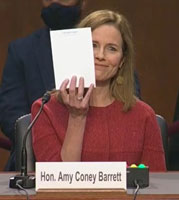
Amy
Coney Barrett Has Perfect Response to Senator Asking if She is 'Reading From Notes'. The Senate Judiciary
Committee began day two of their confirmation hearing for Trump Supreme Court nominee Amy Coney Barrett. Amy Coney
Barrett gave the perfect response when asked if she was reading from notes.
Barrett Asked To Hold Up Notes She's Using To Answer Questions. She Holds Up A Blank Notepad.. Supreme Court nominee Judge Amy Coney Barrett held up a blank notepad when Sen. John Cornyn (R-TX) asked her to show the public the notes she's been using to answer the numerous questions spat at her during day two of the confirmation hearings. "Most of us have multiple notebooks and notes and books, things like that in front of us," said Sen. Cornyn. "Can you hold up what you've been referring to in answering our questions?" Barrett held up a blank notepad. "Is there anything on it?" asked Cornyn. "The letterhead that says United States Senate," the judge replied. [Video clip]
Sheldon Whitehouse Presents 'Dark Money' Conspiracy Theory, Asks Amy Coney Barrett Zero Questions. Sen. Sheldon Whitehouse (D-RI) used his entire time on the second day of the Supreme Court confirmation hearing for Judge Amy Coney Barrett on Tuesday to present a "dark money" conspiracy theory. He asked Judge Barrett no actual questions. Using a series of posters, a magic marker, a highlighter, and an indeterminate number of Post-it notes, Whitehouse sketched a complicated theory — called "The Scheme" — in which he claimed that "dark money" groups influenced the selection of judges.
Democrat Senator Mazie Hirono Asks Amy Coney Barrett if She Has Ever Committed Rape. The Senate Judiciary Committee began day two of their confirmation hearing for Trump Supreme Court nominee Amy Coney Barrett. As expected, Democrat Senators are using this hearing as an opportunity to abuse Amy Coney Barrett, a devout Catholic and mother of seven who is already a vetted judge. There's stupid, and then there's Democrat Senator Mazie Hirono (HI). Hirono on Tuesday [10/13/2020] asked Amy Coney Barrett if she has ever committed rape.
Mazie Hirono Cements Her Insanity, Asks Amy Coney Barrett if She's Ever Raped Someone. Hawaii Senator Mazie Hirono is a certified insane person. That's been known for a while, yet she continues to up the bar every time she ends up in the spotlight during a hearing. After previously trying to disqualify Amy Coney Barrett over her religion back in 2017, something that's blatantly unconstitutional, Hirono strapped on the water skis and had the guy driving the boat floor it towards the shark in today's confirmation hearing. This woman is legitimately the dumbest person to ever serve in the U.S. Senate, and that's a position with an awful lot of competition. [...] Hirono is legitimately upset that Barrett is pledging to interpret the law as it is written by Congress. In what was a convoluted, nonsensical series of "questioning," the Hawaii Senator decides that judges should in fact rule based on sympathies and not the law. Think about how crazy that is? Hirono also apparently has no idea what a term as basic as "severability" means. Keep in mind, this woman graduated from Georgetown with a law degree. My word, if there was ever sufficient proof a university should be shut down, this qualifies.
Amy Coney Barrett hearing was a hostage video. When it comes to wasting time, it's tough to beat the United States Senate. But even for that august body's pedantic standards, Monday's confirmation hearing for Judge Amy Coney Barrett was beyond pointless, it was downright bizarre. The nominee sat wearing a black mask, and looked like the prisoner in a hostage film, as senator after senator talked not so much to her but at or past her. Let's hope the mask protects against drivel as well as coronavirus. When they weren't railing against the hearings happening at all, the Democrats on the Judiciary Committee seemed to be under the impression that it was the Affordable Care Act, not Barrett, whom President Trump nominated for the Supreme Court. They spoke of little else, flanked by blown-up photographs of constituents they say were helped by Obamacare — despite not knowing how, or even if, Barrett would rule on a case involving the legislation.
9 Takeaways From Day 1 of Barrett Confirmation Hearings. The opening day of Senate confirmation hearings for federal Judge Amy Coney Barrett was filled with speechifying, with Democrats on the Judiciary Committee previewing their line of attack on the Supreme Court nominee. In her opening remarks, Barrett, currently a judge on the 7th U.S. Circuit Court of Appeals, stressed that the role of a judge is not to make policy, while Democrats focused almost entirely on policymaking. President Donald Trump nominated Barrett on Sept. 26 to fill the seat of the late Justice Ruth Bader Ginsburg, who had died eight days earlier. Senate Judiciary Chairman Lindsey Graham, R-S.C., predicted Barrett's confirmation would likely pass the Senate on a party-line vote.
Senator Josh Hawley Calls Out Democrats for Religious Litmus Tests and Bigotry on Judicial Nominees. Article six of the constitution, and the first amendment outlining the bill of rights within the United States constitution, affirms that every American citizen has the unassailable right to practice their religion in accordance with their own beliefs; no litmus tests are permitted. However, under the doctrines of Marxism religion is a threat to state control. Modern Democrats are Marxists. In a push-back to the preferred doctrine of modern democrats U.S. Senator Josh Hawley gives a passionate opening remark during the senate committee hearing for Supreme Court nominee Judge Amy Coney Barrett. [Video clip]
AP called out for adopting Democrat language on court-packing. The Associated Press was forced to add an editor's note to a recent story about the Supreme Court on Saturday, in which the outlet made it seem as if the Democratic strategy to pack the high court would "depoliticize" the bench. The article, written by Iris Samuels, centered on a debate between Sen. Steve Daines, R-Mont., and Gov. Steve Bullock, his Democratic opponent in the upcoming election. The AP's original post reportedly read, "Bullock said that if Coney Barrett was confirmed, he would be open to measures to depoliticize the court, including adding judges to the bench, a practice critics have dubbed packing the courts." The report referred to President Trump's Supreme Court nominee Amy Coney Barrett.
The Audacity Of Amy. [Scroll down] In her opening remarks on Day 1 of the hearing she reminded us that "I would be the first mother of school-age children to serve on the Court." Not only would she be the first minivan-driving mom to serve, she would be the only woman on the current Court with ANY children at all. Sotomayor and Kagan, perhaps unsurprisingly, have a total of zero children between them. This matters! As I wrote in an earlier piece, having "kin in the game" when it comes to making big decisions is absolutely crucial. Amy's angriest feminist interlocutors this week, Kamala Harris and Dianne Feinstein, have a grand total of one offspring combined. But as Amy points out in her remarks, making judicial decisions through the lens of a parent whose own child may be affected by the ruling is the best way to make sure justice is served, for both sides.
Biden cautions Senate Democrats against any questions about Amy Coney Barrett's faith. Former Vice President Joe Biden on Monday said that Judge Amy Coney Barrett's faith "should not be considered" during her Senate confirmation hearings. [...] Biden instead said that Democrats need to "stay behind the ball" and focus on Barrett's alleged opposition to the Affordable Care Act, former President Barack Obama's signature achievement, which the Supreme Court will revisit after the November elections. "Everyone knows that in 28 days, 20million Americans may lose their healthcare," Biden said. "This nominee said she wants to get rid of the Affordable Care Act." Barrett has never stated that she would rule against the Affordable Care Act. At the hearings Monday, many Democratic senators accused her of opposing it, with Sens. Dick Durbin of Illinois, Patrick Leahy of Vermont, and Sheldon Whitehouse of New York making passionate speeches about the legislation.
Also posted under Lies about Obamacare.
Amy Coney Barrett: Judges Can't 'Walk in Like a Royal Queen' and Impose Their Will on the World. Judge Amy Coney Barrett addressed the widespread misinformation that judges can brazenly make rulings based on the whims of the day, explaining the process and stressing judges cannot just "walk in like a royal queen" and "impose" their will on the world. Chairman Lindsey Graham (R-SC) prompted Barrett to explain how the process works, using the District of Columbia v. Heller as an example. Barrett briefly explained there has to be a law, lawsuit, appeal, and the court granting cert before it makes a ruling. When asked if the process remains the same no matter the issue — including guns, health care, abortion, campaign finance — Barrett emphasized judges cannot just impose an agenda at random.
Hawley, Sasse Unleash On Harris, Democrats, Media For Treatment Of Barrett. Republican senators Josh Hawley and Ben Sasse criticized Democratic and media treatment of Supreme Court nominee Amy Coney Barrett Monday morning [10/12/2020]. Both senators decried attacks on Barrett's Catholic faith and said that religious freedom is a fundamental American principle that has come under attack from Democrats. "This committee isn't in the business of deciding whether the dogma lives too loudly within someone," Sasse said. "This committee isn't in the business of deciding which religious beliefs are good and which religious beliefs are bad and which religious beliefs are weird."
Sen. Patrick Leahy Tells Amy Coney Barrett That Her Confirmation To SCOTUS Would Be 'Harmful' To Women. Only a handful of Democrats were able to make opening statements Monday [10/12/2020], leading into confirmation hearings for Amy Coney Barrett, whom President Donald Trump nominated to replace the late Justice Ruth Bader Ginsburg and Sen. Patrick Leahy (D-VT) made the most of his precious few minutes. In a statement made directly to Barrett, Leahy told the Supreme Court nominee — a law professor, federal Circuit Court judge, wife, and mother — that confirming her to the highest court in the land would be "harmful" to women.
At Supreme Court hearing, Democrats talk about everything except Amy Coney Barrett. Evidently, polling showed Democrats that their scorched-earth tactics against Brett Kavanaugh backfired in the 2018 Senate races. And they got the memo that the attacks on Barrett's religious beliefs that they deployed during her appellate court confirmation hearings were likely to go over about as well as a Yankees parade in South Boston. Furthermore, they cannot question the credentials of Barrett, who is widely respected by lawyers regardless of their ideology and earned the American Bar Association's highest "well qualified" rating. As a result, Democrats have decided to use the hearings as another platform for their 2020 campaign. Their opening statements were treated simply as another forum for peddling predictable attacks on President Trump and on his administration's handling of the COVID-19 pandemic. But more than anything, Democrats talked about threats to Obamacare and individuals with preexisting conditions.
Red herring alert!
It isn't Judge Barrett's job to provide treatment or insurance for people with "preexisting conditions."
It isn't the government's job to provide medical treatment for everyone or to make everyone buy insurance.
Can Democrats Bork Amy Coney Barrett? Amy Coney Barrett's confirmation hearing to the Supreme Court begins on Columbus Day [10/12/2020] in the U.S. Senate's Judiciary Committee. We can expect four days of an attempt to convince the public that she is, alternately, a straight-laced appeals court judge and a radical religious zealot. Unless Barrett goes off-script, or something truly new and scandalous emerges, the Republicans' 53 seat majority in the Senate should result in her appointment. As a viewer's guide, it's safe to assume that any senator's first goal is to elevate themselves — and this goes for members of both parties. The election looms, however, making Democrats' jobs during the hearings a good bit more complicated. Catholic women in the battleground states are said to be the most precious commodity this cycle.
Schumer Says Democrats Will Try To Block Barrett Confirmation By Not Giving Republicans Quorum. Senate Minority Leader Chuck Schumer said Democrats will not "supply quorum" for votes in the Senate as a way to try and block the confirmation of Supreme Court nominee Amy Coney Barrett before the election. During a Sunday night [10/11/2020] press conference, Schumer slammed Republicans for pushing Barrett's confirmation forward, saying Senate Democrats will do everything they can to prevent Barrett from being confirmed. Schumer went on to say that one way Democrats are considering blocking the confirmation is by not supplying quorum, meaning Democrats would not show up so work could not be done.
Democrats don't dare say why they oppose Judge Barrett, so they lie instead. Democrats on the Senate Judiciary Committee devoted their opening statements on the Supreme Court nomination of Judge Amy Coney Barrett to repeating a shameless lie. Why can't they share their real reasons for opposing her? The Democrats, one after another, claimed that confirming Barrett would result in ObamaCare being overturned when the court takes it up Nov. 10, with Americans dying as a result. It's plainly false: Several conservative justices clearly don't buy the arguments made for striking down the law in this case. And Barrett, based on her overall philosophy, is likely to agree with them. Plus, Republicans are universally in favor of keeping protections for those with pre-existing conditions and have vowed to put it into law if ObamaCare does get overturned.
Court-Packing Is More of a Monstrosity than You Think. The Biden-Harris court-packing plan is a plan to destroy the Constitution and replace it with a disguised dictatorship. Democratic court-packing is a plan to leave the forms of the Constitution intact while destroying its essence, much in the same way that Augustus dealt a death blow to the old Roman Republic. The Biden-Harris court-packing plan is a virtual enabling act, a law that would bypass all the normal lawmaking processes and turn national policy over to unelected far-left judges acting in response to the complaints of ultra-left lawyers and activists. If you think that sounds over-dramatic, let me take you to a federal courthouse in Eugene, Oregon, where a group of activists are seeking to have the Judiciary seize control over most of the nation's economic policy. In 2015 those activists filed a lawsuit known as Juliana v. United States.
'Americans aren't idiots!' The AP's use of 'Democrats' language' to explain 'packing the court' doesn't go well. Since the Associated Press considers itself "an independent global news organization dedicated to factual reporting," it would be problematic for an AP article to contain commentary packaged as news and facts. Real Clear Politics co-founder and president Tom Bevan captured the following excerpt from an AP story. ["]With lightning speed, the Associated Press adopts Democrats' language on SCOTUS: adding members is now 'depoliticizing' the court, only 'critics' refer to it as 'packing.'["] [...] To call increasing the number of Supreme Court justices "depoliticizing" would be an egregious political overstatement if made by a Democrat politician, much less a news organization.
Amy Coney Barrett Will Defend America's Borders and Laws. With the disgraceful spectacle of the Kavanaugh hearings still fresh in many people's memories, America is about to witness another Supreme Court confirmation process, one that may make the last one look dignified by comparison. That would be a shame, because Judge Amy Coney Barrett is a sterling nominee who has shown a reverence for America's laws and sovereignty. In her Rose Garden introduction as the nominee to replace Ruth Bader Ginsburg, Judge Barrett threw down the gauntlet. "I love the United States and I love the United States Constitution," she said. While that may sound admirable to most people, those are fighting words to those on the left. She then doubled down when referring to her mentor, the late Justice Antonin Scalia. "His judicial philosophy is mine, too," she added. "A judge must apply the law as written."
Ben Sasse: Court Packing Is 'Suicide Bombing of Two Branches of Government'. Senator Ben Sasse (R., Neb.) on Sunday [10/11/2020] called Democratic presidential nominee Joe Biden's refusal to say whether he would add seats to the Supreme Court if elected "grotesque," saying court packing amounts to the "suicide bombing of two branches of government." "It's grotesque that Vice President Biden won't answer that really basic question," Sasse said in an appearance on Fox News Sunday. "And it isn't just one branch of government, what they're really talking about or refusing to talk about, is the suicide bombing of two branches of government."
Beyond Court Packing: Here's How Dems Plan To Create A One-Party State. Joe Biden has so far refused to answer the question of whether he'd pack the Supreme Court with leftist justices. But he hasn't even been asked about a more worrisome scheme he and his party are cooking up to ensure Democrats' election victories well into the future. So far, Biden has inartfully dodged the question of whether he would support adding justices to the Supreme Court. All he would say in the debate was "Whatever the position I take, that will be the issue" and in Arizona, he said, "You'll know my opinion on court-packing when the election is over." Biden knows court-packing doesn't poll well, and so with the help of the press, he is avoiding the topic. But Senate Democrats have already made it clear that they will take that route should President Donald Trump get Judge Amy Coney Barrett on the bench.
Behind the scenes of Democrats' half-century quest to destroy the Supreme Court. For nearly 50 years now Democrats have plotted to annihilate the Supreme Court. [...] The reigning euphemism of the day is "court packing," which former Vice President Joe Biden openly refuses to discuss with voters until after the election. A more accurate term is "expanding" the Supreme Court by adding seats to dilute the currently sitting justices. Or "exploding" the federal judiciary. Or "annihilating" the independence of an entire branch of the federal government. They do this by installing puppet "jurists" who no longer believe that the Constitution actually means what it says. It's a "living document," according to this death squad. The judiciary, to these people, is actually just a super-legislature that is unelected and holds office for life. This kind of constitutional thuggery is the hallmark of socialist dictatorships and banana republics — dress up the institution designed to protect democracy and individual liberty with unelected authoritarians specifically designed to make a mockery of both.
Democrat Threats to Pack the Supreme Court Deflect Attention from Their Own Errors. [Scroll down] The next Democrat forced error was Ruth Bader Ginsberg not stepping down when Obama was in power. Democrats should have been calling for RBG to step aside because of her advanced age and health issues, but that never happened. If she would have taken one for the team, Obama's nominee would have likely sailed through the Senate confirmation process since Republicans do not resort to the slash and burn techniques of destroying judicial nominees as Democrats do. Ginsberg's selfishness and Democrat hubris that Hillary Clinton would win in 2016 have placed the Democrats in the position they find themselves in today. As always, instead of looking inward and admitting their errors, Democrats choose to instead blame their enemies.
Democrats delegitimize the Supreme Court because they fear losing power over the rest of us. "It is a decision of the Supreme Court," Rep. Nancy Pelosi said in 2005, speaking about the eminent domain ruling in Kelo v. New London. "If Congress wants to change it, it will require legislation of a level of a constitutional amendment. So this is almost as if God has spoken." This florid reverence for the high court ought not be lost on the reader, especially given where Pelosi and other Democrats find themselves today. As the Senate prepares to confirm President Trump's third Supreme Court nominee, they have begun to say outright that the nomination and confirmation procedure outlined in the U.S. Constitution is illegitimate. In some cases, they are even insinuating that the court itself lacks legitimacy, for which outlandish claim the only visible justification is that they don't like the direction it's going.
Sen. Chris Coons: Amy Coney Barrett Has 'Extreme,' 'Disqualifying' Views, Confirmation Push 'Constitutes Court Packing'. Senate Judiciary Committee member Chris Coons (D., Del.) on Sunday said that Republicans' push to confirm Supreme Court nominee Amy Coney Barrett ahead of the November 3 election "constitutes court packing" and called the judge's views "not just extreme," but "disqualifying." Coons's comments came during an appearance on Chris Wallace's "Fox News Sunday," in which he defended Democrats' calls to add additional seats to the Supreme Court — the actual definition of court packing — in retaliation for the Senate going forward with Barrett's confirmation hearings only weeks before the election. "I'm going to be laying out the ways in which Judge Barrett's views, her views on reaching back and reconsidering and overturning long settled precedent are not just extreme, they're disqualifying," he said.
C'mon, man: Biden must answer court-packing question. The Commission on Presidential Debates will become irreversibly illegitimate unless it reverses course on in-person debates, which alone can force Joe Biden to answer the single most important question in this election: whether Biden would pack to the Supreme Court with additional seats, forever transforming our Constitution's three-branch form of government into a two-branch system. The Constitution allows Congress to set the number of Supreme Court seats. After several decades of trial and error, in 1869, Congress settled on nine seats, which has been a bedrock of stability in America's form of government for 151 years. For more than half of our nation's existence, there has been only one attempt to change that number.
Democrat Joe Biden: Voters 'Don't' Deserve To Know If I'm Going To Pack Supreme Court. Democratic presidential nominee Joe Biden told a local news reporter on Friday afternoon [10/9/2020] that voters do not deserve to know whether he will pack the Supreme Court if he wins the upcoming the election. "Sir, I've got to ask you about packing the courts and I know you said yesterday you aren't going to answer the question until after the election, but this is the number one thing that I've been asking about from viewers in the past couple of days," the reporter said to Biden. "Well, you've been asked by the viewers who are probably Republicans who don't me continuing to talk about what they're doing to the court right now," Biden responded. "Well sir, don't the voters deserve to know--" the reporter pressed. "No, they don't," Biden responded.
Biden Makes False Claims: Republicans Are The Ones 'Packing The Court Now,' 'Not Constitutional What They're Doing'. Democrat presidential nominee Joe Biden made false claims on Saturday [10/10/2020] while speaking to reporters before he boarded his campaign plane, saying that Republicans are the ones engaged in court-packing and claiming that what the Republicans are doing is not constitutional. Biden made the remarks while standing right next to the plane while it was running, making it very difficult to hear his responses. A reporter asked Biden about his controversial stance of not telling voters before the election whether he supports court-packing. The reporter's question comes after Biden said late last night that voters don't deserve an answer from him on the issue.
The Editor says...
"Nominating a supreme court justice during an election is not court packing. Adding justices to the supreme court is."
[Source]
Carlson: Democrat Court-Packing Plans 'Closer Than a Lot of Republicans Want to Admit and You Should Be Worried About It'. Fox News Channel's Tucker Carlson opened his Friday [10/9/2020] broadcast with a warning about Democratic presidential nominee Joe Biden and vice-presidential nominee Kamala Harris regarding potential plans of court-packing if they are elected on November 3. According to Carlson, the objective is to change the American form of government, and he urged Republican lawmakers to be concerned.
'Staggering' Is the Word for Suggestions Barrett Recuse Herself on the Election. It looks like the Democrats are going to try to hector Judge Amy Coney Barrett into recusing herself from any cases on the election. "One of the things I want to ask her," Senator Cory Booker told NBC in respect of the pending confirmation hearing, "is will she recuse herself because of, ah, in terms of any election issues that come before us because if she does not recuse herself, I fear that the court will be further delegitimized." Don't wait up, we say. Senator Booker might want to take a look at a 2004 opinion by The Great Scalia. It sketches Justice Scalia's logic in refusing to recuse himself in a case involving Vice President Dick Cheney. The Sierra Club had asked Scalia to recuse himself because he and the vice president had gone duck hunting together at Louisiana. And had allegedly flown there in a private jet. Turns out that it wasn't a private jet. It was a jet owned by their employer, the American government. That, though, was the least of the points that Scalia makes in a dense but hilarious — and also sage — opinion. In the course of its 21 pages Scalia draws to an astonishing conclusion. Which is that not only was there no basis for his recusal but that because there was no basis, he could not recuse, even if he wanted to. He had a duty.
Joe Biden Under Pressure from Democrats to Publicly Embrace Supreme Court Packing Plan. At a campaign stop on Thursday, Democratic presidential nominee Joe Biden once again refused to publicly state whether he supports packing the U.S. Supreme Court with more justices. But some Democrats are pushing for him to do so, even though he has previously opposed it. Senator Ed Markey of Massachusetts recently urged Democrats to support court-packing if Republican Senate Majority Leader Mitch McConnell moves to confirm President Donald Trump's Supreme Court nominee Amy Coney Barrett.
New York Times Reporter: Kamala Harris Told Me Last Year She Was Absolutely 'Open' To Court Packing. New York Times reporter Alexander Burns said during a Thursday episode of the newspaper's podcast that Democratic vice presidential nominee Sen. Kamala Harris (D-CA) told him last year that she was "absolutely open" to packing the Supreme Court. "Senator Harris told me in an interview, actually, that she was absolutely open to doing that," Burns said. [...] The remarks from Burns come after Democratic presidential nominee Joe Biden told reporters yesterday: "You'll know my opinion on court packing when the election is over."
The Editor says...
If Trump wins the election, you won't hear another word from Joe Biden on this subject. If Biden wins, he will implement
whatever plans he may choose, because it will be too late for you to object.
Biden: 'You'll Know My Opinion on Court Packing When the Election Is Over'. Joe Biden told reporters Thursday [10/8/2020] he would reveal his stance on expanding the size of the Supreme Court the day after the election. "You'll know my opinion on court packing when the election is over," Biden said during a joint appearance with his running mate Sen. Kamala Harris (D., Calif.) in Arizona. He said his position would become a "distraction" if he were to state it. Biden has repeatedly dodged on the question of whether he supports expanding the size of the Supreme Court. During the first presidential debate, Biden refused to take a position on court packing. "Whatever position I take on that, that will become the issue," he said.
Barrett confirmation hearing may pressure Feinstein, Harris to subdue their political instincts. California's Democratic senators forged their political brands during high-profile Supreme Court confirmation hearings like the one to be held next week with Judge Amy Coney Barrett. But as they prepare to quiz President Trump's third nominee to the bench just three weeks before the presidential election, Sens. Dianne Feinstein and Kamala Harris face distinct challenges that may call for them to rein in their natural political instincts. Feinstein, the top Democrat on the Senate Judiciary Committee, needs to prove to skeptical progressives that her preference for bipartisanship and comity won't prevent her from taking an aggressive stance against Republicans — not only during a confirmation process most Democrats view as illegitimate, but as chair of the panel next year if Democrats take the Senate majority in 2021. In contrast, Harris, now the Democratic vice presidential nominee, may be tempted to tone down her prosecutorial style.
Biden is blatantly hiding the single biggest issue in his campaign. The first action of all elected tyrants is to change the rules to prevent future challenges. In America, the way to achieve this end is to pack the Supreme Court, making it a Democrat-run, unelected super-legislature with lifetime tenure. Both Biden and Harris, though, are refusing to say whether they will pack the court, claiming the issue is too important for voters to know in case that knowledge influences their votes. Democrats have politicized for Supreme Court decades, starting with the Bork hearings, in which Biden played a prominent and disgraceful role. They consistently place on the Court judges who believe their role is to create rights out of whole cloth — that is, to legislate — and then to retrofit the Constitution to support their legislation. Whenever they've had activist majorities, Democrats have used the Supreme Court to force initiatives that Americans do not support (e.g., abortion, gay marriage, and Obamacare). Indeed, for almost 100 years, activist justices have been the primary vehicle leftists used to work fundamental changes in America.
Fact Check: Kamala Harris Makes Up False Quote from Abraham Lincoln. CLAIM: Abraham Lincoln declined to fill a Supreme Court seat because it was too close to the election. VERDICT: FALSE. The Senate was out of session. He filled it — in one day — as soon as it was back.
Joe Biden Says 'You'll Know My Opinion on Court-packing When the Election Is Over'. Former Vice President Joe Biden has refused, once again, to reveal his stance on "packing" the Supreme Court: "You'll know my opinion on court-packing when the election is over," he told reporters in Arizona on Thursday [10/8/2020]. Court-packing involves expanding the number of justices on the nation's highest court and filling the new seats with liberals to overcome the current conservative majority. It was rejected the last time it was proposed, in the 1930s. Biden has remained vague on court-packing since the death of Justice Ruth Bader Ginsburg last month. In Arizona, he tried to frame the issue as something only the media cared about.
Why the public, even liberals, should want Amy Coney Barrett. The Washington Examiner/YouGov poll published on Wednesday reveals a public passionate about, and deeply split on, the Supreme Court. Perhaps surprisingly, given this, it also reveals a public averse to extremes. For fully 79%, the appointment of a new justice will weigh heavily when they vote in the presidential election, with 58% regarding it as "very important." But agreement here doesn't imply concurrence over how the matter should be handled; 51% say the nomination should wait until after the election and 42% want it done now. The poll's 3.6% margin of error means that split could be as close as 47%-46%.
Fact Check: Lincoln Didn't Delay His Supreme Court Nomination Because He Cared About Election Integrity. Democratic VP Nominee Kamala Harris dodged a question on court packing during Wednesday night's debate by telling a historically inaccurate tale about President Abraham Lincoln. [...] While it is true that Lincoln postponed a nomination in 1864 right before the election, "Honest Abe" didn't save his nomination of Salmon Chase, former Ohio governor, and Senator, because "it's the right thing to do." "As ever, Lincoln was the shrewd politician and in October of 1864 he saw no profit in alienating any of the factions of his political support by making a selection before the election," writes President Lincoln's Cottage (PLC), a historical group and museum dedicated to preserving Lincoln's legacy. Not only was the Senate out of session in October when Taney died until December 5 making it difficult for Lincoln to move forward with the confirmation proceedings necessary for a new justice, but Lincoln also strategically delayed the nomination to ensure he had Chase and other potential picks' political support through the November election.
Kamala Harris's Dishonesty on Abe Lincoln. It was impossible to miss how Kamala Harris, like Joe Biden, refused to answer questions about their plans to expand the Supreme Court. But she also misrepresented history. Harris claimed at the VP debate that Abraham Lincoln refused to nominate a candidate for Chief Justice in October 1864 because "Honest Abe said, it's not the right thing to do" and wanted the people to vote first. Lincoln, of course, said no such thing. He sent no nominee to the Senate in October 1864 because the Senate was out of session until December. He sent a nominee the day after the session began, and Salmon P. Chase was confirmed the same day. And Lincoln wanted to dangle the nomination before Chase and several other potential candidates because he wanted them to campaign for him. Lincoln's priority was winning the election, which was necessary to win the war — and he filled the vacancy at the first possible instant. Kamala Harris is simply inventing history.
Don't fall for Democrats' bad-faith delay tactics on Amy Coney Barrett confirmation. As President Trump and several Republican Senators battle COVID-19, Democrats are trying to use the news as an excuse to call for delaying Amy Coney Barrett's confirmation hearings, which begin next Monday before the Senate Judiciary Committee. Nobody should fall for such desperate and disingenuous attempts to derail a nomination that Democrats would be opposing under any circumstances. [...] This is complete hogwash. For months, Congressional committees have functioned by allowing for both members and witnesses to testify remotely. Anthony Fauci has testified this way on the coronavirus. Just last week, James Comey testified remotely about the Russia investigation. The Judiciary Committee, in particular, has been functioning in a hybrid way that allows members to participate either remotely or in person and ask questions of nominees. This has included many hearings for the lifetime appointments of federal judges.
Has the campaign against Barrett fizzled out already? Or has it even really begun yet? Democrats and the media have taken aim at Amy Coney Barrett since the passing of Ruth Bader Ginsburg, correctly guessing that Donald Trump planned to nominate the Seventh Circuit jurist in that eventuality. Despite all of the attacks on Barrett over the past two weeks, nothing has landed, Rich Lowry writes today at National Review, and it looks like Democrats have already emptied the quiver for the Supreme Court nominee.
The Unborkable Amy Coney Barrett. [Supreme Court nominee Amy Coney] Barrett is too squeaky clean for [the Democrats'] usual tactics to work. Democrats have instead gone to plan B, making clear what they've worked to obscure for the past three decades in previous attempts to derail Republican judicial nominations. If they can't attack Barrett's qualifications for the Court, they'll explicitly attack the political consequences of her nomination. Finally, the mask has slipped. Forgoing even the pretext of principled opposition, Democrats now admit they oppose judges like Barrett for no other reason than that they would rein in their ability to legislate as they please and without regard for the constraints of the Constitution.
The White House Outbreak Won't Derail Amy Coney Barrett's Nomination. An outbreak of coronavirus at the White House, which has infected not just the president and his senior staff but also at least three Republican senators, has presented Democrats with an opportunity. They seem eager to make the most of it. In a letter addressed to Senate Judiciary Committee Chairman Lindsey Graham, the committee's Democratic members insisted that confirmation hearings (to which they had already objected on procedural grounds and which some Democrats had already threatened to boycott) must be postponed indefinitely due to concerns about the health and safety of senators and their staffs. The letter reminds its readers that at least two of the three Republican senators who contracted COVID-19 are Judiciary Committee members, and CDC guidance advises anyone exposed to this disease to isolate themselves for at least 14 days — even if they test negative. Moreover, the remote hearings that the committee has conducted throughout this pandemic are "not an adequate substitute." The whole thing must be put on hold. "To proceed at this juncture with a hearing to consider Judge Barrett's nomination to the Supreme Court threatens the health and safety of all those who are called upon to do the work of this body," the letter insists.
Americans Back Amy Coney Barrett's Confirmation By Double-Digit Margin. A new national poll shows Americans support the confirmation of Supreme Court nominee Amy Coney Barrett by double-digit margins. A new Morning Consult poll shows Americans support Barrett on a 46-31% margin and that 15% margin of support is an increase from the polling firms last national survey in September following her nomination. That poll had Americans backing Barrett 37-34%, a resulting 12% increase from the 3% margin previously.
Democrats Haven't Landed a Punch on Amy Coney Barrett. The Supreme Court fight of the century is, so far, a fizzle. The ratio of progressive outrage over the nomination of federal Judge Amy Coney Barrett to supposed reasons that the U.S. Senate shouldn't confirm her is completely out of whack — there's a surfeit of the former and almost none of the latter. Barrett has received extraordinary testimonials from her colleagues and students, who say she is brilliant, conscientious, and kind. The opposition has countered with a dog's breakfast of nonsense, including that her confirmation hearing can't be held in the middle of a pandemic — when the Senate has continued its business since the pandemic began.
Senate Judiciary Committee Schedules Hearings On Amy Coney Barrett SCOTUS Nomination. Senate Majority Leader Mitch McConnell (R-KY) made good on his promise to schedule a formal hearing on Amy Coney Barrett's nomination to the Supreme Court. On Monday, the Senate Judiciary Committee announced that Barrett's hearing will begin, as expected, on Monday, October 12, 2020, at 9 am. "The Senate Committee on the Judiciary has scheduled a hearing on the nomination of the Honorable Amy Coney Barrett to be an Associate Justice of the Supreme Court of the United States to begin Monday, Oct. 12 at 9:00 am & continue through Thursday, Oct. 15," the committee tweeted Monday, alongside an official statement and calendar item.
Senator Cruz says Chief Justice John Roberts 'despises Donald Trump'. Texas GOP Sen. Ted Cruz says Supreme Court Chief Justice John Roberts "despises Donald Trump," which accounts for a number of the decisions he had made from the top seat on the high court in recent years. In an appearance on David Brody's recently launched show "The Water Cooler," Senator Cruz, an attorney and author of the new book "One Vote Away: How a Single Supreme Court Seat Can Change History," told the host that "John Roberts has become the new Sandra Day O'Connor." Cruz said he agrees with Vice President Mike Pence, who in an interview last month, told David Brody that Justice Roberts has been a "disappointment to conservatives." However, Cruz believes that part of Roberts' pivot away from conservative-minded jurisprudence is motivated by personal hatred toward the president. "I think it is personal," said the senator.
Biden Threatens Religious Freedom, Suggests Christians With Certain Traditional Views Are 'Dregs of Society'. Biden's rhetoric and policies single out those who adhere to traditional religious beliefs and moral convictions, aiming to limit their ability to live by their consciences and ostracizing them from polite society. The Democrat may outwardly campaign on a platform of unity and diversity, but his candidacy truly represents a threat to traditional religious believers. The most recent evidence of this insidious threat came last week, when a Biden staffer suggested that traditional religious beliefs that homosexual acts are sinful and that marriage is between one man and one woman should be so "taboo" as to disqualify someone from serving on the Supreme Court.
Infected Sen. Ron Johnson vows to wear 'moon suit' for vote on Trump's court pick. Shuttered by COVID-19 infections, the Republican-led Senate is refusing to delay confirmation of President Donald Trump's pick for the Supreme Court. They are even willing to make special arrangements so sick senators can vote for Judge Amy Coney Barrett, and Democrats appear powerless to stop them. Sen. Ron Johnson, R-Wis., said Monday [10/5/2020] that he'll go to the Capitol "in a moon suit" to vote if he's still testing positive for the coronavirus, which has killed more than 209,000 Americans and infected millions. The push to put conservative Judge Amy Coney Barrett on the high court before Nov. 3 is like nothing seen in U.S. history so close to a presidential election. Trump's nomination of Barrett in a Rose Garden ceremony apparently became ground zero for the infections now gripping the president, his White House and its Senate allies. Three GOP senators, including Johnson, have now tested positive for the virus and several more are quarantined at home — denying Republicans a functioning majority.
Amy Coney Barrett's Bright Future On The Supreme Court. "Elections have consequences," former President Barrack Obama told us repeatedly during his Presidency. In the 2016 election, voters chose Donald Trump to be President, with the power to appoint Federal Judges and Justices with the advice and consent of the Senate for his entire four-year term. Voters should have their choice respected, not nullified by power-hungry Democrats. The concern of voters on this issue is why Trump released a list of well-qualified legal conservatives in 2016 as prospective judicial nominees, promising to fill vacancies from the names on that list. Trump has kept that promise faithfully during his entire term in office. Voters elected him in part because of those respected and well-qualified names, and his appointments.
Justices Thomas, Alito slam Obergefell same-sex marriage decision as Supreme Court denies Kim Davis case. Justices Clarence Thomas and Samuel Alito said Monday that Obergefell v. Hodges, the Supreme Court case that mandated all states recognize same-sex marriages, is "found nowhere in the text" of the Constitution and threatens "the religious liberty of the many Americans who believe that marriage is a sacred institution between one man and one woman." The statement was written by Thomas and joined by Alito about the case of Kim Davis, a former Kentucky county clerk who said she would not give same-sex couples marriage licenses. The two justices said they agreed with the consensus of the court that it should not take Davis' case, but only because it did not "cleanly present" the "important questions about the scope of our decision in Obergefell." Thomas and Alito dissented from the original Obergefell decision and their statement Monday could indicate that they would vote to overturn it if presented the chance.
Democrats Hate Amy Coney Barrett Because They Hate the Constitution. President Trump has nominated a recognized legal scholar, and a respected judge, to be the next Supreme Court Justice of the United States: Amy Coney Barrett. Judge Barrett is also a mother of seven children, two of whom are adopted. In her public appearances she seems to have a pleasant personality. Yet Democrats hate her. One has to wonder why. Judge Barrett has openly acknowledged that the late Supreme Court Justice Antonin Scalia was her mentor: she served as a clerk to Justice Scalia at the Supreme Court 20 years ago. Barrett says that she "shares his judicial philosophy." What is that philosophy? It is called "originalism." Originalists have the legal view that justices should adhere as closely as possible to the original text of the U.S. Constitution. They believe judges have a responsibility to refrain from letting their personally held ideological, political or religious beliefs influence their opinions on cases brought before their Court. Arguably, most importantly, originalists are ardently against the judicial branch attempting to legislate from the bench.
Schumer: 'A Virtual (Confirmation) Hearing Is Virtually No Hearing at All'. Senate Minority Leader Chuck Schumer (D-N.Y.) on Sunday accused Republican leader Mitch McConnell of "jamming through the hearings on Amy Coney Barrett, even though three senators have COVID, even though he has said it's not safe for the Senate to meet in session, but it's OK to have the hearings." McConnell tweeted on Saturday: "Senate floor proceedings will be postponed until October 19th. The @SenJudiciary confirmation hearings for Judge Barrett's nomination to the Supreme Court will convene on October 12th as scheduled by Chairman Graham." In an accompanying statement, McConnell said the Senate's floor schedule "will not interrupt the thorough, fair, and historically supported confirmation process previously laid out by Chairman Graham."
Kamala vs. ACB? Democrats Should Avoid It. Even some of the most iconic politicians have had to hide their achilles heel. [...] Worse than a candidate having obvious flaws is when she and her campaign cannot acknowledge them. Such is the case with Sen. Kamala Harris (D-Calif.), the Democratic nominee for vice president. With the nomination of Amy Coney Barrett to the Supreme Court, the real Kamala Harris could be thrust front and center by virtue of her position on the Senate Judicial Committee that holds confirmation hearings for court appointees. Such sudden and unforgiving exposure could very well implode her already lethargic ticket with Joe Biden. The Democrats have only one precaution available to them in order to avoid this humiliation: Ask Harris to remove herself from the confirmation hearings on the pretext that she needs to concentrate on campaigning.
The brilliance lives loudly within her. When Amy Coney Barrett came before that microphone in the Rose Garden to make her official introduction to the wider public, you knew you were getting a different sort of Supreme Court nominee. This wasn't polished civics instructor Neil Gorsuch or earnest political operator Brett Kavanaugh. Here was a joyous, American-as-apple-pie judge next door. [...] Barrett's resume is impressive: Latin honors in college and law school, a Supreme Court clerkship, a distinguished professorial career with prolific scholarship. Yet the unassuming nature of this Notre Dame professor-turned-7th Circuit judge sets her apart from the Ivy-festooned club she's set to join. As the mother of seven, including two adopted from Haiti, she would become the first female justice with school-age children.
5 major cases to watch at the Supreme Court. The Supreme Court on Monday will kick off a new term in which the justices will hear the latest Republican challenge to ObamaCare, a bid to reinstate voting limits in Arizona that were struck down as racially biased and House Democrats' long-running pursuit of secret Russia probe materials. The court resumes its business just weeks after the death of Justice Ruth Bader Ginsburg, a stalwart liberal, left a vacancy that is expected to be filled by President Trump's third nominee to the bench, Judge Amy Coney Barrett, who would cement a 6-3 conservative majority on the court. Senate Republicans hope to seat Barrett prior to the Nov. 3 election, and the pace of her confirmation may have a bearing on how some of the term's cases are decided.
Lefties' silly attacks on Barrett show they really have no real complaint. It's truly remarkable how silly the lefty commentary on Supreme Court nominee Amy Coney Barrett has gotten — a clear sign the critics don't dare discuss her actual merits. First the flap over whether a multidenomational prayer group she enjoys was "the inspiration" for Margaret Atwood's "The Handmaid's Tale." What difference would it make — since Atwood went hog-wild with her imagination? The real group plainly doesn't push subordination of women — or Barrett, an ambitious and successful woman, wouldn't go for it. Yes, she's an observant Catholic — which prompted Sen. Dianne Feinstein to charge that "the dogma lives loudly in you" the last time liberals tried to derail a Barrett confirmation. But she's simply on track to be the sixth Catholic on the high court, even as Joe Biden hopes to become the second Catholic president.
Cotton: Sick GOP Senators Will Be 'Wheeled in' to Personally Cast SCOTUS Vote. Senator Tom Cotton (R-AR) said that Judge Amy Coney Barrett's Supreme Court confirmation would move forward despite three Republican senators having tested positive for coronavirus during this week's broadcast of Fox News Channel's "Sunday Morning Futures." Anchor Maria Bartiromo said, "Your colleagues have tested positive. It looks like it was that Amy Coney Barrett gathering at the White House to introduce her to lawmakers. That really was the place where so many people were exposed."
Democrats would destroy Supreme Court with scheme to pack justices. Subtlety has been a stranger to our politics. This is the age of rage, and there is little room for nuance. That is evident in the intense debate over the nomination of Amy Coney Barrett to the Supreme Court. Democrats have dispensed with any pretense in their calls to block her and pack the bench with more justices. What they want is a new reliable Supreme Court created through litmus test confirmations where Senate votes are conditioned on judicial pledges. Several Democrats have said they will ask Barrett about her view of any challenge to Roe versus Wade, and of cases like the pending challenge to the Affordable Care Act. Barrett faced such demands from Richard Blumenthal and others for her confirmation as an appellate judge, and many Democrats voted against her because she did not promise to uphold Roe. In their campaigns for president, Kirsten Gillibrand and Bernie Sanders pledged to nominate only those who would uphold Roe.
The secular left, Democrats can't impose a religious test on Amy Coney Barrett. Democrats may disagree with Judge Barrett's political views or even her judicial philosophy; they have every right to do so. But when they took their oath to uphold the Constitution, lawmakers, by definition, swore to disregard nominees' religious beliefs. During the Barrett hearings, they should uphold their vow to the Constitution and to the American people.
Democrats threaten to block Amy Coney Barrett's confirmation by refusing to take part in the remote hearing. Leading Democrats have described pressing ahead with Amy Coney Barrett's Supreme Court nomination 'irresponsible and dangerous' and said a virtual confirmation is not acceptable, after seven people at her nomination ceremony tested positive for COVID-19. Six of the 12 Republican members of the Senate Judiciary Committee were present at Saturday's event — Mike Lee, Marsha Blackburn, Ben Sasse, Josh Hawley, Thom Tillis, and Mike Crapo. Two — Lee and Tillis — tested positive on Friday [10/2/2020].
The Dogma Lives Loudly in Everyone, Including Democrats. Now that Amy Coney Barrett stands at the threshold of a lifetime appointment to the Supreme Court, a second round of Democrat Senate Judiciary Committee members posing as an inquisition seems inevitable. How dare this woman live as a committed Catholic right in our faces? Is she not aware that religion generally and Christianity in particular are on the wane among Millennials, Gen Z, and costal elites and that restoration of "God" to the Democrat party platform stirred more than a little controversy just four short years ago? And since it is the Constitution of the United States, not the manifesto of Black Lives Matter, that explicitly prohibits the application of a religious test to court nominees, the Democrats' insistence upon imposing one anyway is also inevitable, because of the dogma that lives loudly inside them.
Feinstein Again Calls For Delayed SCOTUS Hearings, Cites Trump's, GOP Senator's Positive Coronavirus Test. Only two days after calling on Republicans to delay the Supreme Court nomination process until after the presidential election, Senator Dianne Feinstein (D-CA) has, once again, called on Republicans to delay Judge Amy Coney Barrett's nomination process. In a joint statement Friday morning [10/2/2020], Senate Minority Leader Chuck Schumer (D-CA) and Feinstein called on Senator Lindsay Graham (R-SC) to delay the hearing, in part because of President Donald Trump's recent positive coronavirus test.
The Editor says...
The President's day-to-day health has no bearing on a Senate confirmation hearing.
Here's A List Of Democrats Who Have Attacked Amy Coney Barrett For Her Faith. A number of Democratic lawmakers and liberal media figures have attacked Supreme Court nominee Amy Coney Barrett for her Catholic beliefs. [...] [#1] Democratic Illinois Sen. Dick Durbin: Democratic Illinois Sen. Dick Durbin also questioned Barrett over an article she co-authored as a law student that included the term "orthodox Catholic," asking Barrett: "Do you consider yourself an orthodox Catholic?" [...] [#2] Democratic Hawaii Sen. Mazie Hirono: Democratic Hawaii Sen. Mazie Hirono raised Barrett's "closely held views" on Wednesday [9/30/2020], suggesting that these views may make Barrett unfit to serve on the Supreme Court. Hirono questioned "whether her closely held views can be separated from her ability to make objective, fair decisions[.]" "She has very closely held views that will impact a woman's right to choose," Hirono said September 26, "and certainly she has already expressed her willingness to vote down the Affordable Care Act as well as other Supreme Court precedents."
The Editor says...
"A woman's right to choose" is a euphemism for infanticide. No one has a right to commit homicide. Incidentally,
Senator Hirono is a Buddhist.*
SCOTUS Could Use More Skeptics Like Amy Coney Barrett. Democrats worry that Supreme Court nominee Amy Coney Barrett, an originalist and textualist who clerked for Justice Antonin Scalia in the late 1990s, will emulate him if she is confirmed by the Senate. We could do a lot worse. Although progressives often portrayed Scalia as an authoritarian ogre, he was a more faithful defender of First, Fourth, and Sixth amendment rights than some of his purportedly "liberal" colleagues on the Court. Barrett's track record during three years on the U.S. Court of Appeals for the 7th Circuit suggests she also would frequently prove to be a friend of civil liberties. In a 2018 opinion, Barrett concluded that an anonymous tip did not provide reasonable suspicion for police to stop a car in which they found a man with a felony record who illegally possessed a gun. "The anonymous tip did not justify an immediate stop because the caller's report was not sufficiently reliable," she wrote for a unanimous three-judge panel, noting that the report of gun possession by itself did not indicate criminal conduct.
Cardinal Dolan to Senate: Imposing a religious test on Barrett "out of bounds," you know. What makes this episcopal throat-clearing notable is its source. Cardinal Timothy Dolan has good relations with politicians across the political spectrum and tries his best to foster bipartisanship and comity in tone, at least — as one should expect from faith leaders. That has its limits, however, and for Dolan that limit was exceeded in the 2017 confirmation hearing of Amy Coney Barrett. "There should be no religious tests for candidates," Dolan noted on his SiriusXM show earlier today, and complained about attacks by Senate Democrats on Barrett's Catholic faith during that process.
Trump has a new running mate now. Donald Trump has picked a new running mate. Yes, Vice President Mike Pence is still around. And no, the near-constant chatter about former U.S. ambassador to the U.N. Nikki Haley did not come to pass. But since Saturday, when Trump nominated her to the Supreme Court, Judge Amy Coney Barrett has become Trump's new running mate. No matter how you slice it, it's now "Trump-Coney Barrett 2020."
Why Do Some Republicans Drift Leftward? A devout Catholic, [Amy Coney] Barrett will endure the unrelenting slings and arrows of oh, so tolerant Democratic senators (should they even decide to attend the hearings) and the ever fair-minded liberal MSM. Her seven children will be presented as exhibits of evidence of her unsuitability to serve, proof that anyone who would choose to raise seven children in a stable household with a spouse, complete with homework, birthday parties, and new clothes, is someone who is hopelessly out of touch with today's new societal norms and is therefore incapable of rendering relevant judicial decisions in the modern world. However, let's assume that Barrett survives all the procedural, legal, and personal attacks that the Democrats can muster and is confirmed to the Court. What then? Can conservatives be confident that Barrett will be the kind of Justice that brings a commonsense, constitutional, reliably traditional voice to the bench? Or will she soften over time; stray from her roots; and become more of an unpredictable, random vote?
From picking up classes to cooking meals: Notre Dame pulling for Amy Coney Barrett. Notre Dame helped launch Judge Amy Coney Barrett's journey to the federal bench, and the community is going all out to get her confirmed to the Supreme Court. Eager to see an alumna, professor and fellow Domer on the Supreme Court, members of Judge Barrett's university community are writing letters of support to senators, picking up her classwork and cooking meals for the Barrett family. Nicole Garnett, a Notre Dame law professor and longtime friend, said many at Notre Dame dropped everything to attend the formal appointment ceremony at the White House.
Turning the Clock Forward. Putting a strict constructionist in Justice Ginsburg's seat is the precursor to another four years of Trump that would move the federal courts in this direction for decades to come. This essay suggests ten key areas of change for SCOTUS, each of which could help turn America around. These changes might not contain all that needs to be done to restore the republic, but they would move us far down the path. These categories allow a cohesive, united country to emerge to solve our problems in an innovative process not possible under the current administrative state. [...] The Supreme Court can be a positive or negative force. When it is in a "living constitution mode," it is a dangerous oligarchy with the final say over everything, making it the most powerful institution in America.
Democrats Want Term Limits for the Supreme Court but not Themselves. Yet another variation of "change the rules in the middle of the game" has arisen from Democratland. In addition to the "mail-in" ballot scheme to cast confusion on the presidential election, peppered with a good, old-fashioned, FDR-like threat to "pack the Court," congressional democrats fuming about Amy Coney Barrett now want "term limits" for Supreme Court justices. Sometime this week, in a shameless stunt of hypocrisy, House Democrats, led by Rep. Ro Khanna of California, will introduce a bill that would (a) limit the tenure of a Supreme Court Justice to 18 years and (b) limit a president to appointing only two justices during his term in office. Why is this a shameless stunt of hypocrisy? Because congressional Democrats want term limits for the Supreme Court, but they don't want term limits for themselves.
Stephen Colbert Admits 'Justice Barrett Is Inevitable, Like Death'. Late-night host Stephen Colbert sees the writing on the wall: "Supreme Court Justice Amy Coney Barrett" is a future that the Democrats must come to terms with. Speaking on his show Monday night, the comedian who has turned his platform into a political forum, with jokes largely torching President Donald Trump, admitted Amy Coney Barrett's confirmation to the last Justice Ruth Bader Ginsburg's seat "is inevitable, like death."
Exactly what one would expect from the KKK:
Left Targets
Barrett For Adopting Black Children. [Scroll down] The fact that Amy Barrett has adopted two black kids
makes her a "white colonizer," according to Mr. Kendi of BU. But if adopting a black child (two, in Barrett's
case) makes Barrett a "white colonizer", whose goal was to have "'civilized' these 'savage' children in the 'superior' ways
of White people" — then, quite effectively if unknowingly, Kendi has just accused Madonna, Jane Fonda, Angelina
Jolie and Brad Pitt, Charlize Theron, Tom Cruise and Nicole Kidman, Mariska Hargitay, Steven Spielberg and Kate Capshaw,
Sandra Bullock and all the rest on The Root's list of the same. To state the obvious — except to
Mr. Kendi — not one of the celebs deserves to be attacked like this any more than does Amy Coney
Barrett. Suffice to say, unless Kendi or anyone else comes forward with news to the contrary, one can easily believe
that all the white celebrities on this list adopted their black kids for the same reason Amy Barrett did — to love
them. The real lesson here? In the now budding drive to bork Amy Coney Barrett, nothing is off the table.
Yes, The Vice President Breaks A Senate Tie On SCOTUS Nominees. There was never any doubt that Democrats would fight tooth and nail to prevent President Trump from nominating a successor to the late Justice Ruth Bader Ginsburg. That some of those teeth and nails would shred the Constitution in the process is disappointing, but not altogether unexpected. To that end, Harvard Law School Professor Laurence Tribe wrote in the Boston Globe on Wednesday that if the vote on Trump's eventual nominee to the seat should be tied in the Senate, it would fail. In Tribe's telling, the vice president's tie-breaking vote does not apply to judicial nominees. It's a very convenient epiphany, but one supported by neither the Constitution's text nor the Senate's historical practice.
ACB vs. 'Know-Nothing' Democrats. he Democrats have essentially given up on blocking the confirmation of Judge Amy Coney Barrett to the Supreme Court. This does not imply, however, that they will fail to turn her hearings into a nasty farce of smears of the nominee as an adherent to a voodoo-like religious devotion, and a passionate seeker of an America with no assisted healthcare and back-alley abortions. The strategy mirrors the malicious fiction then-Senators Joe Biden and Teddy Kennedy threw at Robert Bork in 1987. Barrett, like Bork, is obviously a person of outstanding character and intelligence with impeccable credentials as a law professor and judge. It will not be easy for Democrats to portray such an accomplished and attractive person and personality, who departed for Washington with her husband and family of seven in a minivan, as the slavering primitivist that is their preferred caricature.
When the Dogma Lives Loudly. When Sen. Dianne Feinstein grilled federal circuit court nominee — and now Supreme Court nominee — Amy Coney Barrett three years ago, she fretted that "the dogma lives loudly within you. And that's of concern." Given the senator's obvious prejudices, she should indeed be concerned. Ms. Barrett's life story suggests that she actually believes and seeks to live what her Catholic faith teaches. Worse, she has a superb intellect, a deep grasp of the law, and an excellent record as a jurist. In other words, she's a nightmare for a certain kind of political tribe. Let's put aside for a moment Sen. Feinstein's Know Nothing-style vulgarity. After all, she's hardly alone in her bigotry. Disdain for vigorous religious convictions, especially the Catholic kind, is a virus that's going around. It seems to infect a number of Democratic senators, including Sen. Kamala Harris, Feinstein's California colleague and vice presidential nominee, who saw looming peril in that dangerous national conspiracy otherwise known as the Knights of Columbus.
Democrats can't smear Amy Coney Barrett. [Scroll down] In 1987, it was Robert H. Bork, nominated to the nation's highest court by President Reagan, who was a gentleman. Democrats held all the advantages in that fight because instead of a gentleman, they had Sen. Ted Kennedy, a slovenly drunk menace to women. Before the sun set, Mr. Kennedy strode to the well of the Senate to accuse Judge Bork of murdering women by denying them abortions — a darkly ironic slur given Mr. Kennedy's own sick history when it came to women. Little more than a decade later came Miguel Estrada, a superlative jurist nominated by President George W. Bush to the D.C. Circuit Court of Appeals — a frequent stepping stone to the Supreme Court. Democrats, led by present-day Senate Minority Leader Chuck Schumer and Minority Whip Dick Durbin, didn't like Mr. Estrada and blocked his nomination because, their staffers said, he was "Latino." You know, "especially dangerous." With each federal cours cage fight, Democrats got more and more unhinged from humanity. More dishonest. More ridiculous.
Biden Says Moving Forward With Barrett Nomination Before Election Day Is An 'Abuse Of Power'. During remarks on Sunday [9/27/2020], Democratic presidential nominee Joe Biden accused Republicans of engaging in an "abuse of power" for moving forward to fill the Supreme Court vacancy left by the late Justice Ruth Bader Ginsburg before election day, emphasizing that early voting has already started in some states. "U.S. Constitution provides one chance — one — for the Americans to have their voices heard on who serves a lifetime appointment on the Supreme Court, who makes those big decisions about their healthcare, their civil rights, and much else," said Biden.
The Barrett Nomination Leaves Democrats With No Options but to Whine, Threaten, and Quiver. Americans who are fair and real recognize that Notre Dame's Amy Coney Barrett is an excellent jurist worthy of sitting on the United States Supreme Court. It is about time that other great law schools besides Harvard and Yale get that recognition. She has all the credentials needed — and more, having just established herself in the United States Court of Appeals for the Seventh Circuit. Yes, the Democrats are upset that Ruth Bader Ginsburg did not have the prescience of a Justice Anthony Kennedy, a Reagan nominee who humbly stepped aside during a Republican administration to make way for a like-minded successor, Brett Kavanaugh, who had clerked for him. Ginsburg chose not to step down during the Obama Years, even though she was urged and even pressed to do so.
Democrats say Judge Barrett should recuse herself in election disputes. Senate Judiciary Democrats are demanding Supreme Court nominee Judge Amy Coney Barrett pledge to recuse herself from any election challenge, saying she would side with President Trump. Sen. Cory A. Booker, a member of the Judiciary Committee that will hold the confirmation hearings, said he will press her about recusal when they meet one-on-one before the hearings. "I'm going to make it very clear. One of the things I want to ask her is will she recuse herself in terms of any election issues that come before us because if she does not recuse herself, I fear that the court will be further delegitimized," Mr. Booker, New Jersey Democrat, said on NBC's "Meet the Press."
The Editor says...
What does that tell you? The Democrats plan to contest the election and take it to the Supreme Court.
Kamala Harris previews Barrett showdown in Senate statement. Sen. Kamala Harris ripped President Trump's Supreme Court pick in a searing statement, setting up a showdown between the 2020 Democratic vice presidential nominee and Judge Amy Coney Barrett when she appears before the Senate Judiciary Committee next month. "Just yesterday, I paid my respects to the legendary Justice Ruth Bader Ginsburg, who devoted her life to fighting for Equal Justice Under Law and a more fair and just world," Harris wrote Saturday [9/26/2020]. "Her passing is devastating, and it would be a travesty to replace her with a justice who is being selected to undo her legacy and erase everything she did for our country."
The Most Important Line in Amy Coney Barrett's Speech. When Supreme Court nominee Amy Coney Barrett spoke in the White House Rose Garden following her formal nomination on Saturday evening, she was everything she's been made out to be: poised, smart, and kind-hearted. [...] Then she delivered the most important part of her speech: ["]I clerked for Justice Scalia more than 20 years ago, but the lessons I learned still resonate. His judicial philosophy is mine, too. A judge must apply the law as written. Judges are not policymakers, and they must be resolute in setting aside any policy views they might hold.["]
Amy Coney Barrett and the Zealots. [Scroll down] There is only the true and the untrue — anything obscuring this reality is dark unreality. And the truth about Amy Coney Barrett is, quite possibly, not that the Democrats are afraid she'll impose Catholicism. They're perhaps afraid that because she honors God, she'll also honor her oath and impose constitutionalism.
NBC Warns 'Committed Conservative' Barrett 'Instantly Controversial'. On Saturday evening [9/26/2020], shortly after President Trump nominated Judge Amy Coney Barrett to the Supreme Court, NBC Nightly News let the ideological labels fly as the nominee was repeatedly identified as a "conservative" who was popular with the "religious right" and "instantly controversial." By contrast, the late Justice Ruth Bader Ginsburg was never given any left-wing political label in the report. [...] In the report that followed, correspondent Hallie Jackson emphasized: "From President Trump, a move to cement a more conservative Supreme Court for a generation."
The Editor says...
Where is the verb in that last sentence? That's not English, it's Headline-ese.
Barrett Will Sail. The wheels of government tend to turn slowly, but Donald Trump has once again demonstrated that if need be, they can be made to turn with dizzying speed. He did it last spring when he mobilized the awesome resources of American business to produce a mountain of medical materiel in record time to meet the emergency sparked by the Chinese virus. And he just did it again by nominating Judge Barrett to meet the political emergency threatened by anti-democratic forces massing to upset the 2020 election. Senate Judiciary Committee Chairman Lindsey Graham (R-S.C.) has already announced that Barrett's confirmation hearings will begin October 12.
The Supreme Court fight of our lives. President Trump has never been known to back away from a political fight, and choosing to nominate a replacement for Justice Ruth Bader Ginsburg immediately was in character. Now he probably ends his term with the most consequential fight yet. The result could be an enduring 6-3 conservative majority on the Supreme Court or an embarrassing political defeat just as voters head to the polls to decide if he merits a second term.
Hawley Warns Democrats A Religious Litmus Test For SCOTUS Nominee Amy Coney Barrett Is Unconstitutional. Sen. Josh Hawley, R-Mo., sent a letter to Senate Minority Leader Chuck Schumer, D-N.Y., urging him to pledge not to use "anti-Catholic, anti-Christian, anti-faith" interrogations in the upcoming confirmation hearing for President Trump's SCOTUS nominee Amy Coney Barrett. "There is a long history of anti-Catholic hatred by some in this country, and a growing tide of anti-religious animus on the Left now, and I hope you and your colleagues will not play any further part in it," Hawley wrote. "Already, members of your caucus have said that they will do this again — that the nominee's religious views will be a prime focus," Hawley added. In the letter, Hawley draws attention to Sen. Dianne Feinstein, D-Calif., Sen. Dick Durbin, D-Ill., and Sen. Mazie Hirono, D-Hawaii, who made "egregious personal attacks" on Barrett during her previous confirmation to become a federal judge.
Liberal Tantrums Over Amy Coney Barrett Were Expected, With Rose Garden Decoration Being Very Triggering. [Justice Ruth Bader] Ginsburg passed away on September 18 at the age of 87, which sent liberal America into meltdown mode. The liberal wing on the Court is crumbling and to make matters worse for them, President Trump is picking her successor. Nothing could be more delicious. And what's better is that this isn't much discontent among Senate Republicans this time. We're pretty united. The only solid 'no' vote right now is Sen. Susan Collins (R-ME) because Maine is weird and frankly, this SCOTUS fight will not help her. It will help everyone else. Nothing gets the conservative base more animated than a fight for the Supreme Court.
The four Democratic overreaches that got us here. If Amy Coney Barrett joins the Supreme Court later this year, conservatives will rightly be thrilled, but maybe Democrats and the Left will question their scorched-earth tactics of the past few years. Had Democrats been more restrained and more bound by norms of the judicial confirmation process, Barrett wouldn't be in the position she is today, as the nominee, with 51 very likely votes in the U.S. Senate. When talking about the judicial wars, it's always possible to go back to Miguel Estrada, Robert Bork, or even Roe v. Wade, but here it's not necessary. We can go back to 2013 and look at four decisions made by Senate Democrats. If they had declined to overreach in just one of these four, Barrett wouldn't be here.
Brace for a bitter debate on America's religious freedom in Senate. If Amy Coney Barrett is confirmed for the Supreme Court, the credit will go to President Trump for nominating her and the GOP Senate for producing the votes. But Barrett will also owe a big thank you to Sen. Dianne Feinstein. It was Feinstein, a California Democrat, who inadvertently made the Roman Catholic mother of seven a conservative star two years ago. At Barrett's confirmation hearing for a federal Court of Appeals seat, Feinstein complained that Barrett's faith was apparent in her writings and said she was concerned because "the dogma lives loudly within you." The overt expression of anti-Catholic bigotry made Barrett an instant hero among religious conservatives and it's no leap to conclude Trump's embrace of Barrett has something to do with Feinstein's attack. After all, the disrupter in chief has a special fondness for those who drive Dems crazy.
Amy Coney Barrett: 'I Love the United States and I Love the United States Constitution'. Judge Amy Coney Barrett declared that she loves the United States and its Constitution during the Saturday ceremony where President Donald Trump nominated her to serve on the Supreme Court. Speaking in the Rose Garden, Coney Barrett said that she was "deeply honored" by the confidence that President Trump had placed in her and expressed appreciation for his support and kindness.
'Leaked' document contains blueprint for left to disrupt Supreme Court nomination proceedings. A document posted online by investigative journalist Millie Weaver provides an in-depth blueprint for left-wing demonstrators and groups on how to disrupt upcoming Supreme Court nomination proceedings after President Donald Trump's scheduled announcement Saturday [9/26/2020], in which he is expected to name Justice Ruth Bader Ginsburg's successor. The link to the document, which is titled, "SCOTUS Rapid Response Action Guide," was tweeted by Weaver Friday evening, who tagged the D.C. Metropolitan Police Department and the Justice Department.
Watching the Democrats compulsively attack Judge Barrett is kind of fun. On Saturday, as many expected, President Trump announced that Judge Amy Coney Barrett was his nomination to fill the empty seat on the Supreme Court. On the grounds of her intellect and abilities, Barrett is a superb choice. All who have worked with her, regardless of their political leanings, admire her, both professionally and personally. Barrett's also an excellent choice because the Democrats are incapable of refraining from attacking her on grounds that make the Democrats look awful. Trump must have known that the leftists' compulsions would be their Achilles' heels. Barrett's confirmation is a done deal because Sen. Mitch McConnell has been able to wrangle the votes he needs for Senate consent. We also know that there is no practical or constitutional reason for the Senate not to schedule a speedy hearing and an equally swift vote.
The Canonization of Saint Ruth Bader Ginsburg. [Scroll down] After the memorials in her honor are complete, Ginsburg doubtless will be accorded hagiographies. What is perhaps more troubling than the accordance of sainthood on the former justice by the left are the obsequies of Christians and others who have almost fought one another in conferring honors on a person who was unalterably and ferociously opposed to everything Christianity once stood for without apology: the sacredness of every human life, the sanctity of marriage, the biological distinctions of the sexes, and the integrity of the Church. [...] Continuing in a similar vein, Ginsburg called for the "sex-integration of Boy Scouts and Girl Scouts" because they "perpetuate stereotyped sex roles." College fraternities and sororities were to be replaced with "college social societies." In the interest of equality, Mother's Day and Father's Day were not to be celebrated separately[.] Worse, "Ginsburg called for reducing the age of consent for sexual acts to people who are 'less than 12 years old.' She wrote that laws against 'bigamists, persons cohabiting with more than one woman, and women cohabiting with a bigamist' are unconstitutional.
Note: To conserve (my) time and bandwidth, older news and commentary about the Supreme Court has been moved to this page.
Jump to the material about the Ten Commandments
Jump to the material about Property seizures
Jump to Lower-Level Judges and Lawyers in General
Back to the Home page
