Social Security is often called "the third rail of American politics." It is
a program which puts the federal government in the position of guaranteeing retirement
money for anyone who lives 65 years. Of course the federal government is not
authorized to undertake such business, as there is nothing in the Constitution
which authorizes direct payments to individuals. Saving and investing
for a comfortable retirement is the business of banks and credit unions.
The IRS started
requiring Social Security numbers on tax returns in 1962.
 Over the years the Social Security number has become a de facto national
identification number, and may end up on your
National ID Card even
though everyone was assured that would never happen when
Social Security numbers were first assigned. Back then, had the
public been able to foresee today's use of the Social Security number as a
serial number for every worker, no doubt the program would have met
with great opposition.
Over the years the Social Security number has become a de facto national
identification number, and may end up on your
National ID Card even
though everyone was assured that would never happen when
Social Security numbers were first assigned. Back then, had the
public been able to foresee today's use of the Social Security number as a
serial number for every worker, no doubt the program would have met
with great opposition.
Quoting from CPSR:
For the first few decades that SSN cards were issued, they carried the
admonition: "Not to be used for Identification." Unfortunately there was
never any law passed instituting this as a policy. The Social Security Agency
was apparently attempting to instill good values in the citizens, but was
apparently unsuccessful in preventing government encroachment into this territory.
Today, Social Security "contributions" are withheld from the paychecks of people (like me) who
are given little or no realistic hope of ever seeing that money again. It is
therefore just another federal tax. "Guarding Social Security" is a
way to buy votes, or to frighten the elderly into voting for the people who are
most likely to perpetuate the system. But the government's hollow promise
of assuming responsibility for an infinite pool of retirement money is not just
hard to believe — for young wage earners especially, it is beginning to
look like a colossal hoax and a cruel scam. With the recipients living longer and becoming
more numerous, many people consider it one of the greatest pyramid schemes of all time.
The whole notion of retirement is a relatively new concept. The Bible (that is, the
authorized King James Version) mentions nothing about retirement — apparently
we're supposed to keep working until we die.
Some of the information on this page pertains to the use and abuse of the Social Security Number
as a national identifier. More information can be found
on this page.
All the information about Medicare, Medicaid, and prescription drug benefits for senior citizens is now
on this page.
Note: Federal, state and local governments spent a total of $747.1 billion on pensions in
2006.*
Overview:
Social
Security Won't Give You Security. Social Security is going broke. When this government program was set up
in 1935, the average life expectancy was 60. But you couldn't collect your first check until you reached 65. In
other words, most people didn't live long enough to receive Social Security. And most of those who did, didn't collect it
for very long. Today, the average lifespan is 79. So now, most people do live long enough to receive Social
Security — for 10, or 20, or even 30 years. Here's another important piece of information: When the
program started, the ratio between worker and retiree was 159 to 1. That means for every one person drawing
benefits, 159 were paying in. Today the ratio is 2.8 to 1. Get that? We've gone from 159 workers
supporting every retired person to fewer than three workers supporting every retiree. And it's going down. You
don't need an advanced math degree to figure this one out: Social Security is spending more than it's bringing in.
Betrayal
Exposed: Social Security Numbers Issued to Illegals Doubled Every Year Under Biden. [Video clip only.]
40
Examples of Fake News in 2025. [#13] Social Security Benefits for Illegal
Immigrants: New York Times Chief White House Correspondent Peter Baker claimed that
"immigrants here illegally do not collect Social Security." In fact, the chief actuary of the
Social Security Administration estimated that 700,000 illegal immigrants worked in 2010 by using
Social Security numbers obtained with "fraudulent birth certificates." Unless this fraud is
rooted out, such people are already collecting or will collect Social Security benefits.
Fake
People And Phony SSNs Had 100% Success In Getting Obamacare Subsidy, Fraud Investigation
Finds. A scathing new Government Accountability Office (GAO) report identified
rampant fraud and systemic failures in the Affordable Care Act (ACA) marketplace just as Congress
is battling over the future of Obamacare's enhanced premium subsidies. [Advertisement]
The report, released Wednesday, revealed that fictitious identities, invalid Social Security
numbers, and even deceased individuals were easily approved for taxpayer-funded subsidies.
Every single application investigators submitted using fabricated or invalid Social Security
numbers in 2024 was approved for coverage. "Republicans have sounded the alarm on the flawed
structural integrity of Obamacare and how Democrats' failed policies to temporarily prop up the
program have exacerbated fraud, hurt patients, increased the burden on American taxpayers,"
Rep. Brett Guthrie (R-KY), chairman of the Energy and Commerce Committee and one of the
members who requested the GAO investigation, said in a statement.
Massive
Obamacare Identity Fraud: 71 People Use One Social Security Number, Fake Identities, Dead
People. A new watchdog investigation found large-scale systemic failures that allow
fake identities, dead people, and massive improper use of Social Security numbers to receive
Obamacare subsidies. GAO conducted covert operations which included creating fictitious
identities. In fact, 100% of fake applicants were approved by Obamacare's marketplace as
recently as late 2024. 90% of fake applicants continue to receive coverage in 2025. The
result: Wasteful federal spending on subsidies for enrollees who are not eligible. Harm
and unexpected costs for consumers. Loss of access to medical providers and medications,
higher copays and deductibles, or forced repayment. Fake identities, dead people, and massive
improper use of Social Security numbers to receive Obamacare subsidies.
Social
Security Has Less Than 8 Years Left. I've lost track of how many blog posts I've
written about Social Security going broke. Over the years there have been quite a few and
always the news is grim. But the latest news, which came out in the form of a trustees report
published this summer says that by 2033 the old age portion of Social Security will be unable to
pay full... benefits to the millions of people who receive it. [...] Social Security is in theory a
trust fund. People pay into it through a payroll tax and, if you ask them, most Americans
have the impression that the money goes into a big bank account to hold onto it for them until they
are ready to retire. In reality, all of the money goes into the general fund and trust fund
has no separate pot of money available to it. This means the system is really a pay-as-you-go
arrangement. The money going to retirees right now is money being paid in by current wokers
plus a bit more taken from the treasury because current workers no longer cover the amount of the
payments. Payments began exceeding receipts in 2021. For some reason, Axios
decided to turn this old news into a news story last week.
Biden-Democrats
gave over 2 million illegal alien social security numbers in 2024. You know how
they keep saying that social security is going to run out of money in a few years? If it
does, it's because of [stuff] like this. Over two million illegal aliens were given social
security numbers in 2024, and nearly four million total during Biden's reign of terror. This
was of course supported enthusiastically by Schumer, Jeffries and the rest of the communist clowns. [Tweet]
DOGE:
Social Security Officially Removes 12.3 Million Individuals Listed Age 120+.
Social Security has removed from its rolls 12.3 million individuals listed as 120 years
old or older, according to the U.S. Department of Government Efficiency (DOGE). The
discrepancies in the Social Security figures and the alarming ages of some of the individuals
listed have garnered national attention over the last several months. [Advertisement] As a
result, in March DOGE began to update the American people on the massive cleanup begun by Social
Security. In a March 18 update, DOGE said Social Security had marked 3.2 million
social security number holders aged 120 or older as deceased, warning that there was still more
work to be done. [Tweet]
Social
Security Clean Up Continues, 12.3 Million Finally Marked as Deceased. After
11 weeks, the Department of Government Efficiency (DOGE) has hit a milestone in its major
cleanup initiative to remove more than 12.3 million names of Social Security number holders
whose dates of birth make them over 120 years old. DOGE team members continue to deal
with what they call "complex cases" that remain, including investigating instances where an
individual has two or more different birth dates on file. Rep. Marjorie Taylor Greene
(R-GA) touted the efforts of DOGE to root out fraud, calling the cleanup of Social Security rolls
"remarkable." [Tweet]
Trump
Blocks Illegals From Receiving Social Security After Biden Let 2 Million Enroll.
President Donald Trump signed a presidential memorandum aimed at blocking illegal immigrants from
receiving Social Security benefits, arguing that only legal American citizens should be eligible
for benefits. The move aims to remove monetary incentives for illegal aliens to come to the
United States, the White House explained in a fact sheet released Tuesday, noting that Trump has
repeatedly promised to take illegal immigrants off Social Security, and that the president signed
an executive order in February ordering taxpayer resources not be used to incentivize or support
illegal immigration. Under President Joe Biden's administration, more than 2 million
illegal immigrants were assigned Social Security numbers in just the 2024 fiscal year, the White
House said. The White House argues that the Biden administration's actions continue to steal
money and important services from American citizens.
Social
Security Launches New ID Technology to Prevent Fraud. The Social Security
Administration (SSA) has rolled out "enhanced technology" to detect suspicious activity in
telephone claims or banking changes. The new technology will strengthen identification
verification, preventing fraud. The SSA had initially planned to roll out new identity
proofing policies in March, but pushback from beneficiaries and advocates delayed it. The
policies have gone through two changes so far. So, what are these ID proofing policy changes,
and how will they affect you? Previously, Social Security recipients could call the toll-free
number to change their direct deposit bank information. But there's a problem with using the
phone. According to the SSA, approximately 40 percent of direct deposit fraud was due to
someone calling the SSA to change banking information. And although SSA employees asked
questions to verify identity, many thieves successfully stole people's funds by diverting the
benefits to other bank accounts or even Visa cards. The SSA Office of the Inspector General
(OIG) estimates that $33.5 million in benefits for 20,878 beneficiaries was misdirected from
January 2013 to May 2018.
Trump
Administration Invalidates Social Security Numbers of 6,300 Illegal Immigrants. In an
ongoing effort to curb illegal immigration, the Trump administration has quietly begun invalidating
Social Security numbers of illegal immigrants who are in the U.S. unlawfully, effectively pushing
them to "self-deport." This action is part of a broader effort to crack down on illegal
immigration and ensure that only those who follow legal procedures can access the benefits and
rights associated with a Social Security number. This week, the Trump administration
instructed the Social Security Administration (SSA) to add over 6,300 illegal immigrants to its
list of deceased individuals, effectively blocking their ability to work. The move,
instructed by Homeland Security Secretary Kristi Noem, is aimed at encouraging illegal aliens to
"self-deport" and return to their home countries. DOGE arranged for cooperation between the
SSA and the DHS. The individuals were granted to them over the years by prior administrations
despite illegally living in the United States, having criminal records, terrorist affiliations,
and/or cancelled visas.
Feds
Charge 18 Illegal Aliens with Stealing Social Security Numbers from Americans. More
than a dozen illegal aliens have been charged with stealing the identities of Americans, defrauding
the Social Security Administration in the process, Immigration and Customs Enforcement (ICE)
officials announced on Friday. According to ICE officials, 18 criminal illegal aliens were
each charged with aggravated identity theft, misuse of Social Security numbers, and false
statements regarding American citizenship with intent to engage in illegal employment. If
convicted, the illegal aliens each face anywhere from 2 to 12 years in prison.
Why
Trump Is Reclassifying Illegals Who Were Given Social Security Numbers As Dead. The
Social Security Administration is literally killing thousands of numbers that were assigned to
illegal aliens. With a Social Security number, illegal aliens can work in the United States
and receive a wide range of taxpayer-funded benefits. The Trump administration is trying to
take away the incentive for illegal aliens to stay in the United States and swiftly remove them
from the system, treating them the same as it would someone who had died. The Trump
administration is putting the Social Security numbers of more than 6,000 illegal aliens into the
same database that dead people's numbers go into, a novel maneuver that effectively strips the
individuals of their numbers and makes them ineligible for benefits. Of those illegal aliens
entered into the database for dead people, the White House said that nearly 1,000 were receiving
Medicaid benefits, while others were given student loans or collecting unemployment insurance.
Trump
Deputies Cancel Illegal Migrants' Social Security Numbers. President Donald Trump's
deputies are wiping up the Social Security Numbers that were quietly given to illegal migrants by
prior administrations. The multi-stage plan has already wiped out more than 6,300 numbers
given to migrants with criminal records, terrorist affiliations, or cancelled visas. [...] "The
goal is to cut [migrants] off from using crucial financial services like bank accounts and credit
cards, along with their access to government benefits," the New York Times reported on
Thursday. "President Trump promised mass deportations, and by removing the monetary incentive
for illegal aliens to come and stay, we will encourage them to self-deport," White House
spokeswoman Elizabeth Huston said in a statement.
A
Few Thoughts on Social Security. I began my working life at 14 washing dishes in a
truck stop just outside of Sedalia, Missouri. Yes, back in 1976 labor laws permitted
this. Fortunately it was only for the summer and then I went off to boarding school.
However. The Social Security Administration saw fit to begin taxing me for SS and Medicare
just like everybody else. I recently made the mistake of looking into the Black Box of SSA to
find out just how much I've paid into it since I started working. And without oversharing,
let's just say it's six figures. Now at age 70 (if I don't die first), the SSA will pull out
their largest eyedropper and deign to give me back a monthly stipend of my own money, totalling
$2,200. At that amount, I may recoup all of my money on my 143rd birthday. I may will myself
to live long enough to do just that.
The
Biden Regime Issued Almost 4 Million SS Numbers To Illegals, Giving Them Access To
Benefits. Biden issued nearly 4M SSNs to non-citizens, just five months after filing
asylum claims in the mail, no interview, and no ID check. As a result, they can access
benefits like Medicaid (1.3M) and get driver's licenses. [Video clip]
Five
Ways Non-Citizens With Social Security Numbers Can Scam America. When Elon Musk and
his DOGE colleague Antonio Gracias showed a Wisconsin audience how non-citizens get Social Security
Numbers (SSNs), their presentation painted the clearest picture yet of the long-term damage former
President Joe Biden's open border policy will have on the United States. Standing in front of
a huge chart, they showed how the number of SSNs issued to new non-citizens spiked in 2024. The
total SSNs issued in 2021 was roughly 270,000; in 2022 it climbed to 590,000, and in 2023,
there were 964,000 SSNs issued to new non-citizens. But in 2024 it more than doubled to over
2 million. This counts only non-citizens who got their SSNs through the Enumeration
Beyond Entry program, a system where the Social Security Administration automatically issues SSNs
and cards to certain foreign nationals in the U.S., as part of an agreement with U.S. Citizenship
and Immigration Services. [Tweet]
Trump
Administration Nears Historic Deal as DOGE Reportedly Finds Millions of Illegals on Social Security
Rolls. President Donald Trump's Internal Revenue Service (IRS) is nearing a historic
deal with the Immigration and Customs Enforcement (ICE) agency that will allow agents to more
efficiently locate and arrest illegal aliens already ordered deported from the United States.
The IRS-ICE agreement, which anonymous sources told Politico is close to being finalized, will see
the tax revenue agency open its databases to ICE agents when they need to confirm the names and
addresses of illegal aliens who have been ordered deported by a federal immigration judge.
What
the DOGErs Keep Finding at Social Security Explains the Progressive Spasms. [Indeed],
it makes you wonder if this is how the Left has been paying off their border-crossing shock
troops. If you'll remember back to last week, when Elon and the DOGE team made their first
official appearance together on Bret Baier's show, I said the segment on Social Security should be
required viewing for every little old recipient squawking about a billionaire 400 times over
trying to steal their $1500 a month check. The reason SS recipients now have to personally
come to an office to change their banking info if they wanted a bank deposit address changed was
because of the rampant phone fraud the DOGE team had uncovered almost immediately. Forty
percent of ALL CALLS were fraudulent efforts to change direct deposit info. This was
done to protect Granny, not rob her and make her life miserable. [Tweet with video clip]
Elon
Musk Says 2.1 Million Non-Citizens Got Social Security Numbers in 2024. Elon
Musk, fronting the Department of Government Efficiency (DOGE), asserts that a significant number of
noncitizens — approximately 2.1 million — acquired social security
numbers in 2024. According to the tech mogul, the number of noncitizens — believed
to be primarily illegal immigrants — attaining social security numbers has exponentially
increased over the last several years, suggesting the federal government had been aware of the
issue but chose to ignore it. The revelations were made during a town hall event in Green
Bay, Wisconsin, where Musk appeared alongside Antonio Gracias, CEO of Valor Equity Partners.
Gracias presented findings indicating that while only 270,000 noncitizens received social security
numbers in 2021, the figure surged to 2.1 million in 2024. He credited the staff at the
Social Security Administration for their cooperation in uncovering these inconsistencies.
Elon
Musk Claims 2.1 Million 'Non-Citizens' Received Social Security Numbers in 2024.
White House adviser and Department of Government Efficiency (DOGE) head Elon Musk has claimed
roughly 2.1 million "non-citizens" received social security numbers in 2024. Speaking at a
conference alongside his longtime friend Antonio Gracias, CEO of Valor Equity Partners, Musk said
DOGE uncovered some eye-opening numbers regarding social security in 2024. "We started at the
top of the system. Mapping the whole system of social security to understand where all the
fraud was. There's a lot of great people there that showed us a lot of waste, so that came
with a big list of stuff. But this is what jumped out at us," Gracias said as he pointed to
the chart. "In 2021, you see 270,000 people; goes all the way to 2.1 million in
2024. These are non-citizens that are getting social security numbers." [Tweet]
Elon
Musk Confirms Widespread Voter Fraud as Millions of Non-Citizens Get Access to Social Security,
Medicaid, and the Ballot Box. Billionaire entrepreneur and Trump advisor Elon Musk
dropped a bombshell this weekend during a fiery 100-minute town hall in Green Bay, Wisconsin, where
he campaigned for conservative judge Brad Schimel in the state's upcoming Supreme Court election on
Tuesday. Joined by Antonio Gracias, a private equity titan and a key member of the Department
of Government Efficiency (DOGE) team tasked with rooting out waste in the federal government, Musk
unveiled a shocking chart: a dramatic spike in Social Security Numbers issued to non-citizens,
soaring from 270,000 in 2021 to a mind-blowing 2.1 million in 2024. That's almost
5 million non-citizens now embedded in the system — collecting benefits, draining
taxpayer dollars, and, most alarmingly, infiltrating the voter rolls.
Inside
Social Security. In the video below Elon Musk introduces his colleague Antonio
Gracias — profiled [elsew]here by the [NY] Times earlier this month — to talk
about what he has discovered inside the Social Security Administration. [...]
MUSK: "People think that Biden was asleep at the switch. They weren't asleep at the
switch. It was a massive large scale program to import as many illegals as possible,
ultimately to change the entire voting map of the United States and disenfranchise the American
people and making it a deep blue one party state from which there would be no escape."
GRACIAS: "Human Traffickers made $13-15B off of this. This is a human tragedy. We
created a system that created an incentive for people to come here and get taken advantage of by
these traffickers."
MUSK: "This is not made up by the right. This is
absolutely true... The real reason for these attacks and the burning of the cars, is that we're
going to turn off the payments to illegals... I think this is the biggest voter fraud in the
history of America by far. If the machine behind the Kamala puppet had won then they would
have legalized all the illegals and there would be no swing states."
Elon
Musk and DOGE Team Reveal that Nearly Half of Social Security Calls are from "Fraudsters" Stealing
Social Security Benefits. Elon Musk and the Department of Government Efficiency
(DOGE) crew have revealed that 40% — nearly half — of the phone calls the
Social Security Administration receives are from "fraudsters" who are changing beneficiaries' bank
information to steal benefits. "When you want to change your bank account, you can call
Social Security. We learned 40% of the phone calls that they get are from fraudsters," one of
Musk's prodigies stated. President Trump's DOGE head, Elon Musk, and members of his team sat
for an interview with Bret Baier, which aired on Thursday evening, to discuss the waste, fraud, and
abuse in government spending that they've uncovered in just two months. Musk explained that
unscrupulous individuals "call in, they say, they claim to be a retiree, then they convince the
Social Security personnel to change where the money is flowing."
You'll
Never Guess Whom WaPo Blames for Decades of Bad Management at 'Crumbling' Social Security.
[C]onservatives have been talking about the dumpster fire at the Social Security Administration
(SSA) since at least the Reagan era. Now we discover in the Washington Post that the
real problems emerged at the agency when Donald Trump and Elon Musk arrived in D.C. ten
weeks ago. The Post wants you to believe that before Trump and Musk arrived, Social Security
was a thriving, well-oiled machine with no problems or waste. There were no 200-year-old
people on the government dole; they were only there as placeholders. No checks were going out
to those people, we were assured! But what ho! We discover on Tuesday on the pages of
the Post, that the outfit that looks to be a Ponzi scheme, which is always just a few years away
from insolvency because there's no "lock box," or real "trust fund," is now "crumbling."
Expert
turns tables on Dem critics after Musk accuses Social Security of being 'Ponzi scheme'.
Democrats have pushed back after Elon Musk claimed that social security operates like a "Ponzi
scheme" as he continues to argue for cuts to the federal bureaucracy, but one expert tells Fox News
Digital that Musk is on track with his criticism of the agency. "Musk's statement about
Social Security being the world's biggest Ponzi scheme does have validity," James Agresti, president
of the nonprofit research institute Just Facts, told Fox News Digital in response to pushback from
Elon Musk's claim, which included a "false" rating from Politifact. "A Ponzi scheme operates
by taking money from new investors to pay current investors. That's the definition given by
the SEC, and contrary to popular belief, that's exactly how Social Security operates."
DOGE:
12M 'Aged 120 And Older' Found Listed In Social Security Database. The Department of
Government Efficiency (DOGE) has reported that over 12 million people 120-years-old and older
were found to still be listed in the U.S. Social Security database. On Tuesday, DOGE posted
an update on their website, revealing that out of over 12 million individuals aged 120 and up
in their records, approximately 3.2 million have now been classified as deceased.
Social
Security Administration says it's identified $800M+ in savings. The Social Security
Administration (SSA) said in a release that it has identified more than $800 million in
savings or "cost avoidance" for fiscal 2025 among information technology, grants, property and
payroll. The SSA stated that it froze hiring and "drastically" cut back on overtime, saving
about $550 million. The government agency that administers the Social Security program
said it cut back $150 million from the information technology systems (ITS) budget by
canceling "non-essential contracts and identifying reductions in other ITS contracts." Acting
SSA Commissioner Lee Dudek said Monday evening the agency has "operated on autopilot" for far too
long. "We have spent billions annually doing the same things the same way, leading to
bureaucratic stagnation, inefficiency, and a lack of meaningful service improvements," Dudek said
in a statement. "It is time to change just that." The SSA said it made a 70 percent
reduction in travel, saving to the tune of $10 million. The agency said it also
terminated $15 million in contracts and another $15 million in grants.
No,
the GOP Isn't Cutting Your Social Security and Medicare. Even if the GOP wanted to
cut Social Security, it couldn't do so in a reconciliation bill. [...] You can understand why the
Left has gone into overdrive opposing the budget — it attacks their sacred cows: taxing
hardworking Americans into oblivion, keeping the U.S. dependent on foreign oil while pushing Green
scams, and keeping our borders wide open to terrorists, cartels, and other criminals.
"This
Might Be The Biggest Fraud In History". Musk posted a spreadsheet of Social Security
Administration data showing "numbers of people in each age bucket with the death field set to
FALSE!" The data shows that 20.789 million Americans are collecting social security
benefits over the age of 100. [...] One X user pointed out that 2023 data showed the US population
at around 334.9 million. However, Musk's data shows 394 million names in the Social
Security Administration database. Musk responded: "Yes, there are FAR more "eligible" social
security numbers than there are citizens in the USA. This might be the biggest fraud in history."
This
Week's Theme: 'DOGE Is Not An Official Government Department'. Everyone is still
howling about DOGE. Although with as many seemingly good things and astonishing finds coming
out of them, it looks to be harder and harder for the opposition to come up with objections that
will work anyone up into a lather over what the teams are doing. For instance, the acting
head of the Social Security Administration stepped down after butting heads with a DOGE team and a
request for access to information she would have rather not granted. [...] King resigned the day
after Musk revealed his team had found some 20M dead Social Security recipients still on the roles
[sic]. A few of them were almost 200 years old, and according to a whacked and ancient SS
dataset, some of them might still be getting checks — but who knows?
Elon
Musk 'uncovers' 20M in Social Security database over age 100 — here's why they're listed
and don't get benefits. Tesla and X CEO-turned-special government employee Elon Musk
claimed to have uncovered "the biggest fraud in history" when he stumbled across more than
20 million people listed in the Social Security database as over 100 years old.
"According to the Social Security database, these are the numbers of people in each age bucket with
the death field set to FALSE!" Musk posted on X late Sunday, showing a chart of ages ranging from
zero to 369 years old. "Maybe Twilight is real and there are a lot of vampires collecting
Social Security," he joked, adding that "there are FAR more 'eligible' social security [sic]
numbers than there are citizens in the USA. This might be the biggest fraud in history."
However, Musk's bombshell has long been known by the Social Security Administration (SSA) watchdog,
which released an audit in July 2023 showing that 18.9 million people listed as
100 years or older — but not dead — were in the database.
Social
Security Fraud: Nearly 1.5 Million Americans Listed as Over 150 Years Old, 1,041
Over 220 Years Old. Elon Musk and his crack team at the Department of Government
Efficiency have been scouring federal data for signs of waste, fraud, and abuse. They may
have found something massive at the Social Security Administration. Musk shared via X on
Sunday that there are hundreds of thousands, if not millions, of Americans listed as alive in the
Social Security databases who have probably been dead for quite a while. The database
included over 1.3 million people between the ages of 150 and 159, nearly 122,000 between the
ages of 160 and 169, and over 6,000 between the ages of 170 and 179.
Acting
head of Social Security Administration resigns after dispute with Elon Musk's DOGE: report.
The Social Security Administration's acting commissioner reportedly resigned over the weekend after
a dispute with the Department of Government Efficiency (DOGE) over the Elon Musk-led group's
efforts to access sensitive government records. Michelle King, a career federal worker who
had been with SSA since 1994, quit over the DOGE disagreement Saturday and was replaced by Leland
Dudek, the Washington Post reported Monday. Dudek, who has been supportive of DOGE's efforts
to root out waste, fraud and abuse in the federal government, will serve as acting commissioner of
SSA until President Trump's pick to lead the agency, Frank Bisignano, is confirmed by the Senate,
according to the outlet.
Trump
Admin Uncovered Massive Fraud Bomb Set To Explode Left-Wing Narrative On DOGE. But a
recent investigation into the Social Security Administration (SSA) shows that not only has the left
used Americans to promote their insidious ideologies at home and abroad, but they have also allowed
abuse and fraud to run rampant in a popular social program initially intended to be state welfare
pensions for the elderly. Social Security officially began in 1935 after The Great Depression
when a 1934 estimate found that nearly half of the elderly in America lacked sufficient income to
be self-supporting. Politicians have bloviated that the pension program was depleted in
modern discussions of the SSA and its welfare programs. They blamed it on several underlying
issues, including a massive Baby Boomer generation set to retire and pull from the fund.
However, thanks to DOGE head Elon Musk, we know that the real reason the pension program is
suffering is likely due to a massive amount of fraud.
The Editor says...
According to figures release on X by Mr. Musk, the number of people receiving Social Security benefits
exceeds the population of the United States, and there are millions of recipients under the age of ten; and yet,
every Social Security administrator in the last 30 years has failed to notice. Or worse, they have
noticed but didn't want to rock the boat.
Elon
Posts Jaw-Dropping Info About 'Vampires' With Social Security Numbers Over 100 Years
Old. Elon Musk has been taking a fine tooth comb through the government finances with
his DOGE team and he's come up with some more information that's likely to raise a few eyebrows and
a lot of questions. Musk posted on X about the astonishing number of people who had active
Social Security numbers who were over 100 years old. [...] The fact that the numbers are
active in regard to people who can't be alive doesn't necessarily mean that money is going out to
them. Musk seems to be implying at least some of it is, as he talks about "vampires
collecting Social Security." But it does mean that the numbers are active, and for more people than
are in the U.S. So that means there's a big problem in the system, with these numbers theoretically
still active. Elon pointed out how this was discovered some time ago, but then nothing was
done about it.
Social
Security database has one person alive for 360-369 years, and over 1.5 million people
over the age of 150. [S]omething is seriously wrong with the database of those over
the age of 150 in this country[;] In fact, the database even has a person between the age 360-369
and over a thousand people between the age of 220-229. More than 1.5 million people, over
the age of 150 are also counted in the database an eligible for social security. [Tweet]
A
terrible, no-good, very bad day for the Swamp. [Scroll down] Musk offered
many examples of fraud, waste, and abuse. Elon said the $59 million that FEMA paid to
New York hotels to house illegal migrants this week was at double normal room
rates — even at a 100% occupancy rate. The space billionaire also announced that
DOGE found some people over 150 years old who are still collecting Social Security. "I
think they're probably dead, is my guess, or they should be very famous, one of the two," Musk quipped.
Why
Government Computers Are Such a Mess. [Scroll down] A Social Security
Account Number (SSAN) is what we usually call a "Social Security number." It should, by
definition, identify one living person uniquely. The Social Security Administration says it
never reuses an SSAN, but in 2011, it started assigning new numbers randomly within limits because
they were running out. There is a whole history of this that is interesting only to nerds,
and especially security nerds, but the gist of it is when you get a Social Security number, it has
the familiar format 123-45-6789 with a few additional rules, and it should be uniquely yours.
And yet there are Social Security numbers that are assigned to as many as eleven different people.
[...] When this was first reported, a lot of people said, "That can't happen!" Except,
apparently, it can. Now, if the data were stored in a unified database, records for a new
person with an already-used SSAN would immediately lead to an error message, and the new record
would be dumped on the floor to be manually fixed. Clearly, they aren't, and at least part of
the reason is that we don't actually have a unified database.
The Editor says...
The article above presents one of the best arguments yet against the proposed National ID Card.
DOGE
Uncovers $50B Annually Sent to People Without SSNs — Why Didn't Congress Reveal
This? $50 to $100 billion a year, that is how much has already been identified
by the White House's Department of Government Efficiency through a review of Treasury payments as
likely fraud. This amount is nothing more than identifying how much is paid monthly to
recipients who don't have a Social Security number or other government identification attached to
their files. In a world of cartels and other foreign government criminal enterprises, it is
not surprising that very smart, organized attacks have been made to steal from the American
taxpayer. After all, it is as simple as Willie Sutton's answer to the question of why he
robbed banks, "because that's where the money is." DOGE head Elon Musk has already estimated,
based upon work done to date, that there is approximately $1 trillion in fraud, waste and
abuse in the system that can be identified and prevented. It took two weeks of analyzing the
government payment systems to make this incredible pronouncement. It is surprising that the
various systems that are in place to ostensibly prevent fraud failed so spectacularly, and it is
fair to wonder if some of those in charge of them were part of the steal?
Top
federal agency with history of wasteful spending could be next DOGE target.
Department of Government Efficiency (DOGE) chief Elon Musk's efforts to clean up waste and fraud in
the federal government will soon shift its focus to the Social Security Administration (SSA) in a
move likely to create a firestorm with Democrats. The SSA, created by the Social Security Act
under President Franklin D. Roosevelt in 1935 and tasked with establishing a federal benefits
system for older Americans, will soon become a focus of DOGE, according to a report from Semafor
that was not denied by the White House when contacted by Fox News Digital. While several
Democrats — including Rep. Dan Goldman, D-N.Y., in a post on X — have
been quick to accuse this move as being aimed at slashing Social Security benefits for the elderly,
several areas with potential waste exist in the agency that don't involve cutting current benefits.
Liz
Warren and the Democrat Quest to Make Social Security a Welfare Program. [Scroll down]
The truth is that Democrats have been dreaming of eliminating the caps for contributions into the
Social Security system while maintaining caps for high-earning beneficiaries like the neighborhood
dentist and Elon Musk for a long time. They have dreamed about doing that because it will
finally and fully transform Social Security into what they've always wanted it to be: a government
welfare program. And while setting up a government welfare program was almost certainly what
FDR had in mind when he pitched his "old age insurance" to Americans back in 1935, he certainly
didn't pitch it as a welfare program.
Trump
Targets Birthright Citizenship, Tripping Immigration's Third Rail. Anyone who has
ridden a subway is familiar with the third rail. Two rails of the subway track carry the
wheels of the subway cars, but the third rail, away from the passenger platform, carries
high-voltage electricity that powers the train. Touching the third rail can result in instant
death. In the American political context, Social Security, the popular retirement program
that supports millions of retirees who are often the most significant voting bloc in every
election, has always been described as the third rail. Any politician who touches Social
Security — by proposing substantial changes such as cutting benefits, raising the
retirement age, or privatizing it — is likely to have a shortened career.
Can
the DOGE finally end mismanagement of Social Security? As a member of the
Pennsylvania House of Representatives, when we were examining potential solutions to the funding
problem of Social Security, I heard repeated comments that Social Security is an entitlement.
While in the Legislature, I was the speaker's majority appointee to the Public School Employee
Retirement System (PSERS). As vice chair of the system and its Audit Committee chair, all the
other board members and I were continuously reminded that we had a fiduciary responsibility to the
members and beneficiaries of the fund. For some unknown reason, that same standard of
fiduciary due care is not extended to Social Security recipients. When Social Security was
established, it was intended to be a self-funding system from the employer and employee
contributions. This self-funding is why Social Security is not an entitlement. The fund
is, instead, a horribly managed defined benefit pension plan — horribly managed by
legislation, not by negligence.
Actually,
Social Security can go bankrupt. It has been more than 40 years since
Congress found common ground on Social Security and implemented a series of necessary
reforms. Over that time, the discussion of Social Security has devolved into a shouting
match, an exchange of emotionally charged hyperbole in which sound bites have become more important
than stone cold facts. This environment is great for politicians who wish to duck and weave
the issue with impunity, less so for the rest of us, because nothing gets done and the problem gets
worse. Voters need to think about the role they play in the do-nothing politics of
Washington, D.C. Social Security is the most predictable crisis in human history. We
have talked about benefit cuts in the mid-2030s for years. As a result of all the talk and no
action, about half of Americans 80-years-old today will outlive the system's ability to pay
scheduled benefits. In fact, nearly half of these people will live long enough to see Social
Security serve as their sole source of income.
Improper
Social Security Payments Reach $1.1 Billion, Agency Backlog Hits All-Time High.
The backlog of payment actions at the Social Security Administration (SSA) is now at a
"record-breaking" level, resulting in the agency making over a billion dollars in improper payments
to beneficiaries, according to the SSA's Office of Inspector General (OIG). The SSA's
backlog of pending actions hit an "all-time high" of 5.2 million as of February, the OIG said
in an Aug. 8 press release, citing an analysis published in June. Pending actions at the
agency's claims processing centers that remain unresolved for a long period of time have resulted
in "larger improper payments, including growing underpayments or increasing overpayments to
beneficiaries." Overpayments put social security beneficiaries under a great burden since
the agency will ask them to pay back the overpaid amount at any time. Some recipients may not
be in a financial position to repay.
Nine
hard but necessary steps to fix our broken Social Security system. Social Security is
a giant Ponzi scheme and, like all Ponzi schemes, it will eventually fail when the cohort paying in
becomes smaller and poorer than the cohort receiving the money. It's going to take a sea change to
remedy the problem, which means re-thinking the government's role. Here's what could be done:
[#1] The Constitution has the federal government's job description, so we must defund
any federal spending that is not within that description, and the projects, whatever they are, need to
be kicked down to the state level where they either belong or taxpayer money shouldn't be spent on them
at all. As an aside, this wouldn't affect only Social Security. It includes banning all
earmarks, making congresspeople liable to the same laws everybody else obeys, and ending both so-called
"monster bills" and continuing resolutions.
[#2] The federal government must balance the budget and pay its debts, including the
worthless Treasure Notes that Social Security holds.
The above two steps sound like the end of Social Security, but they're not. There's still a
way out to protect Americans, especially those who have paid into the system (money that they could have
invested for their own benefit) and are now dependent on its returns.
Redesigning
Social Security. Without Social Security, millions would face poverty, straining
families and state and local governments, increasing inequality, and destabilizing the
economy. But Social Security isn't without its problems. It relies on a larger future
generation funding the current generation of older Americans. This model is projected to run
out of full funding between 2034 and 2037 for the Boomer generation. With the Millennial
generation larger than Gen X, the shortfall might right itself during the Gen X retirement
period. We need to explore innovative solutions beyond increasing taxes, reducing benefits,
or expanding the workforce.
Social
Security, Medicare Go-Broke Dates Pushed Back. The go-broke dates for Medicare and
Social Security have been pushed back as an improving economy has contributed to changed projected
depletion dates, according to the annual Social Security and Medicare trustees report Monday.
Still, officials warn that policy changes are needed lest the programs become unable to pay full
benefits to retiring Americans. Medicare's go-broke date for its hospital insurance trust
fund was pushed back five years to 2036 in the latest report, thanks in part to higher payroll tax
income and lower-than-projected expenses from last year.
Privatize
or Bust: What Australia Teaches Us About Social Security. Though American
policymakers balk at the word, especially within the context of Social Security, other nations that
have successfully privatized retirement savings accounts could provide a model for how we might
avert the imminent bankruptcy of our current system. For a clear picture of how such a scheme
could operate, policymakers should look to Australia. The Australian retirement system,
better known as the "Superannuation Guarantee," relies primarily on personal retirement accounts
and employer contributions for funding. Whereas in the U.S. automatic retirement withdrawals
from employee paychecks go directly into a government-managed Social Security account, in Australia
those funds are managed by a number of private providers.
Social
Security: There Will Be Consequences. Social Security provides an excellent
example of big government failing the public as a whole. For every $1 the program has ever
collected, it has generated $3 of promises that it does not expect to keep. Voters, I hope,
understand that robbing Peter to pay Paul cannot last forever. By all accounts, the public
embraces the idea of Social Security. That is fine, provided that voters realize that they
have a responsibility to monitor the programs that they create through their votes, and they accept
the consequences of allowing a government program to spin out of control. Social Security has
spun out of control. Over the past decade alone, the program has generated more than
$10 trillion in promises that it has no material prospect of keeping. Over this period
of time, the gap between what the program promises and what the program will likely be able to pay
has grown at more than double the rate of growth of the national economy as a whole.
Basically, the hole in the program's finances is growing faster than our ability to fill it.
Social
Security: A Broken Socialist Dinosaur. It seems many still harbor, or want to
perpetuate, the illusion that our Social Security system is not in trouble. [...] It couldn't be
clearer. In 10 years, with no action from Congress, everyone will begin receiving 80% of
what they are currently receiving, or promised, under the existing Social Security system.
Can anyone imagine getting a notice from a private retirement provider saying that in 10 years
all beneficiaries will begin receiving 80% of what they were promised? How did we get into
this situation? It's the wonders of government planning, of socialism. Social Security
is not a pension program based on investments. It is a government tax and spend
program. The stipends of current retirees are paid with the payroll tax of those currently
working. Because life spans have increased and population growth has decreased, there are far
fewer working now to support each retiree than was the case years ago. Socialism is always
mugged by reality.
Is
Social Security savable? Milton Friedman once observed, "If the government ran the
Sahara, in five years there would be a shortage of sand." He was right. The government
has run Social Security for more than 80 years, and now there is a shortage of security. At
this point, the experts believe that someone who is 79 years old today is likely to outlive the
system's ability to pay scheduled benefits.
Christie:
Social Security, Medicare cuts are a necessary 'political risk' in today's economy.
Former New Jersey Gov. Chris Christie (R) said it's time to take a "political risk" and
consider changes to Social Security and Medicare benefits for young people. Changes to the
programs are necessary, otherwise they could run out of money for everyone in about a decade as the
country faces a rising national debt, the presidential candidate said. "The most disgusting
part of Joe Biden's State of the Union address this year was when he stood up, and he said, 'We'll
all agree, right? We're not going to do anything to Social Security?' And both sides got up
and cheered," Christie said at conservative radio host Erick Erickson's conference in Atlanta on
Saturday. "[They're] a group of liars and cowards, because they know that in 10 years,
Medicare will be bankrupt. And in 11 years, Social Security will be bankrupt."
Social
Security is running out of money. Today in news that should shock no one:
Social Security is running out of money. Yesterday was the program's 88th birthday and
socialists were celebrating and promising to expand it. [...] In other words, promising to do
nothing will set the entire system on a course for disaster. There are really only
two ways out of this.
Buffoon
alert: WaPo staffer announces solutions for national debt crisis. For months, the
economic geniuses and budget experts at The Washington Post have worked tirelessly to come up with
ways to handle our $32 trillion debt; just look at this excerpt from an article out yesterday and
written by assistant editor Drew Goins: ["]Over the past few months, the Editorial
Board has been doing what lawmakers haven't: pulling together a plan to stabilize the national
debt.["] Let's take a look at the proposals, starting with Social Security:
["]What the board proposes is a broadening of the amount of income the Social Security tax
is levied on; a gradual increase of the full retirement age to keep up with rising life expectancy;
and a decrease in how much very-high-income households receive in benefits ... while increasing
what low-income homes get.["] They want to levy higher taxes against private employees
and employers (maybe even the retirees?) to cover an unpayable debt, but fail to suggest that the
federal employees receiving the generous pensions and healthcare benefits pay more to support the
system that rewards them the most. They suggested cutting from the top, but didn't think to
cap federal pensions.
The
World's Largest Ponzi Scheme. Americans are just beginning to see the tip of the
iceberg of their own trillion-dollar Ponzi scheme, Social Security ("SSA"). Signed into law in 1935
by FDR during the heart of the Great Depression, workers were told that Social Security was
intended to provide a safety net parallel to retirement systems that existed in Europe. The
retirement age was set at 65. Americans were required to pay into the fund through payroll
deductions their employers collected. Most Americans were "covered" by the system, and it was
later expanded to cover household workers and others who were excluded initially. The system
is structured to be a regressive income tax covering most workers' wages up to $160,200 per year,
with no limit on the parallel Medicare withholding. When FDR was garnering praise for helping
the working class, the average life expectancy in the United States was only 60.7 years. So,
while most workers would pay into the system, few would live long enough to collect benefits. In
contrast, by 2020, the average American life expectancy had surged to 78.81 years. This is
just one of the problems with the SSA's structure that has brought America to the current financial cliff.
The
Social Security dilemma. There is a structural difference between the challenges
implied by the debt ceiling discussion under consideration on Capitol Hill and the financial
imbalances of Social Security. The former is a matter of how much money Congress spent in the
past that we didn't have, while the other is a problem of how much money the program will not spend
in the future. Typically, not spending money does not drive deficits. So, there is a
bit of sleight of hand. The experts of today are worried that voters at some point in the
future might decide to pay beneficiaries scheduled benefits regardless of the program's ability to
pay them. The politicians of today on the other hand are worried that voters won't step in,
leaving a generation of voters wondering what happened to the sacred trust of which politicians are
so enamored.
Some
misconceptions about Social Security. Social Security (S.S.) is not an
entitlement. Why can't anyone, including the Wall Street Journal, get it right?
Entitlement programs are paid for by U.S. taxpayers. Those persons receiving benefits do not
pay for the benefits. Social Security is a funded program paid for by workers. Upon
retirement, they receive benefits from the program, not taxpayers. All workers pay into
Social Security (matched dollar for dollar by the employer). Self-employed persons pay double
that of an employee.
American Despotism.
According to the Social Security Board of Trustees, the program will continue to pay out more than
it collects until 2034, after which it will have exhausted its asset reserves of $2.9 trillion.
The program has a present underfunding of $13.2 trillion. It estimates up to
a 21 percent across-the-board cut in benefits for existing and future retirees to sustain
payouts. Medicare funds will be exhausted by 2026.
Social
Security is Running Out of Time and Money, What Do Biden and Trump Propose? While
Trump promised to not touch SS, Biden said he would protect SS "without any change".
Biden's "guarantee" is impossible, by existing law. The pledge to not change a thing means
automatic benefit cuts starting in 2033 according to the bipartisan Congressional Budget Office (CBO).
Biden
Fiddles While Social Security Burns. The latest Social Security annual report,
projecting that the Trust Fund will be exhausted in 2033, a year sooner than previously thought,
politely explains that the Trustees "reassessed their expectations for the economy in light of
recent developments." What recent developments, you ask? Rising inflation, declining
output, weakened GDP forecast, and worsening labor productivity. In other words, this is
another bitter fruit from President Joe Biden's poisoned economic tree.
Social
Security to become insolvent in 10 years if 'no legislative action' taken, officials
warn. Social Security trust funds are projected to become insolvent over the next
decade if lawmakers don't take legislative action to preserve the health insurance program,
according to the most recent report by the Social Security Board of Trustees. If no action is
taken, Social Security is set to become depleted by 2033 — one year earlier than
previous estimates, according to the report. The most recent projections come as lawmakers
remain split on how to fund the welfare program, and negotiations remain stalled over next year's
budget.
The Editor says...
As someone said (somewhere on the internet) recently, why is Social Security running out of money, but
the welfare state isn't? We paid into Social Security all our lives, but the shiftless
freeloaders on welfare haven't contributed a thing, and most of them are too lazy to work.
Somewhat related:
Woman,
50, faces criminal trial in France after being arrested for 'publicly insulting' President
Macron. A woman has been arrested in France and faces a criminal trial for posting a
slogan referring to President Emmanuel Macron as 'garbage' on social media. The 50-year-old,
who asked to be referred to by her first name of Valerie, was placed in police custody for the
alleged offence. She is accused of 'publicly insulting' the French President, who has
witnessed millions take to the streets in protest to his controversial move to raise the retirement
age from 62 to 64 without a parliamentary vote.
Are
Republicans Trying to Destroy Social Security? Following his State of the Union
Address, President Biden has been on the attack over the GOPs' many proposals to reform Social
Security. Before you react to the talking points, you should ask: Is there any validity
to Biden's concerns? To even the casual observer, Biden's apprehensions concerning the GOP's
Social Security reform proposals appear to ignore one basic fact — and likely the most
important one. There is not a Republican plan or even lone Republican member of Congress
pushing reductions to benefits on the scale that Social Security is scheduled to reduce checks
going to seniors on its own when the trust fund is exhausted. That is zero. In its fact
sheet, the Biden administration claims that congressional Republicans have repeatedly tried to
privatize Social Security. In reality, the last time a Republican put forward a plan to
privatize Social Security was more than a decade ago.
Beating
Democrats on Social Security Reform. The greatest myth sustaining the widespread
popularity and legitimacy of Social Security is that recipients are simply getting back what they
paid into it. Therefore, Republicans must convert this myth into reality to change the
conversation and bypass the conventional unpalatable options for saving the Trust Fund:
• Raising the retirement age.
• Raising payroll tax rates.
• Raising the current $160,200 maximum for payroll taxes.
• Raising the percentage of Social Security benefits subject to income taxation.
Each of these options is off the table because Trump, McConnell, and McCarthy know they are election-year kryptonite.
Senators
are considering raising the retirement age to 70. A group of bipartisan senators is
quietly meeting to retool Social Security before funds run out in 2032. On the table,
according to Semafor, is gradually raising the retirement age to 70 and creating a
$1.5 trillion sovereign wealth fund, which would invest in stocks. That fund would be
separate from the already existing Social Security Trust Fund. If it underperformed, Social
Security would be shored up by increasing the maximum taxable income and payroll taxes.
Social
Security is Broke, but American Taxpayers Just Gave Ukrainian Pensioners a Double-Digit Raise. As American
taxpayers paying into Social Security today stare down the barrel toward substantial cuts to their own benefits,
estimated to take place in 2034, they can at least take solace in knowing that all categories of Ukrainian pensioners
will get a 20% raise in March 2023. "As early as this March," says Ukrainian Prime Minister Denys Shmyhal, "the
government will index pensions by 20%" for about 10 million Ukrainians. Indexing the payments "is not mandatory
according to the Law of Ukraine on the State Budget for 2023," but benevolent President Zelensky has instructed them to
reprice the benefits upwards anyway. And why wouldn't he? His government is swimming in American cash.
Americans have spent more than $100 billion on aid to Ukraine. And, as the notoriously corrupt Ukrainian
government is undoubtedly well aware, money is fungible.
Cuts
Are Coming to Social Security and Medicare Whether the Politicians Want Them or Not. Social Security and
Medicare are on an "unsustainable course" and will run out of funds by 2037. That's the conclusion reached by the
General Accountability Office (GAO) and the Social Security Administration. There is no saving these programs
without massive changes. And demagoguing the issue, as Joe Biden and the Democrats are doing, only delays the day
of reckoning. To pretend these programs don't need intervention now — right now — is to play
with dynamite. The sooner we can get started, the less pain will be inflicted on senior citizens. Pain there
will be. In order to put these programs on the path to long-term viability, it will take political courage absent
from today's politicians.
Sunset
Social Security or wage world war. For those who are not in the grips of emotion, conservatives have been
warning about these entitlements, or payments made to citizens instead of to an agency, since they began with the income
tax in 1913. Our forefathers back then told people that any free program becomes an alternative to the responsible
way of doing things, so people shift their costs to the free program and soon demands expand toward infinity.
Infinite demand leads to Soviet-style collapse. Since the income tax began and funded the entitlements, government
spending in this sector has risen over a hundredfold and now is the major item in our budgets. Our economy changed
since 1950 from being free market to being government-directed because such a huge part of our economy consists of
payments from D.C. A quick look at our budget shows that of our $4.8[trillion] mandatory spending every year,
$4[trillion] of it comprises three programs — Social Security, Medicare, and welfare — and that
this swelling has caused our inflation crisis by diluting our money supply since WW II. Fast forward a few
decades and we have $32[trillion] in debt, almost all of it from entitlements. We can repay war loans but no one
can stop the slow grinding advance of the free stuff from government, and a sensible observer will note that leftism has
risen along with the entitlements. The more people who depend on the free stuff, the more people vote leftist,
especially among the young.
The
Perversion of Self Respect. When the Social Security Act was created in 1935, 27 workers paid for
every retiree. By 2035, which is not that far away, that ratio could fall to 2! And, greatly increased
Social Security benefits will not be paid without help from the U.S. Treasury and/or reducing benefits to
retirees. We need our Millennials and Gen Z generation to emulate their parents, step up, and have
financially productive careers.
Biden's Big
Lie About Social Security and Medicare. emocrats and the corporate media have often accused former
President Donald Trump of using a propaganda strategy called the "Big Lie" to convince Americans that the 2020 election
was stolen. [...] Essentially, it involves relentlessly repeating a colossal lie until the public eventually comes to
believe it. It is little wonder that the Democrats and the Fourth Estate are so familiar with this
strategy — they employ it themselves every election cycle. Their Big Lie of choice is the perennial
claim that the Republicans are plotting to gut Social Security and Medicare. President Joe Biden repeated that
yarn during last week's State of the Union address: "Republicans say if we don't cut Social Security and Medicare,
they'll let America default on its debt for the first time in our history." After being loudly booed for that
whopper, he went on to say, "If anyone tries to cut Social Security ... and if anyone tries to cut Medicare, I'll stop
them." This is an ironic assertion coming from a man who, as a U.S. senator, once bragged about his own attempts to
cut both programs.
Joe
Biden Tried to Sunset Social Security, All Other Federal Programs as a Senator. Joe Biden introduced
legislation that would sunset all federal programs, including social security, every four years when he was a freshman
United States senator in 1975. On Tuesday night at the State of the Union, Biden stated that "some Republicans"
wish to "sunset" social security and Medicare, leading to significant pushback from GOP lawmakers on the House floor
while millions watched. [...] But Biden made an even more aggressive proposal when he represented Delaware in the United
States Senate, seeking "to sunset all federal programs, including social security and Medicare," every four years, Fox
News reported, when he introduced S. 2067 on July 19, 1975. Biden's central argument for reviewing all
programs was the rapid increase of the federal budget.
Republicans
Must Take the Lead in Reforming Social Security and Medicare. The last president to reform Social Security
was Ronald Reagan. He formed the Greenspan Commission to formulate solutions to problems the program faced.
Reagan then worked with speaker of the House Tip O'Neill to enact the solutions. Social Security as we know it
would have ended decades ago had he not been successful. [...] President Reagan was not a supporter of large government
programs. In a 1964 speech, he said, "No government ever reduces itself in size. So government programs,
once launched, never disappear. Actually, a government bureau is the nearest thing to eternal life we'll ever see
on this earth." However, by the time Reagan became president, he understood that the program was embedded in the
lives of the American people, and he would better serve them by sustaining it. Reagan accomplished what seems
improbable today. He reached a bipartisan consensus.
This
simple fix could help save Social Security. Social Security Trust Funds have squandered billions of
dollars on an antiquated investment policy. That loss tells us a lot about the financial crisis coming to Social
Security. In 2019, Social Security lost roughly $1 billion because the system invests the excess reserves on
exactly the wrong minute of the year. Any other day or any minute early in the day, saves the program money.
It is 2023, and the beat goes on. Over the course of 2022, Social Security redeemed more than $100 billion in
high-yield debt, and lost nearly $5 billion in interest earnings in the process. The program just gave it
away. Here is the problem: Social Security generally needs cash to pay its bills in the back half of the
year. Unfortunately, the program locks up all its loose cash on June 30. So, starting July 1,
the program needs to redeem bonds, and the Treasury Department picks the wrong bonds for redemption based on a policy
that literally dates back to the era of black-and-white TV.
Kristi
Noem Speaks Out After Federal Agencies Leak Her Social Security Number. Gov. Kristi Noem (R-S.D.) is
demanding answers after her Social Security Number was leaked by the federal government in a document related to the
House Select Committee's investigation of the Jan. 6 protests. In a letter addressed to Rep. Bennie
Thompson (D-MS), Noem's lawyers condemned the security breach, asking to know how the agencies plan to combat the
high-risk issue. "Gov. Noem and her family are now at very high risk of identity theft and being personally
compromised due to the failure to redact the social security numbers and make the same available to the public," the
letter reads. Noem's husband, three children, and her son-in-law's Social Security Numbers were also leaked.
Social
Security Spent $250M on System It Doesn't Use. When reviewing applications for disability benefits, the
Social Security Administration consults an obsolete directory last updated in 1977, despite having spent $250 million on
a newer, more relevant one. The SSA relies on a 45-year-old job titles database, filled with jobs like "Document
Preparer, Microfilming," "Telephone Quotation Clerk" and "Nut Sorter" to deny thousands of claims a year, The Washington
Post reported. When disabled Americans apply for SSA disability benefits, they can have their applications denied
if the agency finds that they can still work in a job title listed in their directory. But many of those jobs
don't exist anymore or exist in far fewer numbers as work has become more automated, The Post reported. Jobs like
sorting nuts, inspecting dowels, and processing eggs are done by machines, yet those jobs are still listed in the old
directory and used to reject claims. And that's after the SSA spent $250 million since 2012 to build a new
directory of 21st century jobs, with the cost expected to reach $300 million.
Fact check:
Biden's midterms message includes false and misleading claims. [For example,] Biden said at a Democratic
fundraiser in Pennsylvania last week: "On our watch, for the first time in 10 years, seniors are going to get the
biggest increase in their Social Security checks they've gotten." He has also touted the 2023 increase in Social
Security payments at other recent events. But Biden's boasts leave out such critical context that they are highly
misleading. He hasn't explained that the increase in Social Security payments for 2023, 8.7%, is unusually big
simply because the inflation rate has been unusually big. A law passed in the 1970s says that Social Security
payments must be increased by the same percentage that a certain measure of inflation has increased. It's called a
cost-of-living adjustment. [...] Biden said at a Democratic rally in Florida on Tuesday: "And on my watch, for the first
time in 10 years, seniors are getting an increase in their Social Security checks." The claim that the 2023
increase to Social Security payments is the first in 10 years is false. In reality, there has been a
cost-of-living increase every year from 2017 onward.
White
House deletes 'flagged' tweet crediting Biden for Social Security pay increase. On Wednesday, the White
House was humiliated once again when it was forced to delete a tweet that had credited "President Biden's leadership"
for the bump in Social Security payments after being flagged by Twitter as being inaccurate. The increase in
Social Security checks is actually due to a 40-year high in inflation, which ironically, Biden is responsible for.
"Seniors are getting the biggest increase in their Social Security checks in 10 years through President Biden's
leadership," the White House fibbed on Twitter Tuesday. The original tweet was flagged on Twitter noting that many readers
were adding "context" to it. The White House did not say why the tweet was deleted but it was definitely noticed.
Joe
Biden Is Lying To Americans About Medicare And Social Security's Insolvency. A dozen years ago, Democrats
faced a dilemma. A long-term care entitlement known as the CLASS Act that they added to what became Obamacare
faced serious solvency concerns. But after Scott Brown, R-Mass., won a shock Senate victory for Republicans in a
January 2010 special election, ending Democrats' filibuster-proof majority, Democrats didn't have the votes to alter the
CLASS Act or remove it from Obamacare. What did Democrats do? The Obama administration suppressed the
internal documents showing that the CLASS Act wouldn't work.
Social
Security Will Allow People to Select Their 'Gender Identity' Going Forward. The Social Security
Administration announced this week that people will now be able to select the sex that most aligns with their "gender
identity" in records going forward. According to a press release from the SSA, the policy was created to be more
inclusive to "transgender" and "gender diverse" Americans. "The Social Security Administration's Equity Action Plan
includes a commitment to decrease administrative burdens and ensure people who identify as gender diverse or transgender
have options in the Social Security Number card application process," said Acting Commissioner Kijakazi in a statement.
"This new policy allows people to self-select their sex in our records without needing to provide documentation of their
sex designation."
Social
Security's 8.7% COLA Will Protect Retirees From Inflation, but Will Hasten Program's Insolvency. The
Social Security Administration announced Thursday that beneficiaries will receive an 8.7% cost-of-living adjustment next
year. That's good news for seniors today who — like all other Americans — are struggling
with rising costs, but it comes at the expense of a diminished Social Security system for current and future
retirees. Social Security is funded by current workers' payroll taxes, but since the average worker's wages
increased only 4.1% over the past year, that means Social Security's revenues have increased at less than half the rate
of its newly announced expenditure increase. Add in the fact that there are 2.8 million fewer people working today
compared with the pre-pandemic employment-to-population ratio, and Social Security's revenues are almost certainly below
trend while its costs are above trend. Even before this large COLA increase, Social Security was projected to run
out of money to pay scheduled benefits in 2034. Absent reform, that means that anyone who is 55 or younger today won't
receive a single full Social Security benefit.
Social
Security Announces Cost of Living Adjustment for 2023. The Social Security Administration announced on
Thursday that the Cost of Living Adjustment (COLA) for 2023 will be 8.7%, the biggest increase in 40 years.
Seniors will begin seeing the increase in January. The average increase in benefits will be $140, according to SSA.
Social
Security COLA update expected to be boosted significantly due to inflation. News reports say the upcoming
cost of living adjustment (COLA) for Social Security could be "huge," but the Senior Citizens League says it will still
be unfair to seniors and not enough to compensate for their actual increased expenses. "My COLA estimate has dropped
to 8.7% almost a full percentage point from the 9.6% that I forecast last month. That was a significant drop, but
the Consumer Price Index, CPI-W, the index that Social Security benefits are based on, has decreased even [more] —
by 1.10 percentage point year over year to 8.7%," noted Mary Johnson, Social Security and Medicare analyst for the League.
WaPo
gives Sen. Patty Murray 'Four Pinocchios' for saying Republicans plan to 'end' Social Security,
Medicare. The Washington Post handed down four "Pinocchios" to Sen. Patty Murray, D-Wash., for her
claim warning of the "end" Social Security and Medicare if Republicans take control of Congress. Murray, who is
fighting in a tightening reelection battle against GOP challenger Tiffany Smiley, tweeted on Sunday, "Republicans plan
to end Social Security and Medicare if they take back the Senate." Glenn Kessler, the Post's fact-checker,
characterized Murray's tweet as a "'Mediscare' attack" to win over senior voters.
Student
loans and the decline of Social Security. Last month, the Biden administration announced that it would
wipe out an estimated $1 trillion owed to the county. No vote, nor authorization from Congress. The money
simply appeared as if by magic. While the administration's decision is limited to student loans, the existence of
magic money is apt to cause problems for the broader government. Specifically, it is likely going to be a problem
for Social Security and those who depend upon the program. In the case of Social Security, the program's finances
have deteriorated over decades primarily because Congress has been unable to build any consensus on a suitable mix of
higher taxes and benefits reductions. As difficult as it has been to find that middle ground in the past,
compromise will only become more elusive as voters seek to add more magic and less sacrifice.
Ever
wonder how big Joe Biden's Social Security check is? According to President Biden's tax return for last
year, the first couple received a whopping $4,555 a month in Social Security benefits alone which put them well above
what the average retired American brings home each month. And that doesn't include all of their other streams of
income. Social Security just celebrated its 87th birthday. It was signed into law in August 1935 and payouts
began on Jan. 1, 1940. It has become the safety net for more than 48 million retired Americans and many depend
on a monthly check from the agency to survive. The average Social Security check is $1,670.95, according to The Motley
Fool. A Gallup poll reports that 89 percent of surveyed retirees count on Social Security as a "major" or "minor"
source of income. That means only one in 10 Americans aren't reliant on Social Security income to get by during
retirement. The Bidens are in that group.
The average Social Security
monthly check for retired people is $1,666.49. [Thread reader] Skyrocketing inflation has made it extremely
difficult for many seniors to afford food or gas, and I'm starting to hear some very sad stories. These past few years
have been so difficult on people, but it has been extra hard for our grandparent's generation. Not only were they more
vulnerable to complications or death from Covid, w/ most in nursing homes being forced to be shut in alone or even die alone,
now the broken economy and high inflation is taking a serious toll on many senior's ability to afford their basic needs to
survive. SS was never meant to fully pay for retired people's living expenses, but many senior citizens depend
completely on their SS checks. Our grandparents are from a proud generation raised in a different time and many won't
ask for help even if they desperately need it.
Inflation
has eroded 40% of Social Security's purchasing power since 2000. Inflation is rapidly eroding the buying power
of Social Security benefits, according to new research published this week. The Senior Citizens League, a nonpartisan
group that focuses on issues relating to older Americans, estimated on Wednesday that Social Security recipients have lost
40% of their buying power since 2000. "That's the deepest loss in buying power since the beginning of this study in
2010," said Mary Johnson, a policy analyst at the Senior Citizens League who conducted the research. Although Social
Security benefits have climbed by 64% since 2000 thanks to cost-of-living adjustments, typical senior expenses through March
2022 have actually grown by more than double that rate — 130% — as consumer prices soar.
Anderson
Cooper floats withholding Social Security from unvaxxed, fact-checkers lib-splain. Social media exploded after
a clip of CNN anchor Anderson Cooper appearing to suggest that the vaccine-hesitant could be denied Social Security was
posted on Christmas Eve and drew a fierce response from Twitter users worried about the lengths to which the government might
go to enforce compliance. But don't be mad. He didn't really mean what he said as an endorsement. Outlets
like AP have jumped to lib-splain his question as "only a question." Thanks for clearing that up, guys!
Social
Security COLA largest in decades as inflation jumps. Millions of retirees on Social Security will get a 5.9%
boost in benefits for 2022. The biggest cost-of-living adjustment in 39 years follows a burst in inflation as the economy
struggles to shake off the drag of the coronavirus pandemic.
Combined
Social Security Trust Fund only 13 years away from insolvency, trustees report. The national debt is around
$123 trillion (more than four times what the Treasury Department reports) when accounting for factors like amounts owed in
unfunded Social Security and Medicare benefits, Truth in Accounting argues. The combined Social Security Trust Fund is
only 13 years away from insolvency, according to the latest annual report published by its trustees, because of large, rising
imbalances and deteriorating finances, among other factors. Created by FDR's New Deal, the Old-Age and Survivors Insurance
(OASI) Trust Fund — the nation's largest social welfare program — will deplete its reserves by 2033, while
the Social Security Disability Insurance (SSDI) trust fund will become insolvent by 2057. These two funds combined are expected
to exhaust their reserves by 2034, when individuals currently age 54 will reach their full retirement age.
What
happens when the Social Security trust fund hits zero? This week the Board of Trustees of the Social Security
program released its annual report on the program's finances, finding that its trust fund is set to become insolvent in 2034,
a year earlier than had been previously estimated. But what does that mean? What happens when the trust fund
reaches zero? The short answer is, "Nobody knows." The slightly longer answer is, "It is up to Congress."
The most likely answer is, "Nothing." Created in 1939, the Social Security trust fund is largely an accounting
fiction. Until 2010, the Social Security system took in more payroll tax revenue every year than it paid out in Social
Security benefits. This annual surplus was then "invested" in special issue U.S. Treasury bonds. These paper IOUs
are not real assets. They cannot be traded on any market and can only be redeemed by the federal government. In
reality, the excess payroll tax revenue from the Social Security system has always just helped reduce the overall amount of
debt the federal government has had to borrow from the public.
Social
Security recipients may get biggest cost-of-living bump in almost 40 years. The 69 million Americans who
collect Social Security are on track to get the biggest cost-of-living hike since 1983, with one advocacy group for senior
citizens projecting a 6.1% increase to benefits due to surging inflation. The bad news: Recipients will have to
wait for that bump because the Social Security Administration adjusts its payments only once a year, starting with December
benefits that are paid in January. That means seniors and other Social Security beneficiaries wouldn't receive a
cost-of-living adjustment (COLA) until January 2022.
Biden
Stimulus Delayed for Many Americans on Social Security. Americans struggling to survive on federal benefits
have waited weeks for word on their share of the $1.9 trillion stimulus. Some of the country's most vulnerable citizens
have been waiting weeks for the next round of promised financial aid from President Joe Biden's $1.9 trillion "American
Rescue Plan" coronavirus relief package, with no indication of when it would come. Chief among those are the millions
of elderly Americans who depend on federal assistance to survive.
Social
Security Is A Mess: There Are 6 Million Active Accounts Of People Aged 112+. Our friends at Open The Books
continue to expose government waste — and fraud — and in their latest investigation, they have shone the spotlight
on one of the largest wastes in the US government: the Social Security Administration. What they have uncovered is that last year
alone, Social Security admitted to $8 billion in improper and mistaken payments. The punchline: when they dug deeper,
they found that there are six million active social security numbers of people aged 112 and older... even though only 40 or less or those
people exist in the world. The root cause of this collosal abuse: failure to verify death. And yet while you won't read about
it in the papers, the four-year total sum to US taxpayers is roughly $2.8 billion, which in today's numbers when trillions are thrown
around may not sound like much, but add up all the other areas of government waste, and soon you end up with far greater numbers.
The Socialism of Social
Security. Contrary to popular opinion, especially among seniors, Social Security is not a retirement
program. No one "contributes" into a Social Security retirement fund, which then earns interest, and then is later
available during one's retirement years. Moreover, there are no individual lockboxes at Fort Knox with each person's
name on them containing his Social Security "contributions." Social Security is nothing more than a socialist program,
no different from food stamps and public housing. It uses government to forcibly take money from people to whom it
belongs and gives it to people to whom it does not belong. That's classic socialism, in that it embodies the Marxian
principle "From each according to his ability, to each according to his need."
Woman
kept dead grandma in freezer for 15 years so she could continue collecting her Social Security. Some people
will do anything for money, it has been said, and judging by the behavior of many, no doubt that's true. That includes
keeping a dead relative 'on ice' for years to continue collecting their Social Security payments. The UK's Daily Mail
reported that Cynthia Carolyn Black, 61, of Pennsylvania, allegedly stored her deceased grandmother in a freezer from 2004 to
2019 just so she could continue to receive her benefits. The gruesome discovery of Glenora Delahay's corpse was made by
a pair of women who walked into a foreclosed home they were looking to buy a year ago in February.
New
Numbers Confirm Social Security's Dismal Fiscal Outlook. The Social Security Administration just released the
annual report on the program's finances, so I went to to Table VI.G9 of the "Supplemental Single-Year Tables" to peruse the
yearly projections for future revenue and spending (which are adjusted for inflation so we have a more accurate method for
comparisons). The bad news is that an ever-increasing amount of our income is going to be grabbed by payroll taxes.
The worse news is that Social Security's spending burden will climb at an even-faster rate.
Social
Security recipients to automatically get stimulus checks. The Treasury Department now says that Americans on
Social Security will not be required to file a "simple tax return" to receive a stimulus check from the U.S. government.
The announcement reversed an earlier statement from the Internal Revenue Service that participants in the federal retirement
program would need to file such a return to get the funds.
Coronavirus
stimulus cash: What Social Security recipients need to know. As the federal government prepares to
process and send out cash to many American households, individuals have been wondering if they have to take any action in
order to get their checks from the IRS. For most people that answer is no — including Social Security
beneficiaries. The IRS issued guidance on Wednesday to Social Security recipients specifically, notifying them that
they would automatically receive the economic impact payments.
The Editor says...
I'd feel better if they hadn't announced it on April 1st.
Social
Security Reforms Progressives Will Resist. On January 28, the Congressional Budget Office released "The Budget
and Economic Outlook: 2020 to 2030," and it projected annual trillion-dollar budget deficits for the entire decade. The
largest expenditure of the federal government is for social programs, the biggest of which is Social Security. Some
progressives in Congress, however, contend that Social Security should not be a part of any effort to balance the budget.
But if Congress is ever again to get control over the budget, reform of the social programs must be a part of the solution.
Money
and Debt without Limits. Democrat politicians and their proxies in the establishment media have blathered on
and on for years about the possibility of the federal government's "default." But default is when you can't service your
debt, that is, pay the interest on your loans, and pay your loans off when they mature. Default is not indicated by
government shutdowns, where the feds, say, close national parks. If the feds were really strapped and cut or lowered
Social Security benefits, would that constitute a default? In fact, Social Security could be repealed, and contributors
would have no basis for a suit based on nonpayment of a debt, as SS benefits aren't contractual (see Flemming v. Nestor).
It is only when actual debt obligations can't be met that it can be said that a borrower is in default.
Detroit's comeback is a myth. The Social Security
office in Detroit is a dispiriting place done up in industrial grays. It is filled with the long, glum faces of those
who molder in the bowels of the federal bureaucracy waiting for some faceless bureaucrat to help them. Take a
number. Sit down. No loud noises. No food. No phones.
Unexpectedly:
Medicare and Social Security Circling the Drain. Seven years, at most, is all we have. Remember the last
time Republicans tried to address the looming entitlement crisis? Do you recall how the Democrats responded? Did
they propose common-sense reforms? Raising the eligibility ages of recipients? Something, anything to attack the
imminent crisis? Uhm, no. You got it. They aired nonstop commericals of Paul Ryan — then
a key Republican helping George W. Bush try to reform these programs — pushing Granny off a cliff. Here's
the bottom line. This crisis is entirely on the Democrats' hands.
Politicians
Care More About Illegal Immigrants and Elections than Disabled Veterans. James Di Napoli, a disabled Iraq War
veteran, says illegal immigration has ruined his life. In 1968, Di Napoli's father, a former university professor from
Mexico, married under false pretenses his mother, a U.S. citizen, while remaining married to another woman in Mexico.
When Di Napoli was just two years old, his father stole his original Social Security card, and starting in 1988, his father
began to sell Di Napoli's Social Security number to illegal immigrants, who then used the number to obtain employment and
other government benefits. Di Napoli's father continued to facilitate the sale of his Social Security card until his
death in 2009. Since 1994, Di Napoli says he has faced countless audits from the Internal Revenue Service, which has on
numerous occasions investigated Di Napoli because his Social Security number is routinely flagged for unpaid taxes, which
have come from illegal aliens using the Social Security number to work.
Illegal
immigrants cited in theft of 39 million Social Security numbers. Nearly 40 million Social Security numbers have
been stolen and used by illegal immigrants and others to get work, according to agency records obtained by an immigration
reform group. The Immigration Reform Law Institute said that from 2012 to 2016 there were "39 million instances where
names and Social Security numbers on W-2 tax forms did not match the corresponding Social Security records." The group
said that there is a "thriving black market" used by illegal immigrants to get Social Security numbers needed to get a job.
Rubio's
proposal: Get paid family leave in exchange for reducing Social Security benefits. A new bill from a key
Republican senator would provide paid family leave — in return for giving up Social Security benefits. The
legislation, from Sen. Marco Rubio, the Florida Republican who unsuccessfully sought his party's presidential
nomination, is notable both for demonstrating broader interest in the concept of paid family leave as well as the idea of
drawing from Social Security. Under Rubio's proposal, dubbed the Economic Security for New Parents Act, parents could
apply for at least two months of leave across their household. His office calculates the benefit is large enough that
many families will be able to finance at least three months of leave.
Marco
Rubio's Plan To Suck Social Security Dry Faster With Family Leave Isn't Pro-Family. Republican Sen. Marco
Rubio has introduced legislation that would allow parents to cash in a portion of their future Social Security benefits early
to finance family leave. He's billing the proposal as pro-family, but it would actually hurt families by worsening the
program's already dire financial problems. Rubio's bill would give new parents the option to take at least two months
of paid leave, in exchange for delaying their Social Security benefits for three to six months after they retire.
Rubio's passion for providing paid family leave is admirable, but his proposed solution is fundamentally flawed. The
Social Security system is currently not financially stable, and allowing more benefits to be drawn from the trust fund will
only quicken its existing death spiral towards bankruptcy.
The bad news on
entitlements piles up. The trustees for the Social Security and Medicare trust funds released their annual
reports last week. And the takeaway? Despite a strong economy, both programs have large and growing financial
deficits. Unfortunately, the gap between spending and revenue for these programs is likely even larger than the
official projections show because of assumed but unrealistic cuts in medical care payment rates and the persistently low
birth rates of recent years.
Don't Wait For
Social Security's Crisis — It's Here. For the first time in 36 years, Social Security will take
money out of its "trust fund" — an accounting fiction that would get you jailed for fraud in the private
sector — to pay retirees. The truth is, Social Security is for all intents and purposes bankrupt.
Since 2010, Social Security has been spending more than it took in, making up the difference by tapping into the interest
paid on a $2.9 trillion government bond fund. That "interest" is really your tax dollars. Congress, you see,
spent the actual money that came in through your payroll taxes and left IOUs. Now, even the interest on those
entitlement IOUs is no longer enough.
Social
Security now running a deficit; insolvency set at 2034. Social Security will spend more than it collects this
year, the program's trustees said Tuesday [6/5/2018], marking the first time in more than 35 years that it will run an
annual deficit as it slides toward insolvency by 2034. Medicare's main trust fund is in even worse shape, scheduled to
hit insolvency in 2026 — three years earlier than last year's estimate, the trustees said. The twin warnings
add even more pressure to a budget already strained by last year's tax cuts and this year's deal to boost spending on defense
and basic domestic needs, leaving few bright spots in the federal fiscal picture.
Social
Security's Death Knell Is Ringing. Can You Hear It? Social Security is, barring an immediate and massive
overhaul in how benefits are paid to the back-end of the Baby Boomer generation and beyond, on its deathbed. There can
be no mistaking that fact. [...] The 2010 mark for this cash-flow deficit didn't occur willy-nilly. It could be argued
that our government hastened, or at the very least exacerbated, this cash-flow deficit with its "payroll tax holiday," a
bipartisan effort instituted in late 2009 that persisted until 2013. This political maneuver slashed payroll taxes by
roughly one third, from 6.2% to 4.2%. The uncollected 2% (not peanuts in a country the size of ours) happens to coincide
with the moment in time in which the government's payroll tax receipts couldn't cover its Social Security liabilities.
The cost of this "payroll tax holiday" is estimated to be $240 billion in tax revenue, some of which, at least, would have
otherwise gone to pay out Social Security's beneficiaries.
Start Saving Now,
Because Social Security Is Screwed. The single largest government program in the United States will soon have
an annual budget of $1 trillion a year. Yet even that amount isn't sufficient to fulfill the promises it has
made. If Congress doesn't address its insolvency issues, payouts will need to be slashed by a quarter starting in fewer
than 20 years. The program is Social Security, and our national pastime seems to be turning a blind eye to its
dysfunctions. The problems with this entitlement aren't unique. Obamacare is also a mess, while cumulative
government spending on Medicare and Medicaid is growing at a faster rate than Social Security is, and eventually will consume
a larger share of the economy. But that's no reason to ignore the serious fiscal issues with America's main retirement
program. Since 2010, it has been running a cash-flow deficit — meaning that the Social Security payroll
taxes the government collects aren't enough to cover the benefits it's obliged to pay out. That should have been a
signal that the time had come to look at reform. Instead, we've spent the last seven years ignoring the problem.
To get by, the program started tapping into the assets set aside beginning in the 1980s for rainy days.
Social
Security Beneficiaries Hit Record 61,859,250. The number of Social Security beneficiaries hit a record
61,859,250 in November, according to data released by the Social Security Administration. At the same time, according
to the Bureau of Labor Statistics, with unemployment at the lowest rate since 2000 (4.1 percent), there were 126,827,000
full-time workers in the United States (including government workers). Yet that equaled only 2.05 full-time workers for each
person receiving Social Security benefits.
Senators push to ditch Social Security numbers
in light of Equifax hack. SSN is bad. This would be worse. Every proposed replacement moves us
directly into the realm of mandatory electronic national ID systems and cards, which if implemented in our toxic political
and law enforcement environments will inevitably lead to tyranny. Yes, it is technically possible to improve
this system without moving in that direction. But we will be incapable of doing it correctly and safely, [...]
Let's
allow our kids to use some of their future Social Security earnings to pay off their student loans. I'm one of
about 45 million Americans collectively paying back more than $1.4 trillion in college student loan debt. The average
student borrower owes more than $31,000 and some owe a lot more — a huge burden for young people just starting their
careers or going on to graduate school, where their debt will only increase. Unfortunately, Congress — where I am
privileged to serve — has shown very little urgency to address this growing problem, which has reached crisis
proportions. If Congress fails to take substantive steps to change course by offering actionable solutions to disentangle
millions of Americans from the crushing burden of student loan debt, the consequences to our nation will be severe.
Opposing viewpoint:
Craziest
Idea of 2017: Let Students Pay Down Their College Loans by Delaying Their Social Security Benefits.
Representative Tom Garrett (R-Va.) turns 46 in March and is still paying off his student loans. In less than 20 years
he'll qualify to retire under present Social Security rules. He put two-and-two together and came up with the Student
Security Act (SSA): Pay down some of his student loans by pushing back his retirement age. Specifically, Garrett's bill
(H.R.4584, which has four co-sponsors so far) would forgive $550 in student loan debt for each month the student pushes back his or
her retirement age. There is a limit: A student could trade a maximum of $40,150 in debt by delaying benefits for six
years and a month. Never mind that the Social Security "trust funds" are filled with IOUs and that the students have not put
the money into Social Seurity that they would be using to pay down their student loan debts.
California
woman cashed dead mom's Social Security checks for 24 years. A California woman who cashed nearly $300,000
worth of her dead mother's Social Security checks for 24 years, financing her own car payments, airline tickets and hotel
stays along the way, was sentenced Tuesday [12/12/2017] to 13 months in prison. Federal prosecutors said Emma Carter-Alexander,
66, began taking care of her mother, Dorothy Griffin, around April 1991. Soon, Carter-Alexander was approved by the government to
receive — and cash — Griffin's Social Security checks, something Carter-Alexander, of Vallejo, Calif., did every
month. And when her mom died in 1993, Carter-Alexander didn't stop.
Kentucky
lawyer wanted for massive Social Security fraud captured in Honduras, officials say. A prominent Kentucky
disability attorney at the center of a more than $500 million Social Security fraud case, who became the subject of a massive
manhunt after he vanished months ago, has been captured in Honduras, officials announced Monday [12/4/2017]. Eric Conn
was captured by a SWAT team as he came out of a restaurant in the coastal city of La Ceiba, the Honduras public magistrate's
office said in a news release. The office added that the arrest was "the product of arduous intelligence, surveillance and
tailing by the agents." U.S. federal agents spent months tracking Conn, who cut off his electronic monitor in June.
Social
Security Administration Spending Tops $1 Trillion for the First Time. In fiscal 2017, real Social Security
Administration spending topped $1 trillion for the first time, according data published in the Monthly Treasury
Statement. The Social Security Administration spent a total $1,000,812,000,000 in fiscal 2017, according to the
Treasury. That was about 37 times as much as the Department of State spent during the year ($27,061,000,000),
32 times as much as the Department of Justice ($30,977,000,000), and 20 times as much as the Department of
Homeland Security ($50,502,000,000).
Psychologist
in massive Social Security fraud case gets 25-year sentence. The psychologist who helped pull off the biggest
Social Security fraud in U.S. history was sentenced Friday [9/22/2017] to 25 years in prison. Alfred Bradley Adkins was
part of the fraud ring orchestrated by Eric C. Conn, one of the country's most prominent disability lawyers, and David B.
Daugherty, a Social Security judge who rubber-stamped at least 1,700 bogus applications for benefits. All told, the scam
would have cost the government at least $600 million in fraudulent lifetime benefits, according to the government's conservative
estimate. Some $93 million was already paid out before the scam was stopped, the government said.
Social
Security pays millions to people VA says are dead. The Department of Veterans Affairs knew they were dead, but
the Social Security Administration kept paying benefits to hundreds of people anyway, according to a new agency audit
released Friday [9/1/2017] that says at least $37 million in bogus payments were made. Investigators compared the VA's
record to Social Security rolls and found nearly 4,000 people who were listed as dead by the VA, but were still getting
checks. Some of those people listed as dead were in fact still alive, but others were deceased — and their
checks never should have been paid, the Social Security inspector general said.
SSA
gave $1.3 million in benefits to criminals. The Social Security Administration gave $1.3 million in benefits to
criminals, including individuals who had already defrauded the government, according to a new audit. The inspector general for
the agency found that just over 50 representative payees who were felons received benefits even though they should have been barred
from receiving payments. Representative payees are individuals who are responsible for administering benefits for someone who
cannot manage payments themselves, such as their children or a disabled family member.
5
Social Security myths, debunked. Don't let anyone tell you that Social Security is broke. In fact, Social
Security has $2.85 trillion in reserves and ran a $35 billion surplus in 2016. What's more, the surplus
is expected to continue to build the reserves for another five years. After 2021, the picture is not so rosy.
Thanks to the retirement of the baby boomer generation and longer life expectancies, Social Security is expected to swing to
a deficit, which will continue for the foreseeable future. In 2034, the Social Security trust funds are expected to be
completely depleted.
The Editor says...
Social Security may not be insolvent today, but it will be inevitably — and soon. Don't let anyone tell you
that Social Security ISN'T broke./p>
Social
Security And Medicare Are In Worse Shape Than You Think. The Social Security report finds that the "trust fund"
will run out of money in just 17 years. The news only gets worse from there. The program's unfunded liability
over the next 75 years is now $12.5 trillion, which is up from $11.4 trillion last year and $4.7 trillion a
decade ago. In other words, Social Security's long-term unfunded liability has increased by 166% in the span of 10 years.
Social
Security unfunded liabilities rise to $12.5 trillion, according to trustees report. Social Security's unfunded
liabilities total $12.5 trillion in present-dollar terms over a 75-year timeframe, the administration's trustees reported
Thursday, an increase of $1.2 trillion from last year's estimate. The trustees report showed that Social Security's
combined trust fund can only pay scheduled benefits through 2034, a projected date that is unchanged from a year ago.
Medicare's trust fund, though, is in better shape than previously estimated and will run out a year later than previously
anticipated, in 2029. At those dates, beneficiaries would face the prospect of an immediate cut in benefits unless policy
were changed in some way to avoid that outcome. Social Security beneficiaries would see a cut of about a quarter in their
checks, which average about $1,360 a month at the end of 2016 for retirees.
Social Security Trust Funds to Be Depleted in 17 Years. The
Old-Age and Survivors Insurance and Disability Insurance Trust Funds will be depleted in the next 17 years, according to the Social Security
Administration's trustees report. By 2034 the combined asset reserves of both funds are expected to be insolvent. Alone, the Disability
Insurance Trust Fund will be insolvent by 2028. According to the report, the trust funds have a total asset reserves of $2.85 trillion.
Even though the trust fund reserves are growing, the cost of the program will outweigh the revenue by 2022.
The
Great American Rip-Off. Ask a politician how he wants to balance the budget and, nine times out of ten, he'll
give you a politician's answer: cutting "waste, fraud, and abuse." Normally, the correct response to this is contempt and
mockery: What drives federal spending isn't office supplies walking out the back door with a rogue secretary at the Merit
Systems Protection Board — what drives federal spending is Social Security, Medicare, and Medicaid. And you know
where there's a lot of waste, fraud, and abuse? Social Security, Medicare, and Medicaid. Identifying small-ball
efficiencies at obscure federal agencies would not do very much to get federal spending under control, but getting a grip on
the shenanigans that plague the major entitlements — especially the health-care entitlements — could
mean substantial savings, "substantial" here meaning hundreds of billions of dollars.
IRS
Report: Illegal Aliens Using Stolen Social Security Numbers of 1.4 Million Americans To Pay Taxes. An
Internal Revenue Service report noted that roughly 1.4 million illegal aliens are working and paying taxes using stolen
Social Security numbers. It also noted that the IRS isn't the best at catching this fraud. either To make things more
maddening, they're not allowed to work with the Department of Homeland Security on finding the identities of people using
Individual Taxpayer Identification Numbers, which are doled out to immigrants that are not authorized to work in the U.S.
1.4
million illegals working under stolen Social Security numbers: Audit. Most illegal immigrants who pay
taxes have stolen someone else's legal identity, and the IRS doesn't do a very good job of letting those American citizens
and legal immigrants know they're being impersonated, the tax agency's inspector general said in a new report released
Thursday [6/22/2017]. The theft creates major problems for the American citizens and legal foreign workers whose
identities are stolen, and who have to deal with explaining money they never earned. But the IRS only manages to
identify half of the potentially 1.4 million people likely affected by the fraud in 2015, the Treasury Inspector General
for Tax Administration said in its report.
Lawyer
who ran $550 million Social Security fraud scam cuts monitoring device, goes on run. Eric C. Conn pleaded
guilty just months ago to bilking the government out of potentially $550 million in bogus Social Security disability
cases. He had been free on a $1.25 million bond since 2016, and had insisted to a federal judge that he was not a
flight risk, even though authorities said he had repeatedly told his employees he had money stashed overseas and would flee
to Ecuador or Cuba if he ever ended up legal trouble.
Judge
pleads guilty in massive Social Security fraud case. An administrative judge involved in one of the biggest
Social Security frauds in history pleaded guilty Friday, admitting that he helped scam the federal government out of
potentially more than half a billion dollars in bogus disability payments. David B. Daugherty, a former administrative
law judge, approved at least 3,149 disability cases filed by a single lawyer in eastern Kentucky. More than 1,700 of
those have been deemed fraudulent by government investigators, obligating the government to pay out more than $550 million
in lifetime benefits. Daugherty pleaded guilty to two counts of receiving illegal gratuities. The charge is similar
to bribery, though the payoff is made after the fact, not before.
Social
Security Not Keeping up With Seniors' Rising Costs. For the fifth year in a row, the 60 million people who
depend on Social Security have had to settle for historically low increases. For the average recipient the adjustment
adds up to a monthly increase of less than $4 a month.
Guilty
plea in huge Social Security disability fraud case. Nothing quite brings out the genius in criminals like
schemes that look to bilk the American taxpayer. A lawyer in Tennessee signed a guilty plea in one of the biggest Social
Security disability fraud cases in history. Eric C. Conn acknowledged that he was the ringleader in a conspiracy
to defraud the federal government of hundreds of millions of dollars in disability benefits. Here's a crook who covered
all the bases.
This is the Cloward-Piven strategy in action:
Feds
and UN Dumping "Unvetted, Diseased Refugee Men" on Taxpayer. A Missouri woman who has attended official
meetings on resettling migrants is blowing the whistle on United Nations and federal schemes that she says are quietly flying
in huge numbers of unvetted, diseased "refugees" from across Africa and the Middle East — many of whom do not even
have a known name — and immediately handing them passports, Social Security numbers, and a vast array of
tax-funded benefits. Noting that the overwhelming majority of the migrants she observed were men, she suggested the
schemes were an "intentional device" to "invade the United States of America." Adding insult to injury, said the woman
with knowledge of the program, is the fact that state officials and those involved with processing the new arrivals are being
encouraged at official meetings to classify as many of the newcomers as possible as being permanently disabled —
especially as having chronic headaches and lower back pain. The purpose of this, she was told, was so the "refugees"
could qualify for Social Security long-term disability, allowing them to collect taxpayer money for the rest of their lives
despite never having contributed to the already-strained system on its way to bankruptcy.
'Mr.
Social Security' Pleads Guilty for Involvement in Widespread Disability Fraud Scheme. A Kentucky lawyer
involved in a half-a-billion-dollar Social Security disability fraud scheme has pleaded guilty. Eric C. Conn, a flashy
lawyer in the mold of the Breaking Bad character Saul Goodman, worked with an administrative judge and doctors to
approve sham disability claims. The scheme resulted in fraudulent claims that cost the government $550 million, with
Conn himself earning over $5.7 million. The Department of Justice announced Conn pleaded guilty to one count of theft
of government money and one count of payment of gratuities on Friday [3/24/2017].
These
Government Agencies Receive the Most Money. The Office of Management and Budget provides government outlay data
from 1962 to 2021. If an agency was established after 1962, the office lists spending attributable to predecessor
agencies. Note that all figures are inflation adjusted to the 2009 value of the dollar, the year the Office of
Management and Budget uses as its framework. Remarkably, approximately half of all government outlays go to just two
agencies: the Social Security Administration and the Department of Health and Human Services.
Feds
Paid $1 Billion in Social Security Benefits to Individuals Without a SSN. The Social Security Administration
paid $1 billion in benefits to individuals who did not have a Social Security Number (SSN), according to a new audit.
The agency's inspector general found errors in the government's documentation for representative payees, otherwise known as
individuals who receive retirement or disability payments on behalf of another person who is incapable of managing the
benefits themselves. The audit released Friday found thousands of cases where there was no SSN on file. Over the
last decade, the agency paid $1 billion to 22,426 representative payees who "did not have an SSN, and SSA had not
followed its policy to retain the paper application."
The
Social Security Shell Game. To make heads or tails of the Social Security debate requires an understanding
about what Social Security truly is. But that understanding is exceedingly difficult to attain, given that both sides
of the debate are prone to making misleading, or altogether false, statements about the nature of the program.
Congress
Mulls Overturning Obama's Social Security 'Back-Door Gun Grab'. Congressional lawmakers will review a final
rule issued by President Obama in December that stomps on the Second Amendment rights of Social Security beneficiaries.
According to the National Rifle Association Institute for Legislative Action, Obama's Social Security rule qualifies SSI and
disability insurance recipients as "mental defectives," and therefore incapable of legally owning firearms.
The Editor says...
Reviewing and "mulling" should not be confused with effective action.
Social
Security has a looming $11 trillion shortfall. President-elect Donald Trump has said he will preserve Social
Security, though if he and Congress do nothing to fix the funding, the financial reckoning will be huge — as much
as $11.4 trillion down the road. The last time Congress changed Social Security in a significant way with a series
of benefit cuts and payroll tax increases was in 1983 under President Ronald Reagan. Back then, the federal government
needed to fill a funding gap of about 1 percent of taxable workers' wages. By the time Social Security's trust funds
are projected to run out in the early 2030s, the federal government will have to plug a hole of more than 3 percent,
according to estimates by Charles Blahous, a senior research fellow at George Mason University's Mercatus Center.
Obama
Administration Yanks Second Amendment Rights from SSI Recipients. Last week, the Obama administration put the
finishing touches on a new policy that would deprive recipients of disability insurance and Supplemental Security Income
(SSI) of their Second Amendment rights. The administration will now characterize those citizens as "mental defectives,"
thereby having their ability to own a firearm subject to the federal Gun Control Act. Supplemental Security Income
helps blind, disabled, and elderly people with little to no income. Previously, it was understood that "mentally
defective" referred to one's mental health. Citizens who have been institutionalized against their will are restricted
from owning a firearm. The new definition of "mentally defective" has nothing to do with being mentally ill.
Grandma
Got Run Over By Obama: Social Security Finalizes New Gun Prohibition Rule. On Monday [12/19/2016], Barack
Obama's Social Security Administration (SSA) issued the final version of a rule that will doom tens of thousands of
law-abiding (and vulnerable) disability insurance and Supplemental Security Income (SSI) recipients to a loss of Second
Amendment rights under the guise of re-characterizing them as "mental defectives." The SSA, for the first time in its
history, will be coopted into the federal government's gun control apparatus, effectively requiring Social Security
applicants to weigh their need for benefits against their fundamental rights when applying for assistance based on
mental health problems.
At
Last: A New Social Security Reform Plan. Social Security has been a quiet subject for Republicans since
the collapse of President Bush's reform efforts in 2005. In the late 1990s and early 2000s, Republican Members of Congress
were seemingly lining up to present new plans to fix Social Security's long-term funding shortfall, currently estimated at
over $11 trillion. Since Bush's plan failed to pass even a Republican-led Congress, however, many in the GOP have left
the field to progressives who seek to expand Social Security benefits, even at the cost of the program's solvency.
Today [12/8/2016], however, Rep. Sam Johnson (R-TX), the chairman of the House Social Security subcommittee, has
introduced a Social Security plan that would address solvency concerns while also taking steps to make the program work
better for participants. It's a complex plan, so it might be easiest to explain by breaking it down into its functional
components. [...]
Hillary
Clinton's big ideas for tanking the US economy. [#5] Increase Social Security benefits. Hillary wants to
fatten benefits to certain senior citizens and raise the Social Security tax to "pay for it." Really? The system is
already tens of trillions of dollars in the red, according to the Social Security Administration's actuaries. Now we
are going to increase the outflow and make even bigger benefit promises? She would also apply the payroll tax of
12.4 percent on wages of up to $250,000 (up from about $110,000 today), which would be one of the biggest tax hikes
of all time.
House asks feds to stop mailing postcards
with Social Security numbers on them. The House passed legislation Monday [9/26/2016] aimed at stopping the
federal government from mailing letters to people that include their Social Security numbers — including in
envelops that have these vital numbers printed on the outside where anyone can see them. Lawmakers passed the bill,
from Rep. David Valadao, R-Calif., in an easy voice vote Monday afternoon. House Oversight and Government Reform
Committee Chairman Jason Chaffetz, R-Utah, noted that Valadao offered the bill when one of his constituents complained that
her Social Security number could be seen in a letter she got from the Social Security Administration.
This
Loophole Ends the Privacy of Social Security Numbers. Federal law is supposed to protect the privacy of your
Social Security number from government inquiries — but apparently that doesn't extend to a check on whether you've
paid back taxes and child support. In a decision with worrying implications for those who oppose a single national
identification number, a divided federal appeals court has rejected a lawyer's refusal to submit his Social Security number
along with his renewal of Maryland bar membership. The state says it needs Social Security numbers to make sure
lawyers' child support and taxes are up to date. The court's majority said that was enough to fit the Social Security
number under the federal law that allows states to use your number for tax purposes. That definition is so loose that
it enables states to ask for your Social Security number pretty much whenever they want — even when their records
have been hacked.
This
Is Hands-Down the Worst Way to Fix Social Security. According to the 2016 Social Security Board of Trustees
report, the Old-Age, Survivors, and Disability Insurance Trust Fund, which is what pays out benefits to more than 60 million
people each month, is on track to burn through its more than $2.8 trillion in spare cash by the year 2034. If fixes aren't
made to the program, then hefty benefit cuts of up to 21% could be needed to sustain it for another 75 years. The
reason for this depletion can be traced to two key demographic changes. First, baby boomers are retiring at a pace
north of 10,000 per day. As baby boomers leave the workforce and become eligible for Social Security benefits, there
simply aren't enough new workers to take their place and generate the payroll tax revenue necessary to sustain benefit
payouts at their current levels.
Spain's
Bankrupt Social Security System — Is This What Awaits U.S. Too? As recent reports note, Spain's
social security fund will run out of money sometime in 2018. The reason? "Bonus payments" to pensioners, similar to
expansions in Social Security benefits for current retirees and women that Hillary Clinton seeks to put in place in the U.S.
Unless the Spanish government finds the money to patch the coming social security blowout, deep cuts in benefits or steep
rises in taxes will have to be made.
New
Legislation Proposes To "Bail-In' Social Security. This idea is such a classic example of government thinking.
Social Security is failing and will be unable to keep its promises to taxpayers in the next decade. So there's a pretty
convincing track record suggesting that government-managed retirement funds are a very bad idea. And yet the best solution
these people can come up with is to raise your taxes, steal more money, and establish a brand new government-run retirement fund.
Why Don't
Politicians Tell the Truth About Social Security? The boards of trustees of our Social Security and Medicare
programs just issued their annual report, and we learn, once again, that both programs are fiscally insolvent. The
trustees project there will be insufficient funds from the Social Security program to pay its obligations beginning in 2034,
18 years from now, and Medicare will fall short in 2028, 12 years from now. Given that both of these programs play
outsized roles both in the federal budget — combined they represent 41 percent of federal spending in
2015 — and in the personal lives of just about every American citizen, you'd think there would be a big uproar
about this. But the silence is deafening.
The Future of Social
Security. In 2008, the eldest members of the Baby Boom generation turned 62 and became eligible to collect early
retirement benefits from Social Security. Shortly thereafter, in 2010, Social Security began running its first cash
deficit since 1983, when Ronald Reagan worked with Congress to rescue the program from financial collapse. In order to
cover that deficit and meet its obligations to current retirees, Social Security has been withdrawing money from the Social
Security trust funds. Under what the government's actuaries call "intermediate" economic assumptions, the trust funds
will be able to cover the deficit until 2033. After that, paying all promised Social Security benefits will require
increasing the payroll tax by 50%. Under what the government's actuaries call "pessimistic" economic assumptions, the
Social Security trust funds will run out of money to pay promised benefits by 2029.
Social
Security's Gargantuan Fiscal Shortfall. The Social Security Administration has released the 2016 Trustees Report, which
shines a spotlight on the overall fiscal condition of the program. In previous years (2012, 2013, 2014), I've used this opportunity
to play Paul Revere. But instead of warning that the British are coming, I sound the alarm about a future fiscal crisis resulting
from demographic change and poorly designed entitlement programs.
Will Social Security Disappear When
the Trust Fund Runs Out? Millions of older Americans depend on Social Security to provide the income they need in retirement, so any negative news
surrounding the program is potentially cause for alarm. That's why the most recent Social Security Board of Trustees' report is somewhat concerning.
According to the Board's latest projections, Social Security's combined trust funds will be depleted in 2034, which is consistent with last year's findings.
But while this certainly isn't good news, it doesn't mean that Social Security will be going away in its entirety.
Tax
Foundation on Retirement: $19K From SS vs $57K From IRA/401(k). A new study by the Tax Foundation shows that if
a person earning the average wage over time retires in 2016, they could receive $19,646 in annual Social Security
benefits. However, if that person also started at age 22 to save 10% of their annual income in an IRA or 401(k) plan,
while earning the average wage over time, they could receive an annual payout (annuity) of $57,318 from those savings.
They would receive $37,672 more per year in retirement benefits than they would get from Social Security.
The
[Difficulty] of Applying for Government Benefits. Massive budget cuts and hiring freezes in the last few years have
turned the Social Security Administration into one of the most understaffed and overburdened agencies in the federal
government. As of June, it had a backlog of more than 1 million unresolved disability claims, the highest in the
agency's history. The average wait time to get one of these claims adjudicated is more than a year.
The Editor says...
I don't feel sorry for those who find it difficult to pick my pocket. If it is difficult to get disability payments started,
maybe that's because there are tens of thousands of others applying for disability payments, while their only disability is unmitigated
laziness. The government has made it too easy to get on the gravy train.
Blowing the whistle
at the Social Security Administration. Ron Klym blew the whistle about problems at the Social Security
Administration's Milwaukee office, getting the attention of Watchdog.org and U.S. Sen. Ron Johnson, R-Wisconsin.
In return, he says, he has been punished by his superiors. Klym sat down with Eric Boehm to discuss what he says is a
serious civil rights issue at the SSA, where some people who might qualify for disability benefits are waiting more than 800 days
for the office to make a determination about their status. That's just too long, he says, and it seems like officials in
Milwaukee are unfairly deciding who has to wait that long — residents of rural Wisconsin and the Upper Peninsula of
Michigan have been victimized the most. In a scandal that sounds eerily like what happened at the Veterans Administration
recently, Klym says Social Security Administration officials have been shuffling paper to make waiting lists look shorter than
they really are.
Social Security
disability program has plenty of problems elsewhere. There's a corruption odor at ODAR, a whistleblower tells
Wisconsin Watchdog. Ron Klym asserts the various problems he has documented at the Milwaukee Office of Disability
Adjudication and Review are just a small part of a Social Security Administration system bogged down with incompetence and
misconduct. [...] In April, Daugherty, disability attorney Eric Conn, and psychologist, Dr. Alfred Bradley Adkins,
appeared in court on an 18-count indictment. Federal attorneys allege the three men worked a scheme to deliver hundreds
of millions of dollars in Social Security disability payments for thousands of applicants.
Social
Security moves to block the mentally ill from purchasing guns. The Social Security Administration (SSA) is
proposing to report people who receive disability benefits and have a mental health condition to the FBI's background check
system. The proposal, which stems from a memorandum that President Obama issued in 2013, would essentially block some
people with severe mental health problems from buying guns. The SSA, which will propose the rule in Thursday's [5/5/2016]
edition of the Federal Register, says it plans to notify disability beneficiaries who might be reported and establish a process
for them to appeal their placement in the FBI's background check system. The proposal is just the latest attempt by the
Obama administration to keep guns out of the hands of the mentally ill.
The Editor says...
It looks to me like "the latest attempt by the Obama administration to keep guns out of the hands of [everybody, starting with] the
mentally ill, using Social Security as leverage.
Obama
Administration Moves Forward With Stripping Gun Rights Through Social Security. Late last week President Obama
announced a new push for additional federal "smart" gun technology funding. [...] But an issue flying under the radar in
Obama's announcement is the Administration's decision to move forward with gun control measures through the Social Security
system. Late last year it became clear if an individuals needs financial help managing Social Security benefits, the
agency can deem that person mentally unfit to purchase a firearm. This policy is already in place at the Veteran's
Administration, where people who have been assigned a "representative payee" have been permanently placed into the NICS
background check system as ineligible to purchase a firearm without due process, a hearing or a trial.
IRS
says it's OK for illegal aliens to use fraudulent Social Security numbers. There is no longer the rule of law
in America, and government is the worst offender. The Obama administration has become a lawless administration.
The Internal Revenue Service (IRS) under the Obama administration targeted conservatives and Christians for special scrutiny
and even plotted to imprison conservatives. Even when it was discovered, IRS officials like Lois Lerner were not held
accountable, which means the IRS can violate the rights of conservatives and Christians with impunity. The latest case
in point: Earlier today, the Gollum-like IRS Commissioner John Koskinen told a Congressional hearing that the IRS
doesn't have a problem with illegal immigrants using fraudulent Social Security numbers to file their taxes, because they're
doing that for "a legitimate reason". By "legitimate reason," Koskinen means tax revenue.
IRS
chief: Agency encourages illegal immigrant theft of SSNs to file tax returns. The IRS is struggling to ensure
that illegal immigrants are able to illegally use Social Security numbers for legitimate purposes, the agency's head told
senators on Tuesday [4/12/2016], without allowing the numbers to be used for "bad" reasons. IRS Commissioner John
Koskinen made the statement in response to a question from Sen. Dan Coats, R-Ind., during a session of the Senate
Finance Committee about why the IRS appears to be collaborating with taxpayers who file tax returns using fraudulent
information. Coats said that his staff had discovered the practice after looking into agency procedures.
Obama
Claims Power to Make Illegal Immigrants Eligible for Social Security, Disability. Does the president of the
United States have the power to unilaterally tell millions of individuals who are violating federal law that he will not
enforce that law against them now, that they may continue to violate that law in the future and that he will take action that
makes them eligible for federal benefit programs for which they are not currently eligible due to their unlawful status?
Through Solicitor General Donald Verrilli, President Barack Obama is telling the Supreme Court exactly this right now.
The solicitor general calls what Obama is doing "prosecutorial discretion."
'Mr. Social
Security' Indicted in $600 Million Disability Fraud Scheme. Eric C. Conn, a flashy Kentucky lawyer who called
himself "Mr. Social Security," was arrested for his alleged role in a $600 million federal disability fraud scheme,
according to an indictment that was unsealed Tuesday [4/5/2016]. Conn, David Daugherty, and Alfred Adkins, a clinical
psychologist who performed medical evaluations for Conn seven years, were charged in an 18-count indictment on Friday in the
U.S. District Court for the Eastern District of Kentucky. Conn was arrested on Tuesday, and the indictment was
unsealed. Conn's law firm was the centerpiece of a two-year investigation that concluded in 2013 led by former
Sen. Tom Coburn (R., Okla.), who found the lawyer was working with discredited doctors who provided phony medical
evidence for thousands of disability claims, which were then signed off on by Administrative Law Judge David B. Daugherty.
Social
Security Administration Beneficiaries Top 60,000,000. The number of people receiving benefits from the Social Security Administration
topped 60,000,000 for the first time at the beginning of 2016. In December 2015, according to data published by the Office of the Chief Actuary
of Social Security, the Old-Age and Survivors Insurance and Disability Insurance Trust Funds paid benefits to 59,963,425 beneficiaries. In
January 2016, that increased to 60,084,225, and in February 2016 to 60,199,914. The average monthly benefit paid per beneficiary in December
was $1,228.12. In January, it was $1,229.85. In February, it was $1,230.70. The total number of beneficiaries includes retired
workers and their dependents, survivors of deceased workers, and disabled workers and their dependents.
Toxic Words.
Social Security was created back in the 1930s, during the administration of President Franklin D. Roosevelt, one of the shrewdest politicians
who ever sat in the White House. President Roosevelt understood that, if you could convince people that they were entitled to a pension
under Social Security, it could become politically impossible to ever put an end to that system. The pensions promised exceeded what could
actually be paid from the money that was put in by the recipients. But the first generation to enter Social Security would have their
pensions paid by money received from the second generation, as well as its own money. The second generation would be paid with money that
included what was paid in by the third generation, and so on. This is the principle behind a "pyramid" scheme, in which the first
investors can get a big return on their money by simply paying them money received from subsequent investors.
Here are 5 of Bernie
Sanders' Most Ridiculous Ideas. [#4] Expanding Social Security. The Social Security section on Sanders's website
explicitly calls for the expansion of Social Security, which he claims would be funded by lifting the cap on taxable income for Social
Security. Problem is, Social Security faces $22 trillion in unfunded liabilities with cuts in benefits looming. Even
if the cap on taxable income is lifted, expanding it will only exacerbate the program's fiscal insolvency.
Social
Security Trust Fund's Fall Is First Since 1983. The Social Security Trust Fund just suffered its first annual
decline since Congress shored up the retirement program in 1983. The unexpected $3 billion decline is an indication of
the precarious state of Social Security's finances. Since 2010, the program has been paying out more in benefits than it gets
in tax revenue, but the trust fund, which earns about $95 billion a year in interest, had kept growing, though a little less
each year. Now that period of relative stability in the trust fund is almost past, without any effort in Washington to
secure a stable future for Social Security.
Obama's
Gun-Control Plan Includes Gun-Ban For Some Social Security Beneficiaries. The White House released a fact-sheet
Jan. 4 which previews the executive gun control Obama will unveil Tuesday [1/5/2016] and one aspect of the new controls is the inclusion
of "information from the Social Security Administration in the background check system about beneficiaries who are prohibited from
possessing a firearm." On July 18 Breitbart News reported on Obama's push to ban gun-possession for Social Security
beneficiaries who are believed incapable of handling their own finances.
Chase
bankers charged in $400K theft from elderly, dead customers. Two JP Morgan Chase bankers stole more than $400,000 from
elderly and deceased customers by accessing their accounts and getting their two pals withdraw cash from ATMs, authorities said Monday
[12/28/2015]. Personal-account managers Jonathan Francis, 27, and Dion Allison, 30, targeted 15 dormant accounts with high balances
and regular deposits from the Social Security Administration, according to the Brooklyn DA's Office. Between August 2012 and October
2013, Francis and Allison — who worked at Chase's Restoration Plaza branch on Fulton Street in Bedford-Stuyvesant —
then issued ATM cards to cohorts Kery Phillips and Gregory Desrameaux, who would then withdraw as much as $2,000 in cash a day.
2
Bankers Charged With Creating A.T.M. Cards to Steal From Accounts. The 15 JPMorgan Chase bank accounts had a few things in
common: They had high balances, there was little activity on them and they belonged to elderly clients — indeed, at least
eight were dead. And all 15 of the accounts got regular cash infusions, thanks to direct deposits from the Social Security
Administration. That caught the eye of two private bankers who worked at a Bedford-Stuyvesant branch of JPMorgan Chase, Jonathan
Francis and Dion Allison, according to an indictment filed this month in State Supreme Court in Brooklyn. Creating cards for
automated teller machines and forged documents, the men and their accomplices withdrew about $400,000 from the accounts over two years,
according to the indictment.
Chase
Bank Employees Accused of Stealing $400,000 From Elderly, Dead Customers. The defendants used their position in
banking to steal Social Security funds, according to Social Security Administration Special Agent in Charge Edward J. Ryan.
"[It's] an offense against all taxpayers who contribute to Social Security and spend a lifetime working to earn those benefits," he
said. Jonathan Francis, 27, and Dion Allison, 30, both worked as personal bankers at Chase's Restoration Plaza branch at 1380 Fulton
Street in Bed-Stuy. They are accused of using their authority to electronically access dormant accounts with high balances, according to
Brooklyn District Attorney Ken Thompson's office.
Two
JP Morgan Chase bankers in Brooklyn indicted for stealing 400K from accounts of elderly or deceased. Dion Allison, 31, and Jonathan
Francis, 27, were personal bankers at the JPMorgan Chase branch at Restoration Plaza in Bedford-Stuyvesant and systematically searched the bank's
database for accounts with high balances that weren't used except for direct deposits from Social Security, said Brooklyn Assistant District Attorney
Adam Zion. From August 2012 until October 2013, Allison and Francis allegedly found 15 accounts and issued ATM cards to co-conspirators
Kery Phillips and Gregory Desrameaux, authorities said. Eight of the accounts belonged to dead people — one of whom died in 1982.
The Editor says...
Yep, there's a bunch of classy fellows. But the government was sending checks to dead people — for 33 years in one case — and that's just one bank in New York!
The
Idiocy of Central Planning in One Simple Chart. While life expectancy has increased 12 years on average, Social
Security hasn't altered its lifetime payout policies in any meaningful way. Would you expect anything else from a government-run
monopoly? And any anytime a national politician attempts to point out the death spiral of these massive entitlement programs,
they're promptly mocked by Democrats and/or depicted as pushing Granny off a cliff.
Social
Security Facade: Taxing the young to pay for the old. America's principal health and retirement programs for
the elderly, Social Security and Medicare, are placing a massive fiscal burden on its youngest generations and crippling the
country with debts that cannot be paid. While the official national debt sits at a staggering $18 trillion, taking future
entitlement spending obligations into account pushes the number beyond the conceivable: $200 trillion. That's
14 zeroes, over 10 times the official number. The Social Security trust fund is projected to reach insolvency in
19 years, and Medicare will be unable to meet its projected obligations in 15 years. Young Americans are stuck paying
into programs that, absent reform, will only partially be there for their retirements — if they're around at all.
6
Million Un-Dead Have Social Security Numbers, Audit Finds. An internal audit out this week reports that there
are 6 million people with Social Security numbers who were born more than 112 years ago. Unless there is a Missouri's worth
of extremely aged Americans, what this means is that Social Security didn't get the death information that it was supposed to receive on
these people. These un-dead aren't collecting benefits, apparently, but it's still a huge problem, the auditors note, because those
"live" numbers can be, and have been, used to commit fraud.
The Editor says...
Guess who is using one of those very old Social Security numbers.
Report:
Social Security paying millions to dead people. The [Social Security Administration] managed to recover $3.4 billion
in overpayments, but spent $0.07 chasing every dollar it got back and ended the year with $18.5 billion in uncollected payments.
That included $46.8 million that was paid to Social Security recipients who had already died.
$944,143,000,000:
Social Security Administration Spending Hit Record in FY2015; $6,345 For Every American With a Job. As of
September, there were 59,737,817 beneficiaries getting Social Security or disability benefits, according to the SSA. At the
same time, according to the Bureau of Labor Statistics, there were 148,800,000 people who had either a full- or part-time job
in the United States. That means there were only 2.49 people with jobs for each of the 59,737,817 Social Security and
disability beneficiaries. At the same time, there were only 121,839,000 people with full-time jobs in the United States
in September, according to BLS.
For
third time in 40 years, no Social Security increase coming. By law, the annual cost-of-living adjustment, or
COLA, is based on a government measure of inflation, which is being dragged down by lower prices at the pump.
Social Security spent
$300M on 'IT boondoggle'. "The program has invested $288 million over six years, delivered limited
functionality, and faced schedule delays as well as increasing stakeholder concerns," the report said.
Social
Security spent $300M on 'IT boondoggle'. "The program has invested $288 million over six years, delivered
limited functionality, and faced schedule delays as well as increasing stakeholder concerns," the report said.
Things to
know about Social Security at 80: Is It Overhaul time? The retirement fund has enough money to pay full
benefits until 2035. But once the fund is depleted, the shortfalls are projected to be enormous.
Did
You Ever Notice the Asterisk on Your Social Security Statement? While engaging in the
mundane task of gathering financial statements for a "secure retirement" meeting with my husband's
and my adviser, this Baby Boomer stumbled upon documented proof that our nation does not have the
guts to confront one of its most serious economic problems. The realization came when I pulled from
my files a document statement innocently titled, "Your Social Security Statement." At first glance,
the statement did not appear menacing. [...] Then, as if on cue, I saw an asterisk with the following
message: The law governing benefit amounts may change because, by 2033, the payroll taxes collected
will be enough to pay only about 77 percent of scheduled benefits.
Why
The Social Security Trustees Can't Be Trusted. The recent news that the $2.8 trillion
Social Security Trust Fund is projected to last until 2034, one year later than the Social Security
Trustees reported in 2014, was greeted on the left as evidence that there's no urgency to fix the
retirement program's finances. But an examination of the details of the report reveals that the
only thing buoying Social Security's financial outlook is an economic forecast that is far more
optimistic than those of the Congressional Budget Office, the Federal Reserve, private-sector
economists and even the White House Office of Management and Budget.
Is
Social Security Really Going Broke? Social Security has not collected enough in payroll tax to cover
the benefits it's been paying out since 2010. It has made up for the shortfall by using some of the interest
it collects on the Treasury Bonds held by the Trust Fund. (By law, Social Security must invest excess its
revenue in Treasuries.) As they said last year, in about 5 years (2020) the Trustees expect to begin
gradually selling some of the bonds because at that point the interest alone won't be enough. By 2034,
there will be no Treasury bonds left. At that point, even though it will have used up the reserves it has
been building up for decades, Social Security will still be collecting payroll taxes from those in the workforce.
Report:
Social Security disability fund to run dry next year. The 11 million Americans who
receive Social Security disability face steep benefit cuts next year, the government said Wednesday [7/22/2015],
handing lawmakers a fiscal and political crisis in the middle of a presidential campaign.
Dems
Talk About Expanding Social Security As It Careens Toward Insolvency. The Social
Security Administration's latest annual report says what it has been saying for several years
now — its disability insurance program will become insolvent in 2016. The only thing
new is that 2016 is now less than a year away, and since lawmakers have ignored those prior warnings
and refused to consider reforms to the disability program, the problem is now "urgent."
Obama
Announces Large-Scale Gun Grab That Will Affect 4.2 Million SSA Recipients. Obama
plans to extend gun background checks to Social Security. The administration will use the same
strategy they use to confiscate guns from veterans who have others handle their financial affairs
only this will affect a massive 4.2 million Americans. An inability to balance a checkbook could
get them banned from owning a gun. What right does Barack Obama have to unilaterally make this
decision affecting the Second Amendment? This is the single most massive gun grab by this
administration. If you are elderly, a veteran or disabled, you might have your gun taken away
because of Obama's big brush approach to gun control.
How can multiple personalities be abnormal if nothing else is?
Transgender
Oregon Resident Collected Social Security Under Male and Female Names. An Oregon
resident who transitioned to a woman more than three decades ago continued collecting Social
Security disability checks under her male identity, fraudulently raking in $250,000.
Hillary
Clinton's plan to end Social Security. Hillary Clinton says she cares about the middle
class, but she doesn't. If she did, why would she want to dramatically reduce future Social Security
benefits, suck unaffordable amounts from young people footing the bill and even risk the program's ultimate
collapse? To be sure, she doesn't say that's what she wants, but it's what her pronounced policy preferences
could lead to as they also mangled the budget and economy and threatened a calamitous fiscal crisis.
Watchdog:
Agency spends more than it makes to collect wrongful payments. The Social Security
Administration (SSA) spends more money than it collects when trying to recover payments to
individuals who received benefits for which they were not eligible. According to the Office of
Inspector General (OIG), the SSA issued $128.3 million in "low-dollar" overpayments between
2008 and 2013, and then spent $323 million to collect them. The agency ultimately
recovered only $109.4 million. "This resulted in SSA spending over $213.6 million
more than it collected," the OIG said, in an audit released Wednesday [7/1/2015].
SSA Paid the Dead $46.8
Million. The Social Security Administration (SSA) paid individuals acting as representatives
for disabled beneficiaries nearly $50 million even though they were dead. An audit from the
Office of Inspector General (OIG) is just the latest example of the SSA's inability to figure out
who on their rolls is still alive. The audit focused on "representative payees," or a person who
manages another's finances due to mental or physical limitations. The OIG found that many payees
acting on behalf of disability beneficiaries had died.
America's Coming
Transfer of Wealth. According to the CBO's annual Long-Term Budget Outlook, if current
laws were to remain unchanged, government spending as a share of gross domestic product would reach
22.2 percent in fiscal 2025, up from 20.5 percent today. By then, even under a very rosy GDP
growth scenario, the debt would amount to 78 percent of the economy. [...] The deterioration comes fully from
the explosion of major health care programs, Social Security and escalating interest on debt costs. More
precisely, Medicare, Medicaid, Affordable Care Act subsidies, and Social Security are the drivers of our future
debt. Spending on these programs alone could reach 11.8 percent of GDP in fiscal 2025 and
14.2 percent of GDP in 2040, up from 10.1 percent today.
Next
president should privatize Social Security. Jeb Bush thinks the next president will need to privatize
Social Security, he said at a town hall meeting in New Hampshire on Tuesday — acknowledging that his brother
attempted to do so and failed. It's a position sure to be attacked by both Republicans and Democrats.
On
The Brink Of Bankruptcy, Federal Disability Program Wastes Billions. A government audit finds that the Social
Security Disability Insurance program paid out $16.8 billion in disability benefits over the past decade to about four
million people who either were working, made too much money, were in prison, were dead, weren't eligible or were no longer
physically or mentally disabled. [...] Between 2003 and 2014, SSDI rolls climbed 44% — even though the Census
Bureau reports that the number of actual working-age disabled has been climbing at a far lower rate.
Report:
Social Security Overpaid Nearly Half on Disability. Social Security overpaid nearly
half the people receiving disability benefits over the past decade, according to a government
watchdog, raising questions about the management of the cash-strapped program.
SSA Issued
$16.8 Billion Disability Overpayments. The Social Security Administration (SSA) made
nearly $17 billion in disability overpayments in the last decade, according to an audit by the
Office of Inspector General (OIG). Some beneficiaries were able to receive disability benefits
for 10 years, even though they were ineligible. The OIG based its estimate of $16.8 billion
overpayments on a sample of more than 1,500 Americans who received benefits since 2003, finding nearly
half were overpaid. "Our review of 1,532 beneficiaries in current pay status as of October 2003
found that over a 10-year period (from October 2003 through February 2014), SSA assessed overpayments
for 44.5 percent of sampled beneficiaries," the audit said.
Social
Security overpaid nearly half on disability, watchdog says. In all, Social Security overpaid
beneficiaries by nearly $17 billion, according to a 10-year study by the agency's inspector general.
Former
Nazis received $20.2M in Social Security benefits, watchdog says. A report from the
Social Security Administration's inspector general revealed that more than 130 suspected Nazi war
criminals, SS guards and others who may have participated in the Third Reich's atrocities collected
$20.2 million in retirement benefits. The Associated Press reports the inspector general
said nearly a quarter of the total, $5.7 million, went to individuals who were found to have
played a role in the Nazi persecution and had been deported.
Social Security's in worse shape than you thought:
Study. The Social Security Administration projects that its trust funds will be
depleted by 2033 — not an optimistic forecast. But it may be even bleaker than that.
New studies from Harvard and Dartmouth researchers find that the SSA's actuarial forecasts have been
consistently overstating the financial health of the program's trust funds since 2000. "These
biases are getting bigger and they are substantial," said Gary King, co-author of the studies and
director of Harvard's Institute for Quantitative Social Science. "[Social Security] is going
to be insolvent before everyone thinks."
How The Government Lies About Social Security.
Few people either remember this little fact or simply have no idea how the system even works, they
have simply followed orders all their life and "contributed." Social security is a tax, a voluntary
tax. No one is required under any law to obtain a social security number. If that were the
case, the government would automatically issue everyone a number. Think about it.
Should We Kill
the Social Security Number? While tax season is still producing eye twitches around
the nation, it's time to face the music about tax-related identity theft. Experts project the 2014
tax year will be a bad one. The Anthem breach alone exposed 80 million Social Security numbers,
and then was quickly followed by the Premera breach that exposed yet another 11 million Americans'
SSNs. The question now: Why are we still using Social Security numbers to identify taxpayers?
Feds Have
Issued 541,000 SSNs to Illegal Aliens. The Social Security Administration (SSA) has
issued 541,000 Social Security numbers (SSNs) to illegal aliens as a result of President Barack
Obama's executive action on immigration in 2012. The Deferred Action for Childhood Arrivals
(DACA) program — which the president created in the summer of 2012 and which instructs
the Department of Homeland Security (DHS) to give work permits to so-called "DREAMers" —
has enabled more than half a million illegal immigrants to work legally in the United States,
according to a letter from the SSA to Sen. Jeff Sessions (R., Ala.).
Christie's
Entitlement Plan Is Honest But Doesn't Go Far Enough. Few want to talk about
entitlements during a presidential campaign. Though it may no longer be the "third rail" of
politics, it's still hazardous for any candidate. Yet today, entitlements and interest spending
gobble up 70% of our entire budget. It's a sad delusion of public debate that we can cut
discretionary spending and defense and balance our budget. Sorry, no we can't. As the New
Jersey governor correctly notes, runaway growth in entitlements is bankrupting our nation.
More
than A Half Million Social Security Numbers Issued To Illegal Immigrants Granted Amnesty. In a letter to
Sens. Jeff Sessions (R-AL) and Ben Sasse (R-NE), exclusively obtained by Breitbart News, the Social Security Administration
(SSA) reveals that by the end of Fiscal Year 2014 the Obama administration "had issued approximately 541,000 original SSNs
to individuals authorized to work under the 2012 Deferred Action for Childhood Arrivals (DACA) policy since its inception" in
2012. The administration said it did not maintain a count of the number of individuals who applied but were denied an SSN.
The
Lie behind Social Security. Social Security is in trouble. We all know this, or
should. But there is a cheat within the system, and it is time the cheat was brought into the full
light of day. In short, Democrat lawmakers — and Republicans who have remained silent on
the issue — are complicit in a process that amounts to fuzzy math or worse —
intentional confiscation of Social Security benefits from those who, all their lives, have worked
harder. Contrary to public misconception, Social Security is not a level playing field —
it is, in fact, confiscatory.
IG
Audit: 6.5 Million People With Active Social Security Numbers Are 112 or Older. Many
people are living longer, but not to age 112 or beyond — except in the records of the
Social Security Administration. The SSA's inspector general has identified 6.5 million
number-holders age 112 — or older — for whom no death date has been entered in
the main electronic file, called Numident. The audit, dated March 4, 2015, concluded that SSA
lacks the controls necessary to annote death information on the records of number-holders who exceed
"maximum reasonable life expectancies."
Amnestied
Illegals May Receive Social Security As Early As 2017. Illegal immigrants who take
advantage of President Obama's executive actions on immigration will soon collect another benefit:
Social Security. Starting in 2017, the Social Security Administration expects that thousands of
undocumented immigrants will begin collecting from the Old-Age, Survivor's, and Disability Insurance
(OASDI) program as a direct result of the president's actions. In a letter to Republican senator Ron
Johnson, chairman of the Homeland Security and Governmental Affairs Committee, the SSA's chief
actuary Stephen Goss indicated that an additional 16,000 people will begin collecting OASDI benefits
come 2017, and that the number of beneficiaries would continue to increase for 40 years thereafter,
topping out at 695,000 people. Goss's projection may underestimate the number of potential
beneficiaries, however, as it assumes that 50,000 fewer illegal immigrants will enter the country
each year starting in 2016.
DHS
Secretary Fails to Cite Any Law Authorizing Obama to Give Social Security Numbers to Illegal
Aliens. When asked to do so at a Thursday press briefing, Homeland Security Secretary
Jeh Johnson failed to cite any law that authorized President Barack Obama to give Social Security
Numbers to illegal aliens. CNSNews.com asked Johnson: "A federal court in Texas v.
United States has said giving an illegal alien a Social Security Number is not an act of prosecutorial
discretion. What specific law gives the president the authority to give a Social Security Number
to a foreign national in the country illegally?"
Democratic
congresswoman: 'We are at war' over Social Security. The Social Security Disability
Insurance Trust Fund is projected to reach depletion in late 2016. Over 10 million recipients would
see their benefits cut by 20 percent if the fund is depleted. If the Disability Insurance Trust Fund
were combined with the Old Age and Survivors Insurance Trust Fund, the combined trust funds would be projected
to reach depletion in 2033.
Dems
scramble to perpetuate deceptive Social Security accounting. If it's left unreformed,
over 10 million recipients of Social Security's disability insurance will have their benefits
arbitrarily cut by 20 percent near the end of 2016. Many Democrats want to sweep the problem
under the rug with an accounting gimmick that would merge the disability trust fund with the general
Social Security trust fund, which, on paper, isn't expected to be depleted until 2034. But
House Republicans passed a rule Tuesday [1/6/2015] to protect the broader Social Security program
from being raided.
Social
Security spent $300M on 'IT boondoggle. "The program has invested $288 million over
six years, delivered limited functionality, and faced schedule delays as well as increasing stakeholder
concerns," the report said.
Social
Security continuing to pursue claims against family members for old debts. The Social
Security Administration, which announced in April that it would stop trying to collect debts from
the children of people who were allegedly overpaid benefits decades ago, has continued to demand
such payments and now defends that practice in court documents. After The Washington Post
reported in April that the Treasury Department had confiscated $75 million in tax refunds due to
about 400,000 Americans whose ancestors owed money to Social Security, the agency's acting commissioner,
Carolyn Colvin, said efforts to collect on those old debts would cease immediately.
Federal
Spending by the Numbers, 2014 (Including 51 Examples of Government Waste). Where Does
All The Money Go? Forty-nine percent, or almost half of all spending, paid for Social Security and
health care entitlements (primarily Medicare and Medicaid). In 2002, the entitlement share of the
budget was 25 percent, about half of what it is today. Without reform of these massive and growing
programs, Washington will have to borrow increasing amounts of money, piling debt onto younger generations
and putting the nation on a dangerous economic course. Social Security is the largest federal spending
program and has held this position since surpassing defense spending in 1993. Medicare is one of the
largest and fastest-growing programs in the entire federal budget.
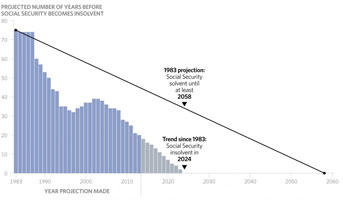
This
Chart Shows Why Social Security Will Be Broke in 10 Years. Social Security's trustees
projected in 1983 that the recently enacted Social Security reforms would keep the program active
for at least the next 75 years, through 2058. However, according to research by Rachel Greszler, a
senior policy analyst, and James M. Roberts, research fellow for economic freedom and growth at The
Heritage Foundation, that approach date has accelerated. "If the trend since 1983 continues, the
program will become insolvent in 2024 — 34 years earlier than originally projected,"
Roberts writes.
Fight
brewing over Social Security benefits for illegal immigrants. A new clash over retirement benefits has come to a head
following President Obama's decision to unilaterally protect up to 5 million illegal immigrants from deportation. The
White House now acknowledges that many of the illegal immigrants spared from deportation under Obama's sweeping executive action
will become eligible for Social Security and Medicare benefits once they reach retirement age.
Can
Social Security Privatization Guarantee You More Benefits at a Lower Cost? [Scroll
down] To illustrate, imagine a Social Security reform plan in which every worker is given a
personal account that is invested in stocks. At retirement, a worker cashes in his account to pay
whatever benefit he is promised by Social Security. If his account balance isn't enough to pay his
promised benefit, the government makes up the difference. If his account is more than is needed,
then the government takes, say, a quarter of that surplus and the account holder keeps the rest.
Under the approach to budget accounting favored by Van de Water and the CBPP, this Social Security reform
plan could guarantee that every worker gets his full benefit while also reducing the budget deficit.
Why is Social
Security seizing your tax refund over your relatives' debt? CBS News first met Mary Grice
in April after her tax refund of almost $3,000 dollars had been confiscated, she said, without notice.
It turned out the Social Security Administration had seized her refund, claiming her family received too much
in death benefits after Grice's father died — in 1960. Grice, who was five years old at the time, says
she never got a penny and calls the loss of her refund an injustice. "They feel that, 'We're the government,
we can do whatever we want, however we want, whenever we want.' and it's so unfair," she said.
Social Security
spent $300M on 'IT boondoggle'. Six years ago the Social Security Administration embarked on an aggressive plan to
replace outdated computer systems overwhelmed by a growing flood of disability claims. Nearly $300 million later, the
new system is nowhere near ready and agency officials are struggling to salvage a project racked by delays and mismanagement,
according to an internal report commissioned by the agency.
Senate
Bill Would Allow Unmarried to Collect SS Spousal Survivor Benefits. Two Senate
Democrats want to change the way a valid marriage is determined under the Social Security Act so
that same-sex couples living in states that do not recognize their unions can still collect spousal
survivor benefits. Senators Patty Murray (D-Wash.) and Mark Udall (D-Colo.) introduced the Social
Security and Marriage Equality (SAME) Act on May 8th. The bill aims to "ensure all same-sex
spouses receive equal treatment under the Social Security Act when applying for Social Security
benefits, regardless of where they live," according to Senator Murray's website.
White
House wanted Geithner to lie to the public about social security being behind the deficit. The White House
wanted Treasury Secretary Timothy Geithner to lie on Sunday talk shows to downplay the part Social Security played in
driving the deficit, it was revealed today. [...] 'I remember during one Roosevelt Room prep session before I appeared
on the Sunday shows, I objected when Dan Pfeiffer wanted me to say Social Security didn't contribute to the deficit.
It wasn't a main driver of our future deficits, but it did contribute,' he says. 'Pfeiffer said the line was
a 'dog whistle' to the left, a phrase I had never heard before. He had to explain that the phrase was code to
the Democratic base, signaling that we intended to protect Social Security.'
Geithner:
White House Wanted Me to Lie on Sunday Shows. Timothy Geithner, the former secretary
of the Treasury Department, says the White House wanted him to lie in scheduled appearances on the
Sunday TV talk shows. [...] Of course, Geithner would not have been the only official from the White
House to have misled the American people on the Sunday talk shows.
Geithner
Fretted Over Social Security Deficits — Before the Dog Whistle. In an election year,
political-speak is done with dog whistles. That's the backdrop readers may want to use in understanding
former Treasury Secretary Tim Geithner's confession in his latest book about the talking-points memo he got for
his Sunday morning TV appearances from Obama Administration official Dan Pfeiffer on not equating Social Security
reform with deficit reduction. Pfeiffer suggested Geithner avoid talking about Social Security reform as
helping to cut the deficit in order to send a calming "dog whistle" of a signal to the Democratic base that
Social Security will not be touched, in order to keep voters in the tent.
Ingraham:
Geithner Should Have Resigned When WH Asked Him to Mislead Public. In his book,
[Timothy] Geithner revealed that Senior Advisor to the President for Strategy and Communications Dan
Pfeiffer asked him to de-emphasize the impact Social Security has on America's deficit ahead of an
appearance on the Sunday talk shows. Pfeiffer said that calling Social Security a deficit driver
would serve as a "'dog whistle' to the left." "We now know that the left considers its base a bunch
of unruly canines," Ingraham observed. "Didn't Tim Geithner, as a public servant, have a duty to
actually resign at that point?" she asked.
Krauthammer:
Administration has manipulative relationship with the truth'. Charles Krauthammer told
viewers Monday on "Special Report with Bret Baier" that a moment recounted in former Treasury
Secretary Tim Geithner's new memoir shows that the Obama administration has a "less than arm's
length relationship with the truth." "It's less than arm's length — it is actually a clearly
manipulative relationship with the truth," Krauthammer said. "That it is to be used, or abused, or
inverted, in order to, quote, 'send a message,' to send a dog signal."
CBO
Director: Important to Give Advance Warning About Coming Changes to Social Security. The United States
faces "fundamental fiscal challenges" stemming from the growth in spending for Social Security and major health care
programs," CBO Director Douglas Elmendorf told a gathering in Washington on Tuesday [3/18/2014].
The rising cost of those programs leaves Americans with "unpleasant" choices to make, but the sooner
they're made, the better, he said.
7
Lies Liberals Tell Young Americans. [#2] Social Security and Medicare will be there for you:
Young Americans are expected to pay into Medicare and Social Security, but the programs aren't going to be there in their
present forms when they get old enough to use them. In other words, we're defrauding young Americans. We're telling
them to pay today so they'll be taken care of when they get old, but we have no intention of ever allowing them to collect.
Unless there are massive changes made to our entitlement programs, most young Americans should expect to work until they die.
Don't Let Death Stop your Social
Security. Uncle Sam, always generous to a fault with taxpayers' money, doled out about $108 billion in Social Security
benefits to the dead in 2012.
Dead or alive? Social Security
can't always say. Federal auditors said Friday the Social Security Administration still struggles with a basic problem —
figuring out who is dead and who is not. The question is a crucial one, since federal agencies rely on the administration to cross-match
data on deceased persons and avoid paying out federally funded benefits to people who aren't alive, or to establish accurate benefits for
survivors. The administration also maintains a "Death Master File" that is available to the public.
Implosion
of Social Security Disability Ponzi Scheme Accelerates. Fresh data just released by the trustees of the Social Security
Administration show that the number of people receiving benefits from the Disability Insurance Trust Fund has exploded over the last
five years, reducing the surplus in that fund from $216 billion in 2008 to just over $100 billion in 2013. There were
7.4 million recipients in January 2009, but as of October 2013, there are nearly nine million beneficiaries, not including another
two million spouses and children of disabled workers who are also receiving benefits. Simple math illustrates the inevitable: If
those receiving benefits for disability (real or faked) continues to increase, the trust fund will be bankrupt in less than three years.
Do Americans Prefer Deception?. Congress
tells us that one-half (6.2 percent) of the Social Security tax is paid by employees and that the other half is paid by employers,
for a total of 12.4 percent. Similarly, we are told that a Medicare tax of 1.45 percent is levied on employees and that
another 1.45 percent is levied on employers. The truth of the matter is that the burden of both taxes is borne by
employees. In other words, we pay both the employee and the so-called employer share.
Agencies can't always tell who's dead and who's not, so benefit checks keep coming. The U.S.
government has a problem with dead people. For one thing, it pays them way too much money. In the past few years, Social Security paid
$133 million to beneficiaries who were deceased. The federal employee retirement system paid more than $400 million to retirees who
had passed away. And an aid program spent $3.9 million in federal money to pay heating and air-conditioning bills for more than 11,000 of
the dead.
Breaking the Third Rail. Social Security, Tip O'Neill once
observed, is the third rail of politics. Lawmakers who touched the venerable retirement insurance program, or its cousins Medicare and Medicaid,
were said to be zapped to death on the spot. This was the case as recently as 2005, when President Bush tried to pass incremental reforms to Social
Security. Democrats rallied the public, the proposal flamed out, and Bush's domestic agenda suffered its most serious setback. But lately,
not only is criticizing entitlements not a political death kiss, it's actually become a necessity in Republican politics.
We Can't Solve Our
Problems If We Deny We Have Them. Over the next 20 years, Social Security will pay out $4.7 trillion more in benefits than it will
bring in through the payroll tax. Americans have been misled into believing this system is solvent because of the fiction of the Social Security Trust
Fund — the "lockbox." Now, to be truthful, the lockbox does exist — a four-drawer filing cabinet located in West Virginia that
holds $2.8 trillion in U.S. government bonds. The figure represents the accumulated surplus of payroll taxes over benefits, plus interest paid on
those balances. But those funds were spent by Washington politicians of both parties on other politically popular goodies. That money is long
gone. The problem with the bonds that replaced it is they have absolutely no monetary value to the U.S. government.
Conn Job. Stanville, a tiny town in eastern
Kentucky, seems an unlikely place for a multimillion-dollar empire. Yet for decades, an unscrupulous lawyer named Eric Christopher Conn has been
working the Social Security disability system, securing benefits for even the most undeserving of clients, according to a new report from the Senate
Committee on Homeland Security and Government Affairs. The report describes a lucrative scheme that involved not only Conn but also a disability
judge and several doctors with bad reputations — all of whom may have profited substantially.
Widespread fraud
reported in Social Security Administration's Disability Program. A two-year investigation by the Senate Permanent Subcommittee on Investigations
has found widespread fraud in the Social Security Administration's Disability Program. The fraud is so rampant, and disability cases have so proliferated
in recent years, that the Social Security's Disability Trust Fund may run out of money in only 18 months, says Sen. Tom Coburn, R-Okla., whose office
undertook the investigation.
Committee Reveals Widespread Disability Scheme. A Kentucky lawyer made
millions off Social Security disability programs, devising a scheme with a judge to approve fraudulent claims at an "assembly-line" rate. A two-year investigation
led by Sen. Tom Coburn (R., Okla.), ranking member on the Senate Homeland Security and Governmental Affairs Committee, revealed a case of coordinated fraud responsible
for the approval of billions in claims.
Social Security Judge Accused of Disability Scheme.
A retired Social Security judge in West Virginia collaborated with a lawyer to improperly award disability benefits to hundreds of applicants, according to a
report released Monday [10/7/2013] by congressional investigators.
Social Security makes $1.3 billion in overpayments.
The Social Security Administration has paid an estimated $1.3 billion in disability insurance payments to thousands of people who weren't
eligible for the benefits, a government watchdog report finds.
Binder on Binder & Binder.
The Social Security Administration pays an awful lot of money to people who aren't — and never claim to be — disabled.
When a person applying for disability secures a legal representative, then is successfully awarded benefits, the lawyer or advocate who helped
him gets a generous cut of the money, paid directly from the SSA's disability fund. In the first six months of 2013, the SSA has already
forked over $642.6 million to these claimant representatives, who have a significant financial interest in getting people on disability.
Schumer: Put Aliens
Who Forged Documents on Path to Citizenship. Americans might generally think that if someone forges a document and uses a
Social Security number that does not belong to them, they should go to jail. Sen. Charles Schumer, D-N.Y., believes if you are an
illegal alien and you do these things, you should become a U.S. citizen. He made his case for this in the Senate Judiciary Committee.
Social Security
Faces $9.6T in Unfunded Liabilities — 83,894 Per Household. The Social Security program faces $9.6 trillion
in unfunded liabilities over the next 75 years, which is up $1 trillion from last year's projection of $8.6 trillion,
according to the latest report from Social Security's board of trustees.
Paterson cardiologist
admits to $19M in health care fraud. A prominent cardiologist who ran medical services companies in New Jersey and New York pleaded
guilty on Wednesday to orchestrating a massive fraud that subjected thousands of patients to unnecessary tests and procedures and resulted in
$19 million in losses. Dr. Jose Katz, 68, of Closter, confessed his crimes to U.S. District Judge Jose L. Linares during a
hearing in federal court in Newark.
Soaring
Social Security disability rolls headed for collapse. Jim Pethokoukis, of the American Enterprise Institute, has calculated
that if labor force participation had not declined so much since Obama took office, the unemployment rate for January would have been
10.8 percent. What happens to the workers who drop out of the labor force? Some retire, some become full-time parents,
some go on welfare. But here's an important answer that is often overlooked: In 2011, on average, one net person has been added
to Social Security's Disability Insurance rolls (and 3.3 to its retirement program) for every five net new jobs created.
Entitlements:
Washington's Official Lies About Spending. The Social Security trust funds contain nothing more than IOUs, bonds
that have absolutely no market value. In other words, they are worthless bookkeeping entries. Social Security is a
pay-as-you-go system, meaning that the taxes paid by today's workers are immediately sent out as payment to today's retirees.
Social Security is just another federal program funded out of general revenues.
Government Gave 4,317
Aliens two Social Security Numbers Apiece. A report from the Social Security Administration Inspector General (IG)
found 4,317 instances where a non-citizen was able to obtain two Social Security numbers, including 542 instances that happened
since 2001. "We identified 4,317 instances where the Numident record of 2 SSNs assigned to noncitizens contained matching
first, middle, and last names; dates and places of birth; gender; and fathers' and mothers' names," the IG reported on Dec. 10,
2012.
Social
Security's disability trust fund could fail to cover all benefits early as 2016. Over the long term, Social Security and Medicare
have promised tens of trillions of dollars more in benefits than the nation can pay for under current policies. But Social Security's
disability trust fund is in even worse shape, and current estimates say by 2016 it won't have enough money to pay full benefits.
President Obama's
Cat-Food Future For Retirees. Americans are drawing down their 401(k)s for nonretirement needs in record numbers, just
as Social Security goes bust. This portends poverty for millions as the White House fiddles.
Obama's
Social Security Games Make Case For Private Pensions. President Obama threatened Social Security checks would be delayed if
Congress didn't play ball on the debt ceiling. Once again, he turned pensions into a political football. There are ways to stop
this.
Beyond waste and fraud. When Social Security
started in 1935, the eligibility age was 65 and life expectancy was 63. Today, the average individual lives until age 78. Boosting
the eligibility age would impose little hardship on retirees while trimming the program that currently consumes more than a fifth of the federal
budget. Similarly, increasing the Medicare deductible to $6,400 per person would save $250 billion annually while encouraging consumers
to better balance costs and benefits.
Social Security: It's Worse
Than You Think. For the first time in more than a quarter-century, Social Security ran a deficit in 2010: It spent
$49 billion dollars more in benefits than it received in revenues, and drew from its trust funds to cover the shortfall. Those
funds — a $2.7 trillion buffer built in anticipation of retiring baby boomers — will be exhausted by 2033, the
government currently projects. Those facts are widely known. What's not is that the Social Security Administration
underestimates how long Americans will live and how much the trust funds will need to pay out [...]
The Real Country-Killer in 2013.
Every week, the U.S. Treasury borrows money to keep operating, by holding auctions of "T-Bills." Institutional investors, foreign and
domestic, show up to bid on these government bonds (Treasury Bills). What if investors decide that it just isn't worth risking any more
of their money? There won't be any money. Even when the country still looks strong, investors could sit on the sidelines, worrying:
"Let someone else take the risk." If the lending stops, can the country survive when the Ponzi scheme collapses? What if there is no
money to cut social security or Medicare checks, or operate the government?
Social Security Ran
$47.8B Deficit in FY 2012; Disabled Workers Hit New Record in December: 8,827,795. The Social Security program ran a $47.8 billion
deficit in fiscal 2012 as the program brought in $725.429 billion in cash and paid $773.247 [billion] for benefits and overhead expenses,
according to official data published by Social Security Administration. The Social Security Administration also released new data revealing
that the number of workers collecting disability benefits hit a record 8,827,795 in December — up from 8,805,353 in November.
Shredding Liberal Talking Points, Again. You cannot dispute this: In 2010,
social security payouts began to exceed revenue. Same for 2011. By 2015, social security is expected to pay out $7.9 trillion more than it
takes in. Who in their right mind can consider that position as "just fine?"
Time to own the election, America.
The nanny state is the president's plan — Americans' cash pouring into the government's coffers to be "redistributed." Given away. To
whomever the government decides "deserves" it. Want to plan for your own future? Absurd. Give us your money and we'll give it back to you in
40 years — if we deem you worthy.
Sheila Jackson
Lee: Entitlements Off The Table, They Are "Earned". Rep. Sheila Jackson Lee (D-TX): "There is no way, Mr. Speaker, that we should
raise the eligibility age for Medicare, that we should not think carefully about how we approach the reform of Medicaid. And that we don't the
American people that Social Security is solvent. [..."]
The Editor asks...
If you are entitled to receive something, it isn't necessary to earn it.
Okay, President Obama,
Let's be Fair. Let's be fair. People who are taking money from the Social Security fund under the guise of being
disabled, when they are not, are essentially stealing the money from the people who obediently paid into Social Security.
Republicans for Big Government. [Scroll down]
Stated differently, the federal government has no legal obligation to pay any money to any Social Security or Medicare or Medicaid
applicant. That's why those who have relied on the political wisdom of politicians, rather than their own prudential judgment,
are dupes. Let me rephrase that: Those who have permitted politicians to use the force of law to compel us all to
contribute our hard-earned income to a bankrupt government Ponzi scheme are dupes if they think this can work without end.
Washington's financial
miscreants sucker us. Only in a town like this would criminally reckless and penniless grifters still be at the bargaining
table as their debtors and creditors pick through the rubble of the financial ruin they themselves created. This Congress has for
decades stolen billions out of our personal retirement account to fund an obscene lavishness and political nest-feathering that would
make a king blush.
Jackson
Lee: 'Who Wants to Make a Fuss About Social Security When It's Solvent?' Rep. Sheila Jackson-Lee (D.-Texas) said
last week that Republicans are being "frivolous" when they talk about reforming Social Security as a means of fixing the federal
government's fiscal problems because Social Security is "solvent." According to Social Security's trustees, the program has
operated in the red in each of the last two years.
Dems Say Social Security
Doesn't Add to Deficit. Congressional Democrats say they aren't willing to consider changes in Social Security in order
to avoid the "fiscal cliff." On Sunday, November 25, 2012, Senator Dick Durbin (D-IL), on ABC's This Week, said,
"Social Security does not add one penny to the deficit. Not a penny. It's a separate funded operation, and we can do things
that I believe we should now, smaller things, played out over the long term that gives it solvency." Durbin also said that
Social Security needs only a few minor tweaks, but no major reforms to ensure its long-term solvency.
Social Security and the Politics of Deceit.
Joe Biden's simplistic remark belies a horrific lack of understanding regarding the reality of investing versus the broken promises of Social Security.
The erroneous comment by Biden about the market and his disingenuous explanation of what life would have been like had you been able to make your own decisions
with Social Security funds underscores the problems our nation faces in understanding the results of the 2012 presidential election. In this election
particularly, the politics of deceit continued unchecked when Biden's statement on Social Security went unchallenged.
Can we protect ourselves from Obama and those who
elected him? (Part 2): [Scroll down] Assume Social Security won't be there for you. If it is, and for whatever reason, you like government
taking 6.2 percent of your paycheck and forcing your employer to match that amount, then good for you. For the business-minded among us, it offers a poor
return on your investment. But then, it isn't really an investment, is it? It's a tax.
It's the Welfare State, Stupid.
The Wall Street Journal recently ran a story about a couple (he 66, she 70) touring the world. They've visited London, Paris, Florence and Buenos
Aires. Their financial adviser sends them $6,000 a month from investments and proceeds from their home sale. They also receive Social
Security. How much? They don't say. My hunch: between $25,000 and $50,000 a year.
Obama: 'Social
Security is Structurally Sound;' Trustees: 'Unfunded Obligation ... Is $8.6T'. President Barack Obama said in Wednesday
night's presidential debate that Social Security is "structurally sound," but Social Security's Board of Trustees said in their 2012
annual report that the program faced $8.6 trillion in "unfunded obligations" — meaning that it is currently obligated to
pay out $8.6 trillion more in benefits than it is anticipated to bring in through taxes.
Can Republicans Talk? Vulnerable
people, depending on that monthly Social Security check, need to hear that you understand that they paid into Social Security for years when
they were working, and that it would be unconscionable to now cheat them out of what they paid for. Policy wonks already know that
nobody in his right mind has proposed any such thing.
The funny think about reform & fear.
That segment of the population that has the least to fear from a reform of Medicare or Social Security is the most fearful — namely, those already receiving Medicare
or Social Security benefits. It is understandable that people heavily dependent on these programs would fear losing their benefits, especially after a lifetime of paying
into these programs. But nobody in his right mind has even proposed taking away the benefits of those who are already receiving them.
Paul Ryan and Social Security — Do
the Math. First, let's just get this out of way. Paul Ryan should be commended for putting forth any plan to
address Social Security. This already makes him more qualified than almost any other candidate in decades, including the
one he is paired with in 2012 and the one he is running against. That being said, the plan put forth in the Path to
Prosperity, also known as the Paul Ryan plan, is based on two facts that most people are aware of, but aren't comfortable
talking about.
Obama Declares War On Seniors, Steals
Part Of Their SS Check. Barack Obama's war on America's seniors knows no limits. The Treasury Department is withholding part
of the Social Security monthly payments of about 115,000 seniors because they have fallen behind on student loan payments. There was a time
when Social Security benefit payments were untouchable, but that is a thing of the past.
Duped by Congressional Lies.
The Social Security pamphlet of 1936 read, "Beginning November 24, 1936, the United States Government will set up a Social Security
account for you. ... The checks will come to you as a right.". Americans were led to believe that Social Security was like a
retirement account and that money placed in it was, in fact, their property. Shortly after the Social Security Act's passage, it was
challenged in the U.S. Supreme Court, in Helvering v. Davis (1937). The court held that Social Security was not an insurance
program, saying, "The proceeds of both employee and employer taxes are to be paid into the Treasury like any other internal revenue
generally, and are not earmarked in any way."
Fraud by illegal immigrants destroying
children's lives. The SSA Actuary estimates that 75 percent of illegal immigrants obtain and use a fraudulent Social Security number.
The Ugly Truth About Social
Security Is Revealed. A recent front page USA Today story inadvertently exposed the lie that is Social Security. [...] Sure
enough, and despite the protests for years from big government apologists that our Social Security funds are secure, it turns out they're
not. We know this now not because we're logical, or because some libertarian said so, but because Jim Horney at the liberal Center on
Budget Priorities told us exactly that.
Work 'til You Drop: Is that such a bad
idea? In the early 1900s, nearly 80 percent of Americans over the age of 65 had a job. Dora Costa, an
economic historian at UCLA, says people stopped working only if they were no longer physically able to. They expected to
work as long as they lived. Is that really such a terrible idea?
The Road From Serfdom. The argument
conservatives too often make seems to be: "Trust us; we know what's best for you." Yet when was the last time that voters
trusted politicians of either party to make wise decisions on their behalf? With congressional approval now
hovering in the teens, there is little likelihood the public will back fundamental reform of the $1 trillion entitlement
system. But there is another way: Give individual citizens the freedom to either stick with the government-run
plan, or choose a market-based option.
The
Real 'Entitlement Mentality' That Is Bankrupting America. The two biggest entitlement programs — Social
Security and Medicare — are seen by voters as trust funds they pay into during their working lives and then get back
in their retirement years. That's what President Franklin D. Roosevelt sold voters back in 1935. He wanted the
"contributors" to have a "legal, moral and political right to collect their pensions." That's what voters still want today.
Let's End
Social Security As We Know It. Governments of most industrialized nations are staggering under
mountainous debts. Aging populations and slowing economic growth have undermined generous welfare states.
Least affordable are public pensions modeled after the infamous "investment" scheme popularized by Charles Ponzi.
Collect money from current taxpayers to pay current beneficiaries, and let the future take care of itself.
Why
Do We Stick With Broken Social Security Model? In its latest projection, the Congressional Budget Office
found that the Social Security Trust Fund had $1 trillion less than expected. Seems it always happens this
way. When will Washington recognize that the problem is the model?
Social
Security Trust Fund Outlook Takes $1 Tril Dive. The outlook for Social Security's trust fund has
deteriorated to an astonishing degree over the past year, new Congressional Budget Office projections show.
The nonpartisan budget scorekeeper now expects the trust fund to peak in 2018 and decline to $2.7 trillion
in 2022 — a full $1 trillion less than Social Security's own actuaries were expecting last year.
Social Security:
The birth of Big Brother. Just last year, 79 percent of respondents to a CNN/ORC poll rated Social
Security "good for the country." In the same survey, an astonishing 73 percent agreed that "Social Security
is something that the U.S. Constitution allows the federal government to do." Support for the program is both
deep and broad, cutting across the political spectrum. ... This is sad because Social Security is every bit as offensive
to liberty and fiscal sanity as Obamacare.
A
Very Good Question about Our National Debt. The total present value of payments expected under
Social Security and Medicare beyond what is expected to be collected under current tax laws is about $100 trillion.
One way to put that amount of money in context is to note that it is about twice the amount of all the net private
assets that exist in America today. To answer cw's question directly, the best back-of-envelope estimate is
that meeting this unfunded portion of our Social Security and Medicare commitments would require roughly an
immediate 80 percent increase in federal income taxes, sustained forever.
Less than half believe Social Security is a good
deal. A new Rasmussen poll shows that only 48% of Americans believe Social Security is a good deal
for working Americans today. 33% say it is not a good deal. 20% are unsure. The numbers do not
add up to 100 because of the way numbers are rounded. 56% of likely voters are either not very confident
or not confident at all that they will receive all that has been promised to them from Social Security.
Is Social Security a Ponzi Scheme?
[Scroll down] Don't be embarrassed if you've fallen for this scam. So has The New York Times.
It tried to set Perry straight by reporting that "economists of all stripes agree" Social Security won't "exhaust
the money in the trust fund" until 2037. But as the Times itself conceded last year, this trust fund
is no more than "an accounting device" that represents how much the government owes itself — or, in other
words, how much must be extracted from taxpayers to cover all the surplus Social Security money Congress has squandered
over the years. The surpluses themselves are long gone, replaced by Treasury bonds that can be redeemed only
through higher taxes or further borrowing (which eventually translates into higher taxes).
Federal
Programs and Tax Breaks That Help Millionaires. The total amount of Social Security retirement benefits
paid to millionaires from 2004 through 2009 was more than $9 billion. This high number of high-earners
receiving benefits from the Social Security Trust Fund was never contemplated when the program was created because
the program was intended as a safety net for low-income earners.
How Social Security went 'cash negative' earlier than expected.
Last year, as a debate over the runaway national debt gathered steam in Washington, Social Security passed a
treacherous milestone. It went "cash negative." For most of its 75-year history, the program had paid
its own way through a dedicated stream of payroll taxes, even generating huge surpluses for the past two decades.
But in 2010, under the strain of a recession that caused tax revenue to plummet, the cost of benefits outstripped
tax collections for the first time since the early 1980s.
Entitlement Programs: A Plan to End
Them. America's financial situation is precarious. Over the past eight years our national debt
has doubled to $14.5 trillion, and our total unfunded liabilities now exceed an astonishing $114 trillion.
That's $1,115,000 per federal income taxpayer. Even the most unrepentant spendthrift understands that these
debts and liabilities are unsupportable, nor can they be solved by immorally targeting the rich. Instead, we
must enact immediate, across-the-board spending cuts, with special emphasis on the biggest components of our
financial wreck: Social Security, Medicare and Medicaid. These entitlement programs constitute the
majority of our unfunded liabilities, because despite being labeled "trusts" they're not actually savings plans.
Social
Security Disaster. The very first Social Security check went to Ida May Fuller in 1940.
She paid just $24.75 in Social Security taxes but collected a total of $22,888.92 in benefits, getting back
all she put into Social Security in a month. According to a Congressional Research Service report titled "Social
Security Reform" (October 2002), by Geoffrey Kollmann and Dawn Nuschler, workers who retired in 1980 at age 65
got back all they put into Social Security, plus interest, in 2.8 years. Workers who retired at age
65 in 2002 will have to wait a total of 16.9 years to break even. For those retiring in 2020, it
will take 20.9 years.
All Entitlements
Are Not Created Equal. Social Security was advertised as an old age retirement savings plan:
your money saved by government and paid to you when you retire. The advertising was false. From the
start, money paid OUT to retirees was money paid IN by still working Americans. This is money that should
have been set aside to pay for their retirement. Social Security was and is a classic Ponzi
scheme — a government initiated and government sanctioned transfer of funds intended for future
retirees paid to present retirees.
Ponzi! Ponzi! Ponzi! Many
people think that when the government takes payroll tax from their paychecks, it goes to something like a
savings account. Seniors who collect Social Security think they're just getting back money that they put
into their "account." Or they think it's like an insurance policy — you win if you live long
enough to get more than you paid in. Neither is true. Nothing is invested. The money taken
from you was spent by government that year. Right away. There's no trust fund. The plan
is unsustainable. Medicare is worse.
You Say 'Ponzi Scheme,' I
Say 'Fraud'. Both the former Massachusetts governor and the current Texas governor understand
that Social Security is a transfer program disguised as a retirement plan and that its frequently mentioned
"trust fund" does not actually exist. Their spat over how exactly to characterize that situation is
illuminating not because it reveals substantive differences between the candidates but because it shows how
often these simple truths are overlooked.
Authors
of Social Security Believed It Was Unconstitutional. Some of the main players involved in creating
Social Security believed it was unconstitutional — and for good reason. Yet, for them, not
unlike many in today's Washington, the ultimate questions were not: Is this good for the long-term
future of the country, and does Congress have authority to do it? They were: Will this serve
our immediate political interests, and can we get away with it?
The 'Ponzi' Sound
Bite. Governor Perry is not even among the first thousand people to call Social Security a
Ponzi scheme. Not only conservatives, but even some liberals, have been calling Social Security a
Ponzi scheme for decades.
The Third Rail Unplugged.
For decades now political consultants, especially those of the Florida sub-species, have been able to charge
big bucks to advise Republican candidates not to say anything about Social Security during campaigns.
It's the "third rail" of politics, they breathlessly warn. Touch it and your political career goes up in smoke.
GOP
Shows Healthy Disregard For 3rd Rail. Social Security, long considered the "third
rail" of U.S. politics, seems to have lost its power of shock. ... That represents a sea change
compared to the last three decades, when any politician who dared to bring up the parlous state
of Social Security's financing would be charged with "pushing grandma off a cliff" by special
interests seeking to scare seniors.
An
uncomfortable truth about Social Security. Rick Perry has gotten a lot of heat for
describing the Social Security system as "a Ponzi scheme," and he deserves it. The Texas
governor owes a big apology to Charles Ponzi. Sure, Ponzi fleeced investors, but they at
least had a choice about participating. Social Security operates on a compulsory basis.
It is a Ponzi
scheme. Social Security taxes on employee wages are transferred straight to the
checks of current retirees, and the "fund" is just a pass-through account and past supluses
were replaced with IOUs. Fifteen years earlier, Charles Ponzi had a similar idea.
The
Great Social Security Debate. Social Security is a pay-as-you-go program. A
current beneficiary isn't receiving the money she paid in years ago. That money is gone.
It went to her parents' Social Security check. The money in her check is coming from her son's
FICA tax today — i.e., her "investment" was paid out years ago to earlier entrants in the
system and her current benefits are coming from the "investment" of the new entrants into the
system. Pay-as-you-go is the definition of a Ponzi scheme.
Perry
and the Ponzis. [Governor Rick] Perry's Ponzi-scheme claim is in no way original.
Not only have a raft of conservatives called Social Security a Ponzi scheme over the years, quite a
few very respectable liberals have done so as well. It is clearly wrong either to treat the
Ponzi-scheme analogy as unprecedented or to rule it altogether out of legitimate public debate.
You're idiotic, he
explained. Is Social Security something of a Ponzi scheme? It seems to me to
partake of its essential elements, requiring new "investors" to pay off previous "investors."
The trappings of the program are sufficiently misleading that they would land principals operating
in the private sector in serious trouble.
Rick
Perry is right: Social Security is a Ponzi scheme. Texas Governor Rick Perry has been criticized
for saying that Social Security is a Ponzi scheme. But he's absolutely right, and he is hardly the first
guy to notice. I figured that out 30 years ago. A Ponzi scheme is an investment program where
there are no real dividends. It is able to make payouts to early investors only as long as there are
enough new investors to pump money into it. Once the new investments decline, the payouts decrease,
and eventually there are no more payouts.
Is
the Social Security Fraud Drawing to a Close?. Social Security, not Medicare or Medicaid,
is the crown jewel of the entitlement state. For several generations now, it has been sold to
voters as a more or less sacred compact. Many Americans still believe that the federal government
maintains an "account" in their name, which contains assets. Some even think that their "account"
contains their own contributions, carefully set aside for their retirement by Franklin Roosevelt or
his successors. If this is not the biggest fraud in the history of the human race, it is certainly
in the top five.
Desperation
On Rise. In another sign of how lousy the president's so-called recovery's been, millions of desperately
unemployed are now threatening to sink Social Security's disability lifeboat.
Social
Security wrongly declares 14,000 people dead each year. Of the approximately 2.8 million death
reports the Social Security Administration receives per year, about 14,000 — or one in every
200 deaths — are incorrectly entered into its Death Master File, which contains the Social
Security numbers, names, birth dates, death dates, zip codes and last-known residences of more than 87 million
deceased Americans. That averages out to 38 life-altering mistakes a day.
America: Time to
Start Over. [Scroll down] This is a monstrous moral failing, a horrendous crime
against our heirs. The difference between ourselves and Bernie Madoff? Not much, really.
It is the height of hypocrisy to put a man like Madoff behind bars for engaging in the same sorts of
financial shell games that we like our politicians to play. Social Security is every bit as much
of a scam as a crooked hedge fund, yet FDR is lionized while Madoff rots in a cell — nothing could
better encapsulate the moral and literal bankruptcy of our civilization.
Obama says he cannot guarantee
Social Security checks will go out on August 3. "I cannot guarantee that those checks go out
on August 3rd if we haven't resolved this issue. Because there may simply not be the money in the
coffers to do it," Mr. Obama said in an interview with CBS Evening News anchor Scott Pelley, according to
excerpts released by CBS News.
The Editor says...
[#1] Who among us believes anything Obama says?
[#2] When has a lack of money ever stopped the government from writing checks?
Obama
Threatens to Withhold Social Security Checks. According to Obama's own budget, the federal
government will take in $2.174 trillion this year, and Social Security outlays will total $727 billion.
Moreover, the government has already borrowed plenty of money this year to supplement the $2.174 trillion.
So what, exactly, would Obama rather spend that money on, instead of sending out Social Security checks?
Obama Plays the Social Security Card.
If Barack Obama had a winning hand, would he have to resort to such dire scare tactics so soon?
Obama
Exposes Social Security's Big Lie. As Nancy Pelosi once put it: "Social Security has never failed to
pay promised benefits, and Democrats will fight to make sure that Republicans do not turn a guaranteed benefit into
a guaranteed gamble." The AFL-CIO warned in 2005 about "President Bush's plan to replace Social Security's
guaranteed benefits with risky private accounts." The AARP describes Social Security as "the guaranteed part
of your retirement plan." Etc., etc. Turns out, this "guarantee" is a lie.
What
Happened to the $2.6 Trillion Social Security Trust Fund? Either Obama and Geithner are lying
to us now, or they and all defenders of the Social Security status quo have been lying to us for decades.
It must be one or the other.
How
to Achieve a Balanced Budget Right Now: Obama's claim that Social Security checks might not go
out is very interesting, no? If that were to happen, it would expose the fiction that Social Security
has a "trust find," and would make it clear that Social Security funds have been fully raided for other
spending. Does Obama really want to go there?
Social Security: a
Reckoning. Understanding what, and who, is to blame for the Social Security funding crisis
will allow us to move on and reach a solution that fairly allocates costs amongst current generations.
Gov. Christie recently said that pension and health care obligations are "the core problems of government
spending in the country." "Federal pension obligations under Social Security now are central to the
current fiscal debate."
Nailing
Obamacare's rationing board. While lawmakers continue to argue about the best way to protect
[Social Security] for the seniors it serves and those who it has yet to serve, there is a growing
bipartisan consensus that the Independent Payment Advisory Board (IPAB) is one provision of the
new health law that will do more to undermine the program than save it.
The Facts About Social Security.
[Scroll down] So what has the Treasury done with the money? Well, the federal government has
spent it on its daily consumption: education, loan guarantees, wars, etc. In other words, the
government has already spent the money it received in exchange for the IOUs. The most recent
projections say that, beginning in 2014, the program will begin permanently paying out more in benefits than
it collects in taxes. At that point, the program will start redeeming the IOUs in the trust fund and
use them to pay benefits to current seniors until they run out. But remember, the money is not there
anymore. So then what?
Social
Security deficits now 'permanent'. Social Security will run a permanent yearly deficit when looking
at the program's tax revenues compared to what it must pay out in benefits, the program's trustees said Friday [5/13/2011]
in a report that found both the outlook for Social Security and Medicare, the two major federal social safety-net
programs, have worsened over the last year. Medicare's hospital insurance trust fund is now slated to
run out of money in 2024, or five years earlier than last year's projection, while Social Security's trust
fund will be exhausted by 2036, a year earlier than the prior projection.
Entitlement
Abuse — Here, There, and Everywhere. Increasingly, we hear jaw dropping stories of
abuse and fraud that should force our leaders in Washington to put the issue of fraud and abuse within the
entitlement system formally on the table. Just last week we learned of the case of the "Adult Baby",
the 30-year old guy, that lives in a diaper, is fed by bottle and thus somehow entitled to taxpayer-supplied,
social security disability for his condition. Strangely, this is the very entitlement system that
Obama and Democrats not only insist that we preserve, but are anxious to expand.
Repairing FDR's
Ponzi scheme. Social Security is broken, and there's no use pretending otherwise.
President Obama sounded Wednesday like he was open to the idea of limited reforms to the New Deal-era's
signature entitlement program. "There are those who believe we shouldn't make any reforms to Medicare,
Medicaid or Social Security," said the president. "But I guarantee that if we don't make any changes
at all, we won't be able to keep our commitment to a retiring generation. ..."
Obama's Hockey Stick:
The Federal Debt. The national debt is calculated in two ways: gross debt and net debt.
Net debt is primarily gross debt net of the various government "trust funds" the largest of which is Social
Security.
Weiner's
Social Security scam. Democrats never miss an opportunity to pander to older voters by demagoguing
on Social Security — and Brooklyn Rep. Anthony Weiner seems only too glad to lead the way.
Weiner, who dreams of becoming mayor, has introduced a bill to require a two-thirds majority in Congress
to enact any changes in Social Security — a near-impossible hurdle. His goal: to
"defend" an entitlement system he insists is "fiscally responsible" and fundamentally sound.
The Politics
of Social Security Reform. Democrat politicians are waging yet another media campaign
to block Social Security reform. Late last month Senator Durbin claimed, "Social Security does
not add one penny to the deficit." Two days later, a White House aide assured voters that Social
Security reform is "not one you care about" and President Obama's budget director opposed reform in a
USA Today op-ed. The Hill then quoted half a dozen more Democrats singing from the same anti-reform
songbook.
Obama's Social Security Hoax.
Everyone knows that the U.S. budget is being devoured by entitlements. Everyone also knows that of
the Big Three — Medicare, Medicaid and Social Security — Social Security is the most
solvable. Back-of-an-envelope solvable: Raise the retirement age, tweak the indexing formula
(from wage inflation to price inflation) and means-test so that Warren Buffett's check gets redirected to a
senior in need. The relative ease of the fix is what makes the Obama administration's Social Security
strategy so shocking. The new line from the White House is: no need to fix it because there is
no problem. As Office of Management and Budget Director Jack Lew wrote in USA Today just a few weeks
ago, the trust fund is solvent until 2037. Therefore, Social Security is now off the table in
debt-reduction talks. This claim is a breathtaking fraud.
Welfare State: Handouts Make Up One-Third of U.S. Wages.
Government payouts — including Social Security, Medicare and unemployment insurance —
make up more than a third of total wages and salaries of the U.S. population, a record figure that will
only increase if action isn't taken before the majority of Baby Boomers enter retirement.
Who rules
America? AARP. The great question haunting Washington's budget debate is whether our elected
politicians will take back government from AARP, the 40 million-member organization that represents
retirees and near-retirees. For all the partisan bluster surrounding last week's release of President
Obama's proposed 2012 budget, it reflects a long-standing bipartisan consensus not to threaten seniors.
Programs for the elderly, mainly Social Security and Medicare, are left untouched.
The Political
Wisdom on Social Security is Bunk. The government is profoundly broke and borrowing 40 cents
of every dollar it spends. The Federal Reserve is printing money by the bale to buy up the debt and friends
and foes alike the world are still extending us credit, but the cliff is now in view. Inflation, a weakened
dollar and punitive borrowing rates all lie ahead. Even so, the process of making cuts has been an exercise
in demagoguery.
CBO:
Social Security Now Officially Broke. Today's CBO report has some bad news about the deficit.
But CBO has some really, really bad news about Social Security: It's officially broke. The
CBO's revenue/expenditure estimates now place the program in permanent deficit.
Sinking it now is best for America in the long run.
Social
Security: Anti-social and insecure. FDR's New Deal turned out to be the Rip-off Deal.
There is an IOU for $2.5 trillion in the Social Security trust fund. Our elected bandits stole
all the Social Security taxes collected over the years and spent it on who knows what. The
Congressional Budget Office recently stated that Social Security will pay out $45 billion more this
year than what it takes in. Deficits such as this are projected until Social Security rolls over
and goes completely belly-up 25 years from now.
Social
Security Is in Far Worse Shape Than You Think. For years, politicians and policymakers have reassured
the American public that the Social Security system, which sends monthly checks out to 53 million beneficiaries,
is safely solvent — and will be for decades to come. But federal spending and income data from the
Treasury Department reveal that the Social Security program is already deep in the red, with outlays exceeding payroll
tax revenues by $76 billion in 2010 alone.
Running the government on
8¢: Today, the United States spends roughly 76 cents of every federal tax dollar on
just four things: Medicare, Medicaid, Social Security and interest on the $14 trillion debt.
That leaves 24 cents of revenue to pay for everything else the federal government does.
Social
Security Data Center Approaching Collapse. An inspector general finds agency operations at high
risk due to delays in upgrading its critical infrastructure and software.
The
Chilean Model. Nearly 30 years ago, on the very day Ronald Reagan was sworn in as U.S.
president, Chile became the first nation to privatize its social security system. Three decades hence,
it has surpassed all expectations.
U.S. House Should Repeal Social Security Along
with ObamaCare. To the best of my recollection, I never agreed to purchase retirement insurance,
AKA, Social Security. Rather, it was mandated by a fascist government that I purchase it. ... In turn,
the Social Security scam has spawned the Medicare Ponzi Scheme which, although it is not required, is another
non-sustainable program administered by dim wits too stupid to survive in the real world.
Here's a tool that
could untrack the third rail. Neither the Democratic Party nor the Republican Party has ever shown
much desire to address the problem of ever-increasing government, in part because they would pay a political penalty
if they did. Certain big-ticket programs still retain considerable support from people who have no idea of
their costs. That's especially true of those out-of-control "entitlement" programs, Social Security and
Medicare. The challenge now is to help the American people understand that their future — and
that of their children and grandchildren — depends upon their willingness to rein in these beloved
programs which the nation simply cannot afford.
Fixing Social Security.
[Scroll down slowly] My real hypothesis is that government is broken. The Democrats of 2010 could
not even write a budget at all. That is one of Congress's few defined tasks, and the Democrats blew
it off. No one will even try to fix Social Security, one of the bigger problems we have, but with one of
the easiest solutions. It was a third rail, it is a third rail, and it will remain a third rail until,
oh, 2039.
Social Security: The New
Class Struggle. Social Security has taken on the all the dimensions of a class struggle between
the "haves" and the "have-nots." In this case, the young "have-nots" struggle against the power, wealth,
and influence of the older "haves." The Social Security struggle is between generations, but it is the
older Americans who have the advantage. It is the older Americans who have the money, the power and the
influence.
The Envious Feminists.
People are emotional beings, often governed more by feelings than reason. And this is never truer than
with leftist people. If you want to understand liberals, know that most of their ideology is simply a
pseudo-intellectual justification for what feels right to them. As for these feelings, the one stereotypically
associated with the left is compassion, which supposedly manifests itself in mercy, charity, forgiveness, and
temperance. In reality, though, the feeling that far better characterizes the left is envy.
Social Security
Bait and Switch. Democrats are trying to keep control of Congress by scaring the wig off grandma
with a phantom GOP plot against Social Security. That is not news. Social Security scare tactics
have been regular campaign themes since FDR. President Obama's unique contribution is to do this even as
he's begging Republicans to help him reduce the deficit and reform entitlement spending.
Obama:
Social Security 'is not in crisis'. President Obama said Social Security is not in crisis and
only modest changes are needed to keep it solvent.
The Crisis President Finds
No Issues with Social Security. President Obama, if nothing else, is a prolific discoverer of
crises. In the short space of nineteen months, we have had a health care crisis, economic crisis, swine
flu crisis, housing crisis, banking crisis, auto industry crisis, financial regulatory crisis, global warming
climate change crisis, Gulf oil spill crisis, mortgage crisis, deep-water drilling crisis, teacher layoff
crisis, and of course, the lack-of-freshly-paved-roads crisis, aptly addressed by the Stimulus bill. ... But
the president assures us that "Social Security is not in crisis," thus guaranteeing that the situation will
worsen at least as long as he occupies the Oval Office.
Believe
It or Not, the U.S. Is In Worse Financial Shape Than Greece. In Ohio on Wednesday [8/18/2010]
President Obama announced that Social Security "is not in crisis" and that only "modest adjustments" are
required. He has long promised that his health care plan will not add "one dime" to the deficit.
Yet, a new report from the International Monetary Fund concludes that, long-term, our government is in worse
financial shape than Greece, and that this problem is driven in large part by both programs, particularly the
new health care plan.
What
Would it Take to Cut Government Spending? Runaway federal spending isn't likely to be brought
under control as long as the major entitlements — Social Security, Medicare and Medicaid —
remain out of control. The number of entitlement beneficiaries is growing faster than the number of taxpayers,
entitlements account for more than half of federal spending, and unfunded liabilities (obligations not covered by
payroll taxes) exceed $100 trillion.
Demogoguing Social Security.
The Democrats must know they're in trouble: they've turned to one of their hoariest dodges, demagoguing Social
Security. In his weekly radio address yesterday [8/14/2010], Barack Obama accused Republicans of
scheming to ruin the program.
Obama
Demagogues Private Enterprise. Many Americans fear privatizing anything they've come to view as
government work. They object to privately managed roads, independent charter schools, private prisons,
etc., despite private companies' repeated success at providing better service while lowering costs.
Private retirement accounts seem particularly threatening.
Opposing view on
retirement income: Let's upend Social Security. The nation's largest entitlement program is
officially in the red. This year, Social Security has paid out more than it receives in payroll taxes.
The Congressional Budget Office predicts that by 2039, the system won't be able to pay retirees their "guaranteed"
share of Social Security benefits that they paid into the system without massive tax increases or benefits
cuts. In less than 20 years, just two workers will be forced to pay the benefits of every one
retiree.
What Handouts To Cut.
Because of failure to heed the limitations of the U.S. Constitution, which has produced runaway federal spending,
our nation sits on the precipice of disaster. Former Senator Alan Simpson of Wyoming and Erskine Bowles,
White House chief of staff under President Bill Clinton, co-chairmen of President Obama's debt and deficit
commission, in a Washington Post article "Obama's Debt Commission Warns of Fiscal 'Cancer'" (July 12, 2010)
said that "(A)t present, federal revenue is fully consumed by three programs: Social Security, Medicare
and Medicaid.
Are
Overdue Reports Concealing ObamaCare Impact On Medicare?. Every year, the Annual Report of
the Social Security Board of Trustees comes out between mid-April and mid-May. Now it's July, and
there's no sign of this year's report. What is the Obama administration hiding?
Three
little pigs: How entitlements will destroy us. Our national debt recently topped the
$13 trillion mark. That amounts to nearly 90% of this country's GDP; $72,000 in debt for every
household in America. And that's the good news. In the next few years, our major entitlement
programs, in particular Social Security and Medicare, will begin to run cash-flow deficits, adding hundreds
of billions each year to the debt. In fact, Social Security's total unfunded liabilities top $15.8 trillion,
and depending on what accounting measure is used, Medicare's future shortfall could exceed $100 trillion.
Social
Security cash flow suddenly negative. Social Security tax receipts for the first half of
2010: $346.9 billion; Social Security benefits payments for the same period: $347.3 billion.
Before this year, projections have always been that Social Security wouldn't cross that line into negative cash
flow for five years or so. Now it's a reality. Congress has been spending Social Security's
positive cash flow for years. Now there's no positive cash flow to spend.
Work
A Little Longer. The administration has delayed release of the 2010 Social Security and
Medicare Trustees report, possibly to hide its gloomy forecast of U.S. finances. Meanwhile, clear
thinkers are offering solutions.
Dems
Worrying Liberals With Talk of Entitlement Reform. [Scroll down] Former SEIU head
and now member of the Deficit Commission Andy Stern last week suggested, to very little fanfare, that the
government should invest Social Security funds in Wall Street to increase returns on them. My, it
wasn't long ago that that sort of comment could get the whole of the Democratic caucus decrying your "risky
scheme" to rob the Greatest Generation of their benefits.
Social
Security benefits targeted in deficit meetings, activists warn. One of the oddest Web posts
making the rounds is a series of blurry videos from Capitol Hill showing people coming and going from a
closed-door meeting of President Barack Obama's new deficit commission. The mundane scenes have a
sinister cast for activists who say the commission is at work on a secret plan to gut Social Security.
The Failure of the
Unfree Market. If you had believed in the 72-Year Rule, you would have seen this coming.
The 72-Year Rule says the lifetime of any social order or governing paradigm is about 72 years. For
example, how long was it from the adoption of our original Constitution (1789), which sanctioned slavery, to
the Civil War (1861)? Call it 72 years. And from then until the New Deal in 1933?
Another 72 years. How about from the Bolshevik Revolution (1917) to the fall of the Berlin Wall
(1989)? That would be 72 years again. Do you know when the first Social Security check was
issued? January 31, 1940. If my guess is right, Social Security has maybe two more years
left.
Let It Burn. If Republicans
take control of the House and Senate, and if they repeal the health care bill, then they will not be able (or
likely even try) to reform Medicare or Social Security. These programs alone will bankrupt our nation.
Yet they are untouchable because a large number of Americans have come to depend upon these benefits. They
have become unknowingly hooked.
Contrary To Amnesty Supporters,
Illegal Aliens Drain Social Security. A recent Rasmussen Reports survey revealed that voters
remain concerned about Social Security and whether the system can deliver what the government has promised.
According to the survey, 58% of U.S. voters lack confidence that the Social Security system will pay them their
future benefits. Advocates for amnesty for millions of illegal immigrants like to claim that amnesty will
"save" Social Security. They also claim that dramatically increased immigration levels will safeguard our
retirements and those of our children because more people will pay into the system. Unfortunately, the
opposite is true.
Spike
in disability claims clogs overloaded system. The Social Security system is so overwhelmed by
applications for disability benefits that many people are waiting more than two years for their first payment.
Social
Security's Straightforward Math. Compared to health care, Social Security is a straightforward
issue. All working Americans pay Social Security taxes. Though technically employers and employees
split the burden, most people recognize that Social Security consumes 12.4 percent of their total
compensation, because the deduction is visible on their paychecks.
Welcome to the Long Run.
[Almost] no one is pushing real Medicare reform or any entitlement reform at all. If anything, politicians
simply want to add more stuff to them. Let's be clear. The real causes were not those listed by [Joel]
Achenbach. The real causes were the great "accomplishments" of the New Deal and the Great Society:
Social Security and Medicare. They were Ponzi schemes, budget time bombs. The short run is over
and I hope you all had a good time, because the long run is here and now.
A country of 'third
rails'. Since the inception of Social Security, there has been an unspoken rule in politics:
When campaigning for national office or running for re-election, a candidate could never pledge to touch, cut
spending for, dismantle, or otherwise look crossways at Social Security unless it was to raise the payouts to
its recipients. Social Security has always been referred to as the "third rail" in politics. You simply
never touch it. It would now appear that the US is riddled with a plethora of untouchable third rails
and holy grails.
A house divided, again.
Now we enter our history's second stage in the struggle against the abomination of socialism. Just as
slavery had been contained in the South, so entitlement socialism has, until this week, been more or less
contained in service to only the poor and the elderly. And even those programs — Medicare
and Social Security — rested on the principle of beneficiaries paying monthly premiums for the
benefits they will get later. Only the poor under Medicaid received benefit without premium payment.
ObamaCare and
American Power: The United States currently spends roughly as much on defense ($661 billion
in fiscal year 2009) as the rest of the world combined. But that's a pittance compared to what we spend
on three major entitlement programs — Social Security, Medicare and Medicaid.
Entitlement Rip-Off. Bernie Madoff
took money from people who thought he'd invested it, gave some to others who thought it was a partial return
on their earlier investments and kept much for himself. That's called a Ponzi scheme, and his $50 billion
fraud was called the biggest ever. But it wasn't the biggest. Social Security and Medicare are much
bigger ones. These are trillion-dollar scams. Medicare has a $36 trillion unfunded liability.
Social Security's is $8 trillion. There's no money to keep those promises. But Congress isn't
investigating this scam. Congress runs it.
Social
Security IOUs stashed away. The retirement nest egg of an entire generation is stashed away in
this small town along the Ohio River: $2.5 trillion in IOUs from the federal government, payable to
the Social Security Administration.
Facts on the Social
Security: This year for the first time in recent history, the federal government
will have to use general revenue to pay Social Security and Medicare benefits — about
$45 billion, or 3.6 percent of federal income taxes. The general revenue
requirement as a share of income taxes will double in less than five years; and five
years beyond that, it will double again.
Third-Rail Shocker.
While a massive health care entitlement is fashioned in secret, another one, Social Security, is running
deficits decades earlier than expected. We've been kicking the can down the road. We're
out of road.
5
Ugly Truths Americans Will Have to Face. [#1] Entitlements must be cut. By 2030, the
Congressional Budget Office is estimating that Social Security, Medicare and Medicaid will make up 75% of our
budget spending. In other words, unless we get a handle on entitlement spending, it will be impossible to
get our deficits under control.
The Land of Entitlements.
[Scroll down] To put this in context, one must realize that there are no Medicare recipients alive today
who have firsthand knowledge of being without Medicare while elderly. Some may remember their parents or
grandparents surviving well into old age without Medicare, but not themselves. Very few alive today remember
a time without Social Security. Within the space of a human lifespan, our society has become a culture conditioned
to accept (and expect) entitlements as the norm without questioning the consequences. It has been a very
effective strategy to enlarge government.
Federal Spending: With the
entitlement programs Medicaid, Social Security, Medicare and Medicaid and discretionary spending levels set to
consume increasing shares of national income, a challenge of unprecedented proportions looms large for
Congress and the president. Federal revenues are expected to consume 19 percent of gross domestic
product (GDP) in 2009, which constitutes a high by historical standards.
Social
Security Reform Cooking Again. Historic change sometimes comes from unlikely sources. A
famous example was long time anti-Communist Richard Nixon breaking the diplomatic ice with Red China.
One that came close was in 1998 when President Clinton carefully studied reforming Social Security with personal
retirement accounts along the lines that President George W. Bush proposed a few years later.
Clueless in Washington.
[Scroll down] In the medium term there are only two ways to bring the deficit back to a sustainable
level — which means no more than 3% of GDP. Either taxes will have to rise, or a serious
attempt must be made to rein in the entitlements — legally mandated programmes such as
Medicare, Medicaid and Social Security — that constitute the great bulk of spending.
Court clears suit to affirm voluntary Medicare, Social Security. A
federal judge has cleared the way for consideration of a class-action lawsuit in which plaintiffs — including
former House Majority Leader Dick Armey — are asking for a ruling upholding an existing law that declares
participation in Medicare and Social Security to be voluntary, not compulsory.
Obama's $250 Bonus Turns Social Security
into Welfare. Since Social Security recipients will get no cost-of-living adjustment (COLA) next
year, President Obama wants to give each of them $250, a move supported in principle by the Republican House and
Senate leadership. However, this move is not only unjustified; it makes a fundamental change to Social
Security's structure and starts the process of converting the program from an earned benefit funded by a
worker's own contributions to a welfare program.
A
White House Power Grab that Congress and America Doesn't See. To achieve the goal of a
universal, single-payer health system, the White House must secure the power it needs by amending the Social
Security Act to transfer pivotal controls from Congress to the executive branch. This transfer of power
would ultimately give the President and the majority party, in this case the radical left Obama White House
and Pelosi-Reid led progressive Democrats, the authority to frame and manipulate new policy, coverage options,
and reimbursements, ultimately reshaping the future US health care system into a something unrecognizable
in this country.
Social Security and Medicare Projections: 2009. The
2009 Social Security and Medicare Trustees Reports show the combined unfunded liability of these two programs
has reached nearly $107 trillion in today's dollars! That is about seven times the size of the U.S.
economy and 10 times the size of the outstanding national debt.
All Falling Down... [Scroll
down] In the late 1930s our grandparents thought tiny sums from social security were lavish godsends,
now we assume a temporary suspension in cost-of-living increases on top of generous pay-outs is nothing short
of a national disaster and proof of our collective selfishness.
Social Security's Wheel of
Fortune. As millions more Americans become eligible, future and current beneficiaries are left wondering:
Just how safe is my Social Security check? America's safety net has been projecting long-term deficits for years, and
it's no secret that legions of retiring baby boomers will one day exhaust Social Security's financial surplus.
The
gathering storm on Social Security and Medicare. Earlier this week, the trustees for Social
Security and Medicare issued their latest annual report warning of the impending financial catastrophe when
the federal government must pay out more in benefits it has promised under the two entitlements than it
collects in taxes to pay for the programs. Medicare ran out of cash to pay for hospital benefits last
year and now these costs are covered by the U.S. Treasury. By 2017, according to the trustees, Medicare
will have exhausted all of its trust funds.
Social Security
strained by early retirements. Big job losses and a spike in early retirement claims from laid-off seniors
will force Social Security to pay out more in benefits than it collects in taxes the next two years, the first time
that's happened since the 1980s.
Obama's
Health Care Promises Ring Hollow. Past government programs designed to be self-sustaining in the
long run simply haven't lived up to lawmakers' expectations. Social Security amendments passed in 1983
mandate that the program be fiscally solvent for the next 75 years. A recent report released last
month by the Social Security Administration claims the solvency of the program will last through 2037,
21 years shorter than expected. Many experts believe this estimate is grossly optimistic.
Rediscovering
the 10th Amendment — Too Little, Too Late. In describing the constant blatant assault on the
Constitution, one hardly knows where to start. The federal government runs Social Security, a 50-state Ponzi
scheme that makes Bernie Madoff look like an underachiever.
A Scheme With No Off
Button. Ever wonder why the New York Times can report on a Ponzi scheme in the private sector
and be totally oblivious to the Ponzi scheme that the U.S. Government has been running right under the Gray
Lady's nose for seventy-five years? This hustle is called "Social Security."
The National
Ponzi Scheme. A Ponzi scheme does not generate any wealth whatsoever; that is why it ultimately
collapses. ... We have a national Ponzi scheme where Congress collects about $785 billion in Social
Security taxes from about 163 million workers to send out $585 billion to 50 million Social
Security recipients. Social Security's trustees tell us that the surplus goes into a $2.2 trillion
trust fund to meet future obligations. The problem is whatever difference between Social Security taxes
and benefits paid out is spent by Congress.
Is
Social Security a Ponzi Scheme? A "Ponzi-like" scheme has three characteristics — transfers,
obscurity, and unsustainability. [#1] Transfer: Early participants are paid off by the
investments of later participants. [#2] Obscurity: The true nature of the scheme is obscured,
so that it looks like early participants are receiving a return on their investments, rather than payments
from later participants. [#3] Unsustainability: The scheme is guaranteed to eventually break
down, once the number of participatns rises high enough.
Deception is the Root Cause of
America's Ills. Mike Whalen, former policy chairman of the Dallas-based National Center for Policy
Analysis, commenting on last year's Social Security Trustees annual report on the state of the Social Security
and Medicare programs, said, "The report on the state of entitlement programs is rather grim — the
combined unfunded liabilities of both programs are $101 trillion." What that means is that in order
for government to make good on its promises, Congress would have to put aside tens of trillions of dollars
in the bank today. Keep in mind that our GDP is only $14 trillion.
Social Security Sham. Keep
in mind, pretensions to the contrary, Social Security is not insurance, where premiums are invested.
With Social Security, politicians spend today's so-called contributions as quickly as they can get their hands on
the money. Crises breed big government, and big government is primarily concerned with saving itself.
Social Security is the largest Ponzi scheme.
The U.S. and international media have been following the story of Bernard Madoff and his "giant Ponzi scheme,"
as the Wall Street Journal called it, which may have cheated unsuspecting investors out of tens of billions of
dollars. ... But is this — as it is being touted — the largest Ponzi scheme in history?
No. That honor goes to a Depression-era creation of the U.S. government itself: the Social Security
system.
Congress' Ponzi scheme.
[Scroll down] Charles Ponzi gave his name to this kind of scam in the 1920s when he was caught paying off old
investors with funds deposited by new ones. The last time we heard the term "giant Ponzi scheme" was
during the debates about "saving Social Security." Advocates of the current system dismiss the phrase
as a slur. But the essence of Social Security is paying past investors from current investments.
We Can't Tax
Our Way Out of the Entitlement Crisis. The spending shortfalls in Social Security and Medicare
are large. According to the Congressional Budget Office, Social Security and Medicare spending left
unchecked would, after a generation, consume about 10 percentage points more of GDP than it does today.
An
eighth of every paycheck. You Don't have to be a financial wizard to know
that Social Security is a lousy investment. Unlike the money you deposit in a bank
or salt away in an IRA, you don't own the money you pay into Social Security. You
have no legal right to get those dollars back, and when you die you can't pass them on
to your heirs. Nor can you use your Social Security account before you
retire — you can't borrow against it and you can't cash it in. You
aren't allowed to put the money into a balanced portfolio. You can't even watch as
the interest accumulates, since your Social Security nest egg doesn't earn any interest.
You Have NO Right to Social
Security. Various congresses and presidents have raised Social Security taxes at least 40 times
since the program commenced in 1935. Also, the retirement age currently is creeping toward 67.
Such steps deprive Americans of their retirement assets. None of this should be surprising. Social
Security funds do not belong to individual workers and entrepreneurs. This money is the property of
Washington politicians and they may do with it whatever they please.
Social (In)security:
[Scroll down] As if teleprompted on cue, [Obama] said that McCain embraces "George Bush's failed privatization
scheme." And with those comments, honesty left the building. Bush's Social Security privatization
plan is not a failed policy. It cannot be "failed" because it has never been tried, with the exception
of three Texas counties where private systems are flourishing.
Fooling
Ourselves into Entitlements. In 1935, when Congress enacted Social Security, protracted retirement
was a luxury enjoyed by a tiny sliver of the population. Back then, Congress did its arithmetic ruthlessly:
When it set the retirement age at 65, the life expectancy of an adult American male was 65. If in 1935
Congress had indexed the retirement age to life expectancy, today's retirement age would be 75.
The Entitlement
Mess. Congress is spending us into a hole. We hear about the cost of earmarks and the Iraq
war. But what about "entitlements"? That's the government's ironic term for programs that transfer
money from people who earned it to people who didn't. Entitlement? How can you be entitled to
someone else's money? To finance "entitlement" programs, the government threatens force against the
taxpayers who provide the money.
An
Open Letter to Black Obama Supporters. In two previous notably liberal administrations, socialist
ideas were entertained: Bloat government to its largest degree and cause people to become dependent upon it
for their livelihood. Under Franklin Delano Roosevelt the longest lasting experiment with Socialism was
instituted. Social Security has now become what people think of as a stream of money flowing from the
government. Perhaps in Urban America you know a number of people who get Social Security benefits who
aren't even retired (which is what it was originally intended for) or disabled, or even in legitimate need
of it. Every check of Social Security that goes to an undeserving recipient plunges Black America
into deeper poverty.
Social Security's
running out of time. Forget all the talk you'll hear about how Social Security is okay until 2040 or
thereabouts. That is, as we'll soon see, utter nonsense. The real problem starts only a decade or so from
now, when Social Security begins to take in less cash than it spends. How can I say that, given Social Security's
$2.3 trillion (and growing) trust fund? It's because the fund owns nothing but Treasury securities.
Normally, of course, Treasury securities are the safest thing you can hold in a retirement account. But Social
Security's Treasuries won't help cover the program's cash shortfall, because Social Security is part of the federal
government.
Distrust Fund: It's almost a
D.C. truism that anytime Congress creates a "trust fund" for a certain policy issue, the money flowing into
the fund will be diverted to something else. Government trust funds are set up with special taxes and
fees so that they will be less subject to normal budget constraints. That makes them desirable for
future Congresses to divert their proceeds to spend on pork. Payroll tax money in the Social Security
Trust Fund has for decades been emptied out to fund general government programs.
New warnings about entitlements shortfall.
Trustees for the government's two biggest benefit programs warned Tuesday [3/25/2008] that Social Security and
Medicare are facing "enormous challenges," with the threat to Medicare's solvency far more severe. The
trustees, issuing a once-a-year analysis, said the resources in the Social Security trust fund will be depleted
by 2041. The reserves in the Medicare trust fund that pays hospital benefits were projected to be wiped
out by 2019.
Social Security is in Trouble.
People are living longer and collecting more Social Security benefit checks. In 1940, life expectancy
was 61.4 for men and 65.7 for women. By 2000, life expectancy was 74.2 years for men and 79.5 for
women; by 2050, life expectancy will be 84 years for men and 87.5 for women.
$45 trillion gap seen in
US benefits. The government is promising $45 trillion more than it can deliver on Social
Security, Medicare and other benefit programs. That is the gap between the promises the government has
made in benefits and the projected revenue stream for these programs over the next 75 years, the Bush
administration estimated Monday [12/17/2007].
The Late Great Social Security
System: When Social Security was set up, its supporters pooh-poohed critics who warned that by
not investing the collected funds, the government was setting up a major fiasco. The pooh-poohers were
wrong, of course; the skeptics, right. Now, all those baby boomers whose FICA withholding kept the
system afloat for years will begin to drain funds. Soon, the money going to retirees will far exceed
money coming in. Hence the crisis.
The retirement
"monster": Taxpayers owe more than a half-million dollars per household for financial promises
made by government, mostly to cover the cost of retirement benefits for baby boomers, a USA Today analysis
shows.
Social Security: A Tale
of Two Problems. The first problem is that the federal government collects more — a
lot more — contributions to Social Security than what it needs to pay the current retirees.
The excess contributions are spent on other government programs and not really saved to pay for the retirement
of the workers who are making the contributions. All the surplus paid into Social Security over the
past 20 years has already been spent.
Social Insecurity:
America's Social Security system is a ticking time bomb. It is not a stable system and provides young
workers with negative returns. Reform is needed now to ensure the future of the system and the financial
security of younger generations. In 2017, Social Security will start to owe more money than it
takes in. The support base for the system is shrinking, as Americans live longer and have fewer
children.
Rethinking Social Insurance:
The single greatest threat to the fiscal health of the United States is the runaway growth of the nation's
major retirement and health care entitlement programs. Social Security and Medicare are projected to
grow from 7.5 percent of GDP today to almost 13 percent of GDP by 2030. Already, the two
programs consume over a third of the federal budget.
How Much Do Americans Depend on Social Security?
Many low-income workers depend almost entirely on Social Security for their retirement income, but it is often
assumed that high-wage workers can maintain their standard of living without Social Security benefits due to
their private pensions and savings. Surprisingly, however, even high-wage workers depend on Social
Security for a substantial portion of their retirement income and would significantly change their consumption
and saving behavior in the absence of Social Security.
Social Security and
Medicare Are Unsustainable. In 2011, the first group of baby boomers
in the United States will reach the age of 65. When the last of that generation
retires in 2032, 77 million of them will have ceased working and paying taxes and
will have at least begun receiving taxpayer-funded health care and pension benefits. A
similar trend is occurring throughout the developed world. In Japan, Europe, and North America,
the number of retirees will double over the next 25 years while the number of taxpayers will grow
only 10 percent. The economic consequences of these changes are
dire: higher taxes, slower growth, and lower living standards.
Social
Security — It Is Time To End It. Regardless of what we as a nation do, social security is a
system that is broken beyond repair. There is really nothing we can do to "fix" it. The
time has come to dismantle it and return the responsibility of planning for ones retirement back to the
individual. Those who do not plan accordingly should expect to be cared for and provided for by
their family as has been the norm for most of the history of this nation and of the world.
Krugman
vs. Krugman. In liberal Democratic circles, the debate over Social Security has taken a
dangerous "don't worry, be happy" turn. The argument has two equally dishonest components. The
first is to deny that Social Security faces a daunting financing problem … The second is to
mischaracterize the arguments of those who advocate responsible action, accusing them of hyping the
system's woes.
Direct deposit of Social Security
checks: safe, fast — and disastrous. As the federal agencies begin
another push for recipients to accept their Social Security checks by direct deposit, consumer advocates
point to a little-known risk of using the system: Recipients who have judgments against them are
vulnerable to losing access to their money. The problem, advocates say, isn't the direct-deposit
system, but the failure of banks to implement safeguards to protect accounts with exempt funds from
being frozen.
The Coming Financial Collapse of Social
Security. The first officially recognized financial collapse of Social Security
occurred in 1977. Government projections at that time showed, and everyone agreed, that without
major changes Social Security would be unable to pay all of its promised benefits within a couple
of years, with a yawning, continually growing deficit after that time.
Social Security bankruptcy
is the real inconvenient truth. By 2017, Social Security tax revenues will be less than promised
benefits, and a government system that millions of Americans depend on will become bankrupt. ... The
solution to Social Security's problems is to acknowledge the program's inherent flaws and to shift from a
government-run welfare program to a system of personal ownership. Specifically, allow people to divert
a portion of the money they pay in Social Security taxes into an account they own, control, and for which
they take responsibility.
Liberal Pyromaniacs:
Liberals behave like a pyromaniac who sets fire to his own house, then is angered because the rest of the family
try to salvage their possessions and escape from the blaze. Like the pyromaniac, liberals feed the destructive
flames of inflation with deficit spending on new welfare programs and the mandated monsters, Social Security and
Medicare. Then they become indignant when rational investors take steps to hedge against liberal-created
inflation.
Hillary
Clinton's memory loss: Hillary Clinton once again asserted during the latest presidential
debate that "the American people know where I've stood for 35 years." Yet, she repeatedly
refuses to tell us where she stands on Social Security reform. And when she does, Mrs. Clinton
misrepresents the condition of Social Security when she and her husband left the White House.
Clinton's Social
Security fecklessness. In words a more thoughtful Clinton likely would have avoided, the leading
Democratic presidential contender told a cheering crowd of AARP policy wonks and political activists that when
she's back in the White House, there won't be any talk about cutting or privatizing Social Security. "This
is the most successful domestic program in the history of the United States. When I'm president,
privatization is off the table because it's not the answer to anything," she said. Also off the table
will be any benefit cuts or increases in the retirement age.
The Slippery Social
Security slope: Most Republicans and Democrats, ideologists of all persuasions as
well, accept that Social Security as presently structured is not sustainable.
Social Security to Become
Key Issue. Three years after the collapse of President Bush's plan for private Social Security
accounts, Republican presidential contenders are eager to try again. Not so the Democrats, who gravitate
toward increasing payroll taxes on upper-income earners to fix the program's finances.
This is just brilliant.
Illegals granted Social
Security. The Senate voted yesterday [5/18/2006] to allow illegal aliens to collect Social
Security benefits based on past illegal employment — even if the job was obtained through forged or
stolen documents.
Social Security uncovers
illegal workers. Privacy concerns prevent the Social Security Administration from notifying
an employer that a hired foreign national is not authorized to work in this country, including someone who
may be a potential national security risk, says a government audit.
Stop
the Mexico Raid on Our Social Security! RetireSafe Delivers 115,000 Petitions
Opposing Social Security for Illegal Immigrants from Mexico. "Social Security is
not a welfare program and it should not be turned into a foreign aid program," said
RetireSafe President Charles Hardin.
Social
Security scam keeps on ticking. The Social Security Trustees issued their annual
report earlier this month, and the program's fiscal outlook is even worse than estimated last
year. Yet, as predictably as May brings rain showers from Heaven and bloated supplemental
spending bills from Congress, liberals in the media, the House and the Senate continue to deny that
the Social Security program faces a fiscal crisis.
A Mass Delusion: Personal accounts
cannot solve Social Security's cash flow shortfalls, but they could help to eliminate the mass delusion about
retirement security that the current program creates.
Your Social Security Number Is a Matter
of National Security. The federal government has enabled the widespread use of Social Security
Numbers by promoting their use by agencies other than the Social Security Administration — the
one agency that has truly legitimate uses for the number — and by failing to effectively
regulate how the private sector uses the number.
Dallas
ISD faulted for using fake Social Security numbers. Years after being advised by a state agency
to stop, the Dallas Independent School District continued to provide foreign citizens with fake Social Security
numbers to get them on the payroll quickly. Some of the numbers were real Social Security numbers already
assigned to people elsewhere. And in some cases, the state's educator certification office unknowingly used
the bogus numbers to run criminal background checks on the new hires, most of whom were brought in to teach
bilingual classes.
California Woman's Social Security Stolen by
Suspected Illegal Immigrants. Audra Schmierer's Social Security number really gets
around. It has been used by at least 81 people in 17 states, most of them probably illegal
immigrants trying to get work. The federal government took years to discover the number was
being used illegally, but authorities took little action even then.
Did
someone mention crimes committed by illegal aliens?
Man
Denies Trying to Help Terrorists. A former graduate student testified Friday [6/16/2006] he
used a fake Social Security number to obtain credit cards but denied accusations that he tried to help
terrorists. A naturalized U.S. citizen born in the West Bank, Arwah Jaber said he was "trying to
survive" and did not believe at the time that it was against the law to provide false information on
credit card applications.
[Nonsense. How many of you believe that a 34-year-old man with a PhD did not know it was illegal to
put false information on credit card application?]
Getting rid of
reckless spending. We are less than one generation away from Congress being unable to pay
for anything other than Medicare, Medicaid, Social Security, and interest on the federal
debt — leaving not so much as a penny for defense or homeland security.
Social
Security is at the roots of the shift. Nancy Pelosi and Harry Reid had a decision to
make. President Bush was starting his second term with a brash challenge to a sacred Democratic
program — Social Security — and the House and Senate Democratic leaders needed a coordinated
response, and fast.
The dried-up veto
pen: Pork barrel projects — even tens of billions of dollars of
them — are not what have dug us into a fiscal hole. It is the rapidly
escalating cost of entitlement programs. President Bush is well aware of the
problems in this area. He eloquently explained the deteriorating fiscal condition
of Social Security in many speeches this year, as part of his effort to reform that program
and stabilize its finances for future generations.
Five Ways to Fix Social Security:
Anyone who knows anything about Social Security knows it is an intergenerational income transfer program.
The transfer is from the young to the old. This sort of Ponzi scheme works only if the number of those
paying increases at a faster pace than the number of those receiving. Given the slowing of population
growth in the United States, the Ponzi scheme cannot survive.
Something
for nothing: Many of us who receive money from Social Security or other government
programs are learning the hard way the difference between money with strings and money without
strings. For example, Social Security recipients have to be enrolled in Medicare, whether
they want to be or not. "Universal" coverage means compulsory coverage, just with prettier
political spin.
Reforming Social
Security. The canard propagated by Democrats and enabled by spineless Republicans is that any
GOP reform would rob benefits from today's seniors. The Democrats' alternative? Why, they
have none….
Medicare and Social Security: Big
Entitlement Costs on the Horizon. Today, 6.9 percent of federal income taxes go towards
the two programs. Dr. Thomas Saving of Texas A&M University, a public trustee of the Medicare and
Social Security trust funds, estimates that, in 2020, 26.6 percent of all federal income taxes will
go to paying for Medicare and Social Security. By 2030, that number will increase to
49.7 percent.
Entitlement programs threaten
western economies. A column in the Wall Street Journal makes the sensible observation that...
"unless we can exploit the dramatic demographic and economic changes that are before us, our future will be
much poorer. Instead of stepping into an easy retirement, many retirees will tumble into a future marked
by bankrupt government social programs and declining asset values that will quickly deplete their cherished
nest eggs. This forecast is not based on an unpredictable future, but on events that have already
transpired."
30 nations' lessons for Social
Security reform. Britain, Chile and many others have virtually no unfunded liability
because they reformed their pay-as-you-go Social Security systems with personal retirement accounts.
Social Security's
Second Career: When Social Security was created in 1935, the retirement
age was set above the average male life expectancy. It was designed so the average
man would never collect any Social Security benefits, which were intended only to help
those who "outlived" their savings. Luckily, that's changed. People live longer,
and future generations can expect to do even better. But that means ever more retirees
depending on ever fewer workers. There were 42 workers for each retiree in 1945. Today
there are only 3.3. And by 2025, the ratio will drop to about two workers per retiree.
Allow People To Invest
Their Social Security Funds. Our Social Security System is truly a pay-as-you-go
system, as the assets in the so-called Social Security Trust Fund cover only a tiny percent of
existing obligations. As the number of retirees rises relative to the number of workers
as our population grows older, it will be impossible to pay existing benefit levels with the
current level of Social Security taxes in another generation or so. Young people recognize
this: surveys show that most do not expect to receive significant return on their Social
Security tax payments when they reach retirement age.
Social Security "Trust Fund": The
so-called social security trust fund exists only as a legal technicality, not as an economic reality.
Trust Fund? What Trust
Fund? The Social Security Trust Fund resides within the H.J. Hintgen Building in Parkersburg,
West Virginia near the Ohio River. The Trust Fund is stored inside the locked bottom drawer of a gray
filing cabinet controlled by employees of the U.S. Bureau of Public Debt. That drawer contains
$1.76 trillion worth of Special Issue U.S. Treasury Bonds. Each of these, 225 pieces of paper
in all, is contained in one of two white, loose-leaf notebooks that hold plastic page covers. Despite the
protective plastic, these certificates have no more financial value than the ink with which they are printed.
Social Security in Crisis.
Medicare and Social Security's combined unfunded liability is seven times the size of our economy. The
"Social Security Trust Fund" is essentially an IOU from the federal government. As such, from the
taxpayers' perspective, the Trust Fund is nonexistent.
Your
papers please…. Each American already has a national ID card — it's
called a Social Security card. The use of Social Security numbers for identification
purposes was somewhat limited until 1962, when the Internal Revenue Service co-opted it for
official taxpayer identification. Ten years later, the notice "For Social Security
Purposes — Not For Identification" was removed from Social Security cards. Currently,
SSNs are the most frequently used identifier in the U.S. They're required for credit and
banking relations, employee files, academic records, licenses and certifications, medical
records and health-insurance accounts, passports, and phone and utility accounts.
Social Security Numbers and Privacy:
Many people have questions regarding social security and privacy. Keeping one's identity safe is a pressing
issue in today's fast-paced, technologically-evolved environment. Fortunately, there are a number of
steps you can take to ensure your social security information stays safe.
Social Security number code cracked,
study claims. For people born after 1988 — when the government began issuing numbers at
birth — the researchers were able to identify, in a single attempt, the first five Social Security digits for
44 percent of individuals. And they got all nine digits for 8.5 percent of those people in fewer
than 1,000 attempts. For smaller states their accuracy was considerably higher than in larger ones.
No, You Can't Have My Social Security Number. Social
Security numbers were never designed to be secure. When SSNs came into existence 75 years ago, they had one and
only one purpose: to keep track of contributions to the federal pension system. ... Ten years after the SSN debuted,
the feds added a clarification to the card in capital letters:
"FOR SOCIAL SECURITY PURPOSES — NOT
FOR IDENTIFICATION." By that point, it was already too late.
Immigration
reform could lead to biometric Social Security card. Two U.S. senators prominent in immigration
reform efforts have proposed that all Americans be issued biometric Social Security cards, containing data from
either a fingerprint or retinal scan to help employers determine whether the holder is legal. In explaining
the only current bipartisan reform proposal, Sen. Charles Schumer, D-N.Y., has called such a high-tech Social
Security card "a linchpin" in efforts to win support in Congress for fixing an immigration enforcement system
that many agree is broken.
You might as well ask for a new set of fingerprints.
Social Security Denies ID Theft
Victim New Number. A 23-year-old Brighton man has been fighting five years to replace a
Social Security number that has been fraudulently used by a suspected illegal immigrant since 2003,
according to police and state tax officials. The Social Security Administration has twice denied his
request for a new number, saying his credit has not been damaged by the identify thief...
Biometrics Pinned to Social
Security Cards. The Social Security card faces its first major upgrade in 70 years under
two immigration-reform proposals slated for debate this week that would add biometric information to the card
and finally complete its slow metamorphosis into a national ID.
SSN-as-ID under scrutiny —
again. It has been known for years … just how dysfunctional the practice is of trying to
authenticate people through basic information such as residential address and SSN.
Immigrants are
stealing U.S. Social Security numbers for jobs, not profits. Camber Lybbert thought it was a
mistake when her bank told her that her daughter's Social Security number, issued by the U.S. government,
was on their files for two credit cards and two auto loans, with an outstanding balance of more
than $25,000. Her daughter is 3 years old.
There
Are No "Transition Costs" for Social Security Reform. Allowing workers
to invest a portion of their Social Security taxes through personal retirement
accounts will incur no net cost to the federal government.
A Risk Worth Taking.
There's no point in having a conservative Congress if it's not going to work to enact conservative policies.
At some point lawmakers have to be willing to take political risks to do what's right.
All
That Work for Nothing? The system is exactly the inverse of what we've all
been told to do in planning for our retirement. Those who work hard and put money
into the system early in life, get the same as those who start paying in later on. And
as a proportion of what they've paid in, the early-contributing ants actually get less than
their grasshopper peers.
The Anti-Entitlement
Revolution. A famous 1994 poll sponsored by Third Millennium, a group that
promotes awareness of national issues affecting post-Baby Boomers, reported that more
adults 18 to 34-years-old believed UFOs exist (46 percent) than believed Social
Security will exist when they retire (28 percent). That was no fluke.
Social Security: One
Leg of a Three-Legged Stool. While Social Security forms a foundation for
retirement savings, Americans must also take advantage of corporate savings vehicles
like 401(k)s and private savings. The other two legs need our attention, too.
Retirement Savings Reforms on which the Left and the Right Can
Agree. People often make mistakes when it comes to investing for retirement: Most Americans
don't save enough, and even those who do save typically invest in inappropriate portfolios.
Social
Security reform threatened by elitist liberals. According to public
record, one of every three members of the Senate and one out of every four members
of the House are millionaires. Despite popular stereotypes of Republicans as
the party of the rich and Democrats as the party of the working class, the wealthiest
member of the Senate (John Kerry of Massachusetts) and the wealthiest member of the
House (Jane Harman of California) are both Democrats. Of the top six wealthiest
senators, five are Democrats.
Groups Attacking Personal Accounts Using
"Rigged Calculator". Factcheck.org raises serious questions about Left wing tactics in the Social Security debate.
AARP and the Social Security crisis:
AARP should be excoriated for enabling and creating the Social Security financial problems for which they now claim to have
solutions. Unfortunately, AARP's "solutions" are the very same bad policies that turned Social Security into a massive
ticking debt bomb — tax increases, benefit cuts for millions of future retirees and continued spending of every
cent of the Social Security Trust Fund.
The Ignorance Strategy: The
Democratic leadership in Congress has apparently adopted this ["ignorance is strength"] philosophy as a strategy to defeat
the idea of optional personal retirement accounts to restructure our dysfunctional Social Security system.
Social Security's Inevitable Future:
Like a Roman Legion advancing against its enemy, Social Security's future problems approach slowly, but their arrival is inevitable.
Social Security Fact of the Day
#28: Social Security cannot afford to pay all of the benefits it has promised. Beginning in 2017, it will
run cash deficits that get bigger every year.
A two-percent tax increase will not save Social
Security. In order for the tax increase to work, the new tax revenues would have to be saved and not
spent — a highly unlikely occurrence given the record in Washington over the last four decades. [In
addition,] the tax increase primarily helps the solvency of the trust fund on paper, rather than actual cash flow problems:
Social Security would still run an annual deficit by 2023, just 5 years later than under the current system.
Are people working under false identities at
DOD? The Office of the Inspector General of the Social Security Administration published an audit report
revealing that Defense, plus the Coast Guard (which is a component of the Department of Homeland Security), filed nearly
6,400 W-2 forms between 1997 and 2002 that could not be matched to known taxpayers and thus had to be dumped into what SSA
calls the Earnings Suspense File.
Noble Lies, Liberal Purposes, and Personal
Retirement Accounts. A frank look at the Social Security status quo reveals that the program is
very poorly designed to realize liberal ideals. … The terms of the imaginary "compact between the generations"
are manifestly unfair. What is worse is that the Social Security status quo embodies a government-perpetuated
deception designed to generate its own political support by misleading voters into believing that their payroll
taxes entitle them to later benefits.
Web site:
Social Security dot org, produced by the Cato
Institute Project on Social Security Choice.
Let's get real about Social Security and
Medicare. The Social Security and Medicare trustees have just issued their annual report on the state of these
programs, and the picture is not pretty. The combined unfunded liability, the shortfall of projected funds available to
meet projected obligations, of the two programs is around $75 trillion. For perspective, the Gross National
Product is $10 trillion.
The Entitlement Panic. Will
America have to declare Chapter 11 because of $80 trillion in unfunded entitlement promises of Medicare, Medicaid and Social
Security? Economist Laurence Kotlikoff believes the answer is perhaps yes unless we reform our fiscal institutions.
One company. Every year, the
Social Security Administration consigns up to 9 million hopelessly inaccurate W–2 reports to Social Security
limbo. It is called the Earnings Suspense File, and it is the final resting place of W–2s that cannot be matched
to a known taxpayer. One company filed 33,448 of these inaccurate W–2s in one year.
How Today's Social Security Works. This
paper explains what Social Security is and how it works. The first section explains what Social Security is and which
programs are and are not part of Social Security. The second section explains the payroll taxes that mainly finance
Social Security and how they are paid. The third section explains what Social Security's trust funds are and are
not. The fourth and longest section discusses how Social Security benefits are calculated and who is eligible to
receive them. All of the information contained in this paper comes from Social Security Administration sources.
Straight Talk about the Social Security Trust Fund: Most
Americans – and many members of Congress – do not understand how Social Security works. Like most
government-sponsored retirement programs in the world today, our Social Security system is pay-as-you-go. All payroll
tax revenues are spent – the very minute, the very hour, the very day they are received by the U.S.
Treasury. Most of these revenues are spent on benefits for current retirees. Any additional amount is spent in
other ways. But there is no funding of future benefits. No money is being stashed away in bank vaults. No
investments are made in real assets.
A dose of realism is needed.
The Levi's I wear today won't fit me when I'm seventy, and we shouldn't expect a social insurance program designed for the
1930's to fit 21st century America.
Dirty little secrets. There are
three dirty little secrets congressional Democrats don't want you to know about Social Security. First, Democrats want
President Bush's proposed personal retirement accounts off the negotiation table because Congress has already spent your
money. That is because, in reality, there is no Social Security Trust Fund.
Questions and Answers About Personal Social Security Retirement
Accounts: The debate over Social Security reform has coalesced around the idea of personal retirement
accounts. PRAs are not risky and they will require no previous investment experience.
The AARP vs. reform: Just
whose money is it? Liberals believe that all money collected by the government is therefore the government's money and
does not belong to those that generate it. Social Security isn't any different than the other line items in the
budget. This philosophy may make sense to the AARP and those that love to control the destinies of individuals, but it
hardly makes sense to the rest of us.
Why is the NAACP against Social Security
reform? One hopes that the NAACP would see as its mission to seek every possible way to help build black
wealth, to encourage black ownership and to strengthen black families. Introducing personal retirement accounts would
do every one of these things, yet the NAACP is opposed. Why?
NOW is
on the wrong side of the Social Security Debate. The National Organization of
Women (NOW) recently denounced President Bush's proposal to reform Social Security by giving
workers the option of diverting a percentage of their taxes into personal retirement
accounts. In a statement on the issue, NOW President Kim Gandy makes more erroneous
assertions than I can list in one article, but let's juxtapose some of her rhetoric with reality.
Rock the Victim mentality: On
the heels of the AARP, NOW, NAACP and other left-leaning groups' hysteria over Social Security reform and personal retirement accounts,
the Rock the Vote campaign is latching on to the issue and misinforming a whole new generation.
Campaign Misinforms Young People on Social Security Reform. Among Rock the Vote's top ten
reasons that young people should oppose Social Security reform is that the current system is "retro chic," "politicians want to trick you" and "investments are a gamble."
Their number one reason — it's better to "visit your grandparents — at their house" because "before Social Security, for most families, all
the generations lived under one roof." This is how Rock the Vote views their constituency — a bunch of shallow, ditzy victims who don't want to live with
their grandparents.
MTV Poll Masks Youth Views on Social Security. In the political Odd Coupling of
2005, MTV's Rock the Vote has joined forces with AARP. Their mission: Block efforts to let young workers invest some of their Social Security taxes
in personal retirement accounts.
Transforming moral problems into politics. Listening to the case for transforming Social
Security to a regime of personal ownership is simple and compelling. The numbers no longer add up in our current system. Personal accounts would allow ownership and
wealth creation. If we had to start from scratch, no one would want the system we now have. If the case is so clear, why isn't it simple to change?
You're too stupid to manage your own
money. Former Democratic vice-presidential contender Geraldine Ferraro inadvertently revealed the
real reason behind Democrats' resistance to the president's proposal of Social Security partial privatization.
"… [I]f you don't have the knowledge [emphasis added] and the wherewithal [emphasis added]
to manage your own private funds," said Ferraro, "well, you know, you're gonna be out of luck."
The Social Security Crisis That Democrats
Actually Did Claim Was A Crisis Before They Claimed It Wasn't A Crisis. In an excellent article on the subject
of Social Security reform titled, "The Innumeracy of it All!", the first paragraph of Donald Luskin's piece says it
all. "In the debate over Social Security reform, the dollar figures involved can be dauntingly large and dizzyingly
complex. That opens up a lot of opportunity for demagogic mischief, and the leftist opponents of reform are taking full
advantage." As a matter of fact, the Democrats who are out there assailing Social Security reform are going to an even
greater extreme on this subject than on just about anything else they've ever set their sights on trying to destroy.
Here's What's Wrong with Social Security. As 2005 begins, it's time to
face facts. Social Security stinks. Government may owe a measure of protection to retirees, but this is a terrible way to provide it. Social
Security is an absurd anachronism — and most people under 50 know it and want something better. By its 70th anniversary, the system must get the
restructuring it desperately needs. Begin with the obvious. Social Security is a Ponzi scheme headed for collapse.
Social Insecurity? The latest liberal spin on Social Security is that there is
no problem. Of course, there is no problem with any obligation if you are willing to welsh when it comes time to pay it.
Changing values: The
displacement of traditional values with the "do your own thing" agenda puts perspective on the problems with
which we're now wrestling on Social Security and Medicare. The conventional explanation for today's Social
Security and Medicare problems is demographics. Our population is "graying" as a result of longer lifespan
and fewer babies.
Who's afraid of Social Security reform? There is much opposition to President
Bush's plans to reform Social Security and provide taxpayers with Personal Retirement Accounts (PRAs) that they actually own and can pass on to their heirs. Why
would anyone not want retirees to become more financially secure and receive more money than they would with the current Social Security payments? Why would
anyone not want to get political and bureaucratic control out of his or her life?
Social Security and Stock Market Risk: Critics of personal accounts say the stock market is too risky for
retirement savings. They also claim workers will fare better with today's pay-as-you-go Social Security than with personal retirement accounts. But
they are wrong.
A Professor Gets Personal. Well-known Princeton economics professor
Burt Malkiel is providing meaningful, data-driven support of market-investing in personal savings accounts as part of Social Security reform. His is a
significant endorsement of the Bush plan at a time when critics are popping up all over the political map.
How to Save Social Security: Social Security is currently
running a surplus. However, these days of plenty are in short supply. In just 15 years, Social Security will
pay out more than it collects in taxes. In each following year, the deficit will grow larger.
Is the Stock Market Too Risky for Retirement? Since the early days of Social Security, benefits have been
financed by taxing workers' payroll. From 1937 through 1949 wage income up to $3,000 was subject to tax at a rate of 2 percent. The $60 maximum
was all that was needed because there were many workers and few beneficiaries, a ratio of 16 to 1 in 1950. But over the last half-century the worker/beneficiary
ratio has fallen because we're living longer and having fewer children; it is now just 3.4 to 1.
How Big Is the Government's Debt? As of 2001, the accumulated entitlement obligations owed
to all people (including all current workers) who have earned Social Security and Medicare benefits is $12.9 trillion for Social Security and $16.9 trillion
for Medicare. When these obligations are combined with the debt held by the public, the total burden equals $33.1 trillion, or 10 times the official debt measure. This
"total debt" is more than three times the size of the nation's total output in 2001, and amounts to $116,381 for every man, woman and child in America.
CBS Seeks To Discredit Social Security Reform. Twenty-one hours
after President Bush, in his State of the Union address, outlined his plan for Social Security, CBS News began its campaign to discredit it. CBS's
John Roberts made no pretense of balance and "reported" a story on Social Security reform skewed nearly entirely to the political left.
Democrats crunched by Social Security
numbers. Opening up the sacrosanct Social Security system to private investment in stocks and bonds has never
been done before, and many Republicans are understandably skittish about whether it will work — and what it could
do to them politically if it doesn't.
Shameless semantics. Two major
changes have occurred since those long-forgotten days when Democrats were identifying Social Security as a crisis that had to
be fixed immediately: The problem has gotten worse, and Democrats have proven they weren't sincere in the first place.
Booing FDR: Amid the applause, there were a few boos for President George W. Bush during his
[2005] State of the Union address. Most came from Democrats when the president spoke about reforming Social Security.
How Will We Pay for Social Security and Medicare?. Social Security and Medicare are making future promises much
greater than the taxes that will be collected at current rates. Unfortunately, some policymakers seem to be intent on making the problem worse, not better. Reforms
are needed that create more saving today for retirement and increase the nation's capital stock.
Social Security, Women and Working Families. Social Security
does not reflect the needs of 21st century families. Further, due to policies established in the 1930s, many women are
unfairly penalized for work. These problems should be addressed during the process of reforming Social Security in a
way that allows couples to invest some of their payroll taxes in personal retirement accounts.
Social Security: America is on the brink of a national fiscal and retirement
security crisis. Social Security has a massive unfunded liability of $12 trillion, and in 2018 the program runs into the red as benefits paid exceed contributions. What's
more, the Social Security Trust Fund is full of meaningless government IOUs — there are no real assets in the "Trust Fund". If nothing is done, in just a few years
Americans will face massive tax hikes and benefit cuts.
What should be done to strengthen Social Security? Due to demographic changes,
the ratio of workers paying into Social Security is shrinking. In the 1950's, there were about eight working-age Americans to support one retiree. Today there
are three. In fifteen years, the ratio will be two workers per retiree.
Social Security Basics: Americans have
come to realize that Social Security faces serious financial problems that are only going to get worse. This public
concern is well grounded. Studies and official reports confirm that Social Security is approaching a major financial
crisis, and even if its revenue and expenditures were in long-term balance, the program is providing poorer and poorer
retirement income security for the money Americans contribute.
Answering the Top 10 Myths About Social Security
Reform: The debate over Social Security reform contains a great deal of incorrect and misleading
information. These "myths" make it hard for workers to make an informed decision on their retirement finances and those
of their children and grandchildren.
Here's one possibility:
End Social Security.
In a free society, government exists to serve its people. In one that is not free, people are a tool of
government. By this standard, anyone following the current debate on Social Security reform would have to
conclude that we are living in a society that is increasingly less free.
The Quest to Live Off Others. If you're a
senior citizen, you might be eligible for property tax reductions, subsidized prescription drugs, reduced fare
on public transportation, and all manner of merchandise discounts.
What
Social Security crisis? In 1935, wealthy liberal do-gooder Franklin Delano
Roosevelt, the most notorious violator of Constitutional federalism in the 20th Century, found
a clause in that venerable document authorizing the central government to provide retirement
benefits for all Americans. Apparently, 100 years earlier, that clause did not exist.
The Social Security
Scam: The program would have been struck down as unconstitutional but for the guile of the
United States' worst president, the socialist FDR, and a craven Supreme Court justice. Social Security
is the biggest fraud ever perpetrated, it is a welfare scheme that steals from the neediest, and it has been a
path to a police state.
19 charged with Social Security check
fraud. In one of the largest prosecutions of its kind in the country, 19 people have been
charged in federal court in Milwaukee with scamming the Social Security Administration out of
some $270,000 — in increments of about $500. The investigation began after officials
determined that the agency's Milwaukee North office on W. Fond du Lac Ave. was among the
worst in the nation in terms of incidents of fraud.
[Among the worst?]
FDR is dead. I have some advice
for the reactionaries in the debate over Social Security reform: Franklin Roosevelt is dead. Get over it.
This notion, that Social Security is some kind of secular tithe to the false god of FDR, is intellectually and morally
offensive. It is dishonest. Of course, liberal mythology about the New Deal legend is, uh, legendary.
Still, it's worth noting that the New Deal surely prolonged the Depression and did far less for poverty than the textbooks
claim. … It was World War II, not the New Deal, that served to pull America out of its economic doldrums.
Social Security: All Trust and No Fund. Various reports claim Social
Security is safe and secure. In their annual report this year, the program's trustees insisted it would be able to pay benefits through 2042. A recent
Congressional Budget Office report is even more optimistic. It says Social Security is solid through 2052. But these reports pretend there is money in
the Social Security trust fund, which actually is all trust and no fund.
People worried when the Social Security Act was passed in 1935 that the Social Security
number (SSN) would become an all-purpose identifier — an understandable public response,
at the time, to a rather dramatic institutional change. But government officials reassured
the public that the SSN would not be used for any such purpose. Equally important, they
showed restraint and only gradually expanded the federally mandated uses of the SSN — not
mandating its use by other federal agencies until 1943. A step at a time, during the 1960s
the SSN became the taxpayer identifier used by the IRS, the identifier for federal civilian
and military personnel, the Medicare identifier, and more. In the 1970s Congress passed
laws requiring the SSN's use for legally admitted aliens and anyone seeking federal
benefits — and also gave the states free rein to use SSNs for identification
purposes. A series of federal laws passed in the 1980s required the issuance of
SSNs to ever-younger children if their parents wanted to claim them as dependents on
federal tax forms — by age 5, age 2, age 1, now at any
age. People got used to it.
Social Security deceit: The
next big lie is from the same [1936] Social Security pamphlet: "Beginning
November 24, 1936, the United States government will set up a Social Security
account for you. … The checks will come to you as a right." First, there's
no Social Security account containing your money, but more importantly, the U.S.
Supreme Court has ruled on two occasions that Americans have no legal right to
Social Security payments.
Social
Security: Defending the cap. The cap – as technicians refer
to it – is the earnings ceiling above which US workers' income is free of
government pension taxes. Currently, workers pay into Social Security 6.2 percent
in tax on only the first $90,000 they earn.
Cap over the wall. The
Social Security trustees assume that 10 years from now economic growth will slow to 1.8 percent —
about half the average growth rate since the Civil War — and will remain that low until 2080.
How do they know? They don't.
What
transition costs? The Democratic Party establishment is appalled at the
thought of private Social Security accounts turning ordinary Americans into owners of
stocks and bonds and, therefore, potential Republicans. The argument by Democrats that
private accounts are too risky fails the test of history. Nobody can find a 20-year
period in America when investments have not gained.
Bush Social Security Revolution?
The Social Security Act was the signature accomplishment of Franklin Roosevelt's newly created American welfare
state in 1935. It switched the American ethos from individual and community reliance to national government
responsibility for personal security and welfare. Its early and apparently costless success provided the
legitimacy for all of the expert-directed federal social programs that have followed to this very day. Yet,
today, it and its entire supporting apparatus stand near bankruptcy.
Social Security is Stealing Our Future. The AARP and the Democrats
are robbing our future in order to maintain a welfare system for the old by blocking Social Security reform.
A stealth tax. Although President Bush has said that he would not increase
Social Security taxes to pay for private accounts, some of his aides are floating the idea of a stealth tax increase on the wealthy, nevertheless.
Two-faced advice on Social
Security. The Washington Post editorial page has taken to arguing with itself over the merits of Social
Security privatization.
A Guide to the New 2004 Social Security Trustees'
Report. The Report shows that today's Social Security cannot last. Over time, the system has promised
almost $26 trillion (in 2004 dollars) more in benefits than it will have the ability to pay. Just repaying the
amount that will be in Social Security's trust fund will cost over $5 trillion.
How to Fix Social Security: There are
only three real solutions to Social Security's rapidly approaching fiscal problems: raise taxes, reduce spending, or make the
current payroll taxes work harder by investing them through some form of personal retirement account.
Time To Start Over With Social Security
Numbers. It isn't just Social Security benefits that Americans are worried about; it's the Social Security
Number (SSN) itself. The widespread misuse of SSNs is a growing political issue.
Privatizing Social Security.
Would you sign a contract that enabled the other party to change the terms of that contract at will, while you could neither
stop him nor make any changes of your own? Probably not. Yet that is exactly what happens when you pay money into
Social Security.
Privatizing Social Security: Part
II. The key problem with Social Security is that it has never taken in enough to cover all the pensions it
promised to pay. Promises win votes but collecting enough money to pay for them does not.
Social
Security and Its Discontents: Social Security is the largest government
program in the world. But it is also a deeply troubled one, on the verge of financial
collapse. Within 15 years Social Security will begin running a deficit. Overall,
the program is more than $26 trillion in debt. Without fundamental reform it will
not be able to pay the benefits it has promised to our children and grandchildren. That
has prompted the most far-reaching discussion of the purpose and structure of Social Security
since the program was enacted in 1935.
Kerry Has No "Plan" for Social
Security. Recently, Senator and presidential candidate John Kerry alleged a George Bush January "surprise" of
aggressive action towards "privatizing" Social Security that will result in a future of destitution for America's seniors
while the rest of America eats cake. Mr. Kerry should have noticed that Al Gore tried the exact same thing but was
unable to fool the informed voters who know that something must be done about Social Security's looming financial crisis.
Social Security and Market Risk: The analysis finds that
although there is a common perception that stocks are more risky than bonds, stocks outperformed bonds in every one of the
95 periods. In addition, all-stock portfolios almost always outperformed mixed portfolios containing both stocks
and bonds. Furthermore, the performance of the capital markets is much better than what young people today can expect
on their Social Security payroll tax dollars.
Are Medicare and Social Security really worth it? The 2004 Medicare and Social Security Trustees Reports
show that programs for the elderly are on an unsustainable course. The expenditures exceed the revenues to be collected, and the funding gap is projected to grow through
time. Obligations to the elderly are more than six times the size of the economy and 18 times the size of the outstanding federal debt.
Social Security Reform: Words Are Good but the American People Need Action. Many
people are shocked to learn the money they have been paying into Social Security over the years — more than 12 percent of their paychecks —
has never been saved for their own retirement. — Instead, it has paid for the benefits of current retirees, and anything left over has been spent by
politicians on other programs.
Privatizing Social Security: The U.S. Social Security system is broke. It does not have the
assets to pay promised benefits. Unless the system is fundamentally changed, solvency will require either massive tax increases for future workers or draconian cuts
in benefits for future retirees. Social Security is also treating the vast majority of people who are working and paying taxes very badly.
Save People — Not The
System. Perhaps it is presumptuous for a black ex-welfare mom to lecture the chairman of the Federal Reserve
about public policy. However, African Americans suffer daily and disproportionately under a broken and unfair Social
Security regime.
Gaps Exist in Laws Protecting Use of
SSNs: Information resellers, credit bureaus and health care companies routinely acquire Social Security numbers
from their customers and face few restrictions on using and keeping them.
The criminal raid on Social Security: Unbelievably, the White House is trying to
convince us to embrace this global ripoff because it "rewards work." No, it rewards criminal behavior. The plan will siphon off the hard-earned tax dollars of American
workers who may never see a dime of their confiscated earnings and fork it over to foreigners guilty of at least four acts of federal law-breaking: crossing the border illegally,
working illegally, engaging in tax fraud and using bogus documents.
Investing in Choice: I understand what it means to invest, and Social Security doesn't
come close. An investment happens when you put money into an enterprise that makes a profit. With Social Security, the money is spent by drunken
politicians — and then replaced by higher taxes on younger people. Everyone admits the program isn't solvent.
Frequently Asked Questions on SSNs and Privacy
Questions and Answers on Social Security
The Privacy Act of 1974 is the primary law affecting the use of SSNs.
It's social, but without much security. It's no coincidence they put the election so close to
Halloween. It helps Democrats do what they do best — scare old folks.
Social Security: Congress should allow young workers to redirect their payroll
taxes to individually owned, privately invested retirement accounts.
Despicable!: Let it be shouted from the housetops, over and over
again: There is no Social Security trust fund. Got that? There isn't one red cent in the so-called Trust Fund. Nothing.
Nil. Nada. It's all been spent. All of it.
The state of Social Security
America's Biggest Crooks:
Her Politicians. The Enron case made headlines because fraud and deception of such magnitude is
fairly unusual in the corporate world. Washington fraud and deception of a much greater magnitude doesn't
make the headlines because fraud and deception in government is standard practice. That's what's so
disgusting when politicians posture and demand that something be done to ensure honest corporate accounting
practices.
Young and overtaxed — A Prescription
for Ruin: Social Security is a raw deal for the young. While a worker born in 1915 who retired at 65
in 1980 collected $71,390 more than he paid into Social Security, a worker born in 1975 can expect to collect
$93,486 less than she contributed.
Small-Time Crooks: The world's largest Ponzi scheme is run, not by a corrupt
corporation, but by the United States government. The Social Security program takes one-eighth of the income of the current generation of workers and promises
them a secure retirement — to be paid for by fleecing the next generation of workers. Eventually, as with any Ponzi scheme, the number of new suckers
coming into the system is not enough to pay the benefits owed to retirees. This is projected to happen in the next 10 to 15 years, causing Social
Security to go bankrupt.
Nearly 10 Percent of Foreigners are Illegally Reaping Social
Security Cards: More than 100,000 of the 1.2 million original Social Security numbers handed out to
foreigners in 2000 were obtained through fake documents, the Social Security Administration said.
Conservative
"Truth Squad" Battles Democrats' Attack Plan on Social Security: A conservative seniors group
Thursday [3/14/2002] launched a political pre-emptive attack against the Democratic Party and its strategists
who are mapping out ways to damage Republicans on the issues of Social Security and Medicare.
The Social Security Crisis and What to Do About
It: "Social Security does not have any assets set aside for anybody's retirement. It's a
pay-as-you-go system. You and I as under 62 or under 65-year-old taxpayers pay money in, and
people who are now receiving Social Security receive that money within 30 days. It's a conduit
system. What we pay in, somebody else receives. Therefore it is dependent upon, when I retire,
another generation of people to be doing the same thing."
Social Security's No Accounts: Americans
can have a secure retirement. But lawmakers must be willing to shake up the system and start letting
people put a portion of their Social Security taxes into personal accounts that they own.
The Left's Vision of Social Security: What
drives the Home Democratic Caucus crazy is the suspicion that the commission will recommend letting people
invest part of their Social Security taxes in personal retirement accounts.
What does
the Bible say about retirement? Only recent English translations will use the word retirement,
because the concept wasn't invented until 1885.
The Notch That Never Was: Franklin D. Roosevelt knew what he was
doing. He once said that welfare is a "narcotic, a subtle destroyer of the human spirit." He also boasted that no one would dare repeal his Social Security
program. Sure enough, once the old folks were hopelessly hooked on it, the Democrats have in the decades since, as they planned all along, ruthlessly and
relentlessly exploited the old folks' fear of losing Social Security.
Panel Admits Lies on Social
Security: Americans are wrong in believing a bald-faced lie that they have a legal right to collect their
Social Security benefits — Congress can stop paying anytime it wants, says a report.
Ten Deceptive Myths About Social Security, The Budget and the Economy.
Be an Activist for Privatizing Social Security
Social Security A repository of
all materials, released to the public by Americans for Tax Reform, pertaining to Social Security.
Social
Security Rates of Return for Today's Young Workers: (Not too good.)
The Failed Critique of Personal
Accounts: Why would anyone oppose such a highly desirable, beneficial reform for working
people? The real problem is that the personal account option would shift power and resources away from
the centralized government in Washington, and the elitists who see themselves as controlling that government,
and back to the workers themselves. That is truly what the opponents of personal accounts for Social
Security cannot accept.
Why Are They Really Against
It?: The fierce, shrill and unreasoned denunciations of allowing workers the freedom to choose a
personal account option for Social Security may impress the gullible. But those very qualities of the
critique reveal its thorough hollowness. The literally hysterical criticisms we have heard, based mostly
on outright fabrications concerning President Bush's eventual personal account proposal, seem calculated only
to shout down any true debate, which the opponents apparently fear they would lose.
Privatizing Social Security is Good for the
Economy: If President Bush successfully restructures Social Security, or even if he doesn't, the
impact on the economy will be tremendous.
Time To Start Over With Social
Security Numbers: It isn't just Social Security benefits that Americans are worried about;
it's the Social Security Number (SSN) itself. The widespread misuse of SSNs is a growing
political issue.
A Cost Benefit Analysis on Privatizing Social
Security: Privatizing Social Security won't involve transition costs. In fact,
it'll hardly cost us a thing.
"Fixing" Social
Security: As Congress debates "fixing" the Ponzi scheme we call Social Security, consider a few
things. Congress established Social Security with a little-known loophole, allowing states and
municipalities to exempt their public employees from Social Security. In 1981, two years before Congress
closed the loophole, three counties in Texas opted out and set up their own privatized retirement system.
The result? Since 1981, the counties' 5,000 public employees, while taxed at the same rate as
Social Security, enjoyed an average return on an investment of 6.5 percent, compared to
Social Security's 2.2 percent.
Questions & Answers On Privatizing Social Security.
Lessons from Chile on Social Security: To
meet the challenge of restructuring Social Security, we'd have to be a rich, advanced and developed
country — like Chile. That's right, Chile... the third-rate third-world country that brilliantly
succeeded in 1981 in a challenge that we haven't even grasped more than two decades later. If Chile can
fix its broken and bankrupt Social Security system, so can we.
Facts Refute Democrat Myth of Needy Elders
Democrats
Scam On: The Social Security scare machine is going into full operation.
Who Uses Phony Social Security Numbers?
Most likely the first thought that would come to your mind when asked that question would be: "An illegal
alien." Second would be someone intent on committing identity fraud...
Structure of Social Security
Numbers.
Back to the Home page

