Many TV stations and networks are on the air 24 hours a day and seem to have plenty of programming material available to fill the time. (That's partly because drive-in movies disappeared and the "B movies" are now on UHF TV.) But if you look closely, much of that material is merely serving as spacers between the commercial breaks. The revenue from commercials keeps the stations on the air. Therein lies the root of TV's troubles: They have to keep your attention, so you'll keep watching, so the ratings for that station will go up, and the advertising rates on that station will then increase. And the cycle repeats.
This results in programming and advertising that looks like it is designed to entertain and inform people with extremely short attention spans — people who get bored after looking at the same thing for more than five seconds. In the business of television news, this means less thoughtful journalism and more three-second sound bites and one-liners. It also means that the typical TV advertisement is a 30-second frenzy of special effects and very short edits.
The sound bite syndrome means that meaningful half-hour debates are condensed down to the few seconds when someone raises his or her voice. That leads to political arguments (and entire campaigns) in which the winner is the person who has come up with the greatest number of memorable one-liners. People who base their votes on this kind of shallow information — or on someone else's emotional outbursts — are likely to do more harm than good at the polls.
The effect on entertainment programming is that prime time shows are becoming more and more salacious in an effort to attract viewers. Material that was considered unfit for broadcast 20 or 30 years ago is now commonplace. Society's standards didn't change overnight — the TV networks kept "pushing the envelope" gradually to get us where we are today. The envelope has taken quite a beating, but the incremental changes seem to go in only one direction.
Much of the blame for the deterioration of broadcasting belongs to the FCC, which has repeatedly deregulated the industry, allowing unlimited advertising time on radio and TV, and ownership of more than one station in each market. More stations means a diluted market and the desperate need to attract an audience. The FCC has also abdicated its role as enforcer of basic decency on radio and television, opening the door to FM "shock jocks" and prime time TV programming that would have been unimaginable a few decades ago.
Some of the blame should go to the producers of network shows. Many of their creations carry the warning, "Viewer discretion advised." (Apparently if they make that disclaimer, it's okay to include anything in a TV show.) But why should discretion be entirely up to the viewers? Couldn't the producers show a little discretion of their own?
The rest of the blame belongs to the audience. You could say that the FCC has just stepped aside and let our society's downfall run its course. The government prefers to "let the market decide" what's appropriate or unfit for broadcast, and how many stations can survive in a given city. But the market doesn't seem to decide that anything is inappropriate. No matter what is on the air, Americans keep watching and listening.
Newton Minow, in his famous vast wasteland speech on May 9, 1961, said, "When television is bad, nothing is worse." If you allow television into your home, you will not benefit from it, unless your goal is to squander your time and take your mind off your troubles. For that purpose, television is cheaper than alcohol and safer than heroin. Television is widely used in hospitals, jails and laundromats as a Time Vaporizer — it makes people less aware of the passing time.
The British TV viewers have to buy a license to receive broadcast signals, which is absurd, in my opinion.
Related topics covered on other pages:
Radio Broadcasting
The Fairness Doctrine
The FCC.
Recent television history:
Coupons for digital converter boxes
The Broadcast Flag
The Transition to Digital TV
News Media Bias, with numerous subcategories.
Cultural and political bias in the movies.
Cultural and political bias on television.
National Public Radio and the Public Broadcasting Service: NPR and PBS are taxpayer-subsidized fountains of humanist and socialist propaganda which should support themselves.
My comments about Spanish-language broadcasting can be seen here.
News Media Incompetence: a discussion of cheap and shallow tabloid news shows.
You may also be interested in my page about the old Emergency Broadcast System.
Closed Captioning
Closed Captioning started out as a simple favor to those less fortunate and has turned into an entitlement. It is now mandatory. But it costs a lot of money to put closed captioning into reruns of old sit-coms, and the TV stations will almost certainly pass the cost along to the advertisers, who will then pass the cost along to you, whether you watch TV or not.
Occasionally during a commercial break on TV, you may hear an announcement such as, "Closed captioning of this program is sponsored by...", followed by one or more commercials. I find it hard to believe that sponsors sign up for commercial time to pay for closed captioning, since closed captioning is required by the FCC, and the station has to provide it anyway.
The FCC says, "Closed captions provide a critical link to news, entertainment, and information for individuals who are deaf and hard of hearing, enabling these individuals to be part of the cultural mainstream of our society."*
That is simply nonsense. Television is not an essential part of life, or of civilized society. In fact our society was more civilized before television came along. In any event, a person can be "part of the cultural mainstream of our society" without watching television.
The FCC's Closed Captioning Rules: Definitions, requirements and complaint procedures.
The FCC's Closed Captioning Fact Sheet says, "Closed captioning is an assistive technology designed to provide access to television for persons who are deaf and hard of hearing."
Usually when you see the word "access" it is a code word for the implementation of special rights and privileges for a protected and politically sensitive minority. Everybody has access to television; sometimes a little too much access. If a person can't make sense of a television program without being able to hear the sound, that person isn't missing anything. I can see where it would be reasonable to require closed captioning on a tornado warning, but to require it on nearly 100% of all programs (no matter how old, unpopular, or self-explanatory) is the kind of foolishness one can expect from an overgrown government.
Brief History of Closed captioning: The engineering department of the Public Broadcasting System started to work on the [closed captioning] project in 1973, under contract to the Bureau of Education for the Handicapped of the Department of Health, Education and Welfare (HEW). The Federal Communications Commission set aside line 21 in 1976, for the transmission of closed captions in the United States.
The Editor says...
I should have known that the Department of HEW was in on this. For those of you too young to remember,
HEW changed its name in 1979 to Health and Human Services, to get away from the well-deserved stigma of the
name Welfare, and to spin off the Department of Education into its own enormous entity. The two
departments devour a total of about $123 billion a year. But that's another topic.
Depictions of Moms in Traditional Roles Banned in Ads. Cooking, cleaning mums will be banned in advertisements across the UK from next year, following a study which claimed traditional gender roles are "harmful and outdated". The decision to tighten regulation was announced by the Committees of Advertising Practice (CAP) this week, after a report published in summer identified gender stereotypes in adverts as a driver of inequality between men and women. "Wherever they appear or are reinforced, gender stereotypes can lead to mental, physical and social harm which can limit the potential of groups and individuals," the Advertising Standards Agency (ASA) alleged in its study.
The Editor says...
A depiction of traditional gender roles, the way normal people live their customary lives and the way things are supposed to be
is not a stereotype. It may be ordinary, dull and routine, but it is not misleading. Those who are constantly "pushing the
envelope" to sell a product, a book, or a TV show are the only ones who find traditional behavior offensive. Permit me to
elaborate: Advertising is constantly being used as propaganda. In every TV commercial, the women are smart and the men
are dumb. The women are the problem solvers, and the men are the ones who brought the problem into the house.
The women are the savvy shoppers, and the men are helpless buffoons. In some commercials, life is wonderful for Mom and
the kids, because there's no man in sight. Nearly everything you see in television advertising depicts an inversion of the truth.
DOJ moves to require services in movie theaters for the blind and deaf. The Justice Department moved Friday [7/25/2014] to open up the nation's cinemas to the visually and hearing impaired with a slate of draft regulations requiring movie theaters to offer closed captioning and audio description technology. "This proposed rule will allow all Americans, including those with disabilities, to fully participate in the moviegoing experience," Attorney General Eric Holder said in unveiling the plan. The DOJ's bid to amend the Americans with Disabilities Act comes four years after the agency signaled plans to move forward with new regulations, drawing more than 1,000 public comments.
The Editor says...
It is an act of tyranny to make the owners of privately-owned businesses adapt to customers who shouldn't be there.
It makes no sense for a deaf and blind man to go to a movie theater, just as it makes no sense for a paraplegic to go
rock climbing or a blind person to go to a gun range and expect to be treated like everyone else. If
people go places they shouldn't be, the owners of those places should not be penalized.
Watching the State of the Union speech with the sound muted:
The Silent SOTU. As I followed along via the closed
captions, it was immediately apparent that Obama had a) nothing to say and b) was saying it very badly. Mercifully spared his
characteristic drone, the predictable cadences and the sine-wave rise and fall of his voice, all a viewer was left with were the president's
policy prescriptions, often hilariously rendered into fractured English in the caption crawl, and his robotic body language; he appeared more
akin to a hologram than a human being. [...] Finally, there is this: At least half the country simply does not believe the man has the
best interests of the union at heart.
Newest disabled right: audio TV captioning. The FCC has proposed that TV networks be compelled to provide at least four hours of programming a week with "secondary audio" descriptions of filmed action in hopes of giving blind viewers an "equivalent experience" to what sighted viewers are getting.
The Editor says...
Common sense should tell you that "blind viewers" will never have an "equivalent experience" sitting in front of a TV,
no matter what provisions are made by the broadcasters.
Timeline of Closed Captioning Development. Americans with Disabilities Act of 1990 enacted, requiring all federally funded public service announcements to be closed captioned.
This kind of incrementalism only goes one direction. First it's applied to television, then to movies in theaters, and before long it will be required on DVDs, video games, and anything that can be shown on a television.
Deaf group files lawsuit against movie theaters. Invoking the Americans with Disabilities Act, eight hearing-impaired persons in Portland, Oregon have filed what aspires to the status of a national class action seeking to force three large cinema chains, Regal, Century, and Carmike, to install closed captioning devices for films in their theaters.
ADA Goes to the Movies. The movie-theater snob looks for big screens, high-end sound, legroom, and the newest innovation, stadium seating. If you're a movie-theater snob, chances are you worship at the altar of AMC theaters because they are the gold-standard of the cineplex world. So naturally, the Department of Justice is trying to put them out of business.
Movie theaters face suit over lack of captioned films. For most cinema buffs, silent movies went out with the Coolidge administration eight decades ago. But for film fans who are hard of hearing, today's theaters offer little beyond an indecipherable silence. Captioned showings remain rare, and existing technology that would allow attendees to read along at their seats is rarely used.
The V-Chip:
An ineffective substitute for parental supervision.
If you bring a television into your house, you know exactly what you're getting into. Whether your TV set has the V-Chip or not, if you see offensive programs on TV, it's only because you failed to push the POWER OFF button.
Parents Have the Tools to Control TV Content. What's so troubling about calls for increased media regulation/censorship in the name of "protecting children" is that it ignores the fact parents have at their disposal many constructive alternatives to censorship.When the Chips Are Off: If Americans overwhelmingly favor the V-chip, why don't they use it? In his 1996 State of the Union address, President Clinton urged Congress "to pass the requirement for a 'V' chip in TV sets, so that parents can screen out programs they believe are inappropriate for their children." He said the technology would enable parents "to assume more personal responsibility for their children's upbringing." This was an odd way to characterize the V-chip, which actually represented an abdication of parental responsibility. Instead of monitoring what their kids watch and deciding for themselves what was appropriate, parents would rely on ratings assigned by the networks. There would be no need for active supervision or discussion: Once the V-chip was programmed, everything would be automatic.
The obscene "reality" at MTV. There's approximately one instance of foul language every three minutes. None of that onslaught would be caught by your supposedly foolproof V-chip, since MTV is skipping out on identifying its own filth.
The networks are fighting a two-faced war. To parents and the general public, they talk of social responsibility, and spend hundreds of millions of dollars talking up their V-chip, and how they aid parents to navigate the channels. But in court filings, and in the councils of power, the networks are unmasked for what they are: people who believe in no limits, no standards, no scruples. It's an industry that is just a profitable assembly line of garbage, and wants the "right" to offend many millions of families, using the public airwaves owned by those families to do so.
Ratings, V-Chips and Self-Policing: "The ratings system is a fraud, and therefore the V-chip is, by extension, useless," said PTC Founder and President Brent Bozell upon the release of the April 2005 special report The Ratings Sham. The report studied 638 different shows during 2003 and 2004 on the seven broadcast networks. Among its major findings:
• Every network had problems with accurate and consistent application of content descriptors.
• NBC didn't use any content descriptors on its programs.
• 81% of CBS's TV-14-rated shows contained sexual dialog yet lacked the "D" descriptor.
• 43% of the Fox shows were missing appropriate content descriptors.
• 73% of ABC's TV-14-rated shows lacked appropriate content descriptors.
• 82% of WB's TV-14-rated shows containing sexual behavior lacked the "S" descriptor.
Cable's creepy lobbyists. For the V-chip to work effectively, it must rely on an accurate ratings system. This ratings system is at best wildly inconsistent, with each network making its own decisions determining what is or isn't offensive in its own programming. At worst, it's a joke.
The V-chip is no magic pill. For starters, most parents have no idea how this V–chip works or know that their TV set even contains one. A survey done by the Kaiser Family Foundation discovered that only 15 percent of parents they surveyed have used the V–chip.
Say Goodbye to Family Friendly TV. Avoiding objectionable material has become more difficult, despite V-chips, which allow parents to control access to certain programs. And one of the more toxic areas is now the ads. Not only do commercials try to use sex to sell everything from automobiles to soap, it seems half the ads on TV now are marketing sex itself in the form of sex-enhancing drugs. And there's no avoiding the ads, no matter how careful you are with selecting your programming.
The TV Boss. A web site developed by the Ad Council to explain how to use the V-Chip. (If you can't figure out how to use the V-Chip, would you be able to get to this web site?)
NBC slices and dices "Veggie Tales". This is one of those moments where you understand that networks like NBC are only talking an empty talk and walking an empty walk when it comes to the First Amendment, and "creative integrity," and so on. They have told parents concerned about their smutty programs like "Will and Grace" that if they're offended, they have a remote control as an option. The networks have spent millions insisting that we have a V-chip in our TV sets. Change the channel. Block it out. But when it comes to religious programming — programming that doesn't even mention Jesus Christ — just watch the hypocrisy.
TV's trouble with religion: For an industry that claims to reflect reality, the results are not good. Religion is virtually ignored, and when covered, more often than not it's attacked.
Industry leaders announce new ratings system. The parent companies of the major broadcast networks, along with several media buying agencies and advertisers announced Thursday [9/10/2009] the creation of a new TV ratings measurement organization: The Coalition for Innovative Media Measurement (CIMM). The group includes 14 companies making a multi-year commitment to establish a new data system.
Judges Find Dignity in Profanity. Anyone who's had half an eye on broadcast television in the last 10 years would not be so ridiculous as to suggest that Hollywood hasn't been trying to push the envelope on what frontier of dirty language, sex and violence it can surpass. Of course, broadcasters came into the courtroom to tell judges they've made a "good faith" effort. But the record shows — the useless V-chip, the corrupted ratings system and so much else — that they could care less. After the decision, the broadcasters kept the phony routine going, insisting that nothing would change now on TV.
Senseless Violence
and the FCC's attempts to put a lid on it.
TV's Increasing Female Body Count. Violence — especially grotesque, gory or bloody violence — has become a staple of network television during sweeps periods. But there's a new kind of violence surging — violence against women.
More Television, More Crime? In the fight against senseless violence, Hollywood remains a tempting target. But don't blame the remote control. Blame a remote dad.
FCC Seeks To Rein In Violent TV Shows. The Federal Communications Commission has concluded that regulating TV violence is in the public interest, particularly during times when children are likely to be viewers — typically between 6 a.m. and 10 p.m., FCC sources say. The agency's recommendations — which will be released in a report to Congress within the next week, agency officials say — could set up a legal battle between Washington and the television industry.
ACLU Fires Back. Although Sen. Jay Rockefeller (D-WV) grabbed the spotlight with his attack on TV violence, little noticed at the time was a proposal by Sen. Sam Brownback (R-KS) to craft a bill strengthening the FCC's profanity-regulation powers and giving it authority to regulate violence. The American Civil Liberties Union wrote to legislators asking them to oppose such a move.
The Editor says...
The ACLU's position is surprising: They see no need to regulate profanity on television because of the "technologies enabling parents to control content". They assume that children are the only people adversely affected by violence on TV, and that everybody makes use of the V-Chip and the POWER OFF button.
Media Violence and the American Public: Scientific Facts Versus Media Misinformation. Over the last 50 years, the average news report has changed from claims of a weak link to a moderate link and then back to a weak link [between media violence and aggression]. However, since 1975 the scientific confidence and statistical magnitude of this link has been clearly positive and has consistently increased over time.
The Ancient Problem of TV Violence. How ancient is the concern over violence on television and its effects on society? Crack open a cobwebbed copy of Lyndon Johnson's National Commission on the Causes and Prevention of Violence from 1969, where it reads, "Public concern for violence in entertainment television programming has been with us since at least 1954." In other words, go back to the days when people were still using their first TV sets. You'd also discover reading this report that even back then, the TV industry execs were trying to duck and weave out of any public concerns.
[The "violence" that LBJ saw on television was probably just a fistfight on "Bonanza."]
TV violence found to be more frequent, graphic. America's children are being exposed to more dead bodies, fistfights and perverts than ever before, according to an analysis of violence on prime-time television released yesterday by the Parents Television Council. Violent content from 8 to 11 p.m. on weekdays jumped 75 percent from 1998 to 2006, largely because of popular crime-solving shows and medical dramas such as "Law and Order" and "CSI," the Los Angeles nonprofit concluded in its report, titled "Dying to Entertain."
Here is their report:
Dying to Entertain. TV violence has become a paradox of sorts. Medical and social science have proven conclusively that children are adversely affected by exposure to it — yet millions of parents think nothing of letting their children watch C.S.I. or other, equally violent programs. Prominent leaders in the entertainment industry publicly decry violent entertainment — but then continue to produce and distribute it. Despite the widespread consensus that TV violence is a significant problem, it has become not only more frequent, but more graphic in recent years.
Remote control: On Tuesday [6/26/2007], the Senate Commerce Committee held a hearing to discuss whether there is too much violence on cable and satellite TV and what to do about it. The issue of TV violence is the baby of Kevin J. Martin, chairman of the Federal Communications Commission, who was scheduled to testify, but canceled at the last minute for family reasons. Martin thinks there is too much violence on subscription TV.
Criticism of TV in General
You probably know people who leave their television on all the time just for background noise. I know a few, and I also know people who watch less-than-mediocre programs "because that was all that was on." Television seems to be the primary source of entertainment for almost everyone — an indispensable part of their everyday routine. But about 1980 I realized there was channel after channel of nothing worth watching, and gave away my last television set. You'd be surprised how much spare time that opens up.
If you watch fifty hours of television every week, you might see one or two minutes of material that was informative, fresh, edifying or uplifting. Something you're glad you watched. But the rest of the time you're probably thinking to yourself, "What a pointless show!" or, "What a stupid commercial!" It's like digging through a barrel of garbage, knowing there's a perfectly good chocolate chip cookie in there somewhere. It just isn't worth immersing yourself in garbage to occasionally find one little morsel.
Another section you might enjoy is called Cultural and political bias on television.
Why Television Drug Commercials Must Stop. Pharmaceutical advertising accounts for a significant portion of television advertising, representing somewhere between 10 and 12 percent of total TV ad spending. In some specific contexts, like national TV, prescription drug brands alone drive 11.6% of the total spend, according to iSpot.TV. This makes pharma advertising a major contributor to the television industry's revenue. Additionally, pharmaceutical advertising is particularly noticeable during news programs and early evening hours, with a focus on targeting older viewers, a demographic known for higher medication usage. Do you ever wonder why NBC had no coverage of an entire series of Senate Hearings on COVID-19 vaccine safety? Well, Pfizer makes the BNT162b2 mRNA COVID-19 vaccine and they are also a large advertising client on the network for their drugs Eliquis and Xeljanz. Pfizer promotes Eliquis in partnership with Bristol Myers Squibb (BMS). They jointly develop and commercialize Eliquis, sharing profits and losses equally.
'Sinners' To Debut On Max As First Show With 'Black American Sign Language' Translation. On July 4th, the movie "Sinners" will become the first show to be interpreted into "Black American Sign Language (BASL)," per a press release from Warner Bros. The entertainment company described it as "a major step forward in accessibility, representation, and visibility in streaming." "BASL is a distinct dialect of American Sign Language (ASL) with its own dynamic history and unique grammar, signing space, rhythm, facial expressions, and cultural nuances," the release stated. "For the first time, the Black Deaf community will have streaming access to a more immersive experience in their language. Max subscribers, who sign in ASL but are unfamiliar with this dialect, will also be able to follow along with this interpretation."
The Editor says...
"Unique grammar" is another way to say Ebonics.
'60 Minutes' on-air personalities threaten mutiny if not allowed to hand-pick new boss. CBS News' "60 Minutes" could now count "revolt" among its woes as the on-air talent reportedly set certain expectations regarding leadership. As parent company Paramount continued efforts to complete a merger with Skydance Media and a $20 billion lawsuit with President Donald Trump remained active in court, the correspondents at "60 Minutes" weren't making a rocky period for CBS News any easier. According to a report from Oliver Darcy, they'd each signed onto a letter calling for interim executive producer Tanya Simon to take on the role permanently. Writing in his Status newsletter, Darcy detailed, "Last month, all seven '60 Minutes' correspondents moved to take some collective action in an effort to safeguard the program that they so deeply care about. Quietly, the group of famed journalists — Lesley Stahl, Scott Pelley, Bill Whitaker, Anderson Cooper, Sharyn Alfonsi, Jon Wertheim, and Cecilia Vega — decided amongst themselves to write a letter to the powers that be at CBS News' parent company, Paramount Global."
The Editor says...
When have you ever been invited to select your new boss? If President Reagan could fire all the
air traffic controllers, CBS can find a backbone and fire all the 60 Minutes on-air "personalities," or
just cancel the whole show. Maybe one TV viewer in a thousand would notice, and only half of them
would care.
The Democrat/Leftist Racists Are Erasing White Men From ALL Advertising everywhere!. You notice yet? There are no white men in ads of big brands. This is what real racism is. The ONLY exception to the rule are burglar alarm companies — EVERY burglar is always White. [Video clip]
Senators To Propose Ban On Big Pharma Ads As TV Networks Stand To Get Wrecked. Senators Bernie Sanders of Vermont and Angus King of Maine, both independents, on Thursday will introduce legislation that would ban pharmaceutical companies from promoting prescription drugs directly to consumers — including through television, radio, print, digital platforms, and social media, the WSJ reports. The proposal would mark a sweeping shift in the U.S. advertising landscape, where pharmaceutical companies are among the largest spenders. Prescription drug brands accounted for roughly 13 percent of all ad spending on linear television in 2025, totaling approximately $2.18 billion so far this year, according to iSpot data. In 2024, the industry spent $3.4 billion on traditional TV ads between January and August alone, according to ad-tracking data. "The American people don't want to see misleading and deceptive prescription drug ads on television," Sanders said in a statement. "They want us to take on the greed of the pharmaceutical industry and ban these bogus ads."
The Editor says...
While you're at it, outlaw advertising by ambulance-chasing lawyers. That will also
never happen. The TV stations, TV networks, and the drug companies themselves have plenty of
lawyers and lobbyists. There's no way the Congress — the same people who can't
get rid of Daylight Saving Time — will ever restrict the amount of advertising or
the products being advertised, with one exception: Cigarettes. Banning the advertising of
prescription drugs is a great idea, but it will never happen as long as the only two Senators
who are talking about it are the two most eccentric "independents" from the far northeast.
Fox News Primetime Is Now Bigger than ABC, CBS, or NBC; CNN Might as Well Not Exist. Everybody has been laughing at CNN's skydive without a parachute, and we all had a chuckle when the ratings came out that showed that CNN's viewership is now about 1/6th that of Fox News. [Advertisement] After all, who would have predicted that the publicity push for Jake Tapper's "Original Sin" (apologies to Alex Thompson, who co-wrote the book and is an actual journalist, but nobody cares about non-celebrities anymore) wouldn't give CNN a bump or two in the ratings? I expected it would have, since any publicity is good publicity if you are looking for ratings. So it's funny that the more people see Jake Tapper, the less interested they are in listening to him. That is funny. Admit it. But it turns out that it is a categorical mistake to compare Fox News to CNN or MSNBC, and I mean that literally. They are not in the same category at all. Fox News is no longer just a news channel juggernaut — they are a genuine ratings juggernaut against the prime time lineups of all the networks. [Tweet]
TV commercials are making me uncomfortable in my easy chair. I am too cheap to pay Amazon Prime to eliminate commercials. Their commercials are annoying, and I suspect they are trying to make me feel guilty for marrying a woman of my own race. I love my wife, and I am glad I married her. As I watch their commercials, however, nearly all families in America are mixed race. When I look at my wife and then look at the wives on TV, a dissonance develops in my brain. Questions develop in my gray matter that ask: Why doesn't my wife look like the wives on the commercials, or why doesn't my family look like the commercial families?
MSNBC and CNN Are About As Popular As the Black Plague. I admit that I don't watch a lot of TV. When I do turn on a TV for news or commentary, it's to watch Gutfeld for a laugh and some other programming for news. I am not in the target audience — the demographic that networks have determined is the buying public. That demographic is the 25-54 age range: ["]In the coveted 25-54 demo, Fox News averaged 262,000 viewers in primetime, which was up 32%, while CNN averaged 76,000 (down 21%), and MSNBC averaged 73,000 (down 34%). For total day in that demo, Fox News was up 22% with 180,000 average viewers, but CNN was down 27% with 59,000 average viewers, and MSNBC averaged 49,000 viewers (down 41%)["] Ouch.
Take Prescription Drug Ads off the Air Already. My father was a doctor and when I was a kid in the 1950s I recall asking him why he didn't advertise. Medicine was his business, wasn't it? Normally responsive to my questions, he was taken aback, wondering how I would even countenance such a thing. The honorable medical profession was above that. They weren't a bag of potato chips or the latest Chevrolet. [...] That was then, as they say, and this is now. We have all sorts of advertisements for medical installations big and small competing for our attention (and money), but even worse we have virtually non-stop advertising for prescription drugs on television. Indeed they seem to dominate the medium appearing on cable and network alike to the degree that sometimes you wonder if there is anything else. I imagine my father would be appalled. Seemingly most common of these ads are the semaglutide weight loss drugs (Ozempic, etc.) that feature chubby women dancing about gleefully among various food displays, supermarket and open air, in praise of the wonders of the drug until the narrator begins the required recitation of side effects at a speed approaching Mach 20.
Drug Ads on TV — A Brief History. [Scroll down] But how did we get to this point that drugs use is at such an epidemic level? Blame it on drug ads on TV, which before August 1997 did not exist. It was at that point in time when everything changed. That's when the FDA allowed it to happen. Prior to 1997, the FDA rules said, "Advertisements promoting the medical use of prescription drugs must contain a 'brief summary' of all important information about the advertised drug, including its side effects, contraindications and effectiveness. In addition, advertisements broadcast over radio, TV or through telephone communications systems must include a 'major statement' prominently disclosing all of the major risks associated with the drug." Prior to August of 1997, print advertisements for prescription drugs were able to meet the "brief summary" requirement by including the risk-related sections of drug labeling together with the advertising copy. As the drug companies looked wistfully at the enormous marketing potential of television, they saw that there was no way to provide the required information about the drug in 30 second or one minute television ads. Did Congress act? No, the FDA made the August 1997 rule change quietly and without consulting Congress or really anyone else.
When Did Lawyers Start Advertising on TV? The landscape of legal advertising underwent a significant shift toward the end of the 20th century. Prior to this, professional ethics and strict regulations had largely forbidden lawyers to engage in the kind of expansive advertising that other professions and industries took for granted. The turning point came in 1977 when the Supreme Court of the United States decided in Bates v. State Bar of Arizona that blanket prohibitions on lawyer advertising are inconsistent with the freedoms guaranteed under the First Amendment. This landmark ruling set the stage for lawyers to start advertising on TV and other media outlets. This transition into televised advertising did not happen overnight. It was met with resistance and skepticism, both from within the legal profession and the public at large.
How the 1980s Revolutionized TV with the Dawn of Infomercials. The 1980s were a golden era for the infomercial industry, a time when late-night television transformed into a platform for a new breed of marketing. It was a decade marked by the rise of direct response television (DRTV) and the birth of the infomercial, where entrepreneurs and marketers capitalized on the growing number of cable TV channels and the increasing appetite for on-demand entertainment.
The Historic Rise Of The Infomercial. Infomercials first gained popularity in the 1980s when the Federal Communications Commission (FCC) relaxed regulations governing advertising time limits. This change allowed marketers to create extended commercial formats that ran for 30 minutes or even an hour. The extra time provided an opportunity to demonstrate and sell products in greater detail than traditional commercials.
The Infomercial Era and Commercial Deregulation. [President] Reagan's approach to deregulation was rooted in his belief that less government intervention would allow the free market to flourish. His administration targeted many industries, but broadcasting and commercial advertising were particularly affected. Before Reagan, the Federal Communications Commission (FCC) maintained strict controls on the content and amount of advertising, especially on television. These regulations were meant to ensure that public interest remained a priority in broadcasting. However, Reagan's policies changed the game. By loosening these restrictions, the administration allowed broadcasters more freedom to determine their advertising content and schedules. This deregulation removed many of the barriers that had previously limited the types of advertisements that could be aired, paving the way for more innovative and aggressive marketing techniques.
FCC lifts many commercial TV rules. The Federal Communications Commission substantially deregulated commercial television Wednesday [6/27/1984], lifting virtually all programming requirements and eliminating time limits on advertising. The unanimous ruling, hailed as a 'landmark' by commissioners, ends the costly, time-consuming requirement for TV stations to submit detailed logs of programs they air, a rule that has been around as long as television itself. [...] The decision scraps the 16 minute-an-hour limit on advertising and allows stations to air 'program-length commercials' — or even nothing but commercials — if they choose. But agency staffers note that 99.7 percent of the nation's TV stations air only an average 10 to 13 minutes of ads each hour anyway. The ruling also repeals 1976 guidelines that required stations to broadcast set amounts of news, information, public affairs and local programming and lifts a 1971 order that made them explain how they determined what issues their communities are interested in.
The Editor says...
June 27, 1984, was the day infomercials were legalized. That made UHF television more profitable
than ever before, and legalized commercial advertising 24/7, if the stations chose to put such a
thing on the air. One of the first examples was the Home Shopping Network (which was also made possible
by the distribution of TV networks via satellite, which began in about 1980). Remember, this was back
in the analog TV days, when each TV channel carried only one program. Today, the game show re-runs
and home shopping shows are on sub-channels that take a relatively thin slice of bandwidth instead
of the entire channel.
Flashback to 1981:
FCC
Drops Radio Regulations; Will Not Affect WHRB's Format. [In January, 1981] The FCC
voted 6-1 to delete maximum limits on commercials and minimum percentage requirements for news and
public affairs programming. The commission also dropped the requirement that station's keep
detailed program logs. [...] The United Church of Christ is appealing the FCC deregulation in
District of Columbia Circuit Court. Many religious groups strongly oppose the commission's move
because religious programming, which falls under the category of public service, is no longer mandatory.
Loud commercials were banned in 2010. For many years, the volume of TV commercials would often be much louder than the program. The boost in volume drove viewers to mute their TVs, turn down the volume, and complain to any agency that would listen. In 2010, the U.S. Congress passed the Commercial Advertisement Loudness Mitigation Act (CALM). The CALM act states that the average volume of commercials during a program must be the same as the average volume of the program itself.
The Editor says...
When the CALM Act was enacted, several companies began selling computerized devices (to the TV stations)
that would analyze audio, with a surprisingly complicated set of parameters, and adjust the perceived
loudness to match the "dialog normal" levels. The end result is that everything on TV is
monotonously loud, not just the commercials. But the processing is so sophisticated that
you don't even notice it.
RFK Jr. reportedly plans to ban pharmaceutical ads on TV. As Robert F. Kennedy Jr. settles into his role as President Donald Trump's health secretary, one major promise he's made is still on table: banning pharmaceutical ads. Kennedy has been a longtime critic of the promotion of drugs on TV, and others high up in Trump's cabinet and advisorship have agreed in recent months.
The Editor says...
Great! Be sure the ban includes prescription drugs for dogs and cats. And while you're
at it, eliminate the TV advertising of ambulance-chasing lawyers, which was only legalized in the 1980's.
With all of those advertising categories gone, a lot of stations will go off the air.
And not long after that, when everybody stops litigating the slightest fender-bender, your car insurance
rates will go way down.
The Racial Content of Advertising. In an advertisement currently running on TV, a young white male kneels on his front lawn, trimming the grass one blade at a time with a nail clipper. Next door, a slightly older black male sits comfortably on his porch, scanning his automated payroll accounts with an air of confidence and superiority as he looks askance at his foolish neighbor. In another ad, a large, middle-aged black woman dances and sings her way through the supermarket aisles, waited upon entirely by whites. At one point she stands still, looking doubtfully at a middle-aged white male who has taken a break from mopping the floors. In the end, she breezes out of the store, her cart filled by whites employees overjoyed to serve her. In yet another ad, two young girls are selling something like Girl Scout cookies — one using a payment app and another relying on cash. The black girl, who uses the app, has sold her entire wagonload of goods before the other has sold much of anything. [...] These are just a few of the dozens of ads now airing that depict whites in a demeaning manner and blacks as their superiors in intelligence and ability. "Racial superiority" was once regarded as immoral if not criminal, but now it is out in the open, with blacks consistently depicted as more capable than whites.
Rory Sutherland is Wrong that Woke Ad Makers Are Just Trying to "Do the Right Thing". These people aren't confused. They're missionaries. And the worst kind — the ones who don't even know they're preaching. They believe it's their job to correct the customer. To lead the culture. To spend your advertising budget telling the world how good they are. And it's killing brands. Marketing used to be about persuasion. About seduction. Now it's all scolding and sermonising. No wonder the public are switching off. No wonder they're buying from competitors who actually respect them. The strategic implications are clear: if your marketing department is staffed by people who think the average customer is a backward bigot, you've got a problem. You're not speaking to your audience — you're sneering at them. This isn't about pandering. It's about respect. It's about remembering that the job is to sell, not to lecture. Until that reality is faced, marketing won't just be ineffective — it will be actively repellent.
Hyundai executive talks benefit of 'multicultural marketing' as several companies dismantle DEI initiatives. Hyundai is launching a new multicultural marketing campaign, and an executive reportedly says that it's good for business. "In terms of the creative that we're doing and the work that we're doing with Culture Brands, it's born from a recognition that it drives sales, drives the bottom line for the company," Hyundai Director of Experiential and Multicultural Marketing Erik Thomas told Digiday. Culture Brands is Hyundai's African American Marketing Agency of Record and produced the "Play for the Car" ad campaign. The commercial features a Black couple "finding moments of connection and joy amid the chaos of daily life" through the driving of a 2025 Hyundai Sonata Hybrid, according to Campaign Director Nate Edwards. The ads will be aimed at Black consumers on channels such as TV One and Bounce.
The Editor says...
In the 1970s, automobile ads targeting only black customers would have been called black exploitation.
Today, it's called "multicultural marketing," but that's a lie: the ads are directed at blacks exclusively.
It's a lie, unless the definition of "multicultural" is anything that's not white.
Netflix propaganda flicks. Leave it to Netflix to change a much beloved coming-of-age story, Anne of Green Gables, written about 100 years ago, into modern political propaganda. The contemporary version, titled "Anne with an E", is complete with a gay theme, love is love, I was born this way. [...] Of course, this is not the only show on Netflix that is 100% political propaganda. In fact, every series on Netflix is 100% political propaganda. They are very subtle sometimes, but these shows are designed to slowly inculcate the viewer to accept progressist ideals. The goal of the progressivists and the elite media is to slowly wear down the public and convince us that we have no say, the elites are permanent, and so we must submit to their power no matter how repugnant this submission is.
Centralizing the T.V. weather reports snows the locals. Los Angeles-based Allen Media Group, controlling owner of the Weather Channel as well as a portfolio of cable networks and 36 news stations across the U.S. concentrated in central states, announced Thursday the firing of over 100 meteorologists at 22 local television stations. Weather segments on local channels, from Wisconsin to Mississippi, will be "hubbed" to broader regional or national sources such as the Weather Channel. Stations affected by the reduction include those in Louisiana, Alabama, Mississippi, Indiana, Iowa, Michigan, Wisconsin, and Minnesota.
The Editor says...
I used to work in broadcast TV, and I have first-hand experience with centralized "Hub-and-Spoke" control
of a TV station. It doesn't work — at least it doesn't do what the parent companies thought
it would do, and it doesn't cut labor costs as much as they predicted. Much of the success of a TV station
in any city, large or small, depends on name recognition and trust of familiar faces. Your long-time local
weatherman knows the names of all the surrounding counties and towns. Even the casual viewer can tell if
an announcer is "not from around here." That's why centralized weather reporting won't work.
FCC chairman launches investigation into NPR and PBS over alleged airing of commercials. The head of the Federal Communications Commission informed NPR and PBS on Wednesday that the agency will probe whether messages aired by the taxpayer-funded broadcasters "cross the line into prohibited commercial advertisements." "I am concerned that NPR and PBS broadcasts could be violating federal law by airing commercials," FCC Chairman Brendan Carr wrote in a letter to the heads of both outlets, according to NPR. Carr, 46, explained that his specific concern is related to corporate underwriting announcements broadcast by NPR and PBS member stations, which may violate rules prohibiting public broadcasters from running commercials.
The Editor says...
The PBS station in Dallas has been running commercials for at least 20 years.
They call them "enhanced endorsements," but they are the same commercials seen on several other
stations around town. I remember writing to the FCC — on a typewriter — to
complain about it. The FCC can probably monitor any TV station at any time from a desk
in Washington DC. It knows as much as it wants to know. But PBS and NPR
are untouchable "sacred cows."
Sneaking in the gay agenda. Until Netflix and Prime Video (the ones I use) stop presenting offensive content by sneaking it in at the last minute, they will lose my viewership. [...] Sorry, not buying gay, especially when I know it at the start. I lose nothing by turning it off and watching something else. It seems like trans, gay, and now intersex is a theme movie-makers are embracing like they embrace food and shelter: necessary to their survival. They are reading the room entirely wrong except within their own circles and that room is getting smaller all the time.
When will the BBC get over its bizarre obsession with drag queens? What percentage of the UK population are drag queens? Sadly, the most recent census doesn't provide an official figure. Judging by the vast and ever-growing volume of coverage that the BBC devotes to them, however, I'd guess it must be at least 50 per cent. These days, you can hardly visit any BBC television channel or webpage without being confronted by the sight of a man in drag. [Numerous examples omitted for brevity.] Nowhere is the BBC's fixation more obvious, however, than on its news website. Its journalists seize every opportunity to pump out sympathetic stories about drag queens — no matter how stupefyingly banal those stories may be. [More examples.] If such stories were about any other group of people, would they really merit such breathless coverage from the national news broadcaster?
Big Pharma and Perverse Incentives. Should Big Pharma be able to promote direct-to-consumer advertising? You'll be shocked to learn that the United States and New Zealand are the only two countries in the world that allow for direct-to-consumer marketing of pharmaceutical products. Big Pharma will spend $30 billion on advertising this year, up 5 percent from last year. Is this ethical? Probably not. [...] As of November 30th, HHS Secretary nominee Robert F. Kennedy Jr. has announced he wants to pull the advertising off the air. Welcomed news, to be sure — let's hope it passes all red tape.
The Editor says...
The big-city TV stations will be the first (and loudest) to object to the prohibition of
prescription drug advertising on TV. There is a drug ad in almost every commercial break on
TV — right after the ad for your local ambulance-chasing lawyer, which should be
illegal, too. Take away the ads for lawyers and drugs, and reduce the maximum duration of a
commercial to two minutes (eliminating commercials disguised as entertainment shows), and at least
half of the TV stations in the U.S. would no longer be profitable.
Blaxploitation is Back on Your TV. Just to set this straight up front, Blaxploitation is a genre of films that arose in the 1970s which were generally low-budget crime thrillers featuring mostly black casts and black directors. The idea of these being exploitation films stemmed from them being a transparent attempt to lure in black audiences, but it doesn't mean the films themselves were bad or that the people involved had bad motives. In fact, some of these films are pretty entertaining and are well loved by all kinds of people. Recently I've been watching a slew of TV shows featuring mostly black casts. The shows are all action/thrillers so the term blaxploitation seems to fit. But unlike the films of the 70s (Shaft, Coffy, etc.) these shows are not low budget and they seem to be doing big business for the streaming services.
Time to Cut the Cord: Why Public Broadcasting No Longer Deserves Our Tax Dollars. The Public Broadcasting Act of 1967 should be repealed. Why should American taxpayers continue funding a relic of the past when today we have unlimited access to diverse media options at our fingertips? With more than 1,000 television channels, streaming services, and endless online content, is there really a need for publicly funded broadcasting in this modern landscape? What was once seen as a necessary initiative for diversifying the media landscape has devolved into a relic of an earlier age — a $2 billion handout benefiting only a small, elite audience. When Lyndon B. Johnson signed the legislation, Americans faced a scarcity of options: four television channels and limited radio programming, often constrained by corporate interests or regional limitations. There was an argument to be made that there was a public need for diversified and educational content. Fast forward to today, the notion of scarcity is laughable. Americans enjoy an overwhelming array of choices, from the internet and streaming services to podcasts, YouTube channels, and digital news outlets — all of which have replaced the once-venerated public broadcasting model[.]
Enough Already with the F-Bombs. I have a satellite TV system with a handful of movie channels featuring new movies made for cable, and every time I click on one in the middle of some story — no matter the format — cops and robbers, comedy — within ten seconds — I am not kidding! — an actor spits out [the F-word]. And as soon as I hear that word — I find it ugly and grating — I click to the next channel and — I am not kidding! — with ten seconds, an actor, even an actress, spews the same four-letter word. Then I click immediately to the third channel and... same thing. I no longer can watch such "entertainment." The behavior also exposes, every time, the scriptwriter's unwitting admission that he suffers from a limited vocabulary in the rich English language. American culture has become unbearably vulgar, which adjective commonly connotes dirty words that usually concern bodily functions below the waist.
The Editor says...
Yes, it does appear that nobody under 30 knows how to express himself or herself forcefully without
using profanity, and this condition has spilled over into television programs. Most of you would
eject a stranger who came into your home cursing and swearing. Why do so many people tolerate the
same behavior from the TV set? You have only yourself to blame if you don't unplug the television
and leave it out by the curb for the next garbage truck or neighborhood scavenger. Nothing requires
you to own a television, and the TV industry long ago passed the point where their programming does more
good than harm. If thousands of people cut the cord and stop watching television, the TV execs
will eventually get a clue and clean up their products.
Is every TV show full of propaganda now?
NBC's
"Law & Order" Portrays Pro-Life People as Terrorist Bombers. NBC's Law & Order
portrayed pro-lifers as terrorist bombers who target IVF (in-vitro fertilization)
practitioners. In the episode, "The Meaning of Life," on Thursday, an IVF doctor named Sarah
Heartwood (Erica Sweany) is left in an irreversible coma after receiving a bomb-laden
package. Heartwood's husband is a well-known atheist author. Law enforcement initially
suspects the bomber is a Muslim plumber who attacked her husband at a book lecture. When the
plumber provides an alibi, NYPD next arrests a black man who delivered the package. Of
course, neither the Muslim nor the black man are the killer. The real killer turns out to be
a "random white guy," in the words of one of the detectives. Surprise!
Smart TVs [are] a 'Vast System of Digital Surveillance'. Calling it a "privacy nightmare," the Center for Digital Democracy issued a report on how the streaming TV industry has evolved into a vast data-driven viewer surveillance apparatus, transforming people's TVs into monitoring, tracking and targeting devices. The streaming television industry has morphed into a vast data-driven viewer surveillance apparatus, transforming people's TVs into tools for monitoring, tracking and targeting, according to a new report from the nonprofit Center for Digital Democracy. The 48-page report, "How TV Watches Us: Commercial Surveillance in the Streaming Era," charts the evolution from broadcast, cable and satellite television to connected TV (CTV), a term that encompasses the wide range of content delivered through the internet to smart TVs. CTV includes popular apps like YouTube TV, Free Advertiser-Supported TV (FAST) channels, and streaming services like Disney+, Netflix and Amazon Prime. It also includes Roku, smart TVs and smart TV devices themselves.
The Editor says...
Nobody forces you to put a television in your house, or to leave it turned on day and night. You'd be
surprised at the amount of spare time you would suddenly gain if you removed your TV(s) from your residence.
The internet does everything television used to do, only better. For example, if bad weather is coming
to town, you can look at a weather radar immediately, without waiting for your local TV station to get around
to it. Or you can just look outside and observe the wind and the clouds.
CNN Launching Paywall, Expecting Consumers to Pay for Content That No One Watches for Free. Ratings challenged CNN is preparing to launch a paywall for their content. What could possibly go wrong? Remember back in 2022 when CNN's streaming service CNN+ flopped before it even got off the ground? Are they going to call this CNN++? CNN's resident potato, Brian Stelter announced this on Twitter/X, saying this will "help foot the bill for CNN's journalism."
In England:
Ban
on junk food advertising online and on TV before 9 pm beginning late next year. Junk
food advertising will be banned online and on TV until after the 9 pm watershed[,] but not until next
year. Ministers have confirmed they are pressing ahead with the policy, despite complaints
about 'nanny state' curbs and the impact on broadcasters. The move is intended to tackle the
'crisis' in childhood obesity, with alarm that a third of youngsters are overweight by the end of
secondary school.
The Editor says...
[#1] Maybe junk food is unhealthy, maybe it's not; but it is a legal product and the consumers can
make their own decisions. [#2] Why must you (in England) pay for a license to watch TV,
when the TV channels have paid advertising?
CNN [is] Effectively Worthless After Parent Warner Bros Takes $9.1 Billion Writedown. What had been obvious "to the rest of us" for years, is finally official: late last night, shares of Warner Bros. Discovery, the parent of CNN and TNT, crashed 10% to the lowest level on record after it reported dire results, which missed across the board and plunged across every income statement category... [Illustration] ...but the biggest hit — and surprise — was the company's stunning $9.1 billion charge taken to write down the value of its traditional TV networks, such as CNN and TNT, which were acquired in 2022 when Warner Bros Discovery was created as part of its acquisition of WarnerMedia. The write down confirmed that legacy cable channels like CNN and TNT are no longer worth what they were when the $42 billion merger was completed. In fact, judging by the ongoing mass layoffs at the former, one can argue that CNN's value is now negative and will continue to be so until it stops hemorrhaging cash.
The Media Still Turn Tricks For The Democrat Party. There's a good reason I wrote about the media's prostitutes a few years ago, actually, seven years ago, with a preface that apologized to legitimate prostitutes who made an honest living. What I reported then was based on the formidable work of ace journalist Ashley Lutz, who scrupulously documented her findings in a Business Insider report. Lutz reported that in 1983, there were 50 media companies, but early in this century, as well as today, only six organizations are responsible for 90 percent or more of all the "news" we read, watch, and listen to! [GE, NewsCorp, Disney, Viacom, Time Warner, CBS]
False pride. Pride. Everyone is so proud. [...] NBC was once so proud its slogan was "Proud as a peacock!" It was so proud, in fact, that it spun off a new channel named Peacock. And the Peacock network has shows like "Queer As Folk," "Queer Planet," and "TransAmerica." All in its "LGBTQIA+ Collection."
Dear Roku, you ruined my TV. Roku has made my TV unusable. On June 6th, my TCL TV's Roku OS was updated to version 13.0.0. Ever since, on everything I watch, there is motion smoothing — a TV and film purists' deepest nightmare. There is no way to turn it off. In the updated OS, Roku added a feature called Roku Smart Picture, which, according to its release notes, "automatically improves picture quality dynamically as users stream." While Roku doesn't explicitly mention motion smoothing, or what Roku calls "action smoothing," the update has made it so that I and many others with Roku TVs see motion smoothing, regardless of whether the picture setting is Roku Smart Picture or not. My TV didn't even support motion smoothing before this. Now, I can't make it go away.
The Editor says...
[#1] "Motion smoothing" sounds like a euphemism for blurring the picture to hide the artifacts in the picture
resulting from low data rates. (Thirty years ago, there was a temporary fad of "noise reduction"
boxes at TV stations which covered up videotape noise by averaging the current picture with the
previous picture, but that just made everything blurry.) "Motion smoothing" is almost like an
admission by the streaming service that you probably don't have enough internet speed (or a good
enough TV signal) to make it work. [#2] There is probably a way to erase the memory in
your TV and return it to "factory default" conditions. On some machines I worked with, years ago,
this was known as a "First Birthday," and it was initiated by pressing an awkward combination of
buttons on the front panel (so there was no chance of doing it accidentally). Other devices
have a "paper clip" reset button which reboots the unit after you poke one end of a straightened
paper clip through a tiny hole that you aren't supposed to notice. Still other units will
start from scratch if you hold down a secret combination of buttons as you reboot or power-cycle
it. [#3] If enough customers of Roku (whatever that is; I've never heard of it until now) are
irritated by this problem, a solution will appear on the internet shortly. Or TCL might offer
a full refund for your TV (not likely). Or it might become the object of class-action
litigation. [#4] It should go without saying that you should unsubscribe from Roku before
scrubbing the memory in the TV. If Roku is the operating system in your TV, rather than a
streaming service, then your only recourse is to buy a new TV (from somebody else).
They're getting cheaper all the time. [#5] Personally, I wouldn't bring a TV into
my house if you gave it to me.
'Dr Who' has worst ratings in 60-year history after taking a 'decisively queer step'. "Dr. Who" has been a fan favorite for the 60 years it's been on air, but with its recent record low ratings on Disney Plus — that's all changing. "Not only is the show absolutely not doing well, but it is failing spectacularly. Like it is doing so poorly," Lauren Chen of "Pseudo-Intellectual" comments, noting that the "show has been on the decline for a while now." Since the first episode of the season, fewer and fewer people are tuning in for more. The issues began with the portrayal of Dr. Who — who is now a crossdressing black man — and went downhill from there.
The straight line between TV's low performance standards and Joe Biden. [Scroll down] Part of Trump's charm is that he'll talk for 90 minutes without teleprompters, mouthpieces, and electronic corrections. He is utterly real and very good at being real. Trump is the political equivalent of an exquisitely polished vaudeville act, while Biden is a barely sentient fossil, even as we're still expected to applaud like trained monkeys to acknowledge the fact that he's still capable of a shadow of his former act.
What about addictive cartoons on TV that reduce a kid's attention span to a few seconds?
NY
Gov. Kathy Hochul signs bill banning 'addictive' social media feeds for kids, the first in the
nation. New York Gov. Kathy Hochul signed landmark legislation Thursday barring
social media companies from bombarding children with "addictive" feeds — something she
said was the first step in a new push to restrict schoolkids' smartphone usage. The
first-in-the nation "SAFE for Kids Act" cracks down on apps — such as TikTok and
Instagram — that use algorithms to keep children glued to their phones and then profit
off that data. "We will save lives with this, my friends," Hochul told a crowd gathered at the
United Federation of Teachers union headquarters in Manhattan for the bill signing.
NBC medical show features kid getting cancer from racism (I'm not kidding). Is there anything worse or more preachy than your average network primetime melodrama? This years-old clip from the NBC show New Amsterdam is going viral because people can't believe how something so stupid could just go unnoticed for years. [Tweet with video clip]
NFL Commissioner Roger Goodell defends 'Sunday Ticket' package as a premium product. NFL Commissioner Roger Goodell reiterated during testimony in federal court Monday [6/17/2024] that the league's "Sunday Ticket" package, the subject of a class-action lawsuit, is a premium product while also defending the league's broadcast model. Goodell was called as a witness by the NFL as the trial for the lawsuit filed by "Sunday Ticket" subscribers entered its third week and was on the stand for nearly four hours. [...] The NFL maintains it has the right to sell "Sunday Ticket" under its antitrust exemption for broadcasting. The plaintiffs say that only covers over-the-air broadcasts and not pay TV. If the NFL is found liable, a jury could award $7 billion in damages, but that number could balloon to $21 billion because antitrust cases can triple damages. During the first two weeks of the trial, exhibits by the plaintiffs showed that Fox and CBS have long been concerned about how competition from a more widely distributed "Sunday Ticket" package could affect ratings for locally aired games.
The Editor says...
If your "Sunday Ticket" costs too much, don't buy it. If your satellite TV service is too expensive,
go back to rabbit ears. If you don't like what you see on TV, turn the thing off and
get rid of it.
Major Corporations Employ DEI Agency to Feature 'Underrepresented' Communities in Commercials. Some of the world's largest companies are hiring a nonprofit agency to make their commercials appear diverse. It's called Free the Work, and it matches companies with minorities to star in their photo shoots and advertisements. Free the Work partners with Amazon, Google, Snapchat, Meta, Uber, Haagen-Dazs, Verizon, Target, and others to ensure diversity, equity, and inclusion in media campaigns. The nonprofit brought in more than $2.5 million in 2022, according to its 990 report, a financial statement filed by tax-exempt organizations. Free the Work has made two commercials for abortion giant Planned Parenthood. One called "We Asked. We Listened. We See You," released in January, features a black woman showing off her mastectomy scars, two girls holding hands, and a girl hugging another girl while holding a pack of Morning After emergency-contraception pills.
The Editor says...
[#1] Nearly everything on TV is propaganda. If you watch television at every opportunity, you
probably know less than you did a month ago. [#2] Practically every commercial on TV features
happy young black females with flawless teeth and immaculately clean houses. The ones that don't
have all that feature mixed couples, homosexuals, and freaks. The only time you'll see a white man
in a TV commercial is when he's playing the role of a criminal or a witless buffoon.
Roam through your favorite grocery store and you'll see that every product with a person depicted on
the packaging has a non-white person prominently (or exclusively) featured. The TV commercials
are the same, and yet there is a push to make them more "diverse," which means non-white.
[#3] Nobody wants to see your surgery scars. Nobody wants to see you celebrate your
chemically-induced abortion or your flaming homosexuality. Nobody buys products because
they were recommended by freaks and weirdos.
Even as leftists relentlessly push 'trans,' hard evidence shows how suicidally dangerous it is. America's cultural controllers, the ones in political circles, the news media, entertainment, and Hollywood, are relentless in their insistence that so-called "transgenderism" is real and that the way to improve so-called "transgender" people's lives is to give them hormones that are opposed to their biological sex and to engage in mutilating slice-and-dice surgery. However, as more data arrive, it's clear that the whole "transgender" push is a Big Lie — and the problem with a Big Lie is that, eventually, usually long after lots of damage is already done, the truth starts to leak out. Disney, of course, is one of the leaders in the LGBTQ+ grooming vanguard, but it's not just Disney. NBC is now promoting a nature show that is also an exercise in LGBTQ+ grooming. [...] The new NBC show is another brick in the transgender wall that the Democrats are building around American society. The primary brick, though, is the Big Lie that, once you've brainwashed children into rejecting their biological reality, you can take those now-miserable lumps of humanity and make them happy by turning their bodies into a weird simulacrum of the opposite sex.
Maybe We're Closer to "You'll Own Nothing" Than We Realize. The World Economic Forum's catchphrase you'll own nothing and be happy was widely mocked as an eyebrow-raising vision of a "sharing economy" future without the implicit agency granted by full ownership. Renting stuff that one needed only for one-time use has long been a market, and car-sharing makes sense for urban dwellers who only need a vehicle on occasion. [...] Given our dependence on software / digital rights and the phantom wealth of credit-asset bubbles,"how much do we actually own?" is a fair question. Consider the recent New York Times article [excerpt below] Why Tech Companies Are Not Your Friends: Lessons From Roku, which was reprinted in other publications with the more accurate title Our Gadgets Are Not Ours. The gist of the article is that since we don't own control of the software, our "ownership" of the device is illusory.
Why Tech Companies Are Not Your Friends. More than a decade ago, when we bought a TV it was just that -- a big screen that let you plug into it whatever you wanted. Nowadays, the vast majority of TVs connect to the internet and run the manufacturer's operating system and apps. Even though you bought the TV, the software component, a major part of what makes the product work, remains controlled by the company. Changes to the product's software interface and data collection practices can happen at any moment. In extreme examples, a device can stop working.
Is It Just Me Or Do Ads These Days All Seem To Have An Agenda. Do you see it too? Are all ad agencies run by the World Economic Forum and Open Society? [Video clip]
BBC weather map row heats up over confusing colours. The BBC has been criticised for the colour scale it uses to represent temperatures, with lows of 11C shown as yellow while 41C is depicted as dark red. The broadcaster has triggered confusion among some viewers with its temperature contour map, which switches to orange when temperatures hit 13C. The colour scheme was introduced in 2017, with the BBC at the time saying it was intended to help those with colour blindness. Toby Young, the founder of website The Daily Sceptic, suggested that the BBC was "going a bit far". "How is it going to represent temperatures above 20C? Fireballs?" he said. A weather forecast on Tuesday night showed most of the country yellow and orange for Wednesday when temperatures were predicted to hit as high as 20C. One viewer wrote on social media that the system was "utterly farcical". "I'm not a massive conspiracy theorist but I have to agree with those who castigate the utterly ludicrous use of bright yellow and orange/red on the weather maps to indicate temperatures of 18/19 degrees!" the viewer wrote.
The Editor says...
When television was received on black-and-white receivers, 50 years ago, no consideration was given
to "color blind" viewers. We were all color blind. At the same time, much less
emphasis was placed on sensational (and highly speculative) forecasting beyond the next 24 hours,
hardly any TV stations had their own weather radar, nobody had any delusions about the government
being able to alter the weather, and absolutely nobody considered carbon dioxide to be a threat.
Villainy: The Only Role Left for White Men. The campaign to airbrush white males from society (customarily euphemised as 'diversity'), is almost complete. White men are now the most hated group in their own land. Their very existence traumatises ethnic colleagues, and worst of all they're too obtuse to understand that 'not being racist isn't enough'. As the last bastion of institutions succumbs to the allure of the DEI inspectorate, the 'patriarchy' is now routinely being excluded from educational opportunities, employment offers, and even historic depiction — thereby rendering him persona non grata in Britain's past, present and future. While clearly desirable, extinction isn't yet on the cards — given that whites are so 'useless', even the armed forces refuse to facilitate their suicide. One avenue remains open however: the poster boy for villainy. White men appear to be the visual of choice when it comes to media depictions of criminal activity — one might even go so far as to say he has a monopoly. White (and preferably working-class) males are the go-to-guy when Sadiq Khan wants to pontificate on 'misogyny'. They're TFL's choice when it comes to tackling unwanted sexual behaviour on public transport. Unbelievably, they're even South Yorkshire Police's pinup for 'child exploitation' — how many focus groups did that take?
The Editor says...
Mrs. Editor and I were enjoying a quick meal at a "surprisingly affordable" fast food joint yesterday,
and I was a little distracted by the TV on the back wall, which seems to be a requirement in restaurants
these days. The TV was tuned to some feminist cable channel that shows man-bashing movies and shows
all the time (I surmise), so naturally all the men are depicted as villains or fools. Moreover,
in the commercial breaks, the majority of the ads are pushing some prescription drug that nobody really
needs (or has ever heard of), and the ads are like drug-induced (excessively colorful, slow-motion) dreams,
in which the person taking the medicine is surrounded by friends and family and well-trained pets, and
life is wonderful, primarily because there's not a white person in sight.
Next commercial: There is one white guy, but he's an obese buffoon who's being lectured
by a black guy because the white guy didn't have sense enough to have already purchased whatever product
is featured in the ad. Next commercial: Another prescription drug, another glimpse of
utopia, in which everybody is "richly ethnic." It's no wonder that when politicians say they
want to assemble a committee or some other group that "looks like America," the group ultimately
excludes white men, because the politicians watch too much television.
Popular Nullification of the State's Propaganda. Over the last century, television and radio have operated as gatekeeper technologies that effectively controlled who was permitted to construct false realities on a mass scale. In any country — from despotically communist to relatively free — the public is constantly bombarded with messages that reinforce certain narratives. Whether that narrative is that eating marshmallow cereal will make you happy or that "fossil fuels" are killing the planet, there is always an economic or political motive behind what you hear and see. In every nation, people with political and economic power have monopolized mass media so that they may monopolize the narrative influences that warp human minds. You will not find much on television that encourages you to think critically or question authorities. Television and radio are most effective when people question little and think even less.
Israel [intends] to block Al Jazeera: Netanyahu says 'terror channel' will no longer be broadcast. Israel is set to block Al Jazeera after Prime Minister Benjamin Netanyahu branded it a "terror channel" that spreads false information. The Israeli government has now passed a new law that would allow the closure of the Qatar-owned news broadcaster. It is thought Netanyahu's decision to block the channel could affect relations with Qatar, which is playing a crucial role in trying to stop the war in Gaza. The broadcaster responded strongly to Netanyahu's claims, calling them a "dangerous, ludicrous lie", and saying he would be held accountable for the safety of its staff and offices.
Maintain Your Brain. Generations ago it wasn't uncommon for educated people to memorize chunks of The Iliad, building up their minds by forcing them to do all the rewarding work associated with real reading: assembling images, keeping track of plot and character structure, juggling themes and challenging ideas even as you carried the story along. Then came mass media. Newspapers shortened attention span, movies arrived and did visual assembly for you, TV mastered mental junk food, MTV replaced story with montages of interesting nonsensical images, then finally the Internet came and made it possible to endlessly follow your own random impulses instead of anyone else's schedule or plot. [...] Inventions like TikTok, which I'm on record saying shouldn't be banned, are designed to create mentally helpless users, like H addicts. If you stand there scrolling and thinking Next! enough, your head will sooner or later be fully hollowed out. You'll lose the ability to remember, focus, and decide for yourself. There's a political benefit in this for leaders, but more importantly there's a huge commercial boon. The mental jellyfish is more susceptible to advertising [...]
It's up to us. Some years ago, Ann Coulter commented about the TV series Law and Order: Special Victims Unit: "The scripts involve the sort of real-life crimes that are a lot more common since our country has become 'diverse,' such as child rape and incest. But the child-rapists are never diverse, as they are in real life. No, the perps are always blond, blue-eyed American men. In fact, the modern American white male is the least rapey, most gentle, protective, chivalrous creature God has ever created." This has been obvious to anyone interested in the truth for, oh, six decades or thereabouts. People who can think follow facts to logical, reasonable conclusions. They don't force-fit reality to a template based on doubtful assumptions that produce silly rules and policy, such as the presumption of police racism that led to the prohibition on profiling.
Common sense thought control. Growing up in a household of teenaged girls in the late 1950s and early 1960s, I have an encyclopedic knowledge of the early days of rock and roll. [...] Connie Stevens and Edd Byrnes had a hit record, Kookie, Kookie (Lend Me Your Comb). Connie played Cricket on Hawaiian Eye, another of the period's four Warner Brothers detective shows that weren't government propaganda unlike NCIS, Hawaii 5-0, and the various FBI sagas where the cops are always right. I prefer Perry Mason reruns because the prosecutor is always wrong.
How Watching Television Became a Chore. [Scroll down] All green lights turn red, eventually. The breathless optimism which led the entertainment business to pay any price for talent, spend vast sums building streaming services, and produce series costing hundreds of millions of dollars began to ebb in 2022, when Netflix announced its first decline in subscriptions — not a slowing, but a decline. What followed was a seven-month labor work stoppage, a chillier reception on Wall Street, and the general sense that there was a limit to how many services the audience would pay for, and that show business, as usual, had gone way past it. There have been massive layoffs at Disney and Warner Bros. Discovery, production cutbacks at every major studio, and merger and selloff rumors everywhere. Of the 10 or so streaming services that now confuse the viewer, maybe 4 or 5 will be around in a year. Amazon and Netflix have even introduced ad-supported tiers to their subscription offerings, and every major streamer is expected to do the same, which means Hollywood is returning to its old business model. The nightly street fights for ratings are back.
The Editor says...
The article above is a review of a new book about how tough the millennials' lives are because
they can't keep track of what they "have to watch" on TV, or what they've already seen, or how much
it costs to pay for streaming services with a credit card. The Chinese could invade and
overtake this country tomorrow, and these shallow simpletons wouldn't care, as long as the movies
on TV were uninterrupted. That's the rotten fruit of the public schools.
Disney+ Loses 1.3 Million Subscribers After Hiking Prices More Than 25 Percent. Disney fans battered by inflation are hitting the "Cancel" button in droves. The Disney+ streaming service lost 1.3 million subscribers worldwide during the last three months of 2023 as a steep price hike took a toll on fans' wallets. In the U.S. and Canada alone, the streamer bid goodbye to 400,000 customers — Disney+'s largest-ever reported domestic decline. The drop represents a major hit for Disney, which has been pouring billions of dollars into its streaming services without yet reaching profitability. Domestic Disney+ subscriptions have stagnated at around 46 million for the past year, an ominous sign for a streaming service that is only four years old.
The news ad spending from pharma is a public relations lobbying tactic. Suspicions confirmed. Former Pharma insider tells Tucker Carlson that the true goal of pharma ads on TV is not to sell drugs but to BUY OFF the news media. This is described as an "open secret" within the pharmaceutical industry. [Video clip]
Majority of 'Most Inclusive TV Shows' [are] Already Canceled. The USC Annenberg Inclusion Initiative's latest list of television's most inclusive shows reveals that a majority of those shows are no longer on the air or have not been renewed. [...] "The list compiles data regarding on-screen and behind-the-camera personnel to rank the 100 most inclusive broadcast and cable series from the 2021-22 broadcast season and streaming series from 2021 to 2023," reports the Messenger. "The list also includes the top 20 producers of the most inclusive shows on TV." [...] Of the top ten inclusive cable and broadcast shows, five are no longer on the air. Of the top ten streaming shows, six have been canceled, while two were limited series not expected to return.
How Bad Has Broadcast TV Become? Stats Show Nobody Is Watching Anything Besides the NFL. The plight of broadcast TV prospects has been woeful for years already. Cord-cutting, while acknowledged and battled for some time, has actually accelerated in the past couple of years. The carriage dispute between Disney and Spectrum in the fall of 2023 reflected this, as the cable provider was not attempting to strongarm the entertainment giant; it simply could not afford any higher fees due to customer flight. With more people jumping to streaming, the four major networks have experienced a severe erosion, with the annual top series — outside of sports programming — not able to average more than 10 million viewers per episode. Things were made worse with the Hollywood strike, diminishing new content, but over the past years football has ruled, and in 2023, that turned into sheer domination. Look at this ratings statistic: Of the top 100-rated broadcasts in 2023, according to Nielsen, 93 of those were NFL games!
Why modern TV ads are so bad. As a happy new year present, Amazon Prime subscribers received an e-mail on January 3 warning them that "Starting February 5, Prime Video movies and TV shows will include limited advertisements. No action is required from you, and there is no change to the current price of your Prime membership. We will also offer a new ad-free option for an additional £2.99 per month." At least it was a fairly neutral read. Back in November Disney+ sent out an unnecessarily enthusiastic equivalent to the media: "Disney+ in the UK introduces its highly anticipated ad-supported subscription plan." Highly anticipated is one way of putting it. Grudgingly accepting the inevitable might be another. The idea that a service you already pay for should now insist on showing you adverts outraged even those in the ad business. [...] The problem is, streaming's original business model hit the buffers. It was fine for Netflix to borrow heavily to fund programmes based on its subscription revenue when it was the only player. But then came Amazon and Apple and Disney+ and Peacock and Max and YouTube and Paramount Plus as well as the remaining cable platforms and, in the UK, ITVX, Sky, Britbox and BT.
Separating fact from fiction on 'climate change'. Here are some legitimate scientific facts: I was in Denver on December 23rd, 2023, and the national weather report was talking about how warm the country was; the temperature was 55°F, which was 12° above normal. Then, the meteorologists showed that the record high in Denver for that date was 74° in 1901. Then on December 24th and 25th, the high was around 30°, which was 13° below normal. Here are the only truthful statements that can come from those facts. Temperatures fluctuate, and Denver's temperature has been colder "than normal" on December 23rd for the last 122 straight years.
The Corruption of Everything. Sexuality has been corrupted. Men claim to be women and vice versa. Drag queens set the kiddie agenda in schools, and transsexuality has become epidemic, although de-transitioners are becoming more noticeable these days. Meanwhile, young lives have been ruined because of this fad. In addition, no TV or streaming drama is complete without the obligatory sex scene. This has made family watching almost impossible and even non-prudes like me squeamish. Sex scenes are not even necessary to enhance the storylines. It's just another way the left can degrade something beautiful and sacred.
What's Left Of Cable TV Is Slowly Going Downhill. We just got done noting how 2023 was finally the year that streaming fully surpassed traditional TV in terms of overall paying subscribers. A very obvious "cord cutting" trend that executives spent years claiming was fake or a fad is now the majority norm. But what's left of traditional cable TV isn't doing so well. Broadcast TV viewing accounted for just 20.8% of total TV watching in 2023. And as companies increasingly funnel their resources and attention toward their own streaming services, traditional television channels are starting to look downright ugly. Take, for example, USA Network. Riding a high thanks to the success of great shows like Mr. Robot just a few years ago, the channel is now just a hollow shell of itself, mindlessly airing repeats.
Hollywood Trembles as Dish Network Loses Another 64K Subscribers. The Dish Network lost 64,000 subscribers in the third quarter after losing 294,000 in the second quarter. [...] Overall, Dish lost 181,000 satellite subscribers, but it picked up 117,000 Sling TV subscribers. Sling TV is basically Dish in a streaming form. [...] The reason this matters is because this sort of Pay TV, where suckers like you pay a ton of money for a ton of channels you never watch (whether it's cable TV, satellite TV, or streaming cable such as Sling or DirecTV+), has served as a lucrative affirmative action program for left-wing Hollywood for decades.
Disney's ABC to Air Additional 10 'Monday Night Football' Games as Writers-Actors Strikes Saps Content. ABC will be airing more "Monday Night Football" games than originally planned. An additional 10 games originally set to appear only on ESPN will be simulcast on ABC. The additional games will be on network television because of the ongoing strikes by the Writers Guild of America and the Screen Actors Guild-American Federation of Television and Radio Artists against the Alliance of Motion Picture and Television Producers, which represents Disney, Netflix, Amazon and others. The strikes, which have been going on for months, have delayed most of the upcoming fall television season.
The Editor says...
Nobody will force you to watch football just because no other programming is available. You have the
opportunity to turn off your TV, for once in your life, and go for a walk or read a book. If a
football game is played, and Team X defeats Team Y, how does that affect you anyway?
It doesn't.
Abortion Is Just A Symptom. [Scroll down] Who out of those four groups listed above do you think are the people most likely to consume pop culture? [...] It's single people. And for a number of reasons we don't need to bore ourselves with, pretty clearly pop culture is aimed at women more than men. Just consider the differential in consumer marketing between the sexes and it becomes obvious. Even the NFL, when it markets merchandise during games, is trying to sell to women as often as men, and it's no longer a surprise to see things like tampon commercials running during college basketball games. And all the action movies have women beating men to a pulp now. They're not trying to attract male audiences with that kind of programming. So women, and single women in particular, are the target audience for most of what corporate media — which is dominated by the Left; most of those media conglomerates who control pop culture are as woke or nearly so as Disney is — and what messaging is fed to them? Certainly not that today's single women should aspire to be wives and mothers, that's for sure. And yet who are the most unhappy people in America? Single women. Unhappy people are the Left's stock in trade.
Why Diversity? Demographically, America is still mostly White with Blacks a 13% minority and Hispanics now the largest minority at 18%. Considering these statistics, it should be quite remarkable that nearly every television and film now features Black actors in various roles. Commercials and magazine ads also invariably showcase persons of color. In spite of this proof of success, we are being labeled by the Left as a racist nation.
Massive emergency alert test will sound alarms on US cellphones, TVs and radios in October. On Wednesday, October 4 at 2:20 p.m. ET, every TV, radio and cellphone in the United States should blare out the distinctive, jarring electronic warning tone of an emergency alert, accompanied by a notice along these lines: "This is a nationwide test of the Emergency Alert System, issued by the Federal Emergency Management Agency, covering the United States from 14:20 to 14:50 hours ET. This is only a test. No action is required by the public."
Nit-picking fact check: The alert is all electronic. It does not have mass.
Massive
Emergency Alert Test to Sound Alarms on all U.S. Cellphones, TVs, Radios. A massive
emergency alert test will reportedly sound alarms on all U.S. cellphones, television sets, and
radios in October, in the wake of the deadly wildfires on the Hawaiian island of Maui. On
October 4, every cellphone, TV, and radio in the United States will blast a warning tone of an
emergency alert, in order to ensure that the nation's Emergency Alert system is working correctly
in the event of a national disaster or attack, according to a report by USA Today.
The Editor says...
The Emergency Alert System needs to be updated (again) to make participation entirely optional.
TV receivers, which are now all digital, pick up a lot of information that the viewer can ignore if
he likes: Things like program descriptions, the upcoming schedule, and station
identification. The EAS should be sent in the PSIP tables, so you can opt out if you're not
interested. Annoying monthly tests would then be eliminated, at least on television.
Cable [TV] Viewership [has] Hit [a] Record Low. For the first time in history, overall viewership of cable TV dropped below 30 percent in July. This is terrible news for a left-wing Hollywood that has utilized the affirmative action of cable TV to prop up its divisive, terrible, and hyper-political programming for decades.
Meet the Company Trying to Control Your Mind. There's a group of people who control what you are allowed to see — the news you read, the videos you watch, the posts you engage with. You haven't heard of them. You don't know their names, but they determine, through methods both direct and indirect, whether you are allowed to be exposed to particular messages. Their decisions can bankrupt companies, silence voices and fundamentally shift cultural norms. Who are these people and how do they do this? Well, at the top level you have a network of global elites who have created a universal framework full of guidelines and ratings designed to enforce "approved" narratives and punish disapproved ones. It sounds like a conspiracy theory, except it isn't a secret and we're not guessing. First, you have the World Economic Forum, the WEF, and their platform for shaping the future of media, entertainment and culture. Second, you have the World Federation of Advertisers, the WFA, who represent mega-corporations that control 90% of global advertising dollars.
So, how are you all surviving the Hollywood strike? The strike in Hollywood has been grinding on for several months now. And while it gets plenty of media coverage, we're not hearing much about productive discussions or progress toward a resolution. [...] Assuming that you're not one of the striking members of the guilds involved or directly involved in the movie business, have you really noticed much of a change in your day-to-day life? Because I really haven't. I haven't been out to the movies in years, but I see there are still films playing at our local theaters. And my normal television programming seems to be showing up as usual.
Nobody wants to pay for woke propaganda. Get a clue.
Paramount
Loses $424 Million on Streaming as TV Ad Revenue Sinks 10 Percent. Paramount
Global — the parent company of CBS, Paramount Studios, PlutoTV, and the Jason
Aldean-canceling CMT — continued to see red ink flow from its streaming entertainment
services, which collectively lost $424 million for the most recent quarter. The loss marked
a slight improvement from the same period last year, alleviating some investor concerns and sending
shares of the media giant up in after-hours trading. But Paramount is still on track to lose
a whopping $2 billion this year on streaming as, like other legacy Hollywood studios, it continues
to pour money onto the digital bonfire.
Late Night Network TV Shows Are Dead, They Just Don't Know It. [Scroll down] CNN Business recognizes that the days of Late-Night dominance on network TV are over. People have multiple choices, and most people don't want to be fire-hosed with unfunny monologues and political lectures or dancers in needle costumes close to bedtime. [...] Michael Jordan said, "Republicans buy sneakers too." What Jordan meant was: If you intentionally alienate at least half the population, you're going to lose at least half your audience. Bud Light learned that lesson the hard way. Late Night TV thinks it is on a short break, and it will be business as usual. But it won't be.
Embattled,
Left-Wing CNN Surrenders and Will Stream on Max. CNN, a far-left propaganda outlet
that spreads conspiracy theories and political violence, will soon be available on the streaming
service HBOMax. This is a huge, huge deal that tells you just how much trouble CNNLOL
and Warner Bros. Discovery (WBD) are in. See if you can locate the fantasy part...
"Warner Bros. Discovery Inc. is planning to add live programming from CNN to the Max
streaming service later this year," reports Bloomberg. This is, "according to people familiar
with the matter, betting that news can help attract subscribers."
The looming existential crisis for cable news. As recently as 2016, when Trump was narrowly elected president, just over 70 percent of all households with a TV had cable or satellite TV subscriptions. Today the figure is just under 40 percent, according to S&P Global Market Intelligence, a research firm. And it's dropping fast. During the first quarter of 2023, another 2.3 million customers (or 7 percent of the total) cut the cord to traditional cable — the fastest cancel-my-subscription pace ever recorded, according to MoffettNathanson, another research firm. The company estimates the number of homes receiving TV via cable is now about the same as it was in 1992, when the industry was still on the rise. "Cable news is dying," wrote Alan Wolk, a veteran advertising executive and media consultant, in a recent newsletter about the TV industry. "Not because it's become irrelevant, but because the medium it lives on, cable TV, is dying." He predicts that cable could, "for all intents and purposes, disappear" within a decade.
Disney+ Subscriptions Plummet by 4 Million as Studio Keeps Pushing Transgender, Drag Queen Content. Disney+ subscriptions experienced a steep drop off during the first three months of 2023, with the woke streaming service losing a whopping 4 million customers globally. Overall, Disney's streaming business continues to bleed money with no sign of profitability in sight. While most of the Disney+ losses resulted from the end of the Hotstar deal in India, the streamer posted an unexpected loss of 300,000 subscribers in the U.S. and Canada as more consumers wake up to Disney's relentless push of transgender and drag queen content in its entertainment for children.
Ex-FCC chief, public TV advocate Newton Minow dead at 97. Newton N. Minow, who as Federal Communications Commission chief in the early 1960s famously proclaimed that network television was a "vast wasteland," died Saturday. He was 97. Minow, who received a Presidential Medal of Freedom in 2016, died Saturday at home, surrounded by loved ones, said his daughter, Nell Minow. "He wanted to be at home," she told The Associated Press. "He had a good life."
Why Tucker Carlson was Doomed. Tucker Carlson's program had been on life support since December 18, 2018. That is when "progressive" Democrats cancelled most of its sponsors. On December 13, 2018, Tucker Carlson did a segment on the effects of massive, uncontrolled, and often illegal immigration from poor countries. Tucker showed videos of caravans of illegal immigrants coming to our borders, and of the piles of garbage they left behind. Tucker explained how this was hurting America in many ways. He criticized political leaders of both parties and business elites for ignoring the problem. [...] Everything Tucker Carlson said was true, undisputed, and reasonable. It had all been said many times by many political leaders and economic experts. In 2016, candidate Donald Trump won widespread, mainstream support by promising to fix these problems. Trump promised a border wall and strict enforcement of immigration laws. Tucker Carlson was correct to remind his viewers of how the leaders of both parties were ignoring this critical issue. However, the Left used Tucker's December 13, 2018 program to begin an orchestrated campaign to eliminate Tucker Carlson's program, and possibly the entire Fox News network, from cable television.
If you're looking for accurate history, read a book.
Egypt
says Netflix's portrayal of Cleopatra as a Black woman is a 'blatant historical fallacy'.
Egypt has accused Netflix of misrepresenting history by casting a Black woman to play Cleopatra, its most
famous historical figure, in a new series. "Queen Cleopatra," which [will be] released May 10,
features Adele James in the lead role, a casting decision that the streaming giant says is "a nod to the
centuries-long conversation about the ruler's race" but which officials in Cairo have dismissed as
"blatant historical fallacy."
Netflix's Black Cleopatra Exposed. First, this business has been going on for a quite long time. One of my very first college research papers (still in my possession, from 1993) was dedicated to debunking this widespread and entrenched claim that ancient Egyptians were Black — as in sub-Saharan African Black. On the one hand, one can sympathize with the motive behind this claim: to give sub-Saharan Africans a source of pride, to present them as one of the first great civilizations. On the other hand, you cannot warp the truth — that is, foist a lie — without negative consequences. Those who claim ancient Egypt was Black commit precisely that one sin they supposedly most abhor: cultural appropriation. Ancient Egypt was Egyptian; to claim otherwise, to attribute its achievements to another race or people, is not just an unconscious but very conscious form of cultural appropriation. Little wonder not a few Egyptians are vexed. One prominent lawyer is even suing Netflix for "blackwashing history."
Why is Netflix pretending that Cleopatra was black? Although the name of Cleopatra's mother is unknown, there are good grounds for insisting that she was not of Egyptian descent. The most one can claim is that some of the blood of the dynasty of Mithridates, king of Pontus (Anatolia and the Black Sea region) ran in Cleopatra's veins. Mithridates made political use of his Persian heritage, just as Cleopatra made use of her Egyptian heritage, with one difference: Cleopatra's Egyptian ancestry was actually non-existent. Nonetheless she appeared on carvings as an Egyptian Pharaoh making oblations to the ancient Egyptian gods, though conveniently there was also an invented god in Ptolemaic Egypt called Serapis who was a fusion of a Greek and Egyptian deity. Cleopatra's Greekness was expressed in her daily speech — she probably talked with her Roman lovers Julius Caesar and Mark Antony in Greek, not Latin.
Canadian State TV Grooms Young Children Into Accepting Drag Queens As Normal. Canadian State TV has taken the baton from their [weak] fascist PM and forced little kids into a room with drag queens and awkwardly groomed them into thinking it's normal for boys to wear makeup and stripper clothes. One must ask, why not just bring in strippers? This is sexism against real women who pole dance and grind on a stage? Watch as the kids have trouble making eye contact and look uncomfortable in front of giant, creepy men in Kiss makeup. [Video clip]
Netflix Quickly And Quietly Cancels A Cartoon Aimed At Very Young Children Featuring A Non-Binary Cow. Netflix has 'quietly canceled' a woke animated kids' show which features a bison who comes out as non-binary to its grandmother. Ridley Jones released its fifth and final season last week, which was not given any promotion, the show's creator Chris Nee claimed in a tweet. The two-time Kidscreen Award winner and Emmy nominee series received harsh criticism online following the release of Episode 8 of Season 5, 'Herd Day' which centers around a bison called Fred, who comes out as non-binary to their grandmother, who is voiced by Cyndi Lauper. Some viewers blasted the show on Twitter claiming Fred's non-binary identity was slipped into the show's narrative. [Video clip]
Vacationers Are Falling Out of Love With Woke Disney Parks. Last year it was leaked that Latoya Raveneau, an executive producer at Disney, had bragged that her team had implemented a "not-at-all-secret gay agenda" and was regularly "adding queerness" to children's programming. [...] Unfortunately, Disney has ignored these concerns and insists on producing woke content to groom children — despite a slew of movies with dismal box office numbers and streaming series that fans aren't watching. For example, this week it was announced that Willow, the highly anticipated sequel series to the 1988 film of the same name, has been canceled after just one season. The show featured a same-sex romance, a man portraying a female character, and the blatant juxtaposition of brave and strong female characters with dumb, cowardly, and weak male characters.
Media distortions: What's really going on in [the] effort to silence Fox News. Reading the breathless — and increasingly unhinged — reports in the left-wing media, you might think that Fox News is staggering against the ropes and about to crumple to the canvas for the final, bloody count-out after 25 years on the air. "Fox News is in serious hot water," squealed CNN last month, reporting on a "smoking gun" that had supposedly just been unearthed in a billion-dollar lawsuit that "represents a serious threat to the channel." As has become the rule, the truth is dramatically different from the dishonest stories these people are telling you. In fact, the truth is pretty much the exact opposite. Fox News today is thriving like never before. Week in and week out, Fox News beats its cable news "competitors" CNN and MSNBC, by massive margins. In the rankings, Fox News programs routinely monopolize the top 15 or so slots for the most watched cable news shows. Last Friday, for instance, MSNBC's top-rated show came in 15th place — meaning 14 Fox News programs beat MSNBC's highest-rated show. Over at CNN, life is even more humiliating. They are lucky if, on any given day, they have a single program break into the top 25 cable news shows.
People can be smart, talented, and complete dunces at the same time. America is filled with overeducated twits. We have spent trillions of dollars creating them, with the excuse that higher education has an enormous economic value for the individuals who get it and for the society in which they live. This is true when relatively few people get specialized knowledge or training, but emphatically not true when higher ed becomes a norm. [...] Watching cable news gives you a front-row seat where you can watch this reality play out before your eyes. Ostensibly smart people — and I am certain that most would score above average on an IQ test — routinely spout the stupidest ideas and receive plaudits for doing so. TV shows and movies featuring good-looking and talented mimics churn out agitprop by the boatload for your entertainment on other channels. The writers are usually idiot-savant intellectuals, and the actors tend just to be idiots who prove that when they open their mouths.
While you are watching your TV, your TV is watching you. In February 2018, an analysis by the reputed magazine Consumer Reports announced that their testing revealed that the increasingly ubiquitous "smart TV" was capable of "watching" the viewer and keeping a detailed record of the viewer's TV watching patterns and related behaviour. As more of smart devices find a place in the average home, there are other gadgets that can work in tandem with smart TVs to perform the task of "watching." Consider, for instance, the Alexa device that responds to voice commands to perform simple tasks, including connecting with a smart TV to control the smart TV. All such devices and functions rely on the fact that these devices always "surveil" their environment — watching with built-in cameras, listening with built-in microphones, and capturing data with built-in sensors. Real people occupy the space that is under the surveillance of these devices.
Disney Gets Desperate, Punishes People for Talking Negatively About Its Live-Action 'Peter Pan' Monstrosity. Disney is guilty of many things, but chief among them is its inability to learn from its mistakes. In fact, it seems more adamant about buckling down on them. Among these mistakes are its inability to make a movie without having it check certain social justice boxes. Race swaps, feminist messaging, and woke overtones are a plague within every modern Disney movie and television show. These political inclusions drag down box office numbers and viewership levels by leaps and bounds, and yet the House of Mouse can't stop mainlining radical leftist politics into its system. The other thing it can't stop doing is attacking its would-be customers and blaming people's dislike of its latest releases on some sort of moral failings like sexism, racism, or homophobia.
CNN on pace to have smallest monthly audience since Obama administration among advertiser-coveted demo. March can't come soon enough for ratings-challenged CNN. The long-struggling network is on pace to finish February with its smallest monthly audience among the advertiser-coveted demographic of adults age 25-54 since June 2014. "Anderson Cooper 360," "The Lead with Jake Tapper" and Wolf Blitzer's "Situation Room" are on pace to their smallest audiences since that same month among the critical demo, while "Inside Politics" is on pace for its least-viewed month among the category since August 2005.
The Editor says...
Back when CNN was shown in all the busiest airports, did the airline passengers count as viewers?
Disney Fully Caves to China for Upcoming Ant-Man Movie with Pro-Socialism Message. Disney seems to have learned a lesson about going woke and going broke, albeit it seems to have discovered the wrong one. They seem to have concluded that "if American audiences don't applaud radical leftist ideas, then perhaps China will." Disney/Marvel's upcoming superhero flick "Ant-Man and the Wasp: Quantumania" seems to do just that. While China doesn't tolerate LGBT messaging, what it does like to hear is that political systems that lead to communism are a good thing. This is exactly what Disney/Marvel decided to get across in the movie with a line from a character. According to YouTube Valliant Renegade who got an early viewing of the flick, one character delivers a very serious line in the film. "Unpopular take, but hear me out: Socialism is a good thing," says the character. [Tweet]
No, Slaves Didn't Build This Country. Not long ago, Disney ripped off any pretense of being a family company and dove head-first into the social justice muck with an episode of "The Proud Family" that featured a slam poetry segment that echoed the fringe critical race theory claim that "slaves built this country." As RedState reported, it soon surfaced that the writer of the show is a very loud and proud social justice radical named Latoya Raveneau, who has a "not-at-all-secret gay agenda" and wants to introduce "queerness" to the shows your kids watch whenever she gets the chance. She also bragged that no one at Disney is trying to stop her. [Tweet]
How Disney Fuels Racism. Disney, the once-great corporation universally admired in the 1950s and 1960s, is today deliberately working to help fuel racism amongst our most innocent citizens, young children. A recent production of Disney's The Proud Family put forth yet another false narrative about our nation's history — that Black slaves "built this nation" and that Blacks today deserve reparations "for every moment we spend submerged in this systemic prejudice, racism, and white supremacy that America was founded with and still has not atoned for." To illustrate this last point, the cartoon showcases a picture of a young Black man with his palms turned up and the words "Hands Up, Don't Shoot" written on them. The film features predominately Black girls angrily denouncing the Founding Fathers and at one point shows the presidential images on Mount Rushmore being replaced with the likes of Harriett Tubman, Nat Turner, and Frederick Douglass — the "real" champions of freedom. Lincoln is deliberately snubbed as the girls proclaim "we can only free ourselves... emancipation was not freedom." No context, of course, is supplied for these outlandish charges, thus exposing the cartoon for the racist propaganda that it is.
Disney Actually Just Laid Off 2.4 Million People — Including Me. Disney shares are up Thursday on news that the company is cutting costs and letting go of 7,000 employees. But the real news is that the formerly family-friend studio lost 2.4 million streaming subscribers — and has no plan to end the woke programming that drove them away. [...] Do you know who isn't getting the boot? Disney+ producer Latoya Raveneau, who admits to pushing a "gay agenda" by "adding queerness" to children's programming wherever she can. Or Jim Morris, who heads up Disney's Pixar division. Pixar has been slowly losing steam since Disney purchased the computer animation studio from Steve Jobs in 2006, and its last three films — Luca, Turning Red, and Lightyear — have all been massive flops. Lightyear might have been the worst of the lot.
Two different ways to counter the left's ugly racial obsessions. Since 1828, Democrats have seen race as their path to power and wealth. They started with slavery and then went to Jim Crow, the spoils from the Civil Rights Movement, and the political cudgel of Critical Race Theory. Democrats never see a whole human being; they just see color. Most recently, Disney's execrable The Proud Family introduced children to reparations, "systemic" racism, White supremacy, and White privilege. [...] It's all there: America was built on slavery (it wasn't), Lincoln didn't free the slaves, Blacks are owed reparations, White supremacy controls America, race hatred, race hatred, and race hatred. In another segment, we also get White privilege and police hatred (along with a dollop of gay rights because the Black man is speaking to his White partner): [Video clip] Children are malleable and impressionable. If a hip Disney cartoon says this, it must be true.
Hunter Biden, victim. Conservatives wonder why Hollywood no longer makes original, family-friendly TV shows and movies. The reason is the writing talent today is so thin that the movie and TV studios are reduced to playing to the LGBT crowd or taking old movies and slapping POC faces on the characters. Sometimes both. Audiences are bored by it. They want to be entertained, not indoctrinated.
Disney+ cartoon features 'Slaves Built This Country' song. Disney's "Proud Family" cartoon series featured kids singing a song about reparations that America "owes" to Black Americans and how slaves "built" the U.S. The "Proud Family" is an American cartoon series that originally ran from September 2001 to August 2005. Since then, the show was revived and is now titled "The Proud Family: Louder and Prouder", which was released in 2022. In the show's recent episode, "Juneteenth", which aired on Feb. 1, 2023, kids discover that their town's founder was a slave owner. The song in the episode opens with the line, "This country was built on slavery which means slaves built this country." This line was repeated continuously throughout the show.
More Chickens Come Home to Roost for Chris Wallace and His CNN Show. Chris Wallace fled Fox to go to CNN last year, right as the shake-up at CNN began. [...] Fox viewers didn't exactly miss him when he was gone. Indeed, they enjoyed when — after leaving Fox — Wallace seemed to get his just deserts when the reason he went — a promise from Jeff Zucker to do a weekday interview program on CNN+ — imploded. Zucker got booted and CNN+ predictably tanked, which left Wallace at sea and caused him to have meltdowns. [...] So how has his show done since? Has it recovered? No, it just had its worst ratings yet.
Hosts 'Growing Frustrated' As CNN Sees Worst Ratings Week in Nine Years. It's not news, necessarily, that CNN is not keeping up with the post-Trump administration times we live in — despite a change in course directed by new boss Chris Licht following a merger between CNN's parent company and Discovery. But when tanking ratings continue to sink to levels not seen in nearly a decade, there's bound to be some talk of whether the network is salvageable at all.
'News management' is a fact of media life. [Scroll down] Sponsors pulling their ads in the wake of some disaster is not new. Back in the day, I was instructed to skip all airline commercials if a plane crash was in the news. Today, it's the news that's skipped in deference to the sponsor. For years, the news reported most mass murderers were on some form of behavior-altering psychotropic drugs. But the drugs were never named despite the fact so many of the killers were taking the same drugs. "Why not" should be clear now. "Managing the news" to remove stories embarrassing to sponsors, politicians and other 'celebrities' was denied by broadcast and print media outlets for decades. Recent events involving the President and Hunter Biden, the Paul Pelosi incident, and now, the Pfizer Drugs executive 'admission' offer proof news management is a fact of media life. The danger to individual freedom and welfare comes when facts that present a danger to health and possibly national security 'manage' to find a way out of the headlines and into the ignorance of those who need to know.
We Live In An 'Idiocracy' In Which Violence Of Epic Proportions Has Become The Norm. If you put garbage in, you are going to get garbage out. So we should not be surprised that a culture which glorifies violence ends up being saturated with it. For instance, have you heard of the Power Slap League? Apparently the goal is for "competitors" to slap one another as hard as they possibly can, and the damage that they have been doing to one another is absolutely horrifying. [Video clip] [...] You would have to be a complete idiot to compete in such a competition. But you would have to be an even bigger idiot to be entertained by it. Unfortunately, millions of Americans are greatly entertained by this sort of a thing, and that is because we truly do live in an "idiocracy".
Virtue-signaling tennis networks erase players' flags. As I relaxed on my sofa to watch the opening round of the Australian Tennis Open on ESPN+, I noticed that during some of the matches, the score box at the lower left-side of the screen had some blank white boxes that normally displayed the flag of the player's country. The blank white boxes were next to players from Russia and Belarus. Then I went on the NBC Sports website to check on scores, and after each name on the brackets the player's country was abbreviated in parentheses — except for players from Russia and Belarus. I then checked the official Australian Open results page, and all of the players except the Russians and Belarusians had their country's flags displayed next to their names. And now, Tennis Australia has banned Russian and Belarusian flags at the open. The Russians and Belarusians at the Melbourne tennis center are apparently players without a country.
The Editor says...
How's that gonna work on the TV coverage of the Olympics?
70% of drugs advertised on TV are of "low therapeutic value," study finds. Some new drugs sell themselves with impressive safety and efficacy data. For others, well, there are television commercials. According to a new study, a little over 70 percent of prescription drugs advertised on television were rated as having "low therapeutic value," meaning they offer little benefit compared with drugs already on the market. The study, appearing in JAMA Open Network, aligns with longstanding skepticism that heavily promoted drugs have high therapeutic value. "One explanation might be that drugs with substantial therapeutic value are likely to be recognized and prescribed without advertising, so manufacturers have greater incentive to promote drugs of lesser value," said the authors, which include researchers at Harvard, Yale, and Dartmouth.
What is the real reason for the overrepresentation of black people in TV advertising? There was so many complaints about under representation of minorities that they are now weighted in the opposite direction. However, they have made a fatal error: They are still under the illusion that an advert can cover all eventualities if they stick in ... Black person, Asian person, LGBT, disability etc etc etc. But apparently there are no white families in UK these days. Come to think of it there are no Black families either. Hang on, there are no Asian families. There are no gay families just gay couples. There are no heterosexual couples just families. There are just a lot of mixed couples with mixed children who all seem to have a disability or two.
Why is it only black people in commercial any more? Advertisers have been pummeled by activists about show blacks and showing them in the best light possible. So the black guy is the boss, the black family is happy in a nice house. A young whole woman will be shown with a black male or more rarely with a black female. A white guy is the butt of the joke as people will be outraged of it were a black guy, a woman or anyone else but a white man. Young white guys don't watch TV anymore. Like ever. They are on the internet. Blacks watch a lot of TV. But advertisers are in a rut and show 13% of the population as if they are 50% of the population.
Why does every commercial have black people? There aren't THAT many black people in America but every commercial on TV features a black person. My theory is every commercial independently doesn't want to offend black people so they all put a black person in it but when you see them back to back it looks like all commercials are about black people.
Let's talk about diversity in TV commercials. If you only watched TV, you might think that white people (including fumbling, bumbling white males) are a minority in the United States. Depending on the commercial break, you might even guess that the population is nearly 70 percent black and 30 percent "other." [...] If I didn't know better, I'd say it almost feels like many of these commercials were written with white people in mind, and then black actors were hired for the sake of "diversity." We see it all the time: the upper-middle-class family wearing upper-middle-class clothes, living in an upper-middle-class home and doing upper-middle-class things, like attending piano recitals, or gaming with pals on razor-thin laptops, or having a backyard birthday party complete with pink princess decorations and a tent and giant bounce-house. [...] While we're on the subject of equity in advertising, why is it that TV commercials portray white men as feminized, stupid, stay-at-home dopes who can't make it through the day without the help of women, children, and people of color? This is, of course, assuming that advertisers bother to portray white men at all.
The Editor says...
It's not just television. Every pop-up ad on the internet features a happy black person with bright eyes and perfect teeth.
Every helpful brochure from your doctor's office, every magazine ad, every billboard on the highway — if they show anyone's
face at all, it's almost always a black person, living a wonderful life with perfectly white teeth and living in an immaculately
clean house. And when two or more people are shown, they're never the same race. Excuse me for noticing.
'The View' is the biggest source of misinformation in America. Barbara Walters died last week at 93, but the legendary journalist's legacy lives on: "The View," the daytime-TV talker she created in 1997, is the most-watched — and most-talked-about — show in its genre. Some legacy, though: What Walters envisioned as "women of different generations, backgrounds and views" discussing "the topics of the day, mixing humor with intelligent debate," devolved after she departed as co-host in 2014 into a four-against-one daily catfight with few laughs and even fewer smarts. The New York Times calls it "the most important political TV show in America." If so, America is in trouble — because "The View" is the biggest source of misinformation in the country. More than 2.4 million people watch "The View" every day — and are less informed for it every day. The show's moderator is one of its worst offenders.
Here's a better idea: cancel the whole show.
Calls
Grow For ABC To Fire Whoopi Goldberg — Replace Her With Rosie O'Donnell On 'The View'. Earlier
this week, we reported that Whoopi Goldberg was being slammed for making more "offensive" comments about the Holocaust
and once again suggesting that it was not originally about race. While she has since apologized, the backlash
against her has continued, and calls are growing for ABC to fire her from "The View" and replace her with Rosie O'Donnell.
The Ads Tell the Story. To take only one such instance of social manipulation, consider the ads that punctuate every TV program from game shows, sitcoms, crime series, dramas, documentaries, and sports events. What we are observing is another form of Vance Packard's "hidden persuaders," promos not only selling a product by attaching it to associated images of glamor or accomplishment or by flashing subliminal messages, as Packard documented, but by introducing new social norms associated with the dogmas of "social justice," identity politics, racial preferences, and gender equity. Thus, many of these ads while touting a product will feature gay and lesbian couples, sometimes even with kids. They will show gracile women working heavy machinery and driving macho trucks or instructing clueless young men how to grow their incomes. Moreover, a plurality of ads having to do with kitchen appliances, investment strategies, leisure holidays, and the purchase of vehicles involve an almost exclusive proportion of mixed marriages. If we are to judge by frequency and repetition, we would have to conclude that such marriages outnumber by orders of magnitude any other nuptial arrangement.
TV Abortion Plotlines Skyrocket as Hollywood Doubles Down on Roe v. Wade Outrage. Hollywood put more abortion plotlines in its TV shows in 2022 than in any of the past five years, as the studios and networks ratcheted up the outrage machine following the Supreme Court's reversal of Roe v. Wade. There were at least 60 abortion plotlines or mentions of abortion in 52 distinct TV shows from January to December 2022 — more than any other year since 2016, according to the annual "Abortion Onscreen" report from the pro-abortion organization Advancing New Standards in Reproductive Health. That outnumbers the 47 abortion plotlines in 42 shows in 2021, the report said.A third of abortion plotlines on TV portrayed barriers to access, compared to only two in 2021.
Disney still all-in on "queering" their content. No surprise here. Disney may be making noises about returning to mainstream entertainment, but noises are noises and action is action. And Disney's actions are still 100% queer ideology. There may have been a changing of the guards at the top of the company, but Disney simply replaced the guy who inherited an ideological mess with the one who created it in the first place. Ed wrote about the leadership shift and why it didn't mean what many on the right thought it did about a return to family-friendly content. Evidence that Disney is going full speed ahead in their quest to "queer" their content is on display with the release of their new young adult fantasy series "Willow," a streaming series remake of an 80's era YA movie. [Tweet] In an interview with Polygon, an online magazine, producer Jonathan Kasdan explains how pleased he is to take the next step of bringing queer content to Disney's predominantly young audience.
Get rid of your TV. In my younger years, I had a dog named Kiki. She was my best friend. [...] Sometime after she passed on, hopefully going to big dog heaven, where the squirrels are slightly slower, I gave away my television and never replaced it. It has been a bit over thirty years since I've owned one. This has been a great joy. These days, we worry a lot about misinformation and disinformation as well as the selective withholding of information that does not support a certain narrative. The commiecrats worry that conservatives may occasionally communicate an idea to somebody, and worse, that that person might consider the idea, looking for truth and value. Conservatives, for their part, subject themselves to the cancel culture by simply offering their opinions in public. I suspect that the ardent television-watcher is subjected to a storm of propaganda from the left. The lying, cheating commiecrats have control of almost all the media air time. This control extends to radio and print, but the most damaging of these platforms is likely the television set.
U.S Cable TV Companies Quietly Bled Another 785,000 Paying Customers Last Quarter. The "cord cutting" phenomenon the cable and broadcast sector long denied or downplayed simply shows no sign of slowing down. According to the latest data by Leichtman Research, the top U.S. pay TV companies lost another 785,000 subscribers last quarter as younger Americans continue to shift to streaming video, over the air antennas, or free services like TikTok and YouTube. While alternative pay TV services (streaming on demand and live streaming) services saw a 701,000 subscriber jump during the third quarter, traditional cable companies lost an estimated 981,674 subscribers depart for greener pastures. Phone companies (AT&T, Verizon) and traditional satellite TV companies (DirecTV, Dish) lost 701,000 paying subscribers during the quarter. Leichtman's analysis never really answers why consumers continue to flee traditional cable (high prices, bloated channel bundles, [senseless] fees, comically terrible customer service), instead only focusing on the fact that this was the third best quarter for streaming services in history.
Audiences simply aren't buying attempts to force them to watch LGBT characters in popular media. A year ago, I wrote a short column on DC Comics' decision to create a new series making America's iconic Man of Steel ... a bisexual. CNN published a glowing report on how the new Superman was a more open-minded hero who had moved on from Lois Lane and now also crushed on male reporters. [...] People, as it turns out, didn't much care for the idea, and DC Comics is cancelling the series after only 18 issues due to poor sales. [...] Superman's bisexual successor is not the only sign that audiences are getting fatigued with the relentless Pride Parade of LGBTetc characters in familiar franchises and new films, which we are told we must enjoy lest we evidence our homophobia. Another example is the alleged "romantic comedy" Bros, in which men flirt and couple with one another and the realities of gay subcultures are, for the most part, safely avoided.
MSNBC depicts CDC director Rochelle Walensky as black, using bizarre skin color alteration on live TV. The U.S. Centers for Disease Control and Prevention's (CDC) Rochelle Walensky is back in the news, this time as a "black" woman. Walensky appeared on MSNBC this week in blackface (and black chest) to push Americans to drag their children in for the all-new two-in-one "vaccine" for the Fauci Flu (covid) and seasonal influenza. "There's no way to know how bad a flu season is going to be, um, but we are, um, hearing potential for it to be a severe season," a really dark Walensky stated to the host. "And we would encourage vaccines." The Rachel Dolezal wannabe went on to urge people over the age of 65 to get the "high-dose" vaccine. She then urged parents to vaccinate children as young as six. "You can get your flu vaccine and, uh, your covid vaccine at the same time," she added.
The Editor says...
I'm a little surprised that such a thing hasn't been tried before. Here's how it works, or at least
how it could be done: You're probably familiar with the idea of a green screen chroma-key.
This technique has been used (and over-used) since about 1970, most commonly to make a TV weather man appear to be
standing in front of a giant map. Earliest use of the chroma-key in local TV stations featured a large blue wall.
About 1980, everybody switched to bright green, because back then, the green channel in a color TV camera had the best
signal-to-noise ratio. Sometime around 2010, the manufacturers of high-end TV studio cameras began to include a
skin detail feature which is essentially a skin-tone chroma-key: Wherever the camera sees flesh, especially in
the middle of the raster, it turns the "detail" sharpness way down, to make everyone's skin look flawlessly smooth.
(Without this feature, High-Definition cameras are brutally honest about skin texture.) Anyway, the detail-killer
could be used to lower the black level, i.e., to make all skin darker. I've never heard of that being done before,
but the technology exists. When MSNBC is called out on the incident described in the article above, they'll
probably blame it on a technical malfunction — unless they brag about it. As developers say, it's either a
bug or a new feature.
Democrats Really Do Ruin Everything. [Scroll down] Jeffrey Dahmer was a murderous cannibal. He was also gay. His victims were gay men. He lured them into his apartment with promises of sex. A new Netflix series accurately portrays those facts. The LGBTQ Crew is not happy about that and demanded Netflix remove the LGBTQ tag from it. Netflix, naturally, complied.
Disney Hires a Drag Queen for Its New Superhero Show. At least one future Disney "princess" may actually be a man. Disney has hired drag queen Shea Coulee to play an unspecified role in its new Marvel superhero TV show, Ironheart. The show will also include Zoe Terakes, a "non-binary" actress. Ironheart tells the story of an Iron Man-like superhero. It will likely debut next year. The show isn't the only Disney series promoting new gender identities. In another Disney show, Baymax, an animated transgender character appears. On previous occasions, Disney executives have announced a "not-so-secret gay agenda" and efforts to add "queerness" to children's programming. Disney has a company pledge to make 50 percent of its onscreen characters sexual and racial minorities.
The Reason Social Justice-Infected Shows Fail Isn't Racism, It's Actually Much Simpler. The age of woke entertainment built its castle on the sand and with every new attempt to build on it, the castle becomes more and more unstable. Studios reach for excuses as to why, and it typically involves blaming fans and viewers. The list of social justice-infected movies and shows is a long one. Ghostbusters 2016, Netflix's live-action Cowboy Beebop, Netflix's live-action Resident Evil show, She-Hulk, Obi-Wan Kenobi, and now Amazon's bastardization of Tolkien's Lord of the Rings with its "Rings of Power" show. Each of these shows abused the source material, insulted the fans with awful accusations of bad character, and then wondered why audiences didn't show up to support it.
It's not especially brave to boycott an already dying TV channel.
Liberals
Turn Against CNN, Launch Viral '#BoycottCNN' Twitter Campaign. On Monday evening, the
hashtag "#BoycottCNN" made Twitter's coveted trending list, which means a lot of people are seeing
it. I nearly brushed it off thinking it was probably just a typical conservative-led boycott
of the network. I was wrong. It was way better than that. The backlash
from the apparent shift to a moderate editorial direction under new CNN chairman and CEO Chris
Licht has clearly struck a nerve with its diehard, shrinking progressive audience. They're
absolutely steaming mad.
Surprising No One, Netflix Cancels Show About Woke Team Of Gay Secret Agents. Netflix has decided to cancel the cartoon "Q-Force" after just one season, surprising literally no one other than most of us who'd never heard of it. The premise of the adult cartoon was pretty bizarre from the start. The story follows Steve Maryweather, portrayed by Sean Hayes, a previously "well-loved" employee at the American Intelligence Agency (AIA), who is reassigned to a West Hollywood department after coming out as gay, according to Collider. Steve decides to build out the WeHo department of the AIA with members of LGBTQ+ community. AIA refuses to give Steve's team any missions, which is in keeping with WeHo's decision to defund the police so one can assume that extends to fictional agencies too? Most crimes don't get prosecuted in California anyway thanks to their predominantly Soros-funded district attorneys, so why would this fictional intelligence agency waste their finances? Regardless of the premise, "Q-Force" earned a 78% audience score on Rotten Tomatoes. However, just over 200 people even bothered to rate the show.
The Left Keeps Injecting Politics Into Movies and TV. This Is Entertainment? [Scroll down] This is garbage, pure and simple. But it's a frustratingly familiar type of garbage. Like a swarm of perpetually outraged locusts, the left devours cultural properties, including "Star Wars" and "The Lord of the Rings." The end result is always desiccated husk, devoid of any of the charm that attracted people to the show or movie in the first place. Dogma replaces fun, and each piece of media regurgitates the same tired talking points. And when fans of the original property are rightfully angry that their shows are being hijacked to disseminate propaganda, they're accused of gatekeeping or bigotry. But it's not gatekeeping or bigoted to expect your show based on "The Lord of the Rings" to, you know, resemble "The Lord of the Rings." On that point specifically, the "Rings of Power" team has blatantly demonstrated it couldn't care less about Tolkien's story and is only interested in wearing the property like a skin suit.
The Fall of CNN: A Cautionary Tale. If you want to see what a company committing suicide looks like, look no further than CNN. Its profits have slipped below $1B for the first time in years and its viewership has fallen below 640K — about a quarter of the 2.4 million nightly viewers of Big Bang Theory reruns. CNN+ was supposed to be the company's path to future riches. It was cancelled only one month after its launch — much to the delight of Chris Wallace critics. [...] CNN should have learned that around the clock anti-Trump coverage is not a sustainable programing strategy for a company that claims to be a news network. CNN's viewers are leaving, and its revenue is following them out the door. Apparently, it was beyond Jeff Zucker's understanding of the industry that you can't sell time on a network that nobody watches. It turns out advertisers are a bunch of greedy capitalists that don't understand the social importance of the work being done by the Commie News Network.
Nobody wants to pay for a subscription to a propaganda channel.
Entertainment
Companies Start Dumping Woke Content As Viewership Tumbles. They'll never admit to it openly, but getting woke
makes companies broke. Hollywood has been overtly progressive for decades, but this is nothing compared to the social
justice invasion since 2016. After around five years of an unprecedented leftist onslaught on the entertainment industry we
are finally starting to see the rampage lose oxygen. There's a weakness within woke productions that the alternative
media has been pointing out for a long time — They don't make a profit because they are designed to appease a
minority of leftist zennials that don't have any money. This is the wrong crowd to rely on for cash flow.
MSNBC flops in May: Network had smallest monthly audience since 1999 among viewers coveted by advertisers. MSNBC finished May with its smallest monthly audience among the advertiser-coveted demographic of adults age 25-54 since November 1999, and its lowest-rated month among the demo in primetime since May 2004, as Rachel Maddow's reduced schedule continues to harm the network. "Record-low ratings going back to 1999 is almost always a bad sign seeing as how they were then a fledgling network and far less ubiquitous in our bodypolitic," NewsBusters managing editor Curtis Houck told Fox News Digital about MSNBC, which launched in 1996. Houck believes that nowadays, liberals have a multiple options when looking to "be spoon-fed their talking points" but MSNBC honchos "need to figure something out unless NBCUniversal is content with perpetually rearranging deck chairs on their version of The Titanic."
Fox News Dominates Cable News Ratings In May — Despite Banning Any Mention of "2000 Mules". The American people are turning away from the hard left left networks. Fox News dominated the ratings again in May — drawing 2.27 million viewers in primetime. This was despite the network banning any mention of "2000 Mules" on its airwaves. MSNBC averaged 1.02 million — CNN averaged only 660,000.
ESPN Loses 10% of Subscribers, Down 8 Million Since 2020. ESPN continues to lose subscribers at an advanced rate, losing another ten percent in fiscal 2021 which amounts to a loss of eight million subscribers since 2020. Disney notes in its annual report that Nielsen numbers show the network counted well over 100 million subscribers ten years ago. But with its latest report, ESPN finds the network only counts 76 million today, according to DEADLINE. Further, ESPN counted 84 million subscribers at the end of fiscal 2020. But in its latest report, the cable network only counts 76 million now.
Netflix Cancels Some of Its Woke Shows, Signaling Its Backpedal From Leftism Is Well Underway. Netflix is doing something other companies are proving to have difficulty doing: learning. If you get woke, there's a 99 percent chance you're going to go broke and Netflix saw the signs. Not that they were hard to read. The public overwhelmingly didn't approve of "Cuties," the movie that featured underage girls dancing in provocative ways. They were also forced to cancel the live-action adaptation of "Cowboy Bebop" after three weeks. Most importantly, they saw how the left attempted to launch a full-scale war against Dave Chappelle after he had dared make fun of the holiest of the leftist holies, and the public overwhelmingly sided with the comedian while the leftist's pet cause only got tepid support. It made it very clear which side the company needed to be on when it came to creativity.
Netflix cancels Ibram X. Kendi's animated movie 'Antiracist Baby'. Netflix is canceling several animated projects, including Ibram X. Kendi's film "Antiracist Baby," as the streaming service has been forced to cut costs and lay off workers due to dwindling subscriber numbers. Ava DuVernay's animated project "Wings of Fire" has also been given the ax, according to Variety, which cited sources as saying that the decision was creative rather than financial. Netflix recently announced that it was laying off 150 workers, or some 2% of its workforce, after reporting weak earnings in the first quarter of this year.
The Editor says...
I wonder if anyone in the upper management of Netflix has yet drawn a connection between
their perverse anti-American propaganda and "dwindling subscriber numbers." Probably not.
Netflix Sees a Sharp Rise in Long-Term Customers Cancelling Their Subscriptions. Netflix is seeing a sharp rise in the number of long-term customers cancelling their subscriptions, signaling a new threat to the left-wing streamer's financial stability, according to a new study. Consumers who had been Netflix subscribers for more than three years accounted for just 5 percent of total cancelations at the start of 2022, but that figure jumped to 13 percent in the first quarter of 2022. Also in the first quarter, total cancellations spiked to 3.6 million people, compared with around 2.5 million in the previous five quarters.
Netflix announces it is cutting 150 jobs amid a slowdown in revenue and loss of 200,000 subscribers. Netflix is cutting about 150 jobs after announcing that it's lost 200,000 subscribers since the end of last year. Most of the employees being laid off are based in the US and work in creative positions across film and TV. The California-based streaming service is even eliminating some executive positions in its original content departments, sources told Deadline. A few director-level executives may also be on their way out.
Netflix Goes Scorched Earth on Woke Employees. When you go woke, you run the risk of going broke, and apparently, Netflix is pulling the ripcord before the streaming giant good and fully faceplants. Following a financial report that saw its stock price plummet 37 percent in late April, Netflix is now moving to adjust its culture and reengage its frustrated audience. A new "culture memo" dealing with "artistic expression" has been sent out, and it's clearly a shot at the woke staffers who have been sandbagging the company.
MSNBC Removes Host Chuck Todd's 'Meet The Press Daily' From Cable Lineup. MSNBC and NBC are moving Chuck Todd's "Meet the Press Daily" to a streaming-only option for viewers and changing the name to "Meet the Press Now." "Meet the Press," hosted by Chuck Todd, is moving from the 1 p.m. EST cable slot to 4 p.m. slot on the streaming service, according to The Hollywood Reporter. MSNBC is reportedly rebranding the 1 p.m. hour to "MSNBC Reports" and correspondent and anchor Chris Jansing will lead the new show, the outlet continued.
Netflix Hit with Shareholder Lawsuit Alleging Executives Misled Investors Amid Subscriber Exodus. As its stock tanks and its subscribers continue to flee, Netflix is now facing a shareholder lawsuit accusing the left-wing streamer of misleading investors about the difficulties the company was experiencing in retaining customers. The lawsuit, which was filed Tuesday [5/3/2022] in a northern California federal court, covers Netflix shareholders who bought the stock between October 19, 2021 and April 19, 2022 — a period during which the value of the stock plummeted a stunning 67 percent.
Breaking the bank to sign the King and Queen of Woke — Harry and Meghan — is the biggest mistake in Netflix history. What's that I hear? I think it's the howls of rage and fury emanating from a Montecito mansion in the hours after Meghan Markle had the crushing realisation that pretending to be a Hollywood 'Duchess' means nothing in the cutthroat world of American TV. Netflix, which just 14 months ago at the height of the pandemic subscriber boom, employed the Sussexes in an unprecedented exclusive telly deal worth tens of millions, has had a crushing realisation of its own: Viewers of the once-great streaming platform aren't going to keep paying to be force fed a succession of painfully PC dramas about pregnant men, series campaigning for us to stop eating meat and fish, and documentaries telling white people how we're racist.
Report: Netflix Axes Series from Meghan Markle and Prince Harry as Subscribers Flee. As subscribers continue to flee in droves, the left-wing Netflix is taking an axe to its original programming development in an effort to rein in spending. The newest casualty: Meghan Markle and Prince Harry, whose planned animated series has reportedly been cancelled. Netflix has dropped Pearl, the working title of the animated series that was created by Meghan Markle through Archewell Productions, the company the Duchess of Sussex and Prince Harry set up at Netflix last year, according to a report from Deadline.
This chart might explain why CNN Plus shut down early. Now that CNN has made the decision to shut down its new streaming baby CNN Plus less than a month after it went live, you might be wondering what went wrong. A report from Axios has a chart that shows the streaming service was far from reaching its projected year-end viewership goal, and would have burned through $400 million in 2022 alone to try to get there. [...] Streaming isn't for everyone, but CNN was setting itself up to make a lot of money. CNN Plus was supposed to make a profit of $800 million per year by 2030, an even bigger cash cow than its cable network is today (which makes about $500 million in annual profit, Axios estimates).
Whites trashed. Alright, let's talk about Racism. Microaggressions, too. I say a study is needed to determine why movie-villains have almost always been portrayed as white people. Whether it be The Joker, The Penguin, The Riddler, Poison Ivy, Egghead from the Batman series, Max Zorin (Arayan superman), Dr. No, Auric Goldfinger, Alec Trevelyan, or Francisco Scaramanga in the James Bond flicks, it's always the same: the bad dude — or dudette in the case of Poison Ivy — is white. What's up with that? The Master, Rassilon, and other unsavory characters in Britain's Dr. Who series are also Caucasian. [...] As for television... well, almost every evil character is a white man, often a businessman. And pretty much all the dumb ones, too. Even on television commercials men are continually made to look like incompetent, bumbling, ignorant fools, people who couldn't possibly figure out how to properly scrub a toilet even if they could be made to do so.
CNN Thought It Had 29 Million 'Superfans' Who'd Pay for CNN+. In the days since the unceremonious demise of CNN+ after a short-lived existence, more information has emerged about what CNN's executives hoped to do with its streaming platform... and it's incredibly on-brand for the cable news outlet that claims to be the "most trusted." According to presentations obtained and reported by Axios, CNN+ was expected to become more profitable than CNN's cable channel that typically makes around $500 million profit per year. As has become clear since last week's announcement that CNN+ would be shut down, its new parent company Warner Bros. Discovery was not enthused by the entry into premium streaming content. "The service also did not fit in with Discovery's broader plans to create one giant, general entertainment streaming service," Axios noted.
The Editor says...
The person who over-estimated the audience by 100-to-1 (or perhaps a thousand to one) is obviously someone fairly high
in the organization, and that person should have been fired on the same day CNN+ was discontinued.
Woke Chickens Come Home to Roost at Disney, Netflix Twitter, CNN. For more than a decade, I've been telling you CNN's power is a mirage. CNN is not popular. In fact, CNN is a punchline out here in the real world. Mention CNN in a waiting room, and people start to laugh. What artificially props CNN up is a left-wing affirmative action program called "cable TV," where suckers like you continue to pay a fortune every month to cable channels that hate you. That's how CNN stays in business. It has nothing to do with merit. I also told you that if CNN was ever forced to survive in a real market economy, it could not survive. Well, CNN+ was forced to survive in the real market economy and lasted only three weeks.
The Reason CNN Plus Failed Isn't What You Think. Strange as it sounds, CNN+ could have succeeded. The streamer's rapid failure is a reminder that CNN fundamentally misunderstands its own brand. The network can't be neutral because its definition of neutrality is out of step with the public's — and it can't be ideological for the exact same reason. This left CNN+ with nowhere to go.
CNN+ shutdown leaves axed staffers 'aghast and furious'. The shocking announcement that CNN+ would be shutting down operations less than a month after it launched has left out-of-work staffers "aghast and furious" over the company's handling of what sources inside the network call "an absolute debacle." [...] CNN+ — which one insider estimated the network spent $300 million launching and between $100 million and $200 million advertising — will cease streaming for good at the end of the month.
CNN+ to Shut Down Just One Month after Launch. Warner Bros. Discovery is shutting down the CNN+ streaming service on April 30, just a month after it first launched, according to multiple reports. CNN's incoming CEO Chris Licht informed Executive Vice President Andrew Morse, who oversees CNN+, of his decision to terminate the service, sources told Variety, which first reported the impending closure. The closure was subsequently announced in a CNN article. Morse will leave CNN following a transition period, while other staffers were notified of the closure at a Thursday meeting.
Warner Bros. Discovery Expected To Shut Down CNN+. Warner Bros. Discovery is shutting down CNN+ as of April 30, marking one of the company's first significant maneuvers since completing the merger of WarnerMedia and Discovery less than two weeks ago. The decision puts an abrupt end to an ambitious and aggressive venture that people familiar with the matter say rankled David Zaslav, the new CEO of Warner Bros. Discovery, from the start. Zaslav was annoyed by the decision of Jason Kilar, the former CEO of WarnerMedia when it was owned by AT&T, to launch CNN+ just weeks before Discovery was set to take over operations. But he was unable to communicate with WarnerMedia management, owing to legal boundaries surrounding the merger process.
CNN Subscriber Platform Will Shut Down April 30th. [A] more assertive, deliberate, strategic and determined MAGA movement is being noticed everywhere. There are new combat rules in response to the leftist onslaught toward our children. Cold anger has turned hot. Some have called this 'Dark MAGA'! Meanwhile, Leftist favorite Netflix, is hemorrhaging users and just lost 30% of its value. Spotify just refused to renew the leftist idols, the Obamas. The ultra-leftist Disney Corp just lost their special district status in Orlando, and leftist Twitter is on the verge of a hostile 'free speech' takeover by Elon Musk. The political culture wars are raging, Biden's support amid the American people is collapsing even more, and Dark MAGA is not relenting. Now this: CNN spent $300 million to launch a subscriber-based platform that didn't even survive a month.
Netflix stock plunges 37% on shocking subscriber loss. Shares of Netflix plunged 37% Wednesday [4/20/2022] after the streamer reported earnings Tuesday evening that showed it lost subscribers for the first time in more than 10 years. The results and weak outlook led to a wave of downgrades from Wall Street on fears over the company's long-term growth potential. Netflix said several headwinds are affecting growth, including increasing competition and the lifting of pandemic restrictions. The video streamer's business benefited from coronavirus stay-at-home orders, with more people seeking out digital entertainment. But in recent months people have been spending less time on digital platforms as vaccines rolled out and mandates eased.
Netflix shares crater 23% after company reports it lost subscribers for the first time in more than 10 years. Netflix on Tuesday reported a loss of 200,000 subscribers during the first quarter — its first decline in paid users in more than a decade — and warned of deepening trouble ahead. The company's shares cratered more than 25% in extended hours after the report on nearly a full day's worth of trading volume. Fellow streaming stocks Roku, Spotify and Disney also tumbled in the after-hours market after Netflix's brutal update. Netflix is forecasting a global paid subscriber loss of 2 million for the second quarter. The last time Netflix lost subscribers was October 2011 when it shed 800,000 paid users.
The Editor says...
Use your browser's search (or find) feature and look for "Netflix" on this page, and you'll see several reasons for the company's decline.
Report: Chris Wallace 'Having Daily Breakdowns' over CNN+ Failure. Former Fox News anchor Chris Wallace has reportedly been breaking down in front of his crew over the "miserable failure" of the new streaming platform CNN+. The launch of CNN+ has been anything but stellar, according to the latest statistics, with the platform drawing in close to 10,000 daily viewers and even fewer subscribers. [...] Wallace announced his decision to leave Fox News for CNN+ this past December, saying he looked forward to the "new freedom." "I am thrilled to join CNN+. After decades in broadcast and cable news, I am excited to explore the world of streaming," he said.
The Editor says...
CNN has greatly over-estimated its popularity by introducing another parallel channel for which there was obviously no demand.
Chris Wallace has also badly over-estimated his value, appeal, and popularity as a program host.
"They Thought People Would Pay For CNN": CNN+ Is A Hilarious Failure. It's not a shock to you or me that CNN+ is crashing and burning. We could have told the CNN bosses this idea wouldn't work, and we could have told Chris Wallace that his move to CNN+ would be an epic disaster. The writing was on the wall. But the left lives in a clueless, out-of-touch bubble, especially the beltway liberals. They are on a whole 'nother astral plane of cluelessness. And now, as we suspected, the bottom is already falling out, and it was just rolled out. Here come the job cuts. Axios is reporting that investment and projections for CNN+ are expected to be cut dramatically in response to a low adoption rate, two sources tell Axios.
DirecTV Will No Longer Carry OAN Beginning Tuesday. DirecTV will drop far-right cable news outlet One America News Network on Tuesday, April 4, according to Bloomberg's Gerry Smith. The satellite TV cable behemoth said earlier this year that it planned to no longer carry OAN, which was criticized for spreading false information about the Covid-19 pandemic, the 2020 presidential election, and its general spread of conspiracy theories, once its contract expires. OAN began airing on DirecTV in April 2017.
The Editor says...
It doesn't matter to me, because I don't own a TV, and even if I did, I certainly wouldn't pay extra for satellite TV.
But OAN was "criticized for spreading false information about the Covid-19 pandemic." Please tell me what OAN said
that has turned out to be false.
Paying For Our Own Destruction. You turn on a TV for about 20 minutes and you'll likely see a commercial with a gay or lesbian couple ordering food or buying something. What they're buying is irrelevant, they're there for a virtue signal and nothing more. How can I say that? How dare I say that? Because why else would so many companies trip all over themselves to pander to a tiny fraction of the population? Everyone on the left, or living in fear of it, is now experiencing the tyranny of the minority — the absolute coddling being demanded by a rounding error of an already small percentage of the population.
CNN+ looks like it's imploding. Like an Iranian mullah rocket launch, CNN+, the cable network's new $100 million streaming service launched Tuesday, is nosediving back to earth with a fizzle. [...] One hundred million dollars. Several hundred new employees. Bigfoot news hire-aways such as the now-unhappy Chris Wallace. And now, two days in, layoffs and talk of merging in with incoming owner Discovery, Inc.'s existing streaming outfit, as a sort of consolation prize. That's wretched stuff — and a close look at the matter suggests it's all their own fault.
Report: One day after launch, CNN+ already preparing for layoffs? I'm torn between skepticism and credulity. On the one hand, this comes from Charles Gasparino, a correspondent for Fox Business. CNN has done so much unflattering coverage of Fox over the past five years that I imagine it'd be irresistible to a Fox reporter to amplify an unflattering rumor about their new streaming project. Even if there's no hard evidence to support it. On the other hand, a concept like CNN+ seems doomed to fail quickly, no? Which demographic out there is willing to pay money for more content from a cable network that's chronically in third place in the ratings? Fox and MSNBC at least can leverage hardcore partisan bases. Put it this way. If Gasparino's wrong and they're not already preparing for layoffs, they probably should be. [Tweet]
Black News Channel Files for Bankruptcy With Up to $50 Million in Debt. Black News Channel — which shut down operations on Friday, just two years after making a splashy debut — has filed for Chapter 11 bankruptcy in Florida. In its Monday [3/28/2022] filing, the Tallahassee-based network listed $10 million-$50 million in liabilities, and estimated between 200 and 999 creditors are owed money. "They filed for bankruptcy faster than they paid their employees the money they're owed," one former employee told TheWrap on Tuesday. "I received a partial payment this morning for two weeks of work. They still owe me for another week." That former staffer was one of roughly 230 who were let go last Friday when the channel ceased operations; the network plans to air repeats for the rest of this month.
Black News Channel Shuts Down After Failing to Pay Their Employees. The Black News Channel shut down on Friday after its lead investor bailed and they failed to pay their employees. Princell Hair, the company's president and CEO, let the employees of the failed venture know on Friday that they were canceling live production and going into bankruptcy. The chief investor, Shahid Khan, bailed when nobody wanted to watch the network's awful, leftist content.
Star Trek Jumps The Shark As They Cameo Low IQ Stacy Abrams As President Of The World. Stacy Abrams, the Georgia politician who's running for governor of the state this year, had a surprise cameo in the latest episode of Star Trek: Discovery, appearing as the president of United Earth. A scene at the end of the season four finale, "Coming Home," introduces the United Earth president, and Abrams gets several lines, announcing that "United Earth is ready right now to rejoin the Federation, and nothing could make me happier than to say those words." She also has a discussion with Discovery's main character, Michael Burnham (Sonequa Martin-Green), about Earth rejoining the Federation, and this scene closes the episode. [Video clip]
DirecTV's Attempt To Cancel Right-Leaning News Network OAN Provokes Lawsuit. DirecTV announced in January the digital satellite service would no longer carry One America News Network (OAN), owned by Herring Networks. The decision prompted a lawsuit by OAN in response Tuesday, arguing that DirecTV's refusal to carry OAN could shut it down entirely. "We informed Herring Networks that, following a routine internal review, we do not plan to enter into a new contract when our current agreement expires," the company told USA Today two months ago, without expanding on its definition of an "internal review." The decision to drop the channel by OAN's largest distributor is expected to take OAN off DirecTV airwaves by the end of April and threatens the outlet's ability to operate in a crowded media environment. It's essentially canceling the network from cable. Six Republican attorneys general last week issued a letter asking DirecTV to reverse its decision to cancel OAN.
White Picket Fence. [Scroll down] Driven though we were to be cool, au courant, and sexually irresistible, we still perhaps asked for particulars on the gas mileage of the Studebaker and the possibility of getting one without all the pricey options. But we did not ask these questions of the actual programs, for we didn't realize they were selling anything. Nor did the producers. But they were. We were being sold something called "American Life." We viewers of our favorite program didn't realize that the program itself was an ad, and the producers didn't intend to produce it as such, but the result was an actual instance of subliminal advertising. The White Picket Fence, Andy Hardy, and Father Knows Best portrayed an American existence as fictional as that of Superman's Smallville. We television children looked around, at the Vietnam War and segregation, inter alia, compared it to the White Picket Fence, and found America not wanting but despicable. The Vietnam War is 50 years gone, segregation and racism have died. But the continued existence of American malevolence is insisted upon by various political movements. If we look away from the screen, however, we do not find it. The screens today are selling us a vision of America as false as the White Picket Fence. But they are now flogging its opposite: America as an Evil Land.
Dish Lost 273K Subscribers in 4th Quarter. Satellite and streaming TV service Dish Network reported losing 273,000 subscribers during the fourth quarter, proving that cord cutting continues among TV customers. The loss is more than double the 133,000 lost subscribers over the fourth quarter in 2021, the Hollywood Reporter said. The drop is startling, compared to the loss of only 13,000 subscribers in the third quarter of this year.
NBC's Beijing Olympic Ratings Called A 'Disaster' For Network. A sobbing Russian figure skater berated by one of her coaches for a poor routine. Grim-looking cooling towers in the background of acrobatic snowboard jumps. Diplomatic boycotts. Half-empty stands. Announcers covering the games from Connecticut. It all played out in a host country engaged in human rights atrocities that was also the origin site of a global pandemic. For NBC, it wasn't exactly Olympic glory in China. The media adjectives pouring in to describe the legacy of the 2022 Beijing Winter Olympics aren't pretty: "Disaster." "Joyless." And NBC's $7.75 billion investment in 2014 that gave it exclusive American media rights to the Olympic Games through 2032 is under question after a second consecutive ratings dud.
Everywhere We Look, The Democrats' Wheels Are Falling Off. If the ads on the Superbowl each year are like a Rorschach test for the nation's mental condition, then this year's ad-roll was a cavalcade of frantic hallucinations suggesting a near-complete detachment from reality for an audience of ADD-disabled cell phone slaves locked into a Big Tech induced consensus trance. You could barely tell what these advertisers were trying to sell in their commercials, the psychotic dazzle of half-second jump-cuts was so ferocious. One interesting note, though: people of non-color (PONCs) seem to have been magically sucked out of the universe. There, that fixed things for everybody else.
Record Low Ratings for NBC's Opening Coverage of Genocide Games. "Thursday's primetime coverage of the Beijing Winter Olympics averaged 7.25 million viewers on NBC, marking the smallest primetime Olympic audience ever on the network," reports Sports Media Watch. "The previous low was 8.5 million for the final night of competition at last year's Tokyo Summer Olympics." That's a 55 percent drop from four years ago when 16 million tuned into the opening night coverage of the 2018 Winter Games in South Korea. That's also down a whopping 64 percent from the 2014 Summer Games.
Netflix loses nearly $45 billion in market cap. Netflix dashed hopes for a quick rebound after forecasting weak first-quarter subscriber growth on Thursday, sending shares sinking nearly 20 percent and wiping away most of its remaining pandemic-fueled gains from 2020, just a week after raising prices by up to $2 a month. The streaming platform projected it would add 2.5 million customers for the first quarter of 2022 — January through March — less than half of the 5.9 million analysts had initially forecast.
Union Pacific train derails near site of recent cargo thefts in Lincoln Heights; 17 cars off track. Seventeen cars of a Union Pacific train derailed Saturday afternoon in Lincoln Heights, the same area which has recently seen rail car thefts. Drone video showed the scene of the derailment near San Pablo Street and Valley Boulevard, which is expected to be blocked for some time.
The Editor says...
[#1] I'm not a detective, but if the railroad pirates have discovered a gold mine of flat-screen TV's and other merchandise
that can be looted and re-sold, they have a tremendous incentive to figure out how to derail a freight train at exactly the
place they want it to stop. A derailment leaves the train stopped for a long time, which makes it much easier to board
and hastily ransack it. [#2] Democrats don't spend any time wondering, Where is this going to lead?
But allow me to make this prediction: Before long, television sets will be sold as brain-dead devices that can only be
activated after you enter a code that the retailer will supply to you when you legitimately purchase the TV. That way,
a stolen TV set will be useful only as a doorstop or boat anchor. This would be especially effective if the TV has a
connection to the internet. Under this registration system, one could easily invent a system to remotely disable
TV sets that were stolen after they were purchased and initially registered, but for now I won't elaborate on the
technical details.
DirecTV announces it's dropping Conservative OANN from lineup, boycott begins. One America News Network will no longer be available as part of the DirecTV lineup once its current contract expires. The digital satellite service announced that conservative network OAN will not have its current contract renewed, which will likely happen in April, according to Bloomberg. "DirecTV, one of the largest U.S. pay-TV providers, plans to drop One America News Network, dealing a major blow to the conservative channel that's been criticized for spreading misinformation and had a loyal fan in former President Donald Trump," wrote the outlet's Gerry Smith. "The satellite-TV provider has notified OAN's owner, Herring Networks Inc., that it plans to stop carrying the company's two channels when their contract expires. Herring Networks also owns AWE, a lifestyle channel that stands for 'A Wealth of Entertainment,'" he added.
The Great Corporate Media Unplug. Two recent articles from Axios and the Associated Press finally quantified just how much the American public has turned off corporate media in 2021. In 2021, CNN's weekday prime-time viewership dropped 38%. Fox News Channel was down 34%. MSNBC dropped 25%. This no doubt helps to explain why unpopular hosts like Chris Wallace at Fox News and Joy Reid at MSNBC are being removed from their slots. [...] The obvious question: where did all those viewers go? It looks like the American public is switching over to independent media. There's plenty of evidence for this hypothesis. Joe Rogan's podcast now has an audience that's almost 4 times the size of the highest rated cable news shows.
Why are Caucasians Vanisihing in TV Commercials? Commercials take up 27% of commercial television screen time and are the main source of income for TV and radio stations. In most cases, advertisements on all channels appear simultaneously, so don't try to change the channel, there will be commercials elsewhere, too. [...] In the United States today, the White population (not including Hispanics) is 57.8%. In real life Caucasians are still in the majority, but now on TV and the Internet they are swept under the rug like trash. Blacks compose 14% of the U.S. population but appear in 50% of commercials. White actors now appear for promotion of health insurance, gold, loans and some medicines. Moreover, if a White person appears in a commercial, he/she is usually old, sick, a freak, or at the very least, an appendage to a Black partner. If there's a doctor on the screen, he's usually Black, while the patient is usually White. Caucasian young men appear in only 4% of the commercials!
A Brief Guide to Leftist Destruction. Americans who remember the titans of late-night comedy — Johnny Carson and Jay Leno — remember how their sole aim was to bring some smiles and laughter to Americans before they went to sleep. Few people had any inkling of the political views of either host. That is now history. The Left has destroyed late night comedy. It now consists of little more than angry rants against conservatives.
Social Engineering in TV Commercials. Imposed ideological conformity, drag queen kids, anti-white racism. It all makes sense when you realize the product is you. [Video clip]
Perception is Not Reality. Television ratings for sports, cable news, entertainment and children's programming are all nose-diving in direct proportion to the amount of agenda-driven ideology being pumped into the content. No amount of denial, self-deception or spin among the left can change the fact that the public wholly rejects their nightmarish fever-visions for humanity. What was once a subtle and nuanced bias in the media has become a sledgehammer of over-the-top propaganda, and the viewers are voting with their wallets and TV remotes to reject such indoctrination tactics.
College Football and the NFL: Two Different Americas. Football is back — and so are the fans. America no longer sees empty stadiums on TV, as people return to watching the games in person. But Americans will notice sharp differences between college and professional football, and it's not just the skill of their players. The pros seem to embrace Biden's New America, while college ball still evokes the old America. The pros embrace social justice messages, while college ball steers clear. Unlike other pro leagues, the NFL decided to carry on wokeness for the 2021 season. The NBA famously painted Black Lives Matter on its courts and encouraged players to turn their jerseys into social justice billboards. The basketball league suffered a ratings decline and consequently decided it would be unwise to continue this practice. The NFL also saw its ratings drop, but league officials wouldn't let that get in the way of their BLM advocacy.
The Editor says...
If you watch a football game on TV, and the game is about to start, and some BLM ceremony breaks out, the so-called Black National Anthem
is played, or some other repugnant insult is hurled your way, don't just turn the sound off. Switch to another TV channel for
a few minutes. If your "smart" TV is connected to the internet, and it probably is, this will send a clear message to the Nielsen
ratings people (and thus to the networks) that you won't put up with that stuff.
CNN Achieves Embarrassing Viewership Milestone. Things haven't been going well for the network, particularly without Donald Trump in the White House, and it has now gone an entire week without reaching 1 million viewers. [...] CNN's viewership has declined a staggering 73 percent since January. Without constantly dumping on Trump, CNN just doesn't have a purpose that inspires ratings. Instead, they've been trying to compensate for Trump not being in office by endlessly covering the partisan House select committee hearing on the Capitol riot, without much success.
The Lost Boys of Television. [Scroll down] However, judging by the current network primetime schedule, those days are not only long gone, but seem to be from an alternate universe. On Sunday night, ABC offers the wrong kind of '60s flashback with game shows like Celebrity Family Feud and To Tell the Truth. CBS insults the '80s through its beyond parodic reboot of The Equalizer starring Queen Latifah. And the CW provides feminist fantasy via Batwoman and Charmed. Monday night, men at gunpoint can choose between ABC's Bachelor in Paradise, CBS' hour-long reboot of the old Norman Lear screed-fest, One Day at a Time, or whatever The Republic of Sarah might be on the CW. Tuesday brings yet more woke DC comic book junk like Superman and Lois, and I'm a fan of classic Superman and Lois Lane. The rest of the week is also no country for young men.
'The Muppets' Spin-Off Teaches Toddlers the Beauty of Transgenderism. Disney continues to corrupt everything it touches. Since it now owns the rights to Jim Henson's The Muppets that means The Muppets gets ruined, and by extension our children's opportunity for quality entertainment. Recently the Disney Muppets spin off TV show, Muppet Babies made beloved character Gonzo into a trans woman, because anyone can be any gender these days. Pop culture outlet Vulture reported on Gonzo's new transgender iteration recently, praising the fact that the show for "3 to 8" year-olds is making such a pro-LGBTQ statement. Though this is disturbing propaganda that insists that parents trying to raise boys and girls normally aren't doing it right.
Olympics ads portray blacks as America's good and dominant race. My TV has been broken for over a year (OK, maybe I don't know how to work the remote) but I watched a little of the Olympics at a friend's house this week. I learned something from the advertisements. I learned that most people in this country are black, and all of the good ones are. Blacks, who comprise about 13% of the U.S. population, comprise most of the actors in the advertisements. Aliens in faraway worlds receiving television signals from earth are apt to conclude that the most powerful culture on Earth is run by good black people.
'It's a Total Fiasco:' NBC's Long-Running 'Today' Morning Show Hits Ratings Rock Bottom. NBC's long-running "Today" morning show experienced a collapse in viewership last week with its smallest audience in 30 years. The show failed to pass the 3 million viewer threshold during the week of July 12-16 and averaged 2.9 million viewers, Fox News reported. Viewership dropped 8 percent from the week before and 23 percent from the same week in 2020, according to TVNewser. The show used to surpass 6 million viewers on a regular basis during its prime.
The Editor says...
Consider also that more people are staying home these days, possibly working from home. With that in mind, 2.9 million viewers is
not "rock bottom." Give it another couple of years. Two questions now arise: How low can the ratings go before the show is
discontinued, and what will replace it?
MLB All-Star Game Limps to Second Lowest Ratings in History. Any Guesses Why? Go woke, go broke. Major League Baseball is learning the hard way that catering to the far left isn't remotely helping their desperate attempts to resurrect what once was America's proud pastime. MLB's All-Star Game, played Tuesday night [7/13/2021], predictably tanked in the Nielsen ratings, delivering the second-lowest official total in the sport's history. According to The Hollywood Reporter, the game narrowly avoided "a third straight all-time audience low" with 8.24 million viewers, "about 100,000 more than the 2019 game's 8.14 million." Except, it's quite possible that this could indeed be the game's lowest ever viewership. Why? According to THP, "It's also worth noting that the Nielsen figures for Tuesday include out of home viewing and 2019's do not." Ouch!
The Week In Review. A video of ESPN personality Rachel Nichols was leaked on Monday in which the reporter can be heard on a hot mic criticizing the network's employment of black reporter Maria Taylor due to ESPN's "crappy longtime record on diversity." Nichols' comment was clearly implying that the reason Taylor is working at ESPN is because Taylor is black. Nichols immediately tried to walk back her comments issuing an apology and essentially begging for mercy, but it was too late. On Tuesday, ESPN announced that Nichols was being replaced as sideline reporter for the NBA finals. It's hard to feel sorry for Nichols or anyone at ESPN. They're working for one of the most woke networks in the country, sports-related or otherwise. They're helping to promote the cancer that is wokeness. If you're playing along with ESPN's anti-American, discrimination-embracing shenanigans by throwing sacrifices to the alligators hoping to be eaten last, you reap what you sow. I barely watch ESPN nowadays. They're not very good anymore, and as I mentioned they're just too far to the left.
After a Year When Activism Killed Sports, ESPN Takes Virtue-Signaling Even Further. Despite the evidence of fans being repelled, Sports Leader ESPN decided to forego sports this week. This week, a Minnesota court decided on the sentencing of Minneapolis police officer Derrick Chauvin, the culmination of a murder case and a year of social upheaval over the death of George Floyd. Far from being the end of the story, or the energy it kicked off, it does signify a mile marker at least in the activist movement. But, as we learned later in the day, it is not the end of sports activism. As the sentence was being announced, the event was covered by ESPN — extensively. Not serving as simply a segment on SportsCenter, or a topic kicked around on one of the numerous pundit programs, the verdict was covered live, pre-empting standard programming and remaining the topic for a duration. The network stayed with the coverage, running it continuously from 5 p.m., all the way up to 7:30 p.m., when it was contractually obligated to run the Major League Baseball game live.
Left Foot In, Children's TV Is Doing the Wokey Pokey. When a PBS station featured "Lil Miss Hot Mess" reading from the performer's new book "The Hips on the Drag Queen Go Swish, Swish, Swish" last month, on a program aimed at children ages 3 to 8, the backlash was immediate, with a video of the reading going viral on conservative social media. "If American tax dollars can be used to pay for 3-8 year olds to watch this PBS Drag Queen Story hour, then I demand equal tax dollars go to also read them Bible stories," tweeted Tricia Flanagan, an unsuccessful 2020 Republican U.S. Senate hopeful from New Jersey. Such pushback from the right is becoming more common lately as today's kid-friendly shows routinely address sex, gender fluidity, race and other complex issues that some parents think their youngsters aren't ready to absorb. They are part of a broader cultural shift, often called the Great Awokening, that includes the advancement of social justice themes in many television shows and other media aimed at older teens and adults.
Nickelodeon's ratings have CRASHED since they started pushing every woke idea on the planet. That's right. The children's TV network — as in, a company that exists to provide entertainment to little kids — has been pushing hard to incorporate every type of woke ideology one can imagine. [...] While cable news is on the way out as things switch to streaming, Nickelodeon's parent company ViacomCBS is stocking their new streaming service, Paramount+, with hundreds of hours of woke Nickelodeon programming.
Nickelodeon is paying a price for its LGBT proselytizing. Nickelodeon always had edgy cartoons for the older set (see, e.g., Ren and Stimpy), but there was a time when you could rely on it for sweet, simple programming aimed at pacifying the three- to five-year-olds while Mom tried to get dinner ready. Of late, though, Nickelodeon has been bringing that edginess to the preschool set, culminating, this year, in the station's going all out to ensure that the pre-kindergarten crowd learned about pansexuals and the magical LGBT rainbow. It must have come as a surprise to the woke college graduates staffing Nickelodeon that parents dislike the new pedophile-esque edge to the programming, because the cable channel, a Viacom flagship, has seen a 70% drop in its audience in just four years.
Networks Program Children With LGBT Agenda During Pride Month. Lots of parents today wouldn't think twice about sitting their kids down in front of the Disney Channel or Cartoon Network. And that, conservatives warn, is exactly the problem. Like so many other moms and dads, they're expecting the same kind of harmless storylines they watched in the '70s and '80s. What their children are seeing is anything but. Say goodbye to the regular plot lines of "Blue's Clues" and "Scooby-Doo" — and say hello to a 21st-century lesson in transgenderism, sex, homosexuality, nonbinaries, and drag queens. That's the new reality of radical programming on some of America's favorite shows — especially, parents are discovering, during June, which is Pride Month. Loveable animals like Arthur and My Little Pony have been commandeered by the far left for lessons that would make most adults' jaws drop.
Do You Know What Your Children Are Watching On Supposedly 'Child Friendly' Networks? Gay Mafia refers to a group of powerful homosexuals who exercise extraordinary influence in the entertainment industry. Their influence can be seen in the number of LGBT related characters in an overabundance of television shows and movies, in far greater percentages than the national average of gays in the United States. ["]In a recent survey [2021] conducted among Americans, 6.4 percent of females and 4.9 percent of males identified themselves as part of the LGBT community.["] The entertainment industry is not the only industry pushing alternative lifestyles on children as we have noted often in the past the growing number of schools in liberal states that are attempting to teach children that there are more than two genders, despite the fact that biology itself determines the sex of a child. They are teaching children about "gay history," transgender curriculum, and sexual practices, in school, including masturbation, anal intercourse, and a number of other sexual acts that should be left to parents to decide if and when their children learn about these issues. Schools and the school indoctrination of children aside, we see that multiple "children friendly" networks are not bringing that same type of indoctrination to children via the entertainment industry, and unlike what has been previously reported about a show here and there, it is becoming more the rule than the exception to shove homosexuality downs the throats of our nation's children.
The TV Ratings For The PGA Championship Crush The NBA. The TV ratings for the PGA Championship this past Sunday [5/23/2021] destroyed the NBA. The popular golf event happened on the same day as multiple NBA playoff games, and the numbers weren't close at all. According to John Ourand, the final round of the event averaged about 6.6 million viewers on CBS and peaked with 13 million as Phil Mickelson closed in on his win. [...] How did the NBA do with the league's four Sunday games? The most-watched game was the Suns beating LeBron James and the Lakers, which averaged 4.4 million viewers on ABC. That means the NBA's best game had its ratings beat by 50%.
MSNBC's ratings are tanking as viewers switch off corporate media. The latest Nielsen ratings for the troubled MSNBC network show a further slide down the scale, as viewers go elsewhere in droves to get their news. MSNBC, according to the latest data, still maintains the number-two spot as far as networks go, but it's losing its grip on viewers. Meanwhile, top-ranked Fox News has been steadily creeping up. Behind Fox and MSNBC are followed by HGTV, a network that specializes mainly in home-improvement and real estate-based shows. After them, CNN, who a long time ago were way in the lead, comes in fourth. According to the Daily Wire, cable TV itself is down significantly in viewership, since Donald Trump left the office of president, hitting MSNBC and CNN particularly hard.
1 in 3 Americans Ready to Drop Netflix, Hulu, Amazon Prime over Lame Shows. A new study found that while Americans are streaming television now more than ever, one in three of them say they are ready to drop Netflix, Hulu, and Amazon Prime because they find their original programs to be subpar. A survey of 2,000 Americans, conducted by OnePoll on behalf of Tubi, found that 70 percent of Americans say they're watching more TV now than at the start of the Chinese coronavirus pandemic, according to a report by Study Finds. The report added that one in three Americans, however, admitted to watching whatever was trending — not because the content was good, but because there was nothing else to do.
NBA Ratings Prove The League is in an Undeniable Decline. The NBA ratings are worse than we thought last month when we found out they were worse than we thought. Headed into the final week of the 2020-21 season, the NBA has averaged 1.4 million viewers across ESPN, ABC, and TNT, down 13% from last year's disastrous COVID-interrupted, bubble season. NBA defenders — at ESPN, Bleacher Report, USA Today and every other sports media outlet — are running out of excuses. "It's the bubble," they yelled last year when the ratings tanked. Make no mistake, the NBA's declines have undoubtedly reached headquarters. Coming into the 2020-21 season, NBA games on ABC — the league's most prominent broadcast partner — were down 45% since 2011-12. Yes, 45%. Within that same time frame, NBA broadcasts on TNT were down 40%, and ESPN was down 20%. Come next week, this story will, somehow, read worse.
Today's blacklisted American: A movie about the dark side of Planned Parenthood. Blacklists are back and Hollywood's got 'em: When long time Hollywood filmmakers Cary Solomon and Chuck Konzelman decided to make the film Unplanned, telling the story of a woman who went from being Planned Parenthood clinic director supporting abortion to an avid advocate for the unborn, they did so under assumed names, and discovered themselves fighting an aggressive effort both in Hollywood and in social media to suppress the film once released. Multiple cable networks, such as Lifetime, Hallmark Channel, HGTV, USA Network, Food Network, The Travel Channel, refused to carry commercials promoting the film. Multiple theater owners received death threats and harassment prior to screenings, with a few cancelling the screenings out of fear for themselves and their families. And then there was the usual Twitter censorship.
A House Divided. As I've been known to point out, the "equity" that the all-conquering Diversity-Inclusion-Equity (DIE) crusade truly wants is your equity in your home. Current developments in Evanston, Ill., and Manhattan Beach, Calif., are starting to give us a sense of how today's increasingly antiquarian white guilt will be leveraged into sizable handouts over supposed injustices in the distant past. We live in an era bizarrely obsessed with real estate transactions of increasingly remote generations. For example, Amazon's new TV series Them is about the horrors at the hands of whiteness faced by blacks moving to Compton, Calif., in 1953. For example, the first episode "Covenant" is about the supernaturally sinister power of restrictive covenants, which were abolished in 1948, but their bad juju powers live on, or something. In reality, of course, blacks turned Compton, which had been a nice enough suburb of Los Angeles that in 1949 it was home to two future presidents of the United States, into the crack murder capital of the world in the NWA era.
Major Hollywood Studio Apparently Done Making Films for 'White Christian Trash'. With all this push for Hollywood "diversity" one often wonders if Hollywood has a vendetta against traditional standards of movie making. According to one insider, that's exactly the case for at least one major studio. Sci-fi author Nick Cole, co-author of the Galaxy's Edge series, claimed that during a pitch meeting, a major Hollywood studio passed on a recent project he had been working on, citing the fact that they're done producing content for "White, Christian, Trash." [...] Perhaps this is the sentiment underlying Hollywood's spate of inclusivity-over-everything pledges they've made in the past few years. In fact Cole said as much, revealing his insider knowledge in response to a report on a recent Hollywood film studio panel, during which Walt Disney Television Chairman of Entertainment Dana Walden talked about TV projects it had passed on for not being "inclusive" enough.
The Editor says...
Please note that "inclusive" means exclusive of whites, males, Christians, and European-Americans. The way the
left-wing socialists use it, the word is an antonym of itself.
Disney chief says ABC passed on 'incredibly well-written scripts' that lacked diversity. One of Disney's top bosses has spoken candidly about pilots the company passed on due to a lack of diversity in their scripts. "I will tell you for the first time we received some incredibly well-written scripts that did not satisfy our standards in terms of inclusion, and we passed on them," Dana Walden, Walt Disney Television's Chairman of Entertainment, said during a panel discussion last week, according to The Hollywood Reporter. As an example, Walden cited a script that told the story of a White family and whose diversity of characters would have likely come from neighbors. "Pass," Walden said. "That's not going to get on the air anymore because that's not what our audience wants. That's not a reflection of our audience, and I feel good about the direction we're moving."
BBC diversity chief says Idris Elba's TV detective Luther 'isn't black enough to be real'. The BBC's diversity chief has claimed Idris Elba's TV detective Luther 'isn't black enough to be real' because 'he doesn't have any black friends and doesn't eat any Caribbean food'. Miranda Wayland said the hit crime drama, which won plaudits for having a strong, black lead character, was only superficially diverse and that corporation bosses are now looking to portray minority groups in a more convincing and rounded way. Elba, who first made his name across the Atlantic starring as Stringer Bell in The Wire, cemented his status as a worldwide star by picking up a Golden Globe, among other gongs, for his depiction of the obsessive John Luther between 2010 and 2019.
CNN loses One Million viewers a night on average since Trump left office and is down nearly 50% in 24-54 age group. CNN is losing around a million viewers on average each night since President Donald Trump left office — and is down nearly 50% in the key 24-54 age group, a report said on Thursday [3/18/2021]. The cable news channel had averaged 2.5 million prime-time viewers each night from November 4 through Inauguration Day on January 20, according to a Fox News analysis of Nielsen data. But data shows the network averaged only 1.6 million total prime-time viewers from January 21, the day after the inauguration of President Joe Biden, through March 15, according to the report.
Ads Push Interracial Couples. No, it isn't your imagination. Commercials engage in social engineering not only by vastly overrepresenting blacks, but by pushing miscegenation (to use a word that will soon disappear from the dictionary). [...] But in advertising, the leftist agenda comes before selling products. Anything that results in fewer white people advances social justice.
TCM Puts Classic Films 'Breakfast At Tiffany's', 'Tarzan', 'Psycho', 'GWTW' And More Under Microscope For Offensive Content. In a sweeping wave of reassessing cultural images we have grown up with in our American life, a new and more sensitive spotlight is being presented on the way we view the past through the prism of a more politically correct 2021. In that regard, Turner Classic Movies (TCM), the WarnerMedia-owned cable channel dedicated to the loving presentation of Hollywood's cinematic heritage right from the beginning of the medium to now, has also jumped into the fray, announcing it will be dedicating primetime programming every Thursday for the month of March beginning tonight with a new series called "Reframed: Classic Films In The Rearview Mirror." The network puts it this way: "All of the films in this series are legendary classics, but when we watch them today, we're seeing them in a different cultural context. We often see problems now that we might not have seen when they were made, whether it's about race, gender or LGBT issues. TCM's five hosts will take turns doing roundtable introductions of each of the films where they will discuss these 20th century films with a 21st century perspective. The goal is never to censor, but simply provide rich historical context to each classic."
The Editor says...
The liberal nannies at TCM apparently think you're too stupid to figure out for yourself that the old movies were produced in an
early 20th-century context. Or perhaps they feel the need to tell you how awful you are if you enjoy the films just as much
as audiences have for the last 75 years. They're only trying to help. Are you paying extra charges every
month to see TCM? How many movies do you watch in a month? Perhaps you should reconsider.
Update: More Than 31 Million Viewers Watched President Trump's CPAC Speech — Trump Just Crushed the Golden Globes. On Monday [3/1/2021] we reported on President Trump's amazing audience numbers for his first speech since leaving office. It was an amazing event! We haven't seen these audience numbers since President Trump left office. It was a rough night for the leftists in Hollywood. The Golden Globes dropped 60% in viewership over the previous year. Only 5.4 million from one report tuned in to the leftist fest. [Video clip]
Hollywood Liberals Really Hate Everything. I just put myself through something I don't recommend to anyone: I watched the Golden Globes. [...] Right from the start it was clear this was going to be awful. Tina Fey and Amy Poehler hosted together, because neither seems capable of doing anything on their own. You'd think having two hosts, both of whom are billed as the funniest women in the business, would make for some comedy. If you thought that, you would be wrong. They aren't good, either as hosts or performers. As performers, they make the cast of the Twilight movies seem like they have range (seriously, watch anything they've done and they both play the same characters every single time). As hosts, they simply aren't funny. The entertainment press insists they are, and they sometimes were on Saturday Night Live, but they've gone their whole careers milking that time and their genders. If they weren't outspoken liberals and women, they'd be holding reunions with Melanie Hutsell, Victoria Jackson, and all the other forgettable people who stunk up that show over the years. But the hosts, while awful, weren't the worst part of the ceremony.
Americans tune out the Golden Globe Awards. The television audience for Hollywood's virtual Golden Globes ceremony on Sunday [2/28/2021] fell sharply from last year's event, with preliminary estimates on Monday indicating that about 60 per cent fewer viewers tuned in to the widely panned award show. Ratings data reported on Monday by The Hollywood Reporter and Deadline showed that only about 5.4 million Americans watched the three-hour telecast on the NBC network. The preliminary figures do not reflect viewing on the American West Coast, but they nevertheless reflect a drop of nearly two-thirds from early audience estimates for the 2020 show.
Disney+ gives 'The Muppet Show' an 'offensive content' disclaimer before select episodes. Before playing the music and lighting the lights, fans who choose to binge "The Muppet Show" on Disney+ will be shown an "offensive content" warning ahead of select episodes. The classic series, which first aired in 1976, was released on the streaming service on Friday [2/19/2021]. "This program includes negative depictions and/or mistreatment of people or cultures. These stereotypes were wrong then and are wrong now. Rather than remove this content, we want to acknowledge its harmful impact, learn from it and spark conversation to create a more inclusive future together," the disclaimer states.
Nielsen now tracking gender, race, ethnicity and sexual orientation in TV programming. Nielsen Media Research has added a new dimension to its systems of tracking TV programming and the viewers who are tuning in. The organization has launched Gracenote Inclusion Analytics, a new division set to deliver "unprecedented visibility into the gender, race, ethnicity and sexual orientation of talent appearing in TV programming and the audiences watching it," the company said in a statement released Thursday [2/18/2021]. "The new solution empowers content creators, owners, distributors and advertisers with much-needed data around on-screen diversity and representation to enable more inclusive content," Nielsen said.
The Editor says...
What about the commercials? TV commercials are part of the programming. Will the Nielsen people keep track of
the race and gender and apparent orientation of the actors in TV commercials? If they do, they'll find very few
white males, except the actors playing the roles of villains in advertisements for burglar alarm companies. TV
commercials almost always depict white men as old, fat, and bald — if they appear at all — while the heroic
central figure (whose life is just wonderful) is almost always black, and lives is a huge and immaculately clean house.
White Supremacy and the Dearth of Ideas. My wife was watching a TV program that caught my attention as I was walking through the room. It was an episode of Madame Secretary in which one of the protagonists is embedded in a White Supremacist organization to disrupt a pending attack. I commented that the series was winding down and would likely be canceled soon. She asked me what I meant by that and I explained my theory of Hollywood and White Supremacy; namely, that when the writers ran out of all possible woke storylines, they resort to a White Supremacy thread to stave off cancellation. Admittedly, I do not have statistics to support this, but consider in your own entertainment choices the number of times you have seen homophobia, islamophobia, transphobia, or any other contemporary cardinal sin woven into the storylines of your programming choices. Now, consider how many times the storyline involves good, decent people who are religiously observant. Then think back and consider how many times the story wends its way to a conflict with White Nationalists or Christian Fundamentalists.
A Blackout In Which We Cancel The Culture. The average American spends more than half his waking hours looking at a screen, a computer, television, tablet, or the ubiquitous smartphone. A certain percentage of this is productive, work-related usage such as spreadsheets, word programs, and the like, but an enormous block of time is consumed by our need to be stimulated and entertained. What is often overlooked is that the stimulation and entertainment we consume changes us, and it changes the way we experience our lives. [...] To truly change the culture and, subsequently, the political environment, we must become aware, and awareness does not reside on cable news channels, Facebook posts, Twitter feeds, or the latest Hollywood blockbuster. Awareness is not virtual, it's transcendent. Imagine how the culture would change if Hollywood spent hundreds of millions on a superhero or Star Wars movie and could not sell any tickets, if Facebook and Twitter usage dropped by 15-20% if a large portion of cable programming and streaming diminished by half. The changes would be tremendous.
Disney+ blocks under-sevens from watching 'racist' Peter Pan, Dumbo and The Aristocats for breaching 'content advisories'. Generations of children have been charmed by the magical tale of the boy who never grew up, but Peter Pan is now on a list of banned movies. Bosses at Disney have blocked anyone under the age of seven from watching the 1953 animated classic on its streaming service over concerns that it portrays racial stereotypes, The Mail on Sunday can reveal. Three other long-standing family favourites — The Aristocats, Swiss Family Robinson and Dumbo — have also been removed from children's accounts for breaching 'content advisories' that were recently put in place.
The Editor says...
[#1] Children under seven shouldn't watch television more than an hour or two per week, and never without supervision. [#2] Nobody should watch
Disney's TV channels. [#3] The movies that were produced under the supervision of Walt Disney himself are worth watching, but almost everything the
Disney company has produced since Walt Disney died is far below his standards. These days,
it's Hardly Walt's Disney. [#4] Adults don't
need "content advisories" to tell them what to watch.
CNN Demands Cable Companies Blacklist OAN and Newsmax TV. After spending five years attempting to claim President Trump stole the 2016 election, after five years of pushing the Russia Collusion Hoax, after five years of promoting and encouraging violence against Trump and his supporters, the far-left CNN is now demanding that its competition at OAN and Newsmax TV be blacklisted. CNNLOL isn't bothering to hide its McCarthysim anymore. CNNLOL is straight-up calling for the big cable TV companies to rip OAN and Newsmax TV off of their bundles, to no longer make either network available to their customers. And after the cable companies agree to do this (and they will), CNNLOL will go after every streaming outlet that carries OAN and Newsmax, and on and on and on.
The Disney company adds to the list of reasons for boycotting it. [Scroll down] But while nobody was looking, Disney became increasingly politically correct. It's massive hit, Frozen, was a feminist tract. Frozen II was a Gaia-worshipping, reparations supporting, feminist tract. Moana, which is lovely, is also an earth-worship movie. On Disney+, you can find preachy fare about climate change, coming out as gay, racial issues, and all sorts of other woke material. I can't count the number of people complaining about the boring political-correctness of the Star Wars and Marvel franchises. And of course, Disney fired Roseanne for daring to offend the Obama clan. When I really started turning on Disney, though, was about a decade ago, when I saw what my kids wanted to watch on Disney's TV channel. The stuff for teens wasn't just mindless. It was also pushing an agenda. It had frantic tweens and teens running around in a world with useless, foolish adults, and meaningless little "be yourself" or "believe in yourself" platitudes. The girls wore clothes that made them look a little bit cheap and the boys were immature and ineffectual.
CNN Cancels Its Airport Network, Travelers Can [Soon] Fly Without Liberal Media Bias. While the first 12 days of 2021 have served as a continuation of 2020's misery, Tuesday [1/12/2021] provided us with some extremely welcomed media news as CNN's airport TV monopoly would come to an end on March 31, thus ending CNN's years of cruel and unusual punishment against air travelers nationwide. In an email to CNN employees, CNN head, "Dwarf King," and puppetmaster Jeff Zucker announced the decision, citing a "steep decline in airport traffic because of COVID-19, coupled with all the new ways that people are consuming content on their personal devices." Therefore, Zucker added, there's less of a "need for the CNN Airport Network." As an aside, there's a question that has to be asked: Was it ever necessary to begin with?
CNN Grounds Its Long-Running Airport Network. CNN Airport, a long-running out-of-home media operation that became an integral part of the traveling experience for people flying through Chicago's O'Hare, Dallas' Love Field or even Fresno-Yosemite International Airport, is shutting down, the victim of shifts in consumer behavior that are moving more quickly than a Boeing 737. CNN said the operation, which aired a mix of news from CNN and snippets from other WarnerMedia networks in 58 different airports in the U.S., would close as of March 31.
CNN Announces It Is Yanking Its Network From Airports; Twitter Has Thoughts. Finally, from CNN's Grand Potentate himself — Jeff Zucker — those words that conservative travelers the world over have been waiting to hear for years: "Today, we are announcing that CNN Airport Network will end operations as of March 31." Zucker blamed COVID-19 and reduced airport traffic and stuff: "The steep decline in airport traffic because of COVID-19, coupled with all the new ways people are consuming content on their personal devices, has lessened the need for the CNN Airport Network." Wait — the "need" for only CNN to be shoved in our faces, on every TV in every major airport in America? And multiple airports around the world? Yeah, no "need," there, Jeff — but thanks. As is the case with "Love means never having to say you're sorry," Zucker said wistfully [sarc] that "saying goodbye to such a beloved brand is not easy." Yeah, pretty sure we'll get over it posthaste, Jeff.
Cartoons Are the Left's New Weapon to Target Your Kids. It's an open secret that the left dominates the media landscape. It's impossible to go a day without some actor in the Hollywood Hills tweeting how conservatives are ruining the country, or a journalist penning a story on why all we need is more government. In the past, these attacks were mostly relegated to adults. The shows kids consumed were politically agnostic, more aimed at entertaining than moralizing. However, the days of fun, imaginative children's TV are over. Now shows must be sufficiently woke, and must condition children with the leftist philosophy du jour. Take the once entertaining Cartoon Network. [...]
Cartoon Network Schools Kids on Pronouns: They Define You and Make You Feel Safe. On Monday [12/14/2020], Cartoon Network took to Twitter to school youngsters on identity and respect: [...] Of course, the culture's initial pronoun promotion came via some who believe they're the opposite of their sex. But it seems to me we're well beyond that: Our language is now taking cues from social media and online gaming — youngsters are being told to pick their enunciated emojis. Putting any notion of sex/gender identity aside, if I may say so, your pronouns aren't "who you are." In fact, no verbal affirmation from another human being is who you are. [...] Pronouns were invented to reference sex in language. It might have been that language never developed them. So if you're thinking you're defined by pronouns — or by anyone's words at all — you're looking to the wrong signifiers in life.
Only Then. There is a lot to be said for court cases and Constitutional law. It's an interesting show, since television has been largely irrelevant for years, many of us refusing to watch it. I don't know how one can. What little I have seen of television lately, it's not so much the shows themselves, but the commercials that I can't tolerate for their promotion of BLM, a Marxist organization. A few rounds of such commercials and whatever I had been watching just isn't worth the tradeoff.
Take a Wild Guess Why Cuomo Is Receiving an Emmy Award. Cuomo is beyond hypocritical. He has a book out about being a leader during COVID... while the pandemic is still going on. Cuomo is receiving an award for his leadership... while the pandemic is still taking place. Oh, and he's being recognized for his leadership decisions when he irresponsibly forced nursing homes to take in COVID-positive patients. Aren't awards supposed to applaud people for good things?
Everything on television is political.
Gov.
Andrew Cuomo will receive Emmy for COVID-19 TV briefings. Gov. Andrew Cuomo — who's been blamed for letting the
deadly coronavirus run rampant in New York's nursing homes — is set to receive an International Emmy award for his daily TV briefings
about the disease. But it won't be for Outstanding Lead Actor in a Real-Life Drama. Instead, Cuomo will be recognized for his
"effective use of television during the pandemic," the International Academy of Television Arts & Sciences announced Friday [11/20/2020].
This used to be called a minority hiring quota.
CBS pledges Survivor, Big
Brother casts will now be 50 percent people of color. CBS announced a new diversity pledge Monday that will
have a visible impact on its staple of reality shows: All future casts will contain at least 50 percent Black,
indigenous and people of color. That means hits like Survivor, Big Brother, and Love Island will be far more diverse
starting with the 2021-2022 season. "The reality TV genre is an area that's especially underrepresented, and needs to
be more inclusive across development, casting, production and all phases of storytelling," said George Cheeks, president and
chief executive officer for the CBS Entertainment Group. "As we strive to improve all of these creative aspects, the
commitments announced today are important first steps in sourcing new voices to create content and further expanding the
diversity in our unscripted programming, as well as on our network."
The Editor says...
What a relief! Until now, there haven't been any minorities on television, except on every "entertainment" program,
every newscast, every movie, and in every commercial break.
Fox News pays the price for betraying its viewership. Under Roger Ailes, Fox News was reliably conservative. When he left, and when Rupert Murdoch handed the reins over to his sons James and Lachlan, things started getting shaky. James, the fiery leftist, only left Fox this July. Now Lachlan, who is married to a fiery leftist, is at the helm, helped by Paul Ryan, the RINO rodent, among others on the Board. With this leadership, while voters have rightly suspected creeping NeverTrumperism in the newsroom for some time now, it all came to a head with this election. Things went pretty sour for viewers when Chris Wallace turned the first presidential debate into a three-way affair, with Wallace siding with Biden. Nevertheless, viewers were willing to give Fox another chance on election night. Fox failed that test. The kill switch for many viewers was that Fox News hired a hard leftist to run its election desk on Election Night. Predictably, Arnon Mishkin called the race in ways only a leftist could love. With hundreds of thousands of votes outstanding, he called Arizona for Biden. Meanwhile, he refused to call obviously pro-Trump states such as Texas and Alaska. Things have gotten worse since then.
The 'Black Problem' in Television. Log onto any Hulu account and a unique feed called Black Stories will populate one of the scrolls. A similar feature appears in Amazon's Prime Video feed, with a scroll for Black Voices presenting a bevy of black-produced, black-directed, and black-acted shows and films. Netflix also cut right to the chase; they had an entire genre created for Black Lives Matter. If black voices are absent or underrepresented in the media, it is hard to tell by looking at every major media presence.
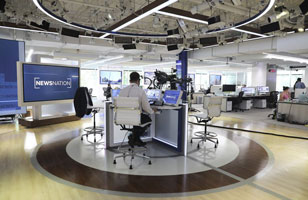 WGN
America to launch 'News Nation' on Tuesday, aiming to transform the house that Bozo built into the next CNN.
WGN America, the erstwhile home to Bozo and Andy Griffith, is set to reinvent itself as a cable news network with the Tuesday
[9/1/2020] launch of "News Nation," a prime-time newscast that pledges to deliver unbiased reporting. The mission is to
take a bite out of CNN, MSNBC and Fox News. Delayed but not derailed by the pandemic, WGN America has assembled a
150-person newsroom and has been making dry runs for several weeks of its nightly three-hour newscasts from extensively
remodeled Chicago studios.
WGN
America to launch 'News Nation' on Tuesday, aiming to transform the house that Bozo built into the next CNN.
WGN America, the erstwhile home to Bozo and Andy Griffith, is set to reinvent itself as a cable news network with the Tuesday
[9/1/2020] launch of "News Nation," a prime-time newscast that pledges to deliver unbiased reporting. The mission is to
take a bite out of CNN, MSNBC and Fox News. Delayed but not derailed by the pandemic, WGN America has assembled a
150-person newsroom and has been making dry runs for several weeks of its nightly three-hour newscasts from extensively
remodeled Chicago studios.
The Editor says...
That's a nice looking newsroom, but it is a mistake to put the primary news studio in one end of a TV newsroom. In a
newsroom, especially when unexpected (bad) things are happening somewhere nearby, conversations tend to get clamorous, police
scanners are chattering, and everybody's phone is ringing. The Happy Team doesn't like off-camera distractions. A
television studio is supposed to be totally silent except for the voices of the on-air talent. Moreover, the modern TV
studio has robotic cameras, and robotic cameras don't watch where they're going. The robot will stop if it runs over
your foot, but by then, it has run over your foot.
There's a reason that Netflix is sexualizing young girls. Thursday [8/20/2020] was a bad day for Netflix, one of the largest video content providers in the world, as well as being a left-leaning organization that partners with the Obamas and other well-known Democrats. Thursday was the day when thousands of people got upset that Netflix was screening and promoting a new French film about tweens twerking as a form of liberation. The obvious problem, of course, is that what Netflix did is catnip for pedophiles. It also degrades our culture and encourages young children to sexualize themselves. Beyond the obvious, Netflix's terrible decision points to a more serious problem in Western culture, which is that sexualizing children is a precursor of state control over the individual.
Hallmark Channel Proudly Presents New Film Featuring Lesbian Wedding. The Hallmark Channel is fulfilling its promise to include projects that feature LGBTQ storylines and characters. On August 15, the network will premiere the film "Wedding Every Weekend," which features a same-sex couple tying the knot. Two friends, who have four weddings to attend over the course of four weeks, decide to go to each one together. One of those weddings is for a lesbian couple.
ESPN Subscriber Losses Accelerate as Network Returns to Woke Programming. The subscriptions and revenues for ESPN are plummeting at an increasingly fast rate, as the network has replaced its sports coverage with leftist propaganda. Analyst Rich Greenfield recently looked at Disney and ESPN's reports and found very troubling numbers for the sport network and its parent company.
Ratings Crash for NBA, MLB After Protest-Filled Debuts. As the NBA and MLB return from their coronavirus-imposed hiatus, it appears TV viewers are not interested in what the increasingly woke leagues have to offer. With both baseball and basketball draped in all sorts of Black Lives Matter and social justice symbolism for their opening games, a substantially smaller number of fans tuned-in to the rest of the week's games.
A&E Went Woke and Now They're Going Broke. Being 'woke' is not good for business — and A&E found that out the hard way. The network has come a long way from its days of dry programming. Shipping Wars, Storage Wars, Longmire, Dog the Bounty Hunter, and other series have boosted ratings for the network. Live PD, created by Dan Abrams, was a better version of COPS that began airing in 2016. It had dozens of crews following police officers from all over the country, [...] After the death of George Floyd in Minneapolis, another wave of political correctness, mob antics, and anti-police fervor took to the streets. Black Lives Matter was back on the scene and the Live PD offered something that could not be allowed to survive because it showed a) that cops are decent human beings; b) at times offered how hard this job can be in certain situations. Remember, there can be no nuance with the far left. The show ran against the narrative that cops were all quasi-Nazis, so the network axed it. As a result, A&E lost nearly half its viewers.
A&E Has Lost Half Its Viewers Since Dropping 'Live PD'. Ratings for A&E Network have plummeted since it canceled the hit police reality show "Live PD" on June 10, a sign of how much the network relies on law-enforcement programming. Average prime-time viewership for A&E between June 11 and July 19 was 498,000 people, down 49% from the same period last year, according to data from Nielsen.
Nearly 1 in 3 U.S. Households Have Cut the Cord, And Sports Won't Save It. We'll look back at the coronavirus pandemic as the era of great transition when traditional linear media entertainment platforms finally conceded defeat to the growing power of direct-to-consumer business. Roku, Inc. today announced findings from its annual cord cutting study, including new insights shared by U.S. consumers about how the COVID-19 pandemic is influencing the shift to streaming. Ironically, Roku has not yet signed streaming agreements with major new entrants such as WarnerMedia's HBO Max and NBCUniversal's Peacock, and yet its findings suggest an acceleration in the mass exodus of linear customers. The study found that approximately 32% of U.S. TV households do not have a traditional pay TV subscription (cable, satellite, telco), while another 25% of households, identified as "cord shavers," cut back their service. When asked about intent to cut the cord fully in the next six months, 45% of cord shaver households said they were likely to do so.
The Editor says...
After you cut off the cable or satellite box, you should complete the process by removing the power cord, too. After your TV
is dead, you'll be surprised to discover that nobody is sick, masks are unnecessary, and Big Brother is not your friend.
BIPOC sounds redundant to me. And it sounds like institutional racism.
CBS
Commits 25 Percent of Development Budget to 'Black, Indigenous, and People of Color'. CBS has now committed to
using 25 percent of its production budget to produce TV projects dedicated to "BIPOC" topics — an acronym for
"Black, Indigenous, and People of Color" — and will increase the number of minorities in creative roles. The
network has promised to flood its production companies with new minority hires, to produce minority shows, and movies,
according to The Wrap. And not only will CBS dedicate 25 percent of its script-writing budget to what some
assume will be woke programming, the media giant said 40 percent of its writers' rooms on all programs will be populated by
non-white writers. The network further promised that half the writing staff of every show would be required to be
minorities by 2023.
The Editor says...
Why wait until 2023? Throw away your television now!
Cartoon Network Teaches Kids About "Intersex, Non-Binary" Gender Identities. A Cartoon Network show is teaching kids about "intersex, non-binary" gender identities. A clip from the Steven Universe show made in partnership with the Dove Self-Esteem Project was uploaded to Twitter in which one of the characters says, "Let's talk about social media, this is my page." The profile page belonging to the character reads "Intersex, non-binary, they-them."
When TV and Film Still Had Heart. There is a real darkness in our country and, no, it isn't the president's fault. He has simply amplified a hidden sentiment that has been masked for a long time. This goes for all forms of media, but specifically, it applies to movies, television, and obviously the news. I'd include music, but I have zero idea what the kids are listening to nowadays. [...] And what is the goal today? It's like there is a competition to see who can create more darkness. We get it. Ryan Murphy, you are the cream of the crop — I'm just not drinking it. Honestly, I'm not sure how many truly are, since a TV "hit" today is 5 million viewers. Shows used to get canceled if they had only 15 million viewers. These days the message counts more than the numbers.
Black mobs terrorizing whites nationwide. The media is constantly pounding the not so subliminal message that whites are evil and stupid. Politicians are doing the same. Actually, politicians are worse. Obama laughingly agreed with Lula, the former Brazillian president (and prior to that former Brazilian communist agitator) when the latter said that the global financial crisis was caused by "blond hair blue eyed devils". It doesn't stop there. "Educators" are also stuffing the brains of students with the notions that whites are evil and thieves and stupid and helpless. Madison Avenue also pushes the agenda that whites are either evil or stupid or both. In one Pepsi commercial, a black couple happily throw a can of Pepsi at the head of a white woman with a velocity that would indicate a fatal blow to the woman's temple. That perhaps is the most obvious of the anti-white commercials. However, it is by no means the only one. Just turn on your TV and I challenge you to find a single commercial or TV show where whites are not portrayed as evil or crooks or stupid or inept.
CNN's Ratings CRASH During Coronavirus Pandemic. There was a time when the nation turned to CNN in times of great crisis, tumult, or chaos, but it looks like those days are long in the past.
The Editor says...
CNN is seen mostly at airports and restaurants. This week, there's nobody in the airports or the restaurants. Hence
the ratings crash. Nobody voluntarily watches CNN.
Kiddy Cable Network Nickelodeon Celebrating Transgender 'Truth' Day. Do you let your kids watch the Nickelodeon cable network? If so they are being inundated with the normalization of Transgenderism.
Nickelodeon 'celebrating transgender people around the world' and 'their truth'. Nickelodeon told its millions of followers Tuesday that it was all-in for "Trans Day of Visibility." The home of "SpongeBob SquarePants," "TMNT" and a host of other children's shows posted a baby-blue, pink, and white flag on its Twitter account while touting support for transgender persons around the world. "Today is International #TransDayOfVisibility," the account tweeted for 3.8 million followers. "We're celebrating transgender people around the world and the courage it takes to live their truth [...]."
The Editor says...
Transvestites may have their own beliefs, but they don't have their own truth. A man who wears women's clothing is still a man.
Over 1,300 FCC Complaints Over Super Bowl Halftime Show. The Super Bowl halftime show earlier this year, featuring Jennifer Lopez and Shakira, saw the Federal Communications Commission receive approximately 1,312 complaints from viewers who felt the show was inappropriate, as CNN reports. During the controversial performance, the singers, wearing revealing outfits, pole-danced and made numerous sexually suggestive gestures. Many viewers, who were watching with their children, subsequently made complaints to the FCC that there was not adequate warning beforehand about what the show would entail.
The FCC got an EARFUL about the NFL Super Bowl halftime show and it wasn't good. If you saw the Super Bowl this year then there's a good chance you were dismayed by what you saw from both Shakira and J.Lo during the halftime show. I remember thinking it was incredibly inappropriate, full of obscene gestures by both singers as they danced around the stage wearing close to nothing. How horrified some parents must have been at what their kids were seeing. In a new report by CNN, they explain that the FCC received over 1300 complaints about the halftime show.
Hollywood is using victimhood to sell us bad entertainment. The 24 million people who watched this year's Academy Awards got to see what Hollywood has become: an industry that cares less about producing quality entertainment, and more about reinforcing a culture that puts a premium on grievance, oppression and victimhood. No one is more committed to fortifying the standing of victims and their unearned privileges than liberal celebrities. What are each of the nationally televised awards ceremonies if not tributes to social justice, celebrations of "diversity" and recognitions of various forms of hardship that women, ethnic minorities and non-heterosexuals are assumed to endure?
Ocasio-Cortez Guests on RuPaul Show: 'I Pledge Allegiance to the Drag'. Rep. Alexandria Ocasio-Cortez (D-NY) will serve as a guest judge on the reality TV show RuPaul's Drag Race, according to a trailer published Thursday [2/13/2020]. The drag queen contest series, which comes back to VH1 this month, carries a semi-political theme this year and features several political puns. Ru Paul will preside over the "Ru-nited States of America," the video ad says. In the video, RuPaul also announces that "the time has come for the first drag queen president."
AOC to guest-judge on 'RuPaul's Drag Race'. Alexandria Ocasio-Cortez has a queen new deal. The 30-year-old freshman congresswoman from The Bronx has signed on as a guest judge for Season 12 of "RuPaul's Drag Race," which will have a two-part premiere on Feb. 28 and March 6 on VH1. The series, which pits 13 cross-dressing contestants against each other in the search of "America's Next Drag Superstar," has already taken on a red, white and blue political hue for the new season, which coincides with the 2020 presidential election.
Don't Pretend The Shakira And J. Lo Super Bowl Sexcapade Was Surprising. [Scroll down] The only interruption from the bedazzled cleavage, stripper-pole suspension and booty-shaking extravaganza was the introduction of a child dance troupe, including Jennifer Lopez's 11-year-old daughter, continuing the ongoing trend of subjecting minors to unfettered promiscuity and sexualization. If anyone should be shielded from the pseudo-empowerment of self-objectification, it should be 11-year-old girls, yet here we are, thrusting them into the center of it. While some lauded the show as fierce and full of "feminine energy," others pushed back. One USA Today opinion article probed whether the Super Bowl ought to come with a parental warning, and National Review disputed J. Lo's characterization of the display as "empowering."
Franklin Graham: 'Pepsi Showing Young Girls that Sexual Exploitation of Women Is Okay'. Christian evangelist Rev. Franklin Graham expressed disappointment with the lack of "moral decency" displayed at the Super Bowl LIV halftime show and the message it purportedly sent to children, writing Pepsi showed "young girls that sexual exploitation of women is okay" and urging society to raise its standards. The Super Bowl LIV entertainment featured pop megastars Jennifer Lopez and Shakira, both of whom busted out in a series of crotch-grabbing, hip-thrusting moves throughout the performance.
J. Lo's Stripper Routine Was Not 'Empowering'. Given the character of Miami, where the game was played, it makes sense for Latinas to perform in the Super Bowl halftime show, but let's not mistake Lopez and Shakira's double-booty shake as a feminist breakthrough. Lopez and Shakira wore Vegas showgirl costumes and Lopez cavorted around a stripper pole. I would not expect either of them to come out on stage in a tweed jacket and recite Shakespeare's sonnets, and I'm sure each of them cashed a large paycheck for their gyrations, but let's at least be honest about the meretricious nature of what the show was. It was pure self-objectification, flaunting feminine sexual appeal for the purpose of titillation. Everybody's got to make a living, but some careers are more worthy of respect than others.
Making the Children Leave the Room. I think Kyle was exactly right in his post this morning criticizing last night's Super Bowl halftime show, put on by Shakira and Jennifer Lopez. "It was pure self-objectification, flaunting feminine sexual appeal for the purpose of titillation," as he put it. I had the same thought; we talk a lot about women's empowerment these days, and about how men shouldn't treat women as sexual objects. That's all well and good, of course, but must we fix that problem that by glorifying women who present themselves as sexual objects? That's really not much more empowering than when men do the same thing to us.
Hallmark Channel boss stepping down after lesbian ad debacle. The chief of the Hallmark Channel's parent company is stepping down following a furor over the network's airing of ads depicting a lesbian wedding. Hallmark Cards announced the departure of Bill Abbott as president and CEO of Crown Media Family Networks, which operates Hallmark's three family-friendly cable channels, after 11 years in the role.
'Party of Five' Reboot Is Pure Illegal Immigrant Propaganda. [Scroll down] The point is, the '90s "Party of Five" was a generational star-maker built on a very compelling premise. The show really didn't need rebooting. It ran for six seasons (1994-2000) and told its story. The kids grew up. But Freeform has decided to reboot it anyway, only without the compelling tragic storyline and with lots and lots of wokeness. Check out the trailer. It's a 30-second lecture on "All That's Bad With America Under Trump." Instead of the kids being orphaned by a law breaker who drives drunk, they're orphaned by a different kind of lawbreaker. Their parents are illegal aliens and deported by the "terror" group ICE.
Hey, AT&T, Flagrant Racism and Sexism Are 'Not OK'. In a new series of AT&T commercials, the format changes a little, but the racism endures. In the first of these ads, the viewer sees an elevator stuck between floors. In the car are ten people, three black males, four women of various ethnicities, two men either white or Hispanic, and a tall, goofy, very white guy in the center of car. Yes, you guessed it. It is the goofy white guy who says inappropriate things until the elevator starts moving again.
CNN Pays 58 Airports $100,000 Each to Play Channel at Gates. Tucker Carlson Tonight reported CNN is spending millions of dollars to have their channel played at fifty-eight airports across the United States. As Carlson explained, CNN is paying the airports approximately $100,000 each to "pump propaganda into America's airports, holding its hapless travelers hostage." He commented: "It's not something [the airports] would do willingly. Who would? Nobody watches [CNN] — it's garbage."
CNN Pays Airports $100,000 Each to Play Fake News At Gates. An investigation by Tucker Carlson Tonight has revealed that CNN is paying off more than fifty major airports throughout the United States to play their broadcasting to unsuspecting travelers at airline gates. The network pays airlines around an average of $100,000 each to play the fake news, adding up to more than $6 million dollars in bribery. Such a use of network resources could be easily used to fund legitimate and newsworthy journalistic endeavors, but the network, under the leadership of Jeff Zucker, instead adopts an approach of merely paying to have its propaganda broadcast to non-consenting viewers.
The Strange Alliance: Secular Humanism and Neo-Paganism. The latest homosexual propaganda that has recently appeared on TV is an ad entitled "Beyond I do". It presents two totally silent lesbians holding several small children and looking very content. The message is clear: Gay marriage is not the end of the homosexual rights campaign but its new beginning.
Under pressure, Hallmark pulls gay-themed wedding ads. Under pressure from a conservative advocacy group, The Hallmark Channel has pulled ads for a wedding-planning website that featured two brides kissing at the altar. The family-friendly network, which is in the midst of its heavily watched holiday programming, removed the ads because the controversy was a distraction, a spokesperson said in an interview Saturday [12/14/2019].
Hallmark Channel Pulls Ads Featuring Lesbian Kiss After Backlash. In early-December, the Hallmark Channel, known for its cheesy Christmas romance movies, began airing commercials for Zola, a wedding planning and registry website. The commercials feature several different couples talking about the benefits of using Zola while standing at the wedding alter in front of friends and family. Two of the three couples in the series are heterosexual, while the third couple is lesbian. Some of the spots are shorter, focusing on only one couple, while others involve a cutting together of all three. At the end of the commercial, the couples kiss.
The next day...
Hallmark
Channel reverses decision to ban ads featuring same-sex couples. The Hallmark Channel is reversing its decision
to pull advertisements featuring same-sex couples and apologizing for removing them in the first place, a network spokeswoman
told CNN Business. The decision comes after Hallmark parent company Crown Media Family Networks faced calls for viewers
and advertisers to boycott its television channel. The ads, from online wedding planning company Zola, showed same-sex
couples celebrating marriages.
Hallmark Channel Reinstates Same-Sex Wedding Commercials It Initially Pulled. The Hallmark Channel, after initially removing a commercial depicting a lesbian wedding, has said it will restore the commercial to its airwaves, according to Fox News. The commercial for the wedding planning site Zola was taken down by Hallmark after widespread complaints, which the network said "was creating a distraction." Zola subsequently pulled all of its other ads from Hallmark, including the ones featuring normal couples, following the decision.
All impeachment all the time. Where does that get you?
Bottom
Falls Out as CNN Ratings Hit 3-Year Low. Far-left CNN, an anti-Trump, pro-violence, racist, fake news outlet
that traffics in conspiracy theories, collapsed to a three-year low in the ratings during the week of November 25.
Your Smart TV could be spying on you, FBI warns. Consumers need to think seriously about the security of their Internet-connect Smart TVs, according to the FBI. "A number of the newer TV's also have built-in cameras," the FBI's Portland field office said, in a statement. "In some cases, the cameras are used for facial recognition so the TV knows who is watching and can suggest programming appropriately. There are also devices coming to market that allow you to video chat with grandma in 42' [sic] glory." "Beyond the risk that your TV manufacturer and app developers may be listening and watching you, that television can also be a gateway for hackers to come into your home," the FBI added.
Why I Enjoy the White Nationalist Christmas Network Known as The Hallmark Channel. [Scroll down] Can you guess which states register the highest when it comes to this network? Yes, states that Trump won in 2016 is where Hallmark does the best with viewers. The piece then goes on some weird tangent about how all the male characters have white-nationalist haircuts. So, there you have it. Hallmark is really a covert network for white nationalism. It just shows you how sick the Left has become since Trump's upset 2016 win.
Hallmark Channel Under Assault by Race Hustlers and LGBTQ Cult, 'Too White'. Every Christmas season, it appears we have to endure listening to the race hustlers and the gay patrol complain about the one channel left in America that does not partake in envelope-pushing. The Hallmark channel really is the last known entertainment that does not engage in the culture wars by pushing "diversity" for the sake of pleasing the agitators and instead focuses on its demographics; white moms and grandmas. But these days, being white and enjoying things white people like is a cause for concern and mockery. I'm white, and a mom, and Hallmark doesn't particularly appeal to me except in the sense that I know I can turn it on and not be concerned that my children will be exposed to clown world morality that is on every other channel.
Woketards Drive 'American Music Awards' Ratings to Another Record Low. The American Music Awards (AMAs) hit an all-time low in the all-important 18-49 age demo Sunday [11/24/2019], and pretty much tied its record-low total viewership. It was just last year when the American Music Awards hit its previous record low, with a 1.8 rating in the 18-49 advertiser-coveted age demo. This year that number dropped to 1.7. Good heavens, the AMAs can't even attract young people. And this year's performances saw one woke showcase after another.
Report: Hollywood Adds More LGBT Characters to TV, Cable, Streaming — Now 488 Total. GLAAD, an organization that seeks to accelerate "acceptance of the LGBT community" in American culture, released its 2019 report, Where We Are on TV, and applauded the TV and cable entertainment industries for adding more LGBT characters to their programs. "Of the 879 regular characters scheduled to appear on broadcast scripted primetime television this season, 90 (10.2 percent) are LGBTQ," states the report. There are also some 30 recurring LGBTQ characters, making a total of 120. That's up from last year's 113 regular and recurring LGBTQ roles.
The Editor says...
If you haven't done so already, you should take all of the television sets out of your house and leave them at the curb for the next garbage truck.
When I got rid of my last TV in 1980, it was because the programming was boring, shallow, insipid, and a waste of time. Now, almost 40 years later,
the programming is offensive, demeaning, pernicious, blasphemous, and destructive. The commercials are nearly as bad, and the so-called
"local news" is nothing but an infomercial for big government.
GLAAD: We Want '20% Of Series Regular Characters' To Be 'LGBTQ By 2025'. On Thursday [11/7/2019], GLAAD published its annual "Where We Are on TV" report, which examines the number of LGBTQ characters on television. In the opening paragraphs of the report, GLAAD President Sarah Kate Ellis states that television plays a crucial role in our culture when it comes to "changing hearts and minds." She adds that according to a study, "less than one-quarter of Americans have a close friend or family member who is transgender," which means many Americans "learn about trans people from what they see in television, movies, and news."
Young Adults Fed Up with SJW and LGBTQ Tyranny. The new "Batwoman" TV series featuring an openly lesbian Batwoman is failing big-time. I was pleasantly surprised to learn that young adults are turned off by the show's extreme woke and SJW (social justice warrior) politically correct messaging. "Woke" means you are aware of social and racial injustice. "Woke" also means straight white men are the source of all evil and must be punished. Women and minorities are perfect in every way. Woke culture says anyone who dares criticize a woman or a minority hates women and minorities. Batman fans are outraged over the "Batwoman" TV series trashing Batman and its in-your-face trashing of men.
The Editor says...
In other words, it's a "made for TV" movie. Just about every Saturday afternoon filler movie on TV is a
man-bashing chick flick, peppered with man-bashing commercials.
Nine Democrat Presidential Candidates Taking Part in LGBT Town Hall Marathon. CNN and the gay rights advocacy group Human Rights Campaign (HRC) are hosting a marathon town hall with nine Democrat presidential candidates on Thursday in Los Angeles from 7:30 p.m. until midnight. "The town hall, which will take place on the eve of National Coming Out Day, will mark the first time in history that a major cable news network will air a presidential event devoted to LGBTQ issues," the HRC website states of the event.
Crash: Emmy Ratings Plunge To Worst In History. The TV people put on a TV show to praise TV, but TV viewers tuned out in droves. The 71st Primetime Emmy Awards on the Fox network hit a record low with a dismal 5.8 household Nielsen rating — a 22% drop from last year, Deadline reported. Last year, the show pulled a 7.4 rating (10.2 million viewers). The latest show got crushed by NBC's "Sunday Night Football," even though it featured the undefeated Los Angeles Rams versus the lowly Cleveland Browns.
Smart TVs Caught Sending Sensitive User Data To Facebook And Netflix. A study by researchers from Northeastern University and Imperial College London found that many popular smart TV models, including models by Samsung and LG, as well as streaming dongles Roku and Amazon FireTV, are leaking sensitive user data to advertisers. The models listed above would share data like location and IP address with Netflix, Facebook and third-party advertisers, according to the FT.
Where have all the heroes gone? [Scroll down] Into this alarming environment comes TV fare showcasing the idea that women aren't as good as men, but better. Computer hackers, car-jackers, detectives, doctors, lawyers, spaceship commanders — all better than their male counterparts. And they can fight! Little bitty women with toothpick arms beat up whole gangs of muscular male brutes with square jaws and hairy bellies. In the next scene, these gals turn on the charm in scanty evening gowns as the guys line up panting. I don't watch the comic book flicks where the female hero with exaggerated curves, dressed to bring these assets into unmissable relief, beats up the worst villains in the universe, but it's hard to escape the ads. Gotta be quick on the remote. The point, among others, is that the male hero has all but disappeared from the cultural scene.
Two Americas, tuning each other out. Americans used to have only a few TV options, leading to moments of mass culture like The Beatles' appearance on "The Ed Sullivan Show" or the "M*A*S*H" finale. But just as the spread of social media jumpstarted political tribalization, the rise of cable and streaming services has necessitated a need for a wealth of content — increasingly targeted and niche — that has hastened a cultural splintering.
New HBO Series 'Righteous Gemstones' Hits Rock Bottom with Mockery of Christians. HBO's latest fiasco in entertainment, The Righteous Gemstones, premiered on Sunday night [8/18/2019]. Nudity? Check. Unnecessary profanity? Check. Extremely mind-numbing content? Check. So what sets this show apart from the rest of the junk HBO puts out? Not much. The storyline, which is centered around a rich celebrity pastor, Eli Gemstone (John Goodman), and his family — a greedy and very corrupt bunch of people — comes across as a mockery of Christians, despite the showrunner's attempts to claim it's not. The Gemstone Family is not only extremely insincere as they parade around in their private jets, going on mission trips that seem more like photo ops than evangelical outreach, but they are also extremely hypocritical. The family is constantly seen fighting and using foul language. In fact, the f-word is used 41 times and the Lord's name is taken in vein [sic] 28 times in the show's first hour.
What TV Binge-Watching Does to Your Brain. Binge-watching episodes of your favorite shows does no favors for your brain, an expert warns. "It's important to recognize that the brain is not an isolated organ — it responds to its environment," said Dr. Randall Wright, a neurologist at Houston Methodist in Texas. "When we binge-watch, we create an unhealthy environment for the brain because we're sitting for long periods of time, isolating ourselves from social activities and eating large amounts of unhealthy food."
Protest Demonstrations in Recent TV and Film. Two recent productions — a TV miniseries and a movie — point to issues in the depiction of social protest and civil disobedience in the entertainment media.
The Editor says...
The article immediately above is a review of two recent TV productions, both of which (judging by the review) portray a complete inversion
of real life, just as most TV programs and commercials do. Television programs are written to depict life as the writers wish it was,
which is far different from the day-to-day life you can see for yourself.
Comcast Launches Eye Control For The TV, An Aid For Physically Disabled Viewers. Comcast has launched a feature enabling viewers with physical disabilities like spinal cord injuries or amyotrophic lateral sclerosis (ALS) the ability to navigate their television using only their eyes. Xfinity X1 eye control is a web-based remote for tablets and computers that pairs with an existing eye gaze system and allows viewers with a single glance to change the channel, access the DVR or search for programs.
The Editor says...
This could be a kindly and benevolent gesture to benefit the one TV viewer in a million who can only move his eyes.
Or it could be a way to see if you pay any attention to pop-up advertisements. The latter is far more likely.
Technical innovations on television are driven by advertising. (Technical innovations on the internet are driven by
pornography, identity theft, data mining, and e-commerce. And advertising.)
Lesbian ponies coming to Discovery Family kids show. The children's show 'My Little Pony: Friendship Is Magic' on Discovery Family Channel will be introducing a new lesbian couple .. of ponies.. in an episode airing the week of June 16, one of the show's writers announced. The episode "The Last Crusade" will feature ponies Aunt Holiday and Auntie Loft, and writer Michael Vogel tweeted about the TV premier of the two characters, relating the moment to Pride Month.
HBO series about teens grossly inappropriate for them, says PTC. The new HBO series called "Euphoria" is a high school-centered show, according to PTC's Melissa Henson, following in the footsteps of series like MTV's "Skins" and "13 Reasons Why" on Netflix ... except that "Euphoria" is pushing the envelope even further by using extremely graphic adult content — sex, violence, profanity, and drug use — to target youngsters. "It's almost like this race to the bottom to see who can get out there with the edgiest, the most risqué content, [to see] who can put these kids in the most dangerous situations," she laments.
Kids Cartoon Show Introduces Lesbian Pony Couple. The hit kids cartoon show "My Little Pony: Friendship Is Magic" will introduce a lesbian pony couple in the upcoming episode for its final season on Saturday [6/15/2019]. The character Scootaloo will appear alongside the show's two new characters, "Aunt Holiday" and "Aunt Lofty." The episode is set to air during the height of gay pride month as millions across the country participate in rallies to celebrate LGBT Pride.
The Growing Popularity of Foot Shooting. The purpose of a comedian is to make people laugh. That ceases when humor becomes politicized. Politicized comedians have not only shot themselves in the foot, they have lost track of their reason for being comedians. Politics kills humor and there's nothing funny about hate. Johnny Carson, Jonathan Winters, Sid Caesar knew that instinctively. Actors and comedians need to make a decision — do they want to entertain people or proselytize? For them, it is essentially impossible to serve two masters. One of the masters is incompatible with the other.
Rachel Maddow's ratings plummet. Rachel Maddow's ratings for the month of May were the lowest in the key 25-54 demographic since President Trump took office in 2017. MSNBC's "The Rachel Maddow Show" averaged 410,000 viewers in the demo this month. The ratings were the lowest in that demographic since January 2017 when the show averaged 412,000 demo viewers.
MTV Reveals First Sexually Fluid Reality Dating Show. MTV on Thursday [5/30/2019] announced the first sexually fluid cast for the upcoming eighth season of their hit reality series, Are You The One?, hosted by Terrence J. Following Are You The One?'s signature format, 16 singles will travel to Hawaii in hopes of finding their "perfect match" and splitting the $1 million cash prize. But, for the first time ever on a dating competition show in the U.S., there will be no gender limitations as each cast member identifies as sexually fluid.
Ohio weatherman lambasts viewers complaining his live tornado bulletin was interrupting The Bachelorette. An Ohio weatherman lost it on live TV after viewers complained his severe weather warning was interrupting the reality show The Bachelorette late on Monday [5/27/2019]. Jamie Simpson was giving updates on the tornadoes, which would go on to ravage the Dayton area later in the night, when he saw complaints pour in on social media. 'We have viewers complaining already, "just go back to the show." No, we're not going back to the show, folks. This is a dangerous situation,' the Fox 45 meteorologist said.
The Editor says...
Weather warnings, Amber Alerts, presidential messages, and all other EAS interruptions should be maskable.
TV sets are smart. The consumer should be able to dig into the setup menu and opt out of a dozen different
categories of messages. If you'd rather watch a circus than a tornado warning, that should be your business.
But the TV stations that produce "local news" shows tend to interrupt normal programming to produce weather warnings.
This is the same programming model they used in 1985. There's no way to opt out of a weather bulletin when the
TV station switches away from your favorite show, except to change the channel or hit the OFF button. It's entirely
up to the TV station management to decide in advance if the interruption of prime-time programming is a good idea. The
government is pressuring them to keep the populace alarmed by menacing it with an endless series of weather
bulletins,* but the
advertisers (to say nothing of the viewers) want the prime time shows to be watchable.
Late Night Right: Where Are The Republicans On Evening TV? Late night comedians pounced on the Mueller report with predictable results. They either shredded Attorney General Bill Barr or claimed President Donald Trump was still guilty of something. No one cracked wise about the Democrats who screamed "collusion," without evidence, for the past two years. Late night TV is awash in liberal voices, and has been this way for some time now. Is there room for at least one right-leaning show?
Atlantic: Late-night comedy isn't funny anymore (it doesn't even try. Today the Atlantic's Andrew Ferguson has a piece about the death of comedy on late-night television. His observations are prompted by the recent arguments over the White House Correspondent's Dinner which hit an iceberg last year in the form of Michelle Wolf's mean and not funny routine. This year, President Trump has said he won't attend and has ordered members in his administration to do likewise. That was seen as a terrible thing by some in the media but I'm with Ed on this one: So what.
National Reckoning, My Eye. The media has managed to impose a kind of groupthink that tells us that America is rife with racism and bigotry, but looking around and watching television, the only racism I seem to notice nowadays is the one against whites who go to church and raise law-abiding families. Watch any Netflix or Amazon series and you'll see what I mean. (Better not watch it, actually.) The priest is always a pervert, the religious families are selling drugs on the sly, and all cops and soldiers are rapists, racists, and bigots. All criminals are white, blond, and sporting Nazi tattoos. Well, you know the rest. Political correctness and diversity training have now become standard, and lockstep conformity is the order of the day.
Charles Van Doren, Inspiration for 'Quiz Show' Movie, Dies at 93. Charles Van Doren, the inspiration for the 1994 film Quiz Show, died on Tuesday [4/9/2019]. He was 93. Van Doren confessed to Congress in 1959 that his 14-week winning streak on the popular NBC quiz show Twenty-One was a hoax. During his eloquent testimony, the Columbia University English instructor confessed to having been given the questions and answers in advance, as well as being told to act dramatically while deliberating over the inexplicably correct answers.
How is it that Charles Van Doren never was in jeopardy? [Scroll down] The corruption by commercialism, by which the sponsors corrupted the producers who corrupted the contestants, who, jointly, corrupted the viewers, disgusted many. For mere money, producers and contestants traded away something more valuable and not easily regained. Audiences mistook trivia for true knowledge and recast the American Dream as a get-rich-quick scheme. It seemingly said something foul about postwar America, which also struggled with investigations into disc-jockey payola, fight fixing, and even the claims of Twenty-One sponsor Geritol around the same time.
Poll: TV Viewers Are Tired of Saturday Night Live's Political Obsession. As the weekly target of Saturday Night Live's "humor," President Trump's disgruntlement with the show is understandable. According to a new poll conducted by The Hollywood Reporter and Morning Consult, however, it isn't just him who has grown weary of SNL's shtick. The poll found that 39 percent of the respondents feel that SNL is now "too political." Almost half of the sample feel that the show in its present incarnation is "more liberal," while five percent of those polled live in some Bizarro world where they feel it's "more conservative." The relentless focus on politics in late-night comedy is certainly tedious.
Many Americans Say 'Saturday Night Live' Is Now "Too Political," Poll Finds. [Scroll down] About 32 percent of Americans said they think the show is "more entertaining" with a political guest host, while 37 percent think otherwise. In a similar vein, Americans are split on whether individual sketches should be based on relevant headlines about the White House or Congress. Some 37 percent of respondents said that the show "is more entertaining when politics is incorporated into sketches," while 35 [percent] disagree that the series is better when it focuses on political news.
This Is The Reason Smart TVs Are So Cheap. A significant reason why a smart TV, or perhaps a new 65-inch 4K smart TV with HDR capability, can be purchased for about $500, is because some manufacturers are harvesting data from users. [...] Vizio TVs, have the ability, with user opt-in, track anything that is on the TV, what the company calls "automatic content recognition." That data used to be sold off to third-party data aggregators, but after the Federal Trade Commission and New Jersey slapped the company with a multi-million dollar fine in 2017. Legal documents from the case reportedly show that Vizio installed software on 11 million smart TVs to track viewing habits without consumers' knowledge. Now, Vizio keeps the data but sells targeted advertising in a platform model like Google and Facebook.
Survey: Americans Spend Nearly Half Their Waking Hours Looking At Screens. More specifically, the survey found that 42% of the time Americans are awake, their eyes are fixated on a television, smartphone, computer, tablet, or other device. Supposing the average American slept eight hours a night (not even close to the case for most adults), the researchers calculated that people spend about six hours and 43 minutes a day staring at a screen.
A complete inversion of reality:
'Murphy
Brown' features reporter beaten by 'sea' of MAGA-hat wearing thugs at 'Trump' rally. CBS' "Murphy Brown" took
its jabs at the Trump administration to a new level this week with a story in which character Frank Fontana is beaten by a
mob of MAGA-hat wearing thugs. Rumors swirled this week that Candice Bergen's show would not be renewed after its
initial batch of 13 episodes aired, but the creators' liberal stance was further solidified on Thursday with a story called
"Beat the Press."
The Editor says...
Tea Party people and right-wingers wearing MAGA hats are usually the victims of political violence in this country, not
the instigators and perpetrators of it. No one other than a poorly-educated left-wing activist at CBS
would believe otherwise. News reporters are only rarely the targets of physical violence, and in all the cases
that I can recall offhand, when reporters have been exposed to criminal violence, it has been connected to theft,
domestic violence, or the random acts of homeless people who should have been locked up.
Report: Anti-Trump 'Murphy Brown' Reboot Cancelled After One Season. CBS is cutting bait with its re-booted, President Trump-bashing sitcom, Murphy Brown, announcing it will not renew the show after its first 13 episodes, according to reports. The Candice Bergan-fronted comedy came back with much fanfare as a full-throated attack on President Donald Trump, but lackluster ratings dogged the show from its very first episode.
Are You Ready to Stop Watching the Never-Ending Commercial? On television, the real commercial is found in the programs more than the nominal commercial breaks. Network programs plug socialized medicine, either with some fawning reference to the Canadian system or complaints about prescription drug prices and "big pharma." For nearly two decades, virtually every prime-time show has featured gay characters politicizing their orientation. Police and legal shows advocate increased immigration while claiming that unlimited immigration is somehow the law. Popular sitcoms feature promiscuity while ridiculing those who fail to be promiscuous. The point is not simply that television features bad things. We already knew that. The point is that television programs are little more than commercials for promiscuity, unfettered immigration, socialized medicine, gay rights, and the rest of the Democrat agenda. Movies are not at all different. Every movie (with a few marginalized exceptions) revises history in some way and serves as a Democrat campaign commercial. The Academy Awards are today's equivalent of Orwell's "two minutes hate" against Republican politicians.
Worst Quarter Ever For Cable/Satellite TV Providers. Contrary to suggestions of a slow-down, the number of Americans severing their ties to cable and satellite TV soared to the largest number ever during the third quarter this year. For the first time satellite and cable TV providers lost more than a million subscribers from July through September this year. To be exact, they lost 1.1 million customers. Which is a lot of of monthly fees gone poof!
Why liberals laughed at a wounded veteran. Conservatives rightly are getting on the case of Peter Michael Davidson of the SNL political hour for mocking a Navy SEAL's war wound. The target was Texas congressional candidate Dan Crenshaw whose only crime is being a Republican. Davidson is now as repulsive as Samantha Bee, who called the First Daughter the C-word, and Stephen Colbert, who called the president a homophobic slur. No one lost their job. They said this in scripted, taped remarks. That means they spoke for their network and its corporate owner.
GLAAD: the number of LGBTQ series regulars on TV is at an all-time high. For the past several years, the entertainment industry has been the subject of many a conversation about representation and inclusion of women, people of color, and LGBTQ+ individuals onscreen. [...] It's a growth that comes in concurrence with a 4 percent increase over last year in series regular characters on broadcast television who are people of color and, within that statistic, an overall increase in racial diversity as characters of all ethnicities have become more visible in mainstream media.
American Music Awards ratings plunge 29 percent with politically charged show. The politically charged 2018 American Music Awards produced dismal viewership, setting an all-time low rating for the annual special. According to Variety, Tuesday night's "American Music Awards" on ABC earned a disappointing 1.8 rating among the key demo of adults age 18-49 with 6.5 million total viewers, according to the Hollywood trade publication. The total was down 25 percent compared to its 2.4 demo rating in 2017.
Emmy Awards drop 11 percent from last year with a record low of 10.2 million viewers. The 70th Primetime Emmy Awards on Monday night produced the show's smallest audience in its history. The final numbers from Nielsen were revealed on Tuesday afternoon and show the annual awards ceremony saw a sharp decline in viewers and a dip in its targeted demographic. A little over 10 million people tuned in to the three-hour Monday night [9/17/2018] show, an 11 percent drop from last year's 11.8 million viewers.
The Emmys Telecast Was a Cringe-Worthy, Tone-Deaf Embarrassment. "Let's give ourselves a hand!" He really said that! It made me laugh. He wanted accolades for this disaster. It made me laugh — and wonder just how tone-deaf this award show could possibly be. The answer presented itself, repeatedly, and with much unearned self-congratulation: very tone-deaf. He is chairman of the Television Academy Hayma Washington, who came on stage right before the last act of a miserable Emmy Awards telecast, and repeated the night's running theme: This, the 70th Emmy Awards, features the most diverse and inclusive group of nominees ever. Yet the tepid response he received — he had to literally cajole the crowd to applaud itself, a rarity for this industry — underscored everything woefully misguided about this Colin Jost and Michael Che-hosted outing, perhaps the worst-produced award show since James Franco and Anne Hathaway co-hosted the Oscars.
The Top 50 Liberal Media Bias Examples. [#46] TV's anti-conservative attacks: Episodic television is no different than Hollywood in its attacks on the right. For a few examples: NCIS featured a story about terrorists not long ago. Of course, the terrorists were white people mad at US government failures, not Muslims. The series Medium created a character evoking comparisons to the law-and-order Sheriff Joe Arpiao in Arizona. Only the TV show's version was a child rapist and murderer — naturally. This is not to mention the bias belched out by the chicks on The View on a daily basis.
How Smart TVs in Millions of U.S. Homes Track More Than What's On Tonight. The growing concern over online data and user privacy has been focused on tech giants like Facebook and devices like smartphones. But people's data is also increasingly being vacuumed right out of their living rooms via their televisions, sometimes without their knowledge. In recent years, data companies have harnessed new technology to immediately identify what people are watching on internet-connected TVs, then using that information to send targeted advertisements to other devices in their homes. Marketers, forever hungry to get their products in front of the people most likely to buy them, have eagerly embraced such practices. But the companies watching what people watch have also faced scrutiny from regulators and privacy advocates over how transparent they are being with users.
Michael Che's Lambaste Of Substituting Politics For Comedy Is Spot-On. The hottest trend in stand-up comedy is to fill as much time as possible on a political soapbox, and perform no actual comedy. The new rock-star comedians praised by progressive millennials do not make uniquely funny observations about life, but reveal deeply personal tragedies to their audience, usually with a strong call to social action. They seem to have one, strong characteristic in common: They are not funny. [...] Late-night comedy shows have elected themselves the educators of the masses.
CW's 'Supergirl' Casts Transgender Rights Activist as First Trans TV Superhero. The CW network's Supergirl has announced the casting of transgender rights activist Nicole Maines to play a super-powered hero in the series upcoming fourth season. Reports of the search for an actor to portray a transgender character broke in May, but now word has emerged that Maines has been cast as Nia Nal, a hero named "The Dreamer." Nal will have the power to sense the future, according to The Hollywood Reporter.
Trump-Bashing Rants By Late-Night 'Comics' Now Get Treated As Real News. If you rely on the nation's top news sites to determine what was really important about the Trump-Putin Helsinki summit, the answer would be: How did Trump-hating late-night talk-show hosts react? We are not kidding. This is how low the mainstream press has sunk.
Will Upcoming Emmy Awards Double as Resistance TV? Awards shows have always had an emotional element to the winners and losers. The best movie, TV show, song, or production should snare the highest awards, but other factors can't help but creep in. When an actor is in his or her golden years, for example, they have a sentimental edge over the competition. Or, as in the case of this year's Best Actor Oscar winner Gary Oldman, a legacy of rock solid performances prior to becoming Winston Churchill in Darkest Hour. Today, there's another factor threatening to overwhelm the usual standards for the best of the best. How does the nominee factor into The Resistance?
Americans are losing confidence in many things, but not these three. Americans, it seems, are growing increasingly dubious, skeptical, even cynical about many of their once-hallowed institutions. These include especially Congress. But any such disapproval list also contains TV news, newspapers, unions, public schools and even the criminal justice system. Only two institutions — the military and small business — hold an overwhelming net positive opinion in the minds of Americans. The volunteer military has by far the most public confidence — 94 percent with a great deal or some confidence in it.
When you finish this editorial, pick up a book. Pleasure reading is at an all-time low, a new study shows, and the culprit is television. More TV and less reading leaves people less imaginative, less informed, and less fully alive. The trend needs to reverse.
Keep the Kids Away from 'Drag Tots' — This Cartoon Is Coming Soon. A new show proves the need for parents to monitor carefully what programs their little ones are watching: On June 28, a cartoon called "Drag Tots" is premiering on World of Wonder network, and it is exactly what the title conveys — a cartoon about baby drag queens. Not only that, but these are baby drag queens with a message: The president is bad. "In the show's first trailer ... a voiceover warns that the world is 'on the brink of chaos' because of President Donald Trump and his controversial administration," notes The Hollywood Reporter. "After a clip is shown of Trump touting his plan to build a wall between the U.S. and Mexico, the voiceover suggests a quick fix to all of today's political unrest: 'baby drag queens.'"
Broadcasters Hope To Counter Ad Skipping By Replacing Ads With Short 'Inspirational Videos'. The cable & broadcast industry has gone to some pretty absurd lengths to avoid having to adapt to the cord cutting era. As ad-skipping DVRs started to become popular, the industry's response wasn't to embrace natural evolution, it was to file a bunch of lawsuits and creatively harass companies that were trying to give consumers what they wanted. Similarly, as cord cutting has grown thanks to sky-high prices and ad break fatigue, the industry's overall response was to first raise prices like it was going out of fashion, then try to speed up or edit down programs in the hopes of shoving more ads into each viewing hour.
A New Low for Dr. Oz. It was Cicero who wondered how one fortuneteller could pass another in the street and keep a straight face. But that's Dr. Oz's main qualification — he keeps a straight face no matter what he's holding up to the camera. What's next? I can just see this credentialed hack earnestly pointing at maps of the soles of the feet to enlighten the masses about reflexology, or extolling the diagnostic benefits of the bumps on the skull. What am I saying — he's probably done those already, and if he hasn't, it's not for lack of shame.
Netflix Approval Plummets Among Republicans Amid Obama Production Deal, Susan Rice Board Appointment. Republican's approval of the internet streaming giant Netflix has dropped amid the company's recent embrace of Susan Rice and Barack Obama, according to polling data obtained by Variety. A survey by the research firm YouGov found that Netflix's positive impression rating with Republicans fell by 16 percent since the beginning of 2018. Meanwhile, the company's positive impression rating with Democrats has risen by 15 percent in the same period.
The Astonishing Silliness of CNN. [Scroll down] Over the course of two airports, CNN was everywhere. Before departure, CNN was rolling in our lunch restaurant. Next door, CNN was burbling in a convenience store. In the second airport, in the waiting area at the gate, CNN was not only surrounding me on several screens, but the sound was also piped in. [...] Join with me, America, and demand the channel be changed. Or even better, to turn the TVs completely off, with the exception of major sporting events and occasional soothing nature specials.
Fox Moves to Revive Tim Allen Comedy Series 'Last Man Standing'. The Tim Allen-fronted blue-collar comedy Last Man Standing may make Fox Broadcasting Co. its new network home after ABC abruptly canceled the successful series last year.
NBC took a $69M chance on Megyn Kelly and it looks like a failure. NBC poured millions of dollars into "Megyn Kelly Today" and, in return, they've been rewarded with a massive drop in viewership. The Peacock network poached Kelly from Fox last year, enticing her from the conservative flagship network with a three-year, $69 million contract, according to the Wall Street Journal. But Kelly's introduction to NBC, premiering at the 9 a.m. hour in September, was met with almost immediate controversy — a feud with Jane Fonda that the morning show host dragged out for months — and she never drew the viewership that the network was looking for. Her Sunday night newsmagazine show was an even bigger disappointment and was quickly shrunk to sporadic primetime specials.
House of Canards: Netflix Drama Gets it Wrong on Gun Laws, NRA. March 4 saw the premiere of the fourth season of Netflix's hit political drama House of Cards. The show follows the machinations of House Majority Whip Frank Underwood as he ascends to the presidency and subsequently runs to stay in office. While the real-life Washington elite certainly have an unsettling fondness for the Machiavellian drama, its depiction of life inside the Beltway is highly stylized. This season this fact is made abundantly clear with the show's portrayal of federal gun laws and NRA.
The Glades, "Iron Pipeline": it's always the awkward ones. Guns are bad and only police personnel should own them; that is what the episode teaches.
Easy as ABC. The American Broadcasting Company has just discovered what George Orwell proclaimed seven decades ago: "To see what is in front of one's nose needs a constant struggle." What ABC finally realized was that about 50 percent of the country voted for Donald Trump. No network can afford to lose half its audience. That way lies self-parody and selfdestruction. Consider ESPN, with its 24/7 politicizing of sport and, as a result, a catastrophic loss of subscribers — down 8 percent last year and falling. ABC News is still in attack mode when it comes to the Trump presidency, but its programming department is too canny to go down that increasingly crowded highway.
Why Megyn Kelly's NBC show is a flop. After making a name for herself at Fox News, in large part thanks to her headline-making feud with Donald Trump, Megyn Kelly was courted by NBC and offered a reported $23 million per year to bring her star power to the Peacock Network. This made her the highest-paid anchor at NBC following Matt Lauer's departure, but unfortunately, courting Kelly may not have been a smart investment. Her first attempt at success, a Sunday night news magazine dubbed Sunday Night with Megyn Kelly, debuted in June 2017 and soon proved to be a flop. Come September, the network moved her to a daily talk show-style gig during the 9 a.m. slot of Today. That series, Megyn Kelly Today, once again failed to bring in viewers and ratings plummeted at lightning speed, fueled by countless controversies.
Hollywood stars, athletes driving away viewers with political activism, poll finds. Actors and athletes increasingly using their forums for political activism are turning off viewers, according to a newly released poll. A McLaughlin & Associates/Media Research Center survey released Wednesday [3/21/2018] found that 44 percent were less likely to watch sports and entertainment shows "because they have become too political." In addition, 75 percent said they watch sports and entertainment to escape from politics, and "do not want to be bombarded with partisan political messages." The poll of 1,000 likely voters comes with television ratings plummeting in the last year for high-profile sports and entertainment events.
Here's What Your Children Are Learning Today. Why on earth should kindergarten curricula include lessons on gender reassignments or anything to do with sex education? Have you watched what children are watching on television today? I remember when Saturday mornings would show cartoons on the local networks but cartoons are only available now on cable stations and are more inclined to represent liberal humor and social engineering rather than what appeals to children. The very young child watching the series "Back at the Barnyard" will assume male bulls have udders like cows. Although the character Lincoln on Nickelodeon's Loud family has ten sisters to watch over, his best friend also has two fathers. [...] Dora the Explorer is a big moneymaker for its creators but I've always thought that what we needed was Hispanic children learning English rather than the other way around plus is it really wise to encourage children that it's okay to befriend wild animals in the jungles?
We Don't Need No Stinking Ratings! I find it curious that a business that reportedly wants to sell a product, such as movies and television shows, will insult its customers as much as it can. The American public does not have a good opinion of the entrainment industry in general, but it does have a high regard for law enforcement officers (as well as EMT, firefighters, and other first responders). Seeing that the traditional networks are bleeding viewers to alternative sources of entertainment (e.g., Amazon Prime, Netflix, Hulu), they may want to be more concerned with providing a saleable product than with patting themselves on the back for evicting the sexual predators they coddled for generations.
At the Box Office and Voting Booth, Leftist Fantasies Bomb. [Scroll down] And then, there's CNN. The cable news outlet has spent the last fourteen months and more giving 24/7 coverage to a Russia-Trump conspiracy for which there is zero evidence, an epidemic of gun violence that does not exist, and what Brian Stelter, in a panic attack reminiscent of the little girl in Frobenius's anecdote, recently called "a rolling, ongoing, crisis" at the White House. The result? Like the Oscars, CNN's ratings have tanked.
Hollywood's Oscars Night Tanks as NRA Membership Skyrockets. Hollywood's biggest night of the year turned into one of the smallest as viewers refused to watch a conga line of virtue-signaling celebrities preen about politics. [...] So, we have people flocking to gun rights organizations and running from Hollywood. Why do you think that is? Hollywood doesn't want to face the reality that it's because people are fed up with condescension from celebrities who don't value Americans' civil rights.
Boycott the Oscars? Why Not Boycott Hollywood? It is very disconcerting to me, a former film buff to read past favorites indulge in hateful, spiteful and idiotic language that reveals the depth of their ignorance on politics. The biggest clue to their ignorance is that they actually supported Hillary Clinton, the worst candidate in ages, who had so much baggage she needed Pullman porters for security. The Oscars telecast will be next week, on March 4th, and will be hosted by nighttime host Jimmy Kimmel. He has demonstrated for the past few months that he can be extremely tearful about issues he hasn't bothered to research. He has been urged by the producers to tone down the politics but the star studded audience is filled with like-minded liberals, so it may be hard for him to avoid playing to them instead of the waning viewers. I remember when the Oscars were something to look forward to.
Sinking Ship: CNN Falls Below The Hallmark Channel In Prime Time Viewership. Cable news viewers are abandoning CNN in droves. Their 24/7 anti-Trump programming policy isn't working out so well, it seems. Even the Hallmark Channel is beating them in some areas. How embarrassing for them.
CNN Is Bleeding Primetime Audience Members At A Really Alarming Rate. The numbers that show the ratings for cable news networks are in, and while Fox News remains at the top of the food chain, CNN is currently limping along as it bleeds primetime viewers at such speeds, it's amazing it's not dead already. According to AdWeek, CNN managed to beat its closest competitor, MSNBC, in viewers during the day overall. But when people come home after work to watch the news, CNN suddenly found itself behind MSNBC in the ratings, never mind how miles ahead Fox News is.
Report: CNN to Lay Off up to 50 Employees After Missing Revenue Targets. Joe Pompeo writes at Vanity Fair that CNN, led by its president Jeff Zucker, will soon lay off dozens of employees — mostly from "several high-profile digital initiatives" — after the left-wing news network failed to reach revenue targets.
'Law & Order: SVU' Depicts Brutal Rape of Female Conservative Commentator. NBC's Law and Order: SVU has always been a reliable series to find liberal bias, whether it includes painting Christians as rape apologists or gender fluidity as "cool." But I think we were overdue for an episode that gives us a real, honest glimpse of what the show thinks of the right. Look no further than this week's episode title "Info Wars."
Two Basic Cable Networks OK Use Of 'F' Word In TV Shows. After President Trump allegedly used [a nasty] word to describe Haiti and some African nations in a private meeting (he denies it), the mainstream media went nuts. Quasi-news outlet CNN reveled in the toilet, saying the word nearly 200 times times in one day.
Life Time Fitness Pulls the Plug on Its In-Club News Channels. It was 4:00 PM at the Life Time gym in Chanhassen, Minnesota, and the 55-inch flat screen in the corner, right above the Smith Machine and adjacent to the Pilates studio, should have been tuned to CNN. The Situation Room With Wolf Blitzer would be coming on as soon as the commercial break was over, but today was different. Over the holidays, Life Time executives determined that CNN and a host of other cable news channels are not consistent with its "overall healthy way of life philosophy and commitment to provide family-oriented environments." So instead of Wolf, gym-goers are now fed positive, healthy content programming, such as A&E, which was now airing on the TV set normally reserved for CNN. On that particular day, the show airing in lieu of The Situation Room was an episode of Intervention in which a "mother of three resorts to prostitution to feed her crack addiction." Healthy programming indeed.
That Game on Your Phone May Be Tracking What You're Watching on TV. At first glance, the gaming apps — with names like "Pool 3D," "Beer Pong: Trickshot" and "Real Bowling Strike 10 Pin" — seem innocuous. One called "Honey Quest" features Jumbo, an animated bear. Yet these apps, once downloaded onto a smartphone, have the ability to keep tabs on the viewing habits of their users — some of whom may be children — even when the games aren't being played. It is yet another example of how companies, using devices that many people feel they can't do without, are documenting how audiences in a rapidly changing entertainment landscape are viewing television and commercials.
How Trump's election killed comedy. "Comedy is dead, except for calling Donald Trump a Nazi," said Rodney Lee Conover, a right-leaning comedian who got his start writing jokes for Rush Limbaugh. The tectonic shift left is not just in comedy clubs' brick walls but in our living rooms. Johnny Carson's middle-of-the-road political comedy has been replaced with Stephen Colbert (host of CBS' "The Late Show"), John Oliver (host of HBO's "Last Week Tonight"), Trevor Noah (host of Comedy Central's "The Daily Show") and others bashing all things conservative on a nightly basis. Jimmy Kimmel has turned his late-night program on ABC into a seminar on health care. Although his rants have been judged as inaccurate and misleading, it doesn't stop them from being shared across social media, where they become gospel for many Americans. Mr. Kimmel revealed that some of his pro-Obamacare monologues were based on talking points provided by Senate Minority Leader Charles E. Schumer, New York Democrat.
ESPN to lay off 150 people, latest round of cuts at sports broadcasting network. ESPN President John Skipper announced Wednesday morning [11/29/2017] the network will be terminating approximately 150 employees, bringing the total number of employees the network has let go in 2017 to about 250. Of the latest round of layoffs, Skipper stated, "We appreciate their contributions, and will assist them as much as possible in this difficult moment with severance, a 2017 bonus, the continuation of health benefits and outplacement services." The employees that were let go worked in "studio production, digital content, and technology."
ESPN Subscribers Drop to 14-Year Low, Putting Pressure on Disney. ESPN lost 2 million subscribers last fiscal year, underscoring the challenge owner Walt Disney Co. faces attracting young people who don't pay for cable. The network, one of the most watched on the cable dial, had 88 million U.S. subscribers at the end of September, including people paying for online versions, Disney said in its annual report Wednesday. That's down from a peak of 100 million in 2010 and marks the lowest total since 2003. To ensure the long-term future of one of its most profitable businesses, Disney Chief Executive Officer Bob Iger is negotiating to include ESPN in new digital forms of pay TV, such as Sling TV and DirecTV Now.
ESPN Loses $1 Billion, More Layoffs Coming. It's going to be a very unhappy holiday season for employees at ESPN as reports indicate more layoffs are coming between now and Christmas after massive losses to the anti-Trump sports network. Somewhere between 60 and 100 employees are slated for the chopping block through the end of the year which represents $80 million in salaries ESPN is trying to salvage to offset an almost $1 billion budget shortfall.
LGBT characters on U.S. TV at record highs. The number of lesbian, gay and transgender characters on U.S. television shows have reached record highs, and campaign group GLAAD said on Thursday [11/9/2017] that their stories were more important than ever given moves in the United States to roll back LGBT acceptance.
CNN to Sell Web Subscriptions in Quest for $1 Billion in Sales. CNN is getting into the digital subscription business, part of an ambitious plan by the cable news channel to generate $1 billion a year in online revenue in the next five years. The cable news network plans to charge for access to exclusive content and live events with some of its biggest stars, like Fareed Zakaria, said Matt Dornic, a CNN spokesman. The material would be in addition to what CNN already offers for free online. Online publishers are focusing increasingly on getting their readers to pay for journalism as it becomes more difficult to survive on digital advertising — a market dominated by two tech giants: Google and Facebook Inc.
A million people cut the cord in the last 3 months, and cable companies are worried. Cord-cutting, or at least the speed at which people are ditching pay TV, is on track to be the biggest upset of the year. There's finally a collection of cheap-ish streaming services widely available, and as you'd imagine, people are jumping ship from cable as fast as humanly possible. The latest bad data points come from the Q3 earnings of all the big cable companies, which are mostly now public. DSLReports added up the damage, and it makes for bad reading if you're a cable company exec.
Remember When Television Was Entertaining? There is no question that the [ABC] network and partner ESPN have been suffering horribly from cord-cutting and streaming services such as Netflix and Hulu. However, alienating viewers with leftist political pandering won't address the problem. [...] There's something disturbing about a major corporation like Disney allowing its operations to use their scripted shows to spew out unrelenting liberal propaganda. [...] People just want to be entertained after work and yet, after a massive sex scandal surrounding a powerful megaproducer, television producers such as ABC continue to force-feed their progressive worldview on unsuspecting viewers. In the process, they lose sight of Walt Disney's original vision of clean, family-friendly television.
NFL or Gilligan's Island, the Choice Is Easy. It's not a tough decision at all, for me the choice is obvious. This year I'll be watching reruns of Gilligan's Island before I'll watch a single down of the National Football League. I just don't have the interest level that I once had in watching professional football, it simply doesn't appeal to me anymore. And it won't appeal to me until the NFL decides to stand up to the thugs and prima donnas on its payroll who want to protest against the very country that has enriched them far beyond that of most Americans.
The Editor says...
Why not just turn the television OFF and read a book, or walk around the block, or something? Must you be entertained constantly?
TV Execs Scramble to Stop Plummeting NFL Ratings, Suggest Canceling Ten 'Thursday Night Football' Games. Network executives are scrambling to solve the growing problem of crashing ratings for the National Football League, by cutting games to end the perceived "over-saturation" of football on TV. To put an end to the sliding ratings, the executives are proposing that fewer games may be the ticket to stop that "over-saturation," with one idea being to cut Thursday Night Football by a whopping ten games.
America Fights Back: Record Number of Patriotic Cord-Cutters Tumble TV Stocks. There is only one way — one! — to finally and forever destroy Hollywood and much of the mainstream media. You have to cut your cable or satellite cord. You have to cancel your pay TV package. The one-legged stool propping up ESPN, CNN, MSNBC, Disney, MTV, and the entire Tinseltown crime syndicate is you paying for cable TV. [...] Not to put too fine a point on it, but there is no single act any American can perform that will do more damage to the institutional left than to cut your cable/satellite cord. So please do so today.
Nolte: Want to Destroy ESPN and CNN Forever? Cut the Cord, Dummy. Almost all of the cultural and political power possessed by Hollywood and the mainstream media is held up by a one-legged stool, a single leg that gets shakier by the month — this increasingly fragile appendage we call the Pay TV Package. Going forward, for reference purposes, the Pay TV Package is your cable or satellite bundle, which brings with it hundreds of channels and a monthly bill that dings you for $1000 to $1500 a year. Without this bundle, almost every institution determined to destroy everything you hold dear — faith, family, country, individual liberty, self-reliance, prosperity, racial harmony, and moral decency — would disappear entirely or at least be much weaker than it currently is. Of course, I am talking about CNN, ESPN, Comedy Central, Disney, MTV, MSNBC, and the like — institutions you — yes YOU — are subsidizing against your will.
How To Destroy CNN, Survive Without Cable TV, And Save Lots of $$$. Did you know that, on average, CNN is not only in last place behind MSNBC, but that the left-wing outlet's average viewers are below 1 million? With such poor ratings, there is no way CNN could survive on advertising revenue alone. So how does CNN stay afloat? By picking YOUR pocket. Yes, Genius, YOU are subsidizing a Fake News outlet that is actively trying to destroy you and everything you stand for. How? Whether or not you watch CNN (and no one really does), if it is part of your cable package, you are putting money directly into CNN's pocket with what is called a subscription fee.
Bring on transgender nudity and demonize the military? The fall premieres have begun on prime-time TV, and just when you thought we couldn't sink lower into the cesspool, there are new "milestones" for the liberal cultural commissars to honor. The Daily Beast reported with great pride that the Amazon show "Transparent" will have TV's first transgender full-frontal nude shot, during a massage scene: [...]
To see your gestures, the TV will have to watch you continuously.
Do you really want that?
End
of the TV remote could be nigh as scientists invent technology to change channel using gestures. The television
remote could become a thing of the past according to scientists who have developed a new technology that allows the device to
be controlled through gestures instead. Computer scientists at Lancaster University have come up with a system that
makes it possible interact with screens simply by using body movements, or waving objects. Requiring only a simple
webcam, the "Matchpoint" works by displaying moving targets that orbit a small circular "widget" in the corner of the screen.
TV And The Cloud People. The people who have long careers in television, making hit shows, all have something in common. They make it their first priority to give the public what they want. Whatever political or personal agendas they have are secondary to putting on a good show. Unlike a pollster or political operator, the guy pitching TV shows has skin in the game. He has to be good at gauging public attitudes or else the show flops. The pollsters never suffer for being wrong. The thing is though, the TV shows also tell us, the Dirt People, something about the people who rule over us. Hollywood is, after all, the class of people in American, whose duty it is to sing the praises of our rulers. It's also their job to sell the public on the official cultural agenda. Whatever fads or social issues are being pushed by our ruling class, will be praised in our TV shows and movies. It's why all of our action heroes are barren cat ladies now. It's why commercials are now full of race mixing.
Remember When Late Night Talk Shows Were Entertaining? Regardless of your position on Obamacare or on the 2016 election, the bigger picture here is how ponderous and self-reverential and sanctimonious our late night shows (and their hosts) have become. Can we get back to entertainment please? If I want political debates on candidates and issues, I've got plenty of cable channels to choose from. Last I checked, the network late night talk shows were supposed to serve a different purpose. I want a humorous and entertaining talk show at the end of my busy and complicated day[,] and I doubt I'm alone.
The Emmys Celebrate a Dying Industry. [Scroll down] In fact, general TV audience has declined steadily among all ages below 65-year-olds in the past six years. In the first quarter of 2011, Americans spent an average of 42 hours watching TV per week, according to Nielsen data. By the first quarter of 2017, that number had dropped to 34. The viewership of those aged between 12 and 24 years old has changed by the highest percentage since 2011, a 41 percent decline.
Emmys Go Political in the First Minute. The 2017 Emmys Awards ceremony wasted no time getting political during Sunday's opening segment, as host Stephen Colbert and friends made political jokes within the very first minute — and Colbert quickly accused President Trump of treason.
Hurricane Irma And How The Left Has Politicized Even The Weather. A number of years ago, I sat down with the general manager of a major television news station. He told me that in their own survey, viewers tuned in for "weather first, sports second, and news last." Therefore he stressed, weather forecasters were the "cash cow" of the station. He further explained that much of television weather forecasting was a "sham." He said that decades ago, they would give a "one-day" forecast. But then Station B across town went to a "two-day" forecast. So then they countered with a "three-day" forecast," until everyone went to the "useless seven-day" forecasts. He emphasized that it was all done for reasons of competition and ratings and that with a "seven-day" forecast, the station and the networks were playing viewers for "fools," because they normally "couldn't even get the forecast for tomorrow correct."
Fox Sports to cut commercials to just six seconds during NFL games to try and hold viewers attention. NFL ratings dropped in 2016, and in an attempt to fix the problem, Fox Sports will reportedly experiment with six-second advertisements alongside their traditional 15- and 30-second spots. According to a report by The New York Times, Fox Sports is attempting to make the six-second advertisement an 'industry standard'.
Here's why ESPN is imploding. ESPN's first problem has been the move of TV viewers to cheaper online viewing platforms. With younger viewers increasingly choosing to forgo expensive cable packages in favor of selective products like Netflix, ESPN has been left with big bills and not enough subscribers. Making matters worse, ESPN continues to charge existing subscribers an excessive premium for its product. Why does it do so? In part, because it must. After all, ESPN has spent the last few years spending billions of dollars on broadcasting rights for a wide array of tournaments. Had they negotiated more effectively — perhaps sacrificing one sport to disabuse other sports of their confidence in demanding astronomic broadcast fee payments — ESPN could have reduced their front-end costs and offered lower subscriber rates.
Is ESPN Unraveling? I don't know, but it's certainly hurting. [...] But don't worry. You'll be seeing more women in front of the camera. John Skipper, the left-winger who runs ESPN, has directed that more women appear in "front-facing positions" during NFL coverage. If he doesn't pay them what the departing males earned, there may be a pay discrimination suit in ESPN's future. Why is ESPN in so much trouble? Mainly because people are "cutting the cable."
Poll Shows CNN Brand Plummeting. [Scroll down] "CNN's negative acceleration point happened in mid-October 2016, around the time Anderson Cooper interviewed Melania Trump, notably discussing her husband's famous 'Access Hollywood' tape," YouGov's Ted Marzilli notes. "Also at that time, a local North Carolina Republican office was firebombed, causing conservative-leaning media to pounce on CNN for suggesting Trump's rhetoric spurred the incident."
ESPN hemorrhaging viewers? ESPN reportedly lost 555,000 subscribers this month, according to sports writer Clay Travis. The drop in November for the sports media company comes right after its worst-ever month, when it lost an estimated 621,000 subscribers in October.
Is 'The
View' the Dumbest Show on TV? This week, "The View" discussed the death of Fidel Castro. You can
practically predict where this is going without watching a single frame:
• Unabashed Obama defense
• A clear lack of knowledge on the subject
• Turning the death of a dictator into a
Trump-bashing session.
If you guessed all three ... congratulations! The show's hosts mostly defended President
Obama's toothless statement concerning Castro's death, one that didn't dare mention any of the vile truths of his reign.
"The View" is About to Get Cancelled, Audience is Tired of Arguments Mocking Jesus and the Bible. Rosie and Whoopi may be abandoned soon as "The View" receives poor ratings. Countrywide, viewers are tired of the yelling matches, and arguments that mock Jesus and the Bible. Reports show ratings have plunged due to Rosie and Whoopi's continuous bickering back and forth, and the audience is complaining that the two constantly interrupt interviewers as well. This long-running show may be in their final season. Not only is there a bad vibe on set, but producers are fed up working around them.
Drown Out the Lying MSM. Do you enjoy being lied to? Or do you have to watch sports so badly that you're willing to fork over $150 per month for a cable or dish subscription that directly funds people who hate you and everything you believe in and want to mislead you, all while insulting you to your face? In a budget-conscious move three years ago, I decided to terminate our television package. Not only did I drown out the weasels on my screen, I increased the amount of quality time spent with my family and saved a lot of money.
BBC targets children to promote the transgender propaganda. The BBC has been accused of acting recklessly after targeting children as young as six with a programme about a schoolboy who takes sex-change drugs.
Outrage As BBC Promotes Transgender 'Sex Change' Show To Children As Young As Six. A BBC Television program directed at young children came under fire concerning a story-line about an 11-year old transgender character taking hormone blockers. British parents and political leaders are outraged over the transgender story-line in "Just A Girl," a show aimed at children as young as six, reports the Mirror. Peter Bone, a Tory Member of Parliament, called the show "inappropriate" and said he would demand the show be removed.
The Media Must Be Dismantled In Order For Freedom To Survive. News has always been biased, but the American media exists for one reason and one reason only in 2016 — to further the agenda of the corporate-government complex a.k.a. the globalists. [...] You will never get any truth from the media when it comes to politics and many other issues. [...] I have personally not watched television in over a year since leaving the news industry, and my mind is more focused than it has ever been in my life. I will likely never own another television in my life.
NFL ratings plunge could spell doom for traditional TV. Football, America's biggest prime-time powerhouse, has been thrust into a crisis this fall, with dwindling ratings sparking questions over whether it can remain a gold mine for television in an age when more Americans are abandoning traditional TV. Network executives have long used the National Football League's live games as a last line of defense against the rapid growth of "cord-cutting" and on-demand viewing upending the industry. But now, the NFL is seeing its ratings tumble in the same way that the Olympics, awards shows and other live events have, falling more than 10 percent for the first five weeks of the season compared with the first five weeks of last season. A continued slide, executives say, could pose an even bigger danger: If football can't survive the new age of TV, what can?
The Editor says...
Football can survive and thrive again, if the players will keep their left-wing America-hating political opinions to themselves. Especially if the well-compensated
football players complain about how tough their lives are. On the other hand, maybe it's better in the long run if the popularity of football diminishes greatly.
Football is a mixture of idolatry and vanity. Football players are not heroes. They are mercenary gladiators. The game of football leaves many young
players paralyzed every year, and many older players with lifetimes of irreversible brain damage. If television falls out of favor with the viewing public,
that could only be a good thing, unless you work at a television station. Most over-the-air television these days is a mixture of infomercials, intellectually vacant
talk shows, and local "news" programs that largely consist of re-phrased press releases from large corporations and promotional announcements for big government.
I should write a book.
Bad things happen when simpletons watch too much television.
Man
Accused of Murdering 90-Year-Old Woman Blames 'The Walking Dead'. Prosecutors allege that Richard Jordan
Tarver, 31, kidnapped a 90-year-old woman from her home in July 2015 and forced her into the trunk of her car. When
they got to a nearby cornfield, he allegedly pointed a .38-caliber handgun at the back of her head and fired, killing the
elderly woman. Lavinda Counce wasn't found for ten days. Prosecutor Grant DeProw told jurors that Tarver binged
on zombie television shows and decided to see how he'd fare in the event that truth mirrored fiction. "He wanted to
feel what it felt like to kill someone," DeProw said.
TV alcohol ad exposure linked to greater chance of underage drinking. Exposure to TV alcohol ads can encourage teenagers to pick up their first drink and engage in hazardous drinking behavior, reveals a study published Monday [1/20/2015] in the journal JAMA Pediatrics. The survey, which included over 1,500 adolescents and young adults, suggests a direct link between receptiveness to these ads and teens' likelihood to binge drink. "The alcohol industry claims that their advertising self-regulation program protects underage youths from seeing their ads. Our study indicates that it does not," lead study author Susanne E. Tanski, pediatrician at the Chilldren's Hospital at Dartmouth-Hitchcock and associate professor of pediatrics at the Geisel School of Medicine at Dartmouth University, said in a news release.
Read more, watch ESPN less. In a commencement address at the University of Central Florida, [ESPN President John] Skipper bemoaned the fact that, according to a recent survey, the average American spends three hours a day in front of a television and just 19 minutes reading. "Please watch a little less television," the TV executive implored. I would modify his plea slightly. Please watch less ESPN. Why? Because [...] ESPN has taken the side of the political left.
The Misinformation Age. Young people are floating in a sea of mass media and they have never known any other way. It's perhaps why millennials are so demanding and entitled. Watching TV is a passive exercise. It is up to the show or movie to entertain you, the viewer. There's no reward for loyalty to a channel, a show or a personality, so there is no loyalty. Consuming mass media is a purely transactional exercise. With so many channels competing for your attention, you have every right to be demanding. Kids raised on TV are certain to be transactional in their daily human relations. The thing is, our mass media culture is mostly fabricated nonsense. Most of what the news people "report" is made up. As soon as you see the word "sources" you know what follows is invented. Even when someone is named as a source, nine times out of ten we learn that the named source did not actually say what he was claimed to have said.
Nothing But Commercials: Furious viewers hit out at NBC for delaying Rio broadcast by an hour before filling opening ceremony with ad breaks. Furious sport fans have blasted NBC executives over social media for their decision to delay broadcasting the Rio Olympics opening ceremony. Viewers also lambasted network bosses for peppering the ceremony with advertising breaks, with the first coming barely five minutes into the event. NBC executives refused to show the ceremony live, either on television or streaming online, in order to knock it back to the 8pm prime time slot.
The Death of the VCR Is a Time To Reflect on Disruptive Technologies That Pols Hate. Technology ultimately liberates the masses more than it allows overlords to direct and control our lives. The audience, presumed to be dumb receivers of whatever messages were beamed into or onto them by leaders, corporations, and others, has more power over media than ever before.
ESPN Wastes No Time Going Political at ESPYs. You planned to have a smoke, maybe walk the dog before the ESPYs got in full swing. Figuring that ESPN would at least recap some of the year in sports before putting on display their craven and gratuitous sellout to radical, racial activism. Well, you guessed wrong. NBA stars Carmelo Anthony, Chris Paul, Dwayne Wade, and LeBron James derailed the evening of expected jockular festivities, instead redirecting the crazy train that ESPN has become down the tracks of athlete activism.
ESPN Turns ESPY Awards Into Black Lives Matter Rally. ESPN is a girlish, gay chat channel like Bravo that features slightly less house-flipping and slightly more homoerotic tributes to the physical male ideal. It's evil, it's stupid, it's a waste of your time, and it's time to block the channel so that you're never tempted to give them your money ever again.
Why I Blame TV for Trump. I really would like to blame Trump. But everything he is doing is with TV news' full acquiescence. Trump doesn't force the networks to show his rallies live rather than do real reporting. Nor does he force anyone to accept his phone calls rather than demand that he do a face-to-face interview that would be a greater risk for him. TV news has largely given Trump editorial control. It is driven by a hunger for ratings — and the people who run the networks and the news channels are only too happy to make that Faustian bargain.
ESPN Has Lost 7 Million Subscribers The Past Two Years. According to a 10K filing from Disney today, which you can read here, ESPN now has 92 million subscribers. That's a troubling number because just two years ago ESPN reported it had 99 million subscribers in the same 10k filing. The last time ESPN had 92 million subscribers was 2006, so the past two years have erased the previous seven years of subscriber growth. These filings are important because it's the first public acknowledgement of ESPN's massive subscriber losses. Given that the average ESPN subscriber pays $6.61 a channel per month, this means that ESPN has lost somewhere in the neighborhood of $550 million in subscriber revenue per year since 2013.
Your Phone Is Listening — Literally Listening — to Your TV. The TV is on in the background, and you're replying to a quick email on your phone nearby. You don't know it, but the devices are communicating. During a commercial, the TV emits an inaudible tone and your phone, which was listening for it, picks it up. Somewhere far away, a server makes a note: Both devices probably belong to you. This information about which devices belong to whom is immensely valuable to advertisers hoping to target ads specifically to you.
Is the FCC ready to think outside the set-top box? About 99% of the nation's 100 million pay TV subscribers lease a set-top box, with the average household paying $231 a year in rental fees, according to a survey by Sens. Edward Markey (D-Mass.) and Richard Blumenthal (D-Conn.). Those costs are one reason a growing number of so-called cord cutters are dropping their conventional pay TV service and now are streaming programming over the Internet directly through smart TVs or via much smaller devices, such as Roku, Chromecast and Apple TV, that they can purchase instead of rent.
Report: ESPN plans to cut 350 jobs. The reduction of about 4.3% of its workforce could be announced early Wednesday [10/21/2015], the report said, citing unnamed sources. ESPN declined to comment on the report. The network has been battling rising programming costs and sluggish advertising sales as viewers increasingly ditch cable for streaming options.
Thursday Night Football is a menace to American families. My husband's dish list keeps me busy while he lounges on our couch watching the games. Some years, I don't get to all of them, and they roll over to the following year. Some dishes become beloved and therefore frequently repeated. On Sundays during the football season, my husband doesn't accompany me to the many children's birthday parties that our kids get invited to. We don't make plans to go out. My husband isn't responsible for errands. We don't do any shopping. I don't engage him in conversation about anything more complicated than "What's the score?" and "So you want more of that?"
The Editor says...
Well, lady, it is obvious that the television has a higher priority than you do. Perhaps you ignored the warning signs
before you married this guy, but now you're stuck with him. You could convert to his religion (football, that is), or,
you could treat his affection for the TV as an addiction, which it is. If you ask him rational questions to point out the
fruitless futility of his hobby, it will only make him angry. For example, if you ask him how his life is any better or
worse on Monday morning because his favorite football team won or lost, he won't have an answer other than "shut up."
Mexico hands out free TVs to the poor in massive giveaway. Cradling a flat-screen television set in her arms, Tomasa Lopez beamed at her good fortune: She'd just taken part in the world's biggest distribution of free digital televisions. Lopez, a domestic servant, was among thousands of people who've thronged a cavernous tent in the populous working-class Iztapalapa district, one of hundreds of venues across Mexico where the poor are receiving some of the 10 million digital television sets the government is giving away at no charge.
The Editor says...
Just what they need. The government keeps the teeming masses docile by providing bread and circuses.
These days the circus is televised. And here's the best part of the whole deal: The government
bought all the TVs, so it doesn't cost anybody anything!
10 Most Politically Incorrect Moments this TV Season — Part One. Hollywood has a narrative, and usually it isn't too subtle. Religious people are perverts (and not just the priests), Republicans are oppressive, civil rights crusaders are saints, every variety of sexuality that doesn't start with the prefix hetero needs protection from an ignorant world, etc. If a white businessman shows up on Law and Order, stop wondering who the bad guy is.
The Pixelated Moron-Maker. The technology's pioneers exuded higher hopes. Inventor Lee de Forest exclaimed, "What thrilling lectures on solar physics will such pictures permit!" RCA honcho David Sarnoff predicted "a new horizon, a new philosophy, a new sense of freedom, and greatest of all, perhaps, a finer and broader understanding between all peoples of the world." My studies have yet to reveal a prophecy of television creating a new race of quarter-ton amoeba-people or transmitting mental retardation to its most faithful viewers.
TV Watchdog: 91% of Sexually Violent 'Jokes' on Family Guy Involved Children. Ninety-one percent of the sexually violent "jokes" during the 2014-2015 season of Fox Broadcast Network's animated Family Guy were about abusing children, up from 75 percent in 2012-2013, according to a research study by the Parents Television Council (PTC), a TV watchdog group. Comedic references to child sex abuse on the show have increased 16 percent since 2012, researchers found. The study identified 58 scenes over the past three years in which there was a humorous treatment of rape, statutory rape, molestation, or pedophilia. In 79 percent of these scenes, children are the victim.
Today in TV History: The Culmination of 'Murphy Brown' vs. Dan Quayle. Seldom have the spheres of politics and narrative television become more intertwined than in the lead-up to Murphy Brown's fourth season finale. And in the annals of history, the battle between fictional character Murphy Brown and sitting Vice President Dan Quayle was decidedly definitively for the former.
Ad nauseam: Why have commercials gotten so crude? Judging by a spate of new advertisements, what goes on in the bathroom is everyone's business. [...] These are not subtle euphemisms. And some people like to eat while watching television. Commercials are getting cruder and cruder, but unlike television shows, they are harder to avoid. Particularly during sporting events, where you'd rather not use the DVR. You can be taking in a perfectly nice baseball game, but it will be interrupted constantly by ads for Cialis or wet wipes.
From Edward Murrow to Diane Sawyer, the deterioration of TV news. Somewhere, Edward R. Murrow is saying, "I warned you this would happen." This month (April 27) marks 50 years since the godfather of broadcast news died. [...] Murrow's visionary speech in 1958 to the Radio Television News Directors Association warned of the growing influence of corporate power in news reporting. He said the public interest could not be served when news was only "a commodity" to be sold for advertisers. He said electronic news was "an incompatible combination of show business, advertising and news." Journalism has been the loser in this combination ever since.
Mr. Noah and the Flood. Comedy Central knows that Jon Stewart's viewers are cheap dates. They are not very bright, and they are not very interested in the world around them. The function of The Daily Show is to flatter the prejudices of a certain segment of largely white and middle-aged metropolitan liberals. Daily Show viewers are not interested in original insight — indeed, the utterance of an original thought or the indulgence of an unpredictable angle of analysis would undermine the entire structure of the program. Daily Show viewers tune in so that they can be made to feel clever for continuing to believe the things they already believe. There is no reason to believe that [Trevor] Noah is going to fail to deliver those exceedingly modest goods.
Fast forward: Networks speed up TV shows to play more ads. It's said that time speeds up as we get older. The same is now apparently true for old TV shows. Actress Courtney Cox, who starred in the series "Friends," noticed it while watching a rerun of one her old shows. "My voice sounds so different because I think they speed it up a little bit, they speed it up a few frames to get another commercial in there," Cox told Conan O'Brien. She's right. With ad growth slowing and ratings slipping at some cable channels, some broadcasters are shortening their shows to have room for more ads.
The Editor says...
This has been going on for at least 25 years. When syndicated shows were played on one-inch videotape machines
with dynamic tracking, it was quickly discovered that the shows could be played at 105 percent of normal speed and
hardly anyone would notice. These days the shows are played on video servers, and no doubt there are servers that
can play back a show a little faster than normal. This practice came to a halt (20 years ago) when the
sponsors discovered they were only getting 29 seconds of air time while paying for 30.
Your Samsung TV Is Snooping on You. Your Samsung smart TV is capturing your conversations. Samsung's privacy policy for an internet-connected smart tv with voice commands reads, "Please be aware that if your spoken words include personal or other sensitive information, that information will be among the data captured and transmitted to a third party."
Samsung's
Smart TVs Are Collecting And Storing Your Private Conversations. Compare Samsung's
wording... ["]Please be aware that if your spoken words include personal or other sensitive
information, that information will be among the data captured and transmitted to a third party
through your use of Voice Recognition.["] with Orwell's: ["]The telescreen received and
transmitted simultaneously. Any sound that Winston made, above the level of a very low
whisper, would be picked up by it, moreover, so long as he remained within the field of vision
which the metal plaque commanded, he could be seen as well as heard. There was of course no
way of knowing whether you were being watched at any given moment...["]
[Emphasis in original.]
Not in front of the telly: Warning over 'listening' TV. Samsung is warning customers about discussing personal information in front of their smart television set. The warning applies to TV viewers who control their Samsung Smart TV using its voice activation feature. Such TV sets "listen" to some of what is said in front of them and may share details they hear with Samsung or third parties, it said. Privacy campaigners said the technology smacked of the telescreens, in George Orwell's 1984, which spied on citizens.
Is your TV eavesdropping on private conversations? Samsung reveals its smart sets can capture every word. Smart TVs and high-end games consoles that 'listen' to voice commands are becoming increasingly popular. But Samsung is today under fire for what it does with this audio information after it is collected. In its privacy policy, the South Korean firm has revealed that if their conversations contain 'personal or other sensitive information', this will be captured and transmitted to an unidentified third party.
Fear and Loathing at the Nanny Bowl. [Fortunately] the on-field action was so compelling, because the ads were so unpalatable. By my rough count, there were at least two ads featuring people with no legs, one with a missing father, one with misogynistic anti-male crack from comedienne Sarah Silverman, and one ad bullying a ten year old boy because he said someone "plays like a girl." (The horror.) And perhaps most infamously based on comments on Twitter and even the London Daily Mail, one dead ten year old boy, thanks to Nationwide.
Beware Of The Pop-Culturized History Channel! As Americans, history is far too valuable to let accuracy be re-written by Hollywood and revised by media as a form of "entertainment."
How Bureaucrats Tried and Failed to Make TV [Worse]. Television permeates our culture and enters our homes and lives in a way that would certainly horrify the early self-appointed gatekeepers between electronic media and the American public. That's a good thing, because the broad realm of video entertainment that we now call "television" would be [much] less interesting if innovators hadn't put much of the medium beyond the gatekeepers' grasp. Relying on early rulings issued by courts baffled by new forms of communication, those gatekeepers insisted that free speech protections didn't apply to moving images and broadcast radio waves. That made it open season for control freak regulators — and all those who inevitably crawl out from under their rocks to manipulate the power of regulation to achieve their own ends.
Viewers turned off by Hollywood writers' strike 'may never switch TV on again'. American TV networks have lost almost a quarter of their audiences because of the Hollywood writers' strike, according to new figures, and executives fear that "orphaned" viewers may never return.Writers vote to end strike that crippled Hollywood. Striking Hollywood writers are going back to work. The Writers Guild of America said its members voted Tuesday [2/12/2008] to end their devastating, three-month strike that brought the entertainment industry to a standstill.
The Editor says...
It is very difficult to feel sorry for the unionized writers. These are the people who develop such great products as the TV series based on the Geico cavemen, and a great number of other shows whose "pilot" episodes weren't good enough to put on the air even once. When you look at the worthless pap on prime-time television, you have to wonder if that's the best they can do. If it is, our country would be better off if the writers stayed out on strike forever!
Think about it. How many movies and TV shows about time travel, space wars, talking animals, talking babies, pirates, foul-mouthed cartoon characters, dysfunctional families and children-as-super-heroes can you stand? Not to mention the sappy, predictable romantic films ("chick flicks"), or the unreal reality shows, or the cheap and insipid programs stitched together from other people's video clips, like America's Wackiest Dash-cam Videos? Being a Hollywood writer requires less talent than the writers would have you believe. It is only natural that they band together in unions, and even then, the writers' union would be worthless without the support of the other labor unions and the on-camera talent.
Violence on Television: Women's lives matter except in primetime. In just one week of prime time television, female characters were violently assaulted 129 times. They were punched, thrown down stairs, run over by cars, stabbed and tortured. Women were hung to death, strapped to tables and used as medical experiments, even graphically tortured through witchcraft where characters' eyes bled. When all the violence was finished, 10 women lay dead. But it's OK. It's all in the name of "entertainment."
The Editor says...
There is one sure way to keep that garbage out of your house: Dispose of your television(s).
Push it (or them) out to the curb on Recycle Day, and find something else to do. I did it several years ago.
There will always be lower-class losers who bathe in "entertainment," but you don't have to be one of them.
TV is increasingly for old people. TV is increasingly for the old, and the Internet is for the young, according to new research by media analyst Michael Nathanson of Moffett Nathanson Research. The median age of a broadcast or cable television viewer during the 2013-2014 TV season was 44.4 years old, a 6 percent increase in age from four years earlier. Audiences for the major broadcast network shows are much older and aging even faster, with a median age of 53.9 years old, up 7 percent from four years ago.
Average TV Viewer Is 44 Years Old. [Scroll down] The windfall from cable television doesn't come from viewership, it comes from forcing a hundred-million plus households to purchase and pay for, and ultimately subsidize, dozens of channels they never watch. If you want Turner Classic Movies and Fox News, chances are you are forced to purchase a cable package that might include MSNBC or CNN or MTV. Not only is that [stuff] pumped into your home, you are subsidizing it. [...] Young people, thankfully, are the biggest threat to this racket. Thanks to Obama's terrible economy, which is hitting millenials hardest, young people just can't afford to pay $90 a month for TV. They can, though, afford $8 a month for Netflix.
Analyst: End of Bundled Cable Will Kill Over 80 Channels. Bundled cable is, in my opinion, one of the greatest hustles ever perpetuated against the American people. The worst part is how it works as a kind of affirmative-action program for left-wing programming that likely wouldn't survive in a world where we weren't forced to pay for channels we never watch. Chief among them, CNN, and MSNBC.
Bundled Cable Deathwatch: Ratings Plunge, Darwin Looms. You don't just cut your cable or satellite television cord all at once. There's a process involved where your viewing habits slowly migrate away from cable and towards alternative outlets like Netflix and Amazon Streaming. Then "it" happens. You realize you're paying $100 a month for a service you hardly watch (cable) and $10 a month for one you watch all the time (streaming).
Smart TVs keep dumbing down our living rooms. The living room's been something like a holy grail for electronics manufacturers for decades. It's the place where we spend hours every day sitting in front of our TVs, passively flipping channels and watching ads. Even as our smartphones and tablets vie for our attention, TV dominates: Americans still spend an average of 4 hours, 38 minutes a day watching the boob tube.
Women Serving in Combat Positions Is a Batty Idea. First off, if you truly want to eviscerate the enemy — namely Muslims — then I propose sending the most nerve grating and foul women Hollywood has to offer straight into hot zones as our forward armies. I'm a thinkin' starting off with Roseanne Barr, Joy Behar and Lisa Lampanelli as our first offensive. Talk about shock and awe! [...] Just send this unholy trinity in with matching Frederick's of Hollywood teddies juiced up on a pot of espresso and then have them confront hajji with their spurious insights, high-pitched, nasally voices and their unfunny comedic screeds, and our foes will shoot themselves in the face.
Is America an Idiocracy? In 1951, Ray Bradbury published Fahrenheit 451, a futuristic novel in which books are burned, and the citizenry occupies itself by watching hours of TV on wall-to-wall sets. Contrary to popular belief, Bradbury says Fahrenheit 451 wasn't about censorship or McCarthyism. It was about how TV undermines interest in reading and learning.
Gallup Poll Finds All-Time Low in Public Confidence in TV News. [Bob] Schieffer and his colleagues will probably ignore the latest finding from Gallup's Confidence in Institutions Survey: television news has fallen to a 21 percent approval rating, a record low and just eight points higher than Congress.How Many Negative Images of Men Do You See on TV in 10 Minutes? I was watching the show House Hunters last night on HGTV and noticed that, even with such a neutral show, in the space of ten minutes I saw two commercials that were abusive to men. In one commercial, a woman was angry at a man at work and dumped a cup of coffee on him. ... I wish I could just peacefully watch a show without the constant message that says men are wimps, perverts, idiots, or must live in constant fear of women and the simultaneous message that women are powerful.
Media's moral morass. The unabated moral confusion flowing through the media is stunning. It's so bad, you can't look away. But we should try. With a few exceptions, the major TV networks are a torrential sewer of left-wing propaganda and smutty sitcoms.
Dish plans closure of 300 more Blockbuster stores. Dish Network Corp., which owns the Blockbuster chain of video rental stores, plans to close an additional 300 locations over the next few weeks on top of hundreds closed previously, according to news reports Monday [1/21/2013].
9 Things to Say Goodbye To: [#7] Television. Revenues to the networks are down dramatically. Not just because of the economy. People are watching TV and movies streamed from their computers. And they're playing games and doing lots of other things that take up the time that used to be spent watching TV. Prime time shows have degenerated down to lower than the lowest common denominator.When English is the official language of this country, lots of writers and reporters will be out of a job.
Nation wondering: what happening to language? Something funny going on across the country. Verbs disappearing. Other speech parts, too. Meanwhile: sentence fragments, participial phrases running amok — starting in New York and Los Angeles, then blanketing the entire nation. Law enforcement puzzled. FBI, no leads yet. Investigations ongoing. And now a theory: Nightly news to blame.
Television News: Are We Amusing Ourselves to Death? Anyone who relies exclusively on television/cable news hosts and political commentators for actual knowledge of the world today is making a serious mistake. Unfortunately, as Americans have devolved into non-readers with woefully short attention spans, newspapers providing even semi-analytical content have found themselves struggling to stay afloat while television, which delivers little more than news sound bites sandwiched between superficial chitchat and entertainment buzz, has become the prime source of so-called "news."
Tocqueville and the Tube. Television makes us fat, lazy, inattentive, unsociable, mistrustful, materialistic — and unhappy about all of that. It cheapens political discourse, weakens family ties, prevents face-to-face socializing, and exposes kids to sex and inures them to violence. Yet Americans can't get enough. In 1950, just 9 percent of U.S. households owned a television; by 1960 it was 90 percent, and by the year 2000 TVs were just about everywhere. Now the average U.S. household has more TVs than people.
Silence that idiot box! For turning brains into mush, you can't do better than television. The "vast wasteland" Newton Minow deplored in 1961 is infinitely vaster now — a largely unrelieved wilderness of mindless, stupefying entertainment, where dysfunction vies for predominance with vulgarity, and where the insatiable hunger for ratings eventually overpowers every consideration of taste, morality, and intellect.
Smart Televisions are highly susceptible to hacking by radio transmission. Researchers discover a massive security flaw in smart TV's that allow hackers to intercept data broadcasts, insert malicious code, and transform the TV into an antenna that infects all other Internet-connected devices in the household. Once the television is infected, it seeks out all other devices connected to the router. The attacks are untraceable as no source IP address or DNS server is ever presented, instead, hackers perform a classic man-in-the-middle attack using radio transmissions.
Publicly Funded Leftism on Community Television. Community television began, like many bad ideas, in the 1960s, when self-styled "media activist" George Stoney and others began lobbying the FCC to mandate "public access" broadcasting. Stoney is described as "an early advocate of video as a tool for social change," who makes films "focusing on issues of social justice." In short, he's a leftist. ... Media activists demanded that this revenue be earmarked to support local public, educational and government television, known as PEG channels. FCC rulings in 1972 and 1974 led to the mandate that every community with 3,500 or more cable subscribers be offered four public access channels funded by access fees. The Supreme Court ruled in 1979 that the FCC had overstepped its authority, but by then it was too late...How TV Killed the Republican Party's Family Values: Republicans are searching for an explanation as to why voters rejected their vision of America. The answer may be on their television screens, where an ever-expanding, bluer definition of family values makes their nostalgic idea of family values feel like a foreign world.
TV's 'air' pollution. From "Glee" to "Girls" to "Two and a Half Men," television has devolved into a vacuous wasteland where ordinary notions of morality, fidelity and decency are not just censored. They're a joke. TV shows present teenage virginity as a curse, human intelligence as a disease, and promiscuous sex as the norm, while average human attention spans are as alien as the Martian landscape.
"I will set no wicked thing before mine eyes."
