|
|
|
|
The Global Warming hoax hasn't gained sufficient traction in the news media using scientific evidence and reasoning, so the proponents of global warming hysteria have resorted to arguments that are based on feelings and emotions rather than cold hard facts. This is especially useful when selling the global warming frenzy to school children or to the always-helpful news media. Subsections: Polar Bears The inconvenient truth about polar bears. The BBC reported terrible news last week about polar bears: they are thriving. This is very annoying of them as it goes against the interests of environmental activists, polar bears being the very emblem, mascot and clickbait of climate change cataclysm. But the bears' stubborn refusal to get the memo and starve has become too obvious to ignore. The latest evidence comes from the Barents Sea, and the Norwegian-administered archipelago of Svalbard in particular, where bear numbers have been steadily increasing. Surprisingly, they are also getting fatter, according to measurements taken when bears are caught and weighed. This is despite a decline in sea-ice cover in the area, especially in autumn. Even more unexpectedly, the bears are fattest in or after years when the sea ice retreats farthest. More Evidence Polar Bear Populations Continue To Thrive. Some polar bears, it seems, are doing well despite reduced ice levels in the Arctic, so a study in the usually alarmist journal Nature Scientific Reports says[.] Although 'body condition index' (BCI) was observed declining for the first five years of the 1995-2019 study, it didn't stay that way: [Excerpt] The key line there is "there was no support for the predicted negative effect of warmer weather and habitat loss". It seems that when conditions change there can be an initial negative effect, during which time animals learn to adapt and benefit. But not all polar bear populations may be so fortunate, apparently, while the BBC inevitably continues to claim they face extinction: [...] Polar bears on Norwegian islands fatter and healthier despite ice loss. Scientists expected the opposite, but polar bears in the Norwegian Arctic archipelago of Svalbard have become fatter and healthier since the early 1990s, all while sea ice has steadily declined due to climate change. Polar bears rely on sea ice as a platform from which to hunt the seals that they rely on for blubber-rich meals. The bears' fat reserves provide energy and insulation and allow mothers to produce rich milk for cubs. Researchers weighed and measured 770 adults in Svalbard between 1992 and 2019 and found that bears had become significantly fatter. Polar Bears [are] Thriving Despite Melting Ice: New Study Shocks Experts. Polar bears are remarkable critters. They are a circumpolar species, found all over the Arctic, from Scandinavia to Russia to Alaska to Canada and thence to Greenland. They are the largest bear extant, and the only bear that feeds exclusively on meat. [Advertisement] Some biologists have been worried about how polar bears will fare in our time of receding sea ice in some parts of the Arctic, but one new study indicates that the great white bears are more adaptable than some thought. [...] Polar bears are capable of exploiting new prey species, and a mildly warming Arctic may well present just that. And if they don't? Well, that would be sad. But we might also note that over 99 percent of all the species that ever lived on this planet are extinct now. Wait: Polar Bears aren't going extinct? Remember all those heart-rending photos of Polar Bears precariously perching on narrow strips of Arctic ice? Or the stories of bears frantically swimming, about to drown, due to Global Warming? We were assured the cuddly, white bears were going to be extinct as their habitat disappeared as the polar ice vanished. Yeah. Not so much. Bears aren't drowning. In fact, they're amazingly capable swimmers[.] Documented evidence confirms the polar bear's capacity for extreme aquatic endurance. In 2008, researchers tracked one adult female that swam continuously for 232 hours (over 9.6 days) through the frigid waters of the Beaufort Sea. During this marathon effort, the bear covered a straight-line distance of 687 kilometers (426 miles), demonstrating the species' physiological reserve. [Tweet] Shrinking island, vanishing polar bears — the climate scare stories that turn out to be false. Looking back on more than 20 years of climate agitation, two themes emerge: a stubborn unwillingness by campaigners to acknowledge any inconvenient science, and ever-shifting favorite stories, first elevated and then dropped by the wayside. The one constant: a fixation on scaring the public, which has in turn shaped bad climate policies. At the start of this century, the polar bear was the emblem of climate apocalypse. Protesters dressed as polar bears, while Al Gore's hit 2006 film "An Inconvenient Truth" showed us a sad, animated polar bear floating away to its death. The Washington Post warned that polar bears faced extinction, and the World Wildlife Fund's chief scientist even claimed some polar bear populations would be unable to reproduce by 2012. And then in the 2010s, campaigners just stopped talking about polar bears. Polar Bears, Dead Coral and Other Climate Fictions. Whatever happened to polar bears? They used to be all climate campaigners could talk about, but now they're essentially absent from headlines. Over the past 20 years, climate activists have elevated various stories of climate catastrophe, then quietly dropped them without apology when the opposing evidence becomes overwhelming. The only constant is the scare tactics. Protesters used to dress up as polar bears. Al Gore's 2006 film, "An Inconvenient Truth," depicted a sad cartoon polar bear floating away to its death. The Washington Post warned in 2004 that the species could face extinction, and the World Wildlife Fund's chief scientist claimed some polar bear populations would be unable to reproduce by 2012. Then in the 2010s, campaigners stopped talking about them. After years of misrepresentation, it finally became impossible to ignore the mountain of evidence showing that the global polar-bear population has increased substantially. Whatever negative effect climate change had was swamped by the reduction in hunting of polar bears. The population has risen from around 12,000 in the 1960s to about 26,000. Polar bear "boom" reported in East & Southwest Greenland comes with the usual problems. Reports over the last week of an unexpected abundance of polar bears onshore in East and Southwest Greenland have locals and tourists concerned. The former Prime Minister of Greenland claims the unusual number of bear sightings and problems with bears near communities (including an attack involving serious injury to a German researcher) are due to abundant sea ice offshore. This explanation is contrary to what polar bear specialists predict: i.e., that problems with bears occur when there is less ice than usual. None of the bears sighted have been described as thin or starving. Polar bears: They are going extinct!? Peter Ridd has been researching the Great Barrier Reef since 1984, has invented a range of advanced scientific instrumentation, and written over 100 scientific publications. Since being fired by James Cook University for raising concerns about science quality assurance issues, Peter Ridd receives no payment for any of the work he does. [Video clip] Polar bears and coral reefs are doing just fine. Corals and polar bears are two very different kinds of animals in all ways but one: climate alarmists love to claim they are particularly threatened by the modest warming that has occurred since the end of the Little Ice Age. Those claims are false. [...] Polar bears are threatened, we are told, because summer sea ice is melting, and soon the polar bears will not have access to their traditional hunting grounds and prey. This sounds like common sense, but even common sense is sometimes wrong, as with the polar bears. Far from dying off from a little warming, polar bear numbers have substantially increased since the 1960s, when they were protected from overhunting. Recent estimates put their population somewhere around 32,000 individual bears, three times as many as the U.S. Fish and Wildlife Service counted in the 1960s. While some subpopulations have seen declines, new subpopulations are still being discovered. Three Times As Many Polar Bears Now As In The 1960s. Last year (2023) marked 50 years of international cooperation to protect polar bears across the Arctic[.] Those efforts have been a conservation success story: from a population estimated at 12,000 bears in the late 1960s, numbers have almost tripled, to just over 32,000 in 2023. Despite this dramatic increase in polar bear populations, claims that their numbers are falling due to 'climate change' still dominate most media coverage. Since 2004 we have been told that polar bear numbers in Western Hudson Bay have been steadily declining, but a new study made public in 2023 reveals that this isn't true. MSM recycling the threatened polar bears story despite it being viciously debunked. The story that polar bears are starving because of a lack of sheet ice has been around for awhile — it was also on NBC on Sunday night. It is pure propaganda. Neither NBC nor the AP who published the following article did any research or asked any questions before indoctrinating the public with this piece. For example, the article did not show how many polar bears there were in the past, nor did it show how many there are today. They just told the public that climate change was forcing them to starve. And since the media pushes the agenda that humans, and our use of natural resources is the cause of climate change, we are at fault. Polar Bears Are Not Threatened. On May 15, 2008, the United States listed the polar bear as threatened under the Endangered Species Act. The government believed they would likely become endangered in the future. They believed that the numbers of bears would decline greatly by 2050. However, there were about 5,000 bears in 1970. Today, there are more than 30,000, so it appears that the bears are not in any real danger. This determination was based on computer models and not on the history of the bears. They believed that the bears had to hunt seals from ice, and they believed that the ice would continue to decline in the Arctic, so they assumed that the bears' numbers would decline as they starved. But polar bears are great swimmers and can hunt seals in open water, so the danger is a myth. Not only that, but sea ice in the Arctic has not declined as projected. Polar bears are the largest carnivores in the world. They are very dangerous. A grown polar bear can be larger than a grizzly. They can be deadly if humans range too close. Polar bears have been here for thousands of years and will no doubt be here a lot longer. New Research Meant to Fearmonger Arctic Ice Melt Accidentally Disproves Threat to Polar Bears. The Cult is good at only one thing. Making predictions that don't come true. [...] It is worth noting that the linked research is very climate cult-friendly, with numerous references to anthropogenic warming. Under no circumstance was it intended to debunk the polar bear myth, but it must. Polar bears are abundant & thriving. Experts who used the American Endangered Species Act (ESA) to list polar bears as 'threatened' in May 2008 were mistaken: sea ice authorities got their predictions wrong about future ice extent and polar bear specialists erroneously declared that two-thirds of polar bears would disappear if summer sea ice declines continued unabated. By 2007, there was even less summer sea ice than computer models of the day had predicted (Stroeve et al. 2007) and in 2012, it dropped to just above 3 mkm2. [...] In fact, for 12 years out of the last 15, summer ice extent has been below 5.0 mkm2 (often well below), which polar bear experts had not anticipated would happen until at least 2050 (Amstrup et al. 2006). [...] Despite this dramatic decline in sea ice, polar bears are still abundant and thriving because polar bear specialists got it wrong about the bears' need for this habitat in summer (Crockford 2017, 2019; Crockford and Geist 2018). Polar bear turned out to be more flexible and resilient than predicted and many subpopulations are better off than before. BBC polar bear propaganda melts under analysis. The anxiety-laden claim of imminent ice-free Arctic summers is reminiscent of similar warnings in the 2000s of Arctic ice that would be gone by the 2010s. However, the ice is still there in the 2020s. Most predictions about ice-free Arctic summers are hinged on the assumption that man-made CO2 emissions will cause significant increases in global temperatures and catastrophic melting in the Arctic. This year, Arctic summer ice levels were higher than the decadal average, thus disproving the assumption of a linear relationship between ice levels and atmospheric CO2 concentration levels. Even if the Arctic's summer sea ice were to decline, the polar bear populations may not be affected in the way it is being imagined. Addressing the remarkable resilience of polar bears near the Norweigan archipelago of Svalbard, Dr. Susan Crockford, a zoologist with more than 40 years 'experience, says, "If the professed correlation between summer sea ice and polar bear health and survival stated by polar bear specialists was correct, there should be no bears left in Svalbard. This portion of the Barents Sea subpopulation especially has endured more than a decade of critically low sea ice in summer. However, despite this dramatic decline in summer sea ice, polar bears in Svalbard are 'unexpectedly' thriving." The myth that the polar bear population is declining. While you'll find no shortage of headlines declaring that polar bears face extinction, the numbers tell a different story. The State of the Polar Report 2018 put the new global mid-point estimate [of the polar bear population] at more than 30,000. Data from conservation groups and the government show that the polar bear population is roughly five times what it was in the 1950s and three or four times what it was in the 1970s when polar bears became protected under international treaty. In fact, though polar bears were placed under the protection of the Endangered Species Act in 2008 over concerns that its Arctic hunting grounds were being reduced by a warming climate, the polar bear population has been stable for the last three decades. In 1984, the polar bear population was estimated at 25,000. In 2008, when polar bears were designated a protected species, The New York Times noted that number remained unchanged: "There are more than 25,000 bears in the Arctic, 15,500 of which roam within Canada's territory." Wandering Polar Bears Are The New Starving Bears Falsely Blamed On Climate Change: Déjà Vu. I said last year that wandering polar bears appeared to be the new 'starving' polar bears that were formerly the go-to victims falsely blamed on lack of ice due to climate change and here we are again. Polar bear specialists and their cheer leaders so seldom disappoint. Although not one of the Canadian news outlets that reported on the fat polar bear that was shot after unexpectedly showing up on the Gaspé peninsula two weeks ago blamed this incident on global warming, a few days later The Guardian in the UK stepped up. The State of the Polar Bear 2021. There were no reports from anywhere around the Arctic in 2021 that would suggest polar bears are suffering as a result of reduced sea-ice extent: no starving bears, no drowning bears, no acts of cannibalism, and no marked increases in bear conflicts with humans. Indeed, contrary to expectations, studies have shown that polar bears in several regions have been doing better with less summer ice, either because multiyear ice has been replaced with more productive seasonal ice, or because the increased primary productivity that has come with longer open-water seasons and thinner sea ice has been a net benefit. Polar bears currently have a relatively large population size and their historical range has not diminished due to habitat loss since 1979.
Polar Bear Habitat More Extensive in Most Areas of the Arctic Compared to Previous Years. Mid-November is half-way through the Arctic fall season (October-December) and polar bear habitat is expanding slowly. Here's a look at fall conditions compared to previous years, so you can see where bears may still be ashore and fasting (i.e. Hudson Bay and southern Foxe Basin) and where others have already resumed feeding. Overpopulation is nonsense. [Scroll down] I decided to give them one last shot. I wrote, "I had this discussion in high school in 1972 and I argued that population will take care of itself. It has. Birth rates are down from 5 in 1950 to 2.5 in 2015. "The death rate has fallen faster which make it appear as if we are having too many babies. Babies are an increasingly smaller share of the population. "The idea that we are crowding out other animals is not true. The polar bear population has quintupled since the 1950s. Gray whales number about 21,000, an estimate that matches pre-whaling days. Man is a pretty good steward of the planet. In fact, oil saved the whale! Rockefeller sold kerosene cheaper than whale oil. "In my state, the bear population was 500 in 1979. It now tops 10,000. Deer top a million. Elsewhere, wild turkeys roam the streets of suburban New Jersey. The Deep Optimism Manifesto. Previous eco-scares and doomsday predictions have proven to be false. Everything from Malthus's predictions of mass starvation to Silent Spring (DDT) to alar to acid rain to nuclear winter to ocean acidification to ozone to The Population Bomb to mass extinctions to insect populations crashing to bee colony collapse to soy products causing everything from cancer to infertility. Sea levels are not rising more than they were in the 1800s. Polar bears are thriving. Extinction rates aren't particularly high and are not increasing. These scares are always invisible and always out in the future. The scare is great for media sales, so they amplify it. Social media amplifies it further. How Socialist Dogma Replaces Real Science with "Settled Science". [Scroll down] Climatology and ecology have turned from objective sciences into undersigners of party science. Instead of scientific debate, doomsday advocates hysterically accuse political opponents of denying scientific facts and general ignorance. These dogmatic beliefs were refuted not only from a theoretical point of view but also after the gloomy predictions did not come true: the ocean did not flood the cities, and polar bears did not die out. But the emerging facts of manipulation in temperature measurements, data processing, and data interpretation have only led to a change in the Left's terminology. Instead of global warming, now we are dealing with climate change due to human activity. Climate Hysteria Is Damaging Children. [Scroll down] Those older remember when former Vice President Al Gore declared that the North Pole would be ice-free by 2015. People were told that snow would be a thing of the past. Instead, the Northern Hemisphere has seen record levels of snow. In recent years it has snowed in the Sahara, Saudi Arabia, and even the Canary Islands, which is at the same latitude as Miami, FL. And don't forget the polar bears. The melting Arctic was supposed to render this animal extinct. Of the population of 8,000-10,000 in the late 1960s, only 25,000-30,000 remain today. Greenpeace co-founder joins climate change skeptics. Polar bears would not exist today without climate change, and they may even be thriving because of current climate trends. That's what the co-founder of Greenpeace told scientists, economists, and academics who took part in an international conference challenging alarmist claims about global warming. Patrick Moore, a Canadian environmentalist who previously served as president of Greenpeace Canada and director of Greenpeace International, was one of several speakers featured as part of the Heartland Institute's conference on the topic held this month. Polar bears have begun to come ashore on Western Hudson Bay. This is not 'early' — just earlier than the last few years. Like last year, however, there is still a fair amount of sea ice left on the bay and some bears seem to be choosing to stay out longer on what 'experts' describe as unsuitable habitat. As you can see on his bear tracker map, Derocher uses a filter that shows only ice >50% concentration because he and his buddies have decided that bears so dislike anything less that they immediately head to shore as soon as ice levels fall below this threshold. How are polar bears doing 15 years after the IUCN declared them 'vulnerable' to extinction? The beginning of this month was the 15th anniversary of the day the IUCN declared polar bears 'vulnerable' to extinction because of climate change, the first time such a designation had ever been made. It was based on the opinion of polar bear specialists who examined the vague information available at the time and decided that in 45 years the bears might be in serious trouble. This decision changed the way the IUCN assessed species risk and led to mass confusion for the general public, who falsely assumed polar bear numbers had already declined by a huge amount. Polar bear problems onshore in Svalbard before prime feeding season. At the end of March there were two polar bear incidents on the same day in Svalbard, where one bear trashed a holiday cabin. Think a door or a window can keep out a polar bear? Think again! Choose verifiable facts over emotional narratives on polar bear conservation. For those who haven't seen it, I've copied below the preface from The Polar Bear Catastrophe That Never Happened. [...] ["]The polar bear is a powerful animal that inspires a conflicting mix of awe and fear. Its life on the sea ice, dictated by one of the harshest environments on earth, is unlike that of any other top predator. We are fascinated by the polar bear's ability to live off its fat, but tend to forget that such an existence is possible only because it is such a proficient and formidable killer. Endearing polar bear cubs, with their virginal white coats and big dark eyes, evoke a different emotion when covered in bright red blood from a recent meal. Adored by those who view the Arctic from afar, those who live amongst these apex predators cannot afford that luxury of emotion: polar bears can kill humans in the blink of an eye, if the right situation presents itself. In sub-Arctic regions, where it is possible for domestic livestock to be kept, horses, sheep, pigs, and ducks have also fallen victim to polar bears' predatory skills, but sled dogs, which are still an essential support animal across much of the Arctic, are by far the human companion taken most often. Even well-fed polar bears, always looking for ways to top up their fat stores, will destroy seasonal cabins and cause havoc in small remote communities where people only survive because they can store enough food to last them through the long, dark winters. [...] ["] Patrick Moore and the Agenda of Fear. Politically motivated climate alarmists are using fear to gain control of human behavior and environmental resources and undermine free, prosperous societies. [...] The polar bear extinction myth tops [Dr. Patrick] Moore's list of fake news worth discrediting. Contrary to the scare, the polar bear population all around the Arctic has increased in recent decades, from an estimated 6,000-12,000 in 1973, it stands at 22,000-31,000 in 2020. Declining sea ice is not harmful, as the scaremongers allege. During warm periods, when there is less sea ice, the food chain is maximized. Phytoplankton populations grow in abundance, leading to the growth of zooplankton, which feed on them. This continues up the food chain through fishes and seals, ultimately benefiting polar bears, which feed on seals. Polar bears are so plentiful now, Moore says, that in places like Nunavut, a territory in northeastern Canada, they have become a safety hazard for residents. S. Beaufort polar bear population stable since 2010 not declining new report reveals. A just-released report on the latest count for the Alaska portion of the Southern Beaufort subpopulation reveals that numbers have been stable since 2010 despite claims the population has continued to decline. However, the study also has a very odd feature: 2012 had the highest population estimate over the decade of 2006-2015 yet also had the lowest survival of all age classes since 2001. However, what is essentially good news about polar bear health and survival in the Southern Beaufort has so far been glossed over by the media because the report prominently includes estimates of polar bear dens on land in areas of potential oil exploration, a highly politicized topic. Theory That Polar Bears Will Go Extinct Due to Climate Change Finds Thin Ice. For many years, climate alarmists have been using photos of polar bears supposedly "stranded" on ice floes as evidence that the species is in mortal danger due to human-caused global warming. However, recent data points to the conclusion that polar bears may not be as endangered as the climate-alarmist community wants us to believe. Sea ice is very important to polar bear populations, as the majority of their seal hunting occurs at sea from April to July. This is when the bears put on most of their yearly fat reserves, which allow them to survive the so-called food-free season, when opportunities for obtaining food lessen due to decreased sea ice. The narrative goes that when sea ice reaches the critical threshold of less than 50 percent concentration, the hunting season — and therefore the eating season — for polar bears comes to an end until the sea ice reconstitutes in three to four months. But this year, five of eleven tagged female bears were still out on the ice as of August 7, far past when sea ice on Hudson Bay fell below the 50-percent concentration mark. "And if five collared bears are out there, then there are almost certainly many more without collars doing the same thing," writes zoologist Susan Crockford, who has long studied polar bears. Apocalypse Never — The Polar Bears Are Alive and Well. With the polar bears pictured on the cover of his new book Apocalypse Never: Why Environmental Alarmism Hurts Us All, Michael Shellenberger is here to report that polar bears are alive and well. He is announcing to the world that things are not as bad as we are being told. Throughout the book, the author provides a litany of positive trends for the environment, for a message that contrasts sharply with what he describes as a broad and deep misinformation campaign propagated by environmental advocates. The overall theme of the book is that environmentalists have deliberately exaggerated news of impending climate disaster or the collapse of biodiversity. While threats exist, we have much reason to hope that human societies will adapt to environmental change with the right combination of technology, management, and good governance. The book is about communication, specifically political communications to the public about the environment. Polar bear cubs play on the thin ice that supposedly threatens them with extinction. This video tweet deserves a post of its own: two relatively inexperienced cubs-of-the-year in Russia deliberately break through thin ice, fall into the icy water and crawl back out — over and over again, for fun, as their mother watches in the background. Play is one way animals learn important survival lessons and for polar bears, this is one of them: [Video clip] More than 50 polar bears overrun far-north Russian village. A village in Russia's Far North has been overrun by more than 50 polar bears. All public activities have reportedly been called off in Ryrkaypiy, in the Chukotka region, and schools are being guarded so that the bears don't wander inside. Tatyana Minenko, head of Ryrkaypiy's bear patrol program, told Ria Novosti, a Russian state news agency, that they had counted 56 polar bears in the village. The animals were "both adult and young... there were females with cubs of different ages," she said, adding that almost all of them appeared to be thin. Canadian Professor Lost Her Job for Telling the Truth About 'Endangered' Polar Bears. Dr Susan Crockford is one of the world's leading experts on polar bears and had held her post as Adjunct Professor at the University of Victoria in British Columbia, Canada for 15 years. But by speaking the truth about polar bears she fell foul of environmental activists who have long treated Ursus maritimus as one of the poster children for their "the Earth is doomed and it's all our fault" narrative. As a result, without explanation, Crockford was ousted from her position at the university. She Would Have Stood a Better Chance Against Polar Bears. Dr. Susan Crockford is one of the world's leading experts on polar bears. As such, she has repeatedly reported the inconvenient fact that polar bears are thriving, with their populations burgeoning. Why is this fact inconvenient? Because climate change activists have chosen polar bears — considered to be cute by people who don't have to deal with them — as a propaganda tool. We have quoted Dr. Crockford's work a number of times: [...] Crockford has written a book called The Polar Bear Catastrophe That Never Happened. To my knowledge, no competent scientist has taken issue with her work, and the Inuit, who live in proximity to polar bears, testify to the problems caused by their growing numbers. Polar bears fired as mascot of climate socialists. The Guardian reported, "Guardian picture editor Fiona Shields explains why we are going to be using fewer polar bears and more people to illustrate our coverage of the climate emergency." That is because there are too many polar bears. An estimated 25,000 to 40,000 polar bears live in the Arctic — up from just 5,000 a half-century ago. The Guardian was too dishonest to admit it. University dumps professor who found polar bears thriving despite climate change. Nobody has done more to sink the claim that climate change is endangering polar bears than zoologist Susan Crockford — and she may have paid for it with her job. After 15 years as an adjunct assistant professor, Ms. Crockford said the University of Victoria rejected without explanation in May her renewal application, despite her high profile as a speaker and author stemming from her widely cited research on polar bears and dog domestication. Ms. Crockford accused officials at the Canadian university of bowing to "outside pressure," the result of her research showing that polar bear populations are stable and even thriving, not plummeting as a result of shrinking Arctic sea ice, defying claims of the climate change movement. Why Climate Skepticism Thrives. The mascot of global warming has lost its charm, and for good reason. For decades, doomsayers have used polar bears as a sympathy tool to persuade people to believe in extreme man-made global warming. We can credit the fears and sympathy for polar bears to one man. A wealthy man, flying in private jets and emitting more carbon dioxide in a single month than a city dweller in Manila or Mumbai does in a lifetime. His name is Al Gore, and he is infamous for claiming, in his 2007 film "An Inconvenient Truth," that Arctic summer sea ice would disappear by 2013, leading to the extinction of polar bears. Ten years down the line, Arctic summer sea ice is doing fine, and polar bear populations are healthier than before. So much so that Canadian authorities in the Nunuvat province actively sought to increase polar-bear culling. This is only slightly off-topic: Photographer of Starving Polar Bear Admits 'Climate Change' Image Was 'Misleading'. A starving polar bear, rummaging for food in empty cans, in an ice-free landscape, with a caption that reads: "This is what climate change looks like." And she blames people for taking the iconic image 'literally'? How else were people supposed to take this heart-wrenching but deceptive image? National Geographic photog admits viral 'climate change' image of starving polar bear was misleading. National Geographic contributing photographer and speaker Cristina Mittermeier acknowledged Thursday that her now-viral photographs of a starving polar bear went "too far" in linking the bear's condition to the effects of climate change. In an article for National Geographic, Ms. Mittermeier wrote that she and photographer Paul Nicklen, who recorded video of the bear, were "on a mission to capture images that communicate the urgency of climate change" Polar Bear Populations [are] Booming. Liberals apparently chose the polar bear as a poster child for global warming because the bears are considered cute, although no one who had a close encounter with a polar bear would describe it that way. Why global warming would be harmful to polar bears was never persuasively explained, nor was there any explanation of how the bears had survived many climatic changes over hundreds of thousands of years. In any event, it's time to call the whole thing off. Polar bears are thriving. Russian Arctic Islands Sound Emergency Over "Invasion" By Polar Bears. A Russian Arctic archipelago on Saturday [2/9/2019] declared an emergency situation over an "invasion" of dozens of aggressive polar bears that have entered homes and public buildings. Russia's northeastern Novaya Zemlya archipelago, which has a population of around 3,000 people, has appealed for help to tackle "a mass invasion of polar bears into inhabited areas," regional authorities said in a statement. Russian authorities have so far refused permission to shoot the bears but are sending a commission to investigate the situation and have not ruled out a cull. Polar bear numbers are so high they threaten native Inuit populations, claims controversial Canadian government report. Polar bear numbers are so high they threaten native Inuit populations, a controversial Canadian government report has found. The animals, which have become one of the enduring symbols of the environmental cause, are growing in such numbers that they cannot currently safely co-exist with humans in northern Canada, the report suggested. But the findings have been bitterly contested by environmental scientists who say that climate change has simply pushed the bears closer to humans as they search for food. Polar bear attack leaves hunter dead, two others injured in Canada. A man was killed and two others were injured after a polar bear attacked the trio of hunters, officials said Tuesday [8/28/2018]. Solomon Malliki, the mayor of Naujaat, Nunavut, located in northern Canada, said the polar bear was shot and killed after attacking the hunters, according to Global News. The group was found in a common hunting spot on Lyon inlet. Killing of polar bear sparks debate on tourism. Norwegian authorities on Monday defended the actions of guards from a German cruise ship that killed a polar bear that had attacked and injured a crew member, saying they at first tried to scare it away. Polar bear killed after attacking cruise ship employee near North Pole. A polar bear was shot and killed after attacking a cruise ship employee who was leading tourists off a ship on an Arctic archipelago on Saturday, officials said. The attack took place after the MS Bremen cruise ship landed on the most northern island of the Svalbard archipelago, a region located between mainland Norway and the North Pole, the Joint Rescue Coordination for Northern Norway said on Twitter. The German Hapag Lloyd Cruises company, which operates the MS Bremen, told The Associated Press that two polar bear guards from their ship went on the island and one of them "was attacked by a polar bear and injured on his head." Too many polar bears. In the 1960s, the world was down to its last 5,000 polar bears. Russia and the United States — along with other nations — agreed to stop hunting them except for subsistence by Eskimos and the like. Now we are up to our eyeballs in polar bears. Contrary to the alarmism by the global warming crowd, we have 28,500 polar bears. There are signs of overpopulation with reports of starving polar bears, and the fact that these ice bears are traveling further south in the quest for food. When animals invade the space of man, bad things happen. Photographer behind viral image of starving polar bear raises questions about climate change narrative. The narrative behind the viral photo of a polar bear starving, reportedly thanks to climate change, has been called into question by the National Geographic photographer who took it in the first place. In an article for the August issue of National Geographic titled "Starving-Polar-Bear Photographer Recalls What Went Wrong," Cristina Mittermeier talks about the intended message of the image versus the message that was received. [...] "The first line of the National Geographic video said, 'This is what climate change looks like' — with 'climate change' then highlighted in the brand's distinctive yellow. In retrospect, National Geographic went too far with the caption." She estimated that 2.5 billion people saw the footage: "It became the most viewed video on National Geographic's website — ever," she said. From there, social media and news outlets erupted over the message that was being portrayed. Some experts suggested a number of reason besides climate change that could've led to the animal's condition, including age, illness or even injury. Mittermeier admits that she couldn't "say that this bear was starving because of climate change." Science, Consensus and Polar Bears. Polar bears have become an icon of the global warming movement. The theory is that global warming reduces the volume of Arctic sea ice, which in turn impacts polar bear habitat. Notwithstanding the fact that polar bears have survived through multiple ice ages and warm periods, and in recent years polar bear populations have grown rather than shrinking, the Left finds it convenient to use them for political purposes. Polar Bear Science is a web site run by Susan Crockford, one of the world's leading experts on polar bears, with over 35 years of experience and many scientific publications. Recently, she was viciously attacked in the New York Times (where else) by leftists who were outraged that she pointed out the fact, based on published data, that climate alarmists' predictions about polar bear populations have not come true. No, Global Warming Isn't Killing Off The Polar Bears. [Scroll down] Unfortunately, the global warming guilt-mongering by the media and their allies in the green movement is almost entirely false. Both the media accounts above and several others noted the lack of ice. But the area in question where the polar bear was wandering lacks ice every year at that time. They call it "summer." So the lack of ice proves nothing, other than the utter tendentiousness of what passes today for environmental reporting. The fact is, polar bears get diseases like parasites and cancer just like any other animal — or humans, for that matter. The bear in question is plainly starving, but it's not clear why. It's important to note, however, that starvation is a leading cause of death among polar bears, especially the old and the young. Though they have no real predatory enemies, they can be outfought for food by bigger, more robust bears. The Ugly Truth About that Dying Polar Bear. Watching a once-mighty beast in its death throes is never a pretty sight. I'll tell you what's a lot uglier, though: the way that polar bear's death has been completely misrepresented for political ends by the usual suspects in the climate alarmism lobby. [...] Every one of the media outlets which reported on the story duly relayed the "fact" that the bear's death had something to do with global warming. The Daily Mail online's coverage, for example, featured a whole fact box explaining how climate change means all the bears are going to die because of the usual pseudo-scientific [nonsense] about summer sea ice and seals and hunting grounds. I call it pseudo-scientific [nonsense] because that's exactly what it is. Starving polar bears are the fake news face of climate change. Climate activists have made polar bears "the face of climate change." This week we see how they have done so: with fake news. That they do so instead of relying on science tells us much about them — and why they have achieved so few policy changes after 30 years of these tactics. Polar bears all over the place now, Native Alaskans say. To climate change fanatics, polar bears are the eye candy for the worldwide call for action on global warming. There have been news reports about the sad shape they are in, with their coats going brown, their food supplies drying up, and their ice floes melting. Conclusion: The bears are set to starve. Welp, turns out there are too many of them now. The "Row to the Pole" publicity stunt looks doomed to failure by a sea ice block. [Scroll down] Only problem was, the North Magnetic Pole is far into the Arctic sea now, and ice locked. [...] Undeterred by this complication, the group of rowers has set off anyway, and made some good progress according to their Facebook page, covering 40 kilometers on the first day. They even offer a satellite tracking page to watch the progress. Too bad though they have not checked the latest satellite images from NASA's AQUA Modis RAPIDFIRE page. I did, and it looks like the expedition is going to hit a wall of ice soon. International Polar Bear Day Sees Population Pop 27% Despite 'Warming'. Conservationists worldwide have cause to celebrate on International Polar Bear Day as the global population of this "endangered" animal is surging. On International Polar Bear Day 2017, the world's polar bear population is up 27% from 2005 — despite some environmentalists' fears of global warming. The day is intended to raise awareness to the supposed plight of the polar bear. NYT: Global Warming Is Turning Polar Bears Into 'Climate Refugees'. The New York Times actually agrees that Arctic-dwelling polar bears are "climate refugees," fleeing for their lives from melting sea ice, which of course according to all the radical politicians, activists and media outlets, is caused by humans... these basket cases are really looking for anything to call a 'refugee'. Antarctica Continues to Baffle Alarmists. A hundred years of cars, planes, wars, and five billion more polluting people, and there's nothing to show for it. Old log books kept by Scott and Shackleton show that Antarctic sea ice hasn't changed much since 1912 reports Joanne Nova. Experts have been concerned that ice at the South Pole had declined significantly since the 1950s, which they feared was driven by man-made climate change. But new analysis suggests that conditions are now virtually identical to when the Terra Nova and Endurance sailed to the continent in the early 1900s, indicating that declines are part of a natural cycle and not the result of global warming. 2016 State of the Climate Report. Polar bears are at or near historic population highs. The only threats they face are from virtual world computer model predictions that do not reflect reality or account for the adaptability of these animals. "The only reason the service listed them was based on speculation from fairly untested models, based on what the fate of polar bears may be in the future," like if global warming ever dramatically alters the bears' habitat, Alaska's coordinator for endangered species explained. "The polar bear population is very, very healthy," Canadian Inuit have emphasized. "We live in polar bear country. We understand the polar bears. We are unanimous in our belief that polar bears have not declined." Anniversary of a Global Warming Fail. It was ten years ago yesterday, when Al Gore stood on stage at Robert Redford's Sundance film festival, hawking his film, The Inconvenient Truth, which was certainly inconvenient, but far from the truth, and stated categorically that "we had only a decade left to save the planet from global warming." Well Al, its ten years later to the day (plus one). We're all still here, as are the plants and animals. Even the precious Polar Bear, the symbol of climate chaos, is doing well. In 1960 there were an estimated 5,000. Today there are least 25,000. CO2 levels keep climbing and "now exceed 401 parts per million in the atmosphere. It is simply not the dangerous greenhouse gas we've repeatedly been told it is." Hungry, aggressive polar bears lay siege to Russian weather station. Three unarmed Russian weather scientists on a remote island in the Arctic have been trapped inside their research station by five hungry, aggressive polar bears that have surrounded the facility, according to the World Wildlife Fund of Russia. The predicament on the Russian island of Vaygach, between the Pechora and Kara Seas, has made it difficult — sometimes impossible — for the two meteorologists and an engineer to scamper a few hundred yards from the station to make their twice-daily weather readings in the ocean, according to the WWF website. By Almost Every Measure, Things Are Looking Good For Polar Bears. We've been treated to a litany of doom regarding polar bears (which are more than happy to attack and kill humans) and "climate change" for quite some time, but especially since Al Gore included the so-called plight of the polar bear in his idiotic movie "An Inconvenient Truth". Yet, we keep finding that the reality bears little resemblance to the truth. Let's be clear: this doesn't mean that the Earth is not in a warm period, one in which Mankind plays a small part, mostly through agriculture, landfills, UHI (Urban Heat Island Effect), and land use. It simply means that life adapts. Like it always has. Because the Earth changes. Always has. Polar Bears: Threatened species or political pawns? For some time now the suggestion has been that polar bears are in trouble and that many sub-populations of Ursus maritimus are decreasing, making them an iconic symbol in the fight against global climate change. But there remains an ongoing debate within the scientific community that studies polar bears and their populations about whether the narrative of declining numbers is a stark reality or convenient myth. Are Polar Bears Really Endangered? Christina Wu at the Urban Times (July 3, 2014) recently asked this question. She came up with a surprisingly balanced argument but some predictable responses from IUCN Polar Bear Specialist Group (PBSG) biologists. As a consequence, she overlooked some critical facts that make a big difference to the answer. Spring/summer sea ice bonanza for polar bears — conditions excellent again for 2014. Again this year — contrary to predictions — there has been no early breakup of the sea ice on Hudson Bay and even though it's the height of summer, there is plenty of ice throughout the Arctic to act as a feeding platform for polar bears. This makes it unlikely there will be a longer-than-average summer fast for polar bears again this year. Media won't tell you, so here are reasons to doubt global warming. Remember the poor polar bears? The conservative Daily Caller website reported May 30: "Researchers with the Polar Bear Specialist Group (PBSG) of the International Union for the Conservation of Nature recently admitted to experienced zoologist and polar bear specialist Susan Crockford that the estimate given for the total number of polar bears in the Arctic was 'simply a qualified guess given to satisfy public demand.'" A "qualified guess"? Crockford, a professor at the University of Victoria in British Columbia, says there are 6,000 to 9,000 more bears than the 20,000 to 25,000 the PBSG guessed at. Polar Bears and Global Warming. There are 22,000 polar bears in 20 distinct population groups worldwide. Only two of these groups are declining — and these are in areas such as Baffin Bay where the temperatures have gotten colder! Two groups have been increasing — and these are in areas such as the Bering Strait and the Chukchi Seas, where temperatures have gotten warmer! The other groups are stable. Fake global warming is one of the most serious fake problems not actually facing our nation today. And the polar bears — oh, the polar bears! Studies reveal that over the last twenty years, as computer models of the climate have progressively damaged computer models of their habitat, the polar bear population has steadily increased. But that's only in real life! In the computer models, the poor creatures are dropping like flies. Let's examine the distorted facts. Scientists Admit Polar Bear Numbers Were Made Up To 'Satisfy Public Demand'. This may come as a shocker to some, but scientists are not always right — especially when under intense public pressure for answers. Researchers with the IUCN Polar Bear Specialist Group (PBSG) recently admitted to experienced zoologist and polar bear specialist Susan Crockford that the estimate given for the total number of polar bars in the Arctic was "simply a qualified guess given to satisfy public demand." Crockford has been critical of official polar bear population estimates because they fail to include five large subpopulations of polar bears. Due to the uncertainty of the populations in these areas, PBSG did not include them in their official estimate — but the polar bear group did include other subpopulation estimates. Scientist confesses he made up polar bear population estimates. The greatest scientific fraud in history is slowly but surely unraveling, and the breadth of the corruption revealed is stunning. As any good con man knows, and emotional appeal is necessary, and the warmists found their cuddly-looking icon of endangerment in the polar bear, an animal frequently chosen as stuffed toys for children to hug. Pictures of polar bears on ice floes, presumably doomed to death by drowning as the Arctic ice disappeared, were used to tug on the heartstrings of adults and children alike, in order to scare them into willingly handing over power over their economic destiny to global mandarins who would reduce their standard of living. But it was necessary to come up with "scientific" estimates of polar bear populations that showed them in danger. With all the billions of dollars available for global warming-related research, and the elevel of peer pressure that money generates, it wasn't that difficult. What Happened to Global Warming? Midwest wind-chill temperatures could hit -70° tonight, as meteorologists predict the lowest readings in decades. Meanwhile, in the antarctic, pinned near glaciers, a second ice breaker must be freed by the US Coast Guard. This, after the first ice-breaker became trapped while attempting to rescue a research ship cruising to the South Pole to prove Global Warming! The marooned research ship only served to highlight the fact that the South Pole ice shelf has never been thicker. Churchill polar bear attack shamelessly used to advance global warming agenda. I guess Suzanne Goldenberg, writing for The Guardian, just couldn't help herself with this latest story (November 4): "Polar bear attacks: scientists warn of fresh dangers in warming Arctic. Two people injured in latest attack as hungry bears deprived of access to sea ice increasingly look for food on land." Reporting on the attack is one thing — several papers covered this over the weekend. However, Goldenberg shamelessly makes this about global warming, aided and abetted by Polar Bears International (PBI) representative Steven Amstrup, a claim that doesn't hold up to even minor scrutiny. What about the polar bears? Disconnect between predictions and observations. With all the talk this week about future climate — the global warming imagined by IPCC crystal ball models, that is — the focus for many is rightly on the gulf between predictions and observations that have taken place so far. This follows on reminders a few weeks ago of the many failed predictions that we would have seen an "ice-free Arctic" by now. Polar bears defy concerns about their extinction. For years polar bears have been the poster boys of global warming — routinely reported to be threatened with extinction due to melting ice-packs and rising sea temperatures. Indeed, when they were put on the US Endangered Species list in 2008, they were the first to be registered solely because of the perceived threat of global warming. Polar bears have not been harmed by sea ice declines in summer — the evidence. Polar bear numbers overall have increased, despite the appearance of a 'stable' global population since 2001 and significant declines in Arctic sea ice coverage in summer. Ian Stirling's latest howler: "the polar bear who died of climate change". Will wildlife biologist and Polar Bear Specialist Group member Ian Stirling now say anything — no matter how unscientific — to garner more sympathy and media attention for polar bears? It appears so. Associated Press retracts 'global warming' North Pole photo. The news organization is catching some heat after publishing a photo supposedly showing a large lake forming at the North Pole due to global warming. But the AP issued a formal retraction of the photo, admitting that the "lake" was a naturally formed small melt-pond that isn't even at the North Pole. Environmental activists use polar bear's death as photo-op. Remember the polar bear became an Internet sensation after starving to death because of global warming? One scientist is questioning this narrative, arguing that the polar bear's death was used as a photo-op by global warming alarmists. Global population of polar bears has increased by 2,650-5,700 since 2001. The official population estimates generated by the IUCN Polar Bear Specialist Group (PBSG) give the impression that the global total of polar bears has not changed appreciably since 2001. [...] However, some accounting changes were done between 2001 and 2009 (the latest report available) that mean a net increase in numbers had to have taken place. Why Less Summer Ice Increases Bear Populations. While the Inuit argue it is the time of the most polar bear, CO2 advocates suggest they may soon go extinct, implying the loss of thick, multiyear ice in September is denying the polar bears the icy platform from which they hunt seals. In reality, less summer ice has a negligible effect on normal hunting, but a decisively positive effect on the bears' main prey. Recent periods of more open water in the summer have undeniably benefitted the whole food chain. Arctic expedition to highlight global warming brings guns to fight off polar bears. In an effort to highlight the effects of global warming, an Irish-Canadian team plans to cross the arctic's Northwest Passage in a rowboat while armed with rubber bullets to ward off polar bears. The team will also carry shotguns to kill the animals if necessary. "They are the only animal out there that will actively hunt down a human being," said seasoned adventurer Kevin Vallely, who is part of the rowing expedition which will take about 80 days and traverse the distance between Inuvik in Canada's Northwest Territories and Pond Inlet, Nunavut. Here is another misguided individual who overestimates the influence of internal combustion engines. Adopt a polar bear? Have you seen what they do? Save the whale? That's so 1970s. Now it's the mighty polar bear that has become the poster child of the environmental movement. But are polar bears really facing extinction, or are they just a photogenic vehicle for promoting alarm about global warming? Court rejects Alaska bid to remove polar bear from threatened list. A federal appeals court has rejected the state of Alaska's attempt to remove polar bears from the threatened species list. Friday's [3/1/2013] decision by the U.S. Court of Appeals for the District of Columbia has major implications, because polar bears were the first species to be listed solely on the basis of threats to their survival from global warming. New Study Says Global Warming is Good for Polar Bears. The amusing thing about this is that, like most global warming research, the new political orthodoxy is necessary to explain the thriving polar bear population. Global Warming is the First Cause of the cult of the Flying Al Gore Monster and all things are explained in terms of the existence of it. Are Polar Bears Really Disappearing? [Scroll down] But after months of reporting and hundreds of bear sightings, I kept running up against an inconvenient truth: There were a lot of well-meaning, well-credentialed scientists, wildlife officers and local experts who simply didn't believe that polar bears were one ice cube away from extinction. And they had the numbers to prove it. Which was good news for the bears... even if it was terrible news for their careers as symbols of environmental doom. Polar bear population now 22,600-32,000. According to a dynamic summary report on the home page of the IUCN/SSC Polar Bear Specialist Group website called State of the Polar Bear, there are now 22,600-32,000 polar bears worldwide, when tallied by nation. Judge tosses Alaska polar bear habitat designation. A federal judge in Alaska has thrown out a plan designating more than 187,000 square miles as habitat for threatened polar bears. Polar Bear Propaganda: A Useful Tool for the Promotion of Environmental Hysteria and Politicized Science. The world has cooled since 1998, the IPCC predictions are already incorrect, and polar bears have survived thousands of years of warmer conditions including the recent past.Thinning Arctic Ice; More Al Gore Aided and Abetted Misinformation? Al Gore did more to bring melting Arctic ice to global attention and concern than anyone. Polar bears became victims and poster animals for destructive human production of CO2. He's done more than most in creating false ideas and images for his political and economic agenda. When asked what's wrong with global warming people usually hesitate for some time, then say glaciers will melt and sea level will rise. That's probably why Gore made it a major part of his movie. To add emotion to fear the demise of polar bears was threatened. People were easily fooled because few know anything about the Arctic Ocean and the ice conditions. Record Polar-Bear Count in Kaktovik, Alaska. Odd at how hungry polar bears keep figuring out ways to feed themselves and not die. It's almost as if hunger has an evolutionary component that helps bears survive. Someone should look into that maybe. Good News For Polar Bears Is Bad News for Global Warming Alarmists. Professor Susan Crockford, a zoologist and evolutionary biologist at the University of Victoria, Canada, reports that polar bears have successfully adapted to severe climate change many times in the past and will likely adapt to future climate change, as well. While common sense tells us that people concerned about global warming should welcome Crockford's findings, expect the merchants of doom and gloom to ignore or go on the attack against the evolutionary biologist's findings. Crockford, who has been published many times in the peer-reviewed scientific literature, presented the evidence for polar bear resilience last night [8/14/2012] at a public lecture at the University of Toronto. Her talk built upon several scientific papers she has written on the subject. Polar bear science – past and present. [At this web site] "you'll find polar bear science without advocacy, fearmongering or spin. Most importantly, there will be no predictions about the future of polar bears! I am a zoologist with more than 35 years experience, including published work on the Holocene history of Arctic animals. I am currently an adjunct professor at the University of Victoria, British Columbia." Cooling the polar bear spin. I've had quite enough of the obfuscation of facts and model-based extrapolations into the future with regards to polar bears. I'm pretty sure I'm not the only one who is interested in what polar bears are doing now and, as much as can be determined, get some understanding of what the biological, geological and evolutionary history of polar bears and their habitat looks like. Spare us the emotional media hype, icon-peddling and fear-mongering about the future — we'd just like some information about the bears! Rethinking Polar Bear Evolution. Green activists and climate alarmists continue to bewail the imminent demise of the polar bear, claiming that a warming world has no place for the great white bear. Balderdash. The latest scientific findings show that the polar bear has weathered worse climatic storms in the past. Showerhead flow rates, 1.6 gallon toilets. Spare Us From All That Manipulative Green Guilt Nonsense! Alright already! Maybe I'll reuse that hotel towel, just like I often do at home. But only if they spare me the planet protection and imperiled polar bear pitch and just be honest. Global Warming's Killer: Critical Thinking. Think about all the assertions we've heard and what happens when anybody starts asking critical questions using information that's easier than ever to find on the internet. Even at the height of winter in the northern hemisphere, we're told the Arctic ice cap is melting and that polar bears drown when swimming through too much open water. Yet polar bear populations are increasing, online Arctic weather station feeds closest to the ice cap routinely show freezing temps in all but the warmest summer months, and this particular winter, Arctic Sea Ice Extent has returned to levels very close to the 1979-2000 average. Cuddly Symbols Not Cooperating in Climate Panic. You don't hear stories, as you do with dolphins, of polar bears rescuing drowning humans. But polar bears, especially cubs, have a different claim on our sympathy — they're adorable. We shudder to see winsome, furry mammals drifting off to sea on ice floes — all because we couldn't part with our SUVs. A children's book prepared by the United Nations put it just that way. [...] The longest recorded polar bear swim, according to National Geographic, was 426 miles straight (though National Geographic is all in on climate change). Since polar bears swim for a living, they're probably pretty good at gauging where land and ice floes are. Too many polar bears. Global warming is not killing off polar bears. "The debate about climate change and its impact on polar bears has intensified with the release of a survey that shows the bear population in a key part of northern Canada is far larger than many scientists thought, and might be growing," the Globe and Mail in Toronto reported. We have too many polar bears — 5 times the number estimated in the 1960s when hunting for polar bears was effectively banned. Polar bear warning issued — in Newfoundland? As I informed readers on Friday, there are too many polar bears and they are over-running northern Canada. Government bureaucrats with science degrees had under-estimated the polar bear population, which has rebounded following severe restrictions on hunting polar bears in Canada. There is not enough ice for all the polar bears (which does not mean the ice is shrinking but rather the quadrupling of polar bears has made the ice seem smaller), which means the smaller ones have to head south for some good eating. Healthy polar bear count confounds doomsayers. The debate about climate change and its impact on polar bears has intensified with the release of a survey that shows the bear population in a key part of northern Canada is far larger than many scientists thought, and might be growing. The number of bears along the western shore of Hudson Bay, believed to be among the most threatened bear subpopulations, stands at 1,013 and could be even higher, according to the results of an aerial survey released Wednesday [4/4/2012] by the Government of Nunavut. Lies & Enviro-Fraud. Millions around the world admired the supreme photography of the BBC's natural history flagship series Frozen Planet. Until, that is, a British newspaper exposé revealed how the BBC faked key sequences including the intimate filming of a polar bear and its cubs in the Arctic. Duped viewers could hardly believe it when they were told the sequence was actually shot in a Dutch zoo — and using fake snow. Writer and broadcaster David Attenborough was unrepentant, pointing out that, in fact, the BBC fakes it all the time. When other sequences from Frozen Planet were also revealed to have been staged, BBC bosses were forced to admit that staging shots was in fact "standard practice". Ontario polar bears doomed, expert says. Say goodbye to Ontario's polar bears. Warmer weather will likely make it impossible for the iconic bears to survive on the shores of Hudson's Bay in Ontario and Manitoba in 20 to 30 years, says the world's best-known polar bear expert. The Editor says... In other words, in the next 30 years, polar bears will encounter conditions they cannot survive, for the first time in the history of the world. It's About More Than Polar Bears for Coca-Cola. Recently NLPC has reported about Coca-Cola's holiday ad campaign to protect polar bears with donations up to $3 million to the World Wildlife Fund, which was a barely disguised effort to fund environmental pressure groups' fraudulent global warming fight. But Coke's passion to avert climate catastrophism runs deeper than the Arctic ice. Drinking Global Warming Propaganda. Al Gore made a Power Point presentation to the Nobel Prize committee, claiming that the polar bear habitat is threatened by global warming. Since bears cannot find ice floes to rest on, as ice areas are rapidly melting, polar bears were drowning. The statement was proven later to be utterly false. The shocking pictures that prove polar bears are cannibals. They are known to be ruthless killers. But this scene proves polar bears will even attack and eat their own kind, even if it's a defenceless cub. Photographer Jenny Ross captured the shocking images and at first thought the bear was eating a seal as she approached by boat. Or it could be a sign of too many polar bears. A half century ago, we had 5,000 polar bears worldwide. Today we have 22,000-25,000 depending on who is doing the counting. ... And who is to say that cannibalism is not part of being a polar bear? We nearly hunted them to extinction. It could be that as their numbers return to "normal" this is "normal" activity for polar bears. Or more than likely, this is a one-off event that happened to be caught on film by a lawyer with an agenda. Scientists 'Endorse Al Gore Even Though They Know What He's Saying Is Exaggerated and Misleading'. A noted "warmist" on Monday said scientists that believe the theory of global warming will "endorse Al Gore even though they know what he's saying is exaggerated and misleading." Richard Muller of the University of California at Berkeley also told Capitol Report New Mexico, "He'll talk about polar bears dying even though we know they're not dying". Today in settled science. A bird expert sees blobs in a photo, and promptly declares polar bears headed to extinction. Scientist will face lie detector test over 'integrity issues'. A wildlife scientist, whose report on dead polar bears in Arctic waters became a rallying call for climate change campaigners, will face a lie detector test as part of an investigation by federal agents. Jeffrey Gleason, who co-wrote a 2006 report highlighting the danger posed to the animals by melting ice, will take a polygraph over alleged scientific misconduct connected to the study, the Independent reported. Another food fight breaks out in climate science. Judith Curry, a co-author of these four papers, has now gone on record repudiating not the papers themselves, but the press associated with the papers. This will be a black eye for the Berkeley Earth Project, and in all probability for Prof Muller. Worst of all, it means that the integrity and validity of what should have been an important confirmatory study is now questionable. Instead of a truly useful study, Muller's use of the press has simply added to the climate food fight. Polar Ice Rapture Misses Its Deadline. This week, a 1979 Palm Beach Post article resurfaced in which Steven Schneider, who for the past 30 years was one of the most prominent global warming alarmists, claimed the west Antarctic ice sheet could melt before the year 2000 and inundate American coastlines with up to 25 feet of sea level rise. Obviously, the west Antarctic ice sheet was not raptured away last century, and New Yorkers can still drive rather than swim to work. If Steven Schneider was the only alarmist making spectacular — and spectacularly wrong — predictions about global warming and polar ice melt, then perhaps we could simply write it off as a single person who walked a little too far off the deep end. But spectacularly wrong global warming predictions, about polar ice and many other global warming-related issues, is par for the course for global warming alarmists. Lying, cheating climate scientists caught lying, cheating again. As you know, I had my doubts about Muller's findings from the start. I thought it was at best disingenuous of him to pose as a "sceptic" when there is little evidence of him ever having been one. As for his argument that the BEST project confounds sceptics by proving global warming exists — this was never more than a straw man. Now, though, it seems that BEST is even worse than I thought. Federal judge orders more review on polar bears. [Scroll down] The polar bear is unique among species protected under the Endangered Species Act because it is the first to be designated as threatened because of global warming. The Editor says... If there has been no global warming since 1998, and there hasn't, then the polar bears aren't really in any danger from global warming. And if we enter a period of global cooling, which we may have, then we can take the polar bears off the endangered list. Once again, many of the people who are so concerned about the polar bears are the same people who preach "survival of the fittest" in the public schools. They should be delighted to watch Darwinism in action. More about the Endangered Species Act. More about global cooling. Polar Bear Researcher Suspended, Under Investigation for 'Integrity Issues'. A leading climate scientist whose report in 2006 of drowning polar bears in Arctic waters galvanized the global warming movement — and was highlighted in Al Gore's Oscar-winning climate-change documentary — has been suspended, possibly over the accuracy of his observations. Polarbeargate? Something about this story is very odd. Surely, under the Obama administration any government official who was discovered to have been "emotionalising the issue" in order to raise public awareness of the terrible dangers of ManBearPig would be given a promotion, and a Congressional Medal of Honor at the very least? Can it really be possible that BOEMRE remains so principled and inviolate that it still insists its employees cleave to the truth? It's definitely one to watch, anyway. After all, the "drowning polar bear" story was instrumental in the US Interior Department's controversial decision in 2008 to have Ursus maritimus declared a "threatened species." Climate Change Alarmists are Alarmed They're Wrong. Three different news items in one week add to the public's growing skepticism about global warming. Most notable is the announcement of an "ongoing internal investigation" into potential scientific misconduct and integrity issues of Charles Monnett — the Anchorage-based scientist with the U.S. Bureau of Ocean Energy Management, Regulation and Enforcement, whose 2004 observation of presumably drowned polar bears in the Arctic helped to galvanize the man-made global warming movement. Arctic scientist under investigation. The federal agency where he works told him he was on leave pending the results of an investigation into "integrity issues." Junk Science Unravels. Research done at Rensselaer Polytechnic Institute has found that "when just 10% of the population holds an unshakable belief, their belief will always be adopted by the majority of the society." The Environmental Protection Agency placed polar bears on the endangered list in 2008, four years after [Charles] Monnett's observation and two years after Gore's movie filled audiences' heads with nonsense. But the claim that man-made global warming is a threat to polar bears has been debunked and the scientist who ginned up the narrative is now under scrutiny. Climate-change theory faces sudden collapse. Every day it seems new evidence emerges that the "evidence" for global warming has been exaggerated, manufactured or just plain wrong. Take the case of Charles Monnett of the US Bureau of Ocean Energy Management, Regulation and Enforcement. On July 18, Monnett — a longtime poster boy for global-warming orthodoxy — was put on leave pending an investigation into the "integrity" of his work. The (polar) bear facts. It was a cold month in hell for global-warming alarmists. First came word last month that the Interior Department had suspended a top scientist who helped turn polar bears into a fuzzy white symbol of the climate-change movement: Think baby seals — but much, much bigger. Then there arose further doubts about some critical global-warming data. Global Warming Link to Drowned Polar Bears Melts Under Searing Fed Probe. Special agents from the Interior Department's inspector general's office are questioning the two government scientists about the paper they wrote on drowned polar bears, suggesting mistakes were made in the math and as to how the bears actually died, and the department is eyeing another study currently underway on bear populations. Biologist Charles Monnett, the lead scientist on the paper, was placed on administrative leave July 18. Fellow biologist Jeffrey Gleason, who also contributed to the study, is being questioned, but has not been suspended. Judge Sides With Polar Bears. The polar bear is the only species to ever be placed on the endangered species list based on global warming data models, which have been widely discredited. Government scientists have been pushing the global warming lie for years in order keep taxpayer funding coming their way while pushing an agenda that has little to do with the environment and everything to do with government control. More about activist judges. Are Polar Bears Dying? A new study by Dr. David Legates, Delaware's State Climatologist and director of the University of Delaware's Center for Climatic Research, throws cold water on the claim that global warming threatens to cause the extinction of polar bears. ... Legates reviewed assertions by environmental alarmists that global warming is causing an unnatural increase in Arctic temperatures, posing a threat to the thickness and extent of sea ice required by polar bears. ... After careful review, Legates found the Arctic Assessment claims of an impending, human-induced arctic meltdown are "not supported by the evidence." Trade group sues over polar bear critical habitat. An Alaska petroleum industry trade group has sued the federal government over its designation of 187,157 square miles as polar bear critical habitat, claiming it covers too much territory and could cost tens of millions or more in economic effects. Surprise! White House says Polar Bears not endangered. How "threatened" are the bears? Much more so from human hunting than from global warming. And while southern populations appear to be thinning, 11 of the 19 polar bear subpopulations are doing just fine thanks. As oil exploration and other human activity crowds the bears in the south, there doesn't seem to be much of a problem farther north where there are far fewer humans. But the warming alarmists will continue to use the polar bear as a symbol of their cause because — admit it — they're so cute. Let the polar bears die, liberals: It's only your beloved evolution at work. If you're quick to blame America for most bad things that happen in the world, you also may be quick to blame human kind for everything sad that happens on the planet. And frankly, that's just species-ist. But unsurprisingly, President Obama isn't impervious to the maudlin message. He is currently considering reclassifying the poor polar bear's status from "threatened" to "endangered" under the federal Endangered Species Act. Polar Bear vs. Spy Camera. Here's an amusing video of some polar bears toying with camouflaged video cameras, and by toying I mean trying to eat. What's interesting is, at the end, the announcer claims that the curiosity that led the bears to toy with the cameras will help the species survive. Which is what we've been saying all along — there's no need to weep for the poor, defenseless polar bear. Enviros Play Their Christmas Card. First it was the cuddly polar bears (Warning: Polar bears only look cuddly from a distance. They are not really. Should you by chance have a close encounter with a polar bear, do not attempt to cuddle with it) and the cute little penguins, and now USA Today reports that reindeer are endangered by climate change. Alaska Considers Suing Obama Over Plan to Save Polar Bears. Alaska is considering mounting a legal challenge to President Obama's plan to set aside 187,000 square miles in the state as a "critical habitat" for polar bears, a move that could add restrictions to future offshore drilling for oil and gas. Alaska Gov. Sean Parnell questioned the decision, saying the designation was not supported by sound science or good economic analysis. The polar bear is being used for emotional leverage. Ten Climate Change "Flagship" Species Named. Although the ten species aren't those most at risk, IUCN selected them because they are well-researched "flagship" species that are being affected by a spectrum of climate change impacts, from melting sea ice to beach erosion. "The polar bear has become an icon of climate change, and it's doing a fabulous job," report co-author Wendy Foden of IUCN's Species Programme said by phone in Copenhagen. Time To Hold Environmental And Climate Doomsayers To Account. [David] Suzuki, Al Gore, and environmental groups have exploited emotions and fears about polar bears. False stories about them drowning, being malnourished and in danger of extinction flooded the media. The ice isn't melting and polar bear numbers are increasing, but it's never about facts. To suppress the facts, world polar bear expert Mitch Taylor, who has lived and researched in the high arctic for over 30 years, was told not to attend a meeting in Copenhagen of the Polar Bear Specialist Group, set up under the International Union for the Conservation of Nature/Species Survival Commission, because he questioned the science of global warming. Move Over Polar Bear, the Arctic Fox is the New Furry Face of Global Warming. On Wednesday's [12/16/2009] Today show, the co-hosts of the 10am hour, Kathie Lee Gifford and Hoda Kotb, invited on David Mizejewski of the Wildlife Federation to participate in that talk-show time honored tradition of the animal segment but viewers couldn't enjoy the cuddly creatures without getting a dose of global warming alarmism. Nuclear Power Beats Coal, Gas When Lending Costs Low, IEA Says. The International Energy Agency, an energy policy adviser to 28 countries, said it expects nuclear power to be a more competitive energy source than coal or natural gas when borrowing costs are low. The Paris-based agency studied cost data for 190 plants in 21 countries under two discount rate scenarios for a report released today called "Projected Costs of Generating Electricity," co-written with the Nuclear Energy Agency. Polar bear and its cub drift on shrinking ice 12 miles from land ... but is it all it seems? A forlorn polar bear cub is comforted by its mother as they drift miles from shore on a rapidly shrinking ice floe. ... But despite this image being released today, it was actually taken in August last year ... "Polar bears have four-inch-thick blubber to keep them warm, big paws that act as flippers and waterproof fur — that means they are incredibly well suited to the water. An adult can swim up to 50 miles at five or six miles per hour, so the mum here should have no trouble completing the 12 miles back." Lessons to Be Learned in the Climate Alarm Zone. [Scroll down] You see, dear children, the Earth's temperature has naturally wavered between periods of hot and cold throughout its history. And in the 130,000 years that polar bears have been around, they've managed to adapt through many periods much warmer than the one that ended last century. Just ask evolutionary biologist Susan Crockford, who ... concluded that "There is no evidence to suggest that the polar bear or its food supply is in danger of disappearing entirely with increased Arctic warming, regardless of the dire fairy-tale scenarios predicted by computer models." Even polar bears stayed in, but people take storm in stride. Polar bears love the snow, but there are limits. And Lincoln Park Zoo's Anana isn't stupid — after a brief inspection of Chicago's first major snowstorm of the winter Thursday [1/7/2010] at lunchtime, she went indoors and stayed there. "She's always been a bit of a princess," zoo spokeswoman Sharon Dewar said as the city braced for a deluge of up to 12 inches by this afternoon. "She likes it better in the warm." Climate challenges. We are told that the melting of Arctic ice is endangering the future of polar bears. There were 5,000 polar bears 50 years ago. There are 25,000 today. This does not seem like extinction to me. Additionally, Captain Roald Amundsen of Norway explored that entire region in 1905 — sailing through the North-West Passage — in a sailboat! Today, there is usually ice blocking his route. Climate change not to blame for polar bear cannibalism. The gory photos of male polar bears devouring cubs, dragging shredded carcasses around and creating a bloody mess on the white snow of Canada's North have caused a stir on the Internet and in reports that link the activity to climate change. But cannibalism among the species is a natural occurrence, says one expert, disputing what is just the latest story to put the polar bear in the debate over man-made global warming. Court rejects lawsuit over polar bears. The 9th U.S. Circuit Court of Appeals on Wednesday ruled against an environmental group that had sued the federal government for allowing oil industry activities to occur in areas that polar bears also use. The bears are listed as threatened under the Endangered Species Act. Foolishly Choosing Bears Over Barrels. [Al] Gore is just plain wrong. Yet the myth he perpetuates has dealt a critical blow to our hopes for true energy independence. Despite ever-increasing numbers and demonstrated adaptability, the famous Knut the polar bear and his kind are still said to be endangered. That in turn has prompted the federal government to designate 200,541 square miles off the coast of Alaska as critical habitat for polar bears, effectively killing hopes to exploit the vast energy riches of the American Arctic. The world polar bear population is at a modern high and growing. A Primer on Global Warming. The overall polar bear population has increased from about 5,000 in the 1960s to 25,000 today, and the only two subpopulations in decline are in areas where it has been getting colder over the past 50 years. Polar bears have survived long periods of time when the Arctic was much warmer than today. Yet alarmists say the bears cannot survive this present warming without help from government regulators. Of Arctic Ice and Polar Bears. Those who are most passionate about the threat of global warming have recently been up in arms about melting ice in the Arctic and using the cutest pictures of polar bears to illustrate the threat to nature caused by global warming. Never mind that the population of polar bears is growing (from an estimated 5,000 in 1960 to 22,000 today), and we could make it grow even more quickly by, umm, not shooting them. The pictures we see of the polar bears 'stranded' on a small ice floe make them look forlorn, but in fact these bears are either surfing — or fishing. Polar bears swim quite nicely, thank you and rest on the occasional floe, or use it as cover while they look for something to eat. Polar Bear Hype. Environmentalists and the media have successfully bamboozled half the populace and every school child in America into believing large numbers of polar bears are starving and drowning in the Arctic because of global warming. But it's obviously not even close to being true. How do we know this? Because if even just one emaciated drowned polar bear's body had been fished from Arctic waters in the last five years, we'd have seen its sorry carcass a thousand times on TV and on the covers of Time and Vanity Fair. Polar bear expert barred by global warmists. Over the coming days a curiously revealing event will be taking place in Copenhagen. Top of the agenda at a meeting of the Polar Bear Specialist Group ... will be the need to produce a suitably scary report on how polar bears are being threatened with extinction by man-made global warming. ... But one of the world's leading experts on polar bears has been told to stay away from this week's meeting, specifically because his views on global warming do not accord with those of the rest of the group. The World Wildlife Fund's Polar Bear Lies. No doubt you've seen the ads: The music is dramatic. The scene is tragic. The message emotional. Polar Bears, holding on for dear life to bits of ice, their artic habitat destroyed by Global Warming. And the narration tells you of the tragic fate of the bears, all because of man and his selfish destruction of the earth. Of course, the ad ends with a plea for funds to help the World Wildlife Fund (WWF) protect the bears and stop Global Warming. Cute, fuzzy animals always do the trick. Trouble is, it's all a lie. Alaska Governor Fights Polar Bear ESA Listing. Republican vice presidential candidate Alaska Gov. Sarah Palin (R) is leading a legal challenge against the U.S. Interior Department's May 14 decision to list polar bears as a threatened species under the Endangered Species Act. In a lawsuit filed August 4, Alaska emphasizes the scientific evidence showing polar bears are not threatened by predicted global warming and any future retreat of the Arctic polar ice cap. The Interior Department asserted polar bears are under threat of extinction, even though the animals' numbers have increased significantly over the past several decades. The plight of the mighty polar bear. It's fashionable to blame global warming for the shrinking of Arctic ice that makes life more difficult for polar bears. But if global warming is merely cyclical change, the polar bear will exist in today's numbers long after "experts" predict its extinction. Legal group sues over polar-bear listing. The Pacific Legal Foundation filed a lawsuit Thursday challenging the Bush administration's decision to list the polar bear as a threatened species, the latest salvo in the debate over global warming and its impact on Arctic wildlife. Reed Hopper, the foundation's lead attorney on the case, said the polar-bear listing under the Endangered Species Act was the first time "that a thriving species has been listed based entirely on speculative models forecasting future events." Polar bears and green self-hate: Today's widespread polar bear concern is shot through with myth and misinformation. One of the nine scientific errors found in Al Gore's horror film An Inconvenient Truth, following a case brought in the British High Court last year, concerned his claims about polar bears. Gore claimed a scientific study had discovered that polar bears were drowning because they had to swim long distances to find ice. Yet the only scientific study Gore's team could provide as evidence was one showing that four polar bears had recently been found drowned because of a storm. Endangered Specious. Alaska says it will sue to challenge the listing of polar bears as a threatened species. The designation could block vital oil and gas development. But that was the whole point in the first place. Obama sticks with Bush-era polar bear rule. The Obama administration will retain a Bush-era rule for polar bears, Interior Secretary Ken Salazar announced Friday, in a move that angered activists who noted the rule limits what can be done to protect the species from global warming. The Editor says... I'd like to reiterate, as forcefully as I can, that (a) there is no shortage of polar bears, and (b) there has been no global warming since 1998. One and a Half Cheers for Interior Secretary Salazar. Exactly a year ago President Bush's Interior Sec., Dirk Kempthorne, under pressure from greenies and global warmists, invoked the U.S. Endangered Species Act to list polar bears as "a threatened species." The listing was idiotic; in fact polar bear numbers have doubled worldwide over the past 30 years. And three years earlier Alaska Gov. Sarah Palin, acting on the advice of people who actually live around polar bears, had filed suit against the Dept. of the Interior to prevent the listing. Unbearable Legislation. The decision announced yesterday by the Secretary of the Interior, to list the polar bear as "threatened," removes all doubt that the Endangered Species Act is broken and in need of urgent repair. It is the environmental movement that must take responsibility for breaking it. A sensible discussion of the polar bear requires acknowledging a simple fact: that the polar bear is merely a proxy for something else. Playing God with "Endangered" Species. In an effort to ensure that no exploration or drilling for oil could occur anywhere in the habitat of the polar bear, this species was put forward for listing as "endangered" even though its population has been growing steadily since the 1950s. The reason cited, however, involved the projection of melting sea ice over the course of the next fifty years resulting from global warming. That's right. A perfectly fine population of polar bears that have been around for millions of years is deemed "endangered" based on computer models for something that is not happening. Officials say polar bears to be protected species. The Interior Department has decided to protect the polar bear as a threatened species because of the decline in Arctic sea ice from global warming, officials said Wednesday [5/14/2008]. Interior Secretary Dirk Kempthorne scheduled a news conference to announce the action. It comes a day before a court-imposed deadline on deciding whether the bear should be put under the protection of the federal Endangered Species Act. Polar Bear Melodrama: Polar bears are not the fragile, vulnerable creatures of liberal iconography. They have thrived in the Arctic for thousands of years, both through periods when their sea-ice habitat was smaller, and larger, than it is now. They will continue to adapt — and the Endangered Species Act can't make the slightest difference. Such realities haven't prevented green showboaters from claiming victory after the Bush Administration designated the polar bear as a "threatened" species yesterday [5/14/2008]. Arctic Fairy Tale. The decision on Wednesday by the U.S. Interior Department to declare the polar bear a threatened species under the Endangered Species Act is a major victory for environmentalists who have been looking for a back-door legal mechanism to limit carbon-dioxide emissions. The decision was made after nine U.S. Geological Survey studies looked into the possibility that the polar bear might be faced with extinction late in this century. Are Polar Bears Really an Endangered Species? Environmentalists use charismatic megafauna to raise awareness of and promote policy solutions to perceived environmental threats. Studies show charismatic species are more likely to be protected than are less photogenic animals. Giant pandas are charismatic megafauna, as are whales, salmon, eagles, and caribou. The latest example is Ursus maritimus, the polar bear. Environmental groups, claiming manmade global warming threatens the polar bears' survival, have called for an endangered species listing with extraordinarily far-reaching consequences. Fears about Polar Bear Populations Are Refuted by Scientific Forecasting. [Scroll down] When I joined forces with a prominent forecasting expert and one of the world's leading climate scientists to audit the government's forecasts, we found the predictions were based on false assumptions and violated many principles of scientific forecasting. In fact, we found the government forecasters followed less than one-sixth of the relevant principles of scientific forecasting. The bottom line is that the government studies are irrelevant to the question whether polar bears are endangered or threatened. Alaska's 'Frustrated' Governor Palin On Our 'Nonsensical' Energy Policy. We believe that listing polar bears as such is a significant threat to development, because most live on the North Slope. (But) the biggest problem with the ruling is that we are the only state that is impacted. Most polar bears (are found) in Canada. We've got other places in the world once again telling us Alaskans how to live, and whether we can develop. We've coexisted with bears for decades to no detrimental effect. Our bear population is thriving. This listing is nothing but interference from outsiders who insist on keeping Alaska from developing our resources responsibly. Oil Companies Brace for Battles Over Polar Bear Listing. The lawyers aren't clearing their calendars just yet, but the oil industry is bracing for some courtroom battles to maintain its stake in Alaska's oil-rich fields now that the Interior Department has listed polar bears as a threatened species. Polar Bear Ruling to Bring Tsunami of Lawsuits. As expected, the U.S. Department of the Interior added the polar bear to the list of threatened species under the Endangered Species Act last week. … Such an action is logically and ethically indefensible. For the administration to determine that the polar bear is threatened, it had to conclude that global warming will melt the ice that polar bears need to survive. Having reached that conclusion, the Endangered Species Act requires them to take action to slow global warming. They can't decide not to do their job and enforce the law. Governor: Alaska to challenge polar bear listing. The state of Alaska will sue to challenge the recent listing of polar bears as a threatened species, Gov. Sarah Palin announced Wednesday [5/21/2008]. She and other Alaska elected officials fear a listing will cripple oil and gas development in prime polar bear habitat off the state's northern and northwestern coasts. Palin argued that there is not enough evidence to support a listing. Polar bears are well-managed and their population has dramatically increased over 30 years as a result of conservation, she said. Canadians argue for polar bear hunt. Officials from northern Canada were in Washington on Monday to make an unpopular argument: Let U.S. hunters continue to kill polar bears for sport. The politicians from Canada's Northwest Territory asked Interior Department officials to allow U.S. sportsmen to still bring back polar bear hides after their hunts in Canada's Arctic region, despite the increased protection now afforded the bear under the Endangered Species Act. The Endangered Values List. Environmentalists have now succeeded in placing the polar bear on the Endangered Species List despite the fact that, according to The International Union for Conservation of Nature, their population has almost doubled from 10,000 in 1965 to over 20,000 in 2006. This action will restrict the production of oil and natural gas in Alaska even further. March of the Polar Bears. A preventive war worked out so well in Iraq that Washington last week launched another. The new preventive war — the government responding forcefully against a postulated future threat — has been declared on behalf of polar bears, the first species whose supposed jeopardy has been ascribed to global warming. Policy Experts Reject Proposal to List Polar Bears as Threatened. U.S. Interior Secretary Dirk Kempthorne proposed on December 27 that polar bears be listed as a "threatened" species, not because their populations are currently in decline but because global warming may threaten them in the future. Kempthorne's proposal came in response to a lawsuit filed by environmental groups against the U.S. Fish and Wildlife Service. Polar Bear Scare on Thin Ice. I'm not quite sure what the future holds for polar bears, but it doesn't appear that any alleged manmade global warming has anything to do with it. The report, entitled "Impacts of a Warming Arctic," pretty much debunks itself on page 23 in the graph labeled, "Observed Arctic Temperature, 1900 to Present." If polar bears really are getting skinnier as the 1999 study suggested, it may actually be due to an increased population subsisting on the same level of available food. After all, the harvesting of Alaskan polar bears has been limited by the Marine Mammal Protection Act and international agreements since 1972. The Polar Bears Are All Right. In 1817, nearly a century before Roald Amundsen first navigated the long-sought Northwest Passage, the Royal Society in London got word of "new sources of warmth" in the Arctic. The society was the Victorian-era equivalent of NASA, and its president reacted with great enthusiasm to the sudden prospect of discoveries "not only interesting to the advancement of science but also to the future intercourse of mankind and the commerce of distant nations." Times change, as does the climate. New sources of warmth are no longer greeted with such good cheer. The Great Polar Bear Population Puzzle. Before anybody tries to change the world to save polar bears, which the Department of Interior listed as "threatened" last week, somebody should figure out how many polar bears there are. When the world's foremost polar bear scientists gathered in Alaska in 1965 for their first international meeting, they confronted a cold fact: They did not know. Church of Green: The U.S. government just put polar bears on the threatened species list because climate change is shrinking the Arctic ice where they live. Never mind that polar bears are in fact thriving — their numbers have quadrupled in the last 50 years. Never mind that full implementation of the Kyoto protocols on greenhouse gases would save exactly one polar bear, according to Danish social scientist Bjørn Lomborg, author of the book Cool It! A Bear of a Problem. Declaring the polar bear a "threatened" species imperiled by global warming certainly hands a public relations victory to environmentalist groups. Now they have cute and cuddly mascot for their climate-change campaigns. Given the structure of the ESA, the listing may provide them with a powerful legal weapon as well. Because the ESA can be used to force legal action even when unwarranted or unwise, it can provide pro-regulatory forces with tremendous leverage over private development. The one thing the listing will not do, however, is help save polar bears or the arctic habitat in which they reside. Arctic Warming Update. Once again claims are flying thick and fast regarding dramatic, in fact, unprecedented Arctic warming. Once again, we look at the available data, now updated to the end of 2004. Once again, we find the claims to be dead flat wrong. There's no need to 'save' the polar bear. Environmental groups are pushing to list the polar bear as a threatened species under the Endangered Species Act, and the Bush administration is considering their demands. It might make sense — if the polar bear were endangered. But the worldwide population of these bears has more than doubled since 1965, to an estimated 20,000-25,000 today. Far from being threatened, by all accounts the bears are thriving. So what's behind the push to "save" the bears? A desire to ban energy exploration in much of Alaska, and a threatened species tag is just the ticket to make it happen. Bear Necessities: [Scroll down] … It was foolish of the Interior Department to add the polar bear to the endangered species list. Anyone who thought that environmental groups would settle for half a loaf — a "threatened" listing with caveats — has failed to learn the lessons of history. Environmental groups are, by their nature, extreme in their desires: they are single-value groups that subordinate all other concerns to the preservation of nature. Polar Bear Scare on Thin Ice. The U.S. Geological Survey (USGS) on September 7 claimed that two-thirds of the world's polar bears may die by 2050 due to global warming. Such claims are strongly contradicted by real-world evidence. Companies get OK to annoy polar bears. Less than a month after declaring polar bears a threatened species because of global warming, the Bush administration is giving oil companies permission to annoy and potentially harm them in the pursuit of oil and natural gas. Referring to the article above... Polar Bears Are More Important Than Western Civilization. Years ago we might have chuckled at reading such a silly article and shaken our heads in comical disbelief. Today, it is clear beyond doubt that the mainstream media seeks to stage a coup by imposing their beliefs and values on the citizens of this country through incessant propagandizing and opinion shaping. A press that writes every article with a preordained agenda and bias against individual liberties can be very dangerous if its audience does not recognize the propaganda for what it is. Federal Government Continues to Weigh ESA Listing of Polar Bears. Dr. Mitchell Taylor, a biologist recently retired from the Nunavut Territorial government in Canada, pointed out in testimony to the U.S. Fish and Wildlife Service that modest warming may be beneficial to the bears because it creates better habitat for seals and makes blueberry bushes more abundant. "Ice has declined in some areas of polar bear range, and this decline in ice appears to have reduced the viability of two populations — at Western Hudson Bay and the Southern Beaufiort. However, polar bears are currently abundant in all populations, and are not threatened with extinction by sea ice reductions," Taylor said. Arctic Ice Melting, Polar Bears Endangered, Govt. Says. The Bush administration wants to add polar bears to the endangered species list as a result of the ice melting in the Arctic. Global warming is being blamed for harming the bears' habitat, but global warming skeptics are unconvinced. Do polar bears need U.S. protection? That's the question under consideration at the US Fish and Wildlife Service, which is poised to recommend whether the icon of the Arctic should be officially designated as a threatened species — even though the bear's numbers currently are not in precipitous decline. The judiciousness of protecting the polar bear under the Endangered Species Act (ESA), in anticipation that its frozen habitat will be thawing as a consequence of climate change, is a matter of hot debate. Canada Inuit rap U.S. greens for polar bear campaign. Leaders of Canada's Arctic Inuit people denounced U.S. environmentalists on Monday [1/14/2008] for pushing Washington to declare the polar bear a threatened species, saying the move was unnecessary and would hurt the local economy. The United States last week delayed a decision on whether global warming threatened polar bears on the grounds that it needed more time to analyze the data. Three U.S. green groups said they would sue for quicker action. Top 10 'Global-Warming' Myths: (#6) Global warming has doomed the polar bears! For some reason, Al Gore's computerized polar bear can't swim, unlike the real kind, as one might expect of an animal named Ursa Maritimus. On the whole, these bears are thriving, if a little less well in those areas of the Arctic that are cooling (yes, cooling). Is it proven fact, or just conventional wisdom? "If you look at the long term records, the Arctic has been as warm or warmer than it is today," says [University of Alabama at Huntsville climatologist John] Christy. He cites temperature data from the Hadley Centre in the UK showing that from 70 degrees north latitude to the pole, the warmest years on record in the Arctic were 1937 and 1938. This area is just slightly above the Arctic Circle. Furthermore, those same records show that the Arctic warmed twice as fast between 1917 and 1937 as it has in the past 20 years. After 1940, the Arctic saw a big cool-down and climatologists noted sea ice expanding in the northern Atlantic. The miraculous survival power of the polar bear: Polar bears have become the poster animals of the catastrophic MMGW movement, like the panda is for the World Wide Fund for Nature. Many environmental organisations are predicting the imminent extinction of polar bears because of MMGW. The Australian activist Tim Flannery recently predicted that polar bears could be extinct in 25 years. However, as with so many of the 'predictions' by global warming alarmists, a reality check shows this to be highly unlikely. Alaska disputes polar bear threat. The polar bear can be found in just one place in America — Alaska — and is perhaps as much a symbol of the state as, say, alligators are of Florida. So you might think Alaska's politicians would be pounding on doors in Washington to protect it. You'd be wrong. As the federal government decides whether to list polar bears as threatened under the Endangered Species Act, Gov. Sarah Palin and the state's Republican congressional delegation are solidly opposed to the idea. Polar Bears and Stalking Horses: If the polar bear is declared "threatened," this could trigger a number of restrictions on activities that produce carbon emissions in the "lower forty-eight" states — a persistent objective of the more extreme environmentalists. To get to that point, several groups, including the Natural Resources Defense Council, filed suit to put the bears into the "threatened" category. The environmentalists' concern for polar bears is touching, but the furry creatures are only a stalking horse for their real objective: stopping the construction of a natural gas pipeline from Alaska to the Lower Forty-Eight in order to tap the 35 trillion cubic feet of proven natural gas reserves in the North Slope. The Polar Bear And The ESA: Backdooring Global Warming Regulations. The federal Endangered Species Act has long been known as extremely burdensome to practioners and the landowners they represent. If the polar bear is listed, a new set of industries will feel those burdens directly. Polars bears on the brink? Don't you believe it. When you're up above the Arctic Circle, on the trail of polar bears who haven't eaten a square meal in months, it's advisable to follow a few basic rules. Number one, as perishing cold as you may be, is don't drink too much coffee. … Polar bears, you see, have an acute sense of smell which helps them to track down prey up to 60 miles away. ESA Listing Not Needed for Polar Bears. Many analysts see the proposal to list the polar bear as threatened as not so much about the welfare of the bears themselves but as an effort to force the Bush administration to adopt regulations to limit greenhouse gas emissions. … [Steven] Milloy noted, "If the administration admits that the bear is dying due to climate change, it may be forced to start energy rationing to reduce greenhouse gas emissions in order to comply with the Endangered Species Act. This is what the environmentalists filing the lawsuit had in mind all along." Saving 0.06 polar bears per year: Given limited resources to address the problem, we should put our money into the highest-yielding policies. For example, [climate scientist Bjorn] Lomborg writes that following the enormously expensive Kyoto recommendations would save 0.06 polar bears per year at most. "But 49 bears from the same population are getting shot every year, and this we can easily do something about." Theory On Thin Ice. Global warming alarmists have made a big deal out of North Pole ice melting and polar bears suffering due to climate change. Before they mouth off again, they should look at a new NASA study. … "Our study confirms many changes seen in upper Arctic Ocean circulation in the 1990s were mostly decadal in nature, rather than trends caused by global warming," said the University of Washington's James Morison. Polar bears in danger? Is this some kind of joke? No wonder Greenpeace had trouble getting polar bears placed on the endangered species list. A fivefold population increase isn't exactly a catastrophic decline. Polar bears 'thriving as the Arctic warms up'. Pictures of a polar bear floating precariously on a tiny iceberg have become the defining image of global warming but may be misleading, according to a new study. A survey of the animals' numbers in Canada's eastern Arctic has revealed that they are thriving, not declining, because of mankind's interference in the environment. ESA Listing for Polar Bears Unsupported by Sound Science. "The leftist Center for Biological Diversity conceived abuse of the Endangered Species Act for creating in the public mind a false crisis over polar bears that will force radical social changes it has been unable to obtain through the democratic process. … The intended outcome is the crippling of the U.S. economy through fossil fuel starvation, increased dependence on insecure energy sources, and a green path to serfdom…." Deadline Postponed on Polar Bear Listing. Citing the complexity of the decision, the U.S. Fish and Wildlife Service announced Monday [1/7/2008] it would not meet a deadline for a recommendation on listing polar bears as a threatened species due to global warming under the federal Endangered Species Act. The Polarizing Politics of the Polar Bear: The question that the Fish and Wildlife Service must answer is: Is there clear, scientific evidence that current worldwide polar bear populations are in trouble and facing possible extinction in the foreseeable future? As the Fish and Wildlife Service reviews the issue over the next year, I feel confident they will conclude as I have, that listing the polar bear is unwarranted. Canadian Survey Reveals Polar Bears Populations Increasing. If the polar bear is the 650-kilogram canary in the climate change coal mine, why are its numbers increasing? The latest government survey of polar bears roaming the vast Arctic expanses of northern Quebec, Labrador and southern Baffin Island show the population of polar bears has jumped to 2,100 animals from around 800 in the mid-1980s. As recently as three years ago, a less official count placed the number at 1,400. Polar Bears on Thin Ice, Not Really! Though polar bears are uniquely adapted to the Arctic region, they are not wedded solely to its coldest parts nor are they restricted to a specific Arctic diet. Aside from a variety of seals, they eat fish, kelp, caribou, ducks, sea birds and scavenged whale and walrus carcasses. In addition, as discussed above, Arctic air temperatures were as high as present temperatures in the 1930s and polar bears survived. The Bear Facts: The International Union for the Conservation of Nature has just put the polar bear on the endangered species list because it is supposedly "facing extinction" — mainly, it claims, as a result of global warming. But statistics show the polar bear is not facing extinction, not by a long shot. The bears are in trouble, but they're not on thin ice. Reports of the imminent extinction of polar bears are exaggerated, says Stuart Wavell, while another threat is ignored. Polar Bears Endangered — By Greenie Bureaucrats. There [are] roughly twice as many polar bears in the world today as thirty years ago. But on May 14th U.S. Interior Secretary Dirk Kempthorne, invoking the U.S. Endangered Species Act, proclaimed polar bears as a "threatened species." In 1972 the creatures had already lost value in the U.S. when the Marine Mammal Protection Act prohibited their hunting in Alaska. (And no, it's not the hunting ban that caused their increased numbers; they proliferated equally in Canada which continued the polar bear season.) They are not just cute and harmless creatures. Chilling game of hide and seek with a hungry polar bear. There are few things more enjoyable on a freezing day than a vigorous game of tag followed by a hearty meal. Unless you're supposed to be the main course, that is. ... Barrow [Alaska] is the northernmost town of the United States, 340 miles north of the Arctic Circle. Polar bears are frequently spotted around the area. They are the world's largest land predator, and are the only animals that actively hunt humans. Global Warming Update: It's deeper than just money. Schoolteachers have created polar-bear-dying lectures to frighten and indoctrinate our children when in fact there are more polar bears now than in 1950. They've taught children about melting glaciers. Just recently, the International Panel on Climate Change was forced to admit that their Himalayan glacier-melting fraud was done to "impact policy makers and politicians and encourage them to take some concrete action." More about environmentalism in schools. The Akademic Shokalskiy gets stuck in Antarctic ice True believers on ice. Who pays for the rescue? The trip organizer, the Australasian Antarctic Expedition, has no budget for it. How did the ship get into trouble? Did nobody check what weather forecasts were available? Track what satellite pictures of the ice showed? Was nobody aware that Antarctic ice has been setting records? A few minutes with Google would show that peak sea ice near Antarctica in 2012 was the most since records began in 1978, and that peak was surpassed in September of 2013. Global Warming Expedition to Prove Antarctic Ice is Melting Trapped by Ice. And it's an ice so thick that icebreakers have been forced to turn back. [...] [D]esperate true believers of global warming/accelerating polar ice melt now find themselves trapped by thousands of square kilometers of summertime sea ice that wasn't supposed to be there. No picture could better symbolize and communicate the intellectual bankruptcy and disillusionment of a faithful group who refuse to believe they have been led astray. This has to be deeply embarrassing, if not outright humiliating. The Editor says... MSM Glosses Over Irony of Global Warming Scientists Trapped in Antarctic Ice. Somewhere far, far to the south where it is summer, a group of global warming scientists are trapped in the Antarctic ice. If you missed the irony of that situation, it is because much of the mainstream media has glossed over that rather inconvenient bit of hilarity. Networks Miss 'Climate Change' Irony of Ship Stuck in 10 Feet of Antarctic Ice. A Russian research vessel has been stuck in thick ice in the Antarctic since Christmas morning, and predictably the big three networks are enjoying the novelty of such an event. However, despite the obvious news story, ABC, CBS and NBC have all missed one great irony in their reporting. On Monday December 30, all three networks covered the story, but only CBS even used the words "climate change" when discussing the trapped ship. All three failed to point out the irony that this event is an embarrassment for those pushing the liberal "climate change" narrative. Who's the denier now? Global warming scientists forced to admit defeat because of too much ice. They went in search evidence of the world's melting ice caps, but instead a team of climate scientists have been forced to abandon their mission ... because the Antarctic ice is thicker than usual at this time of year. The scientists have been stuck aboard the stricken MV Akademik Schokalskiy since Christmas Day, with repeated sea rescue attempts being abandoned as icebreaking ships failed to reach them. Irony of global warming lost on ice-trapped scientists. How many global warming scientists does it take to get stuck in Antarctic ice? When I posed a question like this on Twitter the inmates went wild — led by Dr Craig Emerson. He missed the irony of an expedition trapped by record ice while trying to prove the east Antarctic ice sheet is melting. Instead, the BSc-deprived former Gillard minister tweeted: "What makes you so sure, despite strong scientific evidence, that there's no human-induced global warming?" Global Warming Researchers Ice-Bound; 96 Percent of Network Stories Censor Why Ship Is There. Antarctic ice trapped a ship full of scientists on a climate change expedition. Yet, 96 percent of network news reports about the stranded researchers ignored climate change entirely. The ship has been stuck since Christmas morning. The broadcast networks mostly ignored the reason the Russian ship, Akademic Shokalskiy, was on its way to Antarctica. Twenty-five out of 26 stories (96 percent) on the network morning and evening news shows since Dec. 25 failed to mention climate change had anything to do with the expedition. Helicopter Rescue for Stranded Antarctic Ship on Hold for Better Weather. An air rescue for the passengers aboard a research ship that has been trapped in Antarctic ice for a week will wait for a break in the weather to start airlifting people from the vessel, Australian maritime authorities say. The 74 scientists, tourists and crew aboard the Akademik Shokalskiy, a Russian-crewed research vessel touring the Antarctic, have been trapped in ice since Christmas Eve. A Few Easy Tests to Debunk Global Warming Hysteria. Global warming advocates went to Antarctica to prove that Antarctic sea ice had disappeared because of man. They got stuck in ten foot thick sea ice they knew wasn't there. The rescue ship was also stuck for a while, but it was eventually able to back out to safer water. This all happens in the heat of summer. A hundred years ago, the entire region, right up to the shore, was completely clear of ice. Global Warming Fanatics Trapped In Antarctic Sea Ice. Few of the media reports on the plight of the Russian-flagged research vessel MV Akademik Schokalskiy have noted the irony of a ship full of climate scientists getting stuck in an Antarctic ice sheet so thick that early attempts at breaking through the ice to free them were failures. "We're stuck in our own experiment," the Australasian Antarctic Expedition said in a statement. "We came to Antarctica to study how one of the biggest icebergs in the world has altered the system by trapping ice. We ... are now ourselves trapped by ice surrounding our ship." In a statement only climate-change die-hards could make, the group said, "Sea ice is disappearing due to climate change, but here ice is building up." Frozen Out: 98% of Stories Ignore That Ice-bound Ship Was On Global Warming Mission. A group of climate change scientists were rescued by helicopter Jan. 2, after being stranded in the ice since Christmas morning. But the majority of the broadcast networks' reports about the ice-locked climate researchers never mentioned climate change. The Russian ship, Akademic Shokalskiy, was stranded in the ice while on a climate change research expedition, yet nearly 98 percent of network news reports about the stranded researchers failed to mention their mission at all. Forty out of 41 stories (97.5 percent) on the network morning and evening news shows since Dec. 25 failed to mention climate change had anything to do with the expedition. In fact, rather than point out the mission was to find evidence of climate change, the networks often referred to the stranded people as "passengers," "trackers" and even "tourists," without a word about climate change or global warming. Passengers rescued from icebound Antarctic ship. An Australian icebreaker carrying 52 passengers who were retrieved from an icebound ship in the Antarctic was told to halt its journey home on Friday after concerns that a Chinese vessel involved in the dramatic rescue may also become stuck in the heavy sea ice. Helicopter Rescues Passengers From Ship Trapped in Antarctic Ice. In a dramatic operation displaying unusual international harmony in one of the world's most remote and inhospitable places, a red-and-white Chinese helicopter on Thursday [1/2/2014] rescued 52 passengers trapped for more than a week aboard an icebound Russian research ship in Antarctica, ferrying them a dozen at a time to an Australian icebreaker. Helicopter rescue delayed as second ship trapped in ice. Plans to rescue 52 passengers trapped on the stricken Russian research ship Akademik Shokalskiy have been thrown into disarray after the Chinese ice-breaker Xue Long itself became stuck in pack ice, west of the Mertz Glacier. It is the second vessel to become trapped in the region in less than two weeks. No more dead parrots. Australian global-warming enthusiasts, enthralled by their own hype, expected their summertime trip to the South Pole to be a breeze. They've been insisting for years that man is overheating the planet, the polar ice caps are melting, and penguins in the south and polar bears in the north would soon die of heat prostration. What a Christmas Eve surprise for the 52 passengers aboard the MV Akademik Shokalskiy. Their ship became trapped by ice that clearly wasn't melting. The ship remains stuck, perhaps permanently, but a rescue helicopter carried the researchers to safety. Chinese icebreaker trapped in Antarctica after rescuing passengers from Russian vessel. The Chinese icebreaker that helped rescue 52 passengers from a Russian ship stranded in Antarctic ice found itself stuck in heavy ice, further complicating the 9-day "roller-coaster" rescue operation. Ship of Warmist Fools. Warmist dupes and true believers in the media are having a very hard time with the hilarious spectacle of a ship of literal fools who were so deluded by the warmist cult as to believe it was safe to venture into the Antarctic waters in a vessel that was not an icebreaker. [...] But because the media are themselves mostly committed to protecting the warmist cult from skeptics, an astonishing 98% of media reports neglect to mention the purpose of voyage, instead calling the passengers "tourists" and other such non-incriminating descriptors. The Editor says... Schadenfreude is free; Antarctic air-sea rescues are not. Price to Americans for helping other countries deal with "climate change": $7.45 Billion. Price of an international air-sea rescue of 52 passengers (including 4 journalists and 26 paying tourists, and various academic advocates of "global warming"): Millions of dollars, to be paid by the shipping companies and their insurers. Forest needed to cover carbon footprint of icy rescue. The Russian research vessel Akademik Shokalskiy became stuck in thick pack ice some 3000km southwest of Bluff on Christmas Eve. The 52 passengers, including six New Zealanders, spent eight days trapped before a helicopter from the Chinese ship Xue Long transferred them to Australian vessel Aurora Australis, which will take them to Hobart. Yesterday [1/4/2014], the Australian Maritime Safety Authority said the Xue Long's attempt to manoeuvre through the ice had been unsuccessful and it was now also beset by ice. Global warmists trapped in Antarctic ice were frozen by flawed assumptions. You may have heard about the Russian ship trapped in Antarctic ice. Various ice-breakers from other nations have attempted to free it, but to no avail. The ship is encased in tons of floating sea ice. What many in the mainstream media have failed to mention is that the ship was attempting to study global warming at the South Pole. Along for the ride were some high-roller eco-tourists wanting to see some glaciers dramatically breaking off and falling into the sea. US Icebreaker to Rescue two Ships in Antarctica. A U.S. Coast Guard heavy icebreaker will leave Australia for Antarctica on Sunday to rescue more than 120 crew members aboard two icebreakers trapped in pack ice near the frozen continent's eastern edge, officials said. Update: Related: Ill worker begins two-week voyage from Antarctica to Australian hospital. A seriously ill man has begun a two-week ocean voyage on an icebreaker from an Australian Antarctic base to a hospital in Australia, officials said Monday [3/23/2015]. The Editor says... Another ice-bound ship in 2015: CCGS Amundsen re-routed to Hudson Bay to help with heavy ice. A carefully planned, 115-day scientific expedition on board the floating research vessel, the CCGS Amundsen, has been derailed as the icebreaker was called to help resupply ships navigate heavy ice in Hudson Bay. "Obviously it has a large impact on us," says Martin Fortier, executive director of ArcticNet, which coordinates research on the vessel. "It's a frustrating situation." During the summer, the Amundsen operates as a floating research centre with experiments running 24 hours a day. This year it was scheduled to reach North Baffin Bay. Another ice-bound ship in 2016: U.S. to rescue Antarctic researchers trapped by blizzard. A specially equipped plane from the U.S. Antarctic Program will fly to the rescue of 30 researchers trapped at an Australian station on the frozen continent after an icebreaker poised to bring them home ran aground in a blizzard. By the way, it's summer in Antarctica. The average daily high temperature in February climbs to almost 32 degrees. July's average high is a far less balmy 6 degrees. The American plane, an LC130, is equipped with skis for ice landings. The plane will scoop up 30 expeditioners from Davis research station, the most southerly of Antarctic stations, and deposit them at an airstrip-equipped station "in the coming days" — presumably when the weather is more agreeable — the Australian Antarctica Division said. From there a more conventional Airbus owned by the Australians can whisk them home. And another: Polar Bears Lay Siege to Russian Village. According to liberal propaganda, polar bears are being driven to extinction by the warm weather caused by our stubborn refusal to submit to high energy taxes and a more centrally controlled economy. In reality, their population is on the rise — which may pose a problem: Yet another one in 2018: Delingpole: Ship of Fools V — Yet Another Greenie Expedition Scuppered by Ice. Yet another Arctic expedition to raise awareness of "global warming" has been frustrated by unexpectedly large quantities of ice. This time the climate chumps were a party of scientists, students and filmmakers from the University of Rhode Island's Inner Space Center (ISC) sponsored — your tax dollar at work — by the U.S. National Science Foundation. Their mission: "Research to aid understanding of/document climate change effects" in the Canadian Arctic Archipelago aboard a Russian ship Akademik Ioffe. But now the ship has been damaged after becoming grounded in the ice and its passengers have had to be rescued. And another one in 2019: Ship with Climate Change Warriors caught in ice, Warriors evacuated. Arctic tours ship MS MALMO with 16 passengers on board got stuck in ice on Sep 3 off Longyearbyen, Svalbard Archipelago, halfway between Norway and North Pole. The ship is on Arctic tour with Climate Change documentary film team, and tourists, concerned with Climate Change and melting Arctic ice. All 16 Climate Change warriors were evacuated by helicopter in challenging conditions, all are safe. 7 crew remains on board, waiting for Coast Guard ship assistance. Ship Carrying 'Climate Change Warriors' Concerned About Melting Arctic Ice Gets Stuck in Ice. A ship carrying passengers who included a group of 'Climate Change Warriors' who are concerned about melting Arctic ice got stuck in the ice halfway between Norway and the North Pole. Climate Change Filmmakers Rescued by Helicopter After Boat Stuck in Ice While Documenting 'Melting Glaciers'. 16 climate change kooks needed to be rescued by helicopter after their boat got stuck in the ice while they documented "melting ice glaciers." Polar Ice Antarctic "Triple Whammy" Paper Lands Just As the Ice Rebounds. [Scroll down] In other words: by the time the "triple whammy" paper went to press, Antarctic sea ice had already done the thing the paper now says is unlikely. It bounced — sharply, in a single year. It is worth noting that [Ted] Scambos appears in both stories. In March, his framing for NSIDC was that the rebound was real and tied to favorable wind patterns. This week, in CNN's coverage of the Southampton paper, his framing is that recovery is unlikely. Both statements may turn out to be true on different timescales. But a reader who learned about Antarctica only from press releases would never know the rebound happened at all. New Study Documents A 20-Year Pause In Arctic Sea Ice Decline — Driven By Internal Variability. Despite several peer-reviewed, "overly alarmist" predictions of sea-ice-free summers by 2020 published in the 2010s, there has been "no statistically significant decline in September sea ice area since 2005." It is not just in the annual monthly minimum (September) that sea ice losses have paused for the past two decades; the "current pause in Arctic sea ice is seen in every single month throughout the year." The lack of statistically significant sea ice decline is "robust across observational data sets, metrics, and seasons," and the length of the pause is unprecedented the last 47 years of observations. Climate Alarmists Are Often Wrong But Never in Doubt. There were numerous predictions in the early 2000s that all glaciers in Glacier National Park would disappear by 2020 or, if we were lucky, by 2030. "Later predictions delayed the glaciers' inevitable demise to 2050," according to a December 2025 article in the Daily Inter Lake. "Now, researchers say there is reason to believe some of the park's perennial ice formations will persist into the 2100s." Glaciers are famously stubborn. Several news stories over the years have quoted scientists and climate alarmists predicting that New York City would disappear under water thanks to flooding due to climate change. [...] Despite a track record that should discourage even the most ardent true believer, the predictions keep flying, fast and furious, most centered these days around slightly rising temperatures that will allegedly increase rainfall, create more wicked storms, and lead to drought, flood (they always cover both possibilities) or other catastrophes. Sea ice conditions continued to favour Arctic marine life in 2025. Increased primary productivity in the Arctic generated by reduced summer sea ice has continued into 2025, according to NOAA's annual Arctic Report Card published yesterday, which means Arctic seals and whales, walrus, and polar bears will continue to flourish. Don't look for that take-home in the legacy media, since they will all focus on the bits of the report that feed a doom-mongering narrative. September sea ice extent has continued to stall, rather than plummet as predicted, although they don't come out and say so. NSIDC has stopped producing monthly sea ice reports due to budget cuts in late September 2025. NPR's Climate Alarmism Gets A Reality Check: Three 'Massive' Claims, Zero Evidence. National Public Radio (NPR) recently posted an article titled, "3 massive changes you'll see as the climate careens toward tipping points," by Rebecca Hersher and Lauren Sommer, which claims that coral reefs, the Greenland and West Antarctic ice sheets, and Arctic permafrost are approaching dangerous, near-irreversible climate "tipping points." NPR's claims are false. There is no evidence that coral reefs, the Greenland and West Antarctic ice sheets, or Arctic permafrost are caught in a loop of inevitable decline due to human-caused greenhouse gas emissions. Data show that other factors are at play, and that the so-called tipping points are far from certain. Let's start with Greenland. As Climate at a Glance: Greenland Ice Melt discusses, Greenland contains roughly three million gigatons of ice — a value so large it is nearly impossible to comprehend. Even during the highly publicized melt years of the past decade, annual losses represent less than 0.01 percent of the total ice sheet. Watch failed history of ice free Arctic predictions — '2000, 2008, 2012, 2013, 2016, 2017, 2018, 2019, 2020& now, 2027'!. [Tweet with video clip] Antarctic Amundsen-Scott Station Sees Coldest October in 44 Years; Mainstream Media Silent!. On October 15, the Amundsen-Scott South Pole Station registered an astonishing temperature of minus 61.3 degrees Celsius and it isn't even winter there. It's springtime and temperatures should be on the rise. According to Report 24, the numbers are clear: It was the coldest October measured at the station since 1981. This extreme cold is not an isolated event. As the article points out, even CNN reported in 2021 that the continent had experienced its coldest winter since records began. An 'ice tsunami' in 2024 ripped through the Yukon with such force it tore up trees and the riverbed. A landslide into a river in Canada's Yukon territory last December sent a tsunami of ice slabs flying over two football fields away, severing trees in the process. Now, new research suggests that the damage from this "ice tsunami" was worsened by the destructive force of the river ice. However, it was also restricted to a smaller area than if the landslide had hit in summer and created an ice-free wave. "This effect is an important consideration for future landslide and tsunami hazard assessments in cold regions," study author Derek Cronmiller, a permafrost geologist with the Yukon Geological Survey, wrote in a new paper. Cronmiller visited the remote disaster site 24 days after the landslide and published his findings Sept. 25 in the journal Landslides. Observations show no significant decline in Arctic sea ice concentration (SIC) since 2012. Scientists are now acknowledging the sharply declining trend in Arctic sea ice from the mid-1990s to 2010s (-11.3% per decade), as well as the "negligible" or flat trend since 2012 (-0.4% per decade) are both "closely coupled" with natural decadal-scale variations in the North Atlantic Oscillation, the Atlantic Multidecadal Oscilliation, and "enhanced summertime radiation balance associated with an anticyclonic atmospheric circulation pattern." In other words, instead of a linear decline in Arctic sea ice coupled with rising greenhouse gas emissions, it is claimed that "approximately half" of the observed Arctic sea ice decline in the modern era can be attributed to internal variability. The Arctic Stays Frozen While Climate Science Melts. A mainstay of the climate alarmist movement is that the melting of the frozen Arctic Sea is a bellwether of anthropogenic climate change. It is a 'canary in the coalmine', warning of us of the peril of the impending catastrophe of our own creation. A few years into the new century, satellite measurements of the Arctic's sea ice extent began to show what appeared to be a precipitous decline. If these trends continued, warned scientists, the Arctic would soon be free of sea ice in the summer. And that, warned population biologists, was a death warrant for the humble polar bear, whose hunting ground would disappear beneath her paws. Children across the planet wept as David Attenborough described the plight of these poor creatures on BBC natural history documentaries. But this week, it turns out to be that mainstay which is melting at a much faster rate than the ice. The climate debate is changing, and it is the unhumble climate scientists and activists that are in danger of extinction through embarrassment. Dramatic slowdown in melting of Arctic sea ice surprises scientists. The melting of sea ice in the Arctic has slowed dramatically in the past 20 years, scientists have reported, with no statistically significant decline in its extent since 2005. The finding is surprising, the researchers say, given that carbon emissions from fossil fuel burning have continued to rise and trap ever more heat over that time. They said natural variations in ocean currents that limit ice melting had probably balanced out the continuing rise in global temperatures. However, they said this was only a temporary reprieve and melting was highly likely to start again at about double the long-term rate at some point in the next five to 10 years. The findings do not mean Arctic sea ice is rebounding. Sea ice area in September, when it reaches its annual minimum, has halved since 1979, when satellite measurements began. The climate crisis remains "unequivocally real", the scientists said, and the need for urgent action to avoid the worst impacts remains unchanged. Fact Checking The Climate Claims. The climate alarmists regularly seize on weather events they believe will help them exploit their narrative. Naturally, they ignore contradictory information. So we see it as our duty to fill in the gaps from time to time. Following are a few examples that show why the global warming story is less scientific theory than conjecture in the service of a political agenda. Let's begin in the West Arctic, where the Northwest Passage is experiencing its third-highest level of sea ice extent in the last two decades. In 2009, Al Gore said, with his usual galling listen-to-me certainty, the Arctic polar ice cap could be gone during summer within five to seven years. There has been "marked cooling since the early 2010s ... which is likely linked to a documented slowdown in Greenland's warming and ice loss," say a pair of South Korean researchers. West Arctic, NW Passage See 3rd Highest Sea Ice Extent In Over 2 Decades. An analysis of summer sea ice areas in the West Arctic including the NW Passage by the Canadian government ,shows that ice area levels remain above average. [Chart] The Canadian Ice Service data show that the sea ice areas in the period from June 25 to July 16, 2025 continue to be above average and even larger than at the beginning of the measurements in 1981. This year, for the period June 25 — July 16, the levels are the third highest in over 20 years. No, Space.com, Cutoff of Satellite Sea-Ice Data Won't Make Any Difference. The recent Space.com article, dated July 10, 2025, titled "US military cuts climate scientists off from vital satellite sea-ice data," makes the false case for panic about the loss of data from the Special Sensor Microwave Imager/Sounder (SSMIS) operated by the Department of Defense. Saying, "The changes are the latest attacks by the U.S. government on science and the funding of scientific research in an effort to slash the budget to enable tax cuts elsewhere," Space.com sets the stage for some malevolent action where there is none. The Space.com piece details how the National Snow and Ice Data Center (NSIDC) at the University of Colorado, Boulder, will lose access to SSMIS data, which tracks sea ice coverage. The article paints this as a devastating blow, tying sea ice loss to catastrophic glacier melting and sea level rise, while also admitting to commercial benefits like shorter shipping routes. It also admits that NSIDC plants to pivot to Japan's Advanced Microwave Scanning Radiometer 2 (AMSR2) data, but frets about a temporary data gap. Climate-Obsesseds' Infantile Reading of Polar Ice. Whenever "experts are shocked" they usually have marginalized or ignored altogether factors wrongly assumed to have no influence over their hypotheses, theories or beliefs. Nowhere is this more evident than in climate science where changes in geophysical phenomena continue to defy assumptions and forecasts presented by some of the most highly paid and influential scientists on the planet. Among the most infamous examples is the failure of computer climate models to accurately predict real-world temperatures. This is predominantly due to the unscientific exaggeration of carbon dioxide's (CO2's) potency in warming the atmosphere. Now scientists have encountered more "shocks" as polar sea ice is refusing to behave as expected. Since September 1, 2024, an astonishing 579 billion tons of fresh snow and ice have blanketed the Greenland ice sheet, marking the most significant accumulation for that date in at least eight years — far surpassing the 1981-2010 average. Meanwhile, both the North and South Poles are defying expectations, piling on more ice despite, as reported in hyperbolic headlines, "record-breaking" global heat. It's a breathtaking, almost surreal twist in the story of our planet's climate! Shocking Antarctica discovery sends climate change deniers into mass celebration. Scientists have made a shocking discovery in Antarctica that has climate change deniers claiming there's now proof global warming is just a hoax. Researchers from Tongji University in Shanghai found the frozen continent suddenly reversed its decades-long trend of catastrophic melting and actually gained record amounts of ice in recent years. Although the Antarctic Ice Sheet had been losing ice at an alarming rate for nearly two decades, between 2002 and 2020, that trend sharply changed in 2021. The Editor says... Oh, the Latest News Out of Antarctica Is a Huge Blow to the Global Warming Crowd. In high school, the doomsday scenarios regarding global warming were endless. In 2007, the climate change cult said the Arctic Ice Cap would vanish. It didn't. When 2013 hit, it gained about 530,000 square miles of ice. Still, the con is on with the Green Left, who claims they were on the verge of total destruction. In the 1970s, global cooling and North American re-glaciation would imperil humanity. They were wrong then, and they're wrong now. The Green Movement has been exposed as a backdoor communist push, spearheaded by the wealthy and the elites to screw over further working Americans via intentional economic sabotage. These folks can soak up the costs, and a great many love to hobnob at these exclusive global warming retreats, which also allows them to fire up those private jets. [Tweet] There Goes Antarctica. Our southernmost continent is, we've been told, the suffocating canary in the global coal mine. The more ice loss in Antarctica, the greater trouble we're in. So what do we make of a study which found that between 2021 and 2023, there was a record-breaking increase in the Antarctic Ice Sheet? We mark it down as another in a long line of misses from the global warming zealots. "Notably, four major glaciers in the Wilkes Land — Queen Mary Land region of East Antarctica reversed their previous pattern of accelerated mass loss from 2011 to 2020 and instead showed significant mass gain during the 2021 to 2023 period," says an article in SciTechDaily summarizing the report from Tongji University researchers. How could such an unanticipated event happen? Antarctica Ice [has been] Growing Across Large Areas for at Least 85 Years, Aerial Photos Show. Sensational new discoveries arising from long-forgotten early aerial photographs indicate that ice has remained stable and even grown slightly since the 1930s over a 2,000 km stretch of East Antarctica. In a recent paper published in Nature Communications, researchers from the University of Copenhagen came to their conclusions by tracking glacial movement in an area with as much ice as the Greenland ice sheet. The findings are unlikely to feature in narrative-driven mainstream media. The silence will probably replicate the response to another recent paper that found the ice shelves surrounding Antarctica grew in overall size from 2009-2019. The Copenhagen scientists examined hundreds of old aerial photographs taken for mapping work in 1937. The images were supplemented with a number of photographs taken in the 1950s and 1974 of the same area and a 3D computer reconstruction was produced. The Great Antarctic Sea Ice Flipflop. In 2014 NOAA blamed record high sea ice on global warming. Now NSIDC blames record low sea ice on global warming. [...] Sea Ice scientists should come clean and admit they have no idea which direction sea ice will move next, instead of placing an each way bet, and blaming any change on global warming. There is plenty of evidence Antarctic sea ice has varied wildly for at least the last century. Massive Recovery in Antarctica Sea Ice Unreported by Net Zero-Obsessed Mainstream Media. Remember all that alarmist guff about Antarctica sea ice recording lower levels in winter a couple of years ago? Georgina Rannard of the BBC wrote a story headed 'Antarctic sea ice at "mind-blowing" low alarms experts', while Clive Cookson at the Financial Times gave us his suggestion that the area "faces a catastrophic cascade of extreme environmental events... that will affect the climate around the world". The scare story caravan has moved on to pastures new these days, not unrelated to the fact that at the end of 2024 the extent of sea ice in Antarctica was roughly the same as the 1981 to 2010 average. According to the U.S.-based National Snow and Ice Data Centre (NSIDC), "this provides a sharp illustration of the high variability of Antarctica sea ice extent". It does indeed, and it also provides us with a classic case study of how a short-term natural variation, well understood by many scientists, is weaponised by activists in science, politics and journalism to induce mass climate psychosis with the aim of promoting the political Net Zero lunacy. Latest Arctic Ice Data Shows 26% Larger Than 2012. Climate realist Tony Heller took to X to highlight the climate misinformation and disinformation campaigns waged by far-left corporate media on the global public. Heller referenced a 2007 BBC News article titled "Arctic summers ice-free 'by 2013'," which warned readers of the supposed threat that "latest modeling studies indicate northern polar waters could be ice-free in summers within just 5-6 years." The BBC article's baseless claim was designed to instill climate fears across the public to ram through a radical de-growth climate agenda across the Western world. A review of the last half century of major ice calving events in Antarctica detects no trend. A review by scientists of major ice calving events in Antarctica that have occurred in the last 47 years has detected absolutely no trend either up or down, despite decades of predictions that human caused global warming would cause huge sections of the icecap to break off and catastrophically change the Earth's climate. The graph to the right comes from figure 4 of the paper, and illustrates the lack of trend. Note how the actual observations, the blue dots, show no increase in large calving events. Has Trump Already Solved Global Warming? A report from a group of international researchers shows that temperatures in Greenland aren't cooperating with the alarmists' doomsday predictions. In fact, "most areas are cooling." This is inconvenient for the climate harpies who have designated Greenland as an indicator of what man-made carbon dioxide emissions are doing to the planet. Not three months ago, the World Economic Forum eagerly mentioned a study that predicted that a "total collapse" of Greenland's ice sheet "could happen by 2025." Last year, a Washington Post scare-'em-all headline declared "Greenland glacier's rapid melting may signal faster sea level rise." In another of the many examples we could cite, AZoCleantech.com has claimed that Greenland's changing landscape signals a global threat. Now back to the researchers: Using satellite readings, they determined that "the ice-free sub-regions of Greenland are warmer than the ice-covered sub-regions," which they attribute "to population density." Overall, though, there was no significant change in Greenland's temperature for the period studied, 2000 to 2019. They further noted that "in coastal southern Greenland, the temperature during 1958-2001 showed a significant cooling." And those ice-covered sub-regions they studied? They found "no evidence of warming over" ice-covered areas. Yes, this thrusts another deep gash into the politically spun global warming yarn. Dramatic 1°b;C Plunge Recorded in Recent Antarctica Summer Temperatures. A group of Korean polar scientists have made the astonishing discovery that summer temperatures in Antarctica plunged by a massive 1°C in just 20 years from 1979-1999 and have since been on pause. Perhaps discovery is too strong a word. The work, which was published recently in a Nature journal, confirms that warming has rather passed Antarctica by in the era of mass global heating psychosis. Other scientists have noted that Antarctica has show very little warming over the last 70 years of accurate recordings. All of these findings are ignored in the mainstream media, where a simplistic opinion that humans control the climate by using hydrocarbons is the main driver of panic designed to implement the evil Net Zero project. Plunging temperatures and inconvenient pauses in Antarctica over 45 years do not play well at a time when carbon dioxide atmospheric levels rose from near-denudation 337 parts per million to 420. Carbon Dioxide: A Pollutant or the Food of Life? You be the judge. In spite of Al Gore's promises, the Arctic Winter Ice cap and the Northern Glaciers have been surprisingly healthy over the past few decades. And although the Antarctic sea ice has fluctuated a little as the oceans continue their warming trend, which was predicted after the lag following the Little Ice Age late last millennium, snow volumes in Antarctica continue to bury the Ice Stations, with cold records being broken regularly and with overall cooling, particularly on the giant Eastern and Western plateaus. Antarctica is not rapidly melting. According to BBC writer Jonathan Amos, Earth's great ice sheets, Greenland and Antarctica, are now losing mass six times faster than they were in the 1990s thanks to warming conditions. To focus on Antarctica, the report in Nature claimed Antarctica is losing, in recent years, 190 gigatons of ice per year, an amount that supposedly portends an ominous future for coastal cities around the world. But the total ice mass of Antarctica is generally estimated at 26.5 million gigatons. This means that the participating scientists claim they can observe a change in the total ice mass of Antarctica of one seven millionths per year. You can't even make an easily comprehensible fraction for an amount this infinitesimal. Expressed using decimals, it's .000007. It doesn't take a scientist to wonder if these scientists aren't jumping to conclusions. This amount of change is way below the noise level."
Antarctica Is Colder [and] Icier Today Than At Any Time In 5,000 Years. More evidence emerges that Antarctica has undergone rapid glacier and sea ice expansion in recent centuries, in line with the long-term and recent Antarctic cooling trend. West Antarctica's mean annual surface temperatures cooled by more than -1.8°C (-0.93°C per decade) from 1999-2018 (Zhang et al., 2023). Not just West Antarctica, but most of the continent also has cooled by more than 1°C in the 21st century. Why the polar bears don't need to worry. Not a lot of people know, or rather a lot of people don't want it to be common knowledge, that the maximum extent the Northern Hemisphere sea-ice cover occurs at approximately the same time as the Spring Equinox. This simple fact would undermine the foundations of the 'warmist' propaganda, which has focused for the last two months months on how warm the weather has been (especially in the middle-class, metropolitan bubble of SE England), and would scupper the hand-wringing by such luminaries as Saints Attenborough, Packham and Thunberg. [Graph] This graph clearly shows the annual fluctuation of ice cover over time. It is worth emphasising that the range of year-on-year values is quite narrow, as indicated by the upper and lower quartile and decile bands. This demonstrates that the annual pattern is remarkably consistent, and not marked by sudden variations as the warmists would like to have us believe. Sunday's Energy Absurdity: 'Scientists' Want $50 Billion for a Glacier Curtain. In a story that could have only been provided by podcasting partner Stu Turley, a group of climate alarm devotee 'scientists' are lobbying signatories to an Eisenhower-era Antarctic Treaty to fork over $50 billion so they can construct a 62-mile "curtain" to protect the world from what they're calling a "doomsday glacier." [...] So, hey, just add another $50 billion or so to the tab of the Global Church of Climate Alarm. This is almost as logical an investment in the whole giant outer-space umbrella other 'scientists' who adhere to the dogma of this climate cult want to build to block the sun, isn't it? Sure, it is. What could possibly go wrong? Bizarre Geoengineering Project Floated to Save the World From "Doomsday Glacier". An absurd geo-engineering project involving placing a 62-mile curtain in front of an Antarctic glacier to stop warm-water currents from melting it is being proposed by scientists. The scientists are looking for $50 billion from the 29 nations who are signatories to the Antarctic Treaty, signed in 1959. The United States is an original signatory to the treaty, which states that "Antarctica shall be used for peaceful purposes only." The glacier in question is known as Thwaites Glacier, a Great Britain-sized hunk of ice located in western Antarctica. It has been nicknamed the "Doomsday Glacier" by climate zealots because it can be subject to warmer ocean currents. Climate alarmists claim that climate change, brought on by human emissions of greenhouse gases, is responsible for disrupting what they call "traditional ice thickening and thinning cycles" of the glacier. Climate zealots worry that if the "Doomsday Glacier" collapses, it could lead to a global sea-level rise of up to 10 feet. The same zealots tell us that a sea-level rise of just two feet would be catastrophic for coastal cities such as Miami, New Orleans, and New York. The Editor says... UN Says Melting Arctic Ice Is Key Indicator of Climate Change — But It's Not Melting. It's bad news for polar bears, according to the most recent assessment report by the U.N.'s Intergovernmental Panel on Climate Change (IPCC). Because of increasing carbon dioxide (CO2) and other greenhouse gas emissions, modeling and simulations predict the Arctic will be without ice during the month of September by 2050. "We project an ice-free Arctic in September under all scenarios considered," a scientific report highlighting IPCC's findings states. "These results emphasize the profound impacts of greenhouse gas emissions on the Arctic." A similar prediction was made in 2013, but at that time, the prediction was for no ice by about 2033. "All climate models are projecting an ice-free summer within the next 20 years or so," Ron Kwok, a senior research scientist at NASA's Jet Propulsion Laboratory, said in July 2013. "It's not very far away." However, a new report by Allan Astrup Jensen, research director and CEO at the Nordic Institute of Product Sustainability and Environmental Chemistry and Toxicology in Denmark, shows that from September 2007 through September 2023, Arctic sea ice declines were near zero. Global Warming? Arctic Ice at Highest Level for 21 Years. One of climate alarmists' favorite predictions is that the Arctic is losing its ice due to global warming, something elites have claimed for decades. New data shows, however, that Arctic ice is actually increasing! Climate has always changed and will continue to do so until the real apocalypse (not the fake one climate alarmists have been predicting as imminent for decades). With more than 50 years of failed climate change predictions behind them and a track record of consistent and total untrustworthiness, you'd think that the doom prophets would have given up. Then again, climate change is a convenient way for the greedy to enrich themselves (like former Vice President Al Gore) and for power-hungry politicians to take away rights and liberties while claiming a moral and physical necessity. Does the Earth have a fever? Is it boiling? Have we hit the tipping point? The answer is clearly no. The public is constantly being told that the Earth is the warmest it has ever been. And that warming is being caused by humans, our use of natural resources, and CO2. And the solution for the media and other Democrats is the same as the solution for all problems: We need a bigger government, with higher taxes and more regulations and of course, the government has to be run by Democrats. We need to give up our gas-powered cars, furnaces, gas stoves, and appliances before it is too late. Something that never gets in their way as they push this green agenda are facts. And here is a scientific fact: If all the things we have been told cause warming that we have used a lot of in the last 160 years, we would not be setting a massive amount of cold temperature records. [...] In December 2023, ice in the Arctic rose at the third fastest rate on record (they have only been keeping records since 1981) because in significant parts of the Arctic, temperatures were significantly below average. The Embarrassing Pause In Arctic Sea Ice Loss Has Lasted 17 Years, Defying IPCC, NSIDC Predictions. Scientists have been using the year 2007 as the starting point for assessing Arctic sea ice trends for nearly a decade. A 2015 study published in Nature Climate Change reported a "near-zero trend" in summer sea ice over the 7 years from 2007-2013. [...] Another 10 years have now passed and there is still no evidence of a further decline in sea ice. This is interesting because since late 2007 scientists have predicted Arctic sea ice would decline rapidly as CO2 continued rising — from 385 ppm in 2007 to 422 ppm today. There were 20 models referenced by the IPCC (AR4) projecting a 40% loss of sea ice by 2050 due to an allegedly enhance greenhouse effect associated with anthropogenic CO2 emissions. But a new study reveals there's been no declining trend in summer sea ice area over the last 17 years, and "no apparent correlation" between CO2 and sea ice trends. The Antarctic Ice Shelf Is More Stable than Climate Alarmists Assert. Four papers published in peer-reviewed journals in 2023 concerning Antarctica's ice extent and/or shelves suggest both are more stable than climate alarmists have warned, and Antarctica recovered ice during the current interglacial period, at times when ice levels were lower than they are now, in areas experiencing significant ice loss today. A paper from researchers at the University of Minnesota and the U.K.'s University of Leeds published in the journal The Cryosphere, published by the European Geosciences Union, finds that in the decade between 2009 and 2019, the Antarctic ice shelves increased in mass and extent, on balance. Using global satellites to measure changes in 34 ice shelves across Antarctica from 2009 to 2019, they found that 18 ice shelves retreated in extent and 16 larger shelves grew, producing a net increase in ice. Glaciers Give the Lie to Global Warming Narrative. According to the Gospel of the Global Warming Hoax, 1850 [to] 1910 was the coldest period of the past millennium. Yet glaciers were retreating rapidly. Now that the planet allegedly has a fever, the retreat has slowed dramatically and even reversed: [Video clip] Our moonbat rulers canceled the Medieval Warm Period and Little Ice Age for failing to comply with climate ideology. But preventing glaciers from growing is more difficult than doctoring the historical record to support climate con man Michael Mann's spurious hockey stick graph. Nonetheless, prophet of doom Al Gore shouts that "we could lose our capacity for self-governance" if we don't surrender still more freedom to Big Government so that it can fix the supposedly broken weather. Another Climate Snow Job. A federal bureaucrat is telling us that due to human activity, global snowfall is in decline. There's no reason to be worried, though. We've seen the climate doomsday predictions before, and somehow they always turn out to be wrong. Nearly a quarter of a century ago, we were assured by the British Independent that "Snowfalls are now just a thing of the past." (Don't bother to try to find the story in the Independent's archives — that page doesn't exist or has been moved, presumably because it's an embarrassment to the newspaper.) In that article, reporter Charles Onians appealed to the correct authorities, citing David Viner, then a senior scientist at the climatic research unit of the University of East Anglia, who declared that "within a few years winter snowfall will become 'a very rare and exciting event.'" He told Onians that "children just aren't going to know what snow is." The climate scaremongers: Whatever happened to the ice-free Arctic? According to all the experts, Arctic summers should have been ice-free years ago. In 2007, Nasa warned that the ice would all be gone within five years. Two years later, leading Arctic expert Al Gore told us it would probably disappear within seven years. But when it comes to climate clowns, surely the gold medal must go to Peter Wadhams, who is amazingly still Professor of Ocean Physics and Head of the Polar Ocean Physics Group at Cambridge University. [...] There is no question that sea ice extent fell between 1979 and 2007, but the data clearly shows that this decline has now ended. Comprehensive satellite coverage began only in 1979, but earlier studies suggested that the ice extent grew considerably during the 1960s and 70s, when the Arctic went through a much colder climatic spell. AMOC: A Non-Tipping point. The Atlantic Meridional Overturning Circulation (AMOC) is one of Earth's major ocean circulation systems — it redistributes heat on our planet and is a key driver of climate variability. There is a northward transport of heat throughout the Atlantic, comprising one quarter of the global heat flux (reaching a maximum of 1.3PW at 25°N). The heat transport is a balance of the northward flux of the warm Gulf Stream, Ekman pumping, and southward fluxes of cooler thermocline, and cold North Atlantic deep water. The circulation is completed after a very long time as the deep waters rise to the surface again in the Southern Ocean. The turnover period of AMOC is many hundreds of years. [...] The model makers have managed to create an impression of a steeper decline in the AMOC from 1990 and onwards by manipulating the models from the CMIP5 to the CMIP6 model generations. This manipulation of the history fits the climate crisis narrative that a decline in the AMOC is caused by greenhouse gas emissions and AGW. The IPCC is not too convinced and gives a "low confidence" to the models. This doesn't stop the IPCC from forecasting a sharp and monotonous decrease of the AMOC as "very likely". They promote a climate crisis narrative entirely built on models they themselves give a low confidence rating. Climate scientists admit they have a 90% chance of being wrong about Arctic sea ice. Arctic sea ice is lowest during the month of September, and its average extent during this month is a useful metric for measuring Arctic sea ice decline during the current period of global warming. During the 1980s and 1990s, September Arctic sea-ice extent (SIE) showed a moderate decline. After the 1997 climate shift, which involved a rather abrupt global atmospheric reorganization, the Arctic entered a period of rapid change that I call the Arctic Shift. During this period, Arctic SIE declined more rapidly. Scientists noticed this change in trend about a decade later and became increasingly concerned about the prospect of an ice-free Arctic. 17 years of near-zero trend in September sea ice demolishes claim that more CO2 means less sea ice. If the hottest year ever can't precipitate 'ice-free' conditions in September, what's it going to take? Arctic sea ice failed to nose-dive again this year, undoubtedly disappointing expects who have been anticipating a 'death-spiral' decline for ages. Arctic sea ice hit its seasonal low sometime around mid-September this year and although the precise value hasn't been published, the average September ice coverage will likely be about 4.2 mkm2 once it gets announced in early October. Recent Data Shows Sea Ice Levels Similar to 1966. The climate catastrophe caravan is on the move again with the alarmists whipping up fears over a supposed low rate of winter sea ice in Antarctica. In the Financial Times, science editor Clive Cookson reports that Antarctica "faces a catastrophic cascade of extreme environmental events... that will affect climate around the world". Needless to say, there is no mention that Antarctica sea ice was at a record high in 2014, but curiously missing from all the hysteria is the fact that reanalysed early satellite data shows similar levels of winter ice in 1966. Even more curious is that minimal journalist sleuthing is required to uncover this information, since it is supplied by the frequently-consulted National Snow and Ice Data Centre (NSIDC). Study accidentally proves man-caused global warming [is] not provable. According to a study recently published in the journal Science, and latched onto by USAToday, more than 400,000 years ago, Greenland was actually green. Yes, scientists say, the massive island was an ice-free landscape, and was perhaps even covered with trees. This is important to know, avers study co-lead author Paul Bierman of the University of Vermont, because it tells us "Greenland's ice sheet is fragile." Bierman stated: "All by itself, during a warm period very similar to today, the ice sheet melted away 400,000 years ago. That was without fossil fuel emissions into the atmosphere." An ice sheet melted "all by itself?" Here is a "scientist" telling us that we must immediately change our lifestyles and bankrupt our economies to prevent something that occurred naturally and without human influence 400,000 years ago! After Greenland's ice sheet turned to water, whined the climate alarmists, the sea-level rose at least 5 feet. This caused the USAToday to solemnly observe: "This means that the ice sheet on Greenland may be more sensitive to human-caused climate change than previously thought — and will be vulnerable to irreversible, rapid melting in the coming centuries." Say what?! No, it means that the ice sheet on Greenland was provably sensitive to non-human-caused climate change (warming), and that the melting is reversible, because that is exactly what occurred after the last melting, and why Greenland is more frozen than green today! They've Rolled Out the Ice-Free Arctic Narrative Again! Every summer, this thing called the sun points more directly at the top of the world. There's a lot of ice up there, and some of it melts — every summer. When the sun is less direct, it freezes again. And just as the sun rises, the Climate Cult has returned to the ice-free arctic narrative again. It always begins the same. Researchers say. You can read all the recycled hyperbolic nonsense [elsew]here, but we can sum it up with these pull quotes. [...] The end is near, but melting sea ice has no impact on sea level at all, and past periods of ice-less arctic ocean allowed the greening of Greenland, so it's irrelevant. And second, the only impact rising CO2 has had is on rising government debt, soaring electric rates, increased human rights abuses in third-world nations, and the fattening of Chicken-Little Al Gore, his bank accounts, and those of his fellow travelers. The only thing that should be on thin ice is the narrative. Antarctic Ice Shelf Grew by Over 5,000 Square Kilometers Over Last Decade. While scientists around the world mull the prospects of global warming and its potential effect on the climate, it appears that the amount of ice at the frozen continent of Antarctica has been increasing over the past several years. Even though parts of the Antarctic ice shelves had indeed ended up collapsing and retreating over the past several decades, the overall volume of the ice shelves on the continent might have increased, a new study authored by researchers from the University of Leeds and published in The Cryosphere journal suggests. Arctic Ice: A Cold Reality Check for Climate Alarmism. Recently, we've seen an event that has added fuel to the ongoing debate surrounding climate change and its real-world effects. The case in question involves Russia's latest icebreaker, the Yevpatii Kolovrat, having to take a longer route to reach its Pacific fleet due to impassable heavy ice in Arctic waters. This event raises important questions for those who are concerned about "alarmist" perspectives on climate change. Despite repeated warnings about melting ice caps and rising sea levels, here we have an icebreaker, designed to carve a path through icy waters, being diverted by unusually heavy ice. The ice was so thick, in fact, that even the Yevpatii Kolovrat, designed to deal with such environments, couldn't pass through. This incident underlines the inherent unpredictability in climate change predictions, particularly in relation to multi-year ice. Climate scientists baffled as to why Antarctica has not warmed in 70 years despite rising CO2 levels. Scientists are scrambling to explain why the continent of Antarctica has shown Net Zero warming for the last seven decades and almost certainly much longer. The lack of warming over a significant portion of the Earth undermines the unproven hypothesis that the carbon dioxide humans add to the atmosphere is the main determinant of global climate. [...] A recent paper from two climate scientists (Singh and Polvani) accepts that Antarctica has not warmed in the last seven decades, despite an increase in the atmospheric greenhouse gases. It is noted that the two polar regions present a "conundrum" for understanding present day climate change, as recent warming differs markedly between the Arctic and Antarctic. [...] The scientists note that over the last seven decades, the Antarctica sea ice area has "modestly expanded" and warming has been "nearly non-existent" over much of the ice sheet. NASA estimates current Antarctica ice loss at 147 gigatons a year, but with 26,500,000 gigatons still to go, this works out at annual loss of 0.0005 percent. At current NASA ice loss melt, it will all be gone in about 200,000 years, although the Earth may well have gone through another ice age, or two, before then. About that antarctic iceberg. You may have seen the news that a huge iceberg calved off of the Brunt Ice Shelf in Antarctica. Huge is an understatement. Massive is technically correct since it is roughly 500 billion tons, or enough ice to satisfy every Margarita and Daiquiri maker in the world for a few years. The photos and videos are stunning, and only a few scientists had to suffer frostbite for us to enjoy the view. [Video clip] [...] What makes this particular event interesting to me is how careful both the scientists and the media have been in noting that this event was not linked to climate change in the least. [...] Of course, this calving had nothing to do with temperature — it was simply part of the natural process where Antarctic glaciers accumulate ice over time and flow downhill toward the ocean. Antarctica is actually the continent with the highest average elevation of the land masses on Earth; gravity will draw down the glaciers to the ocean over time. The Editor says... No,
the Antarctic's ice is not melting as fast as predicted. Greenie leftists for years have been saying the Antarctic is melting.
Well, based on this latest news from AFP, the Antarctic ice is not melting as fast as predicted. The global temperature has risen
less than two degrees Fahrenheit in the last 150 years. There is no scientific data that show that this small rise is caused by:
Sea Ice Mysteries. I've never seen either the Arctic or the Antarctic ice pack. I have, however, commercially fished for roe herring in the Bering Sea, setting purse seine net in "brash ice" off of Nome, Alaska. Brash ice is the broken-up remains of the pack ice. It looks like this: [Photo] As a result, polar ice has been a long-time interest of mine. So let me invite you to take a wander with me through the current state of the Arctic and Antarctic ice packs. First, here are the changes in the Arctic sea ice cover: [Chart] Since around 1990, people have been talking about how human-emitted CO2 is busily reducing the amount of Arctic sea ice. When it started dropping very fast around 2015, there was talk that we'd passed a "tipping point" from which the Arctic ice would never recover. And over this entire time, predictions of an "ice-free Arctic ocean" abounded. But then, around 2018, the Arctic sea ice rebounded. Why did it suddenly start dropping so fast post-2015? Nobody knows. Not one scientist on the planet can tell you. Arctic Ice at Decade-High Level: Can Doomsayers Explain? With ice coverage for July and August remaining above the 10-year average of 2010-20, the extent of summer sea ice in the Arctic has surprised experts who once predicted that such levels would be impossible. This stands in stark contrast to the dominant climate narrative that predicts the dwindling of summer ice in the Arctic. Some politicians had even claimed that parts of the Arctic would be ice-free by now. With the seasonal Arctic melt technically over, it is fair to conclude that the extent of ice in the summer of 2022 has been greater than the 10-year average. On most days in July and August, sea-ice levels were above the 10-year average and significantly more than the previous few years. How do climate doomsayers explain the current state of Arctic ice? With ice coverage for July and August remaining above the ten-year average of 2010-20, the extent of summer sea ice in the Arctic has surprised experts who once predicted that such levels would be impossible. This stands in stark contrast to the dominant climate narrative that predicts the dwindling of summer ice in the Arctic. Some politicians had even claimed that parts of the Arctic would be ice-free by now. With the seasonal Arctic melt technically over, it is fair to conclude that the extent of ice in the summer of 2022 has been greater than the ten-year average. Highest coral cover in central, northern Great Barrier Reef in 36 years. The northern and central Great Barrier Reef have recorded their highest amount of coral cover since the Australian Institute of Marine Science (AIMS) began monitoring 36 years ago. Published today [8/3/2022], the AIMS Annual Summary Report on Coral Reef Condition for 2021/22 shows another year of increased coral cover across much of the Reef. In the 87 representative reefs surveyed between August 2021 and May 2022 under the AIMS Long-Term Monitoring Program (LTMP), average hard coral cover in the region north of Cooktown increased to 36% (from 27% in 2021) and to 33% in the central Great Barrier Reef (from 26% in 2021). Doomsday Climate Predictions Meltdown: Arctic Sea Ice Extent Reaches 12-Year Mid-August High. According to Al Gore, based on statements and "science" from "leading climate experts", the Arctic was supposed to be ice-free in the summer already years ago. Now that the summer ice melt season in the Arctic will end soon, by the middle of next month, it's a good time to see how Al Gore's prediction is faring. To do this we look at the latest from data the National Snow and Ice Data Center (NSIDC). The Global Warming Narrative Just Hit a Literal Iceberg. Global warming is not a serious topic. No one cares, but the left wants us all to suffer in order to drop the Earth's temperature by less than a degree or whatever. Let's cannibalize future economic growth, curb population growth while we're at it, and declare war on burgers. These are the most miserable people on Earth. The problem is fighting back against their climate lies is hard when you have the shield of Big Tech there to flag and censor stories that shred their narrative. Before that crackdown, we used to torch the climate change crew. I'll do so again. The Earth is warming so rapidly that it caused a Norwegian cruise ship to hit an iceberg that shouldn't even exist under these harsh conditions. Norwegian Cruise ship hits iceberg in Alaska; rest of trip canceled: reports. A Norwegian Cruise Line ship on the way to an Alaskan glacier hit an iceberg over the weekend and is being turned around due to damage. The ship, the Norwegian Sun, smacked into the minor iceberg, also known as a growler, on Saturday and was rerouted to Juneau for inspection. "On June 25, 2022 while transiting to Hubbard Glacier in Alaska, Norwegian Sun made contact with a growler," a Norwegian Cruise spokesperson told The [New York] Post. "The ship sailed to Juneau, Alaska for further assessment, where it was decided that the current voyage would be shortened, and the cruise scheduled to embark on June 30, 2022 will be canceled, so that the necessary repairs can be made." [Video clip] Democrats Don't Want You To Know What's Really Happening With Arctic Sea Ice. Temperatures in New Hampshire are expected to hit close to 100 degrees this weekend before tailing off to more seasonal weather. The Warmists will be all aflutter, so this seems like a good time to point out this little fact: Arctic sea ice is growing above the 30-year average. Democrats Don't Want You To Know What's Really Happening With Arctic Sea Ice. Temperatures in New Hampshire are expected to hit close to 100 degrees this weekend before tailing off to more seasonal weather. The Warmists will be all aflutter, so this seems like a good time to point out this little fact: Arctic sea ice is growing above the 30-year average. I know, it's not even supposed to be there. All the Cruise Companies are supposed to be booked solid with fully vaccinated tourists drifting across the open water on top of the world. Algore promised, as did all his knee-pad-wearing doe-eyed acolytes. Why the bid to destroy the fossil fuel industry when past predictions of doom have been completely wrong? News break: The Arctic ice in February was 5.64 million square miles, or 266,000 square miles below the average of 1981-1990. That is 95.5% of the average. [...] So much for the greenie predictions that it would be gone soon. It is not melting fast, nor gone. Since temperatures were up a possible 14 degrees in one area of the Arctic and lower by as much as 13 degrees in another area, that shows there is no correlation among temperatures, fossil fuels, and CO2. The climate is and has always been cyclical. 13 Years Ago Today Climate Grifter, Al Gore, Predicted by this time We would Be Underwater with No Polar Ice Caps. It was 13 years ago today that the failed Presidential candidate turned VP, turned climate grifter, Al Gore, said that by this time in our history there would be no polar ice caps left, and most of the eastern seaboard and coastlines around the world would be underwater. It turns out, the man who once claimed he helped create the internet, was wrong about that as well as he continues to peddle the same lies while moving the goal posts. [Video clip] Two icebreakers are on the way to rescue ice-locked ships on Northern Sea Route. District authorities in the Russian Far East have commissioned two icebreakers to aid vessels currently caught in ice in the East Siberian Sea. The nuclear-powered Yamal is due to arrive in the region by November 20, while the diesel-powered Novorossiisk will arrive by November 15, according to regional authorities in Chukotka. The rescue vessel Spasatel Zaborshchikov is also being sent. The decision was this week taken by Yuri Trutnev, the presidential aide to the Russian Far East. The commissioning of the powerful icebreaking vessels comes as severe sea ice conditions have taken shippers by surprise. There are now about 20 vessels that either are stuck or struggling to make it across the icy waters. Antarctic Ice Mass — Alternate Sources. I am engaged in a community education program that includes a great number of climate activists and climate zealots as well as persons who are just curious and interested in improving their community's response to weather and climate. In the process, I happened to mention in an online training session that Antarctic Ice Mass has been increasing, not decreasing over the last few decades, correcting a point made by the instructor. The course instructor, a climate activist and educator, took exception to this correction. I was, however, confident in my position, though I had not reviewed the issue for years — thus, was a little unsure of exactly what sources I was depending on. But, I am not the self-doubting sort, so did not back down. I was asked to provide sources for my comment. Met Office's Fake Arctic Ice Claims Mislead Public. [Scroll down] It is very easy to show that Arctic sea ice has stabilised. As their graph itself shows, there have only been three years since 2007 with lower ice extent than that year, and eleven have had higher extents. Also the average of the last ten years is higher than 2007's extent. In itself, this is too short a period to make any meaningful judgements. But that is no excuse for the Met Office to publish such a manifest falsehood. Global Warming Narrative Takes Another Hit. We have been constantly told for what seems like as long as we can remember that Antarctica is shrinking because man's carbon dioxide emissions are overheating our planet. While fearmongering has made its way around the world countless times, the truth is still pulling on its boots. So what is the truth? It's quite straightforward: Antarctic sea ice has been growing. According to the Japan Meteorological Agency, the continent's annual maximum sea ice has grown for three straight years. The annual mean is increasing, and the annual minimum has also expanded for three consecutive years. The long-term trend lines for the annual maximum and mean, starting in 1979, are noticeably moving upward, while the trend line for the annual minimum is ascending, as well, though much more modestly. Doesn't fit the doomsday narrative, does it? Sea Ice Coverage: Bad News For Alarmists. For the climate change cultists who have been banking on climate system collapse and a rescue by global scientists, these are indeed depressing times. What really has been frustrating the climate alarmists is the Arctic, which many 'experts' promised 10 years age that the late summer Arctic ice would be gone by now. Data from the Danish Meteorological Institute shows that nothing of this sort is happening. Modern Arctic temperatures haven't risen in 80 years. They are no warmer today than they were in the 1930s. Greenland was actually much warmer during the 1920s and 1930s than in recent decades. A recent study shows today's Arctic sea ice cover is still quite extensive when compared to the last several thousand years when CO2 concentrations ranged between 260 and 270 ppm. A reconstruction of Arctic (NW Greenland) sea ice cover reveals modern day sea ice is present multiple months longer than almost any time in the last 8,000 years, and today's summer sea surface temperature's are among the coldest of the Holocene. 11 Empty Climate Claims. Claim [#6]: Global warming is causing snow to disappear. Fact: Snowfall is increasing in the fall and winter in the Northern Hemisphere and North America with many records being set. [...] Claim [#8]: Arctic, Antarctic and Greenland ice loss is accelerating due to global warming. Fact: The polar ice varies with multidecadal cycles in ocean temperatures. Current levels are comparable to or above historical low levels[.] Antarctica was warmer one thousand years ago — and life was OK. Antarctica is twice the size of the US or Australia. Buried 2 km deep under domes of snow, it holds 58 meters of global sea level to ransom. The IPCC have been predicting its demise-by-climate-change for a decade or two. A new paper looks at 60 sites across Antarctica, considering everything from ice, lake and marine cores to peat and seal skins. They were particularly interested in the Medieval Warm Period, and researched back to 600 AD. During medieval times (1000-1200 AD) they estimate Antarctica as a whole was hotter than it is today. Antarctica was even warmer still — during the dark ages circa 700 AD. 300 feet of ice have accumulated since World War II. 'The Sky Is Falling! We're All Going to Die!' In 2008, Al Gore predicted that because of global warming the East Coast would be under water in 10 years. Wait — that would have been 2018. I was in New York City in January and it "seemed" to be okay. Several years ago, the ice pack in Antarctica was not shrinking but growing — at a rate of 100 billion tons per year. Wow! Billions? That seems like a lot, but I'm no expert; I could be missing something. I don't know where you live, but I'm happy if the weatherman gets it right for the upcoming weekend. Yet we have experts telling us what will happen in 100 years. Now it's down to only 10 years. Fake News about Holes in Antarctic Glaciers. CNN is breathless over a "Gigantic hole two-thirds the size of Manhattan discovered in Antarctic glacier." I'm sure they wish the hole actually were in Manhattan and included Trump Tower, but alas the hole is far away from their nemesis, the President. They describe it as, "A massive cavity" which "has been discovered growing in an Antarctic glacier, signaling rapid ice decay that has shocked scientists." It's growing at an "explosive rate" beneath the Thwaites Glacier, they anxiously report. [...] The hole in the glacier is about 0.01 percent of the entire glacier, and the water released from the melt will not even be measurable in the ocean. But CNN won't let that minor point interfere with their doomsday prognostications.
Watching The Arctic Sea Ice Scam Unravel. The Arctic sea ice scam began to rapidly unravel last March, when all records for Arctic sea ice volume gain were blown away. 10 Years Ago Today, Al Gore Predicted North Pole Would Be Completely Ice Free in Five Years. On December 13, 2008, junk scientist Al Gore predicted the North Polar Ice Cap would be completely ice free in five years.
Al Gore Forecasted "Ice-Free" Arctic by 2013; Ice Cover Expands 50%. In 2007, 2008 and 2009, [Al] Gore publicly and very hysterically warned that the North Pole would be "ice-free" by around 2013 because of alleged "man-made global warming." Citing "climate" experts, the government-funded BBC hyped the mass hysteria, running a now-embarrassing article under the headline: "Arctic summers ice-free 'by 2013'." Other establishment media outlets did the same. Well, 2013 is almost over [12/18/2013], and contrary to the alarmist "predictions" by Gore and what critics refer to as his "doomsday cult," the latest satellite data show that Arctic ice cover has actually expanded 50 percent over 2012 levels. In fact, during October, sea-ice levels grew at the fastest pace since records began in 1979. 11-million-ton iceberg threatens to inundate tiny Greenland village with tsunami. An 11-million ton iceberg, perched off the coast of a tiny Greenland village, is striking fear in the hearts of residents. Residents of Innaarsuit worry that a chunk of it could break off and unleash a tsunami upon the town. What happens to the gigantic mountain of ice, which a Danish meteorologist said is 650 feet wide — nearly the length of two football fields — and rises almost 300 feet into the air, depends largely on the weather. Antarctica [is] actually colder than scientists once believed. Tiny valleys near the top of Antarctica's ice sheet reach temperatures of nearly minus 100 degrees Celsius (minus 148 degrees Fahrenheit) in the winter, a new study finds. The results could change scientists' understanding of just how low temperatures can get at Earth's surface, according to the researchers. Study: Arctic Sea Ice Was Thinner In 1955 Than In years 2015-2017. According to a new paper published in the Journal of Geophysical Research, the observed mean thickness of the sea ice in the region north of (Arctic) Svalbard was substantially thinner (0.94 m) in 1955 than it has been in recent years (~1.6 m, 2015/2017). Antarctica Still Doing Just Great. The first thing to note is that the study is published in Nature, which is alarmist central and therefore to be treated with a degree of skepticism. If you read the abstract, it's actually pretty dry and unexciting.
Claim: Global Warming Causing More Icebergs. From the "Global Warming Causes More Snow" department comes a claim that the substantially increased risk of maritime embarrassment for scientists trying to sail to the North Pole is the result of global warming. US scientists stranded in Antarctica rescued. A group of American scientists who were stranded in an ice-bound island off the northeastern tip of the Antarctic Peninsula were rescued Sunday [3/11/2018] by an Argentine icebreaker, U.S. and Argentine authorities said Monday [3/12/2018]. More Polar Scientists Stuck in the Ice. US scientists appealed to Argentina for help when the US icebreaker Laurence M Gould failed to break through the ice. Remember when we were told "Penguins Don't Migrate, they're dying!" ? — never mind. WUWT readers may remember this story from last year, where Chris Turney, leader of the ill fated "ship of fools" Spirit of Mawson expedition that go stuck in Antarctic sea ice said: "Penguins Don't Migrate, they're dying!" and of course blamed the dreaded "climate change" as the reason. Of course three days later, Discover Magazine ran an article that suggested Turney was full of Penguin Poop. Well, seems there's a surplus of Penguins now, in a place nobody thought to look, there's an extra 1.5 million Penguins. Ross ice shelf in Antarctica is freezing and not melting from below as expected — and scientists have no idea why. The under-side of one of the largest floating ice shelves in the southern oceans is not melting as expected, according to experts. Scientists drilling along the western coast of Antarctica found that the Ross Ice Shelf is actually freezing — but they have no idea why. The finding might explain why the ice shelf is considered more stable than many of the region's other floating shelves. If sea water freezes to the bottom of the ice periodically, this would help shore up the shelf and protect it from thinning. Nine Years Ago, Al Gore Predicted North Pole Would Be Completely Ice Free by Today. Gore made the prediction to a German audience in 2008. He told them that "the entire North 'polarized' cap will disappear in 5 years". This wasn't the only time Gore made his ice-free prediction. Gore's been predicting this since 2007. MSM: Slash CO2 Emissions or the Reindeer Get It. Despite these stories, this year's effort to weave Santa into the Global Warming myth seems somehow more subdued than previous years. Perhaps heavy snowfall in the North is making it more difficult to believe in the climate ice melt fairy. Remember when the calving of the Petermann Glacier was a sure sign of 'global warming'? Growth of Greenland's Petermann Glacier during the past five years as revealed by NASA/MODIS satellite imagery from a low point in August 2012 to August 2017. [See animated GIF] Oh, critics will say, it's only one year-to-year comparison. Alright, how about a trend? Surely if observed calving in 2010 and 2012 defines "global warming" action on the glacier, a few years of comparisons would be even better, right? Antarctica is being rapidly melted from below says Nasa, and it thinks it knows why. There is something mysterious and hot lurking beneath the surface of the Antarctic ice. Now Nasa says that it might have found the source of that strange heating — a "mantle plume" — or upwelling of abnormally hot rock, that lies deep beneath the surface. The heat is causing the surface of the ice to melt and crack, resulting in rivers and other disruption to Antarctica. Around 30 years ago, a scientist at the University of Colorado Denver said that there might be a mantle plume under a region of the continent known as Marie Byrd Land. That hypothesis helped explain some strange features seen on the ice, like volcanic activity and a dome. NASA Has More Evidence Volcanic Activity Is Heating Up Antarctica's Ice Sheet. Ancient underground streams of heated rock, called a mantle plume, might be an explanation for the instability of Antarctica's western ice sheet, according to a new NASA study. Scientists have been debating whether or not mantle plume heat contributes to western Antarctica's instability. Some recent studies provided evidence this might be the case, but even this study's authors were skeptical. "I thought it was crazy," Hélène Seroussi, the study's co-author and scientist at NASA's Jet Propulsion Laboratory, said in a release. "I didn't see how we could have that amount of heat and still have ice on top of it," Seroussi said in a statement. The polar ice caps are fine. Still another phenomenon we tend to exaggerate is the melting of the polar caps. The quantity of ice in the Arctic has not gone down for 10 years. One may well witness, from one year to the other, ice level fluctuations, but, on average, that level has remained constant. Right after the Little Ice Age, since the temperature went up, the Arctic started to melt; but the ice level in the Arctic finally settled down. Besides, ice has been expanding in Antarctica over the last 30 years and, similarly, we observe in Greenland that the quantity of ice increased by 112 million cubic kilometers last year. On a global scale, glaciers account for peanuts, with most of the ice being located in Antarctica and so on. Judges Forcing Trump to Reverse Climate "Endangerment Finding". The simple truth is that the Pacific Decadal Oscillation — not recognized until 1996 — has given the world a climate scare every 25-30 years since we got thermometers about 1850. In 1845, the ships of Sir John Franklin's Arctic expedition were crushed by ice. Just 64 years later, in 1909, Roald Amundsen sailed through a relatively warm, ice-free Northwest Passage. In the 1970s, we were warned urgently of a new Ice Age. And then came the "overheated" Al Gore years, 1976-98. The huge Pacific's 60-year oscillation raises ocean temperatures — and thus the world's — by 1-2 degrees C for about 30 years, then shifts back again for another 30 years. Every time it shifted in the past, alarmists extended the current reading in a straight line for five or 20 years and screamed: "Disaster!" This time, the alarmists claim the non-warming isn't real!
NASA and multi-year Arctic ice and historical context. For the first time in history, starting about 1980 with the advent of satellite remote sensing, we have geophysical data we've never had before. The trouble is, that 30+ year period from 1980-2012 is just barely over a 30 year climate normals period. We don't know what sea ice extent and age trends were before that, as there really aren't any good data on the Arctic ice pack prior to 1980. For example if you visit the Wikipedia page Polar Ice Packs, you won't find anything about historical sea ice data prior to that, but plenty about recent declines. Tanker becomes first to cross Arctic without icebreaker. Climate change is helping create new opportunities for shipping companies by melting the ice around the North Pole. A Russian tanker carrying natural gas has become the first merchant ship to sail across the Arctic without the help of an icebreaker, finishing the journey in record time. [...] Every year, arctic ice naturally shrinks in the spring and summer before growing again during winter. But as global temperatures have risen, the old sea ice that lasts year after year has shrunk to its smallest level in three decades. The Editor says... Greenland turns against Mother Gaia. We've all heard it endlessly: the Arctic ice is melting. It will soon be open water, and the surrounding islands bare rock. The Northwest Passage, which lured hundreds to their doom during the Age of Exploration, will at last be a reality. The polar bears will go hungry. Eskimo shamans will no longer be able to contact the Ice Goddess. Manhattan and Long Island will soon be fifty miles offshore... And so on, certainly one of the most dominant and persistent memes of the global warming movement, despite its not containing so much as an ounce of truth. More bad news for warmists: NASA finds no retreat of polar ice. The notion that the polar ice caps would melt and flood coastal cities was always the best marketing tool for the global warming fraud. After all, some people prefer warm weather, and no part of the United States is in the tropics, where heat per se would be the most bothersome. Until humans develop gills, flooded cities would be a write-off. But the ice caps just didn't get the message, and, as we reported yesterday, the ice caps are just as thick as they were decades ago. Al Gore Furious! With Ice Growing at Both Poles, Global Warming Hoaxes Implode! In Antarctica, sea-ice levels just smashed through the previous record highs. There is now more ice than at any point since records began. In the Arctic, where global warming hoaxers prefer to keep the public focused since the Antarctic ice has been growing, scientists said sea-ice melt in 2014 fell below the long-term mean. Good News: Arctic Doom Pushed Off Till 2040. Isn't it funny how the Doomy Goal Posts Of Doom are constantly moved? Now we have the World Economic Forum, a hotbed of Warmists and extreme Socialists who love to redistribute Other People's money making a prognostication: ["]The Arctic is now expected to be ice-free by 2040["] [...] Seriously, they just can't help themselves with their prognostications.
With Ice Growing at Both Poles, Global Warming Theories Implode. In the Southern Hemisphere, sea-ice levels just smashed through the previous record highs across Antarctica, where there is now more ice than at any point since records began. In the Arctic, where global-warming theorists preferred to keep the public focused due to some decreases in ice levels over recent years, scientists said sea-ice melt in 2014 fell below the long-term mean. Global temperatures, meanwhile, have remained steady for some 18 years and counting, contrary to United Nations models predicting more warming as carbon dioxide levels increased. Of course, all of that is great news for humanity — call off the carbon taxes and doomsday bunkers! Iceberg Story, Slim. In the post-November 8 universe, one man's fake news is another man's vitally important scoop. The third-most emailed article in today's [2/7/2017] New York Times is surely both things depending on who's reading it. [...] Here's the gist of it: A crack is growing in the Larson C Ice Shelf, "in an area already vulnerable to warming temperatures" and may soon create a very large iceberg. [...] This is literally a story about an iceberg that could form — and then do no appreciable damage. And lest you think there's any new information here, the Times reports that scientists have been monitoring the thing since 2014. Trump and the Climate Change Clown Show. Polar ice caps are a good barometer of global temperatures. If the ice caps are melting, the planet is likely warming. Environmental soothsayer Al Gore recognized this and made a bold prediction in 2008. He told a German audience that the northern polar ice cap would disappear in five years. How did his prediction turn out? Not well. [...] Polar ice caps are measured via satellite, a process beginning in 1979. Recent NASA satellite data shows no recession of the polar ice caps since 1979. In fact, since 2012, the total extent of polar ice is above post-1979 average. The ice caps are growing, not shrinking. In the words of Al Gore, this is "an inconvenient truth." Embarrassing Predictions Haunt the Global-Warming Industry. [Scroll down] Perhaps nowhere have the alarmists' predictions been proven as wrong as at the Earth's poles. In 2007, 2008, and 2009, Al Gore, the high priest for a movement described by critics as the "climate cult," publicly warned that the North Pole would be "ice-free" in the summer by around 2013 because of alleged "man-made global warming." Speaking to an audience in Germany five years ago, Gore — sometimes ridiculed as "The Goracle" — alleged that "the entire North Polarized [sic] cap will disappear in five years." "Five years," Gore said again, in case anybody missed it the first time, is "the period of time during which it is now expected to disappear." The following year, Gore made similar claims at a UN "climate" summit in Copenhagen. "Some of the models ... suggest that there is a 75 percent chance that the entire north polar ice cap, during some of the summer months, could be completely ice-free within the next five to seven years," Gore claimed in 2009. "We will find out." Yes, we have found out. Contrary to the predictions by Gore and fellow alarmists, satellite data showed that Arctic ice volume as of summer of 2013 had actually expanded more than 50 percent over 2012 levels. Scott and Shackleton logbooks prove Antarctic sea ice is not shrinking 100 years after expeditions. Antarctic sea ice had barely changed from where it was 100 years ago, scientists have discovered, after poring over the logbooks of great polar explorers such as Robert Falcon Scott and Ernest Shackleton. Experts were concerned that ice at the South Pole had declined significantly since the 1950s, which they feared was driven by man-made climate change. But new analysis suggests that conditions are now virtually identical to when the Terra Nova and Endurance sailed to the continent in the early 1900s, indicating that declines are part of a natural cycle and not the result of global warming. Experts said Arctic sea ice would melt entirely by September 2016 — they were wrong. Scientists such as Prof Peter Wadhams, of Cambridge University, and Prof Wieslaw Maslowski, of the Naval Postgraduate School in Moderey, California, have regularly forecast the loss of ice by 2016, which has been widely reported by the BBC and other media outlets. Prof Wadhams, a leading expert on Arctic sea ice loss, has recently published a book entitled A Farewell To Ice in which he repeats the assertion that the polar region would free of ice in the middle of this decade. As late as this summer, he was still predicting an ice-free September. Yet, when figures were released for the yearly minimum on September 10, they showed that there was still 1.6 million square miles of sea ice (4.14 square kilometres), which was 21 percent more than the lowest point in 2012. Expanding Antarctic sea ice caused by 'natural climate fluctuations,' study finds. The expanding Antarctic sea ice, which has long confounded the climate change movement, can be explained in large part by "natural climate fluctuations," according to a new study. The research led by the National Center for Atmospheric Research found that the negative phase of the Interdecadal Pacific Oscillation (IPO), which produces cooler-than-average sea surface temperatures in the tropical eastern Pacific Ocean, "has created favorable conditions for additional Antarctic sea ice growth since 2000." Pilots recount daring mission to rescue sick American workers at South Pole. The U.S. National Science Foundation runs a station at the South Pole and usually between February and October planes don't fly in or out because it is too dark and cold. The Land that Global Warming Forgot:
Laughable Claim: Antarctic snowfall accumulation won't save us from sea level rise because weather patterns were different 10,000 years ago. From the University of Washington comes this desperate piece from Eric Steig of RealClimate and the "Antarctica is warming but now busted" department. [...] Not so fast, says a University of Washington study published in Geophysical Research Letters, a journal of the American Geophysical Union. The authors looked at evidence from the West Antarctic Ice Sheet Divide ice core to get a first clear look at how the continent's snowfall has varied over 31,000 years. [...] For example, the record includes periods before 8,000 years ago, as Earth was coming out of its last ice age, when the air temperature went up by several degrees without any boost in the amount of snowfall. FEAR-Mongering Newspaper Warns PART of Antarctic Is Losing Ice (But Total Ice Is Up). Sometimes the media relies on half-truths and sensationalized headlines to advance the climate change hypothesis and Thursday's Daily Mail is a great example of how they try and fool the public. Trying to frighten the public into a global warming fear-frenzy they published an article warning that West Antarctica has lost 386 square miles of ice since 1975, what they didn't mention until a sidebar near the bottom of the article is that total Antarctic ice has been growing. Who needs icebreakers? Isn't all the polar ice gone already? Climate Crisis and Political Power. Al Gore in 2005 predicted that the polar ice caps would be gone by 2015, leading to a catastrophic rise in sea levels. But in 2015, the polar ice caps were not gone. They were, in fact, above the average for the period since 1979. The computer climate models predict steady warming. But the warming stopped in 1998. If the computer models cannot accurately predict what is now the past, why should we rely on them to predict the future? Global Sea Ice Makes A Strong Comeback. El Nino strengthened significantly during 2015 and peaked in December as one of the strongest such episodes in the past fifty years. Even though El Nino is a phenomenon characterized by unusually warm water in the equatorial Pacific Ocean, it can have ramifications around the world. In fact, global temperatures spiked during the last half of 2015 as a result of the strong El Nino and were still at very high levels relative-to-normal as recently as last month. In addition, global sea ice appeared to be impacted by El Nino as it took a steep dive during much of 2015 and remained at well below-normal levels going into this year. In the past couple of months, however, El Nino has begun to collapse and will likely flip to a moderate or strong La Nina (colder-than-normal water) by later this year. In rather quick fashion, global temperatures have seemingly responded to the unfolding collapse of El Nino and global sea ice has actually rebounded in recent weeks to near normal levels.
The non-disaster of 150,000 missing penguins? They just went somewhere else. Much fuss was made of 150,000 missing penguins in Antarctica as if climate change had killed them. A monster iceberg had washed in, stopping the cute swimming tuxedos from getting to dinner and the colony of 160,000 suddenly shrank to 10,000. Where did all those penguins go? In previous tough times, when they could be tracked they just split up and went to different colonies. Given that the penguins have survived repeated ice ages and warming for millions of years who would have thought that they would have a strategy for dealing with the odd big iceberg? The Case of the 150,000 'Dead' Penguins. Major news outlets ran with a widely mischaracterized study from Australian and New Zealand researchers in Commonwealth Bay, Antarctica, saying enough penguins to fill three Yankee Stadiums had been trapped by an iceberg and, unable to fend for themselves, died. The Guardian issued a death notice, saying "150,000 Penguins Die After Giant Iceberg Renders Colony Landlocked." Other news sources issuing death certificates included the Daily Mail, The Telegraph, and CNN. Bit of a problem: The research paper doesn't — and never did — say that. Some penguins may have died, because penguins aren't immortal. Others probably just moved. 150,000 'dead' penguins may simply have walked somewhere else, experts say. After a massive iceberg collided with Commonwealth Bay and forced the penguins further away from their food source, it had been reported that huge numbers of these flightless birds died as a result. But, some experts suggest an explanation that is much less macabre. With no evidence so far of 150,000 frozen penguin carcasses, researchers say the colony may simply have marched to another location in search of food. Scientists study risk of world's biggest ice shelf collapsing. The western part of Antarctica is warming, both on its surface from its exposure to the air, and at its depths from its contact with the sea, and is doing so at a much faster rate than has been recorded anywhere else on the planet. Scientists working to discover the why and wherefore of this phenomenon have found that Union Glacier offers some exceptional conditions for studying it. [...] "There's no meteorological station nor any people living there. The only observations come from outer space. We lack data from research on land that would allow us to confirm that the information gathered by satellites shows what is really happening," he [glacialist Francisco Fernandoy] said. The Editor says... Scientists study risk of world's biggest ice shelf collapsing. The western part of Antarctica is warming, both on its surface from its exposure to the air, and at its depths from its contact with the sea, and is doing so at a much faster rate than has been recorded anywhere else on the planet. Scientists working to discover the why and wherefore of this phenomenon have found that Union Glacier offers some exceptional conditions for studying it. [...] "There's no meteorological station nor any people living there. The only observations come from outer space. We lack data from research on land that would allow us to confirm that the information gathered by satellites shows what is really happening," he [glacialist Francisco Fernandoy] said. The Editor says... 10 reasons why we shouldn't worry about 'man-made' global warming. [Scroll down to #5] Ever since 2007, when Arctic summer ice hit a record low, we have been warned that summer ice in the Arctic ocean is melting so fast that that it will soon be "ice free". But repeatedly the date when this would come about has been moved forward. In fact, since 2007 satellite measurements have shown the ice recovering, until in 2013 less of it melted than at any time for nine years. In 2013 and 2014, according to the European Space Agency, the volume of Arctic ice jumped back by more than 30 percent. Even more remarkable, however, is what has been happening at the other end of the world. In recent years the extent of sea ice around Antarctica has been greater than at any time since Nasa's satellite records began in 1979. Here are five reasons why it is completely reasonable to conclude that man-made climate change is [nonsense]. [#3] The alarmists have been promising us a global climate catastrophe for decades, swearing the Arctic would be ice free in 2000, and then in 2010 and then by 2013. Guess what: the polar ice caps are still here, and Antarctica's ice cap is bigger than ever measured. NASA Study Showing Massive Ice Growth Debunks UN Claims. Apparently the science surrounding alleged anthropogenic (man-made) global warming (AGW) is not really so settled after all. In a barely noticed statement released last week, NASA dropped the equivalent of a nuclear bomb on the United Nations' climate-alarmism machine, noting that ice across Antarctica has been growing at break-neck speed for decades. The surging ice growth, of course, directly contradicts the predictions of global-warming alarmists, including a 2013 report by the increasingly discredited UN Intergovernmental Panel on Climate Change claiming, falsely as it turns out, that Antarctica was losing ice at an accelerating rate and causing rising sea levels, all supposedly owing to humanity's emissions of the "gas of life" CO2. [...] Rather than melting ice in the southern hemisphere contributing to sea-level rise, as claimed by the UN and its pseudo-scientific climate body, ice in Antarctica is expanding fast and has been for decades — and the surging ice levels are actually causing declines in sea level. NASA says Antarctica is actually gaining ice. In a paper published in the Journal of Glaciology on Friday, researchers from NASA's Goddard Space Flight Center, the University of Maryland in College Park, and the engineering firm Sigma Space Corporation offer a new analysis of satellite data that show a net gain of 112 billion tons of ice a year from 1992 to 2001 in the Antarctic ice sheet. That gain slowed to 82 billion tons of ice per year between 2003 and 2008. New NASA study: Antarctica isn't losing ice mass after all. From the "settled science" department and former chief alarmist Jay Zwally, who for years had said the Arctic was in big trouble (only to have his prediction falsified), comes this Emily Litella moment in climate science: "Never mind!" Curiously, WUWT reported back in 2012 about an ICEsat study by Zwally that said: ICESAT Data Shows Mass Gains of the Antarctic Ice Sheet Exceed Losses. I surmise that with the publication of this second study, the original is now confirmed. Arctic sea ice still too thick for regular shipping route through Northwest Passage. Despite climate change, sea ice in the (NWP) remains too thick and treacherous for it to be a regular commercial Arctic shipping route for many decades, according to new research out of York University. Climate Insanity on steroids! [Scroll down] The sea ice "was thick in the 1920s, thin in the 1930s and 1940s, thick again in the 1960s and 1970s, and thinner in recent decades," oceanographer Igor Polyakov noted in 2004. "Not only in the summer, but in the winter the [Bering Sea region] was free of ice, sometimes with a wide strip of water up to at least 200 miles away from the shore," Swedish explorer Oscar Nordkvist reported in 1822. "We were astonished by the total absence of ice in the Barrow Strait," Francis McClintock, captain of the Fox, wrote in 1860. "I was here at this time in 1854 — still frozen up — and doubts were entertained as to the possibility of escape." How did cars and power plants cause all that? Meanwhile Greenland's ice mass has grown by some 200 cubic kilometers (48 cubic miles) just since 2014. Vikings built homes, grew crops and raised cattle in Greenland between 950 and 1300, before they were frozen out by the Little Ice Age and encroaching pack ice and glaciers. Antarctic sea ice set another record in May, the US National Snow and Ice Data Center reports, climbing 12% above the long-term 1981-2010 average, to reach 12.1 million square kilometers (800,000 square miles) — almost as much as Alaska and Texas combined! If it's global warming and climate change, shouldn't melting phenomena be constant and global?
Scripps says Arctic Sea Ice may return, forecasts of loss based on 'oversimplified arguments'. New research by Till Wagner and Ian Eisenman, scientists at Scripps Institution of Oceanography, UC San Diego, resolves a long-running debate over irreversible Arctic sea ice loss. Ever since the striking record minimum Arctic sea ice extent in 2007, the ominous scenario of a sea ice tipping point has been a fixture in the public debate surrounding man-made climate change and a contingency for which Arctic-bordering countries have prepared. For decades, scientists have been concerned about such a point of no return, beyond which sea ice loss is irreversible. This concern was supported by mathematical models of the key physical processes (known as process models) that were believed to drive sea ice changes. The process models forecasted that increased global warming would push the Arctic into an unstoppable cascade of melting that ceases only when the ocean becomes ice-free. Wake up Obama, climate change has been happening forever. President Obama hiked to Exit Glacier in Alaska last week, with photographers in tow, to send the world a message: The glacier is melting. Obama blames it on the increasing use of fossil fuels such as coal, oil and natural gas, which he wants to restrict not only in the United States but worldwide. The photo op was designed to build support for an international climate agreement he's pushing hard to sell, so far with little success. Trouble is, the president needs to get his facts straight. Exit Glacier has been shrinking for 200 years — since 1815 — long before widespread industrialization and automobiles. As the president ended his trip, he sounded the alarm again: "This state's climate is changing before our eyes." Glacial fiction. The White House ended its climate change campaign in Alaska this week, culminating 11 days of rhetoric blaming anthropogenic global warming on glacial retreat in order to gain support for the Environmental Protection Agency's expensive, burdensome and unconstitutional Clean Power Plan. But on what evidence does the president blame human-induced CO2, rather than natural variations in climate, for causing the retreat of the glaciated areas around Glacier Bay? Glacier Bay is a complex system of fjords in southeast Alaska that has experienced rapid Arctic melt over the last 250 years. According to the United States Geological Survey, Glacier Bay was entirely glaciated prior to the 1700s as a direct result of a "Little Ice Age." By 1750 the "Age" ended and the glacier begun its retreat. The Editor says... Three scientists investigating melting Arctic ice may have been assassinated, professor claims. Professor Peter Wadhams said he feared being labelled a "looney" over his suspicion that the deaths of the scientists were more than just an 'extraordinary' coincidence. But he insisted the trio could have been murdered and hinted that the oil industry or else sinister government forces might be implicated. The three scientists he identified — Seymour Laxon and Katherine Giles, both climate change scientists at University College London, and Tim Boyd of the Scottish Association for marine Science — all died within the space of a few months in early 2013. The Arctic Still Isn't 'Ice Free' Despite Alarmism. It's been two years since former vice president Al Gore claimed the Arctic would be free of sea ice, and despite fears of a hastening polar "death spiral" earlier this year, the north pole looks like it could have near normal ice coverage this summer. After experiencing its lowest maximum sea ice extent on record, the Arctic ice coverage has rebounded and is currently within its normal 30-year range. Near the end of May 2015, experts warned the Arctic "ice extent was at daily record low levels" because of early ice melting in the Bering Sea and low ice conditions in the Barents Sea. Yet, even during the May melt, "ice [was] tracking at near-average levels" in other parts of the Arctic, according to the National Snow and Ice Data Center. Updated NASA Data: Global Warming Not Causing Any Polar Ice Retreat. Updated data from NASA satellite instruments reveal the Earth's polar ice caps have not receded at all since the satellite instruments began measuring the ice caps in 1979. Since the end of 2012, moreover, total polar ice extent has largely remained above the post-1979 average. The updated data contradict one of the most frequently asserted global warming claims — that global warming is causing the polar ice caps to recede. Record Antarctic sea ice a logistic problem for scientists. Growing sea ice surrounding Antarctica could prompt scientists to consider relocating research stations on the continent, according to the operations manager of the Australian Antarctic Division. Rob Wooding said that resupplying Australia's Mawson Station — the longest continuously operated outpost in Antarctica — relied on access to a bay, a task increasingly complicated by sea ice blocking the way. "We are noticing that the sea ice situation is becoming more difficult," Wooding told a media briefing on Monday ahead of two days of meetings between top Antarctic science and logistics experts in Hobart, the capital of Tasmania. Kerry to visit Arctic amid concern over ice melt. Secretary of State John Kerry will visit the Arctic Circle next week for key ministerial talks on climate change amid global concerns about rising seas and accelerating ice melt. Global warming is happening twice as fast in the Arctic than elsewhere on the planet and many fear not only devastating impacts of warming but also from an influx of people and industry on the pristine environment, wildlife and Inuit culture. Kerry will attend a meeting of the Arctic Council in the north western Canadian town of Iqaluit, on Baffin Island. Does Carbon Dioxide Cause Warming? The Data Say NO. On 22 September, the winter maximum ice sheet extent across the Antarctic reached its greatest area since satellite measurement of the ice extent began in 1979. This is consistent with satellite lower tropospheric temperature data for the South Polar region at Dr Roy Spencer's Web site which reveals a slight but not statistically significant rate of cooling for the region for the 36 years of satellite measurement. Coinciding with this, measurements of the atmospheric CO2 have been collected by NOAA at the South Pole and the data is available on the World Meteorological Organisation Web site. It shows that the CO2 concentration has increased by 17.7% in the same period. Ice in the Arctic and Antarctic is 'not melting', says global warming expert. For years, scientists have suggested that both poles are melting at an alarming rate because of warming temperatures — dangerously raising the Earth's sea levels while threatening the homes of Arctic and Antarctic animals. But the uncertainty surrounding climate change and the polar ice caps reached a new level this month when research suggested the ice in the Antarctic is actually growing. And there could even be evidence to suggest the polar bear population is not under threat. Underwater robot confirms Antarctic ice is thicker than previously estimated. This will not come as a shock to the climate scientists who last December took a trip to the Antarctic to prove the ice caps were melting only to get stuck in the non-existent ice, but a British underwater robot has completed two expeditions under the Antarctic ice and has confirmed that it is thicker than the previous estimates. 2008 NASA: Arctic Ocean Could be Mostly Ice Free in 2013. [January 9, 2008] "The sea ice is decreasing faster than all the models predicted," says Jay Zwally, the ice satellite project scientist at NASA Goddard, "We not only have the warming of the atmosphere, we have a warming of the ocean that is affecting this. It has been surprising to everybody, this decrease in area. This is a marked departure, and this is suggesting to us that maybe we are getting at this tipping point." Thousands of Walruses Are Gathering on Alaska's Shore. Nearly 35,000 walruses were discovered this month on a northwest Alaskan shore as result of being unable to find sea ice to rest upon, a problem aggravated by climate change, the National Oceanic and Atmospheric Administration (NOAA) said. The Editor says... The Walrus and the Climate Hysterics. The "walrus crisis" is the Left's latest effort to bully us into electing Democrats. Because... they're going to do something about the walruses, I guess. Hard to say what. Chase them back onto the ice, maybe. Like the other manifestations of climate hysteria, the walrus crisis is entirely fabricated. First, let's note what how great it is that you can find 35,000 Pacific walruses in one place. It is a sign of a thriving wildlife population, estimated to have doubled since the 1950s. New Paper Refutes Walrus-Climate Scare. A briefing paper published today by the Global Warming Policy Foundation refutes claims that Arctic walruses are in distress and danger due to global warming. The paper, written by Canadian zoologist Dr Susan Crockford, assesses the recent mass haulouts of walrus females and calves on the beaches of Alaska and Russia bordering the Chukchi Sea. The events have been blamed by US government biologists and WWF activists on lack of summer sea ice, amplified into alarming scare stories by news media around the world. Update: Another update: What
Climate Change Looks Like: Walrus Crowding. December 1, 2015[:] This week, we're featuring images that show how global warming
has already impacted the world. Packed shoulder to shoulder, an estimated 35,000 Pacific walruses congregated on Alaska's northwest coast near
Point Lay last fall. Normally the mammals find ocean ice sheets to rest on, but as waters have warmed the ice sheets have disappeared.
In seven of the last nine years swarms of walruses swam ashore for refuge, as shown above, according to the U.S. Geological Survey. The Walrus and the New York Times. The Times is peddling ignorance here. Actually, the congregation of walruses on land is an age-old phenomenon known as "hauling out." It has nothing to do with the volume of sea ice at any given time. In fact, the Times is not just peddling ignorance, it is recycling it. Today's Times piece is paraphrased from a much-derided column by Gail Collins that ran in October 2014. The Oceans Ate Global Warming? If the Earth hasn't warmed for the last 18 years because the predicted heat is going into the oceans, then why is there 43% more ice in the last two years? If you add heat to water containing ice, doesn't the ice normally melt? Does it normally freeze over, creating more ice? Satellite images show summer ice cap is thicker and covers 1.7 million square kilometres more than 2 years ago. The Mail on Sunday can reveal that, far from vanishing, the Arctic ice cap has expanded for the second year in succession — with a surge, depending on how you measure it, of between 43 and 63 percent since 2012. Global warming computer models confounded as Antarctic sea ice hits new record high. The levels of Antarctic sea-ice last week hit an all-time high — confounding climate change computer models which say it should be in decline. America's National Snow And Ice Data Center, which is funded by Nasa, revealed that ice around the southern continent covers about 16 million sq km, more than 2.1 million more than is usual for the time of year. It is by far the highest level since satellite observations on which the figures depend began in 1979. In statistical terms, the extent of the ice cover is hugely significant. Record Antarctic Ice Extent Deflates Global Warming Scare. Antarctic polar ice extent has set another new record, defying alarmist global warming claims. Surpassing the greatest month-of-April ice extent in recorded history, the new record throws cold water on alarmist claims that the Antarctic ice cap has crossed a melting point of no return. [...] Notably, while the majority of Antarctica is getting colder and the Southern Hemisphere polar ice cap is expanding, West Antarctica is a smaller portion of the continent that is experiencing modest warming. Trick or truth! Can you even tell the difference? Last Tuesday, the Inter Lake had a front-page Associated Press story that said "Antarctic ice sheet melting expected to raise sea levels." Curious, I googled Antarctic ice and came up with a story posted the night before at dailycaller.com headlined "Global Cooling: Antarctic Sea Ice Coverage Continues to Break Records." Turns out that Antarctic sea ice coverage hit 3.5 million square miles in April — the largest on record. In addition, the story explained that sea ice levels were "significantly above" average for 16 consecutive months. That story got virtually no attention in the national media because it contradicted the "settled science." Someone Tell the Record Polar Ice Cap It Should Be Melting. James Taylor (no, not the singer, as this James Taylor isn't afraid of pointing out) is "the managing editor of Environment & Climate News, a national monthly publication devoted to sound science and free-market environmentalism. He is also senior fellow for The Heartland Institute, focusing on energy and environment issues." In a short post at Heartlands' website, he demolishes the whole "the oceans are rising because of melting glaciers" scare mongering going on in the dishonest media fueled by the political left. Polar Ice Caps Are Global Warming Deniers. When polar ice happens to be below average in a given year, global warming alarmists cite the annual departure from the long-term mean as proof of a human-induced global warming crisis. During years like 2013, when polar ice extent is above the long-term average, global warming alarmists are largely silent on the topic. Importantly, even if the years with below-average polar ice extent began to form a meaningful trend, this in itself would not constitute a global warming crisis. Polar ice retreat would merely reflect warming temperatures, even if the warming is modest and benign. Cruise Ship Spends Christmas Stuck in Ice off Antarctica. The Russian-operated Akademik Shokalskiy, an ice-strengthened vessel built in 1984 for oceanographic research, became stuck in the ice about 1,500 nautical miles from Hobart, Tasmania, and issued a satellite distress call early this morning [12/25/2013], Andrea Hayward-Maher of the Australian Maritime Safety Authority said. Al Gore Forecasted "Ice-Free" Arctic by 2013; Ice Cover Expands 50%. Self-styled "global-warming" guru Al Gore and a gaggle of supposed "climate scientists" have egg all over their faces — big time. In 2007, 2008 and 2009, Gore publicly and very hysterically warned that the North Pole would be "ice-free" by around 2013 because of alleged "man-made global warming." Citing "climate" experts, the government-funded BBC hyped the mass hysteria, running a now-embarrassing article under the headline: "Arctic summers ice-free 'by 2013'." Other establishment media outlets did the same. Satellite Measurements Confirm Arctic Ice Is Increasing Massively. Last Friday [12/13/2013] marked an important anniversary in the history of the global warming hoax. On that day 5 years ago, Al Gore prophesied that the ice cap at the North Pole would be completely melted in 5 years. Let's see how that prediction worked out. Esa's Cryosat sees Arctic sea-ice volume bounce back. Data from Europe's Cryosat spacecraft suggests there were almost 9,000 cu km of ice at the end of this year's melt season. This is close to 50% more than in the corresponding period in 2012. Global warming? Satellite data shows Arctic sea ice coverage up 50 percent!. It was only five years ago in December that Al Gore claimed that the polar ice caps would be completely melted by now. But he might be surprised to find out that Arctic ice coverage is up 50 percent this year from 2012 levels. Active Volcanoes, Not CO2, Are Melting West Antarctic Ice Sheet. Researchers have discovered a chain of smoldering active volcanoes under the West Antarctic ice sheet — which happens to be the ice sheet that climate hysterics say is proof of man-caused global warming. Arctic ice cap grows 29% in one year. Global warming hysterics at the BBC warned us in 2007 that by summer 2013, the Arctic would be ice-free. As with so many other doomsday predictions by warmists, the results turn out to be quite the opposite. Obama on the 'urgency' of combating 'global warming'. Few challenges facing America and the world are less urgent than combating the nonproblem of "global warming". [...] On all measures, global temperatures have been falling for seven full years since late 2001. The January-to-January fall in temperatures between 2007 and 2008 was the greatest since global temperature records were first compiled in 1880, 128 years ago. The rate of new Arctic sea-ice formation in mid-October 2008 was among the fastest since satellite records began almost 30 years ago. There has been no decline whatsoever in the total global extent of sea ice since satellite records began. Arctic Ocean Predicted To Be Ice Free By 2013 — Oops! In his Dec. 10, 2007, "Earth has a fever" speech, [Al] Gore referred to a prediction by U.S. climate scientist Wieslaw Maslowski that the Arctic's summer ice could "completely disappear" by 2013 due to global warming caused by carbon emissions as the seas rose to swallow up places like the island of Manhattan. The inconvenient truth is that planet Earth now has the equivalent of 330,000 Manhattans of Arctic ice, Steve Goddard notes in the blog Real Science. Even before the annual autumn re-freeze was scheduled to begin, he says, NASA satellite images showed an unbroken ice sheet more than half the size of Europe already stretched from the Canadian islands to Russia's northern shores. No polar bears were seen drowning. Warmists Claim They Predicted There Would Be More Arctic Ice This Year. There's been no warming for 8 years in the Arctic. But, hey, the Warmists predicted this, right? [...] Which is strange, because most have been telling us that the Arctic would be ice free this year (see Steven Goddard for a list of these prognostications), and there are non-stop complaints that the melting Arctic will kill all the polar bears (who are also doing quite well) and raise sea levels quite a bit (which is idiotic since the Arctic ice is free floating, but, hey, it's not like Warmists practice science in the first place). The ice is not melting, yet still the scaremongers blunder on. Even then [in 2009], it was abundantly clear that the IPCC's computer-model projections were being disproved by what was actually happening to world temperatures. It was already clear that not one of those predictions being made by Al Gore and others in the days when the warming hysteria was at its height was coming true. This very weekend of September 2013, we were being told back in 2007, would be the moment when the Arctic was "ice-free". Yet this summer's ice-melt has been the smallest for nine years, and the global extent of polar sea ice is currently equal to its average over the past 34 years. Global Warming To Cause New Crisis. What Will It Be? It's not clear whether its majesty Science itself or just a fawning press made the original prediction — though it could have been both — but back in 2007, it was said the ice would have melted entirely by now. Imagine the embarrassment faced by both institutions that its prediction was not only wrong, but backwards. Wrong: Al Gore Predicted Arctic Summer Ice Could Disappear in 2013. A 2007 prediction that summer in the North Pole could be "ice-free by 2013" that was cited by former Vice President Al Gore in his Nobel Peace Prize acceptance speech has proven to be off... by 920,000 square miles. In his Dec. 10, 2007 "Earth has a fever" speech, Gore referred to a prediction by U.S. climate scientist Wieslaw Maslowski that the Arctic's summer ice could "completely disappear" by 2013 due to global warming caused by carbon emissions. Arctic ice cap grows 60% in one year. A much cooler than expected summer has caused more than a million square miles of ocean to be covered in ice this year — a 60% increase from August, 2012. Record return of Arctic ice cap as it grows by 60% in a year. A chilly Arctic summer has left nearly a million more square miles of ocean covered with ice than at the same time last year — an increase of 60 per cent. The rebound from 2012's record low comes six years after the BBC reported that global warming would leave the Arctic ice-free in summer by 2013. Antarctic Sea Ice Extent Breaking All Records. Antarctic sea ice extent at the end of July was the highest on record for that day, growing to 18.077 million sq km. The previous record of 17.783 was set in 2010, whilst the 1981-2010 average was 16.869. British Antarctic Survey: Harsh Antarctic Sea Ice Threatens Emperor Penguins With Starvation. Every sane, half-way educated person knows that a warmer planet is better than a colder one. During the ice ages, when CO2 concentration was just 180 ppm, much life on the planet stood on the brink of extinction. When the planet was a hot-house and CO2 was over 1000 ppm, the Earth was a literal garden of Eden teeming with life. North West Passage blocked with ice — yachts caught. The Northwest Passage after decades of so-called global warming has a dramatic 60% more Arctic ice this year than at the same time last year. The future dreams of dozens of adventurous sailors are now threatened. A scattering of yachts attempting the legendary Passage are caught by the ice, which has now become blocked at both ends and the transit season may be ending early. Antarctic Sea Ice Extent Breaks July Records. Antarctic sea ice extent broke several records in July, continuing a remarkable string of Antarctic sea ice being above the long-term average every day in 2013. For eight of the final nine days in July, Antarctic sea ice surpassed prior records. [...] Global warming activists often refer to recent declines in Arctic sea ice in support of their assertion that humans are creating a global warming crisis. However, they routinely neglect to mention the ongoing growth in Antarctic sea ice that largely cancels out the decline in Arctic sea ice. Greenland ice sheet is melting but much of the heating is coming from inside the earth. Ice in Greenland is melting partly because of heat from the Earth's mantle, according to a team of international researchers. The group claims that they are the first to find a connection between melting of the Greenland ice sheet and the high heat flow from the Earth's mantle. Drowning in Sea Level Nonsense. New York Congressman Jerrold Nadler (D) and forty members of Congress believe the sea levels are rising, that a panel should be created to determine what should be done, and, of course, to throw billions of dollars at a problem that does not exist. Politicians were eager to scare the public with the discredited global warming hoax and now they have found a new one. Antarctic Shelf-Ice More Stable Than Thought: Potsdam Alarm Stories Becoming Obselete. [Scroll down] Has it gotten warmer in Antarctica? [Maria] Martin answers yes to this, but with a reference to supposedly limited measured temperature data, leaving a back door open. Let's take a look at this supposedly "limited measured data". According to RSS satellite data, it has gotten a bit colder, and not warmer, in Antarctica since measurements began in 1979. Arctic Ice Growth Since 1971. Reader Brian D sent over this 1971 National Geographic map, which shows that there is a lot more Arctic sea ice now than there was 42 years ago. Who are the real climate deniers? We know, via proxies like ice core samples, fossil remains, marine specimens, temperature-dependent remanence measurements, as well as historical documents, etc., that there were periods in history when the earth was significantly warmer than it is today, though human beings were not pumping CO2 into the atmosphere — CO2 levels during the Ordovician Age 440 million years ago were ten times higher than they are at present and happened to coincide with an ice age; closer to home, during the Medieval Warm Period the Scandinavians farmed Greenland and in the Roman Warm Period olive groves flourished in Germany. We know that the Northwest Passage was open during the early part of the 20th century and that the Norwegian explorer Roald Amundsen, as recounted in his The North West Passage, navigated the strait between 1903 and 1906. Math-intensive polar ice analysis by Tom Sweeney. Tide Gauges Show Six Inches of Sea Level Rise Per Century. Sea level is rising at a pace of merely six inches per century, tide gauges at 86 coastal stations in Australia show. Scientists reported the tide gauge data in the peer-reviewed journal Environmental Science. Importantly, the scientists reported the modest pace of Australian sea level rise is consistent with the modest pace of sea level rise globally. Antarctica gaining Ice Mass — and is not extraordinary compared to 800 years of data. It's difficult to say anything for sure about Antarctica because the weather is so variable. Bumper snow one year, not so much the next. (Noise and uncertainty is large). But 800 years of ice cores spread across Antarctica shows the Surface Mass Balance (SMB) is more likely to have been increasing over the last century. Another Global Warming Drive-By. Much ado has been made about the loss of sea ice in the Arctic Ocean by the Gang Green, those global warming hysterics who want us to fundamentally reorganize human civilization based on a statistically marginal temperature rise planetwide in the 20th century. But the Antarctic proved a tougher nut to crack, as Antarctica is a continent surrounded by sea and that continent has been gaining ice. Study finds Greenland's ice may not be as vulnerable to climate change as scientists feared. New research suggests that Greenland's vast ice sheet isn't as fragile as some climate scientists feared. The work, published in Nature this week, indicates the majority of ice on Greenland could remain intact for hundreds of years even if the planet warms considerably. New Science Shows Greenland Ice Loss Much Less Than Warmists Computer Models Show. One of the foundation talking points from Disciples of Gore is that Greenland's ice will melt and all of mankind will die (which is an interesting talking point of hysteria since Warmists also want the human population of Earth to be vastly reduced). Warmists always refuse to remember and talk about Vikings having settled Greenland and become an agrarian society during the warm period that preceded the Little Ice Age. JPL moves toward more accurate sea level and ice measurements. New proposal from NASA JPL admits to "spurious" errors in current satellite based sea level and ice altimetry, calls for new space platform to fix the problem. Myths and Facts about Global Warming. Myth 10: The earth's poles are warming; polar ice caps are breaking up and melting and the sea level rising. Fact: The earth is variable. The western Arctic may be getting somewhat warmer, due to cyclic events in the Pacific Ocean, but the Eastern Arctic and Greenland are getting colder. The small Palmer Peninsula of Antarctica is getting warmer, while the main Antarctic continent is actually cooling. Ice thicknesses are increasing both on Greenland and in Antarctica. Sea level monitoring in the Pacific (Tuvalu) and Indian Oceans (Maldives) has shown no sign of any sea level rise. Polar Bear Propaganda in Context. Polar Bears were chosen by Al Gore as the poster animal for global warming. They added emotion and drama to his story about melting arctic ice. This was necessary because most people either had no mental image of the Arctic Ocean or an incorrect one. This was created by looking at grossly distorted world maps in school that take the single point of the North Pole and stretch it out to the same length as the Equator. Few people have ever seen a map looking down on the North Pole.Europe's Media Ignores Record High Antarctic Sea Ice. When the Arctic set a record sea ice minimum back in August, the European mainstream media and government funded climate institutes howled in a deafening, days-long chorus of "global" climate Armageddon. Now fast forward one month to late September 2012 with the sea ice peaking at the opposite end of the planet, i.e. Antarctica. Knowing that the media has grown particularly sensitive to weather extremes, you'd think this current weather extreme around Antarctica would have set off a similar reaction. Any extreme, we are told, is proof of global warming.  The Real Arctic and Antarctic Story.
We hear a constant hyping of the new low arctic ice record and the ignoring of the simultaneous increase of Antarctic ice which appears heading
towards a near new record high. To these so called scientists and the media, the world began in 1979 when satellite tracking began.
The famous picture of the submarine Skate surfacing at the North Pole in August 1959 shows this has happened before.
The Real Arctic and Antarctic Story.
We hear a constant hyping of the new low arctic ice record and the ignoring of the simultaneous increase of Antarctic ice which appears heading
towards a near new record high. To these so called scientists and the media, the world began in 1979 when satellite tracking began.
The famous picture of the submarine Skate surfacing at the North Pole in August 1959 shows this has happened before.Ice at the North Pole in 1958 and 1959 — not so thick. What would NSIDC and our media make of a photo like this if released by the Navy today? Would we see headlines like "North Pole Now Open Water"? Or maybe "Global Warming Melts North Pole"? Perhaps we would. Sensationalism is all the rage these days. If it melts it makes headlines. Arctic Ice Confounds Models. You see, this summer's ice retreat was predicted by no computer model and few scientists even though it possible. While climate scientists ponder what is wrong with their theories nature has carried on — no fuss, no muss, no drama. Circulation patterns are shifting and living creatures from zooplankton to megafauna are taking the change in stride. Cold Hard Fact: Antarctic Sea Ice is at Record High. There is more frozen ocean surrounding Antarctica than has ever been measured. That's right, after all the shouting and hand waving about the new record low amount of sea ice in the Arctic this summer, Antarctic sea ice has ballooned to a new record high. Now there's more ice at South Pole than ever. Ice around the South Pole has expanded to cover a record area, scientists revealed yesterday — a month after saying that the North Pole had lost an unprecedented amount of its ice. Researchers say — rather confusingly — that both occurrences are down to the 'complex and surprising' effects of global warming. Actual AP Headline: 'Experts: Global Warming Means More Antarctic Ice'. For many years, climate realists have pointed to expanding ice in Antarctica as a counter to the claim that decreasing ice in the Arctic is necessarily proof of anthropogenic global warming. The folks at the Associated Press on Wednesday [10/10/2012] came up with an unbelievable answer to that in an article unbelievably titled "Experts: Global Warming Means More Antarctic ice". [...] Author Seth Borenstein then predictably cited scientists supporting this truly amazing concept that anthropogenic global warming can melt ice in one hemisphere while creating it in another. The Skeptics Are Thrashing The Alarmists In The Global Warming Debate. [Scroll down] First of all, Antarctic sea ice has been steadily expanding for decades and is consistently setting new records. This is a far cry from "climate models have generally predicted that Antarctic sea ice won't change much...." By definition, when alarmist climate models say Antarctic sea ice "won't change much," but Antarctic sea ice thereafter engages in decades-long growth culminating in new records set almost every day, the alarmist climate models are wrong. Antarctic Sea Ice Sets Another Record. Antarctic sea ice set another record this past week, with the most amount of ice ever recorded on day 256 of the calendar year (September 12 of this leap year). Please, nobody tell the mainstream media or they might have to retract some stories and admit they are misrepresenting scientific data. 2012 Arctic Ice Melt Claims Distorted and Inaccurate. Recently I identified a counterattack trying to defend the failed anthropogenic global warming (AGW) hypothesis. Claims about Arctic ice melt this summer (2012) are another example. Data and analysis are wrong, but they need to scare a disinterested public. Climate Depot Explains Arctic melting hype. Global warming activists are clinging to Arctic ice shifts as their number one claim of scientific "proof" as they seek to keep the man-made global warming movement alive. Current Arctic ice shifts are not "proof" of man-made global warming, nor are they unusual, unprecedented or cause for alarm, according to multiple peer-reviewed studies, data analyses and experts. Ice core shows Antarctic Peninsula warming is nothing unusual. New ice core data from the Antarctic Peninsula has revealed that temperatures in the region during the past 10,000 years have often been higher than they are today, and that warming of the sort seen there recently has also occurred in the pre-industrial past. Antarctic ice shelves not melting at all, new field data show. Twenty-year-old models which have suggested serious ice loss in the eastern Antarctic have been compared with reality for the first time — and found to be wrong, so much so that it now appears that no ice is being lost at all. Antarctic ice shelves not melting at all, new field data show. Twenty-year-old models which have suggested serious ice loss in the eastern Antarctic have been compared with reality for the first time — and found to be wrong, so much so that it now appears that no ice is being lost at all. Facts Get In The Way — Again — Of A Good Global Warming Story. First, polar ice is now the heaviest "in more than a decade," reports the Los Angeles Times. It is, in fact, so plentiful it could postpone Shell's "start of offshore oil drilling in the Arctic Ocean until the beginning of August." [...] Second, photos taken in the 1930s by Danish explorers "show glaciers in Greenland retreating faster than they are today, according to researchers," tech publication The Register reported. "It now appears that the glaciers were retreating even faster 80 years ago" when man's carbon output was far less than today's, "but nobody worried about it, and the ice subsequently came back again." Heavy sea ice could mean slight delay in offshore Arctic drilling. The heaviest polar ice in more than a decade is clinging to the northern coast of Alaska and could postpone the commencement of offshore oil drilling in the Arctic until the beginning of August — a delay of up to two weeks, Shell Alaska officials said Friday [5/25/2012]. Unveiling the newly refurbished ice-class drilling rig that is poised to commence plumbing two exploratory wells this summer in the Beaufort Sea, Shell executives said the unusually robust sea ice would further narrow what already is a tight window for operations in a $4-billion program designed to measure the extent of what could be the United States' most important new inventory of oil and gas. The Editor says... Wait a minute. I thought the global warming alarmists said the ice at the North Pole was disappearing! And I thought the environmentalists said there was no more oil to be found! Global Warming's Killer: Critical Thinking. Think about all the assertions we've heard and what happens when anybody starts asking critical questions using information that's easier than ever to find on the internet. Even at the height of winter in the northern hemisphere, we're told the Arctic ice cap is melting and that polar bears drown when swimming through too much open water. Yet polar bear populations are increasing, online Arctic weather station feeds closest to the ice cap routinely show freezing temps in all but the warmest summer months, and this particular winter, Arctic Sea Ice Extent has returned to levels very close to the 1979-2000 average. Media Claims Antarctic Ice Crisis, Yet Ice Continues to Grow. Reuters and other media outlets are publishing claims this morning that global warming is threatening Antarctic ice shelves. The rash of media stories perfectly illustrates the strengths and weaknesses of each side in the global warming debate. Computer models, programmed by global warming alarmists to assume that carbon dioxide causes substantial global warming, keep predicting rapidly warming Antarctic temperatures and melting ice sheets. In the real world, however, Antarctica is not warming at all and the Antarctic ice sheet is in a long-term expansion. Media Claims Antarctic Ice Crisis, Yet Ice Continues to Grow. Reuters and other media outlets are publishing claims this morning that global warming is threatening Antarctic ice shelves. The rash of media stories perfectly illustrates the strengths and weaknesses of each side in the global warming debate. Computer models, programmed by global warming alarmists to assume that carbon dioxide causes substantial global warming, keep predicting rapidly warming Antarctic temperatures and melting ice sheets. In the real world, however, Antarctica is not warming at all and the Antarctic ice sheet is in a long-term expansion. Study: Antarctic ice melting from warm water below. Antarctica's massive ice shelves are shrinking because they are being eaten away from below by warm water, a new study finds. The Editor says... I suppose somebody is now going to claim that coal-fired power plants in the United States are causing warm water to appear underwater near Antarctica. Somehow I don't think "warm water" accurately describes it. You probably wouldn't want to go snorkeling in "warm water" of this sort. Changing Sea Ice. Map shows how warm water — not warmer air — is eating away Antarctica's ice shelf and raising world's sea levels. Panetta: Melting Polar Cap Muddles Territorial Claims, Threatens National Security. "In the 21st Century, the reality is that there are environmental threats which constitute threats to our national security," Panetta said. "For example, the area of climate change has a dramatic impact on national security: rising sea levels, to severe droughts, to the melting of the polar caps, to more frequent and devastating natural disasters all raise demand for humanitarian assistance and disaster relief." Global Warming and the Greenland Ice Sheet: The Greenland coastal temperatures have followed the early 20th century global warming trend. Since 1940, however, the Greenland coastal stations data have undergone predominantly a cooling trend. At the summit of the Greenland ice sheet the summer average temperature has decreased at the rate of 2.2°C per decade since the beginning of the measurements in 1987. This suggests that the Greenland ice sheet and coastal regions are not following the current global warming trend. A considerable and rapid warming over all of coastal Greenland occurred in the 1920s when the average annual surface air temperature rose between 2 and 4°C in less than ten years (at some stations the increase in winter temperature was as high as 6°C). This rapid warming, at a time when the change in anthropogenic production of greenhouse gases was well below the current level, suggests a high natural variability in the regional climate. Emphasis added. Too many penguins. That is correct. We have twice as many penguins in Antarctica than scientists thought, a count by satellite revealed. Far from being a species endangered by the carelessness of man, scientists say we have nearly 600,000 emperor penguins. The scientists counted 44 colonies of these birds — including 7 previously unknown. Two Sides to Global Warming: University of Alabama at Huntsville climatologist John Christy, a climate expert on whom I have relied for years, makes some interesting observations about the Arctic Council's report. "If you look at the long term records, the Arctic has been as warm or warmer than it is today," says Christy. He cites temperature data from the Hadley Centre in the UK showing that from 70 degrees north latitude to the pole, the warmest years on record in the Arctic were 1937 and 1938. This area is just slightly above the Arctic Circle. Furthermore, those same records show that the Arctic warmed twice as fast between 1917 and 1937 as it has in the past 20 years. After 1940, the Arctic saw a big cool-down and climatologists noted sea ice expanding in the northern Atlantic. Christy argues that what he calls the Great Climate Shift occurred in the late 1970s and caused another sudden warming in the Arctic. Since the late 1970s there has not been much additional warming in the region at all. Climate 'tech fixes' urged for Arctic methane. An eminent UK engineer is suggesting building cloud-whitening towers in the Faroe Islands as a "technical fix" for warming across the Arctic. Scientists told UK MPs this week that the possibility of a major methane release triggered by melting Arctic ice constitutes a "planetary emergency". The Arctic could be sea-ice free each September within a few years. The Editor says... How is that an emergency? It sounds to me like nature taking its course. How is your life affected if there is open water inside the Arctic Circle at certain times of the year? It isn't. Freezing winters ahead due to melting Arctic Sea ice. Britain faces years of freezing winters because global warming is causing Arctic Sea ice to melt, researchers have found. The Editor says... Last time I checked, ice melts at 28 to 32°F., depending on its salinity, and the average temperature in the Arctic circle region in winter is -40°.* It is usually cold in the winter in England anyway. How is it any colder in England because the ice has melted somewhere to the north? Most polar ice ever recorded. So much for an ice-free Arctic. Henry Hudson's long-ago dream of a Northwest Passage that would link England to the Orient by sea will have to wait another century as Mother Earth gives him the cold shoulder. Antarctic Temperature Trends: It has been known for decades that there is a net warming in Antarctic surface temperature that began during the International Geophysical Year in 1957. However, what is also well known, is that the vast majority of the observed warming in Antarctica took place from the late 1950s through the early 1970s and that since then — during a period going on 40 years now — there has been very little net temperature change over Antarctica taken as a whole. Race to save pelicans in frozen sea. Authorities are scrambling to save hundreds of starving and endangered Dalmatian pelicans after the Caspian Sea froze for the first time in years. Polar ice not melting as fast as you were told. If you already put your beachfront property up for sale in anticipation of it being underwater soon due to global warming, you may want to hold off on taking bids. Why? Some more odd bits of climate data are acting in a pesky fashion and refusing to go along with the settled science. Ice in Bering Sea threatens crab fishery. Sea ice is encroaching unusually early on the central Bering Sea, threatening to grind Alaska's economically important snow crab fishery to a halt at the peak of the season, leaving crabbers facing major losses. Earlier-than-expected ice is moving south over prime crabbing grounds, forcing boats away from their catch and putting millions of dollars of equipment in jeopardy. Al to declare no polar bears in Antarctica. Al Gore, James Hansen of NASA and others are headed way down south to Antarctica to spread half-truths about the South Pole melting. ... Apparently business is slow as it dawns on the public that these charlatans exaggerate. In their Nobel Peace Prize-winning IPCC report, Al Gore, James Hansen and the rest said the Himalayans would be ice-free by 2035. This "science" came from a press release from the tax exempt World Wildlife Fund corporation. When exposed, they said they meant 2305. I am curious as to how that still qualifies as science. Al Gore Said North Pole Would Be Completely Melted This Year... Guess Not, Huh? Junk scientist Al Gore predicted in 2009 that the North Polar Ice Cap would be completely ice free in five years. ... This wasn't the first time Gore made his ice-free prediction. Gore's been predicting this since 2007. That means that this year the North Pole should be completely melted. Arctic freshening not due to ice melt after all, says NASA. Concern that the Arctic Ocean is becoming massively less salty due to its ice cap melting — which could have knock-on consequences for the planet's climate — is unfounded, NASA scientists have said. For years, researchers have seen falling salinity readings in the Canadian half of the Arctic Ocean. This has led them to theorise that large amounts of fresh water were being added due to permanent disappearance of ice. Arctic sea ice decline 'unprecedented' in last 1,400 years. Arctic sea ice continues to dwindle each summer to some of the lowest levels on record, according to the National Snow and Ice Data Center, with this year's ice loss the second-lowest ever. However, the record only goes back to 1979, when satellites began tracking sea ice. This is admittedly a tiny sample set, especially when dealing with long-term climate changes that last hundreds or thousands of years. Ice-Free Arctic — 6,000 years ago. Perhaps the silliest thing about the modern global warming debate is that we're trying to evaluate major climate changes in eye-blinks of time such as 10 or 30 years. The big Ice Age cycle lasts about 90,000 years, the last one ended about 12,000 years ago. ... Yet the UN panel's claims of man-made warming are based on an "unprecedented warming" that was only 22 years long, 1976-1998. Expanding Arctic ice proves global warming. That is correct. The latest government research — peer reviewed, mind you — shows that the Arctic ice sheet will stabilize or expand in the next few decades, which of course will prove global warming. And if the computer model errs and the ice melts, well, that too proves global warming. Exaggerations about climate change. [Exaggeration #2] The North Pole could be 'completely ice free by 2014: During a speech to the Copenhagen climate change conference in 2009, Al Gore claimed there was research showing there is a 75 percent chance that the entire polar ice cap during some of summer months could be completely ice free within five to seven years. But Dr Wieslav Maslowski, of the Naval Postgraduate School in Monterey, California, the climatologist whose work the prediction was based on, said he was clear that he never expected the area to be completely ice free. Arctic Species Prefer Warmer Climate? No person could ever get to the end of [the web] sites proclaiming that the Arctic is ground zero for climate change, the ice is melting, permafrost is being destroyed, habitats of everything and anything living there are highly sensitive to even the smallest change in climate, the whole place is fragile beyond belief, and on and on. Widespread Persistent Thickening of the East Antarctic Ice Sheet by Freezing from the Base. An International Polar Year aerogeophysical investigation of the high interior of East Antarctica reveals widespread freeze-on that drives significant mass redistribution at the bottom of the ice sheet. While surface accumulation of snow remains the primary mechanism for ice sheet growth, beneath Dome A 24% of the base by area is frozen-on ice. In some places, up to half the ice thickness has been added from below. Five Reasons the Planet May Not Be Its Hottest Ever. The WMO report notes that Arctic sea-ice cover in December 2010 was the lowest on record, with an average monthly extent of 12 million square kilometers, 1.35 million square kilometers below the 1979-2000 average for December. The agency called it the third-lowest minimum ice extent recorded in September. In fact, the overall sea-ice record shows virtually no change throughout the past 30 years, argued Lord Monckton, a British politician, journalist, and noted skeptic of global warming. He points out that "the quite rapid loss of Arctic sea ice since the satellites were watching has been matched by a near-equally rapid gain of Antarctic sea ice." Antarctic Ice Melt Scare Lacks Scientific Support. Despite a warming Southern Ocean, the amount of ice surrounding Antarctica is now at the highest level ever measured for this time of the year, since satellites first began to monitor it almost 30 years ago. This represents a continuation of the record set last winter (our summer [of 2007]). Thanks to the miracles of modern technology, we can also look at the departure from the average for ice mass in a given month. At present, the coverage of ice surrounding Antarctica is almost exactly two million square miles above where it is historically supposed to be at this time of year. Time To Hold Environmental And Climate Doomsayers To Account. Stephen Leahy, self-proclaimed International Environmental Journalist, claimed in 2008 that, "Arctic Ice Gone By 2015 — First Time in One million Years." He said it's well ahead of the 50 to 70 year prediction of the Intergovernmental Panel On Climate Change (IPCC), but they're wrong as well. The one million year claim is scientific nonsense because three previous interglacials were warmer than the current one. Three Decades Of Global Cooling. As a Colorado Rockies playoff game is snowed out, scientists report that Arctic sea ice is thickening and Antarctic snow melt is the lowest in three decades. Whatever happened to global warming? ... It seems that ice at both poles hasn't been paying attention to the computer models. The National Snow and Ice Data Center released its summary of summer sea-ice conditions in the Arctic last week and reported a substantial expansion of "second-year ice" — ice thick enough to have persisted through two summers of seasonal melting. Scientist says Arctic getting colder. A Russian scientist says the Arctic may be getting colder, not warmer, which would hamper the international race to discover new mineral fields. An Arctic cold snap that began in 1998 could last for years... Look at the polar ice caps. [Scroll down slowly] The arctic ice cap represents less than 2% of the earth's surface. What these people are doing is taking only one of the two ice caps, the north one, and the difference in its extent over the most recent 30 years. That proves nothing about "global" anything. It is one tiny part of the planet over one relatively short time span. Climate Cools But Arctic Ice Scares Continue. We've heard many claims of Arctic ice collapse. In August 2000, the New York Times reported ships at the North Pole in open water and claimed it was the first open ice in 50 million years. A picture of a submarine in open water at the Pole in March of 1959 quickly proved it wrong. ... In the 1990s, the scare was ice thinning based on comparison of data obtained by under ice submarine measures. Trouble is they were done with different equipment in different months... Deafening Silence on Real Climate Change. Antarctic Ice Melt Lowest Ever Measured. Where's the headline? Where's the television camera? Anyone out there? It's right there in the September 24 issue of the refereed journal Geophysical Research Letters. The senior author is Marc Tedesco of City College of New York, not exactly off the mainstream media's beaten path. The work was sponsored by NASA. Incredible Sea Level Rise Is ... Not Credible. Global warming alarmists are particularly desperate to claim that the Antarctic is "warming first" — as the computerized climate models predicted the Polar Regions would. That's a problem. Satellite readings show the Antarctic ice is increasing by 45 billion tons per year and the Antarctic sea ice is at record-large extent. Don Easterbrook, a geologist at Western Washington University ... points out that the average temperature in the Antarctic is about 55 degrees below zero Fahrenheit. In order to melt any ice at all, you'd have to raise the temperature of the region by 87°F. just to get to the melting point of ice. To do this in 50 years is — incredible! North Pole Sea Ice twice as thick as expected. The research aircraft "Polar 5" today [4/29/2009] concluded its Arctic expedition in Canada. During the flight, researchers measured the current ice thickness at the North Pole and in areas that have never before been surveyed. The result: The sea-ice in the surveyed areas is apparently thicker than scientists had suspected. The elements conspire against the warmists. As the clock ticks down towards December's historic UN Copenhagen conference on climate change, the frenzied efforts of the warmists to panic us over all that vanishing Arctic and Antarctic ice are degenerating into farce. That great authority Ban Ki-moon, the UN's Secretary-General, solemnly tells us that the polar ice caps are "melting far faster than was expected just two years ago". Yet the latest satellite information from the US National Snow and Ice Data Center (passed on by the Watts Up With That blog) shows that, after the third slowest melt of April Arctic ice in 30 years, the world's polar sea ice is in fact slightly above its average extent for early May since satellite records began in 1979. Top 10 dud predictions: In April this year, the papers were full of warnings the Arctic ice could all melt. "We're actually projecting this year that the North Pole may be free of ice for the first time," claimed Dr David Barber, of Manitoba University, ignoring the many earlier times the Pole has been ice free. ... In fact, the Arctic's ice cover this year was almost 10 percent above last year's great low, and has refrozen rapidly since. Meanwhile, sea ice in the Southern Hemisphere has been increasing. Earth bears scars of human destruction: astronaut. A Canadian astronaut aboard the International Space Station said on Sunday [7/26/2009] it looks like Earth's ice caps have melted a bit since he was last in orbit 12 years ago. The Editor says... Evidently we don't need continuous satellite measurements to prove global warming. All we need is one Canadian on the Space Station to have a look now and then. Media Credibility, Not Ice Caps, In Meltdown. Eco-warriors and media hype aside, the fact is, as we head into 2009, that the world's ice mass has been expanding not contracting. Which will surprise evening news junkies fed a diet of polar bears floating about on ice floes and snow shelves falling into the oceans. But if a whole series of reports on ice growth in the Arctic, the Antarctic and among glaciers are right, then it is truth in the mainstream media (MSM) that's in meltdown, not the polar ice caps. Even Antarctica is now feeling the heat of climate change. It's official: there is nowhere left to hide from global warming. The notion that Antarctica is the last continent not to be heating up because of climate change is dead, according to a new study. ... On average the entire continent warmed by 0.5°C between 1957 and 2006. On average, the planet has warmed 0.6°C in 50 years. The Editor says... The writer of this article seems surprised that there's "nowhere left to hide from global warming", but isn't that obvious, if it's global? Despite the hot air, the Antarctic is not warming up. [Scroll down] Another example last week was the much-publicised claim, contradicting all previous evidence, that Antarctica, the world's coldest continent, is in fact warming up, Antarctica has long been a major embarrassment to the warmists. Al Gore and co may have wanted to scare us that the continent which contains 90 percent of all the ice on the planet is heating up, because that would be the source of all the meltwater which they claim will raise sea levels by 20 feet. However, to provide all their pictures of ice-shelves "the size of Texas" calving off into the sea, they have had to draw on one tiny region of the continent, the Antarctic Peninsula — the only part that has been warming. George Will Q&A on his recent column. Bill Steigerwald of the Pittsburgh Tribune Review decided to ask George Will a few questions about his recent column. ... Will was recently villified for his column and for his printing of his interpretation on arctic sea ice in particular. Scare Watch: 'Arctic warming is unprecedented'. [Scroll down] This report reveals very little that is new, and is predicated on a number of unproven assumptions, not the least of which is that the "global warming" that began 300 years ago, when the Sun was at its least active for 10,000 years, and continued until the latter part of the 20th century, when the sun was at its most active for 11,400 years, is chiefly anthropogenic. The mere fact of this warming, nearly all of which took place before humankind can possibly have had any significant influence, does not tell us its cause. 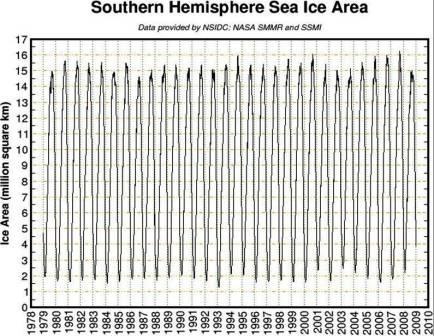
Facts melted by 'global warming'. Last weekend, that heroically diligent US meteorologist Anthony Watts noticed that something very odd had happened to the daily updated graph on the official Nansen website that shows how much sea-ice there is in the Arctic. Without explanation, as he reported on his Watts Up With That website, half a million square kilometres of ice simply vanished overnight. ... The warmists are so locked into their general narrative that the plummeting temperatures and abnormal snowfalls of the past two winters have thrown their army of media groupies into quite a tizzy. Pessimistic Reporting, Optimistic Data. Washington Post correspondant Juliet Eilperin, in her 12-26-08 report entitled "New climate change estimates more pessimistic," dutifully surveys the latest bleak findings of the climate change community. ... Three years ago what NASA quantified as an alarming loss of annual ice loss from Greenland was easily demonstrated at that time to be an insignificant loss, and today NASA's updated data appears to suggest the annual rate of global polar ice loss has actually decreased since then. Top TV Networks Spread False Arctic Sea Ice Scare. High-profile media reports predicting the North Pole would lose its ice cover failed to materialize in 2008, as less Arctic sea ice melted than in 2007 and open water came nowhere near the North Pole. On the July 28, 2008 NBC Nightly News, reporter Anne Thompson warned ominously of ice loss in the Arctic. "This summer, some scientists say that ice could retreat so dramatically that open water covers the North Pole, so much so that you could sail across it." Reality cools climate cultists. While one ice floe does not amount to a mini-ice age, the dramatic evidence runs counter to the mantra of the climate warming cult which has claimed the Arctic is becoming progressively free of ice. The mantra of less ice has long been coupled with the warning that rising sea levels will soon swamp coastal areas and both claims have been used to heighten fears about climate change and add a greater sense of urgency to calls for action now. Another Roll of the Ice Dice. It is my somber duty to relay that, according to Reuters, "The Arctic is warming up so quickly that the region's sea ice cover in summer could vanish as early as 2013[.]" I must admit, sad as I am, I'm mostly confused. I read last June that "for the first time in human history, ice is on course to disappear entirely from the North Pole this year." "This year" is now last year, and the iceless age never came to pass. Canadian hunters killing narwhals trapped in ice. Canadian hunters in a remote Arctic community have started killing a large number of narwhals — small, white whales best known for their long tusks — that are trapped by ice, a federal official said on Friday [11/21/2008]. The whales — which number between 100 and 200 — are stuck near Bylot Island, close to the tiny town of Pond Inlet on the northern end of Baffin Island. The nearest open water is 30 miles away. Save the whales trapped in Arctic ice. Global warming alarmists love to maintain that the Arctic ice pack is melting. Tell it the whales trapped in Arctic ice! Our New Established Religion: The first prediction was that the polar caps could melt, covering the whole globe with water. (A puzzling prediction, given that there have been times when the Earth's polar caps have been almost nonexistent and yet the continents have mostly remained above water.) Other predictions were that the increased heat energy would lead to destructive weather patterns, including droughts, floods, tornadoes, hurricanes and tidal waves. It was even, paradoxically, predicted that warming could cause another ice age. Arctic Sees Massive Gain in Ice Coverage. Increase twice the size of Germany: "colder weather" to blame. Data from the National Snow and Ice Data Center (NSIDC) has indicated a dramatic increase in sea ice extent in the Arctic regions. The growth over the past year covers an area of 700,000 square kilometers: an amount twice the size the nation of Germany. With the Arctic melting season over for 2008, ice cover will continue to increase until melting begins anew next spring. Alarmist global warming claims melt under scientific scrutiny. Gore claims global warming is causing an expansion of African deserts. However, the Sept. 16, 2002, issue of New Scientist reports, "Africa's deserts are in 'spectacular' retreat … making farming viable again in what were some of the most arid parts of Africa." Gore argues Greenland is in rapid meltdown, and that this threatens to raise sea levels by 20 feet. But according to a 2005 study in the Journal of Glaciology, "the Greenland ice sheet is thinning at the margins and growing inland, with a small overall mass gain." Arctic ice refuses to melt as ordered. Just a few weeks ago, predictions of Arctic ice collapse were buzzing all over the internet. Some scientists were predicting that the "North Pole may be ice-free for first time this summer". Others predicted that the entire "polar ice cap would disappear this summer". The Arctic melt season is nearly done for this year. The sun is now very low above the horizon and will set for the winter at the North Pole in five weeks. And none of these dire predictions have come to pass. More Ice Than Ever. Despite a warming Southern Ocean, the amount of ice surrounding Antarctica is now at the highest level ever measured for this time of the year, since satellites first began to monitor it almost thirty years ago. This represents a continuation of the record set last winter (our summer). … At present, the coverage of ice surrounding Antarctica is almost exactly two million square miles above where it is historically supposed to be at this time of year. Where ice caps grow: You've probably heard the permanent ice cap in the Arctic has receded considerably, because the people who are worried about global warming talk about it all the time. You may not know ice in Antarctica is growing. This is an awkward topic for global warming alarmists, because if global warming were, er, global, this shouldn't be happening. Does CO2 really drive global warming? The model we now have is that if the Arctic Ocean is frozen over, as is the case today, the existing ice cap is not being replenished and must shrink, as it is doing today. As it does so, the Earth can absorb more of the Sun's radiation and therefore will heat up — global warming — as it is doing today, so long as the Arctic Ocean is closed. When it is warm enough for the ocean to open, which oceanographic (and media) reports say is evidently happening right now, then the ice cap can begin to re-form. The Top of the World: Is the North Pole Turning to Water? Water at the North Pole was big news in August 2000. Was it just another media scare story, or is the Arctic sea ice really disappearing? This report details the whole issue of Arctic sea ice. Antarctic Ice Melt Scare Lacks Scientific Support. Despite a warming Southern Ocean, the amount of ice surrounding Antarctica is now at the highest level ever measured for this time of the year, since satellites first began to monitor it almost 30 years ago. Experts challenge ice shelf claim. Two scientists have claimed that climate change was not the only cause of the collapse of a 500bn tonne ice shelf in Antarctica six years ago. The 656ft (200m) thick, 1,255 sq mile (3,250 sq km) Larsen B shelf broke apart in March 2002. But Neil Glasser of Aberystwyth University and Ted Scambos of Colorado University claim in a new study that it had been on the brink for decades. Ice returns as Greenland temps plummet. On Disko Bay in western Greenland, where a number of prominent world leaders have visited in recent years to get a first-hand impression of climate change, temperatures have dropped so drastically that the water has frozen over for the first time in a decade. 'The ice is up to 50cm thick,' said Henrik Matthiesen, an employee at Denmark's Meteorological Institute who has also sailed the Greenlandic coastline for the Royal Arctic Line. 'We've had loads of northerly winds since Christmas which has made the area miserably cold.' Arctic Sea Ice Not Melting. A Canadian scientist is pouring cold, unfrozen water on the notion that global warming is melting arctic sea ice like a Popsicle at the beach. The end of the fake consensus on global warming. [In his new book, Lawrence Solomon] attempts to give readers insight into how non-settled and fragmentary the science actually is on climate change. For example, think the polar icecaps are melting? That's true at the North Pole, but it's not certain at the South Pole, according to Duncan Wingham. A portion of Antarctica's northern peninsula is melting. But that's a tiny slice of the 14 million square kilometre continent. And confounding evidence exists. Since the inception of the South Pole research station in 1957, recorded temperatures have actually fallen. 'Nightly News' Gives One Side of Antarctica Ice Changes. Defying the tenets of ethical journalism has become the norm for some media outlets when it the issue is global warming. "NBC Nightly News" was no exception. On January 14, "Nightly News" aired a biased alarmist report of changes in the ice shelf in Antarctica during its "Our Planet" segment, blaming "manmade carbon dioxide" for the shift and ignoring any other possibilities. World's largest ice sheet in 'stable' condition. An ice sheet in Antarctica that is the world's largest — with enough water to raise global sea levels by 200 feet — is relatively stable and poses no immediate threat to ocean levels, according to new research. North Atlantic Warming Tied To Natural Variability. A Duke University-led analysis of available records shows that while the North Atlantic Ocean's surface waters warmed in the 50 years between 1950 and 2000, the change was not uniform. In fact, the subpolar regions cooled at the same time that subtropical and tropical waters warmed. Global Warming Is Not the Cause of Polar Ice Cap Retreat. Although Arctic sea ice last summer reached its minimum extent since satellites began measuring the ice in 1979, NASA scientists have discovered the sea ice retreated due to variable local wind patterns rather than global warming. Moreover, the ice re-formed at a record pace last fall. In the Southern Hemisphere, Antarctic sea ice is at its greatest extent in recorded history. The majority of Antarctica is in a prolonged cold spell and has been accumulating snow and ice for decades. Gulf Stream Will Not Shut Down, Science Magazines Admit. Putting to rest nearly a decade of scare scenarios involving polar ice caps quickly reclaiming Canada, the northern United States, and northern and central Europe, scientists now report there is no chance of the Gulf Stream shutting down any time soon, regardless of any predicted global warming. The Gulf Stream is Here to Stay. The Gulf Stream, that almost mythical flow of warm seas that makes Norway and a few other Nordic countries liveable, isn't about to disappear any time soon. New research contradicts earlier theories that it might. Testing The Waters: According to the greenies, the Earth is supposed to warm continuously and disastrously without taking any rest breaks. Yet after taking actual data from the Labrador Sea where the Gulf Stream gives up its warmth before sinking and returning southward and projecting forward, the Kiel team says the Atlantic currents will keep rising temperatures in check around the world, much as the warming and cooling associated with El Niño and La Niña in the Pacific affect global temperatures. Open Water at the North Pole is Not Proof of Global Warming. Polar Ice Cap Studies Refute Catastrophic Global Warming Theories: More recent studies of the polar ice caps show the polar ice caps are holding their own and actually growing slightly. Greenland's disappearing lakes leave giant ice sheets largely unmoved. Fears that the rapid draining of water from the top of Greenland's ice sheet may be contributing to the rise of global sea levels have been allayed by new research. Though scientists confirmed that the water can drain away faster than Niagara Falls, it did not seem to accelerate the movement of the ice sheet into the ocean as previously thought. Arctic Sea Ice — Is it Disappearing? If we want to understand variability of Arctic sea ice (and, for that matter, sea and air temperature) we should take our eyes off greenhouse gases, at least for a moment, and study multidecadal phenomena. We should also avoid the temptation of taking the last 20–30 years of data, computing a trend, and assuming that that trend will continue for 50–100 years. History tells us that long-term linear trends will not occur. More breathtaking stupidity from the mainstream media. Tom Nelson comments on the article posted immediately below. "It's not even rare for the North Pole to be ice free." Exclusive: No ice at the North Pole. It seems unthinkable, but for the first time in human history, ice is on course to disappear entirely from the North Pole this year. The disappearance of the Arctic sea ice, making it possible to reach the Pole sailing in a boat through open water, would be one of the most dramatic — and worrying — examples of the impact of global warming on the planet. Editor's note: First of all, the statement that there is open water at the North Pole "for the first time in human history" is simply a canard. A group of environmental scientists on the Russian icebreaker Yamal went to the North Pole in August 2000. "When they got to the North Pole they were greeted by an expanse of open water, photographs of which became the subject of sensationalist reporting in the media."* Second, since there has been no global warming in several years, it is not likely that global warming is the cause of the open water at the pole. If this report is true, however, the open water might be due to volcanic activity in the area. (Am I the only one to connect these dots? Can they be connected?) It could be a case of abrupt local warming. Keep reading... Study finds Arctic seabed afire with lava-spewing volcanoes. The Arctic seabed is as explosive geologically as it is politically judging by the "fountains" of gas and molten lava that have been blasting out of underwater volcanoes near the North Pole. "Explosive volatile discharge has clearly been a widespread, and ongoing, process," according to an international team that sent unmanned probes to the strange fiery world beneath the Arctic ice. Volcanic eruptions reshape Arctic ocean floor: study. Recent massive volcanoes have risen from the ocean floor deep under the Arctic ice cap, spewing plumes of fragmented magma into the sea, scientists who filmed the aftermath reported Wednesday. The eruptions — as big as the one that buried Pompei — took place in 1999 along the Gakkel Ridge, an underwater mountain chain snaking 1,800 kilometres (1,100 miles) from the northern tip of Greenland to Siberia. Arctic Volcanoes Found Active at Unprecedented Depths. Buried under thick ice and frigid water, volcanic explosions are shaking the Arctic Ocean floor at depths previously thought impossible, according to a new study. Are Volcanoes Melting Arctic? In August 2000 the New York Times ran a piece claiming the pole was free of ice for the first time in 50 million years, long before SUVs roamed Earth. As earth scientist Patrick Michaels noted, "It was retracted three weeks later as a barrage of scientists protested that open water is common at or near the pole at the end of summer." As reported in the June 26 edition of ScienceDaily, a research team led by the Woods Hole Oceanographic Institute (WHOI) has uncovered evidence of massive undersea volcanic eruptions deep beneath the ice-covered surface of the Arctic Ocean. 

Looks to me like there's plenty of ice at the North Pole and the South Pole. Source: The Cryosphere Today. 
Chart: Global Sea Ice Area 1979-present. [A tip of the hat to Greenie Watch.] Are the ice caps melting? The headlines last week brought us terrifying news: The North Pole will be ice-free this summer "for the first time in human history," wrote Steve Connor in The Independent. Or so the experts at the National Snow and Ice Data Center (NSIDC) in Boulder, Colorado predict. This sounds very frightening, so let's look at the facts about polar sea ice. As usual, there are a couple of huge problems with the reports. Firstly, the story is neither alarming nor unique. Climate change chicanery: Recent events have seen the scare campaign over global warming descend to the level of a Monty Python sketch. Much publicity was given, for instance, to Lewis Gordon Pugh, who set out to paddle a kayak to the Pole to demonstrate the vanishing of the Arctic ice. At 80.5 degrees north, still 600 miles short of his goal, he met with ice so thick that he and his fossil-fuelled support ship had to turn back. Dying for a heatwave. Three shivering global warming activists, stuck on an ice floe in the Arctic, are helping to tear up the psychology textbooks. In 1956, US psychologist Leon Festinger became instantly famous for giving us "cognitive dissonance" — the theory that humans couldn't tolerate two conflicting perceptions. One would have to go. Ha! It's taken half a century, but warming believers are now making a monkey of old Festinger. The 'Global Warming Three' are on thin ice. The only problem with a project to prove that Arctic ice is disappearing is the fact that it is actually getting thicker. Scientist Links Melting Polar Ice to Greenhouse Effect but Government's Own Research Shows Otherwise. Dr. Joe D'Aleo, executive director of the International Climate and Environmental Change Assessment Project [ICECAP], said the depletion of sea ice in the Arctic is part of the Earth's cycles — and "solar activity". "The Arctic temperatures undergo a cyclical change every 60 to 70 years tied to cycles on the sun and in the oceans," said D'Aleo, who was the first director of meteorology at The Weather Channel. "You can see very warm temperatures in the 1930s then cooling and another warming in the last few decades in close correlation with solar activity," he added, "but with a poor correlation with CO2." Sea rise from ice melt 'overestimated'. A bit of encroaching realism here. They admit that the main mass of the Antarctic ice will never melt but they have a new scare to make up for that. They think that over the next 500 years enough ice will melt to throw the earth's rotation out of balance! But it is all speculation which ignores the fact that Antarctic ice is if anything growing overall. There is no evidence since measurements began of Antarctic ice loss on anything like the scale projected. And as a prediction of what could happen in 500 years' time, it is pure hubris and imagination. This is an original compilation, Copyright © 2026 by Andrew K. Dart Report: Antarctic Ice Growing, Not Shrinking. Ice is expanding in much of Antarctica, contrary to the widespread public belief that global warming is melting the continental ice cap. The results of ice-core drilling and sea ice monitoring indicate there is no large-scale melting of ice over most of Antarctica, although experts are concerned at ice losses on the continent's western coast. Embellishing exaggerations. Even the global warmists packing the U.N. Intergovernmental Panel on Climate Change say the chances of the West Antarctic ice sheet melting completely are indistinguishable from nil. Global temperatures would have to spike 5°F and stay there for thousands of years before half the sheet would disappear. However, the earth's temperature has fallen more than 1°F since 1998, erasing the entire increase of the 20th century, and shows no signs of rising anytime soon. Great Lakes Are Rising. Great Lakes water levels are on the rise, putting the damper on media reports claiming global warming has been causing declining water levels. Water levels for each of the Great Lakes are rising. Water levels in Lakes Huron and Michigan have risen a full foot since 2008. Great Lakes water levels rose during the second half of the twentieth century but experienced a short-term decline from the late 1990s through the middle of this decade. Alarmists blamed that on global warming. Arctic temperature is still not above 0°C — the latest date in fifty years of record keeping. The average arctic temperature is still not above (take your pick) 32°F 0°C 273.15°K — this the latest date in fifty years of record keeping that this has happened. Usually it is beginning to level off now and if it does so, it will stay near freezing on average in the arctic leading to still less melting than last summer which saw a 9% increase in arctic ice than in 2007. Lies Revealed — Greenpeace Leader Admits Arctic Ice Exaggeration. The outgoing leader of Greenpeace has admitted his organization's recent claim that the Arctic Ice will disappear by 2030 was "a mistake." Greenpeace made the claim in a July 15 press release entitled "Urgent Action Needed As Arctic Ice Melts," which said there will be an ice-free Arctic by 2030 because of global warming. Under close questioning by BBC reporter Stephen Sackur on the "Hardtalk" program, Gerd Leipold, the retiring leader of Greenpeace, said the claim was wrong. Sen. Kerry Recycles Greenpeace's Lie About Arctic Ice. Radical environmentalists love recycling so much that they recycle lies — and the lies are even bolder when reincarnated. Sen. John Kerry proved it this week when he recycled Greenpeace's lie about an ice-free Arctic and said it will become a reality even sooner, by 2013. 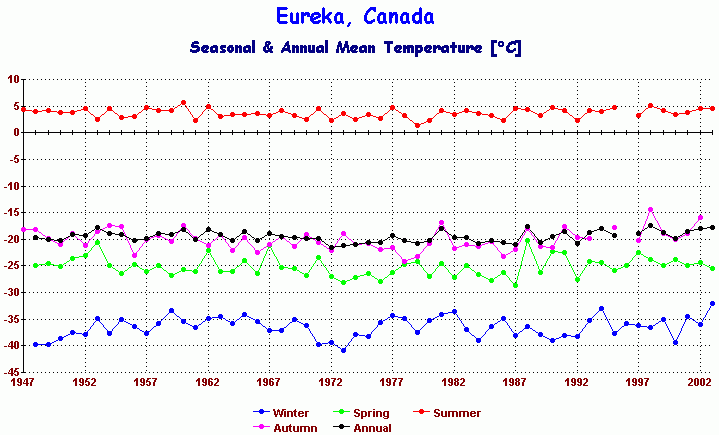 What the Stations Say: Listed here are a set of historical temperature graphs from a large selection of mostly non-urban weather stations in both hemispheres. This data originated with the NASA Goddard Institute (GISS) in the USA and the Climatic Research Unit (CRU) of the University of East Anglia, Norwich, England. With a few exceptions, large cities have been excluded because of Urban Heat Island Effect distortions to long-term data. Circling the Arctic. The highly variable temperatures and amounts of sea ice in both polar regions is well-known to locals, but cherry-picked extremes have become a media weapon to scare ignorant folk with. Greenlanders today are aware of recent warming; but history, archaeology, and the Norse sagas show that Greenland was warmer than today in the Middle Ages, when crops and trees were grown there. Arctic temperatures hit 2,000-year high. The 1990s were the Arctic's warmest decade in the past 2,000 years, says a study released in Friday's edition of Science. ... Scientists used "natural" thermometers — such as glacial ice cores, tree rings and sediments from lakes — to calculate the temperatures of the Arctic over the past two millennia. Instruments have been used to measure the actual temperature of the Arctic since the late 1800s. The Editor says... Hmmm... where to begin? One or two "instruments" in the late 1800s would not be enough to perform accurate measurements of the Arctic Circle. Before that, nobody kept records, so the "report" relies on tree rings, tea leaves and wild guesses. But even if the current Arctic temperature is the highest in a long time, so what? It is still plenty chilly at the north pole. Arctic ice proves to be slippery stuff . BBC viewers were treated last week to the bizarre spectacle of Mr Ban Ki-moon standing on an Arctic ice-floe making a series of statements so laughable that it was hard to believe such a man can be Secretary-General of the UN. Thanks to global warming, he claimed, "100 billion tons" of polar ice are melting each year, so that within 30 years the Arctic could be "ice-free". ... Everything about this oft-repeated item was propaganda of the silliest kind. Arctic melt opens shortcut. For centuries, mariners have dreamed of an Arctic shortcut that would allow them to speed trade between Asia and the West. And Friday, German merchant ships traversed the fabled Northeast Passage, aided by the retreat of Arctic ice that scientists have linked to global warming. The Editor says... Wouldn't it make more sense to say the ice decrease is "linked" to summertime, and the non-stop sunshine at the pole? Global blushing. It's hard to be green when you're red-faced all the time. It's easy to be red-faced when your cause is global warming doomsterism. This week, the doomsters were embarrassed to learn, once again, that the planet was not in grave peril. Antarctica, their greatest candidate for catastrophe, was not melting at an ever-faster rate, according to a report in Geophysical Research Letters, but at the slowest rate in 30 years. Hot and cold. The Arctic ice "is melting far faster than had been previously supposed," we heard this week from the UN's Environment Program, in releasing its 2009 Climate Change Science Compendium. This same week, National Geographic reported that the Arctic ice is probably melting far slower than previously supposed. 'Penguin tourists' trapped in Antarctic ice. More than 100 penguin-loving tourists including dozens from Britain are trapped by ice off Antarctica aboard a Russian ice-breaker cruise ship. The Kapitan Khlebnikov is in a bay near Snow Hill island, located off the northeastern end of the Antarctic Peninsula, and cannot leave as the bay is sealed off with ice, the Russian transportation ministry said. Sea level rise will double due to melting of Antarctica. Sea levels could rise more than twice as fast as previously predicted due to melting ice caps around the south pole, according to the most comprehensive study into how climate change is affecting the Antarctic. The Editor is quick to point out... First of all, remember that while one pole melts, the other pole freezes. They take turns. It's a process called "summer and winter." Secondly, the average annual temperature of the interior of Antarctica is -57°C (-70°F).* This means that the temperature of Antarctica would have to increase by 100°F. — permanently — before the polar ice would melt. Antarctica may heat up dramatically as ozone hole repairs, warn scientists. As blanket of ozone over southern pole seals up, temperatures on continent could soar by 3°C, increasing sea level rise by 1.4m. The Editor says... Less ozone = more warming? Obviously then, the solution to global warming is to destroy the ozone layer! Look, the area of the oceans is 139,544,600 square miles. Water 1.4 meters deep across that area would amount to 3,437 cubic miles. That's about three times the volume of Lake Michigan. I doubt if there are 3,437 cubic miles of ice within 3°C. of melting (permanently). And even if such a mass of ice exists, in order to affect sea level it would have to be ice that is not currently floating on sea water. Inconvenient truth for Al Gore as his North Pole sums don't add up. In his speech [at Copenhagen], Mr Gore told the conference: "These figures are fresh. Some of the models suggest to Dr [Wieslav] Maslowski that there is a 75 percent chance that the entire north polar ice cap, during the summer months, could be completely ice-free within five to seven years." Al Gore's melting Arctic claim unites scientist and sceptic alike. Al Gore stood by his claim yesterday [12/15/2009] that the North Pole could be ice-free within five years, attracting a storm of criticism from scientists and sceptics alike. In an address to the Copenhagen summit, the former Vice-President of the United States quoted an international report published this year, which suggested that the North Pole could have lost virtually all of its ice by 2015. Al Gore tries to cool 'climate spin' by correcting claims of North pole thaw. Al Gore's office issued a formal correction yesterday [12/16/2009] to a speech the former US Vice-President had given earlier in the week that started the latest in a series of "climate spin" rows. Mr Gore told the Copenhagen summit meeting that the latest research suggested that the North Pole would be ice-free within five to seven years. Climategate: This time Al Gore lied. Al Gore's claim last week that the Climategate emails were insignificant relied on two main defences. Both are so flagrantly wrong that it's not enough to say Gore is simply mistaken. No, Al Gore is a liar. Last week we showed that the first of his Climategate defences was so preposterously wrong that it was doubtful he had even read the leaked emails he tried to dismiss. Climategate and the Migrating Arctic Tree Line. [Scroll down] The report correctly states that there has been migration of the polar tree line over the past several thousand years, but the investigators attribute this migration singularly to the cold tolerances of tree species. Although the botanists are correct that cold tolerance does affect the northern limit of trees, they incorrectly attribute the migration solely to variation in climatic temperatures. This is only part of the answer. The other part lies in the in the geographic fact that creates the Arctic Circle in the first place. Sea icy off part of Antarctica despite fear of melt. Sea water under an East Antarctic ice shelf showed no sign of higher temperatures despite fears of a thaw linked to global warming that could bring higher world ocean levels, first tests showed on Monday [1/11/2010]. Antarctica and the Myth of Deadly Rising Seas. On Monday [1/11/2010], scientists from the Norwegian Polar Institute reported that they'd measured sea temperatures beneath an East Antarctic ice shelf and found no signs of warming whatsoever. And while the discovery's corollaries remain mostly blurred by the few rogue mainstream media outlets actually reporting it, the findings are in fact yet another serious blow to the sky-is-falling-because-oceans-are-rising prophecies of the climate alarm crowd. Lake Erie freezes over. Lake Erie is completely frozen over for the first time this winter season, according to the National Weather Service in Cleveland, slowing the lake-effect snow machine. ... [Meteorologist Gary] Garnet said it is fairly common for Lake Erie to freeze, and in an average Ohio winter, it is close to completely frozen most years. That's not Hell freezing over, but it's close. Lake Erie has frozen over for the first time in 14 years, according to AccuWeather. It's good news if you happen to live in Buffalo or southern Ontario. The Editor asks... Does anyone believe that Lake Erie is frozen over, but the North Pole is not? Hoax of the Century. [Scroll down] While endless keening is heard over the Arctic ice cap, we hear almost nothing of the 2009 report of the British Antarctica Survey that the sea ice cap of Antarctica has been expanding by 100,000 square kilometers a decade for 30 years. That translates into 3,800 square miles of new Antarctic ice every year. Oh, that inconvenient growing polar ice cap. Global warmists continue to circulate alarming warnings that the past winter was among the warmest on record. See, for example, Andrew Freeman's March 15 article in the Washington Post entitled "D.C.'s winter was cold, but the globe stayed toasty". Somehow the Arctic Ocean did not get the memo. Was the Arctic Ice Cap 'Adjusted'? There is an entity called the National Snow and Ice Data Center. If you go to its website, you can find data and plots of sea ice extent. In particular, you can find the size of the Arctic ice cap, or what the NSIDC calls Northern Hemisphere sea ice. Sen. Kerry Predicts 'Ice-Free Arctic' In '5 or 10 Years'. Speaking at a town hall-style meeting promoting climate change legislation on Thursday, Sen. John Kerry (D-Mass.) predicted there will be "an ice-free Arctic" in "five or 10 years." "The arctic ice is disappearing faster than was predicted," Kerry said. "And instead of waiting until 2030 or whenever it was to have an ice-free Arctic, we're going to have one in five or 10 years." The Editor says... You may recall that just last year Senator Kerry predicted an ice-free Arctic by 2013.*. Perhaps Senator Kerry should promise to resign from the Senate in 2013 when we find that the North Pole looks just like it always has. Greenland ice loss rates 'one-third' of what was thought. The rate at which ice is disappearing from Greenland and Western Antarctica has been seriously overestimated, according to new research. Measuring a disappearing ice cap is actually quite difficult to do, as the areas in question are remote, hostile environments and the exact depth of ice is often unknown. The U.N.'s climate tax. Alarmist hysteria that melting arctic ice is causing ocean levels to rise — threatening to flood coastal cities around the world — is a "Chicken Little" warning. Last week, scientists cut in half their estimate of the ice-loss rate. The news won't dissuade global warmists at the United Nations to waver from their ultimate target: your wallet. Times Atlas 'wrong' on Greenland ice. Leading UK polar scientists say the Times Atlas of the World was wrong to assert that it has had to re-draw its map of Greenland due to climate change. Publicity for the latest edition of the atlas, launched last week, said warming had turned 15% of Greenland's former ice-covered land "green and ice-free". But scientists from the Scott Polar Research Institute say the figures are wrong; the ice has not shrunk so much. Times Atlas Apologizes for Global-Warming Error. Publishers of the Times Comprehensive Atlas of the World scrambled Tuesday [9/20/2011] to correct a controversial statement that Greenland had lost 15 percent of its permanent ice cover over the last 12 years — an assertion scientists labeled "incorrect and misleading." Global warming and the twisting of our children's minds. The Times Atlas Of The World, regularly updated since the Victorian age, proudly presents itself as 'the most authoritative atlas in the world'. But its latest hefty edition, published at the eye-watering price of £150, has become the focus of a bizarre climate change row. Atlasgate Shrugged: Downplaying Greenland's Fictional Ice Melt. HarperCollins admitted it erased 15 percent of Greenland's ice cover from its previous 2007 atlas, an amount Elizabeth Morris of Cambridge University's Scott Polar Research Institute said "would lead to a sea level rise of 1 metre," according to Varsity. She and six colleagues wrote a letter to the publisher calling the mistake "implausible" and "stupid." Glaciologist Poul Christofferson also signed the letter and told Reuters that "a sizable portion of the area mapped as ice-free in the Atlas is clearly still ice-covered." Four months later... Map-makers admit Greenland gaffe. There was considerable alarm when the word's most authoritative atlas printed a map which showed that Greenland was rapidly turning green. However, experts from around the globe pointed out that the cataclysmic chart had no scientific support and was contradicted by all of the most recent satellite images. Now the Scottish map-makers responsible for the disappearance of 115,830 square miles of polar ice have admitted publicly they were wrong. Glaciers and mountaintop ice Greenland's Melting Ice Is No Cause for Climate-Change Panic. One of the most sacred tenets of climate alarmism is that Greenland's vast ice sheet is shrinking ever more rapidly because of human-induced climate change. The media and politicians warn constantly of rising sea levels that would swamp coastlines from Florida to Bangladesh. A typical headline: "Greenland ice sheet on course to lose ice at fastest rate in 12,000 years." With an area of 660,000 square miles and a thickness up to 1.9 miles, Greenland's ice sheet certainly deserves attention. Its shrinking has been a major cause of recent sea-level rise, but as is often the case in climate science, the data tell quite a different story from the media coverage and the political laments. The chart nearby paints a bigger picture that is well known to experts but largely absent from the media and even from the most recent United Nations climate report. It shows the amount of ice that Greenland has lost every year since 1900, averaged over 10-year intervals; the annual loss averages about 110 gigatons. (A gigaton is one billion metric tons, or slightly over 2.2 trillion pounds.) That is a lot, but that water has caused the planet's oceans to rise each year by only 0.01 inch, about one-fifth the thickness of a dime. More Evidence: Glaciers Existing Today Were Absent For Nearly All Of The Last 10,000 Years. The cryosphere is failing to cooperate with the anthropogenic global warming narrative that says rising greenhouse gas emissions should be catastrophically melting Arctic ice. [...] Several months ago we highlighted another new study documenting a much warmer-than-today Early and Middle Holocene in East Greenland. Ice caps were "absent" or far less extensive than they are presently during this period. What may be surprising is that carbon-dated plant remains buried under retreating glaciers in East Greenland affirm these locations were not covered in glaciers as recently as 400 to 500 years ago, or during the Little Ice Age cold period. Predictions like this are never accurate, but they help to sell newspapers. The Media Is Lying About Greenland and Climate Change. The mainstream media is hell-bent on instilling climate fear among the masses. This means that they can never get over their obsession with weather events in the Arctic, which is one of their favorite subjects for projecting a climate catastrophe. The Greenland Ice Sheet has been of great interest to climate alarmists. Any small change in ice sheet mass is promoted in the media as a product of man-made climate change. Last week, media outlets across the globe claimed that there has been rain for the first time at the Greenland summit. "Rain fell at the normally snowy summit of Greenland for the first time on record," read CNN's headlines. Others went a step further and declared it a sign of climate doomsday. "Rain On Greenland Ice Sheet, Possibly A First, Signals Climate Change Risk," read another headline. Unfortunately, for the mainstream media, climate history nearly always comes back to haunt their claims of unprecedented events. Records reveal that this is not the first rainfall in Greenland, and certainly not the first on the Greenland summit peak, which stands at around 10,000 feet. Deep Permafrost Layers More Climate-Resilient Than Previously Thought — Study. Ancient layers of Siberian permafrost are more resilient to rising global temperatures than previously thought, according to a study by an international team of scientists at the University of Sussex. Permafrost, which covers roughly 65% of Russia's territory, holds roughly twice as much carbon than is found in Earth's atmosphere, according to the U.S. National Snow and Ice Center. Experts warn that as the planet warms, these permanently frozen layers of soil will melt and release stored greenhouse gases, sparking a potentially catastrophic "feedback loop" of climate change acceleration. Greta Crestfallen After 'World's Largest Iceberg' Turns Out To Be Part Of Normal Cycle. It was inevitable that climate change warrior Greta Thunberg would be tweeting about an enormous ice slab nearly the size of Majorca, one of Spain's Balearic Islands in the Mediterranean, calved off an Antarctic ice shelf and was spotted by satellites this week. [Tweet] The only reason Thunberg would be covering such a topic is that the finger-shaped iceberg is approximately 1,668 square miles in size and has been declared as the world's largest iceberg. This would allow her to amplify her climate change fight and press her Twitter following and politicians alike that action is needed to be taken now. The Alps Were Ice-Free 6000 Years Ago, when CO2 was much lower than today's levels. In his video, the German geologist presents a new paper authored by glaciologists Bohleber et al, 2020 of the Austrian Academy of Science. The Austrian-Swiss team discovered from ice cores that the 3500-meter high Weißseespitze summit was ice free 5900 years ago. [Video clip] The telling tale of Glacier National Park's 'gone by 2020' signs. Never put a time limit on your doomsday predictions. This rookie error has been the undoing of charlatans, cultists and false prophets through the ages, from Martin of Tours, who predicted that the world would end by 400, to Harold Camping, who claimed it would happen on Sept. 6, 1994. The latest poor saps to join the oops club are the authorities in charge of Montana's Glacier National Park. For years they've been warning on their visitor signs that their main attraction, the glaciers, would be "gone by 2020." Instead, it's those misleading signs that have had to go, because 2020 has now arrived and those pesky glaciers, all 29 of them, remain stubbornly unmelted by climate change. CNN Pushes Global Warming While Reporting Park Had to Remove Signs Predicting Glaciers Would be Gone in 2020. On Wednesday [1/8/2020], CNN published a report claiming that global warming, or "climate change," is still a bigger problem than ever before, even though the report referenced a particular national park that had just seen a similar claim be debunked, according to Fox News. The CNN report referenced Glacier National Park in Montana, where so-called experts had predicted that the park's glaciers would be gone by 2020 due to climate change. The park had even placed signs near the glaciers making this claim, and thus were forced to take them down after the claim was debunked due to the glaciers still standing. CNN Says Nat'l Park Signs Warning Glaciers Gone by 2020 to Be Removed, Still Touts Man-Made Warming. It must be really hard to have to report a story that flies in the face of CNN's hype over climate change. CNN published a Jan. 7, story headlined "Glacier National Park is replacing signs that predicted its glaciers would be gone by 2020," and admitted that "[i]n 2017, the park was told by the agency [U.S. Geological Survey (USGS)] that the complete melting off of the glaciers was no longer expected to take place so quickly due to changes in the forecast model." The signs were put up over a decade ago, according to CNN. Glacier National Park to replace signs saying glaciers would be gone by 2020. Montana's Glacier National Park is updating its signs to no longer predict its signature glaciers would be melted by 2020. Park spokeswoman Gina Kurzmen said the signs that were added more than a decade ago to reflect climate change forecasts at the time will be replaced to more accurately reflect the glaciers' fate, CNN reported Wednesday [1/8/2020]. Glacier National Park Quietly Removes Its 'Gone by 2020' Signs. Officials at Glacier National Park (GNP) have begun quietly removing and altering signs and government literature which told visitors that the Park's glaciers were all expected to disappear by either 2020 or 2030. In recent years the National Park Service prominently featured brochures, signs and films which boldly proclaimed that all glaciers at GNP were melting away rapidly. But now officials at GNP seem to be scrambling to hide or replace their previous hysterical claims while avoiding any notice to the public that the claims were inaccurate. Teams from Lysander Spooner University visiting the Park each September have noted that GNP's most famous glaciers such as the Grinnell Glacier and the Jackson Glacier appear to have been growing — not shrinking — since about 2010. Beware the Boogeyman Alarm. Back in the years before 2010, federal workers at Glacier National Park in Montana put up signs warning that all of the glaciers would be gone by 2020 because of climate change. Now 2020 has arrived, and about 60 percent of the glaciers remain. Someone pointed this out to park employees, so they have started taking down the signs. While doing so, they complained (in a CNN story) that there is not enough federal money authorized for them to perform the arduous sign-taking-down. (It costs $35 per car to drive into the park. Buses pay $200.) This is why you can't trust a federal employee to do anything. They held a funeral for a melted glacier. No kidding. Most of the ice currently melting on Greenland only formed during the last few hundred years. A new paper (Axford et al., 2019) reveals NW Greenland's "outlet glaciers were smaller than today from ~9.4 to 0.2 ka BP" (9,400 to 200 years before 1950), and that "most of the land-based margin reached its maximum Holocene extent in the last millennium and likely the last few hundred years." The "Settled" Science Becomes Unsettling. It has been 30 years since climate scientists first started warning the public of impending doom, culminating in a Nobel Peace Prize being awarded to Al Gore and the Intergovernmental Panel on Climate Change (IPCC) in 2007. However, in the last decade, the voices of concern have grown increasingly tepid and muted due to the failure of catastrophic warming to materialize. A recent example of this backpedal occurred in Montana Glacier National Park, where signs stating that the glaciers would disappear by 2020 have been quietly removed. Surprise: Largest Glacier in Northern Hemisphere has started growing again. The Jakobshavn is the glacier that dumps more ice in the ocean than any other in the Northern Hemisphere. It made the iceberg that "sank the titanic". It has been receding for years, and the losses were accelerating, but then it astonished the scientists. [...] In a rush, climate-scientists hit auto-excuse-mode — saying the things they never say when there's a bit of warming. It's such a quirk, a blip: in a spot 1000 km away the atmospheric pressure changed "resulting in either warming or cooling" (I don't think the laws of physics are too happy about that) and then ocean currents carry that up to Greenland which affects the glacier. Sure. We never hear them work so hard to explain some temporary warming. Greenland's glacier grows alarming climate hysterics. Have you happened to notice that some news most of us would normally regard as very cheering is often treated by the mainstream media as tragic, or goes unreported altogether? [...] A case in point is a screaming lack of enthusiastic media coverage regarding recent evidence that Jakobshavn, the previously fastest-flowing, fastest-thinning glacier on Greenland's west coast, has now gone rogue. Jakobshavn has represented the largest source of periodic ice mass loss over the last 20 years, and has produced about 10 percent of the country's icebergs. An Inconvenient Glacier: Study Shows Greenland Glacier Growing. [A] new study published in Nature Geoscience has concluded that since 2016, the Jakobshavn Glacier is now growing again. Using airborne altimetry and satellite imagery data, the study concludes that since 2016, the glacier has been advancing. The data used was from NASA's Oceans Melting Greenland (OMG) mission. The study was conducted by NASA's Jet Propulsion Laboratory (JPL) with contributions from Remote Sensing Solutions in Barnstable, Massachusetts, and the University of Utrecht in the Netherlands. The study traces the glacier's growth spurt to a naturally occuring cycle of cooler water in the North Atlantic more than 600 miles south of the glacier. Researchers posit that the cold water was set in motion due to an effect known as the North Atlantic Oscillation (NAO), which causes the Northern Atlantic to switch slowly between warm and cold every five to 20 years. Big U-turn: Key melting Greenland glacier is growing again. A major Greenland glacier that was one of the fastest shrinking ice and snow masses on Earth is growing again, a new NASA study finds. The Jakobshavn glacier around 2012 was retreating about 1.8 miles and thinning nearly 130 feet annually. But it started growing again at about the same rate in the past two years, according to a study in Monday's Nature Geoscience. Study authors and outside scientists think this is temporary. The Editor says... Embarrassing Predictions Haunt the Global-Warming Industry. [Scroll down] Other UN predictions were so ridiculous that they were retracted before they could even be proven wrong. Consider, as just one example, the scandal that came to be known as "Glaciergate." In its final 2007 report, widely considered the "gospel" of "settled" climate "science," the UN IPCC suggested that Himalayan glaciers could melt by 2035 or sooner. It turns out the wild assertion was lifted from World Wildlife Fund propaganda literature. The IPCC recanted the claim after initially defending it. The Hubbard Glacier defies 'climate change' — continues to grow. From NOAA Earth Observatory: Since measurements began in 1895, Alaska's Hubbard Glacier has been thickening and steadily advancing into Disenchantment Bay. The advance runs counter to so many thinning and retreating glaciers nearby in Alaska and around the world. Global-warming Ice Capades. He who lives by the crystal ball must expect occasional bits of ground glass in his pudding, and the false prophets of global warming and their cheerleaders in the media are learning that lesson the hard way. After years of predicting that man-made global warming would melt the planet's glaciers and drown coastal towns beneath rising oceans, the threat itself is melting like ice in April. That's cause for both celebration and a little humility in the face of the many mysteries of nature still to be unraveled. Data from two NASA satellites, employed in the Gravity Recovery and Climate Experiment between 2002 and 2014, enabled researchers to analyze the effects of glacier loss. They found to their surprise that trillions of tons of water wound up not in the sea but spread across the planet's land mass. In fact, 3.2 trillion tons of water, equal to the volume of Lake Huron, soaked into thirsty soil or were collected in lakes and underground aquifers. Greenland's Melting Glaciers Is Totally Terrifying Or Something. [Scroll down] In fact, the rate of retreat, 164 feet per year, is the same as back during the 1930's, when CO2 was well below the "safe" level of 350ppm. Some, let's be honest, are retreating faster. Which in no way proves anthropogenic causation. Just warming/melting. Let's not forget that Vikings made a pretty good living in the nearby island of Iceland, farming and stuff in a green paradise during the Medieval Warm Period, and were wiped out during the Little Ice Age. If we go back over 100,000 years, the temperatures in Greenland are postulated to be 14F higher than today. NY Times: Greenland Is Melting! Greenland is melting due to global warming and will raise sea levels 20 feet, according to an in-depth The New York Times article. [...] Researchers were helicoptered onto the ice where scientists were hit by the "cold of the Greenland summer — the temperature ranged from 27 degrees below zero to a balmy 40 while they were there — a constant wind and the glare of the sun." The science blogger Steven Goddard (a pseudonym) criticized the Times article's portrayal of Greenland as rapidly melting. "The volume of the ice sheet is 3,000,000 cubic kilometers. Using the most aggressive claims, it would take 15,000 years for the ice sheet to melt," Goddard wrote. "That accounts for a sea level rise of about one hundredth of an inch per year." The Editor says... Dumbest Global Warming Study Ever Wins Raves From New York Times. Stunning visuals and melodrama aside, what's really melting faster than a river during summertime is the Times' credibility. The notion that these "researchers" are doing anything close to collecting data that could predict future melting of Greenland's ice sheet is absurd. These researchers are taking measurements at a single river. One. They claim they can then somehow extrapolate this data into a prediction of the fate of the entire ice sheet. But thousands and thousands of these summertime rivers appear on the Greenland ice sheet, which is 660,000 square miles in size. Four times the size of California. Data from one section of one 60-foot wide river is going to tell us precisely zero about anything related to the ice sheet's future. The Fraud Factor of Obama's New Climate Agenda. Recently, President Obama visited Alaska to scare up support for his climate agenda. But it's becoming clear that this agenda is not, in fact, about climate. Instead, it's the typical Washington story of power and money — other people's money. Alaska provided the apparent novelty of ice that melts in the summer, which was used as a theatrical prop for the president. His photo op in front of the retreating Exit Glacier glossed over another bit of reality: The Exit Glacier started retreating more than 100 years before the start of significant man-made carbon dioxide emissions. In a bit of bonus irony, the climate research center at the University of Alaska shows that there has been no warming trend in Alaska since 1977. In fact, the trend is slightly negative. The Hubbard Glacier defies 'climate change' — continues to grow. From NOAA Earth Observatory: Since measurements began in 1895, Alaska's Hubbard Glacier has been thickening and steadily advancing into Disenchantment Bay. The advance runs counter to so many thinning and retreating glaciers nearby in Alaska and around the world. Climate change lies are exposed. A high-level inquiry into the Intergovernmental Panel on Climate Change found there was "little evidence" for its claims about global warming. It also said the panel had emphasised the negative impacts of climate change and made "substantive findings" based on little proof. The review by the InterAcademy Council (IAC) was launched after the IPCC's hugely embarrassing 2007 benchmark climate change report, which contained exaggerated and false claims that Himalayan glaciers could melt by 2035. Glaciers and Global Warming. The melting of glaciers is often cited as evidence mankind is causing global warming through carbon dioxide emissions. A corollary of this is that melting glaciers raise sea levels, which will reach catastrophic levels unless CO2 emissions are reduced. Adding to the massive evidence already refuting these assertions, a recent paper provides more accurate reconstruction of two centuries of previous data "by using many more stations, particularly in the polar regions, and recently processed historic data series from isolated island stations." The new study is based on monthly mean sea level data from 1807 to 2010. Regarding this new study, well-known meteorologist Anthony Watts wrote "this newest analysis of the most comprehensive data set available suggests that there has been no dramatic increase — or any increase, for that matter — in the atmosphere's CO2 concentration. Study: Himalayan Glaciers Not Disappearing After All. Himalayan glaciers — for years one of the poster children of the "man-made global warming is real and we're all doomed" movement — are in no imminent danger whatsoever, a new study has found. Of the 2018 glaciers mapped and monitored for the survey, nearly 87 percent were found to be stable while only 12 percent were found to be in retreat. Good Snowfall Rejuvenates Himalayan Glaciers. With high-altitude mountains in Himachal Pradesh experiencing up to 100 cm fresh snowfall in November month after 10 years, the abundance of snow on mountains has rejuvenated nearly one thousand Himalayan glaciers and has ensured uninterrupted supply of water for drinking, irrigation and hydel projects. Satellite study of Asian mountains show that glaciers are not melting. Huge glaciers in the area between Pakistan and China are puzzling scientists — and disproving the doom-laden predictions of some climate experts. The glaciers in the Karakoram Range between northern Pakistan and western China have actually grown, rather than shrinking.Himalayan Glaciers Expand, Challenging IPCC's Credibility. A new scientific study of the Himalayan glaciers is raising fresh doubts about the troubled theory of manmade climate change, and could renew interest in a debacle that shook the Intergovernmental Panel on Climate Change (IPCC) several years ago. When the "Climategate" scandal erupted in 2009, the global warming theory faced widespread ridicule. For certain segments of public opinion, the release of reams of incriminating emails between climate change scientists fundamentally undermined the credibility of the entire theory. No ice loss seen in major Himalayan glaciers: scientists. One of the world's biggest glacier regions has so far resisted global warming that has ravaged mountain ice elsewhere, scientists reported on Sunday [4/15/2012]. Scientists discover glaciers in Asian mountain range are actually getting bigger. Photos taken by a French satellite show glaciers in a mountain range west of the Himalayas have grown during the last decade. The growing glaciers were found in the Karakoram range, which spans the borders between Pakistan, India and China and is home to the world's second highest peak, K2. Mount Everest becoming unclimbable due to climate change. According to Apa Sherpa, the storied mountaineer who recently won the Guinness World record for having scaled Mount Everest 21 times, the world's tallest mountain is becoming increasingly difficult to climb due to climate change. Apa recently told AFP that he was disturbed by the lack of snow on the mountain, which makes rockslides more common and the possibility of slipping icrease [sic] dramatically. The Editor says... Nobody's putting a gun to your head and telling you to climb the stinkin' mountain, you fool. You're doing it because it's difficult and it's something to brag about if and when you make it to the bottom again. The more difficult it is, the more there is to brag about. You should be overjoyed. And another thing. The act of climbing Mount Everest is entirely symbolic. It is an undertaking that benefits no one else. If it can't be done after this year, there is no great loss. It's like flying around in circles in the International Space Station: Nobody's life is improved by this activity. Global warming skips the Sierras. The Sierra Club ... is one of the biggest and well-financed lobbyists for the regulation of carbon dioxide in the name of stopping global warming — even though a new study shows global warming has had zero effect on the Sierras. The amount of snow that falls each winter varies from year to year and you can make a chart that shows the snowfall has plummeted since 1951-52 or risen since 1952-53. I call it fun with numbers and it seems to be the basis of all global warming 'science." Study: Sierra snowfall consistent over 130 years. Snowfall in the Sierra Nevada has remained consistent for 130 years, with no evidence that anything has changed as a result of climate change, according to a study released Tuesday [2/14/2012]. The analysis of snowfall data in the Sierra going back to 1878 found no more or less snow overall — a result that, on the surface, appears to contradict aspects of recent climate change models. Global warmists throw in the towel. The IPCC report of 2007, which won the Nobel Prize for Peace, ironically is this crazy movement's downfall. A laughable (in hindsight) claim that the Himalayas would be ice-free in 23 years showed that the report was thrown together and not vetted — much less properly peer-reviewed. Global warming charlatans such as Michael Mann and Phil Jones tried to hide their work from any scrutiny. Our gullible government kept the grants going as bureaucrats never questioned these frauds — and gullible reporters continued to carry water for them even after Climategate showed that this was a charade. The Himalayas and nearby peaks have lost no ice in past 10 years, study shows. The world's greatest snow-capped peaks, which run in a chain from the Himalayas to Tian Shan on the border of China and Kyrgyzstan, have lost no ice over the last decade, new research shows. The discovery has stunned scientists, who had believed that around 50bn tonnes of meltwater were being shed each year and not being replaced by new snowfall. Study Confirms Hima-Lyin' About Climate Change. New research shows that the world's greatest snow-capped peaks have lost no ice in the last decade and that polar ice is melting at a much lower rate than warm-mongers say. The new study was conducted by scientists at the University of Colorado, Boulder, published in the journal Nature and based on satellite observations from the Gravity Recovery and Climate Experiment satellite. Climate change may leave Mount Everest ascent ice-free, say climbers. Climbers and custodians of Everest say that rapid climate change could soon make for an ice-free ascent of the world's tallest mountain. The Editor says... (1) If there is no ice on Mount Everest... so what? (2) There is no "rapid climate change" underway.* (3) Who knew that Mount Everest had "custodians"? Exaggerations about climate change. [Exaggeration #1] The Himalayan glaciers will melt by 2035: In 2010, the United Nations' climate science panel admitted that it made a mistake by claiming that the Himalayan glaciers could melt by 2035. The Intergovernmental Panel on Climate Change (IPCC) made the assertion in 2007, saying it was based on detailed research into the impact of global warming. The panel was forced to retract the statement in 2010 after it was questioned by other scientists. World misled over Himalayan glacier meltdown. A warning that climate change will melt most of the Himalayan glaciers by 2035 is likely to be retracted after a series of scientific blunders by the United Nations body that issued it. Two years ago the Intergovernmental Panel on Climate Change (IPCC) issued a benchmark report that was claimed to incorporate the latest and most detailed research into the impact of global warming. A central claim was the world's glaciers were melting so fast that those in the Himalayas could vanish by 2035. Climate Change Claims Melt Away. Environmental activists have long used glaciers as a measure for global warming — and as a scare tactic by claiming that melting glaciers will flood coastal cities. But human understanding of glaciers isn't quite there yet. A team of United Kingdom scientists looking at glaciers in Greenland over five years has found that the six glaciers they monitored melted more during cool summers than in warm summers. Be careful, though, in interpreting this fact, because Ed Josberger, a researcher for the U.S. Geological Survey, told a local reporter writing about glacier growth on Mount Shasta that glacial expansion is proof of global warming. Science has advanced at a spectacular pace in the last 100 years. But it's almost staggering how much we don't know about glaciers. Pop Went the Climate Bubble. Climategate was followed in rapid succession by glacier-gate, rainforest-gate, Pachauri-gate and NASA-gate. Glacier-gate exposed the much-repeated and IPCC-official falsehood that global warming was going to cause the disappearance of the Himalayan glaciers by 2035. This myth was used by Sen. John Kerry to whip up frenzy about Himalayan melting leading to regional water shortages and, ultimately, war between India and Pakistan. As it turns out though, there never was any scientific study or evidence that the glaciers were going anywhere soon. The IPCC claim about the glaciers was based on a mere 1998 telephone interview with an obscure Indian scientist that was reported in the New Scientist magazine, which by the way, is not anywhere close to a peer-reviewed science journal. More warmist alarmism debunked. This new scientific report indicates that the UN's International Panel on Climate Change's alarm about the melting of Himalayan glaciers due to Anthropogenic Global Warming (AGW) is entirely false. In fact half of them are growing! Turns out that darker colored stony rubble plowed up by the advance of the glaciers tends to cover them which affects the rate at which they are heated by the sun. Who would have thought that the myriad of interdependent factors that affect climate in complex and unexpected ways are too many to model accurately with computer calculations? Climate Change and the Expert Who Cried Wolf. It is not the warnings of some scientists about the possible impact of climate change that are most objectionable but rather their elevation into an orthodoxy that it is not permissible to challenge. Yet there has always been the whiff of hyperbole surrounding claims made by the high priests of the climate change movement. One of the most alarming predictions was the forecast of Dr Rajendra Pachauri that the Himalayan glaciers could disappear by 2035, causing an environmental disaster. Holbrooke's Amazing Global Warming Claim. Back in January, the IPCC was forced to retract a claim, buried in its dense 2007 climate change report, that the Himalayan glaciers would very likely melt away by 2035 ("very likely" in the IPCC's rendering means more than a 90% chance of occurring). It turns out the IPCC was off by 300 years. The mistake sparked an international outcry. Rajendra Pachauri, the controversial head of the IPCC, admitted that "the clear and well-established standards of evidence required by the IPCC procedures were not applied properly." One wonders what those procedures looked like. In fact, the 2035 claim was based on a 2005 paper by the World Wildlife Fund (WWF), an activist environmental group. WWF in turn got it from an Indian glaciologist who, according to the Guardian newspaper in London, conceded that his work was "speculative." NZ glacier findings upset climate theory. The paper published in Science magazine yesterday showed the Mt Cook glaciers advanced to their maximum length 6500 years ago, and have been smaller ever since. But glaciers in the Swiss Alps advanced to their maximum only in the past 700 years — during the Northern Hemisphere's "Little Ice Age", which ended about 1860. World misled over Himalayan glacier meltdown. A warning that climate change will melt most of the Himalayan glaciers by 2035 is likely to be retracted after a series of scientific blunders by the United Nations body that issued it. The Latest Global-Warming Baloney: Glaciergate. Yet what these revelations do prove, again, is that the groups and individuals attempting to sell the world the idea that "the planet is melting" are, at best, prone to wild exaggerations to scare people into accepting radical plans that would cripple economies and restrict freedom. At worst, they have, again, shown themselves capable of outright fraud in the name of their ideological commitment to cripple capitalism. When 'green' is shorthand for environmental idiocy. Unfortunately, the lights-out campaign exemplifies the state of much of our environmental debate. We are spoon fed stories that fit preconceived frameworks. For example, the recent breakup of a massive glacier in the Antarctic supposedly proves the mounting effects of global warming. But we don't hear that the area was ice-free, possibly just some 400 years ago, without the help of global warming. We don't hear that the Wilkins Glacier makes up less than 0.01 percent of Antarctica. Nor do we hear that the Antarctic is experiencing record sea ice coverage since satellite measurements began. Study show Greenland's glaciers have been shrinking for 100 years. Greenland's glaciers have been shrinking for the past century, according to a Danish study, suggesting that the ice melt is not a recent phenomenon caused by global warming. Here Comes The Sun. Drip by drip, like a glacier melting in the sun, the claim that man is changing the climate is dissolving into irrelevance. The recent findings of Swiss researchers expose another hole. Former Vice President Al Gore has for years warned that man-made global warming is melting the world's glaciers — a tactic commonly used by alarmists who want to whip up hysteria. Swiss researchers, however, have presented evidence that weakens the argument. The IPCC's Abominable Snowmen: The scientists who said that Himalayan glaciers will be gone by 2035 have admitted the claim has as much credibility as sightings of the mythical Yeti. It's their fraudulent claims that are melting away. UN climate panel blunders again over Himalayan glaciers. The chairman of the UN's Intergovernmental Panel on Climate Change (IPCC), has used bogus claims that Himalayan glaciers were melting to win grants worth hundreds of thousands of pounds. Rajendra Pachauri's Energy and Resources Institute (TERI), based in New Delhi, was awarded up to £310,000 by the Carnegie Corporation of New York and the lion's share of a £2.5m EU grant funded by European taxpayers. Pachauri: The real story behind the Glaciergate scandal. I can report a further dramatic twist to what has inevitably been dubbed "Glaciergate" — the international row surrounding the revelation that the latest report on global warming by the UN's Intergovernmental Panel on Climate Change (IPCC) contained a wildly alarmist, unfounded claim about the melting of Himalayan glaciers. Glacier scientist: I knew data hadn't been verified. The scientist behind the bogus claim in a Nobel Prize-winning UN report that Himalayan glaciers will have melted by 2035 last night admitted it was included purely to put political pressure on world leaders. 12 more glaciers that haven't heard the news about global warming. Turns out the IPCC's chicken little story that all the Himalayan glaciers are melting is just another exaggeration. Or fraud. Take your choice. You know, like the stats coming out of East Anglia CRU. Global Warming Dogma Melts in Glaciergate. [Scroll down] The latest setback came last week, when the world was presented with a new climate scandal: Glaciergate. In the latest case, it turns out that the IPCC employed shockingly sloppy science to suggest that, as a consequence of global warming, Himalayan glaciers were on the verge of destruction. Specifically, the IPCC fabricated a non-existent link between climate change and natural disasters. The Wheels Come Off for the IPCC. Back in December 2009, Madhav Khandekar, in a guest posting on the blog of Dr. Roger Pielke, Sr., questioned the IPCC AR4 report's conclusion that glaciers in the Himalayas — vital to the water supply of the whole Ganges Valley — would disappear by 2035. The problem was that this really couldn't be verified in the "peer-reviewed" literature. In fact, as it was investigated, it looked more and more suspicious. Can Climate Forecasts Still Be Trusted? [Scroll down] In its current report, the Intergovernmental Panel on Climate Change (IPCC) predicts that the glacier, which is 71 kilometers (44 miles) long, could disappear by 2035. It also predicts that the other 45,000 glaciers in the world's highest mountain range will be virtually gone by then ... "This prognosis is, of course, complete nonsense," says John Shroder, a geologist and expert on glaciers at the University of Nebraska in Omaha. The results of his research tell a completely different story. Climate chief was told of false glacier claims before Copenhagen. Rajendra Pachauri was told that the Intergovernmental Panel on Climate Change assessment that the glaciers would disappear by 2035 was wrong, but he waited two months to correct it. He failed to act despite learning that the claim had been refuted by several leading glaciologists. The IPCC's report underpinned the proposals at Copenhagen for drastic cuts in global emissions. Student Paper Is Prime Source on Ice-Melting. The IPCC's latest scientific transgression consists in basing assertions about ice disappearing from the earth's mountain tops on a dissertation written by a geography student studying for the equivalent of a master's degree at the University of Berne. The great global warming collapse: In 2007, the most comprehensive report to date on global warming, issued by the respected United Nations Intergovernmental Panel on Climate Change, made a shocking claim: The Himalayan glaciers could melt away as soon as 2035. ... But the claim was rubbish, and the world's top glaciologists knew it. It was based not on rigorously peer-reviewed science but on an anecdotal report by the WWF [World Wildlife Fund] itself. What to say to a 'warmer': An Indian climate official admitted in January that, as lead author of the IPCC's Asian report, he intentionally exaggerated when claiming Himalayan glaciers would melt away by 2035 in order to prod governments into action. This fraudulent claim was not based on scientific research or peer-reviewed. Instead it was originally advanced by a researcher, since hired by a global warming research organization, who later admitted it was "speculation" lifted from a popular magazine. Climate Change Debate Over? It's Just Begun! Isn't it really funny how all the "errors" made by the climate scientists seem to fall on one side of the debate? If the glaciers of the Himalayas are all going to melt by 2035, that's a real problem. But if they're not expected to melt until 2350, it's another matter. Guess which date the IPCC chose to publish? Just a typo? Glaciers Are Growing, Not Melting. Remember, we're still coming out of the last ice age. Ice is supposed to melt as we come out of an ice age. The ice has been melting for 11,000 years. Why should today be any different? I'm guessing that most Canadians and Northern Europeans are very happy that the ice has been melting. Melting glaciers in Glacier Park: The view from 1963. The recent news release concerning the melting glaciers in Glacier National Park seems somewhat deceptive. I am a National Park Service retiree. I started my career in Glacier National Park in 1963 and attended my first park staff meeting in September of 1963. At that meeting the United States Geological Survey staff presented the results of their annual glacier monitoring program and reported that the park glaciers were continuing to shrink. Antarctic glacier melt maybe 'not due to climate change'. British and international boffins, having probed an Antarctic glacier which is thought to be a major cause of rising sea levels worldwide, report that increased polar ice melting may not be driven by climate change. The Catlin Expedition Here we have three people attempting to walk to the North Pole to prove that the ice is all gone. (If there was no ice, they couldn't walk to the pole. It is the Arctic Ocean after all.) They soon learned that the Arctic Circle is just as cold as it has ever been. The Gore Effect: Catlin Arctic Expedition Hampered by Cold. The Catlin Expedition, which is trekking to the North Pole to highlight effects of global warming on Arctic sea ice, has had equipment malfunctions due to extremely cold weather. ... One of the key pieces of equipment that failed is a radar device to measure ice thickness. The expedition seeks to show that arctic sea ice is getting thinner due to global warming. Arctic Ice Thicker than Expected; Catlin Trek on reduced rations. The German team found ice up to four meters thick when they were expecting the ice to be about 2 meters thick. The CAS expediton was designed to show that ice thickness is decreasing, but they have not released any ice thickness data yet. ... If the resupply flight does not make it to the team soon, a rescue flight may be necessary. The leader of the team, Pen Hadow, had been rescued on the arctic ice in 2003 during another expedition. Liberal Fantasyland. The Catlin Arctic Ice Survey is giving up on its journey to the North Pole to measure arctic ice thickness. Championed by Prince Charles and funded by an insurance company that wants to sell insurance against climate change, the Catlin team travelled 434 km in 73 days, with 490 km remaining to the pole. The Catlin Ice Follies. The global warmists have yet another embarrassment on their hands. The Catlin Arctic Survey was the brainchild of British explorer Pen Hadow who organized an expedition to trek to the North Pole to highlight how global warming was melting the Arctic ice cap. But his quest was thwarted when Mother Nature responded with fierce winds, bitter cold temperatures, and just plain lousy weather which destroyed ice measuring equipment and hampered resupply efforts, which at one point, left the team close to starvation. Explorers: North Pole summers ice free in 10 years. The North Pole will turn into an open sea during summer within a decade, according to data released Wednesday [10/14/2009] by a team of explorers who trekked through the Arctic for three months. The Editor says... Having failed to prove what they set out to prove on their mission, the "explorers" return and simply declare that the ice will disappear in ten years. Why is their opinion of any more value than yours or mine? Another expedition, equally pointless, equally unsuccessful: North Pole expedition abandoned. [Scroll down] The trio had aimed to be the first Irish team to reach the North Pole without the aid of dogs or any mechanical means. They had been planning to walk, ski and swim in their 784km journey, which would have taken almost two months. ... In a message to Mr Foley, Mr Falvey said the team had spent five days in -40 degree conditions. ... The team was prepared for all eventualities, including the possibility that they might have to swim in sub-zero temperatures. The Editor says... That sounds like a perfectly sensible project, doesn't it? Frostbitten Alarmist Rescued From North Pole. Tom Smitheringale wanted to prove the world was warming. Now he's another alarmist with frostbite. ... Indeed, he wanted to see the North Pole while it was still there: "Some scientists have even estimated that the polar ice cap will have entirely melted away by 2014!" But Antarctica isn't melting away, and Arctic ice has slowly increased since its big low in 1997. But no one seems to have told Tom, who soon found his extremities freezing. Another polar rescue must send chills down spines of alarmists. Tom Smitheringale wanted to prove the world was warming. Now he's another alarmist with frostbite. The 40-year-old from Perth planned to be the first Australian to trek unassisted to the North Pole, but announced he'd raise some consciousness along the way. (Desperately) Looking for Arctic warming. First American Ann Bancroft and Norwegian Liv Arnesen trekked off across the Arctic in the dead of the 2007 winter, "to raise awareness about global warming," by showcasing the wide expanses of open water they were certain they would encounter. Instead, icy blasts drove temperatures inside their tent to -58°F, while outside the nighttime air plunged to -103°F. Open water is rare at those temperatures, the intrepid explorers discovered. Facing frostbite, amputated toes and even death, the two were airlifted out 18 miles into their 530-mile expedition. Months later, another expedition: Climate scientists battle brutal Arctic. An elite group of scientists is heading to one of the coldest places on Earth to carry out vital research on global warming. ... They will have to deal with subzero temperatures, severe storms and the threat of polar bears. And another: And again in 2017: Climate change researchers cancel expedition because of climate change. A team of scientists had to abandon an expedition through Hudson Bay because of hazardous ice conditions off the coast of Newfoundland caused by climate change. About 40 scientists from five Canadian universities were scheduled to use the icebreaker CCGS Amundsen for the first leg of a 133-day expedition across the Arctic. It's part of a $17-million, four-year project led by the University of Manitoba that looks at both the effects of climate change as well as public health in remote communities. The Editor says... Climate change study in Canada's Hudson Bay thwarted by climate change. Scientists in Canada have been forced to abandon an expedition to the Hudson Bay to research the impact of climate change, after warming temperatures created perilous ice conditions off the coast of Newfoundland. In late May, 40 scientists from five Canadian universities set off from Quebec City on the icebreaker and Arctic research vessel CCGS Amundsen. The expedition was the first leg of a four-year, C$17m research project designed to delve into the effects of climate change on Hudson Bay. The icebreaker was soon diverted. Dense ice — up to 8 metres (25ft) thick — had filled the waters off the northern coast of Newfoundland, trapping fishing boats and ferries. Global Warming Hoaxers Get Stuck in Ice, Blame Global Warming. At this point, the global warming hoax survives on sheer arrogance. Too Much Ice = Global Warming. The University of Manitoba has canceled its 2017 Arctic expedition because there is too much ice to execute the mission safely. The U of M headlines: "Large Canadian Arctic climate change study cancelled due to climate change." [...] No matter what happens, it is "climate change driven." Global Warming Study Canceled Because There's Too Much Ice. Irony so thick, you need a shovel for it and perhaps an ice ax. In May, an expedition that set out to gather global warming evidence in the Arctic was forced to call it off. Why? Because the ice was too thick and the icebreaker was needed to rescue other ships. So much for that whole 'global warming' thing. [...] The Amundsen is the second most powerful icebreaker in the country and it could barely get through the ice itself. That is very thick ice. Change is a cold certainty. Russian sea captain Dimitri Zinchenko has been steering ships through the pack ice of Antarctica for three decades and is waiting to see evidence of the global warming about which he has heard so much. Zinchenko's vessel, the Spirit of Enderby, was commissioned in January last year to retrace the steps of the great Antarctic explorer Ernest Shackleton, marking the century of his Nimrod expedition of 1907-09. Spirit of Enderby was blocked by a wall of pack ice at the entrance to the Ross Sea, about 400km short of Shackleton's base hut at Cape Royds. Report: Antarctic Ice Growing, Not Shrinking. Ice is expanding in much of Antarctica, contrary to the widespread public belief that global warming is melting the continental ice cap. The results of ice-core drilling and sea ice monitoring indicate there is no large-scale melting of ice over most of Antarctica, although experts are concerned at ice losses on the continent's western coast. 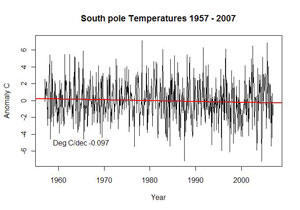 Closest Station Antarctic Reconstruction. In my last alternate reconstruction of Antarctic temperature I used the covariance of satellite information to weight surface stations. While the reconstruction is reasonable I found that it distributed the trends too far from the stations. This prompted me to think of a way to weight stations by area as best as I can. The algorithm I employed uses only surface station data laid on the 5509 grid cell locations of the Steig satellite reconstruction. Arctic sea ice does not melt in place, it is pushed out of the arctic by winds and currents. "One of the common misconceptions pushed in the media is that Arctic sea ice simply 'melts in place'. ... [But] this NASA JPL study that suggests winds may play a key role in pushing Arctic sea ice into lower latitudes where it melts. The author suggests winds may be the dominant factor in the 2007 record low ice extent ..." Sea ice around Antarctica has been increasing since the 1970s. The study by the British Antarctic Survey, published in the journal Geophysical Research Letters, says rather than melting as a result of global warming, Antarctica continues to expand. The fact that Antarctic ice is still growing does not in itself prove that global warming is not happening. But the BAS says increased ice formation can be explained by another environmental concern, the hole in the ozone layer, which is affecting local weather conditions. Polar meltdown? NOT! According to the University of Illinois Antarctic sea ice is nearly 1,000,000 square kilometers above the 1979-2000 normal. That means that the excess sea ice would cover an area about the size of Michigan and California combined! According to the National Snow and Ice Data Center in Boulder, CO — Antarctic sea ice has grown at the rate of over 4% per decade over the past 30 years and reached an all-time maximum in 2008. Climate change research: Weather hampers Arctic mission. Extreme weather conditions are hampering attempts by a team of three British explorers to survey the Arctic sea ice around the North Pole. The Catlin Arctic survey expedition, led by the explorer Pen Hadow is travelling around 1,000 km on foot to the pole. 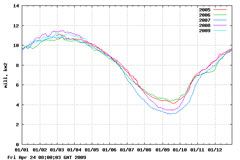 Global Warmists' Sly Polar Disorder. If there's one thing climate alarmists have become quite good at, it's retrofitting both their computer models and the climate phenomena those models predict whenever they fail to do so correctly. And whether projecting increases in temperature, sea levels or atmospheric carbon dioxide — that means often. But some of the most brazen intellectual corruption warmists have committed under fire concerns the sometimes polar opposite trends of Arctic and Antarctic sea ice. Rising Sea Levels Climate Alarmists Are Often Wrong But Never in Doubt. In the early to mid-1970s, several magazine articles and a number of scientists predicted that cooling trends could usher in a new "mini-ice age" beginning within a few short years. Didn't happen. In fact, new crystal balls went from cold to hot. A June 1989 Associated Press story quoted "a senior U.N. environmental official" who claimed that "entire nations could be wiped off the face of the Earth by rising sea levels if the global warming trend is not reversed by the year 2000." Noel Brown, director of the New York office of the U.N. Environment Program, insisted that "governments have a 10-year window of opportunity to solve the greenhouse effect before it goes beyond human control." Without action "ocean levels will rise by up to three feet, enough to cover the Maldives and other flat island nations." At last report, the Maldives continue to thrive — thanks largely to growing tourism! According to CBS News, in 2009 former Vice President Al Gore (always good for a chuckle) "told a U.N. climate conference that new data suggests the Arctic polar ice cap may disappear in the summertime as soon as five to seven years from now," meaning 2016 at the latest. Didn't happen. New Scientist Misses The Science On 'Sinking Pacific Islands'. The New Scientist (NS) recently published "The Pacific Islanders fighting to save their homes from catastrophe" by Katie McQue and Sean Gallagher. The article claims that small Pacific island nations face an existential threat from rising seas and intensifying storms driven by climate change, with displacement already underway and submergence looming. This article is factually false and unsupported by real-world data. The piece relies on emotive anecdotes and dire projections while ignoring a substantial body of empirical research showing that many low-lying islands and atolls are stable or growing, keeping pace with sea level rise rather than succumbing to it. The article asserts that "rising seas are anything but a distant projection," that high tides now regularly inundate areas that "used to stay dry," and that island nations such as Tuvalu could be "almost completely submerged at high tide by the end of the century." Kamala Harris Buys $8.2 Million Seaside Mansion After Warning 'Sea Levels Are Rising' Due to 'Climate Crisis'. Former vice president Kamala Harris and her husband Doug Emhoff purchased an $8 million mansion in an exclusive oceanside Malibu neighborhood last month. The move came after Harris spent years warning that such communities could be threatened by the "climate crisis." A real estate listing for the mansion, reviewed by the Washington Free Beacon, says the luxury pad is "perched in a prime coastal location" with "breathtaking ocean views." The property sits right near a coastline that — according to climate scenarios endorsed by Harris — is at risk of facing extreme flooding. [...] Harris's new home boasts many of the same luxuries that the Biden-Harris administration targeted with burdensome regulations. Listing photos reviewed by the Free Beacon show the mansion features a gas-powered stove and fireplace. The Biden-Harris administration introduced regulations that would have banned half of the gas stove models on the market. The home also has a tankless water heater. The Biden-Harris administration finalized regulations in its final weeks that would have banned roughly 40 percent of the tankless water heaters on the market. Kamala Harris upgrades LA real estate portfolio with $8M mega mansion in Malibu's celeb-packed Pt. Dume. Former Vice President Kamala Harris is upgrading her Los Angeles real estate portfolio, trading one celebrity-soaked neighborhood for another. Harris and her husband Doug Emhoff recently dropped a little over $8 million ($8.15 million) on a 4,000-square-foot, four-bedroom, six-bathroom home in Point Dume, a neighborhood in Malibu that's home to a who's who of both Hollywood and — more recently — Silicon Valley power players, the California Post has learned. In recent weeks several Point Dume residents have spotted Emhoff strolling through the neighborhood which rests on a 63-acre promontory perched above one of California's most famous and exclusive beaches known as Little Dume. Access to Little Dume, which boasts one of the most coveted surf breaks in all of California requires a special key that only a select group of Point Dume residents can possess. While much of Malibu remains devastated by the one-two punch of the 2018 Woolsey Fire and the 2025 Palisades Fire, Point Dume is in relatively good shape compared to other parts of Malibu. Blockbuster sea level study may turn climate change orthodoxy on its head. Global sea levels have not continued to rise at the rates predicted by many scientists — and there is no evidence that climate change has contributed to any such acceleration, a new first-of-its-kind study has claimed. The research found that the average sea level rise in 2020 was only around 1.5mm per year, or 6 inches per century, according to the paper's authors, Dutch engineering consultant Hessel Voortman and independent researcher Rob de Vos. "This is significantly lower than the 3 to 4 mm/year often reported by climate scientists in scientific literature and the media," Voortman told independent journalist Michael Shellenberger. Voortman was shocked that no researcher before had performed an analysis of real-world local data. 50
Examples of Fake News in 2024. PBS News reported that "by 2100, scientists project sea levels around parts of Florida will rise between two and eight feet," submerging large parts of the state. In fact, climate activists have been making such predictions for more than 30 years, and they have turned out to be categorically false:
Top Scientists Deliberately Misrepresented Sea Level Rise For Years. For years, the Intergovernmental Panel on Climate Change, or IPCC, has claimed that human-caused climate change has accelerated sea level rise. But that claim is false. There is no scientific evidence of accelerated sea level rise since the mid-19th Century, and thus none showing human-created emissions caused an acceleration in recent decades. [Paywall] Latest science further exposes lies about rising seas. The scientific truth is simple: Sea levels are rising, but the rate of rise has not accelerated. A new peer-reviewed study confirms what many other studies have already shown — that the steady rise of oceans is a centuries-long process, not a runaway crisis triggered by modern emissions of carbon dioxide (CO2). [...] The natural warming that began in the late 1600s got to a point around 1800 where loss of glacial ice in the summer began to exceed winter accumulation and glaciers began to shrink and seas to rise. By 1850, full-on glacial retreat was underway. Thus, the current period of gradual sea-level increase began between 1800-1860, preceding any significant anthropogenic CO2 emissions by many decades. The U.S. Department of Energy's 2025 critical review on carbon dioxide and climate change confirms this historical perspective. Blockbuster sea level study may turn climate change orthodoxy on its head. Global sea levels have not continued to rise at the rates predicted by many scientists — and there is no evidence that climate change has contributed to any such acceleration, a new first-of-its-kind study has claimed. The research found that the average sea level rise in 2020 was only around 1.5mm per year, or 6 inches percentury, according to the paper's authors, Dutch engineering consultant Hessel Voortman and independent researcher Rob de Vos. "This is significantly lower than the 3 to 4 mm/year often reported by climate scientists in scientific literature and the media," Voortman told independent journalist Michael Shellenberger. Voortman was shocked that no researcher before had performed an analysis of real-world local data. If the sea level is rising, how is this possible? The Editor says... Sea Levels [are] Not Surging Despite Years of Climate Activists And Corporate Media Freaking Out, Study Finds. One recent study compiling sea level rise data shows oceans are not surging as much as the scientific world previously projected and corporate media has repeatedly sounded the alarm over. The Journal of Marine Science and Engineering published the peer-reviewed study on Aug. 27, authored by Dutch engineering consultant Hessel G. Voortman and independent researcher Rob De Vos. The study concluded that the average rate of sea level rise in 2020 was well below other widely cited analyses, and that when projections were compared with local data, there was little evidence climate change was driving the acceleration seen in a few regions — a finding energy policy experts told the Daily Caller News Foundation challenges mainstream climate change orthodoxy. "Overall, this study indicates that in most places, sea levels are not rising unusually quickly. In the relatively few locations where sea levels are rising faster than average, the cause is almost certainly local factors such as land subsidence or ground compaction," Sterling Burnett, director of the Arthur B. Robinson Center on Climate and Environmental Policy at The Heartland Institute, told the Daily Caller News Foundation. No acceleration in sea level rise detected worldwide. An analysis of more than 200 tide stations around the world shows that there is no evidence of a global acceleration in sea level rise. That is the surprising conclusion of the paper A Global Perspective on Local Sea Level Changes, published this week in the Journal of Marine Science and Engineering. It is a unique study by two Dutch researchers, Hessel Voortman and Rob de Vos. The paper also shows that IPCC models significantly overestimate local sea level rise in 2020. This new publication is a follow-up to an earlier paper from 2023 in which first author Hessel Voortman demonstrated that sea level rise along the Dutch coast was not accelerating. These two paragraphs are the opening of a press release sent out on August 29 by engineer Hessel Voortman. Voortman spoke about his sea level research at the Clintel conference last year. Vanuatu To Get Its Day In International Court Over Climate (scam). They been pushing this for at least 15 years, and keep pushing it. I wonder how much money it has cost that could have been put into protecting the nation. It's not like they live on a coral atoll/volcanic islands (it's in the Ring Of Fire) and are polluting their water supply[.] [...] But, what they really want is string free climate cash. Lots of it. Vanuatu turns to the world court as climate disasters mount. After Cyclone Pam battered the reef in 2015, sediment from inland rivers smothered the coral beds. Crown-of-thorns starfish swept in and devoured the recovering polyps. Back-to-back cyclones in 2023 crushed what was left. Then, in December 2024, a 7.3 magnitude earthquake shook the seabed. What remains is a coral graveyard — bleached rubble scattered across the seafloor, habitats collapsed, life vanished. "We've come out of the water in tears," said Warmington, who has logged thousands of dives on this single reef. "We just see heartbreak." That heartbreak is becoming more common across this Pacific island nation, where intensifying cyclones, rising seas and saltwater intrusion are reshaping coastlines and threatening daily life. Since 1993, sea levels around Vanuatu's shores have risen by about 6 millimeters (.24 inches) per year — significantly faster than the global average — and in some areas, tectonic activity has doubled that rate. The Editor says... Oh No — We Might Need a 3ft Sea Wall to Stop the Doomsday Glacier from Wrecking Cities. Like all remotely plausible climate crisis, this doomsday scenario relies on people doing absolutely nothing to help themselves, to adapt and rectify issues. In the Netherlands / Holland, they defeated the sea by building dikes and pumps to protect their fields. Much of Holland would be inundated by sea water long ago if it weren't for anti-flooding systems which have been in place for centuries. In the Italian city of Venice, they drove huge wooden pilings into the silt, and used it to create a stable foundation for one of the most beautiful cities in the world. Some of the most impressive innovations in my opinion occurred in the 19th century United States. Entire cities were raised one floor, like Chicago (see picture at the top of the page) where buildings were jacked up, and Seattle, where streets were simply raised one floor, and what was formerly the street level became an underground tunnel network. If António Guterres Can't Get Basic Facts Right, Why Should We Believe the UN on Anything? Last year the UN Secretary-General António Guterres visited the Pacific island of Samoa and was filmed by a deserted house that he claimed had been abandoned due to climate change-related sea level rises and increasing storms. It was a porkie that quickly put its hat on and travelled around the world. The journalist Ola Sandstig reporting on Swedish public radio recently tracked down the owner of the house and found the dwelling was abandoned due to the 2009 earthquake and tsunami. [...] Guterres stood by the house and stated that "if we are not able to stop what is happening with climate change, the problem that we see in Samoa will not stay in Samoa". The arrogance on display here is astonishing. Most Pacific islands have been inconveniently increasing in size of late due to natural forces such as sand and coral accretion along with land movement. The unfortunate case of Samoa was obviously chosen for maximum psychotic effect. No, BBC, a Small Panamanian Island is Not Drowning Due to Climate Change. The BBC's recent article "Climate change: The Panama community that fled its drowning island," claims that the island of Cartí Sugdupu in Panama is being swallowed by rising sea levels due to climate change. This is false. The reality is that the island's inhabitants are not being forced to relocate because of rising oceans, but due to overcrowding, poor infrastructure, and a lack of resources — issues that have nothing to do with climate change. Furthermore, real-world examples and peer-reviewed research contradict the idea that small islands are disappearing due to rising seas. Instead, many islands are growing, adapting, and naturally shifting over time. The BBC's report is misleading at best, deliberately deceptive at worst. The cities that will be 'submerged by global warming'. The idea of entire cities being plunged underwater might sound like the plot of the latest science-fiction blockbuster. But it could become a reality in just 75 years, according to a terrifying study. Researchers from Nanyang Technological University (NTU), Singapore, have predicted that global sea levels could rise by a staggering 6.2ft (1.9 metres) by 2100 if carbon dioxide (CO2) emissions continue to increase.
The Editor says... Polar Bears, Dead Coral and Other Climate Fictions. [Scroll down] More recently, green campaigners were warning that small Pacific islands would drown as sea levels rose. In 2019 United Nations Secretary-General António Guterres flew all the way to Tuvalu, in the South Pacific, for a Time magazine cover shot. Wearing a suit, he stood up to his thighs in the water behind the headline "Our Sinking Planet." The accompanying article warned the island — and others like it — would be struck "off the map entirely" by rising sea levels. About a month ago, the New York Times finally shared what it called "surprising" climate news: Almost all atoll islands are stable or increasing in size. In fact, scientific literature has documented this for more than a decade. While rising sea levels do erode land, additional sand from old coral is washed up on low-lying shores. Extensive studies have long shown this accretion is stronger than climate-caused erosion, meaning the land area of Tuvalu and many other small islands is increasing. A Fresh Embarrassment for the Climate Cult. Remember how we've been told for years now that climate change, and hence rising sea levels, were an imminent threat to islands and island nations around the world? Well, the New York Times reported a few days ago, oops: ["]The Vanishing Islands That Failed to Vanish["] [Excerpt] Climate realists have been reporting the growth of island atolls for years, but were resolutely ignored. And now of course the Times behaves like they and their sources are noticing this inconvenient fact for the very first time. No, CBS News, New York City Isn't Going to Be Flooded by Sea Level Rise. An recent CBS News article claims that climate change induced sea level rise could result in large parts of New York City being underwater by the year 2100. This is false. The best and most relevant data measuring sea level rise in the New York Battery Park area shows a slow but steady rate of rise since 1850 that would fall very far short of submerging any locations in New York City by 2100. In the article, CBS News cites the National Oceanic and Atmospheric Administration (NOAA) saying: "NOAA predicts sea levels in Battery Park City and on the East Side of Manhattan will rise between 2.5 feet and 6.5 feet by the year 2100." CBS interviewed a resident nearby who said: "That's crazy to even picture," said Nef Garcia, who lives in Battery Park City. He's right, it is crazy and here is why. NOAA's prediction is heavily predicated on computer climate models that assume a huge acceleration in sea level rate of rise over the next 75 years. In particular, NOAA's Sea Level Rise Viewer, upon which the prediction is based, relies on estimates and models used in 2007. The Editor says... Islands that climate alarmists said would be sunk by climate change are actually growing. Climate change is not drowning atoll nations such as the Maldives, the Marshall Islands and Tuvalu, research has revealed. Historically claimed to be vulnerable to sea level rises driven by global warming, recent findings show these low-lying island nations are almost all still the same size or growing. Comparing mid-20th century aerial photographs with contemporary satellite images reveals that, of 709 islands across the Pacific and Indian Oceans, nearly 89 per cent have either expanded or remained stable in recent decades. Only 11 per cent display signs of contraction. For example, the island of Kandahalagalaa shows notable changes from 2005 to 2023. While the eastern portion experienced some erosion, the western side has expanded, maintaining overall stability. 34 Years of Flawed, Failed & Grossly Misrepresented Global Sea Level Rise Speculation. For decades climate alarmists in the UK, EU and U.S. have been making flawed and failed exaggerated claims regarding accelerating global level sea level rise being caused by increasing man made CO2 emissions as one means of politically bullying the world's nations into mandating immensely costly, bureaucratically onerous and completely ineffective global CO2 reductions from these nations. The flawed CO2 reduction schemes in the EU and UK have created significant declines in energy availability and reliability because of these nations excessive reliance on unreliable, nondispatchable, backup power reliant and costly renewable energy. These politically contrived emissions and energy incompetent policies have resulted in greatly increasing energy costs for EU and UK nations that negatively impacted their economies while significantly increasing their dependence on energy from other nations.
The Greatest Scientific Fraud Of All Time — Part XXXII (Sea Level Rise Edition). The Greatest Scientific Fraud Of All Time is the fraud by which government functionaries alter data collected and previously reported in official data bases in order to support a narrative of impending catastrophic global warming. No other scientific fraud in world history comes close to this one in scope or significance. While prior frauds may have scored a crooked scientist some funding or maybe some temporary fame, this one drives trillions of dollars of worldwide government spending and seeks to transform the entire world economy. [...] But why should we really care that the earth's atmosphere is getting a little warmer? The UN has supposedly set some kind of Maginot Line at a 1.5 deg C temperature increase from 20th century levels — an amount so small that you can barely feel it when it occurs each day. The 1.5 deg mark is just not that all that scary. So the bureaucrats and leftists need a Plan B to scare [...] the people. Plan B is sea level rise. Media Ignores Natural Factors Driving Sea Level Rise, Finds Study. Sea level rise on planet Earth could be attributed in part to astronomical influences that involve the sun, moon, and other planets, according to a new research paper from The Heritage Foundation taking aim at media reports on climate change that fixate on carbon dioxide emissions while ignoring other factors. The gravitational interactions of heavenly bodies throughout the solar system figure into a larger set of natural phenomena affecting the oceans, cited in Heritage's special report. But because many media outlets and academic journals falsely assume that only warming periods and human activity can have significant impacts on sea level rise, they typically seize on definitions that are "ambiguous" and "insufficient," writes David Legates, a climatologist and professor emeritus at the University of Delaware who is a visiting fellow at Heritage. "A more useful definition of sea level rise or, as it should be called, coastal inundation, is the increase in water levels relative to the adjacent land," Legates says in his report. Why Is Everything So Stupid? Sea Level is estimated by the IPCC (medium confidence) to rise 2.5 meters by 2100. That means an annual rate of rise between 25-44 mms. The current average rate is 3 mms, or the width of two pennies. The major unknown in sea level rise is the Antarctic Ice Sheet sheering off and causing a catastrophic rise in sea level. This possibility is often posited as caused by human induced global warming. HOWEVER, the West Antarctic Ice Sheet lies atop a major volcanic rift system with 138 documented volcanoes that are widely distributed throughout West Antarctic. These volcanoes produce a steady flux of heat and episodic active volcanoes can potentially produce significant local melting. This factor is not mentioned in the IPCC assessment reports. BUT, we recently discovered that the bedrock beneath the sheet, is rising given the lightening of the ice load. This was an unknown unknown and now it is a known unknown, in that we don't how significant the rise is, and how much it might mitigate the catastrophic risk of an ice shelf sheering off because of volcanic activity. None of this can be solved by solar panels and 15 minute cities. CO2 and Sea Level DO NOT Correlate. I have looked at Sea Level rise a few times recently. This post just adds another perspective by comparing three different data sets. The main take away from this post should be the serious lack of correlation between atmospheric CO2 concentrations and Sea Level changes. No correlation, no dominant causation. And whether you like it or not, sea level is strongly influenced by temperature, calling into question CO2's correlation to global temperatures. Not surprising since there is no empirical CO2/Temperature datasets that show CO2 driving the climate on any statistically significant historical time scale. Both the Jevrejeva et al 2014 and Frederikse et al 2020 data sets generally show alternating 30-year decelerations followed by 30-year accelerations (post-1856). Is an exponentially rising CO2 concentration responsible for the post-1856 linear rise in Sea Level? No, the more likely reason for the regular acceleration/deceleration events is ocean cycles (primarily the 60-year Atlantic Multi-decadal Oscillation (AMO)). That deceleration/acceleration cycle will continue, bringing the sea level rise back in line with the long-term linear sea level trend. The AMO is just starting its 30-year cooling phase (i.e.: deceleration). Note, I arbitrarily correlated the CO2 concentrations with the post-1950 period. Over 86% of humanity's emissions occurred post-1950, so any significant anthropogenic warming would have to have occurred over that period. 56 Years of Climate Codswallop That Never Happened. [Scroll down] With the ice age and acid rain tomfoolery snugly tucked away in the history books, the doom crew needed another looming climate-related tragedy to give us the collywobbles. "Global warming" was born. In 1988, The New York Times assured us the planet had spent the decade getting warmer. The weather trauma had been ongoing for eight years, and we hadn't noticed. The Times warned us ice caps would melt. Polar bears would drown and also die of sunburn, and the earth would flood Noah-style. The New York Times told us Manhattan's West Side Highway would belong to Davy Jones' locker by 2019. Water would slosh over New York City and fish would traverse Manhattan's busy freeway. [...] Did the New York Times tuck their tale and admit they were wrong? Nope. They recently repeated their claptrap and simply moved their water-world timeline to 2050. Scientists say real estate poses more threat to the Big Apple than climate change. New York is sinking fast and new research reveals that real estate developers' 'bigger is better' ethos is the cause. A team from the US Geological Survey and the University of Rhode Island found that the weight of the city's giant skyscrapers is causing the five boroughs to sink one-to-two millimeters yearly. The team analyzed the weight of 1,084,954 buildings constructed across a 302-square-mile city, including over 6,000 skyrises — 247 of which are skyscrapers over 150 feet tall. Tropical Paradise Islands Are Not Sinking and Shrinking; Most Are in Fact Growing! [Scroll down] An analysis of aerial photographs of 27 islands in the Pacific that barely rise above sea level has shown that only four of these atolls have decreased in size since 1951. The base area of the others, however, has remained constant or grown. In the island state of Tuvalu, for example, this affects seven out of nine islets. Even severe natural disasters such as the Christmas tsunami of 2004 or Hurricane Bebe in October 1972 did not reduce the size of the islands. On the contrary: on the Maldives, the tsunami caused a height increase of up to 30 centimeters, while the hurricane increased the size of the main island of Tuvalu, named Fongafale, by ten percent. 50 is the New 70 degrees Fahrenheit. Mean sea level is actually the most reliable indicator of global temperature trends, because it is global and not local. According to NASA's website, the oceans have so far been creeping up at 3.3 millimeters per year. It takes almost 305 millimeters to equal a foot of distance. Oy! Having studied both climatology and paleontology, I can say that, should sea levels stop rising and start falling, we may well be entering the next ice age. C'mon, this "climate change" rap is a fairly naked attempt by the "Totalitarians" to enslave us, the masses. Just scare [...] us. There ya go, it'll work like a charm. We'll gladly surrender just about all of our freedoms in order to imagine saving the planet. Now, that's major-league virtue-signaling. U.N. Chief Guterres Warns of Mass Climate Exodus on a 'Biblical' Scale. U.N. Secretary-General António Guterres offered his apocalyptic view of the coming climate catastrophe Tuesday [2/14/2023], warning the Security Council that rising seas threaten the very existence of "entire countries." In his doomsday address, the U.N.'s alarmist-in-chief declared that the danger "is especially acute for nearly 900 million people who live in coastal zones at low elevations — that's one out of ten people on Earth." "Low-lying communities and entire countries could disappear forever," Guterres asserted. "We would witness a mass exodus of entire populations on a biblical scale." The Editor says... Sea level is stable around the world. We have been studying climate change and potentially associated sea level changes resulting from melting ice and warming oceans for a half century. In the 1970s our primary concern was global cooling and an advancing new ice age. Many believe that increasing quantities of carbon dioxide in our atmosphere could result in rising levels of the sea in general. The record does not show this to be true. There is no evidence whatever to support impending sea-level-rise catastrophe or the unnecessary expenditure of state or federal tax monies to solve a problem that does not exist. The National Oceanographic and Atmospheric Administration (NOAA) has updated its coastal sea level tide gauge data which continue to show no evidence of accelerating sea level rise. There is no correlation between CO2 and rising ocean levels, according to decades of data from NOAA. For years, the global warming cult has shamed people for not believing in their religion of doom, for not agreeing that the oceans are rising, that the world is ending because of CO2. According to decades of tidal data collected by the National Oceanographic and Atmospheric Administration (NOAA), ocean levels have generally stayed the same for centuries, regardless of CO2 levels in the atmosphere. When a minuscule increase in the ocean level is detected, it is observed over a century, and the rise is not even correlated with CO2 levels in the atmosphere. Tectonic activity, hurricane damage, the El Nino effect, and changes in ocean currents are just a few of the uncontrollable variables that affect sea level measurements. Sea level is stable around the world. We have been studying climate change and potentially associated sea level changes resulting from melting ice and warming oceans for a half century. In the 1970s our primary concern was global cooling and an advancing new ice age. Many believe that increasing quantities of carbon dioxide in our atmosphere could result in rising levels of the sea in general. The record does not show this to be true. There is no evidence whatever to support impending sea-level-rise catastrophe or the unnecessary expenditure of state or federal tax monies to solve a problem that does not exist. The National Oceanographic and Atmospheric Administration (NOAA) has updated its coastal sea level tide gauge data which continue to show no evidence of accelerating sea level rise. These measurements include tide gauge data at coastal locations along the West Coast, East Coast, Gulf Coast, Pacific Ocean, Atlantic Ocean and the Gulf of Mexico, as well as seven Pacific Island groups and six Atlantic Island groups, comprising more than 200 measurement stations. The longest NOAA tide gauge record on coastal sea level rise measurements is in New York at the Battery, with its 160-year record which is shown below with a steady rate of sea level rise of 11 inches per century. Climate change talking points. For the record, climate change is real — but that's nothing new, just ask a wooly mammoth or a dinosaur. Atmospheric heat-trapping is also real, or else everything around us would freeze solid every night — just as it does on our airless moon. And sea level is the best way to tell if the earth is warming or cooling because it is a truly global indicator, rather than a stew of various local measurements. [...] Previously at this site, Viv Forbes posted a link to NASA's website showing a graph of annual sea-level measurements going back to 1993. The overall accumulated increase is 102.5 millimeters. This site is also sprinkled, nonetheless, with all kinds of dire climate change warnings. But if you do the math, it comes out to a little under 3.7 millimeters per year. At this rate, it would take about 82 years for the sea level to be raised by one foot. Also, the graph forms what is mostly a straight line even if you scroll down to see the same plot going back all the way to 1900. No "hockey sticks" here; just a steady increase. Maldives at risk? [Scroll down] One of my favorite examples of this phenomenon is the case of the Maldives, a tiny group of over 1000 islands nestled in the Indian Ocean. Back in 1988 climate scientists were predicting that the Maldives would be under water by 2018 or so. Melting icecaps and glaciers would increase sea levels that the islands, few of which are much higher than sea level, would be swamped. It was alarming, and of course the political leaders of the islands begged for foreign aid to deal with the crisis. Rising sea levels were also fouling the ground water of the islands (shockingly these tiny islands actually have groundwater) and before the residents were drowned by rising seas they would die from lack of water — by 1992, in fact. Thirty years ago. Today they are predicting that the groundwater will be fouled in... 30 years. Shockingly, today the Maldives are larger, populated by more than twice as many people, and a tourist destination. Sea Level Is Rising — But So What? A good way to distinguish between a reasonable climate discussion and fear-mongering is to examine the data. Fear-mongering will contain incomplete data, or none at all. The person mongering fear expects us to take the claim on faith. But we don't have to. Sometimes it is ridiculously easy to check the claim. A case in point is a recent article titled "How map of Britain will change in next 80 years as towns and cities fall into the sea" [sic] by Sam Elliott-Gibbs. Note the headline emotionally and deceptively implies they will "fall," but the text goes on to discuss sea level rise based on air temperature. The article cites Climate Central to claim large areas of England will be under water by the year 2100. The only evidence provided is a couple of maps built on Climate Central's interactive mapping tool. Climate Central uses topographic data to forecast flooding based on sea level, and blames sea level rise on climate change. Climate Central bases its sea rise forecast on material that is mostly speculative. It cites the IPCC and a NOAA report. The NOAA report is actually a group effort involving several government agencies, none of which, except NASA, are directly involved in atmospheric science. The NOAA contribution comes from the National Ocean Service, not the atmospheric side. These sources extrapolate sea level rise from 2020 into the future. Why Build There? To begin, hurricanes have not been striking the U.S. more often, nor are they more deadly. [...] Storms like Ian and Katrina are extremely powerful, and at the same time, seas have been slowly rising. But there have always been powerful hurricanes, and seas have risen less than a foot over the last 125 years. To be precise, the seas rose an estimated 6.7 inches in the 20th century, and a 2007 IPCC report predicted a rise of between 7 inches and 1.9 feet for the 21st century. That estimate has since been raised, by some at least, based on so-called scientific models, to an upper limit of 4.9 feet by 2100. But since sea levels have risen only 3 inches in the past 25 years, they have a long way to go to make 4.9 feet or even 1.9 feet by 2100. The real reason behind increasing property damage is over-development on barrier islands and in low-lying coastal areas. Even some mainstream news commentators are beginning to realize this. No, Melting Greenland Ice Is Not About to Swamp Coastal Areas. A study published in Nature Climate Change in late August claimed anthropogenic climate change has already committed approximately 3.3 percent of the Greenland ice sheet to melting — approximately 110 trillion tons of ice. By itself, that would cause nearly a foot of global sea-level rise, the article stated. Even worse, the researchers estimate if the high-period ice loss experienced across 2011 through 2012 were to resume and continue throughout the end of the century, the ice melt could be 185 percent greater, with a correspondingly bigger sea level rise. Corporate media outlets were quick to hype the extreme outlier projections of this single study. CBS News, CNBC, CNN, The New York Times, and The Washington Post, to name just a few, gave the report prominent, alarmingly headlined coverage. [...] The study and the news stories hyping it definitely lack extraordinary evidence. Hard data backing up the claim of alarming amounts of Greenland ice melt driving increasing rates of sea level rise is absent, probably because such data does not exist. Scientists warn South Florida coastal cities will be affected by sea level rise. Sea level rise is increasing at a dramatic rate. Scientists at the University of Miami warn that if we don't act soon, coastal cities and towns will slowly diminish. Scientists say a few decades from now, downtown Miami will be underwater. ["]The tide is coming in and eventually it's not going to go back out," says Dr. Harold Wanless, a Geologist and Professor of Geography and Sustainable Development at University of Miami[.] "Climate change is real. This isn't something that might happen," he says. "The problem is, sea level is rising at an accelerating rate now because of ice melting in Greenland and Antarctica. So for now what is just a high tide — a rare high tide... is going to become a frequent high tide," he says. So what does that mean for us? According to Dr. Wanelss's research, by the year 2060, nearly 60% of Miami-Dade county will be underwater. "Now since the ice melt started we're up to a rate of almost two feet per century," he says. The Editor says... Joe Biden Owns A Pricey Beachfront Mansion Despite His Sea Level Alarmism. He's Not The Only One. President Joe Biden and other climate activists like Bill Gates, John Kerry and former President Barack Obama own several expensive beachfront properties despite their claims that rising sea levels are threatening the planet. Biden owns a $3.8 million beachfront mansion in Delaware even though he has previously warned against rising sea levels caused by climate change, according to CNN. Other prominent environmental activists such as Gates, Obama and Kerry have all expressed concerns about the threat of rising sea levels despite the fact that they also own beachfront properties worth up to $43 million. Biden, who bought his beach mansion in 2017, expressed his fears of rising sea levels in Delaware that he attributed to climate change during a CNN town hall in 2019. Historic $32.5M 'Sandcastle' Is Rhode Island's Most Expensive Home. A beachfront mansion on the market for $32.5 million is Rhode Island's most expensive home. Located in the town of Westerly, the home lovingly referred to as "Sandcastle" sits prominently in the exclusive coastal village of Watch Hill. "This listing is on a gorgeous stretch of sandy beach, which is a rare find," says listing agent Donna Simmons, of Mott & Chace Sotheby's International Realty. The Editor says... The only people who believe this are those who do not believe the Bible. The Editor says... In 1995 The New York Times Warned that East Coast Beaches [Would] Be Gone in 25 Years. In 1995 the New York Times reported that in 25 years the beaches on the US East Coast would no longer be visible — they would be underwater due to global warming. Today evidence again proves The New York Times and climate change radicals were wrong. [...] Now twenty-seven years later, the beaches are still here. [...] They have not fallen into the ocean. The sea levels are not so high due to global warming that the beaches are gone. What beachfront property says about global warming. Global warming is a crisis no one believes in. At least, most people don't believe in it. The market shows us that. More technically, people voting in the mortgage market with their money on balance do not believe in global warming. Sure, I could have started this by pointing out, as many other observers have, that warmists ex-president Barack Obama and billionaire Bill Gates have recently bought low-lying beach properties. That certainly seems in conflict with what they claim to believe about global warming and rising sea levels. Experts Insist Sea Levels Are Rising Despite Photos Proving They Aren't. he First Church of Climate Change demands absolute fealty lest Mother Gaia smite thee mightily with a fearsome blow. This is why, for example, true believers such as Barack Obama only purchase property guaranteed safe from rising sea levels and ... oh, wait ... Nevertheless, intrepid defenders of the faith are unceasing in their efforts, demanding who do you believe: them, or your lying eyes and ears. The latest foray involves recently circulated photos of Sydney Harbor taken some 140 years apart. [Tweet] The Editor says... The Mass Psychosis of Liberals. Liberals have mastered the art of wanting to believe in a false reality, constructing a Bizarro Universe, while at the same time, excusing themselves for committing the very same transgressions against society and nature that they accuse others of doing. [...] According to the dire warnings made in the late 1990s, Manhattan was supposed to be under water by now, yet the latest reports are that it hasn't yet lost Parking Space One. And those polar bears? Still surviving and their numbers are actually increasing. Questions the Climate Police Won't Answer. How can scientists say sea level rise is getting worse when tide gauges show no rise in rates where the land is not sinking, and sinking land accounts for the supposed rise in in the Tidewater area of Virginia and the Mississippi Delta region? I will make a prediction. The climate industry will soon fake the data from tide gauges like they did with satellite surface temperature data. Satellite data weren't showing a warming earth, so they were changed to fit the narrative, changed from actual temperatures to what they should have been as predicted by bogus computer models. You can expect these same dishonest liars to attempt to pass off modeled tide gauge data as actual data in the near future. While we're talking about data, why has global warming paused for the last 20 years when carbon emissions are 'worse than ever'? Why can't the climate police explain the pause? The second home and staycation hotspots that could be swallowed by the sea in just thirty years. Nearly 200,000 homes and businesses in England are at risk of being lost to rising sea levels by the 2050s, a new study has warned. Researchers said the country could face around 14 inches (35 cm) of sea level rise compared to historic levels within 30 years and is nearly certain to see close to 3 ft (1 m) of advancement by the end of the century. It comes a week after the official in charge of Britain's flood protection said some of Britain's seaside towns and villages may have to be abandoned because of rising seas and coastal erosion. The Editor says... Sea Level Rise Acceleration — An Alternative Hypothesis. Having analysed the NASA Sea Level readings over the last 4 years it has been concluded that the accelerations derived by Nerem et al. are a consequence of the methodology used and are not inherent in the data. The analyses further predict that the perceived accelerations will drop to near zero levels in 10 to 20 years. Roaring And Screaming. [Scroll down] The press release about the study is "Researchers demonstrate new link between greenhouse gases and sea-level rise". Inter alia, it says: ["]A new study provides the first evidence that rising greenhouse gases have a long-term warming effect on the Amundsen Sea in West Antarctica. Scientists from British Antarctic Survey (BAS) say that while others have proposed this link, no one has been able to demonstrate it.["] Well ... in a word, no. The study doesn't provide any evidence at all, not one scrap. What it provides instead are the results of computer models using another computer model as input. Rising Seas and Government Greed. Rising gas prices are an immediate problem — rising seas are not. Yet in his State of the Union address on Tuesday, President Biden had nothing new to say about bringing gas prices down. Releasing a few barrels from the Strategic Petroleum Reserve is not a solution; it's a Band-Aid that will last about two days. Yet all that Biden can do is repeat the outworn bromide that global warming is a catastrophe bringing drought, storms, and rising seas. According to most estimates, global sea levels rose by five inches in the 20th century. That's five inches for the entire century, not per year. That is the most recent century we have as a basis for future predictions. Climate scientists believe that ocean levels will rise at twice that rate through the 21st century, but they have been wrong about many things, and their behavior often appears to be politically motivated. One can speculate about the future, but the past does not lie. Geologist on Global Warming: Claims of Accelerating Sea Level Rise And Skyrocketing Rate of Extinctions Are False. NTD's Kevin Hogan speaks with geologist Gregory Wrightstone, the executive director of the CO2 Coalition, at Turning Point USA's 'America Fest 2021.' Wrightstone puts forward evidence to debunk several claims about global warming. He recounts his data-based testimony to the Senate exposing supposed false claims by the United Nations that the world will see 1 million extinctions over the next several decades due to rising temperatures. Wrightstone asserts the UN is promoting fear and alarm over global warming, pointing to the fact that there were only 2 extinctions per year over the last 40 years. He also contradicts claims that extreme weather is a result of climate change by looking at a decrease in severe tornadoes in the U.S. since 1950. Furthermore, he discredits the assertion that the rate of sea level rise is accelerating, showing it has stayed nearly constant over the last century. Climate alarmists plan to destroy a whole village. [Scroll down] Aggregating climate models that were built to measure different parameters results in critical errors that undermine understanding the climate. Climate models have also been shown to be inherently flawed because we simply do not have the capability to run controlled experiments on the climate, nor have models been able to replicate their own results. There is also a possibility that climate models are over-sensitive to carbon dioxide increases and that future projections of temperatures may be too high. Climate alarmists have been using these shaky computer models for years to scold people for driving their cars, subsidize untenable green technology with taxpayer money, and give each other awards for being the most fervent in lip service to the idea that humans are destroying the planet by breathing and eating beef. Now they want to drive people out of their homes because their oracles, the climate models, have spoken of a future in which the ocean might rise between 2 and 3 feet — maybe — in the next 40 years. The people of Fairbourne are having none of it. They don't find the computer models persuasive, and they don't understand why their village has been singled out for destruction from all the other coastal communities in Wales. They don't even know if they will be compensated if they are thrown out of their homes. Jeff Bezos Buys $78 Million Oceanfront Mansion. Amazon founder Jeff Bezos is so concerned about sea level rises caused by climate change, he's bought a $78 million dollar beach mansion located right next to the sea. [Video clip] Weasel word alert: A lot of things COULD happen by 2050.
Our Increasingly Unrecognizable Civilization. [Scroll down] We need politicians with a sense of urgency about these problems, but all they seem to have is urgency about things that aren't urgent. Look at climate change. People say we need to take action over climate change or else rising sea levels are going to overwhelm the Maldives in the Indian Ocean in the 22nd century. That's the century after this one, which is still quite young. These same people say about the immediate crisis on the southern border that it's "a natural phenomenon beyond the control of politicians." But changing the weather in order to lower the sea levels that will threaten the Maldives in the Indian Ocean in the next century is within the power of politicians? In general, our leaders are urgent about nothing that matters and not in the least bit urgent about things that matter very much. How Global Warming Isn't. I kept reading that warming oceans around Antarctica are melting the ice shelves. However, I've also read that Antarctica hasn't warmed in seven decades. Say what? So I thought I'd take a look at the trends in ocean temperatures. As usual in climate, the results were not what I might have expected. I used the Reynolds Optimally Interpolated sea surface temperature (SST) dataset. It is built on satellite and in-situ data, and starts in 1982. Here are the SST trends in that dataset. [...] Seas [are] Rising 20 Times Slower than the Media Claim. According to NASA and NOAA satellite instruments, sea level is rising at a mere 3 millimeters per year, which is a pace of just under one foot per century. (Note, the NASA/NOAA-reported 3.3 mm/year rise in Global Mean Sea Level includes a 0.3 mm "adjustment" that accounts for land rising as glaciers melt. The sea-level rise in relation to coastal shorelines is therefore 3.0 mm/year.) Moreover, the satellite measurements show no significant acceleration during recent decades in the pace of sea-level rise. Given that seas are rising at a pace of merely one foot per century, which is little if any faster than the pace of sea-level rise throughout the global warming of the 1800s and 1900s, it is almost certain that seas will not rise 20 feet during the next 100 to 200 years. It is also almost certain that seas will not rise two feet during the next 20 years. Climate activists simply making stuff up, with the media then reporting on the made-up [falsehoods] as if it is settled science, is par for the course these days in media coverage of the climate debate. Current climate model simulations overestimate future sea-level rise. The melting rate of the Antarctic ice sheet is mainly controlled by the increase of ocean temperatures surrounding Antarctica. Using a new, higher-resolution climate model simulation, scientists from Utrecht University found a much slower ocean temperature increase compared to current simulations with a coarser resolution. Consequently, the projected sea-level rise in 100 years is about 25% lower than expected from the current simulations. These results are published today in the journal Science Advances. Estimates for future sea-level rise are based on a large ensemble of climate model simulations. The output from these simulations helps to understand future climate change and its effects on the sea level. Climate researchers continually aim to improve these models, for example by using a much higher spatial resolution that takes more details into account. "High-resolution simulations can determine the ocean circulation much more accurately," says Prof. Henk Dijkstra. Together with his Ph.D. candidate René van Westen, he has been studying ocean currents in high-resolution climate model simulations over the past few years. Biden said a lot of stupid stuff at his press conference and the media fawned. Even with a book full of cheat sheets, Joe Biden was able to say a lot of stupid stuff. He said we have to spend a lot of money raising streets three feet because of climate change, which supposedly is caused by oil. [...] A follow-up question might have been to ask how much sea levels have risen the last 140 years since the dawn of the use of oil. The best guess is that sea levels have risen less than one foot the last 140 years while oil use has risen 1,781 times from around 55,000 barrels per day to 98 million barrels per day at the end of 2019. Since the Pacific Ocean is over 36,000 feet deep, one foot would equal a .000028 [percent] change in 140 years. So where is the correlation? Does anyone believe oceans can be measured accurately within hundredths of an inch with all the variables, let alone what causes the change? Could beaches disappear partially because of pounding waves and erosion vs. rising sea levels? [...] Why would wealthy people like the Obamas continue paying huge prices for oceanfront property if they believed what they were spewing forth? Wouldn't they buy properties higher up? Kivalina: A Case Study of How Media & Politics Mangle Objective Climate Science! What appears to be more failed alarmist predictions, the BBC's 2013 headlines read Alaskan Village Set to Disappear Under Water in A Decade. "Gone, forever. Remembered — if at all — as the birthplace of America's first climate change refugees." [...] The real problem for Alaska's native communities has been past governments' mis-guided attempts to enforce "permanence" in an everchanging landscape. The "settlements facing imminent destruction" are not places native people had freely chosen to settle. With their survival on the line, indigenous people were intimately aware of Alaska's everchanging environments long before the theory of CO2-induced climate change would be proposed. And so, they chose to be semi-nomadic. Kivalina was a good seasonal hunting camp, but never hosted a permanent settlement. Nonetheless the US Department of the Interior's Bureau of Indian Affairs (BIA) made it permanent in 1905. So it wasn't due to SUVs and pickup trucks? Rising Seas Aren't Swamping Small Island Nations. At a U.N. Conference of world leaders in September, representatives of the Alliance of Small Island States and the Least Developed Countries Group said, "In another 75 years, many ... members may no longer hold seats at the United Nations if the world continues on its present course," the Associated Press (AP) reports. At the same meeting, Fiji Prime Minister Frank Bainimarama said, "We are already seeing a version of environmental Armageddon." The problem, according to the island nations represented at the U.N. meeting, is that low-lying islands such as Tuvalu will completely disappear within 75 years, covered by rising seas. Fortunately, scientific evidence demolishes such claims. Bill Gates, climate change alarmist, buys $43 million mansion right off the ocean. Never trust those who don't practice what they preach. Case-in-point: Billionaire Microsoft co-founder Bill Gates. On top of being a proponent of population control, forced vaccines, and most far-left causes, he's also a staunch believer in promoting climate change hysteria. In one recent talk, he said temperatures will rise continuously going forward and sea levels will rise, decimating the coastlines. There are many who do not buy into this narrative... including Gates himself. If he did, he wouldn't have just purchased a $43 million mansion right off the ocean in Del Mar, California. A Science Project in Celebration of the 50th Anniversary of Earth Day. From 1880-2013, it is estimated that sea levels have risen .06 inch per year or a total of 7.2 inches. The best estimate of the depth of the Atlantic Ocean is 27,841 feet, the Pacific Ocean is 36,070, The Indian Ocean is 26,401 feet and the Arctic Ocean 17,881. Whatever the levels of the ocean's seas are, a 7.2 inch rise in 133 years, would be minimal and there is clearly no correlation between sea levels and CO2, human population and crude oil consumption. Wouldn't it be hard to measure deep seas within a few inches each year? Don't conditions change each year? Isn't there natural erosion? New study shows sea level rise has been slow and a constant, pre-dating industrialization. For those who seek to panic the public into handing control of all economic activity to the state, the prospect of rising sea levels inundating coastal cities has been the most useful tool. By propagating the theory that your SUV, air-conditioning, and jet travel will drown New York and Miami, and submerge Pacific islands out of existence, the warmists plan to extract trillions of dollars from advanced economies and distribute them to cronies making solar cells, electric cars, windmills, and other expensive substitutes, and to the rulers of third-world countries alleged to be devastated (with "administrative costs" sticking to the fingers of the bureaucrats, of course). It all makes intuitive sense, so children like Greta Thunberg are easily convinced that their futures have been stolen because you want to enjoy a first-world lifestyle. Melt the polar ice caps, and we are doomed! In real life, the problems with the theory have been understood by critical minds such as AT contributor and distinguished scientist S. Fred Singer. Now a new study that found a proxy measure to trace sea levels back before the advent of industrialization has confirmed what Dr. Singer told us years ago: sea levels have been rising very gradually at a near constant rate since the end of the last ice age. Hell or High Water. For years the climate alarmists have been claiming that low-lying atolls like those in the Maldives would disappear, swallowed by the sea in a manner reminiscent of Atlantis. Global warming is causing sea level rise, they claim, and places like the Seychelles or Kiribati or the Maldives were doomed, doomed, <i>doomed! Reasonable people pointed out that the sea levels have been rising for ten thousand years and there has been no major increase in the rate of sea level rise (which is 0.118 ± 0.016 inches per year), but this entreaty fell on deaf ears. Brief history of tide gauges. In the 19th Century the Mersey Docks and Harbour Board, that was to become the Liverpool Observatory, established state-of-the-art tidal stations along the nearby Mersey Estuary. In 1929 this Observatory merged with the Tidal Institute at the Liverpool University and this was to become a world-famous centre for sea level research. Today the Permanent Service for Mean Sea Level (PSMSL) maintains a database of tide gauge data from all over the world. After the Intergovernmental Panel for Climate Change was formed in 1988 successive IPCC technical committees carefully examined the PSMSL tide gauge data as the computer climate models were predicting the acceleration of sea level rise. After all, a discovery of sea level acceleration would provide additional evidence of increased global warming due to rising carbon dioxide levels and proof of anthropogenic climate change. Alas! Alas! There was almost a level of disappointment in the early IPCC reports. Despite all their efforts the committees in 1990 (13 experts), 1995 (24 experts) and 2001 (36 experts) stated that they could find no acceleration of sea level rise in the 20th century despite the rise of CO2 during that time. Climate Myths. Alarmists say, "Miami will soon be underwater!" Few serious people deny that the Earth has warmed and that sea levels are rising. But [climatologist Pat] Michaels points out that even if the warming increases, humans can adjust. For example, much of Holland is below sea level. "They said," Michaels recounts, "we're going to adapt to the fact that we're a low-lying country; we're going to build these dikes. Are you telling me that people in Miami are so dumb that they're just going to sit there and drown?" Climate-change deniers may be propping up home prices in waterfront communities, research suggests. The fate of home prices in real-estate markets that have a high risk of being affected by climate change could come down to how many local residents actually believe in climate change. A new study from researchers at the University of British Columbia's Sauder School of Business in Canada examined the role climate change denial plays in the pricing of these homes. The researchers compared sea-level data from the National Oceanic and Atmospheric Administration (NOAA), current real-estate transaction data from Zillow, and geographic data about climate change attitudes from the Yale Program on Climate Change Communication, which estimates opinions on climate change based on a national data set of 24,000 people. Why bother? The Editor says... Why are the Maldives building airports next to the ocean when warmists predict that it will be underwater with sea level rise? Sea level rise, a trend that predates the Industrial Revolution, is being blamed on CO2 emissions and has become one of the most potent harangues used to guilt-trip the populace of major industrial countries over the use of carbon-based energy. (Mysteriously, China and India, whose expanding carbon footprints dwarf the expensive reductions engineered with Teslas, windmills, and vegan diets in the West, are largely exempted from criticism.) We citizens of the advanced countries are instructed that poor residents of tropical islands face inundation because we drive SUVs and chow down on burgers, heedless of the cost to people struggling to stay alive on coral reef atolls. There are even demands for reparations. The Shameless Hypocrisy Of Cities Suing For Climate Change 'Damages'. Consider San Francisco's 2017 municipal bond offering which reassuringly told potential investors, "The City is unable to predict whether sea-level rise or other impacts of climate change or flooding from a major storm will occur, when they may occur, and if any such events occur, whether they will have a material adverse effect on the business operations or financial condition of the City and the local economy." Yet in its multi-billion-dollar climate lawsuit, the city went full-on Chicken Little, warning, "Global warming-induced sea level rise is already causing flooding of low-lying areas of San Francisco." The example isn't isolated. [...] Aside from the shameless hypocrisy of mayors wooing potential investors while claiming pending climate disaster in court, the motivation behind these lawsuits is clear. Many cities filing lawsuits against energy companies are financial train wrecks, seeking billions to offset their mismanagement. 11 Empty Climate Claims. Claim [#7]: Global warming is resulting in rising sea levels as seen in both tide gauge and satellite technology. Fact: The rate of global sea level rise on average has fallen by 40% the last century. Where it is increasing — local factors such as land subsidence are to blame. Climate change is threatening the world's archaeological treasures. Ancient British structures older than the pyramids are being threatened by climate change, experts have warned, as rising sea levels, heavier rainfall and severe weather events endanger Scotland's archaeological treasures. The Orkney Islands, situated off the north coast of the Scottish mainland, are home to more than 3,000 historical sites. Evidence has been found of human habitation there going back 8,500 years. Some buildings on the islands date to the Iron Age, Viking rule and medieval times. But around 1,000 sites are situated on the coastline and are under threat. The Editor says... If the world is fast coming to an end based on climate change, why do people still flock to the coasts? Since at least 1922, the Washington Post and others have been trying to scare everyone into thinking that the coastal cities would soon disappear along with the Arctic icecaps and yet the people living by the coast seem to be relaxed and happy. [...] The warnings today are exactly the same as they were almost 100 years ago and they haven't been right yet. But the goal is not to be right. It is to scare people into giving their hard-earned money and freedom to powerful politicians and bureaucrats. Isle of the Dead (Benchmark). [Scroll down] It is important to note what Captain Ross wrote about it. "My principal object in visiting Port Arthur was to afford a comparison of our standard barometer with that which had been employed for several years by Mr. Lempriere, the Deputy Assistant Commissary General, in accordance with my instructions, and also to establish a permanent mark at the zero point, or general mean level of the sea as determined by the tidal observations which Mr. Lempriere had conducted with perseverance and exactness for some time: by which means any secular variation in the relative level of the land and sea, which is known to occur on some coasts, might at any future period be detected, and its amount determined. The point chosen for this purpose was the perpendicular cliff of the small islet off Point Puer, which, being near to the tide register, rendered the operation more simple and exact. The Governor, whom I had accompanied on an official visit to the settlement, gave directions to afford Mr. Lempriere every assistance of labourers he required, to have the mark cut deeply in the rock in the exact spot which his tidal observations indicated as the mean level of the ocean.["] Sea-Level Hysteria Falls Short On Science. In the 20th century, the oceans rose by slightly less than an inch per decade, according to the UN Intergovernmental Panel on Climate Change (IPCC), and the current consensus is that manmade global warming will make them rise even faster due to thermal expansion. However, a few stubborn voices challenge this view. One of these is Australian amateur scientist and vocal climate skeptic John Daly, who made a fascinating report about an old sea-level benchmark in Port Arthur, Tasmania. Based on measurements done over an extended period, Antarctic explorer Sir James Clark Ross struck a mark on the Isle of the Dead in 1841 to document the average sea level. Now, nearly two centuries later, the mark is still visible, suggesting that there has been little or no sea-level rise. Mainstream scientists dismissed it as an error and gave it little attention. Climate Change Could Leave Obama's Possible New Mansion Underwater, According To Researchers Funded By Obama Admin. The Obamas are reportedly in the process of buying the island property, which was originally listed at listed at $14,850,000, from Boston Celtics owner Wyc Grousbeck. Though the deal has yet to be finalized, both TMZ and the Boston Herald have reported that the Obamas are in escrow. Climate Central, a research group funded by the government during the Obama administration, projects the Obamas' possible new mansion to be well underwater in its "Extreme Scenario 2100" model. Martha's Vineyard Home Proves Obama Knows Global Warming's a Hoax. The Obamas are literally investing $15 million in the fact that Global Warming is a hoax. What's more, he is only 58 years old. He's got at least another 25 to 30 years. Regardless of his age, if Global Warming were real, this would be a terrible investment under any circumstance. As this dumb 12-year deadline counts down, it should be property along the coastlines that lose the most value, while inland property rates skyrocket due to overcrowding by leftists fleeing to safety... right? But leftists are not leaving the coast, and the value of coastline property continues to rise. The sea level of Massachusetts has been remarkably stable over the last century. I believe that nobody could look at graphs of the monthly average mean sea levels measured by tide gauges, with regular, natural oscillations, about a constant linear trend, over more than one hundred years, and say the sea levels have dramatically accelerated over the last few decades. However, this the norm, rather than the exception. Thus, I proposed to the editor of the journal, Dr. David Burdige, a polite, simple, but effective, comment, asking where was the evidence for the accelerating claims when I was not able to spot any difference in between the sea level oscillations about the same linear trend before and after 1990, in the tide gauges of Massachusetts, same of every other long-term tide gauge of the world. Imaginary sea level rise. I doubt if anyone who is not an Earth Scientist specializing in sea level changes would have any idea that it is nearly impossible to measure global sea level changes over centuries with an accuracy outside error limits (i.e. two standard deviations, assuming a Gaussian distribution), when even that is not clear. This explains the numerous and varied estimates from practically nothing (as claimed by probably the World's foremost sea-level scientist Professor Nils Axel Mörner) to common estimates of around 5 to 10 cm per 100 years — take your pick; and the climate alarmists certainly do, going unashamedly up to 50 metres! UN IPCC Scientist Blows Whistle on Lies About Climate, Sea Level. The United Nations Intergovernmental Panel on Climate Change (UN IPCC) is misleading humanity about climate change and sea levels, a leading expert on sea levels who served on the UN IPCC told The New American. In fact, it is more likely that sea levels will decline, not rise, explained Dr. Nils-Axel Mörner, the retired head of the paleogeophysics and geodynamics at Stockholm University. A new solar-driven cooling period is not far off, he said. [...] Asked if coastal cities such as Miami would be flooding due to sea-level rise caused by alleged man-made global warming, Mörner was unequivocal: "Absolutely not." "There is no rapid sea-level rise going on today, and there will not be," he said, citing observable data. "On the contrary, if anything happens, the sea will go down a little." Climate change could put these colleges underwater. A 2018 study from the Union of Concerned Scientists, a climate watchdog group, detailed the danger that cities face due to chronic flooding. As Earth's temperatures increase and ice melts, rising sea levels could leave major portions of U.S. cities underwater in a matter of decades. But in colleges located in these threatened seaside regions, from Texas to Florida to New Jersey, administrators and scientists say they have no plans to move. Instead, they are raising buildings and constructing protective barriers in hopes of making their campuses safe for the foreseeable future. The Editor says... Union of Concerned Scientists. A Union of Concerned Scientists declaration, entitled "Restoring Scientific Integrity in Policy Making," charges that the Bush administration "has continued to distort and suppress science in pursuit of its political goals — despite a plea from top U.S. scientists to restore scientific integrity to the policy-making process." According to UCS President Kevin Knobloch, "We found a serious pattern of undermining science by the Bush administration, and it crosses disciplines, whether it's global climate change or reproductive health or mercury in the food chain or forestry — the list goes on and on." The signers of this document portrayed themselves as objective scientists with no political agenda. But in truth, over half of them were financial contributors to the Democratic Party, Democratic candidates, or a variety of leftist causes. Time Uses Fiji to Stir Global Warming Alarmism. [Scroll down] Multiple organizations have called into question the prediction that oceans will rise three feet by the end of this century. The International Panel on Climate Change predicts only about a half-meter rise in sea levels through the century of the 2000s, and although some have charged its predictions may be on the low end, "there is a 95 percent probability that sea level rise will be less than one meter by 2100," wrote Earl Ritchie, a lecturer in the Department of Construction Management at the University of Houston in Forbes magazine. But as Marc Morano pointed out at Climate Depot, new readings from the National Oceanic and Atmospheric Administration using tide gauge data show the average global sea level rise rate is between 1.7 and 1.8 millimeters per year — or about 5.6 inches this century. There are variations, Morano wrote, but they are tied to rates and sources of vertical land motion. 30 years later, global warming still hasn't sunk the Maldives. After alerting the world in September 1988 that the Maldive islands of the Indian Ocean would be submerged by rising seas in less than three decades — due to the so-called first effects of man-made global warming — officials of the United Nations and associated climatologists are scratching their heads that the island chain is still there. Sea Level Rise is Not Accelerating, New Study Shows. A new report by Drs. Craig Idso, David Legates, and S. Fred Singer, released by The Heartland Institute, shows the Intergovernmental Panel on Climate Change (IPCC) and other government and nongovernment organizations are wrong to claim sea levels are increasing at an unusually rapid rate due to anthropogenic climate change. The scientists analyzed peer-reviewed literature examining long-term data from tidal gauges and other sources and found the amount of sea level increase the Earth has experienced over the past century is not unusual historically, nor has the rate of rise increased significantly over the past few decades.
The scandal of sea levels — rising trends, acceleration — largely created by adjustments. Headlines across Australia yesterday [5/11/2019] told us the dire news that a new study finds that "Sea level rising faster in past 20 years than in entire 20th century". A new paper by Watson et al is driving the headlines, but underneath this Nature paper is a swamp of adjustments, an error larger than the signal, and the result disagrees with many other studies and almost all the raw measurements. Paper after paper kept showing that sea levels rates had slowed (e.g Chen showed deceleration from 2004, Cazenave said in the last decade sea-levels had slowed 30% (but argued post hoc adjustments could solve that). Beenstock used 1000 tide gauges and found no acceleration of sea levels over the last 50 years. The Invalidation of Future Sea Level Rise Projections. In providing the rationale for his paper published in the Journal of Marine Science and Engineering, [P.J.] Watson (2018) writes that "despite the increasing complexity and resolution of [climate] models, their utility for future projections will always be conditional on their ability to replicate historical and recent observational global and regional data trends of importance (such as temperature, sea level, CO2 trends, etc.)." Indeed, model projections must always be evaluated by observations, regardless of their assumed complexities and abilities. Without such validation, and a thorough understanding of a model's predictive limitations, its output should never be utilized in the formation of policy. And so it is a welcomed exercise that Watson set out to compare model predictions versus observations for one of the key parameters in the climate change debate — sea level rise. De Blasio wants to spend $10B to make Manhattan bigger. Mayor Bill de Blasio plans to spend $10 billion to "climate proof" lower Manhattan by building out the coastline by two blocks into the East River from the Brooklyn Bridge to the Battery. "It will be one of the most complex environmental and engineering challenges our city has ever undertaken and it will, literally, alter the shape of the island of Manhattan," the mayor wrote in a New York Magazine op-ed. The buildout will include a half-billion dollars for "grassy berms in parks and removable barriers that can be anchored in place as storms approach," according to the mayor. The Editor says... False sea level alarm. Global warming's asserted impact on the oceans — and especially sea level rise — took center stage in last week's House climate hearings. Democrats repeatedly hammered the message that global warming is causing sea level rise to accelerate, with catastrophic results this century if we don't act immediately to reduce greenhouse gas emissions. The hearings called to mind a sea level rise paper climate scientist Judith Curry published in November 2018. The paper shows there has been no acceleration in sea level rise in recent decades, eviscerating the claims of alarmists. Climatologist counters climate-disaster predictions with sea-level report. For years, climate prognosticators have warned that human-caused global warming is fueling catastrophic sea-level rise, but now climatologist Judith Curry is rocking their boat. In her latest paper, Ms. Curry found that the current rising sea levels are not abnormal, nor can they be pinned on human-caused climate change, arguing that the oceans have been on a "slow creep" for the last 150 years — before the post-1950 climb in carbon-dioxide emissions. Climate Change Alarmism Is The World's Leading Cause Of Hot Gas. Sorry, but by now, this rhetoric is familiar. [...] [Y]ou can go back to 2006, when Al Gore warned in his Oscar-winning documentary that sea levels would rise by 20 feet "in the near future." The producers even offered chilling depictions of cities underwater. Gore was only off by around 20 feet, or so. Sea Level Rise; A Major Non-Existent Threat Exploited by Alarmists and Politicians. Let's start with the automatic assumption by the public and the media that any major environmental issue, like global warming, glaciers melting, or sea level rising, is due to human activity. It reflects that bias, but also how little they know about all the natural causes of change. The simple assumption is that sea level rise is due to anthropogenic global warming (AGW) causing increased melting of glaciers adding more water to the oceans. In reality, just as with climate change, there is a multitude of causes, and few people know very little about any of them, and even those that do know have a quite limited understanding. New Claim: Global Warming Will Knock Out the Internet in 15 Years. A government-funded study predicts rising sea levels will likely submerge over 4,000 miles of internet cables and more than 1,000 data centers in the next 15 years. But even the study's authors admit their results are based on the "most extreme" sea level rise scenario of 6 feet by the end of the century. The study's dire predictions are based on future sea level rise that's worse than even the most "extreme" scenario in the latest National Climate Assessment Special report released by the Trump administration in 2017.
Are sea-levels rising? Nils-Axel Mörner documents a decided lack of rising seas. We've all heard the dire prophesies: Rising seas will reshape the world's coastlines, a one meter rise will inundate 7000 sq mi of dry land, and cost over $100 billion in the United States alone. Worse, we thought things were bad before, but now it's even rising faster than we predicted. ("We" being the unvalidated computer simulations, and "rising", as it turns out, being one interpretation of some highly adjusted, carefully selected data, all possibly "corrected" by one outlying tide gauge in Hong Kong). Nils-Axel Mörner is here to point out that the raw satellite data shows barely any rise, and furthermore, the observations from places all over, like the Maldives, Suriname, Tuvalu, India, Bangladesh, Venice, and Germany show not much either. It's close enough to zero to call it "nothing". The Sea Is Rising, but Not Because of Climate Change. Of all known and imagined consequences of climate change, many people fear sea-level rise most. But efforts to determine what causes seas to rise are marred by poor data and disagreements about methodology. The noted oceanographer Walter Munk referred to sea-level rise as an "enigma"; it has also been called a riddle and a puzzle. It is generally thought that sea-level rise accelerates mainly by thermal expansion of sea water, the so-called steric component. But by studying a very short time interval, it is possible to sidestep most of the complications, like "isostatic adjustment" of the shoreline (as continents rise after the overlying ice has melted) and "subsidence" of the shoreline (as ground water and minerals are extracted). 'Wag The Sea-Level Rise' How Climate Change Zealots Spin Data To Fearmonger. [Scroll down] As Bastasch reports, the study, project RC-2334, misinterpreted the significance of a Pentagon study done for separate purposes and published in 2016. The estimate of sea-level rise on which the study focuses is not — in Michael Bastasch's words — an actual climate scenario. It's a worst-case possibility, posited in a risk-management study. The title of the 2016 study clarifies that: "Regional Sea Level Scenarios for Coastal Risk Management: Managing the Uncertainty of Future Sea Level Change and Extreme Water Levels for Department of Defense Coastal Sites Worldwide." The risk-management study isn't based on original research about sea-level rise. The purpose of the risk-management study is not to figure out how much sea level will rise, or when, but to frame possible scenarios for defense-installation managers, based on the research of others. NOAA — Straight Talk on Sea Level Rise. Tide Gauges measure Local Relative Sea Level and its changes and reflect mostly the magnitude/rate of vertical land movement. Thus, Tide Gauges, by themselves, are not fit for the purpose of determining Global Average or Regional Average Sea Level changes, rise or fall. Do rising temperatures cause rising sea levels? There is a general belief that the observed sea level rise of about 1.5mm per year (according to tide gauges) and 3mm per year (from satellite measurements) is partly due to heating of the oceans and their consequent expansion. If, however, you look at the estimates of sea temperatures, you soon find things that don't add up. Remember when the islands of Tuvalu were going to be inundated by sea level rise? Never mind. Surprise! Poster child for sea level rise, Tuvalu, is actually growing! From the "we told you so, again, and again" department. We've had several articles about the island of Tuvalu and the ridiculous claims of sea level rise causing it to disappear, while at the same time they are building new hotels and airports to attract tourists. Willis has also had several articles on how Pacific atolls grow, and float, rather than sink as sea level advances. Now, a study confirms what we've already known — atolls, and in particular Tuvalu is growing, and increasing land area. So much for climate alarmism. More Global Warming Fraud: This Time, It's Sea Level. Via No Tricks Zone, another instance of fraud perpetrated by global warming alarmists who have charge of data. This time, they are changing sea level measurements to make it appear that sea level is rising abnormally, when it isn't. Moody's Climate Change Delusion. Coastal cities and towns across the United States are now facing significant pressure from Moody's Investors Service, one of the world's most important credit agencies, to battle climate change. Failing to do so, Moody's warns, could result in downgraded credit ratings. Sea level rise is normal. Sea levels are currently on the rise; but this is an overestimated phenomenon. The recorded rise is 1.5 millimeters per year, namely 1.5 cm every ten years, and is, therefore, not dramatic at all. Indeed, it does happen that entire islands do get engulfed; but in 99 percent of the cases, that is due to a classic erosion phenomenon and not to rising sea levels. As far as the Italian city of Venice is concerned, the fact it has been faced with water challenges is not due to any rise of the lagoon level and is just the manifestation of the sad reality that "the City of the Doges" is sinking under its weight on the marshland. Once again, the global sea and ocean levels are rising; but the threat effectively represented by that phenomenon is far from being tangible. I note that the Tuvalu islands, whose engulfment was previously announced as imminent, not only have not been engulfed, but have seen their own land level rise with respect to that of waters around them. Is Sea Level Rising? Climate change alarmists portray a catastrophic rise in sea level as one of the chief dangers of global warming. They draw pictures of the Statue of Liberty up to her chest in water, and so on. I doubt whether many people actually believe these dire predictions, however. If they did, prices for oceanfront property would be collapsing. That isn't happening, which suggests that a lot of people pay lip service to global warming hysteria who don't actually think it has any scientific basis. If they don't believe it, they're right. Here, as in so many instances, global warming alarmism is built on a skinny foundation of truth. Uh Oh Al Gore, Sea Levels Are Falling All Around the Globe. Al Gore said in 2006 that the sea levels would rise by as much as 20 feet in the near future. The man who made hundreds of millions of dollars pushing the most extreme form of climate hysteria, was wrong again. It is a fact sea levels fell in 2016 and from January to now, they fell. Despite the claims of global warming alarmists that sea level rise will put major coastal cities under water in a few short years, NASA put up a chart confirming sea levels are actually falling around the globe. Posted at NASA's Global Climate Change page in it's "Vital Signs" section on sea level, the charts show the falling sea levels. California cities sue big oil firms over climate change. California cities San Francisco and Oakland filed separate lawsuits against five oil companies on Wednesday [9/20/2017] seeking billions of dollars to protect against rising sea levels they blamed on climate change, according to public documents. Bay Area cities sue major oil companies over climate change. San Francisco and Oakland are suing to get five oil companies, including San Ramon-based Chevron, to pay for the cost of protecting the Bay Area from rising sea levels and other effects of global warming. "These fossil fuel companies profited handsomely for decades while knowing they were putting the fate of our cities at risk," San Francisco City Atty. Dennis Herrera said in a statement. California Cities Sue Oil Companies over Climate Change. City attorneys in San Francisco and Oakland, California, sued five oil companies in two coordinated lawsuits on Tuesday [9/19/2017], arguing that the courts should hold these companies responsible for climate change, and force them to financially compensate the cities for harm the plaintiffs claim those companies are causing to the planet's environment. The two cities are suing five of the top petroleum companies from around the world: BP, Chevron, ConocoPhillips, Exxon Mobile, and Royal Dutch Shell. These local municipalities are suing them under California law for being a public nuisance. SF, Oakland sue top five oil and gas companies over climate change. The cities of San Francisco and Oakland have filed separate lawsuits against five major oil and gas companies for allegedly contributing to the costs of climate change and sea level rise by producing massive amounts of fossil fuels, city leaders announced Wednesday [9/21/2017]. The lawsuits against Chevron, ConocoPhillips, Exxon Mobil, BP and Royal Dutch Shell claim the companies have known for decades that global warming and sea level rise were accelerated by the investor-owned producers of fossil fuels, but the companies still continued to "aggressively produce, market and sell vast quantities of fossil fuels for a global market," according to a news release from the San Francisco City Attorney's Office. The Editor says... Sea Level Manipulation. Sea level changes is a key issue in the global warming scenario. It has been widely claimed that sea is rising as a function of the late 20th's warming pulse. Global tide gauge data sets may vary between +1.7 mm/yr to +0.25 mm/yr depending upon the choice of stations. At numerous individual sites, available tide gauges show variability around a stable zero level. Coastal morphology is a sharp tool in defining ongoing changes in sea level. A general stability has been defined in sites like the Maldives, Goa, Bangladesh and Fiji. In contrast to all those observations, satellite altimetry claim there is a global mean rise in sea level of about 3.0 mm/yr. In this paper, it is claimed that the satellite altimetry values have been "manipulated". In this situation, it is recommended that we return to the observational facts, which provides global sea level records varying between ±0.0 and +1.0 mm/yr; i.e. values that pose no problems in coastal protection. Commercial Crabber Of 50 Years Tells Gore Sea Level Hasn't Changed Since At Least 1970. Al Gore was challenged on climate science Tuesday night when the mayor of Tangier Island, a community threatened by coastal erosion, told the environmentalist film producer he hadn't seen the sea level change since he began his first career as a commercial crabber in 1970. Gore was taking questions from the audience at a CNN town hall with Anderson Cooper when the fisherman and Tangier Island mayor James Eskridge refuted Gore's assertion that rising sea levels were endangering coastal communities. "I'm a commercial crabber and I've been working the Chesapeake Bay for 50+ years. I have a crab house business out on the water and the water level is the same as it was when the place was built in 1970," Eskridge said. "I'm not a scientist, but I am a keen observer and if sea level rises are occurring, why am I not seeing signs of it?" Can Sea Monsters Be Far Off? Jonah Goldberg notes in a recent column that climate change alarmism seems to have turned itself up past 11, probably because (my theory) Trump has driven them out of what little of their minds was left. Fake News About Sea Level Rise. [Video clip] California Counties Sue Oil Companies Over "Rising Seas" From Hotcoldwetdry. San Francisco is [experiencing] a mere 1.94 mm per year in [sea level] rise, equating to .64 feet of rise over 100 years. This pretty much covers for both the Marin and San Mateo areas. California Sues Oil Companies For Rising Sea Levels. Three California counties sued 37 of the world's largest oil and coal companies Monday for damages related to global warming-induced sea level rise. Marin County, San Mateo County and Imperial Beach filed separate, but virtually identical, lawsuits claiming that oil companies bear responsibility for the sea level rise harming in coastal counties. County lawyers claim flooding is more frequent and beaches are eroding more rapidly. The counties want reimbursement for current and future financial losses from sea level rise, in addition to punitive damages. The plaintiffs don't set a specific number for damages, but estimate they'll need at least $54 billion dollars over the coming decades.
NPR Bungles Sea Level Rise Story (supposed threats to coastal military installations ignore science). National Public Radio's March 31 "Morning Edition" program carried a "news" story claiming that rising seas threaten a number of U.S. coastal military bases. The commentary was so laden with factual errors that listeners might have thought it was an early April fool's joke. Unfortunately, it was not. NPR remains so wedded to its belief that humans and carbon dioxide emissions are causing a fossil fuels-driven global warming catastrophe that its reporting has been compromised, and it is unable to think critically or report honestly without resorting to activist claims and fake news events. Real journalism would have at least included passing references to alternative views and sources. But they were absent in this story, which in truth is a splendid example of ignorance or deception — reader's choice. Stars Are Moving Away From The Beach Out Of Global Warming Fears. For the longest time Hollywood has been the bastion of meterologists and climate scientists. These distinguished members of he scientific community have often built palatial homes on the beach, but now as their fears of global warming continue to grow, they're starting to put their money where their mouth is, not by donating to causes or helping develop green technology, but by moving away from the beach. That's right — the formerly gauche land side of the Pacific Coast Highway has become more attractive as the stars worry about rising sea levels. Rates of Sea Level Changes — A Clarifying Note. In newspapers, television and numerous blogs, there are no limits of how fast and how much sea level is said to rise. Even a rise in the order of 2 to 5 m by year 2100 has been claimed. We may ask what such figures really imply with respect to proper scientific knowledge, facts recorded in nature and physical laws. The answer is simple; such an enormous rate of sea level changes and any amount exceeding 1 m in a century, represent nothing but unscientific nonsense that does not concur with observational facts, accumulated knowledge through centuries and physical laws. Measuring Sea Level Is a Suspect Art. A catastrophic rise in sea level is one of the calamities anticipated by those who believe in climate change. The believers and the skeptics can carry on a scientific discussion about this matter only if they actually know what the current sea level is and how it has been behaving. Both sides tend to accept that data published by NASA and NOAA regarding measured year-to-year changes in sea level fit the bill. But are those numbers accurate and scientifically credible? Conceptual problems associated with identifying sea level combined with the technological limitations on how we go about taking measurements make that unlikely. Embarrassing Predictions Haunt the Global-Warming Industry. In 2005, the United Nations Environment Programme (UNEP) warned that imminent sea-level rises, increased hurricanes, and desertification caused by "man-made global warming" would lead to massive population disruptions. In a handy map, the organization highlighted areas that were supposed to be particularly vulnerable in terms of producing "climate refugees." Especially at risk were regions such as the Caribbean and low-lying Pacific islands, along with coastal areas. The 2005 UNEP predictions claimed that, by 2010, some 50 million "climate refugees" would be frantically fleeing from those regions of the globe. However, not only did the areas in question fail to produce a single "climate refugee," by 2010, population levels for those regions were actually still soaring. In many cases, the areas that were supposed to be producing waves of "climate refugees" and becoming uninhabitable turned out to be some of the fastest-growing places on Earth. Four Studies Find 'No Observable Sea-Level Effect' From Man-Made Global Warming. Ten years after former Vice President Al Gore warned in his 2006 Oscar-winning film, An Inconvenient Truth, that if nothing was done to stop man-made global warming, melting Antarctic and Greenland ice sheets could raise sea levels by up to 20 feet, four peer-reviewed scientific studies found "no observable sea-level effect of anthropogenic global warming." Kerry: Climate Change Skeptics Believe 'Extra Water is Just Going to Spill Over the Sides of a Flat Earth'. Secretary of State John Kerry says, climate change skeptics believe that with "the melting of the ice and the rise of sea level, all that extra water is just going to spill over the sides of a flat Earth." Kerry made the comments Wednesday [9/14/2016] at the Global Fishing Watch reception in Washington, D.C. Four New Scientific Publications Show no AGW Signal in SLR. It is widely assumed that sea levels have been rising in recent decades largely in response to anthropogenic global warming. However, due to the inherently large contribution of natural oscillatory influences on sea level fluctuations, this assumption lacks substantiation. Instead, natural factors or internal variability override the detection of an anthropogenic signal and may instead largely explain the patterns in sea level rise in large regions of the global oceans. Scientists who have recently attempted to detect an anthropogenic signal in regional sea level rise trends have had to admit that there is "no observable sea-level effect of anthropogenic global warming," or that the "sea level rise pattern does not correspond to externally forced anthropogenic sea level signal," and that sea level "trends are still within the range of long-term internal decadal variability." This is only slightly off-topic: Obama warns poor nations will put planet 'under water' by using fossil fuels. The world's richest nations have long been fueled by oil, coal and natural gas, but President Obama warned Friday that less affluent countries trying to take the same path will put the planet "under water." In an interview with Facebook founder Mark Zuckerberg, Mr. Obama said he hoped social-media "connectivity" will help convince developing nations to eschew fossil fuels, which contribute to rising carbon-dioxide levels in the atmosphere but are also less expensive and more reliable than green energy alternatives. 2015 Updated NOAA Tide Gauge Data Shows No Coastal Sea Level Rise Acceleration. NOAA has updated its extensive U.S. coastal tide gauge data measurement records to include data through year 2015. These measurements include tide gauge data coastal locations for 25 West Coast, Gulf Coast and East Coast states along the Pacific Ocean, Gulf of Mexico and Atlantic Ocean. In addition 7 Pacific island groups and 6 Atlantic island groups also have coastal location tide gauge data measurements updated as well. In all more than 200 coastal locations are included in these measurements with more than 100 of these coastal locations with recorded data periods in excess of 50 years in duration. None of these updated NOAA tide gauge measurement data records show coastal location sea level rise acceleration occurring anywhere on the U.S. coasts or Pacific or Atlantic island groups.
Also posted under NASA and NOAA have been cookin' the books. OMB Director on Climate Change: 'When Surging Seas Storm Onto Wall Street That Stifles Commerce'. Shaun Donovan, the director of the Office of Management and Budget under President Barack Obama, said on Friday that the world's commerce will be harmed when climate change causes the nation's financial center to be flooded and transportation to come to a halt. "When the surging seas storm onto Wall Street that stifles commerce globally," Donovan said at the Climate Action 2016 summit in Washington, D.C. Know The Political Parties By Their Characteristics. President Obama recently said that Miami is having a problem with a rising ocean, but failed to tell us what street in Miami now has salt water running in it. The fool man is a liar, but a lie that frightens you is a lie that will open your pocket book and will convince you to surrender your freedom for the sake of safety, so the liberals attack on this flank every time they can. I have a little sympathy for Paul Ehrlich, Ted Danson and other of the earlier global warming supporters because they were only believing the lies/miscalculations of the warming/change schemers. But now we've lived long enough with this filthy lie to know it's a total falsehood and to know that there's no basis to it at all. Barack Obama is lying through his teeth when he advances his assertions of rising oceans, and I know that he is only furthering his "fundamental transformation of America" when he mentions this subject. Where are America's Drowned Cities? The profound global warming of the past four centuries cannot be plausibly ascribed to anthropogenic causes, but it certainly has happened, and the greens cannot deny it. That being the case, the catastrophic effects predicted for global warming should now be apparent. In particular, many proud cities and towns that were thriving in the seventeenth, eighteenth, and nineteenth centuries should now be sleeping beneath the waves. As Earth Day approaches, it is time that the reality, or lack thereof, of such losses be assessed. Seas Are Rising at Fastest Rate in Last 28 Centuries. The worsening of tidal flooding in American coastal communities is largely a consequence of greenhouse gases from human activity, and the problem will grow far worse in coming decades, scientists reported Monday [2/22/2016]. Those emissions, primarily from the burning of fossil fuels, are causing the ocean to rise at the fastest rate since at least the founding of ancient Rome, the scientists said. They added that in the absence of human emissions, the ocean surface would be rising less rapidly and might even be falling. The increasingly routine tidal flooding is making life miserable in places like Miami Beach; Charleston, S.C.; and Norfolk, Va., even on sunny days. The Editor asks... 10 reasons why we shouldn't worry about 'man-made' global warming. [Scroll down to #6] Despite the best efforts of those supporting the "consensus" to use their computer models to claim otherwise, all direct evidence indicates that if anything these "small island states" are not shrinking but actually growing in size. According to one study, the main atoll on Kiribati has recently been increasing its area by up to 4 per cent or more for four decades[.] As for the Maldives, where their former President famously staged a Cabinet meeting under water to publicise his country's plight, Dr Niklas Morner, a former president of the International Commission on Sea Level Changes, says that in 40 years of studying their tide gauges and shorelines, he has observed no sea level rise at all. New Orleans and Miami will be Under Water within the next century. Say goodbye to Miami and New Orleans. No matter what we do to curb global warming, these and other beloved US cities will sink below rising seas, according to a study released Monday [10/12/2015]. But making extreme carbon cuts and moving to renewable energy could save millions of people living in iconic coastal areas of the United States, said the findings in the October 12 edition of the Proceedings of the National Academy of Sciences, a peer-reviewed US journal. The Editor says... Study: Fossil fuel burn-off will submerge U.S. cities. If the globe continues its unabated use of fossil fuels, global sea levels will swamp populous regions much sooner than previously anticipated, a new study out Friday found. [...] The new projections say the first 100 feet of sea level rise would happen over the next 1,000 years, more than an inch a year, said Ken Caldeira, one of the study's authors and a professor at the Carnegie Institution for Science. The Editor says... NASA: Rising sea levels more dangerous than thought. The current warming of the seas and the associated expansion of their waters account for about one-third of sea level rise around the world. "When heat goes under the ocean, it expands just like mercury in a thermometer," Steve Nerem, lead scientist for NASA's Sea Level Change Team at the University of Colorado in Boulder, said in the press briefing. The remaining two-thirds of sea level rise is occurring as a result of melting from ice sheets in Greenland and Antarctica and mountain glaciers, Nerem said. Data collected by a cadre of NASA satellites — which change position in relation to one other as water and ice on the planet realign and affect gravity's tug — reveal that the ocean's mass is increasing. This increase translates to a global sea level rise of about 1.9 millimeters (0.07 inches) per year, Nerem said. The Editor offers a rebuttal: IPCC 21st Century Projections May Be Grotesquely Overblown. Germany's University of Siegen issued a press release on a recent study conducted by climate scientists. It turns out that natural oceanic cycles indeed do play a far greater role on sea level fluctuations than first believed. [...] Therefore, because the factors were not correctly considered in the past, we can immediately conclude that the scary projections made by the IPCC for the 21st century were falsely calculated and are thus likely grotesquely exaggerated. America is the worst polluter in the history of the world. Toward the end of this century, if current trends are not reversed, large parts of Bangladesh, the Philippines, Indonesia, Pakistan, Egypt and Vietnam, among other countries, will be under water. Some small island nations, such as Kiribati and the Marshall Islands, will be close to disappearing entirely. Swaths of Africa from Sierra Leone to Ethiopia will be turning into desert. Glaciers in the Himalayas and the Andes, on which entire regions depend for drinking water, will be melting away. Many habitable parts of the world will no longer be able to support agriculture or produce clean water. The Editor says... Obama: 'Within Our Children's Lifetimes, On Our Current Pace, the Oceans Go Up Maybe 2, Maybe 3, Maybe 4 Feet'. Speaking at an event held in a private home in San Francisco on Friday evening, President Barack Obama warned: "Well within our children's lifetimes, on our current pace, the oceans go up maybe two, maybe three, maybe four feet." In the speech, the president said: "There are two things in particular that these days I'm spending a lot of time thinking about. The first is the changing nature of the economy." The other, he said, is "climate change." Are The Seas Really Rising Faster Than Ever? Or, could it really have more to do with adjusted data? [...] Why, exactly, is the satellite data "adjusted" in such a manner? The data is the data, yet, Warmist "scientists" will trot out all sorts of excuses as to why their adjustments are needed, though they never answer "why" the data ends up being so far above the reality of the raw data. One of their favorite excuses is "bias drifts", which, surprise!, ends up vastly increasing the results to match the Cult of Climastrology talking points. Enviros Use High Schoolers To Shame Republicans On Global Warming. Environmentalists are now using kids to "school" lawmakers on the science behind man-made global warming. On Tuesday [3/10/2015], six high schoolers from states "hard hit" by global warming will go to Capitol Hill to try and convince lawmakers skeptical of man-made global warming that it's real and it's impacting peoples' lives today. "What I know about climate change is that it's real, it's man-made and there's scientific evidence to back it up," Helen Winston, a high schooler from Nebraska, said in a video produced by the liberal campaign group Avaaz. "Climate change impacts my life most directly through sea level rise," echoed Jack Levy from Florida. The Editor says... It Was George W. Bush Who Slowed the Rise of the Oceans. One of Barack Obama's most notorious flights of hubris was his proclamation that his nomination was "the moment when the rise of the oceans began to slow." I have always understood how silly this was: the oceans have been rising for around 12,000 years, since the end of the last Ice Age. The rise was rapid during the first few millennia, then tapered off to where it has continued at a modest rate, with the usual fluctuations, for many centuries. Does No One Care About the Plight of 'Drowning' Samoa? The Prime Minister of Samoa has launched a heartfelt plea in the Guardian newspaper on behalf of his allegedly drowning Pacific nation. Unless concerted international action is taken to deal with the threat of 'climate change', apparently, small islands like his will be "inundated by rising sea levels." John Kerry launches global effort to save world's oceans 'under siege'. Next week's summit is an attempt to get the international community to focus on three major threats: over-fishing, pollution, and acidification, which is caused by climate change. In recent years, there has been growing concern about the threat to food security from over-fishing. Global fisheries stocks are severely depleted — from illegal and unsustainable fishing, and because of changing migration patterns under climate change. "Most of the world's fisheries are being overfished," Kerry said. New technologies made it easier to monitor shipping vessels on the high seas and even track catches from ship to port. Obama Advisor: Rising Sea Levels Threaten Military Bases: 'Where Will We Move Them?'. A top Obama advisor said at an American Association for the Advancement of Science conference on Thursday [6/5/2014] that climate change threatens our national security, including military bases that could be misplaced by rising sea levels. "It could, for example, affect our military mission," Alice Hill, senior advisor for Preparedness and Resilience to the assistant to the President for Homeland Security and Counterterrorism, said during a panel discussion on "Current Federal Efforts" to fight climate change. Trick or truth! Can you even tell the difference? [I]n the past 6,000 years, there has still been a very gradual increase in sea level that certainly predates the Industrial Age and greenhouse gases by many thousands of years. Between 1870 and 2004, the sea level supposedly rose about 8 inches. Since then, it may have risen another half inch or so, but according to one study, the rate of increase has slowed dramatically in the past 10 years during a period of dramatic increase in industrialization worldwide. Global warming advocates are gung-ho to change all human activity in an effort to stop that half-inch rise in sea levels, but ask yourself this: How do they know that the current minimal rise in sea level is not just the vestigial effect of the warming trend that ended the ice age rather than the result of our puny human endeavors? Brown says rising sea levels could force costly move of LAX. California will face billions of dollars in spending to cope with the consequences of rising sea levels if low-lying communities along the coast are ultimately submerged, as scientists predict, Gov. Jerry Brown said Tuesday [5/13/2014]. Brown's remarks came a day after the release of two studies finding that a slow-motion and irreversible collapse of a massive cluster of glaciers in Antarctica has begun and could cause sea levels to rise worldwide by four feet within 200 years. "If that happens, the Los Angeles airport's going to be underwater," Brown told reporters at a presentation of his revised state budget proposal in Los Angeles. The Editor says... Governor Brown corrects statement about LAX and sea level rise. An aide to Jerry Brown confirmed Wednesday [5/14/2014] that the governor was wrong when he said global warming would eventually cause rising seawater to inundate Los Angeles International Airport. Citing new studies, Brown called attention to the global warming issue on Tuesday, saying a predicted 4-foot rise in sea level within the next 200 years could force the relocation of LAX at a cost of billions of dollars. The Editor says... WH Climate Report: Sea Level Could Rise 8 Inches, 11 Inches, 4 Feet, or 6.6 Feet. The National Climate Assessment released today by the White House says that as a result of climate change the sea level could rise 8 inches, 11 inches, 4 feet or 6.6 feet by the year 2100, but that a rise of less than 8 inches or more than 6.6 feet is "considered implausible." "Scientists are working to narrow the range of sea level rise projections for this century," said the report. Global Warming's True Believers Are Screaming At The Proverbial Scoreboard. My argument was that market signals suggest a lot of warming alarmism is overdone; that if it were really the problem its advocates say it is, cities like Los Angeles, New York and Seattle would presently be experiencing an outflow of human and financial capital, and housing prices in all three would be in serious decline. [...] It's possible markets are blind to very real science, but at present they're saying the presumptions about global warming peril are either wrong, or at the very least not remotely insurmountable. Indeed, as CNBC's Robert Frank noted recently, prices of Miami real estate are soaring. UN climate conference COP19 tells blatant lies to the public about sea level rise & snow cover. Sea levels have been rising naturally for the past 20,000 years since the peak of the last ice age, and at much, much faster rates in the past (up to 40 times faster than today). Sea level rise greatly decelerated about 8,000 years ago to rates similar to today. [...] Sea levels are currently rising 4 to 8 inches per century, and there is no acceleration, which means there is no evidence of a human influence on sea levels. Scientists Find That Sea Level Rise Is Much Slower Than Expected — No Human Fingerprint. Veteran journalist Ulli Kulke of the German blog Die Welt has a report claiming that how sea levels are not rising anywhere near as fast as climate science alarmists are claiming. First Kulke reminds readers that measuring sea level is no easy task because, depending on the location, sea levels can vary by several decimeters — even up to a meter. Much of the science relies on complex statistical computations and the results depend on the methods used. Alarmists Are In Way Over Their Heads On Rising Ocean Claims. [I]t's obvious that the IPCC has got lots of 'splainin' to do about how their previous global warming doomsday predictions based upon hypothetical computer models they claimed to have confidence in got it so wrong. That won't be easy. Political operatives at their upcoming damage-control meeting in Stockholm this week will have to figure out how to spin evidence of a 17 year "pause" in global temperature rise and the expanding Arctic ice mass despite what they love to describe as "record high" atmospheric CO2 concentrations. New York Times environmental journalist Justin Gillis is wrong. Justin Gillis tells NPR how much sea levels will rise: "experts believe sea levels will rise at least 3 feet in the next century, and that number could be as much as 6 feet." [...] So, Gillis tells us the one end of the spectrum is 3 feet and the highest 6 feet, while the the UN says 1 foot to 2.7 feet. His *lowest* estimate is higher than the *highest* of the UN Climate Panel's new, higher estimate. Yet, he justifies his numbers with "experts." Justin Gillis seems to listen to an extremely skewed set of experts. Obviously this writer hasn't read Genesis Chapter 7 — or just doesn't believe it. The Editor says... Sea Level Rise Surprise. [Scroll down] The difficulty with projections of sea level rise is nicely illustrated by the IPCC. The estimates of its first assessment report (1990) showed a range of 10-367 cm for sea level in 2100. The second report, published in 1996, narrowed the range to 3-124 cm. Its third report, published in 2001, showed 11-77 cm. The fourth assessment report, published in 2007, showed 14-43 cm in its draft form but changed it to 18-59 cm in the final printed version. As can be seen, the maximum SLR decreased successively as estimates improved. The tide ebbs on another climate myth. In 2010, Arthur P. Webb and Paul S. Kench, using historical aerial photographs and satellite images, published results which showed that 23 out of 27 Pacific Islands had either remained intact or had grown in area. Some had grown dramatically. [...] In fact, as Webb and Kench pointed out, the islands of Tuvalu, Kiribati and the Federated States of Micronesia are among those which have grown, assisted by accumulated coral debris and sediment. Global Warming Report: By End of Century, Sea Will Rise 0.66 Feet — Or 6.6 Feet. An Obama administration-commissioned report predicts that because of climate change the global sea level will rise somewhere between 0.66 feet and 6.6 feet by the year 2100, citing a "lack of knowledge" as the reason for such a wide range of levels. The Editor says... Gore's Other Big Lie: Former Vice President Al Gore is able to explain things in the simple language used by elementary school teachers, so he tends to be believed even when he is conveying misinformation. For example, his prediction that sea level would rise by up to 20 feet over the twenty-first century was sufficiently believed that many attributed the damage of Hurricane Sandy to rising sea levels, even though, according to a careful analysis by Professor Nils-Axel Mörner of the University of Stockholm, sea level has not risen at all this century. Sea Level Is Not Rising. At most, global average sea level is rising at a rate equivalent to 2-3 inches per century. It is probably not rising at all. Sea level is measured both by tide gauges and, since 1992, by satellite altimetry. One of the keepers of the satellite record told Professor Mörner that the record had been interfered with to show sea level rising, because the raw data from the satellites showed no increase in global sea level at all. Sea-level changes and Earth's rate of rotation. The mean global sea-level changes today and in the near past (and by that also in the near future) have not been able to establish in a satisfactory way, either by mathematical treatments of tide-gauge data, by geophysical modelling or by geological considerations. We here propose a new means of studying global mean sea level; viz. changes in the Earth's rate of rotation (the variations in the length of the day). Any global change in sea level must be seen in the Earth's rate of rotation as this is a direct function of any change in its radius. [...] The recording of LOD changes is a powerful tool for monitoring and predicting global sea level changes.Rate of Sea Level Rise: Predictions vs. Measurements. [An] Australian scientist reports that the average rate of SLR over the almost 20-year period of satellite radar altimeter observations is 3.1640 mm/year, which if held steady over a century would yield a mean global SLR of 31.64 cm, which is just a little above the low-end projection of the IPCC for the year 2100. However, he also finds that the rate of SLR is reducing over the measurement period at a rate of -0.11637 mm/year², and that this deceleration is also "reducing" at a rate of -0.078792 mm/year³. Climate Change Weekly: North Carolina Takes Center Stage in Sea Level Debate. The North Carolina legislature is taking center stage in the global warming debate, voting on legislation this month that would curb the use of speculative, overly alarmist computer models to drive government policy regarding sea level rise. North Carolina resident and independent scientist John Droz has been instrumental in pointing out scientific flaws in alarmist sea level assertions. More about sea levels: As reported in NIPCC 2008, Fred Singer estimated 18 to 20 cm. The 2007 IPCC report, AR4, estimated up to 59 cm (23 inches) and James Hansen of NASA-GISS estimated 600 cm (236 inches, almost 20 feet). The first IPCC Report had estimates up to 367 cm (144 inches, 12 feet). As of now, Fred Singer's estimate seems to be holding up the best. The truth about sea levels? They're always fluctuating. [Scroll down] Satellite altimetry is a wonderful and vital new technique that offers the reconstruction of sea level changes all over the ocean surface. But it has been hijacked and distorted by the IPCC for political ends. In 2003 the satellite altimetry record was mysteriously tilted upwards to imply a sudden sea level rise rate of 2.3mm per year. When I criticised this dishonest adjustment at a global warming conference in Moscow, a British member of the IPCC delegation admitted in public the reason for this new calibration: 'We had to do so, otherwise there would be no trend.' This is a scandal that should be called Sealevelgate. As with the Hockey Stick, there is little real-world data to support the upward tilt. NASA: Sea levels drop. A graphic from NASA shows sea levels have dropped 6 mm in the last 6 months, wiping out the rise over the past 2 years. Whoops! Promise kept: Sea levels fall under Obama. Remember [the] famous speech from then-Senator Obama — the one from 2008, in which he declared that his election would cause the oceans to stop rising and the planet to heal? Of course, this immediately became the butt of many conservatives' jokes. But who's laughing now? As it turns out, this is one of the few promises Obama has kept. Or at least, the oceans have kept it for him. Administration Embraces New Report on Arctic Melting, Sea-Level Rise. The AMAP report stated that "Arctic summer temperatures have been higher in the past few decades than at any time in the past 2,000 years." Other studies, however, have found that Arctic temperatures have fluctuated, and are now around the same level as they were in the mid-1930s. Igor Polyakov of the International Arctic Research Center at the University of Alaska, Fairbanks tracked Arctic temperature records from the latter part of the 19th century until the current decade, and found that the 1930s marked the warmest time during that period. The Climate Refugee Hoax. Five years ago, the U.N. predicted that by 2010 some 50 million people would be fleeing climate change, rising seas, mega-hurricanes and so on. Instead, no islands have sunk and their populations are booming. Al Gore's seawater swindle. [Scroll down] A former research director with the Army Corps of Engineers and a former civil-engineering professor at the University of Florida decided to put the sea-rise claims to the test. They gathered U.S. tide-gauge readings from 57 stations where water levels had been continuously recorded for as long as 156 years. The result did suggest the sea level was increasing in the western Pacific, but this was offset by a drop in the level near the Alaskan coast. "Our analyses do not indicate acceleration in sea level in U.S. tide gauge records during the 20th century," the study's authors concluded. The Effects of Burning Hydrocarbon Fuels over the last 100 years: This is a guest editorial by Dennis Barr, who asserts that the burning of hydrocarbon fuels — not global warming — is the reason for the one-foot increase in the mean sea level over the last century. Dennis ran the numbers and calculated that the combustion of one gallon of octane produces one gallon of water — and it is water that did not previously exist. Rise of sea levels is 'the greatest lie ever told'. If there is one scientist who knows more about sea levels than anyone else in the world it is the Swedish geologist and physicist Nils-Axel Mörner, formerly chairman of the INQUA International Commission on Sea Level Change. And the uncompromising verdict of Dr Mörner, who for 35 years has been using every known scientific method to study sea levels all over the globe, is that all this talk about the sea rising is nothing but a colossal scare story. Despite fluctuations down as well as up, "the sea is not rising," he says. "It hasn't risen in 50 years." If there is any rise this century it will "not be more than 10cm (four inches), with an uncertainty of plus or minus 10cm". The Claim That Sea Level Is Rising Is a Total Fraud. [Scroll down] There's another way of checking it, because if the radius of the Earth increases, because sea level is rising, then immediately the Earth's rate of rotation would slow down. That is a physical law, right? You have it in figure-skating: when they rotate very fast, the arms are close to the body; and then when they increase the radius, by putting out their arms, they stop by themselves. So you can look at the rotation and the same comes up: Yes, it might be 1.1 mm per year, but absolutely not more. 'Water mining' is now a prime culprit for raising sea levels. A new study shows that global warming is not the only cause of swelling seas. Much comes from "water mining" — the pumping of vast amounts of groundwater from beneath the earth, mainly to irrigate crops. This inevitably ends up in the oceans after it evaporates from farmland and comes down as rain. The study — to be published in a forthcoming issue of the journal Geophysics Research Letters — reckons that this accounts for about quarter of global sea-level rise, as much as the melting ice from all the glaciers outside Greenland and Antarctica. The Editor says... Of course, the authors of this "study" are the same people who are so worried about "acidification" of the oceans. They should be happy that fresh water is being dumped into the oceans. But I suspect that the authors' real enemy is mining, not the rise of sea levels. In order to believe this threat exists, you would first have to believe that the water being used for mining has never been exposed to the atmosphere before, where it would have already evaporated or run into the ocean. Groundwater greed driving sea level rises. Slowly and almost imperceptibly the seas are rising, swollen by melting ice and the expansion of seawater as it warms. But there's another source of water adding to the rise: humanity's habit of pumping water from underground aquifers to the surface. Most of this water ends up in the sea. Not many scientists even consider the effects of groundwater on sea level, says Leonard Konikow of the United States Geological Survey in Reston, Virginia. The Editor says... First, if sea levels are rising "almost imperceptibly", what's the problem? Second, "the expansion of seawater as it warms" might be a factor if global temperatures were actually increasing, but they are not. (Nor is there any substantial quantity of "melting ice" that doesn't re-freeze six months later.) Moreover, that expansion would affect only the sea water at the surface of the ocean, and would amount to only about 250 parts per million per degree Kelvin.* Third, if "not many scientists even consider the effects of groundwater on sea level," it might be because they know how much water you would have to pump to raise the ocean by one centimeter. The area of the oceans is 335,258,000 sq km, or 335,258,000,000,000 square meters.* One centimeter of additional depth would require the addition of 3,352,580,000,000 cubic meters of water. That's about 885,638,000,000,000 gallons. If there were ten thousand pumps, each bringing up ten million gallons of new water per day from a depth of 100 feet, that would take 24.2 years, and the pumps would require 1,930 megawatts of power for 24.2 years.* Nobody is pumping that much water out of the ground. If it were possible to pump up this much previously-nonexistent water, the lakes in Texas would always be filled to capacity. Conclusion: Use your heads. There's a new "study" every week claiming that industrial activity is wrecking the earth. The news media will eagerly publish stories about these "studies" without questioning their validity, because they have newspapers to sell and TV shows to fill. Climate scientists say they have solved riddle of rising sea. [Scroll down] In a study published in the journal Nature Geoscience, a team led by Yadu Pokhrel of the University of Tokyo say the answer lies in water that is extracted from underground aquifers, rivers and lakes for human development but is never replenished. The water eventually makes it to the ocean through rivers and evaporation in the soil, they note. Groundwater extraction is the main component of additions that account for the mystery gap, according to their paper, which is based on computer modelling. More about flawed computer models. Latest IPCC Scandal: Exaggerated Sea Level Claims. A Dutch environmental agency has confirmed the most recent assessment report of the United Nations Intergovernmental Panel on Climate Change made overly alarmist sea level claims regarding the Netherlands. The Netherlands Environmental Assessment Agency (NEAA) admitted IPCC relied on inflated numbers NEAA had supplied, claiming 55 percent of the Netherlands is below sea level when the true figure is only 26 percent. NEAA now says it meant to say 55 percent of the country was prone to flooding. Sea Level Rise: A Major Non-existent Threat Exploited by Alarmists. Sea level is not level. This is a surprise to most people and enough to make claims of changing level questionable. For example, it is different at each end of the Panama Canal yet the Pacific and Atlantic Oceans are connected at the both ends of the Americas. Sea level varies with changes in atmospheric pressure. It can rise up several meters over very large areas under large low-pressure systems. This is a factor in dramatic sea level rise when hurricanes approach land. It can vary with winds piling it up in one area and removing it in another. It varies with variations in crustal density. Skeptical Environmentalist' Doubts 'Underwater Manhattan' Global Warming Scenario. One of the tricks in the global warming alarmist playbook over the years has been to show how global warming will cause sea levels to rise and flood the low-lying coastal areas where population centers happen to be, specifically lower Manhattan in New York City. Hot air from Obama: In one of his first public policy statements as America's president-elect, Barack Obama focused on climate change, and clearly stated both his priorities and the facts on which these priorities rest. Unfortunately, both are weak, or even wrong. ... Obama went on to say why he wants to prioritise global warming policies: "The science is beyond dispute and the facts are clear. Sea levels are rising. Coastlines are shrinking. We've seen record drought, spreading famine, and storms that are growing stronger with each passing hurricane season." ... These statements are — however eloquent — seriously wrong or misleading. Sea levels are rising, but they have been rising at least since the early 1800s. Climate change is driving increase in tiger attacks. The number of tiger attacks on people is growing in India's Sundarban islands as habitat loss and dwindling prey caused by climate change drives them to prowl into villages for food, conservation experts say. Wildlife experts say endangered tigers in the world's largest reserve are turning on humans because rising sea levels and coastal erosion are steadily shrinking the tigers' natural habitat. This story also appears under the heading of Global Warming is Blamed for Everything. When Will We Tire of the Fear Mongers? Sea level may rise a foot this century, according to a new report from that font of unvarnished truth, the United Nations. But seas have been rising seven inches a century for at least the past 800 years. No one knows where former vice president Al Gore gets his scary 20 foot prediction for sea level rise. Global Warming: Unfinished Business. Sea level rise is a major feared impact of a future warming. It seems likely, however, that increased evaporation from the ocean may lead to more rapid accumulation of polar ice and a lowering of sea level. This possibility is supported by an observed inverse correlation between sea level rate of rise and tropical sea surface temperature. An Inconvenient Truth exaggerated sea level rise. While some mainstream predictions project sea levels 2 to 4 meters higher by 2100, a new study published today [9/4/2008] in Science concludes that a rise in sea level between 0.8 and 2 meters is much more likely. While scientists agree that sea levels rose by six inches over the course of the 20th century, estimates of future rises remain hazy…. The Truth about the Maldives and Sri Lanka. In 2000 we launched an international sea level research project in the Maldives to shed new light on these manifold sea level problems. We soon understood that this region was by no means undergoing a present sea level rise, and we are now able to give the all-clear for the near future. [PDF] Climate chaos? Don't believe it. In 1988, James Hansen, a climatologist, told the US Congress that temperature would rise 0.3°C by the end of the century (it rose 0.1°C), and that sea level would rise several feet (no, one inch). The UN set up a transnational bureaucracy, the Intergovernmental Panel on Climate Change (IPCC). The UK taxpayer unwittingly meets the entire cost of its scientific team, which, in 2001, produced the Third Assessment Report, a Bible-length document presenting apocalyptic conclusions well beyond previous reports. The history of Greenland alone should be enough to convince you that global warming is a natural process. Who's Afraid of Global Warming? J.R. Dunn debunks the presupposition of global warming's connection to rising sea levels, eroding beaches, threats to coral reefs, mass extinction, storm severity, melting ice sheets, and widespread tropical diseases. 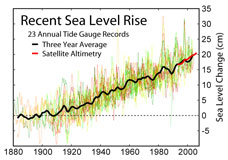
This chart shows sea level has risen, by best estimates, between four and eight inches in the last 150 years. Will sea levels rise 20 feet as Gore predicts? First of all, let's understand just how cold the Antarctic is. Winter temperatures on its high, cold interior plateau range from 40 to 95°F below zero! In the summer (December) it "warms," with temperatures dipping only to 49°F below zero — and sometimes rising within 25°F of the melting point (32°F). But even then, the ice reflects virtually all of the sun's rays back out into space. Sea Level Rise: The 20th Century in Perspective. In contrast to the oft-stated claim that the rate of sea-level rise has been accelerating in tandem with the rate of rise in the air's CO2 concentration and/or its temperature, Larsen and Clark could find no evidence that supports that contention. Warming Likely to Have Modest Effect on Sea Level, If Any. One of the great fears generated by global warming is that the oceans are about to rise and swallow our coasts. These concerns have been heightened by the substantial uptick in Atlantic hurricane activity that began in 1995. The frequency of really strong storms striking the United States now resembles what it was in the 1940s and '50s, however, which few people (aging climatologists excepted) remember. Volcanic eruptions cause sea level spike. The fiercest volcanic eruptions affect global sea level in unexpected ways — at least, in the short term — according to a new study. Particles produced by major eruptions are known to block out sunlight and cool both the ground and the ocean. But computer modellers previously thought this might result in a drop in sea level, since water becomes denser as it cools. In fact, sea levels shoot up after an eruption — initially, at least — according to Aslak Grinsted of the University of Lapland in Finland and colleagues. Why Worry About Global Warming? (1) Whereas the climate modelers in 1980 were forecasting an increase in sea levels of 30 feet, that forecast fell to three to five feet by 1988, and the current forecast is only 12 inches. (2) New evidence shows that the polar ice caps are growing, not melting; and almost all the warming at the poles is occurring during the polar winters, when no melting can occur. (3) New research on hurricanes shows they are not produced by global warming and, if anything, warmer temperatures make hurricanes less severe. (4) Most of the warming so far has occurred at night, reducing the number of frosts and increasing the growing season for farmers – 1990, one of the warmest years in recent history, was also a record year for crops. Flatter oceans may have caused 1920s sea rise. The movement of a colossal "mounds" of water in the North Atlantic and Pacific oceans may have caused sea levels to suddenly begin rising more quickly in the 1920s, researchers say. Their analysis presents a more complex picture of sea-level change and suggests that the rate of change has been more dramatic than previously thought. Global warming impact may be overstated. The most pessimistic predictions of sea level rises as ice sheets are melted by global warming may have to be scaled back as a result of an extraordinary discovery that ice persisted when the Earth was much hotter than today. Scientists have discovered that glaciers survived for hundreds of thousands of years during an extraordinary era when crocodiles roamed the Arctic and the tropical Atlantic Ocean was as warm as human blood. Global Warmists' Mouths Frozen Shut. [Scroll down] Neither the short-term nor long-term trends keep the alarmists from fear-mongering with junk science intended to cause you to give up your money and your economic liberty. Energy Secretary Steven Chu warned earlier this year of dramatic long-term sea-level rises due to global warming even though multiple studies have shown no trend of accelerating rises ... and no rise at all around some of the island nations like Tuvalu and the Maldives which routinely try to extort money from the west with the excuse that we're causing them to be flooded out of existence. Sell the UN. According to the CIA's "World Factbook" Tuvalu is the smallest member of the UN, but not the nation with the smallest population. That honor goes to Pitcairn Islands with a total population of 48. Oh, this is interesting! The legislature of Tuvalu is made up of 11 people which means about 23 percent of the population is involved. If the U.S. had a similar representational ratio, the U.S. Congress would be made up of 72.8 million people. And they still wouldn't get anything done. Error in Dutch polder data undermines trust in IPCC. A United Nations report wrongly claimed that more than half of the Netherlands is currently below sea level. In fact, just twenty percent of the country consists of polders that are pumped dry, and which are at risk of flooding if global warming causes rising sea levels.New Paper in Science: Sea level 81,000 years ago was one meter higher while CO2 was lower. Sea-level rises and falls as Earth's giant ice sheets shrink and grow. It has been thought that sea level around 81,000 years ago — well into the last glacial period — was 15 to 20 meters below that of today and, thus, that the ice sheets were more extensive. Dorale et al. now challenge this view. Scientists Retract Paper on Rising Sea Levels Due to Errors. Scientists have been forced to retract a paper that claimed sea level were rising thanks to the effects of global warming, after mistakes were discovered that undermined the results. IPCC's River Of Lies. Another shoe has dropped from the IPCC centipede as scientists in Bangladesh say their country will not disappear below the waves. As usual, the U.N.'s climate charlatans forgot one tiny detail. Warming and increased CO2 will be good for mankind. [Scroll down] The sea level is indeed rising, just as it has for the past 20,000 years since the end of the last ice age. Fairly accurate measurements of sea level have been available since about 1800. These measurements show no sign of any acceleration. The rising sea level can be a serious local problem for heavily-populated, low-lying areas like New Orleans, where land subsidence compounds the problem. But to think that limiting CO2 emissions will stop sea level rise is a dangerous illusion. It is also possible that the warming seas around Antarctica will cause more snowfall over the continent and will counteract the sea-level rise. Earth Is Cooling, Sea Levels Not Rising, Scientists Say. As the U.S. Senate prepares to consider enormously expensive cap-and-trade legislation, supposedly aimed at curbing alleged global warming caused by man-made emissions, scientists and policy makers at a conference in Chicago heard from experts in various scientific fields challenging the crumbling assumptions that have provided the foundation for global-warming alarmism. Here's a clue: It Wasn't Al Gore! The Winner of This Year's 'Best Climate Predictor' Award. The actual sea level rise over the last eighteen years is 1.85 inches, which works out to 10.4 inches per century. This is similar to the 20th century's rise of 8 inches, but much less than the average rise of 4 feet per century for the last 10,000 years as glaciers left by the last ice age continue to melt. Gore's prediction is clearly the worst of these three, yet he was awarded a million-dollar Nobel Peace Prize for bringing this issue to the attention of the world. Schwarzenegger's prediction comes in second-worst, yet he is angling for a global warming spokesman job in the Obama administration. The IPCC's prediction is third-worst, yet it just won a huge expansion of the U.N. bureaucracy at the Cancun Climate Conference. The UN has Become a Clear Danger to Our Energy Future and National Sovereignty. Recent data from the GRACE satellites indicate that world average sea level is increasing at a rate of 4 inches per century, half that stated by the IPCC. Floods are an annual occurrence around the world, some years have more, some fewer. Interestingly the floods in Queensland, Australia this year were made much worse by government officials moving in the wrong direction with respect to climate change. The officials were told that global warming would increase drought in the area. Believing this to be true flood abatement plans were scrapped, dams were cancelled and existing water storage areas were kept at high levels for fear of drought. Research Center Under Fire for 'Adjusted' Sea-Level Data. Is climate change raising sea levels, as Al Gore has argued — or are climate scientists doctoring the data? The University of Colorado's Sea Level Research Group decided in May to add 0.3 millimeters — or about the thickness of a fingernail — every year to its actual measurements of sea levels, sparking criticism from experts who called it an attempt to exaggerate the effects of global warming. Sea Level Study Leads to Divisions. [Scroll down] But other experts are doubtful. They see the new study's limited data as its primary drawback, and question whether something based on findings from the North Carolina coast alone can be applicable for the whole world. Warmist Cargo Cult Science Returns. Michael Mann, Pennsylvania State University climate Svengali, a member of the CRU (he figured prominently in the e-mail scandals at East Anglia), and great Pittsburgh Penguins fan (he created the famed "hockey stick graph" that was so influential on the 2007 IPCC Climate Change report) has stepped in it again, this time co-authoring a new study (Kemp et. al) that claims to show a massive acceleration in sea level rise in North Carolina that coincides with the industrial era. ... Such shoddy workmanship in any other field would put the principal into another line of work. Exaggerations about climate change. [Exaggeration #3] Half of the Netherlands is below sea level: The Netherlands Environmental Assessment Agency accepted responsibility for a mistake in an IPCC report where it was claimed 55 percent of the Netherlands is below sea level. In fact only only 26 percent is. The report should have said 55 percent is prone to flooding, including river flooding. Embellishing exaggerations. Before you paddle off for higher ground, remember Mr. Gore, a Democrat whose education and training are in government, politics and the law, not science, has been known to embellish from time to time and leave out important facts. He does this to raise the volume of his alarmism to attract "journalists" forever on the lookout for fodder for apocalyptic reporting. This symbiosis is most closely replicated in nature by farm animals and dung beetles. Don't Drown in Hysteria! Read Climate Depot's Factsheet on Sea Level. Climate change quickens, seas feared up 2 meters. Global warming is happening faster than expected and at worst could raise sea levels by up to 2 meters (6½ ft) by 2100, a group of scientists said on Tuesday [11/24/2009] in a warning to next month's U.N. climate summit in Copenhagen. The Editor says... Global warming stopped, or at least halted temporarily, about 13 years ago. Sea levels are always fluctuating. It has now become traditional for climate change summits to open with a new, dazzling prediction of impending catastrophe. The UN Climate Conference under way in the South African coastal town of Durban is no exception. This year's focus is on a familiar and certainly arresting argument: that sea levels are rising at a catastrophic and unprecedented rate mainly due to man-made global warming. No one makes this point with quite so much panache as Mohamed Nasheed, president of the Maldives. New figures: More of US at risk to sea level rise. Nearly 4 million people across the United States, from Los Angeles to much of the East Coast, live in homes more prone to flooding from rising seas fueled by global warming, according to a new method of looking at flood risk published in two scientific papers. The Editor says... Really! Four million people live within one meter of sea level, and the oceans are rising so fast that nothing can be done about it? Nonsense. Many of those four million people live in New Orleans, below sea level, and are fully aware of the risks. Other coastal cities around the world deal with the ocean routinely. The sea level on the coast rises and falls by several feet twice a day. If the average sea level rises at the rate of a millimeter per year, that is not a problem. If you don't like the climate where you live, (at least in the United States) you're free to move inland. Rising Sea Levels Seen as Threat to Coastal U.S.. About 3.7 million Americans live within a few feet of high tide and risk being hit by more frequent coastal flooding in coming decades because of the sea level rise caused by global warming, according to new research. Warmism's ebbing tide. There are two reasons why NSW's decision to remove the compulsory application of coastal councils' benchmarks for rises in sea levels, as outlined by Special Minister of State Chris Hartcher, is an important development in the debate on global warming. First, it represents a retreat from former official certainties and, of more tangible significance, it boosts the likelihood of Victoria and Queensland following suit. Australian sea levels have been falling for 7000 years. It's hard to measure sea levels, because land often moves up and down too (which is known as "isostatic"). But Australia is stable tectonically, so the Australian sea-level record is more useful than most. [...] During the coldest days of the last ice age (known as a glacial maximum) 20,000 years ago, the oceans were 125m lower than today. They peaked at around 1-2 meters higher than present between 9000 and 5000 years ago, and have been trending down ever since. A few words about Tuvalu Tuvalu is the poster child for the "crisis" of rising sea levels. It could be that Tuvalu is subsiding and the mean sea level is more or less constant. But the citizens of Tuvalu have their hands out, looking for a way to cash in on this alleged crisis, since they have no other substantial sources of income. Don't boo-hoo for Tuvalu: If you heard that the island nation of Tuvalu was being swallowed up by the ocean thanks to global warming, Patrick J. Michaels would like to put your mind at ease. Sea level around Tuvalu has been falling precipitously for the last half-century. The natives want out because they wrecked the place. Sinking Islands or Stinking Islands? The headline on Monday [4/20/2009] read, "Climate refugees in Pacific flee rising seas". Boy did the editors get this one wrong. A more accurate caption would have been, "Jesse Jackson-like shake-down gets tribe taken off tropical trash heap". A focus of the story was the tiny South Pacific island nation of Tuvalu. ... For decades there have been ridiculous rumors of islands sinking due to rising waters. The Tuvaluan fantasy has been especially propagated by Al Gore's brilliant work of fiction, An Inconvenient Truth. The supremacy of Tuvalu. Among the heroes of the [Copenhagen climate change] conference are Hugo Chavez and Robert Mugabe. Andrew Bolt gets to the heart of the conference with a look at one of the lesser known figures. Bolt writes: "Nothing is real in Copenhagen — not the temperature record, not the predictions, not the agenda, not the 'solution.'" Quoting a report from the Australian, Bolt provides a good example of "how fake it all is." It's settled; climate circus was a fairy tale. Reuters, for example, carried a moving account of the speech by Ian Fry, lead negotiator for Tuvalu, the beleaguered Pacific island nation soon to be under water because of a planet-devastating combination of your SUV and unsustainable bovine flatulence from Vermont farms. ... Alas, nowhere in this emotionally harrowing dispatch was there room to mention that Ian Fry's country is not Tuvalu but Australia, where he lives relatively safe from rising sea levels given that he's a hundred miles inland. Low-lying Pacific islands 'growing not sinking'. A new geological study has shown that many low-lying Pacific islands are growing, not sinking. The islands of Tuvalu, Kiribati and the Federated States of Micronesia are among those which have grown, because of coral debris and sediment. The study, published in the magazine the New Scientist, predicts that the islands will still be there in 100 years' time. Island nations at UN warn of climate disaster. The island nation of Tuvalu wants the United Nations to act — now — to keep their state above water. Hurricane numbers and intensity Related topic: You may wonder if it is possible to forecast global warming trends for the next 100 years, when forecasters can't make accurate predictions about this year's hurricane season. New Study: Declining Trends In 1980-2023 Tropical Cyclone Frequency, Accumulated Energy. According to climate modeling (Knutson et al., 2015 and 2020), everyday human activities such as driving cars and using cell phones (AGW) should lead to increases in tropical cyclone (TC) landfall frequency and intensity (i.e., accumulated cyclone energy [ACE], or maximum windspeed). Instead, 45 years of satellite observations (Bell et al., 2026) indicate declining TC frequency trends over the western North Pacific (WNP, including the Philippines, Hong Kong, China, Taiwan, Japan, Korea, Vietnam, Micronesia), as well as a weakly declining trend (-7.6 ACE units per decade⁻¹) in TC intensity for the WNP. "Landfall trends over individual nations are insignificant, but significant decreases are noted for the northern Philippines and parts of Micronesia, including for intense (> 33 m s⁻¹)." New paper: U.S. temperature extremes have declined since 1899. There are papers that confirm expectations, and then there are papers that quietly force you to re-check the assumptions everyone has been repeating for the past decade. This new study by John Christy falls squarely into the latter category. The paper, "Declines in hot and cold daily temperature extremes in the conterminous US, 1899-2025", takes on a topic that has become almost ritualized in public discourse: temperature extremes. The narrative most people encounter is straightforward and rarely questioned, that heat extremes are increasing rapidly, cold extremes are fading away, and both trends are tightly coupled to greenhouse gas emissions. What Christy has done here is step back and ask a more basic question: what do the actual station observations, extended as far back as possible and examined without heavy-handed adjustments, say about extremes over the full historical period? The answer is not quite what the headlines would lead you to expect. Media continues to ring climate alarm, but 2025 saw the fewest deaths from extreme weather ever. As 2025 came to a close, the legacy media was topping off its coverage of climate in the preceding 12 months. CBS News reported the year was so hot, "it pushed Earth past the critical climate change mark." ABC News had a "year in review" article recounting stories about wildfires, floods and extreme heat, and The Guardian reported on a study tallying the costliest disasters of 2025. "Cyclones and floods in south-east Asia this autumn killed more than 1,750 people and caused more than $25bn (£19bn) in damage, while the death toll from California wildfires topped 400 people," The Guardian article states in the opening paragraph. One story The Guardian and other outlets aren't reporting is that extreme weather in 2025 claimed the fewest lives in recorded history. Hurricane Climate Disaster the Media Said Was Coming This Year Never Happened. Remember how the media were adamant that the U.S. was due for a climate change-caused deluge of catastrophic hurricanes this year? Well, as the Al Gore effect goes: it never happened. Axios reported November 23 that the 2025 hurricane season is ending without a "single" U.S. landfall for the first time in 10 years. Of course, the liberal outlet couldn't resist trying to drum up fears despite the catastrophic predictions from months ago going kaput: "That's welcome news for hurricane-prone states, but doesn't mean future years will be equally calm — especially as climate change continues to warm the oceans, essentially creating hurricane fuel." Well, that "hurricane fuel" sputtered into a whole lot of nothing this year for U.S. states, further emphasizing why climate change fanatics masquerading as experts know as much about predicting hurricanes as it does about tomorrow's weather: Not much. Hey Guys! Climate Change Is Over! No Hurricanes — Why Is the Left So Quiet? The one thing the left never does is amplify good news about issues like "climate change" when it exists, because doing so would undermine their real campaign: taking away your human and Constitutional rights. Case in point: the National Oceanic and Atmospheric Administration (NOAA) last week announced that, as of November 30, the official end of the 2025 Atlantic hurricane season, this year was historic. "For the first time in a decade, not a single hurricane struck the U.S. this season, and that was a much needed break," said Neil Jacobs, Ph.D., under secretary of commerce for oceans and atmosphere and NOAA administrator. He added that a tropical storm did cause "damage and casualties in the Carolinas, distant hurricanes created rough ocean waters that caused property damage along the East Coast, and neighboring countries experienced direct hits from hurricanes." But with no major hurricane making landfall in the U.S., do you know that that means, kids? It means "climate change" is over! We fixed it! Climate Milestones. On December 1, America experienced two remarkable climate milestones. Despite the unhinged warnings of climate alarmists, 2025 is turning out to be one of the least stormy, and coldest, years on record. Despite NOAA predictions this spring of a "more than active" hurricane season, the 2025 season has passed without a single Atlantic hurricane making landfall. That in itself is unusual. But it has been followed by record-setting cold and snow in the eastern U.S. Of course, climate scientists are quick to say that both the lack of storms and the cold are the result of global warming. [...] For decades, we were told that global warming would create "superstorms" one after another — so much so that, according to AOC, life on earth would end on or about January 1, 2030. AOC was just repeating the extreme predictions one can hear from nearly any climate "scientist" and from politicians such as Al Gore going back to the early 1990s. Where'd All The Hurricanes Go? The National Oceanic and Atmospheric Administration predicted the 2025 Atlantic hurricane season was going to be above normal. With less than a week left in the season, how has the forecast panned out? It was off by a bit — the storms didn't develop as predicted, even though we've been told for decades that man-caused global warming was going to bring stronger and more frequent storms. In May, NOAA's forecast called for a 60% chance of an above-normal season, a 30% chance we would see a near-normal season and only a 10% chance that activity would be below normal. Commerce Secretary Howard Lutnick bragged that "NOAA and the National Weather Service are using the most advanced weather models and cutting-edge hurricane tracking systems to provide Americans with real-time storm forecasts and warnings." And yet the predictions, made a little more than a week before hurricane season began on June 1, were off. There were 13 named storms, one fewer than the 1991-to-2000 normal, five hurricanes, two fewer than the 1991-to-2000 normal, and four major hurricanes, one more than the 1991-to-2000 normal. As of Monday, NOAA was reporting that tropical cyclone formation was not expected during the next seven days. What's more, no hurricane made landfall in the U.S. This hasn't happened in a decade. Shocker: 2025 Hurricane Predictions Flop; No U.S. Landfalls For First Time in 10 Years. Remember how the media were adamant that the U.S. was due for a climate change-caused deluge of catastrophic hurricanes this year? Well, as the Al Gore effect goes, it never happened. Axios reported on November 23 that the 2025 hurricane season is ending without a "single" U.S. landfall for the first time in 10 years. Of course, the liberal outlet couldn't resist trying to drum up fears despite the catastrophic predictions from months ago going kaput: "That's welcome news for hurricane-prone states, but doesn't mean future years will be equally calm — especially as climate change continues to warm the oceans, essentially creating hurricane fuel." Well, that "hurricane fuel" sputtered into a whole lot of nothing this year for U.S. states, further emphasizing why climate change fanatics masquerading as experts know as much about predicting hurricanes as they do about tomorrow's weather: not much. 50
Examples of Fake News in 2024. ABC News reported, "The climate crisis is not a
distant threat; it's happening right now and affecting what matters most to us. Hurricanes
intensified by a warming planet and drought-fueled wildfires are destroying our communities.
Rising seas and flooding are swallowing our homes. And record-breaking heat waves are
reshaping our way of life." In fact, the following climate-related measures have stayed level
or improved for the past 30 [to] 170 years: [Links removed]
Scientists Deliberately Misled Public On Fires, Ice, Food, Floods, Heat, Islands, Coral, Sea Level, And Hurricanes. Climate change is an existential threat to civilization and humankind, according to top scientists, journalists, and policymakers. They say that planetary warming caused by human emissions is making forest fires, hurricanes, and floods more frequent, worse, and more widespread; reducing arctic ice and submerging atoll islands; killing the coral on the Great Barrier Reef; worsening heatwaves and reducing crop yields. Former President Biden said climate change is "an existential threat to all of us," and scientists and environmentalists say "one billion" to "billions" will die from food shortages and other climate impacts. The Hurricane Season That Still Isn't. Cynical, disaster-seeking climate change hysterics have been pushing, for decades now, a narrative that global warming, especially warming ocean temperatures, increase the risk of hurricane activity. Every year, they seem to be eagerly awaiting devastating superstorms to prove them right. And the 2025 hurricane season looked ripe. In May, the National Oceanic and Atmospheric Administration predicted a more-active-than-average season (which runs from June 1 to Dec. 1). The Washington Post hyped this prediction into: "The forecast underscored the dangers of a historically active stretch of Atlantic hurricane activity." And, indeed, the stage was set for the perfect storm to cause catastrophic impact on the American Southeast: NOAA fretted hurricane-fueling warm ocean waters; the South had just come off of a record year of domestic net migration raising the potential human cost; and climate change-denying President Trump had scaled back the Federal Emergency Management Agency (FEMA) which, alarmists claimed, would significantly hinder disaster response. On the current mild hurricane season: The fact that the current hurricane season has been very mild doesn't prove anything about long-term trends. But if we were having an intense season, we could be certain catastrophists would be screaming that the climate apocalypse is now upon us. Where Are All The Hurricanes? And where are the climate alarmists, leftist corporate media outlets, and Greta Thunberg with their predictions of imminent doom for planet Earth? [Advertisement] In Greta's case, perhaps the funding for climate change propaganda dried up, and she has since shifted her focus to everything Palestine. As the saying goes, "follow the money". [Photo] Back to the Atlantic hurricane season: it's been eerily quiet, with no signs of activity this week — even though this is typically the peak of the season. This is the period when tropical cyclones and hurricanes are expected to be churning in the Atlantic Basin, often threatening or making landfall in the U.S., while leftist corporate media unleashes propaganda blaming the working class and their gas stoves, diesel trucks, and meat consumption for fueling the crisis. Yet many of these climate alarmists present more taxes and banning cow farts as the solution to save the planet, yet never mention that they fly around in private jets and sail diesel-powered mega yachts. [The] Atlantic goes quiet at typical peak of hurricane season. Where are all the hurricanes? So far, we've only had one in the Atlantic (Erin), a far cry from the predictions of as many as 10. This week specifically is also usually quite active: Based on past years, Sept. 10 is the typical peak of the Atlantic hurricane season. But this year, a quiet week is expected instead, as no tropical cyclone formation is expected during the next seven days, according to the latest advisory from the National Hurricane Center released Sept. 8. "Models show no areas of possible development this week, headed into the traditional hurricane season peak this Wednesday (Sept. 10)," said WPLG-TV hurricane specialist Michael Lowry in a Substack post. Sorry, New York Times, No Evidence Shows Hurricane Erin was Driven by Climate Change. The New York Times (NYT) published an article titled "How Climate Change Affects Hurricanes Like Erin," in which they rely on rapid attribution analysis to claim that climate change is making rapidly intensifying hurricanes more likely, implying that the storm was worsened by global warming. This is false. Attribution studies are generally not based on solid scientific evidence and therefore not provable. Plus, evidence is lacking to support the idea that rapid intensification is actually becoming more common. At the outset, the NYT claimed that hurricane Erin's effects, such that they are, "are made worse by global warming," even though the storm stayed offshore. The storm intensified quickly from a Category 1 to a Category 5 hurricane, and NYT claims that "[a]s the planet warms, scientists say that rapidly intensifying hurricanes are becoming ever more likely." First, it is important to note that just because a storm is among the most rapidly intensifying on record, does not mean there were not similar storms that failed to be recorded. In the Eye of the Storm. It's another summer when NOAA and other governmental climate agencies seem to have missed the mark. In the spring, NOAA predicted that 2025 would be (another) above average year for Atlantic hurricanes — 60% above normal, to be exact. (When's the last time they predicted below normal?) The 2025 prediction is for 13 [to] 18 named storms, 5 to 9 hurricanes, and 2.5 major hurricanes. On August 7, despite no landfalls to date, NOAA doubled down on its forecast, sticking by its original prediction. There's still plenty of time left for storms to develop, but so far this year, no hurricane has made landfall on America's Atlantic coast, and at this time, none is imminent. This doesn't mean that one or more hurricanes will not make landfall before the end of the hurricane season in November. [...] I often wonder whether the climate forecasters are biased, not so much for political as for self-interested reasons. After all, climatologists have a stake in the number and magnitude of extreme climate events. Evidence of a changing climate, with spectacular storms and large-scale destruction, increases their funding and prestige. When a Cat 4 or Cat 5 hurricane makes landfall, they can say, "I told you so," even though they've been telling us so every year for decades. Another year, another season of failed hurricane predictions from the NOAA. NOAA, the "experts," predicted an "above-normal" hurricane season this year. Of course they predict that every year, and the public has been told for decades that humans and our use of natural resources is the cause of increased activity. After Hurricane Katrina, the public was told that hurricanes would be more numerous and active than ever. Instead hurricane activity was extremely calm for ten years after Katrina. It was a record low for hurricanes. Why didn't Al Gore predict the ten year drought in major hurricanes? In a humorous statement, the "experts" said a ten-year drought in hurricanes occurs once every 270 years: [...] How [...] would anyone know that since records had only been kept since 1850? And this year, as of today, August 5th, no hurricanes have formed in the Atlantic despite the dire predictions. Only four named storms, those with over 35 MPH have occurred. So, we get articles explaining why this has happened by the same "experts" that predicted the active season. The Hurricane Hoax: What the IPCC Doesn't Want You to Know. June 1st has arrived, marking the official start of hurricane season... and, like clockwork, the beginning of another season of climate propaganda. For the media and the climate-industrial complex, every low-pressure system is an opportunity to push a fear-driven narrative: that hurricanes are getting stronger, more frequent, and more deadly due to human-caused climate change. But here's the problem: warming itself is not especially dangerous. On its own, a gradual increase in global average temperature doesn't inspire panic... it doesn't justify emergency declarations or trillion-dollar policies. That's why the IPCC and its media allies must link warming to disasters. It's not the thermometer that scares people[,] It's the hurricane footage. This connection between climate change and bad weather isn't just casual... It's strategic. The climate crisis, as we know it, depends on linking human emissions to catastrophic events, even when the data doesn't support it. And nowhere is this more obvious than in how hurricanes are presented to the public. Case in point: 2025 has kicked off with a conspicuous lull in storm activity. Climate Bombshell: New Evidence Reveals 30 Year Global Drop in Hurricane Frequency and Power. Last month a small but powerful cyclone named Chido made landfall in Mayotte before sweeping into Mozambique, causing considerable damage and leading to the loss of around 100 lives. Days after the tragedy, the Green Blob-funded Carbon Brief noted that scientists have "long suggested" that climate change is making cyclones worse in the region, while Blob-funded World Weather Attribution (WWA) at Imperial College London made a near-instant and curiously precise estimate that a Chido-like cyclone was about 40% more likely to happen in 2024 than during the pre-industrial age. Not to be outdone, Green Blob-funded cheerleader the Guardian chipped in with the obligatory "cyclones are getting worse because of the climate emergency". Almost unnoticed, it seems, among all the Net Zero dooming and grooming was a science paper published during December by Nature that found no increase in the destructive power of cyclones — the generic term for typhoons and hurricanes — in any ocean basin over the last 30 years. In the South Indian basin, the location of cyclone Chido, there was a dramatic decrease in both frequency and duration in recent times. Is Climate Change Making Hurricanes Worse? Hurricanes have long plagued the continental United States, tracing back as far as the Great Colonial Hurricane of 1635, which hit the Jamestown Settlement and the Massachusetts Bay Colony only 15 years after the founding of Plymouth Plantation. From 1900 to 1960, no fewer than 112 hurricanes hit the continental U.S., long before the burning of fossil fuels on a mass scale. The deadliest natural disaster in U.S. history did not take place after the burning of fossil fuels, but before. The Galveston Hurricane killed between 8,000 and 12,000 people — in 1900. D'Aleo and Dayaratna note that U.S. average high temperatures have increased since the 1950s, and that the burning of fossil fuels has increased since the 1950s on a global scale. [Charts] Yet these increases in temperature and emissions do not correlate with either more hurricanes or more intense hurricanes. Wind Speeds Dropping, Rainfall Similar to a Century Ago — the Climate News You Won't Hear in the Mainstream. Needless to say, inconvenient scientific facts are unwelcome in the Latter Day Church of Net Zero, so alarmists are cautioned to stop reading here. The rest of us can digest recent research by Paul Homewood on the British climate in 2023 and published by the Global Warming Policy Foundation. This notes that sea level rises are showing no acceleration over multi-decadal scales and rainfall is not becoming more extreme, while storms have become less powerful over recent years. It has become slightly warmer than it used to be, notes Homewood, "but the U.K. climate has changed very little in recent years". Long-term trends are dwarfed by the natural variability of British weather, he continues, and there is no evidence that weather is becoming more extreme. "Nothing in the data indicates that climate will become more extreme in future," he concludes. Did Bill Nye Really Just Say That About Hurricane Milton? Only MSNBC would trot out this clown to deliver such nonsense about Hurricane Milton. Bill Nye was featured for a segment since every left-wing blowhard thinks hurricane season is some climate change phenomenon. Without fail, this is where some people go. To the public's credit, it's dismissed mainly since everyone has more important things to dwell on now. People are preparing for Milton in Florida, but Nye decided to drop his solution: if you want to stop these storms, vote for Kamala Harris in November. The real cause of weather-related deaths. Despite fear-mongering about climate change supercharging natural disasters, weather-related deaths have declined dramatically. According to the Emergency Event Database, the total global deaths per decade from climate-related disasters has fallen by more than 96% since the 1920s. Data show that between 1960 and 2020, there was an unprecedented decrease in climate-related deaths compared to the period between 1920 and 1959. This decline is even more impressive considering that the global population has more than quadrupled during this period, from about 2 billion in 1920 to nearly 8 billion by 2020. Twisted Truth: Lies, Extreme Lies, and Climate Statistics. In early July, The Wall Street Journal reported the news about "The Science Behind Beryl's Early Fury": According to the National Weather Service this is "the first time a Category 5 hurricane has formed at this time of year since recordkeeping began in 1851...". However, the obvious question is how can we be sure of that claim since only relatively crude, incomplete observations were made many decades prior to the satellite era? For nearly 100 years of recordkeeping, from the 1850s to the mid-1940s, hurricane location and strength was mainly reported by ships and later aircraft with a primary purpose of avoiding life-threatening weather. The launching of satellites in the late 1950s greatly improved hurricane tracking. Today detailed analysis via geostationary and polar orbiting satellites is routine. Little Debbie. Year after year, government agencies issue predictions of "above average tropical storm activity," and most years, the actual activity is just average. From where I sit near the Gulf Coast, I haven't seen hurricane activity increasing due to climate change. What I do see is more hype, year after year — and fewer deaths. It's easy enough to track the death toll over time, and the fact is that hurricane-related deaths are going down. That's not because storms are less frequent or less severe; it's because of better tracking and warnings. [...] With a Cat One storm like Debby, there is no reason for anyone to die. All that's needed is to remain inside or relocate to a shelter and wait out the storm. Met Office Admit Storms Were Much Worse in Past. Despite the plethora of silly names the Met Office has given every passing low-pressure system, and despite their persistent advertising of high wind speeds on top of mountains and clifftops as being representative, this new report admits that storms were much worse in the past[.] State of the UK Climate 2023. [Scroll down to page 61.] As a measure of storminess Figure 60 counts the number of days each year on which at least 20 stations recorded gusts exceeding 40/50/60 Kt (46/58/69 mph). Most Atlantic storms are large-scale systems having widespread effects which this metric is designed to capture. Localized convective gusts will not contribute, nor will storms where the strongest winds are confined to a relatively small region of the UK. The most recent two decades have seen fewer occurrences of max gust speeds above these thresholds than during the previous decades, particularly comparing the period before and after 2000. The number of station-days recording gusts exceeding 40/50/60 Kt in 2023 was broadly comparable to the period after 2000. However, there are considerable year-to-year and decadal variations in these series and they are relatively short. New Paper Finds Tropical Storm Frequency Linked Largely To Oceanic Cycles. The latest climate information video released by the Germany-based European Institute for Climate and Energy (EIKE) presents a recent paper by Huang et al appearing in the journal Geophysical Research Letters: "Contrasting Responses of Atlantic and Pacific Tropical Cyclone Activity to Atlantic Multidecadal Variability". The paper examines the influences of Atlantic Multidecadal Variability (AMV) on global tropical cyclones (TCs)[.] The North Atlantic undergoes approximately 60-year cycles of warmer and colder than normal sea surface temperatures. These changes in thermal surface energy play a role in modulating climate globally, especially in combination with other oceanic cycles. Compared to the AMV negative phases, the AMV positive phase "significantly increases tropical cyclone frequency in the North Atlantic, including those making landfalls," the authors found. "The increase is explained by warmer sea surface temperature, higher relative humidity, increased relative vorticity, and weaker vertical wind shear under the AMV positive phase." [#1] How do they know? [#2] How accurate have their predictions been in previous years? Met Office Says it Cannot Back Up its Senior Meteorologist's Claim on BBC Radio That Storms in the U.K. are "More Intense" Due to Climate Change. The Met Office has been unable to back up a claim that storms in the U.K. are "more intense" due to the effects of climate change. The claim was made by senior Met Office meteorologist Claire Nasir on January 22nd on BBC 5 Live Breakfast in the aftermath of Storm Isha, and led to a freedom of information request for an explanation by investigative journalist Paul Homewood. The Met Office has replied that it is unable to answer the request due to the fact that the information "is not held". Hurricane Ranking Hype. Recently, with much media fanfare, some scientists proposed adding a new, upper category to the hurricane rating scale, Category 6, to reinforce the dangers posed by climate change, which they believe is making hurricanes more powerful. [...] Adding a new category to hurricanes is nothing but a way to promote climate alarmism, a method that I think will fail. There has never been a hurricane in the Atlantic basin that has exceeded 190 mph sustained winds. [...] What we can say with some certainty is that there is no trend of more frequent or more severe tropical cyclones forming globally or in any hurricane basin, which would implicate long-term climate change. Indeed, multiple studies I cited in an article in 2022 showed that there has likely been a long-term decline in the number of hurricanes across all the different hurricane basins, and there has been no increase in more powerful storms. The Editor says... Putting the 'climate change' propaganda into perspective. [Scroll down] As for cost, high inflation makes storms cost even more each year, even if there are fewer storms. Let's put the $178 billion cost in perspective. It is around .7% of the $26 trillion economy. Why would we spend trillions on policies to intentionally destroy so many businesses that directly and indirectly employ tens of millions to save a small sum of $178 billion, even if these policies could change the climate (they can't). Why would we greatly harm the poor and middle classes and reduce their quality of life? Another Long, Hot Summer. [Scroll down] According to climate "scientists," one piece of evidence of climate change is an increase in the number and intensity of tropical storms. In line with that theory, almost every spring, NOAA and other agencies issue warnings for stronger and more frequent storms, but usually those storms fail to materialize. Despite excessive media coverage of Hurricane Idalia, that's exactly what has happened so far in 2023. There are no threatening Atlantic hurricanes forming at this time, and only one hurricane has made landfall so far. That storm, a Category Three at landfall, soon weakened to a Category One — and the Florida death toll from that hurricane was precisely one, a person who died in a car accident related to storm flooding. Cities like Sarasota and Tampa, and towns like Crystal River and Cedar Key, were inside Idalia's cone and suffered from flooding, but the winds after landfall were relatively light and the damage relatively small. Fewer hurricanes are hitting New England. With Hurricane Lee churning off the New England coast this past weekend; the mainstream media is now filled with articles claiming climate change will cause more hurricanes to strike New England. In reality, the objective data show New England is experiencing a dramatic and ongoing decline in hurricanes as the climate modestly warms. There is also no indication that the beneficial trend will reverse itself anytime in the foreseeable future. The Associated Press, USA Today, and ABC News are among the many media entities exploiting the recent offshore storm to make alarmist New England hurricane claims. [...] The planet has been modestly warming since the end of the Little Ice Age approximately 150 years ago, so if the computer model is accurate, we should already be seeing a longstanding increase in the frequency of New England hurricanes. The objective data, however, show a dramatic decline in New England hurricanes. Hurricane Season Means A Surge In Category 5 Climate Lies. We're about half way through the 2023 hurricane season, predicted by the National Oceanic and Atmospheric Administration forecasters to be a near-normal year, and it's been rather quiet. But with a few storms brewing this week in the Atlantic, we expect to hear the usual shrieking from politicians, activists and the media, blaming the weather on man-caused climate change. Our suggestion is to pay no attention to the eco-screamers' lamentations. [...] The alarmist community has long insisted that weather is not the same as climate any time anyone ever pointed to mild summers and colder-than-usual winters as evidence that the global warming theory was bunk. But when it's convenient for spreading fear, the same crowd takes isolated weather events and claims they are evidence that human activity is warming the planet. Tornadoes, Climate Change, and the Media. After the recent devasting tornadoes in the Midwest and South, some media outlets scrambled to try to link the weather events to climate change, when in fact there is no hard data to support this. In fact, tornado data refute claims that tornadoes are increasing in number, range, or severity. However, Salon, Axios, and the Washington Post among others ran articles suggesting climate change is expanding the length of tornado season and area over which tornadoes commonly form, as well as adding ingredients to the atmosphere to make more and bigger tornadoes. [...] These claims of increased storms due to more heat and moisture are misleading at best and demonstrate a clear lack of understanding of how weather fronts collide to form tornadoes. Extreme Weather Events [are] Declining. Some years ago, environmental alarmists decided to hedge their bets by talking about "climate change" rather than "global warming." These days, any inconvenient weather event is chalked up to "climate change." If a tornado hits Florida, it's climate change. If rain spoils your picnic, it's climate change. But are severe weather events actually increasing? No, they are not: [...] Most of our reporters — ignorant, mendacious, or both — routinely recite as fact that the number of extreme weather events is rising, due to climate change. It simply isn't true. Typhoon Frequency Has Fallen Since 1950, Contradicting Alarmist Global Warming Claims. Extreme weather events, like tropical storms, are supposed to be intensifying and becoming more frequent as the world warms, the global warming alarmists like to claim as they try to spread panic and anxiety. This, they say, is robustly supported by science and so humanity is facing dire consequences unless it stops burning fossil fuels immediately. Today let's use the scientific data on Pacific typhoons to see if the alarmist claims are true. These data are provided by the renowned Japan Meteorological Agency (JMA). Surely typhoons must be increasing in frequency year by year since the temperature has risen over the 20th century. Somewhat related: Hurricane Hysteria, Hype, and Histrionics. Hurricane season is upon Southeastern America and that means hair-on-fire hysteria from the media and the political left. After Hurricane Ian ravaged southwest coastal Florida, we have heard nothing but hype from the corporate media, eager to connect every hurricane to catastrophic global warming, climate change, or whatever excuse they are currently using to usher in the Green New Deal and tyrannical top-down control of all aspects of our lives. Hurricanes are not new and are a staple of southern coastal regions since long [ago]. Yet judging from media histrionics, severe hurricanes are only a recent phenomenon, ignoring hundreds or thousands of years ago when Florida was nothing but a swamp. Hurricane harpies in the media, practicing one of the Democrats' favorite strategies of never letting a crisis go to waste, were quick to pounce on tragedy for political gain. Look at some of the headlines, all singing in perfect harmony. [...] It would be nice if progressives concentrated on fixing the man-made disasters they caused instead of theoretical ones they make up. The media and others continually said Ian was the deadliest hurricane in Florida in over 90 years, as if that is a meaningful statistic. They say that Ian was caused by manmade climate change. Of course, they gave zero scientific evidence to support that statement, because there is none, but the indoctrination continues. Only one of the deadliest 24 hurricanes in the U.S has occurred after 1970. Eight of the deadliest occurred before 1900. There has never been a correlation between temperatures, sea levels, and storm activity and the use of energy related natural resources. When there is no correlation, there can't be causation. The radical leftists want to control us, not the climate. Did Global Warming Make Hurricane Ian Intensify Faster than Normal? Ian was indeed one of the most powerful and destructive hurricanes ever to strike southwest Florida. Unfortunately, the tragedy is compounded by climate-change activists who are using it for political purposes. They blame Ian on global warming. Headlines in the mainstream media claimed Ian was the fourth-strongest hurricane ever to hit Florida and that its strong winds were caused by global warming. Both statements are wrong. Biden Was Wildly Wrong About Ian's Death Toll — Here's Why It Matters. The day after Hurricane Ian made landfall in Florida, President Joe Biden issued his forecast: "This could be the deadliest hurricane in Florida's history." Was he hoping it would be? Or is he just ignorant of the history of hurricanes? "The numbers are still unclear," Biden said, "but we're hearing early reports of what could be substantial loss of life." So far, the death toll in Florida from Ian is a little more than 30. That number will no doubt rise, but it is far short of the deadliest, and might be one of the least deadly hurricanes to hit that hurricane-prone state. The deadliest record was set in 1928, when the San Felipe-Okeechobee Hurricane landed near Palm Beach and some 2,500 people died, most of them from a 6-to 9-foot surge the hurricane caused in Lake Okeechobee. There were also hurricanes in the 1600s and 1700s that are believed to have killed more than 1,000 people in Florida. Democrats blaming climate change for Hurricane Ian at odds with science, experts say. Multiple experts contacted by Fox News Digital argued that there isn't sufficient evidence to suggest climate change caused Hurricane Ian or any individual natural disaster. The experts' comments come as a series of media outlets, Democrats and progressive commentators continue to blame the hurricane on human-caused global warming. Hurricane Ian slammed into southwest Florida as a Category 4 storm on Wednesday, causing more than a million residents to lose power and prompting stark safety warnings from Florida officials. "What they're trying to do is politicize the pain and suffering of these people to promote their green agenda," Gregory Wrightstone, the executive director of the climate policy think tank CO2 Coalition, told Fox News Digital in an interview. "Well, their policies and their agenda to promote renewables will do far greater economic destruction to the country and Florida." Where have all the tropical storms gone? Hard as it is to believe, our models about how the climate and weather work are not quite as reliable as we have been told. Again and again and again. Ars Technica has an interesting story that does a fine job of pointing out the huge disconnect between the experts' predictions of a vicious hurricane season and the welcome lack of tropical storms this year. Back in May NOAA predicted an above average year for tropical storms and hurricanes, and they had reasons to. They claimed that "ongoing La Niña, above-average Atlantic temperatures set the stage for busy season ahead." [...] Of course there is plenty of hedging in their forecast, but we are firmly out of the 90% prediction that we would have an above average to near normal hurricane season. In other words, if trends continue our quiet hurricane season was far, far from what they expected. More Bad News For The Eco-Radicals. For the first time in more than 80 years, the Atlantic Ocean hasn't produced a named storm between July 3 and Aug. 31. So the Climatistas will have to celebrate Labor Day this year for its Marxist roots rather than the weather destruction they're constantly rooting for so they can blame it on man. The Atlantic's failure to form a tempest is a rarity. It "has had no #hurricanes yet this year," Colorado State University meteorologist Philip Klotzbach tweeted Thursday. 2022's calm spell happens to be only the seventh time since 1950 that the Atlantic "has gone through August without a #hurricane. Other years are: 1967, 1984, 1988, 2001, 2002, 2013." How Terrified Should We Be of Hurricane Season This Year? Once again, as nearly every year, officials at NOAA and other agencies called for 2022 to be a "very active" hurricane season. In its May 24 release, NOAA predicted "an "above-average hurricane activity this year — which would make it the seventh consecutive above-average hurricane season." It's like the old joke that everyone's grandkid is "above average": for some reason, every hurricane season, the risk is now "above average." I don't know how every year can be "above average," something that defies the laws of statistics. I suspect that it has to do with the strong bias of climate scientists rather than the strength of hurricanes. And in fact, hurricanes have been "fewer than average" this year and for many years recently. So far, halfway through the hurricane season, no Atlantic storms have made landfall on U.S. soil. This lack of severe storms defies the dire predictions of global warming alarmists: that rising temperatures will cause catastrophic storms. In reality, one reason why there are fewer and less severe storms this year is that the Atlantic waters have been cooler than usual. Pacific Typhoons Defy Climate Experts' Dire Forecasts [by] Trending Downward [for] 70 Years!. The Japan Meteorological Agency (JMA) presents the latest data for Pacific typhoons — going back to 1951. This summer climate alarmists in Europe have been chasing "heat waves", likely because hurricanes and typhoons have been on the quiet side. Today we look at the data from the Japan Meteorological Agency (JMA) for the number of typhoons formed in the Pacific in the month of July, now that the July data are available: [...] This article is from 2019, but I just discovered it. This report is presented for what it's worth, with a grain of salt: Climate Change Is Not Making Hurricanes 'Wetter'. Dozens of corporate media outlets published stories claiming anthropogenic climate change caused 2020's hurricane season to be "wetter," with more rain falling in shorter periods of time than would have occurred naturally. Data indicates this is false. The stories were all based on a single "attribution," study in Nature Communications. The study is impossible to verify since it is based on computer models simulations of the past and future, not measurements of past rainfall amounts over the time period specified in the study. The New York Times, the Associated Press (AP), CNN, the Washington Post, and ABC News, are among dozens of corporate and trade media outlets, that published stories in recent days highlighting the reported results of a single study published in Nature Communications which claims to be able to attribute higher rainfall totals that fell during the active 2020 hurricane season to human caused climate change. Somewhat related: California's Wild Weather, Wet or Dry, is Nothing New. For those wondering about the recent heavy rains in the west, going from drought to deluge in a few short months, here's some data and history to illustrate that it is nothing new, and it has nothing to do with the claims of a "climate change" influence. Before the industrial revolution, electricity, eight lane highways, and gas-guzzling SUV's, there was a 43-day rainstorm that began in December 1861 that put central and southern California underwater for up to six months. The highest rainfall ever in California during recorded history likely occurred in January 1862, during the "Great Flood". This was an atmospheric river event like we are experiencing now, but lasted several days, dumping 24.63 inches of rain in San Francisco, 66 inches in Los Angeles, leaving downtown Sacramento underwater. Also somewhat related: Tornadoes: The New Normal That Wasn't. When the unexpected happens, researchers need to ask why and examine the data. Kevin Simmons and I had just published a book on the societal impacts of tornadoes. We sought to assess whether the 2011 death tolls were due to the tornadoes which occurred, societal vulnerability, or perhaps some other factor. We published our findings in a book, Deadly Season: Analysis of the 2011 Tornado Outbreaks and a paper in Natural Hazards Review. [...] There was no upward trend in violent tornadoes prior to 2011; the year was a clear statistical outlier or Black Swan type event. Consequently, we concluded that fatalities should return to the prior normal or decline further due to continued warning process improvements. By contrast, proponents of climate change told us that Joplin and Tuscaloosa were the new normal due to global warming. The U.S. has averaged 43 tornado deaths over the past nine years, with 76 in the deadliest year (2020).
Biden's Magical Mystery Energy Plans. Days after eliminating tens of thousands of jobs by terminating the Keystone Pipeline and halting drilling on Federal Lands, Joe Biden gave a speech in which he said "Today is 'Climate Day' at the White House and — which means that today is 'Jobs Day' at the White House.'" He explained that he would hire Americans to modernize the infrastructure so that it can withstand the increase in hurricanes resulting from global warming. As is true for all of his climate policies, this is delusional. Increased hurricanes resulting from global warming? In the 51 years from 1915, 19 major hurricanes hit the Atlantic coast; in the 51 years to 2016, just seven did. In the last 11 years, only two hurricanes greater than category three hit the continental USA — a record low since 1900. From 1915 to 1926, 12 hit. There were 248 tornadoes across US in May and June. That's one of the lowest numbers in recorded history. After a tumultuous early spring, highlighted by a deadly Easter weekend across the South, May and June were unusually quiet for tornadoes. There was a preliminary total of 248 twisters, according to Accuweather — a combined count less than April's total of 256 and among the lowest numbers in recorded history for two of the typically most active months of the year. June was remarkably tame. The National Weather Service issued just six tornado watches in the U.S., the lowest number for any June in recorded history. Republicans Will Live to Regret Joining Climate Alarmists. Climate alarmists blame rising, man-made CO2 emissions for supposedly ever more frequent and intense hurricanes, tornadoes, volcanic activity, drought, flooding, and snowstorms. (Never mind that twenty years ago, David Viner, a senior research scientist of the climatic research unit of the University of East Anglia, predicted that "children just aren't going to know what snow is.") Tony Heller, a contributor to realclimatechange.com, made a video showing news clips of "extreme weather" from the 1930s, when carbon dioxide levels were low. He narrated: "It was by far the hottest decade on record in the United States. The deadliest flooding in human history occurred in China in the 1930s[.] ... The worst droughts in U.S. history also occurred in the 1930s. Eighty percent of the U.S. was in drought during July 85 years ago. No, Hurricanes Are Not Bigger, Stronger and More Dangerous. [Scroll down] The first big problem with G19 is that it purports to say something about climatological trends in hurricanes, but it uses no actual climate data on hurricanes. That's right, it instead uses data on economic losses from hurricanes to arrive at conclusions about climate trends. The economic data that it uses are based on research that I and colleagues have conducted over more than two decades, which makes me uniquely situated to tell you about the mistakes in G19. Everything You Hear About Billion-Dollar Disasters Is Wrong. The U.S. National Oceanic and Atmospheric Administration (NOAA) counts the number of disasters in the United States that result in losses of greater than $1 billion, starting in 1980. Over the past three decades that count has shown a sharp increase, from five or less such disasters each year in the decade of the 1980s to ten or more in each of the past 4 years. That increase must be due to climate change, right? Actually, no. The billion-dollar disaster tally is easy to understand, simple to communicate, but — regrettably — incredibly misleading and just plain bad economics. 11 Empty Climate Claims. Claim [#2]: Global warming is causing more hurricanes and stronger hurricanes. Fact: Hurricane activity is flat to down since 1900, landfalls in the US are declining[.] Claim [#3]: Global warming is causing more and stronger tornadoes. Fact: The number of strong tornadoes have declined over the last half century[.] Debunked Claim: Early Season Hurricanes Increasing Because of Climate Change. Figures it wouldn't take very long into the 2019 hurricane season for journalists to start screaming climate change. In this recent New Republic article by Eric Holthaus, the claim is made in the subtitle that "early season hurricanes is a sign of things to come for our warming world". Further into the article the author, who is a meteorologist, makes the claim that "as the Gulf of Mexico waters warm because of climate change, early-season hurricanes like proto-Barry could become more common." Let's investigate that assertion further using actual historical data. [...] History Professor on Dorian: Gov. DeSantis's 'Inaction' on Fossil Fuels 'Will Literally Sink Florida'. A professor at the University of Michigan who teaches Middle Eastern and South Asian history and writes for numerous left-wing websites is calling on Florida Governor Ron DeSantis to step down in the wake of Hurricane Dorian because his "inaction" on fossil fuels in the state is partly to blame for the hurricane and eventually "will literally sink" the state. Claiming the hurricane grew bigger because of the "freakishly warm waters of the Caribbean," Juan Cole said that events that only happened every 500 years are now taking place "several times a decade." The Editor says...
Are hurricanes getting worse or not? Some scientists argue that global warming is making hurricanes stronger, or more numerous, or both. Others disagree and there is a great scientific debate over this question. On the physics side, hurricanes are formed by a combination of factors. Sea surface temperature is just one of these, so it is not certain that simply raising global temperatures a bit will increase hurricanes, either in number or in strength. These other factors include wind, humidity, and atmospheric pressure, among others. Note too that on the physics side even how to measure the strength of a hurricane is a matter of debate. 'Tornado drought' dampens Democrats' climate-change narrative. In the wake of the deadly twister outbreak last week, Sen. Bernard Sanders declared that climate change is making tornadoes worse, to which researchers say: Not so fast. Purdue University professor Ernest Agee, who has studied tornadoes for 50 years, said his research and that of other scientists shows that the number of violent U.S. tornadoes has in fact tapered off in recent decades. "My opinion is that strong and violent tornadoes have actually leveled off," said Mr. Agee. "They're definitely not increasing with time over the last few decades. In fact, there's a slight tendency, just a very slight tendency, of the decline in the number of violent and strong tornadoes." Record Low Tornado Season Deals a Blow to Climate Change Alarmists. Advocates for action on climate change suffered a setback last week, when NOAA's National Severe Storms Laboratory released data that shows 2018 set a record for the fewest violent tornadoes and deaths since records have been kept. In 2018, there were only 10 deaths from tornadoes, the fewest since unofficial records began in 1875. The previous low was 12 in 1910. For the first time since 1950, when official records began, there were no "violent" tornadoes during the year according to the laboratory. No violent tornadoes reported in US in 2018, first time since 1950. In a year that saw a pair of destructive hurricanes and a massive winter storm, there was one thing that did not touch down in 2018: a single violent tornado. Tornadoes are rated on a scale from EF-0 to EF-5, with 5 being the strongest with winds of over 200 mph and "incredible," damage, according to to the National Weather Service. In order to be classified as a "violent tornado," the ranking must be an EF-4 with winds between 166 and 200 mph, or an EF-5. No violent tornadoes ended up touching down in 2018, which made it the first since modern record-keeping began in 1950 that no violent twisters were reported, according to FOX23. New Record Low Tornado Count as of October 3. NOAA's Storm Prediction Center keeps a daily count of cumulative number of tornadoes in the U.S. each year, and recent years have had an unusually low number of tornadoes. As of October 3, the cumulative total for 2018 is 759; the previous lowest number of tornadoes for this date was 761. The SPC has records extending back 65 years. Schumer: 'If We Would Do More on Climate Change, We'd Have Fewer of These Hurricanes'. Senate Minority Leader Chuck Schumer (D.-N.Y.) believes that human beings could reduce the frequency of hurricanes and severe storms if only they would do more to counter climate change. [...] Schumer pointed to a U.N. report released this week that says the world has just a little over a decade to "get a handle on carbon emissions." According to that U.N. report, there is "alarming evidence" that humanity has reached "important tipping points, leading to irreversible changes in major ecosystems and the planetary climate system. "Ecosystems as diverse as the Amazon rainforest and the Arctic tundra may be approaching thresholds of dramatic change through warming and drying. Mountain glaciers are in alarming retreat and the downstream effects of reduced water supply in the driest months will have repercussions that transcend generations." Schumer said the Trump administration has done nothing but "move the issue backward." Delingpole: Hurricane Michael Was Not the Third-Strongest Anything. What do you do when you need an extreme weather event — any extreme weather event — to prove that Donald Trump has got it wrong on climate change? Simple. You do what the National Oceanic and Atmospheric Administration (NOAA) did today [10/11/2018] and turn a fairly ordinary hurricane into a record-breaker. Yes, according to NOAA's figures the hurricane was indeed — as Breitbart reported — the strongest to make landfall in the continental U.S. ranked by pressure. Another Hurricane Means More Climate Change Hysteria. [Scroll down] Weather Underground asks, "Are category 4 and 5 hurricanes increasing in number?" The BBC asks a similar question, "Is climate change making hurricanes worse?" The previously cited Guardian also wonders, "Is climate change making hurricanes worse?" Are these claims true? Or just more fake climate news and fear mongering? I decided to do my own research. [...] Hurricanes are devastating and they are a part of life in the Southeast United States. And will remain so regardless of who sits in the White House or what regulations Congress concocts. Only the grandiose believe human behavior influences weather which has been part of Planet Earth long before humans existed. Hurricane Florence is not climate change or global warming. It's just the weather. Even before Hurricane Florence made landfall somewhere near the border of North and South Carolina, predicted damage from potentially catastrophic flooding from the storm was already being blamed on global warming. Writing for NBC News, Kristina Dahl contended, "With each new storm, we are forced to question whether this is our new, climate change-fueled reality, and to ask ourselves what we can do to minimize the toll from supercharged storms." The theory is that tropical cyclones have slowed down in their speed by about 10 percent over the past 70 years due to a retreat of the jet stream farther north, depriving storms of steering currents and making them stall and keep raining in one location. This is what happened with Hurricane Harvey in Houston last year. No, global warming isn't causing worse hurricanes. It's human nature to assign blame for catastrophic events. In medieval times, witches were blamed for weather woes. Trials and burnings increased when weather got worse. In hurricane season today, many find a scapegoat in global warming. Pundits tell us "ignoring the science of climate change will hurt us" (Kristina Ball at NBC) and a Washington Post editorial declares the Trump administration complicit. It's a familiar drumbeat, recognizable from Hurricanes Harvey, Irma and Sandy. For years, Al Gore and others emphasized the need to connect extreme weather to climate change to encourage carbon cuts. Pre-Florence, things reached fever pitch, with even a claim global warming was why the hurricane's rainfall would be (a suspiciously exact) "50 percent worse." Cold Atlantic Water Means Less Hurricane Activity As Peak Approaches. We are approaching the latter part of August, which typically means that we are entering the peak of the Atlantic hurricane season. According to National Oceanic and Atmospheric Administration (NOAA) statistics, September 10th is the peak of the season with the month of August serving as a significant ramp up period. This year forecasters have continued to adjust their forecasts downward. One of the primary reasons is that the region of the Atlantic that "breeds" storms at this time of year has colder than normal waters. 17 Things That Need To Die With 2017. [#14] Blaming climate change for natural disasters. Do you know why Florida gets hit by hurricanes? It's not because Trump doesn't want to be a part of the Paris Agreement. It's because the state has a subtropical and tropical climate and is surrounded by ocean on every side except the northern border. Those nice warm ocean waters are basically hurricane food, because the water's temperature during hurricane season (June 1 to November 30) makes it easier for the water to evaporate and get pulled into the storm's rotation and then recondense into clouds and rain. Drive a Prius if you really want to, but don't feel like you're causing hurricanes if you don't. Study: a 'statistically significant downward trend since 1950 exists' in hurricane landfalls. The extremely active 2017 Atlantic hurricane season concluded an extended period of quiescent continental United States tropical cyclone landfall activity that began in 2006, commonly referred to as the landfall drought. We introduce an extended climatology of U.S. tropical cyclone activity based on accumulated cyclone energy (ACE) and use this data set to investigate variability and trends in landfall activity. The drought years between 2006 and 2016 recorded an average value of total annual ACE over the U.S. that was less than 60% of the 1900-2017 average. Scaling this landfall activity metric by basin-wide activity reveals a statistically significant downward trend since 1950, with the percentage of total Atlantic ACE expended over the continental U.S. at a series minimum during the recent drought period. UN Head Offers Misleading Data on Hurricanes and Climate Change. The National Oceanic and Atmospheric Administration's Geophysical Fluid Dynamics Laboratory issued a report, last revised on August 30, 2017, that demonstrates the crucial difference between mere statistical correlation and proof of causation. [...] The report examined records of past Atlantic tropical storm or hurricane numbers (1878 to present), which it found to be incomplete in terms of reported storms prior to 1965. Reliance on ship-based observations during that period meant that some storms, particularly short-lived ones, were simply overlooked because they had less opportunity for chance encounters with ship traffic. There were no satellites more than five decades ago to observe and measure hurricanes with the same degree of accuracy as can be performed today. Even with the sketchier information we do have regarding hurricanes in the latter part of the nineteenth century and the early part of the twentieth century, we know that five of the eight seasons with the most major hurricanes since 1851 occurred prior to 1965. Hurricanes [are] not the result of climate change. A Washington Post-ABC News poll released on Thursday [9/28/2017] shows that 55% of Americans think that the severity of recent hurricanes is most likely "the result of global climate change." That people believe this is not surprising — we are told over and over: man-made global warming has made the Gulf of Mexico warmer and the air more humid thereby making tropical cyclones — called hurricanes in the North Atlantic — more frequent and more intense. 'We must reduce our carbon dioxide (CO2) emissions to lessen the increasing hurricane threat,' they claim. But this is completely wrong. Dr. Roy Spencer, a principal research scientist at the University of Alabama in Huntsville explains that "major hurricanes don't really care whether the Gulf [of Mexico] is above average or below average in temperature." Scientist Smacks Down Al Gore's Claim That Harvey Brought '500,000 year rains'. Former President Al Gore said Monday that Hurricane Harvey brought once in 500,000 year rainfall to parts of Texas, only to be questioned by scientists challenging his data. [...] Gore said that Harvey brought once in 25,000 year rainfall to the greater Houston area, adding that some "parts of Texas received totals that represented a once in 500,000 year event." Gore likely got the figures from a report released by the company MetStat, which found "localized maximum recurrence intervals of over 500,000 years or a 0.0002% chance of occurring in any given year." Many scientists, however, have shied away from using such phrasing to describe rainfall because of the lack of data. Even MetStat's analysis admitted "these estimates contain considerable uncertainty." Thinking the Unthinkable about Hurricanes. First, if global warming has been occurring for the past several decades, at least since Time and Newsweek warned us in the mid 1970s of the perils of the coming ice age, why are Harvey and Irma the first major hurricanes to hit the US since 2005? We should have been getting pounded each and every year with ever more severe hurricanes. Didn't Al Gore tell us that Hurricane Katrina in 2005 was just the beginning? Why the 12-year hurricane drought? Second, if global warming is causing more superstorms, why is Hurricane Irma ranked only number seven in severity of storms to hit the US? The worst being in 1935, before SUVs existed and when air conditioners were a rare luxury. Third, what is a "normal" hurricane season? The past few weeks? The past 12 years? Who defines normal? Hurricanes, Rainfall, and Climate Change. In the midst of a severe hurricane season and the destruction wrought by hurricanes Harvey and Irma, many people are claiming that man-made global warming has intensified rainfall and hurricanes. However, comprehensive facts show that rainfall and hurricane activity are well within the bounds of natural variation, and there is no cogent evidence that they have increased over the past century. The Climate Alarmists Are Wrong. Time magazine reported confidently, "Climate change makes the hurricane season worse." But Irma and Harvey came after a record 12 years without any Category 3-5 storms hitting the United States. Over those 12 years, did Time say the absence of storms proved climate change fear exaggerated? No. Of course not. It seems logical that warmer water may make storms worse, but there's no proof of that. The government's own National Oceanic and Atmospheric Administration says neither its models "nor our analyses of trends in Atlantic hurricane and tropical storm counts over the past 120-plus years support the notion that greenhouse gas-induced warming leads to large increases in either tropical storm or overall hurricane numbers." As Irma approached, The Washington Post ran an even dumber headline: "Irma and Harvey Should Kill Any Doubt That Climate Change Is Real." That's phrased to make any skeptic look ridiculous. Oh Scientia! Oh Mores! We had a historic lull in hurricanes until the lull was over. Once the hurricanes started back up, so did the claim that climate change caused the hurricanes just as the scientists predicted — the same scientists who didn't predict the lull. Similarly, California had a historic drought that recently came to an end. Most of the climate models say that California should get wetter because of global warming. But that didn't stop President Obama and others from suggesting the dry spell was a symptom of climate change. Then, when California experienced huge amounts of precipitation, suddenly the models were prescient. U.S. Has Gone a Record 142 Months Without a Major Hurricane Strike. Thursday, August 24, 2017 marks a record 142 straight months since the last major hurricane made landfall in the continental United States. But that record major-hurricane drought may be coming to an end. It's over — 4324 day major hurricane drought ends as Harvey makes landfall at Cat 4. [Hurricane] Harvey made landfall [8/25/2017] as a Category 4 ending the "major hurricane drought" we have been experiencing in the USA. Embarrassing Predictions Haunt the Global-Warming Industry. [Scroll down] In his second-term inaugural address, Obama also made some climate claims, saying: "Some may still deny the overwhelming judgment of science, but none can avoid the devastating impact of raging fires and crippling drought and powerful storms." Ironically, all three of the examples he provided of what he called the "threat of climate change" actually discredit his argument. [...] Regarding hurricanes and tornadoes, it probably would have been hard for Obama to choose a worse example to illustrate the alleged threat of man-made warming. Contrary to predictions by global warmists, hurricanes and tornadoes have been hitting in record-setting low numbers. No One Wants to go Broke for Ineffective Climate Change Solutions. Okay, sure, everyone knows that short-term weather fluctuations have little to do with long-term climate trends, but someone needs to tell the climate-change alarmists. Because weather, in the form of Hurricane Matthew, is suddenly proof of climate change again. The Huffington Post pointed to Matthew's "unusual" strength as a climate-change indicator. A Slate piece made the same point, arguing that "October hurricanes aren't supposed to be this scary." Newsweek claimed that Matthew "signals the devastation that lies ahead." The problem for alarmists, as always, is that the true devastation is always just over the horizon. The present reality never justifies the language of crisis, and as time marches on, more and more of the most hysterical predictions fail. Climatistas Are Committed, But Should They Be "Committed"? Everyone remember Hurricane Katrina in 2005? The climatistas fell all over themselves to rush to attribute Katrina to climate change — it was either Robert F. Kennedy Jr. or Al Gore Jr. [...] who said Katrina should have been called "climate change," or "Hurricane Exxon-Mobil" or something. And we were promised that this was the future. So — heh: The Washington Post reported yesterday [8/6/2016] on the record long hurricane "drought" the U.S. has experienced since Katrina. Hurricane season 2016 predictions: Will the hurricane 'drought' end for US? Hurricane season begins Wednesday [6/1/2016]. It has been more than a decade since a major hurricane (Category 3 or stronger storm) struck the United States. The last one was Hurricane Wilma in 2005. There have been 26 major Atlantic hurricanes in the 10 years since. All managed to miss hitting the 3,700 miles of U.S. coastline that ring the Gulf of Mexico and the Atlantic Ocean. Obama: Prepare To Run For Your Lives From Climate Change Hurricanes! The last major hurricane to make landfall was Wilma, all the way back in 2005. Furthermore, since the big 2005 season, the continental US has only see a few hurricanes make landfall, some of which could be argued were not hurricanes at landfall. Not that a tropical storm is any fun, to be sure. Superstorm Sandy was not a hurricane at landfall. Let's not forget, there was a progression of Warmist duckspeak. First it was that the big 2005 season would be the new normal. Then, when landfalling activity dried up, it was that hurricane activity would lessen, but they'd be bigger and more powerful. When they failed to materialize, Warmists claimed that 'climate change' was killing the hurricanes and shifting them away from land. I guess Obama is back to the more powerful talking point. The return of pseudo-science. [Scroll down] Yes, pumping carbon dioxide into a greenhouse in the sunlight will cause it to warm, but the earth is far more complex than a greenhouse. Remember how the global warming crowd told us we were going to have more tornadoes and Atlantic hurricanes? We have actually had fewer tornadoes and a record low level of Atlantic hurricanes over the last decade. I have been asking a basic question for some time: What is the optimum level of carbon dioxide in the atmosphere? No one talks about it because no one knows. 5 Factual Errors In The NAACP's $5 Billion Demand For 'Climate Justice'. [#3] Global Warming will cause more hurricanes. The NAACP director claims that more hurricanes will hit the United States as sea levels rise. But global warming is projected to reduce the number of hurricanes, according to studies sponsored by the National Oceanic and Atmospheric Administration. Research suggests that the number of hurricanes each summer could decrease by about 18 percent as sea levels rise. And the United States is experiencing a decade-long "hurricane drought." The last Category 3 or higher hurricane to make landfall in the United States was Hurricane Wilma in 2005. 10 reasons why we shouldn't worry about 'man-made' global warming. [Scroll down to #8] The curious thing is that, however much these storms may make global headlines, not one has broken any records from the days before global warming was heard of. In fact the evidence shows that in the past 45 years the world has seen no increase in the frequency or intensity of such storms at all. 2015 hurricane season, below average, ending quietly. The 2015 Atlantic hurricane season ends quietly on Monday (Nov. 30), marking the second straight year with a below-average number of named storms. Credit a record-breaking warm-water El Nino in the Pacific and a variety of other climate conditions for the relatively inactive season, say climate scientists at Louisiana State University and Colorado State University. The only threat to Gulf Coast communities was Tropical Storm Bill, a rain-producing storm that made landfall near Matagorda Island, Texas, on June 16 with top winds of 60 mph. Bill is blamed for four deaths and about $17.9 million in damages. NOAA: Record 121 Months Since Last Major Hurricane Hit U.S.. It has now been a record 121 months since the last major hurricane made landfall in the continental United States, according to National Oceanic and Atmospheric Administration (NOAA) statistics. The last major hurricane to make landfall on the continental United States was Hurricane Wilma, which slammed into Florida on October 24, 2005. Here are five reasons why it is completely reasonable to conclude that man-made climate change is [nonsense]. [#5] People know weathermen get the weather wrong and can't accurately forecast the weather for the week ahead; therefore reasonable people are reasonably skeptical about what climatologists are predicting for the years ahead. Up until the day it made landfall, Hurricane Patricia was the strongest hurricane ever measured and predicted to be the worst hurricane ever to hit Mexico and perhaps be the worst killer storm of all recorded history, but it was a dud. Al Gore and the media were wrong: U.S. Major Hurricane Drought Now One Decade and Counting. As of today, October 24th, it has been 3652 days (including leap years) or a decade (10 years) since the US has been hit by a Category 3 or greater hurricane. The last such hurricane was Wilma on October 24th, 2005. Hurricane Wilma was the most intense tropical cyclone ever recorded in the Atlantic basin. Each day forward will be a new record in this decade long hurricane drought period. President Obama's Tour to 'Prove' Global Warming Was a Miserable Failure. President Obama visited New Orleans August 27 to mark the tenth anniversary of hurricane Katrina devastating the city. He preached catastrophic climate change (global warming) is taking place due to carbon dioxide from burning fossil fuels and we must stop using our inexpensive, abundant, and geographically distributed coal, oil, and natural gas. Increased number and strength of hurricanes is one of the results of climate change. Apparently no one told president Obama no category 3 or higher hurricanes have struck the United States since 2005 — a record for lack of hurricane activity and strength. In addition, satellite temperature measurements show no global warming for 17 years What has happened to the hurricanes? The Atlantic tropical cyclone basin has seen several named tropical storms thus far in 2015. Eric Blake, a hurricane specialist at the National Hurricane Center (NHC), said on the lack of hurricanes west of 55 degrees longitude in the Atlantic basin so far this season. He said this marks the first time there have been no western Atlantic hurricanes through Sept. 22 since 1914. The 1914 season was the last time no hurricanes formed anywhere in the Atlantic basin, which includes the Caribbean Sea and Gulf of Mexico. NOAA: Hurricane Drought Hits Record 118 Months. As of today [8/24/2015], it has been a record 118 months since the last major hurricane struck the continental United States, according to records kept by the National Oceanic & Atmospheric Administration's (NOAA) Hurricane Research Division, which list all hurricanes to strike the U.S. mainland going back to 1851[.] A major hurricane is Category 3 or higher hurrucine [sic]. The last one to strike the continental U.S. was Hurricane Wilma, which made landfall in Florida on Oct. 24, 2005. Hurricane Danny fizzles: Why are there fewer big hurricanes? The US is in a historic hurricane drought, according to NOAA's Climate Prediction Center. The fading of Hurricane Danny, which peaked as a Category 3 storm over the Atlantic, came as no surprise Saturday [8/22/2015]. How Does The IPCC Explain the Severe Storms Of History? Every day we hear that storms of greater intensity than ever before are occurring, and it will get worse because of global warming. These claims contradict the current and historic evidence and the mechanisms of formation for mid-latitude cyclonic storms and tornadoes. The misinformation is further evidence of the misdirection created by the Intergovernmental Panel on Climate Change (IPCC). Their examination of the historic record involved creating, altering or ignoring the evidence to fit and support their narrative. In doing so, they eliminated variability, which is major evidence of the underlying mechanisms that create extreme weather. The 70-year smoothing average of the Antarctic ice core data is a classic example. There is no doubt the IPCC set climate research back almost 30 years. They became the central authority on climate change and directed all the focus of research to anthropogenic global warming (AGW). This position started with the definition of climate change provided by their political directors at the United Nations Framework Convention On Climate Change (UNFCCC). It continued with eliminating or rewriting the historic records of CO2 and temperature. Global Warming. In the wake of Hurricane Katrina, warmers, such as the Union of Concerned Scientists, made all manner of doomsday predictions about global warming and the increased frequency of hurricanes. According to the Committee for a Constructive Tomorrow, "no Category 3-5 hurricane has struck the United States for a record nine years, and Earth's temperature has not budged for 18 years." [...] Climate change propaganda is simply a ruse for a socialist agenda. Reasons behind the quietest hurricane season in 30+ years. While the Pacific Ocean has produced an above-normal number of tropical storms and hurricanes this year, the Atlantic Ocean remains a sleeping giant. The 2014 season which runs from June 1st to December 1st started quickly as Hurricane Arthur formed off of the Carolinas and moved ashore during the 4th of July Weekend. It did minimal damage as winds barely achieved hurricane criteria. After that, four more storms came and went, all staying away from the United States. Causes of Death in 1900 vs. Today. What you'll see is that America has been whipping infectious diseases for over a century, thanks to better sterilization, sanitation, and vaccination techniques, and now, Americans are living nearly twice as long. Currently, the average age is around 79 years old, and back in 1900, it was about 47 years old. Some "crisis" we have on our hands. But it's what you don't see on this chart that is really the story. Natural disaster and extreme weather-related deaths don't even make the chart. Don't sacrifice taxpayer trillions at AGW altar. Just now, clinical evidence of harmful warming is elusive. Portions of the Great Lakes remain partly frozen in the retreat of the Great Polar Vortex Winter of 2014. Warming? Really? As for more and scarier hurricanes, the U.S. mainland has gone 7½ years without a Category 3 storm making landfall, the longest drought in recorded history. And the sweep of storms that began April 25 marked the latest tornado outbreak, by nearly a month, since at least 1950, when tracking was nationalized. The Decline of Tornado Devastation. So far in 2014, the United States has experienced fewer tornadoes than in any year since record-keeping began in 1953, or even before. Greg Carbin, a meteorologist with the Storm Prediction Center of the National Oceanic and Atmospheric Administration, has called this "likely the slowest start to tornado activity in any year in modern record, and possibly nearly a century." But just because tornado activity has declined doesn't mean that we can let down our guard, as potentially large impacts are always a threat. Overall, however, the good news for residents of the Midwest's "Tornado Alley" and elsewhere is that over the past six decades America has witnessed a long-term decrease in both property damage and loss of life. 2013 Hurricane Season Continues Record Inactivity. This week marks the halfway point of the 2013 Atlantic hurricane season — and not a single hurricane has formed anywhere in the Atlantic. This year's lack of hurricanes continues an ongoing, beneficial trend of fewer hurricanes coinciding with moderately warming temperatures as the planet continues its recovery from the Little Ice Age. The decline in hurricanes also coincides with global warming alarmists ramping up a deceptive public relations campaign designed to convince the public that global warming skeptics are causing more hurricanes. 2013 Shattering Records for Fewest Tornadoes. Fewer tornadoes have occurred in 2013 than in any other year in recorded history, the National Oceanic and Atmospheric Administration reports. Through October 16, there have been barely half as many tornadoes as average, and 110 fewer tornadoes than the prior record low. Very few tornadoes occur during late fall and winter, so it is unlikely a sufficient number of tornadoes will occur by the end of the year to avoid a full-year record. Global-warming 'proof' is evaporating. The 2013 hurricane season just ended as one of the five quietest years since 1960. But don't expect anyone who pointed to last year's hurricanes as "proof" of the need to act against global warming to apologize; the warmists don't work that way. Warmist claims of a severe increase in hurricane activity go back to 2005 and Hurricane Katrina. The cover of Al Gore's 2009 book, "Our Choice: A Plan to Solve the Climate Crisis," even features a satellite image of the globe with four major hurricanes superimposed. Yet the evidence to the contrary was there all along. 2013 Hurricane Season Calmest in 30 Years. The political left is always harping about extreme weather and global warming. It goes together, like Red Bull and Vodka, for these people. They can't talk about global temperatures anymore since the UK Meteorological Office reported in October 2012 that they've stagnated for the past 16 years. So, they've pivoted towards extreme weather. Mother Jones posted a story last September about a study from the National Oceanic and Atmospheric Administration (NOAA) that linked extreme weather to global climate change. Yet, NOAA posted Monday [11/25/2013] that the 2013 hurricane season was its calmest in 30 years. The 2013 Hurricane Season That Wasn't. Dr. Phil Klotzbach and Dr. Bill Gray of Colorado State University, two guys who really know this stuff, called for a 2013 Atlantic hurricane season with 18 named storms, 9 hurricanes, and 4 intense hurricanes (cat 3 or greater). The National Oceanic and Atmospheric Administration predicted that the season would be above average and possibly hyper-active. Weather Services International released their 2013 forecast in early April, calling for 16 named storms, 9 hurricanes and 5 major hurricanes (cat 3 or greater). [...] Reality check: This year there have been 10 tropical storms, two hurricanes, and no major hurricanes. What happened to hurricane season? As we wrap up September, there have been just two short-lived Category 1 hurricanes in the Atlantic. Yet seasonal forecasts predicted an extremely active season. Nobody Under Drinking Age Has Ever Seen a Category 5 Hurricane. This weekend marked the 21st anniversary of Hurricane Andrew, the last Category 5 hurricane to strike the United States. As science writer Steven Goddard points out, that means no child alive today has ever experienced a Category 5 hurricane in this country, either personally or through real-time news accounts. Alarmists Are in Denial Proposing Hurricane Name Changes. The 350 Action group garnered substantial media attention yesterday by releasing a video proposing naming hurricanes after legislators who are skeptical of the asserted link between hurricanes and global warming. The video is perfectly timed, considering we are halfway through the 2013 hurricane season and we have yet to see an Atlantic hurricane. Don't blame climate change for extreme weather. President Obama has explicitly linked a warming climate to "more extreme droughts, floods, wildfires and hurricanes." The White House warned this summer of "increasingly frequent and severe extreme weather events that come with climate change." Yet this is not supported by science. "General statements about extremes are almost nowhere to be found in the literature but seem to abound in the popular media," climate scientist Gavin Smith of the NASA Goddard Institute for Space Studies said last month. "It's this popular perception that global warming means all extremes have to increase all the time, even though if anyone thinks about that for 10 seconds they realize that's nonsense." Global Warming Is A Fraud: Three More Pieces Of Evidence. [Scroll down] Two related news items, though, shine a disinfecting light on [Al] Gore's toxic rhetoric: One, the U.S., according to USA Today, "is seeing its quietest year for tornadoes in more than a decade." USA Today also reports that "meteorologist Greg Forbes of the Weather Channel says 2013 is the third-quietest year, in records dating back to 1950." Two, Bloomberg News is reporting that there have been no Atlantic hurricanes through August for the first time in 11 years, though "predictions were for an above-normal season." The Northern Atlantic hurricane season ends Nov. 30, so there's time for a grand finale of storms. But that's unlikely. Climate Change Myths. Global average temperature has been flat for a decade. But frightening myths about global warming continue. We're told there are more hurricanes now. We're told that hurricanes are stronger. But the National Hurricane Center says it isn't so. [...] Computer models have long predicted nasty effects from our production of greenhouse gasses. But the nasty effects have not appeared. As far as hurricanes, more hit the United States in the 1880s than recently. Why do people believe that global warming has already created bigger storms? Because when "experts" repeatedly tell us that global warming will wreck the Earth, we start to fit each bad storm into the disaster narrative that's already in our heads. Tropical storm Gabrielle fizzles: Why has hurricane season been so calm? The number of named storms is on pace to fall within the range several seasonal forecasts have projected. On average, however, the season should have seen its first hurricane by now, and none has emerged. Another Busy Hurricane Hoopla Season. This spring, the National Oceanic and Atmospheric Administration issued its annual hurricane forecast. In its report, NOAA indicated a 70% chance that the 2013 season would be "more active than usual." So far, they've been wrong. "More active than usual" has become so common in hurricane forecasting parlance that one wonders what happened to "normal." Lack of Major Hurricanes Keeps Setting Records. The United States is undergoing its longest stretch in recorded history without a major hurricane strike, with each passing day extending the unprecedented lack of severe hurricanes, according to National Oceanic and Atmospheric Administration data. It has been more than 2,750 days since a major hurricane struck the United States. This easily smashes the prior record of less than 2,300 days between major hurricane strikes. Dr. Ryan Maue releases new hurricane frequency data showing a negative trend in the last 30 years. Meteorologist Dr. Ryan Maue has released the latest hurricane frequency data updated through September 2012 showing a continuation of depressed global major hurricane numbers.Forecasters: 2012 Atlantic hurricane season will see near, or slightly below-normal activity. Hurricane season prediction season officially began this morning [4/4/2012] with the release of Bill Gray and Phil Klotzbach's first numerical forecast for the 2012 season. The pair are calling for a slightly below average season, with 10 named storms, 4 hurricanes and 2 major hurricanes. Hurricane predictors admit they can't predict hurricanes. Two top U.S. hurricane forecasters, revered like rock stars in Deep South hurricane country, are quitting the practice because it doesn't work. William Gray and Phil Klotzbach say a look back shows their past 20 years of forecasts had no value. Weather's Too Nice For Global Warming Alarmists. Sunday will be the 2,232nd consecutive day that the U.S. has gone without being hit by a major hurricane. This is a big enough deal to be covered by the mainstream media. But of course it won't be. Extreme Weather Deaths Nosedive. Regardless of global temperatures, fewer people are dying from extreme weather events, according to a new study published by the libertarian think tank Reason Foundation. Its research revealed the global weather-related death rate has declined by 98 percent since the 1920s. Deaths from severe weather now contribute only 0.07 percent to global mortality. A Weather Newsgasm. [Scroll down] Does anyone remember how Al Gore and other global warming liars were predicting that global warming would cause more hurricanes? Well, the East Coast has been through a period of some five years without one making landfall. Since there never was any dramatic global warming, there never was a connection between the two. Hurricane season makes it to the G's without a hurricane. Tropical storm Gert is dying quickly over the Atlantic Ocean this morning. Interesting note — this is the first time since they've given proper names to storms (early 1950s) that a hurricane season has reached the 'G' name without a hurricane. So far they have all been tropical storms! News flash: There is a "snow belt" on the east coast in August! Global Warming's Heavy Cost. Irene's got a middle name, and it's Global Warming. As she roars up the Eastern Seaboard, everyone is doing what they should — boarding windows, preparing rescue plans, stocking up on batteries. But a lot of people are also wondering: what's a "tropical" storm doing heading for the snow belt? Rebuttal: Irene is Obama's punishment. On Thursday [8/25/2011], climate alarmist Bill McKibben wrote, "Irene's got a middle name, and it's Global Warming." His thesis is that warmer ocean temperatures mean hurricanes will hold more moisture and travel farther north than they have in the past, resulting in more devastation. Combine this with melting Arctic ice, record floods and record droughts, and the "global weirding" model is complete. If anything is getting weirder, it's the arguments of the climate-change crowd. They are increasingly unnerved by the collapse of their belief system, as was illustrated by Al Gore's emotional meltdown at an Aspen Institute speech earlier this month. Bad climate for global worriers. In 2005, global warming worriers warned, as they tend to do after all adverse or anomalous environmental events, that Hurricane Katrina was caused by global warming and foreshadowed an increase in the number and destructiveness of hurricanes. As this year's Atlantic hurricane season ends, only three hurricanes have formed — half the average of the past 50 years — and none has hit the United States. Latest science debunks Hurricanes and Global Warming Link. Before the media starts predictably linking Hurricane Gustav and Hannah to man-made global warming a sampling of a few of the most recent studies should easily silence such chatter. Post hoc, ergo procter hoc. Sunspot-hurricane link proposed. A new study suggests that more sunspots mean less intense hurricanes on Earth. But many hurricane experts are cool on the idea. James Elsner, a climatologist at Florida State University in Tallahassee, has analyzed hurricane data going back more than a century. He says he has identified a 10- to 12-year cycle in hurricane records that corresponds to the solar cycle, in which the Sun's magnetic activity rises and falls. M.I.T. Scientists: Warming Will Actually Reduce Number of Hurricanes. After Hurricane Katrina struck in 2005, global warming alarmists claimed greenhouse gas emissions had led to a season that had 22 named tropical storms. Recent reports raise strong doubts about those claims. Global Warming Hurricane Scare Exposed as Hot Air. Two new studies of historical hurricane patterns have slammed the door on claims that global warming has caused unusually strong and frequent hurricanes during the past few years. The studies add to a growing body of research that is quietly discrediting global warming alarmism. In the June 7 issue of Nature, scientists documented their reconstruction of Atlantic Ocean hurricane activity dating back 270 years. They found the 1970s and 1980s were periods of "anomalously low" hurricane activity compared with historical norms. Revisiting the global warming-hurricane link: Since the devastating 2005 Atlantic hurricane season, scientists have been briskly testing the notion that global warming's fingerprints have already appeared on tropical-cyclone activity worldwide. Now, a new analysis from the scientist who helped trigger that flurry of studies suggests that the answer to questions about global warming's impact on current tropical cyclone trends may instead be: No, not yet. Hurricane expert reconsiders global warming's impact. One of the most influential scientists behind the theory that global warming has intensified recent hurricane activity says he will reconsider his stand. The hurricane expert, Kerry Emanuel of the Massachusetts Institute of Technology, this week unveiled a novel technique for predicting hurricane activity. Hurricane Intensity Trends Are Natural, Not Manmade. Clearly, Floridians have a lot at stake when hurricane season approaches each year. Hence the question of whether human-induced changes in the Earth's greenhouse effect may impact current or future hurricane patterns is probably nowhere more important than it is in Florida, with its 17.3 million coastal residents (making up half of the vulnerable coastal population from Texas through North Carolina). Decisions to name storms draw concern. With another hurricane season set to end this Friday, a controversy is brewing over decisions of the National Hurricane Center to designate several borderline systems as tropical storms. Some meteorologists, including former hurricane center director Neil Frank, say as many as six of this year's 14 named tropical systems might have failed in earlier decades to earn "named storm" status. Expert disputes storms' link to global warming. Chris Landsea, science and operations director of the National Hurricane Center in Miami, said the notion that global warming is causing an increase in hurricanes gained widespread attention after the stormy seasons of 2004 and 2005. But that perception is wrong and the statistics don't bear it out, Landsea told about 200 students and professors in the auditorium at USC's geography building. Further study continues to show that hurricane activity occurs in cycles of 20 to 45 years, he said. Hurricanes: are they or aren't they? Much is being made of increased hurricane threat as a result of human-induced (anthropogenic) global warming (AGW). This is a contentious issue, to say the least, with a great deal of "he said, she said" making the situation as clear as mud. Let's see if we can't slice through a little of the heated rhetoric and try to find any cold facts that may be available.  Global Mean Temperature in degress Kelvin, 1850-2000 Carbon dioxide, storm strength not linked, Gray says. Major cuts in carbon emissions would hurt the nation's economy and provide little or no environmental benefit, a top hurricane predictor said Friday [5/18/2007]. And there's scant evidence that carbon dioxide and other greenhouse gases affect hurricane power or frequency, professor William Gray told an audience Friday, the final day of the Governor's Hurricane Conference in Fort Lauderdale. Big increase in hurricanes is not caused by global heating, say scientists. Hurricanes in the Atlantic are increasing because of natural weather patterns rather than global warming, a study has concluded. Growing numbers of hurricanes battering the United States and the Caribbean have made their presence felt in the past decade and are forecast to worsen. Global warming has been cited as a possible cause but researchers looking at sediment and coral deposits have now identified natural variations in their frequency. Three Things to Know About Global Warming: (#2) Global warming does not affect the frequency and strength of hurricanes. According to Max Mayfield, director of the National Hurricane Center: "Hurricanes, and especially major hurricanes, are cyclical. We'll have a few decades of really active hurricanes, and then inactive periods, followed by active periods again. Blaming Bush. About the connection between hurricanes and global warming, [Stanley] Goldenberg [meteorologist at the Hurricane Research Division of NOAA] concludes, "I speak for many hurricane climate researchers in saying such claims are nonsense." Hurricane Katrina and Global Warming: Katrina has nothing to do with global warming. Nothing. It has everything to do with the immense forces of nature that have been unleashed many, many times before and the inability of humans, even the most brilliant engineers, to tame these forces. Study: Global warming may diminish Atlantic hurricane activity. The debate over whether global warming affects hurricanes may be running into some unexpected turbulence. Many researchers believe warming is causing the storms to get stronger, while others aren't so sure. Now, a new study raises the possibility that global warming might even make it harder for hurricanes to form. Global Warming and Hurricanes: Still No Connection. While the impacts of the currently active hurricane period are being felt especially hard in the United States, there remains no scientific proof that human contributions to an enhanced greenhouse effect are the root cause. Assigning blame for Hurricane Katrina: This kind of stupidity merits no attention whatsoever, but I'll give it a paragraph. There is no relationship between global warming and the frequency and intensity of Atlantic hurricanes. Period. CBS Whips Up Worry about Hurricane Season: The first day of spring [2006] proved perfect timing for the CBS's Jim Acosta to resurrect global warming as the villain behind last year's hurricane season, downplaying how hotly debated the matter is in the scientific community. Dr. Gray says Al Gore does 'great disservice' by stirring up alarm over global warming. Dr. William Gray, the scientist known as America's most reliable hurricane forecaster, on Friday called Al Gore "a gross alarmist" for making the Oscar-winning documentary about global warming. Forecaster Blasts Gore on Global Warming. A top hurricane forecaster called Al Gore "a gross alarmist" Friday [4/6/2007] for making an Oscar-winning documentary about global warming. "He's one of these guys that preaches the end of the world type of things. I think he's doing a great disservice and he doesn't know what he's talking about," Dr. William Gray said in an interview with The Associated Press at the National Hurricane Conference in New Orleans, where he delivered the closing speech. Florida Billboards Blame Bush for Hurricanes. Because President George W. Bush has "ignored the threat of global warming," Floridians can expect to be hit by increasingly destructive hurricanes, a new billboard campaign says. The billboards, going up along Interstate 4 between Tampa and Orlando — a week before the presidential election — read, "Global warming equals worse hurricanes. George Bush just doesn't get it." The Editor says... This demonstrates that the global warming issue isn't about science, it's about politics. I'm No Climatologist. I'm sure Al Gore will find some way to spin the spectacular lack of serious tropical storms this year into more proof of human caused climate damage. He is probably just waiting for the right moment. Tornado activity hits 60-year low. The USA in the past 12 months has seen the fewest number of tornadoes since at least 1954, and the death tolls from the dangerous storms have dropped dramatically since 2011. [...] The year-to-date count of tornadoes is probably approaching the lower 10% of all years on record, said Greg Carbin, warning coordination meteorologist with the Storm Prediction Center in Norman. The reason: An unusually cool weather pattern from the Rockies to the East Coast. Tornadoes are not a sign of global warming. Climate and environment were previously outside of politics, but once they became potential election issues politicians exploited them better than environmentalists. … So before anyone attempts to make political gain from the tragic events of the tornados that killed people across the southern US recently, let's put the science on the record. And while we're at it let's explode another false claim that storms and severe weather will increase with global warming.Global Hurricane Activity Lowest in 30 Years. Global hurricane activity over the past two years fell to its lowest level in at least 30 years, according to a researcher at the Florida State University Center for Ocean-Atmosphere Prediction Studies. The news drives another nail in the coffin of the myth that global warming is causing an increase in hurricane activity and intensity. "Global hurricane activity has continued to sink to levels not seen since the 1970s," researcher Ryan Maue noted on the Web page of meteorologist Anthony Watts. Big Tropical Storms in Atlantic Hit 1,000-Year High. The people of U.S. Gulf Coast have felt unusually battered by big storms during the past few years. Now, it turns out their instincts are right. A new report in the scientific journal Nature indicates that the last decade has seen, on average, more frequent hurricanes than any time in the last 1,000 years. The Editor says... Wow! That's astonishing news, especially since there are no detailed records of such things before World War II. National Geographic (dot com) says, "Accurate records of hurricane activity date back 60 years for the Atlantic Ocean and the western Northern Pacific Ocean, but only about 30 years elsewhere."* Climate change 'to cost more than £300 billion'. The UN originally said it would cost just £25 to £105 billion ($40-170 billion), or the cost of about three Olympic Games per year, from 2030 to pay for the sea defences, increase in deaths and damage to infrastructure caused by global warming. However a new study by leading scientific body the International Institute for Environment and Development and the Grantham Institute for Climate Change at Imperial College London estimated it will cost more than triple that amount per annum. The Editor says... Here's a suggestion: Wait until there is a problem before spending the money. Where are the deaths and "damage to infrastructure?" If sea levels are rising at the rate of one foot per century, there's no rush. My Global Warming Epiphany: How can you blame man for sea levels rising when about 99% of that rise since the last ice age occurred before man built the pyramids, much less SUVs? A rise in sea level over the last century should not be surprising; it's been rising for the last 20,000 years. More Science Fiction from the IPCC. In reality, hurricanes, in both strength and in frequency, have been decreasing over the past four years. Ryan Maue of the Center for Ocean-Atmospheric Prediction Studies (COAPS) at Florida State University, a hurricane researcher, has shown that "global and Northern Hemisphere tropical cyclone activity remains near 30-year historical lows — three years in a row now of considerably below-average activity globally." UN's climate link to hurricanes in doubt. Research by hurricane scientists may force the UN's climate panel to reconsider its claims that greenhouse gas emissions have caused an increase in the number of tropical storms. The benchmark report from the Intergovernmental Panel on Climate Change (IPCC) said that a worldwide increase in hurricane-force storms since 1970 was probably linked to global warming. ... However, the latest research, just published in Nature Geoscience, paints a very different picture. Hoax of the Century. [Scroll down] Though America endured one of the worst winters ever, while the 2009 hurricane season was among the mildest, the warmers say this proves nothing. But when our winters were mild and the 2005 hurricane season brought four major storms to the U.S. coast, Katrina among them, the warmers said this validated their theory. You can't have it both ways. IPCC Distortion Of Weather And Climate Is Reinforced By Media Hyperbole. It's pathetic to watch the US mainstream media yearn for a hurricane, especially one that will threaten people. They anxiously scan the weather maps off the coast of West Africa for any low-pressure system that might develop into a news making, life threatening, normal event. It is another measure of how the media is not about news but editorializing, speculation and sensationalism. Sadly, they are joined in this or at least not dissuaded or counteracted by government agencies. The climate crackup. On Thursday [10/7/2010], Florida State University researcher Ryan N. Maue updated his index of tropical cyclone activity to reflect the fact that worldwide hurricane activity has reached a 33-year low. The Western North Pacific has seen tropical cyclone activity at a level 78 percent below normal, proving those seas haven't been calmer since detailed records were first kept in 1945. Accurately describing this period of global climatic tranquility isn't going to compel action. 2010 hurricanes steered clear of U.S. landfalls. For the first time in recorded history, 12 hurricanes formed this year in the Atlantic basin without a single one making landfall in the United States, according to experts at Colorado State University. "The U.S. was extremely lucky," Colorado State meteorologist William Gray says. Apocalypse Now! (Or Pretty Soon, Anyway). November 30 was the last day of the Atlantic hurricane season. Those with six-month memory spans will recall that back in May, forecasters at NOAA were predicting "an extremely active" hurricane season, with 14 to 23 named storms and three to seven major hurricanes. The mainstream media was quick to enlarge NOAA's predictions, speculating that storm damage would exceed that of 2005, the year of Katrina. The environmental radicals who populate mainstream newsrooms were licking their chops, panting at the chance to broadcast images of storm victims hanging out on rooftops and to link the devastation to climate change. Somewhat related... Tornadoes whipped up by wind, not climate: officials. US meteorologists warned Thursday [4/28/2011] it would be a mistake to blame climate change for a seeming increase in tornadoes in the wake of deadly storms that have ripped through the US south. "If you look at the past 60 years of data, the number of tornadoes is increasing significantly, but it's agreed upon by the tornado community that it's not a real increase," said Grady Dixon, assistant professor of meteorology and climatology at Mississippi State University. NOAA Scientist Rejects Global Warming Link to Tornadoes. A top official at the National Oceanic and Atmospheric Administration (NOAA) rejected claims by environmental activists that the outbreak of tornadoes ravaging the American South is related to climate change brought on by global warming. Somewhat related: The coral reef scare Moved to this page. Back to The Global Warming Page Jump to The Global Cooling Page Jump to the Kyoto Protocol Jump to the Environmental Issues Page Back to the Home page 
|
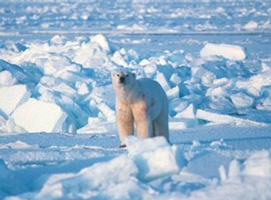

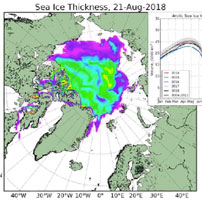
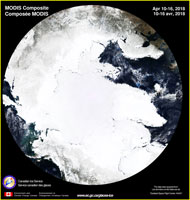
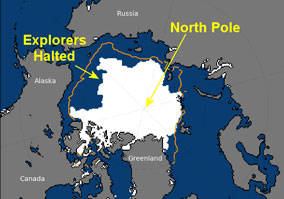
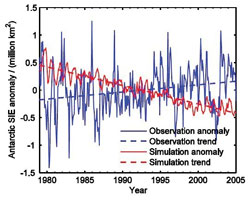
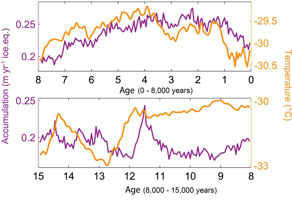
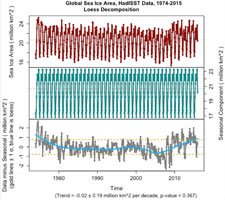
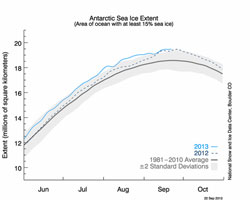

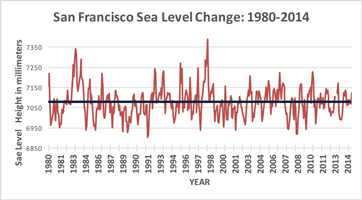
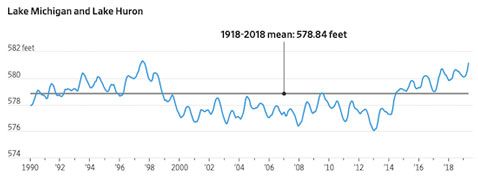
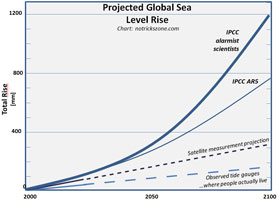
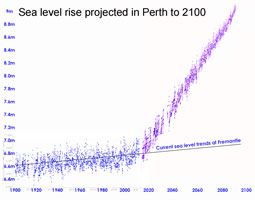
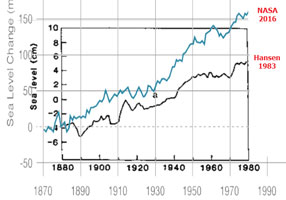
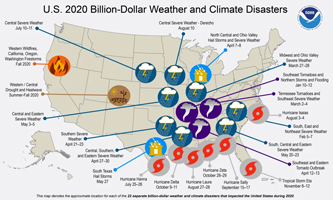
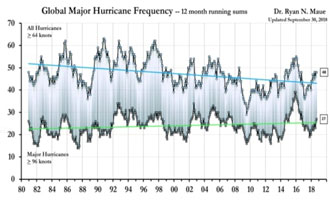

|
Document location https://akdart.com/warming6.html Updated May 12, 2026. Entire contents Copyright 2026 by Andrew K. Dart |