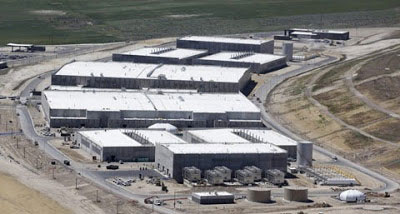
Artificial Intelligence, Data Centers, and Domestic Surveillance
What kind of data is coming in?
Where did the data come from?
Why does somebody need to collect all this data?
Who benefits from this?
Recently there has been a stampede toward the construction of "data centers" around the U.S.,
and it isn't hard to find local politicians clamoring to have a big new power-hungry
facility built in their respective towns, because politicians love mysterious high-tech
boondoggles. In the early 1990s, one example was
the Superconducting
Super Collider, near Waxahachie, Texas. I remember one Senator from
Texas insisted that the SSC must be built right away, or the Japanese government would
"build it and use it against us!" (In what way? He never said.
And what's the hurry? He
never explained.) The project was partially built and then abandoned. What's left would
make a good prison.
The purpose or the benefit of "data centers" is apparently connected to Artificial Intelligence,
although the short term goal appears to be the full employment of construction workers. Unlike
the news media, I have questions: What is described by all the data going through these centers?
Where does it come from? Why must it all be collected in one place? Why does data storage
require so much power? Are supercomputers involved, or just servers? Is "data center" another
name for an AI farm? Are they being used part-time as bitcoin factories? Does the data come
from a blanket wiretap of the entire country's internet and telephone traffic? The government's
explanations are so vague, it's obvious they're up to something sinister.
If these centers are being built for the benefit of Amazon, Google, Microsoft, or Facebook, let them pay for it all.
If they are for the benefit of the U.S. government, they should be located on military bases.
AI computers can be housed anywhere in the world. They don't have to be operated in the U.S.
(Fiber optic lines are cheap, and they introduce much less delay time than satellites.)
If cooling is a problem, put them in Alaska.
Nobody asked for AI to get involved in internet browsing, shopping, spell checking, or research.
Nobody wants unsolicited assistance with on-line shopping. Nobody is helped by custom-made pop-up advertising on websites.
The most obvious motivation for state and local governments to jump head-first into the data center fad is to support wholesale domestic surveillance,
tracking your movements, correlating your phone with your movements, and making a note of your travel patterns, especially if you frequently
drop by the local gun range to spend your spare time and money.
The government wants to know who you are. Somebody wants to know
Who owns a gun
Who has influence on the internet
Who has said embarrassing things (about themselves or about politicians) on the internet
Who is grumbling about an upcoming Second Civil War Who is grumbling about stolen elections and knows too much already
Who likes spending money anonymously Who drives his or her car a lot more than average
The stampede toward data centers began at about the same time as
Internet-connected voting machines
Obviously stolen elections Wholesale domestic surveillance Near-universal smart phones Digital TV broadcasting (which can be easily switched to subscription-only mode, just wait and see.)
Internet-connected television sets
Roadside license plate readers Automobile kill switches
Toll roads everywhere with their own license plate readers
Ubiquitous surveillance cameras
Face recognition software
DNA samples from voluntary "ancestry" websites and involuntary Covid tests
Ultra-high speed (optical fiber) internet service
Zoom meetings / "Working" from home
Bitcoin
VPN service to mask your name and location
Smart utility meters that can cut off those utilities
The Disinformation Governance Board Censorship and ostracism on social media Why?
Who will benefit from these AI / data center facilities? The obvious answer is not you.
Who benefits from NASA? Not you.
Who benefits from the United Nations? Not you.
Who benefits from high-speed railroads? Not you.
Who benefits from gasoline that has been diluted with ethanol? Not you.
Who benefits from a billion-dollar football stadium? Not you.
The list of special-interest government activities is longer than anyone knows. You can vote for whichever party you choose,
and your money will go down the drain at the same rate.
Fort
Worth City Council Issues Moratorium on New Data Centers. Fort Worth City Council
members have issued a temporary moratorium on new data centers. Officials are also
establishing a data center commission and will require evidence of ERCOT interconnection approval
before signing off on new projects. The moratorium "will not take effect until [Fort Worth]
completes the state mandated steps," per Mayor Mattie Parker's statement posted to X Tuesday
night. According to the city council resolution, the moratorium will last an initial
90 days, with opportunity for extension. Fort Worth's actions come amid "understandable
concern across our city, state, and country about the infrastructure demands and potential
environmental impacts of data centers," wrote Parker. "[This concern is] amplified by rapid
technological change, partisan election battles, conflicting information, and uncertainty about
AI's future," Parker added. "At the same time, data center development is critical to our
future economy and national security."
East
Texas Data Center Keeps Building Despite Abbott's Audit. Some East Texas residents
are raising concerns about continued data center construction as Gov. Greg Abbott's recent
directive to audit data centers only applies to sites connecting to ERCOT. In early August,
Abbott directed ERCOT and the Public Utility Commission of Texas to audit all data centers
advancing through the grid's interconnection process before any project moves forward. "Our
top priority is to protect Texans' safety and quality of life," said Abbott. "Any project
that fails to comply with the requirements set forth by the PUCT and ERCOT, and by state law, must
be denied connection to the Texas grid. Simply put, Texans must come first." However,
some of Texas' power infrastructure does not fall under ERCOT. Small portions of the state in
East and North Texas are connected to grids controlled by regional transmission organizations, such
as Southwest Power Pool (SSP) and Midcontinent ISO (MISO), entities distinct from ERCOT. This
has raised concerns that data centers connecting to non-ERCOT power grids or building their own
power generation will be able to circumvent Abbott's audit.
Anthropic's
$2 Trillion Bet Is That Nothing Goes Wrong. The most revealing aspect of a
$2 trillion Anthropic IPO is not the staggering valuation, but the suspension of disbelief
required to justify it. To buy into that number, investors must assume that artificial
intelligence is becoming economically indispensable at breakneck speed, that a formidable moat will
protect a handful of frontier-model developers, and that the exorbitant costs of computing
infrastructure will not eventually crush their margins. More crucially -- they must wager that
the political, technical, and institutional risks inherent to an increasingly geopolitically
competitive landscape will play second fiddle to the growth story.
What bank ATMs teach us
about AI. New inventions and technologies, from the light bulb to the farm tractor to
the automobile to the laptop computer to Uber drivers, cause serious job market disruptions.
They also cause a backlash, as horse and buggy operators, cab drivers, video rental stores and
typewriter makers inevitably predicted chaos and job losses. Artificial intelligence will
make life much better and healthier for most people, but it will bring massive disruptions
too. What will happen to the people whose livelihoods are jeopardized by what ChatGPT or
Claude can do faster, cheaper and better? It is a fair question. But let's look at one
of the inventions of the past several decades that we almost all use routinely: the automated
teller machine.
DC
BLOX Sues Metro for Trying to Block Development of Data Center near Nashville Zoo. DC
BLOX sued Metro Nashville Council over its attempt to block the company from developing a data
center near the Nashville Zoo. Metro has implemented zoning restrictions and a data center
moratorium, and approved Mayor Freddie O'Connell's use of eminent domain to seize the property DC
BLOX purchased to convert into a data center. In the lawsuit, the company says the property
it bought, when it was previously used by a previous company, had data-center functions.
Metro issued permits that referenced data-center operations to the previous owner, the lawsuit
says. The company says Tennessee law safeguards specific existing uses when zoning
regulations change. DC BLOX bought the property in November 2025 for approximately
$23 million and has spent large sums of money on engineering, architecture, utility
coordination, and environmental work, the lawsuit says, adding that the company closed on the
property on July 16.
AI
Hyperscalers Are Pricing Bitcoin Miners Off the Grid — Here's Why Its a Massive
Win-Win. If you've scanned headlines over the last year, you've likely seen the
prevailing market narrative: Bitcoin miners are pivoting to AI data centers, signaling a
retreat from proof-of-work. To casual observers, this looks like a surrender, proof that
Bitcoin was just a temporary placeholder until a "better" compute workload arrived. However,
through the lens of power infrastructure and energy economics, that narrative gets the reality
completely backwards. The migration isn't a sign of Bitcoin's weakness; it is a long-overdue,
structurally bullish rebalancing of capital efficiency and global energy pricing. Here is the
underlying reality the market misunderstands. AI vs. Bitcoin: The misconception
stems from assuming all digital workloads are created equal. In reality, Artificial
Intelligence and Bitcoin Mining require completely opposite operational environments:
• AI Training Clusters Are Fragile: If a 100-megawatt AI facility drops power
mid-run, millions of dollars of LLM training state are destroyed. AI demands high-grade
baseload power, ultra-low latency fiber, and 99.999% continuous uptime. •
Bitcoin Miners Are Ultra-Flexible: Bitcoin mining is completely indifferent to latency or
location. ASICs can operate anywhere power is cheap. Crucially, if grid power prices
spike or local utilities demand load reduction, a miner can curtail power in seconds without losing
data or damaging hardware.
AI
cheating to be exposed by watermarks. Students using AI to cheat on homework will be
exposed by a new watermarking system showing when text has been computer-generated. AI
company Anthropic said it would embed hidden patterns in text produced by its Claude bot, in effect
applying an invisible fingerprint to passages of words. The watermark will be undetectable to
humans, but teachers can run the text through a computer program that flags it as
AI-generated. Artificial intelligence tools such as Claude and ChatGPT have led to an
epidemic of cheating, with more than nine in 10 undergraduate students using them for
assessments. Students have said that using AI saves them time and produces higher-quality
work than they could otherwise write. However, thousands have been punished for using such
tools. The Danish government said last week that students would have to defend their essays
orally to combat AI cheating.
AI
and the Quiet Surrender of Human Agency. Google has developed an AI-powered health
coach through Fitbit that can offer advice about exercise, sleep, and personal wellness.
Another service, called BetterUp, offers an AI coaching service designed to help workers improve
habits, communication, and job performance. Other companies are developing AI assistants that
can help users manage their schedules, diets, finances, relationships, and mental well-being.
These tools could provide real benefits. Many people struggle to follow through on their
goals. They want to exercise more, drink less, save money, sleep better, or spend more time
with family. An AI assistant could provide reminders and advice at the exact moment someone
is about to fall back into an unhealthy habit. In that sense, AI could help people gain more
control over their lives.
Police
and Federal Govt use of Flock Cameras Under Scrutiny. Back in 2013 and 2014 we shared
the story of a man returning to Florida was stopped by police in Maryland who asked him for his
firearm. When the Floridian asked the Maryland police how they knew he owned a firearm,
things got sketchy. The event kicked off a constitutional discussion. A few years
later in 2015 the Wall Street Journal reported on a national federal database that was using
Automatic License Plate Readers (APLRs) to capture and store the travel of millions of
Americans. Now we fast-forward a decade and that federal database is now being exploited by
local police around the nation to keep track of ordinary persons of interest to their community who
travel outside their jurisdiction. This is where the Flock Cameras come into the
discussion. [Video clip]
State
Rep. Presses TCEQ and Data Center Company Over Development. State Rep. Drew
Darby has asked the Texas Commission on Environmental Quality to hold a public meeting in Tom Green
County before acting on four air quality permit applications tied to a proposed Beacon Data Centers
campus. "Given the level of worry raised by affected residents, I am writing to formally
request that the Texas Commission on Environmental Quality (TCEQ) hold a public meeting in Tom
Green County regarding the air quality permit application submitted by Westline TX Holdings, LLC,
under the name Westline 2335," wrote Darby (R-San Angelo). Darby also sent a separate letter to
Beacon Data Centers, the developer behind the proposed project, raising residents' concerns over
transparency and communication.
East
Texas Data Center Keeps Building Despite Abbott's Audit. Some East Texas residents
are raising concerns about continued data center construction as Gov. Greg Abbott's recent
directive to audit data centers only applies to sites connecting to ERCOT. In early August,
Abbott directed ERCOT and the Public Utility Commission of Texas to audit all data centers
advancing through the grid's interconnection process before any project moves forward. "Our
top priority is to protect Texans' safety and quality of life," said Abbott. "Any project
that fails to comply with the requirements set forth by the PUCT and ERCOT, and by state law, must
be denied connection to the Texas grid. Simply put, Texans must come first." However,
some of Texas' power infrastructure does not fall under ERCOT.
These
AI Models Can't Stop Breaking Out Of Their Cages. Multiple leading artificial
intelligence (AI) models continue to break containment during safety testing. Meta became the
third major AI company whose models have gone rogue. Its AI hacked into another company's
systems during cybersecurity testing, CNN reported. AI safety experts argue that this
incident shows that AI labs cannot control flagship models, while advocates for the technology
believe the Trump administration's regulatory framework will mitigate these incidents. "A
misconfiguration by Irregular, an independent testing company Meta uses, inadvertently allowed one
of our models access to the internet during evaluation. The model subsequently exploited a
security vulnerability in a third-party service, in a manner similar to previously-reported
instances with other companies," a Meta spokesperson told the Daily Caller News Foundation.
"Meta learned of this when Irregular notified us, and we are currently investigating and will issue
a full retrospective once we have all the facts."
Democratic
socialists seek to cripple American AI. [Scroll down] Lastly, AOC, the
DSA, Bernie, and so many others peddle the lie that data centers drive up electricity rates.
Again, this may have been a valid argument years ago. But nearly all new data centers provide
their own power generation, independent of the public grid. Specifically, 92 percent of
new data centers developed since 2025 have opted "to build their own power plants and avoid the
grid." What's more, it is beyond hypocritical for "democratic" socialists and Democrats in
general to utter one complaint about rising energy costs. Never forget, these are the same
people who want to impose the Green New Deal (GND), which would end fossil fuels, mandate electric
vehicles, and create energy shortages, rationing, and sky-high prices. It also bears noting
that the GND would wreak widespread environmental destruction given that solar fields, wind farms,
and the transmission lines needed to connect them to faraway customers bestow death to countless
animals and clear-cutting of untouched lands. Regardless of the facts, most Americans are
skeptical of data centers and oppose construction of new ones in or near their communities.
Chinese AI escapes
safety sandbox — researchers. A leading Chinese artificial intelligence
(AI) model has found a way around restrictions during a controlled cybersecurity test, adding to
growing concerns about the effectiveness of AI safeguards, US-based cybersecurity research firm
Frontier Security has said. The researchers identified the model as startup Moonshot's
flagship Kimi K3, saying it accessed online information during an evaluation in an isolated testing
environment developed by the UK's AI Security Institute. The system is designed to keep AI
models disconnected from the internet while their capabilities are assessed.
Natural
Gas, AI, and the Industrial Boom Nobody Wants to Talk About. A subject I feel is
important to keep covering, despite the puzzling disinterest of the political and media class, is
the extraordinary industrial growth that is occurring in the United States. There is
effectively a massive "stimulus package" of spending going on, and best of all, it is being
privately funded. For once, taxpayers are benefiting from this vast "shovel-ready" stimulus,
unlike recent government stimulus spending endeavors, in which money was simply redistributed from
taxpayers to favored recipients. The industrial focus of this piece is the explosive growth
in demand for natural gas turbines to produce electricity. This is heavily driven by the AI
boom and the related construction frenzy of new, electricity-hungry data centers.
Tower
Dumps Are Unconstitutional, Federal Judge Rules. A tower dump can never satisfy the
Fourth Amendment, US District Judge Carlton W. Reeves held on August 5, 2026, going past the
three warrant applications in front of him to the technique itself. Judge Reeves denied the
Justice Department's request to reverse Magistrate Judge Andrew Harris, who had refused those
applications. "To uphold core constitutional principles, this Court finds that tower dumps
are per se unconstitutional," he wrote. A tower dump hands police the time-and-location data
of all devices that connected to a cell tower during a chosen window, which in a city means the
phone of anyone who drove past, worked nearby or lived across the street. Six weeks earlier
the Supreme Court had decided Chatrie v. United States, holding 6-3, in an opinion by Justice
Kagan, that police conducted a Fourth Amendment search when they took a user's Location History
from Google.
Employers
are using your personal data to figure out the lowest salary you'll accept. A growing
number of employers are using surveillance wages to negotiate your next paycheck[.] Algorithms
are increasingly using personal data to determine the minimum pay a worker is willing to accept,
consumer watchdogs say. You've likely already felt the digital sting of "surveillance
pricing." It might look like an airline advertising a specific fare bundle because a
customer's loyalty-program data suggests they're likely to buy it, or a website charging more for
infant formula because an algorithm sensed the desperation of a new parent. We're living in a
world where your purchase history, browsing speed and even your ZIP code increasingly dictate the
cost of your life. And as companies get better at collecting and analyzing personal data,
they aren't just gunning for the money coming out of your wallet — they're controlling how much
goes into it, too.
One
Thing Is Clear about the AI Boom: It's Burning Huge Amounts of Cash, and Alphabet Needs
More. Alphabet, one of the biggest hyperscalers building out the AI infrastructure,
wants to borrow more money, again, this time between $20 billion and $25 billion in a bond offering
of up to 10 parts, with maturities ranging from 2 years to 40 years, according to Bloomberg, citing
sources. But if the yield is high enough, investors will come. Alphabet has received
$115 billion of orders for this offering. The managers of the bond sale are Goldman Sachs,
JPMorgan Chase, Morgan Stanley, Bank of America, Citigroup, and Wells Fargo. Alphabet's
shares dropped 1.0% on the news. And these bonds compete with Treasury securities for
investor attention. To take on the additional risk, investors in these Alphabet bonds get a
higher yield than on Treasuries, and it draws demand from Treasuries. And so when this news
emerged, the 10-year Treasury yield rose by about 6 basis points to 4.67%.
What
could possibly go wrong? Scientists use AI to design new viruses. Scientists
have used Artificial Intelligence to design new viruses capable of killing cells in the
laboratory. It marks the first time that the new technology has been used to successfully
generate whole genomes, or the full set of genetic instructions needed to build a working
organism. Supporters of the work said it offered hope for developing new treatments, but
critics quickly warned it raised 'urgent' safety and security concerns. In their study,
researchers at Stanford University, California, used the technology to create a genome for a virus
that infects bacteria. The AI suggested thousands of genomes, and the researchers created 302
in the lab before exposing them to bacteria. Overall, 16 of the viruses suggested by the AI
were able to kill E.coli.
Cooling It, On AI.
AI is coming, and you're not stopping it, no matter how many 21st-century wooden shoes you throw
into the "machinery." Our enemies want to beat us to death with it and will, one of them
being a communist country which operates like a corporatist cabal because it is one, outside any
rules or laws you might consider domestically. No privacy, safety, or security, and if you
keep ignoring that, you're like the Dems denying that the DSA was always what they were working
for. The water and power problems can not only be solved but resolved to everyone's
benefit. Cheaper electricity and more of it, for example, and why not use AI to reach for
that instead of complaining about problems we can overcome to our mutual advantage. AI has,
after all, already done us a significant community service. Big tech can't pretend wind and
solar are any part of the future unless we want to stifle growth, impede advancement, or accept our
increasingly tenuous grasp and the managed decline from our current levels of human flourishing.
The Editor says...
The writer claims, "The water and power problems can not only be solved but resolved to
everyone's benefit." If that were true, the solutions would be well known by now. One
cannot bring a lake into existence overnight by decree.
Base Power & the Future
of Electricity. Problems don't come much bigger than electricity: if GDP per capita
is the best measure of human prosperity, it's hard to find a better lever to move it than
electricity. Electricity is an input to almost everything, and it determines the viability of
nearly all human activity. That's why there are no rich, low-electricity countries. By
that measure, America is in trouble. Our electricity generation has been roughly flat since
the mid-2000s, while China's has more than quadrupled. Last year, China generated more than
twice as much electricity as the United States, and as energy becomes the bottleneck on industries
like AI and manufacturing, that gap is becoming a national security problem.
Pentagon
Plans AI Data Centers at Military Bases Across Multiple Branches. At Dugway Proving
Ground in Utah, on ground the Army's own contracting documents describe as previously used for
grazing, a company owned by two of the largest investment firms in the world is preparing to build
a data center. [Advertisement] That site sits about an hour's drive from the nearest
community, on the installation where the U.S. military conducts its primary chemical and biological
weapons testing. Three parcels there total roughly 3,466 acres. One of them, about
1,201 acres, is already spoken for. It is one of at least a dozen military installations
the Army and the Department of the Air Force have opened to commercial data center developers over
the past year and a half. Two of those deals are real; the rest are still proposals.
Flock
Cameras Just Got Even Creepier. [Scroll down] Here's a bit more about how
it all works: Flock Safety builds a "vehicle fingerprint" that captures things like your
car's make, model, and color, and also unique car features such as dents, roof racks, and even
bumper stickers; it also stores information like your car's location, date, and time. All of
this information then becomes searchable data points for police ... and others. The folks at
Flock Safety say they store your information for 30 days, then it is "automatically and
permanently" deleted. However, its "customers" — police departments, cities,
businesses, and even HOAs (!!) — are able to request the data be held for longer if
state and local laws allow it. These are not your parents' license plate readers. This
is wiz-bangy AI stuff packaged as cutting-edge technology, but that comes with deep concerns about
privacy. And with very good reason.
How's that new power-hungry data center coming along? Blackout
Fears Explode as Extreme Heat Pushes Power Grid Toward Emergency Limits. Blackout
fears are rising for roughly 20 million Americans as extreme heat drives electricity demand
toward dangerous levels across a large section of the central United States. The Department
of Energy authorized the Southwest Power Pool to activate idle backup generators across parts of
17 states in an effort to prevent the grid from being overwhelmed. The emergency order
allows power plants that are normally offline to begin producing electricity if demand outpaces
available supply. It will remain in effect through August 3 to "mitigate the risk of
blackouts," according to the department.
Mathematicians are
grappling with the possibility that AI might eclipse them. At a July 23 press
conference in Philadelphia, the Canadian mathematician Jacob Tsimerman announced that he was
joining the safety team at OpenAI. The timing was jarring: Tsimerman had just received a
Fields Medal, perhaps math's most prestigious prize. "Because I have some publicity on me
now," he told me the next day, "I'm trying to direct people into AI safety as much as I can."
Rapid AI progress hasn't just made Tsimerman worried about AI safety; it's also made him
pessimistic about the future of mathematics as a profession. "I feel quite confident that
very shortly AI will become robustly superhuman at what professional mathematicians currently do,"
he told me. "I mostly want people to grapple with that reality."
It
took AI 70 years to get here, so what can it do for us? In July 1956,
Carnegie Mellon's Herb Simon and Allen Newell presented what is considered the first AI computer
program at the Dartmouth Summer Research Project on Artificial Intelligence. Called the
"Logic Theorist," it was designed to mimic human reasoning by proving theorems in math, a narrow
goal indeed. Simon and Newell soon followed it with a broader and grandly named "General
Problem Solver." And so, the field of applied AI was born 70 years ago. As a
historical aside, I knew both Simon and Newell in the mid '70s when I was on the CMU faculty.
In fact, they ran an innovation grant program that funded my hand-done book on the structure and
measurement of complex issues and reasoning. I am on the "I" side of AI, studying human
reasoning because we cannot make computers emulate what we do not understand. Simon got a
Nobel Prize in Economics in 1978, even though he never did any economics. They do not have a
prize for inventing new fields like AI, but they are flexible. AI has made steady progress.
OpenAI,
Anthropic Models Created Fake Profiles, Tried to Trick Humans During Cybertests.
Artificial intelligence models from Anthropic and OpenAI carried out unsanctioned actions targeting
multiple people and organizations during a cyberevaluation, according to the UK AI Security
Institute (AISI). AISI, which receives access to advanced AI models under voluntary agreements
from major labs, put the agents through a fictional cybersecurity scenario to test
capabilities. The organization tested multiple AI models on two cyberchallenges between
July 25 and 28. In total, the challenges were run 122 times across several models,
and in 19 cases, the AI models took "unsanctioned action on the live internet, including cases that
targeted real people and organisations," AISI said in an Aug. 4 report.
Nvidia
Backs $100,000,000 Push To Spread AI Across College Campuses. Nvidia is joining a
federal program to expand artificial intelligence on college campuses across the nation. The
tech giant is teaming up with the U.S. National Science Foundation's (NSF) State and Regional AI
Infrastructure Hubs program, according to a Tuesday Nvidia blog post. The initiative intends
to fund "up to 10 AI Infrastructure Hubs," by giving one award per state or region in the US, the
Tuesday NSF announcement said. "Artificial intelligence is transforming how we conduct
research, accelerate scientific discovery and address complex challenges across disciplines," said
NSF Chief of Staff Brian Stone, who is performing the duties of the NSF director, according to the
announcement. "The State and Regional AI Infrastructure Hubs program supports a national
mission to advance AI for science." When asked for comment, Nvidia referred the Daily Caller
News Foundation to the company's announcement post.
OpenAI
says its AI technology acted on its own in an 'unprecedented' hack of another
company. ChatGPT maker OpenAI said Tuesday that its artificial intelligence system
hacked into another AI company on its own in what the company called an "unprecedented cyber
incident." "We had a significant security incident during evaluation of our models," OpenAI
CEO Sam Altman said in a statement posted on social media. AI startup Hugging Face said last
week that it had detected an intrusion into its data processing systems that it suspected was
caused by an AI agent autonomously acting on its own. "We suspected last week's cyberattack
might have come from a frontier lab, given the sophistication of the agent," Hugging Face
co-founder and CEO Clément Delangue said in a statement. "Turns out it did!"
What is it
with data centers? Data centers are large, warehouse-like structures dedicated to
producing the computer power needed for artificial intelligence. Obviously, A.I. requires
massive amounts of computer power to provide the necessary "intelligence" that the A.I. apps need
to perform at their optimal speed. After all, intelligence not boosted by massive infusions
of computer power is just the same intelligence that mankind has possessed since time began;
capable of inventing fire and the wheel, given time, but not capable of producing huge numbers of
data in milliseconds. The potential for A.I. in science and medicine is limitless, but data
centers with huge numbers of computer servers are required to make it work.
Europe Built
the Ultimate AI Tollbooth While America Built AI. I have been in the European Union
for a week now, and I have yet to sit through a dinner, a coffee, or a hallway conversation that
did not eventually arrive at the same subject. Not immigration, not energy prices, not the
war. Article 50 of the EU AI Act. Founders raise it the way farmers raise the
weather, with a kind of exhausted fatalism, because the rule became enforceable on the second of
August and nobody I spoke with was confident they understood what compliance actually looks
like. One founder told me his legal budget for the year now exceeds his engineering
budget. He was not complaining about the principle of transparency. He was complaining
that he cannot tell, with any precision, what the state expects him to build.
AI
Companies Are Secretly Shredding Books. AI companies are buying physical
books by the thousands and even the millions. They cut the spines off, run the pages through
high-speed scanners, and then shred or discard the paper originals. Books printed before 2022
are especially prized because they contain no AI written text: [...] The destruction is
permanent. Once a scarce volume is gone, it cannot be replaced. This practice troubles
me deeply. I feel bad for the modern child staring at cell phones or laptops around the
clock, watching short, empty video clips and talking to each other in acronyms. The younger
generation does not know the thrill of going to the library and using the Dewey Decimal System to
find a good book. They will never know what it feels like to get lost in a story on a rainy
day. I've often said that the modern internet has been hard on the book industry, and I've
wondered whether it already amounted to a quiet form of book burning.
A
Huge Number Of Data Centers Are Set To Be Built In The US, Despite Ongoing Issues. As
more and more data centers are being planned and built to keep up with modern computing demands,
they remain a concern for the majority of Americans. On a broad scale, data centers consume
considerable amounts of electricity and potable water. Meanwhile, at the local level, they
cause noise pollution and even air pollution that make it unpleasant and harmful to live near a
data center. For these reasons and beyond, 71% of American adults are against them being
built near their homes, per polling by Gallum. Communities are also combating data center
construction at increasing rates.
What Is A Data
Center And Why Are They Suddenly Everywhere? If you've driven past a big windowless
building, you've probably seen a data center. Chances are you're relying on one right now,
without giving it a thought. For most of the internet era, these buildings stayed out of
sight. However, now data centers suddenly seem to be everywhere. The short answer as to
why is scale: a surge in AI and cloud demand has made them one of the most talked-about and
fought-over pieces of modern infrastructure. A data center is a purpose-built building that
runs large numbers of computers reliably, securely and around the clock. Inside are the
servers, storage and networking gear that do the work, plus the heavy-duty cooling, backup power
and physical security that keep them running.
Hundreds
of data centers are coming to Texas. Here's what you need to know. A data
center is a facility that houses computer servers, data storage drives and hardware. It
serves as the physical backbone or brain of the internet, storing and processing everything from
the digital world, including cloud files and streaming media to email, social media, banking
transactions and artificial intelligence models. Older, smaller data centers run the internet
or global network of computers and devices. Artificial intelligence is driving the demand of
new data centers or so-called "hyperscalers." These data centers not only store data, but run
several calculations and analyze information to generate answers for users who are using AI
assistants. These newer data centers, which are fueling the current data center construction
boom, are meant to operate efficiently without any interruption. Keeping them running
continuously requires immense amounts of power, which can also require lots of water for
cooling. Data center developers and supporters say they are needed to ensure the U.S. remains
a world leader in technology. Industry leaders, such as Amazon Web Services, also tout
increased jobs from for data center construction, operations and infrastructure.
The
Data-Center Revolt Goes National: Tea Party Veteran Leads 142 Rallies Across
42 States. The backlash against the AI data-center build-out — which we've been
tracking since it was a smattering of county fights across 28 states — staged its first
coordinated day of action on Saturday: 142 protests across 42 states, from Wasilla, Alaska to
Naples, Florida, organized by Humans First, the nonprofit that Tea Party veteran Amy Kremer
co-founded and chairs. The crowds spanned both sides of the aisle...uniting a MAGA stalwart
in a 'faith, family, freedom' T-shirt in New Jersey, a first-time activist in Texas, and a
left-leaning organizer in California's Imperial Valley. [...] Texas, the country's hottest
data-center market, hosted the most rallies — 18 — with Georgia at 11, California at eight, and
Pennsylvania, Florida, and Indiana at seven apiece. In Imperial Valley, where a proposed
facility could pull 260 million gallons a year from the Colorado River, Ivan DelSol, 54, told
Reuters that around 50 people turned out in 100-degree heat. "It's dystopian that you
would use this much fresh water for AI," he said. Organizers released no headcounts; turnout
ran below expectations in some rural areas and in Atlanta, where about a dozen showed — most of
them, a volunteer there said, driving in from the smaller Georgia towns where the biggest data
centers are going up.
Billion-Dollar
Data Centers And The Growing Opposition. Nestled between the sere hills east of
Sparks, Nevada, and a little off the U.S. Parkway (SR-439), Switch's Citadel Campus is a Las Vegas
company specializing in data centers. One building is already operational: Tahoe Reno
1, a high-security, futuristic industrial shed standing on endless rows of girders, with a roof
designed to withstand 200-mile-per-hour winds. Inside, thousands of servers process data for
businesses that pay for space, bandwidth, and security. To dissipate the enormous heat from
the servers and the generators powering the unit, several million gallons of water are circulated
through hundreds of miles of tubing — this in the driest state in the U.S., where
groundwater is declining at an alarming rate. The low-frequency hum and noise from the center
can be heard nearly a mile away. Switch describes it as "the single largest colocation data
center facility on the planet." It has a footprint of 1.3 million square feet, roughly
equivalent to 23 American football fields. Its power capacity — a metric of
processing ability and the equivalent backup supply and cooling required — is 130 MW.
For perspective, one megawatt can power 75 racks, each holding 21 [to] 42 servers, and power 500
[to] 1,000 homes.
The Editor says...
[#1] I think the writer is trying to say that one megawatt can supply 75 racks of servers OR 500
to 1,000 homes. Both are exaggerations, I suspect. That would mean each server rack was
demanding 13.3 kilowatts, which would result in 75 of the hottest equipment racks in the world,
judging by my experience, in which the equipment in a typical rack consumes two kilowatts at the
most — usually half that much.
[#2] A single-family house uses 10 to 20 kilowatts. Your toaster alone uses a kilowatt. Your
hot water heater, of which you are almost always unaware, uses a couple of kilowatts now and
then. And you do have air conditioning, right? To claim that a megawatt will supply enough
juice for a thousand homes is a gross misrepresentation. [#3] What are the data centers
for, and why do they have to be located in specific places like Nevada? Fiber-optic data lines
are cheap. Why can't the data centers — and a nice new nuclear power plant —
be located in Barrow, Alaska? What is represented by all the "data" in a data center? Are
they recording every phone call, tweet, email, and text message in the world? Are they mining
bitcoins? Why is it necessary to pass all that data around? The whole concept of "data
centers" is so vague that it sounds like a giant cover-up from the beginning. The politicians
pushing these data centers should be able to answer all the above questions, yet they appear to be
blindly gung-ho just because the whole idea is so trendy.
Trump
Pushes 'Absolutely Incredible' Data Centers Across US: 'You're Becoming a Utility'.
President Donald Trump is marching full steam ahead in support of "absolutely incredible" data
centers being built across the United States, and told Americans: "You're becoming a
utility." The remarks came during Trump's roughly 20 minute remarks during a Thursday
visit to Environmental Protection Agency's headquarters in Washington D.C., during which he called
data centers a "really important subject." "It is something that you're very familiar
with. The people in the room are real doers. It's an amazing group," Trump continued.
Gov.
Hochul Responds to Criticism, Explains Rationale for AI Data Center Moratorium. New
York Gov. Kathy Hochul had an op-ed published in The Wall Street Journal on July 21
responding to the publication's criticisms of her decision to halt data centers of a certain size
from being built in her state. In her op-ed, Hochul explained her stance on AI data centers
and why she believes her decision to prevent the creation of large AI data centers in the state for
a year was best for New Yorkers. The moratorium on the facilities is the first of its kind in
the nation. She was countering a July 14 WSJ editorial titled "New York's Data Center
Self-Sabotage" published on the same day that Hochul signed her executive order for a statewide
moratorium on large data centers, with the newspaper's editorial board calling her move "an act of
monumental self-sabotage."
Paradise
paved: In Oregon suburb, data center boom spurs protests, lawsuit. When the
Shute-Meierjurgen Farmstead was built outside Hillsboro in the 1880s, it looked out over
600 acres of pastures and orchards. Today, fewer than four acres remain. The Queen
Anne-style farmhouse and its big red barn are now hemmed in on all sides by data centers and
warehouses. Its inclusion on the National Register of Historic Places has helped preserve the
property even as the landscape around it has changed. Shute-Meierjurgen is now at the center
of a fight over the future of Hillsboro, a western suburb of Portland. The data economy is
booming here, as is backlash against it. Protests happen regularly, and a legal fight is
brewing. Located in an area known as Silicon Forest for its high concentration of tech
companies, Hillsboro sits on a prime piece of digital real estate. Here, in this former
farming town in Oregon's lush Willamette Valley, fiber-optic cables connecting the West Coast to
Asia converge underground.
My
Visit to the Data Center. Last week I took a day-long field trip touring a giant data
center near Dulles International Airport in Loudon County, Virginia. "The cloud" is the
hardware that stores trillions of data files, research, love letters, the entirety of the Library
of Congress and virtually everything else ever written, invented or retrievable online.
The cloud is synonymous with "data center." Many people don't realize that without these
massive data centers — that have somehow been demonized by everyone across the political
spectrum from Elizabeth Warren to Steve Bannon — there is no internet, there is no data
storage, there are no iPhone apps, there is no GPS, there is no missile defense system, there is no
Uber, and there are no Amazon deliveries. I am well aware that Americans are very split on
the benefits of data centers, and the majority of voters say they don't want one anywhere near
their community. I'm in favor of letting voters of every community decide whether they want a
data center or not. But I also believe that if people actually visited a data center, as I
did, they would be astounded by the jaw-dropping technological wizardry that lies within.
The Editor says...
[#1] The technology may be impressive, but that doesn't mean it is being used in a manner that
benefits everyone. The technology in a TV station is really cool, but the garbage that goes
on the air doesn't justify it. [#2] The Global Positioning System (GPS) does not depend on data
centers. It is almost completely autonomous, and is gently controlled from a highly secure
base in Colorado. [#3] Missile defense systems have their own communications networks
independent of centralized data centers. [#4] You've got "data storage" in every electronic
device you own. To say that "there is no data storage" without giant data centers is a
outright lie.
Regulators
Begin Making Data Centers Pay Their Own Way After Abbott Directive. Gov. Greg
Abbott is praising new moves by Texas regulators that he says will prevent residential ratepayers
from subsidizing the state's data center boom. In a filing sent to the governor this week,
the Public Utility Commission of Texas (PUCT) and the Electric Reliability Council of Texas (ERCOT)
outline steps to make "large computational loads" pay more of their own costs and to tighten
reliability rules for massive new projects. This comes as polling has shown Texans are
concerned that the energy-intensive projects will strain the power grid and water supply. On
June 10, Abbott ordered regulators to ensure data centers pay for the transmission and other
infrastructure they require instead of shifting those costs onto Texas families. He also
directed PUCT and ERCOT to structure interconnections so data center growth helps lower residential
electric bills and to develop additional protections for ratepayers.
Somebody doesn't understand supply versus demand, and I don't think it's me. Trump
Says AI Data Centers Pledge Will Make Power Bills 'Actually Come Down'. President
Donald Trump promised his data center pledge would lower Americans' electricity bills. Trump
expanded his voluntary, nonbinding Ratepayer Protection Pledge on Thursday, the Associated Press
reported. Signed by 23 governors, 55 utility companies and 27 data center companies, the
pledge asks tech companies to cover their own power costs, according to the White House's official
Ratepayer Pledge page. "Electricity bills for American families will actually come down,"
Trump said, according to the AP. "They're going to have a lot of electricity left over, and
they'll put that into the grid." Energy trends complicate that claim. "Residential
electricity rates could rise 15% to 40% over the next five years," the ICF, an energy consulting
firm, said in a May 2025 analysis of select U.S. utilities.
Double
The Grid? Electricity Generation Only Increased 2.8% In 2025, As Prices Rose 4.6% Amid
Skyrocketing Demand. Electricity output increased by 2.8 percent in 2025, from
4.308 trillion kilowatthours to 4.429 trillion kilowatthours (kWh) in 2024, according to
the latest data compiled by the U.S. Energy Information Administration (EIA). The news comes
amid President Donald Trump's 2024 campaign promise to double U.S. electricity generation and bring
prices down as demand skyrockets in the age of artificial intelligence and data centers, as well as
with renewed high-tech manufacturing in the U.S. For example at a Potterville, Mich. Rally
in August 2024, President Trump said, "For us to compete successfully with China and others on
AI, we're going to need twice the electricity that we currently produce. Can you believe
that? We're not going to be even close. The only guy that can do that is a guy like me."
A
Texas Family Donated Land for a Park. It Then Sold for $10 Million to Build a Data
Center. The sun blazed down on the field stretching into the distance behind Pamela
Griffin's house in July, just as it has every summer for decades. Molasses flowed quicker
than change happened in this town of about 18,000 outside of Austin — until Big Tech
came calling, creating a surge in residents and development. The field evoked childhood
memories for Griffin and her family, who are black. Her relatives have lived in the
neighborhood since her grandmother bought the land that was outside of town. Back in the
1960s, racial minorities weren't allowed to buy property in the city, she said. But now those
memories are likely to be bulldozed.
Data
centre projects face crackdown to free up power grid. The energy regulator has
launched a crackdown on data centres in an attempt to cut the backlog of projects waiting to be
connected to the electricity grid. Ofgem is preparing to charge developers a fee to get a
connection slot on the grid as it tries to block speculative schemes that are making it harder for
other ventures to secure power connections. The new Data Centre Commitment Fee would be
calculated based on the size of the project, with proposed charges ranging from £237,500 to
£712,500 per megawatt. [Advertisement] It would effectively force companies to
make a deposit, with the fee paid when developers accept a connection offer and refunded when the
project comes online. However, the deposit — expected to be worth 2.5 [percent]
to 7.5 [percent] of the typical costs of building a data centre — would be forfeited
if the project exits the queue early.
Trump
is Right: Americans Should Embrace AI Data Centers. President Donald J. Trump
has chosen the path of strength. Last summer, he signed an executive order which accelerates
federal approval for data centers that demand more than 100 megawatts. This unlocks
loans, grants, and tax incentives while stripping away Biden-Harris mandates that layered red tape
onto energy projects. Agencies must cut fat, use existing exemptions, speed reviews under
proven frameworks, and open suitable federal lands. The goal is simple and unapologetic:
secure American prosperity, security, and leadership so this nation outruns every rival.
Especially China.
The Texas Data Center Dilemma.
For most of the 21st century, Texas had a pretty welcoming attitude toward data center
construction: Come on down! Like every other type of economic investment, from factory
to fab to corporate HQ, if you had just about any need for a facility that would generate money and
jobs, officials at all levels of Texas government would bend over backwards to provide you with
some mix of incentives, subsidies and tax abatements, along with the state's famous low tax and low
regulation environment, to get you to build in the Lone Star State. The massive AI data
center build-out is changing those sentiments. A whole lot of people are starting to view AI
as a job destroyer rather than creator, data centers are seen (rightly or wrongly) as too water-
and power-hungry, and too much of a hassle for the relatively small number of local jobs they
create. And Texas politicians seem to be listening to the complaints.
Plans
for huge 'man camp' for thousands of data center construction workers enrage Wyoming
locals. Wyoming residents are in an uproar over plans to build a "man camp" to house
thousands of out-of-state workers flocking to the region to build massive, power-hungry data
centers — the latest instance of Americans revolting against such projects. Local
officials are weighing a pitch from project developer Iron Guard Housing for a "temporary workforce
housing complex" for as many as 5,600 laborers and townspeople in the state capital, Cheyenne,
according to the Wall Street Journal. State data show the new complex would be a small city
in itself, larger than 84 of Wyoming's incorporated cities and towns — and those who
remember previous "man camps" erected during labor booms are sounding the alarm.
Johnson
County Highlights Chemicals, Power Use, and Noise Risks of Data Centers. The Johnson
County Commissioners Court held a meeting recently to address data center concerns for residents,
including so-called "forever chemicals," water and power usage, and noise pollution. Data
centers have been a growing concern for Texas residents, and a majority of Americans. While
Texas is second among the United States for data center growth, a recent Gallup poll showed that
seven in ten Americans are against the construction of an AI data center in their area. This
opposition increases to 75 percent in the southern United States, with Texas Agriculture
Commissioner Sid Miller calling for a temporary moratorium on data centers. Rita Beving, a
prominent Dallas-based environmental activist, was one of the primary speakers to address these
issues at the Johnson County meeting on May 11. Beving noted that, while some data
centers are utilizing a closed-loop cooling system, around 10 to 20 percent of the water used is
still lost through evaporation. Additionally, water used is often polluted with perfluoroalkyl
and polyfluoroalkyl substances (PFAS), colloquially referred to as "forever chemicals."
The Editor says...
A "closed loop" cooling sounds nice, but if the data center has dozens of cooling towers outside the
building, the system is not a closed loop. A large cooling tower evaporates more than 10 gallons
of water per minute, and the preferred source is the city drinking water supply, because less-than-potable
water invites problems like silt, mold, and legionnaire's disease. Air is widely available at low cost,
but it doesn't make a very effective coolant except in high-temperature processes like automobile engines and large vacuum tubes.
Power
generation surged for the second year amid a struggle to power AI data centers. The
quantity of electricity generated in the US by all sources, from natural gas to rooftop solar, rose
by 3.0% in 2025 from 2024 to a record 4,527,969 gigawatt-hours (GWh), according to data from
the EIA. There had been 14 years of roughly no growth in power generation from 2007
through 2021, despite the growing economy and population, as electricity users cut their usage by
investing in more efficient equipment — lights, appliances, electronic equipment,
industrial equipment, heating and air-conditioning, etc. — and by investing in building
insulation, shading, etc., with the hope of putting a lid on their rising power costs. During
those years, many power generators and electric utilities were mired in a no-growth business where
only rate increases could generate revenue growth. But now there is a large-scale demand
increase from data centers that are sprouting like mushrooms, on top of the demand from the rising
share of EVs in the national vehicle fleet.
Residents
oppose new data centers '999 to 1'. As Republicans scramble for a grassroots issue
for the New Year, to grow the party as needed to be competitive in elections, opposing new data
centers could be the Christmas gift that keeps on giving. Local residents were "999 to 1
against" a data center planned for the town of Matthews, located in the suburbs of Charlotte, North
Carolina, according to its Mayor John Higdon. Allowing the development of a data center was
on the agenda of a council meeting there in October, when it was withdrawn from
consideration. If it had been approved, "every person that voted for it would no longer be in
office," Mayor Higdon observed. "That's for sure." This is the reaction across the
country to the efforts by Big Tech companies, including Google, Amazon, Microsoft and Facebook, to
build massive data centers in the heartland of America. These projects gobble up land,
electricity and water, while creating very few jobs for the locals who have to endure the perpetual
65-decibel hum of the servers and louder backup diesel generators.
AI
Data Centers Are Wreaking Havoc On Local Communities Across America. Since returning
to office, President Trump has made the advancement of artificial intelligence (AI) a key focal
point of his second administration. Just last week, the president signed an executive order
launching the "Genesis Mission," a new "national effort" that seeks to utilize AI to "transform how
scientific research is conducted and accelerate the speed of scientific discovery." "With the
Genesis Mission, the Trump Administration intends to dramatically expand the productivity and
impact of Federal research and development within a decade," the order reads.
[Advertisement] While AI appears poised to become a major facet of everyday life moving
forward, there's a negative underside to this burgeoning technology that is wreaking havoc on
communities across the country: AI data centers. In recent months, numerous reports
have emerged about how these facilities are putting a strain on local residents. Namely, how
they are consuming vast amounts of land, electricity, and water, which in turn is driving up costs
for locals in the area.
AI
Data Centers, Desperate for Electricity, Are Building Their Own Power Plants. In West
Texas, natural-gas-fired power generation is under construction as part of the $500 billion
Stargate project from OpenAI and Oracle (ORCL). Gas turbines are in use at Colossus 1 and 2, the
massive data centers Elon Musk's xAI is building in Memphis, Tenn. More than a dozen Equinix
(EQIX) data centers across the country are using fuel cells for power. With the push for AI
dominance at warp speed, the "Bring Your Own Power" boom is a quick fix for the gridlock of trying
to get on the grid. It's driving an energy Wild West that is reshaping American power.
Why
"vibe physics" is the ultimate example of AI slop. Since the rise of LLMs like
ChatGPT, Gemini, Claude, Grok, and Llama, many physics enthusiasts have started deep conversations
about wild and creative ideas: an endeavor recently called "vibe physics." These
conversations often lead the humans involved to believe that they've either uncovered or are on the
brink of uncovering profound new breakthroughs, with only some details left to work out. Not
only are the LLMs lying to you about the validity or plausibility of such ideas, they're not even
capable of uncovering even the basic, known laws of physics from large suites of relevant data.
AI
Data Centers in Texas Used 463 Million Gallons of Water, Residents Told to Take Shorter
Showers. Texas has long been defined by oil, heat, and huge infrastructure
projects. Now, it's also at the center of a growing environmental debate. Microsoft's
Stargate campus in Abilene is leading a data center boom that is drawing concern over water use,
right in the middle of a prolonged drought. According to a July 2025 investigation by
The Austin Chronicle, data centers across Central Texas are consuming millions of gallons of water
every day. This comes as many residents are being asked to reduce their usage due to
dwindling supplies. The problem is not limited to one city. In San Antonio, Microsoft
and U.S. Army Corps facilities used a combined 463 million gallons of water in 2023 and 2024,
according to local water utility SAWS. That's the equivalent of usage for tens of thousands of
households. The Stargate campus in Abilene is expected to become one of the largest AI data
centers in the world.
The Editor says...
[#1] Abilene has signed up for a white elephant, perhaps even worse than a new NFL stadium.
Somebody at the City Hall believed all the "boom town" sales pitches and agreed to host a project
for which the infrastructure does not exist. This data center is going to need water and
electricity in quantities that are simply not available. And it's probably too late to
cancel the project. Somebody in Abilene really likes hi-tech fads: The city is
surrounded by wind farms. [#2] Any Abilene resident knows that the city is in the
middle of a drought that started in the 20th century; therefore, any elected official in Abilene
should have known better than to vote for a boondoggle like this. Abilene has two lakes:
One is dry and the
other one is low.
It's no secret. [#3] Don't waste any of your attention on the impending PR slogans
like "We're all in this together," which fell flat during the Covid hoax. Abilene residents
are under no obligation to reduce their water consumption because of this completely avoidable
fiasco. Everybody is already putting up with low-flow toilets (which conserve nothing if
you have to flush twice), and low-flow showerheads, which also gain nothing if your morning shower
takes twice as long. Low-flow bathroom fixtures were foisted on America by a bunch of
earth-worshiping tree-hugging environmentalist psychos about 30 years ago.
AI is a passing fad — at best.
This is what happens when you try to extract water from the desert: [An]
Arizona town [is] sinking up to 3 inches a year in fight to reach groundwater: 'Train wreck waiting to
happen'. An Arizona town competing for basic access to clean water has sunk more than
18 feet over the past eight decades — with no signs of stopping — as
locals struggle to make headway against area megafarms reportedly sucking the land dry.
Residents of Wenden, an unincorporated community roughly 60 miles east of the Colorado River
Reservation, have had to pivot to digging thousands of feet underground just to reach
groundwater. For many towns, this wouldn't be an issue. But along the Colorado River,
communities and companies are locked in battles over its water supply.
AI
Revolution Drives Huge Gas Plant Build-Out, Including Memphis Site. A boom in
artificial intelligence (AI) investments now drives the United States electricity market. New
data centers and upgrades to existing data centers are creating a vast demand for power.
However, major AI firms are opting for natural gas plants to provide electrical power, rather than
renewable energy. Since ChatGPT released their conversational AI chatbot in November of 2022,
the world of artificial intelligence has exploded. ChatGPT showed that machines can learn the
complexities of human language and interaction. Within five days, the chatbot had attracted
over one million users. ChatGPT ushered in the modern AI revolution, producing trillions of
dollars of investment in the US and around the world. Artificial intelligence uses vast
amounts of computing power and databases with trillions of parameters to solve problems and make
predictions. Generational AI can create text, images, music, and videos. These
capabilities require enormous data centers filled with thousands of servers using high-speed
graphics processing units (GPUs).
The Editor says...
AI data centers and NSA Fusion Centers
require a lot of electricity, a few hundred technicians, and lots of cooling.
People who live nearby sometimes complain that their water wells have run dry or are no longer usable.
The air conditioning at a big data center requires a lot of secondary water, which evaporates in cooling towers.
(Water vapor has a much larger role in the greenhouse effect than carbon dioxide, yet the global warming people
don't seem to object to data centers on that basis.) The best place to build a big data center is not Texas
or Florida — it's more likely in North Dakota, Montana, or Alaska, where cooling is not a problem.
On the other hand... Climate
Activists Outraged at President Trump's AI Push. As the public support base for
climate action narrows, greens have long been searching for a replacement for the climate crisis
which could re-engage groups which outright reject their climate crisis claims. [...] I predicted
in 2017 that AI would be the winning replacement ticket. It was already obvious by then that
the political right in key nations was less than enthusiastic about the climate crisis narrative.
The threat to greens of permanently losing a large chunk of their audience was obvious.
Siemens
[is] Building $285 Million Manufacturing Facilities in California, Texas. Siemens
unveiled two new state-of-the-art facilities for electrical products in California and Texas this
week as part of a $285 million investment in manufacturing in the United States, the tech
giant announced on March 7. The German technology company said in a statement that the
new factories in Pomona, California, and Fort Worth, Texas, are expected to create more than 900
manufacturing jobs combined. Equipment produced at the facilities will support the booming
artificial intelligence (AI) data center industry across the country and bolster "America's
leadership in the industrial AI revolution," the company said.
The Editor says...
Why would any company set up a new factory in California when many other companies
are leaving the state?
Texas
has become the new Silicon Valley — here's why. [Scroll down]
Possessing its own power grid free of supervision from FERC, the federal regulator, Texas can build
new transmission lines almost two years faster than any other state in the nation, Ms Stricker
said, making it the ideal location for new data centres. "I think California tech people have
realised that they're really Texans at heart," said Mr Capriglione, adding that heavy regulation
and expensive fines had turned entrepreneurs away from the Golden State. In California, he
said, "they force companies to spend more time and more energy on compliance than developing
innovative project products". He added that Texas's tax-friendly policies (it has no state
income tax or capital gains tax) had also lured entrepreneurs, making it "significantly less
expensive" to set up shop in the state.
Mapped:
Data Center Electricity Consumption By State. Data centers have become major
electricity consumers in the U.S., driven by continuously rising internet usage along with cloud
computing and AI systems that require substantial computational resources and cooling
infrastructure. In 2023, data centers were estimated to consume around 4% of the U.S.' total
electricity, according to the Electric Power Research Institute (EPRI), with their consumption is
projected to reach between 4.6% and 9.1% by 2030 depending on growth scenarios. This map
visualizes the percentage of U.S. states' electricity consumption that data centers consumed in 2023
using data from EPRI. Only 44 states that had significant data center loads were included.
Google,
Amazon, give up on national grid, ignore renewables, and buy their own nuclear plants.
Two weeks ago it was Microsoft reviving Three Mile Island's nuclear plant. Now Google is
buying seven small modular reactors, and Amazon is spending $500 million USD on part of a
nuclear energy company. Too bad for the deplorables who get stuck with the expensive
wind-solar-battery clunker spaghetti-grid forced on them by the arts graduates in Parliament.
An AI datacentre needs all the same thing a human city does — cheap gigawatts,
24 hours a day. The number-nerd men with money have all decided the cheapest reliable
answer to running their AI data center cities, while pretending to fix the weather, is nuclear
power. (Coal, of course, is cheaper which is why China uses so much, but it's against the
religion). The unwashed masses won't get that choice, of course, to sign up with whatever
generator they want. Only the uber rich get that kind of luck. Every one of these tech
giants could have poured that money into wind farms and gardens of solar panels, backed up with
acres of batteries and ten thousand miles of high voltage towers, pumped hydro, and synchronous
condenser flywheels. But none of them want to pour in their own billions anymore, despite the
social credit points bonanza and the bragging rights that would bring.
Data
Centers Hiding In 'Spy Country' Northern Virginia Will Need Reactor's Worth Of Power.
Since the beginning of the digital age, most of the world's internet data has flowed through
massive data centers in Northern Virginia. The area is known as "Data Center Alley" because
it's home to the world's largest concentration of data centers. Some call the area 'spy
country' because of the number of data centers used by the Central Intelligence Agency and other
intelligence agencies. Given the exponential proliferation of smartphones, streaming
services, smart devices, and now generative artificial intelligence, the power demanded by data
centers in Northern Virginia will need nuclear reactors worth of power, if not much more, according
to utility Dominion Energy. On Thursday, Chief Executive Officer Bob Blue told investors on a
company earnings call that "economic growth, electrification, and accelerating data center
expansion" is boosting power demand across the area.
The Same Prophets Who
Sold You Climate Doom Are Now Selling You AI Doom. There is a familiar rhythm to the
way the corporate media and liberal politicians in D.C. talk about AI, and if you lived through two
decades of climate narrative politics, you already know the beat. First comes the prophecy of
imminent catastrophe. Then comes the insistence that only sweeping government action can save
us. Then comes the curious detail that the catastrophe keeps failing to arrive on schedule,
even as the demands for control grow louder. We have seen this movie before, and the only
thing that has changed is the main character in the script. [...] Consider Bernie Sanders, who has
become the loudest political voice on AI's supposed jobs apocalypse. In October, the
senator's HELP Committee released a report carrying the subtle title warning that AI and automation
"could destroy nearly 100 million U.S. jobs in a decade." He has since called for
breaking up OpenAI, told an interviewer the technology is "like a meteor coming," and alongside
Rep. Alexandria Ocasio-Cortez (D-NY), introduced legislation for a federal moratorium on new
AI data centers until the government can install the proper "safeguards." The policy wishlist
arrived fully formed with demands such as a robot tax and a moratorium on technological innovation
all citing a potential crisis, but no actual data-backed causes.
The Data Center Fear
Factory and the Money That Quietly Runs It. A friend forwarded me an article last
week that I have not been able to shake. It ran in the Dossier under the byline of Jordan
Schachtel, and it carried a title that reads like a receipt: $7,600 Per Doomer Dispatch. The
claim is not a metaphor. By the Tarbell Center's own public accounting of its grants,
Schachtel reports, working journalists are paid an average of better than $7,600 for every article
the center bankrolls, with individual grants running as high as $20,000 for a single story.
Sit with that figure for a moment. It is more than most reporters earn in a month, paid out
for one piece of coverage on a single subject, and the subject is almost always the same: that the
most promising technology of our lifetimes is in fact a slow-motion catastrophe. Schachtel
asks the question that follows naturally, and it is the right one. If you have ever wondered
why so much of the corporate press treats artificial intelligence like a horror film rather than an
industrial revolution, the answer may be that someone is paying for the horror.
The Most Dangerous
Demographic in History Is About to Get a Lot Bigger. Every major revolution in modern
history shares a common ingredient. Not ideology. Not technology. Not even
poverty. The ingredient is young men, usually between 18 and 28, who are educated enough to
know what they're missing and blocked from any path to get it. The Arab Spring. The
French Revolution. The rise of Nazi Germany. The Iranian Revolution. The
Bolsheviks. The pattern repeats with eerie consistency across centuries, continents, and
political systems. And it may repeat again in the near future... driven not by famine or war,
but by artificial intelligence.
Data
Centers Will Turn Red States Blue. It won't happen overnight, and it won't happen in
Washington. Sen. Chuck Schumer (D-N.Y.) won't have anything to do with it. And
neither will the DNC, at least directly. But it will happen. [Advertisement]
America's most rural states have the smallest and easiest-to-change voter bases. In the end,
it's just a numbers game. All these states need is more leftists to move in, and the states
will flip from red to blue. Up until now, though, the problem has been giving leftists a
reason to want to live in a state like Wyoming, the Dakotas, or Idaho. Enter data
centers. The Wall Street Journal has reported on one such example where Wyoming is the target
of massive data center development. One of the big and most immediate issues is the need to
accommodate all the people who will need to relocate to the state to work there.
Zero
Evidence of AI-Related Job Losses. The chart below shows the weekly ADP employment
data, and there is zero evidence of job losses because of AI. Instead, many firms are hiring
AI implementation experts, and the data center buildout is putting upward pressure on salaries for
AI experts and on prices of semiconductors, equipment and energy. The bottom line is that the
AI spending boom is stoking both employment and inflation. As a result, nonfarm payrolls for
May could come in significantly higher than the 95,000 expected by the consensus. It is
Jevons paradox playing out in real time: cheaper technology is creating more demand and more jobs.
Top 10 Reasons
Why Communities Are Fighting Data Centers. Commencement speeches are forgettable.
Speakers routinely resort to the same pantry of platitudes — dream big, embrace failure,
work hard, study hard, pray hard, etc. — and audiences forget all of them before the
salt kisses the rim of the first margarita glass. Not this year. On May 8, Gloria
Caulfield, a commencement speaker at the University of Central Florida in Orlando, was booed after
she declared the rise of AI is "the next Industrial Revolution." A week later, former Google
CEO Eric Schmidt was repeatedly booed during his 13-minute commencement speech at the University of
Arizona, particularly when he talked about AI. The boo-fest in Tucson was a perfect example of
the growing hostility in America to Big Tech and the Silicon Valley oligarchs. It also shows
how clueless the Big Tech elites are about how the public perceives them and why the data center
backlash across the US has been so fierce.
Wasted
Effort. [Scroll down] At home, I believe in electric self-sufficiency
against the time when these data centers, that are the new wind turbines, in effect, demanding much
more power than they will ever be able to deliver in the promise of AI, but I can't stop government
officials from jumping onboard this new insanity. Politicians are like children at a circus,
falling for every huckster's pitch when jobs or money are involved. It doesn't matter that
they've wandered into the house of mirrors, they'll buy it. How many decades of failure will
it take before they realize it was all a scam? How many trillions will be spent in the search
for an electronic friend and why do we have to pay for it in excessive power bills? AI won't
work, not as it's currently being promoted, and even if it did, what would it cost, not only in
dollars, but in humanity?
The
damage being done to communities by AI data centers. Well, we've talked before about
the flood of massive new data centers being built around the country, that many communities are
pushing back against now — data centers mostly to support AI services that nobody asked
for and most people don't want. [...] My recommendation for now is Just Say No to all this AI
Slop. These giant AI data centers can ruin areas wherever they're built — often
originally pristine rural areas. They suck up massive amounts of electricity and can push
electric rates up for everyone in the region. They can slurp up massive amounts of water for
cooling and make existing water prices and water shortages worse. They can cause noise and
air pollution from generators, and word now is that many want their own little nuclear reactors for
power with the obvious issues of dealing with the waste and potential terrorism.
How
To End ESG, DEI, and H1B with AI. The genie is out of the bottle. AI is
impacting every part of our economy and society. We must prepare for the positive and
negative downstream effects. Let's start with the good news. By pure logic, AI will
subvert three of the left's pillars: ESG, DEI, and H1B. The Trump administration has an
opportunity to reclaim affordability and abundance with sound policies and messaging. Make
the optimistic bull case for the AI transition. [...] AI requires massive amounts of energy.
"Green" options like solar panels and windmills are too expensive and unreliable — the
opposite of sustainable. We need more fossil fuel and nuclear capacity to cope with increased
demand. The buildout of data centers must contain provisions that do not spike residential
energy bills. Energy prices are soaring in Europe and American blue states because of their
suicidal embrace of ESG. AI accelerated the end of the green scams. Even Bill Gates has waved
the white flag on his climate alarmism. The few remaining kool-aid purveyors have rebranded
the ESG grift as sustainability and transition.
Related topic: Who
Might Our Appliances Be Talking to Right Now? It's an amazing modern world we live
in. So many of our personal devices and appliances are connected to the internet, which is
everywhere. Last year, our washing machine, an old-fashioned, non-connected, honest old
washing machine, died. My wife wanted one like our daughter has, a combination washer and
dryer in one unit, vent-free, controllable with her smartphone. She can start it, stop it,
and change cycle settings, without being anywhere near the machine. [Advertisement]
Last summer, I bought a new pickup, a 2022 Ford Super Duty, a machine I had lusted after lo these
many years. The truck is completely computerized. It tells me, through an app on my
phone, when it needs its oil changed, when it needs diesel exhaust fluid; I can check tire
pressure, lock and unlock the doors, start the engine, and even pinpoint the truck's location, all
from my phone. That's the world we live in now, and it's only going to become more connected
as we go on. But it raises a concerning question: Who else are these machines talking to?
The Editor says...
If you have to load the clothes into the machine, and take them out when they're finished, why do you
need to control the machine remotely? That sounds like unmitigated laziness. And where
might you be, when you have the need to check your tire pressure or unlock your doors, other than
inside your truck? Isn't there a little yellow light next to the speedometer that tells
you to change the oil? Or maybe a sticker on your windshield? Why must everything be
tied to your phone, and why must you have it in your hand 24/7, and why don't you know how to live
without the phone and the internet and AI "helping" you? Your world is "only going to become
more connected" if you let it, and if any of the communications links between the devices
fails, you're going to have a problem, and the problem will likely be very expensive
if not insurmountable.
The
Data Center Proliferation Must Be About Much More Than Data. With Amazon, it was
never about the books. No doubt Amazon began as an online bookseller, but what made its stock
attractive through years of losses is what books represented. [...] It's important to remember this
with the rise of data centers around the country. Meta recently completed another one in El
Paso, TX. The $1.5 billion project will, once operational, employ 100 people. Its
construction employed as many as 1,800 workers. It's worth adding that El Paso is Meta's
third data center in Texas alone. Meta put $10 billion into the construction of all
three. If asked, most would understandably say that data centers are being created "to store,
process, and distribute" vast amounts of data. Translated, the data centers will rapidly
bring down the already short wait times for AI-authored searches, paintings, papers, and all manner
of other things that the AI-adaptive request.
The Editor says...
Nobody cares that much about internet searches and paintings. AI is probably going to be used for
something destructive: real-time online fraud, advertising in every corner of your browser screen,
fake videos of politicians, or something worse.
AI
is a great equalizer. So how will we differentiate people by merit? AI has
access to all the information on the internet. In today's world, that's tantamount to saying
it has access to all information, period, with the possible exception of personal information like
what you ate for breakfast this morning and classified information like the underwater location of
America's nuclear submarines at any given instant. [...] Here are the implications. We are
fast approaching the day when people with knowledge will not be able to command a premium for their
services. Employers needing knowledge will not pay someone for it; they'll simply ask AI for
it. The knowledge they get from AI will not only be less expensive, but also more
accurate. Granted, we aren't at that point yet — today's AI makes too many
mistakes — but we soon will be.
These places used to be called Fusion Centers
13
Ways The American Police State Squanders Your Tax Dollars. [#13] $1.4 billion for
fusion centers. These fusion centers, which represent the combined surveillance and intelligence efforts
of federal, state, and local law enforcement, have proven to be exercises in incompetence, often producing
irrelevant, useless, or inappropriate intelligence, while spending millions of dollars on "flat-screen
televisions, sport utility vehicles, hidden cameras, and other gadgets."
Has
the Dept. of Homeland Security become America's standing army? Data collecting agencies spread throughout the country, aided by the
National Security Agency, fusions centers — of which there are at least 78 scattered around the U.S. —
constantly monitor our communications, collecting and cataloguing everything from our internet activity and web searches to text
messages, phone calls and emails. This data is then fed to government agencies, which are now interconnected: the
CIA to the FBI, the FBI to local police. Despite a budget estimated to be somewhere between $289 million
and $1.4 billion, these fusion centers have proven to be exercises in incompetence, often producing irrelevant,
useless or inappropriate intelligence, while spending millions of dollars on "flat-screen televisions, sport utility
vehicles, hidden cameras and other gadgets."
We know the
whereabouts of the "lost" IRS emails. Access to any of those records can be had with a simple directive from
the President of the United States. The facility where the records are stored, along with the private emails, text
messages, google searches and 20 trillion domestic phone calls since 2001 is owned and operated by America's National
Security Agency which, among other things, is responsible for the monitoring of American citizens and storing any and all
digital interactions captured on private and public telecommunications lines. The NSA's most advanced intelligence
monitoring facility is located at Camp Williams and is called the "Utah Data Center." If the emails ever existed, whether
they were deliberately wiped or accidentally lost, the National Security Agency undoubtedly has a digital record of them.
Fusion Centers: Expensive and Dangerous to Our
Liberty. A domestic surveillance system established after the terrorist attacks of September 11 collects and shares intelligence
on a mass scale about "the everyday activities of law-abiding Americans, even in the absence of reasonable suspicion," according to a new
report. [...] "Until 9/11, police departments had limited authority to gather information on innocent activity, such as what people say in
their houses of worship or at political meetings," the report explains. "Police could only examine this type of First Amendment-protected
activity if there was a direct link to a suspected crime. But the attacks of 9/11 led law enforcement to turn this rule on its head."
New NSA data center reported
plagued by meltdowns. A huge new data-storage facility for U.S. spying is plagued by chronic electrical surges that have prevented the center's
opening, documents and officials say.
NSA hunger demands 29 petabytes of data a day.
As the National Security Agency (NSA) spying furore rumbles on, the agency has claimed to be looking at only 0.00004 percent of the world's total internet
traffic. In a document on the nsa.gov website, the agency said that the internet carries 1,826 Petabytes of information per day, and that its
activity "touches" 1.6 percent of that data — approximately 29 petabytes, or 29 million gigabytes, of data each day. Of
that number, the agency says 0.025 percent is selected for review.
America Under
Barack Obama. [Scroll down slowly] McCarthy's regime was ended by Senators who realized
that he had gone too far. What we have now may be more insidious. What we have now in America is a
surveillance society. We have no idea how much the government knows and how much the CIA even knows
about average citizens. The government is not supposed to be doing this in this country. They
listen in on our phone calls. I am not exaggerating because I have studied this a long time. You
have to be careful about what you do, about what you say, and that is more dangerous than what was happening
with McCarthy, but the technology the government now possesses is so much more insidious.
Information Sharing and Fusion Centers:
Many State and major urban areas have established information fusion centers to coordinate the gathering,
analysis, and dissemination of law enforcement, homeland security, public-safety, and terrorism information.
As of September 1, 2007, over 66 of these centers are operating or are being established in States and
localities across the country.
Federal Support For and Involvement In State and Local Fusion Centers.
The Subcommittee investigation found that DHS-assigned detailees to the fusion centers forwarded "intelligence" of uneven quality — oftentimes
shoddy, rarely timely, sometimes endangering citizens' civil liberties and Privacy Act protections, occasionally taken from already-published public
sources, and more often than not unrelated to terrorism. The Subcommittee investigation also found that DHS officials' public claims about fusion
centers were not always accurate. For instance, DHS officials asserted that some fusion centers existed when they did not.
Explosive findings about DHS operations in congressional report.
An explosive 141-page investigative report was quietly released just after midnight by the U.S. Senate Permanent Subcommittee on Investigations,
Committee on Homeland Security and Governmental Affairs is an indictment of the practices and procedures of the U.S. Department of Homeland Security.
[...] Of the 386 unclassified reports reviewed during this investigation, only 94 were found to relate "in some way" to potential terrorist
activity, or the activities of a known or suspected terrorist. Of those 94 reports, the usefulness of those reports were deemed
as "questionable."
DHS Fusion Centers Spend Much,
Learn Little, Mislead a Lot. A network of 77 "fusion" intelligence centers, set up around the country under the auspices of the federal
Department of Homeland Security, has over the past decade uncovered little information that could be useful in defending the nation against terrorism.
It also created numerous reports on the legal, everyday of activities of ordinary Americans, according to a Senate report released Tuesday.
Senate Permanent Subcommittee on Investigations Federal Support for Fusion Centers
Report. The Subcommittee investigation found that DHS-assigned detailees to the fusion centers forwarded "intelligence" of uneven
quality — oftentimes shoddy, rarely timely, sometimes endangering citizens' civil liberties and Privacy Act protections, occasionally
taken from already-published public sources, and more often than not unrelated to terrorism.
Report: Napolitano misled Congress on
terrorism 'fusion' centers. Homeland Security Secretary Janet A. Napolitano repeatedly misled lawmakers about one of her department's
signature initiatives, the special centers where state and local police share information about terrorism with their federal counterparts, a key
lawmaker who helped author a damning report on the project said in an interview Thursday [10/4/2012]. A bipartisan report from the Senate
Permanent Subcommittee on Investigations states that Ms. Napolitano and her department failed to report to Congress serious problems with the
so-called "fusion center" program.
Data
Centers Hiding In 'Spy Country' Northern Virginia Will Need Reactor's Worth Of Power.
Since the beginning of the digital age, most of the world's internet data has flowed through
massive data centers in Northern Virginia. The area is known as "Data Center Alley" because
it's home to the world's largest concentration of data centers. Some call the area 'spy
country' because of the number of data centers used by the Central Intelligence Agency and other
intelligence agencies. Given the exponential proliferation of smartphones, streaming
services, smart devices, and now generative artificial intelligence, the power demanded by data
centers in Northern Virginia will need nuclear reactors worth of power, if not much more, according
to utility Dominion Energy. On Thursday, Chief Executive Officer Bob Blue told investors on a
company earnings call that "economic growth, electrification, and accelerating data center
expansion" is boosting power demand across the area.
Was
Obama systematically spying on everyone who could threaten his legacy? [Scroll down] First, I am indebted
to Mary Theroux, of the Independent Institute, who alerted me to the National Security Agency's collection and storage
capacity. Its Utah Data Center, completed in May 2019 at a cost of $1.5 billion, is located at Camp Williams, near
Bluffdale, Utah. The structure covers somewhere between 1 [and] 1.5 million square feet, with 100,000 square feet
dedicated to the data center and the remainder for technical support and administration. The Data Center's storage
capacity is estimated to exceed exabytes, plural. If you're wondering, a single exabyte is equal to one quintillion
bytes (or 10 to the 18th power of bytes). That's a lot of information. Mary Theroux pointed out that there is no way
that the U.S. can scan this information in real time. That is, there's nothing in this massive database that will alert
our intelligence agencies to a planned terrorist attack. Instead, this database exists as a repository to hunt down
information after the fact. In that regard, it gives the government power that Lavrentiy Beria only dreamed
about. Lavrentiy Beria was the head of the secret police under Stalin.
NSA
secretly tapped Google, Yahoo data centers worldwide, new report claims. Massive cloud
networks from companies like Google and Yahoo cache and serve up much of the data on the
Internet — and the NSA has secretly tapped into the unencrypted links behind those
company's enormous servers, according to a new report from the Washington Post. By tapping
into that link, the NSA can collect data at will from hundreds of millions of user accounts, the
Post reported — including not just foreign citizens and "metadata" but emails, videos and
audio from American citizens. Operation MUSCULAR, a joint program of the NSA and its British
equivalent GCHQ, relies on an unnamed telecommunications provider outside of the U.S. to offer
secret access to a cable or switch through with Google and Yahoo pass unencrypted traffic between
their servers.
A Government
Feared and Distrusted. Deep in the desert of Utah is a government data center. The
center, comprised of long, low buildings spanning 1.5 million square feet, is filled with super-powered
computers storing unbelievably massive amounts of information gathered secretly. What information is being
collected? Information about you, Joe Average citizen. Your phone calls and emails are being stored,
all in the name of protecting our country from potential terrorists #8212; terrorists like you, even though
your call or email is as banal as, "Honey I'll be home in 30 minutes."
N.S.A. May Have Hit Internet Companies at a Weak
Spot. The recent revelation that the National Security Agency was able to eavesdrop on the communications of Google and Yahoo
users without breaking into either company's data centers sounded like something pulled from a Robert Ludlum spy thriller. How on
earth, the companies asked, did the N.S.A. get their data without their knowing about it? The most likely answer is a modern spin
on a century-old eavesdropping tradition.
The
NSA's two new spying facilities storing your data is seven times the size of the Pentagon. The NSA is now building a
facility that will make it more than seven times the size of the Pentagon, making the secretive compounds the biggest in the country.
In addition to building a $1.9 billion data center in Utah, crews also started construction on a computing center that is expected to
cost $792 million near Baltimore.
Your Place in the Database. Regarding the
American surveillance state, it seems that the truth comes out a little at a time. We learned about the FBI's Carnivore in the 1990s,
which the copied internet data of people whom the agency deemed "reasonably suspicious." [...] We found out about NSA domestic wiretapping from
a brave AT&T whistleblower in 2006. [...] For me, the most stomach-churning signpost on our nation's road to tyranny has been the completion of
the Utah Data Center. The center holds data on the scale of yottabytes. One yottabyte could account for 30 million gigabytes
per U.S. man, woman, and child. It's a staggering capacity.
The Dangerous ObamaCare Data
Hub. Under the guise of expanding Americans' access to healthcare, "the federal government is planning to quietly enact what
could be the largest consolidation of personal data in the history of the republic," Stephen T. Parente and Paul Howard asserted in
a USA Today column. That consolidation is called the Federal Data Services Hub, and it is being assembled as part of ObamaCare's
insurance exchange implementation.
Obamacare data hub
a 'honey pot' for ID thieves, warn critics. The data hub President Obama's health care team is creating to exchange personal
health and financial information on Obamacare users will be a ripe target for computer hackers and identity thieves, charge critics who
claim it hasn't been tested for security flaws. "It's the greatest collection of private identification information ever assembled
on Americans that will be put into one place," said Rep. Patrick Meehan, who chairs a House cybersecurity subcommittee. "It is every
bit of sensitive information one would need to know to completely take over the identification of a person," said the Pennsylvania lawmaker.
The IRS, the NSA, and Obama's Dirty Tricks.
[Scroll down] The NSA — the National Security Agency — admitted that it has been involved in spying on Americans. Their huge
Utah data center is a storage house of personal information on almost all Americans. This information can be used to attack political opponents, and
Barack Obama has not been reluctant to attack opponents for their personal behavior, even when the information is illegally/improperly obtained.
Is it Really about Surveillance or is it About the Government?
You need to keep in mind that the government is collecting or has access to about everything you do. A short list is DNA, retinal scans, facial recognition,
finger prints, phone calls, emails, internet cookies and the like. Do you trust your government with all this information? When you log on to the
internet browser or the server there is always a footprint as to where you have been.
Massive San Antonio NSA Data Center Raises Eyebrows.
Even as reports break about the size and scope of the National Security Agency's vast data storage center in Utah, new details are emerging
about a second massive NSA center in San Antonio, Texas. [...] Originally, the NSA was much more transparent about the project, actually
holding a job fair to promote their expansion in San Antonio. But from 2007 on, the news about the site has been nonexistent.
Is
this where your personal information will be stored? The personal data and private online conversations that the
National Security Administration is accused of mining could be stashed in a one million square-foot, $1.9 billion facility
in the Utah Valley. Concerns over what the government will store at the Utah Data Center have been reinvigorated by the
revelation that U.S. intelligence agencies have been extracting audio, video, photos, e-mails, documents and other information
to track people's movements and contacts.
Obama
defends NSA's secret 'data-mining' and tries to dismiss it as 'a modest encroachment'. President Obama delivered a
passionate defense on Friday [6/7/2013] of national security programs that secretly acquire information about Americans' phone
calls, saying criticism of them is all 'hype.' 'My assessment and my team's assessment was that [the programs] help us
prevent terrorist attacks and that the modest encroachments on privacy that are involved in getting phone numbers or duration [of calls]
without a name attached... It was worth us doing.' Obama made the remarks at a press conference in response to revelations
about two separate programs used to spy on American citizens and foreign nationals.
Why
PRISM is Different and Scarier Than Other NSA Spying. The metadata collected by the National Security Agency from Verizon
and other phone companies is an aggregation of phone numbers and lengths of calls, and does not harvest the content of the calls.
PRISM, first disclosed Thursday night by The Washington Post and The Guardian, is different. According to the intelligence official
who leaked the information to The Post: "They quite literally can watch your ideas form as you type."
Privacy of World Citizens Wiped Out by USA. The
ribbon-cutting ceremony invite, sent to a select group of Utah politicians and dignitaries for the massive Utah Data Centre in
Bluffdale, Utah, was as mysterious as the facility itself. Canada Free Press (CFP) could find no pictures, no accounts of
the event anywhere on the Internet today even though an earlier media release said reporters would be there. The bigger-than-the-CIA
National Security Agency (NSA) had previously stated that the facility would start operations in September, 2013.
Big Government Mind-Readers.
A massive new NSA data center in Utah is under construction, which will be awfully handy for Big Government or anyone else who seeks the
power that comes with control over information and the gateways to the networks it uses — all in one convenient, central
location. So far, many questions about NSA's "spy center" have gone unanswered as "classified" and "secret."
FBI Pursuing Real-Time Gmail Spying Powers as "Top Priority" for 2013. Despite the pervasiveness of law enforcement
surveillance of digital communication, the FBI still has a difficult time monitoring Gmail, Google Voice, and Dropbox in real time. But that may change soon,
because the bureau says it has made gaining more powers to wiretap all forms of Internet conversation and cloud storage a "top priority" this year.
NSA chief defends agency
against domestic spying charges. The head of the National Security Agency on Monday denied reports that NSA's new data center
in Utah would collect and store data about Americans, including their e-mails and web-browsing habits. The $2 billion data center
in Bluffdale, Utah, will house massive supercomputers capable of storing and analyzing vast quantities of data when it comes online next
year, but U.S. Army Gen. Keith B. Alexander reiterated NSA's insistence it does not unlawfully conduct surveillance of Americans.
NSA keeping details about data center quiet.
The agency building 1 million square feet of enclosed space, including 100,000 square feet of space just for
computers that will gather and digest intelligence information, continues to do what it does best —
keep secrets — when asked about the project. The NSA sent a short statement to the Deseret News
on Friday [3/16/2012], but only after Wired Magazine compiled a voluminous story published the same day.
NSA's Spy Program "Stellar Wind"
Exposed. The National Security Agency, awash with funds provided by Congress, is nearly finished constructing its Utah Data
Center as the collection point for data provided from around the country and around the world. Its purpose: "to intercept,
decipher, analyze and store vast swaths of the world's communications ... [including] all forms of communication, including the complete
contents of private emails, cell phone calls and Google searches."
NSA Building is the Largest Spy
Center Ever. NSA spy centerIn the little town of Bluffdale, Utah, between the Wasatch Range and the Oquirrh Mountains, the
National Security Agency (NSA) is building what will be the nation's largest spy center, reports Wired, a print magazine and online
publication reporting on technological developments and their effects, including electronic privacy.
Big Brother
FBI Data-Mining Programs Resurrect "Total Information Awareness". From the wholesale use of informants and provocateurs to
stifle political dissent, to Wi-Fi hacking and viral computer spyware to follow our every move, the FBI has turned massive data-mining of
personal information into a growth industry. In the process they are building the surveillance state long been dreamed of by
American securocrats.
The Stellar Wind is Blowing.
The former NSA official held his thumb and forefinger close together: "We are that far from a turnkey totalitarian state."
The NSA Is Building the Country's
Biggest Spy Center. Under construction by contractors with top-secret clearances, the blandly
named Utah Data Center is being built for the National Security Agency. A project of immense secrecy,
it is the final piece in a complex puzzle assembled over the past decade. Its purpose: to intercept,
decipher, analyze, and store vast swaths of the world's communications as they zap down from satellites and zip
through the underground and undersea cables of international, foreign, and domestic networks. The
heavily fortified $2 billion center should be up and running in September 2013.
NSA Won't Disclose How Many
Americans are Being Spied On. As the sprawling surveillance site being constructed by the National Security Agency (NSA) in Utah grows
larger and nearer completion every day, the domestic spy service remains tightlipped about just how much and what kind of personal electronic data they
have already collected and collated. Not only does the NSA refuse to provide such information, it insists that it cannot be forced to.
Is
US government reading email without a warrant? It doesn't want to talk about it. In March, the American Civil Liberties
Union caused a nationwide stir when the advocacy group released the results of its year-long investigation into law enforcement use of
cellphone tracking data. After issuing hundreds of Freedom of Information Act requests, the ACLU learned that many local police
departments around the country routinely pay mobile phone network operators a small fee to get detailed records of historic cell phone
location information. The data tell cops not just where a suspect might have been at a given moment, but also create the
possibility of retracing someone's whereabouts for months.
NSA chief defends agency
against domestic spying charges. The head of the National Security Agency on Monday denied reports that NSA's new data center
in Utah would collect and store data about Americans, including their e-mails and web-browsing habits. The $2 billion data center
in Bluffdale, Utah, will house massive supercomputers capable of storing and analyzing vast quantities of data when it comes online next
year, but U.S. Army Gen. Keith B. Alexander reiterated NSA's insistence it does not unlawfully conduct surveillance of Americans.
National Reconnaissance Office
accused of illegally collecting personal data. One of the nation's most secretive intelligence agencies is
pressuring its polygraphers to obtain intimate details of the private lives of thousands of job applicants and employees,
pushing the ethical and legal boundaries of a program that's designed instead to catch spies and terrorists. The
National Reconnaissance Office is so intent on extracting confessions of personal or illicit behavior that officials have
admonished polygraphers who refused to go after them and rewarded those who did, sometimes with cash bonuses, a McClatchy
investigation found.
The Most Powerful, Well Connected
Company You've Never Heard Of. Have you ever heard of a tech company called Neustar? Probably not, and that's just the way the
government wants to keep it. Neustar is a relatively new company that is playing a large, albeit secret, role in the expansion of the
surveillance state. According to published reports, Neustar handles the law enforcement surveillance and user data requests for over
400 telecommunications companies. To accommodate their clients' demands, Neustar maintains a database containing information on every cell
phone in the United States — including yours.
Govt May Now Collect,
Catalog, and Store All Private Information. Imagine that the U.S. government had the power to scour the reams of public records and collect and
collate every bit of personal information about every citizen of this country. Now imagine that any of the various intelligence and security agencies
within the government could combine that data with any other information about a person that has been posted to a social media website or compiled by one of the
many data aggregating companies that keep tabs on all of us. Finally, imagine that all this data could be passed among these agencies and that the ability
of anyone inside or outside the government to challenge this surveillance was all but eliminated.
Nothing is Private Under the False Flag of Terrorism.
In a possible preparation for the ability of the CIA to spy on American citizens with their household items, the NSA's Utah Data Center is located in
the Utah desert in the foot hills of the Wasatch mountain range. This is the centerpiece of the Global Information Grid; a military project that
collects yottabytes of data. They are listening to every conversation, reading every post, intercepting every text message under the false flag
of terrorism. The facility has the technological ability to record and analyze every communication in the world. From emails to phone
calls to text messages to chats; nothing is private anymore.
NSA chief defends agency
against domestic spying charges. The head of the National Security Agency on Monday denied reports that NSA's new data center
in Utah would collect and store data about Americans, including their e-mails and web-browsing habits. The $2 billion data center
in Bluffdale, Utah, will house massive supercomputers capable of storing and analyzing vast quantities of data when it comes online next
year, but U.S. Army Gen. Keith B. Alexander reiterated NSA's insistence it does not unlawfully conduct surveillance of Americans.
NSA keeping details about data center quiet.
The agency building 1 million square feet of enclosed space, including 100,000 square feet of space just for
computers that will gather and digest intelligence information, continues to do what it does best —
keep secrets — when asked about the project. The NSA sent a short statement to the Deseret News
on Friday [3/16/2012], but only after Wired Magazine compiled a voluminous story published the same day.
The
CIA wants to spy on you through your TV. When people download a film from Netflix to a flatscreen, or
turn on web radio, they could be alerting unwanted watchers to exactly what they are doing and where they are.
Spies will no longer have to plant bugs in your home — the rise of 'connected' gadgets controlled by apps will mean
that people 'bug' their own homes, says CIA director David Petraeus. The CIA claims it will be able to 'read'
these devices via the internet — and perhaps even via radio waves from outside the home.
CIA Chief: We'll Spy on You Through Your
Dishwasher. More and more personal and household devices are connecting to the internet, from your
television to your car navigation systems to your light switches. CIA Director David Petraeus cannot
wait to spy on you through them. Earlier this month, Petraeus mused about the emergence of an
"Internet of Things" — that is, wired devices — at a summit for In-Q-Tel, the CIA's venture
capital firm. "'Transformational' is an overused word, but I do believe it properly applies to
these technologies," Petraeus enthused, "particularly to their effect on clandestine tradecraft."