Taxes have been the subject of a lot of grumbling amongst the general population of every country in history, as far as I know. Tax collectors were
notoriously unpopular, according to the stories in the New Testament. These days, the overgrown federal government is giving away money to people who
are too lazy to work, and making many other forms of payments to individuals, all of which are unconstitutional. New types of taxes are being added
constantly, to support the bloated government's appetite, because the prospect of cutting back on spending is politically out of the question.
Of the many taxes we pay every week, the income tax is the most costly. Yet the income tax didn't exist until about a hundred years ago, and even the
income tax started out as a small inconvenience to the wealthiest people in America. Taxes today include numerous nickel-and-dime fees that are tacked on
to your telephone bill or the price you pay for an oil change or a set of tires.
Related topics:
Odometer taxes
Gasoline taxes
Carbon (dioxide) taxes
Cigarette taxes
Value Added Tax
Lies about taxes
The IRS
The use of the IRS as a weapon
Philly
mayor yells at public, asks 'how dare' they question how much she wants to tax. In
one of the most out-of-touch examples I've seen of Democrats in recent weeks, we've now got
Philadelphia mayor Cherelle Parker yelling at her constituents over a new tax she wants on each and
every ride-sharing journey: if enacted, all Uber and Lyft rides would have an additional dollar
tacked on (to support the dying city education system), which in a substantial number of instances,
wouldn't be a miniscule tax. (The average cost of a rideshare in Philadelphia is somewhere
between $16 and $24, or 6.25% and 4%, respectively.) Parker wonders "how dare" the citizens and
voters question how much she wants to take out of their pockets for others' expenses: [Tweet]
Race-Based
Taxes Are the Future if Democrats Win (NYC Model). New York City is the model for
what the Democratic Party plans to do nationwide if they win. It represents the most fully
realized execution of a policy architecture that has been built deliberately, state by state, think
tank by think tank, for three years running. To understand what Democrats do nationally if
they win Congress and the White House, you have to study what Mayor Zohran Mamdani is doing right
now in the most economically significant city in the world. Mamdani's own campaign document,
titled "Stop the Squeeze on NYC Homeowners," explicitly committed to "shift the tax burden from
overtaxed homeowners in the outer boroughs to more expensive homes in richer and whiter
neighborhoods." That language naming race as the organizing principle of a tax policy is
unprecedented in modern American municipal government. When challenged, Mamdani retreated
into narrative framing language immediately: "It's not driven by race. It's more of an
assessment of what neighborhoods are being undertaxed versus overtaxed."
A Modest Proposal
On Tax Day. Every year, there are proposals to simplify the code. But all of
them are premised on the same idea that the rich should pay a bigger share of their income than the
poor. There's one idea that never comes up in these discussions. Do what Robert F.
Kennedy Jr. did with the government's misbegotten food pyramid, and turn the tax code upside
down. Make the tax code regressive, instead of progressive. Insane, right?
But hear us out. Let's say the lowest bracket, instead of 0%, starts at 20%. Lower-income
families are far more likely to be the beneficiaries of government programs, so it seems only fair
that they pay more of their money back to the government. As your income goes up, your tax
rate goes down. Not just on the extra dollar you earned, but all your income. So,
if you make, say, $20,000, you'd be taxed at 20%, and owe $4,000 in taxes. But if you make
$20,001, your tax rate falls to 18%, which means you'd owe only $3,600. And so on up
the income ladder.
Blue
States: 'If You Take A Walk, I'll Tax Your Feet'. Perhaps you've heard —
people are leaving blue states. So many are leaving that the next census promises to be a
colossal pro-red shift in the electoral college. [...] So they're trying to build the financial
equivalent of a Berlin Wall — taxes to keep people from leaving and taking their
productivity with them: [...] Among the other high-profile companies relocating is ExxonMobil,
which is moving its corporate registration from New Jersey to Texas. Uber, from California,
is also in Texas. Plus, Yamaha Motor from California to Georgia. JPMorgan Chase CEO
Jamie Dimon also took a swing at New York City officials this week. He said high taxes are
causing a surge of businesses to leave the Big Apple.
In England:
Making
Tax Digital is a miserable example of creeping state control. According to
HMRC: "Making Tax Digital (MTD) for Income Tax is a new way for sole traders and landlords to
report their income and expenses to HMRC." That is not true. MTD, which came into
effect today is not a way. It is the way, the only way legally permitted. I write as an
interested (and disgruntled) party, since it has been decreed that I must make my tax digital in
respect of my freelance earnings, keeping a digital record of all transactions. MTD will
bring no benefit to me or, I suspect, to thousands of others. It insists that I make tax and
expenses returns once a quarter instead of once a year. It also insists that I still file an
annual return as well. I make that five tax operations, instead of one; therefore, roughly,
three times more work for me or perhaps a doubling of the bill from my accountant. MTD
demands that our returns be submitted only by using MTD-compliant software, so that's another expense.
Auto
industry trade group urges feds to scrap gas tax and replace it with a vehicle weight
fee. The leader of a trade group that represents most major automakers called on the
federal government to eliminate its gasoline tax and replace it with a vehicle fee to finance road
infrastructure needs. Alliance for Automotive Innovation CEO John Bozzella, whose group
represents automakers such as General Motors, Toyota, Volkswagen, Hyundai and other leading car
manufacturers, put forward a proposal that urged the federal government to address the growing
shortfall in the Highway Trust Fund with a vehicle fee. The proposal would function like a
vehicle registration fee that's assessed on all vehicles based on their weight, and was first
reported by Reuters. It comes as the federal government's current surface transportation law
is set to expire on September 30, which could prompt debate over policy changes.
Gavin
Newsom's Empire of Fraud. California is a cash machine. The state collects some
of the country's highest income, business, and fuel taxes, and now spends more than
$300 billion per year. And yet, everywhere you look, California seems to be falling
apart. The roads are crumbling. Mismanaged wildfires have turned neighborhoods into
ash. Drug addiction and homelessness have metastasized, turning parts of Los Angeles and San
Francisco into no-go zones. And the cost-of-living crisis is pricing middle-class taxpayers
out of basic necessities like groceries and gas, even as the state spends billions on welfare
programs that never seem to lift anyone out of poverty. [Advertisement] Californians
are beginning to ask: Where is all this money going? On paper, it funds hospitals,
universities, schools, prisons, infrastructure, and other public services. But beneath the
surface, something else is happening that California Governor Gavin Newsom does not want you to
see: massive, systematic, brazen fraud.
Gavin
Newsom's Empire of Fraud. That is the title of a City Journal article by Chris Rufo
and others. Exposure of industrial-scale fraud in Minnesota has led to heightened awareness
of theft of taxpayer funds in other states, with California at the top of the list. [...] Advocates
of sky-high state spending will claim that it all goes to good causes — schools, health
care for the poor, homelessness, etc. — but the reality is that those benign-sounding
categories are largely a cover for corruption and crime. Welfare fraud in California is so
easy that foreign criminal gangs have gotten in on the action: [...]
Progressives
Give Wealth Confiscation Another Go. It's the 2020 Democratic primaries all over
again. Just as they were then, progressives are trying to one-up each other with increasingly
outlandish fiscal proposals. One of the worst ideas from that year's frenzied
contest — a direct tax on household wealth — is back in fashion. The
same characters are back to reheat old redistribution. Senator Bernie Sanders (I., Vt.) got
the ball rolling, outlining a 5 percent annual tax on all billionaires' net worths. Not
to be outdone, Senator Elizabeth Warren (D., Mass.) is more ambitious. Her plan is to tax all
household wealth above $50 million at 2 percent each year, with a 1 percent surtax
on fortunes over $1 billion. Both senators would use the proceeds not to trim the gaping
deficit, of course, but to fund a laundry list of new entitlements. Although Warren's wealth
tax would be slightly kinder to billionaires, it would apply to far more Americans than Sanders's
plan. Targeting what she calls "ultra-millionaires," it would hit an estimated 260,000 households.
A
Great State Income Tax Divorce Is Underway, And It's A Beautiful Thing. The Wall
Street Journal recently reported on the growing divide between blue and red states when it comes to
income taxes. What it failed to mention is that this shows the genius of the nation's
founders. "Republican-led states are racing each other to flatten, cut, and eliminate
individual income taxes, with 23 states lowering their top income-tax rates since 2021,"
Richard Rubin and Jeanne Whalen write. And, indeed, this year, nine states — all
Republican — either cut their top marginal tax rate or lowered their flat tax
rate. Ohio became the 14th state to adopt a flat tax. "Democratic-controlled states are
moving the opposite way," notes the Journal, "pushing to increase taxes on top earners to combat
inequality and plug budget holes expected from Republicans' cuts to federal health and nutrition
assistance programs."
Chicago
Raises Tourism Tax to Promote Tourism. Hey you! Yes you, why aren't you
visiting Chicago? Is it the constant crime, the miserable weather and an ugly monument to the
nation's worst president not likely to live to a hundred? No, it's because you haven't seen
Chicago's tourism ads. Like this one. [Video clip] Not sold yet? What
about this compelling argument for paying a visit to Chiraq? [Video clip] Okay,
but surely this one will sell you. [Video clip] Well it's not my fault. I
tried to sell you on the virtues of visiting Chicago. The real professionals though in the
Gangster Disciples, I'm sorry the Chicago City Council, a less professional spinoff of the same
organization, have a better plan. Raise taxes on tourists to encourage tourism. Wait,
is that the plan? That doesn't sound right.
Checking
Out Chicago's Checkout Bag Tax. The City of Chicago instituted its Checkout Bag Tax
in 2017. When introduced, allegedly to reduce the use of grocery bags to protect the
environment, the charge was seven cents per bag. It was raised to ten cents per bag in 2025,
and was most recently increased to fifteen cents per bag on Jan. 1, 2026. Before we look
into these ideas in detail, let's consider that history. A decade ago, Chicago did not have a
bag tax. Then they started in 2017 with seven cents, liked it, and increased that number by
43% last year. Then this year, they increased it by yet another 50%. When governments
increase taxes, we expect it to happen slowly and gently enough to not be too destructive.
Chicago did not choose that path. Rather, Chicago chose to be as destructive as possible,
more than doubling the prior levy over two short years. Now, what exactly do they mean by a
"checkout bag?" To what does this tax apply? The municipal code says it applies to "the
retail sale or use of checkout bags in Chicago" — without many exceptions.
Desperate
Hochul begs wealthy New Yorkers to come back — as Mamdani pressures her to hike their
taxes. Gov. Kathy Hochul is begging wealthy New Yorkers who fled the city to
encourage their rich pals to come back and continue padding the Empire State's lavish public
handouts. Hochul made the case against caving to Mayor Zohran Mamdani's demands that she hike
income taxes — by saying she not only wants fat cats to stay in the city, but also by
clawing at those who have moved to states with better business climates like Florida. "Maybe
the first step should be to go down to Palm Beach and see who we can bring back home because our
tax base has been eroded," the Democratic governor said at a forum hosted by Politico last
week. "I have to look at the fact that we are in competition with other states who have less
of a tax burden on their corporations and their individuals," she said.
The
Middle Class Will Pay For Washington's 'Millionaire Tax'. When Washington lawmakers
were debating the state's first-ever income tax, Gov. Bob Ferguson said the 9.9% rate on
incomes above $1 million "represents historic progress in rebalancing our unfair
system." And at first blush, you can see why Washingtonians might agree with him. The
new tax promises, after all, to raise $3.7 billion from fewer than 0.5% percent of the state's
taxpayers, with the money going toward such wonderfulness as education, child care, and expanded
low-income tax credits. The middle-class families in that state are in for a rude
awakening. First, the tax isn't likely to collect anywhere near $3.7 billion, as the
wealthy figure out ways to hide their income or just pack up and leave for places that don't treat
them like slot machines. That's been the case with other "tax the rich" schemes. A
paper published by the National Bureau of Economic Research found that the revenues from
California's 2012 tax-the-rich scheme generated about half as much new revenue as expected.
Already, Starbucks founder Howard Schultz announced plans to relocate from Washington to Florida
(which has no income tax).
Ex-Starbucks
CEO Howard Schultz ditches Seattle for Miami as Dems move to impose 'millionaires' tax'.
Former Starbucks owner and CEO Howard Schultz says he is leaving Seattle for Miami after
44 years in the java giant's home state of Washington — as Dems there have been
pushing for a so-called "millionaires' tax." He has paid about $44 million for a
5,500-square-foot penthouse at the Surf Club, Four Seasons Private Residences in Surfside, Fla.,
the Wall Street Journal reported. The move comes as Washington lawmakers are moving ahead
with a plan to impose a 9.9% tax on household income over $1 million starting in 2029. The
measure was headed for the state Senate this week after passing the House on Tuesday.
Schultz — who once mulled running for president as an independent — made no
mention of the proposed tax in a LinkedIn post announcing his move, though he nodded to the overall
business climate.
Blue
states are committing tax suicide — their mania is contagious. It's not
just New York and California: All across the nation, blue states are committing political and
economic suicide by targeting millionaires with high taxes. Who will suffer most from this
ideologically driven push to punish the wealthy? Wage workers and the poor. Leftist
Democratic pols demanding new state tax-the-rich measures are ignoring economic reality:
Wealthy residents can and do move in response to unreasonable taxes — taking jobs,
revenue and even congressional representation with them. In Washington state this week, a
slim Democratic majority is on the verge of passing a 9.9% income tax on millionaires.
The
Man Who Loves To Tax. The cranky Vermont senator who believes billionaires should be
abolished wants to legislate them out of existence. It's too bad that he doesn't understand
that one billionaire is more valuable than a thousand Bernie Sanders. "Billionaires should
not exist," Sanders, who identifies as a socialist, raged in 2019 during his previous attempt to
hit the wealthy with an additional tax that punished them for their success. That effort, the
New York Times reported, was "particularly aggressive in how it would erode the fortunes of
billionaires" and "would cut in half the wealth of the typical billionaire after 15 years,
according to two economists who worked with the Sanders campaign on the plan." This time,
Sanders wants to ensure that the billionaires who are fleeing California because the politics of
jealousy in the state almost assure the passage of the proposed billionaire tax have nowhere to go
to avoid the levy. He and Democratic Rep. Ro Khanna of California have introduced a bill
that imposes a 5% annual wealth tax on the country's billionaires.
Can
We See The End Of The Income Tax From Here? The federal income tax is abusive.
It is inconsistent with liberty. It has, as Chief Justice John Marshall noted, the power to
destroy. There is nothing positive to be said about it. It cannot even raise government
revenues efficiently. As we said a year ago, of all the good Donald Trump could do in his
second term, eliminating the federal income tax would be one of his greatest achievements.
It's clearly one of his goals. "As time goes by, I believe the tariffs paid for by foreign
countries will, like in the past, substantially replace the modern-day system of income tax," Trump
said during his State of the Union address. It's unlikely, though, that there will be a
one-for-one swap between the two. [...] In 1900, federal revenues as a portion of the gross
domestic product were a mere 3%. The portion shot sky high to almost 20% in 1945 to fund the
war effort. The peace dividend that followed was both meager and brief. From 1952 to
the present, it has bounced around in tight neighborhood bounded by a low of 14.4% in 2010 and a
high of 19.8% in 2000. Last year, it was roughly 17%.
Sanders,
Khanna Unveil $4.4 Trillion Tax Increase. Sen. Bernie Sanders, socialist of
Vermont, and Rep. Ro Khanna, a Democrat from California best known for trafficking in
Epstein-related conspiracy theories, are pushing legislation that would impose a new 5 percent
annual wealth tax on billionaires and use the revenue to give money to everyone earning less than
$150,000 a year. The bill, which the politicians are calling the Make Billionaires Pay Their
Fair Share Act, would raise $4.4 trillion over a decade, according to a letter from Emanuel
Saez and Gabriel Zucman, economists at the University of California, Berkeley, that was released by
the leftist politicians. The March 2, 2026, letter from the two economists, on
University of California, Berkeley, letterhead, advocated the tax less as a tool to raise revenue
and more as a way of curbing what the economists describe as an "unprecedented level" of wealth
concentration.
Blue
state loses over 180,000 residents in past 5 years as high taxes weigh. A major
high-tax blue state has seen a significant population loss due to domestic out-migration over the
last five years, new research found. Massachusetts recorded a net loss of about 182,000
residents to domestic out-migration from April 2020 to July 2025, according to an
analysis of the state's workforce by the Pioneer Institute. The free market think tank noted
the population decline is equivalent to losing roughly one and half Cambridges in that
period. "With domestic out-migration levels growing prior to the pandemic and remaining
significantly elevated beyond it, it is clear out-migration is a structural phenomenon that is here
to stay and not just a byproduct of remote work and the pandemic," the report explained.
Think
Dems' 'Tax The Rich' Policies Will Make America Better Off? Just Take A Look At
California. Politicians love nothing more than spending, as our dangerously surging
fiscal deficits clearly show. But rather than cut unnecessary spending, which would be the
most logical thing, Democrats continue to push the dumbest non-solution for our soaring spending,
deficits, and debt: tax the rich. [...] As CNBC's Robert Frank recently noted, "A new 'blue
wave' of tax hikes on the wealthy is rippling through state legislatures, as Virginia, Washington
state, Rhode Island and others join California in calls for higher taxes on top earners and
billionaires." Don't forget New York. There, a "Tax The Rich" rally on Wednesday in the
state's capital brought heavy backing from unions and far-left Dems, which in the Empire State
means the entire Democratic Party. Their proposal would, the New York Post editorial board
notes, end up "socking not just millionaires but even couples making just $500,000, who'd see their
taxes rise a whopping 10%. And top earners would face a top rate of 24% — the
highest not just in America but the world."
Blue
Cities Are Out of Control. The Boston Globe ran a poll last December which found that
a full third of respondents were thinking about leaving the state because of the high cost of
living. ["]The Globe/Suffolk survey found that about one-third of Massachusetts voters
have seriously considered leaving the state in the past year because of affordability pressures,
even as a majority still believe the state is generally moving in the right direction.
Inflation, health care costs, housing, taxes, and soaring utility bills topped the list of
financial stressors.["] [Advertisement] Boston.com asked their readers how they
felt and and even higher percentage said they were looking to move. [Lengthy excerpt]
Another person said they planned to move to North Carolina and called staying in Massachusetts
"financial suicide." The numbers back up the anecdotes. The state is shrinking.
Black
NYC homeowners slam Mamdani's property tax increase scheme: 'Not happening'. Black
homeowners are fuming over Mayor Zohran Mamdani's threat that he'll raise their property taxes by
nearly 10% — with some telling The [New York] Post it could force them out of New York
City. "Mayor Zohran Mamdani you are out of your goddamn mind," Cambria Heights resident James
Johnson seethed. Critics like Johnson, 35, a Democratic City Council candidate and an
activist for the predominantly black and working class Queens neighborhood, argued the proposed tax
hike was a whiplash-inducing departure from Hizzoner's campaign promise that only the ultra wealthy
would see their taxes go up under his administration.
A
Woman Staying At A NYC Hotel Shows The Insane Taxes That Total Over 50%. A viral post
now spreading across X is exposing what many are calling the true cost of visiting Democrat run
cities and the numbers are setting the internet on fire. In the clip, an American woman
planning a one night stay in New York City breaks down her hotel bill and what she reveals is
nothing short of jaw dropping. The base price of the room is listed at $133.16. Sounds
reasonable at first glance. That is until the government pile on begins. Added to the
bill are a long list of taxes and mandatory fees including an urban tax, an urban fee, a Jacob
Javits tax, a New York City tax, a sustainability fee and additional charges simply labeled as
other. By the time all of these government imposed add ons are calculated, the total in taxes
and fees comes out to $68.80. That is more than 50 percent of the cost of the room itself
for a single night. [Video clip]
Mamdani
Plans First NYC Property Tax Hike In Decades To Plug $5 Billion Hole. New York
City property owners are set to 'enjoy' the first property tax hike in more than two decades as
part of a proposed solution by Mayor Zohran Mamdani to fill a roughly $5 billion budget gap,
Bloomberg reports. "He's put a pretty extreme option on the table, which is a
combination of raising property taxes and taking money from reserves and relying on some pretty
aggressive revenue projections to boot," said NYC Comptroller Mark Levine. The pitch, set to
be unveiled Tuesday afternoon during Mamdani's preliminary budget proposal, comes one day after
Governor Kathy Hochul vowed to kick in another $1.5 billion in additional aid to the city for
the current fiscal year and next. Hochul has also committed $510 million for future
years to help plug holes in the budget.
The Editor says...
If there are "holes in the budget," maybe it's because the city is opening "free" grocery stores, and
giving money to people who are too lazy to work.
Mamdani
threatens 9.5% property tax increase to fill NYC budget gap if Albany won't tax [the] rich.
Mayor Zohran Mamdani laid out two potential paths Tuesday to close what he says is a
$5.4 billion dollar budget gap in New York City. In one, Albany would raise taxes on the
richest New Yorkers. In the other, the City would raise property taxes for the first time
since the late 2000s. The City could generate $3.7 billion by raising the property tax
by 9.5%, Mamdani said. Gov. Kathy Hochul has repeatedly said she is not on board the
mayor's first, and more preferred, option. If Albany does not agree to taxing the wealthiest
New Yorkers, Mamdani says the city would need to raise property taxes in New York City to fill the
budget gap. "If we do not go down the first path, the city will be forced down a second, more
harmful path. Faced with no other choice... we would have to raise property taxes. We
would also have to raid our reserves," Mamdani said at Tuesday's briefing.
Not
Just California: Washington State and Illinois Eyeing Millionaire Taxes. Even
as billionaires flee California to escape a potential wealth tax, proposals to raise taxes on
millionaires are advancing in Washington state and Illinois. Legislation to impose a new
9.9 percent tax on income above $1 million a year advanced this week in Olympia, Wash.,
passing the Senate Ways & Means Committee. The Evergreen State currently has a tax on capital
gains and a 0.58 percent payroll tax dedicated to funding long-term care insurance, but no
other tax on ordinary income. The governor of Washington, Bob Ferguson, a Democrat, has
largely backed the tax increase, saying he would use the revenues to increase spending on K-12
education. The Washington Education Association, the teachers' union, lists "[t]ax the
ultra-rich" as its top legislative priority. The state is already in the top 10 in the nation
in per-student spending, but in the bottom 10 in the nation in demographically adjusted results on
standardized tests.
Mamdani
proposes 2% NYC income tax hike on millionaires to address $7B budget shortfall, 'narrowed from
initial $12B'. Making an appearance in Albany on Wednesday, New York City Mayor
Zohran Mamdani participated in the annual "Tin Cup Day" tradition to lobby for state funding.
During his testimony, Mamdani claimed that while he inherited an initial $12 billion deficit,
the projected budget gap has since narrowed to $7 billion, allegedly due to a surge in tax
revenue and newfound "internal savings." According to Mamdani and his team, the
$5 billion drop in the projected budget gap, from $12 billion down to $7 billion,
was primarily driven by a surge in tax revenue fueled by a robust Wall Street bonus season and
higher-than-expected corporate profits. Mamdani's administration also claims they narrowed
the deficit by tapping into in-year reserves and shifting away from broad agency cuts in favor of
"targeted efficiencies," such as hiring more tax auditors to ensure full revenue collection.
LA
officials pushing tax hike that will raise the price of groceries, restaurants and
shopping. Two Los Angeles County supervisors are backing a new tax hike on residents
that would spike the cost of almost everything — including shopping, dining out and
other everyday purchases across the county. Supervisors Hilda Solis and Holly Mitchell are
pushing a half-cent sales tax they say would help counter looming federal health care funding cuts
that threaten Medi-Cal services. But because the tax would apply to retail sales and
restaurant purchases, it was quickly trashed by opponents who say it raises prices for families
regardless of whether they use affected health care services.
I
Guess That's Why They Call It the Blues. The Democrats circa 2026 have almost become
tax-and-spend parodies of themselves. They used to pretend that raising taxes was a last
resort. Now, the leftwing base regards raising taxes as a badge of honor.
[Advertisement] New York City Mayor Zohran Mamdani declared last week that he has no other
choice but to raise taxes on the rich and corporations because there aren't enough savings from
efficiencies in agency budgets. New York City spends more money per capita than any other
major city in the country, but there's no way to save money. Uh-huh! At least Mamdani
was honest and campaigned as a socialist. The Manhattanites are getting exactly what they
voted for. But the two new rising stars of the party, Mikie Sherrill and Abigail Spanberger,
the newly elected governors of New Jersey and Virginia, respectively, won what were thought to be
tight races by comfortable margins. How? By running as middle-of-the-road
centrists. That's what the voters in both states wanted. Now these "moderates" are
firing off tax increases like pellets from a BB gun on anything that moves.
Mamdani's
'Great Recession' Fearmongering: Only Answer Is to Tax the Pants Off the Rich.
New York's new mayor, Zohran Mamdani, is already discovering that governing can be a whole lot
harder than campaigning — you actually have to manage a budget, deliver on services, and
do so without alienating your key supporters and allies. [Advertisement] The grinning
socialist is realizing that he and the Big Apple are facing some serious fiscal issues, but he has
three answers: 1) It's all former Mayor Eric Adams' fault (with some help from disgraced former
Empire State Governor Andrew Cuomo, and 2) Scare the heck out of everyone by saying we're risking
the next "Great Recession," and 3) We can solve the problem by taxing the [...] wealthy
residents and companies. He might just find out, like his progressive fellow governor,
California's Gavin Newsom, that #3 will just cause many of them to hit the highway —
taking their wealth with them — but he'll worry about that later, evidently.
[Tweet with video clip]
Phasing
Out State Income Tax [is the] Key to Success in Dying Blue States. Across the nation, states
are fiercely competing for companies and population by slashing taxes. New York
Gov. Kathy Hochul is dooming her state to be the loser. [Advertisement] In 2026,
eight states are cutting their income taxes, and four others are reducing corporate tax
rates. South Carolina is pushing ahead on legislation to phase out its income tax entirely
over the next few years, joining nine other income-tax-free states. That's bad news for New
York. Saddled with a spendaholic governor and state legislature, New York is becoming
increasingly unattractive to newcomers and businesses alike. On Tuesday, Hochul unveiled a
record-breaking $260 billion state budget — two and a half times the size of
Florida's, despite Florida's larger population. She may not want you to notice, but her
budget has a gaping hole: Spending exceeds predicted revenues by a staggering
$18 billion. What will plug that hole? Slap your face for saying the
unmentionable: tax hikes. Hochul's position on raising taxes is a red flag that New York
state's worst is yet to come.
Tax
Rate in Virginia Poised to Become Highest in the Nation After Democrats Take Over.
For months now, Democrats in various locations have been running on talking points about
'affordability' but it is just talking points, nothing more. Case in point, Virginia.
Democrats took control of Virginia just days ago and the state is already poised to have the
highest tax rate in the country, beating even California. Does that sound like affordability
to you? [...] Elections have consequences. In Virginia, they are particularly expensive
ones. Remember this the next time a Democrat is running on supposed affordability.
California
Harasses Former Resident for Taxes '4 Years' After He Moved. Entrepreneur Hari
Raghavan posted a screenshot of a letter he received from California looking for taxes from four
years ago — after he says he moved out of the former Golden State. "[S]eriously:
4 years later CA is hunting down those who left," Raghavn wrote on X, adding that the state is
demanding a "Narrative of the circumstances surrounding you becoming non-residents."
[Advertisement] "[W]hat a joke," he added. "This is what a failing state looks
like." Yep. [Tweet] It's probably not a coincidence that Raghavan has said things
the Thought Police find offensive. [...] This comes as no surprise to me. Back in August,
California put a freaken lien on my bank account for over $2,000 in back income taxes for the tax
years 2019 and 2020. But here's the thing: I haven't lived in California since 2011.
Nevertheless, over the last five months, with considerable assistance from my employer, I've been
trying to prove that I didn't live there in 2019 and 2020. California is making me prove a negative.
How
New York's 'extremely aggressive' tax collectors chase down people who leave. There's
seemingly no escape from New York — the New York tax man, that is. The Empire
State is "extremely aggressive" in chasing down wealthy people who attempt to escape high taxes
with moves to Florida and beyond — and that could escalate as New York City Mayor Zohran
Mamdani works to increase taxes on top earners, experts told The [New York] Post. Many New
Yorkers who mull a move believe it's enough to follow the "six-months-and-a-day" rule, which
maintains you're a resident if you spend 184 days or more in New York, not including airport
layovers and hospital stays. In reality, New York State law requires people to go a lot
further to establish their domicile elsewhere, according to experts. That entails updating
their driver's license, voter registration, bank accounts and mailing subscriptions to their new
address, whether that's in Florida or another state. On top of that each state has its own
requirements, too.
The
Great Tax Deception: Exposing illegal extortion by the IRS. For over a century,
the federal income tax system has operated on deception, fear and outright fraud —
conditioning Americans to believe they owe a portion of their labor to an unaccountable
bureaucracy. But the truth, buried in legal codes and court rulings, reveals a shocking
reality: The Internal Revenue Service (IRS) has no legitimate authority over most Americans,
a fact revealed in the book "The Great Tax Deception: How the IRS Preys on Americans and What
You Can Do About It." The income tax, as written in 1913, was never intended to apply to the
people of the 50 states — only to federal employees and residents of Washington,
D.C., and U.S. territories. Yet through intimidation and misinformation, the IRS has
convinced generations to voluntarily confess to debts they don't legally owe. The system
thrives on psychological manipulation. The 1040 form is a trap — a self-assessment
that shifts the burden of proof onto the taxpayer. By signing it, you admit liability under
penalty of perjury, even when no law requires it.
Plundering
the Treasury and Destroying Common Law. During the period of the Scottish
Enlightenment, the study of government and constitutions was undertaken as a cultural phenomenon,
even as the fascinating ruins and relics of ancient societies were being unearthed in Italy and
Greece. One scholar, Alexander Fraser Tytler, devoted his life to the study of the life span
of history's democracies, forming a theory based on the evidence: "A democracy cannot exist
as a permanent form of government. It can only exist until the voters discover they can vote
themselves largesse from the public treasury." In the United States, up until 1913, a
federal budget was created by the representatives of the states in Congress, and then the states
were allotted their responsibility to pay their portion of the budget, based on their
populations. In 1913, all of that changed with the institution of the national income tax,
which is when the redistribution of wealth began. During Woodrow Wilson's presidency, he
founded our Administrative State and funded its beginnings with the fruits of the income tax.
This unenumerated, unconstitutional government within our government has been growing by way of the
ever-expanding income tax ever since.
Vermont
Drifts Toward a Property-Tax Doom Spiral. The Vermont Tax Department is forecasting a
12 percent increase in property taxes for the upcoming 2027 fiscal year, which makes for a
total property tax increase of 41 percent over the past five years. Vermont is heading
toward a doom spiral in which tax increases reduce government revenues. Other states should
take notice. Rapidly rising costs of K-12 education in the state are the cause of the tax
increases, Vermont authorities say. In a letter to the Vermont House Speaker and Senate Pro
Tempore on December 1, Vermont Department of Taxes Commissioner William C. Shouldice IV said
the state's education system is badly broken and wildly overpriced: "Vermonters are asked to
pay significantly more, year after year, to educate fewer students. As the nation's top
education spender, our state's considerable investment does not achieve the quality education
Vermonters expect." While spending rose by $924 million over the past 20 years,
enrollment fell by 16 percent, the letter noted.
From
Golden State to Failing State: California's Stupidest Idea Yet. Workers from
one of California's largest public-sector unions hit the streets in the new year to collect enough
signatures to put a "billionaire's tax" initiative on the ballot in November — just so
illegal aliens can keep getting free healthcare. [Advertisement] "Even before we
launched this initiative, we knew that having the wealthiest in our society step up to pay their
fair share, to help the rest of the folks in California, we had a feeling it was going to be
popular," Renée Saldaña, a spokesperson for Service Employees International
Union-United Healthcare Workers West, told The Center Square on Monday. "These frontline
health care workers have been chomping at the bit to get out there and start gathering
signatures." The proposed tax is a one-time 5% state wealth tax on all California's
billionaires, imposed on "all types of personal property and wealth, including capital stock,
bonds, artwork, collectibles and investments," according to that Center Square writeup.
The
Backlash to Rep. Ro Khanna Continues. Earlier this week I described how
Rep. Ro Khanna had embraced a wealth tax on billionaires being promoted by California
unions. That led to quite a backlash from some of Khanna's own constituents in Silicon
Valley. That backlash has continued to build with some very well-known names calling for a
primary opponent to run against Rep. Khanna. [Advertisement] [Two tweets]
Reddit's co-founder also came out against the idea. In response he got a bunch of death
threats. [Tweet] Palmer Luckey, co-founder of Anduril (which is based in Costa Mesa,
CA) also attacked Rep. Khanna's plan. [Tweet] ["]You are fighting to force
founders like me to sell huge chunks of our companies to pay for fraud, waste, and political favors
for the organizations pushing this ballot initiative. I made my money from my first company,
paid hundreds of millions of dollars in taxes on it, used the remainder to start a second company
that employs six thousand people, and now me and my cofounders have to somehow come up with
billions of dollars in cash.["]
40
Examples of Fake News in 2025. [#14] Illegal Immigrant Tax Filings:
Reporting on the Trump administration's plan to use IRS data to enforce laws against illegal
immigration, CNN claimed that "millions of undocumented immigrants register with the IRS and pay
billions of dollars in federal taxes each year." In fact, nearly all "undocumented
immigrants" who registered with the IRS did so to claim refundable child tax credits, a form of
cash welfare. On net, these tax filers received at least $4.0 billion more in welfare
than they paid in taxes during 2010.
California's
'Get Out Now' Tax. It might seem that public policy insanity has reached an end in
California. After all, what more could the state's malevolent progressive politics concoct to
make it more hostile to business, innovation, enterprise, and hard work than it already is?
How about a tax on those who drive the economy? Yes, that should do it. The Service
Employees International Union-United Healthcare Workers West and St. John's Community Health
in Los Angeles have teamed up to concoct the 2026 Billionaire Tax Act, a citizen-initiated
statute that might appear on the ballot next November. Should it pass, it would levy a
"one-time 5% tax on California billionaires in this emergency situation." Revenues would lift
a budget "facing significant cuts to health care and education" by changing the California
Constitution. Just a "one-time" tax. Does anyone really believe that? Apparently,
billionaires Peter Thiel, a co-founder of PayPal and Palantir Technologies, and Larry Page, a
Google co-founder, don't.
Your carbon footprint is wrecking the Earth! But an 11 percent tax ought to cover it.
Hawaii
to add 11% 'green fee' climate tax on cruise passengers starting Jan. 1. An
appellate court is scheduled to consider a temporary hold on a first-in-the-nation 11% tax on
passenger cruise ships sailing to the Hawaiian islands — but not before the state begins
collecting the tax. The "green fee" to fund climate change mitigation is set to take effect
on Jan. 1. The Ninth District appellate panel is scheduled to have its first hearing on
Monday with subsequent hearings scheduled through February. To battle the growing costs of climate
change on the Pacific Island chain, Gov. Josh Green signed Act 96 into law in May.
California
'wealth tax' proposal has its billionaires preparing to flee. California has a
problem with productive citizens leaving the state, which explains its affection for illegal aliens
to replace them. But the Trump administration is cutting off their capacity to pay for their
'free' health care through federal dollars, which is they've cooked up a new scheme to get the
illegals the freebies they require — another one-time 'billionaire's tax' now collecting
signature at the proposition level. According to Forbes, the eat-the-rich cure-all intends
the following: ["]The "2026 Billionaire Tax Act" would tax California residents
whose net worth exceeds $1 billion up to 5% of their assets, and those with at least
$20 billion in assets as of Jan. 1, 2026, would face a one-time tax of $1 billion.
[...] ["] 'Net worth' of course, is unrealized income. Own a company assessed at a
billion dollars and even though your salary may only be $150,000, you pay the full tax bite on
$1 billion as if you had that much in your checking account. See how bad it would be
here, from one of the actual billionaires thinking about fleeing: [Tweet]
Our
Nation Is Reversing Course. Although the federal income tax was passed into law as a
constitutional amendment under Pres. William Howard Taft, it became law under Wilson and he
set up the Internal Revenue Service. Imagine, there was no income tax in the USA until 1913!
This writer had a brief correspondence with Phyllis Schlafly, founder of the conservative
organization Eagle Forum, a couple of years before she passed. I sent her the tax rates from
the early years of the income tax, and she was surprised at how high they already were. In
1917 the top tax bracket was already being taxed 67%. If you think that is because of WWI, it
should be stated that in 1921, the top bracket tax was even higher at 73%. The top bracket when
Pres. Reagan took office was 70%, and during his term it dropped to 28%.
More
Tax on Tips: Blue States Undercutting New Federal Tax Cuts. Filthy, vile, and
disgusting. And I would add: reprehensible, repulsive, and rebarbative. These words
perfectly describe the latest Democrat scheme to shaft industrious, economically embattled
Americans, all so that the Left can get President Donald Trump. There are no depths too low
for Democrats to dig to hurt this president. [...] The Trump/GOP "One Big, Beautiful Tax Cut"
includes no tax on tips, no tax on overtime, and a new tax-deduction for Social Security
benefits. These promises helped Trump secure the White House and Republicans the U.S. House
and Senate. The GOP's huge win in November 2024 gave Republicans a solid mandate to keep
these promises. And they did. Nonetheless, the Democrat-mismanaged states of Colorado,
Illinois, Maine, and New York are rigging their tax codes so that this Trump/GOP tax relief does
not reduce corresponding state levies. The same holds for Democrat-smothered Washington,
D.C., which will keep higher taxes on 13 of the GOP's 84 federal tax-cut provisions.
Chicago
homeowners are burning mad about skyrocketing property tax bills. Many Cook County
homeowners are reeling from whopping property tax bills that came out late and much higher than
expected. Chicago's south and west sides saw some of the biggest increases as tax bills began
arriving in mailboxes the last few days. In the North Lawndale neighborhood, property tax
bills went up on average 98%. In the West Garfield Park neighborhood, the average increase was
more than 130%[.] One of the main reasons for skyrocketing property tax bills for homeowners is
because of what's happening downtown, where property taxes collected from commercial businesses
dropped $129 million over the past year. Richard Townsell, of North Lawndale, said his
property tax bill went up more than 75%, and he has a friend whose bill jumped 237%
In England:
Rachel
Reeves to announce milkshake tax. Rachel Reeves is expected to announce a tax on
milkshakes in the Budget later this month as part of efforts to make the public healthier.
The Chancellor is preparing to confirm she will end the exemption that milk-based drinks currently
have from taxes on sugary beverages. At present, the Soft Drinks Industry Levy applies to
drinks such as Coca-Cola and Irn Bru. Producers pay at least 18p per litre on soft drinks
containing 5g or more of sugar per 100ml. As well as ending the dairy exemption, the
Chancellor is planning to cut the threshold to 4g per 100ml. The changes will take effect in
April 2027 and raise between £50m and £100m under current Budget plans.
The Editor says...
There are seven abbreviations in the last three sentences of the excerpt above. All they really
necessary? Is the Telegraph trying to save bandwidth? It's a website, not a 1998 text message.
Also in England:
Thousands
of pensioners could be forced to sell their homes as Rachel Reeves eyes 'distressing' new tax
plan. Pensioners could be among the hardest hit by plans reportedly being considered
by Chancellor Rachel Reeves to introduce a one percent annual charge on homes worth more than
£2 million. The proposed levy could see owners of £3million properties
facing yearly bills of up to £10,000. Experts warn that many older homeowners,
particularly those who are "asset rich but cash poor", may struggle to afford the charge.
Some long-term residents who bought their homes decades ago and have since seen property values
soar could even be forced to sell if they cannot meet the extra costs.
California
to Push for a Billionaire Wealth Tax Aimed at 180 People. California is,
politically speaking, a one-party state. Democrats have supermajorities in both the state
house and senate, which means the only thing that can stop them is stubborn fiscal reality.
[Advertisement] We saw this play out just a few months ago when California's plan to extend
Medi-Cal (the state's version of Medicaid) to illegal immigrants blew a big hole in the budget,
forcing Gov. Newsome to dial it back and borrow money. But now, some progressive
economists are teaming up with California unions for a fix that could plug the state's expected
budget shortfall for the next four years. The proposal is a billionaire's wealth tax which
would apply to as few as 180 people in the state.
When
Do We Truly Own Anything? The Property Tax Scheme That Keeps Us Paying Forever.
Every year, I write a check for twenty-four thousand dollars in property taxes. In Texas,
over half of that typically goes toward public education — sometimes up to
70 percent in certain counties. The irony is that none of it goes toward educating my
own children. I homeschool my kids. On our farm, we built a small barn with
electricity, air conditioning, and a nearby restroom. My husband and I teach our children
farming, entrepreneurship, and money management. We hire a teacher three days a week for
reading, writing, and math, and a tutor for additional help with reading. We pay entirely out
of pocket for all of it. Yet each year, I'm still forced to pay tens of thousands of dollars
to fund a system I fundamentally disagree with. I don't believe the public school system
nurtures creativity, curiosity, or courage. It creates workers, not thinkers. It
rewards compliance, not conviction. [...] It feeds them food I consider unhealthy and trains them
to fit in rather than think for themselves. Last year alone, my property tax bill increased
by eleven thousand dollars.
Exit
Taxes as the Ultima Ratio. EU citizens are not infrequently being drained by a tax
burden of 45 percent. We know this from Germany: it is not even necessary to count among
the absolute top earners in order to have to surrender nearly half of one's income to the tax
authorities. Basically, it is a scandal — one about which there is no longer any
open discussion. In Dubai, for example, there is no income tax at all. In the United
States, the state burdens its citizens with around 27 percent. Anyone who can calculate,
who is well educated and mobile, draws the consequences. Alongside the tax burden, social
crises increasingly come into play: uncontrolled migration, the decay of major cities, and the
visibly hostile climate of ever-expanding bureaucracies. For many ambitious people, life in
the EU's Europe is simply too expensive, and the essence of bureaucracy too overbearing.
Another
Tax Revolt May Be Right Around the Corner. Anyone old enough to have lived through
the mayhem and economic decline of the 1970s probably will recall the tax cut heard round the
world. That was the famous California ballot initiative Proposition 13, which slashed
property taxes by more than 25% and then screwed a tight cap on future rate increases.
[Advertisement] This was the tax cut that saved California, helping ignite the go-go days of
Silicon Valley and build what are now trillion-dollar companies. This was also the dawn of
the Reagan era of lower tax rates, the conquering of runaway inflation, and skepticism of big
government at the state and local level. Once Prop 13 passed in California, a dozen more
states slashed out-of-control property tax levies that were driving older Americans out of their
homes. Selling the house to pay the taxes was a routine occurrence. Now even CNN
reports another "property tax revolt is spreading." Why? Because nationwide, property
tax collections went up nearly 7% last year, easily outstripping inflation.
To
understand the property tax revolt, you need to understand property taxes. Well, here
we go again. CNN tells us that a property tax revolt is spreading, with a nationwide movement
to eliminate property taxes on the march. Most of us are familiar with the basic scenario of
property taxation. Every state is replete with numerous political subdivisions commonly known
as "municipal corporations." These are counties, cities, school districts, fire districts,
water districts, sewer districts, diking distraction, etc., etc. Each of these is known as a
"taxing district" because state statute authorizes these districts' legislative authority to adopt
an annual budget and levy that budget as a tax on the property owners in the district.
The
capital gains tax on home sales has got to go. With a reform in this area, economic
activity would expand geometrically. Substantial increases would occur in the businesses of
and employment by real estate brokers and sales agents, contractors and subcontractors, moving
companies, furniture and interior design companies, architects and engineers, and mortgage
lenders. Encouragement of just one sale could, and probably would, significantly increase
many downstream transactions and actually generate significant income tax increases paid by real
estate brokers, contractors, and other businesses and their employees. The trickle-down and
other benefits to the economy cannot be overstated.
Tax
Avoidance Isn't a Crime, It's a Skill — And the Big Beautiful Bill Just Made It
Easier. The American tax system wasn't built to make you rich. It was built to
keep you in line. For most people, taxes are a lifetime subscription. Work
harder. Earn more. Pay more. But every now and then, the system tosses the
average American a bone. The Big Beautiful Bill is one of those moments. This bill
isn't perfect. It's not even permanent. But it gives working Americans a rare shot at
lowering their taxes in meaningful ways. And for those willing to dig deeper, it might be the
spark that leads to a much bigger financial awakening. Let's start with the obvious.
The bill removes federal income tax on tips and overtime. That's a huge win for waiters,
bartenders, nurses, and tradespeople — people who've long been taxed to death for going
the extra mile. Sure, they'll still pay into Social Security and Medicare through FICA (which
I like to call "Funds I Cannot Access") because you pay into it for decades, then get taxed again
when you finally collect — if you live that long. But removing the federal income
tax gives working folks breathing room and maybe even a shot at saving or investing instead of just
treading water.
Perp
Walks and Jump Suits. No single feature of the RINO/Swamp enrages America more than
that blatant legal double standard we face. If we don't do our taxes just right, we get hit
with interest and penalties high enough to pay for a large tax intervention industry. But if
a Senator or Congressman makes millions while in office, no one in the IRS cares enough to wonder
why they're getting a refund on a salary under $200k. [...] But those politicians —
elected, appointed, and judicial — are all being protected. We have to pay our
traffic tickets. They don't even get tickets, and that's just not fair! Are the cops
asleep? These pictures are simply inadequate to the task. The degree of evil we see
daily coming from Mordor on the Potomac is so great that only one remedy is possible —
blindingly bright direct sunlight.
Progressive
'Exit Taxes' become the new Berlin Wall. As reported by Blackout News and then
Climate Depot, European nations like Germany, Norway, and Belgium are "spearheading new regulations
designed to tax capital gains before individuals emigrate." For context, these three nations
already have some of the highest taxation rates in the world. When you look at personal
income tax rates, Germany's top bracket is 47.5%, Norway's is 39.6%, and Belgium's is 53.5%.
(Out of 36 European nations, Germany ranks 12th highest, Norway 19th highest and Belgium fifth
highest.) And, hitting those top tax brackets isn't just for the jetset elites. In Belgium,
once your income reaches €48,320, you're in the top bracket. Converted to American
dollars, that means if you're making $56,492.36, you'd be left with $26.271.95 after paying
$30,223.41 in federal taxes. (Of course, this doesn't include all the other taxes, fines, and
fees that citizens pay.) "Taxes are what we pay to live in a civilized society" they say.
But what do places like Germany, Norway, and Belgium have to show for it?
Whenever
Illinois can burden its citizens with taxes, it will. Illinois Democrats have
supermajorities in both legislative bodies. They also control all major state offices and
both U.S. Senators. They also love to tax people. There is never enough. The
Motor Fuel Tax will continue rising. In July, it will be 48¢/ gallon, up from 19¢
in 2019, a 152% increase in six years. But the Democrats say they need more. Illinois
has the second highest MFT in the country, only behind California (also Democrat run). Democrats
say they care about the poor and middle class, but the gas tax is regressive, harming low-income
people most. Isn't it nuts to have so much reliance on taxes on gasoline when Democrats want
to outlaw its use?
Virginia
Vehicle Property Tax Is Highest in Nation. Why Are Dems Fighting So Hard to Keep
It? Virginians pay an average of $1,139 in annual property taxes just to own a
car — the highest in the nation. In the 2025 legislative session, Republicans
proposed providing car tax relief to low-income families, but Democrats killed the
bill — just as they've repeatedly killed Republican bills that would provide tax relief
for Virginians. Democrat Senate Majority Leader Scott Surovell called Gov. Glenn
Youngkin's (R) proposal for car tax relief "a zombie gimmick that got rejected in the 90s."
Democrats seem to forget the history of the issue, which heavily favors Republicans. In 1997,
Jim Gilmore (R) was elected governor on a platform of getting rid of the car tax. Gilmore was
able to get legislation passed in his first year to phase out the tax over five years. Then
came Democrat Gov. Mark Warner in 2002, who immediately froze the car tax relief at
70 percent and then further eroded the phase-out plan into what remains in place today.
Senate
DOGE leader seeks crackdown on tax-dodging government workers. As Tax Day approaches,
the Senate's DOGE leader announced a new effort Monday aimed at cracking down on federal
bureaucrats who have racked up billions in unpaid taxes. Sen. Joni Ernst, R-Iowa, is
introducing the Tax Delinquencies and Overdue Debts are Government Employees' Responsibility (Tax
DODGER) Act in response to reports of tax scofflaws within the bureaucracy the taxes themselves are
supposed to bankroll. The Tax DODGER Act would require the Internal Revenue Service (IRS) to
publish an annual report on tax delinquencies of current and retired federal employees, including
those who failed to file a 1040 or other tax return. "It is outrageous that while hardworking
Americans fork over their money to Uncle Sam, nearly 150,000 bureaucrats refuse to pay their own
taxes," Ernst told Fox News Digital.
The
fix is in to repeal Colorado's Taxpayer Bill of Rights. Back in 1992, the citizens of
Colorado passed an amendment to the state constitution to limit tax increases. They called it
the Taxpayer Bill of Rights, or TABOR. TABOR did not eliminate taxes, nor did it prohibit tax
increases. Instead, it merely limited tax increases to the rate of inflation plus the
population growth of the state. Even those limits can be exceeded by a mere majority of the
voters of the jurisdiction seeking to exceed it. If the voters of Colorado want to raise the
state income tax rate, for example, they can do so with a simple majority vote in the next
election. Likewise, if the citizens of a municipality want to raise the city sales tax, they
can do so by a simple majority vote in the next election. The people of Colorado love TABOR.
[...] But the Democrat establishment hates TABOR, and it's not just because it has the dreaded
"Bill of Rights" phrase in its name. They hate it because it accomplishes its
objective — it limits tax increases that are not approved by the citizens being
taxed. Democrats want taxes to go up far faster than inflation and population growth, and
they want it to happen without the OK of the voters.
Mississippi
Abolishes State Income Tax in Historic Win for Working Families and Economic Freedom.
Mississippi has officially abolished its state income tax, positioning itself as a leader in the
movement for economic freedom and limited government. Republican Governor Tate Reeves signed
the legislation into law Friday, declaring it a "generational victory" and a bold new chapter for
working families, entrepreneurs, and freedom-loving Americans across the South. "We did it,
Mississippi!" Reeves wrote in a triumphant post on X. "We just eliminated the income
tax!" While Washington continues to suffocate the American people with taxes, inflation, and
runaway spending, Mississippi is doing the opposite — returning power and prosperity to
its citizens.
Taxation
as a Moral Question. The problem with the Caesar Schumers of this world is that they
hold the power to assert unilaterally what is "due" them — and that price is what more
and more Americans are pressing back against. The moral question of taxation needs to start
with not "How much can the state take?," but "Why is the state justified in taking this?"
There's a right claim at stake here, and "Thou shalt not steal" has no governmental
exception. The second issue, closely allied to the first, is whether the costs these taxes
are supposed to pay are happening at the proper level of responsibility. The erosion of
federalism has transferred more and more tasks to Washington, whose remoteness makes oversight
harder. Before we hand out Department of Education grants to local schools, we need to
ask: Why is this coming from Washington rather than New Jersey or Texas or Idaho?
Before we send $47,000 to Colombia for a "transgender opera," we need to ask: why should the
government be paying for any opera, foreign or domestic?
We
Should All Be Much Much Richer. Every Single One. I don't know whether you
caught Howard Lutnik, Trump's Commerce Secretary on CBS Thursday, but it thrilled Absurdistan to
bits. Trump's plan, he says, is to eliminate income tax on those making less than $150,000.
To me, that and regulatory reform accompanied by cutting the admin state by 30%, will change not
just the States but the entire world. I see towns and counties across America lit with sun
and life. The energy and creativity that will unleash, the happy family formation, the
independence of people, will soar. With that, engaged citizens will reform their own
politics, slipped of the iron ring of servitude to the state most of us experience. Seeing
that wealth created, every politician in every country will have to follow.
The Editor says...
Not everyone should be wealthy. Those who are too lazy to work
should starve
.
This
State Is Ready to Abolish Property Taxes. I hesitate to write about anything that is going
to encourage people to move to the Southeast. As we like to say here in Atlanta, "we full."
But it's not just that. Yankees and West Coasters love to move to our little slice of the country
because we have a cheaper cost of living and bring their liberal big government and high-tax policies with
them, and it kind of ruins things for the rest of us. Well, I'm going to make an exception here
because I like what's happening in Florida, and I hope my home state of Georgia — and the
rest of the country — follows suit. The state wants to abolish property taxes, and
Gov. Ron DeSantis (R-Fla.) is behind the idea 100%.
Art
Of The Deal: Trading The Income Tax For Tariffs. While speaking Saturday in Las
Vegas, President Donald Trump suggested, as he had during the 2024 campaign, replacing the federal
income tax with tariffs on foreign imports. We don't need to see an economic analysis to
believe this is debate worth having. Of all the good Trump could do as president in the next
four years, eliminating the federal income tax would be one of his greatest achievements. "If
the tariffs work out like I think, a thing like that could happen, if you want to know the truth,"
he said. Trump also reminded the fussbudgets and change-fearing conventionalists who will
predict that without a federal income tax the country will fall into a decline that until the 16th
Amendment was ratified in 1913, there was no federal income tax. That's right, establishing a
federal income tax required a change to the Constitution. The Supreme Court in 1895 struck
down an effort in the year before to establish a national income tax. It was, said five
justices, unconstitutional. An income tax at any level is insidious.
Why
Property Tax Is Illegal. [Scroll down] If property valuation were true,
requiring a willing buyer and willing seller neither under duress, and cash settled, then the
maximum value assigned could only be what the house was built for or what the house was purchased
for, until such time as the house is sold. The laws and violations thereof have morphed to
the point where the cash grab of the local Taxing Entities (i.e. School Districts) have
rendered meaningless all the protections in law that were established to protect the Citizen real
estate taxpayers, and this has an extreme fraudulent inflation factor. There are 8 elements
of real estate tax in the milk that goes in your cappuccino. Therefore real estate tax fraud
on a mass scale effects every person who shops whether they realize it or not. The more
elements of tax, the higher the inflation, the higher the fraud. If those protections are
going to be ignored (USPAP, State Property Tax Code, State Constitutions and U.S. Constitution),
then the net result is the equity stripping of property taxpayers, such that if there is no law,
then why pay real estate taxes. In other words, either the law exists, or it doesn't.
When a private company does this, they call it price gouging.
MTA
could hike NYC congestion toll by 25% on 'gridlock alert' days in 'surge pricing'-style tax
squeeze. The new $9 toll to drive into Midtown Manhattan could soar another
25% — to $11.25 — on "gridlock alert days" starting next year, The [New
York] Post has learned. The MTA's right to jack up the already hotly controversial commuter
tax was listed in a footnote in the revised congestion pricing plan filed with the state's
rule-making publication, the New York State Register. "If whacking hardworking Jersey and New
York families with a new, $9 a day Congestion Tax wasn't enough, the MTA is now pouring extra salt
on the wound with a 25 percent extra Uber-style surge pricing tax on so-called 'Gridlock Alert
Days' — whenever they want," seethed Dem Rep. Josh Gottheimer, who represents
northern New Jersey communities that border the George Washington Bridge into Manhattan.
California
businesses shocked by payroll tax hikes from $55B unemployment fraud. Many California
business owners are shocked by payroll tax increases incurred by the state's $55 billion
COVID-19 pandemic-era unemployment and payroll benefits fraud — which is more than
NASA's annual budget — incurred from automatically approving applications. States
that do not pay off unemployment benefit loans from the federal government, as California and a
handful of other states have done since the pandemic, automatically are subject to rapidly
increasing federal payroll tax increases until the debt is paid off. Chef Andrew Gruel, who
owns and runs Calico Fish House in Huntington Beach, took to X to explain his recent experience
paying his workers in a post that has since garnered over 16 million views. "We just ran
payroll. The payroll taxes were 2K higher than calculated. We called the payroll
company," said Gruel. "They explained (in summary) that California has a budget shortfall, and the
federal government wants money back that it lent California for UI that it 'lost.' They are
making up for it by having business owners pay it."
The
Blind Eye. [Scroll down] We are also aware of the untruth buried in
Kamala's financial plans. Another of the Commandments tells us not to steal, but what do you
call a 25% tax on "unrealized gains?" Did the DNC think we can't do math? If you own a
million-dollar house and its value goes up to $1,200,000 then, whether you sell it or not, you owe
$50,000. That's theft. Hasn't rampant inflation robbed us enough? Aren't taxes already
too high? And we know that old canard about making the rich pay "their fair share" is just
hogwash. We know that:
The "rich" already pay 95% of the tax burden.
The corporations merely pass the tax bill on to the consumer.
Printing more money merely taxes all of us.
Kamala evidently thought she could slip all that past us and ramp up the theft already being perpetrated.
Exposing
the Lies About Georgia's Ballot Questions. [Scroll down] The way tax
policy in Georgia works now is that if you have any questions or issues with your taxes, you deal
directly with the Department of Revenue. I'm sure there are many wonderful people at the DoR,
but we don't elect them, despite what the Dems want you to think. They're unelected
bureaucrats whose interest is to make sure you give them money. The Tax Court would take the
issue of tax questions out of the hands of bureaucrats and place it in front of an impartial
judiciary. And taxpayers can represent themselves in front of the court.
Mayor:
Get a Reverse Mortgage to Pay Your Taxes. In a city that has raised taxes by almost
25% over the past half-decade, the mayor has made the obvious suggestion: use your home's equity to
hand over your wealth to keep the city's gravy train going. [Advertisement] You will own
nothing and be happy. [Tweet with video clip] It's a brilliant solution if you
think about it. You worked all your life to buy your house outright, happy that you can pass
along the value to the next generation. But really, wouldn't you rather keep the government
bureaucrats happy instead? The children of the community are the children of the community,
which means that your children belong to the government, just as your home should too.
The
Tax Reform Debate. [Scroll down] For instance, implementing a flat tax
rate of 15 to 20% across all income brackets, as advocated by Senator Ted Cruz's "Simple Flat Tax"
plan, can simplify compliance and boost competitiveness. Additionally, adopting a
"territorial tax system," similar to the one implemented in the 2017 Tax Cuts and Jobs Act, can
encourage domestic investment by exempting foreign-earned income from taxation. Furthermore,
conservatives can push for the elimination of the Alternative Minimum Tax (AMT) and the Death Tax,
which disproportionately affect small businesses and family-owned enterprises. By also
increasing the standard deduction to $12,000 for individuals and $24,000 for joint filers,
conservatives can reduce the number of taxpayers subject to complex itemized deductions.
A
Note to the Temporary Oppressors. Politics are just another scam, a means of wresting
the last few coins from people's pockets. Nowhere, in this modern nation is the ability of
the individual to protest the evil of government by denying sustenance to it. Before income
tax, property tax, sales tax and special taxes on gasoline and tobacco, the people had a much
greater ability to refuse to participate in government boondoggles that generally had to be funded
by bonds sold to the people. If you didn't believe that a road or bridge would benefit you,
you could simply refuse to purchase a bond. War bonds are a good example of the government's
need to ask us for further assistance. This is how a great deal of civic projects should be
funded. Let those who seek to spend more to get more do so and those who do not support the
project keep their change in their pockets.
Trump
Proposes Eliminating Taxes On Overtime Pay For Workers. Former President Donald Trump
proposed Thursday during a campaign rally in Tucson, Arizona, to eliminate taxes on overtime pay
should he win the election this November. Trump called for eliminating taxes on overtime
wages for workers who work more than 40 hours a week. The former president said removing
such taxes would bolster worker incentives and simplify recruitment for businesses.
Chicago
Democrats wield the taxation sledgehammer and smash the low-income black communities.
So much for the schtick that progressive tax policies won't impact anyone struggling to survive in
this economy! According to a piece out at Crain's Chicago Business, Cook County Democrats
recently hiked property taxes across the board, with increases larger than any other in nearly
three decades. Of course, on the southside of Chicago, the hardest hit were the low-income
blacks. [...] A person making $24,500 per year, living in an inherited home, could easily be taxed
into poverty, and forced to sell a property they own outright, because they can't afford the tax
bills; progressive politicians are taxing people out of their own homes, and as always, the
hardest hit are those on the lower rungs of the socio-economic ladder.
Goodbye,
JFK Democrats. President John F. Kennedy was a staunch anti-communist who fought
against union and government corruption. He was a pro-life Catholic. He was
laser-focused on faster growth ("we can do bettah") and saw sweeping tax rate reductions as a step
toward achieving 4% to 5% growth. Democrats are now for higher taxes: They ignore and
excuse union and government corruption and they don't even talk about growth. It is all
income redistribution. They should listen to the words of wisdom of JFK circa 1960 to 1963.
In 1962, he famously declared: "It is a paradoxical truth that tax rates are too high and tax
revenues are too low and the soundest way to raise the revenues in the long run is to cut the rates
now." Sadly, today you could count on one hand the number of Democrats in Washington who
believe that. JFK called for a reduction in income tax and capital gains taxes. Kamala
Harris wants to raise every one of these rates — including doubling capital gains taxes.
Harris
Agenda: Taxes on Gains That Don't Yet Exist. Kamala Harris's handlers want her
to win with joy, not substance. Her job is to travel around joyfully with Tim Walz to fire up
the crowds, not with an agenda but with some ethereal version of hope and change. Substance
and truth are missing, and in their place is joy and lots of misinformation, disinformation,
outright lies, bald-faced lies, and lies by omission, backed up by fully corporatized media.
Harris won't tell us what her agenda is; she refuses to answer serious questions, and it's not as
if a serious reporter could get close to her. It's the basement campaign that Biden
ran. Some people doubt she will tax unrealized gains — gains that do not
exist — gains on any appreciating assets — but she will. She has made
herself clear in the recent past. Harris will claim it will only be levied against the
wealthy. However, no one should lose their rights because they are in a certain tax
bracket. Anyway, they'll take their wealth and leave. Additionally, once this communist
value is in our government, it will grow like a fast-spreading cancer as greed sets in.
Report:
Kamala Harris Wants to Hike Taxes by $5 Trillion. Democrat presidential nominee
Vice President Kamala Harris's economic plan would increase taxes by $5 trillion over ten
years, according to Americans for Tax Reform (ATR). Harris's campaign announced an enormous
economic package on Monday that would undo former President Donald Trump's tax cuts, claiming it
would be part of "a fiscally responsible way to put money back in the pockets of working people and
ensure billionaires and big corporations pay their fair share."
The
Property Tax Scam. Like pandemics and climate change, inflation is a handy
smokescreen for government overreach. The modus operandi of this deception is the doctrine
that "inflated property values inflate property taxes." While that has a plausible ring to it, the
property tax system in most states is actually invulnerable to inflation. If, at the stroke
of midnight, inflation caused the assessed value of all taxable property to double, no one's
property taxes would increase. Incredible? Allow me to explain. [...]
The
Disaster Lottery. The governments take our taxes, largely willingly offered in a lot
of cases, but will rip it from one's very hands if necessary. That is a flaw of the system in
itself, because it allows for no political leverage. The opposing party is supposed to use
leverage of the purse to satisfy their constituents, but long ago they had found that they could
all do much more if neither side hindered spending. If one wants to look at the overall trend
since 1787, they will find an increasing and intentional sapping of political leverage the people
might exert against the irrational and self-serving interests of politicians. They just take
the money and do with it whatever they will, relying on some future election to sort itself out as
to whether it was an egregious enough theft to warrant a replacement.
The
Looming Kamala Calamity. Just a few of the taxpayer disasters that Harris has in mind
are that health care is a fundamental right and "Medicare for All" should be the policy. She
also believes in economic security for all who are unable or unwilling to work. She favors
family and medical leave, vacations, and retirement security for all workers, as well as
"high-quality health care" administered by the federal government. [...] She is a nightmare on
taxes. As if we are all not forking over enough money already, Harris has pushed to raise the
corporate income tax, expand the estate tax, impose a financial transaction tax on stock trades,
raise the top marginal income tax rate on the top 1% to 39.6%, and implement a 4% "income-based
premium" on households making more than $100,000 annually to pay for her "Medicare for All" gambit.
En
Banc Fifth Circuit Strikes Down FCC's Universal-Service Tax as Unconstitutional Delegation.
In a ruling today in Consumers' Research v. FCC, the en banc Fifth Circuit ruled by a
vote of 9 to 7 that the multi-billion dollar Universal Service Fund tax levied by the Federal Communications
Commission rests on an unconstitutional combination of delegations and subdelegations of Congress's
legislative power. Judge Andrew Oldham wrote the majority opinion for nine judges. Judge
Jennifer Elrod and Judge James Ho each wrote short concurring opinions. Judge Carl Stewart wrote
the principal dissent for all seven dissenters. Judge Stephen Higginson also wrote a dissent.
France
[is] 'on the brink of financial meltdown' as 'rich to flee country over 90 percent tax'.
France is on the verge of a "financial crisis" and consequent economic decline after the surprise
success of a hard left coalition in this weekend's elections, the country's outgoing finance minister
Bruno Le Maire has warned. Speaking on the political situation, UK-based banking expert Bob
Lyddon has told Express.co.uk the result signals an end to Emmanuel Macron's policy of "controlling debt
and public spending", warning the inevitable "deadlock" is no better than a victory for Marine Le Pen's
far-right National Rally. In a possible hint at future chaos, riot police clashed with left-wing
demonstrators in Paris on Sunday evening.
New
electric vehicle fee coming to Pennsylvania. Come 2025, electric vehicle drivers will
pay an annual registration fee in Pennsylvania. The legislation headed to Gov. Josh
Shapiro's desk will charge owners of battery-powered and plug-in hybrid vehicles $200 next year,
the first of an incremental scale that will reach $286 in 2030. Prime sponsor Sen. Greg
Rothman, R-Shippensburg, said the fee will help maintain Pennsylvania's roads and bridges —
some of the worst-rated in the nation — and shift some of the burden off the state's gas tax.
The Editor says...
If the state and federal governments would stop wasting money,
they would have plenty of tax revenue.
West
Virginia beats tax collection estimates by $827M. West Virginia announced it beat
revenue estimates by nearly $827 million for the fiscal year, meaning the state will now
implement a 3% or 4% personal income tax cut. The tax cut is part is an automatic trigger
from House Bill 2526, signed into law in 2023. "When I first took office, I promised you all a
rocket ship ride, and look at us now," Justice said. "We've cut over a billion dollars in taxes,
and it's truly unbelievable. This is exactly what a responsible government should do for its
people, especially in a state like ours. When the state does well, the people do well."
The Editor says...
I suppose repealing the income tax wasn't even considered.
Joe
Biden Thinks He Can Tax Gains in the Value of Your House When You Have Not Yet Sold
It. This week the Supreme Court decided its biggest tax case of the last generation,
Moore v. United States, so narrowly that it wrote a ticket that is good for the Moores'
train only and not for almost any future trains. The big news that I glean from reading the
opinions in Moore v. United States is that both Biden Supreme Court appointee, Justice
Ketanji Brown Jackson and Joe Biden himself, though his Justice Department, think that Congress has
limitless power to tax unrealized capital gains or to enact a wealth tax on your net worth.
Justice Jackson concluded her opinion by saying essentially that all questions concerning the Tax
Clause of Article I, Section 8 or the scope of the 16th Amendment are political questions
that are not reviewable by the federal courts. This means that the government could tax
increases in the value of your house or apartment; in your IRA retirement savings account; or in
any other stocks that you happen to own even without you selling any of those items.
'No
Tax On Tips' Reveals the Chasm Between Left and Right. President Trump has focused
his 2024 campaign on a number of issues that one would expect, but he shook up the game this summer
by issuing a new policy proposal: "No Tax On Tips." [...] The Committee for a Responsible Federal
Budget declared that this program would likely cost the federal government between $150 and
$250 billion in revenues over ten years. The Democrats consider this terribly
irresponsible. But they happily spend that much in weaponry for a war between Russia and
Ukraine, or for hotels, food, education, transportation and hospital bills for illegal
aliens. At least President Trump's proposal is for American workers. And when you
re-read that number, you see that the estimate is over ten years. That means the accountants
are estimating a cost to the federal government averaging $15 to $25 billion per year, in a
nation with a federal government currently running a $2 trillion deficit on a
$6.5 trillion annual budget. Viewed in that context, to describe President Trump's
proposal as being a drop in the bucket — a veritable rounding error — would
hardly be an exaggeration.
FairTax
101: Making America Great Again. President Trump recently floated the idea of
eliminating the federal income tax. That tax became a fixture in 1913 when Congress ratified
the 16th Amendment. The first U.S. Tax Code was about 400 pages. Today, with everything
included, it's more than 70,000 pages! Initially, the income tax was 1% on all incomes above
$3,000 ($95,000 in today's dollars) and applied to only 3% of the population. Today, the
graduated rates start at 10% for families earning more than $30,000 and go up to 37% for families
earning above $609,000. The rates vary greatly: The top 1% of taxpayers pay 45% of all income
taxes, the top 25% pay 89%, and the bottom 47% pay 0%. Trump understands that the tax system
is a yoke on the neck of American prosperity. According to the National Taxpayer's Union,
Americans spend approximately $260 billion a year complying with the federal Tax Code, most of
which goes into the pockets of accountants and lawyers. And that doesn't count the countless
billions businesses spend adjusting their operations to reduce their tax burden in the first place.
Westbrook
Voters Reject School Budget with Nearly 16 Percent Property Tax Hike. Westbrook
residents voted Tuesday to reject the town's proposed $51.7 million school budget that
included a nearly 16 percent increase in the school property tax rate. According to the
Portland Press Herald, this was reportedly the first time that Westbrook voters have ever rejected
a school budget at the ballot box. The proposal was voted down by a margin of just 53 votes,
or by about 2.78 percent. In total, 48.38 percent of Westbrook voters supported the
school budget, while 51.16 percent opposed it.
Conscientious
Objector to Taxes. If one can be a conscientious objector to military service and be
given a role that, without relieving one of the duty of service, does not require one to pull a
trigger and kill another human being, so should taxpayers be able to pay taxes without being forced
to fund illegal activity. I know this subject has come up before and was summarily executed
by the courts, we are in an entirely different world today. On the one hand the government is
so thoroughly corrupt and in the hands of lunatics that its implosion from lack of fiduciary
responsibility, morality or common sense is likely to encourage its own demise in weeks or months
and provide for a citizen's reset during which all manner of corrections might be made to the
system. On the other hand, it has been so for quite a while now and seems to have some
levitating capability over the abyss that just might last another decade during which the people
will lose all ability to correct the system without either civil war or counter-revolution.
And
the taxpayers all went out of Massachusetts. Let's add another state to the list of
blues losing people and taxpayers. It's Massachusetts, or one of the original 13, but another
one bites the dust, proving the reality that going blue has consequences. [...] According to the
story, people are leaving because of three reasons: a high tax burden, expensive housing, and
health care costs. There goes Obamacare again! Another reality is that remote work
policies have made it easier for "prime age" workers to leave. Why does that matter?
Prime age workers buy homes and cars, and pay taxes.
Why
does America give billion-dollar tax credits to illegal immigrants? This election
year, illegal immigration has jumped to the very top of the list of voters' most important
issues. If you watch the news, you might not be surprised by that — because of
chaos at the border, record-breaking numbers of border crossings under Joe Biden, and high-profile
crimes committed by people who shouldn't be here in the first place. Every year, billions of
dollars are taken out of your tax returns and put into the pockets of illegal aliens in the form of
child tax credits. If you just spent an April night at your kitchen table, making sure you
follow the letter of the law to do your duty as an American taxpayer, that's not a comforting
thought. And it matters more than just for today. That tax credit affects the number on
the bottom of your tax form today — because taxpayers, every single one of us, are
paying for it — and it matters to tomorrow's taxpayers who are going to be on the hook
for a whole lot more.
Biden
Does not Understand Taxes. Biden is again on a tax-raising rampage. He proposes
to increase income taxes by nearly $5 trillion for corporations. Increasing the
corporate income tax rate to 28% (from 21%) will be a great driver of negative effects on the U.S.
economy, reducing long-run GDP by 0.9%, the capital stock by 1.7%, wages by 0.8%, and full-time
jobs by 192,000. Additionally, Biden's new tax proposals include increasing the recently
enacted corporate alternative minimum tax rate from 15% to 21% and denying business deductions for
employee compensation above $1 million. Biden proposes an increase of the corporate
income tax that's a higher tax rate than in communist China, France, and the U.K., each at 25%.
Add to that rate the average state corporate income tax of 4% and the average combined rate will
be 32%, the second-highest corporate income tax rate (just below Colombia) in the developed
world. As the late, great Paul Harvey used to say, "Corporations don't pay taxes."
Households bear the burden of corporate income tax increases in the form of higher prices and/or
slower wage growth.
California's
New Electricity-Income Tax Is Only Weeks Away. In a couple of weeks, California's
Public Utilities Commission will vote on whether or not to adopt a new fixed charge for
electricity, one that will likely be based on income. When I first wrote about this proposal
a year ago, the utilities were suggesting that fee could be as high as $85 a month for some
households. That's not including whatever the utilities charge for actual usage of
electricity. The new fixed fee as proposed was essentially an income tax being paid via your
electric bill. Since then, the proposal has been scaled back quite a bit but some version of
it now seems likely to pass.
Greedy
hand of government goes wild in Massachusetts: 'Basically, we're going after everyone who has
money'. [Scroll down] Sound like the kind of state you'd like to live
in? A lot of people in Massachusetts don't think so. They're fleeing "in droves,"
as the Boston Globe put it, in one of the highest blue-exodus states in the country. [...] Working age
people with education are the ones who want out, the actual taxpayers. The actual loss in the
last year is in the neighborhood of 300,000 and 400,000 people (all of their numbers are
divvied up by demographics, so some could overlap), with net "international" migration (read:
illegals) making up for about 50,000 of the losses, according to their charts.
Some
Crude but Worthwhile Tax Solutions. [Scroll down] I would like to offer
three solutions — none of which will be enacted, and such is the pity of the world we
know. [...] [#1] Single-family, owner-occupied primary residence shall be wholly exempted from all
property taxes. [...] [#2] All profits derived directly from the sale or barter of items produced,
harvested, or manufactured in a single-family, owner-occupied cottage industry or family-run farm,
when sold or traded directly to the end user or consumer by the one having produced, harvested, or
manufactured such items, shall be exempt from all taxes. [...] [#3] It shall be unlawful to charge
more than 1% simple interest per annum on a loan given to purchase a single-family, owner-occupied,
primary residence. It shall be unlawful to charge more than 1% the total value of said loan
for any and all closing costs. It shall be unlawful to enact any penalty or fee on the
prepayment or early payment of such a loan. [...] These three things would solve, address, or
otherwise mitigate so many "issues" (symptoms) facing our country today. It would in one
year's time become an entirely different world — the one intended by the men who
imagined it.
Let's
Curb-Stomp the IRS. [Scroll down] Deroy Murdock proposed his 0-10-100 plan
back in 2015, and it retains the charm of its simplicity. 100% of adults and corporations would pay
10% on everything from wages to tips to gifts to earnings to capital gains and would get zero
deductions. Nope, not a single deduction, or mission creep would inevitably kick in.
Politically, Murdock's plan might have the best chance, since each side would have to give up
something dear. But it would still require an intrusive tax agency of some kind, which makes
it less appealing to me. More appealing is the Fair Tax, which would eliminate payroll taxes
and individual and corporate income taxes. Washington would be funded instead by a national
sales tax — partly offset by a monthly "prebate" paid to every household. As
described by Americans for Fair Taxation, the prebate is "an 'advance refund' at the beginning of
each month so that purchases made up to the poverty level are tax-free." You would take home
100 percent of your pay and determine your tax rate by how much you spend.
Black
Democrat Congresswoman Suggests Blacks Shouldn't Pay Taxes. Democrat congresswoman
Jasmine Crockett suggests black people shouldn't pay taxes but then admits it's a dumb idea because
they "aren't really paying taxes in the first place." The comments came during an interview on
the "The Black Lawyers Podcast." "One of the things they propose is black folk not have to pay taxes
for a certain amount of time because... that puts money back in your pocket." [Video clip]
Democrat
Rep. Jasmine Crockett: Black Americans Should [Be Exempt From] Taxes as a Form of Reparations.
Freshman Rep. Jasmine Crockett (D-TX) suggested that black Americans should be exempt from paying
taxes as a form of reparations but then said it might not work because of the black people who are "not
paying taxes in the first place." Crockett, who recently made headlines for perpetuating the
debunked myth that U.S. border patrol officers "whipped" Haitian migrants, was giving an interview
on "The Black Lawyers Podcast" when she brought up the idea.
New
Jersey, feds to duke it out in court over $15 congestion pricing toll as Garden State tries to
block fee. The hotly contested issue of whether New York's $15 congestion toll should
go forward is hitting a federal courtroom this week as New Jersey seeks to block the measure.
Garden State lawyers will face off against attorneys for the US Department of Transportation, the
Federal Highway Administration and the MTA Wednesday and Thursday in a Newark courtroom over
whether a sufficient review was conducted to assess the impact of the toll on Jersey drivers.
If the feds win their bid to have the lawsuit tossed out, the new fee will be one step closer to
becoming reality, despite a handful of other litigation.
30%
of NYC Property Taxes Are Unpaid with No Consequences. Since the pandemic, more New
Yorkers stopped paying their property taxes. It's attributed to the end of the tax-lien sales
program that would go into effect when people didn't pay their taxes. The notoriously
incompetent City Council didn't renew it. Under that plan, the city was authorized to sell
liens on single-family homes and condos after three years of nonpayment; liens on other property
types could be sold after one year. They don't have to and don't seem to care, or they can't
because New York is bad for business. Inflation and regulations are not mentioned but must be
part of the problem. Bloomberg mentions that mandatory regulated rents make it hard for
landlords to collect rents. Overdue property taxes are forecast to reach their highest level
ever, jumping by over 30% to more than $880 million at the end of the fiscal year in June from
three years ago. That means New York will bring in less tax revenue since nearly half comes
from property tax collections.
Increasing
cigarette taxes doesn't make sense. While there are many good reforms currently under
consideration in the Legislature, Nebraskans are right to reject higher sales taxes. The
cigarette tax increase is especially egregious. Not only would the tax hike disproportionately
harm lower-income Nebraskans (who are more likely to purchase cigarettes), it's also fiscally unwise.
Dramatically raising cigarette taxes will incentivize folks to either buy cigarettes that have been
smuggled in or cross the state border themselves to purchase them. As such, it fails to provide
a good revenue substitute for property taxes, which are less easily evaded.
MTA
chief says $15 congestion pricing is coming to NYC no matter what. MTA chief Janno
Lieber said Friday that like it or not, congestion pricing is happening — as about 100
New York City firefighters and scores of other foes showed up at a public hearing in Manhattan to
protest it. While the hearing was the transit agency's second in two days to supposedly
listen to the public over the proposed back-breaking new $15 Midtown toll, Lieber told reporters
during a break that any attempts to halt the plan are DOA at this point. "This is frequently
represented like I went on a drinking binge and came up with this idea in funding the MTA,'' the
agency's chairman and CEO griped of the Metropolitan Transportation Authority's hotly controversial
plan targeting drivers traveling south of 60th Street in Manhattan.
IRS
Official Tells O'Keefe Media Group Reporter That the IRS uses AI to Spy on Americans' Bank
Accounts. O'Keefe Media Group has infiltrated the IRS! According to Alex Mena,
an IRS official with the criminal investigations unit in New York, who met with O'Keefe Media
Group's undercover journalist, the IRS uses artificial intelligence technology to spy on American
citizens and company bank accounts without a warrant or evidence to uncover what they consider
fraud. According to the source, the IRS is "going after the small people" and "destroying
people's lives." All of the agents are "like robots," said Mena. This is quite ironic,
as The Gateway Pundit recently reported that O'Keefe Media Group exposed the No Mas Muertes (No
More Deaths) organization, a nonprofit and ministry of the Unitarian Universalist Church of Tucson,
for smuggling illegal immigrants from the border in Arizona. This 501(c)(3) organization
holds a tax-exempt status for hundreds of thousands of dollars in donations, but the IRS is
targeting innocent Americans!
New
Testimony Reveals an IRS Contractor Stole Much More Than Trump's Tax Returns. In
2019, then IRS contractor Charles Littlejohn stole President Donald Trump's tax returns and
illegally leaked them to the media. They were also given to Democratic operatives. Last
month, Littlejohn was sentenced to five years in prison after pleading guilty to a number of
federal crimes. "Littlejohn accessed tax returns associated with Public Official A (and
related individuals and entities) on an IRS database after using broad search parameters designed
to conceal the true purpose of his queries. He then uploaded the tax returns to a private
website in order to avoid IRS protocols established to detect and prevent large downloads or
uploads from IRS devices or systems. Littlejohn then saved the tax returns to multiple
personal storage devices, including an iPod, before contacting News Organization 1," the Department
of Justice details.
Hawaii
looking 'to introduce a climate change fee for visitors'. Visitors to Hawaii may be
hit with a new fee, following in the footsteps of other popular holiday locations around the
world. Tourists heading to Hawaii may be slapped with additional entry costs, as the popular
holiday destination looks to introduce a climate change fee for visitors. The new tax,
according to the state's Governor, Josh Green, would be introduced as a way to protect beaches and
prevent future wildfires. Mr Green estimates the flat-fee of around $25, which would be
charged at hotel check-in or vacation rentals such as holiday homes, and amount to more than $68m
annually if passed.
Federal
Entitlements and the End of the American Idea. "Collectivism" and "entitlements" are
synonyms if you break the understanding of those words down to brass tacks. Both could be
described as a governmentally-enforced societal responsibility for citizens to provide resources to
the government, in order for the government to redistribute the confiscated resources to those whom
the government has determined "need" those resources more than the citizens from whom the resources
were confiscated. The power to discriminately confiscate wealth from individual citizens in
order to provide for other citizens was, quite purposefully, not enumerated in the Constitution as
a power of government. As such, the Founders likely never imagined that it could be
done. More than any other moment in American history, the Sixteenth Amendment opened the door
to America's path to collectivism.
Bill
requiring residents to register, pay for pets is likely dead. A bill that would have
required Colorado residents to pay an annual pet registration fee, or face steep penalties for not
doing so is dead, according to its sponsor. Under the legislation, registering every pet,
including fish, would have cost residents $8.50 per animal a year. House Bill 1163 would have
required the Department of Agriculture to develop, implement, and maintain an online pet
registration system. In Colorado, with upwards of 60% of households owning a pet, many of
them with multiple animals, the cost can increase quickly.
House
Republicans Agree To Help Democrats Grow The Welfare State And Shrink The Workforce.
The legislation increases the portion of the subsidy considered refundable — that is,
the amount that households can receive as a cash payment over and above any income tax liability
they have. Under current law, $1,600 of the $2,000 subsidy is refundable, but the legislation
would increase that threshold to the full $2,000 in 2025. While this provision, along with the
others discussed below, will technically expire in 2025, Democrats will likely move to extend all
of them as part of consideration of the Trump tax plan, major portions of which will also expire
next year. While Congress calls this particular program the "child tax credit," the term in
many respects constitutes a misnomer, because most of the payments go to individuals who owe no
income taxes. For instance, the Joint Committee on Taxation found that over
91 percent — or $30.6 billion of the $33.5 billion cost — of
these changes to the "child tax credit" would come via outlay (i.e., spending) effects, making it
much more of a welfare subsidy than a reduction in tax liability.
Don't
believe your lying bank register, inflation is all but gone. The IRS has increased
late payment penalties by 167% over the last two years; the IRS does not borrow funds, and it is
not charged an interest expense, so whatever it charges for interest is arbitrary and essentially a
100% gross margin whether it is 3% or 8%. This high rate really harms those who make
less. As far as I can tell, Biden has never suggested that the government reduce any of its
taxes or fees. Why not, if he wants to help the people? As for wages: why do they
compare gross wages to inflation instead of net wages? People have to pay 100% of the cost of
goods, yet only take home an estimated 65% to 75% of their gross pay — and taxes still
have not been reduced. That is why they come up short each month.
The
Supreme Court Case That Could Upend Parts of the Tax Code. The Supreme Court on Dec.
5 will take up an important but little-noticed case about "unrealized" income that considers the
constitutional limitations on federal taxing power. The case is significant because the court
could use it to strike down the Mandatory Repatriation Tax (MRT), also known as the Section 965
transition tax, which was part of the Tax Cuts and Jobs Act approved by the Republican-controlled
Congress in 2017 and signed into law by then-President Donald Trump. Conservative
constitutionalists say if the Supreme Court finds that the MRT violates the 16th Amendment to the
Constitution, such a legal precedent could prevent Congress from enacting legislation to tax wealth.
Meet
the New Dark Age. [Scroll down] Taxation remains a focal point.
Regular folks would be much more prosperous and thus live better lives if the metastasizing Dark
Age government wasn't using its power to confiscate so much of their money. As a lad I
remember when California raised its sales tax from 3% to 4%. There were squeals of pain
everywhere. Today the state minimum is 7.25%... plus local add-ons. "Oh, you've got to
account for inflation" would be the justification. Ahem... sales tax is immune to inflation;
it's a percentage of something's price. If the price goes up because of inflation, the tax
goes up directly. Across the American landscape we have states that have either sales tax or
income tax. California is in the minority in that it has both.
AOC's
call for higher taxes on New York's 'top 5%' would hit households earning more than $250K, analysis
shows. Rep. Alexandria Ocasio-Cortez's recent call to raise taxes on New York's
highest-earning 5 percent would hit households making $250,000 or more, according to a new
analysis. The firebrand Democrat signed on to a statement issued last month by the New York
City Democratic Socialists, calling on the city and state to 'fund resources for all New Yorkers'
by raising taxes on the top 5 percent. In an analysis on Monday for the Wall Street Journal,
Tim Hoefer, the CEO of conservative think tank Empire Center for Public Policy, accused the
congresswoman of attempting to redefine the term 'rich'.
A
look back at the Philly soda tax. Want a soda? You'll pay more for one in
Philadelphia, because five years ago, local politicians decided to tax it. They're
"protecting" people, they said. The tax would "reduce obesity" and "lower diabetes rates."
But their main goal was to bring in more money, which they said would "fund early childhood
education" and "help a lot of families." [...] Store owners hated the new tax. "Bad tax!" said
Melvin Robinson, who runs Bruno's Pizza. He says few customers now buy soda from him. [...]
As with most taxes, the soda tax had an unintended consequence: Alcohol sales rose 5%.
"People buy more liquor," I shout at Greenlee. "Less Coke, more liquor!" Greenlee laughs and
says, "We have a liquor tax, too!"
Gotham's
Airheaded Carbon Law. On Earth Day 2019, then-mayor Bill de Blasio signed the Climate
Mobilization Act (Local Law 97) into law, heralding a Green New Deal for New York City. The
measure, committing the city to full carbon neutrality by 2050, represented the most aggressive
urban climate-change plan in America. Its centerpiece provision seeks to cut greenhouse-gas
emissions from buildings, a source that constitutes two-thirds of the city's total emissions. "In
one of the great coastal cities of the world, there's a lot we have to do to make sure that life in
2050 will be livable," preached the mayor. Local Law 97 won't make life in New York more
livable in 2050. On the contrary, starting next year, when its harsh penalties take effect, the
law will further raise costs in the world's priciest housing market, force middle-income New
Yorkers to subsidize green industries, and — by discouraging newcomers and driving away
existing residents — displace emissions to less carbon-efficient jurisdictions. In
exchange for nearly three decades of New York sacrifices, LL97 will reduce global climate emissions
by an infinitesimal amount.
Federal
revenue falls $416 billion from this time last year despite passage of IRA. Federal
revenue dropped $416 billion compared to this time last year, according to recently released U.S.
Treasury Department data, despite the Democrats' passage of their $780 billion Inflation Reduction
Act last year. The legislation, which President Biden signed in August 2022, contained a 15%
minimum corporate income tax, which still hasn't been fully implemented by the IRS. Experts at
the Committee for a Responsible Federal Budget and the Tax Foundation told Just the News that most
of the revenue raising provisions in the IRA have not taken effect yet but they likely won't raise
much revenue given the price-tag of the energy-related tax credits in the bill. "When they do,
they'll raise tens of billions a year — not hundreds of billions — much or
all of which will be countered by reduced revenue as a result of the IRA's energy tax credit," said
Marc Goldwein, senior vice president and senior policy director at the CRFB, on Monday.
Democrats'
proposed wealth tax spells doom for entrepreneurs and economic growth. A group of
far-left lawmakers has introduced yet another bill to soak the rich. The new bill is called
the Oppose Limitless Inequality Growth and Reverse Community Harms Act — the OLIGARCH
Act, get it? It would introduce an entirely new tax on wealth above $120 million, starting
at 2% and climbing to 8%. This new tax would be in addition to the income tax.
Rep. Barbara Lee (D-CA) claims the legislation is designed to "tax extreme wealth, reduce
inequality, and combat the threat to democracy posed by aristocracy." But it would more
accurately be described as an economic devastation bill. Indeed, it should alarm
anyone who wants to start a business, build up wealth for retirement, leave an inheritance for
their children, or just see the economy grow for everyone.
Democrats
demand 1,000% excise tax on 'assault weapons,' high-capacity magazines. More than two
dozen House Democrats put forward legislation Friday that would slap "assault weapons" and
high-capacity magazines with a 1,000% excise tax, a change that would raise the price of a $500
weapon to $5,000 in a bid to reduce access to guns across the country. Rep. Don Beyer,
D-Va., and 24 other House Democrats introduced the legislation Friday. It's the second time
Democrats have put forward the idea. Beyer and 37 Democrats proposed the same idea last year
when Democrats controlled the House, but it never moved.
The
True Definition of Socialism. Taxation is the sword and tool of socialism. It
is the fasces of socialism. The U.S. had no income tax until 1913. By 1926, in the
Roaring Twenties, unfettered capitalism had brought prices down so low that one person, earning the
average wage of only $1.24 per hour, could pay off his home in five years, purchase a vacation
home, pay that off, and support a family of five all the way through college. Note that our
vacation home boom in resort towns occurred at that time. So what happened? Why is our
goods-to-price standard of living so much lower and still declining each year? Franklin
Roosevelt increased income taxes for the poor in the lowest income bracket from 4 to 24 percent,
in the highest bracket to 94 percent (reducing what we could afford to pay), and corporate taxes to
40 percent (increasing the price we must pay). This is nonviolent socialism at full
throttle. We became a hybrid capitalist-socialist nation. Franklin Roosevelt had
completed the transformation of the Democrat party into a socialist party, and their occasional
moniker is "progressives."
California
and New York lose $640 million of tax revenue to migration, as conservative Florida and Texas see coffers
boosted by $23.1 billion. California and New York have lost a combined $640 [million] in
tax revenue due to people moving out-of-state, as conservative Florida and Texas see boosts of $23 billion
after an influx of movers. The two states currently top the table with the largest net negative tax
income migration, with The Golden State taking the top spot. In total, California has seen
$343 million leave the state, while New York is just under $300 million.
Biden's
Awful Plan To Raise Your Taxes To Support Global Socialism. The Biden administration
has just spent two years negotiating with a group of foreign countries to raise taxes on U.S.
companies operating overseas. Now we're being told it's been "delayed" for two more
years. But why delay a bad decision? It's an awful idea that should be rejected out of
hand. "Americans have already been crushed by inflation caused by the Biden administration,"
argued West Virginia congresswoman Carol Miller, in a recent op-ed. "But now, they want to add
fuel to the fire by giving American taxes to foreign countries, raising costs for Americans, and
sticking us with the bill for funding a global socialist agenda." Her analysis is spot
on. The U.S. Treasury and White House have no business negotiating a deal to subvert
America's sovereignty and erode its economic power, which the accord with the 38-nation
Organization for Economic Cooperation and Development (OECD), headquartered in the ultra-deluxe
Château de la Muette in Paris, is clearly meant to do.
Seven
Truths to Unmask the Regressive Left. Inflation is stealing your standard of living;
as Thomas Sowell said, it is a "quiet but effective way for the government to transfer resources
from the people to itself, without raising taxes." Do you any longer doubt why the government
knowingly and dramatically inflates the money supply? It's evident that some in government
and academia want the U.S. economy to tank. No economic metric affects everyone so broadly as
inflation. The government simply determines how much more to take from you to compensate them
for inflation's damage. The government is always made whole; are you? It borrows
against our children's future. We have no comparable ability to seize wealth, as does the
government — a demonstration of unrestrained evil in action.
Start
Walking: NY Cleared to Impose $23 Levy on Drivers Entering City. Democrat-run New
York City is ready to hit residents and visitors alike with a "congestion charge" after federal
approval was granted Monday for its first-in-the-nation plan to impose big tolls to drive into the
most visited parts of Manhattan. The program could begin as soon as the spring of 2024,
bringing New York City into line with places like London, Singapore, and Stockholm that have
implemented similar tax impositions on drivers simply going about their everyday business.
The news was announced within hours of NYC officials ordering pizzerias that use coal or
wood-burning ovens to slice their carbon emissions by 75 percent or else face hefty fines,
all in the name of protecting the environment.
Great
Reset: Macron Suggests International Taxation System to Subsidise Green Agenda.
French President Emmanuel Macron has suggested the imposition of a global taxation system in order
to subsidise the green agenda to mitigate climate change. Speaking at the Summit for a New
Global Financing Pact in Paris on Friday, Mr Macron argued that actions from individual governments
would be insufficient to deal with the alleged armageddon set to descend upon the world and
therefore a new international taxation framework should be established. "I'm in favour of an
international taxation to finance efforts that we have to make to fight poverty and in terms of
climate [action]," the French president said in comments reported by POLITICO.
A
Look at Society Shows an Orchestrated Decline. The majority of us, the
middle-incomers, pay less than a third of the income tax revenue. The top 20% pay over
two-thirds, and the bottom 20% pay less than 2%. Yet, we constantly hear how the rich don't
pay their "fair share." How much should they pay? 75%? 100%? Too often, there
is little (if any) rational and unemotional discourse, and greedy whims end up dictating policy,
facts [notwithstanding]! After all, our betters know best. Such is the root of
political demagoguery amplified endlessly, to our detriment.
Taxation
Without Representation Meets the 21st Century. Following the outbreak of Covid-19 in
2020, government orders forced millions of employees to work from home instead of at their usual
offices. These orders accelerated a trend which had already begun toward remote and hybrid
work and — three years later — is all but entrenched. While some
companies have begun requiring employees to return to the office, the outdated ways of packing
folks into tight cubicles in downtown high rises will never be the same. [...] Most Americans pay
state and local income taxes based upon where they reside. Accordingly, the shift to remote
work made no difference to their tax liability. But some employees are subject to commuter
taxes, which are assessed based upon where the work itself is performed. Commuter taxes raise
their own public policy concerns — after all, commuters have no say in how those tax
dollars are used because they cannot vote in those jurisdictions.
CPS
will use its taxing authority to increase property taxes 5% in Chicago to help funding.
[Thread reader] At this rate, CPS and the city will just own all our houses soon. In the private
sector, when demand for your product or service declines 20% over a decade, you usually get some sort
of restructuring that includes right-sizing costs. But in the public sector? [...] To be clear,
I appreciate and respect teachers. My wife was once a teacher in CPS and I benefitted immensely
from quality public education. But it's fair to ask — as city tax payers —
what we're getting in return for this spending increase.
Colorado
Democrats Play Tax Games. Ever since the state turned Blue, Democrat politicians have
been trying to get at the Taxpayer Bill of Rights (TABOR), which is in the Colorado Constitution.
They are at it again. This time, Democrat legislators and Governor Jared Polis seem to be trying
to trick voters into giving away TABOR refunds they are due to get a little property tax relief.
Recently, Coloradoans received property value estimates that show property taxes will go up
substantially, even by 30 to 70 percent.
No,
a 'Fair Tax' is not a good idea. Let's take a look at the "Fair Tax" and see how fair
it really is. Yes, it would tax health care and health insurance. Why would people
think United Health Care, Aetna, and other very profitable companies would not only not pay income
taxes or payroll taxes, but would also be somehow exempt from the fair tax as well? Almost
everything would be taxed, or else they wouldn't collect the money the federal government
supposedly need.
Four
Officers Hurt, 6 Teens Arrested After Massive Brawl At Six Flags Theme Park. Four
police officers were injured and six teens were arrested after a fight erupted at Six Flags Great
America on Memorial Day. Gurnee Police Department (GPD) were called to the amusement park at
approximately 7:15 p.m. on May 29 for a report of a fight, the department said in a press release
the following day. "Witnesses claimed the fight started between two groups inside the park,
near the front gates, and spread to the parking lot," the GPD said.
Goodbye,
Minnesota. I was born in Minneapolis, graduated from the University of Minnesota and
have lived in the Twin Cities essentially my entire life. [...] This year, though, I'm moving my
residency to Florida. [...] Those reasons start, but don't end, with taxes. Even in the face
of a massive $17 billion surplus, the Minnesota Legislature just raised my sales tax and gas tax,
created a new deliveries tax and even flirted with raising my income tax. Minnesota already
has the sixth-highest income tax rate in the country at 9.85%. Contrast that with Florida, which
has no state income tax. Even so, I could remain comfortable paying around 10% of my net
income to Minnesota if I was confident the money would be wisely spent and the rate relatively
constant. But the current trifecta of DFL control in St. Paul boasts that taxes are a
"wonderful tool" to fund their new massive growth in state spending on programs like "free" college
tuition, which won't be free to me.
The
Absurdities of Our Age. The top federal income tax rate is 37 percent. In
California, to take the example of our largest state, the top state bracket is 13.3 percent.
Income subject to federal payroll taxes is 15.3 percent for the self-employed — and
income subject to that crushing take is a whopping $160,200. The above taxes are well aside
from capital gains taxes, sales taxes, property taxes, and fuel taxes, which, along with income
taxes, can easily take 50-60 percent of one's middle-class income. Note that the government
not only does not appreciate the crushing extractions but targets for auditing those who pay at
that rate. And all this tax revenue leads to what? Multitrillion-dollar budget deficits
and unsustainable national debt.
Chicago,
RIP. Electing Lori Lightfoot as Mayor of Chicago was the beginning of the end for
that city. Replacing her with someone even more far left is accelerating Chicago's terminal
decline. Tom Bevan notes that the death throes are under way: [Tweet] The stupidity is
hard to fathom. A "head tax" on employees means less employment. The tax on jet fuel
will fall, I suppose, on all who fly into or out of O'Hare or Midway airport — yet
another reason to avoid the city. A 3.5% income tax that goes all the way down to $100,000 in
income is suicidal. I have no idea how the city plans to implement a "wealth tax," but it
sounds as though a household with a net worth of just $1 million would pay another $4,000 a
year. And the transaction fee will drive banking and investment firms out of the city.
In short, the plan, if enacted, will be a disaster.
Why
a Flat Tax Will Never Get Off the Ground. Every few years, the idea of a flat income
tax — with a tax form you could fill out on a postcard — is floated, either
in D.C. or in various state houses (though not in the states that are growing massively now because
they have no income tax). [...] The concepts are even usually discussed as being
cost-neutral — if you pay (net) $1 now, you still pay (net) $1, except its easier and
more understandable, saving taxpayers time. And because everyone could do their taxes
themselves, it would actually would come out a bit cheaper. So why do these ideas die quiet,
unceremonious deaths each and every time they come up? Two reasons: power and
money. (Everything always seems to come down to those two things.) As to the money,
oddly, it really doesn't involve the government having to give up all that much —
remember, the simple tax concepts floated are usually revenue-neutral — so it's not
that. It's about jobs; specifically, good middle-class jobs.
Is
Biden's 'Billionaire Tax' Flat out Unconstitutional? I'm neither a constitutional
scholar nor a tax attorney, but as a 30-year professional money manager and tax-planning guy, I
can't see how Joe Biden's non-income-based Billionaire Tax comes even close to being
constitutional. Not that constitutionality has ever phased the woefully inept president, but
I'm just sayin'. While Biden's plan to squeeze billionaires will be DOA in Kevin McCarthy's
Republican-controlled House, it's worthy of discussion, for the simple reason that if the Democrats
end up with control of both chambers and the White House after the 2024 election, hello billionaire tax.
IRS
audit finds 42,000 feds cheating on taxes. More than 42,000 federal employees
"repeatedly" failed to file their taxes with the IRS, according to a new audit that said the
government is limited in its ability to punish the cheats. Known as "federal employee
nonfilers," the cases are considered particularly egregious since they involve those paid by
taxpayer money but shirking taxpayer obligations. But the IRS devotes little effort to
targeting federal nonfilers, according to the Treasury Inspector General for Tax Administration.
And the law restricts how much information the IRS can share with other federal agencies, so
they're limited in their ability to prod or punish the employees, the audit found.
IRS
Alerts Taxpayers They Must Answer a New Question on Tax Forms or Face Consequences. The Internal Revenue
Service (IRS) issued an alert to taxpayers on Tuesday, reminding them that they must report all digital asset-related
income and answer a new digital asset question on their 2022 federal income tax return or face consequences such as
delayed refunds or even penalties. The IRS said in a Jan. 24 release that a key change on 1040 forms this year
is that the agency has replaced the term "virtual currency" with "digital assets," in addition to some other
modifications to the wording. The "Yes" or "No" question, which was expanded and revised this year to update
terminology, reads as follows: "At any time during 2022, did you: (a) receive (as a reward, award or payment for
property or services); or (b) sell, exchange, gift or otherwise dispose of a digital asset (or a financial interest in a
digital asset)?"
California
Lawmakers Move to Tax People Who Have Left the State. California lawmakers appear intent on making the
Eagles song Hotel California a reality[,] at least when it comes to taxes for those who try to flee the
state. At the Hotel California, "you can check-out any time you like, but you can never leave!" With soaring costs
and a massive $24 billion deficit, the state is also facing an exodus of people leaving the state. The
solution? Convert the state into a tax Venus flytrap: not only impose a wealth tax on those caught in the
state but tax those who try to leave. The new bill introduced by Democratic Assemblyman Alex Lee would impose an
extra annual 1.5% tax on those with a "worldwide net worth" above $1 billion, starting as early as January 2024.
The law has a cynical bait-and-switch provision. The billionaire tax is just meant for the initial packaging and
passage. It can therefore be sold as a "billionaire's tax." However, in two years, the threshold drops to a
worldwide net worth exceeding $50 million.
Reducing
the Deficits of the Federal Government. It has again become openly fashionable to rhetorically complain
about excessive government spending. One can wax eloquent about the fundamental insincerity of the complaint, but
this misses a rather elemental and important point: it is possible to reduce the ongoing deficits of the Federal
government. The simple mechanism for doing so is tax cuts. I have written about this previously,
illustrating that every tax cut ever enacted since John F. Kennedy has increased revenue to the Federal
government. Now it must be said and almost always is pointed out among critics that in the first year of
collection, revenues go down. But what is absolutely clear is that within less than five years, government
revenues increase dramatically. The growth of federal deficits over the past 60 years is directly
attributable to excessive spending and not to a lack of revenue.
Are
House Republicans serious about a 30% national sales tax? Answer: Maybe, but not all by
itself. That makes the sales pitch not just fraught but entirely hypothetical — and a political
headache for the GOP and Kevin McCarthy. Republicans campaigned last cycle, as they have in the past, on tax
reforms that would either eliminate the IRS or render it nothing more than a bookkeeping function. As Semafor
notes, the most popular two proposals for this promise are the flat tax and the so-called Fair Tax, both of which have
floated around Washington DC for decades. Neither proposal has a prayer of getting into law this session, and one
of them requires an even greater task than just getting a majority House vote: [...]
Why
Government Can't Be Compassionate. Compassion is a wonderful quality, but not in every situation. It
is not good to be compassionate during war, or preparation for war. Or in business dealings. Or in education
and training (to paraphrase T.S. Eliot, no student should ever be denied the right to fail). Or in government
in general. For a government to be compassionate, it must obtain the necessary revenue to fund that
compassion. To do so in a meaningful way, government needs, at a minimum, for these purposes alone, somewhere
between twenty and thirty percent of its citizens' income, the amount claimed in Europe and Canada for
welfare-associated spending. And this on top of what is needed for routine operations of government:
policing, courts, military, infrastructure, and public education. In welfare states like France, with its marginal
rate of 55.4%, affluent citizens are forced to hand over more than half of their earnings. The more successful one
is, the more one is taxed. At one point, the French government discussed imposing a marginal rate of 100% or more,
taxing not just all of one's earnings but seizing one's capital as well.
Uncollected
sales taxes and vehicle license fees. Thanks to its lenient shoplifting laws, California (or, as I think
of it, Commiefornia) is almost certainly losing substantial revenue. Yet the same state that fanatically collects
vehicle registration fees seems unperturbed by these other losses. In Arizona, the sales tax is called a
"transaction privilege tax," and retail businesses are required to collect that tax when selling taxable items if they
are to keep their business license. (Yes, the sales tax is really called "transaction privilege tax.") State
sales tax, when combined with city or town taxes and any other local entities that join the sales tax grift, usually
total more than 10% in most communities. One of the local small cities even charges a 3% sales tax on otherwise
tax-exempt groceries. The merchants' obligation to fund the government with every sale of taxable goods leads me
to conclude that, when a thief steals from the retailer, not only is the retailer taking a loss but so are the
government entities that do not receive their taxes.
London
mayor to impose daily fines on motorists. Sadiq Khan, current Mayor of London and WEF member, is set to
impose £12.50 daily fines to all motorists who enter or commute through the greater city of London. The
Mayor has announced that the Ultra Low Emission Zone (ULEZ) will be expanded across all London boroughs from August
2023, as per the Greater London Authority website. London commuters and residents who drive
'non-compliant' vehicles will be dinged daily. Khan described the decision as "one of the toughest decisions" he's
taken as mayor, but insisted millions from the bustling city will benefit from the cleaner air. The Ultra Low
Emission Zone, or ULEZ for short, was introduced in 2019 as a means to ensure that vehicles meet emission standards set
for the city, lest their drivers pay a daily surcharge. Though pollution levels have decreased since the
introduction of ULEZ, Khan claims that there is still "far too much toxic air pollution permanently damaging the health
of young Londoners and leading to thousands of early deaths every year."
The Editor says...
Is the air in London really that bad, or is this just a way to skim money from nearly everybody? This decree
might be about control, or money, or electric cars, but I doubt if it's really about air quality.
The
Worst Generation of Political Elites Ever. In other words, in one generation America's finances have been
ruined, at every level of government. From a fiscal point of view, this is undoubtedly America's worst generation
ever. In our brief case study: city spending went from $36.3 billion to $101.1 billion; the state
from $79.7 billion to $222 billion; and the federal government from $2.0 trillion to
$6.0 trillion — and the ultimate funding source, U.S. public debt, from $5.7 trillion to
$30.6 trillion. Among economists it was understood, and widely agreed upon, that public debt should never
exceed 70% of GDP. And yet here we are at 121%, higher than at the peak of WWII, rising rapidly, unsustainably, as
far as the eye can see. The Congressional Budget Office forecasts 2052 debt at 185% of GDP. And make no
mistake. No amount of taxation can fix this problem, even leaving aside the ruinous impact of excess taxation on
incentives, growth capital, innovation, personal freedom and prosperity.
Americans
Spent More on Taxes in 2021 Than on Food, Clothing and Health Care Combined. According to newly released
data from the Bureau of Labor Statistics, Americans in 2021 once again spent more on average on taxes than they did on
food, clothing and health care combined. During 2021, according to Table R-1 in the BLS' Consumer Expenditure
Survey, American "consumer units" spent an average of $15,495.28 on food, clothing and health care combined, while
paying an average of $16,729.73 in total taxes to federal, state and local governments.
Revisiting
the Flat Tax. The next time Republicans control all three branches of government they
may wish to visit an old idea — the flat tax. When magazine publisher and Republican Steve
Forbes ran for president in 1996, the flat tax was at the heart of his campaign. Forbes lost
the nomination to Bob Dole, who lost the election to Bill Clinton. Coupled with a serious
reduction in wasteful and unnecessary spending, a flat tax could revive the economy for decades to
come. Forbes proposed a 17 percent flat tax with generous exemptions of $13,000 for each
adult and $5,000 for each child. He proposed eliminating "unfair double taxation of personal
savings, Social Security, pensions, capital gains, and dividend income (effectively turning) all
savings and investment accounts into Roth IRAs: You deposit after-tax income, let your money
multiply in value with compound interest, and then withdraw your money tax-free." Forbes also
wanted to erase the "The unfair alternative minimum tax and 'death' taxes, calling them "regressive
taxes that hurt working families, small business owners and especially farmers who want to pass
their farms on to their children."
Progressive
Carbon Taxes Roll Back Progress on Conservation. Consider the American income tax
system. Not all income is taxed the same — recognizing differences in the nature
of income, and in the policies favored regarding certain investment or business practices, means
that income is divided into different categories. The three chief categories are earned
(active) income, portfolio income, and passive income. [...] Carbon taxes are use
taxes — they are applied like flat (regressive) taxes, on all carbon use without
distinction. These are generally levied against fossil fuels like natural gas, fuel oil, or
gasoline, but also on electricity use. These are essentially "sin taxes" designed to curtail
or reduce use of these commodities to "save the planet." In truth these will do no such
thing, and do little if anything to actually curtail consumption. [...] It is most definitely
not equitable whatsoever. In classic regressive fashion, progressives who tax these
fuels shift the greatest burden onto those least able to bear it.
Manchin-Schumer
15% tax on 'book income' was tried and ditched in 1980s. The United States currently has a 21% corporate tax
rate, which it assesses based on companies' tax returns. The new proposal would assess a minimum 15% tax on the
adjusted financial statement income of corporations: book income. The idea isn't a new one, and in fact, it has
been experimented with. A common refrain among the Democrats is that some corporations are able to slide by with paying
little or no effective taxes. Similar complaints four decades ago helped give rise to the Business Untaxed Reported
Profits adjustment in the 1986 Tax Reform Act.
$3,835,390,000,000:
Federal Tax Collections Set Record Through June. The federal government hauled in a record $3,835,390,000,000
in total taxes in the first nine months of fiscal 2022 (October through June), according to the Monthly Treasury
Statement. That was up $502,438,730,000 — or 15.07 percent — from the then-record
$3,332,951,270,000 (in constant June 2022 dollars) that the federal government collected in taxes in the first nine months of
fiscal 2021.
California
Decides This Is a Great Time to Raise the State Gasoline Tax. This morning [6/20/2022], the national average
price for a gallon of regular gasoline has dropped a few pennies from the all-time high on June 14; on that date it was
$5.01, and this morning it is $4.98, according to the American Automobile Association. Certain states are much higher;
in California, the statewide average price for a gallon of regular gasoline is $6.39. Naturally, at the end of the month,
the state government of California will increase the state tax on gasoline, from 51 cents per gallon to 53.9 cents.
California has the highest taxes on gasoline. This is separate from the environmental regulations that make gasoline
more expensive in California: ["]California's reformulated gasoline program is more stringent than that of the
federal government — California gasoline must use a different formula in warmer weather in an effort to curb
pollution. As a result, gas prices in the state are typically higher and more variable because few supply sources
outside of the state are able to offer California's unique blend of gasoline.["] [...] As the recent supply chain
crisis helped illustrate, more than 40 percent of the container cargo in the U.S. passes through California ports.
Meaning that everything you buy that passes through California is influenced by the price of diesel fuel in the Golden State.
Portland
Maine increases taxes to help asylum seekers, homeless. With inflation up more than 8 percent, Mainers are now
paying record-high prices for food, gasoline, utilities and more. Despite that, the Portland City Council approved a
4.8 percent property tax increase for the fiscal year starting in July. "We realize that people are feeling it at the
gas pump, at the grocery store," Portland Mayor Kate Snyder said. "Inflation is real, and it's real here for the City
of Portland, too, as we look to retain employees. Costs of everything has gone up. So, these are difficult
times." The city's new $269 million budget is up nearly 27 percent over last year, largely due to inflation
and the cost of housing about 1,200 asylum-seekers and 500 people experiencing homelessness.
Luxury and corporate jets to receive special
exemptions from European Union aviation fuel tax. The European Union (EU) is currently working on a plan to
impose an EU-wide minimum tax rate on fuels necessary for aviation in the pursuit of combating climate change. However,
the proposed tax policy has special carve-outs for luxury private jets. The Irish Times reported that executive jets
would escape plans to tax polluting aviation fuels according to the draft proposal that was presented by the European
Commission. Reportedly, the European Commission plans to strictly enforce a new minimum tax rate on "aviation fuels, as
it seeks to meet more ambitious targets to fight climate change." Historically, aviation fuels have largely avoided EU fuel taxes.
Patrisse
Cullors: Martyr to the IRS. Patrisse Cullors admits she's made a "few mistakes" as the ugly headlines
continue to mount over her scandalous spending as the disgraced former leader of Black Lives Matter. She attempted to
keep a lid on her self-authorized spending for several years, but the IRS simply couldn't be ignored for another fiscal year.
(The group hadn't filed since 2017 and was forced to halt collection of donations.) Once the bad news broke in a public tax
filing last week, Cullors couldn't be bothered to address the allegations of her being at the center of a multi-million dollar
grifter project, but rather she doubled down on the absurd claim of being cast in the role of "victim." "Weaponizing against
black women," was the ex-leader's way of explaining the IRS's routine demand for a 990 form from the world-famous "social
justice" network for purposes of fiscal accountability.
Fed
Chair Jerome Powell: We won't hesitate to raise rates to tame inflation. The US central bank is in the
midst of a "whatever it takes" moment when it comes to inflation, but if Fed officials had known how high inflation would
rise, they would have changed their course on policy earlier, Fed Chairman Jerome Powell said Tuesday. "In hindsight,
it would have been better to raise rates earlier," Powell said in an interview at the Wall Street Journal's Future of
Everything event. The central bank raised its benchmark interest rate by a half-percentage point earlier this month,
following a smaller rate hike in March, in order to get a handle on the highest inflation in 40 years.
Home Theft.
Did you know that in some states, if you miss one tax payment, local politicians will take your home, sell it and keep
all the profits? Really. Tawanda Hall was behind on her taxes. She was on a payment plan but had
missed $900. She didn't expect Southfield, Michigan, to take her entire house because of that. It was worth $286,000
more than what she owed. "I'm still in shock," says Tawanda Hall in my new video. "They took my whole house, my
whole family's livelihood." John Bursch, a lawyer for the county, says while this practice may sound unfair (yes, it sure
does), "It's also unfair to force those who pay their taxes to subsidize those who don't."
California to raise its
gas tax, already the highest in the nation. California lawmakers appear unlikely to pause the annual summer
increase in the state's gasoline tax ahead of a May 1 deadline, Gov. Gavin Newsom's office said on Monday [425/2022]. Newsom,
a Democrat, had previously expressed support for helping California motorists experiencing pain at the pump by
waiting to implement a 5.6% tax hike scheduled to take effect on July 1. The tax is used to fund roads and other
infrastructure projects; the state's Legislative Analyst's Office projected the tax will generate about $8.8 billion in
revenue during the 2021-22 fiscal year.
Rhode
Island Dems Introduce Bill To Double Income Taxes For Parents Of Unvaccinated Children. Just as pandemic
restrictions were starting to ease across the country, some areas have started to re-introduce mask mandates.
Philadelphia was the first major city to do so last week. Now, Democrats in the state of Rhode Island want to impose a
monthly fine of $50 for parents of unvaccinated children and double their state income taxes. The bill was introduced
by State Senator Sam Bell, who even gets flak from his Democratic colleagues in the state legislature for being radical and
divisive. Bell justified the bill by saying that there is support for vaccine mandates in the state, despite the fact
that it's a clear violation of civil liberties for the unvaccinated.
Don't
Be Fooled by Biden's 'Only Taxing the Rich' Claims. On the campaign trail, then-presidential candidate Joe
Biden claimed dozens of times that the 98% of Americans earning less than $400,000 per year wouldn't pay a penny more in
taxes if he was elected. Apparently, the federal government could spend trillions more on a big government social
agenda at no cost to the average American. To some, that may sound like a great deal. But if 15 months of the
Biden presidency have taught us anything, it's that nothing he promises is free. In 2021, the Biden administration and
Congress spent with reckless abandon, unnecessarily racking up $2.8 trillion of new debt. Although their attempts to
directly raise taxes on working Americans were mostly blocked or stalled, their deficit-fueled spending contributed to an
enormous indirect tax on all Americans in the form of 7.9% annual inflation.
Biden
goes after billionaires. President Joe Biden is reportedly planning to propose a new 'minimum tax' targeting
billionaires, establishing a 20 percent levy on all American households worth more than $100 million. The White House
plans to unveil the 'Billionaire Minimum Income Tax' on Monday as part of Biden's 2023 budget plan, according to the Washington
Post. But it would have to pass through Congress to become law, and would likely face stiff opposition from some
quarters. The proposal aims to close a purported loophole that benefits the nation's 700-odd billionaires, many of
whom have most of their wealth in stock, which is not taxed until it is sold for a profit.
New
Yorkers confirm: High taxes are pushing them to flee the state in droves. A new poll could spell big
trouble for New York: Nearly four of every 10 voters here are thinking of fleeing. Their No. 1 reason: high
taxes. The survey, released this month by Zogby, found that 38.9% of voters are "considering" or already have "made
plans" to head out, up five points from a month earlier. If even just half do, New York could lose millions of
residents and enormous political clout, not to mention the tax revenue these folks pay. Most notably, a stunning 36.7%
say their top reason for wanting out is that taxes are "too high," a gripe more people cited than any other. Even a
quarter of "progressives," 32% of "liberals" and 38% of "moderates" cite high taxes as their strongest motivation to leave.
Taxes
[are] Nearly 25% of What Illinois Drivers Pay at the Pump. As gas prices nationwide continue to rise,
Illinoisans are forced to pay even more thanks to notoriously high gas taxes that rank No. 2 in the nation. One big
culprit is Gov. J.B Pritzker. He doubled the state gas tax in 2019 and allowed further increases in local gas
taxes, adding $3.50 to every 15-gallon tank of gas, or $0.23 to every gallon for Chicago drivers. Illinois' average gas
price has reached $4.53, over a quarter more than the national average of $4.25, according to AAA. Gas prices in Chicago
are even higher at $4.77, adding more pain to motorists.
Another
Industry Destroyed by Taxes. Marijuana is cheap and easy to grow. Legal sellers complain that police do
little to enforce the laws against illegal dope, but once the government declares marijuana to be A-OK, there isn't much
reason to prioritize a crackdown on those who sell a legal product but dodge taxes. The case against legalized
marijuana having been abandoned, legal sellers are in somewhat the same position as the taxi companies who tried to get Uber
and Lyft banned in various cities. The industry is trying to get tax relief, which would undermine a chief rationale
for legalization: the prospect of massive tax revenue.
Democrats'
Gas Tax Gimmick Is Beyond Stupid. Except in the months preceding a crucial midterm election, today's Democrats
would argue that high gas prices are a good thing. They see gas prices as a Pigouvian tax on fossil fuels that
accelerate the shift to renewable "green" energy. Regulatory and legislative actions such as killing the Keystone
Pipeline early last year, and closing off federal lands for oil drilling, were made by the Biden Administration and its
congressional cohorts knowing full well such decisions would raise gas prices for consumers. Democrats were okay with
that, until their polling numbers began dipping into the frigid zone. It appears now to have dawned on them that higher
gas pump prices are a ballot box killer; this year in particular with Joe Biden's poll numbers deeper underground than oil
shale. This has left Democrats scrambling to find a way to explain to voters how paying more at the pump is a positive
part of their environment masterplan, resulting in one of the dumbest proposals to come out of Congress in
decades — which is saying something.
Americans
ditched high-tax Democrat-run states for low-tax or no-tax havens mostly governed by Republicans during
pandemic. The great migration during the pandemic has seen Americans flee high-tax Democrat-run states and
flock to Republican-led low-tax or no-income-tax states, a study by The Tax Foundation found. 'People move to states with
low-income tax for a multitude of reasons, sometimes it's the most direct and obvious reason that it reduces their own tax
liability,' the vice president of state projects at the Tax Foundation, Jared Walczak, told Yahoo. 'Especially now that
people have more capacity to move where they want, that will be a higher priority for some,' he added. The analysis
contrasted data from the US Census Bureau released last year, along with commercial datasets released this week by U-Haul and
United Van Lines. Low or no-personal-income [tax] states such as Utah, Montana, Arizona, South Carolina, Delaware,
Texas, Nevada, Florida, and North Carolina all saw population gains of 1 percent or more.
Washington
State One Step Closer to Driving Out All Its Billionaires. Washington State took a big step this week towards
passing a "wealth tax" on the state's richest residents. The state — home to uberwealthy Jeff Bezos and Bill
Gates, among others — is holding senate hearings on SB 5426, which would portion a 1% tax on "paper wealth" like
stocks, bonds, futures, and publicly traded options. I'm reading the text of the bill right now, and about the first
15-20% of it isn't even actual law. It's nothing but happy talk, like "Washington has long led the way with innovative
and bold ideas that have changed the world."
Most Tax
Credits Are Bad Tax Policy. Conservatives in Congress face a false choice: Extend unwarranted tax breaks
to a few politically favored entities or allow the federal government to collect even more taxes to feed more reckless
government spending. From that lens, it's unsurprising that some choose to renew the tax breaks, even though it goes
against a fundamental principle of prohibiting government from picking economic winners and losers. But conservative
members of Congress must recognize that if the federal government stays on its current path — having accumulated
$6.6 trillion of new debt in the last two years alone — they'll get the worst of both worlds. Unsustainable
budget deficits will wrongly push Congress to dramatically increase taxes while the U.S. tax code remains littered with tax
breaks for a favored few. The best of both worlds is also possible — if Congress will act quickly to stop
America's fiscal problem at the source. Congress can do this by curtailing runaway federal spending and making
necessary reforms to entitlement programs.
California's
government is wiping out its pot growers. When California made pot legal, the theory was that pot had become
such a normalized part of California culture that it should be treated like alcohol: Adults should be able to buy and
use it legally subject to restrictions. However, California also decided to turn pot into a profit center...for
California. Therefore, it imposes a cultivation tax on growers as well as a 15% excise tax rate on consumers for any
legal pot purchases. California also controls the allowed mark-up rate, which stands at 80%. With the state having
imposed these stringent price controls on legal marijuana, is it any surprise that pot growers are going broke?
Elon
Musk says he will pay more than $11 billion in taxes this year — after Elizabeth Warren called him 'the world's
richest freeloader'. Elon Musk has claimed he will pay more than $11 billion in taxes this year after Elizabeth
Warren accused him of 'freeloading' in bitter war of words. The Tesla CEO, 50, took to Twitter to claim he would be
paying billions of dollars in taxes this year following a row with Massachusetts Sen. Warren over his taxes. He
wrote: 'For those wondering, I will pay over $11 billion in taxes this year.' Musk could face a tax bill of more than
$10 billion in 2021, which could be the largest individual payment to the Internal Revenue Service, according to calculations
by Bloomberg News.
Taxing
Wealth Is Sure-Fire Way to End Up With Less Wealthy Society. In 1696, England instituted a window tax, which
determined household taxes based on the number of windows in the home. The tax was intended to target wealthier
households who would theoretically have more windows in their homes. The tax was ineffective. To avoid paying the
tax, new buildings included fewer windows and citizens bricked up their windows in existing buildings. The resulting
lack of indoor ventilation even led to a stark increase in disease. Whenever government directs a tax at a narrow set
of items or people, it will soon find there is less to tax than there used to be. Just as the window tax reduced the
number of windows in Europe, if the United States institutes new taxes on wealth or capital gains, it will reduce wealth.
Biden's
social welfare bill estimated to raise taxes 30% on middle class, cut them for millionaires. President Biden's
mammoth social welfare and climate change bill is poised to raise taxes on the middle class, while giving lucrative breaks
for the super-wealthy, according to a new study. Nearly 30% of lower- and middle-class households would pay more in
taxes starting next year if the bill became law, according to the study by the liberal-leaning Tax Policy Center, a project
of the Brookings Institution and Urban Institute. The report is an in-depth analysis of the tax increases that House
Democrats want to see included in the multitrillion-dollar legislation. Although the tax increases start small, they
grow massively by the end of the decade.
8
big problems with Biden's 'Build Back Better' bill. [#4] The House bill would hike the cap on the state and
local tax (SALT) deduction from $10,000 all the way to $72,500. This $500 billion tax cut (relative to keeping the $10,000
cap) would provide 84 percent of its benefits to the top-earning 10 percent of households (saving as much as $19,000 each),
while the typical median-earning family would save just $20. And Democrats say Republicans are the party of the rich!
The result is that — even with other new tax hikes — many wealthy families could see a net tax cut in this
bill. No, capping SALT is not about forcing blue states to subsidize red states. States don't pay taxes, individuals do.
Build
Back Better would make US income tax rate highest in developed world. President Biden's Build Back Better
agenda would hike the average top tax rate on personal income in the United States to the highest level in the developed
world, according to an analysis by the Tax Foundation. The $1.75 trillion proposal currently before the House of
Representatives would end up raising the average top tax rate on personal income in the US to a whopping 57.4 percent, the
highest in the 38-member Organisation for Economic Co-operation and Development, according to the analysis. That's up
from the US' current nationwide average top tax rate of 42.9 percent, which lands squarely in the middle when compared with
the other OECD countries, according to the Tax Foundation, a Washington, DC-based think tank.
Colorado
Gov. Jared Polis paid little or no federal taxes for years, report says. Colorado Gov. Jared Polis, a
wealthy tech entrepreneur worth hundreds of millions of dollars, paid little or no federal income taxes in the nine years
before the Democrat was elected governor, by taking advantage of loopholes that aren't available to most taxpayers, according
to a ProPublica report published Thursday [11/4/2021]. Polis paid nothing in federal income taxes from 2013 to 2015 and
paid an effective rate of 8.2% from 2010 to 2018, substantially lower than the 19% paid by a taxpayer who made $45,000 in
2018, the report found. The bombshell report is the latest revelation based on thousands of IRS records obtained
earlier this year by the nonprofit newsroom.
This Can't Be
True. Just when you think it couldn't get any worse, that they can't be serious, that it seems as if the
"Biden" administration's sole goal is to make each person's life as wretchedly painful as possible, BAM! — another
incredible misery warhead detonates on our reality. [...] Progressives have proposed new taxes on unrealized capital gains
and Roth IRAs. This is a betrayal of the American people, pure and simple. Millions of people have invested and
planned their family's finances in good faith based on the rules that were in effect at the time of the original
investment. Now Progressives want to change the rules after the game has started? This is beyond belief.
Beware
The Government That Wants to Tax "Unrealized Capital Gains". Taxing "unrealized capital gains" sounds like a
catchy and obscure way to make wealthy people pay more in taxes, but it doesn't work. A government that moves in this
direction ignores the reality that people are not static. The process also involves "taxing wealth" which then becomes
an arbitrary definition. Unrealized capital gains are not income, they are simply increases in value. If your
home was worth $200,000 last year and $300,000 this year, you have an unrealized capital gain of $100k. A 15% tax bill
on that value increase means the homeowner would have to pay $15,000 to the IRS. Joe Biden is proposing to pay for his
multi-trillion expansion in debt through this type of tax upon billionaires. Treasury Secretary Janet Yellen admitted
this was part of their thinking to help pay for the Biden budget last Sunday.
Why
Democrats' Scheme to Tax Unrealized Capital Gains Should Terrify You. Our current secretary of the Treasury,
Janet Yellen, is busy trying to find a way to tax wealth without calling it taxing wealth. She has eyes on taxing
unrealized capital gains. What this means simply is taxing people for money they have not earned or received.
That's it in a nutshell. That definition should leave even those who have never had a course in accounting or finance
shaken. Not only is Janet Yellen considering this, but the Democrat party is on board as well. Democrats claim that
it is needed in order to pay for their agenda. You know — the one that President Biden says pays for itself.
The idea of taxing you for the income you have not made is also a policy speaker of the House Nancy Pelosi proposes.
Proposals like this always start small, and then the percentages and dimensions gradually increase.
Biden
unveils new billionaire's tax plan aimed at the 0.0002%, which will force them to pay annual levies on their stocks and
bonds. President Biden and Senate Democrats are drafting a plan that would tax the stocks and bonds of the
wealthiest 0.0002 percent, an idea popularized in some 2020 campaigns but still not fully supported within the
Democratic Party. The new 'Billionaire Income Tax' is being written by Senate Finance Committee Chairman Ron Wyden, a
Democrat from Oregon, with input from the Treasury Department and the White House. As it stands, billionaires use much
of their money to buy assets like stocks, which are currently only taxed when they are sold. The new plan would levy
annual taxes on those assets for the ultra-rich while they're still in the hands of their owners.
61%
Of Americans paid no federal income taxes in 2020? Who's greedy? Incredibly, in 2020, approximately 61% of
Americans paid no federal income taxes, according to the Tax Policy Center. Therefore, approximately 39% of Americans
paid all federal income taxes. They are rewarded for this staggering largess by being told they need to "pay their fair
share." Their "fair share," one might logically surmise, would be around 39% of the federal income taxes paid, not 100%.
The top 20% of income earners pay about 67% of federal taxes. "Progressive," you know. They should be lauded as pillars
of the community, as not only the most productive, but the most charitable folks in society. (Whether they wanted to be or
not.) Instead, they are called "greedy" by the self-same people who receive the benefits of this mass income redistribution.
Court
upholds Trump law limiting state tax deductions. A federal appeals court Tuesday [10/5/2021] unanimously
rejected a suit filed by ex-Gov. Andrew Cuomo to overturn a tax overhaul law approved by former President Donald Trump
in 2017 that limited federal deductions on state and local taxes. The $1.5 trillion law imposed a $10,000 cap on
itemized SALT deductions that taxpayers could write-off on their federal returns, which provided Trump and the
then-Republican-led Congress more revenues to pay for other federal tax cuts. The SALT cap largely affects the
wealthiest taxpayers in high tax Democratic states in the Northeast — New York and New Jersey, and Connecticut, as
well as California. The Trump tax reform cut taxes for wealthy Americans and dramatically slashed the corporate tax
rate from 35 percent to 21 percent. But many low and moderate income taxpayers also benefited from the Trump-era
federal tax cuts.
'Tax'
is used 1,829 times, and more things you'll find scanning Dems' latest $3.5 trillion spending bill. Democrats
are being called out for claiming that their $3.5 trillion "Build Back Better" bill will somehow "help families get ahead,"
despite it being loaded with taxes that experts say will ultimately leave America and its citizens significantly
poorer. Tom Elliott, the founder of Grabien Media, discovered that the $3.5 trillion "reconciliation" bill contains
1,829 instances of the word "tax," 69 instances of the word "taxes" and seven instances of the word "taxation." [Tweet]
All this "taxation," he added, will be used to fund more than just free giveaways. It'll also be used to fund "woke" nonsense.
Democrats
weigh first nationwide fee on plastic in U.S. budget negotiations. U.S. congressional Democrats are considering
including the first federal fee to tackle plastic pollution in the multi-trillion-dollar reconciliation bill, a proposal that is
drawing opposition from the plastics and petrochemical industry. Senator Sheldon Whitehouse and Representative Tom Suozzi
are in talks with other Democrats to include their REDUCE Act as a source of revenue in the reconciliation bill. It would
impose a 20-cent-per-pound fee on virgin — or new — plastic for single-use products such as plastic bags and
beverage containers. The proposal is among a slew of money raisers being considered by the White House and Democrats to pay
for a package that includes provisions aimed at tackling climate change and expanding the public safety net. The measure, which
Democrats aim to pass without Republican support, is a pillar of President Joe Biden's domestic agenda.
The Editor says...
This is a tax on everything that contains plastic, which is nearly everything, and the resulting revenue
is to be spent on fighting the weather and giving money to those who are too lazy to work.
GOP
Sen. Hagerty: Dems 'Waging War' On Capitalism Through Tax System. During a Sunday [9/26/2021]
interview on Fox News Channel's "The Next Revolution," Sen. Bill Hagerty (R-TN) sounded off on the Democrats' massive
$3.5 trillion spending bill. Hagerty argued that Democrats are "waging war on American capitalists" through the tax
system. He lamented that President Joe Biden is in "lockstep" with the far-left wing of the Democratic Party.
"It's the biggest bait and switch I think that we've seen in American politics," Hagerty declared. "If you look at how
Joe Biden campaigned in 2020 as a moderate, as a centrist versus what we are getting, Bernie Sanders is the author of this
$3.5 trillion socialist debt bomb that they're unleashing."
Joe
Biden: Tax Tyrant, Tax Cheat, Tax Hypocrite. If there were any doubts that the Democrats are closeted
authoritarians who sometimes crack the door and reveal their urge to rule like autocrats, all should have been removed last
week when President Joe Biden yapped about federal tax policy. "I'm running to change the dynamic of how the economy
grows," he said. "I'm tired of trickle-down. Trillionaires and billionaires are doing very, very well." [...]
Biden was elected to be the CEO of the federal government, and to "preserve, protect and defend" the Constitution, not to
carry out his personal preferences. Furthermore, Biden has neither the moral nor constitutional license to meddle in
private affairs and employ authoritarian means to abolish something simply because he's tired of it. He is not a king
whose whims are law.
Why not a flat
tax? The U.S. tax code is gargantuan and convoluted beyond all human comprehension. According to the Tax
Foundation, if you count the actual tax laws, you end up with over 2,600 pages. But if you add the IRS regulations and
clarifications, you get another roughly 9,000 pages. Finally, if you then add tax case law, you get 70,000 more
pages. Considering such vast complexity, it doesn't really matter what basic tax rates are. There is a widespread
and legitimate feeling that people who can afford shrewd attorneys will always find loopholes, and therefore nothing much
will change. This alone does not engender among the populace any sense that our tax code is just and equitable.
And now the Biden administration wants to require all banks to report financial information to the IRS on any customer whose
total account inflow and/or outflow exceeds $600 in a year. Perhaps a few childhood lemonade stands would be exempt
from such invasive IRS snooping, but that's about all.
Don't buy the hype.
Wealthy, big corporations do pay their fair share of taxes. [Scroll down] By contrast, the latest data
from the Congressional Budget Office shows that in 2018, the year after the Tax Cuts and Jobs Act (TCJA) lowered taxes for
every income group, the share of income taxes paid by the top 1% of taxpayers reached a near-record high of 41.7%.
The same group paid almost 26% of all federal taxes, twice the share paid by the bottom 60% of Americans combined.
Biden's Budget:
The Road to Serfdom. In President Biden's budget speech Thursday, he referred on eight separate occasions to
"pay their fair share." He just kept repeating it. Some left-wing pollster probably told him that it plays well in
progressive precincts. As you may have guessed, this performance and its content got under my skin. Mr. Biden
is always blaming businesses and wealthy successful individuals. Always blaming them. And it's a lie. It's
a big lie. Just like any left-wing propagandist. Say it enough, and it becomes true. It goes way beyond
cognitive dissonance. It is just a big lie. Let's look at some facts. This is from the Internal Revenue
Service as analyzed by the nonpartisan Tax Foundation. First, the United States has the most progressive tax system
in the world. That's according to an OECD study several years ago. Progressive means the upper end pays far more
than the low end. So here are some facts, according to IRS data from 2018, the most recent numbers available.
The top 1% of taxpayers paid $616 billion, which is 40% of all the income taxes paid.
Sorry,
AOC: The rich already pay their fair share. Rep. Alexandria Ocasio-Cortez donned an elegant gown with the
slogan "Tax the Rich" painted on the back at the Met Gala in New York, where guests selected by Vogue's Anna Wintour ponied
up around $35,000 a pop for tickets. My first question is: Who doesn't want to "tax the rich"? Judging
from my social-media feed, there seems to be a growing segment of people under the impression that the wealthy pay little or
nothing in taxes. When you ask Americans if they support a wealth tax, a majority support the idea. One recent
poll found that 80 percent of voters were annoyed that corporations and the wealthy don't pay their "fair share." Polls
rarely ask these people what a "fair share" looks like. Is a quarter of someone's earnings enough? A third?
Because the rich have been shouldering an increasingly larger share of the cost of government.
8
Things You Need to Know About Democrats' Tax Increase Bill. Congressional Democrats this week finally unveiled
the legislative text of the largest tax increase in more than 50 years. It weighs in at more than 880 pages,
so it's no wonder they have attempted to keep the details of the so-called "Build Back Better Act" under wraps. Whenever the
government spends money, it spends somebody else's money — that is to say, a lot of your hard-earned money.
With more than $2 trillion in tax increases, the bill is more than four times Obamacare's $500 billion in tax hikes.
Those tax increases are meant to fund a costly and controversial spending agenda meant to reshape the American economy and
permanently expand government control over many aspects of people's lives. The goal of the liberal proposal is to put
more of the economy's resources under the control of politicians and bureaucrats, rather than the private sector.
Report:
Democrat Tax Hikes WILL Raise Taxes On Middle-Class Americans Despite Biden's Claims. Congressional Democrats'
proposed tax hikes, which are endorsed by the Biden administration, will violate the White House's promises to spare
Americans who make less than $400,000 annually from any tax increases. President Joe Biden and the White House are
framing the Democrat-led tax increases as a "historic middle-class tax cut," but their promises to put the dollar burden on
just the "wealthy and large corporations" are false.
Liberal
groups prod Dems to raise taxes to pay for racial justice agenda. The NAACP and 27 other liberal groups on
Thursday warned Democratic leaders not to back off of plans for higher taxes because higher taxes would improve racial
justice. The groups, which included the Movement for Black Lives and the National Immigration Law Center, made their
case for large tax hikes on corporations and the wealthy in a letter to Senate Majority Leader Charles E. Schumer, House
Speaker Nancy Pelosi and the Democratic chairmen of the House and Senate's tax committees. "We write to make clear how
important it is to communities of color that Congress enact a robust budget reconciliation package of at least $3.5 trillion
in investments in our communities funded through fairer taxes on the rich and corporations," they wrote. "This legislation
would advance racial equity by narrowing racial income and wealth gaps, as well as by funding these long-overdue investments."
Skyrocketing
Cook County property tax bill sends Palatine garden center out of business. A third-generation family business
is now vacant after a change in how they are assessed for property taxes, they said has ruined them. "We were supposed
to be here, I thought for forever," said Ken Kinsch, a former owner of the Kinsch Florist and Garden Center. Rubble is
what's left of the suburban greenhouse and flower farm after more than 80 years in business.
Who
Pays For Dems' Plan To Spend Trillions To 'Stimulate' Economy? Hint: Not The Rich. The Dems' plan,
on paper at least, claims to collect about $2.9 trillion from the wealthy and corporations, mainly by raising tax rates on
high-income families from 37% to 39.6%, corporate tax rates from 21% to 26.5%, and by jacking up the capital-gains tax rate
from 20% to 25%. Another $900 billion or so will come from the vague category of "taxpayer compliance," which seems to
indicate a more aggressive IRS, and from letting Medicare directly "negotiate" — that is, extort —
steep cuts in drug prices by pharmaceutical companies. If all this sounds good to you, you're not alone. It's a
siren song that middle-class Americans have heard, and believed, before. But it's all a lie. Indeed, a new report
from the Joint Tax Committee shows that the Biden-Democrat spending plan breaks his promise not to tax anyone under $400,000
income. The analysis found Biden's plan would hike taxes for those making as little as $30,000 a year starting in 2027.
Democrats'
Climate Change Predictions May Not Materialize, but Their Taxes Undoubtedly Will. Behold the Democrats and
their "imminent doom" climate change predictions. It is quite possible there has never been a more error-prone business
than the climate alarmism prediction business. [Link to another article] As the article demonstrates, Big Media has long
been doing its part. It has spent the last half-century jamming climate alarmism down our throats. Trying to have
us forget about the last failed prediction — by immediately pivoting to the next failed prediction. [...] This
fake story on a fake poll on real taxes imposed in the name of fake "climate change" follows immediately on the heels of
Democrats proposing real taxes in the name of fake "climate change." Why should a half-century of climate alarmism being
very, very wrong get in the way of Democrats really taxing [...] us in the name of climate alarmism?
House
Dems propose one of the largest tax increases ever to pay for Biden's $3.5T spending bill. House Democrats on
Monday [9/13/2021] proposed one of the largest tax increases in U.S. history to pay for President Biden's $3.5 trillion
expansion of the federal safety net. Democrats on the House Ways and Means Committee released an 881-page bill
outlining a series of tax hikes and one-time revenue generators they say will ensure Mr. Biden's big-spending domestic
agenda is fully funded. "Our proposals allow us to both address our perilously changing climate and create new, good
jobs, all while strengthening the economy and reinvigorating local communities," said Ways and Means Committee Chairman
Richard Neal, Massachusetts Democrat.
$3,586,456,000,000:
Federal Tax Collections Set Record Through August. The federal government collected a record $3,586,456,000,000
in total taxes through first eleven months of fiscal 2021 (September through August), according to the Monthly Treasury
Statement. The federal government also collected a record $1,829,589,000,000 in individual income taxes in the
September-through-August period. However, because the federal government also spent $6,297,090,000,000, the Treasury
still ran a deficit of $2,710,635,000,000. When the September-through-August spending numbers for prior fiscal years
are adjusted for inflation into July 2021 dollars (the latest month the Bureau of Labor Statistics inflation calculator will
adjust them to), this September-through-August spending was the second highest ever.
House
Democratic proposals amount to $2 trillion tax hike. The tax hikes House Democrats plan to offset the costs of
President Joe Biden's massive infrastructure and social welfare legislation would net more than $2 trillion in revenue over
the next decade, according to an estimate released Monday [9/13/2021]. The combination of tax code shake-ups by the
House Ways and Means Committee, which includes increases to the capital gains rate, top marginal income tax rate, and
corporate tax rate, among others, will raise nearly $2.1 trillion, the nonpartisan Joint Committee on Taxation concluded.
New
Jersey to Lower Gas Tax Rate by 8.3 Cents, First Time Since Inception in 2016. New Jersey Department of
Treasury announced on Tuesday that the gas tax rate in the state will decrease by 8.3 cents per gallon beginning Oct. 1.
It is the first gas tax reduction since its inception in 2016. The law enacted in 2016 in New Jersey imposed a tax on
gasoline and diesel fuel purchases by motorists to generate funding for maintenance and improvement of the state's roadways
and bridges. The tax has been expected to provide $16 billion over eight years. The law dictates that the gas tax
rate must be adjusted each year in order to generate roughly $2 billion per year, according to a statement by the state
department of treasury. The rate adjustment is made annually by the state government upon reviewing the actual gas tax
revenue collection and the projection of fuel consumption for the current fiscal year.
Biden
plan could force thousands of family farms to sell rather than face transfer tax. President Joe Biden's
proposed American Families Plan promises billions to families with children. But paying for it could have a devastating
impact on family farms. That's because the plan includes large increases in farm transfer taxes. Craig Hill, the
president of Iowa Farm Bureau said, as it stands, the proposal could become law with serious impact on farm families.
Hill said the AFP is a major threat to passing farms to the next generation. AFP can be contrasted with vows in the
Biden administration's Rural Plan, developed for last November's election and published online. That document promises
an approach "that partners with rural communities to invest in their unique assets, with the goal of giving young people more
options to live, work, and raise the next generation in rural America — making sure the wealth created in rural
America stays in rural America." The Rural Plan commits to "making it easier to pass farms and ranches onto the next
generation." Hill told The Center Square that simply is not true of Biden's proposal. The current cost of Iowa
farms is inflated by easy money and the dollar value of transferred family farms could end up incurring tax far beyond
families' ability to pay.
Washington
State's Tax Revolt. Tax revolts are usually led by citizens, sometimes banding together into taxpayer
groups. But in Washington State, the latest tax revolt is being engineered by cities and towns objecting to the
Democratic-led state legislature's attempt to impose a capital gains tax. Local officials fear that the new levy, which
faces a court challenge, would be a prelude to a state income tax that could hamper economic growth and opportunity.
Right now, the Evergreen State is one of only seven states without an income tax and one of just nine without taxes on
capital gains. Five Washington communities — Spokane, Yakima, Spokane Valley, Granger, and Battle
Ground — have passed resolutions in recent weeks pledging to outlaw income taxes at the local level if the state
adopts income or capital gains taxes. More jurisdictions are promising to follow suit.
US
Households Paying No Income Tax Hit 61% of Total Last Year. Nearly 61% of U.S households paid no federal income
taxes during pandemic-stricken year of 2020, because of declines in income and boosts to government subsidies that wiped away
tax liabilities, according to data from the Urban-Brookings Tax Policy Center. The number of households owing nothing
came in at 106.8 million, up from 75.9 million in 2019, the study, released Wednesday [8/18/2021], showed.
The 60.6% proportion for last year compares with 43.3% over the five years before the pandemic struck. The number of familes
owing no federal income taxes is projected to remain high for 2021, at approximately 101.7 million households, or 57.1%,
according to the estimates.
IRS
Lists The Record Number Of Wealthy Americans Becoming Ex-Americans In 2020. The number of wealthy Americans
with assets over $2 million who renounced their citizenship has surged amid socioeconomic despair, political firestorms, and
an unrelenting virus pandemic sparking increasingly freedom-destroying mandates from the 'petty tyrants' — as Rand
Paul described them — in Washington. [...] It's no secret that the Democrats' key
campaign promise is higher taxes and that may have spooked wealthy people also. For 2021, the number of Americans who
renounced their citizenship this year is down, but that might be due to COVID restrictions at U.S. embassies and consulates
that have delayed the process. David Lesperance, an international tax lawyer based in Poland who helps people renounce
U.S. citizenship, told Axios that there's a backlog of wealthy people trying to renounce their citizenship but "can't get the
appointment" with the government because "the system's capacity has peaked." He estimates "20,000 or 30,000 people" are
attempting to renounce their citizenship. Lesperance told Axios that the first process to renouncing citizenship requires
obtaining citizenship in another country. He said, "it's a year-and-a-half to get an appointment at a Canadian embassy."
"Double
Death Tax": Joe Biden Wants to Tax Your Dead Body. For decades, the Democrat "death tax" has been greatly
frowned upon by Republicans and the American people. Most Americans hate the concept of taxing someone's wealth after
they have died however this has not stopped Democrats from gouging money from a deceased person's family. National
Review reports that the death tax has dropped from 55% to 40% this century however it now appears that the Biden
administration wants more. You heard that right: The Biden administration wants to tax you or your loved one's
dead body.
11
Notable Topics in Senate Vote-a-Rama on Spending $3.5 Trillion. [#6] Sen. Charles Grassley, R-Iowa,
proposed an amendment that would prevent lifting the cap on a tax deduction known as the state and local tax loophole, which
lawmakers call SALT. Democrats' spending bill proposal would restore the tax deduction, which primarily benefits
high-income earners by allowing them to write off state taxes when paying federal taxes. The 2017 tax reform law
imposed a cap on the deduction, but Democrats sought to lift the cap. They did so because the cap largely affects
high-tax blue states, where state and local officials are less likely to be held accountable for tax increases if those
increases are offset by lower federal taxes. "If Democrats are really concerned about the wealthiest Americans paying
higher taxes, then they should have no problem supporting my amendment," Grassley said. "This commonsense amendment
will add language to ensure any so-called SALT cap relief doesn't line the pockets of millionaires."
Democrats
target rich people's retirement accounts to pay for progressive wish-list items in $3.5T spending bill.
Democrats on Capitol Hill are reportedly setting their sights on wealthy people's "super-sized retirement savings accounts"
as one way to pay for a litany of progressive wish-list items included in their mammoth $3.5 trillion spending plan.
Politico reported Tuesday that congressional Democrats are "aghast" that some people have managed their wealth responsibly
and amassed multimillion-dollar individual retirement accounts while others have next to nothing — an unacceptable
imbalance in the democratic-socialist state the lawmakers hope to create. These so-called "Mega-IRAs" are said to be on
the table to "bankroll their multitrillion-dollar plan of liberal spending priorities."
Why
the Global Minimum Tax Threatens American Sovereignty. The name "Global Minimal Tax" should immediately set off
red flags. No American likes to hear the two words "global" and "tax" in the same expression. It implies a
surrender of sovereignty to a vague and mysterious world body. They also don't like to see "minimal" and "tax"
together. Experience shows that taxes rarely stay minimal and tend to become maximal. Based on the name alone, it
is best to trash the whole idea. However, the Biden Administration wants to approve this disastrous idea. The
three words that sound so threatening are proposed in the name of two words that everyone wants to see restrained: "Big
Tech." Thus, Treasury secretary Janet Yellen is lobbying Congress, asking them to "please jump from the frying pan into the
fire" to rein in Big Tech. American participation — she claims — will also show goodwill in
cooperating with the "world community." That's two more ambiguous words that don't belong together.
The
seven countries holding out against the US-backed global minimum tax. Two more countries have expressed support
for a global minimum tax, cutting the total number of holdouts down to just seven. Peru and the Caribbean nation of
St. Vincent and the Grenadines have now signed on to the global minimum tax agreement, joining 130 other countries,
including the G-20, representing the world's 20 largest economies. The two countries had not signed on to the plan when
it was first announced earlier this month. The two additional countries joined in recent days before the G-20 met in
Venice, Italy, over the weekend to discuss a variety of pressing global issues, including the tax proposal, according to a
list of countries published by the OECD and updated on Friday.
Biden
and Dems Want a Global Cartel to Set a One-World Corporate Tax Rate. And Republicans Are Going to Help.
If you want to stick it to big corporations and rein in their real or perceived abuses, use your political prowess and the
laws of your own sovereign country to do it. Instead, the Biden administration wants to sidestep this responsibility
and cede U.S. corporate tax policy to create a new global corporate tax rate. Price-fixing tax rates, if you
will, would make it harder for companies to jump to cheaper countries to do business. Instead of competition, this
group of nations seeks to make businesses their captives.
Several
states cutting income taxes to promote post-pandemic economic growth. Arizona is the latest state looking to
lower its income tax rate, citing a budget surplus despite the economic havoc wrought by the coronavirus pandemic.
Gov. Doug Ducey last week signed a budget that includes a transition from the state's current progressive tax structure
to a flat tax rate of 2.5%, which would provide an estimated $340 reduction in the average state income tax payment.
Ducey said Arizona is able to proceed with the tax cut because the state's economy is "booming" and has generated a budget
surplus. Arizona is not the only state looking to cut taxes as the broader U.S. economy recovers from a recession.
Nine
Countries Reject Global Minimum Tax Deal, Sending It Down Rocky Road to Completion. Nine countries have refused
to sign onto an international tax reform framework that includes a 15 percent global minimum corporate tax pushed by the
Biden administration as a way to reduce international tax arbitrage by U.S. multinationals and blunt the impact of President
Joe Biden's proposed domestic corporate tax hike. While officials from 130 out of 139 countries in the so-called
OECD/G20 Inclusive Framework on Base Erosion and Profit Shifting agreed last week to establish the new framework, Ireland,
Estonia, Hungary, Peru, Barbados, Saint Vincent and the Grenadines, Sri Lanka, Nigeria, and Kenya did not sign the
agreement. Irish Finance Minister Paschal Donohoe, whose country has attracted many big U.S. tech firms with its
12.5 percent corporate tax rate, said he would not join the other signatories but would still try to find an outcome
he could back.
Biden
Suffers Another Defeat in the Federal Courts: Judge Slaps Down Move to Limit States' Tax Cuts as Unconstitutional.
The Biden agenda continued its string of legal defeats on Friday afternoon [7/2/2021] as a federal judge slapped down the administration's
attempt to block states from making their own tax cuts. The Biden administration's unconstitutional policy was part of the
$1.9 trillion coronavirus relief package. "U.S. District Judge Douglas Cole issued the permanent injunction requested by
Ohio Attorney General Dave Yost, a Republican who argued the administration was trying to impose a 'tax mandate' on states,' the
Washington Times reported. "The Biden administration reached too far, seized too much and got its hand slapped," Yost said.
"This is a monumental win for the preservation of the U.S. Constitution — the separation of powers is real, and it exists
for a reason."
Ohio
GOP attorney general prevails in lawsuit alleging Biden relief bill unconstitutionally bars tax cuts. A federal
judge has ruled that a provision in President Joe Biden's COVID-19 relief bill limiting state tax cuts is unconstitutional,
handing a victory to Republicans. Ohio Attorney General Dave Yost had filed a federal lawsuit against the Treasury
Department and its secretary, Janet Yellen, alleging that a provision in the $1.9 trillion Democratic spending package that
prohibits states from using relief funds to offset tax cuts or credits "directly or indirectly" is unconstitutional.
U.S. District Judge Douglas Cole issued the permanent injunction against what Yost dubbed the "tax mandate" on Thursday,
ruling that the provision exceeds the federal government's power over states.
Broke:
Wealth tax. Woke: Patriot tax. What do you do when one of your policy proposals proves to be rather
unpopular with rank and file Americans? As with any savvy marketing campaign, you simply rebrand it. That's
apparently what Democratic Congressman Tom Suozzi of New York is planning. Nearly all of the Democrats have been
following Elizabeth Warren's lead and calling for a "wealth tax" on the country's most successful earners, but with virtually
no GOP support and probably not even fifty votes in the Senate (thanks, King Joseph!), it doesn't seem to be going
anywhere. So Suozzi is now pitching the idea of a "one-time tax" on the very wealthy, but he wants to give it a more
appealing name. So how about a "patriot tax?"
One time only. Ri-i-i-i-ight.
Democrat
proposes one-time 5% 'patriot tax' on Americans making more than $100M. The very richest Americans could be hit
with bills for billions of dollars under plans being developed for a wealth tax by Democratic Rep. Tom Suozzi, it
emerged on Monday, which would see Amazon founder Jeff Bezos face paying almost ten billion dollars on his enormous
wealth. Suozzi, who sits on the tax-writing House Ways and Means Committee, is drafting what he called a 'patriot tax.'
It would impose one-time tax of 2.5% on wealth above $50 million and a 5% surcharge above $100 million.
The Editor says...
The income tax started out the same way. Only the wealthiest Americans paid anything, and even then, they only
paid one percent.
Don't
Be Fooled By The 'Global Minimum Corporate Tax' — It's Really Just Another Tax On You. Last weekend,
while most sensible Americans were enjoying their lives, a little-noticed but nonetheless significant event occurred:
The G7 nations — the U.S., Japan, Germany, United Kingdom, France, Italy and Canada — forged a
"historic agreement" to impose a minimum tax on corporations. It's an awful idea hatched by anti-free market globalist
bureaucrats and should be soundly rejected by Congress. The talks for a deal actually began during the Obama
administration eight years ago. They went nowhere under President Donald Trump. Now, with the mentally challenged
globalist Joe Biden in the White House, the other members of the G7 are licking their chops. The idea is simple:
No country should be able to tax corporations less than 15%. It's unfair. By putting a 15% floor under what
corporations pay, supporters assert, it will end a "race to the bottom" as countries battle to attract investment from
foreign companies by cutting tax rates and adding lots of incentives.
Report:
Biden Plans Retroactive Capital Gains Tax Hike. Thinking about selling some appreciated investments before the
big Biden tax hike kicks in? It may already be too late. President Biden's blockbuster $6 trillion budget assumes
that his proposed capital-gains tax hike took effect in April, according to the Wall Street Journal. Biden has
proposed raising the top tax rate on capital gains to 43.4 percent from 23.8 percent for households with income
over $1 million.
The Editor says...
A retroactive tax hike sounds like an ex post facto law, explicitly prohibited by the Constitution.
California's
highest-in-the-nation gas taxes are rising. But promised repairs are lagging. Four years after the
Legislature boosted the gas tax in order to fix California's crumbling roads and bridges, the state has spent billions and
made some progress in repairs, but officials now say the funding is sufficient only to complete less than half of the work
needed. The gas tax has been a political hot potato since it was passed in 2017, resulting in the recall of a
Democratic state senator who voted for the legislation and an unsuccessful attempt by Republicans in 2018 to ask voters to
repeal the higher charges.
'Blatantly
unconstitutional': 78 members of Congress go to court against Biden. Seventy-eight members of Congress have
gone to court to say that President Biden's "American Rescue Plan" is "blatantly unconstitutional" because it purports to
control the decisions states make regarding their own taxes. The friend-of-the-court brief was filed by the American
Center for Law and Justice on behalf of the members of Congress in a case already pending that was brought by 13 attorneys
general. They sued Biden because of the demand, authored by the Schumer-Pelosi regime in Congress, that "prohibits
states from lowering state taxes anytime between now and 2024." "In other words, throughout President Biden's first
term," the ACLJ explained.
States
sue Biden administration for American Rescue Plan's tax-cut prohibition. Texas, Mississippi and Louisiana have
sued the Biden administration over a mandate in the American Rescue Plan that they say prevents states from cutting
taxes. The states, led by Texas, argue the federal government is violating the constitution by prohibiting states that
receive federal COVID-19 aid from using the money to "directly or indirectly" offset tax revenue reduction. "This is
yet another attempt by the federal government to unlawfully exert control over how sovereign states operate," said Texas
Attorney General Ken Paxton. "While hiding behind a deceptively friendly name, the Act effectively removes Texas'
ability to lower taxes while granting Secretary of the Treasury Janet Yellen power to take back federal aid funds if they
disagree with state tax policies."
Silicon
Valley Billionaire Sounds The Alarm; Biden's Tax Plan Is About To [Wreak] Havoc. Without any doubt, raising
taxes on Americans makes them poorer and never better off, regardless of the justification behind the levy. But taxes
can also be — and have been — used in a punitive way to punish success and reward favored political
constituencies. The Democrats are experts at the latter. For a half-century, Democrats, when they've had enough
power to do so, built a 'progressive' tax structure that prohibited growth and shunted innovation as individuals and
corporations alike were kept from realizing their fullest potential. Donald Trump and Republicans reversed that trend
in 2017 with the biggest tax cuts and reforms in a generation. We saw the results: Lower taxes, especially on
job-creating corporations, resulted in massive growth and an explosion of domestic investment, driving down unemployment to
below 4 percent, lifting all socio-economic boats, and allowed every demographic to become better off.
Biden's
New Death Tax. This week, President Biden proposed taxing capital gains at death at a tax rate of 39.6 percent
plus the 3.8 percent investment tax. He proposed a $1 million exemption. For an individual with less than $11.8
million in net worth, this would create a new death tax from whole cloth. President Biden's new death tax would result
in estates that currently are not remotely close to having sufficient net worth to pay a death tax paying a death tax.
It can be named a 'capital gains tax at death'; it is a new death tax. For a long-term real estate investor, President
Biden's plan could confiscate an entire estate. For many others, estates that would have been passed tax-free to
children would see very, very large percentages of their estates reduced by Biden's new death tax.
Poll:
52 Percent Support Senate Filibuster to Block Tax Increases. A Monmouth University poll reported Thursday 52 percent of
Americans support the Senate filibuster when used to block tax increases. The polls asked whether the filibuster should be used to
block "tax rate change" legislation. In this instance, the majority of Americans support the filibuster. The poll's margin
of error is +/- 3.5 percentage points and was conducted by telephone from April 8 to 12, 2021 with 800 adults in the United
States. During President Joe Biden's speech to a joint session of Congress to promote his American Jobs Plan and American Families
Plan Wednesday, he proposed 12 changes to the tax code. Nine of the changes are direct tax increases.
Roger
Stone: Why Am I Being Treated Differently than Hunter Biden and the Rev. Al Sharpton? Call it Witch
Hunt 3.0 The civil suit for $2 Million (!) in back taxes announced by the Biden Department of Justice against me and my wife
when we have neither under-reported income nor hidden any assets and they know we have no assets. This is a politically
motivated harassment fueled by the partisan prosecutors' fury and liberal hysteria over the fact that President Trump saw the
clear corruption of my trial and had the strength and the courage to correct this injustice by issuing me a grant of clemency
and a full and unconditional pardon. Now, Robert Mueller, I am not a convicted felon nor did you have any evidence
against me as you were forced to admit by the court in the long-hidden sections of your report. That was Witch Hunt
1.0. Please recognize the Justice Department filed their civil suit at 6 PM on a Friday with no notice whatsoever to
my tax attorneys with whom they have been in regular contact. This demonstrates the political motivation of these highly
contrived charges. In fact, months of ongoing good-faith negotiations between my tax attorney and the IRS to settle
this debt went silent the day after the Inauguration of Joe Biden and after we submitted a MOUNTAIN of updated financial
information in ongoing settlement negotiations. The claim in the lawsuit that the IRS terminated my settlement agreement
is false and a fraud upon the Court. My tax attorney formally informed them when I was simply unable to pay.
Who
Pays The Corporate Income Tax? President Biden is proposing to finance his infrastructure spending proposal by
increasing the corporate income tax rate from 21 percent to 28 percent. What difference will that make? If there
is one thing that virtually all economists are united about, it is this: corporations don't pay the corporate income
tax. Why is that? A corporation is not a person. It is a relationship — a relationship between
workers, managers, stockholders, consumers and others. You can tax relationships. But relationships don't pay
taxes. The sales tax, for example, taxes a relationship between buyer and seller. But sales don't pay
taxes. People do.
NY
budget will likely hike taxes on state's top earners to highest in the country. New York lawmakers are closing
in on a state budget deal that will likely increase taxes on top earners and big businesses by billions of
dollars — a move which would make wealthy New Yorkers fork over the highest taxes in the country, sources told The
[New York] Post. Legislators and Gov. Andrew Cuomo over the weekend ironed out the final terms of the Empire
State's mammoth $200 billion spending proposal — including a so-called "millionaire's tax" — but broke
on Sunday for the Easter holiday. They were expected to reconvene in Albany on Monday — in person or
remotely — to wrap up talks and possibly vote on the budget, which is already past due. Sources said the
agreement is expected to include tax hikes and additional revenues totaling roughly $5 billion.
13
States Sue President Joe Biden After Disgusting Tax Plan Power Grab. Thirteen states are joining forces to sue
President Joe Biden's administration over his power grabbing American Rescue Plan which banned states from cutting taxes if
they received COVID-19 relief funds. The Daily Caller reports: "The 13-state coalition argued that the provision
included in the Democrats' $1.9 trillion coronavirus relief package preventing states from cutting taxes if they accept
relief from the federal government is unconstitutional. The coalition, led by Republican West Virginia Attorney General
Patrick Morrisey, filed the federal lawsuit Wednesday evening in the U.S. District Court for the Northern District of
Alabama." In a statement released on Wednesday [3/31/2021], Morrisey said, "Never before has the federal government
attempted such a complete takeover of state finances. We cannot stand for such overreach."
Trump
Slams Biden's Tax Hike as the 'Largest Self Inflicted Economic Wound'. Ahead of President Joe Biden's official
introduction of a massive tax and "infrastructure" plan Wednesday afternoon, former President Donald Trump released a
blistering statement blasting the proposal. Here is the statement in full: [...]
Donald
Trump: 'Tax Hike Is Globalist Betrayal By Joe Biden And His Friends'. Former President Trump released a statement
Wednesday [3/31/2021] regarding President Joe Biden's $2.25 trillion infrastructure proposal. Trump criticized Biden's
"radical plan to implement the largest tax hike in American history" as a "massive giveaway to China" that will displace thousands
of "factories, millions of jobs, and trillions of dollars to these competitive Nations."
Who
Raises Taxes During a Pandemic Already Creating Economic Turmoil? JoeBama, That's Who. Think about the
logical insanity of this position for a moment. According to the Biden administration the economy is in trouble, people
are struggling, and congress needs to spend trillions to bail out state, local and federal governments along with sending
income subsidies to all Americans as the economic crisis around COVID continues. Due to policies on energy, regulation
and the COVID virus, simultaneously food prices are going higher, fuel prices are up 30 percent, overall energy prices are
rising, transportation costs increasing and the inflationary impact on the middle-class is eating up their limited paychecks.
At this exact moment the same administration is now proposing a tax increase. Think about the lack of logic here.
Biden
will today announce 7% corporate tax hike to 28% - the largest jump since the 90s. President Joe Biden will
announce the most comprehensive corporate tax hike in 30 years Wednesday afternoon [3/31/2021] when he unveils his massive
$2 trillion infrastructure package. Biden expects the nation's corporations to pay for reengineering infrastructure
in the midst of an economically devastating pandemic. The plan will include a 7 percent corporate tax hike from
the current rate of 21 percent.
Joe
Biden's tax proposal hides that the feds already raised taxes. The big news is that Joe Biden is planning to
propose a series of tax increases that will theoretically generate up to $1.8 trillion to pay for all his spending
plans. I say "theoretically" because the proposed taxes will hit our weak economy so hard there won't be enough money
to fulfill this Biden dream. But what many people don't realize is that we're already having a stealth tax burden
imposed on us, especially on retired people and those on fixed incomes, by virtue of the government's money-printing binge.
Biden
is set to announce $3 Trillion in tax hikes tomorrow. President Joe Biden is set to announce up to $3 trillion
in tax increases targeting the rich and middle class when he unveils his infrastructure package in Pittsburgh tomorrow.
The hikes could hit Americans earning more than $400,000 a year, businesses, married couples and estates. It is part of his
bid to fund the revenue needed for his bold proposal to pay for new roads, bridges, green technology and 'human infrastructure' —
which includes subsidies for Americans to pay for health insurance and measures to cut child poverty.
The
Government Is Considering a Financial Weapon of Mass Destruction. Since the creation of the United States
income tax, government and taxpayers have wrangled over definitions of what constitutes "income," how it is to be calculated,
and when it is to be "recognized" — that is, subjected to tax. A recent New York initiative (predictably
backed by Alexandria Ocasio-Cortez) would tax appreciated assets held by wealthy taxpayers before they were
sold. This hideous tax policy hints at the temptation for government to shift its tax base to rapidly-appreciating
assets when magnifying inflation through reckless debt monetization: [...] The complexity of this state tax law would be
profound. And what of assets subsequently sold at a loss — will the state refund the taxes on the phantom
gain that it "recognized" the previous year?
Elizabeth
Warren fuels class warfare with new wealth redistribution ideas. For the purveyors of identity politics, there
is no surer bet than leading the masses against great wealth. Ever since philosopher Jean Rousseau spoke of "eating the
rich" before the Reign of Terror began, leaders have always had an insatiable appetite for class warfare politics in
history. For her "wealth tax" legislation, Senator Elizabeth Warren insists she is just nibbling on the rich but could
still seize $3 trillion over the next decade, a figure challenged even by an administration economist. She also
included an "exit tax" to prevent the rich from fleeing. This is wildly popular among the masses. It is also
arguably unconstitutional and manifestly impractical. But in Washington, bad policy often makes for great politics.
Warren would add a 2 percent annual tax on the net worth of households and trusts above $50 million, plus an extra
1 percent tax above $1 billion.
The Editor says...
If the fed keeps printing money as fast as possible, and Zimbabwe-style
hyperinflation sets in, we might all be billionaires before we know it.
This is news?
Rich
people are dodging more taxes than the IRS realized, study finds. The richest Americans use crafty methods to
dodge taxes on far more income than the feds previously thought, a new study shows. The Internal Revenue Service tries
to catch high-income tax evaders with random audits — but they often fail to spot complex schemes that the wealthy
employ to hide income, such as offshore bank accounts and pass-through businesses, according to the paper published Monday
[3/22/2021]. In all, the nation's richest 1 percent fail to report 21 percent of their actual income —
and 6 percentage points of that stems from "sophisticated evasion" strategies that federal audits miss, IRS and academic
researchers estimate.
The Editor says...
Income tax avoidance (and outright evasion) have been widespread for over a century; that is, since the ratification of the 16th Amendment.
Biden
Team Preparing Up to $3 Trillion in New Spending for the Economy. President Biden's economic advisers are
pulling together a sweeping $3 trillion package to boost the economy, reduce carbon emissions and narrow economic inequality,
beginning with a giant infrastructure plan that may be financed in part through tax increases on corporations and the rich.
The Editor says...
Carbon dioxide is not carbon. When the Democrats speak of carbon emissions, they reveal their ignorance.
They don't expect you to know the difference between carbon and carbon dioxide.
That's because they think you're stupid.
Top
finance, tech firms mulling NY exodus over proposed tax hike. Top New York firms that toughed it out through
the pandemic are now considering packing their bags over $7 billion in proposed new state taxes. At least 20 finance
and tech companies are already poised to leave for sunny, low-tax Florida, said Kathyrn Wylde, CEO of the business-backed
Partnership for New York City. "The Legislature's proposals will move us in the opposite direction by driving away the
businesses and tax base required to do that," said powerful Real Estate Board of New York President James Whelan. If
the Democrat-controlled state legislature passes its proposed $208 billion tax-and-spend plan, "New York State will be the
most-taxed state in the country," Wylde lamented.
Now
Come the Taxes. The front-page headline in Monday's Wall Street Journal said: "Biden weighs how to pay
for Agenda." Who purchases something they know they can't afford, and then worries about paying for it later? Only
government. After less than two months in office, President Biden and a majority Democrat Congress have engaged in
record spending with insufficient money to pay for it. That may be about to change. Bloomberg.com reports the
president wants to raise individual income taxes, as well as taxes on corporations (and expand the estate tax) to pay for
another round of spending on infrastructure and programs and policies dear to liberal hearts. We are already hearing
the mantra Democrats have used for decades to justify tax hikes: The rich must pay their "fair share." They never
tell us what is fair, or the amount of confiscation they wish to impose. It is always a moving target.
Democrats
will pass huge tax increase on party-line vote, Republicans warn. President Biden's plan to raise corporate
taxes could make it through the Senate if Democrats employ a budgetary tactic that will circumvent a GOP filibuster,
Republicans warned. Minority Leader Mitch McConnell predicted Democrats will usher through a major tax increase
provision by tacking it on to infrastructure legislation, which they plan to pass with only 51 votes via a process known as
budget reconciliation. "I think the Trojan horse will be called 'infrastructure,' but inside the Trojan horse will be
all the tax increases we have been talking about," McConnell, a Kentucky Republican, said. "They want to raise taxes
across the board." Biden is considering a slew of tax hikes to fund the as-yet-unwritten but massive infrastructure
proposal.
Guess
Who'll Pay Biden's Tax Hikes On The 'Rich'? Hint: It's You. If you're an American of average income,
listen up. You're about to become a lot poorer. President Joe Biden's proposed soon-to-be-unveiled multi-trillion
dollar tax hike, the first major increase in taxes since 1993, will ensure that. With a massive wave of new spending on
the way, it was only a matter of time before Biden and his far-left economic team came up with massive new tax increases to
match. You might be happy with your $1,400 "stimulus check," but you won't be happy with the higher taxes you'll be
paying from now until you die. That's right, because no matter what the Democrats said during last year's presidential
campaign about "taxing the rich" and "big corporations" it's the middle class and the poor who will really take a hit.
Biden's
New Tax Hikes May Effectively "Wipe Out" $1,400 Stimulus Checks. Late last week after Joe Biden signed the
$1.9 trillion Democratic constituency payoff bill disguised as "COVID relief," most Americans started getting $1,400
payments from Uncle Sam. That doesn't seem like much money given the fact that tens of millions of Americans suffered
lengthy financial hardship over the past year governors shut down their states and as Democrat governors continued to keep
their states essentially locked down for months afterward. But even that paltry amount of money will seem even less
if Democrats pass Biden's new tax legislation, which contains the largest increase since 1993.
Like
the IRS? Then You'll Love Elizabeth Warren's New Tax Bill. Warren is selling the Ultra-Millionaire Tax Act of
2021 as a crackdown on the super-rich. But in truth, it will likely hit ordinary Americans the hardest. On March 1,
Senator Elizabeth Warren (D., Mass.), joined by Representatives Pramila Jayapal (D., Wash.) and Brendan Boyle (D., Pa.),
introduced the so-called Ultra-Millionaire Tax Act of 2021. The bill would impose an annual "wealth tax," starting at
3 percent and reaching as high as 6 percent, on the richest .5 percent of all Americans. The merits of
the tax itself have been discussed at length. What has not been discussed is the new IRS-enforcement scheme that the
bill would create, which would include a staggering increase in the size of the IRS, a substantial expansion of the IRS's
already-oppressive information-reporting requirements, and many more audits and collection actions.
Federal
COVID-19 Bailout Prohibits States From Cutting Taxes. Buried within the $1.9 trillion emergency spending bill
that Congress sent to President Joe Biden's desk on Wednesday [3/10/2021] is a provision that could effectively block states
from cutting taxes if they accept federal bailout dollars. That provision, added to the bill by the Senate last week,
could put a halt to several states' plans to cut taxes this year as a way to stimulate economic growth following the COVID-19
pandemic. Depending on how the text is interpreted, the measure could also make it illegal for states to create new tax
credit programs like the ones that have become a popular mechanism for expanding school choice. Critics say this
expansion of federal control over state policymaking is murky at best, and potentially unconstitutional.
Student
loan forgiveness may become tax-free under Covid relief bill. Here's what that means for borrowers. A
significant provision making any student loan forgiveness tax-free has been included in the $1.9 trillion federal coronavirus
stimulus package that's working its way through Congress and will likely soon be signed into law. Currently, any student
loan debt canceled by the government can be considered taxable and levied at the borrower's normal income tax rate. For
example, if someone earns $50,000 a year, and was at a 22% tax rate, and received $30,000 in student loan forgiveness, they
might be slapped with a $6,600 bill from the IRS.
Nobody's
Tax Returns are Confidential Anymore. Criminal tax offenses are arguably the most bureaucratically complex
crimes to prosecute. The procedures and paperwork within the IRS are very involved and time-consuming. [...] Once it
makes its way to the Justice Department's Tax Division, a complex bureaucracy in its own right, the case file then descends
the bureaucratic ladder down to the local United States Attorney's office and is assigned to the relevant Assistant U.S.
Attorneys for prosecution. At this stage, the AUSAs often take the attitude that having racked up hundreds of federal
personnel man-hours on the matter, it is a trifling matter to spend three or four days trying the case. The corollary is
that attorneys who specialize in taxation frequently advise their clients to settle their differences with the IRS as early as
practicable when there is a palpable potential for criminal liability, so that the case never becomes a criminal prosecution.
America's
jobless owe thousands of dollars in taxes on their unemployment. Erika Rose was shocked this month when she sat
down to do her taxes and realized she owed $600 to the federal government. She's been on unemployment since April and
has spent much of the winter stretching every penny to pay rent and to keep the lights on. On a recent trip to the
grocery store, she only had $20 in her bank account. "I was so upset. How do I owe over $600 in taxes?" said
Rose, 31, who lives in Los Angeles. "I have never been so fearful in my life of how I'm going to pay my bills." Rose
is among millions of unemployed workers facing surprise tax bills, ranging from several hundred to several thousand dollars,
and many say they just can't pay. For tax purposes, weekly unemployment payments count as income just like wages from a job.
Biden's Misery
Index. Stagflation and the resulting high misery index could return if Biden's stated economic policies are
fully enacted. The reason will be very simple: business will not be able to respond to market conditions by expanding
output. Business will be forced to respond by raising prices. In other words, Biden's push to give people free
goods and services creates a greater demand in the market. He wants to pay for those giveaways by eliminating the 2018
tax cuts and by further raising taxes on the highest income earners and on the wealthiest Americans. Biden's policies
will also result in much higher energy prices. Energy is used in the entire business process meaning the increased cost
will put upward pressure on all prices. He wants to raise the top income tax bracket to at least 40%. And he wants to
raise the capital gains tax rate to 40%. Biden says the wealthy should pay their fair share. But the higher tax rates
will force business to an undesired response to market conditions.
Jeff
Bezos would owe $2 billion a year in state taxes if Washington passes wealth tax. Jeff Bezos would owe about $2
billion a year in state income taxes under Washington's proposed wealth tax, according to legislators. As part of an
effort to reduce inequality and offset the state's lack of an income tax, Washington state legislators are proposing a 1%
levy on wealth over $1 billion. Lawmakers say the tax would raise about $2.5 billion a year in revenue and would only
apply to so-called nontangible financial assets, or financial investments like stocks or options. Yet tax experts say
the state's wealth tax would be overreliant on four megabillionaires who call Washington state home: Bezos, Bill Gates,
MacKenzie Scott and Steve Ballmer. Jared Walczak of the Tax Foundation wrote that 97% of the revenue from the tax would
come from those four billionaires.
Wealth
Redistribution: The Gateway To Socialism. Opinion has shifted in America to the point that almost 60% of
Democrats have a positive view of socialism. Socialism has been embraced by the intelligentsia and is being
increasingly admired by our youth. Proponents of socialism lament the inequality of wealth and income under capitalism
and claim that America's wealthy are not paying their fair share of taxes. Politically elite liberals promote socialism
as the panacea to income and wealth inequality. They call for increased wealth transfers funded by higher taxation of
the rich. Wealth redistribution became institutionalized a century ago on the revenue side of the Federal budget
with the passage of the 16th Amendment allowing income taxation. As money flooded in to governments from higher,
broader and more progressive income taxation, wealth redistribution spread to the expenditure side of Federal and state
budgets in the form of government welfare programs and payments.
The Trouble with
Open Borders. [Scroll down] Containment is holding, for now. But it's not just the big Democrat-run
cities in blue states that are bleeding population — so are the big Democrat-run cities in red states. In
fact, other than New York County (Manhattan), the three counties that have lost the most population during the plague all
have been in Texas: Travis County (Austin), Dallas County (Dallas), and Harris County (Houston). I have lived in
all of those counties (and Manhattan, too), and they all have their charms — but I can also see a solid case for
leaving them, especially if you are a family with children and one or more adults working from home, and if that home is
assessed at a high enough price to intensify the pain of Texas cities' rapacious property taxes.
Rural
America, Prepare for Biden's Newly-Proposed Tax. When President Joe Biden announced former South Bend, Indiana
Mayor Pete Buttigieg as his pick for Transportation Secretary, many scratched their heads. Why would he tap someone who
oversaw a small budget, in a small town, in the midwest for such a role? That puzzle is finally coming together.
It turns out that Biden favors Buttigieg's transportation views, specifically the idea that America should move away from the
gas tax and instead opt into a tax based on the number of miles a person travels. It would be a new way to provide cash
for the Highway Trust Fund, which currently funding from the federal gas tax. As it currently stands, the federal gas
tax is 18.4 cents per gallon and 24.4 cents per gallon for diesel. Liberal states, like California, Oregon,
Washington State, and Colorado are already contemplating this so-called "alternative."
Biden's
Transportation Nominee Pete Buttigieg Says Gasoline Tax Hike Possible. President Joe Biden's pick for secretary
of transportation said recently that a tax on gasoline is possible. "I think all options need to be on the table.
The gas tax has not been increased since 1993, and it's never been paid to inflation. And that's one of the reasons why
the current state of the Highway Trust Fund is there's more going out than coming in. Up until now, that's been
addressed with general funding transfers. I don't know whether Congress would want to continue doing that," former
South Bend Mayor Pete Buttigieg told senators during his confirmation hearing last week. "In the near term, we need a
solution that can provide some predictability and sustainability. In the long-term, we need to bear in mind also that
as vehicles become more efficient and as we pursue electrification, sooner or later there will be questions about whether the
gas tax can be effective at all."
New
tax on number of miles you drive? Incoming Transportation Secretary Buttigieg likes the idea. Incoming
Transportation Secretary Pete Buttigieg has suggested taxing Americans for the number of miles they drive, a policy he
endorsed as a Democratic presidential candidate. The Biden Administration is actively searching for ways to fund its
ambitious $1 trillion infrastructure plan. Buttigieg, the former mayor of South Bend, Ind., acknowledged "privacy
concerns" related to implementing a vehicle miles traveled (VMT) system but said it should be considered as a potential
replacement for the gas tax.
The Editor says...
Nobody is going to replace or eliminate the gasoline tax, or any other tax. An odometer tax will
be an additional tax, on top of the gas tax, the license plate registration fee, the annual inspection fee, the county road and bridge fee, and the federal
tax on tires. Once the federal odometer tax has been in place a few years, be on the lookout for state odometer taxes, too, beginning in high-tax states run
by tax-and-spend Democrats.
Why
New Hampshire is suing Massachusetts. The pandemic has kept Granite State commuters home. The Bay State
wants to tax their income anyway.
For
Chicago Homeowners, It's All Pain, Little Gain. Early in 2019, a real-estate website predicted that Chicago's
housing market would be one of the nation's worst over the next year. Chicago-area home prices, among the slowest to
recover from the 2009 housing recession, were being suppressed by various factors, including escalating property taxes.
Now it's clear from a new study just how much of a burden those taxes have become. Over the past 20 years, they've
risen about four times faster than the rate of local inflation and more than twice as fast as Chicago-area wages, eating up
more and more of the average homeowner's disposable income. And there's more to come, thanks to Mayor Lori Lightfoot's
latest budget, which raises Chicago property taxes again. Much of that money, moreover, isn't targeted to better
services but simply to pay off the city's and Chicago school system's enormous debt.
California
is clobbering small businesses with a retroactive tax grab. Isabel Rubinas of Glen Ellyn, Ill., operates
Lollipop Seeds, a virtual boutique that sells clothing for young children online. And like many small specialty
businesses, its sales have slumped badly during the COVID-19 pandemic. It's also being clobbered by the California
Department of Tax and Fee Administration, the state agency that oversees the collection of sales and use taxes. This
month the CDTFA froze Rubinas' business bank account in Illinois in an effort to collect thousands of dollars in taxes on
sales that Lollipop Seeds made to California shoppers through Amazon.com in 2017, 2018 and 2019. The freeze threatens
to push Lollipop Seeds out of business. And her dilemma is not unique.
You can check out any time you like, but you can never leave.
California
Lawmakers Want Wealth Tax That Will Follow Taxpayers When They Inevitably Move to Cheaper States. As people
leave the State of California in record numbers, Progressive lawmakers in that state are moving ahead with plans to enact a
wealth tax that will tax a person's net worth and even follow them out of state should they move. Many businesses and
wealthy executives are leaving the State of California because of an overreaching tax code that is bleeding the states
population of their ability to accrue wealth. But that's not stopping some state lawmakers from supporting a wealth tax
proposal, even as a growing number of Californians are calling for Gov. Gavin Newsom (D), to be recalled. The
California legislature left the door open last session to enact a wealth tax proposal that would apply up to a 0.4 percent
tax on the amount of a state resident's net worth over $30 million dollars.
Biden's
Massive Tax Hikes Inevitable if Democrats Win Georgia Senate Races. All eyes are on the Georgia Senate run-offs
races to be decided on January 5, 2021. The stakes couldn't be higher, especially for those considering their pocket
books, their small businesses, and their financial futures. Georgia should be on the mind of every American taxpayer —
especially every small business owner. President-elect Joe Biden plans massive tax hikes that could hit nearly every
American's bank account. Small businesses, in particular, could get socked with much higher taxes.
State
takes Minnesotans' tax refunds for debts owed to hospitals. The discovery of seven tumors on her liver forced
Jean Hehn to make some tough financial choices: Pay her medical bill or pay rent. Pay her medical bill or buy
groceries. Pay her medical bill or put gas in her car. But the state of Minnesota took that choice away from Hehn
when it started seizing her state income tax refund to pay an overdue bill with Regions Hospital. The first time it
happened, Hehn said she was shocked — and then angry — that the state had the power to act as a debt
collector for private health care companies. When she told close friends about her experience, some confessed privately
that it had happened to them as well.
The
Governmental Accounting Standards Board: Fraud Hidden in Plain Sight. All 50 states are experiencing
revenue shortfalls due to declines in sales taxes, gas taxes, and licensing fees, not to mention the myriad other ways the
government gleans revenue on a daily basis. For many states, actual revenue will fall short of revenue projections,
which were made before the pandemic. In fact, 22 states will end the current year with deficits exceeding
10 percent of total revenue. However, despite these alarming figures, many states are claiming they will end the
year with a budget surplus. A budget surplus in a year when almost every American not named Jeff Bezos or Elon Musk has
had to tighten their belts more than a starving artist. How is this possible? The answer is in plain sight but
clouded by a dense fog of fuzzy math. It is called the Governmental Accounting Standards Board (GASB) and is the single
worst display of accounting practices since the Enron debacle.
Cuomo says New
York tax hikes likely on the way, even if Congress approves aid. New York Gov. Andrew Cuomo said on
Wednesday [12/9/2020] that income tax increases in the state were inevitable even if the government did dole out more
coronavirus-related aid. "You probably will see tax increases in any event," Cuomo said during his press
conference. Cuomo had previously indicated tax hikes on the wealthy were on the table if the government failed to
approve more funding for state and local governments. The three-term Democratic governor said on Wednesday that the
consequences would be "devastating" if Congress does not agree to provide aid, involving several thousand layoffs, increased
fares and tolls and government borrowing.
Lockdown! Quarantine! Stay in your homes! Oh, BTW there is now a tax on deliveries.
New
Yorkers May Have to Pay Package Delivery Surcharge to Help Fund MTA. With the Metropolitan Transportation
Authority facing a budget crisis, New Yorkers may have to dig into their pockets to help out. Under a new proposed
bill, New York City residents would be required to pay a $3 surcharge on packages they ordered online, with the exception for
medicine and food. Assemblyman Robert Carroll, who proposed the bill, says the online shopping fee would raise more
than $1 billion a year "to fund the operating costs of buses and subways in the city of New York."
Residents
of a Milwaukee enclave fear being taxed out their homes as the museum's plans push downtown development
northward. Lennie Mosley, president of the Halyard Park Neighborhood Association, first moved to the area with
her husband in 1980. Back then, she said, few people wanted to live there. Now, the neighborhood's location within
walking distance of the Fiserv Forum and related projects has put its housing in high demand and led to a sharp rise in
property taxes. In recent decades, the adjacent Brewers Hill neighborhood experienced gentrification, with longtime
residents pushed out as property values skyrocketed due to demand from wealthier buyers who moved in, resulting in higher tax
bills for all.
Deutsche
Bank recommends 5% work-from-home tax after pandemic. A major world bank proposed a 5% tax on anyone working
from home after the COVID-19 pandemic ends. Deutsche Bank researchers argued that people working from home enjoy
economic privileges that do not extend to those forced to work in person. "Remote workers are contributing less to the
infrastructure of the economy whilst still receiving its benefits," analyst Luke Templeman wrote. In its "What We Must
Do To Rebuild" report, Deutsche Bank said such a tax was long overdue. Researchers argued that remote workers don't
make as many daily purchases as in-person workers, therefore they should contribute to the economy in some other way, namely
taxation.
The Editor says...
If you can be taxed because you don't use roads, bridges, and other infrastructure, why are the users taxed, too?
Bidenomics' Shock
Taxes. Facing perhaps their most important election ever, Americans have much to worry about: Urban riots
and political violence, a loss of respect for our basic constitutional rights and American institutions, and the spate of
socialist-inspired radical policy proposals from the Biden campaign. Here's one more thing: the ruinous taxes
you'll have to pay for the left's socialist wish-list if Joe Biden wins. A recent study by a group of highly regarded
economists at the Hoover Institution, including two former members of the Council of Economic Advisers, found that the full
panoply of Biden's policy proposals — Medicare for All, big tax hikes on the wealthy and the working poor, the
massively expensive Green New Deal, and thousands of impending regulations — would have devastating consequences
for the U.S. economy. Why? Not only would they destroy the economy's current renewed momentum, but they would
require enormous tax increases on all Americans, businesses and individuals alike.
Biden
Will Impose Highest Capital Gains Tax Rate Since Jimmy Carter in 1977. Joe Biden wants to impose the highest
capital gains tax rate since the Jimmy Carter era known for its economic stagnation. Biden wants to take the current
capital gains tax rate of 20 percent and double it to 39.6 percent. That's the highest rate since 1977, when
the highest possible capital gains rate was 39.875 percent.
Summarizing Joe Biden. Biden
will repeal the Trump tax cuts on individuals and businesses but promises that no one will pay more tax unless they make more
than $400,000 per year. Nonsense. According to Americans for Tax Reform, repealing the Trump cuts will increase
the taxes paid by a family of four making $73,000 per year by about $2,000. Biden also wants to raise the corporate tax
rate back to 28%, which will mean hundreds of thousands of lost jobs.
Biden
Doubles Down on Promise to Raise Taxes Despite 66% of Voters, 57% of Democrats Wanting Cuts. Democrat vice
presidential candidate Joe Biden doubled down on his promise to raise taxes when he spoke to a room full of deep-pocket
donors from Wall Street. His declaration came just days after telling the country that he was going to kill the oil
industry. Biden told the room of high-priced donors that a Biden administration would see an across-the-board tax
increase on corporation and those defined as wealthy by his advisers. Biden's top advisers have crafted an aggressive
tax-and-spend economic agenda that makes raising taxes their top and immediate priority. His staff has indicated these
tax increases will comes as legislation and happen almost immediately upon taking office.
Notice that reduced spending is never an option, only increased taxes.
Up
In Smoke: NY Gov. Cuomo Wants To Legalize Marijuana To Cover Budget Deficit. New York state faces a
nearly $60 billion budget deficit through 2024. The answer? Pot. Gov. Andrew Cuomo says legalizing
marijuana could be key to offsetting the massive budget deficit and helping the COVID-19 torn state recover. "There are
a lot of reasons to get it done, but one of the benefits is it also brings in revenue, and all states — but
especially this state — we need revenue and we're going to be searching the cupboards for revenue," Cuomo told the
Staten Island Advance. "And I think that is going to put marijuana over the top," he added.
The Editor says...
Obviously, if marijuana is such an important source of revenue, the state will encourage everyone to use it. Even more
obviously, individual marijuana smokers will grow their own, or smuggle it from outside New York.
Biden's
tax plan will lead to a combined rate of as high as 62% for those making more than $400k in some states. The
highest earners in the states of New York, New Jersey and California could end up facing a combined state and federal tax
rate of 62% under Democratic presidential nominee Joe Biden's tax plan, in what would be the highest tax rate implemented in
more than 30 years. The high rate would affect those earning more than $400,000 while those earning below that level
would likely receive tax cuts, according to the Tax Foundation, a low-tax advocacy group. Earners above $400,000
represent at most 1.8% of the population — and Biden has made making them pay more part of his campaign.
Beware
The Joe Biden Tax-And-Spend Nightmare. With Americans distracted by COVID-19, an unexpected Supreme Court
nomination and ongoing leftist rioting in our city streets on a near-nightly basis, they might be forgiven for forgetting
about what might happen to their taxes should Joe Biden be elected. It won't be pleasant. Wednesday night's vice
presidential debate was enlightening, if only because it showed how little Sen. Kamala Harris understands about how
Washington works and how the economy works — and what would-be President Biden really intends to do. Asked
about President Donald Trump's tax cuts, which most economists agree are largely responsible for the resurrection of the U.S.
economy following the slow-growth Obama-Biden years, Harris said: "On Day 1, Joe Biden will repeal that tax bill."
Questions
Swell Over Graduated Tax as State Treasurer Abruptly Cancels Press Conference. With Election Day less than one
month away, a new controversy surrounds one of the biggest issues on Illinois' ballot. Voters are set to decided if the
state will change from a flat income tax to a graduated income tax, a move opponents say could provide an opening to tax
retirement income. The amendment would change the state's mandated flat-rate income tax to a graduated-rate tax with
rates that increase along with income. The confusion comes after comments made by State Treasurer Michael Frerichs in
June about the potential for a tax on retirement income. At the time, Frerichs told the Daily Herald "one thing a
progressive tax would do is make clear you can have graduated rates when you are taxing retirement incomes."
John McAfee
Facing Charges For Tax Evasion. Founder of an antivirus software company and former Libertarian presidential
candidate John McAfee is facing charges for tax evasion and willful failure to file tax returns, the Justice Department
announced Monday [10/5/2020]. The indictment alleges that McAfee failed to file tax returns between 2014 and 2018
despite earning millions of dollars through cryptocurrency, consulting work, speaking engagements and a documentary.
It does not allege that McAfee earned any income from his software company during these years.
The Biden-Harris Billionaires.
[Scroll down] A key plank of [Elizabeth] Warren's campaign proposed such a tax, scissoring two percent a year from
Americans worth over $50 million, rising to three percent on billionaires. Bernie's plan went deeper. Those worth
north of $32.1 million would pay one percent per year, with an additional percentage point clipping those bracketed
above. Americans worth $2.6 billion or more would pay six percent — double Warren's highest rate.
Worth over $10.1 billion? Bernie's plan would snip eight percent. A majority of Americans supported Warren's
wealth tax, even more so than Rep. Alexandria Ocasio-Cortez's (D-N.Y) 70 percent levy on those making over
$10 million a year.
Biden
Admits in Debate He'll Raise Taxes on Middle Class. One of the key moments of Tuesday night's presidential
debate was Joe Biden promising twice! to raise taxes on everyone, including the middle class. "That's why I'm
going to eliminate the Trump tax cuts," Biden said during his first of three debates with President Trump. And then, to
accentuate the point, he said it again, "I'm going to eliminate those tax cuts."
Memo
to Democrats: Don't talk to us about Trump's taxes while trying to raise ours. Democrats galore are using
the story of President Trump's illegally leaked tax records as a vehicle for whipping up hate over what he paid in
taxes. Trump, they claimed, unfairly paid too little while the rest of poor us paid too much. [...] The Democrats in
fact are not serious in the least about what it would take to make Trump and every other rich person pay more in taxes.
If they were, they'd get rid of all the loopholes which they themselves provided, like an outstretched hand to all their
billionaire donors, through the tax code they themselves wrote. Yes, of course they did, and they did it for their own
billionaire buddies.
Ignoring
Clinton Charity Frauds to Attack Trump for Paying Taxes. Yesterday [9/28/2020], the New York Times
published 10,000 empty words on Donald Trump's taxes, a barrage of self-inflicted wounds gutting the integrity of the
editorial staff and management of this publicly traded, yet family influenced company. Yet it was not an effective
indictment of any Trump family member. It is not a crime to offset losses against income, a fact that has been true for
decades. And, it is profit-seeking businesses, and their owners and employees that produce the bulk of taxable income,
yielding revenue needed to defray expenses of government. Over decades, generations of Trumps employed thousands of New
Yorkers directly and indirectly producing incomes and spending that filled tax coffers at federal, state, city and county level.
Obama Wrote
Trump a $73 Million Check. The New York Times' big exposé on President Trump's tax returns flags
some things that may be dodgy but mainly it just confirms what everybody (including Trump) has always said — there
are a lot of loopholes in the tax code that a savvy operator can exploit. Whose fault is that? The system long
predates Trump's political career. For
Biden
Platform Would Raise Taxes By $3.4 Trillion, Study Says. A new study finds that Democratic presidential
candidate Joe Biden's platform would raise taxes by $3.4 trillion on Americans and corporations over the next decade.
The Penn Wharton Budget Model, a nonpartisan group at the University of Pennsylvania's Wharton School, released the study on
Monday. In addition to trillions more in taxes, Biden's platform would raise federal spending by about
$5.4 trillion — or roughly 24% of gross domestic product by 2030, Fox Business reported. "The spending plan,
which is more than double what Hillary Clinton proposed during the 2016 campaign, would be funded by a slew of new taxes,
including a corporate tax hike. Biden's trillion-dollar proposals signal that he'll continue the unprecedented level of
government spending that began in mid-March as American life came to a grinding halt because of the COVID-19 crisis," Fox wrote.
Massachusetts
employers facing 'pretty staggering' hike in unemployment taxes. With unemployment soaring, state lawmakers are
considering ways to soften the blow from a major impending increase in the taxes employers pay toward the state's
unemployment system, a jump in costs that one business group described as a "pretty staggering." With the unemployment
insurance trust fund suddenly facing a multibillion-dollar deficit over the next four years, the contributions required from
Massachusetts businesses are set to increase nearly 60 percent when the calendar turns to 2021 and then continue growing at a
smaller rate through 2024.
50+
Questions No Reporter Dares Ask Joe Biden And His Campaign. On The Economy And Taxes: You promised on the
campaign trail in 2008 that the Obama-Biden administration would never raise taxes on anyone making under $250,000 a
year. Virtually every fact-checker including the left-leaning PolitiFact says you broke that promise. Why should
we believe you when you now promise that no household making under 400,000 a year will get a tax hike? [...] Your answers to
many problems are raising taxes "on the wealthy." The nation's top 10 percent reported a cumulative income of nearly
$5 trillion in 2016. That's every penny they earned in that year. It is enough to fund the federal government
for one year currently, with a bit of change. How is it mathematically possible to pay for additional tens of trillions
of dollars in federal spending without either literally enslaving the rich or raising taxes dramatically on everyone —
especially when we already have more than $100 trillion in unfunded liabilities for existing programs?
Biden
retirement proposal would upend traditional 401(k) plans. A little-noticed feature of Democratic presidential
nominee Joe Biden's tax plan would flip the incentive structure of a retirement system grounded for nearly a century on the
tax deductibility of saving. The former vice president's "drastic" proposal, in the words of one industry lobbyist,
would upend existing tax preferences for retirement saving in 401(k)-style plans. The Investment Company Institute,
which represents mutual funds, exchange-traded funds and other investment vehicles in the U.S. and abroad, has already
promised opposition.
Biden promises
to raise taxes on Americans making more than $400,000 per year. Democratic presidential nominee Joe Biden said
that if he wins the presidency in November's election, he will raise taxes on Americans who earn more than $400,000 a
year. In an interview with ABC's David Muir that aired Sunday, Biden discussed his plan for raising taxes that included
this segment of the population and appeared to include businesses as well. "I will raise taxes for anybody making over
$400,000," Biden said. "Let me tell you why I'm going to do it. It's about time they start paying a fair share of
the economic responsibility we have. The very wealthy should pay a fair share — corporations should pay a
fair share." Biden referred to businesses that take in "close to a trillion dollars and pay no tax at all."
Texas
Cities That Defund Police Should Have Property Tax Rates Frozen Forever: Gov. Abbott. Texas
Gov. Greg Abbott (R) says any Texas city that defunds their police department should have their property tax revenue
frozen at the current level, forever. The governor announced the legislative proposal to discourage the defunding of
law enforcement Tuesday in Fort Worth and encouraged the Texas Legislature to take up the issue in the 2021 session.
"Defunding the police puts the residents in danger and it invites lawlessness into our communities," Abbott said. "This will
be an effective tool that effectively will prevent cities from being able to reduce funding support for law enforcement agencies."
California
Democrats Propose A Wealth Tax Which Taxes You Even After You Leave The State. The pandemic has put a $50
billion dent in California's finances and Democrats are busy coming up with new ways to raise more tax money. Plans to
consider a tax hike on those making more than $1 million was just put off until next year, but now a California Assemblyman
has proposed a wealth tax on top earners: [...] To be clear, property would not be considered as part of total wealth because
it's already taxed by property taxes, but they have to report it anyway. UC Berkeley economist Emmanuel Saez co-wrote a
paper about the new tax. It makes clear that the wealthy would not be able to flee the state to avoid it because the
wealth tax would continue for 10 years after someone leaves the state.
Wealth
Tax On Billionaires? Great — If You Want Stagnation, Fewer Jobs, More Poverty. Senator and former presidential
candidate Bernie Sanders has another bright socialist idea: A 60% wealth tax on billionaires to pay for nationalized health care for a
year. Such nuttiness would be easy to ignore were it not for the fact he's now the driving intellectual force behind Joe Biden's
basement-based presidential campaign. As any economist worth his salt will tell you, a wealth tax is perhaps the most pernicious tax,
since it punishes people retroactively for their hard work, thrift and smart investments. Not only does it dissuade people from
accumulating wealth, but it also dramatically reduces the amount of capital in our economy. Everyone will be poorer, with lower
incomes for all and fewer jobs as the inevitable result.
Donald
Trump vows to extend unemployment benefits until 2021, defer months of payroll taxes and student loan payments.
With no deal in sight on coronavirus relief legislation, President Donald Trump attacked Democratic leaders negotiating with
his top aides and once again threatened to act unilaterally to cut payroll taxes and take other actions. 'If Democrats
continue to hold this critical relief hostage I will act on my authority as president,' Trump said, resuming attacks on
Speaker Nancy Pelosi and Senate Minority Leader Charles Schumer, as the two sides remain trillions apart on relief.
Donald
Trump to Suspend Payroll Tax Until End of 2020. President Trump said Friday he would defer the payroll tax
until the end of the year, using an executive order. The tax would continue to be deferred until the end of 2020, the
president said, and would likely be retroactive from July 1. He said that by the end of 2020 the payroll tax break
could be extended. "Hopefully I'll be here to do the job," Trump said, hinting at the results of Election Day.
California
Legislature to consider new tax on millionaires for schools, other services. Democrats in the California
Legislature have unveiled a new effort to significantly raise tax rates on taxable income of $1 million and higher, an effort
they say would provide billions of dollars to improve K-12 schools and a variety of government services vital to the state's
recovery from the COVID-19 pandemic.
The Editor says...
The schools are already supported by taxes collected from nearly every adult, not just the millionaires. The proposed improvements of
kindergarten classes are just a distraction. They really want the money for "a variety of government services." Constant expansion
of the state government is the reason California is in a financial mess already. Soaking the millionaires might help for a month or two,
but California will inevitably go broke.
Michigan
county treasurer rebuked for seizing retiree's home over $8 tax debt. Officials in one Michigan county are
demanding answers from their treasurer amid concerns that the county could be on the hook for millions of dollars in payments
to former homeowners whose properties were seized under a tough forfeiture practice. Oakland County commissioners sent
an angry letter last week to Treasurer Andrew Meisner after the Michigan Supreme Court rebuked the county's decision to seize
one homeowner's house after he underpaid his taxes by $8.41. The commissioners said that they are forming a special
investigative committee to look into the forfeiture practices and "make recommendations to protect the Oakland County taxpayers."
Teen
opens his first paycheck, is stunned to see taxes deducted. The video below is close to, but distinct from
schadenfreude, because while I enjoy the utter dismay, I sympathize with the teenager who has discovered the extent to which
government grabs money away from those who earn it. Welcome to the club, young man! And be aware that the harder
you work and more successful you are, the more the government is going to take away from you. I suspect most AT readers
can recall their own shock when opening their first paycheck and discovering the share of earnings that were deducted.
But this video has special charm, in part because the narrator, who may well be the dad, is so understanding of what lies
ahead. This is an absolute classic. [Video clip]
The Editor says...
This young wage earner would have been neither surprised nor disillusioned if he had been properly educated before entering the work force.
Goodbye, Washington DC.
[Scroll down] I did my part, too. My role in the fabric of urban society, overlooked but essential, was to spend
my money. Eat, drink, shop, spend, tip, pay. And man, did I pay: taxes, rents, then a mortgage and HOA
fees. I paid taxes on things the government deemed "bad" for me, like alcohol and cigarettes; taxes on services which
organized labor deemed "bad" for them, like rideshare. I paid gas tax, cable tax, cell phone tax, and, of course,
income tax. Lots of income tax. All I asked in return was relative safety and to be left alone to enjoy the
city. City-living in America, for decades, meant tolerating mild inconveniences so that you could be left alone,
alongside millions of others. That was the tacit pact. And DC broke it.
10
policies Biden and Democrats would ram through after axing filibuster. While most tax and spending legislation
can already avoid the filibuster's supermajority requirement through the reconciliation process, some provisions can still be
blocked by the minority. Under Obama, Senate Democrats tried to improve their prospects for repealing the Bush tax cuts
with legislation separating the middle-class reductions from those for upper-income earners. Both pieces of legislation
were stopped by filibuster, and most of the tax cuts were extended in 2013. Democrats are likely to try something
similar with the Trump tax cuts, and without the filibuster, they could. The Buffet rule, which imposed a 30% minimum
tax on the wealthy, was also blocked by filibuster.
Biden
tax plan would lower stock values by 20-25%, Trump economist says. Joe Biden's tax plan would reduce stock
values by 20% to 25%, according to a new analysis conducted by an economic adviser to President Trump. "This is the
biggest assault on investors in 50 years," Stephen Moore, an outside economic adviser to Trump and a member of his economic
recovery task force, said in a statement to the Washington Examiner. "The three stock killers are the corporate
tax rise, the cap gains increase, and the death tax on stocks," said Moore, who also serves as an economist at the
conservative advocacy organization FreedomWorks and is a contributor to the Washington Examiner.
Calls
Mount to Cancel Federal Income Tax, Signed Into Law by Racist Democratic President. On Saturday, the president
of Princeton University, Christopher Eisgruber, said the institution would be removing the name of former President Woodrow
Wilson from its school of public policy and residential college. "Wilson's racism was significant and consequential
even by the standards of his own time. He segregated the federal civil service after it had been racially integrated
for decades, thereby taking America backward in its pursuit of justice," Eisgruber said Saturday [6/27/2020]. But
critics on the right say the mere removal of the racist Democrat's name doesn't go far enough to redress the historic racism
of the Wilsonian era. They are now calling for the cancelation of the federal income tax that Wilson signed into law in
1913, two years before he screened the pro-Klan film "Birth of a Nation" at the White House.
CNBC
Reporter: Biden Is Offering Most Expensive Tax Plan Of Any Democratic Candidate In Recent History. Joe
Biden is presented by Democrats and the media as a moderate, but that's simply not true. His tax plan is ridiculously
expensive. It would spend trillions more than even Hillary Clinton's tax plan in 2016. Robert Frank of CNBC
recently laid it all out.
N.J.
mall owner wants $25M tax holiday this year, huge tax cuts for years to come. A company that operates three
shuttered New Jersey malls is asking Gov. Phil Murphy and local officials to defer $25 million in real estate taxes it
is expected to pay this year because of losses from the coronavirus pandemic shutdown. Joseph Coradino of the Pennsylvania
Real Estate Investment Trust is also asking for a 40% tax reduction next year, 30% the year after that and then a permanent cut of 20%.
Florida
Has A Budget Surplus and No State Income Tax. While Democrat states attempt to use the China coronavirus crisis
to pay off their massive debts after years of corruption and mismanagement, states like Florida maintain budget surpluses and
are opening their states up for business again. Florida governor Ron DeSantis met with President Trump in the White
House this past week and discussed his state's actions related to the coronavirus.
Cuomo
Gives People Another Reason to Hate New York: He'll Tax Coronavirus Volunteers. If you're a healthcare
worker who went to New York to volunteer to help fight the coronavirus outbreak there, Gov. Andrew Cuomo says you owe
New York state income taxes. Even if you were not working for any pay in New York, but you were still being paid in
your home state. Pay that enabled you to volunteer and put your own health in danger to help New York.
Vermont's
giant sucking sound: Residents flee government bloat. In 1992, Ross Perot famously stated that NAFTA
would cause a "giant sucking sound" as jobs and industries fled the U.S. for Mexico. For years, progressive Vermont's
bloated bureaucracy has increased regulations, social programs, and income and real estate taxes in the fantasy that the rich
can just be taxed more to achieve every imagined social good. But the COVID-19 crisis has pulled aside the fiscal veil,
and now the Green Mountain State is careening into the red. A "giant sucking sound" is heard from Vermonters fleeing
the state. Vermont has stubbornly avoided funding its state pension system. It "boasts" the second highest
per-pupil school costs in America, the fourth highest health care costs, and the fourth highest welfare benefits.
Unsurprisingly, it also distinguishes itself as the 49th worst business climate and the only state to have its credit
rating downgraded in 2019 — when economic times were relatively good.
N.J.
facing 'fiscal disaster' that's just weeks away from coronavirus pandemic, Murphy says. New Jersey is facing a
financial disaster due to loss in revenue and spike in expenses related to the coronavirus outbreak that could be just weeks
away, Gov. Phil Murphy said Monday [5/4/2020]. "Right now, it's pouring," Murphy said, shortly after announcing he
was ordering all public and private schools closed for the rest of the academic year. "We are on the brink of having to
make very tough and, quite frankly, very unpalatable decisions."
The Editor says...
There are only two possible decisions: Raise taxes, or return the state to the way it was in 2019.
Which one is more likely to happen?
State
tax revenues crater due to coronavirus. The economic effects of the coronavirus have finally caught up with
West Virginia, with April tax collections coming in substantially below estimates for the month. According to data
collected by the State Auditor's Office, tax collections for the state's General Revenue Fund came in 33 percent below
the adjusted revenue estimates set in January by the Department of Revenue.
How
the COVID-19 virus has impacted New York state finances. New York isn't broke, as Gov. Andrew M. Cuomo
likes to say. But with revenue plunging, without further help, it might have to make spending cuts quickly and
dramatically — $10 billion or more. Or raise taxes. A 463-page document released by Cuomo's budget
division outlines how the state is staying afloat through workplace shutdowns caused by the coronavirus that have sent the
economy tumbling.
The Editor says...
Just what New York needs: an excuse to raise taxes.
Nashville
budget proposal includes 32 percent property tax increase. Despite the economic downturn caused by the response
to COVID-19, Nashville Mayor John Cooper has proposed raising the city's property tax by 32 percent as part of his fiscal
2021 budget proposal. Facing an expected revenue loss of $470 million over a 16-month period, Cooper proposed to
increase the property tax rate from $3.155 up to $4.155 per $100 of assessed value.
Washington
state Supreme Court denies Seattle's bid for income tax on wealthy households. Washington's Supreme Court has
denied Seattle's bid to reinstate an income tax on wealthy households, declining to hear the city's case and dealing a major
blow to advocates for tax system reform in the state. In a majority decision, the Supreme Court on Thursday [4/2/2020]
declined to review the city's request to overturn rulings against the tax by a King County Superior Court judge and the state
Court of Appeals.
What
Is a Mainstream Democrat? [Scroll down] Democrats believe that everybody else should be paying higher
taxes. Democrats like Bill Clinton and Warren Buffett love to complain that they don't pay enough in taxes, yet they
don't voluntarily write checks to the IRS to pay more — they simply complain to virtue-signal to the general
public. The reason Democrats have an insatiable greed for tax dollars is because they want to buy votes through the
redistribution of wealth.
IRS
data show progressive plans require huge middle-class tax hikes. Out of 147 million IRS tax filers in 2018,
just 0.3% (about 500,000) had incomes above $1 million. These earners and families made 17% of all taxable income in
2018 (just shy of $1.5 trillion) and paid 28.6% of all income taxes. That is significantly more than they would pay in
a strictly proportional system, and of course, it doesn't count state or local income taxes or the business taxes that high
earners often pay. Meanwhile, the 85 million filers at the bottom of the pay scale faced a justly and reasonably lower
tax bill. Those reporting incomes of $50,000 or less (more than half of all filers) shouldered just 5.5% of the nation's
total income tax bill. This goes to show that the United States has a tax system that favors those with lower incomes and
demands a fair share, by any reasonable definition, from millionaires and billionaires.
Virginia
Dems to Raise Gas Tax by 10 Cents a Gallon. Virginia Democrats agreed to a deal raising gas taxes in the state
by a total of 10 cents over the next two years, a move party leadership said would give people "more time with their
families." With Democrats also expanding a regional gas tax, overall gas taxes will more than double in some areas of the
state from 16 cents to 34 cents, according to NBC Washington. Democratic lawmakers said the increases would help reduce
traffic on busy roadways in the state.
The Editor says...
It is ironic that the Abortion Party wants people to spend "more time with their families." Some people don't have
families because the Democrats have made abortion widely available.
Biden
Is Not a Moderate, He's Promising to Raise Your Taxes. Here's what would happen if Biden got what he wanted,
according to the Americans for Tax Reform. A family of four earning the median income of $73,000 would see a $2,000 tax
increase. A single parent (with one child) making $41,000 would see a $1,300 tax increase. Millions of low and
middle-income households would be stuck paying the Obamacare individual mandate tax. Utility bills would go up in all
50 states as a direct result of the corporate income tax increase. Small employers will face a tax increase due to the
repeal of the 20% deduction for small business income. The USA would have the highest corporate income tax rate in the
developed world. Taxes would rise in every state and every congressional district. The Death Tax would ensnare
more families and businesses. The AMT would snap back to hit millions of households. Millions of households would
see their child tax credit cut in half. Millions of households would see their standard deduction cut in half, adding
to their tax complexity as they are forced to itemize their deductions and deal with the shoebox full of receipts on top of
the refrigerator. This would kill the booming economy and decimate many middle class families.
Critics
argue Gov. Newsom is diverting gas tax money to projects voters did not approve of. [Scroll down]
"Instead of building capacity on our highways to move people and freight, Governor Newsom is funding his pet rail projects
throughout the state," state Assemblyman Jim Patterson, R-Fresno, said. "This theft of funds meant to improve our
roadways is a glimpse into the future of transportation in our state and Newsom continues to execute his September 2019
Climate Change Executive Order. The Central Valley is just the beginning. Other road projects will likely be
next." "This is theft of our gas taxes by Executive Order," Patterson added.
A wealth tax is a
terrible idea. Throughout the first stage of the Democrats' nomination contest, Sens. Elizabeth Warren and Bernie
Sanders seemed to be competing against one another for who can impose the most burdensome new taxes — or better yet, who
can crash the U.S. economy quicker if elected. Both candidates promise to impose higher estate taxes, higher taxes on small
businesses, and a new "wealth tax," which the Tax Foundation's analysis shows would kill jobs and slow economic growth.
Seattle
City Councilmember Sawant says her tax on big businesses would raise $300 million a year. Seattle City
Councilmember Kshama Sawant outlined her new proposal Wednesday for a tax on big businesses such as Amazon, saying she
intends to introduce legislation that would impose a payroll tax of 1.7% on the largest 3% of Seattle corporations, as
measured by payroll in the city. The tax would apply to about 825 companies (those with at least $7 million in annual
payroll) and would raise $300 million a year, Sawant said, citing work by the council's central staff. Supermarkets
would be exempted. She said her plan would direct 75% of the money raised by the tax to build affordable housing and
25% to convert Seattle homes from gas and oil to electric systems. "This will be working-class housing," the
councilmember said. Sawant announced the proposal at a City Hall news conference. The actual legislation has yet
to be written, and no other council members joined her Wednesday [2/12/2020]. She didn't immediately share the staff
calculations behind her plan.
The
Left Is Itching to Repeal Your Tax Cuts. Here's What That Would Mean. Since the 2017 tax cuts are now two
years old, it's worth revisiting the most universally agreed upon Democratic proposal to raise your taxes: the Repeal the
2017 Tax Cuts and Jobs Act. Leading Democrats like Sens. Elizabeth Warren, D-Mass., and Bernie Sanders, I-Vt., have
said they want to roll back the 2017 tax cuts. Taking them at their word, what would a repeal of the tax cuts look like
for the average American taxpayer?
Here's
What the Tax Cuts Have Done for America in 2 Years. It's been two years this month since Congress passed and
President Donald Trump signed the Tax Cuts and Jobs Act, providing the first major tax reform since 1986. It was a
historic overhaul that has delivered tangible benefits for our national economy. The tax cuts lowered our federal
corporate income tax rate, which was hurting American job creators' ability to compete on a global stage. Previously at
35%, the U.S. rate was one of the highest in the developed world. Now at 21%, it is closer to the average corporate
income tax rate among developed countries, which allows U.S. companies to compete on a more level playing field.
Ohio
Town Votes to Dissolve Local Government Due to Excessive Taxation. Here's one that will make any conservative
smile. An Ohio town recently channeled the American revolutionaries and exercised the clause in the Declaration of
Independence that gives the people permission to throw off a government that oversteps its bounds. Fortunately, they
managed to do this without firing a single shot, unlike the American colonists. The residents of Amelia, Ohio just
voted to dissolve their city's government and to disband the city. Why? Because of excessive taxation. The
Founding Fathers would be proud. But this vote did not come out of nowhere. The New York Times reported
that the dismantling of the city was the result of a fiery year-long debate over taxation.
Democrats
Demand Higher Taxes for the Poorest Americans to Pay for Their Socialist Schemes. Democrats running for
president couldn't be more clear: they want to raise taxes on low- and middle-income Americans. And they're proud
of it! Not to balance the debt mind you, but to fund their increasingly unhinged policies for "giving" free health
care, college tuition, housing and food to everyone in America, with illegal immigrants at the front of the line.
A
drop in people, a $1 billion rise in property taxes. Property tax collections by local governments in Illinois
increased nearly $1 billion between 2017 and 2018 even as the state lost thousands of residents over that year.
Combined, 6,042 local governments received $31.8 billion in property taxes last year, according to Illinois Department of
Revenue reports. That was $944 million more than what was collected in 2017 by those agencies.
Millennials
Are Fleeing Cities For Refuge From Democrats' Disasters. [Scroll down] My home city of Philadelphia is a
prime example. Here, 60,000 residents leave per year, and half of them are 18 to 34 years old. The reason?
Urban centers like Philadelphia are bent on destroying the very conveniences that drew millennials to the city in the first
place. Here, the combined effect of sky-high taxes and outdated regulations add up to an all-out war on millennials.
Or at least a war on the things they love the most. Brunch, for example. In Pennsylvania, where I live, the number
of available liquor licenses is restricted by our state liquor monopoly. These restrictions and the fact that licenses are sold
at auction (seriously!) make selling booze way too expensive for business owners.
California
hikes tax rates on legal marijuana businesses again. California is increasing business tax rates on legal
marijuana, a move that stunned struggling companies that have been pleading with the state to do just the opposite.
Hefty marijuana taxes that can approach 50 percent in some communities have been blamed for pushing shoppers into
California's tax-free illegal market, which is thriving.
Shaking
Down the Rich Is Bad for Democracy. Forget whether the math works. (It doesn't.) Expecting billionaires to pay
for all the nice things is bad for democracy. One of the more exhausting rituals of presidential campaign season is the effort to
make every new proposal "add up." Sure, it's better that politicians try to come up with a plan to pay for their wish
lists. The problem is that the explanations are often a disguise that make the impossible seem possible, even practical.
Fake budgets are the tribute that pandering pays to pragmatism. You could confiscate the wealth of every billionaire and
centimillionaire in the country and it wouldn't come close to paying for Medicare for All or the Green New Deal.
Elizabeth
Warren: Your wealth tax plan? It's unconstitutional. Democratic presidential hopeful Elizabeth
Warren is vigorously promoting her proposed wealth tax aimed at the super rich whom she says don't pay their fair share.
It isn't really a "billionaire tax" — the levies kick in at 2% annually on households with a net worth of
$50 million, rising to 6% for those with a net worth of a billion dollars or more. And unlike income taxes,
this covers every form of wealth and property, even "yachts, jewelry and fine art," held in the United States or
abroad. It takes class warfare to a whole new — and probably illegal — level.
Many
journalists would rather have the economy collapse than have a Republican in the White House. Everything the
Democrats are proposing relating to the economy involves imposing major tax increases and substantial increases in
regulations. Every policy involves transferring massive amounts of money, power and freedom from businesses and the
people and handing it over to the very wealthy politicians and bureaucrats in DC who produce nothing. If they get
elected and get three of their proposals enacted the economic collapse would be greater than anything we have ever
seen. The first disastrous policy would be Medicare for all. Millions of jobs would be lost and trillions of
stock, bond and real estate values would be lost, harming 100% of us. When Elizabeth Warren was asked about the
millions of jobs that would be lost, she gave one of the most idiotic answers ever. She said those people could just
sell life, auto and home insurance instead of health insurance as if demand for those products would skyrocket.
Fake
Wealth and Income Statistics. Tendentious statistics are constantly put forth by various neo-Marxists trying to
prove that American society is unjust and that confiscatory taxes should therefore be imposed on the wealthy. The
advocates of a wealth tax don't seem to be aware that we already have a 40% wealth tax imposed upon death — the
estate tax. The neo-Marxists often contrast the maximum 37% tax on earned income with the maximum 24% (technically
23.8%) tax on long-term capital gains. But capital gains taxes are often a tax on inflation.
Colorado
voters strongly reject ballot measure allowing state to increase its revenues. Despite Colorado handing
Democrats control of both houses of the state Legislature, the governor's mansion, and three other statewide offices, its
voters don't want the state to keep more of their money. A ballot measure to increase state revenue, Proposition CC,
went down to strong defeat.
Here's
a list of $20.35 trillion of Elizabeth Warren tax hikes. Over the course of her campaign for president,
Sen. Elizabeth Warren has proposed more than $20.35 trillion in tax increases. The taxes have been
sweeping — hitting payrolls, investments, wealth, military contractors, and guns and ammo. They will hammer
billionaires and middle-class families. Below, I've compiled an itemized list of all the taxes we have a specific
estimate for, as well as additional tax increases she has proposed for which there is no estimate, and other ways she
anticipates raising revenues by an additional $3.7 trillion without explicit tax increases. This list will be
updated as it grows over the course of the campaign.
Is
California Becoming Premodern? Taxpayers in California, whose basket of sales, gasoline and income taxes is the
highest in the nation, quietly seethe while immobile on antiquated freeways that are crowded, dangerous and under nonstop
makeshift repair. Gas prices of $4 to $5 a gallon — the result of high taxes, hyper-regulation and green
mandates — add insult to the injury of stalled commuters. Gas tax increases ostensibly intended to fund
freeway expansion and repair continue to be diverted to the state's failing high-speed rail project.
Federal
Income Taxes and Federal Spending Both Set Records in FY19. The amount of money the federal government
collected in individual income taxes and the total amount of money the federal government spent both set records in fiscal
2019, according to the Monthly Treasury Statement released Friday afternoon [10/25/2019]. However, even while collecting
a record amount in individual income taxes, the federal government still ran a deficit of $984,388,000,000 during the fiscal
year. In fiscal 2019, which began on Oct. 1, 2018 and ended on Sept. 30, 2019, the federal government collected
$1,717,857,000,000 in individual income taxes, according to the Monthly Treasury Statement.
Biden's
Wealth Tax? Tax Investors 40% on Capital Gains. Former Vice President Joe Biden says he would tax investors by
raising the capital gains tax, now 15 percent or 20 percent on the sale of most assets, to 40 percent. The
money raised would go to programs for the middle class. "I don't oppose a wealth tax," Biden told CBS's "60 Minutes" in
an interview that aired Sunday night [10/27/2019]. (Democrat Sen. Elizabeth Warren has proposed a 2 percent tax on
people with a net worth of $50 million to $1 billion and a 3 percent annual tax on households with a net worth
over $1 billion.)
The
Democratic plan for a 42% national sales tax. If you're a Democrat who supports "Medicare for All," pick your
poison. You can ruin your political career and immolate your party by imposing a ruinous new sales tax, a gargantuan
income tax hike or a surtax on corporate income that would wreck thousands of businesses. This is the cost of bold
plans. Supporters of Medicare for All, the huge, single-payer government health plan backed by Bernie Sanders,
Elizabeth Warren and several other Democratic presidential candidates, say it's time to think big and move to a health plan
that covers everyone. Getting there is a bit tricky, however. A variety of analyses estimate that Medicare for
All would require at least $3 trillion in new spending. That's about as much tax revenue as the government
brings in now. So if paid for through new taxes, federal taxation would have to roughly double.
Three
Far-Left Economists Are Influencing The Way Young People View The Economy And Capitalism. Emmanuel Saez and
Gabriel Zucman are University of California, Berkeley economics professors and key players in designing economic policy for
2020 Democratic hopefuls Elizabeth Warren and Bernie Sanders. Saez and Zucman helped design Warren and Sanders' wealth
tax plans and have presented misleading calculations that claim "Medicare for All" would cut taxes for most Americans,
despite Sanders admitting he would raise taxes on the middle class in order to achieve his "Medicare for All" plan.
Elizabeth
Warren's Financial Berlin Wall. [Scroll down] But this is not good enough for Elizabeth Warren, who
proposes to build a financial Berlin Wall to keep the rich guys in. That's a little bit funny: Billionaires are
awful, evil, wicked, and should not exist — but [they will have trouble] if they try to grant Bernie
Sanders his dearest wish and skedaddle. Singapore doesn't think billionaires should not exist. Neither does
Sweden. Neither does Switzerland. Neither does Italy. Why not let those horrible pinstriped social diseases
just go where they are wanted? Because this is not about revenue. This is about revenge. [...] It is difficult to
accept the proposition that in a free society the freedoms enjoyed do not include the freedom to leave.
Elizabeth
Warren wealth tax: Unfair, counter-productive, growth-killing, and un-American. Massachusetts Senator
Elizabeth Warren, the Democratic candidate for President, has proposed the passage of a wealth tax. The tax would be 2%
annually on net worth between $50 and $100 million, and 3% on net worth above $1 billion. This is a disastrous
proposal for America. The proposed Warren tax on wealth is unfair, counter-productive, growth-killing and downright
un-American. Warren says that income inequality has worsened. She claims the gap between the richest Americans
and the average Americans is widening. Warren points out that it is simply not fair that a few people have so much,
while many people have so little. To correct this, she wants to impose a wealth tax, which, coupled with social
programs, would re-distribute income[.]
O'Rourke's America.
[Scroll down] Democrats, no longer content to impose confiscatory taxes on income, now propose — here again,
Sanders and Warren stand together — to seize Americans' savings, confiscating their property rather than
merely levying their income. If you don't like that, you can organize a political campaign against it —
maybe, if the Democrats will let you. But keep in mind that Democrats today also hold as an article of faith that the
federal government should have the power to prohibit the distribution of videos critical of Democratic presidential
candidates, which is what the Citizens United case was all about.
Newsom's Gas-Tax Switcheroo.
The gas tax was sold as a means to fix and expand freeways, but S.B. 1's fine print gave state officials much latitude to
spend the money in other ways. Voters should have known better but, hey, this is California. Voters' own
culpability didn't stop them from getting angry after Gov. Gavin Newsom last month signed an executive order diverting
road funds to his pet rail projects.
Billionaires
Could Face Tax Rates Up to 97.5% Under Sanders. Billionaires may have much more to fear from a Bernie Sanders
presidency than they do from an Elizabeth Warren administration, according to two economists advising both candidates.
That's one of the conclusions of a new interactive website developed by University of California, Berkeley professors
Emmanuel Saez and Gabriel Zucman. If Sanders had his way, they calculate that the 400 richest Americans, on average,
would have an effective tax rate of 97.5%. That includes not only their income, but also a wealth tax that whittles
away at the family fortune.
Warren
Proposes Ending Trump Tax Cuts and Adding 3 New Taxes. Senator and presidential contender Elizabeth Warren
(D-Mass) has proposed rolling back the tax cuts implemented by the Trump administration in 2018 and imposing an "ultra-millionaire
tax," an "excessive Lobbying Tax," and an increased tax on gun manufacturers." She claims these new taxes will ultimately
serve the purpose of financing "universal childcare, student loan debt relief, and down payments on a Green New Deal and
Medicare for All."
Why
Elizabeth Warren will fail to shine in her moment on the trail. While a wealth tax in the United States is
likely unconstitutional to begin with, it is certainly unenforceable in the way that Warren desires. Look no further
than what happened in 1990, when President Bush caved to Democrats in Congress to raise taxes on luxury goods. Commonly
referred to as the yacht tax, it implemented excise taxes on items associated with the wealthy such as cars, jewelry, and
private jets. When the levy passed, Congress predicted it would bring in $31 million during the first year, but the
actual haul was half of that. Consumption of such high end goods fell and prices soared. The most tangible results
of the tax were most devastating for middle class workers, as nearly 10,000 jobs were destroyed in the luxury goods industry,
and the less than $18 million in new tax revenue was offset by over $24 million in lost income tax and unemployment
benefits for the newly out of work employees. The taxes were slowly and quietly repealed in the 1990s and early 2000s.
Americans
Spent More on Taxes in 2018 Than on Food, Clothing and Health Care Combined. Americans on average spent more on
taxes in 2018 than they did on the basic necessities of food, clothing and health care combined, according to the Bureau of
Labor Statistics Consumer Expenditure Survey. The survey's recently published Table R-1 for 2018 lists the average
"detailed expenditures" of what the BLS calls "consumer units." "Consumer units," says BLS, "include families, single
persons living alone or sharing a household with others but who are financially independent, or two or more persons living
together who share major expenses."
Victory
for Trump Tax Reform: Federal Court Upholds State, Local Deduction Limits. The Trump administration's
signature tax reform law's cap on federal deductions for state and local taxes does not violate the constitution, a federal
judge ruled on Monday [9/30/2019]. A federal judge dismissed a lawsuit filed by four states against the Internal Revenue
Service, rebuffing their challenge against a new $10,000 cap on the deduction for state and local taxes, also known as SALT.
Those states were New York, New Jersey, Maryland, and Connecticut.
Impeachment
nonsense provides cover for Dems' daffy promises. [Scroll down] Elizabeth Warren recently proposed a
"wealth tax" — anyone with a net worth (as opposed to income) of more than $50 million would have to pay an extra
$1 million a year in taxes. Some countries have tried this, but it only led to flight of capital and massive
fraud. Among the nations that eliminated the tax were France, Germany, Italy, Ireland, Sweden and the Netherlands.
Not to mention, what's to stop some couple with a net worth of above $50 million from divorcing to get under the
threshold? So Bernie Sanders took one look at the Warren plan (and most likely his drooping poll numbers) and
adjusted it to ensnare any taxpayer with a net worth of over $32 million.
30
of The Biggest Lies & Hoaxes Perpetrated on The American People. [#10] Taxes: You are being charged
income taxes, taxed on all products, food, and numerous services, to take away nearly 1/3 of your hard earned income to
intentionally keep you living paycheck to paycheck, while those taxes are used to fund NGOs and a myriad of other things that
never truly see the light of day because the money is pocketed. Billions.
Seattle's
proposed tax on Uber, Lyft rides would help fund affordable housing, streetcar. A proposed tax on Uber and Lyft
rides in Seattle could help fund affordable housing units and transportation projects in the city, Mayor Jenny Durkan
announced this week. Durkan proposed the 51-cent tax on rideshares, on top of an existing city fee on Uber and Lyft of
24 cents per ride. The proposal would also require Seattle drivers be paid a minimum wage and get compensation for
benefits and expenses effective July 2020. But it is facing pushback from rideshare companies, which say the tax would
raise prices for riders and hurt those in under-served communities.
The New Road to Serfdom.
Senators Sanders and Warren are battling for the heart and soul of the progressive wing of the democrat party by making
outlandish promises. Neither claims to be a socialist, Sanders says he's a democratic socialist whatever that is, but
their proposals and philosophy certainly have the trappings of Socialism. Their basic philosophy is to promise programs
that guarantee individual security and deliver on those promises by increasing government authority over all aspects of life
and the economy. [...] The appeal of these proposals is mystifying because taxes on everyone would have to significantly
increase. The Sander's tax plan would raise $15.3 trillion over the next decade, according to the Urban-Brookings Tax
Policy Center (TPC). Even if you believe these calculations, which should be taken with a lot of grains of salt, the net
result is a growing national debt and more taxes for everyone.
Contesting
the Progressives' Takeover of Vermont. Vermonters love their state, but most are struggling to afford to live
here. Many are paying $10,000 or more annually in real estate taxes on family land, which is often in a "current use"
conservation program — but still the taxes escalate. Retirees sell up and live in RVs, "going mobile" to
avoid taxes. Young people seek tiny houses to shrink what the Vermont government can siphon off from their
incomes. But still the government bureaucracy swells, regardless of the underlying economy. Vermont boasts the
fifth highest property tax in the nation, but the 24th lowest median income, and the 19th lowest home values.
Progressive
tax-the-rich push gains momentum. Sen. Elizabeth Warren (D-Mass.), who has already proposed a new wealth
tax to raise funds for a variety of new government programs, on Thursday unveiled a plan to expand Social Security by
creating two new taxes on wage and investment income for wealthy Americans. The proposal comes as Warren enjoys a long
stretch of momentum in the presidential race that has lifted her in polls and put her side-by-side with former Vice President
Joe Biden during last week's Democratic debate.
Carl
Icahn Is Heading to Florida for Lower Tax Rates. Billionaire Carl Icahn is planning to move his home and
business to Florida to avoid New York's higher taxes, according to people familiar with the matter. Icahn, 83, who was
born in the Far Rockaway neighborhood in Queens, New York, has been an icon on Wall Street for decades. In the 1990s,
he bought a mansion in the exclusive Indian Creek island enclave on Biscayne Bay in Miami.
Dems
Endorse Huge Tax Hikes on Lower- and Middle-Income American Taxpayers. CNN hosted a discussion yesterday
[9/4/2019] with the major Democratic candidates about global warming ... oops, I mean climate change ... no, sorry, the
preferred term is now "climate crisis." Shockingly, something newsworthy actually happened. As reported by The
New York Times, most of the candidates expressed support for a big carbon tax that would be especially painful for poor
and middle-class taxpayers.
What
the Elites Think Americans 'Need' Has Nothing to Do with Individual Rights. Leftists incessantly entreat
Americans with the question, for example, "why should someone need X millions" of legally acquired dollars? Our
response shouldn't be to ponder or address why someone else might need that amount of money. That question is utterly
irrelevant. What we should be asking is, what right of mine do I own to demand that the government take their
individual property rights from them? The "ultra-millionaire" wealth tax that Elizabeth Warren has proposed is, without
question, an unconstitutional violation of individual property rights. But it's seductive, because the masses buying
into it care more about their moral indignation resulting from someone potentially having more money than he or she might
"need" than about the individual right to property which would be unmistakably stolen from those Americans who are targets
of any new "wealth tax."
Can
the Democratic Party Govern America? Once in power, the Democrats are committed to Medicare for all,
reparations for African Americans, and new environmental programs amid a myriad of spending programs. The estimated
average annual cost of these proposals exceeds $6 Trillion over and above current spending. At present the federal
government spends $4.7 Trillion (which includes $1 Trillion of deficit spending). Income taxes account for 50%
of all government revenue and Social Security and Medicare withholding account for 36%. Thus, individuals account for 86%
of all revenue. In order for the Democrats to pay for these programs, revenue from individual taxpayers would have to be
increased by 200%.
Joe
Biden Pledges To Eliminate All Trump Tax Cuts. Joe Biden pledged to eliminate all of President Donald Trump's
tax cuts when campaigning in Iowa over the weekend. Biden, who has made no effort to hide his ambition to raise taxes
if elected in 2020, told a crowd in the Hawkeye State that by eliminating the tax cuts Trump passed during his first year in
office, the country could spend more on healthcare and other items. The former vice president, however, did not just promise
to roll back some of the cuts for the wealthy, like his other 2020 competitors, but he pledged to "eliminate" all of them.
Florida
Making Billions as Americans Flee High-Tax States. The state of Florida is making billions in tax revenue due
to an influx of new residents fleeing high-tax states. A new study performed by LendingTree found that the Sunshine
State is "the number one largest beneficiary from relocations out of all 50 states — by a landslide," according to
Fox Business. The 2016 IRS data analyzed showed that individuals who relocated to Florida brought in a combined
adjusted gross income (AGI) of nearly $30.2 billion.
In
suburbs, spiral of decline becomes homeowners' burden. Tucked on the outer edges of southern Cook County,
suburban Park Forest was built to help answer a housing shortage in the 1940s as GIs flooded home from World War II. Before
long, it became a model of suburban living, featuring enviable public schools and an attractive downtown shopping center
anchored by a Marshall Field's. Today, the legacy department store is long gone. The high school, Rich East, is
facing such low enrollment that it is being considered for closure. And, as of 2017, financially strapped homeowners
were stuck with the second-highest property tax rate in Cook County, at an average of nearly 34 percent.
Do
You Understand that Democrats will Destroy America? The race for the 2020 Democratic presidential nomination is
quickly becoming a contest to determine which candidate wants to tax the rich the most. Democratic candidates have been
attracted to Congresswoman Ocasio-Cortez's proposal to tax incomes over $10 million at a 70% rate. Not to be outdone,
Ilhan Omar has proposed a 90% top rate. But what are the benefits and costs of these proposals beyond the fun of calling
to soak the rich? According to the Tax Foundation, a 70% tax on all income over $10 million would raise only
$51.4 billion over ten years and lose revenue in the first two years of its enactment because people would forego capital
gains. The federal budget is estimated to collect $3.645 trillion in taxes in fiscal 2019, so the increased tax
revenue will be trivial in terms of changing the actual amount of taxes the US government will have to spend, but it will
have strong disincentives on entrepreneurship. It is America's high rate of innovation and entrepreneurship that account
for American economic success and wealth.
Taxes do not generate money.
Senators
to unveil carbon tax bill to generate $2.5 trillion in 10 years. Two Democratic U.S. senators will unveil a
bill on Thursday [7/25/2019] to curb climate change by slapping a fee on oil, natural gas and coal and delivering most of the
revenues to low- and middle-income Americans, one of the lawmakers said.
The Editor says...
No legislation of any kind will stop the climate from changing.
20th-Century
Progressive Politics Continues to Unfold. Woodrow Wilson got things going in 1913. The 16th Amendment, ratified
in 1913, established the progressive income tax. It provides the financing for the gargantuan central government which
has replaced the federal government of limited powers America once had. The 17th Amendment, also ratified in 1913,
provided for the direct election of senators. Senators had been chosen by the legislatures of the states. The
change diminished the power of the states, and led to the concentration of political and economic power inside the Beltway we
have today. The creation of the Federal Reserve — 1913 was a banner year for such "innovations" —
was the progressives' crown jewel because of the control it gave the central government over finance and the economy.
Thus the basics of the modern progressive state were all put in place within a single year.
Disabled
Vet Loses His Home over $236 in Unpaid Taxes. In 1991, Air Force veteran Jim Boerner suffered "spinal and brain
injuries" during a training exercise at Keesler Air Force Base in Mississippi. Until recently, he had been the proud
owner of a mobile home in a Mesa, Arizona mobile home community. He "loves his neighbors" there and "brings flowers to
widowed neighbors on Christmas, Easter, and Mother's Day," Rebekah L. Sanders of the Arizona Republic writes. He had
purchased the home, his "nest egg," as he refers to it, for a sum somewhere just north of $30K, according to the article.
Now, at age 49, he is on the verge of being evicted by the new owner of that mobile home, which was seized by the government for
Boerner's having been delinquent on his taxes — to the tune of an unpaid amount of $236. The home's buyer,
named Lester Payne, purchased the home at auction for the trifling sum of $4,400.
America's
Road to Socialism Has Been Cobbled by Taxation and Debt. Marx knew that the struggle between socialism and
capitalism was a duel to the death, not a negotiation. An economic system where individuals have fundamental property
rights cannot coexist with an economic system which is predicated upon perpetually infringing upon certain individuals' right
to property in order to provide for others. Only one of these systems could practically, morally, and politically exist
in the end. What Americans don't seem to recognize, when we speak of our nation as a "capitalist" nation, is that
American socialists began cobbling such "inroads upon the social order" a hundred years ago. These impositions on the
free market began modestly, with a progressive income tax.
2020
Democrat Candidates' 21 Most Insanely Scary Proposals. [#18] Tax Increases for All Americans: Every
Democrat candidate, including "moderate" Joe Biden, has promised to raise every Americans taxes by repealing Trump's across
the board tax cut. Trump's tax cut reduced the taxes on every American paying taxes — that means a repeal
increases our taxes. [#19] Tax Rates as High as 77 Percent: Sanders is proposing a death tax of
77 percent while Bill de Blasio is proposing a 70 percent income tax rate.
Illinois
tax hikes could kill small businesses, expert warns. As of Monday [7/1/2019], Illinois drivers face a much higher fuel tax,
which could spell bad news not only for drivers — but also for small businesses in the area. The state doubled its
gas tax to 38 cents per gallon, up from 19 cents per gallon — which had been the rate since 1990.
Illinois Gasoline Tax Doubles
Today. The state's tax on gasoline today [7/1/2019] will spike to 38 cents per gallon — doubling from
the 19-cents-per-gallon state tax Illinois drivers have paid to fuel up since 1990. Just in the first year, the gas tax
will take $1.2 billion more from Illinois drivers, or an average of $100 more per driver. Illinois' doubled state gas
tax comes as part of a $45 billion capital plan Gov. J.B. Pritzker signed into law June 28, on top of
20 more tax and fee hikes to pay for required infrastructure spending as well as for the state's record $40.6 billion fiscal
year 2020 budget, which also starts today. Despite all the new taxes, this will mark the 19th year Illinois will end up
spending more than it collected in revenue — as much as $1.3 billion more.
If
you live in these areas [of Chicago], your property taxes are about to soar. If you're a single-family
homeowner on the North Side or in the central area of Chicago, hang onto your wallet, because you're about to get
clobbered. Cook County Clerk Karen Yarbrough today released her final calculations on new property tax bills that are
about to go in the mail.
Michigan
Governor Proposes Raising Gas Tax to the Nation's Highest. Michigan Gov. Gretchen Whitmer's proposal to
increase the gas tax by 45 cents, which would give Michiganders the highest fuel tax of any state, is overwhelmingly opposed
by small business owners, according to a recent poll by the National Federation of Independent Business (NFIB). Ninety-three
percent of NFIB members surveyed said the state legislature should not adopt the tax hike. Less than one-third supported an
alternative one-cent increase in the state sales tax to 7 cents to pay for roads.
The Editor says...
How did the roads get built 50 years ago?
Deep
Blue Connecticut Is A Model For How Not To Run An Economy. Connecticut is currently facing a $3.7 billion-plus
deficit, but the problem is much worse than it looks. Research found that Connecticut has the worst-funded pension
system in the country for the second year in a row. Unfunded pension liabilities amount to $117.7 billion and unfunded
liabilities for other post-employment benefits (OPEB) amount to $36.7 billion. While the 6.35 percent general sales
tax rate isn't raised, the new budget expands the sales tax base to include more goods and services. The sales tax would
expand to include parking, dry cleaning, laundry, interior design services and safety apparel.
The Editor says...
Why isn't the general sales tax applied to all that stuff already?
Illinois Does a
Connecticut. The last state to adopt a progressive income tax was Connecticut in 1996, and we know how that
turned out. Now Democrats in Illinois want to follow Connecticut down the elevator shaft with a referendum replacing
the state's flat 4.95% income tax with progressive rates they will set later. This is a classic liberal
bait-and-switch — vote now on a promise to fix a fiscal mess, pay later as the fiscal mess gets worse.
New
Illinois tax hikes might prompt consumers to cross the border for gas and cigarettes. New Illinois tax hikes
aimed at generating revenue for transportation and building improvements may send consumers running for the border to get
cheaper gas and cigarettes. The taxes may also force hundreds of convenience stores in Illinois to close, according to
industry advocates, costing potentially thousands of jobs and creating a veritable slushie desert across some regions of the state.
Mr.
Smith Doesn't Go to Washington to Give Back. [C]alls for higher taxes and more government-funded programs are
only increasing. And, it's not just the 2020 Democratic presidential candidates calling for bigger government.
Billionaires Howard Schultz and Bill Gates have made headlines this year for lamenting that they are unable to pay more taxes
than they already do given their enormous incomes. Both have paid eye-popping sums: Gates has contributed more
than $10 billion! Their sense of gratitude is admirable, but both men are wrong in seeing the government as the best
option to steward the money they've earned. Schultz and Gates' success does come with a responsibility to share their
gifts with those less fortunate, but generosity should be an act of free will, both in terms of the sum and the recipient.
Chicago's Hemorrhaging Housing Market.
Government-employee unions have pushed legislation that gradually forces local municipalities to ramp up pension contributions, even
as efforts to control retirement-system costs have sputtered. The result: higher taxes. Chicago's annual pension payments
have doubled over the last few years, to nearly $1.2 billion, and are set to rise to $2 billion within three years. In 2015,
the city passed $543 million in property-tax increases, phased in over three years, to pay for the burden. Every penny that the
city collects in property taxes goes into the pension system. The financially troubled Chicago school system has also been raising
its share of local homeowner taxes, including a $224 million hike in the 2017 school year. The combined bite now gives Chicago
among the highest residential property-tax rates of any American city.
Make Those Nasty Drivers Pay!.
[Scroll down] That is why local officials find it easy to levy hefty taxes on hotel rooms and rental cars —
the tax is paid by visitors from elsewhere, not by constituents who vote. And it is why New York City now plans to
spend billions on increased subsidies for the subway — by soaking it to people who drive cars. The New York
metropolitan area is by far the most populous in the United States, with well over 23 million residents. Because
so many of the suburbs are in New Jersey and Connecticut, though, almost a third of those people do not vote in New York.
And even those who do, won't care that much — over two-thirds of New Yorkers do not own a car. For example,
Manhattan has about 3.1 million households, but only 1.4 million automobiles. Thus, far more people ride the
subway than drive cars. That makes it easy, politically, to make car drivers subsidize subway riders.
Revenues
Are Up 6% After Trump Tax Cuts, So Why Is The Deficit Surging? For the government to be running deficits this
high — and climbing — while the economy is chugging along at a brisk pace and the country isn't at war
is virtually unprecedented. Clearly, it must be the fault of those tax cuts. Except it isn't. The federal
government collected more than $2 trillion in the first seven months of this fiscal year, according to the latest monthly
report from the Treasury Department. That's up almost 2 percent from the same time last year, and up 6 percent
from fiscal 2017, which was before the Trump tax cuts went into effect.
Dem
presidential candidates still want to cancel Trump's tax cuts. There's just one problem: although individual
income tax rates have gone down since 2017, individual income tax revenues have gone up. [...] But how is this possible?
How could tax rates have gone down, but taxes collected gone up?
America's largest
cities drowning in debt, with Chicago leading the way, study finds. America's 10 largest cities, largely
Democrat strongholds, are drowning in municipal debt, according to a new report from government watchdog Truth in
Accounting. The report sought out "to determine what ... overlapping financial entities mean for taxpayers' bottom
line." Truth in Accounting said its purpose was to "calculate the various bills (and surpluses, when available) at the city
government level and divide them out to determine a per-Taxpayer Burden." The two cities with the highest burden: Chicago
and New York City; Chicago's combined taxpayer burden: $119,110; New York City's combined taxpayer burden: $85,600.
Biden: "First
thing I'd do is repeal those Trump tax cuts." A repeal of the Tax Cuts and Jobs Act would impose a large tax
increase on the American people. Thanks to the tax cuts, a typical family of four earning the median family income of
$73,000 saw a tax cut of over $2,000 — a 58% reduction in federal taxes. A single parent with one child with
annual income of $41,000 saw a tax cut of $1,304 — a 73% reduction in federal taxes. As noted by the New
York Times: "Most people got a tax cut."
Hawaii
Swamped by Carbon-Dioxide Tax Bills. Multiple carbon-dioxide tax bills are under consideration in the current
session of the Hawaii State Legislature. The purpose of a so-called carbon tax is to decrease carbon-dioxide emissions
by levying a tax based on the amount of emissions produced. Hawaiians already pay more for electricity than residents
of any other state, at 26.05 cents per kilowatt hour, the U.S. Energy Information Administration reports. Hawaii's
retail electric rates are 148 percent higher than the national average.
50,219,667
Tax Return Filers Paid $0 or Less in Income Taxes. Of the 150,272,157 tax returns filed for the 2016 tax year,
50,219,667 — or 33.4 percent — were classified by the Internal Revenue Service as "nontaxable returns,"
meaning the people who filed them paid $0 or less in income taxes, according to data published by the Statistics of Income
Division of the IRS. At the same time, 80 percent of all income taxes paid that year were paid by tax return filers
who had adjusted gross incomes of $100,000 or more.
The Editor says...
The interesting part is that in fifty million cases, "the people who filed them paid $0 or less." Less than zero
is a negative income tax. The government is taking money out of my paycheck and giving it to someone else who apparently
does not work.
California
Has Become America's Cannibal State. For over six years, California has had a top marginal income tax rate of
13.3 percent, the highest in the nation. About 150,000 households in a state of 40 million people now pay nearly half
of the total annual state income tax. The state legislature sold that confiscatory tax rate on the idea that it was a
temporary fix and would eventually be phased out. No one believed that. California voters, about 40 percent
of whom pay no state income taxes, naturally approved the extension of the high rate by an overwhelming margin. California
recently raised gas taxes by 40 percent and now has the second-highest gas taxes in the United States. California has
the ninth-highest combined state and local sales taxes in the country, but its state sales tax of 7.3 percent is America's
highest. As of April 1, California is now applying that high state sales tax to goods that residents buy online
from out-of-state sellers.
Sacramento
wants to tax soda, tires, guns, water, pain pills, lawyers, car batteries.... There are a whole bunch of taxing
ideas in the Capitol: on new tires, firearms, water, prescription painkillers, lawyers, car batteries, corporations based on
their CEO pay, estates worth more than $3.5 million, oil and gas extraction. The list goes on. The oil and gas
extraction tax is long overdue. We're the only major oil-producing state without one. It would raise an estimated
$1.5 billion a year.
The Editor says...
I guess the LA Times writer thinks an oil and gas extraction tax is a painless money-maker that will have
no effect on the price of gasoline or electricity.
Senator
Wyden's Very Bad Idea for More Taxes. Oregon's liberal Democratic senator Ron Wyden most likely knew from the
get-go that his idea for new taxes on assets and investments wouldn't get a lot of traction — so much so that a
news release, tweet, or bulletin taking credit for his own proposal can't be found on the senator's official website.
Yet Senator Wyden, who is the ranking member of the Senate's Finance Committee, in early April told the financial press he is
developing a "mark-to-market" approach to tax unrealized capital gains. In simple terms, he proposes a
levy — a tax — on investments (like real estate or stocks) based on valuations of their holdings each
year, with all annual gains treated like income — even gains that have not been realized. This "mark-to-market"
accounting practice of updating the value of an asset would tax all capital gains like income at a maximum rate of 37 percent.
Taxing
Unrealized Capital Gains Is a Nutty Idea. If an idea is being put forward these days by a Democratic candidate
for president or a freshman member of Congress, it is probably a good idea not to take it too seriously. This is not to
say that there are not legitimately dangerous things being proposed by the Kamala Harrises and AOC's of this era —
tuition-free college, Medicare-for-all, fossil-fuel elimination, 70 percent tax rates, racial reparations, court-packing,
ending the Electoral College, legalized infanticide — but I am not so sure that an elimination of private health
insurance (Harris) or the funnier implications of the Green New Deal are intended as legitimate policy prescriptions rather
than rank base-pandering. Trying to run to the left of Bernie Sanders to get attention makes people say and do some
crazy things. But Senator Ron Wyden of Oregon is the top-ranking member of the Senate's tax committee, not
a candidate for president, and not a 29-year-old bartender-turned-Instagram-star. And his recent policy proposal to tax
unrealized capital gains is just as extreme, silly, impractical, dangerous, and inane as any of the aforementioned
policy whiffs floating around in the leftist hemisphere.
Democrats
Want to Restore Tax Break for the Wealthy. Democrats often complain that tax cuts primarily benefit "the rich,"
but apparently they only think it's a problem when rich conservatives get a tax break, because they're outraged that
President Trump's tax cuts scaled back a generous subsidy enjoyed by well-off taxpayers in liberal states. A key
provision of the 2017 Tax Cuts and Jobs Act was a new cap on the so-called State and Local Tax ("SALT") Deduction, which
allows taxpayers to deduct state and local taxes on their federal tax return. This provision forces taxpayers in
low-tax states such as Florida and Texas to effectively subsidize those in high-tax states such as New York and California.
All
aboard the runaway spending train. Nothing new on the budget front, or so it seems at first glance.
President Trump submitted to Congress a $4.7 trillion budget for the 2020 fiscal year, which begins on Oct. 1 of this
year. That's almost 8 percent more than he asked for in his last budget. Congress issued its traditional
statement, pronouncing the budget DOA, dead on arrival. Both sides having laid out their stalls, negotiations —
the third step in the budget process — follow between the president and his critics, with words such as "another
government shutdown" and "bankruptcy" being bandied about. Trump wants to spend more to defend the nation, and the
Democrats want to spend more on domestic programs. Trump is talking of another tax cut, the Democrats of tax increases,
but only on the rich, who couldn't cover the cost of both parties' wishes if they surrendered their entire incomes to the
cause. Which they won't, of course, instead preferring to ease their guilt by calling for some modest increases in
their tax load while readying an army of consultants to keep their total burden at acceptable levels.
California May Be Coming for
You. Those of us who live in California are used to the state's aggressive tax-collection policies.
Despite record-setting budgets, the state never has enough revenue to fund all the programs it wants to create or expand so
the tax authorities have to shake every last dime out of residents' pockets. But now, thanks to confusion over how to
collect online sales taxes, California's tax-collection agency may be coming for you — even if you sell a few
items from your kitchen table in Kansas. The newly created California Department of Tax and Fee Administration (CDTFA)
has been sending collection letters to small businesses that sell products via online retail platforms such as Fulfillment by
Amazon. The agency claims that such third-party sellers owe eight years of back taxes because they are considered to
have a physical presence in the Golden State. The agency threatens tens of thousands of dollars in fines and
imprisonment of up to three years.
Buttigieg
Pushes Wealth Tax: 'People in This Country Are Not Paying Their Fair Share'. Monday [4/1/2019] on MSNBC's "The
Last Word," 2020 Democratic presidential hopeful Mayor Pete Buttigieg supported the idea of a wealth tax, arguing that "some
people" were not paying their "fair share."
Justin Trudeau Levies
Carbon Tax On Rebellious Canadian Provinces. Canadian drivers raced to gas stations to fill up their tanks
Sunday before the Trudeau administration's carbon tax went into effect at midnight and raised prices at the pump roughly 12 cents
per gallon. The carbon tax went into effect Monday in four Canadian provinces resisting Prime Minister Justin Trudeau's climate
change agenda. Canadians in Ontario, Manitoba, New Brunswick and Saskatchewan will see fuel prices increase.
Verrazzano-Narrows
Bridge is now most expensive toll in US. MTA tolls went up Sunday [3/31/2019] at several city crossings,
including the Verrazzano-Narrows Bridge, whose $19 one-way bridge toll, is now the most expensive in the country, according
to WCBS. Those with E-Z passes will be charged $12.24 instead, an increase that tallies up to an extra $100 a year for a
daily commuter to Staten Island.
Proposed
NY Real Estate Tax Called 'Disaster' for Already Lagging Market. A plan to tax wealthy apartment owners in New
York City is being called a "disaster" for an already struggling real estate market. The "pied-à-terre" tax, part
of Democratic state lawmakers' budget proposals, would target out of state residents and some New Yorkers who buy property
valued at over $5 million. Mayor Bill de Blasio and Gov. Andrew Cuomo support the tax. State senator Brad
Hoylman, a fan of socialist Alexandria Ocasio-Cortez and co-sponsor of legislation that legalized abortion in New York up
until the moment of birth, originally introduced the tax in 2014.
It's Morning in Tallahassee.
There was once a day, or at least Louis Brandeis said there was, when the states were the laboratory of democracy. I
cannot personally confirm that rumor. Over the course of my own life, the federal government has been a 24-hour
laboratory for mandates on the states, respectively, or on the people. In the economic realm, as just one example,
Washington confiscates much of our wealth and then tells us what to do with the rest. Washington has even larger
appetites for the regulatory state, of course, which is now moving briskly beyond the boundaries of behavior control into the
vast new frontier of thought control.
There
are just nine steps from freedom to socialism to societal breakdown. Step 2. Massive Tax Systems that Reduce
Incentives. Increased tax burdens go hand-in-hand with spending. Throughout history, tax systems start out simple and
wind up complex and burdensome. By the end of Rome's socialism under Diocletian, according to the historian Will Durant,
taxation "rose to such heights that men lost the incentive to work or earn, and an erosive context began between lawyers finding
devices to evade taxes and lawyers formulating laws to prevent evasion," which led Romans to flee, seeking "refuge among the
barbarians." We have a tax code so complicated and long that few can do their own taxes. Not satisfied, politicians
threaten massive income tax hikes, wealth tax confiscation and penalties for those who want to leave the country.
As
residents flee New York's high taxes, state uses intrusive audits to get cash from defectors. New York state
goes to extraordinary lengths to catch wealthy residents who try to flee its burdensome taxes, leaving a gaping hole in the
state's treasury. The aggressive approach by state tax collectors comes as the Empire State faces a $2.3 billion
budget deficit that even Democratic Gov. Andrew Cuomo called "as serious as a heart attack." Cuomo, a vocal critic
of President Trump, blamed congressional Republicans for passing tax reforms that reduced the state and local tax deduction
Americans can take on their annual income tax forms — meaning residents of high-tax blue states like New York have
been feeling the pinch, sparking their exodus.
Alexandria
Ocasio-Cortez's mom shows the socialist disconnect from reality on taxes. Like Sen. Kamala Harris, who was
rebuked by her own father for perpetrating the stereotype of Jamaicans as potheads, socialist Democrat Rep. Alexandria
Ocasio-Cortez was effectively rebuked by her own mother, who told the Daily Mail she moved to Florida from New York to get
away from all those high taxes.
Bad
Ideas Make for Bad Progressive Policies. Much of what progressives mean by "social justice" comprises eliminating gaps
between wealthier Americans and everybody else. Any disparities represent the injustices of capitalism and the tax system designed to
benefit the rich. Statistics are marshalled that prove this disparity and give this ideological trope a veneer of science.
[... But] Even if the government confiscated the $2.4 trillion of America's 540 billionaires, the amount would cover a bit less
than half of this year's $4.4 trillion budget. Confiscating the total worth of the Fortune 500 companies, $22 trillion,
would barely cover the $22 trillion (and still climbing by the minute) of U.S. debt.
Why Service Is Lousy in High-Tax States. Shortly
after New Jersey Gov. Phil Murphy proposed steep tax increases last year, his Texas counterpart, Greg Abbott, wrote an
op-ed in New Jersey's biggest newspaper inviting residents to consider moving to the low-tax Lone Star State.
Mr. Murphy countered with a piece in the Dallas Morning News touting the new investments his government planned as a
reason for Texans to come north. New York Gov. Andrew Cuomo recently attempted to stir up a similar feud,
complaining to President Trump that low-tax Florida is "stealing" his state's population. These face-offs between
states are part of a larger national debate that has intensified this year as new Democratic governors in California,
Connecticut, Illinois and New Jersey push to raise taxes even higher. They say higher taxes are necessary to pay for
better services. But it's far from clear that the already-high taxes in these Democratic strongholds have created
better government and happy residents. People in states with high taxes are more likely to say they are eager to move
elsewhere, and polls show residents increasingly questioning whether they are getting value for government "investment."
The
good, the bad and the ugly. Last week, there was the pitiful scene of Gov. Andrew Cuomo of New York begging
President Trump to restore a tax provision which unfairly benefitted New Yorkers. It seems that many high-income New Yorkers
have been moving their tax homes to Florida, undermining the New York tax base. Those who live in New York City may be paying
state and local income tax rates, in addition to the federal tax, of over 12 percent, giving some an overall tax burden of
approximately 50 percent. Florida imposes no state and local income taxes in addition to the federal income tax —
yet Florida is booming, with a budget surplus, while New York is mired in debt. Only 50 years ago, New York had four times
the population of Florida, and now Florida is larger than New York.
The New Nihilism. The leftwing
rebuttal of Trump's economic agenda is apparently not now a return to Obama tax schedules. Much less is it a
point-by-point refutation of Trump's efforts to reduce regulations and taxes. Instead, new Democrats are calling for an
unconstitutional "wealth tax" on the accumulation of already taxed income. They propose a radically new estate tax to
confiscate already taxed income. And they envision new rates of 70% to 90% on the top brackets — on the
logic that if the government does not get your savings account, or your estate, it can at least take your income. The
logic is again nihilistic: if lower taxes have created rare 3% per annum growth and near-record unemployment, then far higher
taxes would do what exactly? Stall the economy to ensure a recession where everyone might be more equally poorer?
Hits
Keep Piling Up Against Philadelphia Soda Tax. A Philadelphia ShopRite convenience store will close, with the
owner citing lost business related to the city's soda tax as the primary reason for its closure. The store is located
near Philadelphia's city limits, where local residents appear to have taken a good portion of their business across the
border to avoid paying the tax. Jeff Brown, the store's owner, whose efforts in bringing supermarkets into impoverished
areas of Philadelphia was lauded by President Obama in his 2010 State of the Union address, indicated that reduced sales at
all his stores since the soda tax went into effect has cumulatively reduced his total payroll by about 200 jobs, which
he has achieved through attrition rather than through layoffs. The store closure is expected to add another
100 jobs to that running total of attrition.
Attention
Working Americans: Democrats Want To Hike Your Taxes By $1.5 Trillion. Amid all the hoopla about
Democrats wanting to raise taxes on the rich, they are quietly working on a bill that would increase taxes on every working
family in America. Why? To fund expanded benefits for baby boomers hitting retirement.
Democrats
Are Misleading Americans About Their Tax Refund. Democrats looking to score points against President Donald
Trump this week focused attention on data from the government that showed refund checks going out to early filers were
smaller than they were a year ago. Sen. Kamala Harris (D-CA) falsely claimed that smaller refunds indicated that
the tax cuts amounted to a "middle-class tax hike." The smaller refund checks, however, were not indicators that taxes
have gone up. In fact, two-thirds of American households got a tax cut this year. For middle-class families with
children, over 80 percent got tax cuts.
The Siren Song of the Wealth
Tax. A wealth tax is no ordinary tax. Most taxes Americans encounter are "transactional" —
occurring because you have done something. In this vein we have sales taxes, income taxes — even the
inheritance tax requires an action: Die. In contrast, the wealth tax only requires you to exist — and
have enough wealth to trigger it. A wealth tax also differs in its comprehensiveness. Unlike a tax on a purchase
or even income, a wealth tax would apparently encompass all one's wealth — not simply the portion earned annually,
as the income tax does.
Spoiler: HI, DC, WA, NV, SD, FL.
States
with the highest sales tax collections per capita. Forty-five states, and the District of Columbia, collect
sales taxes at the state level. Among those that do not are Alaska, Delaware, Montana, New Hampshire and Oregon.
In Alaska, however, localities are allowed to charge local sales taxes.
Rep.
Ilhan Omar supports taxing wealthiest Americans up to 90%. Weeks after Rep. Alexandria Ocasio-Cortez, D-N.Y., made
headlines by calling for a top marginal income tax rate of 70 percent in an interview with "60 Minutes," her fellow freshman
congresswoman, Rep. Ilhan Omar, D-Minn., suggested that the rich could pay even more. "There are a few things that we can do,"
Rep. Omar said in an interview with "Through Her Eyes." "One of them, is that we can increase the taxes that people are paying
who are the extremely wealthy in our communities. So, 70 percent, 80 percent, we've had it as high as 90 percent.
So, that's a place we can start." "The one percent must pay their fair share," she continued.
Trump's Tax
Cut 'Scam' Created 1.3 Million New Jobs, New CBO Data Show. During the tax cut debate in 2017, Republicans
argued that the cuts would at least partially pay for themselves by spurring economic growth. Democrats said they were
nothing more than a giveaway to the rich. The latest data from the Congressional Budget Office makes it clear that the
GOP had it right.
Elizabeth
Warren Introduces 'Wealth Tax' Aimed at America's Billionaires. Presidential hopeful Sen. Elizabeth Warren
(D-MA) is proposing a new "wealth tax" on Americans with more than $50 million in assets, along with a significant
increase in funding for the Internal Revenue Service (IRS), in an effort to curb income and wealth inequality in America.
Elizabeth
Warren proposes 'ultra-millionaire tax' as part of 2020 bid. According to two economists advising her
presidential campaign on the plan, the tax would hit an estimated 75,000 of the wealthiest American households.
Memo
to Liberals: Higher Taxes Have Already Been Tried. Rep. Alexandria Ocasio-Cortez, D-N.Y., suggests
we institute a 70 percent tax rate on the wealthy. Julian Castro, the former mayor of San Antonio and Department of
Housing and Urban Development secretary, who just announced he is running for president, has resurrected the "fair share"
lingo of past Democrats. In an interview with ABC News, Castro seemed nostalgic for a time when the top marginal tax
rate was 90 percent. Sen. Elizabeth Warren, D-Mass., who has formed a presidential exploratory committee, hasn't
said what top tax rate she favors, but she told CNBC last July that "90 percent sounds pretty shockingly high." Why,
because it would stifle incentive? What about 80 percent? Why not confiscate all private-sector money and let the
government decide how much each of us should be allowed to have? Wouldn't pure socialism be a dream come true for the
far left? It's not that higher taxes and more government spending hasn't been tried. Lyndon Johnson's Great
Society, a series of U.S. programs charged with totally eliminating poverty and racial injustice in the country, is but one
example. Johnson failed to achieve his goal of wiping out poverty because his social programs began in Washington, not
in individual hearts and minds.
If
Illinois Hikes Gas Tax, Expect More Drivers to Buy Across State Lines. For any Illinois state lawmakers
thinking about raising gasoline taxes as much as 30 cents a gallon, southwestern Illinois drivers have a simple
message: Don't. They said they are already overtaxed, and already fill up in nearby St. Louis when
possible. [...] In addition to Missouri, Illinois already charges more in gas taxes than neighboring Wisconsin, Iowa and
Kentucky. Meanwhile, drivers in Indiana and Michigan see average gas taxes that are about 5 cents and
7 cents per gallon higher than in Illinois, respectively. Both states rank in the top 10 nationally
for average state and local gas taxes.
California's
Gavin Newsom Proposes Tax on Drinking Water in First Budget. California Governor Gavin Newsom proposed his
first budget for the state on Friday [1/11/2019], and it includes a tax on drinking water. The budget, titled
"California for All," declares drinking water a "fundamental right," and adds: "The Budget includes short-term measures
to bring immediate relief to communities without safe drinking water and also proposes an ongoing sustainable funding source
to address this problem into the future."
The Editor says...
Wait a minute. If drinking water is a "fundamental right," why should it be taxed? Indeed, why does your city
government send you a utility bill and charge you for water, if it's a right? No, in reality, food and water and
housing and medicine are not "fundamental rights," regardless of the number of politicians who say they are.
De
Blasio Says the 'Wrong People' Have All the Money. As in many major cities in the U..S run by Democrats, you
have to be fabulously rich or wretchedly poor to live in New York City. Either you have the money to live in the
rent-controlled, gentrified neighborhoods or you need government assistance. If I lived in the Big Apple and were rich,
I'd start looking at properties in Connecticut. Mayor Bill de Blasio recently announced the most ambitious health care
plan in America, covering the 600,000 New Yorkers who don't have health insurance — including illegal aliens.
How will the city pay for it? Bill is a little fuzzy on the details but he made it pretty clear where his thinking lies.
What
the nation ought to know about Bill de Blasio. Mayor de Blasio gave his sixth State of the City address
Thursday, and he conjured an image of a revolutionary leader prying money from terrified billionaires. That's because,
in a Democratic primary with candidates tracking increasingly leftward, he stands out for the wrong reason: When it
comes to governing, de Blasio is more old-school, big-city Democratic pragmatist than new-school, Democratic Socialist.
He fears his left flank. De Blasio used to talk about New York as a tale of two cities. Now, he is trying to
write a tale for two audiences. After more than a half-decade of scrutiny, de Blasio grasps that the City Hall press
corps — with its nonpartisan stories of his various failures — won't pave his way to the White
House. So as he starts his sixth year in office, he is looking for new fans.
Alexandria
Ocasio-Cortez [and] other Dems want you to embrace a socialist agenda. [#3] Massive tax increases:
Rep. Ocasio-Cortez has called for increasing the top marginal tax rate for some wealthy Americans to as high as 70
percent. If enacted, Americans for Tax Reform President Grover Norquist says it would be the highest tax rate in the
industrialized world. Democrats have also proposed a dramatic increase to America's corporate tax rate. Rep. Yarmouth
has said he favors raising the corporate rate from 21 percent to 28 percent — a 33 percent increase.
This would be one of the largest corporate tax hikes in recent history, and it would roll back much of the reduction to the corporate
tax rate passed by Republicans and President Donald Trump as part of the Tax Cuts and Jobs Act of 2017. Those tax cuts, coupled
with the Trump administration's regulatory rollbacks, have spurred remarkable economic growth in the United States. According to
data from the Bureau of Labor Statistics, more than 2.8 million full-time jobs were created from January 2018 to December
2018 — 688,000 more than the number of jobs created during the same period in 2017.
A Soda Tax and
Consequences. When Philadelphia became the first major U.S. city to pass a soda tax in 2016, Mayor Jim Kenney
said it would improve public health while funding universal pre-K. Two years in, the policy hasn't delivered on that
elite ideological goal. But the tax has come at the expense of working people and other vulnerable Philadelphians.
Proponents say the soda levy is technically a tax on distribution, but it functions like a regressive consumption tax as
retailers pass the cost onto consumers.
Wealth,
Poverty, and Flight: The Same Old State of California. The top California income-tax rate is
13.3 percent (the nation's highest). The state's average sales tax is (conservatively) about 8.5 percent
(ninth in the nation). California's bewildering combined array of gasoline taxes are about 55 cents per gallon and
rising (second-highest in the nation). In exchange, California public-school test scores rank between 44th and 46th in
the nation. Its roads and infrastructure are rated in various surveys between 42nd and 45th.
The Democrats will decide who's "rich."
Alexandria
Ocasio-Cortez suggests 70% tax on rich to fund Green New Deal: 'Call me a radical'. Rep. Alexandria Ocasio-Cortez has suggested taxing the rich as much as 70 percent to fund a sweeping
economic and energy reform plan called the "Green New Deal." "There's an element where, yeah, people are going to have
to start paying their fair share in taxes," the newly elected congresswoman of New York, a democratic socialist, told CBS
host Anderson Cooper in an interview that's set to air Sunday [1/6/2018]. Ms. Ocasio-Cortez said taxes on the
wealthy will have to be greatly increased in order to pay for the plan, which aims to reduce carbon emissions to zero and
move toward 100% renewable energy within 12 years.
Gas-tax
hike of up to 30 cents a gallon needed, Emanuel and suburban mayors say. Mayor Rahm Emanuel joined forces with
suburban mayors on Tuesday to call for a 20- to 30-cents-a-gallon increase in the state's gasoline tax to bankroll sorely
needed mass transit and road improvements. After that, the mayors argued that the gas tax should be increased every
year to match the inflation rate. At a City Hall news conference Tuesday, Emanuel argued that 24 states have
raised their gas tax since 2012 alone. Meanwhile, Illinois is "stuck in neutral" with a state gas tax of 19 cents
a gallon that's been frozen since 1990 — even though federal taxes and local and state sales taxes and other fees
push the overall tax rate far higher.
French
Riots Really Aren't About Global Warming — They're About Tax Heavy Socialism. After weeks of
spreading riots and demonstrations in Paris, socialist French President Emmanuel Macron has had an epiphany or sorts.
Not only is he not going to put a new global warming tax on fuel, he's going to let financially-strapped French families keep
more of their money from the taxman. At least this year.
France
'yellow vest' protests should be a lesson for green activists in the US. The proximate cause of what's being
coined the "Yellow Vest" protests may shock you: climate taxes. French President Emanuel Macron has fully bought
into the elite, environmentalist position that governments must do everything, including implementing regressive taxes on the
most disadvantaged, to restrict so-called dirty transportation like driving. That's why Macron championed an "eco-tax"
that would raise fuel prices in order to discourage driving. Diesel fuel was set to rise by 24 cents a gallon and
gasoline by 12 cents a gallon in January. That may not seem like a lot, but the French are already paying exorbitant
fuel prices, roughly $6.57 per gallon in U.S. dollars. You can see why the French people would say enough is enough.
Employment
and the Vote. Liberal-controlled cities are massively dysfunctional for many reasons, but perhaps the single
most destructive element is the unfair redistribution of wealth. In the liberal mind of equality of outcome, nonworkers
can live a lifestyle similar to those working long hours. Through the forced confiscation of income, otherwise known as
taxes, liberal city governments place the financial burden on the shoulders of hard-working men and women to pay for the
expenses of nonworkers. Very often young working couples put off buying their first home or starting a family because
of the resulting higher cost of living and because they are busy paying for the growing number of children being born to nonworkers.
France, Taxes,
and Riots. Maybe there's hope for France. When Greeks, Belgians, and the Brits riot, it's because they
want more handouts. The French, by contrast, have taken to the streets to protest higher taxes. [...] I joked years
ago that the French national sport is taxation. It's so bad that thousand of taxpayers have faced effective tax rates
of more than 100 percent.
Chicago's
New PlayStation Tax Shows How Greedy Politicians Can Be. A few weeks ago, PlayStation 4 users in Chicago were
shocked when they turned on their consoles and saw a message from Sony. The message informed users that as of November 14,
2018, they would be required to pay a 9 percent "amusement tax" for PlayStation subscriptions such as PlayStation Now,
PlayStation Plus, PlayStation Music, and others.
As
Predicted, GOP Tax Cuts Prompt Record Tax Revenues. Remember when Democrats mocked last year's tax-cut
legislation? And Nancy Pelosi called the tax breaks for Americans "crumbs"? But President Trump and congressional
Republicans said they would ignite a booming economy and actually increase federal tax collections from greater economic
activity including more consumer spending, business investments, higher wages and even employee bonuses.
Skin In The
Game. The argument that tax cuts reduce federal revenues can be disposed of quite easily. According to
the Congressional Budget Office, revenues from federal income taxes were $76 billion higher in the first half of this
year than they were in the first half of 2017. The Treasury Department says it expects that federal revenues will
continue to exceed last year's for the rest of 2018. Despite record federal revenues, 2018 will see a massive deficit,
perhaps topping $1 trillion. Our massive deficit is a result not of tax cuts but of profligate congressional
spending that outruns rising tax revenues. Grossly false statements about tax cuts' reducing revenue should be put to
rest in the wake of federal revenue increases seen with tax cuts during the Kennedy, Reagan and Trump administrations.
San Francisco
Voters Back 'Robin Hood' Tax On Business. San Francisco voters passed Proposition C yesterday [11/7/2018] with a 60%
majority, Recode reports. The proposition establishes a tax between 0.175% and 0.69% on the gross income of businesses
reporting over $50 million in annual turnover, along with a 1.5% payroll tax for certain companies with $1 billion
in turnover to fund housing and homeless services. The city predicts it will generate between $250 million and
$300 million to help needy causes.
Will
This Deep Blue State Go for Trumponomics? In a contest too close to call, Republican gubernatorial candidate
Bob Stefanowski is running to slash Connecticut taxes and bring Trumponomics to the state. The nation is watching to
see whether a fiscal reformer can sell President Donald Trump's tax-cutting approach to voters who disdain Trump.
LA's
Measure W would charge property owners to help recycle rainwater. Proponents say it's all about rainwater.
"Traditionally every drop that drops here we've engineered to wash out to the ocean so we need to capture and clean the water
that falls here and put it to good use," says Los Angeles Mayor Eric Garcetti. To pay for all this Measure W would
place a new tax on property. The tax would be on what is called "impermeable area" such as your house your driveway,
concrete patios. Anything that stops rainwater from going into the ground.
The
Top Three Percent Paid More Than Half of All Federal Income Taxes. From coast to coast, Democrats are attacking
Republicans on tax policy in negative ads — endlessly repeating the claim that within the (exclusively)
GOP-passed, pro-growth tax reform law, 83 percent of the individual tax relief benefits supposedly flow to the top one
percent of wage earners. Several fact-checkers have examined this assertion, concluding that it's deeply misleading.
[...] In order to advance this talking point, Democrats pretend that the years 2018-2026 do not exist, jumping ahead to a
hypothetical future in which the individual tax rates sunset. As we've argued throughout the debate over the tax law,
it is virtually inconceivable that any Congress would allow a massive middle class tax hike occur before 2027, based on the
relevant political incentives and recent history.
The Top 5 Best
Ideas for Constitutional Amendments. The entire premise that someone should be taxed based on what they earn
is not only completely backwards, but is a means to dis-incentivize an individual from working to earn a living.
Instead, it would be much more effective to tax consumption, or perhaps, a flat or fair tax, as that would tax what a
person spends or consumes versus what a person earns.
Rich
San Francisco businesses could face homelessness tax. San Francisco has come to be known around the world as a
place for aggressive panhandling, open-air drug use and sprawling tent camps, the dirt and despair all the more remarkable
for the city's immense wealth.
Top
3% of U.S. Taxpayers Paid Majority of Income Taxes in 2016. Individual income taxes are the federal
government's single biggest revenue source. In fiscal year 2018, which ended Sept. 30, the individual income tax is
expected to bring in roughly $1.7 trillion, or about half of all federal revenues, according to the Congressional Budget
Office. If past statistics can offer any guidance, in 2016, $1.44 trillion income taxes were paid by 140.9 million
taxpayers reporting a total of $10.2 trillion in adjusted gross income, according to data recently released by the Internal
Revenue Services.
Dem
Nominee for Mass. Governor Refuses to Explain How Much Policies Will Cost. Jay Gonzalez, the Democratic
nominee for governor of Massachusetts, is refusing to elaborate on how much the new spending programs his campaign has
proposed will cost taxpayers. Gonzalez has anchored his challenge to first-term incumbent Republican governor Charlie
Baker around progressive policies such as Medicare for All, a high-speed rail system, and universal pre-kindergarten, among
others. Despite making such promises, the candidate has demurred on the price tag, at one point even telling the Boston
Globe he hadn't "tallied up" the overall spending in his platform. While Gonzalez has been reticent to disclose how
much his policies will cost, he has not shied away from supporting plans to increase the state's overall revenue stream.
The Great Migration.
[The writer] Was reading some data from the Cato Institute. It has to do with Tax Reform and Interstate Migration.
The problem is the data is a little too fresh. Tax reform was only passed in 2017, so 2018 is really the first year that
people are feeling the effects of it. One of the major effects is SALT. That's the ability of citizens to deduct
state and local taxes from their federal taxes. In the past, it's always been allowable. Now, it is not and high
tax states are trying to find an end run around it. They have even resorted to the courts, trying to characterize taxes
we pay for public schools as charities. Of course, the other tact might be to act responsibly and reduce the tax burden
on citizens but who knows a politician that would want to do that? There is no clear relationship between the level of
taxation and the quality of government services or the quality of public schools.
The Three Hard Truths
of the Trump Era. [#1] Lowering taxes does increase revenue. This debate is as old as politics itself,
but thanks to Trump's tax cut, the largest in more than three decades, it can finally be put to rest. The fruits
of the legislation have been ripe indeed as companies repatriated nearly one-third of a trillion dollars in a mere six
months following the tax cut and invested heavily in employee training and infrastructure. But perhaps its greatest
worth is ending the supply side vs. Keynesian debate once and for all. As proof, consider that the federal government
collected a record $1.3 trillion in income taxes through the first nine months of FY18, beating the previous record by
$71 billion, which was set during the same period last year. And as the economy shows few signs of slowing down,
these numbers may well continue to increase.
California
Initiative Filed to End Proposition 13 Protections for Commercial Properties. Funded by Silicon Valley deep
pockets — including the Chan-Zuckerberg Initiative, the personal charity of Facebook CEO Mark Zuckerberg and his
wife Priscilla Chan; a coalition of teachers unions; the League of Women Voters; affordable housing advocates; and other
"social justice warriors" organized as "Schools and Communities First," — the activists submitted the signatures
to the Secretary of State on August 14 to place an initiative on the 2020 ballot to increase California commercial
property tax revenue by $11 billion.
What
is theft? A fairly good working definition of theft is the taking by force of one person's property and the
giving of it to another to whom it does not belong. Most Americans think that doing that is OK as long as it's done by
government. We think that it is OK for Congress to take the earnings of one American to give to another American in the
form of agricultural subsidies, business bailouts, aid for higher education, food stamps, welfare and other such activities
that make up at least two-thirds of the federal budget. If I took some of your earnings to give to a poor person,
I'd go to jail. If a congressman did the same thing, he'd be praised.
Elizabeth
Warren stands by call to overturn income tax cuts. Despite the recent boost in the economy, U.S. Sen. Elizabeth
Warren isn't budging on her position to increase taxes. "Let's be clear, the Republicans just gave away a trillion and a half
dollars in tax cuts to billionaires and giant corporations," Warren told the Herald yesterday [7/28/2018]. "Those tax decisions, they're
not about numbers, they're about values. They're about who you believe the government should work for."
The Dubious Basis
for a Carbon Tax. Rep Curbelo of Florida has introduced a carbon tax bill even though the House of
Representatives have voted 229-180 to oppose any carbon tax legislation. It is clear that no legislation is going to be
passed and most likely that Rep Curbelo is simply using his proposalto bolster his campaign for re-election in
November. He has proposed a $24 per ton tax — the social cost of carbon — beginning in 2020 with
the proceeds replacing the federal gasoline tax. How did he pick $24 when the estimates often cited range from $15-$150
per ton? It really doesn't make any difference since the choice is driven by the climate orthodoxy, model estimates and
judgments and assumptions by climate advocates. In reality, the social cost of carbon which is reflected in any
proposed carbon tax is nothing more than an intellectual exercise that has very little basis in science or empirical facts.
The War on Vacation. But, as usual, the
taxman has come looking for a bigger piece of the pie. State and local authorities in about 35 states have filed lawsuits
in recent years against online travel agencies, claiming those businesses don't pay enough in hotel occupancy taxes.
The
Blue-State Housing Bubble. The best illustration of the current housing bubble can be seen with a specific
example. I know a person on the northwest side of Chicago, a middle-class neighborhood, who recently received, in his
July 2018 property tax bill, a raise of $10,000 on his annual tax payment. This was not a raise in the assessed value
of his house, this was a raise in the tax that is due. The house is 2,200 square feet and since the owner now wants to
sell the house, it was recently assessed as having a fair market value of $348,000. Before this $10K property tax
increase, the property tax bill of the house was already at $13,800. So if anyone wants to buy a house worth $348,000
they have to pay $1,983 per month in property taxes. The mortgage will be about $1,350 per month, so the total payment
will be $3,333 a month for a house worth $348K. And each year the property tax will only go up.
Fake
Indian Elizabeth Warren Suggests 50% Democrat Tax Rates. Thanks to President Trump's tax cuts and reforms 90%
of American wage earners have a higher take-home pay this year. Over 3 million working Americans have received Trump
tax cut bonuses as a result of the Trump tax reform law. But fake Elizabeth Warren wants to take that all away.
New
Yorkers fleeing high taxes find moving isn't so easy. Among the wealthy tri-state-area set, there's more buzz
than ever about fleeing south to Florida, land of mild winters and, more importantly after last year's federal tax overhaul,
zero state personal income tax. Actual action? Pretty scarce. High-earners are learning what tax experts
have known for years: Tax collectors in states like New York make it really hard to leave. Wealth managers and
tax lawyers say many of their clients are staying put after hearing about the scrupulous records they would have to keep to
show they've really uprooted their lives and severed ties with their former states — and that it's not as easy as
just spending a few more days a month in a Florida vacation home.
NJ considers taxing tap water.
Never short on ideas for things to tax, lawmakers in New Jersey are considering a tax on tap water. The proposal is
being floated by State Sen. Bob Smith D-Middlesex, who is trying to say it's not actually a tax but a 'user fee'.
"It is a user fee based on volume," Smith told Fox 5's Chasing New Jersey. It would add 10 cents for every 1,000
gallons of water a home uses.
The
case for abolishing public schools. Here are the reasons why a public school system should be abandoned. [...]
[#2] Expense. Schools cost money, and most of it is being wasted. Property taxes are needlessly assessed and
collected, a lot of them from folks who receive less than nothing in return for those tax dollars. School lunch
programs; school building maintenance; cost of security guards, cameras, and the like; cost of busses and other transportation;
gasoline and gasoline taxes; teacher salaries (which includes your donation to the Democratic National Committee).
New Jersey's
governor hikes taxes in a state where residents are already fleeing. New Jersey faced a government shutdown
late last week when its governor, Democrat Phil Murphy, squabbled with leaders of his own party in the state legislature over
whose taxes to raise — those of businesses or those of wealthy individuals. In the end, officials compromised
and raised taxes on both. The tax burden will increase by about $440 million in a state where residents and businesses
already pay some of the nation's steepest levies. Even before the new, more expensive budget passed, businesses said
that they were reluctant to expand in New Jersey, and surveys show that Jersey's residents leave the state in greater numbers
than citizens of most other places.
California
governor signs soda tax ban into law. California cities and counties are banned from taxing sodas and other
sugary drinks for the next 12 years under a bill signed into law by Democratic Gov. Jerry Brown. The deal was
rushed through the legislature and to the governor's desk on Thursday. In exchange for the law, the nonalcoholic
beverage industry is withdrawing a ballot measure that had been slated for November. It would have raised the voter
threshold to approve local sales tax increases on any item, not just soda taxes, from a majority vote to a supermajority
vote. Signatures were gathered for the ballot through a campaign funded by the beverage industry.
Breaking News for
Dems: High taxes chase away rich people too. [Proposition 30] raised California's top income tax rate by
almost 30 percent, up three percentage points to 13.3%. It also boosted taxes on income from $300,000 to $500,000 by
two percentage points, and jacked the rate on income between $500,000 and $1,000,000 by three percentage points. That
was a 32% jump. What could go wrong, right? Hey, voters approved it. They were told the taxes would go up
only temporarily. Now, you know what that means, of course. It's sold as a temporary increase until government
gets accustomed to the extra money. So the expiration date is pushed back temporarily in another rote vote and then
pushed back temporarily again. And so on. Now, the tax increases won't expire until the middle of Ivanka Trump's
second presidential term.
The
Dark Side Of Welfare Programs. What would you think of a tax system that imposed effective marginal tax rates
of up to 80% on low-income families? That's what exists today thanks to various federal benefit programs that phase out
while income rises. At a recent panel on poverty, the Congressional Budget Office made a presentation showing how
income and benefit programs interact in ways that can heavily discourage work.
Look
What California Thinks is an Emergency Bill. California is a Socialist nightmare with oppressive government
regulations and high taxes killing the middle class. Housing is so costly that it's greatly adding to the number of
homeless. The open borders and sanctuary cities policies have allowed killers, perverts, and drug dealers to get
protection everywhere in the state. With all the problems they have, they rushed through a bill that could make you
laugh. According to the Washington Examiner, the oh-so-urgent bill that had to be rushed through bans California cities
and counties from taxing sodas and other sugary drinks for 12 years. Are you surprised that a nanny state banned
taxes? Don't be. The reason they did it was to keep high taxes on everything else!
Sales
Tax, Cell Phones, and the Court. On Thursday [6/21/2018] and Friday, the Supreme Court of the United States decided a
pair of very important internet cases: Wayfair Online, Inc. v. South Dakota and Carpenter v. United States.
The first is a case concerning the right of states to levy sales taxes on online merchants. [...] A quick overview of the case:
the Supreme Court holds that the Constitution denies states the right to regulate interstate commerce. This is because it reserves
that right to the federal government, a doctrine called the Dormant Commerce Clause. But there is an exception. States can
regulate local activity that affects interstate commerce if there is no conflicting with federal law. But such a state law must
pass two tests: it must not discriminate against out-of-state firms, and must not unduly burden them. And for taxes, there
is another test: the activity must have a "substantial nexus" within (that is, a real connection to) a state to be taxable.
Supreme
Court Opens The Door To Internet Taxes — What Comes Next Could Be A Lot Worse. Whatever you think
about the issue of taxing internet sales, the simple fact is that the Supreme Court has just guaranteed that people across
the country will now be paying more in state taxes. It's hard for us to see how this is good news.
Fed Up in Seattle.
Don't believe the hype that "Amazon killed the Seattle head tax," the new levy that the city recently passed on businesses to
fund an affordable-housing initiative. The truth behind the city council's stunning reversal — repealing the
tax by a 7-2 vote, just four weeks after passing it 9-0 — is that Seattle citizens have erupted in frustration
against the city's tax-and-spend political class that has failed to address the homelessness crisis, despite record new
revenues. As recently as a few years ago, it seemed as if Seattle voters largely viewed our hyper-progressive city
council as a harmless oddity in an otherwise tolerant, thriving, liberal city. But times have changed. Now,
according to recent public polling, 83 percent of Seattle voters are dissatisfied with how the council has addressed
homelessness, 65 percent believe that the local government hasn't used new tax revenues effectively, and 63 percent
believe that the city has enough money to solve the problem but isn't pursuing the right policies.
Seattle
moves to repeal head tax after just a month. Seattle city leaders said Monday [6/11/2018] they will work to repeal a tax
on large businesses just one month after unanimously approving the measure to help pay for affordable housing and homeless services.
Seattle
Needs a Cure for Its Tax Fever. When Amazon announced its search for a second North American headquarters last
year, it listed a "stable and consistent business climate" as a top priority. By that standard, its hometown —
HQ1 — may be failing the test. The Seattle City Council recently approved the largest "head tax" in the
country — $275 per employee per year that Amazon, Starbucks and more than 500 other big companies will have to
pay. Amid the rancorous Seattle debate, one socialist City Council member led a protest march against Amazon.
A workers' rights group sought criminal charges against the company for threatening to pause work on a building if the
council approved a higher head tax of $500 per employee.
Frankly
N.J., your taxes are too high so we're moving out and cutting 116 jobs, biz says. A 75,000 square-foot print
production facility and data center that opened in Newark 10 years ago is shutting down and laying off its 116 employees.
Mimeo.com, a digital printing and content management company based in New York, will close its plant on Mt. Olivet Avenue this
year as it looks to expand its facility in Memphis, Tennessee, or open another location elsewhere in the U.S. "Newark is
fantastic and the people were fantastic. We had a great 10 years there," Mimeo CEO John Delbridge told NJ Advance Media.
Silicon
Valley Wants to Tax Big Tech Just Like Seattle Did. Seattle levied an annual tax of about $50 million on big
companies last week to help solve the city's homeless problem. The tax was watered down from the original proposal but
it was controversial and pitted the city against its most powerful corporate resident, Amazon.com Inc. Now the action
moves to Silicon Valley and the Bay Area. San Francisco, Mountain View, Cupertino and East Palo Alto are all
considering similar taxes on large local employers (read: tech companies) to offset growing inequality and overcrowding they
blame on the industry that turned them into boomtowns. The optics don't favor Big Tech.
New
York State Considers Tax on Drivers Entering NYC. New York Gov. Andrew M. Cuomo (D) is considering a
proposal to charge vehicles entering Manhattan. Citing a desire to alleviate traffic congestion and raise revenue for
the Metropolitan Transit Authority (MTA), Cuomo's "Fix NYC" task force recommends charging cars $11.52, trucks $25.34, and
taxis and ridesharing services $2 to $5 per ride to enter Manhattan. The proposal would make New York the first
city in the United States to charge drivers for entering its downtown core. Drivers could avoid the fee only by entering
Manhattan through either of the two city-owned East River bridges and bypassing the congestion zone. Cuomo convened the
task force after declaring a state of emergency for New York's subway system last summer.
Tax
Revenues Jump 13% To Record High In April. According to the latest monthly report from the Congressional Budget
Office, revenues in April totaled $515 billion — a 13% increase over last April and an all-time high for the
month. For the current 2018 fiscal year, which started last October, revenues are $83 billion higher than they were
the year before — an increase of 4.3%. That's a faster rate of growth than occurred during President Obama's
last years in office.
GOP's
SALT cap may speed exodus from high-tax states, report says. Over the past decade, about 3.5 million Americans
have relocated from high-tax blue states like California and those in the Northeast, to low-tax red states like Texas and
Arizona — and the change is likely to accelerate. So say Arthur Laffer and Stephen Moore, co-authors of a
report from the American Legislative Exchange Council, in a Wall Street Journal essay. They say that the Republican
Party tax bill's cap on the deduction for state and local taxes (SALT) could ramp up the pace by which Americans relocate
in their own economic interest. Laffer and Moore estimate that both California and New York will lose on net about 800,000
over the next three years, roughly double from the previous three years, while Connecticut, New Jersey and Minnesota combined
with lose around 500,000 people in the same period.
Americans
Are Migrating In Droves To Low-Tax States. Recently, Wallet Hub published a list of states ranked by their tax
burden, based on property taxes, income taxes and sales taxes as a share of personal income. The five states that
impose the biggest tax burden on their residents are, in order: New York, Hawaii, Maine, Vermont and Minnesota.
The five states with the lowest tax rates: Alaska, Delaware, Tennessee, Florida and New Hampshire. Right away
there are some obvious similarities between the groups. [...] But there's a far more important similarity among high-tax
states, and one that should be sounding alarm bells there. They are steadily losing population.
Democrats Call for Trillion
Dollar Tax Hike. Senate Democrats are proposing one trillion dollars in higher taxes over the next ten years
including a nearly $600 billion income tax increase, a business tax increase, an increase to the death tax, and a capital
gains tax increase. These proposed tax increases would wipe out the benefits of tax reform, which include larger
paychecks, salary bonuses, pay raises, increased employee retirement contributions, and utility rate cuts. The Senate
Democrat plan calls for raising the income tax rate to 39.6 percent and increasing the Alternative Minimum Tax (AMT) to pre
TCJA levels, meaning millions of Americans would have to again pay this tax. According to 2015 IRS data, over 900,000
taxpayers in California and 500,000 taxpayers in New York paid the AMT prior to passage of the TCJA, which dramatically
increased the threshold at which this tax applied.
A
Really Bad Idea: Taxing Internet Commerce. According to the Sales Tax Institute, there are currently 45 states
that "impose a general sales tax." Each of those states also imposes a "use tax," which is what one is supposed to pay when using
the net to buy stuff from out-of-state vendors. But the states are abject failures at collecting their use taxes; enforcement of
the use tax is a joke. Hence the movement to tax out-of-state sales on the internet.
The
great American tax rip-off. Voters don't often notice the sneaky taxes. [...] Income taxes make up less
than half the tax most of us pay. We also must pay payroll tax, corporate tax, gift tax, gambling tax, federal unemployment
tax, gas tax, cable and telecom taxes, plane ticket tax, FCC subscriber line charges, car documentation fees, liquor and cigarette
taxes, etc.
Denver
proposes raising marijuana tax as part of plan to double affordable housing fund. The City of Denver wants to
double the amount of money it spends on affordable housing every year and part of that plan involves raising taxes on
marijuana sales. The city announced on Monday [4/16/2018] a new partnership with the Denver Housing Authority that
would involve boosting Denver's affordable housing fund to $30 million annually and issuing more than $100 million
in bonds to support more affordable housing over the next five years.
Feds
Collect Record Individual Income Taxes Through March; Still Run $599.7B Deficit. The federal government
collected a record $736,274,000,000 in individual income taxes through the first six months of fiscal 2018 (Oct. 1, 2017
through the end of March), according to the Monthly Treasury Statement released today [4/11/2018]. The approximately
$736,274,000,000 in individual income taxes that the Treasury collected in October through March of this fiscal year was
$24,473,780,000 more than the $711,800,220,000 (in constant March 2018 dollars) that the Treasury collected in the first six
months of fiscal 2017. While the federal government was collecting record individual income taxes in the first half of
this fiscal year, both payroll taxes and corporate income taxes declined compared to last year.
Trump
Tax Cuts Are Boosting Growth And Mostly Paying For Themselves. "U.S. budget deficit to balloon on Republican
tax cuts" is how Reuters put it in a headline. But there's more to the story that the media overlooked. First,
the CBO revised its economic forecast sharply upward this year and next. Last June, the CBO said GDP growth for 2018
would be just 2%. Now it figures growth will be 3.3% — a significant upward revision. It also boosted its
forecast for 2019 from a meager 1.5% to a respectable 2.4%. "Underlying economic conditions have improved in some
unexpected ways since June," the CBO says. Unexpected to the CBO, perhaps, but not to those of us who understood that
Trump's tax cuts and deregulatory efforts would boosts growth.
New York Democrats
Propose $2 Billion in Tax Hikes. New York Governor Andrew Cuomo (D-NY) and Assembly Democrats have joined
together to champion $2 billion in tax hikes in the annual budget. The hikes target everything from ridesharing (Uber,
Lyft) and electronic cigarettes to an internet sales tax and raising the state income tax. Just as federal tax reform is
taking effect, the last thing New Yorkers need is for those savings to be confiscated through Albany's high tax policies.
Why
do Democrats love tax hikes so much? California is already seeing residents and businesses flee the state
because of its sky-high taxes. Yet unbelievably, two Democratic state assemblymen have proposed to more than double the
state business tax — hiking it from 8.84 percent to 18.84 percent on businesses with annual net incomes of
more than $1 million. This would be the highest state corporate tax rate in America. The rationale for the giant
tax hike? Denying the companies tax savings from the federal income tax cuts recently signed into law by President
Trump. Soak the rich! Billions in new tax revenue for the state! What could possibly be wrong with that?
Nancy Pelosi Vows Democrats Will
Raise Taxes If They Take Back The House. House Minority Leader Nancy Pelosi vowed Wednesday [4/4/2018] that Democrats
will rework the GOP tax bill if they successfully retake the House in the 2018 midterm elections. Speaking at a Culver City
town hall event as part of the "Repeal the Trump Tax" tour, Pelosi pledged that Democrats would overhaul the tax bill into one that
"creates growth, creates good-paying jobs, as it reduces the deficit." "Over 80 percent of the benefits go to the top
1 percent," Pelosi said of the GOP tax cuts. [...] According to the non-partisan Tax Policy Center, the average household will
receive a tax cut of $1,610 in 2018. Only 5 percent of taxpayers will see increased taxes in 2018.
Nancy
Pelosi: When We Take Back The House, I PROMISE We'll Repeal Those Republican Tax Cuts. As soon as
Democrats retake the House in November, Democratic Minority Leader Nancy Pelosi told a town hall meeting Wednesday that the
first priority is repealing and "replacing" the GOP tax cut package that passed last December. Speaking to her
constituents in Culver City, California, alongside Hollywood Congressman Ted Lieu, Pelosi pledged to discard the popular
bill, which has prompted several major American companies to boost wages, share profits, and in some cases move their
production operations back from overseas, because Republicans were so secretive in enacting the bill.
The Editor says...
Isn't this the same woman who said we had to pass Obamacare to find out what's in it?
Look what
you pay in state and local taxes. Good thing Washington gave us a break this year on federal income
taxes. Because the total tax-haul numbers for state and local governments are out for last year — and
they'll take your breath away — also your savings and hopes.
Seattle
taxes may reach a tipping point. Property taxes on a median-value house in King County rose $800 compared with
2017, and are up 43 percent over the past four years. In addition to rising home prices and voter-approved levies, the
Legislature's move to fund schools to meet the Supreme Court's McCleary ruling is the biggest driver. The Seattle City
Council is expected to adopt soon some form of head tax on employers grossing more than $8 million to $12 million a
year. The money raised would go for additional spending on homeless services.
State
and Local Income, Sales and Property Taxes All Hit Records in 2017. Real state and local income, sales and
property taxes all hit records in 2017, according to data released this week by the Census Bureau. State and local
governments collected a record $404,509,000,000 in individual income taxes in 2017, according to the Census Bureau.
Before 2017, the greatest level of individual income tax revenues collected by state and local governments occurred in 2015,
when those governments collected $399,933,270,000 in individual income taxes (in constant 2017 dollars converted using the
Bureau of Labor Statistics inflation calculator).
Federal
Tax Revenues Hit Record Highs — Are Trump's Tax Cuts Paying For Themselves? The latest monthly
Treasury report on taxes and spending shows that gross tax receipts in February were $1.4 billion higher than the year
before. Weren't the Republican tax cuts supposed to explode the deficit?
Why the Democrats
Made Such an Idiotic Tax Proposal. With the economy roaring as it hasn't in decades, the stock market at
all-time highs, and unemployment (including for blacks and Hispanics) at all-time lows, the Democrats have just proposed to
"fix things" by raising taxes. [...] Only someone as terminally frozen in 1968 as Bernie Sanders, who has emerged as
the spokesperson for the proposal, could think of this as anything less than economic suicide.
We already have
12,000 tariffs. To hear Never Trumpers (and a few Trumpkins) tell the story, Donald Trump is the first president
since Hoover to impose a tariff on imported products. But Gus Lubin of Business Insider in 2010 reported, "The International
Trade Commission lists over 12,000 specific tariffs on imports to America. Hundreds of agricultural, textile, and
manufacturing items are highly protected. So are obscure items like live foxes." From a 4.8% tariff on live foxes
to a 350% tariff on tobacco, America protected its industries in 2010. Tobacco is very important to the states and federal
government. Smokers cough up more than $15 billion a year in cigarette taxes. Government must save Big
Tobacco, even as it demonizes it. Tariffs are a shell game. Literally. We slap a 131.8% tariff on unshelled
peanuts. With shells, the tariff is 163.8%. Imported French jam, chocolate, ham, European meats, truffles, and
Roquefort cheese are among those products that come with a 100% tariff.
Tariffs Are Taxes.
One of the ironies of trade protectionism is that tariffs and import quotas are what we do to ourselves in times of peace and
what foreign nations do to us with blockades to keep imports from entering our country in times of war. Or consider
that we impose sanctions on U.S. enemies such as North Korea, Russia, and Iran because we want them to feel the economic pain
of being deprived of imports.
Task
force recommends 'head tax' on some Seattle businesses to fund help for homeless. A Seattle task force is recommending the City
Council adopt a $75 million-per-year "head tax" on high-grossing businesses to help address homelessness. Members of the community
panel set up by the council reached consensus during their last meeting Thursday [3/1/2018] after about two months of work. The council
narrowly rejected a $25 million-per-year head tax (also called an employee-hours tax) in November, instead vowing to revisit the issue and
pass a tax this year after more study by the task force. Under the November proposal, the city would have taken 6.5 cents per employee,
per hour, from companies grossing more than $10 million per year. With representatives from nonprofits, advocacy groups and businesses,
the task force was told to consider "new progressive revenue sources," including a head tax (also called an employee-hours tax) capable of
raising $25 million to $75 million a year.
Amazon
earned $5.6B in 2017, but paid no federal taxes. Jeff Bezos' sprawling e-commerce giant Amazon reportedly raked
in more than $5.6 billion in U.S. profits in 2017, but despite that, the company essentially paid $0 in federal income
taxes. That's largely attributable to "excess stock-based compensation deductions" and the effect of the 2017 Tax Act,
according to the company's U.S. Securities and Exchange Commission filing earlier this month. In other words, Amazon
was able to leverage the tax credits and breaks to zero out taxes it owed this year, according to the Institute on Taxation
and Economy Policy (ITEP), a non-partisan think tank.
GOP
Tax Cuts Are Turning Out To Be A Disaster ... For Democrats. Not long ago, Democrats expected that the GOP tax
cuts would be a political disaster for Republicans, just like ObamaCare was for Democrats in 2010. How's that prediction
working out?
States
where Americans pay the least (and most) in taxes. In the U.S. federalist system, each state government decides
how to generate revenue — that is, which taxes to collect, and how. No state tax code is identical and,
largely as a result, what the average American pays annually in taxes varies from state to state. [...] In addition to
federal, state, and local taxes, Americans pay taxes to other states. Out-of-state visitors pay sales taxes as tourists,
investors pay capital gains taxes on investments in other states, and drivers filling up at gas stations in other states
pay those states' excise taxes. For this reason, the tax burden is not always a perfect reflection of taxes collected.
IRS
to Ban Hedge-Fund Tax Dodge on Carried Interest. Treasury Secretary Steven Mnuchin said the Internal Revenue
Service plans on closing a loophole that hedge-fund managers had been trying to exploit to avoid paying higher taxes on
carried-interest profits. Mnuchin told the Senate Finance Committee that a Bloomberg News story Wednesday [2/14/2018],
which detailed how hedge funds created scores of shell companies to work around the new carried-profit rules, prompted him
to instruct administration officials to issue guidance on the subject within two weeks.
To
pay for highways, expanded tolls are better than higher gas tax. Facing large debts that will be partly of his
own making, thanks to last week's spending bill, President Trump must now find sources of funding for his next big priority:
the infrastructure bill he has promised. The loudest voices so far among big business and the environmental lobby have argued
for more than doubling the federal gas tax. But on Tuesday [2/13/2018], Transportation Secretary Elaine Chao expressed skepticism,
stating that the tax has a "very regressive impact" on low-income citizens and that a gas tax hike "is not ideal." Chao is right
about this, but there's a stronger argument still against relying on a massive gas tax increase to fund everything. Namely, such
a tax hike would amount to a further huge subsidy for a big business.
With
A Budget Like This, Can Tax Hikes Be Far Behind? Unlike in previous years, when the president's budget was
declared dead on arrival as soon as it was released, President Trump's budget was dead before it arrived, killed by a
spendthrift Congress. Nevertheless, the budget does serve a purpose, if only to show how Republicans are paving the
way for massive tax hikes down the road.
Republicans
consider the unthinkable: A gas tax increase to pay for infrastructure. Republicans are weighing whether
to raise the federal gas tax. It's an idea they are prone to hate, but they may need it to pay for President Trump's
infrastructure investment plan. Supporters of the idea note that the tax hasn't been raised since 1993 and have plenty
of evidence that resistance to a hike is wearing down. The U.S. Chamber of Commerce recently called for the Trump
administration and Congress to raise the gas tax by 25 cents per gallon to help pay for an infrastructure package, projecting
it would generate more than $375 billion over a decade. For 25 years, the federal tax on gasoline has held steady
at 18.4 cents per gallon and 24.4 cents per gallon for diesel. It is not indexed to inflation.
Tax
Revenues Climbed $18 Billion In First Month Of GOP Tax Cuts. The Congressional Budget Office says that federal
revenues in January added up to $362 billion. That's an increase of $18 billion — or 5.2% — from
the year before. As a result, the government ran a surplus of $51 billion that month, which is equal to the previous January.
Just Say
No To A Gas-Tax Hike. A new report says the White House and GOP members of Congress are discussing raising the
federal gas tax to help pay for infrastructure rebuilding. It's a very bad idea, one that will erase much of the
goodwill that came from cutting Americans' taxes.
California
and the definition of insanity: Why do Democrats love tax hikes so much? California is already seeing
residents and businesses flee the state because of its sky-high taxes. Yet unbelievably, two Democratic state
assemblymen have proposed to more than double the state business tax — hiking it from 8.84 percent to
18.84 percent on businesses with annual net incomes of more than $1 million. This would be the highest
state corporate tax rate in America.
Seattle
Tax Killing local Business so Let's Make it Statewide! It's amusing to watch Seattle tell us that this tax is designed
to get people to drink less sugary drinks, that is, to change their eating behavior, while at the same time saying that it won't change
people's shopping behavior when it comes to shopping. However that's not what local businesses are reporting.
Pizza
shop owner says Seattle's soda tax is costing him business. It hasn't been a full month since Seattle
implemented its soda and sugary beverages tax, and one Seattle business owner has said that the tax is costing him his
business. Businesses and consumers saw sticker shock immediately when the tax went into effect in early January.
Sorry,
Blue States: You Can't Fix the Tax Bill. It's an unhappy time to be a high-income professional in a blue
state — or their governor. The new tax law, which caps the deduction for state and local taxes at $10,000,
amounts to a roughly one-third increase in their effective state-and-local tax rate. That will be an ugly hit to the
pocketbook. They will fiercely resist any attempt to raise taxes further, bad news for mayors and governors who are
often facing big pension holes that are eventually going to need to be filled with taxpayer money. Worse still, they
will probably put pressure on said politicians to lower taxes. And some of them may start shopping for residences in
lower-tax locales, taking their valuable, taxable incomes with them if they go.
Get Ready for a
Meat Tax Push. A story in The Atlantic suggests that meat taxes are "inevitable." So does The
Independent and The Guardian. These folk are serious. PETA wants to tax meat toward the end of outlawing
all eating meat — and eventually all animal husbandry — because, you know, "a rat, is a pig, is a dog,
is a boy." Global warming hysterics want to end meat because of animal flatulence. An industry investment research
group report warns that a meat tax is likely due to the Paris Accords.
Enviros Push Meat Tax. Environmentalists
are targeting your hamburgers and buffalo wings with a "Meat Tax." And they claim they have "never been closer to a meat tax."
Bad
News For Dems: The GOP Tax Cuts Are Getting More Popular By The Day. The Republican tax reforms are
growing increasingly popular as people start to realize the benefits. For Democrats who unanimously opposed these tax
cuts, this can't be good news.
Congestion
pricing: Driving in Manhattan could cost $11.52. Motorists would have to shell out $11.52 to drive into
the busiest parts of Manhattan under a new proposal floated by Gov. Andrew Cuomo to ease traffic congestion and raise
vital funds for mass transit.
California
Democrats want businesses to give half their tax-cut savings to state. California lawmakers are targeting the
expected windfall that companies in the state would see under the federal tax overhaul with a bill that would require
businesses to turn over half to the state. A proposed Assembly Constitutional Amendment by Assemblymen Kevin McCarty,
D-Sacramento, and Phil Ting, D-San Francisco, would create a tax surcharge on California companies making more than $1 million
so that half of their federal tax cut would instead go to programs that benefit low-income and middle-class families.
Chamber
of Commerce wants 25 cent increase in gas tax to pay for infrastructure. The U.S. Chamber of Commerce plans to
soon announce a proposal for the Trump administration and Congress to raise the federal gas tax by 25 cents per gallon to
help pay for an infrastructure package. Chamber President Thomas Donohue told the Washington Post Tuesday [1/16/2018] that the
nation's biggest business lobby wants "to put our oar in the water" but acknowledged it would be "a tough vote" to raise the gasoline
tax for the first time since 1993. "I've been pushing this for a long, long time, but now gangs of people are pushing it," Donohue
said. The increase would raise more than $375 bilion over a decade, the Chamber says. The Trump administration is
expected to introduce a plan soon to revitalize the nation's roads, bridges, highways, and other infrastructure.
Wealthy
exodus to escape new tax rules worries California Democrats. The Republican-backed federal tax bill flipped the
tables on a never-ending question for California politicians: Will high taxes lead the state's wealthiest residents to
flee the Golden State for the comparable tax havens of Florida, Nevada and Texas? Republicans reliably raise that alarm
when Democrats advocate for tax increases, like the 2012 and 2016 ballot initiatives that levied a new income tax on very
high-earning residents. But now, with the federal tax bill cutting off deductions that benefited well-off Californians,
the state's Democrats suddenly are singing the GOP song about a potential millionaire exodus.
Fanta Is Healthier Than Fascism. Seattle's
1.75-cent per ounce tax on sugary drinks went into effect earlier this month. [...] Stores selling liquid deliciousness in bulk suffer the
consequences. At Costco, which specializes in bulk, the tax — Seattle insists on calling it a fee — hits hard. A 35-pack of
Gatorade, the beverage favored by the healthiest people in society, cost $15.99 at Costco before the "fee" and $26.33 after it. Social
media posts noting the price explosion also highlight Costco's advice for consumers to shop at their locations outside of Seattle.
Soda Tax Sticker Shock Grips
Seattle. On January 1, Seattle had several new progressive laws go into effect. Along with mandatory paid sick
leave, mandates for employers to post work schedules 14 days in advance, and severe restrictions on short-term rental platforms
(Airbnb, VRBO, etc.), Seattle imposed a massive new soda tax — 1.75 cents per OUNCE on sugary drinks. In
response, at least one major retailer advertised in detail the reason for the significant increase in prices.
Consumers Find Seattle Soda Tax Distasteful.
The [Seattle] city council signed off on a 1.75 cent per-ounce sweetened beverage tax last summer, which became effective on Jan. 1.
This tax encompasses anything from sodas to sports drinks. According to The Seattle Times, tax advocates — no doubt
in addition to yearning for more city revenue — reasoned that stretching wallets thin by utilizing the now-fashionable
health-by-legislation model would prompt massive consumer turnoff. As Mosqueda went on to say, her team aspired to "impact
norms and behaviors for folks in term of choice and consumption." There were certainly impacts — and they were
directed against the "leadership" of city council members. Just days into the new tax, Twitter users began venting their
frustration. One picture, taken at a local Costco, revealed a staggering price of $17.55 for a case of three dozen 12 oz.
Dr. Pepper cans. Costco took the liberty of revealing both its price ($9.99) and the cutely named "City of Seattle
Sweetened Beverage Recovery Fee" ($7.56).
Americans
Are Voting With Their Feet For Low Taxes, Less Regulation. The latest bit of evidence comes from North American
Moving Services, which annually reports where people are moving to, and from, within the U.S. Its findings show that
between 2011 and 2017, 10 states saw a net influx of people from other states in one or more of those years, while 9 suffered
losses. The rest of the states saw no net change in any of those years. South Carolina, Arizona, Florida and North
Carolina were net winners in most of those years. New Jersey, Illinois, Connecticut, Pennsylvania and Michigan were
consistent losers.
Blue
States Search For Ways to Preserve Subsidies. Blue state governments are reeling following enactment of the tax
reform bill, which among many other virtues, corrects an injustice: residents of low-tax states like South Dakota will no
longer be forced to subsidize residents of high-tax states like New York. Or at least, not to the same extent.
State and local taxes will still be deductible, up to $10,000.
Costco
price labels perfectly expose the absurdity of Seattle's new sugary drink tax. To ring in the new year, Seattle implemented
a new tax on its residents: the dreaded sugary drink tax. Now, we know just how much the tax will hurt consumers.
As
Caps on Federal Deductions Begin, High-Tax States Seek a New Scheme. For many, there are few things quite as
enjoyable as watching high-tax states kvetch that the new GOP tax plan caps deductions on federal tax returns for state and
local taxes. Taxpayers in other states have long subsidized the spendthrift ways of states like California and New
York. Those states could always sell yet another tax increase to their citizens, who knew they could deduct the
increase on federal returns. But those days are over, and high-tax states are scrambling to figure out how to keep
having their cake and eating it, too. The New York Times reports: "One proposal would replace state income taxes,
which are no longer fully deductible under the new law, with payroll taxes on employers, which are deductible. Another
idea would be to allow residents to replace their state income tax payments with tax-deductible charitable contributions to
their state governments." This is in addition to efforts to sue the federal government — as if a federal tax
deduction is somehow a right.
Harvard
Gets No Sympathy for Complaining About New Tax on Its Endowment. Harvard's endowment reaches into the tens of
billions. They can complain about the new tax plan but very few people are feeling their pain.
California
Dem pols scrambling in wake of cuts to deductibility of state and local taxes. You'll never believe the scam
being considered by California's Democrats to defraud the IRS. They know they have a huge problem. Roughly half of
the state's income tax receipts are paid by the top one percent of taxpayers, and the personal cost of those taxes just went
up over one-third, now that they cannot be deducted from taxable federal income under the terms of the new tax reform just
signed into law. For the wealthiest California taxpayers, those earning over $426,700 a year, the impact will be a
marginal loss of over five percent of their after-tax income on amounts over 426k.
The
Democrats' Hard Candy Christmas. The Democrats' idea of economic stimulation runs like this: Give the
government more money and they will invest it in useless projects like Solyndra, urban streetcars, and fast trains to
nowhere, which eventually get scrapped because, as I said, they are useless and of benefit only to the Democrat politicians'
donors. The Republicans' idea has been to let you keep more of your money and spend it in ways that meet your needs.
With
This Tax Cut, Trump and the GOP Are on the Side of the Growth Angels. With President Trump's signing of the big
tax-cut bill, the GOP snatched victory from the jaws of defeat. Suddenly, the political and economic landscapes have
changed. The Republican party has turned the tables on the Democrats. Trump and the GOP are on the side of the
growth angels with the passage of powerful tax-cut legislation to boost business investment, wages, and take-home family
pay. The Democrats, meanwhile, are left with stale class-warfare slogans about tax cuts for the rich. Ironically,
government unions, with their pension plans heavily invested in equity shares, will benefit hugely from the tax-cut-led stock
market boom. They boo the GOP bill while they should be cheering.
Taxpayer
rebellions in the blue states? The Democrats are hysterical about the Trump tax reform. You'd probably be
hysterical, too if someone was about to blow up your little kingdom. For years, high-tax states benefited by passing
the cost to the rest of the country, or allowing their residents to write off their state taxes on their IRS return. In
other words, the real losers of Trump tax reform are the state legislatures in California and Illinois, [...]
Nancy
Ditches Tax Protest After No One Shows Up. Former Speaker of the House Nancy Pelosi bailed on a "highly-anticipated"
protest against the GOP tax cuts making their way through Congress on Monday, ditching the event at the last minute after only dozens
of liberal demonstrators turned up at the event inside the Capitol. A reporter for left-leaning MSNBC news was on the scene to
cover the event, but was forced to admit the blatant failure on-air, saying the protest was nothing like "what we saw with the
healthcare law."
Five
ways the media tries to convince us tax cuts are bad. To hear the media tell it, tax cuts are Bad For You and
you won't like the result. Pay no attention to the fact that the cost of living is up, the government is bigger,
incomes have stagnated, large corporations are no longer creating jobs, and the U.S. hasn't had a major tax cut since 1986.
Somehow, we are all supposed to believe tax cuts which put more of our own money in our pockets, will make us
miserable. It's the most fallacious collection of up-is-down arguments ever assembled.
Sanders:
If Dems Take Control of the Senate 'Absolutely' Corporate Tax Rate Is Going Up. Sunday on CBS's "Face the
Nation," Sen. Bernie Sanders (I-VT) said if the Democrats took control of the Senate after the 2018 midterms elections,
the corporate tax rate would go up. [Video clip]
Why
Susan Collins Will Vote to Kill Obamacare's Insurance Mandate. The median household income for Maine is
$53,079, according to the latest Census Bureau survey. This is about $4,500 below the median household income for the
nation as a whole, and more than $17,000 below the figure for their nearest neighbors in New Hampshire. And it gets
worse. New Hampshire residents don't pay state income tax. Mainers, on the other hand, pay state income tax,
property tax, sales tax, annual excise tax on their cars, ad infinitum. The citizens of Maine are lucky to escape
with their shirts once the federal, state, and local governments finish with them.
Trump
may get tax cut bill with more generous credits for illegal immigrants. President Trump has been willing to
accept almost anything to close the deal on his giant tax cut bill before Christmas, including staying mum about a measure
that would allow illegal immigrants to pocket the more generous child tax credit included in the package. Illegal
immigrants have been collecting the payoff from the "refundable" tax credit for years because of an IRS interpretation of how
the rule was drafted. The Republican-controlled Congress this fall had a chance to correct that in the tax code
overhaul that in the Senate version doubled the child tax credit to $2,000 and expanded eligibility.
That
Democratic rhetoric about taxing the rich? It's a con. Democrats have asserted for years that the rich
aren't paying enough in taxes. In her Democratic National Convention speech in 2016, Hillary Clinton put it in the
party's characteristically way, saying "Wall Street, corporations, and the super-rich are going to start paying their fair
share of taxes." Never mind that, according to the most recent data, the "1 percent" pay more than 25 percent
of all federal tax revenue, more than the bottom 60 percent of income earners combined. Democrats are usually loathe
to give a specific number, but whatever the rich are paying, it isn't enough.
Our Reps
Are (Still) Idiots. OK, so they finally passed it. The Senate tax reform bill, however imperfect, will
return money to taxpayers, spur business, and increase jobs. Significantly, the bill repeals the Obamacare mandate and
provides other benefits, such as opening portions of the Arctic National Wildlife Refuge for oil and gas drilling.
These are major accomplishments. Yet nearly half of our representatives in the Senate voted no, and what with
Sen. Corker's obstruction, Republicans came close to stumbling once again. [...] Why would the people's
representatives, all of them, not rush to pass a major reform that would bring such good to ordinary Americans?
Obviously, because they are idiots.
If
Tax Cuts Can 'Change American Life,' Then Gov't Really Is Too Big. Critics of the Republican tax cuts fret that
they will have a profound effect on American lives. If true, that's all the more reason to cut taxes and simplify the
tax code.
Tax
Cut Bill to Stop Cash Payments to Illegal Immigrants. Buried in the tax reform bill the House of Representatives passed last
week is a small provision — one long advocated by immigration hawks — to close a loophole that allows illegal
immigrants to get cash from the government. Congress prohibited such transfer payments in 1996, but the Internal Revenue Service's
interpretation is that the prohibition does not apply to a government assistance program created after that statute. Known as the
additional child tax credit, the program is designed for low-income people whose tax burden is too low to qualify for the regular
$1,000-per-child credit. It allows families, in other words, to get more money back on their tax returns than they originally pay.
The Dems' Tax
Demagoguery. Senate Minority Leader Chuck Schumer and the Democratic Party are trying to torpedo the biggest tax cut
since 1986. Schumer accuses GOP tax cutters of "messing up the good economy the president inherited from President Obama and
hurting the middle class." The senator must think we're stupid. The Obama economy wasn't "good." It was lousy,
sputtering along at a pathetic 2.1%, far below the 3.8% norm for this nation. Who got clobbered? The middle class,
who had to settle for almost no increase in wages and disappointing job prospects.
Average
price per gallon up 17 cents in Los Angeles since gas tax took effect. The average price for a gallon of gas in
Los Angeles County is up 17 cents compared to last week after a new 12-cent gas tax was tacked on at the pump. In
Orange County, the average price-per-gallon is 18 cents more than it was one week ago.
The
GOP's Boneheaded 'Bubble' Tax Will Pave The Way To Higher Tax Rates. The bubble tax is basically an attempt to
take away the initial 12% tax bracket from wealthy taxpayers. Under the House plan, a family making between $1.2 million
and $1.6 million would pay a 6% surcharge on income in that range, on top of the 39.6% rate they'd already face. That
way, the tax cut will be more "fair." Remember: The original plan would cut the top rate to 35%, so right off the bat
this seems like a major step backward both for pro-growth tax cuts and simplicity. But fear not, says Ways and Means Chairman
Kevin Brady, because this is a bubble rate that would make President Reagan proud.
America
benefits when corporate taxes are cut from 35 percent to 20 percent. The United States has one of the highest
corporate tax rates in the world. If you want to know why so many U.S. companies go through "inversions" (setting up
new corporate headquarters in other countries), there's your answer. Why pay 35 percent of your net earnings when you
can pay a much lower rate elsewhere? So the long-overdue proposal released Thursday [11/2/2017] to reduce the corporate
tax rate to 20 percent is one of the most important economic developments this country has seen in a very long time.
It's part of a much larger Republican proposal, and there's plenty of time to talk about the other provisions. But for
today let's focus on the corporate tax rate, because there's nothing that will do more to spur productivity and economic growth.
GOP's
tax bill cancels $23 billion in credits claimed by illegal immigrants. The new GOP tax overhaul would strip
illegal immigrants of the ability to claim several major tax credits, saving the government $23.1 billion over the next
decade, according to the bill's authors. For years Republicans have complained that despite a general ban on taxpayer
benefits flowing to illegal immigrants, the IRS has allowed them to collect the child tax credit, the American Opportunity
Tax Credit and the Earned Income Tax Credit. Efforts to shut down those claims have been tried in the House but have
never cleared Congress. But the new tax overhaul tries again, calling for taxpayers to have to submit work-eligible
Social Security numbers in order to claim the credits.
Republicans cutting $23 billion
gift to illegal aliens. I do not like tax credits. They are welfare. You get the money regardless if you pay taxes.
It's a negative income tax that is flat-out Marxist.
National Park Service
Proposes Targeted Fee Increases at Parks to Address Maintenance Backlog. Proposed peak season entrance fees and
revised fees for road-based commercial tours would generate badly needed revenue for improvements to the aging infrastructure
of national parks. This includes roads, bridges, campgrounds, waterlines, bathrooms, and other visitor services.
The
Facts About Who Pays the Most in Taxes in America. According to the latest IRS data, the payment of income
taxes is as follows. The top 1 percent of income earners, those having an adjusted annual gross income of $480,930 or
higher, pay about 39 percent of federal income taxes. That means about 892,000 Americans are stuck with paying
39 percent of all federal taxes. The top 10 percent of income earners, those having an adjusted gross income over
$138,031, pay about 70.6 percent of federal income taxes. [...] But the fairness question goes further. The
bottom 50 percent of income earners, those having an adjusted gross income of $39,275 or less, pay 2.83 percent of
federal income taxes.
Long
quiet Chicago area taxpayers push back and win in soda tax battle. Overtaxed residents of Cook County, where
Chicago is, are finally waking up. After decades of being slapped by tax after tax[,] folks are fighting back.
Last week the Cook County Board of Commissioners voted to repeal a hated penny-per-ounce sweetened beverage tax, one that
until the repeal takes effect on December 1, places a 39 percent tax on a $4.88 12-pack of soda pop. "The
pop tax is dead, but the issue is bigger than the pop tax," Cook County Commissioner John Fritchey (D-Chicago) told the Chicago
Tribune's John Kass last week. "The issue here is that the people of Chicago and Cook County are not used to having
their voices heard and making a difference, with public outrage forcing an elected body to reverse course. This is
something." Cook County Board President Toni "Taxwinkle" Preckwinkle (D-Chicago) last year had to issue a rare
tie-breaking vote last year to enact the soda tax, which took effect two months ago. Last week commissioners voted 15-2
to kill it.
Why Keep a Tax That
Everybody Avoids Paying? Trump articulated his thoughts on the estate tax during the campaign. "No family
will have to pay the death tax," he wrote. "You earned and saved that money for your family, not the government.
You paid taxes on it when you earned it." His plan as president reflects his rhetoric as candidate. But several
Republican senators appear skittish. To not make the perfect the enemy of the good, and perhaps to acknowledge that no
plan reads as perfection, the estate tax likely emerges as the component of the overall plan most open to negotiation.
Trump's
$33 Billion Tax Cut You Didn't Know You Just Got. In a recent editorial, we noted that President Trump's
decision to get rid of President Obama's Clean Power Plan would be a major money-saver for companies and a deregulatory boost
for the economy. Now, new data actually put a dollar figure on it. Senior Trump officials now estimate that the
president's decision will save consumers some $33 billion [...] since they will avoid paying the much-higher costs that
Obama had baked into the energy cake through his plan to cut CO2 emissions by 35% over the next 14 years.
The
Progressive Machine Takes a Big Hit in Cook Country, Illinois. Yesterday [10/11/2017], something extraordinary
happened: a progressive racket just got busted in a place notorious for one-party, corrupt, and highly taxed Democrat
governance. As you may have heard, the Board of Cook County, Illinois repealed its penny-per-ounce tax on sweetened
beverages, by a vote of 15 to 2, after passing it last July. This isn't just about people who guzzle Coke and
Pepsi; it is about the progressive racket that follows a battle plan aimed at the state controlling more and more aspects of
citizens' lives, while it consumes more and more of their income.
Enough
Already with 'Pay Your Fair Share'. Taxes are the next frontier. Republicans are the party of lower taxes
and smaller government, aren't they? That's what I always thought until the past 16 years. The national debt
doubled under a Republican president, then doubled again under a Democrat president — while the GOP controlled
Congress during most of those 16 years. If health care reform is a harbinger of tax reform, it's likely that nothing
will happen. Taxes will remain where they are. And hopefully, many GOP representatives and senators, after 2018,
will not remain where they are, primaried into early retirement.
Bernie Sanders
Goes There: Let's Have A "Wealth Tax". You're probably already aware of the growing popularity of Bernie
Sanders among the furthest left wing of the Democratic Party. (Ironic, since Senator Sanders fled the party and
re-registered as an independent as soon as his presidential bid ended.) One of his most often discussed proposals lately
is a single payer health care scheme involving "Medicare for All." The big sticking point on that plan is the
almost unimaginable price tag that goes along with it and the question of how he plans to pay for it.
For
GOP, Tax Reform May Be Last Chance To Save Jobs — Their Own. Tax reform is really about growth, not
about redistribution. It's absurd to suggest we can only cut taxes on the middle class and the poor, since the top 10%
of all incomes pay over 70% of all the taxes.
Residents
not thrilled about mayor's proposed property tax hike. Many Houston residents are still dealing with flood
damaged homes and wondering how much it will cost them to get back to normal. On top of paying for repairs, the city of
Houston may increase property taxes by nine percent.
Americans
pay more in taxes than they spend on food, clothes. Americans spent more money on taxes than they did on food
and clothing last year, according to data released earlier this week. In an assessment of "Consumer Expenditures" for
2016, the Bureau of Labor Statistics showed the average bill for federal, state and local taxes was $10,489. By comparison,
Americans spent $9,006 on food and clothes, with most of that going toward food. CNSNews.com first pointed out the
findings. While it may not come as a surprise that American households are shelling out to Uncle Sam, the data showed
that bill has risen sharply in recent years — the average tax bill rose 41 percent overall since 2013.
Freedom
Foundation sues Seattle over controversial new income tax. The Freedom Foundation sued Seattle Wednesday over
its controversial new income tax on the rich, which critics call "an assault" on the law that sets a dangerous precedent.
The tax, passed by the Seattle City Council last month, targets high-income earners as part of what local lawmakers describe as
"a new formula for fairness." The tax measure requires residents to pay a 2.25 percent tax if they are a single filer
and make more than $250,000 annually or file jointly and make more than $500,000.
Philly's Soda-Tax
Fiasco. So-called sin taxes, intended to make people pay extra for their unhealthy or socially undesirable
habits, have always been popular. Since people often feel guilty about their bad or unhealthful habits, it's often easy
to tax them more for their "sins." It was in this spirit that Philadelphia raised the tax on soda sky-high. What
taxpayers got was a lesson in unintended consequences.
Study:
Philadelphia Tax Makes Soda More Expensive Than Beer. Philadelphia's tax on sugary drinks has made soda more
expensive than beer in the city. The Tax Foundation released a new study on the excise tax last week, finding that the
1.5-cent per ounce tax has fallen short of revenue projections, cost jobs, and has forced some Philadelphians to drive outside
the city to buy groceries. The study finds that the tax is 24 times higher than the Pennsylvania tax rate on beer.
Illinois'
bubbling soda tax rebellion. Could it be that the deep-blue residents of America's second-most populous county,
Cook County — Chicago is the county seat — have had enough? Probably not, at least yet. But
serious dissent may be bubbling as the effects of Cook County's unpopular soda tax sink to the bottom of the glass.
Cook County Board President Toni "Taxwinkle" Preckwinkle, a former Chicago alderman who represented the University of Chicago
area — the Obamas were among her constituents — touted that tax as a public health measure. The
new tax covers not just soda but also many other sweetened beverages including those with corn syrup, such as diet sodas,
some iced teas, and bottled sweetened Starbucks coffee — but not, for instance, cavity-causing Frappuccinos
prepared at a Starbucks location by a barista. Even "free refills" are taxed now.
De
Blasio wants to tax the rich to pay for subway repairs. He said the subways weren't his responsibility, but
Mayor de Blasio now wants to tax wealthy New Yorkers to pay for everything from emergency rail repairs to low-cost bus and
train rides for the poor. De Blasio on Sunday unveiled an election-year pitch to raise $800 million a year for mass
transit by soaking the rich with a nearly 14 percent tax increase on high-income Big Apple residents. The proposed city
income-tax hike would raise the rate for individuals making more than $500,000 and married couples earning over $1 million
from 3.876 percent to 4.41 percent. Hizzoner wants to earmark the bulk of the new cash to fix the decrepit
subways and upgrade the bus system.
Cook County Continues
to Tax Itself Into Oblivion. The leftists who dominate Chicago have been spending the entire state of Illinois
into insolvency. But for true believers in liberalism, all is not lost so long as the moonbats responsible can still
find new things to tax: [...] Liberals sell soda taxes with sugar hysteria. The gullible dutifully believe that sugar
is a drug and even a poison. Note that the tax applies even to drinks that contain no sugar. The taxes will
remain, long after sugar hysteria has gone the way of fretting about global cooling and the hole in the ozone.
Taxes
Will Account For Nearly One-Third of Chicago Soda Prices. A new tax on sugary drinks designed to generate
revenue for cash-strapped Cook County will be the third burdensome tax applied to soda prices in Chicago, making a $4 12-pack
of soda in the city cost $5.97. Beginning July 1, residents of Cook County may notice their grocery bills growing as
a penny-per-ounce tax on artificially sweetened beverages takes effect. The new tax will be added on top of Chicago's
highest in the nation sales tax of 10.25 percent and the city's 3 percent tax on non-alcoholic beverages.
Seattle's
Income Tax Brings Out the Crazy in People. By unanimous vote, the Seattle City Council has now enacted an
Income Tax ordinance imposing a tax on "high income residents," i.e, those whose annual incomes exceed $250,000 ($500,000
for joint filers). The new legislation is largely the work of Councilwoman Kshama Sawant, an unabashed leftist and
redistributionist who was elected on the Socialist Alternative party ticket, and who was a moving force behind Seattle's
ill-advised $15 per hour minimum wage.
AFSCME
Pressuring Cook County Commissioners to Raise Sales, Alcohol, Parking and Cigarette Taxes. AFSCME officials
proposed seven tax increases for Cook County as a way to save union jobs, including an increase in the county sales tax, a
new head tax and doubling the amusement tax to 6 percent, despite the county's local tax burden already being among the
highest in the nation.
First
bicycle tax in nation leaves bike-crazy Oregon riders deflated. In Oregon, a state known for its avid bicycling
culture, the state Legislature's approval of the first bike tax in the nation has fallen flat with riders. Democratic
Gov. Kate Brown is expected to sign the sweeping $5.3 billion transportation package, which includes a $15 excise
tax on the sale of bicycles costing more than $200 with a wheel diameter of at least 26 inches.
The "S" in
socialism stands for Seattle. In a unanimous decision, the Seattle City Council has passed a new income tax on
only "rich" under the belief that "social injustice" will disappear if they do as Barack Obama once said and "spread the
wealth around." This new tax-the-rich law is a classic move by Democratic Socialists who are always looking to spend more
of our money in the name of so-called "social justice." But it's also a classic move for another reason — it's
illegal. This law is a violation of the Washington Constitution because it isn't evenly applied to all people (the poor
and middle class would not have their income taxed). In addition, a state law written in the 1980's prohibits counties and
cities from taxing net income. Still, the mayor of Seattle is undeterred, even as he is likely to spend untold amounts
of taxpayer money defending the law in upcoming legal challenges. But wait! There's more! The socialists —
some would say communists — in the state of Washington aren't done yet. This tax-the-rich effort is only part two
of a three-part agenda.
Best-Run
States Are Low-Tax Republican, Worst-Run Are High-Tax Democratic, Study Finds. According to the latest ranking
of states by the Mercatus Center at George Mason University, the most fiscally sound states in the nation are all low-tax,
GOP strongholds, while the 10 least-solvent states are almost all high-tax and heavily Democratic. The rankings in the
fourth-annual "Ranking of the States by Fiscal Condition" report, which was released this morning, are based on a review of
audited financial statements for 2015 covering five measures that gauge the states' ability to pay bills, avoid budget
deficits, and meet long-term spending needs and cover pension liabilities.
California
Dems panic over their tax hike. Democrats control both houses of the California State Legislature with 2/3 majorities, allowing
them to pass any bills they wish, with no possibility of obstruction from the powerless GOP. As Democrats will when they feel empowered,
they recently passed a major hike in gasoline taxes that will take over $5 billion a year more from the pockets of motorists.
The
Banana Republic of Illinois. Last week, Illinois House Speaker Mike Madigan endorsed a $5 billion annual income
tax hike. This would be the largest tax increase of any state in years. Republican Gov. Bruce Rauner has blocked new
taxes for three years but is now under intense pressure from the Springfield political machine to agree to the revenue heist.
Anyone who thinks this soak-the-rich scheme will solve Illinois' long-term budget crisis should have their head examined.
Illinois already ranks in the top three among the 50 states in state-local tax burden, so if raising taxes were any kind of solution
here, the Land of Lincoln would be a Garden of Eden.
The
Dirty Secret of How Income Taxes Really Work. It is useless to try to get the "rich to pay their fair share"
through progressive taxes. [...] The bottom line is that all income taxes are paid (deducted from an inflexible income) only
by the people in the second group, or the "middle class." Any tax increase is ultimately paid by them only, in the hard
day-to-day facts of higher taxes and higher prices. Government handouts eventually rise with inflation.
A
License to Mow Lawns? Occupational Licensure and Liberty. If teenagers in Gardendale, Alabama, want to earn money this summer mowing
lawns, they'll need to comply with a city ordinance requiring them to get a lawn mowing license, permission that will cost $110. [...] How did we come
to a place where the powers that be can demand people apply for permission to earn a living? Is occupational licensure not a contemporary cousin
to the Stamp Act that sparked a revolution?
47
Conservative Groups and Activists: The Senate Should Repeal All Obamacare Taxes. The U.S. Senate should
accelerate or maintain the tax relief in the House passed American Health Care Act, 47 free market groups and activists today
wrote in a letter addressed to Finance Committee Chairman Orrin Hatch (R-Utah). Recent media reports suggest the Senate
may delay or eliminate repeal of some of these Obamacare taxes. As the coalition notes, this would be a mistake.
How
About E-Verifying Tax Refund Recipients? The Trump administration is said to be thinking about illegal aliens
and Social Security. Let's hope the focus of the new people is not on Social Security beneficiaries, as benefits are
not supposed to be paid to those without legal status, anyway. This part of the system may not be enforced with zest,
but the rules are in place. Clearly such systems could, and should, be tightened. The focus on Social Security
and illegal aliens, however, should be on seeing to it that the massive amount of information on the illegals held by the
SSA — now rarely shared with other agencies — should be routinely dispatched to other federal outfits
that can, and should, do something about it.
Illinois
Seeks 20 Percent 'Privilege Tax' on Financial Advice. The word "privilege" is starting to cause a visceral reaction in
me. Class warfare is alive and well, legalizing theft is an increasingly popular idea, and criminalizing expertise is called
"progressive." The state of Illinois is considering a whopping 20 percent "privilege tax" on financial advice: [...]
["]The new tax is pitched as a way to squeeze more revenue — as much as $1.7 billion a year —
from hedge funds and private-equity firms, which purportedly get off easy on their federal taxes because of the 'carried interest
loophole.'["]
It's
Time To Tone It Down On Health Care. Fact #3: The ACA created twelve new taxes such as the Medical Device Tax,
an Earned Income tax, the Cadillac tax, and the Medicine Cabinet tax. Four previously existing taxes were increased,
including the Biofuel tax and the Medicare Payroll tax. The AHCA rolls back virtually all of these taxes. There
is a good chance that the Senate will leave the rollbacks in place. That translates to more take home pay, more money
in your wallet, and probably more job opportunities.
Soda
tax goes flat in Santa Fe. A national trend in favor of so-called "soda tax" initiatives took a hit Tuesday
when Santa Fe voters soundly rejected a proposed 2-cents-per-ounce tax on the distributors of sugar-sweetened beverages in a
special election unlike anything New Mexico's capital city has seen before. A record 37.6 percent of registered voters
turned out for the election — more than the hotly contested 2014 three-way race for mayor won by Javier Gonzales, who
proposed the tax — and 58 percent voted "no." The final tally was 11,533 against the soda tax and 8,382
in favor.
California
Hails Soda Tax As Necessary Measure, Citizens Furious After True Use Of Money Revealed. In Oakland, CA, council
members are upset with the Mayor Libby Schaaf for pulling a "bait and switch" on its voters. A Soda tax measure that
was passed last year, which is also known as Measure HH, was sold to voters as a measure to help combat obesity and fight the
big soda lobby. During the campaign, Mayor Schaaf was a strong proponent of the measure that was pushed to voters on
the premise that the money would be used to help fight against the epidemics of childhood obesity and diabetes. Measure
HH, which passed with 61 percent support, is a penny-per-ounce tax on the distribution of sugar-sweetened beverages.
It is projected to generate up to $8 million in revenue annually.
List of Obamacare Taxes Repealed.
As a presidential candidate in 2008, Barack Obama had promised repeatedly that he would not raise any tax on any American earning less
than $250,000 per year. He broke the promise when he signed Obamacare. With the passage of the House GOP bill, tens of
millions of middle income Americans will get tax relief from Obamacare's long list of tax hikes.
End
the Income Tax. How did our country thrive without income taxes for 126 years? Answer: federal spending
was significantly lower than it is today. In the early 1900s, government spending accounted for roughly 7% of our GDP;
today, federal spending accounts for around 35% of our GDP.
The
Democrats' Desperate Ploy To Block Tax Reform. Democrats say they won't work with President Trump on tax reform
unless he first releases his tax returns. This has to be the lamest excuse for not fixing the tax code we've ever heard.
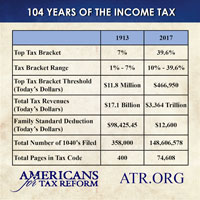
104 Years of the Income Tax: Then and
Now.
• In 1913 the top marginal income tax bracket was 7% — today it is 39.6%.
• In
1913 the marginal income tax bracket range was 1% - 7%. Today the range is 10% - 39.6%.
• In 1913 there were 400 pages in
the tax code. Today there are 74,608 pages in the code.
Why
Does It Cost $409 Billion To Figure Out What We Owe In Taxes? If President Trump wants to drain the swamp, the
best place to start is with the tax code, which is so complicated that Americans spend billions of hours and hundreds of
billions of dollars just trying to figure out how much they owe. The IRS instructions for filing out the 1040 form
include a box near the back that estimates how much time it takes to fill that one form out. This year, it's
15 hours. That's a 67% increase from 1988. This year, the instruction booklet runs 241 pages.
In 1988 it was fewer than 80. The tax code has become so complicated that even the IRS complains about it.
California Prepares
to Enact the Highest Gas Tax in the Country. The California Senate Democrats has approved a multi-billion-dollar increase
in the state's gas tax to pay for road and infrastructure projects. The so-called Road Repair and Accountability Act would ratchet up
the state's gas tax by 12 cents a gallon, and raise the tax on diesel fuel by 20 cents a gallon. It also etches out an additional
charge to annual vehicle license fees ranging from $25 to $175 depending on the car's value. The Senate passed the bill, 27-11 on
Thursday [4/6/2017]. Republicans did not support the measure.
Taxifornia Does
It Again. California's far-left government has done it again. Not realizing its real problems are
excessive spending on misplaced priorities, excessive taxes, too much debt and a far-too generous welfare state, its legislature
working in cahoots with Gov. Jerry "tax-and-spend" Brown has pushed through the largest tax hike in state history.
Taxpayers
Spend 6.1 Billion Hours, $234 Billion Per Year on Tax Compliance. Taxpayers spend 6.1 billion hours a year just
to comply with the federal tax code, according to experts at a Tax Foundation event on Monday [3/27/2017]. Pete Sepp,
president of the National Taxpayers Union, said that tax compliance costs taxpayers $234 billion per year in direct costs and
lost productivity. "The problem is the status quo — thinking that, well, if we don't do tax reform this year it
will just be that bad," Sepp said. "No, the status quo is not the static quo — it's going to get worse."
"The paperwork burden inventory at the Office of Management and Budget related to Treasury is expected to rise by another 2 billion
hours in the next few years," he said. "One-third added to that, we're looking at tax compliance costs of north of $400 billion
a year."
Proposed US
Carbon Tax — A Recipe for Disaster. A group of Republican elder statesmen have recommended that the
US adopt a $40/ton carbon tax as the "most efficient and effective way of reducing CO2 emissions". This post reviews the
potential economic impacts of such a tax on the US energy sector. It concludes that the impacts on the oil and natural
gas sectors would be comparatively minor but that the impacts on the coal sector would be severe. Electric utilities
with a high percentage of coal in their generation mix could well be driven into bankruptcy.
We're all crooks. The laws
that tell you how much tax you owe are so complex that only a few citizens dare, on their own, to propose a figure they are
pretty sure will hold up to a challenge or an audit. Instead, most pay extra sums for professional help or for
insurance to cover the risk. That's a tax upon a tax.
Internet
sales taxes are regulation without representation. All this talk about "draining the swamp" has the alligators
worried. And some of the most aggressive gators in Washington, D.C., are actually state governments: they're
perpetually hungry for more tax revenue to fuel their burgeoning bureaucracies back home. One juicy morsel they'd like
to snap up is a bigger piece of the e-commerce pie. They're asking Congress to pass a law to help them pocket sales
taxes on goods their residents buy online from out-of-state businesses.
Philly's
soda tax is crushing the city's beverage business. If you live in Philadelphia, that bloated feeling you get
from consuming carbonated beverages may be coming from the soda price itself. Last summer, the city passed a Bloomberg-esque
1.5 cent per ounce tax on soda and other sweetened and diet beverages, a move opposed by beverage distributors and
retailers. Since this tax has gone into effect on Jan. 1, consumption of the sweet drinks is off by as much as
50 percent, according to retailers, and companies involved in getting these drinks to consumers are reporting huge
losses and announcing layoffs.
Soda
companies, supermarkets report 30-50 pct. sales drop from soda tax. Two months into the city's sweetened-beverage tax, supermarkets and
distributors are reporting a 30 percent to 50 percent drop in beverage sales and are planning for layoffs. One of the city's largest
distributors says it will cut 20 percent of its workforce in March, and an owner of six ShopRite stores in Philadelphia says he expects to shed
300 workers this spring. "People are seeing sales decline larger than anything they've seen up to this point in the city," said Alex Baloga,
vice president of external relations at the Pennsylvania Food Merchants Association.
Groups
want Trump to close loophole allowing illegal immigrants to abuse tax credits. Illegal immigrants need only one
number to access billions of dollars in free taxpayer cash. The Individual Tax Identification Number (ITIN) unlocks an
exclusive gateway for non-citizens to receive monies meant for working, low-income Americans. The nine-digit code was
created by bureaucrats in 1996 for foreigners who had to deal with the IRS. It allows people without a Social Security
number, including those in the country illegally, to file taxes. "It's just a farce to say it was created to collect
taxes," Robert Rector, senior research fellow at the Heritage Foundation, told Fox News. "It's nothing but a welfare
program designed for illegal immigrants. ITINS are for tourists or illegals. No ITIN filer is eligible to work
in the United States."
Inconvenient
Truth: Shultz and Baker's Disastrously Mistimed Carbon Tax. Ah, a tax! Who would have thought of that?
Actually Al Gore, who did something similar with the help of some particularly greedy hedge-fund types. They called it a
"carbon exchange" and it is now extinct, although several of its founders, including Gore, made fortunes.
Why
Are Republicans Pushing Brand New Taxes? This week, a group of old-guard Republicans and business leaders — including
Reagan administration officials, former Wal-Mart chairman Rob Walton, and venture capitalist Thomas Stephenson — were in the White House
pitching a new carbon tax to fight global warming. The idea is to impose a $40 tax for every ton of CO2 emitted in exchange for a
"signicant" rollback in EPA regulations. [...] But dig just a little deeper and you can easily see that this new carbon tax won't deliver
on any of promises being made. First, no matter where it starts, this new tax, like everyone other one ever enacted, will grow in
size and complexity. The Council itself wants it to "increase steadily over time." And they had to add another new tax on imports
to prevent countries that don't impose a comparable carbon fee from taking advantage. No matter how well constructed, this tax will
redirect resources away from their most productive uses and into government coffers. That is not how you strengthen an economy.
Philadelphia
Goes Over the Tax Cliff. Starting January 1st, Philadelphia implemented the first ever tax on all sweetened beverages, including those
sweetened with artificial sweeteners. The $0.015 tax is being levied on distributors of these beverages, even if the distributor is outside the
city of Philadelphia. [...] To put this in context, if you buy a 12 pack of 12-ounce sodas you will be paying an additional $2.16 for the
privilege — even if it's diet soda and contains no sugar. Most of these beverages have an additional Pennsylvania Sales Tax of 6%. If
you are lucky enough to find a 12 pack of soda on sale for $3.00, your total cost will be $5.34. Protein shakes which many seniors on
fixed incomes drink to supplement their diet also contain sugar and will include this onerous tax.
Philly's
Drink Tax Is Hurting Consumers, Businesses, and the Poor. Philadelphians are experiencing considerable sticker
shock as the prices of their favorite beverages skyrocket because of the largest soda tax in U.S. history going into
effect. It will be hard for Philadelphians to avoid these price hikes because the city's tax covers more than just
sugar-sweetened sodas. It also applies to fruit drinks, sports and energy drinks, sweetened water, pre-sweetened coffee
and teas (although coffee confections such as those created at Starbucks are excluded), and drinks used as mixers in
alcoholic drinks (although the alcohol, which is high in both natural sugars and calories, is exempted from the tax).
North
Dakota wants hired pipeline protesters to pay state income taxes. After spending more than $22 million on the
Dakota Access pipeline protest, North Dakota wants to make sure any paid activists remember to submit their state income
taxes. Tax Commissioner Ryan Rauschenberger said his office is keeping an eye out for tax forms from environmental
groups that may have hired protesters to agitate against the 1,172-mile, four-state pipeline project. "It's something
we're looking at. I can tell you I've had a number of conversations with legislators regarding this very issue," said
Mr. Rauschenberger. "[We're] looking at the entities that have potential paid contractors here on their behalf
doing work."
N.J.
property taxes hit another new high in 2016. New Jersey's infamously high property tax bills topped $8,500 per
home in 2016, a 2.35 percent increase over the previous year, according to figures released Wednesday by the Department of
Community Affairs. Property owners paid $8,549 — $196 more than they did in 2015 when the average tax bill
rose about 2.2 percent, according to the analysis. The average residential bill has risen from $8,161 in 2014 to
$8,353 in 2015 to $8,549 in 2016.
The Scandals That Valerie
Jarrett Overlooked. At the time it [Obamacare] was enacted, the president argued vociferously that the financial consequence of not obtaining
health insurance — the penalty for disobeying the law — was not a tax. He made that argument because he had promised Democrats — many of
whom lost their congressional seats for going along with his utopian experiment — that he would not raise taxes to accomplish his purposes. When
the statute was challenged in the federal courts and the various challenges were consolidated before the Supreme Court, the challengers did not dispute
the claim that the penalty was not a tax. [...] Yet notwithstanding agreement among the parties before the Supreme Court and notwithstanding the absence
of any evidence that the penalty was a tax, the Supreme Court made new law by declaring this non-tax to be a tax and then ruling that Congress can tax
anything it wants — so Congress can force you to purchase a product you don't want by taxing you if you fail to make the purchase.
Soda
tax still catches shoppers by surprise. Philadelphians have known a new soda tax was coming since June, when
Mayor Kenney signed into law a bill placing a 1.5-cent-per-ounce levy on sugary drinks, including diet beverages. That
tax, which is levied at the distributor level but was expected to be passed on to consumers, went into effect Sunday at the
start of the new year. As 2016 ended, outreach teams were making stops around the city to alert store owners about the
new tax. But despite those efforts and the months of contentious debate that preceded City Council's vote passing the
tax, many consumers have still been surprised this week when they were charged higher prices for sweetened beverages.
Philadelphia
Democrats Enact Sugary Drink Tax: $6 Case Of Cola Now Costs $9. The world the Democrats want us living in is
getting more and more expensive, with Philadelphia Democrats recently implementing their Sugary Drink Tax.
Forbes
lays out case for the flat tax. "It's time for another tax revolution," Steve Forbes says in his explanation of
the flat-tax reform proposal outlined in his book Reviving America. Prager U produced this five-minute primer on
Forbes' decades-long effort to get rid of the current Byzantine tax codes and reduce both the corporate and individual income
tax systems to one simple and universal calculation — 17%. Not only would this force everyone except the poor
to pay their fair share, it would relieve both the economy and politics of the burdens of crony capitalism and social engineering.
Incestuous county boards preside
over rising Texas tax bills. If your property taxes stink in Texas, they stink from the top down. By
state law, county appraisal districts (CADs) are tasked to do one thing: set the property values that raise revenue for local
taxing agencies. Headed by boards of directors, CADs are bureaucratically opaque, institutionally autonomous and
fundamentally incestuous bodies with no effective public oversight. County boards are composed of the elected local tax
assessor-collector and a set of directors named by the very local government agencies that depend on tax proceeds from
property appraisals.
$213,300,000,000:
Individual Income Taxes Set Record in First 2 Months of FY17. The federal government brought in a record of
approximately $213,300,000,000 in individual income tax revenues through the first two months of fiscal 2017 (Oct. 1, 2016
through the end of November), according to the Monthly Treasury Statement released today [12/12/2016]. That is approximately
36 times the $5,966,000,000 the federal government brought in from customs duties imposed on foreign imports over the same
two-month span.
Portland
Raises Taxes on Companies Whose CEOs Earn 10 More Than Workers. The city of Portland, Oregon, is imposing a
surtax on companies whose CEOs earn more than 100 times the median pay of their lower-wage workers. Companies will see
a 10 percent increase on their tax rate if the CEO makes 100 times the average employee and a 25 percent increase if they
make 250 times the average salary, The New York Times reported. The new law, which passed 3-1 in the city council, is
estimated to generate about $2.5 to $3.5 million per year, which will be used to address income inequality on a local level.
Who Pays What Taxes
In The US. Every presidential election brings with it a renewed debate on taxes: should tax rates be increased
or decreased (which in turn forces economists to break out their textbooks to brush up on their Laffer curve definitions)?
Traditionally, the question eventually boils down to one thing: what should the tax treatment of the "rich" be: should
the wealthy pay more or less in taxes? Why the particular focus on the rich? The answer is simple: while those
American who declare $500,000 and above in income represent less than 1% of total tax returns, they account for a quarter of
taxable income and — more importantly — are responsible for 37% of government revenues collected through
individual income taxes.
Tax protest study stirs Lubbock Appraisal
District. Property owners protesting appraised values in Lubbock County are more likely to succeed when they
represent themselves, according to an in-house analysis obtained by Watchdog.org. Being represented by an agent doesn't
help, and can hurt, according to Justin Carter, a former staffer and statistician at the Lubbock County Appraisal District.
"Taxpayers are far more likely to receive a break, and a larger break, if they represent themselves," he concluded in the
internal report obtained by Watchdog through a third party.
Pasadena
Planning to Introduce 9.4% 'Netflix Tax'. The city council of Pasadena, California has come under fire recently
after announcing a plan to implement 9.4% tax on video streaming services — a Netflix tax. CBS reports that
the tax, which was designed to generate revenue that had been lost due to the recent trend of people "cutting the cord" and
cancelling cable TV services, was met with widespread disapproval from Pasadena residents. The new law is based around
a 2008 ruling that allowed the city council to tax cell phones as they taxed home landlines, this however set an unforeseen
precedent that allows the city to apply a similar tax to digital streaming services. As many as forty other California
cities have a similar law.
Hillary
Clinton's big ideas for tanking the US economy. [#2] Hike taxes. [...] History proves raising tax rates is the
least effective way for the government to raise revenue. IRS statistics indicate that most of the people who fall into
the top 2 percent of income are small-business owners — and they are America's major employers. Tax them
more, and they'll employ fewer. In the 1980s when income-tax rates were slashed from 70 percent to 28 percent, the
amount of tax revenues over the decade doubled, and the share of taxes paid by the rich increased. All you have to do is
look at the high-tax states like Connecticut, Illinois and New York and you can see the jobs and people fleeing. Our
highest-in-the-world business-income-tax rate has caused companies like Burger King and Johnson Controls to head to more
tax-hospitable climes. Hillary's plan may speed up this exodus.
The
Sleeper Issue for 9 Million Americans that the Media Will Not Cover. FATCA [the 2010 Foreign Account Tax Compliance Act] was initially conceived to
combat offshore tax evasion and recoup tax revenues, requiring U.S. citizens, including those living abroad, to report all financial accounts held outside the
country — an arguably reasonable purpose and measure. But the Democrats took that simple, targeted goal and addressed it by trapping every American
abroad in an insanely expensive regulatory dragnet of questionable legality. [...] In essence, FATCA coerces FFIs to become IRS lackeys, making them conduct wholesale
warrantless seizures of Americans' private financial information on behalf of the IRS, without any reasonable suspicion or probable cause.
The
7 Ugliest Propositions on the California Ballot. [For example,] Prop. 55 & Prop. 56 — Because we
need taxes in California to be the highest in the nation, here are two massive tax increases placed right in front of
you. Both of these are in the vein of the expression, "Don't tax me, tax the guy behind the tree." In 2012 voters
passed higher income taxes on those making more than $250,000 a year — billed at the time as a needed "temporary"
measure to fund state government reeling from the economic downturn.
Hillary
Pushes for Highest Death Tax in the Developed World. What many don't know is that the U.S. already has an
extremely high death tax: The 4th highest among OECD countries. If Clinton succeeds in pushing the Death Tax up
to a 65 percent rate this would place the United States squarely at the top of the list. The Left always pushes the
argument in favor of the estate tax is always about "the rich kids that never worked for their money are given an unfair
start." However, new research on the so-called 1 percenters shows that these "rich kids" are an extremely small part
of an already extremely small group. Most people in America that get rich don't inherit it at all but work for it their
entire lives.
New union backed tax would hammer Oregonians..
Targeted at big businesses, Measure 97 would impose a new 2.5 percent tax on companies that gross over $25 million a
year. The trick is, the tax would not be on net profits but on gross revenues after the $25 million mark. In
other words, companies are not taxed on how much money they actually make after expenses but on how much money comes through
the door. [...] Measure 97 is being sold as a way to fund education, but there is nothing in its text that would keep the
Legislature from using the money for any old thing that it prefers. Our Oregon, the group behind the measure, is
union-funded.
Study:
Clinton's tax hikes would kill 700,000 jobs. Hillary Clinton's tax plan would raise hundreds of billions of
dollars from the wealthy, but would hamstring economic growth and prevent the creation of nearly 700,000 jobs over the next
decade, according to a new analysis released Wednesday [10/12/2016]. The Tax Foundation, a nonpartisan think tank in
Washington, published a score of Clinton's plans for tax policy that found that it would would raise taxes by $1.4 trillion
over the next 10 years, under a static analysis that assumes nothing else changes. That revenue would come from new
taxes on high earners, a higher tax rate on multi-million dollar incomes, and new estate taxes. But because those tax
hikes would decrease the incentives to work, invest, and save, the group found, the Democrat's tax proposals would slow
economic growth.
Proposition 55 would
extend "temporary" tax for 12 years. When Gov. Jerry Brown and his allies urged voters to adopt a temporary income tax on
the wealthiest Californians and a statewide sales tax on everyone four years ago, the deal was billed as a short-term salve for a state
mired in debt and on the verge of insolvency.
The Editor says...
Remember this when the next "temporary" tax is proposed.
N.J.
Legislature passes 23-cent gas tax hike, road funding plan. New Jersey is poised to lose its claim to the
second-lowest gas taxes in the nation. The state Legislature on Friday passed legislation raising the tax on gasoline
sold in New Jersey by 23 cents a gallon, the centerpiece of a controversial tax package that also includes $1.4 billion in
tax cuts. As part of the deal, lawmakers voted to give a tax break for people with pension and retirement income, low-income
workers and veterans. In addition, they voted to eliminate the estate tax over the next 15 months and roll back the
sales tax slightly.
If
Proposition 55 passes, the state budget will rely even more on California's highest earners. If voters approve
Proposition 55, the state will continue depending on [Paul] Taybi and other wealthy Californians to fund a significant
portion of schools, parks, road repairs, police, prisons and many other government services. Those paying the higher
rates, which kick in for single and joint filers making more than $263,000 and $526,000 a year respectively, contributed
almost $34 billion in income taxes in 2014, roughly a third of all state general fund revenue. California's
reliance on the wealthiest taxpayers means the state is especially vulnerable to their bottom lines.
Clintons
"Dodged" Hundreds of Thousands in Taxes. So while we're on the subject of calling using the tax laws smartly
"tax dodging," as I've seen Donald Trump's legal deductions referred to repeatedly, let's duly note that the Clintons have
done some massive legal tax avoidance themselves. According to a June 2014 story in Bloomberg, Bill and Hillary Clinton
dropped ownership of their expensive New York home into a "residence trust" in 2011, helping shield them from estate taxes
that could gobble up 40 percent of their assets when they depart the earth. The Clintons, of course, support the
death tax as a way of bilking the one percent out of their capital. In fact, Hillary wants to raise it to a confiscatory
65 percent. But, as Bloomberg notes, that doesn't mean she wants to pay it.
Aborting the
Trump Revolution. In a famous 1947 dissent, Judge Learned Hand wrote: "[T]here is nothing sinister in so
arranging one's affairs as to keep taxes as low as possible. ... Everybody does so, rich or poor; and all do right, for
nobody owes any public duty to pay more than the law demands: taxes are enforced exactions, not voluntary contributions.
To demand more in the name of morals is mere cant." This writer's father spent his career as a tax accountant who studied tax
codes and utilized every permissible deduction to keep his clients' tax bills as low as legally possible. That was his
business, as it is the business of every accountant, including those who prepare the returns of the politicians and journalists
piling on Trump as some sort of scofflaw tax cheat who has evaded his moral obligations to the state.
Bombshell
Or Something: Trump Might Possibly Could Have Avoided Paying Taxes For 18 Years. [Scroll down] If the part where he didn't pay
taxes afterwards is true, then, so what? He followed the laws. Mr. Trump didn't pass the law. Would you not follow the laws, take
advantage of the laws? Of course you would. Democrats who constantly call for higher taxes, for everyone paying their "fair share," they
themselves take advantage of all the "loopholes" [...] in the tax law to reduce their tax liability. Virtually everyone takes advantage of the
tax code to reduce their tax liability. Nearly 45% will had a net zero federal tax liability in 2016, up from 42% in 2013.
Hillary's
Red Army March of Tax-Hike Destruction. [Scroll down] Let me pull out my list of Clinton tax hikes: a
$350 billion income tax increase in the form of a 28-percent cap on itemized deductions (without lowering personal tax
rates); a more-than $400 billion "fairness" tax hike in the form of a 4 percent "surcharge" on high-end earners; and the
"Buffet rule," which would establish a 30-percent minimum tax on earners with adjusted gross incomes over $1 million.
Clinton also proposes increasing the estate tax rate to a range of 45 to 65 percent and reducing the exemption to
$3.5 million. Remember, estate taxes are already hit once by the income tax, and again by the capital-gains tax. Here,
Clinton would end the stepped-up capital gains tax basis and instead value the gain all the way back to the initial transaction.
The
100th Anniversary of the Income Tax, and the Lesson We Should Learn from that Mistake. What's the worst thing
about Delaware? No, not Joe Biden. He's just a harmless clown and the butt of some good jokes. Instead, the
so-called First State is actually the Worst State because 100 years ago, on this very day, Delaware made the personal income
tax possible by ratifying the 16th Amendment. Though, to be fair, I suppose the 35 states that already had ratified the
Amendment were more despicable since they were even more anxious to enable this noxious levy (and Alabama was first in line, which
is a further sign that Georgia deserved to win the Southeastern Conference Championship Game, but I digress). Let's not get
bogged down in details. The purpose of this post is not to re-hash history, but to instead ask what lessons we can learn
from the adoption of the income tax.
Taxpayers are
fleeing New York in droves. Taxpaying New Yorkers are leaving in droves for other states, according to a new
study. In 2014, 126,000 New York tax filers fled to other places in the United States — more than from any
other state, according to the study posted on newgeography.com by two demographers. The Empire State also lost the most
"high earners," who reported incomes of more than $200,000 a year.
The
Greediest People in America Are Liberal Democrats. [Scroll down] For one thing, since roughly 45% of
Americans pay no income taxes at all, "the rest of us" didn't pay for roads, education, police forces or a military. Of
course, that doesn't even tell the whole story because 60% of American households receive more from the government than they
pay in taxes. In other words, if you pay more in taxes than you receive from the government, you are a MINORITY in
America today. As someone who's probably not going to be in the top 1% of income earners this year (The year's not over
yet and I'm an optimist!), but who pays a lot more in taxes than I receive in government services, let me just note that
I APPRECIATE those 1%ers who are paying nearly half of all federal income taxes. Real world, if you add it all
up, most of these people are paying somewhere around 50% of their net income in taxes.
Obama's
Tax Collections Surpass $20,000,000,000,000; Still Runs Up Debt by $8,878,290,996,028. With the additional
$231,327,000,000 in taxes that the U.S. Treasury collected in August, according to the Monthly Treasury Statement released
today, President Barack Obama has now presided over more than $20,000,000,000,000 in federal tax collections during the 91
full months he has served in the Oval Office. From February 2009 through August 2016, the Treasury collected approximately
$20,197,437,000,000 in tax revenues (in non-inflation-adjusted dollars), according to the Monthly Treasury Statements.
Government
Collects $2.91 Trillion in Taxes in First 11 Months of FY 2016. The federal government collected $2,910,151,000,000 in
taxes in the first 11 months of fiscal year 2016 and still ran a deficit of $620,771,000,000 during this time, according to the latest
monthly Treasury Department statement. Treasury receipts included tax revenue from individual income taxes, corporate income taxes,
social insurance and retirement taxes, unemployment insurance taxes, excise taxes, estate and gift taxes, customs duties, and other
miscellaneous items.
This Is Not
Your Government. Paying taxes? To what? For what? Simply to stay out of jail and for no other
reason. How on earth can the 16th Amendment be binding when the 4th has been obliterated by the Patriot Act? How on
earth can the 16th Amendment be binding when the 1st Amendment is under constant assault by political correctness?
Capitalism
Works If Government Would Just Get Out of the Way! [A]ccording to the Small Business Administration, small businesses represent 99%
of all employer firms, employ half of all private sector employees, pay 45% of total U.S. private payroll, generate 80% of new jobs annually,
create more than 50% of nonfarm private GDP, comprise 97% of all identified exporters, and produce 26% of the known export value to our GDP.
Yet every time new governmental regulation is imposed on businesses, the costs increase. Whenever the government increases taxes on companies,
the costs increase again. In order to stay in business, they must pass those costs on to their customers, or find other ways to reduce costs
like eliminating jobs. That's why it makes no sense to tax companies since we all end up individually paying their taxes via increased
prices for their products and services.
Uncle
Sam goes for gold, too: Up to $9,900 per Olympic gold medal. Michael Phelps swims fast, but not fast
enough to beat Uncle Sam, who awaits him at the finish line each time he wins a medal. His total income tax bill for
the 2016 Games? Up to about $55,000 for his five golds and one silver. Olympic athletes who bring home medals
also bring home cash — $25,000 for gold, $15,000 for silver and $10,000 for bronze — paid for by the
United States Olympic Committee. Like any prize winner, from a jackpot hitter to a Nobel Prize recipient, the athletes
are taxed because Olympic medals and cash bonuses are considered income, said Steven Gill, associate professor of accounting
at San Diego State University.
Expert:
Hillary Clinton 'Doesn't Get' Death Tax; It Hurts Regular People More than Billionaires. Steve Moore, an
advisor on Donald Trump's tax plan and a distinguished visiting fellow at The Heritage Foundation's Institute for Economic
Freedom and Opportunity, laughed at Hillary Clinton's charge that Trump's plan to terminate the federal estate
tax — also called the death tax — would save his family $4 billion dollars. "She says we're
going to get $4 billion from Donald Trump on the death tax? No you're not, you're not going to get anywhere near
that," he chuckled, dismissing the claim Clinton made while campaigning in Ohio on Wednesday [8/17/2016]. "The people
who tend to get killed by the death tax are not people like Warren Buffett, Bill Gates, and Donald Trump — they
have tax advisors."
60 percent of Americans pay less than zero income tax.
'The rich'
don't just pay their 'fair share,' they pay almost everybody's share. [Scroll down] Some additional analysis and commentary will be
provided here that reveal a yet-to-be discussed major implication of the CBO report almost the entire burden: a) of all transfer payments made to
American households and b) of all non-financed government spending, falls on just one group of Americans — the top one-fifth of US households
by income. That's correct, the CBO study shows that the bottom three income quintiles representing 60% of US households are "net recipients" (they
receive more in transfer payments than they pay in federal taxes), the second-highest income quintile pays just slightly more in federal taxes ($14,800)
than it receives in government transfer payments ($14,100), while the top 20% of American "net payer" households finance 100% of the transfer payments to
the bottom 60%, as well as almost 100% of the tax revenue collected to run the federal government.
The Sneaky
Way Obama Is Hiking Death Taxes. President Barack Obama isn't afraid to enact his agenda over the will of
Congress. At this late stage in his presidency, he's still overreaching his authority to push through an agenda; his
most recent overstep being an effort to unilaterally raise the federal estate tax. Conservatives have successfully
lessened the impact of the estate tax, colloquially known as the "death tax," in recent years. In 2000, before George W.
Bush became president, the death tax had a rate of 55 percent and struck families with assets valued at $675,000 or
more. Today, because of the 2001 and 2003 Bush tax cuts, the rate is down to 45 percent and only estates worth
over $10 million face the tax. This is a victory conservatives should be proud of.
Hillary
Would Give Us a Disastrous Third Obama Term. Democrats simply can't be honest about economic policy. They
have to demonize the wealthy to incite class warfare. They must perpetuate and expand government dependency programs,
which means creating incentives for people to remain out of the work force. They must vilify the rich for not paying
their fair share of taxes, despite the undeniable fact that upper-income earners pay far more taxes — actual and
percentage — and that the lower half of income earners pay no income taxes at all. How much "fairer" can
it be for them?
Obama
Has Collected $19,966,110,000,000 in Taxes; Incurred $8,795,689,333,049 in Debt. During the 90 full months
President Barack Obama has completed serving in the White House — February 2009 through July 2016 — the
U.S. Treasury collected approximately $19,966,110,000,000 in tax revenues (in non-inflation-adjusted dollars), according to the
Monthly Treasury Statements. During those same 90 months, the federal debt rose from $10,632,005,246,736.97 to
$19,427,694,579,786.64 — an increase of $8,795,689,333,049.67.
Fed
Set to Unload Explosive Student Loan Rule That Will Dump Billions on Taxpayers. Regulations are flying out the
door in in Washington, where an already hyper-aggressive Obama administration is looking at its last chance to move its
agenda forward while sidestepping Congress. Many of the expensive rules in areas like energy, health care, and finance
have drawn widespread public and media scrutiny — which makes it all the more curious that what is likely to be
the single most expensive proposed regulation of the year, a Department of Education rule that would discharge billions in
student loans, has gone almost completely unnoticed.
Poll:
9 in 10 African-Americans back Clinton. Hillary Clinton boasts a resounding lead over Donald Trump with registered African-American
voters nationwide, according to a new poll. Clinton, the Democratic presidential nominee, leads Trump 91 percent to 1 percent in
that demographic in the NBC News/Wall Street Journal survey released Thursday [8/4/2016]. She also enjoys an edge with women, earning
51 percent to the GOP's presidential nominee 35 percent.
Soaring
Business Taxes Hurt America's Ability to Compete. Countries around the world have made maintaining low corporate tax rates,
as well as reducing rates, a priority in recent years. Meanwhile, the United States has stood on the sidelines. As a result,
the U.S. now has the highest corporate tax rate in the developed world, exceeding the Organization for Economic Cooperation and Development
average by nearly 15 percentage points. By maintaining such a high corporate tax rate, the United States hinders its competitiveness
in the global economy.
Report:
Hillary Clinton would hike taxes by $1.3 trillion. Hillary Clinton comes up $2.2 trillion short in paying for
her policy agenda, despite hiking taxes by $1.3 trillion, according to a new analysis of the Democratic nominee's campaign
platform. The American Action Forum, a center-right policy institute, released a report Thursday [8/4/2016] finding Clinton's
domestic agenda would "have a dramatic effect on the federal budget." Gordon Gray, American Action Forum's director of fiscal
policy, based the report on estimates of policy proposals from the Clinton campaign itself, as well as independent analyses from the
Tax Policy Center and the Center for a Responsible Federal Budget.
Still
a lot of haze around Chicago's cloud tax. After a slow start, Chicago is lurching ahead in taxing the
cloud. Though thousands of companies could be affected, only about 200 took advantage of an amnesty program in which
City Hall gave businesses the chance to pay the tax for last year and escape liability for previous years. "Vendors and
consumers continue to struggle to understand when, if and how to apply this tax," says David Blum, a partner in Akerman law
firm's tax practice group. "As a result of this confusion and uncertainty, some people are sitting on the sidelines to
see how this plays out." At least one company closed a small office in Chicago to avoid the tax.
Hillary Calls for
$350 Billion Student Loan Tax Hike. Another program, another tax hike. Hillary Clinton today proposed a
$350 billion tax increase as part of a "New College Compact" spending program. The $350 billion tax hike over ten
years comes in the form of a 28 percent cap on itemized deductions. This creates a new Alternative Minimum Tax.
Chicago
property tax bill double whammy: Increases plus an assessment hike. Anne McDermott had braced herself for
a big increase in the property taxes on her Near South Side town home, but when she opened the bill last month, she was still
taken aback. She'd figured a boost of maybe $550 on the $4,214 she paid last year. That's a jump of about 13 percent,
the average increase on Chicago property tax bills for 2016. But McDermott's bill went up by nearly $1,360 — more
than 32 percent. It was the result of being hit with a double whammy: Not only were huge tax hikes by City Hall and
Chicago Public Schools taking effect, but the taxman came as he does every three years and reassessed the value of McDermott's
home. And he concluded it was worth a whopping 31 percent more.
Full List of Hillary's Planned
Tax Hikes. [Scroll down] Hillary's formally proposed $1 trillion net tax increase consists of the
following: [#1] Income Tax Increase — $350 Billion: Clinton has proposed a $350 billion
income tax hike in the form of a 28 percent cap on itemized deductions. [#2] Business Tax Increase —
$275 Billion: Clinton has called for a tax hike of at least $275 billion through undefined business tax reform,
as described in a Clinton campaign document. [#3] "Fairness" Tax Increase — $400 Billion:
According to her published plan, Clinton has called for a tax increase of "between $400 and $500 billion" by "restoring
basic fairness to our tax code." These proposals include a "fair share surcharge," the taxing of carried interest capital
gains as ordinary income, and a hike in the Death Tax. But there are even more Clinton tax hike proposals not included in
the tally above. Her campaign has failed to release specific details for many of her proposals. The true Clinton net
tax hike figure is likely much higher than $1 trillion.
After
tax bills hit Chicago mailboxes, some taxpayers hit roof. Jines Martinez is going to have to dig deep to pay
the tax bill that arrived at his Avondale home this week. Martinez's bill shot up to $3,900 from $2,673, and his
increase reflects a double-whammy that hit residents in many Chicago neighborhoods after all property in the city was
reassessed last year for the first time since 2013, and the city passed a $588 million tax hike.
New
Jersey Assembly OKs Christie-backed gas tax raise: NBC 4 New York. New Jersey's Assembly passed legislation
early Tuesday [6/28/2016] to raise the state's gasoline tax by 23 cents per gallon and cut the sales tax from 7 percent
to 6 percent.
House
Republicans Aim to Reform Tax Code to Fit on a Postcard. House Republicans, led by Speaker Paul Ryan (R.,
Wis.), have introduced their tax reform plan, which would simplify the tax code so it could fit on a postcard. "For
years, hard working American taxpayers have asked Washington for a tax code so simple and fair and understandable that it
could fit on a postcard," said Rep. Kevin Brady (R., Texas) who chairs the House Ways and Means Committee. "That
is exactly what we propose." The plan would lower taxes for Americans at every income level and would limit the number of
tax brackets to three. It would lower the corporate tax rate from the highest in the world to 20 percent, and would
lower the top individual tax rate to 33 percent. "This postcard form will simplify the number of tax brackets by more
than half," Brady said. "It will take less from taxpayers at every income level because Washington takes too much of your
hard earned dollars."
The Editor says...
The Republicans have been talking about this for years, and it will never happen. They aren't going to get rid of
the IRS or the EPA or the Department of Education or the Department of Energy. They can't even get rid of ethanol subsidies,
windmill subsidies, PBS subsidies, or the National Endowment for the Arts. You'll never send in your tax return on a post card.
It sounds good in a campaign speech but it will never happen.
Soda
tax passes, Philadelphia becomes first big city in nation to enact one. Looking to raise millions for a bold
expansion of early childhood education, Philadelphia City Council on Thursday [6/16/2016] approved a 1.5-cent-per-ounce tax
on sugar-sweetened and diet beverages, the first such tax imposed in a major U.S. city. The 13-4 vote put to bed
months of speculation and at-times-bitter negotiations, but also ensured that the national spotlight will stay turned on
Philadelphia for months, if not years. Critics quickly vowed a court challenge.
DNC
Platform Witness: Raising Taxes by 80% Won't Impact Economic Growth. A witness appearing before the
Democratic National Committee's Platform Committee on Thursday [6/9/2016] said that raising taxes by 80 percent would not impact
economic growth. Heather Boushey, the chief economist and executive director of the Washington Center for Equitable
Growth, said that raising taxes to nearly twice the current level on some would not hurt America's economic growth according
to a paper by a colleague of hers. "And let me end this by noting Emmanuel Saez, one of the nation's foremost tax
experts, is on my steering committee and he did a paper with a couple of his colleagues a few years ago, really documenting
that we could, and get this, hold onto your seats, raise taxes at the top by upwards of 80 percent and not have any negative
effect on economic growth," Boushey said.
Report:
Obama's oil tax would mean huge tax hike for gasoline. The Obama administration's proposed $10.25 tax on each
barrel of crude oil produced in the United States would be one of the biggest tax increases on gasoline in history, a report
released Thursday [6/9/2016] showed. Alaska Republican Sen. Lisa Murkowski, chairwoman of the Senate Energy and
Natural Resources Committee, released a Congressional Research Service report showing historical increases in the federal
gasoline tax in an attempt to put the oil tax in perspective. While the tax would be levied on oil companies, economists
assume that oil companies would pass on the tax to consumers. The tax could add between 20-25 cents per gallon, and
the report shows that one-time increase would be the largest increase in the gas tax since it was passed in 1932.
Philadelphia
set to pass 1.5 cent-per-ounce soda tax. Philadelphia could soon become the first major U.S. city with a sugary
drinks tax after a city council committee voted Wednesday [6/8/2016] to approve an amended version of a soda tax proposal
that would set a 1.5 cent-per-ounce tax on sugary and diet drinks.
'Gigantic'
corporate tax hike likely headed to Oregon voters. A massive $2.8 billion annual corporate tax hike is likely
headed to Oregon voters in November, a move that could create the most aggressive tax climate for big business of any state
in the nation.
Obama
administration proposes rules aimed at tax evasion. New financial regulations would force companies to disclose
more information about their owners, as part of a crackdown on tax evaders and money launderers, the Obama administration
announced on Friday [5/6/2016].
The Insane
Hidden Tax Burden Quietly Eating Up Your Paycheck. If anything, we — the voters — are as
much to blame for the muddied tax codes as are the nitwit politicians we elect. But not all taxes feel Constitutional,
and not all taxes are the result of our representative government — particularly the taxes paid in the form of
regulatory costs. Regulations increase the cost of everything — including the cost of our housing, clothing
and food. In fact, they even impact our wages. What makes this form of tax so nefarious is that rarely do our
elected representatives get to have a say in the matter; rather, America's regulatory state is overseen by an authoritarian
administrative state, ruled by unelected bureaucrats.
Is
Today — the Anniversary of the Income Tax — the Worst Day in American History? The law
signed that day [10/3/1913] by President Wilson, to be fair, wasn't that awful. The top tax rate was only 7 percent,
the tax form was only 2 pages, and the entire tax code was only 400 pages. And a big chunk of the revenue actually was
used to lower the tax burden on international trade (the basic tariff rate dropped form 40 percent to 25 percent).
But just as tiny acorns become large oak trees, small taxes become big taxes and simple tax codes become complex monstrosities.
And that's exactly what happened in the United States. We now have a top tax rate of 39.6 percent, and it's actually much
higher than that when you include the impact of other taxes, as well as the pervasive double taxation of saving and investment.
And the relatively simply tax law of 1913 has metastasized into 74,000 pages of Byzantine complexity.
Obama's
Global Warming Plan is a 166% Tax for Poorest Families. Carbon taxes are one of the biggest scams possible. They're a
massive wealth transfer and they take money out of the pockets of the working poor and shove into the greedy fat fists of Big Green and its
legions of bankers, environmental consultants and parasite feeder fish.
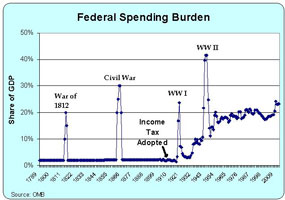
The
100th Anniversary of the Income Tax, and the Lesson We Should Learn from that Mistake. What I want people to
notice is that we enjoyed a very tiny federal government for much of our nation's history. Federal spending would jump
during wars, but then it would quickly shrink back to a very modest level — averaging at most 3 percent of
economic output. So what's the lesson to learn from this data? Well, you'll notice that the normal pattern of
government shrinking back to its proper size after a war came to an end once the income tax was adopted.
Clinton
Embraces Largest Soda Tax Ever Proposed In America — What Won't She Tax? Yesterday [4/20/2016(?)] in
Philadelphia, Hillary Clinton noted that she was "very supportive" of Mayor Jim Kenney's soda tax plan, the highest such tax
proposed in the United States: [Video clip] This new tax would make a 20-ounce bottle of soda 60 cents more
expensive for distributors, who would obviously pass those costs on to consumers, forcing them to pay more for every bottle of
Sprite and can of Coke they purchase.
Hillary's
Soda Tax Endorsement Violates Middle Class Tax Pledge. Clinton was speaking in Philadelphia on Wednesday [4/20/2016] when
she said the following: "I'm very supportive of the mayor's proposal to tax soda to get universal preschool for kids.
I mean, we need universal preschool, and if that's a way to do it, that's how we should do it. Clinton used preschool as an
excuse for her soda tax endorsement, and the threat to soda and pop drinkers nationwide is clear: Clinton's official campaign
plan calls for universal preschool for the entire country.
Fair
Share? 45% Of Americans Pay Zero Income Taxes. Democrats keep demanding that the rich pay their "fair share" of
income taxes. But they never say what fair is. Probably because they know that the rich pay huge amounts while
45% of households pay nothing.
Obama
Has Collected $18,764,164,000,000 in Taxes — $124,003 Per U.S. Job. Over the course of the 86 full
months that President Barack Obama has completed serving in the White House — from February 2009 through March
2016 — the U.S. Treasury has collected approximately $18,764,164,000,000 in tax revenues (in
non-inflation-adjusted dollars), according to the Monthly Treasury Statements issued during that period.
Hillary
promises a trillion dollars in new taxes if elected. Not to be outdone by Bernie Sanders in promising free
stuff to voters, Hillary Clinton is promising to raise taxes by an astounding trillion dollars a year. Taking that kind
money out of the economy and putting it into the hands of government bureaucrats will tank the economy. But of course,
with so many members of the voting pubic not paying income taxes, this may actually be an attractive proposition to them.
IRS
Commissioner: Flat Tax Would Be Simpler, Save Agency a Lot of Money. IRS Commissioner John Koskinen told
lawmakers on Wednesday [4/13/2016] that implementing a flat tax would be simpler than the current tax system and would save
the agency a lot of money. At a hearing of the House Small Business Committee, Koskinen urged lawmakers to approve
President Obama's 2017 budget for the IRS, which increases funding for the agency.
Legal Plunder. If you're
employed, beware. An alarming attitude is sweeping the nation that your paycheck is fair game to fix any social
problem. Left-wing legislators across the nation are mandating deductions from everyone's paycheck to fund paid family
medical leave programs. The programs are used mostly by women to stay home with their newborns. Sounds warm and
fuzzy, but looting your paycheck to fund it amounts to legal plunder. The left is using the law to take what you've
earned and give the money to someone else.
$1.48
Trillion: Government Collects Record-High Taxes in First Half of FY 2016. Inflation-adjusted federal tax
revenues hit a record $1.48 trillion for the first half of fiscal year 2016, but the federal government still ran a
$461 billion deficit during that time, according to the latest monthly Treasury Department statement. Treasury receipts
include tax revenue from individual income taxes, corporate income taxes, social insurance and retirement taxes, unemployment
insurance taxes, excise taxes, estate and gift taxes, customs duties, and other miscellaneous items.
Americans
Spend More on Taxes Than Food, Clothing, Housing Combined. This year Americans will collectively give more
money to the government in taxes than they will spend on on food, clothing, and housing combined, a new report from the Tax
Foundation reveals. The report shows 31 percent of the nation's income will go to taxes — $3.3 trillion
in federal taxes and $1.6 trillion in state and local taxes.
Tax Happy Vermont
Becoming A State Where Only The Rich Can Afford To Live. High taxes, heavy regulations and other policies that
depress economic growth have made Bernie Sanders' home state of Vermont a difficult place to create jobs, earn a living and
raise a family. Underscoring this is the fact that Vermont saw a net outmigration of more than 5,000 residents over the
last decade. Now Gov. Peter Shumlin (D) and state lawmakers are looking to double down on their anti-growth
policies with the state house's approval last week of another round of tax hikes of individuals, families and employers in
the Green Mountain State. The Vermont House of Representatives recently approved $48 million in higher taxes and
fees. Levies were raised on home heating oil, mutual funds, banks, drivers, and the Employer Health Assessment Tax on
businesses who don't provide health insurance for employees was hiked.
The Editor says...
I challenge you to find "outmigration" in a dictionary — meaning a big heavy book that contains every valid English
word. The online dictionaries have it, but even there the word is hyphenated.
Obama
asks Congress to close offshore tax loopholes exploited by U.S. corporations. A day after the U.S.
Treasury announced new rules to reign in the practice of American businesses seeking tax relief offshore, President Barack
Obama on Tuesday [4/5/2016] asked Congress to shut that loophole for good.
The Editor says...
I don't suppose Obama has ever considered lowering taxes, so the corporations wouldn't go elsewhere.
Obama
criticizes companies that leave U.S. for lower taxes. President Obama made a forceful case Tuesday
[4/5/2016] for stopping corporations from moving their headquarters overseas to avoid U.S. taxes, saying they are
taking advantage of the American economic system and saddling the middle class with the bill. These companies
"effectively renounce their citizenship," Obama said at a White House news briefing.
The Editor says...
Very amusing. I wonder if Obama really thinks companies have citizenship.
Unaffordable
California — It Doesn't Have To Be This Way. Here's a documented comparison of California taxes and
economic climate with the rest of the states. The news is bad, and getting worse. [...] CA has the highest state sales
tax rate in the nation. 7.5% (does not include local sales taxes). [...] CA has the nation's 5th highest "gas pump" tax at
59.0 cents/gallon (January, 2016). But add in the unique 10-12 cent CA "cap and trade" cost per gallon, and CA is #1 (about
the same as Pennsylvania). [...] Average 2012 CA impact fee for single-family residence was $31,100, 90% higher than next
worst state. [...] CA has now instituted the highest "cap and trade" tax in the nation — indeed, the ONLY such
U.S. tax.
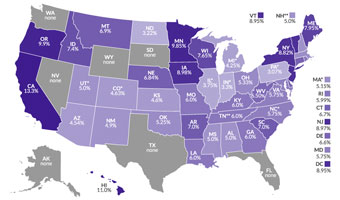
Learning
from New Jersey's Bad Tax Policy. Just fifty years ago, New Jersey was like New Hampshire with no income tax and no sales
tax. It was a fast-growing and prosperous refuge for people escaping high tax burdens in New York and elsewhere. But then
a state sales tax was adopted in 1966, followed by the enactment of a state income tax in 1976. Not surprisingly, politicians used
those revenue sources to finance an orgy of new spending, to such an extent that New Jersey is now in last place in a ranking of state
fiscal conditions. And ever since new taxes were adopted, politicians have routinely and repeatedly increased the rates, diverting
ever-greater amounts of money from the state's private sector.
Report: Sanders
proposes $15T in tax increases, hitting most taxpayers. Democratic presidential candidate Bernie Sanders has
proposed $15.3 trillion in tax increases, according to a new report, and would raise rates on virtually everyone, including
the politically all-important middle class. Not surprisingly for a candidate who has made income inequality his central
issue, Sanders's plan would wallop the rich, an analysis released Friday by the Tax Policy Center shows. The top
0.1 percent would see their tax bills go up by more than $3 million, the report said, which would cut their
after-tax incomes by almost half.
45%
of Americans pay no federal income tax. An estimated 45.3% of American households — roughly 77.5 million —
will pay no federal individual income tax, according to data for the 2015 tax year from the Tax Policy Center, a nonpartisan Washington-based
research group. (Note that this does not necessarily mean they won't owe their states income tax.) Roughly half pay no federal
income tax because they have no taxable income, and the other roughly half get enough tax breaks to erase their tax liability, explains
Roberton Williams, a senior fellow at the Tax Policy Center.
Obama's
$65B 'tax on oil' is really on you. This week, tucked in his budget, the president proposed a $65 billion a year tax
that would raise the cost of gasoline by, on average, 25 cents for every gallon you buy. You'll hear them call this a tax on
oil. But even the White House admits that this new tax would be passed directly on to hard-working families. It gets worse.
Analysts say this tax would increase the cost of basic household goods. Everything from heating oil to the food you buy at the grocery
store. The bottom line is this: you would be taking home less, so that President Obama can spend more.
Congress Passes Law Permanently Banning
Internet Taxes. In a 75-20 vote Thursday [2/11/2016], the Senate agreed to place a permanent ban on state and local Internet taxes. A provision
in a larger bipartisan customs bill — the Trade Facilitation and Trade Enforcement Act — that would force states to phase out the tax by 2020.
Congress had passed a number of temporary bans since 1998, but this bill, which the White House confirmed will be signed into law, would bar the levy for good.
Why expat Americans are giving up their passports.
Reasons for giving up your US citizenship aren't officially listed, but one of the main reasons cited is Fatca — a 2012 law designed
to target overseas accounts held by wealthy Americans. The United States is one of only two countries in the world that has
citizenship-based taxation (the other is Eritrea). As a US citizen you must file a tax return, no matter where you live, and
often pay US taxes on top of the tax you already pay in your country of residence — so-called double taxation. This has
been the case in the US since the Civil War in the 19th Century and until recently really only affected the rich.
It's Tax Refund Time for Illegal Aliens! This
year there is yet another tax break for illegals in the tax system. Unlike citizen and green card workers who are not participating in Obamacare
or another qualifying plan, who will be paying a penalty of up to $695 per adult (with a family limit of $2,085) for not joining the system, illegals
without coverage pay no penalties. None at all.
Breaking
down Obama's new tax proposals. Just how large Obama's tax hikes would be is a matter of debate. Kevin
Brady, the Republican chairman of the House tax-writing committee, pegged the number at $3.4 trillion over 10 years,
equivalent to about an 8 percent increase in federal taxation over currently expected levels.
White
House proposes first $4 trillion budget. President Obama on Tuesday [2/9/2016] proposed the first $4 trillion
federal budget in history. In the last budget outline he will offer as president, Obama suggested adhering to the terms
of the budget deal reached in December with congressional Republicans for fiscal year 2017, the last year he will be in office.
That would allow another $30 billion in spending in 2017, and Obama's budget clocks in at $4.147 trillion for that year.
And guess how they'll spend all that money.
70%
Of Obama's Budget Is Writing Checks To Individuals. What is the federal government's most important function these days?
Based on the Obama budget released today, it's not defense, or roads, or education, or the environment. It's cutting checks.
Buried deep in the president's annual budget are a series of tables that few ever notice, but that are incredibly illuminating when it
comes to understanding the size and scope of today's federal government. The table shows how much money the federal government
spends on what budget officials describe as "payments to individuals." Obama's budget puts the figure for next year at a
mind-boggling $2.9 trillion out of a $4.1 trillion budget.
Obama
to seek $10-a-barrel oil tax. President Obama plans to seek a $10-a-barrel oil tax to overhaul the nation's transportation system
toward reducing carbon emissions. In a statement from the White House Thursday [2/4/2016], the administration expressed plans to spend more
than $300 billion over the next decade, expanding rail and mass transit networks, modernizing freight transportation and expanding research
into self-driving cars.
The Editor says...
As usual, Mr. Obama is proposing to spend the taxpayers' money on projects that are not authorized by the Constitution.
Railroads will expand and freight lines will modernize when the demand materializes and competition requires such improvements.
The demand for self-driving cars will probably never be much more than about a hundred vehicles per year, and even so, the research and development
for such products is not the proper role of government. Moreover, the President does not have the authority to levy taxes.
Obama
proposes carbon tax on oil. The White House on Thursday [2/4/2016] announced its latest plan to address climate
change by levying a $10 per-barrel tax on crude oil. The Obama administration announced its plans while rolling out a
comprehensive transportation strategy that will be the focus of the Department of Transportation's budget request to Congress
when it is issued next week. "For too long, bipartisan support for innovative and expansive transportation investment has
not been accompanied by a long-term plan for paying for it," a White House fact sheet reads. "We need a sustainable funding
solution that takes into account the integrated, interdependent nature of our transportation system.
Obama
to call for $10-per-barrel oil tax to fund clean transport. President Obama will propose a $10 fee for every barrel of oil to be
paid by oil companies in order to fund clean energy transport system, the White House announced Thursday [2/4/2016] — although
Republicans were quick to declare the plan "dead on arrival" in Congress. The fee would be phased in over five years and would provide
$20 billion per year for traffic reduction, investment in transit systems and other modes of transport such as high-speed rail, the White
House said. It would also offer $10 billion to encourage investment in clean transport at the regional level.
The Editor says...
What is clean transport? And what do you suppose the price of gas will do when Obama's $10/barrel tax is applied?
Obama to propose $10-a-barrel oil
tax. Obama aides told POLITICO that when he releases his final budget request next week, the president will propose more than
$300 billion worth of investments over the next decade in mass transit, high-speed rail, self-driving cars, and other transportation
approaches designed to reduce carbon emissions and congestion. To pay for it all, Obama will call for a $10 "fee" on every barrel of
oil, a surcharge that would be paid by oil companies but would presumably be passed along to consumers. [...] But by raising the specter of
new taxes on fossil fuels, it could create a political quandary for Democrats. The fee could add as much as 25 cents a gallon to
the cost of gasoline, and even with petroleum prices at historic lows, the proposal could be particularly awkward for Hillary Clinton, who
has embraced most of Obama's policies but has also vowed to oppose any tax hikes on families earning less than $250,000 a year.
Only
53 percent of Detroit working-age adults had a job in 2014. Detroit sticks it to its residents with a 2.4 percent
municipal income tax and businesses face a corporate income tax. While my guess is that few entry-level workers get angry over
the income tax, higher-paid managers probably do.
No health insurance?
Californians face tax bite of up to $10,000 per family. Sign up for health care coverage or pay the price.
That's the message from Covered California officials, who urged consumers Wednesday [1/13/2016] to sign up for Obamacare coverage
by the Jan. 31 deadline or face stiff tax penalties. This year, the penalties are hitting harder, ranging from a minimum
of $700 for an individual to as much as $10,000 for a family of four, depending on income. The average penalty in 2016 will be
$969. That's a 47 percent increase from last year, according to a recent analysis by the nonprofit Kaiser Family Foundation.
N.J.
property taxes soared by $537M in 2015, report says. New Jersey property taxes soared at their fastest rate in years in
2015, according to a new report by the Asbury Park Press, setting homeowners back an extra $537 million. According to data
compiled by the paper, the average taxpayer forked over $8,354 — $193 more than in 2014. The 2.4 percent hike is
the largest in four years, and the second straight year average tax rates have increased. It also belies a 2 percent cap on
increases implemented by legislators in 2010.
A
New Year's Present for California Trial Lawyers. As businesses and people flee from California to escape the notoriously
inhospitable business environment and the high costs of living, the state's government is moving, based on dubious statistics, to enact
another impossibly broad, costly regulation: a "Fair Pay Act" requiring businesses to prove that "they pay both genders equally
for 'substantially similar' work."
Taxes,
not Terrorism, can get your Passport Revoked. It is an interesting commentary on our priorities that the IRS
now has the authority to revoke the passports of Americans who are in arrears by more than $50,000, but Americans travelling
overseas to fight with ISIS can return safely home with passports in hand. As USA Today notes, the new provision
was included in the FAST Act highway transportation bill signed by President Obama on Dec. 4.
Chicago's
Property Tax-and-Graft Scheme Revealed. On October 28, the Chicago City Council passed the largest property-tax
hike in modern city history by a vote of 36-14, approving Mayor Rahm Emanuel's 2016 budget proposal. Taxpayers will have
to fork over another $588 million property-tax hike to be phased in over the next four years. Some businesses and
taxpayers will simply flee, joining what now is best viewed as the "Great Illinois Exodus". Someone always benefits from
these tax-and-spend schemes. Who is it? The Illinois Policy Institute has the answer [...]
US House okays making internet tax exemptions
permanent. The US House of Representatives has approved a bill that will permanently bar states from collecting taxes on internet
sales. The House on Friday [12/11/2015] gave its approval for HR 644, a trade bill that has been amended to include a permanent renewal
of the Internet Tax Freedom Act. Part of the Trade Facilitation and Enforcement Act of 2015, the bill won the approval of the House by a
vote of 156-158. In passing the bill, the House also approved the renewal of the act that bars state and local governments from taxing
internet access. First passed in 1998, the Internet Tax Freedom Act has been renewed several times since.
Elizabeth
Warren's Tax Warning. Ms. Warren showed up at the National Press Club to pronounce that the idea that American
companies are overtaxed is "not true." In her prepared remarks she said the strategy of "giant corporations" is to "tell a
story about high U.S. taxes, demand tax cuts from the U.S. Congress, and threaten to leave the U.S. for good if they don't get
what they want. I say it's time to call their bluff." Call their bluff? Their bluff has been called.
They've shown their cards. And they've moved overseas. So many U.S. companies have been moving out so quickly that
last year Treasury Secretary Jack Lew didn't think he had time even to conduct a formal rule-making to stop them.
N.J.
has worst business tax climate in U.S.: study. New Jersey's high property and income taxes contribute to its
standing as the nation's least attractive tax climate for businesses, according to a Washington tax policy group's annual
ranking of the 50 states. The Tax Foundation, a public policy group that has two former Republican lawmakers on its board
of directors, considered five metrics, including corporate, individual income, sales, unemployment and property taxes to arrive
at an overall rank. New Jersey ranks dead last — a distinction the Garden State has had since at least 2013.
What
Do Tax Cuts 'Cost'? Less Than Advertised. A new Congressional Budget Office report takes a look at its own
record of forecasting revenues. Each year, the CBO produces a "baseline" for spending and tax revenues for the next fiscal
year, based on current law. Lawmakers use this baseline to measure the impact of tax cuts and spending cuts, or their
opposites, on the budget. So how accurate are the CBO's revenue forecasts? In any given year, not very. In fact, it was
either too high or too low by an average of 5.2% from 1982 to 2014. That works about to an average mistake of $108 billion in
a given year, after adjusting for inflation. Not surprisingly, the CBO missed all the recessions, and so its revenue forecasts in
recession years were way higher than what the government actually took in.
The Selfish'
'Charity' of Liberals. Liberals often attack conservatives for not being charitable and caring. But studies show
that conservatives give more of their own money to charities and that people who go to church give more than people who don't.
By the traditional definition, it's liberals who are lacking in charity. The disconnect can be explained by this quote from a
liberal on FaceBook: ["]There is precious little difference between me giving charity directly, and the government
taxing me a little more and using that.["] Apparently liberals don't realize that increasing tax rates impact everyone,
not just them.
At 10 million words, U.S. tax code is
designed to confuse. Since 1955, an average of 144,500 words have been added to the federal tax code each year. That's
according to a new report out from the Tax Foundation which finds that the tax code currently weighs in at a whopping 10 million words.
The tax watchdog found that the federal tax code is 2,412,000 words long and there are 7,655,000 words of federal tax regulations on the books.
In 1955, there were only a combined 1.4 million words in the nation's tax laws. For context, the King James Bible contains 783,137 words.
What Democrats Mean by 'Paying Your Fair
Share'. [Scroll down] [R]aising tax rates does not automatically mean raising tax revenues — and has
often actually led to falling tax revenues. A fantasy expressed in numbers is still a fantasy. When the state of Maryland
raised its tax rate on people with incomes of a million dollars a year or more, the number of such people living in Maryland fell
from nearly 8,000 to fewer than 6,000. Although it had been projected that the tax revenue collected from such people in
Maryland would rise by $106 million, instead these revenues FELL by $257 million. There was a similar reaction in
Oregon and in Britain. Rich people do not simply stand still to be sheared like sheep. They can either send their
money somewhere else or they can leave themselves.
Obamanomics:
77.5 Million Households Are Not Paying Federal Income Taxes. Mitt Romney, the 2012 Republican presidential
nominee, did irreparable damage to his campaign when he asserted that the 47 percent of Americans dependent on government
who don't pay federal income taxes would back President Obama "no matter what." A few years later, that estimate needs to be
revised. On Tuesday [10/6/2015], The Tax Policy Center, a joint effort by the Urban Institute and the Brookings Institution,
said the number of households that don't pay federal income taxes fell to 45.3 percent. But that figure is still roughly
5 percentage points higher than the center's 2013 estimate of 40.4 percent.
Cut
Corporate Taxes And The Revenue Will Flow. The nonpartisan Tax Foundation finds that because a lower tax rate
would bring jobs and investment back to these shores, the added employment and activity would mean more revenues for Uncle
Sam. Foundation economists estimate that cutting the federal rate from 35% — the world's highest —
to 20%-25% would maximize federal receipts. In other words, says Scott Hodge, the foundation's president, "there's a
Laffer Curve effect to the corporate tax" in which lower rates can lead to higher revenues.
$3,248,723,000,000:
Federal Taxes Set Record in FY 2015; $21,833 Per Worker. The federal government took in a record of
approximately $3,248,723,000,000 in taxes in fiscal 2015 (which ended on Sept. 30), according to the Monthly Treasury
Statement released today [10/15/2015]. That equaled approximately $21,833 for every person in the country who had either
a full-time or part-time job in September. It is also up about $212,927,100,000 in constant 2015 dollars from the
$3,035,795,900,000 in revenue (in 2015 dollars) that the Treasury raked in during fiscal 2014.
A
Leftist Lets It Slip: All Your Money Belongs To Government. It's not a position expressed out loud by Democrats
in America too often. But for many on the political left, it's right there below the surface, ready to burble out, which is
what appears to have happened recently in Great Britain, where the author of the Labor Party's economic policy spoke his
covetous mind. "I would suggest that we don't as such pay taxes," said Richard Murphy, the "chartered accountant" who is
the "guru" behind Labor leader Jeremy Corbyn's economic plan. "The funds that they represent are, I suggest, in fact the
property of the state." Murphy went on, claiming "there is no such thing as 'taxpayers' money': It is the government's
money to do what it will with in accordance with the mandate it has been given and for which it will have to account."
$2.88
Trillion: Gov't Collects Record-High Taxes in First 11 Months of FY 2015. The federal government collected a
record amount of taxes in the first 11 months of fiscal year 2015, exceeding $2.88 trillion in revenue, according to the
latest monthly Treasury Department statement. Despite the revenue, which is still a record amount when adjusted for inflation,
the federal government ran a deficit of $529 billion. Treasury receipts include tax revenue from individual income taxes,
corporate income taxes, social insurance and retirement taxes, unemployment insurance taxes, excise taxes, estate and gift taxes,
customs duties, and other miscellaneous items. In the first 11 months of fiscal year 2015, the amount of taxes collected
by the federal government outpaced the first 11 months of all previous fiscal years, even after adjusting for inflation.
An
Open Letter To Jonah Goldberg — RE: The GOP and Donald Trump. [Scroll down] The "Bush Tax
Cuts" removed tax liability from the bottom 20 to 40% of income earners completely. Leaving the entirety of tax burden on the
upper 60% wage earners. Currently, thanks to those cuts, 49% of tax filers pay ZERO federal income tax. But long term
it's much worse. The "Bush Tax Cuts" were, in essence, created to stop the post 9/11/01 recession — and they
contained a "sunset provision" which ended ten years later specifically because the tax cuts were unsustainable. The
expiration of the lower margin tax cuts then became an argument in the election cycle of 2012. And as usual, the GOP,
McConnell and Boehner were insufferably inept during this process.
California
governor's highway plan includes $65 driver fee. More than two months after calling a special session to
address California's transportation funding backlog, Gov. Jerry Brown has begun circulating a list of administration
proposals on how to pay for it, including a $65 annual fee for drivers and increases in the diesel and gas taxes tied
to inflation.
Rep.
Ellison: 'Call It a Tax or Call it a Fee' — 'We Just Need to Raise It'. Rep. Keith Ellison (D-Minn.)
says it's time to raise the gas tax, "In my opinion, I, Keith Ellison, you know, me. I think we just need to raise it."
Ellison made the comments while discussing federal transportation funding during an appearance on Minnesota Public Radio last
week. [...] The federal gas tax is 18.4 cents a gallon. It hasn't increased since 1993. The last time it
decreased was 1934.
The Tragic and Complete Collapse of Racial
Relations. Overregulating and overtaxing are fine for elites, who have enough money to either pay or find ways to
avoid higher taxes. They don't care much if their power, gas, or health costs go up — at least if they are led to
believe that is the proper green atonement to pay for cooling the planet, putting a bait fish back into a delta, or shutting down
a coal plant.
$2,446,920,000,000:
Federal Taxes Set Record Through June; $16,451 Per U.S. Worker — Feds Still Run $313B
Deficit. Despite the record tax revenues of $2,446,920,000,000 in the first nine
months of this fiscal year, the government spent $2,760,301,000,000 during those nine months, and,
thus, ran up a deficit of $313,381,000,000 during the period. According to the Bureau of Labor
Statistics, total seasonally adjusted employment in the United States in June (including both full
and part-time workers) was 148,739,000. That means that the federal tax haul so far this fiscal
year has equaled $16,451 for every person in the United States with a job.
It's
Not If But When the Government Seizes Private Retirement Savings. A little-noticed rule from the Department
of Labor this week could affect millions of retirement investments. On page 4 of the proposed regulation, DoL
expresses the view that "seldom" can Americans "prudently manage retirement benefits on their own" and that they "generally
cannot distinguish good investments from bad." The government steps in and makes the cost of some of these investments
too high for many. The Competitive Enterprise Institute calls it "Obamacare for Your IRA." It's a hidden tax
scheme you can read about at Fox Business. The point of mentioning it is that the government thinks you're stupid and
they need to step in.
Red
States Outperform Blue In Managing Taxpayer Money. A new report from George Mason
University's Mercatus Center ranks all 50 states based on 14 measures designed to determine whether
states can pay their short-term bills and meet their long-term obligations — debt, pension liabilities
and such. The data go through 2013. The best-run states have enough cash to pay [their] current bills,
enough revenue coming in to meet its fiscal year needs, a cushion for economic shocks, and management long-term
liabilities. The worst states, in contrast, have "tens, if not hundreds, of billions of dollars in unfunded
liabilities — constituting a significant risk to taxpayers in both the short and the long term."
As
Left Celebrates, Right Preps For All-Out Anti-Religious Assault. As the left celebrates in wild Dionysian fashion
the moral absolution of godking Justice Anthony Kennedy for homosexuality and same-sex marriage, conservatives prepare for the next
round of assaults on their religious freedom. Back in June 2013, I predicted in this space that the IRS could change its
regulations to "remove non-profit status for churches across the country." I based my logic on the 1983 Bob Jones University
case in which the IRS unilaterally removed non-profit status from that institution based on its policies against interracial dating.
Already, the triumphal radical left has called for such activity; [...]
IRS
confirms illegals can get back-taxes under Obama amnesty. IRS Commissioner John Koskinen has confirmed
to Congress that illegal immigrants granted amnesty under President Obama's new programs could claim back refunds
even when they never filed returns to pay their taxes in the first place. Sen. Chuck Grassley, who had
pressed Mr. Koskinen over the issue, released written responses Wednesday [6/3/2015] in which the commissioner
admitted he'd botched the question earlier and, in fact, illegal immigrants granted the amnesty will now be
able to claim refunds on tax returns they never even filed, thanks to the Earned Income Tax Credit.
The
Income Taxes of the Bottom Half. In 2014, an unmarried American with a total income of
$10,155 under age 25 and eligible only for the "standard deduction" would have had a taxable income
of $5, and thereby owed the federal government the grand total of $1. [...] But there are some
earners who contribute less than nothing in income taxes; they get money from the IRS just for
filing a tax return. Such earners might use the earned income tax credit. The use of refundable
tax credits, like the EITC, has become so widespread that for years the bottom 40 percent of income
tax filers has "paid" a negative income tax.
From
the 'rain tax' to the 'flush tax': 40 times Martin OMalley raised taxes. Maryland was
hit by 40 tax hikes costing $9.5 billion during [Gov. Martin] O'Malley's eight years in office, from
2007-14. Tax-weary Marylanders made Republican Larry Hogan governor in 2014, bucking O'Malley's lieutenant
governor, Anthony Brown, who was the Democratic candidate. Less-patient Marylanders voted with their
feet and simply fled the state: Almost 72,000 people left Maryland from mid-2007 to mid-2014,
according to Census Bureau data.
Puerto
Rican legislators narrowly approve raising sales tax to highest level in U.S.. Gov.
Alejandro Garc'a Padilla is expected to sign the bill that would increase the tax from 7 percent
to 11.5 percent, as well as create a new 4 percent tax on professional services.
Rep. Johnson
on Taxes: 'We Don't Have Enough'. Rep. Hank Johnson (D-Ga.) says when it comes to
taxes, "we don't have enough to do what the government — and do what the country needs
the government to do and that's the problem."
Feds
set tax haul record: $472B in one month. The federal government set a record tax haul
in April, taking in nearly a half-trillion dollars in one month alone, according to Congressional
Budget Office statistics released Thursday [5/7/2015]. April is always a busy month with the tax
deadline on April 15, but this year's haul was historic, totaling $472 billion, far outstripping
the previous monthly record, set last April, of $414 billion. Spending, meanwhile, was a more modest
$317 billion, leaving the government with a surplus for that one month of $155 billion —
also a record.
Remember
the Flat Tax? Almost exactly 20 years ago, a gawky conservative renegade magazine
publisher named Steve Forbes threw his hat in the ring for the 1996 GOP presidential nomination.
Forbes's run was first seen as a joke. But he wound up rocking the Republican establishment
by injecting fresh and bold reform ideas into a party that had become crusty and tired. Term limits.
Medical savings accounts. Tax limitation. Personal savings accounts for Social Security.
And the issue that electrified conservatives across the country: Blow up the tax system and
install a low-rate flat tax.
100 Years
of the Income Tax. Courtesy of Americans for Tax Reform comes this visceral evidence
of government's endless growth; in good times and bad it grows. It never shrinks. Like
a bad rash. Or a tumor.
Why the 'death
tax' deserves to die. Congress will vote on whether to repeal the death tax on Thursday
[4/16/2015]. There are lots of persuasive reasons to kill this odious tax. The money in a
person's estate has already been taxed over the lifetime that it was earned. The tax breaks up
family-owned businesses. It reduces capital investment and lifetime savings. It encourages
people with wealth to avoid leaving up to half their financial legacy to the IRS (including state estate
taxes) and instead die broke. All of these things make future generations of Americans worse off.
$1,477,901,000,000+:Tax-Day
Tax Record. The federal government has set an all-time record for the amount of
inflation-adjusted tax revenue brought into the federal Treasury from the beginning of the fiscal
year through the April 15 tax-filing deadline. As of the close of business on April 14,
the Treasury had brought in a record $1,477,901,000,000 since fiscal 2015 started on Oct. 1, 2014,
according the Daily Treasury Statement released this afternoon [4/15/2015].
Taxes
destroy, entrap and squeeze Americans. To appreciate the dangers and dysfunction of
today's tax code, we must understand how it functions not only as a destroyer, but as an arbiter of
opportunity, propping up those at the top of the economy, holding down those at the bottom, and
squeezing everyone else in between.
Here's
Why 'Tax Freedom Day' Comes Later Every Year. Forget about April 15 entirely. Instead,
try calculating how long it takes you to earn enough money to pay your total tax bill for the year.
The experts at the Tax Foundation did just that. They found that Americans don't earn enough
money to pay the nation's tax burden until April 24 — 114 days into the year.
This date has been dubbed "Tax Freedom Day," but there's nothing to celebrate.
Get
Ready for $11 Billion in 'Net Neutrality' Taxes. Not long after FCC chairman Tom
Wheeler swore that the FCC takeover of the Internet wouldn't result in new taxes or fees, it
appears likely that new taxes will show up on Internet bills in the near future.
The
redistribution racket. In recent years, though, blue states such as California, Illinois,
Delaware, Connecticut, Hawaii, Maryland and Minnesota adopted this very strategy, and they raised taxes
on their wealthy residents. How did it work out? Almost all of these states lag behind
the national average in growth of jobs and incomes. So, if income redistribution policies are the
solution to shrinking the gap between rich and poor, why do they fail so miserably in the states?
Obama
Wages War On Philanthropy In Bid To Expand Government. The White House has pushed for
a reduction in the value of the charitable deduction (from 39 to 28 cents on the
dollar) — a change that could reduce charitable giving by up to $9 billion.
The implicit assumption: that government can spend that money more effectively.
IRS:
Abortions are Eligible for a Tax Deduction, Stillborn Babies are Not. Did you know
that abortions are apparently eligible for a tax deduction? That appears to be true, so says the
IRS. So what does the IRS say about deducting the cost of killing your child? "You can include
in medical expenses the amount you pay for a legal abortion," it says.
Apparently,
DC Insiders Can Legally Avoid Paying Taxes. You learn something new every day: did you
know that government insiders can receive "certificates of divestiture" that allow them to "indefinitely defer"
paying taxes on proceeds from stock sales?
Most
Americans Hate The Tax Code, But For The Wrong Reason. The real problem with the tax
code isn't "fairness." It's the monstrous complexity that costs the country a staggering amount of
time and money. The IRS estimates that Americans spend more than 6 billion hours filing returns.
And some put the compliance costs at $300 billion. More than half of Americans must pay someone
to figure out their income taxes — even those earning less than $20,000 a year, according to the
Government Accountability Office. More than four in 10 pay someone to file the laughably named 1040EZ.
GOP
warns Obama not to try executive-fiat tax hikes. Congress's two top tax chairmen
warned President Obama on Wednesday [3/18/2015] not to claim unilateral executive powers to raise taxes on his
own, saying it violates the Constitution and ruins chances for a lasting deal. Rep. Paul Ryan,
chairman of the House Ways and Means Committee, and Sen. Orrin G. Hatch, chairman of the Senate
Finance Committee, said they were troubled by White House's announcement earlier this month that Mr.
Obama is "very interested" in exploring what options he has to raise taxes without going through Congress.
New
Republic Writer: The Word 'Taxpayer' Tilts In Favor of Conservatives and Should Be Eliminated. You
don't have to be Frank Luntz or George Lakoff to know that linguistic framing matters a great deal in politics.
Sometimes, however, nuance is in the eye of the beholder. The New Republic's Elizabeth Stoker Bruenig, for
example, considers "taxpayer" an ideologically weighted term.
FCC
Chairman Concedes Future Internet Tax Is Possible After All. Federal Communications Commission
(FCC) Chairman Tom Wheeler acknowledged in congressional testimony today that an Internet tax —
which he had previously said would not be imposed — could be imposed in the future. Wheeler's
remarks came during a Tuesday [3/17/2015] appearance before the House Oversight and Government Reform Committee,
where he was asked to shed light on the process by which the FCC passed rules last month regulating the Internet.
Hillarynomics:
Bill's third term or Barack's? Like President Obama, Clinton may seek middle-class tax
cuts and pay for them through higher taxes on the rich. Would those tax hikes come through higher
rates or scaling back tax breaks? Obama has done both. Would Clinton want to take the top statutory
income tax rate above the current 39.6%, the top rate during hubby Bill's administration?
FCC
Minority Report Warns That New Internet Tax May Be Coming Soon. The Federal
Communication Commission's (FCC) two Republican members warned Americans that a new "Internet tax"
may be only months away in their dissent on the FCC's net neutrality decision, which was publicly
released Thursday [3/12/2015]. "Net neutrality proponents are already bragging that it will
turn the FCC into the 'Department of the Internet,' Republican Commissioner Ajit Pai wrote in an
exhaustive 63-page dissent that lamented the FCC's ruling for reasons ranging from higher taxes and
fees to the plan's questionable legality.
Internet
sales tax bill re-introduced in Senate. A bipartisan group of senators reintroduced legislation
Tuesday [3/10/2015] to apply sales taxes to all Internet purchases, long a goal of state and local governments
as well as traditional "bricks and mortar" retailers. The legislation would require online merchants to
collect and remit sales taxes to the local authorities where the purchaser lives.
Obama to
Adopt the Power for Taxation for Himself. Maybe Obama thinks we're still operating
under the Articles of Confederation! The Articles of Confederation did not grant Congress the power
to tax. Someone needs to let Obama know right away that a constitution has been adopted. Obama,
in response to a letter from Sen. Bernie Sanders (Socialist-Vt.), which I'm sure the White House had
nothing to do with, is considering curbing tax breaks that could net the government $100 billion
over ten years.
Warren
Buffett To Al Sharpton, The 1% Makes 19% Of All Income, Pays 49% Of All Taxes. There
is still considerable discussion about the 1% and whether they take more than they contribute to
society. Yet Congress's Joint Tax Committee says the top 1% pays 49% of all income taxes. That says
a lot, yet many believe it should be more. Some of the 1% even think so. The best example is Warren
Buffett, who has noted that his secretary pays a higher tax rate than he does.
Obama
is Looking into Raising Taxes by Executive Order. We already knew that President Obama
was happy to continue waging war in Libya even after his lawyers told him he needed Congressional
approval. We already knew that he was willing to alter and delay major portions of Obamacare,
regardless of the statutory language. And we already knew that he was eager to indefinitely
suspend deportations for millions of illegal immigrant adults — and proactively give them
legal work papers, making them eligible for billions in tax credits — despite years of
explicitly arguing that he didn't have the authority to do so.
Good
news from Josh Earnest: Obama's "very interested" in using executive action to raise new tax
revenue. Look at it from O's perspective: If you're going to steal lawmaking power
from Congress on an important issue like immigration, why wouldn't you also steal power on an issue
like taxes that's at the very core of the liberal agenda? Not only have Republicans in Congress
failed to stop his earlier power grabs, they've actively humiliated themselves in trying. It's
pure win for the White House.
Now
Obama Claiming He'll Raise Taxes By Executive Order. President Obama really does think
he is a king or an emperor of some type. Now he claims that he is going to use executive orders to
raise taxes on us all. This arrogant prince thinks he can do anything he wants just by his say-so.
No act of Congress needed.
Here's
why raising taxes on the rich won't work. [T]he idea that the rich aren't paying any
taxes is based on misinformation fed to voters. Politicians and the media have consistently told
voters that the wealthiest among us — Bill Gates, Mark Zuckerberg, Tom Brady, Taylor Swift —
are paying very little income tax compared to the rest of us. We are told by no less than Barack Obama that
these millionaires and billionaires have all the money, but they don't bear much, if any, of the burden to pay for
the schools, the roads, the police, the welfare benefits and the rest of the tasks of government. Mr. Obama
wants to raise the top 1 percent's income tax payments to level the playing field and enhance tax "fairness."
Alabama
Gov. Bentley Breaks "No New Taxes" Promise, Pushes for Higher Taxes. Governor Robert
Bentley has made it clear that he intends to break his WRITTEN pledge to voters to oppose and veto
"any and all efforts to increase taxes." Shortly after his re-election this past November, Gov.
Bentley began making a push to increase taxes.
IRS
Confirms Illegal Immigrants Entitled to Back Tax Refunds Under Executive Amnesty. This
won't just be the case moving forward; the newly quasi-legalized-by-fiat immigrants also be able to
claim retroactive refunds for up to three years — even if they didn't file or
pay taxes at the time.
$56B: EITC Payouts
Hit Record. The "refundable portion" of Earned Income Tax Credit (EITC) payments hit a
record $56,189,578,000 in 2012, the latest year for which the Internal Revenue Service has made data
available. A total of $64,128,627,000 in Earned Income Tax Credits was claimed in 2012. Of that,
$56,189,578,000 was the "refundable portion" — paid out if the Treasury in excess of the net taxes
the recipient owed. That means that only $7,939,049,000 — or 12.4 percent —
of the total Earned Income Tax Credit amount in 2012 was used for a tax reduction.
Only
Dems skate on tax raps. I never asked Jim Kerasiotes about his political affiliations,
but now it's clear that whatever he is, the former Big Dig boss is NOT a Democrat. We know this
because Thursday [2/5/2015] he was sentenced to six months in prison for failing to pay the IRS $31,448 in back
taxes. Thirty-one grand and you go to Club Fed — are you kidding me? At last count
the Rev. Al Sharpton owed $4.5 million in back taxes, and he goes to the White House.
'Amnesty
Bonuses' in Tax Code: Illegal Immigrants to Receive Earned Income Tax Credit. A
recent Homeland Security Committee hearing on immigration revealed an alarming consequence of
President Obama's executive amnesty — that illegal immigrants with deferred status may be
able to receive the Earned Income Tax Credit (EITC). Moreover, this person, who is here in the U.S.
unlawfully, could be able to file an amended tax return for up to the last three tax years, possibly
receiving upwards of $24,000 in tax credits.
Obama Budget Creates Second
Death Tax. The Obama budget calls for a stealth increase in the death tax rate from
40% to nearly 60%. Here's how it works: Under current law, when you inherit an asset your basis
in the asset is the higher of the fair market value at the time of death or the decedent's original
basis. Almost always, the fair market value is higher. Under the Obama proposal, when you
inherit an asset your basis will simply be the decedent's original basis.
Obama's
Budget: Tax grandma to fund the AFL-CIO? Posturing as champion of needed public investments and
fairness, President Obama wants new taxes on the overseas earnings of American businesses. That would
kill jobs and punish retired Americans. Although special deals permit some corporations to pay low taxes,
most pay a heavy burden. The estimated effective U.S. corporate tax rate is about 27 percent, and
well above the 20 percent imposed by other industrialized countries.
N.J.
property taxes top $8,000 per home after rising 2.2 percent last year. New Jersey's sky-high
property taxes rose to new heights last year, from an average $7,988 in 2013 to $8,161 in 2014, according to
data from the Department of Community Affairs. The nearly 2.2 percent increase breaks down to an extra
$173 for the average property taxpayer, on top of what were already the highest property taxes in the country.
Obama
Wants to Hike Corporate Taxes to Pay For Infrastructure. It is fitting that President Obama released his
2016 budget on Groundhog's Day. Like Bill Murray's character Phil Connors in the famous movie, Obama is stuck in
an endless loop where he keeps pushing economically destructive tax hikes that have little chance of becoming law.
This is the seventh budget he has released, and each of them had trillions of dollars of tax hikes that would needlessly
increase the tax burden on American families and increase the already bloated size of the federal government.
Obama:
'We can afford' $74B spending increase. In his weekly address, Mr. Obama made the case that the federal
government has the money to invest in infrastructure, education and other priorities because of shrinking deficits,
though he also is calling for tax hikes on the wealthy to fund his desired $74 billion increase in spending.
His budget also would undo the automatic cuts known as sequestration, paving the way for even higher spending down the road.
Inheriting
Grandma's House Comes With Tax Under Obama Plan. President Barack Obama is proposing a
fundamental change in tax policy that would limit what many Americans can leave to their heirs. The
change would affect billionaires — as well as people who aren't wealthy enough to pay
estate taxes, if their assets have gained sharply enough in value. A family home or a stock
portfolio that quadrupled in value to $1 million over the years and goes to a child could be subject
to taxes on that gain, whether or not it's sold. Though it's likely to go nowhere in the
Republican-led Congress, the plan lays down a marker for future Democratic tax policy.
Uncle
Sam Is Coming After Your Savings. [Scroll down] The top tax rate on people who make more than $413,000
($464,000 for married couples) is already almost 40 percent. That's on top of Medicare taxes (2.9 percent, not
capped), Social Security taxes, state and local taxes (in a deep blue area like New York City, these can amount to 10 percent,
though you get some of that back by deducting state taxes from your federal tax) — a marginal tax rate of around
45 to 50 percent in blue states, and possibly even more if you run a business.
The
First Family's 529 Windfall. [Scroll down] But the President's plan would only
apply the new taxes to withdrawn earnings on money contributed to these accounts in the future. All
past contributions to 529 plans would continue to grow and then be withdrawn tax-free to pay for school.
This is no doubt a relief to families that have already managed to save significant sums. And it happens
to fit nicely in the financial plan implemented by the residents of 1600 Pennsylvania Avenue, a household of
two parents and two daughters.
The
rich pay more than their fair share. Since he first appeared on the national stage,
Barack Obama has been claiming that the "rich" don't pay their "fair share" of taxes. But to the
contrary, the "rich" pay far more than their "fair share," which official IRS and CBO data have shown
for years, reconfirmed in new, recent reports. The latest CBO report shows that the top 20% of
income earners pay 70% of all federal taxes, while earning just over 50% of before tax income.
The top 1% pay 24% of all federal taxes, while earning only 14.6% of before tax income.
Obama's
State of the Union will call for hundreds of billions in new taxes. President Obama
will use his state of the union address Tuesday to call for hundreds of billions of dollars in tax
hikes in order to pay for programs targeting students, the middle class and retirees, the White
House announced Saturday [1/17/2015]. The president will propose financing his planned middle
class tax cuts with tax hikes targeted at the "1 percent," as well as a new tax on big banks.
The plan would raise over $300 billion over 10 years altogether. The bulk of that revenue
would come through tax increases targeted at the investment income of high income earners and bequests by
wealthy Americans.
Obama's
State of the Union speech to include $320B tax hike proposal. Escalating his battle
with congressional Republicans, President Obama will propose $320 billion in higher taxes in his
State of the Union address, mostly by raising the rate on capital gains and closing tax loopholes
for wealthier families, senior administration officials said Saturday [1/17/2015]. Mr. Obama also
will call on lawmakers to impose a new fee on big banks with more than $50 billion in assets to
discourage risky financial investments, a holdover from the Wall Street crisis that is sure to appeal
to the president's liberal base.
Obama declares war
on the middle class. In his upcoming state of the union address Barack Obama will
propose approximately $320 billion in new taxes. He's packaging this as a "Robin Hood*" effort:
"By ensuring those at the top pay their fair share in taxes, the president's plan responsibly pays for
investments we need to help middle-class families," the administration says in a summary. It faces
long odds in the Republican-controlled Congress, where lawmakers have bitterly complained about a string
of recent tax increases on the wealthy. Ostensibly, by ripping off some taxpayers he will be able
to give more people free stuff. This is simply cynical class warfare of several different levels.
Obama: Let's
tax college savings plans. In a tax code littered with carve outs, write offs, deductions,
and other tomfoolery, damned little of that goes to the middle-class, which I'll define broadly as anyone
who works for a wage and does not receive food stamps, EITC, or other such means tested benefits.
One of the few good things available to the middle class are the 529 plans. These are essentially
tax exempt. Though your contributions are made from after tax income, the contribution is not taxable
when it is withdrawn for educational use.
Obama
proposes tax hikes on wealthy to pay for $447B jobs bill. The White House said Monday
that President Obama wants to pay for his $447 billion jobs bill by raising taxes on the wealthy and
businesses. Jack Lew, director of the Office of Management and Budget (OMB), said the tax hikes would
pay for Obama's entire bill, which the administration is sending to Congress Monday evening [1/19/2015].
End of an Error.
Obama also wants to raise the capital gains tax to 28 percent, so the total tax take might be as
high as 56.8 percent. But many capital assets, such as real estate and shares in a company
founded by the decedent, are held for decades and the capital gains and estates taxes are not indexed
for inflation. So much of the value taxed away would be illusory, a tax on phantom gains.
An investment worth $1 million in 1970 would have to be worth $6.1 million today for there
to be any real gain at all.
Obama
plans to increase taxes on couples making more than $500,000 to 28 percent to 'help middle
class'. President Barack Obama is seeking an increase in taxes on the wealthiest
Americans by raising the capital gains rate and eliminating a tax break on inheritances, then using
the revenue to fund new tax credits and other cost-saving measures for the middle class. The
president's proposals are to be announced during Tuesday's State of the Union address. They are
likely to be cheered by liberal Democrats and considered non-starters with the new Republican majority
on Capitol Hill.
Chris
Van Hollen, House Democrats push tax increases, wealth redistribution. House Democrats, fresh off
massive election losses, say the problem is they didn't make a bold enough case for tax increases and wealth
transfer to the poor. They rectified that Monday with a speech by Rep. Chris Van Hollen proposing tax
increases on the wealthy with the money going straight to tax cuts for the poor and middle class. The
plan uses tax laws to encourage employee wage increases, reduce tax breaks for Wall Street and slap another
fee on financial transactions. The government would dole out $1,000 tax credits for most workers and
increase a slew of other tax credits for poor and middle-class families.
Report:
1 million corporations closed, 60,000 a year; taxes blamed. America has lost 1 million
corporations since their height during the Reagan era, in part driven out of business by the industrialized
world's highest corporate tax rate, according to a new report from the nonpartisan Tax Foundation.
The just-issued research revealed that the number of traditional "C" corporations has fall to a "historically
low level" and wiped out the corporate tax base, resulting in the federal government relying much more on
individual income taxes to fund its operation.
$404,155,000,000:
Taxes Set Record in First 2 Months of FY15 — Deficit Still $179B. The U.S.
Treasury continued to rake in tax dollars at a record rate in November as the federal government
closed out the first two months of fiscal 2015 with $404,155,000,000 in total receipts, according to
the Monthly Treasury Statement released today [12/10/2014]. In constant 2014 dollars, this is the
first time federal revenues have topped $400 billion in the first two months of the fiscal year.
Even with these record revenues, the Treasury ran a deficit of $178.531 billion deficit in October and
November as it spent $582.686 billion.
Internet
Sales Tax Likely Dying in Lame Duck Session. Despite protests from trade groups and
some state governors, U.S. House of Representatives Speaker John Boehner (R-OH) continues to remain
resolute in his refusal to allow the Marketplace Fairness Act (MFA) to receive a hearing on the
House floor. Currently, online retailers are not required to collect sales taxes on purchases made
from states in which they are not physically located. MFA would require retailers to remit tax
revenue to states and other tax jurisdictions, regardless of the location of their physical centers
of operation.
Prisoners
file $1 billion in bogus tax returns. Inmates and their accomplices filed $1 billion
in fraudulent tax returns in 2012, a six-fold increase from 2007, according to a report released Tuesday
[11/25/2014] by the Internal Revenue Service's auditor. The audit by the Treasury Inspector General
for Tax Administration discovered the IRS has yet to comply with previous recommendations to shore up
fraudulent activities so costly to taxpayers.
Most
Legalized Illegals Will Have No Net Income-Tax Liabilities. President Obama says that
his executive order will ensure that currently illegal immigrants will have to "pay their fair share
of taxes." But [...] a 2006 analysis by the Century Foundation, a progressive think tank, concludes
that "we can be virtually certain that illegal immigrants earned less than $24,000 per year, on
average, probably much less." That amounts to around $29,000 in 2014 dollars, well below the
threshold where an American has a net income-tax liability.
Obama's
deceitful claim illegals will 'pay their fair share'. The problem with this rhetoric
is that very few illegal immigrants make enough money to actually pay taxes. Instead, their "fair
share" will amount to a substantial gift from American citizen and legal immigrant taxpayers who
have played by the rules. [...] Not only will they not pay income taxes, many are likely to get a
check from the IRS, thanks to the Orwellian-named Earned Income Tax Credit, which send a gift from
taxpayers to low income families.
Should
Republicans Embrace The Obama Non-Enforcement Doctrine? [Scroll down] For
example, a Republican could adopt the Obama Non-Enforcement Doctrine with regard to corporate income
taxes by directing the IRS to cease all efforts to enforce those portions of the Internal Revenue
Code relating to income taxes payable by corporations. This would be great public policy. My law
school tax professor once remarked that there is no intellectually respectable argument for the
corporate income tax, other than the fact that it employs an army of lawyers and accountants.
Repealing, in effect, the corporate income tax would give the economy an enormous shot in the arm.
Or, if a Republican president didn't want to go that far, he could stop enforcing those provisions
of the tax code relating to taxation of repatriated profits. This is an area where the right
policy is obvious, but Congress has failed to act.
USDA
Christmas Tree Tax Takes Effect. This year, your real Christmas tree will be more
expensive than it needs to be. That's because the Department of Agriculture is imposing a fee on
each fresh-cut tree sold. A few months ago, the federal government created a national marketing
program to advertise the virtues of real Christmas trees. It's funded by a 15-cent surcharge that
will be added to the cost of each tree sold. It's not a tax, Washington insists — merely
a fee that you have to pay.
New
CBO Report Explodes Tax Fairness Myths. The CBO looks at the distribution of household
income and federal taxes up through 2011, the last year for which it has data. It found, for
example, that: While the top 1% of households accounted for 15% of all income, they paid 35% of
all federal income taxes. The bottom 20% accounted for 5.3% of income, but they got more in
refundable tax credits, on average, than they paid in income taxes. Even when you include payroll
and other federal taxes, the bottom 20% carried just 0.6% of the total tax burden.
Berkeley
to impose first soda 'sin' tax. Voters in Berkeley, Calif., made history Tuesday
[11/4/2014], approving the nation's first soda tax. Berkeley's Measure D imposes a
1 cent per ounce tax on sugar-sweetened beverages (SSBs)and flavored drinks for residents in this
city of 117,000. That will increase the price of a can of soda in Berkeley by 12 cents, and
68 cents for a 2-liter bottle. A referendum in San Francisco on a 2 cent per ounce tax fizzled.
Democrats
in blue states in peril as Republicans ride anti-tax wave. They call it "crushing the
middle class" or "the big squeeze" or just plain "irresponsible." Regardless of the description
they use, Republican candidates for governor in some of the Democratic Party's most dependable
strongholds are finding receptive audiences of voters fed up with too many taxes.
Flashback:
When Presidents Respected the Constitution. This will come as news to radicals, but
keeping the lion's share of what one earns is a fundamental right. That right has been trampled by
Obama. Counting estate taxes, property taxes, sales taxes, state income taxes, and a host of state
and federal fees, the federal marginal rate of 44% raises marginal rates in some municipalities to over
90%. Corporate taxes, which are passed on to consumers in the form of higher prices and to investors
in lower investment returns, add another layer of taxation. But as Coolidge and Reagan understood, the
consequences of Big Government involve more than taxes. By confiscating earnings, government denies
its citizens a host of freedoms.
What a Waste it is to
Prevent Waste. Denizens of Massachusetts, displeased with the state legislature
repeatedly balking at expanding the bottle bill to apply to flimsy water containers, have taken
their campaign directly to the people. Question 2 seeks to compel consumers to pay an extra tax when
purchasing a Gatorade, Snapple, or other non-carbonated beverage not currently requiring a deposit charge.
The state now charges a nickel. The initiative directs increases automatically tied to inflation.
No
Such Thing As A Free Lunch: IRS Mulls Tax On Employee Meals. Companies all over the country often provide
meals and other services to keep employees on the premises and happy. Earlier this year, Forbes counted down the
10 Most Popular Employee Perks of 2014 and found benefits that ran the gamut from game rooms to company gyms. Not
surprisingly, the list also included free food including a "never-ending cereal bar" at Moz.com and a "24-7 on-tap keg" at
apartmentrental.com.
The Left's
Ridiculous Burger King Freakout. Burger King plans to merge with Canuck coffee-and-doughnut
chain Tim Hortons and base the company's headquarters in Canada where it will enjoy the kind of reasonable
corporate tax structure that Democrats continue to obstruct here in the United States. And the move
has provoked a fresh round of moral panic, faux patriotism and confusion.
Map of State Gasoline
Tax Rates in 2014. California is in 1st place with the highest rate of 52.89 cents per
gallon, and is followed closely by New York (49.86 cents/gallon), Connecticut (49.3 cents/gallon),
and Hawaii (48.05 cents/gallon).
Tax
Revenues for FY14 Hit Record Through July — Gov't Runs $460B Deficit.
Inflation-adjusted federal tax revenues hit a record $2,469,178,000,000 for the first 10 months of
the fiscal year this July, but the federal government still ran a $460,450,000,000 deficit during
that time, according to the Monthly Treasury Statement.
U.S.
policymakers gird for rash of corporate expatriations. Washington policymakers are
bracing for a wave of corporations to renounce their U.S. citizenship over the next few months,
depriving the federal government of billions of dollars in tax revenue and stoking public outrage
ahead of the Nov. 4 congressional elections. So far this year, about a dozen U.S.
companies — including such well-known brands as Medtronic medical devices and Chiquita
bananas — have merged with foreign firms and shifted their headquarters offshore to avoid
U.S. taxes, analysts say. Dozens of additional deals are in the works, according to administration
and congressional officials, and other companies are quietly contemplating the move.
Fair
share: Al Sharpton and his organizations owe $4.7 million in unpaid taxes. Sharpton
[...] insists the actual sum he owes is "significantly less" than public records indicate, and that
the debts are "being paid down." The MSNBC host is, naturally, an ardent advocate for raising
taxes on "the rich."
IRS
Abolishes Mandatory Expiration Dates For Illegal Immigrants' Taxpayer Status. The Internal Revenue
Service (IRS) quietly changed regulations to allow more undocumented immigrants to keep their taxpayer status
through a program that is rife with fraud and abuse, and to delay deactivation of immigrant taxpayer status until
2016. The IRS now prevents peoples' Individual Taxpayer Identification Number (ITIN) from automatically
expiring after five years as previously mandated. Now immigrants can keep their ITIN so long as they pay
taxes at least once in a five-year period.
High
Taxes, Abusive Enforcement Causing Businesses, Citizens to Flee America. President
Obama, as promised, is changing America. High taxes and abusive enforcement are compelling
businesses and ordinary citizens to leave the country altogether. The United States has much
higher corporate tax rates than other industrialized countries, and increasingly, the IRS pursues
more aggressive enforcement tactics than foreign tax authorities. The United States stands alone
among industrialized countries by requiring U.S. businesses to pay taxes on profits from overseas
operations and investments — in addition to taxes paid to foreign governments.
Report:
Pentagon Employees with Top Secret Access Have $730M in Back Taxes. Some 83,000
Pentagon employees and contractors who handle classified intelligence were found to have unpaid
federal taxes totaling $730 million, which makes them more likely to "compromise classified
information," according to a report by the Government Accountability Office (GAO). At least
83,000 Defense Department tax delinquents "were determined eligible for secret, top secret, or
sensitive compartmented information (SCI) clearances, or related interim clearances" despite their
outstanding debts, according to the report. Some of those with back taxes are likely
security-cleared employees of the executive branch, legislative branch, and the intelligence
community, due to the large scope of the GAO's analysis.
Newest
Obama Admin Mandate: Corporate Tax Patriotism. First it was Vice President Joe Biden who said paying
higher taxes was "patriotic." Now, Treasury Secretary Jack Lew has resurrected the taxes-as-patriotism meme
for the Obama White House. Secretary Lew used the phrase "economic patriotism" this morning [7/16/2014] on
his interview on CNBC to discuss the Administration's new plans to regulate the corporate marketplace.
Government
will take every penny you've earned so far this year. As Americans celebrated this
nation's birthday on July 4, most were likely unaware of a less uplifting commemoration that fell on
the calendar during the same holiday weekend. That was Cost of Government Day, or July 6, 2014. The
date's significance is one of political math and symbolism. By the time 2014 ends, local, state and
federal governments will have consumed the equivalent of every dime of national production created
between New Year's Day and July 6. The money goes to government spending and regulatory
compliance. Americans have only from Monday [7/7/2014] until year's end to produce anything for themselves.
Highway
(trust fund) robbery. This is a classic Washington crisis by the numbers. Congress
sets up a "trust fund" — in this case, the Highway Trust Fund — and depletes
it by spending the cash on projects that have nothing to do with highways. When there's no money
left, taxes must be raised.
House Aims
to Stop Highway Robbery. Every time you buy a gallon of gas in this nation, you pay
18.2 cents to Uncle Sam. The original rationalization for the federal gas tax was that it was
collected in a "Highway Trust Fund" and used to pay for road infrastructure. In 1983, a transit
account was created, diverting 20 percent of the trust fund to pay for the mass transit dreams of
local potentates. The Highway Trust Fund (which President Barack Obama is reportedly planning to
rename "Transportation Trust Fund") has paid for railroad pork all over the country.
Senators
propose 12-cent gas tax increase. Two senators unveiled a bipartisan plan Wednesday [6/18/2014]
to raise federal gasoline and diesel taxes for the first time in more than two decades, pitching the proposal
as a solution to Congress' struggle to pay for highway and transit programs.
Don't Raise the Gas
Tax. The federal Highway Trust Fund, historically, is a fund that the government can't be trusted
to spend on federal highways. Unfortunately, Senator Bob Corker (R., Tenn.) is proposing to put more money
in it by raising the federal gasoline tax, a proposal he's concocted with Senator Chris Murphy (D., Conn.).
Corker's idea is bad policy and bad politics. The politics: Gas prices are rising rapidly, taxes on
fuel are regressive, and Americans, rightly, really don't like when you raise any kind of tax at all.
After
touting estate tax, Bill and Hillary Clinton seize on loopholes. Estate tax champions
Bill and Hillary Clinton are doing just about everything in their power to stave off hefty estate
taxes on their own personal fortune, according to Bloomberg News. The report out Tuesday [6/17/2014]
shows that the two heads of the political dynasty have been seizing on legal but slippery loopholes to
minimize taxes on inherited wealth — maneuvers not atypical of multimillionaires but which will inevitably
drum up cries of hypocrisy based on the Clintons' active support for the estate tax in the past.
Highway
(trust fund) robbery. The administration insists that America's roads are crumbling,
the bridges tumbling, and Congress must raise taxes, or else. "If they don't act by the end of
the summer," President Obama says, "federal funding for transportation projects will run
out — will run out. There will be no money. The cupboard will be bare."
This is a classic Washington crisis by the numbers. Congress sets up a "trust fund" — in this
case, the Highway Trust Fund — and depletes it by spending the cash on projects that have
nothing to do with highways. When there's no money left, taxes must be raised.
Conservatives' Moment to
Stand Against Cronyism. Most Americans know that our revolutionary history began when a handful of brave
patriots tossed crates of tea into Boston Harbor to protest unfair taxation. But what they might assume incorrectly
is that our forefathers did so in response to increased taxes. In fact, the Tea Act of 1773 actually lowered
taxes on imports. What truly offended the colonists was that it only lowered them for one corporation, the politically
connected East India Company, giving it an unfair, artificial advantage over smaller, local American competitors.
Thus, not only was the American idea hatched in protest to a government that was too big and too intrusive, but also
protesting a government that was willing and able to unfairly benefit favored special interests at the expense of everyone
else. Today, it's commonly known as "cronyism" and represents a uniquely malignant threat to American exceptionalism.
Liberal
Austin homeowners surprised to find they have to pay all the taxes they voted for.
Voting and paying are different endeavors entirely. Often, when one has to pay for the things one
has voted to fund, that decision becomes less flippant. This is a comment, less on the specifics of
Texas' or Austin's tax system than the blaring disconnect between liberals in Austin who are voting
for higher taxes and the actual paying of the taxes. Which, as it turns out, is painful,
discouraging, and can be a detriment to the fabric of the city.
The Unpopular
Property Tax. The complexity of property taxes is also an issue. In Texas, there are
more than 3,900 localities that impose property taxes, including school districts, counties, and
special districts. Texas' property tax burden has grown from approximately 1 percent of value in
the early 1980s to nearly 3 percent today. The rising burden from property tax is worse for the
housing-rich but income-poor elderly homeowners. For example, elderly homeowners tend to move more
often to reduce their property tax burden, which is an additional cost of owning a home for those
who can least afford to move. Interestingly, another reason voters hate property taxes is because
they are more "salient." A salient tax means that the burden is transparent, easy to understand,
and hard to avoid. If paid directly, property taxes are found to be more salient compared with
sales taxes applied at checkout or income taxes withheld from a paycheck.
People
Moving Due to Taxes. The source data — from the IRS — shows the
changes in each state's total adjusted gross income of taxpayers who've moved either in or out.
The states with the highest income taxes have had a net loss in taxpayer AGI of $107 billion, and
the the states with no income tax have had a net gain of $146 billion. In other words, there's
been an exodus from high tax states to those with no taxes.
Federal employees owe
$3.3B in back taxes. Federal employees owe a total of $3.3 billion in back taxes to the federal government, according
to Internal Revenue Service data released Thursday [5/22/2014]. In all, 318,462 federal employees owed back taxes as of last
Sept. 30 — an increase of 2.6% from the previous year.
Thousands of Federal
Workers Owe Billions in Back Taxes. From workers in Congress and at the White House to active duty troops, more than
318,000 federal employees and retirees owe just over $3.3 billion in back taxes, the Internal Revenue Service said Thursday.
That works out to nearly 3.3 percent of all 9.8 million federal workers and retirees who are behind on their taxes, which is
significantly lower than the proportion of delinquent taxpayers in the overall population.
The Tax System
Explained in Beer. Suppose that every day, ten men go out for beer and the bill for
all ten comes to $100. If they paid their bill the way we pay our taxes, it would go something like
this... The first four men (the poorest) would pay nothing. The fifth would pay $1. The
sixth would pay $3. The seventh would pay $7. The eighth would pay $12. The ninth
would pay $18. The tenth man (the richest) would pay $59.
Group
Claims Obamacare Unconstitutionally Imposes New Taxes. A Sacramento-based law firm is challenging President
Barack Obama's health care law, claiming it imposes new taxes unconstitutionally.
Taxman
auctions widow's home over $6 bill. A Pennsylvania judge ruled that it's perfectly OK
for state tax authorities to have sold a widow's home at auction because she failed to pay a $6.30
tax bill.
California
Tops List of 10 States With Highest Taxes. The Tax Foundation has ranked the states by their
state income tax rates and among the highest are California, Hawaii, and Oregon.
Obama
Calls for Highest Sustained Taxation in U.S. History. In the budget proposal he presented to
Congress last month, President Barack Obama called for what would be the highest level of sustained taxation
ever imposed on the American people, according to the analysis published last week by the Congressional Budget
Office. Under Obama's proposal, taxes would rise from 17.6 percent of Gross Domestic Product in 2014
to 19.2 percent in 2024. During the ten years from 2015 to 2024, federal taxation would average
18.7 percent GDP. America has never been subjected to a ten-year stretch of taxation at that level.
Scalia
To Student: If Taxes Go Too High 'Perhaps You Should Revolt'. Supreme Court Justice
Antonin Scalia told a crowd of law school students that if taxes in the U.S. become too high then
people "should revolt." Speaking at the University of Tennessee College of Law on Tuesday [4/15/2014],
the longest-serving justice currently on the bench was asked by a student about the constitutionality of
the income tax, the Knoxville News Sentinel reports. Scalia responded that the government has the
right to implement the tax, "but if it reaches a certain point, perhaps you should revolt."
Paying
more than your fair share of income taxes. If you are a member of the 53% of the US
population who actually pays income taxes, due today without a penalty, perhaps this chart from the
Internal Revenue Service and analyzed by Mark J. Perry of AEIdeas will make you feel better.
Or not. [...] And these are the stats on people who at least pay income taxes; in 2012 Republican
presidential candidate's Mitt Romney was actually criticized for even mentioning that 47% don't pay
income taxes.
IRS considers taxing employee perks doled out by companies.
The Internal Revenue Service is considering a bold move to label perks like free lunch given to workers by companies
as taxable. The agency wonders if freebies like haircuts and gym memberships are a way to compensate the highly
skilled rather than just a way to jumpstart productivity. Companies say it would be a step too far that
needlessly chips away most notably at the fruitfulness of industries in Silicon Valley that have become a driving
force behind the American economy.
Just
39% Think Federal Income Tax System Is Fair. Just 39% of Americans say today's income
tax code — which features multiple tax brackets along with myriad deductions and exemptions —
is the fairest. As to what sort of tax system would be more fair, the public hasn't made up its mind.
Thirty-six percent say a flat tax is the fairest way to collect income taxes, while 19% would prefer
a national sales tax.
Gallup:
52% of Americans Say Federal Income Taxes Too High. Just in time for tax deadline day,
a new Gallup poll finds that a majority of Americans — 52 percent — say they
pay too much federal income tax, while 42 percent say they amount they pay is "about right."
Three percent said their federal taxes are "too low."
The Editor says...
If you feel that your taxes are too low, you can always send a check to the Treasury in the amount
you would prefer to pay. In reality, what the 3 percent are saying is that your taxes
are too low, not theirs.
What
Obamacare Means for Your Taxes. Tax day is here — and some people will pay
more this year because of Obamacare. The law's biggest tax provision — billions of
dollars in tax credits to help people cover the cost of their premiums — is already in
effect, but doesn't affect the taxes due on Tuesday [4/15/2014]. A handful of smaller provisions,
mostly affecting wealthy households, will show up for the first time in this year's filing.
Among this year's changes: a 0.9 percent increase in Medicare taxes and a 3.8 percent
surtax on investment income. Both are limited to high-income taxpayers, and both took effect
for the first time in the tax season that just ended.
The
Democrat Party's Century of Tax Hikes. [T]he 16th amendment, ratified in 1913, stands
as one of the most viscous deteriorations of the American Experiment. Stating simply "The Congress
shall have power to lay and collect taxes on incomes, from whatever source derived, without
apportionment among the several states, and without regard to any census or enumeration" the
amendment grants to the Federal government powers typically reserved for serfdom or British ruled
colonies. It's not that tax collection is inherently evil, or that a personal income tax of some
nature is abhorrent to Constitutional values, but the 16th Amendment marked the beginnings of
progressive dominance in political discourse. Direct taxation (which was expressly prohibited in the
Constitution) endangers personal property, privacy and anonymity.
Obama
has Proposed 442 Tax Hikes Since Taking Office. Perhaps not coincidentally, the Obama
budget with the lowest number of proposed tax increases was released during an election year: In
February 2012, Obama released his FY 2013 budget, with "only" 34 proposed tax increases.
Once safely re-elected, Obama came back with a vengeance, proposing 137 tax increases, a personal
record high for the 44th President. In addition to the 442 tax increases in his annual budget proposals,
the 20 signed into law as part of Obamacare, and the massive tobacco tax hike signed into law on the
sixteenth day of his presidency, Obama has made it clear he is open to other broad-based tax increases.
Obama's
Economy-Killing Tax-Hike Frenzy Knows No End. In his first campaign, President Obama pledged to cut taxes
for all but the very rich. Now that another tax day has come and gone, it should be very clear that his pledge
was just another in a long line of falsehoods. [...] A new report from Americans for Tax Reform (ATR), a group that
advocates tax cuts to restore economic growth, says that President Obama has so far pushed for 442 tax
hikes — many of them aimed squarely at the struggling middle class whom Obama has vowed repeatedly
to protect. If Obama were to get his way, he'd be the most prolific tax hiker in history.
Molinaro
signs repeal of county energy sales tax. Dutchess County Executive Marc Molinaro today [4/8/2014] signed a measure
that removes a 3.75 percent sales tax on residential energy sources in Dutchess County. "We have listened to
our constituents and now keep our promise to repeal this tax upon receipt of aid from Albany," Molinaro said in a
statement. The Dutchess County Legislature voted unanimously Monday night to repeal the sales tax, which was
imposed last year in order to make up a budget shortfall.
'Tax
Freedom Day' falls three days later this year. The day when the nation collectively has
made enough money to pay its total tax burden for the year is three days later this year, according
to a new report. According to a report released Monday [4/7/2014] by the Tax Foundation, this year Tax
Freedom Day falls 111 days into 2014, on April 21. By April 21, to [sic] group
says, Americans will have made enough to pay the $3 trillion in federal taxes and $1.5 trillion
in state taxes — more than they will spend on food clothing and housing combined.
Iowa goes retro to keep millions from tax that
doesn't exist. For six years, the state has collected more than $20 million for a tax that didn't
exist. When questioned about it, the Legislature adopted the solution preferred by small children who've
done something wrong — they pretended it never happened. In 2008, the Legislature passed a bill
that accidentally included language repealing the section of the tax code that imposed a sales tax on heavy
machinery purchased in the state. No one noticed until last summer, when a lawyer contacted the
Iowa Department of Revenue seeking clarification about the tax.
White
House Exposes Corrupt Tax System with Attack on Drudge. It is probably fair to say nobody had
ever heard of the guy outside of his cocooned little Twitterverse of journalists and bloggers who follow his
utterances for strained happy talk about President Obama and his signature health care law. That is,
until last Friday when Jesse Lee strayed from his comfort zone of spotting unicorns dancing under rainbows
to talking about taxes and how they are paid by the people who build small businesses in America.
Taxable swag:
If you got free goodies, the IRS wants to know. [A]s far back as 1960, the Supreme Court, in
Commissioner v Duberstein, ruled that a businessman who'd received a Cadillac as a gift from a company he did
business with needed to pay taxes on it.
For some who are married but filing taxes separately, another HealthCare.gov
hurdle. In May 2012, when the Internal Revenue Service proposed its rules for Americans to get government
subsidies for health insurance, officials acknowledged that a legal quirk needed to be fixed: The Affordable Care
Act was written in a way that inadvertently denied such help to some people who live apart from spouses who abuse them,
are in prison or are on the cusp of a divorce. The problem is that the law's authors, in creating tax credits to help
pay for health plans bought through the new insurance marketplaces, had overlooked the fact that some married people file
their tax returns separately.
What U.S. states have the highest
and lowest taxes? If you hate paying taxes, pay attention to where you live. Residents of the nation's
lowest-tax states pay less than one-quarter of the levies contributed by those in the highest-tax states. And that's
even when they earn the same amount and spend the same amount on everything from housing to beer, according to an analysis
by personal finance site WalletHub. The site looked at 10 different taxes, from property and state and local income
taxes to those on vehicles, food, alcohol, fuel, telecommunications and sales.
Red
state residents pay fewer taxes than blue state residents. The average American family pays nearly $7,000 in
state and local taxes in a given year, but the actual amounts vary wildly. A Californian who lives on the western
side of Lake Tahoe pays almost three times more in state taxes than their neighbor on the Nevada side of the lake. Someone
living in Portland, Ore., pays more than twice as much as a neighbor living across the Columbia River in Vancouver, Wash.
Gates:
Tax consumption to fix unemployment caused by technology. Billionaire software mogul Bill Gates has joined
the growing chorus of tech experts who predict that low-skill Americans will face greater unemployment because more jobs
are being done by software and robots. The Microsoft founder, whose net worth is $76 billion, suggested the
problem could be fixed by reducing taxes on employers and raising taxes on employees, via the reduction of payroll taxes
and the addition of new federal consumption taxes.
The Editor says...
Nonsense. Robots and software might take over some menial and tiresome tasks, but it's difficult to ask a robot
to explain what happened last Tuesday when the production line came to a halt. I work with an automation system,
and believe me, it's not automatic. Mr. Gates and his products have probably forced a lot of people to change jobs
or change careers; but he should realize that jobs come and go, and if your job disappears you go find another one, unless
it's easier to claim some kind of disability.
Pre-K vs. Back Pay:
Personnel Costs Threaten Progressive Goals. If universal pre-K is as critical as New York Mayor Bill de Blasio insists,
funding should be found by cutting lower-priority programs, not through his proposed new income tax. Public sector unions bring
out the worst in the modern administrative state. States with weak labor regulation also tend toward bloat and inefficiency, but
it's in blue states, which overcompensate their employees and mock the concept of "public service" with their absurdly protective work
rules, where government operates most like government. In New York, Mayor Bill de Blasio believes in the benefits of government
spending, but his progressive goals are threatened by unsustainable personnel costs. His proposed solution is to raise taxes,
thus doubling down on bloat.
On Track to Restart the Cold War. On economic policy,
President Obama has consistently and thoroughly followed just the opposite of everything Reagan did. And that is why he has consistently
and thoroughly gotten the opposite of Reagan's results. Reagan slashed tax rates, with the top income tax rate reduced from 70% when he
entered office to 28% when he left. [...] In sharp contrast, Obama's consistently anti-growth economic policies have produced the worst recovery
from a recession since the Great Depression.
Obama unveils $4T
budget plan. [Scroll down] Obama also announced a four-year, $302 billion plan to boost spending on
highways, rail projects and mass transit. Half of the initiative would be financed through corporate taxes. Funding
for highway and mass transit projects expires at the end of September, and there's bipartisan interest in finding a supplemental
funding stream to augment stagnant revenues from the $[sic]18.4 cents-per-gallon gasoline tax.
The
GOP Needs To Stop Attacking Conservatives. Here's what a GOP tax reform idea should look like. Let's cut rates on
people who actually contribute to society to 15% and pay for it by eliminating anything not found in the Constitution. This
basically means stopping every program that takes money from people who work and gives it to the deadbeat Democrat-voting losers
who refuse to. It's simple, fair, and most of all it hurts the kind of parasites who elect dillweeds like Harry Reid.
Report: Duke Energy paid no federal income
taxes in recent years. Duke Energy is one of 26 profitable Fortune 500 companies that paid no federal income taxes over the past
five years, according to a new report. A Duke spokesman said the Charlotte-based company benefited from accelerated depreciation on billions
of dollars in capital investments that it will be paying taxes on for decades to come. Boeing, Corning, General Electric, Priceline.com and
Verizon Communications also are listed among the group that paid no federal income taxes from 2008 to 2012 in the report issued Wednesday [2/26/2014]
by the Citizens for Tax Justice, an advocacy group, and the Institute on Taxation and Economic Policy.
How to Fix Our Appalling Tax
Code. There have been so many changes to the tax code over the past decade that it is now 10 times the
size of the Bible, but with none of the Good News. That factual statement usually gets a good laugh back home in Michigan.
What isn't funny is the effect that constant tinkering with taxes has had on the people who pay them, and on the economy.
According to Nina Olsen, the National Taxpayer Advocate at the IRS, Americans overall spend over six billion hours and $168 billion
every year to file their returns. This is stark testimony to the complexity of the tax code.
8960 or Fight! Some TurboTax customers
are mad at Intuit, maker of the popular tax-prep software, because they've finished their returns but are unable to file. Their anger is misplaced.
They should blame the Internal Revenue Service, along with the 111th Congress and President Obama for enacting and signing the tax increase with which
TurboTax can't yet comply. [...] At issue is ObamaCare's new 3.8% "net investment income tax."
Mayor wants to
impose regulations on ride-sharing industry. Mayor Rahm Emanuel will move Wednesday [2/5/2014] to fill a "regulatory vacuum" that
has given ride-sharing companies an unfair advantage over taxicabs, with no safeguards to protect consumers. The 20-page ordinance, expected
to be introduced at a City Council meeting, would license ride-sharing companies as "transportation network providers" and require them to pay an
annual, $25,000 fee, plus $25 per driver.
Here's why taxes are high:
65
of 70 biggest spenders are Democrats, led by Congressional Black Caucus members. Democrats in Congress sponsored 618 bills
in 2013 that would have spent at least $1.35 trillion, and Republicans sponsored 147 bills worth $635 billion, according to
a Washington Examiner analysis. The figures provide an unusual insight into what members of Congress would do if they ran the show and
had a free hand to spend tax dollars. Of the 70 members who sponsored the largest number of spending bills, 65 were
Democrats, four were Republicans and one an independent.
Congress seeks to
jack up fees on home heating oil in midst of frigid winter. Congress' mammoth farm bill restores the imposition of an
extra fee on home heating oil, hitting consumers in cold-weather states just as utility costs are spiking. The fee —
two-tenths of a cent on every gallon sold — was tacked on to the end of the 959-page bill, which is winding its way through
Capitol Hill.
"America is One
Big Pothole": LaHood Wants to Raise the Gas Tax. With money running out in the Trust Fund that takes care of the highways
and other mass transit projects, Mr. [Ray] LaHood has picked up President Obama's main budgeting technique: raise taxes to find
the money. What's even funnier is that LaHood stated, "Because people are driving less, driving more fuel-efficient cars, and
the gas tax hasn't been raised in many years" we are running out of money in the Highway Trust Fund. Isn't that exactly what
the government wanted us to do?
Grab your wallets:
House to consider internet sales tax. Old-line retailers are pushing Congress to enact the sales tax bill passed by the Senate
last year to "even the playing field." What they rarely mention is that it will drive some smaller online outlets out of business while
hugely complicating online purchases due to thousands of state and local tax jurisdictions that have to be considered.
New IRS rule could cut into restaurant workers' tips. Even as
President Obama and progressive activists are trying to sell the nation on hiking the national minimum wage to help restaurant workers and other low-wage employees,
the Internal Revenue Service is seemingly determined to make life harder for those same workers. A change in tax policy implemented Jan. 1 will
prevent restaurant workers from collecting automatic gratuities — the added 18 percent fee many restaurants charge to groups of eight or
more — as part of their tips.
11 Nasty Trends That Will
Test America's Resilience. Last year was a challenging one for entrepreneurs and other productive Americans. No fewer than
13 new taxes were put into place. Big government now consumes one of every four dollars of our GDP and is getting bigger. Entering
2014, we face problems, including taxes and spending, that neither the White House nor Congress is addressing.
New Year Brings Dawn of Obamacare Tax Increases.
[Scroll down] Seventy-seven years later, the Social Security tax rate is now 12.4 percent. In 2013, a little over six percent
began to be withheld from both employer and employee. Like Social Security before it, Obamacare promises to increase Americans' taxes
year by year, starting this month. Here are three of the major tax increases that come from the Democrats' healthcare law: [...]
Hidden
Obamacare taxes will appear on health insurance bills starting in 2014. New Obamacare taxes that were previously kept
secret have been unveiled by outraged customers who feel betrayed. Residents in many states have yet to feel the change that
will come when President Obama's signature health care program which will go into full effect in January.
Coming up next: ObamaCare taxes and fees.
The disastrous rollout of ObamaCare is only the appetizer for Americans, the 2013 lead-in to higher costs and fees built into the so-called Affordable
Care Act. What most people haven't heard — yet — is the new fees that ObamaCare charges for access to those higher premiums.
New ObamaCare fees coming in 2014. Here comes the
ObamaCare tax bill. The cost of President Obama's massive health-care law will hit Americans in 2014 as new taxes pile up on their
insurance premiums and on their income-tax bills. Most insurers aren't advertising the ObamaCare taxes that are added on to premiums,
opting instead to discretely pass them on to customers while quietly lobbying lawmakers for a break.
The Minimum Wage Issue — Again.
Minimum wage-earners actually pay a "negative" tax. A person making the federally mandated minimum wage of $7.25/hour will make $15,080/year
(assuming he/she works 2,080 hours — 40 hours/week times 52 weeks). He/She is in the first income quintile according to
a recent Congressional Budget Office (CBO) report. According to the same report, he/she pays an income tax rate of -9.2% (Table 2), or $1,387.
He/she pays no income tax on the $15,080, and receives $1,387. So the effective minimum wage is $7.91/hour ([$15,080 + $1,387]/2,080).
But wait! There's more!
The Air Boehner Tax. He is the new tax collector for the
welfare state. And House Speaker John Boehner's latest gift to the American people — a 124% tax increase on air
travel — can aptly be called The Air Boehner Tax.
Surprise! Obamacare Includes A Medicaid Death
Tax. Before Obamacare there was a Medicaid provision allowing the state to recuperate funds spent on a Medicaid patient over 55 years
old from his/her estate. The end result of that policy, for those on Medicaid dying with assets, would see the government seizing the assets of an
estate forcing family members to purchase back any items they'd want to keep. It's called estate recovery, and it's not exactly advertised as one
of the terms for Medicaid enrollment. But pre-Obamacare there weren't many people who were a) on Medicaid and b) had many assets of value
for seizing.
Expanded Medicaid's fine print holds surprise: payback' from
estate after death. As thousands of state residents enroll in Washington's expanded Medicaid program, many will be surprised at fine print:
After you're dead, your estate can be billed for ordinary health-care expenses.
IRS using Google Maps to spy on taxpayers.
Agents from the Internal Revenue Service (IRS) are using Google Maps as part of their tool kit to audit taxpayers and organizations, The Daily Caller
has learned. A redacted IRS letter dated Sept. 8, 2011 reveals that at least in one case the IRS's examiners used photos of a property,
obtained through Google Maps, as evidence to revoke the 501(c)(4) status of a homeowner's association.
Administration Finalizes Obamacare Tax Over Holiday
Weekend. The Obama administration quietly finalized the Health Insurance Tax (HIT) over the Thanksgiving holiday weekend, a provision in
Obamacare that will cost nearly $60 billion over the next five years and raise health care premiums by 3 percent. The final rule,
published on Nov. 27, imposes a fee beginning in 2014 for health insurers with premium revenues over $25 million per year. The
annual tax is levied for "United States health risks," and is hidden from consumers since it is directly assessed on health insurance companies.
David R. Burton, a senior fellow in economic policy at the Heritage Foundation, said the tax will disproportionally impact small businesses.
Illinois Judge Strikes Down State's Internet Tax
Law. A Cook County Circuit Court judge has struck down Illinois' Internet affiliate tax law, handing a victory to thousands of Internet
entrepreneurs across the state.
Berkley, CA
Councilman Wants Billions in Email Taxes — to Fund Post Office. Yes, Leftists are talking about taxing emails. Again.
Ponder for but a moment the monumental government overreach necessary to monitor and count every email every American sends. Network Neutrality and
President Barack Obama's Cyber Security Executive Order are hay-yuge government Web data grabs. They pale in comparison to this.
With trucker tolls on GWB rising
to more than $100, some drivers say they'll avoid NYC. As toll increases go, the one that starts today is pretty moderate, at least for most
of us: an extra 75 cents on your E-ZPass bill to drive a car across the George Washington Bridge. But truckers are being asked to dig a
lot deeper — deep enough, they say, to cut into or even eliminate their profits. [...] It will now cost those who pay cash to cross in the
biggest rigs more than $100, and all truckers are being hit for an extra $8 to $12 dollars [sic] per trip, even with E-ZPass.
Tax hikes remain toxic. On Tuesday, November 5 the
good citizens of Colorado voted 65% to 35% to defeat a ballot measure that would have replaced the present 4.63% flat rate income
tax with a higher rate of 5% for those earning up to $75,0000 and a 5.9% rate for those earning more than $75,000. This measure,
if enacted, would have increased taxes by $1 billion a year with promises that it would be spent "on education."
Michigan House Mulls 9-1-1 Fee for Prepaid Cell
Phones. Michigan House Bill 5468, now under consideration, would change the way 9-1-1 fees are collected on prepaid cell phones in the
state. Currently those fees are charged at wholesale, which leads to complications in apportionment and consistency. The bill would change
the process so fees are charged at retail. [...] Several states, including Georgia and Hawaii, have used 9-1-1 collections to close budget deficits.
WH Predicts: Taxes
Will Hit Record $3T in FY14 — $29,673 Per Full-Time Worker. The latest Monthly Treasury Statement, which was released on
Wednesday afternoon [11/13/2013], relies on the estimate made by the White House Office of Management and Budget to say that federal tax revenues will
top $3 trillion for the first time in the nation's history in fiscal 2014. In fact, the record $3,023,004,000,000 in tax revenues that the
White House is predicting the federal government will rake in during fiscal 2014 not only exceeds the inflation-adjusted revenue taken in by the
government in any previous year, it also equals $29,673 in tax revenue for every full-time worker in the country. It is also equals $9,534 for
every man, woman and child currently living in the country.
Report: Government redistributes more
than $2 trillion in one year. Government policies effectively redistributed more than $2 trillion in income from the top 40 percent
of American society to the bottom 60 percent in 2012, according to a new study from the nonpartisan Tax Foundation. The study tracked the
beneficiaries of government spending programs largely paid for by taxpayers who are not very big beneficiaries of those programs. Families in the
top 1 percent shouldered nearly half of the more than $2 trillion that was redistributed last year.
The ObamaCare taxi tax. This week, The [New York] Post
reported how the city's taxi drivers are now being charged a new tax of 6 cents — i.e., a nickel and a penny — per ride.
The hidden add-on is supposed to go toward programs that help cabbies figure out ObamaCare (good luck with that one) and for disability insurance "over
and above" what medallion owners must already provide.
Happy Birthday, Income Tax! For a century and a
quarter, the United States avoided an income tax. Thomas Jefferson warned against such "internal" taxes, saying that under the British they had "filled
our land with officers and opened our doors to their intrusions." Until the early 20th century, a small federal government relied on import duties and
taxes on alcohol and tobacco for most of its revenue. Congress passed an income tax to fund the Civil War in 1862 but allowed it to expire a decade
later. In 1894, it passed another — a 2 percent flat-rate income tax that kicked in at today's equivalent of $110,000.
Happy birthday income tax, you're 100 years old (ouch!) "In 1913, the tax code
consisted of 400 pages," said Timothy Nash, a professor of free market economics at Northwood University. "By 2012, the tax code
was 73,608 pages," he said. "We have gone from a simple tax system to a complex, unfriendly system."
Public to Congress: Force an Internet
Sales Tax at Your Own Risk. While movement on a bill to extend the reach of state sales tax laws to out-of-state retailers has been quiet lately,
that doesn't mean the American public is more accepting of the idea. A new poll released by the National Taxpayers Union and R Street Institute showed
that 57 percent of likely voters oppose letting state tax authorities require out-of-state retailers to collect sales taxes for them. Only
35 percent support the idea.
$2,472,542,000,000:
Record Taxation Through August; Deficit Still $755B. The federal government raked in a record of approximately $2,472,542,000,000 in
tax revenues through the first eleven months of fiscal 2013, which ran from Oct. 1, 2012 through the end of August, according to the Monthly
Treasury Statement for August. That is up about $285 billion from the approximately $2,187,527,000,000 in taxes the government took in
through August of fiscal 2012.
Left With Nothing. On the day Bennie Coleman lost his house, the
day armed U.S. marshals came to his door and ordered him off the property, he slumped in a folding chair across the street and watched the vestiges of his 76 years
hauled to the curb. [...] The duplex in Northeast Washington that Coleman bought with cash two decades earlier was emptied and shuttered. By sundown, he had nowhere
to go. All because he didn't pay a $134 property tax bill.
New IRS policy taxes automatic tips for waiters.
A new Internal Revenue Service (IRS) policy will classify many waiters' tips as taxable income instead of self-reported tips, leading to increased costs for restaurants.
The IRS will begin classifying automatic tips at large restaurant tables — which are built into the bill, and which currently count as tips that are not subject
to payroll tax withholding — as taxable service charges, according to the Wall Street Journal.
Obama Pushes Cell Phone Rate Hike, Without Congress.
The president is pushing a plan to raise money by hiking cell phone fees and use the revenue generated to wire up local schools with high-speed Internet access.
The idea of allowing states and towns to figure out how to pay for their own Internet access is evidently anathema to this administration, as is the idea that
government should stay within its constitutional boundaries. He's also planning to do this without input from Congress, via the Federal Communications Commission,
according to the Washington Post. Congress, not the executive branch, is empowered by the Constitution with the ability to levy or reject taxes.
Feds May Raise Phone Taxes to Fund Common
Core Test-Taking. The Obama administration may raise taxes on everyone's phone lines by about $5 per year to increase K-12 tech subsidies because most
schools cannot administer the computerized Common Core tests coming out in 2015. President Obama announced the Federal Communications Commission (FCC) will likely
overhaul the schools and libraries universal service support program, commonly known as E-Rate. He also asked the U.S. Department of Education to use federal
funding to give teachers more training in using technology.
Tax reform proposals to be secret for 50 years. The leaders of the
Senate Finance Committee last month asked senators to submit written proposals detailing tax breaks they'd like to see preserved once the tax code is
reformed and explain why. The point was to help inform committee leaders in their efforts to craft a tax reform bill. The request
apparently wasn't embraced, and the committee has now promised skittish senators that their proposals will be kept secret for 50 years.
Detroit's strange earnings tax.
Detroit's lumbering slog through the bankruptcy court is well underway, of course — with the requisite examination of its lessons
for other communities across the country. One lesson might be found in Detroit's weird earnings tax. It collects an income tax
from residents, as well as non-resident income earned in the city, just like Kansas City. But the rate for residents is much higher:
2.4 percent of income. For non-residents, it's 1.2 percent. Does that make any sense?
Online 'Marketplace Fairness
Act' Could Tax Your 401(k). The bill authorizes states to "require all sellers not qualifying for the small seller exception [$1 million
in sales or less] to collect and remit sales and use taxes with respect to remote sales sourced to that Member State." Yet "sellers" and "sales"
are never specifically defined, and there are no specific exemptions for certain types of products or services. Financial experts say this means
states could tax "sales" such as stock trades in a mutual fund or brokerage account, or even contributions to pension plans such as 401(k)s that were
designed to be tax-free until retirement.
Homes, Businesses to Pay 'Rain
Fees' In Nine Maryland Counties. Despite a Republican filibuster attempt in the Senate, the Maryland General Assembly has passed
legislation that would implement a stormwater pollution fee to raise revenue to clean up the Chesapeake Bay. Approved by the Senate and
House of Delegates minutes before the end of the legislative session, HB 987 requires nine counties and Baltimore City to establish a watershed
protection and restoration program. Senate Republican Leader E. J. Pipkin proposed 12 amendments, none of which were adopted.
Pipkin said the bill was essentially an attempt to tax rain water.
Tax Code Needs To Be Simplified
And Rates Lowered. Sens. Max Baucus and Orrin Hatch, the top tax writers in the U.S. Senate, issued a challenge to their colleagues last
month: [quote?] We're clearing out the tax code, and starting from scratch — consider all credits, deductions and "loopholes" to be
wiped clean. If any of their 98 colleagues would like to preserve or add back certain provisions, they have until July 26 to make their
case.[end quote?] I applaud Baucus and Hatch, and hope their colleagues will take seriously this effort to simplify and improve an antiquated and
overly complex tax code.
ObamaCare and Boiling Frogs.
When President Lyndon Johnson expanded America's welfare state with his Great Society programs, the legislation included a provision
requiring business owners to withhold a slice of their employee's paycheck each week so they would hardly notice. It was a
masterstroke. Taxpayers no longer had to write a huge check to Uncle Sam at the end of each fiscal year and boil, like the
proverbial frog, at the sight of their massive tax bite.
How to Repeal the 16th and 17th
Amendments. Repeal of the 16th Amendment starves the federal beast by depriving it of its consumption of money from the states and
the taxpayers through income taxes. States could exercise better control over how or even if their money is spent. Repeal of the
17th Amendment makes United States senators directly appointed by the state legislatures, as they were at our nation's founding, and
representative of the will of each state and its citizens. This action would check the federal government's proclivity to pass
laws binding the states to unfunded mandates.
Online
'Fairness' Tax Could Hit Your 401(k). In February, the European Union proposed allowing its member countries to levy taxes on the trading of
stock, bonds and derivatives. Supporters argue that in addition to raising revenue, the tax would act as a "speed limit" that reduces volatility in
the markets. Opponents counter with studies showing that the revenue estimates are overstated, and that the tax could actually increase volatility.
Tax breaks for the rich!
What is the California Endowment?
[Scroll down] At its website, one can glean the answer from an overview of its history and activities, as well as its 428-page tax
filing for the fiscal year ending March 31, 2012. The endowment is a nonprofit corporation, exempt from taxation under
Section 501(c)(3) of the tax code. That means that its contributions as well as most of its operations are untaxed.
But if you'd like to make a contribution, you're out of luck: "Thank you for the generous offer, but we do not accept donations,"
the website announces. They hardly need to. The tax filing lists the endowment's total assets as of the end of the
fiscal year as $3,660,548,295.
Tax Reform Is the IRS Fix.
Apart from criminal prosecution, the best way to strip the power of politics and corruption from the IRS is to initiate broad-based,
pro-growth tax reform and simplification. It's the complexity of the tax code that nurtures the corruptness of the IRS.
Critics Slam
Unfairness of 'Marketplace Fairness Act'. New legislation that would significantly change how customers of online retailers
are taxed is being considered in Congress. S. 336, the "Marketplace Fairness Act," would expand the ability of state
governments to charge sales taxes on purchases from out-of-state retailers, regardless of whether the retailer has a physical
presence in the state.
Berkley,
CA Councilman Wants Billions in Email Taxes — to Fund Post Office. Ponder for but a moment the monumental
government overreach necessary to monitor and count every email every American sends.
Top 10 bogus arguments for the
Marketplace Fairness Act. Whenever there are tens of millions of dollars worth of lobbying muscle behind a piece of
legislation, folks seem willing to say just about anything to make a case for it. The Marketplace Fairness Act, the misguided
legislation to allow states to enforce their tax laws on out-of-state businesses, is but the latest example.
Backroom Internet Tax Ambush.
Now that the Senate has approved a bill to give state and local governments more power to collect Internet sales taxes, the bill's
author intends to find out what's in it. Specifically he's trying to find out how many audits his bill authorizes against
e-commerce companies.
Senate Passes Internet Sales Tax.
The so-called "Marketplace Fairness Act" passed the Senate today [5/6/2013] on a 69-27 vote, meaning that businesses with more than $1 million in
sales will be subjected to tax collection laws no matter where they're located in the United States.
House hits brakes on Internet tax passed by
Senate. The House was in no rush to take up an internet tax bill that senators approved Monday night [5/6/2013]. And even if the House
takes up the issue, lawmakers said, it will be a bill very different from the Senate's.
Dems propose minimum
45 percent tax rate on income above $1 million. Several House Democrats on Thursday introduced legislation that would impose a minimum
45 percent tax rate on taxable income above $1 million, and would set a 49 percent rate on income above $1 billion. The Fairness in
Taxation Act, H.R. 1723, was proposed by Rep. Jan Schakowsky (D-Ill.), who said the bill would help put the nation's wealth back into the hands of
middle- and lower-income workers.
The Editor says...
That was the original idea of the income tax — to skim a little off the wealthiest Americans and spread the wealth around. Right now, the
ceiling is at a billion dollars — above which the Democrats would like to help themselves to half your income — but I predict the
ceiling will gradually drop until the 45% rate affects most of us. Changes of this sort always start with something inocuous (like a tax
on billion-dollar income) and then the limits move in small increments, so the boiled frogs never have much of a reason to object.
Obama Wants to Make Sure You
Don't Retire Rich. A bullet point on Page 18 of President Barack Obama's 2014 budget sounds ominous: "Prohibit
Individuals from Accumulating Over $3 Million in Tax-Preferred Retirement Accounts." That it appears in a section titled
"Strengthening the Middle Class" is odd since such a proposal would seem to undermine the goal.
But of course...
$3 Million
Retirement Cap in Obama's Budget Would Not Apply to Him. President Barack Obama's 2014 budget puts a $3 million cap on
tax-advantaged retirement accounts to crack down on "wealthy individuals" using these investment vehicles to earn "substantially more than
is needed to fund reasonable levels of retirement savings." But an analysis by Forbes finds that a 20-year old saving for retirement
would need to amass a $9.97 million portfolio to fund just a $60,000 lifestyle by age 65.
RINO alert!
27
GOP Senators Embrace Internet Taxes: Find Out Who. If this many Republicans will vote for this in the Senate, how many
will vote for it in the House?
The 1-percenter who doesn't
pay his 'fair share' — President Obama. The White House admitted in a Friday afternoon [4/12/2013] news dump, of course, that
President Obama paid only an 18.4 percent effective federal income tax rate on his adjusted gross income last year of $608,611. The
highest income-tax rate last year was 35 percent (and has now increased to 39.6 percent, thanks to the fiscal cliff tax hike).
Once again, the president piously demanded that "the wealthiest Americans should pay their fair share" and yet, in the very same paragraph, the
multimillionaire president admitted to paying less than half the standard rate for his income bracket.
The Internet Sales Tax Rush.
Every time Congress has taken a serious look at proposals to boost Internet sales taxes, it has rejected them. That's probably why
pro-tax Senators are trying to rush through an online tax hike with as little consideration as possible.
Where Did Your Tax Dollar Go?
Most Americans dread Tax Day, and for good reasons. Beyond the huge tab Americans pay to the government, the tax code is so complex
that it's difficult to figure out what we owe to the IRS. This is a pain for taxpayers and a huge drain on the economy.
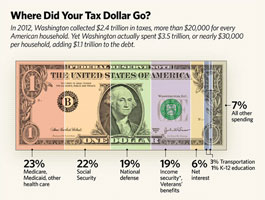
Most of it is in the form of direct payments to individuals, which are completely unconstitutional.
Where Did Your Tax Dollar Go?
The Heritage Foundation has come up with a snazzy graphic so that Americans can see where each percentage of every tax dollar that the
federal government takes goes.
Tax-portation bill. The [Massachusetts] state Senate
passed a sweeping transportation spending plan last night [4/13/2013] that socks the public to the tune of about $500 million in new gas, corporate and cigarette
taxes — but took a step toward transparency by ordering the long-secret MBTA pensions to be made public. Senators voted 30 to 5
to pass the financing bill, which would gradually provide $800 million in new revenues for transportation and about $100 million for education,
housing and other human services.
A Bizarre New 'Rain Tax' Makes A Splash In Maryland.
The Chesapeake Bay faces a serious pollution problem. The Environmental Protection Agency decreed in 2010 that Maryland had to stop so much stormwater
runoff from draining into the Bay, a project that would cost $14.8 billion. To pay for that, authorities decided to tax "impervious surfaces" —
in the words of The Gazette, "anything that prevents rainwater from seeping into the earth (roofs, driveways, patios, sidewalks, etc.) thereby causing stormwater
runoff."
The 'Rain Tax'. In 2010 the
Obama administration's Environmental Protection Agency ordered Maryland to reduce stormwater runoff into the Chesapeake Bay so that nitrogen levels
fall 22 percent and phosphorus falls 15 percent from current amounts.
The Editor says...
The Chesapeake Bay has a pollution problem only because the EPA says so. The EPA has chosen arbitrary reduction goals of 22% and 15% for chemicals
that will make their way into the Chesapeake Bay eventually, even if all the storm drains are plugged up. The EPA is apparently just making
excuses for new taxes. I've never been to the Chesapeake Bay, but I've never heard anyone say it is horribly polluted — except the EPA.
Exclusive: Obama's budget raises taxes
by $1 trillion. President Obama's 2014 budget calls for a trillion dollars in new taxes, almost twice as much as previously thought,
The Washington Examiner has learned. "Of the more than $1 trillion in new taxes, about $800 billion is raised through the
individual income tax system, about $125 billion comes from new excise taxes — including new taxes on tobacco and financial
companies," a source familiar with the president's budget explained.
The Obama Budget Proposal:
Tax Increase on Charity. President Obama's long-awaited budget proposal, to be released today, does not come right out and say that
it intends to reduce contributions to charity — but that is almost certainly what would happen were it to become law.
Obama's tax, spend,
borrow, and redistribute budget. Here are the facts: According to Obama's own numbers, his budget would leave the American people
with a $19.03 trillion debt burden by 2023. And according to the Congressional Budget Office, under current law our debt is scheduled to
reach $19.94 trillion by that same year, a difference of $900 billion. So right off the bat, half of Obama's claimed debt reduction
turns out to be pure fiction.
Cell Phones Often Taxed More Heavily than
Alcohol or Cigarettes. Wireless consumers in the United States pay more than 17 percent in taxes and fees on average on their cell
phone bills, including more than 11 percent in state and local charges, according to a new analysis by the Tax Foundation. In Nebraska, the
combined federal-state-local average rate is nearly 24.5 percent, and in six other states — Florida, Illinois, Missouri, New York,
Rhode Island, and Washington — it exceeds 20 percent.
California
'Lumber Products Assessment' a tax by any other name. The clowns who frequent Sacramento's seedy bars and whorehouses,
otherwise known as the members of the California State Legislature, have pulled off another midnight raid deep into the pocketbooks of all
Californians. At least street thugs and bank robbers are a one-time occurrence; [...]
They pay less, so you pay more.
Understanding the Many Costs of Corporate
Welfare. Beneficiaries of the various special tax treatments and exceptions include owners of NASCAR speedways, companies in American
Samoa, rum producers, businesses on Indian reservations, railroads, Hollywood moviemakers, and green-energy firms, including wind-power equipment
producers. [...] Corporate welfare is a way for politicians to maintain the façade of a free economy while rewarding some activities and
punishing others.
IRS
knowingly sends Billions in Fraudulent Refunds to Illegal Immigrants. A WTHR-TV Indianapolis investigative report
exposes a fraudulent scheme wherein the IRS is sending $4.2 billion per year to illegal immigrants as an "additional child tax
credit" for children who don't even live in the U.S. Further, the IRS and Congress have been ignoring the scheme for years.
This Space for Rent. The
TurboTax business wouldn't even exist if Congress had not seen fit to enact a tax code too complicated for most people to navigate.
Senate
overwhelmingly backs states' collection of online sales tax. The Senate on Friday [3/22/2013] overwhelmingly approved
an amendment empowering states to collect taxes for online sales, delivering a huge victory to lawmakers and stakeholders who have
devoted more than two years to the effort.
House
Dem calls for penny-a-gallon increase in the gas tax. Rep. Peter DeFazio (D-Ore.) on Tuesday [3/19/2013] said
Congress needs to pass legislation increasing the federal gasoline tax in order to pay for increased and ongoing demands on
U.S. infrastructure. DeFazio warned on the House floor that the federal highway trust fund will fall to zero by next year,
and said the government is spending billions less on infrastructure each year, which is hurting job creation.
The Editor says...
If the government is "spending
billions less on infrastructure," what happened to the trillion dollars of "stimulus" money spent in Obama's first term?
House
Dem budget includes $1.2T in taxes, $200B new stimulus. House Democrats on Monday unveiled a 2014 budget proposal that
includes $1.2 trillion in new taxes and $200 billion in stimulus spending. That's about twice the level of stimulus
spending that what was in the Senate Democratic budget, which included $975 million in new taxes.
Senate Democrats Want
Unnecessary $1.5 Trillion Tax Increase. It has been nearly four years since the last time the Senate passed a budget.
In that time, it hasn't as much as proposed a budget. That at long last changed yesterday when Senate Budget chairwoman Patty Murray
(D-WA) released a budget plan for next year. Now that the Democrats in control of the Senate have at least proposed a budget,
passing it through the senior chamber will be the next challenge. Doing so will be no small order. It could be difficult
because, to no one's surprise, Murray's budget includes a massive tax increase. She wants to raise taxes by $1.5 trillion
over the next 10 years. She would do so by "closing loopholes."
Senate Democrats' Budget Hikes
Spending 62%. Federal spending this year will top out at $3.6 trillion. At the start of the recession in 2007,
federal spending was just $2.7 trillion. Under the Democrat's plan, however, over the next ten years spending will rise
sharply to $5.7 trillion, an increase of 62%.
Senate
Democrats release first budget in four years, includes $1 trillion in tax increases. The Senate on Wednesday [3/13/2013]
presented its first budget in four years, a proposal by leaders of the Democrat-controlled chamber that calls for nearly $1 trillion
in tax increases but includes no strategy to make federal revenue match spending in the coming years. The plan calls for
$975 billion in new tax revenue through closing loopholes and ending deductions and credits benefiting corporations and the
country's highest wage earners.
Taxes are highest in states run by Democrats.
States With the Lowest
and Highest Tax Burdens: The average American paid 9.9% of their income on state and local taxes during 2010, according to
data from The Tax Foundation. The state of New York ranked highest, with residents paying 12.8% of their income on state and
local taxes. The lowest: Alaska at 7.0%.
Dinner for twelve at the fancy hotel is nothing compared to the real cost.
Obama,
Graham, McCain Dinner Leads to $600B Tax Hike Idea. The price of Senators McCain and Graham attending an 'outreach dinner'
with the president may wind up costing taxpayers $600 billion more in taxes. And you thought the only price paid would be to
their image. While Rand Paul was working the Senate chamber in a 13 hour-long filibuster to ensure the American homeland
would not be treated like a permanent battlefield, the two GOP Senators were noshing on some mega-caloric meal with President Obama.
Bicycles to Be Taxed for Causing Global Warming. The triumph of
moonbattery means that there is no longer any limit whatsoever to government greed or tyrannical absurdity.
Report: Facebook paid no income tax
last year. While most of country is getting hit with higher taxes, the social-media giant got a pass — and
even got $429 million in refunds.
City hikes taxes on Sandy-hit houses.
Homeowners in an exclusive waterfront enclave in Brooklyn thought Hurricane Sandy was as cruel a blow as they could suffer — until the taxman proved them
wrong. The city is claiming that property values have actually shot up for many homes in Manhattan Beach and it's going ahead with hefty tax hikes for the houses
devastated by the October superstorm, shocked property owners told The [New York] Post.
NY Times Notices Obama Tax Hikes Are
Crushing Americans, Fails to Mention Obama. This should be the first in a series. Wait until these poor [people] start have to paying $20,000 a
family to start for their free ObamaCare. Still, curiously missing from this story is the name of the man responsible for this massive tax hike.
100 years of the income tax. Sunday, February 3, is
the 100th anniversary of the ratification of the Sixteenth Amendment, which makes it the one hundredth birthday of the income tax. It has grown rather
ill-tempered in its dotage. Americans for Tax Reform commemorated the occasion by publishing a few fun facts about the income tax. Among other
interesting statistics, the initial top tax bracket was only 7 percent, and it didn't kick in until income reached a whopping $11.6 million in
2013 dollars. Only 358,000 people had to fill out 1040 forms at first, because the standard family deduction was an adjusted $93,000.
The Income Tax at 100. Today the federal tax system is a
national disgrace: 4 million words, tens of thousands of special favors to rent-seeking individuals and companies, hopeless complexity. It is
contradictory, arbitrary, duplicative, and deeply injurious to the federal fisc, American democracy, and our place in the world.
Where Do Your Taxes Go? The top one percent of
taxpayers — those earning over $390,000 — pay the same amount in income taxes as the lowest 95 percent of Americans combined.
That top one percent also earns a huge portion of the nation's income, while the taxpayers in the lowest 95 percent each make less than $150,000, according
to the Tax Foundation. "Last year, Washington paid out more than $70 billion in refundable tax credits to individuals who either had no income tax
liability or just a small one, so that's why people look at April 15 as pay day rather than tax day," said Scott Hodge, President of the Tax Foundation.
Fees, Taxes on Wireless
Services Keep Climbing . Growing almost as fast as the wireless communications industry are the fees and taxes paid by wireless
phone users. Even as revenue earned per wireless phone falls, taxes and fees climb.
Va. governor considers doing away with state
gas tax. Virginia could become the first state to eliminate its gasoline tax if the state legislature votes to adopt Gov. Bob
McDonnell's alternative plan, which calls for raising the state sales tax and imposing additional vehicle registration fees in order to pay
for roads throughout the state.
E-Filing and the Explosion in Tax-Return Fraud.
Tax-identity theft exploded to more than 1.1 million cases in 2011 from 51,700 in 2008. The Treasury Inspector General for Tax
Administration last summer reported discovering an additional 1.5 million potentially fraudulent 2011 tax refunds totaling in excess
of $5.2 billion.
Obama Voters Furious About Tax
Hikes. Disillusioned Obama voters are waking up to face the reality that Obama didn't exempt them in his quest to steal money from
all Americans to pay for his expanding government. It turns out that those making $30,000 a year will pay more taxes than those making
$500,000 because of the deal Obama pushed for after the fiscal cliff debacle. Obama voters, the joke's on you.
Is It Still Possible to Get Out of Dodge? The government does not want its
citizens living overseas, nor do they want its citizens having assets overseas. [...] The US is the only country in the world (except for Eritrea)
that has citizenship based taxation. No matter where you live, and no matter where you draw your income, the US taxes it. Every other
country has residence based taxation — you are taxed only if you reside in the country or earn income in the country.
The truth about Obama's tax fake out.
Further out, this agreement will do almost nothing to slow the dangerous erosion of our nation's financial strength; projected ten-year
deficits of $7.9 trillion will be whittled down by $650 billion as the wealthy, by the way, pay not "a little more," but quite a
lot more. On top of a hike in rates from 35% to 39.6%, the wealthy will also see deductions phased out, will be paying new surtaxes
on investment income to fund ObamaCare and Medicare as well as higher rates on investment income. In addition, several states,
including California, have passed new taxes on those in the top income brackets.
Obama supporters shocked,
angry at new tax increases. With President Obama back in office and his life-saving "fiscal cliff" bill jammed through
Congress, the new year has brought a surprising turn of events for his sycophantic supporters. "What happened that my Social Security
withholding's in my paycheck just went up?" a poster wrote on the liberal site DemocraticUnderground.com. [...] Shocker. Democrats
who supported the president's re-election just had NO idea that his steadfast pledge to raise taxes meant that he was really going to
raise taxes.
Pelosi says
upcoming fiscal deals should include greater tax increase. House Minority Leader Nancy Pelosi said Sunday [1/6/2013]
that recent tax increases are "not enough" to solve the country's fiscal problems and argued that additional hikes should be included
in upcoming deficit-reduction deals.
Fiscal
Cliff Deal: $1 In Spending Cuts For Every $41 In Tax Increases. When Presidents Ronald Reagan and George H.W. Bush increased
taxes in return for spending cuts — cuts that never ultimately came — they did so at ratios of 1:3 and 1:2.
Obama's idea of 'compromise':
What was McConnell thinking? The fiscal cliff deal passed by the Senate contains $1 in spending cuts for every $41 in tax hikes.
Obama's Fiscal
Cliff Victory Is Far Less Than Meets the Eye. President Obama and his acolytes are gushing over his fiscal cliff victory.
But the glow isn't likely to last long, once everyone figures out that the tax hikes Obama wrangled from Republicans only made matters worse.
What You Could Buy with the
Average Tax Increase. What's $1,635 per year more in taxes for tens of millions of households? That's just $136.25
taken from a family budget per month. Like prudent mobsters, President Obama and Speaker Boehner are just skimming a little from
your earnings to keep the nation from falling off that awful fiscal cliff.
The Progressive Income Tax. Looking
back on 1913, one can only be amazed at the incredible innocence of that generation of Americans. When the Sixteenth (the
progressive income tax) Amendment to the Constitution was formally ratified, the Congress responded by adding a seemingly quite
inoffensive federal income tax rider to the Underwood Tariff Act. The rider called for rates running up to a maximum of
7 percent on the last bracket of a $200,000-a-year income. Although the principle of the income tax had been subject to a
long controversy (it had been declared unconstitutional by the Supreme Court in 1894), the legislators took it lightly.
House Speaker Boehner Votes for Obama's
Marxism. Scottish economist Ramsay McCulloch said in 1845: "The moment you abandon ... the cardinal principle of
exacting from all individuals the same proportion of their income or their property, you are at sea without rudder or compass and there
is no amount of injustice or folly you may not commit."
Cliff Deal Only Whets
Obama's Appetite For More Taxes. Anyone who thinks the fiscal cliff deal will end President Obama's soak-the-rich campaign
isn't paying attention. Even before the ink had dried on his $620 billion tax hike, Obama was talking up his desire for more.
The Republicans didn't compromise: they surrendered . There are some hidden tax rises that
affect almost everyone. Rates on capital gains and dividends go up and a 2 percent payroll tax cut is due to expire. According to
the nonpartisan Tax Policy Center, the ending of the payroll reduction will raise taxes on 77.1 percent of households. The average cost
will be $1,635.
Give It to Me. [Scroll down] Internal Revenue Service data for 2010, as
reported by the Tax Foundation, show America's top 1 percent of income earners receiving 18.9 percent of the nation's adjusted gross income and paying
37.4 percent of all federal income taxes — about double their share of total income. Similarly, the top 5 percent of income earners
received 33.8 percent of the nation's adjusted gross income in 2010 and paid well over half the total federal income tax bill — 59.1 percent.
The
Multiplier Effect of Government Spending is 0. If we want to tax for growth here is what we should do. 1. Eliminate
deductions for the wealthy, but give them a flat tax, say around 17%. No matter what they make on anything, they send in 17%. Hauser's
Law says no one pays more than 20% anyway. 2. Allow some deductions for the middle class and poor, but those deductions should be
economically efficient.
Time to own the election, America.
Yes, America, you voted for higher taxes! During his four-year campaign for re-election, the president never said a word about cutting spending.
He still doesn't plan any, even in the 11th hour of fractious debate over the "fiscal cliff".
Voluntary cooperation vs. violence.
No corporation or charity ever threatens you with violence if you don't buy their product, or contribute to their cause. Only "The Violent
Entity," The State, or what we inaccurately call "government," does that. And it is only by colluding with politicians that corporations and
other special interests gain the power to pick your pocket. [...] When The State uses violence against us, rather than protecting us from it, it
ceases to be a government, and instead becomes a criminal gang. That is where we are today. We do not have a government. We have a
violent criminal gang. Today is the day you must tell the criminal gang how much you earn, so they can steal their preferred amount. You
do not have a choice. Do not file your taxes and you will eventually be subjected to violence. You will lose your freedom, and everything
you own.
An Overlooked Constant. One of the constants in any
analysis of income taxes paid in the United States since their inception in 1916 is the correlation between the top marginal rates and the taxes
actually paid by the so-called wealthy. Short of turning America into Stalin's police state and confiscating all the wealth of the "evil" one
percent, the predictable behavior of this economic class very much revolves around the tax policies of the government, both state and federal.
What happens if we confiscate 100% of
all the income for people who make more than $200K? The IRS received 3,924,490 tax returns showing an income over $200K.
These returns represent a total income of $1.964 trillion! That's a huge amount of money. But it's still not enough.
The federal government is spending about double that this year. Confiscating 100% of the income from those who made more than $200K
funds the federal government for only about six months.
Italics in original.
Sen. Thune: Obama has an 'obsession with
raising taxes'. Republican South Dakota Sen. John Thune said President Obama seems to have an "obsession with raising taxes" as part
of a deficit reduction deal between the White House and congressional leaders to avoid going over the fiscal cliff. Thune, a member of the
Senate Budget Committee, added that such a policy would only raise enough revenue to fund "about a week" of government spending.
The War on (Married) Women. Here's how the
marriage penalty works: Mr. and Mrs. report a combined income to the IRS. This pushes them into a higher tax bracket than they, or
at least one of them, were in when they were single, so their taxes rise. They are taxed on their joint income even when electing to report
as "married filing separately." Women are the ones who typically take the larger financial hit, since most married women are second
earners — by choice, it should be noted.
IRS aims to clarify investment income tax
under healthcare law. The Internal Revenue Service has released new rules for investment income taxes on capital gains
and dividends earned by high-income individuals that passed Congress as part of the 2010 healthcare reform law.
Tax and tell.
Illinois has a reputation for being an expensive and difficult place to do business, a big reason why the state has the ninth-highest
unemployment rate in the country, higher than every state that borders it.
Gohmert: The True Meaning of 'Fair Share'.
Since he first took office in 2008, President Barack Obama has been relentless in his cry for all Americans to pay their "fair share" of taxes,
without ever once giving the specifics of a tax plan that would truly create a "fair share" tax system. Here's a novel idea: let's take
the President at his word. Let's demand taxation fairness. And nothing will better insure that everyone is paying his or her "fair
share" than a flat tax.
California's Road to Perdition.
California was once the envy of everyone. But this promised land is now being controlled by a super-majority of leftists, and the
liberal, pro-union Democrats have only one answer to California's woes: to raise taxes.
New IRS Rule Benefits Only Foreign
Dictators. The Internal Revenue Service is doing its part to drive foreign investment from the U.S.
The Return Of The Tax-And-Spend
Democrats To D.C. President Obama promised to move the country forward, but his so-called deficit-cutting plan looks a lot
like good old fashioned tax-and-spend liberal politics to us.
CNN: Time for a Gas Tax
Hike. Dishonestly portraying "some experts" as offering a new fix to the fiscal cliff, CNN explored the idea of hiking
the federal gas tax because, author Steve Hargreaves says, the current 18.4 cents per gallon is "not enough." "As lawmakers
race to negotiate a deal to avoid the fiscal cliff," Hargreaves urgently reports, "some experts say one tax increase should be on the
table: a gas tax hike." The tax, which raises $32 billion a year, hasn't been raised since 1993, he tells us.
Liberal Democrats:
Higher rates for wealthy 'just the beginning'. The group says "low and moderate-income Americans are already contributing
to deficit reduction," and that "progressive tax reform is the only way that wealthy Americans can share significantly in that sacrifice."
The Editor says...
Exactly the opposite is true. The "low and moderate-income Americans" who expect taxpayers to make up for their
shortfalls are the ones who are dragging the country down. The budget deficit exists because of (unconstitutional) payments
to individuals, many of whom pay no income tax.
White House: Obama 'Will
Not Sign' a Deal Unless It Increases Taxes. White House Press Secretary Jay Carney said today that no matter what else
happens President Barack Obama — who is the only modern president other than Franklin Roosevelt to serve in four years when
federal spending topped 24 percent of GDP — will not sign a deal to avoid the so-called fiscal cliff that will arrive at
the end of this year unless that deal increases taxes.
Obama's
2009 stimulus chief says taxes and rules on junk food are coming. Larry Summers, chair of the White House National Economic
Council when the 2009 stimulus was developed, suggested that President Obama will eventually tax and regulate junk food to drive people to
eat more healthily — although he dinged First Lady Michelle Obama's healthy foods initiative.
U.S. Carbon Tax to Shovel Dollars to U.N.
Bureaucrats? It appears there will be an international dining section for hogs at the carbon-tax trough. Any new tax that
promises hundreds of billions of dollars per year, as a carbon tax does, would bring out the special-interest hogs, and one of the interests
likely to be fed by any federal carbon tax is the U.N.'s Green Climate Fund.
Obama Administration Gets Sued Over Carbon
Tax E-mails. President Obama's Treasury Department is facing a lawsuit for stonewalling a Freedom of Information Act (FOIA) request relating to a planned
carbon tax on fossil fuels. The Competitive Enterprise Institute (CEI), a watchdog group focused on energy and environmental regulations, filed suit Tuesday ]11/13/2012]
in U.S. District Court in Washington, D.C., announcing in a press release that it expects Obama's congressional cronies to propose the tax in the upcoming lame-duck
session.
More
about so-called carbon taxes.
The Debate About Tax Rates: The federal government consumed less than four
percent of GDP in 1930, 9.8 percent in 1940, and 16.2 percent in 1948. By 1965, the number had climbed to 25 percent of
GDP, and it hit 30 percent in 2000.
You reap what you sow.
Democrats want to have their cake and eat it too. I say, let them have their welfare state and let them pay for it too. Raises taxes now,
across the board, and let the Democrats start to accept responsibility for what they have wrought. They have sown the wind; now it is time for
them to reap the whirlwind.
Time for the Unthinkable: a Third-Party. IRS statistics show that 50% of American
citizens pay zero income taxes. This has led to what is called, in economic parlance, "infinite demand for government services." In other words, if services
are free to large amounts of voters, they will want all they can get. This is basic human nature. So under our present tax system, 50% of the American voters
want more government spending every election year.
A Declaration of Grievances. [Scroll down] As
you might expect, after 1913, when the income tax was legally challenged, the Court "found" that it was an indirect tax, not a direct tax.
Shocker. (And remember, for a little context, the tea tax was considered a direct tax since it was laid on a foodstuff!) The most basic idea
inherent in that of American taxation was that the federal government could basically tax only the states, who had to cough up the dough by their own
means. But the fed generally couldn't tax individuals.
Eco-Taxes?
Study Financed by U.S. Treasury Will Link Tax Code to Carbon Emissions. A major tax study currently being sponsored by
the U.S. Treasury will give environmental activists a powerful new weapon in their campaign to alter the entire American economic and
social landscape in the name of halting "climate change" — including the possible levying of new carbon taxes.
The Quiet Californians. [Scroll down] This November the
California voting public is poised to raise state income taxes on the top earners to over 12%, ensuring that the state's rates top both Hawaii's and
Oregon's. With sky-high sales and gas taxes, Californians are already the highest-taxed in the nation. The state's schools and
infrastructure are among the very worst.
Taxes Without Borders. In draft guidelines published this September, the WHO
Framework Convention on Tobacco Control indicated it may put a cigarette tax on the table at its November conference in Seoul, Korea. "First we had
doctors without borders," said David Williams, president of the Taxpayer Protection Alliance. "Now you could have taxes without borders. ... This
is a new frontier in taxes. If they're successful with this, consumers and taxpayers should be concerned about what's coming down the pipe."
Citizens or Subjects? [Mitt]
Romney wishes that he had answered more delicately a donor's question on who would and would not support his candidacy. But Romney
did highlight the 76.1 million Americans whose income tax is $0.00. Many of them also consider Big Government their great
provider. Some feel squashed by a flat-tire economy that thumps along at 1.7 percent GDP growth. Others have become
seduced by an ever-expanding state that caters to their every craving.
As
the UN opens its General Assembly session, it is already thinking up new global taxes. A 1 percent tax on billionaires
around the world. A tax on all currency trading in the U.S. dollar, the euro, the Japanese yen and the British pound sterling.
Another "tiny" tax on all financial transactions, including stock and bond trading, and trading in financial derivatives. New taxes
on carbon emissions and on airline tickets. A royalty on all undersea mineral resources extracted more than 100 miles offshore
of any nation's territory. The United Nations is at it again.
The Fall of the House of Obama.
[Scroll down] Consider President Obama's near-pathological insistence that the rich are not paying "their fair share," when any
cursory review, easily accessible from the CBO, shows that the top fifth of all income tax earners pay approximately 94 percent
of all income taxes. The bottom half, or close to it, pays no federal income tax. The implication is that we're all pulling
our weight, but that the "millionaires and billionaires" are making out like bandits. And somehow, throughout all this, the
Republicans are guilty of perpetrating, as one Democratic congressman put it, some variant of "the big lie."
It's worse than Romney said: 49% on federal aid, 49% pay no tax.
While Romney suggested that 47 percent of Americans are dependent on government aid of some sort, the number is actually slightly
higher. Over 49 percent of Americans live in a household where somebody is dependent on federal assistance, according to
federal statistics. And the percentage of people who don't pay taxes is worse than Romney pegged at 47 percent.
According to the Heritage Foundation, it's over 49 percent.
Obama's Internet tax. The government
doesn't handle technology well. When Uncle Sam comes into contact with something new, his first instinct is to impose familiar
regulations and taxes regardless of whether doing so makes any sense. So it's no surprise the Federal Communications Commission
(FCC) plans to apply telephone-era rules to the Internet, making it more expensive than ever to log in to keep in touch with
friends and family. In late July, the FCC — a relic from the New Deal — moved to replace the Universal
Service Fund with the cheerily titled "Connect America Fund."
FCC backpedals from Internet
tax. The Federal Communications Commission is rapidly backpedaling from a proposal to tax broadband Internet service after a
public outcry over the issue. Democrats and Republicans at the agency are now blaming each other for pushing the idea in the first place.
Government
Unions Plot to Have 11% Illinois State Income Tax on Top Earners By Changing State Constitution. And if one digs beneath the
surface of this plan, one finds government employee unions as a major source of money for supporters of the tax. The non-taxpayers want
more money. Illinois has a flat 5% and these greedy unions want 11% out of some people.
Progressive income tax: Brought to you by Illinois unions.
A coalition of progressive groups is beginning to coalesce around a proposal to create a progressive income tax in Illinois. Under their
plan state income tax rates will increase as one reaches higher incomes, up to a top rate of 11 percent for incomes over $1 million.
This plan would leave Illinois with one of the highest income tax rates in the country, increase Illinoisians tax bills by more than $8 billion,
and would most likely drive entrepreneurs and jobs from the state.
Spread the bandwidth around.
FCC eyes tax on Internet
service. The Federal Communications Commission is eyeing a proposal to tax broadband Internet service. The move would
funnel money to the Connect America Fund, a subsidy the agency created last year to expand Internet access. The FCC issued a request for
comments on the proposal in April. Dozens of companies and trade associations have weighed in, but the issue has largely flown under the
public's radar.
Obama's Campaign about Nothing.
There is isn't any good logical reason to vote for Obama even if you are a liberal. Let's take his tax policy. He wants to
raise taxes on millionaires and billionaires in an effort to do what? Nothing really.
The Silent Second-Term Agenda. President
Obama has a reputation for talking, but not necessarily for saying much. He has achieved new levels of vagueness this election season. Beyond
repeating that he's in favor of making the "rich" pay for more government "investment," he hasn't offered a single new idea for a second term.
This is deliberate. [...] Let's dispense with the obvious: An Obama second term will be foremost about higher taxes and greater spending.
The president has been clear about the former and will consider victory in November a mandate to raise taxes on higher-income Americans and small
businesses — at the least.
The Internet Tax: Another Government Assault On
Prosperity. Across America politicians of both parties will tell you the number one issue facing our country is job creation. They're
right — yet what they continually refuse to acknowledge is that creating these jobs is not their responsibility. Government's role in
economic development should always be passive — confining expenditures to core functions while keeping taxes low in an effort to allow the
optimum conditions for private sector growth. "Get out of the way," in other words.
Rich
Americans pay their fair share in taxes — and then some. The Congressional Budget Office reported last month
that in 2009, the top 20 percent of taxpayers paid an average of 23.2 percent of their income in federal taxes —
more than double the 11.1 percent paid by the middle quintile, and 23 times the 1 percent paid by the lowest
quintile.
Obama's Calculated Deception.
[In 2007], after 25 years of Reagan Republican tax policies, the top 1% paid 40% of federal individual income taxes.[...] Also
in 2007, again before Obama was even elected, and after 25 years of Reaganomics, the bottom 40% of income earners on net as a
group paid less than 0% of federal income taxes. Instead of paying at least some income taxes to help support the
federal government, the federal government paid them cash through the income tax code. Does that reality sound
like what you hear in President Obama's deceiving speeches?
New Hampshire fights Internet sales tax. A bill pending in Congress
would turn New Hampshire businesses that sell over the Internet into tax collectors for other states if they have more than $500,000 in remote sales.
"By imposing collection requirements on businesses that have no physical presence outside of their home state, the legislation under consideration stands
to erode existing protections on state sovereignty," U.S. Sen. Kelly Ayotte, R-N.H., said at a Senate Commerce Committee hearing Wednesday [8/1/2012].
Ayotte is a member of the committee.
No Internet Taxation Without
Representation. Our nation was born from the idea of "no taxation without representation" — that
citizens should not be taxed by governments in which they have no political voice. Yet now lawmakers in Washington
want to overturn that bedrock principle in order to extract more revenues from American consumers. The Marketplace
Fairness Act recently introduced in the Senate would require online retailers to collect and pay sales taxes to states
where they have no physical presence or democratic recourse.
New
sales tax likely cost every internet shopper an extra $125 a year. Internet shoppers could soon be hit with a new
sales tax, making online purchases up to 11 percent more expensive. Congress is considering new legislation that
would allow states to force sales tax on internet purchases, which would help make up states' budget shortfalls. Meanwhile
Amazon, the world's largest internet retailer, is making deals with individual states to collect sales taxes regardless of what
Congress decides.
The shocking truth that
Harry Reid can't deny. [Scroll down] Reid didn't have time apparently to mention an accurate report that 36 Obama
White House aides are $833,000 behind in their taxes, according to the Internal Revenue Service. Nor did Reid explain how the IRS has
somehow overlooked a decade of missing tax returns from a multi-millionaire who's this administration's main political opponent.
Fire Government Workers Who Don't
Pay 'Fair Share'. According to Internal Revenue Service data, 100,000 federal workers and contractors owed $1 billion total
in unpaid federal taxes in 2009, the latest figures available. They simply didn't pay what they owed. And that dollar amount is
up 67% since 2004, when federal workers underpaid by nearly $600 million. In fact, every year since 2004, the IRS has had to deal
with about 100,000 federal workers and contractors who underpay their taxes each year.
House
to Vote on Whether or Not to Fire Federal Workers Who Are Tax Delinquent. If you're going to work for the government, you'd better
be paying your taxes. So says a bill written by Rep. Jason Chaffetz, that will be voted on Wednesday evening [8/1/2012] in the House of
Representatives. Chaffetz's bill will terminate the employment of current federal employees who have "seriously delinquent tax debt" and
prohibit future hiring of such individuals for federal jobs.
Sneaky double taxes. States are so desperate for cash
that they're getting sneaky. Combine the sluggish economy with Obamacare's expensive Medicaid expansion and spiraling public-sector union
benefit payments, and the usual tricks just aren't balancing the books anymore. That's why some are looking to tap out-of-state businesses as a
new source of revenue. On Tuesday [7/24/2012], House Judiciary Committee Chairman Lamar Smith, Texas Republican, held a hearing on a bill he
said "has bipartisan support from members both on and off this committee" to let states tax Internet sales.
Is Dick Durbin Stupid,
Ignorant, or Just Lying to His Constituents? Senator Dick Durbin is pushing for passage of a federal law allowing individual states
to impose sales tax levies on any internet sales made to citizens of those respective states. Those taxes would be identical to the taxes
that would be paid if you or I went to a local store and purchased the identical item.
CBO: Obamacare levies $1 trillion in new
taxes. President Obama's health care law raises taxes by $1 trillion, according to a new report from the Congressional Budget
Office. The individual mandate — which the CBO calls a "penalty tax," in apparent deference to Chief Justice John Roberts — will
produce $55 billion in "penalty payments by uninsured individuals," the CBO told House Speaker John Boehner, R-Ohio, in a Tuesday [7/24/2012]
letter. Of course, the framers of the law didn't design the mandate as a tax, and so it produces less revenue than any other provision in the
bill. The "additional hospital insurance tax" is the largest tax increase in Obamacare, projected to bring in $318 billion in new
revenues.
Bay Area faces new high-speed rail
costs. Now that Gov. Jerry Brown has signed legislation to allow the state to spend billions on high-speed rail, Bay Area residents
had better brace for the real ride — a push for $650 million in toll hikes and new San Francisco taxes.
More
about high-speed rail boondoggles, especially
in California.
The Robin Hood Tax Scam Is
Back. In a burst of uninformed enthusiasm, William La Jeunesse, writing for Fox News, announced that the bill
offered by Senator Tom Harkin (D-Iowa) and Representative Peter DeFazio (D-Ore.) — the "Wall Street Trading and
Speculators Tax Act" — was the Robin Hood tax. If he knew better, La Jeunesse would have called it by its
correct name: the Tobin Tax, first offered 40 years ago by a Keynesian economist, following the collapse of the
Bretton Woods agreement when President Nixon took the United States off the gold standard. That bit of information
would no doubt have helped to curb his enthusiasm.
Obama's Millionaires. President Obama's latest proposal
to raise taxes on high-income earners would effectively cut taxes for a number of senior White House advisers whose net worth
exceeds $1 million. At least five millionaires currently employed in senior White House positions would receive a
tax cut under Obama's plan, an initial Washington Free Beacon review of financial disclosure records has found.
Obama's
Class-Warfare Rhetoric Demonizes Success. Anyone who wants to study the tricks of propaganda rhetoric has a
rich source of examples in the statements of President Barack Obama. On Monday [7/9/2012], for example, he said that
Republicans "believe that prosperity comes from the top down, so that if we spend trillions more on tax cuts for the wealthiest
Americans, that that will somehow unleash jobs and economic growth." Let us begin with the word "spend." Is the
government "spending" money on people whenever it does not tax them as much as it can? Such convoluted reasoning would
never pass muster if the mainstream media were not so determined to see no evil, hear no evil and speak no evil when it
comes to Barack Obama.
The Tax Man Cometh To Police You On Health Care.
The Supreme Court's decision to uphold most of President Barack Obama's health care law will come home to roost for most taxpayers in
about 2½ years, when they'll have to start providing proof on their tax returns that they have health insurance.
ObamaCare's 7 Tax Hikes On
Under $250,000-A-Year Earners. Obama's pledge against any form of tax increase on Americans making less than $250,000 a year "was thrown
out the window" when he signed the healthcare law, says John Kartch, communications director with Americans For Tax Reform (founded by anti-tax crusader
Grover Norquist). Here's a rundown of seven ObamaCare tax hikes that affect the hoi polloi.
Can Government Now Tax Handgun Ammunition
10,000%? Conservatives still reeling from Chief Justice John Roberts's decision to uphold the 2,700-page ObamaCare legislation as a
Federal tax are rightly worried that Roberts opened the door to unlimited Federal coercion of the American public through the tax code. One
possibility that should generate grave concern is that the Federal government could use to the tax code to undermine the Supreme Court's landmark
decisions affirming Second Amendment rights in Heller v. D.C. and McDonald v. Chicago.
DNC
Chair: It's easiest for the IRS to administer the health care mandate, but it's not a tax. Just remember, guys: The Internal
Revenue Service might be the best-equipped entity to administer the "penalty," and the "penalty" might be assessed on your tax return, but the
requirement to pay a "penalty" if you don't buy health insurance is most definitively not a tax.
More about
the Supreme Court decision on Obamacare.
Maryland Imposes
'Millionaires Tax' on $100,000 Incomes. The State and Local Revenue and Financing Act raises state income tax rates by
0.25 percentage points for single filers reporting more than $100,000 and joint filers reporting more than $150,000 taxable income.
For people in the $300,000-$500,000 range, taxes go up 0.50 percentage pointst [sic], an almost 10 percent increase. The
law also reduces personal exemptions for these couples, eliminating them entirely for couples with more than $200,000 in federal adjusted
gross income. This raises both state taxes and the local piggyback income tax.
'The Largest Set of Tax Law Changes in 20
Years'. A new report from the Treasury Department says that Obamacare "represents the largest set of tax law changes in more
than 20 years and affects millions of taxpayers." As the report notes, Obamacare's "new taxes, fees, and penalties account for
approximately $438 billion." But, really, it's even worse than that.
Detroit: The Moral of the Story.
The Left's answer to the deficit: raise taxes to protect spending. The Left's answer to the weak economy: raise
taxes to enable new spending. The Left's answer to the looming sovereign-debt crisis: raise taxes to pay off old
spending. For the Left, every deficit is a revenue-side problem, not a spending-side problem, and the solution to every
economic problem is more spending, necessitating more taxes. The problem with that way of looking at things is called
Detroit, which looks to be running out of money in about one week. Detroit is what liberalism's end-game looks like.
The Not-So-Free State. Maryland
Gov. Martin O'Malley [Democrat] signed a quarter-billion dollars' worth of tax increases into law on Tuesday [5/22/2012].
The move is meant to keep the state's ever-expanding budget on a path toward growth. "Growth" is the last thing the
private-sector economy is going to see in the Free State. According to the latest Labor Department figures, Maryland
lost 6,000 jobs in April, the largest such drop in the nation.
Improvised Explosive Device Tax.
'Taxmageddon' isn't only about the half-trillion-dollar blow to the economy that arrives in 2013 on the end of the Bush-Obama tax
rates. Several of the Affordable Care Act's worst tax increases kick in too, such as the new excise tax on medical devices.
The 2.3% levy applies to the sale of everything from cardiac defibrillators to artificial joints to MRI scanners. The device tax
is supposed to raise $28.5 billion from 2013 to 2022, and it is especially harmful because it applies to gross sales, not
profits.
New Yorkers
Leave Like East Germans Fled Communism. New York thinks of itself as the place to be, but its high taxes have made
it a place to flee. Those who have escaped the Empire State tax man could fill a major city.
High-Taxing
Empire State Loses 3.4 Million Residents in 10 Years. New York State accounted for the biggest migration exodus of any
state in the nation between 2000 and 2010, with 3.4 million residents leaving over that period, according to the Tax Foundation.
Over that decade the state gained 2.1 million, so net migration amounted to 1.3 million, representing a loss of
$45.6 billion in income.
Reluctant
to raise taxes, some states push the tax man on tougher collection enforcement. Dentist Frank Illuzzi was stunned when Vermont
tax collectors began demanding a 6 percent sales tax on the value of toothbrushes and floss he hands out to patients.
The Editor says...
Sales taxes are usually levied on items based upon the prices of items as they are sold — not the MSRP or someone else's estimate
of the value of those items. If the dentist gives you a toothbrush, then the sale price is zero, and so is the tax.
Can California Be Fixed? Recently, I was
driving down pot-holed, two-lane, non-freeway 101 near Monterey (unchanged since the 1960s) when the radio blared that on a recent science test administered to
public schools, California scored 47th in the nation. As I looked at the congested traffic on the decrepit highway and digested the idea that our public
schools are competitive only with Mississippi and Alabama, I wondered — is that what we get for a more than 10 percent income tax, 10 percent
state and local sales taxes, and the highest gas taxes in the nation?
Democrats who cheat on their taxes
want us to pay more. Treasury Secretary Tim Geithner did not pay the taxes he owed; Charles Rangel (D-NY) who as chairman of Ways and
Means wrote tax laws, has run afoul of tax authorities for years' worth of malfeasance; and the latest: Democratic Senator Claire McCaskill of
Missouri — a stalwart supporter of Barack Obama and one of the richest members of Congress. Lest we forget, Tom Daschle, Obama's
putative first choice for HHS Secretary had to drop out when it was disclosed that he also failed to pay taxes he owed. These are all members
of the 1% Club. Meanwhile, the staff of the IRS is being boosted by thousands of new auditors to snoop on our taxes to make sure we pay our "fair
share" and Democrats rail against the "rich" who don't pay their fair share of taxes.
IRS Gives Billions in Tax Refunds to
Illegals. Here's how it works. Illegal immigrants cannot qualify for legitimate Social Security numbers, which would entitle them
to work legally in the U.S. and file income tax returns, but the Internal Revenue Service allows them to apply for nine-digit individual taxpayer
identification numbers, or ITINs, which also are used to file federal income tax returns. In addition, a provision in the tax code permits illegals
to claim "additional child tax credits," which grant families $1,000 per "dependent" child. Roughly three-quarters of tax returns filed by
illegals include these ACTCs. With the ITIN, illegals are able to get tax credits and refunds for nephews, nieces and other family members
who never have touched U.S. soil.
Obama-Loving Media Spin the Economy.
[L]ow-tax states outperform high-tax states. Seven states have no personal income taxes (PIT) — Alaska, Florida, Nevada,
South Dakota, Texas, Washington and Wyoming. Two states tax only income on interest and dividends — New Hampshire and
Tennessee. The average state and local revenue growth of these nine states from 2000 to 2009 was 81.53 percent. Average
revenue growth in the nine states with the highest PIT rates — Ohio, Maine, Maryland, Vermont, New Jersey, California,
Oregon, Hawaii and New York — was 44.88 percent. Similarly, gross state product growth from 2001 to 2010
averaged 58.54 percent in the nine states with no PIT versus 42.06 in the nine states with the highest PIT rates.
Taxing the Sunlight. Of the more than 50 different taxes that exist today
on federal, state and local levels, here are a few more familiar and common taxes. Federal income tax, sales tax, bridge tolls, sales tax, commuter tax, dog license
tax, gasoline tax, Social Security tax, seven different taxes on telephone usage, and the list continues. We jokingly talk about how politicians would tax the air if
they could. Water is already taxed. If only they could contrive a way to tax the sunlight. Wait ... believe it or not ... it's been done!
Medicare
slush fund shows Obama's abuse of power. President Obama regularly misuses executive power, often nakedly in the
service of his political interests. [...] More than 60 Republican congressmen last week sent a letter to the Internal Revenue
Service charging that Tea Party groups across the country were being "harassed" and "stonewalled" by the agency. Rep.
Tom McClintock described a group in his Northern California district that easily obtained nonprofit status from the state
government but got nowhere with the feds. The list of demands, as described by McClintock on the House floor, sounds
like political bullying: "The IRS demanded the names of every participant at every meeting held over the last two years,
transcripts of every speech given at those meetings, what positions they had taken on issues, the names of their volunteers
and donors, and copies of communications they had with elected officials, and on and on."
Amazon,
Texas reach sales tax deal. Amazon.com on Friday agreed to begin collecting sales tax in Texas, forging a deal that
promises to bring more jobs to the southern U.S. state and as the online marketer lost another round in a series of state-by-state
sales tax battles. The agreement, to take effect July 1 for Texas' 6.25-percent sales tax, follows an accord reached with
Nevada earlier in the week to begin collecting that state's 8.1 percent sales tax Jan. 1, 2014.
Judge throws out Illinois 'Amazon tax'.
A Cook County judge has ruled against a state law that requires Amazon.com and other Internet companies to collect sales taxes on transactions with
Illinois customers.
Devious Taxation.
If Congress spends $3.8 trillion out of this year's $15 trillion GDP, what must it do to accomplish that goal?
If you said it must "find a way to force us not to spend $3.8 trillion privately," go to the head of the class.
One way to force us to spend $3.8 trillion less is to tax us that amount, but we're being taxed only $2.5 trillion.
Where does the extra $1.3 trillion come from?
Your Tax-Free Nest Egg May Not Be Tax-Free
After All. More than 30 years ago, lawmakers made a deal with Americans: Set up a retirement nest egg and we'll let you fill it with
tax-free money. A financially troubled Washington now plans to break its word.
Feds eye retirement-fund tax to cut $16 trillion-plus deficit.
Uncle Sam, in a desperate attempt to fix its $16 trillion-plus deficit, is leering over Americans' retirement nest egg as its new bailout fund.
Capitol Hill politicians are assessing tax changes that could let the Internal Revenue Service lay claim to a portion of the $18 trillion sitting in
401(k) accounts and other tax breaks used by middle-class workers, including cutting the mortgage tax deduction.
What's U.S. Citizenship Worth? [During
President Obama's] tenure, the number of Americans renouncing citizenship has taken a sharp upward turn, from an average of 482 per year under
George W. Bush to 742 in 2009, to 1,534 in 2010 and to 1,788 in 2011. At the least, his calls for hiking taxes on the wealthy can't be
doing anything to discourage this trend.
Monsieur
Obama's Tax Rates: Celebrity chef Alain Ducasse changed his citizenship this month from high-tax
France to no-income-tax Monaco. He says it wasn't a financial decision but an "affair of the heart."
Of course. Nonetheless, plenty of other Frenchmen have moved abroad to escape their country's confiscatory
taxes. Americans should be so lucky: Ours is the only industrialized country that taxes its citizens
even if they live overseas.
Global reach of the
IRS: The tax burden on Americans living abroad is so great that many are renouncing their
U.S. citizenship to avoid paying the IRS. The United States is one of just four countries that
taxes its citizens even if they are living and working abroad, and it is the only country that insists its
citizens pay taxes on global income, capital gains and estates.
Wealthy
socialite and top Democratic donor Denise Rich denounces her U.S. citizenship. Denise Rich, the wealthy socialite and former
wife of pardoned billionaire trader Marc Rich, has given up her U.S. citizenship — and, with it, much of her U.S. tax bill.
Rich, 68, a Grammy-nominated songwriter, top Democratic donor and glamorous figure in European royalty circles, renounced her American passport
in November, according to her lawyer.
New federal
agency OFR stirs 'Orwellian' fears. Starting in July, the OFR [Office of Financial Research] Fiscal
Year 2013 budget, estimated at $158 million, will be funded entirely through assessments — also known
as taxes — on bank-holding firms with consolidated assets worth at least $50 billion. But as
became clear at Thursday's [4/19/2012] hearing by the House Financial Services Subcommittee on Oversight and
Investigations, a close reading of the law the president signed provides no limit on the growth of OFR's budget,
nor on the taxes the agency can impose on big banks to fund it.
Americans
Making Over $50,000 a Year Paid 93.3 Percent of All Taxes in 2010. According to statistics compiled from the
Internal Revenue Service (IRS) by the Tax Foundation, those people making above $50,000 had an effective tax rate of
14.1 percent, and carried 93.3 percent of the total tax burden. In contrast, Americans making less than
$50,000 had an effective tax rate of 3.5 percent and their total share of the tax burden was just
6.7 percent. Americans making more than $250,000 had an effective tax rate of 23.4 percent and their total
share of the tax burden was 45.7 percent.
Md. Governor Calls for Sweeping
New Internet Taxes. Maryland Gov. Martin O'Malley's (D) 2012 budget would impose taxes on digitally delivered
goods and services and tax purchases made from out-of-state online retailers that rely on referrals from affiliates.
Yippee! Free government money! Come
and get it! As you prepare to send in your income taxes on April 15 — for many taxpayers the amount involved
is more than they spend on food and housing combined — remember that other people get paid money when they file taxes,
because their incomes are lower than yours. The desperation to spend as much money as possible on taking money from taxpayers
and giving it to other people who didn't earn it and who don't pay income taxes is offensive to everyone who works hard, succeeds, and
as a result has a bulls eye painted on their pocketbooks.
No. 1 in corporate
taxes. As of Sunday, the United States has the highest corporate tax rate of any country in the world.
Given the shaky state of our economy, it's not worth celebrating.
Why Politicians
Promise Heaven And Deliver Hell. The United States now has the dubious distinction of having the highest
corporate tax rate in the world. And people wonder why American corporations are expanding overseas, providing jobs
to foreigners. The left may get their jollies attacking "the rich," but the real victims are other people, who want
the jobs that are sent overseas to escape a hostile business climate at home.
Maryland
Governor Calls for Sweeping New Internet Taxes. Maryland Gov. Martin O'Malley's (D) 2012 budget would impose
taxes on digitally delivered goods and services and tax purchases made from out-of-state online retailers that rely on
referrals from affiliates. The proposed budget is in bills introduced in the Maryland Senate and House in January.
Under the governor's proposal, digitally delivered goods and services would be subject to the state's general 6 percent
sales tax. The proposal would also tax digitally delivered goods and services such as music downloads on iTunes,
ringtones, smart-phone applications, and blogs that charge for their services.
Progressive
Caucus Budget Proposes $2.9 Trillion Spending Hike. [Quoting Rep. Jesse Jackson Jr. (D-Ill.):] "This
budget responds to what the people want, what the economy requires and what the Progressive Caucus believes in.
I look forward to a national discussion about what's in this plan, and I'm excited to stand behind it."
Liberals'
budget would raise taxes to an all-time high. If you want to know why House Democrats lost 63 seats in the
2010 elections — the largest political defeat since 1938 — look no further than the budget put forward
this week by the 83-member Congressional Progressive Caucus. Perhaps unsatisfied with the title they used last year —
"The People's Budget" — the CPC calls this one the "Budget for All." It raises taxes to levels never seen
before — not even during World War II — guts defense spending and splurges on a number of liberal priorities.
We're
No. 1: In highest corporate taxes. Come Sunday [4/1/2012], America finally has something to crow about in its economic
war with China and Japan: It will have the highest jobs-killing corporate tax rate in the industrialized world. No, it's
not an April Fool's joke. When Japan officially slashes its rate to 36.8 percent Sunday, America's will be tops at
39.2 percent.
Biden: "We
Want To Create A Global Minimum Tax". "We want to create (what's called) a global minimum tax, because American
taxpayers shouldn't be providing a larger subsidy for investing abroad than investing at home," Biden said at a campaign
event.
House
Dems propose raising taxes by 40%, including on middle class. A new budget proposal from
liberal House Democrats suggests what Obama's "dream agenda" might be. And if Rep. Paul Ryan's budget
plan is the "Path to Prosperity," the Congressional Progressive Caucus has offered the "Road to Ruin."
White House
considered a $170 billion soda tax to pay for Obamacare. In the view of the Obama White House, a $170 billion
excise tax on soda doesn't raise taxes on the middle class. Nor does a new $20 billion labor tax raise taxes on the
middle class. Unless the tax is specifically an income tax, it doesn't really count against Obama's pledge in their view.
This is why Obama doesn't consider various Obamacare taxes, such as new limits on health savings accounts or taxes on medical
device manufacturers, as middle-class tax hikes, although they surely will come out of middle-class pocketbooks.
Obama
promotes proposed $10,000 Volt tax credit. Are you having a hard time convincing yourself to buy a Chevy
Volt? Perhaps a $10,000 instant tax credit will change your mind. According to a fact sheet sent to reporters
today [3/7/2012], President Obama will once again highlight a proposal to increase the tax credit for electric
vehicles.
State
seeks 'outrageous' vending fee hike. The Patrick administration is pitching a staggering 500-plus percent
hike in vending machine license fees — in part to meet Obama-care rules that haven't even been written yet,
the [Boston] Herald has learned.
Obama's Dividend Assault.
President Obama's 2013 budget is the gift that keeps on giving — to government. One buried surprise is his
proposal to triple the tax rate on corporate dividends, which believe it or not is higher than in his previous budgets.
Mr. Obama is proposing to raise the dividend tax rate to the higher personal income tax rate of 39.6% that will kick in next year.
White
House Economic Adviser: 'We Need a Global Minimum Tax'. Gene Sperling, director of the White House's
national economic council, said today [2/13/2012] at an official meeting that "we need a global minimum tax".
No 'global tax,' W.H. says.
National Economic Council director Gene Sperling's comments that a "global minimum tax" is necessary to curb
outsourcing have caused a stir in the blogosphere — but White House officials say there's no
United Nations-imposed duty in the works.
Obama
Confirms Adviser Sperling's Call for a "Global Minimum Tax". Speaking in Milwaukee on February 15,
President Obama, re-ignited a controversy on "global taxation" set off by his top economic adviser during comments on
the administration's budget on Monday. Gene Sperling, Assistant to the President for Economic Policy and Director
of President Obama's National Economic Council (NEC), caused a commotion this week with his statement that the Obama
administration favors "a global minimum tax."
Who are you going to believe? Your eyes
and ears, or the White House propagandists?
Obama
Confirms Adviser Sperling's Call for a "Global Minimum Tax". Gene Sperling, Assistant to the President for
Economic Policy and Director of President Obama's National Economic Council (NEC), caused a commotion this week with his
statement that the Obama administration favors "a global minimum tax." Sperling's comment, captured by C-SPAN
cameras, was soon spread across the blogosphere in numerous YouTube postings.
States with
enacted or pending online tax rules: Attention, online shoppers. The days of tax-free online
shopping may be coming to an end. More than a dozen states have enacted legislation or rules to force online
retailers to collect sales taxes on purchases, according to tax publisher CCH. Similar legislation is
pending in 10 states.
A World Tax?
Keep Your Eyes on the Internet. [Scroll down] The internet is the perfect vehicle to fund
such programs because it's global in nature and it's easily accessible to anyone with a computer or a smartphone
no matter where he or she lives. What does that mean in practical terms? It means that we are moving
toward a global government with teeth. By that I mean a global political body with taxing and enforcement
powers. As things stand now, the U.N. is a paper tiger because it depends on the goodwill of governments
around the world to operate, but if a global governing authority had direct access to a substantial tax revenue
stream, things would change with lightning speed.
Obama's Silly Rule.
The system is already fair, if by that you mean steeply progressive. According to the Congressional Budget
Office, the top 1 percent pays on average 18.8 percent of its income in federal income taxes, the broad
middle pays 4.2 percent, and the bottom 20 percent gets more money back than it pays in. When
all federal taxes are taken into account, the top 1 percent pays almost 30 percent — Obama's
magic number.
Here's
why union membership keeps falling. Folks in Springfield, Ill., witnessed a bizarre scene two
years ago. Thousands protested outside the Capitol, chanting: "Raise my taxes! Raise my taxes!
Raise my taxes!" Who protests for higher taxes? Government unions do. The American Federation of
State, County, and Municipal Employees helped organize the rally. This is the new face of the union movement.
Only the debt ceiling will
reach the moon. [Scroll down] After all, if you confiscated the total wealth of the Forbes 400
richest Americans it would come to $1.5 trillion. Which is just a wee bit less than the federal
shortfall in just one year of Obama-size budgets.
36 Obama aides
owe $833,000 in back taxes. How embarrassing this must be for President Obama, whose major speech theme so
far this campaign season has been that every single American, no matter how rich, should pay their "fair share" of
taxes.
Takers Taking Over.
Like the socialists who govern Greece, Obama's left-wing administration depends on the support of left-wing
activists, unionized government workers, radicalized students, and welfare recipients. All of these groups
have been pressing for more government spending, and Obama has not disappointed them. ... Ominously, the
percentage of takers, those who collect benefits and pay no federal income tax, now sits at 49%. Anything
beyond that and the country is lost forever.
Government Gone Wild.
Our economic problems rightfully dominate the news. However, they are merely symptoms of a bigger, underlying
problem: government. ... Government has become little more than a carefully crafted myth based on propaganda
disseminated by government itself. It has devolved into a scheme of plunder whereby the elites plunder
the masses.
Cut or Tax? Are
You an Adult or a Child? If you are a child, then the government might seem to you like a parent.
It needs to be big and strong in order to take care of you and pay for all your needs and emergencies. If
you are an adult, you might view the government more like one of your offspring: someone who has a limited
number of chores to do and should be given a small allowance by way of payment for those chores. If you are
an adult, you know freedom entails responsibility. ... A child, on the other hand, wants total freedom —
and then comes crying to Mommy when it gets him in trouble.
The Occupation Should Be On White House
Grounds. At a recent town hall meeting, Rep. Paul Ryan, R-Wis., chairman of the House Budget
Committee, reminded constituents of a story that broke earlier in the year — that General Electric paid no
taxes on profit of $14 billion, $9 billion of which was earned overseas. Ryan related how he had
asked a GE tax officer the length of GE's tax filing. The tax guy said it was filed electronically but
if it had been printed out he reckoned about 57,000 pages. This speaks both to the complexity and
unfairness of the tax code.
Sales Taxes and
the Internet. The Internet-tax measures under consideration would not expand governments' power
to tax, but its power to conscript businesses into acting as tax collectors. At the moment, their ability
to do so is limited by longstanding interstate-commerce jurisprudence: The Supreme Court ruled in the
1967 Bellas Hess v. Illinois decision that states could require businesses to collect sales taxes in
only those jurisdictions in which the businesses maintain an actual physical presence.
City
fines and fees double, triple for minor and major offenses. The mayor isn't just throwing the book
at criminals. He's also raising nuisance fines. They include: Allowing weeds to grow to a height
that exceeds 10 inches — $600-to-$1,200-a-day, up from $500-to-$1,000. [And] Illegal dumping or
allowing trash to accumulate in a way that provides a food supply for rats — $300-to-$600, up
from $250-to-$500.
The Tax Haven That's Saving
Google Billions. The heart of Google's international operations is a silvery glass office building
in central Dublin, a block from the city's Grand Canal. In 2009 the office, which houses roughly 2,000 Google
employees, was credited with 88 percent of the search juggernaut's $12.5 billion in sales outside the
U.S. Most of the profits, however, went to the tax haven of Bermuda.
Progressives
and Their Taxes Kill Cities. High taxes are bad for cities. Low taxes encourage growth.
In fact, between 1980 and 2007, compared to the ten most-taxed metropolitan areas, America's ten least-taxed
metropolitan areas experienced three times faster population growth, 2.7 times faster employment growth,
and twice as great an increase in personal income.
Republican
senators push for Internet sales taxes. Senators Mike Enzi of Wyoming and Lamar
Alexander of Tennessee are currently putting the final touches on their bill, which is backed
by Wal-Mart Stores, Best Buy, Home Depot, and other companies that are currently required to
collect sales taxes. It's a bipartisan concept: a related effort was embraced by
Democrats including Sen. Dick Durbin of Illinois a few months ago.
9-9-no way. Herman
Cain's 9-9-9 tax plan has become center stage of the Republican presidential nomination race and for good
reason. The American tax code has grown into an unwieldy beast. Self-serving politicians hell-bent
on controlling you and enriching their cronies have morphed it into a multiheaded Hydra with endless loopholes,
exceptions, subsidies, giveaways, penalties and more. Cut off one head and another grows back in its
place. This monster can't be tweaked, massaged or even reformed. It must be killed.
The 'fair share' farce.
It's about time the rich started paying their fair share, according to the "Occupy Wall Street" protesters.
Those fat cats aren't chipping in as much as the less fortunate. When are they going to start spreading
their wealth around? Unfortunately for the occupiers, facts have a way of ruining a good story line.
Because when we check the dollars and cents behind who pays what, we find the rich already are sharing quite a
bit of their earnings.
Pastors plan to defy
IRS ban on political speech. Setting the stage for a collision of religion and politics,
Christian ministers from California and 21 other states will use their pulpits Sunday to deliver political
sermons or endorse presidential candidates — defying a federal ban on campaigning by nonprofit
groups. The pastors' advocacy could violate the Internal Revenue Service's rules against political
speech with the purpose of triggering IRS investigations.
Is a Progressive
Tax Constitutional? So much has been made of wealthier citizens paying their "fair share."
Much of the argument against this sort of rhetoric has focused on why we shouldn't raise taxes on the highest
tax bracket, or why we shouldn't create another tax bracket. But one argument that is missing is whether
or not such a system of taxation is legal at all.
Kansas
Budget Director Anderson Calls for End of State Income Tax. Kansas Budget Director Steve Anderson
hopes lawmakers will pass proposed legislation to eliminate gradually the state's personal income tax A
similar attempt to end the tax stalled in the state Senate last year. In addition to eliminating the personal
income tax, the current bill would raise sales and property taxes and cap state revenue at the 2010 level.
It also would reduce corporate taxes from 4 or 7 percent to 3.5 percent.
The internet tax:
Little-Noticed
Federal Online Tax Proposal Draws Fire. On the sweltering Friday afternoon of July 29, all
of Washington and most of the nation was fixated on the political drama over raising the federal debt ceiling.
Few may have noticed that same afternoon also marked U.S. Sen. Dick Durbin's (D-IL) introduction of the Main
Street Fairness Act (S 1452), which would give the federal government's backing to the Streamlined Sales
and Use Tax Agreement (SSUTA). The compact would empower state and local governments to collect sales
taxes from online retailers that have no physical presence in their state.
Let
the Billionaires Pay! Then What? The wealthiest Americans already pay a huge amount in taxes.
In 2008, the top 1 percent of households paid 38 percent of all federal income taxes. A second
reason taxing the rich won't work is because government spending dwarfs the wealth of the richest Americans.
Even taxing away all of the wealth of the nation's billionaires would fund the federal government for only about
four months.
Progressives
and Their Taxes Kill Cities. High taxes are bad for cities. Low taxes encourage growth.
In fact, between 1980 and 2007, compared to the ten most-taxed metropolitan areas, America's ten least-taxed
metropolitan areas experienced three times faster population growth, 2.7 times faster employment growth,
and twice as great an increase in personal income.
5
Major Ways The Obama Administration Is Killing American Jobs. [#5] Taxes: Obama has
relentlessly demonized any American who's wealthy, productive, or owns a business. Then, Obama has
gone on to scratch his head and wonder why those same people aren't creating jobs.
Jobs Created or Saved' Is White House
Fantasy. When the government distributes lucre or loot, people spend it. If your interest is national
income accounting, spending other people's money is great. Spending is a back-door way for government
statisticians to measure what matters, which is the real output of goods and services. But the government
has no money of its own to spend; only what it borrows or confiscates from us via taxation.
The
Cynicism of Obama's Soak-the-Rich Policy. When first adopted, the income tax rate on the
wealthiest Americans was 7 percent. However, it didn't take long to justify a massive increase.
Woodrow Wilson, using the 1st World War as an excuse, soon (within 4 years) increased that rate to 77%.
As a result of the excessive taxation, inflation topping 20% at the end of the war, and a subsequent dramatic
deflation in prices, the Gross Domestic Product fell by 16% from 1919 to 1921, unemployment hit nearly 12 percent,
and a full-blown depression started under Wilson's tenure.
A Short History of
the Income Tax. [Scroll down] The new president, Woodrow Wilson, and the strongly Democratic
Congress promptly passed a personal income tax. It kicked in at 1% on incomes above $3,000 (a comfortable
upper middle-class income at the time) and reached 7% on incomes over $500,000. But there were many
deductions, bringing the effective tax rates down sharply from the marginal ones — a feature of the
tax system ever since. Unfortunately the corporate income tax, originally intended as only a stopgap
measure, was left in place unchanged. As a result, for the last 98 years we have had two completely
separate and uncoordinated income taxes.
Obama's Anti-Rich
Crusade. Apparently, politicians around the world now want to tax the rich, because they
believe, or say they do, that's where the money is. They're wrong. The simple fact is that
there aren't enough of the "millionaires and billionaires" who are now the target of President Barack
Obama's campaign trail scorn to make the tiniest dent in America's deficit.
Obama Speech was "Obama
Unplugged". As others have pointed out, the top 10 percent of earners pay nearly
70 percent of all income taxes and the richest one percent pay more than 30 percent of their
income to the federal government, while the average worker pays less than 14 percent. In addition,
almost half of the public do not pay any income taxes at all. This is known as a progressive tax
system.
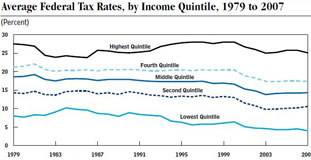
Tax
Demagogues Are Lying Liars, in One Graph. From just this one graph, several observations can be
drawn. The most obvious observation is that the higher your income, the greater your federal tax rate
is. Taxpayers in the top quintile paid about 25% of their income in federal taxes, while those in the
bottom quintile paid about 5% in 2007. The rate for the top quintile has been very steady for the last
thirty years: about 25%.
Obama figures he can just lie.
A polite word for what President Obama is being with his claims about millionaires and taxes is "disingenuous."
A more straightforward term would be lying. Neither the Associated Press nor the Wall Street Journal called
him that yesterday, but both reported the facts that the President is grossly and willfully distorting.
Presidential prevarication. Not that there was ever any
doubt, but the Associated Press ran the numbers on President Obama's soak-the-rich tax scheme, and guess what?
The president's a fibber. The news agency culled figures from a number of key authorities — like
the IRS and the nonpartisan Tax Policy Center — and demonstrated conclusively that top US earners pay far
higher rates than other folks. And foot a wildly outsized portion of the federal tax tab.
Where leftist Democrats thrive, businesses do not.
Illinois
among worst states to do business: Survey. Taxes and high costs were among the factors that contributed
to the state's poor showing in the survey. California was deemed to have the worst business climate, followed by
New York and Illinois. Illinois recently increased its income tax rate, which has prompted several companies,
including Chicago-based CME Group, to consider leaving the state.
Where leftist Democrats thrive, sensible people pack up and leave.
A
Tragic Tale Of Two States. Increasingly, the "I Love New York" sentiment is being replaced with
"I Leave New York." In the past decade, about 1.6 million New Yorkers — most of them
from the New York City metropolitan area — moved to other states. That represents 8% of the
state's population, the biggest exodus from any state, according to an analysis by the Manhattan Institute.
Compare and contrast that to Texas, ranked first among best states to do business in the Chief Executive survey.
IRS
Data Show Most Millionaires Pay Taxes at Higher Rate Than Middle Class. Data compiled by the
nonpartisan Tax Policy Center show households pulling in more than $1 million pay about 29.1 percent
of their income in federal taxes. By contrast, households making between $50,000 and $75,000 pay about
15 percent.
Obama digs up dead
tax hikes. Once again, Barack Obama proposes to raise job-killing taxes on a weakening economy,
one that has all but stopped growing under his 1930s-style policies. In a confused presidency whose policies
have zigged and zagged more times than the stock market, Mr. Obama can't seem to decide what his policy should
be, changing its direction and its prescriptions from one year to the next or, more aptly, from one political
strategy to another as his job-approval polls have continued to plunge.
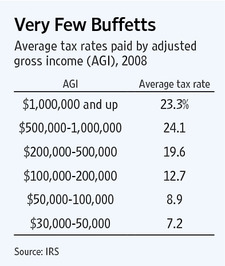
The rich don't pay lower average tax rates.
The Buffett
Alternative Tax. Washington has repeated nearly every economic policy mistake of the 1930s in
recent years, so why not repeat one of the bigger blunders of the 1960s too? We refer to President Obama's
proposal yesterday for a new "Buffett Rule" to raise taxes on Americans earning more than $1 million a
year. This may sound familiar to readers of a certain age, because it is how the current, and much-hated,
Alternative Minimum Tax was born.
Obama is right. The
cold, hard truth is that the rest of America — the poor, the lower-middle class, the unions and the
government employees have to pull more of the load. The reality is that Mr. Obama's voters get a free ride
as a bribe to vote, support and contribute to the president. Yes, we need more "fairness." The
problem is that Obama voters — those doing the most protesting and complaining — are the ones who
need a refresher course in the definition of "fair."
Playing
Robin Hood isn't leadership, Mr. President. According to the latest data from the Tax
Foundation, a nonpartisan research group in Washington, the top 1 percent of taxpayers made 20 percent
of all income in the United States and paid 38 percent of all income taxes. Meanwhile, the bottom
50 percent of taxpayers made 13 percent of all income and paid just 3 percent of all income
taxes. Even more revealing is the fact that the top 5 percent earned 34.7 percent of the
nation's gross adjusted income and paid nearly 60 percent of all federal individual income taxes.
In short, our tax code is steeply progressive already.
The Stealth Wealth Tax.
The stealth wealth tax may be the single-largest tax ever imposed on the American people, yet virtually no one
knows about it. What is particularly unconscionable about this tax is that it has been imposed upon the
most responsible citizens and the elderly in a most disproportionate way, and the real tax rate on American
savers has soared to record levels.
Media Myth Debunked:
Millionaires
Don't Pay Less Tax as Percent of Income Than Lower Earners. As President Obama trots out his new
"Buffett Rule" to raise taxes on millionaires, the media are predictably assisting his efforts by spreading
misinformation about the wealthy paying less taxes than lower wage earners as a percent of income. 2009
tax figures recently released by the Internal Revenue Service thoroughly refute this assertion.
Obama's Recipe for Tax
Disaster. President Obama's "Buffett Tax" proposal to change the nation's tax laws may sound
seductively reasonable. Ensuring that nobody earning over a million dollars a year pays a lower
percentage than the middle class sounds like justice. The truth, however, is that — no matter
how well-packaged it may be — Obama's proposal is a nasty bit of class warfare that will destroy
jobs, drive investment out of the economy, and harm the middle class, and it is certain to raise far less
revenue than predicted.
Back to the Future: Part III.
Ninety years ago — in 1921 — federal income tax policies reached an absurdity
that many people today seem to want to repeat. Those who believe in high taxes on "the rich"
got their way. The tax rate on people in the top income bracket was 73 percent in
1921. On the other hand, the rich also got their way: They didn't actually pay
those taxes.
The Statist
Dictionary: Tax Expenditure. If your earn $1,000, and the Statist is
able to tax only $300 of that from you for the government to spend, the other $700 of your
earnings that you are allowed to keep is viewed as a Tax Expenditure, meaning they could
have taken it as well. And wish they had.
The Democrats'
Invincible Ignorance. If you Google the words "Who pays income tax?" you will find
a chart from the National Taxpayers
Union. It includes these telling statistics: The top 1% of income earners pay 38% of all
federal tax revenue. The top 5% pay 59%. The top 10% pay 70%. The top 25% pay 86%.
The top 50% pay 97.3%. Conversely, the bottom 50% pay merely 2.7% of all federal tax revenue.
As the data shows, the rich are certainly paying their fair share. In fact, they pay the vast
share. The poorest Americans, conversely, pay literally nothing in income taxes.
Ratio
Of Takers To Givers Reaches A Tipping Point. In America, nearly half of wage earners
pay not one single dime in federal income taxes. Many of them trudge down to the local polling
place or vote via absentee ballot — and vote themselves a raise.
Ten Thousand Commandments 2011.
Thanks to the bailouts and other amplified spending, CBO projects a FY 2011 deficit of a previously
unthinkable $1.48 trillion, greater than FY 2010's actual deficit of $1.294 trillion.
With the unveiling of the 2012 budget, President Obama projects an even larger FY 2011 deficit than CBO
does: $1.645 trillion. This figure will be the largest deficit since World War II,
at 11 percent of the entire U.S. economy.
Top 10 Tax-Unfriendly States for Retirees.
If you are lucky enough to contemplate retirement in these tough economic times, keep in mind how much of your
hard-earned money you will have to fork over to the government. With a nod to Kiplinger's "Money Power,"
which compiled the rankings, here are the Top 10 Tax-Unfriendly States for Retirees, which are ones, for the
most part, predominated by liberalism.
The Link
Between Cigarettes and Income Taxes. Fifty-one percent of Americans currently pay no federal
income taxes... none! This does not mean that they do not pay any taxes at all. They pay sales tax,
property tax, and perhaps other local taxes. However, like those who do not pay pay cigarette taxes,
these 51% pay nothing in federal income taxes. Simply put, if you pay zero percent in income taxes and a
politician talks of the need to increase taxes, he or she is nearly always talking about increasing the percentage
rate of those already paying taxes. If I pay no income taxes, I don't care if tax rates are increased.
Obama
Administration Blames the Messenger. The Democrats had their spokespeople on the Sunday
[8/7/2011] TV news programs to respond to the S&P downgrade of U.S. sovereign debt, and to provide the
talking points we can now repeat from memory. ... The New York Times had its short list of suggested
tax increases in an editorial Sunday: income tax rates for everybody, capital gains rates, a
new value-added tax, a new carbon tax, higher gasoline taxes, and eliminating all the tax loopholes
for corporations and wealthy individuals.
This is where "negative income tax" comes from.
Reaganomics
Vs. Obamanomics. Newt Gingrich's Contract with America adopted a child tax credit of
$500 per child that reduced the tax liabilities of lower income people by a higher percentage than
for higher income people. President Bush doubled that credit to $1,000 per child, and made it
refundable so that low-income people who do not even pay $1,000 in federal income taxes could still
get the full credit.
Progressives
and Their Taxes Kill Cities. High taxes are bad for cities. Low taxes encourage growth.
In fact, between 1980 and 2007, compared to the ten most-taxed metropolitan areas, America's ten least-taxed
metropolitan areas experienced three times faster population growth, 2.7 times faster employment growth,
and twice as great an increase in personal income.
Democrats
Are Obsessed With Raising Taxes. The House-passed spending control plan rejected by the Senate
is exactly what Republicans were elected to do last November. The president's obsession with tax increases
repudiates the will of the people.
Bachmann's
Right: All Should Pay Taxes. She was responding to a questioner at a meeting given by the South
Carolina Christian Chamber of Commerce who told Bachmann that part of the deficit problem was that some major
U.S. corporations were paying "very few dollars of federal income taxes, if any." Turning the question
in a slightly different direction, former federal tax attorney Bachmann replied: "Part of the problem is
(that) today only 53% pay any federal income tax at all, 47% pay nothing."
No,
Americans Don't Want Higher Taxes. Four of five Americans are "sold" on higher taxes to solve the
deficit impasse, according to President Obama. Either he's deceiving himself or he completely misunderstands
how the public really feels.
Class warfare,
Obama-style. President Obama is pushing for what he calls a "reasonable proposition" of tax
increases mainly on those families with incomes of $250,000 or more. "We weren't balancing the budget
off of middle-class families and working-class families," he said last week. "And we weren't letting
hedge-fund managers or authors of best-selling books off the hook." Left unsaid was that the top
10 percent of earners are already on the hook for around 70 percent of total income taxes, and the
bottom 50 percent pay next to nothing. If "fairness" was as important to liberals as they say it
is, they would be seeking balance by raising taxes on the low end of the income scale.
Read Obama's lips:
More new taxes. The White House is fighting hard to resolve the debt-ceiling crisis with a deal that
raises taxes to maintain elevated spending levels. Republicans need to understand that compromising on taxes
would be disastrous, possibly guaranteeing President Obama's re-election in 2012. We found ourselves in a
similar situation 21 years ago.
Cat
Owners Hiss at Licensing Proposal. Should cats be treated like dogs, when it comes to licensing and
immunization requirements? The San Diego city auditor's office recommends doing just that — for the
sake of health, safety and "cost recovery" for taxpayers.
A Stealth Tax Hike.
The White House wants Republicans to agree to tax increases that no one wants to call tax increases, and for
an insight into this political method let's focus on one proposal in particular — the phase-out of itemized
deductions for upper-income taxpayers. We hope the tea party is paying attention, because this kind of
maneuver is why people hate Washington.
Give Americans
an income-tax vacation. President Obama wants to raise taxes dramatically. What is the
GOP answer? "Let's keep taxes where they are." ... Here's the problem: Mr. Obama is a socialist
who wants to raise taxes and punish business owners; the alternative is the GOP, which wants to keep things
where they are or nibble around the edges, at best. Neither is the right answer. That puts
America in a lose-lose scenario.
Taxpayers Win Three Times Over in
Defeat of S. 782. The U.S. Senate voted 51-49 today [6/21/2011] against proceeding to final
passage of S. 782, a bill which would increase spending on a Great Society-era community activist
government slush fund.
A New
Paradigm for the Left? More and more people believe that government exists not just to
perform essential services as delimited in the Constitution, but as a grand equalizer of economic
outcomes. It's one thing to argue that those who earn more should pay a higher percentage of
their earnings in income tax. But it's a completely different idea to suggest that the government
should use the tax code and other legislative schemes not just to ensure sufficient revenues to operate
the government, but to more equitably distribute people's remaining income — or, possibly,
assets.
Democrats' Tax-And-Spend
Insanity. You have to wonder who's advising Democrats these days. With the economy
stuck in a two-year, Obama-dug rut, their only new economic growth idea is to raise taxes and hike federal
spending.
All
liberal debt plans raise taxes to historically unprecedented levels. This January Peter G.
Peterson Foundation paid six think tanks $200,000 each to produce long-term budget plans that would reduce our
nation's debt. Today all six plan were revealed. ... The six tanks are the American Enterprise Institute,
the Bipartisan Policy Center, the Center for American Progress, the Economic Policy Institute, The Heritage
Foundation, and the Roosevelt Institute Campus Network. All but the only conservative groups in the mix
(Heritage and AEI) call for raising taxes to levels unprecedented in American history.
Taxes are the Number One Household Expenditure
in Canada. As a single household expenditure most Canadians are paying more to maintain their
governments than they are paying for their housing. According to 2009 data published by Statistics
Canada, average annual household expenditures in Canada for personal income taxes exceeded shelter costs.
How Will States Tax
Internet Downloads? Congress May Decide. Here's an interesting conundrum, posed by Representative
Dennis Ross (R-Florida), at a House Judiciary subcommittee hearing held on Monday: "Imagine you are
sitting in Dulles airport in Virginia, waiting for a flight back to Florida," Ross began in his opening
remarks. "You download a music file from Apple, which is headquartered in California. The music is
sent to you via a server in Oklahoma." Which of these states should be allowed to tax the sale?
The Editor says...
I think I see where this is headed: A federal sales tax for the internet.
Superficiality: A necessary part of
liberal-progressive-socialism. Liberal-progressive obsession with "taxing the rich" is
another example of superficiality, or more often today, mendacious political posturing.
Democrat-Socialists tell us that we can cover government's gigantic spending deficits simply by repealing
Bush-era tax cuts. The fact is, of course, that taxing 100% of income from "the rich" would cover
only a small fraction of present and mandated future deficit spending.
A
"Third Income Tax" To Fund Public Education? California, with an average statewide unemployment
rate of over 12% (in some regions the rate is over 20%) and a budget deficit of somewhere between $10 and
$15 billion, is considering the imposition of a third income tax. The additional income tax rate
would vary, according to which region of the state one lives in, and would be imposed directly by school
districts and county governments. Many of California's public school districts (there are over
1000 of them) are themselves broke, just like the state government.
That's about what you should expect if
you live in California.
Property
Taxes: an ATM for the Government. Congratulations to citizens of North Dakota, fed up with
taxation and have raised the necessary number of signatures to place a measure abolishing property taxes on
the ballot. The voter initiative needed 27,000 signatures. 28,000 signed the petition.
The Satellite Tax: Bad for Texas
Consumers. Two prefiled amendments to HB 3790 would impose a new tax on ALL Texans who
purchase video/cable services. There are three problems with this proposed new "satellite" or subscription
video services tax. First, it is a new tax on consumers in a state where they already pay some of the
highest telecommunications taxes in the country. The average Texan with a landline telephone, cable, and
cell phone pays $318 per year in taxes.
Punishing the producers.
The hypocrisy of the president is the only transparent thing I have seen come out of the Obama administration.
President Obama has been campaigning and giving speeches declaring how rich people need to shoulder more of
the tax burden. What the president doesn't say is that rich people already pay the lion's share of the
federal tax burden and that almost 50 percent of Americans (mostly Obama voters) pay no federal
income tax.
The Gas Price Freakout.
Mr. Obama usually begins his gas price narrative, now a campaign trail staple, by explaining that there aren't
easy solutions. That's true — there's not a lot the political class can do to change gas prices
in the short run — but then the President goes on to mention that there happens to be one easy
solution: raising taxes on the oil and gas industry. This is also his stock answer on the budget
deficit, world hunger and everything else.
There's
No Fairness in Taxing E-Sales. On the homepage of his US Senate website, Illinois Democrat Dick
Durbin invites visitors to learn about his record of "Looking Out For Consumers" by protecting them "from
excessive fees and predatory practices." Alas, the senator's concern for the welfare of consumers
goes only so far. Indeed, he is poised to introduce legislation that would subject millions of
American consumers to "excessive fees" they have long been sheltered from: sales taxes on their
online purchases.
Tax
Day And The Future Tyranny Of The Non-Taxed. Ah, April 15th! I want you to
consider that the date means absolutely nothing to 47% of US households as they will pay zero in federal
income tax. Yes, state, property and sin taxes still get them, but we are seeing a disturbing trend
towards a tipping point where fewer than half of us pay any sort of income tax.
A nation of sponges:
Nonpayers
Complicate Republican Effort At Overhaul of U.S. Tax Code. More than 45 percent of U.S.
households won't owe federal income taxes for 2010. That stems from decades of tax cuts and, in the
minds of some Republican lawmakers, it's also a problem. Policies designed to ease the tax burden of
lower-income Americans and offer targeted tax incentives have pushed millions of people off the income tax
rolls. That has bolstered an argument that these households don't have enough of a stake in the
political system because they don't pay income taxes.
It is impossible to "soak the rich"
enough to pay for Obama's level of spending.
100 Percent Tax on
Those Earning $500K or More Leaves U.S. With $839B Deficit. When he presented his plan for
dealing with the national debt last week, President Barack Obama suggested a number of ways he would like
to increase taxes on people he referred to as "millionaires and billionaires." However, recently
released statistics from the Internal Revenue Service indicate that taxing away 100 percent of the
income of every American who earned $500,000 or more in 2009 would still have left the United States with a
massive annual deficit.
Taxes On Everything.
As Americans scramble to file their taxes, the second-ranking Senate Democrat plans legislation to tax
cyberspace. Liberals seem willing to tax anything that moves — and even some things that don't.
Obama: Message Received, I'll Raise Your Taxes.
It didn't take Barack Obama long to receive the message sent by Friday's historic budget deal. He knows
what America really wants is higher taxes.
Here Comes the Odometer Tax.
The odometer tax would add yet another layer of taxation to the gasoline tax, the annual license plate fee,
the county road and bridge fee, the federal tax on tires, and the cost of your annual state inspection sticker.
U.S. Census
Bureau request alarms Tulsa County Assessor. Buried deep in the bowels of the Patient Protection
and Affordable Care Act is a provision to impose a 3.8% tax on real estate transactions. Proceeding
without regard to Federal Judge Roger Vinson's ruling that the health care law is unconstitutional the Obama
administration appears to be pushing ahead with implementation of the real estate tax scheme. The Tulsa
World reports that County Assessor Ken Yazel has come under fire for comments made last month during the Tulsa
County Republican Convention. Mr. Yazel told the convention that the U.S. Census Bureau had asked his
office for information that he believed could be used to help create a data base for collection of a 3.8%
real estate sales tax. The steadfast assessor isn't backing down from his statement.
Suspend the
gas tax. Republicans should demand the immediate suspension of the 18.4-cent federal
gasoline tax and, at the state level throughout the nation, the suspension of the additional 30-cent
average local tax. When gas prices drop again — likely not for several years —
the taxes should resume. All told, federal, state and local excise and sales taxes account for
almost 50 cents of the price of gasoline at the pump.
No
State Will Ever Go Broke So Long as It Can Raise Your Taxes. Neither individual states nor
the federal government will ever literally go bankrupt. That is because governments have a backup
plan that is not available to any family with a mortgage or college loan: it can confiscate as much
of the income of its citizens as it needs to keep itself going. With this mindset, a state need never
face up to the reality of budgets that are out of control due to generous benefits packages given to already
well-paid government employees, as well as pork-barrel spending aimed at boosting the popularity of politicians.
Confiscate
Americans' Wealth to Pay Government Workers? Even the most jaded of true-believers on
the Left knows that confiscating the wealth and taxing what they consider to be unjust income would
be self-defeating. What could be done one time can never be repeated and there would be no one to
create jobs or a higher standard of living for the overall citizenry, particularly those on the left
side of the ruling class. A cursory study of the experiences in the Soviet Union, Mao's Red
China and Cuba among others reveals that government control of the means of production and wealth
creation is a massive failure.
CBO Sees
Benefits in Taxing Motorists Based on Miles Driven. A new Congressional Budget Office
study says taxing motorists based on the number of miles they drive would be a fair and "efficient"
way to charge motorists for the real cost of using the nation's highways. "Vehicle-miles traveled"
taxes (or VMT taxes) also would provide a strong incentive for people to drive less.
The Cheesehead
Rubicon. In 2008, 56 percent of Wisconsin voters supported Barack Obama for president.
In 2009, Wisconsin's Democratic governor and Democratic Legislature passed legislation that raised taxes and
fees by about $1.2 billion over three years. State lawmakers approved the bill on the very day it
was introduced, with no public hearing. Remember that.
Capitalism
is Peaceful, Socialism is Force. Government wealth redistribution is force, plain and simple.
It's not a power authorized by the United States Constitution, and it's never moral. It's the principle of
the thing: Initiating force against another is always wrong. When you form an army, a police force
and build jails to house people who don't obey you, and you threaten this loss of freedom (including death,
should you try to escape) for not giving up a portion of your money to others, then this is force.
And it's wrong.
Top 5 silliest state tax hikes.
If you own a vacation home in New York, consider yourself a resident. ... Last month, a New York court ruled
that a New Canaan, Connecticut couple's income is subject to New York state taxes because they own a vacation
home on Long Island. Even though they visit the home only a few times a year, it will cost them an additional
$1.06 million in taxes — merely because the court ruled that the home was inhabitable year-round.
Could
the UN Tax Your Airplane Seat? Almost certainly because of the failure of US Congress to
enact carbon legislation and the debacle in Copenhagen last December, the proposal from [Nicholas] Stern
is for the UN to be the revenue raiser. The UN has been mentioned for the first time as the vehicle
to raise $100 billion per year to fight climate change. This departure from past plans is so
outlandish, so far out of any authority that the UN has ever claimed on member states, that it would lend
credibility to the pronouncements of not just right-wing radio talk show hosts but the most radical phobias
of world governance expressed by fringe groups.
The 'Your
Money Is Not Yours' Crowd. One branch of American politics shares [Paul] Krugman's
view that the money you earn — the material manifestation of your mental and physical
labor — is not yours. It belongs to the government. This view was recently
on display when some referred to the extension of the Bush tax rates as "tax cuts." With tax
cuts, taxpayers pay lower rates. With an extension of tax rates, taxpayers keep paying the
same rate. Extending the Bush tax rates prevented tax rates from going up. Nobody got
a tax cut.
Save Us From the Intellectuals.
Extending Bush tax cuts for those making $250,000 or more would not be a giveaway. We're not talking
about the government's money, but money earned by individuals. Only leftists believe that all income is
the property of the state and that the amount remaining after income taxes is a gift from the government to
the individual. Moreover, the tax rates we're discussing have been in place since 2003. To extend
those rates would not be a cut. To fail to extend them would constitute a tax increase.
Save Us From the Intellectuals.
[Scroll down] Extending Bush tax cuts for those making $250,000 or more would not be a giveaway.
We're not talking about the government's money, but money earned by individuals. Only leftists believe
that all income is the property of the state and that the amount remaining after income taxes is a gift from
the government to the individual. Moreover, the tax rates we're discussing have been in place since
2003. To extend those rates would not be a cut. To fail to extend them would constitute a tax
increase.
Md.
bill would create sales tax on gasoline. Democratic leaders in the Maryland Senate are
proposing a new sales tax on gasoline — roughly equal to $2.16 per tank — with a bill
that would steer one-quarter of the revenues from Montgomery, Prince George's and Baltimore counties to the
jurisdictions' billion-dollar light rail projects. Maryland currently charges drivers a fixed 23.5-cent-per-gallon
tax on gasoline. Tacking on a sales tax would not affect the state's per-gallon rate, but instead
would tie any tax increases to the cost of gas.
No Such Thing as Carbon
Neutral. If you can't stop yourself from driving your car, cooking in your kitchen, heating and
cooling your home, exhaling CO2, then 'They' will charge you fees you can't afford. 'They' have set up
unelected local authorities through the EPA who have no accountability to voters and who will decide who uses
what resources to 'their' ends. To insure your submission and compliance with 'their' vision of utopia,
'they' will place Smart meters on your home, GPS devices in your car, tax you for your non-compliant
appliances, take away your incandescent light bulbs, tax your airline flight, tax your tickets to
entertainment venues, tax and cut your water usage, tax your hair-dresser, tax your nail salon, tax your local
deli, tax your (exhale CO2) dry cleaner, anything that does or doesn't move. 'Their' will be done on
earth.
Houston's
'Rain Tax' Could Swamp Property Owners. A new "rain tax" that voters in Houston narrowly
approved in the November general election could add thousands of dollars of fees to some properties.
The so-called Proposition 1 "rain tax" applies a minimum fee on all property in the city limits without
exemption for churches, schools, charities, or senior homeowners. Supporters sold the fee as a means to
improve drainage and reduce flooding in the city, but opponents say it is a tax and grab.
The Editor says...
How can the citizens be taxed as a result of rainfall? In Houston, rain is an every-day event over
which the taxpayers obviously have no control.
Rep. Bachmann: Tax
Bill Violates Article 1, Section 7 of U.S. Constitution. Rep. Michele Bachmann (R-Minn.) told
CNS News that the tax bill passed by the Senate on Wednesday [12/15/2010] violates the U.S. Constitution.
"Article 1, section 7 says that all revenue bills originate in the House and that is our province
and, of course, this originated in the Senate," she told CNS News in an interview Wednesday [12/15/2010]
on Capitol Hill.
Stealth Socialism.
Under the scheme envisioned by ObamaCare, in which insurers would be obliged to cover all comers, a medical
policy would no longer be insurance — that is, a contract to indemnify the policyholder against
risk. It would instead be, as [Justice Department lawyer Ian] Gershengorn describes it, a "financing
mechanism" for medical services. As Suderman points out, because participation would be mandatory,
the "premium," and not just the penalty for failure to pay it, would effectively be a tax.
'Temporary' Tax
Code Puts Nation in a Lasting Bind. Welcome to the world of the temporary tax code. In
the late 1990s, there were typically fewer than a dozen tax provisions that had just a limited lease on life
and needed to be renewed every year or so. Today there are 141.
Who
Owns Us? Congress? Or Ourselves? Do farmers and businessmen have a right to congressional handouts?
Does a person have a right to congressional handouts for housing, food and medical care? First, let's
ask: Where does Congress get handout money? One thing for sure, it's not from the Tooth Fairy or
Santa Claus, nor is it congressmen reaching into their own pockets. The only way for Congress to give
one American one dollar is to first, through the tax code, take that dollar from some other American.
It must forcibly use one American to serve another American.
A
Rate Which Lives In Infamy. President Calvin Coolidge famously said that the chief business of the
American people is business. Now it seems that the chief business of Congress is to make sure American
businesses are taxed at a punitive rate.
Leasing Your Life From The State.
One of the many beneficial side effects of driving Democrats out of power is that they become more open about
their beliefs when they're panicked. Such a moment came on Megyn Kelly's Fox News program on Wednesday
[12/8/2010], when Congressman Anthony Weiner (D-NY) freaked out over the estate tax. ... This is one of the
purest expressions of reflexive Marxist impulse in recent memory. You don't own anything in the
mind of the Democrat Party. It all belongs to the State, and it always did. You are allowed
to keep what our wise and benevolent masters decide to let you keep, and when you die, they're entitled to
take it all back.
Uncle Sam Makes a Killing.
Our representatives in Washington, D.C. are about to use the votes we gave them with our votes to sign a death
warrant. They will condemn to death any frail elderly people worth more than five million dollars who are
within range of the tender ministrations of their heirs, particularly if they are dependent invalids.
Estate Tax Row Exposes Marxist Hatred for Capitalism.
Liberals, especially those in Nancy Pelosi's House, are reportedly violently angry about President Obama's
"deal" with Republicans which sets the estate tax at 35% for estates valued at over $5 million dollars.
Moonbats wanted a 45% tax to kick in for estates valued over 3.5 million.
Democrat
economics borrowed from Marx. The Democrats lack a winning platform on estate taxes —
work hard, save, invest and after death, Uncle Sam gets half. Why would anyone in their right mind put
any effort into work or take any chances on starting a new business if they knew half was going to the
government? It shows hard work and risk-taking isn't all it's cracked up to be. Democrats
don't realize that unlike the Joe Kennedys of this world, children might not keep accumulating wealth.
Net Neutrality:
Treating the Internet Like a Utility. The FCC's proposed power grab could end up sticking you
with a usage-based internet bill, costing many of us high-volume users our employment. ... The problem
commences with who gets to regulate the Internet. The usual suspects in Washington, from Henry Waxman
(D-CA) to Federal Communications Commission Chair Julius Genachowski, are pushing for rules which would take
things in a radically different direction. Recall the "Fairness Doctrine" in radio was an FCC regulation —
not a law. What's currently being pushed as "net neutrality" is in many ways simply a fairness doctrine
for the Internet.
The Unemployment Crisis
Catch-22. The historical facts are quite clear on the subject: lowering tax rates always results
in economic growth by leaving more investment resources in the private sector, where real jobs must be created.
Lower tax rates have always resulted in increased tax revenue streams by way of economic expansion. So why are
Democrats so committed to raising taxes?
Why they call it Taxachusetts.
In Massachusetts in particular, it feels these days that if you simply sneeze you will get taxed. I suppose it is
the price you pay for living in a state that gets about two months of decent weather all year. But what I had not
anticipated, was that taxation with so little representation would become such a fine tuned art, that someone would devise
the most imaginative and creative ways to fleece a guy who simply wanted to celebrate his wedding anniversary.
The Truth Behind the Tax Cut
Lies. The biggest battle in the lame duck session of Congress may well be over whether or not to extend
the Bush administration's tax cuts, which are scheduled to expire in January. The fact that this decision has
been left until late in the eleventh hour, even though the expiration date has been known for years, tells us a lot
about the utter irresponsibility of Congress.
Financial Bigotry. The
"tax cuts for the rich" debate needs a new focus. We are missing the point of the tax debate. It is
not about taxation in a recession. The wealthy will be comparatively well-off regardless of the economic
environment. It is not about the wealthy's ability to promote job creation. Our government does not
care about private-sector growth when it considers government employment an acceptable (and even more valuable)
alternative. And it's certainly not that Republicans are in love with the rich, since households that vote
Democrat tend to have higher incomes than those that vote Republican.
Global Warming, Global Taxes.
Within 72 hours of the Tea Party's "shellacking" of Obama and Pelosi, Ban Ki-moon, the UN Secretary-General,
called for global taxation of the American public — an idea endorsed by a high-level official of
the Obama administration. Ban must not have been watching television on Election Night, because he
missed the voters' rejection of big government, higher taxes, and out of control spending. Or perhaps he
did see the results and thought it best to get his $100 billion of "climate financing" fees on the
agenda of the lame duck Congress.
The Democrats' Taxation Fraud.
One of President Obama's campaign promises was not to raise taxes on middle-class Americans. So here's my
question: If there's a corporate tax increase either in the form of "cap and trade" or income tax,
does it turn out to be a middle-class tax increase?
The Tax Man Cometh!
When the House voted to adjourn about a month ago by a 210-209 margin, Speaker Nancy Pelosi, D-Calif., and her
cronies avoided dealing with extending the 2001 and 2003 Bush tax cuts, which expire Dec. 31. Rather
than address the tax issue, the Senate also voted to adjourn. Instead, Congress is holding a lame-duck
session beginning Nov. 15. What that means is whether or not you elect them back into office, they
are poised to do what they want when they want with little election fallout.
Brass Oldies. More than 80 years
ago, the "tax cuts for the rich" argument was refuted, both in theory and in practice, by Andrew Mellon, who
was Secretary of the Treasury in the 1920s. When Mellon took office, there was a large national debt,
the economy was stagnating, and tax rates were high, though the tax revenues were still not enough to cover
government expenditures. What was Mellon's prescription for getting out of this mess? A series of
major cuts in the tax rates!
Report:
DNC repeatedly delinquent on property taxes. The Democratic National Committee and the party's
private club in the nation's capitol have been delinquent with tax payments on sixteen separate occasions over
the last seven years, Pajamas Media has learned. According to District of Columbia government records,
since 2004 the Democrats' main political committee and its National Democratic Club — an exclusive
restaurant and hideaway on Capitol Hill where prominent Democrats and their guests dine — have been
hit with fines and interest penalties in excess of $115,000 for failure to pay their property taxes on time.
Government Greed.
Those who are always accusing people in the private sector of "greed" almost never accuse government
of greed, no matter what it does.
Obama believes
your paycheck is not your own. This is an extreme concept and one that is best understood by
analyzing it personally. Everyone understands that when I "spend" money on a charity or at the grocery,
the implication is that I am using my money to make a contribution or to buy chips and beer. The President
clearly believes differently, that my paycheck does not begin its life as mine, from which taxes are taken.
Rather, he believes that my paycheck begins life as his, from which residual amounts are beneficently granted
to me for living expenses.
All
Tax Hikes Eventually Hit the Middle Class. One of President Obama's campaign promises was not to
raise taxes on middle-class Americans. So here's my question: If there's a corporate tax increase
either in the form of "cap and trade" or income tax, does it turn out to be a middle-class tax increase?
New Yorkers hit with
nearly 5% state clothes tax. Sticker shock led to rage yesterday [10/1/2010] when bargain-hunting
New Yorkers realized they were being slapped with an almost 5 percent tax hike on clothes and shoe purchases.
The Government Tapeworm.
A successful parasite must keep its host alive, finding the point where it can maximize its intake without
killing off its source of sustenance. So, too, with governments taxing their citizenry. With
taxation, governments can reach the point where higher rates produce less revenue. An academic study
found that a tax increase of just 1% of GDP causes a recession and then a permanent loss of 1.84% of GDP
compared to what it would have been without the tax increase. The results of this study have some
really broad and interesting implications.
Obama's Tax Evasion.
[Scroll down] In the liberal imagination, the money is the government's by default, and the president and
Congress determine through the tax code how much to give back to the people. Last week Obama told an audience
in Virginia that an extension would be "giving them $100,000 for people making a million dollars or more."
But this is backwards. Low taxes don't give away the government's money. Low taxes allow individuals
to keep the money they've earned through hard work, sound investment, and good fortune.
Obama Endorses Global Taxes on Eve of U.N.
Summit. In a classic case of misdirection, while the media are preoccupied with the fate of
the Bush tax cuts, President Obama is preparing to attend a United Nations summit next week to endorse "innovative
finance mechanisms" — global taxes — to drain even more wealth out of the U.S. economy.
41 Obama White House
aides owe the IRS $831,000 in back taxes. Over the years a lot of suspicion has built up across
the country about Washington and its population of opportunistic transients coming to see themselves as a
special kind of person, somehow above average working Americans who don't labor down in that monument-strewn
former swamp. Well, finally, an end to all those undocumented doubts. Thanks to some diligent
digging by the Washington Post, those suspicions can at last be put to rest. They're correct.
A Presidential Tax Cut For
Liberal Elites. President Obama likes to argue that his targeted tax cut is designed to make the
most affluent Americans assume their "fair share" of the nation's obligations. On closer inspection, it
really seems designed to exempt the liberal elites who define those obligations from as much of the burden as
possible.
This could happen here, too.
UK Proposes All Paychecks Go to the State First.
The UK's tax collection agency is putting forth a proposal that all employers send employee paychecks to the
government, after which the government would deduct what it deems as the appropriate tax and pay the employees
by bank transfer. The proposal by Her Majesty's Revenue and Customs (HMRC) stresses the need for employers
to provide real-time information to the government so that it can monitor all payments and make a better
assessment of whether the correct tax is being paid.
Your payroll taxes
go into a bottomless hole. As you've long ago learned, there's a big difference between your
salary and what you take home. For most workers, the largest deduction is for FICA. ... FICA is the
deduction for Social Security (old age, survivors and disability) and Medicare. It consumes the first
15.3 percent of your earnings. Half is taken out of your paycheck, and your employer pays the
other half. But since the employer must pay, you know it is money that might otherwise have been
available to increase your salary. So, in effect, you're paying the entire amount.
Chart: FICA rates 1937 - 2009.
Government
Believes It Has A Right To The Wealthy's Income. During his recent speech in Ohio, President Obama
made it clear his administration will soon raise taxes on those in the top marginal income tax bracket.
While not surprising given the administration's penchant for redistribution, the manner in which President Obama
made his declaration brings cause for concern: "This isn't to punish folks who are better off —
it's because we can't afford the $700 billion price tag." Not only will such tax-the-rich policy hamper
U.S. economic growth, principally among small businesses, but the statement itself is a clear indictment of the
president's broader philosophical belief: Earned income is the Government's, not the Peoples'.
Us vs. Them: The
Idle Rich vs. the Working Rich. Don't you hate those rich people who inherited all their
wealth? They were just born into privileged circumstances and did absolutely no work to earn it.
And still, that's never enough for such greedy individuals, and they constantly seek more and demand to have
everything they want handed to them. It's a bitter, craven existence, and that sense of entitlement and
wanting to just take from others does nothing but hurt this country. And if anyone deserves to be taxed
heavily in this country, it's these idle wealthy who don't deserve their riches in the first place. Lucky
for the taxman, then, there are a few hundred million of them to go after.
The
Stupid Lies Democrats Believe. [Scroll down] Here are some examples: "The rich
don't pay taxes." False. For the 2007 tax year (the latest income tax data year released by the
IRS), the top 1 percent of income earners, those making over $410,000 a year, paid 40 percent of
all federal income taxes.
Thief-in-Chief. When taxes become
involuntary, they become theft. When a majority votes for an involuntary taking of private property,
the government becomes an instrument of gang-theft.
Tax Hike Planned For Lame-Duck Session.
Liberals in Congress have a plan to raise your taxes after the elections this fall, something they must do to
continue feeding the Obama Administration's spending addiction. Watch for them to act after the midterm
elections under the cover of the report from the bipartisan National Commission on Fiscal Responsibility and
Reform. You don't need a commission to see that President Obama's policies have led to out-of-control
federal spending and a growing federal government.
Toward a coarser,
ruder culture. For earlier generations of Americans, it was absolutely none of the government's
business how much your income was, as long as you came by it legally. The 16th Amendment changed all that.
In the succeeding decades, more and more parts of our formerly private financial lives were subject to the prying
eyes of the IRS. ... Worse, though, are the effects of government redistributing our money. Contemporary
democratic politics in America has degenerated into a sordid scramble to see who can use the political process
to extract the most wealth from one's fellow citizens.
Raising Your Indirect
Taxes. There are currently two pieces of tax legislation that have been introduced into
Congress that will affect virtually every person in the United States. These new bills are very
deceptive, since they tax the chemical and petroleum industry; however, what EPA and the sponsors of the
bill do not mention is that these taxes will be passed back down to the consumer level.
Obama Commission Will Call for Trillions in Tax Hikes.
Obama debt commission member, Republican Sen. Judd Gregg of New Hampshire, launched a scary trial balloon on
ABC News. Gregg suggested the debt commission will likely recommend a massive $26.7 trillion tax
increase.
Hawaiians Loudly and Successfully
Object to Proposed Tax Increase. [Scroll down to page 8] Hawaii's General Excise Tax
(GET) is a multilevel sales tax on all goods and services, including food and medicine. Because of its
compounding nature on the gross income, receipts, or proceeds of all business activities, the GET, at a base
rate of 4 percent, is comparable to at least an 11 percent sales tax. In addition, Hawaii's
GET is more regressive than most sales taxes, as many states and local governments exempt items such as food
and medicine but the GET does not. Currently the GET rate in Hawaii is 4 percent except for the
island of Oahu, which charges 4.5 percent to fund a $5.3 billion commuter rail project for the
island.
The
Great Escape. Oregon voters decided in January that it was a good idea to raise taxes on the
wealthy to increase revenues. The result: Tax revenues are actually down. The lesson:
Envy doesn't pay.
Middle Class — Not the Rich or the
Poor — Pay Majority of Federal Taxes. Middle-class Americans — not the
rich or the poor — pay the majority of annual tax revenues taken in by the federal government,
according to data released in a new Congressional Budget Office study. Households earning less than
$34,300 per year, meanwhile, actually pay a negative average federal income tax rate.
Plastic
Bags: Untapped Tax Gold Mine? Only one US city — Washington, D.C. —
has successful instituted a plastic bag tax, but at least 13 other states are considering one. In
its first month, the 5-cent bag tax brought the city about $150,000. Revenues have increased each
subsequent month, reaching $226,000 in May, and totaling $942,000 from January through May. The funds
have all gone towards efforts to clean up the Anacostia River, which runs through Washington.
The Left and Progressively Higher Taxes.
Liberals have a very amorphous definition of fairness, and a very ambiguous definition of who should pay them.
That is something that should leave us all very nervous. How much, for how long, and to what end should
taxes be paid? The left can not answer these questions. If they were to be honest, they would
admit they have never even considered them. Still they are unshaken in their certitude of "fairness:"
a progressive tax system.
Democrats'
budget plan: Tax and spend more. House Majority Leader Steny Hoyer said Tuesday [6/22/2010]
that Democratic congressional leaders have opted not to propose a budget this year. "It isn't possible
to debate and pass a realistic, long-term budget until we've considered the bipartisan commission's
deficit-reduction plan, which is expected in December," he said. This means Congress won't pass an
annual budget plan for the first time since enactment of the Budget and Impoundment Control Act of 1974.
Democrat 'Suicide Bombers'.
[Scroll down] Let's just think this through, which the Democrats obviously haven't. Both the
Cap-and-Trade bill, and a VAT imposition, would raise taxes on everyone in the country. ... These new taxes
are not the type that can be withheld from a paycheck, or tacked discreetly on everyone's phone bill.
They are the type that will be paid every day. They will be paid at the gas pump. They will be
paid at the checkout line in every store in the country. They will be paid every single day.
Death tax
cometh. The federal death tax may be coming for more New Yorkers, a well-placed Capitol
Hill source tells The [New York] Post. The tax will jump to 55 percent next year on all estates
valued at $1 million and up — unless lawmakers can reach a compromise to raise the
threshold amount or cut the rate, or both.
Checking
Chumps. Hollering about "fairness," Democrats vowed to punish U.S. banks by passing new laws to
micromanage their businesses. As a result, free checking may soon be dead. So who's really paying
for all that "fairness"?
Dick
Durbin's Dastardly Plan for Your Debit Card. While you were preoccupied with the oil spill, the
Middle East crisis, the unemployment rate, and everything else in the news, the Senate has been trying to slip
a fast one by you. This time, it has to do with your everyday purchases that you make on your debit
cards. ... The amendment would make the Federal Reserve Bank dictate debit card "interchange rates."
In Canada:
New
eco fees catching consumers by surprise. Checking her receipt as she left a downtown Canadian
Tire, Chris Colorado noticed a new charge. Her $1.99 bottle of dish soap was accompanied by a 13-cent
"eco fee." The levy for thousands of new products, from pharmaceuticals to fire extinguishers, quietly
came into effect July 1, the same day as the harmonized sales tax.
Low Taxes Are an American
Tradition. Except in times of war, the effective tax rate imposed by all levels of government
in the U.S. seldom rose above 5 percent prior to 1916. During the past century, unfortunately, the
U.S. has moved far away from the low-tax views of the Founders. Today, total tax burden stands at
31.6 percent of personal income, with the national government imposing a tax burden of 21.0 percent
and state and local governments imposing an additional 10.6 percent. The typical taxpayer must
work 116 days a year just to pay his taxes.
Five ways Obama may tax you to pay for the government's 'reinvention
of journalism'. Translated, "reinvention of journalism" is codespeak for "Repeal the First Amendment's
prohibition on Congress doing anything to abridge the freedom of the independent press to find and report all of the
facts about what politicians, bureaucrats and their allies in the private sector are doing, are planning on doing,
did in the past, or are thinking about doing to the rest of us and with our tax dollars.
Fix Is On by Obama
and Congress in Union Fight. [Scroll down] To fund his reordering of power in the midst of
a steep economic downturn, Obama has signed into law 25 tax increases totaling $670 billion over the
next ten years, according to a report issued by the House Ways and Means Committee. And Paul Volcker and
Nancy Pelosi — reacting to the reality that increased income taxes cannot save the country from going
broke — are pushing a Value Added Tax, the most pernicious of levies that will empower the IRS to enter
places of business unannounced to demand records and enforce compliance.
Big
Spenders, Cronies Stack Budget Watchdog. President Obama's National Commission on Fiscal Responsibility
and Reform is supposed to come up with ways to slash the budget deficits and shrink a public debt expected to hit
$20 trillion at the end of this decade. But its chief purpose is to propose a laundry list of new taxes
to pay for Obama's costly vision of a far bigger government than we have now, and to give him and the Democrats
political cover while they continue to spend our money like there's no tomorrow.
Fee! Fie! Foe! Fum!
Creepy
Pennsylvania Tax Agency Ad Goes Big Brother. A threatening TV commercial appearing in Pennsylvania
has residents of the state spooked by its "Orwellian" overtones, and critics are calling it a government attempt
to scare delinquent citizens into paying back taxes. In the 30-second ad, ominous mechanical sounds whir in
the background as a satellite camera zooms in through the clouds and locks onto an average Pennsylvania home.
12 Taxes in Health Care Law Violate Obama's Pledge.
As many as a dozen taxes in the new health care law violate President Barack Obama's campaign pledge not to raise
taxes on families earning less than $250,000 and on individuals earning less than $200,000. At least seven of
these taxes directly affect health consumers regardless of income, such as the individual mandate to buy insurance,
the employer mandate, the tanning tax, and limits and penalties on health savings accounts.
The
Global-Warming Tax. Never has a public-policy agenda been pursued with so little regard for
scientific fact or public opinion. In March, 48 percent of Americans agreed that global warming,
while real, is exaggerated. When Gallup first asked this question in 1997, only 31 percent thought
the threat exaggerated. Despite this shift in sentiment, Sens. Lindsey Graham (R., S.C.) and John Kerry
(D., Mass.) and President Obama insist upon ramming a new global-warming tax (called a "fee") through the
Senate.
'If you
tax them, they will leave'. [New Jersey Governor Chris] Christie has a powerful motive for not
sugarcoating the state's troubles. His program is radical, at least for New Jersey. He wants to
slash $10.7 billion from a 2011 budget projected at $38 billion, reduce taxes, cut regulations, and
privatize enterprises such as the state-owned TV network and parking garages.
Obamacare
will make every day feel like April 15th. New taxes on investments, taxes on medical supplies,
taxes on drugs and health insurance, and taxes on you if you are just breathing... the list of taxes Americans
will face just got a lot longer thanks to ObamaCare. The health overhaul plan just enacted represents
the largest tax hike in U.S. history — $569 billion over 10 years through a dizzying
array of taxes and fees that promise to frustrate taxpayers at every turn.
More
about the high cost of Obamacare.
Lower and
Simplify Taxes! It's that joyous time of year: income tax time. So I spend time with
my accountant. I don't want to see him, but I must. I could not do what he's doing. The tax
code has grown so complex that today most Americans hire someone to do their taxes.
Emergency Bill to Close Tax 'Loopholes' Includes
$46 Million Tax Loophole. A bill titled "The American Jobs and Closing Tax Loopholes Act of
2010" that will add $115 billion to the federal deficit between now and October 2011, and that the
Democratic leadership intends to push through Congress before they leave for their week-long Memorial Day
recess, includes a special $46 million tax loophole for Hollywood movie and television producers.
The President is delusional.
Obama 'amused'
by Tea Party rallies. President Barack Obama struck a hyperpartisan note Thursday [4/15/2010],
telling Democrats that he was "amused" by the Tax Day Tea Party rallies. Obama, addressing a Democratic
National Committee (DNC) fundraiser in Miami, did little to endear himself to the Tea Party groups protesting
around the country, saying "they should be saying thank you" because of the tax cuts he has signed into law.
How Dumb Does He Think They Are?
Does Obama seriously not understand that most voters — not those who show up for his rallies, but
voters of normal competence — are well aware of the tax increases in Obamacare, the tax increases
in cap and trade, the tax increases when the Bush tax cuts expire next year, and the looming VAT tax that will
impact every American family?
Obama's new tax on... Rainwater!?
Would President Obama's Environmental Protection Agency really force Americans to pay a tax on "rainwater
runoff" from homes and small businesses? You bet they would. In fact, the EPA, under radical
environmentalist Lisa Jackson, is proposing regulations to do just that.
Why
70 Million Americans Don't Pay Uncle Sam a Dime. While you struggle to meet your deadline,
consider that although the law requires you to file a tax return, more than 70 million of your fellow
filers will not owe a single penny to Uncle Sam. As the latest news from the non-partisan Tax Policy
Center shows, a record 47 percent of tax filers will have no federal income tax liability this year.
Redistributing Our Earnings To
Freeloaders. Income tax day, April 15, now divides Americans into two almost equal classes:
those who pay for the services provided by government and the freeloaders. The percentage of Americans
who will pay no federal income taxes at all for 2009 has risen to 47%. That isn't the worst of it.
The bottom 40% not only pay no income tax, but also the government sends them cash or benefits financed by the
taxes dutifully paid by those who do pay income tax.
Fair Tax Distraction.
Every April, as the due date for individual income tax returns rolls around, I watch for two inevitable events.
One is reports of various U.S. attorneys all across the nation issuing indictments for tax fraud. The typical
targets are local citizens prominent enough to make sure that the story gets media attention just before the annual
peak in filings. The other is articles promising a quick political fix to the labyrinth known as the Internal
Revenue Code and the entire industry that has grown around it. The most commonly proposed solutions being
promoted are some variation on a flat tax or a national sales tax.
Nearly
half of US households escape fed income tax. Tax Day is a dreaded deadline for millions, but
for nearly half of U.S. households it's simply somebody else's problem.
Obamacare Violates Obama's Pledge Not to Increase Taxes.
As many as a dozen taxes in the new health care law violate President Barack Obama's campaign pledge not to
raise taxes on families earning less than $250,000 and on individuals earning less than $200,000. At
least seven of these taxes directly affect health consumers regardless of income, such as the individual
mandate to buy insurance, the employer mandate, the tanning tax, and limits and penalties on health savings
accounts.
Opposing An
Intolerable Act: The history of the United States begins with a rebellion against unfair
taxation. ... The punishment for that first Tea Party was a series of intrusive laws so oppressive that
they were described as the "Intolerable Acts." ... Obamacare is today's "Intolerable Act." It too
should be opposed and repealed.
Internet
taxation is on the way. The Obama Era has become a protracted, nightmarish Whack-A-Mole
game of tax increases and bureaucratic self-enlargement. In sector after sector of American life,
another scheme to expand government and wrench more earnings from Americans' pockets pops up. Its
next targeted sector? The Internet.
The
Coming Tax Rebellion: There is widespread understanding that the American people cannot win back
control of their government until the federal tax system is either repaired or ripped out by the roots and
replaced.
Obamacare Dystopia.
[Scroll down] In one of a bazillion little clauses in a 2,000-page bill your legislators didn't bother
reading (because, as Representative Conyers explained, he wouldn't understand it even if he did), Congress
voted to subject the 28 percent tax benefit to the regular, good, ol', American-as-apple-pie corporate tax
rate of 35 percent. For the purposes of comparison, Sweden's corporate tax rate is 26.3 percent,
and Ireland's is 12.5 percent. But just because America already has the second-highest corporate tax
in the OECD is no reason why we can't keep going until it's double Sweden's and quadruple Ireland's.
The ObamaCare tax hike that loses five times what it brings in.
We turn to the Wall Street Journal for the math on what it will cost to raise taxes on corporations' retiree
prescription drug coverage. This is the provision that has caused several corporations to take markdowns
recently. The bottom line: by closing this "loophole" — which was originally created to
dissuade companies from dumping retirees' prescription costs into Medicare Part D — the government
could lose more than five times what it brings in.
States may hold onto tax refunds
for months. Residents eager to get their state tax refunds may have a long wait this year:
The recession has tied up cash and caused officials in half a dozen states to consider freezing refunds, in
one case for as long as five months.
A
Misleading Sales Pitch. [Scroll down] The FairTax sounds too good to be true.
It is. The campaign for the FairTax is deeply misleading, and much more likely to set back the
cause of tax reform than to advance it. The FairTaxers give a misleading answer to the first question
everyone asks about their idea: How big will the tax be? The FairTaxers say they want a
23 percent sales tax. Most people will assume that a product that costs $100 before the tax is
added would cost $123 with the tax. Actually, the tax would be $30 and the total price $130.
They call it a "23 percent" rate because $30 is 23 percent of $130. ... It is not at all clear
that this 30 percent sales tax would raise enough revenue to eliminate income and payroll taxes.
Politicians Smother Cities.
Cleveland, once America's sixth-largest city, has been going downhill for decades. Why do some cities thrive
while others decay? One reason is that some politicians smother their cities with the unintended consequences
of their grand visions, while others have the good sense to limit government power. In a state that
already taxes its citizens heavily, Cleveland's politicians drown businesses in taxes.
Charging
residents for calling 9-1-1? As if California taxes weren't exorbitant enough the town
of Tracy, California, hoping to generate "extra revenue while it suffers a $9 million budget
deficit," is requiring residents to "pay every time they call 9-1-1 for a medical emergency."
Obama Endorses New Wealth Taxes,
More Drugmaker Fees. President Barack Obama, seeking to break an impasse over health-care
legislation, proposed a plan that includes the first Medicare tax on capital gains and higher fees on
companies such as Pfizer Inc. and Merck & Co. to help cover millions of uninsured Americans.
The
United States of Argentina: Obama's Pension Grab. Barack Obama's money train has steamrolled
uncontrollably across the country, compiling record-breaking budgets, deficits, and debt along its path.
Now, the train is running out of fuel, and the nation's retirement money may find its way on board, to keep
the train on the tracks.
Class Warfare's Next
Target: 401(k) Savings. You did the responsible thing. You saved in your IRA or
401(k) to support your retirement, when you could have spent that money on another vacation, or an upscale
car, or fancier clothes and jewelry. But now Washington is developing plans for your retirement savings.
Goodbye 401(k)
Administration Advances
Plan to Federalize Private Pension System. In February, the U.S. Treasury and Labor departments
jointly announced they were seeking public comment on proposed design changes to employer-sponsored 401(k)
plans and individual retirement accounts that would centralize the private pension system under structures
created and administered by the government.
Beware of Congress's
Threat to Tax 401Ks. With the bear market red in the claw, with an equal opportunity bear market taking out
solid stocks right and left, with panicked investors feeling like every headline is an explosion, comes this impenetrable
stupidity: Some Democrats in Congress have held hearings that included discussions of new proposals to tax
401K money. Specifically, the idea would be to eliminate most of the $80 billion in annual tax breaks
that 401(k) investors receive. Which means a nearly $80 billion tax hike.
Targeting Your 401(k). You
may have heard about Argentina's plan to nationalize private retirement accounts. Some Democrats on
Capitol Hill are inspired, and with their big election victory they may get the chance to test Peronist
ideas in America.
Killing 401(k)'s?
It's still more than two months before the Obama administration takes office, and we are already seeing signs
of just how the Democrats intend to govern. One proposal being floated by Congressional Democrats aims
to abolish the tax incentives for individual 401(k) retirement plans. With the recent financial meltdown
having hit a lot of people's funds heavily, those lawmakers think that the time would be ripe to end the
private system and fold it into an expansion of Social Security.
Retirement Fund Trillions
Lure Government Grabbers. Is the government making plans to confiscate your retirement money?
The Obama administration is certainly exploring the idea. This question no longer seems far-fetched when
the group-thinkers in Washington unabashedly promote a doctrine of wealth redistribution and central planning.
These Keynesian socialists know they will need vast new sources of revenues to fund their relentless spending
binges to "transform" this nation. A logical next step would be to legitimize the confiscation of private
retirement assets — an idea that was contemplated in the recent past by the Clinton administration.
Irish
Government Raids Private Pensions To Pay For Spending. The Irish government plans to institute
a tax on private pensions to drive jobs growth, according to its jobs program strategy, delivered today.
Without the ability sell debt due to soaring interest rates, and with severe spending rules in place due to
its EU-IMF bailout, Ireland has few ways of spending to stimulate the economy. Today's jobs program
includes specific tax increases, including the tax on pensions, aimed at keeping government jobs spending
from adding to the national debt.
Private
Pensions For Public Spending. Ireland says it will seize parts of its citizens' private pensions
so politicians can spend more — a truly awful idea that may be coming to a government near you. Ireland?
Surely, it can't happen here, you say. But it can. Indeed, governments at both the state and federal
level have moved more than once to seize all or part of the money you've saved for retirement.
When the Chips Are Down, All
Democrats Are Liberals. [Scroll down] Second, the Obama tax pledge — no
tax hikes on families making less than $250,000 — has been eviscerated by the bill. There
are no less than seven categories of taxes on the supposedly non-rich and they are not insignificant.
Unlearned Lessons.
Last week, the Newark Star-Ledger reported that New Jersey lost $70 billion in wealth over the past five
years. The reason? Affluent people have moved to states with a lower tax rate or no income tax
at all. The findings are from a study conducted by the Center on Wealth and Philanthropy at Boston
College, the first study on interstate wealth migration in the country.
Deer
hits car, 'crash tax' hits driver. [Scroll down] The Westchester resident suffered only
minor injuries, a few cuts and scrapes from the damaged windshield. What hurt far more was a $350 bill
from the Glenside Fire Protection District, a fee critics refer to as a "crash tax." Locklin, a nurse
who was on her way to work at nearby Glen Oaks Hospital, said emergency crews arrived quickly. Locklin
said she declined treatment and signed a waiver at the scene. Weeks later she was billed by the
Glenside Fire Protection District.
Obama and the Government
Employees: [Scroll down] Meanwhile, Big Brother, like many big brothers, has become a bully.
The Internal Revenue Service is on a hiring binge to crack down on taxpayers; fees on candy, plastic bags, iPod
downloads, sugar, and many other things that make life fun are going up and up; our tax rates are inflating; and
studies show that there has even been an explosion in parking tickets and fines for every picayune sort of
"violation" that the bureaucrats can dream up in all their spare time — phantom taxes, they have
been called. The leviathan must be fed.
Obama
Begins His Assault on Your Life Savings. The welfare state and your life savings are two cars heading down
a one-lane road in opposite directions. One must yield, or there will be a crash. For Americans who believe
in the old-fashioned virtues of hard work, self reliance and respect for private property, the solution is obvious.
The welfare state must yield. For politicians who believe in the welfare state and redistributing wealth, the
solution is equally obvious. Your savings must yield.
Nutter proposes 2-cent-per-ounce sweet-drink tax.
[Philadelphia] Mayor Nutter wants to treat the city's weight and wallet problems in his 2010-11 budget
with the same remedy: the nation's highest tax on all sweetened beverages including soda, energy
drinks, ice tea, even chocolate milk. Nutter's plan would put Philadelphia at the front of the
movement to tax sweet drinks, an effort that the beverage industry already opposes and that could
encounter resistance in City Council.
What
'population control' really means: Again and again I see examples of people voting to the left
of their actual convictions. ... The classic case is "tax the rich." Very few people are in favour of
having their own taxes raised, or their own spending regulated. But if a politician will assure them
that he is going to put taxes up on everyone above a certain income, he is sure to generate some enthusiasm
among those below it.
What Obama and the Media Aren't Telling You about Taxes.
Even if Barack Obama does adhere to his income tax plan, his promise that he won't raise taxes on the common man
is still a lie. A continual theme of the Barack Obama campaign has been his vow that no one making less
than $250,000 a year would get a tax increase. Now he has provided more details, pointing out that to
qualify for a tax cut you must earn less than $200,000. Then, on Tuesday, Joe Biden said during an
interview that tax breaks should go to "people who make $150,000 a year." My, my, when Obama said he
was the candidate of change, he never mentioned that it applied to figures and campaign promises.
The Secret Plan to Pass a
Global Tax. With President Barack Obama attacking "fat cat bankers on Wall Street," left-wing
non-governmental organizations (NGOs) see a great opportunity to pass a global tax on financial transactions
that could generate at least $700 billion a year from the U.S. and other "rich" countries. They are
expecting Obama's support.
List of Taxes Proposed to Pay for
Health Care Reform. The U.S. Senate recently released its long-awaited proposal for
a government-run hostile takeover of the entire U.S. health care system. Predictably, it
includes a barrage of higher taxes to pay for the bill's immense price tag. [They include]
• A value-added tax, which would tax the value added to a product at
each stage of production,
• An excise tax on sugar-sweetened beverages including non-diet soda and sports drinks,
• Higher taxes on alcoholic beverages including beer, wine, and spirits,
• A tax on individuals without acceptable health care coverage of up to 2.5 percent of
their adjusted gross income.
Obama's 2011 budget will include phantom cap-and-trade
revenue. A trade publication is reporting this afternoon [1/29/10] that President
Obama's 2011 federal budget proposal will assume receipt of billions of dollars in revenue generated
from the cap-and-trade program even though that proposal appears now to be all but dead in Congress.
Cash-strapped
states avoid word 'taxes'. Faced with severe budget shortfalls after a steep economic recession,
state legislatures and governors are trying to raise money without raising taxes — at least not
technically. A fee hike, an increased penalty or fine, the elimination of a tax exemption —
none of these technically counts as a tax increase, as far as many state lawmakers are concerned.
The Quarter-Percent
Solution? The sponsors of HR4191 are either so naïve as to have no conception of the
operations of modern-day financial markets — and of the competitiveness which makes a single basis
point a crucial cost advantage — or, more likely, so callous as not to care. They see an
opportunity to curry favor with a poorly informed electorate by trashing Wall Street while at the same time
placing within their grasp trillions of dollars of future tax revenues to secure future political advantage.
War Against
the Wannabe Rich. There is class warfare going on in this country — but it's not
against the established rich. It's against those who are trying to become wealthy. President
Obama has declared that those who make over $200,000 will pay higher income taxes. Caps on payroll
taxes are supposed to come off as well for the upper class. Envisioned estate taxes will take 45 percent
of individual inheritances valued over $3.5 million. Many states have also hiked their income
taxes on the upper brackets.
Liberal Economic Illiteracy: It
doesn't matter one iota that there have been three major tax cuts initiated by three different
presidents since the 1960s — and every one of them resulted in increased revenue flowing into
federal coffers. It doesn't even matter that the largest one was passed, not by a Republican president,
but by Democrat John Fitzgerald Kennedy.
Socialism's Greatest Lie: Government
Can Give You Everything for Free. The idea that the government will take care of you is appealing,
entire nanny states have been built on that proposition. But the government can't take care of you, it
can't even pay its own bills without you. It can't run a television station, a toll bridge or even an
off track betting service, or any venture that in private hands would be profitable, without using taxpayer
funds to prop it up. A legitimate enterprise never needs to fool its customers into thinking that they
will receive something for nothing. It is only the scammers that need to do that.
States hike taxes and
fees to cover budget shortfalls. Speeders doing more than 85 miles per hour in Georgia
will soon pay an additional $200 in fines. Racehorse owners in New York now must fork over $10 to enter
their steeds in events. And Massachusetts started charging a 5% tax on broadcast satellite service.
These measures are part of a record $23.9 billion in tax and fee hikes and $7.7 billion in other
revenue increases enacted by states in fiscal 2010, according to a report released this week.
California
Stealin'. Desperation grabs for revenue are nothing new in politics, but California is once
again leading the way in creative financing. To help close yet another gaping budget deficit, now
estimated to be $7 billion this year and reach as high as $20 billion next, Sacramento lawmakers
have authorized a 10% increase in the amount of taxes withheld from worker paychecks starting November 1
and through 2010.
Time to Bury the
"Death Tax". Kevin Hancock simply wants to harvest trees — sustainably —
and create jobs in the process. The federal government may put a stop to all that. His business,
Hancock Lumber, has been in the family for six generations. It owns 30,000 acres of Maine timberland
and employs 550 people. But Kevin already knows that when his elderly mother dies, he'll have to
sell off huge swaths of his land to pay the ensuing tax bill.
How Do You Measure Integrity?
The term "kleptocracy" is applied to a government that extends the personal wealth and political power
of its own officials and the ruling class via the embezzlement of state funds at the expense of the
wider population, sometimes without even the pretense of honest service. That sounds pretty
close to what we have in America today.
Obama's false 'stimulus'. President
Barack Obama has little interest in, understanding of or affection for free markets, so he fails to understand that
the fundamental relationship between government and the economy is that of parasite to host. ... [Although] government
can consume wealth and redistribute wealth, it can't create wealth. And unless wealth is created, there is
nothing to consume or redistribute. That's why — even when government is doing something
we all agree must be done or most of us want to have it do — government is a parasite. All
it has is what it takes from the producers of wealth.
The Income Tax and Government
Spending. In 1913, We the People amended the Constitution to allow the federal government to punish "the
rich" by seizing from them wealth the government did not need. The government, as Reagan said, quickly found a
way to spend that wealth on its priorities, without the consent of those who actually created it. And so it has
gone, from that day to this, with ever more spending, ever more taxing, and an ever-growing national debt.
A Tax To Grind. The average tax
rate assessed to corporations worldwide has fallen 10 years in a row, but the U.S. isn't driving the trend.
Policymakers in the most advanced economy continue to punish their constituents.
American
Idea. [Scroll down] Article I, Section 8 of the Constitution
grants Congress the power to tax and spend for the enumerated activities therein. Every
American is duty bound to pay his share. Congress has neither constitution nor moral
authority to take the earnings of one American for the benefit of another American. What
do you think will happen to you if don't comply, say with Congress' demand that part of your
earnings be taken to bail out a failing business? You'll see all the brute force that you
want to see and if you resist too much, death is not off the table.
Democrats
and Job Creation ... or Not. I wonder what level of unemployment Democrats need before they
start considering actual rate cuts. A cut in the payroll tax would stimulate the economy instantly by
cutting the cost of employing people. Is that really too hard to understand?
Progressives Back Obama Push for
Global Tax. While policymakers debate a few million dollars for ACORN and a few hundred billion dollars more
for health care reform, those committed to one-world government are moving ahead with plans for a global tax that could
extract trillions of dollars out of Americans' already depleted IRAs and stock holdings. One can't exclude the
possibility of such a tax being slipped into a health care or cap-and-trade bill that the Congress or the public could
not have time to read before passage.
Liberals never learn.
Michigan is an economic basket case. As noted in the Wall Street Journal, the Democratic governor pushed through a
tax increase on business in 2007. This is standard liberal practice — pretending that a tax on
business has no effect on the taxpayer.
Don't Increase Federal Gasoline
Taxes — Abolish Them. Many experts believe that gasoline taxes should be increased for a variety
of reasons. Their arguments are unpersuasive. Oil is not disappearing, and when it becomes more expensive,
market agents will substitute away from gasoline to save money. The link between oil price shocks and
recessions, although real in the 1970s, has been much more benign since 1985 because of the termination of
price controls. Market actors properly account for energy costs in their purchasing decisions absent
government intervention. Pollution taxes, congestion fees, and automobile insurance premiums more
closely related to vehicle miles traveled are better remedies for the externalities associated with automobile
travel than a simple fuel tax. Gasoline consumption does not necessarily distort American foreign
policy, impose military commitments, or empower Islamic terrorist organizations.
In Praise of
Lobbyists. Raising taxes on the overseas profits of American firms has been a central plank
of Barack Obama's agenda since his campaign for President in 2008. ... The U.S. is one of the few developed
countries that even tries to tax corporate overseas profits. Most operate on a territorial system, in
which business profits are taxed in the country in which they are earned.
Transfer Machine. The
theory of government I was taught says that government provides benefits, primarily security, to the entire population.
In return we pay taxes. But lately the government has been a distributor of special privileges, taking money from some and
giving it to others. America is now about evenly split between those who pay income taxes and those who consume them.
47%
will pay no federal income tax. Most people think they pay too much to Uncle Sam, but for
some people it simply is not true. In 2009, roughly 47% of households, or 71 million, will not owe
any federal income tax, according to estimates by the nonpartisan Tax Policy Center.
Court clears suit to affirm voluntary Medicare, Social Security. A
federal judge has cleared the way for consideration of a class-action lawsuit in which plaintiffs — including
former House Majority Leader Dick Armey — are asking for a ruling upholding an existing law that declares
participation in Medicare and Social Security to be voluntary, not compulsory.
Let's
do some detective work. Today's White House proposes and Congress taxes
and spends for anything they can muster a majority vote on. My investigative
query is: Were the Founders and previous congressmen and presidents, who could
not find constitutional authority for today's bread and circuses, just plain stupid
and ignorant?
Getting
back our liberties: We all have a moral obligation to pay our share for
constitutionally mandated functions of the federal government, but we have no such
obligation to have Congress take the earnings of one American and give them to another
American. Forcing one American to serve the purposes of another is one way
slavery can be defined.
Revenge of the Golden
Goose. As taxes increase, and inflation brings bracket creep, expect tax avoidance and
outright tax cheating to soar in America. President Obama's "soak-the-rich" economic populism grows
increasingly obvious and the initial promise of no tax increases for those earning less than $250,000 is
clearly history. Soon-to-arrive inflation guarantees tax bracket creep so today's "middle-class"
$200,000 a year family will soon earn a quarter of a million with no jump in spending power while mandatory
health insurance enrollment, cap and trade induced higher energy costs, increased regulatory burdens, among
other Obama policies, will be new de facto tax increases.
Land Of The Fee. To keep
ObamaCare alive, Montana Democrat Max Baucus has proposed a Rube Goldberg scheme of fees and fines on insurers and the
uninsured designed to forcibly bring everyone into the loving and protective arms of the nanny state. To help
finance his Plan B, Baucus would impose annual fees of $6 billion on health insurers, $4 billion on
medical-device makers, $2.3 billion on drug manufacturers and $750 million on clinical laboratories, among
other taxes.
Baucus Healthcare Revenue
Options: This report is from May 20, 2009. Nevertheless, it is still revealing what means the
Senate Finance Committee and Mr. Baucus are considering to pay for their healthcare reform plans.
Paying for
Obamacare. Much of the discussion to date about health care reform has understandably
focused on the contents of the reform plan itself. But with the plan expected to cost $1-1.5 trillion
over the first ten years, an equally important question is how the president and congressional Democrats plan
to pay for it. While we won't know for certain until we see the final bill, it looks like the answer is
going to be higher — much higher — taxes. And many if not most of those taxes will
fall squarely on the middle class.
More about
Socialized medicine.
Congress, president overstep authority.
A president has no power to raise or lower taxes. He can propose tax measures or veto them but since Congress can
ignore presidential proposals and override a presidential veto, it has the ultimate taxing power. The same
principle applies to spending. A president cannot spend a dime that Congress does not first appropriate.
As such, presidents cannot be held responsible for budget deficits or surpluses. That means that credit for a
budget surplus or blame for budget deficits rests on the congressional majority at the time.
Taxing Off A Runway. Hard to say
which is worse. From the U.S., the Democrat-led Congress is mulling the misnamed "Travel Promotion Act" to hit
travelers with a $10 tax for visiting the U.S. under the visa waiver program. High-spending Europeans will take
the hit. The aim? To promote more tourism through a "nonprofit" company staffed by political cronies and set up
to buy advertising. From the U.K., a government advisory Committee on Climate Change is recommending a $10 tax of
its own on every airline ticket sold. The purpose here is to compensate Third World countries for global warming,
turning every business trip into a guilt trip.
Smoke gets in your ice.
Many Americans find the debate in Washington over adopting a "cap-and-trade" program to reduce carbon dioxide
a bit confusing. That's understandable. Put simply, it's a tax on energy consumption. In fact,
it would be a huge tax. If enacted, cap-and-trade would be one of the government's largest revenue sources
within the next decade. It also would break one of President Obama's promises. In his speech before
Congress in February, he said, "If your family earns less than $250,000 a year, you will not see your taxes
increased a single dime." Unless you use energy, apparently.
Brace
yourself for higher taxes. President Obama had said in September, 2008: "I can make a firm
pledge. Under my plan, no family making less than $250,000 a year will see any form of tax increase.
Not your income tax, not your payroll tax, not your capital gains taxes, not any of your taxes." This
pledge has already been broken, at least with respect to federal tobacco taxes. But the White House has,
until very recently, maintained the fiction that the promise is still in effect with respect to the taxes
everyone pays. Then, in a television appearance on Sunday [6/28/2009], White House advisor
David Axelrod refused to re-commit to Obama's pledge.
More about President Obama's numerous
flip-flops and broken promises.
The U.S. Treasury — A Once and
Everyman's Oyster. Not having access to their own money press, our elected bandits are relegated
to stealing money from the sweat equity of citizen taxpayers who must send checks into the treasury each year.
That and the automatic collection of taxes from virtually any known transaction creates enough chump change for
them to fight over at the end of each year; the latter coming from the Accounts Receivable Tax, Building Permit
Tax, CDL License Tax, Cigarette Tax, Corporate Income Tax, Dog License Tax, Federal Income Tax, Federal Unemployment
Tax (FUTA), Fishing License Tax, Food License Tax, Fuel Permit Tax, Gasoline Tax, Hunting License Tax, Inheritance
Tax, Inventory Tax, IRS Interest Charges (tax on top of tax), IRS Penalties (tax on top of tax), Liquor Tax,
Luxury Tax, Marriage License Tax, Medicare Tax, Property Tax, Real Estate Tax, Service charge taxes, Social
Security Tax, Road Usage Tax (Truckers), Sales Taxes, Recreational Vehicle Tax, School Tax, State Income Tax,
State Unemployment Tax (SUTA), Telephone Federal Excise Tax, Telephone Federal Universal, Service Fee Tax,
Telephone Federal, State and Local Surcharge Tax, Telephone Minimum Usage Surcharge Tax, Telephone Recurring
and Non-recurring Charges Tax, Telephone State and Local Tax, Telephone Usage Charge Tax, Utility Tax, Vehicle
License Registration Tax, Vehicle Sales Tax, Watercraft Registration Tax, Well Permit Tax, and a Workers
Compensation Tax. Not sure who first pulled this perpetual tax list together, buy my taxpayer sense
tells me it's accurate.
The Editor says...
I can think of a few omissions right away. Even after your income is taxed by the IRS, you
pay sales tax on everything you buy. That's double taxation. Here in Dallas, the annual
license plate fee is accompanied by a County Road and Bridge Fee (which is what I thought the
gasoline tax was for). Most cities in Dallas County have a one-percent sales tax for the
mass transit system. Then there is the federal excise tax on new tires, and the "disposal fee" for
your old tires. I've never had to pay it, but there is also a gas guzzler tax on large vehicles.
Completing this list is left to the reader as an exercise.
Driving Taxes Upward:
During the presidential campaign, Barack Obama endeared himself to many voters with a promise that 95 percent
of Americans would get a tax cut. Those making under $250,000 "would not see a single dime of tax
increase — not on anything." Yet since Obama's victory, spending has skyrocketed. It
was only a matter of time before his pledge fell by the wayside.
More examples of
Obama's flip-flops and broken promises.
Tax Man's Target: The Mobile Phone.
The use of company-issued mobile phones could trigger new federal income taxes on millions of Americans as a "fringe
benefit," spurring efforts by the wireless industry and others to kill the idea. The Internal Revenue Service
proposed that employers assign 25% of an employee's annual phone expenses as a taxable benefit.
The IRS Phones Home.
With federal spending in 2009 at 28% of the economy and deficits heading north, Democrats are eyeing tax increases on
everything from soft drinks to electricity to health benefits to charitable contributions. But the palm for creativity
goes to the Internal Revenue Service, which is contemplating a new tax on the use of business cellphones.
Once Considered
Unthinkable, U.S. Sales Tax Gets Fresh Look. With budget deficits soaring and President Obama pushing
a trillion-dollar-plus expansion of health coverage, some Washington policymakers are taking a fresh look at a
money-making idea long considered politically taboo: a national sales tax.
Here Comes the Internet Tax.
What is the single modern invention most responsible for enhancing peoples' freedom and standard of living across the
world? Arguably, it is the Internet. Yet, Democrats from revenue-starved states and Congress are proposing
to make it less free by taxing Internet commerce. (Content regulation should be coming soon to a screen near you.)
This should not come as a terrible surprise. After all, the Internet was just too good, too free, too easy,
too innovative, and too favorable to small businesses for government to stay away.
Tax
Increases, Coming To A Theater Near You. In only 100 days and change, President Barack
Obama has committed $6.5 trillion to waste, fraud and abuse. That's $6,500,000,000,000.00, which is
more than all the costs of World War I and World War II combined. And you think it can't get
worse? Believe me, IT CAN. Things have gotten so bad that, even in my home state of
California, a Republican governor, Arnold Schwarzenegger, is urging support for a massive $16 billion tax
hike which is deceptively masquerading as a measure to put a lid on out-of-control government spending.
You read that right: A massive tax-hike — Proposition 1A — is being
peddled to the people as a measure to control spending.
Deferral: Why You Should Care. President
Obama proposes to increase taxes on American companies — already the second highest-taxed in the world —
by eliminating the deferral of double taxation on income earned abroad. ... Obama's proposal is a terrible idea that will
damage our economy and cost American jobs.
Voting with Their Feet.
New Hampshire has discovered a good way to boost its economy during these troubled times. Unfortunately,
it's not a solution that lends itself for application elsewhere. It involves having one's state located
next to another state that is being run by economic idiots.
Entitlements
crisis? No problem, just raise taxes. As things now stand, according to the trustees, Medicare's
Part A will run out of money for reimbursing hospitals for elderly care in 2017, while the Social Security
shelf goes bare in 2037. Spending on the two programs exceeded $1 trillion last year and is now
increasing at an annual rate that will double it in 2050. With Barack Obama determined to add trillions
in new health care and social welfare spending, there is simply no way — short of slashing benefits
for the old and infirm — for the government to generate sufficient revenues to cover its promises
without massive tax increases on productive, working Americans.
A clear violation of the 4th amendment:
Workers coming
inside to assess a home's worth. Don't look now, but that could be the Norfolk real estate assessor at
your door. Not content with merely taking a gander at the exterior of your abode, and factoring in building
permits and sales of comparable houses, Deborah Bunn and her lieutenants want to snoop around inside to determine
your castle's worth.
Soak the Rich, Lose the Rich.
With states facing nearly $100 billion in combined budget deficits this year, we're seeing more governors than
ever proposing the Barack Obama solution to balancing the budget: Soak the rich. Lawmakers in
California, Connecticut, Delaware, Illinois, Minnesota, New Jersey, New York and Oregon want to raise income
tax rates on the top 1% or 2% or 5% of their citizens. New Illinois Gov. Patrick Quinn wants a 50%
increase in the income tax rate on the wealthy because this is the "fair" way to close his state's gaping
deficit.
Hail the tea bag, weapon of
terror. "Tea-bag parties" erupted — and "erupted" is the correct verb — across
the country on April 15, celebrated by joyous "progressive" taxpayers and loathed by everybody else as
the day to report the intimate details of your life, along with cash, to the Internal Revenue Bureau (which
the bureau insists that we call not a bureau but a "service"). Bureau or service, it's run by bureaucrats,
not servants, and always the target of April ire.
Prosperity Lost.
If a tax is levied on a corporation, and if it is to survive, it must raise the price of its product, or lower dividends
or lay off workers. In each case, it is people, not some legal fiction called a corporation, who bear the burden
of any tax levied on the corporation. An important subject area in economics called tax incidence says that the
entity upon whom a tax is levied does not necessarily bear the burden of the tax. Some of the tax burden can be
shifted to another party. That's precisely what corporations do and as such they are merely government tax
collectors.
Prescription
for Poverty. Barack Obama's press conference last night claimed economic recovery is
"inseparable" from a proposed budget that offers charity for none, malice toward many, and debt for
generations to come. In a conference replete with bad ideas, his most egregious proposal is reducing
tax deductions for charitable donations. Currently, those in the top two tax brackets can deduct
33 and 35 percent of charity, respectively.
Doubling Down on
the Welfare State. The good news is that, according to the Obama administration, the rich will
pay for everything. The bad news is that, according to the Obama administration, you're rich. You
may be surprised to discover you're rich, especially if you're broke.
The Tax Story Media Invariably
Bury One of the assertions that the media make most often about the U.S. economy is that President Bush's
tax cuts didn't do what he promised. But the data clearly show nothing could be farther from the truth.
What other subjects are
being avoided by the news media?
How Democrats Make Millionaires.
Even in these hard economic times, Democrats across the nation are working on plans that will turn some of you into
instant millionaires. There's only one catch. You're not actually going to be bringing in a million-dollar
income. ... To pay this ["millionaires'"] tax, you won't have to make anywhere near a million dollars. If
you make even $300,000 a year, the cash-strapped Empire State will consider you a millionaire.
Oregon Governor Proposes Increasing Taxes, Fees. The
2009 Oregon legislative session opened with a call from Gov. Ted Kulongoski (D) for $2 billion more in
taxes and fees. The $2 billion would come mainly from three sources, according to the governor's
proposal. One proposed source is a $1 billion per biennium tax increase through a 2 cent
increase in the gasoline tax and big increases in vehicle registration fees (200 percent), title
fees (100 percent), and license plate fees (100 percent).
Dems
Use Homestead Exemption to Avoid Taxes. Democrats love taxes. So much so that Joe Biden claimed
paying higher taxes is a patriotic act, which must make April 15 some kind of utopian version of Flag
Day. The problem is that Democrats don't like paying taxes. Over the past several weeks we've
learned enough to make the words "Obama Cabinet" and "taxes" a running punchline.
Parking
meter rate hike sparks a rebellion. I spent last week staring at parking meters. And wondering if
I was witnessing the beginnings of a boycott. Boycott is probably too strong a term. Quiet rebellion may be
more like it. ... What's up is that a month ago, when the City of Chicago privatized parking meters, rates were
immediately jacked way up, and you now have to feed 28 quarters into the meter to park a car in the Loop for
two hours. In exchange for a 75-year lease, the city got $1.2 billion to help plug its budget holes.
There's tax revolt in the air. Long
ago, if you wanted to put on a good taxpayer revolt, you marched in the streets, waved flaming torches, and maybe
dumped a load of British tea into the harbor. Today, you go on the "John and Ken Show."
Is All "Fair"
With the Obama Agenda? [Scroll down] The richest of the rich in 2006 paid nearly double the
proportion of their income in income taxes. Such a disproportionate burden makes it tough to argue that
the tax system is rigged to benefit the rich. Perhaps more striking is the burden placed on the 13.8 million
earners who represent the top 10 percent of Americans. In 2006, the top 10 percent earned almost half of
all the income (47.3 percent) but paid a full 70.8 percent of all income taxes. Put differently,
13.8 million taxpayers paid almost three-quarters of the entire income tax bill in 2006.
Democrats Introduce
Retroactive Tax Increase. Taxes for [Connecticut]'s wealthiest residents would rise retroactively
under a new plan unveiled Thursday [4/2/2009] by Democratic legislators. The current highest rate on the
state income tax of 5 percent would increase to 6 percent for couples filing jointly who earn more than
$250,000 annually.
Senate
Democrats to scrap Obama's $400 tax credit. A top Democrat in the Senate announced a budget
blueprint Tuesday that would scrap President Barack Obama's signature tax cut after 2010 and blends sleight
of hand with modest restraint on domestic programs to cut the deficit to sustainable levels. Senate
Budget Committee Chairman Kent Conrad, D-N.D., promises to reduce the deficit from a projected $1.7 trillion
this year to a still-high $508 billion in 2014.
Taxpayers consider cheating. The
high-profile tax missteps of three of the Obama administration's key nominees could make it more difficult for the IRS to
enforce the law, tax preparers and academicians say. Numerous studies have shown that taxpayers are less likely to
comply with the law if they believe other taxpayers are cheating, says Jason Mazzone, associate professor of law at Brooklyn
Law School. "Taxpayers don't like to be suckers," he says.
US Companies Pay the
Highest Taxes in the World. American businesses, large and small and across all industries pay
from 35% to 41.6% of their income in combined state and federal taxes. The 41.6% maximum rate is
scheduled to rise to 46.2% in 2010 when President Obama's promised tax increases are implemented.
Package
stimulates socialism, not economy. According to Scott A. Hodge, president of the Tax
Foundation, Exxon-Mobil paid or remitted $29.3 billion in taxes in just the first quarter of 2008,
almost three times the net profits the company earned for its shareholders. Government benefits
more from Big Oil than Big Oil shareholders do. But it doesn't stop with Exxon-Mobil. Take the
taxes Wal-Mart, Ford Motor Co., Coca-Cola, and then the thousands upon thousands of other businesses across
the nation pay. Then factor in the income taxes collected on the salaries they pay, everybody's property
taxes, the sales taxes and on and on. In other words, for 2008 the various federal, state and local
governments collectively took in $4,925,500,000,000 (that's just under $5 trillion) in taxes.
Talk of state's 'millionaires' tax' expands to not-so-rich.
Just how much money does it take to be rich in [New York]? What started as a debate over whether to hit the wealthy
with higher income taxes to help balance the state budget has expanded to talk of a "millionaires' tax" on households with
annual incomes exceeding $250,000. That means a tax plan originally focused on 36,000 of the state's wealthiest
residents would extend to nearly 300,000 additional households, according to 2006 state tax figures, the most recent
available.
Here's the real story behind the Tea Party Protests. "Tea
Party" protests have sprung up in multiple cities across the country since Congress passed and President
Barack Obama signed the economic stimulus bill into law as the American Recovery and Reinvestment Act of
2009. As much as I rejoice in the sight of legions of fed-up Americans taking to the streets to protest
the central government's colossal waste of the first fruits of their labors, it is important that people The
Problem With 'Nationalization' understand that the original Boston Tea Party was neither spontaneous nor a
mere lark.
$1 Trillion in
Taxes is Hell to Pay. Big government is back — and so are big taxes. President Obama
unveiled a mammoth, $3.6 trillion budget yesterday that would dramatically boost federal spending almost across
the board — and pay for it with tax hikes of $1 trillion on individuals and businesses over the next
decade.
Drove my Chevy to the ($4.8bn)
levy. President Obama has proposed squeezing $4.8bn out of the mobile network operators with a
levy on the spectrum for which they have already paid, or thought they had. The levy starts at $50m in
2009, rising to $200m in 2010 and eventually hitting $550m a year per company — raising $4.8bn over the
next decade, which could go some way towards addressing America's $1.7trn budget deficit.
What Will Obama's Budget Cost You? $25,573.48...
Each! Obama is about to unleash a $3.552 TRILLION budget on this poor nation. So, if we
each of us were expected to fork over our share of that tab, what would it cost us? Well, according to
Toby Harnden, blogger for the Daily Telegraph, it would amount to $25,573.48 each. I don't know about
you but, I just don't have it.
Rent car in suburbs,
pay Chicago? How would you like to rent a car in Waukegan or St. Charles, only to be slapped
with the 8 percent "transaction tax" that applies to Chicago car rentals? Brace yourself.
With a burgeoning $50.5 million budget gap, Chicago is reaching into suburban pockets. And
Enterprise Rent-a-Car has filed a lawsuit challenging the Daley administration's effort to collect the
tax from drivers who rent cars in the suburbs.
It's Time for American Freedom Fighters to Unite.
If one taxpayer refuses to pay for their Marxist spending spree, he will go to jail. However, if ten million taxpayers
refuse to pay, we have a whole new ball game here... Legitimate tax revolt organizations are popping up all over the
country in response to the massive Pelosi-Reid-Obama power grab of 2009. Two organizations worth looking into are
Freedom Works and The American Taxpayers Union. There are many others forming, so I recommend doing a little
individual research into which ones offer the highest odds of collective success.
The Editor says...
Yes, but if there were ten million people who had such strong convictions about taxes, who were willing to
organize and collectively refuse to pay up, then Obama probably wouldn't have won the election. There
are ten of millions of others who just don't care about the IRS, as long as the IRS leaves them alone.
They tax horses,
don't they? With government revenues hobbled, cities and states are dreaming up ever more exotic
excise taxes, which are targeted taxes on goods rather than on income. Chicago has a now-famous bottled
water tax. Ski lift tickets, veterinary bills, and tattoos are entering the realm of taxable commodities.
You may remember we fought a revolution over the question of the state's right to impose such taxes. Maybe
we will again.
Too Taxing. We're tempted
to say America needs a Treasury secretary who is smart enough to figure out his own taxes. But such a
cheap shot would be beneath us. Instead, we are going to make a serious point: America needs a tax
code simple enough for the Treasury secretary to figure out.
Feel like a chump?
Like all of my fellow citizens, I do not understand what is in the 65,000 or so page Internal Revenue Code that
everyone is supposed to obey. If the leaders of Congress and Treasury agree the tax law is too complex for
anyone to be able to comprehend it, and thus people like [Timothy] Geithner should not pay fines for not reporting
all of their taxable income correctly, what possible justification do they have for insisting that those who
are not politically connected (and not as well trained in tax law) pay taxes on all their income and pay fines
on errors and omissions? Does not the U.S. Constitution say all must be treated equally under the law?
Tiny Tims: Timothy
Geithner isn't the only government worker with a tax problem. According to data from the IRS
and the Office of Personnel Management, nearly 100,000 current federal employees are behind on their taxes.
Not all of them are big offenders, but they are delinquent to the tune of nearly $1 billion —
an average of about $10,000 each. If retirees collecting federal pensions and military personnel are
included, the number is about 267,000, and they owe a total of about $3 billion.
Treat
Us All Like Charles Rangel and Timothy Geithner. Longtime Texas Lt.-Gov Bill Hobby was locked up
one night for driving under the influence, but immediately released when his attorney came down to point out
the high status of the fellow. ... Ever since, Texas lawyers have been showing up to spring their inebriated
clients by exercising this previously unknown "Hobby Rule." It's standard legal procedure to this
day. ... American taxpayers could win the same get-out-of-jail-free pass, thanks to the ongoing legal saga of
my friend and colleague, Rep. Charlie Rangel (D-Harlem), and new Treasury Secretary Timothy Geithner.
Did
someone mention Congressman Charlie Rangel?
The grim tax reaper.
"Death and taxes" are often linked as life's two certainties. Yet, in the United States, there's a third
link to this — "Democrats, death and taxes" — one can always count on Democrats to levy
or maintain a tax, if it is in their power, even at death's door.
Global Taxes and Global TV Now on the
Agenda. President Obama's pick for Treasury Secretary, Timothy Geithner, is being urged
to lay the foundation for "global governance" by considering "international taxation" measures to loot
more money from U.S. taxpayers.
RINO alert!
California governor wants
to tax golf, auto repairs. In California, Schwarzenegger wants to help close a nearly
$42 billion budget deficit by taxing rounds of golf, auto repairs, veterinary care, amusement park and
sporting event admissions and appliance and furniture repairs. Democratic Gov. David Paterson in New
York has proposed levies on MP3 downloads, taxi rides, movies, concerts, sporting events, and personal
services such as haircuts, manicures and massages. Schwarzenegger's fellow Republican in Utah, Gov. Jon
Huntsman, has shelved a proposal to tax attorney and accounting services but promises to bring it back
next year.
The Editor says...
Why not tax illegitimate children, illegal immigrants, and those hubcaps that rotate backwards?
Why Does Your Devalued Home Have Such
a High Tax Rate? Are your property taxes rising while the value of your house falls? Join
the multitudes of Americans in the same predicament.
First Page Funnies. The headline
read: "Home tax won't fall very much." The article explained that, although housing costs have
fallen substantially (the word used was "plunged") the property tax will drop little, if at all. And
why not? Here's the mirth-inducer: "...news reports of double-digit drops in housing
prices are mostly irrelevant, county officials say."
Socialist Republic.
Consider what we are about to do. Bush in 2008 spent 21 percent of GDP. States, counties and cities spent
another 12 percent. Thus, one third of GDP is spent by government at all levels. Obama and Co. propose to
raise that by another 10 percent of GDP. We may soon be north of 40 percent of gross domestic product
controlled and spent by government. That is Eurosocialism.
Scrap the Code. The U.S. Tax Code has 17,000 pages of tax
regulations, 5.5 million words, many inconsistent with each other, 569 different income tax forms requirements,
billions of dollars spent on tax lawyers and accountants to understand tax regulations, and the presumption of guilt
until innocence is proven.
Benedict Arnold. Just over
five years ago, Arnold Schwarzenegger swept into power in California, vowing to crush the "spending addicts"
responsible for the state's crushing budget deficit and to thwart Sacramento Democrats who saw taxpayers as
ATMs. "The people of California have been punished enough. From the time they get up in the morning
and flush the toilet, they are taxed. Then they go and get a coffee, they are taxed. They get into
their car, they are taxed. They go to the gas station, they are taxed. ..."
States to levy a bevy
of new taxes. As a tumultuous year limps to an end, state governors are planning to deliver more
hits to our already battered pocketbooks. More taxes are coming our way. You may not recognize them
because, transparency and honesty be damned, many of them will come disguised as fees, assessments, and whatever
euphemisms can be pulled from a government thesaurus to obscure the truth.
Commission Urges 50 Percent Hike in Federal
Gas Tax. Motorists are driving less and buying less gasoline, which means fuel taxes aren't raising enough
money to keep pace with the cost of road, bridge and transit programs. A federal commission created by Congress to
find a way to make up the growing revenue shortfall in the program that funds highway repairs and construction is talking
about increasing federal gas and diesel taxes. A roughly 50 percent increase in gasoline and diesel fuel taxes
is being urged by the commission until the government devises another way for motorists to pay for using public roads.
San Francisco Studies Fees to Ease Traffic.
Following the lead of other congested cities like London and Singapore, officials in San Francisco are considering a plan to
ease traffic by charging drivers a fee upon entering notoriously clogged sections of the city. Using $1 million in
federal funds, the San Francisco County Transportation Authority is studying various "congestion pricing" options. If
approved, such pricing would make San Francisco the first American city to charge cars a fee to enter certain neighborhoods
at certain times.
'If
I had a nickel for every bag,' sez Mayor Bloomberg. Mayor Bloomberg wants to nickel and dime
you at the grocery store — taxing you an extra 5 cents for every plastic bag you take
home. The controversial charge could raise at least $16 million for the cash-strapped
city while keeping tons of plastic out of landfills, city officials said Thursday [11/6/2008] — but
some outraged shoppers aren't buying it.
15 Percent NYC Income Tax Hike
On the Way? Mayor Michael Bloomberg is going to cut the city work force by 3,000, but that's
just the beginning of the pain New Yorkers will feel as part of the fiscal crisis. A slew of new taxes
are also on the agenda. There will be 1,000 fewer cops, but the city will hire 200 more traffic agents
to give out $60 million a year in new block-the-box tickets.
One Life to
Give the IRS. This week, Democratic vice presidential candidate Joe Biden unleashed the most
absurd remark of his illustrious career, claiming that taxes are "patriotic." Biden claims that
wealthier Americans should pay more in taxes because "it's time to be patriotic ... time to jump in, time to
be part of the deal, time to help get America out of the rut." Oh, the injustice of American society!
When, exactly, did taxation transform into a form of charity?
Taxes could get sky-high with aerial
technology. A new high-tech aerial photography system that can spot an illegal porch from
5,000 feet is being marketed to tax assessors as a way to grow revenue. Pictometry International
Corp. says it offers tax assessors 12 different views of every square foot of building or land in a jurisdiction
that buys their system. They call it "sophisticated visual intelligence." State Sen. Jeff Van Drew
has another name for it. "It's Big Brother," said Van Drew, D-Cape May, Cumberland, Atlantic.
America's Tax Bill Tops $26,738 Per Household.
Americans paid about $3 trillion in taxes in 2004, totaling $26,738 per household, according to a new study
released March 26 by the Tax Foundation. "Which Taxes Weigh Most Heavily on Americans with Different
Incomes?" shows $17,338 of that amount went to the federal government, with $9,400 going to state and local
governments.
Investors Flee From 'Change' Obama
Hypes. Are Barack Obama's proposed tax increases adversely affecting our financial markets? We
say yes, unambiguously. The senator has done a masterful job distracting attention from his tax increases with
his $500-per-worker tax credit supposedly for 95% of Americans. ... With the bottom 40% of income earners not paying
any federal income taxes, such tax credits would not reduce any tax liability for these workers. Instead, since
they're refundable, they would involve new checks from the federal government. These are not tax cuts as Obama is
promising. They are new government spending programs buried in the tax code and estimated to cost $1.3 trillion
over 10 years.
Taxing Times.
The two months between the time of a presidential election and the time when the new president takes office
is an eternity in terms of how much money can be transferred out of the country electronically before any new
high-tax laws can be enacted. ... Much wealth from Third World countries flows out to richer countries like
Switzerland or the United States, where it is safer from confiscation. Jack up the capital gains tax
rate in the United States and more Americans can be expected to send their capital elsewhere.
Obama
tax cut 'refunds' those who don't pay. To pay for his middle-class tax cuts, Mr. Obama would
raise the top marginal tax rate on Americans earning more than $250,000 to 35 percent from
30.6 percent. According to the IRS, the top 5 percent of all income earners in 2004
paid 57.13 percent of all income taxes.
Obama's Tax Cut is Actually a
Spending Increase, Says Non-Partisan Group. The heart of Obama's tax cut proposal is in his
use of refundable tax credits, which the [Tax Policy] Center describes as "credits available to eligible
households even if they have no income tax liability" — in short, refunds available even to those
who don't pay taxes. ... These refunds have the ability of reducing a taxpayer's liability below zero,
meaning they can get a refund without actually paying taxes.
Obama's 95% Illusion. Once
upon a time we called this "welfare," or in George McGovern's 1972 campaign a "Demogrant." Mr. Obama's
genius is to call it a tax cut. The Tax Foundation estimates that under the Obama plan 63 million
Americans, or 44% of all tax filers, would have no income tax liability and most of those would get a check
from the IRS each year.
Searching for Obama's
95 Percent. If Barack Obama can effectively claim that his plan cuts taxes on 95 percent of
Americans, then the term "tax cut" has no meaning.
The
Case Against Barack Obama, Part 1. Democratic presidential contender Barack Obama promises to
"cut taxes for 95 percent of American workers." That's not possible. Why? More than
30 percent pay nothing in federal income taxes.
In Defense of "The
Rich": The top 5 percent (those making more than $153,542 — the group whose
taxes Obama seeks to raise) pay 60 percent of all federal income taxes. The rich (aka the top
1 percent of income earners, those making more than $388,806 a year), according to the IRS, pay 40 percent
of all federal income taxes. The top 1 percent's taxes comprise 17 percent of the federal
government's revenue from all sources, including corporate taxes, excise taxes, social insurance and
retirement receipts.
Memo to
McCain: Take the Gloves Off. Obama says, without rebuttal, that his plan lowers taxes on
"95 percent of working families." This is flatly impossible because 32 percent of income tax
returns filed (some 43 million Americans) pay absolutely nothing in federal income taxes. Obama
makes his claim by offering a $500 "Making Work Pay" tax credit to everybody ($1,000 per family), by expanding
the Earned Income Tax Credit, and creating other credits. If your tax credit is more than your tax
liability, you receive a check from the Treasury and you pay no taxes. That is not a "tax cut."
Good Money After Bad. While
gas prices are at record highs and American families are feeling the economic pinch, Congress may just decide
to boost gas prices even higher. Their reason will be to save jobs. As the Associated Press
reported on July 20, "Now, lawmakers quietly are talking about raising fuel taxes by a dime from the
current 18.4 cents a gallon on gasoline and 24.3 cents on diesel fuel."
Benchmarks of bondage: The
average American worker toils from Jan. 1 to the end of April, and has no legal claim to the fruits of his labor for
that period. Federal, state and local governments, through tax codes, take what he produces. A small portion of
the fruits of his labor provides for the constitutional functions of government. Most of what is taken, up to two-thirds,
is given to some other American in the forms of farm and business subsidies, Social Security, Medicare, welfare and hundreds
of other government handout programs. As in slavery, one person is being forcibly used to serve the purposes of
another person.
Taxachusetts, RIP.
Massachusetts was home of the Boston Tea Party, but in recent years the commonwealth's voters have tended to
docilely accept whatever level of taxation the robber barons on Beacon Hill deem appropriate. When the
tax issue is put directly on the ballot, however, Bostonians momentarily regain their tax-resisting,
tea-dumping spirit.
Texas Treats Phone Use Like a 'Sin'. Texas
consumers who buy electronics or yard equipment pay a combined state and local sales tax rate of 8.25 percent.
For cars, it's 6.25 percent. Only mixed beverages (14 percent) and cigarettes (35.6 percent)
are in the range of telecom taxes. Taxes and fees for local telephone service total almost 29 percent,
putting telephone use in Texas in the "sin tax" category.
Bottled Water Tax Brings Only a Trickle
of Revenue. The city of Chicago's bottled water tax, which went into effect in January, may bring in
less than half of what revenue forecasters first said it would raise. Consumers appear to be buying their
water anywhere but in the city.
Cook County President Gets Earful from Angry Citizens.
Hundreds of residents of Cook County, Illinois gave County Board President Todd Stroger (D) an earful over a
1 percentage point sales tax increase that is forcing county shoppers to pay the highest sales tax burdens
in the nation. Groans and derisive laughter greeted comments by Stroger and his staff as they defended the
tax increase at a meeting at a local college in Palatine in June. Applause greeted many people who spoke
against the county's tax-grabbing, high-spending ways.
New York's Snatch-and-Grab:
New York tax officials are looking to fill budget shortfalls by looking beyond state borders. As part of
its budget, New York passed a first-of-its kind law that saddles sales tax collection burdens on catalog and
online retailers in every state of the country. … Needless to say, this new sales tax law has glaring
constitutional problems.
New tax shocks business
owners. Wayne Bronner, president of Michigan's iconic Bronner's Christmas Wonderland in Frankenmuth, doesn't
feel much Christmas spirit these days for the new Michigan Business Tax. Compared with what his company paid under
Michigan's hated Single Business Tax, Bronner's will pay about 500% more now under the new Michigan Business Tax, a supposed
improvement over the SBT that took effect Jan. 1. The increase includes a surcharge approved late last year so
the state wouldn't go broke.
Virtual
Steamroller. New York recently finished 50th in Chief Executive magazine's survey of
the best states to do business. Respondents cited high taxes, regulation and Governor Eliot
Spitzer's "hostile image toward business." The Governor, for his part, seems to have decided
that if he can't convince companies to move to the Empire State, he'll simply have to govern them
from a distance. Eager to fund his proposed 4.8% budget increase this year (last year's was
6%), Mr. Spitzer is attempting to force out-of-state retailers such as Amazon.com to collect New
York state sales taxes.
Windfall-Profit Nonsense:
Hillary Clinton and Barack Obama want to raise the price of oil, as well as most everything else, and lower the value of the pension
and mutual funds that union members and retirees depend on. Of course, they don't describe their plan that way.
Instead, they call for a windfall-profits tax on the oil companies. But it's the same thing. Taxing a "windfall"
sounds appealing, but stock prices are based on expected profits.
Paying at the Pump: Gasoline
Taxes in America. Early gasoline taxes in the states were explicitly created in an attempt
to charge road users for the privilege of using roads. However, from the very inception of
gasoline taxation, public officials have faced temptation to divert gasoline tax revenue to projects that
are only tangentially related to transportation and that are often purely politically motivated.
What
the "Alternative Minimum Tax" Really Means for American Families: By its name, many taxpayers
might assume the AMT is a good thing. A simpler "alternative" to the complicated and overly burdensome
tax code would be welcome news. … To the contrary, the AMT denies taxpayers many important deductions, so
that middle class families subject to AMT actually pay higher taxes. To make matters worse, Congress
failed to index the AMT for inflation. So the AMT has not been adjusted to keep pace with the rise in
income and cost of living.
Bush
signs $555 billion spending bill. Mr. Bush also signed into law a bill that places a one-year
freeze on the alternative minimum tax. Without such legislation, more than 20 million taxpayers
would have faced this tax for the first time this year and it would have cost each an additional estimated
$2,000 at tax time. Last year, 4 million paid the AMT; this year, it was expected to hit
25 million.
Tide turning
against toll hike plan. Gov. Jon Corzine's plan to cut state debt and fund transportation projects
by sharply hiking tolls ran into deep political trouble yesterday, with every Republican in the Legislature and
a key Democratic senator vowing to oppose it.
NJ:
High Price For Rotten Government. When New Jersey Gov. Jon Corzine announced his slimmed-down
budget recently, he said that the state could no longer afford the government that it now has. What he
didn't say is that this government isn't just expensive, it's also mismanaged and ineffective. That is,
New Jerseyans pay some of the country's highest taxes to get one of the country's worst governments.
Why business is
fleeing New Jersey: It's like watching a car wreck in slow motion. What the Democrats are
doing to the state's economy, I mean. Pieces are flying off in all directions. In terms of taxes and
regulation, New Jersey was once a relative haven, a cheap place to do business. But for most of this century,
we've been slowly losing high-income residents and high-income jobs. … The primary source of job growth in
recent years has been in government, not private industry. And that represents a death spiral. Public
employment creates higher taxes, which in turn discourage private employers from locating or expanding in New Jersey.
N.J.
struggling under tax burden. Between 2002 and 2007, property-tax collections went from $16 billion
to $22.1 billion — a 38 percent jump caused largely by the ballooning costs of running schools
and towns. That increase was more than double the inflation rate in the same period.
New Jersey Lawmakers Consider Tax On Fast Food.
The sputtering economy has caused an increase in prices of many staples including gasoline, rice, ice cream, even
beer. Now some lawmakers in New Jersey are considering taking food taxes a step further and install a proverbial
"sin" tax on fast food. Yes, the idea of marking up your favorite fast food burger or pack of fries is
actually being tossed around, and it's not settling well with many residents.
New Jersey Has
the Nation's Worst Business Tax Climate. The Tax Foundation's 2009 State Business Tax Climate
Index, the sixth annual report ranking the 50 states on the business-friendliness of their tax codes, finds
New Jersey has the worst business tax climate in the nation ... for the second year in a row. The
organization released the index in October in Trenton, New Jersey to highlight the Garden State's earning
the worst overall score.
Cash-strapped states
resort to odd taxes. Need a few million dollars to fill a budget deficit? Lease a toll
highway, like Indiana and Virginia did, or cash in on future lottery profits as a half-dozen states are
considering. You could slap a tax on pornography as six states already have, or tax strip joints like
they do in Texas, where they call it a "pole tax." Some states take a slice out of pumpkin sales at
Halloween. And most states tax Shaquille O'Neal and Barry Bonds when they visit, using a "jock tax" on
professional athletic events.
Taxman may come for Wake's cats and dogs.
Wake County [NC] wants to put a tax on dogs and cats of up to $30 a year — an idea that is making some veterinarians, pet
owners and animal advocates bristle. Under a proposal that county commissioners still must approve, the annual tax
would start in July and be levied on every dog and cat. The licensing tax would be $15 for a dog or cat that had been
spayed or neutered; $30 for non-fixed canines and felines.
Raising
Taxes is Not the Answer. American businessmen, American families, and the individual American taxpayer
deserve another way to pay for Washington's annual budget. Raising taxes is not the answer. It is a
temporary solution to the permanent problem of government overexpansion. We simply must stop finding
ways to pay for an ever bigger government.
Tax Day
is every day in Chicago. Bears fans pouring into Soldier Field on Sunday may not notice as they
wait with anticipation for the kickoff against the Minnesota Vikings, but City Hall will have its hand in their
pockets. The price of their tickets includes a hefty 8 percent "amusement tax." But then, it's
not easy to keep track of all the times the city dings you because it has about two dozen different — and
sometimes obscure and stealthy — ways to do it.
Live and Let Live. When the Salvation Army
asks you for a donation, you are free to say no, and you suffer no consequences. When the U.S. government
demands a tax return and a check on April 15, you can't say no and go about your business. You comply
or face fines or imprisonment. Yes, you get to vote for candidates periodically. But having an
infinitesimal say in who will coerce you doesn't change that fact that they are using force.
5-cent gas tax hike proposed for
bridges' repairs. House Democrats feuded with Republicans and the Bush administration Wednesday
[9/5/2007] over raising gasoline taxes to pay for safer bridges. A month after an interstate bridge
collapsed in Minneapolis and killed 13 people, the government is struggling to develop a long-term way to
pay for repairs and new construction.
The Editor says...
First of all, the existing gasoline tax is supposed to have already paid for highways and bridges over
the last fifty years. Secondly, there would be plenty of money for highway and bridge maintenance if the
government would stop spending money on
the exploration of other planets,
football stadiums,
and hundreds of other pork barrel projects.
Eliminate the
Gasoline Tax? The Greens have, as long as my memory serves, hated gasoline as much as DDT. We
instinctively know that taxing gasoline "will not discourage highway congestion and reduce accidents on the roadway."
Why
Liberals Spread Poverty: It's called a "surcharge." You and I would call it a tax
increase. One more way and reason for the political class to take even more of the money that you and I
slave for by slugging it 9 to 5 everyday. In their funny little semantic sideshow this
"surcharge" would be their answer to resolving the problem of the "alternative minimum tax."
The
Real Reason For Federal Corruption: The increased role of the federal government opens the door to
federal corruption. As long as the federal government spends millions of taxpayer dollars on purely state
and local projects, lobbyists would be fools to stay away. As long as the federal government spends cash
on bridges to nowhere and structures named after senators, political interest groups will lurk in the shadows,
offering pay-for-play.
Kill this
monster. What politician would rail against the country's irrational, insufferable, infernal
Internal Revenue Code today, except perhaps for ceremonial purposes? Some in Congress have made distinguished
careers leading the innocent and unwary through its byzantine ways and byways, occasionally constructing secret
passages to favor the special interests they represent. Whole industries like accountancy and tax law
have been built on it.
The People who Brought you Tax Day.
Taxes are too complex for the good of the economy, too complex for families, and too complex for small
businesses. For big business and for Washington lobbyists, complexity means profit.
The
'Tax Gap' Myth: The "tax gap" is the difference between what the Internal Revenue Service thinks
taxpayers should be paying and what it collects. The IRS currently estimates this at about $290 billion
a year.
Let the backlash begin.
Election Earthquake Rattles Pennsylvania
Legislature. "Earthquake" is one of the words politicians are using to describe the ouster of
numerous incumbent lawmakers in the May primary elections by voters who were angered and outraged over tax
hikes, spending increases, and boosts in legislative pay. The epicenter of this electoral earthquake
was Harrisburg, Pennsylvania, where at least 47 lawmakers will leave office. … Before the May primary
election, 30 other incumbents had announced they would not seek reelection, most because they believed they
would lose, according to Pennsylvania political observers.
The
pan-partisan "debt, debt, and more debt" plan: Politicians of both parties like to spend.
Both like to increase taxes. Both want to "do more things." It's gone out of style to just keep
the old services going; the general consensus seems to be: progress. By which they
mean: debt. ... The four-letter word of politics.
IRS Wants E-Commerce Data.
The Center for Democracy and Technology (CDT) is sounding an early warning on a proposal in the president's 2008
budget that would require Internet businesses such as Ebay and Amazon.com to collect personal data on their
customers and share it with the Internal Revenue Service (IRS). The move is part of an effort by the
U.S. Treasury Department to track down unreported small business income generated by the sale of personal
property on such sites.
Internet Sales Tax Looms. Online
shoppers in more than 20 states may soon pay sales taxes on their purchases if Congress passes pending legislation.
Under the proposed Streamlined Sales and Use Tax Act, out-of-state merchants and online vendors must collect sales tax on
goods shipped to some states.
The
Fair Tax: America's Last Best Hope. I think there is one last chance for America to regain
its past glory and, perhaps, to turn back the tide of socialism that threatens our future prosperity.
This last chance comes in the form of a single piece of legislation which, if passed, will cure almost all of
what is ailing America. I know that seems like an extreme position but I think it can be argued
persuasively.
Why I'm a Conservative: A
Conservative is not opposed to all taxation, but rather sees taxes as a necessary evil, and therefore wants to
encourage only the level of taxation that will support the necessities of limited civil government. Tax
policy shouldn't be used as a means to punish economic social classes that have benefited from the America
Dream, nor as a wedge to promote envy, discontentment and coveting.
Democrats and high taxes go hand in hand.
Minnesota Senate OKs $1 billion tax
increase. The bill would create a top Minnesota tax rate of 9.7 percent, giving
the state the highest top income tax rate in the nation.
Holiday Season 'Tax Holidays' are No Break for
Taxpayers. This year, South Carolina lawmakers have enacted a gimmicky, two-day "sales tax
holiday" to follow the real holiday, but it will only remind us of their unwillingness to let taxpayers
keep more of their money year round.
New Jersey Has Highest Property Taxes
in U.S. New Jersey has the highest property taxes in America — a burden that
is alarming young couples and retirees alike and deepening public cynicism in a state with a long and
rich history of graft and self-dealing. The average property owner in the Garden State pays
about $6,000 a year in property taxes, twice the national average.
Corporate Income Tax Rates in U.S. Are
Among the Highest in the World. Amid growing concerns about U.S. economic competitiveness,
policymakers are awakening to the fact that America has one of the world's most inefficient corporate
income taxes. Rep. Charles Rangel (D-New York), chairman of the U.S. House tax committee, has proposed
reducing the federal corporate tax rate from 35 percent to 30.5 percent. Henry Paulson,
secretary of the Treasury, is also promoting a corporate tax rate cut.
Stealth tax hike slips through
Senate. On May 23, as the Senate raced toward passage of the comprehensive immigration bill
before the Memorial Day break began, Sen. Charles Grassley moved the adoption of a new Title III to the
measure. It passed easily without anybody mentioning that the amendment raises revenue, which was a
violation of the U.S. Constitution's requirement that all such measures originate in the House of Representatives.
Blanco
administration looking at possible tolls on Interstates. An idea floated by Gov. Kathleen
Blanco's transportation chief to turn Interstates 10 and 12 across south Louisiana into toll roads ran into
opposition Thursday [8/10/2006] from Louisiana's two U.S. senators. U.S. Sen. David Vitter, who released
information on the proposal, said it would unduly tax thousands of people who use the highways and asked Blanco
to scrap any proposals to put toll booths on Louisiana's interstates.
It attacks a
village. A Congress that maintains the death tax isn't just attacking families like the
Hannays, it is also attacking the villages where they live.
Taxes, Spending, and Debt are the Real
Issues. The question to ask yourself is this: What would I do with the money withheld from
my paycheck each month? The answer is simple: you would spend, save, or invest the money, all of
which do more for the economy and society than sending it to Washington. Thanks to the deception of
income tax withholding, however, some people actually look forward to tax time and a much-anticipated
refund. Imagine how quickly Americans would demand lower taxes and spending if they had to write the
federal government a check each month!
At Tax Day Rally, Conservatives Want
Taxpayers to 'Get Mad and Stay Mad'. Edward Hudgins, executive director of the Objectivist
Center thinks Americans are too dependent on politicians for handouts. The tax system is immoral
because it makes free Americans beggars, "dependent on crumbs thrown to us by politicians," he says.
Florida Wants to Double Local Car Rental
Tax. The Florida legislature voted in May to allow local governments to increase the current car
rental tax surcharge from $2 to $4 per rental. Now only Gov. Jeb Bush (R) and November referenda in
localities that want to increase the tax stand in the way of car rental tax hikes. … Bush has
indicated misgivings about allowing higher car rental surcharges, telling news-press.com the biggest
problem with the measure is that people who would pay the higher tax "can't vote on it."
[Well, Governor Bush, that's because we live in a democratic republic, not a
direct democracy. When the voters elect
certain types of people, they
have voted to raise taxes.]
Flat-Out Smart. Imagine
a law that affected everyone in the country but was so confusing that only a select few could
understand it. And those select few didn't even include the people who enforced the law. That
may sound like a recipe for disaster. Actually, it's a description of our current tax
policy. Almost 900 tax forms are in use today. It takes more than 60,000 pages of
laws, regulations and IRS rulings to explain how we are supposed to fill out those forms.
A dangerous
obsession. Can you imagine anything more dangerous than allowing politicians to decide how much
money each of us can earn? Of course, such political control of incomes is usually advocated only to deal
with "the rich." But, when income taxes were imposed in the early 20th century, they applied only to "the
rich" and they took a very small percentage of their income. Once the floodgates are opened to this kind
of political power, however, we have seen with the income taxes that they not only spread far beyond "the
rich," they took a serious share of even middle class incomes.
The Number of Americans Outside the Income
Tax System Continues to Grow. Economists estimate that for tax year 2004, a record 42.5 million
Americans who filed a tax return (one-third of the 131 million returns filed last year) had no tax liability after
they took advantage of their credits and deductions. Millions more paid next to nothing. … In addition
to these non-payers, roughly 15 million individuals and families earned some income last year but not enough
to be required to file a tax return.
The Top 1% Pay
35%. The wealthiest 1 percent of tax filers paid a remarkable 35 percent of all
individual income-tax payments [in 2004]. Some will claim that this merely shows that the Bush tax
cuts made the rich richer. In fact, the Statistics of Income data reveal that there were more Americans
filing taxes in every income category from $50,000 and up in 2004.
The top
one-hundredth of one percent. Collecting taxes is not as easy as it sounds. And taxes
don't redistribute income — they just reduce income. Means-tested federal transfer payments
account for little more than 10 percent of federal spending, and more taxes won't change that because
the poor don't lobby or contribute to campaigns and rarely vote.
Millions Hit by Tax Intended for the
Wealthy. Millions of middle-income Americans are about to be hit by the alternative
minimum tax (AMT), enacted nearly 30 years ago to ensure the nation's wealthiest citizens pay
income taxes. Congress failed to act on the AMT in 2005, leaving more than 15 million
Americans to feel its bite this year.
[Are there really 15 million wealthy people in the U.S.?]
Whatever the
Question, the Answer is Not Raising Taxes. Each year when budget time rolls around in
the states, there are questions of how to pay for government functions. Often, there are more
hands outstretched to lawmakers than tax dollars to dole out. Rather than raiding taxpayers'
wallets each year, fiscally responsible legislators and state officials have turned to several
key strategies to prioritize and control state spending.
Are We Being Taxed to Death? Governments
in the U.S. take approximately 40 percent of the country's total income in taxes. In other words, nearly half
of all the income generated each year is sent to governments to spend. The good news is that a growing number
of people pay no federal taxes at all. … The bad news is that people who do pay taxes much pay more to
make up for those who pay nothing.
Liberty in Our Lifetime. Are you frustrated at the
loss of freedom and responsibility in America, while the growth of government and taxes continues unabated?
Do you want to live in strong communities where your rights are respected, and people exercise responsibility
for themselves and in their dealings with each other? If you answered "yes" to those questions, then the
Free State Project has a solution for you.
58 Million Wage Earners Pay No Federal
Income Tax. According to the Washington, DC-based Tax Foundation, "a record 44 million
tax returns filed in 2005 will be correctly demanding the return of every dollar (or more) that is being
withheld from their paychecks during 2004."
Interesting chart:
Who Pays
Income Taxes? See who pays what. Half of the US taxpayers pay 96.5% of
all taxes. The other half get a free ride.
History of Federal Individual Income Bottom and Top
Bracket Rates.
Update:
The Top 50% pay 96.54% of All Income Taxes.
This is the latest data for calendar year 2003 just released in October 2005 by the Internal Revenue Service. The
share of total income taxes paid by the top 1% of wage earners rose to 34.27% from 33.71% in 2002. Their income
share (not just wages) rose from 16.12% to 16.77%. However, their average tax rate actually dropped from 27.25% down
to 24.31%.
Who
pays the taxes? A few weeks ago, the Internal Revenue Service released data on tax
year 2003. They show that the top 1 percent of taxpayers, ranked by adjusted gross income,
paid 34.3 percent of all federal income taxes that year. The top 5 percent paid
54.4 percent, the top 10 percent paid 65.8 percent, and the top quarter of taxpayers
paid 83.9 percent.
Washington's Governor Wants to Spend an
Additional $503 Million. With a $1.45 billion ending fund balance projected for the
remainder of the 2005-07 budget biennium, Washington Gov. Christine Gregoire (D) is proposing
$503 million in new spending in her 2006 supplemental budget request. … "We are right
back on board the tax and spend merry-go-round. This year's spending will inevitably lead
to higher taxes down the road," warned outgoing state Republican Party Chairman Chris Vance.
The Editor interjects...
[State and federal governments don't just spend what they need and refund the rest.
If they can create even a momentary perception of a surplus, they'll spend every dollar
they can get.]
On the other hand...
Georgia Governor Gives up
Tax 'Windfall'. The governor's tax cut follows a one-month moratorium on the state sales
tax on gasoline that was implemented after hurricanes Katrina and Rita hurt supplies. That
moratorium was ratified by the General Assembly in a special session and saved motorists an
estimated $77 million.
When taxation is
obviously theft: The New York Times reported on utilities that collect taxes from their
clients, but don't pay those taxes to the government. And get away with it.
The Bad Tax Bill Within the
Bad Energy Bill: The tax provisions are little more than a collection of old ideas that have
never worked, new ideas unlikely to work, and a lot of pork for the energy industry.
Fixing America's Tax Code: With
all its mind-numbing complexity and wrong-headed rules, the tax code is emblematic of the entire body of
federal laws and regulations on every subject imaginable. Thus, the stakes riding on successful tax
reform are enormous.
The top one
percent: Because most people now accumulate most capital gains and dividends in ways
undetectable on tax returns, tax data wrongly suggest that only the very rich (whose investments
exceed the caps on 401k and Keogh contributions) still appear to be realizing many gains. This
creates a statistical illusion that only those at the top appeared to benefit much from the
1982-2000 boom in stocks and bonds.
Feeding the kitty for
Katrina. The tax increase proponents seemingly cannot grasp that taxes reduce our
economic vitality. When taxes rise, the economy slows. When taxes are reduced, job
creation and economic growth accelerate. Those who do not understand the role of incentives are
always surprised when tax revenues increase, as they did after the Reagan and recent Bush tax
cuts, and fall or stagnate when tax rates increase.
The Facts About Federal Spending.
Including the President's fiscal year 2003 proposal, the Congress will spend almost $800 billion more between
2000-2003 than it did during the period of 1996-1999. This escalation in spending will raise the total four-year
cost of the federal government to an egregious $73,373 per household.
The Government's Endless
Appetite for Spending. Last December, Congress approved a $290 billion increase of the debt
limit to support the government's borrowing through February. This lifted the total amount the federal
government can borrow to $12.4 trillion. But today Congress wants to go into even more debt.
The Editor says...
Please take a moment to recall which party is in control of the Congress while all this is going on.
"View
tax" triggers revolt in rural New Hampshire. The one-room cabin David Bischoff built in a
cow pasture three years ago has no electricity, no running water, no phone service and no driveway. What
it does have is a wide-open view of the surrounding hills — a view valued at $140,000, according
to the latest townwide property revaluation.
The Editor asks...
Are blind people exempt from the view tax?
More information on taxes in general:
50-State Table of Individual Income Tax Rates.
State and Local Tax Burdens by State, 1970-Present.
The 108-year-old Telephone Tax
Time for a Truce in the Spanish-American
War. One-hundred and seven years ago, the United States went to war with Spain. Because at
that time telephones were still a luxury item owned largely by the rich, Congress decided to create a special,
3 percent excise tax on telephone service to finance the war. Although the war ended pretty quickly,
the tax endured and, in fact, is still assessed on every American's phone bill.
Three Percent Fee On Cell Phones Started 107
Years Ago. Anybody who has ever tried to decipher a cell phone bill knows how tough it can
be. One of the charges is a 3 percent fee on every cell phone bill in America. The
origin of the tax predates the invention of the cellular phone by nearly a century.
Phone Taxes
are Cell Hell. You can't hang up on the taxman. Eleven federal, state and city levies add as much
as 33 percent to the cost of New Yorkers' cellphones, a [New York] Post analysis found.
Courts Strike Down Phone Tax. The
IRS is having to defend itself against lawsuits from large telecom consumers because of its refusal to stop
collecting the "temporary" federal excise tax (FET) on telephone services the federal government imposed to
help fund the Spanish American War, which ended on December 10, 1898. Telephone service then was
in its infancy, and only some wealthy people and businesses had telephones. The tax stayed in place,
however, as telephone use spread, and it was expanded over time to cover other telecom services.
Finally!
The Phone
Tax is Laid to Rest at Age 108. Bowing to changes in technology and pressure from taxpayers and
phone companies, the Treasury Department said yesterday that it would scrap the 108-year-old federal excise
tax on long-distance phone calls. The move will bring consumers and businesses about $15 billion
in refunds on next year's tax returns.
Consumers Will Get Refunds for 1898 Phone
Tax. More than 100 years after the Spanish-American War ended, the 3 percent telephone
tax that was imposed to pay for the war is about to end. The U.S. Treasury Department and Internal
Revenue Service announced on May 25 they plan to stop collecting the tax on long-distance phone calls
beginning August 1. Consumers will receive about $15 billion in refunds on their 2006 income
tax returns, filed in 2007.
After 100 Years, Telecom Tax Is No
More. The U.S. Treasury Department will stop collecting the 3 percent telephone
tax, more than 100 years after the end of the Spanish American War, the conflict the tax was
levied to fund.
Update:
IRS
Failed to Refund $4 Billion in Improper Taxes. The Internal Revenue Service has failed
to refund about $4 billion in improperly collected taxes, according to a Treasury Department audit.
The IRS collected $8 billion while an outdated tax on long-distance telephone calls was being challenged in
court, according to a federal report that states "a significant amount" of the tax "may never be refunded."
Somewhat related:
Tax zombie that
refuses to die. [The FCC's Universal Service Fund] is a program that brings telephone service
to mainly rural areas and can be traced back in one form or another to the New Deal. The current cost
of the program is $8 billion and is funded by taxes levied on Americans' phone bills. The FCC is in
the process of reforming the USF, and instead of continuing to run the fund as an open-ended entitlement
program basing costs on last year's base-line, the program should be reformed to operate on a zero-based
budgeting model.
Telecom Taxes Are Unduly Harsh, Regressive:
Study. Taxes and fees imposed on cable TV and phone services in 59 U.S. cities cost the average
household approximately $264 a year, according to a new report from a team of researchers at The Heartland
Institute and Beacon Hill Institute at Suffolk University. On average, communication services are taxed
at 13.32 percent, twice the average rate of other products, the study found.
Cook County Eyes $4 Phone Tax.
A Cook County, Illinois proposal to impose a $4 tax on all wireline and wireless phone lines has
drawn fire from all sides, including the local phone company, consumer advocates, and the local
utilities watchdog group.
Congress Considers
Beer a Luxury — But Not Mink Coats, Private Jets, or Yachts. President
George H.W. Bush and Congress in 1990 raised a host of excise taxes on "luxury" items including
expensive cars, fur coats, jewelry, yachts, and private airplanes. Included in the list
of luxury items was beer, which at the time saw a doubling of the federal excise tax, from $9 to $18 a
barrel. Fifteen years later, the taxes on expensive cars, fur coats, jewelry, yachts, and private
airplanes have been rolled back. The beer tax remains, even though the main purchasers of beer are
lower- and middle-income consumers. Taxes make up an astounding 44 percent of the retail price of
beer, according to the Beer Institute.
Tax Group Targets Spanish-American
War Tax. Americans for Tax Reform (ATR) announced on March 10 [2005] that it
would make repeal of a 107-year-old federal excise tax on telephone service a major priority
in the current session of Congress. Since then, support for the proposal has been
increasing. The tax — a flat 3 percent on every telephone
bill — was enacted in 1898 to fund the Spanish-American War.
Don't Tax My iPod! Anyone who has
ever taken the time to inspect a landline or wireless phone bill will know that, on top of the price of service,
the government heaps taxes: the telecom excise tax, universal service fee, and various others. The
combined state and local tax rate for wireline telecom services averages 14 percent and can be as high as
30 percent, putting communications in the sin-tax bracket along with alcohol and cigarettes. For a
country that claims to value free speech, it's ironic that the tax system is so regressive, favoring
communication for the rich.
Evidence, evidence and more
evidence. An opinion piece by reporter Anna Bernasek in last Sunday's New York Times actually
argues that there's no real evidence that lower tax rates spur economic growth. Bernasek finds a couple
of economists to back up her idea before concluding that tax "reform based on a notion that taxes are bad for
the economy is just that: a notion not backed by strong evidence." Let me beg to differ in a very
strong way.
The Smoking Section:
35
St. Louis-area convenience store owners indicted following federal raids. A federal grand jury has indicted 35 store owners
on federal conspiracy charges for trafficking contraband cigarettes, distributing controlled substances and money laundering. According to reports,
the suspects conspired for more than 2 years to buy contraband cigarettes in St. Louis, a low tax market, while transporting and distributing
them in Chicago, Illinois, and New Jersey, which are high tax markets. [...] The list of defendants include [sic]:
Mohammed Almuttan,
aka Abu Ali, 35, St. Louis, MO
Rami Almuttan, aka Abu Louay, 33, St. Louis, MO
Hisham Mutan, aka Abu
Mohamed, 41, St. Louis, MO
Saddam Mutan, aka Abu Ali, 24, St. Louis, MO
Mazin Abdelsalam, aka Abu Mohammad,
38, St. Louis, MO
Najeh Muhana, aka Abu Yazan, 41, Fairview, NJ
Fares Muhana, aka Abu Yamama, 40, Cliffside Park,
NJ
Ayoub Qaiymah, aka Abu Faysal, 23, Richmond, VA
Naser Abid, 23, Chicago, IL
[...]
Why
New York's high tobacco taxes cost the state billions. Cigarette sales in New York have become a burning issue
on many fronts recently, with anti-smoking tax policies costing the state and city billions in lost tax revenue. A
recent study found that more than 50 percent of the cigarettes consumed in New York are smuggled in — the nation's
highest rate. For 2015, the most recent reporting year, the state lost $1.63 billion because of untaxed sales,
according to new figures released by analysts for the Tax Foundation and the Mackinac Center for Public Policy.
Cigarette
tax revenue plunges as smokers buy outside New York. Albany has really blown it — tax revenues from
cigarettes are up in smoke. New York state cigarette tax collections have plunged by about $400 million over the past
five years, according to figures and estimates from the office of New York State Comptroller Thomas DiNapoli. And New
York has also lost $1.3 billion in uncollected state cigarette taxes each year from alternative sales, according to a
separate study.
Durbin:
Raise Cigarette Tax to Pay for More NIH Funding. Senate Minority Whip Dick Durbin
(D-Ill.) proposed raising the federal tax on tobacco products as a way to pay for additional
National Institutes of Health (NIH) funding. "Newt Gingrich can write all of the articles he
wants in the New York Times about how we need this research. The difficulty is to get the
Republicans to the point of figuring out how to pay for it," Durbin said during a lecture at
Georgetown University. "I'm pretty forthcoming on this — tax and spend and so
forth — I'm pretty forthcoming. I would raise the federal tax on tobacco
products — $1 a package and it would pay for half of the research I just talked
about and discourage young people from using tobacco products.
The Editor says...
Nothing is going to "discourage young people from using tobacco products," if they are so inclined.
Public school indoctrination against cigarettes has been going on since at least 1965 — the same year
warning labels were put on cigarette packages. Most cigarette smokers are hopelessly addicted, and
any further increase in taxes will just take money out of their pockets, because they're not going to
stop smoking. The "young people" will steal what they cannot afford to purchase.
The boom in smuggling to avoid
cigarette taxes. More than half of the cigarettes sold in New York State are smuggled
in from other places to avoid the Empire State's taxes on smokes, which have soared nearly 200 percent
since 2006, according to a report issued by the conservative Tax Foundation. New York is the
highest net importer of smuggled cigarettes — illegal smokes account for 56.9 percent
of the state's total market. New York's cigarettes tax is $4.35 per pack, the country's highest.
Illinois Cigarette Tax
Increase Becomes a Fiscal Flop. In May of 2012, state legislators approved a $1-per-pack increase on the price of cigarettes, nearly
doubling the state's tax rate to $1.98 per pack, the 17th-highest state tax rate in the nation. [ ... But critics] noted the likelihood
that consumers would try to avoid the tax by buying cigarettes out of state, where taxes are lower.
Obama budget includes 94-cent tax
hike on cigarettes. President Obama's budget plan would increase taxes by $580 billion over the next decade, but it relies on many
proposals that have been repeatedly rejected by Congress.
Dig deeper for smokes
in Cook County. On the eve of a $1-per-pack Cook County cigarette tax increase, County Board President Toni Preckwinkle
stood in the glow of X-rays showing damaged lungs, surrounded by some of Stroger Hospital's top pulmonary specialists as she discussed
how smoking shortens people's lives. The setting and talking points made clear the message Preckwinkle wanted to convey Thursday:
This is a public health problem, one she plans to fight by giving smokers an incentive to quit and teens a reason not to start.
'Prohibition
by Price' Drives Cigarette Smuggling in New York, Elsewhere. Cigarette taxes have been in the news lately, and not just because
politicians keep raising them. What's new is that state and local levies have grown so onerous in some parts of the country that they
almost could be called "prohibition by price." And like other forms of prohibition, this one has led to a spike in smuggling-related
criminal activity as smokers turn to illicit distribution channels.
Those cigarette taxes are sure working out, eh?
[L]et's circle back and see how things are going in the states which have chosen to sin tax their way back to prosperity. First, my own home stomping grounds
of New York, which has been seeking a way to stave off total fiscal collapse by jacking up one of the highest tobacco tax rates in the nation. How's that
working out for ya?
Cigarette Tax Evasion Remains Rampant in New York.
The report found that in 2011, New Yorkers purchased 384 million packs of cigarettes from other states, Indian reservations, duty-free shops, and
military bases. If New York State tax had been collected on all of these purchases, it would have generated $1.67 billion in tax revenue.
Violent criminals
expand into cigarettes. A recent wave of state tobacco tax increases, designed to pump
revenue into cash-strapped local governments, is inspiring an increasingly dangerous cigarette smuggling
industry where big profits lure violent criminal gangs and drug traffickers into the booming illegal
market, according to law enforcement officials and court records.
The War on Cigarettes.
[Scroll down] Just last month in Virginia, for example, a contraband cigarette smuggler pleaded guilty
in court of hiring a hit man to murder two people that he suspected of stealing his bootleg cigarettes.
According to media reports, the man's gang was hoping to make a cool $1 million by selling nearly 400,000
cartons of cigarettes in New York City — where taxes alone on a pack of smokes are $4.25.
Amazingly, New York lawmakers are seeking to add another $1 to this already obscene amount, an increase which
will only fuel additional bootlegging — and additional violence.
Obama's First Tax Hike.
President Obama approved his first tax hike today [2/4/2009]. The bill he signed to expand the State
Children's Health Insurance Program contains a provision to increase taxes on tobacco by a whopping
155 percent. That means the federal taxes on cigarettes have gone up an additional 61 cents
a pack. This brings federal taxes on a pack of cigarettes to $1 per pack total.
Lawmakers consider
$1.50-per-pack cigarette tax hike. For years tobacco companies have successfully fought off attempts
by California lawmakers and health groups to increase the cigarette tax. But next month, as the state grapples
with the worst financial crisis in recent history, that may change. Lawmakers will consider a proposal to hike
cigarette taxes by $1.50 per pack and raise $1.2 billion annually. During the last decade, cigarette makers
have spent tens of millions of dollars to kill 14 straight attempts to make smokers pay more.
Smokers face a hit as tobacco taxes
spike. However they satisfy their nicotine cravings, tobacco users are facing a big hit as
the single largest federal tobacco tax increase ever takes effect Wednesday [4/1/2009]. Tobacco
companies and public health advocates, longtime foes in the nicotine battles, are trying to turn the
situation to their advantage. The major cigarette makers raised prices a couple of weeks ago,
partly to offset any drop in profits once the per-pack tax climbs from 39 cents to $1.01.
Obama Breaks Tax Pledge, Signs SCHIP. Barely two weeks
after assuming the presidency, Barack Obama signed into law a bill expanding a health insurance subsidy and
breaking one of the central promises of his candidacy. Obama's February 4 signing of the State
Children's Health Insurance Program (SCHIP) expansion bill more than doubled the federal cigarette tax, even
though he had pledged he would not raise taxes on Americans earning less than $250,000 a year. Taxes
on various classes of cigars also increased.
$10
a Pack! Now That's a Drag. If this doesn't make you quit, nothing will. With a new
62 cent federal tax on cigarettes added this week with the passage of the State Children's Health
Insurance Program law, the new price of a pack of cigarettes will soar past $10 in Manhattan.
Texas House
Approves $1 Increase in Cigarette Tax. A pack-a-day will cost Texas smokers an extra $365 a
year under a cigarette tax increase approved in the House on Thursday [4/27/2006].
Update:
Texas smokers face tax
increase. Smokers in Texas are bracing themselves for a $1 tax increase per pack of cigarettes
next month, the Fort Worth Star-Telegram reported.
Sides square
off in fight to hike tax on tobacco. Come November, Californians will be asked to impose the
biggest tax increase ever on tobacco products, a change that healthcare advocates believe will reduce
cigarette consumption, but some officials think will increase cigarette smuggling.
Cigarette
Taxes Are Fueling Organized Crime. Come July 1, New York City's smokers will be paying on average
$9 a pack for legal cigarettes. But if history is any guide, most cigarettes sold will actually be trucked
up from Virginia, or shipped in from China, by "butt-leggers" who can make over $1 million on each tractor-trailer
load of smuggled smokes. The blunt fact, which politicians of both political parties are determined to
ignore, is that high cigarette taxes in New York have led to a bloody, decades-long smuggling epidemic.
Cigarette
Smuggling: While it's politically popular to impose confiscatory taxes on America's 40 million
tobacco smokers, there are a number of consequences one might consider, but let's start out with a quiz.
If a carton of cigarettes sells for $160 in New York City, and $35 in North Carolina, what do you predict will
happen? If you answered tons of cigarettes will be going up I-95 from North Carolina to New York City,
go to the head of the class.
N.Y. Smokers Face Highest
Tax In Nation. New Yorkers start paying the highest cigarette taxes in the nation Tuesday
[6/3/2008] with the latest $1.25 spike per pack that officials expect to bring in $265 million a
year. Convenience stores across the state and the smokers who will be paying the price are angry about
the change, but health officials hail the tax increase as a success.
New York Sets Record Cigarette Tax. New York's
state cigarette tax climbed from $1.50 to $2.75 a pack in June, the highest state cigarette tax burden in the
nation. … New York City charges its own $1.50 a pack tax, for state and local taxes totaling $4.25 a pack, said
Jeff Lenard, spokesperson for the National Association of Convenience Stores. The federal excise tax on cigarettes
adds 39 cents a pack.
Cigarette Tax Hike:
'Gold Mine' for Smugglers. The proposed tax hike on cigarettes in the state budget would create
a "black market gold mine" for smugglers and force New York smokers to pay the highest taxes in the nation,
experts warn. Facing a $5 billion budget gap, state lawmakers see doubling the state's cigarette
tax, to $3 a pack, as a way to help weather a difficult economic period.
Higher Cigarette Taxes Mean More
Smuggling. Here's a puzzle for lawmakers: If the same percentage of Texans smoke
as nationwide — 20 percent — why are sales of tax-paid cigarette sales so much
lower in Texas? The answer: Texans are smoking millions of bootleg cigarettes smuggled into
the state to avoid the tax of 41 cents per pack. A tractor-trailer holds 200,000 packs, so
the profit margin is awfully tempting.
Cigarette Tax Hikes: A Feeble Attempt to Cut Smoking Rates
and Balance the Budget. Last week, the Kentucky House of Representatives approved a 25 cent increase in
the state's cigarette tax in an effort to help eliminate the state's budget deficit. … Higher cigarette taxes are needed,
some legislators say, to avoid "deep cuts" in the state's budget. They find it is easier to balance the budget on the
backs of smokers than to cut wasteful spending.
Are Cigarette Taxes Becoming Obsolete?
Social and economic changes force us to ask whether excise taxes are obsolete. If they are, governments will
increasingly find that excise taxes do more harm than good. Cigarette taxes, because states have raised them
precipitously during the past 10 years, provide a good test of the obsolescence theory.
Butt
Taxes Go Up in Smoke. The city hauled in $123 million in cigarette taxes last
year — but lost about $40 million to tax-evading smokers, according to a study released
yesterday [10/19/2007].
Tobacco Tax Increase Will Cost Wisconsin.
On January 1, the tax for a pack of cigarettes in Wisconsin increased by $1 bringing it to $1.77 per pack. … A
tobacco tax, aside from being dramatically regressive, is a thoroughly unreliable stream of revenue for health
care expansion; at the end of the day, you will need more smokers or the imposition of higher taxes on workers
and consumers.
Indiana Nearly Doubles Its Cigarette Tax.
Hoosiers will pay an additional 44 cents per pack, with about 33 cents of that tax going directly to
[Governor Mitch] Daniels' plan to subsidize health insurance for lower-income Indiana citizens. Hoosiers
will pay a total tax of 99.5 cents per pack. … "Increasing the tax on cigarettes does not answer our
objects of an overall health plan for Indiana," said Craig Ladwig, president of the Indiana Policy Review
Foundation. "In fact, it just adds the onus of socialized medicine to legislative moralizing."
Drop in
Smoking Means Less Tax Revenue. Across the country, states are putting their treasuries under
pressure by adopting smoking restrictions as well as higher cigarette taxes, which appear to be discouraging
people from lighting up, as many health activists had hoped would happen.
Cook County Doubles Its Cigarette
Tax. The Cook County, Illinois tax on cigarettes has doubled to $2 a pack, giving the city of
Chicago the highest cigarette tax in the nation. County, city, state, and federal taxes on cigarettes
now total $4.05 a pack in Chicago.
[Remember, $4.05 per pack is just the tax, not the total price. The stores also charge
an additional fee for the cigarettes themselves. It's no wonder that cigarettes are
used as money in prisons.
Cigarette Tax Doesn't Live
Up to its Promise. The $1.425 state excise tax [in the state of Washington] is now one of the
highest in the nation. There comes a point when taxes on a product will eventually stunt the overall
volume of sales — therefore negating a once-promised high source of revenue. The evidence
suggests this has been happening with cigarettes for quite some time.
NYC Seeks to Tax and Fine Online Cigarette
Buyers. New York City residents who purchased smokes over the Internet are facing huge fines and
garnishment of their wages for failing to pay city cigarette taxes. … New York City has the highest
cigarette taxes in the nation. The state tax on one pack of cigarettes is $1.50. The city tax adds
another $1.50. The federal tax is 39 cents a pack, for a total tax of $3.39 per pack.
Harm's a two way
street. The largest losers of America's anti-tobacco crusade aren't tobacco companies and
smokers, it's the American people who are incrementally giving up private property rights.
Cigarette Smuggling: Diverse
state tobacco taxes are a key reason for cigarette smuggling, in which organized crime and
terrorist groups increasingly are involved. A July 21 article in the Detroit News
quoted John D'Angelo of the Bureau of Alcohol, Tobacco and Firearms as saying, "There is no
doubt that there's a direct relationship between the increase in a state's tax and an
increase in illegal trafficking."
Cigarette Tax Lessons from
Oregon: The Governor should be wary of increasing cigarette taxes, or any tax for that matter,
in light of the election night results from Oregon. Oregon voters were asked to increase their cigarette
tax by $0.845 to $2.02 per pack from $1.18 per pack in order to fund expansion of the State Children Health
Insurance Program-commonly referred to as SCHIP. … The ballot measure was rejected by a resounding
60-40 margin.
Smokers Head for the Border to Avoid Cigarette
Tax Increase. Guy Arrans, chief operating officer at St. Joseph-based Primar Petroleum, said the
tax increase is going to hurt business at the 14 area convenience stores and gas stations Primar owns and the
30 other independently owned stations it supplies. "They're building more and more of the budget on
smokers but they keep saying they want people to quit," he said. "Why would they build a budget on what
they hope will be a vanishing tax base?" Arrans also pointed out that, since Michigan charges sales tax
atop the cigarette tax, the real tax is $2.12 [per pack, compared to a 55.5 cents per pack in
Indiana.]
States Blow Tobacco Funds on Budget
Smorgasbord. States spent two-thirds of tobacco settlement money on government programs
unrelated to health care in 2005, according to an annual survey released [in April 2005]
by the U.S. Government Accountability Office (GAO).
How to identify
American totalitarians: In America today, two groups are most actively engaged in falsifying
history: the ACLU and the anti-smoking movement. The ACLU is suing cities and counties to remove
crosses from their city and county seals. … Examples of anti-smoking fanatics doctoring photographs
[to remove cigarettes] are so legion that I can only offer a few examples in the space of a column.
Cigarettes are one possible motive for crash
burglaries. The price of a pack of cigarettes is apparently enough to prompt a group of
thieves to steal cars, ram them into Twin Cities convenience stores after hours and scoop up packs of
smokes and other goods to sell on the street.
The government often plays the role of a
heavy-handed nanny, not
just a tax collector, when it goes to great lengths to discourage smoking. That
discussion is on another page.
Illinois Brothers Charged with $10 Million
Cigarette Tax Scam. Two brothers from the Chicago suburb of Burbank, Illinois were arrested
June 6 for allegedly diverting millions of dollars in taxes on sales of tobacco products.
Cigar Tax Up
6,000% to Pay for SCHIP. The increase in federal tobacco taxes that congressional Democrats are
proposing to fund their new healthcare initiative is being praised by anti-smoking advocates as an effective
way to discourage tobacco sales. … The tax hikes would include raising the federal cigarette tax from
39 cents to one dollar. Additionally, the tax cap on cigars would be raised from five cents to
three dollars, a 6,000 percent increase.
Did
someone mention SCHIP?
Taxes on Smokeless Tobacco are Unfair and
Ineffective. In recent years, controversy in many state legislatures has erupted over the right
way to tax smokeless tobacco. It is not immediately clear why some states outside the South tax smokeless
tobacco so heavily and some so lightly, nor why some base their tax on weight and others on price. Assuming
the role of government is to prevent individuals from harming one another, and not to prevent individuals from
harming themselves, then special taxes on tobacco products should exist only if those products impose
significant costs on third parties.
Get ready for $11 a pack
cigarettes. New York City smokers already pay the highest cigarette taxes in the nation, but
a new state law will push those taxes even higher this summer.
Smokers,
cigarette sellers fuming over tax. No butts about it — smokers and shopkeepers are
not fans of New York's $1.60 cigarette tax hike. In the space of three hours Thursday, four customers at
a convenience shop called Candy Store in Times Square declined to buy a pack when they heard the price was up
to $12.75.
This is an original
compilation, Copyright © 2026 by Andrew K. Dart
A
national sales tax: Representative John Linder, a Georgia Republican,
has a 133-page bill to replace 55,000 pages of tax rules. His bill would abolish the
IRS and the many billions of tax forms it sends out and receives. He would erase the
federal income tax system and replace it with a 23 percent national sales tax
on personal consumption.
On the other hand...
The
national sales tax: I have written many times before about what a dopy
idea I think this is. … The national retail sales tax would tax 100 percent of
services, including medical services and government services. Every time you
go to the hospital, you will have to pay 30 percent on top to the federal government.
A Hacksaw for Our
Government Shackles: The top benefit of a national sales tax would supposedly
be reduced bureaucracy or even elimination of the IRS. Don't bet on it. Forty-three
states with income taxes rely heavily on federal enforcement to ensure compliance. With
that enforcement gone, forty-three state bureaucracies would end up performing drastically
more audits. And for a national sales tax to correlate with existing state collections,
the five states without sales taxes would have to create brand new agencies.
National sales tax:
There's no question that tax reform is needed, but tax reform is secondary to a much larger issue —
federal spending. From 1787 to 1920, except during war, federal spending was a mere 3 percent of GDP,
compared to today's 20 percent. If the federal government takes only 3 percent of the GDP, just
about any tax system is relatively non-oppressive.
Okies Enjoy Largest Tax Cut in State
History. The tax cut package passed only months after Republicans took control of the House of
Representatives, which they had last controlled in 1921-22.
Do you
trust your neighbor to pay taxes? Journalists invent sources. Employees
loot their employers to the tune of $50 billion per year. Shoppers make off with
about $13 billion worth of products through shoplifting every year. No one obeys
speed limits. Are we then to believe that only a small minority of taxpayers, offered
the opportunity to cheat such an impersonal entity as the U.S. Treasury, are
declining to do so?
Scrap
the tax code. "There is nothing to be learned from the second kick of a mule," is
an old Texas axiom, and it applies to simplification of the U.S. tax code, which is outdated,
overly complex and exceedingly resistant to reform. The tax code now exceeds a staggering
60,000 pages, prompting Americans to waste 6.2 billion hours just completing their returns
every year. Deciphering it costs the country $203.4 billion a year, according to
the Tax Foundation. Its complexities generate additional job-killing distortions
throughout our economy.
Tax Freedom Day
Tax Freedom Day Is April 17.
Because April 15 is a Sunday and April 16 is a holiday in the District of Columbia, the deadline for filing federal income-tax
returns this year falls on April 17. Coincidentally, that is also Tax Freedom Day for 2012: the day on which the average
American will have worked long enough to pay his share of all the taxes government will extract from the populace this year.
Marching Toward Taxmageddon.
Americans effectively stop paying for government on Tax Freedom Day. Directly, that is. Regulation acts as a huge
de facto tax. And many other liberties have been lost to government over the years. However, taxes are the
easiest way to measure the price of government. This year Tax Freedom Day falls on April 17. That is four
days later than last year, primarily "due to higher federal income and corporate tax collections," explains the Tax Foundation.
Now everyone works for the
government. While the number of Americans on the federal payroll has dramatically increased, so
has the number of us who work for the federal government without being on a federal agency payroll. Back
in 1910, when Tax Freedom Day was first observed, taxes were just five percent of a person's income, and Tax
Freedom Day came on Jan. 19. Now we pay more than 26 percent of our income to the government,
and we work until April 9 (three months later) just to pay our taxes every year.
How much taxation
is enough? Imagine for a moment that Tax Freedom Day was Dec. 31. In other words,
picture working 365 days a year for the government. Now, the government would "give" you a place
to sleep, food to eat and clothes to wear, but all your income would really be Washington's income to allocate
as it saw fit. Some romantics might call this sort of arrangement "socialism" or "communism." But
another perfectly good word for it is "slavery" or, if you prefer, involuntary servitude.
Now everyone works for the
government. While the number of Americans on the federal payroll has dramatically increased, so
has the number of us who work for the federal government without being on a federal agency payroll. Back
in 1910, when Tax Freedom Day was first observed, taxes were just five percent of a person's income, and Tax
Freedom Day came on Jan. 19. Now we pay more than 26 percent of our income to the government,
and we work until April 9 (three months later) just to pay our taxes every year.
How much taxation
is enough? Imagine for a moment that Tax Freedom Day was Dec. 31. In other words,
picture working 365 days a year for the government. Now, the government would "give" you a place
to sleep, food to eat and clothes to wear, but all your income would really be Washington's income to allocate
as it saw fit. Some romantics might call this sort of arrangement "socialism" or "communism." But
another perfectly good word for it is "slavery" or, if you prefer, involuntary servitude.
2009 Tax Freedom Day: August 12. Americans
had to work from January 1 until August 12 this year just to cover the cost of government. That
is 26 days more than they had to work last year to cover the cost of government.
2005 Tax
Freedom Day Falls on April 17. That's the day when "Americans stop
working to pay taxes and begin working for themselves."
"Our Taxes Are Too
High," Americans Say. Tax Freedom Day calculates the day each year when we stop working for
government and start working for ourselves. In effect, this measures taxes as a share of aggregate
income. Last year, taxes took 29.1 percent of income by this measure, down from a recent
high of 33.6 percent in 2000. In short, the tax burden is well above the level that at
least two-thirds of Americans think should be the maximum and right at the level that 90 percent
believe should be the absolute limit.
Chart shows Tax Freedom Day by
State, 2006.
Tax Burdens and Tax Freedom
Day. Tax Freedom Day is the day when the nation as a whole has earned enough
money to pay off its total tax bill for the year. Tax Freedom Day provides Americans
with an easy way to gauge the overall tax take — a task that can otherwise be daunting
due to the multiplicity of taxes at various levels of government and "hidden" taxes
and fees that are often buried in the cost of living.
Cost
of government: How about 231 labor days? August 19th is the day the average American
worker has finally earned enough to pay for his share of the government spending and regulatory burdens in
2010. From now until December 31, he can finally keep the fruits of his own labor, according to
an annual report by the Americans for Tax Reform Foundation. It's eight days later this year than last.
The Costliest Day. As
Doug Bandow recently explained on this site, last Thursday, August 19, was "Cost of Government Day" (COGD),
the date of the calendar year on which the average American worker has earned enough gross income to pay off
his or her share of the spending and regulatory burden imposed by government at the federal, state and local
levels.
Let's
Scrap the Code! Our tax system needs to be changed. Every year, Americans
spend 6.2 billion frustrating hours fighting forms and figures, digging for documentation,
and checking and rechecking their math to make sure everything is right. That's
because our archaic 60,000 page tax code is mired in special interest loopholes.
The Law That Never Was: In
1984, William J. Benson began a research project, never before performed, to investigate the
process of ratification of the 16th Amendment. When his year long project was finished
at the end of 1984, Bill had visited every state capitol and knew that not a single state had
actually and legally ratified the proposal to amend the Constitution. Thirty-three states
engaged in the unauthorized activity of amending the language of the amendment proposed by
Congress, a power the states do not possess.
When It Comes to Taxes, We
Need Some Real Pain. Actually writing out checks to the government generates a lot more thinking
and questions about the size and scope of government. From 1913 to 1942, income taxes were paid in
quarterly installments during the year after the income was earned. Returning to such a system would mean
that all income earners would have to sit down four times a year and write out a check to the government.
Study Finds Controversial Jock
Taxes Spreading. The jock taxes are so named because they require traveling
professional athletes and other team employees to pay income taxes in every state where games
are played. "This is a real slippery slope," said Andrew Chamberlain, a Tax Foundation
spokesperson. "If jock taxes continue to be applied this aggressively, more and more
professionals that travel to other states are going to be subject to them. Eventually, a
traveling executive would have to pay tax in every state that he visits during the year. That
creates an untenable level of complexity."
Government Workers: Working Hard or Hardly Working?
People who have waited on line or on hold or who have heard "that's not my area" too
often wonder if anyone works in federal agencies let alone if those working know what
they are doing. Often they do not: a 2003 study disclosed that the IRS gives
incorrect answers or no answer at all 43 percent of the time!
Wireless Phone Costs Drop, but Taxes Skyrocket.
Taxes on wireless telephone service in the United States have climbed nine times faster than those on general
business since January 2003, putting a damper on the growing use of wireless communications, according to Jim
Schuler, director of policy at the Cellular Telecommunications & Internet Association.
Tax-free Internet Access Might End November 1.
If the 1998 Internet Tax Freedom Act (ITFA) is not extended, consumers may pay taxes to access the Internet this
fall. Congress will either need to extend or make permanent the federal ban that expires on November 1
to keep Internet access tax-free.
Top 10 Wireless Tax States. Since
1993 the average wireless phone customer's monthly bill has gone down almost 37 percent, while minutes of
use have increased about 300 percent … but some state legislatures see wireless service as an easy
target and are taxing it more and more.
Taxing Forests to Death. Proponents of the estate
tax claim it affects only the very rich. However, forest owners, many of whom are cash-poor, are more
likely to incur the estate tax than the general population. Suburban growth has caused timber prices to
rise; thus substantial increases in the value of forest acreage are not unusual.
Estate tax
questions. Financial advisers today tell middle class couples that they will need at least
$1 million in financial assets to live comfortably in retirement. And with the big run-up in housing
prices in recent years, it is not at all uncommon for middle class families to live in $600,000 homes.
The IRS vs. Foreign Investment: Foreigners have
invested more than $1 trillion in capital in the United States since 1984, when Congress and the Reagan
administration established a policy of not taxing interest they earn on U.S. bank deposits. This influx
of capital will be jeopardized if a proposed IRS rule is implemented.
Tax Cuts and the Rich: High tax rates on the
wealthy may make the promoters of economic class warfare feel good, but they do not raise revenue for the
federal government.
Pennsylvania Voters Want Property Tax Reform;
Legislators Ignore Them. "This poll confirms what policymakers have known for years," said Matthew
J. Brouillette, president of the Harrisburg-based Commonwealth Foundation. "Pennsylvanians want the same
protections that citizens in an overwhelming majority of other states have. They want the power to approve
or veto future school property tax increases."
What is the FairTax? The FairTax,
pending in Congress as HR 25 and S 1493, is a non-partisan proposal that would abolish all federal
income taxes, including payroll, self-employment, alternative minimum, income, capital gains, corporate, and
death taxes, replacing them with a simple, visible, federal sales tax.
They're gaining
in the poles…
Wooden
Telephone Pole Tax. An attempt to raise taxes on New Hampshire phone
calls. The magic show where politicians claim businesses can make money appear
from nowhere used to be convincing. But today's economically savvy voters will no longer
be fooled by this sleight-of-hand pick-pocket scam that has too often left them wondering
where their money has gone. Voters today know that, in the end, only people
pay taxes.
Editor's Note: What would
be the purpose of taxing telephone poles, and what good could result from this
tax? Is this just a way to compel people to switch to cell phones? Or
was this proposal cooked up by a tree-hugging liberal who opposes the harvesting of
trees? (Does the tax apply to metal poles, too?) In any event, there aren't very many new telephone poles installed
on a typical day, except after a storm, and there certainly aren't many poles which
carry telephone lines exclusively — most carry power lines and other utilities
as well.
The FICA slush fund:
This time each year, as we all go through the ritual torture of filling out our income-tax forms, we hear a
crescendo of complaints from friends, neighbors and co-workers about how unfair, complex, onerous and
contradictory the tax code is — and they're right.
Simplify the Tax Code with a Flat Tax: The
income-tax system began in 1913 as a two-page form backed by 14 pages of law. Today, we struggle with
742 different forms and 254 separate publications, backed by more than 17,000 pages of law.
The "progressive" taxman cometh.
In an ideal world, every person and every corporation would pay the same tax rate on their income, with no
deductions for anything. A universal flat tax rate would be fair, and for most people, the rate would
be lower than the rate now being paid. A single tax rate would reduce the IRS bureaucracy to a mere
shadow of itself. Tax attorneys and CPAs would need to find productive work. First-time employees
and low-wage earners could assume the same tax responsibility everyone else bears. Tax returns could,
indeed, be no more complicated than a postcard.
The U.S. Income Tax Burden: An Analysis of CBO
Numbers. An enormous percentage of taxes are payed by a minority of Americans. The
Top 1% of taxpayers pay 29% of all taxes. The Top 5% of taxpayers pay 50% of all taxes.
Tax system punishes
success: According to tax data released by the IRS in 2000, the top 5 percent of wage
earners pay nearly 57 percent of all income taxes collected annually; the top 10 percent pay
67.3 percent; the top 50 percent pay more than 96 percent of all income taxes.
High Tax Republicans Replacing
"Tax and Spend" Democrats? A new tax revolt may be in the works. Only this time, the "bad
guys" are Republicans. Taxpayers in several states are complaining the GOP politicians they put in office
are acting like Democrats when it comes to spending their hard-earned dollars.
Theft of your labors:
Americans collectively spend more on government today than they do on food, clothing and shelter combined.
Much of that biggest expense in their budget is based on this wacky notion of the sliding scale. You pay
one price, your neighbor pays another. And those who pay the most get the least in return.
Winning The War Over
Liberalism: A review of "Let Freedom Ring — Winning the War of Liberty Over Liberalism", by
Sean Hannity. "Government spending is at an all-time high. And the tax burden is at a record high,
having skyrocketed during the Clinton-Gore years," Hannity writes.
Death to the death
tax: It's time for the Senate to join the House in repealing, once and for all, the socialistic
death tax monster, whose only remaining purpose is to serve as ammunition for class warfare demagogues.
Does Bigger Government Help the Poor?
Higher tax burdens are associated with greater poverty. Big government that is tax-financed is more
likely to add, rather than subtract, from poverty rolls.
This next one is a broken link, but I'm trying to track it down somewhere else.
Evaluating the Incentives to Stay in the Welfare
System: A family with $12,600 in earnings before taxes pays $1,251 in taxes but gets back an EITC
of $2,247 for a total of $13,596. [A negative income tax!]
What's the Worst Tax for Texas? A new study
unveiled in Midland finds that an income tax would be a drag on Texas' economy, and suggests that reliance on
sales taxes and user-fees will harm economic growth the least.
Collection Contributions: The IRS uses an
illegal quota system that rewards agents for the amount of money they collect.
"Global
Tax Police" Under Scrutiny: House Majority Leader Dick Armey says a Paris
organization is trying to initiate a "global network of tax police" targeting low-tax
nations such as the United States.
Income Tax
Withholding Called "Triumph of Big Government": Americans are now in their 60th year of
having income taxes withheld from their paychecks. And the National Taxpayers Union, no friend of the
Internal Revenue Service, is condemning the law for having created a "bloated" welfare state that lacks
accountability and punishes taxpayers.
Maine tops in taxes per
person: Mainers paid 14.5 percent of what they earned to the state and local government for
income, sales and property taxes, the New York Times reported recently. New Yorkers came in
second place at 14.2 percent.

