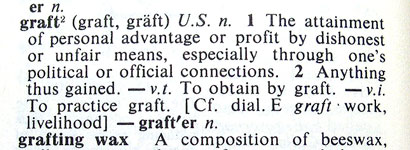
Funk & Wagnall's Standard Dictionary of the English Language,
1964 International Edition, Volume One, page 548.
| $ |
|
$ |
|
|
This page deals with money set aside for political purposes, for a small and specific part of the country, to benefit only a few people at everyone else's expense. Another page, called Money Down the Drain, deals with cases where tax dollars have been wasted through government inefficiency and recklessness at the national level.
The problem of wasteful spending and "earmarks" is especially difficult to solve because members of both political parties are equally eager to spend tax dollars on worthless and unnecessary "pet projects." In this regard, there is no difference between the two political parties.
There is now a new page (here) for the discussion of government money spent on professional sports teams and stadiums, which are some of the most inexcusable corporate welfare projects.
Farm subsidies are another variety of corporate welfare.
There is also a page about Cutting the Federal Budget To Prevent U.S. Bankruptcy: A series of excellent articles by Jim Grichar about a long list of federal agencies that should be trimmed or eliminated.
Somewhere on this site there is also a Government Waste Page, which lists a number of excellent places to cut federal spending.
Also take a look at the Huge list of government agencies. There is a bureau and a bureaucrat for every imaginable function of our overgrown government. And each one has a deputy and a secretary.
This strikes some people as anti-American, but it really is not: I believe It's Time to Scrap NASA. NASA spends about $18 billion a year and doesn't really do anything. Is your life really any better because there is an international space station? NASA is a pork barrel project that only benefits Houston and Cape Canaveral.
In order to make this page load a little faster, the Pork Page has been
chopped (that's a pun), and certain subtopics are now discussed
on this page. Subtopics on the
spinoff page include:
The Federal Funding Accountability and Transparency Act of 2006.
The Big Dig in Boston.
Senator Lott's Railroad Line — The Railroad to Nowhere.
Sweetheart deal for Boeing.
The National Endowment for the Arts.
Amtrak.
The V-22 Osprey.
Lately there has been a lot of discussion about public funding of NPR and PBS as well.
Other specific examples of pork projects are listed on a page of their own. The page you're reading now is about the problem of congressional favors and pet projects in general.
Pork products in the Emergency Economic Stabilization Act of 2008 and the American Recovery and Reinvestment Act of 2009
Dogs on meth, 'binge drinking ferrets' featured in Rand Paul's Festivus report on wasteful spending. The federal government spent tens of millions of dollars on gruesome and pointless experiments on animals from dogs to dolphins, according to 2025's "Festivus" report by Sen. Rand Paul, R-Ky., which uses the Seinfeld-invented Dec. 23 holiday to catalog more than $1.6 trillion in what he perceives as wasteful government spending. Paul especially highlights animal experiments in the report, which credits investigations by the anti-animal testing White Coat Waste Project for bringing several to his attention. Secretary of War Pete Hegseth also credited WCW and Paul with exposing the Navy's sodomization of cats in last year's Festivus report. The National Institutes of Health has spent another $2.9 million giving beagles cocaine since they were featured in Paul's 2022 Festivus report and "has added methamphetamine injections to the mix," WCW said in reviewing its contributions to Paul's report.
Cocaine Dogs and 'Safe Space Ambassadors': Rand Paul Highlights Wild Government Waste in Annual 'Festivus' Report. Senator Rand Paul (R., Ky.) released a report Tuesday detailing $1.6 trillion in government waste, in keeping with his annual "Festivus" tradition of airing grievances against wasteful federal spending. A whopping $1.2 trillion of that wasteful spending is interest payments on the ballooning national debt, according to the report, which contains numerous examples of government programs Paul considers to be useless and fiscally irresponsible. "Last Festivus, we clamored over the national debt reaching over an astronomical $36 trillion. Shockingly, in one short year, the career politicians and bureaucrats in Washington have managed to reach nearly $40 trillion in debt, without so much as a second thought. When asked who's to blame for our crushing level of debt, the answer is 'Everyone.' This year, Congress voted to raise the debt ceiling by $5 trillion, the most we ever have," Paul's report reads.
Dems Refused To Pass Kids Cancer Research Bill Until They Could Use It To Push 1,500 Pages Of Pork. In March the Republican-led House passed H.R. 3391, which would continue funding research of pediatric diseases like childhood cancer. The legislation never went anywhere in the Senate under the leadership of Democrat Majority Leader Chuck Schumer. But now Democrats are trying to use sick kids with cancer as leverage to pass 1,500-plus pages of pork. On Wednesday Speaker Mike Johnson unveiled a 1,500-page so-called "continuing resolution" that was really nothing more than a stuffed omnibus bill that included money for censorship, sweetheart deals for Congress, and other unnecessary expenditures. Almost immediately the pork-stuffed "continuing resolution" was rebuked by millions of Americans, including President-elect Donald Trump and incoming co-director of the Department of Government Efficient (DOGE) Elon Musk.
The Editor says...
"Kids with cancer" is just an emotional ploy to get a pork-laden bill passed. Paying for the
medical bills of individuals is not the proper role of government. Yes, Obamacare exists,
but it is not the proper role of government.
Government Shutdown? America Will Be Just Fine. As the U.S. hurtles toward yet another government shutdown, this time over the Democrats' refusal to pass a clean Continuing Resolution (CR), it's worth asking: what's the real catastrophe here? A few days without non-essential bureaucrats? Or continuing to shovel trillions of borrowed dollars into a bloated federal behemoth, laden with pork projects and graft? I'll take the temporary shutdown. This shutdown isn't a crisis. It's a mirror held up to a government that refuses to exercise fiscal discipline. For decades, Congress has avoided tough choices by larding up omnibus bills with billions of wasteful spending, dumped on us like Caesar's decrees. Yet when conservatives demand just a sliver of responsibility — like, say, funding the border wall or cutting back bureaucratic flab — the Beltway elites clutch their pearls.
Another Debt Ceiling Debate, Another Govt Funding Charade, Another Looming Govt Shutdown. If the government "shuts down" but nobody notices, is it really a shutdown? After a group of 38 republicans aligned with almost all democrats in the house, the effort to raise the debt ceiling and fund government failed. Unbeknownst to most, the debt ceiling was suspended in Jun[e] of 2023. As a result, Joe Biden and congress could spend on Ukraine without worry about the debt ceiling being a hurdle. The UniParty suspended the debt ceiling with a purpose. Starting Jan 1st, 2025, the debt ceiling issue is scheduled to return. National debt will be whatever it was when the debt ceiling was suspended plus whatever spending Biden and the UniParty did since June of 2023. A new debt ceiling is estimated to be hit by June of 2025 or earlier.
Trump and Musk Demolish the Obama Hallucinatory Permission Structure. [Scroll down] For years Congress has avoided accountability for overspending by waiting until almost the end of the year, crafting a grift-heavy bill and demanding that it be immediately passed before the year-end recess under threat of a government shutdown (a shutdown which sounds scarier than it actually is, in any event). Tucked into this monster is usually one or two more palatable appropriations which the lackey media will highlight to persuade what readers they still have that the bill must be passed. This time it was an appropriation for research into pediatric cancer. Unfortunately for the fools who bought this sob story, the House had passed a bill appropriating funds for this purpose nine months earlier which Senator Chuck Schumer had left languish so that there could be a diamond in this manure heap to demagogue about. When the first bill was introduced days before it was to be voted on, it was over 1500 pages long, another legislative trick, because no one could digest it in time. But Musk created an artificial intelligence program, Grok, that could and did, and the analysis was posted on X so everyone could see a summary of what was in the bill. Voters saw that Congress would fund a 35% raise for themselves, would continue the hated COVID biometric regime, would fund more government censorship, and would grant immunity from prosecution for the corrupt J6 committee, among other things. Outraged voters swamped congressional lines and Trump threatened to primary any Republican who voted for it. The bill failed, as did a second one. A third bill now pared down to less than a tenth of the original passed the House, then the Senate on Saturday morning, and Biden signed it into law.
The Editor says...
What's the most surprising part of that lengthy excerpt? The last five words: "Biden signed it
into law." Biden's mind is in such a rapidly-declining state that he most likely had no idea
what he was signing. He just signs what his handlers tell him to sign. That should be
illegal, if it isn't; and it demonstrates that the 25th Amendment has no effect if politics shield
the puppet president.
AI finds the legal bombs: The Blob can't hide things in 1,000 page OmniPork bills anymore. The most exciting thing I heard today was that AI was used to find all the nasty surprises secreted away in the 1,500 pages of US legislation that was being pumped through Congress in the days before Christmas. Legal aides must have spent all year stacking the deck with tricks to enrich the political class. No human could unpack the fine print overnight, but AI could. Then, free speech saved the day, the Capitol Pork was exposed when Elon Musk spread the word to his 208 million readers. [...] When Republicans reduced the bill to 115 pages, the Democrats who would have presumably passed all of it the day before, would not pass the short form without the grift and the graft.
The Craziest Things Congress Snuck Into Its Pork-Packed Christmas Spending Spree. House Republicans are currently debating a continuing resolution that would keep the government running through March 14, however many are heavily criticizing leadership for trying to push through unnecessary provisions negotiated behind closed doors. The over 1,500-page spending measure will receive votes from both Democrats and Republicans and is being pushed by Speaker of the House Mike Johnson. Johnson said in September that he has "no intention of going back" to the "terrible tradition" of a Christmas omnibus. [Tweet with video clip]
Congressional dirty dealing is now on full display. The proposed language of the next continuing resolution seems to be back on the drawing board. One of the big questions, though, about the 1,547-page monstrosity that just died in the House is how we can hold accountable the people who created it. Many are saying that bills should identify who's behind each proposal. In fact, they do. The problem is that this was not a bill. Instead, it was a deliberately opaque runaround using House rules that was intended to hide the actors behind its content. [...] This process is deliberately opaque. Where is this method for pulling the wool over the electorate's eyes spelled out? In the 1,547 pages of the 117th Congress' Rules for the House of Representatives, as adopted and amended by the 118th Congress' 52-page-long HRes-5. I wonder how many Members have even read these, or do they just go along unthinkingly? This is how you hide a bill's origins. This is how the sausage gets stuffed with no one the wiser about who proposed which bits of text that are finally included or left out. This is how all the Members, collectively and individually, avoid accountability for their actions.
'The American People Didn't Vote For This': Conservatives Blast Johnson's Christmastime Spending Scam. Congress's latest spending scam is not receiving the glowing reviews weak-kneed Speaker Mike Johnson was hoping for. On Tuesday evening, congressional leaders released the text of a 1,547-page omnibus package designed to fund the federal government through March 2025. Like those that have come before it, the bill is stacked with pork provisions championed by the D.C. establishment and loathed by everyday Americans. Among the worst included in the end-of-year spending spree are provisions extending the State Department's censorship-loving Global Engagement Center, opening the door for congressional members to receive a pay raise, and allowing members of Congress to opt out of Obamacare. With government funding set to expire on Friday, the last-minute release of the bill and its contents have drawn criticisms from some of conservative politics' biggest voices.
X defeats Congress. In their retreat from the presidency and control of the Senate, Democrats are leaving a scorched trail behind them. Biden commuted the sentences of 1,500 thugs, mugs, pugs and doctors who peddle prescription drugs. Schumer assembled a 1,547-page spend-it-all bill — continuing resolution to use congressional jargon for trillion-dollar slush funding — and scheduled the vote for Friday, the last day on the congressional calendar, giving congressmen the choice between saying yes or being blamed for a government shutdown at Christmastime. Bwahaha, he cackled. Elon Musk said we'll just see about that. He lit up Twitter and fueled the biggest, fastest and most effective backlash since Bud Light. Musk will primary RINOs who don't toe the line. He spent $277 million on Trump's campaign. That's 1/1,024th of his $300 billion-plus net worth. (The $420 billion figure includes $120 billion that a Delaware witch, excuse me, judge is holding hostage.) No one in the Republican Caucus wants to be Liz Cheney'd, especially since she may go to prison for witness tampering in the J6 hearings.
Trump And Vance Slam Pork-Filled Bill, Tell GOP To Stand Their Ground. A statement from President Donald J. Trump and Vice President-Elect JD Vance: The most foolish and inept thing ever done by Congressional Republicans was allowing our country to hit the debt ceiling in 2025. It was a mistake and is now something that must be addressed. Meanwhile, Congress is considering a spending bill that would give sweetheart provisions for government censors and for Liz Cheney. The bill would make it easier to hide the records of the corrupt January 6 committee — which accomplished nothing for the American people and hid security failures that happened that day. This bill would also give Congress a pay increase while many Americans are struggling this Christmas. Increasing the debt ceiling is not great but we'd rather do it on Biden's watch. If Democrats won't cooperate on the debt ceiling now, what makes anyone think they would do it in June during our administration? Let's have this debate now. And we should pass a streamlined spending bill that doesn't give Chuck Schumer and the Democrats everything they want.
Elon & Vivek Have the 'Swamp on the Run'. It was Mr. Ramaswamy who broke it down for us on Mr. Musk's X. [...] "The bill could have easily been under 20 pages. Instead, there are dozens of unrelated policy items crammed into the 1,547 pages of this bill. There's not legitimate reason for them to be voted on as a packed deal by a lame-duck Congress. 72 pages worth of 'Pandemic Preparedness and Response' policy; renewal of the much criticized 'Global Engagement Center,' a key player in the federal censorship state; 17 different pieces of Commerce legislation; paving for a new football stadium in D.C.; a pay raise for Congressmen & Senators and making them eligible for Federal Employee Health Benefits. It's indefensible to ram these measures through at the last second without debate. We're grateful for DOGE's warm reception on Capitol Hill. Nearly everyone agrees we need a smaller & more streamlined federal government, but actions speak louder than words. This is an early test. The bill should fail." It better and, as of this writing, it looks very much that it will.
Peak Porkulus: Rand Paul stands between us and Democrats' fiscal spendathon. Voters made their intentions clear in this past election that endless, bottomless, government spending has got to stop. That means nothing to Democrats in Congress, who have put their foot on the accelerator of government spending ahead of their last day in office in the upcoming budget bills, stopgap and omnibus. They call it 'cramulus.' [...] Had Rand Paul not pulled the brake lever on this runaway train, Elon could not have moved in for the kill — and they would have gotten away with it one more time. This is the real leader of the Senate.
Congressional 'pig book' released and look whose noses are in the trough. Citizens Against Government Waste, a nonprofit, has published its annual "Congressional Pig Book," and it's a doozy. Published annually since 1991, the "Congressional Big Book" contains a compilation of all the wasteful "pork-barrel" projects in the federal budget pursued by both Democrats and Republicans. [Tweet] Covering last year's budget, this year's book reportedly contains 8,222 earmarks costing a whopping $22.7 billion. [...] Who's to blame for all this wasted money? It's really both parties, though Republicans at least tried to make a difference by banning earmarks in 2010. But then 11 years later, Democrats reversed the ban. A year later, Republicans "voted to keep earmarks for spending bills in December 2022, which was a defeat for Republicans looking to rein in spending on 'pork,'" according to the Washington Examiner. Things got even worse once Hakeem Jeffries took over as House Democrat leader. "In exchange for votes to prevent a government shutdown, Jeffries pushed Republican leaders to agree to increase the amount of money for earmarks allotted to Democrats in the transportation, housing, and urban development appropriations bill," the Examiner notes.
Biden's Signature Bills Showering Battleground States With Billions Of Taxpayer Dollars, With More To Come. Two of President Joe Biden's flagship laws are pumping billions of dollars of taxpayer cash into states that will likely decide the winner of November's presidential election, with much more money still up for grabs. The 2021 bipartisan infrastructure package and the Inflation Reduction Act (IRA), Biden's massive climate bill, have routed more than $60 billion combined to Michigan, North Carolina, Pennsylvania, Wisconsin, Nevada, Arizona and Georgia, according to White House data. These states are widely considered to be the seven key swing states that will dictate whether Biden will secure a second term or if former President Donald Trump will return to the White House. The funds that have been distributed from the two bills to date amount to approximately half of the total amount of money that the two bills have to offer, according to Axios.
The Art of Leveraging the Poor, to Fund the Wealthy. As both sides of the aisle clash over budgetary priorities, a massive fight is anticipated over the Rural Development budget which will determine key appropriations to this year's "Farm Bill." What's being referred to as the "Farm Bill" by the media, and various members of Congress, is actually an Omnibus slate of policies proposing amendments to everything from the Stockyard and Packers Act of 1921, to adding Reparations as an entitlement program. The biggest issue at stake, however, are the vast adjustments prioritized to "mitigate climate change." The scope of proposals have the ability to create a new digital system of authoritarian neo-feudalism, with the woke climate compliant being the titled nobility class, yet owning nothing.
Senate
Advances Stop-Gap Spending Bill with $12 Billion in Ukraine Aid, $3 Billion for Biden's Afghans. The
Senate advanced on Tuesday [9/27/2022] a stop-gap spending bill that allocates $12 billion in aid to Ukraine and
$3 billion for Afghan resettlement. The Senate voted to invoke cloture on the legislative vehicle for the continuing
resolution (CR), a stop-gap spending bill that would continue to fund the federal government until December 16.
The Senate invoked cloture 72-23, featuring strong Republican and Democrat support for the motion. The legislation,
among other things, would provide:
• $12.3 billion in economic and military aid to Ukraine
• $1 billion for Low-Income Home Energy Assistance (LIHEAP)
• $2.5 billion in funding for New Mexico to recover from the Hermit's Peak/Calf Canyon fire
• $20 million for water infrastructure in Jackson, Mississippi
• a five-year reauthorization of FDA user fees
• $3 billion for the State Department to facilitate Afghan resettlement, and the FBI would receive $15 million to vet Afghan refugees
• $35 million to prepare and respond to "potential and radiological incidents in Ukraine"
Biden Brings in Professional Bagman John Podesta to Divvy Up the $316 Billion in Climate Change Money to DNC Donors Ahead of Midterm Election. Joe Biden has hired John Podesta to be the new Clean Energy Czar citing his experience in progressive causes. [...] If Podesta is the new Clean Energy Czar, it begs the question of what the heck John Kerry is doing now? I digress. You might remember that Steven Chu was the Obama Climate Change Czar for the first clean energy boondoggle that came as an outcome of the American Recovery and Reinvestment Act (ARRA), those shovel ready jobs that didn't materialize and carried the Solyndra spending nonsense. John Podesta had nothing to do with the Obama-era clean energy initiatives or energy spending programs. Podesta was inserted into Obama's orbit in the second term (2013) specifically to watch out for Hillary Clinton's interests when she left to run for President. Podesta later joined her in 2015 and took over the strategy team. Bottom line, John Podesta is being now being hired to divvy up the $316 billion in Green New Deal money recently authorized by congress. That is what Podesta specializes in, the distribution of taxpayer money to DNC allied groups and networks in advance of the 2022 midterms.
Biden administration under fire over big contracts for boosters. The White House and President Joe Biden are facing scrutiny over millions of dollars' worth of government contracts and loans going to big Democratic donors. The Biden administration has established a pattern of doling out taxpayer money to businesses associated with donors, according to a group of House Republicans calling for more information about the White House's process for awarding contracts. "Awarding lucrative government contracts to companies led by large Democratic donors is becoming a troubling Biden Administration pattern and raises questions about whether political contributions play a role in the decision to award federal taxpayer dollars," reads a letter GOP members of the House Committee on Oversight and Reform sent to White House Office of Management and Budget Director Shalanda Young.
Groups with strong liberal ties funneled massive 2020 election grants to Democrat-rich districts. Private donors led by Facebook CEO Mark Zuckerberg pumped more than $400 million into administering the 2020 presidential election, money that was often funneled by Democratic operatives into Democratic districts in what became essentially a get-out-the-vote effort for President Biden. The total amount of private donations for carrying out the 2020 election exceeded the federal government's entire allocation for election spending in the same year. The U.S. Election Assistance Commission was responsible for administering the $400 million in "election security grants" that Congress approved in 2020 to help local officials administer the election amidst a pandemic.
Earmarks are back, and they're as lousy as ever. One of the worst decisions by the current Democratic congressional majority, and one of the main reasons it ought to be taken away, is the decision to restore earmarks. Republicans had wisely banned these specific-interest spending provisions after winning back the House majority in 2010. [...] Republican Sen. Steve Daines of Montana offered a few examples of these earmarks in a video he tweeted out last week. "There are 4,000 earmarks in this bill, totaling over $8 billion," said Daines. Among those he listed were $500,000 to promote "health equity" in pools in Yonkers, New York, and "$300,000 for a left-wing anti-gun group that thinks, and I'm quoting from their website, 'the Second Amendment has long been a tool for white supremacy.'" He also pointed to $2 million set aside for George Mason University's Center for Climate Change Communication — not to study climate change, mind you, but to communicate about it. Obviously, such toxic groups and other frivolous causes can still receive government funding, with or without earmarks. Some will argue that the ban on earmarks did not cause overall discretionary spending to go down anyway, so what's the loss?
Taxpayers
[are] footing [the] bill for these questionable provisions in [a] $1.5T spending law. President Joe Biden has
signed the omnibus spending law, which funds the federal government for another six-plus months. But it also includes
plenty of provisions tucked in by lawmakers in the wee hours before passage in the House and Senate that benefits lawmakers'
states and districts and not necessarily U.S. taxpayers as a whole. [...] Some of the bacon congressional Democrats brought
home include:
• $496,000 for YMCA swimming pool improvements in Yonkers, New York, a project "essential for minimizing
disparities in access to swimming lessons and aerobics, promoting health equity," according to Rep. Jamaal Bowman, a
first-term New York Democrat affiliated with the far-left "Squad."
• $160,000 to study the sustainability of astronaut food at Lincoln University in Pennsylvania,
requested by Democratic Sen. Bob Casey.
• $110,000 for a food truck and refrigerated van to serve the Spanish American Center in Massachusetts,
requested by Rep. Jim McGovern, a Democrat who chairs the House Rules Committee.
• $1.6 million for the "development of equitable growth of shellfish aquaculture in Rhode Island," requested by
Democratic Sens. Jack Reed and Sheldon Whitehouse.
• $2 million for an electric vehicle-based ferry in Alaska, requested by Republican Sen. Lisa Murkowski.
• $3 million for a Gandhi museum in Houston, requested by Democratic Rep. Al Green.
The Editor says...
Of all the government White Elephants, bottomless money pits, and boondoggles in the history of pork barrel spending, "an electric
vehicle-based ferry in Alaska" sounds like the worst idea ever. If I'm not mistaken, Alaska is cold, electric vehicles don't hold
a charge too well in cold weather, and nobody wants to be on a battery-powered boat when a storm erupts halfway to ... wherever the ferry
goes. Presumably the route taken by the ferry is too long to justify a bridge. I'd be very interested to see where this ferry
is so badly needed, and how Alaska is currently getting by without it. And since Alaska is practically floating on oil, what explains the
attraction to electric vehicles?
Biden's $1.5T budget bill funnels millions in pork to vulnerable Democrats. President Biden's $1.5 trillion government funding bill funnels millions of dollars in pork to vulnerable Democrats in November's midterm elections while benefiting Republicans who helped secure its passage. Mr. Biden's 2,741-page budget bill, which passed with bipartisan support last week, was the first in more than a decade to include earmarks. The discretionary spending measures were long banned under Republican control of Congress but returned last year under Democrats' unified control of the House and the Senate. Although Republicans also benefit from the budget's allotments, some of the biggest winners from the inclusion of $8 billion in earmarks are Democrats facing tough reelection challenges. Sen. Raphael G. Warnock, for instance, inserted earmarks worth roughly $95 million to fund pet projects in his home state of Georgia.
Investigation finds Illinois politicians packed extra pork into $45 billion plan. An investigation into Illinois' largest-ever capital projects bill found nearly $4 billion in discretionary funds set aside for politicians' pork projects, including $2 billion for Gov. J.B. Pritzker to spend as he saw fit — including on needs he saw driving around during his campaign. There was also $144 million for constituents with close ties to former House Speaker Michael Madigan, according to the Better Government Association analysis. Some of the recipients never asked for the money, with one who did ask getting over $29 million more than they sought. The earmarks included $2 billion for the governor's office, $368 million for House Democrats and $326 million for Senate Democrats. The remaining $1.2 billion was identified only as "leadership additions."
Dem Bill Includes $900 Handout for Electric Bicycles. Taxpayers are on the hook for up to $900 of the purchase of an electric bicycle in Democrats' most recent version of their reckless tax and spending spree. According to the text of the bill, Section 136407 would create a new 30% refundable tax credit for electric bicycles purchased before January 1, 2026. The bill allows up to $3,000 of the cost of an "e-bike" to be taken into account for the credit, creating a maximum allowable credit of $900 for individuals. E-bikes costing as much as $4,000 would be eligible for the credit.
House Dem threatens to vote against $3.5T bill unless Black colleges get more money. President Biden's wavering $3.5 trillion social welfare bill took another hit when Rep. Alma Adams said she's a no vote unless more money goes to historically Black colleges and universities. Ms. Adams, a North Carolina Democrat and top advocate for HBCUs, said Mr. Biden is shortchanging the Black schools in the massive spending bill. "I cannot in good conscience vote for legislation that I sincerely believe will not serve its intended purpose," she wrote this week to her Democratic colleagues. "If this language as written becomes law, it is accurate to say that HBCUs will only successfully compete for pennies on the dollar."
Joe Biden Looks to Stuff Government Funding Bill with Leftist Goodies. President Joe Biden hopes to stuff the government funding bill with leftist "anomalies" as lawmakers continue to negotiate a way to keep the government running. Punchbowl News reported Monday [9/6/2021] that the Biden White House continues to prepare a list of "anomalies" that they will want funded as part of any continuing resolution (CR) that a CR does not usually fund. The White House will send the list of their priorities to the House and Senate Appropriations Committees likely sometime this week.
Nancy Pelosi Under Fire For Adding $200M Earmark For Presidio Park In San Francisco. House Republicans have been doing whatever possible to stop the Democrats from passing their latest massive spending proposal. House Speaker Nancy Pelosi (D-Calif.) was called out for adding her own special projects to the $3.5 trillion reconciliation package. "It wasn't 3.5 they voted for. It was nearly $5 trillion they just voted for this week," explained House Minority Leader Kevin McCarthy (R-Calif.). "There is no longer a centrist Democrat. There is no longer a moderate Democrat. Every single Democrat voted for this." This process is known as earmarking and Pelosi was recently called out by some on the right for slipping a $200 million earmark into the package for the historic Presidio Park in San Francisco.
One Payoff in the Infrastructure Deal Is So Blatantly Corrupt That You Almost Have to Respect the Hustle. While Nancy Pelosi's machinations may have put the infrastructure deal in jeopardy, the smart money still resides on its passing at some point. There are just too many Republicans who seem too gung-ho, and you'd only need a few crossovers in the House to overcome the socialist wing. With that said, the contents of the bill are becoming public, revealing the absolute boondoggle that this hastily written bipartisan compromise is. Yet, there's one corrupt payoff in it that really stands out among the rest. Enter Sen. Joe Manchin, who has been one of the key players in formulating and moving forward the infrastructure deal. Given that, you knew he'd be getting his palms greased. Even still, I'm not sure I expected it to be this blatant. [Tweet] Who is Gayle Manchin? Well, that would be Joe Manchin's wife, who was appointed as co-chair of the Appalachian Regional Commission by Joe Biden. In this infrastructure bill is a $1 billion expenditure to that commission.
Mark Meadows Warns Nearly ALL Infrastructure Money in Dem Bill Goes to Blue Cities. Former White House Chief of Staff Mark Meadows said on Saturday that a Democratic infrastructure bill contains language and provisions that will direct the lion's share of taxpayer funds toward blue cities and states regardless of need elsewhere. "When we start to look at it, no one's against roads and bridges working for them, but what they are against is the Washington, D.C., establishment actually spending their dollars on their behalf, but not necessarily their priorities," Meadows told Newsmax TV. "The problem is about those priorities: Most of the money that they're talking about, actually will go to major metropolitan areas," Meadows added.
We're Governed by Morons. When it comes to earmarks, both parties are horrible. They're now trying to call this pork "Congressionally Directed Spending" rather than earmarks, thinking it somehow sounds better. It kind of does, as long as you don't think about it. The real problem isn't whether Congress directs where the money is spent or some faceless bureaucrat does, it's the spending in the first place. [...] Representative Kathy Castor (D-Florida) earmarked $7.7 million for a street car project in Tampa, because it's 1900 again, or something. Representative Don Young (R-Alaska) earmarked $18.6 million for a fire station in Kodiak, Alaska, which we have to assume will be made out of 24-karat gold. Forbes reports Congress is spending "$40 million for museums including a $3.75 million request by Rep. Brad Schneider (D-IL) to upgrade the Waukegan Carnegie Museum through the local park district. In fact, there were 29 earmarks with the word "museum" in the description and requests included a new $6.4 million Gandhi museum (Rep. Al Green D-TX); $2.2 million for the new Bahamian Museum of Art & Culture in Coconut Grove (Rep. Frederica Wilson D-FL); and $792,000 to repair the New England Motorcycle Museum (Rep. Joe Courtney D-CT)."
Earmarks Are a Tool of the Swamp, Not the Constitution. Republicans are helping House Speaker Nancy Pelosi bring back the special-interest spending known as earmarks. You won't find so much as a tweet from congressional Republicans touting the move, but the House GOP Conference changed its rules to lift the earmark ban and added a statement that earmarks could help "execute Congress' Article I authority to control the power of the purse." So on one hand, it is refreshing to hear some lawmakers make gestures toward reclaiming the constitutional powers that rightfully belong to the peoples' elected representatives. But the power of the purse does not give Congress a license to spend on anything it wants, irrespective of the guardrails imposed by the Constitution.
Biden bribes Manchin, bye-bye filibuster. Joe Biden has never been known for subtlety. [...] [The Democrats'] legislative priorities — passing HR 1 to guarantee Republicans will never win another presidency or congressional majority by mandating nationwide cheating-enabling mail-in voting with no ID requirements and much more — depend on ending the filibuster. And Manchin's vote is required to do that. If confirmed by the Senate [...], Mrs. Manchin would have major role in an agency with a $165 million budget whose "mission is to innovate, partner, and invest to build community capacity and strengthen economic growth in Appalachia." The word "invest" is the key one here. That means money. Money handed out to people, either directly or through loan guarantees (think: Solyndra) or some other mechanism.
Democrats' Infrastructure Proposal Unfocused, Possibly Superfluous: Expert. Infrastructure spending is usually a popular proposal. Between potholes down the street and reports of crumbling bridges, Americans tend to agree that America's infrastructure needs work. An infrastructure spending bill floated by Democrats, however, is shaping up to be something else entirely — maybe even superfluous, according to an infrastructure policy expert. Major federal infrastructure spending was originally justified as a national defense issue. The interstate system was to secure expedient troop movement, for instance. But those days are long gone. Today's bipartisan support for such spending stems from political expediency. There are still bridges, dams, perhaps even airport projects, that could be defended as national security assets, but politicians no longer bother. They present infrastructure bills as a way to boost the economy and create jobs.
Earmarks Represent Corruption, Waste, and the Swamp. The Ban on Them Should Stay in Place. After a decade-long ban, earmarks, the practice of Congress funneling your tax dollars to special interests, is set to make a comeback. Some members of Congress are now proposing a plan to bring earmarks back under the rebranded euphemism "community project funding." Conservatives have long found against the practice of earmarking federal funds for special interests. The practice took off in the 1990s and accelerated in the early 2000s — between 1994 and 2011, the number of earmarks each year increased by 282% to nearly 16,000. The American people have long opposed earmarks. A 2006 Wall Street Journal poll showed that people listed "prohibiting members of Congress from directing federal funds to specific projects benefiting only certain constituents" as their top priority for Congress.
Secret Republican Vote to Restore Earmarks Is a Betrayal of the Voters. Earmarks are, or were, spending provisions that Senators and Representatives attach to bills that are likely to pass and be signed into law. The Congressional Research Service defines them as a benefit to "a specific entity or state, locality, or congressional district other than through a statutory or administrative formula or competitive award process." They allow members of Congress to shower "pork" projects on their districts — or to reward favored donors and special interests. The typical argument for earmarks is that they can help to relieve partisan gridlock. A politician might agree to break ranks with his or her party if there is something in it for the folks back home (or the campaign coffers).
Here Are Some Of The Craziest Spending Items In The Coronavirus Stimulus Bill. On Wednesday [3/17/2021], many Americans saw their $1,400 stimulus checks hit their bank accounts, courtesy of the mammoth coronavirus relief package Democrats shoehorned through Congress last week. The final destinations are fuzzier, however, for some of the other blocks of cash provided in the $1.9 trillion stimulus bill, ostensibly aimed at alleviating the economic suffering caused by the coronavirus pandemic. Some of the items are only loosely related to relieving pandemic woes, and in some cases, Democrats appear to have given up attempting to connect the funding to the coronavirus at all, raising eyebrows among critics who argued the package should not be used as a "Trojan Horse" for a Democratic agenda.
Ron DeSantis Says Florida [is being] Penalized by Biden's Stimulus Package: 'It Stinks to High Heaven'. Florida Governor Ron DeSantis said his state is being penalized in President Joe Biden's $1.9 trillion coronavirus stimulus plan, during a Saturday appearance on Fox News' Justice with Judge Jeanine. "What this bill does is it says if you locked down, if you destroyed your state, if you destroyed your economy, and you failed to stop COVID as well, you're going to get a windfall," DeSantis told host Jeanine Pirro. "Some of these lockdown states are getting an extra billion, $2 billion, $3 billion," DeSantis added. "So, it's effectively a transfer of money from states like Florida and Georgia to states like New York, Illinois and California."
Beyond Covid relief: Biden invokes LBJ as Democrats aim to expand welfare state. Nearly $2 trillion in fresh relief benefits are expected to start flowing into Americans' bank accounts within days. Now, Democrats are already looking to make some of them permanent. With President Joe Biden's American Rescue Plan signed into law, Democratic lawmakers are exploring ways to ensure that generous tax credits and other key aspects of the legislation will last well beyond the pandemic itself, either through additional rounds of extensions or more permanent measures.
Wells Fargo, Chase not processing stimulus payments until Wednesday, sparking criticism. Banking giants Wells Fargo and Chase said that they will not process recently issued $1400 stimulus payments until Wednesday, causing of outcry from their customers. HuffPost notes that the banks said in individual statements last week that they will not be processing and releasing the payments until March 17. "We expect most of the electronic payments to be available as soon as Wednesday, March 17, 2021," Chase said on its website[.]
Five of Andrew Cuomo's other biggest scandals. [#2] The Buffalo Billion: Cuomo, in his first term, pledged more than $1 billion to revitalize infrastructure in post-industrial western New York cities. The governor named Alain Kaloyeros, founder of SUNY Polytechnic Institute, to be the state's "secret weapon" in implementing the project. Kaloyeros soon came under federal scrutiny for his flashy lifestyle and boasts of connections to the governor. In 2018, Kaloyeros was sentenced to more than three years in prison for his role in a complicated bid-rigging scandal in which he had steered more than $850 million in building contracts to Cuomo's political allies. The two top firms implicated, LPCiminelli and COR Development, were major Cuomo campaign donors.
The Pelosi Payoff: 'CoVID' Package to Give California $42B, Illinois $13B, New York $24B. A new report from the federal government revealed Friday the total amount of money distributed to the states under the recently passed $1.9 trillion CoVID relief package; showing big bucks being shelled out to deep blue states across the country. The list includes California at $42 billion, Illinois at $13 billion, and New York at $24 billion in federal funds. Critics of the legislation argue the bill has very little to do with defeating the global CoVID pandemic; instead allocating funds for pensions, child care, teachers unions, and other far-left priorities.
Time to change the way Congress writes bills. The recent passing of the $1.9 trillion relief package by House Democrats exposes once again the corrupt method used routinely to ensure passage of legislation that is weak or politically biased. I'm referring specifically to the practice of loading up a bill with additional appropriations that have little or nothing to do with the stated purpose of the bill, lovingly known as "pork." This helps to explain why a bill like this grows to 591 pages. It is estimated that only 9% of the funds are destined for actual COVID relief. It was apparently more important to Democrats to lard up the bill with more of their wish-list items. How about $350 billion to bail out mismanaged states, $12 billion for foreign aid, $135 million for the Endowment for the Arts? And how could they let any spending bill get by without something for Big Tech in California, specifically a Silicon Valley underground tunnel for $112 million? One of the more egregious items was for Howard University, which will receive $35 million to cover losses due to the pandemic, the only university to be reimbursed for that reason. I'm sure it's just a coincidence that VP Harris is a graduate of Howard.
The Blatant Fraud Behind The New $1.9 Tril 'COVID Relief' Law. With the COVID-19 relief bill now signed into law, it can't be any clearer that Americans have had the wool pulled over their eyes on what this really was all about. Far from "COVID relief," the mantra of the far-left Democrats, it was really all about "Blue State" relief. That's right, in case you haven't been paying attention, the bill that many Americans thought would bring them fat checks and some reprieve from their government-induced lockdown woes has turned into a giant Christmas tree surrounded by goodies for Democrat-run Blue States and their Big Labor allies. As we've pointed out [...] elsewhere in recent weeks, the $1.9 trillion virus relief bill wasn't even needed. The economy has already been bouncing back sharply, while most states actually weathered last year's downturn nicely. Some 22 states actually reported higher tax revenues during the pandemic than in the same period in 2019.
Joe Biden's 'COVID Relief' Bill Bails Out San Francisco Budget for Two Years. The $1.9 trillion "COVID relief" bill proposed by President Joe Biden and approved by Democrats in Congress "will erase the majority of San Francisco's projected $650 million budget deficit over the next two years," the San Francisco Chronicle reports.
The Blue State Rescue Plan. Wednesday afternoon [3/10/2021], the Democratic majority in the House passed HR 1319. Variously marketed as a "pandemic relief bill," an "economic stimulus package," and the "American Rescue Plan," it is largely a wealth transfer from well-managed and prosperous red states to incompetently managed blue states. A mere 9 percent of the legislation's $1.9 trillion cost will be devoted to mitigating COVID-19, and about 12 percent will go to individuals in the form of stimulus checks and unemployment payments. The rest will go to blue state bailouts, funding for school systems that remain closed, kickbacks to unions, new subsidies for Obamacare, and exorbitant financing for innumerable pet progressive projects. By far the worst of the bill's provisions involves the $350 billion earmarked for blue states and their crumbling cities.
[There's] More Money in [the] Stimulus Bill for Pension Bailouts 'Than All the Money Combined' for Vaccines, Congressman Says. Unions are getting a free pass after mismanaging their multi-employer pensions for decades. In a provision not well-publicized before the stimulus bill narrowly passed by the Senate with only Democrat support, $86 billion dollars will be directed to at least 185 multi-employer union pension plans that are close to collapse. [...] The pension crisis is not new and fixing it has long been a Democrat priority. Congress passed legislation in 2014 to allow insolvent pensions to pare benefits within limits to prevent bailouts by the taxpayer. However, President Obama's Treasury Department blocked the Central States Pension Fund's plan to use the law in 2016. The media framed this denial as an attempt to force a straight bailout, and here we are.
Filiblustering the Future of America. For the privilege of being rescued, middle-class Americans will be rode hard by a $1.9 trillion price tag against their future liquidity and that of their children. HB 1319 is dressed up with promises of compensation checks, virus testing and vaccines, food stamp and school programs, homeowner tax breaks, psychological services, and other pandemic head fakes. In sum, actual relief doesn't add up to [...] a lot, nine percent, in fact, of all allocated funds. Democrats are using pandemic-related as a generous definition for pandemic relief. Much of HB 1319 is a watering trough that buys off a voting constituency and finances progressive pet projects, funds Planned Parenthood and abortions, doles out loyalty payments to teachers unions, bails out fiscally-irresponsible blue states, imputes racial equity qualifications for farm grants, and sends billions to overseas COVID efforts after paring down relief checks to Americans.
$140 million 'Pelosi subway' axed from Senate COVID bill: parliamentarian. Funding for a rail project near House Speaker Nancy Pelosi's California district that Republicans denounced as wasteful was removed Tuesday from President Biden's $1.9 trillion COVID-19 stimulus bill. The Senate parliamentarian ruled the $140 million appropriation wasn't allowed under the so-called Byrd rule that polices unrelated items in budget reconciliation bills. Republicans singled out the rail project as an example of unrelated "pork" in the bill, which is being rammed through Congress without Republican support using special rules that allow a simple majority vote in the Senate.
8 Things You Must Know About Deeply Flawed COVID-19 Package. [#7] It Will Give Huge Handouts to Special Interests: The bill includes more than $1,000 per person in funds for state and local governments, despite the fact that federal aid last year dwarfed any localized revenue reductions. At least $90 billion will be given from the general public to pad out pension plans for private-sector workers, overwhelmingly benefitting Big Labor. The "at least" is because this bailout could balloon to more than twice that amount. On top of that, $57 billion will go toward the transportation sector in a way that privileges unionized workers. These three items alone amount to nearly $500 billion that will create far more in political benefits than public benefit.
Schumer stumps for $25B in restaurant relief as thousands close in NYC. Indoor dining is returning around the city, but struggling restaurants desperately need another stimulus bill to make it through the next stretch of the pandemic, Sen. Chuck Schumer (D.N.Y.) said Sunday [2/21/2021]. The Senate majority leader said he's working to keep thousands of local restaurants afloat by pushing for a $25 billion relief fund baked into the proposed $1.9 trillion COVID-19 stimulus package working its way through Congress. Struggling restaurateurs could apply for relief grants through the Small Business Administration. Restaurant owners were able to apply for forgivable Paycheck Protection Program loans through previous stimulus packages that Congress passed in March and December. But Schumer is aiming for a dedicated program exclusively for bars and eateries.
Nothing Spells COVID "Relief" Quite Like $100 Million for an Underground Electric Train for Silicon Valley. On Day 31 of the Biden Administration, we get the 591-page bill that the Democrats are proposing to enact into law. Buried in the text of the legislation is a section from the House Transportation Committee (Sec. 7006) to fund $30 billion for transit systems to "prevent, prepare for, and respond to coronavirus," with funds earmarked for operating costs and capital investments to various transit systems around the country. To "prevent, prepare for, and respond to coronavirus". The bill funds $1 billion for projects under Section 3005(b) of Public Law 114-94, the "Fixing America's Surface Transportation Act." That section created a pilot program to fast-track federal funds on projects meeting certain specifications and has been used in applications for funding the Bay Area Rapid Transit (BART) Silicon Valley project. According to a Fox Business review of the allocation formula featured in the COVID-19 bill and other related documents, the new "RELIEF" bill would provide BART with around $112 million in funding for continuing the 6.5-mile extension from its current terminus in Milpitas down to San Jose then back northwest to the City of Santa Clara. The extension would include three underground stations and one at-grade station at its new terminus in Santa Clara City.
Dems' COVID-19 Bill Is A Grab-Bag Of Leftist Goodies — Not Stimulus. After a group of 10 Senate Republicans duly trudged to the White House on Monday to show their "bipartisanship" on yet another COVID-19 stimulus bill, President Joe Biden did the predictable: He looked at their outreached hand of political comity and spat on it. Just as well, since the only thing the Democrats' plan will "stimulate" will be more debt. Biden and his party were never really interested in bipartisanship at all, despite their claims to the contrary. The whole point of this choreographed Kabuki political theater was to humiliate the Republicans, who foolishly took Biden and the Democrats at their word.
Get ready for more Obama-era green energy scams. With Democrats about to control all the levers of power in Washington, the biggest winners might be the wind and solar companies. These firms' stocks continue to surge mostly because President-elect Joe Biden has pledged to invest several hundred billion dollars in green energy through a pipeline of taxpayer-funded grants, loans, tax credits and loan guarantees. This game plan looks suspiciously like a replay of the litany of green "stimulus" fiascoes that Biden piloted as vice president back in 2009 with the $800 billion Obama stimulus plan. The experiment in the government as an investment banker belly-flopped with embarrassing failures from Solyndra, Fisker Automotive and Abound Solar. Taxpayers lost billions of dollars on these lemons.
Can Trump really cut pork from $900B package he signed? President Trump signed the $900 billion COVID-19 economic rescue package he called a "disgrace" in time to avert a government shutdown. Now, he wants to go back and excise the pork-barrel spending. The tool Trump plans to use to have his new spending and cut it too is the Impoundment Control Act of 1974. "I will send back to Congress a redlined version, item by item, accompanied by the formal rescission request to Congress insisting that those funds be removed from the bill," he vowed. "It would be useful for Trump to send up a rescissions bill, not because it would end up cutting anything permanently but because the more debate the country has on wasteful spending, the better," said Chris Edwards, tax policy director at the libertarian Cato Institute.
Trump Should Veto The $2.3 Tril, 5,593-Page COVID-19 'Stimulus' — 2020's Biggest Fraud Of All. Based on a U.S. population of roughly 330 million, the $900 billion stimulus amounts to $2,727 in spending per person. OK, but how much of that goes into people's pockets? A pittance: $600. Yet, Democratic House Speaker Nancy Pelosi committed the unforgivable sin of holding up those $600 checks for struggling American families in order to hurt President Donald Trump's reelection chances. This is politics at its most cynical and is a prime example why average Americans today hold politicians in such low esteem. All told, the bill for this sprawling legislation comes to $2.3 trillion — yes, that's trillion with a "t". Add that into Green's earlier calculation, and the amount spent per household grows to $6,969. Sure, but all that is going to COVID-19 relief for individuals and small businesses, right? No, not even close — $1.4 trillion from the Consolidated Appropriations Act is dedicated to the federal government's fiscal 2021 budget. It was all cobbled together in the last hours of closed-door negotiations, focused on getting massive servings of pork spending and new, useless government programs added, not on COVID-19 relief. That was just the selling point to all us rubes.
That COVID Relief Bill Gets So Much Worse, and It Should Infuriate You. This morning [12/21/2020] I wrote an initial take on the newly agreed upon (agreed upon by Congressional leadership at least) coronavirus relief package. I focused on some of the ridiculous, unrelated domestic hand-outs in the bill. Later, Jennifer Oliver O'Connell did another dive into the general terribleness of the legislation because there was just too much wrong with it to cover in one piece. Well, as per our usual agreement with Congress, more and more is being discovered in the 5600 page monstrosity, and it gets so much worse. For example, did you know there are big payouts to foreign governments all throughout the bill?
New COVID-19 Relief Bill Also Creates 2 New Museums and a Library, References Dalai Lama Controversy. The main thrust of the bill is to provide $600 per person to people below a certain income threshold and to expand the Paycheck Protection Program for various businesses. But that's not all — not by a long shot. For instance, the bill also instructs the Smithsonian Institution to create two new identity-based museums: one for women, and one for Latinos. (The legislation refrains from using the phrase "Latinx.") The bill also takes a position on the reincarnation of the Dalai Lama, expressing that in the view of the U.S. government, "the wishes of the 14th Dalai Lama, including any written instructions, should play a key role in the selection, education, and veneration of a future Dalai Lama." The bill includes a provision prohibiting any federal funds from being used by the Association of Community Organizations for Reform Now (ACORN), an activist group that no longer exists in the United States. It attempts to normalize U.S. foreign relations with Sudan, criminalizes illegal streaming, and creates a plan for building a Theodore Roosevelt presidential library in North Dakota.
COVID-19 relief bill highlights: Breakdown of $54 billion for New York. A $900 billion federal COVID-19 relief deal agreed upon by lawmakers would inject $54 billion in needed funds into New York's economy, Sen. Chuck Schumer said Monday [12/21/2020]. It includes $13 billion to state government, $5 billion for education, $4.2 billion for transit, $1.6 billion for the COVID-19 fight and vaccination efforts and $1.3 billion for rent relief. There's also billions for businesses and money going directly to New Yorkers, assuming lawmakers vote for the agreement and President Donald Trump signs off on it.
Flying Blind: Congress Votes on 11th-Hour, 5,600-Page Spending Bill Unread. A terrible 2020 is coming to a close, and the American people are about to get handed a massive bill. After months of delays and waiting, a federal stopgap spending package, combined with $900 billion in COVID-19 relief, is finally being released to the public. The bill, the Consolidated Appropriations Act, is nearly 5,600 pages long. Only now are most members of Congress seeing it in its entirety.
House Voting Today on 5,600 Page Pork-Filled COVID Package No-One Has Read, McConnell Wants Unanimous Consent. [T]he UniParty is in full swing and they don't even care what our opinion is about this massive $2.5 TRILLION (approximated because it hasn't been scored) COVID/Omnibus spending bill that totals over 5,600 pages. The actual 5,600 page bill wasn't populated for public review until shortly after noon this afternoon and staff had an issue putting it on-line. Incredibly, and in keeping with the previous approach preferred by congress, the House plans on voting on this bill today; and Mitch McConnell wants the Senate to pass it by unanimous consent (no recorded votes). My rough review shows an approximately 70/30 split on the $900+ billion COVID package. Approximately 30 percent +/- of the bill will actually help working class families and businesses on Main Street. Approximately 70 percent of the bill will go to political donors, special interests, environmental lobbyists, K-Street groups who wrote the bill, foreign interests, Wall Street and corporate beneficiaries.
AOC frustrated with lack of review time ahead of vote on 5,593-page stimulus bill. Rep. Alexandria Ocasio-Cortez criticized the rushed process ahead of Monday's vote on a massive stimulus bill, as the text is finally released after long delays. "It's not good enough to hear about what's in the bill. Members of Congress need to see and read the bills we are expected to vote on," the New York Democrat tweeted. "I know it's 'controversial' and I get in trouble for sharing things like this, but the people of this country deserve to know. They deserve better." Capitol Hill leaders announced a finalized deal on $900 billion in coronavirus relief and resources late Sunday evening, but the 5,593-page bill wasn't released until Monday afternoon.
Sen. Ted Cruz Is Right: Congress Labeled End-Of-Year Spending Bill "COVID Relief" to Cover the Pork. As we've covered thoroughly at RedState, Congress passed a pork-filled monstrosity Monday and called it COVID relief, believing that a $600 check would satiate most Americans and keep them from looking deeper into the bill's contents. In most years that might be true, but during a year in which a good part of the country has been locked down for nine months, in which millions have lost their jobs (and more), and in which the hypocrisy and corruption of our elected "leaders" has been fully revealed, well, good luck with that. It took months for Congress to act on pandemic relief back in the spring, and they tried to attach a bunch of pork then, too. The first bill bought them a few months — months which brought the problems with the bill into full view — but still, House Democrats didn't seriously push for any type of targeted bill because they knew it would give Donald Trump a PR victory.
Nancy
has another Marie Antoinette moment as Wolf blasts her. Wolf Blitzer dared ask Speaker Pelosi twice why she
won't accept the $1.8 trillion package Republicans have offered "because people need the money now." The woman
worth $120 million dollars, give or take, who owns mansions and a vineyard, and owns a huge freezer filled with really
expensive ice cream, won't agree to a relief bill that only targets people who need relief. [...] These are a few of the
things she wants:
• $1 trillion in nearly totally unrestricted funds just for cities and states. There is one
restriction — no money for policing.
• It gives federal taxpayer-funded healthcare to illegal aliens — any illegal who wanders into the country.
• Her bill allows ballot harvesting and revokes state-level ID laws.
• She has funding in it for pot shops.
• They want hundreds of millions for public broadcast and funding for local press retirement plans.
• Policing of racial makeup of corporate boards is in the bill.
• Endless climate change pork that won't do a thing for climate change in our lifetimes [...]
Report: Bulk of Pelosi's $2.2 Trillion 'Coronavirus' Bill Goes to Her 'Wish List,' Not to 'Crush the Virus'. House Democrats, led by Speaker Nancy Pelosi (D-Calif.) are demanding Republicans accept their $2.2 trillion so-called "coronavirus relief" bill — yet, the majority of the bill and its taxpayer funding would go to liberal agenda items unrelated to coronavirus, analysis by former New York Lieutenant Governor Betsy McCaughey (R) finds. In her article, "Nancy Pelosi's 'COVID relief' bill is mainly just a left-wing wish list," published Tuesday [10/6/2020] in the New York Post, McCaughey details expensive and irrelevant items in the bill that, she says, will not help to "crush the virus" as Pelosi claims.
Keywords: pork barrel, slush fund, grab bag, political payoff
Nancy
Pelosi's 'COVID relief' bill is mainly just a left-wing wish list. [Scroll down] There is almost no
disagreement between Republicans and Democrats over sending every American adult a $1,200 check. But that's a small
part of the total bill. Pelosi's version would fritter away hundreds of billions of dollars closing state and city
budget gaps, with nothing long-term to show for it. We won't be any more prepared for the next pandemic. Pelosi's
bill promises school districts $225 billion, but only $5 billion, or 2 percent, would go to making schools safer
by improving air quality or installing sinks and other hygiene upgrades. The rest is a teachers union protection plan.
Astonishingly, school districts that economize and reduce per-pupil spending or change labor contracts are automatically
ineligible for stimulus funding. The bill allocates $417 billion to state and local governments, with no strings.
This is a lost opportunity to rescue cities that are turning into ghost towns because employees fear the virus and are
working remotely.
Thoughts on the Current Crisis. [Scroll down] It is hard to admire the $2 trillion bill Congress recently passed to address this problem. Critics have made much of the fact that it included $25 million for the Kennedy Center for the Performing Arts in Washington, D.C. That fact is indeed indicative of the lack of seriousness with which so many, especially in the House of Representatives, take the plight of the millions who have lost their jobs due to the shutdowns. But there was a lot more in the bill that had nothing to do with relief for people thrown out of work or with helping our economy recover: $75 million each for the National Endowment for the Arts and the National Endowment for the Humanities, $324 million for diplomatic programs, $25 million for salaries and expenses in the House of Representatives, $78,000 for the Institute of American Indian and Alaska Native Culture and Arts Development, and the list goes on. This bill is unworthy of a great democracy in a time of crisis.
No More Pork-Laden Stimulus Bills, Please. Nothing cries out more for giving the president a line item veto for federal spending than the 880-page coronavirus stimulus bill that Speaker Pelosi put together from her Socialist Wish List filing cabinet and pasted into her stimulus bill. Rep James Clyburn (D-SC) had already signaled the plan was to load the Democrat agenda into the bill. Ultimately the taxpayer was saddled with the costs of many programs completely unrelated to managing the crisis. Did the Speaker expect to get the entire progressive agenda which included legitimizing voter fraud? No, she sent up a lot of throwaways, but the pattern has always been to force acceptance of some of the agenda each time there is a crisis, attaching as much as possible to each "must pass" bill. Each side then proclaims how much they surrendered by giving up their throwaways. Because the pork is buried in massive bills, the assumption is no one will read it before passage. With each crisis, the country is then moved incrementally to the left and national debt increases by unnecessary amounts.
Our Crooked Congress. Democrats decided that the Chinese coronavirus pandemic was a great time to try and backdoor their long laundry list of Leftie goals. While Americans are fearing for their lives and livelihoods, Pelosi and her crew were treating the crisis as though it were a political gift — a genie in a bottle who could make all their wishes come true. Green New Deal, open borders, funding sanctuary cities, forcing unions on mid-sized companies (500-10,000 employees) if they take government funds, ballot harvesting, and a cool $350 million for migrants and refugees, among other items. But even more insulting is that the Democrats decided it was time to take advantage of a crisis to hand out goodies for their friends: $75 million for the Public Broadcasting Service and National Public Radio, $50 million for the Office of Museum and Library services that already got funded for the year, $8 billion for tribal governments, $10 billion for the U.S. Postal Service, $25 million for the Kennedy Center (because nothing says helping the American people like giving the Kennedy Center a facelift even though it's sitting on a $140 million endowment), and — wait for it kids — a $25 million pay raise for the House of Representatives as well as $20 million for the FBI to cover "salaries and expenses."
Sugar Subsidies Are Welfare for the Rich. America's biggest welfare recipients are often politically connected corporations — like America's sugar producers. The industry gets billions of dollars in special deals while deceitfully running ads that say, "American farmers don't get subsidy checks." That ad confused me. If they "don't get subsidy checks," then what is America's multibillion-dollar sugar program? "It costs taxpayers nothing," claim ads from the American Sugar Alliance. "We are a no-cost program, no cost to the taxpayer." "That's absolutely bogus," says Ross Marchand of the Taxpayers Protection Alliance in my newest video. Americans "pay as customers and they pay as taxpayers." He's right.
From Your Table to Their Farm. Forget all the tongue clucking about Washington being so divided and nasty that Democrats and Republicans cannot work together. As the Senate and House proved this week in passing the $867 billion farm bill, when it comes to spending money they don't have, party leaders really can reach across the aisle. With the national federal debt approaching $22 trillion, President Donald Trump has praised the bill, which provides food stamps for the poor, but also hands out subsidies to American farmers, even though it does not include needed reforms or even modest spending cuts. Conservative think tanks dismiss the farm subsidies as corporate welfare. On the left, environmentalist groups have opposed them as well. Fiscal hawks are appalled at the failure of Congress to do anything to ease the deficit. And yet the farm bill lives.
Subsidies For All! — The Farm Bill's Creeping Socialism. As the Washington Post noted, Congress passed the $867 billion farm bill "with strong bipartisan support, spurred in part by pressure from farmers battered by President Trump's trade war with China." Sorry, don't blame the trade war with China for this debacle. The Farm Bill is a disaster on its own. It's filled with literally hundreds of billions of dollars of market-distorting subsidies to U.S. farmers. But the bill that passed excluded the one good idea it originally contained: A work requirement for able-bodied welfare recipients. How bad is the bill? Even Iowa Republican Sen. Charles E. Grassley, himself a farmer, was outraged because the package granted federal subsidies even to distant relatives of farmers that don't farm.
A Mountain Of Surplus Cheese, Brought To You By The Federal Government. The amount of surplus cheese is growing fast — up 6% in just the past year. According to news accounts, the reason is that dairy production is climbing, while dairy consumption is falling. [...] In what other industry would you find producers continuing to ramp up production while demand slides, and then stuffing the growing pile of surplus into warehouses, hoping the federal government will buy some of it? What makes the dairy industry different is decades of government efforts to "support" dairy farmers with various subsidy schemes. The 2014 farm bill did away with old federal price support programs, but replaced them with heavily subsidized insurance that essentially guarantees margins for those who sign up. This year, the dairy industry successfully lobbied Congress to expand this subsidy program.
Here's what Congress is stuffing into its $1.3 trillion spending bill. [Scroll down] FBI: The spending bill grants the agency $9.03 billion for salaries and expenses, a $263 million jump over the last fiscal year and $307 million more than the Trump administration requested. The bill does not include any funding for the construction of a new FBI headquarters, a win for Sen. Chris Van Hollen (D-Md.), a member of the Senate Appropriations Committee.
Congress clears massive spending bill in midnight vote. The House approved a $1.3 trillion spending bill Thursday [3/22/2018] to fund the government for the rest of fiscal year 2018 and the Senate followed suit early Friday morning, beating the shutdown deadline and leaving Republicans and Democrats to fight over credit and blame. The bill was a testament to what Congress could do when both sides agreed to open the federal checkbook, with the GOP touting the biggest cash infusion for the military in 15 years, and Democrats saying they won billions of dollars in new spending on health care, education and infrastructure despite being largely shut out of power in Washington, D.C.
Rep. Paul Gosar: Omnibus Is Christmas in the Spring for Liberals and Special Interests. It's Christmas in March. Today, liberals and special interest groups received a present personally gift-wrapped by leaders in the House and Senate. This massive spending bill would be more aptly named the OmniBUST Bill for busting through spending limits put in place in 2011. Worse, it provides funding for Planned Parenthood and blocks penalties for Sanctuary Cities. This pork-riddled bill forks over half a billion dollars to build a tunnel for liberal New York Senator Chuck Schumer. This bill also fails to fully fund President Trump's request for a border wall along the Southern border and does not include language allowing for carrying concealed weapons across state lines — a promise made to me and our entire Republican majority. Hidden in this bill is a section on school safety which prohibits money from being used for guns and gun training. In other words, none of the Omnibus funds can be used to arm teachers or school resource officers.
Trump Threatens Spending Bill Veto if Schumer-Backed New York 'Gateway' Pork [is] Inside. Efforts to insert into the omnibus spending bill $900 million in funding for the New York-New Jersey "Gateway" project — a series of tunnels and bridges between Newark and Manhattan to improve traffic flow — are being led by Schumer and House GOP Appropriations Committee chairman Rep. Rodney Frelinghuysen (R-NJ). Frelinghuysen, who is retiring at the end of his current term, controls the purse strings in the House of Representatives and has an enormous amount of influence and power over the spending process from his perch atop the House Appropriations Committee. But, as reported by a number of outlets last week — and confirmed by Breitbart News — it is President Trump who is standing against the boondoggle pet project, which has already skyrocketed exorbitantly beyond initial estimates.
Why swamp creatures are hard to kill. It's a wonder, in fact, that there isn't a Boeing logo next to the term "crony capitalism" in the dictionary. The company's success in getting the federal government to act as its agent, protector and bank ranks the aircraft company right up there with Tesla, wind farms and ethanol producers as an expert-class crony capitalist. Boeing and 9 other U.S. corporate giants like General Electric soaked up more than 65 percent of all the [Export-Import] bank's benefits before Congress pulled the plug in 2015 by allowing the Ex-Im charter to expire.
Emergency pork is still just pork.
House
GOP Agrees on $81 Billion in Disaster Spending. House Republicans on Monday [12/18/2017] proposed $81 billion
in disaster relief for areas hit by hurricanes and wildfires, the largest standalone aid bill in recent years. The aid
likely would be attached to a government spending bill that must be passed this week to keep the government operating after
Friday. The disaster spending is being pushed forward by Republicans from Texas, Florida and California who threatened
to oppose the spending bill if hurricane relief wasn't included. If enacted, the measure would bring total disaster aid
this year to $133 billion.
$22 Million Spent on UFO Program Benefitting Friend of Harry Reid. The Department of Defense spent $22 million on a program involving unidentified flying objects, with most of the funds going to a friend of then-Senate Majority Leader Harry Reid (D., Nev.). The Advanced Aerospace Threat Identification Program, which for years investigated reports of UFOs, was initially largely funded at the request of Reid, who has long held an interest in space phenomena, the New York Times reports. The majority of designated funds went to an aerospace research company run by Reid's longterm friend Robert Bigelow. The billionaire entrepreneur said in May he was "absolutely convinced" aliens exist and UFOs have visited Earth.
Hurricane Harvey Relief Comes With an Extra-Large Side of Pork. [Scroll down] On the Harvey side, it included $7.4 billion for the Department of Housing and Urban Development's Community Development Block Grant program — which had been on the president's budget chopping block because its "allocation formula poorly targets funds to the areas of greatest need" and because "many aspects of the program have become outdated." But because Harvey relief was linked to the continuing resolution, voting for money for Texas also meant, among other things, agreeing to extend the authority for the Eisenhower Memorial Commission, a project begun in 1999 and described by columnist George Will as a "saga of arrogance and celebrity worship." He added, "Sixteen years later, and eight years after the project's 2007 scheduled completion, scores of millions have been squandered, and there is no memorial and no immediate prospect of building one." It also meant a vote to extend the problematic Head Start base grants and allows for an increase in former presidents' pension.
The Sandy Relief Bill Was Chock Full Of Pork. Here's an easy way to tell whether a bill primarily contains emergency spending: the spending is right now. It's an emergency. Here's a way to tell when it isn't: when the spending is directed at things that have nothing to do with said emergency, and are instead funding things years into the future. The Sandy relief measure was an example of the latter.
CAGW Releases 2017 Congressional Pig Book. Unfortunately, the earmark moratorium has not only failed to eliminate earmarks, but also has rendered the process patently less transparent. There are no names of legislators, no list or chart of earmarks, and limited information on where and how the money will be spent. Earmarks were scattered throughout the legislative and report language, requiring substantial detective work to unearth each project. While the lower number and cost of earmarks are an improvement relative to many prior years, transparency and accountability have regressed immeasurably.
Congress has a problem with pork. Here are five examples in the 2017 budget. Each year, Citizens Against Government Waste, a nonpartisan federal spending watchdog, publishes its "Congressional Pig Book." It's a report highlighting earmarks within the federal budget for that fiscal year. The report, released Wednesday, found 163 earmarks in the fiscal 2017 budget totaling $6.8 billion. That's a 32.5 percent increase from the earmarks in fiscal 2016, according to CAGW. Earmarks have only continued to grow in recent years, even after the House voted in 2011 to place a moratorium on them.
Dem Leader Chuck Schumer Given 'Porker of the Year' Award from Gov Waste Watchdog. Senate Minority Leader Chuck Schumer (D., N.Y.) was awarded the title of 2016 Porker of the Year after he pulled away from five fellow wasteful congressman in a poll conducted by Citizens Against Government Waste, a government spending watchdog group. Schumer was highlighted by the group for his work on supporting the policy of making "debt free" college for all college students.
Alluring aroma of pork: Republicans poised to restart earmark factory in Congress. Former Sen. Tom Coburn can still tick off a rogue's gallery of the dumbest earmarks he saw. Of course there's the Bridge to Nowhere, the nearly half-billion-dollar link to an Alaskan island with a population of 50. But there's also the Seattle sculpture garden or, one of his favorites, the goose poop earmark of one senator who asked federal taxpayers to pick up the tab for controlling the troublesome birds so they no longer soiled his home city's parks in New York. This makes it all the more stunning to Mr. Coburn that six years after Congress finally shut off the earmark factory, many members are clamoring to bring them back.
This should get interesting: Lawmakers flirt with ending earmark ban. Earmarks drove the public crazy a decade ago. Voters perceived "earmarks" as symptom of a corrupt, out-of-control spending spree in a Congress gone mad. People heard about then-House Majority Leader Tom DeLay, R-Texas, greasing bills with "earmarks" to coax recalcitrant lawmakers to vote yes. There was a federal inquiry into superlobbyist Jack Abramoff. Then-Rep. Duke Cunningham, R-Calif., pleaded guilty to engineering a "bribe menu" to steer federal contracts to lobbyists who lavished him with antiques and a Rolls Royce. Cunningham spent eight years in jail. The feds then indicted, tried, convicted and finally cleared the late Sen. Ted Stevens, R-Alaska, for improperly receiving gifts. They poked around the ethics of Rep. Don Young, R-Alaska. Stevens was known as the "Emperor of Earmarks." The public erupted into a tizzy over the symbol that crystalized all that was wrong in Washington. Congress earmarked $223 million to construct the so-called "Bridge to Nowhere."
Reid Proudly Declares Himself King of Earmarks: 'I Boast About Earmarks'. On a day when "concerned" Senate Democrats met behind closed doors to look for a "path forward," as Sen. Harry Reid described it, Reid told reporters, "I'm one of the kings of earmarks." The retiring Senate Minority Leader said he's "never apologized to anybody" for his attitude toward taxpayer money that lawmakers direct to be spent on pet projects back home. "I go home and I boast about earmarks. And that's what everyone should do," Reid said. A reporter asked Reid about earmarks following reports that House Republicans were trying to restore them. (House Republicans, in an attempt to curb wasteful spending, agreed to ban earmarks in 2011, and Speaker Paul Ryan has vowed that as long as he's speaker, "there will be no earmarks."
Suddenly, Democrats Are Very Worried About Ethical Conflicts. [Scroll down] Two points. First, they didn't bother doing this to either Nancy Pelosi nor Barack Obama, when they promised the same. Nor to themselves, because it was a Democrat promise. Second, as far as lining their own pockets, most Democrats, like most Republicans, have voted against things like recusing themselves from votes on legislation that would put money in their own pockets. They've voted against banning what is essentially insider trading for Congress.
Ryan stops vote on bringing back earmarks. Speaker Paul Ryan (R-Wis.) on Wednesday persuaded Republicans to postpone votes on bringing back legislative earmarks until 2017 after reminding members of President-elect Donald Trump's promise to "drain the swamp" of Washington. House Republicans were set to hold a secret ballot on changes to their internal conference rules that would have allowed lawmakers to direct spending to projects in their districts under certain circumstances. Based on what lawmakers were saying in the meeting, "it was likely that an earmark amendment would have passed," according to a source in the room. "Ultimately, the Speaker stepped in and urged that we not make this decision today," the source said.
Why would House Republicans vote to make earmarks great again? The Republican president-elect promised to take back Washington, D.C., from lobbyists, entrenched special interests and the elites. He didn't suggest rolling back the ban on congressional earmarks. On their own personal initiative, though, three House Republicans have drafted an amendment to the Republican House rules package that would make earmarks great again. For a party trying to capitalize on a reform mandate, that's not a winning initiative. And it's also nearly a political impossibility.
House GOP Weighs Proposal to Bring Back Earmarks. One week after Donald Trump won the presidency on a promise to "drain the swamp" in Washington, House Republicans will vote on a proposal to bring back earmarks. The vote will take place Wednesday when House Republicans meet to adopt their rules for the next Congress. The House earmark ban dates to 2010 when the GOP won control of the chamber. Now, a trio of Republican lawmakers wants to return to the practice of earmarking, which became synonymous with government waste and pork-barrel spending during the GOP-controlled Congress of the early 2000s.
Democrats Try To Play Politics With Zika, And It Backfires. "It's a mockery of how Congress should treat an emergency," Senate Minority Leader Harry Reid, D-Nev., complained Wednesday [6/29/2016]. Reid is certainly right about that. The emergency funds are supposed to go to help develop a vaccine, provide mosquito control and fund other Zika prevention efforts before the virus spreads into the U.S. The amount of money wasn't the issue. Although it was less than the White House request, Democrats were content with the $1.1 billion price tag. What they couldn't stomach were the "poison pills."
Absurd Earmark Finally Recognized as Fishy. Sometimes in Washington, the irrationality of bureaucracy, the painful reality of special interests, and the messiness of actually governing combine into something resembling absurdist theater. Except that it's real. That's what happened in the Senate this week with the catfish inspection program.
Every member of Congress ought to be embarrassed by the 2016 'Pig Book'. As the tax deadline approaches it's once again time to consider how the federal government wastes our money. Remember the spending caps that were supposed to keep Congress from overspending? Gone with the wind. How about the promise Republicans made about no more earmarks on spending bills? It disappeared almost as fast as a gold coin in a magician's hands. Of course, they are not calling these new and improved earmarks earmarks. They call them something else, so they can claim they are keeping their promise. Is it any wonder this political season is characterized by voter anger?
2016 Congressional Pig Book. Pork-barrel spending is alive and well in Washington, D.C., despite claims to the contrary. For the fourth time since Congress enacted an earmark moratorium that began in fiscal year (FY) 2011, Citizens Against Government Waste (CAGW) has unearthed earmarks in the appropriations bills. The 2016 Congressional Pig Book exposes 123 earmarks in FY 2016, an increase of 17.1 percent from the 105 in FY 2015. The cost of earmarks in FY 2016 is $5.1 billion, an increase of 21.4 percent from the $4.2 billion in FY 2015. While the increase in cost over one year is disconcerting, the two-year rise of 88.9 percent over the $2.7 billion in FY 2014 is downright disturbing. The FY 2016 earmarks are all contained in H.R. 2029, the Consolidated Appropriations Act, 2016, which presents its own challenges in regard to how the taxpayers' money is being spent. Throwing all earmarks into one large bill makes it more difficult to identify and eliminate earmarks than if Congress adhered to regular order and considered the 12 appropriations bills individually.
Congress is still wasting taxpayers' money. Remember the spending caps that were supposed to keep Congress from overspending? Gone with the wind. How about the promise Republicans made about no more earmarks on spending bills? It disappeared almost as fast as a gold coin in a magician's hands. Of course, they are not calling these new and improved earmarks earmarks. They call them something else, so they can claim they are keeping their promise. Is it any wonder this political season is characterized by voter anger?
Green Subsidies Bill Perfectly Illustrates Washington's Spending Addiction. Christmas came early last year for green companies looking for Washington handouts after Congress passed legislation extending massive subsides for wind, solar and other renewable energy companies. Now the Senate is attempting to ensure Christmas comes again for these same companies, by expanding the qualifying sources for green goodies. Some senators are under the impression that energy subsides help spur "innovation." They want to therefore attach targeted tax breaks for renewable energy sources as part of legislation to reauthorize funding for the Federal Aviation Administration. The tax credits benefit companies producing energy from fuel cells, geothermal, biomass, combined heat and power systems and small wind power. The problem with this is that free enterprise, not the federal government, drives energy innovation.
CBO Projects U.S. Sugar Program will Costs Taxpayers $138 Million. The protectionist U.S. Sugar Program is a relic of a different time, but yet continues to cost the American taxpayer millions. The program began by setting quotas on sugar imports from around the world, in order to protect struggling farmers during the Great Depression. As global trade improved, cheaper sugar was denied entry to the American marketplace, allowing the price of sugar to rise. Today, the U.S. Sugar Program has evolved into a web of protectionist policies including import quotas, price supports, and non-recourse loans, costing Americans both jobs and millions of dollars.
Christmas has come early — thanks to Congress! Tax deal sees presents for NASCAR, horse racing and more. The new tax break bill being heralded on Capitol Hill this week is said to be a triumph of bipartisanship, an example of a new era of congressional leadership and a return back to the old ways of Washington. All of which is true. Instead of cherished Republican goals such as cutting the deficit and curbing spending — which have marked the past several tax packages passed in recent years — the new deal would expand the federal deficit.
Conservative Group 'Empower Texans' Faces Political Persecution. According to a lawsuit filed in Travis County, Texas, Empower Texans is a 501(c)(4) nonprofit that was organized in 2006 to build support for strong fiscal stewardship by the state government, and to inform Texas voters and taxpayers about how their government officials are acting in relation to that objective. In 2007, for example, Empower Texans mounted a direct mail campaign asking voters to call on their state legislators to return a $13 billion tax surplus instead of spending it on more government programs. This kind of activity, along with its legislative scorecard, apparently angered not just state legislators, but lobbyists who make their living convincing the state government to spend money on their clients' pet projects.
Guns, Butter and Budgetary Baloney. The budgetary device called the Overseas Contingency Operations account, or "war fund," started off as a supplemental appropriation to fund the military response after the Sept. 11, 2001, terrorist attacks. But it quickly became a slush fund that allows policymakers to spend gobs of money with little oversight and fatten the Pentagon's base budget when the spending caps are put into place, seeing as OCO funding is exempt.
Hide-And-Seek! Congress Still Burying Earmarks In Bills. Congress banned earmarks in 2011, but crafty congressmen found ways to sneak nearly $5 million worth of the special interest spending projects into 2015 appropriation bills, according to a congressional watchdog. A new report made public Sunday by Citizens Against Government Waste argues that earmarks never really went away, despite the 2011 ban, they just got harder to find.
Alaska kills infamous 'bridge to nowhere' that helped put end to earmarks. Alaska officials have put the final kibosh on the infamous "bridge to nowhere" — a $400 million project tucked into the federal transportation plan 10 years ago that became the symbol of Washington pork, spawned massive voter outrage and forever changed the way the government does business. State officials concluded late last month that the project was too expensive and too extravagant for now, bringing to an end a 40-year push by locals in Alaska's far southwestern corner to construct a permanent link between the city of Ketchikan and the airport that serves it.
Paul Ryan's House Sets the Stage for Next Highway Bailout Boondoggle. The House plans to consider a $325 billion 6-year highway bill that will require an $85 billion bailout through FY 2021. Where will they find the $85 billion in savings? The same place the found the $112 billion in "offsets" to fund the budget betrayal deal last week. In other words, they will use Enron-style accounting and an array of intangible offsets to pay for another bailout of the failed and inefficient federal transportation system. But what is most offensive about this bill is that, by reauthorizing federal highway programs for another 6 years instead of 2 or 3 years, this bill will preemptively sabotage the leverage of the next president to force critical policy changes in the system.
Spanish company tops list of US corporate welfare hogs. The federal government has quietly doled out $68 billion through 137 government giveaway programs since 2000, according to a new database built by a nonprofit research organization, Good Jobs First. It identified more than 164,000 gifts of taxpayer money to companies. [...] A report the organization released today [3/17/2015], "Uncle Sam's Favorite Corporations," shows that big businesses raked in two-thirds of the welfare. The most surprising and tantalizing finding is the identity of the biggest known recipient of federal welfare. That dubious honor belongs to Iberdrola, a Spanish energy company with a reputation for awful service and admissions of incompetence. It collected $2.1 billion of welfare on a $5.4 billion investment in U.S. wind farms from coast to coast.
Republicans on Road to Ruin With Highway Bill. Later this week, the highway trust fund officially runs out of money unless Congress authorizes more funding for roads and bridges. But the bill that is being pushed by Democrats and some Republicans is starting to look like a Republican Party Dunkirk that could infuriate conservative voters and even wind up costing the GOP the 2016 election. The $320 billion six year public works funding bill would raise government spending, increase taxes on businesses and possibly provide a new lease on life for the corporate welfare queen — the Export-Import Bank. This happens every time a highway bill comes up for a vote. Republicans toss out their fiscal conservative credentials and line up for the pork.
Highway Funding Battle Brings Out the Worst of Washington. Simply stated, the congressional committee system generally encourages bad decisions. If you want to understand why there's no push to scale back the role of the federal government in transportation, just look at the role of the committees in the House and Senate that are involved with the issue. Both the authorizing committees (the ones that set the policy) and the appropriating committees (the ones that spend the money) are among the biggest advocates of generating more revenue in order to enable continued federal government involvement in transportation. Why? For the simple reason that allocating transportation dollars is how the members of these committees raise campaign cash and buy votes.
'Jurassic Pork' report flags projects that survived earmark ban. From a railroad theme park in Pennsylvania to a science center in San Francisco, a range of earmark projects have lived on long after the kind of earmarks that spawned them were banned, according to a new report released Thursday [6/11/2015] called "Jurassic Pork." Riffing off the release this weekend of the latest "Jurassic Park" film, the report from Sen. Jeff Flake, R-Ariz., lists what he calls "fossilized" projects. They pre-date the earmark ban but still are collecting money to this day from other taxpayer sources.
The Problem of 'Honest Graft'. Political corruption is a major problem in our government. We waste hundreds of billions of dollars every year on projects and programs that benefit narrow, well-placed factions over the public interest. Given our country's persistently weak economic growth as well as the federal government's structural deficit, waste of this kind is particularly pernicious. Moreover, it saps public confidence from our democratic institutions; for a government that derives its legitimacy from the consent of the governed, this is a worrying development.
'Porker Of The Year'. CAGW, a non-profit dedicated to eliminating government waste, gives the award annually to the lawmaker, government official, or political candidate who has shown the most "blatant disregard" for taxpayers that year. [Senator Elizabeth] Warren won over six other candidates with 34 percent of the vote in a public online poll. She won the award because in 2014 she suggested the USPS fix its financial troubles by rebranding itself as a bank. If USPS offered basic bill paying, check cashing and small loans, it could make enough money to provide those services and shape up its finances.
Buckley's
'Modest Proposal' Would Erase 18% Of The Federal Budget. Roughly one-sixth of the
federal budget goes for nothing that's a matter of national concern, but for grants to state and
local governments. Those grants fund a vast array of programs and projects, such as:
• $65 million so New York and New Jersey can promote themselves as "good places to do
business."
• $3.9 million for the airport in St. Cloud, MN, which has no
daily commuter flights.
• $532,000 to beautify one block on Main Street in
Rossville, KS (pop. 1,150).
Congress' defense bill is littered with nonsense. Just in time for Christmas, a massive $577 billion defense-authorization bill headed for a vote in the Senate next week is packed with goodies that have nothing to do with national security. One provision pushes forward a National Women's History Museum in Washington, DC — long advocated by Rep. Carolyn Maloney (D-Manhattan). Also tucked in the bill are pet projects that would establish a Harriet Tubman national historic park in Auburn, NY, and study the creation of federal historic sites in Queens, Brooklyn and Manhattan.
Page 1,324 of 1,648-Page Defense Bill Mandates 'Legislative Plan' for National Women's History Museum. If you scroll all the way to page 1,318 of the 1,648-page National Defense Authorization Bill that the House Republican leadership posted online at 10:32 p.m. on Tuesday night [12/2/2014] you will find the beginning of the section that creates a federal commission to develop a plan to build a National Women's History Museum. On page 1,324, the bill mandates that this commission "shall" give Congress a "legislative plan of action" to contruct the museum. The plan for the museum commission has been criticized by conservative women's groups and leaders who believe it will be tilted toward a feminist, pro-abortion vision of American women — and that it will promote such figures as eugenicist Margaret Sanger and cost-free-contraception health-insurance entitlement advocate Sandra Fluke.
Mississippi Political Elites Can't Believe Voters Turning Against 'King Of Pork' Cochran. One liberal professor in particular is perplexed by the concept. "It's the strangest thing I've ever seen," Professor Marty Wiseman tells the [New York] Times. "It defies logic or reason for somebody to not only run on cutting off the supply of federal money to Mississippi, but to actually be winning the race."
Thad Cochran runs in Mississippi as king of corporate welfare. When the Republican Party deviates from its limited-government talk, it's almost always at the bidding of Big Business. And in these cases Mississippi Sen. Thad Cochran almost always sides with Big Business. Cochran, the six-term Mississippi senator, has suddenly become the underdog in his re-election. The Republican primary has gone to a runoff after Cochran and conservative challenger Chris McDaniel both finished with 49 percent of the vote.
Thad Cochran: 'I Think Earmarks Have Gotten A Bad Name'. Sen. Thad Cochran (R-MS) suggested to National Public Radio (NPR) he would like to bring earmarks back to Congress. "I think earmarks have gotten a bad name," Cochran told the national radio outlet for a piece it published on the race between Cochran and state Sen. Chris McDaniel for the GOP nomination for the seat. Cochran said if Congress isn't allow to earmark spending, then federal agencies have more authority over how to spend the money.
Republicans try to sneak corporate welfare agency OPIC through the House. Republican leaders are trying quietly to reauthorize a corporate welfare agency this week, using a few opaque words slipped into a bill providing foreign aid to Africa. The Overseas Private Investment Corp. is a federal agency that subsidizes U.S. companies investing in foreign countries — such as Ritz-Carlton building a hotel in Turkey. OPIC provides a taxpayer backstop for the banks and the developers in case anything goes wrong.
Reviving earmarks is the last thing Congress should do. Three unexpected stories have appeared in the news recently concerning the earmark ban approved by Congress in 2010 following a long campaign led by Sen. Tom Coburn, R-Okla. In the first, under a headline proclaiming that "pork is back on the table in Mississippi," National Journal's Alex Roarty reported that "a pair of Republican candidates — Sen. Thad Cochran and former Democratic congressman-turned-GOP challenger Gene Taylor — are embracing the now-banned practice sometimes labeled pork-barrel spending, using it not only to bolster their own campaigns but to cudgel their foes."
Even Under GOP Control, Congress Signals Unwillingness to Stop Spending. Actions speak louder than words, and Congress' actions over 113th session demonstrate a bipartisan unwillingness to get runaway federal spending under control. An early indication was Congress's actions on the Hurricane Sandy bill, a bloated, $50 billion pork-barrel spending bill that was ostensibly intended to help northeastern states recover from the storm. Due to its dubious emergency designation, spending in the bill didn't count against the spending caps put in place by the 2010 Budget Control Act. Consequently, opportunistic Members of Congress from both political parties seized the chance to attach tens of billions of dollars in pet-project spending to the bill, using it as a vehicle to side-step the caps.
The Privileged People. During the "fiscal cliff" negotiations that Congress and the media made sound so tough — as if every last penny were pinched — Congress still managed to slip in plenty of special deals for cronies. NASCAR got $70 million for new racetracks. Algae growers got $60 million. Hollywood film producers got a $430 million tax break. When America's going broke, how do moviemakers get a special break? By lobbying for it.
Meet the pork-filled $956 Billion Farm Bill. The federal government pays for a $15 million 'wool trust fund,' runs a $170 million program to protect catfish growers from overseas competition, sets aside $3 million to promote Christmas trees, funds another $2 million to help farmers sell more sheep, and plunks down $100 million researching how to get Americans to buy more maple syrup.
Omnibus spending bill stuffed with Pentagon pork. Celebrated as a bipartisan victory, the omnibus bill Congress approved Thursday is yet another example of lawmakers' propensity for overspending. The massive $1.1 trillion spending package funnels more money that it should to defense and other domestic projects. Following the outline set by the Ryan-Murray plan, the bill spends above the levels set by the 2011 sequester and wastes loads of money on special interests. Although the proposal increases spending across the board, the big winners of this bipartisan spending orgy are the Pentagon and the military-industrial complex. Thanks to Congress' willingness to renege on its commitment to cut spending through sequestration, the Department of Defense won't be subjected to the cuts that had been planned for the next two years.
No more funding for official portrait paintings. Congress' spending bill funds the National Endowment for the Arts, but one art project finally is getting cut off: the official portrait paintings of presidents, Cabinet secretaries and high-ranking members of Congress. For the first time, the bill bans taxpayer money from financing official portrait paintings, many of which can't even be viewed by the public. That is one of a number of "policy riders" that negotiators attached to the massive bill, most designed to tweak Obama administration policies on items including coal and incandescent light bulbs.
Sugarplum time. The expired breaks are a bag of sugar plums offered as a reward to the industries with the most persuasive lobbyists. They include $12 billion over a decade in credits for windmills, a $2 billion annual subsidy for things like two- and three-wheeled plug-in electric "e-bikes," and $75 million in incentives for Hollywood producers to film in the United States instead of Canada and other tax-friendlier foreign locales. The giveaways include $50 million in accelerated depreciation to speed construction of NASCAR racetracks, a rum excise-tax rebate for Puerto Rico that dates from 1917 and a $250 deduction for teachers who pay for school supplies out of their pockets.
Group accuses McConnell of putting 'Kentucky Kickback' in bill. A conservative group is accusing Senate Minority Leader Mitch McConnell (R-Ky.) of including an earmark for a water project in the deal to end the government shutdown and raise the debt ceiling. The Senate Conservatives Fund tagged the provision the "Kentucky Kickback," and said it would benefit the Olmsted Locks and Dam, which is under construction on the Ohio River between Kentucky and Illinois. "In exchange for funding ObamaCare and raising the debt limit, Mitch McConnell has secured a $2 billion earmark," the group wrote in a statement. "This is an insult to all the Kentucky families who don't want to pay for ObamaCare and don't want to shoulder any more debt."
McConnell-Reid Deal Includes $2 Billion Earmark for Kentucky Project. A proposal to end the government shutdown and avoid default orchestrated by Republican Leader Mitch McConnell and Democratic Leader Harry Reid includes a $2 billion earmark for a Kentucky project. Language in a draft of the McConnell-Reid deal (see page 13, section 123) provided to WFPL News shows a provision that increases funding for the massive Olmsted Dam Lock in Louisville from $775 million to nearly $2.9 billion. The dam is considered an important project for the state and region in regards to water traffic along the Ohio River.
Budget deal includes $174K payout to widow of millionaire senator. Buried inside the budget deal brokered by Mitch McConnell and Harry Reid: a payout to the millionaire widow of the late Democratic senator Frank Lautenberg. [...] USA Today reported last month that the proposed one-time payment to Bonnie Englebardt is equivalent to a full year's salary for a senator. It's a long tradition of Congress to make such expenditures to widows.
Surprises tucked in Senate debt bill. The legislation released by the Senate late Wednesday to reopen the government contains several surprises. The bill includes extra funds to fix flooded roads in Colorado, a $3 million appropriation for a civil liberties oversight board and a one-time payment to the widow of Sen. Frank Lautenberg (D-N.J.), who died over the summer. It also includes an increase in authorization for spending on construction on the lower Ohio River in Illinois and Kentucky. The bill increases it to $2.918 billion.
Pelosi on pork project: 'What difference does it make?' House Minority Leader Nancy Pelosi Thursday [10/17/2013] said she can't answer for why pork-barrel items snuck into the debt and spending bill that passed Congress late Thursday, but said the press should stop focusing on that and instead look at the broader debt fight.
$174,000 to a Senator's Widow and Other Surprises in the Fiscal Compromise Bill. There are some interesting nuggets inserted into the bill designed to re-open the government and avert a default, which the U.S. Congress passed Wednesday night. As pork goes, these are low-level on the outrage scale, such as a death benefit for Sen. Frank Lautenberg's widow — a line item buried on page 20 of the 35-page bill.
A Kentucky kick-back? Mitch McConnell is taking criticism for a provision in the Senate compromise bill that allocates [actually raises the cap for what can be allocated later] almost $3 billion for a project the Minority Leader previously has backed for a dam and lock project on the Ohio River. The dam project reportedly would benefit Kentucky as well as Tennessee and Illinois. As Eliana Johnson reports, this provision has been characterized as the "Kentucky kickback."
Shutdown Deal Includes Pork-Barrel Spending. The compromise deal to reopen the government and avert a default on the nation's debt, set to be approved by both houses of Congress Wednesday evening, is not without pork. It includes nearly $2.8 billion for dam project previously backed by Senate miority leader Mitch McConnell and a $174,000 payment to Bonnie Englebardt Lautenberg, the widow of late New Jersey senator Frank Lautenberg.
The Editor says...
The cream puff for Senator Lautenberg's widow (who could apparently get by without it) is the second-worst kind of pork barrel spending, because it
benefits only one person. The worst kind, of course, would be spending that benefits nobody.
Olmsted Dam Supporters Defend $3 Billion for Kentucky Project in McConnell-Reid Deal. Pushing back against criticisms that's it's a "kickback" for Senate Republican Leader Mitch McConnell, business leaders in Western Kentucky are defending efforts to pay for the Olmsted Dam and Lock in the bill ending the government shutdown. The language in the McConnell-Reid deal increased the funding cap on the project from $775 million to $2.9 billion, which conservative critics blasted as a so-called "Kentucky Kickback" earmark.
Goodies Make Bad Budget Deal Even Worse. The budget deal failed to stop the train wreck that is ObamaCare, ignored the nation's entitlement crisis and kicked the debt can down the road. But lawmakers did manage to take care of their own.
'What difference does it make?' Pelosi says of extra spending in shutdown deal. Americans shouldn't think much about the various appropriations in the bill to reopen government, according to House Minority Leader Nancy Pelosi, D-Calif., even though she wished the spending measures weren't in the bill. "This was consistent with what would be in a continuing resolution," Pelosi told reporters when asked about extra measures such as a death benefit for the widow of the late Sen. Frank Lautenberg, D-N.J., and earmarked spending for a Kentucky dam.
Senate Democrats block reopening of NIH, national parks. Senate Majority Leader Harry Reid on Thursday [10/3/2013] blocked a House bill providing funding to reopen national parks amid the government shutdown, saying he would not allow the GOP to pick and choose from among favored programs and insisting the only way out is to pass all spending at the same time. Republicans tried to get an agreement in the Senate to restore the parks money along with funding for the National Institutes of Health, the military reserves and National Guard, and veterans affairs, but Democrats objected to each of those agreements in turn.
The Editor says...
Big omnibus bills are the most effective way to conceal and pass pork-barrel projects through Congress. The only purpose for the all-or-nothing
strategy is obfuscation. The Republicans' approach is the authorization of one inocuous item at a time, which would be an easy way for both parties
to agree on programs that everybody likes. At some point, however, the Democrats would have to vote on specific budget items that not everybody
favors, like PBS, a bridge to nowhere, Obamaphones, or lifetime food stamp benefits. If those votes were to take place, we would all have a list
of who's in favor and who's opposed to specific wasteful programs, and the entrenched establishment politicians in both parties can't
withstand that kind of scrutiny.
The National Science Foundation: Under the Microscope. Very few of the proposals submitted for NSF financial support represented transformative scientific research according to most grant reviewers surveyed. Taxpayers may also question the value of many of the projects NSF actually chose to fund, such as: How to ride a bike; When did dogs became man's best friend; If political views are genetically pre-determined; How to improve the quality of wine; Do boys like to play with trucks and girls like to play with dolls; How rumors get started; If parents choose trendy baby names; How much housework does a husband create for a wife; and When is the best time to buy a ticket to a sold out sporting event.
Casino Crony Kickback: Reid, Heller Slip Las Vegas Tourism Handout into Immigration Bill. Senate Majority Leader Harry Reid (D-NV) and Sen. Dean Heller (R-NV) have inserted a provision that amounts to little more than a handout to Las Vegas casinos into the repackaged immigration reform bill, Breitbart News has learned. This provision, a brazen example of crony capitalism, was inserted into the immigration law enforcement section of the bill despite the fact that it has nothing whatsoever to do with "immigration" or "law enforcement."
Why is a conservative group opposing spending cuts? President Obama's budget this week proposed $50 billion in new infrastructure funding. [...] Republicans have always been unreliable on reducing federal spending. GOP politicians will crow about bloated budgets and dangerous deficits but then load spending bills with parochial pork. Republican talk of spending cuts almost always leaves the defense budget sacrosanct, with highway spending also receiving special treatment.
Obscene Government Waste:
• Rep. Tom Coburn (R-OK) is a leading budget hawk who identified programs to
fund a space ship to another solar system, funds for advancements in beef jerky from France, and $6 billion
for research to find out what lessons about democracy and decision-making can be learned — from fish!
• While you're trying to figure out how to pay your 2012 taxes, give a thought to the National
Science Foundation $350,000 grant to Perdue University researchers on how to improve your golf game.
• Not to be outspent, the National Institutes of Health gave a $940,000 grant to researchers who
found that the production of pheromones in — wait for it — fruit flies, declines over time.
Turns out that male fruit flies were more attracted to younger female fruit flies.
Investing in Bad Science. The federal government expends vast amounts of money on "research" of innumerable kinds. Many of these expenditures are unwise and unwarranted, falling into the category of pork or overlapping with work that would otherwise be performed by private-sector entities. Public funding for scientific research should largely be limited to basic scientific discoveries or proof-of-principle experiments — which would reasonably be defined as public goods — rather than efforts to extend science into marketable technologies or products.
New York Fires Auditor Who Found Abuse of Federal Hurricane Sandy Funds. No good deed goes unpunished in New York as the state has abruptly cut off a contract with the independent auditor who found that the city and state had been wasting federal money meant to be spent on Hurricane Sandy recovery efforts. Thomas Sadowski, the fired consultant, told the Times Union that he was escorted out of the building when he visited the New York Office of Emergency Management shortly after he filed his report on November 17.
The 'Sandy Relief' Bill Passes. It's a $50.7 billion bill with $17 billion in actual Sandy relief. Two thirds of the money in that bill has [nothing] to do with Hurricane Sandy.
Pork in the Hurricane Sandy bailout bill:
Sandy Republicans Pig Out. For
instance, $17 billion was for "Community Development Block Grants," boondoggle spending that usually benefits political activists
rather than average citizens. Alaska fishermen several thousand miles away from Hurricane Sandy would have gotten $150 million.
There was $8 million for cars and equipment for the Departments of Homeland Security and Justice. The Veterans Administration
would collect $207 million for its Manhattan Medical Center. There was $2 million to repair a roof at the Smithsonian
Institution in Washington and $58.8 million for private forest restoration. Almost $11 billion was targeted for
future public transportation construction and maintenance.
Prolific
Pork In U.S. Senate Bill To Aid Victims of Hurricane Sandy Is Shameful. Highlights include:
• $8 million to buy cars and equipment for the Homeland Security and Justice departments.
• $10.78 billion for public transportation, most of which is allocated to future construction and
improvements, not disaster relief.
• $17 billion for wasteful Community Development Block Grants (CDBG), a program that has become notorious
for its use as a backdoor earmark program.
• $197 million "to... protect coastal ecosystems and habitat impacted by Hurricane Sandy."
• $41 million to fix up eight military bases, including Guantanamo Bay, Cuba.
• $4 million for repairs at Kennedy Space Center in Florida (because Florida is so close to New Jersey, right?)
Who Would Dare Veto the Sandy Bill? In the late 19th century we had a president empowered by the same Constitution we have now, who felt its limitations mattered. Today's politicians, judges, academia and mainstream media are unashamed to openly defy the Constitution, circumvent it, or declare it outdated and irrelevant — while at the same time seeking to publicly shame those who strive to adhere to it, or at the very least hesitate to spend what our treasury doesn't hold.
Should Your Children Pay for My Rollercoaster? The criticism of the Sandy Bill to date has been about the pork the Senate larded into it: the $150 million for fisheries as far away as Alaska; the $2 million for unrelated repairs at the Smithsonian; the $50 million in subsidies for tree planting on private properties; the $336 million for AMTRAK without any real plan for how the money will be spent. What we should be questioning, however, is the money spent on direct Sandy relief, especially since we don't actually have the money to spend.
Compromise with a Side of Pork. Republicans expressed dismay at the amount of excessive spending in the fiscal cliff deal that Congress passed Tuesday evening. "The Senate loaded this up with pork," said Rep. Darrell Issa (R., Calif.) Wednesday during an appearance on the Laura Ingraham show. "This bill was filled with both tax extenders and spending." The spending included an extension of unemployment insurance while the tax breaks include subsidies for electric scooters and wind turbines.
Congress Piles the Pork into Hurricane Sandy Relief. The millions of dollars for projects unrelated to recovery from Hurricane Sandy included in the Sandy relief act is the latest in a long line of examples of politicians using emergency spending bills to fund pet projects. "You're at the end of the Congress, and there's always an interest in attaching anything you can to bills that are going through the Capitol Hill station," said Steve Ellis, vice president of Taxpayers for Common Sense. "This is one of the last trains going through the station."
Some Hurricane Sandy aid diverted to Gulf Coast in D.C. deal to gain Senate votes. A bill to provide $60.4 billion in disaster aid to Northeast states ravaged by Hurricane Sandy has been quietly amended to divert some of the money to Gulf Coast states recovering from a much smaller storm. Democrats made the changes last week to win the support of enough Republicans to guarantee Senate passage, sources told the Daily News.
Pork for Christmas. All eyes are on the fiscal-cliff negotiations to trim the $1 trillion-plus budget deficit. Running alongside but largely out of public view is a $60.4 billion emergency spending bill to provide relief to the victims of superstorm Sandy. Trouble is, the "Sandy" bill is laden with billions of dollars of spending stowaways wholly unrelated to the hurricane. Did anyone really think earmarks would stay buried?
Senator 'Pleased' to Include $200 Million in Pork Projects in 'Sandy Bill'. Senator Mark Begich, a Democrat from Alaska, is "pleased" to include more than $200 million in pork spending in the Sandy legislation, a bill meant to help those affected by Hurricane Sandy. [...] Conservative groups have encouraged elected officials to vote against the bill because of the pork projects.
How Obama's $60.4 billion Hurricane Sandy aid bill is stuffed with pork for NASA, museums, Alaska fisheries and more. President Obama's proposed $60.4 billion federal aid for victims of Hurricane Sandy has been revealed stuffed with millions in spending for museums and NASA with portions sent as far from the Northeast's destruction as Alaska. Now dubbed the 'Sandy scam' by its critics, only a portion of the federal funding goes directly to states and victims hardest hit by superstorm Sandy in New Jersey, New York and Connecticut.
NASA to send new rover to Mars in 2020. Most missions to Mars have failed, although there have been a handful of successful projects, including the Pathfinder, which landed in 1997 and the Spirit, which landed in 2004 and roamed the surface for six years before contact was lost. The $2.5 billion nuclear-powered Curiosity is designed to hunt for soil-based signatures of life on the Earth's nearest neighbor and send back data to prepare for a future human mission.
The Editor says...
How many Martian probes do we really need? There have been multiple robotic probes sent to Mars already, and they have all landed in
exactly the most favorable spots to "find evidence of life" or to "pave the way for manned missions" to Mars, etc., and they have all found
nothing but sterile dirt. Every Mars mission is called a success, even if nothing is found. The Martian probe business is a
classic example of multi-billion-dollar pork that benefits almost no one in this country.
Green War. The Department of Defense has launched more green energy initiatives than any other federal agency and many are duplicative and wasteful, according to a report released Thursday [11/15/2012] by Sen. Tom Coburn (R., Okla.). The Coburn report details nearly $68 billion in defense spending that appears to have little to do with national defense and instead focuses on issues ranging from beef jerky to studies of flying dinosaurs. Included in the report is $700 million in green energy initiatives.
Reid blocks government funding bill to aid in Montana Senate race. Senate Majority Leader Harry Reid (D-Nev.) is holding up the final vote on a spending measure that will prevent a government shutdown unless Republicans agree to vote on a massive package of bills designed to help a Montana senator in a tough reelection fight.Pork products in the Emergency Economic Stabilization Act of 2008
and the American Recovery and Reinvestment Act of 2009
Recovery Act spent over 600 million dollars on climate change research. The American Recovery and Reinvestment Act of 2009 (ARRA), better known as the stimulus act or stimulus package, was passed with the stated goal of helping our economy. It was meant to create jobs and boost consumer spending. Opponents of the nearly $1 trillion act pointed out that many of the provisions had nothing to do with helping the economy.
Bailout funds being spent in ways Congress never foresaw. In short, what once was disparagingly referred to as bailout for Wall Street now looks like a broader bailout of all sorts of troubled businesses. Some lawmakers and outside analysts question whether that's serving the public interest as intended — or whether it's becoming a taxpayer-financed giveaway to favored firms.
Chicago-to-Detroit high-speed rail 'positioned' to receive stimulus funds. The Obama administration said Friday [3/20/2009] that a Chicago-to-Detroit high-speed rail plan is "well positioned" to receive federal stimulus funding, according to a state lawmaker. Michigan House Speaker Pro Tem Pam Byrnes said the description came from Transportation Secretary Ray LaHood during a day of meetings at the White House on the stimulus plan.
Pay raise for judges tucked into bailout plan. If the $14 billion bailout plan for U.S. automakers passes, it will help more than just Ford, Chrysler and General Motors. Federal judges would get a pay raise, as well. The raise — an annual cost of living adjustment, or COLA — would bring U.S. District court judges up to par with members of Congress, who will receive an almost $5,000 boost on Jan. 1.
Piggy Pols in Hog Heaven with Pork-Packed Pact. Congressional deal-brookers yesterday slopped a mess of pork into the $700 billion financial rescue bill passed by the Senate last night — including a tax break for makers of kids' wooden arrows — in a bid to lure reluctant lawmakers into voting for the package. Stuffed into the 451-page bill are more than $1.7 billion worth of targeted tax breaks to be doled out for a sty full of eyebrow-raising purposes over the next decade. ... Some of the pork-barrel measures buried in the financial rescue package had been contained in a bill that previously passed the Senate, but died in the House.
'I am the Speaker of the House'. To hear her aides and associates tell it, Pelosi entered last week on her best bipartisan behavior, hoping that billions in tax cuts would be enough to lure six to 10 Republican House members to vote for the $819 billion stimulus plan. To Republicans, it was a typical Pelosi pose — and they accused her of ramming one of the biggest spending bills in history down their throats while scaling back President Barack Obama's tax-cut proposal to fund 40 years' worth of liberal wish-list items.
Public Transit Gets Stimulated. Greens are lining up at the stimulus trough to fund a wish list of alternative-energy boondoggles. But an old green favorite — public transit — is also looking to sneak a few million through the back door while the gettin' is good. Sen. Harry Reid's Vegas-to-L.A. train has gotten the headlines, but with a staggering $8 billion in stimulus set aside for public transit, every pol with a pet rail program is looking to bring home the bacon.
Bailout bill gives tax break to NASCAR. A tax break for NASCAR racetracks and other motor-sports facilities is among the "sweeteners" tucked inside a 450-page financial-services bailout bill to make the package more palatable to lawmakers. The Senate-passed bill includes an array of so-called "tax extenders."
Bailout bill loops in green tech, IRS snooping. Last week, the Bush administration proposed a three-page bill to bail out Wall Street to the tune of $700 billion. It died in the U.S. House of Representatives earlier this week. On Friday [10/3/2008], though, the House approved a far bigger, broader, and beefier version of the bill — which has ballooned to a remarkable 442 pages.
Tax Earmarks, Pork and Other Bailout Bill
Horrors.
-- "Wooden arrows designed for use by children" This provision was put
into the bill by Oregon Senators Smith and Wyden for the primary benefit of an Oregon arrow
manufacturer … estimated to save arrow companies $200,000 annually.
-- "Motorsports racing track facilities" A Bloomberg article
notes this "will save NASCAR track builders $109 million this year."
-- Rum producers in Puerto Rico and the Virgin Islands
-- Investors in the District of Columbia or on Indian reservations.
The connection between that pork and freeing the credit market from the
burden of sub-prime mortgages isn't quite clear.
Using panic to pass pork:
Here are some of the special-interest provisions that are now part of the Wall Street bailout legislation.
The bill started at 3 pages, grew to 106 pages, and is now 451 pages.
• Film and Television Productions (Sec. 502)
• Wooden Arrows designed for use by children (Sec. 503)
• 6 page package of earmarks for litigants in the 1989 Exxon Valdez incident, Alaska (Sec. 504)
• Virgin Island and Puerto Rican Rum (Section 308)
• American Samoa (Sec. 309)
• Mine Rescue Teams (Sec. 310)
• Mine Safety Equipment (Sec. 311)
• Domestic Production Activities in Puerto Rico (Sec. 312)
• Indian Tribes (Sec. 314, 315)
• Railroads (Sec. 316)
• Auto Racing Tracks (317)
• District of Columbia (Sec. 322)
• Wool Research (Sec. 325)
Pork spending inside bailout bill: Another measure inserted into the bill appears to be a bald-faced bid aimed at winning the support of Rep. Don Young (R-Alaska), who voted against the original version when it went down in flames in the House on Monday. That provision — a $223 million package of tax benefits for fishermen and others whose livelihoods suffered as a result of the 1989 Exxon Valdez oil spill — has been the subject of fervent lobbying by Alaska's congressional delegation.
Bailout Bill Is Rife With Tasty Green Pork. Clean technology companies of all sorts are cheering the green pork that legislators added to the $700-billion Wall Street bailout bill that passed Congress last week. Extensions to tax credits for wind and solar power producers finally got their long-awaited passage, but a slate of more obscure provisions could help drive new interest in a diverse array of green businesses, including geothermal, solar thermal, tidal, and wave power, plug-in hybrid cars, and energy efficiency aids.
A Wonderful, Magical Green Bailout. Much has been said and written in recent days about how "The liberal uses crises, real or manufactured, to expand the power of government at the expense of the individual and private property." The current financial situation is surely no different. What is striking is how brazen are the attempts we are seeing to attach pet schemes to the bailout's coattails.
Spoonful of pork may help bitter economic pill go down. The Senate's financial rescue plan may have a better chance of passage because it's padded with pork that may be tasty enough to get reluctant House members to bite. Most of the $110 billion in additions, such as a tax credit for research and development and an increase in insurance for bank accounts, would have broad economic impact. The benefits of others, though, may not be so evident to most taxpayers.
Your TARP Money at work — Pork for Barney Frank. We have been told we are in a horrible financial crisis that might bring down the banking system in America. ... Well, I've got good news and bad news. The good news is that we have finally tracked down where some of the money is actually being spent. The bad news is that Barney Frank who is playing politics as usual, porked $12 million in an earmark to some banking cronies in his home district.
OneUnited sought Frank's help for TARP funds. Boston's OneUnited Bank received $12 million in federal rescue funds last month just weeks after regulators issued a cease-and-desist order to overhaul some of its lending and executive compensation practices. ... The Wall Street Journal reported Thursday that the tiny bank received the bailout money after gaining influential support from Massachusetts congressman and House Financial Services Committee Chairman Barney Frank.
Barney Frank helped controversial black-owned bank gain money. U.S. Rep. Barney Frank yesterday [1/22/2009] defended helping Boston's OneUnited Bank land $12 million in federal funding, despite regulatory complaints its executives were getting "excessive" pay and even a Porshe for its CEO. Frank, head of the powerful House Financial Services Committee, acknowledged that last fall he inserted into the government's $700 billion Troubled Assets Relief Program bill specific language to help OneUnited, New England's only black-owned bank.
Barney Frank's hypocrisy: Ah, the dirty little secret is out. That $700 billion TARP (Troubled Asset Relief Program) bill was in part simply a variation on congressional pork — except this time the recipients were banks with friends in high places. One of those powerful friends was Rep. Barney Frank (D-Newton), chairman of the House Financial Services Committee.
DOE Inspector General: Over 100 Criminal Investigations Of Obama Stimulus Spending. The Inspector General of the Energy Department, Gregory Friedman, has been investigating the fate of the $35.2 billion his department received from the Obama "stimulus" disaster in 2009. ... You'll be delighted to know that more than a hundred criminal investigations were launched into Energy's handling of its mere 4% of the Obama stimulus. Friedman says "these involve various schemes, including the submission of false information, claims for unallowable or unauthorized expenses, and other improper uses of Recovery Act funds." Five criminal prosecutions have resulted, and over $2.3 million in stolen "stimulus" loot has been recovered.
H.R.1: The House's Pig Pen. The pork-laden American Recovery and Reinvestment Act of 2009 passed by Democrats in the House is a huge pig pen. [Excerpts from the items requested by the Department of Agriculture:] $5,838,000,000 — Rural Development Programs, Rural Community Advancement Program; $22,129,000,000 — Rural Housing Service, Rural Housing Insurance Fund Program Account; $2,825,000,000 — Rural Utilities Service, Distance Learning, Telemedicine, and Broadband Program; ...
Where do the stimulus horror stories end? The Obama administration handed $7.2 million to four Oregon logging companies to hire loggers in a severely depressed industry. But according to a Department of Labor inspector general report, only two of jobs thus funded went to U.S. citizens: "Only two Oregonians were listed on the employer recruitment reports, indicating that workers in Oregon were likely unaware these job opportunities were available. In fact, although 146 U.S. workers were contacted by the three employers regarding possible employment, none were hired. Instead, 254 foreign workers were brought into the country for these jobs."
Obama Stimulus Spending Includes
Rental Cars, Outhouses, and 'Sediment Removal'. Among the many things that have been built with
stimulus money so far are:
- $971,711.42 to "replace pond liners" at the Garrison Dam National Fish Hatchery in Cole Harbor, N.D.
- $193,077 for a "double-vault toilet building" at the Hoyer Campground in Spokane, Wash.
- $487,944 for "toilet buildings and vaults" in the Pike and San Isabel National Forests
- $254,000 for "pre-fabricated restroom facilities" in Atlanta, Ga.
- $17,110 in hotel bills at a Marriott Hotel in Arlington, Va., for the Employment Standards
Administration's annual "Prevailing Wage Conference."
Stimulus Goes to the Dogs. Yep. That's a state-of-the-art dog park, paid for with stimulus money.
Republicans:
Stimulus Money Being Wasted. Among the projects singled out for criticism in the report:
· A half million dollars for new windows at the Mt. St. Helens visitors center in Amboy,
Washington. The building has been closed since 2007 and there are no immediate plans to reopen it.
· $6.9 million dollars for repairs to an 1846 brick fort marooned on Dry Tortuga at the end the
Florida Keys. Few people can visit this remote national park unless they hire a seaplane or take
a four-hour round-trip boat ride.
· Creating a museum in an abandoned train station in Glasboro, NJ, at the cost of $1.2 million.
· $2 million dollars to send researchers from the California Academy of Sciences to islands in
the Indian Ocean to study exotic ants.
More On The Democrat "Stimulus"
Plan: Here are just a few of the programs and projects that have been included in the House
Democrats' proposal:
$650 million for digital TV coupons.
$6 billion for colleges/universities — many which have billion dollar endowments.
$166 billion in direct aid to states — many of which have failed to budget wisely.
$50 million in funding for the National Endowment of the Arts.
$44 million for repairs to U.S. Department of Agriculture headquarters.
$200 million for the National Mall, including grass planting.
$400 million for "National Treasures."
$800 billion, and something for everyone.
$99,600 for doorbells in Laurel, Miss. This will create two jobs, not to mention making it
easier for the Avon Lady. ...
$500,000 for a dog park in Chula Vista, Calif. There are many dog parks on this list. ...
$3,450,000 to "rehabilitate" sidewalks in Alexandria, Va. There's a rehab center for sidewalks?
This will create 46 jobs.
Stimulus Plan Is Full Of Pork Projects.
· $600 million to buy hybrid vehicles for federal employees.
· $150 million for Smithsonian museum facilities.
· $75 million for "smoking cessation activities."
· $200 million for public computer centers at community colleges.
· $10 million to inspect canals in urban areas.
· $6 billion to turn federal buildings into "green" buildings.
· $1.2 billion for "youth activities," including youth summer job programs.
· $500 million for building and repairing National Institutes of Health facilities in Bethesda, Maryland.
· $160 million for "paid volunteers" at the Corporation for National and Community Service.
· $850 million for Amtrak.
· $100 million for reducing the hazard of lead-based paint.
· $110 million to the Farm Service Agency to upgrade computer systems.
· $200 million in funding for the lease of alternative energy vehicles for
use on military installations.
Obama package focuses mainly on alternative power sources. "There's not a lot of oil and gas" money in the stimulus bill, said Rep. Gene Green, D-Houston. Instead, President Barack Obama's package focuses most of its attention, and an expected $54 billion or more in energy spending, on renewable and alternative power sources, not on the fossil fuel production of Houston's major oil companies.
2.8 Million porkulus dollars down the toilet. At least 2.8 million dollars of porkulus money will be flushed down the drain — literally. In remote areas of one of the nation's least populous states, New Mexico, the Obama administration has decided to spend almost three million of your tax dollars "repairing and replacing aging toilets in three of the state's national forests," some toilets "as old as 20 years." ... Doing the math, that would equate to something like $125,000-$150,000 per restroom.
$300 Million for Golf carts/Hybrids in Stimulus. $300 million has been allocated in the stimulus bill for modern golf carts and other forms of environmentally friendly modes of transportation. The Democrats thought they could fool you by renaming the money earmarked for golf carts in the stimulus bill as paying for "neighborhood electric vehicles" and "low speed motor vehicles."
The "Tiny" Trillion-Dollar Turbaconducken You Don't Care About. [Scroll down] According to House Speaker Nancy Pelosi's fantasyland "fact sheet" released early Thursday afternoon, [2/12/2009] "there are no earmarks or pet projects" in the final package. Trust her no further than you could throw a pot-bellied pig. Despite the self-delusional declarations of Pelosi and President Obama that no pet projects exist, Hill staffers spilled the beans on several new set-asides tacked onto the bill.
The Buck Always Stops with Taxpayers. Since
Obama took office a short three weeks ago, he has proposed a second $1 trillion "stimulus package," which reads like
the greatest pork orgy in human history, and makes FDR's New Deal look like a Raw Deal for Americans permanently affixed
to the public teat. [It includes]
$150 million for emergency food assistance
$100 million for "Education and Human Resources"
$500 million for repair and replacement of schools, jails, roads, bridges, housing and more for Bureau of Indian Affairs
$8.4 billion in "State and Tribal Assistance Grants"
$550 million for Indian Health facilities
$1.2 billion in grants to states for youth summer jobs programs and other activities
$50 million in grants to fund "arts projects and activities"
$1 billion for Low-Income Home Energy Assistance
$2 billion in Child Care and Development Block Grants for states
$1 billion for Head Start programs
$1.1 billion for Early Head Start programs
$5.5 billion in targeted education grants
$160 million for AmeriCorps grants
$500 million in Native American Housing Block Grants
$1.5 billion in homeless prevention activities
So far, it's been Obamateur Hour. The hideous drooling blob of toxic pustules dignified as the "stimulus" bill is something the incoming Obama had months to prepare for and oodles of bipartisan goodwill and fawning press coverage to waft him along on. Instead, he chose to outsource it to Nancy Pelosi, Harry Reid, Barney Frank and the rest of the congressional pork barons. So that, too, is not an "event" but merely, like his Cabinet picks, a matter of judgment and executive competence.
Obama's pork barrel is open — and it is stinking. Stimulus is one of those neutral, unexceptional words that is suddenly appropriated by politicians and debauched, so that ever after it will have connotations that are sinister, ironic and sleaze-ridden. Barack Obama's "stimulus" plan will be long remembered as the occasion when political euphemism triggered economic disaster. There is no terminology available to express adequately the appalling irresponsibility of this naked political banditry. To have squandered a fraction of the near-$1 trillion cost of Obama's pork barrel in days of prosperity would have been more than reprehensible; to do so at a time of financial crisis is unforgivable.
Newsflash: They don't want a "stimulus". There is a principle called "Occam's Razor," which has been interpreted to mean that the simplest of two competing theories is usually the right one. This comes to mind as President Obama and the flying monkey minions in Congress scramble frantically to ram a trillion dollar "stimulus" bill down American's throats with no debate, no discussion, and almost no understanding of what is in it. And what is in it makes it abundantly clear that this is no "stimulus." It is riddled with hundreds of billions of dollars in pork, payoffs to special interest groups, massive increases in welfare spending, new and more bloated federal bureaucracies. What's worse, we don't actually have the money for any of it. It will have to be taxed, printed, and borrowed, all of which will make our economic situation worse, not better.
Handout sure to stimulate a lot of scams. This so-called economic stimulus act is going to spur more crime than anything Congress has passed since the Volstead Act. ... Take the weatherization plan. ... Low-income homeowners will soon be getting grants of up to $5,000 to weatherize their homes and thus reduce our dependence on foreign oil, wink wink, nudge, nudge. Soon "contractors" will be setting up shop in the inner cities, recruiting marks, doing the paperwork that allows them to apply for a grant. The first $500 will go to the program supervisor, to get him to sign off on a patently fraudulent project. Then the homeowner will get $1,000 cash, to keep his mouth shut when nothing is actually done. And finally, another $500 cash will be duked to the inspector who signs off on the, ahem, work. Profit per job: $3,000. You don't think this will happen? It already does — every time there's a disaster.
States, Nonprofits Jockey for 'Weatherizing' Funds. President Barack Obama wants to make a million houses a year more energy efficient as part of his goal to create thousands of "green" jobs and reduce U.S. carbon emissions. But the administration's push to expand an obscure antipoverty program into a centerpiece of that initiative is stirring debate over the best way to use a flash flood of federal stimulus dollars.
Update:
Energy Dept. weatherization programs rife with waste, fraud. In total, the stimulus program allocated about $5 billion to the cause of home weatherization, outfitting homes with the latest green technology in order to reduce energy prices. It's now three years later, and it appears the weatherization program has gone down a road of waste, fraud and abuse.
No Consensus on "Stimulus" Bill. [Obama] said: "What do you think a stimulus is? It's spending. That's the whole point!" With all due respect, sir, that's not the whole point. Even the "nonpartisan" Congressional Budget Office and your fellow Keynesians concede that not all spending has the same stimulative effect. But we know you know that, sir, and that you are not about to let this "crisis go to waste." You have loaded up this bill with your party's pent-up wish list of pet pork projects and political payoffs: $345 million for Agriculture Department computers, $650 million for TV converter boxes, $15 billion for college scholarships, and untold, obscene amounts for ACORN-like "community organizing".
Pelosi's mouse slated for $30M slice of cheese. A tiny mouse with the longtime backing of a political giant may soon reap the benefits of the economic-stimulus package. Lawmakers and administration officials divulged Wednesday that the $789 billion economic stimulus bill being finalized behind closed doors in Congress includes $30 million for wetlands restoration that the Obama administration intends to spend in the San Francisco Bay Area to protect, among other things, the endangered salt marsh harvest mouse.
Stimulus has $30M to save Pelosi's harvest mouse. Other spending questioned by Republicans, and not considered on the chopping block, are $275 million for flood prevention, $200 million for public computer centers at community colleges and libraries and $650 million for the digital TV converter box coupons. The list goes on: $1 billion for administrative costs and construction of National Oceanic and Atmospheric Administration office buildings, $100 million for constructing U.S. Marshals office buildings, and $1.3 billion for NASA, including $450 million tagged for science. Then there is the $300 million for hybrid and electric cars for the federal government, which include golf carts for federal workers to tool around in.
'Historic' Stimulus Is Egregious Waste. Consider what's in this monster: It overflows with pork — $2 billion to ACORN, an anti-capitalist "community" group that's been accused of voter registration fraud; $30 million to restore wetlands and save the endangered salt marsh harvest mouse in the San Francisco Bay Area (a Nancy Pelosi project); another $1 billion for a Prevention and Wellness Fund for education programs on sexually transmitted diseases. Tens of billions will be spent on high-speed rail lines, which will be of little practical use but of great political service, and projects to expand high-speed Internet access in rural areas.
Stimulus Bill Contains Many Items That May Not Boost Economy. Democratic leaders are hailing the economic stimulus bill as a way to "invest quickly into the economy," but according to a Wall Street Journal estimate, only about 12 cents of every dollar will actually go to "something that can plausibly be considered a growth stimulus."
Congress $hopping Carts. The federal government is preparing to spend millions to purchase a fleet of small electric vehicles that critics compare to golf carts. The $838 billion economic stimulus bill that passed the Senate yesterday contains $300 million for the government to purchase a fleet of "green" cars. But the money won't just go to buy fuel-efficient hybrids such as the Ford Escape or Chevy Volt. The cash also can be used to purchase "neighborhood electric vehicles."
Reid and Pelosi choreograph the stimulus con. [Harry] Reid offered this interesting observation during debate about the content of the bill, saying "the main direction is tax cuts, people are really needful of money. About 58% of it is job creating." So if the purpose of the stimulus bill is to spark economic growth and job creation, why not get rid of the 42 percent the Senate Majority Leader admits isn't about those two goals? The reason, of course, is that the Democratic majorities under Reid and House Speaker Nancy Pelosi are hell-bent to serve up a porkfest of unmatched magnitude for their favored special interests.
Stimulus bill funds ACORN despite its history of corruption. A multi-million dollar liberal non-profit activist conglomerate reportedly under federal investigation may get a big piece of the economic recovery stimulus pie now under consideration by Congress. It's the Association of Community Organizations for Reform Now —the infamous ACORN. That's right. ACORN, the activist group that has been implicated in voter fraud and registration deception in at least 14 states may get the financial bailout it needs to pull off another round of schemes in the next election season.
Stimulus Bill to Help Hollywood. Finally, Democrats have found a tax-cut they can support — one that puts even more money in the pockets of Barbara Streisand, Michael Moore and the rest of their pals in Tinseltown. Big Hollywood opened its hearts — and fat wallets — to get President Obama into the White House and give Democrats both chambers of Congress and now it's time to return the love.
GOP Yells 'Cut!' To Boo$t For H'Wood. Senate Republicans yesterday stripped a special $246 million tax break for Hollywood producers from President Obama's stimulus package. This isn't stimulus. This is a gift," said Sen. Tom Coburn (R-Okla.), who wrote the amendment to strike out the giveaway for some of the Democrats' most generous political supporters.
Senate cuts movie-industry tax break from stimulus bill. The motion picture industry's record-setting month at the box office may have cost it $246 million in tax breaks, as the Senate on Tuesday stripped a provision from the economic stimulus bill that critics derided as an unnecessary Hollywood bailout. In denying the tax breaks on new film projects, senators cited the $1.03-billion haul from movie ticket sales in January, a 19% year-over-year increase, according to industry tracking firm Media by Numbers.
Chicago Mayor Seeking Bailout Money for $15 Billion Airport Albatross. Now that Governor Rod Blagojevich is, politically speaking, pushing up daises, attention in the Land of Lincoln is going to be drawn to efforts by Chicago's Mayor Daley to latch on to a portion of the coming "stimulus package" in order to fund his dream of expanding O'Hare Airport.
Stimulus Brings Out City Wish Lists: Neon for Vegas, Harleys for Shreveport. Las Vegas, which by some accounts already glitters, wants $2 million for neon signs. Boynton Beach, Fla., is looking for $4.5 million for an "eco park" featuring butterfly gardens and gopher tortoises. And Chula Vista, Calif., would like $500,000 to create a place for dogs to run off the leash. These are among 18,750 projects listed in "Ready to Go," the U.S. Conference of Mayors' wish list for funding from the stimulus bill moving through Congress.
A Sham "Stimulus". Every so often Congress gets hold of a bill that simply must pass. A defense spending bill, say, during war time. So lawmakers exploit the situation, tacking on pet projects that have nothing to do with defense. This year's must-pass bill is a "stimulus" measure. True to form, Congress has loaded the American Recovery and Reinvestment Act of 2009 with hundreds of billions in wasteful spending.
STD, no-smoking cash still in bill. Senate Democrats, mocked over trying to stimulate the economy with $475 million to fight smoking and sexually transmitted diseases, removed the programs from the economic recovery package on Tuesday. But the money remains. And, yes, it can still be tapped to help smokers quit and to prevent the spread of STDs.
$825 Billion Stimulus Plan to Pay for New Windows, Day Care, Cable TV. The $825 billion government stimulus package unveiled by congressional Democrats on Friday [1/16/2009] contains billions of dollars in government spending supposedly designed to create jobs and stimulate the economy. However, the package also contains a host of items congressional leaders rarely mention, including hundreds of millions of dollars for cable TV boxes, new windows in government housing, and day care, among numerous other economic stimulus programs.
And Now, Back To Our Regularly Scheduled Spending Orgy. [Scroll down] The other incontrovertible truth about this massive wealth transfer is that Washington cannot stop the inevitable lard-up. The original concept of spending on "roads and bridges" has morphed into spending on anything and everything that moves or can be moved. Every moocher in the marketplace wants his grubby paws on the money. And if his or her provision isn't already written into the Democrats' legislation, it will get slipped in under the cover of night.
Lobbyists skirt Obama's earmark ban. President Barack Obama's ban on earmarks in the $825 billion economic stimulus bill doesn't mean interest groups, lobbyists and lawmakers won't be able to funnel money to pet projects. They're just working around it — and perhaps inadvertently making the process more secretive.
Republicans Object to Stimulus Dollars for ACORN. Republican lawmakers are raising concerns that ACORN, the low-income advocacy group under investigation for voter registration fraud, could be eligible for billions in aid from the economic stimulus proposal working its way through the House. House Republican Leader John Boehner issued a statement over the weekend noting that the stimulus bill wending its way through Congress provides $4.19 billion for "neighborhood stabilization activities."
If it walks like a duck: Remember the group ACORN? These are the good folks who, in the name of community activism, registered dead people to vote, registered the same person multiple times and even registered Mickey Mouse to vote. They have run afoul of the law in multiple states for their "community activities". Put simply, this is an organization that is doing its best to destroy the electoral process with bogus voting — and now they want us to pay for it! The new stimulus plan wants to reward these fine folks and help them grow their activities.
ACORN's Stimulus. With a new president ensconced in the White House, it's time to roll out the goodies for loyal supporters in left-of-center political advocacy groups such as ACORN. The latest economic stimulus bill promises to do just that by providing a huge bailout — up to $5.2 billion in taxpayer funds — for some of the same liberal groups that helped get Barack Obama elected. The three relevant fiscal provisions are buried deep in the $825 billion monstrosity known as the proposed "American Recovery and Reinvestment Act of 2009."
Obama's Bill Hands ACORN $5.2 Billion Bailout. A rising chorus of GOP leaders are protesting that the blockbuster Democratic stimulus package would provide up to a whopping $5.2 billion for ACORN, the left-leaning nonprofit group under federal investigation for massive voter fraud. Most of the money is secreted away under an item in the now $836 billion package titled "Neighborhood Stabilization Programs."
Good Morning, Suckers. Barack Obama and Congressional Democrats are playing the voters for fools with the so-called stimulus package. The massive $825 billion package is not even targeted on programs to stimulate the economy. Instead, it is laced with runaway government spending for increased welfare, overgrown bureaucracy, pork, political payoffs, and other waste.
A 40-Year Wish List: You won't believe what's in that stimulus bill. We've looked it over, and even we can't quite believe it. There's $1 billion for Amtrak, the federal railroad that hasn't turned a profit in 40 years; $2 billion for child-care subsidies; $50 million for that great engine of job creation, the National Endowment for the Arts; $400 million for global-warming research and another $2.4 billion for carbon-capture demonstration projects.
Republicans Won. In a stunning turn of events, House Republicans won a critical symbolic victory yesterday [1/28/2009] in uniting against Obama's $1 trillion phony economic "stimulus" plan. Republicans did the right thing yesterday. Even ABC's Good Morning America, normally a hotbed of support for Democrats and Democrat causes, faithfully reported that the bill seemed little more than a huge serving of pork.
Obama's First Fumble. Last week America blew a raspberry at the House "stimulus" bill. The Wall Street Journal edit page reckoned it out at about 12 percent stimulus. What about the other 88 percent? It was mostly the usual liberal special-interest spending, 40 years of pent-up pet projects.
Dr.
Coburn Releases Stimulus Oversight Report. Ten examples of wasteful stimulus projects in the report include:
[#7] $1.15 million for installation of a new guard rail for the non-existent Optima Lake in Oklahoma.
[#8] Nearly $10 million to renovate an abandoned train station that hasn't been used in 30 years.
[#9] 10,000 dead people get stimulus checks, but the Social Security Administration blames a tough deadline.
Good News: Stimulus Money Grounds Flying Turtles! This is the kind of quote we jaded waste warriors wait for. Today's AP has a story about the fact that Sen. Tom Coburn (R-Okla.) released a preliminary report on how states are using stimulus money. In his 45-page report, ... Dr. Coburn mentions $3.4 million that was used by the Florida Department of Transportation to construct an "eco-passage" on I 27, which is really a little tunnel under a road for wildlife trying to cross, especially turtles which, as you can imagine, just don't have the steam to get across the roads without being crushed. It gets so much better, though, because in this "say-anything" culture, it isn't enough to defend this ridiculous use of federal tax dollars by just saying it saves turtles (and by the way, wasn't the goal of the $787 billion "stim" bill to save jobs?).
Flying Turtles, part two. My earlier post on how $3.4 million in "stimulus" money is being used by the Florida State Department of Transportation to build an eco-passage for turtles elicited a humorous response from a "shell-shocked" Florida resident, Russell Price, a self-employed businessman in real estate development and concerned taxpayer.
Is Obama laundering federal money to GE through Michigan? General Electric is getting yet more taxpayer money, possibly laundered federal money, to subsidize its business. A GE press release announced that the state of Michigan will provide GE with $60 million to build a $100 million "technology & software center" — what used to be known as an "office building." While the source of the Michigan subsidy could be Michigan taxpayers, given how strapped the state is from auto industry losses, it's quite possible that the Obama administration is funneling U.S. taxpayer stimulus money through Michigan to GE.
No second stimulus, please. Only $56.3 billion of the $787 billion stimulus has been paid out, yet the push is coming to persuade us to spend more money on top of money that hasn't even been spent yet. By now it's clear that what little of the taxpayer-funded stimulus has been spent has created pork, not jobs. That's why news reports keep coming about things like stimulus projects placing rails around non-existent lakes and redecorating old theaters.
Stimu-loss for words. The feds have spent millions in stimulus cash on "silly" projects, including left-leaning puppet shows, a martini bar, and a study of Viking civic life, according to a devastating new report.
Report says Mark Penn got a $2.8 million stimulus contract. According to its October 2009 quarterly finance report, the Hillary Clinton for President campaign has one outstanding debt: $995,500 owed to Penn, Schoen & Berland Associates, LLC, which is run by Democratic pollster Mark Penn. According to The Hill today, the same firm received a $2.8 million stimulus subcontract "for media services and outreach to help prepare 'unready' households for the DTV transition" — a contract that Republican Senators contend was "pure waste."
Mark Penn's two firms got $6 million from stimulus for PR campaign. Nearly $6 million in stimulus money was paid to two firms run by Mark Penn, Hillary Clinton's pollster in 2008. Federal records show that $5.97 million from the $787 billion stimulus helped preserve three jobs at Burson-Marsteller, the global public-relations and communications firm headed by Penn.
Beltway Christmas: Cash for Corruptocrats. According to a new study by the Mercatus Center at George Mason University, Democratic districts have raked in nearly twice as much porkulus money as GOP districts — without regard to the actual economic suffering and job loss in those districts. ... [including] Barack Obama's home state of Illinois, which reaped the single biggest earmark in the porkulus bill — $1 billion for the dubious FutureGen near-zero emissions "clean coal" plant earmark championed by disgraced Democrat and former Illinois Gov. Rod Blagojevich and Senate Majority Whip Dick Durbin.
Merry Christmas from the IRS: Another Year of Government Dysfunction. The internal watchdogs at the Treasury have just published a report showing that it is almost impossible to verify eligibility for the special interest tax breaks in the so-called stimulus. ... To be fair, even a competent government agency might have trouble making a bad law work, and the $787 [sic] boondoggle was rushed through the legislative process with very little — if any — attention paid to anything other than funneling other people's money to special interest groups.
Your stimulus dollars, not really at work in New Hampshire. At least the Alaska "Bridge to Nowhere" would have crossed a body of water. Not so with this stimulus project.
How Wooden Arrows Will Save America: Those of us deep in the American hinterlands may be excused for questioning the wooden arrow excise-tax exemption and all the manifold other bizarre insertions into the federal bailout bill. Of course it seems to us very strange that, for a bill supposed to ward off financial collapse so imminent as to be mere hours away, our congressmen are tripping over themselves to stuff it with all kinds of trivial earmarks, special favors and graft. They don't seem to be acting like people desperate to avert a crisis. They seem to be acting like contestants in a game show trying to grab all the dollars before time runs out.
Top 10 Tax Sweeteners in the Bailout Bill: [For example] Sec. 602. Transfer to abandoned mine reclamation fund: Transfers interest earned on money in the abandoned mine reclamation fund to the United Mine Workers of America Combined Benefit Fund, which helps pay health benefits for retired miners and their dependents who worked under collective bargaining agreements that promised lifetime health-care benefits.
Porking Up the Rescue Bill: But at least one [of the "sweeteners"] was huge — a $3.5 billion measure intended to force health-insurance companies to cover mental illness as they do physical sickness. Now, most of this wasn't spending — but, instead, targeted tax relief (or social policy disguised as such). And many weren't even part of the rescue bill itself. Rather they were included in a tax-relief measure that passed the Senate, 93-2, weeks ago, and which has been attached to the larger measure. Things are getting out of hand.
Read the bailout bill for yourself.
Vegas, Midwest seek the $8 billion for fast trains. The Republicans attacking President Barack Obama's economic stimulus package point to a project they dub the "Sin Express" — a high speed rail link between Anaheim, Calif., site of Disneyland, and Las Vegas.
This is an original compilation, Copyright © 2026 by Andrew K. Dart
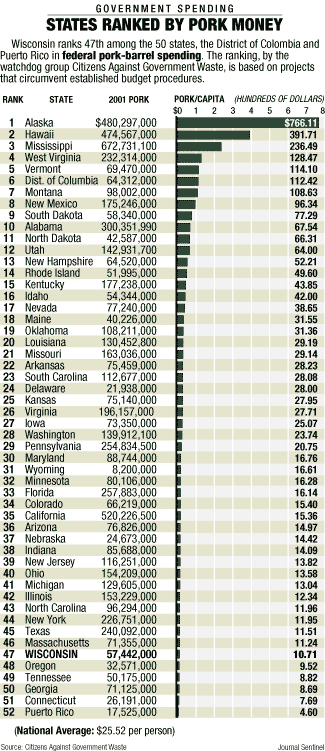

|
Document location https://akdart.com/pork.html Updated April 7, 2026. ©2026 by Andrew K. Dart |